EP3689136A1 - Cleaning of pet areas by autonomous cleaning robots - Google Patents
Cleaning of pet areas by autonomous cleaning robots Download PDFInfo
- Publication number
- EP3689136A1 EP3689136A1 EP20154900.3A EP20154900A EP3689136A1 EP 3689136 A1 EP3689136 A1 EP 3689136A1 EP 20154900 A EP20154900 A EP 20154900A EP 3689136 A1 EP3689136 A1 EP 3689136A1
- Authority
- EP
- European Patent Office
- Prior art keywords
- pet
- cleaning robot
- cleaning
- autonomous
- autonomous cleaning
- Prior art date
- Legal status (The legal status is an assumption and is not a legal conclusion. Google has not performed a legal analysis and makes no representation as to the accuracy of the status listed.)
- Pending
Links
Images





Classifications
-
- A—HUMAN NECESSITIES
- A01—AGRICULTURE; FORESTRY; ANIMAL HUSBANDRY; HUNTING; TRAPPING; FISHING
- A01K—ANIMAL HUSBANDRY; AVICULTURE; APICULTURE; PISCICULTURE; FISHING; REARING OR BREEDING ANIMALS, NOT OTHERWISE PROVIDED FOR; NEW BREEDS OF ANIMALS
- A01K1/00—Housing animals; Equipment therefor
- A01K1/01—Removal of dung or urine ; Removal of manure from stables
- A01K1/0128—Removal of dung or urine ; Removal of manure from stables by means of scrapers or the like moving continuously
-
- A—HUMAN NECESSITIES
- A47—FURNITURE; DOMESTIC ARTICLES OR APPLIANCES; COFFEE MILLS; SPICE MILLS; SUCTION CLEANERS IN GENERAL
- A47L—DOMESTIC WASHING OR CLEANING; SUCTION CLEANERS IN GENERAL
- A47L9/00—Details or accessories of suction cleaners, e.g. mechanical means for controlling the suction or for effecting pulsating action; Storing devices specially adapted to suction cleaners or parts thereof; Carrying-vehicles specially adapted for suction cleaners
- A47L9/28—Installation of the electric equipment, e.g. adaptation or attachment to the suction cleaner; Controlling suction cleaners by electric means
- A47L9/2805—Parameters or conditions being sensed
- A47L9/281—Parameters or conditions being sensed the amount or condition of incoming dirt or dust
- A47L9/2815—Parameters or conditions being sensed the amount or condition of incoming dirt or dust using optical detectors
-
- A—HUMAN NECESSITIES
- A47—FURNITURE; DOMESTIC ARTICLES OR APPLIANCES; COFFEE MILLS; SPICE MILLS; SUCTION CLEANERS IN GENERAL
- A47L—DOMESTIC WASHING OR CLEANING; SUCTION CLEANERS IN GENERAL
- A47L11/00—Machines for cleaning floors, carpets, furniture, walls, or wall coverings
- A47L11/24—Floor-sweeping machines, motor-driven
-
- A—HUMAN NECESSITIES
- A47—FURNITURE; DOMESTIC ARTICLES OR APPLIANCES; COFFEE MILLS; SPICE MILLS; SUCTION CLEANERS IN GENERAL
- A47L—DOMESTIC WASHING OR CLEANING; SUCTION CLEANERS IN GENERAL
- A47L11/00—Machines for cleaning floors, carpets, furniture, walls, or wall coverings
- A47L11/28—Floor-scrubbing machines, motor-driven
-
- A—HUMAN NECESSITIES
- A47—FURNITURE; DOMESTIC ARTICLES OR APPLIANCES; COFFEE MILLS; SPICE MILLS; SUCTION CLEANERS IN GENERAL
- A47L—DOMESTIC WASHING OR CLEANING; SUCTION CLEANERS IN GENERAL
- A47L7/00—Suction cleaners adapted for additional purposes; Tables with suction openings for cleaning purposes; Containers for cleaning articles by suction; Suction cleaners adapted to cleaning of brushes; Suction cleaners adapted to taking-up liquids
- A47L7/04—Suction cleaners adapted for additional purposes; Tables with suction openings for cleaning purposes; Containers for cleaning articles by suction; Suction cleaners adapted to cleaning of brushes; Suction cleaners adapted to taking-up liquids for using the exhaust air for other purposes, e.g. for distribution of chemicals in a room, for sterilisation of the air
-
- A—HUMAN NECESSITIES
- A47—FURNITURE; DOMESTIC ARTICLES OR APPLIANCES; COFFEE MILLS; SPICE MILLS; SUCTION CLEANERS IN GENERAL
- A47L—DOMESTIC WASHING OR CLEANING; SUCTION CLEANERS IN GENERAL
- A47L9/00—Details or accessories of suction cleaners, e.g. mechanical means for controlling the suction or for effecting pulsating action; Storing devices specially adapted to suction cleaners or parts thereof; Carrying-vehicles specially adapted for suction cleaners
- A47L9/28—Installation of the electric equipment, e.g. adaptation or attachment to the suction cleaner; Controlling suction cleaners by electric means
- A47L9/2805—Parameters or conditions being sensed
- A47L9/2821—Pressure, vacuum level or airflow
-
- A—HUMAN NECESSITIES
- A47—FURNITURE; DOMESTIC ARTICLES OR APPLIANCES; COFFEE MILLS; SPICE MILLS; SUCTION CLEANERS IN GENERAL
- A47L—DOMESTIC WASHING OR CLEANING; SUCTION CLEANERS IN GENERAL
- A47L9/00—Details or accessories of suction cleaners, e.g. mechanical means for controlling the suction or for effecting pulsating action; Storing devices specially adapted to suction cleaners or parts thereof; Carrying-vehicles specially adapted for suction cleaners
- A47L9/28—Installation of the electric equipment, e.g. adaptation or attachment to the suction cleaner; Controlling suction cleaners by electric means
- A47L9/2805—Parameters or conditions being sensed
- A47L9/2826—Parameters or conditions being sensed the condition of the floor
-
- A—HUMAN NECESSITIES
- A47—FURNITURE; DOMESTIC ARTICLES OR APPLIANCES; COFFEE MILLS; SPICE MILLS; SUCTION CLEANERS IN GENERAL
- A47L—DOMESTIC WASHING OR CLEANING; SUCTION CLEANERS IN GENERAL
- A47L9/00—Details or accessories of suction cleaners, e.g. mechanical means for controlling the suction or for effecting pulsating action; Storing devices specially adapted to suction cleaners or parts thereof; Carrying-vehicles specially adapted for suction cleaners
- A47L9/28—Installation of the electric equipment, e.g. adaptation or attachment to the suction cleaner; Controlling suction cleaners by electric means
- A47L9/2836—Installation of the electric equipment, e.g. adaptation or attachment to the suction cleaner; Controlling suction cleaners by electric means characterised by the parts which are controlled
- A47L9/2852—Elements for displacement of the vacuum cleaner or the accessories therefor, e.g. wheels, casters or nozzles
-
- A—HUMAN NECESSITIES
- A47—FURNITURE; DOMESTIC ARTICLES OR APPLIANCES; COFFEE MILLS; SPICE MILLS; SUCTION CLEANERS IN GENERAL
- A47L—DOMESTIC WASHING OR CLEANING; SUCTION CLEANERS IN GENERAL
- A47L9/00—Details or accessories of suction cleaners, e.g. mechanical means for controlling the suction or for effecting pulsating action; Storing devices specially adapted to suction cleaners or parts thereof; Carrying-vehicles specially adapted for suction cleaners
- A47L9/28—Installation of the electric equipment, e.g. adaptation or attachment to the suction cleaner; Controlling suction cleaners by electric means
- A47L9/2857—User input or output elements for control, e.g. buttons, switches or displays
-
- G—PHYSICS
- G05—CONTROLLING; REGULATING
- G05D—SYSTEMS FOR CONTROLLING OR REGULATING NON-ELECTRIC VARIABLES
- G05D1/00—Control of position, course, altitude or attitude of land, water, air or space vehicles, e.g. using automatic pilots
- G05D1/02—Control of position or course in two dimensions
- G05D1/021—Control of position or course in two dimensions specially adapted to land vehicles
- G05D1/0287—Control of position or course in two dimensions specially adapted to land vehicles involving a plurality of land vehicles, e.g. fleet or convoy travelling
-
- G—PHYSICS
- G05—CONTROLLING; REGULATING
- G05D—SYSTEMS FOR CONTROLLING OR REGULATING NON-ELECTRIC VARIABLES
- G05D1/00—Control of position, course, altitude or attitude of land, water, air or space vehicles, e.g. using automatic pilots
- G05D1/60—Intended control result
- G05D1/69—Coordinated control of the position or course of two or more vehicles
- G05D1/692—Coordinated control of the position or course of two or more vehicles involving a plurality of disparate vehicles
-
- A—HUMAN NECESSITIES
- A47—FURNITURE; DOMESTIC ARTICLES OR APPLIANCES; COFFEE MILLS; SPICE MILLS; SUCTION CLEANERS IN GENERAL
- A47L—DOMESTIC WASHING OR CLEANING; SUCTION CLEANERS IN GENERAL
- A47L2201/00—Robotic cleaning machines, i.e. with automatic control of the travelling movement or the cleaning operation
- A47L2201/04—Automatic control of the travelling movement; Automatic obstacle detection
-
- A—HUMAN NECESSITIES
- A47—FURNITURE; DOMESTIC ARTICLES OR APPLIANCES; COFFEE MILLS; SPICE MILLS; SUCTION CLEANERS IN GENERAL
- A47L—DOMESTIC WASHING OR CLEANING; SUCTION CLEANERS IN GENERAL
- A47L2201/00—Robotic cleaning machines, i.e. with automatic control of the travelling movement or the cleaning operation
- A47L2201/06—Control of the cleaning action for autonomous devices; Automatic detection of the surface condition before, during or after cleaning
Definitions
- Cleaning robots include mobile robots that autonomously perform cleaning tasks within an environment, e.g., a home. Many kinds of cleaning robots are autonomous to some degree and in different ways.
- the cleaning robots include a controller that is configured to autonomously navigate the cleaning robot about the environment such that the cleaning robot can perform a mopping function or ingest debris as it moves.
- an autonomous cleaning robot includes a drive operable to move the autonomous cleaning robot across a floor surface; a cleaning assembly configured to clean the floor surface; a receiver configured to receive an indication of cat activity in a cat box; and a controller configured to navigate the autonomous cleaning robot to the cat box to execute a cleaning mission in response to the received indication of cat activity.
- Embodiments can include one or more of the following features.
- One or more signals transmitted from the cat box is a source of the indication that the cat box needs to be cleaned.
- One or more sensors monitoring the cat box initiate transmission of the one or more signals.
- Monitoring the cat box includes sensing presence of a cat or sensing presence of debris scattered proximate to the cat box.
- the cleaning mission includes a first stage where a side brush of the autonomous cleaning robot is not active, and a second stage where the side brush of the autonomous cleaning robot is active.
- an autonomous cleaning robot includes a drive operable to move the autonomous cleaning robot across a floor surface; a cleaning assembly configured to clean the floor surface; a receiver configured to receive an indication of pet activity in a pet area; and a controller configured to navigate the autonomous cleaning robot to the pet area to execute a cleaning mission in response to the received indication of pet activity.
- Embodiments can include one or more of the following features.
- One or more signals transmitted from pet equipment located in the pet area is a source of the indication that the pet area needs to be cleaned.
- One or more sensors monitoring the pet equipment initiate transmission of the one or more signals.
- Monitoring the pet equipment includes sensing presence of a pet or sensing presence of debris scattered at pet area.
- a parameter of the cleaning mission depends upon the pet area that needs to be cleaned.
- the parameter includes a vacuum power level of the autonomous cleaning robot.
- the vacuum power level of the autonomous cleaning robot is higher than when the pet area includes pet equipment for a dog or cat.
- the parameter includes a type of cleaning by the autonomous cleaning robot.
- a vacuum power level of the autonomous cleaning robot is increased during the cleaning mission to ventilate an undesirable scent at the pet area.
- the autonomous cleaning robot includes a hookup to attach the autonomous cleaning robot to a port of pet equipment at the pet area for ventilating an undesirable scent.
- the autonomous cleaning robot includes a hookup to attach the autonomous cleaning robot to a port of pet equipment at the pet area for ventilating an undesirable scent.
- the cleaning assembly is configured to vacuum debris from the floor surface.
- An underside portion of the autonomous cleaning robot includes a cleaning pad holder for attaching a cleaning pad configured to hold liquid.
- a method of operating an autonomous cleaning robot includes receiving, at a computing device, an indication of activity of a pet at a pet area; determining a cleaning mission and one or more cleaning mission parameters for cleaning the pet area; and initiating, to the autonomous cleaning robot, a transmission including data for causing the autonomous cleaning robot to initiate the cleaning mission using the one or more cleaning mission parameters.
- Embodiments can include one or more of the following features.
- the one or more cleaning parameters represent a start time for the cleaning mission, the start time being provided by a user handheld computing device.
- Sensor monitoring of pet equipment at the pet area provides the indication of the pet activity at the pet area.
- the method includes determining one or more of the cleaning mission parameters based on a characteristic of the pet area.
- One of the cleaning mission parameters includes a vacuum power level, and including determining the vacuum power level based on an identity of the pet area.
- One of the cleaning mission parameters includes a vacuum power level for ventilating an undesirable scent.
- One of the cleaning mission parameters includes a wet or dry mopping setting.
- Pet debris left in a pet area by a pet e.g., a cat using a litter box, a dog entering through a pet door, a bird eating seeds in its cage, can be cleaned promptly and efficiently.
- the ability to detect an indication of pet activity at a pet area and in response deploy an autonomous cleaning robot to clean the pet area reduces the burden on the pet owner to attend to cleaning tasks typically associated with pet ownership. By cleaning pet areas promptly, less pet debris is tracked around other areas, such as other rooms of a house, contributing to generally enhanced household cleanliness.
- an autonomous cleaning robot such as a vacuum cleaning robot or a mopping robot
- a pet area such as the area in the vicinity of a litter box, dog door, pet food or water dish, bird or small animal cage, or other type of pet area.
- Sensors in the pet area detect signals indicative of pet activity in the pet area, such as the presence of a pet in the pet area, motion in the pet area, or the presence of pet debris, such as food, litter, dirt, or pet hair, in the pet area.
- an autonomous cleaning robot can be deployed to execute a cleaning mission in the pet area.
- the deployment of the autonomous cleaning robot can be automatic, e.g., based on an automated determination that the signals sensed by the sensors in the pet area are indicative of pet activity; or can be in response to user input, e.g., based on a user viewing information indicative of the detected signals.
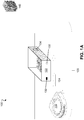
- an autonomous cleaning robot 110 is operable to clean a pet area 120 in the vicinity of a litter box 122, such as a litter box for a cat.
- the autonomous cleaning robot 110 can be operable to clean pet debris 124 from the floor or other surface on which the litter box 122 is disposed.
- the pet debris 124 can include cat litter that has been tracked out of the litter box 122, e.g., when a cat exits the litter box 122.
- the pet debris 124 can include other types of debris, such as dirt, cat hair, or other debris.
- the autonomous cleaning robot 110 can be configured for vacuum cleaning.
- an autonomous cleaning robot can employ a wet cleaning pad configured to hold liquid and to be used during a mopping cleaning mission (e.g., autonomous cleaning robot 111 shown in Fig. 5 ).
- the autonomous cleaning robot 111 (again referring briefly to Fig. 5 ) can employ a dry cleaning pad configured to be used for sweeping or dusting.
- a single autonomous cleaning robot can be configured for both vacuum cleaning and mopping, and can be operable to clean the pet area 120 by first vacuum cleaning the pet area and then mopping the pet area.
- a set of autonomous cleaning robots can be operable to clean the pet area 120 as a team. For instance, a first autonomous cleaning robot (e.g., the autonomous cleaning robot 110) can vacuum clean the pet area, and subsequently a second autonomous cleaning robot (e.g., the autonomous cleaning robot 111 of Fig. 5 ) can mop the pet area.
- a sensor 130 in the pet area 120 is configured to sense a characteristic of the pet area 120 indicative of pet activity in the pet area 120.
- An indication of pet activity can include an indication of the presence of a pet or pet debris in the pet area.
- Example characteristics indicative of pet activity in a pet area can include, e.g., the presence of pet debris 124 outside the litter box, the presence of a pet in or near the litter box, the exiting of a pet from the litter box, the sound of cat litter hitting the floor, or another characteristic of the pet area.
- the sensor 130 can be incorporated into the litter box 122 (as shown in Fig. 1 ), e.g., integrated into or attached to a wall or base of the litter box, or can be disposed in the pet area 120.
- the senor 130 can be an optical sensor, such as a camera, that captures images of an exterior of the litter box 122, e.g., that can be analyzed to detect the presence of pet debris 124 outside of the litter box 122.
- the sensor 130 can be an optical sensor, such as a camera, that can detect the presence of a cat in the litter box 122.
- the sensor 130 can be a motion sensor that detects motion in the vicinity of the litter box 122, e.g., motion of a cat entering or exiting the litter box 122. The motion sensor can be sensitive to a direction of the motion, e.g., to distinguish between a cat entering the litter box and a cat exiting from the litter box.
- the senor 130 can be a weight sensor that detects a weight of contents of the litter box 122, which can be indicative of, e.g., the presence of a cat in the litter box.
- the sensor 130 can be a pressure sensor, such as a capacitive sensor having a capacitance that changes with applied pressure, that can detect a pressure applied by the contents of the litter box 122, e.g., indicative of the presence of a cat in the litter box.
- the sensor 130 can be an acoustic sensor that detects the sound of cat litter scattering on the floor.
- Other types of sensors 130 can also be used, such as an infrared sensor, a break sensor, or another type of sensor capable of sensing a characteristic of the pet area 120 indicative of pet activity in the pet area 120.
- a transmitter 132 is electronically coupled to the sensor 130, e.g., by a wired or wireless connection, such as a short-range wireless connection.
- the transmitter 132 transmits signals detected by the sensor 130 to a remote computing device 140, such as a cloud-based computing system, via a wired or wireless connection, such as a wireless Internet connection.
- the signals transmitted by the transmitter 132 can provide identification of the type of pet area 120, e.g., a litter box 122, a dog food bowl, a bird cage, a dog door, or another type of pet area.
- the remote computing device 140 processes the signals to determine whether the signal is indicative of pet activity in the pet area 120 (discussed further below). When it is determined that the signal is indicative of pet activity, the remote computing device 140 transmits a command to the autonomous cleaning robot 110 instructing the autonomous cleaning robot 110 to execute a cleaning mission in the pet area 120.
- a cleaning mission is a period of operation of the autonomous cleaning robot 110 in which the autonomous cleaning robot cleans a floor surface according to a set of cleaning parameters, including scheduling parameters (e.g., start time, duration), execution parameters (e.g., vacuum power level, type of cleaning), and navigational parameters (e.g., an indication of the area to be cleaned).
- executing a cleaning mission in the pet area 120 can include cleaning the pet area 120 and all areas within a specified range (e.g., 1-5 feet) of the pet area. In some examples, executing a cleaning mission in the pet area 120 can include a first stage of vacuum cleaning the pet area 120 and all areas within a specified range of the pet area using a specified vacuum power level, and a second stage of wet mopping the pet area 120.
- a specified range e.g. 1-5 feet
- the cleaning mission can include multiple stages.
- the cleaning mission can include a first stage in which the autonomous cleaning robot 110 cleans the pet area 120 with a side brush of the autonomous cleaning robot not being active, and a second stage in which the autonomous cleaning robot 110 again cleans the pet area with the side brush activated.
- Operation of the side brush of an autonomous cleaning robot 110 can cause debris in the path of the autonomous cleaning robot to be scattered, e.g., pet debris 124 can be scattered outside the pet area 120 by operation of the side brush.
- This example two-stage cleaning mission helps to reduce such scattering of debris.
- the autonomous cleaning robot 110 When the autonomous cleaning robot 110 receives a command to execute a cleaning mission in the pet area 120, the autonomous cleaning robot 110 navigates to the location of the pet area 120 to execute the cleaning mission according to the command, e.g., according to one or more cleaning parameters for the cleaning mission (discussed further below).
- the location of the pet area 120 can be identified by an imaging device, such as a camera, on the autonomous cleaning robot 110. For instance, the autonomous cleaning robot 110 can explore an area, such as a room, until the camera captures an image of the pet area 120, and the autonomous cleaning robot 110 can then navigate to the pet area 120.
- the location of the pet area 120 can be identified by user indication, e.g., by user input into a user interface of a computing device.
- the location of the pet area 120 can be identified by wireless (e.g., Wi-Fi) localization.
- the autonomous cleaning robot 110 can have previously generated a map of an area, such as a room, in which the pet area 120 is located, and the autonomous cleaning robot 110 can rely on the previously generated map in navigating to the pet area 120.
- the litter box 122 can include a port 134, such as an opening, a door or hatch, or a port sized and dimensioned to interlock with a mating feature, such as a hookup, on the autonomous cleaning robot 110.
- the autonomous cleaning robot 110 can be a vacuum cleaning robot that can move near the port 134 and can suck in air from the interior of the litter box 122 through the port 134. The air sucked in through the port 134 can be passed through a filter of the autonomous cleaning robot 110, e.g., to ventilate an undesirable scent in the interior of the litter box 122.
- the autonomous cleaning robot 110 can suck in and filter air in the general vicinity of the litter box 122, e.g., to ventilate an undesirable scent in the general vicinity of the litter box 122.
- a vacuum power of the autonomous cleaning robot 110 can be increased for a scent ventilation portion of the cleaning mission.
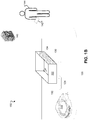
- the transmitter 132 transmits signals detected by the sensor 130 to a mobile device 142, such as a mobile phone, tablet, wearable computing device, or other type of mobile computing device.
- a mobile device 142 such as a mobile phone, tablet, wearable computing device, or other type of mobile computing device.
- Information based on the transmitted signals can be presented on a display interface of the mobile device 142, e.g., for review by a user 144.
- the user 144 can provide an input into the mobile device 142 indicating that the user would like the autonomous cleaning robot 110 to clean the pet area 120, e.g., when the user determines that the signals are indicative of pet activity in the pet area 120.
- the mobile device 142 can transmit a command to the autonomous cleaning robot 110 instructing the autonomous cleaning robot 110 to execute a cleaning mission in the pet area 120. In some examples, responsive to receipt of the user input, the mobile device 142 can transmit a signal to the remote computing device 140, which can then transmit a command to the autonomous cleaning robot 110 instructing the autonomous cleaning robot 110 to execute a cleaning mission in the pet area 120.
- the autonomous cleaning robot 110 is operable to clean a pet area 220 in the vicinity of a pet door, such as a pet door 222 installed in a larger door 226, such as the door of a house.
- a pet door such as a pet door 222 installed in a larger door 226, such as the door of a house.
- the sensor 130 and transmitter 132 are incorporated into the pet door 222, e.g., integrated into or attached to the pet door 222.
- the sensor 130 and transmitter 132 can be disposed elsewhere in the pet area 220, such as on the larger door, a door frame, on a nearby wall, or elsewhere.
- the sensor 130 is configured to sense a characteristic of the pet area 220 indicative of pet activity in the pet area 220, such as the presence of pet debris 224 such as dirt, footprints, or pet hair; the presence of a pet in the pet area 220; the motion of the pet door 222, the sound of a pet scratching on the pet door 220; or another characteristic of the pet area.
- the senor 130 can be an optical sensor, such as a camera, that captures images of the floor in front of the pet door 222, e.g., that can be analyzed to detect the presence of pet debris 224.
- the sensor 130 can be a motion sensor that detects motion of the pet door 222. The motion sensor can be sensitive to a direction of the motion, e.g., to distinguish between a pet entering the pet door 222 and a pet exiting from the pet door 222.
- the sensor 130 can be an acoustic sensor that detects the sound of an animal scratching at the pet door 222. Other types of sensors 130 can also be used in conjunction with the pet door 222.
- the autonomous cleaning robot 110 is operable to clean a pet area 320 in the vicinity of a bird cage 322.
- the sensor 130 and transmitter 132 are incorporated into the structure of the bird cage 322, e.g., integrated into or attached to the bird cage 322 and its base. In some examples, the sensor 130 and transmitter 132 can be disposed elsewhere in the pet area 320.
- the sensor 130 is configured to sense a characteristic of the pet area 320 indicative of pet activity in the pet area 320, such as the presence of pet debris 324 such as food or feathers on the ground; the motion of pet debris falling to the ground; or another characteristic of the pet area.
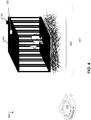
- the autonomous cleaning robot 110 is operable to clean a pet area 420 in the vicinity of a cage 422 for a small animal, such as a rabbit, guinea pig, hamster, or other small animal.
- a small animal such as a rabbit, guinea pig, hamster, or other small animal.
- the sensor 130 and transmitter 132 are incorporated into the structure of the cage 422, e.g., integrated into or attached to the cage 422. In some examples, the sensor 130 and transmitter 132 can be disposed elsewhere in the pet area 420.
- the sensor 130 is configured to sense a characteristic of the pet area 420 indicative of pet activity in the pet area 420, such as the presence of pet debris 424 such as food, pet hair, or cage lining material (e.g., hay or wood chips); or another characteristic of the pet area.
- a characteristic of the pet area 420 indicative of pet activity in the pet area 420 such as the presence of pet debris 424 such as food, pet hair, or cage lining material (e.g., hay or wood chips); or another characteristic of the pet area.
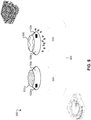
- two autonomous cleaning robots 110, 111 are operable (e.g., by vacuuming, mopping, etc.) to clean a pet area 520 in the vicinity of a pet food bowl 522 and a pet water dish 526.
- Pet debris 524 in the pet area 520 can be, e.g., spilled pet food, pet hair, spilled water, or other types of pet debris.
- the autonomous cleaning robots 110, 111 can be different types of cleaning robots.
- the autonomous cleaning robot 110 can be a robot configured for a vacuum cleaning mission and the autonomous cleaning robot 111 can be a robot configured for a wet mopping mission.
- a sensor 130a and transmitter 132a are incorporated into the pet food bowl 522, e.g., integrated into or attached to the pet food bowl 522.
- a sensor 130b and transmitter 132b are incorporated into the pet water dish 526.
- Each transmitter 132a, 132b transmits signals detected by the corresponding sensors 130a, 130b, respectively.
- the sensors 130a, 130b are the same type of sensor.
- the sensors 130a, 130b can be optical sensors that capture images of a pet at the pet food bowl 522 and the pet water dish 524, respectively.
- the sensors 130a, 130b can be different types of sensors.
- the sensor 130a can be an acoustic sensor that detects the sound of pet food hitting the floor
- the sensor 130b can be a weight sensor that detects decreasing weight of the water in the pet water dish 524.
- a command is transmitted to one or both autonomous cleaning robots 110, 111 with instructions for a cleaning mission.
- the autonomous cleaning robot to which the command is transmitted can depend on the sensor that detected the characteristic indicative of pet activity in the pet area 520. For instance, detection by the sensor 130a of pet food spilled on the floor can result in the command being transmitted to the vacuum cleaning robot 110, while detection by the sensor 130b of decreasing water volume in the pet water dish 524 can result in the command being transmitted to the wet mopping robot 111.
- a sensor in the pet area senses (650) a characteristic of the pet area 620 indicative of pet activity in the pet area.
- the characteristic of the pet area 620 can be, e.g., the presence of an animal in the pet area, the motion of an animal entering or exiting the pet area, the presence of pet debris in the pet area, or another characteristic.
- a signal is transmitted (652) from the pet area 620 to a remote computing device, e.g., via a wired or wireless Internet connection.
- the remote computing device can be a cloud-based computing system 140 having one or more processors 141.
- signals can be transmitted intermittently, e.g., when a sensor in the pet area 620 has sensed a characteristic (e.g., motion).
- signals can be transmitted periodically or streamed.
- receipt of a signal at the cloud-based computing system 140 is sufficient to trigger a determination that the signal is indicative of pet activity in the pet area 620.
- a motion sensor may provide a signal only when motion is detected, and receipt of a signal detected by a motion sensor can be sufficient to indicate pet activity in the pet area 620.
- the cloud-based computing system 140 can process one or more received signals to determine whether the signals are indicative of pet activity in the pet area 620.
- the cloud-based computing system 140 can perform image processing of images transmitted from the pet area 620 to identify the presence of pet debris in the pet area 620.
- the cloud-based computing system 140 can determine whether a change in weight or capacitance between successive signals is indicative that a cat has exited a litter box in the pet area 620.
- cleaning parameters can include, e.g., scheduling parameters (such as a start time or a duration), execution parameters (such as a vacuum power level or a type of cleaning, e.g., spot cleaning, edge cleaning, vacuum cleaning, wet cleaning, etc.), and navigational parameters (e.g., an indication of an area to be cleaned, such as a range from a target location or a boundary defining the area to be cleaned).
- scheduling parameters such as a start time or a duration
- execution parameters such as a vacuum power level or a type of cleaning, e.g., spot cleaning, edge cleaning, vacuum cleaning, wet cleaning, etc.
- navigational parameters e.g., an indication of an area to be cleaned, such as a range from a target location or a boundary defining the area to be cleaned.
- the start time can include a delay after the animal has left the pet area, e.g., to help reduce the risk that the animal may continue to soil the pet area.
- the cleaning parameters can depend on the nature of the pet area 620, such as the type of pet area (e.g., litter box, food dish, pet door, bird cage, etc.). For instance, if the pet area 620 includes a bird cage, the cleaning parameters can indicate a more intensive cleaning, e.g., a higher vacuum power for a vacuum cleaning mission, than if the pet area 620 includes a litter box. For instance, if the pet area 620 includes a pet door, the cleaning parameters can indicate wet cleaning.
- the type of pet area e.g., litter box, food dish, pet door, bird cage, etc.
- the cleaning parameters can indicate a more intensive cleaning, e.g., a higher vacuum power for a vacuum cleaning mission, than if the pet area 620 includes a litter box.
- the cleaning parameters can indicate wet cleaning.
- the cloud-based computing system 140 transmits (656) a command to the autonomous cleaning robot 110, e.g., via a wired or wireless Internet connection, to cause the autonomous cleaning robot 110 to execute a cleaning mission according to the cleaning parameters.
- the cleaning parameters can instruct the autonomous cleaning robot 110 to perform specific cleaning tasks in the pet area 620.
- the command can be transmitted at a scheduled time, such as based on a time delay after the pet has left the pet area 620.
- the cloud-based computing system 140 can check whether the scheduling parameters for the pet area cleaning mission conflict with a previously scheduled cleaning mission. If the scheduling parameters for the pet area cleaning mission do conflict with a previously stored schedule, the cloud-based computing system 140 can transmit a notification to a mobile device 142 of a user of the autonomous cleaning robot 110 asking for a selection of either the pet area cleaning mission or the previously scheduled cleaning mission, or can reschedule either the pet area cleaning mission or the previously scheduled cleaning mission without user input.
- the autonomous cleaning robot 110 receives the command (658) and one or more processors 112 of the autonomous cleaning robot 110 cause the autonomous cleaning robot 110 to execute (660) the cleaning mission according to the cleaning parameters.
- the autonomous cleaning robot 110 can transmit a notification for presentation (662) on the mobile device 142, e.g., via a wireless Internet connection or a short-range communications protocol, indicative that the cleaning mission in the pet area 620 has been completed.
- the autonomous cleaning robot 110 can transmit a notification to the cloud-based computing system 140 indicative that the cleaning mission has been completed.
- a sensor in the pet area senses (750) a characteristic of the pet area 720 indicative of pet activity in the pet area 720.
- the characteristic of the pet area 720 can be, e.g., the presence of an animal in the pet area, the motion of an animal entering or exiting the pet area, the presence of pet debris in the pet area, or another characteristic.
- a signal is transmitted (752) from the pet area 720 to the mobile device 142 of a user of the autonomous cleaning robot 110, e.g., via a wireless Internet connection or a short-range communications protocol.
- signals can be transmitted intermittently, e.g., when a sensor in the pet area 720 has sensed a characteristic (e.g., motion).
- signals can be transmitted periodically or streamed.
- the mobile device 142 includes one or more processors 144 configured to execute a mobile application 146 for presentation of scheduling interfaces for the autonomous cleaning robot 110 on a display of the mobile device 142. Based on the signal received by the mobile device 140 from the pet area, information is displayed through the scheduling interfaces of the mobile device 140. For instance, images of the pet area 720, timestamps at which motion of a pet door was detected, a graph showing sensed weight of a litter box, or other information can be displayed. The user can review the displayed information and determine whether the displayed information is indicative of pet activity in the pet area 720.
- the user can input (754) a cleaning command into the mobile device 142.
- the user can input the cleaning command by a physical interaction, such as a button or a touch screen display.
- the user can input a spoken cleaning command that can be processed by natural language processing to prepare the command.
- the cleaning command can be an indication that a cleaning mission should be executed by the autonomous cleaning robot 110.
- the cleaning command can specify one or more cleaning parameters for the cleaning mission, such as a start time, a duration, a type of cleaning, or another cleaning parameter.
- a signal indicative of the cleaning command is transmitted (756) to the cloud-based computing system 140, e.g., via a wired or wireless Internet connection.
- the cloud-based computing system 140 determines (758) cleaning parameters for the cleaning mission. In some examples, the determination of cleaning parameters can be based at least in part on the cleaning parameters specified by the user-inputted cleaning command.
- the cloud-based computing system 140 transmits (760) a command to the autonomous cleaning robot 110, e.g., via a wired or wireless Internet connection, to cause the autonomous cleaning robot 110 to execute a cleaning mission according to the cleaning parameters.
- the command can be transmitted at a scheduled time, such as based on a time delay after the pet has left the pet area 720.
- the autonomous cleaning robot 110 receives the command (762) and the one or more processors 112 of the autonomous cleaning robot 110 cause the autonomous cleaning robot 110 to execute (764) the cleaning mission according to the cleaning parameters. In some examples, following completion of the cleaning mission, the autonomous cleaning robot 110 can transmit (766) a notification to the mobile device 142, the cloud-based computing system 140, or both, indicative that the cleaning mission has been completed.
- an indication of pet activity in a pet area is received (800) at a computing device, such as a cloud-based computing device or a mobile device.
- the indication of pet activity can be received from one or more sensors in the pet area.
- a cleaning mission including one or more cleaning parameters for the cleaning mission, is determined (802) for cleaning the pet area.
- the cleaning parameters can include, e.g., a start time for the cleaning mission, a duration of the cleaning mission, a type of cleaning for the cleaning mission (e.g., vacuum cleaning or wet or dry mopping), or other parameters.
- the cleaning parameters can be provided through a mobile device, e.g., by a spoken input that is processed by the mobile device or by the cloud-based computing device using natural language processing.
- the cleaning parameters can be determined by the cloud-based computing device, e.g., based on the nature of the pet area.
- a transmission to the autonomous cleaning robot is initiated (804).
- the transmission includes data, such as a command, that cause the autonomous cleaning robot to initiate and execute (806) the cleaning mission according to the one or more cleaning parameters.
- an example of an autonomous cleaning robot 900 includes a chassis 910, a controller 920, memory 922, a battery 924, a battery charger 926, a human-machine interface (HMI) 928, a drive system 930, a mapping/navigation system 940, a cleaning assembly 942, a wireless communication system 950, an IR emitter 960, environmental sensors 970A-H, a debris bin 942A (to store debris collected by a cleaning operation), a bin level sensor 942B, a dirt extraction sensor 942C (to detect the density of characteristics of the debris collected by the cleaning operation), an indicator light 974A, an audio transducer 974B, a ranging device 976, and a cleaning mode selection switch or button 974C.
- HMI human-machine interface
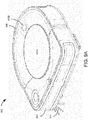
- the environmental sensors 970A-970H can include a camera 970B mounted on a top surface of the autonomous cleaning robot 900, as shown in the top perspective view of FIG. 9A .
- the camera 970B can be used to navigate the autonomous cleaning robot 900 and acquire images for other operational use.
- the camera 970B can be a visual simultaneous location and mapping (VSLAM) camera and is used to detect features and landmarks in the operating environment and build an occupancy map based thereon.
- VSLAM visual simultaneous location and mapping
- the autonomous cleaning robot 900 can include one or more of a bumper 904, cliff sensors 195A-195D, and an edge brush 911 mounted or otherwise positioned at a periphery of a housing 906 of the autonomous cleaning robot 900.
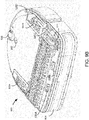
- the housing 106 is illustrated in FIGS. 9A-9B as having a squared front section on which the bumper 904 is mounted; however, the housing may have a rounded or circular shape in other embodiments.
- a caster wheel 196 can be disposed on the underside of the autonomous cleaning robot 900.
- the caster wheel 196 can be positioned at an opposite end of the autonomous cleaning robot 900 than the cleaning assembly 942, with the drive rollers/tracks 932A, 932B therebetween, such that the cleaning assembly 942 is a cantilevered arrangement.
- the autonomous cleaning robot 900 may also include downward- or floor-facing camera 197.
- the autonomous cleaning robot 900 may be generally configured in the manner of or include features from the Roomba® floor cleaning robot and/or robots as described in U.S. Pat. No. 7,024,278 and U.S. Pat. No. 8,374,721 , the disclosures of which are incorporated herein by reference, with suitable modifications.
- the autonomous cleaning robot 900 can be configured as an autonomous patrolling robot that includes a telescoping mast having one or more elements associated with the sensor elements 970A-H and/or the wireless communication circuit or system 950 mounted thereon or otherwise operably associated therewith.
- the controller 920 can include any suitably configured processor or processors.
- the processor(s) can include one or more data processing circuits, such as a general purpose and/or special purpose processor (such as a microprocessor and/or digital signal processor) that may be collocated or distributed across one or more networks.
- the processor is configured to execute program code stored in the memory 922, e.g., a computer readable storage medium, to perform some or all of the operations and methods that are described above for one or more of the embodiments.
- the memory 922 is representative of the one or more memory devices containing the software and data used for facilitating operations of the robot in accordance with some embodiments of the present disclosure.
- the memory 922 can include, but is not limited to, the following types of devices: cache, ROM, PROM, EPROM, EEPROM, flash, SRAM, and DRAM.
- the processor is thus in communication with the controller 900, memory 922, the cleaning system 942 and drive system 930.
- the drive system 930 can include any suitable mechanism or system for actively and controllably transiting the autonomous cleaning robot 900 through an environment (e.g., to and through a pet area).
- the drive system 930 can include a roller, rollers, track or tracks 932A, 932B and one or more onboard (i.e., carried by the autonomous cleaning robot 900) electric motors 934 operable by the controller 920 to convey the autonomous cleaning robot 900 across the floor of its operating environment.
- the service operation system 942 is operable to execute a service operation in the living space 90.
- the service operation system 942 includes a floor cleaning system that cleans a floor surface of an environment (e.g., a pet area) as the autonomous cleaning robot 900 transits through the environment.
- the service operation system 942 can include a suction head and an onboard vacuum generator to vacuum clean the floor.
- the service operation system 942 can include an end effector such as (but not limited to) a sweeping or mopping mechanism, one or more rotating brushes, rollers, wet or dry stationary or oscillating and/or vibrating cloths, or multilayer pad assemblies.
- the wireless communication system 950 includes a wireless communication transceiver or module 952 and an associated antenna 954 to enable wireless communication between the robot 900 and other connected devices in the operating environment of the autonomous cleaning robot.
- the wireless communication transceiver or module 952 may be a Wi-Fi module.
Landscapes
- Engineering & Computer Science (AREA)
- Mechanical Engineering (AREA)
- Life Sciences & Earth Sciences (AREA)
- Automation & Control Theory (AREA)
- Aviation & Aerospace Engineering (AREA)
- Radar, Positioning & Navigation (AREA)
- Remote Sensing (AREA)
- Physics & Mathematics (AREA)
- General Physics & Mathematics (AREA)
- Environmental Sciences (AREA)
- Animal Husbandry (AREA)
- Biodiversity & Conservation Biology (AREA)
- Zoology (AREA)
- Electric Vacuum Cleaner (AREA)
- Control Of Position, Course, Altitude, Or Attitude Of Moving Bodies (AREA)
- Housing For Livestock And Birds (AREA)
Abstract
Description
- Cleaning robots include mobile robots that autonomously perform cleaning tasks within an environment, e.g., a home. Many kinds of cleaning robots are autonomous to some degree and in different ways. The cleaning robots include a controller that is configured to autonomously navigate the cleaning robot about the environment such that the cleaning robot can perform a mopping function or ingest debris as it moves.
- In an aspect, an autonomous cleaning robot includes a drive operable to move the autonomous cleaning robot across a floor surface; a cleaning assembly configured to clean the floor surface; a receiver configured to receive an indication of cat activity in a cat box; and a controller configured to navigate the autonomous cleaning robot to the cat box to execute a cleaning mission in response to the received indication of cat activity.
- Embodiments can include one or more of the following features.
- One or more signals transmitted from the cat box is a source of the indication that the cat box needs to be cleaned. One or more sensors monitoring the cat box initiate transmission of the one or more signals. Monitoring the cat box includes sensing presence of a cat or sensing presence of debris scattered proximate to the cat box.
- The cleaning mission includes a first stage where a side brush of the autonomous cleaning robot is not active, and a second stage where the side brush of the autonomous cleaning robot is active.
- In an aspect, an autonomous cleaning robot includes a drive operable to move the autonomous cleaning robot across a floor surface; a cleaning assembly configured to clean the floor surface; a receiver configured to receive an indication of pet activity in a pet area; and a controller configured to navigate the autonomous cleaning robot to the pet area to execute a cleaning mission in response to the received indication of pet activity.
- Embodiments can include one or more of the following features.
- One or more signals transmitted from pet equipment located in the pet area is a source of the indication that the pet area needs to be cleaned. One or more sensors monitoring the pet equipment initiate transmission of the one or more signals. Monitoring the pet equipment includes sensing presence of a pet or sensing presence of debris scattered at pet area.
- A parameter of the cleaning mission depends upon the pet area that needs to be cleaned. The parameter includes a vacuum power level of the autonomous cleaning robot. When the pet area includes a bird cage, the vacuum power level of the autonomous cleaning robot is higher than when the pet area includes pet equipment for a dog or cat. The parameter includes a type of cleaning by the autonomous cleaning robot.
- A vacuum power level of the autonomous cleaning robot is increased during the cleaning mission to ventilate an undesirable scent at the pet area. The autonomous cleaning robot includes a hookup to attach the autonomous cleaning robot to a port of pet equipment at the pet area for ventilating an undesirable scent.
- The autonomous cleaning robot includes a hookup to attach the autonomous cleaning robot to a port of pet equipment at the pet area for ventilating an undesirable scent.
- The cleaning assembly is configured to vacuum debris from the floor surface.
- An underside portion of the autonomous cleaning robot includes a cleaning pad holder for attaching a cleaning pad configured to hold liquid.
- In an aspect, a method of operating an autonomous cleaning robot includes receiving, at a computing device, an indication of activity of a pet at a pet area; determining a cleaning mission and one or more cleaning mission parameters for cleaning the pet area; and initiating, to the autonomous cleaning robot, a transmission including data for causing the autonomous cleaning robot to initiate the cleaning mission using the one or more cleaning mission parameters.
- Embodiments can include one or more of the following features.
- The one or more cleaning parameters represent a start time for the cleaning mission, the start time being provided by a user handheld computing device.
- Sensor monitoring of pet equipment at the pet area provides the indication of the pet activity at the pet area.
- The method includes determining one or more of the cleaning mission parameters based on a characteristic of the pet area. One of the cleaning mission parameters includes a vacuum power level, and including determining the vacuum power level based on an identity of the pet area.
- One of the cleaning mission parameters includes a vacuum power level for ventilating an undesirable scent.
- One of the cleaning mission parameters includes a wet or dry mopping setting.
- The approaches to cleaning of pet areas by autonomous cleaning robots as described here can have one or more of the following advantages. Pet debris left in a pet area by a pet, e.g., a cat using a litter box, a dog entering through a pet door, a bird eating seeds in its cage, can be cleaned promptly and efficiently. The ability to detect an indication of pet activity at a pet area and in response deploy an autonomous cleaning robot to clean the pet area reduces the burden on the pet owner to attend to cleaning tasks typically associated with pet ownership. By cleaning pet areas promptly, less pet debris is tracked around other areas, such as other rooms of a house, contributing to generally enhanced household cleanliness.
- The details of one or more implementations are set forth in the accompanying drawings and the description below. Other features and advantages will be apparent from the description and drawings, and from the claims.
-
-
Figs. 1A ,1B , and2-5 are diagrams of example environments for an autonomous cleaning robot. -
Figs. 6 and7 are process flow diagrams. -
Fig. 8 is a flow chart. -
Figs. 9A-9C are diagrams of an autonomous cleaning robot. - Described herein is an approach to deploying an autonomous cleaning robot, such as a vacuum cleaning robot or a mopping robot, to clean a pet area, such as the area in the vicinity of a litter box, dog door, pet food or water dish, bird or small animal cage, or other type of pet area. Sensors in the pet area detect signals indicative of pet activity in the pet area, such as the presence of a pet in the pet area, motion in the pet area, or the presence of pet debris, such as food, litter, dirt, or pet hair, in the pet area. Responsive to the detection of pet activity in the pet area, an autonomous cleaning robot can be deployed to execute a cleaning mission in the pet area. The deployment of the autonomous cleaning robot can be automatic, e.g., based on an automated determination that the signals sensed by the sensors in the pet area are indicative of pet activity; or can be in response to user input, e.g., based on a user viewing information indicative of the detected signals.
- Referring to
Fig. 1A , in anexample environment 100, anautonomous cleaning robot 110 is operable to clean apet area 120 in the vicinity of alitter box 122, such as a litter box for a cat. Theautonomous cleaning robot 110 can be operable to cleanpet debris 124 from the floor or other surface on which thelitter box 122 is disposed. Thepet debris 124 can include cat litter that has been tracked out of thelitter box 122, e.g., when a cat exits thelitter box 122. Thepet debris 124 can include other types of debris, such as dirt, cat hair, or other debris. - In some examples, the
autonomous cleaning robot 110 can be configured for vacuum cleaning. In some examples, an autonomous cleaning robot can employ a wet cleaning pad configured to hold liquid and to be used during a mopping cleaning mission (e.g.,autonomous cleaning robot 111 shown inFig. 5 ). In some examples, the autonomous cleaning robot 111 (again referring briefly toFig. 5 ) can employ a dry cleaning pad configured to be used for sweeping or dusting. In some examples, a single autonomous cleaning robot can be configured for both vacuum cleaning and mopping, and can be operable to clean thepet area 120 by first vacuum cleaning the pet area and then mopping the pet area. In some examples, a set of autonomous cleaning robots can be operable to clean thepet area 120 as a team. For instance, a first autonomous cleaning robot (e.g., the autonomous cleaning robot 110) can vacuum clean the pet area, and subsequently a second autonomous cleaning robot (e.g., theautonomous cleaning robot 111 ofFig. 5 ) can mop the pet area. - A
sensor 130 in thepet area 120 is configured to sense a characteristic of thepet area 120 indicative of pet activity in thepet area 120. An indication of pet activity can include an indication of the presence of a pet or pet debris in the pet area. Example characteristics indicative of pet activity in a pet area can include, e.g., the presence ofpet debris 124 outside the litter box, the presence of a pet in or near the litter box, the exiting of a pet from the litter box, the sound of cat litter hitting the floor, or another characteristic of the pet area. Thesensor 130 can be incorporated into the litter box 122 (as shown inFig. 1 ), e.g., integrated into or attached to a wall or base of the litter box, or can be disposed in thepet area 120. - In some examples, the
sensor 130 can be an optical sensor, such as a camera, that captures images of an exterior of thelitter box 122, e.g., that can be analyzed to detect the presence ofpet debris 124 outside of thelitter box 122. In some examples, thesensor 130 can be an optical sensor, such as a camera, that can detect the presence of a cat in thelitter box 122. In some examples, thesensor 130 can be a motion sensor that detects motion in the vicinity of thelitter box 122, e.g., motion of a cat entering or exiting thelitter box 122. The motion sensor can be sensitive to a direction of the motion, e.g., to distinguish between a cat entering the litter box and a cat exiting from the litter box. In some examples, thesensor 130 can be a weight sensor that detects a weight of contents of thelitter box 122, which can be indicative of, e.g., the presence of a cat in the litter box. In some examples, thesensor 130 can be a pressure sensor, such as a capacitive sensor having a capacitance that changes with applied pressure, that can detect a pressure applied by the contents of thelitter box 122, e.g., indicative of the presence of a cat in the litter box. In some examples, thesensor 130 can be an acoustic sensor that detects the sound of cat litter scattering on the floor. Other types ofsensors 130 can also be used, such as an infrared sensor, a break sensor, or another type of sensor capable of sensing a characteristic of thepet area 120 indicative of pet activity in thepet area 120. - A
transmitter 132 is electronically coupled to thesensor 130, e.g., by a wired or wireless connection, such as a short-range wireless connection. In some examples, thetransmitter 132 transmits signals detected by thesensor 130 to aremote computing device 140, such as a cloud-based computing system, via a wired or wireless connection, such as a wireless Internet connection. In some examples, the signals transmitted by thetransmitter 132 can provide identification of the type ofpet area 120, e.g., alitter box 122, a dog food bowl, a bird cage, a dog door, or another type of pet area. - The
remote computing device 140 processes the signals to determine whether the signal is indicative of pet activity in the pet area 120 (discussed further below). When it is determined that the signal is indicative of pet activity, theremote computing device 140 transmits a command to theautonomous cleaning robot 110 instructing theautonomous cleaning robot 110 to execute a cleaning mission in thepet area 120. A cleaning mission is a period of operation of theautonomous cleaning robot 110 in which the autonomous cleaning robot cleans a floor surface according to a set of cleaning parameters, including scheduling parameters (e.g., start time, duration), execution parameters (e.g., vacuum power level, type of cleaning), and navigational parameters (e.g., an indication of the area to be cleaned). In some examples, executing a cleaning mission in thepet area 120 can include cleaning thepet area 120 and all areas within a specified range (e.g., 1-5 feet) of the pet area. In some examples, executing a cleaning mission in thepet area 120 can include a first stage of vacuum cleaning thepet area 120 and all areas within a specified range of the pet area using a specified vacuum power level, and a second stage of wet mopping thepet area 120. - In some examples, the cleaning mission can include multiple stages. For instance, the cleaning mission can include a first stage in which the
autonomous cleaning robot 110 cleans thepet area 120 with a side brush of the autonomous cleaning robot not being active, and a second stage in which theautonomous cleaning robot 110 again cleans the pet area with the side brush activated. Operation of the side brush of anautonomous cleaning robot 110 can cause debris in the path of the autonomous cleaning robot to be scattered, e.g.,pet debris 124 can be scattered outside thepet area 120 by operation of the side brush. This example two-stage cleaning mission helps to reduce such scattering of debris. - When the
autonomous cleaning robot 110 receives a command to execute a cleaning mission in thepet area 120, theautonomous cleaning robot 110 navigates to the location of thepet area 120 to execute the cleaning mission according to the command, e.g., according to one or more cleaning parameters for the cleaning mission (discussed further below). In some examples, the location of thepet area 120 can be identified by an imaging device, such as a camera, on theautonomous cleaning robot 110. For instance, theautonomous cleaning robot 110 can explore an area, such as a room, until the camera captures an image of thepet area 120, and theautonomous cleaning robot 110 can then navigate to thepet area 120. In some examples, the location of thepet area 120 can be identified by user indication, e.g., by user input into a user interface of a computing device. In some examples, the location of thepet area 120 can be identified by wireless (e.g., Wi-Fi) localization. In some examples, theautonomous cleaning robot 110 can have previously generated a map of an area, such as a room, in which thepet area 120 is located, and theautonomous cleaning robot 110 can rely on the previously generated map in navigating to thepet area 120. - In some examples, the
litter box 122 can include aport 134, such as an opening, a door or hatch, or a port sized and dimensioned to interlock with a mating feature, such as a hookup, on theautonomous cleaning robot 110. In operation, theautonomous cleaning robot 110 can be a vacuum cleaning robot that can move near theport 134 and can suck in air from the interior of thelitter box 122 through theport 134. The air sucked in through theport 134 can be passed through a filter of theautonomous cleaning robot 110, e.g., to ventilate an undesirable scent in the interior of thelitter box 122. In some examples, theautonomous cleaning robot 110 can suck in and filter air in the general vicinity of thelitter box 122, e.g., to ventilate an undesirable scent in the general vicinity of thelitter box 122. In some examples, a vacuum power of theautonomous cleaning robot 110 can be increased for a scent ventilation portion of the cleaning mission. - Referring to
Fig. 1B , in an example environment 150, thetransmitter 132 transmits signals detected by thesensor 130 to amobile device 142, such as a mobile phone, tablet, wearable computing device, or other type of mobile computing device. Information based on the transmitted signals can be presented on a display interface of themobile device 142, e.g., for review by auser 144. Theuser 144 can provide an input into themobile device 142 indicating that the user would like theautonomous cleaning robot 110 to clean thepet area 120, e.g., when the user determines that the signals are indicative of pet activity in thepet area 120. In some examples, responsive to receipt of the user input, themobile device 142 can transmit a command to theautonomous cleaning robot 110 instructing theautonomous cleaning robot 110 to execute a cleaning mission in thepet area 120. In some examples, responsive to receipt of the user input, themobile device 142 can transmit a signal to theremote computing device 140, which can then transmit a command to theautonomous cleaning robot 110 instructing theautonomous cleaning robot 110 to execute a cleaning mission in thepet area 120. - Referring to
Fig. 2 , in anexample environment 200, theautonomous cleaning robot 110 is operable to clean apet area 220 in the vicinity of a pet door, such as apet door 222 installed in alarger door 226, such as the door of a house. In the example ofFig. 2 , thesensor 130 andtransmitter 132 are incorporated into thepet door 222, e.g., integrated into or attached to thepet door 222. In some examples, thesensor 130 andtransmitter 132 can be disposed elsewhere in thepet area 220, such as on the larger door, a door frame, on a nearby wall, or elsewhere. Thesensor 130 is configured to sense a characteristic of thepet area 220 indicative of pet activity in thepet area 220, such as the presence ofpet debris 224 such as dirt, footprints, or pet hair; the presence of a pet in thepet area 220; the motion of thepet door 222, the sound of a pet scratching on thepet door 220; or another characteristic of the pet area. - In some examples, the
sensor 130 can be an optical sensor, such as a camera, that captures images of the floor in front of thepet door 222, e.g., that can be analyzed to detect the presence ofpet debris 224. In some examples, thesensor 130 can be a motion sensor that detects motion of thepet door 222. The motion sensor can be sensitive to a direction of the motion, e.g., to distinguish between a pet entering thepet door 222 and a pet exiting from thepet door 222. In some examples, thesensor 130 can be an acoustic sensor that detects the sound of an animal scratching at thepet door 222. Other types ofsensors 130 can also be used in conjunction with thepet door 222. - Referring to
Fig. 3 , in anexample environment 300, theautonomous cleaning robot 110 is operable to clean apet area 320 in the vicinity of abird cage 322. In the example ofFig. 3 , thesensor 130 andtransmitter 132 are incorporated into the structure of thebird cage 322, e.g., integrated into or attached to thebird cage 322 and its base. In some examples, thesensor 130 andtransmitter 132 can be disposed elsewhere in thepet area 320. Thesensor 130 is configured to sense a characteristic of thepet area 320 indicative of pet activity in thepet area 320, such as the presence of pet debris 324 such as food or feathers on the ground; the motion of pet debris falling to the ground; or another characteristic of the pet area. - Referring to
Fig. 4 , in anexample environment 400, theautonomous cleaning robot 110 is operable to clean apet area 420 in the vicinity of acage 422 for a small animal, such as a rabbit, guinea pig, hamster, or other small animal. In the example ofFig. 4 , thesensor 130 andtransmitter 132 are incorporated into the structure of thecage 422, e.g., integrated into or attached to thecage 422. In some examples, thesensor 130 andtransmitter 132 can be disposed elsewhere in thepet area 420. Thesensor 130 is configured to sense a characteristic of thepet area 420 indicative of pet activity in thepet area 420, such as the presence ofpet debris 424 such as food, pet hair, or cage lining material (e.g., hay or wood chips); or another characteristic of the pet area. - Referring to
Fig. 5 , in anexample environment 500, twoautonomous cleaning robots pet area 520 in the vicinity of a pet food bowl 522 and apet water dish 526.Pet debris 524 in thepet area 520 can be, e.g., spilled pet food, pet hair, spilled water, or other types of pet debris. Theautonomous cleaning robots autonomous cleaning robot 110 can be a robot configured for a vacuum cleaning mission and theautonomous cleaning robot 111 can be a robot configured for a wet mopping mission. - A
sensor 130a and transmitter 132a are incorporated into the pet food bowl 522, e.g., integrated into or attached to the pet food bowl 522. Asensor 130b andtransmitter 132b are incorporated into thepet water dish 526. Eachtransmitter 132a, 132b transmits signals detected by the correspondingsensors sensors sensors pet water dish 524, respectively. In some examples, thesensors sensor 130a can be an acoustic sensor that detects the sound of pet food hitting the floor, and thesensor 130b can be a weight sensor that detects decreasing weight of the water in thepet water dish 524. - When pet activity has been detected in the
pet area 520, a command is transmitted to one or bothautonomous cleaning robots pet area 520. For instance, detection by thesensor 130a of pet food spilled on the floor can result in the command being transmitted to thevacuum cleaning robot 110, while detection by thesensor 130b of decreasing water volume in thepet water dish 524 can result in the command being transmitted to thewet mopping robot 111. - Referring to
Fig. 6 , in an example process flow for causing theautonomous cleaning robot 110 to execute a cleaning mission in apet area 620, a sensor in the pet area senses (650) a characteristic of thepet area 620 indicative of pet activity in the pet area. The characteristic of thepet area 620 can be, e.g., the presence of an animal in the pet area, the motion of an animal entering or exiting the pet area, the presence of pet debris in the pet area, or another characteristic. A signal is transmitted (652) from thepet area 620 to a remote computing device, e.g., via a wired or wireless Internet connection. For instance, the remote computing device can be a cloud-basedcomputing system 140 having one ormore processors 141. In some examples, signals can be transmitted intermittently, e.g., when a sensor in thepet area 620 has sensed a characteristic (e.g., motion). In some examples, signals can be transmitted periodically or streamed. - In some examples, receipt of a signal at the cloud-based
computing system 140 is sufficient to trigger a determination that the signal is indicative of pet activity in thepet area 620. For instance, when thepet area 620 includes a pet door, a motion sensor may provide a signal only when motion is detected, and receipt of a signal detected by a motion sensor can be sufficient to indicate pet activity in thepet area 620. In some examples, the cloud-basedcomputing system 140 can process one or more received signals to determine whether the signals are indicative of pet activity in thepet area 620. In an example, the cloud-basedcomputing system 140 can perform image processing of images transmitted from thepet area 620 to identify the presence of pet debris in thepet area 620. In another example, the cloud-basedcomputing system 140 can determine whether a change in weight or capacitance between successive signals is indicative that a cat has exited a litter box in thepet area 620. - When it is determined that pet activity has been detected in the
pet area 620, the cloud-basedcomputing system 140 determines (654) cleaning parameters for the cleaning mission. Cleaning parameters can include, e.g., scheduling parameters (such as a start time or a duration), execution parameters (such as a vacuum power level or a type of cleaning, e.g., spot cleaning, edge cleaning, vacuum cleaning, wet cleaning, etc.), and navigational parameters (e.g., an indication of an area to be cleaned, such as a range from a target location or a boundary defining the area to be cleaned). In some examples, the start time can include a delay after the animal has left the pet area, e.g., to help reduce the risk that the animal may continue to soil the pet area. In some examples, the cleaning parameters can depend on the nature of thepet area 620, such as the type of pet area (e.g., litter box, food dish, pet door, bird cage, etc.). For instance, if thepet area 620 includes a bird cage, the cleaning parameters can indicate a more intensive cleaning, e.g., a higher vacuum power for a vacuum cleaning mission, than if thepet area 620 includes a litter box. For instance, if thepet area 620 includes a pet door, the cleaning parameters can indicate wet cleaning. - The cloud-based
computing system 140 transmits (656) a command to theautonomous cleaning robot 110, e.g., via a wired or wireless Internet connection, to cause theautonomous cleaning robot 110 to execute a cleaning mission according to the cleaning parameters. For instance, the cleaning parameters can instruct theautonomous cleaning robot 110 to perform specific cleaning tasks in thepet area 620. In some examples, the command can be transmitted at a scheduled time, such as based on a time delay after the pet has left thepet area 620. - In some examples, the cloud-based
computing system 140 can check whether the scheduling parameters for the pet area cleaning mission conflict with a previously scheduled cleaning mission. If the scheduling parameters for the pet area cleaning mission do conflict with a previously stored schedule, the cloud-basedcomputing system 140 can transmit a notification to amobile device 142 of a user of theautonomous cleaning robot 110 asking for a selection of either the pet area cleaning mission or the previously scheduled cleaning mission, or can reschedule either the pet area cleaning mission or the previously scheduled cleaning mission without user input. - The
autonomous cleaning robot 110 receives the command (658) and one ormore processors 112 of theautonomous cleaning robot 110 cause theautonomous cleaning robot 110 to execute (660) the cleaning mission according to the cleaning parameters. In some examples, following completion of the cleaning mission, theautonomous cleaning robot 110 can transmit a notification for presentation (662) on themobile device 142, e.g., via a wireless Internet connection or a short-range communications protocol, indicative that the cleaning mission in thepet area 620 has been completed. In some examples, theautonomous cleaning robot 110 can transmit a notification to the cloud-basedcomputing system 140 indicative that the cleaning mission has been completed. - Referring to
Fig. 7 , in an example process flow for causing anautonomous cleaning robot 110 to execute a cleaning mission in apet area 720, a sensor in the pet area senses (750) a characteristic of thepet area 720 indicative of pet activity in thepet area 720. The characteristic of thepet area 720 can be, e.g., the presence of an animal in the pet area, the motion of an animal entering or exiting the pet area, the presence of pet debris in the pet area, or another characteristic. A signal is transmitted (752) from thepet area 720 to themobile device 142 of a user of theautonomous cleaning robot 110, e.g., via a wireless Internet connection or a short-range communications protocol. In some examples, signals can be transmitted intermittently, e.g., when a sensor in thepet area 720 has sensed a characteristic (e.g., motion). In some examples, signals can be transmitted periodically or streamed. - The
mobile device 142 includes one ormore processors 144 configured to execute amobile application 146 for presentation of scheduling interfaces for theautonomous cleaning robot 110 on a display of themobile device 142. Based on the signal received by themobile device 140 from the pet area, information is displayed through the scheduling interfaces of themobile device 140. For instance, images of thepet area 720, timestamps at which motion of a pet door was detected, a graph showing sensed weight of a litter box, or other information can be displayed. The user can review the displayed information and determine whether the displayed information is indicative of pet activity in thepet area 720. - The user can input (754) a cleaning command into the
mobile device 142. In some examples, the user can input the cleaning command by a physical interaction, such as a button or a touch screen display. In some examples, the user can input a spoken cleaning command that can be processed by natural language processing to prepare the command. In some examples, the cleaning command can be an indication that a cleaning mission should be executed by theautonomous cleaning robot 110. In some examples, the cleaning command can specify one or more cleaning parameters for the cleaning mission, such as a start time, a duration, a type of cleaning, or another cleaning parameter. - A signal indicative of the cleaning command is transmitted (756) to the cloud-based
computing system 140, e.g., via a wired or wireless Internet connection. The cloud-basedcomputing system 140 determines (758) cleaning parameters for the cleaning mission. In some examples, the determination of cleaning parameters can be based at least in part on the cleaning parameters specified by the user-inputted cleaning command. The cloud-basedcomputing system 140 transmits (760) a command to theautonomous cleaning robot 110, e.g., via a wired or wireless Internet connection, to cause theautonomous cleaning robot 110 to execute a cleaning mission according to the cleaning parameters. In some examples, the command can be transmitted at a scheduled time, such as based on a time delay after the pet has left thepet area 720. - The
autonomous cleaning robot 110 receives the command (762) and the one ormore processors 112 of theautonomous cleaning robot 110 cause theautonomous cleaning robot 110 to execute (764) the cleaning mission according to the cleaning parameters. In some examples, following completion of the cleaning mission, theautonomous cleaning robot 110 can transmit (766) a notification to themobile device 142, the cloud-basedcomputing system 140, or both, indicative that the cleaning mission has been completed. - Referring to
Fig. 8 , in an example process for operating an autonomous cleaning robot, an indication of pet activity in a pet area is received (800) at a computing device, such as a cloud-based computing device or a mobile device. The indication of pet activity can be received from one or more sensors in the pet area. - A cleaning mission, including one or more cleaning parameters for the cleaning mission, is determined (802) for cleaning the pet area. The cleaning parameters can include, e.g., a start time for the cleaning mission, a duration of the cleaning mission, a type of cleaning for the cleaning mission (e.g., vacuum cleaning or wet or dry mopping), or other parameters. In some examples, the cleaning parameters can be provided through a mobile device, e.g., by a spoken input that is processed by the mobile device or by the cloud-based computing device using natural language processing. In some examples, the cleaning parameters can be determined by the cloud-based computing device, e.g., based on the nature of the pet area.
- A transmission to the autonomous cleaning robot is initiated (804). The transmission includes data, such as a command, that cause the autonomous cleaning robot to initiate and execute (806) the cleaning mission according to the one or more cleaning parameters.
- Referring to
Figs. 9A-9C , an example of anautonomous cleaning robot 900 includes achassis 910, acontroller 920,memory 922, abattery 924, abattery charger 926, a human-machine interface (HMI) 928, adrive system 930, a mapping/navigation system 940, a cleaningassembly 942, awireless communication system 950, anIR emitter 960,environmental sensors 970A-H, adebris bin 942A (to store debris collected by a cleaning operation), abin level sensor 942B, adirt extraction sensor 942C (to detect the density of characteristics of the debris collected by the cleaning operation), anindicator light 974A, anaudio transducer 974B, a rangingdevice 976, and a cleaning mode selection switch orbutton 974C. - The
environmental sensors 970A-970H can include acamera 970B mounted on a top surface of theautonomous cleaning robot 900, as shown in the top perspective view ofFIG. 9A . Thecamera 970B can be used to navigate theautonomous cleaning robot 900 and acquire images for other operational use. In some examples, thecamera 970B can be a visual simultaneous location and mapping (VSLAM) camera and is used to detect features and landmarks in the operating environment and build an occupancy map based thereon. - As shown in the bottom perspective view of
FIG. 9B , theautonomous cleaning robot 900 can include one or more of abumper 904,cliff sensors 195A-195D, and anedge brush 911 mounted or otherwise positioned at a periphery of ahousing 906 of theautonomous cleaning robot 900. The housing 106 is illustrated inFIGS. 9A-9B as having a squared front section on which thebumper 904 is mounted; however, the housing may have a rounded or circular shape in other embodiments. Acaster wheel 196 can be disposed on the underside of theautonomous cleaning robot 900. In some examples, thecaster wheel 196 can be positioned at an opposite end of theautonomous cleaning robot 900 than the cleaningassembly 942, with the drive rollers/tracks 932A, 932B therebetween, such that the cleaningassembly 942 is a cantilevered arrangement. Theautonomous cleaning robot 900 may also include downward- or floor-facingcamera 197. In some embodiments, theautonomous cleaning robot 900 may be generally configured in the manner of or include features from the Roomba® floor cleaning robot and/or robots as described inU.S. Pat. No. 7,024,278 andU.S. Pat. No. 8,374,721 , the disclosures of which are incorporated herein by reference, with suitable modifications. In other embodiments, theautonomous cleaning robot 900 can be configured as an autonomous patrolling robot that includes a telescoping mast having one or more elements associated with thesensor elements 970A-H and/or the wireless communication circuit orsystem 950 mounted thereon or otherwise operably associated therewith. - The
controller 920 can include any suitably configured processor or processors. The processor(s) can include one or more data processing circuits, such as a general purpose and/or special purpose processor (such as a microprocessor and/or digital signal processor) that may be collocated or distributed across one or more networks. The processor is configured to execute program code stored in thememory 922, e.g., a computer readable storage medium, to perform some or all of the operations and methods that are described above for one or more of the embodiments. Thememory 922 is representative of the one or more memory devices containing the software and data used for facilitating operations of the robot in accordance with some embodiments of the present disclosure. Thememory 922 can include, but is not limited to, the following types of devices: cache, ROM, PROM, EPROM, EEPROM, flash, SRAM, and DRAM. The processor is thus in communication with thecontroller 900,memory 922, thecleaning system 942 anddrive system 930. - The
drive system 930 can include any suitable mechanism or system for actively and controllably transiting theautonomous cleaning robot 900 through an environment (e.g., to and through a pet area). Thedrive system 930 can include a roller, rollers, track or tracks 932A, 932B and one or more onboard (i.e., carried by the autonomous cleaning robot 900)electric motors 934 operable by thecontroller 920 to convey theautonomous cleaning robot 900 across the floor of its operating environment. - The
service operation system 942 is operable to execute a service operation in the living space 90. In some examples, theservice operation system 942 includes a floor cleaning system that cleans a floor surface of an environment (e.g., a pet area) as theautonomous cleaning robot 900 transits through the environment. In some examples, theservice operation system 942 can include a suction head and an onboard vacuum generator to vacuum clean the floor. In some examples, theservice operation system 942 can include an end effector such as (but not limited to) a sweeping or mopping mechanism, one or more rotating brushes, rollers, wet or dry stationary or oscillating and/or vibrating cloths, or multilayer pad assemblies. - The
wireless communication system 950 includes a wireless communication transceiver ormodule 952 and an associatedantenna 954 to enable wireless communication between therobot 900 and other connected devices in the operating environment of the autonomous cleaning robot. For example, the wireless communication transceiver ormodule 952 may be a Wi-Fi module. - A number of embodiments have been described. Nevertheless, it will be understood that various modifications may be made without departing from the spirit and scope of the invention. For example, some of the steps described above may be order independent, and thus can be performed in an order different from that described.
- Other implementations are also within the scope of the following claims.
- Although the present invention is defined in the attached claims, it should be understood that the present invention can also (alternatively) be defined in accordance with the following embodiments:
- 1. An autonomous cleaning robot comprising:
- a drive operable to move the autonomous cleaning robot across a floor surface;
- a cleaning assembly configured to clean the floor surface;
- a receiver configured to receive an indication of cat activity in a cat box; and
- a controller configured to navigate the autonomous cleaning robot to the cat box to execute a cleaning mission in response to the received indication of cat activity.
- 2. The autonomous cleaning robot of embodiment 1, wherein one or more signals transmitted from the cat box is a source of the indication that the cat box needs to be cleaned.
- 3. The autonomous cleaning robot of embodiment 2, wherein one or more sensors monitoring the cat box initiate transmission of the one or more signals.
- 4. The autonomous cleaning robot of
embodiment 3, wherein monitoring the cat box comprises sensing presence of a cat or sensing presence of debris scattered proximate to the cat box. - 5. The autonomous cleaning robot of embodiment 1, wherein the cleaning mission includes a first stage where a side brush of the autonomous cleaning robot is not active, and a second stage where the side brush of the autonomous cleaning robot is active.
- 6. An autonomous cleaning robot comprising:
- a drive operable to move the autonomous cleaning robot across a floor surface;
- a cleaning assembly configured to clean the floor surface;
- a receiver configured to receive an indication of pet activity in a pet area; and
- a controller configured to navigate the autonomous cleaning robot to the pet area to execute a cleaning mission in response to the received indication of pet activity.
- 7. The autonomous cleaning robot of embodiment 6, wherein one or more signals transmitted from pet equipment located in the pet area is a source of the indication that the pet area needs to be cleaned.
- 8. The autonomous cleaning robot of embodiment 7, wherein one or more sensors monitoring the pet equipment initiate transmission of the one or more signals.
- 9. The autonomous cleaning robot of embodiment 8, wherein monitoring the pet equipment comprises sensing presence of a pet or sensing presence of debris scattered at pet area.
- 10. The autonomous cleaning robot of embodiment 6, wherein a parameter of the cleaning mission depends upon the pet area that needs to be cleaned.
- 11. The autonomous cleaning robot of embodiment 10, wherein the parameter includes a vacuum power level of the autonomous cleaning robot.
- 12. The autonomous cleaning robot of embodiment 11, wherein when the pet area comprises a bird cage, the vacuum power level of the autonomous cleaning robot is higher than when the pet area comprises pet equipment for a dog or cat.
- 13. The autonomous cleaning robot of embodiment 10, wherein the parameter includes a type of cleaning by the autonomous cleaning robot.
- 14. The autonomous cleaning robot of embodiment 6, wherein a vacuum power level of the autonomous cleaning robot is increased during the cleaning mission to ventilate an undesirable scent at the pet area.
- 15. The autonomous cleaning robot of embodiment 14, further comprising a hookup to attach the autonomous cleaning robot to a port of pet equipment at the pet area for ventilating an undesirable scent.
- 16. The autonomous cleaning robot of embodiment 6, further comprising a hookup to attach the autonomous cleaning robot to a port of pet equipment at the pet area for ventilating an undesirable scent.
- 17. The autonomous cleaning robot of embodiment 6, wherein the cleaning assembly is configured to vacuum debris from the floor surface.
- 18. The autonomous cleaning robot of embodiment 6, wherein an underside portion of the autonomous cleaning robot comprises a cleaning pad holder for attaching a cleaning pad configured to hold liquid.
- 19. A method of operating an autonomous cleaning robot comprising:
- receiving, at a computing device, an indication of activity of a pet at a pet area;
- determining a cleaning mission and one or more cleaning mission parameters for cleaning the pet area; and
- initiating, to the autonomous cleaning robot, a transmission comprising data for causing the autonomous cleaning robot to initiate the cleaning mission using the one or more cleaning mission parameters.
- 20. The method of embodiment 19, wherein the one or more cleaning parameters represent a start time for the cleaning mission, the start time being provided by a user handheld computing device.
- 21. The method of embodiment 19, wherein sensor monitoring of pet equipment at the pet area provides the indication of the pet activity at the pet area.
- 22. The method of embodiment 19, comprising determining one or more of the cleaning mission parameters based on a characteristic of the pet area.
- 23. The method of embodiment 22, wherein one of the cleaning mission parameters comprises a vacuum power level, and comprising determining the vacuum power level based on an identity of the pet area.
- 24. The method of embodiment 19, wherein one of the cleaning mission parameters comprises a vacuum power level for ventilating an undesirable scent.
- 25. The method of embodiment 19, wherein one of the cleaning mission parameters comprises a wet or dry mopping setting.
Claims (15)
- An autonomous cleaning robot comprising:a drive operable to move the autonomous cleaning robot across a floor surface;a cleaning assembly configured to clean the floor surface;a receiver configured to receive an indication of pet activity in a pet area; anda controller configured to navigate the autonomous cleaning robot to the pet area to execute a cleaning mission in response to the received indication of pet activity.
- The autonomous cleaning robot of claim 1, wherein one or more signals transmitted from pet equipment located in the pet area is a source of the indication that the pet area needs to be cleaned.
- The autonomous cleaning robot of claim 2, wherein one or more sensors monitoring the pet equipment initiate transmission of the one or more signals.
- The autonomous cleaning robot of claim 3, wherein monitoring the pet equipment comprises sensing presence of a pet or sensing presence of debris scattered at the pet area.
- The autonomous cleaning robot of any one of claims 1 to 4, wherein a parameter of the cleaning mission depends upon the pet area that needs to be cleaned
- The autonomous cleaning robot of claim 5, wherein the parameter includes a vacuum power level of the autonomous cleaning robot or a type of cleaning by the autonomous cleaning robot [claim 13].
- The autonomous cleaning robot of any one of claims 1 to 6, wherein when the pet area comprises a bird cage, a vacuum power level of the autonomous cleaning robot is higher than when the pet area comprises pet equipment for a dog or cat.
- The autonomous cleaning robot of any one of claims 1 to 7, wherein a vacuum power level of the autonomous cleaning robot is increased during the cleaning mission to ventilate an undesirable scent at the pet area, optionally further comprising a hookup to attach the autonomous cleaning robot to a port of pet equipment at the pet area for ventilating an undesirable scent.
- The autonomous cleaning robot of any one of claims 1 to 8, further comprising a hookup to attach the autonomous cleaning robot to a port of pet equipment at the pet area for ventilating an undesirable scent.
- The autonomous cleaning robot of any one of claims 1 to 9, wherein the cleaning assembly is configured to vacuum debris from the floor surface, and/or wherein an underside portion of the autonomous cleaning robot comprises a cleaning pad holder for attaching a cleaning pad configured to hold liquid.
- The cleaning robot of any one of preceding claims 1 to 10, wherein the pet is a cat, the pet box is a cat box.
- The cleaning robot of any one of claims 1 to 11, wherein the cleaning mission includes a first stage where a side brush of the autonomous cleaning robot is not active, and a second stage where the side brush of the autonomous cleaning robot is active.
- A method of operating an autonomous cleaning robot comprising:receiving, at a computing device, an indication of activity of a pet at a pet area;determining a cleaning mission and one or more cleaning mission parameters for cleaning the pet area; andinitiating, to the autonomous cleaning robot, a transmission comprising data for causing the autonomous cleaning robot to initiate the cleaning mission using the one or more cleaning mission parameters.
- The method of claim 13, wherein the one or more cleaning parameters represent a start time for the cleaning mission, the start time being provided by a user handheld computing device.
- The method of claim 13 or claim 14, wherein one of the cleaning mission parameters comprises a vacuum power level for ventilating an undesirable scent, or wherein one of the cleaning mission parameters comprises a wet or dry mopping setting.
Applications Claiming Priority (2)
| Application Number | Priority Date | Filing Date | Title |
|---|---|---|---|
| US16/264,268 US10463217B1 (en) | 2019-01-31 | 2019-01-31 | Cleaning of pet areas by autonomous cleaning robots |
| US16/663,684 US11191407B2 (en) | 2019-01-31 | 2019-10-25 | Cleaning of pet areas by autonomous cleaning robots |
Publications (1)
| Publication Number | Publication Date |
|---|---|
| EP3689136A1 true EP3689136A1 (en) | 2020-08-05 |
Family
ID=69423182
Family Applications (1)
| Application Number | Title | Priority Date | Filing Date |
|---|---|---|---|
| EP20154900.3A Pending EP3689136A1 (en) | 2019-01-31 | 2020-01-31 | Cleaning of pet areas by autonomous cleaning robots |
Country Status (2)
| Country | Link |
|---|---|
| US (2) | US11191407B2 (en) |
| EP (1) | EP3689136A1 (en) |
Cited By (1)
| Publication number | Priority date | Publication date | Assignee | Title |
|---|---|---|---|---|
| WO2026079577A1 (en) * | 2024-10-08 | 2026-04-16 | 삼성전자주식회사 | Robot and control method therefor |
Families Citing this family (8)
| Publication number | Priority date | Publication date | Assignee | Title |
|---|---|---|---|---|
| US11191407B2 (en) | 2019-01-31 | 2021-12-07 | Irobot Corporation | Cleaning of pet areas by autonomous cleaning robots |
| DE102020129026A1 (en) * | 2020-11-04 | 2022-05-05 | Vorwerk & Co. Interholding Gesellschaft mit beschränkter Haftung | Self-propelled cleaning device |
| CN112773283B (en) * | 2020-12-25 | 2022-05-10 | 珠海一微半导体股份有限公司 | Cleaning robot and intelligent pet accompanying control method and chip of cleaning robot system |
| CN113598656B (en) * | 2021-08-10 | 2022-10-18 | 追觅创新科技(苏州)有限公司 | Cleaning method and device for mobile robot, storage medium and electronic device |
| WO2023016297A1 (en) * | 2021-08-10 | 2023-02-16 | 追觅创新科技(苏州)有限公司 | Cleaning method and device for mobile robot, storage medium and electronic device |
| CN115530675A (en) * | 2021-08-10 | 2022-12-30 | 追觅创新科技(苏州)有限公司 | Cleaning method and device, storage medium and electronic device of mobile robot |
| CN115702762A (en) * | 2021-08-10 | 2023-02-17 | 追觅创新科技(苏州)有限公司 | Cleaning method and system for mobile robot, mobile robot |
| CN116965349A (en) * | 2023-07-19 | 2023-10-31 | 华南农业大学 | Livestock and poultry house cleaning robot and its operating method |
Citations (10)
| Publication number | Priority date | Publication date | Assignee | Title |
|---|---|---|---|---|
| US20020189008A1 (en) * | 2001-06-19 | 2002-12-19 | Hipponsteel Joseph B. | Apparatuses for ventialting and deodorizing air |
| US7024278B2 (en) | 2002-09-13 | 2006-04-04 | Irobot Corporation | Navigational control system for a robotic device |
| US20080173247A1 (en) * | 2007-01-23 | 2008-07-24 | Radio Systems Corporation | Robotic Pet Waste Treatment or Collection |
| US8374721B2 (en) | 2005-12-02 | 2013-02-12 | Irobot Corporation | Robot system |
| GB2529166A (en) * | 2014-08-11 | 2016-02-17 | Simon James Webber | Animal excrement collection |
| US20170251633A1 (en) * | 2012-09-19 | 2017-09-07 | Krystalka R. Womble | Method and System for Remote Monitoring, Care and Maintenance of Animals |
| CN107713913A (en) * | 2017-10-23 | 2018-02-23 | 珠海市微半导体有限公司 | Robot recognizes and the method for processing pet dung |
| CN107745387A (en) * | 2017-10-31 | 2018-03-02 | 朱森 | A kind of multi-functional dog robot |
| CN108158588A (en) * | 2016-12-07 | 2018-06-15 | 南宁富桂精密工业有限公司 | A kind of method and device for detecting bowl evacuation of pet position |
| WO2020013394A1 (en) * | 2018-07-09 | 2020-01-16 | 임세빈 | Pet monitoring robot |
Family Cites Families (33)
| Publication number | Priority date | Publication date | Assignee | Title |
|---|---|---|---|---|
| KR940004375B1 (en) | 1992-03-25 | 1994-05-23 | 삼성전자 주식회사 | Drive system for automatic vacuum cleaner |
| US6948873B2 (en) * | 1998-11-09 | 2005-09-27 | The Procter & Gamble Company | Cleaning composition, pad, wipe implement, and system and method of use thereof |
| SE518392C2 (en) | 1998-12-22 | 2002-10-01 | Jan Sandberg | Method for cleaning animal stables with an automatic cleaning device and automatic cleaning device |
| US6176201B1 (en) | 1999-09-16 | 2001-01-23 | Dale Fields | Ventilated cat litter box |
| US20050241593A1 (en) | 2004-04-29 | 2005-11-03 | Kaura Kamaljit S | Livestock habitat |
| US20110130877A1 (en) | 2009-12-02 | 2011-06-02 | James Lynch | Mobile Fragrance Delivery System |
| DE102011102477A1 (en) | 2011-05-24 | 2012-11-29 | Blohm + Voss Industries Gmbh | seal |
| US20120304412A1 (en) * | 2011-05-31 | 2012-12-06 | James Kenneth Lynch | Mobile fragrance delivery system |
| US8878680B2 (en) * | 2011-06-13 | 2014-11-04 | Debby Clary | Litter box cleanup monitor |
| WO2013013037A1 (en) | 2011-07-19 | 2013-01-24 | Christopher Romano | Apparatus and method for maintaining pet waste |
| US20140060578A1 (en) * | 2012-08-28 | 2014-03-06 | Milliken & Company | Robotic Carpet and Rug Deep Cleaner |
| EP2839769B1 (en) | 2013-08-23 | 2016-12-21 | LG Electronics Inc. | Robot cleaner and method for controlling the same |
| WO2015116833A1 (en) | 2014-01-29 | 2015-08-06 | P Tech, Llc | Systems and methods for disinfection |
| US20160021844A1 (en) | 2014-07-26 | 2016-01-28 | James Arnold Peterson | Litter box aerator |
| US10798917B2 (en) | 2014-10-02 | 2020-10-13 | N.V. Nederlandsche Apparatenfabriek Nedap | Farm system |
| EP3186658B1 (en) | 2014-10-31 | 2021-02-24 | Siemens Schweiz AG | Method, digital tool, device and system for detecting/recognizing in a radio range, in particular of an indoor area, repetitive motions, in particular rhythmic gestures, with at least one motional speed and each at least one repetition |
| US9875503B2 (en) | 2015-03-06 | 2018-01-23 | Wal-Mart Stores, Inc. | Method and apparatus for transporting a plurality of stacked motorized transport units |
| US9265396B1 (en) | 2015-03-16 | 2016-02-23 | Irobot Corporation | Autonomous floor cleaning with removable pad |
| JP7007078B2 (en) | 2015-10-08 | 2022-01-24 | 東芝ライフスタイル株式会社 | Vacuum cleaner |
| US10399045B2 (en) * | 2016-04-09 | 2019-09-03 | Mike Altomare | Robotic litter processing system |
| US10123674B2 (en) | 2016-09-09 | 2018-11-13 | International Business Machines Corporation | Cognitive vacuum cleaner with learning and cohort classification |
| US20180078107A1 (en) * | 2016-09-22 | 2018-03-22 | Martin Gagnon | Docking station for coupling autonomous vacuum to central vacuum |
| KR101911294B1 (en) * | 2016-12-30 | 2018-10-24 | 엘지전자 주식회사 | Cleaner |
| US20180228335A1 (en) * | 2017-02-10 | 2018-08-16 | Kenneth C. Miller | Robotic vacuum cleaner docking station with debris removal |
| DE102017109219A1 (en) * | 2017-04-28 | 2018-10-31 | RobArt GmbH | Method for robot navigation |
| KR20180134230A (en) | 2017-06-08 | 2018-12-18 | 삼성전자주식회사 | Cleaning robot and controlling method of thereof |
| US10583561B2 (en) | 2017-08-31 | 2020-03-10 | Neato Robotics, Inc. | Robotic virtual boundaries |
| US11274929B1 (en) * | 2017-10-17 | 2022-03-15 | AI Incorporated | Method for constructing a map while performing work |
| CN111246786B (en) * | 2018-07-20 | 2022-07-29 | 尚科宁家运营有限公司 | Robot cleaner debris removal docking station |
| TWI726551B (en) * | 2018-12-24 | 2021-05-01 | 國立臺灣科技大學 | Master-slave cooperative cleaning robot system |
| US20200217057A1 (en) * | 2019-01-07 | 2020-07-09 | First Star Communications Ltd. | Self-cleaning Public Bathroom Systems and Methods |
| US10463217B1 (en) | 2019-01-31 | 2019-11-05 | Irobot Corporation | Cleaning of pet areas by autonomous cleaning robots |
| US11191407B2 (en) | 2019-01-31 | 2021-12-07 | Irobot Corporation | Cleaning of pet areas by autonomous cleaning robots |
-
2019
- 2019-10-25 US US16/663,684 patent/US11191407B2/en active Active
-
2020
- 2020-01-31 EP EP20154900.3A patent/EP3689136A1/en active Pending
-
2021
- 2021-12-06 US US17/543,212 patent/US11930992B2/en active Active
Patent Citations (10)
| Publication number | Priority date | Publication date | Assignee | Title |
|---|---|---|---|---|
| US20020189008A1 (en) * | 2001-06-19 | 2002-12-19 | Hipponsteel Joseph B. | Apparatuses for ventialting and deodorizing air |
| US7024278B2 (en) | 2002-09-13 | 2006-04-04 | Irobot Corporation | Navigational control system for a robotic device |
| US8374721B2 (en) | 2005-12-02 | 2013-02-12 | Irobot Corporation | Robot system |
| US20080173247A1 (en) * | 2007-01-23 | 2008-07-24 | Radio Systems Corporation | Robotic Pet Waste Treatment or Collection |
| US20170251633A1 (en) * | 2012-09-19 | 2017-09-07 | Krystalka R. Womble | Method and System for Remote Monitoring, Care and Maintenance of Animals |
| GB2529166A (en) * | 2014-08-11 | 2016-02-17 | Simon James Webber | Animal excrement collection |
| CN108158588A (en) * | 2016-12-07 | 2018-06-15 | 南宁富桂精密工业有限公司 | A kind of method and device for detecting bowl evacuation of pet position |
| CN107713913A (en) * | 2017-10-23 | 2018-02-23 | 珠海市微半导体有限公司 | Robot recognizes and the method for processing pet dung |
| CN107745387A (en) * | 2017-10-31 | 2018-03-02 | 朱森 | A kind of multi-functional dog robot |
| WO2020013394A1 (en) * | 2018-07-09 | 2020-01-16 | 임세빈 | Pet monitoring robot |
Cited By (1)
| Publication number | Priority date | Publication date | Assignee | Title |
|---|---|---|---|---|
| WO2026079577A1 (en) * | 2024-10-08 | 2026-04-16 | 삼성전자주식회사 | Robot and control method therefor |
Also Published As
| Publication number | Publication date |
|---|---|
| US20220133110A1 (en) | 2022-05-05 |
| US20200245836A1 (en) | 2020-08-06 |
| US11191407B2 (en) | 2021-12-07 |
| US11930992B2 (en) | 2024-03-19 |
Similar Documents
| Publication | Publication Date | Title |
|---|---|---|
| US10463217B1 (en) | Cleaning of pet areas by autonomous cleaning robots | |
| US11930992B2 (en) | Cleaning of pet areas by autonomous cleaning robots | |
| US11709497B2 (en) | Method for controlling an autonomous mobile robot | |
| JP7695227B2 (en) | Mapping for autonomous mobile robots | |
| JP7794521B2 (en) | System and method for controlling an autonomous mobile robot | |
| EP3432107B1 (en) | Cleaning robot and controlling method thereof | |
| JP7259015B2 (en) | Mobile robot and its control method | |
| US11934200B2 (en) | Plurality of robot cleaner and a controlling method for the same | |
| CN102541059B (en) | The equipment that can automatically move | |
| KR102021833B1 (en) | A ROBOT CLEANER Using artificial intelligence AND CONTROL METHOD THEREOF | |
| CN114424136A (en) | Image acquisition device for autonomous mobile robot and related systems and methods | |
| US20170090456A1 (en) | Autonomous cleaning robot | |
| JP7755885B2 (en) | Cleaning system, and robot cleaning device, flying object device, air purifying device, cleaning instruction device constituting the cleaning system, and robot cleaning device program, flying object device program, air purifying device program, and cleaning instruction device program | |
| US11150668B2 (en) | Plurality of robot cleaner and a controlling method for the same | |
| CN115151172A (en) | Control of autonomous mobile robot | |
| EP3895593B1 (en) | Robot cleaner and method for operating same | |
| KR101697557B1 (en) | Dust measurement apparatus and robot cleaner included the apparatus | |
| KR101759275B1 (en) | Charging device for robot cleaner | |
| US20240252008A1 (en) | Method for operating a mobile self-propelled appliance and mobile self-propelled appliance | |
| EP4714326A1 (en) | Cleaning robot for sensing and cleaning floor and control method therefor | |
| JP2022163754A (en) | Vacuum cleaner management device and program | |
| CN115530673A (en) | Intelligent dry land working system and method | |
| CN115702762A (en) | Cleaning method and system for mobile robot, mobile robot |
Legal Events
| Date | Code | Title | Description |
|---|---|---|---|
| STAA | Information on the status of an ep patent application or granted ep patent |
Free format text: STATUS: EXAMINATION IS IN PROGRESS |
|
| PUAI | Public reference made under article 153(3) epc to a published international application that has entered the european phase |
Free format text: ORIGINAL CODE: 0009012 |
|
| 17P | Request for examination filed |
Effective date: 20200131 |
|
| AK | Designated contracting states |
Kind code of ref document: A1 Designated state(s): AL AT BE BG CH CY CZ DE DK EE ES FI FR GB GR HR HU IE IS IT LI LT LU LV MC MK MT NL NO PL PT RO RS SE SI SK SM TR |
|
| AX | Request for extension of the european patent |
Extension state: BA ME |
|
| RIN1 | Information on inventor provided before grant (corrected) |
Inventor name: ANGLE, COLIN Inventor name: HALLORAN, MICHAEL J. Inventor name: SINNIGEN, JOHN Inventor name: BIALEK, ANDERS |