EP3689002B1 - Detektion akustischer rückkopplungen in konferenzsystemen - Google Patents
Detektion akustischer rückkopplungen in konferenzsystemen Download PDFInfo
- Publication number
- EP3689002B1 EP3689002B1 EP18783352.0A EP18783352A EP3689002B1 EP 3689002 B1 EP3689002 B1 EP 3689002B1 EP 18783352 A EP18783352 A EP 18783352A EP 3689002 B1 EP3689002 B1 EP 3689002B1
- Authority
- EP
- European Patent Office
- Prior art keywords
- howl
- teleconference
- state
- teleconferencing
- block
- Prior art date
- Legal status (The legal status is an assumption and is not a legal conclusion. Google has not performed a legal analysis and makes no representation as to the accuracy of the status listed.)
- Active
Links
Images







Classifications
-
- G—PHYSICS
- G10—MUSICAL INSTRUMENTS; ACOUSTICS
- G10L—SPEECH ANALYSIS TECHNIQUES OR SPEECH SYNTHESIS; SPEECH RECOGNITION; SPEECH OR VOICE PROCESSING TECHNIQUES; SPEECH OR AUDIO CODING OR DECODING
- G10L25/00—Speech or voice analysis techniques not restricted to a single one of groups G10L15/00 - G10L21/00
- G10L25/48—Speech or voice analysis techniques not restricted to a single one of groups G10L15/00 - G10L21/00 specially adapted for particular use
-
- H—ELECTRICITY
- H04—ELECTRIC COMMUNICATION TECHNIQUE
- H04M—TELEPHONIC COMMUNICATION
- H04M3/00—Automatic or semi-automatic exchanges
- H04M3/42—Systems providing special services or facilities to subscribers
- H04M3/56—Arrangements for connecting several subscribers to a common circuit, i.e. affording conference facilities
- H04M3/568—Arrangements for connecting several subscribers to a common circuit, i.e. affording conference facilities audio processing specific to telephonic conferencing, e.g. spatial distribution, mixing of participants
-
- H—ELECTRICITY
- H04—ELECTRIC COMMUNICATION TECHNIQUE
- H04M—TELEPHONIC COMMUNICATION
- H04M9/00—Arrangements for interconnection not involving centralised switching
- H04M9/08—Two-way loud-speaking telephone systems with means for conditioning the signal, e.g. for suppressing echoes for one or both directions of traffic
-
- H—ELECTRICITY
- H04—ELECTRIC COMMUNICATION TECHNIQUE
- H04R—LOUDSPEAKERS, MICROPHONES, GRAMOPHONE PICK-UPS OR LIKE ACOUSTIC ELECTROMECHANICAL TRANSDUCERS; ELECTRIC HEARING AIDS; PUBLIC ADDRESS SYSTEMS
- H04R3/00—Circuits for transducers
- H04R3/02—Circuits for transducers for preventing acoustic reaction, i.e. acoustic oscillatory feedback
-
- H—ELECTRICITY
- H04—ELECTRIC COMMUNICATION TECHNIQUE
- H04M—TELEPHONIC COMMUNICATION
- H04M2203/00—Aspects of automatic or semi-automatic exchanges
- H04M2203/20—Aspects of automatic or semi-automatic exchanges related to features of supplementary services
- H04M2203/2094—Proximity
Definitions
- This disclosure relates to the processing of audio signals.
- this disclosure relates to processing audio signals related to teleconferencing or video conferencing.
- Acoustic feedback is a type of feedback that occurs when a sound loop exists between an audio input (e.g., a microphone) and an audio output (for example, a loudspeaker).
- a signal received by the microphone may be amplified and reproduced by the loudspeaker.
- the reproduced sound from the loudspeaker may then be received by the microphone again, amplified further, and then reproduced by the loudspeaker again at a higher amplitude or volume level.
- the sound of the acoustic feedback may be a loud screech or squeal, which may be referred to herein as a "howl.”
- guitarists and other performers may intentionally create howl (e.g., between a guitar pickup and a loudspeaker) in order to produce desired musical effects.
- howl e.g., between a guitar pickup and a loudspeaker
- some methods have proven to successfully detect and mitigate unintentionally-produced howl, this problem has proven to be more difficult to solve in the context of teleconferencing.
- aspects of the present application may be embodied, at least in part, in an apparatus, a system that includes more than one device, a method, a computer program product, etc. Accordingly, aspects of the present application may take the form of a hardware embodiment, a software embodiment (including firmware, resident software, microcodes, etc.) and/or an embodiment combining both software and hardware aspects.
- Such embodiments may be referred to herein as a "circuit,” a “module” or “engine.”
- Some aspects of the present application may take the form of a computer program product embodied in one or more non-transitory media having computer readable program code embodied thereon.
- Such non-transitory media may, for example, include a hard disk, a random access memory (RAM), a read-only memory (ROM), an erasable programmable read-only memory (EPROM or Flash memory), a portable compact disc read-only memory (CD-ROM), an optical storage device, a magnetic storage device, or any suitable combination of the foregoing. Accordingly, the teachings of this disclosure are not intended to be limited to the implementations shown in the figures and/or described herein, but instead have wide applicability.
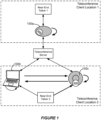
- Figure 1 shows examples of teleconference devices during a teleconference involving two teleconference client locations.
- a teleconference server is configured for providing audio connectivity (which may be full-duplex audio connectivity) between a teleconference client device 100a in teleconference client location 1 and teleconference client devices 100b and 100c in teleconference client location 2.
- the teleconference client devices 100a and 100c are conference phones, whereas teleconference client device 100b is a laptop.
- teleconference client devices 100b and 100c both have their microphones and speakers enabled. Therefore, the microphones of teleconference client devices 100b and 100c each provide teleconference audio data to the teleconference server corresponding to the speech of near-end talker 2. Accordingly, the teleconference server provides teleconference audio data to teleconference client device 100b corresponding to the speech of near-end talker 2 received by teleconference client device 100c, and also provides teleconference audio data to teleconference client device 100c corresponding to the speech of near-end talker 2 received by teleconference client device 100b.
- the speakers of teleconference client devices 100b and 100c each reproduce the speech of near-end talker 2 after a time delay corresponding with the round-trip time for the teleconference audio data to be transmitted from the teleconference client location 2 to the teleconference server and back.
- the speakers of teleconference client device 100b reproduce the speech of near-end talker 2
- the microphones of teleconference client device 100c detect the reproduced speech of near-end talker 2.
- the speakers of teleconference client device 100c reproduce the speech of near-end talker 2
- the microphone(s) of teleconference client device 100b detect the reproduced speech of near-end talker 2.
- a howl state can be triggered by the speech of near-end talker 2 in teleconference client location 2.
- the howl state has at least some characteristics that would not be present if the teleconference client devices 100b and 100c were not participating in a teleconference.
- Figure 2 shows graphs, in the time and frequency domains, of an example of a howl state that may involve two or more teleconference devices in a teleconference client location.
- Graph 205 is in the time domain, with time represented by the horizontal axis and level, in dB, represented by the vertical axis.
- Graph 205 shows howl events 210a-210f. The time during which the howl events 210a-210f are taking place may be referred to herein as a "howl state.”
- the howl events 210a-210f are periodic, or quasi-periodic, and that they increase in amplitude over time.
- the periodicity of the howl events 210a-210f corresponds with a time delay corresponding with the round-trip time for the teleconference audio data to be transmitted from a teleconference client location to a teleconference server and back.
- the level of speech events (to the left of the howl events 210a-210f) is lower than that of the howl events 210a-210f.
- Graph 215 represents the same audio data, including the howl events 210a-210f, in the frequency domain. It may be observed from graph 215 that most of the energy of the howl events 210a-210f is concentrated in relatively narrow frequency bands.
- the howl state has at least some characteristics that would not be present if the devices involved in producing the howl state were not participating in a teleconference. For example, acoustic feedback between a microphone and a speaker of a public address audio system may occur when the microphone is too close to the loudspeaker and/or when the amplification is too large. Such acoustic feedback would generally manifest as a single and continuous howl event, not as a plurality of discontinuous and periodically-occurring howl events. In contrast to acoustic feedback in a public address system context, acoustic feedback in a duplex communication use case may span different networks and different devices.
- the round-trip time is usually larger than 300ms, and may be in the range of 500 ms to a second or more. Accordingly, acoustic feedback detection and mitigation in a teleconferencing context may be very different from acoustic feedback detection and mitigation in a public address system context, where the feedback is caused in the same microphone-amplifier-loudspeaker system.
- FIG. 3 is a block diagram that shows examples of components of an apparatus that may be configured to perform at least some of the methods disclosed herein.
- the apparatus 305 may be a teleconferencing server.
- the apparatus 305 may be a teleconference client device.
- the components of the apparatus 305 may be implemented via hardware, via software stored on non-transitory media, via firmware and/or by combinations thereof.
- the types and numbers of components shown in Figure 3 , as well as other figures disclosed herein, are merely shown by way of example. Alternative implementations may include more, fewer and/or different components.
- the apparatus 305 may include one or more microphones, one or more speakers, etc.
- the apparatus 305 includes an interface system 310 and a control system 315.
- the interface system 310 may include one or more network interfaces, one or more interfaces between the control system 315 and a memory system and/or one or more external device interfaces (such as one or more universal serial bus (USB) interfaces).
- the interface system 310 may include a user interface system.
- the user interface system may be configured for receiving input from a user.
- the user interface system may be configured for providing feedback to a user.
- the user interface system may include one or more displays with corresponding touch and/or gesture detection systems.
- the user interface system may include one or more speakers.
- the user interface system may include apparatus for providing haptic feedback, such as a motor, a vibrator, etc.
- the control system 315 may, for example, include a general purpose single- or multi-chip processor, a digital signal processor (DSP), an application specific integrated circuit (ASIC), a field programmable gate array (FPGA) or other programmable logic device, discrete gate or transistor logic, and/or discrete hardware components.
- DSP digital signal processor
- ASIC application specific integrated circuit
- FPGA field programmable gate array
- the apparatus 305 may be implemented in a single device. However, in some implementations, the apparatus 305 may be implemented in more than one device. In some such implementations, functionality of the control system 315 may be included in more than one device. In some examples, the apparatus 305 may be a component of another device. For example, in some implementations the apparatus 305 may be a component of a server, e.g., a line card.
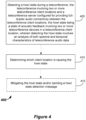
- Figure 4 is a flow diagram that outlines blocks of a method according to one example. The method may, in some instances, be performed by the apparatus of Figure 3 or by another type of apparatus disclosed herein. In some examples, the blocks of method 400 may be implemented via software stored on one or more non-transitory media.
- block 405 involves detecting a howl state during a teleconference.
- the teleconference involves two or more teleconference client locations and a teleconference server configured for providing full-duplex audio connectivity between the teleconference client locations.
- the howl state is a state of acoustic feedback involving two or more teleconference devices in a teleconference client location.
- detecting the howl state involves an analysis of both spectral and temporal characteristics of teleconference audio data.
- detecting the howl state may involve calculating a power-based metric according to order statistics of frequency bands, calculating a spectral resonance metric, calculating an inter-percentile range metric, event aggregation, calculating a periodicity metric, detecting envelope similarity, calculating a spectral peakiness metric, a machine-learning-based process and/or estimating a howl presence probability.
- metric and "measure” may be used synonymously herein.
- detecting the howl state may, for example, involve estimating a howl presence probability according to the teleconference audio data.
- the howl presence probability estimation may be based on a hierarchical rule set or a machine learning method. Detecting the howl state may be based, at least in part, on the howl presence probability.
- Various examples are described in detail below.
- the teleconference server may detect the howl state in block 405.
- a howl-detection-enabled teleconference device at a teleconference client location may detect the howl state in block 405.
- block 410 involves determining which client location is causing the howl state.
- the teleconference server may determine which client location is causing the howl state in block 410.
- a howl-detection-enabled teleconference device at a teleconference client location may determine which client location is causing the howl state in block 410.
- the howl-detection-enabled teleconference device may, in some instances, determine that the howl-detection-enabled teleconference device itself, or another teleconference device at the same teleconference client location, it causing the howl state.
- Optional block 415 involves mitigating the howl state or sending a howl state detection message.
- the teleconference server may send the howl state detection message to the client location that is causing the howl state in block 415.
- mitigating the howl state may involve detecting one or more peak frequency bands of the howl state and applying one or more notch filters corresponding to the one or more peak frequency bands.
- mitigating the howl state may involve muting one or more microphones at the client location that is causing the howl state and/or lowering a speaker volume at the client location that is causing the howl state.
- a howl-detection-enabled teleconference device at the client location that is causing the howl state may be configured to mitigate the howl state.
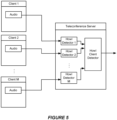
- Figure 5 shows teleconference client device and teleconference server configurations according to one implementation.
- the teleconference server is configured to detect the howl state based, at least in part, on teleconference audio data received from the teleconference client locations.
- teleconference client locations 1 through M are participating in a teleconference.
- the teleconference server includes howl detectors 1 through M, each howl detector corresponding with a teleconference client location or a teleconference client device at a client location.
- each of the howl detectors 1 through M is configured for detecting a howl state during a teleconference.
- the teleconference server also includes a howl client detector configured for determining which client location is causing the howl state.
- each of the howl detectors 1 through M is configured for sending a howl state signal to the howl client detector after detecting a howl state.
- the howl client detector may determine which client location is causing the howl state according to the howl detector from which the howl state signal is received.
- the teleconference server may be configured for mitigating the howl state and/or sending a howl state detection message to the teleconference client location causing the howl state.
- the howl detectors and the howl client detector shown and described herein, including but not limited to those shown in Figure 5 may be implemented in various ways according to the particular implementation.
- the howl detectors and the howl client detector may be implemented as part of a control system such as that shown in Figure 3 and described above.
- the howl detectors and the howl client detector may be implemented via hardware, via software (which may include firmware, resident software, microcodes, etc.) and/or in an embodiment combining both software and hardware aspects.
- Such embodiments may be referred to herein as a "circuit,” a “module” or “engine.”
- the howl detectors and the howl client detector may be implemented via a computer program product embodied in one or more non-transitory media having computer readable program code embodied thereon.
- Such non-transitory media may, for example, include a hard disk, a random access memory (RAM), a read-only memory (ROM), an erasable programmable read-only memory (EPROM or Flash memory), a portable compact disc read-only memory (CD-ROM), an optical storage device, a magnetic storage device, or any suitable combination of the foregoing.
- Figure 6 shows teleconference client device and teleconference server configurations according to another implementation.
- the teleconference server is configured to detect the howl state based, at least in part, on teleconference audio data received from the teleconference client locations 1 through M, which are participating in a teleconference.
- the teleconference server includes a mixer that is configured to mix the teleconference audio data received from the teleconference client locations 1 through M and to output a teleconference audio data mix to the howl detector.
- the howl detector is configured to detect a howl state based on the teleconference audio data mix.
- This type of implementation has potential advantages as compared to the type of implementation shown in Figure 5 , in that multiple howl detectors are not required. Accordingly, this type of implementation can provide relatively lower computational overhead, less power consumption, etc., as compared to the type of implementation shown in Figure 5 .
- the teleconference server shown in Figure 6 also includes a howl client detector that is configured for determining which client location is causing the howl state.
- the teleconference server may be configured for mitigating the howl state and/or sending a howl state detection message to the teleconference client location causing the howl state.
- the teleconference server may receive teleconference metadata from each of the teleconference client locations 1 through M participating in the teleconference.
- the teleconference metadata may include voice activity detection metadata, level metadata and/or energy metadata.
- the howl client detector may be configured to determine which client location is causing the howl state based, at least in part, on the teleconference metadata.
- the howl client detector may be configured to determine which client location is causing the howl state based, at least in part, on voice activity detection metadata indicating which teleconference client location has a teleconference participant who is currently speaking. This is a reasonable assumption because throughout most of a teleconference or other conversation, one person is talking at a time.
- Some implementations may provide a howl client detection algorithm, which also may be referred to as a "blame” algorithm, to correlate regions of howl to a particular teleconference client based on howl detection result in the server and each teleconference client's metadata information received by the teleconference server.
- the "blame" algorithm may be as follows:
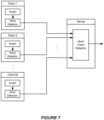
- FIG. 7 shows teleconference client device and teleconference server configurations according to still another implementation.
- each of the teleconference client locations includes a howl detector.
- a teleconference device that includes such a howl detector may be referred to herein as a howl-detection-enabled teleconference device at a teleconference client location.
- the howl-detection-enabled teleconference device may be configured to detect a howl state.
- the howl-detection-enabled teleconference device (or another device at the teleconference client location) may be configured to mitigate the howl state.
- no teleconference server involvement may be required for detecting and/or mitigating the howl state.
- a teleconference device at a teleconference client location may perform a howl feature extraction process on at least some of the teleconference audio data received by the teleconference device.
- the howl feature extraction process may yield howl feature data.
- the characteristics of the howl feature data may vary according to the details of the howl feature extraction process of a particular implementation.
- the howl feature data may include one or more features corresponding with a power-based metric, a spectral resonance metric, an inter-percentile range metric, an event aggregation, a periodicity metric, envelope similarity, a spectral peakiness metric, and/or a howl presence probability.
- the teleconference device may send at least some of the howl feature data to the teleconference server.
- the teleconference server may be configured to detect the howl state based, at least in part, on the howl feature data.
- the teleconference server may be configured to determine which client location is causing the howl state based, at least in part, on the client location from which the howl feature data are received.
- Some howl detection methods may involve detecting the short-term spectral structural features of howl, the medium-term spectral-temporal structure features of howl and/or the long-term temporal repeat patterns of howl.
- Such howl detection methods may involve a howl presence probability estimation or a "binary" howl/no howl determination. The detailed discussion below will describe aspects of the following howl detection methods, including:
- the audio signal may be transformed into the frequency domain and the features may be calculated based on frequency domain audio signals.
- some method operates, at least in part, in the time domain.
- Figure 8 is a flow diagram that outlines blocks of howl detection methods according to some implementations.
- the blocks of method 800 may, for example, be implemented by one or more of the devices shown in Figures 3 and 5-7 .
- the blocks of method 800 may be implemented via software stored on one or more non-transitory media.
- the blocks of method 800 like other methods described herein, are not necessarily performed in the order indicated. Moreover, such methods may include more or fewer blocks than shown and/or described.
- method 800 begins with audio data being transformed from the time domain to the frequency domain in block 805.
- the audio data may include teleconference audio data.
- the transformed audio data are divided into frequency bands in block 810.
- the number of frequency bands may vary according to the particular implementation. Some implementations (which may correspond to relatively narrow-band audio data) may involve dividing the transformed audio data into 40 audio bands, whereas other implementations may involve dividing the transformed audio data into 48 audio bands (which may correspond to wideband audio data), into 56 audio bands (which may correspond to super-wideband audio data), or into another number of audio bands.
- block 810 may involve dividing the transformed audio data into logarithmically-spaced bands, whereas other examples may involve dividing the transformed audio data into linearly-spaced bands.
- the transformed and banded audio data are provided to three different howl detection processes: block 815 involves detecting short-term features of spectral structures, block 820 involves detecting medium-term spectral and temporal features and block 825 involves detecting patterns that are repeated over a relatively long term. Examples of each of these howl detection processes are provided below.
- “medium-term” may be a time period of hundreds of milliseconds, e.g., 150 ms, 200 ms, 250 ms, 300 ms, 350 ms, 400 ms, etc.
- “Long-term” means longer than medium-term.
- long-term may be on the order of seconds, such as 1 second, 1.5 seconds, 2 seconds, 2.5 seconds, etc.
- Short-term means shorter than medium-term.
- short-term may correspond to tens of milliseconds, e.g., 10 ms, 20 ms, 30 ms, etc.
- Short-term events may, in some examples, be detectable in an individual frame of audio data.
- Some alternative methods may involve only two of the three types of howl detection processes shown in Figure 8 . Some methods may involve only one of the three types of howl detection processes, e.g., only block 815 or block 820.
- the results from blocks 815, 820 and 825 are all provided to a howl presence probability estimation process in block 830.
- block 830 outputs an indication of howl presence probability.
- Optional post-processing block 835 receives the indication of howl presence probability and outputs a howl binary indicator, which indicates either a howl state or a no-howl state.
- method 800 also may include actions responsive to a howl state, such as mitigating the howl state or sending a howl state detection message.
- a first such metric which is referred to herein as a spectral peakiness measure (SPM) is based on the observation that howl audio usually has very high spectral peaks, with energy concentrated in narrow frequency ranges.
- SPM spectral peakiness measure
- One of the embodiments of the spectral peakiness measure can be seen in Equation (1), below.
- Equation 1 X(k) represents the spectral amplitude of band index k, l represents the index of the frame and K represents the number of the frequency bands.
- SPM is calculated as one minus the ratio between geometric mean of the band power spectrum and the arithmetic mean of the band power spectrum.
- N the block size and T s represents a smoothing time constant.
- the values of N and T s may vary according to the particular implementation and may depend, for example, on the sampling rate and/or the frame length. In some examples wherein the frame length is 20ms, N may be 320 for a 16K sampling rate and 640 for a 32K sampling rate. In other examples, the frame length may be 10ms, 30ms, etc. According to some implementations, Ts may be 0.04s, 0.06s, 0.10s, 0.12s, etc.
- spectral-related measures may be used to characterize a peaky condition of a signal spectrum, such as:
- Another measure of peakiness that may be used for howl state detection may be referred to herein as a "consistent high-peakiness measure based on counter.” These implementations involve detecting, based on the counter, relatively long blocks having a high peakiness signal. In some such implementations, the counter may be released slowly if the signal is not becoming highly peaky.
- P Counter (1) represents the counted number of high-peakiness signals
- P MaxCounter represents the maximum counter value when long blocks with high peakiness signal are observed
- SP ⁇ M Th represents a threshold for determining a condition of high-peakiness
- SP ⁇ M DownTh represents a threshold of declining SPM (l)
- P CounterDown represents a step for decrementing the counter.
- SPM_Th may be 0.85, 0.88, 0.90, etc.
- SPM_DownTh may be 0.05, 0.08, 0.10, etc.
- P_CounterDown may be 0.2, 0.5, 1.0, etc.
- the value of P_CounterDown may depend, for example, on a desired release time.
- Inter-percentile range (IPR) metrics may be used to detect the contrast between band power in a current frame. Howl audio usually has very high IPR compared with speech and noise signals.
- k represents the index of the band
- l represents the index of the frame.
- the corresponding order statistics version of band power may be denoted as B(t, 1), B(2, 1), ... B(K,l), respectively, where: B 1 l ⁇ B 2 l ⁇ ... ⁇ B K l
- IPR l B r l ⁇ B ⁇ l
- Percentile Th 80.
- Percentile Th may be 82, 85, etc.
- N represents the block size
- T S represents a smoothing time constant.
- the values of N and T s may vary according to the particular implementation and may depend on the sampling rate and/or the frame length. In some examples wherein the frame length is 20ms, N may be 320 for a 16K sampling rate and 640 for a 32K sampling rate. In other examples, the frame length may be 10ms, 30ms, etc. According to some implementations, Ts may be 0.04s, 0.06s, 0.10s, 0.12s, etc. Weighting Functions for IPR
- some type of weighting function(s) may be used for IPR metrics. Using a well-chosen weighting function can increase the discriminative ability of the original IPR measure.
- the input level may be determined before automatic gain control (AGC) is applied.
- inLeveldB represents the input level of a signal.
- inLeveldB may represent the input level of a signal before AGC is applied.
- inLeveldB may represent the input level of a signal after AGC is applied.
- LowTh -60 dB
- HighTh -30dB. It will be appreciated that the values of LowTh and HighTh may vary according to the particular implementation.
- IPR Counter l ⁇ min IPR MaxCounter , IPR Counter l + IP R ⁇ Comb l > I P ⁇ R Th , max 0 , IPR Counter l ⁇ IPR CounterDown , if IP R ⁇ Comb l ⁇ I P ⁇ R Th ⁇ I P ⁇ R DownTh otherwise
- IPR Counter ( l ) represents the counter of the high-IPRComb signal
- IPR MaxCounter represents the maximum counter when long blocks with high IPRComb signals are observed
- IPR Th represents the threshold of the high-IPRComb metric
- IPR CounterDown represents the step of the declining counter.
- IPR_Th may be 12, 15, 18, 20, etc.
- An example of "long blocks" is a block on the order of 10 or 20 frames, the time duration of which will depend on the frame length. For example, if the frame length is 20ms, a block on the order of 10 or 20 frames would correspond to a time duration of 200 to 400 milliseconds. Accordingly, this metric provides an example of a process that may occur in block 820 of Figure 8 .
- the medium-term event-based counter may detect repeating patterns of the spectral structure of howl audio during the medium term.
- Event Counter (l) represents the counter of the medium-term howl event
- Event MaxCounter represents the maximum counter of medium-term howl events
- Event CounterDown represents the step of the declining event counter.
- the counter is used to detect repeating patterns of the spectral structure of howl in the medium term.
- the maximum counter represents the highest possible likelihood of howl presence, e.g., 1.
- CounterDown represents the step size for decreasing the counter. When the counter value decreases, this indicates that the likelihood of howl presence is declining.
- ⁇ ( k,l ) is essentially an entropy measure of a normalized short-term spectrum computed at band k over R consecutive frames, ending at the l th frame.
- the signal variability measure LTSV is the sample variance of entropies (computed according to Equation 14) for K bands.
- This metric is another example of a process that could correspond to block 825 of Figure 8 .
- the inventors have observed that howl in a teleconferencing context often shows long-term repeated patterns that may, for example, occur over a period of two or more seconds.
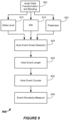
- Figure 9 is a flow diagram that shows example blocks of a howl event periodicity detection method.
- the blocks of method 900 may, for example, be implemented by one or more of the devices shown in Figures 3 and 5-7 .
- the blocks of method 900 may be implemented via software stored on one or more non-transitory media.
- the blocks of method 900 like other methods described herein, are not necessarily performed in the order indicated. Moreover, such methods may include more or fewer blocks than shown and/or described.
- method 900 begins with received audio data being transformed from the time domain to the frequency domain in block 905.
- the audio data may include teleconference audio data.
- the transformed audio data are also divided into frequency bands in block 905.
- block 910 involves a "delta level" process for determining whether there is a level increase that is characteristic of a howl event. In some examples, this level increase threshold may be 20dB, 25dB, 30dB, etc.
- block 915 involves evaluating IPR. Block 915 may, for example, involve one or more types of IPR calculation methods such as those described above.
- block 920 involves one or more types of peakiness detection, which can represent the spectral structure of the howl event onset. Block 920 may involve one or more of the peakiness detection methods described above.
- howl onset detection metrics output from the processes of blocks 910-920 are provided to a howl event onset detection process in block 925.
- the howl onset detection metrics output from the processes of blocks 910-920 are given equal weight during the howl event onset detection process, whereas in other examples one of the metrics may be given more weight than others.
- a howl event onset detection indication is input to the process of block 930, wherein the howl event length is determined.
- one or more howl event detection methods may be invoked, e.g., one or more of the short-term howl event detection methods that are disclosed herein.
- method 900 proceeds to a howl event counter process (block 935).
- a result of the howl event counter process (which may include a detected howl event number) is provided to the event periodicity measuring process(es) of block 940.
- EventCount represents a detected howl event number
- EventNumTh represents a threshold of the howl event presence number
- Periodicity Step represents an increased step of periodicity.
- EventNumTh is 2 and Periodicity Step is 0.5.
- EventNumTh may be 1.5, 1.8, etc.
- Periodicity Step may be 0.4, 0.6, etc.
- ⁇ smooth represents a smoothing coefficient.
- ⁇ smooth may be 0.85, 0.9, 0.95, etc.
- Some implementations involve determining a long-term periodicity metric that is based on audio signal levels.
- the inventors have observed that the amplitude modulation spectrum of howl events in a teleconferencing context often shows a long-term repeated pattern.
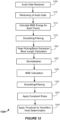
- Figure 10 is a flow diagram that shows example blocks of another method of measuring howl event periodicity.
- the blocks of method 1000 may, for example, be implemented by one or more of the devices shown in Figures 3 and 5-7 .
- the blocks of method 1000 may be implemented via software stored on one or more non-transitory media.
- the blocks of method 1000 like other methods described herein, are not necessarily performed in the order indicated. Moreover, such methods may include more or fewer blocks than shown and/or described.
- method 1000 begins with audio data being received in block 1005.
- the audio data may include teleconference audio data.
- the received audio data are provided to block 1010.
- block 1010 involves evaluating level information in audio data according to a sliding time window.
- the sliding time window may be 128 frames of audio data. In other examples, the sliding time window may be longer or shorter.
- the level information may be determined prior to an AGC process.
- the results of block 1010 are provided to block 1015, which involves a process of modulation spectrum analysis.
- block 1015 involves fast Fourier transform (FFT) calculations.
- FFT fast Fourier transform
- the modulation spectrum analysis of block 1015 may involve a Fourier transform of the long-term level information in the sliding time window.
- the results of block 1015 are provided to the peak picking process of block 1020.
- the peak value of the modulation spectrum is selected in block 1020 because the peak value represents periodicity information.
- a periodicity measure may then be determined in block 1025, based on the results of block 1020.
- a peak level selected in block 1020 may indicate the onset of a howl event.
- a corresponding peak level may be identified later in time and may be correlated with the earlier peak level.
- a global howl presence probability may be determined.
- Figure 11 is a flow diagram that shows blocks of a howl presence probability determination method according to one example.
- the blocks of method 1100 may, for example, be implemented by one or more of the devices shown in Figures 3 and 5-7 .
- the blocks of method 1100 may be implemented via software stored on one or more non-transitory media.
- the blocks of method 1100 like other methods described herein, are not necessarily performed in the order indicated. Moreover, such methods may include more or fewer blocks than shown and/or described.
- block 1105 may involve other processes according to the particular implementation, such as receiving audio data, transforming the audio data to the frequency domain, banding, etc.
- block 1110 involves determining whether a number of howl events has exceeded a first howl event counter threshold, which also may be referred to as a medium-term event counter high threshold.
- the medium-term event counter high threshold may be 10, 12, 13, etc. If it is determined in block 1110 that the number of howl events has exceeded the first howl event counter threshold, the process continues to block 1115.
- the process continues to block 1150, wherein it is determined whether a number of howl events is less than a second howl event counter threshold, which also may be referred to as a medium-term event counter low threshold.
- a second howl event counter threshold which also may be referred to as a medium-term event counter low threshold.
- the medium-term event counter low threshold may be 5, 6, 7, etc. If it is determined in block 1150 that the number of howl events is less than the second howl event counter threshold, the process continues to block 1155, which involves reducing the current howl presence probability (HPP).
- HPP current howl presence probability
- block 1155 involves multiplying the current HPP value by HPP_Clear, which is a constant for reducing the HPP value quickly if the probability of a false alarm is high.
- HPP_Clear may be 0.1, 0.2, 0.3, etc.
- block 1160 involves setting the current HPP value to the greater of zero or the value of (HPP(l) [the current HPP value] - HPP_Down).
- HPP_Down is a constant for reducing the value of HPP.
- the value of HPP_Down may be 0.02, 0.03, 0.04, etc.
- block 1115 involves evaluating signal variability.
- block 1115 involves determining whether the long-term signal variability (LTSV) is greater than an LTSV threshold value, denoted LTSV_Th1 in Figure 11 .
- LTSV_Th1 the long-term signal variability
- the value of LTSV_Th1 may be 0.15, 0.2, 0.25, etc. If it is determined in block 1115 that LTSV is not greater than LTSV_Th1, the process proceeds to block 1150. However, if it is determined in block 1115 that the LTSV is greater than LTSV_Th1, the process continues to block 1120.
- block 1120 involves determining whether one or more level values of the audio input data exceed a threshold.
- the level value(s) may be determined prior to an AGC process.
- block 1120 involves determining whether InLeveldB>Level_Th1.
- the value of LTSV_Th1 may be -60Db, -65Db, -70Db, etc. If it is determined in block 1120 that InLeveldB is not greater than LTSV_Th1, the process proceeds to block 1150. However, if it is determined in block 1120 that InLeveldB>Level_Th1, the process continues to block 1125 in this example.
- block 1125 involves setting the current HPP value to the lesser of 1 or the sum of the current HPP value and the "raw" howl probability, which may in some examples be determined according to Equation 21. The process then proceeds to block 1130.
- block 1130 involves determining whether a howl event periodicity metric is less than a first howl event periodicity threshold, which is denoted Periodicity_Thl in Figure 11 .
- the value of Periodicity_Th1 may be 0.2, 0.3, 0.4, 0.5, etc. If it is determined in block 1130 that the howl event periodicity metric is less than Periodicity_Th1, the process continues to block 1135.
- block 1135 involves reducing the current HPP. In this example, block 1135 involves multiplying the current HPP value by HPP_Clear.
- block 1140 involves determining whether the howl event periodicity metric is greater than a second howl event periodicity threshold, which is denoted Periodicity _Th2 in Figure 11 .
- the value of Periodicity_Th2 may be 0.80, 0.85, 0.90, etc.
- the process continues to block 1145.
- block 1145 involves setting the current HPP value to the lesser of 1 or the sum of the current HPP value and a constant that is denoted HPP_Up in Figure 11 .
- HPP_Up is a value used to incrementally increase the current value of HPP. In some examples, the value of HPP_Up may be 0.1, 0.15, 0.2, etc.
- An HPP value may be output after the foregoing processes have been completed. Although this is not shown in Figure 11 , the process may continue as additional howl events are detected.
- an HPP value may be determined according to one or more other methods.
- an HPP value may be determined according to a machine learning based method such as regression a decision tree method, an Adaptive Boosting algorithm, a Gaussian Mixture Model, a Hidden Markov Model or a deep neural network.
- Vth represents a voting ratio threshold, which may vary according to the particular implementation. In some examples, Vth may be 0.5, 0.6, 0.7, etc.
- a median filter method may be used for further binary decision smoothing.
- M represents a length of a median filter window. In some examples, M may be in the range of 3, 4, 5, etc.
- Figure 12 is a flow diagram that shows example blocks of a method of determining signal envelope similarity.
- the blocks of method 1200 may, for example, be implemented by one or more of the devices shown in Figures 3 and 5-7 .
- the blocks of method 1200 may be implemented via software stored on one or more non-transitory media.
- the blocks of method 1200 like other methods described herein, are not necessarily performed in the order indicated. Moreover, such methods may include more or fewer blocks than shown and/or described.
- method 1200 begins with audio data being received in block 1205.
- the audio data may include teleconference audio data.
- the received audio data are provided to block 1210 without a transformation to the frequency domain.
- block 1210 involves windowing of the time-domain audio signal.
- the frame length is 10ms and the time-domain audio signal is first windowed via a Hamming window having a window length of 20ms.
- the type of windowing process and the window length may vary according to the particular implementation.
- a Hanning window may be applied.
- the window size may be 25ms, 30ms, etc.
- the process then continues to block 1212, wherein the RMS energy for each frame is calculated.
- the median filtering operation may involve sorting the RMS energy and selecting values in the 50 th percentile.
- the results of block 1215 are provided to block 1220.
- block 1220 involves, for the smoothed RMS envelope, a peak-picking method that is used to find the RMS peaks.
- the peak-picking method may, in some examples, selecting local maximum RMS values.
- the blocks between two adjacent peaks are extracted and then the length of the remaining blocks is calculated. This length may be used as a constraint condition for envelope periodicity in some implementations.
- Equations 27 and 28 vrms1 and vrms2 represent two adjacent blocks among three peaks.
- the mean square error (MSE) of the smooth RMS of two blocks is then calculated in block 1230.
- block 1235 follows, in order to alleviate the fluctuation of MSE among peaks.
- block 1235 involves a median filtering process to obtain smoothed MSE values.
- the inventors have observed that the length of corresponding howl events in a teleconferencing context may be very similar. By using the lengths of blocks corresponding to howl events, one can construct a kind of constraint rule that may be applied to the smoothed MSE values. In this way, one can obtain final MSE values.
- constraint rules are then applied in block 1240.
- the constraint rules may be based, at least in part, on the maximum length and the ratio of len1 and len2, where len1 and len2 represent the lengths of the above-referenced vrms1 and vrms2, respectively. If the maximum length is too long or the ratio is too small or too big, this may indicate that the difference between len1 and len2 is too large. Therefore, according to some examples, the MSE values may be increased. If the ratio nearly equals to 1, and the ratios over several blocks (for example, over 4 or 5 blocks) are nearly equal to 1, this may indicate that the envelopes have strong similarity. Therefore, according to some such examples, the MSE values may be decreased.
- a binary indication of howl events may then be derived in block 1245.
- the threshold for MSE values may be small, e.g., 0.015, 0.02, 0.025, 0.03, etc.
- the output may be 1 for a howl event and 0 for a non-howl event.
- Equation 30 A represents energy.
- an audio signal may be windowed and then transformed to the frequency domain, e.g., by using an FFT or a modified discrete cosine transform.
- Equation 31 X [ k ] represents a coefficient in the frequency domain, k represents the frequency index and N represents the frame length.
- N represents the length of the moving average filter, the value of which may differ according to the implementation. In some examples, the value of N may be 3, 5, 7, etc. According to some implementations, the peaks of the envelope may then be picked and the MSE values may be calculated. In some examples, these processes may be performed as described above with reference to blocks 1220-1245 of Figure 12 .
- One implementation of determining sub-band domain envelope similarity may start by windowing a received audio signal and then transforming the audio signal to the frequency domain, e.g., by using an FFT or a modified discrete cosine transform.
- the resulting broad-band signal may be divided into sub-bands, e.g., according to psychoacoustic principles.
- the number of sub-bands may, for example, be based on the sampling rate of the broad-band signal. In one example involving a 16kHz sampling rate, the broad-band signal may be divided into 48 sub-bands. In other examples involving a 32kHz sampling rate, the broad-band signal may be divided into 56 or 64 sub-bands.
- the process may then proceed substantially as described in the preceding section.
- some examples of this method may involve outputting not only binary non-howl or howl event indications (e.g., 1 and 0), but also outputting an indication of uncertainty (e.g., 0.5) in the howl event determination.
- a howl event may be mixed with a speech signal and this may result in an ambiguous howl event determination result.
- Figure 13 is a flow diagram that outlines blocks of howl detection methods according to some implementations.
- the blocks of method 1300 may, for example, be implemented by one or more of the devices shown in Figures 3 and 5-7 .
- the processes that are referenced by the blocks of Figure 13 may be performed according to any of the corresponding above-described methods.
- the blocks of method 1300 may be implemented via software stored on one or more non-transitory media.
- the blocks of method 1300 like other methods described herein, are not necessarily performed in the order indicated. Moreover, such methods may include more or fewer blocks than shown and/or described.
- method 1300 begins with audio data being transformed from the time domain to the frequency domain in block 1305.
- the audio data may include teleconference audio data.
- the transformed audio data are divided into frequency bands in block 1310.
- the transformed and banded audio data are provided to four different howl detection processes: according to this implementation, block 1315 involves detecting spectral peakiness, block 1320 involves determining IPR, block 1325 involves determining signal level before AGC is applied to the audio data and block 1330 involves a spectral entropy determination process.
- the results of block 1315, 1320 and 1325 are provided to the IPRComb block, which in turn provides input to the High IPRComb Consistency Measure block 1345.
- the results of block 1315 are also provided to the High Peakiness Consistency Measure block 1340.
- the results of block 1330 are also provided to the Long-Term Signal Variability block 1350.
- the results of blocks 1325, 1340, 1345, 1350 and 1355 are provided to the Howl Presence Probability Determination block 1360.
- block 1360 outputs a measure of howl presence probability, which is also referred to herein as HPP.
- block 1360 also provides input to Post-Processing block 1365, which outputs a binary howl/no howl indication.
- method 1300 may involve mitigating a howl state or sending a howl state detection message.
Landscapes
- Engineering & Computer Science (AREA)
- Multimedia (AREA)
- Signal Processing (AREA)
- Physics & Mathematics (AREA)
- Health & Medical Sciences (AREA)
- Acoustics & Sound (AREA)
- Computational Linguistics (AREA)
- Audiology, Speech & Language Pathology (AREA)
- Human Computer Interaction (AREA)
- Otolaryngology (AREA)
- General Health & Medical Sciences (AREA)
- Telephonic Communication Services (AREA)
- Circuit For Audible Band Transducer (AREA)
- Telephone Function (AREA)
Claims (15)
- Telekonferenzserver, umfassend:ein Schnittstellensystem, das für Kommunikation zwischen dem Telekonferenzserver und Telekonferenz-Client-Standorten konfiguriert ist; undein Steuerungssystem, welches konfiguriert ist zum:Bereitstellen von Vollduplex-Audiokonnektivität während einer Telefonkonferenz zwischen zwei oder mehr Telefonkonferenz-Client-Standorten;Erfassen eines Pfeifzustands während der Telekonferenz, wobei der Pfeifzustand ein Zustand akustischer Rückkopplung ist, an dem zwei oder mehr Telefonkonferenzvorrichtungen an einem Telekonferenz-Client-Standort involviert sind, wobei Erfassen des Pfeifzustands Folgendes involviert:Empfangen von Telefonkonferenz-Audiodaten von einem oder mehreren der Telefonkonferenz-Client-Standorte,Umwandeln von Telefonkonferenz-Audiodaten vom Zeitbereich in den Frequenzbereich,Aufteilen der umgewandelten Audiodaten in Frequenzbänder, Erfassen, in den umgewandelten und gebänderten Audiodaten, von kurzfristigen spektralen Merkmalen und mittelfristigen spektralen und zeitlichen Merkmalen, wobei kurzfristig in der Größenordnung von zig Millisekunden und mittelfristig in der Größenordnung von Hunderten von Millisekunden liegt,Schätzen, basierend auf den kurzfristigen spektralen Merkmalen und mittelfristigen spektralen und zeitlichen Merkmalen, einer Wahrscheinlichkeit des Vorhandenseins eines Pfeifens und Ausgeben eines binären Pfeifindikators, der ein Vorhandensein des Pfeifzustands anzeigt; undBestimmen, welcher Client-Standort den Pfeifzustand verursacht.
- Telekonferenzserver nach Anspruch 1, wobei kurzfristige spektrale Merkmale ein spektrales Peakiness-Maß, SPM, beinhalten, wobei das SPM eines Frames als Eins minus einem Verhältnis zwischen einem geometrischen Mittel des Bandleistungsspektrums für den Frame und dem arithmetischen Mittel des Bandleistungsspektrums für den Frame berechnet wird.
- Telekonferenzserver nach Anspruch 1, wobei kurzfristige spektrale Merkmale einen Inter-Perzentil-Bereich, IPR, beinhalten, wobei der IPR eines Frames 1 als IPR(l)=B(l,l)-B(K,l) definiert ist, wobei B(r,l) die Statistikversion der r-ten Ordnung der Bandstärke für Frame list und K ein Index ist, der ein vordefiniertes Perzentil einer Gesamtzahl, K, von Frequenzbändern darstellt, gemäß:

- Telekonferenzserver nach Anspruch 3, wobei das Perzentil 80, 82 oder 85 beträgt.
- Telekonferenzserver nach Anspruch 3 oder 4, wobei IPR(l) in einer Gewichtungsfunktion gewichtet wird, wobei die Gewichtungsfunktion einen Eingangspegel und ein spektrales Peakiness-Maß, SPM, nach Anspruch 2 verwendet.
- Telekonferenzserver nach Anspruch 1, wobei das Steuersystem für zumindest eines von Abschwächen des Pfeifzustands oder Senden einer Pfeifzustandserfassungsnachricht konfiguriert ist.
- Telekonferenzserver nach Anspruch 1 oder Anspruch 2, wobei das Steuersystem zum Bestimmen, welche Client-Vorrichtung den Pfeifzustand verursacht, konfiguriert ist.
- Telekonferenzserver nach einem der Ansprüche 1-7, wobei das Steuerungssystem konfiguriert ist zum:Erstellen eines Telekonferenz-Audiodatenmixes, der die von den Telekonferenz-Client-Standorten empfangenen Telekonferenz-Audiodaten umfasst; undErfassen des Pfeifzustands basierend auf dem Telekonferenz-Audiodatenmix.
- Telekonferenzserver nach einem der Ansprüche 1-7, wobei das Steuerungssystem konfiguriert ist zum:Empfangen, über das Schnittstellensystem, von Telekonferenz-Metadaten von den Telekonferenz-Client-Standorten; undBestimmen, welcher Client-Standort den Pfeifzustand verursacht, zumindest teilweise basierend auf den Telekonferenz-Metadaten.
- Telekonferenzserver nach Anspruch 1, wobei die Schätzung der Wahrscheinlichkeit des Vorhandenseins des Pfeifens auf einem hierarchischen Regelsatz oder einem maschinellen Lernprozess basiert.
- Telekonferenzserver nach Anspruch 1, wobei die kurzfristigen spektralen Merkmale und mittelfristigen spektralen und zeitlichen Merkmale aus einer Liste ausgewählt werden, die aus Folgendem besteht: einer leistungsbasierten Metrik gemäß der Ordnungsstatistik von Frequenzbändern; einer spektralen Resonanzmetrik; einer Metrik für den Inter-Perzentil-Bereich; Ereignisaggregation; einer Periodizitätsmetrik; Hüllkurvenähnlichkeit; und einer spektralen Peakiness-Metrik.
- Telefonkonferenz-Client-Vorrichtung, umfassend:ein Schnittstellensystem, das für Kommunikation zwischen der Telekonferenz-Client-Vorrichtung und einem Telekonferenz-Server konfiguriert ist, der zum Bereitstellen einer Vollduplex-Audioverbindung während einer Telekonferenz zwischen einer Vielzahl von Telekonferenz-Client-Standorten konfiguriert ist, und um einen Pfeifzustand zumindest teilweise basierend auf Pfeifmerkmalsdaten zu erfassen; undein Steuerungssystem, welches konfiguriert ist zum:
Durchführen eines Pfeifzustandsmerkmalsextraktionsprozesses während der Telekonferenz, wobei der Pfeifzustandsmerkmalsextraktionsprozess Extrahieren von Pfeifmerkmalsdaten involviert, die zum Erfassen eines Pfeifzustands relevant sind, wobei der Pfeifzustand ein Zustand akustischer Rückkopplung ist, an dem die Telekonferenz-Client-Vorrichtung und zumindest eine andere Vorrichtung an einem Telekonferenz-Client-Standort, der die Telekonferenz-Client-Vorrichtung beinhaltet, involviert sind, wobei der Pfeifzustandsmerkmalsextraktionsprozess Folgendes involviert:Umwandeln von am Telekonferenz-Client-Standort gesammelten Telefonkonferenz-Audiodaten vom Zeitbereich in den Frequenzbereich,Aufteilen der umgewandelten Audiodaten in Frequenzbänder, Erfassen, in den umgewandelten und gebänderten Audiodaten, von kurzfristigen spektralen Merkmalen und mittelfristigen spektralen Merkmalen und zeitlichen Merkmalen, wobei kurzfristig in der Größenordnung von zig Millisekunden und mittelfristig in der Größenordnung von Hunderten von Millisekunden liegt, undSenden der Pfeifmerkmalsdaten an den Telekonferenzserver. - Telekonferenz-Client-Vorrichtung nach Anspruch 12, wobei die kurzfristigen spektralen Merkmale und mittelfristigen spektralen und zeitlichen Merkmale aus einer Liste ausgewählt werden, die aus Folgendem besteht: einer leistungsbasierten Metrik gemäß der Ordnungsstatistik von Frequenzbändern; einer spektralen Resonanzmetrik; einer Metrik für den Inter-Perzentil-Bereich; Ereignisaggregation; einer Periodizitätsmetrik; Hüllkurvenähnlichkeit; und einer spektralen Peakiness-Metrik.
- Computerprogrammprodukt, das einen computerlesbaren Programmcode umfasst, der von einem oder mehreren Prozessoren eines Telekonferenzservers auszuführen ist, wenn er von einem nicht-transitorischen computerlesbaren Medium abgerufen wird, wobei der Programmcode Anweisungen beinhaltet, die den Telekonferenzserver wie im Telekonferenzserver nach einem der Ansprüche 1 bis 11 definiert, konfigurieren.
- Computerprogrammprodukt, das einen computerlesbaren Programmcode umfasst, der von einem oder mehreren Prozessoren einer Telekonferenz-Client-Vorrichtung auszuführen ist, wenn er von einem nicht-transitorischen computerlesbaren Medium abgerufen wird, wobei der Programmcode Anweisungen beinhaltet, die die Telekonferenz-Client-Vorrichtung wie in der Telekonferenz-Client-Vorrichtung nach Anspruch 12 oder Anspruch 13 definiert, konfigurieren.
Applications Claiming Priority (4)
| Application Number | Priority Date | Filing Date | Title |
|---|---|---|---|
| CN2017104604 | 2017-09-29 | ||
| US201762575701P | 2017-10-23 | 2017-10-23 | |
| EP17201011 | 2017-11-10 | ||
| PCT/US2018/053119 WO2019067718A2 (en) | 2017-09-29 | 2018-09-27 | ACOUSTIC REACTION DETECTION IN CONFERENCE SYSTEMS |
Publications (2)
| Publication Number | Publication Date |
|---|---|
| EP3689002A2 EP3689002A2 (de) | 2020-08-05 |
| EP3689002B1 true EP3689002B1 (de) | 2024-10-30 |
Family
ID=63794778
Family Applications (1)
| Application Number | Title | Priority Date | Filing Date |
|---|---|---|---|
| EP18783352.0A Active EP3689002B1 (de) | 2017-09-29 | 2018-09-27 | Detektion akustischer rückkopplungen in konferenzsystemen |
Country Status (4)
| Country | Link |
|---|---|
| US (2) | US11277518B2 (de) |
| EP (1) | EP3689002B1 (de) |
| CN (2) | CN113766073B (de) |
| WO (1) | WO2019067718A2 (de) |
Families Citing this family (16)
| Publication number | Priority date | Publication date | Assignee | Title |
|---|---|---|---|---|
| CN113766073B (zh) * | 2017-09-29 | 2024-04-16 | 杜比实验室特许公司 | 会议系统中的啸叫检测 |
| WO2021013363A1 (en) * | 2019-07-25 | 2021-01-28 | Unify Patente Gmbh & Co. Kg | Method and system for avoiding howling disturbance on conferences |
| US11057702B1 (en) | 2019-12-20 | 2021-07-06 | Microsoft Technology Licensing, Llc | Method and system for reducing audio feedback |
| GB2596169B (en) * | 2020-02-11 | 2022-04-27 | Tymphany Acoustic Tech Ltd | A method and an audio processing unit for detecting a tone |
| CN111883163B (zh) * | 2020-04-02 | 2023-11-28 | 珠海市杰理科技股份有限公司 | 音频啸叫抑制方法、设备和系统及神经网络训练方法 |
| CN112992190B (zh) * | 2021-02-02 | 2021-12-10 | 北京字跳网络技术有限公司 | 音频信号的处理方法、装置、电子设备和存储介质 |
| US20220415336A1 (en) * | 2021-06-28 | 2022-12-29 | Panasonic Intellectual Property Management Co., Ltd. | Voice communication apparatus and howling detection method |
| JP7767808B2 (ja) * | 2021-09-27 | 2025-11-12 | 富士フイルムビジネスイノベーション株式会社 | 情報処理装置およびプログラム |
| CN113724725B (zh) * | 2021-11-04 | 2022-01-18 | 北京百瑞互联技术有限公司 | 一种蓝牙音频啸叫检测抑制方法、装置、介质及蓝牙设备 |
| CN113905310B (zh) * | 2021-12-09 | 2022-03-01 | 北京百瑞互联技术有限公司 | 一种蓝牙音频的啸叫检测和抑制方法、装置及介质 |
| CN114863941B (zh) * | 2022-03-25 | 2026-02-03 | 杭州网易智企科技有限公司 | 啸叫抑制方法及装置、存储介质、电子设备 |
| CN114420148B (zh) * | 2022-03-30 | 2022-06-14 | 北京百瑞互联技术有限公司 | 啸叫检测和抑制方法、装置、介质及设备 |
| US12154537B2 (en) | 2022-11-23 | 2024-11-26 | Synaptics Incorporated | Howling suppression for active noise cancellation (ANC) systems and methods |
| US12034784B1 (en) * | 2023-02-21 | 2024-07-09 | Zoom Video Communications, Inc. | Automatic detection of companion mode for hybrid events |
| CN116124285A (zh) * | 2023-02-28 | 2023-05-16 | 重庆长安汽车股份有限公司 | 一种汽车驱动系统噪声评价方法 |
| CN118748003B (zh) * | 2024-08-08 | 2025-12-02 | 宁波方太厨具有限公司 | 主动降噪系统及其控制方法、异音检测方法、装置 |
Citations (1)
| Publication number | Priority date | Publication date | Assignee | Title |
|---|---|---|---|---|
| WO2007013981A2 (en) * | 2005-07-22 | 2007-02-01 | Gables Engineering, Inc. | Acoustic feedback cancellation system |
Family Cites Families (34)
| Publication number | Priority date | Publication date | Assignee | Title |
|---|---|---|---|---|
| JP3654470B2 (ja) * | 1996-09-13 | 2005-06-02 | 日本電信電話株式会社 | サブバンド多チャネル音声通信会議用反響消去方法 |
| DE60029147T2 (de) * | 2000-12-29 | 2007-05-31 | Nokia Corp. | Qualitätsverbesserung eines audiosignals in einem digitalen netzwerk |
| JP2004165888A (ja) * | 2002-11-12 | 2004-06-10 | Oki Electric Ind Co Ltd | ハウリング処理装置 |
| GB0317158D0 (en) * | 2003-07-23 | 2003-08-27 | Mitel Networks Corp | A method to reduce acoustic coupling in audio conferencing systems |
| TWI289020B (en) * | 2004-02-06 | 2007-10-21 | Fortemedia Inc | Apparatus and method of a dual microphone communication device applied for teleconference system |
| JP4287762B2 (ja) * | 2004-02-20 | 2009-07-01 | パナソニック株式会社 | ハウリング検出方法及び装置、並びにこれを備えた音響装置 |
| US20050286443A1 (en) * | 2004-06-29 | 2005-12-29 | Octiv, Inc. | Conferencing system |
| US20050285935A1 (en) * | 2004-06-29 | 2005-12-29 | Octiv, Inc. | Personal conferencing node |
| US7742608B2 (en) * | 2005-03-31 | 2010-06-22 | Polycom, Inc. | Feedback elimination method and apparatus |
| US7991146B2 (en) * | 2005-11-15 | 2011-08-02 | Mitel Networks Corporation | Anti-howling structure |
| US7873175B2 (en) * | 2005-12-27 | 2011-01-18 | Polycom, Inc. | Multiplexed microphone signals with multiple signal processing paths |
| JP2007300295A (ja) * | 2006-04-28 | 2007-11-15 | Matsushita Electric Ind Co Ltd | 会議マイクロフォン装置および会議マイクロフォン制御方法 |
| US20080091415A1 (en) * | 2006-10-12 | 2008-04-17 | Schafer Ronald W | System and method for canceling acoustic echoes in audio-conference communication systems |
| JP4569618B2 (ja) * | 2006-11-10 | 2010-10-27 | ソニー株式会社 | エコーキャンセラ及び通話音声処理装置 |
| US8160239B2 (en) * | 2006-11-10 | 2012-04-17 | Sony Corporation | Echo canceller and speech processing apparatus |
| JP2008263280A (ja) * | 2007-04-10 | 2008-10-30 | Iwatsu Electric Co Ltd | ハウリング防止装置 |
| CN101511050A (zh) * | 2009-03-24 | 2009-08-19 | 北京中星微电子有限公司 | 助听装置及消除声反馈的方法 |
| US8488745B2 (en) * | 2009-06-17 | 2013-07-16 | Microsoft Corporation | Endpoint echo detection |
| US8462193B1 (en) | 2010-01-08 | 2013-06-11 | Polycom, Inc. | Method and system for processing audio signals |
| CN102740214B (zh) * | 2011-04-01 | 2014-09-10 | 中国科学院声学研究所 | 一种基于反馈信号频谱估计的啸叫抑制方法 |
| KR20170017000A (ko) * | 2012-11-12 | 2017-02-14 | 야마하 가부시키가이샤 | 신호 처리 시스템 및 신호 처리 방법 |
| US9521258B2 (en) * | 2012-11-21 | 2016-12-13 | Castel Communications, LLC | Real-time call center call monitoring and analysis |
| EP2736271B1 (de) * | 2012-11-27 | 2019-06-19 | Oticon A/s | Verfahren zur Steuerung eines Aktualisierungsalgorithmus eines adaptiven Rückkopplungsschätzsystems und eine De-Korrelierungseinheit |
| CN105099949A (zh) * | 2014-04-16 | 2015-11-25 | 杜比实验室特许公司 | 基于对延迟抖动和对话动态的监视的抖动缓冲器控制 |
| EP2975831A1 (de) | 2014-07-16 | 2016-01-20 | Dolby Laboratories Licensing Corporation | In-Betrieb-Überwachung der Sprachqualität in Telekonferenzen |
| CN105812993B (zh) * | 2014-12-29 | 2019-02-15 | 联芯科技有限公司 | 啸叫检测和抑制方法及其装置 |
| US10142484B2 (en) * | 2015-02-09 | 2018-11-27 | Dolby Laboratories Licensing Corporation | Nearby talker obscuring, duplicate dialogue amelioration and automatic muting of acoustically proximate participants |
| EP3139636B1 (de) * | 2015-09-07 | 2019-10-16 | Oticon A/s | Hörgerät mit einem auf signalenergieverschiebung basierenden rückkopplungsunterdrückungssystem |
| CN105516876A (zh) * | 2015-12-09 | 2016-04-20 | 天津大学 | 一种基于谱熵的啸叫检测方法 |
| KR20170072783A (ko) * | 2015-12-16 | 2017-06-27 | 한국전자통신연구원 | 다자간 회의 서비스에서의 채널 상태 적응형 오디오 믹싱 방법 |
| CN105788611A (zh) * | 2016-02-25 | 2016-07-20 | 成都普创通信技术股份有限公司 | 一种音频质量在线监测系统 |
| CN105979197B (zh) * | 2016-07-19 | 2019-04-05 | 一块互动(北京)科技有限公司 | 基于啸叫音自动识别的远程会议控制方法及装置 |
| CN113766073B (zh) * | 2017-09-29 | 2024-04-16 | 杜比实验室特许公司 | 会议系统中的啸叫检测 |
| EP3481085B1 (de) * | 2017-11-01 | 2020-09-09 | Oticon A/s | Rückkopplungsdetektor und hörgerät mit einem rückkopplungsdetektor |
-
2018
- 2018-09-27 CN CN202111051519.9A patent/CN113766073B/zh active Active
- 2018-09-27 US US16/640,169 patent/US11277518B2/en active Active
- 2018-09-27 WO PCT/US2018/053119 patent/WO2019067718A2/en not_active Ceased
- 2018-09-27 EP EP18783352.0A patent/EP3689002B1/de active Active
- 2018-09-27 CN CN201880062458.6A patent/CN111149370B/zh active Active
-
2022
- 2022-03-10 US US17/691,966 patent/US11677879B2/en active Active
Patent Citations (1)
| Publication number | Priority date | Publication date | Assignee | Title |
|---|---|---|---|---|
| WO2007013981A2 (en) * | 2005-07-22 | 2007-02-01 | Gables Engineering, Inc. | Acoustic feedback cancellation system |
Non-Patent Citations (1)
| Title |
|---|
| TOON VAN WATERSCHOOT ET AL: "Fifty Years of Acoustic Feedback Control: State of the Art and Future Challenges", PROCEEDINGS OF THE IEEE., vol. 99, no. 2, 1 February 2011 (2011-02-01), US, pages 288 - 327, XP055225971, ISSN: 0018-9219, DOI: 10.1109/JPROC.2010.2090998 * |
Also Published As
| Publication number | Publication date |
|---|---|
| CN113766073A (zh) | 2021-12-07 |
| EP3689002A2 (de) | 2020-08-05 |
| US11277518B2 (en) | 2022-03-15 |
| CN113766073B (zh) | 2024-04-16 |
| WO2019067718A2 (en) | 2019-04-04 |
| CN111149370B (zh) | 2021-10-01 |
| US20210136230A1 (en) | 2021-05-06 |
| WO2019067718A3 (en) | 2019-05-09 |
| US11677879B2 (en) | 2023-06-13 |
| US20220201125A1 (en) | 2022-06-23 |
| CN111149370A (zh) | 2020-05-12 |
Similar Documents
| Publication | Publication Date | Title |
|---|---|---|
| US11677879B2 (en) | Howl detection in conference systems | |
| US10867620B2 (en) | Sibilance detection and mitigation | |
| EP2151822B1 (de) | Vorrichtung und Verfahren zur Verarbeitung eines Audiosignals zur Sprachverstärkung unter Anwendung einer Merkmalsextraktion | |
| CN103325386B (zh) | 用于信号传输控制的方法和系统 | |
| EP2828856B1 (de) | Audio-Klassifikation unter Verwendung von Harmonizitätsschätzung | |
| WO2019113130A1 (en) | Voice activity detection systems and methods | |
| CN105118522B (zh) | 噪声检测方法及装置 | |
| CN111292758B (zh) | 语音活动检测方法及装置、可读存储介质 | |
| CN101821971A (zh) | 用于噪声活动检测的系统和方法 | |
| EP3526792B1 (de) | Verfahren und vorrichtung zur erkennung von sprachaktivitäten | |
| CN101010722A (zh) | 音频信号中话音活动的检测 | |
| EP3118852B1 (de) | Verfahren und vorrichtung zur verarbeitung von audiosignalen | |
| EP2881948A1 (de) | Spektralkammsprachaktivitätserkennung | |
| WO2006041735A2 (en) | Reverberation removal | |
| EP3261089B1 (de) | Zischdetektion und -abschwächung | |
| CN113593604B (zh) | 检测音频质量方法、装置及存储介质 | |
| CN104036785A (zh) | 语音信号的处理方法和装置、以及语音信号的分析系统 | |
| WO2017143334A1 (en) | Method and system for multi-talker babble noise reduction using q-factor based signal decomposition | |
| HK40035084B (en) | Howl detection in conference systems | |
| HK40035084A (en) | Howl detection in conference systems | |
| Tiwari et al. | Speech enhancement using noise estimation with dynamic quantile tracking | |
| Liu et al. | Auditory filter-bank compression improves estimation of signal-to-noise ratio for speech in noise | |
| HK40021198A (en) | Howl detection in conference systems | |
| HK40021198B (en) | Howl detection in conference systems | |
| HK40065600B (zh) | 会议系统中的啸叫检测 |
Legal Events
| Date | Code | Title | Description |
|---|---|---|---|
| STAA | Information on the status of an ep patent application or granted ep patent |
Free format text: STATUS: UNKNOWN |
|
| STAA | Information on the status of an ep patent application or granted ep patent |
Free format text: STATUS: THE INTERNATIONAL PUBLICATION HAS BEEN MADE |
|
| PUAI | Public reference made under article 153(3) epc to a published international application that has entered the european phase |
Free format text: ORIGINAL CODE: 0009012 |
|
| STAA | Information on the status of an ep patent application or granted ep patent |
Free format text: STATUS: REQUEST FOR EXAMINATION WAS MADE |
|
| 17P | Request for examination filed |
Effective date: 20200429 |
|
| AK | Designated contracting states |
Kind code of ref document: A2 Designated state(s): AL AT BE BG CH CY CZ DE DK EE ES FI FR GB GR HR HU IE IS IT LI LT LU LV MC MK MT NL NO PL PT RO RS SE SI SK SM TR |
|
| AX | Request for extension of the european patent |
Extension state: BA ME |
|
| DAV | Request for validation of the european patent (deleted) | ||
| DAX | Request for extension of the european patent (deleted) | ||
| REG | Reference to a national code |
Ref country code: HK Ref legal event code: DE Ref document number: 40035084 Country of ref document: HK |
|
| STAA | Information on the status of an ep patent application or granted ep patent |
Free format text: STATUS: EXAMINATION IS IN PROGRESS |
|
| 17Q | First examination report despatched |
Effective date: 20220426 |
|
| P01 | Opt-out of the competence of the unified patent court (upc) registered |
Effective date: 20230417 |
|
| GRAP | Despatch of communication of intention to grant a patent |
Free format text: ORIGINAL CODE: EPIDOSNIGR1 |
|
| STAA | Information on the status of an ep patent application or granted ep patent |
Free format text: STATUS: GRANT OF PATENT IS INTENDED |
|
| INTG | Intention to grant announced |
Effective date: 20240214 |
|
| GRAJ | Information related to disapproval of communication of intention to grant by the applicant or resumption of examination proceedings by the epo deleted |
Free format text: ORIGINAL CODE: EPIDOSDIGR1 |
|
| STAA | Information on the status of an ep patent application or granted ep patent |
Free format text: STATUS: EXAMINATION IS IN PROGRESS |
|
| GRAP | Despatch of communication of intention to grant a patent |
Free format text: ORIGINAL CODE: EPIDOSNIGR1 |
|
| STAA | Information on the status of an ep patent application or granted ep patent |
Free format text: STATUS: GRANT OF PATENT IS INTENDED |
|
| INTC | Intention to grant announced (deleted) | ||
| INTG | Intention to grant announced |
Effective date: 20240430 |
|
| RIN1 | Information on inventor provided before grant (corrected) |
Inventor name: FANG, QIANQIAN Inventor name: DENG, FENG Inventor name: GUNAWAN, DAVID Inventor name: LI, KAI |
|
| GRAS | Grant fee paid |
Free format text: ORIGINAL CODE: EPIDOSNIGR3 |
|
| GRAA | (expected) grant |
Free format text: ORIGINAL CODE: 0009210 |
|
| STAA | Information on the status of an ep patent application or granted ep patent |
Free format text: STATUS: THE PATENT HAS BEEN GRANTED |
|
| AK | Designated contracting states |
Kind code of ref document: B1 Designated state(s): AL AT BE BG CH CY CZ DE DK EE ES FI FR GB GR HR HU IE IS IT LI LT LU LV MC MK MT NL NO PL PT RO RS SE SI SK SM TR |
|
| REG | Reference to a national code |
Ref country code: GB Ref legal event code: FG4D |
|
| REG | Reference to a national code |
Ref country code: CH Ref legal event code: EP |
|
| REG | Reference to a national code |
Ref country code: IE Ref legal event code: FG4D |
|
| REG | Reference to a national code |
Ref country code: DE Ref legal event code: R096 Ref document number: 602018076019 Country of ref document: DE |
|
| REG | Reference to a national code |
Ref country code: LT Ref legal event code: MG9D |
|
| REG | Reference to a national code |
Ref country code: NL Ref legal event code: MP Effective date: 20241030 |
|
| PG25 | Lapsed in a contracting state [announced via postgrant information from national office to epo] |
Ref country code: HR Free format text: LAPSE BECAUSE OF FAILURE TO SUBMIT A TRANSLATION OF THE DESCRIPTION OR TO PAY THE FEE WITHIN THE PRESCRIBED TIME-LIMIT Effective date: 20241030 Ref country code: IS Free format text: LAPSE BECAUSE OF FAILURE TO SUBMIT A TRANSLATION OF THE DESCRIPTION OR TO PAY THE FEE WITHIN THE PRESCRIBED TIME-LIMIT Effective date: 20250228 Ref country code: PT Free format text: LAPSE BECAUSE OF FAILURE TO SUBMIT A TRANSLATION OF THE DESCRIPTION OR TO PAY THE FEE WITHIN THE PRESCRIBED TIME-LIMIT Effective date: 20250228 |
|
| PG25 | Lapsed in a contracting state [announced via postgrant information from national office to epo] |
Ref country code: FI Free format text: LAPSE BECAUSE OF FAILURE TO SUBMIT A TRANSLATION OF THE DESCRIPTION OR TO PAY THE FEE WITHIN THE PRESCRIBED TIME-LIMIT Effective date: 20241030 Ref country code: NL Free format text: LAPSE BECAUSE OF FAILURE TO SUBMIT A TRANSLATION OF THE DESCRIPTION OR TO PAY THE FEE WITHIN THE PRESCRIBED TIME-LIMIT Effective date: 20241030 |
|
| REG | Reference to a national code |
Ref country code: AT Ref legal event code: MK05 Ref document number: 1738109 Country of ref document: AT Kind code of ref document: T Effective date: 20241030 |
|
| PG25 | Lapsed in a contracting state [announced via postgrant information from national office to epo] |
Ref country code: BG Free format text: LAPSE BECAUSE OF FAILURE TO SUBMIT A TRANSLATION OF THE DESCRIPTION OR TO PAY THE FEE WITHIN THE PRESCRIBED TIME-LIMIT Effective date: 20241030 |
|
| PG25 | Lapsed in a contracting state [announced via postgrant information from national office to epo] |
Ref country code: ES Free format text: LAPSE BECAUSE OF FAILURE TO SUBMIT A TRANSLATION OF THE DESCRIPTION OR TO PAY THE FEE WITHIN THE PRESCRIBED TIME-LIMIT Effective date: 20241030 |
|
| PG25 | Lapsed in a contracting state [announced via postgrant information from national office to epo] |
Ref country code: NO Free format text: LAPSE BECAUSE OF FAILURE TO SUBMIT A TRANSLATION OF THE DESCRIPTION OR TO PAY THE FEE WITHIN THE PRESCRIBED TIME-LIMIT Effective date: 20250130 |
|
| PG25 | Lapsed in a contracting state [announced via postgrant information from national office to epo] |
Ref country code: AT Free format text: LAPSE BECAUSE OF FAILURE TO SUBMIT A TRANSLATION OF THE DESCRIPTION OR TO PAY THE FEE WITHIN THE PRESCRIBED TIME-LIMIT Effective date: 20241030 Ref country code: LV Free format text: LAPSE BECAUSE OF FAILURE TO SUBMIT A TRANSLATION OF THE DESCRIPTION OR TO PAY THE FEE WITHIN THE PRESCRIBED TIME-LIMIT Effective date: 20241030 Ref country code: GR Free format text: LAPSE BECAUSE OF FAILURE TO SUBMIT A TRANSLATION OF THE DESCRIPTION OR TO PAY THE FEE WITHIN THE PRESCRIBED TIME-LIMIT Effective date: 20250131 |
|
| PG25 | Lapsed in a contracting state [announced via postgrant information from national office to epo] |
Ref country code: PL Free format text: LAPSE BECAUSE OF FAILURE TO SUBMIT A TRANSLATION OF THE DESCRIPTION OR TO PAY THE FEE WITHIN THE PRESCRIBED TIME-LIMIT Effective date: 20241030 |
|
| PG25 | Lapsed in a contracting state [announced via postgrant information from national office to epo] |
Ref country code: RS Free format text: LAPSE BECAUSE OF FAILURE TO SUBMIT A TRANSLATION OF THE DESCRIPTION OR TO PAY THE FEE WITHIN THE PRESCRIBED TIME-LIMIT Effective date: 20250130 |
|
| PG25 | Lapsed in a contracting state [announced via postgrant information from national office to epo] |
Ref country code: SM Free format text: LAPSE BECAUSE OF FAILURE TO SUBMIT A TRANSLATION OF THE DESCRIPTION OR TO PAY THE FEE WITHIN THE PRESCRIBED TIME-LIMIT Effective date: 20241030 |
|
| PG25 | Lapsed in a contracting state [announced via postgrant information from national office to epo] |
Ref country code: DK Free format text: LAPSE BECAUSE OF FAILURE TO SUBMIT A TRANSLATION OF THE DESCRIPTION OR TO PAY THE FEE WITHIN THE PRESCRIBED TIME-LIMIT Effective date: 20241030 |
|
| PG25 | Lapsed in a contracting state [announced via postgrant information from national office to epo] |
Ref country code: EE Free format text: LAPSE BECAUSE OF FAILURE TO SUBMIT A TRANSLATION OF THE DESCRIPTION OR TO PAY THE FEE WITHIN THE PRESCRIBED TIME-LIMIT Effective date: 20241030 |
|
| PG25 | Lapsed in a contracting state [announced via postgrant information from national office to epo] |
Ref country code: RO Free format text: LAPSE BECAUSE OF FAILURE TO SUBMIT A TRANSLATION OF THE DESCRIPTION OR TO PAY THE FEE WITHIN THE PRESCRIBED TIME-LIMIT Effective date: 20241030 |
|
| PG25 | Lapsed in a contracting state [announced via postgrant information from national office to epo] |
Ref country code: SK Free format text: LAPSE BECAUSE OF FAILURE TO SUBMIT A TRANSLATION OF THE DESCRIPTION OR TO PAY THE FEE WITHIN THE PRESCRIBED TIME-LIMIT Effective date: 20241030 |
|
| PG25 | Lapsed in a contracting state [announced via postgrant information from national office to epo] |
Ref country code: CZ Free format text: LAPSE BECAUSE OF FAILURE TO SUBMIT A TRANSLATION OF THE DESCRIPTION OR TO PAY THE FEE WITHIN THE PRESCRIBED TIME-LIMIT Effective date: 20241030 |
|
| PG25 | Lapsed in a contracting state [announced via postgrant information from national office to epo] |
Ref country code: IT Free format text: LAPSE BECAUSE OF FAILURE TO SUBMIT A TRANSLATION OF THE DESCRIPTION OR TO PAY THE FEE WITHIN THE PRESCRIBED TIME-LIMIT Effective date: 20241030 |
|
| REG | Reference to a national code |
Ref country code: DE Ref legal event code: R097 Ref document number: 602018076019 Country of ref document: DE |
|
| PLBE | No opposition filed within time limit |
Free format text: ORIGINAL CODE: 0009261 |
|
| STAA | Information on the status of an ep patent application or granted ep patent |
Free format text: STATUS: NO OPPOSITION FILED WITHIN TIME LIMIT |
|
| PG25 | Lapsed in a contracting state [announced via postgrant information from national office to epo] |
Ref country code: SE Free format text: LAPSE BECAUSE OF FAILURE TO SUBMIT A TRANSLATION OF THE DESCRIPTION OR TO PAY THE FEE WITHIN THE PRESCRIBED TIME-LIMIT Effective date: 20241030 |
|
| 26N | No opposition filed |
Effective date: 20250731 |
|
| PGFP | Annual fee paid to national office [announced via postgrant information from national office to epo] |
Ref country code: DE Payment date: 20250820 Year of fee payment: 8 |
|
| PGFP | Annual fee paid to national office [announced via postgrant information from national office to epo] |
Ref country code: GB Payment date: 20250822 Year of fee payment: 8 |
|
| PGFP | Annual fee paid to national office [announced via postgrant information from national office to epo] |
Ref country code: FR Payment date: 20250820 Year of fee payment: 8 |
|
| REG | Reference to a national code |
Ref country code: CH Ref legal event code: H13 Free format text: ST27 STATUS EVENT CODE: U-0-0-H10-H13 (AS PROVIDED BY THE NATIONAL OFFICE) Effective date: 20260504 |