EP3687152B1 - Lernverfahren und lernvorrichtung zur bündelung von roi unter verwendung von maskierungsparametern zur verwendung für mobile vorrichtungen oder kompakte netzwerke über hardware-optimierung und testverfahren und testvorrichtung mit verwendung davon - Google Patents
Lernverfahren und lernvorrichtung zur bündelung von roi unter verwendung von maskierungsparametern zur verwendung für mobile vorrichtungen oder kompakte netzwerke über hardware-optimierung und testverfahren und testvorrichtung mit verwendung davon Download PDFInfo
- Publication number
- EP3687152B1 EP3687152B1 EP19215127.2A EP19215127A EP3687152B1 EP 3687152 B1 EP3687152 B1 EP 3687152B1 EP 19215127 A EP19215127 A EP 19215127A EP 3687152 B1 EP3687152 B1 EP 3687152B1
- Authority
- EP
- European Patent Office
- Prior art keywords
- testing
- roi
- value
- pooling
- cnn
- Prior art date
- Legal status (The legal status is an assumption and is not a legal conclusion. Google has not performed a legal analysis and makes no representation as to the accuracy of the status listed.)
- Active
Links
Images


Classifications
-
- G—PHYSICS
- G06—COMPUTING OR CALCULATING; COUNTING
- G06N—COMPUTING ARRANGEMENTS BASED ON SPECIFIC COMPUTATIONAL MODELS
- G06N3/00—Computing arrangements based on biological models
- G06N3/02—Neural networks
- G06N3/04—Architecture, e.g. interconnection topology
- G06N3/045—Combinations of networks
-
- G—PHYSICS
- G06—COMPUTING OR CALCULATING; COUNTING
- G06N—COMPUTING ARRANGEMENTS BASED ON SPECIFIC COMPUTATIONAL MODELS
- G06N3/00—Computing arrangements based on biological models
- G06N3/02—Neural networks
- G06N3/08—Learning methods
- G06N3/084—Backpropagation, e.g. using gradient descent
-
- G—PHYSICS
- G06—COMPUTING OR CALCULATING; COUNTING
- G06F—ELECTRIC DIGITAL DATA PROCESSING
- G06F18/00—Pattern recognition
- G06F18/20—Analysing
- G06F18/21—Design or setup of recognition systems or techniques; Extraction of features in feature space; Blind source separation
- G06F18/211—Selection of the most significant subset of features
- G06F18/2115—Selection of the most significant subset of features by evaluating different subsets according to an optimisation criterion, e.g. class separability, forward selection or backward elimination
-
- G—PHYSICS
- G06—COMPUTING OR CALCULATING; COUNTING
- G06F—ELECTRIC DIGITAL DATA PROCESSING
- G06F18/00—Pattern recognition
- G06F18/20—Analysing
- G06F18/21—Design or setup of recognition systems or techniques; Extraction of features in feature space; Blind source separation
- G06F18/214—Generating training patterns; Bootstrap methods, e.g. bagging or boosting
-
- G—PHYSICS
- G06—COMPUTING OR CALCULATING; COUNTING
- G06F—ELECTRIC DIGITAL DATA PROCESSING
- G06F18/00—Pattern recognition
- G06F18/20—Analysing
- G06F18/21—Design or setup of recognition systems or techniques; Extraction of features in feature space; Blind source separation
- G06F18/2163—Partitioning the feature space
-
- G—PHYSICS
- G06—COMPUTING OR CALCULATING; COUNTING
- G06F—ELECTRIC DIGITAL DATA PROCESSING
- G06F18/00—Pattern recognition
- G06F18/20—Analysing
- G06F18/21—Design or setup of recognition systems or techniques; Extraction of features in feature space; Blind source separation
- G06F18/217—Validation; Performance evaluation; Active pattern learning techniques
-
- G—PHYSICS
- G06—COMPUTING OR CALCULATING; COUNTING
- G06F—ELECTRIC DIGITAL DATA PROCESSING
- G06F18/00—Pattern recognition
- G06F18/20—Analysing
- G06F18/24—Classification techniques
- G06F18/241—Classification techniques relating to the classification model, e.g. parametric or non-parametric approaches
- G06F18/2413—Classification techniques relating to the classification model, e.g. parametric or non-parametric approaches based on distances to training or reference patterns
- G06F18/24133—Distances to prototypes
- G06F18/24137—Distances to cluster centroïds
- G06F18/2414—Smoothing the distance, e.g. radial basis function networks [RBFN]
-
- G—PHYSICS
- G06—COMPUTING OR CALCULATING; COUNTING
- G06N—COMPUTING ARRANGEMENTS BASED ON SPECIFIC COMPUTATIONAL MODELS
- G06N3/00—Computing arrangements based on biological models
- G06N3/02—Neural networks
- G06N3/04—Architecture, e.g. interconnection topology
- G06N3/0464—Convolutional networks [CNN, ConvNet]
-
- G—PHYSICS
- G06—COMPUTING OR CALCULATING; COUNTING
- G06N—COMPUTING ARRANGEMENTS BASED ON SPECIFIC COMPUTATIONAL MODELS
- G06N3/00—Computing arrangements based on biological models
- G06N3/02—Neural networks
- G06N3/08—Learning methods
- G06N3/09—Supervised learning
-
- G—PHYSICS
- G06—COMPUTING OR CALCULATING; COUNTING
- G06T—IMAGE DATA PROCESSING OR GENERATION, IN GENERAL
- G06T5/00—Image enhancement or restoration
- G06T5/20—Image enhancement or restoration using local operators
-
- G—PHYSICS
- G06—COMPUTING OR CALCULATING; COUNTING
- G06T—IMAGE DATA PROCESSING OR GENERATION, IN GENERAL
- G06T7/00—Image analysis
- G06T7/10—Segmentation; Edge detection
- G06T7/11—Region-based segmentation
-
- G—PHYSICS
- G06—COMPUTING OR CALCULATING; COUNTING
- G06V—IMAGE OR VIDEO RECOGNITION OR UNDERSTANDING
- G06V10/00—Arrangements for image or video recognition or understanding
- G06V10/20—Image preprocessing
- G06V10/25—Determination of region of interest [ROI] or a volume of interest [VOI]
-
- G—PHYSICS
- G06—COMPUTING OR CALCULATING; COUNTING
- G06V—IMAGE OR VIDEO RECOGNITION OR UNDERSTANDING
- G06V10/00—Arrangements for image or video recognition or understanding
- G06V10/40—Extraction of image or video features
- G06V10/44—Local feature extraction by analysis of parts of the pattern, e.g. by detecting edges, contours, loops, corners, strokes or intersections; Connectivity analysis, e.g. of connected components
- G06V10/443—Local feature extraction by analysis of parts of the pattern, e.g. by detecting edges, contours, loops, corners, strokes or intersections; Connectivity analysis, e.g. of connected components by matching or filtering
- G06V10/449—Biologically inspired filters, e.g. difference of Gaussians [DoG] or Gabor filters
- G06V10/451—Biologically inspired filters, e.g. difference of Gaussians [DoG] or Gabor filters with interaction between the filter responses, e.g. cortical complex cells
- G06V10/454—Integrating the filters into a hierarchical structure, e.g. convolutional neural networks [CNN]
-
- G—PHYSICS
- G06—COMPUTING OR CALCULATING; COUNTING
- G06V—IMAGE OR VIDEO RECOGNITION OR UNDERSTANDING
- G06V10/00—Arrangements for image or video recognition or understanding
- G06V10/70—Arrangements for image or video recognition or understanding using pattern recognition or machine learning
- G06V10/764—Arrangements for image or video recognition or understanding using pattern recognition or machine learning using classification, e.g. of video objects
-
- G—PHYSICS
- G06—COMPUTING OR CALCULATING; COUNTING
- G06V—IMAGE OR VIDEO RECOGNITION OR UNDERSTANDING
- G06V10/00—Arrangements for image or video recognition or understanding
- G06V10/70—Arrangements for image or video recognition or understanding using pattern recognition or machine learning
- G06V10/82—Arrangements for image or video recognition or understanding using pattern recognition or machine learning using neural networks
-
- G—PHYSICS
- G06—COMPUTING OR CALCULATING; COUNTING
- G06T—IMAGE DATA PROCESSING OR GENERATION, IN GENERAL
- G06T2207/00—Indexing scheme for image analysis or image enhancement
- G06T2207/20—Special algorithmic details
- G06T2207/20084—Artificial neural networks [ANN]
-
- H—ELECTRICITY
- H04—ELECTRIC COMMUNICATION TECHNIQUE
- H04N—PICTORIAL COMMUNICATION, e.g. TELEVISION
- H04N1/00—Scanning, transmission or reproduction of documents or the like, e.g. facsimile transmission; Details thereof
- H04N1/46—Colour picture communication systems
- H04N1/64—Systems for the transmission or the storage of the colour picture signal; Details therefor, e.g. coding or decoding means therefor
Definitions
- the present disclosure relates to a method for pooling at least one ROI by using one or more masking parameters to be used for mobile devices or compact networks via hardware optimization; and more particularly, the method for pooling the ROI by using the masking parameters, including steps of: (a) if an input image is acquired, instructing a convolutional layer of a CNN to generate a feature map corresponding to the input image; (b) instructing an RPN of the CNN to determine the ROI corresponding to at least one object included in the input image by using the feature map; and (c) instructing an ROI pooling layer of the CNN to apply each of pooling operations correspondingly to each of sub-regions in the ROI by referring to each of the masking parameters corresponding to each of the pooling operations, to thereby generate a masked pooled feature map, and a computing device, a testing method, and a testing device using the same.
- Deep CNN Deep Convolution Neural Networks, or Deep CNN is the most core of the remarkable development in the field of Deep Learning.
- the CNN has been employed to solve character recognition problems in 1990s, it is not until recently that the CNN has become widespread in Machine Learning. For example, in 2012, the CNN significantly outperformed its competitors in an annual software contest, the ImageNet Large Scale Visual Recognition Challenge, and won the contest. After that, the CNN has become a very useful tool in the field of the machine learning.
- ROI pooling is a pooling method by using each of representative feature values corresponding to each of sub-regions, wherein each of the sub-regions are included in at least one ROI, i.e., Region-Of-Interest, which is at least one important part of an input image, i.e. at least one part where at least one target object is located.
- the ROI pooling is widely used in the Machine Learning because it can reduce a computational load.
- the conventional ROI pooling method on condition that ROI corresponding to an object included in the input image is determined by an RPN, pooling operations are applied to respective sub-regions in the ROI. Through pooling operations, representative feature values corresponding to the sub-regions in the ROI are calculated.
- the representative feature values are generated by using each average of all feature values included in each sub-region or by using each largest value among all feature values included in each sub-region.
- Fig. 4 shows a process of generating the representative feature values for the ROI pooling according to the conventional ROI pooling method.
- the conventional ROI pooling method explained above has a critical disadvantage of inefficient memory access, because the sub-regions in the ROI are rectangles, though shapes of arbitrary objects included in arbitrary input images are various, generally not rectangles. Thus, there may be some unnecessary pixels which are included in the sub-regions but not included in the objects of the input image. These inefficient, needless accesses to the unnecessary pixels may cause distortion on the pooling result, or a drop of learning speed.
- US 9,953,437 B1 discloses a method for constructing a table including information on a pooling type based on ranges of scale of at least one object in at least one image for constructing table, comprising steps of generating a first pooled feature map by applying max pooling and a second pooled feature map by applying avg pooling; acquiring a first and a second candidate bounding box; comparing a first degree of similarity between the first candidate bounding box and a GT bounding box with a second degree of similarity between the second candidate bounding box and the GT bounding box to thereby construct the table.
- a method for pooling at least one ROI by using one or more masking parameters including steps of: (a) a computing device, if an input image is acquired, instructing a convolutional layer of a CNN to generate a feature map corresponding to the input image; (b) the computing device instructing an RPN of the CNN to determine the ROI corresponding to at least one object included in the input image by using the feature map; and (c) the computing device instructing an ROI pooling layer of the CNN to apply each of pooling operations correspondingly to each of sub-regions in the ROI by referring to each of the masking parameters corresponding to each of the pooling operations, to thereby generate a masked pooled feature map.
- each of the masking parameters is determined as either a first value or a second value
- the computing device instructs the ROI pooling layer to apply each of the pooling operations correspondingly to each of the sub-regions in the ROI by referring to information on whether each of the masking parameters is the first value or the second value, to thereby generate the masked pooled feature map.
- the computing device instructs the ROI pooling layer not to apply its corresponding pooling operation to feature values, included in each of the corresponding sub-regions in the ROI, whose corresponding masking parameters are the first value.
- the method further includes steps of: (d) the computing device instructing an output layer of the CNN to generate CNN output values by applying neural network operations to the masked pooled feature map; and (e) the computing device instructing a loss layer of the CNN to generate loss values by referring to the CNN output values and their corresponding GTs, and learning the masking parameters of the ROI pooling layer by backpropagating the loss values.
- the computing device further learns at least part of parameters included in the convolutional layer and the output layer by backpropagating the loss values.
- each of the masking parameters is determined as either a first value or a second value
- the computing device instructs the ROI pooling layer to apply each of the pooling operations correspondingly to each of the sub-regions in the ROI by referring to information on whether each of the masking parameters is the first value or the second value, to thereby generate the masked pooled feature map
- the computing device instructs the ROI pooling layer to output each of representative feature values, as each component of the masked pooled feature map, and wherein each of the representative feature values is each of averages of feature values, included in each of the corresponding sub-regions in the ROI, whose corresponding masking parameters are the second value.
- each of the masking parameters is determined as either a first value or a second value
- the computing device instructs the ROI pooling layer to apply each of the pooling operations correspondingly to each of the sub-regions in the ROI by referring to information on whether each of the masking parameters is the first value or the second value, to thereby generate the masked pooled feature map
- the computing device instructs the ROI pooling layer to output each of representative feature values, as each component of the masked pooled feature map, and wherein each of the representative feature values is each of largest ones among feature values, included in each of the corresponding sub-regions in the ROI, whose corresponding masking parameters are the second value.
- a testing method for pooling at least one ROI by using one or more masking parameters including steps of: (a) on condition that (1) a computing device has instructed a convolutional layer of a CNN to generate a feature map for training corresponding to a training image, (2) the computing device has instructed an RPN of the CNN to determine the ROI for training corresponding to at least one object for training included in the training image by using the feature map for training, (3) the computing device has instructed an ROI pooling layer of the CNN to apply each of pooling operations correspondingly to each of sub-regions for training in the ROI for training by referring to each of the masking parameters corresponding to each of the pooling operations, to thereby generate a masked pooled feature map for training, (4) the computing device has instructed an output layer of the CNN to generate CNN output values for training by applying neural network operations to the masked pooled feature map for training, and (5) the computing device has instructed a loss layer of the CNN to generate loss values by referring to the CNN
- each of the masking parameters is determined as either a first value or a second value
- the testing device instructs the ROI pooling layer to apply each of the pooling operations correspondingly to each of the sub-regions for testing in the ROI for testing by referring to information on whether each of the masking parameters is the first value or the second value, to thereby generate the masked pooled feature map for testing.
- the computing device instructs the ROI pooling layer not to apply its corresponding pooling operation to feature values for testing, included in each of the corresponding sub-regions for testing in the ROI for testing, whose corresponding masking parameters are the first value.
- each of the masking parameters is determined as either a first value or a second value
- the testing device instructs the ROI pooling layer to apply each of the pooling operations correspondingly to each of the sub-regions for testing in the ROI for testing by referring to information on whether each of the masking parameters is the first value or the second value, to thereby generate the masked pooled feature map for testing
- the testingdevice instructs the ROI pooling layer to output each of representative feature values for testing, as each component of the masked pooled feature map for testing, and wherein each of the representative feature values for testing is each of averages of feature values for testing, included in each of the corresponding sub-regions for testing in the ROI for testing, whose corresponding masking parameters are the second value.
- each of the masking parameters is determined as either a first value or a second value
- the testing device instructs the ROI pooling layer to apply each of the pooling operations correspondingly to each of the sub-regions for testing in the ROI for testing by referring to information on whether each of the masking parameters is the first value or the second value, to thereby generate the masked pooled feature map for testing
- the testing device instructs the ROI pooling layer to output each of representative feature values for testing, as each component of the masked pooled feature map for testing, and wherein each of the representative feature values for testing is each of largest ones among feature values for testing, included in each of the corresponding sub-regions for testing in the ROI for testing, whose corresponding masking parameters are the second value.
- a computing device for pooling at least one ROI by using one or more masking parameters including: at least one memory that stores instructions; and at least one processor configured to execute the instructions to: perform processes of (I) instructing a convolutional layer of a CNN to generate a feature map corresponding to an input image; (II) instructing an RPN of the CNN to determine the ROI corresponding to at least one object included in the input image by using the feature map; and (III) instructing an ROI pooling layer of the CNN to apply each of pooling operations correspondingly to each of sub-regions in the ROI by referring to each of the masking parameters corresponding to each of the pooling operations, to thereby generate a masked pooled feature map.
- each of the masking parameters is determined as either a first value or a second value
- the processor instructs the ROI pooling layer to apply each of the pooling operations correspondingly to each of the sub-regions in the ROI by referring to information on whether each of the masking parameters is the first value or the second value, to thereby generate the masked pooled feature map.
- the processor instructs the ROI pooling layer not to apply its corresponding pooling operation to feature values, included in each of the corresponding sub-regions in the ROI, whose corresponding masking parameters are the first value.
- the processor further performs processes of: (IV) instructing an output layer of the CNN to generate CNN output values by applying neural network operations to the masked pooled feature map; (V) instructing a loss layer of the CNN to generate loss values by referring to the CNN output values and their corresponding GTs, and learning the masking parameters of the ROI pooling layer by backpropagating the loss values.
- the processor further learns at least part of parameters included in the convolutional layer and the output layer by backpropagating the loss values.
- each of the masking parameters is determined as either a first value or a second value
- the processor instructs the ROI pooling layer to apply each of the pooling operations correspondingly to each of the sub-regions in the ROI by referring to information on whether each of the masking parameters is the first value or the second value, to thereby generate the masked pooled feature map
- the processor instructs the ROI pooling layer to output each of representative feature values, as each component of the masked pooled feature map, and wherein each of the representative feature values is each of averages of feature values, included in each of the corresponding sub-regions in the ROI, whose corresponding masking parameters are the second value.
- each of the masking parameters is determined as either a first value or a second value
- the processor instructs the ROI pooling layer to apply each of the pooling operations correspondingly to each of the sub-regions in the ROI by referring to information on whether each of the masking parameters is the first value or the second value, to thereby generate the masked pooled feature map
- the processor instructs the ROI pooling layer to output each of representative feature values, as each component of the masked pooled feature map, and wherein each of the representative feature values is each of largest ones among feature values, included in each of the corresponding sub-regions in the ROI, whose corresponding masking parameters are the second value.
- a testing device for pooling at least one ROI by using one or more masking parameters including: at least one memory that stores instructions; and at least one processor, on condition that (1) a computing device has instructed a convolutional layer of a CNN to generate a feature map for training corresponding to a training image, (2) the computing device has instructed an RPN of the CNN to determine the ROI for training corresponding to at least one object for training included in the training image by using the feature map for training, (3) the computing device has instructed an ROI pooling layer of the CNN to apply each of pooling operations correspondingly to each of sub-regions for training in the ROI for training by referring to each of the masking parameters corresponding to each of the pooling operations, to thereby generate a masked pooled feature map for training, (4) the computing device has instructed an output layer of the CNN to generate CNN output values for training by applying neural network operations to the masked pooled feature map for training, and (5) the computing device has instructed a loss layer of the
- each of the masking parameters is determined as either a first value or a second value
- the processor instructs the ROI pooling layer to apply each of the pooling operations correspondingly to each of the sub-regions for testing in the ROI for testing by referring to information on whether each of the masking parameters is the first value or the second value, to thereby generate the masked pooled feature map for testing.
- the processor instructs the ROI pooling layer not to apply its corresponding pooling operation to feature values for testing, included in each of the corresponding sub-regions for testing in the ROI for testing, whose corresponding masking parameters are the first value.
- each of the masking parameters is determined as either a first value or a second value
- the processor instructs the ROI pooling layer to apply each of the pooling operations correspondingly to each of the sub-regions for testing in the ROI for testing by referring to information on whether each of the masking parameters is the first value or the second value, to thereby generate the masked pooled feature map for testing
- the processor instructs the ROI pooling layer to output each of representative feature values for testing, as each component of the masked pooled feature map for testing, and wherein each of the representative feature values for testing is each of averages of feature values for testing, included in each of the corresponding sub-regions for testing in the ROI for testing, whose corresponding masking parameters are the second value.
- each of the masking parameters is determined as either a first value or a second value
- the processor instructs the ROI pooling layer to apply each of the pooling operations correspondingly to each of the sub-regions for testing in the ROI for testing by referring to information on whether each of the masking parameters is the first value or the second value, to thereby generate the masked pooled feature map for testing
- the processor instructs the ROI pooling layer to output each of representative feature values for testing, as each component of the masked pooled feature map for testing, and wherein each of the representative feature values for testing is each of largest ones among feature values for testing, included in each of the corresponding sub-regions for testing in the ROI for testing, whose corresponding masking parameters are the second value.
- Any images referred to in the present disclosure may include images related to any roads paved or unpaved, in which case the objects on the roads or near the roads may include vehicles, persons, animals, plants, buildings, flying objects like planes or drones, or any other obstacles which may appear in a road-related scene, but the scope of the present disclosure is not limited thereto.
- said any images referred to in the present disclosure may include images not related to any roads, such as images related to alleyway, land lots, sea, lakes, rivers, mountains, forests, deserts, sky, or any indoor space
- the objects in said any images may include vehicles, persons, animals, plants, buildings, flying objects like planes or drones, ships, amphibious planes or ships, or any other obstacles which may appear in a scene related to alleyway, land lots, sea, lakes, rivers, mountains, forests, deserts, sky, or any indoor space, but the scope of the present disclosure is not limited thereto.
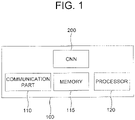
- Fig. 1 shows a configuration of a computing device for learning an ROI pooling layer using masking parameters.
- the computing device may represent a learning device.
- the computing device 100 may include a CNN 200. Functions of inputting and outputting various data and those of operating the various data by the CNN 200 may be performed by a communication part 110 and a processor 120 therein respectively. But, in Fig. 1 , detailed explanation on how the communication part 110 and the processor 120 are connected is omitted.
- the learning device may further include a memory 115 capable of storing computer readable instructions for performing following processes.
- the processor, the memory, a medium, etc. may be integrated with an integrated processor.
- Fig. 2 shows a configuration of the CNN 200 and a learning process in accordance with the present disclosure.
- the CNN 200 may include a convolutional layer 210, an RPN 220, an ROI pooling layer 230, an output layer 240, and a loss layer 250.
- the convolutional layer 210 may perform a process of generating a feature map by applying one or more convolution operations to an input image.
- the RPN 220 may perform a process of determining at least one ROI corresponding to at least one object included in the input image by using the feature map.
- the feature map used for determining the ROI may be a feature map generated lastly by the convolutional layer 210, but it may not be limited to this.
- the ROI pooling layer 230 may perform a process of generating a masked pooled feature map by applying each of pooling operations correspondingly to each of sub-regions in the ROI by referring to each of masking parameters corresponding to each of the pooling operations. Specific information about the masking parameters will be explained later.
- the output layer 240 may perform a process of generating CNN output values by applying neural network operations to the masked pooled feature map.
- the loss layer 250 may perform a process of generating loss values by referring to the CNN output values and their corresponding GTs. The loss values may be backpropagated to thereby learn the masking parameters.
- the process performed by the ROI pooling layer 230 may be explained by referring to Fig. 3 .
- Fig. 3 shows a process of generating representative feature values in accordance with the present disclosure.
- Fig. 3 it may be seen that only some of values included in the sub-regions in the ROI were used for generating the representative feature values owing to the masking parameters.
- Each of the masking parameters, corresponding to each of feature values included in the ROI, is determined as either a first value or a second value.
- the computing device 100 instructs the ROI pooling layer 230 to apply each of the pooling operations correspondingly to each of the sub-regions in the ROI by referring to information on whether each of the masking parameters is the first value or the second value, to thereby generate the masked pooled feature map.
- the computing device 100 may instruct the ROI pooling layer 230 not to apply its corresponding pooling operation to the feature values, included in each of the corresponding sub-regions in the ROI, whose corresponding masking parameters are the first value.
- the first value may be set to 0, and the second value may be set to 1.
- the ROI pooling layer 230 may multiply each of the masking parameters and each of the feature values in the ROI element-wise, to thereby generate the representative feature values. In this way, a usage of computing resources may be reduced.
- the computing device may instruct the ROI pooling layer to output each of the representative feature values, as each component of the masked pooled feature map.
- each of the representative feature values may be (i) each of averages of feature values, or (ii) each of largest ones among feature values, wherein the feature values used here are the feature values included in each of the corresponding sub-regions in the ROI, whose corresponding masking parameters are the second value.
- an average pooling method or a max pooling method may be used. Although only an example on the average pooling method is shown in Fig. 3 , it may be self-evident that the max pooling may be applied by following the methods shown above.
- the output layer 240 may generate the CNN output values by applying the neural network operations to the masked pooled feature map.
- the neural network operations may be for an image segmentation, an object detection or a clustering, but it may not be limited to this.
- the loss layer 250 may generate the loss values by referring to the CNN output values and their corresponding GTs.
- the loss values may be backpropagated to thereby learn the masking parameters of the ROI pooling layer 230.
- at least part of the parameters included in the convolutional layer 210 and the output layer 240 may be further learned in the backpropagation process.
- the computing device 100 has instructed the convolutional layer 210 of the CNN 200 to generate the feature map for training corresponding to the training image; (2) the computing device 100 has instructed the RPN 220 of the CNN 200 to determine the ROI for training corresponding to at least one object for training included in the training image by using the feature map for training; (3) the computing device 100 has instructed the ROI pooling layer 230 of the CNN 200 to apply each of the pooling operations correspondingly to each of the sub-regions for training in the ROI for training by referring to each of the masking parameters corresponding to each of the pooling operations, to thereby generate the masked pooled feature map for training; (4) the computing device 100 has instructed the output layer 240 of the CNN 200 to generate CNN output values for training by applying neural network operations to the masked pooled feature map for training; (5) the computing device 100 has instructed the loss layer 250 of the CNN 200 to generate loss values by referring to the CNN output values for training and their corresponding GTs, and learning the masking parameters of the ROI pooling layer 230 by
- the testing device may instruct the RPN of the CNN to determine the ROI for testing corresponding to at least one object for testing included in the test image by using the feature map for testing.
- the testing device may instruct the ROI pooling layer of the CNN to apply each of the pooling operations correspondingly to each of sub-regions for testing in the ROI for testing by referring to each of the masking parameters corresponding to each of the pooling operations, to thereby generate a masked pooled feature map for testing.
- the testing device may instruct the output layer of the CNN to generate CNN output values for testing by applying the neural network operations to the masked pooled feature map for testing.
- the configuration of the testing device is the same to the configuration of the computing device 100 except the part for generating the loss values.
- the ROI pooling method is applicable to mobile devices, compact networks, and the like via hardware optimization.
- the objects of the technical solution of the present disclosure or parts contributing to the prior art can be implemented in a form of executable program command through a variety of computer means and can be recorded to computer readable recording media.
- the computer readable media may include solely or in combination, program commands, data files, and data structures.
- the program commands recorded to the media may be components specially designed for the present disclosure or may be usable to a skilled person in a field of computer software.
- Computer readable record media include magnetic media such as hard disk, floppy disk, and magnetic tape, optical media such as CD-ROM and DVD, magneto-optical media such as floptical disk and hardware devices such as ROM, RAM, and flash memory specially designed to store and carry out programs.
- Program commands include not only a machine language code made by a complier but also a high-level code that can be used by an interpreter etc., which is executed by a computer.
- the aforementioned hardware devices can work as more than a software module to perform the action of the present disclosure and they can do the same in the opposite case.
- the hardware devices may be combined with memory such as ROM and RAM to store program commands and include a processor such as CPU or GPU composed to execute commands stored in the memory and also include a communication part for sending and receiving signals with external devices.
Landscapes
- Engineering & Computer Science (AREA)
- Theoretical Computer Science (AREA)
- Physics & Mathematics (AREA)
- General Physics & Mathematics (AREA)
- Evolutionary Computation (AREA)
- Artificial Intelligence (AREA)
- Data Mining & Analysis (AREA)
- Life Sciences & Earth Sciences (AREA)
- Health & Medical Sciences (AREA)
- General Health & Medical Sciences (AREA)
- General Engineering & Computer Science (AREA)
- Software Systems (AREA)
- Computing Systems (AREA)
- Computer Vision & Pattern Recognition (AREA)
- Molecular Biology (AREA)
- Biomedical Technology (AREA)
- Multimedia (AREA)
- Mathematical Physics (AREA)
- Computational Linguistics (AREA)
- Biophysics (AREA)
- Medical Informatics (AREA)
- Databases & Information Systems (AREA)
- Bioinformatics & Cheminformatics (AREA)
- Bioinformatics & Computational Biology (AREA)
- Evolutionary Biology (AREA)
- Biodiversity & Conservation Biology (AREA)
- Image Analysis (AREA)
Claims (14)
- Verfahren zum Pooling von mindestens einer ROI, d.h. Region von Interesse, unter Verwendung eines oder mehrerer Maskierungsparameter, umfassend folgende Schritte:(a) eine Rechenvorrichtung (100), wenn ein Eingangsbild erfasst wird, die eine Faltungsschicht (210) eines CNN (200), d.h. ein neuronales Faltungsnetzwerk, anweist, eine dem Eingangsbild entsprechende Merkmalskarte zu erzeugen;(b) die Rechenvorrichtung (100) ein RPN (220), d.h. ein Regionenvorschlagsnetzwerk, des CNN (200) anweist, die ROI zu bestimmen, die mindestens einem in dem Eingangsbild enthaltenen Objekt entspricht, indem die Merkmalskarte verwendet wird; und dadurch gekennzeichnet, dass(c) die Rechenvorrichtung (100) eine ROI-Pooling-Schicht (230) des CNN (200) anweist, jede der Pooling-Operationen entsprechend auf jede der Unterregionen in der ROI anzuwenden, indem auf jeden der Maskierungsparameter Bezug genommen wird, die jeder der Pooling-Operationen entsprechen, um dadurch eine maskierte gepoolte Merkmalskarte zu erzeugen,wobei jeder der Maskierungsparameter entweder als ein erster Wert oder als ein zweiter Wert bestimmt wird, undwobei im Schritt (c) die Rechenvorrichtung (100) die ROI-Pooling-Schicht (230) anweist, jede der Pooling-Operationen entsprechend auf jede der Unterregionen in der ROI anzuwenden, indem auf Informationen darüber Bezug genommen wird, ob jeder der Maskierungsparameter der erste Wert oder der zweite Wert ist, um dadurch die maskierte gepoolte Merkmalskarte zu erzeugen.
- Verfahren nach Anspruch 1, wobei die Rechenvorrichtung (100) die ROI-Pooling-Schicht (230) anweist, ihre entsprechende Pooling-Operation auf Merkmalswerte anzuwenden, die in jeder der entsprechenden Unterregionen in der ROI enthalten sind, deren entsprechende Maskierungsparameter der zweite Wert sind.
- Verfahren nach Anspruch 1, ferner umfassend folgende Schritte:(d) die Rechenvorrichtung (100) weist eine Ausgabeschicht (240) des CNN (200) an, CNN-Ausgabewerte zu erzeugen, indem neuronale Netzwerkoperationen auf die maskierte gepoolte Merkmalskarte angewendet werden; und(e) die Rechenvorrichtung (100) weist eine Verlustschicht (250) des CNN (200) an, Verlustwerte zu erzeugen, indem sie sich auf die CNN-Ausgabewerte und ihre entsprechenden GTs, d.h. Grundwahrheiten, bezieht, und die Maskierungsparameter der ROI-Pooling-Schicht (230) durch Backpropagieren der Verlustwerte zu lernen.
- Verfahren nach Anspruch 3, wobei im Schritt (e) die Rechenvorrichtung (100) ferner zumindest einen Teil der in der Faltungsschicht (210) und der Ausgabeschicht (240) enthaltenen Parameter durch Backpropagation der Verlustwerte lernt.
- Verfahren nach Anspruch 1, wobei jeder der Maskierungsparameter entweder als ein erster Wert oder als ein zweiter Wert bestimmt wird,wobei im Schritt (c) die Rechenvorrichtung (100) die ROI-Pooling-Schicht (230) anweist, jede der Pooling-Operationen entsprechend auf jede der Unterregionen in der ROI anzuwenden, indem auf Informationen darüber Bezug genommen wird, ob jeder der Maskierungsparameter der erste Wert oder der zweite Wert ist, um dadurch die maskierte gepoolte Merkmalskarte zu erzeugen,wobei im Schritt (c) die Rechenvorrichtung (100) die ROI-Pooling-Schicht (230) anweist, jeden der repräsentativen Merkmalswerte als jede Komponente der maskierten gepoolten Merkmalskarte auszugeben, undwobei jeder der repräsentativen Merkmalswerte jeder der Durchschnittswerte von Merkmalswerten ist, die in jeder der entsprechenden Unterregionen in der ROI enthalten sind, deren entsprechende Maskierungsparameter der zweite Wert sind.
- Verfahren nach Anspruch 1, wobei jeder der Maskierungsparameter entweder als ein erster Wert oder als ein zweiter Wert bestimmt wird,wobei im Schritt (c) die Rechenvorrichtung (100) die ROI-Pooling-Schicht (230) anweist, jede der Pooling-Operationen entsprechend auf jede der Unterregionen in der ROI anzuwenden, indem auf Informationen darüber Bezug genommen wird, ob jeder der Maskierungsparameter der erste Wert oder der zweite Wert ist, um dadurch die maskierte gepoolte Merkmalskarte zu erzeugen,wobei im Schritt (c) die Rechenvorrichtung (100) die ROI-Pooling-Schicht (230) anweist, jeden der repräsentativen Merkmalswerte als jede Komponente der maskierten gepoolten Merkmalskarte auszugeben, undwobei jeder der repräsentativen Merkmalswerte jeder der größten unter den Merkmalswerten ist, die in jeder der entsprechenden Unterregionen in der ROI enthalten sind, deren entsprechende Maskierungsparameter der zweite Wert sind.
- Testverfahren zum Pooling mindestens einer ROI, d.h. Region von Interesse, unter Verwendung eines oder mehrerer Maskierungsparameter, umfassend folgende Schritte:(a) unter der Bedingung, dass (1) eine Rechenvorrichtung (100) das Verfahren nach Anspruch 1 und Anspruch 3 implementiert hat, eine Testvorrichtung, wenn ein Testbild erfasst wird, die Faltungsschicht des CNN anweist, eine Merkmalskarte zum Testen entsprechend dem Testbild zu erzeugen;(b) die Testvorrichtung weist die RPN (220) des CNN (200) an, die zu testende ROI zu bestimmen, die mindestens einem zu testenden Objekt entspricht, das in dem Testbild enthalten ist, indem sie die Merkmalskarte für den Test verwendet;(c) die Testvorrichtung die ROI-Pooling-Schicht (230) des CNN (200) anweist, jede der Pooling-Operationen entsprechend auf jeden der zu testenden Unterregionen in der zu testenden ROI anzuwenden, indem auf jeden der Maskierungsparameter Bezug genommen wird, die jeder der Pooling-Operationen entsprechen, um dadurch eine maskierte gepoolte Merkmalskarte für den Test zu erzeugen; und(d) die Testvorrichtung die Ausgabeschicht (240) des CNN (200) anweist, CNN-Ausgabewerte zum Testen zu erzeugen, indem die Operationen des neuronalen Netzes auf die maskierte gepoolte Merkmalskarte zum Testen angewendet werden.
- Testverfahren nach Anspruch 7, wobei jeder der Maskierungsparameter entweder als ein erster Wert oder als ein zweiter Wert bestimmt wird, und
wobei im Schritt (c) die Testvorrichtung die ROI-Pooling-Schicht (230) anweist, jede der Pooling-Operationen entsprechend auf jeden der zu testenden Unterregionen in der zu testenden ROI anzuwenden, indem auf Informationen darüber Bezug genommen wird, ob jeder der Maskierungsparameter der erste Wert oder der zweite Wert ist, um dadurch die maskierte gepoolte Merkmalskarte zum Test zu erzeugen. - Verfahren nach Anspruch 8, wobei die Rechenvorrichtung (100) die ROI-Pooling-Schicht (230) anweist, ihre entsprechende Pooling-Operation auf zu testende Merkmalswerte anzuwenden, die in jeder der entsprechenden zu testenden Unterregionen in der zu testenden ROI enthalten sind, deren entsprechende Maskierungsparameter der zweite Wert sind.
- Verfahren nach Anspruch 7, wobei jeder der Maskierungsparameter entweder als ein erster Wert oder als ein zweiter Wert bestimmt wird,wobei im Schritt (c) die Testvorrichtung die ROI-Pooling-Schicht (230) anweist, jede der Pooling-Operationen entsprechend auf jeden der zu testenden Unterregionen in der zu testenden ROI anzuwenden, indem auf Informationen darüber Bezug genommen wird, ob jeder der Maskierungsparameter der erste Wert oder der zweite Wert ist, um dadurch die maskierte gepoolte Merkmalskarte zum Test zu erzeugen,wobei im Schritt (c) die Testvorrichtung die ROI-Pooling-Schicht (230) anweist, jeden der repräsentativen Merkmalswerte für den Test als jede Komponente der maskierten gepoolten Merkmalskarte für den Test auszugeben, undwobei jeder der repräsentativen Merkmalswerte zum Testen jeder der Durchschnittswerte von Merkmalswerten zum Testen ist, die in jeder der entsprechenden Unterregionen zum Testen in der ROI zum Testen enthalten sind, deren entsprechende Maskierungsparameter der zweite Wert sind.
- Verfahren nach Anspruch 7, wobei jeder der Maskierungsparameter entweder als ein erster Wert oder als ein zweiter Wert bestimmt wird,wobei im Schritt (c) die Testvorrichtung die ROI-Pooling-Schicht (230) anweist, jede der Pooling-Operationen entsprechend auf jeden der zu testenden Unterregionen in der zu testenden ROI anzuwenden, indem auf Informationen darüber Bezug genommen wird, ob jeder der Maskierungsparameter der erste Wert oder der zweite Wert ist, um dadurch die maskierte gepoolte Merkmalskarte zum Test zu erzeugen,wobei im Schritt (c) die Testvorrichtung die ROI-Pooling-Schicht (230) anweist, jeden der repräsentativen Merkmalswerte für den Test als jede Komponente der maskierten gepoolten Merkmalskarte für den Test auszugeben, undwobei jeder der repräsentativen Merkmalswerte zum Testen jeder der größten unter den Merkmalswerten zum Testen ist, die in jeder der entsprechenden Unterregionen zum Testen in der ROI zum Testen enthalten sind, deren entsprechende Maskierungsparameter der zweite Wert sind.
- Computerprogramm mit Anweisungen, die, wenn das Programm von einem Computer ausgeführt wird, den Computer veranlassen, die Schritte des Verfahrens nach Anspruch 1 auszuführen.
- Computerprogramm nach Anspruch 12, das Anweisungen enthält, die, wenn das Programm von einem Computer ausgeführt wird, den Computer veranlassen, die Schritte des Verfahrens nach Anspruch 5 auszuführen.
- Testvorrichtung zum Pooling von mindestens einer ROI, d.h. Region von Interesse, unter Verwendung eines oder mehrerer Maskierungsparameter, umfassend:mindestens einen Speicher (115), der Anweisungen speichert; undmindestens einen Prozessor (120), unter der Bedingung, dass (1) eine Rechenvorrichtung (100) eine Faltungsschicht (210) eines CNN (200), ein neuronales Faltungsnetzwerk, angewiesen hat, eine Merkmalskarte für das Training zu erzeugen, die einem Trainingsbild entspricht, (2) die Rechenvorrichtung (100) ein RPN (220), d.h. ein Regionenvorschlagsnetzwerk, des CNN (200) angewiesen hat, die ROI für das Training zu bestimmen, die mindestens einem Objekt für das Training entspricht, das in dem Trainingsbild enthalten ist, indem die Merkmalskarte für das Training verwendet wird, dadurch gekennzeichnet, dass (3) die Rechenvorrichtung (100) eine ROI-Pooling-Schicht (230) des CNN (200) angewiesen hat, jede der Pooling-Operationen entsprechend auf jeden der Unterregionen für das Training in der ROI für das Training anzuwenden, indem auf jeden der Maskierungsparameter Bezug genommen wird, die jeder der Pooling-Operationen entsprechen, um dadurch eine maskierte gepoolte Merkmalskarte für das Training zu erzeugen, (4) die Rechenvorrichtung (100) eine Ausgabeschicht (240) des CNN (200) angewiesen hat, CNN-Ausgabewerte für das Training zu erzeugen, indem neuronale Netzwerkoperationen auf die maskierte gepoolte Merkmalskarte für das Training angewendet werden, und (5) die Rechenvorrichtung (100) eine Verlustschicht (250) des CNN (200) angewiesen hat, Verlustwerte zu erzeugen, indem auf die CNN-Ausgabewerte für das Training und ihre entsprechenden GTs, d.h. Grundwahrheiten, Bezug genommen wird und die Maskierungsparameter der ROI-Pooling-Schicht (230) durch Backpropagieren der Verlustwerte gelernt wird, wobei jeder der Maskierungsparameter entweder als ein erster Wert oder als ein zweiter Wert bestimmt wird, wobei bei dem Verfahren von (3) der Prozessor (120) die ROI-Pooling-Schicht (230) anweist, jede der Pooling-Operationen entsprechend auf jede der Unterregionen in der ROI anzuwenden, indem auf Informationen darüber Bezug genommen wird, ob jeder der Maskierungsparameter der erste Wert oder der zweite Wert ist, um dadurch die maskierte gepoolte Merkmalskarte zu erzeugen, wobei der Prozessor so konfiguriert ist, dass er die Anweisungen ausführt, um folgende Prozesse durchzuführen: (I) Anweisen der Faltungsschicht (210) des CNN (200), eine Merkmalskarte zum Testen zu erzeugen, die einem Testbild entspricht; (II) Anweisen der RPN (220) des CNN (200), die ROI zum Testen zu bestimmen, die mindestens einem Objekt zum Testen entspricht, das in dem Testbild enthalten ist, indem die Merkmalskarte zum Testen verwendet wird; (III) Anweisen der ROI-Pooling-Schicht (230) des CNN (200), jede der Pooling-Operationen entsprechend auf jede der Unterregionen zum Testen in der ROI zum Testen anzuwenden, indem auf jeden der Maskierungsparameter Bezug genommen wird, der jeder der Pooling-Operationen entspricht, um dadurch eine maskierte gepoolte Merkmalskarte zum Testen zu erzeugen; und (IV) Anweisen der Ausgabeschicht (240) des CNN (200), CNN-Ausgabewerte zum Testen zu erzeugen, indem die neuronalen Netzwerkoperationen auf die maskierte gepoolte Merkmalskarte zum Testen angewendet werden.
Applications Claiming Priority (1)
| Application Number | Priority Date | Filing Date | Title |
|---|---|---|---|
| US16/254,982 US10325179B1 (en) | 2019-01-23 | 2019-01-23 | Learning method and learning device for pooling ROI by using masking parameters to be used for mobile devices or compact networks via hardware optimization, and testing method and testing device using the same |
Publications (2)
| Publication Number | Publication Date |
|---|---|
| EP3687152A1 EP3687152A1 (de) | 2020-07-29 |
| EP3687152B1 true EP3687152B1 (de) | 2022-07-20 |
Family
ID=66826056
Family Applications (1)
| Application Number | Title | Priority Date | Filing Date |
|---|---|---|---|
| EP19215127.2A Active EP3687152B1 (de) | 2019-01-23 | 2019-12-11 | Lernverfahren und lernvorrichtung zur bündelung von roi unter verwendung von maskierungsparametern zur verwendung für mobile vorrichtungen oder kompakte netzwerke über hardware-optimierung und testverfahren und testvorrichtung mit verwendung davon |
Country Status (5)
| Country | Link |
|---|---|
| US (1) | US10325179B1 (de) |
| EP (1) | EP3687152B1 (de) |
| JP (1) | JP6957050B2 (de) |
| KR (1) | KR102337358B1 (de) |
| CN (1) | CN111476343B (de) |
Families Citing this family (10)
| Publication number | Priority date | Publication date | Assignee | Title |
|---|---|---|---|---|
| JP2019211969A (ja) * | 2018-06-04 | 2019-12-12 | オリンパス株式会社 | 学習管理装置、学習管理サーバ、および学習管理方法 |
| US10713815B1 (en) * | 2019-01-31 | 2020-07-14 | StradVision, Inc. | Method and device for supporting administrators to processes of object detectors to provide logical driving |
| CN110503088B (zh) * | 2019-07-03 | 2024-05-07 | 平安科技(深圳)有限公司 | 基于深度学习的目标检测方法及电子装置 |
| CN111368690B (zh) * | 2020-02-28 | 2021-03-02 | 珠海大横琴科技发展有限公司 | 基于深度学习的海浪影响下视频图像船只检测方法及系统 |
| US12488568B2 (en) * | 2020-06-05 | 2025-12-02 | Nec Corporation | Information processing apparatus which reduces computation operations, information processing method, and computer readable medium |
| CN111737468B (zh) * | 2020-06-23 | 2023-07-25 | 中国平安人寿保险股份有限公司 | 短语聚类方法、装置、设备及存储介质 |
| CN111916206B (zh) * | 2020-08-04 | 2023-12-08 | 重庆大学 | 一种基于级联的ct影像辅助诊断系统 |
| US12299567B2 (en) * | 2021-09-20 | 2025-05-13 | Arm Limited | Convolution size prediction to reduce calculations |
| US12488556B2 (en) | 2022-02-08 | 2025-12-02 | Samsung Electronics Co., Ltd. | Method and electronic device for processing input frame for on-device AI model |
| WO2023153781A1 (en) * | 2022-02-08 | 2023-08-17 | Samsung Electronics Co., Ltd. | Method and electronic device for processing input frame for on-device ai model |
Family Cites Families (37)
| Publication number | Priority date | Publication date | Assignee | Title |
|---|---|---|---|---|
| US11074495B2 (en) * | 2013-02-28 | 2021-07-27 | Z Advanced Computing, Inc. (Zac) | System and method for extremely efficient image and pattern recognition and artificial intelligence platform |
| US9558268B2 (en) * | 2014-08-20 | 2017-01-31 | Mitsubishi Electric Research Laboratories, Inc. | Method for semantically labeling an image of a scene using recursive context propagation |
| US10387773B2 (en) * | 2014-10-27 | 2019-08-20 | Ebay Inc. | Hierarchical deep convolutional neural network for image classification |
| WO2016090520A1 (en) * | 2014-12-10 | 2016-06-16 | Xiaogang Wang | A method and a system for image classification |
| CN112945251B (zh) * | 2015-02-10 | 2022-06-28 | 御眼视觉技术有限公司 | 用于确定车道分配的系统、方法及计算机可读存储介质 |
| WO2016141282A1 (en) * | 2015-03-04 | 2016-09-09 | The Regents Of The University Of California | Convolutional neural network with tree pooling and tree feature map selection |
| US9940539B2 (en) * | 2015-05-08 | 2018-04-10 | Samsung Electronics Co., Ltd. | Object recognition apparatus and method |
| EP3295368A1 (de) * | 2015-05-13 | 2018-03-21 | Google LLC | Deepstereo: lernen zur vorhersage neuer ansichten von bildern aus der realen welt |
| US9741107B2 (en) * | 2015-06-05 | 2017-08-22 | Sony Corporation | Full reference image quality assessment based on convolutional neural network |
| US9633282B2 (en) * | 2015-07-30 | 2017-04-25 | Xerox Corporation | Cross-trained convolutional neural networks using multimodal images |
| US9710714B2 (en) * | 2015-08-03 | 2017-07-18 | Nokia Technologies Oy | Fusion of RGB images and LiDAR data for lane classification |
| US9767381B2 (en) * | 2015-09-22 | 2017-09-19 | Xerox Corporation | Similarity-based detection of prominent objects using deep CNN pooling layers as features |
| US9965705B2 (en) * | 2015-11-03 | 2018-05-08 | Baidu Usa Llc | Systems and methods for attention-based configurable convolutional neural networks (ABC-CNN) for visual question answering |
| US9965719B2 (en) * | 2015-11-04 | 2018-05-08 | Nec Corporation | Subcategory-aware convolutional neural networks for object detection |
| US10019631B2 (en) * | 2015-11-05 | 2018-07-10 | Qualcomm Incorporated | Adapting to appearance variations when tracking a target object in video sequence |
| US9881234B2 (en) * | 2015-11-25 | 2018-01-30 | Baidu Usa Llc. | Systems and methods for end-to-end object detection |
| US9773196B2 (en) * | 2016-01-25 | 2017-09-26 | Adobe Systems Incorporated | Utilizing deep learning for automatic digital image segmentation and stylization |
| JP6525912B2 (ja) * | 2016-03-23 | 2019-06-05 | 富士フイルム株式会社 | 画像分類装置、方法およびプログラム |
| US9830529B2 (en) * | 2016-04-26 | 2017-11-28 | Xerox Corporation | End-to-end saliency mapping via probability distribution prediction |
| US10210418B2 (en) * | 2016-07-25 | 2019-02-19 | Mitsubishi Electric Research Laboratories, Inc. | Object detection system and object detection method |
| KR102483642B1 (ko) * | 2016-08-23 | 2023-01-02 | 삼성전자주식회사 | 라이브니스 검사 방법 및 장치 |
| US9947102B2 (en) * | 2016-08-26 | 2018-04-17 | Elekta, Inc. | Image segmentation using neural network method |
| RU2016138608A (ru) * | 2016-09-29 | 2018-03-30 | Мэджик Лип, Инк. | Нейронная сеть для сегментации изображения глаза и оценки качества изображения |
| US10424064B2 (en) * | 2016-10-18 | 2019-09-24 | Adobe Inc. | Instance-level semantic segmentation system |
| US10503998B2 (en) * | 2016-11-07 | 2019-12-10 | Gracenote, Inc. | Recurrent deep neural network system for detecting overlays in images |
| CN108073929B (zh) * | 2016-11-15 | 2023-11-24 | 北京三星通信技术研究有限公司 | 基于动态视觉传感器的物体检测方法及设备 |
| US10345449B2 (en) * | 2016-12-02 | 2019-07-09 | Verizon Connect Ireland Limited | Vehicle classification using a recurrent neural network (RNN) |
| US9953236B1 (en) * | 2017-03-10 | 2018-04-24 | TuSimple | System and method for semantic segmentation using dense upsampling convolution (DUC) |
| CN107145889B (zh) * | 2017-04-14 | 2020-02-18 | 中国人民解放军国防科学技术大学 | 基于具有RoI池化的双CNN网络的目标识别方法 |
| CN107480707B (zh) * | 2017-07-26 | 2020-08-07 | 天津大学 | 一种基于信息无损池化的深度神经网络方法 |
| US10679351B2 (en) * | 2017-08-18 | 2020-06-09 | Samsung Electronics Co., Ltd. | System and method for semantic segmentation of images |
| US9934440B1 (en) * | 2017-10-04 | 2018-04-03 | StradVision, Inc. | Method for monitoring blind spot of monitoring vehicle and blind spot monitor using the same |
| US10223610B1 (en) * | 2017-10-15 | 2019-03-05 | International Business Machines Corporation | System and method for detection and classification of findings in images |
| US9953437B1 (en) * | 2017-10-18 | 2018-04-24 | StradVision, Inc. | Method and device for constructing a table including information on a pooling type and testing method and testing device using the same |
| CN109215034B (zh) * | 2018-07-06 | 2021-09-21 | 成都图必优科技有限公司 | 一种基于空间金字塔掩盖池化的弱监督图像语义分割方法 |
| CN108898610B (zh) * | 2018-07-20 | 2020-11-20 | 电子科技大学 | 一种基于mask-RCNN的物体轮廓提取方法 |
| CN109117822A (zh) * | 2018-08-31 | 2019-01-01 | 贵州大学 | 一种基于深度学习的零件实例分割识别方法 |
-
2019
- 2019-01-23 US US16/254,982 patent/US10325179B1/en active Active
- 2019-09-27 KR KR1020190119523A patent/KR102337358B1/ko active Active
- 2019-12-11 EP EP19215127.2A patent/EP3687152B1/de active Active
-
2020
- 2020-01-07 JP JP2020001023A patent/JP6957050B2/ja active Active
- 2020-01-20 CN CN202010065642.5A patent/CN111476343B/zh active Active
Also Published As
| Publication number | Publication date |
|---|---|
| KR20200091783A (ko) | 2020-07-31 |
| CN111476343A (zh) | 2020-07-31 |
| EP3687152A1 (de) | 2020-07-29 |
| CN111476343B (zh) | 2023-05-26 |
| JP2020119529A (ja) | 2020-08-06 |
| KR102337358B1 (ko) | 2021-12-10 |
| JP6957050B2 (ja) | 2021-11-02 |
| US10325179B1 (en) | 2019-06-18 |
Similar Documents
| Publication | Publication Date | Title |
|---|---|---|
| EP3687152B1 (de) | Lernverfahren und lernvorrichtung zur bündelung von roi unter verwendung von maskierungsparametern zur verwendung für mobile vorrichtungen oder kompakte netzwerke über hardware-optimierung und testverfahren und testvorrichtung mit verwendung davon | |
| EP3686780B1 (de) | Lernverfahren und lernvorrichtung zur aufmerksamkeitsgetriebenen bildsegmentierung unter verwendung mindestens einer adaptiven verlustgewichtskarte zur aktualisierung von hd-karten, die zur erfüllung der stufe 4 von autonomen fahrzeugen erforderlich ist, sowie prüfverfahren und prüfvorrichtung dafür | |
| US10540572B1 (en) | Method for auto-labeling training images for use in deep learning network to analyze images with high precision, and auto-labeling device using the same | |
| US10373026B1 (en) | Learning method and learning device for generation of virtual feature maps whose characteristics are same as or similar to those of real feature maps by using GAN capable of being applied to domain adaptation to be used in virtual driving environments | |
| EP3686779B1 (de) | Verfahren und vorrichtung zur aufmerksamkeitsbasierten spurdetektion ohne nachverarbeitung unter verwendung einer spurmaske und testverfahren und testvorrichtung mit verwendung davon | |
| US10410120B1 (en) | Learning method and testing method of object detector to be used for surveillance based on R-CNN capable of converting modes according to aspect ratios or scales of objects, and learning device and testing device using the same | |
| EP3686774B1 (de) | Lernverfahren und lernvorrichtung zur verbesserung der segmentierungsleistung bei der strassenhindernisdetektion, die erforderlich ist, um die stufe 4 und die stufe 5 von autonomen fahrzeugen unter verwendung des laplace-pyramidennetzwerks zu erfüllen, und testverfahren und dasselbe verwendende testvorrichtung | |
| US10325371B1 (en) | Method and device for segmenting image to be used for surveillance using weighted convolution filters for respective grid cells by converting modes according to classes of areas to satisfy level 4 of autonomous vehicle, and testing method and testing device using the same | |
| CN111507161B (zh) | 利用合并网络进行异质传感器融合的方法和装置 | |
| US10551846B1 (en) | Learning method and learning device for improving segmentation performance to be used for detecting road user events using double embedding configuration in multi-camera system and testing method and testing device using the same | |
| US10325352B1 (en) | Method and device for transforming CNN layers to optimize CNN parameter quantization to be used for mobile devices or compact networks with high precision via hardware optimization | |
| KR20200027428A (ko) | 에지 이미지를 이용하여 객체를 검출하는 학습 방법 및 학습 장치 그리고 이를 이용한 테스트 방법 및 테스트 장치 | |
| US10311336B1 (en) | Method and device of neural network operations using a grid generator for converting modes according to classes of areas to satisfy level 4 of autonomous vehicles | |
| US10565476B1 (en) | Method and computing device for generating image data set for learning to be used for detection of obstruction in autonomous driving circumstances and learning method and learning device using the same | |
| US10452980B1 (en) | Learning method and learning device for extracting feature from input image by using convolutional layers in multiple blocks in CNN, resulting in hardware optimization which allows key performance index to be satisfied, and testing method and testing device using the same | |
| US11461653B2 (en) | Learning method and learning device for CNN using 1xK or Kx1 convolution to be used for hardware optimization, and testing method and testing device using the same | |
| US20200250514A1 (en) | Learning method and learning device for integrating object detection information acquired through v2v communication from other autonomous vehicle with object detection information generated by present autonomous vehicle, and testing method and testing device using the same | |
| US10311578B1 (en) | Learning method and learning device for segmenting an image having one or more lanes by using embedding loss to support collaboration with HD maps required to satisfy level 4 of autonomous vehicles and softmax loss, and testing method and testing device using the same | |
| CN111488786B (zh) | 基于cnn的监视用客体检测器的方法及装置 | |
| US10325185B1 (en) | Method and device for online batch normalization, on-device learning, and continual learning applicable to mobile devices or IOT devices additionally referring to one or more previous batches to be used for military purpose, drone or robot, and testing method and testing device using the same | |
| EP3686784B1 (de) | Verfahren und vorrichtung für operationen eines neuronalen netzes unter verwendung eines rastergenerators zur umwandlung von modi gemäss der klassen von bereichen zur zufriedenstellung der stufe 4 für autonome fahrzeuge | |
| US10339424B1 (en) | Method and device of neural network operations using a grid generator for converting modes according to classes of areas to satisfy level 4 of autonomous vehicles | |
| US10373004B1 (en) | Method and device for detecting lane elements to plan the drive path of autonomous vehicle by using a horizontal filter mask, wherein the lane elements are unit regions including pixels of lanes in an input image |
Legal Events
| Date | Code | Title | Description |
|---|---|---|---|
| PUAI | Public reference made under article 153(3) epc to a published international application that has entered the european phase |
Free format text: ORIGINAL CODE: 0009012 |
|
| STAA | Information on the status of an ep patent application or granted ep patent |
Free format text: STATUS: REQUEST FOR EXAMINATION WAS MADE |
|
| 17P | Request for examination filed |
Effective date: 20191211 |
|
| AK | Designated contracting states |
Kind code of ref document: A1 Designated state(s): AL AT BE BG CH CY CZ DE DK EE ES FI FR GB GR HR HU IE IS IT LI LT LU LV MC MK MT NL NO PL PT RO RS SE SI SK SM TR |
|
| AX | Request for extension of the european patent |
Extension state: BA ME |
|
| RBV | Designated contracting states (corrected) |
Designated state(s): AL AT BE BG CH CY CZ DE DK EE ES FI FR GB GR HR HU IE IS IT LI LT LU LV MC MK MT NL NO PL PT RO RS SE SI SK SM TR |
|
| GRAP | Despatch of communication of intention to grant a patent |
Free format text: ORIGINAL CODE: EPIDOSNIGR1 |
|
| STAA | Information on the status of an ep patent application or granted ep patent |
Free format text: STATUS: GRANT OF PATENT IS INTENDED |
|
| INTG | Intention to grant announced |
Effective date: 20220408 |
|
| GRAS | Grant fee paid |
Free format text: ORIGINAL CODE: EPIDOSNIGR3 |
|
| GRAA | (expected) grant |
Free format text: ORIGINAL CODE: 0009210 |
|
| STAA | Information on the status of an ep patent application or granted ep patent |
Free format text: STATUS: THE PATENT HAS BEEN GRANTED |
|
| AK | Designated contracting states |
Kind code of ref document: B1 Designated state(s): AL AT BE BG CH CY CZ DE DK EE ES FI FR GB GR HR HU IE IS IT LI LT LU LV MC MK MT NL NO PL PT RO RS SE SI SK SM TR |
|
| REG | Reference to a national code |
Ref country code: CH Ref legal event code: EP |
|
| REG | Reference to a national code |
Ref country code: DE Ref legal event code: R096 Ref document number: 602019017172 Country of ref document: DE |
|
| REG | Reference to a national code |
Ref country code: AT Ref legal event code: REF Ref document number: 1506317 Country of ref document: AT Kind code of ref document: T Effective date: 20220815 |
|
| REG | Reference to a national code |
Ref country code: IE Ref legal event code: FG4D |
|
| REG | Reference to a national code |
Ref country code: LT Ref legal event code: MG9D |
|
| REG | Reference to a national code |
Ref country code: NL Ref legal event code: MP Effective date: 20220720 |
|
| PG25 | Lapsed in a contracting state [announced via postgrant information from national office to epo] |
Ref country code: SE Free format text: LAPSE BECAUSE OF FAILURE TO SUBMIT A TRANSLATION OF THE DESCRIPTION OR TO PAY THE FEE WITHIN THE PRESCRIBED TIME-LIMIT Effective date: 20220720 Ref country code: RS Free format text: LAPSE BECAUSE OF FAILURE TO SUBMIT A TRANSLATION OF THE DESCRIPTION OR TO PAY THE FEE WITHIN THE PRESCRIBED TIME-LIMIT Effective date: 20220720 Ref country code: PT Free format text: LAPSE BECAUSE OF FAILURE TO SUBMIT A TRANSLATION OF THE DESCRIPTION OR TO PAY THE FEE WITHIN THE PRESCRIBED TIME-LIMIT Effective date: 20221121 Ref country code: NO Free format text: LAPSE BECAUSE OF FAILURE TO SUBMIT A TRANSLATION OF THE DESCRIPTION OR TO PAY THE FEE WITHIN THE PRESCRIBED TIME-LIMIT Effective date: 20221020 Ref country code: NL Free format text: LAPSE BECAUSE OF FAILURE TO SUBMIT A TRANSLATION OF THE DESCRIPTION OR TO PAY THE FEE WITHIN THE PRESCRIBED TIME-LIMIT Effective date: 20220720 Ref country code: LV Free format text: LAPSE BECAUSE OF FAILURE TO SUBMIT A TRANSLATION OF THE DESCRIPTION OR TO PAY THE FEE WITHIN THE PRESCRIBED TIME-LIMIT Effective date: 20220720 Ref country code: LT Free format text: LAPSE BECAUSE OF FAILURE TO SUBMIT A TRANSLATION OF THE DESCRIPTION OR TO PAY THE FEE WITHIN THE PRESCRIBED TIME-LIMIT Effective date: 20220720 Ref country code: FI Free format text: LAPSE BECAUSE OF FAILURE TO SUBMIT A TRANSLATION OF THE DESCRIPTION OR TO PAY THE FEE WITHIN THE PRESCRIBED TIME-LIMIT Effective date: 20220720 Ref country code: ES Free format text: LAPSE BECAUSE OF FAILURE TO SUBMIT A TRANSLATION OF THE DESCRIPTION OR TO PAY THE FEE WITHIN THE PRESCRIBED TIME-LIMIT Effective date: 20220720 |
|
| REG | Reference to a national code |
Ref country code: AT Ref legal event code: MK05 Ref document number: 1506317 Country of ref document: AT Kind code of ref document: T Effective date: 20220720 |
|
| PG25 | Lapsed in a contracting state [announced via postgrant information from national office to epo] |
Ref country code: PL Free format text: LAPSE BECAUSE OF FAILURE TO SUBMIT A TRANSLATION OF THE DESCRIPTION OR TO PAY THE FEE WITHIN THE PRESCRIBED TIME-LIMIT Effective date: 20220720 Ref country code: IS Free format text: LAPSE BECAUSE OF FAILURE TO SUBMIT A TRANSLATION OF THE DESCRIPTION OR TO PAY THE FEE WITHIN THE PRESCRIBED TIME-LIMIT Effective date: 20221120 Ref country code: HR Free format text: LAPSE BECAUSE OF FAILURE TO SUBMIT A TRANSLATION OF THE DESCRIPTION OR TO PAY THE FEE WITHIN THE PRESCRIBED TIME-LIMIT Effective date: 20220720 Ref country code: GR Free format text: LAPSE BECAUSE OF FAILURE TO SUBMIT A TRANSLATION OF THE DESCRIPTION OR TO PAY THE FEE WITHIN THE PRESCRIBED TIME-LIMIT Effective date: 20221021 |
|
| REG | Reference to a national code |
Ref country code: DE Ref legal event code: R097 Ref document number: 602019017172 Country of ref document: DE |
|
| PG25 | Lapsed in a contracting state [announced via postgrant information from national office to epo] |
Ref country code: SM Free format text: LAPSE BECAUSE OF FAILURE TO SUBMIT A TRANSLATION OF THE DESCRIPTION OR TO PAY THE FEE WITHIN THE PRESCRIBED TIME-LIMIT Effective date: 20220720 Ref country code: RO Free format text: LAPSE BECAUSE OF FAILURE TO SUBMIT A TRANSLATION OF THE DESCRIPTION OR TO PAY THE FEE WITHIN THE PRESCRIBED TIME-LIMIT Effective date: 20220720 Ref country code: DK Free format text: LAPSE BECAUSE OF FAILURE TO SUBMIT A TRANSLATION OF THE DESCRIPTION OR TO PAY THE FEE WITHIN THE PRESCRIBED TIME-LIMIT Effective date: 20220720 Ref country code: CZ Free format text: LAPSE BECAUSE OF FAILURE TO SUBMIT A TRANSLATION OF THE DESCRIPTION OR TO PAY THE FEE WITHIN THE PRESCRIBED TIME-LIMIT Effective date: 20220720 Ref country code: AT Free format text: LAPSE BECAUSE OF FAILURE TO SUBMIT A TRANSLATION OF THE DESCRIPTION OR TO PAY THE FEE WITHIN THE PRESCRIBED TIME-LIMIT Effective date: 20220720 |
|
| PLBE | No opposition filed within time limit |
Free format text: ORIGINAL CODE: 0009261 |
|
| STAA | Information on the status of an ep patent application or granted ep patent |
Free format text: STATUS: NO OPPOSITION FILED WITHIN TIME LIMIT |
|
| PG25 | Lapsed in a contracting state [announced via postgrant information from national office to epo] |
Ref country code: SK Free format text: LAPSE BECAUSE OF FAILURE TO SUBMIT A TRANSLATION OF THE DESCRIPTION OR TO PAY THE FEE WITHIN THE PRESCRIBED TIME-LIMIT Effective date: 20220720 Ref country code: EE Free format text: LAPSE BECAUSE OF FAILURE TO SUBMIT A TRANSLATION OF THE DESCRIPTION OR TO PAY THE FEE WITHIN THE PRESCRIBED TIME-LIMIT Effective date: 20220720 |
|
| 26N | No opposition filed |
Effective date: 20230421 |
|
| P01 | Opt-out of the competence of the unified patent court (upc) registered |
Effective date: 20230522 |
|
| PG25 | Lapsed in a contracting state [announced via postgrant information from national office to epo] |
Ref country code: AL Free format text: LAPSE BECAUSE OF FAILURE TO SUBMIT A TRANSLATION OF THE DESCRIPTION OR TO PAY THE FEE WITHIN THE PRESCRIBED TIME-LIMIT Effective date: 20220720 |
|
| REG | Reference to a national code |
Ref country code: CH Ref legal event code: PL |
|
| REG | Reference to a national code |
Ref country code: BE Ref legal event code: MM Effective date: 20221231 |
|
| PG25 | Lapsed in a contracting state [announced via postgrant information from national office to epo] |
Ref country code: SI Free format text: LAPSE BECAUSE OF FAILURE TO SUBMIT A TRANSLATION OF THE DESCRIPTION OR TO PAY THE FEE WITHIN THE PRESCRIBED TIME-LIMIT Effective date: 20220720 Ref country code: LU Free format text: LAPSE BECAUSE OF NON-PAYMENT OF DUE FEES Effective date: 20221211 |
|
| PG25 | Lapsed in a contracting state [announced via postgrant information from national office to epo] |
Ref country code: LI Free format text: LAPSE BECAUSE OF NON-PAYMENT OF DUE FEES Effective date: 20221231 Ref country code: IE Free format text: LAPSE BECAUSE OF NON-PAYMENT OF DUE FEES Effective date: 20221211 Ref country code: CH Free format text: LAPSE BECAUSE OF NON-PAYMENT OF DUE FEES Effective date: 20221231 |
|
| PG25 | Lapsed in a contracting state [announced via postgrant information from national office to epo] |
Ref country code: BE Free format text: LAPSE BECAUSE OF NON-PAYMENT OF DUE FEES Effective date: 20221231 |
|
| PG25 | Lapsed in a contracting state [announced via postgrant information from national office to epo] |
Ref country code: HU Free format text: LAPSE BECAUSE OF FAILURE TO SUBMIT A TRANSLATION OF THE DESCRIPTION OR TO PAY THE FEE WITHIN THE PRESCRIBED TIME-LIMIT; INVALID AB INITIO Effective date: 20191211 |
|
| PG25 | Lapsed in a contracting state [announced via postgrant information from national office to epo] |
Ref country code: CY Free format text: LAPSE BECAUSE OF FAILURE TO SUBMIT A TRANSLATION OF THE DESCRIPTION OR TO PAY THE FEE WITHIN THE PRESCRIBED TIME-LIMIT Effective date: 20220720 |
|
| PG25 | Lapsed in a contracting state [announced via postgrant information from national office to epo] |
Ref country code: MK Free format text: LAPSE BECAUSE OF FAILURE TO SUBMIT A TRANSLATION OF THE DESCRIPTION OR TO PAY THE FEE WITHIN THE PRESCRIBED TIME-LIMIT Effective date: 20220720 Ref country code: IT Free format text: LAPSE BECAUSE OF FAILURE TO SUBMIT A TRANSLATION OF THE DESCRIPTION OR TO PAY THE FEE WITHIN THE PRESCRIBED TIME-LIMIT Effective date: 20220720 |
|
| PG25 | Lapsed in a contracting state [announced via postgrant information from national office to epo] |
Ref country code: MC Free format text: LAPSE BECAUSE OF FAILURE TO SUBMIT A TRANSLATION OF THE DESCRIPTION OR TO PAY THE FEE WITHIN THE PRESCRIBED TIME-LIMIT Effective date: 20220720 |
|
| PG25 | Lapsed in a contracting state [announced via postgrant information from national office to epo] |
Ref country code: TR Free format text: LAPSE BECAUSE OF FAILURE TO SUBMIT A TRANSLATION OF THE DESCRIPTION OR TO PAY THE FEE WITHIN THE PRESCRIBED TIME-LIMIT Effective date: 20220720 Ref country code: MC Free format text: LAPSE BECAUSE OF FAILURE TO SUBMIT A TRANSLATION OF THE DESCRIPTION OR TO PAY THE FEE WITHIN THE PRESCRIBED TIME-LIMIT Effective date: 20220720 |
|
| PG25 | Lapsed in a contracting state [announced via postgrant information from national office to epo] |
Ref country code: BG Free format text: LAPSE BECAUSE OF FAILURE TO SUBMIT A TRANSLATION OF THE DESCRIPTION OR TO PAY THE FEE WITHIN THE PRESCRIBED TIME-LIMIT Effective date: 20220720 |
|
| PG25 | Lapsed in a contracting state [announced via postgrant information from national office to epo] |
Ref country code: MT Free format text: LAPSE BECAUSE OF FAILURE TO SUBMIT A TRANSLATION OF THE DESCRIPTION OR TO PAY THE FEE WITHIN THE PRESCRIBED TIME-LIMIT Effective date: 20220720 |
|
| PGFP | Annual fee paid to national office [announced via postgrant information from national office to epo] |
Ref country code: DE Payment date: 20250226 Year of fee payment: 6 |
|
| PGFP | Annual fee paid to national office [announced via postgrant information from national office to epo] |
Ref country code: GB Payment date: 20251218 Year of fee payment: 7 |
|
| PGFP | Annual fee paid to national office [announced via postgrant information from national office to epo] |
Ref country code: FR Payment date: 20251218 Year of fee payment: 7 |