EP3686984A1 - Nonaqueous electrolyte storage element and method for producing nonaqueous electrolyte storage element - Google Patents
Nonaqueous electrolyte storage element and method for producing nonaqueous electrolyte storage element Download PDFInfo
- Publication number
- EP3686984A1 EP3686984A1 EP18868925.1A EP18868925A EP3686984A1 EP 3686984 A1 EP3686984 A1 EP 3686984A1 EP 18868925 A EP18868925 A EP 18868925A EP 3686984 A1 EP3686984 A1 EP 3686984A1
- Authority
- EP
- European Patent Office
- Prior art keywords
- nonaqueous electrolyte
- positive electrode
- energy storage
- storage device
- electrolyte energy
- Prior art date
- Legal status (The legal status is an assumption and is not a legal conclusion. Google has not performed a legal analysis and makes no representation as to the accuracy of the status listed.)
- Granted
Links
Images
Classifications
-
- H—ELECTRICITY
- H01—ELECTRIC ELEMENTS
- H01M—PROCESSES OR MEANS, e.g. BATTERIES, FOR THE DIRECT CONVERSION OF CHEMICAL ENERGY INTO ELECTRICAL ENERGY
- H01M4/00—Electrodes
- H01M4/02—Electrodes composed of, or comprising, active material
- H01M4/13—Electrodes for accumulators with non-aqueous electrolyte, e.g. for lithium-accumulators; Processes of manufacture thereof
- H01M4/139—Processes of manufacture
- H01M4/1391—Processes of manufacture of electrodes based on mixed oxides or hydroxides, or on mixtures of oxides or hydroxides, e.g. LiCoOx
-
- H—ELECTRICITY
- H01—ELECTRIC ELEMENTS
- H01M—PROCESSES OR MEANS, e.g. BATTERIES, FOR THE DIRECT CONVERSION OF CHEMICAL ENERGY INTO ELECTRICAL ENERGY
- H01M4/00—Electrodes
- H01M4/02—Electrodes composed of, or comprising, active material
- H01M4/36—Selection of substances as active materials, active masses, active liquids
- H01M4/362—Composites
- H01M4/364—Composites as mixtures
-
- H—ELECTRICITY
- H01—ELECTRIC ELEMENTS
- H01M—PROCESSES OR MEANS, e.g. BATTERIES, FOR THE DIRECT CONVERSION OF CHEMICAL ENERGY INTO ELECTRICAL ENERGY
- H01M10/00—Secondary cells; Manufacture thereof
- H01M10/05—Accumulators with non-aqueous electrolyte
- H01M10/052—Li-accumulators
-
- H—ELECTRICITY
- H01—ELECTRIC ELEMENTS
- H01M—PROCESSES OR MEANS, e.g. BATTERIES, FOR THE DIRECT CONVERSION OF CHEMICAL ENERGY INTO ELECTRICAL ENERGY
- H01M10/00—Secondary cells; Manufacture thereof
- H01M10/05—Accumulators with non-aqueous electrolyte
- H01M10/052—Li-accumulators
- H01M10/0525—Rocking-chair batteries, i.e. batteries with lithium insertion or intercalation in both electrodes; Lithium-ion batteries
-
- H—ELECTRICITY
- H01—ELECTRIC ELEMENTS
- H01M—PROCESSES OR MEANS, e.g. BATTERIES, FOR THE DIRECT CONVERSION OF CHEMICAL ENERGY INTO ELECTRICAL ENERGY
- H01M10/00—Secondary cells; Manufacture thereof
- H01M10/05—Accumulators with non-aqueous electrolyte
- H01M10/056—Accumulators with non-aqueous electrolyte characterised by the materials used as electrolytes, e.g. mixed inorganic/organic electrolytes
- H01M10/0564—Accumulators with non-aqueous electrolyte characterised by the materials used as electrolytes, e.g. mixed inorganic/organic electrolytes the electrolyte being constituted of organic materials only
- H01M10/0566—Liquid materials
- H01M10/0568—Liquid materials characterised by the solutes
-
- H—ELECTRICITY
- H01—ELECTRIC ELEMENTS
- H01M—PROCESSES OR MEANS, e.g. BATTERIES, FOR THE DIRECT CONVERSION OF CHEMICAL ENERGY INTO ELECTRICAL ENERGY
- H01M10/00—Secondary cells; Manufacture thereof
- H01M10/05—Accumulators with non-aqueous electrolyte
- H01M10/058—Construction or manufacture
-
- H—ELECTRICITY
- H01—ELECTRIC ELEMENTS
- H01M—PROCESSES OR MEANS, e.g. BATTERIES, FOR THE DIRECT CONVERSION OF CHEMICAL ENERGY INTO ELECTRICAL ENERGY
- H01M10/00—Secondary cells; Manufacture thereof
- H01M10/42—Methods or arrangements for servicing or maintenance of secondary cells or secondary half-cells
- H01M10/4235—Safety or regulating additives or arrangements in electrodes, separators or electrolyte
-
- H—ELECTRICITY
- H01—ELECTRIC ELEMENTS
- H01M—PROCESSES OR MEANS, e.g. BATTERIES, FOR THE DIRECT CONVERSION OF CHEMICAL ENERGY INTO ELECTRICAL ENERGY
- H01M4/00—Electrodes
- H01M4/02—Electrodes composed of, or comprising, active material
- H01M4/13—Electrodes for accumulators with non-aqueous electrolyte, e.g. for lithium-accumulators; Processes of manufacture thereof
- H01M4/131—Electrodes based on mixed oxides or hydroxides, or on mixtures of oxides or hydroxides, e.g. LiCoOx
-
- H—ELECTRICITY
- H01—ELECTRIC ELEMENTS
- H01M—PROCESSES OR MEANS, e.g. BATTERIES, FOR THE DIRECT CONVERSION OF CHEMICAL ENERGY INTO ELECTRICAL ENERGY
- H01M4/00—Electrodes
- H01M4/02—Electrodes composed of, or comprising, active material
- H01M4/13—Electrodes for accumulators with non-aqueous electrolyte, e.g. for lithium-accumulators; Processes of manufacture thereof
- H01M4/131—Electrodes based on mixed oxides or hydroxides, or on mixtures of oxides or hydroxides, e.g. LiCoOx
- H01M4/1315—Electrodes based on mixed oxides or hydroxides, or on mixtures of oxides or hydroxides, e.g. LiCoOx containing halogen atoms, e.g. LiCoOxFy
-
- H—ELECTRICITY
- H01—ELECTRIC ELEMENTS
- H01M—PROCESSES OR MEANS, e.g. BATTERIES, FOR THE DIRECT CONVERSION OF CHEMICAL ENERGY INTO ELECTRICAL ENERGY
- H01M4/00—Electrodes
- H01M4/02—Electrodes composed of, or comprising, active material
- H01M4/13—Electrodes for accumulators with non-aqueous electrolyte, e.g. for lithium-accumulators; Processes of manufacture thereof
- H01M4/136—Electrodes based on inorganic compounds other than oxides or hydroxides, e.g. sulfides, selenides, tellurides, halogenides or LiCoFy
-
- H—ELECTRICITY
- H01—ELECTRIC ELEMENTS
- H01M—PROCESSES OR MEANS, e.g. BATTERIES, FOR THE DIRECT CONVERSION OF CHEMICAL ENERGY INTO ELECTRICAL ENERGY
- H01M4/00—Electrodes
- H01M4/02—Electrodes composed of, or comprising, active material
- H01M4/36—Selection of substances as active materials, active masses, active liquids
- H01M4/362—Composites
- H01M4/366—Composites as layered products
-
- H—ELECTRICITY
- H01—ELECTRIC ELEMENTS
- H01M—PROCESSES OR MEANS, e.g. BATTERIES, FOR THE DIRECT CONVERSION OF CHEMICAL ENERGY INTO ELECTRICAL ENERGY
- H01M4/00—Electrodes
- H01M4/02—Electrodes composed of, or comprising, active material
- H01M4/62—Selection of inactive substances as ingredients for active masses, e.g. binders, fillers
-
- H—ELECTRICITY
- H01—ELECTRIC ELEMENTS
- H01M—PROCESSES OR MEANS, e.g. BATTERIES, FOR THE DIRECT CONVERSION OF CHEMICAL ENERGY INTO ELECTRICAL ENERGY
- H01M4/00—Electrodes
- H01M4/02—Electrodes composed of, or comprising, active material
- H01M4/62—Selection of inactive substances as ingredients for active masses, e.g. binders, fillers
- H01M4/628—Inhibitors, e.g. gassing inhibitors, corrosion inhibitors
-
- H—ELECTRICITY
- H01—ELECTRIC ELEMENTS
- H01M—PROCESSES OR MEANS, e.g. BATTERIES, FOR THE DIRECT CONVERSION OF CHEMICAL ENERGY INTO ELECTRICAL ENERGY
- H01M4/00—Electrodes
- H01M4/02—Electrodes composed of, or comprising, active material
- H01M4/64—Carriers or collectors
- H01M4/66—Selection of materials
-
- H—ELECTRICITY
- H01—ELECTRIC ELEMENTS
- H01M—PROCESSES OR MEANS, e.g. BATTERIES, FOR THE DIRECT CONVERSION OF CHEMICAL ENERGY INTO ELECTRICAL ENERGY
- H01M4/00—Electrodes
- H01M4/02—Electrodes composed of, or comprising, active material
- H01M4/64—Carriers or collectors
- H01M4/66—Selection of materials
- H01M4/661—Metal or alloys, e.g. alloy coatings
-
- H—ELECTRICITY
- H01—ELECTRIC ELEMENTS
- H01M—PROCESSES OR MEANS, e.g. BATTERIES, FOR THE DIRECT CONVERSION OF CHEMICAL ENERGY INTO ELECTRICAL ENERGY
- H01M4/00—Electrodes
- H01M4/02—Electrodes composed of, or comprising, active material
- H01M4/64—Carriers or collectors
- H01M4/66—Selection of materials
- H01M4/661—Metal or alloys, e.g. alloy coatings
- H01M4/662—Alloys
-
- H—ELECTRICITY
- H01—ELECTRIC ELEMENTS
- H01M—PROCESSES OR MEANS, e.g. BATTERIES, FOR THE DIRECT CONVERSION OF CHEMICAL ENERGY INTO ELECTRICAL ENERGY
- H01M10/00—Secondary cells; Manufacture thereof
- H01M10/05—Accumulators with non-aqueous electrolyte
- H01M10/056—Accumulators with non-aqueous electrolyte characterised by the materials used as electrolytes, e.g. mixed inorganic/organic electrolytes
- H01M10/0564—Accumulators with non-aqueous electrolyte characterised by the materials used as electrolytes, e.g. mixed inorganic/organic electrolytes the electrolyte being constituted of organic materials only
- H01M10/0566—Liquid materials
- H01M10/0569—Liquid materials characterised by the solvents
-
- H—ELECTRICITY
- H01—ELECTRIC ELEMENTS
- H01M—PROCESSES OR MEANS, e.g. BATTERIES, FOR THE DIRECT CONVERSION OF CHEMICAL ENERGY INTO ELECTRICAL ENERGY
- H01M4/00—Electrodes
- H01M4/02—Electrodes composed of, or comprising, active material
- H01M2004/026—Electrodes composed of, or comprising, active material characterised by the polarity
- H01M2004/028—Positive electrodes
-
- H—ELECTRICITY
- H01—ELECTRIC ELEMENTS
- H01M—PROCESSES OR MEANS, e.g. BATTERIES, FOR THE DIRECT CONVERSION OF CHEMICAL ENERGY INTO ELECTRICAL ENERGY
- H01M2300/00—Electrolytes
- H01M2300/0017—Non-aqueous electrolytes
- H01M2300/0025—Organic electrolyte
- H01M2300/0028—Organic electrolyte characterised by the solvent
- H01M2300/0034—Fluorinated solvents
-
- H—ELECTRICITY
- H01—ELECTRIC ELEMENTS
- H01M—PROCESSES OR MEANS, e.g. BATTERIES, FOR THE DIRECT CONVERSION OF CHEMICAL ENERGY INTO ELECTRICAL ENERGY
- H01M2300/00—Electrolytes
- H01M2300/0017—Non-aqueous electrolytes
- H01M2300/0025—Organic electrolyte
- H01M2300/0028—Organic electrolyte characterised by the solvent
- H01M2300/0037—Mixture of solvents
-
- H—ELECTRICITY
- H01—ELECTRIC ELEMENTS
- H01M—PROCESSES OR MEANS, e.g. BATTERIES, FOR THE DIRECT CONVERSION OF CHEMICAL ENERGY INTO ELECTRICAL ENERGY
- H01M4/00—Electrodes
- H01M4/02—Electrodes composed of, or comprising, active material
- H01M4/36—Selection of substances as active materials, active masses, active liquids
- H01M4/48—Selection of substances as active materials, active masses, active liquids of inorganic oxides or hydroxides
- H01M4/50—Selection of substances as active materials, active masses, active liquids of inorganic oxides or hydroxides of manganese
- H01M4/505—Selection of substances as active materials, active masses, active liquids of inorganic oxides or hydroxides of manganese of mixed oxides or hydroxides containing manganese for inserting or intercalating light metals, e.g. LiMn2O4 or LiMn2OxFy
-
- H—ELECTRICITY
- H01—ELECTRIC ELEMENTS
- H01M—PROCESSES OR MEANS, e.g. BATTERIES, FOR THE DIRECT CONVERSION OF CHEMICAL ENERGY INTO ELECTRICAL ENERGY
- H01M4/00—Electrodes
- H01M4/02—Electrodes composed of, or comprising, active material
- H01M4/36—Selection of substances as active materials, active masses, active liquids
- H01M4/48—Selection of substances as active materials, active masses, active liquids of inorganic oxides or hydroxides
- H01M4/52—Selection of substances as active materials, active masses, active liquids of inorganic oxides or hydroxides of nickel, cobalt or iron
- H01M4/525—Selection of substances as active materials, active masses, active liquids of inorganic oxides or hydroxides of nickel, cobalt or iron of mixed oxides or hydroxides containing iron, cobalt or nickel for inserting or intercalating light metals, e.g. LiNiO2, LiCoO2 or LiCoOxFy
-
- H—ELECTRICITY
- H01—ELECTRIC ELEMENTS
- H01M—PROCESSES OR MEANS, e.g. BATTERIES, FOR THE DIRECT CONVERSION OF CHEMICAL ENERGY INTO ELECTRICAL ENERGY
- H01M4/00—Electrodes
- H01M4/02—Electrodes composed of, or comprising, active material
- H01M4/36—Selection of substances as active materials, active masses, active liquids
- H01M4/58—Selection of substances as active materials, active masses, active liquids of inorganic compounds other than oxides or hydroxides, e.g. sulfides, selenides, tellurides, halogenides or LiCoFy; of polyanionic structures, e.g. phosphates, silicates or borates
- H01M4/5825—Oxygenated metallic salts or polyanionic structures, e.g. borates, phosphates, silicates, olivines
-
- Y—GENERAL TAGGING OF NEW TECHNOLOGICAL DEVELOPMENTS; GENERAL TAGGING OF CROSS-SECTIONAL TECHNOLOGIES SPANNING OVER SEVERAL SECTIONS OF THE IPC; TECHNICAL SUBJECTS COVERED BY FORMER USPC CROSS-REFERENCE ART COLLECTIONS [XRACs] AND DIGESTS
- Y02—TECHNOLOGIES OR APPLICATIONS FOR MITIGATION OR ADAPTATION AGAINST CLIMATE CHANGE
- Y02E—REDUCTION OF GREENHOUSE GAS [GHG] EMISSIONS, RELATED TO ENERGY GENERATION, TRANSMISSION OR DISTRIBUTION
- Y02E60/00—Enabling technologies; Technologies with a potential or indirect contribution to GHG emissions mitigation
- Y02E60/10—Energy storage using batteries
-
- Y—GENERAL TAGGING OF NEW TECHNOLOGICAL DEVELOPMENTS; GENERAL TAGGING OF CROSS-SECTIONAL TECHNOLOGIES SPANNING OVER SEVERAL SECTIONS OF THE IPC; TECHNICAL SUBJECTS COVERED BY FORMER USPC CROSS-REFERENCE ART COLLECTIONS [XRACs] AND DIGESTS
- Y02—TECHNOLOGIES OR APPLICATIONS FOR MITIGATION OR ADAPTATION AGAINST CLIMATE CHANGE
- Y02P—CLIMATE CHANGE MITIGATION TECHNOLOGIES IN THE PRODUCTION OR PROCESSING OF GOODS
- Y02P70/00—Climate change mitigation technologies in the production process for final industrial or consumer products
- Y02P70/50—Manufacturing or production processes characterised by the final manufactured product
Definitions
- the present invention relates to a nonaqueous electrolyte energy storage device and a method for manufacturing a nonaqueous electrolyte energy storage device.
- a nonaqueous electrolyte secondary battery typified by a lithium ion secondary battery is often used in an electronic device such as a personal computer and a communication terminal, an automobile and others due to the high energy density thereof.
- the nonaqueous electrolyte secondary battery is equipped with a pair of electrodes that are electrically separated from each other through a separator and a nonaqueous electrolyte arranged between the electrodes, and is configured so as to be charged and discharged through the acceptance and reception of ions between the electrodes.
- a capacitor such as a lithium ion capacitor and an electric double-layer capacitor has also been widely used.
- an imide salt such as lithium bis(fluorosulfonyl)imide (LiFSI) is known.
- LiFSI lithium bis(fluorosulfonyl)imide
- An imide salt has higher dissociability between a cation and an anion compared with LiPF 6 and the like which have been widely used as electrolyte salts. Therefore, a nonaqueous electrolyte energy storage device in which an imide salt is used is expected to have good high-rate-discharge performance under lower temperatures and others.
- Li/Li + ) or more can be prevented by using an imide salt at a high concentration (see Patent Document 1, Abstract in Non-Patent Document 1).
- Patent Document 1 Abstract in Non-Patent Document 1
- the specific concentration of an imide salt at which this preventive effect can be achieved there is a statement "in the case where the voltage is 4.5 V, the corrosion is not observed when LiFSI is used at a concentration of 1.5 mol/L or more; while in the case where the voltage is as high as 4.9 V, the corrosion is not observed when LiFSI is used at a concentration of 4 mol/L" in paragraph[0012] in Patent Document 1, for example.
- Patent Document 1 JP-A-2015-79636
- Non-Patent Document 1 Jianhui Wang et. al., "Superconcentrated electrolytes for a high-voltage lithium-ion battery", Nature Communications, 2016, 7:12032 doi:10.1038/ncomms12032
- a nonaqueous electrolyte energy storage device in the case where an imide salt such as LiN(SO 2 F) 2 (LiFSI), LiN(C 2 F 5 SO 2 ) 2 (LiBETI) and LiN(CF 3 SO 2 ) 2 (LiTFSI) is used as an electrolyte salt at a commonly employed concentration of about 1 mol/kg, the oxidation and corrosion of aluminum can occur easily when a positive electrode exhibits an operation potential of 4.0 V (vs. Li/Li + ) or more. The occurrence of oxidation/corrosion of aluminum is not desirable, because the internal resistance is greatly increased in association with a charge-discharge cycle.
- an imide salt such as LiN(SO 2 F) 2 (LiFSI), LiN(C 2 F 5 SO 2 ) 2 (LiBETI) and LiN(CF 3 SO 2 ) 2 (LiTFSI)
- the oxidation/corrosion of aluminum can be prevented by using a nonaqueous electrolyte containing an imide salt at a high concentration.
- the viscosity of the nonaqueous electrolyte increases and the internal resistance also increases.
- the increase in the viscosity of the nonaqueous electrolyte is not desirable, because good high-rate-discharge performance of a nonaqueous electrolyte energy storage device including the imide salt under lower temperatures, which is one of advantages of the use of the imide salt, or the like may be deteriorated.
- the present invention has been made in the above-mentioned situations.
- the object of the present invention is to provide: a nonaqueous electrolyte energy storage device which is free from the problem that the internal resistance after a charge-discharge cycle is greatly increased when an imide salt is used as an electrolyte salt at a concentration falling within a range that is not deemed as a high concentration range; and a method for manufacturing the nonaqueous electrolyte energy storage device.
- a nonaqueous electrolyte energy storage device including: a positive electrode including a positive electrode mix containing a phosphorus atom; and a nonaqueous electrolyte containing an imide salt, wherein a peak attributed to P2p appears at a position corresponding to 135 eV or less in an X-ray photoelectron spectroscopic spectrum of the positive electrode mix.
- Another aspect of the present invention is a method for manufacturing a nonaqueous electrolyte energy storage device including:
- a nonaqueous electrolyte energy storage device which addresses the problem that, when an imide salt is used as an electrolyte salt at a concentration falling within a range that is not deemed as a high concentration range, the internal resistance after a charge-discharge cycle is greatly increased; and a method for manufacturing the nonaqueous electrolyte energy storage device.
- the nonaqueous electrolyte energy storage device includes: a positive electrode including a positive electrode mix containing a phosphorus atom; and a nonaqueous electrolyte containing an imide salt, wherein a peak attributed to P2p appears at a position corresponding to 135 eV or less in an X-ray photoelectron spectroscopic spectrum of the positive electrode mix.
- the nonaqueous electrolyte energy storage device it becomes possible to prevent the oxidation/corrosion of aluminum and to prevent the increase in the internal resistance after a charge-discharge cycle even when the concentration of an imide salt in a nonaqueous electrolyte is not increased.
- the reason why the above-mentioned advantageous effects can produced is unclear, but the following reasons are assumed.
- a coating film which contains a component having such a property that a peak attributed to P2p appears at a position corresponding to 135 eV or less in an X-ray photoelectron spectroscopic spectrum coming from the oxoacid of phosphorus. It is assumed that the coating film can prevent the oxidation/corrosion of aluminum that serves as a positive electrode base material or the like and consequently the internal resistance cannot be increased and the increase in the internal resistance after a charge-discharge cycle can be prevented. The reason for these phenomena is unclear.
- the effect that the increase in the internal resistance after a charge-discharge cycle can be prevented is a special effect that can be achieved only when an imide salt is used as an electrolyte salt and a positive electrode mix having such a property that a peak attributed to P2p appears at a position corresponding to 135 eV or less in the X-ray photoelectron spectroscopic spectrum is used.
- the capacity retention rate after a charge-discharge cycle can also be increased. The reason when the capacity retention rate is increased is also unclear.
- a coating film containing a component having such a property that a peak attributed to P2p appears at a position corresponding to 135 eV or less in the X-ray photoelectron spectroscopic spectrum can also prevent the oxidation/corrosion of aluminum. According to the nonaqueous electrolyte energy storage device, it becomes possible, for example, to prevent the increase in the internal resistance after a charge-discharge cycle even when the concentration of the imide salt is not increased as mentioned above.
- the nonaqueous electrolyte energy storage device can improve the disadvantages, e.g., high viscosity and high internal resistance, of a conventional nonaqueous electrolyte energy storage device including an imide salt at a high concentration, and can be used suitably even when the nonaqueous electrolyte energy storage device is so designed as to contain the imide salt at a concentration falling within a range that does not deemed as a high concentration range.
- a sample (a positive electrode mix) to be used in the measurement of an X-ray photoelectron spectroscopic spectrum can be prepared in the following manner.
- a nonaqueous electrolyte energy storage device is discharged at a current of 0.1 C to an end-of-discharge voltage employed in the conventional use to make the nonaqueous electrolyte energy storage device in a completely discharged state.
- the energy storage device in the completely discharged state is broken down to remove a positive electrode, and the positive electrode is fully washed with dimethyl carbonate and is then dried under reduced pressure at room temperature.
- the dried positive electrode is cut into a predetermined size (e.g., 2 ⁇ 2 cm), and is used as a sample for the measurement of an X-ray photoelectron spectroscopic spectrum.
- the operations from the breaking down of the nonaqueous electrolyte energy storage device to the preparation of the sample to be used in the measurement of an X-ray photoelectron spectroscopic spectrum are carried out in an argon atmosphere at a dew point of -60°C or lower, and the produced sample was enclosed in a transfer vessel, is then held in an argon atmosphere at a dew point of -60°C or lower and is then introduced into a sample chamber in an X-ray photoelectron spectroscopic spectrum measurement device.
- the device and the measurement conditions to be employed in the measurement of an X-ray photoelectron spectroscopic spectrum are as follows.
- the position of a peak in the spectrum is a value determined in the following manner. Firstly, the position of a peak of C1s which is attributed to sp2 carbon is defined as 284.8 eV, and the binding energies of all of the obtained spectra are corrected on the basis of this definition. Next, a background is removed from each of the corrected spectra by a straight line method. In this manner, a leveling processing of the spectra is carried out. A binding energy at which the intensity of a peak attributed to P2p becomes highest in the spectra obtained after the leveling processing is defined as the position of a peak attributed to P2p.
- the content of the imide salt in the nonaqueous electrolyte is 0.5 mol/kg or more and 2 mol/kg or less. According to the nonaqueous electrolyte energy storage device, the oxidation/corrosion of aluminum can be prevented even when the imide salt is used at a concentration falling within the above-mentioned range that is not deemed as a high concentration range. Therefore, in the nonaqueous electrolyte energy storage device, it is not needed to use the imide salt at a high concentration. In general, when an imide salt is used at a high concentration, the viscosity is increased and the internal resistance is also increased.
- the nonaqueous electrolyte energy storage device when the concentration of the imide salt in the nonaqueous electrolyte falls within a range that is not deemed as a high concentration range like the above-mentioned range, the internal resistance is not increased and the increase in the internal resistance after a charge-discharge cycle can be prevented. Furthermore, the viscosity of a nonaqueous electrolyte containing the imide salt at a concentration falling within the above-mentioned range that does not deemed as a high concentration range is small. Therefore, it is expected that the high-rate-discharge performance at a lower temperature and the like can be improved.
- the maximum reached potential of the positive electrode is preferably 4.4 V (vs. Li/Li + ) or more, more preferably 4.5 V (vs. Li/Li + ) or more, still more preferably 4.6 V (vs. Li/Li + ) or more. According to the nonaqueous electrolyte energy storage device, even in such charge-discharge that the maximum reached potential of the positive electrode at which the oxidation/corrosion of aluminum is likely to be caused remarkably when the imide salt is used becomes 4.4 V (vs. Li/Li + ) or more, it becomes generally possible to decrease the internal resistance after a charge-discharge cycle.
- the capacity can be increased by the charge/discharge of the positive electrode at an operation potential of 4.4 V (vs. Li/Li + ) or more while preventing the increase in the internal resistance after a charge-discharge cycle.
- the method for manufacturing the nonaqueous electrolyte energy storage device is a method for manufacturing a nonaqueous electrolyte energy storage device including a positive electrode which includes a positive electrode mix prepared using a positive electrode mix paste containing an oxoacid of phosphorus and a nonaqueous electrolyte containing an imide salt.
- a positive electrode mix paste containing an oxoacid of phosphorus When a positive electrode mix paste containing an oxoacid of phosphorus is used, a positive electrode mix having such a property that a peak attributed to P2p appears at a position corresponding to 135 eV or less in an X-ray photoelectron spectroscopic spectrum of the positive electrode mix can be produced. Therefore, according to the manufacture method, even when the imide salt is used at a concentration falling within a range that cannot be deemed as a high concentration range, it becomes possible to manufacture a nonaqueous electrolyte energy storage device having such a property that the increased in the internal resistance after a charge-discharge cycle can be prevented.
- nonaqueous electrolyte energy storage device according to one embodiment of the present invention and the method for manufacturing the nonaqueous electrolyte energy storage device will be described in detail.
- the nonaqueous electrolyte energy storage device includes a positive electrode, a negative electrode and a nonaqueous electrolyte.
- a nonaqueous electrolyte secondary battery will be described as one example of the nonaqueous electrolyte energy storage device.
- the positive electrode and the negative electrode are commonly laminated or wound with a separator interposed therebetween to form an electrode assembly in which the positive electrode and the negative electrode are superposed alternately.
- the electrode assembly is enclosed in a container, and then the nonaqueous electrolyte is filled in the container.
- the nonaqueous electrolyte is arranged between the positive electrode and the negative electrode.
- a known metallic container,, a known resin container or the like which is commonly used as a container for a nonaqueous electrolyte secondary battery can be used.
- the positive electrode includes a positive electrode base material and a positive electrode mix layer arranged on the positive electrode base material directly or with an intermediate layer interposed therebetween.
- the positive electrode base material has electric conductivity.
- a metal such as aluminum, titanium, tantalum and stainless steel or an alloy of the metal can be used.
- aluminum and an aluminum alloy are preferred from the viewpoint of the balance between the level of electric conductivity and cost.
- the type of the positive electrode base material to be formed include a foil and a vapor-deposited film, and a foil is preferred from the viewpoint of cost.
- an aluminum foil is preferred.
- aluminum or the aluminum alloy include A1085P and A3003P which are prescribed in JIS-H-4000 (2014).
- the intermediate layer is a layer coating the surface of the positive electrode base material, and contains electrically conductive particles such as carbon particles and therefore can reduce the contact resistance between the positive electrode base material and the positive electrode mix layer.
- the constitution of the intermediate layer is not particularly limited, and the intermediate layer can be formed from, for example, a composition containing a resin binder and electrically conductive particles.
- electrical conductivity or “conductivity” as used herein refers to the matter that the volume resistivity as measured in accordance with JIS-H-0505 (1975) is 10 7 ⁇ cm or less, and the term “electrical non-conductivity” or “non-conductivity” as used herein refers to the matter that the volume resistivity is more than 10 7 ⁇ cm.
- the positive electrode mix layer is a layer formed from a positive electrode mix.
- the positive electrode mix contains a positive active material and a phosphorus atom, and may optionally further contain an optional component such as a conductive agent, a binder, a thickening agent, a filler and a dispersing agent. In an X-ray photoelectron spectroscopic spectrum of the positive electrode mix, a peak attributed to P2p appears at a position corresponding to 135 eV or less.
- the positive electrode mix layer is generally formed on the surface of the positive electrode base material by applying a positive electrode mix paste containing a positive active material, an oxoacid of phosphorus and the like and then drying the paste.
- the oxoacid of phosphorus may be modified partly or entirely. It is assumed that the phosphorus atom is present in a coating film formed on the surface of the positive electrode mix. Namely, it is assumed that, when a phosphorus atom coming from the oxoacid of phosphorus is present in a coating film formed on the surface of the positive electrode mix, a peak attributed to P2p can appear at a position corresponding to 135 eV or less in an X-ray photoelectron spectroscopic spectrum of the positive electrode mix.
- Examples of the positive active material include a lithium-(transition metal) composite oxide and a polyanion compound.
- the lithium-(transition metal) composite oxide include composite oxides each represented by Li x MO y (wherein M represents at least one transition metal) (e.g., Li x CoO 2 , Li x NiO 2 , Li x MnO 3 , Li x Ni ⁇ Co (1- ⁇ )O 2 , Li x Ni ⁇ Co ⁇ Al (1- ⁇ - ⁇ )O 2 , Li x Ni ⁇ Mn ⁇ Co (1- ⁇ - ⁇ )O 2 and Li 1+x (Ni ⁇ Mn ⁇ Co (1- ⁇ - ⁇ ) ) 1 - x O 2 each having a layered ⁇ -NaFeO 2 -type crystal structure; and Li x Mn 2 O 4 and Li x Ni ⁇ Mn( 2 - ⁇ )O 4 each having a spinel-type crystal structure).
- polyanion compound is a polyanion compound represented by Li w Me x (XO y ) z (wherein Me represents at least one transition metal; and X represents, for example, P, Si, B, V or the like), (e.g., LiFePO 4 , LiMnPO 4 , LiNiPO 4 , LiCoPO 4 , Li 3 V 2 (PO 4 ) 3 , Li 2 MnSiO 4 , and Li 2 CoPO 4 F).
- LiFePO 4 , LiMnPO 4 , LiNiPO 4 , LiCoPO 4 , Li 3 V 2 (PO 4 ) 3 , Li 2 MnSiO 4 , and Li 2 CoPO 4 F Some of all of the elements or the polyanions in these compounds may be substituted by another elements or anion species. In the positive electrode mix layer, these compounds may be used singly, or a mixture of two or more of these compounds may be used.
- the positive active material includes a positive active material having such a property that the positive electrode potential can become higher than 4.0 V (vs. Li/Li + ) at an end-of-charge potential employed in the common use of a nonaqueous electrolyte energy storage device.
- a positive active material a lithium-(transition metal) composite oxide is preferred.
- the nonaqueous electrolyte energy storage device can be prevented from the increase in the internal resistance after a charge-discharge cycle even when used under the condition where the maximum reached potential of the positive electrode becomes higher than 4.0 V (vs. Li/Li + ). Therefore, when a positive active material having such a property that the positive electrode operation potential can become 4.0 V (vs.
- nonaqueous electrolyte energy storage device in which the energy density can be increased and the increase in the internal resistance after a charge-discharge cycle can be prevented.
- common use refers to the case where the nonaqueous electrolyte energy storage device is used by employing charge-discharge conditions that are recommended or designated for the nonaqueous electrolyte energy storage device. With respect to the charge conditions, in the case where a charger for the nonaqueous electrolyte energy storage device is provided, the term “common use” refers to a case where the nonaqueous electrolyte energy storage device is used through the application of the charger.
- the lower limit of the content ratio of the lithium-(transition metal) composite oxide relative to the whole amount of the positive active material is preferably 50% by mass, more preferably 90% by mass, still more preferably 99% by mass.
- the positive active material may be composed substantially only of a lithium-(transition metal) composite oxide.
- the positive active material includes a positive active material having such a property that the positive electrode operation potential can become 4.4 V (vs. Li/Li + ) or more at an end-of-charge voltage in the common use of the nonaqueous electrolyte energy storage device.
- the positive active material having such a property that the positive electrode operation potential can become 4.4 V (vs. Li/Li + ) or more at an end-of-charge voltage in the common use of the nonaqueous electrolyte energy storage device may be a positive active material in which lithium ions can be inserted and extracted reversibly at a potential of 4.4 V (vs. Li/Li + ) or more.
- Examples of the positive active material include: Li 1+x (Ni ⁇ Mn ⁇ Co (1 - ⁇ - ⁇ )) 1 - x O 2 (0 ⁇ x ⁇ 1, 0 ⁇ ⁇ ⁇ 0.5, 0.5 ⁇ ⁇ ⁇ 1, 0 ⁇ 1- ⁇ - ⁇ ⁇ 0.5) that has a layered ⁇ -NaFeO 2 -type crystal structure; LiNi 0.5 Mn 1.5 O 4 that is an example of a Li x Ni ⁇ Mn (2 - ⁇ )O 4 having a spinel-type crystal structure; and LiNiPO 4 , LiCoPO 4 , Li 2 CoPO 4 F, and Li 2 MnSiO 4 that are examples of the polyanion compound.
- the content of the positive active material in the positive electrode mix layer can be, for example, 80% by mass or more and 98% by mass or less, preferably 90% by mass or more.
- the upper limit of the position of the peak attributed to P2p is preferably 134 eV.
- the lower limit of the position of the peak may be 130 eV, or may be 132 eV.
- the conductive agent is not particularly limited, as long as the conductive agent is a conductive material that does not adversely affect the performance of an energy storage device.
- the conductive agent include natural or artificial graphite, carbon black such as furnace black, acetylene black and ketjen black, a metal and a conductive ceramic, and acetylene black is preferred.
- the form of the conductive agent include a powdery form and a fibrous form.
- binder examples include: a thermoplastic resin such as a fluororesin (e.g., polytetrafluoroethylene (PTFE), poly(vinylidene fluoride) (PVDF)), polyethylene, polypropylene and polyimide; an elastomer such as an ethylene-propylene-diene rubber (EPDM), a sulfonated EPDM, a styrene butadiene rubber (SBR) and a fluororubber; and a polysaccharide polymer.
- a thermoplastic resin such as a fluororesin (e.g., polytetrafluoroethylene (PTFE), poly(vinylidene fluoride) (PVDF)), polyethylene, polypropylene and polyimide
- an elastomer such as an ethylene-propylene-diene rubber (EPDM), a sulfonated EPDM, a styrene butadiene rubber (SBR) and a flu
- the thickening agent is a polysaccharide polymer such as carboxymethyl cellulose (CMC) and methyl cellulose.
- CMC carboxymethyl cellulose
- methyl cellulose a polysaccharide polymer
- the filler is not particularly limited, as long as the filler does not adversely affect the performance of an energy storage device.
- the main component of the filler include a polyolefin such as polypropylene and polyethylene, silica, alumina, zeolite and a glass.
- the negative electrode includes a negative electrode base material and a negative electrode mix layer arranged on the negative electrode base material directly or with an intermediate layer interposed therebetween.
- the intermediate layer may have the same configuration as that of the intermediate layer in the positive electrode.
- the negative electrode base material may have the same constitution as that of the positive electrode base material.
- a metal such as copper, nickel, stainless steel and a nickel-plated steel or an alloy thereof can be used, and copper or a copper alloy is preferred.
- a copper foil is preferred. Examples of the copper foil include a rolled copper foil and an electrodeposited copper foil.
- the negative electrode mix layer is formed from a negative electrode mix containing a negative active material.
- the negative electrode mix that forms the negative electrode mix layer may optionally contain an optional component such as a conductive agent, a binder, a thickening agent, a filler and a dispersing agent.
- an optional component such as a conductive agent, a binder, a thickening agent, a filler and a dispersing agent.
- the optional component such as a conductive agent, a binder, a thickening agent, a filler and a dispersing agent, the same component as that mentioned with respect to the positive electrode mix layer can be used.
- the negative active material a material that can absorb and release a lithium ion or the like can be used commonly.
- the negative active material include: a metal or a metalloid, such as Si and Sn; a metal oxide or a metalloid oxide such as an Si oxide and an Sn oxide; a poly(phosphoric acid) compound; and a carbon material such as graphite, non-graphite carbon (easily graphitizable carbon or hardly graphitizable carbon).
- the negative electrode mix may also contain: a main group non-metal element such as B, N, P, F, Cl, Br and I; a main group metal element such as Li, Na, Mg, Al, K, Ca, Zn, Ga and Ge; and a transition metal element such as Sc, Ti, V, Cr, Mn, Fe, Co, Ni, Cu, Mo, Zr, Ta, Hf, Nb and W.
- a main group non-metal element such as B, N, P, F, Cl, Br and I
- a main group metal element such as Li, Na, Mg, Al, K, Ca, Zn, Ga and Ge
- a transition metal element such as Sc, Ti, V, Cr, Mn, Fe, Co, Ni, Cu, Mo, Zr, Ta, Hf, Nb and W.
- a woven fabric, a non-woven fabric, a porous resin film or the like can be used, for example.
- a porous resin film is preferred from the viewpoint of strength
- a non-woven fabric is preferred from the viewpoint of the retentatiblity of the nonaqueous electrolyte.
- a polyolefin such as polyethylene and polypropylene is preferred from the viewpoint of strength
- a polyimide, an aramide or the like is preferred from the viewpoint of oxidative decomposition resistance.
- these resins may be combined in a composite form.
- An inorganic insulation material layer may be arranged between the separator and an electrode (usually the positive electrode).
- the inorganic insulation material layer is a porous material layer that is also called as a "heat-resistant layer” or the like.
- a separator having such a structure that the inorganic insulation material layer is formed on one surface or both surfaces of a porous resin film may be used.
- the inorganic insulation material layer may be generally composed of inorganic insulation material particles and a binder, and may also contain other component.
- the inorganic insulation material particles particles of Al 2 O 3 , SiO 2 , aluminosilicate and the like are preferred.
- the nonaqueous electrolyte contains an imide salt and a nonaqueous solvent in which the imide salt is dissolved.
- the nonaqueous electrolyte is not limited to one having a liquid form. Namely, a nonaqueous electrolyte having a solid form and a nonaqueous electrolyte having a gel-like form are also included within the scope of the nonaqueous electrolyte.
- the imide salt examples include a lithium imide salt, a sodium imide salt and a potassium imide, and a lithium imide salt is preferred.
- lithium imide salt examples include: a lithium sulfonylimide salt such as LiN(SO 2 F) 2 (lithium bis(fluorosulfonyl)imide: LiFSI), LiN(CF 3 SO 2 ) 2 (lithium bis(trifluoromethanesulfonyl)imide: LiTFSI), LiN(C 2 F 5 SO 2 ) 2 (lithium bis(pentafluoroethanesulfonyl)imide: LiBETI), LiN(C 4 F 9 SO 2 ) 2 (lithium bis(nonafluorobutanesulfonyl)imide), CF 3 -SO 2 -N-SO 2 -N-SO 2 CF 3 Li, FSO 2 -N-SO 2 -C 4 F 9 Li, CF 3 -SO 2 -N-SO 2 -C 4 F 9 Li, CF 3 -SO 2 -N-SO 2 -C 4 F 9 Li, CF 3 -SO 2 -N
- the lithium imide salt preferably has a fluorine atom.
- the lithium imide salt preferably has, for example, a fluorosulfonyl group, a difluorophosphonyl group, a fluoroalkyl group or the like.
- a lithium sulfonylimide salt is preferred, LiFSI, LiTFSI and LiBETI are more preferred, and LiFSI is still more preferred.
- These imide salts are imide salts each of which can cause the oxidation/corrosion of aluminum relatively easily upon such charge-discharge that the operation potential of the positive electrode becomes 4.0 V (vs. Li/Li + ) or more.
- the lower limit of the content of the imide salt in the nonaqueous electrolyte is, for example, preferably 0.5 mol/kg, more preferably 0.8 mol/kg.
- the upper limit of the content is preferably 2 mol/kg, more preferably 1.4 mol/kg, still more preferably 1.2 mol/kg, further preferably 1.1 mol/kg.
- the content of the imide salt is equal to or less than the upper limit, it is expected that the increased in viscosity can be prevented and the high-rate-discharge performance or the like of the nonaqueous electrolyte energy storage device can be improved.
- an electrolyte salt other than the imide salt may be further contained or may not be contained.
- the electrolyte salt include a lithium salt, a sodium salt, a potassium salt, a magnesium salt, and an onium salt other than the imide salt.
- the upper limit of the content of the electrolyte salt other than the imide salt in the nonaqueous electrolyte may be preferably 1 mol/kg, more preferably 0.1 mol/kg, still more preferably 0.01 mol/kg.
- the content of the electrolyte salt other than the imide salt is equal to or less than the upper limit, the increase in the internal resistance after a charge-discharge cycle can be prevented effectively, and the capacity retention rate can be further improved.
- the upper limit of the content of the electrolyte salt other than the imide salt in the nonaqueous electrolyte is 0.01 mol/kg, the nonaqueous electrolyte almost contains substantially no electrolyte salt other than the imide salt.
- the electrolyte salt other than the imide salt may be an electrolyte salt having a PF 6 anion such as LiPF 6 .
- a peak attributed to P2p coming from LiPF 6 appears at a position corresponding to a value more than 135 eV (generally within the range from more than 135 eV and 138 eV or less) in an X-ray photoelectron spectroscopic spectrum of the positive electrode mix. Therefore, a peak attributing to P2p coming from LiPF 6 can be distinguished from a peak attributing to P2p coming from an oxoacid of phosphorus depending on the difference in the positions of the peaks.
- nonaqueous solvent a known nonaqueous solvent which is commonly used as a nonaqueous solvent for a nonaqueous electrolyte for a conventional energy storage device can be used.
- the nonaqueous solvent include a carbonate (e.g., a cyclic carbonate and a linear carbonate), an ester, an ether, an amide, a sulfone, a lactone and a nitrile.
- a carbonate e.g., a cyclic carbonate and a linear carbonate
- the carbonate may be a carbonate having no substituent, or a carbonate having a substituent. Examples of the substituent include a hydroxy group and a halogen atom.
- the volume ratio of the cyclic carbonate and the linear carbonate is not particularly limited, and is preferably, for example, 5 : 95 or more and 50 : 50 or less.
- the lower limit of the content of the cyclic carbonate in the nonaqueous solvent is preferably 1% by volume, more preferably 5% by volume.
- the upper limit of the content of the cyclic carbonate is preferably 50% by volume, more preferably 40% by volume.
- the lower limit of the content of the linear carbonate in the nonaqueous solvent is preferably 20% by volume, more preferably 50% by volume.
- the upper limit of the content of the linear carbonate is preferably 95% by volume, more preferably 90% by volume.
- cyclic carbonate examples include ethylene carbonate (EC), propylene carbonate (PC), butylene carbonate (BC), vinylene carbonate (VC), vinyl ethylene carbonate (VEC), chloroethylene carbonate, fluoroethylene carbonate (FEC), diluoroethylene carbonate (DFEC), fluoromethyl ethylene carbonate, trifluoroethyl ethylene carbonate, styrene carbonate, catechol carbonate, 1-phenylvinylene carbonate and 1,2-dihenylvinylene carbonate.
- EC ethylene carbonate
- PC propylene carbonate
- BC butylene carbonate
- VEC vinylene carbonate
- VEC vinyl ethylene carbonate
- chloroethylene carbonate fluoroethylene carbonate
- FEC fluoroethylene carbonate
- DFEC diluoroethylene carbonate
- fluoromethyl ethylene carbonate trifluoroethyl ethylene carbonate
- catechol carbonate 1-phenylvinylene carbonate and 1,2-
- linear carbonate examples include diethyl carbonate (DEC), dimethyl carbonate (DMC), ethylmethyl carbonate (EMC), diphenyl carbonate, methyl trifluoroethyl carbonate (MFEC) and bis(trifluoroethyl) carbonate (FDEC).
- DEC diethyl carbonate
- DMC dimethyl carbonate
- EMC ethylmethyl carbonate
- MFEC methyl trifluoroethyl carbonate
- FDEC bis(trifluoroethyl) carbonate
- the nonaqueous solvent preferably contains a fluorinated carbonate.
- the cyclic carbonate is preferably a fluorinated cyclic carbonate such as fluoroethylene carbonate, diluoroethylene carbonate, fluoromethyl ethylene carbonate and trifluoroethyl ethylene carbonate.
- the linear carbonate is preferably a fluorinated linear carbonate such as methyl trifluoroethyl carbonate and bis(trifluoroethyl) carbonate.
- the fluorinated carbonate can prevent the occurrence of a side reaction particularly at a potential of 4.0 V (vs. Li/Li + ) or more to achieve the further improvement in the charge-discharge cycle properties, including the prevention of the increase in internal resistance after a charge-discharge cycle and the improvement in the capacity retention rate.
- a fluorinated solvent other than the fluorinated carbonate can also be used.
- a fluorinated solvent is a fluorinated ether such as 1,1,2,2-tetrafluoroethyl-2,2,3,3-tetrafluoropropyl ether and 1,1,2,2-tetrafluoroethyl-2,2,2-trifluoroethyl ether (TFEE).
- the lower limit of the total content of the fluorinated solvent(s) including the fluorinated carbonate in the nonaqueous solvent is preferably 20% by volume, more preferably 50% by volume, still more preferably 80% by volume, further preferably 90% by volume, still further preferably 99% by volume.
- the total content of the fluorinated solvent(s) including the fluorinated carbonate is equal to or more than the lower limit, the increase in the internal resistance after a charge-discharge cycle particularly at a potential of 4.0 V (vs. Li/Li + ) or more can be prevented effectively and the capacity retention rate can be further improved.
- nonaqueous electrolyte other additive may be added.
- the upper limit of the content of a component other than the electrolyte salt including the imide salt and the nonaqueous solvent in the nonaqueous electrolyte may be preferably 5% by mass, more preferably 1% by mass, still more preferably 0.1% by mass.
- the increase in the internal resistance after such a charge-discharge cycle that the maximum reached potential of the positive electrode becomes 4.0 V (vs. Li/Li + ) or more can be prevented, and the capacity retention rate is also is high. Therefore, it becomes possible to use the positive electrode at an operation potential of 4.0 V (vs. Li/Li + ) or more.
- the lower limit of the maximum reached potential of the positive electrode of the nonaqueous electrolyte energy storage device may be, for example, 4.0 V (vs. Li/Li + ) or 4.2 V (vs. Li/Li + ), and is preferably 4.4 V (vs. Li/Li + ), more preferably 4.5 V (vs.
- Li/Li + still more preferably 4.6 V (vs. Li/Li + ), still further preferably 4.7 V (vs. Li/Li + ).
- the upper limit of the maximum reached potential of the positive electrode is, for example, 5.4 V (vs. Li/Li + ), and may be 5.0 V (vs. Li/Li + ).
- the maximum reached potential of the positive electrode is a positive electrode potential at an end-of-charge voltage of the nonaqueous electrolyte energy storage device which is employed in the conventional use of the nonaqueous electrolyte energy storage device.
- the maximum reached potential of the positive electrode becomes, for example, 4.4 V (vs.
- the effect to prevent the increase in the internal resistance after a charge-discharge cycle and the effect to improve the capacity retention rate in the nonaqueous electrolyte energy storage device can be exerted more significantly.
- the nonaqueous electrolyte energy storage device is preferably manufactured by the following method.
- the method for manufacturing the nonaqueous electrolyte energy storage device according to one embodiment of the present invention is a method for manufacturing a nonaqueous electrolyte energy storage device including a positive electrode including a positive electrode mix prepared using a positive electrode mix paste containing an oxoacid of phosphorus and a nonaqueous electrolyte containing an imide salt.
- one example of the method for manufacturing the nonaqueous electrolyte energy storage device includes:
- the positive electrode mix paste generally contains, in addition to the oxoacid of phosphorus, a positive active material and a binder, and optionally contains other components.
- the positive electrode mix paste can be prepared by mixing these components together.
- the positive electrode mix paste is applied onto the surface of a positive electrode base material and is then dried to manufacture a positive electrode having such a property that a peak attributed to P2p appears at a position corresponding to 135 eV or less in an X-ray photoelectron spectroscopic spectrum of the positive electrode mix.
- examples of the oxoacid of phosphorus include phosphoric acid (H 3 PO 4 ), phosphonic acid (H 3 PO 3 ), phosphinic acid (H 3 PO 2 ), pyrophosphoric acid (H 4 P 2 O 7 ) and polyphosphoric acid.
- phosphoric acid and phosphonic acid are preferred, and phosphonic acid is more preferred.
- a coating film containing a phosphorus atom can be formed on the positive electrode, and therefore, a positive electrode having such a property that a peak attributed to P2p appears at a position corresponding to 135 eV or less in an X-ray photoelectron spectroscopic spectrum of the positive electrode mix can be manufactured.
- a metal salt e.g., a lithium salt, a sodium salt, a potassium salt, a magnesium salt, a calcium salt
- an oxoacid of phosphorus or an ester of an oxoacid of phosphorus e.g., a phosphoric acid ester, a phosphonic acid ester
- the lower limit of the content (amount to be added) of the oxoacid of phosphorus in the positive electrode mix paste is preferably 0.05 part by mass, more preferably 0.1 part by mass, still more preferably 0.3 part by mass, relative to 100 parts by mass of the positive active material.
- the upper limit of the content is preferably 5 parts by mass, more preferably 3 parts by mass, still more preferably 2 parts by mass.
- an organic solvent is generally used as the dispersion medium.
- the organic solvent include: a polar solvent such as N-methyl-2-pyrrolidone (NMP), acetone and ethanol; and a non-polar solvent such as xylene, toluene and cyclohexane.
- the method for applying the positive electrode mix paste is not particularly limited, and the application of the positive electrode mix paste can be carried out by a known technique, such as roller coating, screen coating and spin coating.
- the nonaqueous electrolyte injection step can be carried out by a known method. Namely, a nonaqueous electrolyte having a desired composition is prepared, and the prepared nonaqueous electrolyte is injected into a container.
- the manufacture method may also include, for example, the following steps.
- the manufacture method may include the steps of: manufacturing a negative electrode; laminating or winding the positive electrode and the negative electrode together with a separator interposed therebetween to form an electrode assembly in which the positive electrode and the negative electrode are overlaid alternately; and enclosing the positive electrode and the negative electrode (i.e., the electrode assembly) in the container.
- the electrode assembly is enclosed in the container and subsequently the nonaqueous electrolyte is injected into the container.
- the order of the enclosure of the electrode assembly in the container and the injection of the electrode assembly into the container may be reversed.
- an inlet port of the container is sealed. In this manner, the nonaqueous electrolyte energy storage device can be manufactured.
- the present invention is not limited to the above-mentioned embodiments, and can be made in aspects having various modifications and improvements, in addition to the above-mentioned aspects.
- the intermediate layer may not be provided.
- the positive electrode mix may not form a distinct layer.
- the positive electrode may have, for example, such a structure that the positive electrode mix is carried on a mesh-form positive electrode base material.
- the nonaqueous electrolyte secondary battery is a nonaqueous electrolyte secondary battery
- the nonaqueous electrolyte energy storage device may be another type of nonaqueous electrolyte energy storage device.
- An example of the another type of nonaqueous electrolyte energy storage device is a capacitor (e.g., an electric double-layer capacitor, a lithium ion capacitor).
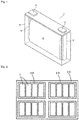
- FIG. 1 the schematic view of a nonaqueous electrolyte energy storage device 1 having a rectangular form, which is one embodiment of the nonaqueous electrolyte energy storage device of the present invention, is shown.
- This drawing is a perspective view of the inside of a container.
- an electrode assembly 2 is enclosed in a container 3.
- the electrode assembly 2 is formed by winding a positive electrode including a positive electrode mix and a negative electrode including a negative electrode mix with a separator interposed therebetween.
- the positive electrode is electrically connected to a positive electrode terminal 4 through a positive electrode lead 4', and the negative electrode is electrically connected to a negative electrode terminal 5 through a negative electrode lead 5'.
- a nonaqueous electrolyte is injected.
- the configuration of the nonaqueous electrolyte energy storage device according to the present invention is not particularly limited, and examples of the configuration include a cylindrical battery, a square-type battery (a rectangular battery), and a flat battery.
- the present invention can also be made as an energy storage apparatus equipped with a plurality of the above-mentioned nonaqueous electrolyte energy storage devices.
- One embodiment of the energy storage apparatus is shown in Fig. 2 .
- an energy storage apparatus 30 is equipped with a plurality of energy storage units 20.
- Each of the energy storage units 20 is equipped with a plurality of nonaqueous electrolyte energy storage devices 1.
- the energy storage apparatus 30 can be installed as a power supply for an automobile such as an electric vehicle (EV), a hybrid electric vehicle (HEV) and a plugin hybrid electric vehicle (PHEV).
- EV electric vehicle
- HEV hybrid electric vehicle
- PHEV plugin hybrid electric vehicle
- a lithium-(transition metal) composite oxide having an ⁇ -NaFeO 2 structure and represented by Li 1+ ⁇ Me 1 - ⁇ O 2 (wherein Me represents a transition metal including Mn; 0.1 ⁇ ⁇ ⁇ 0.2; and the molar ratio of Mn to Me, i.e., Mn/Me, was a value represented by the formula: 0.5 ⁇ Mn/Me) was used.
- the positive active material, acetylene black (AB) that served as a conductive agent, poly(vinylidene fluoride) (PVDF) that served as a binder, and phosphonic acid (H 3 PO 3 ) were mixed at a mixing ratio of (94-X) : 4.5 : 1.5 : X by mass in terms of solid contents using N-methyl pyrrolidone (NMP) as a dispersion medium to prepared a positive electrode mix paste.
- NMP N-methyl pyrrolidone
- the positive electrode mix paste was applied onto one surface of an aluminum foil that served as a positive electrode base material, and was then dried by heating at 100°C to form a positive electrode mix layer on the positive electrode base material.
- the positive electrode mix paste was also applied onto the opposite side surface of the aluminum foil, and was then dried by heating at 100°C.
- the positive electrode mix layer formed on the opposite side surface was detached after the drying. In this manner, a positive electrode P1 was manufactured.
- a positive electrode R1 was manufactured in the same manner as in the "manufacture of the positive electrode P1", except that phosphonic acid was not added to the positive electrode mix paste.
- a lithium-(transition metal) composite oxide having an ⁇ -NaFeO 2 structure and represented by LiNi 1/3 Co 1/3 Mn 1/3 O 2 was used as a positive active material.
- the positive active material, acetylene black (AB) that served as a conductive agent, poly(vinylidene fluoride) (PVDF) that served as a binder, and phosphonic acid (H 3 PO 3 ) were mixed at a mixing ratio of 95.5 : 2 : 2 : 0.5 by mass in terms of solid contents using N-methyl pyrrolidone (NMP) as a dispersion medium to prepared a positive electrode mix paste.
- NMP N-methyl pyrrolidone
- the positive electrode mix paste was applied onto one surface of an aluminum foil that served as a positive electrode base material, and was then dried by heating at 100°C to form a positive electrode mix layer on the positive electrode base material.
- the positive electrode mix paste was also applied onto the opposite side surface of the aluminum foil, and was then dried by heating at 100°C.
- the positive electrode mix layer formed on the opposite side surface was detached after the drying. In this manner, a positive electrode P2 was manufactured.
- a positive electrode R2 was manufactured in the same manner as in the "manufacture of the positive electrode P2", except that phosphonic acid was not added to the positive electrode mix paste.
- the same paste mix paste as that used in the manufacture of the positive electrode P2 was applied onto one surface of an aluminum foil that served as a positive electrode base material, and was then dried by heating at 100°C to form a positive electrode mix layer on the positive electrode base material.
- the positive electrode mix paste was also applied onto the opposite side surface of the aluminum foil, and was then dried by heating at 100°C.
- the positive electrode mix layer formed on the opposite side surface was detached after the drying. In this manner, a positive electrode P3 was manufactured.
- a positive electrode R3 was manufactured in the same manner as in the "manufacture of the positive electrode P3", except that phosphonic acid was not added to the positive electrode mix paste.
- a negative electrode was manufactured using graphite as a negative active material.
- Lithium bis(fluorosulfonyl)imide that served as an electrolyte salt was dissolved at a concentration of 1.0 mol/kg in a mixed solvent prepared by mixing fluoroethylene carbonate (FEC) with methyl trifluoroethyl carbonate (MFEC) at a volume ratio of 3 : 7 to prepare a nonaqueous electrolyte.
- FEC fluoroethylene carbonate
- MFEC methyl trifluoroethyl carbonate
- the positive electrode P1 and the negative electrode were laminated on each other with a separator that was a polyolefin-made microporous film interposed therebetween to manufacture an electrode assembly.
- the electrode assembly was enclosed in a container made from a metal-resin composite film, then the nonaqueous electrolyte was injected into the inside of the container, and then an opening of the container was sealed by heat sealing to manufacture a nonaqueous electrolyte energy storage device (a laminated nonaqueous electrolyte secondary battery) of Example 1.
- Nonaqueous electrolyte energy storage devices of Examples 2 to 6, Comparative Examples 1 to 6 and Reference Examples 1 to 2 were manufactured in the same manner as in Example 1, except that the types of the positive electrodes and the electrolyte salts, the types of the solvents and the volume-based mixing ratios shown in Tables 1 to 3 were employed.
- Each of the nonaqueous electrolyte energy storage devices of Examples 1 to 4, Comparative Examples 1 to 4 and Reference Examples 1 to 2 was subjected to initial charge-discharge under the following conditions.
- Each of the nonaqueous electrolyte energy storage devices was charged to 4.6 V at 25°C at a constant current of a charge current of 0.1 C, and was then charged at a constant voltage of 4.6 V. With respect to the charge termination conditions, the charging was carried out until the charge current became 0.05 C. After the charging, a pause time of 10 minutes was provided, and then discharging was carried out to 2.0 V at 25°C at a constant current of 0.1 C.
- Each of the nonaqueous electrolyte energy storage devices which had been subjected to the initial charge-discharge procedure and was in a completely discharged state, was broken down in an argon atmosphere at a dew point of -60°C or lower to remove the positive electrode, and the positive electrode was washed with dimethyl carbonate, and was then dried under reduced pressure at room temperature.
- the positive electrode thus obtained was enclosed in a transfer vessel in an argon atmosphere, and was then introduced into a sample chamber in an X-ray photoelectron spectroscopic spectrum measurement device, and then the surface of the positive electrode mix in the positive electrode was subjected to an X-ray photoelectron spectroscopic measurement under the above-mentioned conditions.
- Each of the nonaqueous electrolyte energy storage devices which had undergone the initial charge-discharge procedure was stored in a thermostat bath at 45°C for two hours, was then charged to 4.6 V at a constant current of a charge current of 1.0 C, and was then charged at a constant voltage of 4.6 V. With respect to the charge termination conditions, the charging was carried out until the charge current became 0.05 C.
- a pause time of 10 minutes was provided, and then discharging was carried out to 2.0 V at a constant current of 1.0 C. After the discharging, a pause time of 10 minutes was provided.
- the above-mentioned charging, discharging and pausing steps constituted one cycle, and the cycle was repeated 50 cycles. All of the charging, the discharging and the pausing were carried out in a thermostat bath at 45°C.
- the internal resistance (ACR) was measured before and after the charge-discharge cycle test by an alternate current (1 kHz) method .
- the ratio of the internal resistance (ACR) measured before the charge-discharge cycle test to that measured after the charge-discharge cycle test was defined as an ACR ratio, and the results of the ACR ratios are shown in Table 1.
- the initial charge-discharge procedure and the charge-discharge cycle test were carried out in the same manner as in the "Evaluation 1", except that the end-of-charge voltage was adjusted to 4.35 V (the maximum reached potential of the positive electrode: 4.45 V (vs. Li/Li + )) and the end-of-discharge voltage was adjusted to 2.75 V.
- the X-ray photoelectron spectroscopic measurement of the surface of the positive electrode mix was carried out in the same manner as in the "Evaluation 1".
- the initial charge-discharge procedure and the charge-discharge cycle test were carried out in the same manner as in the "Evaluation 1", except that the end-of-charge voltage was adjusted to 4.2 V (the maximum reached potential of the positive electrode: 4.3 V (vs. Li/Li + )) and the end-of-discharge voltage was adjusted to 2.75 V.
- the X-ray photoelectron spectroscopic measurement of the surface of the positive electrode mix was carried out in the same manner as in the "Evaluation 1".
- Example 1 As apparent from the comparison between Example 1 and Comparative Example 1 in Table 1, it is found that, in a nonaqueous electrolyte energy storage device in which a nonaqueous electrolyte contained an imide salt as an electrolyte salt, the ACR ratio is small and the increase in the internal resistance after a charge-discharge cycle is prevented by using a positive electrode P1 having such a property that a peak attributed to P2p appears at a position corresponding to 135 eV or less in an X-ray photoelectron spectroscopic spectrum of a positive electrode mix.
- the same tendency is also confirmed from the comparison between Example 4 and Comparative Example 4 in Table 1, the comparison between Example 5 and Comparative Example 5 in Table 2, and the comparison between Example 6 and Comparative Example 6 in Table 3.
- Example 1 the internal resistance after the charge-discharge cycle was decreased compared with that before the charge-discharge cycle, rather than the increase in the internal resistance associated with the charge-discharge cycle is prevented.
- Example 1 it is found that, when such a charge-discharge cycle that the maximum reached potential of a positive electrode becomes 4.6 V (vs.
- the effect to decrease the ACR ratio and the effect to prevent the increase in the internal resistance after a charge-discharge cycle are achieved remarkably by using a positive electrode P1 having such a property that a peak attributed to P2p appears at a position corresponding to 135 eV or less in an X-ray photoelectron spectroscopic spectrum of a positive electrode mix (see Table 1). This is assumed to be because, although the oxidation/corrosion of aluminum, which is likely to be caused upon such a charge-discharge procedure that the operation potential of a positive electrode becomes 4.0 V (vs.
- Li/Li + Li/Li +
- an imide salt when used as an electrolyte salt, occurs more remarkably with the increase in the maximum reached potential of the positive electrode, the effect of a coating film derived from an oxoacid of phosphorus formed on the positive electrode mix can be exhibited regardless of the level of the maximum reached potential of the positive electrode.
- the effect to prevent the increase in the internal resistance after a charge-discharge cycle is considered as a special effect that can be achieved only when an imide salt that serves as an electrolyte salt and each of the positive electrodes P1 to P3 each having such a property that a peak attributed to P2p appears at a position corresponding to 135 eV or less in an X-ray photoelectron spectroscopic spectrum of a positive electrode mix are combined.
- Example 1 As apparent from the comparison between Example 1 and Comparative Example 1, it is found that, in the case of a positive electrode P1 having such a property that a peak attributed to P2p appears at a position corresponding to 135 eV or less in an X-ray photoelectron spectroscopic spectrum of a positive electrode mix, when the electrolyte salt is replaced from LiPF 6 (Reference Example 1) to an imide salt (Example 1), the ACR ratio is decreased and the increase in the internal resistance after the charge-discharge cycle is prevented.
- the effect to prevent the increase in the internal resistance after a charge-discharge cycle achieved by using an imide salt, which has been believed to cause the oxidation/corrosion of aluminum, as an electrolyte salt is considered to be a special effect that cannot be predicted from the conventional technical knowledge.
- the capacity retention rate after a charge-discharge cycle can be improved by using positive electrodes P1 to P3 each having such a property that a peak attributed to P2p appears at a position corresponding to 135 eV or less in an X-ray photoelectron spectroscopic spectrum of a positive electrode mix in nonaqueous electrolyte energy storage devices each using an imide salt.
- the present invention can be applied to: a nonaqueous electrolyte energy storage device to be used as a power supply for an electronic device (e.g., a personal computer, a communication terminal), an automobile and the like; and others.
Landscapes
- Chemical & Material Sciences (AREA)
- Chemical Kinetics & Catalysis (AREA)
- Electrochemistry (AREA)
- General Chemical & Material Sciences (AREA)
- Engineering & Computer Science (AREA)
- Materials Engineering (AREA)
- Manufacturing & Machinery (AREA)
- Inorganic Chemistry (AREA)
- Composite Materials (AREA)
- Physics & Mathematics (AREA)
- General Physics & Mathematics (AREA)
- Condensed Matter Physics & Semiconductors (AREA)
- Secondary Cells (AREA)
- Battery Electrode And Active Subsutance (AREA)
- Electric Double-Layer Capacitors Or The Like (AREA)
- Cell Electrode Carriers And Collectors (AREA)
Abstract
Description
- The present invention relates to a nonaqueous electrolyte energy storage device and a method for manufacturing a nonaqueous electrolyte energy storage device.
- A nonaqueous electrolyte secondary battery typified by a lithium ion secondary battery is often used in an electronic device such as a personal computer and a communication terminal, an automobile and others due to the high energy density thereof. In general, the nonaqueous electrolyte secondary battery is equipped with a pair of electrodes that are electrically separated from each other through a separator and a nonaqueous electrolyte arranged between the electrodes, and is configured so as to be charged and discharged through the acceptance and reception of ions between the electrodes. As a nonaqueous electrolyte energy storage device other than the nonaqueous electrolyte secondary battery, a capacitor such as a lithium ion capacitor and an electric double-layer capacitor has also been widely used.
- As one type of electrolyte salt to be used in a nonaqueous electrolyte, an imide salt such as lithium bis(fluorosulfonyl)imide (LiFSI) is known. An imide salt has higher dissociability between a cation and an anion compared with LiPF6 and the like which have been widely used as electrolyte salts. Therefore, a nonaqueous electrolyte energy storage device in which an imide salt is used is expected to have good high-rate-discharge performance under lower temperatures and others. However, it is known that, when an imide salt is used as an electrolyte salt, the oxidation and corrosion of aluminum that is used as, for example, a positive electrode base material in a nonaqueous electrolyte energy storage device may occur as the result of such a charge-discharge procedure that the operation potential of a positive electrode becomes 4.0 V (vs. Li/Li+) or more and consequently the charge-discharge performance may be deteriorated. In contrast, it is reported that the occurrence of the oxidation/corrosion of aluminum upon such charge-discharge that the operation potential of a positive electrode becomes 4.0 V (vs. Li/Li+) or more can be prevented by using an imide salt at a high concentration (see
Patent Document 1, Abstract in Non-Patent Document 1). With respect to the specific concentration of an imide salt at which this preventive effect can be achieved, there is a statement "in the case where the voltage is 4.5 V, the corrosion is not observed when LiFSI is used at a concentration of 1.5 mol/L or more; while in the case where the voltage is as high as 4.9 V, the corrosion is not observed when LiFSI is used at a concentration of 4 mol/L" in paragraph[0012] inPatent Document 1, for example. - Patent Document 1:
JP-A-2015-79636 - Non-Patent Document 1: Jianhui Wang et. al., "Superconcentrated electrolytes for a high-voltage lithium-ion battery", Nature Communications, 2016, 7:12032 doi:10.1038/ncomms12032
- In a nonaqueous electrolyte energy storage device, in the case where an imide salt such as LiN(SO2F)2(LiFSI), LiN(C2F5SO2)2(LiBETI) and LiN(CF3SO2)2(LiTFSI) is used as an electrolyte salt at a commonly employed concentration of about 1 mol/kg, the oxidation and corrosion of aluminum can occur easily when a positive electrode exhibits an operation potential of 4.0 V (vs. Li/Li+) or more. The occurrence of oxidation/corrosion of aluminum is not desirable, because the internal resistance is greatly increased in association with a charge-discharge cycle. On the other hand, the oxidation/corrosion of aluminum can be prevented by using a nonaqueous electrolyte containing an imide salt at a high concentration. In this case, the viscosity of the nonaqueous electrolyte increases and the internal resistance also increases. The increase in the viscosity of the nonaqueous electrolyte is not desirable, because good high-rate-discharge performance of a nonaqueous electrolyte energy storage device including the imide salt under lower temperatures, which is one of advantages of the use of the imide salt, or the like may be deteriorated.
- The present invention has been made in the above-mentioned situations. The object of the present invention is to provide: a nonaqueous electrolyte energy storage device which is free from the problem that the internal resistance after a charge-discharge cycle is greatly increased when an imide salt is used as an electrolyte salt at a concentration falling within a range that is not deemed as a high concentration range; and a method for manufacturing the nonaqueous electrolyte energy storage device.
- One aspect of the present invention which has been made for the purpose of solving the above-mentioned problems is a nonaqueous electrolyte energy storage device including: a positive electrode including a positive electrode mix containing a phosphorus atom; and
a nonaqueous electrolyte containing an imide salt,
wherein a peak attributed to P2p appears at a position corresponding to 135 eV or less in an X-ray photoelectron spectroscopic spectrum of the positive electrode mix. - Another aspect of the present invention is a method for manufacturing a nonaqueous electrolyte energy storage device including:
- a positive electrode including a positive electrode mix produced using a positive electrode mix paste containing an oxoacid of phosphorus; and
- a nonaqueous electrolyte containing an imide salt.
- According to the present invention, it is possible to provide: a nonaqueous electrolyte energy storage device which addresses the problem that, when an imide salt is used as an electrolyte salt at a concentration falling within a range that is not deemed as a high concentration range, the internal resistance after a charge-discharge cycle is greatly increased; and a method for manufacturing the nonaqueous electrolyte energy storage device.
-
-
Fig. 1 is an appearance perspective view illustrating a nonaqueous electrolyte energy storage device according to one embodiment of the present invention. -
Fig. 2 is a schematic view of an energy storage apparatus composed of an assembly of a plurality of nonaqueous electrolyte energy storage devices according to one embodiment of the present invention. - The nonaqueous electrolyte energy storage device according to one embodiment of the present invention includes: a positive electrode including a positive electrode mix containing a phosphorus atom; and
a nonaqueous electrolyte containing an imide salt,
wherein a peak attributed to P2p appears at a position corresponding to 135 eV or less in an X-ray photoelectron spectroscopic spectrum of the positive electrode mix. - According to the nonaqueous electrolyte energy storage device, it becomes possible to prevent the oxidation/corrosion of aluminum and to prevent the increase in the internal resistance after a charge-discharge cycle even when the concentration of an imide salt in a nonaqueous electrolyte is not increased. In the nonaqueous electrolyte energy storage device, the reason why the above-mentioned advantageous effects can produced is unclear, but the following reasons are assumed. When a positive electrode mix is formed using a positive electrode mix paste containing an oxoacid of phosphorus, a coating film is formed which contains a component having such a property that a peak attributed to P2p appears at a position corresponding to 135 eV or less in an X-ray photoelectron spectroscopic spectrum coming from the oxoacid of phosphorus. It is assumed that the coating film can prevent the oxidation/corrosion of aluminum that serves as a positive electrode base material or the like and consequently the internal resistance cannot be increased and the increase in the internal resistance after a charge-discharge cycle can be prevented. The reason for these phenomena is unclear. However, the effect that the increase in the internal resistance after a charge-discharge cycle can be prevented is a special effect that can be achieved only when an imide salt is used as an electrolyte salt and a positive electrode mix having such a property that a peak attributed to P2p appears at a position corresponding to 135 eV or less in the X-ray photoelectron spectroscopic spectrum is used. According to the nonaqueous electrolyte energy storage device, the capacity retention rate after a charge-discharge cycle can also be increased. The reason when the capacity retention rate is increased is also unclear. However, it is assumed to be because a coating film containing a component having such a property that a peak attributed to P2p appears at a position corresponding to 135 eV or less in the X-ray photoelectron spectroscopic spectrum can also prevent the oxidation/corrosion of aluminum. According to the nonaqueous electrolyte energy storage device, it becomes possible, for example, to prevent the increase in the internal resistance after a charge-discharge cycle even when the concentration of the imide salt is not increased as mentioned above. Therefore, the nonaqueous electrolyte energy storage device can improve the disadvantages, e.g., high viscosity and high internal resistance, of a conventional nonaqueous electrolyte energy storage device including an imide salt at a high concentration, and can be used suitably even when the nonaqueous electrolyte energy storage device is so designed as to contain the imide salt at a concentration falling within a range that does not deemed as a high concentration range.
- A sample (a positive electrode mix) to be used in the measurement of an X-ray photoelectron spectroscopic spectrum can be prepared in the following manner. A nonaqueous electrolyte energy storage device is discharged at a current of 0.1 C to an end-of-discharge voltage employed in the conventional use to make the nonaqueous electrolyte energy storage device in a completely discharged state. The energy storage device in the completely discharged state is broken down to remove a positive electrode, and the positive electrode is fully washed with dimethyl carbonate and is then dried under reduced pressure at room temperature. The dried positive electrode is cut into a predetermined size (e.g., 2 × 2 cm), and is used as a sample for the measurement of an X-ray photoelectron spectroscopic spectrum. The operations from the breaking down of the nonaqueous electrolyte energy storage device to the preparation of the sample to be used in the measurement of an X-ray photoelectron spectroscopic spectrum are carried out in an argon atmosphere at a dew point of -60°C or lower, and the produced sample was enclosed in a transfer vessel, is then held in an argon atmosphere at a dew point of -60°C or lower and is then introduced into a sample chamber in an X-ray photoelectron spectroscopic spectrum measurement device. The device and the measurement conditions to be employed in the measurement of an X-ray photoelectron spectroscopic spectrum are as follows.
- Device: "AXIS NOVA" manufactured by KRATOS ANALYTICAL
- X-Ray source: monochromatized AlKα
- Acceleration voltage: 15 kV
- Area to be analyzed: 700 µm × 300 µm
- Measurement range: P2p = 145 to 128 eV, C1s = 300 to 272 eV
- Measurement interval: 0.1 eV
- Measurement time: P2p = 72.3 seconds/round, C1s = 70.0 seconds/round
- Frequency of integration: P2p = 15 times, C1s = 8 times
- The position of a peak in the spectrum is a value determined in the following manner. Firstly, the position of a peak of C1s which is attributed to sp2 carbon is defined as 284.8 eV, and the binding energies of all of the obtained spectra are corrected on the basis of this definition. Next, a background is removed from each of the corrected spectra by a straight line method. In this manner, a leveling processing of the spectra is carried out. A binding energy at which the intensity of a peak attributed to P2p becomes highest in the spectra obtained after the leveling processing is defined as the position of a peak attributed to P2p.
- In the nonaqueous electrolyte energy storage device, it is preferred that the content of the imide salt in the nonaqueous electrolyte is 0.5 mol/kg or more and 2 mol/kg or less. According to the nonaqueous electrolyte energy storage device, the oxidation/corrosion of aluminum can be prevented even when the imide salt is used at a concentration falling within the above-mentioned range that is not deemed as a high concentration range. Therefore, in the nonaqueous electrolyte energy storage device, it is not needed to use the imide salt at a high concentration. In general, when an imide salt is used at a high concentration, the viscosity is increased and the internal resistance is also increased. In contrast, in the nonaqueous electrolyte energy storage device, when the concentration of the imide salt in the nonaqueous electrolyte falls within a range that is not deemed as a high concentration range like the above-mentioned range, the internal resistance is not increased and the increase in the internal resistance after a charge-discharge cycle can be prevented. Furthermore, the viscosity of a nonaqueous electrolyte containing the imide salt at a concentration falling within the above-mentioned range that does not deemed as a high concentration range is small. Therefore, it is expected that the high-rate-discharge performance at a lower temperature and the like can be improved.
- In the nonaqueous electrolyte energy storage device, the maximum reached potential of the positive electrode is preferably 4.4 V (vs. Li/Li+) or more, more preferably 4.5 V (vs. Li/Li+) or more, still more preferably 4.6 V (vs. Li/Li+) or more. According to the nonaqueous electrolyte energy storage device, even in such charge-discharge that the maximum reached potential of the positive electrode at which the oxidation/corrosion of aluminum is likely to be caused remarkably when the imide salt is used becomes 4.4 V (vs. Li/Li+) or more, it becomes generally possible to decrease the internal resistance after a charge-discharge cycle. Therefore, when the maximum reached potential of the positive electrode is adjusted to 4.4 V (vs. Li/Li+) or more, the capacity can be increased by the charge/discharge of the positive electrode at an operation potential of 4.4 V (vs. Li/Li+) or more while preventing the increase in the internal resistance after a charge-discharge cycle.
- The method for manufacturing the nonaqueous electrolyte energy storage device according to one embodiment of the present invention is a method for manufacturing a nonaqueous electrolyte energy storage device including a positive electrode which includes a positive electrode mix prepared using a positive electrode mix paste containing an oxoacid of phosphorus and a nonaqueous electrolyte containing an imide salt.
- When a positive electrode mix paste containing an oxoacid of phosphorus is used, a positive electrode mix having such a property that a peak attributed to P2p appears at a position corresponding to 135 eV or less in an X-ray photoelectron spectroscopic spectrum of the positive electrode mix can be produced. Therefore, according to the manufacture method, even when the imide salt is used at a concentration falling within a range that cannot be deemed as a high concentration range, it becomes possible to manufacture a nonaqueous electrolyte energy storage device having such a property that the increased in the internal resistance after a charge-discharge cycle can be prevented.
- Hereinbelow, the nonaqueous electrolyte energy storage device according to one embodiment of the present invention and the method for manufacturing the nonaqueous electrolyte energy storage device will be described in detail.
- The nonaqueous electrolyte energy storage device according to one embodiment of the present invention includes a positive electrode, a negative electrode and a nonaqueous electrolyte. Hereinbelow, a nonaqueous electrolyte secondary battery will be described as one example of the nonaqueous electrolyte energy storage device. The positive electrode and the negative electrode are commonly laminated or wound with a separator interposed therebetween to form an electrode assembly in which the positive electrode and the negative electrode are superposed alternately. The electrode assembly is enclosed in a container, and then the nonaqueous electrolyte is filled in the container. The nonaqueous electrolyte is arranged between the positive electrode and the negative electrode. As the container, a known metallic container,, a known resin container or the like which is commonly used as a container for a nonaqueous electrolyte secondary battery can be used.
- The positive electrode includes a positive electrode base material and a positive electrode mix layer arranged on the positive electrode base material directly or with an intermediate layer interposed therebetween.
- The positive electrode base material has electric conductivity. As the material for the base material, a metal such as aluminum, titanium, tantalum and stainless steel or an alloy of the metal can be used. Among these materials, aluminum and an aluminum alloy are preferred from the viewpoint of the balance between the level of electric conductivity and cost. In the case where the positive electrode base material is made from aluminum or an aluminum alloy, the effect that the increase in the internal resistance of the nonaqueous electrolyte energy storage device after a charge-discharge cycle, which is assumed to be mainly caused by the oxidation/corrosion of aluminum, can be prevented can be achieved more satisfactorily. Examples of the type of the positive electrode base material to be formed include a foil and a vapor-deposited film, and a foil is preferred from the viewpoint of cost. Namely, as the positive electrode base material, an aluminum foil is preferred. Examples of aluminum or the aluminum alloy include A1085P and A3003P which are prescribed in JIS-H-4000 (2014).
- The intermediate layer is a layer coating the surface of the positive electrode base material, and contains electrically conductive particles such as carbon particles and therefore can reduce the contact resistance between the positive electrode base material and the positive electrode mix layer. The constitution of the intermediate layer is not particularly limited, and the intermediate layer can be formed from, for example, a composition containing a resin binder and electrically conductive particles. The term "electrical conductivity" or "conductivity" as used herein refers to the matter that the volume resistivity as measured in accordance with JIS-H-0505 (1975) is 107 Ω●cm or less, and the term "electrical non-conductivity" or "non-conductivity" as used herein refers to the matter that the volume resistivity is more than 107 Ω●cm.
- The positive electrode mix layer is a layer formed from a positive electrode mix. The positive electrode mix contains a positive active material and a phosphorus atom, and may optionally further contain an optional component such as a conductive agent, a binder, a thickening agent, a filler and a dispersing agent. In an X-ray photoelectron spectroscopic spectrum of the positive electrode mix, a peak attributed to P2p appears at a position corresponding to 135 eV or less. The positive electrode mix layer is generally formed on the surface of the positive electrode base material by applying a positive electrode mix paste containing a positive active material, an oxoacid of phosphorus and the like and then drying the paste. In the nonaqueous electrolyte energy storage device, the oxoacid of phosphorus may be modified partly or entirely. It is assumed that the phosphorus atom is present in a coating film formed on the surface of the positive electrode mix. Namely, it is assumed that, when a phosphorus atom coming from the oxoacid of phosphorus is present in a coating film formed on the surface of the positive electrode mix, a peak attributed to P2p can appear at a position corresponding to 135 eV or less in an X-ray photoelectron spectroscopic spectrum of the positive electrode mix.
- Examples of the positive active material include a lithium-(transition metal) composite oxide and a polyanion compound. Examples of the lithium-(transition metal) composite oxide include composite oxides each represented by LixMOy (wherein M represents at least one transition metal) (e.g., LixCoO2, LixNiO2, LixMnO3, LixNiαCo(1-α)O2, LixNiαCoβAl(1-α-β)O2, LixNiαMnβCo(1-α-β)O2 and Li1+x(NiαMnβCo(1-α-β))1-xO2 each having a layered α-NaFeO2-type crystal structure; and LixMn2O4 and LixNiαMn(2-α)O4 each having a spinel-type crystal structure). An example of the polyanion compound is a polyanion compound represented by LiwMex(XOy)z (wherein Me represents at least one transition metal; and X represents, for example, P, Si, B, V or the like), (e.g., LiFePO4, LiMnPO4, LiNiPO4, LiCoPO4, Li3V2(PO4)3, Li2MnSiO4, and Li2CoPO4F). Some of all of the elements or the polyanions in these compounds may be substituted by another elements or anion species. In the positive electrode mix layer, these compounds may be used singly, or a mixture of two or more of these compounds may be used.
- It is preferred that the positive active material includes a positive active material having such a property that the positive electrode potential can become higher than 4.0 V (vs. Li/Li+) at an end-of-charge potential employed in the common use of a nonaqueous electrolyte energy storage device. As the positive active material, a lithium-(transition metal) composite oxide is preferred. The nonaqueous electrolyte energy storage device can be prevented from the increase in the internal resistance after a charge-discharge cycle even when used under the condition where the maximum reached potential of the positive electrode becomes higher than 4.0 V (vs. Li/Li+). Therefore, when a positive active material having such a property that the positive electrode operation potential can become 4.0 V (vs. Li/Li+) or more is used, it becomes possible to manufacture a nonaqueous electrolyte energy storage device in which the energy density can be increased and the increase in the internal resistance after a charge-discharge cycle can be prevented. The term "common use" as used herein refers to the case where the nonaqueous electrolyte energy storage device is used by employing charge-discharge conditions that are recommended or designated for the nonaqueous electrolyte energy storage device. With respect to the charge conditions, in the case where a charger for the nonaqueous electrolyte energy storage device is provided, the term "common use" refers to a case where the nonaqueous electrolyte energy storage device is used through the application of the charger.
- The lower limit of the content ratio of the lithium-(transition metal) composite oxide relative to the whole amount of the positive active material is preferably 50% by mass, more preferably 90% by mass, still more preferably 99% by mass. The positive active material may be composed substantially only of a lithium-(transition metal) composite oxide. When the content ratio of the lithium-(transition metal) composite oxide is increased in this manner, the energy density can be further increased while preventing the increase in the internal resistance after a charge-discharge cycle.
- It is more preferred that the positive active material includes a positive active material having such a property that the positive electrode operation potential can become 4.4 V (vs. Li/Li+) or more at an end-of-charge voltage in the common use of the nonaqueous electrolyte energy storage device. The positive active material having such a property that the positive electrode operation potential can become 4.4 V (vs. Li/Li+) or more at an end-of-charge voltage in the common use of the nonaqueous electrolyte energy storage device may be a positive active material in which lithium ions can be inserted and extracted reversibly at a potential of 4.4 V (vs. Li/Li+) or more. Examples of the positive active material include: Li1+x(NiαMnβCo(1-α-β))1-xO2 (0 < x <1, 0 ≤ α < 0.5, 0.5 < β ≤ 1, 0 ≤ 1-α-β < 0.5) that has a layered α-NaFeO2-type crystal structure; LiNi0.5Mn1.5O4 that is an example of a LixNiαMn(2-α)O4 having a spinel-type crystal structure; and LiNiPO4, LiCoPO4, Li2CoPO4F, and Li2MnSiO4 that are examples of the polyanion compound.
- The content of the positive active material in the positive electrode mix layer can be, for example, 80% by mass or more and 98% by mass or less, preferably 90% by mass or more.
- In the X-ray photoelectron spectroscopic spectrum of the positive electrode mix, the upper limit of the position of the peak attributed to P2p is preferably 134 eV. The lower limit of the position of the peak may be 130 eV, or may be 132 eV.
- The conductive agent is not particularly limited, as long as the conductive agent is a conductive material that does not adversely affect the performance of an energy storage device. Examples of the conductive agent include natural or artificial graphite, carbon black such as furnace black, acetylene black and ketjen black, a metal and a conductive ceramic, and acetylene black is preferred. Examples of the form of the conductive agent include a powdery form and a fibrous form.
- Examples of the binder include: a thermoplastic resin such as a fluororesin (e.g., polytetrafluoroethylene (PTFE), poly(vinylidene fluoride) (PVDF)), polyethylene, polypropylene and polyimide; an elastomer such as an ethylene-propylene-diene rubber (EPDM), a sulfonated EPDM, a styrene butadiene rubber (SBR) and a fluororubber; and a polysaccharide polymer.
- An example of the thickening agent is a polysaccharide polymer such as carboxymethyl cellulose (CMC) and methyl cellulose. In the case where the thickening agent has a functional group capable of reacting with lithium, it is preferred to deactivate the functional group by methylation or the like in advance.
- The filler is not particularly limited, as long as the filler does not adversely affect the performance of an energy storage device. Examples of the main component of the filler include a polyolefin such as polypropylene and polyethylene, silica, alumina, zeolite and a glass.
- The negative electrode includes a negative electrode base material and a negative electrode mix layer arranged on the negative electrode base material directly or with an intermediate layer interposed therebetween. The intermediate layer may have the same configuration as that of the intermediate layer in the positive electrode.
- The negative electrode base material may have the same constitution as that of the positive electrode base material. As the material for the negative electrode base material, a metal such as copper, nickel, stainless steel and a nickel-plated steel or an alloy thereof can be used, and copper or a copper alloy is preferred. Namely, as the negative electrode base material, a copper foil is preferred. Examples of the copper foil include a rolled copper foil and an electrodeposited copper foil.
- The negative electrode mix layer is formed from a negative electrode mix containing a negative active material. The negative electrode mix that forms the negative electrode mix layer may optionally contain an optional component such as a conductive agent, a binder, a thickening agent, a filler and a dispersing agent. As the optional component such as a conductive agent, a binder, a thickening agent, a filler and a dispersing agent, the same component as that mentioned with respect to the positive electrode mix layer can be used.
- As the negative active material, a material that can absorb and release a lithium ion or the like can be used commonly. Specific examples of the negative active material include: a metal or a metalloid, such as Si and Sn; a metal oxide or a metalloid oxide such as an Si oxide and an Sn oxide; a poly(phosphoric acid) compound; and a carbon material such as graphite, non-graphite carbon (easily graphitizable carbon or hardly graphitizable carbon).
- The negative electrode mix (negative electrode mix layer) may also contain: a main group non-metal element such as B, N, P, F, Cl, Br and I; a main group metal element such as Li, Na, Mg, Al, K, Ca, Zn, Ga and Ge; and a transition metal element such as Sc, Ti, V, Cr, Mn, Fe, Co, Ni, Cu, Mo, Zr, Ta, Hf, Nb and W.
- As the material for the separator, a woven fabric, a non-woven fabric, a porous resin film or the like can be used, for example. Among these materials, a porous resin film is preferred from the viewpoint of strength, and a non-woven fabric is preferred from the viewpoint of the retentatiblity of the nonaqueous electrolyte. As the main component for the separator, a polyolefin such as polyethylene and polypropylene is preferred from the viewpoint of strength, and a polyimide, an aramide or the like is preferred from the viewpoint of oxidative decomposition resistance. Alternatively, these resins may be combined in a composite form.
- An inorganic insulation material layer may be arranged between the separator and an electrode (usually the positive electrode). The inorganic insulation material layer is a porous material layer that is also called as a "heat-resistant layer" or the like. Alternatively, a separator having such a structure that the inorganic insulation material layer is formed on one surface or both surfaces of a porous resin film may be used. The inorganic insulation material layer may be generally composed of inorganic insulation material particles and a binder, and may also contain other component. As the inorganic insulation material particles, particles of Al2O3, SiO2, aluminosilicate and the like are preferred.
- The nonaqueous electrolyte contains an imide salt and a nonaqueous solvent in which the imide salt is dissolved. The nonaqueous electrolyte is not limited to one having a liquid form. Namely, a nonaqueous electrolyte having a solid form and a nonaqueous electrolyte having a gel-like form are also included within the scope of the nonaqueous electrolyte.
- Examples of the imide salt include a lithium imide salt, a sodium imide salt and a potassium imide, and a lithium imide salt is preferred.
- Examples of the lithium imide salt include: a lithium sulfonylimide salt such as LiN(SO2F)2 (lithium bis(fluorosulfonyl)imide: LiFSI), LiN(CF3SO2)2 (lithium bis(trifluoromethanesulfonyl)imide: LiTFSI), LiN(C2F5SO2)2 (lithium bis(pentafluoroethanesulfonyl)imide: LiBETI), LiN(C4F9SO2)2 (lithium bis(nonafluorobutanesulfonyl)imide), CF3-SO2-N-SO2-N-SO2CF3Li, FSO2-N-SO2-C4F9Li, CF3-SO2-N-SO2-C4F9Li, CF3-SO2-N-SO2-CF2-SO2-NSO2-CF3Li2, F3-SO2-N-SO2-CF2-SO3Li2 and CF3-SO2-N-SO2-CF2-SO2-C(-SO2CF3)2Li2; and a lithium phosphonylimide salt such as LiN(POF2)2 (lithium bis(difluorophosphonyl)imide: LiDFPI). These lithium imide salts may be used singly or may be used in the form of a combination of two or more of them.
- The lithium imide salt preferably has a fluorine atom. Specifically, the lithium imide salt preferably has, for example, a fluorosulfonyl group, a difluorophosphonyl group, a fluoroalkyl group or the like. Among these lithium imide salts, a lithium sulfonylimide salt is preferred, LiFSI, LiTFSI and LiBETI are more preferred, and LiFSI is still more preferred. These imide salts are imide salts each of which can cause the oxidation/corrosion of aluminum relatively easily upon such charge-discharge that the operation potential of the positive electrode becomes 4.0 V (vs. Li/Li+) or more. Therefore, when these imide salts are used, such an advantage of the present invention that the oxidation/corrosion of aluminum upon such charge-discharge that the operation potential of the positive electrode becomes 4.0 V (vs. Li/Li+) or more can be prevented and the increase in the internal resistance of the nonaqueous electrolyte energy storage device after a charge-discharge cycle can be prevented can be achieved especially effectively.
- The lower limit of the content of the imide salt in the nonaqueous electrolyte is, for example, preferably 0.5 mol/kg, more preferably 0.8 mol/kg. When the content of the imide salt is equal to or more than the lower limit, the charge-discharge performance can be improved. The upper limit of the content is preferably 2 mol/kg, more preferably 1.4 mol/kg, still more preferably 1.2 mol/kg, further preferably 1.1 mol/kg. When the content of the imide salt is equal to or less than the upper limit, it is expected that the increased in viscosity can be prevented and the high-rate-discharge performance or the like of the nonaqueous electrolyte energy storage device can be improved.
- In the nonaqueous electrolyte, an electrolyte salt other than the imide salt may be further contained or may not be contained. Examples of the electrolyte salt include a lithium salt, a sodium salt, a potassium salt, a magnesium salt, and an onium salt other than the imide salt. In the case where an electrolyte salt other than the imide salt is contained, the upper limit of the content of the electrolyte salt other than the imide salt in the nonaqueous electrolyte may be preferably 1 mol/kg, more preferably 0.1 mol/kg, still more preferably 0.01 mol/kg. When the content of the electrolyte salt other than the imide salt is equal to or less than the upper limit, the increase in the internal resistance after a charge-discharge cycle can be prevented effectively, and the capacity retention rate can be further improved. When the upper limit of the content of the electrolyte salt other than the imide salt in the nonaqueous electrolyte is 0.01 mol/kg, the nonaqueous electrolyte almost contains substantially no electrolyte salt other than the imide salt. The electrolyte salt other than the imide salt may be an electrolyte salt having a PF6 anion such as LiPF6.
- In the case where LiPF6 is used as the another electrolyte salt, a peak attributed to P2p coming from LiPF6 appears at a position corresponding to a value more than 135 eV (generally within the range from more than 135 eV and 138 eV or less) in an X-ray photoelectron spectroscopic spectrum of the positive electrode mix. Therefore, a peak attributing to P2p coming from LiPF6 can be distinguished from a peak attributing to P2p coming from an oxoacid of phosphorus depending on the difference in the positions of the peaks.
- As the nonaqueous solvent, a known nonaqueous solvent which is commonly used as a nonaqueous solvent for a nonaqueous electrolyte for a conventional energy storage device can be used. Examples of the nonaqueous solvent include a carbonate (e.g., a cyclic carbonate and a linear carbonate), an ester, an ether, an amide, a sulfone, a lactone and a nitrile. Among these nonaqueous solvents, it is preferred to use at least a carbonate, and it is more preferred to use a cyclic carbonate and a linear carbonate in combination. The carbonate may be a carbonate having no substituent, or a carbonate having a substituent. Examples of the substituent include a hydroxy group and a halogen atom.
- In the case where a cyclic carbonate and a linear carbonate are used in combination, the volume ratio of the cyclic carbonate and the linear carbonate (i.e., a (cyclic carbonate):(linear carbonate) ratio) is not particularly limited, and is preferably, for example, 5 : 95 or more and 50 : 50 or less. The lower limit of the content of the cyclic carbonate in the nonaqueous solvent is preferably 1% by volume, more preferably 5% by volume. The upper limit of the content of the cyclic carbonate is preferably 50% by volume, more preferably 40% by volume. The lower limit of the content of the linear carbonate in the nonaqueous solvent is preferably 20% by volume, more preferably 50% by volume. The upper limit of the content of the linear carbonate is preferably 95% by volume, more preferably 90% by volume.
- Examples of the cyclic carbonate include ethylene carbonate (EC), propylene carbonate (PC), butylene carbonate (BC), vinylene carbonate (VC), vinyl ethylene carbonate (VEC), chloroethylene carbonate, fluoroethylene carbonate (FEC), diluoroethylene carbonate (DFEC), fluoromethyl ethylene carbonate, trifluoroethyl ethylene carbonate, styrene carbonate, catechol carbonate, 1-phenylvinylene carbonate and 1,2-dihenylvinylene carbonate.
- Examples of the linear carbonate include diethyl carbonate (DEC), dimethyl carbonate (DMC), ethylmethyl carbonate (EMC), diphenyl carbonate, methyl trifluoroethyl carbonate (MFEC) and bis(trifluoroethyl) carbonate (FDEC).
- The nonaqueous solvent preferably contains a fluorinated carbonate. Namely, the cyclic carbonate is preferably a fluorinated cyclic carbonate such as fluoroethylene carbonate, diluoroethylene carbonate, fluoromethyl ethylene carbonate and trifluoroethyl ethylene carbonate. The linear carbonate is preferably a fluorinated linear carbonate such as methyl trifluoroethyl carbonate and bis(trifluoroethyl) carbonate. The fluorinated carbonate can prevent the occurrence of a side reaction particularly at a potential of 4.0 V (vs. Li/Li+) or more to achieve the further improvement in the charge-discharge cycle properties, including the prevention of the increase in internal resistance after a charge-discharge cycle and the improvement in the capacity retention rate.
- In the nonaqueous solvent, a fluorinated solvent other than the fluorinated carbonate can also be used. An example of the fluorinated solvent is a fluorinated ether such as 1,1,2,2-tetrafluoroethyl-2,2,3,3-tetrafluoropropyl ether and 1,1,2,2-tetrafluoroethyl-2,2,2-trifluoroethyl ether (TFEE).
- The lower limit of the total content of the fluorinated solvent(s) including the fluorinated carbonate in the nonaqueous solvent is preferably 20% by volume, more preferably 50% by volume, still more preferably 80% by volume, further preferably 90% by volume, still further preferably 99% by volume. When the total content of the fluorinated solvent(s) including the fluorinated carbonate is equal to or more than the lower limit, the increase in the internal resistance after a charge-discharge cycle particularly at a potential of 4.0 V (vs. Li/Li+) or more can be prevented effectively and the capacity retention rate can be further improved.
- In the nonaqueous electrolyte, other additive may be added. The upper limit of the content of a component other than the electrolyte salt including the imide salt and the nonaqueous solvent in the nonaqueous electrolyte may be preferably 5% by mass, more preferably 1% by mass, still more preferably 0.1% by mass.
- In the nonaqueous electrolyte energy storage device, the increase in the internal resistance after such a charge-discharge cycle that the maximum reached potential of the positive electrode becomes 4.0 V (vs. Li/Li+) or more can be prevented, and the capacity retention rate is also is high. Therefore, it becomes possible to use the positive electrode at an operation potential of 4.0 V (vs. Li/Li+) or more. The lower limit of the maximum reached potential of the positive electrode of the nonaqueous electrolyte energy storage device may be, for example, 4.0 V (vs. Li/Li+) or 4.2 V (vs. Li/Li+), and is preferably 4.4 V (vs. Li/Li+), more preferably 4.5 V (vs. Li/Li+), still more preferably 4.6 V (vs. Li/Li+), still further preferably 4.7 V (vs. Li/Li+). In this manner, when the maximum reached potential of the positive electrode is high, the energy density can be increased. The upper limit of the maximum reached potential of the positive electrode is, for example, 5.4 V (vs. Li/Li+), and may be 5.0 V (vs. Li/Li+).
- It is preferred that the maximum reached potential of the positive electrode is a positive electrode potential at an end-of-charge voltage of the nonaqueous electrolyte energy storage device which is employed in the conventional use of the nonaqueous electrolyte energy storage device. In general, in the case where the potential of the positive electrode becomes high frequently as the result of the repeated charge-discharge procedures, the increase in the internal resistance or the decrease in the capacity may often occur. Therefore, when the maximum reached potential of the positive electrode becomes, for example, 4.4 V (vs. Li/Li+) or more frequently as the result of the repeated charge-discharge procedures, the effect to prevent the increase in the internal resistance after a charge-discharge cycle and the effect to improve the capacity retention rate in the nonaqueous electrolyte energy storage device can be exerted more significantly.
- The nonaqueous electrolyte energy storage device is preferably manufactured by the following method. Namely, the method for manufacturing the nonaqueous electrolyte energy storage device according to one embodiment of the present invention is a method for manufacturing a nonaqueous electrolyte energy storage device including a positive electrode including a positive electrode mix prepared using a positive electrode mix paste containing an oxoacid of phosphorus and a nonaqueous electrolyte containing an imide salt.
- For example, one example of the method for manufacturing the nonaqueous electrolyte energy storage device includes:
- manufacturing a positive electrode using a positive electrode mix paste containing an oxoacid of phosphorus (i.e., a positive electrode manufacture step); and
- injecting a nonaqueous electrolyte containing an imide salt into a container (i.e., a nonaqueous electrolyte injection step).
- The positive electrode mix paste generally contains, in addition to the oxoacid of phosphorus, a positive active material and a binder, and optionally contains other components. The positive electrode mix paste can be prepared by mixing these components together. The positive electrode mix paste is applied onto the surface of a positive electrode base material and is then dried to manufacture a positive electrode having such a property that a peak attributed to P2p appears at a position corresponding to 135 eV or less in an X-ray photoelectron spectroscopic spectrum of the positive electrode mix.
- The term "oxoacid of phosphorus" refers to a compound having such a structure that a hydroxy group (-OH) and an oxy group (=O) are bonded to a phosphorus atom. Examples of the oxoacid of phosphorus include phosphoric acid (H3PO4), phosphonic acid (H3PO3), phosphinic acid (H3PO2), pyrophosphoric acid (H4P2O7) and polyphosphoric acid. Among these compounds, phosphoric acid and phosphonic acid are preferred, and phosphonic acid is more preferred. By the action of the oxoacid of phosphorus, a coating film containing a phosphorus atom can be formed on the positive electrode, and therefore, a positive electrode having such a property that a peak attributed to P2p appears at a position corresponding to 135 eV or less in an X-ray photoelectron spectroscopic spectrum of the positive electrode mix can be manufactured. If a metal salt (e.g., a lithium salt, a sodium salt, a potassium salt, a magnesium salt, a calcium salt) of an oxoacid of phosphorus or an ester of an oxoacid of phosphorus (e.g., a phosphoric acid ester, a phosphonic acid ester) is used in place of the oxoacid of phosphorus, it is impossible to manufacture a positive electrode having such a property that a peak attributed to P2p appears at a position corresponding to 135 eV or less in an X-ray photoelectron spectroscopic spectrum of a positive electrode mix, and therefore the advantageous effects of the present invention cannot be achieved.
- The lower limit of the content (amount to be added) of the oxoacid of phosphorus in the positive electrode mix paste is preferably 0.05 part by mass, more preferably 0.1 part by mass, still more preferably 0.3 part by mass, relative to 100 parts by mass of the positive active material. The upper limit of the content is preferably 5 parts by mass, more preferably 3 parts by mass, still more preferably 2 parts by mass. When the content of the oxoacid of phosphorus is falls within the above-mentioned range, the increase in the internal resistance after a charge-discharge cycle can be prevented more effectively, and the capacity retention rate can be further increased.
- In the positive electrode mix paste, an organic solvent is generally used as the dispersion medium. Examples of the organic solvent include: a polar solvent such as N-methyl-2-pyrrolidone (NMP), acetone and ethanol; and a non-polar solvent such as xylene, toluene and cyclohexane.
- The method for applying the positive electrode mix paste is not particularly limited, and the application of the positive electrode mix paste can be carried out by a known technique, such as roller coating, screen coating and spin coating.
- The nonaqueous electrolyte injection step can be carried out by a known method. Namely, a nonaqueous electrolyte having a desired composition is prepared, and the prepared nonaqueous electrolyte is injected into a container.
- In addition to the positive electrode manufacture step and the nonaqueous electrolyte injection step, the manufacture method may also include, for example, the following steps. For example, the manufacture method may include the steps of: manufacturing a negative electrode; laminating or winding the positive electrode and the negative electrode together with a separator interposed therebetween to form an electrode assembly in which the positive electrode and the negative electrode are overlaid alternately; and enclosing the positive electrode and the negative electrode (i.e., the electrode assembly) in the container. In general, the electrode assembly is enclosed in the container and subsequently the nonaqueous electrolyte is injected into the container. However, the order of the enclosure of the electrode assembly in the container and the injection of the electrode assembly into the container may be reversed. Subsequent to these steps, an inlet port of the container is sealed. In this manner, the nonaqueous electrolyte energy storage device can be manufactured.
- The present invention is not limited to the above-mentioned embodiments, and can be made in aspects having various modifications and improvements, in addition to the above-mentioned aspects. For example, in the positive electrode and the negative electrode, the intermediate layer may not be provided. Alternatively, in the positive electrode of the nonaqueous electrolyte energy storage device, the positive electrode mix may not form a distinct layer. For example, the positive electrode may have, for example, such a structure that the positive electrode mix is carried on a mesh-form positive electrode base material.
- In the above-mentioned embodiments, a case where the nonaqueous electrolyte secondary battery is a nonaqueous electrolyte secondary battery is mainly described. However, the nonaqueous electrolyte energy storage device may be another type of nonaqueous electrolyte energy storage device. An example of the another type of nonaqueous electrolyte energy storage device is a capacitor (e.g., an electric double-layer capacitor, a lithium ion capacitor).
- In
Fig. 1 , the schematic view of a nonaqueous electrolyteenergy storage device 1 having a rectangular form, which is one embodiment of the nonaqueous electrolyte energy storage device of the present invention, is shown. This drawing is a perspective view of the inside of a container. In the nonaqueous electrolyteenergy storage device 1 shown inFig. 1 , anelectrode assembly 2 is enclosed in acontainer 3. Theelectrode assembly 2 is formed by winding a positive electrode including a positive electrode mix and a negative electrode including a negative electrode mix with a separator interposed therebetween. The positive electrode is electrically connected to apositive electrode terminal 4 through a positive electrode lead 4', and the negative electrode is electrically connected to anegative electrode terminal 5 through a negative electrode lead 5'. In thecontainer 3, a nonaqueous electrolyte is injected. - The configuration of the nonaqueous electrolyte energy storage device according to the present invention is not particularly limited, and examples of the configuration include a cylindrical battery, a square-type battery (a rectangular battery), and a flat battery. The present invention can also be made as an energy storage apparatus equipped with a plurality of the above-mentioned nonaqueous electrolyte energy storage devices.
One embodiment of the energy storage apparatus is shown inFig. 2 . InFig. 2 , anenergy storage apparatus 30 is equipped with a plurality ofenergy storage units 20. Each of theenergy storage units 20 is equipped with a plurality of nonaqueous electrolyteenergy storage devices 1. Theenergy storage apparatus 30 can be installed as a power supply for an automobile such as an electric vehicle (EV), a hybrid electric vehicle (HEV) and a plugin hybrid electric vehicle (PHEV). - Hereinbelow, the present invention will be described more specifically with reference to examples. However, the present invention is not limited to the following examples.
- As a positive active material, a lithium-(transition metal) composite oxide having an α-NaFeO2 structure and represented by Li1+αMe1-αO2 (wherein Me represents a transition metal including Mn; 0.1 < α < 0.2; and the molar ratio of Mn to Me, i.e., Mn/Me, was a value represented by the formula: 0.5 < Mn/Me) was used. The positive active material, acetylene black (AB) that served as a conductive agent, poly(vinylidene fluoride) (PVDF) that served as a binder, and phosphonic acid (H3PO3) were mixed at a mixing ratio of (94-X) : 4.5 : 1.5 : X by mass in terms of solid contents using N-methyl pyrrolidone (NMP) as a dispersion medium to prepared a positive electrode mix paste. In this regard, X (the mixing amount of phosphonic acid) was 0.2 or 1. In each of the below-mentioned evaluations, there was not observed any difference between the case where X was 0.2 and the case where X was 1. The positive electrode mix paste was applied onto one surface of an aluminum foil that served as a positive electrode base material, and was then dried by heating at 100°C to form a positive electrode mix layer on the positive electrode base material. The positive electrode mix paste was also applied onto the opposite side surface of the aluminum foil, and was then dried by heating at 100°C. The positive electrode mix layer formed on the opposite side surface was detached after the drying. In this manner, a positive electrode P1 was manufactured.
- A positive electrode R1 was manufactured in the same manner as in the "manufacture of the positive electrode P1", except that phosphonic acid was not added to the positive electrode mix paste.
- As a positive active material, a lithium-(transition metal) composite oxide having an α-NaFeO2 structure and represented by LiNi1/3Co1/3Mn1/3O2 was used. The positive active material, acetylene black (AB) that served as a conductive agent, poly(vinylidene fluoride) (PVDF) that served as a binder, and phosphonic acid (H3PO3) were mixed at a mixing ratio of 95.5 : 2 : 2 : 0.5 by mass in terms of solid contents using N-methyl pyrrolidone (NMP) as a dispersion medium to prepared a positive electrode mix paste. The positive electrode mix paste was applied onto one surface of an aluminum foil that served as a positive electrode base material, and was then dried by heating at 100°C to form a positive electrode mix layer on the positive electrode base material. The positive electrode mix paste was also applied onto the opposite side surface of the aluminum foil, and was then dried by heating at 100°C. The positive electrode mix layer formed on the opposite side surface was detached after the drying. In this manner, a positive electrode P2 was manufactured.
- A positive electrode R2 was manufactured in the same manner as in the "manufacture of the positive electrode P2", except that phosphonic acid was not added to the positive electrode mix paste.
- The same paste mix paste as that used in the manufacture of the positive electrode P2 was applied onto one surface of an aluminum foil that served as a positive electrode base material, and was then dried by heating at 100°C to form a positive electrode mix layer on the positive electrode base material. The positive electrode mix paste was also applied onto the opposite side surface of the aluminum foil, and was then dried by heating at 100°C. The positive electrode mix layer formed on the opposite side surface was detached after the drying. In this manner, a positive electrode P3 was manufactured.
- A positive electrode R3 was manufactured in the same manner as in the "manufacture of the positive electrode P3", except that phosphonic acid was not added to the positive electrode mix paste.
- A negative electrode was manufactured using graphite as a negative active material.
- Lithium bis(fluorosulfonyl)imide (LiFSI) that served as an electrolyte salt was dissolved at a concentration of 1.0 mol/kg in a mixed solvent prepared by mixing fluoroethylene carbonate (FEC) with methyl trifluoroethyl carbonate (MFEC) at a volume ratio of 3 : 7 to prepare a nonaqueous electrolyte.
- The positive electrode P1 and the negative electrode were laminated on each other with a separator that was a polyolefin-made microporous film interposed therebetween to manufacture an electrode assembly. The electrode assembly was enclosed in a container made from a metal-resin composite film, then the nonaqueous electrolyte was injected into the inside of the container, and then an opening of the container was sealed by heat sealing to manufacture a nonaqueous electrolyte energy storage device (a laminated nonaqueous electrolyte secondary battery) of Example 1.
- Nonaqueous electrolyte energy storage devices of Examples 2 to 6, Comparative Examples 1 to 6 and Reference Examples 1 to 2 were manufactured in the same manner as in Example 1, except that the types of the positive electrodes and the electrolyte salts, the types of the solvents and the volume-based mixing ratios shown in Tables 1 to 3 were employed.
- The solvents shown in the tables are the following compounds.
- FEC: fluoroethylene carbonate
- MFEC: methyl trifluoroethyl carbonate
- TFEE: 1,1,2,2-tetrafluoroethyl-2,2,2-trifluoroethyl ether
- EMC: ethyl methyl carbonate
- EC: ethylene carbonate
- Each of the nonaqueous electrolyte energy storage devices of Examples 1 to 4, Comparative Examples 1 to 4 and Reference Examples 1 to 2 was subjected to initial charge-discharge under the following conditions. Each of the nonaqueous electrolyte energy storage devices was charged to 4.6 V at 25°C at a constant current of a charge current of 0.1 C, and was then charged at a constant voltage of 4.6 V. With respect to the charge termination conditions, the charging was carried out until the charge current became 0.05 C. After the charging, a pause time of 10 minutes was provided, and then discharging was carried out to 2.0 V at 25°C at a constant current of 0.1 C.
- Each of the nonaqueous electrolyte energy storage devices, which had been subjected to the initial charge-discharge procedure and was in a completely discharged state, was broken down in an argon atmosphere at a dew point of -60°C or lower to remove the positive electrode, and the positive electrode was washed with dimethyl carbonate, and was then dried under reduced pressure at room temperature. The positive electrode thus obtained was enclosed in a transfer vessel in an argon atmosphere, and was then introduced into a sample chamber in an X-ray photoelectron spectroscopic spectrum measurement device, and then the surface of the positive electrode mix in the positive electrode was subjected to an X-ray photoelectron spectroscopic measurement under the above-mentioned conditions. From the spectrum thus obtained, the position of a peak attributed to P2p was determined by the above-mentioned method. In each of the positive electrode mixes (P 1) of Examples 1 to 4 and Reference Example 1 in which phosphonic acid was used, a peak attributed to P2p appeared at a position located between 133 to 134 eV. In each of the positive electrode mixes (R1) of Comparative Examples 1 to 4 and Reference Example 2 in which phosphonic acid was not used, a peak attributed to P2p was not observed in the range of 135 eV or less. In each of the positive electrode mixes of Reference Examples 1 and 2 in which LiPF6 was used as the electrolyte salt, a peak attributed to P2p which came from LiPF6 was observed at 136 eV
- Each of the nonaqueous electrolyte energy storage devices which had undergone the initial charge-discharge procedure was stored in a thermostat bath at 45°C for two hours, was then charged to 4.6 V at a constant current of a charge current of 1.0 C, and was then charged at a constant voltage of 4.6 V. With respect to the charge termination conditions, the charging was carried out until the charge current became 0.05 C. The positive electrode potential at the time of termination of the charging (= the maximum reached potential of the positive electrode) was 4.7 V (vs. Li/Li+). After the charging, a pause time of 10 minutes was provided, and then discharging was carried out to 2.0 V at a constant current of 1.0 C. After the discharging, a pause time of 10 minutes was provided. The above-mentioned charging, discharging and pausing steps constituted one cycle, and the cycle was repeated 50 cycles. All of the charging, the discharging and the pausing were carried out in a thermostat bath at 45°C.
- With respect to each of the nonaqueous electrolyte energy storage devices, the internal resistance (ACR) was measured before and after the charge-discharge cycle test by an alternate current (1 kHz) method . The ratio of the internal resistance (ACR) measured before the charge-discharge cycle test to that measured after the charge-discharge cycle test was defined as an ACR ratio, and the results of the ACR ratios are shown in Table 1.
- With respect to each of the nonaqueous electrolyte energy storage devices, the ratio of the charge capacity measured on 50th cycle to that measured on 1st cycle in the above-mentioned charge-discharge cycle test was defined as a capacity retention rate (%), and the results of the capacity retention ratios are shown in Table 1.
[Table 1] Positive electrode (Li-rich) Electrolyte salt Solvent (volume ratio) Positive electrode maximum reached potential ACR ratio Capacity retention rate V (vs. L/Li+) - % Example 1 P1 1.0 mol/kg LiFSI FEC : MFEC (3 : 7) 4.7 1.15 95.1 Comparative Example 1 R1 1.0 mol/kg LiFSI FEC : MFEC (3 : 7) 4.7 9.57 72.7 Reference Example 1 P1 1.0 mol/kg LiPF6 FEC : MFEC (3 : 7) 4.7 1.23 92.6 Reference Example 2 R1 1.0 mol/kg LiPF6 FEC : MFEC (3 : 7) 4.7 1.22 91.4 Example 2 P1 1.0 mol/kg LiFSI FEC : MFEC (1 : 9) 4.7 - 95.0 Comparative Example 2 R1 1.0 mol/kg LiFSI FEC : MFEC (1 : 9) 4.7 - 84.5 Example 3 P1 1.0 mol/kg LiFSI FEC : MFEC : TFEE (1 : 5 : 4) 4.7 - 93.2 Comparative Example 3 R1 1.0 mol/kg LiFSI FEC : MFEC : TFEE (1 : 5 : 4) 4.7 - 89.2 Example 4 P1 1.0 mol/kg LiFSI FEC : EMC (3 : 7) 4.7 2.62 74.5 Comparative Example 4 R1 1.0 mol/kg LiFSI FEC : EMC (3 : 7) 4.7 2 × 10⁸ 4.9 - With respect to each of the nonaqueous electrolyte energy storage devices of Example 5 and Comparative Example 5, the initial charge-discharge procedure and the charge-discharge cycle test were carried out in the same manner as in the "
Evaluation 1", except that the end-of-charge voltage was adjusted to 4.35 V (the maximum reached potential of the positive electrode: 4.45 V (vs. Li/Li+)) and the end-of-discharge voltage was adjusted to 2.75 V. After the initial charge-discharge, the X-ray photoelectron spectroscopic measurement of the surface of the positive electrode mix was carried out in the same manner as in the "Evaluation 1". In the positive electrode mix (P2) of Example 5 in which phosphonic acid was used, a peak attributed to P2p appeared between 133 and 134 eV. In the positive electrode mixes (R2) of Comparative Example 5 in which phosphonic acid was not used, a peak attributed to P2p was not observed in the range of 135 eV or less. The internal resistance and the capacity retention rate were measured in the same manner as in the "Evaluation 1". The results of the measurements are shown in Table 2.[Table 2] Positive electrode (NCM) Electrolyte salt Solvent (volume ratio) Positive electrode maximum reached potential ACR ratio Capacity retention rate V (vs. L/Li+) - % Example 5 P2 1.0 mol/kg LiFSI EC : EMC (3 : 7) 4.45 1.14 94.8 Comparative Example 5 R2 1.0 mol/kg LiFSI EC : EMC (3 : 7) 4.45 2.86 51.6 - With respect to each of the nonaqueous electrolyte energy storage devices of Example 6 and Comparative Example 6, the initial charge-discharge procedure and the charge-discharge cycle test were carried out in the same manner as in the "
Evaluation 1", except that the end-of-charge voltage was adjusted to 4.2 V (the maximum reached potential of the positive electrode: 4.3 V (vs. Li/Li+)) and the end-of-discharge voltage was adjusted to 2.75 V. After the initial charge-discharge, the X-ray photoelectron spectroscopic measurement of the surface of the positive electrode mix was carried out in the same manner as in the "Evaluation 1". In the positive electrode mix (P3) of Example 6 in which phosphonic acid was used, a peak attributed to P2p appeared between 133 and 134 eV. In the positive electrode mixes (R3) of Comparative Example 6 in which phosphonic acid was not used, a peak attributed to P2p was not observed in the range of 135 eV or less. The internal resistance and the capacity retention rate were measured in the same manner as in the "Evaluation 1". The results of the measurements are shown in Table 3.[Table 3] Positive electrode (NCM) Electrolyte salt Solvent (volume ratio) Positive electrode maximum reached potential ACR ratio Capacity retention rate V (vs. L/Li+) - % Example 6 P3 1.0 mol/kg LiFSI EC : EMC (3 : 7) 4.3 1.03 97.6 Comparative Example 6 R3 1.0 mol/kg LiFSI EC : EMC (3 : 7) 4.3 3.12 97.1 - As apparent from the comparison between Example 1 and Comparative Example 1 in Table 1, it is found that, in a nonaqueous electrolyte energy storage device in which a nonaqueous electrolyte contained an imide salt as an electrolyte salt, the ACR ratio is small and the increase in the internal resistance after a charge-discharge cycle is prevented by using a positive electrode P1 having such a property that a peak attributed to P2p appears at a position corresponding to 135 eV or less in an X-ray photoelectron spectroscopic spectrum of a positive electrode mix. The same tendency is also confirmed from the comparison between Example 4 and Comparative Example 4 in Table 1, the comparison between Example 5 and Comparative Example 5 in Table 2, and the comparison between Example 6 and Comparative Example 6 in Table 3. It should be noted that, in Example 1 and the like, the internal resistance after the charge-discharge cycle was decreased compared with that before the charge-discharge cycle, rather than the increase in the internal resistance associated with the charge-discharge cycle is prevented. Particularly, as demonstrated in Examples 1 and 4, it is found that, when such a charge-discharge cycle that the maximum reached potential of a positive electrode becomes 4.6 V (vs. Li/Li+) or more is carried out, the effect to decrease the ACR ratio and the effect to prevent the increase in the internal resistance after a charge-discharge cycle are achieved remarkably by using a positive electrode P1 having such a property that a peak attributed to P2p appears at a position corresponding to 135 eV or less in an X-ray photoelectron spectroscopic spectrum of a positive electrode mix (see Table 1). This is assumed to be because, although the oxidation/corrosion of aluminum, which is likely to be caused upon such a charge-discharge procedure that the operation potential of a positive electrode becomes 4.0 V (vs. Li/Li+) or more when an imide salt is used as an electrolyte salt, occurs more remarkably with the increase in the maximum reached potential of the positive electrode, the effect of a coating film derived from an oxoacid of phosphorus formed on the positive electrode mix can be exhibited regardless of the level of the maximum reached potential of the positive electrode.
- On the other hand, as apparent from the comparison between Reference Examples 1 and 2 in Table 1, in the case where LiPF6 is used as an electrolyte salt, the increase in the internal resistance after a charge-discharge cycle is not prevented and the ACR ratio (i.e., the rate of increase in the internal resistance after the charge-discharge cycle) is increased compared with that achieved in the case where a conventional positive electrode R1 is used even when a positive electrode P1 having such a property that a peak attributed to P2p appears at a position corresponding to 135 eV or less in an X-ray photoelectron spectroscopic spectrum of a positive electrode mix is used. Namely, the effect to prevent the increase in the internal resistance after a charge-discharge cycle is considered as a special effect that can be achieved only when an imide salt that serves as an electrolyte salt and each of the positive electrodes P1 to P3 each having such a property that a peak attributed to P2p appears at a position corresponding to 135 eV or less in an X-ray photoelectron spectroscopic spectrum of a positive electrode mix are combined.
- Furthermore, as apparent from the comparison between Comparative Example 1 and Reference Example 2, when a conventional positive electrode R1 is used, the ACR ratio (i.e., the rate of increase in the internal resistance after a charge-discharge cycle) is greatly increased by replacing the electrolyte salt from LiPF6 (Reference Example 2) into an imide salt (Comparative Example 1). These results are coincident with the conventional technical knowledge that an imide salt may cause the oxidation/corrosion of aluminum upon such charge-discharge that the operation potential of a positive electrode becomes 4.0 V (vs. Li/Li+) or more. As mentioned above, according to the conventional technical knowledge, it has been believed that, when the electrolyte salt is replaced from LiPF6 into an imide salt, the oxidation/corrosion of aluminum proceeds and, as a result, the rate of increase in the internal resistance after a charge-discharge cycle may be increased to no small extent. However, as apparent from the comparison between Example 1 and Comparative Example 1, it is found that, in the case of a positive electrode P1 having such a property that a peak attributed to P2p appears at a position corresponding to 135 eV or less in an X-ray photoelectron spectroscopic spectrum of a positive electrode mix, when the electrolyte salt is replaced from LiPF6 (Reference Example 1) to an imide salt (Example 1), the ACR ratio is decreased and the increase in the internal resistance after the charge-discharge cycle is prevented. Therefore, in the case where a positive electrode having such a property that a peak attributed to P2p appears at a position corresponding to 135 eV or less in an X-ray photoelectron spectroscopic spectrum of a positive electrode mix is used, the effect to prevent the increase in the internal resistance after a charge-discharge cycle achieved by using an imide salt, which has been believed to cause the oxidation/corrosion of aluminum, as an electrolyte salt is considered to be a special effect that cannot be predicted from the conventional technical knowledge.
- Attention is focused on the capacity retention rate after a charge-discharge cycle. As apparent from the comparison between Example 1 and Reference Example 1 in Table 1, when a positive electrode P1 having such a property that a peak attributed to P2p appears at a position corresponding to 135 eV or less in an X-ray photoelectron spectroscopic spectrum of a positive electrode mix is used, the capacity retention rate after a charge-discharge cycle can be improved by using an imide salt as an electrolyte salt. On the other hand, as apparent from the comparison between Comparative Example 1 and Reference Example 2, when a conventional positive electrode R1 is used, the capacity retention rate after a charge-discharge cycle is decreased by replacing the electrolyte salt from LiPF6 (Reference Example 1) to an imide salt (Example 1), as known from the conventional technical knowledge. Namely, in the case where a positive electrode P1 having such a property that a peak attributed to P2p appears at a position corresponding to 135 eV or less in an X-ray photoelectron spectroscopic spectrum of a positive electrode mix is used, it is considered that the effect to improve the capacity retention rate after a charge-discharge cycle by using an imide salt, which is believed to cause the oxidation/corrosion of aluminum, as an electrolyte salt is a special effect that cannot be predicted from the conventional technical knowledge.
- Furthermore, as shown in Examples 2 to 6, the capacity retention rate after a charge-discharge cycle can be improved by using positive electrodes P1 to P3 each having such a property that a peak attributed to P2p appears at a position corresponding to 135 eV or less in an X-ray photoelectron spectroscopic spectrum of a positive electrode mix in nonaqueous electrolyte energy storage devices each using an imide salt. This is considered to be because the oxidation/corrosion of aluminum by the action of an imide salt can be prevented by using positive electrodes P1 to P3 regardless of the compositions of the solvents, and this effect is considered to be exhibited only when an imide salt that serves an electrolyte salt and each of positive electrodes P1 to P3 each having such a property that a peak attributed to P2p appears at a position corresponding to 135 eV or less in an X-ray photoelectron spectroscopic spectrum of a positive electrode mix are combined.
- The present invention can be applied to: a nonaqueous electrolyte energy storage device to be used as a power supply for an electronic device (e.g., a personal computer, a communication terminal), an automobile and the like; and others.
-
- 1
- Nonaqueous electrolyte energy storage device
- 2
- Electrode assembly
- 3
- Container
- 4
- Positive electrode terminal
- 4'
- Positive electrode lead
- 5
- Negative electrode terminal
- 5'
- Negative electrode lead
- 20
- Energy storage unit
- 30
- Energy storage apparatus
Claims (20)
- A nonaqueous electrolyte energy storage device comprising:a positive electrode including a positive electrode mix containing a phosphorus atom; anda nonaqueous electrolyte containing an imide salt,wherein a peak attributed to P2p appears at a position corresponding to 135 eV or less in an X-ray photoelectron spectroscopic spectrum of the positive electrode mix.
- The nonaqueous electrolyte energy storage device according to claim 1, wherein the peak attributed to P2p appears at a position corresponding to 134 eV or less in an X-ray photoelectron spectroscopic spectrum of the positive electrode mix.
- The nonaqueous electrolyte energy storage device according to claim 1 or 2, wherein a content of the imide salt in the nonaqueous electrolyte is 0.5 mol/kg or more and 2 mol/kg or less.
- The nonaqueous electrolyte energy storage device according to claim 3, wherein the content of the imide salt in the nonaqueous electrolyte is 0.8 mol/kg or more.
- The nonaqueous electrolyte energy storage device according to claim 3 or 4, wherein the content of the imide salt in the nonaqueous electrolyte is 1.4 mol/kg or less.
- The nonaqueous electrolyte energy storage device according to claim 3 or 4, wherein the content of the imide salt in the nonaqueous electrolyte is 1.2 mol/kg or less.
- The nonaqueous electrolyte energy storage device according to claim 3 or 4, wherein the content of the imide salt in the nonaqueous electrolyte is 1.1 mol/kg or less.
- The nonaqueous electrolyte energy storage device according to any one of claims 1 to 7, wherein the imide salt includes a lithium imide salt.
- The nonaqueous electrolyte energy storage device according to claim 8, wherein the lithium imide salt contains at least one group selected from a fluorosulfonyl group, a difluorophosphonyl group and a fluoroalkyl group.
- The nonaqueous electrolyte energy storage device according to claim 8 or 9, wherein the lithium imide salt includes a lithium sulfonylimide salt.
- The nonaqueous electrolyte energy storage device according to any one of claims 1 to 7, wherein the lithium imide salt includes lithium bis(fluorosulfonyl)imide.
- The nonaqueous electrolyte energy storage device according to any one of claims 1 to 11, wherein the nonaqueous electrolyte does not substantially contain an electrolyte salt having a PF6 anion.
- The nonaqueous electrolyte energy storage device according to any one of claims 1 to 12, wherein the nonaqueous electrolyte contains a fluorinated carbonate.
- The nonaqueous electrolyte energy storage device according to any one of claims 1 to 13, wherein a maximum reached potential of the positive electrode is 4.4 V (vs. Li/Li+) or more.
- The nonaqueous electrolyte energy storage device according to any one of claims 1 to 13, wherein the maximum reached potential of the positive electrode is 4.5 V (vs. Li/Li+) or more.
- The nonaqueous electrolyte energy storage device according to any one of claims 1 to 13, wherein the maximum reached potential of the positive electrode is 4.6 V (vs. Li/Li+) or more.
- The nonaqueous electrolyte energy storage device according to any one of claims 1 to 16, wherein the positive electrode includes a positive electrode base material and a positive electrode mix layer and the positive electrode base material contains aluminum or an aluminum alloy.
- The nonaqueous electrolyte energy storage device according to any one of claims 1 to 17, wherein the positive electrode mix contains a positive active material and a phosphorus atom and the positive active material contains a positive active material having such a property that the positive electrode potential can become higher than 4.0 V (vs. Li/Li+) at an end-of-charge voltage employed in the common use of the nonaqueous electrolyte energy storage device.
- A method for manufacturing a nonaqueous electrolyte energy storage device including:a positive electrode including a positive electrode mix produced using a positive electrode mix paste containing an oxoacid of phosphorus; anda nonaqueous electrolyte containing an imide salt.
- The method for manufacturing a nonaqueous electrolyte energy storage device according to claim 19, wherein the oxoacid of phosphorus includes phosphoric acid or phosphonic acid.
Applications Claiming Priority (2)
| Application Number | Priority Date | Filing Date | Title |
|---|---|---|---|
| JP2017203397 | 2017-10-20 | ||
| PCT/JP2018/034206 WO2019077919A1 (en) | 2017-10-20 | 2018-09-14 | Nonaqueous electrolyte storage element and method for producing nonaqueous electrolyte storage element |
Publications (3)
| Publication Number | Publication Date |
|---|---|
| EP3686984A1 true EP3686984A1 (en) | 2020-07-29 |
| EP3686984A4 EP3686984A4 (en) | 2021-06-16 |
| EP3686984B1 EP3686984B1 (en) | 2024-06-12 |
Family
ID=66174030
Family Applications (1)
| Application Number | Title | Priority Date | Filing Date |
|---|---|---|---|
| EP18868925.1A Active EP3686984B1 (en) | 2017-10-20 | 2018-09-14 | Nonaqueous electrolyte storage element and method for producing nonaqueous electrolyte storage element |
Country Status (5)
| Country | Link |
|---|---|
| US (1) | US20210098777A1 (en) |
| EP (1) | EP3686984B1 (en) |
| JP (1) | JP7151714B2 (en) |
| CN (1) | CN111316494B (en) |
| WO (1) | WO2019077919A1 (en) |
Families Citing this family (7)
| Publication number | Priority date | Publication date | Assignee | Title |
|---|---|---|---|---|
| JP7376348B2 (en) * | 2019-12-26 | 2023-11-08 | エルジー エナジー ソリューション リミテッド | Positive electrode, lithium ion secondary battery, manufacturing method of positive electrode, and manufacturing method of lithium ion secondary battery |
| JPWO2022054781A1 (en) * | 2020-09-08 | 2022-03-17 | ||
| WO2022215160A1 (en) * | 2021-04-06 | 2022-10-13 | TeraWatt Technology株式会社 | Lithium secondary battery |
| CN113782825B (en) * | 2021-09-13 | 2023-07-21 | 蜂巢能源科技有限公司 | A kind of solid electrolyte material and its preparation method and application |
| WO2025093839A1 (en) * | 2023-11-03 | 2025-05-08 | Arkema France | Method for preparing a fluorinated polymer |
| FR3154999B1 (en) * | 2023-11-03 | 2025-10-10 | Arkema France | Process for the preparation of a fluoropolymer |
| WO2026054018A1 (en) * | 2024-09-04 | 2026-03-12 | 株式会社村田製作所 | Secondary battery |
Family Cites Families (14)
| Publication number | Priority date | Publication date | Assignee | Title |
|---|---|---|---|---|
| JP4847675B2 (en) * | 2002-10-23 | 2011-12-28 | パナソニック株式会社 | Nonaqueous electrolyte secondary battery and electrolyte used therefor |
| JP4693373B2 (en) * | 2004-07-21 | 2011-06-01 | 三洋電機株式会社 | Non-aqueous electrolyte battery |
| JP2007220335A (en) * | 2006-02-14 | 2007-08-30 | Univ Nagoya | Lithium ion secondary battery |
| JP5127706B2 (en) * | 2006-05-31 | 2013-01-23 | 三洋電機株式会社 | High voltage rechargeable non-aqueous electrolyte secondary battery |
| JP4967970B2 (en) * | 2007-10-03 | 2012-07-04 | ソニー株式会社 | Method for producing positive electrode of lithium ion battery |
| JP2011070773A (en) * | 2009-03-19 | 2011-04-07 | Equos Research Co Ltd | Lithium ion battery electrode |
| JP5678539B2 (en) * | 2009-09-29 | 2015-03-04 | 三菱化学株式会社 | Non-aqueous electrolyte battery |
| JP2013152825A (en) * | 2012-01-24 | 2013-08-08 | Sony Corp | Battery, battery pack, electronic device, electrically-powered vehicle, power storage device and electric power system |
| JP2014022291A (en) * | 2012-07-20 | 2014-02-03 | Nippon Shokubai Co Ltd | Nonaqueous electrolyte and lithium secondary battery using the same |
| JP6296597B2 (en) * | 2013-10-16 | 2018-03-20 | 学校法人 関西大学 | Lithium ion secondary battery |
| JP2015201308A (en) * | 2014-04-07 | 2015-11-12 | 旭化成株式会社 | Electrolyte for nonaqueous power storage device, and lithium ion secondary battery |
| WO2016132903A1 (en) * | 2015-02-19 | 2016-08-25 | 株式会社リコー | Nonaqueous electrolyte electricity storage element |
| JP2017091993A (en) * | 2015-11-17 | 2017-05-25 | 株式会社日本触媒 | Lithium ion secondary battery |
| JP6702338B2 (en) * | 2015-12-11 | 2020-06-03 | 株式会社Gsユアサ | Non-aqueous electrolyte storage element and method for manufacturing the same |
-
2018
- 2018-09-14 WO PCT/JP2018/034206 patent/WO2019077919A1/en not_active Ceased
- 2018-09-14 CN CN201880067518.3A patent/CN111316494B/en active Active
- 2018-09-14 EP EP18868925.1A patent/EP3686984B1/en active Active
- 2018-09-14 US US16/756,888 patent/US20210098777A1/en not_active Abandoned
- 2018-09-14 JP JP2019549155A patent/JP7151714B2/en active Active
Also Published As
| Publication number | Publication date |
|---|---|
| CN111316494B (en) | 2025-04-25 |
| EP3686984A4 (en) | 2021-06-16 |
| CN111316494A (en) | 2020-06-19 |
| EP3686984B1 (en) | 2024-06-12 |
| JPWO2019077919A1 (en) | 2020-09-17 |
| US20210098777A1 (en) | 2021-04-01 |
| WO2019077919A1 (en) | 2019-04-25 |
| JP7151714B2 (en) | 2022-10-12 |
Similar Documents
| Publication | Publication Date | Title |
|---|---|---|
| EP3686984B1 (en) | Nonaqueous electrolyte storage element and method for producing nonaqueous electrolyte storage element | |
| JP2018055886A (en) | Carbon-coated positive electrode active material, method for manufacturing the same, positive electrode, and nonaqueous electrolyte power storage device | |
| JP7455498B2 (en) | Non-aqueous electrolyte, non-aqueous electrolyte storage element, and method for manufacturing a non-aqueous electrolyte storage element | |
| JP2019029311A (en) | Negative electrode and non-aqueous electrolyte storage element | |
| EP3926652B1 (en) | Non-aqueous electrolyte for power storage element, non-aqueous electrolyte power storage element, and method for producing non-aqueous electrolyte power storage element | |
| EP3506412B1 (en) | Nonaqueous electrolyte energy storage device | |
| EP3849007B1 (en) | Nonaqueous electrolyte electricity storage element and method for producing nonaqueous electrolyte electricity storage element | |
| JP7155719B2 (en) | Nonaqueous electrolyte storage element and method for manufacturing nonaqueous electrolyte storage element | |
| JP2018049821A (en) | Nonaqueous electrolyte for power storage element, nonaqueous electrolyte power storage element, and method for manufacturing nonaqueous electrolyte power storage element | |
| EP3605669B1 (en) | Nonaqueous electrolyte power storage device | |
| EP4358220A1 (en) | Non-aqueous electrolyte power storage element | |
| EP3389119B1 (en) | Nonaqueous electrolyte energy storage device and method for producing the same | |
| EP3926718B1 (en) | Current collector, conductive layer forming paste, electrode, and energy storage device | |
| JP7528418B2 (en) | Nonaqueous electrolyte storage element and method for producing the same | |
| JP6922242B2 (en) | Manufacturing method of non-aqueous electrolyte storage element and non-aqueous electrolyte storage element | |
| EP3671906B1 (en) | Electrode and energy storage device | |
| EP3477758B1 (en) | Nonaqueous electrolyte, power storage element, and method for producing power storage element | |
| WO2017145507A1 (en) | Non-aqueous electrolyte for secondary batteries, non-aqueous electrolyte secondary battery, and method for manufacturing non-aqueous electrolyte secondary battery | |
| JP2022033631A (en) | Manufacturing method of non-aqueous electrolyte power storage element and non-water electrolyte power storage element | |
| JP2021048088A (en) | Non-aqueous electrolyte power storage element | |
| JP2018125210A (en) | Nonaqueous electrolyte storage element and method for manufacturing the same |
Legal Events
| Date | Code | Title | Description |
|---|---|---|---|
| STAA | Information on the status of an ep patent application or granted ep patent |
Free format text: STATUS: THE INTERNATIONAL PUBLICATION HAS BEEN MADE |
|
| PUAI | Public reference made under article 153(3) epc to a published international application that has entered the european phase |
Free format text: ORIGINAL CODE: 0009012 |
|
| STAA | Information on the status of an ep patent application or granted ep patent |
Free format text: STATUS: REQUEST FOR EXAMINATION WAS MADE |
|
| 17P | Request for examination filed |
Effective date: 20200423 |
|
| AK | Designated contracting states |
Kind code of ref document: A1 Designated state(s): AL AT BE BG CH CY CZ DE DK EE ES FI FR GB GR HR HU IE IS IT LI LT LU LV MC MK MT NL NO PL PT RO RS SE SI SK SM TR |
|
| AX | Request for extension of the european patent |
Extension state: BA ME |
|
| DAV | Request for validation of the european patent (deleted) | ||
| DAX | Request for extension of the european patent (deleted) | ||
| A4 | Supplementary search report drawn up and despatched |
Effective date: 20210514 |
|
| RIC1 | Information provided on ipc code assigned before grant |
Ipc: H01M 10/0568 20100101AFI20210508BHEP Ipc: H01G 11/06 20130101ALI20210508BHEP Ipc: H01G 11/30 20130101ALI20210508BHEP Ipc: H01G 11/62 20130101ALI20210508BHEP Ipc: H01M 4/13 20100101ALI20210508BHEP Ipc: H01M 4/139 20100101ALI20210508BHEP Ipc: H01M 4/62 20060101ALI20210508BHEP Ipc: H01M 4/66 20060101ALI20210508BHEP Ipc: H01M 10/0569 20100101ALI20210508BHEP Ipc: H01M 10/058 20100101ALI20210508BHEP Ipc: H01M 4/1391 20100101ALI20210508BHEP Ipc: H01M 4/36 20060101ALI20210508BHEP Ipc: H01M 4/525 20100101ALI20210508BHEP Ipc: H01M 10/052 20100101ALI20210508BHEP Ipc: H01M 4/02 20060101ALN20210508BHEP |
|
| GRAP | Despatch of communication of intention to grant a patent |
Free format text: ORIGINAL CODE: EPIDOSNIGR1 |
|
| STAA | Information on the status of an ep patent application or granted ep patent |
Free format text: STATUS: GRANT OF PATENT IS INTENDED |
|
| INTG | Intention to grant announced |
Effective date: 20240306 |
|
| RIC1 | Information provided on ipc code assigned before grant |
Ipc: H01M 4/02 20060101ALN20240223BHEP Ipc: H01M 10/052 20100101ALI20240223BHEP Ipc: H01M 4/525 20100101ALI20240223BHEP Ipc: H01M 4/36 20060101ALI20240223BHEP Ipc: H01M 4/1391 20100101ALI20240223BHEP Ipc: H01M 10/058 20100101ALI20240223BHEP Ipc: H01M 10/0569 20100101ALI20240223BHEP Ipc: H01M 4/66 20060101ALI20240223BHEP Ipc: H01M 4/62 20060101ALI20240223BHEP Ipc: H01M 4/139 20100101ALI20240223BHEP Ipc: H01M 4/13 20100101ALI20240223BHEP Ipc: H01G 11/62 20130101ALI20240223BHEP Ipc: H01G 11/30 20130101ALI20240223BHEP Ipc: H01G 11/06 20130101ALI20240223BHEP Ipc: H01M 10/0568 20100101AFI20240223BHEP |
|
| GRAS | Grant fee paid |
Free format text: ORIGINAL CODE: EPIDOSNIGR3 |
|
| GRAA | (expected) grant |
Free format text: ORIGINAL CODE: 0009210 |
|
| STAA | Information on the status of an ep patent application or granted ep patent |
Free format text: STATUS: THE PATENT HAS BEEN GRANTED |
|
| AK | Designated contracting states |
Kind code of ref document: B1 Designated state(s): AL AT BE BG CH CY CZ DE DK EE ES FI FR GB GR HR HU IE IS IT LI LT LU LV MC MK MT NL NO PL PT RO RS SE SI SK SM TR |
|
| REG | Reference to a national code |
Ref country code: GB Ref legal event code: FG4D |
|
| REG | Reference to a national code |
Ref country code: CH Ref legal event code: EP |
|
| REG | Reference to a national code |
Ref country code: DE Ref legal event code: R096 Ref document number: 602018070636 Country of ref document: DE |
|
| REG | Reference to a national code |
Ref country code: IE Ref legal event code: FG4D |
|
| PG25 | Lapsed in a contracting state [announced via postgrant information from national office to epo] |
Ref country code: BG Free format text: LAPSE BECAUSE OF FAILURE TO SUBMIT A TRANSLATION OF THE DESCRIPTION OR TO PAY THE FEE WITHIN THE PRESCRIBED TIME-LIMIT Effective date: 20240612 |
|
| PG25 | Lapsed in a contracting state [announced via postgrant information from national office to epo] |
Ref country code: FI Free format text: LAPSE BECAUSE OF FAILURE TO SUBMIT A TRANSLATION OF THE DESCRIPTION OR TO PAY THE FEE WITHIN THE PRESCRIBED TIME-LIMIT Effective date: 20240612 Ref country code: HR Free format text: LAPSE BECAUSE OF FAILURE TO SUBMIT A TRANSLATION OF THE DESCRIPTION OR TO PAY THE FEE WITHIN THE PRESCRIBED TIME-LIMIT Effective date: 20240612 |
|
| REG | Reference to a national code |
Ref country code: LT Ref legal event code: MG9D |
|
| PG25 | Lapsed in a contracting state [announced via postgrant information from national office to epo] |
Ref country code: GR Free format text: LAPSE BECAUSE OF FAILURE TO SUBMIT A TRANSLATION OF THE DESCRIPTION OR TO PAY THE FEE WITHIN THE PRESCRIBED TIME-LIMIT Effective date: 20240913 |
|
| REG | Reference to a national code |
Ref country code: NL Ref legal event code: MP Effective date: 20240612 |
|
| PG25 | Lapsed in a contracting state [announced via postgrant information from national office to epo] |
Ref country code: ES Free format text: LAPSE BECAUSE OF FAILURE TO SUBMIT A TRANSLATION OF THE DESCRIPTION OR TO PAY THE FEE WITHIN THE PRESCRIBED TIME-LIMIT Effective date: 20240612 |
|
| PG25 | Lapsed in a contracting state [announced via postgrant information from national office to epo] |
Ref country code: LV Free format text: LAPSE BECAUSE OF FAILURE TO SUBMIT A TRANSLATION OF THE DESCRIPTION OR TO PAY THE FEE WITHIN THE PRESCRIBED TIME-LIMIT Effective date: 20240612 |
|
| PG25 | Lapsed in a contracting state [announced via postgrant information from national office to epo] |
Ref country code: NO Free format text: LAPSE BECAUSE OF FAILURE TO SUBMIT A TRANSLATION OF THE DESCRIPTION OR TO PAY THE FEE WITHIN THE PRESCRIBED TIME-LIMIT Effective date: 20240912 Ref country code: LV Free format text: LAPSE BECAUSE OF FAILURE TO SUBMIT A TRANSLATION OF THE DESCRIPTION OR TO PAY THE FEE WITHIN THE PRESCRIBED TIME-LIMIT Effective date: 20240612 Ref country code: HR Free format text: LAPSE BECAUSE OF FAILURE TO SUBMIT A TRANSLATION OF THE DESCRIPTION OR TO PAY THE FEE WITHIN THE PRESCRIBED TIME-LIMIT Effective date: 20240612 Ref country code: GR Free format text: LAPSE BECAUSE OF FAILURE TO SUBMIT A TRANSLATION OF THE DESCRIPTION OR TO PAY THE FEE WITHIN THE PRESCRIBED TIME-LIMIT Effective date: 20240913 Ref country code: FI Free format text: LAPSE BECAUSE OF FAILURE TO SUBMIT A TRANSLATION OF THE DESCRIPTION OR TO PAY THE FEE WITHIN THE PRESCRIBED TIME-LIMIT Effective date: 20240612 Ref country code: ES Free format text: LAPSE BECAUSE OF FAILURE TO SUBMIT A TRANSLATION OF THE DESCRIPTION OR TO PAY THE FEE WITHIN THE PRESCRIBED TIME-LIMIT Effective date: 20240612 Ref country code: BG Free format text: LAPSE BECAUSE OF FAILURE TO SUBMIT A TRANSLATION OF THE DESCRIPTION OR TO PAY THE FEE WITHIN THE PRESCRIBED TIME-LIMIT Effective date: 20240612 Ref country code: RS Free format text: LAPSE BECAUSE OF FAILURE TO SUBMIT A TRANSLATION OF THE DESCRIPTION OR TO PAY THE FEE WITHIN THE PRESCRIBED TIME-LIMIT Effective date: 20240912 |
|
| PG25 | Lapsed in a contracting state [announced via postgrant information from national office to epo] |
Ref country code: NL Free format text: LAPSE BECAUSE OF FAILURE TO SUBMIT A TRANSLATION OF THE DESCRIPTION OR TO PAY THE FEE WITHIN THE PRESCRIBED TIME-LIMIT Effective date: 20240612 |
|
| REG | Reference to a national code |
Ref country code: AT Ref legal event code: MK05 Ref document number: 1694993 Country of ref document: AT Kind code of ref document: T Effective date: 20240612 |
|
| PG25 | Lapsed in a contracting state [announced via postgrant information from national office to epo] |
Ref country code: NL Free format text: LAPSE BECAUSE OF FAILURE TO SUBMIT A TRANSLATION OF THE DESCRIPTION OR TO PAY THE FEE WITHIN THE PRESCRIBED TIME-LIMIT Effective date: 20240612 |
|
| PG25 | Lapsed in a contracting state [announced via postgrant information from national office to epo] |
Ref country code: PT Free format text: LAPSE BECAUSE OF FAILURE TO SUBMIT A TRANSLATION OF THE DESCRIPTION OR TO PAY THE FEE WITHIN THE PRESCRIBED TIME-LIMIT Effective date: 20241014 |
|
| PG25 | Lapsed in a contracting state [announced via postgrant information from national office to epo] |
Ref country code: PT Free format text: LAPSE BECAUSE OF FAILURE TO SUBMIT A TRANSLATION OF THE DESCRIPTION OR TO PAY THE FEE WITHIN THE PRESCRIBED TIME-LIMIT Effective date: 20241014 |
|
| PG25 | Lapsed in a contracting state [announced via postgrant information from national office to epo] |
Ref country code: PL Free format text: LAPSE BECAUSE OF FAILURE TO SUBMIT A TRANSLATION OF THE DESCRIPTION OR TO PAY THE FEE WITHIN THE PRESCRIBED TIME-LIMIT Effective date: 20240612 |
|
| PG25 | Lapsed in a contracting state [announced via postgrant information from national office to epo] |
Ref country code: EE Free format text: LAPSE BECAUSE OF FAILURE TO SUBMIT A TRANSLATION OF THE DESCRIPTION OR TO PAY THE FEE WITHIN THE PRESCRIBED TIME-LIMIT Effective date: 20240612 |
|
| PG25 | Lapsed in a contracting state [announced via postgrant information from national office to epo] |
Ref country code: IS Free format text: LAPSE BECAUSE OF FAILURE TO SUBMIT A TRANSLATION OF THE DESCRIPTION OR TO PAY THE FEE WITHIN THE PRESCRIBED TIME-LIMIT Effective date: 20241012 Ref country code: AT Free format text: LAPSE BECAUSE OF FAILURE TO SUBMIT A TRANSLATION OF THE DESCRIPTION OR TO PAY THE FEE WITHIN THE PRESCRIBED TIME-LIMIT Effective date: 20240612 |
|
| PG25 | Lapsed in a contracting state [announced via postgrant information from national office to epo] |
Ref country code: CZ Free format text: LAPSE BECAUSE OF FAILURE TO SUBMIT A TRANSLATION OF THE DESCRIPTION OR TO PAY THE FEE WITHIN THE PRESCRIBED TIME-LIMIT Effective date: 20240612 |
|
| PG25 | Lapsed in a contracting state [announced via postgrant information from national office to epo] |
Ref country code: SK Free format text: LAPSE BECAUSE OF FAILURE TO SUBMIT A TRANSLATION OF THE DESCRIPTION OR TO PAY THE FEE WITHIN THE PRESCRIBED TIME-LIMIT Effective date: 20240612 Ref country code: RO Free format text: LAPSE BECAUSE OF FAILURE TO SUBMIT A TRANSLATION OF THE DESCRIPTION OR TO PAY THE FEE WITHIN THE PRESCRIBED TIME-LIMIT Effective date: 20240612 |
|
| PG25 | Lapsed in a contracting state [announced via postgrant information from national office to epo] |
Ref country code: SM Free format text: LAPSE BECAUSE OF FAILURE TO SUBMIT A TRANSLATION OF THE DESCRIPTION OR TO PAY THE FEE WITHIN THE PRESCRIBED TIME-LIMIT Effective date: 20240612 |
|
| PG25 | Lapsed in a contracting state [announced via postgrant information from national office to epo] |
Ref country code: SM Free format text: LAPSE BECAUSE OF FAILURE TO SUBMIT A TRANSLATION OF THE DESCRIPTION OR TO PAY THE FEE WITHIN THE PRESCRIBED TIME-LIMIT Effective date: 20240612 Ref country code: SK Free format text: LAPSE BECAUSE OF FAILURE TO SUBMIT A TRANSLATION OF THE DESCRIPTION OR TO PAY THE FEE WITHIN THE PRESCRIBED TIME-LIMIT Effective date: 20240612 Ref country code: RO Free format text: LAPSE BECAUSE OF FAILURE TO SUBMIT A TRANSLATION OF THE DESCRIPTION OR TO PAY THE FEE WITHIN THE PRESCRIBED TIME-LIMIT Effective date: 20240612 Ref country code: PL Free format text: LAPSE BECAUSE OF FAILURE TO SUBMIT A TRANSLATION OF THE DESCRIPTION OR TO PAY THE FEE WITHIN THE PRESCRIBED TIME-LIMIT Effective date: 20240612 Ref country code: IS Free format text: LAPSE BECAUSE OF FAILURE TO SUBMIT A TRANSLATION OF THE DESCRIPTION OR TO PAY THE FEE WITHIN THE PRESCRIBED TIME-LIMIT Effective date: 20241012 Ref country code: EE Free format text: LAPSE BECAUSE OF FAILURE TO SUBMIT A TRANSLATION OF THE DESCRIPTION OR TO PAY THE FEE WITHIN THE PRESCRIBED TIME-LIMIT Effective date: 20240612 Ref country code: CZ Free format text: LAPSE BECAUSE OF FAILURE TO SUBMIT A TRANSLATION OF THE DESCRIPTION OR TO PAY THE FEE WITHIN THE PRESCRIBED TIME-LIMIT Effective date: 20240612 Ref country code: AT Free format text: LAPSE BECAUSE OF FAILURE TO SUBMIT A TRANSLATION OF THE DESCRIPTION OR TO PAY THE FEE WITHIN THE PRESCRIBED TIME-LIMIT Effective date: 20240612 |
|
| PG25 | Lapsed in a contracting state [announced via postgrant information from national office to epo] |
Ref country code: IT Free format text: LAPSE BECAUSE OF FAILURE TO SUBMIT A TRANSLATION OF THE DESCRIPTION OR TO PAY THE FEE WITHIN THE PRESCRIBED TIME-LIMIT Effective date: 20240612 |
|
| REG | Reference to a national code |
Ref country code: DE Ref legal event code: R097 Ref document number: 602018070636 Country of ref document: DE |
|
| PG25 | Lapsed in a contracting state [announced via postgrant information from national office to epo] |
Ref country code: DK Free format text: LAPSE BECAUSE OF FAILURE TO SUBMIT A TRANSLATION OF THE DESCRIPTION OR TO PAY THE FEE WITHIN THE PRESCRIBED TIME-LIMIT Effective date: 20240612 |
|
| PLBE | No opposition filed within time limit |
Free format text: ORIGINAL CODE: 0009261 |
|
| STAA | Information on the status of an ep patent application or granted ep patent |
Free format text: STATUS: NO OPPOSITION FILED WITHIN TIME LIMIT |
|
| PG25 | Lapsed in a contracting state [announced via postgrant information from national office to epo] |
Ref country code: MC Free format text: LAPSE BECAUSE OF FAILURE TO SUBMIT A TRANSLATION OF THE DESCRIPTION OR TO PAY THE FEE WITHIN THE PRESCRIBED TIME-LIMIT Effective date: 20240612 |
|
| REG | Reference to a national code |
Ref country code: CH Ref legal event code: PL |
|
| PG25 | Lapsed in a contracting state [announced via postgrant information from national office to epo] |
Ref country code: LU Free format text: LAPSE BECAUSE OF NON-PAYMENT OF DUE FEES Effective date: 20240914 |
|
| 26N | No opposition filed |
Effective date: 20250313 |
|
| GBPC | Gb: european patent ceased through non-payment of renewal fee |
Effective date: 20240914 |
|
| PG25 | Lapsed in a contracting state [announced via postgrant information from national office to epo] |
Ref country code: GB Free format text: LAPSE BECAUSE OF NON-PAYMENT OF DUE FEES Effective date: 20240914 |
|
| REG | Reference to a national code |
Ref country code: BE Ref legal event code: MM Effective date: 20240930 |
|
| PG25 | Lapsed in a contracting state [announced via postgrant information from national office to epo] |
Ref country code: BE Free format text: LAPSE BECAUSE OF NON-PAYMENT OF DUE FEES Effective date: 20240930 |
|
| PG25 | Lapsed in a contracting state [announced via postgrant information from national office to epo] |
Ref country code: FR Free format text: LAPSE BECAUSE OF NON-PAYMENT OF DUE FEES Effective date: 20240930 |
|
| PG25 | Lapsed in a contracting state [announced via postgrant information from national office to epo] |
Ref country code: CH Free format text: LAPSE BECAUSE OF NON-PAYMENT OF DUE FEES Effective date: 20240930 |
|
| PG25 | Lapsed in a contracting state [announced via postgrant information from national office to epo] |
Ref country code: IE Free format text: LAPSE BECAUSE OF NON-PAYMENT OF DUE FEES Effective date: 20240914 |
|
| PG25 | Lapsed in a contracting state [announced via postgrant information from national office to epo] |
Ref country code: SE Free format text: LAPSE BECAUSE OF FAILURE TO SUBMIT A TRANSLATION OF THE DESCRIPTION OR TO PAY THE FEE WITHIN THE PRESCRIBED TIME-LIMIT Effective date: 20240612 |
|
| PGFP | Annual fee paid to national office [announced via postgrant information from national office to epo] |
Ref country code: DE Payment date: 20250820 Year of fee payment: 8 |
|
| PG25 | Lapsed in a contracting state [announced via postgrant information from national office to epo] |
Ref country code: CY Free format text: LAPSE BECAUSE OF FAILURE TO SUBMIT A TRANSLATION OF THE DESCRIPTION OR TO PAY THE FEE WITHIN THE PRESCRIBED TIME-LIMIT; INVALID AB INITIO Effective date: 20180914 |
|
| PG25 | Lapsed in a contracting state [announced via postgrant information from national office to epo] |
Ref country code: HU Free format text: LAPSE BECAUSE OF FAILURE TO SUBMIT A TRANSLATION OF THE DESCRIPTION OR TO PAY THE FEE WITHIN THE PRESCRIBED TIME-LIMIT; INVALID AB INITIO Effective date: 20180914 |