EP3686849B1 - Lernverfahren und lernvorrichtung zur laufzeiteingabetransformation eines realen bildes der realen welt in ein virtuelles bild der virtuellen welt, das zur objekterkennung auf realen bildern verwendet werden soll, unter verwendung eines zyklus-gan, das auf eine domänenanpassung angewendet werden kann - Google Patents
Lernverfahren und lernvorrichtung zur laufzeiteingabetransformation eines realen bildes der realen welt in ein virtuelles bild der virtuellen welt, das zur objekterkennung auf realen bildern verwendet werden soll, unter verwendung eines zyklus-gan, das auf eine domänenanpassung angewendet werden kann Download PDFInfo
- Publication number
- EP3686849B1 EP3686849B1 EP20151840.4A EP20151840A EP3686849B1 EP 3686849 B1 EP3686849 B1 EP 3686849B1 EP 20151840 A EP20151840 A EP 20151840A EP 3686849 B1 EP3686849 B1 EP 3686849B1
- Authority
- EP
- European Patent Office
- Prior art keywords
- image
- images
- virtual
- transformer
- real
- Prior art date
- Legal status (The legal status is an assumption and is not a legal conclusion. Google has not performed a legal analysis and makes no representation as to the accuracy of the status listed.)
- Active
Links
Images

Classifications
-
- G—PHYSICS
- G06—COMPUTING OR CALCULATING; COUNTING
- G06N—COMPUTING ARRANGEMENTS BASED ON SPECIFIC COMPUTATIONAL MODELS
- G06N3/00—Computing arrangements based on biological models
- G06N3/02—Neural networks
- G06N3/08—Learning methods
- G06N3/088—Non-supervised learning, e.g. competitive learning
-
- G—PHYSICS
- G06—COMPUTING OR CALCULATING; COUNTING
- G06T—IMAGE DATA PROCESSING OR GENERATION, IN GENERAL
- G06T3/00—Geometric image transformations in the plane of the image
- G06T3/04—Context-preserving transformations, e.g. by using an importance map
-
- G—PHYSICS
- G06—COMPUTING OR CALCULATING; COUNTING
- G06F—ELECTRIC DIGITAL DATA PROCESSING
- G06F17/00—Digital computing or data processing equipment or methods, specially adapted for specific functions
- G06F17/10—Complex mathematical operations
- G06F17/11—Complex mathematical operations for solving equations, e.g. nonlinear equations, general mathematical optimization problems
-
- G—PHYSICS
- G06—COMPUTING OR CALCULATING; COUNTING
- G06F—ELECTRIC DIGITAL DATA PROCESSING
- G06F18/00—Pattern recognition
- G06F18/20—Analysing
- G06F18/21—Design or setup of recognition systems or techniques; Extraction of features in feature space; Blind source separation
- G06F18/214—Generating training patterns; Bootstrap methods, e.g. bagging or boosting
- G06F18/2148—Generating training patterns; Bootstrap methods, e.g. bagging or boosting characterised by the process organisation or structure, e.g. boosting cascade
-
- G—PHYSICS
- G06—COMPUTING OR CALCULATING; COUNTING
- G06N—COMPUTING ARRANGEMENTS BASED ON SPECIFIC COMPUTATIONAL MODELS
- G06N3/00—Computing arrangements based on biological models
- G06N3/02—Neural networks
- G06N3/04—Architecture, e.g. interconnection topology
- G06N3/045—Combinations of networks
-
- G—PHYSICS
- G06—COMPUTING OR CALCULATING; COUNTING
- G06N—COMPUTING ARRANGEMENTS BASED ON SPECIFIC COMPUTATIONAL MODELS
- G06N3/00—Computing arrangements based on biological models
- G06N3/02—Neural networks
- G06N3/04—Architecture, e.g. interconnection topology
- G06N3/045—Combinations of networks
- G06N3/0455—Auto-encoder networks; Encoder-decoder networks
-
- G—PHYSICS
- G06—COMPUTING OR CALCULATING; COUNTING
- G06N—COMPUTING ARRANGEMENTS BASED ON SPECIFIC COMPUTATIONAL MODELS
- G06N3/00—Computing arrangements based on biological models
- G06N3/02—Neural networks
- G06N3/04—Architecture, e.g. interconnection topology
- G06N3/0464—Convolutional networks [CNN, ConvNet]
-
- G—PHYSICS
- G06—COMPUTING OR CALCULATING; COUNTING
- G06N—COMPUTING ARRANGEMENTS BASED ON SPECIFIC COMPUTATIONAL MODELS
- G06N3/00—Computing arrangements based on biological models
- G06N3/02—Neural networks
- G06N3/04—Architecture, e.g. interconnection topology
- G06N3/047—Probabilistic or stochastic networks
-
- G—PHYSICS
- G06—COMPUTING OR CALCULATING; COUNTING
- G06N—COMPUTING ARRANGEMENTS BASED ON SPECIFIC COMPUTATIONAL MODELS
- G06N3/00—Computing arrangements based on biological models
- G06N3/02—Neural networks
- G06N3/04—Architecture, e.g. interconnection topology
- G06N3/0475—Generative networks
-
- G—PHYSICS
- G06—COMPUTING OR CALCULATING; COUNTING
- G06N—COMPUTING ARRANGEMENTS BASED ON SPECIFIC COMPUTATIONAL MODELS
- G06N3/00—Computing arrangements based on biological models
- G06N3/02—Neural networks
- G06N3/08—Learning methods
-
- G—PHYSICS
- G06—COMPUTING OR CALCULATING; COUNTING
- G06N—COMPUTING ARRANGEMENTS BASED ON SPECIFIC COMPUTATIONAL MODELS
- G06N3/00—Computing arrangements based on biological models
- G06N3/02—Neural networks
- G06N3/08—Learning methods
- G06N3/094—Adversarial learning
-
- G—PHYSICS
- G06—COMPUTING OR CALCULATING; COUNTING
- G06T—IMAGE DATA PROCESSING OR GENERATION, IN GENERAL
- G06T11/00—Two-dimensional [2D] image generation
-
- G—PHYSICS
- G06—COMPUTING OR CALCULATING; COUNTING
- G06T—IMAGE DATA PROCESSING OR GENERATION, IN GENERAL
- G06T15/00—Three-dimensional [3D] image rendering
- G06T15/10—Geometric effects
-
- G—PHYSICS
- G06—COMPUTING OR CALCULATING; COUNTING
- G06T—IMAGE DATA PROCESSING OR GENERATION, IN GENERAL
- G06T19/00—Manipulating three-dimensional [3D] models or images for computer graphics
- G06T19/006—Mixed reality
-
- G—PHYSICS
- G06—COMPUTING OR CALCULATING; COUNTING
- G06T—IMAGE DATA PROCESSING OR GENERATION, IN GENERAL
- G06T7/00—Image analysis
- G06T7/20—Analysis of motion
- G06T7/246—Analysis of motion using feature-based methods, e.g. the tracking of corners or segments
-
- G—PHYSICS
- G06—COMPUTING OR CALCULATING; COUNTING
- G06V—IMAGE OR VIDEO RECOGNITION OR UNDERSTANDING
- G06V10/00—Arrangements for image or video recognition or understanding
- G06V10/70—Arrangements for image or video recognition or understanding using pattern recognition or machine learning
- G06V10/764—Arrangements for image or video recognition or understanding using pattern recognition or machine learning using classification, e.g. of video objects
-
- G—PHYSICS
- G06—COMPUTING OR CALCULATING; COUNTING
- G06V—IMAGE OR VIDEO RECOGNITION OR UNDERSTANDING
- G06V10/00—Arrangements for image or video recognition or understanding
- G06V10/70—Arrangements for image or video recognition or understanding using pattern recognition or machine learning
- G06V10/82—Arrangements for image or video recognition or understanding using pattern recognition or machine learning using neural networks
-
- G—PHYSICS
- G06—COMPUTING OR CALCULATING; COUNTING
- G06V—IMAGE OR VIDEO RECOGNITION OR UNDERSTANDING
- G06V20/00—Scenes; Scene-specific elements
- G06V20/10—Terrestrial scenes
- G06V20/13—Satellite images
-
- G—PHYSICS
- G06—COMPUTING OR CALCULATING; COUNTING
- G06V—IMAGE OR VIDEO RECOGNITION OR UNDERSTANDING
- G06V20/00—Scenes; Scene-specific elements
- G06V20/50—Context or environment of the image
- G06V20/56—Context or environment of the image exterior to a vehicle by using sensors mounted on the vehicle
-
- G—PHYSICS
- G06—COMPUTING OR CALCULATING; COUNTING
- G06T—IMAGE DATA PROCESSING OR GENERATION, IN GENERAL
- G06T2207/00—Indexing scheme for image analysis or image enhancement
- G06T2207/20—Special algorithmic details
- G06T2207/20081—Training; Learning
Definitions
- the present disclosure relates to a learning method and a learning device, a testing method and a testing device for use with an autonomous vehicle, virtual driving, and the like; and more particularly, to the learning method and the learning device for learning transformation of real images on a real world into virtual images on a virtual world by using a cycle GAN, and the testing method and the testing device using the same.
- Deep Convolution Neural Networks are at the heart of the remarkable development in deep learning. CNNs have already been used in the 90's to solve problems of character recognition, but their use has become as widespread as it is now thanks to recent researches. These CNNs won the 2012 ImageNet image classification tournament, crushing other competitors. Then, the CNNs became a very useful tool in the field of machine learning.
- the CNNs have been popular in an autonomous vehicles industry.
- the CNNs When used in the autonomous vehicles industry, the CNNs perform functions of acquiring images from a camera installed on a vehicle, searching for lanes, etc. In order to perform these functions, the CNNs learn parameters by using training images on a real world and their corresponding GTs.
- Shortcoming of this kind of a traditional approach is that acquiring training images on a real world and generating their corresponding GTs should be done by people, not automatically by a programmed computer, resulting in high cost on training processes.
- An alternative approach for training the CNNs is using virtual images on a virtual world simulated by a programmed computer.
- the virtual images and their corresponding GTs can be acquired automatically by the programmed computer, resulting in much lower cost on training processes, comparing to the traditional approach.
- GAN cycle Generative Adversarial Network
- GAN cycle Generative Adversarial Network
- a learning device for learning a transformation of one or more real images on a real world into one or more virtual images on a virtual world by using a cycle Generative Adversarial Network (GAN) according to claim 11.
- GAN cycle Generative Adversarial Network
- recordable media that are readable by a computer for storing a computer program to execute the method of the present disclosure is further provided.
- Any images referred to in the present disclosure may include images related to any roads paved or unpaved, in which case the objects on the roads or near the roads may include vehicles, persons, animals, plants, buildings, flying objects like planes or drones, or any other obstacles which may appear in a road-related scene, but the scope of the present disclosure is not limited thereto.
- said any images referred to in the present disclosure may include images not related to any roads, such as images related to alleyway, land lots, sea, lakes, rivers, mountains, forests, deserts, sky, or any indoor space
- the objects in said any images may include vehicles, persons, animals, plants, buildings, flying objects like planes or drones, ships, amphibious planes or ships, or any other obstacles which may appear in a scene related to alleyway, land lots, sea, lakes, rivers, mountains, forests, deserts, sky, or any indoor space, but the scope of the present disclosure is not limited thereto.
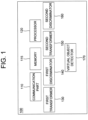
- Fig. 1 is a drawing schematically illustrating a learning device performing a learning method for transforming real images into virtual images by using a cycle GAN (Generative Adversarial Network) in accordance with one example embodiment of the present disclosure.
- GAN Geneative Adversarial Network
- the learning device 100 includes a first transformer 130, a first discriminator 140, a second transformer 150, a second discriminator 160, and a virtual object detector 170, which are components to be described later. Processes of input/output and computation of the first transformer 130, the first discriminator 140, the second transformer 150, the second discriminator 160, and the virtual object detector 170 may be respectively performed by a communication part 110 and a processor 120. However, detailed communication schematics between the communication part 110 and the processor 120 is omitted in Fig. 1 .
- a memory 115 stores various instructions to be described later, and the processor 120 executes the instructions stored in the memory 115 and performs processes of the present disclosure by executing the processes to be disclosed later.
- Such description of the learning device 100 does not exclude an integrated device including any combination of a processor, a memory, a medium, or any other computing components.
- the first transformer 130 and the second transformer 150 respectively transform characteristics of its inputted image. Specifically, the first transformer 130 transforms at least one first input image, which is one of real images on a real world, into at least one first output image, whose one or more characteristics are same as or similar to those of virtual images on a virtual world. And, the second transformer 150 transforms at least one second input image, which is one of the virtual images, into at least one second output image, whose one or more characteristics are same as or similar to those of the real images.
- the one or more characteristics of the virtual images may include (i) a higher chroma, (ii) a higher contrast, (iii) relatively omitted details of objects, and (iv) relatively simple, unrealistic routes of rays.
- Example of these virtual images may be seen in open world games such as Gran Turismo series, Forza motorsports series and GTA series.
- the scope of the present disclosure is not limited thereto.
- the one or more characteristics of the real images may include opposite characteristics, such as (i) a lower chroma, (ii) a lower contrast, (iii) relatively sufficient details of objects, (iv) relatively sophisticated, realistic routes of rays. Also, the scope of the present disclosure is not limited thereto. Below, in order to explain configurations of the first transformer 130 and the second transformer 150, Fig. 2 will be referred to.
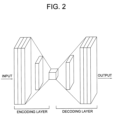
- Fig. 2 is a drawing schematically illustrating a first transformer and a second transformer for transforming the real images into the virtual images by using a cycle GAN in accordance with one example embodiment of the present disclosure.
- the first transformer 130 and the second transformer 150 may include at least part of one or more encoding layers and one or more decoding layers.
- the encoding layers may apply one or more convolution operations to its inputted image, to thereby generate at least one feature map
- the decoding layers may apply one or more deconvolution operations to the feature map, to thereby generate an image with transformed characteristics.
- each of the transformers may perform transformations of each direction, a direction of from the real images to images whose characteristics are same as or similar to those of the virtual images, or a direction of from the virtual images to images whose characteristics are same as or similar to those of the real images.
- the first discriminator 140 and the second discriminator 160 may determine whether the input image fed thereinto is an image with the transformed characteristics or an image with untransformed characteristics.
- the first discriminator 140 may determine whether the input image fed thereinto is one of primary virtual images or one of secondary virtual images, to thereby output 1 if the former is the case and 0 if the latter is the case.
- the primary virtual images are at least part of the virtual images without a transformation from at least part of the real images
- the secondary virtual images are at least part of the virtual images with the transformation from at least part of the real images.
- the second discriminator 160 may determine whether the input image fed thereinto is one of primary real images or one of secondary real images, to thereby output 1 if the former is the case and 0 if the latter is the case.
- the primary real images are at least part of the real images without a transformation from at least part of the virtual images
- the secondary real images are at least part of the real images with the transformation from at least part of the virtual images.
- the first discriminator 140 and the second discriminator 160 may be comprised of one or more CNNs, but the scope of the present disclosure is not limited thereto.
- the virtual object detector 170 may be comprised of one or more CNNs, specifically, may include a convolutional layer and an FC layer.
- the convolutional layer may apply the convolution operations to the input image fed thereinto, to thereby generate the feature map
- the FC layer may apply a bounding box regression to the feature map, to thereby detect one or more virtual objects.
- the configuration of the virtual object detector 170 is not limited thereto.
- the virtual object detector 170 may have been learned by using the sets of the training images, which are at least part of the virtual images, and their corresponding GTs.
- the configuration of the learning device 100 for learning the transformation of the one or more real images on the real world into the one or more virtual images on the virtual world by using the cycle GAN in accordance with one example embodiment of the present disclosure is described so far, and the learning method using the learning device 100 in accordance with the present disclosure is described by referring to Fig. 3 .
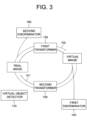
- Fig. 3 is a drawing schematically illustrating the learning device for transforming the real images into the virtual images by using the cycle GAN in accordance with one example embodiment of the present disclosure.
- FIG. 3 general operations of the first transformer 130, the first discriminator 140, the second transformer 150, the second discriminator 160, and the virtual object detector 170 are described. There are two major processes, and each of the processes is defined as a forward process 101 and a backward process 102.
- At least one first image which is one of the real images is transformed into at least one second image whose one or more characteristics are same as or similar to those of the virtual images by the first transformer 130, a 1_1-st result of determining the second image is generated by the first discriminator 140, and the second image is transformed into at least one third image whose one or more characteristics are same as or similar to those of the real images by the second transformer 150.
- the process of generating the 1_1-st result and the process of transforming the second image into the third image may be performed in a different order or may be performed concurrently.
- At least one fourth image which is one of the virtual images is transformed into at least one fifth image whose one or more characteristics are same as or similar to those of the real images by the second transformer 150, a 2_1-st result of determining the fifth image is generated by the second discriminator 160, and the fifth image is transformed into at least one sixth image whose one or more characteristics are same as or similar to those of the virtual images again by the first transformer 130.
- the process of generating the 2_1-st result and the part of transforming the fifth image into the sixth image may be performed in a different order or may be performed concurrently. Additionally, the forward process 101 and the backward process 102 may be performed in a different order or may be performed concurrently.
- the purpose of these processes is to calculate one or more losses for better learning of the first transformer 130, the first discriminator 140, the second transformer 150, and the second discriminator 160.
- the processes of calculating the losses for learning each of components of the learning device 100 will be described in detail.
- the transformer loss included in said one or more losses may be defined by a formula above, and I may be the first image, G ( I ) may be the second image, D G ( G ( I )) may be the 1_1-st result, F ( G ( I )) may be the third image, X may be the fourth image, F ( X ) may be the fifth image, D F ( F ( X )) may be the 2_1-st result, G ( F ( X )) may be the sixth image, ⁇ and ⁇ may be constants for respectively adjusting weights of
- log(1 - D G ( G ( I ))) may be a term for the learning of the first transformer 130 to make the first discriminator 140 be deceived. That is, the function of argmin makes a resultant final value be decreased and thus also makes log(1 - D G ( G ( I ))) be decreased. But since the log function is an increasing function, 1- D G ( G ( I )) within the log decreases. That is, D G ( G ( I )) increases. Since the first discriminator 140 outputs 1 for an image without the transformed format, the term allows the first transformer 130 to learn to deceive the first discriminator 140.
- may make the transformed image be similar to the original image, that is, may make the second image be similar to the first image.
- the term is required to reduce a difference from the original, since features in the image may not be conserved if the first transformer 130 learns just to deceive the first discriminator 140. That is, it is for the purpose of reducing I - F ( G ( I )), i.e., the difference between the first image and the third image.
- the difference may mean discrepancy between each of values in the first image and each of its corresponding values in the third image. Due to this second term, the part of transforming the second image into the third image is present in the forward process 101.
- the functions of the third and the fourth terms are respectively similar to those of the first term and the second term respectively, and only difference is the third and the fourth terms are used for the second transformer 150.
- the first transformer 130 will be learned better by the second term if the second transformer 150 is learned better.
- Values used for the third and the fourth terms may be acquired in the backward process 102.
- Other details on the third and the fourth terms are similar to those on the first and the second terms and easily inferred from the description above by those skilled in the art, and thus omitted.
- ⁇ and ⁇ in the formula are constants for respectively adjusting weights of
- a programmer may adjust the influence of
- the transformer loss further includes a partial loss corresponding to the virtual object detection result generated by detector 170. This may be seen in the formula below.
- G ⁇ argmin log 1 ⁇ D G G I + ⁇ I ⁇ F G I + log 1 ⁇ D F F X + ⁇ X ⁇ G F X + argmax ⁇ 1 ⁇ OD G I + ⁇ 2 ⁇ OD G F X
- argmax( ⁇ 1 ⁇ OD( G ( I )) + ⁇ 2 ⁇ OD ( G ( F ( X ))))) are the partial loss corresponding to the virtual object detection result.
- ⁇ 1 and ⁇ 2 are constants for respectively adjusting weights of OD( G ( I )) and OD ( G ( F ( X ))).
- Fig. 4 will be referred to.
- Fig. 4 is a drawing schematically illustrating a process of calculating the partial loss included in a transformer loss in accordance with one example embodiment of the present disclosure.
- the virtual object detector 170 detects objects included in the second image, and generates each of softmax scores including probabilities of classes to which each of the objects may correspond.
- a specific part of the partial loss, corresponding to a specific object included in the second image may be generated by referring to one or more first probabilities and at least one second probability, included in a specific softmax score.
- the first probabilities may denote probabilities of the specific object being included in object classes, e.g., a pedestrian class or a vehicle class
- the second probability may denote a probability of the specific object being included in a background class, e.g., a sky class.
- the specific part of the partial loss may be selected to allow a sum of (i) a largest probability among the first probabilities and (ii) a difference between 1 and the second probability to be larger. It can be expressed as the formula below.
- a second part of the specific processes of generating the partial loss corresponding to the sixth image may be performed, similarly to the first part.
- the partial loss may be included in the transformer loss in order to conserve details of the objects in the image even after the transformation processes.
- the second and the fourth terms of the formula and the partial loss may function in a complementary way. Specifically, the second term and the fourth term described above allow a transformed image to be similar to an original image corresponding to the transformed image, but this only makes the two images be similar in general, but cannot conserve selectively and preferentially the details of objects included in the original image. In contrary, the partial loss allows the objects included in the original image to be conserved in the transformed image, but it may make new objects, which do not exist in the original image, in the transformed image. However, with the second term and the fourth term, which keeps similarity between the original image and the transformed image, a generation of the unwanted new objects can be prevented. Thus, by adding the partial loss, the first transformer 130 may be significantly optimized.
- FD loss which is a loss for the first discriminator 140 is defined by a formula above.
- VI is any arbitrary virtual image among the virtual images
- D G ( VI ) is a 1_2-nd result, from the first discriminator, of determining the arbitrary virtual image
- G ( I ) is the second image
- D G ( G ( I )) is the 1_1-st result.
- Argmax makes the whole resultant value increase, makes D G ( VI ) be outputted as 1, and makes D G ( G ( I )) be outputted as 0. Therefore the first discriminator 140 may determine correctly whether characteristics of the inputted image were previously transformed or not.
- SD loss which is a loss for the second discriminator 160 is defined by a formula above.
- RI is any arbitrary real image among the real images
- D F ( RI ) is a 2_2-nd result, from the second discriminator, of determining the arbitrary real image
- F ( X ) is the fifth image
- D F ( F ( X )) is the 2_1-st result. Similar to the FD loss, it makes the second discriminator 160 to determine correctly whether characteristics of the inputted image were previously transformed or not.
- any arbitrary image which is one of the real images, may be inputted and used for the learning processes.
- the learning device 100 may learn at least part of parameters of the first transformer 130, the first discriminator 140, the second transformer 150, and the second discriminator 160.
- the encoding layers and the decoding layers included in the first transformer 130 and the second transformer 150 may be learned separately, with no relationship therebetween. Different from the general ones, layers included in the first transformer 130 and the second transformer 150 may be learned relatedly. Below, related learning processes will be explained.
- At least part of the first parameters and at least part of the second parameters may be learned relatedly such that a degree of relationship between the first parameters and the second parameters is allowed to be larger than a threshold value.
- the degree of the relationship may denote a ratio of same values included in the first parameters and their corresponding second parameters.
- at least part of the first parameters may be learned same as their corresponding second parameters.
- the first specific encoding layers and the first specific decoding layers may be selected among the first encoding layers and the first decoding layers respectively such that one or more first distances from a first latent space are smaller than a first threshold distance.
- the first latent space is where a first feature map generated by the first encoding layers lies, located between the first encoding layer and the first decoding layers.
- the second specific encoding layers and the second specific decoding layers are selected among the second encoding layers and the second decoding layers respectively such that one or more second distances from a second latent space, located between the second encoding layer and the second decoding layers, are smaller than a second threshold distance.
- This kind of approach may optimize the transforming process because parameters in layers close to the latent spaces include much information on contents of images inputted to the transformers, so that robust information acquired from both of the real images and the virtual images may be reflected on related parameters.
- the first transformer 130 may conserve or nearly keep the contents of the image while transforming its characteristics.
- testing processes after completion of the learning process, are carried out by a testing device, as described in claim 8.
- the testing device may include configurations of the learning device 100 described in the Fig. 1 , except the second transformer 150, the first discriminator 140 and the second discriminator 160.
- parameters included in the virtual object detector 170 may be fine-tuned by further using transformed images for fine-tuning and their corresponding GTs.
- the fine-tuning processes may be similar to the learning processes of the first transformer 130, thus omitted. However, this process may not be essential in practicing the present disclosure.
- the testing device including the virtual object detector 170 and the first transformer 130 may support an autonomous vehicle. Specifically, if the test images, which are at least part of the real images, are acquired by a camera included in the autonomous vehicle, the testing device 100 may instruct the first transformer to transform the test images into transformed test images, and instruct the virtual object detector 170 to detect objects included in the transformed test images, whose characteristics are same as or similar to those of virtual images, to thereby support driving of the autonomous vehicle in the real world.
- the virtual object detector 170 learned by using information on the virtual world, may be used for driving of an autonomous vehicle in the real world.
- communication parts of the learning device and the testing device may perform transmission of image data, for example, images described above like the original image, original labels, and additional labels, etc., and that processors and/or memories of the learning device and the testing device may retain data for feature maps and performing operations, and that the processors of the learning device and the testing device may perform convolution operations, deconvolution operations, and loss value operations, but the scope of the present disclosure is not limited thereto.
- the present disclosure has an effect of alleviating a problem of procuring the sets of the training images in the non-RGB format by transforming the sets of the training images in the RGB format into those in the non-RGB format with a cycle GAN (Generative Adversarial Network) capable of being applied to domain adaptation.
- GAN Geneative Adversarial Network
- the method in accordance with the present disclosure can be performed to be used in virtual driving environments by using a runtime input transformation. Further, a gap between virtuality and reality, and annotation costs can be reduced by the method.
- the embodiments of the present disclosure as explained above can be implemented in a form of executable program command through a variety of computer means recordable to computer readable media.
- the computer readable media may include solely or in combination, program commands, data files, and data structures.
- the program commands recorded to the media may be components specially designed for the present disclosure or may be usable to a skilled human in a field of computer software.
- Computer readable media include magnetic media such as hard disk, floppy disk, and magnetic tape, optical media such as CD-ROM and DVD, magneto-optical media such as floptical disk and hardware devices such as ROM, RAM, and flash memory specially designed to store and carry out program commands.
- Program commands include not only a machine language code made by a complier but also a high level code that can be used by an interpreter etc., which is executed by a computer.
- the aforementioned hardware device can work as more than a software module to perform the action of the present disclosure and they can do the same in the opposite case.
Landscapes
- Engineering & Computer Science (AREA)
- Physics & Mathematics (AREA)
- Theoretical Computer Science (AREA)
- General Physics & Mathematics (AREA)
- Evolutionary Computation (AREA)
- Software Systems (AREA)
- Artificial Intelligence (AREA)
- Computing Systems (AREA)
- Health & Medical Sciences (AREA)
- General Health & Medical Sciences (AREA)
- Data Mining & Analysis (AREA)
- Mathematical Physics (AREA)
- General Engineering & Computer Science (AREA)
- Life Sciences & Earth Sciences (AREA)
- Molecular Biology (AREA)
- Computational Linguistics (AREA)
- Biophysics (AREA)
- Biomedical Technology (AREA)
- Multimedia (AREA)
- Computer Vision & Pattern Recognition (AREA)
- Databases & Information Systems (AREA)
- Medical Informatics (AREA)
- Computational Mathematics (AREA)
- Mathematical Analysis (AREA)
- Pure & Applied Mathematics (AREA)
- Mathematical Optimization (AREA)
- Computer Graphics (AREA)
- Astronomy & Astrophysics (AREA)
- Remote Sensing (AREA)
- Geometry (AREA)
- Operations Research (AREA)
- Algebra (AREA)
- Computer Hardware Design (AREA)
- Probability & Statistics with Applications (AREA)
- Bioinformatics & Cheminformatics (AREA)
- Bioinformatics & Computational Biology (AREA)
- Evolutionary Biology (AREA)
- Image Analysis (AREA)
- Image Processing (AREA)
Claims (12)
- Lernverfahren zum Lernen einer Transformation eines oder mehrerer realer Bilder auf einer realen Welt in ein oder mehrere virtuelle Bilder auf einer virtuellen Welt unter Verwendung eines zyklischen Generative Adversarial Network, GAN, umfassend die Schritte:(a) nach dem Erfassen mindestens eines ersten Bildes, I, das eines der realen Bilder ist, (i) Anweisen eines ersten Transformators (130) durch eine Lernvorrichtung (100), das erste Bild in mindestens ein zweites Bild, G(I), zu transformieren, dessen eine oder mehrere Eigenschaften gleich oder ähnlich denen der virtuellen Bilder sind, (ii-1) Anweisen eines ersten Diskriminators (140) durch die Lernvorrichtung (100) (ii-1) Anweisen eines ersten Diskriminators (140) durch die Lernvorrichtung (100), zu bestimmen, ob das zweite Bild eines von primären virtuellen Bildern oder eines von sekundären virtuellen Bildern ist, wobei die primären virtuellen Bilder zumindest ein Teil der virtuellen Bilder ohne eine Transformation von zumindest einem Teil der realen Bilder sind, und die sekundären virtuellen Bilder zumindest ein Teil der virtuellen Bilder mit der Transformation von zumindest einem Teil der realen Bilder sind, um dadurch ein 1_1-st-Ergebnis DG(G(I))) zu erzeugen, und (ii-2) Anweisen eines zweiten Transformators (150) durch die Lernvorrichtung (100), das zweite Bild in mindestens ein drittes Bild F(G(I)) zu transformieren, dessen eine oder mehrere Eigenschaften mit denen der realen Bilder gleich oder ihnen ähnlich sind;(b) nach dem Erfassen mindestens eines vierten Bildes, X, das eines der virtuellen Bilder ist, (i) Anweisen des zweiten Transformators (150) durch die Lernvorrichtung (100), das vierte Bild in mindestens ein fünftes Bild F(X) zu transformieren, dessen eine oder mehrere Eigenschaften gleich oder ähnlich denen der realen Bilder sind, (ii-1) Anweisen, durch die Lernvorrichtung (100), eines zweiten Diskriminators (160), um zu bestimmen, ob das fünfte Bild eines von primären realen Bildern oder eines von sekundären realen Bildern ist, wobei die primären realen Bilder zumindest ein Teil der realen Bilder ohne eine Transformation von zumindest einem Teil der virtuellen Bilder sind, und die sekundären realen Bilder zumindest ein Teil der realen Bilder mit der Transformation von zumindest einem Teil der virtuellen Bilder sind, um dadurch ein 2_1-st-Ergebnis, DF (F(X)), zu erzeugen, und (ii-2) Anweisen des ersten Transformators (130) durch die Lernvorrichtung (100), das fünfte Bild in mindestens ein sechstes Bild, G(F(X)), zu transformieren, dessen eine oder mehrere Eigenschaften gleich oder ähnlich denen der virtuellen Bilder sind; und(c) Berechnen eines oder mehrerer Verluste durch die Lernvorrichtung (100) unter Bezugnahme auf mindestens einen Teil des ersten Bildes, des zweiten Bildes, des dritten Bildes, des vierten Bildes, des fünften Bildes, des sechsten Bildes, des 1_1-st-Ergebnisses und des 2_1-st-Ergebnisses, um dadurch mindestens einen Teil der Parameter des ersten Transformators (130), des zweiten Transformators (150), des ersten Diskriminators (140) und des zweiten Diskriminators (160) zu lernen,dadurch gekennzeichnet, dass im Schritt (c) nach dem Erfassen (i) eines Virtuell-Objekt-Erkennungsergebnisses, OD(G(I)), OD(G(F(X))), auf mindestens einem Teil des zweiten Bildes und des sechsten Bildes, das von einem Virtuell-Objekt-Detektor (170) erzeugt wird, der mindestens ein virtuelles Objekt erkennt, das in seinem eingegebenen Bild enthalten ist, und (ii) seiner entsprechenden Grundwahrheit, wobei durch die Lernvorrichtung (100) eine Verlusteinheit angewiesen wird, einen Transformatorverlust zu erzeugen, der in dem einen oder den mehreren Verlusten enthalten ist, indem weiter auf das Virtuell-Objekt-Erkennungsergebnis Bezug genommen wird.
- Lernverfahren nach Anspruch 1, wobei im Schritt (c) ein Transformatorverlust, der in dem einen oder den mehreren Verlusten enthalten ist, durch die folgende Formel optimiert wird:
 wobei γ und β Konstanten zum Einstellen der Gewichte der einzelnen Komponenten |I - F(G(I))| und |X - G(F(X))|,und argmax(λ1 × OD(G(I)) + λ2 × OD (G(F(X)))) ein Teilverlust des Transformatorverlustes ist, der dem Virtuell-Objekt-Erkennungsergebnis entspricht, wobei λ1 und λ2 Konstanten zum Einstellen jeder der Gewichte jeder der Komponenten OD(G(I)) und OD (G(F(Z))).
 - Lernverfahren nach Anspruch 1, wobei im Schritt (c) ein FD-Verlust, der ein Verlust für den ersten Diskriminator (140) ist und in den Verlusten enthalten ist, durch die folgende Formel optimiert wird:

- Lernverfahren nach Anspruch 1, wobei im Schritt (c) ein SD-Verlust, der ein Verlust für den zweiten Diskriminator (160) ist, der in den Verlusten enthalten ist, durch die folgende Formel optimiert wird:

- Lernverfahren nach Anspruch 1, wobei sowohl der erste Transformator (130) als auch der zweite Transformator (150) mindestens einen Teil einer oder mehrerer Kodierungsschichten und einer oder mehrerer Dekodierungsschichten enthält.
- Lernverfahren nach Anspruch 5, wobei (i) mindestens ein Teil der ersten Parameter, die in (i-1) einer oder mehreren ersten spezifischen Kodierungsschichten enthalten sind, die mindestens ein Teil der ersten Kodierungsschichten sind, die in dem ersten Transformator (130) enthalten sind, und (i-2) einer oder mehreren ersten spezifischen Dekodierungsschichten, die mindestens ein Teil der ersten Dekodierungsschichten sind, die in dem ersten Transformator (130) enthalten sind, und (ii) mindestens ein Teil der zweiten Parameter, die in (ii-1) einer oder mehreren zweiten spezifischen Kodierungsschichten enthalten sind, die zumindest ein Teil von zweiten Kodierungsschichten sind, die in dem zweiten Transformator (150) enthalten sind, und (ii-2) einer oder mehreren zweiten spezifischen Dekodierungsschichten, die zumindest ein Teil von zweiten Dekodierungsschichten sind, die in dem zweiten Transformator (150) enthalten sind, in Beziehung zueinander gelernt werden, um dadurch zu ermöglichen, dass ein Grad der Beziehung zwischen den ersten Parametern und den zweiten Parametern größer als ein Schwellenwert ist.
- Lernverfahren nach Anspruch 6, wobei die ersten spezifischen Kodierungsschichten und die ersten spezifischen Dekodierungsschichten unter den ersten Kodierungsschichten bzw. den ersten Dekodierungsschichten so ausgewählt werden, dass ein oder mehrere erste Abstände von einem ersten latenten Raum, der sich zwischen der ersten Kodierungsschicht und den ersten Dekodierungsschichten befindet, kleiner als ein erster Schwellenabstand sind, und die zweiten spezifischen Kodierungsschichten und die zweiten spezifischen Dekodierungsschichten unter den zweiten Kodierungsschichten bzw. den zweiten Dekodierungsschichten so ausgewählt werden, dass ein oder mehrere zweite Abstände von einem zweiten latenten Raum, der sich zwischen der zweiten Kodierungsschicht und den zweiten Dekodierungsschichten befindet, kleiner als ein zweiter Schwellenabstand sind.
- Testverfahren zum Testen einer Transformation eines oder mehrerer realer Bilder zum Testen in einer realen Welt in ein oder mehrere virtuelle Bilder zum Testen in einer virtuellen Welt unter Verwendung eines zyklischen Generative Adversarial Network, GAN, umfassend einen Schritt:
Anweisen des ersten Transformators (130) des zyklischen GANs nach Anspruch 1 durch eine Testvorrichtung, mindestens ein Testbild zu erfassen, das eines der realen Bilder zum Testen ist, und das Testbild in mindestens ein transformiertes Testbild zu transformieren, dessen eine oder mehrere Eigenschaften gleich oder ähnlich denen der virtuellen Bilder zum Testen sind. - Testverfahren nach Anspruch 8, wobei das transformierte Testbild zur Feinabstimmung von Parametern verwendet wird, die in einem Virtuell-Objekt-Detektor (170) enthalten sind.
- Testverfahren nach Anspruch 8, wobei das Testbild eines der realen Bilder zum Testen ist, das von einer in einem autonomen Fahrzeug enthaltenen Kamera aufgenommen wurde, und ein in dem autonomen Fahrzeug enthaltener Virtuell-Objekt-Detektor (170) mindestens ein in dem transformierten Testbild enthaltenes Objekt erkennt, um dadurch das autonome Fahrzeug beim Fahren in der realen Welt zu unterstützen.
- Lernvorrichtung (100) zum Lernen einer Transformation eines oder mehrerer realer Bilder auf einer realen Welt in ein oder mehrere virtuelle Bilder auf einer virtuellen Welt unter Verwendung eines zyklischen Generative Adversarial Network, GAN, umfassend:mindestens einem Speicher (115), der Anweisungen speichert; undmindestens einen Prozessor (120), der so konfiguriert ist, dass er die Anweisungen ausführt, um: die folgenden Schritte auszuführen:(a) nach dem Erfassen mindestens eines ersten Bildes, I, das eines der realen Bilder ist, (i) Anweisen eines ersten Transformators (130), das erste Bild in mindestens ein zweites Bild, G(I), zu transformieren, dessen eine oder mehrere Eigenschaften gleich oder ähnlich denen der virtuellen Bilder sind, (ii-1) Anweisen eines ersten Diskriminators (140), zu bestimmen, ob das zweite Bild eines der primären virtuellen Bilder oder eines der sekundären virtuellen Bilder ist, wobei die primären virtuellen Bilder zumindest ein Teil der virtuellen Bilder ohne eine Transformation von zumindest einem Teil der realen Bilder sind, und die sekundären virtuellen Bilder zumindest ein Teil der virtuellen Bilder mit der Transformation von zumindest einem Teil der realen Bilder sind, um dadurch ein 1_1-stes Ergebnis, DG(G(I))), zu erzeugen, und (ii-2) Anweisen eines zweiten Transformators (150), das zweite Bild in mindestens ein drittes Bild, F(G(I)), zu transformieren, dessen eine oder mehrere Eigenschaften gleich oder ähnlich denen der realen Bilder sind,(b) nach dem Erfassen mindestens eines vierten Bildes, X, das eines der virtuellen Bilder ist, (i) Anweisen des zweiten Transformators (150), das vierte Bild in mindestens ein fünftes Bild, F(X), zu transformieren, dessen eine oder mehrere Eigenschaften gleich oder ähnlich denen der realen Bilder sind, (ii-1) Anweisen eines zweiten Diskriminators (160), um zu bestimmen, ob das fünfte Bild eines der primären realen Bilder oder eines der sekundären realen Bilder ist, wobei die primären realen Bilder zumindest ein Teil der realen Bilder ohne eine Transformation von zumindest einem Teil der virtuellen Bilder sind, und die sekundären realen Bilder zumindest ein Teil der realen Bilder mit der Transformation von zumindest einem Teil der virtuellen Bilder sind, um dadurch ein 2_1-stes Ergebnis, DF (F(X)), zu erzeugen, und (ii-2) Anweisen des ersten Transformators (130), das fünfte Bild in mindestens ein sechstes Bild, G(F(X)), zu transformieren, dessen eine oder mehrere Eigenschaften gleich oder ähnlich denen der virtuellen Bilder sind, und(c) Berechnen eines oder mehrerer Verluste durch Bezugnahme auf mindestens einen Teil des ersten Bildes, des zweiten Bildes, des dritten Bildes, des vierten Bildes, des fünften Bildes, des sechsten Bildes, des 1_1-sten Ergebnisses und des 2_1-sten Ergebnisses, um dadurch mindestens einen Teil der Parameter des ersten Transformators (130), des zweiten Transformators (150), des ersten Diskriminators (140) und des zweiten Diskriminators (160) zu lernen,dadurch gekennzeichnet, dass bei dem Schritt (c) der Prozessor (120) nach dem Erfassen (i) eines Virtuell-Objekt-Erkennungsergebnisses, OD(G(I)), OD(G(F(X))), auf mindestens einem Teil des zweiten Bildes und des sechsten Bildes, das von einem Virtuell-Objekt-Detektor (170) erzeugt wird, der mindestens ein virtuelles Objekt erkennt, das in seinem eingegebenen Bild enthalten ist, und (ii) seiner entsprechenden Grundwahrheit eine Verlusteinheit anweist, einen Transformatorverlust zu erzeugen, der in dem einen oder den mehreren Verlusten enthalten ist, indem weiterhin auf das Virtuell-Objekt-Erkennungsergebnis Bezug genommen wird.
- Lernvorrichtung (100) nach Anspruch 11, wobei im Schritt (c) ein Transformatorverlust, der in dem einen oder den mehreren Verlusten enthalten ist, durch die folgende Formel optimiert wird:
 wobei γ und β Konstanten zum Einstellen der Gewichte der einzelnen Komponenten |I - F(G(I))| und |X - G(F(X))|,und argmax(λ1 × OD(G(I)) + λ2 × OD (G(F(X)))) ein Teilverlust des Transformatorverlustes ist, der dem Virtuell-Objekt-Erkennungsergebnis entspricht, wobei λ1 und λ2 Konstanten zum Einstellen jeder der Gewichte jeder der Komponenten OD(G(I)) und OD(G(F(X))).
Applications Claiming Priority (1)
| Application Number | Priority Date | Filing Date | Title |
|---|---|---|---|
| US16/258,877 US10373023B1 (en) | 2019-01-28 | 2019-01-28 | Learning method and learning device for runtime input transformation of real image on real world into virtual image on virtual world, to be used for object detection on real images, by using cycle GAN capable of being applied to domain adaptation |
Publications (3)
| Publication Number | Publication Date |
|---|---|
| EP3686849A1 EP3686849A1 (de) | 2020-07-29 |
| EP3686849C0 EP3686849C0 (de) | 2024-03-06 |
| EP3686849B1 true EP3686849B1 (de) | 2024-03-06 |
Family
ID=67477545
Family Applications (1)
| Application Number | Title | Priority Date | Filing Date |
|---|---|---|---|
| EP20151840.4A Active EP3686849B1 (de) | 2019-01-28 | 2020-01-14 | Lernverfahren und lernvorrichtung zur laufzeiteingabetransformation eines realen bildes der realen welt in ein virtuelles bild der virtuellen welt, das zur objekterkennung auf realen bildern verwendet werden soll, unter verwendung eines zyklus-gan, das auf eine domänenanpassung angewendet werden kann |
Country Status (5)
| Country | Link |
|---|---|
| US (1) | US10373023B1 (de) |
| EP (1) | EP3686849B1 (de) |
| JP (1) | JP6886201B2 (de) |
| KR (1) | KR102372702B1 (de) |
| CN (1) | CN111489285B (de) |
Families Citing this family (17)
| Publication number | Priority date | Publication date | Assignee | Title |
|---|---|---|---|---|
| US10916046B2 (en) * | 2019-02-28 | 2021-02-09 | Disney Enterprises, Inc. | Joint estimation from images |
| CN109919251B (zh) * | 2019-03-21 | 2024-08-09 | 腾讯科技(深圳)有限公司 | 一种基于图像的目标检测方法、模型训练的方法及装置 |
| EP3736741B1 (de) | 2019-05-06 | 2025-02-12 | Dassault Systèmes | Erfahrungslernen in einer virtuellen welt |
| US20200364585A1 (en) * | 2019-05-17 | 2020-11-19 | Oracle International Corporation | Modular feature extraction from parsed log data |
| US10733325B1 (en) | 2019-11-15 | 2020-08-04 | Capital One Services, Llc | Securing user-entered text in-transit |
| KR20220008035A (ko) | 2020-07-13 | 2022-01-20 | 삼성전자주식회사 | 위조 지문 검출 방법 및 장치 |
| CN112669242A (zh) * | 2021-03-16 | 2021-04-16 | 四川大学 | 基于改进图像增强算法与生成对抗网络的夜景复原方法 |
| US12260339B2 (en) * | 2021-05-03 | 2025-03-25 | Mitsubishi Electric Research Laboratories, Inc. | Generative model for inverse design of materials, devices, and structures |
| KR20230010286A (ko) | 2021-07-12 | 2023-01-19 | 삼성전자주식회사 | 신경망 모델을 이용한 이미지 변환 방법 및 장치 |
| KR102616961B1 (ko) * | 2021-08-31 | 2023-12-27 | 동국대학교 산학협력단 | 이종 캡슐내시경 간의 도메인 적응에 의한 병증정보 제공 방법 |
| JP2023055063A (ja) * | 2021-10-05 | 2023-04-17 | 株式会社安川電機 | 学習システム、画像生成システム、生産システム、学習方法、及びgan |
| CN114219701A (zh) * | 2021-11-10 | 2022-03-22 | 华南理工大学 | 敦煌壁画艺术风格转换方法、系统、计算机设备及存储介质 |
| CN114090751B (zh) * | 2021-11-12 | 2025-08-22 | 北京明略软件系统有限公司 | 对话模型训练、对话生成方法、系统、计算机和存储介质 |
| CN116205838A (zh) * | 2021-11-30 | 2023-06-02 | 鸿海精密工业股份有限公司 | 异常图像检测方法、系统、终端设备及存储介质 |
| KR102856442B1 (ko) * | 2022-01-11 | 2025-09-04 | 연세대학교 산학협력단 | 이미지 문맥 오차를 통한 적대적 생성 신경망 기반의 실사 주행 영상 생성 방법 및 장치 |
| KR102580658B1 (ko) * | 2022-06-28 | 2023-09-21 | 국민대학교산학협력단 | 스케치 이미지 객체 탐지를 위한 이미지 변환 장치 및 방법 |
| KR20240094763A (ko) * | 2022-12-16 | 2024-06-25 | 현대오토에버 주식회사 | 학습 데이터 증강을 위한 장치 및 방법 |
Family Cites Families (9)
| Publication number | Priority date | Publication date | Assignee | Title |
|---|---|---|---|---|
| US10614287B2 (en) * | 2014-06-16 | 2020-04-07 | Siemens Healthcare Diagnostics Inc. | Virtual staining of cells in digital holographic microscopy images using general adversarial networks |
| US10867365B2 (en) * | 2015-08-12 | 2020-12-15 | Sony Corporation | Image processing apparatus, image processing method, and image processing system for synthesizing an image |
| US10762653B2 (en) * | 2016-12-27 | 2020-09-01 | Canon Kabushiki Kaisha | Generation apparatus of virtual viewpoint image, generation method, and storage medium |
| CN107273936B (zh) * | 2017-07-07 | 2020-09-11 | 广东工业大学 | 一种gan图像处理方法及系统 |
| WO2019019199A1 (en) * | 2017-07-28 | 2019-01-31 | Shenzhen United Imaging Healthcare Co., Ltd. | SYSTEM AND METHOD FOR IMAGE CONVERSION |
| US10726304B2 (en) * | 2017-09-08 | 2020-07-28 | Ford Global Technologies, Llc | Refining synthetic data with a generative adversarial network using auxiliary inputs |
| CN108495110B (zh) * | 2018-01-19 | 2020-03-17 | 天津大学 | 一种基于生成式对抗网络的虚拟视点图像生成方法 |
| US11501438B2 (en) | 2018-04-26 | 2022-11-15 | Elekta, Inc. | Cone-beam CT image enhancement using generative adversarial networks |
| EP4404111A3 (de) | 2018-07-30 | 2024-10-23 | Memorial Sloan Kettering Cancer Center | Multimodale, multiauflösende neuronale tiefenlernnetze zur segmentierung, ergebnisvorhersage und überwachung der longitudinalen reaktion auf immuntherapie und strahlentherapie |
-
2019
- 2019-01-28 US US16/258,877 patent/US10373023B1/en active Active
- 2019-12-12 KR KR1020190166178A patent/KR102372702B1/ko active Active
-
2020
- 2020-01-08 CN CN202010017701.1A patent/CN111489285B/zh active Active
- 2020-01-14 EP EP20151840.4A patent/EP3686849B1/de active Active
- 2020-01-15 JP JP2020004253A patent/JP6886201B2/ja active Active
Also Published As
| Publication number | Publication date |
|---|---|
| EP3686849A1 (de) | 2020-07-29 |
| KR20200093424A (ko) | 2020-08-05 |
| KR102372702B1 (ko) | 2022-03-10 |
| CN111489285A (zh) | 2020-08-04 |
| EP3686849C0 (de) | 2024-03-06 |
| US10373023B1 (en) | 2019-08-06 |
| CN111489285B (zh) | 2023-07-04 |
| JP2020119553A (ja) | 2020-08-06 |
| JP6886201B2 (ja) | 2021-06-16 |
Similar Documents
| Publication | Publication Date | Title |
|---|---|---|
| EP3686849B1 (de) | Lernverfahren und lernvorrichtung zur laufzeiteingabetransformation eines realen bildes der realen welt in ein virtuelles bild der virtuellen welt, das zur objekterkennung auf realen bildern verwendet werden soll, unter verwendung eines zyklus-gan, das auf eine domänenanpassung angewendet werden kann | |
| US10373026B1 (en) | Learning method and learning device for generation of virtual feature maps whose characteristics are same as or similar to those of real feature maps by using GAN capable of being applied to domain adaptation to be used in virtual driving environments | |
| EP3690737B1 (de) | Lernverfahren und lernvorrichtung für die strategische umwandlung von rgb-trainingsbildsätzen in nicht-rgb-trainingsbildsätze, die zur lernobjekterkennung auf bildobjekten im nicht-rgb-format verwendet werden sollen, unter verwendung eines zyklus-gan, was zu einer erheblichen verringerung der rechenlast und der wiederverwendung von daten führt | |
| US10373317B1 (en) | Learning method and learning device for attention-driven image segmentation by using at least one adaptive loss weight map to be used for updating HD maps required to satisfy level 4 of autonomous vehicles and testing method and testing device using the same | |
| JP6855082B2 (ja) | 自律走行状況での障害物検出のためのcnn学習用イメージデータセットの生成方法及び装置、そしてこれを利用したテスト方法及びテスト装置 | |
| US10410352B1 (en) | Learning method and learning device for improving segmentation performance to be used for detecting events including pedestrian event, vehicle event, falling event and fallen event using edge loss and test method and test device using the same | |
| EP3686774B1 (de) | Lernverfahren und lernvorrichtung zur verbesserung der segmentierungsleistung bei der strassenhindernisdetektion, die erforderlich ist, um die stufe 4 und die stufe 5 von autonomen fahrzeugen unter verwendung des laplace-pyramidennetzwerks zu erfüllen, und testverfahren und dasselbe verwendende testvorrichtung | |
| EP3686808B1 (de) | Verfahren und vorrichtung zur transformation von cnn-schichten zur optimierung der cnn-parameterquantisierung zur verwendung für mobile vorrichtungen oder kompakte netzwerke mit hoher präzision über hardware-optimierung | |
| JP2020038668A (ja) | 自律走行状況で、障害物検出のためのcnn学習用イメージデータセットの生成方法及びコンピューティング装置 | |
| EP3690723B1 (de) | Lernverfahren und lernvorrichtung für heterogene sensorfusion unter verwendung eines fusionsnetzwerks, das eine nichtmaximale unterdrückung lernt | |
| US10311336B1 (en) | Method and device of neural network operations using a grid generator for converting modes according to classes of areas to satisfy level 4 of autonomous vehicles | |
| US10817777B2 (en) | Learning method and learning device for integrating object detection information acquired through V2V communication from other autonomous vehicle with object detection information generated by present autonomous vehicle, and testing method and testing device using the same | |
| US10890916B2 (en) | Location-specific algorithm selection for optimized autonomous driving | |
| EP3686837B1 (de) | Lernverfahren und lernvorrichtung zur verringerung der verzerrung, die in einem verzerrten bild auftritt, das bei der stabilisierung eines verzerrten bildes erzeugt wird, durch verwendung eines gan zur verbesserung der fehlertoleranz und der fluktuationsrobustheit in extremen situationen | |
| CN111476082B (zh) | 在线批次归一化、在线学习及持续学习的方法和装置 | |
| US10339424B1 (en) | Method and device of neural network operations using a grid generator for converting modes according to classes of areas to satisfy level 4 of autonomous vehicles | |
| US10460210B1 (en) | Method and device of neural network operations using a grid generator for converting modes according to classes of areas to satisfy level 4 of autonomous vehicles |
Legal Events
| Date | Code | Title | Description |
|---|---|---|---|
| PUAI | Public reference made under article 153(3) epc to a published international application that has entered the european phase |
Free format text: ORIGINAL CODE: 0009012 |
|
| STAA | Information on the status of an ep patent application or granted ep patent |
Free format text: STATUS: REQUEST FOR EXAMINATION WAS MADE |
|
| 17P | Request for examination filed |
Effective date: 20200114 |
|
| AK | Designated contracting states |
Kind code of ref document: A1 Designated state(s): AL AT BE BG CH CY CZ DE DK EE ES FI FR GB GR HR HU IE IS IT LI LT LU LV MC MK MT NL NO PL PT RO RS SE SI SK SM TR |
|
| AX | Request for extension of the european patent |
Extension state: BA ME |
|
| RBV | Designated contracting states (corrected) |
Designated state(s): AL AT BE BG CH CY CZ DE DK EE ES FI FR GB GR HR HU IE IS IT LI LT LU LV MC MK MT NL NO PL PT RO RS SE SI SK SM TR |
|
| STAA | Information on the status of an ep patent application or granted ep patent |
Free format text: STATUS: EXAMINATION IS IN PROGRESS |
|
| 17Q | First examination report despatched |
Effective date: 20220323 |
|
| GRAP | Despatch of communication of intention to grant a patent |
Free format text: ORIGINAL CODE: EPIDOSNIGR1 |
|
| STAA | Information on the status of an ep patent application or granted ep patent |
Free format text: STATUS: GRANT OF PATENT IS INTENDED |
|
| RIC1 | Information provided on ipc code assigned before grant |
Ipc: G06T 11/00 20060101AFI20231018BHEP |
|
| INTG | Intention to grant announced |
Effective date: 20231120 |
|
| GRAS | Grant fee paid |
Free format text: ORIGINAL CODE: EPIDOSNIGR3 |
|
| GRAA | (expected) grant |
Free format text: ORIGINAL CODE: 0009210 |
|
| STAA | Information on the status of an ep patent application or granted ep patent |
Free format text: STATUS: THE PATENT HAS BEEN GRANTED |
|
| AK | Designated contracting states |
Kind code of ref document: B1 Designated state(s): AL AT BE BG CH CY CZ DE DK EE ES FI FR GB GR HR HU IE IS IT LI LT LU LV MC MK MT NL NO PL PT RO RS SE SI SK SM TR |
|
| REG | Reference to a national code |
Ref country code: CH Ref legal event code: EP |
|
| REG | Reference to a national code |
Ref country code: IE Ref legal event code: FG4D |
|
| REG | Reference to a national code |
Ref country code: DE Ref legal event code: R096 Ref document number: 602020026638 Country of ref document: DE |
|
| U01 | Request for unitary effect filed |
Effective date: 20240306 |
|
| U07 | Unitary effect registered |
Designated state(s): AT BE BG DE DK EE FI FR IT LT LU LV MT NL PT SE SI Effective date: 20240312 |
|
| PG25 | Lapsed in a contracting state [announced via postgrant information from national office to epo] |
Ref country code: GR Free format text: LAPSE BECAUSE OF FAILURE TO SUBMIT A TRANSLATION OF THE DESCRIPTION OR TO PAY THE FEE WITHIN THE PRESCRIBED TIME-LIMIT Effective date: 20240607 |
|
| PG25 | Lapsed in a contracting state [announced via postgrant information from national office to epo] |
Ref country code: HR Free format text: LAPSE BECAUSE OF FAILURE TO SUBMIT A TRANSLATION OF THE DESCRIPTION OR TO PAY THE FEE WITHIN THE PRESCRIBED TIME-LIMIT Effective date: 20240306 Ref country code: RS Free format text: LAPSE BECAUSE OF FAILURE TO SUBMIT A TRANSLATION OF THE DESCRIPTION OR TO PAY THE FEE WITHIN THE PRESCRIBED TIME-LIMIT Effective date: 20240606 |
|
| PG25 | Lapsed in a contracting state [announced via postgrant information from national office to epo] |
Ref country code: ES Free format text: LAPSE BECAUSE OF FAILURE TO SUBMIT A TRANSLATION OF THE DESCRIPTION OR TO PAY THE FEE WITHIN THE PRESCRIBED TIME-LIMIT Effective date: 20240306 |
|
| PG25 | Lapsed in a contracting state [announced via postgrant information from national office to epo] |
Ref country code: RS Free format text: LAPSE BECAUSE OF FAILURE TO SUBMIT A TRANSLATION OF THE DESCRIPTION OR TO PAY THE FEE WITHIN THE PRESCRIBED TIME-LIMIT Effective date: 20240606 Ref country code: NO Free format text: LAPSE BECAUSE OF FAILURE TO SUBMIT A TRANSLATION OF THE DESCRIPTION OR TO PAY THE FEE WITHIN THE PRESCRIBED TIME-LIMIT Effective date: 20240606 Ref country code: HR Free format text: LAPSE BECAUSE OF FAILURE TO SUBMIT A TRANSLATION OF THE DESCRIPTION OR TO PAY THE FEE WITHIN THE PRESCRIBED TIME-LIMIT Effective date: 20240306 Ref country code: GR Free format text: LAPSE BECAUSE OF FAILURE TO SUBMIT A TRANSLATION OF THE DESCRIPTION OR TO PAY THE FEE WITHIN THE PRESCRIBED TIME-LIMIT Effective date: 20240607 Ref country code: ES Free format text: LAPSE BECAUSE OF FAILURE TO SUBMIT A TRANSLATION OF THE DESCRIPTION OR TO PAY THE FEE WITHIN THE PRESCRIBED TIME-LIMIT Effective date: 20240306 |
|
| PG25 | Lapsed in a contracting state [announced via postgrant information from national office to epo] |
Ref country code: IS Free format text: LAPSE BECAUSE OF FAILURE TO SUBMIT A TRANSLATION OF THE DESCRIPTION OR TO PAY THE FEE WITHIN THE PRESCRIBED TIME-LIMIT Effective date: 20240706 |
|
| PG25 | Lapsed in a contracting state [announced via postgrant information from national office to epo] |
Ref country code: SM Free format text: LAPSE BECAUSE OF FAILURE TO SUBMIT A TRANSLATION OF THE DESCRIPTION OR TO PAY THE FEE WITHIN THE PRESCRIBED TIME-LIMIT Effective date: 20240306 |
|
| PG25 | Lapsed in a contracting state [announced via postgrant information from national office to epo] |
Ref country code: CZ Free format text: LAPSE BECAUSE OF FAILURE TO SUBMIT A TRANSLATION OF THE DESCRIPTION OR TO PAY THE FEE WITHIN THE PRESCRIBED TIME-LIMIT Effective date: 20240306 |
|
| PG25 | Lapsed in a contracting state [announced via postgrant information from national office to epo] |
Ref country code: PL Free format text: LAPSE BECAUSE OF FAILURE TO SUBMIT A TRANSLATION OF THE DESCRIPTION OR TO PAY THE FEE WITHIN THE PRESCRIBED TIME-LIMIT Effective date: 20240306 |
|
| PG25 | Lapsed in a contracting state [announced via postgrant information from national office to epo] |
Ref country code: SK Free format text: LAPSE BECAUSE OF FAILURE TO SUBMIT A TRANSLATION OF THE DESCRIPTION OR TO PAY THE FEE WITHIN THE PRESCRIBED TIME-LIMIT Effective date: 20240306 |
|
| PG25 | Lapsed in a contracting state [announced via postgrant information from national office to epo] |
Ref country code: SM Free format text: LAPSE BECAUSE OF FAILURE TO SUBMIT A TRANSLATION OF THE DESCRIPTION OR TO PAY THE FEE WITHIN THE PRESCRIBED TIME-LIMIT Effective date: 20240306 Ref country code: SK Free format text: LAPSE BECAUSE OF FAILURE TO SUBMIT A TRANSLATION OF THE DESCRIPTION OR TO PAY THE FEE WITHIN THE PRESCRIBED TIME-LIMIT Effective date: 20240306 Ref country code: RO Free format text: LAPSE BECAUSE OF FAILURE TO SUBMIT A TRANSLATION OF THE DESCRIPTION OR TO PAY THE FEE WITHIN THE PRESCRIBED TIME-LIMIT Effective date: 20240306 Ref country code: PL Free format text: LAPSE BECAUSE OF FAILURE TO SUBMIT A TRANSLATION OF THE DESCRIPTION OR TO PAY THE FEE WITHIN THE PRESCRIBED TIME-LIMIT Effective date: 20240306 Ref country code: IS Free format text: LAPSE BECAUSE OF FAILURE TO SUBMIT A TRANSLATION OF THE DESCRIPTION OR TO PAY THE FEE WITHIN THE PRESCRIBED TIME-LIMIT Effective date: 20240706 Ref country code: CZ Free format text: LAPSE BECAUSE OF FAILURE TO SUBMIT A TRANSLATION OF THE DESCRIPTION OR TO PAY THE FEE WITHIN THE PRESCRIBED TIME-LIMIT Effective date: 20240306 |
|
| REG | Reference to a national code |
Ref country code: DE Ref legal event code: R097 Ref document number: 602020026638 Country of ref document: DE |
|
| PLBE | No opposition filed within time limit |
Free format text: ORIGINAL CODE: 0009261 |
|
| STAA | Information on the status of an ep patent application or granted ep patent |
Free format text: STATUS: NO OPPOSITION FILED WITHIN TIME LIMIT |
|
| 26N | No opposition filed |
Effective date: 20241209 |
|
| U20 | Renewal fee for the european patent with unitary effect paid |
Year of fee payment: 6 Effective date: 20250121 |
|
| REG | Reference to a national code |
Ref country code: CH Ref legal event code: PL |
|
| PG25 | Lapsed in a contracting state [announced via postgrant information from national office to epo] |
Ref country code: MC Free format text: LAPSE BECAUSE OF FAILURE TO SUBMIT A TRANSLATION OF THE DESCRIPTION OR TO PAY THE FEE WITHIN THE PRESCRIBED TIME-LIMIT Effective date: 20240306 |
|
| GBPC | Gb: european patent ceased through non-payment of renewal fee |
Effective date: 20250114 |
|
| PG25 | Lapsed in a contracting state [announced via postgrant information from national office to epo] |
Ref country code: GB Free format text: LAPSE BECAUSE OF NON-PAYMENT OF DUE FEES Effective date: 20250114 |
|
| PG25 | Lapsed in a contracting state [announced via postgrant information from national office to epo] |
Ref country code: CH Free format text: LAPSE BECAUSE OF NON-PAYMENT OF DUE FEES Effective date: 20250131 |
|
| PG25 | Lapsed in a contracting state [announced via postgrant information from national office to epo] |
Ref country code: IE Free format text: LAPSE BECAUSE OF NON-PAYMENT OF DUE FEES Effective date: 20250114 |
|
| U20 | Renewal fee for the european patent with unitary effect paid |
Year of fee payment: 7 Effective date: 20260122 |