EP3686794B1 - Lernverfahren und lernvorrichtung für cnn unter verwendung von 1xk- oder kx1-faltung zur hardware-optimierung sowie testverfahren und testvorrichtung damit - Google Patents
Lernverfahren und lernvorrichtung für cnn unter verwendung von 1xk- oder kx1-faltung zur hardware-optimierung sowie testverfahren und testvorrichtung damit Download PDFInfo
- Publication number
- EP3686794B1 EP3686794B1 EP20151251.4A EP20151251A EP3686794B1 EP 3686794 B1 EP3686794 B1 EP 3686794B1 EP 20151251 A EP20151251 A EP 20151251A EP 3686794 B1 EP3686794 B1 EP 3686794B1
- Authority
- EP
- European Patent Office
- Prior art keywords
- feature map
- channel
- testing
- reshaped
- channels
- Prior art date
- Legal status (The legal status is an assumption and is not a legal conclusion. Google has not performed a legal analysis and makes no representation as to the accuracy of the status listed.)
- Active
Links
Images





Classifications
-
- G—PHYSICS
- G06—COMPUTING OR CALCULATING; COUNTING
- G06V—IMAGE OR VIDEO RECOGNITION OR UNDERSTANDING
- G06V10/00—Arrangements for image or video recognition or understanding
- G06V10/40—Extraction of image or video features
- G06V10/46—Descriptors for shape, contour or point-related descriptors, e.g. scale invariant feature transform [SIFT] or bags of words [BoW]; Salient regional features
- G06V10/462—Salient features, e.g. scale invariant feature transforms [SIFT]
-
- G—PHYSICS
- G06—COMPUTING OR CALCULATING; COUNTING
- G06N—COMPUTING ARRANGEMENTS BASED ON SPECIFIC COMPUTATIONAL MODELS
- G06N3/00—Computing arrangements based on biological models
- G06N3/02—Neural networks
- G06N3/08—Learning methods
- G06N3/084—Backpropagation, e.g. using gradient descent
-
- G—PHYSICS
- G06—COMPUTING OR CALCULATING; COUNTING
- G06F—ELECTRIC DIGITAL DATA PROCESSING
- G06F11/00—Error detection; Error correction; Monitoring
- G06F11/30—Monitoring
- G06F11/34—Recording or statistical evaluation of computer activity, e.g. of down time, of input/output operation ; Recording or statistical evaluation of user activity, e.g. usability assessment
- G06F11/3466—Performance evaluation by tracing or monitoring
-
- G—PHYSICS
- G06—COMPUTING OR CALCULATING; COUNTING
- G06F—ELECTRIC DIGITAL DATA PROCESSING
- G06F13/00—Interconnection of, or transfer of information or other signals between, memories, input/output devices or central processing units
- G06F13/14—Handling requests for interconnection or transfer
- G06F13/36—Handling requests for interconnection or transfer for access to common bus or bus system
- G06F13/368—Handling requests for interconnection or transfer for access to common bus or bus system with decentralised access control
- G06F13/378—Handling requests for interconnection or transfer for access to common bus or bus system with decentralised access control using a parallel poll method
-
- G—PHYSICS
- G06—COMPUTING OR CALCULATING; COUNTING
- G06F—ELECTRIC DIGITAL DATA PROCESSING
- G06F17/00—Digital computing or data processing equipment or methods, specially adapted for specific functions
- G06F17/10—Complex mathematical operations
- G06F17/15—Correlation function computation including computation of convolution operations
-
- G—PHYSICS
- G06—COMPUTING OR CALCULATING; COUNTING
- G06F—ELECTRIC DIGITAL DATA PROCESSING
- G06F18/00—Pattern recognition
- G06F18/20—Analysing
- G06F18/24—Classification techniques
- G06F18/241—Classification techniques relating to the classification model, e.g. parametric or non-parametric approaches
-
- G—PHYSICS
- G06—COMPUTING OR CALCULATING; COUNTING
- G06F—ELECTRIC DIGITAL DATA PROCESSING
- G06F18/00—Pattern recognition
- G06F18/20—Analysing
- G06F18/24—Classification techniques
- G06F18/241—Classification techniques relating to the classification model, e.g. parametric or non-parametric approaches
- G06F18/2413—Classification techniques relating to the classification model, e.g. parametric or non-parametric approaches based on distances to training or reference patterns
-
- G—PHYSICS
- G06—COMPUTING OR CALCULATING; COUNTING
- G06N—COMPUTING ARRANGEMENTS BASED ON SPECIFIC COMPUTATIONAL MODELS
- G06N3/00—Computing arrangements based on biological models
- G06N3/02—Neural networks
- G06N3/04—Architecture, e.g. interconnection topology
-
- G—PHYSICS
- G06—COMPUTING OR CALCULATING; COUNTING
- G06N—COMPUTING ARRANGEMENTS BASED ON SPECIFIC COMPUTATIONAL MODELS
- G06N3/00—Computing arrangements based on biological models
- G06N3/02—Neural networks
- G06N3/04—Architecture, e.g. interconnection topology
- G06N3/045—Combinations of networks
-
- G—PHYSICS
- G06—COMPUTING OR CALCULATING; COUNTING
- G06N—COMPUTING ARRANGEMENTS BASED ON SPECIFIC COMPUTATIONAL MODELS
- G06N3/00—Computing arrangements based on biological models
- G06N3/02—Neural networks
- G06N3/04—Architecture, e.g. interconnection topology
- G06N3/0464—Convolutional networks [CNN, ConvNet]
-
- G—PHYSICS
- G06—COMPUTING OR CALCULATING; COUNTING
- G06N—COMPUTING ARRANGEMENTS BASED ON SPECIFIC COMPUTATIONAL MODELS
- G06N3/00—Computing arrangements based on biological models
- G06N3/02—Neural networks
- G06N3/04—Architecture, e.g. interconnection topology
- G06N3/047—Probabilistic or stochastic networks
-
- G—PHYSICS
- G06—COMPUTING OR CALCULATING; COUNTING
- G06N—COMPUTING ARRANGEMENTS BASED ON SPECIFIC COMPUTATIONAL MODELS
- G06N3/00—Computing arrangements based on biological models
- G06N3/02—Neural networks
- G06N3/08—Learning methods
- G06N3/09—Supervised learning
-
- G—PHYSICS
- G06—COMPUTING OR CALCULATING; COUNTING
- G06V—IMAGE OR VIDEO RECOGNITION OR UNDERSTANDING
- G06V10/00—Arrangements for image or video recognition or understanding
- G06V10/40—Extraction of image or video features
- G06V10/44—Local feature extraction by analysis of parts of the pattern, e.g. by detecting edges, contours, loops, corners, strokes or intersections; Connectivity analysis, e.g. of connected components
- G06V10/443—Local feature extraction by analysis of parts of the pattern, e.g. by detecting edges, contours, loops, corners, strokes or intersections; Connectivity analysis, e.g. of connected components by matching or filtering
- G06V10/449—Biologically inspired filters, e.g. difference of Gaussians [DoG] or Gabor filters
- G06V10/451—Biologically inspired filters, e.g. difference of Gaussians [DoG] or Gabor filters with interaction between the filter responses, e.g. cortical complex cells
- G06V10/454—Integrating the filters into a hierarchical structure, e.g. convolutional neural networks [CNN]
-
- G—PHYSICS
- G06—COMPUTING OR CALCULATING; COUNTING
- G06V—IMAGE OR VIDEO RECOGNITION OR UNDERSTANDING
- G06V10/00—Arrangements for image or video recognition or understanding
- G06V10/70—Arrangements for image or video recognition or understanding using pattern recognition or machine learning
- G06V10/764—Arrangements for image or video recognition or understanding using pattern recognition or machine learning using classification, e.g. of video objects
-
- G—PHYSICS
- G06—COMPUTING OR CALCULATING; COUNTING
- G06V—IMAGE OR VIDEO RECOGNITION OR UNDERSTANDING
- G06V10/00—Arrangements for image or video recognition or understanding
- G06V10/70—Arrangements for image or video recognition or understanding using pattern recognition or machine learning
- G06V10/82—Arrangements for image or video recognition or understanding using pattern recognition or machine learning using neural networks
-
- G—PHYSICS
- G06—COMPUTING OR CALCULATING; COUNTING
- G06V—IMAGE OR VIDEO RECOGNITION OR UNDERSTANDING
- G06V10/00—Arrangements for image or video recognition or understanding
- G06V10/94—Hardware or software architectures specially adapted for image or video understanding
Definitions
- the present disclosure relates to a method for learning parameters of a CNN according to claim 1.
- a corresponding method for testing a CNN is recited in claim 7 and a learning device for learning parameters of a CNN comprising a memory that stores instructions for performing the method according to any of the claims 1-6 is recited in claim 13.
- Deep Convolution Neural Networks are at the heart of the remarkable development in deep learning. CNNs have already been used in the 90's to solve the problems of character recognition, but their use has become as widespread as it is now thanks to recent research. These deep CNNs won the 2012 ImageNet image classification tournament, crushing other competitors. Then, the convolutional neural network became a very useful tool in the field of the machine learning.
- Yani loannou "A tutorial on Filter Groups (Grouped Convolution) - A Shallow Blog about Deep Learning", 10 August 2017 (2017-08-10), Retrieved from the Internet: URL:https://blog.yani.io/filter-group-tutorial/
- the feature extractor of the CNN may include convolutional layers, and the feature classifier may include one or more FC layers capable of applying fully connected operations to the features extracted by the feature extractor.
- the convolutional layers are the most important part of the CNN which do almost all of the operation.
- the convolutional layers extract features from a local receptive field by further using information on pixels nearby.
- a characteristic of filters of the convolutional layers are linear, thus the filters cannot extract non-linear features very well. This problem can be resolved by increasing the number of feature maps, but then the amount of computation also increases.
- a 1 ⁇ 1 convolutional layer has been used to reduce the dimension of the feature maps to minimize computational load.
- the 1 ⁇ 1 convolutional layer can extract like features from multiple feature maps, and as a result, can reduce the number of the feature maps, thus can reduce the amount of computation.
- the 1 ⁇ 1 convolutional layer is used for image segmentation, or used in place of the FC layers for the feature extractor.
- the inventors of the present disclosure propose a CNN capable of reducing the amount of the convolution operation more effectively, compared to convolution operation of the 1 ⁇ 1 convolutional layer.
- a method for learning parameters of a CNN using a 1 ⁇ K convolution operation or a K ⁇ 1 convolution operation including steps of: (a) a learning device, if at least one training image is acquired, instructing a reshaping layer to two-dimensionally concatenate each of features in each group comprised of each corresponding K channels among all channels of the training image or its processed feature map, to thereby generate a reshaped feature map, and instructing a subsequent convolutional layer to apply the 1 ⁇ K convolution operation or the K ⁇ 1 convolution operation to the reshaped feature map, to thereby generate an adjusted feature map whose volume is adjusted; and (b) the learning device instructing an output layer to generate at least one output by referring to features on the adjusted feature map or its processed feature map, and instructing a loss layer to calculate one or more losses by referring to the output and its corresponding at least one ground truth, to thereby learn at least part of parameters of the subsequent convolutional layer by backpropag
- the learning device if the number of channels of the training image or its processed feature map is not a multiple of K, instructs the reshaping layer to add at least one dummy channel to the channels of the training image or its processed feature map such that the number of the channels including the at least one dummy channel is a multiple of K, and to concatenate said each of features in said each group comprised of said each corresponding K channels among said all channels, including the at least one dummy channel, of the training image or its processed feature map.
- the learning device instructs the reshaping layer to generate the reshaped feature map having a width of W, a height of H•K, and a channel of CEIL L K .
- the learning device instructs the subsequent convolutional layer to apply a 1 ⁇ K convolution operation to the reshaped feature map, to thereby generate the adjusted feature map having a volume of W•H•M, resulting from a width of W, a height of H, and a channel of M.
- the learning device instructs the reshaping layer to generate the reshaped feature map having a width of W•K, a height of H, and a channel of CEIL L K .
- the learning device instructs the subsequent convolutional layer to apply a K ⁇ 1 convolution operation to the reshaped feature map, to thereby generate the adjusted feature map having a volume of W•H•M, resulting from a width of W, a height of H, and a channel of M.
- the learning device instructs the reshaping layer to (i) generate the reshaped feature map having a width of W, a height of H•K, and a channel of CEIL L K , or (ii) generate the reshaped feature map having a width of W•K, a height of H, and a channel of CEIL L K , and, if a size of a final part of the reshaped feature map on a CEIL L K ⁇ th channel is different from a size of a width of W and a height of H•K, the learning device instructs the reshaping layer to add at least one zero padding such that the final part of the reshaped feature map on the CEIL L K ⁇ th channel has the width of W and the height of H•K, or wherein, if the size of the final part
- a method for testing a CNN using a 1 ⁇ K convolution operation or a K ⁇ 1 convolution operation including steps of: (a) on condition that a learning device (i) has instructed a reshaping layer to two-dimensionally concatenate each of features for training in each group comprised of each corresponding K channels among all channels of at least one training image or its processed feature map, to thereby generate a reshaped feature map for training, and has instructed a subsequent convolutional layer to apply the 1 ⁇ K convolution operation or the K ⁇ 1 convolution operation to the reshaped feature map for training, to thereby generate an adjusted feature map for training whose volume is adjusted, and (ii) has instructed an output layer to generate at least one output for training by referring to features on the adjusted feature map for training or its processed feature map, and has instructed a loss layer to calculate one or more losses by referring to the output for training and its corresponding at least one ground truth, to thereby learn at least part of parameters of the subsequent con
- the testing device if the number of channels of the test image or its processed feature map is not a multiple of K, instructs the reshaping layer to add at least one dummy channel to the channels of the test image or its processed feature map such that the number of the channels including the at least one dummy channel is a multiple of K, and to concatenate said each of features in said each group comprised of said each corresponding K channels among said all channels, including the at least one dummy channel, of the test image or its processed feature map.
- the testing device instructs the reshaping layer to generate the reshaped feature map for testing having a width of W, a height of H•K, and a channel of CEIL(K).
- the testing device instructs the subsequent convolutional layer to apply a 1 ⁇ K convolution operation to the reshaped feature map for testing, to thereby generate the adjusted feature map for testing having a volume of W•H•M, resulting from a width of W, a height of H, and a channel of M.
- the testing device instructs the reshaping layer to generate the reshaped feature map for testing having a width of W•K, a height of H, and a channel of CEIL(K).
- the testing device instructs the subsequent convolutional layer to apply a K ⁇ 1 convolution operation to the reshaped feature map for testing, to thereby generate the adjusted feature map for testing having a volume of W•H•M, resulting from a width of W, a height of H, and a channel of M.
- the testing device instructs the reshaping layer to (i) generate the reshaped feature map for testing having a width of W, a height of H•K, and a channel of CEIL L K , or (ii) generate the reshaped feature map for testing having a width of W•K, a height of H, and a channel of CEIL L K , and, if a size of a final part of the reshaped feature map for testing on a CEIL L K ⁇ th channel is different from a size of a width of W and a height of H•K, the testing device instructs the reshaping layer to add at least one zero padding such that the final part of the reshaped feature map for testing on the CEIL L K ⁇ th channel has the width of W and the height of H•K, or wherein, if the size of
- a learning device for learning parameters of a CNN using a 1 ⁇ K convolution operation or a K ⁇ 1 convolution operation, including: at least one memory that stores instructions; and at least one processor configured to execute the instructions to: perform processes of (I) instructing a reshaping layer to two-dimensionally concatenate each of features in each group comprised of each corresponding K channels among all channels of at least one training image or its a processed feature map, to thereby generate a reshaped feature map, and instructing a subsequent convolutional layer to apply the 1 ⁇ K convolution operation or the K ⁇ 1 convolution operation to the reshaped feature map, to thereby generate an adjusted feature map whose volume is adjusted, and (II) instructing an output layer to generate at least one output by referring to features on the adjusted feature map or its processed feature map, and instructing a loss layer to calculate one or more losses by referring to the output and its corresponding at least one ground truth, to thereby learn at least part of parameters of
- the processor if the number of channels of the training image or its the pre-processed feature map is not a multiple of K, instructs the reshaping layer to add at least one dummy channel to the channels of the training image or its processed feature map such that the number of the channels including the at least one dummy channel is a multiple of K, and to concatenate said each of features in said each group comprised of said each corresponding K channels among said all channels, including the at least one dummy channel, of the training image or its the pre-processed feature map.
- the processor instructs the reshaping layer to generate the reshaped feature map having a width of W, a height of H•K, and a channel of CEIL L K .
- the processor instructs the subsequent convolutional layer to apply a 1 ⁇ K convolution operation to the reshaped feature map, to thereby generate the adjusted feature map having a volume of W•H•M, resulting from a width of W, a height of H, and a channel of M.
- the processor instructs the subsequent convolutional layer to apply a K ⁇ 1 convolution operation to the reshaped feature map, to thereby generate the adjusted feature map having a volume of W•H•M, resulting from a width of W, a height of H, and a channel of M.
- the processor instructs the reshaping layer to (i) generate the reshaped feature map having a width of W, a height of H•K, and a channel of CEIL L K , or (ii) generate the reshaped feature map having a width of W•K, a height of H, and a channel of CEIL L K , and, if a size of a final part of the reshaped feature map on a CEIL L K ⁇ th channel is different from a size of a width of W and a height of H•K, the processor instructs the reshaping layer to add at least one zero padding such that the final part of the reshaped feature map on the CEIL L K ⁇ th channel has the width of W and the height of H•K, or wherein, if the size of the final part of the
- a testing device for testing a CNN using a 1 ⁇ K convolution operation or a K ⁇ 1 convolution operation including: at least one memory that stores instructions; and at least one processor, on condition that a learning device (i) has instructed a reshaping layer to two-dimensionally concatenate each of features for training in each group comprised of each corresponding K channels among all channels of at least one training image or its processed feature map, to thereby generate a reshaped feature map for training, and has instructed a subsequent convolutional layer to apply the 1 ⁇ K convolution operation or the K ⁇ 1 convolution operation to the reshaped feature map for training, to thereby generate an adjusted feature map for training whose volume is adjusted, and (ii) has instructed an output layer to generate at least one output for training by referring to features on the adjusted feature map for training or its processed feature map, and has instructed a loss layer to calculate one or more losses by referring to the output for training and its corresponding at least one ground truth, to
- the processor if the number of channels of the test image or its processed feature map is not a multiple of K, instructs the reshaping layer to add at least one dummy channel to the channels of the test image or its processed feature map such that the number of the channels including the at least one dummy channel is a multiple of K, and to concatenate said each of features in said each group comprised of said each corresponding K channels among said all channels, including the at least one dummy channel, of the test image or its processed feature map.
- the processor instructs the reshaping layer to generate the reshaped feature map for testing having a width of W, a height of H•K, and a channel of CEIL L K .
- the processor instructs the subsequent convolutional layer to apply a 1 ⁇ K convolution operation to the reshaped feature map for testing, to thereby generate the adjusted feature map for testing having a volume of W•H•M, resulting from a width of W, a height of H, and a channel of M.
- the processor instructs the reshaping layer to generate the reshaped feature map for testing having a width of W•K, a height of H, and a channel of CEIL L K .
- the processor instructs the subsequent convolutional layer to apply a K ⁇ 1 convolution operation to the reshaped feature map for testing, to thereby generate the adjusted feature map for testing having a volume of W•H•M, resulting from a width of W, a height of H, and a channel of M.
- the processor instructs the reshaping layer to (i) generate the reshaped feature map for testing having a width of W, a height of H•K, and a channel of CEIL L K , or (ii) generate the reshaped feature map for testing having a width of W•K, a height of H, and a channel of CEIL L K , and, if a size of a final part of the reshaped feature map for testing on a CEIL L K ⁇ th channel is different from a size of a width of W and a height of H•K, the processor instructs the reshaping layer to add at least one zero padding such that the final part of the reshaped feature map for testing on the CEIL L K ⁇ th channel has the width of W and the height of H•K, or wherein, if
- recordable media that are readable by a computer for storing a computer program to execute the method of the present disclosure is further provided.
- Any images referred to in the present disclosure may include images related to any roads paved or unpaved, in which case the objects on the roads or near the roads may include vehicles, persons, animals, plants, buildings, flying objects like planes or drones, or any other obstacles which may appear in a road-related scene, but the scope of the present disclosure is not limited thereto.
- said any images referred to in the present disclosure may include images not related to any roads, such as images related to alleyway, land lots, sea, lakes, rivers, mountains, forests, deserts, sky, or any indoor space
- the objects in said any images may include vehicles, persons, animals, plants, buildings, flying objects like planes or drones, ships, amphibious planes or ships, or any other obstacles which may appear in a scene related to alleyway, land lots, sea, lakes, rivers, mountains, forests, deserts, sky, or any indoor space, but the scope of the present disclosure is not limited thereto.
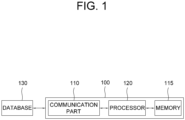
- Fig. 1 is a drawing schematically illustrating a learning device of a CNN using a 1 ⁇ K or a K ⁇ 1 convolution operation in accordance with one example embodiment of the present disclosure, and by referring to Fig. 1 , the learning device 100 may include a communication part 110 and a processor 120.
- the communication part 110 may receive at least one training image.
- the training image may be stored in a database 130, and the database 130 may store at least one ground truth of class information on each of one or more objects and at least one ground truth of location information on each of the objects, corresponding to the training images.
- the learning device may further include a memory 115 capable of storing computer readable instructions for performing following processes.
- the processor, the memory, a medium, etc. may be integrated with an integrated processor.
- the processor 120 may perform processes of instructing a reshaping layer to two-dimensionally concatenate each of features in each group comprised of each corresponding K channels among all channels of the training image or its processed feature map, to thereby generate a reshaped feature map, and instructing a subsequent convolutional layer to apply the 1 ⁇ K convolution operation or the K ⁇ 1 convolution operation to the reshaped feature map, to thereby generate an adjusted feature map whose volume is adjusted.
- said processed feature map is a feature map generated by at least one of (i) a method of applying one or more convolution operations to the training image, (ii) that of applying subsequent operations, e.g., a batch normalization operation, an activation operation, a pooling operation, to a result of said method of (i), and (iii) that of applying additional convolution operations to a result of said method of (ii).
- the processor 120 may instruct an output layer to generate at least one output by referring to features on the adjusted feature map or its processed feature map, and may instruct a loss layer to calculate one or more losses by referring to the output and its corresponding at least one ground truth, to thereby learn at least part of parameters of the subsequent convolutional layer by backpropagating the losses.
- the learning device 100 in accordance with one example of the present disclosure may be a computing device and may be any digital device with a processor capable of computation.
- Fig. 1 shows the single learning device 100, the scope of the present disclosure is not limited thereto.
- the learning device may be configured as several devices to perform its functions.
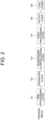
- FIG. 2 A method for learning parameters of the CNN using the 1 ⁇ K or the K ⁇ 1 convolution operation by using the learning device 100 in accordance with one example embodiment of the present disclosure is described by referring to Fig. 2 as follows.
- the learning device 100 may instruct a pre-processing layer 121 to pre-process the training image, to thereby generate the processed feature map.
- the pre-processing layer 121 may include at least one of a convolutional layer, a batch normalization layer, an activation layer, and a pooling layer, and may generate the processed feature map.
- the processed feature map is a feature map generated by at least one of (i) a method of applying the convolution operations to the training image, (ii) that of applying subsequent operations, e.g., the batch normalization operation, the activation operation, the pooling operation, to a result of said method of (i), and (iii) that of applying additional convolution operations to a result of said method of (ii).
- the scope of the pre-processing layer 121 is not limited thereto, that is, the pre-processing layer 121 may include each layer which forms the CNN for image processing.
- the learning device 100 may instruct a reshaping layer 122 to two-dimensionally concatenate each of features in each group comprised of each corresponding K channels among all channels of the training image or its processed feature map, to thereby generate the reshaped feature map.
- the learning device 100 may directly input the training image into the reshaping layer 122, without instructing the pre-processing layer 121 to pre-process the training image.
- the learning device 100 may instruct the reshaping layer 122 to add at least one dummy channel to the channels corresponding to each of the pixels such that the number of the channels including the at least one dummy channel is a multiple of K, and to concatenate said each of features in said each group comprised of said each corresponding K channels among said all channels, including the at least one dummy channel, of the training image or its processed feature map .
- the learning device 100 may instruct the reshaping layer 122 to (i) generate the reshaped feature map having a width of W, a height of H•K, and a channel of CEIL L K , or (ii) generate the reshaped feature map having a width of W•K, a height of H, and a channel of CEIL L K .
- the learning device 100 may instruct the reshaping layer 122 to add at least one zero padding such that the final part of the reshaped feature map on the CEIL L K ⁇ th channel has the width of W and the height of H•K, or if the size of the final part of the reshaped feature map on the CEIL L K ⁇ th channel is different from a size of a width of W•K and a height of H, the learning device 100 may instruct the reshaping layer 122 to add at least one zero padding such that the final part of the reshaped feature map on the CEIL L K ⁇ th channel has the width of W•K and the height of H.
- each of features, corresponding to said each of pixels, on a first channel C1 of the training image or its processed feature map 300 may be represented by C1F11, ..., C1F22, ..., and C1FWH.
- each of features, corresponding to said each of pixels, on other channels C2, C3, ..., and CL of the training image or its processed feature map 300 may be represented in a similar way.
- features C1F11, C2F11, ..., and CKF11 of K channels corresponding to the pixel C1F11 on the training image or its processed feature map 300 in Fig. 3 may be concatenated, features C1F21, C2F21, ..., and CKF21 of K channels corresponding to the pixel C1F21 on the training image or its processed feature map 300 may be concatenated, ..., features C1FWH, C2FWH, ..., and CKFWH of K channels corresponding to the pixel C1FWH on the training image or its processed feature map 300 may be concatenated, and the like. That is, features of each K channels corresponding to every pixel on the training image or its processed feature map 300 may be concatenated to generate the reshaped feature map 400A.
- the reshaped feature map 400A may have a width of W, a height of H•K, and a channel of CEIL L K .
- each channel of the reshaped feature map 400A may correspond to each group comprised of K channels of the training image or its processed feature map 300. That is, a first channel of the reshaped feature map 400A may correspond to a first channel to a K-th channel of the training image or its processed feature map 300, and a second channel of the reshaped feature map 400A may correspond to a (K+1)-th channel to a (2•K)-th channel of the training image or its processed feature map 300.
- a CEIL L K ⁇ th channel of the reshaped feature map 400A may correspond to a CEIL L K ⁇ 1 ⁇ K + 1 ⁇ th channel to an L-th channel of the training image or its processed feature map 300.
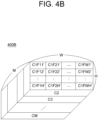
- the learning device 100 may instruct the subsequent convolutional layer 123 to apply the 1 ⁇ K convolution operation to the reshaped feature map 400A, to thereby generate the adjusted feature map 400B whose volume is adjusted.
- a feature of a pixel C1F11' is generated by applying the 1 ⁇ K convolution operation to C1F11, C2F11, ..., and CKF11, corresponding to a size of 1 ⁇ K, of the reshaped feature map 400A in Fig. 4A
- a feature of a pixel C1F22' is generated by applying the 1 ⁇ K convolution operation to C1F22, C2F22, ..., and CKF22
- a feature of a pixel C1FWH' is generated by applying the 1 ⁇ K convolution operation to C1FWH, C2FWH, ..., and CKFWH, and the like.
- the size of 1 ⁇ K may be a kernel size of the convolutional layers.
- the 1 ⁇ K convolution operation by applying the 1 ⁇ K convolution operation to the reshaped feature map 400A in Fig. 4A , the adjusted feature map 400B having a width of W and a height of H as in Fig. 4B may be generated. Therefore, compared to the 1 ⁇ 1 convolution operation on the training image or its processed feature map 300, the amount of computation becomes 1/K by generating the reshaped feature map 400A and performing the 1 ⁇ K convolution operation, and thus the speed of the convolution operation is increased by a factor of K.
- the number of channels of the adjusted feature map 400B may correspond to the number of kernels, i.e., the number of the filters, of the subsequent convolutional layer 123 performing the 1 ⁇ K convolution operation.
- the number of the kernels of the subsequent convolutional layer 123 is M
- the number of the channels of the adjusted feature map 400B may be M.
- the features C1F12, C2F12, ..., and CKF12 of K channels corresponding to the pixel C1F12 on the training image or its processed feature map 300 may be concatenated in the direction of the width, ..., the features C1FWH, C2FWH, ..., and CKFWH of K channels corresponding to the pixel C1FWH on the training image or its processed feature map 300 may be concatenated in the direction of the width, and the like. That is, the features of each K channels corresponding to every pixel on the training image or its processed feature map 300 may be concatenated in the direction of the width to generate the reshaped feature map 500A.
- the reshaped feature map 500A may have a width of W•K, a height of H, and a channel of CEIL L K .
- each channel of the reshaped feature map 500A may correspond to each group comprised of K channels of the training image or its processed feature map 300. That is, a first channel of the reshaped feature map 500A may correspond to a first channel to a K-th channel of the training image or its processed feature map 300, and a second channel of the reshaped feature map 500A may correspond to a (K+1)-th channel to a (2•K)-th channel of the training image or its processed feature map 300.
- a CEIL L K ⁇ th channel of the reshaped feature map 500A may correspond to a CEIL L K ⁇ 1 ⁇ K + 1 ⁇ th channel to an L-th channel of the training image or its processed feature map 300.
- the learning device 100 may instruct the subsequent convolutional layer 123 to apply the K ⁇ 1 convolution operation to the reshaped feature map 500A, to thereby generate the adjusted feature map 500B whose volume is adjusted.
- a feature of a pixel C1F11 is generated by applying the K ⁇ 1 convolution operation to C1F11, C2F11, ..., and CKF11, corresponding to a size of K ⁇ 1, of the reshaped feature map 500A in Fig. 5A
- a feature of a pixel C1F12 is generated by applying the K ⁇ 1 convolution operation to C1F12, C2F12, ..., and CKF12, ...
- a feature of a pixel C1FWH is generated by applying the K ⁇ 1 convolution operation to C1FWH, C2FWH, ..., and CKFWH, and the like.
- the size of K ⁇ 1 may be a kernel size of the convolutional layers.
- the learning device 100 may instruct a post-processing layer 124 to post-process the adjusted feature map 500B outputted from the subsequent convolutional layer 123.
- the post-processing layer 124 may include at least one of the convolutional layer, the batch normalization layer, the activation layer, the pooling layer, and an FC layer, and may generate probability information representing classified features of the adjusted feature map 500B or its processed feature map outputted from the subsequent convolutional layer 123.
- the scope of the post-processing layer 124 is not limited thereto, that is, the post-processing layer 124 may include each layer which forms the CNN for image processing.
- the learning device 100 may instruct an output layer 125 to generate at least one output by referring to features on the adjusted feature map 500B or its processed feature map, and may instruct a loss layer 126 to calculate one or more losses by referring to the output and its corresponding at least one ground truth, to thereby learn at least part of parameters of the subsequent convolutional layer 123 by backpropagating the losses.
- the learning device 100 may directly input the adjusted feature map 500B into the output layer 125, without instructing the post-processing layer 124 to post-process the adjusted feature map 500B.
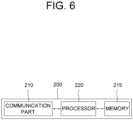
- Fig. 6 is a drawing schematically illustrating a testing device of the CNN using the 1 ⁇ K or the K ⁇ 1 convolution operation in accordance with one example embodiment of the present disclosure, and by referring to Fig. 6 , the testing device 200 may include a communication part 210 and a processor 220.
- testing device may further include a memory 215 capable of storing computer readable instructions for performing following processes.
- the processor, the memory, a medium, etc. may be integrated with an integrated processor.
- the communication part 210 may acquire or support another device to acquire at least one test image.
- the CNN using the 1 ⁇ K or the K ⁇ 1 convolution operation in accordance with one example of the present disclosure may be assumed to have been learned by the learning method described by referring to Figs. 2 to 5B .
- the learning device may have performed processes of (a) instructing the reshaping layer to two-dimensionally concatenate each of features for training in each group comprised of each corresponding K channels among all channels of the training image or its processed feature map, to thereby generate a reshaped feature map for training, and instructing the subsequent convolutional layer to apply the 1 ⁇ K convolution operation or the K ⁇ 1 convolution operation to the reshaped feature map for training, to thereby generate an adjusted feature map for training whose volume is adjusted.
- said processed feature map for training is a feature map generated by at least one of (i) a method of applying the convolution operations to the training image, (ii) that of applying subsequent operations, e.g., the batch normalization operation, the activation operation, the pooling operation, to a result of said method of (i), and (iii) that of applying additional convolution operations to a result of said method of (ii).
- the learning device may have performed processes of (b) instructing the output layer to generate at least one output for training by referring to features on the adjusted feature map for training or its processed feature map, and instructing the loss layer to calculate one or more losses by referring to the output for training and its corresponding at least one ground truth, to thereby learn at least part of parameters of the subsequent convolutional layer by backpropagating the losses.
- the processor 220 may perform processes of instructing the reshaping layer to two-dimensionally concatenate each of features for testing in each group comprised of each corresponding K channels among all channels of the test image or its processed feature map, to thereby generate a reshaped feature map for testing, and instructing the subsequent convolutional layer to apply the 1 ⁇ K convolution operation or the K ⁇ 1 convolution operation to the reshaped feature map for testing, to thereby generate an adjusted feature map for testing whose volume is adjusted.
- said processed feature map for testing is a feature map generated by at least one of (i) a method of applying the convolution operations to the test image, (ii) that of applying subsequent operations, e.g., the batch normalization operation, the activation operation, the pooling operation, to a result of said method of (i), and (iii) that of applying additional convolution operations to a result of said method of (ii). Then, the processor 220 may instruct the output layer to generate at least one output for testing by referring to features on the adjusted feature map for testing or its processed feature map.
- the testing device 200 in accordance with one example embodiment of the present disclosure may be a computing device and may be any device with a processor capable of computation.
- Fig. 6 shows the single testing device 200, the scope of the present disclosure is not limited thereto.
- the testing device may be configured as several devices to perform its functions.
- a method for testing parameters of the CNN using the 1 ⁇ K or the K ⁇ 1 convolution operation by using the testing device 200 in accordance with one example embodiment of the present disclosure is described by referring to Fig. 7 as follows. In the description below, the part easily deducible from the learning method described by referring to Figs. 1 to 5B will be omitted.
- the testing device 200 may instruct a pre-processing layer 221 to pre-process the test image, to thereby generate the processed feature map for testing.
- the pre-processing layer 221 may include at least one of the convolutional layer, the batch normalization layer, the activation layer, and the pooling layer, and may apply the convolution operations to the test image, to thereby generate the processed feature map for testing.
- the processed feature map for testing is a feature map generated by at least one of (i) a method of applying the convolution operations to the test image, (ii) that of applying subsequent operations, e.g., the batch normalization operation, the activation operation, the pooling operation, to a result of said method of (i), and (iii) that of applying additional convolution operations to a result of said method of (ii).
- the scope of the pre-processing layer 221 is not limited thereto, that is, the pre-processing layer 221 may include each layer which forms the CNN for image processing.
- the testing device 200 may instruct a reshaping layer 222 to two-dimensionally concatenate each of features in each group comprised of each corresponding K channels among all channels of the test image or its processed feature map, to thereby generate the reshaped feature map for testing.
- said processed feature map for testing is a feature map generated by at least one of (i) a method of applying the convolution operations to the test image, (ii) that of applying subsequent operations, e.g., the batch the normalization operation, the activation operation, the pooling operation, to a result of said method of (i), and (iii) that of applying additional convolution operations to a result of said method of (ii).
- the testing device 200 may directly input the test image into the reshaping layer 222, without instructing the pre-processing layer 221 to pre-process the test image.
- the testing device 200 may instruct the reshaping layer 222 to add at least one dummy channel to the channels corresponding to each of the pixels such that the number of the channels including the at least one dummy channel is a multiple of K, and to concatenate said each of features in said each group comprised of said each corresponding K channels among said all channels, including the at least one dummy channel, of the test image or its processed feature map.
- the testing device 200 may instruct the reshaping layer 222 to (i) generate the reshaped feature map for testing having a width of W, a height of H•K, and a channel of CEIL L K , or (ii) generate the reshaped feature map for testing having a width of W•K, a height of H, and a channel of CEIL L K .
- the testing device 200 may instruct the reshaping layer 222 to add at least one zero padding such that the final part of the reshaped feature map for testing on the CEIL L K ⁇ th channel has the width of W and the height of H•K, or if the size of the final part of the reshaped feature map for testing on the CEIL L K ⁇ th channel is different from a size of a width of W•K and a height of H, the testing device 200 may instruct the reshaping layer 222 to add at least one zero padding such that the final part of the reshaped feature map for testing on the CEIL L K ⁇ th channel has the width of W•K and the height of H.
- the reshaped feature map for testing may have a width of W, a height of H•K, and a channel of CEIL L K .
- each channel of the reshaped feature map for testing may correspond to each group comprised of K channels of the test image or its processed feature map. That is, a first channel of the reshaped feature map for testing may correspond to a first channel to a K-th channel of the test image or its processed feature map, and a second channel of the reshaped feature map for testing may correspond to a (K+1)-th channel to a (2•K)-th channel of the test image or its processed feature map.
- a CEIL L K ⁇ th channel of the reshaped feature map for testing may correspond to a CEIL L K ⁇ 1 ⁇ K + 1 ⁇ th channel to an L-th channel of the test image or its processed feature map.
- the testing device 200 may instruct the subsequent convolutional layer 223 to apply the 1 ⁇ K convolution operation to the reshaped feature map for testing, to thereby generate the adjusted feature map for testing whose volume is adjusted.
- the number of channels of the adjusted feature map for testing may correspond to the number of kernels of the subsequent convolutional layer 223 performing the 1 ⁇ K convolution operation, that is, the number of the filters.
- the number of the channels of the adjusted feature map for testing may be M.
- the reshaped feature map for testing may have a width of W•K, a height of H, and a channel of CEIL(K). Also, each channel of the reshaped feature map for testing may correspond to each group comprised of K channels of the test image or its processed feature map.
- the testing device 200 may instruct a post-processing layer 224 to post-process the adjusted feature map for testing outputted from the subsequent convolutional layer 223.
- the post-processing layer 224 may include at least one of the convolutional layer, the batch normalization layer, the activation layer, the pooling layer, and the FC layer, and may generate probability information representing classified features of the adjusted feature map for testing or its processed feature map outputted from the subsequent convolutional layer 223.
- the scope of the post-processing layer 224 is not limited thereto, that is, the post-processing layer 224 may include each layer which forms the CNN for image processing.
- the testing device 200 may instruct the output layer 225 to generate at least one output for testing by referring to features on the adjusted feature map for testing or its processed feature map.
- the present disclosure has an effect of reducing the amount of the convolution operations of the CNN efficiently by using the 1 ⁇ K or the K ⁇ 1 convolution operation.
- the present disclosure has another effect of extracting features on an image by the convolution operations since the number of channels of an inputted feature map or the image is increased by a factor of K using the 1 ⁇ K or the K ⁇ 1 convolution operation.
- the method in accordance with the present disclosure may be provided to be used for hardware optimization which satisfies KPI(key performance index).
- the embodiments of the present disclosure as explained above can be implemented in a form of executable program command through a variety of computer means recordable to computer readable media.
- the computer readable media may include solely or in combination, program commands, data files, and data structures.
- the program commands recorded to the media may be components specially designed for the present disclosure or may be usable to a skilled human in a field of computer software.
- Computer readable media include magnetic media such as hard disk, floppy disk, and magnetic tape, optical media such as CD-ROM and DVD, magneto-optical media such as floptical disk and hardware devices such as ROM, RAM, and flash memory specially designed to store and carry out program commands.
- Program commands include not only a machine language code made by a compiler but also a high level code that can be used by an interpreter etc., which is executed by a computer.
- the aforementioned hardware device can work as more than a software module to perform the action of the present disclosure and they can do the same in the opposite case.
Landscapes
- Engineering & Computer Science (AREA)
- Theoretical Computer Science (AREA)
- Physics & Mathematics (AREA)
- General Physics & Mathematics (AREA)
- Evolutionary Computation (AREA)
- Artificial Intelligence (AREA)
- General Engineering & Computer Science (AREA)
- Data Mining & Analysis (AREA)
- Health & Medical Sciences (AREA)
- General Health & Medical Sciences (AREA)
- Software Systems (AREA)
- Life Sciences & Earth Sciences (AREA)
- Computing Systems (AREA)
- Molecular Biology (AREA)
- Biomedical Technology (AREA)
- Mathematical Physics (AREA)
- Biophysics (AREA)
- Computational Linguistics (AREA)
- Computer Vision & Pattern Recognition (AREA)
- Multimedia (AREA)
- Databases & Information Systems (AREA)
- Medical Informatics (AREA)
- Biodiversity & Conservation Biology (AREA)
- Computational Mathematics (AREA)
- Pure & Applied Mathematics (AREA)
- Mathematical Optimization (AREA)
- Mathematical Analysis (AREA)
- Bioinformatics & Computational Biology (AREA)
- Evolutionary Biology (AREA)
- Bioinformatics & Cheminformatics (AREA)
- Quality & Reliability (AREA)
- Computer Hardware Design (AREA)
- Algebra (AREA)
- Probability & Statistics with Applications (AREA)
- Image Analysis (AREA)
Claims (13)
- Computerimplementiertes Verfahren zum Lernen von Parametern eines CNN unter Verwendung einer 1 ×K-Faltungsoperation oder einer K×1-Faltungsoperation, wobei das Verfahren zum Lernen die Schritte umfasst:(a) Erzeugen einer umgeformten Merkmalsabbildung über eine Umformungsschicht durch zweidimensionales Verketten jeweiliger Merkmale in einer jeweiligen Gruppe, die aus jeweiligen entsprechenden K Kanälen aus allen Kanälen einer verarbeiteten Merkmalsabbildung eines Trainingsbildes besteht, wobei die verarbeitete Merkmalsabbildung eine Breite (W), eine Höhe (H) und eine Tiefe (L) aufweist, die mehrere Kanäle aufweisen, wobei jeder Kanal der mehreren Kanäle mehrere Merkmale aufweist und wobei jedes Merkmal der mehreren Merkmale einem jeweiligen Pixel der verarbeiteten Merkmalsabbildung entspricht und wobei jedes Pixel jedes Kanals in der umgeformten Merkmalsabbildung auf einer Eins-zu-Eins-Basis einem jeweiligen der zweidimensional verketteten Merkmale in der jeweiligen Gruppe entspricht, die aus den jeweiligen entsprechenden K verschiedenen Kanälen besteht, und wobei die verarbeitete Merkmalsabbildung durch Neuanordnen von Werten von Pixeln der verarbeiteten Merkmalsabbildung, die in K Kanälen angeordnet sind, auf einer Eins-zu-Eins-Basis auf einem einzigen Kanal umgeformt wird, um die umgeformte Merkmalsabbildung mit einer Breite W, eine Höhe H*K und einem Kanal CEIL(L/K) zu bilden, und die Werte der Pixel vor und nach dem Umformen beibehalten werden, und Erzeugen einer angepassten Merkmalsabbildung, deren Volumen durch Anwenden der 1 ×K-Faltungsoperation oder der K×1-Faltungsoperation auf die umgeformte Merkmalsabbildung angepasst wird, über eine folgende Faltungsschicht; und(b) Erzeugen mindestens einer Ausgabe unter Rückgriff auf Merkmale auf der angepassten Merkmalsabbildung oder deren angepasster Merkmalsabbildung über eine Ausgabeschicht, Berechnen eines oder mehrerer Verluste unter Rückgriff auf die Ausgabe und deren entsprechende mindestens eine Ground Truth über eine Verlustschicht und Lernen zumindest eines Teils von Parametern der folgenden Faltungsschicht durch Zurückführen der Verluste durch Backpropagation.
- Verfahren nach Anspruch 1, ferner umfassend im Schritt (a), wenn die Anzahl der Kanäle des Trainingsbildes oder seiner verarbeiteten Merkmalsabbildung kein Vielfaches von K ist, Hinzufügen mindestens eines Dummy-Kanals zu den Kanälen der verarbeiteten Merkmalsabbildung des Trainingsbildes über die Umformungsschicht, derart, dass die Anzahl der Kanäle einschließlich des mindestens einen Dummy-Kanals ein Vielfaches von K ist, und Verketten des jeweiligen der Merkmale in jeder Gruppe, die aus den jeweiligen K Kanälen aus den allen Kanälen einschließlich des mindestens einen Dummy-Kanals besteht, der verarbeiteten Merkmalsabbildung des Trainingsbildes.
- Verfahren nach Anspruch 1, ferner umfassend unter der Annahme, dass die Anzahl der Kerne der folgenden Faltungsschicht M ist, im Schritt (a) Erzeugen der angepassten Merkmalsabbildung mit einem Volumen W•H•M durch Anwenden einer 1×K-Faltungsoperation auf die umgeformte Merkmalsabbildung über die folgende Faltungsschicht.
- Verfahren nach Anspruch 1, ferner umfassend im Schritt (a) Erzeugen der umgeformten Merkmalsabbildung mit einer Breite W•K, einer Höhe H und einem Kanal CEIL(L/K) über die Umformungsschicht.
- Verfahren nach Anspruch 4, ferner umfassend unter der Annahme, dass die Anzahl der Kerne der folgenden Faltungsschicht M ist, im Schritt (a) Erzeugen der angepassten Merkmalsabbildung mit einem Volumen W•H•M durch Anwenden einer K×1-Faltungsoperation auf die umgeformte Merkmalsabbildung über die folgende Faltungsschicht.
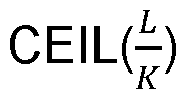
- Verfahren nach Anspruch 1, ferner umfassend im Schritt (a) Erzeugen (i) der umgeformten Merkmalsabbildung mit einer Breite W, einer Höhe H•K und einem Kanal



- Computerimplementiertes Verfahren zum Testen eines CNN, welches eine Faltungsschicht mit Parametern aufweist, die gemäß dem Verfahren nach einem der Ansprüche 1 bis 7 gelernt werden, wobei das Verfahren zum Testen die Schritte umfasst:(a) Erzeugen einer umgeformten Merkmalsabbildung zum Testen über eine Umformungsschicht durch zweidimensionales Verketten jeweiliger Merkmale zum Testen in einer jeweiligen Gruppe, die aus jeweiligen entsprechenden K Kanälen aus allen Kanälen einer verarbeiteten Merkmalsabbildung eines Testbildes besteht, wobei die verarbeitete Merkmalsabbildung eine Breite (W), eine Höhe (H) und eine Tiefe (L) aufweist, die mehrere Kanäle aufweisen, wobei jeder Kanal der mehreren Kanäle mehrere Merkmale aufweist und wobei jedes Merkmal der mehreren Merkmale einem jeweiligen Pixel der verarbeiteten Merkmalsabbildung entspricht und wobei jedes Pixel jedes Kanals in der umgeformten Merkmalsabbildung mit einer Breite W, eine Höhe H*K und einem Kanal CEIL(L/K) auf einer Eins-zu-Eins-Basis einem jeweiligen der zweidimensional verketteten Merkmale in der jeweiligen Gruppe entspricht, die aus den jeweiligen entsprechenden K verschiedenen Kanälen besteht, und wobei die verarbeitete Merkmalsabbildung durch Neuanordnen von Werten von Pixeln der verarbeiteten Merkmalsabbildung, die in K Kanälen angeordnet sind, auf einer Eins-zu-Eins-Basis auf einem einzigen Kanal umgeformt wird und die Werte der Pixel vor und nach dem Umformen beibehalten werden, und Erzeugen einer angepassten Merkmalsabbildung zum Testen, deren Volumen durch Anwenden einer 1 ×K-Faltungsoperation oder einer K×1-Faltungsoperation auf die umgeformte Merkmalsabbildung zum Testen angepasst wird, über eine folgende Faltungsschicht; und(b) Erzeugen mindestens einer Ausgabe zum Testen unter Rückgriff auf Merkmale auf der angepassten Merkmalsabbildung zum Testen oder deren angepasster Merkmalsabbildung über eine Ausgabeschicht.
- Verfahren nach Anspruch 7, ferner umfassend im Schritt (a), wenn die Anzahl der Kanäle der verarbeiteten Merkmalsabbildung des Testbildes kein Vielfaches von K ist, Hinzufügen mindestens eines Dummy-Kanals zu den Kanälen der verarbeiteten Merkmalsabbildung des Testbildes über die Umformungsschicht, derart, dass die Anzahl der Kanäle einschließlich des mindestens einen Dummy-Kanals ein Vielfaches von K ist, und Verketten des jeweiligen der Merkmale in jeder Gruppe, die aus den jeweiligen K Kanälen aus den allen Kanälen einschließlich des mindestens einen Dummy-Kanals besteht, der verarbeiteten Merkmalsabbildung des Testbildes.
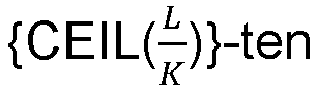
- Verfahren nach Anspruch 7, ferner umfassend im Schritt (a) Erzeugen der umgeformten Merkmalsabbildung zum Testen mit einer Breite W, einer Höhe H•K und einem Kanal

- Verfahren nach Anspruch 9, ferner umfassend unter der Annahme, dass die Anzahl der Kerne der folgenden Faltungsschicht M ist, im Schritt (a) Erzeugen der angepassten Merkmalsabbildung zum Testen mit einem Volumen W•H•M durch Anwenden einer 1 ×K-Faltungsoperation auf die umgeformte Merkmalsabbildung zum Testen über die folgende Faltungsschicht.
- Verfahren nach Anspruch 10, ferner umfassend unter der Annahme, dass die Anzahl der Kerne der folgenden Faltungsschicht M ist, im Schritt (a) Erzeugen der angepassten Merkmalsabbildung zum Testen mit einem Volumen W•H•M durch Anwenden einer K×1-Faltungsoperation auf die umgeformte Merkmalsabbildung zum Testen über die folgende Faltungsschicht.
- Verfahren nach Anspruch 7, ferner umfassend im Schritt (a) Erzeugen (i) der umgeformten Merkmalsabbildung zum Testen mit einer Breite W, einer Höhe H•K und einem Kanal




- Lernvorrichtung zum Lernen von Parametern eines CNN unter Verwendung einer 1×K-Faltungsoperation oder einer K×1-Faltungsoperation, aufweisend:einen Speicher, welcher Anweisungen zum Durchführen des Verfahrens nach einem der Ansprüche 1 bis 6 speichert; undeinen Prozessor, konfiguriert zum Ausführen der Anweisungen, die in dem Speicher gespeichert sind.
Applications Claiming Priority (1)
| Application Number | Priority Date | Filing Date | Title |
|---|---|---|---|
| US16/255,109 US11461653B2 (en) | 2019-01-23 | 2019-01-23 | Learning method and learning device for CNN using 1xK or Kx1 convolution to be used for hardware optimization, and testing method and testing device using the same |
Publications (3)
| Publication Number | Publication Date |
|---|---|
| EP3686794A1 EP3686794A1 (de) | 2020-07-29 |
| EP3686794B1 true EP3686794B1 (de) | 2024-07-24 |
| EP3686794C0 EP3686794C0 (de) | 2024-07-24 |
Family
ID=69159558
Family Applications (1)
| Application Number | Title | Priority Date | Filing Date |
|---|---|---|---|
| EP20151251.4A Active EP3686794B1 (de) | 2019-01-23 | 2020-01-10 | Lernverfahren und lernvorrichtung für cnn unter verwendung von 1xk- oder kx1-faltung zur hardware-optimierung sowie testverfahren und testvorrichtung damit |
Country Status (5)
| Country | Link |
|---|---|
| US (1) | US11461653B2 (de) |
| EP (1) | EP3686794B1 (de) |
| JP (1) | JP6857369B2 (de) |
| KR (1) | KR102337383B1 (de) |
| CN (1) | CN111476247B (de) |
Families Citing this family (6)
| Publication number | Priority date | Publication date | Assignee | Title |
|---|---|---|---|---|
| US10303980B1 (en) * | 2018-09-05 | 2019-05-28 | StradVision, Inc. | Learning method, learning device for detecting obstacles and testing method, testing device using the same |
| CN111988609B (zh) * | 2019-05-22 | 2024-07-16 | 富士通株式会社 | 图像编码装置、概率模型生成装置和图像解码装置 |
| US10943353B1 (en) | 2019-09-11 | 2021-03-09 | International Business Machines Corporation | Handling untrainable conditions in a network architecture search |
| US11023783B2 (en) * | 2019-09-11 | 2021-06-01 | International Business Machines Corporation | Network architecture search with global optimization |
| KR102718383B1 (ko) | 2022-03-22 | 2024-10-16 | 동원산업 주식회사 | 인공 신경망을 이용한 어류 등급 판정 방법 및 장치 |
| KR102818910B1 (ko) | 2024-11-13 | 2025-06-11 | 주식회사 미래인테크놀러지 | 핵심 성과 지표를 최적화하기 위한 방법, 시스템 및 비일시성의 컴퓨터 판독 가능 기록 매체 |
Family Cites Families (16)
| Publication number | Priority date | Publication date | Assignee | Title |
|---|---|---|---|---|
| US10083395B2 (en) * | 2015-05-21 | 2018-09-25 | Google Llc | Batch processing in a neural network processor |
| CN106558025B (zh) * | 2015-09-29 | 2021-02-09 | 腾讯科技(深圳)有限公司 | 一种图片的处理方法和装置 |
| CN108475331B (zh) * | 2016-02-17 | 2022-04-05 | 英特尔公司 | 用于对象检测的方法、装置、系统和计算机可读介质 |
| JP6869676B2 (ja) * | 2016-09-27 | 2021-05-12 | キヤノン株式会社 | 情報処理装置、情報処理方法及びプログラム |
| JP6929047B2 (ja) * | 2016-11-24 | 2021-09-01 | キヤノン株式会社 | 画像処理装置、情報処理方法及びプログラム |
| US10067509B1 (en) * | 2017-03-10 | 2018-09-04 | TuSimple | System and method for occluding contour detection |
| US11468318B2 (en) * | 2017-03-17 | 2022-10-11 | Portland State University | Frame interpolation via adaptive convolution and adaptive separable convolution |
| ES3052990T3 (en) * | 2017-04-07 | 2026-01-16 | Intel Corp | Methods and systems for budgeted and simplified training of deep neural networks |
| JP6744838B2 (ja) * | 2017-04-18 | 2020-08-19 | Kddi株式会社 | エンコーダデコーダ畳み込みニューラルネットワークにおける解像感を改善するプログラム |
| CN109145927A (zh) * | 2017-06-16 | 2019-01-04 | 杭州海康威视数字技术股份有限公司 | 一种对形变图像的目标识别方法及装置 |
| US10474988B2 (en) * | 2017-08-07 | 2019-11-12 | Standard Cognition, Corp. | Predicting inventory events using foreground/background processing |
| US10049323B1 (en) * | 2017-10-13 | 2018-08-14 | StradVision, Inc. | Method and device for performing activation and convolution operation at the same time and learning method and learning device for the same |
| JP6961726B2 (ja) * | 2017-10-16 | 2021-11-05 | イルミナ インコーポレイテッド | バリアントの分類のための深層畳み込みニューラルネットワーク |
| SG11201912781TA (en) * | 2017-10-16 | 2020-01-30 | Illumina Inc | Aberrant splicing detection using convolutional neural networks (cnns) |
| CN109166100A (zh) * | 2018-07-24 | 2019-01-08 | 中南大学 | 基于卷积神经网络的多任务学习细胞计数方法 |
| CN109086886A (zh) * | 2018-08-02 | 2018-12-25 | 工极(北京)智能科技有限公司 | 一种基于极限学习机的卷积神经网络学习算法 |
-
2019
- 2019-01-23 US US16/255,109 patent/US11461653B2/en active Active
- 2019-11-15 KR KR1020190147089A patent/KR102337383B1/ko active Active
- 2019-12-19 CN CN201911314750.5A patent/CN111476247B/zh active Active
-
2020
- 2020-01-09 JP JP2020001966A patent/JP6857369B2/ja active Active
- 2020-01-10 EP EP20151251.4A patent/EP3686794B1/de active Active
Also Published As
| Publication number | Publication date |
|---|---|
| EP3686794C0 (de) | 2024-07-24 |
| US20200234135A1 (en) | 2020-07-23 |
| US11461653B2 (en) | 2022-10-04 |
| CN111476247B (zh) | 2023-09-26 |
| KR20200091795A (ko) | 2020-07-31 |
| JP2020119535A (ja) | 2020-08-06 |
| KR102337383B1 (ko) | 2021-12-10 |
| CN111476247A (zh) | 2020-07-31 |
| EP3686794A1 (de) | 2020-07-29 |
| JP6857369B2 (ja) | 2021-04-14 |
Similar Documents
| Publication | Publication Date | Title |
|---|---|---|
| EP3686794B1 (de) | Lernverfahren und lernvorrichtung für cnn unter verwendung von 1xk- oder kx1-faltung zur hardware-optimierung sowie testverfahren und testvorrichtung damit | |
| EP3686801B1 (de) | Lernverfahren und lernvorrichtung für ein neuronales faltungsnetzwerk unter verwendung von 1xh-faltung zur bilderkennung zur hardware-optimierung sowie testverfahren und testvorrichtung damit | |
| CN110874563B (zh) | 通过cnn的多个图像输出的提供集成的特征图的方法及装置 | |
| EP3690721A1 (de) | Verfahren zur gesichtserkennung unter verwendung einer vielzahl von patch-kombinationen auf der basis eines tiefen neuronalen netzes | |
| US10402977B1 (en) | Learning method and learning device for improving segmentation performance in road obstacle detection required to satisfy level 4 and level 5 of autonomous vehicles using laplacian pyramid network and testing method and testing device using the same | |
| EP3686793A1 (de) | Lernverfahren und lernvorrichtung zum extrahieren von merkmalen aus einem eingabebild unter verwendung von konvolutionalen schichten in mehreren blöcken in cnn mit dem ergebnis einer hardware-optimierung, die eine zufriedenstellung des key-performance-index ermöglicht, sowie prüfverfahren und prüfvorrichtung damit | |
| US10387753B1 (en) | Learning method and learning device for convolutional neural network using 1×1 convolution for image recognition to be used for hardware optimization, and testing method and testing device using the same | |
| EP3686800B1 (de) | Lernverfahren und lernvorrichtung für objektdetektor basierend auf cnn mit verwendung von 1xh-faltung zur verwendung in der hardware-optimierung sowie prüfverfahren und prüfvorrichtung mit verwendung davon | |
| EP3686781B1 (de) | Lernverfahren und lernvorrichtung für einen objektdetektor auf der basis von cnn unter verwendung von bildverknüpfung sowie testverfahren und testvorrichtung damit | |
| US10430691B1 (en) | Learning method and learning device for object detector based on CNN, adaptable to customers' requirements such as key performance index, using target object merging network and target region estimating network, and testing method and testing device using the same to be used for multi-camera or surround view monitoring | |
| EP3624016A1 (de) | Verfahren und vorrichtung zur codierung von bildern sowie prüfverfahren und prüfvorrichtung damit | |
| US10402692B1 (en) | Learning method and learning device for fluctuation-robust object detector based on CNN using target object estimating network adaptable to customers' requirements such as key performance index, and testing device using the same | |
| JP2020038666A (ja) | 自律走行状況で障害物検出のための学習用データセットの生成方法及びこれを利用したコンピューティング装置、学習方法及び学習装置 | |
| EP3686797A1 (de) | Lernverfahren und lernvorrichtung für objektdetektor basierend auf cnn mit 1×1-faltung zur hardwareoptimierung sowie prüfverfahren und prüfvorrichtung damit |
Legal Events
| Date | Code | Title | Description |
|---|---|---|---|
| PUAI | Public reference made under article 153(3) epc to a published international application that has entered the european phase |
Free format text: ORIGINAL CODE: 0009012 |
|
| STAA | Information on the status of an ep patent application or granted ep patent |
Free format text: STATUS: REQUEST FOR EXAMINATION WAS MADE |
|
| 17P | Request for examination filed |
Effective date: 20200110 |
|
| AK | Designated contracting states |
Kind code of ref document: A1 Designated state(s): AL AT BE BG CH CY CZ DE DK EE ES FI FR GB GR HR HU IE IS IT LI LT LU LV MC MK MT NL NO PL PT RO RS SE SI SK SM TR |
|
| AX | Request for extension of the european patent |
Extension state: BA ME |
|
| RBV | Designated contracting states (corrected) |
Designated state(s): AL AT BE BG CH CY CZ DE DK EE ES FI FR GB GR HR HU IE IS IT LI LT LU LV MC MK MT NL NO PL PT RO RS SE SI SK SM TR |
|
| STAA | Information on the status of an ep patent application or granted ep patent |
Free format text: STATUS: EXAMINATION IS IN PROGRESS |
|
| 17Q | First examination report despatched |
Effective date: 20220602 |
|
| REG | Reference to a national code |
Ref country code: DE Ref legal event code: R079 Free format text: PREVIOUS MAIN CLASS: G06K0009460000 Ipc: G06F0018241300 Ref document number: 602020034334 Country of ref document: DE |
|
| GRAP | Despatch of communication of intention to grant a patent |
Free format text: ORIGINAL CODE: EPIDOSNIGR1 |
|
| STAA | Information on the status of an ep patent application or granted ep patent |
Free format text: STATUS: GRANT OF PATENT IS INTENDED |
|
| RIC1 | Information provided on ipc code assigned before grant |
Ipc: G06V 10/94 20220101ALI20240403BHEP Ipc: G06V 10/82 20220101ALI20240403BHEP Ipc: G06V 10/764 20220101ALI20240403BHEP Ipc: G06V 10/44 20220101ALI20240403BHEP Ipc: G06F 18/2413 20230101AFI20240403BHEP |
|
| INTG | Intention to grant announced |
Effective date: 20240417 |
|
| GRAS | Grant fee paid |
Free format text: ORIGINAL CODE: EPIDOSNIGR3 |
|
| GRAA | (expected) grant |
Free format text: ORIGINAL CODE: 0009210 |
|
| STAA | Information on the status of an ep patent application or granted ep patent |
Free format text: STATUS: THE PATENT HAS BEEN GRANTED |
|
| AK | Designated contracting states |
Kind code of ref document: B1 Designated state(s): AL AT BE BG CH CY CZ DE DK EE ES FI FR GB GR HR HU IE IS IT LI LT LU LV MC MK MT NL NO PL PT RO RS SE SI SK SM TR |
|
| REG | Reference to a national code |
Ref country code: GB Ref legal event code: FG4D |
|
| REG | Reference to a national code |
Ref country code: CH Ref legal event code: EP |
|
| REG | Reference to a national code |
Ref country code: IE Ref legal event code: FG4D Ref country code: DE Ref legal event code: R096 Ref document number: 602020034334 Country of ref document: DE |
|
| U01 | Request for unitary effect filed |
Effective date: 20240809 |
|
| U07 | Unitary effect registered |
Designated state(s): AT BE BG DE DK EE FI FR IT LT LU LV MT NL PT SE SI Effective date: 20240826 |
|
| PG25 | Lapsed in a contracting state [announced via postgrant information from national office to epo] |
Ref country code: NO Free format text: LAPSE BECAUSE OF FAILURE TO SUBMIT A TRANSLATION OF THE DESCRIPTION OR TO PAY THE FEE WITHIN THE PRESCRIBED TIME-LIMIT Effective date: 20241024 |
|
| PG25 | Lapsed in a contracting state [announced via postgrant information from national office to epo] |
Ref country code: PL Free format text: LAPSE BECAUSE OF FAILURE TO SUBMIT A TRANSLATION OF THE DESCRIPTION OR TO PAY THE FEE WITHIN THE PRESCRIBED TIME-LIMIT Effective date: 20240724 Ref country code: GR Free format text: LAPSE BECAUSE OF FAILURE TO SUBMIT A TRANSLATION OF THE DESCRIPTION OR TO PAY THE FEE WITHIN THE PRESCRIBED TIME-LIMIT Effective date: 20241025 |
|
| U20 | Renewal fee for the european patent with unitary effect paid |
Year of fee payment: 6 Effective date: 20241219 |
|
| PG25 | Lapsed in a contracting state [announced via postgrant information from national office to epo] |
Ref country code: IS Free format text: LAPSE BECAUSE OF FAILURE TO SUBMIT A TRANSLATION OF THE DESCRIPTION OR TO PAY THE FEE WITHIN THE PRESCRIBED TIME-LIMIT Effective date: 20241124 |
|
| PG25 | Lapsed in a contracting state [announced via postgrant information from national office to epo] |
Ref country code: HR Free format text: LAPSE BECAUSE OF FAILURE TO SUBMIT A TRANSLATION OF THE DESCRIPTION OR TO PAY THE FEE WITHIN THE PRESCRIBED TIME-LIMIT Effective date: 20240724 |
|
| PG25 | Lapsed in a contracting state [announced via postgrant information from national office to epo] |
Ref country code: ES Free format text: LAPSE BECAUSE OF FAILURE TO SUBMIT A TRANSLATION OF THE DESCRIPTION OR TO PAY THE FEE WITHIN THE PRESCRIBED TIME-LIMIT Effective date: 20240724 Ref country code: RS Free format text: LAPSE BECAUSE OF FAILURE TO SUBMIT A TRANSLATION OF THE DESCRIPTION OR TO PAY THE FEE WITHIN THE PRESCRIBED TIME-LIMIT Effective date: 20241024 |
|
| PG25 | Lapsed in a contracting state [announced via postgrant information from national office to epo] |
Ref country code: RS Free format text: LAPSE BECAUSE OF FAILURE TO SUBMIT A TRANSLATION OF THE DESCRIPTION OR TO PAY THE FEE WITHIN THE PRESCRIBED TIME-LIMIT Effective date: 20241024 Ref country code: PL Free format text: LAPSE BECAUSE OF FAILURE TO SUBMIT A TRANSLATION OF THE DESCRIPTION OR TO PAY THE FEE WITHIN THE PRESCRIBED TIME-LIMIT Effective date: 20240724 Ref country code: NO Free format text: LAPSE BECAUSE OF FAILURE TO SUBMIT A TRANSLATION OF THE DESCRIPTION OR TO PAY THE FEE WITHIN THE PRESCRIBED TIME-LIMIT Effective date: 20241024 Ref country code: IS Free format text: LAPSE BECAUSE OF FAILURE TO SUBMIT A TRANSLATION OF THE DESCRIPTION OR TO PAY THE FEE WITHIN THE PRESCRIBED TIME-LIMIT Effective date: 20241124 Ref country code: HR Free format text: LAPSE BECAUSE OF FAILURE TO SUBMIT A TRANSLATION OF THE DESCRIPTION OR TO PAY THE FEE WITHIN THE PRESCRIBED TIME-LIMIT Effective date: 20240724 Ref country code: GR Free format text: LAPSE BECAUSE OF FAILURE TO SUBMIT A TRANSLATION OF THE DESCRIPTION OR TO PAY THE FEE WITHIN THE PRESCRIBED TIME-LIMIT Effective date: 20241025 Ref country code: ES Free format text: LAPSE BECAUSE OF FAILURE TO SUBMIT A TRANSLATION OF THE DESCRIPTION OR TO PAY THE FEE WITHIN THE PRESCRIBED TIME-LIMIT Effective date: 20240724 |
|
| PG25 | Lapsed in a contracting state [announced via postgrant information from national office to epo] |
Ref country code: SM Free format text: LAPSE BECAUSE OF FAILURE TO SUBMIT A TRANSLATION OF THE DESCRIPTION OR TO PAY THE FEE WITHIN THE PRESCRIBED TIME-LIMIT Effective date: 20240724 Ref country code: RO Free format text: LAPSE BECAUSE OF FAILURE TO SUBMIT A TRANSLATION OF THE DESCRIPTION OR TO PAY THE FEE WITHIN THE PRESCRIBED TIME-LIMIT Effective date: 20240724 |
|
| PG25 | Lapsed in a contracting state [announced via postgrant information from national office to epo] |
Ref country code: CZ Free format text: LAPSE BECAUSE OF FAILURE TO SUBMIT A TRANSLATION OF THE DESCRIPTION OR TO PAY THE FEE WITHIN THE PRESCRIBED TIME-LIMIT Effective date: 20240724 |
|
| PG25 | Lapsed in a contracting state [announced via postgrant information from national office to epo] |
Ref country code: SK Free format text: LAPSE BECAUSE OF FAILURE TO SUBMIT A TRANSLATION OF THE DESCRIPTION OR TO PAY THE FEE WITHIN THE PRESCRIBED TIME-LIMIT Effective date: 20240724 |
|
| PLBE | No opposition filed within time limit |
Free format text: ORIGINAL CODE: 0009261 |
|
| STAA | Information on the status of an ep patent application or granted ep patent |
Free format text: STATUS: NO OPPOSITION FILED WITHIN TIME LIMIT |
|
| 26N | No opposition filed |
Effective date: 20250425 |
|
| REG | Reference to a national code |
Ref country code: CH Ref legal event code: PL |
|
| PG25 | Lapsed in a contracting state [announced via postgrant information from national office to epo] |
Ref country code: MC Free format text: LAPSE BECAUSE OF FAILURE TO SUBMIT A TRANSLATION OF THE DESCRIPTION OR TO PAY THE FEE WITHIN THE PRESCRIBED TIME-LIMIT Effective date: 20240724 |
|
| GBPC | Gb: european patent ceased through non-payment of renewal fee |
Effective date: 20250110 |
|
| PG25 | Lapsed in a contracting state [announced via postgrant information from national office to epo] |
Ref country code: GB Free format text: LAPSE BECAUSE OF NON-PAYMENT OF DUE FEES Effective date: 20250110 |
|
| PG25 | Lapsed in a contracting state [announced via postgrant information from national office to epo] |
Ref country code: CH Free format text: LAPSE BECAUSE OF NON-PAYMENT OF DUE FEES Effective date: 20250131 |
|
| PG25 | Lapsed in a contracting state [announced via postgrant information from national office to epo] |
Ref country code: IE Free format text: LAPSE BECAUSE OF NON-PAYMENT OF DUE FEES Effective date: 20250110 |
|
| U20 | Renewal fee for the european patent with unitary effect paid |
Year of fee payment: 7 Effective date: 20251215 |