EP3686190A1 - Synthesis of therapeutically active compounds - Google Patents
Synthesis of therapeutically active compounds Download PDFInfo
- Publication number
- EP3686190A1 EP3686190A1 EP19209249.2A EP19209249A EP3686190A1 EP 3686190 A1 EP3686190 A1 EP 3686190A1 EP 19209249 A EP19209249 A EP 19209249A EP 3686190 A1 EP3686190 A1 EP 3686190A1
- Authority
- EP
- European Patent Office
- Prior art keywords
- alkyl
- alkylene
- phenyl
- nhch
- optionally substituted
- Prior art date
- Legal status (The legal status is an assumption and is not a legal conclusion. Google has not performed a legal analysis and makes no representation as to the accuracy of the status listed.)
- Pending
Links
- 0 C*C(CCC1)C1C#N Chemical compound C*C(CCC1)C1C#N 0.000 description 13
- XVBMLXWZQQEHCO-UHFFFAOYSA-N C(C12)OCC1C2Nc1nc(-c2ccccc2)nc(NC2C3C2COC3)n1 Chemical compound C(C12)OCC1C2Nc1nc(-c2ccccc2)nc(NC2C3C2COC3)n1 XVBMLXWZQQEHCO-UHFFFAOYSA-N 0.000 description 1
- MFRHJCBZQYWZPY-MTRHQBNDSA-N C/C=N\C(\c1nc(NC(CC2)CC2(F)F)nc(Nc2ccnc(C3(CC3)C#N)c2)n1)=N/C(C(F)(F)F)=C Chemical compound C/C=N\C(\c1nc(NC(CC2)CC2(F)F)nc(Nc2ccnc(C3(CC3)C#N)c2)n1)=N/C(C(F)(F)F)=C MFRHJCBZQYWZPY-MTRHQBNDSA-N 0.000 description 1
- HMRKPTGJADCEIY-UHFFFAOYSA-N CC(C(F)(F)F)Nc1nc(NC(C)C(F)(F)F)nc(-c2nc(C(F)(F)F)c[s]2)n1 Chemical compound CC(C(F)(F)F)Nc1nc(NC(C)C(F)(F)F)nc(-c2nc(C(F)(F)F)c[s]2)n1 HMRKPTGJADCEIY-UHFFFAOYSA-N 0.000 description 1
- WXBOZLIIKJDCRJ-UHFFFAOYSA-N CC(C(F)(F)F)Nc1nc(Nc2cc(F)cc(C#N)c2)nc(-[n]2nc(C(F)(F)F)cc2)n1 Chemical compound CC(C(F)(F)F)Nc1nc(Nc2cc(F)cc(C#N)c2)nc(-[n]2nc(C(F)(F)F)cc2)n1 WXBOZLIIKJDCRJ-UHFFFAOYSA-N 0.000 description 1
- BDJHMJRZDMMMSY-UHFFFAOYSA-N CC(C)(C#N)Nc1nc(Nc2ccnc(C(C)(F)F)c2)nc(-c2cccc(C(F)(F)F)n2)n1 Chemical compound CC(C)(C#N)Nc1nc(Nc2ccnc(C(C)(F)F)c2)nc(-c2cccc(C(F)(F)F)n2)n1 BDJHMJRZDMMMSY-UHFFFAOYSA-N 0.000 description 1
- MDGYQOGSIDPTTI-UHFFFAOYSA-N CC(C)(C)OC(N(CC1)CC1Nc1nc(NC(CC2)CC2(F)F)nc(-c2cccc(C(F)(F)F)n2)n1)=O Chemical compound CC(C)(C)OC(N(CC1)CC1Nc1nc(NC(CC2)CC2(F)F)nc(-c2cccc(C(F)(F)F)n2)n1)=O MDGYQOGSIDPTTI-UHFFFAOYSA-N 0.000 description 1
- MDLNQVWWUAJKJT-UHFFFAOYSA-N CC(C)(CNc1nc(Nc2cc(F)cc(F)c2)nc(-c2nccc(C(F)(F)F)n2)n1)O Chemical compound CC(C)(CNc1nc(Nc2cc(F)cc(F)c2)nc(-c2nccc(C(F)(F)F)n2)n1)O MDLNQVWWUAJKJT-UHFFFAOYSA-N 0.000 description 1
- OLELDTDOYATLQM-UHFFFAOYSA-N CC(C)C(C)Nc1nc(NC(C)C(C)C)nc(-c2cccc(C(F)(F)F)n2)n1 Chemical compound CC(C)C(C)Nc1nc(NC(C)C(C)C)nc(-c2cccc(C(F)(F)F)n2)n1 OLELDTDOYATLQM-UHFFFAOYSA-N 0.000 description 1
- WRGXZQLSVWMDHD-UHFFFAOYSA-N CC(C)Nc1nc(-c2ccccc2)nc(NC2CCCCC2)n1 Chemical compound CC(C)Nc1nc(-c2ccccc2)nc(NC2CCCCC2)n1 WRGXZQLSVWMDHD-UHFFFAOYSA-N 0.000 description 1
- HNZFJEZPGBZOCO-ZGTCLIOFSA-N CC(C)OCC(C)Nc1nc(N[C@H](C)C2CC2)nc(-c2cccc(C(F)(F)F)n2)n1 Chemical compound CC(C)OCC(C)Nc1nc(N[C@H](C)C2CC2)nc(-c2cccc(C(F)(F)F)n2)n1 HNZFJEZPGBZOCO-ZGTCLIOFSA-N 0.000 description 1
- HZGXPKOWSPLQAQ-UHFFFAOYSA-N CC(C1)(C1S(CC1)C1C(CC1)C1C#N)C#N Chemical compound CC(C1)(C1S(CC1)C1C(CC1)C1C#N)C#N HZGXPKOWSPLQAQ-UHFFFAOYSA-N 0.000 description 1
- ZWCOCJRGYLEAPY-UHFFFAOYSA-N CC(c1cc(-c2nc(NC(CC3)CCC3(F)F)nc(NC(CC3)CCC3(F)F)n2)ncc1)(F)F Chemical compound CC(c1cc(-c2nc(NC(CC3)CCC3(F)F)nc(NC(CC3)CCC3(F)F)n2)ncc1)(F)F ZWCOCJRGYLEAPY-UHFFFAOYSA-N 0.000 description 1
- RJZGABPOSOZJRY-LBPRGKRZSA-N CC(c1cc(Nc2nc(-c3cccc(C(F)(F)F)n3)nc(N[C@@H](CC3)CC3(F)F)n2)ccn1)(F)F Chemical compound CC(c1cc(Nc2nc(-c3cccc(C(F)(F)F)n3)nc(N[C@@H](CC3)CC3(F)F)n2)ccn1)(F)F RJZGABPOSOZJRY-LBPRGKRZSA-N 0.000 description 1
- RJZGABPOSOZJRY-GFCCVEGCSA-N CC(c1cc(Nc2nc(-c3cccc(C(F)(F)F)n3)nc(N[C@H](CC3)CC3(F)F)n2)ccn1)(F)F Chemical compound CC(c1cc(Nc2nc(-c3cccc(C(F)(F)F)n3)nc(N[C@H](CC3)CC3(F)F)n2)ccn1)(F)F RJZGABPOSOZJRY-GFCCVEGCSA-N 0.000 description 1
- FMEFOJDQNHZTCP-UHFFFAOYSA-N CC(c1cc(Nc2nc(Cl)nc(-c3cccc(C(F)(F)F)n3)n2)ccn1)(F)F Chemical compound CC(c1cc(Nc2nc(Cl)nc(-c3cccc(C(F)(F)F)n3)n2)ccn1)(F)F FMEFOJDQNHZTCP-UHFFFAOYSA-N 0.000 description 1
- CDUYLYBNWORMLM-UHFFFAOYSA-N CC(c1nc(-c2nc(NC(C3)CC3(F)F)nc(NC(C3)CC3(F)F)n2)cnc1)(F)F Chemical compound CC(c1nc(-c2nc(NC(C3)CC3(F)F)nc(NC(C3)CC3(F)F)n2)cnc1)(F)F CDUYLYBNWORMLM-UHFFFAOYSA-N 0.000 description 1
- OMZLJEXLAIMEOS-UHFFFAOYSA-N CC(c1nc(-c2nc(NC(CC3)CC3(F)F)nc(NC(CC3)CC3(F)F)n2)c[s]1)(F)F Chemical compound CC(c1nc(-c2nc(NC(CC3)CC3(F)F)nc(NC(CC3)CC3(F)F)n2)c[s]1)(F)F OMZLJEXLAIMEOS-UHFFFAOYSA-N 0.000 description 1
- IXEKFWPZLJDVJT-UHFFFAOYSA-N CC(c1nc(-c2nc(NC(CC3)CCC3(F)F)nc(NC(CC3)CCC3(F)F)n2)cnc1)(F)F Chemical compound CC(c1nc(-c2nc(NC(CC3)CCC3(F)F)nc(NC(CC3)CCC3(F)F)n2)cnc1)(F)F IXEKFWPZLJDVJT-UHFFFAOYSA-N 0.000 description 1
- SYQDVXHVPOZWCK-UHFFFAOYSA-N CCC(CCC(C)Nc1nc(-[n]2ncc(Cl)c2)nc(NC(CC2)CCC2(F)F)n1)(F)F Chemical compound CCC(CCC(C)Nc1nc(-[n]2ncc(Cl)c2)nc(NC(CC2)CCC2(F)F)n1)(F)F SYQDVXHVPOZWCK-UHFFFAOYSA-N 0.000 description 1
- KWZUHJYUGYMDMF-GHMZBOCLSA-N CC[C@@H](C)Nc1nc(-c2cccc(C(F)(F)F)n2)nc(N[C@H](C)CC)n1 Chemical compound CC[C@@H](C)Nc1nc(-c2cccc(C(F)(F)F)n2)nc(N[C@H](C)CC)n1 KWZUHJYUGYMDMF-GHMZBOCLSA-N 0.000 description 1
- BFJHNUYGNSNYQA-BARJQPRISA-N C[C@H](C(F)(F)F)Nc1nc(N[C@H](C)C(F)(F)F)nc(C(/C=N\C=C(\C(F)(F)F)/N)=C)n1 Chemical compound C[C@H](C(F)(F)F)Nc1nc(N[C@H](C)C(F)(F)F)nc(C(/C=N\C=C(\C(F)(F)F)/N)=C)n1 BFJHNUYGNSNYQA-BARJQPRISA-N 0.000 description 1
- LSTZWQRRMGIDNW-HTQZYQBOSA-N C[C@H](C1CC1)Nc1nc(N[C@H](C)C2CC2)nc(Cl)n1 Chemical compound C[C@H](C1CC1)Nc1nc(N[C@H](C)C2CC2)nc(Cl)n1 LSTZWQRRMGIDNW-HTQZYQBOSA-N 0.000 description 1
- LHBMQURTVTWZJE-UHFFFAOYSA-N Cc1cc(-c2nc(NC(CC3)CCC3(F)F)nc(NC(CC3)CCC3(F)F)n2)n[o]1 Chemical compound Cc1cc(-c2nc(NC(CC3)CCC3(F)F)nc(NC(CC3)CCC3(F)F)n2)n[o]1 LHBMQURTVTWZJE-UHFFFAOYSA-N 0.000 description 1
- YXCYCZLJJZKMJO-UHFFFAOYSA-N FC(c1c[s]c(-c2nc(NC(CC3)CC3(F)F)nc(Nc3cc(F)cc(F)c3)n2)n1)(F)F Chemical compound FC(c1c[s]c(-c2nc(NC(CC3)CC3(F)F)nc(Nc3cc(F)cc(F)c3)n2)n1)(F)F YXCYCZLJJZKMJO-UHFFFAOYSA-N 0.000 description 1
- PDXMOPYZKDLAPA-UHFFFAOYSA-N FC(c1cccc(-c2nc(NC(CC3)CC3(F)F)nc(Nc3ccnc(C(F)(F)F)c3)n2)n1)(F)F Chemical compound FC(c1cccc(-c2nc(NC(CC3)CC3(F)F)nc(Nc3ccnc(C(F)(F)F)c3)n2)n1)(F)F PDXMOPYZKDLAPA-UHFFFAOYSA-N 0.000 description 1
- JJTZFWKZJUSSOK-UHFFFAOYSA-N FC(c1nc(-c2nc(Cl)cc(Cl)n2)ccc1)(F)F Chemical compound FC(c1nc(-c2nc(Cl)cc(Cl)n2)ccc1)(F)F JJTZFWKZJUSSOK-UHFFFAOYSA-N 0.000 description 1
- YXRZGIVPZUGDBI-UHFFFAOYSA-N FC(c1nc(-c2nc(NC(C3)CC3(F)F)nc(NC(C3)CC3(F)F)n2)ccn1)(F)F Chemical compound FC(c1nc(-c2nc(NC(C3)CC3(F)F)nc(NC(C3)CC3(F)F)n2)ccn1)(F)F YXRZGIVPZUGDBI-UHFFFAOYSA-N 0.000 description 1
- JWMKUJAOIPXYIG-UHFFFAOYSA-N FC(c1nc(-c2nc(NC(CC3)CC3(F)F)nc(NC(CC3)CC3(F)F)n2)ccc1)(F)F Chemical compound FC(c1nc(-c2nc(NC(CC3)CC3(F)F)nc(NC(CC3)CC3(F)F)n2)ccc1)(F)F JWMKUJAOIPXYIG-UHFFFAOYSA-N 0.000 description 1
- VFMVBGKNWIWEDT-UHFFFAOYSA-N FC(c1nc(-c2nc(NC(CC3)CC3c3ccccc3)nc(NC(CC3)CC3(F)F)n2)ccc1)(F)F Chemical compound FC(c1nc(-c2nc(NC(CC3)CC3c3ccccc3)nc(NC(CC3)CC3(F)F)n2)ccc1)(F)F VFMVBGKNWIWEDT-UHFFFAOYSA-N 0.000 description 1
- XOGJBAWBFBEDJT-UHFFFAOYSA-N FC(c1nc(-c2nc(NC3CCOCC3)nc(NC(CC3)CCC3(F)F)n2)ccc1)(F)F Chemical compound FC(c1nc(-c2nc(NC3CCOCC3)nc(NC(CC3)CCC3(F)F)n2)ccc1)(F)F XOGJBAWBFBEDJT-UHFFFAOYSA-N 0.000 description 1
- IXFTZPSJWXQNPG-UHFFFAOYSA-N FC(c1nc(-c2nc(NC3CNCC3)nc(NC(CC3)CC3(F)F)n2)ccc1)(F)F Chemical compound FC(c1nc(-c2nc(NC3CNCC3)nc(NC(CC3)CC3(F)F)n2)ccc1)(F)F IXFTZPSJWXQNPG-UHFFFAOYSA-N 0.000 description 1
- OWAVUCAENWNGFB-UHFFFAOYSA-N FC(c1nc(-c2nc(NCC(C3)CC3(F)F)nc(Nc3cc(C(F)(F)F)ncc3)n2)ccc1)(F)F Chemical compound FC(c1nc(-c2nc(NCC(C3)CC3(F)F)nc(Nc3cc(C(F)(F)F)ncc3)n2)ccc1)(F)F OWAVUCAENWNGFB-UHFFFAOYSA-N 0.000 description 1
- VPNNRJRDRDIMTN-UHFFFAOYSA-N FC(c1nc(-c2nc(NCC3CCC3)nc(NCC3CCC3)n2)ccc1)(F)F Chemical compound FC(c1nc(-c2nc(NCC3CCC3)nc(NCC3CCC3)n2)ccc1)(F)F VPNNRJRDRDIMTN-UHFFFAOYSA-N 0.000 description 1
- POHHIURFWMYFGA-UHFFFAOYSA-N N#CC1(CC1)c1cc(Nc2nc(-[n]3nc(C(F)(F)F)cc3)nc(NC(CC3)CCC3(F)F)n2)ccn1 Chemical compound N#CC1(CC1)c1cc(Nc2nc(-[n]3nc(C(F)(F)F)cc3)nc(NC(CC3)CCC3(F)F)n2)ccn1 POHHIURFWMYFGA-UHFFFAOYSA-N 0.000 description 1
- BNHMYSZGOLVPEX-UHFFFAOYSA-N N#CC1(CC1)c1cc(Nc2nc(-c3cccc(C(F)(F)F)n3)nc(NCC(F)(F)F)n2)ccn1 Chemical compound N#CC1(CC1)c1cc(Nc2nc(-c3cccc(C(F)(F)F)n3)nc(NCC(F)(F)F)n2)ccn1 BNHMYSZGOLVPEX-UHFFFAOYSA-N 0.000 description 1
- HAEHSFVDBQNHOX-UHFFFAOYSA-N NC1CC(C2)C2C1 Chemical compound NC1CC(C2)C2C1 HAEHSFVDBQNHOX-UHFFFAOYSA-N 0.000 description 1
- WGAKUTZKMMLMBF-UHFFFAOYSA-N O=C(NC(C1=CC=CC=CC=CC=C1)=N1)NC1=O Chemical compound O=C(NC(C1=CC=CC=CC=CC=C1)=N1)NC1=O WGAKUTZKMMLMBF-UHFFFAOYSA-N 0.000 description 1
- PKIKEOPRKWNZFD-UHFFFAOYSA-N Oc(cc1)nc(-c2nc(NC(CC3)CCC3(F)F)nc(NC(CC3)CCC3(F)[F]C[F]C(CC3)(CCC3Nc3nc(NC(CC4)CCC4(F)F)nc(-c(nc(cc4)F)c4F)n3)F)n2)c1F Chemical compound Oc(cc1)nc(-c2nc(NC(CC3)CCC3(F)F)nc(NC(CC3)CCC3(F)[F]C[F]C(CC3)(CCC3Nc3nc(NC(CC4)CCC4(F)F)nc(-c(nc(cc4)F)c4F)n3)F)n2)c1F PKIKEOPRKWNZFD-UHFFFAOYSA-N 0.000 description 1
Classifications
-
- A—HUMAN NECESSITIES
- A61—MEDICAL OR VETERINARY SCIENCE; HYGIENE
- A61K—PREPARATIONS FOR MEDICAL, DENTAL OR TOILETRY PURPOSES
- A61K31/00—Medicinal preparations containing organic active ingredients
- A61K31/33—Heterocyclic compounds
- A61K31/395—Heterocyclic compounds having nitrogen as a ring hetero atom, e.g. guanethidine or rifamycins
- A61K31/53—Heterocyclic compounds having nitrogen as a ring hetero atom, e.g. guanethidine or rifamycins having six-membered rings with three nitrogens as the only ring hetero atoms, e.g. chlorazanil, melamine
-
- A—HUMAN NECESSITIES
- A61—MEDICAL OR VETERINARY SCIENCE; HYGIENE
- A61K—PREPARATIONS FOR MEDICAL, DENTAL OR TOILETRY PURPOSES
- A61K31/00—Medicinal preparations containing organic active ingredients
- A61K31/33—Heterocyclic compounds
- A61K31/395—Heterocyclic compounds having nitrogen as a ring hetero atom, e.g. guanethidine or rifamycins
- A61K31/495—Heterocyclic compounds having nitrogen as a ring hetero atom, e.g. guanethidine or rifamycins having six-membered rings with two or more nitrogen atoms as the only ring heteroatoms, e.g. piperazine or tetrazines
- A61K31/505—Pyrimidines; Hydrogenated pyrimidines, e.g. trimethoprim
- A61K31/506—Pyrimidines; Hydrogenated pyrimidines, e.g. trimethoprim not condensed and containing further heterocyclic rings
-
- A—HUMAN NECESSITIES
- A61—MEDICAL OR VETERINARY SCIENCE; HYGIENE
- A61K—PREPARATIONS FOR MEDICAL, DENTAL OR TOILETRY PURPOSES
- A61K31/00—Medicinal preparations containing organic active ingredients
- A61K31/33—Heterocyclic compounds
- A61K31/395—Heterocyclic compounds having nitrogen as a ring hetero atom, e.g. guanethidine or rifamycins
- A61K31/535—Heterocyclic compounds having nitrogen as a ring hetero atom, e.g. guanethidine or rifamycins having six-membered rings with at least one nitrogen and one oxygen as the ring hetero atoms, e.g. 1,2-oxazines
- A61K31/5375—1,4-Oxazines, e.g. morpholine
- A61K31/5377—1,4-Oxazines, e.g. morpholine not condensed and containing further heterocyclic rings, e.g. timolol
-
- A—HUMAN NECESSITIES
- A61—MEDICAL OR VETERINARY SCIENCE; HYGIENE
- A61K—PREPARATIONS FOR MEDICAL, DENTAL OR TOILETRY PURPOSES
- A61K45/00—Medicinal preparations containing active ingredients not provided for in groups A61K31/00 - A61K41/00
- A61K45/06—Mixtures of active ingredients without chemical characterisation, e.g. antiphlogistics and cardiaca
-
- A—HUMAN NECESSITIES
- A61—MEDICAL OR VETERINARY SCIENCE; HYGIENE
- A61P—SPECIFIC THERAPEUTIC ACTIVITY OF CHEMICAL COMPOUNDS OR MEDICINAL PREPARATIONS
- A61P35/00—Antineoplastic agents
-
- A—HUMAN NECESSITIES
- A61—MEDICAL OR VETERINARY SCIENCE; HYGIENE
- A61P—SPECIFIC THERAPEUTIC ACTIVITY OF CHEMICAL COMPOUNDS OR MEDICINAL PREPARATIONS
- A61P35/00—Antineoplastic agents
- A61P35/02—Antineoplastic agents specific for leukemia
-
- A—HUMAN NECESSITIES
- A61—MEDICAL OR VETERINARY SCIENCE; HYGIENE
- A61P—SPECIFIC THERAPEUTIC ACTIVITY OF CHEMICAL COMPOUNDS OR MEDICINAL PREPARATIONS
- A61P43/00—Drugs for specific purposes, not provided for in groups A61P1/00-A61P41/00
-
- C—CHEMISTRY; METALLURGY
- C07—ORGANIC CHEMISTRY
- C07D—HETEROCYCLIC COMPOUNDS
- C07D251/00—Heterocyclic compounds containing 1,3,5-triazine rings
- C07D251/02—Heterocyclic compounds containing 1,3,5-triazine rings not condensed with other rings
- C07D251/12—Heterocyclic compounds containing 1,3,5-triazine rings not condensed with other rings having three double bonds between ring members or between ring members and non-ring members
- C07D251/14—Heterocyclic compounds containing 1,3,5-triazine rings not condensed with other rings having three double bonds between ring members or between ring members and non-ring members with hydrogen or carbon atoms directly attached to at least one ring carbon atom
- C07D251/16—Heterocyclic compounds containing 1,3,5-triazine rings not condensed with other rings having three double bonds between ring members or between ring members and non-ring members with hydrogen or carbon atoms directly attached to at least one ring carbon atom to only one ring carbon atom
- C07D251/18—Heterocyclic compounds containing 1,3,5-triazine rings not condensed with other rings having three double bonds between ring members or between ring members and non-ring members with hydrogen or carbon atoms directly attached to at least one ring carbon atom to only one ring carbon atom with nitrogen atoms directly attached to the two other ring carbon atoms, e.g. guanamines
-
- C—CHEMISTRY; METALLURGY
- C07—ORGANIC CHEMISTRY
- C07D—HETEROCYCLIC COMPOUNDS
- C07D251/00—Heterocyclic compounds containing 1,3,5-triazine rings
- C07D251/02—Heterocyclic compounds containing 1,3,5-triazine rings not condensed with other rings
- C07D251/12—Heterocyclic compounds containing 1,3,5-triazine rings not condensed with other rings having three double bonds between ring members or between ring members and non-ring members
- C07D251/26—Heterocyclic compounds containing 1,3,5-triazine rings not condensed with other rings having three double bonds between ring members or between ring members and non-ring members with only hetero atoms directly attached to ring carbon atoms
- C07D251/40—Nitrogen atoms
- C07D251/48—Two nitrogen atoms
-
- C—CHEMISTRY; METALLURGY
- C07—ORGANIC CHEMISTRY
- C07D—HETEROCYCLIC COMPOUNDS
- C07D401/00—Heterocyclic compounds containing two or more hetero rings, having nitrogen atoms as the only ring hetero atoms, at least one ring being a six-membered ring with only one nitrogen atom
- C07D401/02—Heterocyclic compounds containing two or more hetero rings, having nitrogen atoms as the only ring hetero atoms, at least one ring being a six-membered ring with only one nitrogen atom containing two hetero rings
- C07D401/04—Heterocyclic compounds containing two or more hetero rings, having nitrogen atoms as the only ring hetero atoms, at least one ring being a six-membered ring with only one nitrogen atom containing two hetero rings directly linked by a ring-member-to-ring-member bond
-
- C—CHEMISTRY; METALLURGY
- C07—ORGANIC CHEMISTRY
- C07D—HETEROCYCLIC COMPOUNDS
- C07D401/00—Heterocyclic compounds containing two or more hetero rings, having nitrogen atoms as the only ring hetero atoms, at least one ring being a six-membered ring with only one nitrogen atom
- C07D401/14—Heterocyclic compounds containing two or more hetero rings, having nitrogen atoms as the only ring hetero atoms, at least one ring being a six-membered ring with only one nitrogen atom containing three or more hetero rings
-
- C—CHEMISTRY; METALLURGY
- C07—ORGANIC CHEMISTRY
- C07D—HETEROCYCLIC COMPOUNDS
- C07D403/00—Heterocyclic compounds containing two or more hetero rings, having nitrogen atoms as the only ring hetero atoms, not provided for by group C07D401/00
- C07D403/02—Heterocyclic compounds containing two or more hetero rings, having nitrogen atoms as the only ring hetero atoms, not provided for by group C07D401/00 containing two hetero rings
- C07D403/04—Heterocyclic compounds containing two or more hetero rings, having nitrogen atoms as the only ring hetero atoms, not provided for by group C07D401/00 containing two hetero rings directly linked by a ring-member-to-ring-member bond
-
- C—CHEMISTRY; METALLURGY
- C07—ORGANIC CHEMISTRY
- C07D—HETEROCYCLIC COMPOUNDS
- C07D403/00—Heterocyclic compounds containing two or more hetero rings, having nitrogen atoms as the only ring hetero atoms, not provided for by group C07D401/00
- C07D403/02—Heterocyclic compounds containing two or more hetero rings, having nitrogen atoms as the only ring hetero atoms, not provided for by group C07D401/00 containing two hetero rings
- C07D403/10—Heterocyclic compounds containing two or more hetero rings, having nitrogen atoms as the only ring hetero atoms, not provided for by group C07D401/00 containing two hetero rings linked by a carbon chain containing aromatic rings
-
- C—CHEMISTRY; METALLURGY
- C07—ORGANIC CHEMISTRY
- C07D—HETEROCYCLIC COMPOUNDS
- C07D405/00—Heterocyclic compounds containing both one or more hetero rings having oxygen atoms as the only ring hetero atoms, and one or more rings having nitrogen as the only ring hetero atom
- C07D405/02—Heterocyclic compounds containing both one or more hetero rings having oxygen atoms as the only ring hetero atoms, and one or more rings having nitrogen as the only ring hetero atom containing two hetero rings
- C07D405/12—Heterocyclic compounds containing both one or more hetero rings having oxygen atoms as the only ring hetero atoms, and one or more rings having nitrogen as the only ring hetero atom containing two hetero rings linked by a chain containing hetero atoms as chain links
-
- C—CHEMISTRY; METALLURGY
- C07—ORGANIC CHEMISTRY
- C07D—HETEROCYCLIC COMPOUNDS
- C07D405/00—Heterocyclic compounds containing both one or more hetero rings having oxygen atoms as the only ring hetero atoms, and one or more rings having nitrogen as the only ring hetero atom
- C07D405/14—Heterocyclic compounds containing both one or more hetero rings having oxygen atoms as the only ring hetero atoms, and one or more rings having nitrogen as the only ring hetero atom containing three or more hetero rings
-
- C—CHEMISTRY; METALLURGY
- C07—ORGANIC CHEMISTRY
- C07D—HETEROCYCLIC COMPOUNDS
- C07D409/00—Heterocyclic compounds containing two or more hetero rings, at least one ring having sulfur atoms as the only ring hetero atoms
- C07D409/02—Heterocyclic compounds containing two or more hetero rings, at least one ring having sulfur atoms as the only ring hetero atoms containing two hetero rings
- C07D409/04—Heterocyclic compounds containing two or more hetero rings, at least one ring having sulfur atoms as the only ring hetero atoms containing two hetero rings directly linked by a ring-member-to-ring-member bond
-
- C—CHEMISTRY; METALLURGY
- C07—ORGANIC CHEMISTRY
- C07D—HETEROCYCLIC COMPOUNDS
- C07D413/00—Heterocyclic compounds containing two or more hetero rings, at least one ring having nitrogen and oxygen atoms as the only ring hetero atoms
- C07D413/02—Heterocyclic compounds containing two or more hetero rings, at least one ring having nitrogen and oxygen atoms as the only ring hetero atoms containing two hetero rings
- C07D413/04—Heterocyclic compounds containing two or more hetero rings, at least one ring having nitrogen and oxygen atoms as the only ring hetero atoms containing two hetero rings directly linked by a ring-member-to-ring-member bond
-
- C—CHEMISTRY; METALLURGY
- C07—ORGANIC CHEMISTRY
- C07D—HETEROCYCLIC COMPOUNDS
- C07D413/00—Heterocyclic compounds containing two or more hetero rings, at least one ring having nitrogen and oxygen atoms as the only ring hetero atoms
- C07D413/14—Heterocyclic compounds containing two or more hetero rings, at least one ring having nitrogen and oxygen atoms as the only ring hetero atoms containing three or more hetero rings
-
- C—CHEMISTRY; METALLURGY
- C07—ORGANIC CHEMISTRY
- C07D—HETEROCYCLIC COMPOUNDS
- C07D417/00—Heterocyclic compounds containing two or more hetero rings, at least one ring having nitrogen and sulfur atoms as the only ring hetero atoms, not provided for by group C07D415/00
- C07D417/02—Heterocyclic compounds containing two or more hetero rings, at least one ring having nitrogen and sulfur atoms as the only ring hetero atoms, not provided for by group C07D415/00 containing two hetero rings
- C07D417/04—Heterocyclic compounds containing two or more hetero rings, at least one ring having nitrogen and sulfur atoms as the only ring hetero atoms, not provided for by group C07D415/00 containing two hetero rings directly linked by a ring-member-to-ring-member bond
-
- C—CHEMISTRY; METALLURGY
- C07—ORGANIC CHEMISTRY
- C07D—HETEROCYCLIC COMPOUNDS
- C07D417/00—Heterocyclic compounds containing two or more hetero rings, at least one ring having nitrogen and sulfur atoms as the only ring hetero atoms, not provided for by group C07D415/00
- C07D417/14—Heterocyclic compounds containing two or more hetero rings, at least one ring having nitrogen and sulfur atoms as the only ring hetero atoms, not provided for by group C07D415/00 containing three or more hetero rings
-
- A—HUMAN NECESSITIES
- A61—MEDICAL OR VETERINARY SCIENCE; HYGIENE
- A61K—PREPARATIONS FOR MEDICAL, DENTAL OR TOILETRY PURPOSES
- A61K2300/00—Mixtures or combinations of active ingredients, wherein at least one active ingredient is fully defined in groups A61K31/00 - A61K41/00
Definitions
- Isocitrate dehydrogenases catalyze the oxidative decarboxylation of isocitrate to 2-oxoglutarate (i.e., ⁇ -ketoglutarate). These enzymes belong to two distinct subclasses, one of which utilizes NAD(+) as the electron acceptor and the other NADP(+). Five isocitrate dehydrogenases have been reported: three NAD(+)-dependent isocitrate dehydrogenases, which localize to the mitochondrial matrix, and two NADP(+)-dependent isocitrate dehydrogenases, one of which is mitochondrial and the other predominantly cytosolic. Each NADP(+)-dependent isozyme is a homodimer.
- IDH1 isocitrate dehydrogenase 1 (NADP+), cytosolic
- IDP isocitrate dehydrogenase 1
- IDCD isocitrate dehydrogenase 1
- PICD protein encoded by this gene
- the protein encoded by this gene is the NADP(+)-dependent isocitrate dehydrogenase found in the cytoplasm and peroxisomes. It contains the PTS-1 peroxisomal targeting signal sequence.
- the presence of this enzyme in peroxisomes suggests roles in the regeneration of NADPH for intraperoxisomal reductions, such as the conversion of 2, 4-dienoyl-CoAs to 3-enoyl-CoAs, as well as in peroxisomal reactions that consume 2-oxoglutarate, namelythe alpha-hydroxylation of phytanic acid.
- the cytoplasmic enzyme serves a significant role in cytoplasmic NADPH production.
- the human IDH1 gene encodes a protein of 414 amino acids.
- the nucleotide and amino acid sequences for human IDH1 can be found as GenBank entries NM_005896.2 and NP_005887.2 respectively.
- the nucleotide and amino acid sequences for IDH1 are also described in, e.g., Nekrutenko et al., Mol. Biol. Evol. 15:1674-1684(1998 ); Geisbrecht et al., J. Biol. Chem. 274:30527-30533(1999 ); Wiemann et al., Genome Res. 11:422-435(2001 ); The MGC Project Team, Genome Res.
- Non-mutant e.g., wild type
- IDH1 catalyzes the oxidative decarboxylation of isocitrate to ⁇ -ketoglutarate thereby reducing NAD + (NADP + ) to NADH (NADPH), e.g., in the forward reaction: Isocitrate + NAD + (NADP + ) ⁇ ⁇ -KG + CO 2 + NADH (NADPH) + H + .
- IDH2 isocitrate dehydrogenase 2 (NADP+), mitochondrial
- IDH isocitrate dehydrogenase 2 (NADP+), mitochondrial
- IDP isocitrate dehydrogenase 2
- IDHM isocitrate dehydrogenase 2
- ICD-M isocitrate dehydrogenase 2
- mNADP-IDH isocitrate dehydrogenase 2 (NADP+), mitochondrial
- the protein encoded by this gene is the NADP(+)-dependent isocitrate dehydrogenase found in the mitochondria. It plays a role in intermediary metabolism and energy production. This protein may tightly associate or interact with the pyruvate dehydrogenase complex.
- Human IDH2 gene encodes a protein of 452 amino acids. The nucleotide and amino acid sequences for IDH2 can be found as GenBank entries NM_002168.2 and NP_002159.2 respectively.
- nucleotide and amino acid sequence for human IDH2 are also described in, e.g., Huh et al., Submitted (NOV-1992) to the EMBL/GenBank/DDBJ databases ; and The MGC Project Team, Genome Res. 14:2121-2127(2004 ).
- Non-mutant e.g., wild type, IDH2 catalyzes the oxidative decarboxylation of isocitrate to ⁇ -ketoglutarate ( ⁇ -KG) thereby reducing NAD + (NADP + ) to NADH(NADPH), e.g., in the forward reaction: Isocitrate + NAD + (NADP + ) ⁇ ⁇ -KG + CO 2 + NADH (NADPH) + H + .
- mutant IDH1 and/or mutant IDH2 and their neoactivity are therefore a potential therapeutic treatment for cancer. Accordingly, there is an ongoing need for inhibitors of IDH1 and/or IDH2 mutants having alpha hydroxyl neoactivity.
- compositions comprising a compound of Formula I, Ia, Ib, B, C, Ic, Id, Ie, If, Ig, II, III, IIIa, IIIb, IIIc, and IIId, or as described in any one of the embodiments herein inhibits mutant IDH1 or mutant IDH2.
- pharmaceutical compositions comprising a compound of Formula I, Ia, Ib, B, C, Ic, Id, Ie, If, Ig, II, III, IIIa, IIIb, IIIc, and IIId, and methods of using such compositions to treat cancers characterized by the presence of a mutant IDH1 or mutant IDH2.
- halo or halogen refers to any radical of fluorine, chlorine, bromine or iodine.
- alkyl refers to a fully saturated or unsaturated hydrocarbon chain that may be a straight chain or branched chain, containing the indicated number of carbon atoms.
- C 1 -C 12 alkyl indicates that the group may have from 1 to 12 (inclusive) carbon atoms in it.
- haloalkyl refers to an alkyl in which one or more hydrogen atoms are replaced by halo, and includes alkyl moieties in which all hydrogens have been replaced by halo (e.g., perfluoroalkyl).
- arylalkyl or “aralkyl” refer to an alkyl moiety in which an alkyl hydrogen atom is replaced by an aryl group.
- Aralkyl includes groups in which more than one hydrogen atom has been replaced by an aryl group.
- arylalkyl or “aralkyl” include benzyl, 2-phenylethyl, 3-phenylpropyl, 9-fluorenyl, benzhydryl, and trityl groups.
- alkyl includes "alkenyl” and "alkynyl”.
- alkylene refers to a divalent alkyl, e.g., -CH 2 -, -CH 2 CH 2 -, -CH 2 CH 2 CH 2 - and -CH 2 CH(CH 3 )CH 2 -.
- alkenyl refers to a straight or branched hydrocarbon chain containing 2-12 carbon atoms and having one or more double bonds.
- alkenyl groups include, but are not limited to, allyl, propenyl, 2-butenyl, 3-hexenyl and 3-octenyl groups.
- One of the double bond carbons may optionally be the point of attachment of the alkenyl substituent.
- alkynyl refers to a straight or branched hydrocarbon chain containing 2-12 carbon atoms and characterized in having one or more triple bonds.
- alkynyl groups include, but are not limited to, ethynyl, propargyl, and 3-hexynyl.
- One of the triple bond carbons may optionally be the point of attachment of the alkynyl substituent.
- alkoxy refers to an -O-alkyl radical.
- haloalkoxy refers to an alkoxy in which one or more hydrogen atoms are replaced by halo, and includes alkoxy moieties in which all hydrogens have been replaced by halo (e.g., perfluoroalkoxy).
- aryl refers to a fully aromatic monocyclic, bicyclic, or tricyclic hydrocarbon ring system. Examples of aryl moieties are phenyl, naphthyl, and anthracenyl. Unless otherwise specified, any ring atom in an aryl can be substituted by one or more substituents.
- monocyclic aryl means a monocyclic fully romatic hydrocarbon ring system, optionally substituted by one or more substituents which can not form a fused bicyclic or tricyclic ring.
- Carbocyclyl refers to a non-aromatic, monocyclic, bicyclic, or tricyclic hydrocarbon ring system.
- Carbocyclyl groups include fully saturated ring systems (e.g., cycloalkyls), and partially saturated ring systems.
- Carbocyclyl groups also include spirocyclic moieties.
- spirocyclic moieties include, but are not limited to, bicyclo[3.1.0]hexanyl, spiro[2.2]pentanyl, spiro[3.3]heptanyl, spiro[2.5]octanyl, spiro[3.5]nonanyl, spiro[4.5]decanyl, and spiro[3.6]decanyl. Unless otherwise specified, any ring atom in a carbocyclyl can be substituted by one or more substituents.
- Bicyclic or tricyclic ring systems where an aryl is fused to a carbocyclyl and the point of attachment from the ring system to the rest of the molecule is through the non-aromatic ring are considered to be carbocyclyl (e.g., cycloalkyl).
- carbocyclyl e.g., cycloalkyl
- Examples of such carbocyclyl moieties include, but are not limited to, 2,3-dihydro-1H-indene and 1,2,3,4-tetrahydronaphthalene.
- cycloalkyl as employed herein includes saturated cyclic, bicyclic, tricyclic, or polycyclic hydrocarbon groups having 3 to 12 carbons. Any ring atom can be substituted (e.g., by one or more substituents). Examples of cycloalkyl moieties include, but are not limited to, cyclopropyl, cyclohexyl, methylcyclohexyl, adamantyl, and norbornyl.
- heteroaryl refers to a fully aromatic 5-8 membered monocyclic, 8-12 membered bicyclic, or 11-14 membered tricyclic ring system having 1-3 heteroatoms if monocyclic, 1-6 heteroatoms if bicyclic, or 1-9 heteroatoms if tricyclic, said heteroatoms selected from O, N, or S (or the oxidized formssuch as N 4 -O - , S(O) and S(O) 2 ).
- monocyclic heteroaryl means a monocyclic fully romatic ring systemhaving 1-3 heteroatoms, optionally substituted by one or more substituents which can not form a fused bicyclic or tricyclic ring.
- heterocyclyl refers to a nonaromatic, 3-10 membered monocyclic, 8-12 membered bicyclic, or 11-14 membered tricyclic ring system having 1-3 heteroatoms if monocyclic, 1-6 heteroatoms if bicyclic, or 1-9 heteroatoms if tricyclic, said heteroatoms selected from O, N, or S(or the oxidized formssuch as N + -O - , S(O) and S(O) 2 ).
- the heteroatom may optionally be the point of attachment of the heterocyclyl substituent.
- heterocyclyl examples include, but are not limited to, tetrahydrofuranyl, tetrahydropyranyl, piperidinyl, morpholino, pyrrolinyl, pyrimidinyl, and pyrrolidinyl.
- Heterocyclyl groups include fully saturated ring systems, and partially saturated ring systems.
- Bicyclic and tricyclic ring systems containing one or more heteroatoms and both aromatic and non-aromatic rings are considered to be heterocyclyl or heteroaryl groups.
- Bicyclic or tricyclic ring systems where an aryl or a heteroaryl is fused to a carbocyclyl or heterocyclyl and the point of attachment from the ring system to the rest of the molecule is through an aromatic ring are considered to be aryl or heteroaryl groups, respectively.
- Bicyclic or tricyclic ring systems where an aryl or a heteroaryl is fused to a carbocyclyl or heterocyclyl and the point of attachment from the ring system to the rest of the molecule is through the non-aromatic ring are considered to be carbocyclyl (e.g., cycloalkyl) or heterocyclyl groups, respectively.
- Heterocyclyl groups either alone or as part of a group,are optionally substituted on one or more any substitutable nitrogen atom with oxo,-C 1 -C 4 alkyl, or fluoro-substituted C 1 -C 4 alkyl.
- the term “substituted” refers to the replacement of a hydrogen atom by another group.
- the term "bodily fluid” includes one or more of amniotic fluid surrounding a fetus, aqueous humour, blood ( e.g., blood plasma), serum, Cerebrospinal fluid, cerumen, chyme, Cowper's fluid, female ejaculate, interstitial fluid, lymph, breast milk, mucus ( e.g ., nasal drainage or phlegm), pleural fluid, pus, saliva, sebum, semen, serum, sweat, tears, urine, vaginal secretion, or vomit.
- blood e.g., blood plasma
- serum Cerebrospinal fluid
- cerumen cerumen
- chyme chyme
- Cowper's fluid female ejaculate
- interstitial fluid lymph, breast milk
- mucus e.g ., nasal drainage or phlegm
- pleural fluid pus
- inhibitor or “prevent” include both complete and partial inhibition and prevention.
- An inhibitor may completely or partially inhibit the intended target.
- treat means decrease, suppress, attenuate, diminish, arrest, or stabilize the development or progression of a disease/disorder (e.g., a cancer), lessen the severity of the disease/disorder (e.g., acancer) or improve the symptoms associated with the disease/disorder (e.g., a cancer).
- a disease/disorder e.g., a cancer
- lessen the severity of the disease/disorder e.g., acancer
- improve the symptoms associated with the disease/disorder e.g., a cancer
- an amount of a compound effective to treat a disorder refers to an amount of the compound which is effective, upon single or multiple dose administration to a subject, in treating a cell, or in curing, alleviating, relieving or improving a subject with a disorder beyond that expected in the absence of such treatment.
- the term "subject" is intended to include human and non-human animals. Exemplary human subjects include a human patient (referred to as a patient) having a disorder, e.g., a disorder described herein or a normal subject.
- non-human animals of one aspect of the invention includes all vertebrates, e.g., non-mammals (such as chickens, amphibians, reptiles) and mammals, such as non-human primates, domesticated and/or agriculturally useful animals, e.g., sheep, dog, cat, cow, pig, etc.
- vertebrates e.g., non-mammals (such as chickens, amphibians, reptiles) and mammals, such as non-human primates, domesticated and/or agriculturally useful animals, e.g., sheep, dog, cat, cow, pig, etc.
- R 1 and R 2 are taken together to form a carbocyclyl or heterocyclyl, either of which is optionally substituted with aryl or heteroaryl, which is optionally substituted with up to 2 substituents independently selected from halo, C 1 -C 4 alkyl, C 1 -C 4 haloalkyl, C 1 -C 4 alkoxy, -CN, and -OH.
- R 1 and R 2 are taken together to form a carbocyclyl or heterocyclyl, either of which is optionally substituted with phenyl, pyridinyl or pyrimidinyl, which is optionally substituted with up to 2 substituents independently selected from halo, C 1 -C 4 alkyl, C 1 -C 4 haloalkyl, C 1 -C 4 alkoxy, -CN, and -OH.
- R 1 and R 2 are taken together to form a carbocyclyl or heterocyclyl, either of which is optionally substituted with aryl or heteroaryl, which is optionally substituted with up to 2 substituents independently selected from halo, C 1 -C 4 alkyl, C 1 -C 4 haloalkyl, C 1 -C 4 alkoxy, -CN, and -OH.
- R 1 and R 2 are taken together to form a carbocyclyl or heterocyclyl, either of which is optionally substituted with phenyl, pyridinyl or pyrimidinyl, which is optionally substituted with up to 2 substituents independently selected from halo, C 1 -C 4 alkyl, C 1 -C 4 haloalkyl, C 1 -C 4 alkoxy, -CN, and -OH.
- R 2 and R 5 are each independently selected from: -(C 1 -C 6 alkyl), - (C 1 -C 6 alkyl)-C(O)-NH 2 , -(C 1 -C 6 alkyl)-CO 2 H -(C 2 -C 6 alkenyl or alkynyl), -(C 1 -C 6 alkylene)-O-(C 1 -C 6 alkyl), -(C 0 -C 6 alkylene)-C(O)N(R 6 )-(C 1 -C 6 alkyl), -(C 0 -C 6 alkylene)-Q, -(C 0 -C 6 alkylene)-C(O)-(C 1 -C 6 alkyl), and -(C 0 -C 6 alkylene)-C(O)-(C 0 -C 6 alkylene)-Q, wherein Q is optionally substituted with up to 3 substituents independently selected from
- R 1 and R 2 are taken together to form cyclopropyl, cyclobutyl, cyclopentyl, cyclohexyl, tetrahydrofuranyl, tetrahydropyranyl, oxetanyl, bicyclo[2.2.1]heptanyl, oxobicyclo[3.1.0]hexanyl, azetidinyl, any of which is optionally substituted with up to 2 substituents independently selected from C 1 -C 4 alkyl, C 1 -C 4 alkoxy,C 3 -C 6 cycloalkyl, -OH, -C(O)CH 3 , fluoro, and chloro.
- R 4 and R 5 are taken together to form cyclopropyl, cyclobutyl, cyclopentyl, cyclohexyl, tetrahydrofuranyl, tetrahydropyranyl, oxetanyl, bicyclo[2.2.1]heptanyl, oxobicyclo[3.1.0]hexanyl, or azetidinyl, any of which is optionally substituted with up to 2 substituents independently selected from C 1 -C 4 alkyl, C 1 -C 4 alkoxy,C 3 -C 6 cycloalkyl, -OH, -C(O)CH 3 , fluoro, and chloro.
- R 4 and R 5 are taken together to form phenyl, pyrazolyl, imidazolyl, pyrrolidinyl, oxazolyl, isoxazolyl, pyridinyl, pyrimidinyl, pyraziny
- R 1 , R 3 , R 4 , and R 6 are each independently selected from hydrogen, C 1 -C 4 alkyl, C 1 -C 4 haloalkyl, -O-C 1 -C 4 alkyl, and CN, wherein each said alkyl moiety of R 1 , R 3 , R 4 , and R 6 are each independently optionally substituted with -OH, -NH 2 , -CN, -O-C 1 -C 4 alkyl, - NH(C 1 -C 4 alkyl), or -N(C 1 -C 4 alkyl) 2 ; and R 2 and R 5 are each independently selected from: -(C 1 -C 6 alkyl), -(C 1 -C 6 alkyl)-C(O)-NH 2 , -(C 1 -C 6 alkyl)-CO 2 H, -(C 2 -C 6 alkenyl or alkynyl), -(C 1 -
- ring A is an optionally substituted 6-membered monocyclic aryl. In some embodiments, ring A is an optionally substituted 5-6 membered heteroaryl. In some embodiments, ring A is an optionally substituted 5-membered heteroaryl.
- ring A is a substituted 5-6 member monocyclic aryl or monocyclic heteroaryl, which is substituted with up to two substituents independently selected from halo, -C 1 -C 4 alkyl, -C 1 -C 4 haloalkyl, -C 1 -C 4 hydroxyalkyl, -NH-S(O) 2 -(C 1 -C 4 alkyl), -S(O) 2 NH(C 1 -C 4 alkyl), -CN, -S(O) 2 -(C 1 -C 4 alkyl), C 1 -C 4 alkoxy, -NH(C 1 -C 4 alkyl), -OH, -OCF 3 , -CN, -NH 2 , -C(O)NH 2 , -C(O)NH(C 1 -C 4 alkyl), -C(O)-N(C 1 -C 4 alkyl) 2 , -(C 1
- ring A is a substituted 5-6 member monocyclic aryl or monocyclic heteroaryl, which is substituted with up to two substituents independently selected from fluoro, chloro, CF 3 , CF 2 , -OH, -OCH 3 , -OCF 3 , -CN, -NH 2 .
- ring A is a substituted 6-membered monocyclic aryl.
- ring A is a substituted 5-6 membered heteroaryl.
- ring A is a substituted 5-membered heteroaryl.
- ring A is selected from phenyl, pyrazolyl, oxazolyl, isoxazolyl, pyridinyl, pyrimidinyl, pyrazinyl, and thiazolyl, wherein ring A is optionally substituted with up to two substituents independently selected from halo, -C 1 -C 4 alkyl, -C 1 -C 4 haloalkyl, -C 1 -C 4 hydroxyalkyl, -NH-S(O) 2 -(C 1 -C 4 alkyl), -S(O) 2 NH(C 1 -C 4 alkyl), -CN, -S(O) 2 -(C 1 -C 4 alkyl), C 1 -C 4 alkoxy, -NH(C 1 -C 4 alkyl), -OH, -OCF 3 , -CN, -NH 2 , -C(O)NH 2 , -C(O)(O)
- ring A is selected from phenyl, pyrazolyl, imidazolyl, pyrrolidinyl, oxazolyl, isoxazolyl, pyridinyl, pyrimidinyl, pyrazinyl, triazinyl,thiazolyl, thiadiazolyl and isothiazolyl, wherein ring A is optionally substituted with up to two substituents independently selected from halo, -C 1 -C 4 alkyl, -C 1 -C 4 haloalkyl, -C 1 -C 4 hydroxyalkyl, -NH-S(O) 2 -(C 1 -C 4 alkyl), -S(O) 2 NH(C 1 -C 4 alkyl), -CN, -S(O) 2 -(C 1 -C 4 alkyl), C 1 -C 4 alkoxy, -NH(C 1 -C 4 alkyl), -OH,
- ring A is monocyclic heteroaryl optionally substituted with halo, -C 1 -C 4 alkyl, -C 1 -C 4 haloalkyl, -O-C 1 -C 4 haloalkyl, -OH, -CN, and -NH 2 ;
- R 1 , R 3 , R 4 , and R 6 are each independently selected from hydrogen and C 1 -C 4 alkyl; and
- R 2 and R 5 are each independently -(C 0 -C 6 alkylene)-Q; or R 1 and R 2 are optionally taken together to form an optionally substituted carbocyclyl, an optionally substituted heterocyclyl or an optionally substituted heteroaryl; or R 4 and R 5 are optionally taken together to form an optionally substituted carbocyclyl, an optionally substituted heterocyclyl or an optionally substituted heteroaryl.
- ring A is monocyclic heteroaryl optionally substituted with halo, -C 1 -C 4 alkyl, -C 1 -C 4 haloalkyl, -O-C 1 -C 4 haloalkyl, -OH, -CN, and -NH 2 ;
- R 1 , R 3 , R 4 , and R 6 are each independently selected from hydrogen and C 1 -C 4 alkyl; and
- R 2 and R 5 are each independently -(C 0 -C 6 alkylene)-Q; or R 1 and R 2 are optionally taken together to form an optionally substituted carbocyclyl oran optionally substituted heterocyclyl; or R 4 and R 5 are optionally taken together to form an optionally substituted carbocyclyl, an optionally substituted heterocyclyl or an optionally substituted heteroaryl.
- ring A is: wherein R 9 is selected from hydrogen, halo, and -C 1 -C 4 haloalkyl; each X a is independently N or C-R 9a , provided that when one X a is N, then the other two X a are both C-R 9a ; and R 9a is selected from hydrogen, halo, and -C 1 -C 4 haloalkyl.
- ring A is: wherein R 9 is selected from hydrogen, halo, and -C 1 -C 4 haloalkyl. In some embodiments, ring A is: wherein R 9 is selected from hydrogen, halo, and -C 1 -C 4 haloalkyl. In some embodiments, ring A is: wherein R 9 is selected from hydrogen, halo, and -C 1 -C 4 haloalkyl. In some embodiments, ring A is pyridinyl optionally substituted with halo or -C 1 -C 4 haloalkyl.
- ring A is pyridinyl optionally substituted with halo, e.g., chloro or fluoro. In some embodiments, ring A is pyridin-2-yl substituted with -C 1 -C 4 haloalkyl, e.g., -CHF 2 and CF 3 . In some embodiments, ring A is: wherein R 9 is selected from hydrogen, halo, and -C 1 -C 4 haloalkyl. In some embodiments, ring A is: wherein each R 9 is independently selected from hydrogen, halo, and -C 1 -C 4 haloalkyl. In some embodiments, R 9 is chloro or fluoro. In some embodiments, R 9 is -CHF 2 or CF 3 . In some embodiments, R 9 is CF 3 or chloro. In some embodiments, R 9 is CF 3 .
- ring A is: wherein R 9b is selected from hydrogen and -C 1 -C 4 alkyl, and wherein R 9 is selected from hydrogen, halo, and -C 1 -C 4 haloalkyl.
- ring A is: wherein R 9b is selected from hydrogen and -C 1 -C 4 alkyl, and wherein R 9 is selected from hydrogen, halo, and -C 1 -C 4 haloalkyl.
- ring A is: wherein R 9b is selected from hydrogen and -C 1 -C 4 alkyl, and wherein R 9 is selected from hydrogen, halo, and -C 1 -C 4 haloalkyl.
- ring A is: wherein R 9 is selected from hydrogen, halo, and -C 1 -C 4 haloalkyl. In some embodiments, ring A is pyrazolyl optionally substituted with halo or -C 1 -C 4 haloalkyl. In some embodiments, ring A is pyrazolyl optionally substituted with halo, e.g., chloro or fluoro. In some embodiments, ring A is 1H-pyrazol-1-yl substituted with -C 1 -C 4 haloalkyl, e.g., -CHF 2 and CF 3 .
- ring A is: wherein R 9 is selected from hydrogen, halo, and -C 1 -C 4 haloalkyl. In some embodiments, R 9 is chloro or fluoro. In some embodiments, R 9 is -CHF 2 or CF 3 . In some embodiments, R 9 is CF 3 or chloro. In some embodiments, R 9 is CF 3 .
- ring A is: wherein R 9 is selected from hydrogen, halo, and -C 1 -C 4 haloalkyl.
- ring A is: wherein R 9 is selected from hydrogen, halo, and -C 1 -C 4 haloalkyl.
- ring A is: wherein R 9 is selected from hydrogen, halo, and -C 1 -C 4 haloalkyl.
- ring A is: wherein R 9 is selected from hydrogen, halo, and -C 1 -C 4 haloalkyl.
- ring A is: wherein R 9 is selected from hydrogen, halo, and -C 1 -C 4 haloalkyl.
- ring A is: wherein R 9 is selected from hydrogen, halo, and -C 1 -C 4 haloalkyl.
- ring A is: wherein R 9 is selected from hydrogen, halo, and -C 1 -C 4 haloalkyl.
- ring A is pyridinyl optionally substituted with halo or -C 1 -C 4 haloalkyl. In some embodiments, ring A is pyridinyl substituted with halo, e.g., chloro or fluoro. In some embodiments, ring A is pyridinyl substituted with -C 1 -C 4 haloalkyl, e.g., -CHF 2 and CF 3 . In some embodiments, ring A is pyrazinyl optionally substituted with halo or -C 1 -C 4 haloalkyl.
- ring A is pyrazinyl substituted with halo, e.g., chloro or fluoro. In some embodiments, ring A is pyrazinyl substituted with -C 1 -C 4 haloalkyl, e.g., -CHF 2 and CF 3 . In some embodiments, ring A is pyrimidinyl optionally substituted with halo or -C 1 -C 4 haloalkyl. In some embodiments, ring A is pyrimidinyl substituted with halo, e.g., chloro or fluoro.
- ring A is pyrimidinyl substituted with -C 1 -C 4 haloalkyl, e.g., -CHF 2 and CF 3 .
- ring A is pyrazolyl optionally substituted with halo or -C 1 -C 4 haloalkyl.
- ring A is pyrazolyl substituted with halo, e.g., chloro or fluoro.
- ring A is pyrazolyl substituted with -C 1 -C 4 haloalkyl, e.g., -CHF 2 and CF 3 .
- R 1 , R 3 , R 4 , and R 6 are each independently selected from hydrogen and C 1 -C 4 alkyl; and R 2 and R 5 are each independently -(C 0 -C 6 alkylene)-Q.
- R 1 and R 4 are each hydrogen.
- R 3 and R 6 are each C 1 -C 4 alkyl.
- R 3 and R 6 are each C 1 -C 4 haloalkyl.
- Q is selected from aryl, heteroaryl, carbocyclyl and heterocyclyl, any of which is optionally substituted. In some embodiments, Q is optionally substituted carbocyclyl.
- Q is optionally substituted cyclopropyl.
- Q is unsubstituted cyclopropyl.
- R 2 and R 5 are each independently unsubstituted cyclopropyl.
- R 1 and R 4 are each hydrogen
- R 3 and R 6 are each -CH 3
- R 2 and R 5 are each unsubstituted cyclopropyl.
- R 2 is -(C 0 -C 6 alkylene)-cyclopropyl and R 5 is -(C 0 -C 6 alkylene)-aryl, e.g., optionally substituted phenyl.
- R 2 is cyclopropyl and R 5 is phenyl substituted with halo, e.g., fluoro.
- ring A is pyridinyl optionally substituted with halo or -C 1 -C 4 haloalkyl. In some embodiments, ring A is pyridinyl substituted with halo, e.g., chloro or fluoro. In some embodiments, ring A is pyridinyl substituted with -C 1 -C 4 haloalkyl, e.g., -CHF 2 and CF 3 . In some embodiments, ring A is pyrazinyl optionally substituted with halo or -C 1 -C 4 haloalkyl.
- ring A is pyrazinyl substituted with halo, e.g., chloro or fluoro. In some embodiments, ring A is pyrazinyl substituted with -C 1 -C 4 haloalkyl, e.g., -CHF 2 and CF 3 . In some embodiments, ring A is pyrimidinyl optionally substituted with halo or -C 1 -C 4 haloalkyl. In some embodiments, ring A is pyrimidinyl substituted with halo, e.g., chloro or fluoro.
- ring A is pyrimidinyl substituted with -C 1 -C 4 haloalkyl, e.g., -CHF 2 and CF 3 .
- ring A is pyrazolyl optionally substituted with halo or -C 1 -C 4 haloalkyl.
- ring A is pyrazolyl substituted with halo, e.g., chloro or fluoro.
- ring A is pyrazolyl substituted with -C 1 -C 4 haloalkyl, e.g., -CHF 2 and CF 3 .
- R 3 and R 6 are each independently selected from hydrogen and C 1 -C 4 alkyl; R 1 and R 2 are taken together to form an optionally substituted carbocyclyl; and R 4 and R 5 are taken together to form an optionally substituted carbocyclyl.
- R 1 and R 2 are taken together to form a cyclobutyl, cyclopentyl or cyclohexyl, each optionally substituted.
- R 1 and R 2 are taken together to form a cyclopentyl or cyclohexyl, each optionally substituted.
- R 4 and R 5 are taken together to form a cyclobutyl, cyclopentyl or cyclohexyl, each optionally substituted. In some embodiments, R 4 and R 5 are taken together to form a cyclopentyl or cyclohexyl, each optionally substituted. In some embodiments, R 1 and R 2 are taken together to form a cyclopentyl or cyclohexyl, each substituted by one or more halo, e.g., fluoro; and R 4 and R 5 are taken together to form a cyclobutyl, cyclopentyl or cyclohexyl, each substituted by one or more halo, e.g., fluoro.
- R 1 and R 2 are taken together to form a bicyclo[3.1.0]hexanyl; and R 4 and R 5 are taken together to form a bicyclo[3.1.0]hexanyl.
- R 1 and R 2 taken together, and R 4 and R 5 taken together form: In some embodiments, R 1 and R 2 taken together, and R 4 and R 5 taken together form: or In some embodiments, R 1 and R 2 taken together, and R 4 and R 5 taken together form: In some embodiments, R 1 and R 2 taken together, and R 4 and R 5 taken together form: In some embodiments, R 1 and R 2 taken together, and R 4 and R 5 taken together form: In some embodiments, R 1 and R 2 taken together, and R 4 and R 5 taken together form: which is optionally substituted with cyano or halo, e.g.
- R 1 and R 2 taken together, and R 4 and R 5 taken together form:
- R 1 and R 2 are taken together to form a cyclobutyl, cyclopentyl or cyclohexyl, each substituted by one or more 6-member monocyclic aryl, e.g., phenyl, which is optionally substituted with halo, e.g.
- R 4 and R 5 are taken together to form a cyclobutyl, cyclopentyl or cyclohexyl, each substituted by one or more 6-member monocyclic aryl, e.g., phenyl, which is optionally substituted with halo, e.g. fluoro, chloro, or bromo.
- R 1 and R 2 or R 4 and R 5 are taken together form: wherein Ring C is phenyl, pyridyl, or pyrimidinyl, which is optionally substituted with cyano or halo, e.g.
- R 1 and R 2 or R 4 and R 5 are taken together form: wherein Ring C is phenyl, pyridyl, or pyrimidinyl, which is optionally substituted with cyano or halo, e.g. fluoro, chloro, or bromo.
- R 1 and R 2 or R 4 and R 5 are taken together form: wherein Ring C is phenyl, pyridyl, or pyrimidinyl, which is optionally substituted with cyano or halo, e.g. fluoro, chloro, or bromo.
- ring A is pyridinyl optionally substituted with halo or -C 1 -C 4 haloalkyl. In some embodiments, ring A is pyridinyl substituted with halo, e.g., chloro or fluoro. In some embodiments, ring A is pyridinyl substituted with -C 1 -C 4 haloalkyl, e.g., -CHF 2 and CF 3 . In some embodiments, ring A is pyrazinyl optionally substituted with halo or -C 1 -C 4 haloalkyl.
- ring A is pyrazinyl substituted with halo, e.g., chloro or fluoro. In some embodiments, ring A is pyrazinyl substituted with -C 1 -C 4 haloalkyl, e.g., -CHF 2 and CF 3 . In some embodiments, ring A is pyrimidinyl optionally substituted with halo or -C 1 -C 4 haloalkyl. In some embodiments, ring A is pyrimidinyl substituted with halo, e.g., chloro or fluoro.
- ring A is pyrimidinyl substituted with -C 1 -C 4 haloalkyl, e.g., -CHF 2 and CF 3 .
- ring A is pyrazolyl optionally substituted with halo or -C 1 -C 4 haloalkyl.
- ring A is pyrazolyl substituted with halo, e.g., chloro or fluoro.
- ring A is pyrazolyl substituted with -C 1 -C 4 haloalkyl, e.g., -CHF 2 and CF 3 .
- R 1 , R 3 , R 4 , and R 6 are each independently selected from hydrogen, C 1 -C 4 alkyl, and -CN, wherein each said alkyl moiety of R 1 , R 3 , R 4 , and R 6 are each independently optionally substituted with -OH, -NH 2 , -CN, -O-C 1 -C 4 alkyl; and R 2 and R 5 are each independently selected from -(C 1 -C 6 alkyl) and -(C 0 -C 6 alkylene)-Q.
- R 1 , R 3 , R 4 , and R 6 are each independently selected from hydrogen, C 1 -C 4 alkyl, and -CN; and R 2 and R 5 are each independently -(C 1 -C 6 alkyl) and -(C 0 -C 6 alkylene)-Q.
- R 1 , R 3 , R 4 , and R 6 are each independently selected from hydrogen, C 1 -C 4 alkyl, and -CN; R 2 is -(C 1 -C 6 alkyl); and R 5 is -(C 0 -C 6 alkylene)-Q, wherein Q is optionally substituted carbocyclyl.
- Q is unsubstituted carbocyclyl.
- Q is cyclopropyl.
- ring A is pyridinyl optionally substituted with halo or -C 1 -C 4 haloalkyl. In some embodiments, ring A is pyridinyl substituted with -C 1 -C 4 haloalkyl, e.g., -CHF 2 and CF 3 . In some embodiments, ring A is pyrazinyl optionally substituted with halo or -C 1 -C 4 haloalkyl. In some embodiments, ring A is pyrazinyl substituted with halo, e.g., chloro or fluoro.
- ring A is pyrazinyl substituted with -C 1 -C 4 haloalkyl, e.g., -CHF 2 and CF 3 .
- ring A is pyrimidinyl optionally substituted with halo or -C 1 -C 4 haloalkyl.
- ring A is pyrimidinyl substituted with halo, e.g., chloro or fluoro.
- ring A is pyrimidinyl substituted with -C 1 -C 4 haloalkyl, e.g., -CHF 2 and CF 3 .
- ring A is pyrazolyl optionally substituted with halo or -C 1 -C 4 haloalkyl. In some embodiments, ring A is pyrazolyl substituted with halo, e.g., chloro or fluoro. In some embodiments, ring A is pyrazolyl substituted with -C 1 -C 4 haloalkyl, e.g., -CHF 2 and CF 3 .
- R 1 , R 3 , and R 6 are each independently selected from hydrogen and C 1 -C 4 alkyl, wherein each said alkyl moiety of R 1 , R 3 , and R 6 are each independently optionally substituted with -OH, -NH 2 , -CN, -O-C 1 -C 4 alkyl, -NH(C 1 -C 4 alkyl), or -N(C 1 -C 4 alkyl) 2 ; R 2 is -(C 0 -C 6 alkylene)-Q; and R 4 and R 5 taken together form an optionally substituted carbocyclyl, optionally substituted heterocyclyl or optionally substituted heteroaryl.
- R 4 and R 5 taken together form an optionally substituted carbocyclyl.
- the carbocyclyl is selected from cyclopentyl and cyclohexyl optionally substituted with -OH, -O(C 1 -C 4 alkyl), -CO 2 H, or halo.
- R 4 and R 5 taken together form an optionally substituted heterocyclyl optionally substituted with -OH, -O(C 1 -C 4 alkyl), - CO 2 H, or halo.
- R 4 and R 5 taken together form an optionally substituted tetrahydrofuran.
- R 1 , R 3 , and R 6 are each independently selected from hydrogen and C 1 -C 4 alkyl, wherein each said alkyl moiety of R 1 , R 3 , and R 6 are each independently optionally substituted with -OH, -NH 2 , -CN, -O-C 1 -C 4 alkyl; R 2 is -(C 0 -C 6 alkylene)-Q; and R 5 is C 1 -C 4 alkyl.
- R 1 , R 3 , and R 6 are each independently selected from hydrogen, C 1 -C 4 alkyl, or carbocyclyl, wherein any alkyl or carbocyclyl portion of R 1 , R 3 , and R 6 are each independently optionally substituted with -OH, -NH 2 , -CN, -O-C 1 -C 4 alkyl, -SO 2 -C 1 -C 4 alkyl, -C(O)NH 2 , -O-R 12 ,-CO 2 R 12 or -C(O)R 12 , wherein R 12 is morpholino, piperidinyl, phenyl, pyridyl, or pyrimidinyl.
- R 1 , R 3 , and R 6 are each independently selected from hydrogen and C 1 -C 4 alkyl, wherein each said alkyl moiety of R 1 , R 3 , and R 6 are each independently optionally substituted with -OH, -NH 2 , -CN, -O-C 1 -C 4 alkyl, -OR 12 , wherein R 12 is phenyl, pyridyl, or pyrimidinyl; R 2 is -(C 0 -C 6 alkylene)-Q; and R 5 is C 1 -C 4 alkyl.
- R 7 is H. In some embodiments, R 8 is H. In some embodiments, both R 7 and R 8 are H.
- ring A, R 1 , R 2 , R 3 , R 4 , R 5 , R 6 , R 7 , R 8 are selected from any one of the preceding embodiments.
- X is N and R 4 and R 5 are optionally taken together to form an optionally substituted carbocyclyl or optionally substituted heterocyclyl.
- the compound is selected from any one of the compounds set forth in Table 1, below.
- the preceding methods comprise step (1) reacting with to give and step (2) reacting with In other embodiments, the preceding methods comprise step (1) reacting with to give step (2) reacting with to give and step (3) reacting with
- the preceding methods comprise step (1) reacting with to give and step (2) reacting with Also included are methods for making compounds of Formula I or a compound of any one of the embodiments described herein comprising reacting with In other embodiments, the preceding methods comprise step (1) converting with under basic conditions to give step (2) reacting with PCl 5 , POCl 3 to give step (3) reacting with to give and step (4) reacting with In other embodiments, the preceding methods comprise step (1) converting with under basic conditions to give step (2) reacting with PCl 5 , POCl 3 to give step (3) reacting with to give and step (4) reacting with In other embodiments, the preceding methods comprise step (1) converting with under basic conditions to give step (2) reacting with PCl 5 , POCl 3 to give step (3) reacting with to give and step (4) reacting with In other embodiments, the preceding methods comprise step (1) converting with under basic conditions to give step (2) reacting with PCl 5 , POCl 3 to give step (3) reacting with to give and step (4) reacting with In other embodiments, the method
- the method comprises the step of reacting with under basic conditions to give wherein ring B is an aryl or heteroaryl ring, and ring G is a carbocyclyl or heterocyclyl ring. In other embodiments, the method comprises the step ofreacting with ring A to form
- the compounds of one aspect of this invention may contain one or more asymmetric centers and thus occur as racemates, racemic mixtures, scalemic mixtures,anddiastereomeric mixtures, as well as single enantiomers or individual stereoisomersthat are substantially free from another possible enantiomer or stereoisomer.
- substantially free of other stereoisomers means a preparation enriched in a compound having a selected stereochemistry at one or more selected stereocentersby at least about 60%, 65%, 70%, 75%, 80%, 85%, 90%, 95%, 96%, 97%, 98%, or 99%.
- enriched means that at least the designated percentage of a preparation is the compound having a selected stereochemistry at one or more selected stereocenters.
- the compound is enriched in the specific stereoisomer by at least about 60%, 65%, 70%, 75%, 80%, 85%, 90%, 95%, 96%, 97%, 98%, or 99%.
- H may be in any isotopic form, including 1 H, 2 H (D or deuterium), and 3 H (T or tritium);
- C may be in any isotopic form, including 11 C, 12 C, 13 C, and 14 C; N may be in any isotopic form, including 13 N, 14 N and 15 N; O may be in any isotopic form, including 15 O, 16 O and 18 O;
- F may be in any isotopic form, including 18 F; and the like.
- the compound is enriched in a specific isotopic formof H, C, N, O and/or Fby at least about 60%, 65%, 70%, 75%, 80%, 85%, 90%, 95%, 96%, 97%, 98%, or 99%.
- the compounds of one aspect of this invention may also be represented in multiple tautomeric forms, in such instances, one aspect of the invention expressly includes all tautomeric forms of the compounds described herein, even though only a single tautomeric form may be represented (e.g., alkylation of a ring system may result in alkylation at multiple sites, one aspect of the invention expressly includes all such reaction products; and keto-enol tautomers). All such isomeric forms of such compounds are expressly included herein.
- a corresponding salt of the active compound for example, a pharmaceutically-acceptable salt.
- a pharmaceutically-acceptable salt examples of pharmaceutically acceptable salts are discussed in Berge et al., 1977, "Pharmaceutically Acceptable Salts.” J. Pharm. Sci. Vol. 66, pp. 1-19 .
- a salt may be formed with a suitable cation.
- suitable inorganic cations include, but are not limited to, alkali metal ions such as Na + and K + , alkaline earth cations such as Ca 2+ and Mg 2+ , and other cations such as Al 3+ .
- Suitable organic cations include, but are not limited to, ammonium ion (i.e., NH 4 + ) and substituted ammonium ions (e.g., NH 3 R + , NH 2 R 2+ , NHR 3+ , NR 4+ ).
- Examples of some suitable substituted ammonium ions are those derived from: ethylamine, diethylamine, dicyclohexylamine, triethylamine, butylamine, ethylenediamine, ethanolamine, diethanolamine, piperazine, benzylamine, phenylbenzylamine, choline, meglumine, and tromethamine, as well as amino acids, such as lysine and arginine.
- An example of a common quaternary ammonium ion is N(CH 3 ) 4 + .
- a salt may be formed with a suitable anion.
- suitable inorganic anions include, but are not limited to, those derived from the following inorganic acids: hydrochloric, hydrobromic, hydroiodic, sulfuric, sulfurous, nitric, nitrous, phosphoric, and phosphorous.
- Suitable organic anions include, but are not limited to, those derived from the following organic acids: 2-acetyoxybenzoic, acetic, ascorbic, aspartic, benzoic, camphorsulfonic, cinnamic, citric, edetic, ethanedisulfonic, ethanesulfonic, fumaric, glucoheptonic, gluconic, glutamic, glycolic, hydroxymaleic, hydroxynaphthalene carboxylic, isethionic, lactic, lactobionic, lauric, maleic, malic, methanesulfonic, mucic, oleic, oxalic, palmitic, pamoic, pantothenic, phenylacetic, phenylsulfonic, propionic, pyruvic, salicylic, stearic, succinic, sulfanilic, tartaric, toluenesulfonic, and valeric.
- the compounds provided herein therefore include the compounds themselves, as well as their salts, hydrates and their prodrugs, if applicable.
- the compounds provided herein may be modified and converted to prodrugs by appending appropriate functionalities to enhance selected biological properties, e.g., targeting to a particular tissue.
- modifications i.e., prodrugs
- prodrugs are known in the art and include those which increase biological penetration into a given biological compartment (e.g., blood, lymphatic system, central nervous system), increase oral availability, increase solubility to allow administration by injection, alter metabolism and alter rate of excretion.
- prodrugs examples include esters (e.g., phosphates, amino acid (e.g.,valine) esters), carbamates and other pharmaceutically acceptable derivatives, which, upon administration to a subject, are capable of providing active compounds.
- esters e.g., phosphates, amino acid (e.g.,valine) esters
- carbamates e.g., benzyl alcohol, benzyl ether, benzyl-N-(2-aminoe) esters
- carbamates examples include other pharmaceutically acceptable derivatives, which, upon administration to a subject, are capable of providing active compounds.
- Calcium and sodium phosphates of each compound in Table 1, if applicable, are explicitly included herein.
- Amino acid (e.g., valine) esters of each compound in Table 1, if applicable, are explicitly included herein.
- compositions and routes of administration are provided.
- compositions may be formulated together with a pharmaceutically acceptable carrier or adjuvant into pharmaceutically acceptable compositions prior to be administered to a subject.
- pharmaceutically acceptable compositions further comprise additional therapeutic agents in amounts effective for achieving a modulation of disease or disease symptoms, including those described herein.
- pharmaceutically acceptable carrier or adjuvant refers to a carrier or adjuvant that may be administered to a subject, together with a compound of one aspect of this invention, and which does not destroy the pharmacological activity thereof and is nontoxic when administered in doses sufficient to deliver a therapeutic amount of the compound.
- Pharmaceutically acceptable carriers, adjuvants and vehicles that may be used in the pharmaceutical compositions of one aspect of this invention include, but are not limited to, ion exchangers, alumina, aluminum stearate, lecithin, self-emulsifying drug delivery systems (SEDDS) such as d- ⁇ -tocopherol polyethyleneglycol 1000 succinate, surfactants used in pharmaceutical dosage forms such as Tweens or other similar polymeric delivery matrices, serum proteins, such as human serum albumin, buffer substances such as phosphates, glycine, sorbic acid, potassium sorbate, partial glyceride mixtures of saturated vegetable fatty acids, water, salts or electrolytes, such as protamine sulfate, disodium hydrogen phosphate, potassium hydrogen phosphate, sodium chloride, zinc salts, colloidal silica, magnesium trisilicate, polyvinyl pyrrolidone, cellulose-based substances, polyethylene glycol, sodium carboxymethylcellulose, polyacrylates, waxes,
- Cyclodextrins such as ⁇ -, ⁇ -, and ⁇ -cyclodextrin, or chemically modified derivatives such as hydroxyalkylcyclodextrins, including 2- and 3-hydroxypropyl- ⁇ -cyclodextrins, or other solubilized derivatives may also be advantageously used to enhance delivery of compounds of the formulae described herein.
- compositions of one aspect of this invention may be administered orally, parenterally, by inhalation spray, topically, rectally, nasally, buccally, vaginally or via an implanted reservoir, preferably by oral administration or administration by injection.
- the pharmaceutical compositions of one aspect of this invention may contain any conventional non-toxic pharmaceutically-acceptable carriers, adjuvants or vehicles.
- the pH of the formulation may be adjusted with pharmaceutically acceptable acids, bases or buffers to enhance the stability of the formulated compound or its delivery form.
- parenteral as used herein includes subcutaneous, intracutaneous, intravenous, intramuscular, intraarticular, intraarterial, intrasynovial, intrasternal, intrathecal, intralesional and intracranial injection or infusion techniques.
- the pharmaceutical compositions may be in the form of a sterile injectable preparation, for example, as a sterile injectable aqueous or oleaginous suspension.
- This suspension may be formulated according to techniques known in the art using suitable dispersing or wetting agents (such as, for example, Tween 80) and suspending agents.
- the sterile injectable preparation may also be a sterile injectable solution or suspension in a non-toxic parenterally acceptable diluent or solvent, for example, as a solution in 1,3-butanediol.
- suitable vehicles and solvents that may be employed are mannitol, water, Ringer's solution and isotonic sodium chloride solution.
- sterile, fixed oils are conventionally employed as a solvent or suspending medium.
- any bland fixed oil may be employed including synthetic mono- or diglycerides.
- Fatty acids, such as oleic acid and its glyceride derivatives are useful in the preparation of injectables, as are natural pharmaceutically-acceptable oils, such as olive oil or castor oil, especially in their polyoxyethylated versions.
- These oil solutions or suspensions may also contain a long-chain alcohol diluent or dispersant, or carboxymethyl cellulose or similar dispersing agents which are commonly used in the formulation of pharmaceutically acceptable dosage forms such as emulsions and or suspensions.
- surfactants such as Tweens or Spans and/or other similar emulsifying agents or bioavailability enhancers which are commonly used in the manufacture of pharmaceutically acceptable solid, liquid, or other dosage forms may also be used for the purposes of formulation.
- compositions of one aspect of this invention may be orally administered in any orally acceptable dosage form including, but not limited to, capsules, tablets, emulsions and aqueous suspensions, dispersions and solutions.
- carriers which are commonly used include lactose and corn starch.
- Lubricating agents such as magnesium stearate, are also typically added.
- useful diluents include lactose and dried corn starch.
- compositions of one aspect of this invention may also be administered in the form of suppositories for rectal administration.
- These compositions can be prepared by mixing a compound of one aspect of this invention with a suitable non-irritating excipient which is solid at room temperature but liquid at the rectal temperature and therefore will melt in the rectum to release the active components.
- suitable non-irritating excipient include, but are not limited to, cocoa butter, beeswax and polyethylene glycols.
- Topical administration of the pharmaceutical compositions of one aspect of this invention is useful when the desired treatment involves areas or organs readily accessible by topical application.
- the pharmaceutical composition should be formulated with a suitable ointment containing the active components suspended or dissolved in a carrier.
- Carriers for topical administration of the compounds of one aspect of this invention include, but are not limited to, mineral oil, liquid petroleum, white petroleum, propylene glycol, polyoxyethylene polyoxypropylene compound, emulsifying wax and water.
- the pharmaceutical composition can be formulated with a suitable lotion or cream containing the active compound suspended or dissolved in a carrier with suitable emulsifying agents.
- Suitable carriers include, but are not limited to, mineral oil, sorbitan monostearate, polysorbate 60, cetyl esters wax, cetearyl alcohol, 2-octyldodecanol, benzyl alcohol and water.
- the pharmaceutical compositions of one aspect of this invention may also be topically applied to the lower intestinal tract by rectal suppository formulation or in a suitable enema formulation. Topically-transdermal patches are also included in one aspect of this invention.
- compositions of one aspect of this invention may be administered by nasal aerosol or inhalation.
- Such compositions are prepared according to techniques well-known in the art of pharmaceutical formulation and may be prepared as solutions in saline, employing benzyl alcohol or other suitable preservatives, absorption promoters to enhance bioavailability, fluorocarbons, and/or other solubilizing or dispersing agents known in the art.
- compositions of one aspect of this invention comprise a combination of a compound of the formulae described herein and one or more additional therapeutic or prophylactic agents
- both the compound and the additional agent should be present at dosage levels of between about 1 to 100%, and more preferably between about 5 to 95% of the dosage normally administered in a monotherapy regimen.
- the additional agents may be administered separately, as part of a multiple dose regimen, from the compounds of one aspect of this invention. Alternatively, those agents may be part of a single dosage form, mixed together with the compounds of one aspect of this invention in a single composition.
- the compounds described herein can, for example, be administered by injection, intravenously, intraarterially, subdermally, intraperitoneally, intramuscularly, or subcutaneously; or orally, buccally, nasally, transmucosally, topically, in an ophthalmic preparation, or by inhalation, with a dosage ranging from about 0.5 to about 100 mg/kg of body weight, alternatively dosages between 1 mg and 1000 mg/dose, every 4 to 120 hours, or according to the requirements of the particular drug.
- the methods herein contemplate administration of an effective amount of compound or compound composition to achieve the desired or stated effect.
- the pharmaceutical compositions of one aspect of this invention will be administered from about 1 to about 6 times per day or alternatively, as a continuous infusion.
- Such administration can be used as a chronic or acute therapy.
- the amount of active ingredient that may be combined with the carrier materials to produce a single dosage form will vary depending upon the host treated and the particular mode of administration.
- a typical preparation will contain from about 5% to about 95% active compound (w/w).
- such preparations contain from about 20% to about 80% active compound.
- a maintenance dose of a compound, composition or combination of one aspect of this invention may be administered, if necessary. Subsequently, the dosage or frequency of administration, or both, may be reduced, as a function of the symptoms, to a level at which the improved condition is retained when the symptoms have been alleviated to the desired level. Subjects may, however, require intermittent treatment on a long-term basis upon any recurrence of disease symptoms.
- compositions described above comprising a compound of Formula I, la, Ib, B, C, Ic, Id, Ie, If, Ig, II, III, IIIa, IIIb, IIIc, or IIId or a compound described in any one of the embodiments herein, may further comprise another therapeutic agent useful for treating cancer.
- a method for inhibiting mutant IDH1 activity comprising contacting a subject in need thereof with a compound (including its tautomers and/or isotopologues) of Formula I, la, Ib, B, C, Ic, Id, Ie, If, Ig, II, III, IIIa, IIIb, IIIc, or IIId, or a compound described in any one of the embodiments herein, or a pharmaceutically acceptable salt thereof.
- the cancer to be treated is characterized by a mutant allele of IDH1 wherein the IDH1 mutation results in a new ability of the enzyme to catalyze the NAPH-dependent reduction of a-ketoglutarate to R (-)-2-hydroxyglutarate in a subject.
- the mutant IDH1 has an R132X mutation.
- the R132X mutation is selected from R132H, R132C, R132L, R132V, R132S and R132G.
- the R132X mutation is R132H or R132C.
- the R132X mutation is R132H.
- Also provided are methods of treating a cancer characterized by the presence of a mutant allele of IDH1 comprising the step of administering to subject in need thereof (a) a compound of Formula I, la, Ib, B, C, Ic, Id, Ie, If, Ig, II, III, IIIa, IIIb, IIIc, or IIId, or a compound described in any one of the embodiments herein, or a pharmaceutically acceptable salt thereof, or (b) a pharmaceutical composition comprising (a) and a pharmaceutically acceptable carrier.
- the cancer to be treated is characterized by a mutant allele of IDH1 wherein the IDH1 mutation results in a new ability of the enzyme to catalyze the NAPH-dependent reduction of ⁇ -ketoglutarate to R (-)-2-hydroxyglutarate in a patient.
- the IDH1 mutation is an R132X mutation.
- the R132X mutation is selected from R132H, R132C, R132L, R132V, R132S and R132G.
- the R132X mutation is R132 H or R132C.
- a cancer can be analyzed by sequencing cell samples to determine the presence and specific nature of (e.g., the changed amino acid present at) a mutation at amino acid 132 of IDH1.
- mutant alleles of IDH1 wherein the IDH1 mutation results in a new ability of the enzyme to catalyze the NAPH-dependent reduction of ⁇ -ketoglutarate to R (-)-2-hydroxyglutarate, and in particular R132H mutations of IDH1, characterize a subset of all types of cancers, without regard to their cellular nature or location in the body.
- the compounds and methods of this invention are useful to treat any type of cancer that is characterized by the presence of a mutant allele of IDH1 imparting such acitivity and in particular an IDH1 R132H or R132C mutation.
- the efficacy of cancer treatment is monitored by measuring the levels of 2HG in the subject.
- levels of 2HG are measured prior to treatment, wherein an elevated level is indicated for the use of the compound of Formula I, la, Ib, B, C, Ic, Id, Ie, If, Ig, II, III, IIIa, IIIb, IIIc, or IIId, or a compound described in any one of the embodiments described herein to treat the cancer.
- the level of 2HG is determined during the course of and/or following termination of treatment to establish efficacy. In certain embodiments, the level of 2HG is only determined during the course of and/or following termination of treatment.
- a reduction of 2HG levels during the course of treatment and following treatment is indicative of efficacy.
- a determination that 2HG levels are not elevated during the course of or following treatment is also indicative of efficacy.
- the these 2HG measurements will be utilized together with other well-known determinations of efficacy of cancer treatment, such as reduction in number and size of tumors and/or other cancer-associated lesions, improvement in the general health of the subject, and alterations in other biomarkers that are associated with cancer treatment efficacy.
- 2HG can be detected in a sample by LC/MS.
- the sample is mixed 80:20 with methanol, and centrifuged at 3,000 rpm for 20 minutes at 4 degrees Celsius.
- the resulting supernatant can be collected and stored at -80 degrees Celsius prior to LC-MS/MS to assess 2-hydroxyglutarate levels.
- LC liquid chromatography
- Each method can be coupled by negative electrospray ionization (ESI, -3.0 kV) to triple-quadrupole mass spectrometers operating in multiple reaction monitoring (MRM) mode, with MS parameters optimized on infused metabolite standard solutions.
- ESI, -3.0 kV negative electrospray ionization
- MRM multiple reaction monitoring
- Metabolites can be separated by reversed phase chromatography using 10 mM tributyl-amine as an ion pairing agent in the aqueous mobile phase, according to a variant of a previously reported method ( Luo et al.J Chromatogr A 1147, 153-64, 2007 ).
- Another method is specific for 2-hydroxyglutarate, running a fast linear gradient from 50% -95% B (buffers as defined above) over 5 minutes.
- a Synergi Hydro-RP, 100mm ⁇ 2 mm, 2.1 ⁇ m particle size (Phenomonex) can be used as the column, as described above.
- Metabolites can be quantified by comparison of peak areas with pure metabolite standards at known concentration.
- Metabolite flux studies from 13 C-glutamine can be performed as described, e.g., in Munger et al. Nat Biotechnol 26, 1179-86, 2008 .
- 2HG is directly evaluated.
- a derivative of 2HGformed in process of performing the analytic method is evaluated.
- a derivative can be a derivative formed in MS analysis.
- Derivatives can include a salt adduct, e.g., a Na adduct, a hydration variant, or a hydration variant which is also a salt adduct, e.g., a Na adduct, e.g., as formed in MS analysis.
- a metabolic derivative of 2HG is evaluated.
- examples include species that build up or are elevated, or reduced, as a result of the presence of 2HG, such as glutarate or glutamate that will be correlated to 2HG, e.g., R-2HG.
- Exemplary 2HG derivatives include dehydrated derivatives such as the compounds provided below or a salt adduct thereof:
- the cancer is a tumor wherein at least 30, 40, 50, 60, 70, 80 or 90% of the tumor cells carry an IDH1 mutation, and in particular an IDH1 R132H or R132C mutation, at the time of diagnosis or treatment.
- IDH1 R132X mutations are known to occur in certain types of cancers as indicated in Table 2, below. Table 2. IDH mutations associated with certain cancers Cancer Type IDH1 R132X Mutation Tumor Type brain tumors R132H primary tumor R132C primary tumor R132S primary tumor R132G primary tumor R132L primary tumor R132V primary tumor fibrosarcoma R132C HT1080 fibrosarcoma cell line Acute Myeloid Leukemia (AML) R132H primary tumor R132G primary tumor R132C primary tumor Prostate cancer R132H primary tumor R132C primary tumor Acute lymphoblastic leukemia (ALL) R132C primary tumor paragangliomas R132C primary tumor
- IDH1 R132H mutations have been identified in glioblastoma, acute myelogenous leukemia, sarcoma, melanoma, non-small cell lung cancer, cholangiocarcinomas, chondrosarcoma, myelodysplastic syndromes (MDS), myeloproliferative neoplasm (MPN), colon cancer, and angio-immunoblastic non-Hodgkin's lymphoma (NHL).
- the methods described herein are used to treat glioma (glioblastoma), acute myelogenous leukemia, sarcoma, melanoma, non-small cell lung cancer (NSCLC), cholangiocarcinomas, chondrosarcoma, myelodysplastic syndromes (MDS), myeloproliferative neoplasm (MPN), colon cancer, or angio-immunoblastic non-Hodgkin's lymphoma (NHL) in a patient.
- glioma glioblastoma
- NSCLC non-small cell lung cancer
- MDS myelodysplastic syndromes
- MDN myeloproliferative neoplasm
- NDL angio-immunoblastic non-Hodgkin's lymphoma
- the methods described herein are used to treat glioma (glioblastoma), acute myelogenous leukemia, sarcoma, melanoma, non-small cell lung cancer (NSCLC), cholangiocarcinomas (e.g., intrahepatic cholangiocarcinoma (IHCC)), chondrosarcoma, myelodysplastic syndromes (MDS), myeloproliferative neoplasm (MPN), prostate cancer, chronic myelomonocytic leukemia (CMML), B-acute lymphoblastic leukemias (B-ALL), B-acute lymphoblastic leukemias (B-ALL), myeloid sarcoma, multiple myeloma, lymphoma colon cancer, or angio-immunoblastic non-Hodgkin's lymphoma (NHL) in a patient.
- glioma glioblastoma
- IHCC intrahepatic
- the advanced hematologic malignancy to be treated is lymphoma (e.g., Non-Hodgkin lymphoma (NHL) such B-cell lymphoma (e.g ., Burkitt lymphoma, chronic lymphocytic leukemia/small lymphocytic lymphoma (CLL/SLL), diffuse large B-cell lymphoma, follicular lymphoma, immunoblastic large cell lymphoma, precursor B-lymphoblastic lymphoma, and mantle cell lymphoma) and T-cell lymphoma (e.g ., mycosis fungoides, anaplastic large cell lymphoma, and precursor T-lymphoblastic lymphoma).
- NHL Non-Hodgkin lymphoma
- B-cell lymphoma e.g ., Burkitt lymphoma, chronic lymphocytic leukemia/small lymphocytic lymphoma (CLL/SLL)
- the cancer is a cancer selected from any one of the cancer types listed in Table 2, and the IDH R132X mutation is one or more of the IDH1 R132X mutations listed in Table 2 for that particular cancer type.
- Treatment methods described herein can additionally comprise various evaluation steps prior to and/or following treatment with a compound of Formula I, la, Ib, B, C, Ic, Id, Ie, If, Ig, II, III, IIIa, IIIb, IIIc, or IIId or a compound described in any one of the embodiments described herein.
- the method further comprises the step of evaluating the growth, size, weight, invasiveness, stage and/or other phenotype of the cancer.
- the method further comprises the step of evaluating the IDH1 genotype of the cancer. This may be achieved by ordinary methods in the art, such as DNA sequencing, immuno analysis, and/or evaluation of the presence, distribution or level of 2HG.
- the method further comprises the step of determining the 2HG level in the subject. This may be achieved by spectroscopic analysis, e.g., magnetic resonance-based analysis, e.g., MRI and/or MRS measurement, sample analysis of bodily fluid, such as serum or spinal cord fluid analysis, or by analysis of surgical material, e.g., by mass-spectroscopy.
- spectroscopic analysis e.g., magnetic resonance-based analysis, e.g., MRI and/or MRS measurement
- sample analysis of bodily fluid such as serum or spinal cord fluid analysis
- surgical material e.g., by mass-spectroscopy.
- a method for inhibiting a mutant IDH2 activity comprising contacting a subject in need thereof with a compound of Formula I, la, Ib, B, C, Ic, Id, Ie, If, Ig, II, III, IIIa, IIIb, IIIc, or IIId, a compound described in any one of the embodiments herein, or a pharmaceutically acceptable salt thereof.
- the cancer to be treated is characterized by a mutant allele of IDH2 wherein the IDH2 mutation results in a new ability of the enzyme to catalyze the NAPH-dependent reduction of ⁇ -ketoglutarate to R (-)-2-hydroxyglutarate in a subject.
- the mutant IDH2 has an R140X mutation.
- the R140X mutation is a R140Q mutation. In another aspect of this embodiment, the R140X mutation is a R140W mutation. In another aspect of this embodiment, the R140X mutation is a R140L mutation. In another aspect of this embodiment,the mutant IDH2 has an R172X mutation. In another aspect of this embodiment, the R172X mutation is a R172K mutation. In another aspect of this embodiment, the R172X mutation is a R172G mutation.
- Also provided are methods of treating a cancer characterized by the presence of a mutant allele of IDH2 comprising the step of administering to subject in need thereof (a) a compound of Formula I, la, Ib, B, C, Ic, Id, Ie, If, Ig, II, III, IIIa, IIIb, IIIc, or IIId or a compound described in any one of the embodiments herein, or a pharmaceutically acceptable salt thereof, or (b) a pharmaceutical composition comprising (a) and a pharmaceutically acceptable carrier.
- the cancer to be treated is characterized by a mutant allele of IDH2 wherein the IDH2 mutation results in a new ability of the enzyme to catalyze the NAPH-dependent reduction of ⁇ -ketoglutarate to R (-)-2-hydroxyglutarate in a patient.
- the mutant IDH2 has an R140X mutation.
- the R140X mutation is a R140Q mutation.
- the R140X mutation is a R140W mutation.
- the R140X mutation is a R140L mutation.
- the mutant IDH2 has an R172X mutation.
- the R172X mutation is a R172K mutation.
- the R172X mutation is a R172G mutation.
- a cancer can be analyzed by sequencing cell samples to determine the presence and specific nature of (e.g., the changed amino acid present at) a mutation at amino acid 140 and/or 172 of IDH2.
- mutant alleles of IDH2wherein the IDH2 mutation results in a new ability of the enzyme to catalyze the NAPH-dependent reduction of ⁇ -ketoglutarate to R (-)-2-hydroxyglutarate, and in particular R140Q and/or R172K mutations of IDH2, characterize a subset of all types of cancers, without regard to their cellular nature or location in the body.
- the compounds and methods of one aspect of this invention are useful to treat any type of cancer that is characterized by the presence of a mutant allele of IDH2 imparting such acitivity and in particular an IDH2 R140Q and/or R172K mutation.
- the efficacy of cancer treatment is monitored by measuring the levels of 2HG as described herein.
- the cancer is a tumor wherein at least 30, 40, 50, 60, 70, 80 or 90% of the tumor cells carry an IDH2 mutation, and in particular an IDH2R140Q, R140W, or R140L and/or R172K or R172G mutation, at the time of diagnosis or treatment.
- one aspect of the invention provides a method of treating a cancer selected fromglioblastoma (glioma), myelodysplastic syndrome (MDS), myeloproliferative neoplasm (MPN), acute myelogenous leukemia (AML), sarcoma, melanoma, non-small cell lung cancer, chondrosarcoma, cholangiocarcinomas or angioimmunoblastic lymphoma in a patient by administering to the patient a compound of Formula I, la, Ib, B, C, Ic, Id, Ie, If, Ig, II, III, IIIa, IIIb, IIIc, or IIId in an amount effective to treat the cancer.
- a cancer selected fromglioblastoma (glioma), myelodysplastic syndrome (MDS), myeloproliferative neoplasm (MPN), acute myelogenous leukemia (AML), sarcoma, melanoma, non-small
- the cancer to be treated is glioma, myelodysplastic syndrome (MDS), myeloproliferative neoplasm (MPN), acute myelogenous leukemia (AML), melanoma, chondrosarcoma, or angioimmunoblastic non-Hodgkin's lymphoma (NHL).
- MDS myelodysplastic syndrome
- MPN myeloproliferative neoplasm
- AML acute myelogenous leukemia
- melanoma chondrosarcoma
- NDL angioimmunoblastic non-Hodgkin's lymphoma
- 2HG is known to accumulate in the inherited metabolic disorder 2-hydroxyglutaric aciduria. This disease is caused by deficiency in the enzyme 2-hydroxyglutarate dehydrogenase, which converts 2HG to ⁇ -KG ( Struys, E. A. et al. Am J Hum Genet 76, 358-60 (2005 )).
- 2-hydroxyglutarate dehydrogenase deficiencies accumulate 2HG in the brain as assessed by MRI and CSF analysis, develop leukoencephalopathy, and have an increased risk of developing brain tumors ( Aghili, M., Zahedi, F. & Rafiee, J Neurooncol 91, 233-6 (2009 ); Kolker, S., Mayatepek, E. & Hoffmann, G. F.
- 2HG may also be toxic to cells by competitively inhibiting glutamate and/or ⁇ KG utilizing enzymes.
- These include transaminases which allow utilization of glutamate nitrogen for amino and nucleic acid biosynthesis, and ⁇ KG-dependent prolyl hydroxylases such as those which regulate HIF1-alpha levels.
- one aspect of the invention provides a method of treating 2-hydroxyglutaric aciduria, particularly D-2-hydroxyglutaric aciduria, in a patient by administering to the patient a compound of Formula I, la, Ib, B, C, Ic, Id, Ie, If, Ig, II, III, IIIa, IIIb, IIIc, or IIId or a compound described in any one of the embodiments described herein.
- Also provided are methods of treating a disease selected from Maffucci syndrome and Ollier disease, characterized by the presence of a mutant allele of IDH1 comprising the step of administering to subject in need thereof (a) a compound of Formula I, la, Ib, B, C, Ic, Id, Ie, If, Ig, II, III, IIIa, IIIb, IIIc, or IIId, or a compound described in any one of the embodiments herein, or a pharmaceutically acceptable salt thereof, or (b) a pharmaceutical composition comprising (a) and a pharmaceutically acceptable carrier.
- Treatment methods described herein can additionally comprise various evaluation steps prior to and/or following treatment with a compound of Formula I, la, Ib, B, C, Ic, Id, Ie, If, Ig, II, III, IIIa, IIIb, IIIc, or IIId or a compound described in any one of the embodiments described herein.
- the method further comprises the step of evaluating the growth, size, weight, invasiveness, stage and/or other phenotype of the cancer.
- the method further comprises the step of evaluating the IDH2 genotype of the cancer. This may be achieved by ordinary methods in the art, such as DNA sequencing, immuno analysis, and/or evaluation of the presence, distribution or level of 2HG.
- the method further comprises the step of determining the 2HG level in the subject. This may be achieved by spectroscopic analysis, e.g., magnetic resonance-based analysis, e.g., MRI and/or MRSmeasurement, sample analysis of bodily fluid, such as serum or spinal cord fluid analysis, or by analysis of surgical material, e.g., by mass-spectroscopy.
- spectroscopic analysis e.g., magnetic resonance-based analysis, e.g., MRI and/or MRSmeasurement
- sample analysis of bodily fluid such as serum or spinal cord fluid analysis
- surgical material e.g., by mass-spectroscopy.
- the methods described herein comprise the additional step of co-administering to a subject in need thereof a second therapy e.g., an additional cancer therapeutic agent or an additional cancer treatment.
- additional cancer therapeutic agents include for example, chemotherapy, targeted therapy, antibody therapies, immunotherapy,and hormonal therapy.
- Additional cancer treatments include, for example: surgery, and radiation therapy. Examples of each of these treatments are provided below.
- co-administering means that the additional cancer therapeutic agent may be administered together with a compound of one aspect of this invention as part of a single dosage form (such as a composition of one aspect of this invention comprising a compound of one aspect of the invention and an second therapeutic agent as described above) or as separate, multiple dosage forms.
- the additional cancer therapeutic agent may be administered prior to, consecutively with, or following the administration of a compound of one aspect of this invention.
- both the compounds of one aspect of this invention and the second therapeutic agent(s) are administered by conventional methods.
- compositions of one aspect of this invention comprising both a compound of one aspect of the invention and a second therapeutic agent, to a subject does not preclude the separate administration of that same therapeutic agent, any other second therapeutic agent or any compound of one aspect of this invention to said subject at another time during a course of treatment.
- co-administering as used herein with respect to an additional cancer treatment means that the additional cancer treatment may occurprior to, consecutively with, concurrently with or following the administration of a compound of one aspect of this invention.
- the additional cancer therapeutic agent is a chemotherapy agent.
- chemotherapeutic agents used in cancer therapy include, for example, antimetabolites (e.g., folic acid, purine, and pyrimidine derivatives), alkylating agents (e.g., nitrogen mustards, nitrosoureas, platinum, alkyl sulfonates, hydrazines, triazenes, aziridines, spindle poison, cytotoxic agents, topoisomerase inhibitors and others), and hypomethylating agents( e.g ., decitabine (5-aza-deoxycytidine), zebularine, isothiocyanates, azacitidine (5-azacytidine), 5-flouro-2'-deoxycytidine, 5,6-dihydro-5-azacytidine and others).
- antimetabolites e.g., folic acid, purine, and pyrimidine derivatives
- alkylating agents e.g., nitrogen mustards, nitrosoureas, platinum, alkyl s
- agents include Aclarubicin, Actinomycin, Alitretinoin, Altretamine, Aminopterin, Aminolevulinic acid, Amrubicin, Amsacrine, Anagrelide, Arsenic trioxide, Asparaginase, Atrasentan, Belotecan, Bexarotene, bendamustine, Bleomycin, Bortezomib, Busulfan, Camptothecin, Capecitabine, Carboplatin, Carboquone, Carmofur, Carmustine, Celecoxib, Chlorambucil, Chlormethine, Cisplatin, Cladribine, Clofarabine, Crisantaspase, Cyclophosphamide, Cytarabine, dacarbazine, Dactinomycin, Daunorubicin, Decitabine, Demecolcine, Docetaxel, Doxorubicin, Efaproxiral, Elesclomol, Elsamitrucin, Eno
- the additional cancer therapeutic agent is a differentiation agent.
- Such differentiation agent includes retinoids (such as all-trans-retinoic acid (ATRA), 9-cis retinoic acid, 13- cis -retinoic acid (13-cRA) and 4-hydroxy-phenretinamide (4-HPR)); arsenic trioxide; histone deacetylase inhibitors HDACs (such as azacytidine (Vidaza) and butyrates (e.g., sodium phenylbutyrate)); hybrid polar compounds (such as hexamethylene bisacetamide ((HMBA)); vitamin D; and cytokines (such as colony-stimulating factors including G-CSF and GM-CSF, and interferons).
- retinoids such as all-trans-retinoic acid (ATRA), 9-cis retinoic acid, 13- cis -retinoic acid (13-cRA) and 4-hydroxy-phenretinamide (4-HPR)
- the additional cancer therapeutic agent is a targeted therapy agent.
- Targeted therapy constitutes the use of agents specific for the deregulated proteins of cancer cells.
- Small molecule targeted therapy drugs are generally inhibitors of enzymatic domains on mutated, overexpressed, or otherwise critical proteins within the cancer cell.
- Prominent examples are the tyrosine kinase inhibitors such as Axitinib, Bosutinib, Cediranib, dasatinib, erlotinib, imatinib, gefitinib, lapatinib, Lestaurtinib, Nilotinib, Semaxanib, Sorafenib, Sunitinib, and Vandetanib, and also cyclin-dependent kinase inhibitors such as Alvocidib and Seliciclib.
- Monoclonal antibody therapy is another strategy in which the therapeutic agent is an antibody which specifically binds to a protein on the surface of the cancer cells.
- Examples include the anti-HER2/neu antibody trastuzumab (HERCEPTIN®) typically used in breast cancer, and the anti-CD20 antibody rituximab and Tositumomab typically used in a variety of B-cell malignancies.
- Other exemplary antibodies include Cetuximab, Panitumumab, Trastuzumab, Alemtuzumab, Bevacizumab, Edrecolomab, and Gemtuzumab.
- Exemplary fusion proteins include Aflibercept and Denileukin diftitox.
- the targeted therapy can be used in combination with a compound described herein, e.g., a biguanide such as metformin or phenformin, preferably phenformin.
- Targeted therapy can also involve small peptides as "homing devices” which can bind to cell surface receptors or affected extracellular matrix surrounding the tumor. Radionuclides which are attached to these peptides (e.g ., RGDs) eventually kill the cancer cell if the nuclide decays in the vicinity of the cell.
- RGDs Radionuclides which are attached to these peptides
- An example of such therapy includes BEXXAR®.
- the additional cancer therapeutic agent is an immunotherapy agent.
- Cancer immunotherapy refers to a diverse set of therapeutic strategies designed to induce the subject's own immune system to fight the tumor. Contemporary methods for generating an immune response against tumors include intravesicular BCG immunotherapy for superficial bladder cancer, and use of interferons and other cytokines to induce an immune response in renal cell carcinoma and melanoma subjects.
- Allogeneic hematopoietic stem cell transplantation can be considered a form of immunotherapy, since the donor's immune cells will often attack the tumor in a graft-versus-tumor effect.
- the immunotherapy agents can be used in combination with a compound or composition described herein.
- the additional cancer therapeutic agent is a hormonal therapy agent.
- the growth of some cancers can be inhibited by providing or blocking certain hormones.
- hormone-sensitive tumors include certain types of breast and prostate cancers. Removing or blocking estrogen or testosterone is often an important additional treatment.
- administration of hormone agonists, such as progestogens may be therapeutically beneficial.
- the hormonal therapy agents can be used in combination with a compound or a composition described herein.
- Other possible additional therapeutic modalities include imatinib, gene therapy, peptide and dendritic cell vaccines, synthetic chlorotoxins, and radiolabeled drugs and antibodies.
- the reagents were purchased from commercial sources (such as Alfa, Acros, Sigma Aldrich, TCI and Shanghai Chemical Reagent Company), and used without further purification.
- Nuclear magnetic resonance (NMR) spectra were obtained on a Brucker AMX-400 NMR (Brucker, Switzerland). Chemical shifts were reported in parts per million (ppm, ⁇ ) downfield from tetramethylsilane.
- Mass spectra were given with electrospray ionization (ESI) from a Waters LCT TOF Mass Spectrometer (Waters, USA) or Shimadzu LCMS-2020 Mass Spectrometer (Shimadzu, Japan). Microwave reactions were run on an Initiator 2.5 Microwave Synthesizer (Biotage, Sweden).
- a stereoisomer e.g., an (R) or (S) stereoisomer
- a preparation of that compound such that the compound is enriched at the specified stereocenter by at least about 90%, 95%, 96%, 97%, 98%, or 99%.
- the chemical name of each of the exemplary compound described below is generated by ChemDraw software.
- Ethylmagnesium bromide (48.5 mL, 146 mmol) was added dropwise over 30 min to a solution of benzonitrile (5 g, 48 mmol, 3 eq) and titanium tetraisopropanolate (21.5 mL, 73 mmol, 1.5 eq) in dry THF (140 mL) at -70°C.
- the solution was stirred at r.t. for 1.5 hr, followed by dropwise addition of boron trifluorideetherate (15 mL, 121 mmol, 2.5 eq) over 15 min.
- the mixture was stirred at r.t. for another 1.5 hr followed by addition of IN aq. HCl and Et 2 O.
- Step 2.Preparation of dicyclopropylmethanamine To a cooled solution of dicyclopropylmethanoneoxime (550 mg, 4.4 mmol) in THF (5 mL) was added LiAlH 4 (200 mg, 5.3 mmol). The mixture was then stirred at 80°C for 6 hr and cooled to room temperature. The mixture was quenched by IN aq.NaOH until gas evolution ceased and then filtered. The filtrate was extracted with EtOAc. Combined organic layers were dried over anhydrous Na 2 SO 4 , and concentrated under reduced pressure to give the desired product which was used directly in the next step without any further purification. LC-MS : m/z 112.1 (M+H) + .
- Step 1 Preparation of benzyl cyclopent-3-enylcarbamate.
- cyclopent-3-enecarboxylic acid 5 g, 44.6 mmol, 1 eq
- DPPA 13.5 g, 49 mmol, 1.1 eq
- Et 3 N 7.4 mL, 53.5 mmol, 1.2 eq
- BnOH 7 mL, 66.9 mmol, 1.5 eq
- Step 2 Preparation of benzyl bicyclo[3.1.0]hexan-3-ylcarbamate.
- benzyl cyclopent-3-enylcarbamate (1 g, 4.6 mmol, 1 eq) in anhydrous DCM at 0°C under an atmosphere of nitrogen was added ZnEt 2 (9.7 mL, 9.7 mmol, 2.1 eq), followed by dropwise addition of CH 2 I 2 (0.78 mL, 9.7 mmol, 2.1 eq).
- the reaction mixture was warmed to room temperature and stirred for 4 hr.
- the resulting reaction mixture was quenched with brine and extracted with DCM.
- the organic layer was dried over anhydrous Na 2 SO 4 , and concentrated.
- the residue was purified by column chromatography using PE/EtOAc (5:1) as eluent to give the desired product.
- LC-MS m/z 232.1 (M+H) + .
- Step 3 Preparation of bicyclo[3.1.0]hexan-3-amine.
- benzyl bicyclo[3.1.0]hexan-3-ylcarbamate (2 g) in MeOH (20 mL) at r.t. under an atmosphere of nitrogen was added Pd/C (0.2 g)in one portion.
- the resulting mixture was then stirred under a hydrogen balloon overnight.
- the reaction mixture was filtered and the filtrate was concentrated under reduced pressure to give the desired product which was used directly in the next step without any further purification.
- LC-MS m/z 98.1 (M+H) + .
- Step 1 Preparation of 4-chloro-N-methoxy-N-methylpicolinamide.
- TBTU 30.6 g, 95.2 mmol
- N,O-dimethylhydroxylamine 9.3 g, 95.2 mmol
- DIPEA 24.6 g, 190.4 mmol
- the reaction mixture was stirred at room temperature overnight.
- the reaction mixture was diluted with saturated aqueous NH 4 Cl and extracted with EtOAc. The organic layer was dried over Na 2 SO 4 and concentrated. The residue was purified by flash chromatography to give the desired product.
- LC-MS m/z 201.0 (M+H) + .
- Step 2 Preparation of 1-(4-chloropyridin-2-yl)ethanone.
- THF 50 mL
- MeMgBr 28.04mL, 84.12 mmol
- the mixture was then stirred at r.t. overnight and quenched with saturated aqueous NH 4 Cl.
- the resulting mixture was extracted with EtOAc.
- the organic layer was dried over anhydrous Na 2 SO 4 and concentrated. The residue was purified by flash chromatography to give the desired product.
- Step 3 4-chloro-2-(1,1-difluoroethyl)pyridine.
- DCM dimethylethyl
- DAST aqueous NaHCO 3
- the resulting mixture was extracted with DCM.
- the organic layer was dried over anhydrous Na 2 SO 4 and concentrated. The residue was purified by flash chromatography to give the desired product.
- Step 4 Preparation of tert-butyl (2-(1,1-difluoroethyl)pyridin-4-yl)carbamate.
- BocNH 2 (4.74 g, 40.5 mmol)
- X-phos (1.14 g, 1.7 mmol
- CsCO 3 (16.5 g, 50.7 mmol)
- Pd(OAc) 2 (1.32 g, 2.7 mmol) at room temperature.
- Step 5 Preparation of 2-(1,1-difluoroethyl)pyridin-4-amine.
- a solution of tert-butyl (2-(1,1-difluoroethyl)pyridin-4-yl)carbamate (7.97 g, 30.86 mmol) in DCM (30 mL) was cooled under ice-water bath.
- TFA (10 mL) was then added dropwise.
- the reaction mixture was stirred at room temperature for 4 hrs and monitored by TLC. Once the reaction completed, the mixture was diluted with water and adjusted pH>7by saturated aqueous NaHCO 3 .
- the resulting mixture was extracted with DCM. Combined organic layers were dried over anhydrous Na 2 SO 4 and concentrated to give the desired product which was used in the next step without further purification.
- Step 1 Preparation of 1-(4-bromopyridin-2-yl)cyclopropanecarbonitrile .
- LiHMDS (1M in toluene, 17.6 mL, 17.6 mmol, 3.1 eq) was added dropwise to a cold (-5°C) mixture of 4-bromo-2-fluoropyridine (1 g, 5.7 mmol), cyclopanecarbonitrile (1.25 mL, 17 mmol, 3 eq) and 4A MS in toluene (20 mL).
- the reaction mixture was allowed to warm to room temperature and stirred for 16 hr. After it was poured into water, the mixture was filtered.
- Step 2 Preparation of 1-(4-(diphenylmethyleneamino)pyridin-2-yl)cyclopropanecarbonitrile.
- 1-(4-bromopyridin-2-yl)cyclopropanecarbonitrile (0.45g, 2.1 mmol)
- BINAP 0.04 g, 0.063 mmol
- Pd 2 (dba) 3 0.019g, 0.021 mmol
- NaO t Bu 0.282 g, 2.94 mmol
- Step 3 Preparation of 1-(4-aminopyridin-2-yl)cyclopropanecarbonitrile.
- Step 1 Preparation of 6-trifluomethyl-pyridine-2-carboxylic acid methyl ester (2).
- 2-chloro-6-trifluoromethyl-pyridine (2 g, 11.1 mmol, 1.0 eq) in MeOH (20 mL) was add Pd(OAc) 2 (124 mg, 0.05eq) and dppf (600 mg, 0.1eq) under an atmosphere of nitrogen.
- Et 3 N (2.3 mL, 1.5eq) was then added to the resulting orange solution.
- the reaction solution was then stirred under an atmosphere of carbon monoxide (40 psi) at 60°C for 22 hr. Once the reaction completed, the mixture was filtered and the filtrate was concentrated in high vacuum.
- Step 2 Preparation of 6-(6-trifluomethylpyridin-2-yl)-1,3,5-triazine-2,4-dione.
- methyl 6-trifluoromethylpicolinate 33 g, 0.16 mol, 3eq
- biuret 5.3 g, 0.052 mol
- Step 3 Preparation of 2,4-dichloro-6-(6-trijluomethyl-pyridin-2-yl)-1,3,5-triazine.
- 6-(6-trifluomethyl-pyridin-2-yl)-1,3,5-triazine-2,4(1H,3H)-dione (3.37 g, 0.013mol) in POCl 3 (48 mL) was added PCl 5 (23 g, 0.1 mol). The mixture was stirred at 100°C for 2 hr and then concentrated. The residue was dissolved inEtOAc and then washed with Sat. aq. NaHCO 3 .
- Step 4 Preparation of N 2 ,N 4 -bis((R)-1-cyclopropylethyl)-6-(6-(trifluoromethyl)-pyridin-2-yl)-1,3,5-triazine-2,4-diamine.
- Example 1 The procedure set forth in Example 1 was used to produce the following compounds using the appropriate starting materials.
- Step 1 Preparationof(R)-4-chloro-N-(1-cyclopropylethyl)-6-(6-(trifluoromethyl)pyridin-2-yl)-1,3,5-triazin-2-amine.
- 2,4-dichloro-6-(6-(trifluoromethyl)pyridine-2-yl)-1,3,5-triazine 600 mg, 2.0mmol, 1.0 eq
- (R)-1-cyclopropylethanamine hydrochloride salt (268 mg, 2.2mmol, 1.1 eq) in THF (6 mL) were added CsF (608 mg, 4.0mmol, 2eq) and DIPEA (0.7 mL, 4.0mmol, 2 eq) at room temperature.
- CsF 608 mg, 4.0mmol, 2eq
- DIPEA 0.7 mL, 4.0mmol, 2 eq
- Step2 Preparation of N 2 -((R)-1-cyclopropylethyl)-N4-(pentan-2-yl)-6-(6-(trifluoromethyl)pyridin-2-yl)-1,3,5-triazine-2,4-diamine.
- Example 2 The procedure set forth in Example 2 was used to produce the following compounds using the appropriate starting materials.
- LC-MS m/z 411.2 (M+H) + .
- Step 1 Preparation of 6-chloro-N 2 ,N 4 -bis((R)-1-cyclopropylethyl)-1,3,5-triazine-2,4-diamine.
- 2,4,6-trichloro-1,3,5-triazine (2g, 10.9 mmol, 1 eq) and (R)-1-cyclopropylethanamine hydrochloride (2.7 g, 22.8 mmol, 2.1 eq)in acetone (50 mL) was added DIPEA (4.5 mL, 27.3 mmol, 2.5 eq) and CsF (3.3 g, 21.8 mmol, 2.0 eq).
- Step 2 Preparation of N 2 ,N 4 -his((R)-1-cyclopropylethyl)-6-(pyridin-4-yl)-1,3,5-triazine-2,4-diamine.
- 6-chloro-N 2 ,N 4 -bis((R)-1-cyclo-propylethyl)-1,3,5-triazine-2,4-diamine 100 mg, 0.36 mmol
- pyridin-4-ylboronic acid 66 mg, 0.52 mmol
- K 2 CO 3 99 mg, 0.72 mmol
- Step 1 Preparation of N 2 -(3,3-difluorocyclopentyl)-N 4 -(pyrrolidin-3-yl)-6-(6-(trifluoro methyl)pyridin-2-yl)-1,3,5-triazine-2,4-diamine.
- a solution of tert-butyl 3-(4-(3,3-difluorocyclopentylamino)-6-(6-(trifluoromethyl)pyridin-2-yl)-1,3,5-triazin-2-ylamino)pyrrolidine-1-carboxylate 160 mg, 0.3 mmol
- DCM 3 mL
- TFA 1 mL
- Step 2 Preparation of N 2 -(3,3-difluorocyclopentyl)-N 4 -(1-(methylsulfonyl)pyrroli-din-3-yl)-6-(6-(trifluoromethyl)pyridin-2-yl)-1,3,5-triazine-2,4-diamine.
- the mixture was stirred at 0°C for 2hr, then at r.t for 30 min, and finally at 60 °C for 2hr.
- the reaction mixture was quenched with water and extracted by EtOAc. Combined organic layers were washed with brine, dried over anhydrous Na 2 SO 4 , and concentrated. The residue was purified by a standard method to give the desired product.
- Step 1 Preparation of 6-(6-(azetidin-1-yl)pyridin-2-yl)-N 2 ,N 4 -bis((R)-1-cyclopropyl-ethyl)-1,3,5-triazine-2,4-diamine.
- Step 2 Preparation of N 2 ,N 4 -bis((R)-1-cyclopropylethyl)-6-(pyridin-2-yl)-1,3,5-triazine-2,4-diamine.
- 6-(6-chloropyridin-2-yl)-N 2 ,N 4 -bis((R)-1-cyclopropylethyl)-1,3,5-triazine-2,4-diamine (20 mg, 0.05 mmol) in methanol (2 mL) was added Pd/C (2 mg) under an atmosphere of nitrogen. The mixture was then stirred at room temperature under ahydrogen balloon overnight. The mixture was filtered and the filtrate was concentrated.
- Step 1 Preparation of 2-((4-(2-fluoro-5-hydroxyphenyl)-6-(isopropylamino)-1,3,5-triazin-2-yl)amino)-2-methylpropanenitrile.
- 2-((4-(2-fluoro-5-methoxyphenyl)-6-(isopropylamino)-1,3,5-triazin-2-yl)amino)-2-methylpropanenitrile 200 mg, 0.6 mmol
- BBr 3 0.6 mL
- Step 1 Preparation of 6-(trifluoromethyl)picolinimidamide.
- a solution of6-(trifluoromethyl)picolinonitrile (50 mg, 0.3 mmol, 1 eq) in EtOH (3 mL) was added NaOMe (1.6 mg, 0.03 mmol, 0.1 eq) at 0°C.
- the mixture was stirred at r.t. for 1 hr, followed by addition of NH 4 Cl (21 mg, 0.39 mmol, 13 eq).
- the resulting mixture was stirred at 90°C for 1 hr and cooled to room temperature.
- the mixture was adjusted pH to 9 with saturated aqueous NaHCO 3 and then extracted with EtOAc. Combined organic layers were washed with brine, dried over anhydrous Na 2 SO 4 , and concentrated.
- the residue was purified by a standard method to afford the desired product.
- Step 2 Preparation of 2-(6-(trifluoromethyl)pyridin-2-yl)pyrimidine-4,6-diol.
- a solution of sodium (366 mg, 15.9 mmol, 5.0 eq) in anhydrous EtOH (6 mL) was added dropwise a solution of 6-(trifluoromethyl)picolinimidamide (600 mg, 3.2 mmol) in EtOH.
- the reaction mixture was stirred at r.t. for 1 hr, followed by addition of diethyl malonate (1 mL, 6.4 mmol, 2.0 eq).
- the mixture was stirred at reflux overnight and then cooled to room temperature.
- the resulting mixture was adjusted pH to 7 by 1 N aq. HClsolution.
- Step 3 Preparation of 4,6-dichloro-2-(6-(trifluoromethyl)pyridin-2-yl)pyrimidine.
- a solution of 2-(6-(trifluoromethyl)pyridin-2-yl)pyrimidine-4,6-diol (1 g, 3.9 mmol) in POCl 3 (6 mL) was stirred at 90°C overnight and then concentrated to remove the volatile. The residue was purified by a standard method to afford the desired product.
- Step 4 Preparation of (R)-6-chloro-N-(1-cyclopropylethyl)-2-(6-(trifluoromethyl)-pyridin-2-yl)pyrimidin-4-amine.
- THF 3 mL
- (R)-1- - cyclopropylethanamine 0.06 mL, 0.6 mmol, 2.2 eq
- Et 3 N 0.07 mL, 0.54 mmol, 2 eq
- Step 5 Preparation of N4,N6-bis((R)-1-cyclopropylethyl)-2-(6-(trifluoromethyl)pyridin-2-yl)pyrimidine-4,6-diamine.
- (R)-6-chloro-N-(1-cyclopropylethyl)-2-(6-(trifluoromethyl) -pyridin-2-yl)pyrimidin-4-amine 50 mg, 0.15 mmol, 1 eq
- DMSO 2 mL
- DIPEA 0.08 mL, 0.45 mmol, 3 eq
- Step 1 Preparation of 2-bromo-6-(1,1-difluoroethyl)pyridine.
- Step 2 Preparation of methyl 6-(1,1-difluoroethyl)picolinate.
- Step 3 Preparation of 6-(6-(1,1-difluoroethyl)pyridin-2-yl)-1,3,5-triazine-2,4(1H,3H)-dione.
- EtOH freshly prepared from sodium (1.9 g, 82.6 mmol and EtOH (150 mL)
- the mixture was stirred at 90°C for 16 hr and concentrated under reduced pressure. To the residue was added water (50 mL).
- Step 4 Preparation of 2,4-dichloro-6-(6-(1,1-difluoroethyl)pyridin-2-yl)-1,3,5-triazine.
- Step 5 Preparation of N 2 ,N 4 -bis(4,4-difluorocyclohexyl)-6-(6-(1,1-difluoroethyl)pyridin-2-yl)-1,3,5-triazine-2,4-diamine
- 2,4-dichloro-6-(6-(1,1-difluoroethyl)pyridin-2-yl)-1,3,5-triazine 582 mg, 2.0 mmol, 1.0 eq
- 4,4-difluorocyclohexanamine hydrochloride (752 mg, 4.4 mmol, 2.2 eq) in THF (12 mL) at r.t.were added CsF (1.2 g, 8.0 mmol, 2eq) and DIPEA (1.4 mL, 8.0 mmol, 4 eq).
- Example 9 The procedure set forth in Example 9 was used to produce the following compounds using the appropriate starting materials.
- Example 10 Preparation of Symmetric Di-aliphatic Triazine Compounds of Formula L.
- the compounds of this Example are prepared by general Scheme 10, set forth below.
- Step 1 Preparation of 6-(6-chloropyridin-2-yl)-1,3,5-triazine-2,4(1H,3H)-dione.
- biuret 14.8 g, 0.14 mol
- methyl 6-chloropicolinate 21 g, 0.12 mol
- EtOH 250 mL
- the mixture was degassed with N 2 three times and then stirred at 25°C for 20 min. Then the temperature was allowed to rise to 50°C, followed by addition of HC(OMe) 3 (17 mL, 0.14 mol) and TFA (1.37 g, 0.01 mol).
- the reaction mixture (pale yellow slurry) was stirred at this temperature for 30 min, followed by dropwise addition of a solution of NaOEt in EtOH (20%wt, 163 g, 0.48 mol).
- the resulting yellowish thick slurry was heated to reflux for 2hr until the reaction was complete.
- the mixture was cooled to r.t. and concentrated under reduced pressure.
- the residue was treated with water (200 mL) and concentrated under reduced pressure to remove the remaining ethanol.
- water (300 mL) was added to the residue (while stirring) to form a clear brown solution.
- the solution was cooled to 10°C and slowly adjusted to pH 1 by 6N HCl.
- the resulting mixture was stirred for another 2 hr and filtered.
- Step 2 Preparation of 2,4-dichloro-6-(6-chloropyridin-2-yl)-1,3,5-triazine.
- the procedure is the same as Example 1 Step 3 described above.
- Step 3 Preparation of 6-(6-chloropyridin-2-yl)-N 2 ,N 4 -bis((R)-1,1,1-trifluoropropan-2-yl)-1,3,5-triazine-2,4-diamine.
- Example 10 The procedure set forth in Example 10 was used to produce the following compounds using the appropriate starting materials.
- Example 11 The compounds of this Example are prepared by general Scheme 11, set forth below.
- Step 1 Preparation of N 2 ,N 4 -bis((R)-1-cyclopropylethyl)-6-(6-((4-methoxybenzyl) amino)pyridin-2-yl)-1,3,5-triazine-2,4-diamine.
- Step 2 Preparation of 6-(6-aminopyridin-2-yl)-N 2 ,N 4 -bis((R)-1-cyclopropyl ethyl)-1,3,5-triazine-2,4-diamine.
- N 2 ,N 4 -bis((R)-1-cyclopropylethyl)-6-(6-(4-methoxybenzylamino)pyridin-2-yl)-1,3,5-triazine-2,4-diamine 80 mg, 0.17 mmol
- TFA 0.5 mL
- the solution mixture was then stirred at r.t. overnight then concentrated under reduced pressure.
- the residue was purified by standard methods to afford the desired product.
- Example 12 The compounds of this example are prepared by general Scheme 12, set forth below.
- Step 1 Preparation of 6-(4,6-bis((R)-1-cyclopropylethylamino)-1,3,5-triazin-2-yl)pyridin-2-ol
- N 2 ,N 4 -bis((R)-1-cyclopropylethyl)-6-(6-methoxypyridin-2-yl)-1,3,5-triazine-2,4-diamine 50 mg, 0.14 mmol
- NaI 63 mg, 0.42 mmol
- TMSCl 46 mg, 0.42 mmol
- Example 13 The compounds of this Example are prepared by general Scheme 13, set forth below.
- Step 1 Preparation of N 2 ,N 4 -bis((R)-1-cyclopropylethyl)-6-(6-vinylpyridin-2-yl)-1,3,5-triazine-2,4-diamine.
- 6-(6-chloropyridin-2-yl)-N2,N4-bis ((R)-1-cyclopropylethyl)-1,3,5-triazine-2,4-diamine 200 mg, 0.56 mmol
- 2,4,6-trivinyl-1,3,5,2,4,6-trioxatriborinane (135 mg, 0.84 mmol)
- K 2 CO 3 154 mg, 1.11 mmol
- dioxane (2 mL) and H 2 O (0.8 mL) under an atmosphere of N 2 was added Pd(dppf)Cl 2 (41 mg, 0.06 mmol) in one portion.
- Example 14 The compounds of this Example are prepared by general Scheme 14, set forth below.
- Step 1 Preparation of 6-(4,6-bis(((R)-1-cyclopropylethyl)amino)-1,3,5-triazin-2-yl) picolinaldehyde.
- Ozone was bubbled into a solution of N 2 , N 4 -bis((R)-1-cyclopropylethyl)-6-(6-vinylpyridin-2-yl)-1,3,5-triazine-2,4-diamine (120 mg, 0.34 mmol) in DCM (2 mL) at -78 °C for 1hr.
- Me 2 S 0.2 mL
- the resulting mixture was concentrated and the residue was purified by standard methods to afford the desired product.
- LCMS m/z 353 (M+H) + .
- Step 2 Preparation of N 2 ,N 4 -bis((R)-1-cyclopropylethyl)-6-(6-(difluoromethyl)pyridin-2-yl)-1,3,5-triazine-2,4-diamine.
- 6-(4,6-bis((R)-1-cyclo propylethylamino)-1,3,5-triazin-2-yl)picolinaldehyde 50 mg, 0.14 mmol
- DCM anhydrous DCM
- DAST 68 mg, 0. 43 mmol
- Example 14 The procedure set forth in Example 14 was used to produce the following compounds using the appropriate starting materials.
- Example 15 The compounds of this Example are prepared by general Scheme 15, set forth below.
- Step 1 Preparation of methyl 6-(4,6-bis((R)-1-cyclopropylethylamino)-1,3,5-triazin-2-yl)picolinate.
- 6-(6-chloropyridin-2-yl)-N 2 ,N 4 -bis((R)-1-cyclopropylethyl)-1,3,5-triazine-2,4-diamine (0.25g, 0.7mmol) in MeOH (10mL) were added dppf (80mg, 0.15mmol), Pd(OAc) 2 (60mg, 0. 27 mmol) and Et 3 N (150mg, 1.5 mmol).
- Step 2 Preparation of 6-(4,6-bis(((R)-1-cyclopropylethyl)amino)-1,3,5-triazin-2-yl)picolinic acid.
- methyl 6-(4,6-bis((R)-1-cyclopropylethylamino)-1,3,5-triazin-2-yl)picolinate 150 mg, 0.40 mmol
- lithium hydroxide 47 mg, 2.0 mmol
- the reaction mixture was stirred at r.t. overnight then acidified withaq.HCl (1 N) to pH5-6 and extracted with EtOAc.
- the combined organic layers weredried over anhydrous Na 2 SO 4 , and concentrated under reduced pressure to give the desired product.
- LCMS m/z 367 (M-H) - .
- Step 3 Preparation of 6-(4,6-bis((R)-1-cyclopropylethylamino)-1,3,5-triazin-2-yl)picolinamide.
- 6-(4,6-bis(((R)-1-cyclopropylethyl)amino)-1,3,5-triazin-2-yl)picolinic acid 120mg, 0.32mmol
- oxalyl chloride 65mg, 0.5mmol
- Step 4 Preparation of 6-(4,6-bis((R)-1-cyclopropylethylamino)-1,3,5-triazin-2-yl)picolinonitrile.
- 6-(4,6-bis((R)-1-cyclopropylethylamino)-1,3,5-triazin-2-yl)picolinamide(36mg, 0.1mmol) in dry pyridine(3.0mL) was added phosphorous trichloride (0.1mL). The reaction mixture was stirred at r.t. for 2 hr then concentrated under reduced pressure.
- Example 16 The compounds of this Example are prepared by general Scheme 16, set forth below.
- Step 1 Preparation of 3,6-difluoro-2-hydrazinylpyridine.
- 2,3,6-trifluoropyridine 1.0 g, 7.5 mmol
- ethanol 10 mL
- hydrazine hydrate 0.75 g, 15.0 mmol
- the reaction mixture was warmed up to r.t. and then heated at reflux for 2 hr. After it was cooled to r.t., the reaction mixture was diluted with water (10 mL) and extracted with DCM (2 x 20 mL). The combined organic layers were dried over anhydrous Na 2 SO 4 and concentrated under reduced pressure to afford 3,6-difluoro-2-hydrazinylpyridine.
- LC-MS m/z
- 146 (M+H) + 146 (M+H) + .
- Step 2 Preparation of 2-bromo-3,6-difluoropyridine.
- 3,6-difluoro-2-hydrazinylpyridine(1.1 g, 7.0 mmol) in chloroform (20 mL) at r.t. was added dropwise bromine (1.8 g, 11.2 mmol).
- the reaction mixture was heated to 60°C for 1.5 hr.
- the resulting mixture was cooled to r.t., quenched with satd. aq. NaHCO 3 , and extracted with dichloromethane (2 x 20 mL).
- the combined organic layers were dried over anhydrous Na 2 SO 4 and concentrated and purified by standard methods to afford 2-bromo-3,6-difluoropyridine.
- LC-MS m/z 194 (M+H) + .
- Step 3 Preparation of methyl 3,6-difluoropicolinate.
- 2-bromo-3,6-difluoropyridine 0.8 g, 4.1mmol
- MeOH MeOH
- dppf 0.3 g, 0.56 mmol
- Pd(OAc) 2 0.1 g, 0.45 mmol
- Et 3 N 1.6 mL, 8.2 mmol
- the suspension was degassed and back-filled with CO atmosphere three times.
- the resulting mixture was stirred under CO atmosphere (60 psi) at 70°C for 12 hr, then cooled to r.t. and concentrated under reduced pressure.
- the residue was triturated with EtOAc (150 mL) and filtered.
- the filtrate was concentrated and purified by standard methods to afford methyl 3,6-difluoropicolinate.
- LC-MS m/z 174 (M+H) + .
- Step 4 Preparation of N 2 ,N 4 -bis(4,4-difluorocyclohexyl)-6-(3,6-difluoropyridin-2-yl)-1,3,5-triazine-2,4-diamine.
- N 1 ,N 5 -bis(4,4-difluorocyclo hexyl)-biguanide 167 mg, 0.50 mmol
- methyl 3,6-difluoropicolinate 130 mg, 0.75 mmol
- the reaction mixture was stirred at r.t. overnight, then poured into water, and extracted with EtOAc.
- Example 17 The compounds of this Example are prepared by general Scheme 17, set forth below.
- Step 1 Preparation of N 2 ,N 4 -bis(4,4-difluorocyclohexyl)-6-(3-fluoro-6-hydrazinylpyridin-2-yl)-1,3,5-triazine-2,4-diamine.
- N 2 ,N 4 -bis(4,4-difluoro-cyclohexyl)-6-(3,6-difluoropyridin-2-yl)-1,3,5-triazine-2,4-diamine 230 mg, 0.50 mmol
- THF(20 mL) hydrazine hydrate(150 mg, 3.0 mmol).
- the reaction mixture was stirred at 60°C for 2.5 hr.
- Step 2 Preparation of 6-(6-amino-3-fluoropyridin-2-yl)-N2,N4-bis(4,4-difluorocyclohexyl)-1,3,5-triazine-2,4-diamine.
- N 2 ,N 4 -bis(4,4-difluoro-cyclohexyl)-6-(3-fluoro-6-hydrazinylpyridin-2-yl)-1,3,5-triazine-2,4-diamine 47 mg, 0.1 mmol
- Raney Ni 100 mg
- the reaction mixture was stirred under H 2 atmosphere overnight at r.t. then filtered.
- Example 18 The compounds of this Example are prepared by general Scheme 18, set forth below.
- Step 1 Preparation of 6-(4,6-bis((4,4-difluorocyclohexyl)amino)-1,3,5-triazin-2-yl)-5-fluoropyridin-2-ol.
- Example 19 The compounds of this Example are prepared by general Scheme 19, set forth below.
- Step 1 Preparation of N 1 ,N 5 -bis(3,3-difluorocyclopentyl)-biguanide.
- a mixture of 3,3-difluorocyclopentanamine hydrochloride (3 g, 19.1 mmol) and sodium dicyanamide (1.7 g, 19.1 mmol) was heated at 160°C for 1 hr.
- the resulting product was dissolved in MeOH then filtered.
- the filtrate was concentrated to afford the desired product.
- Step 2 Preparation of ethyl 6-cyclopropylpicolinate.
- ethyl 6-bromopicolinate 200 mg, 0.87 mmol
- cyclopropylboronic acid 149 mg, 1.74 mmol
- K 3 PO 4 369 mg, 1.74 mmol
- diichloro(diphenylphosphinoferrocene)palladium 11 mg, 0.017 mmol.
- the resulting mixture was stirred under N 2 atmosphere at 100°C overnight, then cooled to r.t. and filtered. The filtrate was concentrated and purified by standard methodsto afford the desired product.
- LC-MS m/z 192.1 (M+H) + .
- Step 3 6-(6-cyclopropylpyridin-2-yl)-N 2 ,N 4 -bis(3,3-difluorocyclopentyl)-1,3,5-triazine-2,4-diamine.
- N 1 ,N 5 -bis(3,3-difluorocyclopentyl)-biguanide 50 mg,0.16 mmol
- ethyl 6-cyclopropylpicolinate 62 mg, 0.33 mmol
- NaOMe 44 mg, 0.80 mmol
- Example 19 The procedure set forth in Example 19 was used to produce the following compounds using the appropriate starting materials.
- Step 1 Preparation of methyl 6-(trifluoromethyl)pyrazine-2-carboxylate.
- dppf 0.16 g, 0.29 mmol
- Pd(OAc) 2 0.1 g, 0.44 mmol
- Et 3 N 0.12 mL, 8.2 mmol
- the suspension was degassed under vacuum and then backfilled with CO three times.
- the resulting mixture was stirred under CO atmosphere (80 psi) at 70°C for 2 days until the reaction was completed.
- the mixture was cooled to r.t. and concentrated under reduced pressure at 30°C.
- EtOAc 150 mL
- the suspension was filtered and the filtrate was concentrated and purified by standard methods to afford the desired product.
- LC-MS m/z 207 (M+H) + .
- Step 2 Preparation of 6-(6-(trifluoromethyl)pyrazin-2-yl)-1,3,5-triazine-2,4(1H,3H)-dione.
- the procedure is the same as Example 1 Step 2 described above.
- Step 3 Preparation of 2,4-dichloro-6-(6-(trifluoromethyl)pyrazin-2-yl)-1,3,5-triazine.
- 6-(6-(trifluoromethyl)pyrazin-2-yl)-1,3,5-triazine-2,4(1H,3H)-dione 2.8 g, 0.011 mol
- Et 3 N 0.3 mL
- the mixture was stirred at 100°C for 16 hr until the reaction was completed.
- the resulting mixture was concentrated and purified by standard methods to afford the desired product.
- LC-MS m/z 296 (M+H) + .
- Step 4 Preparation of N 2 ,N 4 -bis(4,4-difluorocyclohexyl)-6-(6-(trifluoromethyl)pyrazin-2-yl)-1,3,5-triazine-2,4-diamine .
- the procedure is the same as Example 1 Step 4.
- 1 H NMR 400 MHz, CDCl 3 ) ⁇ 9.73 (m, 1H), 9.07 (s, 1H), 5.49-5.15 (m, 2H), 4.17-3.99 (m, 2H), 2.17-1.58 (m, 16H).
- LC-MS m/z 494 (M+H) + .
- Step 1 Preparation of 1-(6-chloropyrazin-2-yl)ethanol.
- methyl 6-formylpyrazine-2-carboxylate 590 mg, 4.15 mmol
- CH 3 MgBr 2.1 mL, 6.2 mmol
- the reaction mixture was stirred at r.t. for 1 hr, then quenched with satd. a.q. NH 4 Cl at 0°C and extracted with DCM (3 x 10 mL). The combined organic layers were washed with brine, dried over anhydrous Na 2 SO 4 and concentrated to afford the desired product.
- LC-MS m/z 159.0 (M+H) + .
- Step 3 Preparation of methyl 6-acetylpyrazine-2-carboxylate.
- dppf 94.0 mg, 0.17 mmol
- Pd(OAc) 2 20 mg, 0.1 mmol
- Et 3 N 0.4 mL, 2.6 mmol
- the mixture was stirred under CO (60 psi) atmosphere at 60°C overnight.
- the resulting mixture was cooled to r.t. and filtered.
- the filtrate was concentrated and purified by standard methods to afford the desired product.
- LC-MS m/z 181.0 (M+H) + .
- Step 4 Preparation of methyl 6-(1,1-difluoroethyl)pyrazine-2-carboxylate.
- DCM dimethylethyl-N-(2-aminoethyl)-2-carboxylate
- DAST 0.86 mL, 6.5 mmol
- the reaction mixture was stirred at r.t. for 3 hr, then quenched with coldsatd. aq. NaHCO 3 at 0 °C and extracted with DCM (3 x1 0 mL). The combined organic layers were dried over anhydrous Na 2 SO 4 and concentratedto afford the desired product.
- LC-MS m/z 203.1 (M+H) + .
- Step 5 Preparation of 6-(6-(1,1-difluoroethyl)pyrazin-2-yl)-1,3,5-triazine-2,4(1H,3H)-dione.
- the procedure is the same as Example 1 Step 2 described above.
- Step 6 Preparation of 2,4-dichloro-6-(6-(1,1-difluoroethyl)pyrazin-2-yl)-1,3,5-triazine.
- the procedure is the same as Example 1 Step 3 described above.
- Step 7 Preparation of N 2 ,N 4 -bis(4,4-difluorocyclohexyl)-6-(6-(1,1-difluoroethyl)pyrazin-2-yl)-1,3,5-triazine-2,4-diamine.
- the procedure is the same as Example 1 Step 4 described above.
- Example 21 The procedure set forth in Example 21 was used to produce the following compounds using the appropriate starting materials.
- Step 1 Preparation of 2-(methoxycarbonyl)pyrazine 1-oxide.
- methyl pyrazine-2-carboxylate (10.0 g, 70 mmol) in 1,2-dichloroethane (120 mL) was added 3-chloroperoxybenzoic acid (25.0 g, 140 mmol).
- the reaction mixture was stirred at 60°C overnight.
- the resulting mixture was cooled to r.t. and filtered.
- the filtrate was dried over anhydrous K 2 CO 3 and concentrated under reduced pressure.
- the residue was triturated with hexane and filtered and dried to afford 2-(methoxycarbonyl)pyrazine 1-oxide.
- LC-MS m/z 155.0 (M+H) + .
- Step 2 Preparation of methyl 6-chloropyrazine-2-carboxylate.
- a mixture of 2-(methoxycarbonyl)pyrazine 1-oxide (4.8 g, 30 mmol) in SOCl 2 (50 mL) was stirred at 85°C overnight. The mixture was cooled to r.t. and concentrated under reduced pressure. The residue was neutralized by satd.aq. NaHCO 3 and extracted with DCM (3 x 20 mL). The combined organic layers were washed with brine, dried over anhydrous Na 2 SO 4 and concentrated and purified by standard methods to afford methyl 6-chloropyrazine-2-carboxylate.
- Step 3 Preparation of (6-chloropyrazin-2-yl)methanol.
- a solution of methyl 6-chloropyrazine-2-carboxylate (2.0 g, 11.6 mmol) in water (20 mL) at 0 °C was added NaBH 4 (2.3 g, 58.0 mmol) portionwise.
- the reaction mixture was warmed to r.t. and stirred for 30 min, followed by addition of satd. aq. K 2 CO 3 (40 mL) and EtOH (20 mL).
- the resulting mixture was stirred for another 1 hr and extracted with EA (2 x 20 mL).
- the combined organic layers were dried over anhydrous Na 2 SO 4 and concentrated and purified by standard methods to afford (6-chloropyrazin-2-yl)methanol.
- LC-MS m/z 145.0 (M+H) + .
- Step4 Preparation of 6-chloropyrazine-2-carbaldehyde.
- 6-chloropyrazin-2-yl 6-chloropyrazin-2-yl)methanol(600mg, 4.2 mmol) in DCM (10 mL) was added Dess-Martin reagent (2.6 g, 6.3 mmol). The reaction mixture was stirred at r.t. for 3 hr, and then filtered. The filtrate was concentrated and purified by standard methods to afford 6-chloropyrazine-2-carbaldehyde.
- LC-MS m/z 143.0 (M+H) + .
- Step5 Preparation of methyl 6-formylpyrazine-2-carboxylate.
- dppf 388 mg, 0.7 mmol
- Pd(OAc) 2 90 mg, 0.4 mmol
- Et 3 N 1.5 mL, 10.5 mmol.
- the suspension was stirred under CO atmosphere (60 psi) at 60°C overnight.
- the resulting mixture was cooled to r.t. and filtered.
- the filtrate was concentrated and purified by standard methods to afford methyl 6-formylpyrazine-2-carboxylate.
- LC-MS m/z 167.0 (M+H) + .
- Step6 Preparation of methyl 6-(difluoromethyl)pyrazine-2-carboxylate.
- methyl 6-formylpyrazine-2-carboxylate 4.1 g, 24.7 mmol
- DCM 40 mL
- DAST 16.3 mL, 123.5 mmol
- the reaction mixture was stirred at r.t. for 3 hrs, then quenched with cold satd. aq.NaHCO 3 at 0 °C and extracted with DCM (2 x 20 mL). Combined organic layers were dried over anhydrous Na 2 SO 4 and concentratedto afford the desired product.
- LC-MS m/z 189.0 (M+H) + .
- Step7 Preparation of 6-(6-(difluoromethyl)pyrazin-2-yl)-1,3,5-triazine-2,4(1H,3H)-dione.
- biuret 659 mg, 6.4 mmol
- methyl 6-(difluoromethyl)pyrazine-2-carboxylate 1.0 g, 5.3 mmol
- EtOH 12 mL
- Step 8 Preparation of 2,4-dichloro-6-(6-(difluoromethyl)pyrazin-2-yl)-1,3,5-triazine.
- the procedure is the same as Example 1 Step 3 described above.
- LC-MS m/z 2782.0 (M+H) + .
- Step 8 Preparation of N 2 ,N 4 -bis(4,4-difluorocyclohexyl)-6-(6-(difluoromethyl)pyrazin-2-yl)-1,3,5-triazine-2,4-diamine.
- the procedure is the same as Example 1 Step 4 described above.
- 1 H NMR 400 MHz, CDCl 3 ) ⁇ 9.69 (m, 1H), 9.07 (s, 1H), 6.89 (m, 1H), 5.53 - 5.12 (m, 2H), 4.08 (m, 2H), 2.23 - 1.67 (m, 16H).
- LC-MS m/z 476.2 (M+H) + .
- Example 22 The procedure set forth in Example 22 was used to produce the following compounds using the appropriate starting materials.
- Example 23 The compounds of this Example are prepared by general Scheme 23, set forth below.
- Step 1 Preparation of 6-(6-chloropyrazin-2-yl)-N 2 ,N 4 -bis(4,4-difluorocyclohexyl)-1,3,5-triazine-2,4-diamine.
- methyl 6-chloropyrazine-2-carboxylate 300mg,1.74mmol
- N 1 ,N 5 -di-(4,4-difluorocyclohexanamine)-biguanide 700 mg, 2.10 mmol
- MeOH 8 mL
- MeONa 340 mg, 6.28 mmol
- Example 23 The procedure set forth in Example 23 was used to produce the following compounds using the appropriate starting materials.
- Step 1 Preparation of methyl 2-(trifluoromethyl)pyrimidine-4-carboxylate.
- dppf 3.0 g, 5.5 mmol
- Pd(OAc) 2 630 mg, 2.8 mmol
- Et 3 N 11.4 mL, 41.2 mmol
- the mixture was stirred under CO atmosphere (60 psi) at 60 °C overnight.
- the resulting mixture was cooled to r.t. and filtered.
- the filtrate was concentrated and purified by standard methods to afford the desired product.
- LC-MS m/z 207.0 (M+H) + .
- Step2 Preparation of 6-(2-(trifluoromethyl)pyrimidin-4-yl)-1,3,5-triazine-2,4(1H,3H)-dione .
- the procedure is the same as Example 1 Step 2 described above.
- Step 3 Preparation of 2,4-dichloro-6-(2-(trifluoromethyl)pyrimidin-4-yl)-1,3,5-triazine.
- the procedure is the same as Example 1 Step 3 described above.
- Step 4 Preparation of N 2 ,N 4 -bis(4,4-difluorocyclohexyl)-6-(2-(trifluoromethyl)pyrimidin-4-yl)-1,3,5-triazine-2,4-diamine.
- the procedure is the same as Example 1 Step 4 described above.
- 1 H NMR 400 MHz, CDCl 3 ) ⁇ 9.08 (m, 1H), 8.42 (m, 1H), 5.54 - 5.19 (m, 2H), 4.16 - 3.99 (m, 2H), 2.29 - 1.73 (m, 16H).
- LC-MS m/z 494.2 (M+H) + .
- Example 24 The procedure set forth in Example 24 was used to produce the following compounds using the appropriate starting materials.
- Example 25 The compounds of this Example are prepared by general Scheme 25, set forth below.
- Step 1 Preparation of ethyl 2-(trifluoromethyl)thiazole-4-carboxylate.
- 2,2,2-trifluoroacetamide(1.42 g, 12.6 mmol) in dry THF(60 mL) was added Lawesson's reagent (3.06 g,7.56 mmol).
- the reaction mixture was heated atreflux for 18 hr and then cooled, followed by addition ofethyl 3-bromo-2-oxopropanoate (1.6 mL, 12.6 mmol). The mixture was refluxed for another 18 hr and then cooled to r.t.. The resulting mixture was partitioned between EtOAc and water.
- Step 2 Preparation of N 1 ,N 5 -bis(3,3-difluorocyclobutyl)-biguanide.
- a mixture of 3,3-difluorocyclobutanamine hydrochloride(3.024 g, 0.021 mol) and NaN(CN) 2 (890 mg,0.01 mol) was vigorously stirred at 160°C for 2 hr then cooled to r.t.. The resulting mixture was dissolved in MeOH and filtered. The filtrate was concentrated to afford the desired product.
- LC-MS m/z 282 (M+H) + .
- Step 3 Preparation of N 2 ,N 4 -bis(3,3-difluorocyclobutyl)-6-(4-(trifluoromethyl)thiazol-2-yl)-1,3,5-triazine-2,4-diamine.
- N 1 ,N 5 -bis(3,3-difluorocyclobutyl)-biguanide 60 mg, 0.22 mmol
- MeOH MeOH
- ethyl 2-(trifluoromethyl)thiazole-4-carboxylate 58.5 mg, 0.26 mmol
- NaOMe 23.7 mg, 0.44 mmol
- Example 25 The procedure set forth in Example 25 was used to produce the following compounds using the appropriate starting materials.
- Example 26 The compounds of this Example are prepared by general Scheme 26, set forth below.
- Step 1 Preparation of ethyl 2-bromothiazole-4-carboxylate.
- MeCN MeCN
- isoamyl nitrite 24.5 g, 209 mmol
- CuBr 2 27.5 g, 122 mmol
- the mixture was stirred at 70°C overnight, then cooled to r.t., diluted with water (200 mL), and extracted with EtOAc (2 x 200 mL).
- the combined organic layers were dried over anhydrous Na 2 SO 4 and concentrated and purified by standard methodsto afford ethyl 2-bromothiazole-4-carboxylate.
- LC-MS m/z 236 (M+H) + .
- Step 2 Preparation of 2-bromothiazole-4-carboxylic acid.
- ethyl 2-bromothiazole-4-carboxylate 18.0 g, 76.0 mmol
- H 2 O 90 mL
- LiOH 4.8 g, 114 mmol
- the mixture was stirred at r,t for 3 hr and extracted with EtOAc (2 x 150 mL).
- EtOAc 2 x 150 mL
- the aqueouslayer was separated, adjusted to pH 2-3 with satd. aq. NH 4 Cl, and filtered.
- the solid was collected and dried under high vacuum to afford 2-bromothiazole-4-carboxylic acid.
- LC-MS m/z 206 (M-H) - .
- Step 3 Preparation of 2-bromo-N-methoxy-N-methylthiazole-4-carboxamide.
- 2-bromothiazole-4-carboxylic acid 11.4 g, 55.0 mmol
- DCM 100 mL
- N,O-dimethylhydroxylamine 6.9 g, 71.0 mmol
- HATU 71.0 mmol
- DIPEA 21.2 g, 164.0 mmol
- Step 4 Preparation of 1-(2-bromothiazol-4-yl)ethanone.
- 2-bromo-N-methoxy-N-methylthiazole-4-carboxamide (6.8 g, 27.0 mmol) in THF (60 mL) under N 2 atomsphere at 0°C was slowly added dropwise MeMgBr (9.9 mL, 29.7 mmol, 3M in THF).
- MeMgBr 9.9 mL, 29.7 mmol, 3M in THF.
- the reaction mixture was quenched with satd. aq. NH 4 Cl (100 mL) and extracted with EtOAc (2 x 100 mL).
- the combined organic layers were dried over anhydrous Na 2 SO 4 , and concentrated and purified by standard methods to afford 1-(2-bromothiazol-4-yl)ethanone.
- LC-MS m/z 206 (M+H) + .
- Step 5 Preparation of methyl 4-acetylthiazole-2-carboxylate.
- a solution of 1-(2-bromothiazol-4-yl)ethanone (340 mg, 1.65 mmol) in MeOH (10 mL) were added Pd(OAc) 2 (20.0 mg, 0.08 mmol), dppf (95.0 mg, 0.16 mmol) and Et 3 N (250 mg, 2.5 mmol).
- Pd(OAc) 2 20.0 mg, 0.08 mmol
- dppf 95.0 mg, 0.16 mmol
- Et 3 N 250 mg, 2.5 mmol
- the mixture was heated at 60°C under CO atmosphere (0.4 mPa) overnight.
- the resulting mixture was cooled to r.t. and filtered.
- the filtrate was concentrated and the residue purified by standard methods to afford methyl 4-acetylthiazole-2-carboxylate.
- LC-MS m/z 186 (M+H) + .
- Step 6 Preparation of methyl 4-(1,1-difluoroethyl)thiazole-2-carboxylate.
- DCM dimethyl methyl sulfoxide
- Step 7 Preparation of N 2 ,N 4 -bis(4,4-difluorocyclohexyl)-6-(4-(1,1-difluoroethyl)thiazol-2-yl)-1,3,5-triazine-2,4-diamine.
- N 1 ,N 5 -bis(3,3-difluorocyclobutyl)-biguanide 60 mg, 0.22 mmol
- MeOH mL
- ethyl 4-(1,1-difluoroethyl)thiazole-2-carboxylate 50 mg, 0.26 mmol
- NaOMe 23.7 mg, 0.44 mmol
- Example 26 The procedure set forth in Example 26 was used to produce the following compounds using the appropriate starting materials.
- Example 27 The compounds of this Example are prepared by general Scheme 27, set forth below.
- Step 1 Preparation of 2-bromothiazole-4-carbaldehyde.
- 2-bromo-N-methoxy-N-methylthiazole-4-carboxamide 10 g, 0.04 mol
- THF 80 mL
- DIBAL-H 7.35 g, 0.052 mol
- the reaction mixture wasstirred at -78 °C for 2 hr, then adjusted pH to 5-6.
- the mixture was partitioned between EtOAc (80 mL) and H 2 O (60 mL). The organic layer was separated, washed with brine(40 mL), dried over anhydrous Na 2 SO 4 , concentrated and purified by standard methods to afford the desired product.
- LC-MS m/z 192 (M+H) + .
- Step 3 Preparation of methyl 4-(difluoromethyl)thiazole-2-carboxylate.
- a mixture of 2-bromo-4-(difluoromethyl)thiazole (0.6 g, 2.82 mmol), dppf (0.14 g, 0.28 mmol), Et 3 N (0.43 g, 4.23 mmol) and Pd(OAc) 2 (0.13 g, 0.56 mmol) in MeOH (10 mL) was stirred at 60 °Cunder an atmosphere of CO for 16 hr.
- the resulting mixture was filtered, the filtrate was concentrated and the residue was partitioned between DCM (30 mL) and H 2 O.
- the organic layer was separated, washed with brine(30 mL), dried over anhydrous Na 2 SO 4 , and concentrated and purified by standard methodsto afford the desired product.
- LC-MS m/z 194 (M+H) + .
- Step 4 Preparation of N 2 ,N 4 -bis(4,4-difluorocyclohexyl)-6-(4-(difluoromethyl)thiazol-2-yl)-1,3,5-triazine-2,4-diamine.
- N 1 ,N 5 -bis(3,3-difluorocyclobutyl)-biguanide 45 mg, 13.3 mmol
- methyl 4-(difluoromethyl)thiazole-2-carboxylate 40 mg, 20.7 mmol
- the reaction mixture was stirred at r.t.
- Example 27 The procedure set forth in Example 27 was used to produce the following compounds using the appropriate starting materials.
- Example 28 The compounds of this Example are prepared by general Scheme 28, set forth below.
- Step 1 Preparation of 5-phenyl-1,3,4-oxathiazol-2-one.
- benzamide 200 mg, 1.65 mmol
- toluene 2 mL
- carbonyl chloride thiohypochlorite 0.16 mL, 1.98 mmol
- the mixture was stirred at 120°C for 3 hr.
- the resulting mixture was cooled to r.t., then quenched with H 2 O and extracted with EtOAc(2 x 10 mL).
- EtOAc EtOAc(2 x 10 mL).
- the combined organic layers were washed with brine, dried over anhydrous Na 2 SO 4 , concentrated and purified by standard methods to afford the desired product.
- LC-MS m/z 180 (M+H) + .
- Step 2 Preparation of 3-phenyl-1,2,4-thiadiazole-5-carboxylate.
- a mixture of 5-phenyl-1,3,4-oxathiazol-2-one (270 mg, 1.5 mmol) and ethyl carbonocyanidate (790 mg, 6.0 mmol) in DCE (2 mL) was stirred in a sealed vial under microwave irradiation at 160°C for 0.5 hr. The resulting mixture was concentrated and purified by standard methods to afford the desired product.
- LC-MS m/z 235 (M+H) + .
- Step 3 Preparation of N 2 ,N 4 -bis(4,4-difluorocyclohe-xyl)-6-(3-phenyl-1,2,4-thiadiazol-5-yl)-1,3,5-triazine-2,4-diamine.
- N 1 ,N 5 -bis(4,4-difluorocyclohexyl)-biguanide 90 mg, 0.27 mmol
- ethyl 3-phenyl-1,2,4-thiadiazole-5-carboxylate 75 mg, 0.32 mmol
- NaOMe 43 mg, 0.8 mmol
- Example 28 The procedure set forth in Example 28 was used to produce the following compounds using the appropriate starting materials.
- Example 29 The compounds of this Example are prepared by general Scheme 29, set forth below.
- Step 1 Preparation of 6-chloro-N 2 ,N 4 -bis((R)-1-cyclopropylethyl)-1,3,5-triazine-2,4-diamine.
- acetone 35 mL
- (S)-1-cyclopropylethanamine hydrochloride 2.7 mg, 22.8 mmol
- DIPEA 3.5 mg, 27 mmol
- CsF 3.3 mg, 21.8 mmol
- Step B Preparation of N 2 ,N 4 -bis((R)-1-cyclopropylethyl)-6-(4-methyl-1H-pyrazol-1-yl)-1,3,5-triazine-2,4-diamine.
- 4-methyl-1H-pyrazole 207 mg, 1.07 mmol
- NaH 34 mg, 1.42 mmol
- 6-chloro-N 2 ,N 4 -bis((R)-1-cyclo-propylethyl)-1,3,5-triazine-2,4-diamine 200 mg, 0.71 mmol
- THF 3 mL
- reaction mixture was stirred at r.t. overnight, and then concentrated and purified by standard methods to afford N 2 ,N 4 -bis((R)-1-cyclopropylethyl)-6-(4-methyl-1H-pyrazol-1-yl)-1,3,5-triazine-2,4-diamine.
- Example 29 The procedure set forth in Example 29 was used to produce the following compounds using the appropriate starting materials.
- Example 30 The compounds of this Example are prepared by general Scheme 30, set forth below.
- Step 1 Preparation of methyl 1-methyl-1H-pyrazole-3-carboxylate.
- SOCl 2 1.4 mL, 20 mmol
- the mixture was stirred at r.t overnight then concentrated under reduced pressure.
- the residue was dissolved in EtOAc, washed withsatd. aq. NaHCO 3 and concentrated to afford methyl 1-methyl-1H-pyrazole-3-carboxylate.
- LC-MS m/z 141 (M+H) + .
- Step 2 Preparation of N 2 ,N 4 -bis(4,4-difluorocyclohexyl)-6-(1-methyl-1H-pyrazol-3-yl)-1,3,5-triazine-2,4-diamine.
- N 1 ,N 5 -bis(4,4-difluorocyclohexyl)-biguanide 120 mg, 0.36 mmol
- methyl 1-methyl-1H-pyrazole-3-carboxylate 60 mg, 0.43 mmol
- NaOMe 28 mg, 1.07 mmol
- Example 30 The procedure set forth in Example 30 was used to produce the following compounds using the appropriate starting materials.
- Example 31 The compounds of this Example are prepared by general Scheme 31, set forth below.
- Step 1 Preparation of 4-iodo-3-(trifluoromethyl)-1H-pyrazole.
- 3-(trifluoromethyl)-1H-pyrazole 500 mg, 3.7 mmol
- 50% H 2 SO 4 at 0 °C 50% H 2 SO 4 at 0 °C
- NIS 992 mg, 4.4 mmol
- the suspension was stirred at 0°C for 10 min and then at r.t. for 3 hr.
- the resulting mixture was quenched with water (50 mL), and then stirred overnight.
- the precipitate was collected by filtration and dried to afford 4-iodo-3-(trifluoromethyl)-1H-pyrazole.
- LC-MS m/z 263 (M+H) + .
- Step 2 Preparation of 4-(4,4,5,5-tetramethyl-1,3,2-dioxaborolan-2-yl)-3-(trifluoromethyl)-1H-pyrazole.
- 4-iodo-3-(trifluoromethyl)-1H-pyrazole 100 mg, 0.38 mmol
- (4,4,4',4',5,5,5',5'-octamethyl-2,2'-bi(1,3,2-dioxaborolane) 397 mg, 0.57 mmol
- 1,1'-bis-(diphenylphosphino)ferrocene-palladium(II)dichloride dichloromethane complex 31 mg, 0.04 mmol
- potassium acetate 509 mg, 0.76.
- Step 3 Preparation of N 2 ,N 4 -bis(4,4-difluorocyclohexyl)-6-(3-(trifluoromethyl)-1H-pyrazol-4-yl)-1,3,5-triazine-2,4-diamine.
- Example 31 The procedure set forth Example 31 was used to produce the following compounds using the appropriate starting materials.
- Example 32 Preparation of Aromatic-Aliphatic Triazine Compounds of Formula Q.
- the compounds of this Example are prepared by general Scheme 32, set forth
- Step 1 Preparation of 4-chloro-N-(6-(1,1-difluoroethyl)pyridin-3-yl)-6-(6-(trifluoromethyl)pyridin-2-yl)-1,3,5-triazin-2-amine.
- Step 2 Preparation of N 2 -(3,3-difluorocyclopentyl)-N 4 -(2-(1,1-difluoroethyl)pyridin-4-yl)-6-(6-(trifluoromethyl)pyridin-2-yl)-1,3,5-triazine-2,4-diamine
- 4-chloro-N-(6-(1,1-difluoroethyl)pyridin-3-yl)-6-(6-(trifluoromethyl)pyridine-2-yl)-1,3,5-triazin-2-amine 35 mg, 0.08 mmol
- 3,3-difluorocyclopentanamine (16 mg, 0.13 mmol) in THF (2 mL) were added CsF (24 mg, 0.16 mmol) and DIPEA (0.03 mL, 0.16 mmol).
- Example 32 The procedure set forth in Example 32 was used to produce the following compounds using the appropriate starting materials.
Landscapes
- Chemical & Material Sciences (AREA)
- Organic Chemistry (AREA)
- Health & Medical Sciences (AREA)
- Veterinary Medicine (AREA)
- Medicinal Chemistry (AREA)
- Pharmacology & Pharmacy (AREA)
- Life Sciences & Earth Sciences (AREA)
- Animal Behavior & Ethology (AREA)
- General Health & Medical Sciences (AREA)
- Public Health (AREA)
- Epidemiology (AREA)
- Chemical Kinetics & Catalysis (AREA)
- General Chemical & Material Sciences (AREA)
- Nuclear Medicine, Radiotherapy & Molecular Imaging (AREA)
- Engineering & Computer Science (AREA)
- Bioinformatics & Cheminformatics (AREA)
- Hematology (AREA)
- Oncology (AREA)
- Pharmaceuticals Containing Other Organic And Inorganic Compounds (AREA)
- Plural Heterocyclic Compounds (AREA)
- Nitrogen Condensed Heterocyclic Rings (AREA)
- Medicines That Contain Protein Lipid Enzymes And Other Medicines (AREA)
- Peptides Or Proteins (AREA)
Abstract
Description
- This application claims priority from International Application Serial No.
PCT/CN2013/079200 filed July 11, 2013 - Isocitrate dehydrogenases (IDHs) catalyze the oxidative decarboxylation of isocitrate to 2-oxoglutarate (i.e., α-ketoglutarate). These enzymes belong to two distinct subclasses, one of which utilizes NAD(+) as the electron acceptor and the other NADP(+). Five isocitrate dehydrogenases have been reported: three NAD(+)-dependent isocitrate dehydrogenases, which localize to the mitochondrial matrix, and two NADP(+)-dependent isocitrate dehydrogenases, one of which is mitochondrial and the other predominantly cytosolic. Each NADP(+)-dependent isozyme is a homodimer.
- IDH1 (isocitrate dehydrogenase 1 (NADP+), cytosolic) is also known as IDH; IDP; IDCD; IDPC or PICD. The protein encoded by this gene is the NADP(+)-dependent isocitrate dehydrogenase found in the cytoplasm and peroxisomes. It contains the PTS-1 peroxisomal targeting signal sequence. The presence of this enzyme in peroxisomes suggests roles in the regeneration of NADPH for intraperoxisomal reductions, such as the conversion of 2, 4-dienoyl-CoAs to 3-enoyl-CoAs, as well as in peroxisomal reactions that consume 2-oxoglutarate, namelythe alpha-hydroxylation of phytanic acid. The cytoplasmic enzyme serves a significant role in cytoplasmic NADPH production.
- The human IDH1 gene encodes a protein of 414 amino acids. The nucleotide and amino acid sequences for human IDH1 can be found as GenBank entries NM_005896.2 and NP_005887.2 respectively. The nucleotide and amino acid sequences for IDH1 are also described in, e.g., Nekrutenko et al., Mol. Biol. Evol. 15:1674-1684(1998); Geisbrecht et al., J. Biol. Chem. 274:30527-30533(1999); Wiemann et al., Genome Res. 11:422-435(2001); The MGC Project Team, Genome Res. 14:2121-2127(2004); Lubec et al., Submitted (DEC-2008) to UniProtKB; Kullmann et al., Submitted (JUN-1996) to the EMBL/GenBank/DDBJ databases; and Sjoeblom et al., Science 314:268-274(2006).
- Non-mutant, e.g., wild type, IDH1 catalyzes the oxidative decarboxylation of isocitrate to α-ketoglutarate thereby reducing NAD+ (NADP+) to NADH (NADPH), e.g., in the forward reaction:
Isocitrate + NAD+ (NADP+) → α-KG + CO2 + NADH (NADPH) + H+.
- It has been discovered that mutations of IDH1 present in certain cancer cells result in a new ability of the enzyme to catalyze the NAPH-dependent reduction of α-ketoglutarate to R(-)-2-hydroxyglutarate (2HG). The production of 2HG is believed to contribute to the formation and progression of cancer (Dang, L et al., Nature 2009, 462:739-44).
- IDH2 (isocitrate dehydrogenase 2 (NADP+), mitochondrial) is also known as IDH; IDP; IDHM; IDPM; ICD-M; or mNADP-IDH. The protein encoded by this gene is the NADP(+)-dependent isocitrate dehydrogenase found in the mitochondria. It plays a role in intermediary metabolism and energy production. This protein may tightly associate or interact with the pyruvate dehydrogenase complex. Human IDH2 gene encodes a protein of 452 amino acids. The nucleotide and amino acid sequences for IDH2 can be found as GenBank entries NM_002168.2 and NP_002159.2 respectively. The nucleotide and amino acid sequence for human IDH2 are also described in, e.g., Huh et al., Submitted (NOV-1992) to the EMBL/GenBank/DDBJ databases; and The MGC Project Team, Genome Res. 14:2121-2127(2004).
- Non-mutant, e.g., wild type, IDH2 catalyzes the oxidative decarboxylation of isocitrate to α-ketoglutarate (α-KG) thereby reducing NAD+ (NADP+) to NADH(NADPH), e.g., in the forward reaction:
Isocitrate + NAD+ (NADP+) → α-KG + CO2 + NADH (NADPH) + H+.
- It has been discovered that mutations of IDH2 present in certain cancer cells result in a new ability of the enzyme to catalyze the NAPH-dependent reduction of α-ketoglutarate to R(-)-2-hydroxyglutarate (2HG). 2HG is not formed by wild-type IDH2. The production of 2HG is believed to contribute to the formation and progression of cancer (Dang, L et al, Nature 2009, 462:739-44).
- The inhibition of mutant IDH1 and/or mutant IDH2 and their neoactivity is therefore a potential therapeutic treatment for cancer. Accordingly, there is an ongoing need for inhibitors of IDH1 and/or IDH2 mutants having alpha hydroxyl neoactivity.
- Described herein are compounds of Formula I, or a pharmaceutically acceptable salt or hydrate thereof:

- ring A is an optionally substituted 5-6 member monocyclic aryl or monocyclic heteroaryl;
- X is N, CH or C-halo;
- R1, R3, R4, and R6 are each independently selected from hydrogen, C1-C4 alkyl, C1-C4 haloalkyl, -O-C1-C4 alkyl, and CN, wherein each said alkyl moiety of R1, R3, R4, and R6 are each independently optionally substituted with -OH, -NH2, -CN, -O-C1-C4 alkyl, -NH(C1-C4 alkyl), or -N(C1-C4 alkyl)2;
- R2 and R5 are each independently selected from: -(C1-C6 alkyl), -(C1-C6 alkyl)-C(O)-NH2, -(C1-C6 alkyl)-CO2H, -(C2-C6 alkenyl or alkynyl), -(C1-C6 alkylene)-N(R6)-(C1-C6 alkylene)-O-(C1-C6 alkyl), -(C1-C6 alkylene)-N(R6)-(C0-C6 alkylene)-Q, -(C1-C6 alkylene)-N(R6)(R6), -(C1-C6 alkylene)-N(R6)-S(O)1-2-(C1-C6 alkyl), -(C1-C6 alkylene )-N(R6)-S(O)1-2-(C0-C6 alkyl)-Q, -(C1-C6 alkylene)-S(O)1-2-N(R6)(R6), -(C1-C4 alkylene)-S(O)1-2-N(R6)-(C1-C6 alkylene)-Q, -C(O)N(R6)-(C1-C6 alkylene)-C(O)- (C0-C6 alkylene)-O-(C1-C6 alkyl), -C(O)N(R6)-(C1-C6 alkylene)-C(O)-(C0-C6 alkylene)-O-(C0-C6 alkylene)-Q, -(C1-C6 alkylene)-O-C(O)-(C1-C6 alkyl), -(C1-C6 alkylene)-O-C(O)-(C0-C6 alkyl)-Q, -(C1-C6 alkylene)-O-(C1-C6 alkyl), -(C1-C6 alkylene)-O-(C1-C6 alkylene)-Q, -(C0-C6 alkylene)-C(O)-(C0-C6 alkylene)-O-(C1-C6 alkyl), -(C0-C6 alkylene)-C(O)-(C0-C6alkylene)-O-(C1-C6 alkylene)-Q, -(C1-C6 alkylene)-O-C(O)-(C1-C6 alkyl), -(C1-C6 alkylene)-O-C(O)-(C0-C6 alkylene)-Q, -(C0-C6 alkylene)-C(O)N(R6)-(C1-C6 alkyl), -(C0-C6 alkylene)-C(O)N(R6)-(C0-C6 alkylene)-Q, -(C1-C6 alkylene)-N(R6)C(O)-(C1-C6 alkyl), -(C1-C6 alkylene)-N(R6)C(O)-(C0-C6 alkylene)-Q, -(C0-C6 alkylene)-S(O)0-2-(C1-C6 alkyl), -(C0-C6 alkylene)-S(O)0-2-(C0-C6 alkylene)-Q, -(C1-C6 alkylene)-N(R6)-C(O)-N(R6)-(C1-C6 alkyl), -(C0-C6 alkylene)-Q, -(C0-C6 alkylene)-C(O)-(C1-C6 alkyl), -(C0-C6 alkylene)-C(O)-(C0-C6 alkylene)-Q, wherein:
- any alkyl or alkylene moiety present in R2 and R5 is optionally substituted with one or more -OH, -O(C1-C4 alkyl), -CO2H, or halo;
- any terminal methyl moiety present in R2 and R5 is optionally replaced with -CH2OH, CF3, -CH2F, -CH2Cl, C(O)CH3, C(O)CF3, CN, or CO2H;
- R7 and R8 are each independently selected from hydrogen and C1-C6 alkyl; and
- Q is selected from aryl, heteroaryl, carbocyclyl and heterocyclyl, any of which is optionally substituted; wherein
- R1 and R3 are optionally taken together with the carbon atom to which they are attached to form C(=O); or
- R4 and R6 are optionally taken together with the carbon atom to which they are attached to form C(=O); or
- R1 and R2 are optionally taken together to form an optionally substituted carbocyclyl or optionally substituted heterocyclyl; or
- R4 and R5 are optionally taken together to form an optionally substituted carbocyclyl, optionally substituted heterocyclyl, an optionally substituted aryl, or an optionally substituted heteroaryl; wherein:
- (i) when X is N and A is optionally substituted phenyl, then (a) neither N(R7)C(R4)(R5)(R6) nor N(R8)C(R1)(R2)(R3) is NHCH2CH2OCH2CH2OCH2CH2NH2,4-[[2-[2-(2-aminoethoxy)ethoxy]ethyl]amino]and (b) N(R7)C(R4)(R5)(R6) and N(R8)C(R1)(R2)(R3) are not both NHEt, NH(n-propyl), NH(n-butyl), NH(n-docecyl), NH-[(4- methoxyphenyl)methyl], NHCH2CH2CHO, NHCH2CH2OCH3, NHCH2CH2OH, NHCH2CH(OH)CH3, NHCH2CH2OC(O)phenyl, NHCH2CH2CH2OH, NHCH2CH2CH2N(CH3)phenyl, NHCH2C(O)OCH3, NHCH2C(O)OCH2CH3, NHCH2phenyl, NHCH(CH3)CH2CH3, or NHCH2CH2OC(O)CH3;
- (ii) when X is CH or C-Cl and A is phenyl optionally substituted with F, Cl or SO2CH3, then neither N(R7)C(R4)(R5)(R6) nor N(R8)C(R1)(R2)(R3) is N(CH3)CH2C(O)NH-i-propyl, NHCH(CH3)(CH2)3N(CH2CH3)2, NHCH2CH2OH, NHCH2CH2OCH3, NHCH2CH2OSO3H, NHCH2CH2CH2OCH2CH2O-phenyl, NHCH2CH2CH2OH, NHCH2CH2CH2OCH3, NHCH2CH(OH)CH3, N(CH2CH3)2, NH-i-propyl, NHCH2CH2NHC(O)OCH3, NHCH2CH2NHC(O)CH3, NHCH2CH2NH2, or NHCH2-phenyl;
- (iii) when X is CH and A is optionally substituted pyridyl, then neither N(R7)C(R4)(R5)(R6) nor N(R8)C(R1)(R2)(R3) is NHCH2-phenyl, NHCH2-(2,4-difluorophenyl), N(CH3)CH2CH2C(O)OH, NHCH2CH2C(O)OH, NHCH2CH2C(O)OCH2CH3, NHCH2CH2C(O)O-t-butyl, NHCH2CH2C(O)NH2, NHCH2CH2-phenyl, NHCH2CH2OH, NHCH2CH2NH2, NHCH2CH2N(CH3)2, or NHCH2CH2CH3;
- (iv) when X is CH and A is optionally substituted 1-imidazolyl, optionally substituted 1-pyrrolyl or optionally substituted 1-pyrazolyl, then neither N(R7)C(R4)(R5)(R6) nor N(R8)C(R1)(R2)(R3) is NH(CH2)7CH3, NHCH2-(o-chloro-phenyl), or NHCH2CH2OH;
- (v) when X is N and A is an optionally substituted pyridyl, then (A) neither N(R7)C(R4)(R5)(R6) nor N(R8)C(R1)(R2)(R3) is NHC(O)-[2-chloro-4-(methylsulfonyl)], N(CH3)2, NHCH2CH2CH2SO2CH2CH2Cl, NHCH2CH2OCH2CH2SO2CH2CH2Cl, or NHCH2CH2SO2CH2CH2Cl, (B) N(R7)C(R4)(R5)(R6) and N(R8)C(R1)(R2)(R3) are not both NHC(O)C(CH3)3, NHC(O)CH=CH2, NHC(O)C(CH3)=CH2, NHCH2CH2OH, NH-cyclohexyl, NHCH2-phenyl, NHC(O)phenyl, NHC(O)(CH2)5NH2, NHC(O)OCH3, NHC(O)CH3, and NHC(O)NH-optionally substituted phenyl, and (C) when N(R7)C(R4)(R5)(R6) is NHC(CH3)3, then N(R8)C(R1)(R2)(R3) is not NHCH2-phenyl or NH-CH2CH3;
- (vi) when X is N and A is an optionally substituted heteroaryl, then N(R7)C(R4)(R5)(R6) and N(R8)C(R1)(R2)(R3) are not both N(CH2CH3)2, NHCH2CH2-i-propyl, NHCH2CH(CH3)2, and NHC(O)CH3;
- (vii) when X is CH and A is unsubstituted 2-pyridinyl, then the ring formed by R4 and R5 is not 5-methyl-1H-pyrazol-3-yl;
- (viii) when A is optionally substituted 1-pyrazolyl, then neither N(R7)C(R4)(R5)(R6) nor N(R8)C(R1)(R2)(R3) is N(CH3)2, NHCH3, NHAc, NHisopropyl, NHCH2CH3, NHCH2CH2SO3H or N(CH2CH3)2;
- (ix) when X is N and A is optionally substituted phenyl,thienyl, or pyridinyl, then neither N(R7)C(R4)(R5)(R6) nor N(R8)C(R1)(R2)(R3) is NHcyclohexylC(O)NHCH2R, wherein R is phenyl or pyridinyl which is substituted with one or more of OCF3, OCH3, chloro, or CF3;
- (x) when X is N, A is an optionally substituted phenyl and R4 and R5 form an optionally substituted phenyl, then N(R8)C(R1)(R2)(R3) is not NHCH2(4-fluorophenyl), NHCH2CO2H, NHCH2C(O)Cl, NHCH(CO2H)(CH2SCH2phenyl), NHCH2C(O)NHC(O)NHR or NHCH2C(O)NHC(S)NHR, wherein R is optionally substituted phenyl or naphthyl;
- (xi) when X is N, A is an oxadiazole substituted with an optionally substituted pyridinyl, then R4 and R5 do not form an optionally substituted phenyl;
- (xii) when A is substituted 1-pyrazolyl, then (A) then N(R7)C(R4)(R5)(R6) and N(R8)C(R1)(R2)(R3) are not both NHC(CH3)3, and (B) A is not substituted with N=N-R, wherein R is a ring;
- (xiii) ring A is not an optionally substituted triazolyl, 3,5-dimethyl-1H-pyrazol-1-yl;
- (xix)when R1 and R2 are optionally taken together to form an unsubstituted cyclohexyl, and R4 and R5 are optionally taken together to form an unsubstituted cyclohexyl, then A is not a disubstituted 1-pyrazolyl or an unsubstituted phenyl; and
- (xx) the compound is not selected from the group:
- (1) N-(2-aminophenyl)-4-[[[4-[(2,3-dihydro-1H-inden-2-yl)amino]-6-phenyl-1,3,5-triazin-2-yl]amino]methyl]-benzamide;
- (2) 2-chloro-N-[4-(cyclopropylamino)-6-(2-pyridinyl)-1,3,5-triazin-2-yl]-4-(methylsulfonyl)-benzamide;
- (3) 2-[[1-[4-(cyclopropylamino)-6-(ethylamino)-1,3,5-triazin-2-yl]-1H-1,2,4-triazol-3-yl]thio]-acetamide;
- (4) N2-cyclopropyl-N4-ethyl-6-[3-[(phenylmethyl)thio]-1H-1,2,4-triazol-1-yl]-1,3,5-triazine-2,4-diamine;
- (5) 2-[[1-[4-(cyclopropylamino)-6-(ethylamino)-1,3,5-triazin-2-yl]-1H-1,2,4-triazol-3-yl]thio]- acetic acid methyl ester;
- (6) N-[[4-[[[4-(cyclopropylamino)-6-(2-pyridinyl)-1,3,5-triazin-2-yl]amino]methyl]cyclohexyl] methyl]-4-fluoro-benzenesulfonamide;
- (7) N2-cyclopropyl-6-(3,5-dimethyl-1H-pyrazol-1-yl)-N4-phenyl-1,3,5-triazine-2,4-diamine;
- (8) N2,N4-dicyclohexyl-6-[3-(4-methoxyphenyl)-5-(methylthio)-1H-pyrazol-1-yl]-1,3,5-triazine-2,4-diamine;
- (9) N2,N4-dicyclohexyl-6-[3-(3,4-dimethoxyphenyl)-5-(methylthio)-1H-pyrazol-1-yl]-1,3,5-triazine-2,4-diamine;
- (10) N2,N4-dicyclohexyl-6-[5-(methylthio)-3-(3,4,5-trimethoxyphenyl)-1H-pyrazol-1-yl]-1,3,5-triazine-2,4-diamine;
- (11) N2,N4-dicyclohexyl-6-phenyl-1,3,5-triazine-2,4-diamine;
- (12) 1,1'-[(6-phenyl-s-triazine-2,4-diyl)diimino]bis[dodecahydro-anthraquinone];
- (13) 4,4'-[(6-phenyl-1,3,5-triazine-2,4-diyl)bis(iminomethylene)]bis[2,6-bis(1,1-dimethylethyl)-phenol;
- (14) N-[4-[(4-aminobutyl)amino]-6-[5-[[[[4-chloro-3-(trifluoromethyl)phenyl]amino]carbonyl]amino]-2-methylphenyl]-1,3,5-triazin-2-yl]-glycine;
- (15) 4-[2-[[4-[(5-aminopentyl)amino]-6-(3-fluorophenyl)-1,3,5-triazin-2-yl]amino]ethyl]- phenol;
- (16) 4-[2-[[4-[(5-aminopentyl)amino]-6-(4-fluorophenyl)-1,3,5-triazin-2-yl]amino]ethyl]- phenol;
- (17) 6-(4-aminopyridin-3-yl)-N2-benzyl-N4-(tert-butyl)-1,3,5-triazine-2,4-diamine;
- (18) N2,N4-bis(cyclohexylmethyl)-6-phenyl-1,3,5-triazine-2,4-diamine;
- (19) 4,4'-[[6-[3,5-bis(1,1-dimethylethyl)-4-hydroxyphenyl]-1,3,5-triazine-2,4-diyl]bis(imino- 3,1-propanediyl)]bis[2,6-bis(1,1-dimethylethyl)-phenol;
- (20) 4,4'-[(6-phenyl-1,3,5-triazine-2,4-diyl)bis(imino-3,1-propanediyl)]bis[2,6-bis(1,1-dimethylethyl)-phenol;
- (21) N-[6-[(2,3-dihydro-1H-inden-2-yl)amino]-2-(2-pyridinyl)-4-pyrimidinyl]-βalanine;
- (22) N4-cyclopentyl-2-phenyl-N6-(phenylmethyl)-4,6-pyrimidinediamine;
- (23) 2-[[6-(bicyclo[2.2.1]hept-2-ylamino)-2-phenyl-4-pyrimidinyl]amino]-ethanol;
- (24) N2-isopropyl-6-phenyl-N4-(tetrahydro-2H-pyran-4-yl)-1,3,5-triazine-2,4-diamine;
- (25) 2-chloro-4-(methylsulfonyl)-N-[4-[(phenylmethyl)amino]-6-(2-pyridinyl)-1,3,5-triazin-2-yl]-benzamide;
- (26) N-[[4-[[[4-(cyclopropylamino)-6-(2-pyridinyl)-1,3,5-triazin-2-yl]amino]methyl]cyclohexyl]methyl]-4-fluoro-benzenesulfonamide;
- (27) [[4-[[[[[4-amino-6-(4-pyridinyl)-1,3,5-triazin-2-yl]amino]methoxy]methyl]amino]-6-(4-pyridinyl)-1,3,5-triazin-2-yl]imino]bis-methanol;
- (28) [[4-[[[[[4-[bis(hydroxymethyl)amino]-6-(4-pyridinyl)-1,3,5-triazin-2-yl]amino]methoxy]methyl](hydroxymethyl)amino]-6-(4-pyridinyl)-1,3,5-triazin-2-yl]imino]bis-methanol;
- (29) 5-[4,6-bis(diethylamino)-1,3,5-triazin-2-yl]-2H-tetrazole-2-acetic acid ethyl ester;
- (30) N 2,N 2,N 4,N 4-tetraethyl-6-(2H-tetrazol-5-yl)-1,3,5-triazine-2,4-diamine;
- (31) N,N'-[6-[4-(acetylamino)-1,2,5-oxadiazol-3-yl]-1,3,5-triazine-2,4-diyl]bis-acetamide;
- (32) N-(2-chloro-6-methylphenyl)-5-[[4-(dimethylamino)-6-(2-pyridinyl)-1,3,5-triazin-2-yl]amino]-1,3,4-Oxadiazole-2-carboxamide;
- (33) N4-(5-methyl-1H-pyrazol-3-yl)-2-(2-pyridinyl)-N6-(tetrahydro-2H-pyran-4-yl)-4,6-Pyrimidinediamine;
- (34) 6-(4-chlorophenyl)-N2-[4-chloro-3-(trifluoromethyl)phenyl]-N4-[3-(diethylamino)propyl]-1,3,5-Triazine-2,4-diamine;
- (35) 6-(4-chlorophenyl)-N2-[4-chloro-3-(trifluoromethyl)phenyl]-N4-[3-(dimethylamino)propyl]- 1,3,5-Triazine-2,4-diamine;
- (36) N2-[3,5-bis(trifluoromethyl)phenyl]-6-(4-chlorophenyl)-N4-[3-(diethylamino)propyl]-1,3,5-Triazine-2,4-diamine;
- (37) N2,N4-bis[(4-methoxyphenyl)methyl]-6-[4-(trifluoromethoxy)phenyl]-1,3,5-Triazine-2,4-diamine;
- (38) N,N"-(6-phenyl-1,3,5-triazine-2,4-diyl)bis[N'-(2-chloroethyl)-Urea;
- (39) N-[4-chloro-3-(trifluoromethyl)phenyl]-N'-[4-methyl-3-[[4-phenyl-6-(propylamino)-1,3,5-triazin-2-yl]amino]phenyl]-urea;
- (40) N-[4-[[5-[[[[4-chloro-3-(trifluoromethyl)phenyl]amino]carbonyl]amino]-2-methylphenyl]amino]-6-(4-pyridinyl)-1,3,5-triazin-2-yl]-glycine;
- (41) N-[4-[[5-[[[[4-chloro-3-(trifluoromethyl)phenyl]amino]carbonyl]amino]-2-methylphenyl]amino]-6-(5-thiazolyl)-1,3,5-triazin-2-yl]-L-Valine;
- (42) s-Triazine, 2-phenyl-4,6-bis[[6-[[4-phenyl-6-[[6-[[4-phenyl-6-(trichloromethyl)-s-triazin-2-yl]amino]hexyl]amino]-s-triazin-2-yl]amino]hexyl]amino]-;
- (43) α,α'-[(6-phenyl-1,3,5-triazine-2,4-diyl)bis[imino(1,1,2,2-tetrafluoro-3-oxo-3,1-propanediyl)]]bis[ω-[tetrafluoro(trifluoromethyl)ethoxy]-Poly[oxy[trifluoro(trifluoromethyl)-1,2-ethanediyl]];
- (44)α-[[4-[[(3-chlorophenyl)methyl]amino]-6-(1H-imidazol-1-yl)-1,3,5-triazin-2-yl]amino]-N-[[4-(trifluoromethyl)phenyl]methyl]-, (αR)-Cyclohexanepropanamide;
- (45)6-(1H-imidazol-1-yl)-N2,N4-bis(1-methylethyl)-1,3,5-Triazine-2,4-diamine;and
- (46) N2,N4-bis(1-methylpropyl)-6-phenyl-1,3,5-Triazine-2,4-diamine.
- The compounds of Formula I, Ia, Ib, B, C, Ic, Id, Ie, If, Ig, II, III, IIIa, IIIb, IIIc, and IIId, or as described in any one of the embodiments herein inhibits mutant IDH1 or mutant IDH2. Also described herein are pharmaceutical compositions comprising a compound of Formula I, Ia, Ib, B, C, Ic, Id, Ie, If, Ig, II, III, IIIa, IIIb, IIIc, and IIId, and methods of using such compositions to treat cancers characterized by the presence of a mutant IDH1 or mutant IDH2.
- The details of construction and the arrangement of components set forth in the following description or illustrated in the drawings are not meant to be limiting. Other embodiments and different ways to practice the invention are expressly included. Also, the phraseology and terminology used herein is for the purpose of description and should not be regarded as limiting. The use of "including," "comprising," or "having," "containing", "involving", and variations thereof herein, is meant to encompass the items listed thereafter and equivalents thereof as well as additional items.
- The term "halo" or "halogen" refers to any radical of fluorine, chlorine, bromine or iodine.
- The term "alkyl" refers to a fully saturated or unsaturated hydrocarbon chain that may be a straight chain or branched chain, containing the indicated number of carbon atoms. For example, C1-C12 alkyl indicates that the group may have from 1 to 12 (inclusive) carbon atoms in it. The term "haloalkyl" refers to an alkyl in which one or more hydrogen atoms are replaced by halo, and includes alkyl moieties in which all hydrogens have been replaced by halo (e.g., perfluoroalkyl).The terms "arylalkyl" or "aralkyl" refer to an alkyl moiety in which an alkyl hydrogen atom is replaced by an aryl group. Aralkyl includes groups in which more than one hydrogen atom has been replaced by an aryl group. Examples of "arylalkyl" or "aralkyl" include benzyl, 2-phenylethyl, 3-phenylpropyl, 9-fluorenyl, benzhydryl, and trityl groups. The term "alkyl" includes "alkenyl" and "alkynyl".
- The term "alkylene" refers to a divalent alkyl,
e.g., -CH2-, -CH2CH2-, -CH2CH2CH2- and -CH2CH(CH3)CH2-. - The term "alkenyl" refers to a straight or branched hydrocarbon chain containing 2-12 carbon atoms and having one or more double bonds. Examples of alkenyl groups include, but are not limited to, allyl, propenyl, 2-butenyl, 3-hexenyl and 3-octenyl groups. One of the double bond carbons may optionally be the point of attachment of the alkenyl substituent.
- The term "alkynyl" refers to a straight or branched hydrocarbon chain containing 2-12 carbon atoms and characterized in having one or more triple bonds. Examples of alkynyl groups include, but are not limited to, ethynyl, propargyl, and 3-hexynyl. One of the triple bond carbons may optionally be the point of attachment of the alkynyl substituent.
- The term "alkoxy" refers to an -O-alkyl radical. The term "haloalkoxy" refers to an alkoxy in which one or more hydrogen atoms are replaced by halo, and includes alkoxy moieties in which all hydrogens have been replaced by halo (e.g., perfluoroalkoxy).
- Unless otherwise specified, the term "aryl" refers to a fully aromatic monocyclic, bicyclic, or tricyclic hydrocarbon ring system. Examples of aryl moieties are phenyl, naphthyl, and anthracenyl.Unless otherwise specified, any ring atom in an aryl can be substituted by one or more substituents. The term "monocyclic aryl" means a monocyclic fully romatic hydrocarbon ring system, optionally substituted by one or more substituents which can not form a fused bicyclic or tricyclic ring.
- The term "carbocyclyl" refers to a non-aromatic, monocyclic, bicyclic, or tricyclic hydrocarbon ring system. Carbocyclyl groups include fully saturated ring systems (e.g., cycloalkyls), and partially saturated ring systems. Carbocyclyl groups also include spirocyclic moieties. Examples of spirocyclic moieties include, but are not limited to, bicyclo[3.1.0]hexanyl, spiro[2.2]pentanyl, spiro[3.3]heptanyl, spiro[2.5]octanyl, spiro[3.5]nonanyl, spiro[4.5]decanyl, and spiro[3.6]decanyl. Unless otherwise specified, any ring atom in a carbocyclyl can be substituted by one or more substituents.
- Bicyclic or tricyclic ring systems where an aryl is fused to a carbocyclyl and the point of attachment from the ring system to the rest of the molecule is through the non-aromatic ring are considered to be carbocyclyl (e.g., cycloalkyl). Examples of such carbocyclyl moieties include, but are not limited to, 2,3-dihydro-1H-indene and 1,2,3,4-tetrahydronaphthalene.
- The term "cycloalkyl" as employed herein includes saturated cyclic, bicyclic, tricyclic, or polycyclic hydrocarbon groups having 3 to 12 carbons. Any ring atom can be substituted (e.g., by one or more substituents). Examples of cycloalkyl moieties include, but are not limited to, cyclopropyl, cyclohexyl, methylcyclohexyl, adamantyl, and norbornyl.
- Unless otherwise specified, the term "heteroaryl" refers to a fully aromatic 5-8 membered monocyclic, 8-12 membered bicyclic, or 11-14 membered tricyclic ring system having 1-3 heteroatoms if monocyclic, 1-6 heteroatoms if bicyclic, or 1-9 heteroatoms if tricyclic, said heteroatoms selected from O, N, or S (or the oxidized formssuch as N4-O-, S(O) and S(O)2). The term "monocyclic heteroaryl" means a monocyclic fully romatic ring systemhaving 1-3 heteroatoms, optionally substituted by one or more substituents which can not form a fused bicyclic or tricyclic ring.
- The term "heterocyclyl" refers to a nonaromatic, 3-10 membered monocyclic, 8-12 membered bicyclic, or 11-14 membered tricyclic ring system having 1-3 heteroatoms if monocyclic, 1-6 heteroatoms if bicyclic, or 1-9 heteroatoms if tricyclic, said heteroatoms selected from O, N, or S(or the oxidized formssuch as N+-O-, S(O) and S(O)2). The heteroatom may optionally be the point of attachment of the heterocyclyl substituent. Examples of heterocyclyl include, but are not limited to, tetrahydrofuranyl, tetrahydropyranyl, piperidinyl, morpholino, pyrrolinyl, pyrimidinyl, and pyrrolidinyl. Heterocyclyl groups include fully saturated ring systems, and partially saturated ring systems.
- Bicyclic and tricyclic ring systems containing one or more heteroatoms and both aromatic and non-aromatic rings are considered to be heterocyclyl or heteroaryl groups. Bicyclic or tricyclic ring systems where an aryl or a heteroaryl is fused to a carbocyclyl or heterocyclyl and the point of attachment from the ring system to the rest of the molecule is through an aromatic ring are considered to be aryl or heteroaryl groups, respectively. Bicyclic or tricyclic ring systems where an aryl or a heteroaryl is fused to a carbocyclyl or heterocyclyl and the point of attachment from the ring system to the rest of the molecule is through the non-aromatic ring are considered to be carbocyclyl (e.g., cycloalkyl) or heterocyclyl groups, respectively.
- Aryl, heteroaryl, carbocyclyl (including cycloalkyl), and heterocyclyl groups, either alone or a part of a group (e.g., the aryl portion of an aralkyl group), areoptionally substituted at one or more substitutable atoms with, unless specified otherwise, substituents independently selected from: halo, -C=N, C1-C4alkyl,
=O, -ORb -ORb', -SRb, -SRb, -(C1-C4alkyl)-N(Rb)(Rb), -(C1-C4alkyl)-N(Rb)(Rb'),-N(Rb)(Rb), -N( Rb)(Rb'), -O-(C1-C4alkyl)-N(Rb)(Rb), -O-(C1-C4alkyl)-N(Rb)(Rb'), -(C1-C4 alkyl)-O-(C1-C4 alkyl)-N(Rb)(Rb), -(C1-C4 alkyl)-O-(C1-C4 alkyl)-N(Rb)(Rb'), -C(O)-N(Rb)(Rb), -(C1-C4 alkyl)-C(O)-N(Rb)(Rb), -(C1-C4 alkyl)-C(O)-N(Rb)(Rb), -ORb', Rb', -C(O)(C1-C4 alkyl), -C(O)Rb', -C(O)N(Rb')(Rb), -N(Rb)C(O)(Rb), -N(Rb)C(O)(Rb'), -N(Rb)SO2(Rb), -SO2N(Rb )(Rb), -N(Rb)SO2(Rb'), and -SO2N(Rb)(Rb'), wherein any alkyl substituent is optionally further substituted with one or more of -OH, -O-(C1-C4 alkyl), halo, -NH2, -NH(C1-C4 alkyl), or -N(C1-C4 alkyl)2; - each Rb is independently selected from hydrogen, and -C1-C4 alkyl; or
- two Rbs are taken together with the nitrogen atom to which they are bound to form a 4- to 8-membered heterocyclyl optionally comprising one additional heteroatom selected from N, S, and O; and
- each Rb' is independently selected from C3-C7carbocyclyl, phenyl, heteroaryl, and heterocyclyl, wherein one or more substitutablepositions on said phenyl, cycloalkyl, heteroaryl or heterocycle substituent is optionally further substituted with one or more of -(C1-C4 alkyl), -(C1-C4 fluoroalkyl), -OH, -O-(C1-C4 alkyl), -O-(C1-C4 fluoroalkyl), halo, -NH2, -NH(C1-C4 alkyl), or -N(C1-C4 alkyl)2.
- Heterocyclyl groups, either alone or as part of a group,are optionally substituted on one or more any substitutable nitrogen atom with oxo,-C1-C4 alkyl, or fluoro-substituted C1-C4 alkyl.
- The term "substituted" refers to the replacement of a hydrogen atom by another group. The term"bodily fluid" includes one or more of amniotic fluid surrounding a fetus, aqueous humour, blood (e.g., blood plasma), serum, Cerebrospinal fluid, cerumen, chyme, Cowper's fluid, female ejaculate, interstitial fluid, lymph, breast milk, mucus (e.g., nasal drainage or phlegm), pleural fluid, pus, saliva, sebum, semen, serum, sweat, tears, urine, vaginal secretion, or vomit.
- As used herein, the terms "inhibit" or "prevent" include both complete and partial inhibition and prevention. An inhibitor may completely or partially inhibit the intended target.
- The term "treat" means decrease, suppress, attenuate, diminish, arrest, or stabilize the development or progression of a disease/disorder (e.g., a cancer), lessen the severity of the disease/disorder (e.g., acancer) or improve the symptoms associated with the disease/disorder (e.g., a cancer).
- As used herein, an amount of a compound effective to treat a disorder, or a "therapeutically effective amount" refers to an amount of the compound which is effective, upon single or multiple dose administration to a subject, in treating a cell, or in curing, alleviating, relieving or improving a subject with a disorder beyond that expected in the absence of such treatment. As used herein, the term "subject" is intended to include human and non-human animals. Exemplary human subjects include a human patient (referred to as a patient) having a disorder, e.g., a disorder described herein or a normal subject. The term "non-human animals" of one aspect of the invention includes all vertebrates, e.g., non-mammals (such as chickens, amphibians, reptiles) and mammals, such as non-human primates, domesticated and/or agriculturally useful animals, e.g., sheep, dog, cat, cow, pig, etc.
- Provided is a compound of Formula I, or a pharmaceutically acceptable salt or hydrate thereof:

- ring A is an optionally substituted 5-6 member monocyclic aryl or monocyclic heteroaryl;
- X is N, CH or C-halo;
- R1, R3, R4, and R6 are each independently selected from hydrogen, C1-C4 alkyl, C1-C4 haloalkyl, -O-C1-C4 alkyl, and CN, wherein each said alkyl moiety of R1, R3, R4, and R6 are each independently optionally substituted with -OH, -NH2, -CN, -O-C1-C4 alkyl, -NH(C1-C4 alkyl), or -N(C1-C4 alkyl)2;
- R2 and R5 are each independently selected from: -(C1-C6 alkyl), -(C1-C6 alkyl)-C(O)-NH2, -(C1-C6 alkyl)-CO2H, -(C2-C6 alkenyl or alkynyl), -(C1-C6 alkylene)-N(R6)-(C1-C6 alkylene)-O-(C1-C6 alkyl), -(C1-C6 alkylene)-N(R6)-(C0-C6 alkylene)-Q, -(C1-C6 alkylene)-N(R6)(R6), -(C1-C6 alkylene)-N(R6)-S(O)1-2-(C1-C6 alkyl), -(C1-C6 alkylene)-N(R6)-S(O)1-2-(C0-C6 alkyl)-Q, -(C1-C6 alkylene)-S(O)1-2-N(R6)(R6), -(C1-C4 alkylene)-S(0)1-2-N(R6)-(C1-C6 alkylene)-Q, -C(O)N(R6)-(C1-C6 alkylene)-C(O)- (C0-C6 alkylene)-O-(C1-C6 alkyl), -C(O)N(R6)-(C1-C6 alkylene)-C(O)-(C0-C6 alkylene)-O-(C0-C6 alkylene)-Q, -(C1-C6 alkylene)-O-C(O)-(C1-C6 alkyl), -(C1-C6 alkylene)-O-C(O)-(C0-C6 alkyl)-Q, -(C1-C6 alkylene)-O-(C1-C6 alkyl), -(C1-C6 alkylene)-O-(C1-C6 alkylene)-Q, -(C0-C6 alkylene)-C(O)-(C0-C6 alkylene)-O-(C1-C6 alkyl), -(C0-C6 alkylene)-C(O)-(C0-C6 alkylene)-O-(C1-C6alkylene)-Q, -(C1-C6 alkylene)-O-C(O)-(C1-C6 alkyl), -(C1-C6 alkylene)-O-C(O)-(C0-C6 alkylene)-Q, -(C0-C6 alkylene)-C(O)N(R6)-(C1-C6 alkyl), -(C0-C6 alkylene)-C(O)N(R6)-(C0-C6 alkylene)-Q, -(C1-C6 alkylene)- N(R6)C(O)-(C1-C6 alkyl), -(C1-C6 alkylene)-N(R6)C(O)-(C0-C6 alkylene)-Q, -(C0-C6 alkylene)-S(O)0-2-(C1-C6 alkyl), -(C0-C6 alkylene)-S(O)0-2-(C0-C6 alkylene)-Q, -(C1-C6 alkylene)-N(R6)-C(O)-N(R6)-(C1-C6 alkyl), -(C0-C6 alkylene)-Q, -(C0-C6 alkylene)-C(O)-(C1-C6 alkyl), -(C0-C6 alkylene)-C(O)-(C0-C6 alkylene)-Q, wherein:
- any alkyl or alkylene moiety present in R2 and R5 is optionally substituted with one or more -OH, -O(C1-C4 alkyl), -CO2H, or halo;
- any terminal methyl moiety present in R2 and R5 is optionally replaced with -CH2OH, CF3, -CH2F, -CH2Cl, C(O)CH3, C(O)CF3, CN, or CO2H;
- R7 and R8 are each independently selected from hydrogen and C1-C6 alkyl; and
- Q is selected from aryl, heteroaryl, carbocyclyl and heterocyclyl, any of which is optionally substituted; wherein
- R1 and R3 are optionally taken together with the carbon atom to which they are attached to form C(=O); or
- R4 and R6 are optionally taken together with the carbon atom to which they are attached to form C(=O); or
- R1 and R2 are optionally taken together to form an optionally substituted carbocyclyl or optionally substituted heterocyclyl; or
- R4 and R5 are optionally taken together to form an optionally substituted carbocyclyl, optionally substituted heterocyclyl, an optionally substituted aryl, or an optionally substituted heteroaryl; wherein:
- (i) when X is N and A is optionally substituted phenyl, then (a) neither N(R7)C(R4)(R5)(R6) nor N(R8)C(R1)(R2)(R3) is NHCH2CH2OCH2CH2OCH2CH2NH2, 4-[[2-[2-(2-aminoethoxy)ethoxy]ethyl]amino] and (b) N(R7)C(R4)(R5)(R6) and N(R8)C(R1)(R2)(R3) are not both NHEt, NH(n-propyl), NH(n-butyl), NH(n-docecyl), NH-[(4- methoxyphenyl)methyl], NHCH2CH2CHO, NHCH2CH2OCH3, NHCH2CH2OH, NHCH2CH(OH)CH3, NHCH2CH2OC(O)phenyl, NHCH2CH2CH2OH, NHCH2CH2CH2N(CH3)phenyl, NHCH2C(O)OCH3, NHCH2C(O)OCH2CH3, NHCH2phenyl, NHCH(CH3)CH2CH3, or NHCH2CH2OC(O)CH3 ;
- (ii) when X is CH or C-Cl and A is phenyl optionally substituted with F, Cl or SO2CH3, then neither N(R7)C(R4)(R5)(R6) nor N(R8)C(R1)(R2)(R3) is N(CH3)CH2C(O)NH-i-propyl, NHCH(CH3)(CH2)3N(CH2CH3)2, NHCH2CH2OH, NHCH2CH2OCH3, NHCH2CH2OSO3H, NHCH2CH2CH2OCH2CH2O-phenyl, NHCH2CH2CH2OH, NHCH2CH2CH2OCH3, NHCH2CH(OH)CH3, N(CH2CH3)2, NH-i-propyl, NHCH2CH2NHC(O)OCH3, NHCH2CH2NHC(O)CH3, NHCH2CH2NH2, or NHCH2-phenyl;
- (iii) when X is CH and A is optionally substituted pyridyl, then neither N(R7)C(R4)(R5)(R6) nor N(R8)C(R1)(R2)(R3) is NHCH2-phenyl, NHCH2-(2,4-difluorophenyl), N(CH3)CH2CH2C(O)OH, NHCH2CH2C(O)OH, NHCH2CH2C(O)OCH2CH3, NHCH2CH2C(O)O-t-butyl, NHCH2CH2C(O)NH2, NHCH2CH2-phenyl, NHCH2CH2OH, NHCH2CH2NH2, NHCH2CH2N(CH3)2, or NHCH2CH2CH3;
- (iv) when X is CH and A is optionally substituted 1-imidazolyl, optionally substituted 1-pyrrolyl or optionally substituted 1-pyrazolyl, then neither N(R7)C(R4)(R5)(R6) nor N(R8)C(R1)(R2)(R3) is NH(CH2)7CH3, NHCH2-(o-chloro-phenyl), or NHCH2CH2OH;
- (v) when X is N and A is an optionally substituted pyridyl, then (A) neither N(R7)C(R4)(R5)(R6) nor N(R8)C(R1)(R2)(R3) is NHC(0)-[2-chloro-4-(methylsulfonyl)], N(CH3)2, NHCH2CH2CH2SO2CH2CH2Cl, NHCH2CH2OCH2CH2SO2CH2CH2Cl, or NHCH2CH2SO2CH2CH2Cl, (B) N(R7)C(R4)(R5)(R6) and N(R8)C(R1)(R2)(R3) are not both NHC(O)C(CH3)3, NHC(O)CH=CH2, NHC(O)C(CH3)=CH2, NHCH2CH2OH, NH-cyclohexyl, NHCH2-phenyl, NHC(O)phenyl, NHC(O)(CH2)5NH2, NHC(O)OCH3, NHC(O)CH3, and NHC(O)NH-optionally substituted phenyl, and (C) when N(R7)C(R4)(R5)(R6) is NHC(CH3)3, then N(R8)C(R1)(R2)(R3) is not NHCH2-phenyl or NH-CH2CH3;
- (vi) when X is N and A is an optionally substituted heteroaryl, then N(R7)C(R4)(R5)(R6) and N(R8)C(R1)(R2)(R3) are not both N(CH2CH3)2, NHCH2CH2-i-propyl, NHCH2CH(CH3)2, and NHC(O)CH3;
- (vii) when X is CH and A is unsubstituted 2-pyridinyl, then the ring formed by R4 and R5 is not 5-methyl-1H-pyrazol-3-yl,
- (viii) when A is optionally substituted 1-pyrazolyl, then neither N(R7)C(R4)(R5)(R6) nor N(R8)C(R1)(R2)(R3) is N(CH3)2, NHCH3, NHAc, NHisopropyl, NHCH2CH3, NHCH2CH2SO3H or N(CH2CH3)2,
- (ix) when X is N and A is optionally substituted phenyl, thienyl, or pyridinyl, then neither N(R7)C(R4)(R5)(R6) nor N(R8)C(R1)(R2)(R3) is NHcyclohexylC(O)NHCH2R, wherein R is phenyl or pyridinyl which is substituted with one or more of OCF3, OCH3, chloro, or CF3,
- (x) when X is N, A is an optionally substituted phenyl and R4 and R5 form an optionally substituted phenyl, then N(R8)C(R1)(R2)(R3) is not NHCH2(4-fluorophenyl), NHCH2CO2H, NHCH2C(O)Cl, NHCH(CO2H)(CH2SCH2phenyl), or NHCH2C(O)NHC(O)NHR or NHCH2C(O)NHC(S)NHR, wherein R is optionally substituted phenyl or naphthyl,
- (xi) when X is N, A is an oxadiazole substituted with an optionally substituted pyridinyl, then R4 and R5 do not form an optionally substituted phenyl,
- (xii) when A is substituted 1-pyrazolyl, then (A) then N(R7)C(R4)(R5)(R6) and N(R8)C(R1)(R2)(R3) are not both NHC(CH3)3, and (B) A is not substituted with N=N-R, wherein R is a ring,
- (xiii) ring A is not an optionally substituted triazolyl, 3,5-dimethyl-1H-pyrazol-1-yl,
- (xix)when R1 and R2 are optionally taken together to form an unsubstituted cyclohexyl, and R4 and R5 are optionally taken together to form an unsubstituted cyclohexyl, then A is not a disubstituted 1-pyrazolyl or an unsubstituted phenyl; and
- (xx) the compound is not selected from the group:
- (1) N-(2-aminophenyl)-4-[[[4-[(2,3-dihydro-1H-inden-2-yl)amino]-6-phenyl-1,3,5-triazin-2-yl]amino]methyl]-benzamide,
- (2) 2-chloro-N-[4-(cyclopropylamino)-6-(2-pyridinyl)-1,3,5-triazin-2-yl]-4-(methylsulfonyl)-benzamide,
- (3) 2-[[1-[4-(cyclopropylamino)-6-(ethylamino)-1,3,5-triazin-2-yl]-1H-1,2,4-triazol-3-yl]thio]-acetamide,
- (4) N2-cyclopropyl-N4-ethyl-6-[3-[(phenylmethyl)thio]-1H-1,2,4-triazol-1-yl]-1,3,5-triazine-2,4-diamine,
- (5) 2-[[1-[4-(cyclopropylamino)-6-(ethylamino)-1,3,5-triazin-2-yl]-1H-1,2,4-triazol-3-yl]thio]-acetic acid methyl ester,
- (6) N-[[4-[[[4-(cyclopropylamino)-6-(2-pyridinyl)-1,3,5 -triazin-2-yl]amino]methyl] cyclohexyl] methyl]-4-fluoro-benzenesulfonamide,
- (7) N2-cyclopropyl-6-(3,5-dimethyl-1H-pyrazol-1-yl)-N4-phenyl-1,3,5-triazine-2,4-diamine,
- (8) N2,N4-dicyclohexyl-6-[3-(4-methoxyphenyl)-5-(methylthio)-1H-pyrazol-1-yl]-1,3,5-triazine-2,4-diamine,
- (9) N2,N4-dicyclohexyl-6-[3-(3,4-dimethoxyphenyl)-5-(methylthio)-1H-pyrazol-1-yl]-1,3,5-triazine-2,4-diamine,
- (10) N2,N4-dicyclohexyl-6-[5-(methylthio)-3-(3,4,5-trimethoxyphenyl)-1H-pyrazol-1-yl]-1,3,5-triazine-2,4-diamine,
- (11) N2,N4-dicyclohexyl-6-phenyl-1,3,5-triazine-2,4-diamine,
- (12) 1,1'-[(6-phenyl-s-triazine-2,4-diyl)diimino]bis[dodecahydro-anthraquinone],
- (13) 4,4'-[(6-phenyl-1,3,5-triazine-2,4-diyl)bis(iminomethylene)]bis[2,6-bis(1,1-dimethylethyl)-phenol,
- (14) N-[4-[(4-aminobutyl)amino]-6-[5-[[[[4-chloro-3-(trifluoromethyl)phenyl]amino]carbonyl] amino]-2-methylphenyl]-1,3,5-triazin-2-yl]-glycine,
- (15) 4-[2-[[4-[(5-aminopentyl)amino]-6-(3-fluorophenyl)-1,3,5-triazin-2-yl]amino]ethyl]-phenol,
- (16)4-[2-[[4-[(5-aminopentyl)amino]-6-(4-fluorophenyl)-1,3,5-triazin-2-yl]amino]ethyl]-phenol,
- (17) 6-(4-aminopyridin-3-yl)-N2-benzyl-N4-(tert-butyl)-1,3,5-triazine-2,4-diamine,
- (18) N2,N4-bis(cyclohexylmethyl)-6-phenyl-1,3,5-triazine-2,4-diamine,
- (19) 4,4'-[[6-[3,5-bis(1,1-dimethylethyl)-4-hydroxyphenyl]-1,3,5-triazine-2,4-diyl]bis(imino-3,1-propanediyl)]bis[2,6-bis(1,1-dimethylethyl)-phenol,
- (20) 4,4'-[(6-phenyl-1,3,5-triazine-2,4-diyl)bis(imino-3,1-propanediyl)]bis[2,6-bis(1,1-dimethylethyl)-phenol,
- (21) N-[6-[(2,3-dihydro-1H-inden-2-yl)amino]-2-(2-pyridinyl)-4-pyrimidinyl]-βalanine,
- (22) N4-cyclopentyl-2-phenyl-N6-(phenylmethyl)-4,6-pyrimidinediamine,
- (23) 2-[[6-(bicyclo[2.2.1]hept-2-ylamino)-2-phenyl-4-pyrimidinyl]amino]-ethanol,
- (24) N2-isopropyl-6-phenyl-N4-(tetrahydro-2H-pyran-4-yl)-1,3,5-triazine-2,4-diamine,
- (25) 2-chloro-4-(methylsulfonyl)-N-[4-[(phenylmethyl)amino]-6-(2-pyridinyl)-1,3,5-triazin-2-yl]-benzamide,
- (26) N-[[4-[[[4-(cyclopropylamino)-6-(2-pyridinyl)-1,3,5-triazin-2-yl]amino]methyl]cyclohexyl]methyl]-4-fluoro-benzenesulfonamide,
- (27) [[4-[[[[[4-amino-6-(4-pyridinyl)-1,3,5-triazin-2-yl]amino]methoxy]methyl]amino]-6-(4-pyridinyl)-1,3,5-triazin-2-yl]imino]bis-methanol,
- (28) [[4-[[[[[4-[bis(hydroxymethyl)amino]-6-(4-pyridinyl)-1,3,5-triazin-2-yl]amino]methoxy]methyl](hydroxymethyl)amino]-6-(4-pyridinyl)-1,3,5-triazin-2-yl]imino]bis-methanol,
- (29) 5-[4,6-bis(diethylamino)-1,3,5-triazin-2-yl]-2H-tetrazole-2-acetic acid ethyl ester,
- (30) N 2,N 2,N 4,N 4-tetraethyl-6-(2H-tetrazol-5-yl)-1,3,5-triazine-2,4-diamine,
- (31) N,N'-[6-[4-(acetylamino)-1,2,5-oxadiazol-3-yl]-1,3,5-triazine-2,4-diyl]bis-acetamide,
- (32) N-(2-chloro-6-methylphenyl)-5-[[4-(dimethylamino)-6-(2-pyridinyl)-1,3,5-triazin-2-yl]amino]-1,3,4-Oxadiazole-2-carboxamide,
- (33) N4-(5-methyl-1H-pyrazol-3-yl)-2-(2-pyridinyl)-N6-(tetrahydro-2H-pyran-4-yl)-4,6-Pyrimidinediamine,
- (34) 6-(4-chlorophenyl)-N2-[4-chloro-3-(trifluoromethyl)phenyl]-N4-[3-(diethylamino)propyl]-1,3,5-Triazine-2,4-diamine,
- (35) 6-(4-chlorophenyl)-N2-[4-chloro-3-(trifluoromethyl)phenyl]-N4-[3-(dimethylamino)propyl]- 1,3,5-Triazine-2,4-diamine,
- (36) N2-[3,5-bis(trifluoromethyl)phenyl]-6-(4-chlorophenyl)-N4-[3-(diethylamino)propyl]-1,3,5-Triazine-2,4-diamine,
- (37) N2,N4-bis[(4-methoxyphenyl)methyl]-6-[4-(trifluoromethoxy)phenyl]-1,3,5-Triazine-2,4-diamine,
- (38) N,N"-(6-phenyl-1,3,5-triazine-2,4-diyl)bis[N'-(2-chloroethyl)-Urea,
- (39) N-[4-chloro-3-(trifluoromethyl)phenyl]-N'-[4-methyl-3-[[4-phenyl-6-(propylamino)-1,3,5-triazin-2-yl]amino]phenyl]-urea,
- (40) N-[4-[[5-[[[[4-chloro-3-(trifluoromethyl)phenyl]amino]carbonyl]amino]-2-methylphenyl]amino]-6-(4-pyridinyl)-1,3,5-triazin-2-yl]-glycine,
- (41) N-[4-[[5-[[[[4-chloro-3-(trifluoromethyl)phenyl]amino]carbonyl]amino]-2-methylphenyl]amino]-6-(5-thiazolyl)-1,3,5-triazin-2-yl]-L-Valine,
- (42) s-Triazine, 2-phenyl-4,6-bis[[6-[[4-phenyl-6-[[6-[[4-phenyl-6-(trichloromethyl)-s-triazin-2-yl]amino]hexyl]amino]-s-triazin-2-yl]amino]hexyl]amino]-,
- (43) α,α'-[(6-phenyl-1,3,5-triazine-2,4-diyl)bis[imino(1,1,2,2-tetrafluoro-3-oxo-3,1-propanediyl)]]bis[ω-[tetrafluoro(trifluoromethyl)ethoxy]-Poly[oxy[trifluoro(trifluoromethyl)-1,2-ethanediyl]],
- (44) α-[[4-[[(3-chlorophenyl)methyl]amino]-6-(1H-imidazol-1-yl)-1,3,5-triazin-2-yl]amino]-N-[[4-(trifluoromethyl)phenyl]methyl]-, (αR)-Cyclohexanepropanamide,
- (45)6-(1H-imidazol-1-yl)-N2,N4-bis(1-methylethyl)-1,3,5-Triazine-2,4-diamine, and
- (46) N2,N4-bis(1-methylpropyl)-6-phenyl-1,3,5-Triazine-2,4-diamine.
- Provided is a compound of Formula I, or a pharmaceutically acceptable salt or hydrate thereof:

- ring A is an optionally substituted 5-6 member monocyclic aryl or monocyclic heteroaryl;
- X is N, CH or C-halo;
- R1, R3, R4, and R6 are each independently selected from hydrogen, C1-C4 alkyl, C1-C4 haloalkyl, -O-C1-C4 alkyl, and CN, wherein any alkyl portion of R1, R3, R4, and R6 are each independently optionally substituted with -OH, -NH2, -CN, -O-C1-C4 alkyl, -NH(C1-C4 alkyl), or -N(C1-C4 alkyl)2;
- R2 and R5 are each independently selected from: -(C1-C6 alkyl), -(C1-C6 alkyl)-C(O)-NH2, -(C1-C6 alkyl)-CO2H, -(C2-C6 alkenyl or alkynyl), -(C1-C6 alkylene)-N(R6)-(C1-C6 alkylene)-O-(C1-C6 alkyl), -(C1-C6 alkylene)-N(R6)-(C0-C6 alkylene)-Q, -(C1-C6 alkylene)-N(R6)(R6), -(C1-C6 alkylene)-N(R6)-S(O)1-2-(C1-C6 alkyl), -(C1-C6 alkylene)-N(R6)-S(O)1-2-(C0-C6 alkyl)-Q, -(C1-C6 alkylene)-S(O)1-2-N(R6)(R6), -(C1-C4 alkylene)-S(O)1-2-N(R6)-(C1-C6 alkylene)-Q, -C(O)N(R6)-(C1-C6 alkylene)-C(O)- (C0-C6 alkylene)-O-(C1-C6 alkyl), -C(O)N(R6)-(C1-C6 alkylene)-C(O)-(C0-C6 alkylene)-O-(C0-C6 alkylene)-Q, -(C1-C6 alkylene)-O-C(O)-(C1-C6 alkyl), -(C1-C6 alkylene)-O-C(O)-(C0-C6 alkyl)-Q, -(C1-C6 alkylene)-O-(C1-C6 alkyl), -(C1-C6 alkylene)-O-(C1-C6 alkylene)-Q, -(C0-C6 alkylene)-C(O)-(C0-C6 alkylene)-O-(C1-C6 alkyl), -(C0-C6 alkylene)-C(O)-(C0-C6 alkylene)-O-(C1-C6alkylene)-Q, -(C1-C6 alkylene)-O-C(O)-(C1-C6 alkyl), -(C1-C6 alkylene)-O-C(O)-(C0-C6 alkylene)-Q, -(C0-C6 alkylene)-C(O)N(R6)-(C1-C6 alkyl), -(C0-C6alkylene)-C(O)N(R6)-(C0-C6 alkylene)-Q, -(C1-C6 alkylene)-N(R6)C(O)-(C1-C6 alkyl), -(C1-C6 alkylene)-N(R6)C(O)-(C0-C6 alkylene)-Q, -(C0-C6 alkylene)-S(O)0-2-(C1-C6 alkyl), -(C0-C6 alkylene)-S(O)0-2-(C0-C6 alkylene)-Q, -(C1-C6 alkylene)-N(R6)-C(O)-N(R6)-(C1-C6 alkyl), -(C0-C6 alkylene)-Q, -(C0-C6 alkylene)-C(O)-(C1-C6 alkyl), -(C0-C6 alkylene)-C(O)-(C0-C6 alkylene)-Q, wherein:
- any alkyl or alkylene moiety present in R2 and R5 is optionally substituted with one or more -OH, -O(C1-C4 alkyl), -CO2H, or halo;
- any terminal methyl moiety present in R2 and R5 is optionally replaced with -CH2OH, CF3, -CH2F, -CH2Cl, C(O)CH3, C(O)CF3, CN, or CO2H;
- R7 and R8 are each independently selected from hydrogen and C1-C6 alkyl; and
- Q is selected from aryl, heteroaryl, carbocyclyl and heterocyclyl, any of which is optionally substituted; wherein
- R1 and R3 are optionally taken together with the carbon atom to which they are attached to form C(=O); or
- R4 and R6 are optionally taken together with the carbon atom to which they are attached to form C(=O); or
- R1 and R2 are optionally taken together to form an optionally substituted carbocyclyl or optionally substituted heterocyclyl; or
- R4 and R5 are optionally taken together to form an optionally substituted carbocyclyl or optionally substituted heterocyclyl;
wherein:- (i) when X is N and A is optionally substituted phenyl, then (a) neither N(R7)C(R4)(R5)(R6) nor N(R8)C(R1)(R2)(R3) is 4-[[2-[2-(2-aminoethoxy)ethoxy]ethyl]amino] and (b) N(R7)C(R4)(R5)(R6) and N(R8)C(R1)(R2)(R3) are not both NHEt, NH(n-propyl), NH(n-butyl), NH(n-docecyl), NH-[(4- methoxyphenyl)methyl], NHCH2CH2CHO, NHCH2CH2OCH3, NHCH2CH2OH, NHCH2CH(OH)CH3, NHCH2CH2OC(O)phenyl, NHCH2CH2CH2OH, NHCH2CH2CH2N(CH3)phenyl, NHCH2C(O)OCH3, NHCH2C(O)OCH2CH3, NHCH2phenyl, NHCH(CH3)CH2CH3, or NHCH2CH2OC(O)CH3;
- (ii) when X is CH or C-Cl and A is phenyl optionally substituted with F, Cl or SO2CH3, then neither N(R7)C(R4)(R5)(R6) nor N(R8)C(R1)(R2)(R3) is N(CH3)CH2C(O)NH-i-propyl, NHCH(CH3)(CH2)3N(CH2CH3)2, NHCH2CH2OH, NHCH2CH2OCH3, NHCH2CH2OSO3H, NHCH2CH2CH2OCH2CH2O-phenyl, NHCH2CH2CH2OH, NHCH2CH2CH2OCH3, NHCH2CH(OH)CH3, N(CH2CH3)2, NH-i-propyl, NHCH2CH2NHC(O)OCH3, NHCH2CH2NHC(O)CH3, NHCH2CH2NH2, or NHCH2-phenyl;
- (iii) when X is CH and A is optionally substituted pyridyl, then neither N(R7)C(R4)(R5)(R6) nor N(R8)C(R1)(R2)(R3) is NHCH2-phenyl, NHCH2-(2,4-difluorophenyl), N(CH3)CH2CH2C(O)OH, NHCH2CH2C(O)OH, NHCH2CH2C(O)OCH2CH3, NHCH2CH2C(O)O-t-butyl, NHCH2CH2C(O)NH2, NHCH2CH2-phenyl, NHCH2CH2OH, NHCH2CH2NH2, NHCH2CH2N(CH3)2, or NHCH2CH2CH3;
- (iv) when X is CH and A is optionally substituted 1-imidazolyl, optionally substituted 1-pyrrolyl or optionally substituted 1-pyrazolyl, then neither N(R7)C(R4)(R5)(R6) nor N(R8)C(R1)(R2)(R3) is NH(CH2)7CH3, NHCH2-(o-chloro-phenyl), or NHCH2CH2OH;
- (v) when X is N and A is an optionally substituted pyridyl, then (A) neither N(R7)C(R4)(R5)(R6) nor N(R8)C(R1)(R2)(R3) is NHC(O)-[2-chloro-4-(methylsulfonyl)], (B) N(R7)C(R4)(R5)(R6) and N(R8)C(R1)(R2)(R3) are not both NHC(O)C(CH3)3, NHC(O)CH=CH2, NHC(O)C(CH3)=CH2, NHCH2CH2OH, NH-cyclohexyl, NHCH2-phenyl, NHC(O)phenyl, NHC(O)(CH2)5NH2, NHC(O)OCH3, NHC(O)CH3, and NHC(O)NH-optionally substituted phenyl, and (C) when N(R7)C(R4)(R5)(R6) is NHC(CH3)3, then N(R8)C(R1)(R2)(R3) is not NHCH2-phenyl or NH-CH2CH3;
- (vi) when X is N and A is an optionally substituted heteroaryl, then N(R7)C(R4)(R5)(R6) and N(R8)C(R1)(R2)(R3) are not both N(CH2CH3)2, NHCH2CH2-i-propyl, NHCH2CH(CH3)2, and NHC(O)CH3;
- (vii) the compound is not selected from the group:
- (1) N2-[2-[2-(2-aminoethoxy)ethoxy]ethyl]-N4-cyclopentyl-6-phenyl-1,3,5-triazine-2,4-diamine,
- (2) N2-[2-[2-(2-aminoethoxy)ethoxy]ethyl]-N4-cyclopentyl-6-(4-methoxyphenyl)-1,3,5-triazine-2,4-diamine,
- (3) N2-[2-[2-(2-aminoethoxy)ethoxy]ethyl]-N4-cyclopentyl-6-(3-nitrophenyl)-1,3,5-triazine-2,4-diamine,
- (4) N2-[2-[2-(2-aminoethoxy)ethoxy]ethyl]-N4-cyclopentyl-6-(4-fluorophenyl)-1,3,5-triazine-2,4-diamine,
- (5) N2-[2-[2-(2-aminoethoxy)ethoxy]ethyl]-N4-cyclopentyl-6-(4-trifluoromethoxyphenyl)-1,3,5-triazine-2,4-diamine,
- (6) N2-[2-[2-(2-aminoethoxy)ethoxy]ethyl]-N4-cyclopentyl-6-(4-t-butyl-phenyl)-1,3,5-triazine-2,4-diamine,
- (7) N2-[2-[2-(2-aminoethoxy)ethoxy]ethyl]-N4-cyclopentyl-6-(2-thienyl)-1,3,5-triazine-2,4-diamine,
- (8) N-(2-aminophenyl)-4-[[[4-[(2,3-dihydro-1H-inden-2-yl)amino]-6-phenyl-1,3,5-triazin-2-yl]amino]methyl]-benzamide,
- (9) 2-chloro-N-[4-(cyclopropylamino)-6-(2-pyridinyl)-1,3,5-triazin-2-yl]-4-(methylsulfonyl)-benzamide,
- (10) N2-[2-[2-(2-aminoethoxy)ethoxy]ethyl]-N4-cyclopropyl-6-(4-methoxyphenyl)-1,3,5-triazine-2,4-diamine,
- (11) 2-[[1-[4-(cyclopropylamino)-6-(ethylamino)-1,3,5-triazin-2-yl]-1H-1,2,4-triazol-3-yl]thio]-acetamide,
- (12) N2-cyclopropyl-N4-ethyl-6-[3-[(phenylmethyl)thio]-1H-1,2,4-triazol-1-yl]-1,3,5-triazine-2,4-diamine,
- (13) 2-[[1-[4-(cyclopropylamino)-6-(ethylamino)-1,3,5-triazin-2-yl]-1H-1,2,4-triazol-3-yl]thio]- acetic acid methyl ester,
- (14) N2-[2-[2-(2-aminoethoxy)ethoxy]ethyl]-N4-cyclopropyl-6-(2,4,6-trimethylphenyl)-1,3,5-triazine-2,4-diamine,
- (15) N2-[2-[2-(2-aminoethoxy)ethoxy]ethyl]-N4-cyclopropyl-6-phenyl-1,3,5-triazine-2,4-diamine,
- (16) N2-[2-[2-(2-aminoethoxy)ethoxy]ethyl]-N4-cyclopropyl-6-(4-methylphenyl)-1,3,5-triazine-2,4-diamine,
- (17) N2-[2-[2-(2-aminoethoxy)ethoxy]ethyl]-N4-cyclopropyl-6-(4-chlorophenyl)-1,3,5-triazine-2,4-diamine,
- (18) N-[[4-[[[4-(cyclopropylamino)-6-(2-pyridinyl)-1,3,5-triazin-2-yl]amino]methyl]cyclohexyl] methyl]-4-fluoro-benzenesulfonamide,
- (19) N2-cyclopropyl-6-(3,5-dimethyl-1H-pyrazol-1-yl)-N4-phenyl-1,3,5-triazine-2,4-diamine,
- (20) N2,N4-dicyclohexyl-6-[3-(4-methoxyphenyl)-5-(methylthio)-1H-pyrazol-1-yl]-1,3,5-triazine-2,4-diamine,
- (21) N2,N4-dicyclohexyl-6-[3-(3,4-dimethoxyphenyl)-5-(methylthio)-1H-pyrazol-1-yl]-1,3,5-triazine-2,4-diamine,
- (22) N2,N4-dicyclohexyl-6-[5-(methylthio)-3-(3,4,5-trimethoxyphenyl)-1H-pyrazol-1-yl]-1,3,5-triazine-2,4-diamine,
- (23) N2,N4-dicyclohexyl-6-phenyl-1,3,5-triazine-2,4-diamine,
- (24) 1,1'-[(6-phenyl-s-triazine-2,4-diyl)diimino]bis[dodecahydro-anthraquinone],
- (25) 4,4'-[(6-phenyl-1,3,5-triazine-2,4-diyl)bis(iminomethylene)]bis[2,6-bis(1,1-dimethylethyl)-phenol,
- (26) N-[4-[(4-aminobutyl)amino]-6-[5-[[[[4-chloro-3-(trifluoromethyl)phenyl]amino]carbonyl]amino]-2-methylphenyl]-1,3,5-triazin-2-yl]-glycine,
- (27) 4-[2-[[4-[(5-aminopentyl)amino]-6-(3-fluorophenyl)-1,3,5-triazin-2-yl]amino]ethyl]- phenol,
- (28) 4-[2-[[4-[(5-aminopentyl)amino]-6-(4-fluorophenyl)-1,3,5-triazin-2-yl]amino]ethyl]- phenol,
- (29) 6-(4-aminopyridin-3-yl)-N2-benzyl-N4-(tert-butyl)-1,3,5-triazine-2,4-diamine,
- (30) N2,N4-bis(cyclohexylmethyl)-6-phenyl-1,3,5-triazine-2,4-diamine,
- (31) 4,4'-[[6-[3,5-bis(1,1-dimethylethyl)-4-hydroxyphenyl]-1,3,5-triazine-2,4-diyl]bis(imino-3,1-propanediyl)]bis[2,6-bis(1,1-dimethylethyl)-phenol,
- (32) 4,4'-[(6-phenyl-1,3,5-triazine-2,4-diyl)bis(imino-3,1-propanediyl)]bis[2,6-bis(1,1-dimethylethyl)-phenol,
- (33) N-[6-[(2,3-dihydro-1H-inden-2-yl)amino]-2-(2-pyridinyl)-4-pyrimidinyl]-βalanine,
- (34) N4-cyclopentyl-2-phenyl-N6-(phenylmethyl)-4,6-pyrimidinediamine,
- (35) 2-[[6-(bicyclo[2.2.1]hept-2-ylamino)-2-phenyl-4-pyrimidinyl]amino]-ethanol,
- (36) N2-isopropyl-6-phenyl-N4-(tetrahydro-2H-pyran-4-yl)-1,3,5-triazine-2,4-diamine,
- (37) 2-chloro-4-(methylsulfonyl)-N-[4-[(phenylmethyl)amino]-6-(2-pyridinyl)-1,3,5-triazin-2-yl]-benzamide,
- (38) N-[[4-[[[4-(cyclopropylamino)-6-(2-pyridinyl)-1,3,5-triazin-2-yl]amino]methyl]cyclohexyl]methyl]-4-fluoro-benzenesulfonamide,
- (39) [[4-[[[[[4-amino-6-(4-pyridinyl)-1,3,5-triazin-2-yl]amino]methoxy]methyl]amino]-6-(4-pyridinyl)-1,3,5-triazin-2-yl]imino]bis-methanol,
- (40) [[4-[[[[[4-[bis(hydroxymethyl)amino]-6-(4-pyridinyl)-1,3,5-triazin-2-yl]amino]methoxy]methyl](hydroxymethyl)amino]-6-(4-pyridinyl)-1,3,5-triazin-2-yl]imino]bis-methanol,
- (41) 5-[4,6-bis(diethylamino)-1,3,5-triazin-2-yl]-2H-tetrazole-2-acetic acid ethyl ester,
- (42) N 2,N 2,N 4,N 4-tetraethyl-6-(2H-tetrazol-5-yl)-1,3,5-triazine-2,4-diamine, and
- (43) N,N'-[6-[4-(acetylamino)-1,2,5-oxadiazol-3-yl]-1,3,5-triazine-2,4-diyl]bis-acetamide.
- Provided is a compound of Formula I, or a pharmaceutically acceptable salt or hydrate thereof:

- ring A is an optionally substituted 5-6 member monocyclic aryl or monocyclic heteroaryl;
- X is N or CH;
- R1, R3, R4, and R6 are each independently selected from hydrogen, C1-C4 alkyl, C1-C4 haloalkyl, -O-C1-C4 alkyl, and CN, wherein any alkyl portion of R1, R3, R4, and R6 are each independently optionally substituted with -OH, -NH2, -CN, -O-C1-C4 alkyl, -NH(C1-C4 alkyl), or -N(C1-C4 alkyl)2;
- R2 and R5 are each independently selected from: -(C1-C6 alkyl), -(C1-C6 alkyl)-C(O)-NH2, -(C1-C6 alkyl)-CO2H, -(C2-C6 alkenyl or alkynyl), -(C1-C6 alkylene)-N(R6)-(C1-C6 alkylene)-O-(C1-C6 alkyl), -(C1-C6 alkylene)-N(R6)-(C0-C6 alkylene)-Q, -(C1-C6alkylene)-N(R6)(R6), -(C1-C6 alkylene)-N(R6)-S(O)1-2-(C1-C6 alkyl), -(C1-C6 alkylene)-N(R6)-S(O)1-2-(C0-C6 alkyl)-Q, -(C1-C6 alkylene)-S(O)1-2-N(R6)(R6), -(C1-C4 alkylene)-S(O)1-2-N(R6)-(C1-C6 alkylene)-Q, -C(O)N(R6)-(C1-C6 alkylene)-C(O)-(C0-C6 alkylene)-O-(C1-C6 alkyl), -C(O)N(R6)-(C1-C6 alkylene)-C(O)-(C0-C6 alkylene)-O-(C0-C6 alkylene)-Q, -(C1-C6 alkylene)-O-C(O)-(C1-C6 alkyl), -(C1-C6 alkylene)-O-C(O)-(C0-C6 alkyl)-Q, -(C1-C6 alkylene)-O-(C1-C6 alkyl), -(C1-C6 alkylene)-O-(C1-C6 alkylene)-Q, -(C0-C6 alkylene)-C(O)-(C0-C6 alkylene)-O-(C1-C6 alkyl), -(C0-C6 alkylene)-C(O)-(C0-C6 alkylene)-O-(C1-C6 alkylene)-Q, -(C1-C6 alkylene)-O-C(O)-(C1-C6 alkyl), -(C1-C6 alkylene)-O-C(O)-(C0-C6 alkylene)-Q, -(C0-C6 alkylene)-C(O)N(R6)-(C1-C6 alkyl), -(C0-C6 alkylene)-C(O)N(R6)-(C0-C6 alkylene)-Q, -(C1-C6 alkylene)-N(R6)C(O)-(C1-C6 alkyl), -(C1-C6 alkylene)-N(R6)C(O)-(C0-C6 alkylene)-Q, -(C0-C6 alkylene)-S(O)0-2-(C1-C6 alkyl), -(C0-C6 alkylene)-S(O)0-2-(C0-C6 alkylene)-Q, -(C1-C6 alkylene)-N(R6)-C(O)-N(R6)-(C1-C6 alkyl), -(C0-C6 alkylene)-Q, -(C0-C6 alkylene)-C(O)-(C1-C6 alkyl), -(C0-C6 alkylene)-C(O)-(C0-C6 alkylene)-Q, wherein:
- any alkyl or alkylene moiety present in R2 and R5 is optionally substituted with one or more -OH, -O(C1-C4 alkyl), -CO2H, or halo;
- any terminal methyl moiety present in R2 and R5 is optionally replaced with -CH2OH, CF3, -CH2F, -CH2Cl, C(O)CH3, C(O)CF3, CN, or CO2H;
- R7 and R8 are each independently selected from hydrogen and C1-C6 alkyl; and
- Q is selected from aryl, heteroaryl, carbocyclyl and heterocyclyl, any of which is optionally substituted; wherein
- R1 and R3 are optionally taken together with the carbon atom to which they are attached to form C(=O); or
- R4 and R6 are optionally taken together with the carbon atom to which they are attached to form C(=O); or
- R1 and R2 are optionally taken together to form an optionally substituted carbocyclyl or optionally substituted heterocyclyl; or
- R4 and R5 are optionally taken together to form an optionally substituted carbocyclyl or optionally substituted heterocyclyl;
wherein:- (i) when X is N and A is optionally substituted phenyl, then (a) neither N(R7)C(R4)(R5)(R6) nor N(R8)C(R1)(R2)(R3) is 4-[[2-[2-(2-aminoethoxy)ethoxy]ethyl]amino] and (b) N(R7)C(R4)(R5)(R6) and N(R8)C(R1)(R2)(R3) are not both NHEt, NH(n-propyl), NH(n-butyl), NH(n-docecyl), NH-[(4- methoxyphenyl)methyl], NHCH2CH2CHO, NHCH2CH2OCH3, NHCH2CH2OH, NHCH2CH(OH)CH3, NHCH2CH2OC(O)phenyl, NHCH2CH2CH2OH, NHCH2CH2CH2N(CH3)phenyl, NHCH2C(O)OCH3, NHCH2C(O)OCH2CH3, NHCH2phenyl, NHCH(CH3)CH2CH3, or NHCH2CH2OC(O)CH3;
- (ii) when X is CH or C-Cl and A is phenyl optionally substituted with F, Cl or SO2CH3, then neither N(R7)C(R4)(R5)(R6) nor N(R8)C(R1)(R2)(R3) is N(CH3)CH2C(O)NH-i-propyl, NHCH(CH3)(CH2)3N(CH2CH3)2, NHCH2CH2OH, NHCH2CH2OCH3, NHCH2CH2OSO3H, NHCH2CH2CH2OCH2CH2O-phenyl, NHCH2CH2CH2OH, NHCH2CH2CH2OCH3, NHCH2CH(OH)CH3, N(CH2CH3)2, NH-i-propyl, NHCH2CH2NHC(O)OCH3, NHCH2CH2NHC(O)CH3, NHCH2CH2NH2, or NHCH2-phenyl;
- (iii) when X is CH and A is optionally substituted pyridyl, then neither N(R7)C(R4)(R5)(R6) nor N(R8)C(R1)(R2)(R3) is NHCH2-phenyl, NHCH2-(2,4-difluorophenyl), N(CH3)CH2CH2C(O)OH, NHCH2CH2C(O)OH, NHCH2CH2C(O)OCH2CH3, NHCH2CH2C(O)O-t-butyl, NHCH2CH2C(O)NH2, NHCH2CH2-phenyl, NHCH2CH2OH, NHCH2CH2NH2, NHCH2CH2N(CH3)2, or NHCH2CH2CH3;
- (iv) when X is CH and A is optionally substituted 1-imidazolyl, optionally substituted 1-pyrrolyl or optionally substituted 1-pyrazolyl, then neither N(R7)C(R4)(R5)(R6) nor N(R8)C(R1)(R2)(R3) is NH(CH2)7CH3, NHCH2-(o-chloro-phenyl), or NHCH2CH2OH;
- (v) when X is N and A is an optionally substituted pyridyl, then (A) neither N(R7)C(R4)(R5)(R6) nor N(R8)C(R1)(R2)(R3) is NHC(O)-[2-chloro-4-(methylsulfonyl)], (B) N(R7)C(R4)(R5)(R6) and N(R8)C(R1)(R2)(R3) are not both NHC(O)C(CH3)3, NHC(O)CH=CH2, NHC(O)C(CH3)=CH2, NHCH2CH2OH, NH-cyclohexyl, NHCH2-phenyl, NHC(O)phenyl, NHC(O)(CH2)5NH2, NHC(O)OCH3, NHC(O)CH3, and NHC(O)NH-optionally substituted phenyl, and (C) when N(R7)C(R4)(R5)(R6) is NHC(CH3)3, then N(R8)C(R1)(R2)(R3) is not NHCH2-phenyl or NH-CH2CH3;
- (vi) when X is N and A is an optionally substituted heteroaryl, then N(R7)C(R4)(R5)(R6) and N(R8)C(R1)(R2)(R3) are not both N(CH2CH3)2, NHCH2CH2-i-propyl, NHCH2CH(CH3)2, and NHC(O)CH3;
- (vii) the compound is not selected from the group:
- (1) N2-[2-[2-(2-aminoethoxy)ethoxy]ethyl]-N4-cyclopentyl-6-phenyl-1,3,5-triazine-2,4-diamine,
- (2) N2-[2-[2-(2-aminoethoxy)ethoxy]ethyl]-N4-cyclopentyl-6-(4-methoxyphenyl)-1,3,5-triazine-2,4-diamine,
- (3) N2-[2-[2-(2-aminoethoxy)ethoxy]ethyl]-N4-cyclopentyl-6-(3-nitrophenyl)-1,3,5-triazine-2,4-diamine,
- (4) N2-[2-[2-(2-aminoethoxy)ethoxy]ethyl]-N4-cyclopentyl-6-(4-fluorophenyl)-1,3,5-triazine-2,4-diamine,
- (5) N2-[2-[2-(2-aminoethoxy)ethoxy]ethyl]-N4-cyclopentyl-6-(4-trifluoromethoxyphenyl)-1,3,5-triazine-2,4-diamine,
- (6) N2-[2-[2-(2-aminoethoxy)ethoxy]ethyl]-N4-cyclopentyl-6-(4-t-butyl-phenyl)-1,3,5-triazine-2,4-diamine,
- (7) N2-[2-[2-(2-aminoethoxy)ethoxy]ethyl]-N4-cyclopentyl-6-(2-thienyl)-1,3,5-triazine-2,4-diamine,
- (8) N-(2-aminophenyl)-4-[[[4-[(2,3-dihydro-1H-inden-2-yl)amino]-6-phenyl-1,3,5-triazin-2-yl]amino]methyl]-benzamide,
- (9) 2-chloro-N-[4-(cyclopropylamino)-6-(2-pyridinyl)-1,3,5-triazin-2-yl]-4-(methylsulfonyl)-benzamide,
- (10) N2-[2-[2-(2-aminoethoxy)ethoxy]ethyl]-N4-cyclopropyl-6-(4-methoxyphenyl)-1,3,5-triazine-2,4-diamine,
- (11) 2-[[1-[4-(cyclopropylamino)-6-(ethylamino)-1,3,5-triazin-2-yl]-1H-1,2,4-triazol-3-yl]thio]-acetamide,
- (12) N2-cyclopropyl-N4-ethyl-6-[3-[(phenylmethyl)thio]-1H-1,2,4-triazol-1-yl]-1,3,5-triazine-2,4-diamine,
- (13) 2-[[1-[4-(cyclopropylamino)-6-(ethylamino)-1,3,5-triazin-2-yl]-1H-1,2,4-triazol-3-yl]thio]- acetic acid methyl ester,
- (14) N2-[2-[2-(2-aminoethoxy)ethoxy]ethyl]-N4-cyclopropyl-6-(2,4,6-trimethylphenyl)-1,3,5-triazine-2,4-diamine,
- (15) N2-[2-[2-(2-aminoethoxy)ethoxy]ethyl]-N4-cyclopropyl-6-phenyl-1,3,5-triazine-2,4-diamine,
- (16) N2-[2-[2-(2-aminoethoxy)ethoxy]ethyl]-N4-cyclopropyl-6-(4-methylphenyl)-1,3,5-triazine-2,4-diamine,
- (17) N2-[2-[2-(2-aminoethoxy)ethoxy]ethyl]-N4-cyclopropyl-6-(4-chlorophenyl)-1,3,5-triazine-2,4-diamine,
- (18) N-[[4-[[[4-(cyclopropylamino)-6-(2-pyridinyl)-1,3,5-triazin-2-yl]amino]methyl]cyclohexyl] methyl]-4-fluoro-benzenesulfonamide,
- (19) N2-cyclopropyl-6-(3,5-dimethyl-1H-pyrazol-1-yl)-N4-phenyl-1,3,5-triazine-2,4-diamine,
- (20) N2,N4-dicyclohexyl-6-[3-(4-methoxyphenyl)-5-(methylthio)-1H-pyrazol-1-yl]-1,3,5-triazine-2,4-diamine,
- (21) N2,N4-dicyclohexyl-6-[3-(3,4-dimethoxyphenyl)-5-(methylthio)-1H-pyrazol-1-yl]-1,3,5-triazine-2,4-diamine,
- (22) N2,N4-dicyclohexyl-6-[5-(methylthio)-3-(3,4,5-trimethoxyphenyl)-1H-pyrazol-1-yl]-1,3,5-triazine-2,4-diamine,
- (23) N2,N4-dicyclohexyl-6-phenyl-1,3,5-triazine-2,4-diamine,
- (24) 1,1'-[(6-phenyl-s-triazine-2,4-diyl)diimino]bis[dodecahydro-anthraquinone],
- (25) 4,4'-[(6-phenyl-1,3,5-triazine-2,4-diyl)bis(iminomethylene)]bis[2,6-bis(1,1-dimethylethyl)-phenol,
- (26) N-[4-[(4-aminobutyl)amino]-6-[5-[[[[4-chloro-3-(trifluoromethyl)phenyl]amino]carbonyl]amino]-2-methylphenyl]-1,3,5-triazin-2-yl]-glycine,
- (27) 4-[2-[[4-[(5-aminopentyl)amino]-6-(3-fluorophenyl)-1,3,5-triazin-2-yl]amino]ethyl]- phenol,
- (28) 4-[2-[[4-[(5-aminopentyl)amino]-6-(4-fluorophenyl)-1,3,5-triazin-2-yl]amino]ethyl]- phenol,
- (29) 6-(4-aminopyridin-3-yl)-N2-benzyl-N4-(tert-butyl)-1,3,5-triazine-2,4-diamine,
- (30) N2,N4-bis(cyclohexylmethyl)-6-phenyl-1,3,5-triazine-2,4-diamine,
- (31) 4,4'-[[6-[3,5-bis(1,1-dimethylethyl)-4-hydroxyphenyl]-1,3,5-triazine-2,4-diyl]bis(imino-3,1-propanediyl)]bis[2,6-bis(1,1-dimethylethyl)-phenol,
- (32) 4,4'-[(6-phenyl-1,3,5-triazine-2,4-diyl)bis(imino-3,1-propanediyl)]bis[2,6-bis(1,1-dimethylethyl)-phenol,
- (33) N-[6-[(2,3-dihydro-1H-inden-2-yl)amino]-2-(2-pyridinyl)-4-pyrimidinyl]-βalanine,
- (34) N4-cyclopentyl-2-phenyl-N6-(phenylmethyl)-4,6-pyrimidinediamine,
- (35) 2-[[6-(bicyclo[2.2.1]hept-2-ylamino)-2-phenyl-4-pyrimidinyl]amino]-ethanol,
- (36) N2-isopropyl-6-phenyl-N4-(tetrahydro-2H-pyran-4-yl)-1,3,5-triazine-2,4-diamine,
- (37) 2-chloro-4-(methylsulfonyl)-N-[4-[(phenylmethyl)amino]-6-(2-pyridinyl)-1,3,5-triazin-2-yl]-benzamide,
- (38) N-[[4-[[[4-(cyclopropylamino)-6-(2-pyridinyl)-1,3,5-triazin-2-yl]amino]methyl]cyclohexyl]methyl]-4-fluoro-benzenesulfonamide,
- (39) [[4-[[[[[4-amino-6-(4-pyridinyl)-1,3,5-triazin-2-yl]amino]methoxy]methyl]amino]-6-(4-pyridinyl)-1,3,5-triazin-2-yl]imino]bis-methanol,
- (40) [[4-[[[[[4-[bis(hydroxymethyl)amino]-6-(4-pyridinyl)-1,3,5-triazin-2-yl]amino]methoxy]methyl](hydroxymethyl)amino]-6-(4-pyridinyl)-1,3,5-triazin-2-yl]imino]bis-methanol,
- (41) 5-[4,6-bis(diethylamino)-1,3,5-triazin-2-yl]-2H-tetrazole-2-acetic acid ethyl ester,
- (42) N 2,N 2,N 4,N 4-tetraethyl-6-(2H-tetrazol-5-yl)-1,3,5-triazine-2,4-diamine, and
- (43) N,N'-[6-[4-(acetylamino)-1,2,5-oxadiazol-3-yl]-1,3,5-triazine-2,4-diyl]bis-acetamide.
- Also provided is a compound of Formula I, or a pharmaceutically acceptable salt or hydrate thereof:

- ring A is an optionally substituted 5-6 member monocyclic aryl or monocyclic heteroaryl;
- X is N or CH;
- R1, R3, R4, and R6 are each independently selected from hydrogen, C1-C4 alkyl, C1-C4 haloalkyl, -O-C1-C4 alkyl, and CN, wherein each said alkyl moiety of R1, R3, R4, and R6 are each independently optionally substituted with -OH, -NH2, -CN, -O-C1-C4 alkyl, -NH(C1-C4 alkyl), or -N(C1-C4 alkyl)2;
- R2 and R5 are each independently selected from: -(C1-C6 alkyl), -(C1-C6 alkyl)-C(O)-NH2, -(C1-C6 alkyl)-CO2H, -(C2-C6 alkenyl or alkynyl), -(C1-C6 alkylene)-N(R6)-(C1-C6 alkylene)-O-(C1-C6 alkyl), -(C1-C6 alkylene)-N(R6)-(C0-C6 alkylene)-Q, -(C1-C6 alkylene)-N(R6)(R6), -(C1-C6 alkylene)-N(R6)-S(O)1-2-(C1-C6 alkyl), -(C1-C6 alkylene)-N(R6)-S(O)1-2-(C0-C6 alkyl)-Q, -(C1-C6 alkylene)-S(O)1-2-N(R6)(R6), -(C1-C4 alkylene)-S(O)1-2-N(R6)-(C1-C6 alkylene)-Q, -C(O)N(R6)-(C1-C6 alkylene)-C(O)- (C0-C6 alkylene)-O-(C1-C6 alkyl), -C(O)N(R6)-(C1-C6 alkylene)-C(O)-(C0-C6 alkylene)-O-(C0-C6 alkylene)-Q, -(C1-C6 alkylene)-O-C(O)-(C1-C6 alkyl), -(C1-C6 alkylene)-O-C(O)-(C0-C6 alkyl)-Q, -(C1-C6 alkylene)-O-(C1-C6 alkyl), -(C1-C6 alkylene)-O-(C1-C6 alkylene)-Q, -(C0-C6 alkylene)-C(O)-(C0-C6 alkylene)-O-(C1-C6 alkyl), -(C0-C6 alkylene)-C(O)-(C0-C6 alkylene)-O-(C1-C6 alkylene)-Q, -(C1-C6 alkylene)-O-C(O)-(C1-C6 alkyl), -(C1-C6 alkylene)-O-C(O)-(C0-C6 alkylene)-Q, -(C0-C6 alkylene)-C(O)N(R6)-(C1-C6 alkyl), -(C0-C6 alkylene)-C(O)N(R6)-(C0-C6 alkylene)-Q, -(C1-C6 alkylene)-N(R6)C(O)-(C1-C6 alkyl), -(C1-C6 alkylene)-N(R6)C(O)-(C0-C6 alkylene)-Q, -(C0-C6 alkylene)-S(O)0-2-(C1-C6 alkyl), -(C0-C6 alkylene)-S(O)0-2-(C0-C6 alkylene)-Q, -(C1-C6 alkylene)-N(R6)-C(O)-N(R6)-(C1-C6 alkyl), -(C0-C6alkylene)-Q, -(C0-C6 alkylene)-C(O)-(C1-C6 alkyl), -(C0-C6 alkylene)-C(O)-(C0-C6 alkylene)-Q, wherein:
- any alkyl or alkylene moiety present in R2 and R5 is optionally substituted with one or more -OH, -O(C1-C4 alkyl), -CO2H, or halo;
- any terminal methyl moiety present in R2 and R5 is optionally replaced with -CH2OH, CF3, -CH2F, -CH2Cl, C(O)CH3, C(O)CF3, CN, or CO2H;
- R7 and R8 are each independently selected from hydrogen and C1-C6 alkyl; and
- Q is selected from aryl, heteroaryl, carbocyclyl and heterocyclyl, any of which is optionally substituted; wherein
- R1 and R3 are optionally taken together with the carbon atom to which they are attached to form C(=O); or
- R4 and R6 are optionally taken together with the carbon atom to which they are attached to form C(=O); or
- R1 and R2 are optionally taken together to form an optionally substituted carbocyclyl or optionally substituted heterocyclyl; or
- R4 and R5 are optionally taken together to form an optionally substituted carbocyclyl, optionally substituted heterocyclyl, an optionally substituted aryl, or an optionally substituted heteroaryl; wherein:
- (i) when X is N and A is optionally substituted phenyl, then (a) neither N(R7)C(R4)(R5)(R6) nor N(R8)C(R1)(R2)(R3) is NHCH2CH2OCH2CH2OCH2CH2NH2, 4-[[2-[2-(2-aminoethoxy)ethoxy]ethyl]amino] and (b) N(R7)C(R4)(R5)(R6) and N(R8)C(R1)(R2)(R3) are not both NHEt, NH(n-propyl), NH(n-butyl), NH(n-docecyl), NH-[(4- methoxyphenyl)methyl], NHCH2CH2CHO, NHCH2CH2OCH3, NHCH2CH2OH, NHCH2CH(OH)CH3, NHCH2CH2OC(O)phenyl, NHCH2CH2CH2OH, NHCH2CH2CH2N(CH3)phenyl, NHCH2C(O)OCH3, NHCH2C(O)OCH2CH3, NHCH2phenyl, NHCH(CH3)CH2CH3, or NHCH2CH2OC(O)CH3;
- (ii) when X is CH or C-Cl and A is phenyl optionally substituted with F, Cl or SO2CH3, then neither N(R7)C(R4)(R5)(R6) nor N(R8)C(R1)(R2)(R3) is N(CH3)CH2C(O)NH-i-propyl, NHCH(CH3)(CH2)3N(CH2CH3)2, NHCH2CH2OH, NHCH2CH2OCH3, NHCH2CH2OSO3H, NHCH2CH2CH2OCH2CH2O-phenyl, NHCH2CH2CH2OH, NHCH2CH2CH2OCH3, NHCH2CH(OH)CH3, N(CH2CH3)2, NH-i-propyl, NHCH2CH2NHC(O)OCH3, NHCH2CH2NHC(O)CH3, NHCH2CH2NH2, or NHCH2-phenyl;
- (iii) when X is CH and A is optionally substituted pyridyl, then neither N(R7)C(R4)(R5)(R6) nor N(R8)C(R1)(R2)(R3) is NHCH2-phenyl, NHCH2-(2,4-difluorophenyl), N(CH3)CH2CH2C(O)OH, NHCH2CH2C(O)OH, NHCH2CH2C(O)OCH2CH3, NHCH2CH2C(O)O-t-butyl, NHCH2CH2C(O)NH2, NHCH2CH2-phenyl, NHCH2CH2OH, NHCH2CH2NH2, NHCH2CH2N(CH3)2, or NHCH2CH2CH3;
- (iv) when X is CH and A is optionally substituted 1-imidazolyl, optionally substituted 1-pyrrolyl or optionally substituted 1-pyrazolyl, then neither N(R7)C(R4)(R5)(R6) nor N(R8)C(R1)(R2)(R3) is NH(CH2)7CH3, NHCH2-(o-chloro-phenyl), or NHCH2CH2OH;
- (v) when X is N and A is an optionally substituted pyridyl, then (A) neither N(R7)C(R4)(R5)(R6) nor N(R8)C(R1)(R2)(R3) is NHC(O)-[2-chloro-4-(methylsulfonyl)], N(CH3)2,NHCH2CH2CH2SO2CH2CH2Cl, NHCH2CH2OCH2CH2SO2CH2CH2Cl, or NHCH2CH2SO2CH2CH2Cl, (B) N(R7)C(R4)(R5)(R6) and N(R8)C(R1)(R2)(R3) are not both NHC(O)C(CH3)3, NHC(O)CH=CH2, NHC(O)C(CH3)=CH2, NHCH2CH2OH, NH-cyclohexyl, NHCH2-phenyl, NHC(O)phenyl, NHC(O)(CH2)5NH2, NHC(O)OCH3, NHC(O)CH3, and NHC(O)NH-optionally substituted phenyl, and (C) when N(R7)C(R4)(R5)(R6) is NHC(CH3)3, then N(R8)C(R1)(R2)(R3) is not NHCH2-phenyl or NH-CH2CH3;
- (vi) when X is N and A is an optionally substituted heteroaryl, then N(R7)C(R4)(R5)(R6) and N(R8)C(R1)(R2)(R3) are not both N(CH2CH3)2, NHCH2CH2-i-propyl, NHCH2CH(CH3)2, and NHC(O)CH3;
- (vii) when X is CH and A is unsubstituted 2-pyridinyl, then the ring formed by R4 and R5 is not 5-methyl-1H-pyrazol-3-yl,
- (viii) when A is optionally substituted 1-pyrazolyl, then neither N(R7)C(R4)(R5)(R6) nor N(R8)C(R1)(R2)(R3) is N(CH3)2, NHCH3, NHAc, NHisopropyl, NHCH2CH3, NHCH2CH2SO3H or N(CH2CH3)2,
- (ix) when X is N and A is optionally substituted phenyl,thienyl, or pyridinyl, then neither N(R7)C(R4)(R5)(R6) nor N(R8)C(R1)(R2)(R3) is NHcyclohexylC(O)NHCH2R, wherein R is phenyl or pyridinyl which is substituted with one or more of OCF3, OCH3, chloro, or CF3,
- (x) when X is N, A is an optionally substituted phenyl and R4 and R5 form an optionally substituted phenyl, then N(R8)C(R1)(R2)(R3) is not NHCH2(4-fluorophenyl), NHCH2CO2H, NHCH2C(O)Cl, NHCH(CO2H)(CH2SCH2phenyl), or NHCH2C(O)NHC(O)NHR or NHCH2C(O)NHC(S)NHR, wherein R is optionally substituted phenyl or naphthyl,
- (xi) when X is N, A is an oxadiazole substituted with an optionally substituted pyridinyl, then R4 and R5 do not form an optionally substituted phenyl,
- (xii) when A is substituted 1-pyrazolyl, then (A) then N(R7)C(R4)(R5)(R6) and N(R8)C(R1)(R2)(R3) are not both NHC(CH3)3, and (B) A is not substituted with N=N-R, wherein R is a ring,
- (xiii) ring A is not an optionally substituted triazolyl, 3,5-dimethyl-1H-pyrazol-1-yl,
- (xix)when R1 and R2 are optionally taken together to form an unsubstituted cyclohexyl, and R4 and R5 are optionally taken together to form an unsubstituted cyclohexyl, then A is not a disubstituted 1-pyrazolyl or an unsubstituted phenyl; and
- (xx) the compound is not selected from the group:
- (1) N-(2-aminophenyl)-4-[[[4-[(2,3-dihydro-1H-inden-2-yl)amino]-6-phenyl-1,3,5-triazin-2-yl]amino]methyl]-benzamide,
- (2) 2-chloro-N-[4-(cyclopropylamino)-6-(2-pyridinyl)-1,3,5-triazin-2-yl]-4-(methylsulfonyl)-benzamide,
- (3) 2-[[1-[4-(cyclopropylamino)-6-(ethylamino)-1,3,5-triazin-2-yl]-1H-1,2,4-triazol-3-yl]thio]-acetamide,
- (4) N2-cyclopropyl-N4-ethyl-6-[3-[(phenylmethyl)thio]-1H-1,2,4-triazol-1-yl]-1,3,5-triazine-2,4-diamine,
- (5) 2-[[1-[4-(cyclopropylamino)-6-(ethylamino)-1,3,5-triazin-2-yl]-1H-1,2,4-triazol-3-yl]thio]-acetic acid methyl ester,
- (6) N-[[4-[[[4-(cyclopropylamino)-6-(2-pyridinyl)-1,3,5-triazin-2-yl]amino]methyl]cyclohexyl] methyl]-4-fluoro-benzenesulfonamide,
- (7) N2-cyclopropyl-6-(3,5-dimethyl-1H-pyrazol-1-yl)-N4-phenyl-1,3,5-triazine-2,4-diamine,
- (8) N2,N4-dicyclohexyl-6-[3-(4-methoxyphenyl)-5-(methylthio)-1H-pyrazol-1-yl]-1,3,5-triazine-2,4-diamine,
- (9) N2,N4-dicyclohexyl-6-[3-(3,4-dimethoxyphenyl)-5-(methylthio)-1H-pyrazol-1-yl]-1,3,5-triazine-2,4-diamine,
- (10) N2,N4-dicyclohexyl-6-[5-(methylthio)-3-(3,4,5-trimethoxyphenyl)-1H-pyrazol-1-yl]-1,3,5-triazine-2,4-diamine,
- (11) N2,N4-dicyclohexyl-6-phenyl-1,3,5-triazine-2,4-diamine,
- (12) 1,1'-[(6-phenyl-s-triazine-2,4-diyl)diimino]bis[dodecahydro-anthraquinone],
- (13) 4,4'-[(6-phenyl-1,3,5-triazine-2,4-diyl)bis(iminomethylene)]bis[2,6-bis(1,1-dimethylethyl)-phenol,
- (14) N-[4-[(4-aminobutyl)amino]-6-[5-[[[[4-chloro-3-(trifluoromethyl)phenyl]amino]carbonyl] amino]-2-methylphenyl]-1,3,5-triazin-2-yl]-glycine,
- (15) 4-[2-[[4-[(5-aminopentyl)amino]-6-(3-fluorophenyl)-1,3,5-triazin-2-yl]amino]ethyl]-phenol,
- (16)4-[2-[[4-[(5-aminopentyl)amino]-6-(4-fluorophenyl)-1,3,5-triazin-2-yl]amino]ethyl]-phenol,
- (17) 6-(4-aminopyridin-3-yl)-N2-benzyl-N4-(tert-butyl)-1,3,5-triazine-2,4-diamine,
- (18) N2,N4-bis(cyclohexylmethyl)-6-phenyl-1,3,5-triazine-2,4-diamine,
- (19) 4,4'-[[6-[3,5-bis(1,1-dimethylethyl)-4-hydroxyphenyl]-1,3,5-triazine-2,4-diyl]bis(imino-3,1-propanediyl)]bis[2,6-bis(1,1-dimethylethyl)-phenol,
- (20) 4,4'-[(6-phenyl-1,3,5-triazine-2,4-diyl)bis(imino-3,1-propanediyl)]bis[2,6-bis(1,1-dimethylethyl)-phenol,
- (21) N-[6-[(2,3-dihydro-1H-inden-2-yl)amino]-2-(2-pyridinyl)-4-pyrimidinyl]-βalanine,
- (22) N4-cyclopentyl-2-phenyl-N6-(phenylmethyl)-4,6-pyrimidinediamine,
- (23) 2-[[6-(bicyclo[2.2.1]hept-2-ylamino)-2-phenyl-4-pyrimidinyl]amino]-ethanol,
- (24) N2-isopropyl-6-phenyl-N4-(tetrahydro-2H-pyran-4-yl)-1,3,5-triazine-2,4-diamine,
- (25) 2-chloro-4-(methylsulfonyl)-N-[4-[(phenylmethyl)amino]-6-(2-pyridinyl)-1,3,5-triazin-2-yl]-benzamide,
- (26) N-[[4-[[[4-(cyclopropylamino)-6-(2-pyridinyl)-1,3,5-triazin-2-yl]amino]methyl]cyclohexyl]methyl]-4-fluoro-benzenesulfonamide,
- (27) [[4-[[[[[4-amino-6-(4-pyridinyl)-1,3,5-triazin-2-yl]amino]methoxy]methyl]amino]-6-(4-pyridinyl)-1,3,5-triazin-2-yl]imino]bis-methanol,
- (28) [[4-[[[[[4-[bis(hydroxymethyl)amino]-6-(4-pyridinyl)-1,3,5-triazin-2-yl]amino]methoxy]methyl](hydroxymethyl)amino]-6-(4-pyridinyl)-1,3,5-triazin-2-yl]imino]bis-methanol,
- (29) 5-[4,6-bis(diethylamino)-1,3,5-triazin-2-yl]-2H-tetrazole-2-acetic acid ethyl ester,
- (30) N 2,N 2,N 4,N 4-tetraethyl-6-(2H-tetrazol-5-yl)-1,3,5-triazine-2,4-diamine,
- (31) N,N'-[6-[4-(acetylamino)-1,2,5-oxadiazol-3-yl]-1,3,5-triazine-2,4-diyl]bis-acetamide,
- (32) N-(2-chloro-6-methylphenyl)-5-[[4-(dimethylamino)-6-(2-pyridinyl)-1,3,5-triazin-2-yl]amino]-1,3,4-Oxadiazole-2-carboxamide,
- (33) N4-(5-methyl-1H-pyrazol-3-yl)-2-(2-pyridinyl)-N6-(tetrahydro-2H-pyran-4-yl)-4,6-Pyrimidinediamine,
- (34) 6-(4-chlorophenyl)-N2-[4-chloro-3-(trifluoromethyl)phenyl]-N4-[3-(diethylamino)propyl]-1,3,5-Triazine-2,4-diamine,
- (35) 6-(4-chlorophenyl)-N2-[4-chloro-3-(trifluoromethyl)phenyl]-N4-[3-(dimethylamino)propyl]- 1,3,5-Triazine-2,4-diamine,
- (36) N2-[3,5-bis(trifluoromethyl)phenyl]-6-(4-chlorophenyl)-N4-[3-(diethylamino)propyl]-1,3,5-Triazine-2,4-diamine,
- (37) N2,N4-bis[(4-methoxyphenyl)methyl]-6-[4-(trifluoromethoxy)phenyl]-1,3,5-Triazine-2,4-diamine,
- (38) N,N"-(6-phenyl-1,3,5-triazine-2,4-diyl)bis[N'-(2-chloroethyl)-Urea,
- (39) N-[4-chloro-3-(trifluoromethyl)phenyl]-N'-[4-methyl-3-[[4-phenyl-6-(propylamino)-1,3,5-triazin-2-yl]amino]phenyl]-urea,
- (40) N-[4-[[5-[[[[4-chloro-3-(trifluoromethyl)phenyl]amino]carbonyl]amino]-2-methylphenyl]amino]-6-(4-pyridinyl)-1,3,5-triazin-2-yl]-glycine,
- (41) N-[4-[[5-[[[[4-chloro-3-(trifluoromethyl)phenyl]amino]carbonyl]amino]-2-methylphenyl]amino]-6-(5-thiazolyl)-1,3,5-triazin-2-yl]-L-Valine,
- (42) s-Triazine, 2-phenyl-4,6-bis[[6-[[4-phenyl-6-[[6-[[4-phenyl-6-(trichloromethyl)-s-triazin-2-yl]amino]hexyl]amino]-s-triazin-2-yl]amino]hexyl]amino]-,
- (43) α,α'-[(6-phenyl-1,3,5-triazine-2,4-diyl)bis[imino(1,1,2,2-tetrafluoro-3-oxo-3,1-propanediyl)]]bis[ω-[tetrafluoro(trifluoromethyl)ethoxy]-Poly[oxy[trifluoro(trifluoromethyl)-1,2-ethanediyl]],
- (44) α-[[4-[[(3-chlorophenyl)methyl]amino]-6-(1H-imidazol-1-yl)-1,3,5-triazin-2-yl]amino]-N-[[4-(trifluoromethyl)phenyl]methyl]-, (αR)-Cyclohexanepropanamide,
- (45)6-(1H-imidazol-1-yl)-N2,N4-bis(1-methylethyl)-1,3,5-Triazine-2,4-diamine, and
- (46) N2,N4-bis(1-methylpropyl)-6-phenyl-1,3,5-Triazine-2,4-diamine.
- Also provided is a compound of Formula Ia, or a pharmaceutically acceptable salt or hydrate thereof:

- ring A is an optionally substituted 5-6 member monocyclic aryl or monocyclic heteroaryl;
- R1, R3, R4, and R6 are each independently selected from hydrogen, C1-C4 alkyl, C1-C4 haloalkyl, -O-C1-C4 alkyl, and CN, wherein any alkyl portion of R1, R3, R4, and R6 are each independently optionally substituted with -OH, -NH2, -CN, -O-C1-C4 alkyl, -NH(C1-C4 alkyl), or -N(C1-C4 alkyl)2;
- R2 and R5 are each independently selected from: -(C1-C6 alkyl), -(C1-C6 alkyl)-C(O)-NH2, -(C1-C6 alkyl)-CO2H, -(C2-C6 alkenyl or alkynyl), -(C1-C6 alkylene)-N(R6)-(C1-C6 alkylene)-O-(C1-C6 alkyl), -(C1-C6 alkylene)-N(R6)-(C0-C6 alkylene)-Q, -(C1-C6 alkylene)-N(R6)(R6), -(C1-C6 alkylene)-N(R6)-S(O)1-2-(C1-C6 alkyl), -(C1-C6 alkylene)-N(R6)-S(O)1-2-(C0-C6 alkyl)-Q, -(C1-C6 alkylene)-S(O)1-2-N(R6)(R6), -(C1-C4 alkylene)-S(O)1-2-N(R6)-(C1-C6 alkylene)-Q, -C(O)N(R6)-(C1-C6 alkylene)-C(O)- (C0-C6 alkylene)-O-(C1-C6 alkyl), -C(O)N(R6)-(C1-C6 alkylene)-C(O)-(C0-C6 alkylene)-O-(C0-C6 alkylene)-Q, -(C1-C6 alkylene)-O-C(O)-(C1-C6 alkyl), -(C1-C6 alkylene)-O-C(O)-(C0-C6 alkyl)-Q, -(C1-C6 alkylene)-O-(C1-C6 alkyl), -(C1-C6 alkylene)-O-(C1-C6 alkylene)-Q, -(C0-C6 alkylene)-C(O)-(C0-C6 alkylene)-O-(C1-C6 alkyl), -(C0-C6 alkylene)-C(O)-(C0-C6 alkylene)-O-(C1-C6alkylene)-Q, -(C1-C6 alkylene)-O-C(O)-(C1-C6 alkyl), -(C1-C6alkylene)-O-C(O)-(C0-C6 alkylene)-Q, -(C0-C6 alkylene)-C(O)N(R6)-(C1-C6 alkyl), -(C0-C6 alkylene)-C(O)N(R6)-(C0-C6 alkylene)-Q, -(C1-C6 alkylene)-N(R6)C(O)-(C1-C6 alkyl), -(C1-C6 alkylene)-N(R6)C(O)-(C0-C6 alkylene)-Q, -(C0-C6 alkylene)-S(O)0-2-(C1-C6 alkyl), -(C0-C6 alkylene)-S(O)0-2-(C0-C6 alkylene)-Q, -(C1-C6 alkylene)-N(R6)-C(O)-N(R6)-(C1-C6 alkyl), -(C0-C6 alkylene)-Q, -(C0-C6 alkylene)-C(O)-(C1-C6 alkyl), -(C0-C6 alkylene)-C(O)-(C0-C6 alkylene)-Q, wherein:
- any alkyl or alkylene moiety present in R2 and R5 is optionally substituted with one or more -OH, -O(C1-C4 alkyl), -CO2H, or halo;
- any terminal methyl moiety present in R2 and R5 is optionally replaced with -CH2OH, CF3, -CH2F, -CH2Cl, C(O)CH3, C(O)CF3, CN, or CO2H;
- R7 and R8 are each independently selected from hydrogen and C1-C6 alkyl; and
- Q is selected from aryl, heteroaryl, carbocyclyl and heterocyclyl, any of which is optionally substituted; wherein
- R1 and R3 are optionally taken together with the carbon atom to which they are attached to form C(=O); or
- R4 and R6 are optionally taken together with the carbon atom to which they are attached to form C(=O); or
- R1 and R2 are optionally taken together to form an optionally substituted carbocyclyl or optionally substituted heterocyclyl; or
- R4 and R5 are optionally taken together to form an optionally substituted carbocyclyl or optionally substituted heterocyclyl;
wherein:- (i) when A is optionally substituted phenyl, then (a) neither N(R7)C(R4)(R5)(R6) nor N(R8)C(R1)(R2)(R3) is 4-[[2-[2-(2-aminoethoxy)ethoxy]ethyl]amino] and (b) N(R7)C(R4)(R5)(R6) and N(R8)C(R1)(R2)(R3) are not both NHEt, NH(n-propyl), NH(n-butyl), NH(n-docecyl), NH-[(4- methoxyphenyl)methyl], NHCH2CH2CHO, NHCH2CH2OCH3, NHCH2CH2OH, NHCH2CH(OH)CH3, NHCH2CH2OC(O)phenyl, NHCH2CH2CH2OH, NHCH2CH2CH2N(CH3)phenyl, NHCH2C(O)OCH3, NHCH2C(O)OCH2CH3, NHCH2phenyl, NHCH(CH3)CH2CH3, or NHCH2CH2OC(O)CH3;
- (ii) when X is N and A is an optionally substituted pyridyl, then (A) neither N(R7)C(R4)(R5)(R6) nor N(R8)C(R1)(R2)(R3) is NHC(O)-[2-chloro-4-(methylsulfonyl)], (B) N(R7)C(R4)(R5)(R6) and N(R8)C(R1)(R2)(R3) are not both NHC(O)C(CH3)3, NHC(O)CH=CH2, NHC(O)C(CH3)=CH2, NHCH2CH2OH, NH-cyclohexyl, NHCH2-phenyl, NHC(O)phenyl, NHC(O)(CH2)5NH2, NHC(O)OCH3, NHC(O)CH3, and NHC(O)NH-optionally substituted phenyl, and (C) when N(R7)C(R4)(R5)(R6) is NHC(CH3)3, then N(R8)C(R1)(R2)(R3) is not NHCH2-phenyl or NH-CH2CH3;
- (iii) when X is N and A is an optionally substituted heteroaryl, then N(R7)C(R4)(R5)(R6) and N(R8)C(R1)(R2)(R3) are not both N(CH2CH3)2, NHCH2CH2-i-propyl, NHCH2CH(CH3)2, and NHC(O)CH3; and
- (iv) the compound is not selected from the group:
- (1) N2-[2-[2-(2-aminoethoxy)ethoxy]ethyl]-N4-cyclopentyl-6-phenyl-1,3,5-triazine-2,4-diamine,
- (2) N2-[2-[2-(2-aminoethoxy)ethoxy]ethyl]-N4-cyclopentyl-6-(4-methoxyphenyl)-1,3,5-triazine-2,4-diamine,
- (3) N2-[2-[2-(2-aminoethoxy)ethoxy]ethyl]-N4-cyclopentyl-6-(3-nitrophenyl)-1,3,5-triazine-2,4-diamine,
- (4) N2-[2-[2-(2-aminoethoxy)ethoxy]ethyl]-N4-cyclopentyl-6-(4-fluorophenyl)-1,3,5-triazine-2,4-diamine,
- (5) N2-[2-[2-(2-aminoethoxy)ethoxy]ethyl]-N4-cyclopentyl-6-(4-trifluoromethoxyphenyl)-1,3,5-triazine-2,4-diamine,
- (6) N2-[2-[2-(2-aminoethoxy)ethoxy]ethyl]-N4-cyclopentyl-6-(4-t-butyl-phenyl)-1,3,5-triazine-2,4-diamine,
- (7) N2-[2-[2-(2-aminoethoxy)ethoxy]ethyl]-N4-cyclopentyl-6-(2-thienyl)-1,3,5-triazine-2,4-diamine,
- (8) N-(2-aminophenyl)-4-[[[4-[(2,3-dihydro-1H-inden-2-yl)amino]-6-phenyl-1,3,5-triazin-2-yl]amino]methyl]-benzamide,
- (9) 2-chloro-N-[4-(cyclopropylamino)-6-(2-pyridinyl)-1,3,5-triazin-2-yl]-4-(methylsulfonyl)-benzamide,
- (10) N2-[2-[2-(2-aminoethoxy)ethoxy]ethyl]-N4-cyclopropyl-6-(4-methoxyphenyl)-1,3,5-triazine-2,4-diamine,
- (11) 2-[[1-[4-(cyclopropylamino)-6-(ethylamino)-1,3,5-triazin-2-yl]-1H-1,2,4-triazol-3-yl]thio]-acetamide,
- (12) N2-cyclopropyl-N4-ethyl-6-[3-[(phenylmethyl)thio]-1H-1,2,4-triazol-1-yl]-1,3,5-triazine-2,4-diamine,
- (13) 2-[[1-[4-(cyclopropylamino)-6-(ethylamino)-1,3,5-triazin-2-yl]-1H-1,2,4-triazol-3-yl]thio]- acetic acid methyl ester,
- (14) N2-[2-[2-(2-aminoethoxy)ethoxy]ethyl]-N4-cyclopropyl-6-(2,4,6-trimethylphenyl)-1,3,5-triazine-2,4-diamine,
- (15) N2-[2-[2-(2-aminoethoxy)ethoxy]ethyl]-N4-cyclopropyl-6-phenyl-1,3,5-triazine-2,4-diamine,
- (16) N2-[2-[2-(2-aminoethoxy)ethoxy]ethyl]-N4-cyclopropyl-6-(4-methylphenyl)-1,3,5-triazine-2,4-diamine,
- (17) N2-[2-[2-(2-aminoethoxy)ethoxy]ethyl]-N4-cyclopropyl-6-(4-chlorophenyl)-1,3,5-triazine-2,4-diamine,
- (18) N-[[4-[[[4-(cyclopropylamino)-6-(2-pyridinyl)-1,3,5-triazin-2-yl]amino]methyl]cyclohexyl] methyl]-4-fluoro-benzenesulfonamide,
- (19) N2-cyclopropyl-6-(3,5-dimethyl-1H-pyrazol-1-yl)-N4-phenyl-1,3,5-triazine-2,4-diamine,
- (20) N2,N4-dicyclohexyl-6-[3-(4-methoxyphenyl)-5-(methylthio)-1H-pyrazol-1-yl]-1,3,5-triazine-2,4-diamine,
- (21) N2,N4-dicyclohexyl-6-[3-(3,4-dimethoxyphenyl)-5-(methylthio)-1H-pyrazol-1-yl]-1,3,5-triazine-2,4-diamine,
- (22) N2,N4-dicyclohexyl-6-[5-(methylthio)-3-(3,4,5-trimethoxyphenyl)-1H-pyrazol-1-yl]-1,3,5-triazine-2,4-diamine,
- (23) N2,N4-dicyclohexyl-6-phenyl-1,3,5-triazine-2,4-diamine,
- (24) 1,1'-[(6-phenyl-s-triazine-2,4-diyl)diimino]bis[dodecahydro-anthraquinone],
- (25) 4,4'-[(6-phenyl-1,3,5-triazine-2,4-diyl)bis(iminomethylene)]bis[2,6-bis(1,1-dimethylethyl)-phenol,
- (26) N-[4-[(4-aminobutyl)amino]-6-[5-[[[[4-chloro-3-(trifluoromethyl)phenyl]amino]carbonyl]amino]-2-methylphenyl]-1,3,5-triazin-2-yl]-glycine,
- (27) 4-[2-[[4-[(5-aminopentyl)amino]-6-(3-fluorophenyl)-1,3,5-triazin-2-yl]amino]ethyl]-phenol,
- (28) 4-[2-[[4-[(5-aminopentyl)amino]-6-(4-fluorophenyl)-1,3,5-triazin-2-yl]amino]ethyl]-phenol,
- (29) 6-(4-aminopyridin-3-yl)-N2-benzyl-N4-(tert-butyl)-1,3,5-triazine-2,4-diamine,
- (30) N2,N4-bis(cyclohexylmethyl)-6-phenyl-1,3,5-triazine-2,4-diamine,
- (31) 4,4'-[[6-[3,5-bis(1,1-dimethylethyl)-4-hydroxyphenyl]-1,3,5-triazine-2,4-diyl]bis(imino-3,1-propanediyl)]bis[2,6-bis(1,1-dimethylethyl)-phenol,
- (32) 4,4'-[(6-phenyl-1,3,5-triazine-2,4-diyl)bis(imino-3,1-propanediyl)]bis[2,6-bis(1,1-dimethylethyl)-phenol,
- (33) N2-isopropyl-6-phenyl-N4-(tetrahydro-2H-pyran-4-yl)-1,3,5-triazine-2,4-diamine,
- (34) 2-chloro-4-(methylsulfonyl)-N-[4-[(phenylmethyl)amino]-6-(2-pyridinyl)-1,3,5-triazin-2-yl]-benzamide,
- (35) N-[[4-[[[4-(cyclopropylamino)-6-(2-pyridinyl)-1,3,5-triazin-2-yl]amino]methyl]cyclohexyl]methyl]-4-fluoro-benzenesulfonamide,
- (36) [[4-[[[[[4-amino-6-(4-pyridinyl)-1,3,5-triazin-2-yl]amino]methoxy]methyl]amino]-6-(4-pyridinyl)-1,3,5-triazin-2-yl]imino]bis-methanol,
- (37) [[4-[[[[[4-[bis(hydroxymethyl)amino]-6-(4-pyridinyl)-1,3,5-triazin-2-yl]amino]methoxy]methyl](hydroxymethyl)amino]-6-(4-pyridinyl)-1,3,5-triazin-2-yl]imino]bis-methanol,
- (38) 5-[4,6-bis(diethylamino)-1,3,5-triazin-2-yl]-2H-tetrazole-2-acetic acid ethyl ester,
- (39) N 2,N 2,N 4,N 4-tetraethyl-6-(2H-tetrazol-5-yl)-1,3,5-triazine-2,4-diamine, and
- (40) N,N'-[6-[4-(acetylamino)-1,2,5-oxadiazol-3-yl]-1,3,5-triazine-2,4-diyl]bis-acetamide.
- Also provided is a compound of Formula Ia, or a pharmaceutically acceptable salt or hydrate thereof:

- ring A is an optionally substituted 5-6 member monocyclic aryl or monocyclic heteroaryl;
- R1, R3, R4, and R6 are each independently selected from hydrogen, C1-C4 alkyl, C1-C4 haloalkyl, -O-C1-C4 alkyl, and CN, wherein each said alkyl moiety of R1, R3, R4, and R6 are each independently optionally substituted with -OH, -NH2, -CN, -O-C1-C4 alkyl, -NH(C1-C4 alkyl), or -N(C1-C4 alkyl)2;
- R2 and R5 are each independently selected from: -(C1-C6 alkyl), -(C1-C6 alkyl)-C(O)-NH2, -(C1-C6 alkyl)-CO2H, -(C2-C6 alkenyl or alkynyl), -(C1-C6 alkylene)-N(R6)-(C1-C6 alkylene)-O-(C1-C6 alkyl), -(C1-C6 alkylene)-N(R6)-(C0-C6 alkylene)-Q, -(C1-C6 alkylene)-N(R6)(R6), -(C1-C6 alkylene)-N(R6)-S(O)1-2-(C1-C6 alkyl), -(C1-C6 alkylene)-N(R6)-S(O)1-2-(C0-C6 alkyl)-Q, -(C1-C6 alkylene)-S(O)1-2-N(R6)(R6), -(C1-C4 alkylene)-S(O)1-2-N(R6)-(C1-C6 alkylene)-Q, -C(O)N(R6)-(C1-C6 alkylene)-C(O)- (C0-C6 alkylene)-O-(C1-C6 alkyl), -C(O)N(R6)-(C1-C6 alkylene)-C(O)-(C0-C6 alkylene)-O-(C0-C6 alkylene)-Q, -(C1-C6 alkylene)-O-C(O)-(C1-C6 alkyl), -(C1-C6 alkylene)-O-C(O)-(C0-C6 alkyl)-Q, -(C1-C6 alkylene)-O-(C1-C6 alkyl), -(C1-C6 alkylene)-O-(C1-C6 alkylene)-Q, -(C0-C6 alkylene)-C(O)-(C0-C6 alkylene)-O-(C1-C6 alkyl), -(C0-C6 alkylene)-C(O)-(C0-C6 alkylene)-O-(C1-C6 alkylene)-Q, -(C1-C6 alkylene)-O-C(O)-(C1-C6 alkyl), -(C1-C6 alkylene)-O-C(O)-(C0-C6 alkylene)-Q, -(C0-C6 alkylene)-C(O)N(R6)-(C1-C6 alkyl), -(C0-C6 alkylene)-C(O)N(R6)-(C0-C6 alkylene)-Q, -(C1-C6 alkylene)-N(R6)C(O)-(C1-C6 alkyl), -(C1-C6 alkylene)-N(R6)C(O)-(C0-C6 alkylene)-Q, -(C0-C6 alkylene)-S(O)0-2-(C1-C6 alkyl), -(C0-C6 alkylene)-S(O)0-2-(C0-C6 alkylene)-Q, -(C1-C6 alkylene)-N(R6)-C(O)-N(R6)-(C1-C6 alkyl), -(C0-C6 alkylene)-Q, -(C0-C6 alkylene)-C(O)-(C1-C6 alkyl), -(C0-C6 alkylene)-C(O)-(C0-C6 alkylene)-Q, wherein:
- any alkyl or alkylene moiety present in R2 and R5 is optionally substituted with one or more -OH, -O(C1-C4 alkyl), -CO2H, or halo;
- any terminal methyl moiety present in R2 and R5 is optionally replaced with -CH2OH, CF3, -CH2F, -CH2Cl, C(O)CH3, C(O)CF3, CN, or CO2H;
- R7 and R8 are each independently selected from hydrogen and C1-C6 alkyl; and
- Q is selected from aryl, heteroaryl, carbocyclyl and heterocyclyl, any of which is optionally substituted; wherein
- R1 and R3 are optionally taken together with the carbon atom to which they are attached to form C(=O); or
- R4 and R6 are optionally taken together with the carbon atom to which they are attached to form C(=O); or
- R1 and R2 are optionally taken together to form an optionally substituted carbocyclyl or optionally substituted heterocyclyl; or
- R4 and R5 are optionally taken together to form an optionally substituted carbocyclyl, optionally substituted heterocyclyl, an optionally substituted aryl, or an optionally substituted heteroaryl; wherein:
- (i) when A is optionally substituted phenyl, then (a) neither N(R7)C(R4)(R5)(R6) nor N(R8)C(R1)(R2)(R3) is NHCH2CH2OCH2CH2OCH2CH2NH2 or 4-[[2-[2-(2-aminoethoxy)ethoxy]ethyl]amino] and (b) N(R7)C(R4)(R5)(R6) and N(R8)C(R1)(R2)(R3) are not both NHEt, NH(n-propyl), NH(n-butyl), NH(n-docecyl), NH-[(4- methoxyphenyl)methyl], NHCH2CH2CHO, NHCH2CH2OCH3, NHCH2CH2OH, NHCH2CH(OH)CH3, NHCH2CH2OC(O)phenyl, NHCH2CH2CH2OH, NHCH2CH2CH2N(CH3)phenyl, NHCH2C(O)OCH3, NHCH2C(O)OCH2CH3, NHCH2phenyl, NHCH(CH3)CH2CH3, or NHCH2CH2OC(O)CH3;
- (ii) when A is an optionally substituted pyridyl, then (A) neither N(R7)C(R4)(R5)(R6) nor N(R8)C(R1)(R2)(R3) is NHC(O)-[2-chloro-4-(methylsulfonyl)], N(CH3)2, NHCH2CH2CH2SO2CH2CH2Cl, NHCH2CH2OCH2CH2SO2CH2CH2Cl,or NHCH2CH2SO2CH2CH2Cl, (B) N(R7)C(R4)(R5)(R6) and N(R8)C(R1)(R2)(R3) are not both NHC(O)C(CH3)3, NHC(O)CH=CH2, NHC(O)C(CH3)=CH2, NHCH2CH2OH, NH-cyclohexyl, NHCH2-phenyl, NHC(O)phenyl, NHC(O)(CH2)5NH2, NHC(O)OCH3, NHC(O)CH3, and NHC(O)NH-optionally substituted phenyl, and (C) when N(R7)C(R4)(R5)(R6) is NHC(CH3)3, then N(R8)C(R1)(R2)(R3) is not NHCH2-phenyl or NH-CH2CH3;
- (iii) when A is an optionally substituted heteroaryl, then N(R7)C(R4)(R5)(R6) and N(R8)C(R1)(R2)(R3) are not both N(CH2CH3)2, NHCH2CH2-i-propyl, NHCH2CH(CH3)2, and NHC(O)CH3;
- (iv) when A is optionally substituted 1-pyrazolyl, then neither N(R7)C(R4)(R5)(R6) nor N(R8)C(R1)(R2)(R3) is N(CH3)2, NHCH3, NHAc, NHisopropyl, NHCH2CH3, NHCH2CH2SO3H or N(CH2CH3)2,
- (v) when A is optionally substituted phenyl,thienyl, or pyridinyl, then neither N(R7)C(R4)(R5)(R6) nor N(R8)C(R1)(R2)(R3) is NHcyclohexylC(O)NHCH2R, wherein R is phenyl or pyridinyl which is substituted with one or more of OCF3, OCH3, chloro, or CF3,
- (vi) when A is an optionally substituted phenyl and R4 and R5 form an optionally substituted phenyl, then N(R8)C(R1)(R2)(R3) is not NHCH2(4-fluorophenyl), NHCH2CO2H, NHCH2C(O)Cl, NHCH(CO2H)(CH2SCH2phenyl), or NHCH2C(O)NHC(O)NHR or NHCH2C(O)NHC(S)NHR, wherein R is optionally substituted phenyl or naphthyl,
- (vii) when A is an oxadiazole substituted with an optionally substituted pyridinyl, then R4 and R5 do not form an optionally substituted phenyl,
- (viii) when A is substituted 1-pyrazolyl, then (A) then N(R7)C(R4)(R5)(R6) and N(R8)C(R1)(R2)(R3) are not both NHC(CH3)3, and (B) A is not substituted with N=N-R, wherein R is a ring,
- (ix) ring A is not an optionally substituted triazolyl, 3,5-dimethyl-1H-pyrazol-1-yl,
- (x)when R1 and R2 are optionally taken together to form an unsubstituted cyclohexyl, and R4 and R5 are optionally taken together to form an unsubstituted cyclohexyl, then A is not a disubstituted 1-pyrazolyl or an unsubstituted phenyl;
- (xi) the compound is not selected from the group:
- (1) N-(2-aminophenyl)-4-[[[4-[(2,3-dihydro-1H-inden-2-yl)amino]-6-phenyl-1,3,5-triazin-2-yl]amino]methyl]-benzamide,
- (2) 2-chloro-N-[4-(cyclopropylamino)-6-(2-pyridinyl)-1,3,5-triazin-2-yl]-4-(methylsulfonyl)-benzamide,
- (3) 2-[[1-[4-(cyclopropylamino)-6-(ethylamino)-1,3,5-triazin-2-yl]-1H-1,2,4-triazol-3-yl]thio]-acetamide,
- (4) N2-cyclopropyl-N4-ethyl-6-[3-[(phenylmethyl)thio]-1H-1,2,4-triazol-1-yl]-1,3,5-triazine-2,4-diamine,
- (5) 2-[[1-[4-(cyclopropylamino)-6-(ethylamino)-1,3,5-triazin-2-yl]-1H-1,2,4-triazol-3-yl]thio]-acetic acid methyl ester,
- (6) N-[[4-[[[4-(cyclopropylamino)-6-(2-pyridinyl)-1,3,5-triazin-2-yl]amino]methyl]cyclohexyl] methyl]-4-fluoro-benzenesulfonamide,
- (7) N2-cyclopropyl-6-(3,5-dimethyl-1H-pyrazol-1-yl)-N4-phenyl-1,3,5-triazine-2,4-diamine,
- (8) N2,N4-dicyclohexyl-6-[3-(4-methoxyphenyl)-5-(methylthio)-1H-pyrazol-1-yl]-1,3,5-triazine-2,4-diamine,
- (9) N2,N4-dicyclohexyl-6-[3-(3,4-dimethoxyphenyl)-5-(methylthio)-1H-pyrazol-1-yl]-1,3,5-triazine-2,4-diamine,
- (10) N2,N4-dicyclohexyl-6-[5-(methylthio)-3-(3,4,5-trimethoxyphenyl)-1H-pyrazol-1-yl]-1,3,5-triazine-2,4-diamine,
- (11) N2,N4-dicyclohexyl-6-phenyl-1,3,5-triazine-2,4-diamine,
- (12) 1,1'-[(6-phenyl-s-triazine-2,4-diyl)diimino]bis[dodecahydro-anthraquinone],
- (13) 4,4'-[(6-phenyl-1,3,5-triazine-2,4-diyl)bis(iminomethylene)]bis[2,6-bis(1,1-dimethylethyl)-phenol,
- (14) N-[4-[(4-aminobutyl)amino]-6-[5-[[[[4-chloro-3-(trifluoromethyl)phenyl]amino]carbonyl] amino]-2-methylphenyl]-1,3,5-triazin-2-yl]-glycine,
- (15) 4-[2-[[4-[(5-aminopentyl)amino]-6-(3-fluorophenyl)-1,3,5-triazin-2-yl]amino]ethyl]- phenol,
- (16) 4-[2-[[4-[(5-aminopentyl)amino]-6-(4-fluorophenyl)-1,3,5-triazin-2-yl]amino]ethyl]- phenol,
- (17) 6-(4-aminopyridin-3-yl)-N2-benzyl-N4-(tert-butyl)-1,3,5-triazine-2,4-diamine,
- (18) N2,N4-bis(cyclohexylmethyl)-6-phenyl-1,3,5-triazine-2,4-diamine,
- (19) 4,4'-[[6-[3,5-bis(1,1-dimethylethyl)-4-hydroxyphenyl]-1,3,5-triazine-2,4-diyl]bis(imino-3,1-propanediyl)]bis[2,6-bis(1,1-dimethylethyl)-phenol,
- (20) 4,4'-[(6-phenyl-1,3,5-triazine-2,4-diyl)bis(imino-3,1-propanediyl)]bis[2,6-bis(1,1-dimethylethyl)-phenol,
- (21) N2-isopropyl-6-phenyl-N4-(tetrahydro-2H-pyran-4-yl)-1,3,5-triazine-2,4-diamine,
- (22) 2-chloro-4-(methylsulfonyl)-N-[4-[(phenylmethyl)amino]-6-(2-pyridinyl)-1,3,5-triazin-2-yl]-benzamide,
- (23) N-[[4-[[[4-(cyclopropylamino)-6-(2-pyridinyl)-1,3,5-triazin-2-yl]amino]methyl]cyclohexyl]methyl]-4-fluoro-benzenesulfonamide,
- (24) [[4-[[[[[4-amino-6-(4-pyridinyl)-1,3,5-triazin-2-yl]amino]methoxy]methyl]amino]-6-(4-pyridinyl)-1,3,5-triazin-2-yl]imino]bis-methanol,
- (25) [[4-[[[[[4-[bis(hydroxymethyl)amino]-6-(4-pyridinyl)-1,3,5-triazin-2-yl]amino]methoxy]methyl](hydroxymethyl)amino]-6-(4-pyridinyl)-1,3,5-triazin-2-yl]imino]bis-methanol,
- (26) 5-[4,6-bis(diethylamino)-1,3,5-triazin-2-yl]-2H-tetrazole-2-acetic acid ethyl ester,
- (27) N 2,N 2,N 4,N 4-tetraethyl-6-(2H-tetrazol-5-yl)-1,3,5-triazine-2,4-diamine,
- (28) N,N'-[6-[4-(acetylamino)-1,2,5-oxadiazol-3-yl]-1,3,5-triazine-2,4-diyl]bis-acetamide,
- (29) N-(2-chloro-6-methylphenyl)-5-[[4-(dimethylamino)-6-(2-pyridinyl)-1,3,5-triazin-2-yl]amino]-1,3,4-Oxadiazole-2-carboxamide,
- (30) 6-(4-chlorophenyl)-N2-[4-chloro-3-(trifluoromethyl)phenyl]-N4-[3-(diethylamino)propyl]-1,3,5-Triazine-2,4-diamine,
- (31) 6-(4-chlorophenyl)-N2-[4-chloro-3-(trifluoromethyl)phenyl]-N4-[3-(dimethylamino)propyl]- 1,3,5-Triazine-2,4-diamine,
- (32) N2-[3,5-bis(trifluoromethyl)phenyl]-6-(4-chlorophenyl)-N4-[3-(diethylamino)propyl]-1,3,5-Triazine-2,4-diamine,
- (33) N2,N4-bis[(4-methoxyphenyl)methyl]-6-[4-(trifluoromethoxy)phenyl]-1,3,5-Triazine-2,4-diamine,
- (34) N,N"-(6-phenyl-1,3,5-triazine-2,4-diyl)bis[N'-(2-chloroethyl)-Urea,
- (35) N-[4-chloro-3-(trifluoromethyl)phenyl]-N'-[4-methyl-3-[[4-phenyl-6-(propylamino)-1,3,5-triazin-2-yl]amino]phenyl]-urea,
- (36) N-[4-[[5-[[[[4-chloro-3-(trifluoromethyl)phenyl]amino]carbonyl]amino]-2-methylphenyl]amino]-6-(4-pyridinyl)-1,3,5-triazin-2-yl]-glycine,
- (37) N-[4-[[5-[[[[4-chloro-3-(trifluoromethyl)phenyl]amino]carbonyl]amino]-2-methylphenyl]amino]-6-(5-thiazolyl)-1,3,5-triazin-2-yl]-L-Valine,
- (38) s-Triazine, 2-phenyl-4,6-bis[[6-[[4-phenyl-6-[[6-[[4-phenyl-6-(trichloromethyl)-s-triazin-2-yl]amino]hexyl]amino]-s-triazin-2-yl]amino]hexyl]amino]-,
- (39) α,α'-[(6-phenyl-1,3,5-triazine-2,4-diyl)bis[imino(1,1,2,2-tetrafluoro-3-oxo-3,1-propanediyl)]]bis[ω-[tetrafluoro(trifluoromethyl)ethoxy]-Poly[oxy[trifluoro(trifluoromethyl)-1,2-ethanediyl]],
- (40) α-[[4-[[(3-chlorophenyl)methyl]amino]-6-(1H-imidazol-1-yl)-1,3,5-triazin-2-yl]amino]-N-[[4-(trifluoromethyl)phenyl]methyl]-, (αR)-Cyclohexanepropanamide,
- (41) N,N'-[6-[4-(acetylamino)-1,2,5-oxadiazol-3-yl]-1,3,5-triazine-2,4-diyl]bis-acetamide,
- (42)6-(1H-imidazol-1-yl)-N2,N4-bis(1-methylethyl)-1,3,5-Triazine-2,4-diamine, and
- (43) N2,N4-bis(1-methylpropyl)-6-phenyl-1,3,5-Triazine-2,4-diamine.
- In some embodiments, R1 and R4 are eachindependently selected from hydrogen, -CH3, -CH2CH3,-CH2OH, -CH(CH3)OH,-C(CH3)2OH, CF3, CN, or R1 and R3 are taken together to form =O; or R4 and R6 are optionally taken together with the carbon atom to which they are attached to form C(=O).
- In some embodiments, R1 and R2 are taken together to form carbocyclyl or heterocyclyl, either of which is optionally substituted with up to 3 substituents independently selected from halo, e.g., fluoro, C1-C4 alkyl, C1-C4 haloalkyl, C1-C4 alkoxy, -CN, =O, -OH, and -C(O)C1-C4 alkyl.In some embodiments, R1 and R2 are taken together to form a carbocyclyl or heterocyclyl, either of which is optionally substituted with up to 3 substituents independently selected from halo, e.g., fluoro, C1-C4 alkyl, C1-C4 haloalkyl, C1-C4 alkoxy, -CN, =O, -OH, aryl, heteroaryl-SO2C1-C4 alkyl, -CO2C1-C4 alkyl, -C(O)aryl, and -C(O)C1-C4 alkyl. In some embodiments R1 and R2 are taken together to form a carbocyclyl or heterocyclyl, either of which is optionally substituted with aryl or heteroaryl, which is optionally substituted with up to 2 substituents independently selected from halo, C1-C4 alkyl, C1-C4 haloalkyl, C1-C4 alkoxy, -CN, and -OH. In some embodiments R1 and R2 are taken together to form a carbocyclyl or heterocyclyl, either of which is optionally substituted with phenyl, pyridinyl or pyrimidinyl, which is optionally substituted with up to 2 substituents independently selected from halo, C1-C4 alkyl, C1-C4 haloalkyl, C1-C4 alkoxy, -CN, and -OH.
- In some embodiments, R4 and R5 are taken together to form carbocyclyl or heterocyclyl, either of which is optionally substituted with up to 3 substituents independently selected from halo, e.g., fluoro, C1-C4 alkyl, C1-C4 haloalkyl, C1-C4 alkoxy, -CN, =O, -OH, and -C(O)C1-C4 alkyl.In some embodiments, R4 and R5 are taken together to form a carbocyclyl or heterocyclyl, either of which is optionally substituted with up to 3 substituents independently selected from halo, e.g., fluoro, C1-C4 alkyl, C1-C4 haloalkyl, C1-C4 alkoxy, -CN, =O, -OH, aryl, heteroaryl - SO2C1-C4 alkyl, -CO2C1-C4 alkyl, -C(O)aryl, and -C(O)C1-C4 alkyl. In some embodiments R1 and R2 are taken together to form a carbocyclyl or heterocyclyl, either of which is optionally substituted with aryl or heteroaryl, which is optionally substituted with up to 2 substituents independently selected from halo, C1-C4 alkyl, C1-C4 haloalkyl, C1-C4 alkoxy, -CN, and -OH. In some embodiments R1 and R2 are taken together to form a carbocyclyl or heterocyclyl, either of which is optionally substituted with phenyl, pyridinyl or pyrimidinyl, which is optionally substituted with up to 2 substituents independently selected from halo, C1-C4 alkyl, C1-C4 haloalkyl, C1-C4 alkoxy, -CN, and -OH.
- In some embodiments, R2 and R5 are each independently selected from: -(C1-C6 alkyl), - (C1-C6 alkyl)-C(O)-NH2, -(C1-C6 alkyl)-CO2H -(C2-C6 alkenyl or alkynyl), -(C1-C6 alkylene)-O-(C1-C6 alkyl), -(C0-C6 alkylene)-C(O)N(R6)-(C1-C6 alkyl), -(C0-C6 alkylene)-Q, -(C0-C6 alkylene)-C(O)-(C1-C6 alkyl), and -(C0-C6 alkylene)-C(O)-(C0-C6 alkylene)-Q, wherein Q is optionally substituted with up to 3 substituents independently selected from C1-C4 alkyl, C1-C4 haloalkyl, C1-C4 alkoxy, =O, -C(O)-C1-C4 alkyl, -CN, and halo.
- In some embodiments, R2 and R5 are each independently selected from: -(C1-C4 alkyl) optionally substituted with halo, e.g., fluoro or -OH;-(C0-C4 alkylene)-O-(C1-C4 alkyl), -(C0-C2 alkylene)-N(R6)-(C1-C6 alkyl), -(C1-C6 alkyl)-C(O)-NH2,-(C0-C2 alkylene)-Q, -(C0-C6 alkylene)-C(O)-(C1-C6 alkyl), and -O-(C0-C2 alkylene)-Q, wherein Q is optionally substituted with up to 3 substituents independently selected from C1-C4 alkyl, C1-C4 haloalkyl, C1-C4 alkoxy, =O, -C(O)-C1-C4 alkyl, -CN, and halo. In one aspect of these embodiments, Q is selected from pyridinyl, tetrahydrofuranyl, cyclobutyl, cyclopropyl, phenyl, pyrazolyl, morpholinyl and oxetanyl, wherein Q is optionally substituted with up to 2 substituents independently selected from C1-C4 alkyl, C1-C4 haloalkyl, =O, fluoro, chloro, and bromo. In another aspect of these embodiments, Q is selected from pyridinyl, tetrahydrofuranyl, cyclobutyl, cyclopropyl, phenyl, pyrazolyl, morpholinyl and oxetanyl, wherein Q is optionally substituted with up to 2 substituents independently selected from -CH3 and =O.
- In some embodiments, R1 and R2 are taken together to form cyclopropyl, cyclobutyl, cyclopentyl, cyclohexyl, tetrahydrofuranyl, tetrahydropyranyl, oxetanyl, bicyclo[2.2.1]heptanyl, oxobicyclo[3.1.0]hexanyl, azetidinyl, any of which is optionally substituted with up to 2 substituents independently selected from C1-C4 alkyl, C1-C4 alkoxy,C3-C6 cycloalkyl, -OH, -C(O)CH3, fluoro, and chloro.
- In some embodiments, R4 and R5 are taken together to form cyclopropyl, cyclobutyl, cyclopentyl, cyclohexyl, tetrahydrofuranyl, tetrahydropyranyl, oxetanyl, bicyclo[2.2.1]heptanyl, oxobicyclo[3.1.0]hexanyl, or azetidinyl, any of which is optionally substituted with up to 2 substituents independently selected from C1-C4 alkyl, C1-C4 alkoxy,C3-C6 cycloalkyl, -OH, -C(O)CH3, fluoro, and chloro.In some embodiments, R4 and R5 are taken together to form phenyl, pyrazolyl, imidazolyl, pyrrolidinyl, oxazolyl, isoxazolyl, pyridinyl, pyrimidinyl, pyrazinyl, triazinyl, thiazolyl, thiadiazolyl or isothiazolyl,any of which is optionally substituted with up to 2 substituents independently selected from halo, CN, C1-C4 alkyl, C1-C4 haloalkyl, C1-C4 alkoxy,C3-C6 cycloalkyl, phenyl,-OH, -C(O)CH3, wherein any alkyl, cycloalkyl, or phenyl moiety is optionally substituted with fluoro, chloro, -OH, -NH2, or-CN. In some embodiments the C3-C6cycloalkyl is

- In some embodiments, R1, R3, R4, and R6 are each independently selected from hydrogen, C1-C4 alkyl, C1-C4 haloalkyl, -O-C1-C4 alkyl, and CN, wherein each said alkyl moiety of R1, R3, R4, and R6 are each independently optionally substituted with -OH, -NH2, -CN, -O-C1-C4 alkyl, - NH(C1-C4 alkyl), or -N(C1-C4 alkyl)2; and R2 and R5 are each independently selected from: -(C1-C6 alkyl), -(C1-C6 alkyl)-C(O)-NH2, -(C1-C6 alkyl)-CO2H, -(C2-C6 alkenyl or alkynyl), -(C1-C6 alkylene)-O-(C1-C6 alkyl), -(C0-C6 alkylene)-C(O)N(R6)-(C1-C6 alkyl), and -(C0-C6 alkylene)-C(O)-(C1-C6 alkyl), wherein:any alkyl or alkylene moiety present in R2 and R5 is optionally substituted with one or more -OH, -O(C1-C4 alkyl), -CO2H, or halo; and any terminal methyl moiety present in R2 and R5 is optionally replaced with -CH2OH, CF3, -CH2F, -CH2Cl, C(O)CH3, C(O)CF3, CN, or CO2H; or R1 and R3 are optionally taken together with the carbon atom to which they are attached to form C(=O); or
R4 and R6 are optionally taken together with the carbon atom to which they are attached to form C(=O); or R1 and R2 are optionally taken together to form an optionally substituted carbocyclyl; or R4 and R5 are optionally taken together to form an optionally substituted carbocyclyl, wherein, when A is an optionally substituted phenyl, 2-pyrrolyl, or 1-imidazolyl, then N(R7)C(R4)(R5)(R6) is not the same as N(R8)C(R1)(R2)(R3), and the compound is not 2-(1,2-dibromoethyl)-4-phenyl-6-(1,1,2,2,3,3,4,4,5,5,6,6,6-tridecafluorohexyl-1,3,5-Triazine. - In some embodiments, ring A is an optionally substituted 6-membered monocyclic aryl. In some embodiments, ring A is an optionally substituted 5-6 membered heteroaryl. In some embodiments, ring A is an optionally substituted 5-membered heteroaryl.
- In some embodiments, ring A is a substituted 5-6 member monocyclic aryl or monocyclic heteroaryl, which is substituted with up to two substituents independently selected from halo, -C1-C4 alkyl, -C1-C4 haloalkyl, -C1-C4 hydroxyalkyl, -NH-S(O)2-(C1-C4 alkyl), -S(O)2NH(C1-C4 alkyl), -CN, -S(O)2-(C1-C4 alkyl), C1-C4 alkoxy, -NH(C1-C4 alkyl), -OH, -OCF3, -CN, -NH2, -C(O)NH2, -C(O)NH(C1-C4 alkyl), -C(O)-N(C1-C4 alkyl)2, -(C1-C6 alkylene)-O-(C1-C6 alkyl), azetidinyl, phenyl, and cyclopropyl optionally substituted with OH. In some embodiments, ring A is a substituted 5-6 member monocyclic aryl or monocyclic heteroaryl, which is substituted with up to two substituents independently selected from fluoro, chloro, CF3, CF2, -OH, -OCH3, -OCF3, -CN, -NH2. In some embodiments, ring A is a substituted 6-membered monocyclic aryl. In some embodiments, ring A is a substituted 5-6 membered heteroaryl. In some embodiments, ring A is a substituted 5-membered heteroaryl.
- In some embodiments, ring A is selected from phenyl, pyrazolyl, oxazolyl, isoxazolyl, pyridinyl, pyrimidinyl, pyrazinyl, and thiazolyl, wherein ring A is optionally substituted with up to two substituents independently selected from halo, -C1-C4 alkyl, -C1-C4 haloalkyl, -C1-C4 hydroxyalkyl, -NH-S(O)2-(C1-C4 alkyl), -S(O)2NH(C1-C4 alkyl), -CN, -S(O)2-(C1-C4 alkyl), C1-C4 alkoxy, -NH(C1-C4 alkyl), -OH, -OCF3, -CN, -NH2, -C(O)NH2, -C(O)NH(C1-C4 alkyl), - C(O)-N(C1-C4 alkyl)2, and cyclopropyl optionally substituted with OH.
- In some embodiments, ring A is selected from phenyl, pyrazolyl, imidazolyl, pyrrolidinyl, oxazolyl, isoxazolyl, pyridinyl, pyrimidinyl, pyrazinyl, triazinyl,thiazolyl, thiadiazolyl and isothiazolyl, wherein ring A is optionally substituted with up to two substituents independently selected from halo, -C1-C4 alkyl, -C1-C4 haloalkyl, -C1-C4 hydroxyalkyl, -NH-S(O)2-(C1-C4 alkyl), -S(O)2NH(C1-C4 alkyl), -CN, -S(O)2-(C1-C4 alkyl), C1-C4 alkoxy, -NH(C1-C4 alkyl), -OH, -CN, and -NH2.
- In some embodiments, ring A is monocyclic heteroaryl optionally substituted with halo, -C1-C4 alkyl, -C1-C4 haloalkyl, -O-C1-C4 haloalkyl, -OH, -CN, and -NH2; R1, R3, R4, and R6 are each independently selected from hydrogen and C1-C4 alkyl; and R2 and R5 are each independently -(C0-C6 alkylene)-Q; or R1 and R2 are optionally taken together to form an optionally substituted carbocyclyl, an optionally substituted heterocyclyl or an optionally substituted heteroaryl; or R4 and R5 are optionally taken together to form an optionally substituted carbocyclyl, an optionally substituted heterocyclyl or an optionally substituted heteroaryl.
- In some embodiments, ring A is monocyclic heteroaryl optionally substituted with halo, -C1-C4 alkyl, -C1-C4 haloalkyl, -O-C1-C4 haloalkyl, -OH, -CN, and -NH2; R1, R3, R4, and R6 are each independently selected from hydrogen and C1-C4 alkyl; and R2 and R5 are each independently -(C0-C6 alkylene)-Q; or R1 and R2 are optionally taken together to form an optionally substituted carbocyclyl oran optionally substituted heterocyclyl; or R4 and R5 are optionally taken together to form an optionally substituted carbocyclyl, an optionally substituted heterocyclyl or an optionally substituted heteroaryl. In some embodiments, ring A is:

- In some embodiments, ring A is:
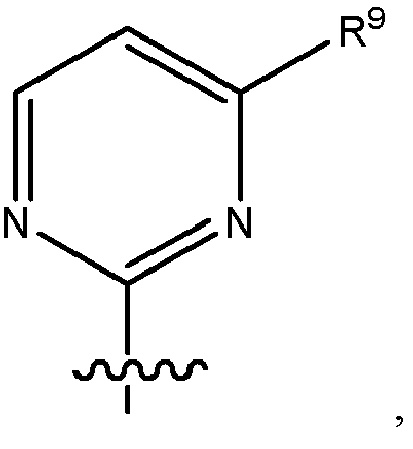


- In some embodiments, ring A is:

- In some embodiments, ring A is:

- In some embodiments, ring A is:

- In some embodiments, ring A is:


- In some embodiments, ring A is:

- In some embodiments, ring A is:

- In some embodiments, ring A is:

- In some embodiments, ring A is:

- In some embodiments, ring A is:
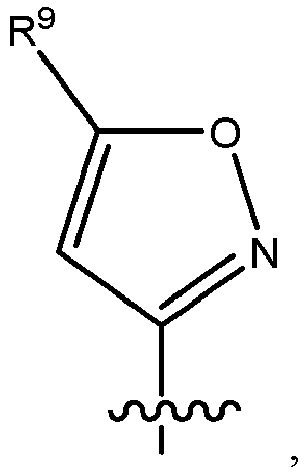
- In some embodiments, ring A is:

- In some embodiments, ring A is:

- In some embodiments, ring A is pyridinyl optionally substituted with halo or -C1-C4 haloalkyl. In some embodiments, ring A is pyridinyl substituted with halo, e.g., chloro or fluoro. In some embodiments, ring A is pyridinyl substituted with -C1-C4 haloalkyl, e.g., -CHF2 and CF3. In some embodiments, ring A is pyrazinyl optionally substituted with halo or -C1-C4 haloalkyl. In some embodiments, ring A is pyrazinyl substituted with halo, e.g., chloro or fluoro. In some embodiments, ring A is pyrazinyl substituted with -C1-C4 haloalkyl, e.g., -CHF2 and CF3. In some embodiments, ring A is pyrimidinyl optionally substituted with halo or -C1-C4 haloalkyl. In some embodiments, ring A is pyrimidinyl substituted with halo, e.g., chloro or fluoro. In some embodiments, ring A is pyrimidinyl substituted with -C1-C4 haloalkyl, e.g., -CHF2 and CF3. In some embodiments, ring A is pyrazolyl optionally substituted with halo or -C1-C4 haloalkyl. In some embodiments, ring A is pyrazolyl substituted with halo, e.g., chloro or fluoro. In some embodiments, ring A is pyrazolyl substituted with -C1-C4 haloalkyl, e.g., -CHF2 and CF3.
- In some embodiments, R1, R3, R4, and R6 are each independently selected from hydrogen and C1-C4 alkyl; and R2 and R5 are each independently -(C0-C6 alkylene)-Q. In some embodiments, R1 and R4 are each hydrogen. In some embodiments, R3 and R6 are each C1-C4 alkyl. In some embodiments, R3 and R6 are each C1-C4 haloalkyl. In some embodiments, Q is selected from aryl, heteroaryl, carbocyclyl and heterocyclyl, any of which is optionally substituted. In some embodiments, Q is optionally substituted carbocyclyl. In some embodiments, Q is optionally substituted cyclopropyl.In some embodiments, Q is unsubstituted cyclopropyl. In some embodiments, R2 and R5 are each independently unsubstituted cyclopropyl. In some embodiments, R1 and R4 are each hydrogen, R3 and R6 are each -CH3, and R2 and R5 are each unsubstituted cyclopropyl. In some embodiments, R2 is -(C0-C6 alkylene)-cyclopropyl and R5 is -(C0-C6 alkylene)-aryl, e.g., optionally substituted phenyl. In some embodiments, R2 is cyclopropyl and R5 is phenyl substituted with halo, e.g., fluoro.
- In some embodiments, ring A is pyridinyl optionally substituted with halo or -C1-C4 haloalkyl. In some embodiments, ring A is pyridinyl substituted with halo, e.g., chloro or fluoro. In some embodiments, ring A is pyridinyl substituted with -C1-C4 haloalkyl, e.g., -CHF2 and CF3. In some embodiments, ring A is pyrazinyl optionally substituted with halo or -C1-C4 haloalkyl. In some embodiments, ring A is pyrazinyl substituted with halo, e.g., chloro or fluoro. In some embodiments, ring A is pyrazinyl substituted with -C1-C4 haloalkyl, e.g., -CHF2 and CF3. In some embodiments, ring A is pyrimidinyl optionally substituted with halo or -C1-C4 haloalkyl. In some embodiments, ring A is pyrimidinyl substituted with halo, e.g., chloro or fluoro. In some embodiments, ring A is pyrimidinyl substituted with -C1-C4 haloalkyl, e.g., -CHF2 and CF3. In some embodiments, ring A is pyrazolyl optionally substituted with halo or -C1-C4 haloalkyl. In some embodiments, ring A is pyrazolyl substituted with halo, e.g., chloro or fluoro. In some embodiments, ring A is pyrazolyl substituted with -C1-C4 haloalkyl, e.g., -CHF2 and CF3.
- In some embodiments, R3 and R6 are each independently selected from hydrogen and C1-C4 alkyl; R1 and R2 are taken together to form an optionally substituted carbocyclyl; and R4 and R5 are taken together to form an optionally substituted carbocyclyl.In some embodiments, R1 and R2 are taken together to form a cyclobutyl, cyclopentyl or cyclohexyl, each optionally substituted. In some embodiments, R1 and R2 are taken together to form a cyclopentyl or cyclohexyl, each optionally substituted. In some embodiments, R4 and R5 are taken together to form a cyclobutyl, cyclopentyl or cyclohexyl, each optionally substituted. In some embodiments, R4 and R5 are taken together to form a cyclopentyl or cyclohexyl, each optionally substituted. In some embodiments, R1 and R2 are taken together to form a cyclopentyl or cyclohexyl, each substituted by one or more halo, e.g., fluoro; and R4 and R5 are taken together to form a cyclobutyl, cyclopentyl or cyclohexyl, each substituted by one or more halo, e.g., fluoro. In some embodiments, R1 and R2 are taken together to form a bicyclo[3.1.0]hexanyl; and R4 and R5 are taken together to form a bicyclo[3.1.0]hexanyl. In some embodiments, R1 and R2 taken together, and R4 and R5 taken together form:


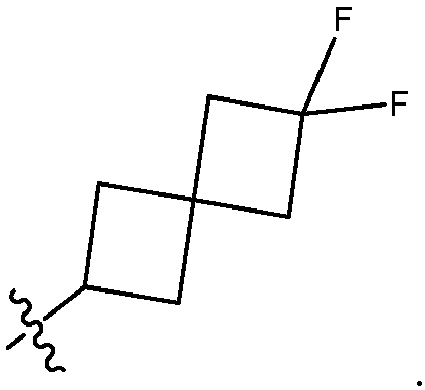


- In som embodiments, ring A is pyridinyl optionally substituted with halo or -C1-C4 haloalkyl. In some embodiments, ring A is pyridinyl substituted with halo, e.g., chloro or fluoro. In some embodiments, ring A is pyridinyl substituted with -C1-C4 haloalkyl, e.g., -CHF2 and CF3. In some embodiments, ring A is pyrazinyl optionally substituted with halo or -C1-C4 haloalkyl. In some embodiments, ring A is pyrazinyl substituted with halo, e.g., chloro or fluoro. In some embodiments, ring A is pyrazinyl substituted with -C1-C4 haloalkyl, e.g., -CHF2 and CF3. In some embodiments, ring A is pyrimidinyl optionally substituted with halo or -C1-C4 haloalkyl. In some embodiments, ring A is pyrimidinyl substituted with halo, e.g., chloro or fluoro. In some embodiments, ring A is pyrimidinyl substituted with -C1-C4 haloalkyl, e.g., -CHF2 and CF3. In some embodiments, ring A is pyrazolyl optionally substituted with halo or -C1-C4 haloalkyl. In some embodiments, ring A is pyrazolyl substituted with halo, e.g., chloro or fluoro. In some embodiments, ring A is pyrazolyl substituted with -C1-C4 haloalkyl, e.g., -CHF2 and CF3.
- In some embodiments, R1, R3, R4, and R6 are each independently selected from hydrogen, C1-C4 alkyl, and -CN, wherein each said alkyl moiety of R1, R3, R4, and R6 are each independently optionally substituted with -OH, -NH2, -CN, -O-C1-C4 alkyl; and R2 and R5 are each independently selected from -(C1-C6 alkyl) and -(C0-C6 alkylene)-Q. In some embodiments, R1, R3, R4, and R6 are each independently selected from hydrogen, C1-C4 alkyl, and -CN; and R2 and R5 are each independently -(C1-C6 alkyl) and -(C0-C6 alkylene)-Q. In some embodiments, R1, R3, R4, and R6 are each independently selected from hydrogen, C1-C4 alkyl, and -CN; R2 is -(C1-C6 alkyl); and R5 is -(C0-C6 alkylene)-Q, wherein Q is optionally substituted carbocyclyl. In some embodiments, Q is unsubstituted carbocyclyl. In some embodiments, Q is cyclopropyl.
- In some embodiments, ring A is pyridinyl optionally substituted with halo or -C1-C4 haloalkyl. In some embodiments, ring A is pyridinyl substituted with -C1-C4 haloalkyl, e.g., -CHF2 and CF3. In some embodiments, ring A is pyrazinyl optionally substituted with halo or -C1-C4 haloalkyl. In some embodiments, ring A is pyrazinyl substituted with halo, e.g., chloro or fluoro. In some embodiments, ring A is pyrazinyl substituted with -C1-C4 haloalkyl, e.g., -CHF2 and CF3. In some embodiments, ring A is pyrimidinyl optionally substituted with halo or -C1-C4 haloalkyl. In some embodiments, ring A is pyrimidinyl substituted with halo, e.g., chloro or fluoro. In some embodiments, ring A is pyrimidinyl substituted with -C1-C4 haloalkyl, e.g., -CHF2 and CF3. In some embodiments, ring A is pyrazolyl optionally substituted with halo or -C1-C4 haloalkyl. In some embodiments, ring A is pyrazolyl substituted with halo, e.g., chloro or fluoro. In some embodiments, ring A is pyrazolyl substituted with -C1-C4 haloalkyl, e.g., -CHF2 and CF3.
- In some embodiments, R1, R3, and R6 are each independently selected from hydrogen and C1-C4 alkyl, wherein each said alkyl moiety of R1, R3, and R6 are each independently optionally substituted with -OH, -NH2, -CN, -O-C1-C4 alkyl, -NH(C1-C4 alkyl), or -N(C1-C4 alkyl)2; R2 is -(C0-C6 alkylene)-Q; and R4 and R5 taken together form an optionally substituted carbocyclyl, optionally substituted heterocyclyl or optionally substituted heteroaryl. In some embodiments, R4 and R5 taken together form an optionally substituted carbocyclyl. In some embodiments, the carbocyclyl is selected from cyclopentyl and cyclohexyl optionally substituted with -OH, -O(C1-C4 alkyl), -CO2H, or halo. In some embodiments, R4 and R5 taken together form an optionally substituted heterocyclyl optionally substituted with -OH, -O(C1-C4 alkyl), - CO2H, or halo. In some embodiments, R4 and R5 taken together form an optionally substituted tetrahydrofuran. In some embodiments, R1, R3, and R6 are each independently selected from hydrogen and C1-C4 alkyl, wherein each said alkyl moiety of R1, R3, and R6 are each independently optionally substituted with -OH, -NH2, -CN, -O-C1-C4 alkyl; R2 is -(C0-C6 alkylene)-Q; and R5 is C1-C4 alkyl. In some embodiments, R1, R3, and R6 are each independently selected from hydrogen, C1-C4 alkyl, or carbocyclyl, wherein any alkyl or carbocyclyl portion of R1, R3, and R6 are each independently optionally substituted with -OH, -NH2, -CN, -O-C1-C4 alkyl, -SO2-C1-C4 alkyl, -C(O)NH2, -O-R12,-CO2R12 or -C(O)R12, wherein R12 is morpholino, piperidinyl, phenyl, pyridyl, or pyrimidinyl. In some embodiments, R1, R3, and R6 are each independently selected from hydrogen and C1-C4 alkyl, wherein each said alkyl moiety of R1, R3, and R6 are each independently optionally substituted with -OH, -NH2, -CN, -O-C1-C4 alkyl, -OR12, wherein R12 is phenyl, pyridyl, or pyrimidinyl; R2 is -(C0-C6 alkylene)-Q; and R5 is C1-C4 alkyl.
- In some embodiments, R7 is H. In some embodiments, R8 is H. In some embodiments, both R7 and R8 are H.
- In some embodiments, ring A, R1, R2, R3, R4, R5, R6, R7, R8 are selected from any one of the preceding embodiments.
- Also provided is a compound of Formula B, or pharmaceutically acceptable salt or hydrate thereof:

- X isN, CH or C-halo;
- Xa is N or C-R9a, provided that when one Xa is N, then the other two Xa are both C-R9a;
- R9 is halo, -C1-C4 alkyl, -C1-C4 haloalkyl, -C1-C4 hydroxyalkyl, -NH-S(O)2-(C1-C4 alkyl), -S(O)2NH(C1-C4 alkyl), -CN, -S(O)2-(C1-C4 alkyl), C1-C4 alkoxy, -NH(C1-C4 alkyl), - N(C1-C4 alkyl)2, -OH, -OCF3, -CN, -NH2, -C(O)NH2, -C(O)NH(C1-C4 alkyl), -C(O)-N(C1-C4 alkyl)2, -(C1-C6 alkylene)-O-(C1-C6 alkyl), aryl, and cyclopropyl optionally substituted with OH;
- each R9a is independently selected from hydrogen, halo, -C1-C4 alkyl, -C1-C4 haloalkyl, -C1-C4 hydroxyalkyl, -NH-S(O)2-(C1-C4 alkyl), -S(O)2NH(C1-C4 alkyl), -CN, -S(O)2-(C1-C4 alkyl),
- C1-C4 alkoxy, -NH(C1-C4 alkyl), -N(C1-C4 alkyl)2, -OH, -OCF3, -CN, -NH2, -C(O)NH2, - C(O)NH(C1-C4 alkyl), -C(O)-N(C1-C4 alkyl)2, -(C1-C6 alkylene)-O-(C1-C6 alkyl), aryl, and
- cyclopropyl optionally substituted with OH;
- R1, R3, R4, and R6 are each independently selected from hydrogen, C1-C4 alkyl, C1-C4 haloalkyl, -O-C1-C4 alkyl, and CN, wherein each said alkyl moiety of R1, R3, R4, and R6 are each independently optionally substituted with -OH, -NH2, -CN, -O-C1-C4 alkyl, -NH(C1-C4 alkyl), or -N(C1-C4 alkyl)2;
- R2 and R5 are each independently selected from: -(C1-C6 alkyl), -(C1-C6 alkyl)-C(O)-NH2, -(C1-C6 alkyl)-CO2H, -(C2-C6 alkenyl or alkynyl), -(C1-C6 alkylene)-O-(C1-C6 alkyl), -(C0-C6 alkylene)-C(O)N(R6)-(C1-C6 alkyl), -(C0-C6 alkylene)-Q,-(C0-C6 alkylene)-C(O)-(C1-C6 alkyl), and-(C0-C6 alkylene)-C(O)-(C0-C6 alkylene)-Q, wherein:
- any alkyl or alkylene moiety present in R2 and R5 is optionally substituted with one or more -OH, -O(C1-C4 alkyl), -CO2H, or halo;
- any terminal methyl moiety present in R2 and R5 is optionally replaced with -CH2OH, CF3, -CH2F, -CH2Cl, C(O)CH3, C(O)CF3, CN, or CO2H;
- R7 and R8 are each independently selected from hydrogen and C1-C6 alkyl; and
- Q is selected from aryl, heteroaryl, carbocyclyl and heterocyclyl, any of which is optionally substituted; wherein
- R1 and R3 are optionally taken together with the carbon atom to which they are attached to form C(=O); or
- R4 and R6 are optionally taken together with the carbon atom to which they are attached to form C(=O); or
- R1 and R2 are optionally taken together to form an optionally substituted carbocyclyl or
- optionally substituted heterocyclyl; or
- R4 and R5 are optionally taken together to form an optionally substituted carbocyclyl or
- optionally substituted heterocyclyl, an optionally substituted 5-6 member monocyclic aryl, or an optionally substituted 5-6 member monocyclic heteroaryl;
- wherein the compound is not selected from the group:
- (1) 4,6-Pyrimidinediamine, 2-(6-methyl-2-pyridinyl)-N4,N6-dipropyl-;
- (2) 4,6-Pyrimidinediamine, N4-ethyl-2-(6-methyl-2-pyridinyl)-N6-propyl-;
- (3) 4,6-Pyrimidinediamine, N4,N4-diethyl-2-(6-methyl-2-pyridinyl)-N6-propyl-;
- (4) [2,4'-Bipyrimidine]-2',4,6-triamine, N6-[2-(dimethylamino)ethyl]-N2',N2',N4,N4-tetramethyl-; or
- (5) [2,4'-Bipyrimidine]-2',4,6-triamine, N6-[2-(dimethylamino)ethyl]-N2',N2',N4,N4-tetramethyl-, phosphate.
- In some embodiments, X is N and R4 and R5 are optionally taken together to form an optionally substituted carbocyclyl or optionally substituted heterocyclyl.
- Also provided is a compound of Formula Ib, or pharmaceutically acceptable salt or hydrate thereof:

- R1, R3, R4, and R6 are each independently selected from hydrogen, C1-C4 alkyl, C1-C4 haloalkyl, -O-C1-C4 alkyl, and CN, wherein each said alkyl moiety of R1, R3, R4, and R6 are each independently optionally substituted with -OH, -NH2, -CN, -O-C1-C4 alkyl, -NH(C1-C4 alkyl), or -N(C1-C4 alkyl)2;
- R2 and R5 are each independently selected from: -(C1-C6 alkyl), -(C1-C6 alkyl)-C(O)-NH2, -(C1-C6 alkyl)-CO2H, -(C0-C6 alkylene)-Q, -(C0-C6 alkylene)-C(O)-(C1-C6 alkyl), -(C0-C6 alkylene)-C(O)-(C0-C6 alkylene)-Q, wherein:
- any alkyl or alkylene moiety present in R2 and R5 is optionally substituted with one or more -OH, -O(C1-C4 alkyl), -CO2H, or halo;
- any terminal methyl moiety present in R2 and R5 is optionally replaced with -CH2OH, CF3, -CH2F, -CH2Cl, C(O)CH3, C(O)CF3, CN, or CO2H;
- R7 and R8 are each independently selected from hydrogen and C1-C6 alkyl;
- R9 is selected from hydrogen, halo, and -C1-C4 haloalkyl; and
- Q is selected from aryl, heteroaryl, carbocyclyl and heterocyclyl, any of which is optionally substituted; wherein
- R1 and R3 are optionally taken together with the carbon atom to which they are attached to form C(=O); or
- R4 and R6 are optionally taken together with the carbon atom to which they are attached to form C(=O); or
R1 and R2 are optionally taken together to form an optionally substituted carbocyclyl, optionally substituted heterocyclyl; or - R4 and R5 are optionally taken together to form an optionally substituted carbocyclyl, optionally substituted heterocyclyl;
wherein:- (i) neither N(R7)C(R4)(R5)(R6) nor N(R8)C(R1)(R2)(R3) is NHC(O)-[2-chloro-4-(methylsulfonyl)] or N(CH3)2,
- (ii) N(R7)C(R4)(R5)(R6) and N(R8)C(R1)(R2)(R3) are not both NHC(O)C(CH3)3, NHC(O)CH=CH2, NHC(O)C(CH3)=CH2, NHCH2CH2OH, NH-cyclohexyl, NHCH2-phenyl, NHC(O)phenyl, NHC(O)(CH2)5NH2, NHC(O)OCH3, NHC(O)CH3, and NHC(O)NH-optionally substituted phenyl, and
- (iii) when N(R7)C(R4)(R5)(R6) is NHC(CH3)3, then N(R8)C(R1)(R2)(R3) is not NHCH2-phenyl or NH-CH2CH3; and
- (1) 2-chloro-N-[4-(cyclopropylamino)-6-(2-pyridinyl)-1,3,5-triazin-2-yl]-4-(methylsulfonyl)-benzamide,
- (2) N-[[4-[[[4-(cyclopropylamino)-6-(2-pyridinyl)-l,3,5-triazin-2-yl]amino]methyl]cyclohexyl] methyl]-4-fluoro-benzenesulfonamide,
- (3) 2-chloro-4-(methylsulfonyl)-N-[4-[(phenylmethyl)amino]-6-(2-pyridinyl)-1,3,5-triazin-2-yl]-benzamide, or
- (4) N-[[4-[[[4-(cyclopropylamino)-6-(2-pyridinyl)-1,3,5-triazin-2-yl]amino]methyl]cyclohexyl]methyl]-4-fluoro-benzenesulfonamide.
- Also provided is a compound of Formula Ia, or a pharmaceutically acceptable salt or hydrate thereof:

- ring A is is an optionally substituted 5-6 member monocyclic aryl or monocyclic heteroaryl;
- R3 and R6 are both hydrogen;
- R1 and R4 are each independently selected from C1-C4 alkyl and C1-C4 haloalkyl;and
- R2 and R5 are each -(C1-C6 alkyl); or
- R1 and R2 are optionally taken together to form an optionally substituted monocyclic carbocyclyl; or
- R4 and R5 are optionally taken together to form an optionally substituted monocyclic carbocyclyl ;
wherein:- (i) ring A is not an optionally substituted triazolyl, 3,5-dimethyl-1H-pyrazol-1-yl,
- (ii)when R1 and R2 are optionally taken together to form an unsubstituted cyclohexyl, and R4 and R5 are optionally taken together to form an unsubstituted cyclohexyl, then A is not a disubstituted 1-pyrazolyl or an unsubstituted phenyl; and
- (iii) the compound is not selected from the group:
- (1)6-(1H-imidazol-1-yl)-N2,N4-bis(1-methylethyl)-1,3,5-Triazine-2,4-diamine, or
- (2) N2,N4-bis(1-methylpropyl)-6-phenyl-1,3,5-Triazine-2,4-diamine.
- Also provided is a compound of Formula C, or pharmaceutically acceptable salt or hydrate thereof:

- X is N, CH or C-halo;
- each Xb is independently N-R9b, O, S, C-H, or C-R9c, provided that at least one Xb is C-R9c, and when one Xb is C-H or C-R9 and the other is C-R9c then Xc is N, and when one Xb is N-R9b, O, or S,then Xc is C;
- R9b is hydrogen or -C1-C4 alkyl;
- R9c is halo, -C1-C4 alkyl, -C1-C4 haloalkyl, -C1-C4 hydroxyalkyl, -NH-S(O)2-(C1-C4 alkyl), -S(O)2NH(C1-C4 alkyl), -CN, -S(O)2-(C1-C4 alkyl), C1-C4 alkoxy, -NH(C1-C4 alkyl), - N(C1-C4 alkyl)2, -OH, -OCF3, -CN, -NH2, -C(O)NH2, -C(O)NH(C1-C4 alkyl), -C(O)-N(C1-C4 alkyl)2, -(C1-C6 alkylene)-O-(C1-C6 alkyl), aryl, and cyclopropyl optionally substituted with OH; R1, R3, R4, and R6 are each independently selected from hydrogen, C1-C4 alkyl, C1-C4 haloalkyl, -O-C1-C4 alkyl, and CN, wherein each said alkyl moiety of R1, R3, R4, and R6 are each independently optionally substituted with -OH, -NH2, -CN, -O-C1-C4 alkyl, -NH(C1-C4 alkyl), or -N(C1-C4 alkyl)2;
- R2 and R5 are each independently selected from: -(C1-C6 alkyl), -(C1-C6 alkyl)-C(O)-NH2, -(C1-C6 alkyl)-CO2H, -(C0-C6 alkylene)-Q, -(C0-C6 alkylene)-C(O)-(C1-C6 alkyl), -(C0-C6 alkylene)-C(O)-(C0-C6 alkylene)-Q, wherein:
- any alkyl or alkylene moiety present in R2 and R5 is optionally substituted with one or more -OH, -O(C1-C4 alkyl), -CO2H, or halo;
- any terminal methyl moiety present in R2 and R5 is optionally replaced with -CH2OH, CF3, -CH2F, -CH2Cl, C(O)CH3, C(O)CF3, CN, or CO2H;
- R7 and R8 are each independently selected from hydrogen and C1-C6 alkyl; and
- Q is selected from aryl, heteroaryl, carbocyclyl and heterocyclyl, any of which is optionally substituted; wherein
- R1 and R3 are optionally taken together with the carbon atom to which they are attached to form C(=O); or
- R4 and R6 are optionally taken together with the carbon atom to which they are attached to form C(=O); or
- R1 and R2 are optionally taken together to form an optionally substituted carbocyclyl or optionally substituted heterocyclyl; or
- R4 and R5 are optionally taken together to form an optionally substituted carbocyclyl or
- optionally substituted heterocyclyl, an optionally substituted 5-6 member monocyclic aryl, or an optionally substituted heteroaryl;
wherein:- (i) when X is CH and A is optionally substituted 1-imidazolyl, optionally substituted 1-pyrrolyl or optionally substituted 1-pyrazolyl, then neither N(R7)C(R4)(R5)(R6) nor N(R8)C(R1)(R2)(R3) is NH(CH2)7CH3, NHCH2-(o-chloro-phenyl), or NHCH2CH2OH; and
- (ii) when X and Xc are both N, then neither N(R7)C(R4)(R5)(R6) nor N(R8)C(R1)(R2)(R3) is N(CH3)2, NHCH3, or N(CH2CH3)2.
- Also provided is a compound having Formula Id, or pharmaceutically acceptable salt or hydrate thereof:

- R1, R3, R4, and R6 are each independently selected from hydrogen, C1-C4 alkyl, C1-C4 haloalkyl, -O-C1-C4 alkyl, and CN, wherein each said alkyl moiety of R1, R3, R4, and R6 are each independently optionally substituted with -OH, -NH2, -CN, -O-C1-C4 alkyl, -NH(C1-C4 alkyl), or -N(C1-C4 alkyl)2;
- R2 and R5 are each independently selected from: -(C1-C6 alkyl), -(C1-C6 alkyl)-C(O)-NH2, -(C1-C6 alkyl)-CO2H, -(C0-C6 alkylene)-Q, -(C0-C6 alkylene)-C(O)-(C1-C6 alkyl), -(C0-C6 alkylene)-C(O)-(C0-C6 alkylene)-Q, wherein:
- any alkyl or alkylene moiety present in R2 and R5 is optionally substituted with one or more -OH, -O(C1-C4 alkyl), -CO2H, or halo;
- any terminal methyl moiety present in R2 and R5 is optionally replaced with -CH2OH, CF3, -CH2F, -CH2Cl, C(O)CH3, C(O)CF3, CN, or CO2H;
- R7 and R8 are each independently selected from hydrogen and C1-C6 alkyl;
- R9 is halo or-C1-C4 haloalkyl; and
- Q is selected from aryl, heteroaryl, carbocyclyl and heterocyclyl, any of which is optionally substituted; wherein
- R1 and R3 are optionally taken together with the carbon atom to which they are attached to form C(=O); or
- R4 and R6 are optionally taken together with the carbon atom to which they are attached to form C(=O);
- R1 and R2 are optionally taken together to form an optionally substituted carbocyclyl or optionally substituted heterocyclyl; or
- R4 and R5 are optionally taken together to form an optionally substituted carbocyclyl,optionally substituted heterocyclyl, an optionally substituted aryl, or an optionally substituted heteroaryl;
wherein the compound is not:- (1) N2,N2,N4-trimethyl-6-[3-(trifluoromethyl)-1H-pyrazol-1-yl]-1,3,5-Triazine-2,4-diamine, or
- (2) N4-ethyl-N2,N2-dimethyl-6-[3-(trifluoromethyl-1H-pyrazol-1-yl]-1,3,5-Triazine-2,4-diamine.
- A compound having Formula Ie, or pharmaceutically acceptable salt or hydrate thereof:

- R1, R3, R4, and R6 are each independently selected from hydrogen, C1-C4 alkyl, C1-C4 haloalkyl, -O-C1-C4 alkyl, and CN, wherein each said alkyl moiety of R1, R3, R4, and R6 are each independently optionally substituted with -OH, -NH2, -CN, -O-C1-C4 alkyl, -NH(C1-C4 alkyl), or -N(C1-C4 alkyl)2;
- R2 and R5 are each independently selected from: -(C1-C6 alkyl), -(C1-C6 alkyl)-C(O)-NH2, -(C1-C6 alkyl)-CO2H, -(C0-C6 alkylene)-Q, -(C0-C6 alkylene)-C(O)-(C1-C6 alkyl), -(C0-C6 alkylene)-C(O)-(C0-C6 alkylene)-Q, wherein:
- any alkyl or alkylene moiety present in R2 and R5 is optionally substituted with one or more -OH, -O(C1-C4 alkyl), -CO2H, or halo;
- any terminal methyl moiety present in R2 and R5 is optionally replaced with -CH2OH, CF3, -CH2F, -CH2Cl, C(O)CH3, C(O)CF3, CN, or CO2H;
- R7 and R8 are each independently selected from hydrogen and C1-C6 alkyl;
- R9 is selected from hydrogen, halo, and -C1-C4 haloalkyl; and
- Q is selected from aryl, heteroaryl, carbocyclyl and heterocyclyl, any of which is optionally substituted; wherein
- R1 and R3 are optionally taken together with the carbon atom to which they are attached to form C(=O); or
- R4 and R6 are optionally taken together with the carbon atom to which they are attached to form C(=O);
- R1 and R2 are optionally taken together to form an optionally substituted carbocyclyl or optionally substituted heterocyclyl; or
- R4 and R5 are optionally taken together to form an optionally substituted carbocyclyl or optionally substituted heterocyclyl.
- A compound having Formula If, or pharmaceutically acceptable salt or hydrate thereof:

- R1, R3, R4, and R6 are each independently selected from hydrogen, C1-C4 alkyl, C1-C4 haloalkyl, -O-C1-C4 alkyl, and CN, wherein each said alkyl moiety of R1, R3, R4, and R6 are each independently optionally substituted with -OH, -NH2, -CN, -O-C1-C4 alkyl, -NH(C1-C4 alkyl), or -N(C1-C4 alkyl)2;
- R2 and R5 are each independently selected from: -(C1-C6 alkyl), -(C1-C6 alkyl)-C(O)-NH2, -(C1-C6 alkyl)-CO2H, -(C0-C6 alkylene)-Q, -(C0-C6 alkylene)-C(O)-(C1-C6 alkyl), -(C0-C6 alkylene)-C(O)-(C0-C6 alkylene)-Q, wherein:
- any alkyl or alkylene moiety present in R2 and R5 is optionally substituted with one or more -OH, -O(C1-C4 alkyl), -CO2H, or halo;
- any terminal methyl moiety present in R2 and R5 is optionally replaced with -CH2OH, CF3, -CH2F, -CH2Cl, C(O)CH3, C(O)CF3, CN, or CO2H;
- R7 and R8 are each independently selected from hydrogen and C1-C6 alkyl;
- R9 is selected from hydrogen, halo, and -C1-C4 haloalkyl; and
- Q is selected from aryl, heteroaryl, carbocyclyl and heterocyclyl, any of which is optionally substituted; wherein
- R1 and R3 are optionally taken together with the carbon atom to which they are attached to form C(=O); or
- R4 and R6 are optionally taken together with the carbon atom to which they are attached to form C(=O);
- R1 and R2 are optionally taken together to form an optionally substituted carbocyclyl or optionally substituted heterocyclyl; or
- R4 and R5 are optionally taken together to form an optionally substituted carbocyclyl or optionally substituted heterocyclyl.
- Also provided is a compound of Formula II, or pharmaceutically acceptable salt or hydrate thereof:

- ring A is an optionally substituted 5-6 member monocyclic aryl or monocyclic heteroaryl;
- R1, R3, R4, and R6 are each independently selected from hydrogen, C1-C4 alkyl, C1-C4 haloalkyl, -O-C1-C4 alkyl, and CN, wherein each said alkyl moiety of R1, R3, R4, and R6 are each independently optionally substituted with -OH, -NH2, -CN, -O-C1-C4 alkyl, -NH(C1-C4 alkyl), or -N(C1-C4 alkyl)2;
- R2 and R5 are each independently selected from: -(C1-C6 alkyl), -(C1-C6 alkyl)-C(O)-NH2, -(C1-C6 alkyl)-CO2H, -(C2-C6 alkenyl or alkynyl), -(C1-C6 alkylene)-N(R6)-(C1-C6alkylene)-O-(C1-C6 alkyl), -(C1-C6 alkylene)-N(R6)-(C0-C6 alkylene)-Q, -(C1-C6 alkylene)-N(R6)(R6), -(C1-C6 alkylene)-N(R6)-S(O)1-2-(C1-C6 alkyl), -(C1-C6 alkylene)-N(R6)-S(O)1-2-(C0-C6 alkyl)-Q, -(C1-C6 alkylene)-S(O)1-2-N(R6)(R6), -(C1-C4 alkylene)-S(O)1-2-N(R6)-(C1-C6 alkylene)-Q, -C(O)N(R6)-(C1-C6 alkylene)-C(O)- (C0-C6 alkylene)-O-(C1-C6 alkyl), -C(O)N(R6)-(C1-C6 alkylene)-C(O)-(C0-C6 alkylene)-O-(C0-C6 alkylene)-Q, -(C1-C6 alkylene)-O-C(O)-(C1-C6 alkyl), -(C1-C6 alkylene)-O-C(O)-(C0-C6 alkyl)-Q, -(C1-C6 alkylene)-O-(C1-C6 alkyl), -(C1-C6 alkylene)-O-(C1-C6 alkylene)-Q, -(C0-C6 alkylene)-C(O)-(C0-C6 alkylene)-O-(C1-C6 alkyl), -(C0-C6 alkylene)-C(O)-(C0-C6 alkylene)-O-(C1-C6 alkylene)-Q, -(C1-C6 alkylene)-O-C(O)-(C1-C6 alkyl), -(C1-C6 alkylene)-O-C(O)-(C0-C6 alkylene)-Q, -(C0-C6 alkylene)-C(O)N(R6)-(C1-C6 alkyl), -(C0-C6 alkylene)-C(O)N(R6)-(C0-C6 alkylene)-Q, -(C1-C6 alkylene)-N(R6)C(O)-(C1-C6 alkyl), -(C1-C6 alkylene)-N(R6)C(O)-(C0-C6 alkylene)-Q, -(C0-C6 alkylene)-S(O)0-2-(C1-C6 alkyl), -(C0-C6 alkylene)-S(O)0-2-(C0-C6 alkylene)-Q, -(C1-C6 alkylene)-N(R6)-C(O)-N(R6)-(C1-C6 alkyl), -(C0-C6 alkylene)-Q, -(C0-C6 alkylene)-C(O)-(C1-C6 alkyl), -(C0-C6 alkylene)-C(O)-(C0-C6 alkylene)-Q, wherein:
- any alkyl or alkylene moiety present in R2 and R5 is optionally substituted with one or more -OH, -O(C1-C4 alkyl), -CO2H, or halo;
- any terminal methyl moiety present in R2 and R5 is optionally replaced with -CH2OH, CF3, -CH2F, -CH2Cl, C(O)CH3, C(O)CF3, CN, or CO2H;
- R7 and R8 are each independently selected from hydrogen and C1-C6 alkyl; and
- Q is selected from aryl, heteroaryl, carbocyclyl and heterocyclyl, any of which is optionally substituted; wherein
- R1 and R3 are optionally taken together with the carbon atom to which they are attached to form C(=O); or
- R4 and R6 are optionally taken together with the carbon atom to which they are attached to form C(=O); or
- R1 and R2 are optionally taken together to form an optionally substituted carbocyclyl or optionally substituted heterocyclyl; or
- R4 and R5 are optionally taken together to form an optionally substituted carbocyclyl, optionally substituted heterocyclyl, an optionally substituted aryl, or an optionally substituted heteroaryl;
wherein:- (i) when A is phenyl optionally substituted with F, Cl or SO2CH3, then neither N(R7)C(R4)(R5)(R6) nor N(R8)C(R1)(R2)(R3) is N(CH3)CH2C(O)NH-i-propyl, NHCH(CH3)(CH2)3N(CH2CH3)2, NHCH2CH2OH, NHCH2CH2OCH3, NHCH2CH2OSO3H, NHCH2CH2CH2OCH2CH2O-phenyl, NHCH2CH2CH2OH, NHCH2CH2CH2OCH3, NHCH2CH(OH)CH3, N(CH2CH3)2, NH-i-propyl, NHCH2CH2NHC(O)OCH3, NHCH2CH2NHC(O)CH3, NHCH2CH2NH2, or NHCH2-phenyl;
- (ii) when A is optionally substituted pyridyl, then neither N(R7)C(R4)(R5)(R6) nor N(R8)C(R1)(R2)(R3) is NHCH2-phenyl, NHCH2-(2,4-difluorophenyl), N(CH3)CH2CH2C(O)OH, NHCH2CH2C(O)OH, NHCH2CH2C(O)OCH2CH3, NHCH2CH2C(O)O-t-butyl, NHCH2CH2C(O)NH2, NHCH2CH2-phenyl, NHCH2CH2OH, NHCH2CH2NH2, NHCH2CH2N(CH3)2, or NHCH2CH2CH3;
- (iii) when A is optionally substituted 1-imidazolyl, optionally substituted 1-pyrrolyl or optionally substituted 1-pyrazolyl, then neither N(R7)C(R4)(R5)(R6) nor N(R8)C(R1)(R2)(R3) is NH(CH2)7CH3, NHCH2-(o-chloro-phenyl), or NHCH2CH2OH;
- (iv) when A is unsubstituted 2-pyridinyl, then the ring formed by R4 and R5 is not 5-methyl-1H-pyrazol-3-yl; and
- (v) when A is optionally substituted 1-pyrazolyl, then neither N(R7)C(R4)(R5)(R6) nor N(R8)C(R1)(R2)(R3) is N(CH3)2, NHCH3, NHAc, NHisopropyl, NHCH2CH3, NHCH2CH2SO3H or N(CH2CH3)2,
- (vi) ring A is not an optionally substituted triazolyl, 3,5-dimethyl-1H-pyrazol-1-yl,
- (vii)when R1 and R2 are optionally taken together to form an unsubstituted cyclohexyl, and R4 and R5 are optionally taken together to form an unsubstituted cyclohexyl, then A is not a disubstituted 1-pyrazolyl or an unsubstituted phenyl; and
- (viii) the compound is not selected from the group:
- (1)6-(1H-imidazol-1-yl)-N2,N4-bis(1-methylethyl)-1,3,5-Triazine-2,4-diamine, or
- (2) N2,N4-bis(1-methylpropyl)-6-phenyl-1,3,5-Triazine-2,4-diamine.
- Also provided is a compound of Formula Ic, or pharmaceutically acceptable salt or hydrate thereof:

- R1, R3, R4, and R6 are each independently selected from hydrogen, C1-C4 alkyl, C1-C4 haloalkyl, -O-C1-C4 alkyl, and CN, wherein each said alkyl moiety of R1, R3, R4, and R6 are each independently optionally substituted with -OH, -NH2, -CN, -O-C1-C4 alkyl, -NH(C1-C4 alkyl), or -N(C1-C4 alkyl)2;
- each R9 is independently selected fromhalo, -C1-C4 alkyl, -C1-C4 haloalkyl, -C1-C4 hydroxyalkyl, -NH-S(O)2-(C1-C4 alkyl), -S(O)2NH(C1-C4 alkyl), -CN, -S(O)2-(C1-C4 alkyl), C1-C4 alkoxy, -NH(C1-C4 alkyl), -N(C1-C4 alkyl)2, -OH, -OCF3, -CN, -NH2, -C(O)NH2,-C(O)NH(C1-C4 alkyl), -C(O)-N(C1-C4 alkyl)2, -(C1-C6 alkylene)-O-(C1-C6 alkyl), aryl, and cyclopropyl optionally substituted with OH;
- n is 1 to 3;
- R2 and R5 are each independently selected from: -(C1-C6 alkyl), -(C1-C6 alkyl)-C(O)-NH2, -(C1-C6 alkyl)-CO2H, -(C2-C6 alkenyl or alkynyl), -(C1-C6 alkylene)-O-(C1-C6 alkyl), -(C0-C6 alkylene)-C(O)N(R6)-(C1-C6 alkyl), -(C0-C6 alkylene)-Q, -(C0-C6 alkylene)-C(O)-(C1-C6 alkyl), and -(C0-C6 alkylene)-C(O)-(C0-C6 alkylene)-Q, wherein:
- any alkyl or alkylene moiety present in R2 and R5 is optionally substituted with one or more -OH, -O(C1-C4 alkyl), -CO2H, or halo;
- any terminal methyl moiety present in R2 and R5 is optionally replaced with -CH2OH, CF3, -CH2F, -CH2Cl, C(O)CH3, C(O)CF3, CN, or CO2H;
- R7 and R8 are each independently selected from hydrogen and C1-C6 alkyl; and
- Q is selected from carbocyclyl and heterocyclyl, any of which is optionally substituted; wherein
- R1 and R3 are optionally taken together with the carbon atom to which they are attached to form C(=O); or
- R4 and R6 are optionally taken together with the carbon atom to which they are attached to form C(=O); or
- R1 and R2 are optionally taken together to form an optionally substituted carbocyclyl; or R4 and R5 are optionally taken together to form an optionally substituted carbocyclyl;
wherein:- (i) neither N(R7)C(R4)(R5)(R6) nor N(R8)C(R1)(R2)(R3) is NHCH2CH2OCH2CH2OCH2CH2NH2, or 4-[[2-[2-(2-aminoethoxy)ethoxy]ethyl]amino],
- (ii) N(R7)C(R4)(R5)(R6) and N(R8)C(R1)(R2)(R3) are not both NHEt, NH(n-propyl), NH(n-butyl), NH(n-docecyl), NH-[(4- methoxyphenyl)methyl], NHCH2CH2CHO, NHCH2CH2OCH3, NHCH2CH2OH, NHCH2CH(OH)CH3, NHCH2CH2OC(O)phenyl, NHCH2CH2CH2OH, NHCH2CH2CH2N(CH3)phenyl, NHCH2C(O)OCH3, NHCH2C(O)OCH2CH3, NHCH2phenyl, NHCH(CH3)CH2CH3, or NHCH2CH2OC(O)CH3; and
- (iii) neither N(R7)C(R4)(R5)(R6) nor N(R8)C(R1)(R2)(R3) is NHcyclohexylC(O)NHCH2R, wherein R is phenyl or pyridinyl which is substituted with one or more of OCF3, OCH3, chloro, or CF3.
- Also provided is a compound of Formula III, or pharmaceutically acceptable salt or hydrate thereof:

- ring A is an optionally substituted 5-6 member monocyclic heteroaryl;
- ring B is an optionally substituted 5-6 member monocyclic aryl or monocyclic heteroaryl;
- R1 and R3 are each independently selected from hydrogen, C1-C4 alkyl, C1-C4 haloalkyl, -O-C1-C4 alkyl, and CN, wherein each said alkyl moiety of R1, R3, R4, and R6 are each independently optionally substituted with -OH, -NH2, -CN, -O-C1-C4 alkyl, -NH(C1-C4 alkyl), or -N(C1-C4 alkyl)2;
- R2 is selected from: -(C1-C6 alkyl), -(C1-C6 alkyl)-C(O)-NH2, -(C1-C6 alkyl)-CO2H, -(C2-C6 alkenyl or alkynyl), -(C1-C6 alkylene)-O-(C1-C6 alkyl), -(C0-C6 alkylene)-C(O)N(R6)-(C1-C6 alkyl),-(C0-C6 alkylene)-Q, -(C0-C6 alkylene)-C(O)-(C1-C6 alkyl), and -(C0-C6 alkylene)-C(O)-(C0-C6 alkylene)-Q, wherein:
- any alkyl or alkylene moiety present in R2 is optionally substituted with one or more -OH, -O(C1-C4 alkyl), -CO2H, or halo;
- any terminal methyl moiety present in R2 is optionally replaced with -CH2OH, CF3, -CH2F, -CH2Cl, C(O)CH3, C(O)CF3, CN, or CO2H;
- R7 and R8 are each independently selected from hydrogen and C1-C6 alkyl; and
- Q is selected from aryl, heteroaryl, carbocyclyl and heterocyclyl, any of which is optionally substituted; wherein
- R1 and R3 are optionally taken together with the carbon atom to which they are attached to form C(=O); or
- R1 and R2 are optionally taken together to form an optionally substituted carbocyclyl or optionally substituted heterocyclyl;
- wherein when A is an oxadiazole substituted with an optionally substituted pyridinyl, then G is not an optionally substituted phenyl.
- In some embodiments, G is substituted with 1 or 2 substituents selected from halo, C1-C4 alkyl, C1-C4 haloalkyl, C1-C4 alkoxy, -CN, =O, -OH, aryl, heteroaryl -SO2C1-C4 alkyl, -CO2C1-C4 alkyl, -C(O)aryl, and -C(O)C1-C4 alkyl.
- Also provided is a compound of Formula IIIa, or pharmaceutically acceptable salt or hydrate thereof:

- ring A is a substituted 5-6 member monocyclic heteroaryl;
- Xd is C or N;
- each Rb is independently selected from halo, CN, C1-C4 alkyl, C1-C4 haloalkyl, C1-C4 alkoxy, C3-C6 cycloalkyl, phenyl, -OH, -C(O)CH3, wherein any alkyl, cycloalkyl, or phenyl moiety is optionally substituted with fluoro, chloro, -OH, -NH2, or -CN;
- p is 1 to 2;
- R1 and R3 are each independently selected from hydrogen, C1-C4 alkyl, C1-C4 haloalkyl, -O-C1-C4 alkyl, and CN, wherein each said alkyl moiety of R1, R3, R4, and R6 are each independently optionally substituted with -OH, -NH2, -CN, -O-C1-C4 alkyl, -NH(C1-C4 alkyl), or -N(C1-C4 alkyl)2;
- R2 is selected from: -(C1-C6 alkyl), -(C1-C6 alkyl)-C(O)-NH2, -(C1-C6 alkyl)-CO2H, -(C2-C6 alkenyl or alkynyl), -(C1-C6 alkylene)-O-(C1-C6 alkyl), -(C0-C6 alkylene)-C(O)N(R6)-(C1-C6 alkyl),
-(C0-C6 alkylene)-Q, -(C0-C6 alkylene)-C(O)-(C1-C6 alkyl), and -(C0-C6 alkylene)-C(O)-(C0-C6 alkylene)-Q, wherein:- any alkyl or alkylene moiety present in R2 is optionally substituted with one or more -OH, -O(C1-C4 alkyl), -CO2H, or halo;
- any terminal methyl moiety present in R2 is optionally replaced with -CH2OH, CF3, -CH2F, -CH2Cl, C(O)CH3, C(O)CF3, CN, or CO2H;
- R7 and R8 are each independently selected from hydrogen and C1-C6 alkyl; and
- Q is selected from aryl, heteroaryl, carbocyclyl and heterocyclyl, any of which is optionally substituted; wherein
- R1 and R3 are optionally taken together with the carbon atom to which they are attached to form C(=O); or
- R1 and R2 are optionally taken together to form an optionally substituted carbocyclyl or optionally substituted heterocyclyl;
- wherein when A is an oxadiazole substituted with an optionally substituted pyridinyl, then Xd is not C.
- Also provided is a compound of Formula IIIb, or pharmaceutically acceptable salt or hydrate thereof:

- ring A is a substituted 5-6 member monocyclic heteroaryl;
- R7 and R8 are each independently selected from hydrogen and C1-C6 alkyl;
- each Rb is independently selected from halo, CN, C1-C4 alkyl, C1-C4 haloalkyl, C1-C4 alkoxy, C3-C6 cycloalkyl, phenyl, -OH, -C(O)CH3, wherein any alkyl, cycloalkyl, or phenyl moiety is optionally substituted with fluoro, chloro, -OH, -NH2, or -CN;
- p is 1 to 2;and
- G is an optionally substituted carbocyclyl or heterocyclyl,
- wherein A is not an oxadiazole substituted with an optionally substituted pyridinyl.
- Also provided is a compound of Formula IIIc, or pharmaceutically acceptable salt or hydrate thereof:

- ring A is a substituted 5-6 member monocyclic heteroaryl;
- R1 and R3 are each independently selected from hydrogen, C1-C4 alkyl, C1-C4 haloalkyl, -O-C1-C4 alkyl, and CN, wherein each said alkyl moiety of R1, R3, R4, and R6 are each independently optionally substituted with -OH, -NH2, -CN, -O-C1-C4 alkyl, -NH(C1-C4 alkyl), or -N(C1-C4 alkyl)2;
- R2 is selected from: -(C1-C6 alkyl), -(C1-C6 alkyl)-C(O)-NH2, -(C1-C6 alkyl)-CO2H, -(C2-C6 alkenyl or alkynyl), -(C1-C6 alkylene)-O-(C1-C6 alkyl), -(C0-C6 alkylene)-C(O)N(R6)-(C1-C6 alkyl),
-(C0-C6 alkylene)-Q, -(C0-C6 alkylene)-C(O)-(C1-C6 alkyl), and -(C0-C6 alkylene)-C(O)-(C0-C6 alkylene)-Q, wherein:- any alkyl or alkylene moiety present in R2 is optionally substituted with one or more -OH, -O(C1-C4 alkyl), -CO2H, or halo;
- any terminal methyl moiety present in R2 is optionally replaced with -CH2OH, CF3, -CH2F, -CH2Cl, C(O)CH3, C(O)CF3, CN, or CO2H;
- R7 and R8 are each independently selected from hydrogen and C1-C6 alkyl; and
- Q is selected from aryl, heteroaryl, carbocyclyl and heterocyclyl, any of which is optionally substituted; wherein
- R1 and R3 are optionally taken together with the carbon atom to which they are attached to form C(=O); or
- R1 and R2 are optionally taken together to form an optionally substituted carbocyclyl or optionally substituted heterocyclyl;
- each Rb is independently selected from halo, CN, C1-C4 alkyl, C1-C4 haloalkyl, C1-C4 alkoxy, C3-C6 cycloalkyl, phenyl, -OH, -C(O)CH3, wherein any alkyl, cycloalkyl, or phenyl moiety is optionally substituted with fluoro, chloro, -OH, -NH2, or -CN; and
- p is 1 to 2.
- Also provided is a compound of Formula IIId, or pharmaceutically acceptable salt or hydrate thereof:

- ring A is a substituted 5-6 member monocyclic heteroaryl;
- R7 and R8 are each independently selected from hydrogen and C1-C6 alkyl;
- each Rb is independently selected from halo, CN, C1-C4 alkyl, C1-C4 haloalkyl, C1-C4 alkoxy, C3-C6 cycloalkyl, phenyl, -OH, -C(O)CH3, wherein any alkyl, cycloalkyl, or phenyl moiety is optionally substituted with fluoro, chloro, -OH, -NH2, or -CN;
- p is 1 to 2;and
- G is an optionally substituted carbocyclyl or heterocyclyl.
- Further embodiments provided herein include combinations of one or more of the particular embodiments set forth above.
- In another embodiment, the compound is selected from any one of the compounds set forth in Table 1, below.


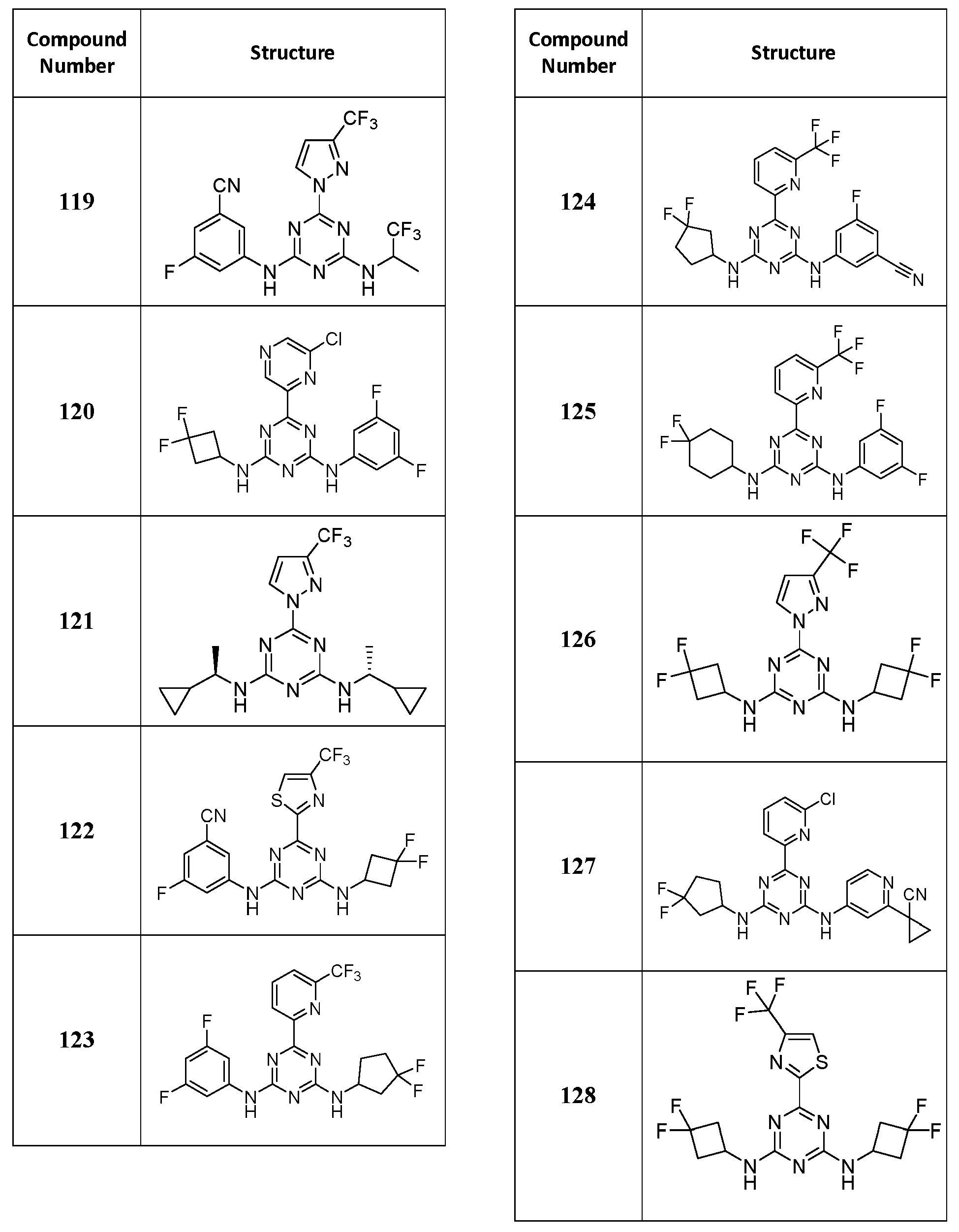


- Included herein are also methods for making compounds of Formula I or a compound of any one of the embodiments described herein comprising reacting


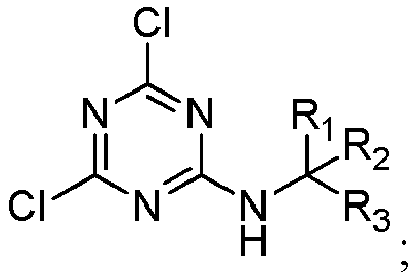


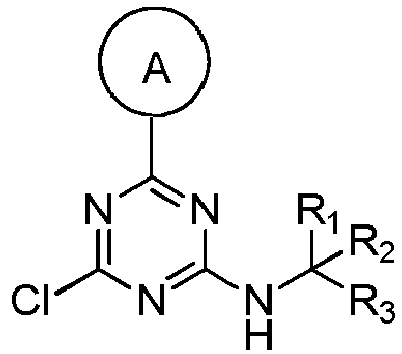

- Also included are methods for making compounds of Formula I or a compound of any one of the embodiments described herein comprising reacting


- Also included are methods for making compounds of Formula I or a compound of any one of the embodiments described herein comprising reacting


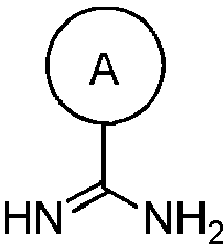

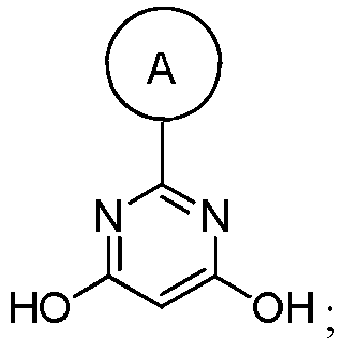


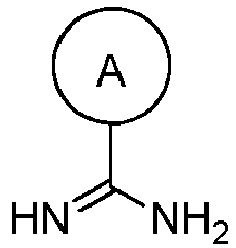

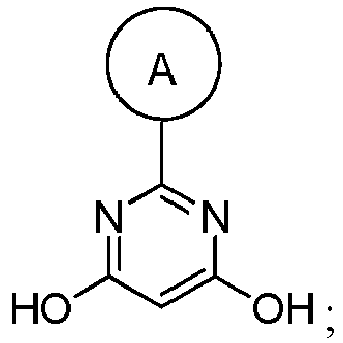


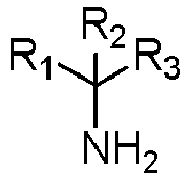


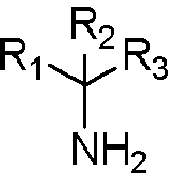


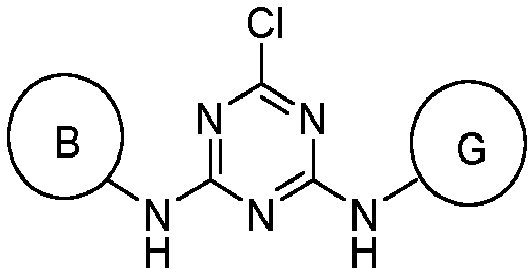

- The compounds of one aspect of this invention may contain one or more asymmetric centers and thus occur as racemates, racemic mixtures, scalemic mixtures,anddiastereomeric mixtures, as well as single enantiomers or individual stereoisomersthat are substantially free from another possible enantiomer or stereoisomer. The term "substantially free of other stereoisomers" as used herein means a preparation enriched in a compound having a selected stereochemistry at one or more selected stereocentersby at least about 60%, 65%, 70%, 75%, 80%, 85%, 90%, 95%, 96%, 97%, 98%, or 99%. The term "enriched" means that at least the designated percentage of a preparation is the compound having a selected stereochemistry at one or more selected stereocenters. Methods of obtaining or synthesizing an individual enantiomer or stereoisomer for a given compound are known in the art and may be applied as practicable to final compounds or to starting material or intermediates.
- In certain embodiments, the compound of Formula I, la, Ib, B, C, Ic, Id, Ie, If, Ig, II, III, IIIa, IIIb, IIIc, or IIId,is enriched for a structure or structures having a selected stereochemistry at one or more carbon atoms.For example, the compound is enriched in the specific stereoisomer by at least about 60%, 65%, 70%, 75%, 80%, 85%, 90%, 95%, 96%, 97%, 98%, or 99%.
- The compounds of Formula I, la, Ib, B, C, Ic, Id, Ie, If, Ig, II, III, IIIa, IIIb, IIIc, or IIId may also comprise one or more isotopic substitutions. For example, H may be in any isotopic form, including 1H, 2H (D or deuterium), and 3H (T or tritium); C may be in any isotopic form, including11C,12C, 13C, and 14C; N may be in any isotopic form, including13N,14N and 15N; O may be in any isotopic form, including15O,16O and 18O; F may be in any isotopic form, including18F; and the like. For example, the compound is enriched in a specific isotopic formof H, C, N, O and/or Fby at least about 60%, 65%, 70%, 75%, 80%, 85%, 90%, 95%, 96%, 97%, 98%, or 99%.
- Unless otherwise indicated when a disclosed compound is named or depicted by a structure without specifying the stereochemistry and has one or more chiral centers, it is understood to represent all possible stereoisomers of the compound.
- The compounds of one aspect of this invention may also be represented in multiple tautomeric forms, in such instances, one aspect of the invention expressly includes all tautomeric forms of the compounds described herein, even though only a single tautomeric form may be represented (e.g., alkylation of a ring system may result in alkylation at multiple sites, one aspect of the invention expressly includes all such reaction products; and keto-enol tautomers). All such isomeric forms of such compounds are expressly included herein.
- It may be convenient or desirable to prepare, purify, and/or handle a corresponding salt of the active compound, for example, a pharmaceutically-acceptable salt. Examples of pharmaceutically acceptable salts are discussed in Berge et al., 1977, "Pharmaceutically Acceptable Salts." J. Pharm. Sci. Vol. 66, pp. 1-19.
- For example, if the compound is anionic, or has a functional group which may be anionic (e.g.,-COOH may be -COO-), then a salt may be formed with a suitable cation. Examples of suitable inorganic cations include, but are not limited to, alkali metal ions such as Na+ and K+, alkaline earth cations such as Ca2+ and Mg2+, and other cations such as Al3+. Examples of suitable organic cations include, but are not limited to, ammonium ion (i.e., NH4 +) and substituted ammonium ions (e.g., NH3R+, NH2R2+, NHR3+, NR4+). Examples of some suitable substituted ammonium ions are those derived from: ethylamine, diethylamine, dicyclohexylamine, triethylamine, butylamine, ethylenediamine, ethanolamine, diethanolamine, piperazine, benzylamine, phenylbenzylamine, choline, meglumine, and tromethamine, as well as amino acids, such as lysine and arginine. An example of a common quaternary ammonium ion is N(CH3)4 +.
- If the compound is cationic, or has a functional group that may be cationic (e.g., -NH2 may be -NH3 +), then a salt may be formed with a suitable anion. Examples of suitable inorganic anions include, but are not limited to, those derived from the following inorganic acids: hydrochloric, hydrobromic, hydroiodic, sulfuric, sulfurous, nitric, nitrous, phosphoric, and phosphorous.
- Examples of suitable organic anions include, but are not limited to, those derived from the following organic acids: 2-acetyoxybenzoic, acetic, ascorbic, aspartic, benzoic, camphorsulfonic, cinnamic, citric, edetic, ethanedisulfonic, ethanesulfonic, fumaric, glucoheptonic, gluconic, glutamic, glycolic, hydroxymaleic, hydroxynaphthalene carboxylic, isethionic, lactic, lactobionic, lauric, maleic, malic, methanesulfonic, mucic, oleic, oxalic, palmitic, pamoic, pantothenic, phenylacetic, phenylsulfonic, propionic, pyruvic, salicylic, stearic, succinic, sulfanilic, tartaric, toluenesulfonic, and valeric. Mesylates of each compound in Table 1 are explicitly included herein. Examples of suitable polymeric organic anions include, but are not limited to, those derived from the following polymeric acids: tannic acid, carboxymethyl cellulose.
- The compounds provided herein therefore include the compounds themselves, as well as their salts, hydrates and their prodrugs, if applicable. The compounds provided herein may be modified and converted to prodrugs by appending appropriate functionalities to enhance selected biological properties, e.g., targeting to a particular tissue. Such modifications (i.e., prodrugs) are known in the art and include those which increase biological penetration into a given biological compartment (e.g., blood, lymphatic system, central nervous system), increase oral availability, increase solubility to allow administration by injection, alter metabolism and alter rate of excretion. Examples of prodrugs include esters (e.g., phosphates, amino acid (e.g.,valine) esters), carbamates and other pharmaceutically acceptable derivatives, which, upon administration to a subject, are capable of providing active compounds. Calcium and sodium phosphates of each compound in Table 1, if applicable, are explicitly included herein. Amino acid (e.g., valine) esters of each compound in Table 1, if applicable, are explicitly included herein.
- The compounds utilized in the methods described herein may be formulated together with a pharmaceutically acceptable carrier or adjuvant into pharmaceutically acceptable compositions prior to be administered to a subject. In another embodiment, such pharmaceutically acceptable compositions further comprise additional therapeutic agents in amounts effective for achieving a modulation of disease or disease symptoms, including those described herein.
- The term "pharmaceutically acceptable carrier or adjuvant" refers to a carrier or adjuvant that may be administered to a subject, together with a compound of one aspect of this invention, and which does not destroy the pharmacological activity thereof and is nontoxic when administered in doses sufficient to deliver a therapeutic amount of the compound.
- Pharmaceutically acceptable carriers, adjuvants and vehicles that may be used in the pharmaceutical compositions of one aspect of this invention include, but are not limited to, ion exchangers, alumina, aluminum stearate, lecithin, self-emulsifying drug delivery systems (SEDDS) such as d-α-tocopherol polyethyleneglycol 1000 succinate, surfactants used in pharmaceutical dosage forms such as Tweens or other similar polymeric delivery matrices, serum proteins, such as human serum albumin, buffer substances such as phosphates, glycine, sorbic acid, potassium sorbate, partial glyceride mixtures of saturated vegetable fatty acids, water, salts or electrolytes, such as protamine sulfate, disodium hydrogen phosphate, potassium hydrogen phosphate, sodium chloride, zinc salts, colloidal silica, magnesium trisilicate, polyvinyl pyrrolidone, cellulose-based substances, polyethylene glycol, sodium carboxymethylcellulose, polyacrylates, waxes, polyethylene-polyoxypropylene-block polymers, polyethylene glycol and wool fat. Cyclodextrins such as α-, β-, and γ-cyclodextrin, or chemically modified derivatives such as hydroxyalkylcyclodextrins, including 2- and 3-hydroxypropyl-β-cyclodextrins, or other solubilized derivatives may also be advantageously used to enhance delivery of compounds of the formulae described herein.
- The pharmaceutical compositions of one aspect of this invention may be administered orally, parenterally, by inhalation spray, topically, rectally, nasally, buccally, vaginally or via an implanted reservoir, preferably by oral administration or administration by injection. The pharmaceutical compositions of one aspect of this invention may contain any conventional non-toxic pharmaceutically-acceptable carriers, adjuvants or vehicles. In some cases, the pH of the formulation may be adjusted with pharmaceutically acceptable acids, bases or buffers to enhance the stability of the formulated compound or its delivery form. The term parenteral as used herein includes subcutaneous, intracutaneous, intravenous, intramuscular, intraarticular, intraarterial, intrasynovial, intrasternal, intrathecal, intralesional and intracranial injection or infusion techniques.
- The pharmaceutical compositions may be in the form of a sterile injectable preparation, for example, as a sterile injectable aqueous or oleaginous suspension. This suspension may be formulated according to techniques known in the art using suitable dispersing or wetting agents (such as, for example, Tween 80) and suspending agents. The sterile injectable preparation may also be a sterile injectable solution or suspension in a non-toxic parenterally acceptable diluent or solvent, for example, as a solution in 1,3-butanediol. Among the acceptable vehicles and solvents that may be employed are mannitol, water, Ringer's solution and isotonic sodium chloride solution. In addition, sterile, fixed oils are conventionally employed as a solvent or suspending medium. For this purpose, any bland fixed oil may be employed including synthetic mono- or diglycerides. Fatty acids, such as oleic acid and its glyceride derivatives are useful in the preparation of injectables, as are natural pharmaceutically-acceptable oils, such as olive oil or castor oil, especially in their polyoxyethylated versions. These oil solutions or suspensions may also contain a long-chain alcohol diluent or dispersant, or carboxymethyl cellulose or similar dispersing agents which are commonly used in the formulation of pharmaceutically acceptable dosage forms such as emulsions and or suspensions. Other commonly used surfactants such as Tweens or Spans and/or other similar emulsifying agents or bioavailability enhancers which are commonly used in the manufacture of pharmaceutically acceptable solid, liquid, or other dosage forms may also be used for the purposes of formulation.
- The pharmaceutical compositions of one aspect of this invention may be orally administered in any orally acceptable dosage form including, but not limited to, capsules, tablets, emulsions and aqueous suspensions, dispersions and solutions. In the case of tablets for oral use, carriers which are commonly used include lactose and corn starch. Lubricating agents, such as magnesium stearate, are also typically added. For oral administration in a capsule form, useful diluents include lactose and dried corn starch. When aqueous suspensions and/or emulsions are administered orally, the active ingredient may be suspended or dissolved in an oily phase is combined with emulsifying and/or suspending agents. If desired, certain sweetening and/or flavoring and/or coloring agents may be added.
- The pharmaceutical compositions of one aspect of this invention may also be administered in the form of suppositories for rectal administration. These compositions can be prepared by mixing a compound of one aspect of this invention with a suitable non-irritating excipient which is solid at room temperature but liquid at the rectal temperature and therefore will melt in the rectum to release the active components. Such materials include, but are not limited to, cocoa butter, beeswax and polyethylene glycols.
- Topical administration of the pharmaceutical compositions of one aspect of this invention is useful when the desired treatment involves areas or organs readily accessible by topical application. For application topically to the skin, the pharmaceutical composition should be formulated with a suitable ointment containing the active components suspended or dissolved in a carrier. Carriers for topical administration of the compounds of one aspect of this invention include, but are not limited to, mineral oil, liquid petroleum, white petroleum, propylene glycol, polyoxyethylene polyoxypropylene compound, emulsifying wax and water. Alternatively, the pharmaceutical composition can be formulated with a suitable lotion or cream containing the active compound suspended or dissolved in a carrier with suitable emulsifying agents. Suitable carriers include, but are not limited to, mineral oil, sorbitan monostearate, polysorbate 60, cetyl esters wax, cetearyl alcohol, 2-octyldodecanol, benzyl alcohol and water. The pharmaceutical compositions of one aspect of this invention may also be topically applied to the lower intestinal tract by rectal suppository formulation or in a suitable enema formulation. Topically-transdermal patches are also included in one aspect of this invention.
- The pharmaceutical compositions of one aspect of this invention may be administered by nasal aerosol or inhalation. Such compositions are prepared according to techniques well-known in the art of pharmaceutical formulation and may be prepared as solutions in saline, employing benzyl alcohol or other suitable preservatives, absorption promoters to enhance bioavailability, fluorocarbons, and/or other solubilizing or dispersing agents known in the art.
- When the compositions of one aspect of this invention comprise a combination of a compound of the formulae described herein and one or more additional therapeutic or prophylactic agents, both the compound and the additional agent should be present at dosage levels of between about 1 to 100%, and more preferably between about 5 to 95% of the dosage normally administered in a monotherapy regimen. The additional agents may be administered separately, as part of a multiple dose regimen, from the compounds of one aspect of this invention. Alternatively, those agents may be part of a single dosage form, mixed together with the compounds of one aspect of this invention in a single composition.
- The compounds described herein can, for example, be administered by injection, intravenously, intraarterially, subdermally, intraperitoneally, intramuscularly, or subcutaneously; or orally, buccally, nasally, transmucosally, topically, in an ophthalmic preparation, or by inhalation, with a dosage ranging from about 0.5 to about 100 mg/kg of body weight, alternatively dosages between 1 mg and 1000 mg/dose, every 4 to 120 hours, or according to the requirements of the particular drug. The methods herein contemplate administration of an effective amount of compound or compound composition to achieve the desired or stated effect. Typically, the pharmaceutical compositions of one aspect of this invention will be administered from about 1 to about 6 times per day or alternatively, as a continuous infusion. Such administration can be used as a chronic or acute therapy. The amount of active ingredient that may be combined with the carrier materials to produce a single dosage form will vary depending upon the host treated and the particular mode of administration. A typical preparation will contain from about 5% to about 95% active compound (w/w). Alternatively, such preparations contain from about 20% to about 80% active compound.
- Lower or higher doses than those recited above may be required. Specific dosage and treatment regimens for any particular subject will depend upon a variety of factors, including the activity of the specific compound employed, the age, body weight, general health status, sex, diet, time of administration, rate of excretion, drug combination, the severity and course of the disease, condition or symptoms, the subject's disposition to the disease, condition or symptoms, and the judgment of the treating physician.
- Upon improvement of a subject's condition, a maintenance dose of a compound, composition or combination of one aspect of this invention may be administered, if necessary. Subsequently, the dosage or frequency of administration, or both, may be reduced, as a function of the symptoms, to a level at which the improved condition is retained when the symptoms have been alleviated to the desired level. Subjects may, however, require intermittent treatment on a long-term basis upon any recurrence of disease symptoms.
- The pharmaceutical compositions described above comprising a compound of Formula I, la, Ib, B, C, Ic, Id, Ie, If, Ig, II, III, IIIa, IIIb, IIIc, or IIId or a compound described in any one of the embodiments herein, may further comprise another therapeutic agent useful for treating cancer.
- Provided is a method for inhibiting mutant IDH1 activity comprising contacting a subject in need thereof with a compound (including its tautomers and/or isotopologues) of Formula I, la, Ib, B, C, Ic, Id, Ie, If, Ig, II, III, IIIa, IIIb, IIIc, or IIId, or a compound described in any one of the embodiments herein, or a pharmaceutically acceptable salt thereof. In one embodiment, the cancer to be treated is characterized by a mutant allele of IDH1 wherein the IDH1 mutation results in a new ability of the enzyme to catalyze the NAPH-dependent reduction of a-ketoglutarate to R(-)-2-hydroxyglutarate in a subject. In one aspect of this embodiment,the mutant IDH1 has an R132X mutation. In one aspect of this embodiment, the R132X mutation is selected from R132H, R132C, R132L, R132V, R132S and R132G. In another aspect, the R132X mutation is R132H or R132C. In yet another aspect, the R132X mutation is R132H. Also provided are methods of treating a cancer characterized by the presence of a mutant allele of IDH1 comprising the step of administering to subject in need thereof (a) a compound of Formula I, la, Ib, B, C, Ic, Id, Ie, If, Ig, II, III, IIIa, IIIb, IIIc, or IIId, or a compound described in any one of the embodiments herein, or a pharmaceutically acceptable salt thereof, or (b) a pharmaceutical composition comprising (a) and a pharmaceutically acceptable carrier.
- In one embodiment, the cancer to be treated is characterized by a mutant allele of IDH1 wherein the IDH1 mutation results in a new ability of the enzyme to catalyze the NAPH-dependent reduction of α-ketoglutarate to R(-)-2-hydroxyglutarate in a patient. In one aspect of this embodiment, the IDH1 mutation is an R132X mutation. In another aspect of this embodiment, the R132X mutation is selected from R132H, R132C, R132L, R132V, R132S and R132G. In another aspect, the R132X mutation is R132 H or R132C. A cancer can be analyzed by sequencing cell samples to determine the presence and specific nature of (e.g., the changed amino acid present at) a mutation at amino acid 132 of IDH1.
- Without being bound by theory, applicants believe that mutant alleles of IDH1 wherein the IDH1 mutation results in a new ability of the enzyme to catalyze the NAPH-dependent reduction of α-ketoglutarate to R(-)-2-hydroxyglutarate, and in particular R132H mutations of IDH1, characterize a subset of all types of cancers, without regard to their cellular nature or location in the body. Thus, the compounds and methods of this invention are useful to treat any type of cancer that is characterized by the presence of a mutant allele of IDH1 imparting such acitivity and in particular an IDH1 R132H or R132C mutation.
- In one aspect of this embodiment, the efficacy of cancer treatment is monitored by measuring the levels of 2HG in the subject. Typically levels of 2HG are measured prior to treatment, wherein an elevated level is indicated for the use of the compound of Formula I, la, Ib, B, C, Ic, Id, Ie, If, Ig, II, III, IIIa, IIIb, IIIc, or IIId, or a compound described in any one of the embodiments described herein to treat the cancer. Once the elevated levels are established, the level of 2HG is determined during the course of and/or following termination of treatment to establish efficacy. In certain embodiments, the level of 2HG is only determined during the course of and/or following termination of treatment. A reduction of 2HG levels during the course of treatment and following treatment is indicative of efficacy. Similarly, a determination that 2HG levels are not elevated during the course of or following treatment is also indicative of efficacy. Typically, the these 2HG measurements will be utilized together with other well-known determinations of efficacy of cancer treatment, such as reduction in number and size of tumors and/or other cancer-associated lesions, improvement in the general health of the subject, and alterations in other biomarkers that are associated with cancer treatment efficacy.
- 2HG can be detected in a sample by LC/MS. The sample is mixed 80:20 with methanol, and centrifuged at 3,000 rpm for 20 minutes at 4 degrees Celsius. The resulting supernatant can be collected and stored at -80 degrees Celsius prior to LC-MS/MS to assess 2-hydroxyglutarate levels. A variety of different liquid chromatography (LC) separation methods can be used. Each method can be coupled by negative electrospray ionization (ESI, -3.0 kV) to triple-quadrupole mass spectrometers operating in multiple reaction monitoring (MRM) mode, with MS parameters optimized on infused metabolite standard solutions. Metabolites can be separated by reversed phase chromatography using 10 mM tributyl-amine as an ion pairing agent in the aqueous mobile phase, according to a variant of a previously reported method (Luo et al.J Chromatogr A 1147, 153-64, 2007). One method allows resolution of TCA metabolites: t = 0, 50% B; t = 5, 95% B; t= 7, 95% B; t= 8, 0% B, where B refers to an organic mobile phase of 100% methanol. Another method is specific for 2-hydroxyglutarate, running a fast linear gradient from 50% -95% B (buffers as defined above) over 5 minutes. A Synergi Hydro-RP, 100mm × 2 mm, 2.1 µm particle size (Phenomonex) can be used as the column, as described above. Metabolites can be quantified by comparison of peak areas with pure metabolite standards at known concentration. Metabolite flux studies from 13C-glutamine can be performed as described, e.g., in Munger et al. Nat Biotechnol 26, 1179-86, 2008.
- In one embodiment 2HG is directly evaluated.
- In anotherembodiment a derivative of 2HGformed in process of performing the analytic method is evaluated. By way of example such a derivative can be a derivative formed in MS analysis. Derivatives can include a salt adduct, e.g., a Na adduct, a hydration variant, or a hydration variant which is also a salt adduct, e.g., a Na adduct, e.g., as formed in MS analysis.
- In anotherembodiment a metabolic derivative of 2HG is evaluated. Examples include species that build up or are elevated, or reduced, as a result of the presence of 2HG, such as glutarate or glutamate that will be correlated to 2HG, e.g., R-2HG.
- Exemplary 2HG derivatives include dehydrated derivatives such as the compounds provided below or a salt adduct thereof:

- In one embodiment the cancer is a tumor wherein at least 30, 40, 50, 60, 70, 80 or 90% of the tumor cells carry an IDH1 mutation, and in particular an IDH1 R132H or R132C mutation, at the time of diagnosis or treatment.
- IDH1 R132X mutations are known to occur in certain types of cancers as indicated in Table 2, below.
Table 2. IDH mutations associated with certain cancers Cancer Type IDH1 R132X Mutation Tumor Type brain tumors R132H primary tumor R132C primary tumor R132S primary tumor R132G primary tumor R132L primary tumor R132V primary tumor fibrosarcoma R132C HT1080 fibrosarcoma cell line Acute Myeloid Leukemia (AML) R132H primary tumor R132G primary tumor R132C primary tumor Prostate cancer R132H primary tumor R132C primary tumor Acute lymphoblastic leukemia (ALL) R132C primary tumor paragangliomas R132C primary tumor - IDH1 R132H mutations have been identified in glioblastoma, acute myelogenous leukemia, sarcoma, melanoma, non-small cell lung cancer, cholangiocarcinomas, chondrosarcoma, myelodysplastic syndromes (MDS), myeloproliferative neoplasm (MPN), colon cancer, and angio-immunoblastic non-Hodgkin's lymphoma (NHL). Accordingly, in one embodiment, the methods described herein are used to treat glioma (glioblastoma), acute myelogenous leukemia, sarcoma, melanoma, non-small cell lung cancer (NSCLC), cholangiocarcinomas, chondrosarcoma, myelodysplastic syndromes (MDS), myeloproliferative neoplasm (MPN), colon cancer, or angio-immunoblastic non-Hodgkin's lymphoma (NHL) in a patient.
- In another embodiment, the methods described herein are used to treat glioma (glioblastoma), acute myelogenous leukemia, sarcoma, melanoma, non-small cell lung cancer (NSCLC), cholangiocarcinomas (e.g., intrahepatic cholangiocarcinoma (IHCC)), chondrosarcoma, myelodysplastic syndromes (MDS), myeloproliferative neoplasm (MPN), prostate cancer, chronic myelomonocytic leukemia (CMML), B-acute lymphoblastic leukemias (B-ALL), B-acute lymphoblastic leukemias (B-ALL), myeloid sarcoma, multiple myeloma, lymphoma colon cancer, or angio-immunoblastic non-Hodgkin's lymphoma (NHL) in a patient.
- In another embodiment, the advanced hematologic malignancy to be treated is lymphoma (e.g., Non-Hodgkin lymphoma (NHL) such B-cell lymphoma (e.g., Burkitt lymphoma, chronic lymphocytic leukemia/small lymphocytic lymphoma (CLL/SLL), diffuse large B-cell lymphoma, follicular lymphoma, immunoblastic large cell lymphoma, precursor B-lymphoblastic lymphoma, and mantle cell lymphoma) and T-cell lymphoma (e.g., mycosis fungoides, anaplastic large cell lymphoma, and precursor T-lymphoblastic lymphoma).
- Accordingly in one embodiment, the cancer is a cancer selected from any one of the cancer types listed in Table 2, and the IDH R132X mutation is one or more of the IDH1 R132X mutations listed in Table 2 for that particular cancer type.
- Treatment methods described herein can additionally comprise various evaluation steps prior to and/or following treatment with a compound of Formula I, la, Ib, B, C, Ic, Id, Ie, If, Ig, II, III, IIIa, IIIb, IIIc, or IIId or a compound described in any one of the embodiments described herein.
- In one embodiment, prior to and/or after treatment with a compound of Formula I, la, Ib, B, C, Ic, Id, Ie, If, Ig, II, III, IIIa, IIIb, IIIc, or IIId or a compound described in any one of the embodiments described herein, the method further comprisesthe step of evaluating the growth, size, weight, invasiveness, stage and/or other phenotype of the cancer.
- In one embodiment, prior to and/or after treatmentwith a compound of Formula I, la, Ib, B, C, Ic, Id, Ie, If, Ig, II, III, IIIa, IIIb, IIIc, or IIId or a compound described in any one of the embodiments described herein, the method further comprisesthe step of evaluating the IDH1 genotype of the cancer. This may be achieved by ordinary methods in the art, such as DNA sequencing, immuno analysis, and/or evaluation of the presence, distribution or level of 2HG.
- In one embodiment, prior to and/or after treatmentwith a compound of Formula I, la, Ib, B, C, Ic, Id, Ie, If, Ig, II, III, IIIa, IIIb, IIIc, or IIId or a compound described in any one of the embodiments described herein, the method further comprises the step of determining the 2HG level in the subject. This may be achieved by spectroscopic analysis, e.g., magnetic resonance-based analysis, e.g., MRI and/or MRS measurement, sample analysis of bodily fluid, such as serum or spinal cord fluid analysis, or by analysis of surgical material, e.g., by mass-spectroscopy.
- Also provided is a method for inhibiting a mutant IDH2 activity comprising contacting a subject in need thereof with a compound of Formula I, la, Ib, B, C, Ic, Id, Ie, If, Ig, II, III, IIIa, IIIb, IIIc, or IIId, a compound described in any one of the embodiments herein, or a pharmaceutically acceptable salt thereof. In one embodiment, the cancer to be treated is characterized by a mutant allele of IDH2 wherein the IDH2 mutation results in a new ability of the enzyme to catalyze the NAPH-dependent reduction of α-ketoglutarate to R(-)-2-hydroxyglutarate in a subject. In one aspect of this embodiment,the mutant IDH2 has an R140X mutation. In another aspect of this embodiment, the R140X mutation is a R140Q mutation. In another aspect of this embodiment, the R140X mutation is a R140W mutation. In another aspect of this embodiment, the R140X mutation is a R140L mutation. In another aspect of this embodiment,the mutant IDH2 has an R172X mutation. In another aspect of this embodiment, the R172X mutation is a R172K mutation. In another aspect of this embodiment, the R172X mutation is a R172G mutation. Also provided are methods of treating a cancer characterized by the presence of a mutant allele of IDH2 comprising the step of administering to subject in need thereof (a) a compound of Formula I, la, Ib, B, C, Ic, Id, Ie, If, Ig, II, III, IIIa, IIIb, IIIc, or IIId or a compound described in any one of the embodiments herein, or a pharmaceutically acceptable salt thereof, or (b) a pharmaceutical composition comprising (a) and a pharmaceutically acceptable carrier.
- In one embodiment, the cancer to be treated is characterized by a mutant allele of IDH2 wherein the IDH2 mutation results in a new ability of the enzyme to catalyze the NAPH-dependent reduction of α-ketoglutarate to R(-)-2-hydroxyglutarate in a patient. In one aspect of this embodiment,the mutant IDH2 has an R140X mutation. In another aspect of this embodiment, the R140X mutation is a R140Q mutation. In another aspect of this embodiment, the R140X mutation is a R140W mutation. In another aspect of this embodiment, the R140X mutation is a R140L mutation. In another aspect of this embodiment,the mutant IDH2 has an R172X mutation. In another aspect of this embodiment, the R172X mutation is a R172K mutation. In another aspect of this embodiment, the R172X mutation is a R172G mutation. A cancer can be analyzed by sequencing cell samples to determine the presence and specific nature of (e.g., the changed amino acid present at) a mutation at amino acid 140 and/or 172 of IDH2.
- Without being bound by theory, applicants believe that mutant alleles of IDH2wherein the IDH2 mutation results in a new ability of the enzyme to catalyze the NAPH-dependent reduction of α-ketoglutarate to R(-)-2-hydroxyglutarate, and in particular R140Q and/or R172K mutations of IDH2, characterize a subset of all types of cancers, without regard to their cellular nature or location in the body. Thus, the compounds and methods of one aspect of this invention are useful to treat any type of cancer that is characterized by the presence of a mutant allele of IDH2 imparting such acitivity and in particular an IDH2 R140Q and/or R172K mutation.
- In one aspect of this embodiment, the efficacy of cancer treatment is monitored by measuring the levels of 2HG as described herein.
- In one embodiment the cancer is a tumor wherein at least 30, 40, 50, 60, 70, 80 or 90% of the tumor cells carry an IDH2 mutation, and in particular an IDH2R140Q, R140W, or R140L and/or R172K or R172G mutation, at the time of diagnosis or treatment.
- In another embodiment, one aspect of the invention provides a method of treating a cancer selected fromglioblastoma (glioma), myelodysplastic syndrome (MDS), myeloproliferative neoplasm (MPN), acute myelogenous leukemia (AML), sarcoma, melanoma, non-small cell lung cancer, chondrosarcoma, cholangiocarcinomas or angioimmunoblastic lymphoma in a patient by administering to the patient a compound of Formula I, la, Ib, B, C, Ic, Id, Ie, If, Ig, II, III, IIIa, IIIb, IIIc, or IIId in an amount effective to treat the cancer. In a more specific embodiment the cancer to be treated is glioma, myelodysplastic syndrome (MDS), myeloproliferative neoplasm (MPN), acute myelogenous leukemia (AML), melanoma, chondrosarcoma, or angioimmunoblastic non-Hodgkin's lymphoma (NHL).
- 2HG is known to accumulate in the inherited metabolic disorder 2-hydroxyglutaric aciduria. This disease is caused by deficiency in the enzyme 2-hydroxyglutarate dehydrogenase, which converts 2HG to α-KG (Struys, E. A. et al. Am J Hum Genet 76, 358-60 (2005)). Patients with 2-hydroxyglutarate dehydrogenase deficiencies accumulate 2HG in the brain as assessed by MRI and CSF analysis, develop leukoencephalopathy, and have an increased risk of developing brain tumors (Aghili, M., Zahedi, F. & Rafiee, J Neurooncol 91, 233-6 (2009); Kolker, S., Mayatepek, E. & Hoffmann, G. F. Neuropediatrics 33, 225-31 (2002); Wajner, M., Latini, A., Wyse, A. T. & Dutra-Filho, C. S. J Inherit Metab Dis 27, 427-48 (2004)). Furthermore, elevated brain levels of 2HG result in increased ROS levels (Kolker, S. et al. Eur J Neurosci 16, 21 -8 (2002); Latini, A. et al. Eur J Neurosci 17, 2017-22 (2003)), potentially contributing to an increased risk of cancer. The ability of 2HG to act as an NMDA receptor agonist may contribute to this effect (Kolker, S. et al. Eur J Neurosci 16, 21-8 (2002)). 2HG may also be toxic to cells by competitively inhibiting glutamate and/or αKG utilizing enzymes. These include transaminases which allow utilization of glutamate nitrogen for amino and nucleic acid biosynthesis, and αKG-dependent prolyl hydroxylases such as those which regulate HIF1-alpha levels.
- Thus, according to another embodiment, one aspect of the invention provides a method of treating 2-hydroxyglutaric aciduria, particularly D-2-hydroxyglutaric aciduria, in a patient by administering to the patient a compound of Formula I, la, Ib, B, C, Ic, Id, Ie, If, Ig, II, III, IIIa, IIIb, IIIc, or IIId or a compound described in any one of the embodiments described herein.
- Also provided are methods of treating a disease selected from Maffucci syndrome and Ollier disease, characterized by the presence of a mutant allele of IDH1 comprising the step of administering to subject in need thereof (a) a compound of Formula I, la, Ib, B, C, Ic, Id, Ie, If, Ig, II, III, IIIa, IIIb, IIIc, or IIId, or a compound described in any one of the embodiments herein, or a pharmaceutically acceptable salt thereof, or (b) a pharmaceutical composition comprising (a) and a pharmaceutically acceptable carrier.
- Treatment methods described herein can additionally comprise various evaluation steps prior to and/or following treatment with a compound of Formula I, la, Ib, B, C, Ic, Id, Ie, If, Ig, II, III, IIIa, IIIb, IIIc, or IIId or a compound described in any one of the embodiments described herein.
- In one embodiment, prior to and/or after treatment with a compound of Formula I, la, Ib, B, C, Ic, Id, Ie, If, Ig, II, III, IIIa, IIIb, IIIc, or IIId or a compound described in any one of the embodiments described herein, the method further comprisesthe step of evaluating the growth, size, weight, invasiveness, stage and/or other phenotype of the cancer.
- In one embodiment, prior to and/or after treatmentwith a compound of Formula I, la, Ib, B, C, Ic, Id, Ie, If, Ig, II, III, IIIa, IIIb, IIIc, or IIId or a compound described in any one of the embodiments described herein, the method further comprisesthe step of evaluating the IDH2 genotype of the cancer. This may be achieved by ordinary methods in the art, such as DNA sequencing, immuno analysis, and/or evaluation of the presence, distribution or level of 2HG. In one embodiment, prior to and/or after treatmentwith a compound of Formula I, la, Ib, B, C, Ic, Id, Ie, If, Ig, II, III, IIIa, IIIb, IIIc, or IIId or a compound described in any one of the embodiments described herein, the method further comprises the step of determining the 2HG level in the subject. This may be achieved by spectroscopic analysis, e.g., magnetic resonance-based analysis, e.g., MRI and/or MRSmeasurement, sample analysis of bodily fluid, such as serum or spinal cord fluid analysis, or by analysis of surgical material, e.g., by mass-spectroscopy.
- In some embodiments, the methods described herein comprise the additional step of co-administering to a subject in need thereof a second therapy e.g., an additional cancer therapeutic agent or an additional cancer treatment. Exemplary additional cancer therapeutic agents include for example, chemotherapy, targeted therapy, antibody therapies, immunotherapy,and hormonal therapy. Additional cancer treatments include, for example: surgery, and radiation therapy. Examples of each of these treatments are provided below.
- The term "co-administering" as used herein with respect to an additional cancer therapeutic agents means that the additional cancer therapeutic agent may be administered together with a compound of one aspect of this invention as part of a single dosage form (such as a composition of one aspect of this invention comprising a compound of one aspect of the invention and an second therapeutic agent as described above) or as separate, multiple dosage forms. Alternatively, the additional cancer therapeutic agent may be administered prior to, consecutively with, or following the administration of a compound of one aspect of this invention. In such combination therapy treatment, both the compounds of one aspect of this invention and the second therapeutic agent(s) are administered by conventional methods. The administration of a composition of one aspect of this invention, comprising both a compound of one aspect of the invention and a second therapeutic agent, to a subject does not preclude the separate administration of that same therapeutic agent, any other second therapeutic agent or any compound of one aspect of this invention to said subject at another time during a course of treatment. The term "co-administering" as used herein with respect to an additional cancer treatment means that the additional cancer treatment may occurprior to, consecutively with, concurrently with or following the administration of a compound of one aspect of this invention. In some embodiments, the additional cancer therapeutic agent is a chemotherapy agent. Examples of chemotherapeutic agents used in cancer therapy include, for example, antimetabolites (e.g., folic acid, purine, and pyrimidine derivatives), alkylating agents (e.g., nitrogen mustards, nitrosoureas, platinum, alkyl sulfonates, hydrazines, triazenes, aziridines, spindle poison, cytotoxic agents, topoisomerase inhibitors and others), and hypomethylating agents(e.g., decitabine (5-aza-deoxycytidine), zebularine, isothiocyanates, azacitidine (5-azacytidine), 5-flouro-2'-deoxycytidine, 5,6-dihydro-5-azacytidine and others). Exemplary agents include Aclarubicin, Actinomycin, Alitretinoin, Altretamine, Aminopterin, Aminolevulinic acid, Amrubicin, Amsacrine, Anagrelide, Arsenic trioxide, Asparaginase, Atrasentan, Belotecan, Bexarotene, bendamustine, Bleomycin, Bortezomib, Busulfan, Camptothecin, Capecitabine, Carboplatin, Carboquone, Carmofur, Carmustine, Celecoxib, Chlorambucil, Chlormethine, Cisplatin, Cladribine, Clofarabine, Crisantaspase, Cyclophosphamide, Cytarabine, Dacarbazine, Dactinomycin, Daunorubicin, Decitabine, Demecolcine, Docetaxel, Doxorubicin, Efaproxiral, Elesclomol, Elsamitrucin, Enocitabine, Epirubicin, Estramustine, Etoglucid, Etoposide, Floxuridine, Fludarabine, Fluorouracil (5FU), Fotemustine, Gemcitabine, Gliadel implants, Hydroxycarbamide, Hydroxyurea, Idarubicin, Ifosfamide, Irinotecan, Irofulven, Ixabepilone, Larotaxel, Leucovorin, Liposomal doxorubicin, Liposomal daunorubicin, Lonidamine, Lomustine, Lucanthone, Mannosulfan, Masoprocol, Melphalan, Mercaptopurine, Mesna, Methotrexate, Methyl aminolevulinate, Mitobronitol, Mitoguazone, Mitotane, Mitomycin, Mitoxantrone, Nedaplatin, Nimustine, Oblimersen, Omacetaxine, Ortataxel, Oxaliplatin, Paclitaxel, Pegaspargase, Pemetrexed, Pentostatin, Pirarubicin, Pixantrone, Plicamycin, Porfimer sodium, Prednimustine, Procarbazine, Raltitrexed, Ranimustine, Rubitecan, Sapacitabine, Semustine, Sitimagene ceradenovec, Strataplatin, Streptozocin, Talaporfin, Tegafur-uracil, Temoporfin, Temozolomide, Teniposide, Tesetaxel, Testolactone, Tetranitrate, Thiotepa, Tiazofurine, Tioguanine, Tipifarnib, Topotecan, Trabectedin, Triaziquone, Triethylenemelamine, Triplatin, Tretinoin, Treosulfan, Trofosfamide, Uramustine, Valrubicin, Verteporfin, Vinblastine, Vincristine, Vindesine, Vinflunine, Vinorelbine, Vorinostat, Zorubicin, and other cytostatic or cytotoxic agents described herein. Because some drugs work better together than alone, two or more drugs are often given at the same time. Often, two or more chemotherapy agents are used as combination chemotherapy.
- In some embodiments, the additional cancer therapeutic agent is a differentiation agent. Such differentiation agent includes retinoids (such as all-trans-retinoic acid (ATRA), 9-cis retinoic acid, 13-cis-retinoic acid (13-cRA) and 4-hydroxy-phenretinamide (4-HPR)); arsenic trioxide; histone deacetylase inhibitors HDACs (such as azacytidine (Vidaza) and butyrates (e.g., sodium phenylbutyrate)); hybrid polar compounds (such as hexamethylene bisacetamide ((HMBA)); vitamin D; and cytokines (such as colony-stimulating factors including G-CSF and GM-CSF, and interferons).
- In some embodiments the additional cancer therapeutic agent is a targeted therapy agent. Targeted therapy constitutes the use of agents specific for the deregulated proteins of cancer cells. Small molecule targeted therapy drugs are generally inhibitors of enzymatic domains on mutated, overexpressed, or otherwise critical proteins within the cancer cell. Prominent examples are the tyrosine kinase inhibitors such as Axitinib, Bosutinib, Cediranib, dasatinib, erlotinib, imatinib, gefitinib, lapatinib, Lestaurtinib, Nilotinib, Semaxanib, Sorafenib, Sunitinib, and Vandetanib, and also cyclin-dependent kinase inhibitors such as Alvocidib and Seliciclib. Monoclonal antibody therapy is another strategy in which the therapeutic agent is an antibody which specifically binds to a protein on the surface of the cancer cells. Examples include the anti-HER2/neu antibody trastuzumab (HERCEPTIN®) typically used in breast cancer, and the anti-CD20 antibody rituximab and Tositumomab typically used in a variety of B-cell malignancies. Other exemplary antibodies include Cetuximab, Panitumumab, Trastuzumab, Alemtuzumab, Bevacizumab, Edrecolomab, and Gemtuzumab. Exemplary fusion proteins include Aflibercept and Denileukin diftitox. In some embodiments, the targeted therapy can be used in combination with a compound described herein, e.g., a biguanide such as metformin or phenformin, preferably phenformin.
- Targeted therapy can also involve small peptides as "homing devices" which can bind to cell surface receptors or affected extracellular matrix surrounding the tumor. Radionuclides which are attached to these peptides (e.g., RGDs) eventually kill the cancer cell if the nuclide decays in the vicinity of the cell. An example of such therapy includes BEXXAR®.
- In some embodiments, the additional cancer therapeutic agent is an immunotherapy agent. Cancer immunotherapy refers to a diverse set of therapeutic strategies designed to induce the subject's own immune system to fight the tumor. Contemporary methods for generating an immune response against tumors include intravesicular BCG immunotherapy for superficial bladder cancer, and use of interferons and other cytokines to induce an immune response in renal cell carcinoma and melanoma subjects.
- Allogeneic hematopoietic stem cell transplantation can be considered a form of immunotherapy, since the donor's immune cells will often attack the tumor in a graft-versus-tumor effect. In some embodiments, the immunotherapy agents can be used in combination with a compound or composition described herein.
- In some embodiments, the additional cancer therapeutic agent is a hormonal therapy agent. The growth of some cancers can be inhibited by providing or blocking certain hormones. Common examples of hormone-sensitive tumors include certain types of breast and prostate cancers. Removing or blocking estrogen or testosterone is often an important additional treatment. In certain cancers, administration of hormone agonists, such as progestogens may be therapeutically beneficial. In some embodiments, the hormonal therapy agents can be used in combination with a compound or a composition described herein.
- Other possible additional therapeutic modalities include imatinib, gene therapy, peptide and dendritic cell vaccines, synthetic chlorotoxins, and radiolabeled drugs and antibodies.
- In the following examples, the reagents (chemicals) were purchased from commercial sources (such as Alfa, Acros, Sigma Aldrich, TCI and Shanghai Chemical Reagent Company), and used without further purification. Nuclear magnetic resonance (NMR) spectra were obtained on a Brucker AMX-400 NMR (Brucker, Switzerland). Chemical shifts were reported in parts per million (ppm, δ) downfield from tetramethylsilane. Mass spectra were given with electrospray ionization (ESI) from a Waters LCT TOF Mass Spectrometer (Waters, USA) or Shimadzu LCMS-2020 Mass Spectrometer (Shimadzu, Japan). Microwave reactions were run on an Initiator 2.5 Microwave Synthesizer (Biotage, Sweden).
- For exemplary compounds disclosed in this section, the specification of a stereoisomer (e.g., an (R) or (S) stereoisomer) indicates a preparation of that compound such that the compound is enriched at the specified stereocenter by at least about 90%, 95%, 96%, 97%, 98%, or 99%. The chemical name of each of the exemplary compound described below is generated by ChemDraw software.
-
- anhy.
- anhydrous
- aq.
- aqueous
- min
- minute(s)
- hrs
- hours
- mL
- milliliter
- mmol
- millimole(s)
- mol
- mole(s)
- MS
- mass spectrometry
- NMR
- nuclear magnetic resonance
- TLC
- thin layer chromatography
- HPLC
- high-performance liquid chromatography
- satd.
- saturated
-
- Hz
- hertz
- δ
- chemical shift
- J
- coupling constant
- s
- singlet
- d
- doublet
- t
- triplet
- q
- quartet
- m
- multiplet
- br
- broad
- qd
- quartet of doublets
- dquin
- doublet of quintets
- dd
- doubletof doublets
- dt
- doublet of triplets
-
- DAST
- diethylaminosulfurtrifluoride
- CHCl3
- chloroform
- DCM
- dichloromethane
- DMF
- dimethylformamide
- Et2O
- diethyl ether
- EtOH
- ethyl alcohol
- EtOAc
- ethyl acetate
- MeOH
- methyl alcohol
- MeCN
- acetonitrile
- PE
- petroleum ether
- THF
- tetrahydrofuran
- DMSO
- dimethyl sulfoxide
- AcOH
- acetic acid
- HCl
- hydrochloric acid
- H2SO4
- sulfuric acid
- NH4Cl
- ammonium chloride
- KOH
- potassium hydroxide
- NaOH
- sodium hydroxide
- K2CO3
- potassium carbonate
- Na2CO3
- sodium carbonate
- TFA
- trifluoroacetic acid
- Na2SO4
- sodium sulfate
- NaBH4
- sodium borohydride
- NaHCO3
- sodium bicarbonate
- NaHMDS
- sodium hexamethyldisilylamide
- LiHMDS
- lithium hexamethyldisilylamide
- LAH
- lithium aluminum hydride
- NaBH4
- sodium borohydride
- LDA
- lithium diisopropylamide
- Et3N
- triethylamine
- Py
- pyridine
- DMAP
- 4-(dimethylamino)pyridine
- DIPEA
- N,N-diisopropylethylamine
- Xphos
- 2-dicyclohexylphosphino-2,4,6-triisopropylbiphenyl
- BINAP
- 2,2'-bis(diphenylphosphanyl)-1,1'-binaphthyl
- dppf
- 1,1'-bis(diphenylphosphino)ferrocene
- TBTU
- 2-(1H-benzotriazole-1-yl)-1,1,3,3-tetramethyluronium tetrafluoroborate
- DPPA
- diphenylphosphoryl azide
- NH4OH
- ammonium hydroxide
- EDCI
- 1-ethyl-3-(3-dimethylaminopropyl)carbodiimide
- HOBt
- 1-hydroxybenzotriazole
- Py
- Pyridine
- Dppf
- 1,1'-bis(diphenylphosphino)ferrocene
- HATU
- O-(7-azabenzotriazol-1-yl)-N,N,N',N'-tetra-methyluronium
- BINAP
- 2,2'-bis(diphenylphosphanyl)-1,1'-binaphthyl
-

- Ethylmagnesium bromide (48.5 mL, 146 mmol) was added dropwise over 30 min to a solution of benzonitrile (5 g, 48 mmol, 3 eq) and titanium tetraisopropanolate (21.5 mL, 73 mmol, 1.5 eq) in dry THF (140 mL) at -70°C. The solution was stirred at r.t. for 1.5 hr, followed by dropwise addition of boron trifluorideetherate (15 mL, 121 mmol, 2.5 eq) over 15 min. The mixture was stirred at r.t. for another 1.5 hr followed by addition of IN aq. HCl and Et2O. The resulting mixture was poured into 10% aq. NaOH, and extracted with Et2O. Combined organic layers were dried over anhydrous Na2SO4, and concentrated. The residue was purified by column chromatography using PE/EtOAc/NH3.H2O (4:1:0.1%) to afford the desired product. LC-MS: m/z 134.1 (M+H)+.
-

- To a mixture of NH4Cl (4.9 g, 92.3 mmol) and acetone (7 mL, 92.3 mmol) in ammonium hydroxide (40 mL, 230.7 mmol) was added KCN (5 g, 76.9 mmol) at r.t. The reaction mixture was stirred at r.t for 3 days. The mixture was extracted with DCM (2 x 30 mL). Combined organic layers were washed with brine, dried over anhydrous Na2SO4 and concentrated to afford the desired product which was used directly in the next step without any further purification.
-

- To a mixture of NH4Cl (981 mg, 18.5mmol), acetaldehyde (1 mL, 18.5mmol) in ammonium hydroxide (3 mL) was added KCN (1 g, 15.4mmol) at room temperature. The reaction mixture was stirred at r.t for 2 days. The mixture was extracted with DCM (2 x 30 mL). Combined organic layers were washed with brine, dried over anhydrous Na2SO4 and concentrated to afford the desired product which was used directly in the next step without any further purification.
-

- Step1.Preparation of dicyclopropylmethanoneoxime. To a mixture of dicyclopropylmethanone (500 mg, 4.5 mmol) in pyridine (5 mL) was added hydroxylamine hydrochloride (469 mg, 6.75 mmol). The reaction mixture was stirred at 100°C for 4 hr and cooled to r.t followed by addition of EtOAc. The resulting mixture was washed with 1 N aq. HCl and brine, dried over anhydrous Na2SO4, and concentrated under reduced pressure to give the desired product which was used directly in the next step without any further purification.

- Step 2.Preparation of dicyclopropylmethanamine. To a cooled solution of dicyclopropylmethanoneoxime (550 mg, 4.4 mmol) in THF (5 mL) was added LiAlH4 (200 mg, 5.3 mmol). The mixture was then stirred at 80°C for 6 hr and cooled to room temperature. The mixture was quenched by IN aq.NaOH until gas evolution ceased and then filtered. The filtrate was extracted with EtOAc. Combined organic layers were dried over anhydrous Na2SO4, and concentrated under reduced pressure to give the desired product which was used directly in the next step without any further purification.

-

- Step 1: Preparation of benzyl cyclopent-3-enylcarbamate. To a solution of cyclopent-3-enecarboxylic acid (5 g, 44.6 mmol, 1 eq) and DPPA (13.5 g, 49 mmol, 1.1 eq) in toluene (80 mL) was added Et3N (7.4 mL, 53.5 mmol, 1.2 eq) at r.t.. The mixture was then stirred at reflux for 2hr during which period a larger amount of nitrogen evolved.After BnOH (7 mL, 66.9 mmol, 1.5 eq) was added, the resulting mixture was stirred at 100°C overnight and cooled to room temperature. After quenched with saturated aqueous NaHCO3. The resulting mixture was extracted with EtOAc. Combined organic layers were washed with brine, dried over anhydrous Na2SO4, and concentrated under reduced pressure. The residue was purified by flash chromatography using PE/EtOAc (5:1) as eluent to give the desired product.

- Step 2: Preparation of benzyl bicyclo[3.1.0]hexan-3-ylcarbamate. To a solution of benzyl cyclopent-3-enylcarbamate (1 g, 4.6 mmol, 1 eq) in anhydrous DCM at 0°C under an atmosphere of nitrogen was added ZnEt2 (9.7 mL, 9.7 mmol, 2.1 eq), followed by dropwise addition of CH2I2 (0.78 mL, 9.7 mmol, 2.1 eq). The reaction mixture was warmed to room temperature and stirred for 4 hr. The resulting reaction mixture was quenched with brine and extracted with DCM. The organic layer was dried over anhydrous Na2SO4, and concentrated. The residue was purified by column chromatography using PE/EtOAc (5:1) as eluent to give the desired product.

- Step 3: Preparation of bicyclo[3.1.0]hexan-3-amine. To a solution of benzyl bicyclo[3.1.0]hexan-3-ylcarbamate (2 g) in MeOH (20 mL) at r.t. under an atmosphere of nitrogen was added Pd/C (0.2 g)in one portion. The resulting mixture was then stirred under a hydrogen balloon overnight. The reaction mixture was filtered and the filtrate was concentrated under reduced pressure to give the desired product which was used directly in the next step without any further purification.

-

- Step 1: Preparation of 4-chloro-N-methoxy-N-methylpicolinamide. To a solution of 4-chloropicolinic acid (10 g, 63.5 mmol) in DMF (150 mL) was added TBTU (30.6 g, 95.2 mmol), N,O-dimethylhydroxylamine(9.3 g, 95.2 mmol) and DIPEA (24.6 g, 190.4 mmol) at 0°C.The mixture was stirred at room temperature overnight. The reaction mixture was diluted with saturated aqueous NH4Cl and extracted with EtOAc. The organic layer was dried over Na2SO4 and concentrated. The residue was purified by flash chromatography to give the desired product.

- Step 2: Preparation of 1-(4-chloropyridin-2-yl)ethanone. To a solution of 4-chloro-N-methoxy-N-methylpicolinamide (11.25 g, 56.08 mmol) in THF (50 mL) at 0°C was added MeMgBr (28.04mL, 84.12 mmol). The mixture was then stirred at r.t. overnight and quenched with saturated aqueous NH4Cl. The resulting mixture was extracted with EtOAc. The organic layer was dried over anhydrous Na2SO4 and concentrated. The residue was purified by flash chromatography to give the desired product.

- Step 3: 4-chloro-2-(1,1-difluoroethyl)pyridine. To a solution of 1-(4-chloropyridin-2-yl)ethanone (6.3 g, 40.5 mmol) in DCM (30 mL) was added DAST (65.2 g, 405 mmol) at 0°C. The mixture was then stirred at r.t. overnight and quenched with saturated aqueous NaHCO3. The resulting mixture was extracted with DCM. The organic layer was dried over anhydrous Na2SO4 and concentrated. The residue was purified by flash chromatography to give the desired product.

- Step 4:Preparation of tert-butyl (2-(1,1-difluoroethyl)pyridin-4-yl)carbamate. To a solution of 4-chloro-2-(1,1-difluoroethyl)pyridine (6.0 g, 33.8 mmol) in dioxane(20 mL) was added BocNH2(4.74 g, 40.5 mmol), X-phos (1.14 g, 1.7 mmol), CsCO3 (16.5 g, 50.7 mmol) and Pd(OAc)2 (1.32 g, 2.7 mmol) at room temperature. The mixture was then stirred at 80 °C overnight and then cooled to room temperature.The reaction mixture was diluted with Sat. aq. NH4Cl and extracted with EtOAc. The organic layer was dried over anhydrous Na2SO4 and concentrated. The residuewas purified by flash chromatography to give the desired product.

- Step 5:Preparation of 2-(1,1-difluoroethyl)pyridin-4-amine. A solution of tert-butyl (2-(1,1-difluoroethyl)pyridin-4-yl)carbamate (7.97 g, 30.86 mmol) in DCM (30 mL) was cooled under ice-water bath. TFA (10 mL) was then added dropwise. The reaction mixture was stirred at room temperature for 4 hrs and monitored by TLC. Once the reaction completed, the mixture was diluted with water and adjusted pH>7by saturated aqueous NaHCO3. The resulting mixture was extracted with DCM. Combined organic layers were dried over anhydrous Na2SO4 and concentrated to give the desired product which was used in the next step without further purification.

-
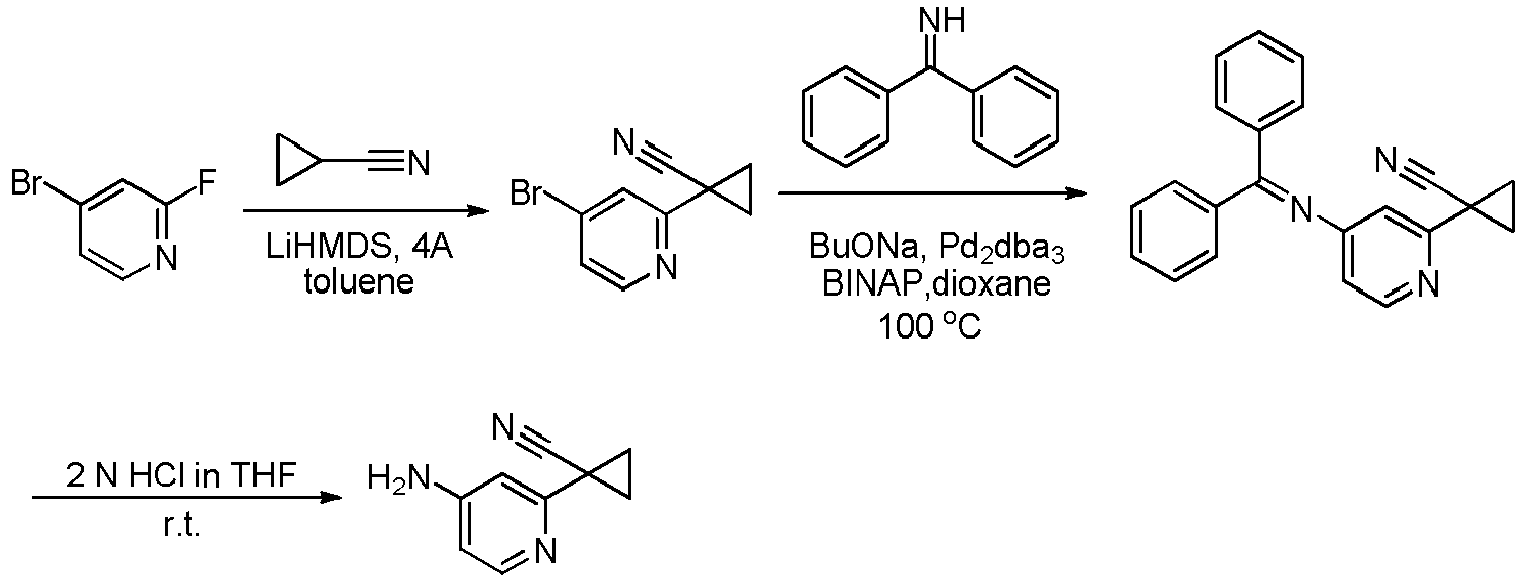
- Step 1: Preparation of 1-(4-bromopyridin-2-yl)cyclopropanecarbonitrile.LiHMDS (1M in toluene, 17.6 mL, 17.6 mmol, 3.1 eq) was added dropwise to a cold (-5°C) mixture of 4-bromo-2-fluoropyridine (1 g, 5.7 mmol), cyclopanecarbonitrile (1.25 mL, 17 mmol, 3 eq) and 4A MS in toluene (20 mL). The reaction mixture was allowed to warm to room temperature and stirred for 16 hr. After it was poured into water, the mixture was filtered. The filtrate was diluted with EtOAc and H2O, and extracted with EtOAc. The organic phase was washed with water and brine, dried over anhydrous Na2SO4, and concentrated. The residue was purified by column chromatography using PE/EtOAc (9:1) as eluent to give the desired product.

- Step 2: Preparation of 1-(4-(diphenylmethyleneamino)pyridin-2-yl)cyclopropanecarbonitrile. To a mixture of 1-(4-bromopyridin-2-yl)cyclopropanecarbonitrile (0.45g, 2.1 mmol), BINAP (0.04 g, 0.063 mmol), Pd2(dba)3 (0.019g, 0.021 mmol) and NaOtBu (0.282 g, 2.94 mmol) in toluene (6 mL) at r.t. under an atmosphere of nitrogen was added diphenylmethanimine (0.45 g, 2.51 mmol). The reaction mixture was stirred at reflux for 2 hr and then cooled to room temperature. The mixture was concentrated under reduced pressure and the residue was purified by column chromatography to give the desired product.

- Step 3: Preparation of 1-(4-aminopyridin-2-yl)cyclopropanecarbonitrile. A mixture of 1-(4-(diphenylmethyleneamino)pyridin-2-yl)cyclopropanecarbonitrile (0.48 g, 1.49 mmol), THF (10 mL) and aq. HCl (2N, 2.0 mL) was stirred at room temperature for 1hour. The mixture was then partitioned between EtOAc (15 mL) and water (15 mL). The aqueous phase was extracted with EtOAc (2 x 25 mL). Combined organic layers were dried over anhydrous Na2SO4 and concentrated. The residue was purified by column chromatography to give the desired product.

- Example 1 Preparation of Di-aliphatic Triazine Compounds of Formula DWherein Ring A is substituted Pyridin-2-yl or Phenyl.The compounds of this Example are prepared by general Scheme 1, set forth below.

- Step 1: Preparation of 6-trifluomethyl-pyridine-2-carboxylic acid methyl ester (2). To a solution of 2-chloro-6-trifluoromethyl-pyridine (2 g, 11.1 mmol, 1.0 eq) in MeOH (20 mL) was add Pd(OAc)2 (124 mg, 0.05eq) and dppf (600 mg, 0.1eq) under an atmosphere of nitrogen. Et3N (2.3 mL, 1.5eq) was then added to the resulting orange solution. The reaction solution was then stirred under an atmosphere of carbon monoxide (40 psi) at 60°C for 22 hr. Once the reaction completed, the mixture was filtered and the filtrate was concentrated in high vacuum. The residue was purified by column chromatography to afford the desired product.

- Step 2:Preparation of 6-(6-trifluomethylpyridin-2-yl)-1,3,5-triazine-2,4-dione. To a solution of freshly prepared NaOEt from Na (3.84 g, 0.16 mol, 3 eq) in ethanol (500 mL) was added methyl 6-trifluoromethylpicolinate (33 g, 0.16 mol, 3eq) and biuret (5.3 g, 0.052 mol). Theresulting mixture was heated to reflux for 1 hr and then concentrated. The residue was poured into water and treated with Sat. aq. NaHCO3 to adjust pH to 7. The precipitated solid was collected by filtration and dried under air to give the desired compound.

- Step 3: Preparation of 2,4-dichloro-6-(6-trijluomethyl-pyridin-2-yl)-1,3,5-triazine. To a solution of 6-(6-trifluomethyl-pyridin-2-yl)-1,3,5-triazine-2,4(1H,3H)-dione (3.37 g, 0.013mol) in POCl3 (48 mL) was added PCl5 (23 g, 0.1 mol). The mixture was stirred at 100°C for 2 hr and then concentrated. The residue was dissolved inEtOAc and then washed with Sat. aq. NaHCO3. The organic layer was dried over anhydrous Na2SO4 and thenconcentrated to give the desired product.

- Step 4: Preparation of N2,N4-bis((R)-1-cyclopropylethyl)-6-(6-(trifluoromethyl)-pyridin-2-yl)-1,3,5-triazine-2,4-diamine. To a mixture of 2,4-dichloro-6-(6-(trifluoromethyl)pyridine-2-yl)-1,3,5-triazine (600 mg, 2.0mmol, 1.0 eq) and (R)-1-cyclopropylethanamine hydrochloride salt (536 mg, 4.4mmol, 2.2eq) in THF (12 mL) were added CsF (1.2 g, 8.0mmol, 2eq) and DIPEA (1.4 mL, 8.0mmol, 4eq) at room temperature. The mixture was stirred at 60°C overnight and then filtered. The filtrate was concentrated under reduced pressure and the residue was purified by a standard method to give the desired product.

- The procedure set forth in Example 1 was used to produce the following compounds using the appropriate starting materials.
-

-

-

-

-
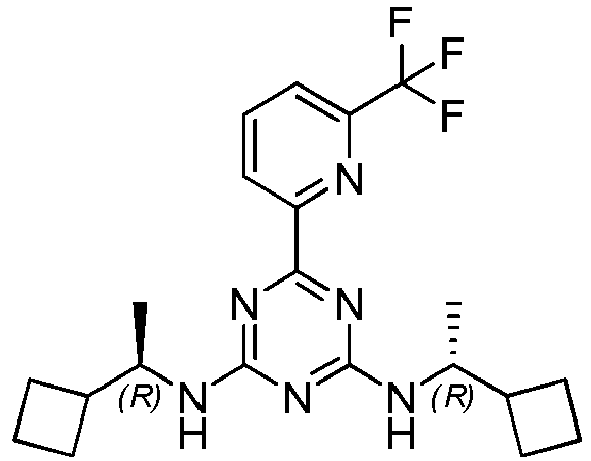
-

-

-

-

-

-

-

-

-

-

-

-

-

-

-

-

-

-

-

-

-
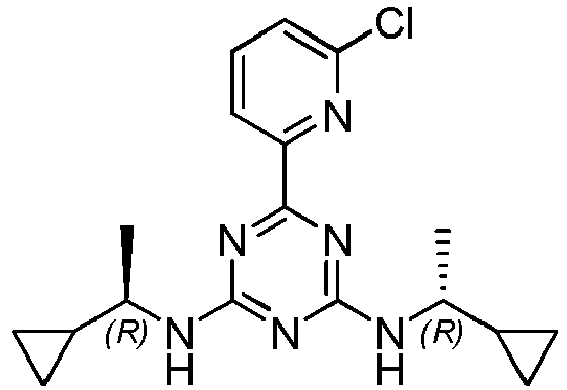
-

-

-

-

- Compound N2,N4-bis((1S,3S)-3-(4-fluorophenyl)cyclobutyl)-6-(6-(trifluoromethyl)pyridin-2-yl)-1,3,5-triazine-2,4-diamine To a mixture of 2,4-dichloro-6-(6-(trifluoromethyl)pyridine-2-yl)-1,3,5-triazine (600 mg, 2.0 mmol, 1.0 eq) and (1s,3s)-3-(4-fluorophenyl)cyclobutanamine (726 mg, 4.4 mmol, 2.2 eq) in THF (12 mL) at r.t.were added CsF (0.6 g, 2.0 mmol, 1 eq.) and DIPEA (0.7 mL, 4.0 mmol, 2 eq). The resulting mixture was stirred at 60°C overnight and then filtered. The filtrate was concentrated and purified via standard techniques to afford the desired product.

-
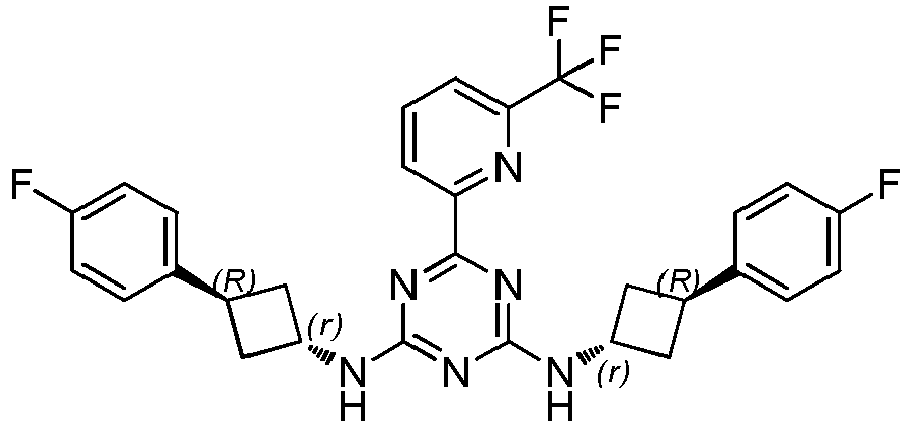
-

-

-
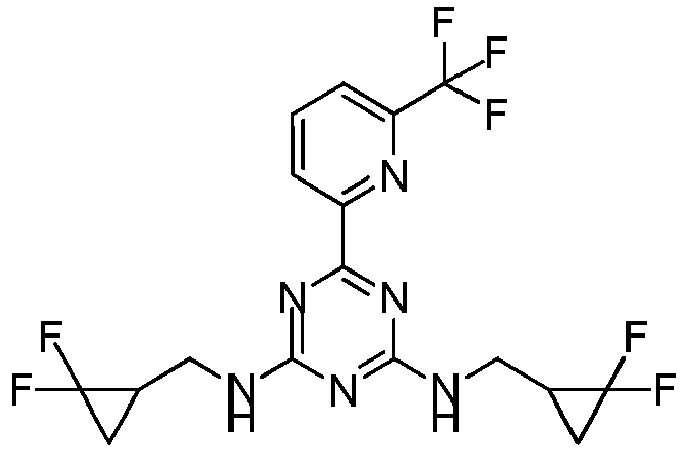
-

-

-

-

-

-

-

-

-

-

-

Table 1: The following compounds were prepared by following the procedure described in Scheme 1 above. Compound No. Name Structure LCMS Expected MW Found (M+1)+ 72 N2,N4-di((1R,5S)-3-oxabicyclo[3.1.0]hexan-6-yl)-6-(6-chloropyridin-2-yl)-1,3,5-triazine-2,4-diamine 
386.1 387.1 73 6-(6-aminopyridin-2-yl)-N2,N4 - dineopentyl-1,3,5-triazine-2,4-diamine 
343.2 344.2 74 6-(6-aminopyridin-2-yl)-N2,N4-diisobutyl-1,3,5-triazine-2,4-diamine 
315.2 316.2 6-(6-aminopyridin-2-yl)-N2,N4-bis(3-methylbutan-2-yl)-1,3,5-triazine-2,4-diamine 
343.2 344.2 - Example 2 Preparation of Di-aliphatic Triazine Compounds of Formula EWherein Ring A is substituted Pyridin-2-yl or Phenyl. The compounds of this Example are prepared by general Scheme 2, set forth below.

- Step 1:Preparationof(R)-4-chloro-N-(1-cyclopropylethyl)-6-(6-(trifluoromethyl)pyridin-2-yl)-1,3,5-triazin-2-amine. To a mixture of 2,4-dichloro-6-(6-(trifluoromethyl)pyridine-2-yl)-1,3,5-triazine (600 mg, 2.0mmol, 1.0 eq) and (R)-1-cyclopropylethanamine hydrochloride salt (268 mg, 2.2mmol, 1.1 eq) in THF (6 mL) were added CsF (608 mg, 4.0mmol, 2eq) and DIPEA (0.7 mL, 4.0mmol, 2 eq) at room temperature. The mixture was stirred at 40°C overnight and then filtered. The filtrate was concentrated under reduced pressure and the residue was purified by a standard method to give the desired product.

- Step2: Preparation of N2-((R)-1-cyclopropylethyl)-N4-(pentan-2-yl)-6-(6-(trifluoromethyl)pyridin-2-yl)-1,3,5-triazine-2,4-diamine. To a mixture of (R)-4-chloro-N-(1-cyclopropylethyl)-6-(6-(trifluoromethyl)pyridin-2-yl)-1,3,5-triazin-2-amine (80 mg, 0.23mmol, 1.0 eq) and pentan-2-amine (25 mg,0.28mmol, 1.2eq) in THF (2 mL) were added CsF (70 mg, 0.46mmol, 2eq) and DIPEA (0.08 mL, 0.46 mmol, 2 eq) at room temperature. The mixture was stirred at 60°C overnight and filtered. The filtrate was concentrated under reduced pressure and then purified by a standard method to give the desired product.

- The procedure set forth in Example 2was used to produce the following compounds using the appropriate starting materials.

-

-

-

-

-

-

-

-

-

-

-

-
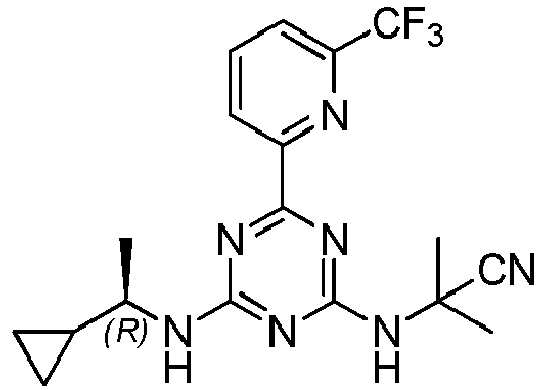
-

-

-

-

-

-

-

-

-

-

-

-

-

-

-

-
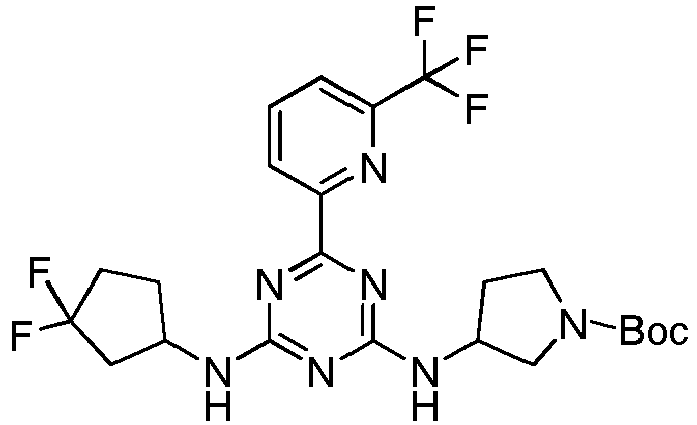
-

-

-

-

-

-

-

-

-

-

-

-

-

-

-

-

-

-
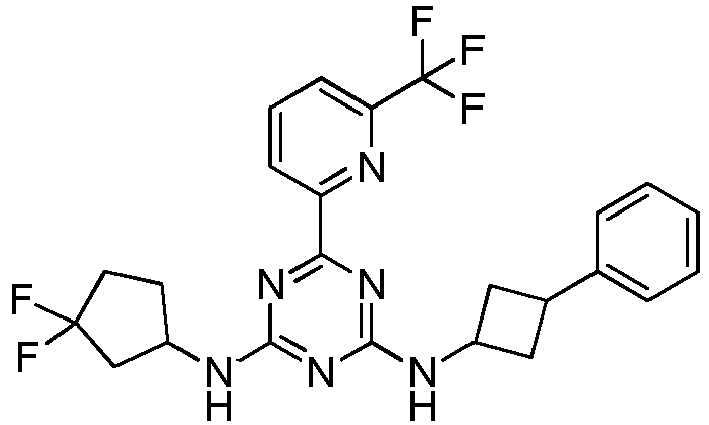
-

-

-

-

-

-

-

-

-

-

-

-

-

-

-

-

-

-

-

-

-

-

-

-

-

-

-
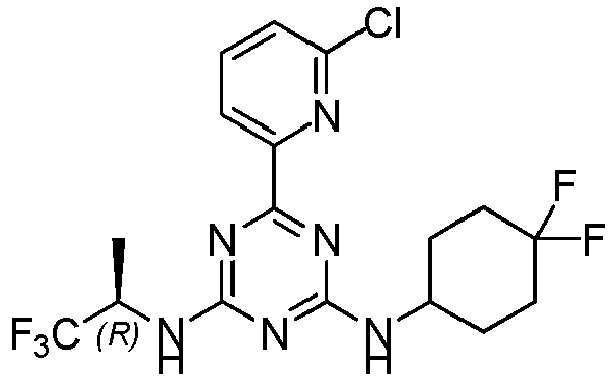
Table 2: The following targets were prepared by the procedure described in Scheme 2 above. Compound ID Name Structure LCMS Expected MW Found (M+1)+ 12 1-(4-((R)-1-cyclopropylethylamino)-6-(6-(trifluoromethyl)pyridin-2-yl)-1,3,5-triazin-2-ylamino)propan-2-ol 
382.2 383.2 10 1-(4-(1-cyclopropylethylamino)-6-(6-(trifluoromethyl)pyridin-2-yl)-1,3,5-triazin-2-ylamino)-2-methylpropan-2-ol 
396.2 397.2 24 (R)-N2-(1-cyclopropylethyl)-N4 - (pyridin-2-ylmethyl)-6-(6-(trifluoromethyl)pyridin-2-yl)-1,3,5-triazine-2,4-diamine 
415.2 416.2 25 N2-((R)-1-cyclopropylethyl)-N4 - (1-(pyridin-2-yl)ethyl)-6-(6-(trifluoromethyl)pyridin-2-yl)-1,3,5-triazine-2,4-diamine 
429.2 430.2 N2 -cyclohexyl-N4 - isopropyl-6-phenyl-1,3,5-triazine-2,4-diamine 
311.2 312.2 69 N2-isopropyl-6-phenyl-N4 - (tetrahydro-2H-pyran-3-yl)-1,3,5-triazine-2,4-diamine 
313.2 314.2 - Example 3 Preparation of Di-aliphatic Triazine Compounds of Formula F. The compounds of this Example are prepared by general Scheme 3, set forth below.

- Step 1: Preparation of 6-chloro-N2,N4-bis((R)-1-cyclopropylethyl)-1,3,5-triazine-2,4-diamine. To a mixture of 2,4,6-trichloro-1,3,5-triazine (2g, 10.9 mmol, 1 eq) and (R)-1-cyclopropylethanamine hydrochloride (2.7 g, 22.8 mmol, 2.1 eq)in acetone (50 mL) was added DIPEA (4.5 mL, 27.3 mmol, 2.5 eq) and CsF (3.3 g, 21.8 mmol, 2.0 eq). The mixture was stirred at 40°C for 3 hr and then at 50°C for another 3 hr. The mixture was filtered and the filtrate was concentrated under reduced pressure. The residue was purified by a standard method to afford the desired product.
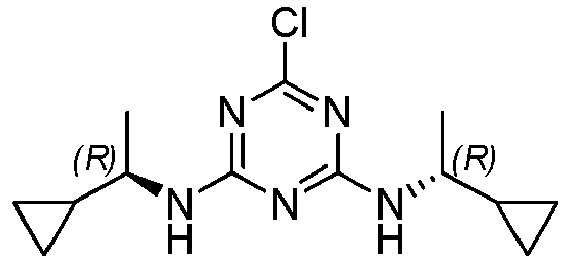
- Step 2: Preparation of N2,N4-his((R)-1-cyclopropylethyl)-6-(pyridin-4-yl)-1,3,5-triazine-2,4-diamine. To a mixture of 6-chloro-N2,N4-bis((R)-1-cyclo-propylethyl)-1,3,5-triazine-2,4-diamine (100 mg, 0.36 mmol), pyridin-4-ylboronic acid (66 mg, 0.52 mmol), and K2CO3 (99 mg, 0.72 mmol) in 1,4-dioxane (3 mL) and water (1 mL) stirred at r.t. under the atmosphere of nitrogenwas added Pd(PPh3)4 (42 mg, 0.036 mmol) in one portion. The reaction mixture was stirred at 80°C overnight. The mixture was partitioned between water and EtOAc. The organic layer was dried over anhydrous Na2SO4 and concentrated. The residue was purified by a standard method to give the desired product.

- The procedure set forth above was used to produce the following compounds using the appropriate starting materials.
-

-

Table 3: The following targets were prepared by the procedure described in Scheme 3 above. Compound ID Name Structure LCMS Expected MW Found (M+1)+ 92 N2,N4-bis((R)-1-cyclopropylethyl)-6-(pyridin-3-yl)-1,3,5-triazine-2,4-diamine 
324.2 325.2 78 N2,N4-bis((R)-1-cyclopropylethyl)-6-(2-fluoro-5-methoxyphenyl)-1,3,5-triazine-2,4-diamine 
371.2 372.2 66 6-(2-chlorophenyl)-N2,N4-bis((R)-1-cyclopropylethyl)-1,3,5-triazine-2,4-diamine 
357.2 358.2 77 6-(2-fluorophenyl)-N2,N4-bis((R)-1-cyclopropylethyl)-1,3,5-triazine-2,4-diamine 
341.2 342.2 82 (3-(4,6-his((R)-1-cyclopropylethylamino)-1,3,5-triazin-2-yl)phenyl) methanol 
353.2 354.2 N2,N4-bis(1-cyclopropylethyl)-6-(1H-indol-4-yl)-1,3,5-triazine-2,4-diamine 
362.2 363.2 N2,N4-bis((R)-1-cyclopropylethyl)-6-(1H-indol-4-yl)-1,3,5-triazine-2,4-diamine 
362.2 363.2 - Example 4 Preparation of Di-aliphatic Triazine Compounds of Formula G. The compounds of this Example are prepared by general Scheme 4, set forth below.

- Step 1. Preparation of N2-(3,3-difluorocyclopentyl)-N4-(pyrrolidin-3-yl)-6-(6-(trifluoro methyl)pyridin-2-yl)-1,3,5-triazine-2,4-diamine. To a solution of tert-butyl 3-(4-(3,3-difluorocyclopentylamino)-6-(6-(trifluoromethyl)pyridin-2-yl)-1,3,5-triazin-2-ylamino)pyrrolidine-1-carboxylate (160 mg, 0.3 mmol) in DCM (3 mL) at 0°C was added TFA (1 mL). The mixture was stirred at room temperature for 2hrs and then concentrated. The residue was extracted with EtOAc. Combined organic layerswere washed with saturated aqueous NaHCO3 and brine, dried over anhydrous Na2SO4 and then concentrated to afford the desired product which was used in the next step without any further purification.

- Step 2. Preparation of N2-(3,3-difluorocyclopentyl)-N4-(1-(methylsulfonyl)pyrroli-din-3-yl)-6-(6-(trifluoromethyl)pyridin-2-yl)-1,3,5-triazine-2,4-diamine. A mixture of N2-(3,3-difluorocyclopentyl)-N4-(pyrrolidin-3-yl)-6-(6-(trifluoromethyl) pyridin-2-yl)-1,3,5-triazine-2,4-diamine (20 mg, 0.05 mmol), Et3N (9.4 mg, 0.09 mmol), MsCl (6 mg, 0.06 mmol) in DCM (2 mL) was stirred at room temperature overnight. The mixture was concentrated and the residue was purified by a standard method to afford the desired product.

- The procedure set forth above was used to produce the following compoundsusing the appropriate starting material.
-

-

- Compound N2-(3,3-difluorocyclopentyl)-N4-(1-methylpyrrolidin-3-yl)-6-(6-(trifluoromethyl)pyridin-2-yl)-1,3,5-triazine-2,4-diamine. To a solution of tert-butyl 3-(4-(3,3-difluorocyclopentylamino)-6-(6-(trifluoromethyl)pyridin-2-yl)-1,3,5-triazin-2-ylamino)pyrrolidine-1-carboxylate (25 mg, 0.05mmol) in THF (3 mL) at 0°C was added LiAlH4(5 mg, 0.14 mmol). The mixture was stirred at 0°C for 2hr, then at r.t for 30 min, and finally at 60 °C for 2hr. The reaction mixture was quenched with water and extracted by EtOAc. Combined organic layers were washed with brine, dried over anhydrous Na2SO4, and concentrated. The residue was purified by a standard method to give the desired product.

- Example 5Preparation of Di-aliphatic Triazine Compounds. The compounds of this Example are prepared by general Scheme 5, set forth below.

- Step 1: Preparation of 6-(6-(azetidin-1-yl)pyridin-2-yl)-N2,N4-bis((R)-1-cyclopropyl-ethyl)-1,3,5-triazine-2,4-diamine. A mixture of 6-(6-chloropyridin-2-yl)-N2,N4-bis((R)-1-cyclopropylethyl)-1,3,5-triazine-2,4-diamine (40 mg, 0.11 mmol), azetidine (7.6 mg, 0.13 mmol), 2,2'-bis-(diphenylphosphino)-1,1'-binaphthyl (6.9 mg, 0.01 mmol), sodium tert-butoxide (15 mg, 0.16 mmol) and tris(dibenzylideneacetone) -dipalladium (10.2 mg, 0.01 mmol) in toluene (3 mL) was stirred at 100°C under an atmosphere of nitrogen overnight. The mixture was cooled to room temperature and filtered.The filtrate was concentrated under reduced pressure and the residue was purified by a standard method to afford the desired product.

- Step 2: Preparation of N2,N4-bis((R)-1-cyclopropylethyl)-6-(pyridin-2-yl)-1,3,5-triazine-2,4-diamine. To a solution of 6-(6-chloropyridin-2-yl)-N2,N4-bis((R)-1-cyclopropylethyl)-1,3,5-triazine-2,4-diamine (20 mg, 0.05 mmol) in methanol (2 mL) was added Pd/C (2 mg) under an atmosphere of nitrogen. The mixture was then stirred at room temperature under ahydrogen balloon overnight. The mixture was filtered and the filtrate was concentrated. The residue was purified by a standard method to afford the desired product.

- Example 6 Preparation of Di-aliphatic Triazine Compounds of Formula H.The compounds of this Example are prepared by general Scheme 6, set forth below.

- Step 1: Preparation of 2-((4-(2-fluoro-5-hydroxyphenyl)-6-(isopropylamino)-1,3,5-triazin-2-yl)amino)-2-methylpropanenitrile. To a solution of 2-((4-(2-fluoro-5-methoxyphenyl)-6-(isopropylamino)-1,3,5-triazin-2-yl)amino)-2-methylpropanenitrile (200 mg, 0.6 mmol) in anhydrous DCM (3 mL) at -65°C was added dropwise BBr3 (0.6 mL) and the reaction mixture was stirred at this temperature for 20 min. The mixture was slowly warmed up to 0°C and stirred for 10 min. and then stirred at room temperature for 1 hr. The reaction was quenched with icy Sat. aq. NaHCO3 till pH = 8. The resulting mixture was extracted with EtOAc(2 x 10 mL). Combined organic layers were washed with brine, dried over anhydrous Na2SO4 and concentrated under reduced pressure. Theresidue was purified by a standard method to afford the desired product.

- Example 7Preparation of Di-aliphatic Pyrimidine Compounds of Formula J.The compounds of this Example are prepared by general Scheme 7, set forth below.

- Step 1: Preparation of 6-(trifluoromethyl)picolinimidamide. To a solution of6-(trifluoromethyl)picolinonitrile (50 mg, 0.3 mmol, 1 eq) in EtOH (3 mL) was added NaOMe (1.6 mg, 0.03 mmol, 0.1 eq) at 0°C. The mixture was stirred at r.t. for 1 hr, followed by addition of NH4Cl (21 mg, 0.39 mmol, 13 eq). The resulting mixture was stirred at 90°C for 1 hr and cooled to room temperature. The mixture was adjusted pH to 9 with saturated aqueous NaHCO3 and then extracted with EtOAc. Combined organic layers were washed with brine, dried over anhydrous Na2SO4, and concentrated. The residue was purified by a standard method to afford the desired product.

- Step 2: Preparation of 2-(6-(trifluoromethyl)pyridin-2-yl)pyrimidine-4,6-diol. To a solution of sodium (366 mg, 15.9 mmol, 5.0 eq) in anhydrous EtOH (6 mL) was added dropwise a solution of 6-(trifluoromethyl)picolinimidamide (600 mg, 3.2 mmol) in EtOH. The reaction mixture was stirred at r.t. for 1 hr, followed by addition of diethyl malonate (1 mL, 6.4 mmol, 2.0 eq). The mixture was stirred at reflux overnight and then cooled to room temperature. The resulting mixture was adjusted pH to 7 by 1 N aq. HClsolution. The suspension was filtered and the filter cake was washed with water. The solid was suspended in MeOH and filtered. The filtrate was concentrated under reduced pressure to give the desired product which was used directly in the next step without any further purification.

- Step 3: Preparation of 4,6-dichloro-2-(6-(trifluoromethyl)pyridin-2-yl)pyrimidine. A solution of 2-(6-(trifluoromethyl)pyridin-2-yl)pyrimidine-4,6-diol (1 g, 3.9 mmol) in POCl3 (6 mL) was stirred at 90°C overnight and then concentrated to remove the volatile. The residue was purified by a standard method to afford the desired product.

- Step 4: Preparation of (R)-6-chloro-N-(1-cyclopropylethyl)-2-(6-(trifluoromethyl)-pyridin-2-yl)pyrimidin-4-amine. To a solution of 4,6-dichloro-2-(6-(trifluoromethyl) pyridin-2-yl)pyrimidine (80 mg, 0.27 mmol, 1 eq) in THF (3 mL) was added (R)-1- - cyclopropylethanamine (0.06 mL, 0.6 mmol, 2.2 eq) and Et3N (0.07 mL, 0.54 mmol, 2 eq). The reaction mixture was stirred at room temperature overnight and concentrated. The residue was purified by a standard method to give the desired product.

- Step 5 : Preparation of N4,N6-bis((R)-1-cyclopropylethyl)-2-(6-(trifluoromethyl)pyridin-2-yl)pyrimidine-4,6-diamine. To a solution of (R)-6-chloro-N-(1-cyclopropylethyl)-2-(6-(trifluoromethyl) -pyridin-2-yl)pyrimidin-4-amine (50 mg, 0.15 mmol, 1 eq) in DMSO (2 mL) was added (R)-1-cyclopropylethanamine hydrochloride (22 mg, 0.18 mmol, 1.2 eq) and DIPEA (0.08 mL, 0.45 mmol, 3 eq). The mixture was irradiated under microwave at 160 °C for 1.5 hr. After addition of (R)-1-cyclopropylethanamine (0.18 mmol, 1.2 eq),the resulting mixture was stirred and irradiated under microwave at 160 °C for another 2 hr. The mixture was cooled to r.t. and then partitioned between EtOAc and water. The organic layer was washed with water and brine, dried over anhydrous Na2SO4, and concentrated. The residue was purified by a standard method to give the desired product.

- The procedure set forth above was used to produce the following compounds using the appropriate starting materials.
-
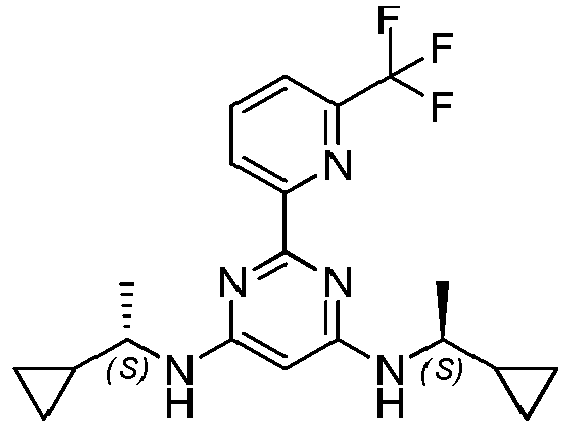
-

Table 7: The following compounds were prepared by the procedure described in Scheme 7 above. Compound ID Name Structure LCMS Expected MW Found (M+1)+ N4,N6-bis(-1-cyclopropylethyl)-2-(6-(trifluoromethyl)pyrid in-2-yl)pyrimidine-4,6-diamine 
391.2 392.2 - Example 9. Preparation of Symmetric Di-aliphatic Triazine Compounds of Formula K. The compounds of this Example are prepared by general Scheme 9, set forth below.

- To a solution of 1-(6-bromopyridin-2-yl)ethanone (26 g, 130 mmol) in dry DCM (150 mL) at 0 °C was added dropwise DAST (84 mL, 650 mmol) over 30 min. The reaction mixture was then slowly allowed to warm up to r.t., and stirred until the reaction was complete.The resulting mixture was slowly poured into ice (300 g) and extracted with DCM (2 x 50 mL). The combined organic layers were washed with water, dried over anhydrous Na2SO4 and concentrated under reduced pressure. The residue was purified by standard methods to afford 2-bromo-6-(1,1-difluoroethyl)pyridine.LC-MS: m/z 222.0 (M+H)+.
- To a solution of 2-bromo-6-(1,1-difluoroethyl)pyridine (30.2 g, 136 mmol) in MeOH (300 mL) were added 1,1'-bis(diphenylphosphino)-ferrocene (7.5 g, 13.6 mmol), triethylamine (28.4 mL, 204 mmol), and Pd(OAc)2(1.52 g, 6.7 mmol).The mixture was stirred at 60°C under CO atmosphere (60 psi) for 16 hr. The resulting mixture was filtered and concentrated under reduced pressure. The residue was purified bystandard methods to afford methyl 6-(1,1-difluoroethyl) picolinate.LC-MS: m/z 202.2 (M+H)+.
- Step 3: Preparation of 6-(6-(1,1-difluoroethyl)pyridin-2-yl)-1,3,5-triazine-2,4(1H,3H)-dione. To a solution of NaOEt in EtOH (freshly prepared from sodium (1.9 g, 82.6 mmol and EtOH (150 mL)) was added methyl 6-(1,1-difluoroethyl)picolinate(2.8 g, 28 mmol) and biuret(14.0 g, 70 mmol). The mixture was stirred at 90°C for 16 hr and concentrated under reduced pressure. To the residue was added water (50 mL). The resulting mixture was adjusted the pH to 7 with IN HCl, and then filtered. The filter cake was washed with water, and dried under high vacuum to afford 6-(6-(1,1-difluoroethyl)pyridin-2-yl)-1,3,5-triazine-2,4(1H,3H)-dione.LC-MS: m/z 255.1 (M+H)+.
- To a solution of 6-(6-(1,1-difluoroethyl)pyridin-2-yl)-1,3,5-triazine-2,4(1H,3H)-dione (6 g, 25 mmol) in POCl3 (60 mL) was added PCl5 (26 g, 125 mmol). The mixture was stirred at 100°C for 16 hr and concentrated under reduced pressure. The residue was purified by standard methods to afford 2,4-dichloro-6-(6-(1,1-difluoroethyl)pyridin-2-yl)-1,3,5-triazine. 1H NMR (400MHz, CDCl3) δ8.62 (d, 1H), 8.07 (t, 1H), 7.94 (d, 1H), 2.16 (q, 3H). LC-MS: m/z 292.1 (M+H)+.
- Step 5: Preparation of N2,N4-bis(4,4-difluorocyclohexyl)-6-(6-(1,1-difluoroethyl)pyridin-2-yl)-1,3,5-triazine-2,4-diamine To a mixture of 2,4-dichloro-6-(6-(1,1-difluoroethyl)pyridin-2-yl)-1,3,5-triazine (582 mg, 2.0 mmol, 1.0 eq) and 4,4-difluorocyclohexanamine hydrochloride (752 mg, 4.4 mmol, 2.2 eq) in THF (12 mL) at r.t.were added CsF (1.2 g, 8.0 mmol, 2eq) and DIPEA (1.4 mL, 8.0 mmol, 4 eq). The mixture was stirred at 60°C overnight and then filtered. The filtrate was concentrated under reduced pressure and the residue was purified by standard methods to give the desired product.

- The procedure set forth in Example 9 was used to produce the following compounds using the appropriate starting materials.
-

-

- Example 10. Preparation of Symmetric Di-aliphatic Triazine Compounds of Formula L. The compounds of this Example are prepared by general Scheme 10, set forth below.

- Step 1: Preparation of 6-(6-chloropyridin-2-yl)-1,3,5-triazine-2,4(1H,3H)-dione. To a dried three-necked round bottom flask were added biuret (14.8 g, 0.14 mol), methyl 6-chloropicolinate (21 g, 0.12 mol) and EtOH (250 mL). The mixture was degassed with N2 three times and then stirred at 25°C for 20 min. Then the temperature was allowed to rise to 50°C, followed by addition of HC(OMe)3 (17 mL, 0.14 mol) and TFA (1.37 g, 0.01 mol). The reaction mixture (pale yellow slurry) was stirred at this temperature for 30 min, followed by dropwise addition of a solution of NaOEt in EtOH (20%wt, 163 g, 0.48 mol). The resulting yellowish thick slurry was heated to reflux for 2hr until the reaction was complete. The mixture was cooled to r.t. and concentrated under reduced pressure. The residue was treated with water (200 mL) and concentrated under reduced pressure to remove the remaining ethanol. Then water (300 mL) was added to the residue (while stirring) to form a clear brown solution. The solution was cooled to 10°C and slowly adjusted to pH 1 by 6N HCl. The resulting mixture was stirred for another 2 hr and filtered. The filter cake was washed with aq. HCl (pH=1), collected and suspended in DCM (300 mL). The suspension was stirred at r.t. for 2hr, filtered and dried to afford the desired product. LC-MS: m/z 225.0 (M+H)+.
- Step 2: Preparation of 2,4-dichloro-6-(6-chloropyridin-2-yl)-1,3,5-triazine. The procedure is the same as Example 1 Step 3 described above.LC-MS: m/z 260.9 (M+H)+.
- Step 3 : Preparation of 6-(6-chloropyridin-2-yl)-N2,N4-bis((R)-1,1,1-trifluoropropan-2-yl)-1,3,5-triazine-2,4-diamine. A mixture of 2,4-dichloro-6-(6-chloro -pyridin-2-yl)-1,3,5-triazine (0.27 g, 1.04 mol), (R)-1,1,1-trifluoropropan-2-amine hydrochloride (0.39 g, 2.6 mol), and potassium carbonate (0.43 g, 3.1 mol) in dry 1,4-dioxane (2.5 mL) was stirred under the atmosphere of N2 at 50°C for 36 hr then at 100°C for another 36 hr until the reaction was complete. The resulting mixture was filtered through Celite and the cake was washed with EtOAc. The filtrate was concentrated and the residue was purified by standard methods to give the desired product.

- The procedure set forth in Example 10 was used to produce the following compounds using the appropriate starting materials.
-
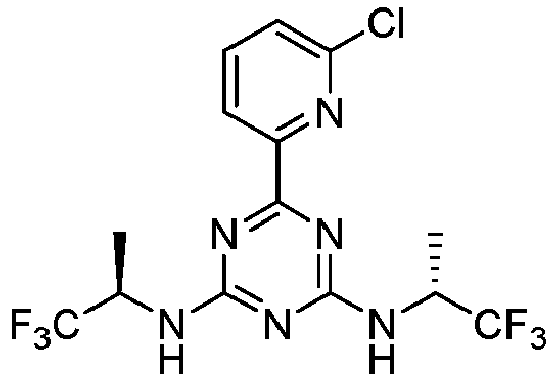
-

-

-

-

-

-

-

-

-

-

-

-

-
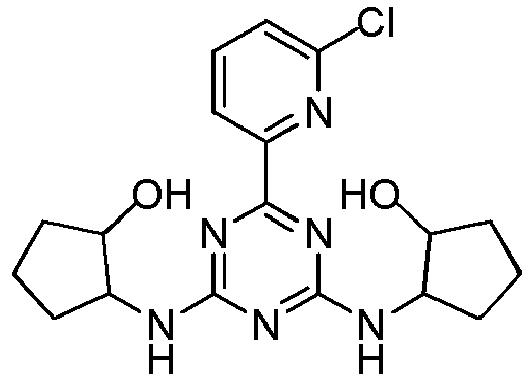
-

-

-

- Example 11 The compounds of this Example are prepared by general Scheme 11, set forth below.

- Step 1. Preparation of N2,N4-bis((R)-1-cyclopropylethyl)-6-(6-((4-methoxybenzyl) amino)pyridin-2-yl)-1,3,5-triazine-2,4-diamine. To a solution of 6-(6-chloropyridin-2-yl)-N2,N4-bis((R)-1-cyclopropylethyl)-1,3,5-triazine-2,4-diamine (120 mg, 0.33 mmol), (4-methoxyphenyl)methanamine (69 mg, 0.51 mmol), BINAP (42 mg, 0.66 mmol) and t-BuONa (63 mg, 0.66 mmol) in anhydrous dioxane (2 mL) at r.t. under N2 atmospherewas added Pd2(dba)3 (30 mg, 0.033 mmol) in one portion. The reaction mixture was then stirred at 100 °C overnight then concentrated under reduced pressure to afford the desired product.

- Step 2. Preparation of 6-(6-aminopyridin-2-yl)-N2,N4-bis((R)-1-cyclopropyl ethyl)-1,3,5-triazine-2,4-diamine. N2,N4-bis((R)-1-cyclopropylethyl)-6-(6-(4-methoxybenzylamino)pyridin-2-yl)-1,3,5-triazine-2,4-diamine (80 mg, 0.17 mmol) was dissolved in TFA (0.5 mL) under N2 atmosphere. The solution mixture was then stirred at r.t. overnight then concentrated under reduced pressure. The residue was purified by standard methods to afford the desired product.

- Example 12 The compounds of this example are prepared by general Scheme 12, set forth below.

- Step 1. Preparation of 6-(4,6-bis((R)-1-cyclopropylethylamino)-1,3,5-triazin-2-yl)pyridin-2-ol To a mixture of N2,N4-bis((R)-1-cyclopropylethyl)-6-(6-methoxypyridin-2-yl)-1,3,5-triazine-2,4-diamine (50 mg, 0.14 mmol) and NaI (63 mg, 0.42 mmol) in anhydrous CH3CN (1 mL) at r.t. was added TMSCl (46 mg, 0.42 mmol) in one portion. The reaction mixture was stirred 80 °C for 6 hr then concentrated under reduced pressure. The residue was purified by standard methods to afford the desired product. 1H NMR (400 MHz, CDCl3) δ 10.24 (br s, 1H), 7.51 (t, J = 8.0 Hz, 1H), 7.29 - 7.20 (m, 1H), 6.71 (d, J = 8.0 Hz, 1H), 5.42 - 5.31 (m, 2H), 3.63 - 3.52 (m, 2H), 1.30 - 1.25 (m, 6H), 0.98 - 0.87 (m, 2H), 0.62 - 0.21 (m, 8H).LCMS: m/z 341.2 (M+H)+.
- Example 13 The compounds of this Example are prepared by general Scheme 13, set forth below.

- Step 1. Preparation of N2,N4-bis((R)-1-cyclopropylethyl)-6-(6-vinylpyridin-2-yl)-1,3,5-triazine-2,4-diamine. To a suspension of 6-(6-chloropyridin-2-yl)-N2,N4-bis ((R)-1-cyclopropylethyl)-1,3,5-triazine-2,4-diamine (200 mg, 0.56 mmol), 2,4,6-trivinyl-1,3,5,2,4,6-trioxatriborinane (135 mg, 0.84 mmol) and K2CO3 (154 mg, 1.11 mmol) in dioxane (2 mL) and H2O (0.8 mL) under an atmosphere of N2 was added Pd(dppf)Cl2 (41 mg, 0.06 mmol) in one portion. The reaction mixture was stirred at 100 °C overnight then cooled to r.t. and quenched with water. The resulting mixture was extracted with EtOAc (20 mL x 2). The combined organic layers were washed with water and brine, dried over anhydrous Na2SO4, and concentrated under reduced pressure. The residue was purified by standard methods to afford the desired product. 1H NMR (400 MHz, CDCl3) δ 8.28 - 8.15 (m, 1H), 7.77 (t, J = 7.6 Hz, 1H), 7.58 (d, J = 7.6 Hz, 1H), 7.05 - 6.99 (m, 1H), 6.15 (d, J = 17.6 Hz, 1H), 5.42 (d, J = 17.6 Hz, 1H), 5.44-5.16 (m, 2H), 3.72-3.52 (m, 2H), 1.35 - 1.22 (m, 6H), 0.98 - 0.86 (m, 2H), 0.58 - 0.21 (m, 8H). LCMS: m/z 351.1 (M+H)+.
- Example 14 The compounds of this Example are prepared by general Scheme 14, set forth below.

- Step 1. Preparation of 6-(4,6-bis(((R)-1-cyclopropylethyl)amino)-1,3,5-triazin-2-yl) picolinaldehyde. Ozone was bubbled into a solution of N2, N4-bis((R)-1-cyclopropylethyl)-6-(6-vinylpyridin-2-yl)-1,3,5-triazine-2,4-diamine (120 mg, 0.34 mmol) in DCM (2 mL) at -78 °C for 1hr. After excess ozone was purged by N2, Me2S (0.2 mL) was added into the reaction mixture at 0 °C. The resulting mixture was concentrated and the residue was purified by standard methods to afford the desired product. LCMS: m/z 353 (M+H)+.
- Step 2. Preparation of N2,N4-bis((R)-1-cyclopropylethyl)-6-(6-(difluoromethyl)pyridin-2-yl)-1,3,5-triazine-2,4-diamine. To a solution of 6-(4,6-bis((R)-1-cyclo propylethylamino)-1,3,5-triazin-2-yl)picolinaldehyde (50 mg, 0.14 mmol) in anhydrous DCM (2 mL) at 0 °C was added dropwise DAST (68 mg, 0. 43 mmol). The reaction mixture was stirred at r.t overnight. The resulting mixture was slowly quenched with satd. aq. NaHCO3 (5 mL) at 0°C, then extracted with DCM (40 mL). The combined organic layers were washed with water and brine, dried over anhydrous Na2SO4, concentrated, and purified by standard methods to afford the desired product. 1H NMR (400 MHz, CDCl3) δ 8.46 (s, 1H), 7.97 (t, J = 7.6 Hz, 1H), 7.77 (d, J = 7.6 Hz, 1H), 6.98 - 6.70 (m, 1H), 5.47 - 5.21 (m, 2H), 3.67 - 3.50 (m, 2H), 1.32 - 1.25 (m, 6H), 0.92 - 0.86 (m, 2H), 0.58 - 0.21 (m, 8H). LCMS: m/z 375 (M+H)+.
- The procedure set forth in Example 14 was used to produce the following compounds using the appropriate starting materials.
-

-

- Example 15 The compounds of this Example are prepared by general Scheme 15, set forth below.

- Step 1: Preparation of methyl 6-(4,6-bis((R)-1-cyclopropylethylamino)-1,3,5-triazin-2-yl)picolinate. To a mixture of 6-(6-chloropyridin-2-yl)-N2,N4-bis((R)-1-cyclopropylethyl)-1,3,5-triazine-2,4-diamine (0.25g, 0.7mmol) in MeOH (10mL) were added dppf (80mg, 0.15mmol), Pd(OAc)2 (60mg, 0. 27 mmol) and Et3N (150mg, 1.5 mmol). The reaction mixture was degassed and back-filled with CO three times and then stirred under an atmosphere of CO (60 psi) at 70°C for 12hr. The resulting mixture was cooled to r.t. and concentrated under reduced pressure. The residue was triturated with EtOAc (100mL) and filtered. The filtrate was concentrated and purified by standard methods to afford methyl 6-(4,6-bis((R)-1-cyclopropylethylamino)-1,3,5-triazin-2-yl)picolinate. 1H NMR (400 MHz, CDCl3) δ 8.50 (m, 1H), 8.24-8.22 (dd, 1H), 7.99-7.95 (t, 1H), 5.49 (m, 2H), 4.02 (s, 3H), 3.57 (m, 2H), 1.92 (s,6H), 0.96-0.87 (m, 2H), 0.52-0.26 (m,8H). LCMS: m/z 383(M+H)+.
- Step 2: Preparation of 6-(4,6-bis(((R)-1-cyclopropylethyl)amino)-1,3,5-triazin-2-yl)picolinic acid. To a mixture of methyl 6-(4,6-bis((R)-1-cyclopropylethylamino)-1,3,5-triazin-2-yl)picolinate (150 mg, 0.40 mmol) in water(2.0mL) and THF(3.0mL) was added lithium hydroxide(47 mg, 2.0 mmol). The reaction mixture was stirred at r.t. overnight then acidified withaq.HCl (1 N) to pH5-6 and extracted with EtOAc. The combined organic layers weredried over anhydrous Na2SO4, and concentrated under reduced pressure to give the desired product.LCMS: m/z 367 (M-H)-.
- Step 3: Preparation of 6-(4,6-bis((R)-1-cyclopropylethylamino)-1,3,5-triazin-2-yl)picolinamide. To an ice cold mixture of 6-(4,6-bis(((R)-1-cyclopropylethyl)amino)-1,3,5-triazin-2-yl)picolinic acid (120mg, 0.32mmol) in dry DCM(5.0mL) and DMF(0.1mL) was added dropwise oxalyl chloride(65mg, 0.5mmol). The reaction mixture was stirred at r.t. for 2 hr then treated with ammonia. The resulting mixture wasstirred for 10min at 0°C, and then concentrated and purified by standard methods to give 6-(4,6-bis((R)-1-cyclopropylethylamino)-1,3,5-triazin-2-yl)picolinamide. 1H NMR (400 MHz, CDCl3) δ 13.59 (s, 1H), 9.30-9.14 (m, 3H), 8.58-8.30 (m, 3H), 7.95 (s, 1H), 3.77-3.54 (m, 2H), 1.29 (d, 6H), 1.02 (m,2H), 0.50-0.30 (m,8H). LCMS: m/z 368(M+H)+.
- Step 4: Preparation of 6-(4,6-bis((R)-1-cyclopropylethylamino)-1,3,5-triazin-2-yl)picolinonitrile. To a mixture of 6-(4,6-bis((R)-1-cyclopropylethylamino)-1,3,5-triazin-2-yl)picolinamide(36mg, 0.1mmol) in dry pyridine(3.0mL) was added phosphorous trichloride (0.1mL). The reaction mixture was stirred at r.t. for 2 hr then concentrated under reduced pressure. The residue was purified by standard methods to give 6-(4,6-bis((R)-1-cyclopropylethylamino)-1,3,5-triazin-2-yl)picolinonitrile. 1H NMR (400 MHz, CDCl3) δ 8.50-8.48 (m, 1H), 8.24-8.22 (t, 1H), 7.73-7.71 (dd, 1H), 5.46-5.14 (m, 2H), 3.62-3.50 (m, 2H), 1.22-1.18 (m, 6H), 0.89-0.84 (m, 2H), 0.46-0.20 (m,8H). LCMS: m/z 350(M+H)+.
- Example 16 The compounds of this Example are prepared by general Scheme 16, set forth below.

- Step 1: Preparation of 3,6-difluoro-2-hydrazinylpyridine. To an ice-cold solution of 2,3,6-trifluoropyridine(1.0 g, 7.5 mmol) in ethanol (10 mL) was added hydrazine hydrate (0.75 g, 15.0 mmol). The reaction mixture was warmed up to r.t. and then heated at reflux for 2 hr. After it was cooled to r.t., the reaction mixture was diluted with water (10 mL) and extracted with DCM (2 x 20 mL). The combined organic layers were dried over anhydrous Na2SO4 and concentrated under reduced pressure to afford 3,6-difluoro-2-hydrazinylpyridine.LC-MS (m/z): 146 (M+H)+.
- Step 2: Preparation of 2-bromo-3,6-difluoropyridine. To a stirred solution of 3,6-difluoro-2-hydrazinylpyridine(1.1 g, 7.0 mmol) in chloroform (20 mL) at r.t. was added dropwise bromine (1.8 g, 11.2 mmol). The reaction mixture was heated to 60°C for 1.5 hr. The resulting mixture was cooled to r.t., quenched with satd. aq. NaHCO3, and extracted with dichloromethane (2 x 20 mL). The combined organic layers were dried over anhydrous Na2SO4 and concentrated and purified by standard methods to afford 2-bromo-3,6-difluoropyridine. LC-MS: m/z 194 (M+H)+.
- Step 3:Preparation of methyl 3,6-difluoropicolinate. To a solution of 2-bromo-3,6-difluoropyridine (0.8 g, 4.1mmol) in MeOH (10 mL) were added dppf (0.3 g, 0.56 mmol), Pd(OAc)2 (0.1 g, 0.45 mmol) and Et3N (1.6 mL, 8.2 mmol). The suspension was degassed and back-filled with CO atmosphere three times. The resulting mixture was stirred under CO atmosphere (60 psi) at 70°C for 12 hr, then cooled to r.t. and concentrated under reduced pressure. The residue was triturated with EtOAc (150 mL) and filtered. The filtrate was concentrated and purified by standard methods to afford methyl 3,6-difluoropicolinate.LC-MS: m/z 174 (M+H)+.
- Step 4:Preparation of N2,N4-bis(4,4-difluorocyclohexyl)-6-(3,6-difluoropyridin-2-yl)-1,3,5-triazine-2,4-diamine. To a suspension of N1,N5-bis(4,4-difluorocyclo hexyl)-biguanide (167 mg, 0.50 mmol) and methyl 3,6-difluoropicolinate (130 mg, 0.75 mmol) in MeOH (5 mL) was added NaOMe (81 mg, 1.5 mmol). The reaction mixture was stirred at r.t. overnight, then poured into water, and extracted with EtOAc. The combined organic extracts were dried over anhydrous Na2SO4, and concentrated under reduced pressure. The residue was purified by standard methods to afford N2,N4-bis(4,4-difluorocyclohexyl)-6-(3,6-difluoropyridin-2-yl)-1,3,5-triazine-2,4-diamine. 1H NMR (400 MHz, CDCl3) δ 7.67-7.61 (m, 1H), 7.07-7.03 (m, 1H), 5.46-5.10 (m, 2H), 4.08-3.97 (m, 2H), 2.17-2.09 (m, 8H), 1.96-1.83 (m, 4H), 1.73-1.63 (m, 4H). LC-MS: m/z 461 (M+H)+.
- Example 17 The compounds of this Example are prepared by general Scheme 17, set forth below.

- Step 1: Preparation of N2,N4-bis(4,4-difluorocyclohexyl)-6-(3-fluoro-6-hydrazinylpyridin-2-yl)-1,3,5-triazine-2,4-diamine. To a solution of N2,N4-bis(4,4-difluoro-cyclohexyl)-6-(3,6-difluoropyridin-2-yl)-1,3,5-triazine-2,4-diamine (230 mg, 0.50 mmol) in THF(20 mL) was added hydrazine hydrate(150 mg, 3.0 mmol). The reaction mixture was stirred at 60°C for 2.5 hr. After cooling to r.t., the reaction mixture was diluted with DCM and washed with water. The organic phase was separated,dried over anhydrous Na2SO4, and concentrated under reduced pressure to give the desired product. LC-MS (m/z): 473.2 (M+H)+.
- Step 2: Preparation of 6-(6-amino-3-fluoropyridin-2-yl)-N2,N4-bis(4,4-difluorocyclohexyl)-1,3,5-triazine-2,4-diamine. To a solution of N2,N4-bis(4,4-difluoro-cyclohexyl)-6-(3-fluoro-6-hydrazinylpyridin-2-yl)-1,3,5-triazine-2,4-diamine (47 mg, 0.1 mmol) in methanol (5.0 mL) was added Raney Ni (100 mg). The reaction mixture was stirred under H2 atmosphere overnight at r.t. then filtered. The filtrate was concentrated and purified by standard methodsto afford the desired product. 1H NMR (400 MHz, CDCl3) δ 7.43-7.39 (m, 1H), 7.03-7.01 (m, 1H), 4.59 (s, 2H), 4.10-4.05 (m, 2H), 2.09-1.93 (m, 12H), 1.76-1.68 (m, 4H). LC-MS: m/z 458.2 (M+H)+.
- Example 18 The compounds of this Example are prepared by general Scheme 18, set forth below.

- Step 1: Preparation of 6-(4,6-bis((4,4-difluorocyclohexyl)amino)-1,3,5-triazin-2-yl)-5-fluoropyridin-2-ol. A mixture of N2,N4-bis(4,4-difluorocyclohexyl)-6-(3,6-difluoropyridin-2-yl)-1,3,5-triazine-2,4-diamine (100 mg, 0.22 mmol) in conc. HCl (5.0 mL) was stirred at 100°C overnight. The resulting mixture was concentrated and purified by standard methods to afford the desired product. 1H NMR (400 MHz, CDCl3) δ 9.96 (m, 1H), 7.40-7.27 (m, 2H), 6.73-6.67 (m, 1H), 5.47-5.17 (m, 2H), 4.02-3.92 (m, 2H), 2.11-1.66 (m, 16H). LCMS: m/z 459(M+H)+.
- Example 19 The compounds of this Example are prepared by general Scheme 19, set forth below.

- Step 1: Preparation of N1,N5-bis(3,3-difluorocyclopentyl)-biguanide. A mixture of 3,3-difluorocyclopentanamine hydrochloride (3 g, 19.1 mmol) and sodium dicyanamide (1.7 g, 19.1 mmol) was heated at 160°C for 1 hr. The resulting product was dissolved in MeOH then filtered. The filtrate was concentrated to afford the desired product. LC-MS: m/z 310.2 (M+H)+.
- Step 2: Preparation of ethyl 6-cyclopropylpicolinate. To a mixture of ethyl 6-bromopicolinate (200 mg, 0.87 mmol) andcyclopropylboronic acid (149 mg, 1.74 mmol) in toluene (15 mL) were added K3PO4 (369 mg, 1.74 mmol) anddichloro(diphenylphosphinoferrocene)palladium (11 mg, 0.017 mmol). The resulting mixture was stirred under N2 atmosphere at 100°C overnight, then cooled to r.t. and filtered. The filtrate was concentrated and purified by standard methodsto afford the desired product. LC-MS: m/z 192.1 (M+H)+.
- Step 3: 6-(6-cyclopropylpyridin-2-yl)-N2,N4-bis(3,3-difluorocyclopentyl)-1,3,5-triazine-2,4-diamine. To a mixture of N1,N5-bis(3,3-difluorocyclopentyl)-biguanide (50 mg,0.16 mmol) and ethyl 6-cyclopropylpicolinate (62 mg, 0.33 mmol) in methanol (5 mL) was added NaOMe (44 mg, 0.80 mmol).The reaction mixture was stirred at r.t. overnight, and then concentrated under reduced pressure. The residue was partitioned between EtOAc and water. The organic layer was separated, washed with brine, and dried over anhydrous Na2SO4, concentrated, and purified by standard methods to afford the desired product. 1H NMR (400 MHz, CDCl3) δ8.43-8.33 (m, 1H), 8.06-7.99 (m, 1H), 7.25-7.23 (d, J=8 Hz, 1H), 6.66-6.52 (m, 1H), 5.90-5.79 (m, 1H), 4.74-4.45 (m, 2H), 2.66-2.54 (m, 2H), 2.38-2.16 (m, 8H), 1.90-1.88 (m, 2H), 1.42-1.40 (m, 2H), 1.29-1.25 (m, 1H), 1.25-1.01 (m, 2H). LC-MS: m/z 437.2 (M+H)+.
- The procedure set forth in Example 19 was used to produce the following compounds using the appropriate starting materials.
-

-

- Example 20 Preparation of Symmetric Di-aliphatic Triazine Compounds of Formula M. The compounds of this Example are prepared by general Scheme 20, set forth below.

- Step 1: Preparation of methyl 6-(trifluoromethyl)pyrazine-2-carboxylate. To a mixture of 2-chloro-6-(trifluoromethyl)pyrazine (1 g,5.5 mol) in MeOH (5.5 mL) was added dppf (0.16 g, 0.29 mmol), Pd(OAc)2 (0.1 g, 0.44 mmol) and Et3N (0.12 mL, 8.2 mmol). The suspension was degassed under vacuum and then backfilled with CO three times. The resulting mixture was stirred under CO atmosphere (80 psi) at 70°C for 2 days until the reaction was completed. The mixture was cooled to r.t. and concentrated under reduced pressure at 30°C. To the residue was added EtOAc (150 mL). The suspension was filtered and the filtrate was concentrated and purified by standard methods to afford the desired product.LC-MS: m/z 207 (M+H)+.
- Step 2: Preparation of 6-(6-(trifluoromethyl)pyrazin-2-yl)-1,3,5-triazine-2,4(1H,3H)-dione. The procedure is the same as Example 1 Step 2 described above. LC-MS: m/z 260 (M+H)+.
- Step 3: Preparation of 2,4-dichloro-6-(6-(trifluoromethyl)pyrazin-2-yl)-1,3,5-triazine. To a solution of 6-(6-(trifluoromethyl)pyrazin-2-yl)-1,3,5-triazine-2,4(1H,3H)-dione (2.8 g, 0.011 mol) in POCl3 (30 mL) was added Et3N (0.3 mL). The mixture was stirred at 100°C for 16 hr until the reaction was completed. The resulting mixture was concentrated and purified by standard methods to afford the desired product. LC-MS: m/z 296 (M+H)+.
- Step 4: Preparation of N2,N4-bis(4,4-difluorocyclohexyl)-6-(6-(trifluoromethyl)pyrazin-2-yl)-1,3,5-triazine-2,4-diamine . The procedure is the same as Example 1 Step 4.

- The procedure set forth in Example 20 above was used to produce the following compounds using the appropriate starting materials.
-

-

-

-

-

-

-

- Example 21 Preparation of Symmetric Di-aliphatic Triazine Compounds of Formula N. The compounds of this Example are prepared by general Scheme 21, set forth below.

- Step 1: Preparation of 1-(6-chloropyrazin-2-yl)ethanol. To a solution of methyl 6-formylpyrazine-2-carboxylate (590 mg, 4.15 mmol) in anhydrous THF (5 mL) at -5°C was added dropwise CH3MgBr (2.1 mL, 6.2 mmol). The reaction mixture was stirred at r.t. for 1 hr, then quenched with satd. a.q. NH4Cl at 0°C and extracted with DCM (3 x 10 mL). The combined organic layers were washed with brine, dried over anhydrous Na2SO4 and concentrated to afford the desired product.LC-MS: m/z 159.0 (M+H)+.
- Step 2: Preparation of 1-(6-chloropyrazin-2-yl)ethanone. To a solution of 1-(6-chloropyrazin-2-yl)ethanol (370 mg, 2.3 mmol) in DCM (5 mL) at r.t. was added DMP (1.5 g, 3.5 mmol).The reaction mixture was stirred at r.t. for 3 hr then filtered. The filtrate was concentrated and purified by standard methods to afford the desired product. 1H NMR (400 MHz, CDCl3) δ 9.12(s, 1H), 8.78(s, 1H), 2.72(s, 3H). LC-MS: m/z 157.1 (M+H)+.
- Step 3: Preparation of methyl 6-acetylpyrazine-2-carboxylate. To a solution of 1-(6-chloropyrazin-2-yl)ethanone (260.0 mg, 1.7 mmol) in MeOH (3 mL) were added dppf (94.0 mg, 0.17 mmol), Pd(OAc)2 (20 mg, 0.1 mmol) and Et3N (0.4 mL, 2.6 mmol). The mixture was stirred under CO (60 psi) atmosphere at 60°C overnight. The resulting mixture was cooled to r.t. and filtered. The filtrate was concentrated and purified by standard methods to afford the desired product. LC-MS: m/z 181.0 (M+H)+.
- Step 4: Preparation of methyl 6-(1,1-difluoroethyl)pyrazine-2-carboxylate. To a solution of methyl 6-acetylpyrazine-2-carboxylate(240 mg, 1.3 mmol) in anhydrous DCM (3 mL) at 0 °C was slowly added DAST (0.86 mL, 6.5 mmol). The reaction mixture was stirred at r.t. for 3 hr, then quenched with coldsatd. aq. NaHCO3 at 0 °C and extracted with DCM (3 x1 0 mL). The combined organic layers were dried over anhydrous Na2SO4 and concentratedto afford the desired product. LC-MS: m/z 203.1 (M+H)+.
- Step 5: Preparation of 6-(6-(1,1-difluoroethyl)pyrazin-2-yl)-1,3,5-triazine-2,4(1H,3H)-dione. The procedure is the same as Example 1 Step 2 described above.LC-MS: m/z 256.1 (M+H)+.
- Step 6: Preparation of 2,4-dichloro-6-(6-(1,1-difluoroethyl)pyrazin-2-yl)-1,3,5-triazine. The procedure is the same as Example 1 Step 3 described above. LC-MS: m/z 292.0 (M+H)+.
- Step 7: Preparation of N2,N4-bis(4,4-difluorocyclohexyl)-6-(6-(1,1-difluoroethyl)pyrazin-2-yl)-1,3,5-triazine-2,4-diamine. The procedure is the same as Example 1 Step 4 described above.

- The procedure set forth in Example 21 was used to produce the following compounds using the appropriate starting materials.
-

-

- Example 22 Preparation of Symmetric Di-aliphatic Triazine Compounds of Formula O. The compounds of this Example are prepared by general Scheme 22, set forth below.

- Step 1: Preparation of 2-(methoxycarbonyl)pyrazine 1-oxide. To a solution of methyl pyrazine-2-carboxylate (10.0 g, 70 mmol) in 1,2-dichloroethane (120 mL) was added 3-chloroperoxybenzoic acid (25.0 g, 140 mmol). The reaction mixture was stirred at 60°C overnight. The resulting mixture was cooled to r.t. and filtered. The filtrate was dried over anhydrous K2CO3 and concentrated under reduced pressure. The residue was triturated with hexane and filtered and dried to afford 2-(methoxycarbonyl)pyrazine 1-oxide.LC-MS: m/z 155.0 (M+H)+.
- Step 2: Preparation of methyl 6-chloropyrazine-2-carboxylate. A mixture of 2-(methoxycarbonyl)pyrazine 1-oxide (4.8 g, 30 mmol) in SOCl2 (50 mL) was stirred at 85°C overnight. The mixture was cooled to r.t. and concentrated under reduced pressure.The residue was neutralized by satd.aq. NaHCO3 and extracted with DCM (3 x 20 mL). The combined organic layers were washed with brine, dried over anhydrous Na2SO4 and concentrated and purified by standard methods to afford methyl 6-chloropyrazine-2-carboxylate. 1H NMR (600 MHz, CDCl3) δ 8.59 (s, 1H), 8.53 (s, 1 H), 4.84 (s, 2H), 3.01 (s, 1H).LC-MS: m/z 173.0 (M+H)+.
- Step 3: Preparation of (6-chloropyrazin-2-yl)methanol. To a solution of methyl 6-chloropyrazine-2-carboxylate (2.0 g, 11.6 mmol) in water (20 mL) at 0 °C was added NaBH4 (2.3 g, 58.0 mmol) portionwise. The reaction mixture was warmed to r.t. and stirred for 30 min, followed by addition of satd. aq. K2CO3 (40 mL) and EtOH (20 mL). The resulting mixture was stirred for another 1 hr and extracted with EA (2 x 20 mL). The combined organic layers were dried over anhydrous Na2SO4 and concentrated and purified by standard methods to afford (6-chloropyrazin-2-yl)methanol. LC-MS: m/z 145.0 (M+H)+.
- Step4: Preparation of 6-chloropyrazine-2-carbaldehyde. To a solution of (6-chloropyrazin-2-yl)methanol(600mg, 4.2 mmol) in DCM (10 mL) was added Dess-Martin reagent (2.6 g, 6.3 mmol). The reaction mixture was stirred at r.t. for 3 hr, and then filtered. The filtrate was concentrated and purified by standard methods to afford 6-chloropyrazine-2-carbaldehyde.LC-MS: m/z 143.0 (M+H)+.
- Step5: Preparation of methyl 6-formylpyrazine-2-carboxylate. To a mixture of 6-chloropyrazine-2-carbaldehyde (1.0 g, 7.0 mmol) in MeOH (10 mL) were added dppf (388 mg, 0.7 mmol), Pd(OAc)2 (90 mg, 0.4 mmol) and Et3N (1.5 mL, 10.5 mmol). The suspension was stirred under CO atmosphere (60 psi) at 60°C overnight. The resulting mixture was cooled to r.t. and filtered. The filtrate was concentrated and purified by standard methods to afford methyl 6-formylpyrazine-2-carboxylate.LC-MS: m/z 167.0 (M+H)+.
- Step6: Preparation of methyl 6-(difluoromethyl)pyrazine-2-carboxylate. To a mixture of methyl 6-formylpyrazine-2-carboxylate (4.1 g, 24.7 mmol) in anhydrous DCM (40 mL) at 0 °C was slowly added DAST (16.3 mL, 123.5 mmol). The reaction mixture was stirred at r.t. for 3 hrs, then quenched with cold satd. aq.NaHCO3 at 0 °C and extracted with DCM (2 x 20 mL). Combined organic layers were dried over anhydrous Na2SO4 and concentratedto afford the desired product. LC-MS: m/z 189.0 (M+H)+.
- Step7: Preparation of 6-(6-(difluoromethyl)pyrazin-2-yl)-1,3,5-triazine-2,4(1H,3H)-dione. To a flame-dried three necked round bottom flask was added biuret (659 mg, 6.4 mmol) and methyl 6-(difluoromethyl)pyrazine-2-carboxylate (1.0 g, 5.3 mmol), followed by addition of EtOH (12 mL). The mixture was degassed and back-filled with N2 three times. The mixture was stirred at 25°C for 20 min, and then heated to 50°C. Then HC(OMe)3 (0.7 mL, 6.4 mmol) and TFA (0.04 mL, 0.53 mmol) were added to the above mixture. The mixture(pale yellow slurry)was stirred at this temperature for 30 min, followed by dropwise addition of a solution of NaOEt in EtOH (20% wt, 7.2 g, 21.2 mmol). The resulting mixture was heated at reflux for 2 hr, then cooled to r.t. and concentrated under reduced pressure. The residue was treated with water (10 mL) and concentrated again to remove the remaining ethanol. The final residue was suspended in water (30 mL), cooled to 10°C when the acidity was adjusted to pH=1 by slow addition of 6N HCl (solid precipitated out), and then stirred for 2hr. The mixture was filtered and the filter cake was washed withaq. HCl (pH=1). The solid was collected and suspended in DCM (30 mL). The suspension was stirred at r.t. for 2 hr and then filtered again. The filtercake was collected and dried to afford the desired product.LC-MS: m/z 242.0 (M+H)+.
- Step 8: Preparation of 2,4-dichloro-6-(6-(difluoromethyl)pyrazin-2-yl)-1,3,5-triazine. The procedure is the same as Example 1 Step 3 described above.LC-MS: m/z 2782.0 (M+H)+.
- Step 8: Preparation of N2,N4-bis(4,4-difluorocyclohexyl)-6-(6-(difluoromethyl)pyrazin-2-yl)-1,3,5-triazine-2,4-diamine. The procedure is the same as Example 1 Step 4 described above.

- The procedure set forth in Example 22 was used to produce the following compounds using the appropriate starting materials.
-

-

-

-

-

- Example 23 The compounds of this Example are prepared by general Scheme 23, set forth below.

- Step 1:Preparation of 6-(6-chloropyrazin-2-yl)-N2,N4-bis(4,4-difluorocyclohexyl)-1,3,5-triazine-2,4-diamine. To a mixture of methyl 6-chloropyrazine-2-carboxylate (300mg,1.74mmol) and N1,N5-di-(4,4-difluorocyclohexanamine)-biguanide (700 mg, 2.10 mmol)in MeOH (8 mL) was added MeONa (340 mg, 6.28 mmol).The reaction mixture was stirred at r.t. overnight, and then partitioned between EtOAc (30 mL) and H2O (30mL). The organic layerwas separated, washed with brine (30 mL), dried over anhydrous Na2SO4, and concentrated and purified by standard methods to afford the desired product. 1H NMR (400MHz, DMSO-d6) δ 9.48 - 9.32 (m, 1H), 8.93 (d,J=8Hz, 1H), 7.92 - 7.59 (m, 2H), 4.15 -3.95(m, 2H), 2.08 - 1.60(m, 16H).LCMS: m/z 460(M+H)+.
- The procedure set forth in Example 23 was used to produce the following compounds using the appropriate starting materials.
-

-

-

- Example 24 Preparation of SymmetricDi-aliphatic Triazine Compounds of Formula P. The compounds of this Example are prepared by general Scheme 24, set forth below.

- Step 1: Preparation of methyl 2-(trifluoromethyl)pyrimidine-4-carboxylate. To a solution of 4-chloro-2-(trifluoromethyl)pyrimidine (10 g, 54.9 mmol) in MeOH (60 mL) was added dppf (3.0 g, 5.5 mmol), Pd(OAc)2 (630 mg, 2.8 mmol) and Et3N (11.4 mL, 41.2 mmol). The mixture was stirred under CO atmosphere (60 psi) at 60 °C overnight. The resulting mixture was cooled to r.t. and filtered. The filtrate was concentrated and purified by standard methods to afford the desired product. LC-MS: m/z 207.0 (M+H)+.
- Step2: Preparation of 6-(2-(trifluoromethyl)pyrimidin-4-yl)-1,3,5-triazine-2,4(1H,3H)-dione . The procedure is the same as Example 1 Step 2 described above.LC-MS: m/z 260.0 (M+H)+.
- Step 3: Preparation of 2,4-dichloro-6-(2-(trifluoromethyl)pyrimidin-4-yl)-1,3,5-triazine. The procedure is the same as Example 1 Step 3 described above. LC-MS: m/z 296.0 (M+H)+.
- Step 4: Preparation of N2,N4-bis(4,4-difluorocyclohexyl)-6-(2-(trifluoromethyl)pyrimidin-4-yl)-1,3,5-triazine-2,4-diamine. The procedure is the same as Example 1 Step 4 described above.

- The procedure set forth in Example 24 was used to produce the following compounds using the appropriate starting materials.
-

-

-

-

-

-
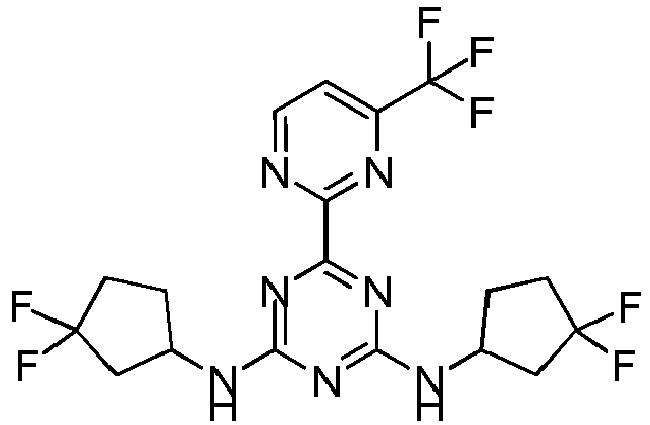
-

-

-

- Example 25 The compounds of this Example are prepared by general Scheme 25, set forth below.

- Step 1: Preparation of ethyl 2-(trifluoromethyl)thiazole-4-carboxylate. To a solution of 2,2,2-trifluoroacetamide(1.42 g, 12.6 mmol) in dry THF(60 mL) was added Lawesson's reagent (3.06 g,7.56 mmol). The reaction mixture was heated atreflux for 18 hr and then cooled, followed by addition ofethyl 3-bromo-2-oxopropanoate (1.6 mL, 12.6 mmol).The mixture was refluxed for another 18 hr and then cooled to r.t.. The resulting mixture was partitioned between EtOAc and water. The organic layer was separated, dried over anhydrous Na2SO4 and concentrated and purified by standard methods to afford ethyl 2-(trifluoromethyl)thiazole-4-carboxylate. 1H NMR (400MHZ, CDCl3) δ 8.42 (s, 1H) 4.47 (q, J=7.1 Hz, 2H), 1.45 (t, J= 7.2 Hz, 3H). LC-MS: m/z 226 (M+H)+.
- Step 2: Preparation of N1,N5-bis(3,3-difluorocyclobutyl)-biguanide. A mixture of 3,3-difluorocyclobutanamine hydrochloride(3.024 g, 0.021 mol) and NaN(CN)2 (890 mg,0.01 mol) was vigorously stirred at 160°C for 2 hr then cooled to r.t.. The resulting mixture was dissolved in MeOH and filtered. The filtrate was concentrated to afford the desired product.LC-MS: m/z 282 (M+H)+.
- Step 3: Preparation of N2,N4-bis(3,3-difluorocyclobutyl)-6-(4-(trifluoromethyl)thiazol-2-yl)-1,3,5-triazine-2,4-diamine. To a mixture of N1,N5-bis(3,3-difluorocyclobutyl)-biguanide (60 mg, 0.22 mmol) in MeOH (5 mL) were added ethyl 2-(trifluoromethyl)thiazole-4-carboxylate (58.5 mg, 0.26 mmol) and NaOMe (23.7 mg, 0.44 mmol). The reaction mixture was then stirred at r.t. for 48 hr then partitioned between EtOAc and H2O. The organic layer was separated, washed with brine, dried over anhydrous Na2SO4, and concentrated and purified by standard methods to afford the N2,N4-bis(3,3-difluorocyclobutyl)-6-(4-(trifluoromethyl)thiazol-2-yl)-1,3,5-triazine-2,4-diamine.

- The procedure set forth in Example 25 was used to produce the following compounds using the appropriate starting materials.
-

-
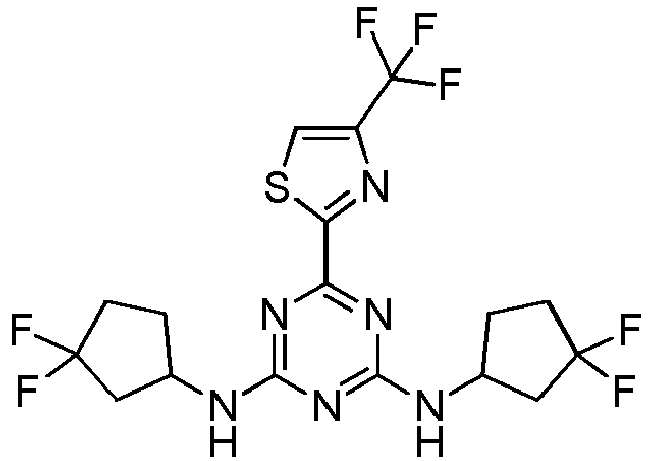
-

-

-

-

-

-

-

-

- Example 26 The compounds of this Example are prepared by general Scheme 26, set forth below.

- Step 1: Preparation of ethyl 2-bromothiazole-4-carboxylate. To a solution of ethyl 2-aminothiazole-4-carboxylate (15.0 g, 87.1 mmol) in MeCN (100 mL) was added isoamyl nitrite (24.5 g, 209 mmol) and CuBr2 (27.5 g, 122 mmol). The mixture was stirred at 70°C overnight, then cooled to r.t., diluted with water (200 mL), and extracted with EtOAc (2 x 200 mL). The combined organic layers were dried over anhydrous Na2SO4 and concentrated and purified by standard methodsto afford ethyl 2-bromothiazole-4-carboxylate. LC-MS: m/z 236 (M+H)+.
- Step 2: Preparation of 2-bromothiazole-4-carboxylic acid. To a solution of ethyl 2-bromothiazole-4-carboxylate (18.0 g, 76.0 mmol) in THF (90 mL) and H2O (90 mL) was added LiOH (4.8 g, 114 mmol). The mixture was stirred at r,t for 3 hr and extracted with EtOAc (2 x 150 mL).The aqueouslayer was separated, adjusted to pH 2-3 with satd. aq. NH4Cl, and filtered. The solid was collected and dried under high vacuum to afford 2-bromothiazole-4-carboxylic acid. LC-MS: m/z 206 (M-H)-.
- Step 3: Preparation of 2-bromo-N-methoxy-N-methylthiazole-4-carboxamide. To a solution of 2-bromothiazole-4-carboxylic acid (11.4 g, 55.0 mmol) in DCM (100 mL) were added N,O-dimethylhydroxylamine (6.9 g, 71.0 mmol), HATU (27.0 g, 71.0 mmol) and DIPEA (21.2 g, 164.0 mmol). The mixture was stirred at r,t.overnight, then quenched with water (200 mL) and extracted with DCM (2 x 200 mL). The combined organic layers were dried over anhydrous Na2SO4, and concentrated and purified by standard methods to afford 2-bromo-N-methoxy-N-methylthiazole- 4-carboxamide.LC-MS: m/z 251 (M+H)+.
- Step 4: Preparation of 1-(2-bromothiazol-4-yl)ethanone. To a solution of 2-bromo-N-methoxy-N-methylthiazole-4-carboxamide (6.8 g, 27.0 mmol) in THF (60 mL) under N2 atomsphere at 0°C was slowly added dropwise MeMgBr (9.9 mL, 29.7 mmol, 3M in THF). The mixture was slowly warmed to r,t and stirred at this temperature for 30 min. The reaction mixture was quenched with satd. aq. NH4Cl (100 mL) and extracted with EtOAc (2 x 100 mL). The combined organic layers were dried over anhydrous Na2SO4, and concentrated and purified by standard methods to afford 1-(2-bromothiazol-4-yl)ethanone. LC-MS: m/z 206 (M+H)+.
- Step 5:Preparation of methyl 4-acetylthiazole-2-carboxylate. To a solution of 1-(2-bromothiazol-4-yl)ethanone (340 mg, 1.65 mmol) in MeOH (10 mL) were added Pd(OAc)2 (20.0 mg, 0.08 mmol), dppf (95.0 mg, 0.16 mmol) and Et3N (250 mg, 2.5 mmol). The mixture was heated at 60°C under CO atmosphere (0.4 mPa) overnight. The resulting mixture was cooled to r.t. and filtered. The filtrate was concentrated and the residue purified by standard methods to afford methyl 4-acetylthiazole-2-carboxylate. LC-MS: m/z 186 (M+H)+.
- Step 6: Preparation of methyl 4-(1,1-difluoroethyl)thiazole-2-carboxylate. To a solution of 4-acetylthiazole-2-carboxylate (200 mg, 1.07 mmol) in DCM (10 mL) at 0°C was slowly added dropwise DAST (1.64 g, 10.2 mmol). The mixture was then warmed to r,t and stirred at r.t. overnight. The mixture was slowly quenched with satd. aq. NaHCO3 (20 mL) and extracted with DCM (2 x 20 mL). The combined organic layers were dried over anhydrous Na2SO4, and concentrated and purified by standard methods to give methyl 4-(1,1-difluoroethyl)thiazole-2-carboxylate.LC-MS: m/z 208 (M+H)+.
- Step 7: Preparation of N2,N4-bis(4,4-difluorocyclohexyl)-6-(4-(1,1-difluoroethyl)thiazol-2-yl)-1,3,5-triazine-2,4-diamine. To a mixture of N1,N5-bis(3,3-difluorocyclobutyl)-biguanide (60 mg, 0.22 mmol) in MeOH (5 mL) were added ethyl 4-(1,1-difluoroethyl)thiazole-2-carboxylate (50 mg, 0.26 mmol) and NaOMe (23.7 mg, 0.44 mmol). The reaction mixture was then stirred at r.t. for 48 hr, and then partitioned between EtOAc and H2O. The organic layer was separated, washed with brine, dried over anhydrous Na2SO4, concentrated and purified by standard methods to afford N2,N4-bis(4,4-difluorocyclohexyl)-6-(4-(1,1-difluoroethyl)thiazol-2-yl)-1,3,5-triazine-2,4-diamine.

- The procedure set forth in Example 26 was used to produce the following compounds using the appropriate starting materials.
-

-

-

- Example 27 The compounds of this Example are prepared by general Scheme 27, set forth below.

- Step 1: Preparation of 2-bromothiazole-4-carbaldehyde. To a mixture of 2-bromo-N-methoxy-N-methylthiazole-4-carboxamide (10 g, 0.04 mol) in THF (80 mL) at -78 °C was slowly added DIBAL-H (7.35 g, 0.052 mol). The reaction mixture wasstirred at -78 °C for 2 hr, then adjusted pH to 5-6. The mixture was partitioned between EtOAc (80 mL) and H2O (60 mL). The organic layer was separated, washed with brine(40 mL), dried over anhydrous Na2SO4, concentrated and purified by standard methods to afford the desired product.LC-MS: m/z 192 (M+H)+.
- Step 2: Preparation of 2-bromo-4-(difluoromethyl)thiazole. To a mixture of 2-bromothiazole-4-carbaldehyde (0.764 g, 0.004 mol) in DCM (7 mL) at 0°C was added dropwise DAST (3.22 g, 0.02 mol). The mixture was stirred at 25 °Cfor 48 hr, then quenched withsatd. aq. NaHCO3 and adjusted pH to 8 - 10. The resulting mixture was extracted with DCM (2 x 40 mL). The combined organic layers were washed with brine(30 mL), dried over anhydrous Na2SO4 and concentrated and purified by standard methods to afford the desired product. LC-MS: m/z 214 (M+H)+.
- Step 3: Preparation of methyl 4-(difluoromethyl)thiazole-2-carboxylate. A mixture of 2-bromo-4-(difluoromethyl)thiazole (0.6 g, 2.82 mmol), dppf (0.14 g, 0.28 mmol), Et3N (0.43 g, 4.23 mmol) and Pd(OAc)2 (0.13 g, 0.56 mmol) in MeOH (10 mL) was stirred at 60 °Cunder an atmosphere of CO for 16 hr. The resulting mixture was filtered, the filtrate was concentrated and the residue was partitioned between DCM (30 mL) and H2O. The organic layer was separated, washed with brine(30 mL), dried over anhydrous Na2SO4, and concentrated and purified by standard methodsto afford the desired product.LC-MS: m/z 194 (M+H)+.
- Step 4: Preparation of N2,N4-bis(4,4-difluorocyclohexyl)-6-(4-(difluoromethyl)thiazol-2-yl)-1,3,5-triazine-2,4-diamine.To a suspension of N1,N5-bis(3,3-difluorocyclobutyl)-biguanide (45 mg, 13.3 mmol) and methyl 4-(difluoromethyl)thiazole-2-carboxylate (40 mg, 20.7 mmol) in MeOH (10mL) was added NaOMe (20 mg, 37.0 mmol). The reaction mixture was stirred at r.t. overnight, then poured into water and extracted with EtOAc.Combined organic layers were over anhydrous Na2SO4, concentrated and purified by standard methods to afford the desired product.

- The procedure set forth in Example 27 was used to produce the following compounds using the appropriate starting materials.
-

-

- Example 28 The compounds of this Example are prepared by general Scheme 28, set forth below.
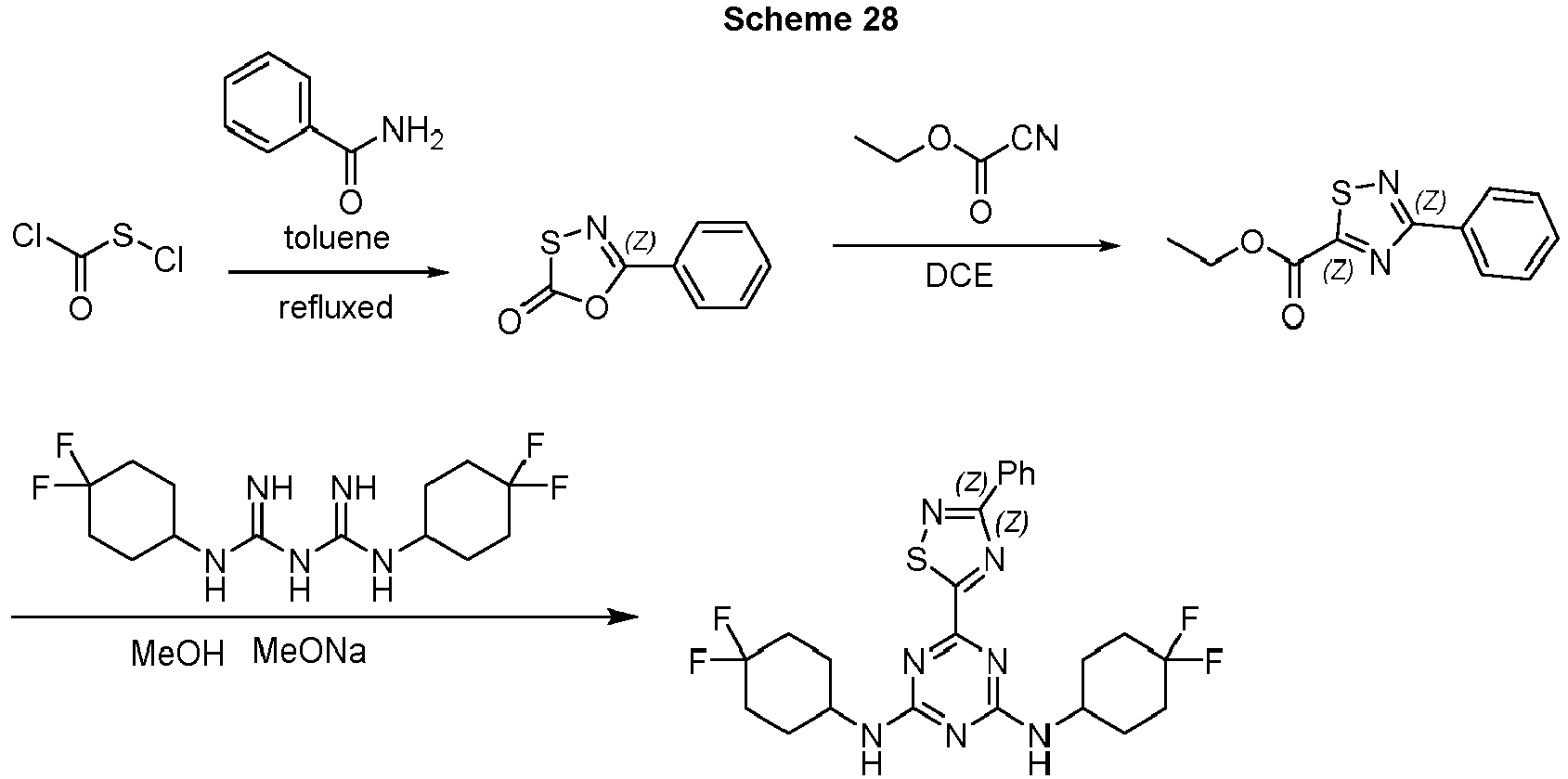
- Step 1: Preparation of 5-phenyl-1,3,4-oxathiazol-2-one. To a solution of benzamide (200 mg, 1.65 mmol) in toluene (2 mL) under N2 atmosphere was added carbonyl chloride thiohypochlorite(0.16 mL, 1.98 mmol). The mixture was stirred at 120°C for 3 hr. The resulting mixture was cooled to r.t., then quenched with H2O and extracted with EtOAc(2 x 10 mL). The combined organic layers were washed with brine, dried over anhydrous Na2SO4, concentrated and purified by standard methods to afford the desired product.LC-MS: m/z 180 (M+H)+.
- Step 2: Preparation of 3-phenyl-1,2,4-thiadiazole-5-carboxylate. A mixture of 5-phenyl-1,3,4-oxathiazol-2-one (270 mg, 1.5 mmol) and ethyl carbonocyanidate (790 mg, 6.0 mmol) in DCE (2 mL) was stirred in a sealed vial under microwave irradiation at 160°C for 0.5 hr. The resulting mixture was concentrated and purified by standard methods to afford the desired product.LC-MS: m/z 235 (M+H)+.
- Step 3: Preparation of N2,N4-bis(4,4-difluorocyclohe-xyl)-6-(3-phenyl-1,2,4-thiadiazol-5-yl)-1,3,5-triazine-2,4-diamine. To a mixture of N1,N5-bis(4,4-difluorocyclohexyl)-biguanide (90 mg, 0.27 mmol) and ethyl 3-phenyl-1,2,4-thiadiazole-5-carboxylate (75 mg, 0.32 mmol) in MeOH (2 mL) was added NaOMe (43 mg, 0.8 mmol). The reaction mixture was then stirred at r.t. overnight. The resulting mixture was poured into water and extracted with EtOAc. The combined organic layers were dried over anhydrous Na2SO4 and concentrated and purified by standard methods to afford the desired product.

- The procedure set forth in Example 28was used to produce the following compounds using the appropriate starting materials.
-

- Example 29 The compounds of this Example are prepared by general Scheme 29, set forth below.

- Step 1.Preparation of 6-chloro-N2,N4-bis((R)-1-cyclopropylethyl)-1,3,5-triazine-2,4-diamine. To a solution of 2,4,6-trichloro-1,3,5-triazine (2 g, 10.9 mmol) in acetone (35 mL) were added (S)-1-cyclopropylethanamine hydrochloride(2.7 mg, 22.8 mmol), DIPEA (3.5 mg, 27 mmol) and CsF (3.3 mg, 21.8 mmol). The mixture was stirred at 50°C overnight, and then filtered. The filtrate was concentrated and purified by standard methods to give the desired product. LC-MS: m/z 282 (M+H)+.
- Step B.Preparation of N2,N4-bis((R)-1-cyclopropylethyl)-6-(4-methyl-1H-pyrazol-1-yl)-1,3,5-triazine-2,4-diamine. To an ice-cold solution of 4-methyl-1H-pyrazole (207 mg, 1.07 mmol)in dry THF (5 mL) was slowly added NaH (34 mg, 1.42 mmol) over 30 min, followed by addition of a solution of 6-chloro-N2,N4-bis((R)-1-cyclo-propylethyl)-1,3,5-triazine-2,4-diamine (200 mg, 0.71 mmol) in THF (3 mL). The reaction mixture was stirred at r.t. overnight, and then concentrated and purified by standard methods to afford N2,N4-bis((R)-1-cyclopropylethyl)-6-(4-methyl-1H-pyrazol-1-yl)-1,3,5-triazine-2,4-diamine.

- The procedure set forth in Example 29 was used to produce the following compounds using the appropriate starting materials.
-

-

-

-

-

-

-

-

- Example 30 The compounds of this Example are prepared by general Scheme 30, set forth below.

- Step 1: Preparation of methyl 1-methyl-1H-pyrazole-3-carboxylate. To a solution of 1-methyl-1H-pyrazole-3-carboxylic acid (504 mg, 4 mmol) in MeOH (5 mL) was added SOCl2 (1.4 mL, 20 mmol) at 0°C. The mixture was stirred at r.t overnight then concentrated under reduced pressure. The residue was dissolved in EtOAc, washed withsatd. aq. NaHCO3 and concentrated to afford methyl 1-methyl-1H-pyrazole-3-carboxylate.LC-MS: m/z 141 (M+H)+.
- Step 2: Preparation of N2,N4-bis(4,4-difluorocyclohexyl)-6-(1-methyl-1H-pyrazol-3-yl)-1,3,5-triazine-2,4-diamine. To a solution of N1,N5-bis(4,4-difluorocyclohexyl)-biguanide (120 mg, 0.36 mmol) and methyl 1-methyl-1H-pyrazole-3-carboxylate (60 mg, 0.43 mmol) in MeOH (2 mL) was added NaOMe (28 mg, 1.07 mmol). The reaction mixture was stirred at r.t. overnight, then poured into water and extracted with EtOAc. Combined organic layers were dried over anhydrous Na2SO4, and concentrated and purified by standard methods to afford N2,N4-bis(4,4-difluorocyclohexyl)-6-(1-methyl-1H-pyrazol-3-yl)-1,3,5-triazine-2,4-diamine.

- The procedure set forth in Example 30was used to produce the following compounds using the appropriate starting materials.
-

-

-

-

- Example 31 The compounds of this Example are prepared by general Scheme 31, set forth below.

- Step 1: Preparation of 4-iodo-3-(trifluoromethyl)-1H-pyrazole. To a solution of 3-(trifluoromethyl)-1H-pyrazole (500 mg, 3.7 mmol) in 50% H2SO4 at 0 °C was added NIS (992 mg, 4.4 mmol). The suspension was stirred at 0°C for 10 min and then at r.t. for 3 hr. The resulting mixture was quenched with water (50 mL), and then stirred overnight. The precipitate was collected by filtration and dried to afford 4-iodo-3-(trifluoromethyl)-1H-pyrazole.LC-MS: m/z 263 (M+H)+.
- Step 2: Preparation of 4-(4,4,5,5-tetramethyl-1,3,2-dioxaborolan-2-yl)-3-(trifluoromethyl)-1H-pyrazole. To a mixture of 4-iodo-3-(trifluoromethyl)-1H-pyrazole (100 mg, 0.38 mmol) and (4,4,4',4',5,5,5',5'-octamethyl-2,2'-bi(1,3,2-dioxaborolane) (397 mg, 0.57 mmol) in DMF (3 mL) were added 1,1'-bis-(diphenylphosphino)ferrocene-palladium(II)dichloride dichloromethane complex (31 mg, 0.04 mmol) and potassium acetate (509 mg, 0.76).The reaction mixture was stirred at 90 °C for 2 hr, then quenched with water and extracted with Et2O. The combined organic layers were washed with brine, dried over anhydrous Na2SO4, and concentrated to afford 4-(4,4,5,5-tetramethyl-1,3,2-dioxaborolan-2-yl)-3-(trifluoromethyl)-1H-pyrazole.LC-MS: m/z 263 (M+H)+.
- Step 3: Preparation of N2,N4-bis(4,4-difluorocyclohexyl)-6-(3-(trifluoromethyl)-1H-pyrazol-4-yl)-1,3,5-triazine-2,4-diamine. To a solution of 6-chloro-N2,N4-bis(4,4-difluorocyclohexyl)-1,3,5-triazine-2,4-diamine (145 mg, 0.38 mmol) and 4-(4,4,5,5-tetramethyl-1,3,2-dioxaborolan-2-yl)-3-(trifluoromethyl)-1H-pyrazole (100 mg, 0.38 mmol) in DME (3 mL) and H2O (1 mL) were added K2CO3 (158 mg, 1.15 mmol) and Pd(PPh3)4 (44 mg, 0.04 mmol) under N2 atmosphere. The mixture was stirred at 90°C for 16 hr, and then filtered. The filtrate was partitioned between EtOAc and H2O. The aqueous layer was separated and extracted with EtOAc. The combined organic layerswere washed with brine, dried over anhydrous Na2SO4, and concentrated and purified by standard methods to afford N2,N4-bis(4,4-difluorocyclohexyl)-6-(3-(trifluoromethyl)-1H-pyrazol-4-yl)-1,3,5-triazine-2,4-diamine.

- The procedure set forth Example 31 was used to produce the following compounds using the appropriate starting materials.
-

-

-

-

-
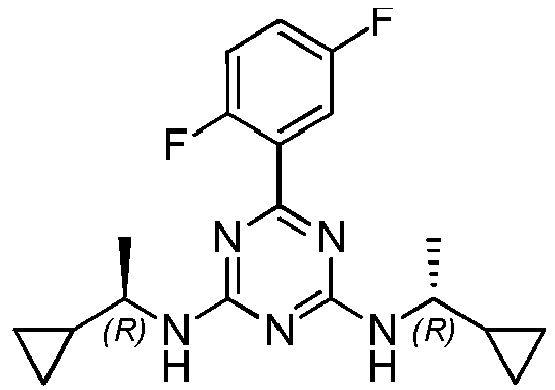
-

-

- Example 32. Preparation of Aromatic-Aliphatic Triazine Compounds of Formula Q. The compounds of this Example are prepared by general Scheme 32, set forth

- Step 1: Preparation of 4-chloro-N-(6-(1,1-difluoroethyl)pyridin-3-yl)-6-(6-(trifluoromethyl)pyridin-2-yl)-1,3,5-triazin-2-amine. To a mixture of 2,4-dichloro-6-(6-(trifluoromethyl)pyridin-2-yl)-1,3,5-triazine (188 mg, 0.64 mmol) and 2-(1,1-difluoroethyl)pyridin-4-amine (50 mg, 0.32 mmol) in 1, 4-dioxane (4 mL) were added tBuONa (61 mg, 0.64 mmol) and Pd(dppf)Cl2 (22 mg, 0.03 mmol) under an atmosphere of nitrogen. The reaction mixture was then stirred at 80°C overnight, and then filtered. The filtrate was concentrated and purified by standard methods to afford the desired product.

- Step 2:Preparation of N2-(3,3-difluorocyclopentyl)-N4-(2-(1,1-difluoroethyl)pyridin-4-yl)-6-(6-(trifluoromethyl)pyridin-2-yl)-1,3,5-triazine-2,4-diamine To a mixture of 4-chloro-N-(6-(1,1-difluoroethyl)pyridin-3-yl)-6-(6-(trifluoromethyl)pyridine-2-yl)-1,3,5-triazin-2-amine (35 mg, 0.08 mmol) and 3,3-difluorocyclopentanamine (16 mg, 0.13 mmol) in THF (2 mL) were added CsF (24 mg, 0.16 mmol) and DIPEA (0.03 mL, 0.16 mmol). The reaction mixture was then stirred at 50°C overnight. The mixture was filtered and the filtrate was concentrated and purified by standard methods to afford the desired product.

- The procedure set forth in Example 32 was used to produce the following compounds using the appropriate starting materials.
-

-

-

-

-
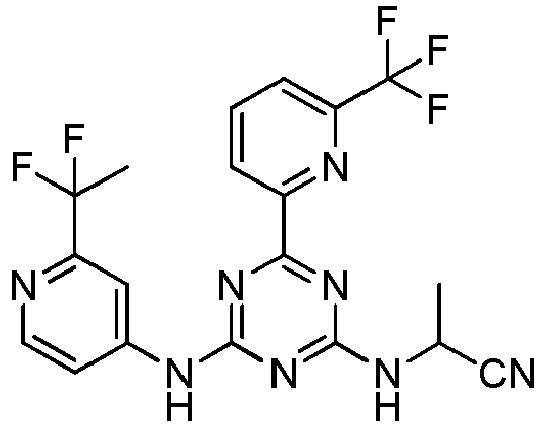
-

-
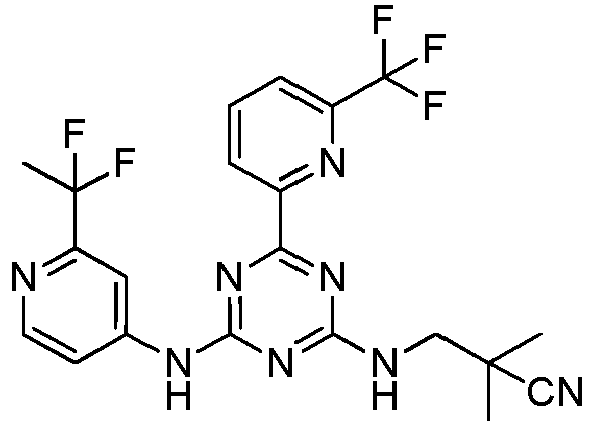
-

-

-

-

-

-

-

-

-

-

-

-

-

-

-

-

-

-

-

-

-

-

-

-

-

-

-

-

-

-

-

-

-

-

-

-

-

-

-

-

-

-

-

-

-

-

-

-

-

-

-

-

-

-

-

-

-

-

-

-

-

-
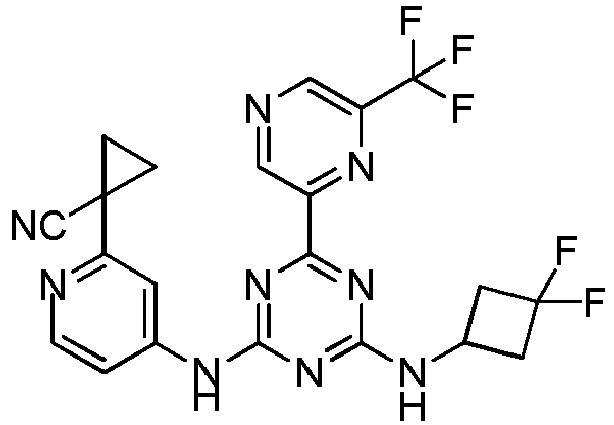
-

-

-

-

-

-

-

-

-

-

-

-

-

-

-

-

-
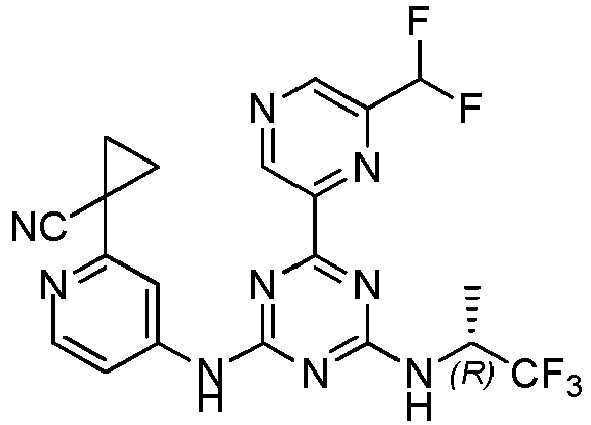
-

-

-
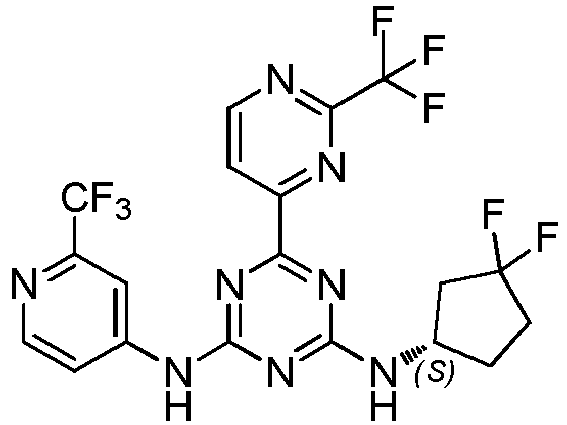
-

-

-

-

-

-

-

-

-

-

- Example 33. Preparation of Aromatic-aliphatic Triazine Compounds. The compounds of this Example are prepared by general Scheme 33, set forth below.

- Step 1: Preparation of N1-(3,5-difluorophenyl)-N3-nitrile-guanidine. To a solution of NaN(CN)2 (4.1 g, 46.5 mmol) in water (34 mL) at 80°C was added a solution of 3,5-difluoroaniline (3 g, 23.2 mmol) in a mixed solvent of water and conc. HCl (2M, 2 mL). The reaction mixture was then stirred at 90°C for 16 hours. The resulting mixture was cooled to r.t. and quenched by satd. aq. NaHCO3 and adjusted topH 7-8. The mixture was filtered and the filter cake was collected and dried to afford the desired product. LC-MS: m/z 197 (M+H)+.
- Step 2: Preparation of N1-(3,5-difluorophenyl)-N5-(4,4-difluorocyclohexyl)-guanidine. A mixture of N1-(3,5-difluorophenyl)-N3-nitrile-guanidine (300 mg, 1.53 mmol) and 4,4-difluorocyclohexanamine hydrochloride (262 mg, 1.53 mmol) was well mixed together and then stirred at 160°C for 1 hr. The resulting mixture was cooled to r.t. and then triturated with a mixed solvent of EtOAc and PE. The solid was collected by filtration and dried to afford the desired product. LC-MS: m/z 332 (M+H)+.
- Step 3: Preparation of 3,6-difluoro-2-hydrazinylpyridine. To an ice-cold mixture of 2,3,6-trifluoropyridine (1.0 g, 7.5 mmol) in ethanol (10 mL) was added hydrazine hydrate (0.75 g, 15.0 mmol). The reaction mixture was warmed to r.t. then heated to reflux for 2 hr. After cooling to r.t., the reaction mixture was diluted with water (10 mL) and extracted with DCM (2 x 20 mL). The combined organic layers were dried over anhydrous Na2SO4 and concentrated under reduced pressure to afford 3,6-difluoro-2-hydrazinylpyridine. LC-MS: m/z 146 (M+H)+.
- Step 4:Preparation of2-bromo-3,6-difluoropyridine. To a stirred solution of 3,6-difluoro-2-hydrazinylpyridine(1.1 g, 7.0 mmol) in chloroform (20 mL) at r.t. was added dropwise bromine (1.8 g, 11.2 mmol).The reaction mixture was then stirred at 60°C for 1.5 hr. The resulting mixture was cooled to r.t.,then quenched with satd. aq. NaHCO3, and extracted with dichloromethane (2 x 20 mL). The combined organic layers were dried over anhydrous Na2SO4, and concentrated and purified by standard methods to afford 2-bromo-3,6-difluoropyridine. LC-MS: m/z 194 (M+H)+.
- Step 5:Preparation of methyl 3,6-difluoropicolinate. To a solution of 2-bromo-3,6-difluoropyridine (0.8 g, 4.1mmol) in MeOH (10 mL) were added dppf (0.3 g, 0.56 mmol), Pd(OAc)2 (0.1 g, 0. 45 mmol) and Et3N (1.6 mL, 8.2 mmol). The suspension was degassed and back-filled with CO atmosphere three times. The mixture was then stirred under CO atmosphere (60 psi) at 70°C for 12 hr. The resulting mixture was cooled to r.t. and concentrated under reduced pressure. The residue was triturated with EtOAc (150 mL). The solid was filtered off and the filtrate was concentrated and purified by standard methods to afford methyl 3,6-difluoropicolinate. LC-MS: m/z 174 (M+H)+.
- Step 6: Preparation of N2-(4,4-difluorocyclohexyl)-N4-(3,5-difluorophenyl)-6-(3,6-difluoropyridin-2-yl)-1,3,5-triazine-2,4-diamine. To a suspension of N1-(3,5-difluorophenyl)-N5-(4,4-difluorocyclohexyl)-guanidine (191 mg, 0.58 mmol) and methyl 3,6-difluoropicolinate (100 mg, 0.58 mmol) in MeOH (3 mL) was added NaOMe (94 mg, 1.73 mmol). The reaction mixture was stirred at r.t. overnight, then poured into water and extracted with EtOAc. Combined organic layers were dried over anhydrous Na2SO4, and concentrated and purified by standard methods to afford N2-(4,4-difluorocyclohexyl)-N4-(3,5-difluorophenyl)-6-(3,6-difluoropyridin-2-yl)-1,3,5-triazine-2,4-diamine.

- The procedure set forth in Example 33 was used to produce the following compounds using the appropriate starting materials.
-

-

- Example 34. The compounds of this Example are prepared by general Scheme 34, set forth below.

- Step 1: Preparation of N2-(4,4-difluorocyclohexyl)-N4-(3,5-difluorophenyl)-6-(3-fluoro-6-hydrazinylpyridin-2-yl)-1,3,5-triazine-2,4-diamine. To a solution of N2-(4,4-difluorocyclohexyl)-N4-(3,5-difluorophenyl)-6-(3,6-difluoropyridin-2-yl)-1,3,5-triazine-2,4-diamine(225 mg, 0.49 mmol) in THF(20 mL) was added hydrazine hydrate(150 mg, 3.0 mmol). The reaction mixture was thenstirred at 60°C for 2.5 hr. After cooling to r.t., the reaction mixture was diluted with DCM (20 mL) and washed with brine (2 x 10 mL). The organic phase was separated, dried over anhydrous Na2SO4 and concentrated under reduced pressure to give the desired product.

- Step 2: Preparation of 6-(6-amino-3-fluoropyridin-2-yl)-N2-(4,4-difluorocyclohexyl)-N4-(3,5-difluorophenyl)-1,3,5-triazine-2,4-diamine. To a solution of N2-(4,4-difluorocyclohexyl)-N4-(3,5-difluorophenyl)-6-(3-fluoro-6-hydrazinylpyridin-2-yl)-1,3,5-triazine-2,4-diamine(46 mg,0.1 mmol) in methanol(5.0 mL) was added Raney Ni (100 mg). The mixture was stirred at r.t. under H2 atmosphere overnight. The resulting mixture was filtered and the filtrate was concentrated and purified by standard methods to afford 6-(6-amino-3-fluoropyridin-2-yl)-N2-(4,4-difluorocyclohexyl)-N4-(3,5-difluorophenyl)-1,3,5-triazine-2,4-diamine.

- The procedure set forth in Example 34was used to produce the following compounds using the appropriate starting materials.
-

-

- Step A: 6-(Trifluoromethyl)pyrazine-2-carboxamide. To a solution of methyl 6-(trifluoromethyl) pyrazine-2-carboxylate (15 g, 72.8 mmol) in EtOH (20 mL) was added NH4OH (6 mL, 156 mmol).The reaction mixture was stirred at r.t. for 4hr then concentrated under reduced pressure. The residue was triturated with H2O(10 mL) and then filtered to afford 6-(trifluoromethyl)pyrazine-2-carboxamide.LC-MS: m/z 192 (M+H)+.
- Step B:6-(Trifluoromethyl)pyrazine-2-carbonitrile. A mixture of 6-(trifluoromethyl) pyrazine-2-carboxamide (10 g, 52 mmol) in POCl3 (80 mL) was stirred at 100°Covernight. The reaction mixture was cooled to r.t. and concentrated under reduced pressure. The residue was partitioned between DCM and ice water. The organic layer was separated, washed with brine, dried over anhydrous Na2SO4,concentrated, and purified by standard methods to afford 6-(trifluoromethyl)pyrazine-2-carbonitrile.LC-MS: m/z 174 (M+H)+.
- Step C: 6-(Trifluoromethyl)pyrazine-2-carboximidamide hydrochloride. To a solution of 6-(trifluoromethyl) pyrazine-2-carbonitrile (3.4 g, 15 mmol) in MeOH (5 mL) was added a solution of sodium metal (35 mg, 1.5 mmol) in MeOH. The reaction mixture was stirred at r.t. for 12 hr, followed by addition of NH4Cl (1.5 g, 30 mmol). The mixture was stirred at 70°C for 3 hr, then cooled to r.t. and concentrated under reduced pressure. The residue was diluted with EtOH (10 mL) and stirred at reflux for 0.5 hr. The resulting mixture was cooled to r.t. and filtered. The filtrate was concentrated under reduced pressure to afford 6-(trifluoromethyl) pyrazine-2-carboximidamide hydrochloride. LC-MS: m/z 191 (M+H)+.
- Step D: 2-(6-(trifluoromethyl)pyrazin-2-yl)pyrimidine-4,6(1H,5H)-dione. To a mixture of 6-(trifluoromethyl) pyrazine-2-carboximidamide hydrochloride (1.6 g, 7.0 mmol) in diethyl malonate (3.2 g, 21.2 mmol) was added potassium carbonate (3.0 g, 21.2 mmol). The reaction mixture was stirred at 120 °C for 8 hr. The resulting mixture was cooled to r.t. and triturated with petroleum ether. The solid was collected by filtration, washed with petroleum ether then treated with MeOH to form a suspension. The suspension was filtered and the filtrate was concentrated under reduced pressure to afford 2-(6-(trifluoromethyl)pyrazin-2-yl)pyrimidine-4,6-(1H,5H)-dione. LC-MS: m/z 259 (M+H)+.
- Step E: 4, 6-Dichloro-2-(6-(trifluoromethyl)pyrazin-2-yl)pyrimidine. A mixture of 2-(6-(trifluoromethyl) pyrazin-2-yl) pyrimidine-4, 6(1H, 5H)-dione (1.4 g, 5.4 mmol) in POCl3 (10 mL) was stirred at 100°C overnight then cooled to r.t. and concentrated under reduced pressure. The residue was purified by column chromatography (PE/EA = 20/1 to 10/1) to afford 4, 6-dichloro-2-(6-(trifluoromethyl) pyrazin-2-yl)pyrimidine.LC-MS: m/z 295 (M+H)+.
- Step F: N4, N6-bis (4,4-difluorocyclohexyl)-2-(6-(trifluoromethyl)pyrazin-2-yl)pyrimidine-4, 6-diamine. To a mixture of 4, 6-dichloro-2-(6-(trifluoromethyl) pyrazin-2-yl)pyrimidine (100 mg, 0.34 mmol), CsF(103 mg, 0.68 mmol) and 4,4-difluorocyclohexanamine hydrochloride (116 mg, 0.68 mmol) in DMSO (1 mL) was added DIPEA (220 mg, 0.17 mmol). The reaction mixture was stirred at 80°C for 4 hr under nitrogen,and then stirred at 150°C for 6 hr under microwave irradiation. The resulting mixture was cooled to r.t., quenched with water, and extracted with EtOAc. The combined organic layers were washed with brine, dried over anhydrous Na2SO4, and concentrated under reduced pressure. The residue was purified by standard methods to afford N4,N6-bis (4,4-difluorocyclohexyl)-2-(6-(trifluoromethyl) pyrazin-2-yl) pyrimidine-4, 6-diamine.

- Example 36. Preparation of Aromatic-aliphatic Triazine Compounds. The compounds of this Example are prepared by general Scheme 36, set forth below.

- Step 1: Preparation of 1-(4-bromopyridin-2-yl)cyclopropanecarbonitrile. To a solution of 4-bromo-2-fluoropyridine (30 g, 170.47 mmol) and cyclopropane carbonitrile (22.9 g, 340.94 mmol) in THF (400 mL) below -10°C was slowly added dropwise LiHMDS (1.2 mmol/L, 284 mL). The reaction mixture was then stirred at r.t. for 12 hr. The resulting mixture was cooled to 0°C, then quenched with brine (200 mL). The mixture was concentrated under reduced pressure. The residue was extracted with EtOAc (3x200 mL). The combined layers were dried over anhydrous Na2SO4 and concentrated and purified by standard methods to afford the desired product.LC-MS: m/z 223 (M+H)+.
- Step 2: Preparation of 1-(4-(diphenylmethyleneamino)pyridin-2-yl)cyclopropanecarbonitrile. To a solution of 1-(4-bromopyridin-2-yl)cyclopropanecarbonitrile (30 g, 134.48 mmol) and diphenyl methanimine (29.3 g, 161.38 mmol) in dioxane (150 mL) were added t-BuONa (19.4 g, 201.73 mmol), Binap (5.0 g, 8.1 mmol) and Pd2(dba)3 (2.5 g, 2.69 mmol).The mixture was heated to 100°C for 1 hr under N2 atmosphere, then cooled and filtered. The filtrate was concentrated to give the desired product. LC-MS: m/z 324 (M+H)+.
- Step 3: Preparation of 1-(4-aminopyridin-2-yl)cyclopropanecarbonitrile. A mixture of 1-(4-(diphenylmethyleneamino)pyridin-2-yl)cyclopropanecarbonitrile (42.1 g crude, 130 mmol) and THF/ aq. HCl (2N) (200 mL, V:V=2:1) was stirred at r.t. for 1 hr and concentrated under reduced pressure. The aqueouslayer was extracted with PE (3x100 mL), then adjusted to pH 8-9 with satd. aq. Na2CO3, and extracted with EtOAc (3x100 mL).The combined organic layers were dried over anhydrous Na2SO4, and concentrated concentrated and purified by standard methods to afford the desired product. 1HNMR (CDCl3)δ8.04-8.05 (d, J=4Hz, 1H), 6.95-6.96 (d, J=4Hz), 6.37-6.39 (m, 1H), 4.23 (br, 2H), 1.17-1.80 (m, 2H), 1.61-1.63 (m, 2H).LC-MS: m/z 160 (M+H)+.
- Step 4: Preparation of 1-(4-(4,6-dichloro-1,3,5-triazin-2-ylamino)pyridin-2-yl)cyclopropane carbonitrile. To a solution of 1-(4-aminopyridin-2-yl)cyclopropanecarbonitrile (2.5 g, 15.7 mmol), 2,4,6-trichloro-1,3,5-triazine (3.5 g, 18.8 mmol) in THF (40 mL) was added NaHCO3 (2.64 g, 31.4 mmol). The reaction mixture was stirred at r.t. overnight thenfiltered. The filtrate was concentrated and purified by standard methods to afford the desired product.LC-MS: m/z 307 (M+H)+.
- Step 5: Preparation of 1-(4-(4-chloro-6-(3,3-difluorocyclopentylamino)-1,3,5-triazin-2-yl amino)pyridin-2-yl)cyclopropanecarbonitrile. To a solution of 1-(4-(4,6-dichloro-1,3,5-triazin-2-ylamino)pyridin-2-yl)cyclopropanecarbonitrile (0.75 g, 2.44mmol) and 3,3-difluorocyclopentanamine hydrochloride (0.39 g, 2.44 mmol) in THF (10 mL) at 0 °C was slowly added dropwise DIPEA (0.63 g, 4.88 mmol).The reaction mixture was stirred at r.t. for 8hr, and then concentrated under reduced pressure. The residue was partitioned between EtOAc (20mL) and HCl solution (10 %wt, 3 mL). The aqueous layer was separated and extracted with EtOAc (2x5 mL).The combined organic layers were dried over anhydrous Na2SO4 and concentrated and purified by standard methods to afford the desired product.LC-MS: m/z 392 (M+H)+.
- Step 6: Preparation of 1-(4-(4-(3,3-difluorocyclopentylamino)-6-(3-(trifluoromethyl)-1H-pyrazol-1-yl)-1,3,5-triazin-2-ylamino)pyridin-2-yl)cyclopropanecarbonitrile. To a solution of 1-(4-(4-chloro-6-(3,3-difluorocyclopentylamino)-1,3,5-triazin-2-ylamino) pyridin-2-yl)cyclopropanecarbonitrile (0.6 g, 1.53 mmol) in DMF (600 mL) were added 3-(trifluoromethyl)-lH-pyrazole (0.2 g, 1.53 mmol) and K2CO3 (0.42 g, 3.06 mmol). The mixture was stirred at 35°C overnight then concentrated under reduced pressure. The residue was dissolved in EtOAc (20mL) then washed in sequence withaq. 10% LiCl solution (2x5 mL), 5% HCl solution(2x5 mL), and satd. aq. NaHCO3 (2x5 mL). The organic layer was separated, dried over anhydrous Na2SO4, and concentrated and purified by standard methods to afford the desired product. 1H NMR (400 MHz, CDCl3) δ 8.81 - 8.21 (m, 3H), 7.75 - 7.43 (m, 1H), 7.17 - 6.88 (m, 1H), 6.74 (d, J = 2.7 Hz, 1H), 6.05 - 5.76 (m, 1H), 5.12 - 4.41 (m, 1H), 2.86 - 2.61 (m, 1H), 2.57 - 2.00 (m, 4H), 1.97 - 1.78 (m, 3H), 1.76 - 1.68 (m, 2H). LC-MS: m/z 492 (M+H)+.
- The procedure set forth in Example 36was used to produce the following compounds using the appropriate starting materials.
-

-

-

-

-

-

-

-

-
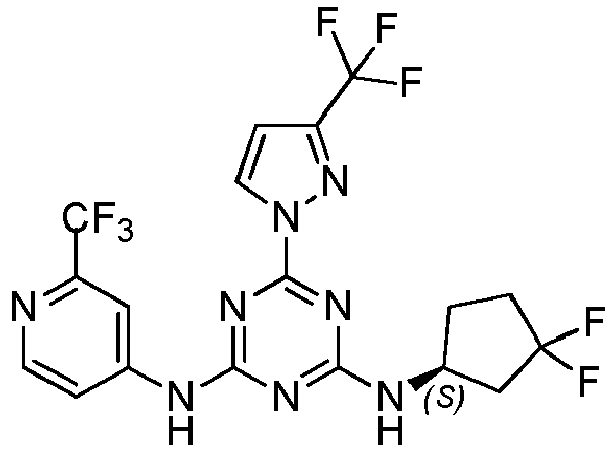
-

-

-

-

-

-

-

-

-

-

-

-

-

-

-

-

- Example 37. Preparation of Aromatic-aliphatic Triazine Compounds of Formula Ic. The compounds of this Example are prepared by general Scheme 37, set forth below.

- Step 1: Preparation of 4,6-dichloro-N-(2-(trifluoromethyl)pyridin-4-yl)-1,3,5-triazin-2-amine. To a solution of 2-(trifluoromethyl)pyridin-4-amine (3 g, 18.7 mmol) and 2,4,6-trichloro-1,3,5-triazine (3.6 g, 19.5 mmol) in THF (40 mL) was added NaHCO3(3.1 g,37.5 mmol). The reaction mixture was stirred at r.t. for 16 hr and filtered. The filtrate was concentrated concentratedand purified by standard methodsto affordthe desired product.LC-MS: m/z 310 (M+H)+.
- Step 2:Preparation of 6-chloro-N2-(3,3-difluorocyclobutyl)-N4-(2-(trifluoromethyl)pyridin-4-yl)-1,3,5-triazine-2,4-diamine. To a solution of 4,6-dichloro-N-(2-(trifluoromethyl)pyridin-4-yl)-1,3,5-triazin-2-amine (4 g, 12.9 mmol) and 3,3-difluorocyclobutanamine hydrochloride (1.9 g, 13.5 mmol) in THF (40 mL) was added DIPEA (4.8 g, 37.2 mmol). The reaction mixture was stirred at r.t. for 15 hr then concentrated under reduced pressure The residue was partitioned between EtOAc (200 mL) and aq. HCl (10%wt, 50 mL). The aqueous layer was separated and extracted with EtOAc (2 x 100 mL). The combined organic layers were dried over anhydrous Na2SO4,concentratedand purified by standard methodsto affordthe desired product. LC-MS: m/z 381 (M+H)+.
- Step 3:Preparation of 4-(3,3-difluorocyclobutylamino)-6-(2-(trifluoromethyl)pyridin-4-ylamino)-1,3,5-triazine-2-carbonitrile. To a solution of 6-chloro-N2-(3,3-difluorocyclobutyl)-N4-(2-(trifluoromethyl)pyridin-4-yl)-1,3,5-triazine-2,4-diamine (2.2 g, 5.77 mmol) in MeCN (30 mL) and DMSO (10 mL) at r.t. was added NaCN (2.9 g, 60 mmol). The reaction mixture was stirred at 60°C overnight then partitioned between EtOAc (50 mL) and H2O (20 mL).The organic layer was separated, washed with brine, dried over anhydrous Na2SO4, concentratedand purified by standard methodsto affordthe desired product.LC-MS: m/z 372 (M+H)+.
- Step 4: Preparation of 4-(3,3-difluorocyclobutylamino)-6-(2-(trifluoromethyl)pyridin-4-ylamino)-1,3,5-triazine-2-carbothioamide. To a solution of 4-(3,3-difluorocyclobutylamino)-6-(2-(trifluoromethyl)pyridin-4-ylamino)-1,3,5-triazine-2-carbonitrile (0.7 g, 1.88 mmol) in DMF (15 mL) were added NaHS (0.5 g, 9.0 mmol) and MgCl2 (0.85 g, 9.0 mmol). The reaction mixture was stirred at r.t. for 0.5 hr then partitioned between EtOAc (30 mL) and H2O (10 mL).The organic layer was separated, washed with brine, dried over anhydrous Na2SO4, and concentratedand purified by standard methodsto affordthe desired product.LC-MS: m/z 406 (M+H)+.
- Step 5: Preparation of 2-(4-(3,3-difluorocyclobutylamino)-6-(2-(trifluoromethyl)pyridin-4-ylamino)-1,3,5-triazin-2-yl)-4-(trifluoromethyl)-4,5-dihydrothiazol-4-ol A mixture of 4-(3,3-difluorocyclobutylamino)-6-(2-(trifluoromethyl)pyridin-4-ylamino)-1,3,5-triazine-2-carbothioamide (350 mg, 0.86 mmol) and 3-bromo-1,1,1-trifluoropropan-2-one (180 mg, 0.95 mmol) in MeCN (10 mL) was stirred at 60°C for 2 hr then partitioned between EtOAc (20 mL) and H2O (10 mL). The organic layer was separated, washed with brine, dried over anhydrous Na2SO4, and concentratedand purified by standard methodsto affordthe desired product. 1H NMR (400 MHz, DMSO-d6) δ 10.94 - 10.86 (m, 1H), 9.08 (d, J = 6.0 Hz, 1H), 8.69 - 8.48 (m, 2H), 7.86 - 7.78 (m, 2H), 4.30 - 4.21 (m, 1H), 3.76 - 3.71 (m, 1H), 3.53 - 3.41 (m, 1H), 3.11 - 2.93 (m, 2H), 2.87 - 2.66 (m, 2H). LC-MS: m/z 516 (M+H)+.
- Step 6: Preparation of N2-(3,3-difluorocyclobutyl)-N4-(2-(trifluoromethyl)pyridin-4-yl)-6-(4-(trifluoromethyl)thiazol-2-yl)-1,3,5-triazine-2,4-diamine. To a solution of 2-(4-(3,3-difluorocyclobutylamino)-6-(2-(trifluoromethyl)pyridin-4-ylamino)-1,3,5-triazin-2-yl)-4-(trifluoromethyl)-4,5-dihydrothiazol-4-ol (250 mg, 0.48 mmol) and TEA (0.4 mL, 2.4 mmol) in DCM (20 mL) at 0°C was added dropwise a solution of triphosgene (290 mg, 0.96 mmol) in DCM (5 mL). The reaction mixture was stirred at 0°C for 0.5 hr, and then partitioned between DCM (20 mL) and H2O (10 mL).The organic layer was separated, washed with brine, dried over anhydrous Na2SO4, and concentratedand purified by standard methodsto affordthe desired product. 1H NMR (400 MHz, DMSO-d6) δ 11..05 -10.94 (m, 1H), 9.10 (d, J = 6.1 Hz, 1H), 8.82 (s, 1H), 8.70 (s, 1H), 8.64 (t, J = 5.4 Hz, 1H), 7.83 (d, J = 5.4 Hz, 1H), 4.52 - 4.22 (m, 1H), 3.18 - 2.99 (m, 2H), 2.82 (dt, J = 32.2, 14.2 Hz, 2H).LC-MS: m/z 498 (M+H)+.
- The procedure set forth above in Example 37 used to produce the following compounds using the appropriate starting materials.
-

-

-

-

-

-

- Example 38.Preparation of Dialiphatic Pyrimidine Compounds of Formula S. The compounds of this Example are prepared by general Scheme 32, set forth below.

- Step 1: Preparation of methyl 6-chloropicolinimidate. To a solution of 6-chloropicolinonitrile (3 g, 22 mmol) in MeOH (25 mL) was added a freshly prepared solution of sodium metal (55 mg, 2.4 mol) in MeOH (5 mL). The reaction mixture was stirred at r.t. for 16 hr, and then concentrated under reduced pressure to afford the desired product. LC-MS: m/z 171 (M+H)+.
- Step 2: Preparation of 6-chloropicolinimidamide. A mixture of ammonium chloride (2.18 g, 40mmol) and methyl 6-chloropicolinimidate (3.5 g, 20mmol) in MeOH (30 mL) was a stirred at 70°C for 3 hr, then cooled to r.t. and concentrated under reduced pressure. The residue was diluted with EtOH (40 mL) and stirred at reflux for 0.5 hr. The resulting mixture was cooled and filtered. The filtrate was concentrated under reduced pressure to give the desired product.LC-MS: m/z 156 (M+H)+.
- Step 3: Preparation of 2-(6-chloropyridin-2-yl)pyrinddine-4,6-diol To a solution of sodium metal (0.9 g, 40mmol) in MeOH (10 mL) was added 6-chloropicolinimid -amide (2 g, 13 mmol) and dimethyl malonate (1.7 g, 13 mmol).The reaction mixture was stirred at 85°C overnight, and then concentrated under reduced pressure. The residue was triturated with EtOAc (30 mL) and filtered. The solid was collected and dried under high vacuum to give the desired product.LC-MS: m/z 224 (M+H)+.
- Step 4: Preparation of 4,6-dichloro-2-(6-chloropyridin-2-yl)pyrimidine. A mixture of 2-(6-chloropyridin-2-yl)pyrimidine-4,6-diol (2 g, 9 mmol) in POCl3 (20 mL) was stirred at 90 °C overnight then concentrated under reduced pressure. The residue was slowly poured into satd. aq. NaHCO3 at 0°C. The resulting mixture was extracted with EtOAc (2 x 30 mL). Combined organic layers were washed with water (30 mL) and brine (30 mL), dried over anhydrous Na2SO4 and concentrated under reduced pressure. The residue was purified by standard methods to give the desired product.LC-MS: m/z 260 (M+H)+.
- Step 5: Preparation of (R)-6-chloro-2-(6-chloropyridin-2-yl)-N-(1,1,1-trifluoropropan-2-yl)pyrimidin-4-amine. A mixture of 4,6-dichloro-2-(6-chloropyridin-2-yl)pyrimidine (200 mg, 0.77 mmol), 1,1,1-trifluoropropan-2-amine hydrochloride (255 mg, 1.7 mmol), CsF (258 mg, 1.7 mmol), and DIPEA (497 mg, 3.85 mmol) in DMSO (3 mL) was stirred at 100°C overnight. The resulting mixture was quenched with H2O (30 mL) and extracted with EtOAc (2 x 30 mL). The combined organic layers were washed with brine (30 mL), dried over anhydrous Na2SO4, and concentrated under reduced pressure. The residue was purified by standard methods to give the desired product. 1H NMR (400 MHz, DMSO-d6) δ 8.37 (m, 2H), 8.04 (m, 1H), 7.68 (d, J = 8 Hz, 1H), 6.89 (m, 1H), 5.02 (m, 1H), 1.38 (d, J = 8 Hz, 3H).LC-MS: m/z 337 (M+H)+.
- Step 6: Preparation of (R)-2-(6-chloropyridin-2-yl)-N4-(4,4-difluorocyclohexyl)-N6-(1,1,1-trifluoropropan-2-yl)pyrimidine-4,6-diamine. A mixture of (R)-6-chloro-2-(6-chloropyridin-2-yl)-N-(1,1,1-trifluoropropan-2-yl)pyrimidin-4-amine (100 mg, 0.3 mmol), 4,4-difluorocyclohexanamine hydrochloride (114 mg, 0.66 mmol), CsF (100 mg, 0.66 mmol), and DIPEA (194 mg, 1.5 mmol) in DMSO (3 mL) was stirred at 100°C overnight. The resulting mixture was quenched with H2O (30 mL) and extracted with EtOAc (2 x 30 mL). The combined organic layers were washed with brine (30 mL), dried over anhydrous Na2SO4, concentrated, and purified by standard methods to give the desired product.

- The following describes the experimental procedures that can be used to obtain data on columns 2 and 4 of Table 4 and column 2 of Table 5.
- In the primary reaction, the reduction of α-KG acid to 2-HG is accompanied by a concomitant oxidation of NADPH to NADP. The amount of NADPH remaining at the end of the reaction time is measured in a secondary diaphorase/resazurin reaction in which the NADPH is consumed in a 1:1 molar ratio with the conversion of resazurin to the highly fluorescent resorufin. Uninhibited reactions exhibit a low fluorescence at the end of the assay, while reactions in which the consumption of NADPH by R132H IDH1 has been inhibited by a small molecule show a high fluorescence.
- The primary reaction is performed in a volume of 50 µL 1X Buffer (150 mM NaCl, 20 mM Tris 7.5, 10 mM MgCl2, 0.05% (w/v) bovine serum albumin), contained 0.25 ug/mL (2.7 nM) IDH1 wt / IDH1 R132H heterodimer, 0.3 mM alpha-ketoglutarate, 4 µM NADPH, and either 300 µM NADP (saturated) or 30 µM NADP (without saturation), and 1 uL of 50X compound in DMSO. The mixture of compound, enzyme, and cofactor is pre-incubated at room temperature for 1 hr prior to the addition of alpha-ketoglutarate. To perform the secondary reaction, 10 uL of IX buffer containing 36 µg/ml diaphorase and 30 mM resazurin is added to the primary reaction and incubated for a further 5 minutes at 25°C. Florescence is read on a Spectramax platereader at Ex 544 Em 590. Compounds or compound dilutions are prepared in 100% DMSO concentration and diluted 1:50 into the final reaction. IDH1 wt / IDH1 R132C is assayed under similar conditions except that IX Buffer is 50 mM K2HP04, pH 6.5; 10 mM MgCl2; 10% glycerol; 0.03% (w/v) bovine serum albumin and final concentrations are 0.4 ug/mL (4.3 nM) IDH1 wt / IDH1 R132C heterodimer, 0.02 mM alpha-ketoglutarate, 4 uM NADPH, and either 300 µM NADP (saturated) or 30 µM NADP (without saturation). IC50s are determined.
- IDH1 or IDH2 wildtype (wt) and mutant heterodimers are expressed and purified by methods known in the art. For example, IDH1wt/R132m heterodimer is expressed and purified as follows. Co-expression of IDH1wt-his and IDH1R132C-flag is carried out in sf9 insect cells.
- Cells (25g) are resuspended in 250 ml of 50mM Tirs, 500mM NaCl, pH7.4, at 4°C with stirring.
- Cells are disrupted with 4 passes through an M-Y110 Micro fluidizer (Microfluidics) set to 500
psi, and then centrifuged at 22,000 rcf for 20min at 4°C. The supernatant is harvested and loaded
at 15cm/h on a Histrap FF 5∗1ml column (GE) which is equilibrated with 50mM Tirs, 500mM NaCl, pH7.4. Host cell contaminants are removed by washing the column with equilibration buffer followed by equilibration buffer containing 20mM imidazole and 60mM imidazole to baseline. IDH1wt-his homodimer and IDH1wt-his / IDH1R132C-flag are eluted by equilibration buffer containing 250mM imidazole. Fractions eluted by 250mM imidazole are pooled together and loaded at 15cm/h onto a column pre-packed with 10ml ANTI-FLAG® M2 Affinity Gel (Sigma), the column is equilibrated with 50mM Tris, 500mM NaCl, pH7.4. After washing with equilibration buffer, IDH1wt-his/IDH1R132C-flag heterodimer is eluted by equilibration buffer containing flag peptide (0.2mg/ml). Aliquots of IDH1wt-his/IDH1R132C-flag are flash frozen in liquid N2 and stored at -80°C.Same conditions are used for the purification of IDH1wt-his/IDHIR132H-flag. - The following describes the experimental procedures that can be used to obtain data on columns 3 and 6 of Table 4.
- A test compound is prepared as 10 mM stock in DMSO and diluted to 50X final concentration in DMSO, for a 50 µl reaction mixture. IDH enzyme activity converting alpha-ketoglutarate to 2-hydroxyglutaric acid is measured using a NADPH depletion assay. In the assay the remaining cofactor is measured at the end of the reaction with the addition of a catalytic excess of diaphorase and resazurin, to generate a fluorescent signal in proportion to the amount of NADPH remaining. IDH1-R132 homodimer enzyme is diluted to 0.125 µg/ml in 40 µl of Assay Buffer (150 mM NaCl, 20 mM Tris-Cl pH 7.5, 10 mM MgCl2, 0.05% BSA, 2 mM b-mercaptoethanol); 1 µl of test compound dilution in DMSO is added and the mixture is incubated for 60 minutes at room temperature. The reaction is started with the addition of 10 µl of Substrate Mix (20 µl NADPH, 5 mM alpha-ketoglutarate, in Assay Buffer) and the mixture is incubated for 90 minutes at room temperature. The reaction is terminated with the addition of 25 µl of Detection Buffer (36 µg/ml diaphorase, 30 mM resazurin, in IX Assay Buffer), and is incubated for 1 minute before reading on a SpectraMax platereader at Ex544/Em590.
- Compounds are assayed for their activity against IDH1 R132C following the same assay as above with the following modifications: Assay Buffer is (50 mM potassium phosphate, pH 6.5; 40 mM sodium carbonate, 5 mM MgCl2, 10% glycerol, 2 mM b-mercaptoethanol, and 0.03% BSA). The concentration of NADPH and alpha-ketoglutarate in the Substrate Buffer is 20 µM and 1 mM, respectively.
- The following describes the experimental procedures that can be used to obtain data oncolumns 3 and 5 of Table 5.
- A test compound is prepared as 10 mM stock in DMSO and diluted to 50X final concentration in DMSO, for a 50 µl reaction mixture. IDH enzyme activity converting alpha-ketoglutarate to 2-hydroxyglutaric acid is measured using a NADPH depletion assay. In the assay the remaining cofactor is measured at the end of the reaction with the addition of a catalytic excess of diaphorase and resazurin, to generate a fluorescent signal in proportion to the amount of NADPH remaining. IDH1-R132H homodimer enzyme is diluted to 0.125 µg/ml in 40 µl of Assay Buffer (150 mM NaCl, 20 mM Tris-Cl pH 7.5, 10 mM MgCl2, 0.05% BSA, 2 mM b-mercaptoethanol) containing 5 µM NADPH and 37.5 µM NADP; 1 µl of test compound dilution in DMSO is added and the mixture is incubated for 60 minutes at room temperature. The reaction is started with the addition of 10 µl of Substrate Mix (20 µl NADPH, 5 mM alpha-ketoglutarate, in Assay Buffer) and the mixture is incubated for 60 minutes at room temperature. The reaction is terminated with the addition of 25 µl of Detection Buffer (36 µg/ml diaphorase, 30 mM resazurin, in IX Assay Buffer), and is incubated for 1 minute before reading on a SpectraMax platereader at Ex544/Em590.
- Compounds are assayed for their activity against IDH1 R132C following the same assay as above with the following modifications: IDH1-R132C homodimer enzyme is diluted to 0.1875 µg/ml in 40 µl of Assay Buffer (50 mM potassium phosphate, pH 6.5; 40 mM sodium carbonate, 5 mM MgCl2, 10% glycerol, 2 mM b-mercaptoethanol, and 0.03% BSA) containing 5 uM NADPH and 28.75 uM NADP. The concentration of alpha-ketoglutarate in the Substrate Buffer is 1 mM
- The following describes the experimental procedures used to obtain data on column 7 of Table 4.
- Compounds are assayed for IDH2 R140Qinhibitory activity through a cofactor depletion assay. Compounds are preincubated with enzyme, then the reaction is started by the addition of NADPH and α-KG, and allowed to proceed for 60 minutes under conditions previously demonstrated to be linear with respect for time for consumption of both cofactor and substrate. The reaction is terminated by the addition of a second enzyme, diaphorase, and a corresponding substrate, resazurin. Diaphorase reduces resazurin to the highly fluorescent resorufin with the concomitant oxidation of NADPH to NADP, both halting the IDH2 reaction by depleting the available cofactor pool and facilitating quantitation of the amount of cofactor remaining after a specific time period through quantitative production of an easily detected fluorophore.
- Specifically, into each of 12 wells of a 384-well plate, 1 µl of 100x compound dilution series is placed, followed by the addition of 40 µl of buffer (50 mM potassium phosphate (K2HPO4), pH 7.5; 150 mM NaCl; 10 mM MgCl2, 10% glycerol, 0.05% bovine serum albumin, 2 mM beta-mercaptoethanol) containing 0.25 µg/ml IDH2 R140Q protein. The test compound is then incubated for one hour at room temperature with the enzyme; before starting the IDH2 reaction with the addition of 10 µl of substrate mix containing 4 µM NADPH and 1.6 mM α-KG in the buffer described above. After a further 16 hours of incubation at room temperature, the reaction is halted and the remaining NADPH measured through conversion of resazurin to resorufin by the addition of 25 µl Stop Mix (36 µg/ml diaphorase enzyme and 60 µM resazurin; in buffer). After one minute of incubation the plate is read on a plate reader at Ex544/Em590.
- For determination of the inhibitory potency of compounds against IDH2 R140Q in an assay format similar to the above, a similar procedure is performed, except that the final testing concentration is 0.25 µg/ml IDH2 R140Q protein, 4 µM NADPH and 1.6 mM α-KG.
- For determination of the inhibitory potency of compounds against IDH2 R140Q in a high throughput screening format, a similar procedure is performed, except that 0.25 µg/ml IDH2 R140Q protein is utilized in the preincubation step, and the reaction is started with the addition of 4 µM NADPH and 8 µM α-KG.
- The following describes the experimental procedures used to obtain data on column 6 of Table 5.
- Compounds are assayed for IDH2 R140Q inhibitory activity through a cofactor depletion assay. Compounds are preincubated with enzyme and cofactor, then the reaction is started by the addition of α-KG, and allowed to proceed for 60 minutes under conditions previously demonstrated to be linear. The reaction is terminated by the addition of a second enzyme, diaphorase, and a corresponding substrate, resazurin. Diaphorase reduces resazurin to the highly fluorescent resorufin with the concomitant oxidation of NADPH to NADP, both halting the IDH2 reaction by depleting the available cofactor pool and facilitating quantitation of the amount of cofactor remaining after a specific time period through quantitative production of an easily detected fluorophore.
- Specifically, into each of 12 wells of a 384-well plate, 1 µl of 50x compound dilution series is placed, followed by the addition of 40 µl of buffer (50 mM potassium phosphate (K2HPO4), pH 7.5; 150 mM NaCl; 10 mM MgCl2, 10% glycerol, 0.05% bovine serum albumin, 2 mM beta-mercaptoethanol) containing 0.39 µg/ml IDH2 R140Q protein, 5 uM NADPH and 750 uM NADP. The test compound is then incubated for 16 hrs at room temperature with the enzyme and cofactors before starting the IDH2 reaction with the addition of 10 µl of substrate mix containing 8 mM α-KG (final concentration 1.6 mM) in the buffer described above. After a further 1 hour of incubation at room temperature, the reaction is halted and the remaining NADPH measured through conversion of resazurin to resorufin by the addition of 25 µl Stop Mix (36 µg/ml diaphorase enzyme and 60 µM resazurin; in buffer). After one minute of incubation the plate is read on a plate reader at Ex544/Em590.
- The following describes the experimental procedures that can be used to obtain data on column 5 of Table 4.
- Cells (HT1080 or U87MG) are grown in T125 flasks in DMEM containing 10% FBS, 1x penicillin/streptomycin and 500ug/mL G418 (present in U87MG cells only). They are harvested by trypsin and seeded into 96 well white bottom plates at a density of 5000 cell/well in 100 ul/well in DMEM with 10% FBS. No cells are placed in columns 1 and 12. Cells are incubated overnight at 37°C in 5% CO2. The next day test compounds are made up at 2x the final concentration and 100ul are added to each cell well. The final concentration of DMSO is 0.2% and the DMSO control wells are plated in row G. The plates are then placed in the incubator for 48 hours. At 48 hours, 100ul of media isremoved from each well and analyzed by LC-MS for 2-HG concentrations. The cell plate isplaced back in the incubator for another 24 hours. At 72 hours post compound addition, 10 mL/plate of Promega Cell Titer Glo reagent is thawed and mixed. The cell plate is removed from the incubator and allowed to equilibrate to roomtemperature. Then 100ul of Promega Cell Titer Glo reagent is added to each well of media. The cell plate is then placed on an orbital shaker for 10 minutes and then allowed to sit at room temperature for 20 minutes. The plate is then read for luminescence with an integration time of 500ms.
- The following describes the experimental procedures that are used to obtain data on column 8 of Table 4.
- U87MGpLVX-IDH2R140Q-neo cells are maintained in DMEM containing 10% FBS, 1x penicillin/streptomycin and 500µg/uL G418. HT1080 cells are maintained in RPMI containing 10% FBS, 1x penicillin/streptomycin. Cells are seeded at a density of 5,000 (U87MGR140Q) or 2,500 (HT1080) cells/well into 96-well microtiter plates and incubated overnight at 37°C and 5% CO2. The next day compounds are prepared in 100% DMSO and then diluted in media for a final concentration of 0.2% DMSO. Media is removed from the cell plates and 200 µL of the compound dilutions are added to each well. After 48 hours of incubation with compound at 37°C, 100 µL of media are removed from each well and analyzed by LC-MS for 2-HG concentrations as described in Dang, L. et al. Nature, 2009, 462, 739-744. The cell plates are then allowed to incubate another 24 hours. At 72 hours post compound addition, Promega Cell Titer Glo reagent is added to each well and the plates are read for luminescence to determine any compound effects on growth inhibition (GI50).
- The following describes the experimental procedures that can be used to obtain data in column 4 of Table 5.
- Neurosphere cells (TS603) are grown at 37C in 5% CO2 in Stem Cell Technologies NeuroCult™ NS-A media supplemented with 1% Primocin, 1% Normocin, 0.0002% Heparin, 20ng/mL EGF and 10ng/mL bFGF. Cells are harvested, pelleted and resuspended in Accumax for cell dissociation and counting. Cells are counted and then resuspended in NeuroCult media with 2x heparin, EGF and bFGF at 4 million cells/10mL media. 100µl of cell solution are plated in each well of a 96 well with the exception of columns 1 and 12. Columns 1 and 12 contain 200µL PBS. Compound dose responses are set up at a 2x concentration in Neurocult media without heparin, EGF and bFGF. The final concentration of DMSO is 0.25%. DMSO only control wells are plated in row H. The plates are then placed in the incubator for 48 hours. At 48 hours, 100µl of media is removed from each well and analyzed by LC-MS for 2-HG concentrations. The cell plate is placed back in the incubator for another 24 hours. At 72 hours post compound addition, 10 mL/plate of Promega Cell Titer Glo reagent is thawed and mixed. The cell plate is removed from the incubator and allowed to equilibrate to room temperature. Then 100µl of Promega Cell Titer Glo reagent is added to each well of media. The cell plate is then placed on an orbital shaker for 10 minutes and then allowed to sit at room temperature for 20 minutes. The plate is then read for luminescence with an integration time of 500ms.
- The data for various compounds of one aspect of the invention in the R132Henzymatic assay, R132Cenzymatic assay, R140Q enzymatic assay, R132C cell-based assay, and R140Q cell-based assay as described above or similar thereto are presented below in Tables 2 and 3. For each assay, values indicated as "A" represent an IC50 of less than 50 nM; values indicated as "B" represent an IC50 of between 50 nM and 100 nM; values indicated as "C" represent an IC50 of greater than 100 nM and less than 1 µM; values indicated as "D" represent an IC50 of greater than or equal to 1 µM; values indicated as "no fit" are inactives and blank values represent that the compound was either inactive or not tested in that particular assay.
Table 4. Inhibitory Activities of Representative Compounds of formula I Compound No. IDH1 wt/R132H NADPH / NADP IC50 not saturated IDH1 R132H IC50 IDH1 wt/R132C NADPH / NADP IC50 HT1080 IC50 IDH1 R132C IC50 IDH2 R140Q IC50 U87MG IC50 1 D D A A 2 A A A A A 3 C B 4 B B B A 5 D No Fit 6 D C 7 C D A 8 No Fit D B 9 B C A 10 D D B 11 C B B A 12 D D B 13 A A B 14 D D D 15 D D 16 D D A 17 B A B 18 A B B 19 B B B 20 A B B A 21 D D A 22 B C A 23 B B 24 D D 25 D D 26 C D A 27 B C 28 A B B B 29 C D 30 B C B 31 A A A A 32 D D 33 A A B 34 A A B 35 D D 36 A A B 37 B D 38 B C 39 A B B 40 B B 41 B D 42 B C 43 C D 44 C D 45 A B 46 D D 47 D No Fit 48 D No Fit 49 D D 50 A A B 51 D D 52 B A 53 C B 54 D D 55 C B 56 B A 57 D D 58 A A 59 A 60 A 61 D 62 B 63 B 64 B 65 No Fit 66 D 67 D 69 C 70 B 71 B 72 D B 73 A B 74 A B 75 B A 76 B B B A 77 D C 78 No Fit D B 79 D D B 80 C B B A 81 D D B 82 D D A 83 D D 84 D D 85 B C B 86 B D D 87 B D 88 D D 89 D D 90 C B 91 D D 92 D D 93 D 94 D 95 D 96 D 100 A A A 101 A A A A A 102 A A A A 103 A A A A 104 A A A A 105 A A A A A 106 A C A A 107 A C A A 108 A B A A 109 A A A 110 A A B A A 111 A A A A 112 A C A A 113 A A A A A 114 A A A A 115 A A C A A 116 A C A A 117 A A D A A 118 A A A A 119 A B A A 120 A A A 121 A A A A A 122 A B A A 123 A A C A A 124 A A A A 125 A A A A 126 A A A A 127 A A B A A 128 A A A A A 129 A A A 130 A A A A A 131 A A A A 132 A C A A 133 A C A A 134 A A A A A 135 A 136 A A A A A 137 A B A A 138 A A A A 139 A A A 140 A C A A 141 A A A A 142 A A A A A 143 A B A A 144 A A A A 145 A A C A A 146 A A A A 147 A A C A A 148 A A A 149 A A B A A 150 A A A 151 A A B A A 152 A A A A 153 A B A A 154 A C A A 155 A B A A 156 A A A A 157 A A B B 158 A C A A 159 A C A A 160 A A A A 161 A A A A 162 A A A A 163 A C A A 164 A A A A 165 A C A A 166 A C 167 A A A A 168 A A A A 169 A A A A 170 A A A A 171 A C A A 172 A B A A 173 A B A A 174 A B A A 175 A C A A 176 A A C A A 177 A B A A 178 A A C A A 179 A C A A 180 A A B C 181 A A C A A 182 A A A A 183 A B A A 184 A A A 185 A B A A 186 A C A A 187 A A A A 188 A A 189 A A C A A 190 A C A A 191 A A C A A 192 A A C A A 193 A A A A 194 A B B B 195 A C A A 196 A B B C 197 A C A A 198 A A A 199 A A A A 200 A D A A 201 A B A A 202 A C A A 203 A A A A A 204 A A A 205 A B A A 206 A 207 A C A A 208 A 209 A C A A 210 A C A A 211 A C A A 212 A B A A 213 A A A A 214 A A A A 215 A C A A 216 A C A A 217 A C A A 218 A C A A 219 A 220 A C B B 221 A D A A 222 A B C C 223 A B A A 224 A A C A A 225 A 226 A B A A 227 A B C C 228 A A A 229 A B C A A 230 A A A 231 A B D A A 232 A D A A 233 A 234 A 235 A C A A 236 A D A A 237 A A C A A 238 A C 239 A C 240 A 241 A C 242 B B 243 B C 244 B C D A A 245 B C A A 246 B B B B 247 B B A A 248 B C C A 249 B C A C 250 B C C A 251 B C A C 252 B C A A 253 B C A A 254 B 255 C C C 256 C B A A 257 C C A A 258 C D A 259 C A A 260 C B D A A 261 C B A A 262 C C 263 C C C 264 C C 265 C C 266 C C D 267 C C A A 268 C A C B B 269 C 270 C C C C 271 C C 272 C C C C C 273 C C D 274 C C 275 C 276 C C 277 C B B 278 C D D 279 C C C C 280 C D D 281 C 282 C 283 C C C 284 C 285 C D D 286 C 287 C D C C 288 C C C 289 C D A A 290 C 291 C 292 C D 293 C C B B 294 C 295 C 296 C D 297 C C 298 C D A A 299 C 300 C 301 C D 302 C C C C 303 D 304 D 305 D 306 D 307 D 308 D C C 309 D 310 D 311 D D 312 D 313 D 314 D 315 D 316 D 317 D 318 D 319 D 320 D 321 D D 322 D 323 D 324 D 325 D D A A 326 D D D 327 D 328 D 329 D 330 D 331 D 332 D 333 D 334 335 336 337 338 339 A A 340 A A 341 A A 342 A A 343 A A 344 B B 345 C C 346 A A 347 A A 348 A A 349 A A 350 B A A 351 A A 352 A A 353 A A 354 A A 355 A A 356 A A 357 A A 358 A A 359 A A 360 A A 361 A A 362 A 363 B B 364 A A 365 A A 366 A A 367 A A 368 A A 369 A A 370 A A 371 A A 372 A A 373 A A 374 A A 375 A A 376 A A 377 C A A 378 B A A 379 A A 380 A A 381 C A A 382 C A A 383 A A 384 C A A 385 C A A 386 A A A 387 A A 388 B A A 389 C A A 390 C A A 391 C A A 392 B A A 393 C A A 394 C A A 395 A A 396 B B 397 A A 398 A A 399 A A A 400 A A 401 C A A 402 A A A 403 A A A 404 A A A 405 B A A 406 A A A 407 C A A 408 A A A 409 A A A 410 A A A 411 C B B 412 C B 413 C A 414 A C C C 415 C C 416 A C D 417 C D 418 B 419 D C 420 C C B 421 C Table 5. Inhibitory Activities of Representative Compounds of formula I Compound No. IDH1 wt/R132H NADPH/ NADP IC50 saturated IDH1 R132H NADPH / NADP IC50 Neurosphere IC50 IDH R132C NADPH / NADP IC50 IDH2 R140Q 16hr NADPH/ NADP IC50 100 A A 101 A A A A 102 A A 103 A A 104 A 105 A A 106 A A A 107 A A 108 A A 109 A 110 B A A 111 A A 112 A A 113 A A A 114 A 115 A A 116 A A A 117 A 118 A A 119 A A 120 A A 121 B A 122 A A 123 A A 124 A A 125 A 126 B A 127 A A A 128 A A 129 A 130 A 131 B A 132 A A 133 B A C 134 A A 135 A 136 A A 137 A A C 138 A A 139 A 140 A A 141 A A 142 A A 143 A A 144 A A 145 A A 146 A A 147 B A 148 A 149 A A 150 A 151 A A 152 A A 153 A 154 A A 155 A A 156 A A 157 A A 158 B A C 159 A A 160 B A C 161 A A B 162 A A 163 B A 164 B A 165 B A 166 A 167 A A A 168 A A B 169 A A 170 C A 171 B A 172 A A 173 A A 174 A A B 175 B A 176 C A 177 B A 178 B A A 179 A A 180 A A 181 A A 182 C A 183 C A 184 A 185 A A 186 C A 187 C A 188 A 189 C A C 190 C A D 191 C A 192 C A 193 B A A 194 C A 195 B A 196 A A 197 C A 198 A 199 C A 200 B A 201 B A 202 C A 203 A A A 204 A 205 C A 206 A 207 B A 208 A 209 C A 210 B A 211 C A 212 C A 213 B A 214 C A 215 B A 216 C A 217 B A 218 A 219 A 220 B A 221 C A 222 C A 223 C A 224 C A 225 A 226 C A 227 C A 228 A 229 C A 230 A 231 C A 232 C A 233 234 C C 235 A 236 C 237 C A 238 C A 239 C A 240 241 C B 242 C 243 D A 244 A B 245 A A 246 C A 247 C A 248 A 249 D B 250 C A B 251 C A 252 D B 253 C A 254 B 255 C C 256 D A 257 C 258 259 260 261 D B 262 D C 263 C C 264 C B 265 D C 266 D A C 267 D B 268 D A B 269 270 D 271 C C 272 D 273 D D 274 D C 275 D 276 D 277 278 279 D 280 D C 281 282 283 D 284 285 286 287 D 288 289 D B 290 291 292 293 D D 294 295 296 D 297 D 298 D B 299 300 301 D 302 D 303 304 305 C 306 307 308 D C 309 D 310 311 D 312 313 314 315 D 316 317 D 318 D 319 D 320 321 D 322 323 324 325 B 326 327 328 D 329 330 331 332 D 333 D 334 335 A A 336 A A 337 A A 338 B A 339 A A 340 C B 341 C A 342 C A 343 C 344 B A 345 A A 346 A A 347 A A 348 A A 349 A A 350 A A A B 351 A A 352 A A 353 A A 354 B A 355 A A 356 A A 357 B A 358 A A 359 A A 360 A A 361 B A 362 B 363 A A 364 B A 365 B A 366 A A 367 A A 368 A A A 369 A A 370 A A 371 A A 372 A A 373 A A 374 B A 375 C A 376 D 377 A A 378 A A 379 B A 380 C A 381 A A 382 B C A 383 C A 384 A A 385 B A 386 A A 387 C A 388 A A 389 A B A C 390 B A 391 A B A C 392 A A 393 A B A C 394 A A 395 A A 396 D 397 C 398 C 399 A A 400 A C A C 401 A A A C 402 B A 403 A A 404 A A 405 B A 406 A A 407 C A 408 A A 409 A A 410 A A A A 411 C A 412 C A 413 A A 414 B C A 415 416 C 417 C 418 A 419 C 421 C - Having thus described several aspects of several embodiments, it is to be appreciated various alterations, modifications, and improvements will readily occur to those skilled in the art. Such alterations, modifications, and improvements are intended to be part of this disclosure, and are intended to be within the spirit and scope of the invention. Accordingly, the foregoing description and drawings are by way of example only.
- Aspects and features of the present disclosure are set out in the following numbered clauses which contain the subject matter of the claims of the parent application as filed.
- 1. A compound having Formula I or a pharmaceutically acceptable salt or hydrate thereof:

- ring A is an optionally substituted 5-6 member monocyclic aryl or monocyclic heteroaryl;
- X is N, CH or C-halo;
- R1, R3, R4, and R6 are each independently selected from hydrogen, C1-C4 alkyl, C1-C4 haloalkyl, -O-C1-C4 alkyl, and CN, wherein each said alkyl moiety of R1, R3, R4, and R6 are each independently optionally substituted with -OH, -NH2, -CN, -O-C1-C4 alkyl, -NH(C1-C4 alkyl), or -N(C1-C4 alkyl)2;
- R2 and R5 are each independently selected from: -(C1-C6 alkyl), -(C1-C6 alkyl)-C(O)-NH2,-(C1-C6 alkyl)-CO2H, -(C2-C6 alkenyl or alkynyl), -(C1-C6 alkylene)-N(R6)-(C1-C6 alkylene)-O-(C1-C6 alkyl), -(C1-C6 alkylene)-N(R6)-(C0-C6 alkylene)-Q, -(C1-C6 alkylene)-N(R6)(R6), -(C1-C6 alkylene)-N(R6)-S(O)1-2-(C1-C6 alkyl), -(C1-C6 alkylene)-N(R6)-S(O)1-2-(C0-C6 alkyl)-Q, -(C1-C6 alkylene)-S(O)1-2-N(R6)(R6), -(C1-C4 alkylene)-S(O)1-2-N(R6)-(C1-C6 alkylene)-Q, -C(O)N(R6)-(C1-C6 alkylene)-C(O)- (C0-C6 alkylene)-O-(C1-C6 alkyl), -C(O)N(R6)-(C1-C6 alkylene)-C(O)-(C0-C6 alkylene)-O-(C0-C6 alkylene)-Q, -(C1-C6 alkylene)-O-C(O)-(C1-C6 alkyl), -(C1-C6 alkylene)-O-C(O)-(C0-C6 alkyl)-Q, -(C1-C6 alkylene)-O-(C1-C6 alkyl), -(C1-C6 alkylene)-O-(C1-C6 alkylene)-Q, -(C0-C6 alkylene)-C(O)-(C0-C6 alkylene)-O-(C1-C6 alkyl), -(C0-C6 alkylene)-C(O)-(C0-C6 alkylene)-O-(C1-C6 alkylene)-Q, -(C1-C6 alkylene)-O-C(O)-(C1-C6 alkyl), -(C1-C6 alkylene)-O-C(O)-(C0-C6 alkylene)-Q, -(C0-C6 alkylene)-C(O)N(R6)-(C1-C6 alkyl), -(C0-C6 alkylene)-C(O)N(R6)-(C0-C6 alkylene)-Q, -(C1-C6 alkylene)-N(R6)C(O)-(C1-C6 alkyl), -(C1-C6 alkylene)-N(R6)C(O)-(C0-C6 alkylene)-Q, -(C0-C6 alkylene)-S(O)0-2-(C1-C6 alkyl), -(C0-C6 alkylene)-S(O)0-2-(C0-C6 alkylene)-Q, -(C1-C6 alkylene)-N(R6)-C(O)-N(R6)-(C1-C6 alkyl), -(C0-C6 alkylene)-Q, -(C0-C6 alkylene)-C(O)-(C1-C6 alkyl), -(C0-C6 alkylene)-C(O)-(C0-C6 alkylene)-Q, wherein:
- any alkyl or alkylene moiety present in R2 and R5 is optionally substituted with one or more -OH, -O(C1-C4 alkyl), -CO2H, or halo;
- any terminal methyl moiety present in R2 and R5 is optionally replaced with -CH2OH, CF3, -CH2F, -CH2Cl, C(O)CH3, C(O)CF3, CN, or CO2H;
- R7 and R8 are each independently selected from hydrogen and C1-C6 alkyl; and
- Q is selected from aryl, heteroaryl, carbocyclyl and heterocyclyl, any of which is optionally substituted; wherein
- R1 and R3 are optionally taken together with the carbon atom to which they are attached to form C(=O); or
- R4 and R6 are optionally taken together with the carbon atom to which they are attached to form C(=O); or
- R1 and R2 are optionally taken together to form an optionally substituted carbocyclyl or
- optionally substituted heterocyclyl; or
- R4 and R5 are optionally taken together to form an optionally substituted carbocyclyl,
- optionally substituted heterocyclyl, an optionally substituted aryl, or an optionally substituted heteroaryl;
wherein:- (i) when X is N and A is optionally substituted phenyl, then (a) neither N(R7)C(R4)(R5)(R6) nor N(R8)C(R1)(R2)(R3) is NHCH2CH2OCH2CH2OCH2CH2NH2, 4-[[2-[2-(2-aminoethoxy)ethoxy]ethyl]amino] and (b) N(R7)C(R4)(R5)(R6) and N(R8)C(R1)(R2)(R3) are not both NHEt, NH(n-propyl), NH(n-butyl), NH(n-docecyl), NH-[(4-methoxyphenyl)methyl], NHCH2CH2CHO, NHCH2CH2OCH3, NHCH2CH2OH, NHCH2CH(OH)CH3, NHCH2CH2OC(O)phenyl, NHCH2CH2CH2OH, NHCH2CH2CH2N(CH3)phenyl, NHCH2C(O)OCH3, NHCH2C(O)OCH2CH3, NHCH2phenyl, NHCH(CH3)CH2CH3, or NHCH2CH2OC(O)CH3;
- (ii) when X is CH or C-Cl and A is phenyl optionally substituted with F, Cl or SO2CH3, then neither N(R7)C(R4)(R5)(R6) nor N(R8)C(R1)(R2)(R3) is N(CH3)CH2C(O)NH-i-propyl, NHCH(CH3)(CH2)3N(CH2CH3)2, NHCH2CH2OH, NHCH2CH2OCH3, NHCH2CH2OSO3H, NHCH2CH2CH2OCH2CH2O-phenyl, NHCH2CH2CH2OH, NHCH2CH2CH2OCH3, NHCH2CH(OH)CH3, N(CH2CH3)2, NH-i-propyl, NHCH2CH2NHC(O)OCH3, NHCH2CH2NHC(O)CH3, NHCH2CH2NH2, or NHCH2-phenyl;
- (iii) when X is CH and A is optionally substituted pyridyl, then neither N(R7)C(R4)(R5)(R6) nor N(R8)C(R1)(R2)(R3) is NHCH2-phenyl, NHCH2-(2,4-difluorophenyl), N(CH3)CH2CH2C(O)OH, NHCH2CH2C(O)OH, NHCH2CH2C(O)OCH2CH3, NHCH2CH2C(O)O-t-butyl, NHCH2CH2C(O)NH2, NHCH2CH2-phenyl, NHCH2CH2OH, NHCH2CH2NH2, NHCH2CH2N(CH3)2, or NHCH2CH2CH3;
- (iv) when X is CH and A is optionally substituted 1-imidazolyl, optionally substituted 1-pyrrolyl or optionally substituted 1-pyrazolyl, then neither N(R7)C(R4)(R5)(R6) nor N(R8)C(R1)(R2)(R3) is NH(CH2)7CH3, NHCH2-(o-chloro-phenyl), or NHCH2CH2OH;
- (v) when X is N and A is an optionally substituted pyridyl, then (A) neither N(R7)C(R4)(R5)(R6) nor N(R8)C(R1)(R2)(R3) is NHC(O)-[2-chloro-4-(methylsulfonyl)], N(CH3)2, NHCH2CH2CH2SO2CH2CH2Cl, NHCH2CH2OCH2CH2SO2CH2CH2Cl, or NHCH2CH2SO2CH2CH2Cl, (B) N(R7)C(R4)(R5)(R6) and N(R8)C(R1)(R2)(R3) are not both NHC(O)C(CH3)3, NHC(O)CH=CH2, NHC(O)C(CH3)=CH2, NHCH2CH2OH, NH-cyclohexyl, NHCH2-phenyl, NHC(O)phenyl, NHC(O)(CH2)5NH2, NHC(O)OCH3, NHC(O)CH3, and NHC(O)NH-optionally substituted phenyl, and (C) when N(R7)C(R4)(R5)(R6) is NHC(CH3)3, then N(R8)C(R1)(R2)(R3) is not NHCH2-phenyl or NH-CH2CH3;
- (vi) when X is N and A is an optionally substituted heteroaryl, then N(R7)C(R4)(R5)(R6) and N(R8)C(R1)(R2)(R3) are not both N(CH2CH3)2, NHCH2CH2-i-propyl, NHCH2CH(CH3)2, and NHC(O)CH3;
- (vii) when X is CH and A is unsubstituted 2-pyridinyl, then the ring formed by R4 and R5 is not 5-methyl-lH-pyrazol-3-yl,
- (viii) when A is optionally substituted 1-pyrazolyl, then neither N(R7)C(R4)(R5)(R6) n or N(R8)C(R1)(R2)(R3) is N(CH3)2, NHCH3, NHAc, NHisopropyl, NHCH2CH3, NHCH2CH2SO3H or N(CH2CH3)2,
- (ix) when X is N and A is optionally substituted phenyl, thienyl, or pyridinyl, then neither N(R7)C(R4)(R5)(R6) nor N(R8)C(R1)(R2)(R3) is NHcyclohexylC(O)NHCH2R, wherein R is phenyl or pyridinyl which is substituted with one or more of OCF3, OCH3, chloro, or CF3,
- (x) when X is N, A is an optionally substituted phenyl and R4 and R5 form an optionally substituted phenyl, then N(R8)C(R1)(R2)(R3) is not NHCH2(4-fluorophenyl), NHCH2CO2H, NHCH2C(O)Cl, NHCH(CO2H)(CH2SCH2phenyl), or NHCH2C(O)NHC(O)NHR or NHCH2C(O)NHC(S)NHR, wherein R is optionally substituted phenyl or naphthyl,
- (xi) when X is N, A is an oxadiazole substituted with an optionally substituted pyridinyl, then R4 and R5 do not form an optionally substituted phenyl,
- (xii) when A is substituted 1-pyrazolyl, then (A) then N(R7)C(R4)(R5)(R6) and N(R8)C(R1)(R2)(R3) are not both NHC(CH3)3, and (B) A is not substituted with N=N-R, wherein R is a ring,
- (xiii) the compound is not selected from the group:
- (1) N-(2-aminophenyl)-4-[[[4-[(2,3-dihydro-1H-inden-2-yl)amino]-6-phenyl-1,3,5-triazin-2-yl]amino]methyl]-benzamide,
- (2) 2-chloro-N-[4-(cyclopropylamino)-6-(2-pyridinyl)-1,3,5-triazin-2-yl]-4-(methylsulfonyl)-benzamide,
- (3) 2-[[1-[4-(cyclopropylamino)-6-(ethylamino)-1,3,5-triazin-2-yl]-1H-1,2,4-triazol-3-yl]thio]-acetamide,
- (4) N2-cyclopropyl-N4-ethyl-6-[3-[(phenylmethyl)thio]-1H-1,2,4-triazol-1-yl]-1,3,5-triazine-2,4-diamine,
- (5) 2-[[1-[4-(cyclopropylamino)-6-(ethylamino)-1,3,5-triazin-2-yl]-1H-1,2,4-triazol-3-yl]thio]- acetic acid methyl ester,
- (6) N-[[4-[[[4-(cyclopropylamino)-6-(2-pyridinyl)-1,3,5-triazin-2-yl]amino]methyl]cyclohexyl]methyl]-4-fluoro-benzenesulfonamide,
- (7) N2-cyclopropyl-6-(3,5-dimethyl-1H-pyrazol-1-yl)-N4-phenyl-1,3,5-triazine-2,4-diamine,
- (8) N2,N4-dicyclohexyl-6-[3-(4-methoxyphenyl)-5-(methylthio)-1H-pyrazol-1-yl]-1,3,5-triazine-2,4-diamine,
- (9) N2,N4-dicyclohexyl-6-[3-(3,4-dimethoxyphenyl)-5-(methylthio)-1H-pyrazol-1-yl]-1,3,5-triazine-2,4-diamine,
- (10) N2,N4-dicyclohexyl-6-[5-(methylthio)-3-(3,4,5-trimethoxyphenyl)-1H-pyrazol-1-yl]-1,3,5-triazine-2,4-diamine,
- (11) N2,N4-dicyclohexyl-6-phenyl-1,3,5-triazine-2,4-diamine,
- (12) 1,1'-[(6-phenyl-s-triazine-2,4-diyl)diimino]bis[dodecahydro-anthraquinone],
- (13) 4,4'-[(6-phenyl-1,3,5-triazine-2,4-diyl)bis(iminomethylene)]bis[2,6-bis(1,1-dimethylethyl)-phenol,
- (14) N-[4-[(4-aminobutyl)amino]-6-[5-[[[[4-chloro-3-(trifluoromethyl)phenyl]amino]carbonyl]amino]-2-methylphenyl]-1,3,5-triazin-2-yl] -glycine,
- (15) 4-[2-[[4-[(5-aminopentyl)amino]-6-(3- fluorophenyl)-1,3,5-triazin-2-yl]amino]ethyl]-phenol,
- (16) 4-[2-[[4-[(5-aminopentyl)amino]-6-(4-fluorophenyl)-1,3,5-triazin-2-yl]amino]ethyl]-phenol,
- (17) 6-(4-aminopyridin-3-yl)-N2-benzyl-N4-(tert-butyl)-1,3,5-triazine-2,4-diamine,
- (18) N2,N4-bis(cyclohexylmethyl)-6-phenyl-1,3,5-triazine-2,4-diamine,
- (19) 4,4'-[[6-[3,5-bis(1,1-dimethylethyl)-4-hydroxyphenyl]-1,3,5-triazine-2,4-diyl]bis(imino-3,1-propanediyl)]bis[2,6-bis(1,1-dimethylethyl)-phenol,
- (20) 4,4'-[(6-phenyl-1,3,5-triazine-2,4-diyl)bis(imino-3,1-propanediyl)]bis[2,6-bis(1,1-dimethylethyl)-phenol,
- (21) N-[6-[(2,3-dihydro-lH-inden-2-yl)amino]-2-(2-pyridinyl)-4-pyrimidinyl]-β alanine,
- (22) N4-cyclopentyl-2-phenyl-N6-(phenylmethyl)-4,6-pyrimidinediamine,
- (23) 2-[[6-(bicyclo[2.2.1]hept-2-ylamino)-2-phenyl-4-pyrimidinyl]amino]-ethanol,
- (24) N2-isopropyl-6-phenyl-N4-(tetrahydro-2H-pyran-4-yl)-1,3,5-triazine-2,4-diamine,
- (25) 2-chloro-4-(methylsulfonyl)-N-[4-[(phenylmethyl)amino]-6-(2-pyridinyl)-1,3,5-triazin-2-yl]-benzamide,
- (26) N-[[4-[[[4-(cyclopropylamino)-6-(2-pyridinyl)-1,3,5-triazin-2-yl]amino]methyl]cyclohexyl]methyl]-4-fluoro-benzenesulfonamide,
- (27) [[4-[[[[[4-amino-6-(4-pyridinyl)-1,3,5-triazin-2-yl]amino]methoxy]methyl]amino]-6-(4-pyridinyl)-1,3,5-triazin-2-yl]imino]bis-methanol,
- (28) [[4-[[[[[4-[bis(hydroxymethyl)amino]-6-(4-pyridinyl)-1,3,5-triazin-2-yl]amino]methoxy]methyl](hydroxymethyl)amino]-6-(4-pyridinyl)-1,3,5-triazin-2-yl]imino]bis-methanol,
- (29) 5-[4,6-bis(diethylamino)-1,3,5-triazin-2-yl]-2H-tetrazole-2-acetic acid ethyl ester,
- (30) N 2,N 2,N 4,N 4-tetraethyl-6-(2H-tetrazol-5-yl)-1,3,5-triazine-2,4-diamine,
- (31) N,N'-[6-[4-(acetylamino)-1,2,5-oxadiazol-3-yl]-1,3,5-triazine-2,4-diyl]bis-acetamide,
- (32) N-(2-chloro-6-methylphenyl)-5-[[4-(dimethylamino)-6-(2-pyridinyl)-1,3,5-triazin-2-yl]amino]-1,3,4-Oxadiazole-2-carboxamide,
- (33) N4-(5-methyl-1H-pyrazol-3-yl)-2-(2-pyridinyl)-N6-(tetrahydro-2H-pyran-4-yl)-4,6-Pyrimidinediamine,
- (34) 6-(4-chlorophenyl)-N2-[4-chloro-3-(trifluoromethyl)phenyl]-N4-[3-(diethylamino)propyl]-1,3,5-Triazine-2,4-diamine,
- (35) 6-(4-chlorophenyl)-N2-[4-chloro-3-(trifluoromethyl)phenyl]-N4-[3-(dimethylamino)propyl]-1,3,5-Triazine-2,4-diamine,
- (36) N2-[3,5-bis(trifluoromethyl)phenyl]-6-(4-chlorophenyl)-N4-[3-(diethylamino)propyl]-1,3,5-Triazine-2,4-diamine,
- (37) N2,N4-bis[(4-methoxyphenyl)methyl]-6-[4-(trifluoromethoxy)phenyl]-1,3,5-Triazine-2,4-diamine,
- (38) N,N"-(6-phenyl-1,3,5-triazine-2,4-diyl)bis[N'-(2-chloroethyl)-Urea,
- (39) N-[4-chloro-3-(trifluoromethyl)phenyl]-N'-[4-methyl-3-[[4-phenyl-6-(propylamino)-1,3,5 -triazin-2-yl]amino]phenyl]-urea,
- (40) N-[4-[[5-[[[[4-chloro-3-(trifluoromethyl)phenyl]amino]carbonyl]amino]-2-methylphenyl]amino]-6-(4-pyridinyl)-1,3,5-triazin-2-yl]-glycine,
- (41) N-[4-[[5-[[[[4-chloro-3-(trifluoromethyl)phenyl]amino]carbonyl]amino]-2-methylphenyl]amino]-6-(5-thiazolyl)-1,3,5-triazin-2-yl]-L-Valine,
- (42) s-Triazine, 2-phenyl-4,6-bis[[6-[[4-phenyl-6-[[6-[[4-phenyl-6-(trichloromethyl)-s-triazin-2-yl] amino] hexyl] amino] -s-triazin-2-yl] amino]hexyl] amino] -,
- (43) α,α'-[(6-phenyl-1,3,5-triazine-2,4-diyl)bis[imino(1,1,2,2-tetrafluoro-3-oxo-3,1-propanediyl)]]bis[ω-[tetrafluoro(trifluoromethyl)ethoxy]-Poly[oxy[trifluoro(trifluoromethyl)-1,2-ethanediyl]], and
- (44) α-[[4-[[(3-chlorophenyl)methyl]amino]-6-(1H-imidazol-1-yl)-1,3,5-tnazin-2-yl]amino]-N-[[4-(trifluoromethyl)phenyl]methyl]-, (αR)-Cyclohexanepropanamide.
- 2. A compound having Formula Ia or a pharmaceutically acceptable salt or hydrate thereof:

- ring A is an optionally substituted 5-6 member monocyclic aryl or monocyclic heteroaryl;
- R1, R3, R4, and R6 are each independently selected from hydrogen, C1-C4 alkyl, C1-C4 haloalkyl, -O-C1-C4 alkyl, and CN, wherein each said alkyl moiety of R1, R3, R4, and R6 are each independently optionally substituted with -OH, -NH2, -CN, -O-C1-C4 alkyl, -NH(C1-C4 alkyl), or -N(C1-C4 alkyl)2;
- R2 and R5 are each independently selected from: -(C1-C6 alkyl), -(C1-C6 alkyl)-C(O)-NH2, -(C1-C6 alkyl)-CO2H, -(C2-C6 alkenyl or alkynyl), -(C1-C6 alkylene)-N(R6)-(C1-C6 alkylene)-O-(C1-C6 alkyl), -(C1-C6 alkylene)-N(R6)-(C0-C6 alkylene)-Q, -(C1-C6 alkylene)-N(R6)(R6), -(C1-C6 alkylene)-N(R6)S(O)1-2-(C1-C6 alkyl), -(C1-C6 alkylene)-N(R6)-S(O)1-2-(C0-C6 alkyl)-Q, -(C1-C6 alkylene)-S(O)1-2-N(R6)(R6), -(C1-C4 alkylene)-S(O)1-2-N(R6)-(C1-C6 alkylene)-Q, -C(O)N(R6)-(C1-C6 alkylene)-C(O)- (C0-C6 alkylene)-O-(C1-C6 alkyl), -C(O)N(R6)-(C1-C6 alkylene)-C(O)-(C0-C6 alkylene)-O-(C0-C6 alkylene)-Q, -(C1-C6 alkylene)-O-C(O)-(C1-C6 alkyl), -(C1-C6 alkylene)-O-C(O)-(C0-C6 alkyl)-Q, -(C1-C6 alkylene)-O-(C1-C6 alkyl), -(C1-C6 alkylene)-O-(C1-C6 alkylene)-Q, -(C0-C6 alkylene)-C(O)-(C0-C6 alkylene)-O-(C1-C6 alkyl), -(C0-C6 alkylene)-C(O)-(C0-C6 alkylene)-O-(C1-C6 alkylene)-Q, -(C1-C6 alkylene)-O-C(O)-(C1-C6 alkyl), -(C1-C6 alkylene)-O-C(O)-(C0-C6 alkylene)-Q, -(C0-C6 alkylene)-C(O)N(R6)-(C1-C6 alkyl), -(C0-C6 alkylene)-C(O)N(R6)-(C0-C6 alkylene)-Q, -(C1-C6 alkylene)-N(R6)C(O)-(C1-C6 alkyl), -(C1-C6 alkylene)-N(R6)C(O)-(C0-C6 alkylene)-Q, -(C0-C6 alkylene)-S(O)0-2-(C1-C6 alkyl), -(C0-C6 alkylene)-S(O)0-2-(C0-C6 alkylene)-Q, -(C1-C6 alkylene)-N(R6)-C(O)-N(R6)-(C1-C6 alkyl), -(C0-C6 alkylene)-Q, -(C0-C6 alkylene)-C(O)-(C1-C6 alkyl), -(C0-C6 alkylene)-C(O)-(C0-C6 alkylene)-Q, wherein:
- any alkyl or alkylene moiety present in R2 and R5 is optionally substituted with one or more -OH, -O(C1-C4 alkyl), -CO2H, or halo;
- any terminal methyl moiety present in R2 and R5 is optionally replaced with -CH2OH, CF3, -CH2F, -CH2Cl, C(O)CH3, C(O)CF3, CN, or CO2H;
- R7 and R8 are each independently selected from hydrogen and C1-C6 alkyl; and
- Q is selected from aryl, heteroaryl, carbocyclyl and heterocyclyl, any of which is optionally substituted; wherein
- R1 and R3 are optionally taken together with the carbon atom to which they are attached to form C(=O); or
- R4 and R6 are optionally taken together with the carbon atom to which they are attached to form C(=O); or
- R1 and R2 are optionally taken together to form an optionally substituted carbocyclyl or optionally substituted heterocyclyl; or
- R4 and R5 are optionally taken together to form an optionally substituted carbocyclyl, optionally substituted heterocyclyl, an optionally substituted aryl, or an optionally substituted heteroaryl;
wherein:- (i) when A is optionally substituted phenyl, then (a) neither N(R7)C(R4)(R5)(R6) nor N(R8)C(R1)(R2)(R3) is NHCH2CH2OCH2CH2OCH2CH2NH2 or 4-[[2-[2-(2-aminoethoxy)ethoxy]ethyl]amino] and (b) N(R7)C(R4)(R5)(R6) and N(R8)C(R1)(R2)(R3) are not both NHEt, NH(n-propyl), NH(n-butyl), NH(n-docecyl), NH-[(4-methoxyphenyl)methyl], NHCH2CH2CHO, NHCH2CH2OCH3, NHCH2CH2OH, NHCH2CH(OH)CH3, NHCH2CH2OC(O)phenyl, NHCH2CH2CH2OH, NHCH2CH2CH2N(CH3)phenyl, NHCH2C(O)OCH3, NHCH2C(O)OCH2CH3, NHCH2phenyl, NHCH(CH3)CH2CH3, or NHCH2CH2OC(O)CH3;
- (ii) when A is an optionally substituted pyridyl, then (A) neither N(R7)C(R4)(R5)(R6) nor N(R8)C(R1)(R2)(R3) is NHC(O)-[2-chloro-4-(methylsulfonyl)], N(CH3)2, NHCH2CH2CH2SO2CH2CH2Cl, NHCH2CH2OCH2CH2SO2CH2CH2Cl, or NHCH2CH2SO2CH2CH2Cl, (B) N(R7)C(R4)(R5)(R6) and N(R8)C(R1)(R2)(R3) are not both NHC(O)C(CH3)3, NHC(O)CH=CH2, NHC(O)C(CH3)=CH2, NHCH2CH2OH, NH-cyclohexyl, NHCH2-phenyl, NHC(O)phenyl, NHC(O)(CH2)5NH2, NHC(O)OCH3, NHC(O)CH3, and NHC(O)NH-optionally substituted phenyl, and (C) when N(R7)C(R4)(R5)(R6) is NHC(CH3)3, then N(R8)C(R1)(R2)(R3) is not NHCH2-phenyl or NH-CH2CH3;
- (iii) when A is an optionally substituted heteroaryl, then N(R7)C(R4)(R5)(R6) and N(R8)C(R1)(R2)(R3) are not both N(CH2CH3)2, NHCH2CH2-i-propyl, NHCH2CH(CH3)2, and NHC(O)CH3;
- (iv) when A is optionally substituted 1-pyrazolyl, then neither N(R7)C(R4)(R5)(R6) nor N(R8)C(R1)(R2)(R3) is N(CH3)2, NHCH3, NHAc, NHisopropyl, NHCH2CH3, NHCH2CH2SO3H or N(CH2CH3)2,
- (v) when A is optionally substituted phenyl, thienyl, or pyridinyl, then neither N(R7)C(R4)(R5)(R6) nor N(R8)C(R1)(R2)(R3) is NHcyclohexylC(O)NHCH2R, wherein R is phenyl or pyridinyl which is substituted with one or more of OCF3, OCH3, chloro, or CF3,
- (vi) when A is an optionally substituted phenyl and R4 and R5 form an optionally substituted phenyl, then N(R8)C(R1)(R2)(R3) is not NHCH2(4-fluorophenyl), NHCH2CO2H, NHCH2C(O)Cl, NHCH(CO2H)(CH2SCH2phenyl), or NHCH2C(O)NHC(O)NHR or NHCH2C(O)NHC(S)NHR, wherein R is optionally substituted phenyl or naphthyl,
- (vii) when A is an oxadiazole substituted with an optionally substituted pyridinyl, then R4 and R5 do not form an optionally substituted phenyl,
- (viii) when A is substituted 1-pyrazolyl, then (A) then N(R7)C(R4)(R5)(R6) and N(R8)C(R1)(R2)(R3) are not both NHC(CH3)3, and (B) A is not substituted with N=N-R, wherein R is a ring,
- (ix) the compound is not selected from the group:
- (1) N-(2-aminophenyl)-4-[[[4-[(2,3-dihydro-1H-inden-2-yl)amino]-6-phenyl-1,3,5-triazin-2-yl]amino]methyl]-benzamide,
- (2) 2-chloro-N-[4-(cyclopropylamino)-6-(2-pyridinyl)-1,3,5-triazin-2-yl]-4-(methylsulfonyl)-benzamide,
- (3) 2-[[1-[4-(cyclopropylamino)-6-(ethylamino)-1,3,5-triazin-2-yl]-1H-1,2,4-triazol-3-yl]thio]-acetamide,
- (4) N2-cyclopropyl-N4-ethyl-6-[3-[(phenylmethyl)thio]-1H-1,2,4-triazol-1-yl]-1,3,5-triazine-2,4-diamine,
- (5) 2-[[1-[4-(cyclopropylamino)-6-(ethylamino)-1,3,5-triazin-2-yl]-1H-1,2,4-triazol-3-yl]thio]- acetic acid methyl ester,
- (6) N-[[4-[[[4-(cyclopropylamino)-6-(2-pyridinyl)-1,3,5-triazin-2-yl]amino]methyl]cyclohexyl]methyl]-4-fluoro-benzenesulfonamide,
- (7) N2-cyclopropyl-6-(3,5-dimethyl-1H-pyrazol-1-yl)-N4-phenyl-1,3,5-triazine-2,4-diamine,
- (8) N2,N4-dicyclohexyl-6-[3-(4-methoxyphenyl)-5-(methylthio)-1H-pyrazol-1-yl]-1,3,5-triazine-2,4-diamine,
- (9) N2,N4-dicyclohexyl-6-[3-(3,4-dimethoxyphenyl)-5-(methylthio)-1H-pyrazol-1-yl]-1,3,5-triazine-2,4-diamine,
- (10) N2,N4-dicyclohexyl-6-[5-(methylthio)-3-(3,4,5-trimethoxyphenyl)-1H-pyrazol-1-yl]-1,3,5-triazine-2,4-diamine,
- (11) N2,N4-dicyclohexyl-6-phenyl-1,3,5-triazine-2,4-diamine,
- (12) 1,1'-[(6-phenyl-s-triazine-2,4-diyl)diimino]bis[dodecahydro-anthraquinone],
- (13) 4,4'-[(6-phenyl-1,3,5-triazine-2,4-diyl)bis(iminomethylene)]bis[2,6-bis(1,1-dimethylethyl)-phenol,
- (14) N-[4-[(4-aminobutyl)amino]-6-[5-[[[[4-chloro-3-(trifluoromethyl)phenyl]amino]carbonyl]amino]-2-methylphenyl]-1,3,5-triazin-2-yl]-glycine,
- (15) 4-[2-[[4-[(5-aminopentyl)amino]-6-(3-fluorophenyl)-1,3,5-triazin-2-yl]amino]ethyl]-phenol,
- (16) 4-[2-[[4-[(5-aminopentyl)amino]-6-(4-fluorophenyl)-1,3,5-triazin-2-yl]amino]ethyl]-phenol,
- (17) 6-(4-aminopyridin-3-yl)-N2-benzyl-N4-(tert-butyl)-1,3,5-triazine-2,4-diamine,
- (18) N2,N4-bis(cyclohexylmethyl)-6-phenyl-1,3,5-triazine-2,4-diamine,
- (19) 4,4'-[[6-[3,5-bis(1,1-dimethylethyl)-4-hydroxyphenyl]-1,3,5-triazine-2,4-diyl]bis(imino-3,1-propanediyl)]bis[2,6-bis(1,1-dimethylethyl)-phenol,
- (20) 4,4'-[(6-phenyl-1,3,5-triazine-2,4-diyl)bis(imino-3,1-propanediyl)]bis[2,6-bis(1,1-dimethylethyl)-phenol,
- (21) N2-isopropyl-6-phenyl-N4-(tetrahydro-2H-pyran-4-yl)-1,3,5-triazine-2,4-diamine,
- (22) 2-chloro-4-(methylsulfonyl)-N-[4-[(phenylmethyl)amino]-6-(2-pyridinyl)-1,3,5-triazin-2-yl]-benzamide,
- (23) N-[[4-[[[4-(cyclopropylamino)-6-(2-pyridinyl)-1,3,5-triazin-2-yl]amino]methyl]cyclohexyl]methyl]-4-fluoro-benzenesulfonamide,
- (24) [[4-[[[[[4-amino-6-(4-pyridinyl)-1,3,5-triazin-2-yl]amino]methoxy]methyl]amino]-6-(4-pyridinyl)-1,3,5-triazin-2-yl]imino]bis-methanol,
- (25) [[4-[[[[[4-[bis(hydroxymethyl)amino]-6-(4-pyridinyl)-1,3,5-triazin-2-yl]amino]methoxy]methyl](hydroxymethyl)amino]-6-(4-pyridinyl)-1,3,5-triazin-2-yl]imino]bis-methanol,
- (26) 5-[4,6-bis(diethylamino)-1,3,5-triazin-2-yl]-2H-tetrazole-2-acetic acid ethyl ester,
- (27) N 2,N 2,N 4,N 4-tetraethyl-6-(2H-tetrazol-5-yl)-1,3,5-triazine-2,4-diamine,
- (28) N,N'-[6-[4-(acetylamino)-1,2,5-oxadiazol-3-yl]-1,3,5-triazine-2,4-diyl]bis-acetamide,
- (29) N-(2-chloro-6-methylphenyl)-5-[[4-(dimethylamino)-6-(2-pyridinyl)-1,3,5-triazin-2-yl]amino]-1,3,4-Oxadiazole-2-carboxamide,
- (30) 6-(4-chlorophenyl)-N2-[4-chloro-3-(trifluoromethyl)phenyl]-N4-[3-(diethylamino)propyl]-1,3,5-Triazine-2,4-diamine,
- (31) 6-(4-chlorophenyl)-N2-[4-chloro-3-(trifluoromethyl)phenyl]-N4-[3-(dimethylamino)propyl]-1,3,5-Triazine-2,4-diamine,
- (32) N2-[3,5-bis(trifluoromethyl)phenyl]-6-(4-chlorophenyl)-N4-[3-(diethylamino)propyl]-1,3,5-Triazine-2,4-diamine,
- (33) N2,N4-bis[(4-methoxyphenyl)methyl]-6-[4-(trifluoromethoxy)phenyl]-1,3,5-Triazine-2,4-diamine,
- (34) N,N"-(6-phenyl-1,3,5-triazine-2,4-diyl)bis[N'-(2-chloroethyl)-Urea,
- (35) N-[4-chloro-3-(trifluoromethyl)phenyl]-N'-[4-methyl-3-[[4-phenyl-6-(propylamino)-1,3,5-triazin-2-yl]amino]phenyl]-urea,
- (36) N-[4-[[5-[[[[4-chloro-3-(trifluoromethyl)phenyl]amino]carbonyl]amino]-2-methylphenyl]amino]-6-(4-pyridinyl)-1,3,5-triazin-2-yl]-glycine,
- (37) N-[4-[[5-[[[[4-chloro-3-(trifluoromethyl)phenyl]amino]carbonyl]amino]-2-methylphenyl]amino]-6-(5-thiazolyl)-1,3,5-triazin-2-yl]-L-Valine,
- (38) s-Triazine, 2-phenyl-4,6-bis[[6-[[4-phenyl-6-[[6-[[4-phenyl-6-(trichloromethyl)-s-triazin-2-yl] amino]hexyl] amino] -s-triazin-2-yl] amino]hexyl] amino]-,
- (39) α,α'-[(6-phenyl-1,3,5-triazine-2,4-diyl)bis[imino(1,1,2,2-tetrafluoro-3-oxo-3,1-propanediyl)]]bis[ω-[tetrafluoro(trifluoromethyl)ethoxy]-Poly[oxy[trifluoro(trifluoromethyl)-1,2-ethanediyl]], and
- (40) α-[[4-[[(3-chlorophenyl)methyl]amino]-6-(1H-imidazol-1-yl)-1,3,5-triazin-2-yl]amino]-N-[[4-(trifluoromethyl)phenyl]methyl]-, (αR)-Cyclohexanepropanamide.
- 3. The compound of clause 2, wherein
R1, R3, R4, and R6 are each independently selected from hydrogen, C1-C4 alkyl, C1-C4 haloalkyl, -O-C1-C4 alkyl, and CN, wherein each said alkyl moiety of R1, R3, R4, and R6 are each independently optionally substituted with -OH, -NH2, -CN, -O-C1-C4 alkyl, -NH(C1-C4 alkyl), or -N(C1-C4 alkyl)2; and
R2 and R5 are each independently selected from: -(C1-C6 alkyl), -(C1-C6 alkyl)-C(O)-NH2,-(C1-C6 alkyl)-CO2H, -(C2-C6 alkenyl or alkynyl), -(C1-C6 alkylene)-O-(C1-C6 alkyl), -(C0-C6 alkylene)-C(O)N(R6)-(C1-C6 alkyl), and -(C0-C6 alkylene)-C(O)-(C1-C6 alkyl), wherein:- any alkyl or alkylene moiety present in R2 and R5 is optionally substituted with one or more -OH, -O(C1-C4 alkyl), -CO2H, or halo; and
- any terminal methyl moiety present in R2 and R5 is optionally replaced with -CH2OH, CF3, -CH2F, -CH2Cl, C(O)CH3, C(O)CF3, CN, or CO2H;
R4 and R6 are optionally taken together with the carbon atom to which they are attached to form C(=O); or
R1 and R2 are optionally taken together to form an optionally substituted carbocyclyl; or
R4 and R5 are optionally taken together to form an optionally substituted carbocyclyl, wherein, when A is an optionally substituted phenyl, 2-pyrrolyl, or 1-imidazolyl, then N(R7)C(R4)(R5)(R6) is not the same as N(R8)C(R1)(R2)(R3), and the compound is not 2-(1,2-dibromoethyl)-4-phenyl-6-(1,1,2,2,3,3,4,4,5,5,6,6,6-tridecafluorohexyl-1,3,5-Triazine. - 4. The compound of clause 2, wherein ring A is a substituted 5-6 member monocyclic aryl or monocyclic heteroaryl, which is substituted with up to two substituents independently selected from halo, -C1-C4 alkyl, -C1-C4 haloalkyl, -C1-C4 hydroxyalkyl, -NH-S(O)2-(C1-C4 alkyl), -S(O)2NH(C1-C4 alkyl), -CN, -S(O)2-(C1-C4 alkyl), C1-C4 alkoxy, -NH(C1-C4 alkyl), -OH, -OCF3, -CN, -NH2, -C(O)NH2, -C(O)NH(C1-C4 alkyl), -C(O)-N(C1-C4 alkyl)2, -(C1-C6 alkylene)-O-(C1-C6 alkyl), azetidinyl, phenyl, and cyclopropyl optionally substituted with OH.
- 5. A compound having Formula B, or pharmaceutically acceptable salt or hydrate thereof:

- X is N, CH or C-halo;
- Xa is N or C-R9a, provided that when one Xa is N, then the other two Xa are both C-R9a;
- R9 is halo, -C1-C4 alkyl, -C1-C4 haloalkyl, -C1-C4 hydroxyalkyl, -NH-S(O)2-(C1-C4 alkyl), -S(O)2NH(C1-C4 alkyl), -CN, -S(O)2-(C1-C4 alkyl), C1-C4 alkoxy, -NH(C1-C4 alkyl),-N(C1-C4 alkyl)2, -OH, -OCF3, -CN, -NH2, -C(O)NH2, -C(O)NH(C1-C4 alkyl), -C(O)-N(C1-C4 alkyl)2, -(C1-C6 alkylene)-O-(C1-C6 alkyl), aryl, and cyclopropyl optionally substituted with OH;
- each R9a is independently selected from hydrogen, halo, -C1-C4 alkyl, -C1-C4 haloalkyl, -C1-C4 hydroxyalkyl, -NH-S(O)2-(C1-C4 alkyl), -S(O)2NH(C1-C4 alkyl), -CN, -S(O)2-(C1-C4 alkyl), C1-C4 alkoxy, -NH(C1-C4 alkyl), -N(C1-C4 alkyl)2, -OH, -OCF3, -CN, -NH2, -C(O)NH2, -C(O)NH(C1-C4 alkyl), -C(O)-N(C1-C4 alkyl)2, -(C1-C6 alkylene)-O-(C1-C6 alkyl), aryl, and cyclopropyl optionally substituted with OH;
- R1, R3, R4, and R6 are each independently selected from hydrogen, C1-C4 alkyl, C1-C4 haloalkyl, -O-C1-C4 alkyl, and CN, wherein each said alkyl moiety of R1, R3, R4, and R6 are each independently optionally substituted with -OH, -NH2, -CN, -O-C1-C4 alkyl, -NH(C1-C4 alkyl), or -N(C1-C4 alkyl)2;
- R2 and R5 are each independently selected from: -(C1-C6 alkyl), -(C1-C6 alkyl)-C(O)-NH2,-(C1-C6 alkyl)-CO2H, -(C2-C6 alkenyl or alkynyl), -(C1-C6 alkylene)-O-(C1-C6 alkyl), -(C0-C6 alkylene)-C(O)N(R6)-(C1-C6 alkyl), -(C0-C6 alkylene)-Q, -(C0-C6 alkylene)-C(O)-(C1-C6 alkyl), and -(C0-C6 alkylene)-C(O)-(C0-C6 alkylene)-Q, wherein:
- any alkyl or alkylene moiety present in R2 and R5 is optionally substituted with one or more -OH, -O(C1-C4 alkyl), -CO2H, or halo;
- any terminal methyl moiety present in R2 and R5 is optionally replaced with -CH2OH, CF3, -CH2F, -CH2Cl, C(O)CH3, C(O)CF3, CN, or CO2H;
- R7 and R8 are each independently selected from hydrogen and C1-C6 alkyl; and
- Q is selected from aryl, heteroaryl, carbocyclyl and heterocyclyl, any of which is optionally substituted; wherein
- R1 and R3 are optionally taken together with the carbon atom to which they are attached to form C(=O); or
- R4 and R6 are optionally taken together with the carbon atom to which they are attached to form C(=O); or
- R1 and R2 are optionally taken together to form an optionally substituted carbocyclyl or optionally substituted heterocyclyl; or
- R4 and R5 are optionally taken together to form an optionally substituted carbocyclyl or optionally substituted heterocyclyl, an optionally substituted 5-6 member monocyclic aryl, or an optionally substituted 5-6 member monocyclic heteroaryl;
- wherein the compound is not selected from the group:
- (1) 4,6-Pyrimidinediamine, 2-(6-methyl-2-pyridinyl)-N4,N6-dipropyl-;
- (2) 4,6-Pyrimidinediamine, N4-ethyl-2-(6-methyl-2-pyridinyl)-N6-propyl-;
- (3) 4,6-Pyrimidinediamine, N4,N4-diethyl-2-(6-methyl-2-pyridinyl)-N6-propyl-;
- (4) [2,4'-Bipyrimidine]-2',4,6-triamine, N6-[2-(dimethylamino)ethyl]-N2',N2',N4,N4-tetramethyl-; or
- (5) [2,4'-Bipyrimidine]-2',4,6-triamine, N6-[2-(dimethylamino)ethyl]-N2',N2',N4,N4-tetramethyl-, phosphate.
- 6. The compound of clause 5, wherein R4 and R5 are optionally taken together to form an optionally substituted carbocyclyl or optionally substituted heterocyclyl.
- 7. A compound having Formula C, or pharmaceutically acceptable salt or hydrate thereof:

- X is N, CH or C-halo;
- each Xb is independently N-R9b, O, S, C-H, or C-R9c, provided that at least one Xb is C-R9c, and when one Xb is C-H or C-R9c and the other is C-R9c then Xc is N, and when one Xb is N-R9b, O, or S,then Xc is C;
- R9b is hydrogen or -C1-C4 alkyl;
- R9c is halo, -C1-C4 alkyl, -C1-C4 haloalkyl, -C1-C4 hydroxyalkyl, -NH-S(O)2-(C1-C4 alkyl), -S(O)2NH(C1-C4 alkyl), -CN, -S(O)2-(C1-C4 alkyl), C1-C4 alkoxy, -NH(C1-C4 alkyl),-N(C1-C4 alkyl)2, -OH, -OCF3, -CN, -NH2, -C(O)NH2, -C(O)NH(C1-C4 alkyl), -C(O)-N(C1-C4 alkyl)2, -(C1-C6 alkylene)-O-(C1-C6 alkyl), aryl, and cyclopropyl optionally substituted with OH;
- R1, R3, R4, and R6 are each independently selected from hydrogen, C1-C4 alkyl, C1-C4 haloalkyl, -O-C1-C4 alkyl, and CN, wherein each said alkyl moiety of R1, R3, R4, and R6 are each independently optionally substituted with -OH, -NH2, -CN, -O-C1-C4 alkyl, -NH(C1-C4 alkyl), or -N(C1-C4 alkyl)2;
- R2 and R5 are each independently selected from: -(C1-C6 alkyl), -(C1-C6 alkyl)-C(O)-NH2,-(C1-C6 alkyl)-CO2H, -(C0-C6 alkylene)-Q, -(C0-C6 alkylene)-C(O)-(C1-C6 alkyl), -(C0-C6 alkylene)-C(O)-(C0-C6 alkylene)-Q, wherein:
- any alkyl or alkylene moiety present in R2 and R5 is optionally substituted with one or more -OH, -O(C1-C4 alkyl), -CO2H, or halo;
- any terminal methyl moiety present in R2 and R5 is optionally replaced with -CH2OH, CF3, -CH2F, -CH2Cl, C(O)CH3, C(O)CF3, CN, or CO2H;
- R7 and R8 are each independently selected from hydrogen and C1-C6 alkyl; and
- Q is selected from aryl, heteroaryl, carbocyclyl and heterocyclyl, any of which is optionally substituted; wherein
- R1 and R3 are optionally taken together with the carbon atom to which they are attached to form C(=O); or
- R4 and R6 are optionally taken together with the carbon atom to which they are attached to form C(=O); or
- R1 and R2 are optionally taken together to form an optionally substituted carbocyclyl or optionally substituted heterocyclyl; or
- R4 and R5 are optionally taken together to form an optionally substituted carbocyclyl or optionally substituted heterocyclyl, an optionally substituted 5-6 member monocyclic aryl, or an optionally substituted heteroaryl;
wherein:- (i) when X is CH and A is optionally substituted 1-imidazolyl, optionally substituted 1-pyrrolyl or optionally substituted 1-pyrazolyl, then neither N(R7)C(R4)(R5)(R6) nor N(R8)C(R1)(R2)(R3) is NH(CH2)7CH3, NHCH2-(o-chloro-phenyl), or NHCH2CH2OH; and
- (ii) when X and Xc are both N, then neither N(R7)C(R4)(R5)(R6) nor N(R8)C(R1)(R2)(R3) is N(CH3)2, NHCH3, or N(CH2CH3)2.
- 8. The compound of clause 7 wherein:
- R9c is halo, -OH, CN, -NH2, -O-C1-C4 alkyl, -NH(C1-C4 alkyl), -N(C1-C4 alkyl)2, -C1-C4 alkyl, -C1-C4 haloalkyl, and -(C1-C6 alkylene)-O-(C1-C6 alkyl);
- R1 and R4 are each hydrogen;
- R3 and R6 are each independently selected from C1-C4 alkyl, C1-C4 haloalkyl, -O-C1-C4 alkyl, and CN; and
- R2 and R5 are each -(C1-C6 alkyl), wherein:
the alkyl moiety present in R2 and R5 is optionally substituted with one or more -OH, -O(C1-C4 alkyl), -CO2H, or halo; and any terminal methyl moiety present in R2 and R5 is optionally replaced with -CH2OH, CF3, -CH2F, -CH2Cl, C(O)CH3, C(O)CF3, CN, or CO2H.
- 9. The compound of clause 7 wherein R1 and R4 are each independently selected from C1-C4 alkyl and C1-C4 haloalkyl, and R2 and R5 are each -(C1-C6 alkyl).
- 10. The compound of clause 1 or 2 wherein R3 and R6 are both hydrogen, R1 and R4 are each independently selected from C1-C4 alkyl and C1-C4 haloalkyl, and R2 and R5 are each -(C1-C6 alkyl).
- 11. A compound having Formula III, or pharmaceutically acceptable salt or hydrate thereof:

- ring A is an optionally substituted 5-6 member monocyclic heteroaryl;
- ring B is an optionally substituted 5-6 member monocyclic aryl or monocyclic heteroaryl; R1 and R3 are each independently selected from hydrogen, C1-C4 alkyl, C1-C4 haloalkyl, -O-C1-C4 alkyl, and CN, wherein each said alkyl moiety of R1, R3, R4, and R6 are each independently optionally substituted with -OH, -NH2, -CN, -O-C1-C4 alkyl, -NH(C1-C4 alkyl), or -N(C1-C4 alkyl)2;
- R2 is selected from: -(C1-C6 alkyl), -(C1-C6 alkyl)-C(O)-NH2, -(C1-C6 alkyl)-CO2H, -(C2-C6 alkenyl or alkynyl), -(C1-C6 alkylene)-O-(C1-C6 alkyl), -(C0-C6 alkylene)-C(O)N(R6)-(C1-C6 alkyl), -(C0-C6 alkylene)-Q, -(C0-C6 alkylene)-C(O)-(C1-C6 alkyl), and -(C0-C6 alkylene)-C(O)-(C0-C6 alkylene)-Q, wherein:
- any alkyl or alkylene moiety present in R2 is optionally substituted with one or more -OH, -O(C1-C4 alkyl), -CO2H, or halo;
- any terminal methyl moiety present in R2 is optionally replaced with -CH2OH, CF3, -CH2F, -CH2Cl, C(O)CH3, C(O)CF3, CN, or CO2H;
- R7 and R8 are each independently selected from hydrogen and C1-C6 alkyl; and
- Q is selected from aryl, heteroaryl, carbocyclyl and heterocyclyl, any of which is optionally substituted; wherein
- R1 and R3 are optionally taken together with the carbon atom to which they are attached to form C(=O); or
- R1 and R2 are optionally taken together to form an optionally substituted carbocyclyl or optionally substituted heterocyclyl;
- wherein when A is an oxadiazole substituted with an optionally substituted pyridinyl, then G is not an optionally substituted phenyl.
- 12. The compound of clause 11, wherein G is substituted with 1 or 2 substituents selected from halo, C1-C4 alkyl, C1-C4 haloalkyl, C1-C4 alkoxy, -CN, =O, -OH, aryl, heteroaryl-SO2C1-C4 alkyl, -CO2C1-C4 alkyl, -C(O)aryl, and -C(O)C1-C4 alkyl.
- 13. A pharmaceutical composition comprising a compound of clause 1, and a pharmaceutically acceptable carrier.
- 14. The composition of clause 13, further comprising a second therapeutic agent useful in the treatment of cancer.
- 15. A method of treating a cancer characterized by the presence of an IDH1 mutation, wherein the IDH1 mutation results in a new ability of the enzyme to catalyze the NAPH-dependent reduction of α-ketoglutarate to R(-)-2-hydroxyglutarate in a patient, comprising the step of administering to the patient in need thereof a composition of clause 13.
- 16. The method of clause 15, wherein the IDH1 mutation is an IDH1 R132H or R132C mutation.
- 17. The method of clause 16, wherein the cancer is selected from from glioma (glioblastoma), acute myelogenous leukemia, sarcoma, melanoma, non-small cell lung cancer (NSCLC), cholangiocarcinomas, chondrosarcoma, myelodysplastic syndromes (MDS), myeloproliferative neoplasm (MPN), colon cancer, or angio-immunoblastic non-Hodgkin's lymphoma (NHL) in a patient.
- 18. The method of clause 16, further comprising administering to the patient in need thereof a second therapeutic agent useful in the treatment of cancer.
Claims (15)
- A method for preparing a compound of formula (Ia):
 ring A is selected from phenyl, pyrazolyl, oxazolyl, isoxazolyl, pyridinyl, pyrimidinyl, pyrazinyl, and thiazolyl, wherein ring A is optionally substituted with up to two substituents independently selected from halo, -C1-C4 alkyl, -C1-C4 haloalkyl, -C1-C4 hydroxyalkyl, -NH-S(O)2-(C1-C4 alkyl), -S(O)2NH(C1-C4 alkyl), -CN, -S(O)2-(C1-C4 alkyl), C1-C4 alkoxy, -NH(C1-C4 alkyl), -OH, -OCF3, -CN, -NH2, -C(O)NH2, -C(O)NH(C1-C4 alkyl), -C(O)-N(C1-C4 alkyl)2, and cyclopropyl optionally substituted with OH;R1, R3, R4, and R6 are each independently selected from hydrogen, C1-C4 alkyl, C1-C4 haloalkyl, -O-C1-C4 alkyl, and CN, wherein each said alkyl moiety of R1, R3, R4, and R6 are each independently optionally substituted with -OH, -NH2, -CN, -O-C1-C4 alkyl, -NH(C1-C4 alkyl), or-N(C1-C4 alkyl)2;R2 and R5 are each independently selected from: -(C1-C6 alkyl), -(C1-C6 alkyl)-C(O)-NH2, -(C1-C6 alkyl)-CO2H, -(C2-C6 alkenyl or alkynyl), -(C1-C6 alkylene)-N(R6)-(C1-C6 alkylene)-O-(C1-C6 alkyl), -(C1-C6 alkylene)-N(R6)-(C0-C6 alkylene)-Q, -(C1-C6 alkylene)-N(R6)(R6), -(C1-C6 alkylene)-N(R6)-S(O)1-2-(C1-C6 alkyl), -(C1-C6 alkylene)-N(R6)-S(O)1-2-(C0-C6 alkyl)-Q, -(C1-C6 alkylene)-S(O)1-2-N(R6)(R6), -(C1-C4 alkylene)-S(O)1-2-N(R6)-(C1-C6 alkylene)-Q, -C(O)N(R6)-(C1-C6 alkylene)-C(O)- (C0-C6 alkylene)-O-(C1-C6 alkyl), -C(O)N(R6)-(C1-C6 alkylene)-C(O)-(C0-C6 alkylene)-O-(C0-C6 alkylene)-Q, -(C1-C6 alkylene)-O-C(O)-(C1-C6 alkyl), -(C1-C6 alkylene)-O-C(O)-(C0-C6 alkyl)-Q, -(C1-C6 alkylene)-O-(C1-C6 alkyl), -(C1-C6 alkylene)-O-(C1-C6 alkylene)-Q, -(C0-C6 alkylene)-C(O)-(C0-C6 alkylene)-O-(C1-C6 alkyl), -(C0-C6 alkylene)-C(O)-(C0-C6 alkylene)-O-(C1-C6 alkylene)-Q, -(C1-C6 alkylene)-O-C(O)-(C1-C6 alkyl), -(C1-C6 alkylene)-O-C(O)-(C0-C6 alkylene)-Q, -(C0-C6 alkylene)-C(O)N(R6)-(C1-C6 alkyl), -(C0-C6 alkylene)-C(O)N(R6)-(C0-C6 alkylene)-Q, -(C1-C6 alkylene)-N(R6)C(O)-(C1-C6 alkyl), -(C1-C6 alkylene)-N(R6)C(O)-(C0-C6 alkylene)-Q, -(C0-C6 alkylene)-S(O)0-2-(C1-C6 alkyl), -(C0-C6 alkylene)-S(O)0-2-(C0-C6 alkylene)-Q, -(C1-C6 alkylene)-N(R6)-C(O)-N(R6)-(C1-C6 alkyl), -(C0-C6 alkylene)-Q, -(C0-C6 alkylene)-C(O)-(C1-C6 alkyl), -(C0-C6 alkylene)-C(O)-(C0-C6 alkylene)-Q, wherein:any alkyl or alkylene moiety present in R2 and R5 is optionally substituted with one or more -OH, -O(C1-C4 alkyl), -CO2H, or halo;any terminal methyl moiety present in R2 and R5 is optionally replaced with -CH2OH, CF3, -CH2F, -CH2Cl, C(O)CH3, C(O)CF3, CN, or CO2H;Q is selected from aryl, heteroaryl, carbocyclyl and heterocyclyl, any of which is optionally substituted; whereinR1 and R2 are optionally taken together to form a carbocyclyl or heterocyclyl either of which is optionally substituted with up to 3 substituents independently selected from halo, e.g., fluoro, C1-C4 alkyl, C1-C4 haloalkyl, C1-C4 alkoxy, -CN, =O, -OH, aryl, heteroaryl, -SO2C1-C4 alkyl, -CO2C1-C4 alkyl, -C(O)aryl, and -C(O)C1-C4 alkyl; orR4 and R5 are optionally taken together to form a carbocyclyl, or a heterocyclyl either of which is optionally substituted with up to 3 substituents independently selected from halo, e.g., fluoro, C1-C4 alkyl, C1-C4 haloalkyl, C1-C4 alkoxy, -CN, =O, -OH, aryl, heteroaryl, -SO2C1-C4 alkyl, -CO2C1-C4 alkyl, -C(O)aryl, and -C(O)C1-C4 alkyl;R7 and R8 are H;
wherein:(i) when A is optionally substituted phenyl, then (a) neither N(R7)C(R4)(R5)(R6) nor N(R8)C(R1)(R2)(R3) is NHCH2CH2OCH2CH2OCH2CH2NH2 or 4-[[2-[2-(2-aminoethoxy)ethoxy]ethyl]amino] and (b) N(R7)C(R4)(R5)(R6) and N(R8)C(R1)(R2)(R3) are not both NHEt, NH(n-propyl), NH(n-butyl), NH(n-docecyl), NH-[(4- methoxyphenyl)methyl], NHCH2CH2CHO, NHCH2CH2OCH3, NHCH2CH2OH, NHCH2CH(OH)CH3, NHCH2CH2OC(O)phenyl, NHCH2CH2CH2OH, NHCH2CH2CH2N(CH3)phenyl, NHCH2C(O)OCH3, NHCH2C(O)OCH2CH3, NHCH2phenyl, NHCH(CH3)CH2CH3, or NHCH2CH2OC(O)CH3;(ii) when A is an optionally substituted pyridyl, then (A) neither N(R7)C(R4)(R5)(R6) n or N(R8)C(R1)(R2)(R3) is NHCH2CH2CH2SO2CH2CH2Cl, NHCH2CH2OCH2CH2SO2CH2CH2Cl, or NHCH2CH2SO2CH2CH2Cl, (B) N(R7)C(R4)(R5)(R6) and N(R8)C(R1)(R2)(R3) are not both NHCH2CH2OH, NH-cyclohexyl, NHCH2-phenyl, and (C) when N(R7)C(R4)(R5)(R6) is NHC(CH3)3, then N(R8)C(R1)(R2)(R3) is not NHCH2-phenyl or NH-CH2CH3;(iii) when A is an optionally substituted heteroaryl, then N(R7)C(R4)(R5)(R6) and N(R8)C(R1)(R2)(R3) are not both NHCH2CH2-i-propyl, NHCH2CH(CH3)2;(iv) when A is optionally substituted 1-pyrazolyl, then neither N(R7)C(R4)(R5)(R6) n or N(R8)C(R1)(R2)(R3) is NHCH3, NHAc, NHisopropyl, NHCH2CH3, NHCH2CH2SO3H,(v) when A is optionally substituted phenyl, or pyridinyl, then neither N(R7)C(R4)(R5)(R6) n or N(R8)C(R1)(R2)(R3) is NHcyclohexylC(O)NHCH2R, wherein R is phenyl or pyridinyl which is substituted with one or more of OCF3, OCH3, chloro, or CF3,(vi) when A is an optionally substituted phenyl and R4 and R5 form an optionally substituted phenyl, then N(R8)C(R1)(R2)(R3) is not NHCH2(4-fluorophenyl), NHCH2CO2H, NHCH2C(O)Cl, NHCH(CO2H)(CH2SCH2phenyl), or NHCH2C(O)NHC(O)NHR or NHCH2C(O)NHC(S)NHR, wherein R is optionally substituted phenyl or naphthyl,(vii) when A is substituted 1-pyrazolyl, then N(R7)C(R4)(R5)(R6) and N(R8)C(R1)(R2)(R3) are not both NHC(CH3)3,(x) ring A is not 3,5-dimethyl-1H-pyrazol-1-yl,(ix) when R1 and R2 are optionally taken together to form an unsubstituted cyclohexyl, and R4 and R5 are optionally taken together to form an unsubstituted cyclohexyl, then A is not a disubstituted 1-pyrazolyl or an unsubstituted phenyl;(x) the compound is not selected from the group:(1) N-(2-aminophenyl)-4-[[[4-[(2,3-dihydro-1H-inden-2-yl)amino]-6-phenyl-1,3,5-triazin-2-yl]amino]methyl]-benzamide,(2) N-[[4-[[[4-(cyclopropylamino)-6-(2-pyridinyl)-1,3,5-triazin-2-yl]amino]methyl]cyclohexyl] methyl]-4-fluoro-benzenesulfonamide,(3) N2-cyclopropyl-6-(3,5-dimethyl-1H-pyrazol-1-yl)-N4-phenyl-1,3,5-triazine-2,4-diamine,(4) N2,N4-dicyclohexyl-6-phenyl-1,3,5-triazine-2,4-diamine,(5) 1,1'-[(6-phenyl-s-triazine-2,4-diyl)diimino]bis[dodecahydro-anthraquinone],(6) 4,4'-[(6-phenyl-1,3,5-triazine-2,4-diyl)bis(iminomethylene)]bis[2,6-bis(1,1-dimethylethyl)-phenol,(7) 4-[2-[[4-[(5-aminopentyl)amino]-6-(3-fluorophenyl)-1,3,5-triazin-2-yl]amino]ethyl]-phenol,(8) 4-[2-[[4-[(5-aminopentyl)amino]-6-(4-fluorophenyl)-1,3,5-triazin-2-yl]amino]ethyl]-phenol,(9) 6-(4-aminopyridin-3-yl)-N2-benzyl-N4-(tert-butyl)-1,3,5-triazine-2,4-diamine,(10) N2,N4-bis(cyclohexylmethyl)-6-phenyl-1,3,5-triazine-2,4-diamine,(11) 4,4'-[(6-phenyl-1,3,5-triazine-2,4-diyl)bis(imino-3,1-propanediyl)]bis[2,6-bis(1,1-dimethylethyl)-phenol,(12) N2-isopropyl-6-phenyl-N4-(tetrahydro-2H-pyran-4-yl)-1,3,5-triazine-2,4-diamine,(13) N-[[4-[[[4-(cyclopropylamino)-6-(2-pyridinyl)-1,3,5-triazin-2-yl]amino]methyl]cyclohexyl]methyl]-4-fluoro-benzenesulfonamide,(14) [[4-[[[[[4-amino-6-(4-pyridinyl)-1,3,5-triazin-2-yl]amino]methoxy]methyl]amino]-6-(4-pyridinyl)-1,3,5-triazin-2-yl]imino]bis-methanol,(15) 6-(4-chlorophenyl)-N2-[4-chloro-3-(trifluoromethyl)phenyl]-N4-[3-(diethylamino)propyl]-1,3,5-Triazine-2,4-diamine,(16) 6-(4-chlorophenyl)-N2- [4-chloro-3 -(trifluoromethyl)phenyl] -N4- [3 -(dimethylamino)propyl] - 1,3,5-Triazine-2,4-diamine,(17) N2- [3,5 -bis(trifluoromethyl)phenyl] -6-(4-chlorophenyl)-N4- [3 -(diethylamino)propyl] -1,3,5-Triazine-2,4-diamine,(18) N2,N4-bis[(4-methoxyphenyl)methyl]-6-[4-(trifluoromethoxy)phenyl]-1,3,5-Triazine-2,4-diamine,(19) N-[4-chloro-3-(trifluoromethyl)phenyl]-N'-[4-methyl-3-[[4-phenyl-6-(propylamino)-1,3,5-triazin-2-yl]amino]phenyl]-urea,(20) N-[4-[[5-[[[[4-chloro-3-(trifluoromethyl)phenyl]amino]carbonyl]amino]-2-methylphenyl]amino]-6-(4-pyridinyl)-1,3,5-triazin-2-yl]-glycine,(21) N-[4-[[5-[[[[4-chloro-3-(trifluoromethyl)phenyl]amino]carbonyl]amino]-2-methylphenyl]amino]-6-(5-thiazolyl)-1 ,3,5 -triazin-2-yl] -L-Valine,(22) s-Triazine, 2-phenyl-4,6-bis[[6-[[4-phenyl-6-[[6-[[4-phenyl-6-(trichloromethyl)-s-triazin-2-yl]amino]hexyl]amino]-s-triazin-2-yl]amino]hexyl]amino]-,(23) α,α'-[(6-phenyl-1,3,5-triazine-2,4-diyl)bis[imino(1,1,2,2-tetrafluoro-3-oxo-3,1-propanediyl)]]bis[ω-[tetrafluoro(trifluoromethyl)ethoxy]-Poly[oxy[trifluoro(trifluoromethyl)-1,2-ethanediyl]],(24) α-[[4-[[(3-chlorophenyl)methyl]amino]-6-(1H-imidazol-1-yl)-1,3,5-triazin-2-yl]amino]-N-[[4-(trifluoromethyl)phenyl]methyl]-, (αR)-Cyclohexanepropanamide,(25) 6-(1H-imidazol-1-yl)-N2,N4-bis(1-methylethyl)-1,3,5-Triazine-2,4-diamine, and(26) N2,N4-bis(1-methylpropyl)-6-phenyl-1,3,5-Triazine-2,4-diamine. wherein the method comprises:a) a reaction between b) a reaction between
- The method of claim 1, wherein:a) R2 and R5 are each independently selected from: -(C1-C6 alkyl), -(C1-C6 alkyl)-C(O)-NH2,-(C1-C6 alkyl)-CO2H, -(C2-C6 alkenyl or alkynyl), -(C1-C6 alkylene)-O-(C1-C6 alkyl), -(C0-C6 alkylene)-C(O)N(R6)-(C1-C6 alkyl), and -(C0-C6 alkylene)-C(O)-(C1-C6 alkyl); orb) ring A is optionally substituted with up to two substituents independently selected from halo, -C1-C4 alkyl, -C1-C4 haloalkyl, -C1-C4 hydroxyalkyl, -NH-S(O)2-(C1-C4 alkyl), -S(O)2NH(C1-C4 alkyl), -CN, -S(O)2-(C1-C4 alkyl), C1-C4 alkoxy, -NH(C1-C4 alkyl), -OH, -CN, and -NH2; orc) R1, R3, R4, and R6 are each independently selected from hydrogen, C1-C4 alkyl, C1-C4 haloalkyl, -O-C1-C4 alkyl, and CN, wherein each said alkyl moiety of R1, R3, R4, and R6 are each independently optionally substituted with -OH, -NH2, -CN, -O-C1-C4 alkyl, -NH(C1-C4 alkyl), or-N(C1-C4 alkyl)2;
R2 and R5 are each independently selected from: -(C1-C6 alkyl), -(C1-C6 alkyl)-C(O)-NH2, -(C1-C6 alkyl)-CO2H -(C2-C6 alkenyl or alkynyl), -(C1-C6 alkylene)-O-(C1-C6 alkyl), -(C0-C6 alkylene)-C(O)N(R6)-(C1-C6 alkyl), and -(C0-C6 alkylene)-C(O)-(C1-C6 alkyl), wherein:any alkyl or alkylene moiety present in R2 and R5 is optionally substituted with one or more -OH, -O(C1-C4 alkyl), -CO2H, or halo;any terminal methyl moiety present in R2 and R5 is optionally replaced with -CH2OH, CF3, -CH2F, -CH2Cl, C(O)CH3, C(O)CF3, CN, or CO2H; ord) ring A is pyridinyl optionally substituted with halo or -C1-C4 haloalkyl; ore) R3 and R6 are both hydrogen, R1 and R4 are each independently selected from C1-C4 alkyl and C1-C4 haloalkyl, and R2 and R5 are each -(C1-C6 alkyl). - The method of claim 1 or 2, wherein comprising a reaction between


- The method of claim 1, 2 or 3, wherein


- The method of claim 1 or 2, comprising a reaction between


- The method of claim 5 wherein the palladium catalyst is Pd(PPh3)4, optionally wherein the base is K2CO3.
- The method of claim 5 or 6 wherein


- The method of claim 7 wherein


- The method of any one of claims 1 part a), 2, 3, 4 or 8 wherein the reaction takes place in the presence of a base, optionally wherein the base is selected from CsF, NaHCO3, Na2CO3, DIPEA, TEA, pyridine or a combination thereof.
- The method of claim 9 wherein the base is a mixture of CsF and DIPEA.
- The method of claim 4 wherein


- The method of claim 11 wherein the reaction takes place at 80-110 °C.
- The method of claim 11 or 12 wherein


- The method of claim 13 wherein the alkoxide is sodium ethoxide dissolved in ethanol.
- The method of claim 13 or 14 wherein the reaction takes place at 20-110 °C.
Applications Claiming Priority (3)
| Application Number | Priority Date | Filing Date | Title |
|---|---|---|---|
| PCT/CN2013/079200 WO2015003360A2 (en) | 2013-07-11 | 2013-07-11 | Therapeutically active compounds and their methods of use |
| PCT/CN2014/081957 WO2015003640A1 (en) | 2013-07-11 | 2014-07-10 | Therapeutically active compounds and their methods of use |
| EP14822106.2A EP3019483B1 (en) | 2013-07-11 | 2014-07-10 | Therapeutically active compounds and their methods of use |
Related Parent Applications (1)
| Application Number | Title | Priority Date | Filing Date |
|---|---|---|---|
| EP14822106.2A Division EP3019483B1 (en) | 2013-07-11 | 2014-07-10 | Therapeutically active compounds and their methods of use |
Publications (1)
| Publication Number | Publication Date |
|---|---|
| EP3686190A1 true EP3686190A1 (en) | 2020-07-29 |
Family
ID=52279361
Family Applications (2)
| Application Number | Title | Priority Date | Filing Date |
|---|---|---|---|
| EP19209249.2A Pending EP3686190A1 (en) | 2013-07-11 | 2014-07-10 | Synthesis of therapeutically active compounds |
| EP14822106.2A Active EP3019483B1 (en) | 2013-07-11 | 2014-07-10 | Therapeutically active compounds and their methods of use |
Family Applications After (1)
| Application Number | Title | Priority Date | Filing Date |
|---|---|---|---|
| EP14822106.2A Active EP3019483B1 (en) | 2013-07-11 | 2014-07-10 | Therapeutically active compounds and their methods of use |
Country Status (39)
| Country | Link |
|---|---|
| US (6) | US9579324B2 (en) |
| EP (2) | EP3686190A1 (en) |
| JP (4) | JP6538037B2 (en) |
| KR (2) | KR102519463B1 (en) |
| AR (2) | AR096902A1 (en) |
| AU (2) | AU2014289744C1 (en) |
| BR (2) | BR112016000561B8 (en) |
| CA (1) | CA2917358C (en) |
| CL (2) | CL2016000052A1 (en) |
| CR (2) | CR20200479A (en) |
| CY (1) | CY1122671T1 (en) |
| DK (1) | DK3019483T3 (en) |
| EA (2) | EA030199B9 (en) |
| EC (1) | ECSP24031979A (en) |
| ES (1) | ES2773321T3 (en) |
| FI (1) | FIC20265008I1 (en) |
| FR (1) | FR26C1011I1 (en) |
| HR (1) | HRP20200274T1 (en) |
| HU (1) | HUE047782T2 (en) |
| IL (2) | IL243494B (en) |
| LT (2) | LT3019483T (en) |
| MX (2) | MX391858B (en) |
| MY (2) | MY196418A (en) |
| NL (1) | NL301370I2 (en) |
| NO (1) | NO2026014I1 (en) |
| NZ (1) | NZ754946A (en) |
| PE (1) | PE20160524A1 (en) |
| PH (3) | PH12021551649A1 (en) |
| PL (1) | PL3019483T3 (en) |
| PT (1) | PT3019483T (en) |
| RS (1) | RS59922B1 (en) |
| SA (2) | SA516370384B1 (en) |
| SG (1) | SG11201600185UA (en) |
| SI (1) | SI3019483T1 (en) |
| SM (1) | SMT202000102T1 (en) |
| TW (3) | TWI759251B (en) |
| UA (1) | UA122387C2 (en) |
| WO (2) | WO2015003360A2 (en) |
| ZA (2) | ZA201600667B (en) |
Families Citing this family (62)
| Publication number | Priority date | Publication date | Assignee | Title |
|---|---|---|---|---|
| CN102985557B (en) | 2009-03-13 | 2018-06-15 | 安吉奥斯医药品有限公司 | Methods and compositions for use in disorders related to cell proliferation |
| PE20120693A1 (en) | 2009-06-29 | 2012-07-04 | Agios Pharmaceuticals Inc | HETEROCYCLES COMPOUNDS AS MODULATORS OF PYRUVATE KINASE M2 (PKM2) |
| WO2011050210A1 (en) | 2009-10-21 | 2011-04-28 | Agios Pharmaceuticals, Inc. | Methods and compositions for cell-proliferation-related disorders |
| PT3406251T (en) | 2011-05-03 | 2024-01-24 | Agios Pharmaceuticals Inc | Pyruvate kinase activators for use in therapy |
| CN102827170A (en) | 2011-06-17 | 2012-12-19 | 安吉奥斯医药品有限公司 | Active treatment compositions and use method thereof |
| CN102827073A (en) | 2011-06-17 | 2012-12-19 | 安吉奥斯医药品有限公司 | Therapeutically active compositions and application methods thereof |
| SMT201800334T1 (en) | 2012-01-06 | 2018-09-13 | Agios Pharmaceuticals Inc | Therapeutically active compounds and their methods of use |
| US9474779B2 (en) | 2012-01-19 | 2016-10-25 | Agios Pharmaceuticals, Inc. | Therapeutically active compositions and their methods of use |
| WO2014062511A1 (en) | 2012-10-15 | 2014-04-24 | Agios Pharmaceuticals, Inc. | Therapeutic compounds and compositions |
| US9447025B2 (en) | 2013-03-14 | 2016-09-20 | Kalyra Pharmaceuticals, Inc. | Bicyclic analgesic compounds |
| WO2015003360A2 (en) | 2013-07-11 | 2015-01-15 | Agios Pharmaceuticals, Inc. | Therapeutically active compounds and their methods of use |
| WO2015003355A2 (en) | 2013-07-11 | 2015-01-15 | Agios Pharmaceuticals, Inc. | Therapeutically active compounds and their methods of use |
| MX375030B (en) | 2013-07-11 | 2025-03-06 | Agios Pharmaceuticals Inc | N,6-BIS(ARYL OR HETEROARYL)-1,3,5-TRIAZINE-2,4-DIAMINE COMPOUNDS AS MUTANT IDH2 INHIBITORS FOR THE TREATMENT OF CANCER. |
| CN105593215B (en) | 2013-07-11 | 2019-01-15 | 安吉奥斯医药品有限公司 | 2,4- or 4,6-diaminopyrimidine compounds as IDH2 mutant inhibitors for the treatment of cancer |
| WO2015010297A1 (en) | 2013-07-25 | 2015-01-29 | Agios Pharmaceuticals, Inc. | Therapeutically active compounds and their methods of use |
| CN105916507A (en) | 2013-08-02 | 2016-08-31 | 安吉奥斯医药品有限公司 | Therapeutically active compounds and methods of use thereof |
| US10189780B2 (en) | 2013-12-12 | 2019-01-29 | Zeno Royalties & Milestones, LLC | Bicyclic alkyl compounds and synthesis |
| CN106232567B (en) | 2014-03-07 | 2021-11-02 | 里科瑞尔姆Ip控股有限责任公司 | Propylane Derivatives and Synthesis |
| PH12021551647A1 (en) | 2014-03-14 | 2022-06-06 | Agios Pharmaceuticals Inc | Pharmaceutical compositions of therapeutically active compounds |
| CN106999451B (en) | 2014-09-17 | 2021-04-02 | 里科瑞尔姆Ip控股有限责任公司 | bicyclic compounds |
| AU2015324158A1 (en) | 2014-09-29 | 2017-04-13 | Agios Pharmaceuticals, Inc. | Therapeutically active compounds and their methods of use |
| CN104672093B (en) * | 2015-03-22 | 2016-04-13 | 成都塞恩斯医药科技有限公司 | A kind of preparation method of bicyclo-propyl methylamine |
| MX384883B (en) | 2015-06-11 | 2025-03-14 | Agios Pharmaceuticals Inc | METHODS FOR USING PYRUVATE KINASE ACTIVATORS. |
| AU2016299092B2 (en) | 2015-07-30 | 2020-08-20 | Centaurus Biopharma Co., Ltd. | 1, 3, 5-triazine derivative and method of using same |
| CN108349933A (en) * | 2015-08-05 | 2018-07-31 | 安吉奥斯医药品有限公司 | The method for preparing 6- (aryl or heteroaryl) -1,3,5- triazine -2,4- glycol and 6- (aryl or heteroaryl) -1,3,5- triazine -2,4- diamines |
| HUE067449T2 (en) | 2015-10-15 | 2024-10-28 | Servier Lab | Combination therapy comprising ivosidenib, cytarabine and daunorubicin or idarubicin for treating acute myelogenous leukemia |
| MD3362066T2 (en) | 2015-10-15 | 2022-08-31 | Les Laboratoires Servier Sas | Combination therapy for treating malignancies |
| JP6588647B2 (en) | 2015-10-21 | 2019-10-09 | ノイフォルム・ファーマシューティカルズ・インコーポレイテッドNeuform Pharmaceuticals, Inc. | Deuterium compounds and compositions and methods for treating hematological malignancies |
| WO2017140758A1 (en) | 2016-02-19 | 2017-08-24 | Debiopharm International S.A. | Derivatives of 2-amino-4-(2-oxazolidinon-3-yl)-pyrimidine fused with a five-membered heteroaromatic ring in 5,6-position which are useful for the treatment of various cancers |
| US20190060257A1 (en) * | 2016-03-16 | 2019-02-28 | Zeno Royalties & Milestones, LLC | Analgesic compounds |
| WO2017210545A1 (en) * | 2016-06-02 | 2017-12-07 | Cadent Therapeutics, Inc. | Potassium channel modulators |
| KR102232614B1 (en) * | 2016-07-21 | 2021-03-29 | 난징 산홈 팔마세우티칼 컴퍼니 리미티드 | Chemical compounds of isocitrate dehydrogenase inhibitors and their application |
| CN109563027A (en) * | 2016-07-28 | 2019-04-02 | 拜耳作物科学股份公司 | The preparation method of fluoro-alkyl nitrile and corresponding fluoro-alkyl tetrazolium |
| EP3571193B1 (en) | 2017-01-23 | 2021-12-01 | Cadent Therapeutics, Inc. | Potassium channel modulators |
| EP3628043A4 (en) | 2017-05-15 | 2021-04-28 | Recurium IP Holdings, LLC | Analgesic compounds |
| KR20200027502A (en) | 2017-06-12 | 2020-03-12 | 아지오스 파마슈티컬스 아이엔씨. | How to treat brain tumors using combination therapy |
| CN119280245A (en) * | 2017-06-12 | 2025-01-10 | 法国施维雅药厂 | Methods of treating brain tumors using combination therapy |
| EP4201399A3 (en) | 2017-06-30 | 2023-08-09 | Celgene Corporation | Compositions and methods of use of 2-(4-chlorophenyl)-n-((2-(2,6-dioxopiperidin-3-yl)-1-oxoisoindolin-5-yl) methyl) -2,2-difluoroacetamide |
| CN109265444B (en) * | 2017-07-17 | 2022-03-11 | 南京圣和药业股份有限公司 | Optical isomer of substituted triazine IDH inhibitor and application thereof |
| CN109467538A (en) | 2017-09-07 | 2019-03-15 | 和记黄埔医药(上海)有限公司 | Cycloalkene-substituted heteroaromatic compounds and their uses |
| UA127380C2 (en) * | 2017-11-02 | 2023-08-02 | Ле Лаборатуар Сервье | Cocrystals, pharmaceutical compositions thereof, and methods of treatment involving same |
| US10980788B2 (en) | 2018-06-08 | 2021-04-20 | Agios Pharmaceuticals, Inc. | Therapy for treating malignancies |
| AU2019296173B2 (en) * | 2018-06-26 | 2022-01-06 | Kpc Pharmaceuticals, Inc. | Benzimidazole derivatives and use thereof as IDH1 inhibitors |
| MX2021004647A (en) | 2018-10-22 | 2021-08-16 | Novartis Ag | CRYSTALLINE FORMS OF POTASSIUM CHANNELS MODULATORS. |
| ES3068390T3 (en) | 2019-10-16 | 2026-05-29 | Chemocentryx Inc | Heteroaryl-biphenyl amides for the treatment of pd-l1 diseases |
| US20200085832A1 (en) | 2019-11-22 | 2020-03-19 | Agios Pharmaceuticals, Inc. | Deuterated analogs of an organic compound |
| US20230270814A1 (en) | 2020-07-21 | 2023-08-31 | Daiichi Sankyo Company, Limited | Combination pharmaceutical of temozolomide and mutant idh1 enzyme inhibitor |
| CN112321571B (en) * | 2020-10-27 | 2022-06-03 | 浙江工业大学 | 2-furan-quinoline-4-formamide compound and application thereof |
| KR20230145402A (en) * | 2021-02-12 | 2023-10-17 | 르 라보레또레 쎄르비에르 | Therapeutically active compounds and methods of their use |
| US11865079B2 (en) * | 2021-02-12 | 2024-01-09 | Servier Pharmaceuticals Llc | Therapeutically active compounds and their methods of use |
| CN117529323A (en) * | 2021-02-12 | 2024-02-06 | 法国施维雅药厂 | Therapeutically active compounds and methods of use |
| CN113461660B (en) * | 2021-06-11 | 2022-08-02 | 浙江大学 | 2,4, 6-trisubstituted-1, 3, 5-s-triazine compound, preparation and application thereof |
| CN118355008A (en) * | 2022-01-11 | 2024-07-16 | 正大天晴药业集团股份有限公司 | A method for preparing 1,3,5-triazine derivatives |
| CN118786119A (en) * | 2022-03-15 | 2024-10-15 | 贝达药业股份有限公司 | Mutant IDH1 and IDH2 inhibitors and their applications |
| US20230346789A1 (en) * | 2022-03-31 | 2023-11-02 | Msd International Gmbh | Methods of treating enhancing brain tumors using combination therapy |
| CN114773320A (en) * | 2022-05-29 | 2022-07-22 | 重庆医科大学 | 1,3,5-triazine compound, preparation method and application thereof |
| CN116102509A (en) * | 2022-12-16 | 2023-05-12 | 浙江工业大学 | A kind of difluoromethyl sulfide compound and its preparation method and application |
| EP4637751A2 (en) * | 2022-12-23 | 2025-10-29 | University Of Pittsburgh - Of The Commonwealth System Of Higher Education | Foxm1 inhibitors and their use in treating cancers |
| AR133332A1 (en) | 2023-07-25 | 2025-09-17 | Servier Lab | SALTS, CO-CRYSTALS, PHARMACEUTICAL COMPOSITIONS THEREOF, AND METHODS OF TREATMENT INVOLVING THE SAME |
| EP4538262A1 (en) | 2023-10-12 | 2025-04-16 | Sandoz Ag | Cocrystals of vorasidenib |
| CN117586228A (en) * | 2023-12-01 | 2024-02-23 | 上海彩迩文生化科技有限公司 | Preparation method of triazine drugs |
| US20250257050A1 (en) | 2024-02-09 | 2025-08-14 | Les Laboratoires Servier | Process for the preparation of vorasidenib |
Citations (4)
| Publication number | Priority date | Publication date | Assignee | Title |
|---|---|---|---|---|
| JPS5170779A (en) * | 1974-12-17 | 1976-06-18 | Nippon Shinyaku Co Ltd | SHINKINAGUANA MIDORUINO SEIHO |
| DE3103110A1 (en) * | 1981-01-30 | 1982-08-26 | Basf Ag, 6700 Ludwigshafen | Triazinyl-containing compounds |
| WO1999031088A1 (en) * | 1997-12-12 | 1999-06-24 | Abbott Laboratories | Triazine angiogenesis inhibitors |
| WO2003087057A1 (en) * | 2002-04-05 | 2003-10-23 | Astrazeneca Ab | Benzamide derivatives useful as histone deacetylase inhibitors |
Family Cites Families (182)
| Publication number | Priority date | Publication date | Assignee | Title |
|---|---|---|---|---|
| US2390529A (en) | 1942-02-03 | 1945-12-11 | Ernst A H Friedheim | Hydrazino-1,3,5-triazino derivatives of substituted phenylarsenic compounds |
| DE1252823B (en) * | 1963-02-15 | |||
| BE754242A (en) * | 1970-07-15 | 1971-02-01 | Geigy Ag J R | DIAMINO-S-TRIAZINES AND DINITRO-S-TRIAZINES |
| US3867383A (en) * | 1971-03-29 | 1975-02-18 | Ciba Geigy Corp | Monoanthranilatoanilino-s-triazines |
| US3681332A (en) * | 1971-04-13 | 1972-08-01 | Lilly Industries Ltd | Dihalo-s-triazine compounds |
| BE793501A (en) * | 1971-12-31 | 1973-06-29 | Ciba Geigy | HETEROCYCLIC COMPOUNDS AND PHYTOPHARMACEUTICAL PRODUCTS WHICH CONTAIN IT |
| CH606334A5 (en) * | 1974-06-21 | 1978-10-31 | Ciba Geigy Ag | |
| DE2715984A1 (en) | 1977-04-09 | 1978-10-26 | Basf Ag | DYE PREPARATIONS FOR CELLULOSE AND CELLULOSE-CONTAINING TEXTILE MATERIAL |
| DE2737984A1 (en) | 1977-08-23 | 1979-03-08 | Lentia Gmbh | PROCESS FOR THE PRODUCTION OF STORAGE-STABLE AND YELLOW-FREE STOVE-IN LACQUER RESINS |
| DE2928485A1 (en) | 1979-07-14 | 1981-01-29 | Bayer Ag | USE OF UREA DERIVATIVES AS A MEDICINAL PRODUCT IN THE TREATMENT OF FATTY METABOLISM DISORDERS |
| JPS5655302A (en) * | 1979-10-15 | 1981-05-15 | Hokko Chem Ind Co Ltd | Fungicide for agriculture and horticulture |
| JPS58186682A (en) | 1982-04-27 | 1983-10-31 | 日本化薬株式会社 | Dyeing of cellulose or cellulose containing fiber material |
| DE3512630A1 (en) | 1985-04-06 | 1986-10-23 | Hoechst Ag, 6230 Frankfurt | METHOD FOR COLORING OR PRINTING CELLULOSE FIBERS OR CELLULOSE MIXED FIBERS |
| US5041443A (en) | 1989-02-21 | 1991-08-20 | Dainippon Pharmaceutical Co., Ltd. | Medicament for treating cerebral insufficiency diseases, novel 2-(1-piperazinyl)-4-phenylcycloalkanopyrimidine derivatives, and process for the production thereof |
| DK0385237T3 (en) | 1989-03-03 | 1994-07-25 | Dainippon Pharmaceutical Co | 2- (1-Piperazinyl) -4-phenylcycloalkanopyridine derivatives, process for their preparation and pharmaceutical composition containing them |
| DE3922735A1 (en) * | 1989-07-11 | 1991-01-24 | Hoechst Ag | AMINOPYRIMIDINE DERIVATIVES, METHOD FOR THE PRODUCTION THEREOF, THE AGENTS CONTAINING THEY AND THEIR USE AS FUNGICIDES |
| JPH0491034A (en) | 1990-08-02 | 1992-03-24 | Fujimoto Daiagunosuteitsukusu:Kk | Central nerve protecting agent |
| JPH0499768A (en) | 1990-08-17 | 1992-03-31 | Dainippon Pharmaceut Co Ltd | 4-(4-phenylpyridin-2-yl)piperazine-1-oxide derivative |
| JPH05140126A (en) * | 1991-11-26 | 1993-06-08 | Hokko Chem Ind Co Ltd | Triazole derivatives and herbicides |
| AU665238B2 (en) * | 1992-02-28 | 1995-12-21 | Zenyaku Kogyo Kabushiki Kaisha | S-triazine derivative and remedy for estrogen-dependent diseases containing the same as active ingredient |
| US5441563A (en) | 1993-07-06 | 1995-08-15 | Armstrong World Industries, Inc. | Highly insoluble azole embossing inhibitor and the use thereof |
| IL115420A0 (en) | 1994-09-26 | 1995-12-31 | Zeneca Ltd | Aminoheterocyclic derivatives |
| IL117580A0 (en) | 1995-03-29 | 1996-07-23 | Merck & Co Inc | Inhibitors of farnesyl-protein transferase and pharmaceutical compositions containing them |
| JPH08311047A (en) * | 1995-05-16 | 1996-11-26 | Nissan Chem Ind Ltd | Cyanoethylmelamine derivative and its production |
| FR2735127B1 (en) | 1995-06-09 | 1997-08-22 | Pf Medicament | NEW HETEROAROMATIC PIPERAZINES USEFUL AS MEDICAMENTS. |
| AU6015896A (en) | 1995-06-15 | 1997-01-15 | Nissan Chemical Industries Ltd. | Epoxy/acid anhydride composition |
| ES2100129B1 (en) | 1995-10-11 | 1998-02-16 | Medichem Sa | NEW POLYCLIC AMINOPYRIDINE COMPOUNDS ACETYLCHOLINESTERASE INHIBITORS, PROCEDURE FOR THE PREPARATION AND USE. |
| US6313127B1 (en) | 1996-02-02 | 2001-11-06 | Zeneca Limited | Heterocyclic compounds useful as pharmaceutical agents |
| GB9602166D0 (en) | 1996-02-02 | 1996-04-03 | Zeneca Ltd | Aminoheterocyclic derivatives |
| US5807876A (en) | 1996-04-23 | 1998-09-15 | Vertex Pharmaceuticals Incorporated | Inhibitors of IMPDH enzyme |
| JPH09291034A (en) | 1996-02-27 | 1997-11-11 | Yoshitomi Pharmaceut Ind Ltd | Condensed pyridine compound and its use as a medicine |
| US6262113B1 (en) | 1996-03-20 | 2001-07-17 | Smithkline Beecham Corporation | IL-8 receptor antagonists |
| JP2000510866A (en) | 1996-05-20 | 2000-08-22 | ダーウィン・ディスカバリー・リミテッド | Quinoline sulfonamides as inhibitors of TNF and PDE-IV |
| US5984882A (en) | 1996-08-19 | 1999-11-16 | Angiosonics Inc. | Methods for prevention and treatment of cancer and other proliferative diseases with ultrasonic energy |
| EP0945446A4 (en) | 1996-11-14 | 1999-12-08 | Nissan Chemical Ind Ltd | Cyanoethylmelamine derivatives and process for producing the same |
| US6399358B1 (en) | 1997-03-31 | 2002-06-04 | Thomas Jefferson University | Human gene encoding human chondroitin 6-sulfotransferase |
| JPH11158073A (en) * | 1997-09-26 | 1999-06-15 | Takeda Chem Ind Ltd | Adenosine a3 antagonist |
| DE69830513T2 (en) | 1997-12-22 | 2006-03-16 | Bayer Pharmaceuticals Corp., West Haven | INHIBITION OF THE p38 KINASE USING SYMMETRICAL AND ASYMMETRIC DIPHENYL HYDROGEN |
| US7517880B2 (en) | 1997-12-22 | 2009-04-14 | Bayer Pharmaceuticals Corporation | Inhibition of p38 kinase using symmetrical and unsymmetrical diphenyl ureas |
| AU9064598A (en) | 1998-07-10 | 2000-02-01 | Harald Groger | Precusors for pna-monomers |
| US6783965B1 (en) | 2000-02-10 | 2004-08-31 | Mountain View Pharmaceuticals, Inc. | Aggregate-free urate oxidase for preparation of non-immunogenic polymer conjugates |
| ATE298251T1 (en) | 1998-08-06 | 2005-07-15 | Mountain View Pharmaceuticals | PEG-URICASE CONJUGATES AND USE THEREOF |
| AU764479B2 (en) | 1998-10-29 | 2003-08-21 | Bristol-Myers Squibb Company | Compounds derived from an amine nucleus that are inhibitors of IMPDH enzyme |
| UY25842A1 (en) | 1998-12-16 | 2001-04-30 | Smithkline Beecham Corp | IL-8 RECEPTOR ANTAGONISTS |
| WO2000075129A1 (en) | 1999-06-07 | 2000-12-14 | Shire Biochem Inc. | Thiophene integrin inhibitors |
| DE60023920T2 (en) | 1999-08-27 | 2006-07-20 | Sugen, Inc., South San Francisco | Phosphate mimetics and methods of treatment with phosphatase inhibitors HIBITORS |
| CZ2002961A3 (en) | 1999-09-17 | 2002-08-14 | Millennium Pharmaceuticals, Inc. | Benzamides and related compounds for factor Xa inhibition |
| AU781880B2 (en) | 1999-09-17 | 2005-06-16 | Millennium Pharmaceuticals, Inc. | Inhibitors of factor Xa |
| CA2396693A1 (en) | 1999-12-28 | 2001-07-05 | Stephen T. Wrobleski | Cytokine, especially tnf-alpha, inhibitors |
| WO2001064642A2 (en) | 2000-02-29 | 2001-09-07 | Cor Therapeutics, Inc. | Benzamides and related inhibitors of factor xa |
| IL153884A0 (en) | 2000-07-20 | 2003-07-31 | Neurogen Corp | Capsaicin receptor ligands |
| JP4113323B2 (en) * | 2000-08-07 | 2008-07-09 | 富士フイルム株式会社 | Azo dye, ink jet recording ink containing the same, and ink jet recording method |
| US6525091B2 (en) | 2001-03-07 | 2003-02-25 | Telik, Inc. | Substituted diarylureas as stimulators for Fas-mediated apoptosis |
| JP2004534017A (en) | 2001-04-27 | 2004-11-11 | バーテックス ファーマシューティカルズ インコーポレイテッド | BACE inhibitors |
| CN100457726C (en) | 2001-06-11 | 2009-02-04 | 比奥维特罗姆股份公开公司 | Substituted sulfonamide compounds, process for their preparation and their use as medicaments for the treatment of CNS disorders, obesity and type II diabetes |
| CA2450934A1 (en) | 2001-06-19 | 2002-12-27 | Marco Dodier | Pyrimidine inhibitors of phosphodiesterase (pde) 7 |
| JP4344241B2 (en) * | 2001-08-17 | 2009-10-14 | チバ ホールディング インコーポレーテッド | Triazine derivatives and their use as sunscreens |
| JP4753336B2 (en) * | 2001-09-04 | 2011-08-24 | 日本化薬株式会社 | Novel allyl compound and process for producing the same |
| EP1470174A1 (en) | 2001-12-21 | 2004-10-27 | Dow Global Technologies Inc. | Tertiary amine modified polyols and polyurethane products made therefrom |
| US6878196B2 (en) | 2002-01-15 | 2005-04-12 | Fuji Photo Film Co., Ltd. | Ink, ink jet recording method and azo compound |
| AU2003225800A1 (en) | 2002-03-15 | 2003-09-29 | Hayley Binch | Azolylaminoazine as inhibitors of protein kinases |
| US20040067234A1 (en) | 2002-07-11 | 2004-04-08 | Paz Einat | Isocitrate dehydrogenase and uses thereof |
| SI2256108T1 (en) | 2002-07-18 | 2016-05-31 | Janssen Pharmaceutica N.V. | Substituted triazine kinase inhibitors |
| JP2004083610A (en) * | 2002-08-22 | 2004-03-18 | Fuji Photo Film Co Ltd | Ink set, ink cartridge, method for recording, printer and record |
| JP2004107220A (en) * | 2002-09-13 | 2004-04-08 | Mitsubishi Pharma Corp | TNF-α production inhibitor |
| AR042052A1 (en) | 2002-11-15 | 2005-06-08 | Vertex Pharma | USEFUL DIAMINOTRIAZOLS AS INHIBITORS OF PROTEINQUINASES |
| US7361691B2 (en) | 2002-12-02 | 2008-04-22 | Arqule, Inc. | Method of treating cancers using β-lapachone or analogs or derivatives thereof |
| NZ541050A (en) | 2002-12-16 | 2010-06-25 | Genmab As | Human monoclonal antibodies against interleukin 8 (IL-8) |
| AU2004204778B2 (en) | 2003-01-10 | 2008-05-22 | Threshold Pharmaceuticals, Inc. | Treatment of cancer with 2-deoxyglucose |
| US7358262B2 (en) | 2003-01-29 | 2008-04-15 | Whitehead Institute For Biomedical Research | Identification of genotype-selective anti-tumor agents |
| WO2004074438A2 (en) | 2003-02-14 | 2004-09-02 | Smithkline Beecham Corporation | Ccr8 antagonists |
| WO2004073619A2 (en) | 2003-02-14 | 2004-09-02 | Smithkline Beecham Corporation | Ccr8 antagonists |
| DE602004027171D1 (en) | 2003-04-11 | 2010-06-24 | High Point Pharmaceuticals Llc | Compounds with activity on 11Beta hydroxasteroid dehydrogenase |
| WO2004099163A1 (en) | 2003-05-05 | 2004-11-18 | New York University | Solid phase synthesis of biaryl triazine library by suzuki cross-coupling reaction |
| WO2005003103A2 (en) | 2003-06-30 | 2005-01-13 | Astrazeneca Ab | 2, 4, 6-tri-substituted 6-membered heterocycles and their use in the treatment of neurodegenerative diseases |
| ATE455546T1 (en) | 2003-08-06 | 2010-02-15 | Vertex Pharma | AMINOTRIAZOLE COMPOUNDS AS PROTEIN KINASE INHIBITORS |
| EP1689722A2 (en) | 2003-10-10 | 2006-08-16 | Bayer Pharmaceuticals Corporation | 4-aminopyrimidine derivatives for treatment of hyperproliferative disorders |
| JP4099768B2 (en) | 2003-11-10 | 2008-06-11 | 富士電機デバイステクノロジー株式会社 | Electrophotographic photosensitive member and method for determining presence or absence of interference fringes resulting from electrophotographic photosensitive member |
| US20070196395A1 (en) | 2003-12-12 | 2007-08-23 | Mackerell Alexander | Immunomodulatory compounds that target and inhibit the py'binding site of tyrosene kinase p56 lck sh2 domain |
| CA2551524A1 (en) | 2003-12-24 | 2005-07-21 | Scios, Inc. | Treatment of malignant gliomas with tgf-beta inhibitors |
| JP2005264016A (en) * | 2004-03-19 | 2005-09-29 | Fuji Photo Film Co Ltd | Inkjet recording ink, ink set, and inkjet recording method |
| US7335770B2 (en) | 2004-03-24 | 2008-02-26 | Reddy U5 Therapeutics, Inc. | Triazine compounds and their analogs, compositions, and methods |
| GB0412526D0 (en) | 2004-06-05 | 2004-07-14 | Leuven K U Res & Dev | Type 2 diabetes |
| EP2316458A1 (en) | 2004-09-20 | 2011-05-04 | Xenon Pharmaceuticals Inc. | Pyridazine derivatives for inhibiting human stearoyl-coa-desaturase |
| EP1805142A4 (en) | 2004-09-23 | 2009-06-10 | Reddy Us Therapeutics Inc | Novel pyridine compounds, process for their preparation and compositions containing them |
| WO2006038594A1 (en) | 2004-10-04 | 2006-04-13 | Ono Pharmaceutical Co., Ltd. | N-type calcium channel inhibitor |
| EP1836188A1 (en) | 2004-12-30 | 2007-09-26 | Astex Therapeutics Limited | Pyrazole derivatives as that modulate the activity of cdk, gsk and aurora kinases |
| WO2006079791A1 (en) | 2005-01-25 | 2006-08-03 | Astrazeneca Ab | Chemical compounds |
| MX2007012548A (en) | 2005-04-11 | 2008-03-11 | Savient Pharmaceuticals Inc | A variant form of urate oxidase and use thereof. |
| EP2687608B1 (en) | 2005-06-08 | 2017-02-08 | Millennium Pharmaceuticals, Inc. | Methods for the identification, assessment, and treatment of patients with cancer therapy |
| GB0513702D0 (en) | 2005-07-04 | 2005-08-10 | Sterix Ltd | Compound |
| ZA200801822B (en) | 2005-08-26 | 2009-09-30 | Serono Lab | Pyrazine derivatives and use as p13k inhibitors |
| US8133900B2 (en) | 2005-11-01 | 2012-03-13 | Targegen, Inc. | Use of bi-aryl meta-pyrimidine inhibitors of kinases |
| JP4753363B2 (en) | 2005-12-28 | 2011-08-24 | 株式会社ジョイコシステムズ | GAME MEDIA LENDING DEVICE SETTING ADAPTER, GAME MEDIA LENDING DEVICE SETTING ADAPTER CONNECTION CABLE |
| WO2007095812A1 (en) | 2006-02-27 | 2007-08-30 | Shanghai Institute Of Materia Medica, Chinese Academy Of Sciences | Substituted [1,3,5] triazine compounds, their processes for preparation and uses thereof |
| TW200815426A (en) | 2006-06-28 | 2008-04-01 | Astrazeneca Ab | New pyridine analogues II 333 |
| US20100297673A1 (en) | 2006-09-20 | 2010-11-25 | Reddy Us Therapeutics | Methods and compositions for upregulation of peroxiredoxin activity |
| EP2086329B1 (en) | 2006-10-26 | 2014-07-23 | The Arizona Board of Regents on behalf of the University of Arizona | Aquaporin modulators and methods of using them for the treatment of edema and fluid imbalance |
| HUP0600810A3 (en) | 2006-10-27 | 2008-09-29 | Richter Gedeon Nyrt | New sulfonamide derivatives as bradykinin antagonists, process and intermediates for their preparation and pharmaceutical compositions containing them |
| PE20081229A1 (en) | 2006-12-01 | 2008-08-28 | Merck & Co Inc | DIAZEPAM OREXIN RECEPTOR ANTAGONISTS REPLACED |
| WO2008070661A1 (en) | 2006-12-04 | 2008-06-12 | Neurocrine Biosciences, Inc. | Substituted pyrimidines as adenosine receptor antagonists |
| PT2101760E (en) | 2006-12-08 | 2013-05-07 | Millennium Pharm Inc | Unit dose formulations and methods of treating thrombosis with an oral factor xa inhibitor |
| JP5622393B2 (en) * | 2006-12-15 | 2014-11-12 | アブラクシスバイオサイエンス リミテッド ライアビリティー カンパニー | Triazine derivatives and their therapeutic applications |
| WO2008131547A1 (en) | 2007-04-30 | 2008-11-06 | Prometic Biosciences Inc. | 'triazine derivatives, compositions containing such derivatives, and methods of treatment of cancer and autoimmune diseases using such derivatives' |
| JP2010529193A (en) | 2007-06-11 | 2010-08-26 | ミイカナ セラピューティクス インコーポレイテッド | Substituted pyrazole compounds |
| EA018503B1 (en) | 2007-07-20 | 2013-08-30 | НЕРВИАНО МЕДИКАЛ САЙЕНСИЗ С.р.л. | Substituted indazole derivatives active as kinase inhibitors |
| US8415340B2 (en) | 2007-07-25 | 2013-04-09 | Bristol-Myers Squibb Company | Triazine kinase inhibitors |
| TW200906818A (en) | 2007-07-31 | 2009-02-16 | Astrazeneca Ab | Chemical compounds |
| CL2008002998A1 (en) | 2007-10-10 | 2009-11-20 | Takeda Pharmaceuticals Co | Piperazine-1-carboxamide derived compounds, faah inhibitor; pharmaceutical composition comprising said compound; and use of the compound for the treatment of inflammatory or neuropathic pain, anxiety and depression. |
| MY157116A (en) | 2007-10-11 | 2016-05-13 | Glaxosmithkline Llc | Novel seh inhibitors and their use |
| WO2009091388A2 (en) | 2007-12-21 | 2009-07-23 | Progenics Pharmaceuticals, Inc. | Triazines and related compounds having antiviral activity, compositions and methods thereof |
| AU2008345225A1 (en) | 2007-12-21 | 2009-07-09 | University Of Rochester | Method for altering the lifespan of eukaryotic organisms |
| JP5277685B2 (en) * | 2008-03-26 | 2013-08-28 | 富士ゼロックス株式会社 | Electrophotographic photosensitive member, image forming apparatus, process cartridge, and image forming method |
| GB0805477D0 (en) | 2008-03-26 | 2008-04-30 | Univ Nottingham | Pyrimidines triazines and their use as pharmaceutical agents |
| US20090281089A1 (en) | 2008-04-11 | 2009-11-12 | Genentech, Inc. | Pyridyl inhibitors of hedgehog signalling |
| CN101575408B (en) | 2008-05-09 | 2013-10-30 | Mca技术有限公司 | Polytriazinyl compounds as flame retardants and light stabilizers |
| MX2010013682A (en) | 2008-06-11 | 2011-03-15 | Astrazeneca Ab | Tricyclic 2,4-diamin0-l,3,5-triazine derivatives useful for the treatment of cancer and myeloproliferative disorders. |
| FR2932483A1 (en) | 2008-06-13 | 2009-12-18 | Cytomics Systems | COMPOUNDS USEFUL FOR THE TREATMENT OF CANCERS. |
| CN101307029B (en) | 2008-07-08 | 2011-04-13 | 浙江大学 | 2,4,6-tri-substituted-1,3,5-triazine derivates library and preparation method |
| TW201028381A (en) | 2008-07-14 | 2010-08-01 | Shionogi & Co | Pyridine derivative having ttk inhibition activity |
| US8685660B2 (en) | 2008-09-03 | 2014-04-01 | The Johns Hopkins University | Genetic alterations in isocitrate dehydrogenase and other genes in malignant glioma |
| US20100144722A1 (en) | 2008-09-03 | 2010-06-10 | Dr. Reddy's Laboratories Ltd. | Novel heterocyclic compounds as gata modulators |
| JP2010079130A (en) * | 2008-09-29 | 2010-04-08 | Fuji Xerox Co Ltd | Electrophotographic photoreceptor, process cartridge, and image forming apparatus |
| EP2370417A2 (en) | 2008-11-21 | 2011-10-05 | Millennium Pharmaceuticals, Inc. | Lactate salt of 4-[6-methoxy-7-(3-piperidin-1-yl-propoxy)quinazolin-4-yl]piperazine-1-carboxylic acid(4-isopropoxyphenyl)-amide and pharmaceutical compositions thereof for the treatment of cancer and other diseases or disorders |
| JP2010181540A (en) * | 2009-02-04 | 2010-08-19 | Fuji Xerox Co Ltd | Electrophotographic photoreceptor, process cartridge and image forming apparatus |
| JP5263304B2 (en) | 2009-02-06 | 2013-08-14 | 日本新薬株式会社 | Aminopyrazine derivatives and medicines |
| CN102985557B (en) | 2009-03-13 | 2018-06-15 | 安吉奥斯医药品有限公司 | Methods and compositions for use in disorders related to cell proliferation |
| CA2760363C (en) | 2009-05-04 | 2015-10-20 | The United States Of America, As Represented By The Secretary, Department Of Health And Human Services | Selective access to cryopreserved samples |
| PL2427441T3 (en) | 2009-05-04 | 2017-06-30 | Agios Pharmaceuticals, Inc. | Pkm2 activators for use in the treatment of cancer |
| WO2010130638A1 (en) | 2009-05-14 | 2010-11-18 | Evotec Ag | Sulfonamide compounds, pharmaceutical compositions and uses thereof |
| CA2764785C (en) * | 2009-06-08 | 2015-10-27 | California Capital Equity, Llc | Triazine derivatives and their therapeutical applications |
| EP2440052A4 (en) | 2009-06-08 | 2013-01-23 | Abraxis Bioscience Llc | Triazine derivatives and their therapeutical applications |
| EP2440053A4 (en) | 2009-06-09 | 2012-10-31 | California Capital Equity Llc | Benzyl substituted triazine derivatives and their therapeutical applications |
| CN102573481A (en) | 2009-06-09 | 2012-07-11 | 加利福尼亚资本权益有限责任公司 | Ureidophenyl substituted triazine derivatives and their therapeutical applications |
| CN102573487A (en) * | 2009-06-09 | 2012-07-11 | 加利福尼亚资本权益有限责任公司 | Pyridil-triazine inhibitors of hedgehog signaling |
| PE20120693A1 (en) | 2009-06-29 | 2012-07-04 | Agios Pharmaceuticals Inc | HETEROCYCLES COMPOUNDS AS MODULATORS OF PYRUVATE KINASE M2 (PKM2) |
| WO2011005208A1 (en) | 2009-07-10 | 2011-01-13 | Milux Holding S.A. | Knee joint device and method |
| BR112012004149A2 (en) * | 2009-08-25 | 2016-03-22 | Abraxis Bioscience Llc | combination therapy with taxane nanoparticle compositions and hedgehog inhibitors |
| US20120157471A1 (en) | 2009-09-01 | 2012-06-21 | Pfizer Inc. | Benzimidazole derivatives |
| US20120189670A1 (en) | 2009-09-14 | 2012-07-26 | Kirkpatrick D Lynn | Pharmaceutical compositions and formulations including inhibitors of the pleckstrin homology domain and methods for using same |
| JP5473851B2 (en) * | 2009-09-30 | 2014-04-16 | 富士フイルム株式会社 | Polymer film, retardation film, polarizing plate and liquid crystal display device |
| US8652534B2 (en) | 2009-10-14 | 2014-02-18 | Berry Pharmaceuticals, LLC | Compositions and methods for treatment of mammalian skin |
| WO2011050210A1 (en) | 2009-10-21 | 2011-04-28 | Agios Pharmaceuticals, Inc. | Methods and compositions for cell-proliferation-related disorders |
| EP2525790B1 (en) | 2009-10-21 | 2020-05-27 | Agios Pharmaceuticals, Inc. | Methods and compositions for cell-proliferation-related disorders |
| EP2947073B1 (en) | 2009-10-22 | 2019-04-03 | Fibrotech Therapeutics Pty Ltd | Fused ring analogues of anti-fibrotic agents |
| WO2011072174A1 (en) * | 2009-12-09 | 2011-06-16 | Agios Pharmaceuticals, Inc. | Therapeutically active compounds for use in the treatment of cancer characterized as having an idh mutation |
| NZ578968A (en) | 2010-02-10 | 2011-03-31 | Allans Sheetmetal And Engineering Services | Fuel feed system for a pellet fire |
| US20130197106A1 (en) | 2010-04-01 | 2013-08-01 | Agios Pharmaceuticals, Inc | Methods of identifying a candidate compound |
| US20130109643A1 (en) | 2010-05-10 | 2013-05-02 | The Johns Hopkins University | Metabolic inhibitor against tumors having an idh mutation |
| US10064885B2 (en) | 2010-07-09 | 2018-09-04 | Massachusetts Institute Of Technology | Metabolic gene, enzyme, and flux targets for cancer therapy |
| CN103097340B (en) | 2010-07-16 | 2018-03-16 | 安吉奥斯医药品有限公司 | Therapeutically active compositions and methods of use thereof |
| CN103282365B (en) | 2010-10-21 | 2017-12-29 | 麦迪韦逊科技有限公司 | (8S, 9R) 5 fluorine 8 (4 fluorophenyl) 9 (base of 1 methyl 1H, 1,2,4 triazoles 5) 8,9 dihydro 2H pyridos [4,3,2 de] phthalazines 3 (7H) ketone toluene fulfonate of crystallization |
| SG10201601507YA (en) * | 2010-11-29 | 2016-04-28 | Galleon Pharmaceuticals Inc | Novel compounds as respiratory stimulants for treatment of breathing control disorders or diseases |
| TWI549947B (en) | 2010-12-29 | 2016-09-21 | 阿吉歐斯製藥公司 | Therapeutic compounds and compositions |
| EP2691391A4 (en) | 2011-03-29 | 2014-09-10 | Broad Inst Inc | COMPOUNDS AND METHODS FOR THE TREATMENT OF DISEASES RELATED TO ISOCITRATE DEHYDROGENASE |
| EP2704720B1 (en) | 2011-05-03 | 2019-08-07 | Agios Pharmaceuticals, Inc. | Pyruvate kinase r activators for use in therapy |
| TW201636330A (en) | 2011-05-24 | 2016-10-16 | 拜耳知識產權公司 | 4-aryl-N-phenyl-1,3,5-triazabenzene-2-amine containing a sulfonium imine group |
| CN102827073A (en) * | 2011-06-17 | 2012-12-19 | 安吉奥斯医药品有限公司 | Therapeutically active compositions and application methods thereof |
| CN102827170A (en) | 2011-06-17 | 2012-12-19 | 安吉奥斯医药品有限公司 | Active treatment compositions and use method thereof |
| ES2698847T3 (en) * | 2011-07-07 | 2019-02-06 | Merck Patent Gmbh | Substituted azaheterocycles for the treatment of cancer |
| EP2729146B1 (en) | 2011-07-08 | 2017-03-08 | Helmholtz-Zentrum für Infektionsforschung GmbH | Medicament for treatment of liver cancer |
| AU2012287103B2 (en) * | 2011-07-22 | 2017-03-30 | University Of Louisville Research Foundation, Inc. | Anti-biofilm compounds |
| MX342326B (en) * | 2011-09-27 | 2016-09-26 | Novartis Ag | 3-pyrimidin-4-yl-oxazolidin-2-ones as inhibitors of mutant idh. |
| CN102659765B (en) * | 2011-12-31 | 2014-09-10 | 沈阳药科大学 | Pyrimidine and triazine compound preparation method and application |
| SMT201800334T1 (en) | 2012-01-06 | 2018-09-13 | Agios Pharmaceuticals Inc | Therapeutically active compounds and their methods of use |
| US9474779B2 (en) | 2012-01-19 | 2016-10-25 | Agios Pharmaceuticals, Inc. | Therapeutically active compositions and their methods of use |
| ES2698625T3 (en) | 2012-01-19 | 2019-02-05 | Agios Pharmaceuticals Inc | Therapeutically active compounds and their methods of use |
| EP2634259A1 (en) | 2012-03-01 | 2013-09-04 | Deutsches Krebsforschungszentrum | Means and methods for the determination of (D)-2-hydroxyglutarate (D2HG) |
| CN104169260A (en) | 2012-03-09 | 2014-11-26 | 卡尔那生物科学株式会社 | Novel triazone derivative |
| WO2014015422A1 (en) | 2012-07-27 | 2014-01-30 | Ontario Institute For Cancer Research | Cellulose-based nanoparticles for drug delivery |
| WO2014062511A1 (en) | 2012-10-15 | 2014-04-24 | Agios Pharmaceuticals, Inc. | Therapeutic compounds and compositions |
| PH12015501130B1 (en) | 2012-11-21 | 2023-01-27 | Ptc Therapeutics Inc | Substituted reverse pyrimidine bmi-1 inhibitors |
| MX375030B (en) | 2013-07-11 | 2025-03-06 | Agios Pharmaceuticals Inc | N,6-BIS(ARYL OR HETEROARYL)-1,3,5-TRIAZINE-2,4-DIAMINE COMPOUNDS AS MUTANT IDH2 INHIBITORS FOR THE TREATMENT OF CANCER. |
| WO2015003355A2 (en) | 2013-07-11 | 2015-01-15 | Agios Pharmaceuticals, Inc. | Therapeutically active compounds and their methods of use |
| WO2015003360A2 (en) | 2013-07-11 | 2015-01-15 | Agios Pharmaceuticals, Inc. | Therapeutically active compounds and their methods of use |
| CN105593215B (en) | 2013-07-11 | 2019-01-15 | 安吉奥斯医药品有限公司 | 2,4- or 4,6-diaminopyrimidine compounds as IDH2 mutant inhibitors for the treatment of cancer |
| WO2015010297A1 (en) | 2013-07-25 | 2015-01-29 | Agios Pharmaceuticals, Inc. | Therapeutically active compounds and their methods of use |
| WO2015018060A1 (en) | 2013-08-09 | 2015-02-12 | Agios Pharmaceuticals, Inc. | Crystalline forms of therapeutically active compounds and use thereof |
| CN105916507A (en) | 2013-08-02 | 2016-08-31 | 安吉奥斯医药品有限公司 | Therapeutically active compounds and methods of use thereof |
| MD3362066T2 (en) | 2015-10-15 | 2022-08-31 | Les Laboratoires Servier Sas | Combination therapy for treating malignancies |
| KR102232614B1 (en) | 2016-07-21 | 2021-03-29 | 난징 산홈 팔마세우티칼 컴퍼니 리미티드 | Chemical compounds of isocitrate dehydrogenase inhibitors and their application |
| KR102498693B1 (en) | 2016-09-07 | 2023-02-10 | 셀진 코포레이션 | tablet composition |
-
2013
- 2013-07-11 WO PCT/CN2013/079200 patent/WO2015003360A2/en not_active Ceased
-
2014
- 2014-07-09 SM SM20200102T patent/SMT202000102T1/en unknown
- 2014-07-10 MX MX2019013140A patent/MX391858B/en unknown
- 2014-07-10 BR BR112016000561A patent/BR112016000561B8/en not_active IP Right Cessation
- 2014-07-10 KR KR1020227005567A patent/KR102519463B1/en active Active
- 2014-07-10 EA EA201690206A patent/EA030199B9/en unknown
- 2014-07-10 SG SG11201600185UA patent/SG11201600185UA/en unknown
- 2014-07-10 MY MYPI2019007872A patent/MY196418A/en unknown
- 2014-07-10 EA EA201890411A patent/EA201890411A1/en unknown
- 2014-07-10 RS RS20200156A patent/RS59922B1/en unknown
- 2014-07-10 CR CR20200479A patent/CR20200479A/en unknown
- 2014-07-10 PT PT148221062T patent/PT3019483T/en unknown
- 2014-07-10 PH PH1/2021/551649A patent/PH12021551649A1/en unknown
- 2014-07-10 HR HRP20200274TT patent/HRP20200274T1/en unknown
- 2014-07-10 KR KR1020167003499A patent/KR102366734B1/en active Active
- 2014-07-10 LT LTEP14822106.2T patent/LT3019483T/en unknown
- 2014-07-10 UA UAA201601119A patent/UA122387C2/en unknown
- 2014-07-10 PL PL14822106T patent/PL3019483T3/en unknown
- 2014-07-10 SI SI201431492T patent/SI3019483T1/en unknown
- 2014-07-10 PE PE2016000039A patent/PE20160524A1/en unknown
- 2014-07-10 WO PCT/CN2014/081957 patent/WO2015003640A1/en not_active Ceased
- 2014-07-10 DK DK14822106.2T patent/DK3019483T3/en active
- 2014-07-10 EP EP19209249.2A patent/EP3686190A1/en active Pending
- 2014-07-10 NZ NZ754946A patent/NZ754946A/en unknown
- 2014-07-10 AU AU2014289744A patent/AU2014289744C1/en active Active
- 2014-07-10 HU HUE14822106A patent/HUE047782T2/en unknown
- 2014-07-10 EP EP14822106.2A patent/EP3019483B1/en active Active
- 2014-07-10 JP JP2016524672A patent/JP6538037B2/en active Active
- 2014-07-10 BR BR122017014843-5A patent/BR122017014843B1/en active IP Right Grant
- 2014-07-10 MX MX2016000360A patent/MX369319B/en active IP Right Grant
- 2014-07-10 ES ES14822106T patent/ES2773321T3/en active Active
- 2014-07-10 MY MYPI2016000020A patent/MY175824A/en unknown
- 2014-07-10 CA CA2917358A patent/CA2917358C/en active Active
- 2014-07-11 TW TW110137062A patent/TWI759251B/en active
- 2014-07-11 TW TW103123881A patent/TWI692472B/en active
- 2014-07-11 TW TW107138083A patent/TWI756482B/en active
- 2014-07-11 AR ARP140102587A patent/AR096902A1/en active IP Right Grant
- 2014-07-11 US US14/328,885 patent/US9579324B2/en active Active
-
2016
- 2016-01-07 IL IL243494A patent/IL243494B/en active IP Right Grant
- 2016-01-11 PH PH12016500077A patent/PH12016500077B1/en unknown
- 2016-01-11 SA SA516370384A patent/SA516370384B1/en unknown
- 2016-01-11 SA SA520411465A patent/SA520411465B1/en unknown
- 2016-01-11 CL CL2016000052A patent/CL2016000052A1/en unknown
- 2016-01-29 ZA ZA2016/00667A patent/ZA201600667B/en unknown
- 2016-02-11 CR CR20160069A patent/CR20160069A/en unknown
- 2016-04-07 US US15/093,345 patent/US10028961B2/en active Active
- 2016-12-28 US US15/392,681 patent/US10172864B2/en active Active
-
2017
- 2017-01-24 ZA ZA2017/00572A patent/ZA201700572B/en unknown
- 2017-03-08 CL CL2017000554A patent/CL2017000554A1/en unknown
-
2018
- 2018-10-23 US US16/167,725 patent/US10946023B2/en active Active
-
2019
- 2019-02-20 AU AU2019201179A patent/AU2019201179B2/en active Active
- 2019-05-30 PH PH12019501197A patent/PH12019501197A1/en unknown
- 2019-06-05 JP JP2019105001A patent/JP2019163326A/en active Pending
- 2019-06-30 IL IL267743A patent/IL267743B/en unknown
-
2020
- 2020-02-18 CY CY20201100149T patent/CY1122671T1/en unknown
-
2021
- 2021-01-26 US US17/158,867 patent/US11844758B2/en active Active
- 2021-05-25 JP JP2021087457A patent/JP7450581B2/en active Active
-
2023
- 2023-10-05 US US18/376,981 patent/US12433895B2/en active Active
-
2024
- 2024-01-05 AR ARP240100023A patent/AR131555A2/en unknown
- 2024-03-05 JP JP2024032681A patent/JP2024057088A/en active Pending
- 2024-04-29 EC ECSENADI202431979A patent/ECSP24031979A/en unknown
-
2026
- 2026-03-04 FI FIC20265008C patent/FIC20265008I1/en unknown
- 2026-03-04 NO NO2026014C patent/NO2026014I1/en unknown
- 2026-03-04 FR FR26C1011C patent/FR26C1011I1/en active Active
- 2026-03-05 LT LTPA2026510C patent/LTPA2026510I1/lt unknown
- 2026-03-06 NL NL301370C patent/NL301370I2/en unknown
Patent Citations (4)
| Publication number | Priority date | Publication date | Assignee | Title |
|---|---|---|---|---|
| JPS5170779A (en) * | 1974-12-17 | 1976-06-18 | Nippon Shinyaku Co Ltd | SHINKINAGUANA MIDORUINO SEIHO |
| DE3103110A1 (en) * | 1981-01-30 | 1982-08-26 | Basf Ag, 6700 Ludwigshafen | Triazinyl-containing compounds |
| WO1999031088A1 (en) * | 1997-12-12 | 1999-06-24 | Abbott Laboratories | Triazine angiogenesis inhibitors |
| WO2003087057A1 (en) * | 2002-04-05 | 2003-10-23 | Astrazeneca Ab | Benzamide derivatives useful as histone deacetylase inhibitors |
Non-Patent Citations (18)
| Title |
|---|
| "GenBank", Database accession no. NP 002159.2 |
| "The MGC Project Team", GENOME RES., vol. 14, 2004, pages 2121 - 2127 |
| AGHILI, M.ZAHEDI, F.RAFIEE, J, NEUROONCOL, vol. 91, 2009, pages 233 - 6 |
| BERGE ET AL.: "Pharmaceutically Acceptable Salts", J. PHARM. SCI., vol. 66, 1977, pages 1 - 19 |
| DANG, L ET AL., NATURE, vol. 462, 2009, pages 739 - 44 |
| GEISBRECHT ET AL., J. BIOL. CHEM., vol. 274, 1999, pages 30527 - 30533 |
| KOLKER, S. ET AL., EUR J NEUROSCI, vol. 16, 2002, pages 21 - 8 |
| KOLKER, S.MAYATEPEK, E.HOFFMANN, G. F., NEUROPEDIATRICS, vol. 33, 2002, pages 225 - 31 |
| LATINI, A. ET AL., EUR J NEUROSCI, vol. 17, 2003, pages 2017 - 22 |
| LUO ET AL., J CHROMATOGR A, vol. 1147, 2007, pages 153 - 64 |
| MUNGER ET AL., NAT BIOTECHNOL, vol. 26, 2008, pages 1179 - 86 |
| NEKRUTENKO ET AL., MOL. BIOL. EVOL., vol. 15, 1998, pages 1674 - 1684 |
| SALEH M ET AL: "Synthesis and antimicrobial activity of 2-fluorophenyl-4,6-disubstituted [1,3,5]triazines", BIOORGANIC & MEDICINAL CHEMISTRY LETTERS, PERGAMON, AMSTERDAM, NL, vol. 20, no. 3, 1 February 2010 (2010-02-01), pages 945 - 949, XP026861840, ISSN: 0960-894X, [retrieved on 20100119] * |
| SJOEBLOM ET AL., SCIENCE, vol. 314, 2006, pages 268 - 274 |
| STRUYS, E. A. ET AL., AM J HUM GENET, vol. 76, 2005, pages 358 - 60 |
| VIKAS S PADALKAR ET AL: "Synthesis of novel fluorescent 1,3,5-trisubstituted triazine derivatives and photophysical property evaluation of fluorophores and their BSA conjugates", HETEROCYCLIC COMMUNICATIONS, 1 August 2012 (2012-08-01), Berlin, pages 127 - 134, XP055689940, Retrieved from the Internet <URL:https://www.degruyter.com/view/journals/hc/18/3/article-p127.xml> DOI: 10.1515/hc-2012-0024 * |
| WAJNER, M.LATINI, A.WYSE, A. T.DUTRA-FILHO, C. S., J INHERIT METAB DIS, vol. 27, 2004, pages 427 - 48 |
| WIEMANN ET AL., GENOME RES., vol. 11, 2001, pages 422 - 435 |
Also Published As
Similar Documents
| Publication | Publication Date | Title |
|---|---|---|
| US12433895B2 (en) | Therapeutically active compounds and their methods of use | |
| EP3406608B1 (en) | Therapeutically active compounds and their methods of use | |
| CN111087353B (en) | Therapeutically active compounds and methods of use | |
| EP3019480A1 (en) | 2,4- or 4,6-diaminopyrimidine compounds as idh2 mutants inhibitors for the treatment of cancer | |
| HK40034582A (en) | Synthesis of therapeutically active compounds | |
| HK1217948B (en) | Therapeutically active compounds and their methods of use | |
| HK1203942B (en) | Therapeutically active compounds and their methods of use |
Legal Events
| Date | Code | Title | Description |
|---|---|---|---|
| PUAI | Public reference made under article 153(3) epc to a published international application that has entered the european phase |
Free format text: ORIGINAL CODE: 0009012 |
|
| STAA | Information on the status of an ep patent application or granted ep patent |
Free format text: STATUS: THE APPLICATION HAS BEEN PUBLISHED |
|
| AC | Divisional application: reference to earlier application |
Ref document number: 3019483 Country of ref document: EP Kind code of ref document: P |
|
| AK | Designated contracting states |
Kind code of ref document: A1 Designated state(s): AL AT BE BG CH CY CZ DE DK EE ES FI FR GB GR HR HU IE IS IT LI LT LU LV MC MK MT NL NO PL PT RO RS SE SI SK SM TR |
|
| AX | Request for extension of the european patent |
Extension state: BA ME |
|
| STAA | Information on the status of an ep patent application or granted ep patent |
Free format text: STATUS: REQUEST FOR EXAMINATION WAS MADE |
|
| 17P | Request for examination filed |
Effective date: 20210129 |
|
| RAX | Requested extension states of the european patent have changed |
Extension state: BA Payment date: 20210129 Extension state: ME Payment date: 20210129 |
|
| RBV | Designated contracting states (corrected) |
Designated state(s): AL AT BE BG CH CY CZ DE DK EE ES FI FR GB GR HR HU IE IS IT LI LT LU LV MC MK MT NL NO PL PT RO RS SE SI SK SM TR |
|
| REG | Reference to a national code |
Ref country code: HK Ref legal event code: DE Ref document number: 40034582 Country of ref document: HK |
|
| RAP1 | Party data changed (applicant data changed or rights of an application transferred) |
Owner name: LES LABORATOIRES SERVIER SAS |
|
| RAP3 | Party data changed (applicant data changed or rights of an application transferred) |
Owner name: LES LABORATOIRES SERVIER |
|
| STAA | Information on the status of an ep patent application or granted ep patent |
Free format text: STATUS: EXAMINATION IS IN PROGRESS |
|
| 17Q | First examination report despatched |
Effective date: 20220927 |
|
| P01 | Opt-out of the competence of the unified patent court (upc) registered |
Effective date: 20230411 |