EP3685968B1 - Roboterbewegungsplanung bei der herstellung - Google Patents
Roboterbewegungsplanung bei der herstellung Download PDFInfo
- Publication number
- EP3685968B1 EP3685968B1 EP19153052.6A EP19153052A EP3685968B1 EP 3685968 B1 EP3685968 B1 EP 3685968B1 EP 19153052 A EP19153052 A EP 19153052A EP 3685968 B1 EP3685968 B1 EP 3685968B1
- Authority
- EP
- European Patent Office
- Prior art keywords
- tasks
- robot
- task
- function
- time
- Prior art date
- Legal status (The legal status is an assumption and is not a legal conclusion. Google has not performed a legal analysis and makes no representation as to the accuracy of the status listed.)
- Active
Links
Images

Classifications
-
- B—PERFORMING OPERATIONS; TRANSPORTING
- B25—HAND TOOLS; PORTABLE POWER-DRIVEN TOOLS; MANIPULATORS
- B25J—MANIPULATORS; CHAMBERS PROVIDED WITH MANIPULATION DEVICES
- B25J9/00—Programme-controlled manipulators
- B25J9/16—Programme controls
- B25J9/1656—Programme controls characterised by programming, planning systems for manipulators
- B25J9/1664—Programme controls characterised by programming, planning systems for manipulators characterised by motion, path, trajectory planning
-
- G—PHYSICS
- G06—COMPUTING OR CALCULATING; COUNTING
- G06N—COMPUTING ARRANGEMENTS BASED ON SPECIFIC COMPUTATIONAL MODELS
- G06N10/00—Quantum computing, i.e. information processing based on quantum-mechanical phenomena
- G06N10/60—Quantum algorithms, e.g. based on quantum optimisation, quantum Fourier or Hadamard transforms
-
- G—PHYSICS
- G06—COMPUTING OR CALCULATING; COUNTING
- G06Q—INFORMATION AND COMMUNICATION TECHNOLOGY [ICT] SPECIALLY ADAPTED FOR ADMINISTRATIVE, COMMERCIAL, FINANCIAL, MANAGERIAL OR SUPERVISORY PURPOSES; SYSTEMS OR METHODS SPECIALLY ADAPTED FOR ADMINISTRATIVE, COMMERCIAL, FINANCIAL, MANAGERIAL OR SUPERVISORY PURPOSES, NOT OTHERWISE PROVIDED FOR
- G06Q10/00—Administration; Management
- G06Q10/04—Forecasting or optimisation specially adapted for administrative or management purposes, e.g. linear programming or "cutting stock problem"
- G06Q10/047—Optimisation of routes or paths, e.g. travelling salesman problem
-
- G—PHYSICS
- G05—CONTROLLING; REGULATING
- G05B—CONTROL OR REGULATING SYSTEMS IN GENERAL; FUNCTIONAL ELEMENTS OF SUCH SYSTEMS; MONITORING OR TESTING ARRANGEMENTS FOR SUCH SYSTEMS OR ELEMENTS
- G05B2219/00—Program-control systems
- G05B2219/30—Nc systems
- G05B2219/34—Director, elements to supervisory
- G05B2219/34418—Scheduler for sequential control, task planning, control sequence
-
- G—PHYSICS
- G05—CONTROLLING; REGULATING
- G05B—CONTROL OR REGULATING SYSTEMS IN GENERAL; FUNCTIONAL ELEMENTS OF SUCH SYSTEMS; MONITORING OR TESTING ARRANGEMENTS FOR SUCH SYSTEMS OR ELEMENTS
- G05B2219/00—Program-control systems
- G05B2219/30—Nc systems
- G05B2219/40—Robotics, robotics mapping to robotics vision
- G05B2219/40446—Graph based
Definitions
- the present disclosure relates to systems and methods for robot motion planning, in particular for use in manufacturing.
- the present disclosure relates to systems and methods for robot motion planning using optimization based on quantum annealing.
- the nature of the quantum processor used according to the present disclosure imposes the constraint that the optimization problem be cast as a quadratic unconstrained binary optimization (QUBO) problem. For the specific problem investigated, this allows situations with one robot to be modeled naturally. The results show that for simple single-robot tasks, the optimization problem can be straightforwardly solved within a feasible time span on existing quantum computing hardware. It is emphasized that one goal of the present disclosure is to show the feasibility of running a particular kind of optimization problem on a quantum annealer.
- QUBO quadratic unconstrained binary optimization
- the method comprises determining a first function f distance indicative of a distance travelled by the robot performing the motion; determining a second function f tasks configured to enforce that each task of the one or more tasks is performed exactly once; determining a third function f time configured to enforce that exactly one task of the one or more tasks is performed at a time; determining the objective function based on the first, second, and third functions; and optimizing the one or more motions of the robot based on the objective function using quantum computing techniques.
- optimizing the one or more motions of the robot based on the objective function is performed using quantum annealing.
- the vertices V are configured to represent a starting location of the robot and a start point and an end point of each task of the one or more tasks.
- the edges E are configured to represent motion paths that the robot can perform.
- the weights W are configured to represent a cost of a motion traversing an edge E .
- a task of the one or more tasks includes a 1-dimensional path.
- the 1-dimensional path includes a start point, an end point, and a processing time.
- the processing time is defined as a weight (w), e.g. based on a Euclidean distance (see below).
- a system for optimizing one or more motions of a robot performing one or more tasks including a control unit configured for performing the method in accordance with the present invention, in particular in accordance with any one of aspects 1 to 10.
- Quantum computing technology is widely considered to constitute a promising platform for providing some advantages over classical computing in the coming years for solving certain kinds of difficult optimization problems, such as problems arising in combinatorial optimization.
- An example of a combinatorial optimization problem is as follows. From a large finite set of possible production plans, the specific subset must be found which optimizes the desired target functions while satisfying predetermined constraints. Due to the high computational effort, exact optimization can often take infeasibly long for large enough problems. In practice, one therefore typically resorts to specialized heuristics which often times have no formal guarantee of returning a global optimum for short run times, but have nevertheless been shown experimentally to find, in a feasible period of time, solutions which are "good enough" for the specific application at hand. One may view quantum annealing as one such heuristic.
- the problem investigated is similar to the Traveling Salesman Problem (TSP), which is ubiquitous across many areas of optimization and is one of the most intensely studied problems in optimization.
- TSP Traveling Salesman Problem
- N 1-dimensional paths.
- most of the details of each path may be disregarded as irrelevant, except for the start and end points of each path.
- Each path corresponds to a task on which a robot, with a given starting location, needs to do some work.
- M ⁇ 1 robots There are, of course, several natural extensions of the problem that may be considered for a more realistic treatment of a real-world problem, for example, the generalization to M ⁇ 1 robots. According to the present disclosure, however, the simple case of a single robot is focused on.
- the relevant computational problem is the problem of determining in which order the tasks should be done so as to minimize the total length traveled by the robot, thus minimizing the time required to perform the tasks.
- Figure 1 shows a simplified illustration of an optimization problem in 2-dimensional space, which corresponds to a typical assembly line motion of several robots.
- a typical process requires firstly the distribution of tasks among the robots 60-1, 60-2, 60-3 and secondly scheduling the order of tasks for each robot (e.g. tasks b, c for robot 60-1).
- firstly distributing tasks among robots 60-1, 60-2, and 60-33 is an optimization problem
- secondly finding an optimal order to complete the allocated tasks is also an optimization problem.
- Robot 60-1 starts from its initial position, completes task b, followed by task c and ends back at its initial position.
- robot 60-2 starts from its initial position, completes tasks a, g, d, and f, and ends back at its initial position.
- robot 60-3 starts from its initial position, completes tasks e and h, and ends back at its initial position.
- task h can be regarded as an integrated task.
- An integrated task can be, for example, a robotic task that requires a specific area to be covered by a process medium, such as painting or sealing medium.
- robot 60-3 applies the process medium along the dashed meandering path to cover the area filled with dots.
- integrated tasks can be included in the optimization with an associated weight that is not only based on the start and end points, but also on the nature of the integrated task, such that the overall weight of the tasks is correctly with respect the weight of generic tasks (e.g. based on start / end points, such as a, b, c, etc.).
- start / end points such as a, b, c, etc.
- edges of G correspond to the possible paths that the robot can travel. These edges take one of two forms. First, they can be of the form ( v r ; v i k ), where i ⁇ ⁇ 1, ... , N ⁇ , k ⁇ ⁇ 1,2 ⁇ . Edges of this form correspond to paths between the starting location of the robot, and the start- or endpoint of a task. Alternatively, edges can be of the form ( v i k ; v j l ) . Edges of this form correspond to the paths between either the start- or endpoint of task i, to either the start- or endpoint of task j .
- a binary variable x i , t d ⁇ 0 1 is associated, which encodes whether or not the t-th task to perform should be task i in direction d.
- direction d can be arbitrarily defined to be the direction such that when a robot performs task i , the robot ends at vertex v i d .
- x x 1 , 1 1 , x 1 , 1 2 , x 2 , 1 1 , x 2 , 1 2 , ... , x N , 1 1 , x N , 1 2 , x 1 , 2 1 , x 1 , 2 2 , x 2 , 2 1 , x 2 , 2 2 , ... , x N , 2 1 , x N , 2 2 , ⁇ x 1 , N 1 , x 1 , N 2 , x 2 , N 1 , x 2 , N 2 , ... , x N , N 1 , x N , N 2 .
- x encodes the order in which the robot is to perform the tasks.
- the objective function can be defined based on the logical variables defined above. Generally, a number of different and/or various optimization objectives are conceivable, for example the optimization of processing time, energy consumption, wear & tear of components, robot lifetime, setup costs, and other. In the present embodiment, an objective function is focused on, which will model the distance travelled by the robot between the tasks (as the cost function that is to be optimized).
- (1) corresponds to the distance the robot travels to its first task
- the second term corresponds to the distance the robot travels between subsequent tasks.
- Task Start End Velocity a (287, 619) (17, 479) 94 b (595, 627) (592, 52) 58 c (488, 353) (43, 565) 68 d (450, 142) (688, 580) 63 e (136, 403) (630, 170) 70
- Table 1 above lists the start and end positions of each task along with the associated speed.
- the processing time (i.e. the weight) of a task results from the Euclidean distance between start and end position divided by the velocity.
- the travel time between two separate tasks is calculated by the corresponding Euclidean distance of the link divided by a default speed of 100.
- the robot home position (R0) has been set to (0, 0).
- the optimal path is: R 0 ⁇ a' ⁇ c' ⁇ d ⁇ b ⁇ e' ⁇ R 0
- ' indicates that the task is processed in the reverse direction.
- Figure 2 shows median success probabilities in accordance with embodiments of the present invention.
- the results of performance testing are shown in Figure 2 , which shows the success probability for any given annealing cycle on the D-Wave quantum annealer versus problem size.
- Diagram 200 in figure 2 illustrates success probabilities for a single robot (i.e. 1-robot) scenario.
- the vertical axis 210 denotes the respective median success probability (ranging between 10 -7 and 10 0 ) and the horizontal axis denotes the number of tasks (e.g. 2, 3, 4, ).
- range 232 to 238 denote different time ranges: range 232 denotes a range of ⁇ 5 seconds, range 234 denotes a range of ⁇ 5 - 50 seconds, range 236 denotes a range of ⁇ 50 - 500 seconds, and range 238 denotes a range of ⁇ 500 seconds.
- the observed median success probability per annealing cycle was ⁇ 0: 3.
- "success” denotes that the annealing cycle returned a configuration that resulted in the optimal solution after repairing every so-called chain, which is a group of qubits corresponding to the same logical variable.
- the observed median success probability per annealing cycle was ⁇ 10 -5 .
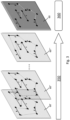
- Figure 3 illustrates the use of heuristics and AI to reduce the number of logical variables in accordance with embodiments of the present invention. It must be considered that several heuristic approaches could be used to reduce the M-robot setting to the 1-robot (i.e. single robot) setting, and then, the algorithm developed in detail on each of the derived 1-robot problems could be used. In another embodiment, heuristics could be first applied to create and investigate 350 a population of good solutions and then using AI to identify a common pattern 360 in it. In this way, it is possible to reduce the number of logical variables by considering frequently occurring task pairs as a fixed sequence (see Figure 3 ). It is anticipated that heuristics would enable addressing larger and overall more complex problems on existing quantum computing technology. Additionally, it is noted that addressing this problem with a universal quantum computer could allow more flexibility with the kinds of models chosen to describe the problem.
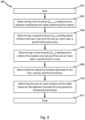
- FIG. 4 shows a flow chart of a method 400 for robot motion planning in accordance with embodiments of the present invention.
- the method 400 for optimizing, based on a weighted graph G and an objective function f , one or more motions of a robot 60, 60-1, 60-2, 60-3 performing one or more tasks starts at step 401.
- a first function f distance indicative of a distance travelled by the robot performing the motion is determined.
- a second function f tasks is determined.
- the second function f tasks is configured to enforce that each task j of the one or more tasks is performed exactly once.
- a third function f time is determined.
- the third function f time is configured to enforce that exactly one task j of the one or more tasks is performed at a time.
- the objective function fis determined based on the first, second, and third functions.
- the one or more motions of the robot 60, 60-1, 60-2, 60-3 are optimized based on the objective function f using quantum computing techniques. The method stops at step 412.
Landscapes
- Engineering & Computer Science (AREA)
- General Physics & Mathematics (AREA)
- Physics & Mathematics (AREA)
- Theoretical Computer Science (AREA)
- Business, Economics & Management (AREA)
- Human Resources & Organizations (AREA)
- Data Mining & Analysis (AREA)
- Mathematical Physics (AREA)
- Mathematical Analysis (AREA)
- Mathematical Optimization (AREA)
- Pure & Applied Mathematics (AREA)
- Computing Systems (AREA)
- General Engineering & Computer Science (AREA)
- Evolutionary Computation (AREA)
- Software Systems (AREA)
- Economics (AREA)
- Condensed Matter Physics & Semiconductors (AREA)
- Strategic Management (AREA)
- Computational Mathematics (AREA)
- Artificial Intelligence (AREA)
- Robotics (AREA)
- Quality & Reliability (AREA)
- Game Theory and Decision Science (AREA)
- Mechanical Engineering (AREA)
- Entrepreneurship & Innovation (AREA)
- Marketing (AREA)
- Operations Research (AREA)
- Development Economics (AREA)
- Tourism & Hospitality (AREA)
- General Business, Economics & Management (AREA)
- Numerical Control (AREA)
- Feedback Control In General (AREA)
- Manipulator (AREA)
- Control Of Position, Course, Altitude, Or Attitude Of Moving Bodies (AREA)
Claims (5)
- Verfahren (400) zum Optimieren, basierend auf einem gewichteten Graphen G und einer Zielfunktion f, die dargestellt ist als

 wobei N eine Anzahl von Bewegungspfaden ist,einer oder mehrerer Bewegungen eines Roboters (60, 60-1, 60-2, 60-3) zur Verwendung bei einer Herstellung, welcher eine oder mehrere Aufgaben durchführt, wobei der Roboter (60, 60-1, 60-2, 60-3) von einem Startort startet, die eine oder die mehreren Aufgaben abschließt und wieder zurück an seinem Startort endet, wobei der gewichtete Graph G, bezeichnet als G: = (V; E; W), eine Funktion von Vertices V, die zum Repräsentieren eines Startortes des Roboters (60, 60-1, 60-2, 60-3) und eines Startpunktes und eines Endpunktes jeder Aufgabe der einen oder mehreren Aufgaben konfiguriert sind, Kanten E, die zum Repräsentieren von Bewegungspfaden konfiguriert sind, die der Roboter (60, 60-1, 60-2, 60-3) durchführen kann, und Gewichtungen W ist, die zum Repräsentieren von Kosten einer Bewegung konfiguriert sind, die eine Kante E durchläuft, wobei das Verfahren Folgendes umfasst:- Bestimmen (402) einer ersten Funktion fEntfernung, die eine durch den Roboter, der die Bewegung durchführt, zurückgelegte Entfernung angibt, wobei die erste Funktion bestimmt wird als
 - Bestimmen (404) einer zweiten Funktion fAufgaben , die zum Erzwingen davon konfiguriert ist, dass jede Aufgabe der einen oder mehreren Aufgaben genau einmal durchgeführt wird, wobei die zweite Funktion bestimmt wird als
 - Bestimmen (406) einer dritten Funktion fZeit , die zum Erzwingen davon konfiguriert ist, dass genau eine Aufgabe der einen oder mehreren Aufgaben auf einmal durchgeführt wird, wobei die dritte Funktion bestimmt wird als
 wobei N eine Anzahl von Bewegungspfaden ist; und wobei
 wobei das Verfahren ferner die folgenden Schritte umfasst:Bestimmen (408) der Zielfunktion f basierend auf dem Summenterm der ersten, zweiten und dritten Funktion, wobei die Zielfunktion eine quadratische Funktion von x in der Form von f:= xTQx ist; undOptimieren (410) der einen oder mehreren Bewegungen des Roboters (60, 60-1, 60-2, 60-3) basierend auf der Zielfunktion f unter Verwendung von Quanten-Annealing als Quanten-Computing-Techniken.
 - Verfahren nach Anspruch 1, wobei die Vertices V bestimmt werden als

- Verfahren nach einem der vorhergehenden Ansprüche 1 bis 2, wobei die Kanten E bestimmt werden als

- Verfahren nach einem der vorhergehenden Ansprüche 1 bis 3, wobei die Gewichte W bestimmt werden als


- Verfahren nach einem der vorhergehenden Ansprüche 1 bis 4, wobei eine Aufgab j der einen oder mehreren Aufgaben einen 1-dimensionalen Pfad beinhaltet; wobei optional der 1-dimensionale Pfad den Startpunkt vN (1), den Endpunkt vN (2) und eine Verarbeitungszeit beinhaltet, wobei die Verarbeitungszeit bevorzugt als ein Gewicht w definiert ist, z. B. basierend auf einem euklidischen Abstand, und wobei N eine Anzahl von Bewegungspfaden ist.
Priority Applications (1)
| Application Number | Priority Date | Filing Date | Title |
|---|---|---|---|
| EP19153052.6A EP3685968B1 (de) | 2019-01-22 | 2019-01-22 | Roboterbewegungsplanung bei der herstellung |
Applications Claiming Priority (1)
| Application Number | Priority Date | Filing Date | Title |
|---|---|---|---|
| EP19153052.6A EP3685968B1 (de) | 2019-01-22 | 2019-01-22 | Roboterbewegungsplanung bei der herstellung |
Publications (2)
| Publication Number | Publication Date |
|---|---|
| EP3685968A1 EP3685968A1 (de) | 2020-07-29 |
| EP3685968B1 true EP3685968B1 (de) | 2025-05-14 |
Family
ID=65200634
Family Applications (1)
| Application Number | Title | Priority Date | Filing Date |
|---|---|---|---|
| EP19153052.6A Active EP3685968B1 (de) | 2019-01-22 | 2019-01-22 | Roboterbewegungsplanung bei der herstellung |
Country Status (1)
| Country | Link |
|---|---|
| EP (1) | EP3685968B1 (de) |
Families Citing this family (7)
| Publication number | Priority date | Publication date | Assignee | Title |
|---|---|---|---|---|
| US20220076366A1 (en) * | 2020-09-04 | 2022-03-10 | Fujitsu Limited | Solving optimization problems associated with maritime facility on optimization solver machines |
| US20220122006A1 (en) * | 2020-10-20 | 2022-04-21 | Fujitsu Limited | Production planning using optimization solver machines |
| CN114089755B (zh) * | 2021-11-16 | 2024-02-02 | 大连理工大学 | 一种基于一致性包算法的多机器人任务分配方法 |
| CN114662739A (zh) * | 2022-02-28 | 2022-06-24 | 福建星云电子股份有限公司 | 一种焊接路径规划方法及系统 |
| DE102022118245A1 (de) * | 2022-07-21 | 2024-02-01 | Dr. Ing. H.C. F. Porsche Aktiengesellschaft | System, Verfahren und Computerprogrammprodukt zur optimierten Testplanung für das Prototypenmanagement einer Entität |
| DE102022124067A1 (de) | 2022-09-20 | 2024-03-21 | Bayerische Motoren Werke Aktiengesellschaft | Verfahren zum Ermitteln eines von einem Roboter auszuführenden Arbeitsvorgangs, Verfahren zum Ermitteln und Prüfen eines von einer Anlage auszuführenden Arbeitsvorgangs, Vorrichtung zur Datenverarbeitung, Computerprogramm und computerlesbares Medium |
| CN115456297B (zh) * | 2022-09-28 | 2024-05-21 | 远峰科技股份有限公司 | 自动泊车路径优化方法及装置 |
-
2019
- 2019-01-22 EP EP19153052.6A patent/EP3685968B1/de active Active
Non-Patent Citations (1)
| Title |
|---|
| BISWAS RUPAK ET AL: "A NASA perspective on quantum computing: Opportunities and challenges", PARALLEL COMPUTING, vol. 64, 27 November 2016 (2016-11-27), pages 81 - 98, XP085041297, ISSN: 0167-8191, DOI: 10.1016/J.PARCO.2016.11.002 * |
Also Published As
| Publication number | Publication date |
|---|---|
| EP3685968A1 (de) | 2020-07-29 |
Similar Documents
| Publication | Publication Date | Title |
|---|---|---|
| EP3685968B1 (de) | Roboterbewegungsplanung bei der herstellung | |
| Kumar et al. | Path planning for the autonomous robots using modified grey wolf optimization approach | |
| Chen et al. | A fast and efficient double-tree RRT $^* $-like sampling-based planner applying on mobile robotic systems | |
| Elbanhawi et al. | Sampling-based robot motion planning: A review | |
| Belta et al. | Discrete abstractions for robot motion planning and control in polygonal environments | |
| Abdalla et al. | Mobile robot navigation using PSO-optimized fuzzy artificial potential field with fuzzy control | |
| Ren et al. | Ms*: A new exact algorithm for multi-agent simultaneous multi-goal sequencing and path finding | |
| US20210309264A1 (en) | Human-robot collaboration | |
| Narang et al. | Generating pedestrian trajectories consistent with the fundamental diagram based on physiological and psychological factors | |
| Mehta et al. | Quantum annealing based optimization of robotic movement in manufacturing | |
| Zhang et al. | An efficient centralized planner for multiple automated guided vehicles at the crossroad of polynomial curves | |
| Ghrist et al. | Computing pareto optimal coordinations on roadmaps | |
| Wang et al. | Coordination-free multi-robot path planning for congestion reduction using topological reasoning | |
| Mondal et al. | Cooperative multi-agent planning framework for fuel constrained uav-ugv routing problem | |
| Mavrogiannis et al. | Multi-agent trajectory prediction and generation with topological invariants enforced by hamiltonian dynamics | |
| Li et al. | Adaptive sampling-based motion planning with a non-conservatively defensive strategy for autonomous driving | |
| Kochdumper et al. | Real-time capable decision making for autonomous driving using reachable sets | |
| EP4435549B1 (de) | Roboternavigation mit gleichzeitiger planung und lernen des lokalen pfades | |
| Ross et al. | An optimal control theory for the traveling salesman problem and its variants | |
| Jafarzadeh et al. | An exact geometry-based algorithm for path planning | |
| Nayak et al. | Multi-robot exploration for the CADRE mission | |
| Zeng et al. | A two-stage path planning approach for multiple car-like robots based on PH curves and a modified harmony search algorithm | |
| McMahon et al. | Robot motion planning with task specifications via regular languages | |
| Davydov et al. | Q-Mixing network for multi-agent pathfinding in partially observable grid environments | |
| Ge et al. | Enhancing Swift and Socially-Aware Navigation with Continuous Spatial-Temporal Routing |
Legal Events
| Date | Code | Title | Description |
|---|---|---|---|
| PUAI | Public reference made under article 153(3) epc to a published international application that has entered the european phase |
Free format text: ORIGINAL CODE: 0009012 |
|
| STAA | Information on the status of an ep patent application or granted ep patent |
Free format text: STATUS: THE APPLICATION HAS BEEN PUBLISHED |
|
| STAA | Information on the status of an ep patent application or granted ep patent |
Free format text: STATUS: REQUEST FOR EXAMINATION WAS MADE |
|
| AK | Designated contracting states |
Kind code of ref document: A1 Designated state(s): AL AT BE BG CH CY CZ DE DK EE ES FI FR GB GR HR HU IE IS IT LI LT LU LV MC MK MT NL NO PL PT RO RS SE SI SK SM TR |
|
| AX | Request for extension of the european patent |
Extension state: BA ME |
|
| 17P | Request for examination filed |
Effective date: 20200717 |
|
| RBV | Designated contracting states (corrected) |
Designated state(s): AL AT BE BG CH CY CZ DE DK EE ES FI FR GB GR HR HU IE IS IT LI LT LU LV MC MK MT NL NO PL PT RO RS SE SI SK SM TR |
|
| RIN1 | Information on inventor provided before grant (corrected) |
Inventor name: BENESCH, STEFAN Inventor name: PFLUGFELDER, BERNHARD Inventor name: WICK, OLIVER Inventor name: TAN, KHANH-HUY Inventor name: MURADI, MURAD Inventor name: SCHINKEL, FRITZ, DR. Inventor name: MEHTA, ARPIT Inventor name: MUELLER, MARKUS Inventor name: WOLDETSADICK, SELAM GETACHEW |
|
| STAA | Information on the status of an ep patent application or granted ep patent |
Free format text: STATUS: EXAMINATION IS IN PROGRESS |
|
| 17Q | First examination report despatched |
Effective date: 20210907 |
|
| P01 | Opt-out of the competence of the unified patent court (upc) registered |
Effective date: 20230502 |
|
| GRAP | Despatch of communication of intention to grant a patent |
Free format text: ORIGINAL CODE: EPIDOSNIGR1 |
|
| STAA | Information on the status of an ep patent application or granted ep patent |
Free format text: STATUS: GRANT OF PATENT IS INTENDED |
|
| INTG | Intention to grant announced |
Effective date: 20241204 |
|
| GRAS | Grant fee paid |
Free format text: ORIGINAL CODE: EPIDOSNIGR3 |
|
| GRAA | (expected) grant |
Free format text: ORIGINAL CODE: 0009210 |
|
| STAA | Information on the status of an ep patent application or granted ep patent |
Free format text: STATUS: THE PATENT HAS BEEN GRANTED |
|
| AK | Designated contracting states |
Kind code of ref document: B1 Designated state(s): AL AT BE BG CH CY CZ DE DK EE ES FI FR GB GR HR HU IE IS IT LI LT LU LV MC MK MT NL NO PL PT RO RS SE SI SK SM TR |
|
| REG | Reference to a national code |
Ref country code: GB Ref legal event code: FG4D |
|
| RIN1 | Information on inventor provided before grant (corrected) |
Inventor name: SCHINKEL, FRITZ, DR. Inventor name: MURADI, MURAD Inventor name: TAN, KHANH-HUY Inventor name: WICK, OLIVER Inventor name: PFLUGFELDER, BERNHARD Inventor name: BENESCH, STEFAN Inventor name: WOLDETSADICK, SELAM GETACHEW Inventor name: MUELLER, MARKUS Inventor name: MEHTA, ARPIT |
|
| REG | Reference to a national code |
Ref country code: CH Ref legal event code: EP |
|
| REG | Reference to a national code |
Ref country code: IE Ref legal event code: FG4D |
|
| REG | Reference to a national code |
Ref country code: DE Ref legal event code: R096 Ref document number: 602019069867 Country of ref document: DE |
|
| REG | Reference to a national code |
Ref country code: NL Ref legal event code: MP Effective date: 20250514 |
|
| PG25 | Lapsed in a contracting state [announced via postgrant information from national office to epo] |
Ref country code: PT Free format text: LAPSE BECAUSE OF FAILURE TO SUBMIT A TRANSLATION OF THE DESCRIPTION OR TO PAY THE FEE WITHIN THE PRESCRIBED TIME-LIMIT Effective date: 20250915 Ref country code: FI Free format text: LAPSE BECAUSE OF FAILURE TO SUBMIT A TRANSLATION OF THE DESCRIPTION OR TO PAY THE FEE WITHIN THE PRESCRIBED TIME-LIMIT Effective date: 20250514 Ref country code: ES Free format text: LAPSE BECAUSE OF FAILURE TO SUBMIT A TRANSLATION OF THE DESCRIPTION OR TO PAY THE FEE WITHIN THE PRESCRIBED TIME-LIMIT Effective date: 20250514 |
|
| REG | Reference to a national code |
Ref country code: LT Ref legal event code: MG9D |
|
| PG25 | Lapsed in a contracting state [announced via postgrant information from national office to epo] |
Ref country code: NO Free format text: LAPSE BECAUSE OF FAILURE TO SUBMIT A TRANSLATION OF THE DESCRIPTION OR TO PAY THE FEE WITHIN THE PRESCRIBED TIME-LIMIT Effective date: 20250814 Ref country code: GR Free format text: LAPSE BECAUSE OF FAILURE TO SUBMIT A TRANSLATION OF THE DESCRIPTION OR TO PAY THE FEE WITHIN THE PRESCRIBED TIME-LIMIT Effective date: 20250815 |
|
| PG25 | Lapsed in a contracting state [announced via postgrant information from national office to epo] |
Ref country code: NL Free format text: LAPSE BECAUSE OF FAILURE TO SUBMIT A TRANSLATION OF THE DESCRIPTION OR TO PAY THE FEE WITHIN THE PRESCRIBED TIME-LIMIT Effective date: 20250514 Ref country code: PL Free format text: LAPSE BECAUSE OF FAILURE TO SUBMIT A TRANSLATION OF THE DESCRIPTION OR TO PAY THE FEE WITHIN THE PRESCRIBED TIME-LIMIT Effective date: 20250514 |
|
| REG | Reference to a national code |
Ref country code: AT Ref legal event code: MK05 Ref document number: 1794427 Country of ref document: AT Kind code of ref document: T Effective date: 20250514 |
|
| PG25 | Lapsed in a contracting state [announced via postgrant information from national office to epo] |
Ref country code: BG Free format text: LAPSE BECAUSE OF FAILURE TO SUBMIT A TRANSLATION OF THE DESCRIPTION OR TO PAY THE FEE WITHIN THE PRESCRIBED TIME-LIMIT Effective date: 20250514 |
|
| PG25 | Lapsed in a contracting state [announced via postgrant information from national office to epo] |
Ref country code: HR Free format text: LAPSE BECAUSE OF FAILURE TO SUBMIT A TRANSLATION OF THE DESCRIPTION OR TO PAY THE FEE WITHIN THE PRESCRIBED TIME-LIMIT Effective date: 20250514 |
|
| PG25 | Lapsed in a contracting state [announced via postgrant information from national office to epo] |
Ref country code: AT Free format text: LAPSE BECAUSE OF FAILURE TO SUBMIT A TRANSLATION OF THE DESCRIPTION OR TO PAY THE FEE WITHIN THE PRESCRIBED TIME-LIMIT Effective date: 20250514 |
|
| PG25 | Lapsed in a contracting state [announced via postgrant information from national office to epo] |
Ref country code: RS Free format text: LAPSE BECAUSE OF FAILURE TO SUBMIT A TRANSLATION OF THE DESCRIPTION OR TO PAY THE FEE WITHIN THE PRESCRIBED TIME-LIMIT Effective date: 20250814 |
|
| PG25 | Lapsed in a contracting state [announced via postgrant information from national office to epo] |
Ref country code: IS Free format text: LAPSE BECAUSE OF FAILURE TO SUBMIT A TRANSLATION OF THE DESCRIPTION OR TO PAY THE FEE WITHIN THE PRESCRIBED TIME-LIMIT Effective date: 20250914 |
|
| PG25 | Lapsed in a contracting state [announced via postgrant information from national office to epo] |
Ref country code: LV Free format text: LAPSE BECAUSE OF FAILURE TO SUBMIT A TRANSLATION OF THE DESCRIPTION OR TO PAY THE FEE WITHIN THE PRESCRIBED TIME-LIMIT Effective date: 20250514 |
|
| PG25 | Lapsed in a contracting state [announced via postgrant information from national office to epo] |
Ref country code: DK Free format text: LAPSE BECAUSE OF FAILURE TO SUBMIT A TRANSLATION OF THE DESCRIPTION OR TO PAY THE FEE WITHIN THE PRESCRIBED TIME-LIMIT Effective date: 20250514 Ref country code: SM Free format text: LAPSE BECAUSE OF FAILURE TO SUBMIT A TRANSLATION OF THE DESCRIPTION OR TO PAY THE FEE WITHIN THE PRESCRIBED TIME-LIMIT Effective date: 20250514 |