EP3684613B1 - Ig window unit including laminated substrates for preventing bird collisions - Google Patents
Ig window unit including laminated substrates for preventing bird collisions Download PDFInfo
- Publication number
- EP3684613B1 EP3684613B1 EP18786098.6A EP18786098A EP3684613B1 EP 3684613 B1 EP3684613 B1 EP 3684613B1 EP 18786098 A EP18786098 A EP 18786098A EP 3684613 B1 EP3684613 B1 EP 3684613B1
- Authority
- EP
- European Patent Office
- Prior art keywords
- window unit
- coating
- glass substrate
- reflecting
- layers
- Prior art date
- Legal status (The legal status is an assumption and is not a legal conclusion. Google has not performed a legal analysis and makes no representation as to the accuracy of the status listed.)
- Active
Links
Images



Classifications
-
- A—HUMAN NECESSITIES
- A01—AGRICULTURE; FORESTRY; ANIMAL HUSBANDRY; HUNTING; TRAPPING; FISHING
- A01M—CATCHING, TRAPPING OR SCARING OF ANIMALS; APPARATUS FOR THE DESTRUCTION OF NOXIOUS ANIMALS OR NOXIOUS PLANTS
- A01M29/00—Scaring or repelling devices, e.g. bird-scaring apparatus
- A01M29/06—Scaring or repelling devices, e.g. bird-scaring apparatus using visual means, e.g. scarecrows, moving elements, specific shapes, patterns or the like
- A01M29/08—Scaring or repelling devices, e.g. bird-scaring apparatus using visual means, e.g. scarecrows, moving elements, specific shapes, patterns or the like using reflection, colours or films with specific transparency or reflectivity
-
- B—PERFORMING OPERATIONS; TRANSPORTING
- B32—LAYERED PRODUCTS
- B32B—LAYERED PRODUCTS, i.e. PRODUCTS BUILT-UP OF STRATA OF FLAT OR NON-FLAT, e.g. CELLULAR OR HONEYCOMB, FORM
- B32B17/00—Layered products essentially comprising sheet glass, or glass, slag, or like fibres
- B32B17/06—Layered products essentially comprising sheet glass, or glass, slag, or like fibres comprising glass as the main or only constituent of a layer, next to another layer of a specific material
- B32B17/10—Layered products essentially comprising sheet glass, or glass, slag, or like fibres comprising glass as the main or only constituent of a layer, next to another layer of a specific material of synthetic resin
- B32B17/10005—Layered products essentially comprising sheet glass, or glass, slag, or like fibres comprising glass as the main or only constituent of a layer, next to another layer of a specific material of synthetic resin laminated safety glass or glazing
- B32B17/10009—Layered products essentially comprising sheet glass, or glass, slag, or like fibres comprising glass as the main or only constituent of a layer, next to another layer of a specific material of synthetic resin laminated safety glass or glazing characterized by the number, the constitution or treatment of glass sheets
- B32B17/10036—Layered products essentially comprising sheet glass, or glass, slag, or like fibres comprising glass as the main or only constituent of a layer, next to another layer of a specific material of synthetic resin laminated safety glass or glazing characterized by the number, the constitution or treatment of glass sheets comprising two outer glass sheets
- B32B17/10045—Layered products essentially comprising sheet glass, or glass, slag, or like fibres comprising glass as the main or only constituent of a layer, next to another layer of a specific material of synthetic resin laminated safety glass or glazing characterized by the number, the constitution or treatment of glass sheets comprising two outer glass sheets with at least one intermediate layer consisting of a glass sheet
-
- B—PERFORMING OPERATIONS; TRANSPORTING
- B32—LAYERED PRODUCTS
- B32B—LAYERED PRODUCTS, i.e. PRODUCTS BUILT-UP OF STRATA OF FLAT OR NON-FLAT, e.g. CELLULAR OR HONEYCOMB, FORM
- B32B17/00—Layered products essentially comprising sheet glass, or glass, slag, or like fibres
- B32B17/06—Layered products essentially comprising sheet glass, or glass, slag, or like fibres comprising glass as the main or only constituent of a layer, next to another layer of a specific material
- B32B17/10—Layered products essentially comprising sheet glass, or glass, slag, or like fibres comprising glass as the main or only constituent of a layer, next to another layer of a specific material of synthetic resin
- B32B17/10005—Layered products essentially comprising sheet glass, or glass, slag, or like fibres comprising glass as the main or only constituent of a layer, next to another layer of a specific material of synthetic resin laminated safety glass or glazing
- B32B17/10009—Layered products essentially comprising sheet glass, or glass, slag, or like fibres comprising glass as the main or only constituent of a layer, next to another layer of a specific material of synthetic resin laminated safety glass or glazing characterized by the number, the constitution or treatment of glass sheets
- B32B17/10036—Layered products essentially comprising sheet glass, or glass, slag, or like fibres comprising glass as the main or only constituent of a layer, next to another layer of a specific material of synthetic resin laminated safety glass or glazing characterized by the number, the constitution or treatment of glass sheets comprising two outer glass sheets
- B32B17/10045—Layered products essentially comprising sheet glass, or glass, slag, or like fibres comprising glass as the main or only constituent of a layer, next to another layer of a specific material of synthetic resin laminated safety glass or glazing characterized by the number, the constitution or treatment of glass sheets comprising two outer glass sheets with at least one intermediate layer consisting of a glass sheet
- B32B17/10055—Layered products essentially comprising sheet glass, or glass, slag, or like fibres comprising glass as the main or only constituent of a layer, next to another layer of a specific material of synthetic resin laminated safety glass or glazing characterized by the number, the constitution or treatment of glass sheets comprising two outer glass sheets with at least one intermediate layer consisting of a glass sheet with at least one intermediate air space
-
- B—PERFORMING OPERATIONS; TRANSPORTING
- B32—LAYERED PRODUCTS
- B32B—LAYERED PRODUCTS, i.e. PRODUCTS BUILT-UP OF STRATA OF FLAT OR NON-FLAT, e.g. CELLULAR OR HONEYCOMB, FORM
- B32B17/00—Layered products essentially comprising sheet glass, or glass, slag, or like fibres
- B32B17/06—Layered products essentially comprising sheet glass, or glass, slag, or like fibres comprising glass as the main or only constituent of a layer, next to another layer of a specific material
- B32B17/10—Layered products essentially comprising sheet glass, or glass, slag, or like fibres comprising glass as the main or only constituent of a layer, next to another layer of a specific material of synthetic resin
- B32B17/10005—Layered products essentially comprising sheet glass, or glass, slag, or like fibres comprising glass as the main or only constituent of a layer, next to another layer of a specific material of synthetic resin laminated safety glass or glazing
- B32B17/10165—Functional features of the laminated safety glass or glazing
- B32B17/10174—Coatings of a metallic or dielectric material on a constituent layer of glass or polymer
- B32B17/10183—Coatings of a metallic or dielectric material on a constituent layer of glass or polymer being not continuous, e.g. in edge regions
- B32B17/10192—Coatings of a metallic or dielectric material on a constituent layer of glass or polymer being not continuous, e.g. in edge regions patterned in the form of columns or grids
-
- B—PERFORMING OPERATIONS; TRANSPORTING
- B32—LAYERED PRODUCTS
- B32B—LAYERED PRODUCTS, i.e. PRODUCTS BUILT-UP OF STRATA OF FLAT OR NON-FLAT, e.g. CELLULAR OR HONEYCOMB, FORM
- B32B17/00—Layered products essentially comprising sheet glass, or glass, slag, or like fibres
- B32B17/06—Layered products essentially comprising sheet glass, or glass, slag, or like fibres comprising glass as the main or only constituent of a layer, next to another layer of a specific material
- B32B17/10—Layered products essentially comprising sheet glass, or glass, slag, or like fibres comprising glass as the main or only constituent of a layer, next to another layer of a specific material of synthetic resin
- B32B17/10005—Layered products essentially comprising sheet glass, or glass, slag, or like fibres comprising glass as the main or only constituent of a layer, next to another layer of a specific material of synthetic resin laminated safety glass or glazing
- B32B17/10165—Functional features of the laminated safety glass or glazing
- B32B17/10174—Coatings of a metallic or dielectric material on a constituent layer of glass or polymer
- B32B17/10201—Dielectric coatings
-
- B—PERFORMING OPERATIONS; TRANSPORTING
- B32—LAYERED PRODUCTS
- B32B—LAYERED PRODUCTS, i.e. PRODUCTS BUILT-UP OF STRATA OF FLAT OR NON-FLAT, e.g. CELLULAR OR HONEYCOMB, FORM
- B32B17/00—Layered products essentially comprising sheet glass, or glass, slag, or like fibres
- B32B17/06—Layered products essentially comprising sheet glass, or glass, slag, or like fibres comprising glass as the main or only constituent of a layer, next to another layer of a specific material
- B32B17/10—Layered products essentially comprising sheet glass, or glass, slag, or like fibres comprising glass as the main or only constituent of a layer, next to another layer of a specific material of synthetic resin
- B32B17/10005—Layered products essentially comprising sheet glass, or glass, slag, or like fibres comprising glass as the main or only constituent of a layer, next to another layer of a specific material of synthetic resin laminated safety glass or glazing
- B32B17/10165—Functional features of the laminated safety glass or glazing
- B32B17/10174—Coatings of a metallic or dielectric material on a constituent layer of glass or polymer
- B32B17/1022—Metallic coatings
- B32B17/10229—Metallic layers sandwiched by dielectric layers
-
- B—PERFORMING OPERATIONS; TRANSPORTING
- B32—LAYERED PRODUCTS
- B32B—LAYERED PRODUCTS, i.e. PRODUCTS BUILT-UP OF STRATA OF FLAT OR NON-FLAT, e.g. CELLULAR OR HONEYCOMB, FORM
- B32B17/00—Layered products essentially comprising sheet glass, or glass, slag, or like fibres
- B32B17/06—Layered products essentially comprising sheet glass, or glass, slag, or like fibres comprising glass as the main or only constituent of a layer, next to another layer of a specific material
- B32B17/10—Layered products essentially comprising sheet glass, or glass, slag, or like fibres comprising glass as the main or only constituent of a layer, next to another layer of a specific material of synthetic resin
- B32B17/10005—Layered products essentially comprising sheet glass, or glass, slag, or like fibres comprising glass as the main or only constituent of a layer, next to another layer of a specific material of synthetic resin laminated safety glass or glazing
- B32B17/1055—Layered products essentially comprising sheet glass, or glass, slag, or like fibres comprising glass as the main or only constituent of a layer, next to another layer of a specific material of synthetic resin laminated safety glass or glazing characterized by the resin layer, i.e. interlayer
- B32B17/10761—Layered products essentially comprising sheet glass, or glass, slag, or like fibres comprising glass as the main or only constituent of a layer, next to another layer of a specific material of synthetic resin laminated safety glass or glazing characterized by the resin layer, i.e. interlayer containing vinyl acetal
-
- C—CHEMISTRY; METALLURGY
- C03—GLASS; MINERAL OR SLAG WOOL
- C03C—CHEMICAL COMPOSITION OF GLASSES, GLAZES OR VITREOUS ENAMELS; SURFACE TREATMENT OF GLASS; SURFACE TREATMENT OF FIBRES OR FILAMENTS MADE FROM GLASS, MINERALS OR SLAGS; JOINING GLASS TO GLASS OR OTHER MATERIALS
- C03C17/00—Surface treatment of glass, not in the form of fibres or filaments, by coating
- C03C17/34—Surface treatment of glass, not in the form of fibres or filaments, by coating with at least two coatings having different compositions
- C03C17/36—Surface treatment of glass, not in the form of fibres or filaments, by coating with at least two coatings having different compositions at least one coating being a metal
- C03C17/3602—Surface treatment of glass, not in the form of fibres or filaments, by coating with at least two coatings having different compositions at least one coating being a metal the metal being present as a layer
- C03C17/3618—Coatings of type glass/inorganic compound/other inorganic layers, at least one layer being metallic
-
- C—CHEMISTRY; METALLURGY
- C03—GLASS; MINERAL OR SLAG WOOL
- C03C—CHEMICAL COMPOSITION OF GLASSES, GLAZES OR VITREOUS ENAMELS; SURFACE TREATMENT OF GLASS; SURFACE TREATMENT OF FIBRES OR FILAMENTS MADE FROM GLASS, MINERALS OR SLAGS; JOINING GLASS TO GLASS OR OTHER MATERIALS
- C03C17/00—Surface treatment of glass, not in the form of fibres or filaments, by coating
- C03C17/34—Surface treatment of glass, not in the form of fibres or filaments, by coating with at least two coatings having different compositions
- C03C17/36—Surface treatment of glass, not in the form of fibres or filaments, by coating with at least two coatings having different compositions at least one coating being a metal
- C03C17/3602—Surface treatment of glass, not in the form of fibres or filaments, by coating with at least two coatings having different compositions at least one coating being a metal the metal being present as a layer
- C03C17/3657—Surface treatment of glass, not in the form of fibres or filaments, by coating with at least two coatings having different compositions at least one coating being a metal the metal being present as a layer the multilayer coating having optical properties
- C03C17/366—Low-emissivity or solar control coatings
-
- C—CHEMISTRY; METALLURGY
- C03—GLASS; MINERAL OR SLAG WOOL
- C03C—CHEMICAL COMPOSITION OF GLASSES, GLAZES OR VITREOUS ENAMELS; SURFACE TREATMENT OF GLASS; SURFACE TREATMENT OF FIBRES OR FILAMENTS MADE FROM GLASS, MINERALS OR SLAGS; JOINING GLASS TO GLASS OR OTHER MATERIALS
- C03C17/00—Surface treatment of glass, not in the form of fibres or filaments, by coating
- C03C17/34—Surface treatment of glass, not in the form of fibres or filaments, by coating with at least two coatings having different compositions
- C03C17/36—Surface treatment of glass, not in the form of fibres or filaments, by coating with at least two coatings having different compositions at least one coating being a metal
- C03C17/3602—Surface treatment of glass, not in the form of fibres or filaments, by coating with at least two coatings having different compositions at least one coating being a metal the metal being present as a layer
- C03C17/3681—Surface treatment of glass, not in the form of fibres or filaments, by coating with at least two coatings having different compositions at least one coating being a metal the metal being present as a layer the multilayer coating being used in glazing, e.g. windows or windscreens
-
- C—CHEMISTRY; METALLURGY
- C03—GLASS; MINERAL OR SLAG WOOL
- C03C—CHEMICAL COMPOSITION OF GLASSES, GLAZES OR VITREOUS ENAMELS; SURFACE TREATMENT OF GLASS; SURFACE TREATMENT OF FIBRES OR FILAMENTS MADE FROM GLASS, MINERALS OR SLAGS; JOINING GLASS TO GLASS OR OTHER MATERIALS
- C03C17/00—Surface treatment of glass, not in the form of fibres or filaments, by coating
- C03C17/34—Surface treatment of glass, not in the form of fibres or filaments, by coating with at least two coatings having different compositions
- C03C17/3411—Surface treatment of glass, not in the form of fibres or filaments, by coating with at least two coatings having different compositions with at least two coatings of inorganic materials
- C03C17/3429—Surface treatment of glass, not in the form of fibres or filaments, by coating with at least two coatings having different compositions with at least two coatings of inorganic materials at least one of the coatings being a non-oxide coating
- C03C17/3441—Surface treatment of glass, not in the form of fibres or filaments, by coating with at least two coatings having different compositions with at least two coatings of inorganic materials at least one of the coatings being a non-oxide coating comprising carbon, a carbide or oxycarbide
-
- C—CHEMISTRY; METALLURGY
- C03—GLASS; MINERAL OR SLAG WOOL
- C03C—CHEMICAL COMPOSITION OF GLASSES, GLAZES OR VITREOUS ENAMELS; SURFACE TREATMENT OF GLASS; SURFACE TREATMENT OF FIBRES OR FILAMENTS MADE FROM GLASS, MINERALS OR SLAGS; JOINING GLASS TO GLASS OR OTHER MATERIALS
- C03C17/00—Surface treatment of glass, not in the form of fibres or filaments, by coating
- C03C17/34—Surface treatment of glass, not in the form of fibres or filaments, by coating with at least two coatings having different compositions
- C03C17/36—Surface treatment of glass, not in the form of fibres or filaments, by coating with at least two coatings having different compositions at least one coating being a metal
- C03C17/3602—Surface treatment of glass, not in the form of fibres or filaments, by coating with at least two coatings having different compositions at least one coating being a metal the metal being present as a layer
- C03C17/3634—Surface treatment of glass, not in the form of fibres or filaments, by coating with at least two coatings having different compositions at least one coating being a metal the metal being present as a layer one layer at least containing carbon, a carbide or oxycarbide
-
- C—CHEMISTRY; METALLURGY
- C03—GLASS; MINERAL OR SLAG WOOL
- C03C—CHEMICAL COMPOSITION OF GLASSES, GLAZES OR VITREOUS ENAMELS; SURFACE TREATMENT OF GLASS; SURFACE TREATMENT OF FIBRES OR FILAMENTS MADE FROM GLASS, MINERALS OR SLAGS; JOINING GLASS TO GLASS OR OTHER MATERIALS
- C03C17/00—Surface treatment of glass, not in the form of fibres or filaments, by coating
- C03C17/34—Surface treatment of glass, not in the form of fibres or filaments, by coating with at least two coatings having different compositions
- C03C17/36—Surface treatment of glass, not in the form of fibres or filaments, by coating with at least two coatings having different compositions at least one coating being a metal
- C03C17/3602—Surface treatment of glass, not in the form of fibres or filaments, by coating with at least two coatings having different compositions at least one coating being a metal the metal being present as a layer
- C03C17/3644—Surface treatment of glass, not in the form of fibres or filaments, by coating with at least two coatings having different compositions at least one coating being a metal the metal being present as a layer the metal being silver
-
- C—CHEMISTRY; METALLURGY
- C03—GLASS; MINERAL OR SLAG WOOL
- C03C—CHEMICAL COMPOSITION OF GLASSES, GLAZES OR VITREOUS ENAMELS; SURFACE TREATMENT OF GLASS; SURFACE TREATMENT OF FIBRES OR FILAMENTS MADE FROM GLASS, MINERALS OR SLAGS; JOINING GLASS TO GLASS OR OTHER MATERIALS
- C03C2217/00—Coatings on glass
- C03C2217/70—Properties of coatings
- C03C2217/74—UV-absorbing coatings
-
- C—CHEMISTRY; METALLURGY
- C03—GLASS; MINERAL OR SLAG WOOL
- C03C—CHEMICAL COMPOSITION OF GLASSES, GLAZES OR VITREOUS ENAMELS; SURFACE TREATMENT OF GLASS; SURFACE TREATMENT OF FIBRES OR FILAMENTS MADE FROM GLASS, MINERALS OR SLAGS; JOINING GLASS TO GLASS OR OTHER MATERIALS
- C03C2217/00—Coatings on glass
- C03C2217/70—Properties of coatings
- C03C2217/78—Coatings specially designed to be durable, e.g. scratch-resistant
-
- C—CHEMISTRY; METALLURGY
- C03—GLASS; MINERAL OR SLAG WOOL
- C03C—CHEMICAL COMPOSITION OF GLASSES, GLAZES OR VITREOUS ENAMELS; SURFACE TREATMENT OF GLASS; SURFACE TREATMENT OF FIBRES OR FILAMENTS MADE FROM GLASS, MINERALS OR SLAGS; JOINING GLASS TO GLASS OR OTHER MATERIALS
- C03C27/00—Joining pieces of glass to pieces of other inorganic material; Joining glass to glass other than by fusing
- C03C27/06—Joining glass to glass by processes other than fusing
- C03C27/10—Joining glass to glass by processes other than fusing with the aid of adhesive specially adapted for that purpose
-
- E—FIXED CONSTRUCTIONS
- E06—DOORS, WINDOWS, SHUTTERS, OR ROLLER BLINDS IN GENERAL; LADDERS
- E06B—FIXED OR MOVABLE CLOSURES FOR OPENINGS IN BUILDINGS, VEHICLES, FENCES OR LIKE ENCLOSURES IN GENERAL, e.g. DOORS, WINDOWS, BLINDS, GATES
- E06B3/00—Window sashes, door leaves, or like elements for closing wall or like openings; Layout of fixed or moving closures, e.g. windows in wall or like openings; Features of rigidly-mounted outer frames relating to the mounting of wing frames
- E06B3/66—Units comprising two or more parallel glass or like panes permanently secured together
- E06B3/67—Units comprising two or more parallel glass or like panes permanently secured together characterised by additional arrangements or devices for heat or sound insulation or for controlled passage of light
- E06B3/6715—Units comprising two or more parallel glass or like panes permanently secured together characterised by additional arrangements or devices for heat or sound insulation or for controlled passage of light specially adapted for increased thermal insulation or for controlled passage of light
Definitions
- the IG window unit includes at least first, second and third substrates (e.g., glass substrates) spaced apart from one another, wherein at least one of the substrates supports an ultraviolet (UV) reflecting coating for reflecting UV radiation so that birds are capable of more easily seeing the window, and wherein at least two of the substrates are laminated to one another via a polymer-based laminating film (e.g., of or including PVB, EVA, or SGP).
- the UV reflecting coating is patterned so that it is not provided across the entirety of the IG window unit. By making the window more visible to birds, bird collisions and bird deaths can be reduced.
- the provision of the laminated substrates in the IG window unit is particularly advantageous for bird collision windows, because it can further reduce bird collisions by providing an increased contrast ratio, improve durability, and improve processing.
- An IG window unit typically includes at least first and second substrates spaced apart from one another by at least one spacer and/or seal.
- the gap or space between the spaced apart substrates may or may not be filled with a gas (e.g., argon) and/or evacuated to a pressure less than atmospheric pressure in different instances.
- a gas e.g., argon
- IG window units include a solar management coating (e.g., multi-layer coating for reflecting at least some infrared radiation) on an interior surface of one of the two substrates.
- a solar management coating e.g., multi-layer coating for reflecting at least some infrared radiation
- Such IG units enable significant amounts of infrared (IR) radiation to be blocked so that it does not reach the interior of the building (apartment, house, office building, or the like).
- U.S. Patent No. 8,114,488 discloses a window for reducing bird collisions.
- the window of the ⁇ 488 patent is effective for preventing/reducing bird collisions, there is room for improvement.
- U.S. Patent No. 9,650,290 discloses an IG window unit for reducing bird collisions, as shown for example in prior art Fig. 1 .
- the IG window unit in Fig. 1 includes first glass substrate 1 and second glass substrate 30 that are spaced apart from one another at least by one or more peripheral seal(s) or spacer(s) 15.
- the spacer(s) 15, other spacer(s), and/or peripheral seal space the two substrates 1 and 30 apart from one another so that the substrates do not contact one another and so that a space or air gap 17 is defined therebetween.
- Air gap 17 may or may not be filled with gas such as argon.
- a solar management coating 19 e.g., low-E coating
- a UV reflecting coating 150 are provided on the same glass substrate 1.
- the IG window unit of the '290 patent is made up of two glass substrates spaced apart from each other via an air gap, and there is no lamination film.
- the IG window unit of the '290 patent may suffer from a less than desirable contrast ratio between areas with the UV reflecting film and areas without the UV reflecting film.
- WO2017/011268 A1 and US2015/345206 A1 discloses IG window units for reducing bird collisions.
- a window is designed to prevent or reduce bird collisions therewith.
- the window comprises an insulating glass (IG) window unit designed to prevent or reduce bird collisions therewith.
- the IG window unit includes at least first, second and third substrates (e.g., glass substrates) spaced apart from one another, wherein at least one of the substrates supports an ultraviolet (UV) reflecting coating for reflecting UV radiation so that birds are capable of more easily seeing the window, and wherein at least two of the substrates are laminated to one another via a polymer-based laminating film (e.g., of or including PVB, EVA, or SGP).
- UV reflecting coating is patterned so that it is not provided across the entirety of the IG window unit.
- the provision of the laminated substrates in the IG window unit is particularly advantageous for bird collision windows, because it: (a) increases the contrast ratio of the IG window unit between areas having the UV reflecting coating and areas not having the UV reflecting coating, thereby making the window more visible to birds and reducing the likelihood of bird collisions, (b) increases mechanical durability of the IG window unit and reduces the likelihood of glass cracking due to bird collisions, and (c) in certain embodiments allows two single-coated-side glass substrates to be provided which improves production durability and processing so as to reduce likelihood of coating damage during processing, manufacturing, and/or shipping.
- an IG window unit comprising: a first glass substrate; a second glass substrate; a third glass substrate; wherein the first glass substrate is provided at an exterior side of the IG window unit so as to face an exterior of a building in which the IG window unit is to be mounted; wherein the second glass substrate is provided between at least the first and third glass substrates; wherein the third glass substrate is provided at an interior side of the IG window unit so as to face an interior of a building in which the IG window unit is to be mounted; a patterned UV reflecting coating provided on the first glass substrate and on an exterior surface of the IG window unit so as to face an exterior of a building in which the IG window unit is to be mounted; wherein the first and second glass substrates are laminated to each other via a polymer inclusive laminating film; a low-E coating provided on a side of the second glass substrate opposite the polymer inclusive laminating film, so that the second glass substrate is located between the low-E coating and the polymer inclusive laminating film; where
- an IG window unit comprising: a first glass substrate; a second glass substrate; a third glass substrate; wherein the first glass substrate is provided at an exterior side of the IG window unit so as to face an exterior of a building in which the IG window unit is to be mounted; wherein the second glass substrate is provided between at least the first and third glass substrates; wherein the third glass substrate is provided at an interior side of the IG window unit so as to face an interior of a building in which the IG window unit is to be mounted; a patterned UV reflecting coating provided on the first glass substrate and on an exterior surface of the IG window unit so as to face an exterior of a building in which the IG window unit is to be mounted; wherein the second and third glass substrates are laminated to each other via a polymer inclusive laminating film; a low-E coating provided on either the second glass substrate or on a side of the first glass substrate opposite the UV reflecting coating, so that the first glass substrate is located between the low-E coating and
- the difference between color vision of a bird and human is significant.
- a bird's visual receptor may be around 370 nm which means that birds can generally see efficiently in the UV range.
- the UV coating may be designed to have essentially the same or a similar reflectance characteristic as bare glass, so as to be substantially invisible to humans.
- a window is designed to prevent or reduce bird collisions therewith.
- the window comprises an insulating glass (IG) window unit designed to prevent or reduce bird collisions therewith.
- the IG window unit includes at least first (1), second (30) and third (31) glass substrates spaced apart from one another, wherein the first substrate 1 as shown in Figs. 2-3 supports an ultraviolet (UV) reflecting coating 150 for reflecting UV radiation so that birds are capable of more easily seeing the window.
- At least two of the substrates are laminated to one another via a polymer-based laminating film (e.g., of or including PVB, EVA, or SGP) 200.
- a polymer-based laminating film e.g., of or including PVB, EVA, or SGP
- the polymer-based laminating film 200 is preferably of a type that has a high absorption of UV, for example a film 200 that has a UV absorption from 350-380 nm of at least 80%, more preferably of at least 90%, and most preferably at least 95%. Note that this is not a typical feature of laminating films such as PVB, because certain PVB films for example do not have a high UV absorption (while others do).
- substrates 30 and 31 are laminated to each other in the Fig. 2 embodiment, and substrates 1 and 30 are laminated to each other in the Fig. 3 embodiment via laminating film 200.
- the UV reflecting coating 150 is patterned so that it is not provided across the entirety of the IG window unit.
- Example embodiments of this invention provide a new IGU configuration with laminated glass to further increase the contrast ratio between areas with UV reflecting coating and areas without the UV reflecting coating.
- PVB used in laminated glass can absorb much of UV wavelengths between 300nm and 400nm, thereby increasing contrast ratio between areas with UV reflecting coating 150 and areas without the UV reflecting coating 150.
- the provision of the laminated substrates, via laminating film 200, in the IG window unit is particularly advantageous for bird collision windows, because it: (a) increases the contrast ratio of the IG window unit between areas having the UV reflecting coating and areas not having the UV reflecting coating, thereby making the window more visible to birds and reducing the likelihood of bird collisions, (b) increases mechanical durability of the IG window unit and reduces the likelihood of glass cracking due to bird collisions, and (c) in certain embodiments allows two single-coated-side glass substrates to be provided which improves production durability and processing so as to reduce likelihood of coating damage during processing, manufacturing, and/or shipping.
- a pair of spaced apart substrates may be separated from one another by at least one seal and/or spacer 15 in certain example embodiment.
- a low-E coating 19 for blocking at least some infrared (IR) radiation and a UV reflecting blocking coating 150 for reflecting UV radiation to make the window more visible to birds in order to reduce collisions.
- the low-E coating 19 may have an emissivity (E n ) of no greater than 0.10 and/or a sheet resistance (R s ) of no greater than 8 ohms/square.
- the UV reflecting coating 19 may block at least 38% (more preferably at least 40%, more preferably at least 55%, even more preferably at least 60%, and possibly at least 65%) of UV radiation in at least a substantial part of the range from 350 to 440 nm (or alternatively in a substantial part of the range from 300-400 nm).
- This is significant UV blockage/reflection, and represents a significant advantage over coatings described in U.S. Patent No. 8,114,488 for example and without limitation. This increases the UV reflection of the window unit intended for commercial or residential applications in order to make such windows more visible to birds thereby preventing or reducing bird collisions.
- the UV reflecting/blocking coating 150 is patterned (e.g., in a grid pattern or in a parallel striped pattern) on the window unit which can make it even more visible to birds to further reduce bird collisions.
- the IG window unit preferably has a visible transmission of at least about 50%, more preferably of at least about 60%, and even more preferably of at least about 65% or at least about 70%.
- the film side UV reflectance may have: (a) a visible transmission of at least about 70%, more preferably of at least about 80%, and even more preferably of at least about 85%, (b) the film side UV reflectance of at least 38% (more preferably at least 40%, more preferably at least 55%, even more preferably at least 60%, and possibly at least 65%), and (c) a film side visible reflectance of less than about 20%, more preferably less than about 15%, and most preferably less than about 10%.
- the film side UV reflectance may be at least about 4 times higher than the film side visible reflectance of the monolithic coated article (more preferably at least about 5 times higher, even more preferably at least about 8 times higher, and possibly at least 10 times higher).
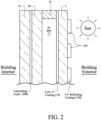
- Figs. 2-3 are cross sectional views of a portion of an IG window unit.
- the IG window unit includes glass substrate 1, glass substrate 30, and glass substrate 31.
- glass substrate 1 and glass substrate 30 are spaced apart from one another at least by one or more peripheral seal(s) or spacer(s) 15, so as to define an air gap 17 therebetween.
- the UV reflecting coating 150 is provided on the outboard side of glass substrate 1, and the low-E coating 19 is provided on the inboard side of substrate 1.
- the air gap may or may not be filled with a gas such as argon gas.
- an array of spacers (not shown) may be provided between the substrates 1 and 30 in Fig.
- the spacer(s) 15, other spacer(s), and/or peripheral seal space the two substrates 1 and 30 in Fig. 2 apart from one another so that the substrates do not contact one another and so that a space or gap 17 is defined therebetween.
- the space 17 between the substrates 1, 30 may be evacuated to a pressure lower than atmospheric in certain example embodiments, and/or may be filled with a gas (e.g., Ar) in certain example embodiments. In certain example embodiments, it is possible to suspend foil or other radiation reflective sheet(s) (not shown) in space 17.
- Glass substrates 30 and 31 are laminated to each other via laminating film 200, on the inboard side (side to be closest to the building interior) of the air gap 17 in the Fig. 2 embodiment.
- the polymer based laminating film 17 preferably absorbs UV, and may be of or include PVB (polyvinyl butyral), EVA, SGP (Sentry Glass Plus), or the like in different example embodiments of this invention.
- PVB polyvinyl butyral
- EVA polyvinyl butyral
- SGP Surface Glass Plus
- each glass substrate may be of the soda-lime-silica type of glass, or any other suitable type of glass, and may be for example from about 1 to 10 mm thick in certain example embodiments of this invention.
- glass substrate 30 and glass substrate 31 are spaced apart from one another at least by one or more peripheral seal(s) or spacer(s) 15, so as to define an air gap 17 therebetween.
- the UV reflecting coating 150 is provided on the outboard side of glass substrate 1 closest to the building exterior, and the low-E coating 19 is provided on the inboard side of substrate 30.
- the air gap 17 may or may not be filled with a gas such as argon gas.
- an array of spacers may be provided between the substrates 30 and 31 in Fig. 3 in a viewing area of the window for spacing the substrates from one another as in the context of a vacuum IG window unit.
- the spacer(s) 15, other spacer(s), and/or peripheral seal space the two substrates 30 and 31 in Fig. 3 apart from one another so that the substrates do not contact one another and so that a space or gap 17 is defined therebetween.
- the space 17 between the substrates 31, 30 may be evacuated to a pressure lower than atmospheric in certain example embodiments, and/or may be filled with a gas (e.g., Ar) in certain example embodiments.
- a gas e.g., Ar
- glass substrates 1 and 30 are laminated to each other via polymer based laminating film 200, on the outboard side (side to be closest to the building exterior) of the air gap 17.
- the polymer based laminating film 17 preferably absorbs UV, and may be of or include PVB, EVA, SGP, or the like.
- Figs. 2 and 3 differ from each other mainly in that (i) the laminated structure is provided on the inboard side of the air gap17 and on the inboard side of the low-E coating 19 in Fig. 2 , but is provided on the outboard side of the air gap 17 and low-E coating 19 in Fig. 3 , and (ii) Fig. 3 provides for a structure allowing two single-coated-side glass substrates 1 and 30 to be provided which improves production durability and processing so as to reduce likelihood of coating damage during processing, manufacturing, and/or shipping. With respect to point (ii), in Fig.
- glass substrate 1 is only coated on one side with UV coating 150, and glass substrate 30 is only coated on one side with low-E coating 19, in the manufacturing process (laminating film 200 is an interlayer for laminating/adhering purposes and is not a film that is sputter-deposited or otherwise deposited onto a surface of a substrate).
- laminated film 200 is an interlayer for laminating/adhering purposes and is not a film that is sputter-deposited or otherwise deposited onto a surface of a substrate.
- the Fig. 2 embodiment requires that both sides of glass substrate 1 be coated, one side with the UV coating 150 and the other side with the low-E coating, which can increase risk of damage during processing, shipping, and/or handling.
- the IG window units of Figs. 2-3 include low-E coating 19 that is supported on an inboard side of glass substrate 1 ( Fig. 2 ) or on an inboard side of glass substrate 30 ( Fig. 3 ).
- Low-E coating 19 includes one or more layers, although in many embodiments it is a multi-layer coating.
- Low-E coating 19 includes at least one IR reflecting layer (e.g., based on silver or gold) sandwiched between at least first and second dielectric layers. Since one example function of low-E coating 19 is to block (i.e., reflect and/or absorb) certain amounts of IR radiation and prevent the same from reaching the building interior, the solar management coating 9 includes at least one IR blocking (i.e., IR reflecting and/or absorbing) layer.
- Example IR blocking layer(s) which may be present in coating 19 are of or include silver (Ag), nickel-chrome (NiCr), gold (Au), and/or any other suitable material that blocks significant amounts of IR radiation. It will be appreciated by those skilled in the art that IR blocking layer(s) of low-E coating 19 need not block all IR radiation, but only need to block significant amounts thereof. In certain embodiments, each IR blocking layer of coating 19 is provided between at least a pair of dielectric layers.
- Example dielectric layers include silicon nitride, titanium oxide, silicon oxynitride, tin oxide, and/or other types of metal-oxides and/or metal-nitrides.
- each IR blocking layer may also be provided between a pair of contact layers of or including a material such as an oxide and/or nitride of nickel-chrome or any other suitable material.
- Example low-E coatings 19 are described in U.S. Patent Nos.
- the low-E coating 19 before and/or after optional heat treatment (e.g., thermal tempering and/or heat bending), may have a sheet resistance (R s ) of no greater than 8 ohms/square, more preferably no greater than 6 ohms/square, and most preferably no greater than 4 ohms/square.
- the low-E coating 19 may have an emissivity (E n ) after heat treatment of no greater than 0.10, more preferably no greater than 0.07, and even more preferably no greater than 0.05 (before and/or after optional heat treatment).
- solar management coatings 19 herein are not limited to these particular coatings, and any other suitable solar management coatings capable of blocking amounts of IR radiation may instead be used.
- Solar management coatings 19 herein may be deposited on substrate(s) 1 and/or 30 in any suitable manner, including but not limited to sputtering, vapor deposition, and/or any other suitable technique.
- the IG window units further include UV reflecting coating 150 for reflecting significant amounts of UV radiation thereby making the window more visible to birds.
- Coatings 150 may be sputter-deposited in example embodiments of this invention.
- UV reflecting coating 150 may be, for purposes of example and without limitation, any of the UV reflecting coatings illustrated in Figs. 7-11 . This increases the UV reflection of the window unit in order to make such windows more visible to birds thereby preventing or reducing bird collisions.
- the use of such coatings 150 herein enhances the performance of the glass or window by increasing the UV reflectance beyond the normal limits of raw uncoated plate glass in the 300-440 nm range of the spectrum.
- the UV reflecting coating 150 is in direct contact with the glass substrate 1 on the exterior surface thereof, and is not part of a low-E coating 19.
- IR reflecting layers e.g., silver based, gold based, NiCr, or IR reflecting TCO-based layers
- the low-E coating is provided on the other side of substrate 1 from coating 150 (not part of this invention) or alternatively on substrate 30 (according to this invention).
- the UV reflecting coating 150 may block at least 38% (more preferably at least 40%, more preferably at least 55%, even more preferably at least 60%, and possibly at least 65%) of UV radiation in at least a substantial part of the range from 350 to 440 nm (or alternatively in a substantial part of the range from 300-400 nm).
- the UV reflecting coating 150 is patterned (e.g., in the shape of a grid or in substantially parallel or non-parallel stripes) on the surface of substrate 1 as shown in Figs. 2-3 .
- the patterned shape of coating 150 may be formed as follows, for purposes of example.
- a pattern (not shown) is provided on the surface of substrate 1 prior to the coating 150 being formed, with the pattern being located in areas which are ultimately to be free of coating 150.
- a coating 150 is continuously formed across the entire or substantially the entire surface of substrate 1 over the pattern.
- the pattern can then be removed (along with the portions of coating 150 located directly over it) in order to create a patterned coating 150, so that the coating 150 remains on only the portions of the substrate where the original pattern was not deposited.
- a patterned coating 150 can be formed in such a manner in example embodiments of this invention.
- the remaining patterned coating 150 is substantially invisible to human eyes, but is visible to bird eyes as explained above
- the window unit e.g., insulating glass (IG) window unit and/or laminated window unit
- the IG window unit includes three substrates (e.g., glass substrates) spaced apart from one another, and at least one of the substrates supports an ultraviolet (UV) reflecting coating for reflecting UV radiation.
- the UV reflecting coating is a coating designed without any IR reflecting layer(s) of silver or gold.
- the UV reflecting coating 150 may be patterned by a laser (e.g., femto laser) which is used to either entirely or partially remove (e.g., via laser ablation) a portion of the coating in a pattern, so that after patterning by the laser the patterned coating is either not provided across the entirety of the window unit and/or is non-uniform in UV reflection across the window unit so that the UV reflection differs across different areas of the window thereby making the window unit more visible to birds which can see UV radiation and detect that pattern.
- the as-deposited UV reflecting coating entirely remains on the substrate in areas not patterned by the laser, and partially remains in areas patterned by the laser.
- Femto lasers have been found to be advantageous in that they can efficiently pattern such UV reflecting coatings 150 without damaging the underlying glass substrate, and can more easily be used to remove only part of such a coating in patterned areas so as to maintain substantially the same surface energy in both patterned and non-patterned areas of the UV reflective coating.
- the user of the Femto lasers result in a final product with less haze that if a non-Femto laser has been used.
- the final coated article, including both patterned and nonpatterned areas has a haze value of no greater than 0.4, more preferably no greater than 0.3, and most preferably no greater than 0.2.
- a laser fluence of from 0.01 to 2 J/cm 2 , and most preferably 0.05 to 1 J/cm 2 advantageous results in a smoother ablation of the patterned areas and allows the ablation to occur with partial coating removal but without any significant damage to the glass substrate and without significant haze in the patterned areas.
- the patterned UV reflecting coating 150 is preferably substantially neutral in the visible range, so that the patterning of the UV coating is not reasonably seen by humans via the naked eye. Another advantage of laser is that we can do random patterning on the fly.
- a method of making a window for reducing bird collisions comprising a first glass substrate and a ultraviolet (UV) reflective coating supported by at least the first glass substrate, the method comprising: having the first glass substrate and the ultraviolet (UV) reflective coating supported by at least the first glass substrate; emitting a laser beam from at least one laser source, the laser beam comprising optical pulses with (i) a duration below 1000 Femtoseconds and/or (ii) a fluence from 0.01 to 2.0 J/cm 2 ; wherein the laser beam comprising optical pulses is incident upon the UV reflective coating and patterns the UV reflective coating into patterned and non-patterned areas which have different respective UV reflectances, the laser beam having been incident upon the patterned areas but not the non-patterned areas.
- the laser beam may comprise optical pulses with a duration below 100 Femtoseconds, and possibly a duration below 50 Femtoseconds. All layers of the UV reflective coating may be dielectric layers, or alternatively the UV reflective coating may be a low-E coating having at least one IR reflective layer sandwiched between at least first and second dielectric layers.
- Figs. 4-6 demonstrate surprising technical advantages associated with the IG window units of Figs. 2-3 compared to that of Fig. 1 , and also demonstrate surprising technical advantages of the Fig. 3 embodiment (outboard laminated structure), according to this invention, compared to the Fig. 2 embodiment (inboard laminated structure), not part of this invention.
- Fig. 4 is a wavelength (nm) versus Transmission (T) % and Reflection (R) %, showing transmission and reflection as a function of wavelength (nm) for an example IG window unit of the Fig.
- Fig. 5 is a wavelength (nm) versus Transmission (T) % and Reflection (R) %, showing transmission and reflection as a function of wavelength (nm) for an example IG window unit of the Fig.
- Fig. 6 is a wavelength (nm) versus Transmission (T) % and Reflection (R) %, showing transmission and reflection as a function of wavelength (nm) for an example IG window unit of prior art Fig.
- Fig. 4 corresponds to an example of the Fig. 3 embodiment
- Fig. 5 corresponds to an example of the Fig. 2 embodiment
- Fig. 6 corresponds to prior art Fig. 1 .
- lamination when laminating film 200 is present laminating together a pair of substrates reduces UV transmission for both areas with and without UV reflecting coating, thereby enhancing the transmissive contrast ratio CR(TR), which is defined as the ratio of transmittance without UV coating to that with UV coating.
- the contrast ratio has been found to be higher for the laminated IGUs of Figs. 2-3 around 365-369 nm (compared to Fig. 1 ).
- the transmission curves for inboard laminated structure and outboard laminated structures are nearly identical, so the improvement is essentially the same in the transmission mode for the Fig. 2 and 3 embodiments.
- Fig. 3 IG unit with the outboard laminated structure has been found to realize improved performance features compared to both the Fig. 1 and Fig. 2 IG units.
- Fig. 3 has a laminated structure (compared to Fig. 1 ) and because Fig. 3 has the laminated structure on the outboard side of the air gap and low-E coating (compared to Fig. 2 ).
- Figs. 4-6 illustrate that the IG units of Figs. 1-3 have very different reflection curves in UV spectra.
- UV light from the sun is mostly absorbed by PVB 200 before it reaches the low-E coating 19.
- a certain portion of UV light reaches and is reflected by the low-E coating 19; this amount of extra UV reflection reduces the reflective contrast ratio CR(RF) which is defined as the ratio of reflectance in areas with UV coating 150 to areas without UV coating 150.
- the reflective contrast ratio of the IG unit has surprisingly been found to be significantly higher for the Fig. 3 embodiment of this invention, compared to the Fig. 2 embodiment, and thus the Fig. 3 IG window unit will be more visible to birds and thus realize less bird collisions than both Fig. 1 and the Fig. 2 embodiment.
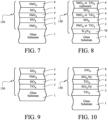
- Figs. 7-11 are cross sectional views of various UV reflecting coatings 150 that may be used on substrate 1 in the IG window unit of Fig. 1 or Fig. 2 in example embodiments of this invention.
- Glass substrate 1 may be soda-lime-silica based glass or any other suitable type of glass, and may be from about 1-10 mm thick, more preferably from about 2-6 mm thick, in example embodiments of this invention.
- UV reflecting coating 150 includes high index transparent dielectric layers 2, 4 and 6 of or including niobium oxide (e.g., Nb 2 O 5 , NbO 2 and/or NbO) and low index transparent dielectric layers 3 and 5 of or including silicon oxide (e.g., SiO 2 which may or may not be doped with aluminum and/or nitrogen).
- layer 6 in Fig. 7 is optional and can be removed to improve UV reflectance in certain instances, or can instead be of or including zirconium oxide.
- one or both of the silicon oxide layers 3 and/or 5 may be doped with other material such as from about 1-8% aluminum and/or from about 1-10% nitrogen.
- layers 2, 4 and 6 may also be doped with other material in certain example instances.
- layer 6 is the outermost layer of the coating 150 and may be exposed to air.
- Each of layers 2-6 is considered "transparent" to visible light because each of these layers, standing alone, is substantially transparent to visible light (e.g., at least about 50% transparent, more preferably at least about 60% or 70% transparent to visible light).
- High index transparent dielectric layers 2, 4 and 6 of or including niobium oxide may have a refractive index (n) of from about 2.15 to 2.5, more preferably from about 2.2 to 2.4, and most preferably from about 2.25 to 2.35 (at 550 nm).
- the niobium oxide may be replaced with titanium oxide (e.g., TiO 2 ), zirconium oxide, hafnium oxide (e.g., HfO 2 ), cerium oxide (e.g., CeO 2 ), zinc sulfide, or bismuth oxide (e.g., Bi 2 O 3 ) in one or more of high index layers 2, 4 and/or 6.
- titanium oxide e.g., TiO 2
- zirconium oxide hafnium oxide (e.g., HfO 2 ), cerium oxide (e.g., CeO 2 ), zinc sulfide, or bismuth oxide (e.g., Bi 2 O 3 )
- layers 2 and 4 are of or including niobium oxide
- layers 3 and 5 are of or including silicon oxide.
- Low index transparent dielectric layers 3 and 5 of or including silicon oxide may have a refractive index (n) of from about 1.4 to 1.7, more preferably from about 1.4 to 1.6, and most preferably from about 1.45 to 1.55 (all refractive index n values herein are measured at 550 nm).
- Transparent dielectric layers 2-6 are preferably deposited by sputtering in example embodiments of this invention.
- transparent dielectric layers 2, 4 and 6 of or including niobium oxide may be sputter deposited via at least one sputtering target of or including Nb, via sputtering in an atmosphere including a mixture of argon and reactive oxygen gases.
- transparent dielectric layers 3 and 5 of or including silicon oxide may be sputter deposited via at least one sputtering target of or including Si or SiAl, via sputtering in an atmosphere including a mixture of argon and reactive oxygen gases.
- Rotation C-Mag sputtering targets, or other types of targets may be used. In sputtering operations, sufficient reactive oxygen gas may be used to achieve the refractive index values discussed herein.
- Ceramic targets may alternatively be used to sputter deposit one or more of these layers. While layers 2-6 are preferably deposited via sputtering, it is possible that they may be deposited via other techniques in alternative embodiments of this invention. While coating 150 consists of five layers in the Fig.
- a protective layer of or including zirconium oxide may be provided in the coating 150 as the uppermost layer over and directly contacting layer 6.
- Coating 150 in the Fig. 7 embodiment and in other example embodiments contains no metallic reflective layer.
- Fig. 8 is a cross sectional view of another UV reflecting coating 150 that may be used on substrate 1 in the Fig. 2 or Fig. 3 IG window unit.
- the Fig. 8 embodiment is the same as the Fig. 7 embodiment, except that transparent dielectric barrier layer 70 is provided between the glass substrate 1 and high index layer 2.
- layer 6 in Fig. 8 is optional and can be removed to improve UV reflectance in certain instances, or can instead be of or including zirconium oxide.
- the barrier layer 70 is of or including silicon nitride (e.g., Si 3 N 4 ) in certain example embodiments of this invention. Barrier layer 70 may optionally be used in the coatings of any of Figs. 7-11 , but is only shown in Fig. 8 for purposes of simplicity.
- silicon nitride based barrier layer 70 may be doped with other material such as from about 1-8% aluminum and/or from about 1-10% oxygen.
- the Fig. 8 embodiment is particular useful in heat treated (e.g., thermally tempered) embodiments, where the barrier layer 70 helps prevent or reduce migration of elements (e.g., Na) from the glass substrate into the coating during the high temperature heat treatment.
- heat treatment e.g., thermal tempering
- Such heat treatment may include, for example heating the coated article in an oven or the like at temperature(s) of at least about 580 degrees C, more preferably of at least about 600 degrees C.
- the coating of the Fig. 8 embodiment may or may not be heat treated (e.g., thermally tempered) in example embodiments of this invention.
- Fig. 9 is a cross sectional view of another UV reflecting coating 150 that may be used on substrate 1 in the Fig. 2 or Fig. 3 IG window unit.
- the Fig. 9 embodiment is the same as the Fig. 7 embodiment, except that layer 6 is removed.
- the coated article shown in Fig. 9 may have, for example, a film side UV reflectance of from about 40-45%, with an example being about 41% (reflecting at least this much UV radiation in at least a substantial part of the range from 300-400 nm).
- a film side UV reflectance of from about 40-45%, with an example being about 41% (reflecting at least this much UV radiation in at least a substantial part of the range from 300-400 nm).
- layer 5 is the outermost layer of UV reflecting coating 150, and layer 2 is of or including titanium oxide (e.g., TiO 2 ), layer 3 is of or including silicon oxide (e.g., SiO 2 which may or may not be doped with aluminum and/or nitrogen), layer 4 is of or including niobium oxide (e.g., Nb 2 O 5 , NbO 2 and/or NbO), and layer 5 is of or including silicon oxide (e.g., SiO 2 which may or may not be doped with aluminum and/or nitrogen).
- the coating of the Fig. 9 embodiment may also include an overcoat of or including zirconium oxide (e.g., ZrO 2 ).
- zirconium oxide e.g., ZrO 2
- transparent dielectric layer 2 of or including titanium oxide may be from about 5-40 nm thick, more preferably from about 10-25 nm thick, even more preferably from about 10-20 nm thick, with an example thickness being from about 13-16 nm;
- transparent dielectric layer 3 of or including silicon oxide may be from about 30-100 nm thick, more preferably from about 40-80 nm thick, even more preferably from about 50-70 nm thick, with an example thickness being about 60 nm;
- transparent dielectric layer 4 of or including niobium oxide may be from about 15-150 nm thick, more preferably from about 20-125 nm thick, even more preferably from about 95-120 nm thick, with an example thickness being about 33 nm or about 105 nm;
- transparent dielectric layer 5 of or including silicon oxide may be from about 40-130 nm thick, more preferably from about 50-110 nm thick, even more preferably from about 60-100
- niobium oxide based layer 4 is preferably substantially thicker than titanium oxide based layer 2.
- niobium oxide based layer 4 is at least about 40 nm thicker (more preferably at least about 50 nm thicker, and most preferably at least about 70 nm thicker) than titanium oxide based layer 2.
- niobium oxide based layer 4 is also preferably thicker than each of layers 3 and 5, for example layer 4 being at least about 10 nm thicker and most preferably at least about 15 nm thicker than each of silicon oxide based layers 3 and 5.
- Silicon oxide based layer 5 is at least about 10 or 20 nm thicker than is silicon oxide based layer 3 in certain embodiments of the Fig. 2 , 3 , 9 embodiment of this invention.
- a protective layer (not shown) of or including zirconium oxide may be provided as the outermost layer over layer 5 in the Fig. 9 coating (similar to the protective outer layer in Fig. 10 ).
- Fig. 10 is a cross sectional view of another UV reflecting coating 150 that may be used on substrate 1 in the Fig. 2 or Fig. 3 IG window unit.
- the coated article shown in Fig. 10 may have, for example, a film side UV reflectance of from about 60-70%, with an example being about 65% (reflecting at least this much UV radiation in at least a substantial part of the range from 300-400 nm).
- a film side UV reflectance of from about 60-70%, with an example being about 65% (reflecting at least this much UV radiation in at least a substantial part of the range from 300-400 nm).
- layer 2 is of or including titanium oxide (e.g., TiO 2 )
- layers 3 and 5 are of or including silicon oxynitride (e.g., which may or may not be doped with aluminum)
- layer 4 is of or including titanium oxide (e.g., TiOz)
- outermost protective layer 8 is of or including zirconium oxide (e.g., ZrO 2 ).
- zirconium oxide e.g., ZrO 2
- transparent dielectric layer 2 of or including titanium oxide may be from about 5-40 nm thick, more preferably from about 10-25 nm thick, even more preferably from about 10-20 nm thick, with an example thickness being about 17 nm;
- transparent dielectric layer 3 of or including silicon oxynitride may be from about 30-100 nm thick, more preferably from about 40-80 nm thick, even more preferably from about 45-70 nm thick, with an example thickness being about 50 nm;
- transparent dielectric layer 4 of or including titanium oxide may be from about 10-80 nm thick, more preferably from about 15-50 nm thick, even more preferably from about 20-40 nm thick, with an example thickness being about 30 nm;
- transparent dielectric layer 5 of or including silicon oxynitride may be from about 50-130 nm thick, more preferably from about 70-120 nm thick, even more preferably from about 80-110 nm thick, with
- titanium oxide based layer 4 is at least about 8 nm thicker (more preferably at least about 10 nm thicker, and most preferably at least about 15 nm thicker) than titanium oxide based layer 2.
- silicon oxynitride based layer 5 is at least about 10, 20 or 30 nm thicker than is silicon oxynitride based layer 3 in certain embodiments of the Fig. 2 , 3 , 10 embodiment of this invention.
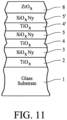
- Fig. 11 is a cross sectional view of another UV reflecting coating 150 that may be used on the outboard side of substrate 1 in the Fig. 2 or Fig. 3 IG window unit.
- the coated article shown in Fig. 11 may have, for example, a film side UV reflectance of from about 50-80%, with an example being about 70% (reflecting at least this much UV radiation in at least a substantial part of the range from 300-400 nm).
- a film side UV reflectance of from about 50-80%, with an example being about 70% (reflecting at least this much UV radiation in at least a substantial part of the range from 300-400 nm).
- layers 2, 4 and 4' are of or including titanium oxide (e.g., TiO 2 ), and layers 3, 5 and 5' are of or including silicon oxynitride (e.g., which may or may not be doped with aluminum), and outermost protective layer 8 is of or including zirconium oxide (e.g., ZrO 2 ).
- titanium oxide e.g., TiO 2
- layers 3, 5 and 5' are of or including silicon oxynitride (e.g., which may or may not be doped with aluminum)
- outermost protective layer 8 is of or including zirconium oxide (e.g., ZrO 2 ).
- transparent dielectric layer 2 of or including titanium oxide may be from about 5-40 nm thick, more preferably from about 10-25 nm thick, even more preferably from about 10-20 nm thick, with an example thickness being about 11 nm;
- transparent dielectric layer 3 of or including silicon oxynitride may be from about 30-100 nm thick, more preferably from about 40-80 nm thick, even more preferably from about 45-70 nm thick, with an example thickness being about 63 nm;
- transparent dielectric layer 4 of or including titanium oxide may be from about 10-80 nm thick, more preferably from about 15-50 nm thick, even more preferably from about 20-40 nm thick, with an example thickness being about 37 nm;
- transparent dielectric layer 5 of or including silicon oxynitride may be from about 10-70 nm thick, more preferably from about 15-60 nm thick, even more preferably from about 20-40 nm thick, with an example
- high index layers 4 and 4' are preferably substantially thicker than high index layer 2.
- titanium oxide based layers 4 and 4' may be at least about 8 nm thicker (more preferably at least about 10 nm thicker, and most preferably at least about 15 nm thicker) than high index titanium oxide based layer 2.
- silicon oxynitride based layer 5' is at least about 10, 20 or 30 nm thicker than are silicon oxynitride based layers 3 and/or 5 in certain embodiments of the Fig. 2 , 3 , 11 embodiment of this invention.
- Fig. 2 , 3 , 11 embodiment of this invention are silicon oxynitride based layers 3 and/or 5 in certain embodiments of the Fig. 2 , 3 , 11 embodiment of this invention.
- the silicon oxynitride based layers 3, 5 and 5' may have a refractive index n (measured at 550 nm) of from about 1.6 to 1.8, more preferably from about 1.65 to 1.75, and most preferably 1.7.
- n measured at 550 nm
- the Fig. 10-11 embodiments are also surprisingly advantageous in that their optical properties have been found to be close to that of uncoated float glass, which makes the coatings 150 essentially invisible to human eyes.
Landscapes
- Life Sciences & Earth Sciences (AREA)
- Chemical & Material Sciences (AREA)
- Engineering & Computer Science (AREA)
- Chemical Kinetics & Catalysis (AREA)
- General Chemical & Material Sciences (AREA)
- Geochemistry & Mineralogy (AREA)
- Materials Engineering (AREA)
- Organic Chemistry (AREA)
- Pest Control & Pesticides (AREA)
- Insects & Arthropods (AREA)
- Birds (AREA)
- Wood Science & Technology (AREA)
- Zoology (AREA)
- Environmental Sciences (AREA)
- Civil Engineering (AREA)
- Structural Engineering (AREA)
- Joining Of Glass To Other Materials (AREA)
- Surface Treatment Of Glass (AREA)
- Securing Of Glass Panes Or The Like (AREA)
- Laminated Bodies (AREA)
- Catching Or Destruction (AREA)
Description
- This invention relates to an insulating glass (IG) window unit designed to prevent or reduce bird collisions therewith. The IG window unit includes at least first, second and third substrates (e.g., glass substrates) spaced apart from one another, wherein at least one of the substrates supports an ultraviolet (UV) reflecting coating for reflecting UV radiation so that birds are capable of more easily seeing the window, and wherein at least two of the substrates are laminated to one another via a polymer-based laminating film (e.g., of or including PVB, EVA, or SGP). The UV reflecting coating is patterned so that it is not provided across the entirety of the IG window unit. By making the window more visible to birds, bird collisions and bird deaths can be reduced. The provision of the laminated substrates in the IG window unit is particularly advantageous for bird collision windows, because it can further reduce bird collisions by providing an increased contrast ratio, improve durability, and improve processing.
- IG window units are known in the art. For example, see
U.S. Patent Nos. 6,632,491 ,6,014,872 ;5,800,933 ;5,784,853 ;5,557,462 ;5,514,476 ;5,308,662 ;5,306,547 ; and5,156,894 . An IG window unit typically includes at least first and second substrates spaced apart from one another by at least one spacer and/or seal. The gap or space between the spaced apart substrates may or may not be filled with a gas (e.g., argon) and/or evacuated to a pressure less than atmospheric pressure in different instances. - Many conventional IG window units include a solar management coating (e.g., multi-layer coating for reflecting at least some infrared radiation) on an interior surface of one of the two substrates. Such IG units enable significant amounts of infrared (IR) radiation to be blocked so that it does not reach the interior of the building (apartment, house, office building, or the like).
- Unfortunately, bird collisions with such windows represent a significant problem. For instance, in Chicago certain buildings (e.g., skyscrapers) are located in migratory bird paths. Birds flying along these paths repeatedly run into these buildings because they cannot see the windows of the building. This results in thousands of bird deaths, especially during seasons of bird migration. Birds living in environments such as forests or park areas, with buildings located in such areas, face similar problems associated with flying into the buildings.
- Conventional ways of reducing bird collisions with windows include the use of nets, decals, or frit. However, these solutions are considered ineffective because of the aesthetic impact on the architecture and/or because they do not work as they do not make the glass more visible to birds.
-
U.S. Patent No. 8,114,488 discloses a window for reducing bird collisions. However, while the window of the `488 patent is effective for preventing/reducing bird collisions, there is room for improvement. -
U.S. Patent No. 9,650,290 Fig. 1 . The IG window unit inFig. 1 includesfirst glass substrate 1 andsecond glass substrate 30 that are spaced apart from one another at least by one or more peripheral seal(s) or spacer(s) 15. The spacer(s) 15, other spacer(s), and/or peripheral seal space the twosubstrates air gap 17 is defined therebetween.Air gap 17 may or may not be filled with gas such as argon. A solar management coating 19 (e.g., low-E coating) and aUV reflecting coating 150 are provided on thesame glass substrate 1. However, the IG window unit of the '290 patent is made up of two glass substrates spaced apart from each other via an air gap, and there is no lamination film. Thus, the IG window unit of the '290 patent may suffer from a less than desirable contrast ratio between areas with the UV reflecting film and areas without the UV reflecting film. Thus, there is room for improvement.WO2017/011268 A1 andUS2015/345206 A1 discloses IG window units for reducing bird collisions. - In view of the above, it will be appreciated that there exists a need in the art for improved windows which can prevent or reduce bird collisions therewith.
- In this invention, a window is designed to prevent or reduce bird collisions therewith. The window comprises an insulating glass (IG) window unit designed to prevent or reduce bird collisions therewith. The IG window unit includes at least first, second and third substrates (e.g., glass substrates) spaced apart from one another, wherein at least one of the substrates supports an ultraviolet (UV) reflecting coating for reflecting UV radiation so that birds are capable of more easily seeing the window, and wherein at least two of the substrates are laminated to one another via a polymer-based laminating film (e.g., of or including PVB, EVA, or SGP). The UV reflecting coating is patterned so that it is not provided across the entirety of the IG window unit. By making the window more visible to birds, bird collisions and bird deaths can be reduced. The provision of the laminated substrates in the IG window unit is particularly advantageous for bird collision windows, because it: (a) increases the contrast ratio of the IG window unit between areas having the UV reflecting coating and areas not having the UV reflecting coating, thereby making the window more visible to birds and reducing the likelihood of bird collisions, (b) increases mechanical durability of the IG window unit and reduces the likelihood of glass cracking due to bird collisions, and (c) in certain embodiments allows two single-coated-side glass substrates to be provided which improves production durability and processing so as to reduce likelihood of coating damage during processing, manufacturing, and/or shipping.
- In this invention, there is provided an IG window unit comprising: a first glass substrate; a second glass substrate; a third glass substrate; wherein the first glass substrate is provided at an exterior side of the IG window unit so as to face an exterior of a building in which the IG window unit is to be mounted; wherein the second glass substrate is provided between at least the first and third glass substrates; wherein the third glass substrate is provided at an interior side of the IG window unit so as to face an interior of a building in which the IG window unit is to be mounted; a patterned UV reflecting coating provided on the first glass substrate and on an exterior surface of the IG window unit so as to face an exterior of a building in which the IG window unit is to be mounted; wherein the first and second glass substrates are laminated to each other via a polymer inclusive laminating film; a low-E coating provided on a side of the second glass substrate opposite the polymer inclusive laminating film, so that the second glass substrate is located between the low-E coating and the polymer inclusive laminating film; wherein the first glass substrate is located between the patterned UV reflecting coating and the polymer inclusive laminating film; wherein the UV reflecting coating is not part of a low-E coating and does not contain any IR reflecting layer of silver or gold; and wherein the second glass substrate is spaced apart from the third glass substrate via at least an air gap, so that a laminated structure including the first glass substrate, the second glass substrate, and the polymer inclusive laminating film is located on an outboard side of the air gap and on an outboard side of the low-E coating.
- In an example embodiment, not part of this invention, there is provided an IG window unit comprising: a first glass substrate; a second glass substrate; a third glass substrate; wherein the first glass substrate is provided at an exterior side of the IG window unit so as to face an exterior of a building in which the IG window unit is to be mounted; wherein the second glass substrate is provided between at least the first and third glass substrates; wherein the third glass substrate is provided at an interior side of the IG window unit so as to face an interior of a building in which the IG window unit is to be mounted; a patterned UV reflecting coating provided on the first glass substrate and on an exterior surface of the IG window unit so as to face an exterior of a building in which the IG window unit is to be mounted; wherein the second and third glass substrates are laminated to each other via a polymer inclusive laminating film; a low-E coating provided on either the second glass substrate or on a side of the first glass substrate opposite the UV reflecting coating, so that the first glass substrate is located between the low-E coating and the UV reflecting coating, and so that the second glass substrate is located between the polymer inclusive laminating film and the low-E coating; wherein the first glass substrate is spaced apart from the second glass substrate via at least an air gap, so that a laminated structure including the second glass substrate, the third glass substrate, and the polymer inclusive laminating film is located on an inboard side of the air gap and on an inboard side of the low-E coating.
-
-
FIGURE 1 is a cross sectional view of a prior art IG window unit. -
FIGURE 2 is a cross sectional view of an IG window unit according to an example embodiment, not part of this invention. -
FIGURE 3 is a cross sectional view of an IG window unit according to this invention. -
FIGURE 4 is a wavelength (nm) versus Transmission (T) % and Reflection (R) %, showing transmission and reflection as a function of wavelength (nm) for an example IG window unit of theFig. 3 embodiment of this invention where the laminated glass substrates are on the outboard side (closest to the exterior of the building on which the window is to be provided) of the air gap, where broken lines are spectral curves in an area without the UV reflecting coating and solid lines are spectral curves in an area with the UV reflecting coating, and assuming for purposes of example 6 mm thick glass substrates, a 12 mm thick air gap, and about 0.76 mm thick PVB laminating film. -
FIGURE 5 is a wavelength (nm) versus Transmission (T) % and Reflection (R) %, showing transmission and reflection as a function of wavelength (nm) for an example IG window unit of theFig. 2 embodiment where the laminated glass substrates are on the inboard side (closest to the interior of the building on which the window is to be provided) of the air gap, where broken lines are spectral curves in an area without the UV reflecting coating and solid lines are spectral curves in an area with the UV reflecting coating, and assuming for purposes of example 6 mm thick glass substrates, a 12 mm thick air gap, and about 0.76 mm thick PVB laminating film. -
FIGURE 6 is a wavelength (nm) versus Transmission (T) % and Reflection (R) %, showing transmission and reflection as a function of wavelength (nm) for an example IG window unit of prior artFig. 1 having no laminated glass substrates, where broken lines are spectral curves in an area without the UV reflecting coating and solid lines are spectral curves in an area with the UV reflecting coating, and assuming for purposes of example 6 mm thick glass substrates, and a 12 mm thick air gap. -
FIGURE 7 is cross sectional view of a UV reflecting coating on a glass substrate, which may be used in the IG window unit of any ofFigs. 2-3 . -
FIGURE 8 is cross sectional view of another UV reflecting coating on a glass substrate, which may be used in the IG window unit of any ofFigs. 2-3 . -
FIGURE 9 is cross sectional view of another UV reflecting coating on a glass substrate, which may be used in the IG window unit of any ofFigs. 2-3 . -
FIGURE 10 is cross sectional view of yet another UV reflecting coating on a glass substrate, which may be used in the IG window unit of any ofFigs. 2-3 . -
FIGURE 11 is cross sectional view of yet another UV reflecting coating on a glass substrate, which may be used in the IG window unit of any ofFigs. 2-3 . - Referring now more particularly to the accompanying drawings in which like reference numerals indicate like parts throughout the several views
- The difference between color vision of a bird and human is significant. A bird's visual receptor may be around 370 nm which means that birds can generally see efficiently in the UV range. Using this difference, it is possible to make a coating that efficiently reflects UV (making it visible to birds) while being substantially neutral/invisible to human eyes Thus, the UV coating may be designed to have essentially the same or a similar reflectance characteristic as bare glass, so as to be substantially invisible to humans.
- A window is designed to prevent or reduce bird collisions therewith. The window comprises an insulating glass (IG) window unit designed to prevent or reduce bird collisions therewith. The IG window unit includes at least first (1), second (30) and third (31) glass substrates spaced apart from one another, wherein the
first substrate 1 as shown inFigs. 2-3 supports an ultraviolet (UV) reflectingcoating 150 for reflecting UV radiation so that birds are capable of more easily seeing the window. At least two of the substrates are laminated to one another via a polymer-based laminating film (e.g., of or including PVB, EVA, or SGP) 200. The polymer-basedlaminating film 200 is preferably of a type that has a high absorption of UV, for example afilm 200 that has a UV absorption from 350-380 nm of at least 80%, more preferably of at least 90%, and most preferably at least 95%. Note that this is not a typical feature of laminating films such as PVB, because certain PVB films for example do not have a high UV absorption (while others do). For instance,substrates Fig. 2 embodiment, andsubstrates Fig. 3 embodiment vialaminating film 200. TheUV reflecting coating 150 is patterned so that it is not provided across the entirety of the IG window unit. By making the window more visible to birds, bird collisions and bird deaths can be reduced. Example embodiments of this invention provide a new IGU configuration with laminated glass to further increase the contrast ratio between areas with UV reflecting coating and areas without the UV reflecting coating. For example, PVB used in laminated glass can absorb much of UV wavelengths between 300nm and 400nm, thereby increasing contrast ratio between areas withUV reflecting coating 150 and areas without theUV reflecting coating 150. The provision of the laminated substrates, via laminatingfilm 200, in the IG window unit is particularly advantageous for bird collision windows, because it: (a) increases the contrast ratio of the IG window unit between areas having the UV reflecting coating and areas not having the UV reflecting coating, thereby making the window more visible to birds and reducing the likelihood of bird collisions, (b) increases mechanical durability of the IG window unit and reduces the likelihood of glass cracking due to bird collisions, and (c) in certain embodiments allows two single-coated-side glass substrates to be provided which improves production durability and processing so as to reduce likelihood of coating damage during processing, manufacturing, and/or shipping. - Referring to
Figs. 2-3 for example, a pair of spaced apart substrates may be separated from one another by at least one seal and/orspacer 15 in certain example embodiment. According to the invention, there is provided a low-E coating 19 for blocking at least some infrared (IR) radiation and a UV reflecting blockingcoating 150 for reflecting UV radiation to make the window more visible to birds in order to reduce collisions. In certain example embodiments, the low-E coating 19 may have an emissivity (En) of no greater than 0.10 and/or a sheet resistance (Rs) of no greater than 8 ohms/square. In certain example embodiments, theUV reflecting coating 19 may block at least 38% (more preferably at least 40%, more preferably at least 55%, even more preferably at least 60%, and possibly at least 65%) of UV radiation in at least a substantial part of the range from 350 to 440 nm (or alternatively in a substantial part of the range from 300-400 nm). This is significant UV blockage/reflection, and represents a significant advantage over coatings described inU.S. Patent No. 8,114,488 for example and without limitation. This increases the UV reflection of the window unit intended for commercial or residential applications in order to make such windows more visible to birds thereby preventing or reducing bird collisions. The use of such coatings herein enhances the performance of the glass or window by increasing the UV reflectance beyond the normal limits of raw uncoated plate glass in the 300-440 nm range of the spectrum. According to the invention, the UV reflecting/blockingcoating 150 is patterned (e.g., in a grid pattern or in a parallel striped pattern) on the window unit which can make it even more visible to birds to further reduce bird collisions. The IG window unit preferably has a visible transmission of at least about 50%, more preferably of at least about 60%, and even more preferably of at least about 65% or at least about 70%. Monolithic coated articles having only thecoating 150 on a glass substrate 1 (e.g., seeFig. 3 ) may have: (a) a visible transmission of at least about 70%, more preferably of at least about 80%, and even more preferably of at least about 85%, (b) the film side UV reflectance of at least 38% (more preferably at least 40%, more preferably at least 55%, even more preferably at least 60%, and possibly at least 65%), and (c) a film side visible reflectance of less than about 20%, more preferably less than about 15%, and most preferably less than about 10%. Thus, the film side UV reflectance may be at least about 4 times higher than the film side visible reflectance of the monolithic coated article (more preferably at least about 5 times higher, even more preferably at least about 8 times higher, and possibly at least 10 times higher). -
Figs. 2-3 are cross sectional views of a portion of an IG window unit. The IG window unit includesglass substrate 1,glass substrate 30, andglass substrate 31. In theFig. 2 embodiment, not part of the invention,glass substrate 1 andglass substrate 30 are spaced apart from one another at least by one or more peripheral seal(s) or spacer(s) 15, so as to define anair gap 17 therebetween. TheUV reflecting coating 150 is provided on the outboard side ofglass substrate 1, and the low-E coating 19 is provided on the inboard side ofsubstrate 1. The air gap may or may not be filled with a gas such as argon gas. Optionally, an array of spacers (not shown) may be provided between thesubstrates Fig. 2 in a viewing area of the window for spacing the substrates from one another as in the context of a vacuum IG window unit. The spacer(s) 15, other spacer(s), and/or peripheral seal space the twosubstrates Fig. 2 apart from one another so that the substrates do not contact one another and so that a space orgap 17 is defined therebetween. Thespace 17 between thesubstrates space 17.Glass substrates film 200, on the inboard side (side to be closest to the building interior) of theair gap 17 in theFig. 2 embodiment. The polymer basedlaminating film 17 preferably absorbs UV, and may be of or include PVB (polyvinyl butyral), EVA, SGP (Sentry Glass Plus), or the like in different example embodiments of this invention. When substrate(s) 1, 30 and 31 are of glass, each glass substrate may be of the soda-lime-silica type of glass, or any other suitable type of glass, and may be for example from about 1 to 10 mm thick in certain example embodiments of this invention. - Similarly, in the
Fig. 3 embodiment, according to this invention,glass substrate 30 andglass substrate 31 are spaced apart from one another at least by one or more peripheral seal(s) or spacer(s) 15, so as to define anair gap 17 therebetween. TheUV reflecting coating 150 is provided on the outboard side ofglass substrate 1 closest to the building exterior, and the low-E coating 19 is provided on the inboard side ofsubstrate 30. Theair gap 17 may or may not be filled with a gas such as argon gas. Optionally, an array of spacers (not shown) may be provided between thesubstrates Fig. 3 in a viewing area of the window for spacing the substrates from one another as in the context of a vacuum IG window unit. The spacer(s) 15, other spacer(s), and/or peripheral seal space the twosubstrates Fig. 3 apart from one another so that the substrates do not contact one another and so that a space orgap 17 is defined therebetween. Thespace 17 between thesubstrates space 17. In theFig. 3 embodiment,glass substrates laminating film 200, on the outboard side (side to be closest to the building exterior) of theair gap 17. The polymer basedlaminating film 17 preferably absorbs UV, and may be of or include PVB, EVA, SGP, or the like. Thus,Figs. 2 and3 differ from each other mainly in that (i) the laminated structure is provided on the inboard side of the air gap17 and on the inboard side of the low-E coating 19 inFig. 2 , but is provided on the outboard side of theair gap 17 and low-E coating 19 inFig. 3 , and (ii)Fig. 3 provides for a structure allowing two single-coated-side glass substrates Fig. 3 glass substrate 1 is only coated on one side withUV coating 150, andglass substrate 30 is only coated on one side with low-E coating 19, in the manufacturing process (laminatingfilm 200 is an interlayer for laminating/adhering purposes and is not a film that is sputter-deposited or otherwise deposited onto a surface of a substrate). In contrast, theFig. 2 embodiment requires that both sides ofglass substrate 1 be coated, one side with theUV coating 150 and the other side with the low-E coating, which can increase risk of damage during processing, shipping, and/or handling. - The IG window units of
Figs. 2-3 include low-E coating 19 that is supported on an inboard side of glass substrate 1 (Fig. 2 ) or on an inboard side of glass substrate 30 (Fig. 3 ). Low-E coating 19 includes one or more layers, although in many embodiments it is a multi-layer coating. Low-E coating 19 includes at least one IR reflecting layer (e.g., based on silver or gold) sandwiched between at least first and second dielectric layers. Since one example function of low-E coating 19 is to block (i.e., reflect and/or absorb) certain amounts of IR radiation and prevent the same from reaching the building interior, the solar management coating 9 includes at least one IR blocking (i.e., IR reflecting and/or absorbing) layer. Example IR blocking layer(s) which may be present incoating 19 are of or include silver (Ag), nickel-chrome (NiCr), gold (Au), and/or any other suitable material that blocks significant amounts of IR radiation. It will be appreciated by those skilled in the art that IR blocking layer(s) of low-E coating 19 need not block all IR radiation, but only need to block significant amounts thereof. In certain embodiments, each IR blocking layer ofcoating 19 is provided between at least a pair of dielectric layers. Example dielectric layers include silicon nitride, titanium oxide, silicon oxynitride, tin oxide, and/or other types of metal-oxides and/or metal-nitrides. In certain embodiments, in addition to being between a pair of dielectric layers, each IR blocking layer may also be provided between a pair of contact layers of or including a material such as an oxide and/or nitride of nickel-chrome or any other suitable material. Example low-E coatings 19 are described inU.S. Patent Nos. 7,267,879 ,6,576,349 ,7,217,461 ,7,153,579 ,5,800,933 ,5,837,108 ,5,557,462 ,6,014,872 ,5,514,476 ,5,935,702 ,4,965,121 ,5,563,734 ,6,030,671 ,4,898,790 ,5,902,505 ,3,682,528 . - In certain example embodiments, before and/or after optional heat treatment (e.g., thermal tempering and/or heat bending), the low-
E coating 19 may have a sheet resistance (Rs) of no greater than 8 ohms/square, more preferably no greater than 6 ohms/square, and most preferably no greater than 4 ohms/square. In certain embodiments, the low-E coating 19 may have an emissivity (En) after heat treatment of no greater than 0.10, more preferably no greater than 0.07, and even more preferably no greater than 0.05 (before and/or after optional heat treatment). Of course,solar management coatings 19 herein are not limited to these particular coatings, and any other suitable solar management coatings capable of blocking amounts of IR radiation may instead be used.Solar management coatings 19 herein may be deposited on substrate(s) 1 and/or 30 in any suitable manner, including but not limited to sputtering, vapor deposition, and/or any other suitable technique. - Still referring to
Figs. 2-3 , the IG window units further includeUV reflecting coating 150 for reflecting significant amounts of UV radiation thereby making the window more visible to birds.Coatings 150 may be sputter-deposited in example embodiments of this invention.UV reflecting coating 150 may be, for purposes of example and without limitation, any of the UV reflecting coatings illustrated inFigs. 7-11 . This increases the UV reflection of the window unit in order to make such windows more visible to birds thereby preventing or reducing bird collisions. The use ofsuch coatings 150 herein enhances the performance of the glass or window by increasing the UV reflectance beyond the normal limits of raw uncoated plate glass in the 300-440 nm range of the spectrum. TheUV reflecting coating 150 is in direct contact with theglass substrate 1 on the exterior surface thereof, and is not part of a low-E coating 19. In particular, there are no IR reflecting layers (e.g., silver based, gold based, NiCr, or IR reflecting TCO-based layers) incoating 150, and there are no IR reflecting layers on the side of thesubstrate 1 on which thecoating 150 is provided. Instead, the low-E coating is provided on the other side ofsubstrate 1 from coating 150 (not part of this invention) or alternatively on substrate 30 (according to this invention). In certain example embodiments, theUV reflecting coating 150 may block at least 38% (more preferably at least 40%, more preferably at least 55%, even more preferably at least 60%, and possibly at least 65%) of UV radiation in at least a substantial part of the range from 350 to 440 nm (or alternatively in a substantial part of the range from 300-400 nm). - The
UV reflecting coating 150 is patterned (e.g., in the shape of a grid or in substantially parallel or non-parallel stripes) on the surface ofsubstrate 1 as shown inFigs. 2-3 . The patterned shape ofcoating 150 may be formed as follows, for purposes of example. A pattern (not shown) is provided on the surface ofsubstrate 1 prior to thecoating 150 being formed, with the pattern being located in areas which are ultimately to be free ofcoating 150. After the pattern is formed, acoating 150 is continuously formed across the entire or substantially the entire surface ofsubstrate 1 over the pattern. The pattern can then be removed (along with the portions ofcoating 150 located directly over it) in order to create apatterned coating 150, so that thecoating 150 remains on only the portions of the substrate where the original pattern was not deposited. Thus, apatterned coating 150 can be formed in such a manner in example embodiments of this invention. The remainingpatterned coating 150 is substantially invisible to human eyes, but is visible to bird eyes as explained above - In certain example embodiments of this invention, the window unit (e.g., insulating glass (IG) window unit and/or laminated window unit) is designed to prevent or reduce bird collisions therewith. The IG window unit includes three substrates (e.g., glass substrates) spaced apart from one another, and at least one of the substrates supports an ultraviolet (UV) reflecting coating for reflecting UV radiation. The UV reflecting coating is a coating designed without any IR reflecting layer(s) of silver or gold. The
UV reflecting coating 150 may be patterned by a laser (e.g., femto laser) which is used to either entirely or partially remove (e.g., via laser ablation) a portion of the coating in a pattern, so that after patterning by the laser the patterned coating is either not provided across the entirety of the window unit and/or is non-uniform in UV reflection across the window unit so that the UV reflection differs across different areas of the window thereby making the window unit more visible to birds which can see UV radiation and detect that pattern. Thus, in certain example embodiments, the as-deposited UV reflecting coating entirely remains on the substrate in areas not patterned by the laser, and partially remains in areas patterned by the laser. Femto lasers have been found to be advantageous in that they can efficiently pattern suchUV reflecting coatings 150 without damaging the underlying glass substrate, and can more easily be used to remove only part of such a coating in patterned areas so as to maintain substantially the same surface energy in both patterned and non-patterned areas of the UV reflective coating. Surprisingly and unexpectedly, it has also been found that the user of the Femto lasers result in a final product with less haze that if a non-Femto laser has been used. In preferred example embodiments of this invention, the final coated article, including both patterned and nonpatterned areas, has a haze value of no greater than 0.4, more preferably no greater than 0.3, and most preferably no greater than 0.2. Less haze is more aesthetically pleasing to humans, and by making the window more visible to birds, bird collisions and bird deaths can be reduced. Surprisingly, and unexpectedly, it has also been found that during patterning a laser fluence of from 0.01 to 2 J/cm2, and most preferably 0.05 to 1 J/cm2, advantageous results in a smoother ablation of the patterned areas and allows the ablation to occur with partial coating removal but without any significant damage to the glass substrate and without significant haze in the patterned areas. The patternedUV reflecting coating 150 is preferably substantially neutral in the visible range, so that the patterning of the UV coating is not reasonably seen by humans via the naked eye. Another advantage of laser is that we can do random patterning on the fly. In an example embodiment, not part of this invention, there is provided a method of making a window for reducing bird collisions, the window comprising a first glass substrate and a ultraviolet (UV) reflective coating supported by at least the first glass substrate, the method comprising: having the first glass substrate and the ultraviolet (UV) reflective coating supported by at least the first glass substrate; emitting a laser beam from at least one laser source, the laser beam comprising optical pulses with (i) a duration below 1000 Femtoseconds and/or (ii) a fluence from 0.01 to 2.0 J/cm2; wherein the laser beam comprising optical pulses is incident upon the UV reflective coating and patterns the UV reflective coating into patterned and non-patterned areas which have different respective UV reflectances, the laser beam having been incident upon the patterned areas but not the non-patterned areas. The laser beam may comprise optical pulses with a duration below 100 Femtoseconds, and possibly a duration below 50 Femtoseconds. All layers of the UV reflective coating may be dielectric layers, or alternatively the UV reflective coating may be a low-E coating having at least one IR reflective layer sandwiched between at least first and second dielectric layers. -
Figs. 4-6 demonstrate surprising technical advantages associated with the IG window units ofFigs. 2-3 compared to that ofFig. 1 , and also demonstrate surprising technical advantages of theFig. 3 embodiment (outboard laminated structure), according to this invention, compared to theFig. 2 embodiment (inboard laminated structure), not part of this invention.Fig. 4 is a wavelength (nm) versus Transmission (T) % and Reflection (R) %, showing transmission and reflection as a function of wavelength (nm) for an example IG window unit of theFig. 3 embodiment of this invention where the laminated glass substrates are on the outboard side (closest to the exterior of the building on which the window is to be provided) of the air gap, where broken lines are spectral curves in an area without the UV reflecting coating and solid lines are spectral curves in an area with the UV reflecting coating, and assuming for purposes of example 6 mm thick glass substrates, a 12 mm thick air gap, and about 0.76 mm thick PVB laminating film. In a similar manner,Fig. 5 is a wavelength (nm) versus Transmission (T) % and Reflection (R) %, showing transmission and reflection as a function of wavelength (nm) for an example IG window unit of theFig. 2 embodiment where the laminated glass substrates are on the inboard side (closest to the interior of the building on which the window is to be provided) of the air gap, where broken lines are spectral curves in an area without the UV reflecting coating and solid lines are spectral curves in an area with the UV reflecting coating, and assuming for purposes of example 6 mm thick glass substrates, a 12 mm thick air gap, and about 0.76 mm thick PVB laminating film. For purposes of comparison,Fig. 6 is a wavelength (nm) versus Transmission (T) % and Reflection (R) %, showing transmission and reflection as a function of wavelength (nm) for an example IG window unit of prior artFig. 1 having no laminated glass substrates, where broken lines are spectral curves in an area without the UV reflecting coating and solid lines are spectral curves in an area with the UV reflecting coating, and assuming for purposes of example 6 mm thick glass substrates, and a 12 mm thick air gap. The same low-E coating is assumed in each ofFigs. 4-6 , and the same UV reflecting coating is assumed in each ofFigs. 4-5 . Thus,Fig. 4 corresponds to an example of theFig. 3 embodiment,Fig. 5 corresponds to an example of theFig. 2 embodiment, andFig. 6 corresponds to prior artFig. 1 . - It can be seen that in
Figs. 4-5 the solid transmission curve (Ta) remains flat in the UV region for much longer than inFig. 6 . In particular, inFig. 6 the transmission curve begins increasing around 335 nm, whereas inFigs. 4-5 the transmission curve does not begin increasing until after 380 nm, thereby demonstrating that the laminated structures inFigs. 2-3 suppress transmission in the UV region from 300-400 nm much better than does the prior artFig. 1 structure that has no laminated structure. It is possible that this may be due to the presence of thelaminating film 200 that absorbs UV radiation. - Thus, as shown in
Figs. 4-6 , in the transmission mode, lamination (when laminatingfilm 200 is present laminating together a pair of substrates) reduces UV transmission for both areas with and without UV reflecting coating, thereby enhancing the transmissive contrast ratio CR(TR), which is defined as the ratio of transmittance without UV coating to that with UV coating.
- The contrast ratio has been found to be higher for the laminated IGUs of
Figs. 2-3 around 365-369 nm (compared toFig. 1 ). The transmission curves for inboard laminated structure and outboard laminated structures are nearly identical, so the improvement is essentially the same in the transmission mode for theFig. 2 and3 embodiments. - On the other hand, the
Fig. 3 IG unit with the outboard laminated structure has been found to realize improved performance features compared to both theFig. 1 andFig. 2 IG units. This is becauseFig. 3 has a laminated structure (compared toFig. 1 ) and becauseFig. 3 has the laminated structure on the outboard side of the air gap and low-E coating (compared toFig. 2 ).Figs. 4-6 illustrate that the IG units ofFigs. 1-3 have very different reflection curves in UV spectra. In the case of outboard laminated structure ofFig. 3 , UV light from the sun is mostly absorbed byPVB 200 before it reaches the low-E coating 19. But in the case of inboard laminated structure ofFig. 2 , a certain portion of UV light reaches and is reflected by the low-E coating 19; this amount of extra UV reflection reduces the reflective contrast ratio CR(RF) which is defined as the ratio of reflectance in areas withUV coating 150 to areas withoutUV coating 150.
- Thus, due to providing the laminated structure on the outboard side of the
air gap 17 and on the outboard side of the low-E coating 19, the reflective contrast ratio of the IG unit has surprisingly been found to be significantly higher for theFig. 3 embodiment of this invention, compared to theFig. 2 embodiment, and thus theFig. 3 IG window unit will be more visible to birds and thus realize less bird collisions than bothFig. 1 and theFig. 2 embodiment. -
Figs. 7-11 are cross sectional views of variousUV reflecting coatings 150 that may be used onsubstrate 1 in the IG window unit ofFig. 1 orFig. 2 in example embodiments of this invention.Glass substrate 1 may be soda-lime-silica based glass or any other suitable type of glass, and may be from about 1-10 mm thick, more preferably from about 2-6 mm thick, in example embodiments of this invention. - In the
Fig. 7 embodiment,UV reflecting coating 150 includes high index transparentdielectric layers dielectric layers layer 6 inFig. 7 is optional and can be removed to improve UV reflectance in certain instances, or can instead be of or including zirconium oxide. In certain example embodiments, one or both of thesilicon oxide layers 3 and/or 5 may be doped with other material such as from about 1-8% aluminum and/or from about 1-10% nitrogen. One or more oflayers Fig. 7 embodiment,layer 6 is the outermost layer of thecoating 150 and may be exposed to air. Each of layers 2-6 is considered "transparent" to visible light because each of these layers, standing alone, is substantially transparent to visible light (e.g., at least about 50% transparent, more preferably at least about 60% or 70% transparent to visible light). High index transparentdielectric layers high index layers layer 6 may be of or including titanium oxide, whilelayers dielectric layers dielectric layers dielectric layers coating 150 consists of five layers in theFig. 7 embodiment, it is possible that additional layers may be provided in alternative embodiments. For example, a protective layer of or including zirconium oxide (not shown) may be provided in thecoating 150 as the uppermost layer over and directly contactinglayer 6. Coating 150 in theFig. 7 embodiment and in other example embodiments contains no metallic reflective layer. -
Fig. 8 is a cross sectional view of anotherUV reflecting coating 150 that may be used onsubstrate 1 in theFig. 2 orFig. 3 IG window unit. TheFig. 8 embodiment is the same as theFig. 7 embodiment, except that transparentdielectric barrier layer 70 is provided between theglass substrate 1 andhigh index layer 2. Note thatlayer 6 inFig. 8 is optional and can be removed to improve UV reflectance in certain instances, or can instead be of or including zirconium oxide. Thebarrier layer 70 is of or including silicon nitride (e.g., Si3N4) in certain example embodiments of this invention.Barrier layer 70 may optionally be used in the coatings of any ofFigs. 7-11 , but is only shown inFig. 8 for purposes of simplicity. In certain example embodiments, silicon nitride basedbarrier layer 70 may be doped with other material such as from about 1-8% aluminum and/or from about 1-10% oxygen. TheFig. 8 embodiment is particular useful in heat treated (e.g., thermally tempered) embodiments, where thebarrier layer 70 helps prevent or reduce migration of elements (e.g., Na) from the glass substrate into the coating during the high temperature heat treatment. Such heat treatment (e.g., thermal tempering) may include, for example heating the coated article in an oven or the like at temperature(s) of at least about 580 degrees C, more preferably of at least about 600 degrees C. The coating of theFig. 8 embodiment may or may not be heat treated (e.g., thermally tempered) in example embodiments of this invention. -
Fig. 9 is a cross sectional view of anotherUV reflecting coating 150 that may be used onsubstrate 1 in theFig. 2 orFig. 3 IG window unit. TheFig. 9 embodiment is the same as theFig. 7 embodiment, except thatlayer 6 is removed. The coated article shown inFig. 9 may have, for example, a film side UV reflectance of from about 40-45%, with an example being about 41% (reflecting at least this much UV radiation in at least a substantial part of the range from 300-400 nm). In an example of theFig. 9 embodiment,layer 5 is the outermost layer ofUV reflecting coating 150, andlayer 2 is of or including titanium oxide (e.g., TiO2),layer 3 is of or including silicon oxide (e.g., SiO2 which may or may not be doped with aluminum and/or nitrogen),layer 4 is of or including niobium oxide (e.g., Nb2O5, NbO2 and/or NbO), andlayer 5 is of or including silicon oxide (e.g., SiO2 which may or may not be doped with aluminum and/or nitrogen). Optionally, the coating of theFig. 9 embodiment may also include an overcoat of or including zirconium oxide (e.g., ZrO2). In certain example embodiments of theFig. 9 embodiment of this invention: (i) transparent dielectric layer 2 of or including titanium oxide may be from about 5-40 nm thick, more preferably from about 10-25 nm thick, even more preferably from about 10-20 nm thick, with an example thickness being from about 13-16 nm; (ii) transparent dielectric layer 3 of or including silicon oxide may be from about 30-100 nm thick, more preferably from about 40-80 nm thick, even more preferably from about 50-70 nm thick, with an example thickness being about 60 nm; (iii) transparent dielectric layer 4 of or including niobium oxide may be from about 15-150 nm thick, more preferably from about 20-125 nm thick, even more preferably from about 95-120 nm thick, with an example thickness being about 33 nm or about 105 nm; (iv) transparent dielectric layer 5 of or including silicon oxide may be from about 40-130 nm thick, more preferably from about 50-110 nm thick, even more preferably from about 60-100 nm thick, with example thickness being about 60 nm or about 90 nm; and (v) optional transparent overcoat protective dielectric layer 8 of or including zirconium oxide may be from about 5-60 nm thick, more preferably from about 5-30 nm thick, even more preferably from about 5-20 nm thick, with an example thickness being about 10 nm. To realize the desired UV reflectance and visible transmission values herein, niobium oxide basedlayer 4 is preferably substantially thicker than titanium oxide basedlayer 2. For example, in certain example embodiments, niobium oxide basedlayer 4 is at least about 40 nm thicker (more preferably at least about 50 nm thicker, and most preferably at least about 70 nm thicker) than titanium oxide basedlayer 2. Moreover, niobium oxide basedlayer 4 is also preferably thicker than each oflayers example layer 4 being at least about 10 nm thicker and most preferably at least about 15 nm thicker than each of silicon oxide basedlayers layer 5 is at least about 10 or 20 nm thicker than is silicon oxide basedlayer 3 in certain embodiments of theFig. 2 ,3 ,9 embodiment of this invention. Optionally, a protective layer (not shown) of or including zirconium oxide may be provided as the outermost layer overlayer 5 in theFig. 9 coating (similar to the protective outer layer inFig. 10 ). -
Fig. 10 is a cross sectional view of anotherUV reflecting coating 150 that may be used onsubstrate 1 in theFig. 2 orFig. 3 IG window unit. The coated article shown inFig. 10 may have, for example, a film side UV reflectance of from about 60-70%, with an example being about 65% (reflecting at least this much UV radiation in at least a substantial part of the range from 300-400 nm). In an example of theFig. 10 embodiment,layer 2 is of or including titanium oxide (e.g., TiO2), layers 3 and 5 are of or including silicon oxynitride (e.g., which may or may not be doped with aluminum),layer 4 is of or including titanium oxide (e.g., TiOz), and outermostprotective layer 8 is of or including zirconium oxide (e.g., ZrO2). In certain example embodiments of theFig. 10 embodiment of this invention: (i) transparent dielectric layer 2 of or including titanium oxide may be from about 5-40 nm thick, more preferably from about 10-25 nm thick, even more preferably from about 10-20 nm thick, with an example thickness being about 17 nm; (ii) transparent dielectric layer 3 of or including silicon oxynitride may be from about 30-100 nm thick, more preferably from about 40-80 nm thick, even more preferably from about 45-70 nm thick, with an example thickness being about 50 nm; (iii) transparent dielectric layer 4 of or including titanium oxide may be from about 10-80 nm thick, more preferably from about 15-50 nm thick, even more preferably from about 20-40 nm thick, with an example thickness being about 30 nm; (iv) transparent dielectric layer 5 of or including silicon oxynitride may be from about 50-130 nm thick, more preferably from about 70-120 nm thick, even more preferably from about 80-110 nm thick, with an example thickness being about 88 nm; and (v) transparent dielectric protective layer 8 of or including zirconium oxide may be from about 3-30 nm thick, more preferably from about 4-10 nm thick, with an example thickness being about 7 nm To realize the desired UV reflectance and visible transmission values herein, layer 4 is preferably substantially thicker than titanium oxide based layer 2. For example, in certain example embodiments, titanium oxide basedlayer 4 is at least about 8 nm thicker (more preferably at least about 10 nm thicker, and most preferably at least about 15 nm thicker) than titanium oxide basedlayer 2. And silicon oxynitride basedlayer 5 is at least about 10, 20 or 30 nm thicker than is silicon oxynitride basedlayer 3 in certain embodiments of theFig. 2 ,3 ,10 embodiment of this invention. -
Fig. 11 is a cross sectional view of anotherUV reflecting coating 150 that may be used on the outboard side ofsubstrate 1 in theFig. 2 orFig. 3 IG window unit. The coated article shown inFig. 11 may have, for example, a film side UV reflectance of from about 50-80%, with an example being about 70% (reflecting at least this much UV radiation in at least a substantial part of the range from 300-400 nm). In an example of theFig. 11 embodiment, layers 2, 4 and 4' are of or including titanium oxide (e.g., TiO2), and layers 3, 5 and 5' are of or including silicon oxynitride (e.g., which may or may not be doped with aluminum), and outermostprotective layer 8 is of or including zirconium oxide (e.g., ZrO2). In certain example embodiments of theFig. 11 embodiment of this invention: (i) transparent dielectric layer 2 of or including titanium oxide may be from about 5-40 nm thick, more preferably from about 10-25 nm thick, even more preferably from about 10-20 nm thick, with an example thickness being about 11 nm; (ii) transparent dielectric layer 3 of or including silicon oxynitride may be from about 30-100 nm thick, more preferably from about 40-80 nm thick, even more preferably from about 45-70 nm thick, with an example thickness being about 63 nm; (iii) transparent dielectric layer 4 of or including titanium oxide may be from about 10-80 nm thick, more preferably from about 15-50 nm thick, even more preferably from about 20-40 nm thick, with an example thickness being about 37 nm; (iv) transparent dielectric layer 5 of or including silicon oxynitride may be from about 10-70 nm thick, more preferably from about 15-60 nm thick, even more preferably from about 20-40 nm thick, with an example thickness being about 32 nm; (v) transparent dielectric layer 4' of or including titanium oxide may be from about 10-80 nm thick, more preferably from about 15-50 nm thick, even more preferably from about 20-40 nm thick, with an example thickness being about 33 nm; (vi) transparent dielectric layer 5' of or including silicon oxynitride may be from about 50-130 nm thick, more preferably from about 70-120 nm thick, even more preferably from about 80-110 nm thick, with an example thickness being about 100 nm; and (vii) transparent dielectric protective layer 8 of or including zirconium oxide for mechanical durability may be from about 3-30 nm thick, more preferably from about 4-10 nm thick, with an example thickness being about 5 nm. To realize the desired UV reflectance and visible transmission values herein,high index layers 4 and 4' are preferably substantially thicker thanhigh index layer 2. For example, in certain example embodiments, titanium oxide basedlayers 4 and 4' may be at least about 8 nm thicker (more preferably at least about 10 nm thicker, and most preferably at least about 15 nm thicker) than high index titanium oxide basedlayer 2. And silicon oxynitride based layer 5' is at least about 10, 20 or 30 nm thicker than are silicon oxynitride basedlayers 3 and/or 5 in certain embodiments of theFig. 2 ,3 ,11 embodiment of this invention. In theFig. 10-11 embodiments, the silicon oxynitride basedlayers Fig. 10-11 embodiments are also surprisingly advantageous in that their optical properties have been found to be close to that of uncoated float glass, which makes thecoatings 150 essentially invisible to human eyes.
Claims (15)
- An IG window unit comprising:a first glass substrate (1);a second glass substrate (30);a third glass substrate (31);wherein the first glass substrate (1) is provided at an exterior side of the IG window unit so as to face an exterior of a building in which the IG window unit is to be mounted;wherein the second glass substrate (30) is provided between at least the first (1) and third (31) glass substrates;wherein the third glass substrate (31) is provided at an interior side of the IG window unit so as to face an interior of a building in which the IG window unit is to be mounted;a patterned UV reflecting coating (150) provided on the first glass substrate (1) and on an exterior surface of the IG window unit so as to face an exterior of a building in which the IG window unit is to be mounted;wherein the first (1) and second (30) glass substrates are laminated to each other via a polymer inclusive laminating film (200);a low-E coating (19) provided on a side of the second glass substrate (30) opposite the polymer inclusive laminating film (200), so that the second glass substrate (30) is located between the low-E coating (19) and the polymer inclusive laminating film (200);wherein the first glass substrate (1) is located between the patterned UV reflecting coating (150) and the polymer inclusive laminating film (200);wherein the UV reflecting coating (150) is not part of a low-E coating (19) and does not contain any IR reflecting layer of silver or gold; andwherein the second glass substrate (30) is spaced apart from the third glass substrate (31) via at least an air gap, so that a laminated structure including the first glass substrate (1), the second glass substrate (30), and the polymer inclusive laminating film (200) is located on an outboard side of the air gap and on an outboard side of the low-E coating (19).
- The IG window unit of claim 1, wherein the UV reflecting coating (150) comprises first, second, third, and fourth layers in this order moving away from the first glass substrate (1), and wherein the first and third layers are high index layers having a refractive index of at least about 2.25 and the second and fourth layers are low index layers having a refractive index of no greater than 1.8, where refractive indices are measured at 550 nm;wherein the first, second, third and fourth layers are each dielectric layers that are at least 50% transparent to visible light; andwherein the IG window unit has a visible transmission of at least about 50%, and the UV reflecting coating (150) reflects at least 40% of UV radiation in the range from 300-400 nm.
- The IG window unit of any preceding claim, wherein the UV reflecting coating (150) reflects at least 50% of UV radiation in the range from 300-400 nm.
- The IG window unit of any preceding claim, wherein the UV reflecting coating (150) reflects at least 60% of UV radiation in the range from 300-400 nm.
- The IG window unit of any preceding claim, wherein the low-E coating (19) comprises at least one infrared (IR) reflecting layer comprising silver located between at least first and second dielectric layers.
- The IG window unit of any preceding claim, wherein the low-E coating (19) comprises first and second infrared IR reflecting layers comprising silver, at least one dielectric layer provided between the first IR reflecting layer and the second glass substrate (30), at least another dielectric layer provided between the first and second IR reflecting layers, and wherein the low-E coating (19) has a normal emissivity (En) of no greater than 0.10 and/or a sheet resistance (Rs) of no greater than 8 ohms/square.
- The IG window unit of any preceding claim, wherein the second (30) and third (31) glass substrates are spaced apart from one another by at least one spacer and/or edge seal so as to define the air gap between the second (30) and third (31) glass substrates.
- The IG window unit of any preceding claim, wherein the air gap is filled with gas, preferably comprising argon gas.
- The IG window unit of any preceding claim, wherein the air gap is evacuated to a pressure less than atmospheric.
- The IG window unit of any preceding claim, wherein the UV reflecting coating (150) directly contacts the first glass substrate (1).
- The IG window unit of any preceding claim, wherein the low-E coating (19) directly contacts the second glass substrate (30).
- The IG window unit of any preceding claim, wherein the polymer inclusive laminating film (200) comprises PVB.
- The IG window unit of any preceding claim, wherein the second (30) and third (31) glass substrates are spaced apart from each other farther than the first (1) and second (30) glass substrates are separated from each other, preferably wherein the second (30) and third (31) glass substrates are spaced apart from each other at least 5 mm farther than the first (1) and second (30) glass substrates are separated from each other.
- The IG window unit of any preceding claim, wherein the IG window unit has a transmission of no greater than 5% at 370 nm in all areas including the UV reflecting coating (150) and in areas not including the UV reflecting coating (150).
- The IG window unit of any preceding claim, wherein the laminating film (200) has a UV absorption from 350-380 nm of at least 90%.
Priority Applications (1)
| Application Number | Priority Date | Filing Date | Title |
|---|---|---|---|
| EP24195917.0A EP4464157A3 (en) | 2017-09-18 | 2018-09-18 | Ig window unit including laminated substrates for preventing bird collisions |
Applications Claiming Priority (2)
| Application Number | Priority Date | Filing Date | Title |
|---|---|---|---|
| US201762559684P | 2017-09-18 | 2017-09-18 | |
| PCT/US2018/051404 WO2019055953A1 (en) | 2017-09-18 | 2018-09-18 | Ig window unit including laminated substrates for preventing bird collisions |
Related Child Applications (2)
| Application Number | Title | Priority Date | Filing Date |
|---|---|---|---|
| EP24195917.0A Division EP4464157A3 (en) | 2017-09-18 | 2018-09-18 | Ig window unit including laminated substrates for preventing bird collisions |
| EP24195917.0A Division-Into EP4464157A3 (en) | 2017-09-18 | 2018-09-18 | Ig window unit including laminated substrates for preventing bird collisions |
Publications (2)
| Publication Number | Publication Date |
|---|---|
| EP3684613A1 EP3684613A1 (en) | 2020-07-29 |
| EP3684613B1 true EP3684613B1 (en) | 2024-09-25 |
Family
ID=63841004
Family Applications (2)
| Application Number | Title | Priority Date | Filing Date |
|---|---|---|---|
| EP18786098.6A Active EP3684613B1 (en) | 2017-09-18 | 2018-09-18 | Ig window unit including laminated substrates for preventing bird collisions |
| EP24195917.0A Pending EP4464157A3 (en) | 2017-09-18 | 2018-09-18 | Ig window unit including laminated substrates for preventing bird collisions |
Family Applications After (1)
| Application Number | Title | Priority Date | Filing Date |
|---|---|---|---|
| EP24195917.0A Pending EP4464157A3 (en) | 2017-09-18 | 2018-09-18 | Ig window unit including laminated substrates for preventing bird collisions |
Country Status (9)
| Country | Link |
|---|---|
| US (1) | US10843961B2 (en) |
| EP (2) | EP3684613B1 (en) |
| JP (1) | JP7150829B2 (en) |
| KR (1) | KR102455259B1 (en) |
| CN (1) | CN111093983A (en) |
| CA (1) | CA3073843C (en) |
| ES (1) | ES2990071T3 (en) |
| PL (1) | PL3684613T3 (en) |
| WO (1) | WO2019055953A1 (en) |
Families Citing this family (30)
| Publication number | Priority date | Publication date | Assignee | Title |
|---|---|---|---|---|
| CN111093983A (en) | 2017-09-18 | 2020-05-01 | 佳殿玻璃有限公司 | Insulated glazing unit comprising a laminated substrate for bird strike protection |
| CN112292623B (en) * | 2018-06-18 | 2022-07-01 | 日本特殊陶业株式会社 | Optical wavelength conversion member, optical wavelength conversion device, and light-emitting device |
| WO2020035818A1 (en) * | 2018-08-15 | 2020-02-20 | Guardian Glass, LLC | Window unit with patterned coating for reducing bird collisions and method of making same |
| EP3986840A1 (en) * | 2019-06-20 | 2022-04-27 | Guardian Glass, LLC | Patterns for deterring bird collisions, articles including such patterns, and associated methods |
| WO2021221898A1 (en) * | 2020-04-28 | 2021-11-04 | Corning Incorporated | Anti-reflective coatings for application with waveguide optical systems and methods of forming |
| US11092726B1 (en) * | 2020-06-19 | 2021-08-17 | Guardian Glass, LLC | Window unit having UV reflecting coating with high contrast ratio at large viewing angles for reducing bird collisions |
| GB202013360D0 (en) * | 2020-08-26 | 2020-10-07 | Pilkington Group Ltd | Glazing for minimising bird collisions |
| WO2022053507A1 (en) * | 2020-09-10 | 2022-03-17 | Agc Glass Europe | Temperable uv reflecting coated glass sheet |
| DE102020129482A1 (en) * | 2020-11-09 | 2022-05-12 | Fraunhofer-Gesellschaft zur Förderung der angewandten Forschung eingetragener Verein | Optically structured element for a bird protection glass, optical system and use of the optically structured element |
| KR102530413B1 (en) | 2020-12-09 | 2023-05-10 | 연세대학교 산학협력단 | Optical element array structure for bird collision prevention and manufacturing method thereof |
| WO2022139405A1 (en) * | 2020-12-21 | 2022-06-30 | 서울바이오시스주식회사 | Light source device |
| CA3149490C (en) | 2021-02-19 | 2024-05-28 | Prelco Inc. | Bird-friendly, thermally-insulating glass and method for making the same |
| US12232490B2 (en) | 2021-06-30 | 2025-02-25 | Chad Ryan Hamilton | Avian impact mitigation system |
| EP4377274A1 (en) | 2021-07-27 | 2024-06-05 | AGC Glass Europe | Glazing for preventing bird collisions |
| CN114479693B (en) * | 2021-09-08 | 2023-12-19 | 纳琳威纳米科技(上海)有限公司 | Bird strike prevention optical flexible film and preparation method and application thereof |
| WO2023134924A1 (en) | 2022-01-13 | 2023-07-20 | Agc Glass Europe | Bird protection device |
| EP4230401A1 (en) * | 2022-02-18 | 2023-08-23 | Kuraray Europe GmbH | Laminated glazing comprising a bird protection pattern |
| EP4230402A1 (en) * | 2022-02-18 | 2023-08-23 | Kuraray Europe GmbH | Laminated glazing comprising a bird protection pattern |
| EP4486708A1 (en) * | 2022-03-02 | 2025-01-08 | HODY LE CAER, Virginie | Heat-treatable coloured glazing unit for solar applications |
| US20240417319A1 (en) * | 2022-03-29 | 2024-12-19 | Saint-Gobain Glass France | Glass pane with a coating for reducing bird collisions |
| WO2024037866A1 (en) * | 2022-08-19 | 2024-02-22 | Saint-Gobain Glass France | Glass pane having a coating for reducing bird collisions |
| EP4615227A1 (en) * | 2022-11-11 | 2025-09-17 | Vitro Flat Glass LLC | Features for window unit for reducing bird collisions |
| WO2024102974A1 (en) * | 2022-11-11 | 2024-05-16 | Vitro Flat Glass Llc | Window for reducing bird collisions |
| US20240159101A1 (en) * | 2022-11-11 | 2024-05-16 | Vitro Flat Glass Llc | Features for Window Unit for Reducing Bird Collisions |
| KR102535601B1 (en) * | 2022-12-23 | 2023-05-30 | 주식회사 탑그라스가드 | Anti-bird collision film with insulation function |
| US12696894B2 (en) | 2023-03-13 | 2026-08-04 | Vitro Flat Glass Llc | Window unit for reducing bird collisions and methods of making the same |
| KR102759959B1 (en) * | 2023-03-24 | 2025-02-03 | 주식회사 케이씨씨글라스 | Ultraviolet reflection laminate |
| TR2023011123A2 (en) * | 2023-09-07 | 2025-03-21 | Tuerkiye Sise Ve Cam Fabrikalari Anonim Sirketi | A BIRD-FRIENDLY GLASS |
| TWI902396B (en) * | 2024-08-13 | 2025-10-21 | 山青股份有限公司 | Substrate for a reflective film structure with heat-resistant bending crack resistance and manufacturing method thereof |
| WO2026083269A1 (en) * | 2024-10-18 | 2026-04-23 | Guardian Glass, LLC | Coated article having antireflective coating |
Citations (14)
| Publication number | Priority date | Publication date | Assignee | Title |
|---|---|---|---|---|
| DE1434175A1 (en) | 1961-02-09 | 1968-10-17 | Alfred Arnold | Insulating washer |
| DE20215573U1 (en) * | 2001-12-13 | 2003-01-02 | Meyerhuber, Alfred, Dr., 91710 Gunzenhausen | Bird protection device for a transparent fabric and glass with a bird protection device |
| DE202008002287U1 (en) * | 2008-02-19 | 2009-06-25 | Schott Ag | Glass component comprising at least one glass element made of a conventional glass and a functional coating |
| WO2011028254A2 (en) | 2009-08-27 | 2011-03-10 | Guardian Industries Corp. | Electrochromic devices, assemblies incorporating electrochromic devices, and/or methods of making the same |
| US20110300319A1 (en) * | 2008-12-22 | 2011-12-08 | Saint-Gobain Glass France | Substrate provided with a multilayer coating having thermal properties and an absorbent layer |
| DE102011103132A1 (en) | 2011-05-25 | 2012-11-29 | Isolar Isolierglaserzeugung Gmbh | Panel unit for use with protection structure against bird strike, has support structure consisting of graphically designed coated elements, where protection structure is visible as non-flying obstacle to bird eye |
| US20130003208A1 (en) | 2011-06-29 | 2013-01-03 | Robert Alsip | Bird Collision Avoidance Treatment for Exterior Glass |
| US20150321453A1 (en) | 2014-05-07 | 2015-11-12 | Kuraray Europe Gmbh | Pvb film with low-migration uv protection |
| WO2015183681A1 (en) | 2014-05-27 | 2015-12-03 | Centre Luxembourgeois De Recherches Pour Le Verre Et La Ceramique (C.R.V.C.) Sarl | Ig window unit for preventing bird collisions |
| WO2016056460A1 (en) | 2014-10-07 | 2016-04-14 | 旭硝子株式会社 | Laminated plate and method for manufacturing laminated plate |
| WO2016198901A1 (en) | 2015-06-11 | 2016-12-15 | Pilkington Group Limited | Bird safe glazing |
| WO2017011268A1 (en) | 2015-07-10 | 2017-01-19 | View, Inc. | Bird friendly electrochromic devices |
| US20170208796A1 (en) * | 2014-05-28 | 2017-07-27 | Pilkington Group Limited | A glazing |
| WO2019055953A1 (en) | 2017-09-18 | 2019-03-21 | Guardian Glass, LLC | Ig window unit including laminated substrates for preventing bird collisions |
Family Cites Families (31)
| Publication number | Priority date | Publication date | Assignee | Title |
|---|---|---|---|---|
| US3682528A (en) | 1970-09-10 | 1972-08-08 | Optical Coating Laboratory Inc | Infra-red interference filter |
| US4898790A (en) | 1986-12-29 | 1990-02-06 | Ppg Industries, Inc. | Low emissivity film for high temperature processing |
| US5902505A (en) | 1988-04-04 | 1999-05-11 | Ppg Industries, Inc. | Heat load reduction windshield |
| US4965121A (en) | 1988-09-01 | 1990-10-23 | The Boc Group, Inc. | Solar control layered coating for glass windows |
| US5156894A (en) | 1989-08-02 | 1992-10-20 | Southwall Technologies, Inc. | High performance, thermally insulating multipane glazing structure |
| US5544465A (en) | 1989-08-02 | 1996-08-13 | Southwall Technologies, Inc. | Thermally insulating multipane glazing struture |
| US5306547A (en) | 1990-12-14 | 1994-04-26 | Southwall Technologies Inc. | Low transmission heat-reflective glazing materials |
| US5308662A (en) | 1991-07-16 | 1994-05-03 | Southwall Technologies Inc. | Window construction with UV protecting treatment |
| CA2120875C (en) | 1993-04-28 | 1999-07-06 | The Boc Group, Inc. | Durable low-emissivity solar control thin film coating |
| US5688585A (en) | 1993-08-05 | 1997-11-18 | Guardian Industries Corp. | Matchable, heat treatable, durable, IR-reflecting sputter-coated glasses and method of making same |
| US5514476A (en) | 1994-12-15 | 1996-05-07 | Guardian Industries Corp. | Low-E glass coating system and insulating glass units made therefrom |
| FR2728559B1 (en) | 1994-12-23 | 1997-01-31 | Saint Gobain Vitrage | GLASS SUBSTRATES COATED WITH A STACK OF THIN LAYERS WITH INFRARED REFLECTION PROPERTIES AND / OR IN THE FIELD OF SOLAR RADIATION |
| US5557462A (en) | 1995-01-17 | 1996-09-17 | Guardian Industries Corp. | Dual silver layer Low-E glass coating system and insulating glass units made therefrom |
| MX9605168A (en) | 1995-11-02 | 1997-08-30 | Guardian Industries | Neutral, high performance, durable low-e glass coating system, insulating glass units made therefrom, and methods of making same. |
| US6030671A (en) | 1998-01-09 | 2000-02-29 | Msc Specialty Films, Inc. | Low emissivity window films |
| US7267879B2 (en) | 2001-02-28 | 2007-09-11 | Guardian Industries Corp. | Coated article with silicon oxynitride adjacent glass |
| US6576349B2 (en) | 2000-07-10 | 2003-06-10 | Guardian Industries Corp. | Heat treatable low-E coated articles and methods of making same |
| DE10155273B4 (en) * | 2001-11-09 | 2006-03-23 | Guardian Flachglas Gmbh | Use of a glazing unit as fire-resistant glass |
| US6632491B1 (en) | 2002-05-21 | 2003-10-14 | Guardian Industries Corp. | IG window unit and method of making the same |
| DE102004026157B4 (en) * | 2003-05-30 | 2017-11-09 | Honda Motor Co., Ltd. | Valve timing control system and control system for an internal combustion engine |
| US7153579B2 (en) | 2003-08-22 | 2006-12-26 | Centre Luxembourgeois de Recherches pour le Verre et la Ceramique S.A, (C.R.V.C.) | Heat treatable coated article with tin oxide inclusive layer between titanium oxide and silicon nitride |
| US7217461B2 (en) | 2004-09-01 | 2007-05-15 | Centre Luxembourgeois De Recherches Pour Le Verre Et La Ceramique S.A. (C.R.V.C.) | Coated article with low-E coating including IR reflecting layer(s) and corresponding method |
| US8199264B2 (en) * | 2007-11-26 | 2012-06-12 | Guardian Industries Corp. | Ruggedized switchable glazing comprising a liquid crystal inclusive layer and a multi-layer low-E ultraviolet blocking coating |
| US8114488B2 (en) | 2007-11-16 | 2012-02-14 | Guardian Industries Corp. | Window for preventing bird collisions |
| JP2010132497A (en) | 2008-12-04 | 2010-06-17 | Central Glass Co Ltd | Double glazing |
| US9958750B2 (en) * | 2010-11-08 | 2018-05-01 | View, Inc. | Electrochromic window fabrication methods |
| US8790783B2 (en) * | 2011-03-03 | 2014-07-29 | Guardian Industries Corp. | Barrier layers comprising Ni and/or Ti, coated articles including barrier layers, and methods of making the same |
| US9499438B2 (en) * | 2013-02-28 | 2016-11-22 | Guardian Industries Corp. | Window for attenuating RF and IR electromagnetic signals |
| GB201309386D0 (en) | 2013-05-24 | 2013-07-10 | Pilkington Group Ltd | A Glazing |
| DE102014002644A1 (en) * | 2014-02-27 | 2015-08-27 | Boraident Gmbh | Method of making a bird protection device and bird protection glass |
| US10866480B2 (en) * | 2017-04-20 | 2020-12-15 | Cardinal Ig Company | High performance privacy glazing structures |
-
2018
- 2018-09-18 CN CN201880059777.1A patent/CN111093983A/en active Pending
- 2018-09-18 EP EP18786098.6A patent/EP3684613B1/en active Active
- 2018-09-18 EP EP24195917.0A patent/EP4464157A3/en active Pending
- 2018-09-18 US US16/133,822 patent/US10843961B2/en active Active
- 2018-09-18 ES ES18786098T patent/ES2990071T3/en active Active
- 2018-09-18 KR KR1020207007301A patent/KR102455259B1/en active Active
- 2018-09-18 WO PCT/US2018/051404 patent/WO2019055953A1/en not_active Ceased
- 2018-09-18 PL PL18786098.6T patent/PL3684613T3/en unknown
- 2018-09-18 CA CA3073843A patent/CA3073843C/en active Active
- 2018-09-18 JP JP2020514758A patent/JP7150829B2/en active Active
Patent Citations (17)
| Publication number | Priority date | Publication date | Assignee | Title |
|---|---|---|---|---|
| DE1434175A1 (en) | 1961-02-09 | 1968-10-17 | Alfred Arnold | Insulating washer |
| DE20215573U1 (en) * | 2001-12-13 | 2003-01-02 | Meyerhuber, Alfred, Dr., 91710 Gunzenhausen | Bird protection device for a transparent fabric and glass with a bird protection device |
| DE202008002287U1 (en) * | 2008-02-19 | 2009-06-25 | Schott Ag | Glass component comprising at least one glass element made of a conventional glass and a functional coating |
| EP2093052A1 (en) | 2008-02-19 | 2009-08-26 | Schott AG | Glass component comprising at least one glass element from a conventional glass and functional coating |
| US20110300319A1 (en) * | 2008-12-22 | 2011-12-08 | Saint-Gobain Glass France | Substrate provided with a multilayer coating having thermal properties and an absorbent layer |
| WO2011028254A2 (en) | 2009-08-27 | 2011-03-10 | Guardian Industries Corp. | Electrochromic devices, assemblies incorporating electrochromic devices, and/or methods of making the same |
| US20130087720A1 (en) * | 2011-05-25 | 2013-04-11 | Isolar Isolierglaserzeugung Gmbh | Anti-Bird Glass and Method of Its Production and Use |
| DE102011103132A1 (en) | 2011-05-25 | 2012-11-29 | Isolar Isolierglaserzeugung Gmbh | Panel unit for use with protection structure against bird strike, has support structure consisting of graphically designed coated elements, where protection structure is visible as non-flying obstacle to bird eye |
| US20130003208A1 (en) | 2011-06-29 | 2013-01-03 | Robert Alsip | Bird Collision Avoidance Treatment for Exterior Glass |
| US20150321453A1 (en) | 2014-05-07 | 2015-11-12 | Kuraray Europe Gmbh | Pvb film with low-migration uv protection |
| WO2015183681A1 (en) | 2014-05-27 | 2015-12-03 | Centre Luxembourgeois De Recherches Pour Le Verre Et La Ceramique (C.R.V.C.) Sarl | Ig window unit for preventing bird collisions |
| US20150345206A1 (en) | 2014-05-27 | 2015-12-03 | CRVC SaRL, | Ig window unit for preventing bird collisions |
| US20170208796A1 (en) * | 2014-05-28 | 2017-07-27 | Pilkington Group Limited | A glazing |
| WO2016056460A1 (en) | 2014-10-07 | 2016-04-14 | 旭硝子株式会社 | Laminated plate and method for manufacturing laminated plate |
| WO2016198901A1 (en) | 2015-06-11 | 2016-12-15 | Pilkington Group Limited | Bird safe glazing |
| WO2017011268A1 (en) | 2015-07-10 | 2017-01-19 | View, Inc. | Bird friendly electrochromic devices |
| WO2019055953A1 (en) | 2017-09-18 | 2019-03-21 | Guardian Glass, LLC | Ig window unit including laminated substrates for preventing bird collisions |
Non-Patent Citations (24)
Also Published As
| Publication number | Publication date |
|---|---|
| EP4464157A3 (en) | 2025-02-19 |
| KR20200055714A (en) | 2020-05-21 |
| PL3684613T3 (en) | 2024-12-02 |
| KR102455259B1 (en) | 2022-10-19 |
| JP7150829B2 (en) | 2022-10-11 |
| EP4464157A2 (en) | 2024-11-20 |
| CN111093983A (en) | 2020-05-01 |
| ES2990071T3 (en) | 2024-11-28 |
| US20190084874A1 (en) | 2019-03-21 |
| CA3073843C (en) | 2024-03-12 |
| US10843961B2 (en) | 2020-11-24 |
| CA3073843A1 (en) | 2019-03-21 |
| EP3684613A1 (en) | 2020-07-29 |
| WO2019055953A1 (en) | 2019-03-21 |
| JP2020534233A (en) | 2020-11-26 |
Similar Documents
| Publication | Publication Date | Title |
|---|---|---|
| US10843961B2 (en) | IG window unit including laminated substrates for preventing bird collisions | |
| EP3148948B1 (en) | Ig window unit for preventing bird collisions | |
| US20210222486A1 (en) | Window unit with patterned coating for reducing bird collisions and method of making same | |
| US11092726B1 (en) | Window unit having UV reflecting coating with high contrast ratio at large viewing angles for reducing bird collisions | |
| EP1742889B1 (en) | Hybrid coating stack | |
| US20240253330A1 (en) | Glazing for preventing bird collisions | |
| US20120121829A1 (en) | Window for preventing bird collisions | |
| RU2754898C2 (en) | Window block-glass unit with triple silver coating and dielectric coating on opposite sides of glass substrate | |
| US12221377B2 (en) | Temperable UV reflecting coated glass sheet | |
| KR20170105904A (en) | Low-emissivity glass | |
| CA3290205A1 (en) | Insulating glazing with a coating for reducing bird collisions |
Legal Events
| Date | Code | Title | Description |
|---|---|---|---|
| STAA | Information on the status of an ep patent application or granted ep patent |
Free format text: STATUS: UNKNOWN |
|
| STAA | Information on the status of an ep patent application or granted ep patent |
Free format text: STATUS: THE INTERNATIONAL PUBLICATION HAS BEEN MADE |
|
| PUAI | Public reference made under article 153(3) epc to a published international application that has entered the european phase |
Free format text: ORIGINAL CODE: 0009012 |
|
| STAA | Information on the status of an ep patent application or granted ep patent |
Free format text: STATUS: REQUEST FOR EXAMINATION WAS MADE |
|
| 17P | Request for examination filed |
Effective date: 20200401 |
|
| AK | Designated contracting states |
Kind code of ref document: A1 Designated state(s): AL AT BE BG CH CY CZ DE DK EE ES FI FR GB GR HR HU IE IS IT LI LT LU LV MC MK MT NL NO PL PT RO RS SE SI SK SM TR |
|
| AX | Request for extension of the european patent |
Extension state: BA ME |
|
| DAV | Request for validation of the european patent (deleted) | ||
| DAX | Request for extension of the european patent (deleted) | ||
| RIN1 | Information on inventor provided before grant (corrected) |
Inventor name: VANDAL, ROBERT, A. Inventor name: WANSACK, SARAH Inventor name: WENG, JIAN-GANG Inventor name: BRECHT, GREG |
|
| STAA | Information on the status of an ep patent application or granted ep patent |
Free format text: STATUS: EXAMINATION IS IN PROGRESS |
|
| 17Q | First examination report despatched |
Effective date: 20210630 |
|
| GRAP | Despatch of communication of intention to grant a patent |
Free format text: ORIGINAL CODE: EPIDOSNIGR1 |
|
| STAA | Information on the status of an ep patent application or granted ep patent |
Free format text: STATUS: GRANT OF PATENT IS INTENDED |
|
| RIC1 | Information provided on ipc code assigned before grant |
Ipc: A01M 29/08 20110101ALI20240402BHEP Ipc: B32B 17/10 20060101AFI20240402BHEP |
|
| INTG | Intention to grant announced |
Effective date: 20240424 |
|
| RIN1 | Information on inventor provided before grant (corrected) |
Inventor name: VANDAL, ROBERT, A. Inventor name: BRECHT, GREG Inventor name: WANSACK, SARAH Inventor name: WENG, JIAN-GANG |
|
| GRAS | Grant fee paid |
Free format text: ORIGINAL CODE: EPIDOSNIGR3 |
|
| GRAA | (expected) grant |
Free format text: ORIGINAL CODE: 0009210 |
|
| STAA | Information on the status of an ep patent application or granted ep patent |
Free format text: STATUS: THE PATENT HAS BEEN GRANTED |
|
| AK | Designated contracting states |
Kind code of ref document: B1 Designated state(s): AL AT BE BG CH CY CZ DE DK EE ES FI FR GB GR HR HU IE IS IT LI LT LU LV MC MK MT NL NO PL PT RO RS SE SI SK SM TR |
|
| REG | Reference to a national code |
Ref country code: GB Ref legal event code: FG4D |
|
| REG | Reference to a national code |
Ref country code: CH Ref legal event code: EP |
|
| REG | Reference to a national code |
Ref country code: DE Ref legal event code: R096 Ref document number: 602018074741 Country of ref document: DE |
|
| REG | Reference to a national code |
Ref country code: IE Ref legal event code: FG4D |
|
| REG | Reference to a national code |
Ref country code: ES Ref legal event code: FG2A Ref document number: 2990071 Country of ref document: ES Kind code of ref document: T3 Effective date: 20241128 |
|
| REG | Reference to a national code |
Ref country code: LT Ref legal event code: MG9D |
|
| PG25 | Lapsed in a contracting state [announced via postgrant information from national office to epo] |
Ref country code: NO Free format text: LAPSE BECAUSE OF FAILURE TO SUBMIT A TRANSLATION OF THE DESCRIPTION OR TO PAY THE FEE WITHIN THE PRESCRIBED TIME-LIMIT Effective date: 20241225 |
|
| PG25 | Lapsed in a contracting state [announced via postgrant information from national office to epo] |
Ref country code: GR Free format text: LAPSE BECAUSE OF FAILURE TO SUBMIT A TRANSLATION OF THE DESCRIPTION OR TO PAY THE FEE WITHIN THE PRESCRIBED TIME-LIMIT Effective date: 20241226 Ref country code: FI Free format text: LAPSE BECAUSE OF FAILURE TO SUBMIT A TRANSLATION OF THE DESCRIPTION OR TO PAY THE FEE WITHIN THE PRESCRIBED TIME-LIMIT Effective date: 20240925 |
|
| PG25 | Lapsed in a contracting state [announced via postgrant information from national office to epo] |
Ref country code: BG Free format text: LAPSE BECAUSE OF FAILURE TO SUBMIT A TRANSLATION OF THE DESCRIPTION OR TO PAY THE FEE WITHIN THE PRESCRIBED TIME-LIMIT Effective date: 20240925 |
|
| PG25 | Lapsed in a contracting state [announced via postgrant information from national office to epo] |
Ref country code: LV Free format text: LAPSE BECAUSE OF FAILURE TO SUBMIT A TRANSLATION OF THE DESCRIPTION OR TO PAY THE FEE WITHIN THE PRESCRIBED TIME-LIMIT Effective date: 20240925 |
|
| PG25 | Lapsed in a contracting state [announced via postgrant information from national office to epo] |
Ref country code: RS Free format text: LAPSE BECAUSE OF FAILURE TO SUBMIT A TRANSLATION OF THE DESCRIPTION OR TO PAY THE FEE WITHIN THE PRESCRIBED TIME-LIMIT Effective date: 20241225 |
|
| REG | Reference to a national code |
Ref country code: NL Ref legal event code: MP Effective date: 20240925 |
|
| PG25 | Lapsed in a contracting state [announced via postgrant information from national office to epo] |
Ref country code: RS Free format text: LAPSE BECAUSE OF FAILURE TO SUBMIT A TRANSLATION OF THE DESCRIPTION OR TO PAY THE FEE WITHIN THE PRESCRIBED TIME-LIMIT Effective date: 20241225 Ref country code: NO Free format text: LAPSE BECAUSE OF FAILURE TO SUBMIT A TRANSLATION OF THE DESCRIPTION OR TO PAY THE FEE WITHIN THE PRESCRIBED TIME-LIMIT Effective date: 20241225 Ref country code: LV Free format text: LAPSE BECAUSE OF FAILURE TO SUBMIT A TRANSLATION OF THE DESCRIPTION OR TO PAY THE FEE WITHIN THE PRESCRIBED TIME-LIMIT Effective date: 20240925 Ref country code: GR Free format text: LAPSE BECAUSE OF FAILURE TO SUBMIT A TRANSLATION OF THE DESCRIPTION OR TO PAY THE FEE WITHIN THE PRESCRIBED TIME-LIMIT Effective date: 20241226 Ref country code: FI Free format text: LAPSE BECAUSE OF FAILURE TO SUBMIT A TRANSLATION OF THE DESCRIPTION OR TO PAY THE FEE WITHIN THE PRESCRIBED TIME-LIMIT Effective date: 20240925 Ref country code: BG Free format text: LAPSE BECAUSE OF FAILURE TO SUBMIT A TRANSLATION OF THE DESCRIPTION OR TO PAY THE FEE WITHIN THE PRESCRIBED TIME-LIMIT Effective date: 20240925 |
|
| REG | Reference to a national code |
Ref country code: AT Ref legal event code: MK05 Ref document number: 1726342 Country of ref document: AT Kind code of ref document: T Effective date: 20240925 |
|
| PG25 | Lapsed in a contracting state [announced via postgrant information from national office to epo] |
Ref country code: NL Free format text: LAPSE BECAUSE OF FAILURE TO SUBMIT A TRANSLATION OF THE DESCRIPTION OR TO PAY THE FEE WITHIN THE PRESCRIBED TIME-LIMIT Effective date: 20240925 |
|
| PG25 | Lapsed in a contracting state [announced via postgrant information from national office to epo] |
Ref country code: PT Free format text: LAPSE BECAUSE OF FAILURE TO SUBMIT A TRANSLATION OF THE DESCRIPTION OR TO PAY THE FEE WITHIN THE PRESCRIBED TIME-LIMIT Effective date: 20250127 Ref country code: IS Free format text: LAPSE BECAUSE OF FAILURE TO SUBMIT A TRANSLATION OF THE DESCRIPTION OR TO PAY THE FEE WITHIN THE PRESCRIBED TIME-LIMIT Effective date: 20250125 |
|
| PG25 | Lapsed in a contracting state [announced via postgrant information from national office to epo] |
Ref country code: RO Free format text: LAPSE BECAUSE OF FAILURE TO SUBMIT A TRANSLATION OF THE DESCRIPTION OR TO PAY THE FEE WITHIN THE PRESCRIBED TIME-LIMIT Effective date: 20240925 Ref country code: SM Free format text: LAPSE BECAUSE OF FAILURE TO SUBMIT A TRANSLATION OF THE DESCRIPTION OR TO PAY THE FEE WITHIN THE PRESCRIBED TIME-LIMIT Effective date: 20240925 |
|
| PG25 | Lapsed in a contracting state [announced via postgrant information from national office to epo] |
Ref country code: AT Free format text: LAPSE BECAUSE OF FAILURE TO SUBMIT A TRANSLATION OF THE DESCRIPTION OR TO PAY THE FEE WITHIN THE PRESCRIBED TIME-LIMIT Effective date: 20240925 Ref country code: EE Free format text: LAPSE BECAUSE OF FAILURE TO SUBMIT A TRANSLATION OF THE DESCRIPTION OR TO PAY THE FEE WITHIN THE PRESCRIBED TIME-LIMIT Effective date: 20240925 |
|
| PG25 | Lapsed in a contracting state [announced via postgrant information from national office to epo] |
Ref country code: CZ Free format text: LAPSE BECAUSE OF FAILURE TO SUBMIT A TRANSLATION OF THE DESCRIPTION OR TO PAY THE FEE WITHIN THE PRESCRIBED TIME-LIMIT Effective date: 20240925 |
|
| PG25 | Lapsed in a contracting state [announced via postgrant information from national office to epo] |
Ref country code: SK Free format text: LAPSE BECAUSE OF FAILURE TO SUBMIT A TRANSLATION OF THE DESCRIPTION OR TO PAY THE FEE WITHIN THE PRESCRIBED TIME-LIMIT Effective date: 20240925 |
|
| REG | Reference to a national code |
Ref country code: DE Ref legal event code: R026 Ref document number: 602018074741 Country of ref document: DE |
|
| PLBI | Opposition filed |
Free format text: ORIGINAL CODE: 0009260 |
|
| PLAB | Opposition data, opponent's data or that of the opponent's representative modified |
Free format text: ORIGINAL CODE: 0009299OPPO |
|
| PGFP | Annual fee paid to national office [announced via postgrant information from national office to epo] |
Ref country code: PL Payment date: 20250630 Year of fee payment: 8 |
|
| PLAX | Notice of opposition and request to file observation + time limit sent |
Free format text: ORIGINAL CODE: EPIDOSNOBS2 |
|
| PG25 | Lapsed in a contracting state [announced via postgrant information from national office to epo] |
Ref country code: DK Free format text: LAPSE BECAUSE OF FAILURE TO SUBMIT A TRANSLATION OF THE DESCRIPTION OR TO PAY THE FEE WITHIN THE PRESCRIBED TIME-LIMIT Effective date: 20240925 |
|
| 26 | Opposition filed |
Opponent name: ARCON FLACH- UND SICHERHEITSGLAS GMBH & CO.KG Effective date: 20250624 Opponent name: PILKINGTON GROUP LIMITED Effective date: 20250625 |
|
| R26 | Opposition filed (corrected) |
Opponent name: PILKINGTON GROUP LIMITED Effective date: 20250625 |
|
| PG25 | Lapsed in a contracting state [announced via postgrant information from national office to epo] |
Ref country code: SE Free format text: LAPSE BECAUSE OF FAILURE TO SUBMIT A TRANSLATION OF THE DESCRIPTION OR TO PAY THE FEE WITHIN THE PRESCRIBED TIME-LIMIT Effective date: 20240925 |
|
| PGFP | Annual fee paid to national office [announced via postgrant information from national office to epo] |
Ref country code: DE Payment date: 20250702 Year of fee payment: 8 |
|
| PGFP | Annual fee paid to national office [announced via postgrant information from national office to epo] |
Ref country code: TR Payment date: 20250911 Year of fee payment: 8 Ref country code: IT Payment date: 20250825 Year of fee payment: 8 |
|
| PGFP | Annual fee paid to national office [announced via postgrant information from national office to epo] |
Ref country code: GB Payment date: 20250703 Year of fee payment: 8 |
|
| PGFP | Annual fee paid to national office [announced via postgrant information from national office to epo] |
Ref country code: FR Payment date: 20250708 Year of fee payment: 8 |
|
| PLBB | Reply of patent proprietor to notice(s) of opposition received |
Free format text: ORIGINAL CODE: EPIDOSNOBS3 |
|
| PG25 | Lapsed in a contracting state [announced via postgrant information from national office to epo] |
Ref country code: HR Free format text: LAPSE BECAUSE OF FAILURE TO SUBMIT A TRANSLATION OF THE DESCRIPTION OR TO PAY THE FEE WITHIN THE PRESCRIBED TIME-LIMIT Effective date: 20240925 |
|
| PGFP | Annual fee paid to national office [announced via postgrant information from national office to epo] |
Ref country code: ES Payment date: 20251014 Year of fee payment: 8 |
|
| REG | Reference to a national code |
Ref country code: CH Ref legal event code: H13 Free format text: ST27 STATUS EVENT CODE: U-0-0-H10-H13 (AS PROVIDED BY THE NATIONAL OFFICE) Effective date: 20260504 |
|
| PG25 | Lapsed in a contracting state [announced via postgrant information from national office to epo] |
Ref country code: LU Free format text: LAPSE BECAUSE OF NON-PAYMENT OF DUE FEES Effective date: 20250918 |
|
| REG | Reference to a national code |
Ref country code: BE Ref legal event code: MM Effective date: 20250930 |
|
| PG25 | Lapsed in a contracting state [announced via postgrant information from national office to epo] |
Ref country code: LT Free format text: LAPSE BECAUSE OF FAILURE TO SUBMIT A TRANSLATION OF THE DESCRIPTION OR TO PAY THE FEE WITHIN THE PRESCRIBED TIME-LIMIT Effective date: 20240925 |
|
| PG25 | Lapsed in a contracting state [announced via postgrant information from national office to epo] |
Ref country code: MC Free format text: LAPSE BECAUSE OF FAILURE TO SUBMIT A TRANSLATION OF THE DESCRIPTION OR TO PAY THE FEE WITHIN THE PRESCRIBED TIME-LIMIT Effective date: 20240925 |
|
| PG25 | Lapsed in a contracting state [announced via postgrant information from national office to epo] |
Ref country code: BE Free format text: LAPSE BECAUSE OF NON-PAYMENT OF DUE FEES Effective date: 20250930 Ref country code: CH Free format text: LAPSE BECAUSE OF NON-PAYMENT OF DUE FEES Effective date: 20250930 Ref country code: IE Free format text: LAPSE BECAUSE OF NON-PAYMENT OF DUE FEES Effective date: 20250918 |