EP3683943A1 - Power converter - Google Patents
Power converter Download PDFInfo
- Publication number
- EP3683943A1 EP3683943A1 EP19152303.4A EP19152303A EP3683943A1 EP 3683943 A1 EP3683943 A1 EP 3683943A1 EP 19152303 A EP19152303 A EP 19152303A EP 3683943 A1 EP3683943 A1 EP 3683943A1
- Authority
- EP
- European Patent Office
- Prior art keywords
- switch
- bus
- power
- bridge circuit
- line
- Prior art date
- Legal status (The legal status is an assumption and is not a legal conclusion. Google has not performed a legal analysis and makes no representation as to the accuracy of the status listed.)
- Granted
Links
Images




Classifications
-
- H—ELECTRICITY
- H02—GENERATION; CONVERSION OR DISTRIBUTION OF ELECTRIC POWER
- H02M—APPARATUS FOR CONVERSION BETWEEN AC AND AC, BETWEEN AC AND DC, OR BETWEEN DC AND DC, AND FOR USE WITH MAINS OR SIMILAR POWER SUPPLY SYSTEMS; CONVERSION OF DC OR AC INPUT POWER INTO SURGE OUTPUT POWER; CONTROL OR REGULATION THEREOF
- H02M7/00—Conversion of AC power input into DC power output; Conversion of DC power input into AC power output
- H02M7/42—Conversion of DC power input into AC power output without possibility of reversal
- H02M7/44—Conversion of DC power input into AC power output without possibility of reversal by static converters
- H02M7/48—Conversion of DC power input into AC power output without possibility of reversal by static converters using discharge tubes with control electrode or semiconductor devices with control electrode
- H02M7/53—Conversion of DC power input into AC power output without possibility of reversal by static converters using discharge tubes with control electrode or semiconductor devices with control electrode using devices of a triode or transistor type requiring continuous application of a control signal
- H02M7/537—Conversion of DC power input into AC power output without possibility of reversal by static converters using discharge tubes with control electrode or semiconductor devices with control electrode using devices of a triode or transistor type requiring continuous application of a control signal using semiconductor devices only, e.g. single switched pulse inverters
- H02M7/539—Conversion of DC power input into AC power output without possibility of reversal by static converters using discharge tubes with control electrode or semiconductor devices with control electrode using devices of a triode or transistor type requiring continuous application of a control signal using semiconductor devices only, e.g. single switched pulse inverters with automatic control of output wave form or frequency
- H02M7/5395—Conversion of DC power input into AC power output without possibility of reversal by static converters using discharge tubes with control electrode or semiconductor devices with control electrode using devices of a triode or transistor type requiring continuous application of a control signal using semiconductor devices only, e.g. single switched pulse inverters with automatic control of output wave form or frequency by pulse-width modulation
-
- H—ELECTRICITY
- H02—GENERATION; CONVERSION OR DISTRIBUTION OF ELECTRIC POWER
- H02J—ELECTRIC POWER NETWORKS; CIRCUIT ARRANGEMENTS OR SYSTEMS FOR SUPPLYING OR DISTRIBUTING ELECTRIC POWER; SYSTEMS FOR STORING ELECTRIC ENERGY
- H02J9/00—Circuit arrangements for emergency or stand-by power supply, e.g. for emergency lighting
- H02J9/04—Circuit arrangements for emergency or stand-by power supply, e.g. for emergency lighting in which the distribution system is disconnected from the normal source and connected to a standby source
- H02J9/06—Circuit arrangements for emergency or stand-by power supply, e.g. for emergency lighting in which the distribution system is disconnected from the normal source and connected to a standby source with automatic change-over, e.g. UPS systems
-
- H—ELECTRICITY
- H02—GENERATION; CONVERSION OR DISTRIBUTION OF ELECTRIC POWER
- H02M—APPARATUS FOR CONVERSION BETWEEN AC AND AC, BETWEEN AC AND DC, OR BETWEEN DC AND DC, AND FOR USE WITH MAINS OR SIMILAR POWER SUPPLY SYSTEMS; CONVERSION OF DC OR AC INPUT POWER INTO SURGE OUTPUT POWER; CONTROL OR REGULATION THEREOF
- H02M1/00—Details of apparatus for conversion
- H02M1/12—Arrangements for reducing harmonics from AC input or output
-
- H—ELECTRICITY
- H02—GENERATION; CONVERSION OR DISTRIBUTION OF ELECTRIC POWER
- H02M—APPARATUS FOR CONVERSION BETWEEN AC AND AC, BETWEEN AC AND DC, OR BETWEEN DC AND DC, AND FOR USE WITH MAINS OR SIMILAR POWER SUPPLY SYSTEMS; CONVERSION OF DC OR AC INPUT POWER INTO SURGE OUTPUT POWER; CONTROL OR REGULATION THEREOF
- H02M5/00—Conversion of AC power input into AC power output, e.g. for change of voltage, for change of frequency, for change of number of phases
- H02M5/40—Conversion of AC power input into AC power output, e.g. for change of voltage, for change of frequency, for change of number of phases with intermediate conversion into DC
- H02M5/42—Conversion of AC power input into AC power output, e.g. for change of voltage, for change of frequency, for change of number of phases with intermediate conversion into DC by static converters
- H02M5/44—Conversion of AC power input into AC power output, e.g. for change of voltage, for change of frequency, for change of number of phases with intermediate conversion into DC by static converters using discharge tubes or semiconductor devices to convert the intermediate DC into AC
- H02M5/453—Conversion of AC power input into AC power output, e.g. for change of voltage, for change of frequency, for change of number of phases with intermediate conversion into DC by static converters using discharge tubes or semiconductor devices to convert the intermediate DC into AC using devices of a triode or transistor type requiring continuous application of a control signal
- H02M5/458—Conversion of AC power input into AC power output, e.g. for change of voltage, for change of frequency, for change of number of phases with intermediate conversion into DC by static converters using discharge tubes or semiconductor devices to convert the intermediate DC into AC using devices of a triode or transistor type requiring continuous application of a control signal using semiconductor devices only
- H02M5/4585—Conversion of AC power input into AC power output, e.g. for change of voltage, for change of frequency, for change of number of phases with intermediate conversion into DC by static converters using discharge tubes or semiconductor devices to convert the intermediate DC into AC using devices of a triode or transistor type requiring continuous application of a control signal using semiconductor devices only having a rectifier with controlled elements
-
- H—ELECTRICITY
- H02—GENERATION; CONVERSION OR DISTRIBUTION OF ELECTRIC POWER
- H02M—APPARATUS FOR CONVERSION BETWEEN AC AND AC, BETWEEN AC AND DC, OR BETWEEN DC AND DC, AND FOR USE WITH MAINS OR SIMILAR POWER SUPPLY SYSTEMS; CONVERSION OF DC OR AC INPUT POWER INTO SURGE OUTPUT POWER; CONTROL OR REGULATION THEREOF
- H02M7/00—Conversion of AC power input into DC power output; Conversion of DC power input into AC power output
- H02M7/02—Conversion of AC power input into DC power output without possibility of reversal
- H02M7/04—Conversion of AC power input into DC power output without possibility of reversal by static converters
- H02M7/12—Conversion of AC power input into DC power output without possibility of reversal by static converters using discharge tubes with control electrode or semiconductor devices with control electrode
- H02M7/21—Conversion of AC power input into DC power output without possibility of reversal by static converters using discharge tubes with control electrode or semiconductor devices with control electrode using devices of a triode or transistor type requiring continuous application of a control signal
- H02M7/217—Conversion of AC power input into DC power output without possibility of reversal by static converters using discharge tubes with control electrode or semiconductor devices with control electrode using devices of a triode or transistor type requiring continuous application of a control signal using semiconductor devices only
-
- H—ELECTRICITY
- H02—GENERATION; CONVERSION OR DISTRIBUTION OF ELECTRIC POWER
- H02M—APPARATUS FOR CONVERSION BETWEEN AC AND AC, BETWEEN AC AND DC, OR BETWEEN DC AND DC, AND FOR USE WITH MAINS OR SIMILAR POWER SUPPLY SYSTEMS; CONVERSION OF DC OR AC INPUT POWER INTO SURGE OUTPUT POWER; CONTROL OR REGULATION THEREOF
- H02M7/00—Conversion of AC power input into DC power output; Conversion of DC power input into AC power output
- H02M7/02—Conversion of AC power input into DC power output without possibility of reversal
- H02M7/04—Conversion of AC power input into DC power output without possibility of reversal by static converters
- H02M7/12—Conversion of AC power input into DC power output without possibility of reversal by static converters using discharge tubes with control electrode or semiconductor devices with control electrode
- H02M7/21—Conversion of AC power input into DC power output without possibility of reversal by static converters using discharge tubes with control electrode or semiconductor devices with control electrode using devices of a triode or transistor type requiring continuous application of a control signal
- H02M7/217—Conversion of AC power input into DC power output without possibility of reversal by static converters using discharge tubes with control electrode or semiconductor devices with control electrode using devices of a triode or transistor type requiring continuous application of a control signal using semiconductor devices only
- H02M7/2173—Conversion of AC power input into DC power output without possibility of reversal by static converters using discharge tubes with control electrode or semiconductor devices with control electrode using devices of a triode or transistor type requiring continuous application of a control signal using semiconductor devices only in a biphase or polyphase circuit arrangement
-
- H—ELECTRICITY
- H02—GENERATION; CONVERSION OR DISTRIBUTION OF ELECTRIC POWER
- H02M—APPARATUS FOR CONVERSION BETWEEN AC AND AC, BETWEEN AC AND DC, OR BETWEEN DC AND DC, AND FOR USE WITH MAINS OR SIMILAR POWER SUPPLY SYSTEMS; CONVERSION OF DC OR AC INPUT POWER INTO SURGE OUTPUT POWER; CONTROL OR REGULATION THEREOF
- H02M7/00—Conversion of AC power input into DC power output; Conversion of DC power input into AC power output
- H02M7/42—Conversion of DC power input into AC power output without possibility of reversal
- H02M7/44—Conversion of DC power input into AC power output without possibility of reversal by static converters
- H02M7/48—Conversion of DC power input into AC power output without possibility of reversal by static converters using discharge tubes with control electrode or semiconductor devices with control electrode
- H02M7/53—Conversion of DC power input into AC power output without possibility of reversal by static converters using discharge tubes with control electrode or semiconductor devices with control electrode using devices of a triode or transistor type requiring continuous application of a control signal
- H02M7/537—Conversion of DC power input into AC power output without possibility of reversal by static converters using discharge tubes with control electrode or semiconductor devices with control electrode using devices of a triode or transistor type requiring continuous application of a control signal using semiconductor devices only, e.g. single switched pulse inverters
- H02M7/538—Conversion of DC power input into AC power output without possibility of reversal by static converters using discharge tubes with control electrode or semiconductor devices with control electrode using devices of a triode or transistor type requiring continuous application of a control signal using semiconductor devices only, e.g. single switched pulse inverters in a push-pull configuration
- H02M7/53803—Conversion of DC power input into AC power output without possibility of reversal by static converters using discharge tubes with control electrode or semiconductor devices with control electrode using devices of a triode or transistor type requiring continuous application of a control signal using semiconductor devices only, e.g. single switched pulse inverters in a push-pull configuration with automatic control of output voltage or current
-
- H—ELECTRICITY
- H02—GENERATION; CONVERSION OR DISTRIBUTION OF ELECTRIC POWER
- H02M—APPARATUS FOR CONVERSION BETWEEN AC AND AC, BETWEEN AC AND DC, OR BETWEEN DC AND DC, AND FOR USE WITH MAINS OR SIMILAR POWER SUPPLY SYSTEMS; CONVERSION OF DC OR AC INPUT POWER INTO SURGE OUTPUT POWER; CONTROL OR REGULATION THEREOF
- H02M1/00—Details of apparatus for conversion
- H02M1/0003—Details of control, feedback or regulation circuits
- H02M1/0025—Arrangements for modifying reference values, feedback values or error values in the control loop of a converter
-
- H—ELECTRICITY
- H02—GENERATION; CONVERSION OR DISTRIBUTION OF ELECTRIC POWER
- H02M—APPARATUS FOR CONVERSION BETWEEN AC AND AC, BETWEEN AC AND DC, OR BETWEEN DC AND DC, AND FOR USE WITH MAINS OR SIMILAR POWER SUPPLY SYSTEMS; CONVERSION OF DC OR AC INPUT POWER INTO SURGE OUTPUT POWER; CONTROL OR REGULATION THEREOF
- H02M3/00—Conversion of DC power input into DC power output
- H02M3/02—Conversion of DC power input into DC power output without intermediate conversion into AC
- H02M3/04—Conversion of DC power input into DC power output without intermediate conversion into AC by static converters
- H02M3/10—Conversion of DC power input into DC power output without intermediate conversion into AC by static converters using discharge tubes with control electrode or semiconductor devices with control electrode
- H02M3/145—Conversion of DC power input into DC power output without intermediate conversion into AC by static converters using discharge tubes with control electrode or semiconductor devices with control electrode using devices of a triode or transistor type requiring continuous application of a control signal
- H02M3/155—Conversion of DC power input into DC power output without intermediate conversion into AC by static converters using discharge tubes with control electrode or semiconductor devices with control electrode using devices of a triode or transistor type requiring continuous application of a control signal using semiconductor devices only
- H02M3/156—Conversion of DC power input into DC power output without intermediate conversion into AC by static converters using discharge tubes with control electrode or semiconductor devices with control electrode using devices of a triode or transistor type requiring continuous application of a control signal using semiconductor devices only with automatic control of output voltage or current, e.g. switching regulators
- H02M3/158—Conversion of DC power input into DC power output without intermediate conversion into AC by static converters using discharge tubes with control electrode or semiconductor devices with control electrode using devices of a triode or transistor type requiring continuous application of a control signal using semiconductor devices only with automatic control of output voltage or current, e.g. switching regulators including plural semiconductor devices as final control devices for a single load
Definitions
- the present invention relates to a power converter, and particularly to a power converter improving issues of discontinuous phase transition current and total harmonic distortion (THD) in an output alternating-current power by using control signals.
- TDD total harmonic distortion
- the primary object of the present invention is to solve the issues of discontinuous phase transition current and total harmonic distortion (THD) in an output alternating-current (AC) power of an circuit.
- TDD discontinuous phase transition current and total harmonic distortion
- the present invention provides a power converter comprising an alternating-current (AC) power input line, an AC power output line, a neutral line, a first capacitor connected to the AC power output line and the neutral line, a first inductor connected to the AC power input line, a first bus, a second bus, a second capacitor connected to the first bus and the second bus, a first half-bridge circuit, a second half-bridge circuit, a third half-bridge circuit, a second inductor and a controller.
- the first half-bridge circuit comprises a first switch connected to the first bus, and a second switch connected in series with the first switch and connected to the second bus, wherein the first inductor is connected to a node between the first switch and the second switch.
- the second half-bridge circuit comprises a third switch connected to the first bus, and a fourth switch connected in series with the third switch and connected to the second bus, wherein the AC power output line is connected to a node between the third switch and the fourth switch.
- the third half-bridge circuit comprises a fifth switch connected to the first bus, and a sixth switch connected in series with the fifth switch and connected to the second bus, wherein one end of the second inductor is connected to a node between the fifth switch and the sixth switch and the other end is connected to the neutral line.
- the controller provides a control signal to each of the first switch, the second switch, the third switch, the fourth switch, the fifth switch and the sixth switch.
- the control signal provided for the second half-bridge circuit or the third half-bridge circuit by the controller is generated by comparing a mixed sine wave with a high-frequency triangular carrier, wherein the mixed sine wave is generated by mixing a third-order harmonic of a low-frequency sine wave into the low-frequency sine wave, and the low-frequency sine wave for modulating the control signal of the first half-bridge circuit and the second half-bridge circuit has an inverted phase from the phase of the low-frequency sine wave for modulating the control signal for the third half-bridge circuit.
- the power converter further comprised s a third inductor connected to the AC power output line and connected to the node between the third switch and the fourth switch, and a third capacitor connected to a node between the AC power output line and the neutral line, wherein the third inductor and the third capacitor together form a filter circuit.
- the frequency of the low-frequency sine wave is equal to the frequency of an output AC power inputted to the power converted or outputted from the power converter.
- control signal provided by the controller to each of the first switch, the second switch, the third switch and the fourth switch is generated by comparing the low-frequency sine wave with the high-frequency triangular carrier.
- the power converter comprises a first differential amplifier, a second differential amplifier, a third differential amplifier, a first current sensing element connected in series with the AC power input line and the first inductor and outputting an input current signal to the controller, a second current sensing element connected in series with the AC power output line and outputting an output current signal to the controller, a third inductor connected to the AC power output line and connected to the node between the third switch and the fourth switch, a third capacitor connected to the node between the AC power output line and the neutral line and forming the filter circuit together with the third inductor, and a third current sensing element connected to the node between the third switch and the fourth switch and connected in series with the third inductor to output an inverter current signal to the controller.
- the first differential amplifier comprises a first input end connected to the AC power input line, a second input end connected to the neutral line, and a first output end providing an input voltage signal to the controller.
- the second differential amplifier comprises a third input end connected to the AC power output line, a fourth input end connected to the neutral line, and a second output end providing an output voltage signal to the controller.
- the third differential amplifier comprises a fifth input end connected to the first bus, a sixth input end connected to the second bus, and a third output end providing a bus voltage signal to the controller.
- the controller adjusts the control signals outputted to the first half-bridge circuit on the basis of the input current signal, the input voltage signal and the bus voltage signal, and adjusts the control signals outputted to the second half-bridge circuit on the basis of the output current signal, the output voltage signal and the inverter current signal.
- each of the first input end, the second input end, the third input end, the fourth input end, the fifth input end and the sixth input end is provided with a serial voltage dividing resistor, and each of the serial voltage dividing resistor comprises of at least two resistors.
- the power converter comprises a direct-current (DC) power converting circuit connected to the first bus and the second bus.
- DC direct-current
- the present invention provides the following features compared to the prior art.
- the first half-bridge circuit, the second half-bridge circuit and the third half-bridge circuit all adopt high-frequency switching control, and the control signal for controlling the third half-bridge circuit is generated by comparing the mixed sine wave with the high-frequency triangular carrier, wherein the mixed sine wave is generated by mixing a third-order harmonic of the low-frequency sine wave into the low-frequency sine wave.
- the output current can be kept continuous, thus achieving an advantage of high phase transition stability.
- the present invention at the same time reduces total harmonic distortion (THD) of the output AC power.
- TDD total harmonic distortion
- the present invention provides a power converter 100.
- the power converter 100 may be constructed in an uninterrupted power system or a communication apparatus and may be implemented in a plural quantity by series connection.
- the power converter 100 includes an alternating-current (AC) power input line 11, an AC power output line 12, a neutral line 13, a first capacitor 14 connected to the AC power input line 11 and the neutral line 13, a first inductor 15 connected to the AC power input line 11, a first bus 16, a second bus 17, a second capacitor 18 connected to the first bus 16 and the second bus 17, a first half-bridge circuit 19, a second half-bridge circuit 20, a third half-bridge circuit 21, a second inductor 22 and a controller 23.
- AC alternating-current
- the AC power input line 11 and the neutral line 13 are respectively connected to positive and negative terminals of an AC power source 50, and the AC power output line 12 and the neutral line 13 are respectively connected to one end of a load 51 so as to provide an output AC power 52 to the load 51.
- the first half-bridge circuit 19 includes a first switch 191 connected to the first bus 16, and a second switch 192 connected in series to the first switch 191 and connected to the second bus 17.
- the first inductor 15 is connected to the node between the first switch 191 and the second switch 192.
- the second half-bridge circuit 20 includes a third switch 201 connected to the first bus 16, and a fourth switch 202 connected in series to the third switch 201 and connected to the second bus 17.
- the AC power output line 12 is connected to the node between the third switch 201 and the fourth switch 202.
- the third half-bridge circuit 21 includes a fifth switch 211 connected to the first bus 16, and a sixth switch 212 connected in series with the fifth switch 211 and connected to the second bus 17.
- One end of the second inductor 22 is connected to the node between the fifth switch 211 and the sixth switch 212, and the other end is connected to the neutral line 13.
- each of the first switch 191, the second switch 192, the third switch 201, the fourth switch 202, the fifth switch 211 and the sixth switch 212 may be a metal-oxide semiconductor field-effect transistor (MOSFET) or an insulated gate bipolar transistor (IGBT).
- MOSFET metal-oxide semiconductor field-effect transistor
- IGBT insulated gate bipolar transistor
- the first capacitor 14, the first inductor 15, the second inductor 22, the first switch 191, the second switch 192, the fifth switch 211 and the sixth switch 212 form a rectification circuit 40.
- the second inductor 22, the third inductor 29, the third switch 201, the fourth switch 202, the fifth switch 211 and the sixth switch 212 form an inverter circuit 41.
- the rectification circuit 40 is for converting AC power to direct current (DC) power
- the inverter circuit 41 is for converting DC power to AC power.
- the controller 23 is a microcontroller unit (MCU), and the controller 23 is connected to the first switch 191, the second switch 192, the third switch 201, the fourth switch 202, the fifth switch 211 and the sixth switch 212.
- the controller 23 is configured to individually send a control signal (60, 61, 62, 63, 64, 65) to the first switch 191, the second switch 192, the third switch 201, the fourth switch 202, the fifth switch 211 and the sixth switch 212, wherein each of the control signals (60, 61, 62, 63, 64, 65) is generated through pulse width modulation (PWM).
- PWM pulse width modulation
- the first switch 191, the second switch 192, the third switch 201, the fourth switch 202, the fifth switch 211 and the sixth switch 212 become a conducted state or a cut-off state on the basis of the respective control signals (60, 61, 62, 63, 64, 65) received.
- control signals 64 and 65 which are provided by the controller 23 and transmitted to the third half-bridge circuit 21 are generated by comparing a mixed sine wave 70 with a high-frequency triangular carrier 71 so as to eliminate total harmonic distortion of the output AC power 52 and improve the issue of a discontinuous output current, wherein the mixed sine wave 70 is generated by mixing a third-order harmonic of a low-frequency sine wave 72 (denoted by 73 in the figures) into the low-frequency sine wave 72.
- the third-order harmonic 73 is a sine wave having a frequency higher than that of the low-frequency sine wave 72.
- control signals 64 and 65 received by the fifth switch 211 and the sixth switch 212 may be designed to have mutually inverted phases; that is, the sixth switch 212 is cut off when the fifth switch 211 is conducted, and the sixth switch 212 is conducted when the fifth switch 211 is cut off.
- the frequency of the low-frequency sine wave 72 is equal to the frequency of the output AC power 52 inputted to the power converter 100 or outputted from the power converter 100. For example, when the frequency of the output AC power 52 is 50 Hz, the frequency of the low-frequency sine wave 72 is also 50 Hz.
- each of the control signals (60, 61, 62, 63) outputted by the controller 53 to the first switch 191, the second switch 192, the third switch 201 and the fourth switch 202 is respectively generated by comparing another low-frequency sine wave 74 with the high-frequency triangular carrier 71.
- the low-frequency sine wave 74 for modulating the control signals (60, 61, 62, 63) for the first half-bridge circuit 19 and the second half-bridge circuit 20 have an inverted phase from that of the low-frequency sine wave 72 for modulating the control signals 64 and 65 for the third half-bridge circuit 21.
- FIG. 3(C) show respectively schematic diagrams of modulation of the control signals 60, 61, 62 and 63 outputted to the first half-bridge circuit 19 and the second half-bridge circuit 20, and Fig. 3(B) shows a schematic diagram of modulation of the control signals 64 and 65 outputted to the third half-bridge circuit 21.
- the control signals 60 and 61 received by the first switch 191 and the second switch 192 may be designed to have mutually inverted phases
- the control signals 62 and 63 received by the third switch 201 and the fourth switch 202 may be designed to have mutually inverted phases.
- Such design of having mutually inverted phases is for preventing short-circuitry of the half-bridge circuits, and associated details are undoubtedly known to a person skilled in the art and are thus omitted herein.
- control signals 64 and 65 provided for the third half-bridge circuit 21 by the controller 23 are not modulated according to the foregoing embodiment; that is, the control signals 64 and 65 are generated without using the mixed sine wave 70.
- the control signals 62 and 63 provided for the second half-bridge circuit 20 by the controller 23 are generated by comparing the mixed sine wave 75 with the high-frequency triangular carrier 71, wherein the mixed sine wave 75 is generated by mixing a third-order harmonic of the low-frequency sine wave 74 (denoted as 76 in the figures) into the low-frequency sine wave 74.
- control signals 60 and 61 used for controlling the first half-bridge circuit 19 may be high-frequency control signals
- control signals 64 and 65 used for controlling the third half-bridge circuit 21 may be high-frequency control signals or low-frequency control signals according to actual implementation requirements.
- the control signals 64 and 65 are fundamentally in low frequencies, and the time point for switching control potentials of the control signals 64 and 65 are corresponding to the time point when the output AC power 52 is between a phase angle of 175 degrees to 185 degrees or 355 degrees to 5 degrees.
- the control signals 64 and 65 are implemented by a high frequency in the two intervals above.
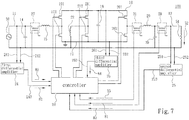
- the power converter 100 includes a first differential amplifier 24, a second differential amplifier 25, a third differential amplifier 26, a first current sensing element 27 connected in series with the AC power input line 11 and the first inductor 15 and outputting an input current signal 80 to the controller 23, and a second current sensing element 28 connected in series with the AC power output line 12 and outputting an output current signal 81 to the controller 23.
- the first differential amplifier 24 includes a first input end 241 connected to the AC power input line 11, a second input end 242 connected to the neutral line 13, and a first output end 243 providing an input voltage signal 82 to the controller 23.
- the second differential amplifier 25 includes a third input end 251 connected to the AC power output line 12, a fourth input end 252 connected to the neutral line 13, and a second output end 253 providing an output voltage signal 83 to the controller 23.
- the third differential amplifier 26 includes a fifth input end 261 connected to the first bus 16, a sixth input end 262 connected to the second bus 17, and a third output end 263 providing a bus voltage signal 84 to the controller 23. Accordingly, the controller 23 may adjust the control on the first switch 191, the second switch 192, the third switch 201 and the fourth switch 202 according to a current operating status and perform compensation. Referring to Fig.
- the first input end 241 and the second input end 242 are respectively provided with serial voltage dividing resistors 244 and 245, wherein each of the serial voltage dividing resistors 244 and 245 comprises at least two resistors.
- each of the serial voltage dividing resistors 244 and 245 comprises at least two resistors.
- the serial voltage dividing resistors 244 and 245 are only provided on the first input end 241 and the second input end 242, in the implementation of the present invention, the third input end 251, the fourth input end 252, the fifth input end 261 and the sixth input end 262 may also be provided with the serial voltage dividing resistor (not shown). Accordingly, the serial voltage dividing resistors 244 and 245 are able to jointly distribute the received voltage and current.
- the power converter 100 further includes a third inductor 29 connected to the AC power output line 12 and connected to the node between the third switch 201 and the fourth switch 202, and a third capacitor 30 connected to the node between the AC power output line 12 and the neutral line 13, wherein the third inductor 29 and the third capacitor 30 together form a filter circuit 42 to filter out the noise from the inverter circuit 41.
- the power converter 100 further includes a third current sensing element 31 connected to the node between the third switch 201 and the fourth switch 202 and connected in series with the third inductor 29 so as to output an inverter current signal 85 to the controller 23.
- the controller 23 adjusts the control signals 60 and 61 outputted to the first half-bridge circuit 19 on the basis of the input current signal 80, the input voltage signal 82 and the bus voltage signal 84, and adjusts the control signals 62 and 63 outputted to the second half-bridge circuit 20 on the basis of the output current signal 81, the output voltage signal 83 and the inverter current signal 85.
- the power converter 100 further includes a DC power converting circuit 32 connected to the first bus 16 and the second bus 17. Further, the DC power converting circuit 32 may be used for modulating DC power or be used to charge an energy storage element included so as to serve as a backup power device of the power converter 100.
- the energy storage element may be a battery or a super capacitor.
- control signals 62 , 63, 64 and 65 for the second half-bridge circuit 20 or the third half-bridge circuit 21 are generated by comparing the mixed sine wave 70 (or 75) with the high-frequency triangular carrier 71.
- the output current during the phase transition i.e., from a phase angle of 355 degrees to a phase angle of 5 degrees or from a phase angle of 175 degrees or a phase angle of 185 degrees
- the present invention at the same time reduces the total harmonic distortion of the output AC power 52.
Landscapes
- Engineering & Computer Science (AREA)
- Power Engineering (AREA)
- Business, Economics & Management (AREA)
- Emergency Management (AREA)
- Inverter Devices (AREA)
Abstract

Description
- The present invention relates to a power converter, and particularly to a power converter improving issues of discontinuous phase transition current and total harmonic distortion (THD) in an output alternating-current power by using control signals.
- The
U.S. Patents No. 6,310,787 and No.6,181,581 as well as European Patent No.1969694B1 disclose a kind of power converter; however, a control means used in the power converter disclosed by the above patents suffers from issues of discontinuous phase transition current and higher total harmonic distortion (THD) in the output alternating-current power. - The primary object of the present invention is to solve the issues of discontinuous phase transition current and total harmonic distortion (THD) in an output alternating-current (AC) power of an circuit.
- To achieve the above object, the present invention provides a power converter comprising an alternating-current (AC) power input line, an AC power output line, a neutral line, a first capacitor connected to the AC power output line and the neutral line, a first inductor connected to the AC power input line, a first bus, a second bus, a second capacitor connected to the first bus and the second bus, a first half-bridge circuit, a second half-bridge circuit, a third half-bridge circuit, a second inductor and a controller. The first half-bridge circuit comprises a first switch connected to the first bus, and a second switch connected in series with the first switch and connected to the second bus, wherein the first inductor is connected to a node between the first switch and the second switch. The second half-bridge circuit comprises a third switch connected to the first bus, and a fourth switch connected in series with the third switch and connected to the second bus, wherein the AC power output line is connected to a node between the third switch and the fourth switch. The third half-bridge circuit comprises a fifth switch connected to the first bus, and a sixth switch connected in series with the fifth switch and connected to the second bus, wherein one end of the second inductor is connected to a node between the fifth switch and the sixth switch and the other end is connected to the neutral line. The controller provides a control signal to each of the first switch, the second switch, the third switch, the fourth switch, the fifth switch and the sixth switch. The control signal provided for the second half-bridge circuit or the third half-bridge circuit by the controller is generated by comparing a mixed sine wave with a high-frequency triangular carrier, wherein the mixed sine wave is generated by mixing a third-order harmonic of a low-frequency sine wave into the low-frequency sine wave, and the low-frequency sine wave for modulating the control signal of the first half-bridge circuit and the second half-bridge circuit has an inverted phase from the phase of the low-frequency sine wave for modulating the control signal for the third half-bridge circuit.
- In one embodiment, the power converter further comprised s a third inductor connected to the AC power output line and connected to the node between the third switch and the fourth switch, and a third capacitor connected to a node between the AC power output line and the neutral line, wherein the third inductor and the third capacitor together form a filter circuit.
- In one embodiment, the frequency of the low-frequency sine wave is equal to the frequency of an output AC power inputted to the power converted or outputted from the power converter.
- In one embodiment, the control signal provided by the controller to each of the first switch, the second switch, the third switch and the fourth switch is generated by comparing the low-frequency sine wave with the high-frequency triangular carrier.
- In one embodiment, the power converter comprises a first differential amplifier, a second differential amplifier, a third differential amplifier, a first current sensing element connected in series with the AC power input line and the first inductor and outputting an input current signal to the controller, a second current sensing element connected in series with the AC power output line and outputting an output current signal to the controller, a third inductor connected to the AC power output line and connected to the node between the third switch and the fourth switch, a third capacitor connected to the node between the AC power output line and the neutral line and forming the filter circuit together with the third inductor, and a third current sensing element connected to the node between the third switch and the fourth switch and connected in series with the third inductor to output an inverter current signal to the controller. The first differential amplifier comprises a first input end connected to the AC power input line, a second input end connected to the neutral line, and a first output end providing an input voltage signal to the controller. The second differential amplifier comprises a third input end connected to the AC power output line, a fourth input end connected to the neutral line, and a second output end providing an output voltage signal to the controller. The third differential amplifier comprises a fifth input end connected to the first bus, a sixth input end connected to the second bus, and a third output end providing a bus voltage signal to the controller. The controller adjusts the control signals outputted to the first half-bridge circuit on the basis of the input current signal, the input voltage signal and the bus voltage signal, and adjusts the control signals outputted to the second half-bridge circuit on the basis of the output current signal, the output voltage signal and the inverter current signal.
- In one embodiment, each of the first input end, the second input end, the third input end, the fourth input end, the fifth input end and the sixth input end is provided with a serial voltage dividing resistor, and each of the serial voltage dividing resistor comprises of at least two resistors.
- In one embodiment, the power converter comprises a direct-current (DC) power converting circuit connected to the first bus and the second bus.
- The present invention provides the following features compared to the prior art. In the power converter of the present invention, the first half-bridge circuit, the second half-bridge circuit and the third half-bridge circuit all adopt high-frequency switching control, and the control signal for controlling the third half-bridge circuit is generated by comparing the mixed sine wave with the high-frequency triangular carrier, wherein the mixed sine wave is generated by mixing a third-order harmonic of the low-frequency sine wave into the low-frequency sine wave. Thus, during phase transition of the output AC power (i.e., from a phase angle of 355 degrees to a phase angle of 5 degrees, or from a phase angle of 175 degrees to a phase angle of 185 degrees), the output current can be kept continuous, thus achieving an advantage of high phase transition stability. Further, the present invention at the same time reduces total harmonic distortion (THD) of the output AC power.
-
-
Fig. 1 is a schematic diagram of circuit composition of a power converter according to an embodiment of the present invention; -
Fig. 2 is a schematic diagram of implementation of a controller generating control signals according to an embodiment of the present invention; -
Fig. 3 is a schematic diagram of control signals generated according to an embodiment of the present invention; -
Fig. 4 is a comparison diagram of waveforms control signals and an output alternating-current (AC) power according to an embodiment of the present invention; -
Fig. 5 is a schematic diagram of implementation of a controller generating control signals according to another embodiment of the present invention; -
Fig. 6 is a comparison diagram of waveforms control signals and an output AC power according to another embodiment of the present invention; -
Fig. 7 is a schematic diagram of circuit composition of a power converter according to another embodiment of the present invention; -
Fig. 8 is a schematic diagram of units of a first differential amplifier according to an embodiment of the present invention; and -
Fig. 9 is schematic diagram of circuit composition of a power converter according to another embodiment of the present invention. - Details and technical contents of the present invention are described with the accompanying drawings below.
- Referring to
Fig. 1 ,Fig. 2 ,Fig. 3 andFig. 4 , the present invention provides apower converter 100. Thepower converter 100 may be constructed in an uninterrupted power system or a communication apparatus and may be implemented in a plural quantity by series connection. Thepower converter 100 includes an alternating-current (AC)power input line 11, an ACpower output line 12, aneutral line 13, afirst capacitor 14 connected to the ACpower input line 11 and theneutral line 13, afirst inductor 15 connected to the ACpower input line 11, afirst bus 16, asecond bus 17, asecond capacitor 18 connected to thefirst bus 16 and thesecond bus 17, a first half-bridge circuit 19, a second half-bridge circuit 20, a third half-bridge circuit 21, asecond inductor 22 and acontroller 23. The ACpower input line 11 and theneutral line 13 are respectively connected to positive and negative terminals of anAC power source 50, and the ACpower output line 12 and theneutral line 13 are respectively connected to one end of aload 51 so as to provide anoutput AC power 52 to theload 51. The first half-bridge circuit 19 includes afirst switch 191 connected to thefirst bus 16, and asecond switch 192 connected in series to thefirst switch 191 and connected to thesecond bus 17. Thefirst inductor 15 is connected to the node between thefirst switch 191 and thesecond switch 192. The second half-bridge circuit 20 includes athird switch 201 connected to thefirst bus 16, and afourth switch 202 connected in series to thethird switch 201 and connected to thesecond bus 17. The ACpower output line 12 is connected to the node between thethird switch 201 and thefourth switch 202. The third half-bridge circuit 21 includes afifth switch 211 connected to thefirst bus 16, and asixth switch 212 connected in series with thefifth switch 211 and connected to thesecond bus 17. One end of thesecond inductor 22 is connected to the node between thefifth switch 211 and thesixth switch 212, and the other end is connected to theneutral line 13. Further, each of thefirst switch 191, thesecond switch 192, thethird switch 201, thefourth switch 202, thefifth switch 211 and thesixth switch 212 may be a metal-oxide semiconductor field-effect transistor (MOSFET) or an insulated gate bipolar transistor (IGBT). Further, in thepower converter 100 of the present invention, thefirst capacitor 14, thefirst inductor 15, thesecond inductor 22, thefirst switch 191, thesecond switch 192, thefifth switch 211 and thesixth switch 212 form arectification circuit 40. Further, in thepower converter 100, thesecond inductor 22, thethird inductor 29, thethird switch 201, thefourth switch 202, thefifth switch 211 and thesixth switch 212 form aninverter circuit 41. Therectification circuit 40 is for converting AC power to direct current (DC) power, and theinverter circuit 41 is for converting DC power to AC power. - Referring to
Fig. 1 ,Fig. 2 ,Fig. 3 , andFig. 4 , thecontroller 23 is a microcontroller unit (MCU), and thecontroller 23 is connected to thefirst switch 191, thesecond switch 192, thethird switch 201, thefourth switch 202, thefifth switch 211 and thesixth switch 212. Thecontroller 23 is configured to individually send a control signal (60, 61, 62, 63, 64, 65) to thefirst switch 191, thesecond switch 192, thethird switch 201, thefourth switch 202, thefifth switch 211 and thesixth switch 212, wherein each of the control signals (60, 61, 62, 63, 64, 65) is generated through pulse width modulation (PWM). Thefirst switch 191, thesecond switch 192, thethird switch 201, thefourth switch 202, thefifth switch 211 and thesixth switch 212 become a conducted state or a cut-off state on the basis of the respective control signals (60, 61, 62, 63, 64, 65) received. Further, in one embodiment of the present invention, thecontrol signals controller 23 and transmitted to the third half-bridge circuit 21 are generated by comparing a mixedsine wave 70 with a high-frequencytriangular carrier 71 so as to eliminate total harmonic distortion of theoutput AC power 52 and improve the issue of a discontinuous output current, wherein themixed sine wave 70 is generated by mixing a third-order harmonic of a low-frequency sine wave 72 (denoted by 73 in the figures) into the low-frequency sine wave 72. The third-order harmonic 73 is a sine wave having a frequency higher than that of the low-frequency sine wave 72. Further, thecontrol signals fifth switch 211 and thesixth switch 212 may be designed to have mutually inverted phases; that is, thesixth switch 212 is cut off when thefifth switch 211 is conducted, and thesixth switch 212 is conducted when thefifth switch 211 is cut off. Further, the frequency of the low-frequency sine wave 72 is equal to the frequency of theoutput AC power 52 inputted to thepower converter 100 or outputted from thepower converter 100. For example, when the frequency of theoutput AC power 52 is 50 Hz, the frequency of the low-frequency sine wave 72 is also 50 Hz. Further, each of the control signals (60, 61, 62, 63) outputted by the controller 53 to thefirst switch 191, thesecond switch 192, thethird switch 201 and thefourth switch 202 is respectively generated by comparing another low-frequency sine wave 74 with the high-frequencytriangular carrier 71. Further, in one embodiment of the present invention, the low-frequency sine wave 74 for modulating the control signals (60, 61, 62, 63) for the first half-bridge circuit 19 and the second half-bridge circuit 20 have an inverted phase from that of the low-frequency sine wave 72 for modulating thecontrol signals bridge circuit 21. Referring toFig. 3 , whereinFig. 3(A) and Fig. 3(C) show respectively schematic diagrams of modulation of thecontrol signals bridge circuit 19 and the second half-bridge circuit 20, andFig. 3(B) shows a schematic diagram of modulation of thecontrol signals bridge circuit 21. Further, thecontrol signals first switch 191 and thesecond switch 192 may be designed to have mutually inverted phases, and thecontrol signals 62 and 63 received by thethird switch 201 and thefourth switch 202 may be designed to have mutually inverted phases. Such design of having mutually inverted phases is for preventing short-circuitry of the half-bridge circuits, and associated details are undoubtedly known to a person skilled in the art and are thus omitted herein. - Referring to
Fig. 5 , in another embodiment, the control signals 64 and 65 provided for the third half-bridge circuit 21 by thecontroller 23 are not modulated according to the foregoing embodiment; that is, the control signals 64 and 65 are generated without using themixed sine wave 70. In this embodiment, the control signals 62 and 63 provided for the second half-bridge circuit 20 by thecontroller 23 are generated by comparing themixed sine wave 75 with the high-frequencytriangular carrier 71, wherein themixed sine wave 75 is generated by mixing a third-order harmonic of the low-frequency sine wave 74 (denoted as 76 in the figures) into the low-frequency sine wave 74. Further, in this embodiment, the control signals 60 and 61 used for controlling the first half-bridge circuit 19 may be high-frequency control signals, and the control signals 64 and 65 used for controlling the third half-bridge circuit 21 may be high-frequency control signals or low-frequency control signals according to actual implementation requirements. Further referring toFig. 6 , in one embodiment, the control signals 64 and 65 are fundamentally in low frequencies, and the time point for switching control potentials of the control signals 64 and 65 are corresponding to the time point when theoutput AC power 52 is between a phase angle of 175 degrees to 185 degrees or 355 degrees to 5 degrees. In this embodiment, the control signals 64 and 65 are implemented by a high frequency in the two intervals above. - Also referring to
Fig. 7 , in one embodiment, thepower converter 100 includes a firstdifferential amplifier 24, a seconddifferential amplifier 25, a thirddifferential amplifier 26, a firstcurrent sensing element 27 connected in series with the ACpower input line 11 and thefirst inductor 15 and outputting an inputcurrent signal 80 to thecontroller 23, and a secondcurrent sensing element 28 connected in series with the ACpower output line 12 and outputting an outputcurrent signal 81 to thecontroller 23. The firstdifferential amplifier 24 includes afirst input end 241 connected to the ACpower input line 11, asecond input end 242 connected to theneutral line 13, and afirst output end 243 providing aninput voltage signal 82 to thecontroller 23. The seconddifferential amplifier 25 includes athird input end 251 connected to the ACpower output line 12, afourth input end 252 connected to theneutral line 13, and asecond output end 253 providing anoutput voltage signal 83 to thecontroller 23. The thirddifferential amplifier 26 includes afifth input end 261 connected to thefirst bus 16, asixth input end 262 connected to thesecond bus 17, and athird output end 263 providing abus voltage signal 84 to thecontroller 23. Accordingly, thecontroller 23 may adjust the control on thefirst switch 191, thesecond switch 192, thethird switch 201 and thefourth switch 202 according to a current operating status and perform compensation. Referring toFig. 8 , in one embodiment, thefirst input end 241 and thesecond input end 242 are respectively provided with serialvoltage dividing resistors voltage dividing resistors voltage dividing resistors first input end 241 and thesecond input end 242, in the implementation of the present invention, thethird input end 251, thefourth input end 252, thefifth input end 261 and thesixth input end 262 may also be provided with the serial voltage dividing resistor (not shown). Accordingly, the serialvoltage dividing resistors - Refer to
Fig. 7 , thepower converter 100 further includes athird inductor 29 connected to the ACpower output line 12 and connected to the node between thethird switch 201 and thefourth switch 202, and athird capacitor 30 connected to the node between the ACpower output line 12 and theneutral line 13, wherein thethird inductor 29 and thethird capacitor 30 together form afilter circuit 42 to filter out the noise from theinverter circuit 41. Moreover, in this embodiment, thepower converter 100 further includes a thirdcurrent sensing element 31 connected to the node between thethird switch 201 and thefourth switch 202 and connected in series with thethird inductor 29 so as to output an invertercurrent signal 85 to thecontroller 23. Thecontroller 23 adjusts the control signals 60 and 61 outputted to the first half-bridge circuit 19 on the basis of the inputcurrent signal 80, theinput voltage signal 82 and thebus voltage signal 84, and adjusts the control signals 62 and 63 outputted to the second half-bridge circuit 20 on the basis of the outputcurrent signal 81, theoutput voltage signal 83 and the invertercurrent signal 85. - Referring to
Fig. 9 , in one embodiment, thepower converter 100 further includes a DCpower converting circuit 32 connected to thefirst bus 16 and thesecond bus 17. Further, the DCpower converting circuit 32 may be used for modulating DC power or be used to charge an energy storage element included so as to serve as a backup power device of thepower converter 100. The energy storage element may be a battery or a super capacitor. - In conclusion, the control signals 62 , 63, 64 and 65 for the second half-
bridge circuit 20 or the third half-bridge circuit 21 are generated by comparing the mixed sine wave 70 (or 75) with the high-frequencytriangular carrier 71. Thus, the output current during the phase transition (i.e., from a phase angle of 355 degrees to a phase angle of 5 degrees or from a phase angle of 175 degrees or a phase angle of 185 degrees) of theoutput AC power 52 may be kept continuous, achieving the feature of high phase transition stability. Further, the present invention at the same time reduces the total harmonic distortion of theoutput AC power 52.
Claims (7)
- A power converter (100), comprising:an alternating-current (AC) power input line (11);an AC power output line (12);a neutral line (13);a first capacitor (14), connected to the AC power input line (11) and the neutral line (13);a first inductor (15), connected to the AC power input line (11);a first bus (16) and a second bus (17);a second capacitor (18), connected to the first bus (16) and the second bus (17);a first half-bridge circuit (19), comprising a first switch (191) connected to the first bus (16), and a second switch (192) connected in series with the first switch (191) and connected to the second bus (17), wherein the first inductor (15) is connected to a node between the first switch (191) and the second switch (192);a second half-bridge circuit (20), comprising a third switch (201) connected to the first bus (16), and a fourth switch (202) connected in series with the third switch (201) and connected to the second bus (17), wherein the AC power output line (12) is connected to a node between the third switch (201) and the fourth switch (202);a third half-bridge circuit (21), comprising a fifth switch (211) connected to the first bus (16), and a sixth switch (212) connected in series with the fifth switch (211) and connected to the second bus (17);a second inductor (22), having one end connected to a node between the fifth switch (211) and the sixth switch (212) and one other end connected to the neutral line (13); anda controller (23), providing a control signal (60, 61, 62, 63, 64, 65) to each of the first half-bridge circuit (19), the second half-bridge circuit (20) and the third half-bridge circuit (21), wherein the control signal (62, 63, 64, 65) provided for the second half-bridge circuit (20) or the third half-bridge circuit (21) by the controller (23) is generated by comparing a mixed sine wave (70) with a high-frequency triangular carrier (71), the mixed sine wave (70) is generated by mixing a third-order harmonic (73) of a low-frequency sine wave (72) into the low-frequency sine wave (72), and the low-frequency sine wave (72) for modulating the control signal (60, 61, 62, 63) of the first half-bridge circuit (19) and the second half-bridge circuit (20) has an inverted phase from the phase of the low-frequency sine wave (72) for modulating the control signal (64, 65) of the third half-bridge circuit (21).
- The power converter (100) of claim 1, further comprising a third inductor (29) connected to the AC power output line (12) and connected to the node between the third switch (201) and the fourth switch (202), and a third capacitor (30) connected to a node between the AC power output line (12) and the neutral line (13), wherein the third inductor (29) and the third capacitor (30) together form a filter circuit (42).
- The power converter (100) of claim 1, wherein a frequency of the low-frequency sine wave (72) is equal to a frequency of an output AC power (52) inputted to the power converter (100) or outputted from the power converter (100).
- The power converter (100) of claim 1 or claim 3, wherein the control signal (60, 61, 62, 63) provided for each of the first switch (191), the second switch (192), the third switch (201) and the fourth switch (202) by the controller (23) is generated by comparing the low-frequency sine wave (72) with the high-frequency triangular carrier (71).
- The power converter (100) of claim 1 further comprises a first differential amplifier (24), a second differential amplifier (25), a third differential amplifier (26), a first current sensing element (27) connected in series with the AC power input line (11) and the first inductor (15) and outputting an input current signal (80) to the controller (23), a second current sensing element (28) connected in series with the AC power output line (12) and outputting an output current signal (81) to the controller (23), a third inductor (29) connected to the AC power output line (12) and connected to the node between the third switch (201) and the fourth switch (202), a third capacitor (30) connected to the node between the AC power output line (12) and the neutral line (13) and forming a filter circuit (42) together with the third inductor (29), and a third current sensing element (31) connected to the node between the third switch (201) and the fourth switch (202) and connected in series with the third inductor (29) to output an inverter current signal (85) to the controller (23);
wherein the first differential amplifier (24) comprises a first input end (241) connected to the AC power input line (11), a second input end (242) connected to the neutral line (13), and a first output end (243) providing an input voltage signal (82) to the controller (23), the second differential amplifier (25) comprises a third input end (251) connected to the AC power output line (12), a fourth input end (252) connected to the neutral line (13), and a second output end (253) providing an output voltage signal (83) to the controller (23), the third differential amplifier (26) comprises a fifth input end (261) connected to the first bus (16), a sixth input end (262) connected to the second bus (17), and a third output end (263) providing a bus voltage signal (84) to the controller (23), and the controller (23) adjusts the control signals (60) outputted to the first half-bridge circuit (19) on a basis of the input current signal (80), the input voltage signal (82) and the bus voltage signal (84), and adjusts the control signals (60) outputted to the (20) on a basis of the output current signal (81), the output voltage signal (83) and the inverter current signal (85). - The power converter (100) of claim 5, wherein each of the first input end (241), the second input end (242), the third input end (251), the fourth input end (252), the fifth input end (261) and the sixth input end (262) is provided with a serial voltage dividing resistor (244, 245), and each of the serial voltage dividing resistors (244, 245) comprises of at least two resistors.
- The power converter (100) of claim 1, further comprising a direct-current (DC) power converting circuit (32) connected to the first bus (16) and the second bus (17).
Priority Applications (2)
| Application Number | Priority Date | Filing Date | Title |
|---|---|---|---|
| ES19152303T ES2869135T3 (en) | 2019-01-17 | 2019-01-17 | power converter |
| EP19152303.4A EP3683943B1 (en) | 2019-01-17 | 2019-01-17 | Power converter |
Applications Claiming Priority (1)
| Application Number | Priority Date | Filing Date | Title |
|---|---|---|---|
| EP19152303.4A EP3683943B1 (en) | 2019-01-17 | 2019-01-17 | Power converter |
Publications (2)
| Publication Number | Publication Date |
|---|---|
| EP3683943A1 true EP3683943A1 (en) | 2020-07-22 |
| EP3683943B1 EP3683943B1 (en) | 2021-03-24 |
Family
ID=65036677
Family Applications (1)
| Application Number | Title | Priority Date | Filing Date |
|---|---|---|---|
| EP19152303.4A Active EP3683943B1 (en) | 2019-01-17 | 2019-01-17 | Power converter |
Country Status (2)
| Country | Link |
|---|---|
| EP (1) | EP3683943B1 (en) |
| ES (1) | ES2869135T3 (en) |
Cited By (1)
| Publication number | Priority date | Publication date | Assignee | Title |
|---|---|---|---|---|
| CN115765389A (en) * | 2022-10-29 | 2023-03-07 | 华为数字能源技术有限公司 | Power converter and control method thereof |
Citations (9)
| Publication number | Priority date | Publication date | Assignee | Title |
|---|---|---|---|---|
| JPH08126352A (en) * | 1994-10-26 | 1996-05-17 | Sanken Electric Co Ltd | Power converter |
| JPH09238481A (en) * | 1996-03-04 | 1997-09-09 | Mitsubishi Electric Corp | Power converter |
| EP1076403A2 (en) * | 1999-08-13 | 2001-02-14 | Powerware Corporation | Multi-mode power converters incorporating balancer circuits and methods of operation thereof |
| US20010026460A1 (en) * | 2000-04-03 | 2001-10-04 | Youichi Ito | Multiway power converter |
| US20020118556A1 (en) * | 1999-08-13 | 2002-08-29 | Johnson Robert W. | Power converters with ac and dc operating modes and methods of operation thereof |
| EP1806819A1 (en) * | 2006-01-05 | 2007-07-11 | Constructions Electroniques + Telecommunications, en abrégé "C.E.+T" | Backup power system |
| JP2014011831A (en) * | 2012-06-28 | 2014-01-20 | Mitsubishi Electric Corp | Ac/dc power conversion device, and uninterruptible power supply device comprising the same |
| EP2759038A2 (en) * | 2011-09-23 | 2014-07-30 | Eaton Corporation | Uninterruptible power supply systems and methods employing on-demand energy storage |
| US20160065056A1 (en) * | 2014-08-27 | 2016-03-03 | Schneider Electric It Corporation | Delta conversion rectifier |
-
2019
- 2019-01-17 ES ES19152303T patent/ES2869135T3/en active Active
- 2019-01-17 EP EP19152303.4A patent/EP3683943B1/en active Active
Patent Citations (11)
| Publication number | Priority date | Publication date | Assignee | Title |
|---|---|---|---|---|
| JPH08126352A (en) * | 1994-10-26 | 1996-05-17 | Sanken Electric Co Ltd | Power converter |
| JPH09238481A (en) * | 1996-03-04 | 1997-09-09 | Mitsubishi Electric Corp | Power converter |
| EP1076403A2 (en) * | 1999-08-13 | 2001-02-14 | Powerware Corporation | Multi-mode power converters incorporating balancer circuits and methods of operation thereof |
| US20020118556A1 (en) * | 1999-08-13 | 2002-08-29 | Johnson Robert W. | Power converters with ac and dc operating modes and methods of operation thereof |
| US20010026460A1 (en) * | 2000-04-03 | 2001-10-04 | Youichi Ito | Multiway power converter |
| US6310787B2 (en) | 2000-04-03 | 2001-10-30 | Sanken Electric Co., Ltd. | Multiway power converter |
| EP1806819A1 (en) * | 2006-01-05 | 2007-07-11 | Constructions Electroniques + Telecommunications, en abrégé "C.E.+T" | Backup power system |
| EP1969694B1 (en) | 2006-01-05 | 2017-05-03 | Constructions Electroniques + Telecommunications, En abrégé "C.E.+T." | Backup power system |
| EP2759038A2 (en) * | 2011-09-23 | 2014-07-30 | Eaton Corporation | Uninterruptible power supply systems and methods employing on-demand energy storage |
| JP2014011831A (en) * | 2012-06-28 | 2014-01-20 | Mitsubishi Electric Corp | Ac/dc power conversion device, and uninterruptible power supply device comprising the same |
| US20160065056A1 (en) * | 2014-08-27 | 2016-03-03 | Schneider Electric It Corporation | Delta conversion rectifier |
Cited By (1)
| Publication number | Priority date | Publication date | Assignee | Title |
|---|---|---|---|---|
| CN115765389A (en) * | 2022-10-29 | 2023-03-07 | 华为数字能源技术有限公司 | Power converter and control method thereof |
Also Published As
| Publication number | Publication date |
|---|---|
| EP3683943B1 (en) | 2021-03-24 |
| ES2869135T3 (en) | 2021-10-25 |
Similar Documents
| Publication | Publication Date | Title |
|---|---|---|
| US9419542B2 (en) | Inverter device | |
| CN101674028A (en) | three-level inverter | |
| US11159102B2 (en) | Active voltage bus system and method | |
| CN101917126A (en) | A control method for voltage equalization and power equalization of multi-module cascaded solid-state transformers | |
| US9438132B2 (en) | Multilevel AC/DC power converting method and converter device thereof | |
| Maheshri et al. | Simulation of single phase SPWM (Unipolar) inverter | |
| US9531298B2 (en) | Inverter device | |
| CN203747686U (en) | Single-phase mixed three-level grid-connected inverter | |
| RU163740U1 (en) | MULTI-PHASE RECTIFIER WITH CORRECTION OF POWER COEFFICIENT | |
| WO2020062837A1 (en) | Inverter system | |
| US20150180368A1 (en) | Power converter, and inverter device including the power converter | |
| US7015679B2 (en) | Circuit and method for supplying an electrical a.c. load | |
| CN110546874A (en) | Power conversion system | |
| US10530267B1 (en) | Power converter | |
| EP3683943A1 (en) | Power converter | |
| JP4135403B2 (en) | Switching circuit and power supply circuit | |
| US9343995B2 (en) | Power conversion device | |
| CN107809181B (en) | A kind of Mixed cascading H bridge rectifier for being 1:2 for output voltage | |
| CN104022673A (en) | SPWM method of single-phase full bridge inverter | |
| CN215871225U (en) | Five-level voltage source type conversion device | |
| JP7030070B2 (en) | Power converter | |
| CN112242741B (en) | Uninterruptible power supply device and control method thereof | |
| JP2573229B2 (en) | Variable voltage and variable frequency power supply | |
| CN206461535U (en) | The signal control circuit of inverter | |
| GB2474009A (en) | Inverter having pair of switching arms with voltage divider |
Legal Events
| Date | Code | Title | Description |
|---|---|---|---|
| PUAI | Public reference made under article 153(3) epc to a published international application that has entered the european phase |
Free format text: ORIGINAL CODE: 0009012 |
|
| STAA | Information on the status of an ep patent application or granted ep patent |
Free format text: STATUS: THE APPLICATION HAS BEEN PUBLISHED |
|
| AK | Designated contracting states |
Kind code of ref document: A1 Designated state(s): AL AT BE BG CH CY CZ DE DK EE ES FI FR GB GR HR HU IE IS IT LI LT LU LV MC MK MT NL NO PL PT RO RS SE SI SK SM TR |
|
| AX | Request for extension of the european patent |
Extension state: BA ME |
|
| STAA | Information on the status of an ep patent application or granted ep patent |
Free format text: STATUS: REQUEST FOR EXAMINATION WAS MADE |
|
| 17P | Request for examination filed |
Effective date: 20200717 |
|
| RBV | Designated contracting states (corrected) |
Designated state(s): AL AT BE BG CH CY CZ DE DK EE ES FI FR GB GR HR HU IE IS IT LI LT LU LV MC MK MT NL NO PL PT RO RS SE SI SK SM TR |
|
| GRAP | Despatch of communication of intention to grant a patent |
Free format text: ORIGINAL CODE: EPIDOSNIGR1 |
|
| STAA | Information on the status of an ep patent application or granted ep patent |
Free format text: STATUS: GRANT OF PATENT IS INTENDED |
|
| RIC1 | Information provided on ipc code assigned before grant |
Ipc: H02M 7/538 20070101ALI20200915BHEP Ipc: H02J 9/06 20060101ALI20200915BHEP Ipc: H02M 1/00 20060101ALN20200915BHEP Ipc: H02M 1/12 20060101AFI20200915BHEP Ipc: H02M 3/158 20060101ALN20200915BHEP Ipc: H02M 7/217 20060101ALI20200915BHEP Ipc: H02M 5/458 20060101ALI20200915BHEP Ipc: H02M 7/5395 20060101ALI20200915BHEP |
|
| INTG | Intention to grant announced |
Effective date: 20201013 |
|
| GRAS | Grant fee paid |
Free format text: ORIGINAL CODE: EPIDOSNIGR3 |
|
| GRAA | (expected) grant |
Free format text: ORIGINAL CODE: 0009210 |
|
| STAA | Information on the status of an ep patent application or granted ep patent |
Free format text: STATUS: THE PATENT HAS BEEN GRANTED |
|
| AK | Designated contracting states |
Kind code of ref document: B1 Designated state(s): AL AT BE BG CH CY CZ DE DK EE ES FI FR GB GR HR HU IE IS IT LI LT LU LV MC MK MT NL NO PL PT RO RS SE SI SK SM TR |
|
| REG | Reference to a national code |
Ref country code: GB Ref legal event code: FG4D |
|
| REG | Reference to a national code |
Ref country code: CH Ref legal event code: EP |
|
| REG | Reference to a national code |
Ref country code: IE Ref legal event code: FG4D |
|
| REG | Reference to a national code |
Ref country code: DE Ref legal event code: R096 Ref document number: 602019003292 Country of ref document: DE Ref country code: AT Ref legal event code: REF Ref document number: 1375512 Country of ref document: AT Kind code of ref document: T Effective date: 20210415 |
|
| REG | Reference to a national code |
Ref country code: NL Ref legal event code: FP |
|
| REG | Reference to a national code |
Ref country code: SE Ref legal event code: TRGR |
|
| REG | Reference to a national code |
Ref country code: LT Ref legal event code: MG9D |
|
| PG25 | Lapsed in a contracting state [announced via postgrant information from national office to epo] |
Ref country code: NO Free format text: LAPSE BECAUSE OF FAILURE TO SUBMIT A TRANSLATION OF THE DESCRIPTION OR TO PAY THE FEE WITHIN THE PRESCRIBED TIME-LIMIT Effective date: 20210624 Ref country code: GR Free format text: LAPSE BECAUSE OF FAILURE TO SUBMIT A TRANSLATION OF THE DESCRIPTION OR TO PAY THE FEE WITHIN THE PRESCRIBED TIME-LIMIT Effective date: 20210625 Ref country code: HR Free format text: LAPSE BECAUSE OF FAILURE TO SUBMIT A TRANSLATION OF THE DESCRIPTION OR TO PAY THE FEE WITHIN THE PRESCRIBED TIME-LIMIT Effective date: 20210324 Ref country code: FI Free format text: LAPSE BECAUSE OF FAILURE TO SUBMIT A TRANSLATION OF THE DESCRIPTION OR TO PAY THE FEE WITHIN THE PRESCRIBED TIME-LIMIT Effective date: 20210324 Ref country code: BG Free format text: LAPSE BECAUSE OF FAILURE TO SUBMIT A TRANSLATION OF THE DESCRIPTION OR TO PAY THE FEE WITHIN THE PRESCRIBED TIME-LIMIT Effective date: 20210624 |
|
| PG25 | Lapsed in a contracting state [announced via postgrant information from national office to epo] |
Ref country code: RS Free format text: LAPSE BECAUSE OF FAILURE TO SUBMIT A TRANSLATION OF THE DESCRIPTION OR TO PAY THE FEE WITHIN THE PRESCRIBED TIME-LIMIT Effective date: 20210324 Ref country code: LV Free format text: LAPSE BECAUSE OF FAILURE TO SUBMIT A TRANSLATION OF THE DESCRIPTION OR TO PAY THE FEE WITHIN THE PRESCRIBED TIME-LIMIT Effective date: 20210324 |
|
| REG | Reference to a national code |
Ref country code: AT Ref legal event code: MK05 Ref document number: 1375512 Country of ref document: AT Kind code of ref document: T Effective date: 20210324 |
|
| REG | Reference to a national code |
Ref country code: ES Ref legal event code: FG2A Ref document number: 2869135 Country of ref document: ES Kind code of ref document: T3 Effective date: 20211025 |
|
| PG25 | Lapsed in a contracting state [announced via postgrant information from national office to epo] |
Ref country code: LT Free format text: LAPSE BECAUSE OF FAILURE TO SUBMIT A TRANSLATION OF THE DESCRIPTION OR TO PAY THE FEE WITHIN THE PRESCRIBED TIME-LIMIT Effective date: 20210324 Ref country code: EE Free format text: LAPSE BECAUSE OF FAILURE TO SUBMIT A TRANSLATION OF THE DESCRIPTION OR TO PAY THE FEE WITHIN THE PRESCRIBED TIME-LIMIT Effective date: 20210324 Ref country code: CZ Free format text: LAPSE BECAUSE OF FAILURE TO SUBMIT A TRANSLATION OF THE DESCRIPTION OR TO PAY THE FEE WITHIN THE PRESCRIBED TIME-LIMIT Effective date: 20210324 Ref country code: SM Free format text: LAPSE BECAUSE OF FAILURE TO SUBMIT A TRANSLATION OF THE DESCRIPTION OR TO PAY THE FEE WITHIN THE PRESCRIBED TIME-LIMIT Effective date: 20210324 Ref country code: AT Free format text: LAPSE BECAUSE OF FAILURE TO SUBMIT A TRANSLATION OF THE DESCRIPTION OR TO PAY THE FEE WITHIN THE PRESCRIBED TIME-LIMIT Effective date: 20210324 |
|
| PG25 | Lapsed in a contracting state [announced via postgrant information from national office to epo] |
Ref country code: RO Free format text: LAPSE BECAUSE OF FAILURE TO SUBMIT A TRANSLATION OF THE DESCRIPTION OR TO PAY THE FEE WITHIN THE PRESCRIBED TIME-LIMIT Effective date: 20210324 Ref country code: PT Free format text: LAPSE BECAUSE OF FAILURE TO SUBMIT A TRANSLATION OF THE DESCRIPTION OR TO PAY THE FEE WITHIN THE PRESCRIBED TIME-LIMIT Effective date: 20210726 Ref country code: SK Free format text: LAPSE BECAUSE OF FAILURE TO SUBMIT A TRANSLATION OF THE DESCRIPTION OR TO PAY THE FEE WITHIN THE PRESCRIBED TIME-LIMIT Effective date: 20210324 Ref country code: PL Free format text: LAPSE BECAUSE OF FAILURE TO SUBMIT A TRANSLATION OF THE DESCRIPTION OR TO PAY THE FEE WITHIN THE PRESCRIBED TIME-LIMIT Effective date: 20210324 Ref country code: IS Free format text: LAPSE BECAUSE OF FAILURE TO SUBMIT A TRANSLATION OF THE DESCRIPTION OR TO PAY THE FEE WITHIN THE PRESCRIBED TIME-LIMIT Effective date: 20210724 |
|
| REG | Reference to a national code |
Ref country code: DE Ref legal event code: R097 Ref document number: 602019003292 Country of ref document: DE |
|
| PG25 | Lapsed in a contracting state [announced via postgrant information from national office to epo] |
Ref country code: DK Free format text: LAPSE BECAUSE OF FAILURE TO SUBMIT A TRANSLATION OF THE DESCRIPTION OR TO PAY THE FEE WITHIN THE PRESCRIBED TIME-LIMIT Effective date: 20210324 Ref country code: AL Free format text: LAPSE BECAUSE OF FAILURE TO SUBMIT A TRANSLATION OF THE DESCRIPTION OR TO PAY THE FEE WITHIN THE PRESCRIBED TIME-LIMIT Effective date: 20210324 |
|
| PLBE | No opposition filed within time limit |
Free format text: ORIGINAL CODE: 0009261 |
|
| STAA | Information on the status of an ep patent application or granted ep patent |
Free format text: STATUS: NO OPPOSITION FILED WITHIN TIME LIMIT |
|
| 26N | No opposition filed |
Effective date: 20220104 |
|
| PG25 | Lapsed in a contracting state [announced via postgrant information from national office to epo] |
Ref country code: IS Free format text: LAPSE BECAUSE OF FAILURE TO SUBMIT A TRANSLATION OF THE DESCRIPTION OR TO PAY THE FEE WITHIN THE PRESCRIBED TIME-LIMIT Effective date: 20210724 |
|
| PGFP | Annual fee paid to national office [announced via postgrant information from national office to epo] |
Ref country code: SE Payment date: 20220125 Year of fee payment: 4 Ref country code: NL Payment date: 20220120 Year of fee payment: 4 Ref country code: IT Payment date: 20220131 Year of fee payment: 4 Ref country code: ES Payment date: 20220216 Year of fee payment: 4 Ref country code: BE Payment date: 20220120 Year of fee payment: 4 |
|
| PG25 | Lapsed in a contracting state [announced via postgrant information from national office to epo] |
Ref country code: MC Free format text: LAPSE BECAUSE OF FAILURE TO SUBMIT A TRANSLATION OF THE DESCRIPTION OR TO PAY THE FEE WITHIN THE PRESCRIBED TIME-LIMIT Effective date: 20210324 |
|
| REG | Reference to a national code |
Ref country code: CH Ref legal event code: PL |
|
| PG25 | Lapsed in a contracting state [announced via postgrant information from national office to epo] |
Ref country code: LU Free format text: LAPSE BECAUSE OF NON-PAYMENT OF DUE FEES Effective date: 20220117 |
|
| PG25 | Lapsed in a contracting state [announced via postgrant information from national office to epo] |
Ref country code: LI Free format text: LAPSE BECAUSE OF NON-PAYMENT OF DUE FEES Effective date: 20220131 Ref country code: CH Free format text: LAPSE BECAUSE OF NON-PAYMENT OF DUE FEES Effective date: 20220131 |
|
| PG25 | Lapsed in a contracting state [announced via postgrant information from national office to epo] |
Ref country code: IE Free format text: LAPSE BECAUSE OF NON-PAYMENT OF DUE FEES Effective date: 20220117 |
|
| REG | Reference to a national code |
Ref country code: SE Ref legal event code: EUG |
|
| REG | Reference to a national code |
Ref country code: NL Ref legal event code: MM Effective date: 20230201 |
|
| REG | Reference to a national code |
Ref country code: BE Ref legal event code: MM Effective date: 20230131 |
|
| PG25 | Lapsed in a contracting state [announced via postgrant information from national office to epo] |
Ref country code: SE Free format text: LAPSE BECAUSE OF NON-PAYMENT OF DUE FEES Effective date: 20230118 Ref country code: NL Free format text: LAPSE BECAUSE OF NON-PAYMENT OF DUE FEES Effective date: 20230201 |
|
| PG25 | Lapsed in a contracting state [announced via postgrant information from national office to epo] |
Ref country code: BE Free format text: LAPSE BECAUSE OF NON-PAYMENT OF DUE FEES Effective date: 20230131 |
|
| PG25 | Lapsed in a contracting state [announced via postgrant information from national office to epo] |
Ref country code: IT Free format text: LAPSE BECAUSE OF NON-PAYMENT OF DUE FEES Effective date: 20230117 |
|
| REG | Reference to a national code |
Ref country code: ES Ref legal event code: FD2A Effective date: 20240229 |
|
| PG25 | Lapsed in a contracting state [announced via postgrant information from national office to epo] |
Ref country code: ES Free format text: LAPSE BECAUSE OF NON-PAYMENT OF DUE FEES Effective date: 20230118 |
|
| PG25 | Lapsed in a contracting state [announced via postgrant information from national office to epo] |
Ref country code: MK Free format text: LAPSE BECAUSE OF FAILURE TO SUBMIT A TRANSLATION OF THE DESCRIPTION OR TO PAY THE FEE WITHIN THE PRESCRIBED TIME-LIMIT Effective date: 20210324 Ref country code: ES Free format text: LAPSE BECAUSE OF NON-PAYMENT OF DUE FEES Effective date: 20230118 Ref country code: CY Free format text: LAPSE BECAUSE OF FAILURE TO SUBMIT A TRANSLATION OF THE DESCRIPTION OR TO PAY THE FEE WITHIN THE PRESCRIBED TIME-LIMIT Effective date: 20210324 |
|
| PG25 | Lapsed in a contracting state [announced via postgrant information from national office to epo] |
Ref country code: HU Free format text: LAPSE BECAUSE OF FAILURE TO SUBMIT A TRANSLATION OF THE DESCRIPTION OR TO PAY THE FEE WITHIN THE PRESCRIBED TIME-LIMIT; INVALID AB INITIO Effective date: 20190117 |
|
| PG25 | Lapsed in a contracting state [announced via postgrant information from national office to epo] |
Ref country code: MT Free format text: LAPSE BECAUSE OF FAILURE TO SUBMIT A TRANSLATION OF THE DESCRIPTION OR TO PAY THE FEE WITHIN THE PRESCRIBED TIME-LIMIT Effective date: 20210324 |
|
| PG25 | Lapsed in a contracting state [announced via postgrant information from national office to epo] |
Ref country code: TR Free format text: LAPSE BECAUSE OF FAILURE TO SUBMIT A TRANSLATION OF THE DESCRIPTION OR TO PAY THE FEE WITHIN THE PRESCRIBED TIME-LIMIT Effective date: 20210324 |
|
| PG25 | Lapsed in a contracting state [announced via postgrant information from national office to epo] |
Ref country code: SI Free format text: LAPSE BECAUSE OF FAILURE TO SUBMIT A TRANSLATION OF THE DESCRIPTION OR TO PAY THE FEE WITHIN THE PRESCRIBED TIME-LIMIT Effective date: 20210324 |
|
| PGFP | Annual fee paid to national office [announced via postgrant information from national office to epo] |
Ref country code: GB Payment date: 20260130 Year of fee payment: 8 |
|
| PGFP | Annual fee paid to national office [announced via postgrant information from national office to epo] |
Ref country code: DE Payment date: 20260130 Year of fee payment: 8 |
|
| PGFP | Annual fee paid to national office [announced via postgrant information from national office to epo] |
Ref country code: FR Payment date: 20260130 Year of fee payment: 8 |