EP1969694B1 - Backup power system - Google Patents
Backup power system Download PDFInfo
- Publication number
- EP1969694B1 EP1969694B1 EP06793416.6A EP06793416A EP1969694B1 EP 1969694 B1 EP1969694 B1 EP 1969694B1 EP 06793416 A EP06793416 A EP 06793416A EP 1969694 B1 EP1969694 B1 EP 1969694B1
- Authority
- EP
- European Patent Office
- Prior art keywords
- switch
- voltage
- line
- bridge circuit
- backup processor
- Prior art date
- Legal status (The legal status is an assumption and is not a legal conclusion. Google has not performed a legal analysis and makes no representation as to the accuracy of the status listed.)
- Active
Links
Images


Classifications
-
- H—ELECTRICITY
- H02—GENERATION; CONVERSION OR DISTRIBUTION OF ELECTRIC POWER
- H02J—ELECTRIC POWER NETWORKS; CIRCUIT ARRANGEMENTS OR SYSTEMS FOR SUPPLYING OR DISTRIBUTING ELECTRIC POWER; SYSTEMS FOR STORING ELECTRIC ENERGY
- H02J9/00—Circuit arrangements for emergency or stand-by power supply, e.g. for emergency lighting
- H02J9/04—Circuit arrangements for emergency or stand-by power supply, e.g. for emergency lighting in which the distribution system is disconnected from the normal source and connected to a standby source
- H02J9/06—Circuit arrangements for emergency or stand-by power supply, e.g. for emergency lighting in which the distribution system is disconnected from the normal source and connected to a standby source with automatic change-over, e.g. UPS systems
- H02J9/062—Circuit arrangements for emergency or stand-by power supply, e.g. for emergency lighting in which the distribution system is disconnected from the normal source and connected to a standby source with automatic change-over, e.g. UPS systems for AC powered loads
Definitions
- the present invention relates to a power backup processor unit comprising a first AC input line comprising a first inductance and provided to be connected to an AC power supply, a first AC output line comprising a second inductance and provided to be connected to a critical load, a second AC output line provided to be connected to the critical load, a neutral line provided to be connected to a neutral port, first and second DC voltage busses provided to be connected to a DC power supply, a capacitor interposed between the first and second DC voltage busses, a first half-bridge circuit comprising first and second switches, wherein the first switch is connected between the first AC input line and the first DC voltage bus and the second switch is connected between the first AC input line and the second DC voltage bus, a second half-bridge circuit comprising third and fourth switches, wherein the third switch is connected between the first AC output line and the first DC voltage bus and the fourth switch is connected between the first AC output line and the second DC voltage bus, a third half-bridge circuit comprising fifth and sixth switches, wherein the fifth switch is connected between the neutral
- Power backup processors are typically used in the telecommunication industry to ensure continuous delivery of AC energy to critical applications such as a central office of a telecommunication operator.
- a first converter 101 which is an AC/DC converter, has a first AC input and a first DC output.
- the first AC input comprises a first AC input line 119 and a neutral line 120.
- Said first AC input line 119 is provided to be connected to a single-phase AC power supply, whereas said neutral line 120 is provided to be connected to a neutral port.
- a second converter 102 which is a DC/AC converter, has a first DC input and a first AC output, which comprises a first AC output line 121 and a second neutral line 122.
- a third converter 103 which is a DC/DC converter, has a second DC input and a second DC output, said second DC input being provided to be connected to a DC power supply.
- a fourth converter 104 which is another DC/DC converter, has a third DC input and a third DC output. The first DC output is connected to the third DC input, the third DC output to the second DC input and the second DC output to the first DC input.
- the second converter 102 connected to the third converter 103 form together an inverter 100b, and the first converter 101 connected to the fourth converter 104 form together a rectifier 100a.
- a battery 106 is typically used as a DC power supply and therefore connected between the output from the rectifier 100a and the input from the inverter 100b.
- a switching unit 105 comprising switches 105a and 105b and a microcontroller 105c to control the switches is foreseen to allow to switch between a connection using the power processor formed by the rectifier 100a and inverter 100b and a connection through the cable 107.
- the critical load 108 is here illustrated by one resistance. In practice, the critical load may be formed by a plurality of units connected in parallel to the processor.
- a problem with this known configuration as illustrated in Figure 1 is that the efficiency is relatively low. From the single-phase AC power supply to the critical load, the current needs to pass through four converters and one switch. The efficiency obtained through such a circuit is typically around 80%. When the critical load is fed with the DC power supply, the current needs to pass through two converters and one switch yielding an efficiency in the order of 90%.
- United States Patent No. 4,709,318 discloses an alternative configuration which comprises just three converters, these three converters being a first converter, which is an AC/DC converter with a first AC input and a first DC output, a second converter, which is a DC/AC converter with a first DC input and a first AC output, and a third converter, which is a DC/DC converter provided with a second DC input and a second DC output.
- the first AC input is provided to be connected to an AC power source
- the first AC output is provided to be connected to a critical load
- the second DC input is provided to be connected to a DC power source and both the first and second DC outputs are connected to two DC voltage busses in turn connected to the first DC input.
- the current only needs to pass through two converters between the AC power supply and the critical load.
- the first and second converters are such that the voltage between the DC voltage busses is comparatively high, namely 400 V DC to achieve a 120 V RMS AC output voltage.
- Such high voltage requires dimensioning the elements of the converters accordingly, increasing the cost while reducing both efficiency and reliability.
- Said second AC output line is directly connected to said neutral line.
- This configuration also comprises a series of controllers provided to command all switches using pulse width modulation.
- the half-bridge circuits corresponding to at least the first to fourth switches are commanded using pulse width modulation so as to generate, from V L , in , a substantially continuous positive voltage +V b at the first DC voltage bus and a substantially continuous negative voltage -V b at the second DC voltage bus and so as to convert said two different, substantially continuous voltages +V b , -V b into a cyclical voltage V L , out at the first AC output line.
- the half-bridge circuit corresponding to the first neutral line is commanded merely to compensate minor voltage fluctuations at the first and second DC voltage busses, both switches of this half-bridge being closed only for a very small percentage of the time and in very short pulses.
- the first neutral line in this configuration therefore operates merely as a "0" volts axis.
- said series of controllers can also be provided in operation to open the fifth switch and close the sixth switch for a period t 1 of at least 50%, and preferably at least 95%, of a first half of a cycle of V L , in and close the fifth switch and open the sixth switch for a period t 2 of at least 50%, and preferably at least 95%, of a second half of the cycle of V L,in (see for example US 6,181,581 B1 , col. 8, second paragraph).
- topology of these two last circuits differs from the one of US 6,181,581 B1 in that a single capacitor is bridging the two DC busses instead of two capacitors in series with the junction between the two connected to neutral.
- arm 1 and 2 operate as a PWM converter and arm 2 and 3 operate as a PWM inverter. Therefore arm 2 is used in common.
- the neutral line is provided to be directly connected to the second AC output line
- the power backup processor further comprises a third inductance connected between the neutral line and the third half-bridge circuit, the series of controllers being provided to open the fifth switch and close the sixth switch for a period U of at least 50%, and preferably at least 95%, of a first half of a cycle of V L , and close the fifth switch and open the sixth switch for a period t 2 of at least 50%, and preferably at least 95%, of a second half of said cycle of V L,in .
- This embodiment generates a V N,out that is countercyclical to V L,out. While in this simpler arrangement it is not possible to change the frequency and phase displacement of V L,out with respect to V L,in , the reduction in the number of components further increases the reliability, as well as the efficiency, which can reach around 95%.
- the fifth and sixth switches are pulse-width modulated during a period t 3 , between t 1 and t 2 , so that V N,out presents a continuity of at least its first and second derivates. This improves the longevity of the components and the cleanliness of the output.
- the series of controllers consists of one controller unit.
- this allows managing more efficiently and easily the energy flow, without the need of adding additional components to manage communication between individual controllers.
- the power backup processor unit further comprises a DC/DC converter connected to the first and second DC voltage busses for connecting said first and second DC voltage busses to said DC power source.
- a DC/DC converter connected to the first and second DC voltage busses for connecting said first and second DC voltage busses to said DC power source.
- the DC/DC converter is bi-directional. This makes it possible to use the device according to the invention as a rectifier, wherein current would flow from the AC input to the DC power source for recharging.
- the first, second, fifth and sixth switches are power bi-directional and the series of controllers is provided to run the first half-bridge circuit in reverse, so as to convert a DC voltage between the two DC voltage busses into an AC voltage at the first AC input line.
- This allows using the device according to the invention as a means to supply energy from the DC power input into the AC power supply.
- a current flow in this direction could be applied for example in photovoltaic cell applications, wherein the energy generated by the cells is fed back to the AC power supply when not used by the critical load.
- the third and fourth switches are power bi-directional, and the series of controllers is also provided to run the second half-bridge circuit in reverse, so as to convert an AC voltage between the first and second AC output lines into a DC voltage between the two DC voltage busses. This allows the recuperation of energy from the critical load back into the AC and/or DC power supply, which principle could be applied to elevator systems.
- the power backup processor comprises a plurality of power backup processor units connected in parallel, each power backup processor unit comprising the first, second and third converters as claimed in any one of the preceding claims.
- each power backup processor unit comprising the first, second and third converters as claimed in any one of the preceding claims. This allows to guarantee continuous operation should one of the units fail to operate and without the presence of a single point of failure element such as switch 105a in the prior art device of Figure 1 .
- the device according to particular embodiments of the invention allows to suppress the following two negative effects occurring simultaneously and present in the prior art devices as illustrated in Figure 1 .
- a power processor unit 200 comprises a first converter 201 comprising an AC input connected to an AC power supply 205. This converter is provided to convert AC power at for example 230 V AC RMS to a DC power at for example 350 - 400 V DC. The DC output of this first converter is connected to a DC input of a second converter 202. The second converter 202 is provided to convert de DC power to AC power of for example 230 V AC RMS, which is then fed to the critical load 204. The path formed by the first and the second converters is used when power needs to be fed from the AC power supply 205.
- the power processor unit 200 is further provided to receive power from a DC power supply 206 such as a battery providing a DC power at for example 48 V DC. Since the DC input of the second converter usually has a considerably higher voltage, the power processor unit 200 will also comprise a third converter 203 comprising a DC input provided to be connected to the DC power supply 206 and a DC output.
- the third converter 203 is preferably an isolated converter (as represented by the double diagonal line), but could in some application be non isolated. According to the invention and as illustrated in Figure 2 , this DC output is connected to both the DC output from the first converter 201 and the DC input from the second converter. The path formed by the third and the second converters is thus used when power needs to be fed from the DC power supply 206.
- a capacitor 207 is provided between the output of the first converter 201 and the input of the second converter 202 and acts an energy storage unit.
- a micro-controller or controller 208 is connected to each of the three converters 201, 202 and 203 to communicate commands to each of the converters. The micro-controller is further connected to communication output 209.
- FIG. 3 shows in more detail the first and second converters 201 and 202 of the power processor according to this embodiment of the prior art.
- the first converter 201 comprises a first and a third half-bridge circuit 301, 303, both connected between a first and a second DC voltage bus 311, 312.
- the first half-bridge circuit 301 comprises a first switch 301a connected between an AC input line 313, comprising a first inductance 313i, and the first DC voltage bus 311 , and a second switch 301b connected between the AC input line 313 and the second DC voltage bus 312.
- the third half-bridge circuit 303 comprises a fifth switch 303a, connected between a neutral line 314 and the first DC voltage bus 311 , and a sixth switch 303b, connected between the neutral line 314 and the second DC voltage bus 312.
- the second converter 202 comprises a second and a fourth half-bridge circuit 302,304, both also connected between the first and the second DC voltage bus 311, 312.
- the second half-bridge circuit 302 comprises a third switch 302a, connected between a first AC output line 315, comprising an inductance 315i, and the first DC voltage bus 311 , and a fourth switch 302b, connected between the first AC output line 315 and the second DC voltage bus 312.
- the fourth half bridge circuit 304 comprises a seventh switch 304a, connected between a second AC output line 316 and the first DC voltage bus 311 , and an eighth switch 304b, connected between the second AC output line 316 and the second DC voltage bus 312.
- the DC/DC converter 203 and the capacitor 207 are then connected to the first and second DC voltage busses 311, 312 between the first and second converters 201 and 202.
- the micro-controller 208 commands the switches of at least the first and second half-bridge circuits 301,302 using pulse width modulation (PWM).
- Pulse width modulation uses a square wave whose duty cycle is modulated resulting in the variation of the average value of the waveform. By switching voltage with the approximate duty cycle, the output will approximate a voltage at the appropriate level, as depicted in Fig. 4 .
- the first and second inductances 313i, 315i and the capacitor 207 attenuate the switching noise.
- the duty cycle of the square waveform is much shorter than that of the sine wave of either the input or output AC voltages, typically in the order of magnitude of microseconds, e.g. 20 ⁇ s vs. 20 ms for a typical 50 Hz AC voltage.
- V L,in When the first AC input line 313 is connected to a single-phase AC power supply, a variable, cyclical voltage V L,in is established at the first AC input line 313 in the form of a substantially sinusoidal wave.
- This AC voltage V L,in has a frequency f L,in , and therefore a cycle length 1/f L,in , and an amplitude V L,inPeak .
- V L,inPeak can be, for example 325 V, corresponding to an RMS AC voltage V L,inRMS of 230 V, and f L,in can be, for example, 50 Hz.
- the controllers leave the fifth switch 303a open, while the sixth switch 303b is closed so as to connect the second DC voltage bus 312 to the neutral line 314 and the first half-bridge circuit 301 is pulse width modulated to convert the variable positive voltage at the first AC input line 313 into a continuous voltage +V b at the first DC voltage bus 311.
- the controllers close the fifth switch 303a, while the sixth switch 303b is opened so as to connect the first DC voltage bus 311 to the neutral line 314, and the first half-bridge circuit 301 is pulse width modulated to convert the variable negative voltage at the first AC input line 313 into a continuous voltage -V b at the second DC voltage bus 312.
- a substantially continuous voltage difference 2V b is generated between the first DC voltage bus 311 and the second DC voltage bus 312.
- the first inductance 313i filters the switching noise of the first and second switches 301a, 301 b.
- the third switch 302a and the fourth switch 302b respectively connecting the first DC voltage bus 311 and the second DC voltage bus 312 to the first AC output line 315, are pulse width modulated so as to generate a cyclical, close to sinusoidal voltage V L,out at the first AC output line, with a frequency f L,out , an amplitude V L,outPeak close to Vb and a phase displacement ⁇ with respect to V L,in .
- the second inductance 315i filters the switching noise of the third and fourth switches 302a, 302b.
- the seventh switch 304a is open during at least part of the first half of each cycle of V L,out and closed during at least part the second half.
- the eighth switch 304b is closed during at least part of the first half and opened during at least part of the second half.
- a countercyclical voltage V N,out is generated at the second AC output line 316.
- V N,out is substantially constant and equal to -V b .
- V N,out is V N,out substantially constant and equal to +V b .
- this fourth half-bridge circuit 304 is preferably pulse-width modulated to ensure a smooth transition between -V b and +V b and vice versa.
- a similar transition period also takes place between t 2 ' and t 1' .
- both the first and the second derivatives of V N,out are continuous.
- Each one of the periods t 1' and t 2' can be continuous or split in several segments of, respectively, the first or second half-cycles. They can also be centred around the peaks of V L,out , as depicted, or, on the contrary, advanced or delayed with respect to those peaks and have the same or different lengths.
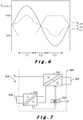
- V N,out between -V b and +V b will be more or less pronounced, leading to a more square or trapezoidal wave shape, as can be seen by comparing Fig. 5 and Fig. 6 , corresponding to an alternative where each one of t1' and t 2 ' correspond to less than 95 % but at least 75% of each half-cycle. Having such a substantially square or trapezoidal wave shape for V N,out would result in a distorted wave shape of V load if the second half-bridge circuit 302 was pulse-width modulated to produce a sinusoidal wave shape of V L,out .
- the second half-bridge circuit 302 is commanded so that V L,out follows a corrected sine wave, as depicted in Figs. 5 and 6 , resulting in a substantially sinusoidal V load .
- the fourth half-bridge circuit 304 could instead be pulse-width modulated during the whole cycle, so as to generate a sinusoidal V N,out that would not distort V L,out , this would be considerably less energy-efficient than pulse-width modulating only the second half-bridge circuit 302 for the whole cycle with a corrected wave shape instead.
- the shorter the transition periods between t 1 ' and t 2 ' the bigger the correction of the wave shape of V L,out will have to be.
- shorter transition periods between t 1 ' and t 2 ' have the advantage of limiting the number of switchovers of the fourth half-bridge circuit 304, with the corresponding advantages in higher efficiency, lower radio interference generation, etc.
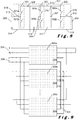
- Figs. 7 and 8 illustrate an embodiment of the power backup processor according to the invention.
- the second half-bridge circuit 302 is synchronised with the first half-bridge circuit 301, so that V L,out has substantially, or even precisely, the same frequency and phase as V L,in .
- the third half-bridge circuit 303 is controlled so that the neutral line 314 is connected to the second DC voltage bus 312 during the first half of the cycle of V L,in and therefore, in this embodiment, also of V L,out , and to the first DC voltage bus 311 during the second half of the same cycle, this allows to dispense with the fourth half-bridge circuit 304 of the first embodiment and to connect the second AC output line 316 directly to the neutral line 314 instead.
- a third impedance 314i has to be interposed between the neutral line 314 and the third half-bridge circuit 303 to filter the switching noise of the fifth and sixth switches 303a, 303b.
- the third half-bridge circuit 303 is also controlled in the way depicted by Figures 5 or 6 , wherein during a period t 1 of at least 95%, respectively at least 75% of the first half-cycle, during which the fifth switch 303a is open and the sixth switch 303b closed, V N,out is substantially constant and equal to - V b .
- V N,out is substantially constant and equal to +V b .
- this third half-bridge circuit 304 is preferably pulse-width modulated to ensure a smooth transition between -V b and +V b and vice versa.
- both the first and the second derivatives of V N,out are continuous.
- Each one of the periods t 1 and t 2 can be continuous or split in several segments of, respectively, the first or second half-cycles. They can also be centred around the peaks of V L,out , as depicted, or, on the contrary, advanced or delayed with respect to those peaks and have the same or different lengths.
- the topology of the invention is new because it has a third inductance (see inductance 314i in Fig. 8 of the present application) which is missing in the corresponding figures of J.W. Baek et al and T. Uematsu et al.
- the invention structurally differs from the system disclosed in previously cited US 6,181,581 B1 in that the disclosed system therein has two capacitors in series with the junction between the two connected to neutral.
- the main difference between the circuit of the invention and the circuit of T. Uematsu et al is the connection of the neutral point to the DC voltage buses "311/312".
- the voltages at node 312 are expected to be very different in both cases.
- the potential at "node 312" cannot be floating at the switching frequency.
- the voltage on the output inductor (equivalent of inductor 315i) is expected to be high and affected by high current ripple, further conducting to high inductor losses. Similarly the current ripple is also high on the input inductor (equivalent of inductor 313i).
- the amplitude of the current flowing to neutral in the center arm transistors is expected to be high, leading to higher switching and conduction losses in the center arm transistors.
- the circuit of the present invention is more advantageous in the sense it induces less losses and less stress on the components.
- protection means 305 are preferably provided in one of the first or second DC voltage busses 311, 312, upstream of the connection 210 or 211, respectively, to the DC power source 206 and of the capacitor 207.
- the protection means 305 consist in particular of a fuse and allow to use the DC power source 206 when the first half-bridge circuit 301 breaks and could possibly short-circuit the DC voltage at the capacitor 207.
- the DC/DC converter 203 can be bi-directional, thus allowing to directly power from the DC voltage busses 311, 312 back to the DC power source 206, for instance for recharging a battery being used as the DC power source 206.
- the AC/DC/AC converter 701 of the embodiment according to the invention can also be power bi-directional, allowing the recuperation of energy from the critical load 204 and/or the DC power source 206.
- the switches of the half-bridge circuits forming these first and second converters will have to be power bi-directional themselves, and the series of controllers 208 will have to be provided to run these converters 201 and/or 202 or 203 also in reverse.
- the switches of the half-bridge circuits can be in particular IGBT switches with antiparallel diodes.
- Figure 9 shows an embodiment from the processor according to the present invention comprising a plurality of processor units 200a, 200b, ... 200i connected in parallel.
- Each of the processor units 200a, 200b, ... 200i has a configuration as shown in Figure 7 .
- a communication bus 300 connects the communication outputs 209 of the processor units.
- the micro-controllers of the processor units are interconnected to allow synchronisation of the first AC outputs and to organise load sharing between the units.
- the principles of synchronisation and load sharing between units are known to the person skilled in the art and thus do not need to be described in detail.
- the communication bus comprises a double connection between the units to provide redundancy in case one of the connections would fail.
- wireless connection using IR or HF technology, in particular Bluetooth technology is also conceivable. It is also conceivable to provide one connection with cables and the other connection as a wireless connection.
Landscapes
- Business, Economics & Management (AREA)
- Emergency Management (AREA)
- Engineering & Computer Science (AREA)
- Power Engineering (AREA)
- Inverter Devices (AREA)
- Stand-By Power Supply Arrangements (AREA)
Description
- The present invention relates to a power backup processor unit comprising a first AC input line comprising a first inductance and provided to be connected to an AC power supply, a first AC output line comprising a second inductance and provided to be connected to a critical load, a second AC output line provided to be connected to the critical load, a neutral line provided to be connected to a neutral port, first and second DC voltage busses provided to be connected to a DC power supply, a capacitor interposed between the first and second DC voltage busses, a first half-bridge circuit comprising first and second switches, wherein the first switch is connected between the first AC input line and the first DC voltage bus and the second switch is connected between the first AC input line and the second DC voltage bus, a second half-bridge circuit comprising third and fourth switches, wherein the third switch is connected between the first AC output line and the first DC voltage bus and the fourth switch is connected between the first AC output line and the second DC voltage bus, a third half-bridge circuit comprising fifth and sixth switches, wherein the fifth switch is connected between the neutral line and the first DC voltage bus and the sixth switch is connected between the neutral line and the second DC voltage bus. The processor further comprises a series of controllers provided to command the switches, wherein said series of controllers is provided to command at least the first to fourth switches using pulse width modulation. The present invention also relates to a method of operating said power backup processor.
- Power backup processors are typically used in the telecommunication industry to ensure continuous delivery of AC energy to critical applications such as a central office of a telecommunication operator.
- A configuration typically known from the state of the art and comprising a series of converters is illustrated in
Figure 1 . In this configuration, afirst converter 101, which is an AC/DC converter, has a first AC input and a first DC output. The first AC input comprises a firstAC input line 119 and aneutral line 120. Said firstAC input line 119 is provided to be connected to a single-phase AC power supply, whereas saidneutral line 120 is provided to be connected to a neutral port. Asecond converter 102, which is a DC/AC converter, has a first DC input and a first AC output, which comprises a firstAC output line 121 and a secondneutral line 122. Said firstAC output line 121 is provided to be connected to acritical load 108, whereas said secondneutral line 122 is provided to be connected to a neutral. Athird converter 103, which is a DC/DC converter, has a second DC input and a second DC output, said second DC input being provided to be connected to a DC power supply. Afourth converter 104, which is another DC/DC converter, has a third DC input and a third DC output. The first DC output is connected to the third DC input, the third DC output to the second DC input and the second DC output to the first DC input. - The
second converter 102 connected to thethird converter 103 form together aninverter 100b, and thefirst converter 101 connected to thefourth converter 104 form together arectifier 100a. Abattery 106 is typically used as a DC power supply and therefore connected between the output from therectifier 100a and the input from theinverter 100b. Aswitching unit 105 comprisingswitches microcontroller 105c to control the switches is foreseen to allow to switch between a connection using the power processor formed by therectifier 100a and inverter 100b and a connection through thecable 107. Thecritical load 108 is here illustrated by one resistance. In practice, the critical load may be formed by a plurality of units connected in parallel to the processor. - A problem with this known configuration as illustrated in
Figure 1 is that the efficiency is relatively low. From the single-phase AC power supply to the critical load, the current needs to pass through four converters and one switch. The efficiency obtained through such a circuit is typically around 80%. When the critical load is fed with the DC power supply, the current needs to pass through two converters and one switch yielding an efficiency in the order of 90%. - United States Patent No.
4,709,318 discloses an alternative configuration which comprises just three converters, these three converters being a first converter, which is an AC/DC converter with a first AC input and a first DC output, a second converter, which is a DC/AC converter with a first DC input and a first AC output, and a third converter, which is a DC/DC converter provided with a second DC input and a second DC output. In this alternative configuration of the state of the art, the first AC input is provided to be connected to an AC power source, the first AC output is provided to be connected to a critical load, the second DC input is provided to be connected to a DC power source and both the first and second DC outputs are connected to two DC voltage busses in turn connected to the first DC input. With this configuration, the current only needs to pass through two converters between the AC power supply and the critical load. However, in this disclosure the first and second converters are such that the voltage between the DC voltage busses is comparatively high, namely 400 V DC to achieve a 120 V RMS AC output voltage. Such high voltage requires dimensioning the elements of the converters accordingly, increasing the cost while reducing both efficiency and reliability. - United States Patent No.
US 6,181,581 B1 discloses a power backup processor comprising features in common with the independent claims. In particular, this power backup processor comprises: - a first AC input line comprising a first inductance and provided to be connected to an AC power supply with a cyclical voltage VL, in;
- a first AC output line comprising a second inductance and provided to be connected to a critical load;
- a second AC output line provided to be connected to the critical load;
- a neutral line provided to be connected to a neutral port; a first and a second DC voltage busses provided to be connected to a DC power supply;
- a first and second capacitors interposed in series between the first and second DC voltage busses, so that the common end between the capacitors is connected to the neutral port;
- a first half-bridge circuit comprising a first switch and a second switch, wherein the first switch is connected between the first AC input line and the first DC voltage bus and the second switch is connected between the first AC input line and the second DC voltage bus;
- a second half-bridge circuit comprising a third switch and a fourth switch, wherein the third switch is connected between the first AC output line and the first DC voltage bus and the fourth switch is connected between the first AC output line and the second DC voltage bus;
- a third half-bridge circuit comprising a fifth switch and a sixth switch, wherein the fifth switch is connected between the neutral line and the first DC voltage bus and the sixth switch is connected between the neutral line and the second DC voltage bus;
- a third inductance connected between said neutral line and the common end of said fifth and sixth switches.
- Said second AC output line is directly connected to said neutral line.
- This configuration also comprises a series of controllers provided to command all switches using pulse width modulation. In operation, the half-bridge circuits corresponding to at least the first to fourth switches are commanded using pulse width modulation so as to generate, from VL, in, a substantially continuous positive voltage +Vb at the first DC voltage bus and a substantially continuous negative voltage -Vb at the second DC voltage bus and so as to convert said two different, substantially continuous voltages +Vb, -Vb into a cyclical voltage VL,out at the first AC output line.
- The half-bridge circuit corresponding to the first neutral line is commanded merely to compensate minor voltage fluctuations at the first and second DC voltage busses, both switches of this half-bridge being closed only for a very small percentage of the time and in very short pulses. The first neutral line in this configuration therefore operates merely as a "0" volts axis.
- In particular said series of controllers can also be provided in operation to open the fifth switch and close the sixth switch for a period t1 of at least 50%, and preferably at least 95%, of a first half of a cycle of VL,in and close the fifth switch and open the sixth switch for a period t2 of at least 50%, and preferably at least 95%, of a second half of the cycle of VL,in (see for example
US 6,181,581 B1 , col. 8, second paragraph). - J.W. Baek et al, in "In study on a single-phase module UPS using a three-arms converter and inverter", IECON 02 [Industrial Electronics Society, IEEE 2002 28th Annual Conference of the], Vol.2, 5 Nov. 2002, pp. 1282-1287 and T. Uematsu et al, in "A study of the high performance single phase UPS", Proc. IEEE Pest\'98 Conf., Vol.2, pp. 1872-1878, 1998, disclose each a three-arms converter and inverter circuit for a single phase UPS system, whose topology is close to the structural details of the circuit of the invention, with the exception of the third inductance. Moreover the topology of these two last circuits differs from the one of
US 6,181,581 B1 in that a single capacitor is bridging the two DC busses instead of two capacitors in series with the junction between the two connected to neutral. In the three-arm circuit, arm 1 and 2 operate as a PWM converter and arm 2 and 3 operate as a PWM inverter. Therefore arm 2 is used in common. - It is also disclosed in Uematsu et al that the output voltage/frequency must be equal to the input voltage/frequency.Thus it is known therefrom that the controllers can be provided in operation to synchronize the first and second half-bridge circuits so that VL,in and VL,out have substantially the same phase and frequency.
- It is a primary object of the present invention to provide a power backup processor and a method of operating said power backup processor suitable for a single-phase AC power supply and with a higher efficiency, at least when the critical load is fed with the single-phase AC power supply, while having a high availability and quality of voltage supply, and avoiding the drawbacks related to high DC voltages.
- According to the present invention, the neutral line is provided to be directly connected to the second AC output line, and the power backup processor further comprises a third inductance connected between the neutral line and the third half-bridge circuit, the series of controllers being provided to open the fifth switch and close the sixth switch for a period U of at least 50%, and preferably at least 95%, of a first half of a cycle of VL,and close the fifth switch and open the sixth switch for a period t2 of at least 50%, and preferably at least 95%, of a second half of said cycle of VL,in. This embodiment generates a VN,out that is countercyclical to VL,out. While in this simpler arrangement it is not possible to change the frequency and phase displacement of VL,out with respect to VL,in, the reduction in the number of components further increases the reliability, as well as the efficiency, which can reach around 95%.

- Advantageously, the fifth and sixth switches are pulse-width modulated during a period t3, between t1 and t2, so that VN,out presents a continuity of at least its first and second derivates. This improves the longevity of the components and the cleanliness of the output.
- Preferably, the series of controllers consists of one controller unit. As opposed to individual controllers for each converter, this allows managing more efficiently and easily the energy flow, without the need of adding additional components to manage communication between individual controllers.
- Preferably, the power backup processor unit further comprises a DC/DC converter connected to the first and second DC voltage busses for connecting said first and second DC voltage busses to said DC power source. This allows the use of a DC power source with a different, usually lower, voltage than the voltage between the two DC voltage busses.
- In a particular embodiment, the DC/DC converter is bi-directional. This makes it possible to use the device according to the invention as a rectifier, wherein current would flow from the AC input to the DC power source for recharging.
- Advantageously, the first, second, fifth and sixth switches are power bi-directional and the series of controllers is provided to run the first half-bridge circuit in reverse, so as to convert a DC voltage between the two DC voltage busses into an AC voltage at the first AC input line. This allows using the device according to the invention as a means to supply energy from the DC power input into the AC power supply. A current flow in this direction could be applied for example in photovoltaic cell applications, wherein the energy generated by the cells is fed back to the AC power supply when not used by the critical load.
- It can further be advantageous if the third and fourth switches are power bi-directional, and the series of controllers is also provided to run the second half-bridge circuit in reverse, so as to convert an AC voltage between the first and second AC output lines into a DC voltage between the two DC voltage busses. This allows the recuperation of energy from the critical load back into the AC and/or DC power supply, which principle could be applied to elevator systems.
- Preferably, the power backup processor according to the invention comprises a plurality of power backup processor units connected in parallel, each power backup processor unit comprising the first, second and third converters as claimed in any one of the preceding claims. This allows to guarantee continuous operation should one of the units fail to operate and without the presence of a single point of failure element such as
switch 105a in the prior art device ofFigure 1 . - The device according to particular embodiments of the invention allows to suppress the following two negative effects occurring simultaneously and present in the prior art devices as illustrated in
Figure 1 . First, when power is supplied throughswitch 105b andcable 107, disturbances can occur by supplying power to the critical load without filtering. Secondly, when a critical non linear load is supplied, harmonic currents are generated on the AC power supply. This can lead to deterioration of the quality of the AC power supply voltage caused by harmonic currents which are applied to the AC power supply. - Other details and advantages will appear from the description of the annexed drawings.
-
Figure 1 illustrates a typical configuration of a power backup processor according to the prior art. -
Figure 2 illustrates a detailed embodiment of the power backup processor unit according to the prior art. -
Figure 3 illustrates part of said detailed embodiment of the power backup processor unit according to the prior art. -
Figure 4 illustrates voltage conversion using pulse width modulation. -
Figure 5 illustrates an example of the output voltages of the power backup processor unit according to the prior art. -
Figure 6 illustrates another example of the output voltages of the power backup processor unit according to the prior art. -
Figure 7 illustrates the power backup processor according to the invention. -
Figure 8 illustrates part of the power backup processor according to the invention. -
Figure 9 illustrates a further embodiment of the power backup processor according to the invention with several units in parallel. - In a detailed and explanatory prior art embodiment, as illustrated in
Figure 2 , apower processor unit 200 comprises afirst converter 201 comprising an AC input connected to anAC power supply 205. This converter is provided to convert AC power at for example 230 V AC RMS to a DC power at for example 350 - 400 V DC. The DC output of this first converter is connected to a DC input of asecond converter 202. Thesecond converter 202 is provided to convert de DC power to AC power of for example 230 V AC RMS, which is then fed to thecritical load 204. The path formed by the first and the second converters is used when power needs to be fed from theAC power supply 205. - The
power processor unit 200 is further provided to receive power from aDC power supply 206 such as a battery providing a DC power at for example 48 V DC. Since the DC input of the second converter usually has a considerably higher voltage, thepower processor unit 200 will also comprise athird converter 203 comprising a DC input provided to be connected to theDC power supply 206 and a DC output. Thethird converter 203 is preferably an isolated converter (as represented by the double diagonal line), but could in some application be non isolated. According to the invention and as illustrated inFigure 2 , this DC output is connected to both the DC output from thefirst converter 201 and the DC input from the second converter. The path formed by the third and the second converters is thus used when power needs to be fed from theDC power supply 206. - A
capacitor 207 is provided between the output of thefirst converter 201 and the input of thesecond converter 202 and acts an energy storage unit. A micro-controller orcontroller 208 is connected to each of the threeconverters communication output 209. -
Figure 3 shows in more detail the first andsecond converters first converter 201 comprises a first and a third half-bridge circuit DC voltage bus bridge circuit 301 comprises afirst switch 301a connected between anAC input line 313, comprising afirst inductance 313i, and the firstDC voltage bus 311 , and asecond switch 301b connected between theAC input line 313 and the secondDC voltage bus 312. The third half-bridge circuit 303 comprises afifth switch 303a, connected between aneutral line 314 and the firstDC voltage bus 311 , and asixth switch 303b, connected between theneutral line 314 and the secondDC voltage bus 312. Thesecond converter 202 comprises a second and a fourth half-bridge circuit 302,304, both also connected between the first and the secondDC voltage bus bridge circuit 302 comprises athird switch 302a, connected between a firstAC output line 315, comprising aninductance 315i, and the firstDC voltage bus 311 , and afourth switch 302b, connected between the firstAC output line 315 and the secondDC voltage bus 312. The fourthhalf bridge circuit 304 comprises aseventh switch 304a, connected between a secondAC output line 316 and the firstDC voltage bus 311 , and aneighth switch 304b, connected between the secondAC output line 316 and the secondDC voltage bus 312. The DC/DC converter 203 and thecapacitor 207 are then connected to the first and second DC voltage busses 311, 312 between the first andsecond converters - To convert the cyclical, substantially sinusoidal voltage of the AC power supply into a continuous voltage between the first and second DC voltage busses 311, 312, and to convert said continuous voltage back into a cyclical voltage between the first and second AC output lines 315,316, the
micro-controller 208 commands the switches of at least the first and second half-bridge circuits 301,302 using pulse width modulation (PWM). Pulse width modulation uses a square wave whose duty cycle is modulated resulting in the variation of the average value of the waveform. By switching voltage with the approximate duty cycle, the output will approximate a voltage at the appropriate level, as depicted inFig. 4 . The first andsecond inductances capacitor 207 attenuate the switching noise. The duty cycle of the square waveform is much shorter than that of the sine wave of either the input or output AC voltages, typically in the order of magnitude of microseconds, e.g. 20 µs vs. 20 ms for a typical 50 Hz AC voltage. - When the first
AC input line 313 is connected to a single-phase AC power supply, a variable, cyclical voltage VL,in is established at the firstAC input line 313 in the form of a substantially sinusoidal wave. This AC voltage VL,in has a frequency fL,in, and therefore a cycle length 1/fL,in, and an amplitude VL,inPeak. VL,inPeak can be, for example 325 V, corresponding to an RMS AC voltage VL,inRMS of 230 V, and fL,in can be, for example, 50 Hz. During the first half of each cycle of VL,in, the controllers leave thefifth switch 303a open, while thesixth switch 303b is closed so as to connect the secondDC voltage bus 312 to theneutral line 314 and the first half-bridge circuit 301 is pulse width modulated to convert the variable positive voltage at the firstAC input line 313 into a continuous voltage +Vb at the firstDC voltage bus 311. During the second half of each cycle of VL,in, the controllers close thefifth switch 303a, while thesixth switch 303b is opened so as to connect the firstDC voltage bus 311 to theneutral line 314, and the first half-bridge circuit 301 is pulse width modulated to convert the variable negative voltage at the firstAC input line 313 into a continuous voltage -Vb at the secondDC voltage bus 312. As a result, a substantially continuous voltage difference 2Vb is generated between the firstDC voltage bus 311 and the secondDC voltage bus 312. Thefirst inductance 313i filters the switching noise of the first andsecond switches - In the second half-
bridge circuit 302, thethird switch 302a and thefourth switch 302b, respectively connecting the firstDC voltage bus 311 and the secondDC voltage bus 312 to the firstAC output line 315, are pulse width modulated so as to generate a cyclical, close to sinusoidal voltage VL,out at the first AC output line, with a frequency fL,out, an amplitude VL,outPeak close to Vb and a phase displacement Δϕ with respect to VL,in. Thesecond inductance 315i filters the switching noise of the third andfourth switches - In this first embodiment of the power backup processor of the invention, as illustrated in
Fig. 3 , theseventh switch 304a is open during at least part of the first half of each cycle of VL,out and closed during at least part the second half. Inversely, theeighth switch 304b is closed during at least part of the first half and opened during at least part of the second half. As a result, a countercyclical voltage VN,out is generated at the secondAC output line 316. -
Fig. 5 illustrates a cycle of the output voltages VL,out, VN,out and Vload= (VN,out-VL,out). During a period t1' of at least 95% of the first half-cycle, during which theseventh switch 304a is open and theeighth switch 304b closed, VN,out is substantially constant and equal to -Vb. During a period t2' of at least 95% of the second half-cycle, during which theseventh switch 304a is closed and theeighth switch 304b open, is VN,out substantially constant and equal to +Vb. During the transition period t3' between t1' and t2', this fourth half-bridge circuit 304 is preferably pulse-width modulated to ensure a smooth transition between -Vb and +Vb and vice versa. A similar transition period also takes place between t2' and t1'. Ideally, both the first and the second derivatives of VN,out are continuous. Each one of the periods t1' and t2' can be continuous or split in several segments of, respectively, the first or second half-cycles. They can also be centred around the peaks of VL,out, as depicted, or, on the contrary, advanced or delayed with respect to those peaks and have the same or different lengths. - As VN,out is countercyclical to VL,out, the output voltage Vload= (VN,out-VL,out) supplied to the critical load has nearly twice the amplitude of VN,out, as depicted in
Fig. 5 . This allows a comparatively high output voltage Vload with a comparatively moderate DC voltage difference 2Vb between the firstDC voltage bus 311 and the secondDC voltage bus 312 If VN,out is substantially square or trapezoidal, it is preferable to adapt the pulse width modulation of the second half-bridge circuit 302 so that VL,out has a corrected sinusoidal form that in combination with VN,out results in a closer to sinusoidal Vload= (VN,out-VL,out), as illustrated inFig. 5 . - Depending on the length of t1' and t2', the slope of VN,out between -Vb and +Vb will be more or less pronounced, leading to a more square or trapezoidal wave shape, as can be seen by comparing
Fig. 5 andFig. 6 , corresponding to an alternative where each one of t1' and t2' correspond to less than 95 % but at least 75% of each half-cycle. Having such a substantially square or trapezoidal wave shape for VN,out would result in a distorted wave shape of Vload if the second half-bridge circuit 302 was pulse-width modulated to produce a sinusoidal wave shape of VL,out. For this reason, the second half-bridge circuit 302 is commanded so that VL,out follows a corrected sine wave, as depicted inFigs. 5 and6 , resulting in a substantially sinusoidal Vload. While the fourth half-bridge circuit 304 could instead be pulse-width modulated during the whole cycle, so as to generate a sinusoidal VN,out that would not distort VL,out, this would be considerably less energy-efficient than pulse-width modulating only the second half-bridge circuit 302 for the whole cycle with a corrected wave shape instead. The shorter the transition periods between t1' and t2', the bigger the correction of the wave shape of VL,out will have to be. On the other hand, shorter transition periods between t1' and t2' have the advantage of limiting the number of switchovers of the fourth half-bridge circuit 304, with the corresponding advantages in higher efficiency, lower radio interference generation, etc. - It is particularly advantageous to command both the third and the fourth half-
bridge circuits -
Figs. 7 and8 illustrate an embodiment of the power backup processor according to the invention. In this embodiment, the second half-bridge circuit 302 is synchronised with the first half-bridge circuit 301, so that VL,out has substantially, or even precisely, the same frequency and phase as VL,in. Since the third half-bridge circuit 303 is controlled so that theneutral line 314 is connected to the secondDC voltage bus 312 during the first half of the cycle of VL,in and therefore, in this embodiment, also of VL,out, and to the firstDC voltage bus 311 during the second half of the same cycle, this allows to dispense with the fourth half-bridge circuit 304 of the first embodiment and to connect the secondAC output line 316 directly to theneutral line 314 instead. However, in this embodiment athird impedance 314i has to be interposed between theneutral line 314 and the third half-bridge circuit 303 to filter the switching noise of the fifth andsixth switches - As shown in
Figure 7 , this forms, with thecapacitor 207, one AC/DC/AC converter 701. - In this second embodiment, the third half-
bridge circuit 303 is also controlled in the way depicted byFigures 5 or6 , wherein during a period t1 of at least 95%, respectively at least 75% of the first half-cycle, during which thefifth switch 303a is open and thesixth switch 303b closed, VN,out is substantially constant and equal to - Vb. During a period t2 of at least 95%, respectively at least 75% of the second half-cycle, during which thefifth switch 303a is closed and thesixth switch 303b open, VN,out is substantially constant and equal to +Vb. During the transition period t3 between t1 and t2, this third half-bridge circuit 304 is preferably pulse-width modulated to ensure a smooth transition between -Vb and +Vb and vice versa. Ideally, both the first and the second derivatives of VN,out are continuous. Each one of the periods t1 and t2 can be continuous or split in several segments of, respectively, the first or second half-cycles. They can also be centred around the peaks of VL,out, as depicted, or, on the contrary, advanced or delayed with respect to those peaks and have the same or different lengths. - The topology of the invention is new because it has a third inductance (see
inductance 314i inFig. 8 of the present application) which is missing in the corresponding figures of J.W. Baek et al and T. Uematsu et al. - Moreover, the invention structurally differs from the system disclosed in previously cited
US 6,181,581 B1 in that the disclosed system therein has two capacitors in series with the junction between the two connected to neutral. - The main difference between the circuit of the invention and the circuit of T. Uematsu et al is the connection of the neutral point to the DC voltage buses "311/312". The voltages at
node 312 are expected to be very different in both cases. In particular in T. Uematsu et al. the potential at "node 312" cannot be floating at the switching frequency. The voltage on the output inductor (equivalent ofinductor 315i) is expected to be high and affected by high current ripple, further conducting to high inductor losses. Similarly the current ripple is also high on the input inductor (equivalent ofinductor 313i). - Also the amplitude of the current flowing to neutral in the center arm transistors is expected to be high, leading to higher switching and conduction losses in the center arm transistors.
- The circuit of the present invention is more advantageous in the sense it induces less losses and less stress on the components.
- In
US 6,181,581 B1 , there is an inductance (L3) connecting the central half-bridge to the neutral point. However the single capacitor C in the invention is replaced by two capacitors (C1, C2) which junction is directly connected to the neutral point. Thus the reference to neutral of node "312" is different and so is also the potential atnode 312. In the invention, optimization can be achieved by apportioning the inductance value on the 3 inductors, while this is not the case inUS 6,181,581 B1 , which suffers from the same drawbacks as T. Uematsu et al. - In the invention lower applied voltage on inductors reduces the inductor current ripple and further the inductor core losses.
- As shown in
Figure 8 , protection means 305 are preferably provided in one of the first or second DC voltage busses 311, 312, upstream of theconnection DC power source 206 and of thecapacitor 207. The protection means 305 consist in particular of a fuse and allow to use theDC power source 206 when the first half-bridge circuit 301 breaks and could possibly short-circuit the DC voltage at thecapacitor 207. - The DC/
DC converter 203 can be bi-directional, thus allowing to directly power from the DC voltage busses 311, 312 back to theDC power source 206, for instance for recharging a battery being used as theDC power source 206. - The AC/DC/
AC converter 701 of the embodiment according to the invention can also be power bi-directional, allowing the recuperation of energy from thecritical load 204 and/or theDC power source 206. For this purpose, the switches of the half-bridge circuits forming these first and second converters will have to be power bi-directional themselves, and the series ofcontrollers 208 will have to be provided to run theseconverters 201 and/or 202 or 203 also in reverse. The switches of the half-bridge circuits can be in particular IGBT switches with antiparallel diodes. -
Figure 9 shows an embodiment from the processor according to the present invention comprising a plurality ofprocessor units processor units Figure 7 . Acommunication bus 300 connects the communication outputs 209 of the processor units. Hence the micro-controllers of the processor units are interconnected to allow synchronisation of the first AC outputs and to organise load sharing between the units. The principles of synchronisation and load sharing between units are known to the person skilled in the art and thus do not need to be described in detail. Preferably, as illustrated inFigure 9 , the communication bus comprises a double connection between the units to provide redundancy in case one of the connections would fail. Instead of a cable connection, wireless connection using IR or HF technology, in particular Bluetooth technology, is also conceivable. It is also conceivable to provide one connection with cables and the other connection as a wireless connection. - As will be appreciated, modifications are conceivable without falling outside the scope of the appended claims.
Claims (12)
- A power backup processor unit (200) comprising:a) a first AC input line (313) comprising a first inductance (313i) and provided to be connected to an AC power supply with a cyclical voltage VL,in;b) a first AC output line (315) comprising a second inductance (315i) and provided to be connected to a critical load (204);c) a second AC output line (316) provided to be connected to the critical load (204);d) a neutral line (314) provided to be connected to a neutral port;e) first and second DC voltage busses (311,312) provided to be connected to a DC power supply (206);f) a single capacitor (207) directly interposed between the first and second DC voltage busses (311,312);g) a first half-bridge circuit (301) comprising a first switch (301a) and a second switch (301b), wherein the first switch (301a) is connected between the first AC input line (313) and the first DC voltage bus (311) and the second switch (301b) is connected between the first AC input line (313) and the second DC voltage bus (312);h) a second half-bridge circuit (302) comprising a third switch (302a) and a fourth switch (302b), wherein the third switch (302a) is connected between the first AC output line (315) and the first DC voltage bus (311) and the fourth switch (302b) is connected between the first AC output line (315) and the second DC voltage bus (312);i) a third half-bridge circuit (303) comprising a fifth switch (303a) and a sixth switch (303b), wherein the fifth switch (303a) is connected between the neutral line (314) and the first DC voltage bus (311) and the sixth switch (303b) is connected between the neutral line (314) and the second DC voltage bus (312);j) a series of controllers (208) provided to command the switches (301a ...303b), wherein said series of controllers (208) is provided to command at least the first to fourth switches (301a ...302b) using pulse width modulation to convert VL,in into two different, substantially continuous voltages +Vb, -Vb at the first and the second DC voltage busses (311,312) and said two different, substantially continuous voltages +Vb, -Vb into a cyclical voltage VL,out at the first AC output line (315);k) a third inductance (314i) connected between said neutral line (314) and said fifth and sixth switches (303a, 303b);said second AC output line (316) being directly connected to said neutral line (314);
said series of controllers (208) being provided to synchronize said first and second half-bridge circuits (301, 302) so that VL,in and VL,out have substantially the same phase and frequency, and
said series of controllers (208) being also provided to open the fifth switch (303a) and close the sixth switch (303b) for a period t1 of at least 50%, and preferably at least 95%, of a first half of a cycle of VL,in and close the fifth switch (303a) and open the sixth switch (303b) for a period t2 of at least 50%, and preferably at least 95%, of a second half of the cycle of VL,in. - The power backup processor unit (200) according to claim 1, characterised in that said series of controllers (208) is also provided to pulse-width modulate said fifth switch (303a) and said sixth switch (303b) during a transition period t3 between t1 and t2.
- The power backup processor unit (200) according to one of claims 1 or 2, characterised in that the third and fourth switches (302a,302b) are bi-directional, and the series of controllers (208) is also provided to run the second half-bridge circuit (302) in reverse, so as to convert an AC voltage between the first and second AC output lines (315,316) into a DC voltage between the two DC voltage busses (311,312).
- The power backup processor unit (200) according to any one of the preceding claims, characterised in that the series of controllers (208) consists of one controller unit.
- The power backup processor unit (200) according to one of the preceding claims, further comprising a DC/DC converter (203) connected to the first and second DC voltage busses (311,312) for connecting said first and second DC voltage busses (311,312) to said DC power source (206).
- The power backup processor unit (200) according to claim 5, characterised in that the DC/DC converter (203) is bi-directional.
- The power backup processor unit (200) according to one of the previous claims, characterised in that the first, second, fifth and sixth switches (301a,301b,303a,303b) are bi-directional and the series of controllers is provided to run the first half-bridge circuit (301) in reverse, so as to convert a DC voltage between the two DC voltage busses (311,312) into an AC voltage at the first AC input line (313).
- The power backup processor system comprising a plurality of power backup processor units (200a ...200i) as claimed in any one of the preceding claims and connected in parallel.
- The power backup processor system according to claim 8, further comprising communication means, in particular at least one inter unit communication bus (300), connected to the controllers of each power backup processor unit (200a ...200i).
- A method of controlling a power backup processor unit (200), said power backup processor unit (200) comprising:a) a first AC input line (313) comprising a first inductance (313i) and provided to be connected to an AC power supply with a cyclical voltage VL,in;b) a first AC output line (315) comprising a second inductance (315i) and provided to be connected to a critical load (204);c) a second AC output line (316) provided to be connected to the critical load (204);d) a neutral line (314) provided to be connected to a neutral port;e) first and second DC voltage busses (311,312) provided to be connected to a DC power supply (206);f) a single capacitor (207) directly interposed between the first and second DC voltage busses (311,312);g) a first half-bridge circuit (301) comprising a first switch (301a) and a second switch (301b), wherein the first switch (301a) is connected between the first AC input line (313) and the first DC voltage bus (311) and the second switch (301b) is connected between the first AC input line (313) and the second DC voltage bus (312);h) a second half-bridge circuit (302) comprising a third switch (302a) and a fourth switch (302b), wherein the third switch (302a) is connected between the first AC output line (315) and the first DC voltage bus (311) and the fourth switch (302b) is connected between the first AC output line (315) and the second DC voltage bus (312);i) a third half-bridge circuit (303) comprising a fifth switch (303a) and a sixth switch (303b), wherein the fifth switch (303a) is connected between the neutral line (314) and the first DC voltage bus (311) and the sixth switch (303b) is connected between the neutral line (314) and the second DC voltage bus (312), said second AC output line (316) being directly connected to the neutral line (314) and said power backup processor unit also comprising a third inductance (314i) connected between said neutral line (314) and said fifth and sixth switches (303a, 303b) ;said method comprising the step of:j) pulse width modulating said first half-bridge circuit (301) to convert VL,in into two different, substantially continuous voltages +Vb, -Vb at the first and the second DC voltage busses (311,312) and said second half-bridge circuit (302) to convert said two different, substantially continuous voltages +Vb, -Vb into a cyclical voltage VL,out at the first AC output line (315);k) opening the fifth switch (303a) and closing the sixth switch (303b) for a period t1 of at least 50%, and preferably at least 95%, of a first half of a cycle of VL, in; and1) closing the fifth switch (303a) and opening the sixth switch (303b) for a period t2 of at least 50%, and preferably at least 95%, of a second half of the cycle of VL,in.
- The method according to claim 10, characterised in that it also comprises the step of pulse-width modulating said fifth switch (303a) and said sixth switch (303b) during a transition period t3 between t1 and t2.
- The method according to claims 10 or 11, characterised in that the first and second half-bridge circuits (301,302) are synchronised so that VL,in and VL,out have substantially the same phase and frequency.
Priority Applications (2)
| Application Number | Priority Date | Filing Date | Title |
|---|---|---|---|
| EP06793416.6A EP1969694B1 (en) | 2006-01-05 | 2006-09-11 | Backup power system |
| PL06793416T PL1969694T3 (en) | 2006-01-05 | 2006-09-11 | Backup power system |
Applications Claiming Priority (3)
| Application Number | Priority Date | Filing Date | Title |
|---|---|---|---|
| EP20060100122 EP1806819A1 (en) | 2006-01-05 | 2006-01-05 | Backup power system |
| PCT/EP2006/066237 WO2007077043A1 (en) | 2006-01-05 | 2006-09-11 | Backup power system |
| EP06793416.6A EP1969694B1 (en) | 2006-01-05 | 2006-09-11 | Backup power system |
Publications (2)
| Publication Number | Publication Date |
|---|---|
| EP1969694A1 EP1969694A1 (en) | 2008-09-17 |
| EP1969694B1 true EP1969694B1 (en) | 2017-05-03 |
Family
ID=36499664
Family Applications (2)
| Application Number | Title | Priority Date | Filing Date |
|---|---|---|---|
| EP20060100122 Withdrawn EP1806819A1 (en) | 2006-01-05 | 2006-01-05 | Backup power system |
| EP06793416.6A Active EP1969694B1 (en) | 2006-01-05 | 2006-09-11 | Backup power system |
Family Applications Before (1)
| Application Number | Title | Priority Date | Filing Date |
|---|---|---|---|
| EP20060100122 Withdrawn EP1806819A1 (en) | 2006-01-05 | 2006-01-05 | Backup power system |
Country Status (7)
| Country | Link |
|---|---|
| US (1) | US8044535B2 (en) |
| EP (2) | EP1806819A1 (en) |
| CN (2) | CN101336505B (en) |
| ES (1) | ES2628810T3 (en) |
| PL (1) | PL1969694T3 (en) |
| WO (1) | WO2007077043A1 (en) |
| ZA (1) | ZA200806676B (en) |
Cited By (1)
| Publication number | Priority date | Publication date | Assignee | Title |
|---|---|---|---|---|
| EP3683943A1 (en) | 2019-01-17 | 2020-07-22 | Cotek Electronic Ind. Co., Ltd. | Power converter |
Families Citing this family (14)
| Publication number | Priority date | Publication date | Assignee | Title |
|---|---|---|---|---|
| US8311591B2 (en) | 2009-05-13 | 2012-11-13 | Alcatel Lucent | Closed-loop efficiency modulation for use in network powered applications |
| US9787209B2 (en) | 2012-02-15 | 2017-10-10 | Schneider Electric It Corporation | Modular three phase on-line ups |
| WO2013185847A1 (en) * | 2012-06-15 | 2013-12-19 | Huawei Technologies Co., Ltd. | Method and apparatus for performing power conversion |
| GB2524992A (en) * | 2014-04-08 | 2015-10-14 | Eltek As | Electic multi-mode power converter module and power system |
| US10523049B2 (en) * | 2014-12-25 | 2019-12-31 | Toshiba Mitsubishi-Electric Industrial Systems Corporation | Uninterruptible power supply apparatus |
| US10199828B2 (en) * | 2015-08-16 | 2019-02-05 | Oren TAMIR | Phase compensation system |
| US10574086B2 (en) * | 2016-04-08 | 2020-02-25 | Rhombus Energy Solutions, Inc. | Nonlinear control algorithm and system for a single-phase AC-AC converter with bidirectional isolated DC-DC converter |
| EP3467994A1 (en) | 2017-10-03 | 2019-04-10 | CE+T Power Luxembourg SA | Virtualization of power for data centers, telecom environments and equivalent infrastructures |
| CN111342677A (en) * | 2018-12-18 | 2020-06-26 | 协欣电子工业股份有限公司 | power converter |
| US10530267B1 (en) | 2019-01-15 | 2020-01-07 | Cotek Electronic Ind. Co., Ltd. | Power converter |
| US11588327B2 (en) | 2020-03-10 | 2023-02-21 | Ce+T Power Luxembourg Sa | Safe and resilient energy distribution for a highly efficient microgrid |
| EP3879661B1 (en) | 2020-03-10 | 2022-12-07 | CE+T Power Luxembourg SA | Safe and resilient energy distribution system for a highly efficient microgrid |
| EP4118724A1 (en) | 2020-03-10 | 2023-01-18 | CE+T Power Luxembourg SA | Safe and resilient energy distribution system for a highly efficient microgrid |
| EP4742486A1 (en) | 2024-11-08 | 2026-05-13 | CE+T Power Luxembourg SA | System and method for preventing renewable sources power transfer faults in a grid-connected converter |
Family Cites Families (14)
| Publication number | Priority date | Publication date | Assignee | Title |
|---|---|---|---|---|
| US4673825A (en) * | 1985-02-15 | 1987-06-16 | Exide Electronics Corporation | Uninterruptible power supply with isolated bypass winding |
| US4709318A (en) * | 1986-10-22 | 1987-11-24 | Liebert Corporation | UPS apparatus with control protocols |
| US4827150A (en) * | 1988-06-08 | 1989-05-02 | Reynal Thomas J | Uninterruptible power supply inverter circuit |
| US5834858A (en) * | 1995-04-05 | 1998-11-10 | Electronic Design & Manufacturing Inc. | Emergency power supply |
| US5771161A (en) * | 1997-01-10 | 1998-06-23 | Northrop Grumman Corporation | Uninterruptable capability for an active power line conditioner |
| US6160722A (en) * | 1999-08-13 | 2000-12-12 | Powerware Corporation | Uninterruptible power supplies with dual-sourcing capability and methods of operation thereof |
| TW513850B (en) * | 2000-04-03 | 2002-12-11 | Shan Ken Oenki Kabushiki Kaish | Electric power converting apparatus |
| US6385056B1 (en) * | 2000-09-29 | 2002-05-07 | Jeff Gucyski | Precision switching power amplifier and uninterruptible power system |
| US6603672B1 (en) * | 2000-11-10 | 2003-08-05 | Ballard Power Systems Corporation | Power converter system |
| TWI248438B (en) * | 2001-04-10 | 2006-02-01 | Sod Conseils Rech Applic | Derivatives of heterocycles with 5 members, their preparation and their use as medicaments |
| US6424119B1 (en) * | 2001-04-19 | 2002-07-23 | American Power Conversion | Multiple energy storage device controller |
| US7467412B2 (en) * | 2003-10-20 | 2008-12-16 | Panasonic Corporation | Data transfer system, data transfer program and video server system |
| US7088601B2 (en) * | 2004-01-23 | 2006-08-08 | Eaton Power Quality Corporation | Power conversion apparatus and methods using DC bus shifting |
| JP2007523586A (en) * | 2004-02-17 | 2007-08-16 | アギア システムズ インコーポレーテッド | Switching power supply controller with built-in power supply switching |
-
2006
- 2006-01-05 EP EP20060100122 patent/EP1806819A1/en not_active Withdrawn
- 2006-09-11 WO PCT/EP2006/066237 patent/WO2007077043A1/en not_active Ceased
- 2006-09-11 ES ES06793416.6T patent/ES2628810T3/en active Active
- 2006-09-11 EP EP06793416.6A patent/EP1969694B1/en active Active
- 2006-09-11 CN CN200680052389.8A patent/CN101336505B/en not_active Expired - Fee Related
- 2006-09-11 US US12/160,147 patent/US8044535B2/en active Active
- 2006-09-11 PL PL06793416T patent/PL1969694T3/en unknown
- 2006-09-11 ZA ZA200806676A patent/ZA200806676B/en unknown
- 2006-09-11 CN CN201410105217.9A patent/CN103956824B/en not_active Expired - Fee Related
Non-Patent Citations (1)
| Title |
|---|
| BAEK J W ET AL: "A study on a single-phase module UPS using a three-arms converter and inverter", IECON-2002. PROCEEDINGS OF THE 28TH. ANNUAL CONFERENCE OF THE IEEE INDUSTRIAL ELECTRONICS SOCIETY. SEVILLA, SPAIN, NOV. 5 - 8, 2002; [ANNUAL CONFERENCE OF THE IEEE INDUSTRIAL ELECTRONICS SOCIETY], IEEE, NEW YORK,NY, US, vol. 2, 5 November 2002 (2002-11-05), pages 1282 - 1287, XP010632890, ISBN: 978-0-7803-7474-4, DOI: 10.1109/IECON.2002.1185460 * |
Cited By (1)
| Publication number | Priority date | Publication date | Assignee | Title |
|---|---|---|---|---|
| EP3683943A1 (en) | 2019-01-17 | 2020-07-22 | Cotek Electronic Ind. Co., Ltd. | Power converter |
Also Published As
| Publication number | Publication date |
|---|---|
| CN103956824B (en) | 2016-03-16 |
| CN103956824A (en) | 2014-07-30 |
| WO2007077043A1 (en) | 2007-07-12 |
| EP1806819A1 (en) | 2007-07-11 |
| CN101336505B (en) | 2015-04-08 |
| US8044535B2 (en) | 2011-10-25 |
| PL1969694T3 (en) | 2017-12-29 |
| ES2628810T3 (en) | 2017-08-04 |
| CN101336505A (en) | 2008-12-31 |
| EP1969694A1 (en) | 2008-09-17 |
| US20100026093A1 (en) | 2010-02-04 |
| ZA200806676B (en) | 2009-11-25 |
Similar Documents
| Publication | Publication Date | Title |
|---|---|---|
| EP2899836B1 (en) | On-line uninterrupted power supply topology | |
| EP2737605B1 (en) | Dual boost converter for ups system | |
| US5831846A (en) | Dual mode boost converter and method of operation thereof | |
| CN105490306B (en) | A kind of grid-connected power supply system of photovoltaic energy storage | |
| EP2751919B1 (en) | Twin boost converter with integrated charger for ups | |
| CN101689760B (en) | Inverter for feeding electrical energy into a power supply system | |
| USRE41965E1 (en) | Bi-directional multi-port inverter with high frequency link transformer | |
| US20010001535A1 (en) | Multi-mode power converters incorporating balancer circuits and methods of operation thereof | |
| US7310254B2 (en) | AC-to-AC (frequency) converter with three switches per leg | |
| CN104348375B (en) | Power supply device and method of operating device | |
| US9203323B2 (en) | Very high efficiency uninterruptible power supply | |
| US8044535B2 (en) | Backup power system | |
| US10326357B1 (en) | Adaptive power converter topologies supporting active power factor correction (PFC) | |
| JP5362657B2 (en) | Power converter | |
| CN113544965A (en) | AC to DC and DC to AC power conversion | |
| US6940188B2 (en) | Electric power converting device | |
| JP4209196B2 (en) | Power converter | |
| Ardashir et al. | A six-switch five-level transformer-less inverter without leakage current for grid-tied PV system | |
| US6175510B1 (en) | Direct conversion uninterruptible power supply | |
| CN101179255B (en) | H-bridge inverter of AC motor | |
| KR20150062999A (en) | Electrical driving system having charging circuit for an energy storage device and method for operating an energy storage device | |
| US11070079B2 (en) | Integrated power supply system for auxiliary services for power converters | |
| CN117223204A (en) | DC/DC converter device and operating method for wind turbines, electric drive systems or industrial DC power supply systems | |
| JP2002320390A (en) | Power storage device | |
| Afshari et al. | DC-Ready Flyback-Based Micro-Converter |
Legal Events
| Date | Code | Title | Description |
|---|---|---|---|
| PUAI | Public reference made under article 153(3) epc to a published international application that has entered the european phase |
Free format text: ORIGINAL CODE: 0009012 |
|
| 17P | Request for examination filed |
Effective date: 20080708 |
|
| AK | Designated contracting states |
Kind code of ref document: A1 Designated state(s): AT BE BG CH CY CZ DE DK EE ES FI FR GB GR HU IE IS IT LI LT LU LV MC NL PL PT RO SE SI SK TR |
|
| DAX | Request for extension of the european patent (deleted) | ||
| 17Q | First examination report despatched |
Effective date: 20130812 |
|
| REG | Reference to a national code |
Ref country code: DE Ref legal event code: R079 Ref document number: 602006052454 Country of ref document: DE Free format text: PREVIOUS MAIN CLASS: H02J0009000000 Ipc: H02J0009060000 |
|
| RIC1 | Information provided on ipc code assigned before grant |
Ipc: H02J 9/06 20060101AFI20161014BHEP |
|
| GRAP | Despatch of communication of intention to grant a patent |
Free format text: ORIGINAL CODE: EPIDOSNIGR1 |
|
| STAA | Information on the status of an ep patent application or granted ep patent |
Free format text: STATUS: GRANT OF PATENT IS INTENDED |
|
| INTG | Intention to grant announced |
Effective date: 20161202 |
|
| GRAS | Grant fee paid |
Free format text: ORIGINAL CODE: EPIDOSNIGR3 |
|
| GRAA | (expected) grant |
Free format text: ORIGINAL CODE: 0009210 |
|
| STAA | Information on the status of an ep patent application or granted ep patent |
Free format text: STATUS: THE PATENT HAS BEEN GRANTED |
|
| AK | Designated contracting states |
Kind code of ref document: B1 Designated state(s): AT BE BG CH CY CZ DE DK EE ES FI FR GB GR HU IE IS IT LI LT LU LV MC NL PL PT RO SE SI SK TR |
|
| REG | Reference to a national code |
Ref country code: GB Ref legal event code: FG4D |
|
| REG | Reference to a national code |
Ref country code: AT Ref legal event code: REF Ref document number: 890981 Country of ref document: AT Kind code of ref document: T Effective date: 20170515 Ref country code: CH Ref legal event code: EP |
|
| REG | Reference to a national code |
Ref country code: IE Ref legal event code: FG4D |
|
| REG | Reference to a national code |
Ref country code: DE Ref legal event code: R096 Ref document number: 602006052454 Country of ref document: DE |
|
| RAP2 | Party data changed (patent owner data changed or rights of a patent transferred) |
Owner name: CONSTRUCTIONS ELECTRONIQUES + TELECOMMUNICATIONS, |
|
| REG | Reference to a national code |
Ref country code: ES Ref legal event code: FG2A Ref document number: 2628810 Country of ref document: ES Kind code of ref document: T3 Effective date: 20170804 |
|
| REG | Reference to a national code |
Ref country code: SE Ref legal event code: TRGR |
|
| REG | Reference to a national code |
Ref country code: FR Ref legal event code: PLFP Year of fee payment: 12 |
|
| REG | Reference to a national code |
Ref country code: NL Ref legal event code: MP Effective date: 20170503 |
|
| REG | Reference to a national code |
Ref country code: AT Ref legal event code: MK05 Ref document number: 890981 Country of ref document: AT Kind code of ref document: T Effective date: 20170503 |
|
| REG | Reference to a national code |
Ref country code: LT Ref legal event code: MG4D |
|
| PG25 | Lapsed in a contracting state [announced via postgrant information from national office to epo] |
Ref country code: FI Free format text: LAPSE BECAUSE OF FAILURE TO SUBMIT A TRANSLATION OF THE DESCRIPTION OR TO PAY THE FEE WITHIN THE PRESCRIBED TIME-LIMIT Effective date: 20170503 Ref country code: AT Free format text: LAPSE BECAUSE OF FAILURE TO SUBMIT A TRANSLATION OF THE DESCRIPTION OR TO PAY THE FEE WITHIN THE PRESCRIBED TIME-LIMIT Effective date: 20170503 Ref country code: GR Free format text: LAPSE BECAUSE OF FAILURE TO SUBMIT A TRANSLATION OF THE DESCRIPTION OR TO PAY THE FEE WITHIN THE PRESCRIBED TIME-LIMIT Effective date: 20170804 Ref country code: LT Free format text: LAPSE BECAUSE OF FAILURE TO SUBMIT A TRANSLATION OF THE DESCRIPTION OR TO PAY THE FEE WITHIN THE PRESCRIBED TIME-LIMIT Effective date: 20170503 |
|
| PG25 | Lapsed in a contracting state [announced via postgrant information from national office to epo] |
Ref country code: IS Free format text: LAPSE BECAUSE OF FAILURE TO SUBMIT A TRANSLATION OF THE DESCRIPTION OR TO PAY THE FEE WITHIN THE PRESCRIBED TIME-LIMIT Effective date: 20170903 Ref country code: BG Free format text: LAPSE BECAUSE OF FAILURE TO SUBMIT A TRANSLATION OF THE DESCRIPTION OR TO PAY THE FEE WITHIN THE PRESCRIBED TIME-LIMIT Effective date: 20170803 Ref country code: NL Free format text: LAPSE BECAUSE OF FAILURE TO SUBMIT A TRANSLATION OF THE DESCRIPTION OR TO PAY THE FEE WITHIN THE PRESCRIBED TIME-LIMIT Effective date: 20170503 Ref country code: LV Free format text: LAPSE BECAUSE OF FAILURE TO SUBMIT A TRANSLATION OF THE DESCRIPTION OR TO PAY THE FEE WITHIN THE PRESCRIBED TIME-LIMIT Effective date: 20170503 |
|
| PG25 | Lapsed in a contracting state [announced via postgrant information from national office to epo] |
Ref country code: RO Free format text: LAPSE BECAUSE OF FAILURE TO SUBMIT A TRANSLATION OF THE DESCRIPTION OR TO PAY THE FEE WITHIN THE PRESCRIBED TIME-LIMIT Effective date: 20170503 Ref country code: DK Free format text: LAPSE BECAUSE OF FAILURE TO SUBMIT A TRANSLATION OF THE DESCRIPTION OR TO PAY THE FEE WITHIN THE PRESCRIBED TIME-LIMIT Effective date: 20170503 Ref country code: CZ Free format text: LAPSE BECAUSE OF FAILURE TO SUBMIT A TRANSLATION OF THE DESCRIPTION OR TO PAY THE FEE WITHIN THE PRESCRIBED TIME-LIMIT Effective date: 20170503 Ref country code: EE Free format text: LAPSE BECAUSE OF FAILURE TO SUBMIT A TRANSLATION OF THE DESCRIPTION OR TO PAY THE FEE WITHIN THE PRESCRIBED TIME-LIMIT Effective date: 20170503 |
|
| REG | Reference to a national code |
Ref country code: SK Ref legal event code: T3 Ref document number: E 25366 Country of ref document: SK |
|
| REG | Reference to a national code |
Ref country code: DE Ref legal event code: R097 Ref document number: 602006052454 Country of ref document: DE |
|
| PLBE | No opposition filed within time limit |
Free format text: ORIGINAL CODE: 0009261 |
|
| STAA | Information on the status of an ep patent application or granted ep patent |
Free format text: STATUS: NO OPPOSITION FILED WITHIN TIME LIMIT |
|
| 26N | No opposition filed |
Effective date: 20180206 |
|
| PG25 | Lapsed in a contracting state [announced via postgrant information from national office to epo] |
Ref country code: MC Free format text: LAPSE BECAUSE OF FAILURE TO SUBMIT A TRANSLATION OF THE DESCRIPTION OR TO PAY THE FEE WITHIN THE PRESCRIBED TIME-LIMIT Effective date: 20170503 Ref country code: SI Free format text: LAPSE BECAUSE OF FAILURE TO SUBMIT A TRANSLATION OF THE DESCRIPTION OR TO PAY THE FEE WITHIN THE PRESCRIBED TIME-LIMIT Effective date: 20170503 |
|
| REG | Reference to a national code |
Ref country code: FR Ref legal event code: PLFP Year of fee payment: 13 |
|
| PG25 | Lapsed in a contracting state [announced via postgrant information from national office to epo] |
Ref country code: HU Free format text: LAPSE BECAUSE OF FAILURE TO SUBMIT A TRANSLATION OF THE DESCRIPTION OR TO PAY THE FEE WITHIN THE PRESCRIBED TIME-LIMIT; INVALID AB INITIO Effective date: 20060911 |
|
| PG25 | Lapsed in a contracting state [announced via postgrant information from national office to epo] |
Ref country code: CY Free format text: LAPSE BECAUSE OF NON-PAYMENT OF DUE FEES Effective date: 20170503 |
|
| PG25 | Lapsed in a contracting state [announced via postgrant information from national office to epo] |
Ref country code: PT Free format text: LAPSE BECAUSE OF FAILURE TO SUBMIT A TRANSLATION OF THE DESCRIPTION OR TO PAY THE FEE WITHIN THE PRESCRIBED TIME-LIMIT Effective date: 20170503 |
|
| PGFP | Annual fee paid to national office [announced via postgrant information from national office to epo] |
Ref country code: LU Payment date: 20200831 Year of fee payment: 15 Ref country code: IE Payment date: 20200821 Year of fee payment: 15 Ref country code: TR Payment date: 20200821 Year of fee payment: 15 Ref country code: GB Payment date: 20200819 Year of fee payment: 15 Ref country code: SK Payment date: 20200826 Year of fee payment: 15 |
|
| PGFP | Annual fee paid to national office [announced via postgrant information from national office to epo] |
Ref country code: CH Payment date: 20200819 Year of fee payment: 15 Ref country code: PL Payment date: 20200824 Year of fee payment: 15 Ref country code: SE Payment date: 20200826 Year of fee payment: 15 |
|
| REG | Reference to a national code |
Ref country code: CH Ref legal event code: PL |
|
| REG | Reference to a national code |
Ref country code: SE Ref legal event code: EUG |
|
| REG | Reference to a national code |
Ref country code: SK Ref legal event code: MM4A Ref document number: E 25366 Country of ref document: SK Effective date: 20210911 |
|
| GBPC | Gb: european patent ceased through non-payment of renewal fee |
Effective date: 20210911 |
|
| PG25 | Lapsed in a contracting state [announced via postgrant information from national office to epo] |
Ref country code: SK Free format text: LAPSE BECAUSE OF NON-PAYMENT OF DUE FEES Effective date: 20210911 Ref country code: SE Free format text: LAPSE BECAUSE OF NON-PAYMENT OF DUE FEES Effective date: 20210912 Ref country code: LU Free format text: LAPSE BECAUSE OF NON-PAYMENT OF DUE FEES Effective date: 20210911 Ref country code: IE Free format text: LAPSE BECAUSE OF NON-PAYMENT OF DUE FEES Effective date: 20210911 Ref country code: GB Free format text: LAPSE BECAUSE OF NON-PAYMENT OF DUE FEES Effective date: 20210911 |
|
| PG25 | Lapsed in a contracting state [announced via postgrant information from national office to epo] |
Ref country code: LI Free format text: LAPSE BECAUSE OF NON-PAYMENT OF DUE FEES Effective date: 20210930 Ref country code: CH Free format text: LAPSE BECAUSE OF NON-PAYMENT OF DUE FEES Effective date: 20210930 |
|
| PG25 | Lapsed in a contracting state [announced via postgrant information from national office to epo] |
Ref country code: PL Free format text: LAPSE BECAUSE OF NON-PAYMENT OF DUE FEES Effective date: 20210911 |
|
| P01 | Opt-out of the competence of the unified patent court (upc) registered |
Effective date: 20230523 |
|
| PGFP | Annual fee paid to national office [announced via postgrant information from national office to epo] |
Ref country code: DE Payment date: 20250820 Year of fee payment: 20 |
|
| PGFP | Annual fee paid to national office [announced via postgrant information from national office to epo] |
Ref country code: IT Payment date: 20250820 Year of fee payment: 20 |
|
| PGFP | Annual fee paid to national office [announced via postgrant information from national office to epo] |
Ref country code: BE Payment date: 20250820 Year of fee payment: 20 |
|
| PGFP | Annual fee paid to national office [announced via postgrant information from national office to epo] |
Ref country code: FR Payment date: 20250820 Year of fee payment: 20 |
|
| PGFP | Annual fee paid to national office [announced via postgrant information from national office to epo] |
Ref country code: ES Payment date: 20251001 Year of fee payment: 20 |