EP3682797B1 - Finden der dehnung eines expandierbaren distalen endes eines katheters - Google Patents
Finden der dehnung eines expandierbaren distalen endes eines katheters Download PDFInfo
- Publication number
- EP3682797B1 EP3682797B1 EP19219613.7A EP19219613A EP3682797B1 EP 3682797 B1 EP3682797 B1 EP 3682797B1 EP 19219613 A EP19219613 A EP 19219613A EP 3682797 B1 EP3682797 B1 EP 3682797B1
- Authority
- EP
- European Patent Office
- Prior art keywords
- distal
- end assembly
- proximal
- processor
- position sensor
- Prior art date
- Legal status (The legal status is an assumption and is not a legal conclusion. Google has not performed a legal analysis and makes no representation as to the accuracy of the status listed.)
- Active
Links
Images

Classifications
-
- A—HUMAN NECESSITIES
- A61—MEDICAL OR VETERINARY SCIENCE; HYGIENE
- A61B—DIAGNOSIS; SURGERY; IDENTIFICATION
- A61B18/00—Surgical instruments, devices or methods for transferring non-mechanical forms of energy to or from the body
- A61B18/04—Surgical instruments, devices or methods for transferring non-mechanical forms of energy to or from the body by heating
- A61B18/12—Surgical instruments, devices or methods for transferring non-mechanical forms of energy to or from the body by heating by passing a current through the tissue to be heated, e.g. high-frequency current
-
- A—HUMAN NECESSITIES
- A61—MEDICAL OR VETERINARY SCIENCE; HYGIENE
- A61B—DIAGNOSIS; SURGERY; IDENTIFICATION
- A61B5/00—Measuring for diagnostic purposes; Identification of persons
- A61B5/06—Devices, other than using radiation, for detecting or locating foreign bodies ; Determining position of diagnostic devices within or on the body of the patient
- A61B5/065—Determining position of the probe employing exclusively positioning means located on or in the probe, e.g. using position sensors arranged on the probe
-
- A—HUMAN NECESSITIES
- A61—MEDICAL OR VETERINARY SCIENCE; HYGIENE
- A61B—DIAGNOSIS; SURGERY; IDENTIFICATION
- A61B18/00—Surgical instruments, devices or methods for transferring non-mechanical forms of energy to or from the body
- A61B18/04—Surgical instruments, devices or methods for transferring non-mechanical forms of energy to or from the body by heating
- A61B18/12—Surgical instruments, devices or methods for transferring non-mechanical forms of energy to or from the body by heating by passing a current through the tissue to be heated, e.g. high-frequency current
- A61B18/14—Probes or electrodes therefor
-
- A—HUMAN NECESSITIES
- A61—MEDICAL OR VETERINARY SCIENCE; HYGIENE
- A61B—DIAGNOSIS; SURGERY; IDENTIFICATION
- A61B34/00—Computer-aided surgery; Manipulators or robots specially adapted for use in surgery
- A61B34/20—Surgical navigation systems; Devices for tracking or guiding surgical instruments, e.g. for frameless stereotaxis
-
- A—HUMAN NECESSITIES
- A61—MEDICAL OR VETERINARY SCIENCE; HYGIENE
- A61B—DIAGNOSIS; SURGERY; IDENTIFICATION
- A61B5/00—Measuring for diagnostic purposes; Identification of persons
- A61B5/06—Devices, other than using radiation, for detecting or locating foreign bodies ; Determining position of diagnostic devices within or on the body of the patient
- A61B5/061—Determining position of a probe within the body employing means separate from the probe, e.g. sensing internal probe position employing impedance electrodes on the surface of the body
- A61B5/062—Determining position of a probe within the body employing means separate from the probe, e.g. sensing internal probe position employing impedance electrodes on the surface of the body using magnetic field
-
- A—HUMAN NECESSITIES
- A61—MEDICAL OR VETERINARY SCIENCE; HYGIENE
- A61B—DIAGNOSIS; SURGERY; IDENTIFICATION
- A61B5/00—Measuring for diagnostic purposes; Identification of persons
- A61B5/06—Devices, other than using radiation, for detecting or locating foreign bodies ; Determining position of diagnostic devices within or on the body of the patient
- A61B5/065—Determining position of the probe employing exclusively positioning means located on or in the probe, e.g. using position sensors arranged on the probe
- A61B5/066—Superposing sensor position on an image of the patient, e.g. obtained by ultrasound or x-ray imaging
-
- A—HUMAN NECESSITIES
- A61—MEDICAL OR VETERINARY SCIENCE; HYGIENE
- A61B—DIAGNOSIS; SURGERY; IDENTIFICATION
- A61B5/00—Measuring for diagnostic purposes; Identification of persons
- A61B5/24—Detecting, measuring or recording bioelectric or biomagnetic signals of the body or parts thereof
- A61B5/25—Bioelectric electrodes therefor
- A61B5/279—Bioelectric electrodes therefor specially adapted for particular uses
- A61B5/28—Bioelectric electrodes therefor specially adapted for particular uses for electrocardiography [ECG]
- A61B5/283—Invasive
- A61B5/287—Holders for multiple electrodes, e.g. electrode catheters for electrophysiological study [EPS]
-
- A—HUMAN NECESSITIES
- A61—MEDICAL OR VETERINARY SCIENCE; HYGIENE
- A61B—DIAGNOSIS; SURGERY; IDENTIFICATION
- A61B5/00—Measuring for diagnostic purposes; Identification of persons
- A61B5/24—Detecting, measuring or recording bioelectric or biomagnetic signals of the body or parts thereof
- A61B5/316—Modalities, i.e. specific diagnostic methods
- A61B5/318—Heart-related electrical modalities, e.g. electrocardiography [ECG]
-
- A—HUMAN NECESSITIES
- A61—MEDICAL OR VETERINARY SCIENCE; HYGIENE
- A61B—DIAGNOSIS; SURGERY; IDENTIFICATION
- A61B5/00—Measuring for diagnostic purposes; Identification of persons
- A61B5/68—Arrangements of detecting, measuring or recording means, e.g. sensors, in relation to patient
- A61B5/6846—Arrangements of detecting, measuring or recording means, e.g. sensors, in relation to patient specially adapted to be brought in contact with an internal body part, i.e. invasive
- A61B5/6847—Arrangements of detecting, measuring or recording means, e.g. sensors, in relation to patient specially adapted to be brought in contact with an internal body part, i.e. invasive mounted on an invasive device
- A61B5/6852—Catheters
- A61B5/6853—Catheters with a balloon
-
- A—HUMAN NECESSITIES
- A61—MEDICAL OR VETERINARY SCIENCE; HYGIENE
- A61B—DIAGNOSIS; SURGERY; IDENTIFICATION
- A61B5/00—Measuring for diagnostic purposes; Identification of persons
- A61B5/68—Arrangements of detecting, measuring or recording means, e.g. sensors, in relation to patient
- A61B5/6846—Arrangements of detecting, measuring or recording means, e.g. sensors, in relation to patient specially adapted to be brought in contact with an internal body part, i.e. invasive
- A61B5/6847—Arrangements of detecting, measuring or recording means, e.g. sensors, in relation to patient specially adapted to be brought in contact with an internal body part, i.e. invasive mounted on an invasive device
- A61B5/6852—Catheters
- A61B5/6858—Catheters with a distal basket, e.g. expandable basket
-
- A—HUMAN NECESSITIES
- A61—MEDICAL OR VETERINARY SCIENCE; HYGIENE
- A61B—DIAGNOSIS; SURGERY; IDENTIFICATION
- A61B5/00—Measuring for diagnostic purposes; Identification of persons
- A61B5/68—Arrangements of detecting, measuring or recording means, e.g. sensors, in relation to patient
- A61B5/6846—Arrangements of detecting, measuring or recording means, e.g. sensors, in relation to patient specially adapted to be brought in contact with an internal body part, i.e. invasive
- A61B5/6847—Arrangements of detecting, measuring or recording means, e.g. sensors, in relation to patient specially adapted to be brought in contact with an internal body part, i.e. invasive mounted on an invasive device
- A61B5/6852—Catheters
- A61B5/6859—Catheters with multiple distal splines
-
- A—HUMAN NECESSITIES
- A61—MEDICAL OR VETERINARY SCIENCE; HYGIENE
- A61M—DEVICES FOR INTRODUCING MEDIA INTO, OR ONTO, THE BODY; DEVICES FOR TRANSDUCING BODY MEDIA OR FOR TAKING MEDIA FROM THE BODY; DEVICES FOR PRODUCING OR ENDING SLEEP OR STUPOR
- A61M25/00—Catheters; Hollow probes
- A61M25/0067—Catheters; Hollow probes characterised by the distal end, e.g. tips
- A61M25/0074—Dynamic characteristics of the catheter tip, e.g. openable, closable, expandable or deformable
-
- A—HUMAN NECESSITIES
- A61—MEDICAL OR VETERINARY SCIENCE; HYGIENE
- A61M—DEVICES FOR INTRODUCING MEDIA INTO, OR ONTO, THE BODY; DEVICES FOR TRANSDUCING BODY MEDIA OR FOR TAKING MEDIA FROM THE BODY; DEVICES FOR PRODUCING OR ENDING SLEEP OR STUPOR
- A61M25/00—Catheters; Hollow probes
- A61M25/01—Introducing, guiding, advancing, emplacing or holding catheters
- A61M25/0105—Steering means as part of the catheter or advancing means; Markers for positioning
-
- A—HUMAN NECESSITIES
- A61—MEDICAL OR VETERINARY SCIENCE; HYGIENE
- A61M—DEVICES FOR INTRODUCING MEDIA INTO, OR ONTO, THE BODY; DEVICES FOR TRANSDUCING BODY MEDIA OR FOR TAKING MEDIA FROM THE BODY; DEVICES FOR PRODUCING OR ENDING SLEEP OR STUPOR
- A61M25/00—Catheters; Hollow probes
- A61M25/10—Balloon catheters
-
- A—HUMAN NECESSITIES
- A61—MEDICAL OR VETERINARY SCIENCE; HYGIENE
- A61B—DIAGNOSIS; SURGERY; IDENTIFICATION
- A61B17/00—Surgical instruments, devices or methods
- A61B17/00234—Surgical instruments, devices or methods for minimally invasive surgery
- A61B2017/00238—Type of minimally invasive operation
- A61B2017/00243—Type of minimally invasive operation cardiac
-
- A—HUMAN NECESSITIES
- A61—MEDICAL OR VETERINARY SCIENCE; HYGIENE
- A61B—DIAGNOSIS; SURGERY; IDENTIFICATION
- A61B18/00—Surgical instruments, devices or methods for transferring non-mechanical forms of energy to or from the body
- A61B2018/00053—Mechanical features of the instrument of device
- A61B2018/00214—Expandable means emitting energy, e.g. by elements carried thereon
- A61B2018/0022—Balloons
-
- A—HUMAN NECESSITIES
- A61—MEDICAL OR VETERINARY SCIENCE; HYGIENE
- A61B—DIAGNOSIS; SURGERY; IDENTIFICATION
- A61B18/00—Surgical instruments, devices or methods for transferring non-mechanical forms of energy to or from the body
- A61B2018/00053—Mechanical features of the instrument of device
- A61B2018/00214—Expandable means emitting energy, e.g. by elements carried thereon
- A61B2018/00267—Expandable means emitting energy, e.g. by elements carried thereon having a basket shaped structure
-
- A—HUMAN NECESSITIES
- A61—MEDICAL OR VETERINARY SCIENCE; HYGIENE
- A61B—DIAGNOSIS; SURGERY; IDENTIFICATION
- A61B18/00—Surgical instruments, devices or methods for transferring non-mechanical forms of energy to or from the body
- A61B2018/00315—Surgical instruments, devices or methods for transferring non-mechanical forms of energy to or from the body for treatment of particular body parts
- A61B2018/00345—Vascular system
- A61B2018/00351—Heart
-
- A—HUMAN NECESSITIES
- A61—MEDICAL OR VETERINARY SCIENCE; HYGIENE
- A61B—DIAGNOSIS; SURGERY; IDENTIFICATION
- A61B18/00—Surgical instruments, devices or methods for transferring non-mechanical forms of energy to or from the body
- A61B2018/00571—Surgical instruments, devices or methods for transferring non-mechanical forms of energy to or from the body for achieving a particular surgical effect
- A61B2018/00577—Ablation
-
- A—HUMAN NECESSITIES
- A61—MEDICAL OR VETERINARY SCIENCE; HYGIENE
- A61B—DIAGNOSIS; SURGERY; IDENTIFICATION
- A61B34/00—Computer-aided surgery; Manipulators or robots specially adapted for use in surgery
- A61B34/20—Surgical navigation systems; Devices for tracking or guiding surgical instruments, e.g. for frameless stereotaxis
- A61B2034/2046—Tracking techniques
- A61B2034/2051—Electromagnetic tracking systems
-
- A—HUMAN NECESSITIES
- A61—MEDICAL OR VETERINARY SCIENCE; HYGIENE
- A61B—DIAGNOSIS; SURGERY; IDENTIFICATION
- A61B34/00—Computer-aided surgery; Manipulators or robots specially adapted for use in surgery
- A61B34/20—Surgical navigation systems; Devices for tracking or guiding surgical instruments, e.g. for frameless stereotaxis
- A61B2034/2046—Tracking techniques
- A61B2034/2061—Tracking techniques using shape-sensors, e.g. fiber shape sensors with Bragg gratings
-
- A—HUMAN NECESSITIES
- A61—MEDICAL OR VETERINARY SCIENCE; HYGIENE
- A61B—DIAGNOSIS; SURGERY; IDENTIFICATION
- A61B2560/00—Constructional details of operational features of apparatus; Accessories for medical measuring apparatus
- A61B2560/02—Operational features
- A61B2560/0223—Operational features of calibration, e.g. protocols for calibrating sensors
-
- A—HUMAN NECESSITIES
- A61—MEDICAL OR VETERINARY SCIENCE; HYGIENE
- A61B—DIAGNOSIS; SURGERY; IDENTIFICATION
- A61B2562/00—Details of sensors; Constructional details of sensor housings or probes; Accessories for sensors
- A61B2562/02—Details of sensors specially adapted for in-vivo measurements
- A61B2562/0223—Magnetic field sensors
-
- A—HUMAN NECESSITIES
- A61—MEDICAL OR VETERINARY SCIENCE; HYGIENE
- A61M—DEVICES FOR INTRODUCING MEDIA INTO, OR ONTO, THE BODY; DEVICES FOR TRANSDUCING BODY MEDIA OR FOR TAKING MEDIA FROM THE BODY; DEVICES FOR PRODUCING OR ENDING SLEEP OR STUPOR
- A61M25/00—Catheters; Hollow probes
- A61M25/01—Introducing, guiding, advancing, emplacing or holding catheters
- A61M25/0105—Steering means as part of the catheter or advancing means; Markers for positioning
- A61M2025/0166—Sensors, electrodes or the like for guiding the catheter to a target zone, e.g. image guided or magnetically guided
-
- A—HUMAN NECESSITIES
- A61—MEDICAL OR VETERINARY SCIENCE; HYGIENE
- A61M—DEVICES FOR INTRODUCING MEDIA INTO, OR ONTO, THE BODY; DEVICES FOR TRANSDUCING BODY MEDIA OR FOR TAKING MEDIA FROM THE BODY; DEVICES FOR PRODUCING OR ENDING SLEEP OR STUPOR
- A61M25/00—Catheters; Hollow probes
- A61M25/01—Introducing, guiding, advancing, emplacing or holding catheters
- A61M25/0105—Steering means as part of the catheter or advancing means; Markers for positioning
- A61M25/0108—Steering means as part of the catheter or advancing means; Markers for positioning using radio-opaque or ultrasound markers
Definitions
- the present invention relates generally to invasive medical probes, and particularly to cardiac catheters.
- U.S. Patent 6,748,255 describes an improved basket catheter that is particularly useful for mapping the heart.
- the catheter comprises an elongated catheter body having proximal and distal ends and at least one lumen therethrough.
- a basket-shaped electrode assembly is mounted at the distal end of the catheter body.
- the basket assembly has proximal and distal ends and comprises a plurality of spines connected at their proximal and distal ends. Each spine comprises at least one electrode.
- the basket assembly has an expanded arrangement wherein the spines bow radially outwardly and a collapsed arrangement wherein the spines are arranged generally along the axis of the catheter body.
- the catheter further comprises a distal location sensor mounted at or near the distal end of the basket-shaped electrode assembly and a proximal location sensor mounted at or near the proximal end of the basket-shaped electrode assembly.
- the coordinates of the distal location sensor relative to those of the proximal sensor can be determined and taken together with known information pertaining to the curvature of the spines of the basket-shaped mapping assembly to find the positions of the at least one electrode of each spine.
- U.S. Patent Application Publication 2013/0123694 describes a method for measuring balloon expansion profile in vivo.
- the method comprises providing a balloon with at least one sensing element as a diagnostic device, where the at least one sensing element is characterized by at least one attribute that is representative of balloon dimension; measuring the at least one attribute to obtain an observed attribute value; and estimating the balloon dimension and the balloon expansion profile based on the observed attribute value.
- a diagnostic kit for measuring a balloon expansion profile in vivo is also provided.
- the diagnostic kit comprises the diagnostic device; a measurement module for measuring an observed attribute value for the attribute; and a processor module for processing the observed attribute value to estimate the balloon expansion profile as one or more outputs.
- U.S. Patent Application Publication 2011/0313414 describes a method for simulating the bend shape of a catheter including providing at least two sensor elements in the catheter, wherein the sensor elements traverse magnetic line of force to generate induced current. Space information of the sensor elements is extracted from the induced current information, and the bend shape of the catheter is calculated according to aforementioned space information in combination with characteristic information of the catheter.
- U.S. Patent Application Publication 2006/0009690 discloses a catheter that has a basket-shaped electrode assembly with an improved mechanism for expanding and contracting the electrode array.
- the catheter comprises an elongated catheter body and a basket-shaped electrode assembly mounted at the distal end of the catheter body.
- the basket assembly comprises a plurality of spines connected at their proximal and distal ends.
- the basket assembly has an expanded arrangement wherein the spines bow radially outwardly and a collapsed arrangement wherein the spines are arranged generally along the axis of the catheter body.
- An expander is attached at or near its distal end to the distal ends of the spines. In use, the expander can be moved longitudinally relative to the catheter body to expand and contract the basket-shaped electrode assembly.
- An embodiment of the present invention provides a system, including an expandable distal-end assembly, a proximal position sensor, a distal position sensor, and a processor.
- the expandable distal-end assembly is coupled to a distal end of a shaft for insertion into a cavity of an organ of a patient.
- the proximal position sensor is located at a proximal end of the distal-end assembly.
- the distal position sensor is located at a distal end of the distal-end assembly.
- the processor is configured to, based on signals received from the proximal position sensor, estimate a position and a longitudinal direction of the proximal sensor in a coordinate system used by the processor, and, based on signals received from the distal position sensor, estimate a position of the distal position sensor in the coordinate system.
- the processor is further configured to project the estimated position of the distal position sensor on an axis defined by the estimated longitudinal direction, and calculate an elongation of the distal-end assembly by calculating a distance between the estimated position of the proximal position sensor and the projected position of the distal position sensor.
- the proximal position sensor and the distal position sensor are magnetic sensors.
- the processor is further configured to estimate an ellipticity of the expandable distal-end assembly.
- the expandable distal-end assembly includes a basket. In another embodiment, the expandable distal-end assembly includes a balloon.
- the processor is configured to, based on calculating the elongation, indicate a degree of elongation of the expandable distal-end assembly.
- a method including, in a processor, receiving signals from a proximal position sensor located at a proximal end of an expandable distal-end assembly coupled to a distal end of a shaft for insertion into a cavity of an organ of a patient, and from a distal position sensor located at a distal end of the distal-end assembly. Based on the signals received from the proximal position sensor, a position and a longitudinal direction of the proximal position sensor are estimated in a coordinate system used by the processor. Based on the signals received from the distal position sensor, a position of the distal position sensor in the coordinate system is estimated. The estimated position is projected on an axis defined by the estimated longitudinal direction. An elongation of the distal-end assembly is calculated by calculating a distance between the estimated position of the proximal sensor and the projected position of the distal position sensor.
- a system including an expandable distal-end, a proximal position device, a distal position device, and a processor.
- the expandable distal-end assembly is coupled to a distal end of a shaft for insertion into a cavity of an organ of a patient.
- the proximal position device is located at a proximal end of the distal-end assembly.
- the distal position device is located at a distal end of the distal-end assembly, wheras one of the position devices is configured as a transmitter and the other as a receiver.
- the processor is configured to, based on signals received from the receiver, estimate a distance of the receiver from the transmitter, and indicate an elongation of the expandable distal-end assembly as the calibrated distance.
- a method including communicating signals between a proximal position device located at a proximal end of an expandable distal-end assembly coupled to a distal end of a shaft for insertion into a cavity of an organ of a patient, and a distal position device located at a distal end of the distal-end assembly, wherein one of the position devices is configured as a transmitter and the other as a receiver. Based on the communicated signals received from the receiver, a distance of the receiver from the transmitter is estimated. An elongation of the distal-end assembly catheter is indicated as the calibrated distance.
- An expandable distal-end assembly of a catheter for insertion into a cavity of an organ of a patient may be employed in various clinical applications, such as electro-anatomical mapping and ablation of the cavity walls, e.g., cardiac chamber walls.
- the deployment of the expandable distal-end assembly, which is coupled to a distal end of a shaft for insertion, is usually accomplished manually.
- measurement results relying on a known ellipticity may produce distorted results.
- signals from ultrasound transducers that are fitted on a plurality of expandable spines of the basket may be calibrated incorrectly due to a wrongly assumed basket ellipticity that, for example, causes error in assumed relative positions and orientations of the ultrasound transducers, and may cause a processor to produce a distorted anatomical map of the cavity.
- Embodiments of the present invention that are described hereinafter provide tracking systems and methods for estimating an elongation of the expandable distal-end assembly, from which the expandable distal-end assembly shape, and hence relative positions and orientations of devices fitted on, for example, expandable spines of the expandable distal-end assembly, can be more accurately estimated by a processor.
- One disclosed embodiment incorporates an estimation-error correction technique using projection, as described below.
- a tracking system tracks an expandable distal-end assembly of a catheter, the expandable distal-end assembly comprising a proximal position and direction sensor located at a proximal end of the expandable distal-end assembly and a distal position sensor located at a distal end of the expandable distal-end assembly.
- a processor is configured (e.g., programmed) to estimate a position and a longitudinal direction of the proximal sensor in a coordinate system used by the tracking system, based on signals received from the proximal position sensor.
- the processor estimates a position of the distal sensor in the coordinate system, and, to reduce an estimation-error in that position, corrects the estimated position of the distal sensor by projecting the estimated position on an axis defined by the estimated longitudinal direction.
- the processor calculates an elongation of the expandable distal-end assembly (e.g., basket or balloon catheter) by calculating the distance between the estimated position of the proximal sensor and the projected position of the distal sensor. Based on the calculated elongation, the processor estimates, for example, the ellipticity of the basket and/or the elongation state of the basket or of the balloon.
- the expandable distal-end assembly e.g., basket or balloon catheter
- the proximal and distal sensors are magnetic sensors.
- the sensors are operated by a catheter-based tracking system, such as the CARTO3 ® (made by Biosense-Webster, Irvine, California).
- two position devices are provided, where one position device is located at a proximal end of the expandable distal-end assembly and the other position device is located at a distal end of the distal-end assembly.
- one of the position devices is configured as a transmitter and the other as a receiver. Based on signals received from the receiver, and based on an available calibration of inter-position device distance as a function of the received signal, the processor estimates the distance of the receiver sensor from the transmitter sensor. The processor then provides an elongation of the expandable distal-end assembly as the estimated calibrated distance.
- the processor is programmed in software containing a particular algorithm that enables the processor to conduct each of the processor related steps and functions outlined above.
- the disclosed systems and methods for finding elongation of an expandable distal-end assembly of catheter using projection inside a cavity of an organ may improve diagnostic and/or treatment results of a catheterization procedure done using the expandable distal-end assembly catheter.
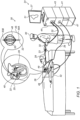
- Fig. 1 is a schematic, pictorial illustration of an electro-anatomical mapping system 20, in accordance with an embodiment of the present invention.
- a physician 30 navigates a basket catheter 40 (made by Biosense-Webster), seen in detail in inset 45, to a target location in a heart 26 of a patient 28, by manipulating shaft 22, using a manipulator 32 near the proximal end of the catheter, and/or deflection from a sheath 23.
- physician 30 uses catheter 40 to perform electro-anatomical mapping of a cardiac chamber.
- the embodiments described herein refer mainly to a basket distal-end assembly, purely by way of example.
- the disclosed techniques can be used for estimating the elongation (and thus the degree of expansion) of a balloon-based distal-end assembly or of any other suitable type of expandable distal-end assembly.
- Catheter 40 is inserted in a folded configuration, through sheath 23, and only after the catheter exits sheath 23 does catheter 40 regain its intended functional shape.
- sheath 23 also serves to minimize vascular trauma on its way to the target location.
- Basket catheter 40 incorporates a magnetic sensor 50A, seen in inset 45, at the distal edge of shaft 22 (i.e., at the proximal edge of basket catheter 40).
- sensor 50A is a Triple-Axis Sensor (TAS).
- a second magnetic sensor 50B is included in a distal edge of the basket catheter.
- Sensor 50B may be a Single-Axis Sensor (SAS) or a Triple-Axis Sensor (TAS), for example.
- Catheter 40 further comprises multiple expandable spines 55, which may be mechanically flexible, to each of which are coupled one or more devices 48.
- Devices 48 may be of numerous types, such as sensing-electrodes, ablation-electrodes, ultrasound transducers, contact force sensors, irrigation ports, temperature sensors, and others.
- Magnetic sensors 50A and 50B and devices 48 are connected by wires running through shaft 22 to various driver circuitries in a console 24.
- catheter 40 may be an inflatable balloon.
- system 20 comprises a magnetic-sensing sub-system to estimate an ellipticity of basket catheter 40, as well as its elongation/retraction state, inside a cardiac chamber of heart 26 by estimating the elongation of basket catheter 40 from the distance between sensors 50A and 50B.
- Patient 28 is placed in a magnetic field generated by a pad containing magnetic field generator coils 42, which are driven by unit 43.
- the magnetic fields generated by coils 42 generate signals in sensors 50A and 50B, which are indicative of position and/or direction.
- the generated signals are transmitted to console 24 and become corresponding electrical inputs to a processor 41.
- the processor uses the signals to calculate the elongation of basket catheter 40, and to estimate basket ellipticity and elongation/retraction state from the calculated distance between sensors 50A and 50B.
- the method of position and/or direction sensing using external magnetic fields and magnetic sensors, such as 50A and 50B, is implemented in various medical applications, for example, in the CARTO TM system, produced by Biosense-Webster, and is described in detail in U.S. Patents 5,391,199 , 6,690,963 , 6,484,118 , 6,239,724 , 6,618,612 and 6,332,089 , in PCT Patent Publication WO 96/05768 , and in U.S. Patent Application Publications 2002/0065455 A1 , 2003/0120150 A1 and 2004/0068178 A1 .
- Processor 41 typically a general-purpose computer, is further connected via suitable front end and interface circuits 44, to receive signals from surface-electrodes 49.
- Processor 41 is connected to surface-electrodes 49 by wires running through a cable 39 to the chest of patient 28.
- processor 41 additionally receives various spatial and electrophysiological signals via an electrical interface 44, and uses the information contained in these signals to construct an electro-anatomical map 31 of the cavity. During and/or following the procedure, processor 41 may display electro-anatomical map 31 on a display 27.
- Processor 41 is typically programmed in software by one skilled in this art to carry out the functions described herein.
- the software may be downloaded to the computer in electronic form, over a network, for example, or it may, alternatively or additionally, be provided and/or stored on non-transitory tangible media, such as magnetic, optical, or electronic memory.
- processor 41 runs a dedicated algorithm that enables processor 41 to perform the disclosed steps, as described below.
- Fig. 1 shows only elements related to the disclosed techniques for the sake of simplicity and clarity.
- System 20 typically comprises additional modules and elements that are not directly related to the disclosed techniques, and thus are intentionally omitted from Fig. 1 and from the corresponding description.
- the elements of system 20 and the methods described herein may be further applied, for example, to control an ablation of tissue of heart 26.
- Fig. 2 is a schematic side-view of basket catheter 40 of Fig. 1 , in accordance with embodiments of the present invention.
- the expandable frame of basket catheter 40 comprises a plurality of expandable spines 55 coupled to a distal end of shaft 22, in proximity to the location of proximal position and direction sensor 50A.
- the expandable frame of basket catheter 40 extends along a longitudinal axis 62 and converges at a distal end of the basket, the location of distal position sensor 50B.
- Spines 55 form an ellipsoid shape of the basket, such as one defined by a surface of revolution about longitudinal axis 62. In general, however, the basket and devices mounted on spines are not required to have a full rotational symmetry.
- processor 41 Based on signals from sensor 50A, processor 41 estimates longitudinal direction 62 (i.e., a direction which is parallel to a longitudinal axis defined by the distal end of shaft 22). At the same time, processor 41 estimates, potentially incorrectly, a position of distal sensor 50B, as being position 50C. Evidently, such an error would cause the estimated shape of the basket to be distorted. The error is largely amended by processor 41 projecting the coordinates of incorrect position 50C on axis 62, so as to obtain a projected position 50D, which is more accurate. Based on the distance along axis 62 between positions 50A and 50D, the processor derives actual values of elongation and ellipticity.
- proximal sensor 50A is replaced with a position device that is configured as a transmitter and distal sensor 50B is replaced with a position device that is configured as a receiver.
- the processor estimates the distance of the receiver sensor from the transmitter. The processor then provides an elongation of the basket as the estimated calibrated distance.
- a method which comprises communicating signals between a proximal position device located at a proximal end of an expandable basket coupled to a distal end of a shaft for insertion into a cavity of an organ of a patient, and a distal position device located at a distal end of the basket, wherein one of the position devices is configured as a transmitter and the other as a receiver
- the illustration in Fig. 2 is conceptual and brought by way of example.
- the actual basket structure may vary.
- expandable spines 55 may be made of a printed circuit board (PCB), or of a shape memory alloy. More generally, the illustration shown in Fig. 2 is applicable, with the necessary changes have been made, to any expandable distal-end assembly of a catheter for insertion into a cavity of an organ of a patient, such as a balloon catheter.
- Fig. 3 is a flow chart that schematically illustrates a method and algorithm for electro-anatomical mapping of a cardiac cavity, in accordance with an embodiment of the present invention.
- the algorithm carries out a process that begins with physician 30 moving basket catheter 40, which is equipped with magnetic sensors 50A and 50B, inside a cardiac cavity.
- processor 41 receives signals from sensors 50A and 50B, at a signal receiving step 70.
- processor 41 estimates a position and a longitudinal direction of proximal sensor 50A, at a basket proximal measurement step 72.
- processor 41 estimates a respective position of distal sensor 50B, at a basket distal measurement step 74.
- processor 41 projects any wrongly estimated position 50C of distal sensor 50B, found in step 74, on an axis 62 defined by the estimated longitudinal direction of proximal sensor 50A, at a distal position projection step 76. The aforementioned projected position is marked 50D.
- processor 41 calculates the elongation of basket catheter 40, as the distance between position 50A and position 50D, at a basket elongation calculation step 78.
- diagnostic and/or therapeutic procedures can be improved, by, for example, correcting assumed positions and orientations of ultrasound transducers fitted over basket catheter 40.
- Another example is issuing directions to the user to perform an action, based on the calculated elongation, such as to perform elongation of the catheter before inflating the balloon in case the system recognizes that the catheter is in its retracted state.
- processor 41 presents the estimated elongation to physician 30, e.g., using a suitable graphical or textual display on display 27. Additionally or alternatively, processor 41 may adapt the procedure or take any other suitable action autonomously based on the estimated elongation, such as preventing from inflating the balloon in case the balloon catheter is determined by the disclosed technique to be in a retracted state.
- the example flow chart shown in Fig. 3 is chosen purely for the sake of conceptual clarity.
- the flow chart shown in Fig. 3 is applicable, with the necessary changes have been made, to any expandable distal-end assembly of a catheter for insertion into a cavity of an organ of a patient, such as a balloon catheter.
- the present embodiment also comprises additional steps of the algorithm, such as operating sensors mounted on the basket spines, which have been omitted from the disclosure herein purposely on order to provide a more simplified flow chart.
- the methods and systems described herein can also be used in other medical applications in which a catheter is inserted into a cavity of an organ of a patient, such as with a navigable Ear, Nose, & Throat (ENT) probe.
- a navigable Ear, Nose, & Throat (ENT) probe such as with a navigable Ear, Nose, & Throat (ENT) probe.
Landscapes
- Health & Medical Sciences (AREA)
- Life Sciences & Earth Sciences (AREA)
- Engineering & Computer Science (AREA)
- Heart & Thoracic Surgery (AREA)
- Biomedical Technology (AREA)
- Animal Behavior & Ethology (AREA)
- General Health & Medical Sciences (AREA)
- Public Health (AREA)
- Veterinary Medicine (AREA)
- Surgery (AREA)
- Biophysics (AREA)
- Molecular Biology (AREA)
- Medical Informatics (AREA)
- Physics & Mathematics (AREA)
- Pathology (AREA)
- Human Computer Interaction (AREA)
- Pulmonology (AREA)
- Hematology (AREA)
- Anesthesiology (AREA)
- Nuclear Medicine, Radiotherapy & Molecular Imaging (AREA)
- Robotics (AREA)
- Child & Adolescent Psychology (AREA)
- Plasma & Fusion (AREA)
- Otolaryngology (AREA)
- Gynecology & Obstetrics (AREA)
- Radiology & Medical Imaging (AREA)
- Cardiology (AREA)
- Physiology (AREA)
- Media Introduction/Drainage Providing Device (AREA)
- Surgical Instruments (AREA)
- Measurement Of Length, Angles, Or The Like Using Electric Or Magnetic Means (AREA)
Claims (12)
- System, umfassend:eine erweiterbare Distalendanordnung (40), die mit einem distalen Ende eines Schafts (22) für ein Einführen in einen Organhohlraum eines Patienten gekoppelt ist;einen proximalen Positionssensor (50A), der sich an einem proximalen Ende der Distalendanordnung (40) befindet;einen distalen Positionssensor (50B), der sich an einem distalen Ende der Distalendanordnung (40) befindet; undeinen Prozessor (41), der konfiguriert ist zum:basierend auf Signalen, die von dem proximalen Positionssensor (50A) empfangen werden, Schätzen einer Position und einer Längsrichtung des proximalen Sensors (50A) in einem Koordinatensystem, das durch den Prozessor (41) verwendet wird;basierend auf Signalen, die von dem distalen Positionssensor (50B) empfangen werden, Schätzen einer Position des distalen Positionssensors (50B) in dem Koordinatensystem; dadurch gekennzeichnet, dass der Prozessor ferner konfiguriert ist zum:Projizieren der geschätzten Position des distalen Positionssensors (50B) auf eine Achse, die durch die geschätzte Längsrichtung definiert ist; undund Berechnen einer Verlängerung der Distalendanordnung (40) durch Berechnen einer Entfernung zwischen der geschätzten Position des proximalen Positionssensors (50A) und der projizierten Position des distalen Positionssensors (50B).
- System nach Anspruch 1, wobei der proximale Positionssensor und der distale Positionssensor Magnetsensoren sind.
- System nach Anspruch 1, wobei, unter Verwendung der berechneten Verlängerung, der Prozessor ferner konfiguriert ist, um eine Elliptizität der erweiterbaren Distalendanordnung zu schätzen.
- System nach Anspruch 1, wobei die erweiterbare Distalendanordnung einen Korb umfasst.
- System nach Anspruch 1, wobei die erweiterbare Distalendanordnung einen Ballon umfasst.
- System nach Anspruch 1, wobei der Prozessor konfiguriert ist, um basierend auf einem Berechnen der Verlängerung, einen Verlängerungsgrad der erweiterbaren Distalendanordnung anzugeben.
- Verfahren, umfassend:in einem Prozessor, Empfangen von Signalen von einem proximalen Positionssensor, der sich an einem proximalen Ende einer erweiterbaren Distalendanordnung befindet, die mit einem distalen Ende eines Schafts für das Einführen in einen Organhohlraum eines Patienten gekoppelt ist, und von einem distalen Positionssensor, der sich an einem distalen Ende der Distalendanordnung befindet;basierend auf den Signalen, die von dem proximalen Positionssensor empfangen werden, Schätzen einer Position und einer Längsrichtung des proximalen Positionssensors in einem Koordinatensystem, das durch den Prozessor verwendet wird;basierend auf den Signalen, die durch den distalen Positionssensor empfangen werden, Schätzen einer Position des distalen Positionssensors in dem Koordinatensystem; dadurch gekennzeichnet, dass der Prozessor ferner:Projizieren der geschätzten Position auf eine Achse, die durch die geschätzte Längsrichtung definiert ist; undBerechnen einer Verlängerung der Distalendanordnung durch Berechnen einer Entfernung zwischen der geschätzten Position des proximalen Sensors und der projizierten Position des distalen Positionssensors.
- Verfahren nach Anspruch 7, wobei das Empfangen der Signale das Empfangen von Signalen von Magnetsensoren umfasst.
- Verfahren nach Anspruch 7, und umfassend, unter Verwendung der berechneten Verlängerung, das Schätzen einer Elliptizität der Distalendanordnung.
- Verfahren nach Anspruch 7, wobei die erweiterbare Distalendanordnung einen Korb umfasst.
- Verfahren nach Anspruch 7, wobei die erweiterbare Distalendanordnung einen Ballon umfasst.
- Verfahren nach Anspruch 7, wobei das Berechnen der Verlängerung das Angeben eines Verlängerungsgrads der erweiterbaren Distalendanordnung umfasst.
Applications Claiming Priority (1)
| Application Number | Priority Date | Filing Date | Title |
|---|---|---|---|
| US16/234,604 US11672952B2 (en) | 2018-12-28 | 2018-12-28 | Finding elongation of expandable distal end of catheter |
Publications (4)
| Publication Number | Publication Date |
|---|---|
| EP3682797A2 EP3682797A2 (de) | 2020-07-22 |
| EP3682797A3 EP3682797A3 (de) | 2020-10-14 |
| EP3682797B1 true EP3682797B1 (de) | 2024-07-31 |
| EP3682797C0 EP3682797C0 (de) | 2024-07-31 |
Family
ID=69024175
Family Applications (1)
| Application Number | Title | Priority Date | Filing Date |
|---|---|---|---|
| EP19219613.7A Active EP3682797B1 (de) | 2018-12-28 | 2019-12-24 | Finden der dehnung eines expandierbaren distalen endes eines katheters |
Country Status (5)
| Country | Link |
|---|---|
| US (3) | US11672952B2 (de) |
| EP (1) | EP3682797B1 (de) |
| JP (1) | JP7443052B2 (de) |
| CN (2) | CN119214775A (de) |
| IL (1) | IL271645B2 (de) |
Families Citing this family (42)
| Publication number | Priority date | Publication date | Assignee | Title |
|---|---|---|---|---|
| US10905329B2 (en) | 2016-06-09 | 2021-02-02 | Biosense Webster (Israel) Ltd. | Multi-function conducting elements for a catheter |
| US12029545B2 (en) | 2017-05-30 | 2024-07-09 | Biosense Webster (Israel) Ltd. | Catheter splines as location sensors |
| US20190314083A1 (en) | 2018-04-11 | 2019-10-17 | Biosense Webster (Israel) Ltd. | Flexible Multi-Arm Catheter with Diametrically Opposed Sensing Electrodes |
| US11045628B2 (en) | 2018-12-11 | 2021-06-29 | Biosense Webster (Israel) Ltd. | Balloon catheter with high articulation |
| US11207016B2 (en) | 2018-12-28 | 2021-12-28 | Biosense Webster (Israel) Ltd. | Mapping ECG signals using a multipole electrode assembly |
| US11672952B2 (en) | 2018-12-28 | 2023-06-13 | Biosense Webster (Israel) Ltd. | Finding elongation of expandable distal end of catheter |
| US11712172B2 (en) | 2019-07-18 | 2023-08-01 | Biosense Webster (Israel) Ltd. | Visual guidance for positioning a distal end of a medical probe |
| US11759150B2 (en) | 2019-08-27 | 2023-09-19 | Biosense Webster (Israel) Ltd. | Accurate basket catheter tracking |
| US11950930B2 (en) | 2019-12-12 | 2024-04-09 | Biosense Webster (Israel) Ltd. | Multi-dimensional acquisition of bipolar signals from a catheter |
| US11517218B2 (en) | 2019-12-20 | 2022-12-06 | Biosense Webster (Israel) Ltd. | Selective graphical presentation of electrophysiological parameters |
| EP4087511A4 (de) * | 2020-01-08 | 2024-02-14 | 460Medical, Inc. | Systeme und verfahren zur optischen abfrage von ablationsverletzungen |
| US11987017B2 (en) | 2020-06-08 | 2024-05-21 | Biosense Webster (Israel) Ltd. | Features to assist in assembly and testing of devices |
| US12263014B2 (en) * | 2020-08-18 | 2025-04-01 | St. Jude Medical, Cardiology Division, Inc. | High-density electrode catheters with magnetic position tracking |
| US12048479B2 (en) | 2020-09-10 | 2024-07-30 | Biosense Webster (Israel) Ltd. | Surface mounted electrode catheter |
| US11950841B2 (en) | 2020-09-22 | 2024-04-09 | Biosense Webster (Israel) Ltd. | Basket catheter having insulated ablation electrodes and diagnostic electrodes |
| US11950840B2 (en) | 2020-09-22 | 2024-04-09 | Biosense Webster (Israel) Ltd. | Basket catheter having insulated ablation electrodes |
| US12082875B2 (en) | 2020-09-24 | 2024-09-10 | Biosense Webster (Israel) Ltd | Balloon catheter having a coil for sensing tissue temperature and position of the balloon |
| US11974803B2 (en) | 2020-10-12 | 2024-05-07 | Biosense Webster (Israel) Ltd. | Basket catheter with balloon |
| US12396789B2 (en) * | 2020-10-15 | 2025-08-26 | Biosense Webster (Israel) Ltd. | Determining shape of expandable distal member of a catheter |
| US12201786B2 (en) * | 2020-12-17 | 2025-01-21 | Biosense Webster (Israel) Ltd. | Measurement of distal end dimension of catheters using magnetic fields |
| US11918383B2 (en) | 2020-12-21 | 2024-03-05 | Biosense Webster (Israel) Ltd. | Visualizing performance of catheter electrodes |
| US12064170B2 (en) | 2021-05-13 | 2024-08-20 | Biosense Webster (Israel) Ltd. | Distal assembly for catheter with lumens running along spines |
| US20230009573A1 (en) | 2021-07-09 | 2023-01-12 | Biosense Webster (Israel) Ltd. | Ablation and mapping with a singular multi-electrode catheter |
| US12364426B2 (en) | 2021-08-12 | 2025-07-22 | Biosense Webster (Israel) Ltd. | Electro-anatomical mapping and annotation presented in electrophysiological procedures |
| US20230053064A1 (en) | 2021-08-16 | 2023-02-16 | Biosense Webster (Israel) Ltd. | Catheter having electrodes with adjustable size |
| US12004804B2 (en) | 2021-09-09 | 2024-06-11 | Biosense Webster (Israel) Ltd. | Basket catheter with mushroom shape distal tip |
| US12478424B2 (en) | 2021-09-10 | 2025-11-25 | Biosense Webster (Israel) Ltd. | Staggered pairs of biased ablation electrodes on basket catheter |
| US12011280B2 (en) | 2021-10-04 | 2024-06-18 | Biosense Webster (Israel) Ltd. | Electrophysiological mapping in the presence of injury current |
| US12533489B2 (en) | 2021-10-08 | 2026-01-27 | Biosense Webster (Israel) Ltd. | Measuring tissue proximity for multi-electrode catheter |
| US20230147259A1 (en) | 2021-11-10 | 2023-05-11 | Biosense Webster (Israel) Ltd. | Estimating contact force applied between catheter and tissue using transmitter and receivers of the catheter |
| US12419683B2 (en) | 2021-12-22 | 2025-09-23 | Biosense Webster (Israel) Ltd. | Irreversible electroporation with shorted electrodes |
| US12484961B2 (en) | 2022-01-20 | 2025-12-02 | Biosense Webster (Israel) Ltd. | Mechanical retainer systems for electrodes of a basket catheter, and methods of the same |
| US12446946B2 (en) | 2022-01-20 | 2025-10-21 | Biosense Webster (Israel) Ltd. | Systems and methods for a single spiral electrode assembly forming a spherical basket for improved tissue contact and current delivery |
| US12440263B2 (en) | 2022-01-20 | 2025-10-14 | Biosense Webster (Israel) Ltd. | Systems and methods for tripodic spines forming a spherical basket for improved tissue contact and current delivery |
| US12551658B2 (en) | 2022-03-25 | 2026-02-17 | St. Jude Medical, Cardiology Division, Inc. | Steerable introducer with slide block divider |
| CN114831724B (zh) * | 2022-04-20 | 2025-12-12 | 苏州中荟医疗科技有限公司 | 一种消融装置及在消融治疗中获取导管形态的方法 |
| US12471989B2 (en) | 2022-04-28 | 2025-11-18 | Biosense Webster (Israel) Ltd. | Strengthened expandable baskets for medical probes and medical probes containing strengthen expandable baskets |
| US20240058073A1 (en) | 2022-08-18 | 2024-02-22 | Biosense Webster (Israel) Ltd. | Multi-arm Catheter with Improved Magnetic Location Tracking |
| US12533185B2 (en) | 2022-12-28 | 2026-01-27 | Biosense Webster (Israel) Ltd. | Basket end effector with distal position sensor |
| US12521035B2 (en) | 2022-12-29 | 2026-01-13 | Biosense Webster (Israel) Ltd. | Cylindrical cage systems and methods for distributed tissue contact for mapping and ablation |
| US20250186125A1 (en) * | 2023-12-06 | 2025-06-12 | Biosense Webster (Israel) Ltd. | Monitoring torsion on a distal end assembly |
| US20260013750A1 (en) * | 2024-07-15 | 2026-01-15 | Biosense Webster (Israel) Ltd. | Magnetic based sheath detection |
Family Cites Families (35)
| Publication number | Priority date | Publication date | Assignee | Title |
|---|---|---|---|---|
| US6285898B1 (en) * | 1993-07-20 | 2001-09-04 | Biosense, Inc. | Cardiac electromechanics |
| US6983179B2 (en) * | 1993-07-20 | 2006-01-03 | Biosense, Inc. | Method for mapping a heart using catheters having ultrasonic position sensors |
| US5391199A (en) | 1993-07-20 | 1995-02-21 | Biosense, Inc. | Apparatus and method for treating cardiac arrhythmias |
| CA2197986C (en) | 1994-08-19 | 2008-03-18 | Shlomo Ben-Haim | Medical diagnosis, treatment and imaging systems |
| US6690963B2 (en) | 1995-01-24 | 2004-02-10 | Biosense, Inc. | System for determining the location and orientation of an invasive medical instrument |
| US6915149B2 (en) * | 1996-01-08 | 2005-07-05 | Biosense, Inc. | Method of pacing a heart using implantable device |
| IL125761A (en) | 1996-02-15 | 2005-05-17 | Biosense Inc | Independently positionable transducers for location system |
| CA2246287C (en) | 1996-02-15 | 2006-10-24 | Biosense, Inc. | Medical procedures and apparatus using intrabody probes |
| US6490474B1 (en) * | 1997-08-01 | 2002-12-03 | Cardiac Pathways Corporation | System and method for electrode localization using ultrasound |
| US6239724B1 (en) | 1997-12-30 | 2001-05-29 | Remon Medical Technologies, Ltd. | System and method for telemetrically providing intrabody spatial position |
| US6226542B1 (en) * | 1998-07-24 | 2001-05-01 | Biosense, Inc. | Three-dimensional reconstruction of intrabody organs |
| US6301496B1 (en) * | 1998-07-24 | 2001-10-09 | Biosense, Inc. | Vector mapping of three-dimensionally reconstructed intrabody organs and method of display |
| US6950689B1 (en) * | 1998-08-03 | 2005-09-27 | Boston Scientific Scimed, Inc. | Dynamically alterable three-dimensional graphical model of a body region |
| US6298257B1 (en) * | 1999-09-22 | 2001-10-02 | Sterotaxis, Inc. | Cardiac methods and system |
| US6484118B1 (en) | 2000-07-20 | 2002-11-19 | Biosense, Inc. | Electromagnetic position single axis system |
| US6741878B2 (en) | 2001-12-14 | 2004-05-25 | Biosense Webster, Inc. | Basket catheter with improved expansion mechanism |
| US6748255B2 (en) | 2001-12-14 | 2004-06-08 | Biosense Webster, Inc. | Basket catheter with multiple location sensors |
| US7729742B2 (en) | 2001-12-21 | 2010-06-01 | Biosense, Inc. | Wireless position sensor |
| US20040068178A1 (en) | 2002-09-17 | 2004-04-08 | Assaf Govari | High-gradient recursive locating system |
| US10568546B2 (en) * | 2003-02-21 | 2020-02-25 | 3Dt Holdings, Llc | Devices and methods for sizing valve apertures and luminal organs |
| EP1912565B1 (de) * | 2005-08-05 | 2011-09-14 | Koninklijke Philips Electronics N.V. | Katheternavigationssystem |
| US20070106114A1 (en) * | 2005-11-09 | 2007-05-10 | Pentax Corporation | Endoscope-shape monitoring system |
| US7729752B2 (en) * | 2006-06-13 | 2010-06-01 | Rhythmia Medical, Inc. | Non-contact cardiac mapping, including resolution map |
| US8357152B2 (en) | 2007-10-08 | 2013-01-22 | Biosense Webster (Israel), Ltd. | Catheter with pressure sensing |
| CN101347331B (zh) * | 2008-06-06 | 2011-09-07 | 微创医疗器械(上海)有限公司 | 一种模拟导管弯曲形态的方法及磁感应导管 |
| CN102939051A (zh) | 2010-06-13 | 2013-02-20 | 安吉奥梅特里克斯公司 | 用于确定血管体腔的信息并引导医疗设备的方法和系统 |
| US20130123694A1 (en) | 2010-09-17 | 2013-05-16 | Angiometrix Corporation | Diagnostic kit and method for measuring balloon dimension in vivo |
| CA2930528C (en) * | 2013-12-17 | 2022-06-21 | Halliburton Energy Services Inc. | Drilling modeling calibration, including estimation of drill string stretch and twist |
| US9696131B2 (en) * | 2013-12-24 | 2017-07-04 | Biosense Webster (Israel) Ltd. | Adaptive fluoroscope location for the application of field compensation |
| EP3256043B1 (de) * | 2015-02-12 | 2020-03-18 | Foundry Innovation & Research 1, Ltd. | Implantierbare vorrichtungen zur herzfehlerüberwachung |
| JP6728244B2 (ja) | 2015-06-19 | 2020-07-22 | セント・ジュード・メディカル,カーディオロジー・ディヴィジョン,インコーポレイテッド | デバイスナビゲーションのための電磁動的位置合わせ |
| JP6615977B2 (ja) | 2015-08-05 | 2019-12-04 | ボストン サイエンティフィック サイムド,インコーポレイテッド | 膀胱マッピングのためのスマート装置 |
| US20170079553A1 (en) * | 2015-09-21 | 2017-03-23 | Biosense Webster (Israel) Ltd. | Adding a Tracking Sensor to a Rigid Tool |
| JP6532061B2 (ja) * | 2016-03-18 | 2019-06-19 | 三菱重工業株式会社 | 光計測装置、光計測方法及び回転機械 |
| US11672952B2 (en) * | 2018-12-28 | 2023-06-13 | Biosense Webster (Israel) Ltd. | Finding elongation of expandable distal end of catheter |
-
2018
- 2018-12-28 US US16/234,604 patent/US11672952B2/en active Active
-
2019
- 2019-12-22 IL IL271645A patent/IL271645B2/en unknown
- 2019-12-24 EP EP19219613.7A patent/EP3682797B1/de active Active
- 2019-12-26 JP JP2019235855A patent/JP7443052B2/ja active Active
- 2019-12-27 CN CN202411332922.2A patent/CN119214775A/zh active Pending
- 2019-12-27 CN CN201911377935.0A patent/CN111374765B/zh active Active
-
2023
- 2023-05-05 US US18/312,783 patent/US12156977B2/en active Active
-
2024
- 2024-11-26 US US18/960,388 patent/US20250082901A1/en active Pending
Also Published As
| Publication number | Publication date |
|---|---|
| JP2020108769A (ja) | 2020-07-16 |
| JP7443052B2 (ja) | 2024-03-05 |
| IL271645B2 (en) | 2024-01-01 |
| EP3682797A2 (de) | 2020-07-22 |
| EP3682797A3 (de) | 2020-10-14 |
| US20200206461A1 (en) | 2020-07-02 |
| EP3682797C0 (de) | 2024-07-31 |
| US20250082901A1 (en) | 2025-03-13 |
| US20230270977A1 (en) | 2023-08-31 |
| US11672952B2 (en) | 2023-06-13 |
| IL271645B1 (en) | 2023-09-01 |
| CN119214775A (zh) | 2024-12-31 |
| CN111374765B (zh) | 2024-10-18 |
| US12156977B2 (en) | 2024-12-03 |
| IL271645A (en) | 2020-06-30 |
| CN111374765A (zh) | 2020-07-07 |
Similar Documents
| Publication | Publication Date | Title |
|---|---|---|
| EP3682797B1 (de) | Finden der dehnung eines expandierbaren distalen endes eines katheters | |
| EP3785612B1 (de) | Genaue verfolgung eines korbkatheters | |
| CN112674754B (zh) | 验证导管正确地撤回到护套内 | |
| EP3571989B1 (de) | Skalierung von impedanzortungsmessungen eines ballonkatheters | |
| EP3574827B1 (de) | Katheterlokalisierung unter verwendung von gegenwärtigen standort in kombination mit magnetfelderfassung | |
| CN111297470A (zh) | 组合来自不同坐标系的导管可视化 | |
| EP4137051A1 (de) | Elektro-anatomische kartierung und beschriftung bei elektrophysiologischen verfahren | |
| EP4324388B1 (de) | Mehrarmiger katheter mit verbesserter magnetischer positionsverfolgung | |
| JP7827246B2 (ja) | 遠位端寸法の正確な測定 | |
| EP4631454A2 (de) | Darstellung von qualitätsmessungen der gewebeablation in einem blutgefäss mithilfe einer zweidimensionalen karte |
Legal Events
| Date | Code | Title | Description |
|---|---|---|---|
| PUAI | Public reference made under article 153(3) epc to a published international application that has entered the european phase |
Free format text: ORIGINAL CODE: 0009012 |
|
| STAA | Information on the status of an ep patent application or granted ep patent |
Free format text: STATUS: THE APPLICATION HAS BEEN PUBLISHED |
|
| AK | Designated contracting states |
Kind code of ref document: A2 Designated state(s): AL AT BE BG CH CY CZ DE DK EE ES FI FR GB GR HR HU IE IS IT LI LT LU LV MC MK MT NL NO PL PT RO RS SE SI SK SM TR |
|
| AX | Request for extension of the european patent |
Extension state: BA ME |
|
| PUAL | Search report despatched |
Free format text: ORIGINAL CODE: 0009013 |
|
| AK | Designated contracting states |
Kind code of ref document: A3 Designated state(s): AL AT BE BG CH CY CZ DE DK EE ES FI FR GB GR HR HU IE IS IT LI LT LU LV MC MK MT NL NO PL PT RO RS SE SI SK SM TR |
|
| AX | Request for extension of the european patent |
Extension state: BA ME |
|
| RIC1 | Information provided on ipc code assigned before grant |
Ipc: A61B 5/00 20060101AFI20200908BHEP Ipc: A61B 5/06 20060101ALI20200908BHEP Ipc: A61B 5/042 20060101ALI20200908BHEP |
|
| STAA | Information on the status of an ep patent application or granted ep patent |
Free format text: STATUS: REQUEST FOR EXAMINATION WAS MADE |
|
| 17P | Request for examination filed |
Effective date: 20210414 |
|
| RBV | Designated contracting states (corrected) |
Designated state(s): AL AT BE BG CH CY CZ DE DK EE ES FI FR GB GR HR HU IE IS IT LI LT LU LV MC MK MT NL NO PL PT RO RS SE SI SK SM TR |
|
| RAP3 | Party data changed (applicant data changed or rights of an application transferred) |
Owner name: BIOSENSE WEBSTER (ISRAEL) LTD. |
|
| REG | Reference to a national code |
Ref country code: DE Ref legal event code: R079 Free format text: PREVIOUS MAIN CLASS: A61B0005000000 Ipc: A61M0025010000 Ref country code: DE Ref legal event code: R079 Ref document number: 602019056049 Country of ref document: DE Free format text: PREVIOUS MAIN CLASS: A61B0005000000 Ipc: A61M0025010000 |
|
| GRAP | Despatch of communication of intention to grant a patent |
Free format text: ORIGINAL CODE: EPIDOSNIGR1 |
|
| STAA | Information on the status of an ep patent application or granted ep patent |
Free format text: STATUS: GRANT OF PATENT IS INTENDED |
|
| RIC1 | Information provided on ipc code assigned before grant |
Ipc: A61B 5/06 20060101ALI20240222BHEP Ipc: A61M 25/01 20060101AFI20240222BHEP |
|
| INTG | Intention to grant announced |
Effective date: 20240312 |
|
| GRAS | Grant fee paid |
Free format text: ORIGINAL CODE: EPIDOSNIGR3 |
|
| GRAA | (expected) grant |
Free format text: ORIGINAL CODE: 0009210 |
|
| STAA | Information on the status of an ep patent application or granted ep patent |
Free format text: STATUS: THE PATENT HAS BEEN GRANTED |
|
| AK | Designated contracting states |
Kind code of ref document: B1 Designated state(s): AL AT BE BG CH CY CZ DE DK EE ES FI FR GB GR HR HU IE IS IT LI LT LU LV MC MK MT NL NO PL PT RO RS SE SI SK SM TR |
|
| REG | Reference to a national code |
Ref country code: CH Ref legal event code: EP Ref country code: GB Ref legal event code: FG4D |
|
| REG | Reference to a national code |
Ref country code: DE Ref legal event code: R096 Ref document number: 602019056049 Country of ref document: DE |
|
| REG | Reference to a national code |
Ref country code: IE Ref legal event code: FG4D |
|
| U01 | Request for unitary effect filed |
Effective date: 20240819 |
|
| U07 | Unitary effect registered |
Designated state(s): AT BE BG DE DK EE FI FR IT LT LU LV MT NL PT RO SE SI Effective date: 20240902 |
|
| U20 | Renewal fee for the european patent with unitary effect paid |
Year of fee payment: 6 Effective date: 20241107 |
|
| PG25 | Lapsed in a contracting state [announced via postgrant information from national office to epo] |
Ref country code: NO Free format text: LAPSE BECAUSE OF FAILURE TO SUBMIT A TRANSLATION OF THE DESCRIPTION OR TO PAY THE FEE WITHIN THE PRESCRIBED TIME-LIMIT Effective date: 20241031 |
|
| PG25 | Lapsed in a contracting state [announced via postgrant information from national office to epo] |
Ref country code: PL Free format text: LAPSE BECAUSE OF FAILURE TO SUBMIT A TRANSLATION OF THE DESCRIPTION OR TO PAY THE FEE WITHIN THE PRESCRIBED TIME-LIMIT Effective date: 20240731 Ref country code: GR Free format text: LAPSE BECAUSE OF FAILURE TO SUBMIT A TRANSLATION OF THE DESCRIPTION OR TO PAY THE FEE WITHIN THE PRESCRIBED TIME-LIMIT Effective date: 20241101 |
|
| PG25 | Lapsed in a contracting state [announced via postgrant information from national office to epo] |
Ref country code: IS Free format text: LAPSE BECAUSE OF FAILURE TO SUBMIT A TRANSLATION OF THE DESCRIPTION OR TO PAY THE FEE WITHIN THE PRESCRIBED TIME-LIMIT Effective date: 20241130 |
|
| PG25 | Lapsed in a contracting state [announced via postgrant information from national office to epo] |
Ref country code: HR Free format text: LAPSE BECAUSE OF FAILURE TO SUBMIT A TRANSLATION OF THE DESCRIPTION OR TO PAY THE FEE WITHIN THE PRESCRIBED TIME-LIMIT Effective date: 20240731 |
|
| PG25 | Lapsed in a contracting state [announced via postgrant information from national office to epo] |
Ref country code: RS Free format text: LAPSE BECAUSE OF FAILURE TO SUBMIT A TRANSLATION OF THE DESCRIPTION OR TO PAY THE FEE WITHIN THE PRESCRIBED TIME-LIMIT Effective date: 20241031 Ref country code: ES Free format text: LAPSE BECAUSE OF FAILURE TO SUBMIT A TRANSLATION OF THE DESCRIPTION OR TO PAY THE FEE WITHIN THE PRESCRIBED TIME-LIMIT Effective date: 20240731 |
|
| PG25 | Lapsed in a contracting state [announced via postgrant information from national office to epo] |
Ref country code: RS Free format text: LAPSE BECAUSE OF FAILURE TO SUBMIT A TRANSLATION OF THE DESCRIPTION OR TO PAY THE FEE WITHIN THE PRESCRIBED TIME-LIMIT Effective date: 20241031 Ref country code: PL Free format text: LAPSE BECAUSE OF FAILURE TO SUBMIT A TRANSLATION OF THE DESCRIPTION OR TO PAY THE FEE WITHIN THE PRESCRIBED TIME-LIMIT Effective date: 20240731 Ref country code: NO Free format text: LAPSE BECAUSE OF FAILURE TO SUBMIT A TRANSLATION OF THE DESCRIPTION OR TO PAY THE FEE WITHIN THE PRESCRIBED TIME-LIMIT Effective date: 20241031 Ref country code: IS Free format text: LAPSE BECAUSE OF FAILURE TO SUBMIT A TRANSLATION OF THE DESCRIPTION OR TO PAY THE FEE WITHIN THE PRESCRIBED TIME-LIMIT Effective date: 20241130 Ref country code: HR Free format text: LAPSE BECAUSE OF FAILURE TO SUBMIT A TRANSLATION OF THE DESCRIPTION OR TO PAY THE FEE WITHIN THE PRESCRIBED TIME-LIMIT Effective date: 20240731 Ref country code: GR Free format text: LAPSE BECAUSE OF FAILURE TO SUBMIT A TRANSLATION OF THE DESCRIPTION OR TO PAY THE FEE WITHIN THE PRESCRIBED TIME-LIMIT Effective date: 20241101 Ref country code: ES Free format text: LAPSE BECAUSE OF FAILURE TO SUBMIT A TRANSLATION OF THE DESCRIPTION OR TO PAY THE FEE WITHIN THE PRESCRIBED TIME-LIMIT Effective date: 20240731 |
|
| PG25 | Lapsed in a contracting state [announced via postgrant information from national office to epo] |
Ref country code: SM Free format text: LAPSE BECAUSE OF FAILURE TO SUBMIT A TRANSLATION OF THE DESCRIPTION OR TO PAY THE FEE WITHIN THE PRESCRIBED TIME-LIMIT Effective date: 20240731 |
|
| PG25 | Lapsed in a contracting state [announced via postgrant information from national office to epo] |
Ref country code: CZ Free format text: LAPSE BECAUSE OF FAILURE TO SUBMIT A TRANSLATION OF THE DESCRIPTION OR TO PAY THE FEE WITHIN THE PRESCRIBED TIME-LIMIT Effective date: 20240731 |
|
| PG25 | Lapsed in a contracting state [announced via postgrant information from national office to epo] |
Ref country code: SK Free format text: LAPSE BECAUSE OF FAILURE TO SUBMIT A TRANSLATION OF THE DESCRIPTION OR TO PAY THE FEE WITHIN THE PRESCRIBED TIME-LIMIT Effective date: 20240731 |
|
| PLBE | No opposition filed within time limit |
Free format text: ORIGINAL CODE: 0009261 |
|
| STAA | Information on the status of an ep patent application or granted ep patent |
Free format text: STATUS: NO OPPOSITION FILED WITHIN TIME LIMIT |
|
| PG25 | Lapsed in a contracting state [announced via postgrant information from national office to epo] |
Ref country code: MC Free format text: LAPSE BECAUSE OF FAILURE TO SUBMIT A TRANSLATION OF THE DESCRIPTION OR TO PAY THE FEE WITHIN THE PRESCRIBED TIME-LIMIT Effective date: 20240731 |
|
| 26N | No opposition filed |
Effective date: 20250501 |
|
| REG | Reference to a national code |
Ref country code: CH Ref legal event code: PL |
|
| PG25 | Lapsed in a contracting state [announced via postgrant information from national office to epo] |
Ref country code: CH Free format text: LAPSE BECAUSE OF NON-PAYMENT OF DUE FEES Effective date: 20241231 |
|
| PG25 | Lapsed in a contracting state [announced via postgrant information from national office to epo] |
Ref country code: IE Free format text: LAPSE BECAUSE OF NON-PAYMENT OF DUE FEES Effective date: 20241224 |
|
| U20 | Renewal fee for the european patent with unitary effect paid |
Year of fee payment: 7 Effective date: 20251110 |
|
| PGFP | Annual fee paid to national office [announced via postgrant information from national office to epo] |
Ref country code: GB Payment date: 20251030 Year of fee payment: 7 |