EP3682633B1 - Vorrichtung und verfahren zur bildcodierung mit grenzpartitionsverarbeitung - Google Patents
Vorrichtung und verfahren zur bildcodierung mit grenzpartitionsverarbeitung Download PDFInfo
- Publication number
- EP3682633B1 EP3682633B1 EP17781113.0A EP17781113A EP3682633B1 EP 3682633 B1 EP3682633 B1 EP 3682633B1 EP 17781113 A EP17781113 A EP 17781113A EP 3682633 B1 EP3682633 B1 EP 3682633B1
- Authority
- EP
- European Patent Office
- Prior art keywords
- boundary
- coding
- image
- partitioning
- coding unit
- Prior art date
- Legal status (The legal status is an assumption and is not a legal conclusion. Google has not performed a legal analysis and makes no representation as to the accuracy of the status listed.)
- Active
Links
Images
Classifications
-
- H—ELECTRICITY
- H04—ELECTRIC COMMUNICATION TECHNIQUE
- H04N—PICTORIAL COMMUNICATION, e.g. TELEVISION
- H04N19/00—Methods or arrangements for coding, decoding, compressing or decompressing digital video signals
- H04N19/10—Methods or arrangements for coding, decoding, compressing or decompressing digital video signals using adaptive coding
- H04N19/102—Methods or arrangements for coding, decoding, compressing or decompressing digital video signals using adaptive coding characterised by the element, parameter or selection affected or controlled by the adaptive coding
- H04N19/119—Adaptive subdivision aspects, e.g. subdivision of a picture into rectangular or non-rectangular coding blocks
-
- H—ELECTRICITY
- H04—ELECTRIC COMMUNICATION TECHNIQUE
- H04N—PICTORIAL COMMUNICATION, e.g. TELEVISION
- H04N19/00—Methods or arrangements for coding, decoding, compressing or decompressing digital video signals
- H04N19/10—Methods or arrangements for coding, decoding, compressing or decompressing digital video signals using adaptive coding
- H04N19/134—Methods or arrangements for coding, decoding, compressing or decompressing digital video signals using adaptive coding characterised by the element, parameter or criterion affecting or controlling the adaptive coding
- H04N19/136—Incoming video signal characteristics or properties
-
- H—ELECTRICITY
- H04—ELECTRIC COMMUNICATION TECHNIQUE
- H04N—PICTORIAL COMMUNICATION, e.g. TELEVISION
- H04N19/00—Methods or arrangements for coding, decoding, compressing or decompressing digital video signals
- H04N19/10—Methods or arrangements for coding, decoding, compressing or decompressing digital video signals using adaptive coding
- H04N19/134—Methods or arrangements for coding, decoding, compressing or decompressing digital video signals using adaptive coding characterised by the element, parameter or criterion affecting or controlling the adaptive coding
- H04N19/146—Data rate or code amount at the encoder output
- H04N19/147—Data rate or code amount at the encoder output according to rate distortion criteria
-
- H—ELECTRICITY
- H04—ELECTRIC COMMUNICATION TECHNIQUE
- H04N—PICTORIAL COMMUNICATION, e.g. TELEVISION
- H04N19/00—Methods or arrangements for coding, decoding, compressing or decompressing digital video signals
- H04N19/10—Methods or arrangements for coding, decoding, compressing or decompressing digital video signals using adaptive coding
- H04N19/169—Methods or arrangements for coding, decoding, compressing or decompressing digital video signals using adaptive coding characterised by the coding unit, i.e. the structural portion or semantic portion of the video signal being the object or the subject of the adaptive coding
- H04N19/17—Methods or arrangements for coding, decoding, compressing or decompressing digital video signals using adaptive coding characterised by the coding unit, i.e. the structural portion or semantic portion of the video signal being the object or the subject of the adaptive coding the unit being an image region, e.g. an object
- H04N19/172—Methods or arrangements for coding, decoding, compressing or decompressing digital video signals using adaptive coding characterised by the coding unit, i.e. the structural portion or semantic portion of the video signal being the object or the subject of the adaptive coding the unit being an image region, e.g. an object the region being a picture, frame or field
-
- H—ELECTRICITY
- H04—ELECTRIC COMMUNICATION TECHNIQUE
- H04N—PICTORIAL COMMUNICATION, e.g. TELEVISION
- H04N19/00—Methods or arrangements for coding, decoding, compressing or decompressing digital video signals
- H04N19/10—Methods or arrangements for coding, decoding, compressing or decompressing digital video signals using adaptive coding
- H04N19/169—Methods or arrangements for coding, decoding, compressing or decompressing digital video signals using adaptive coding characterised by the coding unit, i.e. the structural portion or semantic portion of the video signal being the object or the subject of the adaptive coding
- H04N19/17—Methods or arrangements for coding, decoding, compressing or decompressing digital video signals using adaptive coding characterised by the coding unit, i.e. the structural portion or semantic portion of the video signal being the object or the subject of the adaptive coding the unit being an image region, e.g. an object
- H04N19/176—Methods or arrangements for coding, decoding, compressing or decompressing digital video signals using adaptive coding characterised by the coding unit, i.e. the structural portion or semantic portion of the video signal being the object or the subject of the adaptive coding the unit being an image region, e.g. an object the region being a block, e.g. a macroblock
-
- H—ELECTRICITY
- H04—ELECTRIC COMMUNICATION TECHNIQUE
- H04N—PICTORIAL COMMUNICATION, e.g. TELEVISION
- H04N19/00—Methods or arrangements for coding, decoding, compressing or decompressing digital video signals
- H04N19/30—Methods or arrangements for coding, decoding, compressing or decompressing digital video signals using hierarchical techniques, e.g. scalability
-
- H—ELECTRICITY
- H04—ELECTRIC COMMUNICATION TECHNIQUE
- H04N—PICTORIAL COMMUNICATION, e.g. TELEVISION
- H04N19/00—Methods or arrangements for coding, decoding, compressing or decompressing digital video signals
- H04N19/46—Embedding additional information in the video signal during the compression process
-
- H—ELECTRICITY
- H04—ELECTRIC COMMUNICATION TECHNIQUE
- H04N—PICTORIAL COMMUNICATION, e.g. TELEVISION
- H04N19/00—Methods or arrangements for coding, decoding, compressing or decompressing digital video signals
- H04N19/90—Methods or arrangements for coding, decoding, compressing or decompressing digital video signals using coding techniques not provided for in groups H04N19/10-H04N19/85, e.g. fractals
- H04N19/96—Tree coding, e.g. quad-tree coding
Definitions
- the present disclosure relates to the field of image coding. Particularly, the disclosure relates to improving coding and decoding of a video with boundary forced partitioning.
- Digital video has been widely used since introduction of DVD-discs. Before transmission the video is encoded and transmitted using transmission medium. The viewer receives the video and uses a viewing device to decode and display the video. Over the years the quality of video has improved, for example, because of higher resolutions, color depths and frame rates. This has lead into larger data streams that are nowadays commonly transported over internet and mobile communication networks.
- the High Efficiency Video Coding is an example of a video coding standard that is commonly known to persons skilled in the art.
- HEVC High Efficiency Video Coding
- CU coding unit
- PU prediction units
- AMP asymmetric partitioning
- One of the resulting PUs has a rectangular shape with one side having a length equal to the width and height M of the CU and the other side having a length equal to M/4; the other PU covers the remaining rectangular area of the CU.
- the asymmetric partitioning modes are only supported for CU sizes larger than 8x8 luma samples.
- a coding tree unit In HEVC, a coding tree unit (CTU) is split into coding units (CU) by using a quadtree structure denoted as coding tree to adapt to various local characteristics.
- CTU coding tree unit
- CU coding units
- quadtree structure denoted as coding tree
- the quad tree approach may be able to make the boundary CTU treatable without introducing too many unnecessary partitions.
- a boundary CTU is the largest Coding Unit located on a slice/picture boundary.
- unnecessary boundary forced partition happens quite often by using forced QT structure. This typically leads into higher bitrate.
- US 2017/208336 A1 discloses a method of decoding video data including receiving a bitstream that includes a sequence of bits that forms a representation of a coded picture of the video data, partitioning the coded picture of the video data into a plurality of blocks using three or more different partition structures, and reconstructing the plurality of blocks of the coded picture of the video data.
- Partitioning the coded picture of the video data may include partitioning the coded picture of the video data into the plurality of blocks using the three or more different partition structures, wherein at least three of the three or more different partition structures may be used at each depth of a tree structure that represents how a particular block of the coded picture of the video data is partitioned.
- An apparatus and a method for image coding with boundary partitioning processing are disclosed.
- image coding and particularly in video coding images are typically split into smaller blocks or units that are then processed.
- Effective splitting or partitioning has an important role in effective image coding.
- the apparatus and method use a particular boundary partitioning processing for improving splitting, which can be used in improving compression performance.
- the boundary partitioning reduces unnecessary partitioning on the frame boundary and reduces complexity of forced partitioning procedure.
- a disclosure in connection with a described method may also hold true for a corresponding device or system configured to perform the method and vice versa.
- a corresponding device may include a unit to perform the described method step, even if such unit is not explicitly described or illustrated in the figures.
- a corresponding method may include a step performing the described functionality, even if such step is not explicitly described or illustrated in the figures.
- Video coding typically refers to the processing of a sequence of pictures, which form the video or video sequence.
- the term picture, image or frame may be used/are used synonymously in the field of video coding as well as in this application.
- Each picture is typically partitioned into a set of non-overlapping blocks.
- the encoding/decoding of the picture is typically performed on a block level where e.g. inter frame prediction or intra frame prediction are used to generate a prediction block, to subtract the prediction block from the current block (block currently processed/to be processed) to obtain a residual block, which is further transformed and quantized to reduce the amount of data to be transmitted (compression) whereas at the decoder side the inverse processing is applied to the encoded/compressed block to reconstruct the block (video block) for representation.
- boundary partitioning processing is disclosed in hybrid video coding or still image coding. However, the method discussed may be applied to individual pictures or images that need to be partitioned for other processing purposes.
- boundary partition processing using triple tree (TT) or asymmetric partition (AMP) structure is disclosed.
- TT triple tree
- AMP asymmetric partition
- QT quad tree
- horizontal TT or AMP for bottom boundary and vertical TT or AMP for right boundary are introduced.
- forcing QT will be used until (1) the current CU on the image boundary does not need to be force partitioned, i.e. the CU is entirely within the boundary, (2) the current CU is only on the bottom boundary, or (3) the current CU is only on the right boundary.
- Triple tree and asymmetric partitioning are used in this description as examples only and may be replaced with other suitable partitioning schemes.
- normal partition is used to mean non-forced rate distortion optimization based partitioning, where a partition flag is used in normal partition to indicate the partition type, such as a flag to indicate a horizontal binary tree partition, or a vertical binary tree partition, or a vertical triple tree partition, or a horizontal triple tree partition or any other supported partition types.
- This arrangement has a benefit of providing possibility to maintain larger split block sizes until the remaining boundary samples in the current CU are exactly half of the block height/width.
- the binary partitioning can be used to terminate the partitioning processing.
- boundary partition processing with TT or AMP may be first used to obtain the largest possible split CU of the boundary samples until all samples are inside of the frame boundary, or remaining boundary samples in current CU are exactly half of the block height/width, then BT is used to terminate the forced partition processing.
- Boundary partitioning processing is performed only after a certain number of QT partitioning levels. This is for instance advantageous in cases where the further partitioning after forced partitioning is limited according to a predefined configuration. For instance further partitioning of the current leaf node may be limited by a predefined maximal or minimal TT or AMP size, the maximal TT or AMP depth, etc. This allows to obtain a finer partition of the CU.
- the levels of QT could be predefined or adaptive selected in both encoder and decoder side using same method. It could also be adjusted by cost and signaled into the bitstream to indicate how many levels of forced QT are used for the decoder.
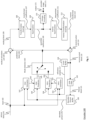
- Fig. 1 shows an encoder 100, which comprises an input 102, a residual calculation unit 104, a transformation unit 106, a quantization unit 108, an inverse quantization unit 110, and inverse transformation unit 112, a reconstruction unit 114, a buffer 116, a loop filter 120, a frame buffer 130, an inter estimation unit 142, an inter prediction unit 144, an intra estimation unit 152, an intra prediction unit 154, a mode selection unit 160, an entropy encoding unit 170, and an output 172.
- a CU is force partitioned by applying the method described above until the CU is located entirely within the image boundary.
- the forced partitioned CU may be further partitioned, sent to the input 102 and processed by the inter- or intra-processing blocks 142, 144, 154, 152 to obtain a RD value.
- the force partitioned CU may be further partitioned by using different partitioning schemes and the RD value is calculated. The CU with the smallest RD value will then be used to perform prediction.
- the forced partitioning includes firstly performing one or more levels of QT partitioning.
- the number of QT partitioning levels is predefined.
- the number of QT partitioning levels may be dynamically determined. For instance several forced partitioning loops, each including a different number of initial QT partitioning levels up a maximum threshold, are performed to obtain a corresponding partitioned CU.
- the at least one partitioned CU entirely lies within the image boundary and may be eventually further partitioned according to different partitioning schemes as described above with relation to figure 3 .
- the so obtained CU is then processed by the Inter Estimation 142, Inter prediction 134, Intra prediction 154 or Intra estimation 152 to calculate an RD value and the partitioned CU with the smallest RD value is chosen for performing prediction.
- the maximum threshold may be calculated based on the size of the shorter edge within the image of the boundary CTU.
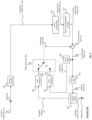
- Fig. 2 shows an exemplary video decoder 200 configured to receive a encoded picture data (bitstream) 171, e.g. encoded by encoder 100, to obtain a decoded picture 231.
- the decoder 200 comprises an input 202, an entropy decoding unit 204, an inverse quantization unit 210, an inverse transformation unit 212, a reconstruction unit 214, a buffer 216, a loop filter unit 220, a decoded picture buffer 230, an inter prediction unit 244, an intra prediction unit 254, a mode selection unit 260 and an output 232.
- the decoder receives a bittream from the encoder. Forced partitioning is executed based the force partitioning scheme of the invention, known at the decoder, as discussed before with reference to figure 3 until the partitioned CU is entirely within the image boundary. Thereafter at the entropy decoding unit 204 partitioning information concerning the further partitioning is parsed from the bitstream and the force partitioned CU is further partitioned according said parsed partitioning information. The obtained partitioned CU is then further processed by the inter-/intra prediction unit for performing prediction.
- the entropy decoding unit 204 may parse from the bitstream the number of initial forced QT partitions before executing the forced partitioning scheme known at the decoder. The method proceeds then as described in the above paragraph.
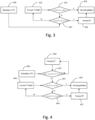
- Fig 3 is an illustration of an example method involving of boundary partition processing.
- the method is initiated by determining if a coding tree unit of an image is located on an image boundary, step 300.
- the determination is done for coding tree unit, however, this is only an example and the method may be initiated from a coding block that has been partitioned, split or other way derived from a coding tree unit.
- the boundary in the following description should be understood to be one of the following: horizontal boundary, vertical boundary or corner.
- step 301 as a response to the positive detection of a boundary coding tree unit, possibility to perform binary tree partitioning is checked, step 301. This may be done by determining whether the image boundary divides the coding unit into two portions having different or equal sizes. This, however, does not apply for corner cases, in which case additional forced QT partitioning is performed until the corner portion coding block is entirely inside the image boundary as will be explained in the following. If the two portions are of equal size, then symmetric binary tree partitioning is performed, step 301. If the two portions are of the equal size, the binary partitioning can be used to terminate the boundary forced partition processing and continue with normal partitioning, step 305.
- boundary partition processing is one of the following: triple tree partitioning or asymmetric partitioning. These are explained in more detail below, however, other suitable partitioning methods may also be used.
- first boundary partition processing it is determined if the right boundary or bottom boundary sample of the current CTU/CU is located inside of the bottom image boundary or right image boundary. When it is inside, the method continues with normal partitioning, step 305. If it is not entirely inside, the method continues from step 301 by checking again the possibility to perform binary tree partitioning.
- the apparatus is configured to hierarchically repeat partitioning on child coding units, which are located on the image boundary, partitioned from the coding unit until a deepest level coding unit is entirely inside the image boundary.
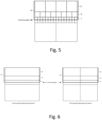
- Fig. 4 is an illustration of another example method involving boundary partitioning processing.
- the method of figure 4 starts correspondingly checking if the CTU or CU is on the image boundary as in the method of figure 3 , step 400. If it is a boundary, first it is checked if a predetermined N shallowest levels quad tree partitioning have been performed, step 401. If not, then QT partitioning is performed at step 402, N being an integer smaller than the maximal number of forced partitioning hierarchy levels, here the maximal forced partition levels could be derived from the size of the shorter edge within the image of the boundary CTU. N may be predetermined, determined using a common method at encoder and decoder or provided in the bitstream.
- the common method may be a calculation based on temporal id, slice type, CTU size or similar.
- theQT level N is integer number smaller than the maximal possible forced partition levels. It can be noted that if N is 0 the method simplifies to the example method shown in figure 3 .
- the partitioning method proceeds with boundary partitioning processing similarly as in the example of figure 3 .
- the method proceeds to normal partitioning, step 405. If not, it is first checked if the image boundary divides the current CU into two equal size, which means a BT partition could be done , step 406. If yes, then the BT partitioning is done, step 407 and the method proceeds to normal partitioning, step 405. If no, the method is continued by triple tree or asymmetric partitioning, step 404.
- FIG. 5 discloses is an illustration of HD sequence (1920x1080) bottom boundary CTU (128x128) forced partition.
- the coding tree units (CTU) or coding unit (CU) which is located on the slice/picture boundaries will be forced split using quadtree (QT) until the right bottom sample of the leaf node is located within the slice/picture boundary.
- QT quadtree
- the forced QT partition does not need to be signaled in the bitstream.
- the purpose of a forced partition is to make the boundary CTU/CU possible by the encoder/decoder.
- FIG. 6 is an illustration of HD sequences bottom boundary CTU forced BT partition.
- the forced BT partition ( Fig. 6a ) and a forced QT plus a forced BT partition ( Fig. 6b ) for the boundary CTUs are shown in Fig. 6 .
- a forced QT partition in the Fig. 6a forced BT approach, a forced horizontal BT for bottom boundary and a forced vertical BT for right boundary are used.
- a forced QT will be used until the current CU does not need to be force partitioned or the current CU is on the bottom or right boundary.
- the corner CTU/CU could be considered as either bottom boundary or right boundary CTU/CU.
- a forced BT can be combined with a forced QT partition as shown in Fig. 6b , wherein the forced BT partition is only done after a certain number of forced QT levels.
- the levels of forced QT could be pre-defined or adaptive selected.
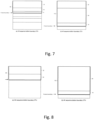
- Figures 7 and 8 explain using triple tree and asymmetric partitioning in boundary partition processing. These two methods, or other corresponding methods, are optional to each other. Thus, the encoder and decoder should use the same method. This can be, for example, agreed in advance or signaled in the bitstream.
- Fig. 7 is an illustration of bottom boundary processing with a CTU forced TT partition.
- Fig. 7 illustrates situations, wherein when the CTU/CU is located on the bottom boundary, horizontal forced TT is used without partition flag signaling at the encoder recursively until the boundary CU is entirely located within the slice/picture boundary.
- the forced horizontal TT partition is terminated when the deepest level coding unit is entirely inside the image boundary.
- the TT partition may be terminated in the following two cases: (a) When the right bottom sample of the boundary leaf nodes is located within the slice/picture bottom boundary, or (b) when height of the rest boundary samples within the slice/picture boundary in current CU is exactly half of the height of current boundary located CU, in the other words, the rest samples could be directly split by forced BT horizontally.
- the forced partition is terminated, in the (b) case, after one step horizontal forced BT the forced partition is terminated.
- Fig. 7(a) shows the example of 128x56 samples bottom boundary (HD sequence bottom boundary CTU) partitioned by forced horizontal TT, in this case, no forced BT is applied to terminate the forced partition procedure.
- Figure 7(b) shows the example of 128x112 samples bottom boundary (4K sequence bottom boundary CTU) partitioned by forced TT, in this case, forced BT in the last forced partition is applied.
- vertical forced TT partition is used without partition flag signaling at the encoder recursively until the right bottom sample of the boundary leaf nodes are located within the slice/picture right boundary or the rest samples in current boundary located CU could be directly split by forced BT vertically.
- forced vertical TT with or without forced BT partition
- the forced partitioned CUs from the boundary CTU are possibly further split by RD-optimization at the encoder and the further split flag is signaled from the encoder to the decoder.
- the forced QT partition is used without signaling recursively.
- a further forced horizontal or vertical TT partition will be operated recursively until the right bottom samples of the boundary leaf nodes located inside of the slice/picture boundary or the rest samples in current CU could be directly split by a forced BT on the direction of forced partition.
- a further forced QT partition will be used until the right bottom samples of the boundary leaf nodes are within the slice/picture boundary.
- the forced partitioned CUs from the boundary CTU are possibly further split by RD-optimization at the encoder and the further split flag is signaled from the encoder to the decoder.
- Figure 8 discloses similar arrangement with forced asymmetric partitioning (AMP). If the CTU/CU locates on the bottom boundary, forced bottom AMP will be applied recursively without any signaling until the boundary deepest level coding unit is entirely inside the slice/picture boundary. For example, forced bottom AMP will be recursively applied until the right bottom sample of the boundary leaf nodes located inside of the slice/picture bottom boundary or the rest samples of the current boundary located CU could be directly split by forced BT horizontally. The forced AMP should always keep the non-boundary forced partitioned CU as large as possible.
- forced AMP should always keep the non-boundary forced partitioned CU as large as possible.
- FIG 8(a) shows the example of 128x56 samples bottom boundary (HD sequence bottom boundary CTU) partitioned by forced horizontal AMP. In this case, no forced BT is applied to terminate the forced partition procedure.
- Figure 8(b) shows the example of 128x112 samples bottom boundary (4K sequence bottom boundary CTU) partitioned by forced TT. In this case, forced BT in the last forced partition is applied.
- forced bottom AMP will be applied recursively without any signaling until, for instance, the right bottom sample of the boundary leaf nodes located inside of the slice/picture right boundary or the rest samples of the current boundary located CU could be directly split by forced BT on the direction of forced partition.
- the forced AMP should always keep the non-boundary forced partitioned CU as large as possible.
- the forced split CUs from the boundary CTU are possibly further split based on RD-cost at the encoder and the further split flag is signaled from the encoder to the decoder.
- the forced QT partition is used without signaling it recursively.
- a further forced horizontal or vertical AMP partition will be operated recursively until the right bottom samples of the boundary leaf nodes located inside of the slice/picture boundary or the rest samples in current CU could be directly split by forced BT on the direction of forced partition.
- a further forced QT partition will be used until the right bottom samples of the leaf nodes within the slice/picture boundary.
- the forced partitioned CUs from the boundary CTU are possibly further split by RD-optimization at the encoder and the further split flag is signaled from the encoder to the decoder.
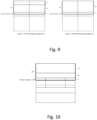
- FIG. 9 the combination of forced QT and forced TT/AMP (with or without last forced BT step) partition is shown.
- the combined forced partition of QT and TT/AMP may be used.
- a forced TT/AMP partition is only done after a certain number of forced QT levels.
- the number of forced QT levels could be pre-defined or adaptively selected.
- Figure 9(a) illustrates the example of one level QT and with a forced TT terminated by a forced BT partitioning of 128x56 samples at the bottom boundary in 128x128 CTU.
- Figure 8(b) illustrates the example of one level QT and with forced AMP terminated by forced BT partitioning of 128x56 samples bottom boundary in 128x128 CTU.
- TT of different art uniform/non-uniform
- AMP of different art are also suitable for our forced TT/AMP + BT or combination of forced QT and forced TT/AMP +QT.
- FIG. 10 is an illustration of a forced TT for HD bottom boundary partition with limited aspect ratio 1:4.
- JEM software (after version 3.0) there is a definition of maximal BT size and a minimal BT size.
- the maximal BT size is 32 samples and the minimal BT size is 4 samples.
- the long side of the current CU reach the maximal BT size or the short side of the current CU reach the minimal BT size, the current direction of BT split will be terminated. Instead, a normal directional BT split could be used.
- the maximal aspect ratio of previous CU is limited the BT splitting.
- the forced TT/AMP (+BT) partition could also be limited by aspect ratio of current leaf node.
- a normal directional forced TT/AMP(+BT) splitting will be used instead current forced partition.
- the threshold value may be pre-defined, calculated both in encoder and decoder side using the same method, for instance the threshold can be calculated based on the temporal ID of the frame or slice type, or transferred in bitstream and in the decoder parsed to indicate the limited aspect ratio.
- Figure 10 shows one example of forced TT partition limited by aspect ratio 1:4.
- the aspect ratio of the current leaf node of the coding unit is limited as a criteria for partition direction when the aspect ratio exceeds a threshold value.
- the threshold may be predefined, derived using a predefined method or it may be included in the bitstream.
- the bitstream includes encoded units and partition information indicating how the coding tree units are partitioned so that the corresponding decoder is able to decode the encoded bitstream.
- a horizontal TT/AMP depicted in figures 7 and 8 respectively, will be used on the CTU/CU located on the bottom boundary until the right bottom samples of the boundary leaf nodes inside the slice/picture bottom boundary or the rest samples could be directly split by forced BT horizontally.
- Vertical TT/AMP (not shown) will be used on the CTU/CU located on the right boundary until the right bottom samples of the boundary leaf nodes inside the slice/picture right boundary or the rest samples could be directly split by BT vertically.
- the right bottom corner CTU/CU will be partitioned using QT until the right bottom samples of the boundary leaf node inside of the slice/picture boundary or the leaf nodes becoming right/bottom boundary case. Further partition is operated based on the decoded splitting flag.
- horizontal TT/AMP will be used on the CTU/CU located on the bottom boundary until the right bottom samples of the boundary leaf nodes inside the slice/picture bottom boundary or the rest samples could be directly split by forced BT horizontally.
- Vertical TT/AMP will be used on the CTU/CU located on the right boundary until the right bottom samples of the boundary leaf nodes inside the slice/picture right boundary or the rest samples could be directly split by BT vertically.
- the right bottom corner CTU/CU will be partitioned using QT until the right bottom samples of the boundary leaf node inside of the slice/picture boundary or the boundary leaf nodes becoming right/bottom boundary case. Further partition is operated based on the decoded splitting flag.
- the arrangements for image coding may be implemented in hardware, such as the video encoding apparatus or video decoding apparatus as described above, or as a method.
- the method may be implemented as a computer program.
- the computer program is then executed in a computing device.
- the apparatus such as video decoding apparatus, video encoding apparatus or any other corresponding image coding apparatus is configured to perform one of the methods described above.
- the apparatus comprises necessary hardware components. These may include at least one processor, at least one memory, at least one network connection, a bus and similar. Instead of dedicated hardware components it is possible to share, for example, memories or processors with other components or access at a cloud service, centralized computing unit or other resource that can be used over a network connection.
- a computer program may be stored/distributed on a suitable medium, such as an optical storage medium or a solid-state medium supplied together with or as part of other hardware, but may also be distributed in other forms, such as via the Internet or other wired or wireless telecommunication systems.
- a suitable medium such as an optical storage medium or a solid-state medium supplied together with or as part of other hardware, but may also be distributed in other forms, such as via the Internet or other wired or wireless telecommunication systems.
Landscapes
- Engineering & Computer Science (AREA)
- Multimedia (AREA)
- Signal Processing (AREA)
- Compression Or Coding Systems Of Tv Signals (AREA)
Claims (15)
- Bildcodierungsvorrichtung, wobei die Vorrichtung beim Codieren für Folgendes konfiguriert ist:
Bestimmen (300, 400), ob sich eine Codierungseinheit eines Bildes an einer Bildgrenze befindet, wobei sich die Codierungseinheit an der Bildgrenze befindet, wenn die Codierungseinheit einen ersten Teil umfasst, der sich innerhalb der Bildgrenze befindet, und einen zweiten Teil, der sich außerhalb der Bildgrenze befindet; und falls sich die Codierungseinheit an der Bildgrenze befindet, ist die Vorrichtung ferner für Folgendes konfiguriert:Bestimmen (301, 406), ob die Bildgrenze die Codierungseinheit in zwei Abschnitte unterschiedlicher oder gleicher Größe teilt;Durchführen einer Grenzpartitionsverarbeitung (302, 404) an der Codierungseinheit, wobei die Grenzpartitionsverarbeitung eine Tripletree-Partitionierung oder eine asymmetrische Partitionierung umfasst, wenn die Bildgrenze die Codierungseinheit in zwei Teile mit unterschiedlichen Größen teilt; undDurchführen einer symmetrischen Binärbaumpartitionierung (304, 407) durch, wenn die Bildgrenze die Codierungseinheit in zwei gleich große Teile teilt. - Bildcodierungsvorrichtung nach Anspruch 1, wobei die Vorrichtung ferner dazu konfiguriert ist, die Partitionierung von untergeordneten Codierungseinheiten, die sich an der Bildgrenze befinden, hierarchisch zu wiederholen, wobei diese von der Codierungseinheit partitioniert werden, bis eine Codierungseinheit der tiefsten Grenzebene vollständig innerhalb der Bildgrenze liegt.
- Bildcodierungsvorrichtung nach Anspruch 1 oder 2, wobei die erste partitionierte Codierungseinheit eine Codierungsbaumeinheit ist.
- Bildcodierungsvorrichtung nach Anspruch 1, 2 oder 3, wobei die Vorrichtung weiterhin dazu konfiguriert ist, zunächst N Ebenen einer Quadtree-Partitionierung (402) durchzuführen, nachdem ermittelt wurde, ob sich eine Codierungsbaumeinheit an der Bildgrenze befindet, wobei N eine Ganzzahl ist, die kleiner als die maximale Anzahl von Partitionierungshierarchieebenen ist.
- Bildcodierungsvorrichtung nach Anspruch 4, wobei die Vorrichtung ferner konfiguriert ist, um: ein vordefiniertes N als Anzahl der Ebenen der Quadtree-Partitionierung (402) zu verwenden; oder N als Anzahl der Ebenen der Quadtree-Partitionierung (402) unter Verwendung einer vordefinierten Methode abzuleiten.
- Bildcodierungsvorrichtung nach einem der Ansprüche 1 bis 5, wobei die Vorrichtung weiterhin dazu konfiguriert ist, in jeder Hierarchieebene eine Quadtree-Partitionierung für eine Eckgrenzencodierungseinheit zu verwenden.
- Bildcodierungsvorrichtung nach einem der vorhergehenden Ansprüche 1 bis 6, wobei die Vorrichtung eine Bildcodierungsvorrichtung (100) ist und die Bildcodierungsvorrichtung (100) ferner dazu konfiguriert ist, einen Bitstrom zu erzeugen, der die codierten Codierungseinheiten und Partitionierungsinformationen umfasst, die angeben, wie die Codierungsbaumeinheiten partitioniert sind.
- Bildcodierungsvorrichtung nach Anspruch 7, sofern abhängig von den Ansprüchen 2 bis 6, wobei die Vorrichtung ferner dazu konfiguriert ist, die Codierungseinheit für die tiefste Ebene gemäß einer Ratenverzerrungsoptimierung weiter zu partitionieren.
- Bildcodierungsvorrichtung nach einem der vorhergehenden Ansprüche 1 bis 6, wobei die Vorrichtung eine Decodierungsvorrichtung ( 200 ) ist.
- Bildcodierungsvorrichtung nach Anspruch 9, wobei die Vorrichtung ferner dazu konfiguriert ist, einen Bitstrom zu analysieren, der codierte Codierungseinheiten und eine Partitionierungsinformation enthält, die angibt, wie die Codierungsbaumeinheiten partitioniert sind.
- Bildcodierungsvorrichtung nach Anspruch 3 bis 10, wobei eine Angabe der N-Ebenen der Quadtree-Partitionierung (402) oder des Schwellenwerts des Seitenverhältnisses einer Codierungseinheit aus den Partitionierungsinformationen des Bildes gewonnen wird.
- Verfahren zum Codieren eines Bildes, umfassend:
Bestimmen (300, 400), ob sich eine Codierungseinheit eines Bildes an einer Bildgrenze befindet; und falls sich die Codierungseinheit an der Bildgrenze befindet, wobei sich die Codierungseinheit an der Bildgrenze befindet, wenn die Codierungseinheit einen ersten Teil umfasst, der sich innerhalb der Bildgrenze befindet, und einen zweiten Teil, der sich außerhalb der Bildgrenze befindet, das Verfahren ferner Folgendes umfasst:Bestimmen (301, 406), ob die Bildgrenze die Codierungseinheit in zwei Abschnitte unterschiedlicher oder gleicher Größe teilt;Durchführen einer Grenzpartitionsverarbeitung (302, 404) an der Codierungseinheit, wobei die Grenzpartitionsverarbeitung eine Tripletree-Partitionierung oder eine asymmetrische Partitionierung umfasst, wenn die Bildgrenze die Codierungseinheit in zwei Teile mit unterschiedlichen Größen teilt; undDurchführen einer symmetrischen Binärbaumpartitionierung (304, 407) durch, wenn die Bildgrenze die Codierungseinheit in zwei gleich große Teile teilt. - Verfahren nach Anspruch 12, wobei das Verfahren außerdem das hierarchisch wiederholte Aufteilen von untergeordneten Codierunseinheiten umfasst, die von der Codierunseinheit abgeteilt werden, bis eine Codierungseinheit mit einer Grenze auf der tiefsten Ebene vollständig innerhalb der Bildgrenze liegt.
- Verfahren nach Anspruch 12 oder 13, wobei die erste partitionierte Codierungseinheit eine Codierungsbaumeinheit ist.
- Verfahren nach einem der vorhergehenden Ansprüche 12 bis 14, wobei das Verfahren weiterhin zunächst das Durchführen von N-Ebenen einer Quadtree-Partitionierung (402) umfasst, nachdem ermittelt wurde, ob sich eine Codierungsbaumeinheit an der Bildgrenze befindet, wobei N eine Ganzzahl ist, die kleiner als die maximale Anzahl von Partitionierungshierarchieebenen ist.
Applications Claiming Priority (1)
| Application Number | Priority Date | Filing Date | Title |
|---|---|---|---|
| PCT/EP2017/075709 WO2019072367A1 (en) | 2017-10-09 | 2017-10-09 | APPARATUS AND METHOD FOR IMAGE ENCODING HAVING LIMIT PARTITION PROCESSING |
Publications (2)
| Publication Number | Publication Date |
|---|---|
| EP3682633A1 EP3682633A1 (de) | 2020-07-22 |
| EP3682633B1 true EP3682633B1 (de) | 2025-04-23 |
Family
ID=60043211
Family Applications (1)
| Application Number | Title | Priority Date | Filing Date |
|---|---|---|---|
| EP17781113.0A Active EP3682633B1 (de) | 2017-10-09 | 2017-10-09 | Vorrichtung und verfahren zur bildcodierung mit grenzpartitionsverarbeitung |
Country Status (3)
| Country | Link |
|---|---|
| US (1) | US20200236359A1 (de) |
| EP (1) | EP3682633B1 (de) |
| WO (1) | WO2019072367A1 (de) |
Families Citing this family (7)
| Publication number | Priority date | Publication date | Assignee | Title |
|---|---|---|---|---|
| MX384086B (es) * | 2016-05-25 | 2025-03-14 | Arris Entpr Llc | Particionamiento binario, ternario, cuaternario para jvet. |
| CN108965894B (zh) * | 2017-05-27 | 2021-12-21 | 华为技术有限公司 | 一种视频图像的编解码方法及装置 |
| EP3725083A1 (de) * | 2017-12-14 | 2020-10-21 | InterDigital VC Holdings, Inc. | Verfahren und vorrichtung zur codierung eines bildblocks |
| KR20200112945A (ko) | 2018-01-29 | 2020-10-05 | 인터디지털 브이씨 홀딩스 인코포레이티드 | 재구성된 픽처의 정제를 갖는 인코딩 및 디코딩 |
| WO2019189279A1 (en) * | 2018-03-30 | 2019-10-03 | Sharp Kabushiki Kaisha | Systems and methods for partitioning video blocks at a boundary of a picture for video coding |
| CN112369022B (zh) * | 2018-06-27 | 2024-10-29 | 韩国电子通信研究院 | 图像编码/解码方法和装置以及存储比特流的记录介质 |
| US11412222B2 (en) | 2020-02-12 | 2022-08-09 | Tencent America LLC | Flexible picture partitioning |
Family Cites Families (2)
| Publication number | Priority date | Publication date | Assignee | Title |
|---|---|---|---|---|
| US20120082238A1 (en) * | 2010-10-01 | 2012-04-05 | General Instrument Corporation | Coding and decoding utilizing picture boundary variability in flexible partitioning |
| US10212444B2 (en) * | 2016-01-15 | 2019-02-19 | Qualcomm Incorporated | Multi-type-tree framework for video coding |
-
2017
- 2017-10-09 EP EP17781113.0A patent/EP3682633B1/de active Active
- 2017-10-09 WO PCT/EP2017/075709 patent/WO2019072367A1/en not_active Ceased
-
2020
- 2020-04-09 US US16/844,796 patent/US20200236359A1/en not_active Abandoned
Also Published As
| Publication number | Publication date |
|---|---|
| EP3682633A1 (de) | 2020-07-22 |
| US20200236359A1 (en) | 2020-07-23 |
| WO2019072367A1 (en) | 2019-04-18 |
Similar Documents
| Publication | Publication Date | Title |
|---|---|---|
| EP3682633B1 (de) | Vorrichtung und verfahren zur bildcodierung mit grenzpartitionsverarbeitung | |
| US11064220B2 (en) | Method and apparatus of video data processing with restricted block size in video coding | |
| US11438590B2 (en) | Methods and apparatuses of chroma quantization parameter derivation in video processing system | |
| US10904580B2 (en) | Methods and apparatuses of video data processing with conditionally quantization parameter information signaling | |
| KR101538710B1 (ko) | 시간적 블록 병합 모드 | |
| US10681351B2 (en) | Methods and apparatuses of reference quantization parameter derivation in video processing system | |
| US10630977B2 (en) | Method and apparatus for encoding/decoding a video signal | |
| CN112673626A (zh) | 各分割约束元素之间的关系 | |
| US10735735B2 (en) | Guided transcoding | |
| KR102595146B1 (ko) | 비디오 인코더, 비디오 디코더 및 그에 대응하는 방법 | |
| US20160073110A1 (en) | Object-based adaptive brightness compensation method and apparatus | |
| EP3701721A1 (de) | Vorrichtung und verfahren zur bildcodierung mit asymmetrischer partitionierung | |
| CN111587575A (zh) | 基于高频归零确定变换系数扫描顺序的方法及其设备 | |
| US10805611B2 (en) | Method and apparatus of constrained sequence header | |
| WO2023086956A1 (en) | Initialization processing for video coding | |
| RU2809192C2 (ru) | Кодер, декодер и соответствующие способы межкадрового предсказания |
Legal Events
| Date | Code | Title | Description |
|---|---|---|---|
| STAA | Information on the status of an ep patent application or granted ep patent |
Free format text: STATUS: UNKNOWN |
|
| STAA | Information on the status of an ep patent application or granted ep patent |
Free format text: STATUS: THE INTERNATIONAL PUBLICATION HAS BEEN MADE |
|
| PUAI | Public reference made under article 153(3) epc to a published international application that has entered the european phase |
Free format text: ORIGINAL CODE: 0009012 |
|
| STAA | Information on the status of an ep patent application or granted ep patent |
Free format text: STATUS: REQUEST FOR EXAMINATION WAS MADE |
|
| 17P | Request for examination filed |
Effective date: 20200417 |
|
| AK | Designated contracting states |
Kind code of ref document: A1 Designated state(s): AL AT BE BG CH CY CZ DE DK EE ES FI FR GB GR HR HU IE IS IT LI LT LU LV MC MK MT NL NO PL PT RO RS SE SI SK SM TR |
|
| AX | Request for extension of the european patent |
Extension state: BA ME |
|
| DAV | Request for validation of the european patent (deleted) | ||
| DAX | Request for extension of the european patent (deleted) | ||
| STAA | Information on the status of an ep patent application or granted ep patent |
Free format text: STATUS: EXAMINATION IS IN PROGRESS |
|
| 17Q | First examination report despatched |
Effective date: 20230822 |
|
| GRAP | Despatch of communication of intention to grant a patent |
Free format text: ORIGINAL CODE: EPIDOSNIGR1 |
|
| STAA | Information on the status of an ep patent application or granted ep patent |
Free format text: STATUS: GRANT OF PATENT IS INTENDED |
|
| INTG | Intention to grant announced |
Effective date: 20241203 |
|
| GRAS | Grant fee paid |
Free format text: ORIGINAL CODE: EPIDOSNIGR3 |
|
| GRAA | (expected) grant |
Free format text: ORIGINAL CODE: 0009210 |
|
| STAA | Information on the status of an ep patent application or granted ep patent |
Free format text: STATUS: THE PATENT HAS BEEN GRANTED |
|
| AK | Designated contracting states |
Kind code of ref document: B1 Designated state(s): AL AT BE BG CH CY CZ DE DK EE ES FI FR GB GR HR HU IE IS IT LI LT LU LV MC MK MT NL NO PL PT RO RS SE SI SK SM TR |
|
| REG | Reference to a national code |
Ref country code: GB Ref legal event code: FG4D |
|
| REG | Reference to a national code |
Ref country code: CH Ref legal event code: EP |
|
| REG | Reference to a national code |
Ref country code: DE Ref legal event code: R096 Ref document number: 602017089061 Country of ref document: DE |
|
| REG | Reference to a national code |
Ref country code: IE Ref legal event code: FG4D |
|
| REG | Reference to a national code |
Ref country code: NL Ref legal event code: MP Effective date: 20250423 |
|
| PG25 | Lapsed in a contracting state [announced via postgrant information from national office to epo] |
Ref country code: NL Free format text: LAPSE BECAUSE OF FAILURE TO SUBMIT A TRANSLATION OF THE DESCRIPTION OR TO PAY THE FEE WITHIN THE PRESCRIBED TIME-LIMIT Effective date: 20250423 |
|
| REG | Reference to a national code |
Ref country code: AT Ref legal event code: MK05 Ref document number: 1788956 Country of ref document: AT Kind code of ref document: T Effective date: 20250423 |
|
| PG25 | Lapsed in a contracting state [announced via postgrant information from national office to epo] |
Ref country code: ES Free format text: LAPSE BECAUSE OF FAILURE TO SUBMIT A TRANSLATION OF THE DESCRIPTION OR TO PAY THE FEE WITHIN THE PRESCRIBED TIME-LIMIT Effective date: 20250423 Ref country code: PT Free format text: LAPSE BECAUSE OF FAILURE TO SUBMIT A TRANSLATION OF THE DESCRIPTION OR TO PAY THE FEE WITHIN THE PRESCRIBED TIME-LIMIT Effective date: 20250825 Ref country code: FI Free format text: LAPSE BECAUSE OF FAILURE TO SUBMIT A TRANSLATION OF THE DESCRIPTION OR TO PAY THE FEE WITHIN THE PRESCRIBED TIME-LIMIT Effective date: 20250423 |
|
| REG | Reference to a national code |
Ref country code: LT Ref legal event code: MG9D |
|
| PG25 | Lapsed in a contracting state [announced via postgrant information from national office to epo] |
Ref country code: GR Free format text: LAPSE BECAUSE OF FAILURE TO SUBMIT A TRANSLATION OF THE DESCRIPTION OR TO PAY THE FEE WITHIN THE PRESCRIBED TIME-LIMIT Effective date: 20250724 Ref country code: NO Free format text: LAPSE BECAUSE OF FAILURE TO SUBMIT A TRANSLATION OF THE DESCRIPTION OR TO PAY THE FEE WITHIN THE PRESCRIBED TIME-LIMIT Effective date: 20250723 |
|
| PG25 | Lapsed in a contracting state [announced via postgrant information from national office to epo] |
Ref country code: PL Free format text: LAPSE BECAUSE OF FAILURE TO SUBMIT A TRANSLATION OF THE DESCRIPTION OR TO PAY THE FEE WITHIN THE PRESCRIBED TIME-LIMIT Effective date: 20250423 |
|
| PG25 | Lapsed in a contracting state [announced via postgrant information from national office to epo] |
Ref country code: BG Free format text: LAPSE BECAUSE OF FAILURE TO SUBMIT A TRANSLATION OF THE DESCRIPTION OR TO PAY THE FEE WITHIN THE PRESCRIBED TIME-LIMIT Effective date: 20250423 |
|
| PGFP | Annual fee paid to national office [announced via postgrant information from national office to epo] |
Ref country code: GB Payment date: 20250904 Year of fee payment: 9 |
|
| PG25 | Lapsed in a contracting state [announced via postgrant information from national office to epo] |
Ref country code: HR Free format text: LAPSE BECAUSE OF FAILURE TO SUBMIT A TRANSLATION OF THE DESCRIPTION OR TO PAY THE FEE WITHIN THE PRESCRIBED TIME-LIMIT Effective date: 20250423 |
|
| PG25 | Lapsed in a contracting state [announced via postgrant information from national office to epo] |
Ref country code: AT Free format text: LAPSE BECAUSE OF FAILURE TO SUBMIT A TRANSLATION OF THE DESCRIPTION OR TO PAY THE FEE WITHIN THE PRESCRIBED TIME-LIMIT Effective date: 20250423 |
|
| PG25 | Lapsed in a contracting state [announced via postgrant information from national office to epo] |
Ref country code: RS Free format text: LAPSE BECAUSE OF FAILURE TO SUBMIT A TRANSLATION OF THE DESCRIPTION OR TO PAY THE FEE WITHIN THE PRESCRIBED TIME-LIMIT Effective date: 20250723 |
|
| PG25 | Lapsed in a contracting state [announced via postgrant information from national office to epo] |
Ref country code: IS Free format text: LAPSE BECAUSE OF FAILURE TO SUBMIT A TRANSLATION OF THE DESCRIPTION OR TO PAY THE FEE WITHIN THE PRESCRIBED TIME-LIMIT Effective date: 20250823 |
|
| PG25 | Lapsed in a contracting state [announced via postgrant information from national office to epo] |
Ref country code: LV Free format text: LAPSE BECAUSE OF FAILURE TO SUBMIT A TRANSLATION OF THE DESCRIPTION OR TO PAY THE FEE WITHIN THE PRESCRIBED TIME-LIMIT Effective date: 20250423 |