EP3680465A1 - Structure of engine intake duct - Google Patents
Structure of engine intake duct Download PDFInfo
- Publication number
- EP3680465A1 EP3680465A1 EP20150426.3A EP20150426A EP3680465A1 EP 3680465 A1 EP3680465 A1 EP 3680465A1 EP 20150426 A EP20150426 A EP 20150426A EP 3680465 A1 EP3680465 A1 EP 3680465A1
- Authority
- EP
- European Patent Office
- Prior art keywords
- fin
- rear end
- inclined surface
- bend
- side inclined
- Prior art date
- Legal status (The legal status is an assumption and is not a legal conclusion. Google has not performed a legal analysis and makes no representation as to the accuracy of the status listed.)
- Withdrawn
Links
Images




Classifications
-
- F—MECHANICAL ENGINEERING; LIGHTING; HEATING; WEAPONS; BLASTING
- F02—COMBUSTION ENGINES; HOT-GAS OR COMBUSTION-PRODUCT ENGINE PLANTS
- F02M—SUPPLYING COMBUSTION ENGINES IN GENERAL WITH COMBUSTIBLE MIXTURES OR CONSTITUENTS THEREOF
- F02M35/00—Combustion-air cleaners, air intakes, intake silencers, or induction systems specially adapted for, or arranged on, internal-combustion engines
- F02M35/10—Air intakes; Induction systems
- F02M35/10091—Air intakes; Induction systems characterised by details of intake ducts: shapes; connections; arrangements
- F02M35/10118—Air intakes; Induction systems characterised by details of intake ducts: shapes; connections; arrangements with variable cross-sections of intake ducts along their length; Venturis; Diffusers
-
- F—MECHANICAL ENGINEERING; LIGHTING; HEATING; WEAPONS; BLASTING
- F02—COMBUSTION ENGINES; HOT-GAS OR COMBUSTION-PRODUCT ENGINE PLANTS
- F02M—SUPPLYING COMBUSTION ENGINES IN GENERAL WITH COMBUSTIBLE MIXTURES OR CONSTITUENTS THEREOF
- F02M35/00—Combustion-air cleaners, air intakes, intake silencers, or induction systems specially adapted for, or arranged on, internal-combustion engines
- F02M35/10—Air intakes; Induction systems
- F02M35/104—Intake manifolds
-
- F—MECHANICAL ENGINEERING; LIGHTING; HEATING; WEAPONS; BLASTING
- F02—COMBUSTION ENGINES; HOT-GAS OR COMBUSTION-PRODUCT ENGINE PLANTS
- F02B—INTERNAL-COMBUSTION PISTON ENGINES; COMBUSTION ENGINES IN GENERAL
- F02B29/00—Engines characterised by provision for charging or scavenging not provided for in groups F02B25/00, F02B27/00 or F02B33/00 - F02B39/00; Details thereof
- F02B29/02—Other fluid-dynamic features of induction systems for improving quantity of charge
-
- F—MECHANICAL ENGINEERING; LIGHTING; HEATING; WEAPONS; BLASTING
- F02—COMBUSTION ENGINES; HOT-GAS OR COMBUSTION-PRODUCT ENGINE PLANTS
- F02M—SUPPLYING COMBUSTION ENGINES IN GENERAL WITH COMBUSTIBLE MIXTURES OR CONSTITUENTS THEREOF
- F02M35/00—Combustion-air cleaners, air intakes, intake silencers, or induction systems specially adapted for, or arranged on, internal-combustion engines
- F02M35/10—Air intakes; Induction systems
- F02M35/10091—Air intakes; Induction systems characterised by details of intake ducts: shapes; connections; arrangements
-
- F—MECHANICAL ENGINEERING; LIGHTING; HEATING; WEAPONS; BLASTING
- F02—COMBUSTION ENGINES; HOT-GAS OR COMBUSTION-PRODUCT ENGINE PLANTS
- F02M—SUPPLYING COMBUSTION ENGINES IN GENERAL WITH COMBUSTIBLE MIXTURES OR CONSTITUENTS THEREOF
- F02M35/00—Combustion-air cleaners, air intakes, intake silencers, or induction systems specially adapted for, or arranged on, internal-combustion engines
- F02M35/10—Air intakes; Induction systems
- F02M35/10091—Air intakes; Induction systems characterised by details of intake ducts: shapes; connections; arrangements
- F02M35/10124—Ducts with special cross-sections, e.g. non-circular cross-section
-
- F—MECHANICAL ENGINEERING; LIGHTING; HEATING; WEAPONS; BLASTING
- F02—COMBUSTION ENGINES; HOT-GAS OR COMBUSTION-PRODUCT ENGINE PLANTS
- F02M—SUPPLYING COMBUSTION ENGINES IN GENERAL WITH COMBUSTIBLE MIXTURES OR CONSTITUENTS THEREOF
- F02M35/00—Combustion-air cleaners, air intakes, intake silencers, or induction systems specially adapted for, or arranged on, internal-combustion engines
- F02M35/10—Air intakes; Induction systems
- F02M35/10242—Devices or means connected to or integrated into air intakes; Air intakes combined with other engine or vehicle parts
- F02M35/10262—Flow guides, obstructions, deflectors or the like
-
- B—PERFORMING OPERATIONS; TRANSPORTING
- B01—PHYSICAL OR CHEMICAL PROCESSES OR APPARATUS IN GENERAL
- B01D—SEPARATION
- B01D46/00—Filters or filtering processes specially modified for separating dispersed particles from gases or vapours
- B01D46/0039—Filters or filtering processes specially modified for separating dispersed particles from gases or vapours with flow guiding by feed or discharge devices
- B01D46/0041—Filters or filtering processes specially modified for separating dispersed particles from gases or vapours with flow guiding by feed or discharge devices for feeding
- B01D46/0043—Filters or filtering processes specially modified for separating dispersed particles from gases or vapours with flow guiding by feed or discharge devices for feeding containing fixed gas displacement elements or cores
-
- B—PERFORMING OPERATIONS; TRANSPORTING
- B01—PHYSICAL OR CHEMICAL PROCESSES OR APPARATUS IN GENERAL
- B01D—SEPARATION
- B01D46/00—Filters or filtering processes specially modified for separating dispersed particles from gases or vapours
- B01D46/0039—Filters or filtering processes specially modified for separating dispersed particles from gases or vapours with flow guiding by feed or discharge devices
- B01D46/0047—Filters or filtering processes specially modified for separating dispersed particles from gases or vapours with flow guiding by feed or discharge devices for discharging the filtered gas
- B01D46/0049—Filters or filtering processes specially modified for separating dispersed particles from gases or vapours with flow guiding by feed or discharge devices for discharging the filtered gas containing fixed gas displacement elements or cores
-
- B—PERFORMING OPERATIONS; TRANSPORTING
- B01—PHYSICAL OR CHEMICAL PROCESSES OR APPARATUS IN GENERAL
- B01D—SEPARATION
- B01D46/00—Filters or filtering processes specially modified for separating dispersed particles from gases or vapours
- B01D46/10—Particle separators, e.g. dust precipitators, using filter plates, sheets or pads having plane surfaces
-
- F—MECHANICAL ENGINEERING; LIGHTING; HEATING; WEAPONS; BLASTING
- F02—COMBUSTION ENGINES; HOT-GAS OR COMBUSTION-PRODUCT ENGINE PLANTS
- F02M—SUPPLYING COMBUSTION ENGINES IN GENERAL WITH COMBUSTIBLE MIXTURES OR CONSTITUENTS THEREOF
- F02M35/00—Combustion-air cleaners, air intakes, intake silencers, or induction systems specially adapted for, or arranged on, internal-combustion engines
- F02M35/12—Intake silencers ; Sound modulation, transmission or amplification
- F02M35/1205—Flow throttling or guiding
- F02M35/1216—Flow throttling or guiding by using a plurality of holes, slits, protrusions, perforations, ribs or the like; Surface structures; Turbulence generators
-
- F—MECHANICAL ENGINEERING; LIGHTING; HEATING; WEAPONS; BLASTING
- F15—FLUID-PRESSURE ACTUATORS; HYDRAULICS OR PNEUMATICS IN GENERAL
- F15D—FLUID DYNAMICS, i.e. METHODS OR MEANS FOR INFLUENCING THE FLOW OF GASES OR LIQUIDS
- F15D1/00—Influencing flow of fluids
- F15D1/02—Influencing flow of fluids in pipes or conduits
- F15D1/04—Arrangements of guide vanes in pipe elbows or duct bends; Construction of pipe conduit elements for elbows with respect to flow, e.g. for reducing losses of flow
-
- F—MECHANICAL ENGINEERING; LIGHTING; HEATING; WEAPONS; BLASTING
- F15—FLUID-PRESSURE ACTUATORS; HYDRAULICS OR PNEUMATICS IN GENERAL
- F15D—FLUID DYNAMICS, i.e. METHODS OR MEANS FOR INFLUENCING THE FLOW OF GASES OR LIQUIDS
- F15D1/00—Influencing flow of fluids
- F15D1/02—Influencing flow of fluids in pipes or conduits
- F15D1/06—Influencing flow of fluids in pipes or conduits by influencing the boundary layer
-
- Y—GENERAL TAGGING OF NEW TECHNOLOGICAL DEVELOPMENTS; GENERAL TAGGING OF CROSS-SECTIONAL TECHNOLOGIES SPANNING OVER SEVERAL SECTIONS OF THE IPC; TECHNICAL SUBJECTS COVERED BY FORMER USPC CROSS-REFERENCE ART COLLECTIONS [XRACs] AND DIGESTS
- Y02—TECHNOLOGIES OR APPLICATIONS FOR MITIGATION OR ADAPTATION AGAINST CLIMATE CHANGE
- Y02T—CLIMATE CHANGE MITIGATION TECHNOLOGIES RELATED TO TRANSPORTATION
- Y02T10/00—Road transport of goods or passengers
- Y02T10/10—Internal combustion engine [ICE] based vehicles
- Y02T10/12—Improving ICE efficiencies
Definitions
- the present disclosure relates to a structure of an engine intake duct that forms an intake flow path to guide air to an engine.
- Examples of an engine intake duct that forms an intake flow path to guide air to an engine of a vehicle include an inlet duct and an air cleaner hose.
- Such a duct has a bent portion (also referred to as a bend portion), and the air flowing in the duct separates from an inner surface of the bend portion on an inner side in a bend direction when air passes the bend portion.
- a flow velocity of air increases in a vicinity of the inner surface of the bend portion on an outer side in the bend direction, but the flow velocity of air decreases in the vicinity of the inner surface of the bend portion on the inner side in the bend direction.
- the flow velocity of air in the duct is non-uniform.
- the non-uniformity of the air flow velocity in the duct might cause a decrease in an amount of air entering the engine.
- a throttle valve is provided on a downstream side of the duct to incline a plate-shaped member provided in a flow path so that the flow path is closable.
- a size of a gap between the plate-shaped member and an inner surface of the flow path is changed, to adjust an amount of air flowing toward a combustion chamber of the engine. Consequently, when air enters the gap between the plate-shaped member and the inner surface of the flow path at a low flow velocity, a desired amount of air cannot be sent to the combustion chamber of the engine.
- JP 2018-13061 A there is disclosed a duct structure in which a fin is provided on an inner surface of a bend portion of the duct on an inner side in a bend direction or on an inner surface of a linear portion that is located on a downstream side of the inner surface of the bend portion on the inner side in the bend direction.
- the fin has a shape that rises from an inner surface of the duct and extends along an intake flow path.
- the fin includes a rear end surface that is a steep wall extending between a rear end of a fin top surface that is located at a position higher than the inner surface of the duct and a fin rear end portion that is located in the inner surface of the duct.
- a structure of an engine intake duct is a structure of an engine intake duct that forms an intake flow path to guide air to an engine, the structure including an upstream side linear portion, a bend portion, and a downstream side linear portion in order from an upstream side, and further including a fin that rises from an inner surface of the duct including an inner surface of the bend portion on an inner side in a bend direction and extends along the intake flow path, wherein a fin tip portion that is a tip of the fin is located in the bend portion, a fin rear end portion that is a rear end of the fin is located in the bend portion or the downstream side linear portion, the fin includes a tip side inclined surface that ascends and inclines from the fin tip portion to a downstream side, a rear end side inclined surface that descends and inclines to the downstream side behind the tip side inclined surface, and a rear end surface that is a steep wall extending from a rear end of the rear end side inclined surface located at a position higher than the inner surface of the duct to the fin rear
- At least a part of the top of the tip side inclined surface of the fin is formed along the extension line of the inner surface of the upstream side linear portion toward the bend portion in the duct, thereby allowing a lot of air that proceeds from the upstream side linear portion to the bend portion in the duct to proceed along the tip side inclined surface of the fin while suppressing pressure loss. Then, a lot of air proceeds along the rear end side inclined surface and passes a rear end of the surface, so that strong vortex may be generated behind the rear end surface of the fin.
- a portion in which the vortex is generated has a pressure lower than a pressure of a region around the vortex, and the stronger vortex causes the lower pressure.
- the fin may include a highest portion that protrudes highest from the inner surface of the duct between the tip side inclined surface and the rear end side inclined surface, and the highest portion of the fin may be located on the extension line of the upstream side linear portion.
- the air that proceeds from the upstream side linear portion to the bend portion in the duct reaches the highest portion of the fin as it is. Consequently, a lot of air flows along the rear end side inclined surface that is located behind the highest portion of the fin, and may generate a stronger vortex behind the rear end surface of the fin. Consequently, a lot of air may be attracted toward the vortex, and it is possible to precisely inhibit the air separation from the inner surface of the bend portion in the duct on the inner side in the bend direction.
- the fin may include a highest portion that protrudes highest from the inner surface of the duct between the tip side inclined surface and the rear end side inclined surface, and the highest portion of the fin may be located on an inner side of the extension line of the upstream side linear portion in the bend direction of the bend portion.
- the pressure loss of the fin to the air that proceeds from the upstream side linear portion to the bend portion in the duct may be decreased.
- a width in an orthogonal direction orthogonal to an extending direction of the intake flow path may change in accordance with a position in the extending direction.
- a width in the orthogonal direction may gradually increase from the fin tip portion toward the downstream side, and in the rear end side inclined surface of the fin, a width in the orthogonal direction may gradually decrease from a side of the tip side inclined surface toward the downstream side.
- the width of the tip side inclined surface (the width in the orthogonal direction orthogonal to the extending direction of the intake flow path) gradually increases from the fin tip portion toward the downstream side. Consequently, the pressure loss of the fin to the air that proceeds from the upstream side linear portion to the bend portion in the duct is suppressed, and a lot of air flows along a rear end side (the downstream side) of the broadened tip side inclined surface. Then, the width of the rear end side inclined surface gradually decreases from the tip side inclined surface side toward the downstream side, and the vortex is generated on the rear end surface of the fin. Consequently, a lot of air that flows along the tip side inclined surface is gathered together toward the downstream side of the rear end side inclined surface.
- the gathered air passes the rear end of the rear end side inclined surface, and hence the vortex generated behind the rear end surface of the fin is strengthened. Consequently, further air is gathered together toward the rear end of the rear end side inclined surface.
- the vortex is synergistically strengthened. Through the strong vortex, a lot of air may be attracted to the inner surface of the bend portion of the duct on the inner side in the bend direction, and hence it is possible to precisely inhibit the air separation from the inner surface of the duct.
- a descending inclination angle of the rear end side inclined surface of the fin may be moderate as compared to an ascending inclination angle of the tip side inclined surface of the fin.
- the engine intake duct that forms the intake flow path to guide air to the engine, it is possible to effectively inhibit the air separation that occurs on the inner surface of the bend portion of the duct on the inner side in the bend direction. In consequence, a flow velocity of air in the duct is made more uniform, and hence the amount of the intake air to the engine may be increased.
- FIG. 1 is a schematic view showing an example of an intake flow path 14 that guides air to an engine 24 of a vehicle, and showing an air flowing direction with bold black arrows.
- a first inlet duct 16, a second inlet duct 18, an air cleaner 20, and an air cleaner hose 22 are arranged in order from an upstream side, thereby forming the intake flow path 14 of the engine 24.
- Air proceeds from the first inlet duct 16 to the second inlet duct 18, and is exhausted through the air cleaner 20 to the air cleaner hose 22 and guided from the air cleaner hose 22 into the engine 24.
- each of the first inlet duct 16, the second inlet duct 18, and the air cleaner hose 22 can be referred to as an engine intake duct 12 and will be hereinafter referred to simply as a duct.
- the engine 24 includes a throttle valve 90, and the throttle valve 90 is disposed in the intake flow path 14 on a downstream side of the air cleaner hose 22.
- a plate-shaped member 91 provided in the flow path so that the flow path is closable is inclined about an axis 92, and a size of a gap between the plate-shaped member 91 and a flow path inner surface is changed, to thereby adjust an amount of air toward a combustion chamber of the engine.
- the air cleaner hose 22 has a bend section 26a, and similarly the second inlet duct 18 has a bend section 26b.
- air separates from an inner surface of the duct on an inner side in a bend direction.
- a flow velocity of air increases in a vicinity of the inner surface of the duct on an outer side in the bend direction, while the flow velocity of air decreases in the vicinity of the inner surface of the duct on the inner side in the bend direction.
- the flow velocity of air in the duct is non-uniform.
- each bend section 26a, 26b is provided in each bend section 26a, 26b, and air is inhibited from separating from the inner surface of the duct on the inner side in the bend direction, to thereby increase the amount of the intake air of the engine 24.
- description will be made in detail as to each bend section 26a, 26b of the present embodiment.
- FIG. 2 is a sectional view of the bend section 26a of the air cleaner hose 22, and shows an air flow direction with white arrows.
- the air cleaner hose 22 is a perfectly circular tube (see FIG. 4 ), and includes an upstream side linear portion 50, a bend portion 52, and a downstream side linear portion 54 in order from the upstream side as shown in FIG. 2 .
- the air cleaner hose 22 includes a fin 30a that rises from an inner surface of the bend portion 52 on the inner side in the bend direction and an inner surface of the downstream side linear portion 54 that is located on the downstream side of the bend portion, and extends along the intake flow path 14.
- the fin 30a is formed integrally with the air cleaner hose 22.
- FIG. 3 is an enlarged view of the fin 30a shown in FIG. 2
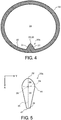
- FIG. 4 is a cross sectional view of the air cleaner hose 22 in a highest portion (a highest portion 36) of the fin 30a
- FIG. 5 is a plan view of the fin 30a.
- a fin tip portion 32 that is a tip of the fin 30a is located in the bend portion 52
- a fin rear end portion 42 that is a rear end of the fin 30a is located in the downstream side linear portion 54.
- the fin 30a includes a tip side inclined surface 34 that ascends and inclines from the fin tip portion 32 toward a rear side (the downstream side), and a rear end side inclined surface 38 that descends and inclines to the downstream side behind the tip side inclined surface 34.
- a length of the rear end side inclined surface 38 in an extending direction of the intake flow path (hereinafter also referred to as a flow path direction) is greater than a length of the tip side inclined surface 34 in the flow path direction, and a descending inclination angle of the rear end side inclined surface 38 is moderate as compared to an ascending inclination angle of the tip side inclined surface 34.
- the highest portion 36 that protrudes highest from an inner surface 15 of the air cleaner hose 22 is located between the tip side inclined surface 34 and the rear end side inclined surface 38.
- a part of a ridge portion (hereinafter referred to as a top 35) of the tip side inclined surface 34 of the fin 30a is formed along an extension line 60 of the inner surface 15 of the upstream side linear portion 50 toward the bend portion 52 in the air cleaner hose 22. Furthermore, the highest portion 36 of the fin 30a is located on the extension line 60 of the upstream side linear portion 50 of the air cleaner hose 22, and located at a tip of the top 35 of the tip side inclined surface 34 of the fin 30a along the extension line 60.
- a rear end 39 of the rear end side inclined surface 38 is located at a position higher than the inner surface 15 of the air cleaner hose 22, and the fin rear end portion 42 is located on the inner surface 15 of the air cleaner hose 22.
- the fin 30a includes a rear end surface 40 that is a steep wall extending from the rear end 39 of the rear end side inclined surface 38 to the fin rear end portion 42.
- a vertical section of the fin 30a (a section in a case where the fin is cut in a direction orthogonal to the extending direction of the intake flow path) has a substantially triangular shape.
- the fin 30a includes the top 35 having a smooth tip (the highest portion 36 in FIG. 4 ), and two opposite side portions 37 extending from the inner surface 15 of the air cleaner hose 22 toward the top 35.
- a position (a height) of the top 35 of the fin 30a to the inner surface 15 of the air cleaner hose 22 decreases from the highest portion 36 toward the fin tip portion 32 or the fin rear end portion 42.
- a width in an orthogonal direction (a Y-direction shown in FIG. 5 , hereinafter referred to also as a fin short direction) orthogonal to the extending direction of the intake flow path (an X-direction shown in FIG. 5 , hereinafter referred to also as a fin longitudinal direction) changes in accordance with a position in the fin longitudinal direction.
- a width in the fin short direction (the Y-direction) gradually increases from the fin tip portion 32 toward the downstream side (a lower side in FIG.
- a width in the fin short direction gradually decreases from a tip side inclined surface 34 side toward the downstream side.
- the fin 30a includes a widest portion 44 having the largest width in the fin short direction (the Y-direction), at a position between the tip side inclined surface 34 and the rear end side inclined surface 38 (a boundary 64 between the tip side inclined surface 34 and the rear end side inclined surface 38 in the present embodiment). As shown in FIG. 5 , the widest portion 44 of the fin 30a is located at the same position as in the highest portion 36.
- the rear end 39 of the rear end side inclined surface 38 is cut along the fin short direction, and has a predetermined width in the fin short direction.
- a portion in which the vortex 80 is generated has a pressure lower than a pressure of a region around the vortex 80, and the stronger vortex 80 causes the lower pressure. Consequently, a lot of air around the vortex 80 can be attracted toward the vortex 80 (the inner surface 15 of the air cleaner hose 22 on the inner side in the bend direction), and it is possible to effectively inhibit air separation from the inner surface 15 of the bend portion 52 of the air cleaner hose 22 on the inner side in the bend direction. In consequence, bias of flow of air in the air cleaner hose 22 (a non-uniform air flow velocity) can be suppressed, and an amount of intake air to the engine can be increased.
- the highest portion 36 of the fin 30a is located between the tip side inclined surface 34 and the rear end side inclined surface 38, and located on the extension line 60 of the inner surface 15 of the upstream side linear portion 50 toward the bend portion 52 in the air cleaner hose 22.
- the air that proceeds from the upstream side linear portion 50 to the bend portion 52 in the air cleaner hose 22 reaches the highest portion 36 of the fin 30a as it is. Consequently, a lot of air flows along the rear end side inclined surface 38 that is located behind the highest portion 36 of the fin 30a, and can generate the stronger vortex 80 (see FIG. 2 ) behind the rear end surface 40 of the fin 30a. Consequently, a lot of air can be attracted toward the vortex 80, and it is possible to precisely inhibit the air separation from the inner surface 15 of the bend portion 52 of the air cleaner hose 22 on the inner side in the bend direction.
- the width of the tip side inclined surface 34 of the fin 30a in the fin short direction gradually increases from the fin tip portion 32 toward the downstream side (the lower side of FIG. 5 ). Consequently, the pressure loss of the fin 30a to the air that proceeds from the upstream side linear portion to the bend portion in the air cleaner hose is suppressed, and a lot of air flows along a rear end side (the downstream side) of the broadened tip side inclined surface 34.
- the width of the rear end side inclined surface 38 of the fin 30a in the fin short direction gradually decreases from the tip side inclined surface 34 side toward the downstream side, and the vortex is generated on the rear end surface of the fin 30a as described above. Consequently, a lot of air that flows along the tip side inclined surface 34 is gathered together toward the downstream side of the rear end side inclined surface 38. Then, the gathered air passes the rear end 39 of the rear end side inclined surface 38, and hence the vortex 80 (see FIG. 2 ) generated behind the rear end surface of the fin 30a is strengthened. Thus, further air is gathered together toward the rear end of the rear end side inclined surface 38. In this manner, the vortex 80 is synergistically strengthened.
- the descending inclination angle of the rear end side inclined surface 38 of the fin 30a is moderate as compared to the ascending inclination angle of the tip side inclined surface 34 of the fin 30a. Consequently, a lot of air that proceeds from the tip side inclined surface 34 to the rear end side inclined surface 38 in the fin 30a does not come away from the rear end side inclined surface 38 and proceeds along the rear end side inclined surface 38. Therefore, the strong vortex 80 can be generated behind the rear end surface 40 of the fin 30a. In consequence, a lot of air can be attracted to the inner surface of the bend portion of the air cleaner hose 22 on the inner side in the bend direction, and it is possible to precisely inhibit the air separation from the inner surface of the air cleaner hose 22.
- FIG. 6 is a sectional view of the bend section 26b of the second inlet duct 18, and shows an air flowing direction with white arrows.
- the second inlet duct 18 is also a perfectly circular tube, and includes an upstream side linear portion 50, a bend portion 52, and a downstream side linear portion 54 in order from the upstream side.
- a bend angle of the second inlet duct 18 is larger than that of the air cleaner hose 22, and a length of the bend portion 52 increases. Accordingly, a length of a fin 30b of the second inlet duct 18 in an extending direction of the intake flow path 14 is larger than that of the fin 30a of the air cleaner hose 22.
- the fin 30b is formed integrally with the second inlet duct 18.
- FIG. 7 is an enlarged view of the fin 30b shown in FIG. 6 .
- a structure of the fin 30b of the second inlet duct 18 is similar to the above described structure of the fin 30a of the air cleaner hose 22, but is little different therefrom in fin position. Specifically, the fin 30b of the second inlet duct 18 rises from the inner surface of the bend portion 52 on the inner side in the bend direction, and does not extend to the downstream side linear portion 54 (see FIG. 6 ). Furthermore, as shown in FIG. 7 , both the fin tip portion 32 and the fin rear end portion 42 are located in the bend portion 52 of the second inlet duct 18.
- a highest portion 36 of the fin 30b is different from the highest portion 36 of the fin 30a of the above described air cleaner hose 22 in that the highest portion is located on an inner side of an extension line 60 of an inner surface of the upstream side linear portion 50 toward the bend portion 52 in a bend direction of the bend portion 52.
- the second inlet duct 18 is similar to the above described air cleaner hose 22 in that a part of a top 35 of a tip side inclined surface 34 of the fin 30b is formed along the extension line 60 of the inner surface of the upstream side linear portion 50 toward the bend portion 52 in the second inlet duct 18. Consequently, as shown by a bold black arrow (flow of air) of FIG. 7 , a lot of air that proceeds from the upstream side linear portion 50 to the bend portion 52 in the second inlet duct 18 is allowed to proceed along the tip side inclined surface 34 of the fin 30b while suppressing the pressure loss.
- a lot of air proceeds along a rear end side inclined surface 38 and passes a rear end of the surface, and can thereby generate a strong vortex 80 behind a rear end surface 40 of the fin 30b.
- a portion in which the vortex 80 is generated has a pressure lower than a pressure of a region around the vortex 80, and the stronger vortex 80 causes the lower pressure. Consequently, a lot of air around the vortex 80 can be attracted toward the vortex 80 (an inner surface 15 of the second inlet duct 18 on the inner side in the bend direction), and it is possible to effectively inhibit air separation from the inner surface 15 of the bend portion 52 of the second inlet duct 18 on the inner side in the bend direction. In consequence, bias of the flow of air in the second inlet duct 18 (a non-uniform air flow velocity) is suppressed.
- the duct and the fin are integrally formed.
- the fin may be separate from the duct.
- the fin may be attached to the duct with an adhesive.
- a part of the top 35 of the tip side inclined surface 34 of the fin is formed along the extension line 60 of the inner surface 15 of the upstream side linear portion 50 toward the bend portion 52 in the duct.
- the entirety of the top 35 of the tip side inclined surface 34 of the fin may be formed along the extension line 60 of the upstream side linear portion 50.
Landscapes
- Engineering & Computer Science (AREA)
- Mechanical Engineering (AREA)
- General Engineering & Computer Science (AREA)
- Chemical & Material Sciences (AREA)
- Combustion & Propulsion (AREA)
- Physics & Mathematics (AREA)
- Fluid Mechanics (AREA)
- Cooling, Air Intake And Gas Exhaust, And Fuel Tank Arrangements In Propulsion Units (AREA)
- Characterised By The Charging Evacuation (AREA)
Abstract
Description
- This application claims priority to Japanese Patent Application No.
2019-003459 filed on January 11, 2019 - The present disclosure relates to a structure of an engine intake duct that forms an intake flow path to guide air to an engine.
- Examples of an engine intake duct that forms an intake flow path to guide air to an engine of a vehicle include an inlet duct and an air cleaner hose. Such a duct has a bent portion (also referred to as a bend portion), and the air flowing in the duct separates from an inner surface of the bend portion on an inner side in a bend direction when air passes the bend portion.
- Due to the air separation, a flow velocity of air increases in a vicinity of the inner surface of the bend portion on an outer side in the bend direction, but the flow velocity of air decreases in the vicinity of the inner surface of the bend portion on the inner side in the bend direction. On a downstream side of the bend portion, the flow velocity of air in the duct is non-uniform. The non-uniformity of the air flow velocity in the duct might cause a decrease in an amount of air entering the engine. For example, a throttle valve is provided on a downstream side of the duct to incline a plate-shaped member provided in a flow path so that the flow path is closable. Thus, a size of a gap between the plate-shaped member and an inner surface of the flow path is changed, to adjust an amount of air flowing toward a combustion chamber of the engine. Consequently, when air enters the gap between the plate-shaped member and the inner surface of the flow path at a low flow velocity, a desired amount of air cannot be sent to the combustion chamber of the engine.
- To cope with a problem of air separation in a duct, in
JP 2018-13061 A - In a duct structure described in
JP 2018-13061 A - It is an advantage of the present disclosure to provide a structure of an engine intake duct that forms an intake flow path to guide air to an engine, in which consideration is given to a position or a structure of a fin to a linear portion of the duct that is located on an upstream side of a bend portion of the duct, so that it is possible to effectively inhibit air separation that occurs on an inner surface of the bend portion of the duct on an inner side in a bend direction in the structure of the engine intake duct.
- A structure of an engine intake duct according to the present disclosure is a structure of an engine intake duct that forms an intake flow path to guide air to an engine, the structure including an upstream side linear portion, a bend portion, and a downstream side linear portion in order from an upstream side, and further including a fin that rises from an inner surface of the duct including an inner surface of the bend portion on an inner side in a bend direction and extends along the intake flow path, wherein a fin tip portion that is a tip of the fin is located in the bend portion, a fin rear end portion that is a rear end of the fin is located in the bend portion or the downstream side linear portion, the fin includes a tip side inclined surface that ascends and inclines from the fin tip portion to a downstream side, a rear end side inclined surface that descends and inclines to the downstream side behind the tip side inclined surface, and a rear end surface that is a steep wall extending from a rear end of the rear end side inclined surface located at a position higher than the inner surface of the duct to the fin rear end portion located in the inner surface of the duct, and at least a part of a top of the tip side inclined surface of the fin is formed along an extension line of an inner surface of the upstream side linear portion toward the bend portion.
- According to this configuration, at least a part of the top of the tip side inclined surface of the fin is formed along the extension line of the inner surface of the upstream side linear portion toward the bend portion in the duct, thereby allowing a lot of air that proceeds from the upstream side linear portion to the bend portion in the duct to proceed along the tip side inclined surface of the fin while suppressing pressure loss. Then, a lot of air proceeds along the rear end side inclined surface and passes a rear end of the surface, so that strong vortex may be generated behind the rear end surface of the fin. A portion in which the vortex is generated has a pressure lower than a pressure of a region around the vortex, and the stronger vortex causes the lower pressure. Consequently, a lot of air around the vortex may be attracted toward the vortex (the inner surface of the duct on the inner side in the bend direction), and it is possible to effectively inhibit air separation from the inner surface of the bend portion of the duct on the inner side in the bend direction. In consequence, bias of flow of air in the duct (a non-uniform air flow velocity) may be suppressed, and an amount of intake air to the engine may be increased.
- Furthermore, in the structure of the engine intake duct of the present disclosure, the fin may include a highest portion that protrudes highest from the inner surface of the duct between the tip side inclined surface and the rear end side inclined surface, and the highest portion of the fin may be located on the extension line of the upstream side linear portion.
- According to this configuration, the air that proceeds from the upstream side linear portion to the bend portion in the duct reaches the highest portion of the fin as it is. Consequently, a lot of air flows along the rear end side inclined surface that is located behind the highest portion of the fin, and may generate a stronger vortex behind the rear end surface of the fin. Consequently, a lot of air may be attracted toward the vortex, and it is possible to precisely inhibit the air separation from the inner surface of the bend portion in the duct on the inner side in the bend direction.
- Furthermore, in the structure of the engine intake duct of the present disclosure, the fin may include a highest portion that protrudes highest from the inner surface of the duct between the tip side inclined surface and the rear end side inclined surface, and the highest portion of the fin may be located on an inner side of the extension line of the upstream side linear portion in the bend direction of the bend portion.
- According to this configuration, the pressure loss of the fin to the air that proceeds from the upstream side linear portion to the bend portion in the duct may be decreased.
- Furthermore, in the structure of the engine intake duct of the present disclosure, in the fin, a width in an orthogonal direction orthogonal to an extending direction of the intake flow path may change in accordance with a position in the extending direction. In the tip side inclined surface of the fin, a width in the orthogonal direction may gradually increase from the fin tip portion toward the downstream side, and in the rear end side inclined surface of the fin, a width in the orthogonal direction may gradually decrease from a side of the tip side inclined surface toward the downstream side.
- According to this configuration, the width of the tip side inclined surface (the width in the orthogonal direction orthogonal to the extending direction of the intake flow path) gradually increases from the fin tip portion toward the downstream side. Consequently, the pressure loss of the fin to the air that proceeds from the upstream side linear portion to the bend portion in the duct is suppressed, and a lot of air flows along a rear end side (the downstream side) of the broadened tip side inclined surface. Then, the width of the rear end side inclined surface gradually decreases from the tip side inclined surface side toward the downstream side, and the vortex is generated on the rear end surface of the fin. Consequently, a lot of air that flows along the tip side inclined surface is gathered together toward the downstream side of the rear end side inclined surface. Then, the gathered air passes the rear end of the rear end side inclined surface, and hence the vortex generated behind the rear end surface of the fin is strengthened. Consequently, further air is gathered together toward the rear end of the rear end side inclined surface. Thus, the vortex is synergistically strengthened. Through the strong vortex, a lot of air may be attracted to the inner surface of the bend portion of the duct on the inner side in the bend direction, and hence it is possible to precisely inhibit the air separation from the inner surface of the duct.
- Furthermore, in the structure of the engine intake duct of the present disclosure, a descending inclination angle of the rear end side inclined surface of the fin may be moderate as compared to an ascending inclination angle of the tip side inclined surface of the fin.
- According to this configuration, a lot of air that proceeds from the tip side inclined surface to the rear end side inclined surface in the fin does not come away from the rear end side inclined surface and proceeds along the rear end side inclined surface. Consequently, the strong vortex may be generated behind the rear end surface of the fin. In consequence, a lot of air may be attracted to the inner surface of the bend portion of the duct on the inner side in the bend direction, and it is possible to precisely inhibit the air separation from the duct inner surface.
- According to the present disclosure, in the engine intake duct that forms the intake flow path to guide air to the engine, it is possible to effectively inhibit the air separation that occurs on the inner surface of the bend portion of the duct on the inner side in the bend direction. In consequence, a flow velocity of air in the duct is made more uniform, and hence the amount of the intake air to the engine may be increased.
- Embodiment(s) of the present disclosure will be described based on the following figures, wherein:
-
FIG. 1 is a schematic view showing an example of an intake flow path of an engine of a vehicle; -
FIG. 2 is a sectional view of a bend section of an air cleaner hose; -
FIG. 3 is an enlarged view of a fin of the air cleaner hose; -
FIG. 4 is a cross sectional view of the air cleaner hose; -
FIG. 5 is a plan view of the fin of the air cleaner hose; -
FIG. 6 is a sectional view of a bend section of a second inlet duct; and -
FIG. 7 is an enlarged view of a fin of the second inlet duct. - Hereinafter, with reference to the drawings, description will be made to as to an embodiment of a structure of an engine intake duct according to the present disclosure. Similar elements in all the drawings are denoted with the same reference signs, and redundant description is omitted.
-
FIG. 1 is a schematic view showing an example of anintake flow path 14 that guides air to anengine 24 of a vehicle, and showing an air flowing direction with bold black arrows. As shown inFIG. 1 , a first inlet duct 16, asecond inlet duct 18, anair cleaner 20, and an aircleaner hose 22 are arranged in order from an upstream side, thereby forming theintake flow path 14 of theengine 24. Air proceeds from the first inlet duct 16 to thesecond inlet duct 18, and is exhausted through theair cleaner 20 to the aircleaner hose 22 and guided from the aircleaner hose 22 into theengine 24. Here, each of the first inlet duct 16, thesecond inlet duct 18, and the aircleaner hose 22 can be referred to as an engine intake duct 12 and will be hereinafter referred to simply as a duct. - The
engine 24 includes athrottle valve 90, and thethrottle valve 90 is disposed in theintake flow path 14 on a downstream side of the aircleaner hose 22. By thethrottle valve 90, a plate-shapedmember 91 provided in the flow path so that the flow path is closable is inclined about anaxis 92, and a size of a gap between the plate-shapedmember 91 and a flow path inner surface is changed, to thereby adjust an amount of air toward a combustion chamber of the engine. - The air
cleaner hose 22 has abend section 26a, and similarly thesecond inlet duct 18 has abend section 26b. In thesebend sections bend section member 91 of thethrottle valve 90 and the flow path inner surface, and hence an amount of intake air of theengine 24 decreases. To solve the problem, in the present embodiment, a fin is provided in eachbend section engine 24. Hereinafter, description will be made in detail as to eachbend section - Firstly, the
bend section 26a of the aircleaner hose 22 will be described.FIG. 2 is a sectional view of thebend section 26a of the aircleaner hose 22, and shows an air flow direction with white arrows. The aircleaner hose 22 is a perfectly circular tube (seeFIG. 4 ), and includes an upstream sidelinear portion 50, abend portion 52, and a downstream sidelinear portion 54 in order from the upstream side as shown inFIG. 2 . Furthermore, the aircleaner hose 22 includes afin 30a that rises from an inner surface of thebend portion 52 on the inner side in the bend direction and an inner surface of the downstream sidelinear portion 54 that is located on the downstream side of the bend portion, and extends along theintake flow path 14. Thefin 30a is formed integrally with the aircleaner hose 22. -
FIG. 3 is an enlarged view of thefin 30a shown inFIG. 2 ,FIG. 4 is a cross sectional view of the aircleaner hose 22 in a highest portion (a highest portion 36) of thefin 30a, andFIG. 5 is a plan view of thefin 30a. As shown inFIG. 3 , afin tip portion 32 that is a tip of thefin 30a is located in thebend portion 52, and a finrear end portion 42 that is a rear end of thefin 30a is located in the downstream sidelinear portion 54. Thefin 30a includes a tip side inclinedsurface 34 that ascends and inclines from thefin tip portion 32 toward a rear side (the downstream side), and a rear end side inclinedsurface 38 that descends and inclines to the downstream side behind the tip side inclinedsurface 34. A length of the rear end side inclinedsurface 38 in an extending direction of the intake flow path (hereinafter also referred to as a flow path direction) is greater than a length of the tip side inclinedsurface 34 in the flow path direction, and a descending inclination angle of the rear end side inclinedsurface 38 is moderate as compared to an ascending inclination angle of the tip side inclinedsurface 34. Thehighest portion 36 that protrudes highest from aninner surface 15 of the aircleaner hose 22 is located between the tip side inclinedsurface 34 and the rear end side inclinedsurface 38. - As shown in
FIG. 3 , a part of a ridge portion (hereinafter referred to as a top 35) of the tip side inclinedsurface 34 of thefin 30a is formed along anextension line 60 of theinner surface 15 of the upstream sidelinear portion 50 toward thebend portion 52 in the aircleaner hose 22. Furthermore, thehighest portion 36 of thefin 30a is located on theextension line 60 of the upstream sidelinear portion 50 of the aircleaner hose 22, and located at a tip of the top 35 of the tip side inclinedsurface 34 of thefin 30a along theextension line 60. - A
rear end 39 of the rear end side inclinedsurface 38 is located at a position higher than theinner surface 15 of the aircleaner hose 22, and the finrear end portion 42 is located on theinner surface 15 of the aircleaner hose 22. Thefin 30a includes arear end surface 40 that is a steep wall extending from therear end 39 of the rear end side inclinedsurface 38 to the finrear end portion 42. - As shown in
FIG. 4 , a vertical section of thefin 30a (a section in a case where the fin is cut in a direction orthogonal to the extending direction of the intake flow path) has a substantially triangular shape. Thefin 30a includes the top 35 having a smooth tip (thehighest portion 36 inFIG. 4 ), and twoopposite side portions 37 extending from theinner surface 15 of the aircleaner hose 22 toward the top 35. As shown inFIG. 3 , a position (a height) of the top 35 of thefin 30a to theinner surface 15 of the aircleaner hose 22 decreases from thehighest portion 36 toward thefin tip portion 32 or the finrear end portion 42. - As shown in
FIG. 5 (the plan view), in thefin 30a, a width in an orthogonal direction (a Y-direction shown inFIG. 5 , hereinafter referred to also as a fin short direction) orthogonal to the extending direction of the intake flow path (an X-direction shown inFIG. 5 , hereinafter referred to also as a fin longitudinal direction) changes in accordance with a position in the fin longitudinal direction. In the tip side inclinedsurface 34 of thefin 30a, a width in the fin short direction (the Y-direction) gradually increases from thefin tip portion 32 toward the downstream side (a lower side inFIG. 5 ), while in the rear end side inclinedsurface 38 of thefin 30a, a width in the fin short direction (the Y-direction) gradually decreases from a tip side inclinedsurface 34 side toward the downstream side. Thefin 30a includes awidest portion 44 having the largest width in the fin short direction (the Y-direction), at a position between the tip side inclinedsurface 34 and the rear end side inclined surface 38 (aboundary 64 between the tip side inclinedsurface 34 and the rear end side inclinedsurface 38 in the present embodiment). As shown inFIG. 5 , thewidest portion 44 of thefin 30a is located at the same position as in thehighest portion 36. Therear end 39 of the rear end side inclinedsurface 38 is cut along the fin short direction, and has a predetermined width in the fin short direction. - Next, description will be given as to technological effects of the
bend section 26a of the above described aircleaner hose 22. - In the above described air
cleaner hose 22, as shown inFIG. 3 , a part of the top 35 of the tip side inclinedsurface 34 of thefin 30a is formed along theextension line 60 of theinner surface 15 of the upstream sidelinear portion 50 toward thebend portion 52 in the aircleaner hose 22. Consequently, as shown by bold black arrows (flow of air) ofFIG. 2 , a lot of air that proceeds from the upstream sidelinear portion 50 to thebend portion 52 in the aircleaner hose 22 is allowed to proceed along the tip side inclinedsurface 34 of thefin 30a while suppressing pressure loss. Then, a lot of air proceeds along the rear end side inclinedsurface 38 and passes the rear end of the surface, and can thereby generate astrong vortex 80 behind therear end surface 40 of thefin 30a. A portion in which thevortex 80 is generated has a pressure lower than a pressure of a region around thevortex 80, and thestronger vortex 80 causes the lower pressure. Consequently, a lot of air around thevortex 80 can be attracted toward the vortex 80 (theinner surface 15 of the aircleaner hose 22 on the inner side in the bend direction), and it is possible to effectively inhibit air separation from theinner surface 15 of thebend portion 52 of the aircleaner hose 22 on the inner side in the bend direction. In consequence, bias of flow of air in the air cleaner hose 22 (a non-uniform air flow velocity) can be suppressed, and an amount of intake air to the engine can be increased. - Furthermore, in the above described air
cleaner hose 22, as shown inFIG. 3 , thehighest portion 36 of thefin 30a is located between the tip side inclinedsurface 34 and the rear end side inclinedsurface 38, and located on theextension line 60 of theinner surface 15 of the upstream sidelinear portion 50 toward thebend portion 52 in the aircleaner hose 22. Thus, the air that proceeds from the upstream sidelinear portion 50 to thebend portion 52 in the aircleaner hose 22 reaches thehighest portion 36 of thefin 30a as it is. Consequently, a lot of air flows along the rear end side inclinedsurface 38 that is located behind thehighest portion 36 of thefin 30a, and can generate the stronger vortex 80 (seeFIG. 2 ) behind therear end surface 40 of thefin 30a. Consequently, a lot of air can be attracted toward thevortex 80, and it is possible to precisely inhibit the air separation from theinner surface 15 of thebend portion 52 of the aircleaner hose 22 on the inner side in the bend direction. - Furthermore, in the above described air
cleaner hose 22, as shown inFIG. 5 , the width of the tip side inclinedsurface 34 of thefin 30a in the fin short direction (the Y-direction) gradually increases from thefin tip portion 32 toward the downstream side (the lower side ofFIG. 5 ). Consequently, the pressure loss of thefin 30a to the air that proceeds from the upstream side linear portion to the bend portion in the air cleaner hose is suppressed, and a lot of air flows along a rear end side (the downstream side) of the broadened tip side inclinedsurface 34. Furthermore, the width of the rear end side inclinedsurface 38 of thefin 30a in the fin short direction (the Y-direction) gradually decreases from the tip side inclinedsurface 34 side toward the downstream side, and the vortex is generated on the rear end surface of thefin 30a as described above. Consequently, a lot of air that flows along the tip side inclinedsurface 34 is gathered together toward the downstream side of the rear end side inclinedsurface 38. Then, the gathered air passes therear end 39 of the rear end side inclinedsurface 38, and hence the vortex 80 (seeFIG. 2 ) generated behind the rear end surface of thefin 30a is strengthened. Thus, further air is gathered together toward the rear end of the rear end side inclinedsurface 38. In this manner, thevortex 80 is synergistically strengthened. Through thestrong vortex 80, a lot of air can be attracted to theinner surface 15 of the bend portion of the aircleaner hose 22 on the inner side in the bend direction, and hence it is possible to precisely inhibit the air separation from the inner surface of the aircleaner hose 22. - Furthermore, in above described air
cleaner hose 22, as shown inFIG. 2 , the descending inclination angle of the rear end side inclinedsurface 38 of thefin 30a is moderate as compared to the ascending inclination angle of the tip side inclinedsurface 34 of thefin 30a. Consequently, a lot of air that proceeds from the tip side inclinedsurface 34 to the rear end side inclinedsurface 38 in thefin 30a does not come away from the rear end side inclinedsurface 38 and proceeds along the rear end side inclinedsurface 38. Therefore, thestrong vortex 80 can be generated behind therear end surface 40 of thefin 30a. In consequence, a lot of air can be attracted to the inner surface of the bend portion of the aircleaner hose 22 on the inner side in the bend direction, and it is possible to precisely inhibit the air separation from the inner surface of the aircleaner hose 22. - Next, description will be given as to the
bend section 26b of thesecond inlet duct 18 shown inFIG. 1 . -
FIG. 6 is a sectional view of thebend section 26b of thesecond inlet duct 18, and shows an air flowing direction with white arrows. Similarly to the above described aircleaner hose 22, thesecond inlet duct 18 is also a perfectly circular tube, and includes an upstream sidelinear portion 50, abend portion 52, and a downstream sidelinear portion 54 in order from the upstream side. A bend angle of thesecond inlet duct 18 is larger than that of the aircleaner hose 22, and a length of thebend portion 52 increases. Accordingly, a length of afin 30b of thesecond inlet duct 18 in an extending direction of theintake flow path 14 is larger than that of thefin 30a of the aircleaner hose 22. Thefin 30b is formed integrally with thesecond inlet duct 18. -
FIG. 7 is an enlarged view of thefin 30b shown inFIG. 6 . A structure of thefin 30b of thesecond inlet duct 18 is similar to the above described structure of thefin 30a of the aircleaner hose 22, but is little different therefrom in fin position. Specifically, thefin 30b of thesecond inlet duct 18 rises from the inner surface of thebend portion 52 on the inner side in the bend direction, and does not extend to the downstream side linear portion 54 (seeFIG. 6 ). Furthermore, as shown inFIG. 7 , both thefin tip portion 32 and the finrear end portion 42 are located in thebend portion 52 of thesecond inlet duct 18. Furthermore, ahighest portion 36 of thefin 30b is different from thehighest portion 36 of thefin 30a of the above described aircleaner hose 22 in that the highest portion is located on an inner side of anextension line 60 of an inner surface of the upstream sidelinear portion 50 toward thebend portion 52 in a bend direction of thebend portion 52. - As shown in
FIG. 7 , thesecond inlet duct 18 is similar to the above described aircleaner hose 22 in that a part of a top 35 of a tip side inclinedsurface 34 of thefin 30b is formed along theextension line 60 of the inner surface of the upstream sidelinear portion 50 toward thebend portion 52 in thesecond inlet duct 18. Consequently, as shown by a bold black arrow (flow of air) ofFIG. 7 , a lot of air that proceeds from the upstream sidelinear portion 50 to thebend portion 52 in thesecond inlet duct 18 is allowed to proceed along the tip side inclinedsurface 34 of thefin 30b while suppressing the pressure loss. Then, a lot of air proceeds along a rear end side inclinedsurface 38 and passes a rear end of the surface, and can thereby generate astrong vortex 80 behind arear end surface 40 of thefin 30b. A portion in which thevortex 80 is generated has a pressure lower than a pressure of a region around thevortex 80, and thestronger vortex 80 causes the lower pressure. Consequently, a lot of air around thevortex 80 can be attracted toward the vortex 80 (aninner surface 15 of thesecond inlet duct 18 on the inner side in the bend direction), and it is possible to effectively inhibit air separation from theinner surface 15 of thebend portion 52 of thesecond inlet duct 18 on the inner side in the bend direction. In consequence, bias of the flow of air in the second inlet duct 18 (a non-uniform air flow velocity) is suppressed. - Next, a modification will be described. For the above described ducts (the air
cleaner hose 22 and the second inlet duct 18), the duct and the fin are integrally formed. However, the fin may be separate from the duct. For example, the fin may be attached to the duct with an adhesive. - Furthermore, in the above described duct, a part of the top 35 of the tip side inclined
surface 34 of the fin is formed along theextension line 60 of theinner surface 15 of the upstream sidelinear portion 50 toward thebend portion 52 in the duct. However, the entirety of the top 35 of the tip side inclinedsurface 34 of the fin may be formed along theextension line 60 of the upstream sidelinear portion 50.
Claims (5)
- A structure of an engine intake duct (12) that forms an intake flow path to guide air to an engine, the structure comprising an upstream side linear portion (50), a bend portion (52), and a downstream side linear portion (54) in order from an upstream side, and further comprising a fin (30a, 30b) that rises from an inner surface of the duct including an inner surface of the bend portion (52) on an inner side in a bend direction and extends along the intake flow path, whereina fin tip portion (32) that is a tip of the fin (30a, 30b) is located in the bend portion (52), and a fin rear end portion (42) that is a rear end of the fin (30a, 30b) is located in the bend portion (52) or the downstream side linear portion (54),the fin (30a, 30b) comprises a tip side inclined surface (34) that ascends and inclines from the fin tip portion (32) to a downstream side, a rear end side inclined surface (38) that descends and inclines to the downstream side behind the tip side inclined surface (34), and a rear end surface (40) that is a steep wall extending from a rear end (39) of the rear end side inclined surface (38) located at a position higher than the inner surface of the duct to the fin rear end portion (42) located in the inner surface of the duct, andat least a part of a top (35) of the tip side inclined surface (34) of the fin (30a, 30b) is formed along an extension line (60) of an inner surface of the upstream side linear portion (50) toward the bend portion (52).
- The structure of the engine intake duct according to claim 1, wherein the fin (30a) comprises a highest portion (36) that protrudes highest from the inner surface of the duct between the tip side inclined surface (34) and the rear end side inclined surface (38), and
the highest portion (36) of the fin (30a) is located on the extension line (60) of the upstream side linear portion (50). - The structure of the engine intake duct according to claim 1, wherein the fin (30b) comprises a highest portion (36) that protrudes highest from the inner surface of the duct between the tip side inclined surface (34) and the rear end side inclined surface (38), and
the highest portion (36) of the fin (30b) is located on an inner side of the extension line (60) of the upstream side linear portion (50) in the bend direction of the bend portion (52). - The structure of the engine intake duct according to claim 2 or 3, wherein in the fin (30a, 30b), a width in an orthogonal direction orthogonal to an extending direction of the intake flow path changes in accordance with a position in the extending direction,in the tip side inclined surface (34) of the fin (30a, 30b), a width in the orthogonal direction gradually increases from the fin tip portion (32) toward the downstream side, andin the rear end side inclined surface (38) of the fin (30a, 30b), a width in the orthogonal direction gradually decreases from a side of the tip side inclined surface (34) toward the downstream side.
- The structure of the engine intake duct according to claim 4, wherein a descending inclination angle of the rear end side inclined surface (38) of the fin (30a, 30b) is moderate as compared to an ascending inclination angle of the tip side inclined surface (34) of the fin (30a, 30b).
Applications Claiming Priority (1)
| Application Number | Priority Date | Filing Date | Title |
|---|---|---|---|
| JP2019003459A JP7243195B2 (en) | 2019-01-11 | 2019-01-11 | Engine intake duct structure |
Publications (1)
| Publication Number | Publication Date |
|---|---|
| EP3680465A1 true EP3680465A1 (en) | 2020-07-15 |
Family
ID=69143418
Family Applications (1)
| Application Number | Title | Priority Date | Filing Date |
|---|---|---|---|
| EP20150426.3A Withdrawn EP3680465A1 (en) | 2019-01-11 | 2020-01-07 | Structure of engine intake duct |
Country Status (4)
| Country | Link |
|---|---|
| US (1) | US10907588B2 (en) |
| EP (1) | EP3680465A1 (en) |
| JP (1) | JP7243195B2 (en) |
| CN (1) | CN111434912B (en) |
Families Citing this family (1)
| Publication number | Priority date | Publication date | Assignee | Title |
|---|---|---|---|---|
| US11592041B2 (en) * | 2020-10-28 | 2023-02-28 | Artisan Industries, Inc. | Device for increasing flow capacity of a fluid channel |
Citations (6)
| Publication number | Priority date | Publication date | Assignee | Title |
|---|---|---|---|---|
| DE192795C (en) * | 1905-11-11 | 1908-01-03 | Pipe bend | |
| US3113593A (en) * | 1961-06-01 | 1963-12-10 | Vicard Pierre Georges | Devices for minimizing losses in fluid conduits |
| US5213138A (en) * | 1992-03-09 | 1993-05-25 | United Technologies Corporation | Mechanism to reduce turning losses in conduits |
| JP2010270662A (en) * | 2009-05-21 | 2010-12-02 | Tigers Polymer Corp | Ventilation duct |
| JP2018013061A (en) | 2016-07-20 | 2018-01-25 | トヨタ自動車株式会社 | Duct structure |
| DE102018112906A1 (en) * | 2017-06-02 | 2018-12-06 | Toyota Jidosha Kabushiki Kaisha | air filter |
Family Cites Families (6)
| Publication number | Priority date | Publication date | Assignee | Title |
|---|---|---|---|---|
| US3623511A (en) * | 1970-02-16 | 1971-11-30 | Bvs | Tubular conduits having a bent portion and carrying a fluid |
| JPS58148260A (en) * | 1982-02-27 | 1983-09-03 | Yamaha Motor Co Ltd | Intake and exhaust passages for internal-combustion engine |
| ES2071276T3 (en) * | 1990-12-24 | 1995-06-16 | United Technologies Corp | MECHANISM TO REDUCE PRESSURE LOSSES IN THE TUBE CURVES AND ELBOWS. |
| JP3679991B2 (en) * | 2000-11-22 | 2005-08-03 | 三菱重工業株式会社 | Silencer |
| JP5985315B2 (en) * | 2012-03-26 | 2016-09-06 | 株式会社Roki | Ventilation duct |
| JP6777015B2 (en) * | 2017-06-02 | 2020-10-28 | トヨタ自動車株式会社 | Air cleaner and manufacturing method of air cleaner |
-
2019
- 2019-01-11 JP JP2019003459A patent/JP7243195B2/en active Active
- 2019-12-11 CN CN201911264673.7A patent/CN111434912B/en not_active Expired - Fee Related
- 2019-12-30 US US16/729,956 patent/US10907588B2/en not_active Expired - Fee Related
-
2020
- 2020-01-07 EP EP20150426.3A patent/EP3680465A1/en not_active Withdrawn
Patent Citations (6)
| Publication number | Priority date | Publication date | Assignee | Title |
|---|---|---|---|---|
| DE192795C (en) * | 1905-11-11 | 1908-01-03 | Pipe bend | |
| US3113593A (en) * | 1961-06-01 | 1963-12-10 | Vicard Pierre Georges | Devices for minimizing losses in fluid conduits |
| US5213138A (en) * | 1992-03-09 | 1993-05-25 | United Technologies Corporation | Mechanism to reduce turning losses in conduits |
| JP2010270662A (en) * | 2009-05-21 | 2010-12-02 | Tigers Polymer Corp | Ventilation duct |
| JP2018013061A (en) | 2016-07-20 | 2018-01-25 | トヨタ自動車株式会社 | Duct structure |
| DE102018112906A1 (en) * | 2017-06-02 | 2018-12-06 | Toyota Jidosha Kabushiki Kaisha | air filter |
Also Published As
| Publication number | Publication date |
|---|---|
| CN111434912A (en) | 2020-07-21 |
| JP7243195B2 (en) | 2023-03-22 |
| US20200224616A1 (en) | 2020-07-16 |
| CN111434912B (en) | 2022-01-28 |
| US10907588B2 (en) | 2021-02-02 |
| JP2020112092A (en) | 2020-07-27 |
Similar Documents
| Publication | Publication Date | Title |
|---|---|---|
| US7543561B2 (en) | Swirl generator | |
| US8118560B2 (en) | Blade | |
| US8210482B2 (en) | Prismatic-shaped vortex generators | |
| US12110848B2 (en) | Intake duct | |
| US9156508B2 (en) | Vehicle rear spoiler device | |
| RU2607715C2 (en) | Gas turbine engine pylon | |
| US10415519B2 (en) | Duct structure | |
| US20120325324A1 (en) | Air separator and air separator with ducting for maximum cooling and fuel economy | |
| US20090308075A1 (en) | Turbine exhaust system and method for modifying the same | |
| US10907588B2 (en) | Structure of engine intake duct | |
| US11708762B2 (en) | Film cooling structure and turbine blade for gas turbine engine | |
| CN109911037B (en) | Air guiding device for a motor vehicle | |
| KR102744727B1 (en) | turbine blade | |
| CN110439864B (en) | Air inlet current collector and centrifugal fan with same | |
| JP6766760B2 (en) | Vehicle undercarriage | |
| CN108700241A (en) | Bend pipe and the fluid machinery for having the bend pipe | |
| CN113154446A (en) | Support plate type stabilizer for intensified combustion of afterburner | |
| JP2009041561A (en) | Axial diffuser for centrifugal compressor | |
| CN118008575A (en) | Elbow exhaust pipe and design method thereof | |
| CN109707542B (en) | ventilation duct | |
| JP2019183726A (en) | EGR device | |
| JP2005188363A (en) | Air cleaner | |
| JP2009257347A (en) | Fluid pipeline | |
| CN113898475A (en) | Air intake for a stationary gas turbine engine | |
| CN111795216B (en) | Mixed flow conduit for an exhaust system |
Legal Events
| Date | Code | Title | Description |
|---|---|---|---|
| PUAI | Public reference made under article 153(3) epc to a published international application that has entered the european phase |
Free format text: ORIGINAL CODE: 0009012 |
|
| STAA | Information on the status of an ep patent application or granted ep patent |
Free format text: STATUS: REQUEST FOR EXAMINATION WAS MADE |
|
| 17P | Request for examination filed |
Effective date: 20200107 |
|
| AK | Designated contracting states |
Kind code of ref document: A1 Designated state(s): AL AT BE BG CH CY CZ DE DK EE ES FI FR GB GR HR HU IE IS IT LI LT LU LV MC MK MT NL NO PL PT RO RS SE SI SK SM TR |
|
| AX | Request for extension of the european patent |
Extension state: BA ME |
|
| STAA | Information on the status of an ep patent application or granted ep patent |
Free format text: STATUS: EXAMINATION IS IN PROGRESS |
|
| 17Q | First examination report despatched |
Effective date: 20220321 |
|
| STAA | Information on the status of an ep patent application or granted ep patent |
Free format text: STATUS: THE APPLICATION IS DEEMED TO BE WITHDRAWN |
|
| 18D | Application deemed to be withdrawn |
Effective date: 20250121 |