EP3680289A1 - Polymeric composition, polymer capsule, and fabric softener composition including same - Google Patents
Polymeric composition, polymer capsule, and fabric softener composition including same Download PDFInfo
- Publication number
- EP3680289A1 EP3680289A1 EP18857309.1A EP18857309A EP3680289A1 EP 3680289 A1 EP3680289 A1 EP 3680289A1 EP 18857309 A EP18857309 A EP 18857309A EP 3680289 A1 EP3680289 A1 EP 3680289A1
- Authority
- EP
- European Patent Office
- Prior art keywords
- group
- formula
- bond
- polymerizable composition
- alkyl group
- Prior art date
- Legal status (The legal status is an assumption and is not a legal conclusion. Google has not performed a legal analysis and makes no representation as to the accuracy of the status listed.)
- Granted
Links
- 0 CC*(*)*(*CC1CC1)C(C)N1C(C)C1 Chemical compound CC*(*)*(*CC1CC1)C(C)N1C(C)C1 0.000 description 2
Classifications
-
- C—CHEMISTRY; METALLURGY
- C08—ORGANIC MACROMOLECULAR COMPOUNDS; THEIR PREPARATION OR CHEMICAL WORKING-UP; COMPOSITIONS BASED THEREON
- C08K—Use of inorganic or non-macromolecular organic substances as compounding ingredients
- C08K5/00—Use of organic ingredients
- C08K5/16—Nitrogen-containing compounds
- C08K5/17—Amines; Quaternary ammonium compounds
- C08K5/19—Quaternary ammonium compounds
-
- C—CHEMISTRY; METALLURGY
- C11—ANIMAL OR VEGETABLE OILS, FATS, FATTY SUBSTANCES OR WAXES; FATTY ACIDS THEREFROM; DETERGENTS; CANDLES
- C11D—DETERGENT COMPOSITIONS; USE OF SINGLE SUBSTANCES AS DETERGENTS; SOAP OR SOAP-MAKING; RESIN SOAPS; RECOVERY OF GLYCEROL
- C11D3/00—Other compounding ingredients of detergent compositions covered in group C11D1/00
- C11D3/16—Organic compounds
- C11D3/37—Polymers
- C11D3/3746—Macromolecular compounds obtained by reactions only involving carbon-to-carbon unsaturated bonds
- C11D3/3769—(Co)polymerised monomers containing nitrogen, e.g. carbonamides, nitriles or amines
-
- C—CHEMISTRY; METALLURGY
- C08—ORGANIC MACROMOLECULAR COMPOUNDS; THEIR PREPARATION OR CHEMICAL WORKING-UP; COMPOSITIONS BASED THEREON
- C08F—MACROMOLECULAR COMPOUNDS OBTAINED BY REACTIONS ONLY INVOLVING CARBON-TO-CARBON UNSATURATED BONDS
- C08F12/00—Homopolymers and copolymers of compounds having one or more unsaturated aliphatic radicals, each having only one carbon-to-carbon double bond, and at least one being terminated by an aromatic carbocyclic ring
- C08F12/02—Monomers containing only one unsaturated aliphatic radical
- C08F12/04—Monomers containing only one unsaturated aliphatic radical containing one ring
- C08F12/06—Hydrocarbons
- C08F12/08—Styrene
-
- C—CHEMISTRY; METALLURGY
- C08—ORGANIC MACROMOLECULAR COMPOUNDS; THEIR PREPARATION OR CHEMICAL WORKING-UP; COMPOSITIONS BASED THEREON
- C08F—MACROMOLECULAR COMPOUNDS OBTAINED BY REACTIONS ONLY INVOLVING CARBON-TO-CARBON UNSATURATED BONDS
- C08F16/00—Homopolymers and copolymers of compounds having one or more unsaturated aliphatic radicals, each having only one carbon-to-carbon double bond, and at least one being terminated by an alcohol, ether, aldehydo, ketonic, acetal or ketal radical
- C08F16/12—Homopolymers and copolymers of compounds having one or more unsaturated aliphatic radicals, each having only one carbon-to-carbon double bond, and at least one being terminated by an alcohol, ether, aldehydo, ketonic, acetal or ketal radical by an ether radical
-
- C—CHEMISTRY; METALLURGY
- C08—ORGANIC MACROMOLECULAR COMPOUNDS; THEIR PREPARATION OR CHEMICAL WORKING-UP; COMPOSITIONS BASED THEREON
- C08F—MACROMOLECULAR COMPOUNDS OBTAINED BY REACTIONS ONLY INVOLVING CARBON-TO-CARBON UNSATURATED BONDS
- C08F18/00—Homopolymers and copolymers of compounds having one or more unsaturated aliphatic radicals, each having only one carbon-to-carbon double bond, and at least one being terminated by an acyloxy radical of a saturated carboxylic acid, of carbonic acid or of a haloformic acid
- C08F18/02—Esters of monocarboxylic acids
- C08F18/04—Vinyl esters
-
- C—CHEMISTRY; METALLURGY
- C08—ORGANIC MACROMOLECULAR COMPOUNDS; THEIR PREPARATION OR CHEMICAL WORKING-UP; COMPOSITIONS BASED THEREON
- C08F—MACROMOLECULAR COMPOUNDS OBTAINED BY REACTIONS ONLY INVOLVING CARBON-TO-CARBON UNSATURATED BONDS
- C08F2/00—Processes of polymerisation
- C08F2/44—Polymerisation in the presence of compounding ingredients, e.g. plasticisers, dyestuffs, fillers
-
- C—CHEMISTRY; METALLURGY
- C08—ORGANIC MACROMOLECULAR COMPOUNDS; THEIR PREPARATION OR CHEMICAL WORKING-UP; COMPOSITIONS BASED THEREON
- C08F—MACROMOLECULAR COMPOUNDS OBTAINED BY REACTIONS ONLY INVOLVING CARBON-TO-CARBON UNSATURATED BONDS
- C08F20/00—Homopolymers and copolymers of compounds having one or more unsaturated aliphatic radicals, each having only one carbon-to-carbon double bond, and only one being terminated by only one carboxyl radical or a salt, anhydride, ester, amide, imide or nitrile thereof
- C08F20/02—Monocarboxylic acids having less than ten carbon atoms, Derivatives thereof
- C08F20/10—Esters
- C08F20/12—Esters of monohydric alcohols or phenols
- C08F20/16—Esters of monohydric alcohols or phenols of phenols or of alcohols containing two or more carbon atoms
- C08F20/18—Esters of monohydric alcohols or phenols of phenols or of alcohols containing two or more carbon atoms with acrylic or methacrylic acids
-
- C—CHEMISTRY; METALLURGY
- C08—ORGANIC MACROMOLECULAR COMPOUNDS; THEIR PREPARATION OR CHEMICAL WORKING-UP; COMPOSITIONS BASED THEREON
- C08F—MACROMOLECULAR COMPOUNDS OBTAINED BY REACTIONS ONLY INVOLVING CARBON-TO-CARBON UNSATURATED BONDS
- C08F20/00—Homopolymers and copolymers of compounds having one or more unsaturated aliphatic radicals, each having only one carbon-to-carbon double bond, and only one being terminated by only one carboxyl radical or a salt, anhydride, ester, amide, imide or nitrile thereof
- C08F20/02—Monocarboxylic acids having less than ten carbon atoms, Derivatives thereof
- C08F20/52—Amides or imides
- C08F20/54—Amides, e.g. N,N-dimethylacrylamide or N-isopropylacrylamide
- C08F20/56—Acrylamide; Methacrylamide
-
- C—CHEMISTRY; METALLURGY
- C08—ORGANIC MACROMOLECULAR COMPOUNDS; THEIR PREPARATION OR CHEMICAL WORKING-UP; COMPOSITIONS BASED THEREON
- C08F—MACROMOLECULAR COMPOUNDS OBTAINED BY REACTIONS ONLY INVOLVING CARBON-TO-CARBON UNSATURATED BONDS
- C08F212/00—Copolymers of compounds having one or more unsaturated aliphatic radicals, each having only one carbon-to-carbon double bond, and at least one being terminated by an aromatic carbocyclic ring
- C08F212/02—Monomers containing only one unsaturated aliphatic radical
- C08F212/04—Monomers containing only one unsaturated aliphatic radical containing one ring
- C08F212/06—Hydrocarbons
- C08F212/08—Styrene
-
- C—CHEMISTRY; METALLURGY
- C08—ORGANIC MACROMOLECULAR COMPOUNDS; THEIR PREPARATION OR CHEMICAL WORKING-UP; COMPOSITIONS BASED THEREON
- C08F—MACROMOLECULAR COMPOUNDS OBTAINED BY REACTIONS ONLY INVOLVING CARBON-TO-CARBON UNSATURATED BONDS
- C08F220/00—Copolymers of compounds having one or more unsaturated aliphatic radicals, each having only one carbon-to-carbon double bond, and only one being terminated by only one carboxyl radical or a salt, anhydride ester, amide, imide or nitrile thereof
- C08F220/02—Monocarboxylic acids having less than ten carbon atoms; Derivatives thereof
- C08F220/10—Esters
- C08F220/12—Esters of monohydric alcohols or phenols
- C08F220/14—Methyl esters, e.g. methyl (meth)acrylate
-
- C—CHEMISTRY; METALLURGY
- C11—ANIMAL OR VEGETABLE OILS, FATS, FATTY SUBSTANCES OR WAXES; FATTY ACIDS THEREFROM; DETERGENTS; CANDLES
- C11D—DETERGENT COMPOSITIONS; USE OF SINGLE SUBSTANCES AS DETERGENTS; SOAP OR SOAP-MAKING; RESIN SOAPS; RECOVERY OF GLYCEROL
- C11D1/00—Detergent compositions based essentially on surface-active compounds; Use of these compounds as a detergent
- C11D1/38—Cationic compounds
-
- C—CHEMISTRY; METALLURGY
- C11—ANIMAL OR VEGETABLE OILS, FATS, FATTY SUBSTANCES OR WAXES; FATTY ACIDS THEREFROM; DETERGENTS; CANDLES
- C11D—DETERGENT COMPOSITIONS; USE OF SINGLE SUBSTANCES AS DETERGENTS; SOAP OR SOAP-MAKING; RESIN SOAPS; RECOVERY OF GLYCEROL
- C11D17/00—Detergent materials or soaps characterised by their shape or physical properties
- C11D17/0039—Coated compositions or coated components in the compositions, (micro)capsules
-
- C—CHEMISTRY; METALLURGY
- C11—ANIMAL OR VEGETABLE OILS, FATS, FATTY SUBSTANCES OR WAXES; FATTY ACIDS THEREFROM; DETERGENTS; CANDLES
- C11D—DETERGENT COMPOSITIONS; USE OF SINGLE SUBSTANCES AS DETERGENTS; SOAP OR SOAP-MAKING; RESIN SOAPS; RECOVERY OF GLYCEROL
- C11D3/00—Other compounding ingredients of detergent compositions covered in group C11D1/00
- C11D3/0005—Other compounding ingredients characterised by their effect
- C11D3/001—Softening compositions
-
- C—CHEMISTRY; METALLURGY
- C11—ANIMAL OR VEGETABLE OILS, FATS, FATTY SUBSTANCES OR WAXES; FATTY ACIDS THEREFROM; DETERGENTS; CANDLES
- C11D—DETERGENT COMPOSITIONS; USE OF SINGLE SUBSTANCES AS DETERGENTS; SOAP OR SOAP-MAKING; RESIN SOAPS; RECOVERY OF GLYCEROL
- C11D3/00—Other compounding ingredients of detergent compositions covered in group C11D1/00
- C11D3/50—Perfumes
- C11D3/502—Protected perfumes
- C11D3/505—Protected perfumes encapsulated or adsorbed on a carrier, e.g. zeolite or clay
-
- D—TEXTILES; PAPER
- D06—TREATMENT OF TEXTILES OR THE LIKE; LAUNDERING; FLEXIBLE MATERIALS NOT OTHERWISE PROVIDED FOR
- D06M—TREATMENT, NOT PROVIDED FOR ELSEWHERE IN CLASS D06, OF FIBRES, THREADS, YARNS, FABRICS, FEATHERS OR FIBROUS GOODS MADE FROM SUCH MATERIALS
- D06M13/00—Treating fibres, threads, yarns, fabrics or fibrous goods made from such materials, with non-macromolecular organic compounds; Such treatment combined with mechanical treatment
- D06M13/005—Compositions containing perfumes; Compositions containing deodorants
-
- D—TEXTILES; PAPER
- D06—TREATMENT OF TEXTILES OR THE LIKE; LAUNDERING; FLEXIBLE MATERIALS NOT OTHERWISE PROVIDED FOR
- D06M—TREATMENT, NOT PROVIDED FOR ELSEWHERE IN CLASS D06, OF FIBRES, THREADS, YARNS, FABRICS, FEATHERS OR FIBROUS GOODS MADE FROM SUCH MATERIALS
- D06M15/00—Treating fibres, threads, yarns, fabrics, or fibrous goods made from such materials, with macromolecular compounds; Such treatment combined with mechanical treatment
- D06M15/19—Treating fibres, threads, yarns, fabrics, or fibrous goods made from such materials, with macromolecular compounds; Such treatment combined with mechanical treatment with synthetic macromolecular compounds
- D06M15/21—Macromolecular compounds obtained by reactions only involving carbon-to-carbon unsaturated bonds
- D06M15/263—Macromolecular compounds obtained by reactions only involving carbon-to-carbon unsaturated bonds of unsaturated carboxylic acids; Salts or esters thereof
- D06M15/267—Macromolecular compounds obtained by reactions only involving carbon-to-carbon unsaturated bonds of unsaturated carboxylic acids; Salts or esters thereof of unsaturated carboxylic esters having amino or quaternary ammonium groups
-
- D—TEXTILES; PAPER
- D06—TREATMENT OF TEXTILES OR THE LIKE; LAUNDERING; FLEXIBLE MATERIALS NOT OTHERWISE PROVIDED FOR
- D06M—TREATMENT, NOT PROVIDED FOR ELSEWHERE IN CLASS D06, OF FIBRES, THREADS, YARNS, FABRICS, FEATHERS OR FIBROUS GOODS MADE FROM SUCH MATERIALS
- D06M23/00—Treatment of fibres, threads, yarns, fabrics or fibrous goods made from such materials, characterised by the process
- D06M23/12—Processes in which the treating agent is incorporated in microcapsules
-
- D—TEXTILES; PAPER
- D06—TREATMENT OF TEXTILES OR THE LIKE; LAUNDERING; FLEXIBLE MATERIALS NOT OTHERWISE PROVIDED FOR
- D06M—TREATMENT, NOT PROVIDED FOR ELSEWHERE IN CLASS D06, OF FIBRES, THREADS, YARNS, FABRICS, FEATHERS OR FIBROUS GOODS MADE FROM SUCH MATERIALS
- D06M2200/00—Functionality of the treatment composition and/or properties imparted to the textile material
- D06M2200/50—Modified hand or grip properties; Softening compositions
Definitions
- the present application relates to a polymerizable composition, polymer capsules and a fabric softener composition comprising the same.
- a fabric softener is used upon softening treatment of clothes to have the basic function of preventing static electricity and imparting flexibility. Besides, the fabric softener is used for the purpose of giving a refreshing feeling through imparting a lingering aroma feeling and preventing a bad smell due to detergent residues. However, in the conventional fabric softener, such a lingering aroma feeling has disappeared within a short period of time after washing, which has been a major cause of dissatisfaction for consumers.
- a polymer compound such as polyanion such as gum arabic, polyurethane, melamine, gelatin and a polyacrylic ester polymer, has been used as a component of the capsule shell.
- polyanion such as gum arabic, polyurethane, melamine, gelatin and a polyacrylic ester polymer
- attempts have also been made to duplicate capsules or apply them with coating materials again.
- the present application provides a polymerizable composition which can form polymer capsules capable of inhibiting early release of a supported fragrance material and dispersing the fragrance therein to the outside depending on rupture of the capsule shell material by light friction at certain times.
- the present application provides polymer capsules capable of improving adhesion with fibers by imparting a cationic group to the capsule surface through chemical bonding.
- the present application provides polymer capsules capable of providing a sufficient aroma, even when a small amount of a fragrance is used, by minimizing the amount of the fragrance released without being attached to fibers during washing.
- alkyl group may mean an alkyl group having 1 to 20 carbon atoms, 1 to 16 carbon atoms, 1 to 12 carbon atoms, 1 to 8 carbon atoms or 1 to 4 carbon atoms, unless otherwise specified.
- the alkyl group may be a linear, branched or cyclic alkyl group and may be optionally substituted by one or more substituents.
- alkylene group may mean an alkylene group having 1 to 20 carbon atoms, 1 to 16 carbon atoms, 1 to 12 carbon atoms, 1 to 8 carbon atoms or 1 to 4 carbon atoms, unless otherwise specified.
- the alkylene group may be a linear, branched or cyclic alkylene group and may optionally be substituted by one or more substituents.
- aryl group or arylene group may mean a monovalent or divalent residue derived from a compound containing one benzene ring structure or a structure in which two or more benzene rings linked together with sharing one or two carbon atoms, or linked by any linker, or a derivative thereof, unless otherwise specified.
- the aryl group or arylene group may be, for example, an aryl group having 6 to 30 carbon atoms, 6 to 25 carbon atoms, 6 to 21 carbon atoms, 6 to 18 carbon atoms or 6 to 13 carbon atoms, unless otherwise specified.
- the term capsule is a structure including a hollow, where the shape of the capsule is not particularly limited, which may be used for supporting a component such as a fragrance or a cosmetic contained in a fabric softener or the like therein.
- the present application relates to a polymerizable composition.
- the polymerizable composition of the present application can provide polymer capsules capable of supporting various active ingredients therein.
- the polymer capsule may be a cationic polymer capsule.
- the cationic polymer capsule may be one in which a cationic group is introduced on the surface. More specifically, the cationic polymer capsule may be one in which the cationic group is introduced on the surface by chemical bonding. More specifically, the cationic polymer capsule may be one in which the cationic group is introduced on the surface by covalent bonding.
- the polymerizable composition of the present application comprises a compound represented by Formula 1 below and a polymerizable monomer:
- R 1 is hydrogen or an alkyl group
- X is an ester bond, an amide bond, a sulfonamide bond, a phosphoramide bond or an arylene group
- Y is an alkylene group
- R 2 and R 4 are each independently an alkyl group, an ester group-containing alkylalkanoate group or an aryl group
- R 3 is an alkyl group, an ester group-containing alkylalkanoate group, an aryl group or a functional group represented by Formula 2 below
- Z - is an anion:
- * is a site bonded with N + in Formula 1
- R 6 is an alkylene group or an arylene group
- R 5 and R 7 are each independently an alkyl group, an ester group- containing alkylalkanoate group or a benzyl group
- Y 1 is an alkylene group
- X 1 is an ester bond, an amide bond, a sulfonamide bond, a phosphoramide bond or an arylene group
- R 8 is hydrogen or an alkyl group
- Z - is an anion.
- R 1 may be hydrogen or an alkyl group having 1 to 6 carbon atoms.
- X may be an ester bond or an arylene group, and specifically, X may be an ester bond or a phenylene group.
- Y may be an alkylene group having 1 to 20 carbon atoms.
- R 2 and R 4 may be each independently an alkyl group having 1 to 30 carbon atoms, an ester group-containing alkyl alkanoate group having 1 to 30 carbon atoms or an aryl group, specifically may be an alkyl group having 1 to 30 carbon atoms or a benzyl group, and more specifically may be an alkyl group having 1 to 30 carbon atoms.
- R 3 may be an alkyl group having 1 to 30 carbon atoms, an ester group-containing alkyl alkanoate group having 1 to 30 carbon atoms, an aryl group or a functional group represented by Formula 2 above.
- Z - in Formula 1 above may be Cl - , Br - , I - , CH 3 SO 3 - or CH 3 CO 2 - .
- R 2 and R 4 in Formula 1 may be each independently an alkyl group having 10 or more carbon atoms or 12 or more carbon atoms, and may be an alkyl group having 18 or less carbon atoms or 16 or less carbon atoms.
- R 6 may be an alkylene group having 1 to 30 carbon atoms.
- R 5 and R 7 may be each independently an alkyl group having 1 to 30 carbon atoms, an ester group-containing alkyl alkanoate group having 1 to 30 carbon atoms or an aryl group, specifically may be an alkyl group having 1 to 30 carbon atoms or a benzyl group, and more specifically may be an alkyl group having 1 to 30 carbon atoms.
- R 5 and R 7 in Formula 2 may be each independently an alkyl group having 10 or more carbon atoms or 12 or more carbon atoms, and may be an alkyl group having 18 or less carbon atoms or 16 or less carbon atoms.
- Y 1 may be an alkylene group having 1 to 20 carbon atoms.
- X 1 may be an ester bond or an arylene group, and specifically may be an ester bond or a phenylene group.
- R 8 may be hydrogen or an alkyl group, specifically hydrogen or an alkyl group having 1 to 6 carbon atoms.
- Z - may be Cl - , Br - , I - , CH 3 SO 3 - or CH 3 CO 2 - .
- the compound represented by Formula 1 above may be included in the polymerizable composition of the present application as a cationic surfactant and/or a crosslinkable monomer.
- the compound represented by Formula 1 above may be a compound represented by Formula 3 below:
- R 9 and R 15 are each independently hydrogen or an alkyl group
- X 2 and X 3 are each independently an ester bond, an amide bond, a sulfonamide bond, a phosphoramide bond or an arylene group
- Y 2 and Y 3 are each independently an alkylene group
- R 10 , R 11 , R 13 and R 14 are each independently hydrogen or an alkyl group
- R 12 is an alkylene group or an arylene group
- Z - is an anion.
- R 9 and R 15 may be each independently hydrogen or an alkyl group having 1 to 6 carbon atoms.
- X 2 and X 3 may be each independently an ester bond or an arylene group, and specifically may be an ester bond or a benzyl group.
- Y 2 and Y 3 may be each independently an alkylene group having 1 to 20 carbon atoms.
- R 10 , R 11 , R 13 and R 14 may be each independently hydrogen or an alkyl group having 1 to 6 carbon atoms.
- R 12 may be an alkylene group having 1 to 30 carbon atoms.
- Z - may be Cl - , Br - , I - , CH 3 SO 3 - or CH 3 CO 2 - .
- R 10 , R 11 , R 13 and R 14 in Formula 3 may be each independently an alkyl group having 10 or more carbon atoms or 12 or more carbon atoms, and may be an alkyl group having 18 or less carbon atoms or 16 or less carbon atoms.
- the cationic group may be introduced on the surface of the polymer capsule derived from the composition. Specifically, the cationic group may be introduced on the surface of the capsule by chemical bonding. More specifically, the cationic group may be introduced on the surface of the capsule by covalent bonding.
- the compound of Formula 3 additionally includes two kinds of vinyl groups, so that the compound represented by Formula 3 above can crosslink the shell of the polymer capsule derived from the polymerizable composition.
- the crosslinkable monomer of Formula 3 contains an alkyl group or a phenyl group, which is non-polar, simultaneously with an ammonium group (N + ), which is a cation, whereby the polymer capsule derived from the polymerizable composition can have amphiphilicity.
- the compound represented by Formula 3 can make the polymer capsule to have amphiphilicity, and thus can also serve as a surfactant capable of forming emulsified particles during emulsion polymerization.
- the compound represented by Formula 3 can be represented by Formula 3-1 or 3-2 below:
- R 1 may be hydrogen or an alkyl group having 1 to 6 carbon atoms or 1 to 4 carbon atoms
- Z - may be Cl - , Br - , I - , CH 3 SO 3 - or CH 3 CO 2 - .
- n may be an integer of 1 to 28, 1 to 24, 2 to 20 or 2 to 16.
- n may be an integer of 1 to 28, 1 to 24, 1 to 20, 2 to 16 or 2 to 12.
- the compound represented by Formula 1 above may be a compound represented by Formula 4 below:
- R 16 is hydrogen or an alkyl group
- X 4 is an ester bond, an amide bond, a sulfonamide bond, a phosphoramide bond or an arylene group
- Y 4 is an alkylene group
- R 17 , R 18 and R 19 are each independently an alkyl group, an ester group-containing alkylalkanoate group or an aryl group
- Z - is an anion.
- R 16 in Formula 4 may be hydrogen or an alkyl group having 1 to 6 carbon atoms.
- X 4 may be an ester bond or an arylene group, and specifically may be an ester bond or a benzyl group.
- Y 4 may be an alkylene group having 1 to 20 carbon atoms.
- R 17 , R 18 and R 19 may be each independently an alkyl group having 1 to 30 carbon atoms, an ester group-containing alkylalkanoate group having 1 to 30 carbon atoms or a benzyl group, and specifically may be an alkyl group having 1 to 30 carbon atoms or 8 to 20 carbon atoms.
- Z - may be Cl - , Br - , I - , CH 3 SO 3 - or CH 3 CO 2 - .
- R 17 , R 18 and R 19 in Formula 4 may be each independently an alkyl group having 10 or more carbon atoms or 12 or more carbon atoms, and may be an alkyl group having 18 or less carbon atoms or 16 or less carbon atoms.
- the content of the cationic group imparted to the surface of the polymer capsule derived from the polymerizable composition can be increased and stability, fabric adhesion or the like of the polymer capsules can be improved
- An example of the compound represented by Formula 4 above may include compounds of Formulas 4-1 to 4-4 below:
- R 1 may be hydrogen or an alkyl group having 1 to 6 carbon atoms or 1 to 4 carbon atoms
- Z - may be Cl - , Br - , I - , CH 3 SO 3 - or CH 3 CO 2 - .
- each n may be independently an integer of 1 to 28, 1 to 24 or 2 to 20.
- the polymerizable composition may comprise the compound represented by Formula 3 above and the compound represented by Formula 4. That is, when the compound represented by Formula 1 above is included in the polymerizable composition as the crosslinkable monomer and the cationic surfactant, the compound represented by Formula 1 above may comprise the compounds represented by Formula 3 and Formula 4 above.
- a radical polymerizable monomer contained in the polymerizable composition of the present application is one capable of forming polymer capsules by polymerization with the compound represented by Formula 1 above, and specifically one capable of forming polymer capsules by polymerization with the crosslinkable monomer, which is a compound represented by Formula 3 above, and/or the cationic surfactant, which is a compound represented by Formula 4 above, it is not particularly limited.
- An example of the radical polymerizable monomer may include a (meth)acrylic acid ester compound, a (meth)acrylamide compound, a styrene compound, a vinyl ether compound, a vinyl ester compound, a (meth)acrylonitrile compound, and the like.
- a (meth)acrylic acid ester compound or a styrene compound can be used, without being limited thereto.
- the (meth)acrylic acid ester compound may be an alkyl (meth)acrylate having an alkyl group having 1 or more carbon atoms, where an alkyl (meth)acrylate having an alkyl group having 20 or less carbon atoms, 18 or less carbon atoms, 16 or less carbon atoms, 14 or less carbon atoms or 12 or less carbon atoms may be used.
- An examples of such a monomer may include methyl (meth)acrylate, ethyl (meth)acrylate, n-propyl (meth)acrylate, isopropyl (meth)acrylate, n-butyl (meth)acrylate, t-butyl (meth)acrylate, sec-butyl (meth)acrylate, pentyl (meth)acrylate, 2-ethylhexyl (meth)acrylate, 2-ethylbutyl (meth)acrylate, n-octyl (meth)acrylate, isobornyl (meth)acrylate, isooctyl (meth)acrylate, isononyl (meth)acrylate, lauryl (meth)acrylate, and the like.
- the styrene compound may be styrene or alkyl styrene.
- the alkylstyrene may be styrene to which an alkyl group having 1 to 8 carbon atoms, 1 to 6 carbon atoms or 1 to 4 carbon atoms is bonded.
- the alkylstyrene can be exemplified by a nuclear alkyl-substituted styrene such as p-methylstyrene, 2,4-dimethylstyrene or ethylstyrene; or ⁇ -alkyl-substituted styrene such as ⁇ -methylstyrene or ⁇ -methyl-p-methylstyrene, and the like, but is not limited thereto.
- a nuclear alkyl-substituted styrene such as p-methylstyrene, 2,4-dimethylstyrene or ethylstyrene
- ⁇ -alkyl-substituted styrene such as ⁇ -methylstyrene or ⁇ -methyl-p-methylstyrene, and the like, but is not limited thereto.
- the polymerizable composition may comprise the radical polymerizable monomer in an amount of 15 wt% to 85 wt%.
- the polymerizable composition may comprise the radical polymerizable monomer in a content of 17 wt% or more, 19 wt% or more, 21 wt% or more, 23 wt% or more, 25 wt% or more, 27 wt% or more, 29 wt% or more, 31 wt% or more, 33 wt% or more, 35 wt% or more, or 37 wt% or more, and may comprise it in a content of 83 wt% or less, 81 wt% or less, 79 wt% or less, 77 wt% or less, 75 wt% or less, 73 wt% or less, 71 wt% or less, 69 wt% or less, 67 wt% or less, 65 wt% or less, 63 wt% or less, 61 w
- the polymerizable composition of the present application comprises the compound represented by Formula 3 above as the crosslinkable monomer
- the polymerizable composition may comprise the compound represented by Formula 3 in a range of 0.1 parts by weight to 30 parts by weight per 100 parts by weight of the radical polymerizable monomer.
- the polymerizable composition may comprise the compound represented by Formula 3 above in an amount of 0.5 part by weight or more, 0.75 part by weight or more, or 1 part by weight or more, and 10 parts by weight or less, 7.5 parts by weight or less, or 6 parts by weight or less, per 100 parts by weight of the radical polymerizable monomer.
- the polymerizable composition when the polymerizable composition comprises the compound represented by Formula 3 above as the crosslinkable monomer, the polymerizable composition may comprise the compound represented by Formula 3 in an amount of 0.1 wt% to 5 wt%. Specifically, the polymerizable composition may comprise the compound represented by Formula 3 in an amount of 0.2 wt% or more, 0.3 wt% or more, or 0.4 wt% or more, and may comprise it in a content of 4 wt% or less, 3 wt% or less, or 2.5 wt% or less.
- polymer capsules in which cationic groups are introduced on the surfaces through emulsion polymerization can be effectively produced, and polymer capsules containing an active substance such as a fragrance therein can be produced.
- the polymerizable composition may comprise the compound represented by Formula 4 above in an amount of 1 part by weight to 30 parts by weight per100 parts by weight of the radical polymerizable monomer.
- the polymerizable composition may comprise the compound represented by Formula 4 above in an amount of 1 part by weight or more, 2 parts by weight or more, 3 parts by weight or more, 4 parts by weight or more, or 5 parts by weight or more, and 30 parts by weight or less, 29 parts by weight or less, 28 parts by weight or less, 27 parts by weight or less, 26 parts by weight or less, or 25 parts by weight or less, per 100 parts by weight of the radical polymerizable monomer.
- the polymerizable composition may comprise the compound represented by Formula 4 above in an amount of 0.5 wt% to 10 wt%.
- the polymerizable composition may comprise the compound represented by Formula 4 above in an amount of 1 wt% or more, 1.5 wt% or more, 2 wt% or more, and may comprise it an amount of 9.5 wt% or less, 9 wt% or less, or 8 wt% or less.
- an effective component such as a fragrance can be effectively supported inside the polymer capsules formed from the polymerizable composition of the present application.
- the polymerizable composition of the present application may further comprise a second crosslinkable monomer and/or a second ionic surfactant, in addition to the above-described compound and the radical polymerizable monomer.
- the second crosslinkable monomer is not particularly limited as long as it is a compound having two or more unsaturated vinyl groups in one molecule and is capable of inducing the crosslinking structure of the polymer during polymerization.
- the second crosslinkable monomer may include ethylene glycol di(meth)acrylate, diethylene glycol di(meth)acrylate, 1,6-hexyl di(meth)acrylate, divinylbenzene, trimethylolpropane tri(meth)acrylate, pentaerythritol tetra(meth)acrylate or the like, but is limited thereto.
- the second crosslinkable monomer may be contained in the polymerizable composition in an amount of 0.1 wt% to 5 wt%.
- the sum of the used amounts of the compound represented by Formula 3) and the second crosslinking monomer may be in a range of 0.2 wt% to 10 wt% per the polymerizable composition.
- the second ionic surfactant may comprise one or more selected from cationic surfactants for general fabric softeners, and the kind thereof is not particularly limited.
- the second ionic surfactant may comprise one or more selected from the group consisting of diester ammonium methosulfate, imidazoline ammonium methosulfate, cetyltrimethylammonium chloride, dipalmitoylethylhydroxyethylammonium methosulfate, behentrimonium chloride, steatrimonium chloride, cetrimonium bromide, behentrimonium methosulfate and stearamidopropyldimethylamine.
- the second ionic surfactant may be included in the polymerizable composition in an amount of 0.1 wt% to 5 wt%.
- the sum of the used amounts of the compound represented by Formula 4 and the second ionic surfactant may be in a range of 0.2 wt% to 10 wt% per the polymerizable composition.
- the polymerizable composition of the present application may further comprise a radical initiator.
- the radical initiator may be a photopolymerization initiator or a thermal polymerization initiator, and more specifically, may be a thermal polymerization initiator.
- the thermal polymerization initiator is not particularly limited as long as it is a substance which is decomposed by heat to generate a radical and is capable of initiating polymerization of a vinyl compound.
- thermal polymerization initiator for example, a known substance such as an azo-based compound or an organic peroxide may be used, and it may include, for example, at least one of azobisisobutyronitrile, azobiscyanovaleric acid, 2,2'-azobis-(2,4-dimethyl)valeronitrile, dilauryl peroxide, tertiary butyl peroxide and diisopropyl peroxydicarbonate, but is not limited thereto.
- the polymerizable composition may comprise the radical initiator in an amount of 0.5 parts by weight to 5 parts by weight per 100 parts by weight of the radical polymerizable monomer. Specifically, the polymerizable composition may comprise the radical initiator in an amount of 0.75 parts by weight or more, or 1 part by weight or more, and 3 parts by weight or less, or 1.5 parts by weight or less, per 100 parts by weight of the radical polymerizable monomer.
- the polymerizable composition of the present application may comprise the radical initiator in an amount of 0.1 wt% or more and 1 wt% or less.
- the polymerizable composition may comprise the radical initiator in an amount of 0.2 wt% or more, 0.3 wt% or more, or 0.4 wt% or more, and may comprise it in an amount of 0.9 wt% or less, 0.8 wt% or less, 0.7 wt% or less, 0.6 wt% or less, or 0.5 wt% or less.
- the content of the radical initiator is adjusted to the above range, the yield of the polymerization reaction is sufficiently high, so that it is possible to form rigid polymer capsules.
- the polymerizable composition may further comprise a fragrance.
- the polymerizable composition further comprises a fragrance, when it is polymerized to form polymer capsules, the fragmace can be supported inside the polymer capsules.
- a specific example of the fragrance that can be included in the polymerizable composition of the present application may include one or more selected from the group consisting of benzylisoeugenol, dimethyl anthranilate (2-methyl-aminomethyl benzoate), cetyl acetate, 5-(2-methylene-6,6-dimethylcyclohexyl)-4-penten-3-one, 2-methyl-4-(2,2,3-trimethyl-3-1-yl)-2-buten-1-ol), tricyclodecylpropyl oleate, tricyclodecyl acetate, ⁇ -hexylcinnamic aldehyde, 3a,6,6,9a-tetramethyldodecahydronaphtho[2,1-b]furan, methyl-3-(trimethyl-2,2,3-cyclopenten-3-yl)-5-pentanol-2, 2,6-dinitro-3,4,5-trimethyl-tert-butyl benzene, 2-
- the polymerizable composition may comprise the fragrance in an amount of 15 parts by weight to 75 parts by weight per 100 parts by weight of the radical polymerizable monomer.
- the polymerizable composition may comprise the fragrance in an amount of 17 parts by weight or more, 19 parts by weight or more, 21 parts by weight or more, 22 parts by weight or more, 23 parts by weight or more, 24 parts by weight or more, or 25 parts by weight or more, and 70 parts by weight or less, 65 parts by weight or less, 60 parts by weight or less, or 55 parts by weight or less, per 100 parts by weight of the radical polymerizable monomer.
- the polymerizable composition may comprise the fragrance in an amount of 5 wt% to 30 wt%. Specifically, the polymerizable composition may comprise the fragrance in an amount of 9 wt% or more, or 12 wt% or more, and may comprise it in an amount of 25 wt% or less, or 20 wt% or less.
- the polymer capsules derived from the polymerizable composition sufficiently collect the fragrance, whereby sufficient aroma transmission force can be ensured.
- the polymer capsules can be stably polymerized within the above-described content range of the fragrance.
- the polymerizable composition of the present application may further comprise an aqueous solvent, specifically water, in order to form polymer capsules more effectively.
- the polymer capsules of the present application can be formed by emulsion polymerization of the components contained in the polymerizable composition. Accordingly, when the polymerizable composition comprises an aqueous solvent, the cationic surfactant contained in the polymerizable composition can smoothly flocculate, so that the polymer capsules can be formed into the form of particles, as described below.
- the content of the aqueous solvent is not particularly limited, which may be 100 parts by weight to 500 parts by weight, specifically 150 parts by weight or more, 200 parts by weight or more, or 240 parts by weight or more, and may be 450 parts by weight or less, 400 parts by weight or less, 350 parts by weight or less, 300 parts by weight or less, or 250 parts by weight or less, per 100 parts by weight of the polymerizable composition excluding the aqueous solvent.
- the present application also relates to polymer capsules.
- the polymer capsules of the present application comprises a shell material containing a unit of the compound represented by Formula 1 above and a unit of the polymerizable monomer.
- the unit of a certain compound or a certain monomer may mean a form in which the compound or monomer undergoes polymerization to form a skeleton of the polymer, for example, a main chain or a side chain.
- the polymer capsules may be formed from the above-described polymerizable composition, and specifically may be a reaction product of the polymerizable composition, more specifically, may be a polymer of the polymerizable composition, and most specifically, may be an emulsion polymer of the polymerizable composition.
- the shell material may comprise the unit represented by Formula 3 above and/or Formula 4 above.
- the shell material may comprise a reaction product of the polymerizable composition as a main component.
- a certain component comprises any other component as a main component means that it may comprise any other component in an amount of 55 wt% or more, 60 wt% or more, 65 wt% or more, 70 wt% or more, 75 wt% or more, 80 wt% or more, 85 wt% or more, or 90 wt% or more, relative to the total weight of a certain component, where the upper limit thereof is not particularly limited, but may be, for example, about 98 wt% or less, or 95 wt% or less.
- the polymer capsule may be one that a cation exists on the surface thereof, and specifically, the polymer capsule may be one that a cationic group is introduced on the surface by chemical bonding. That is, the polymer capsules of the present application may be cationic polymer capsules.
- the cation group may be a quaternary ammonium group. That is, the polymer capsules may be those that cations derived from the crosslinkable monomer represented by Formula 1, specifically Formula 3 and/or the ionic surfactant represented by Formula 4 are present on the surfaces. This can improve adhesion to fibers and the like.
- the polymer capsule prepared therefrom may further comprise the fragrance supported therein as well. Since the fragrance is the same as that contained in the polymerizable composition, the detail thereof will be omitted.
- the shape of the polymer capsules of the present application is not particularly limited, but may be, for example, a particle shape.
- the particle diameter of the particles may be in a range of 50 nm to 750 nm.
- the term particle diameter may mean particle diameter, and the particle diameter may be a Z-average value of diameters of polymer capsules measured by a dynamic light scattering method after diluting the polymer capsules with 1% aqueous solution.
- the particle diameter of the polymer capsules may be 60 nm or more, 70 nm or more, 80 nm or more, 90 nm or more, or 100 nm or more, and may be 740 nm or less, 730 nm or less, 720 nm or less, 710 nm or less, 700 nm or less, 690 nm or less, 680 nm or less, or 670 nm or less.
- the present application relates to a method for producing polymer capsules.
- the method for producing polymer capsules of the present application may comprise a step of emulsion-polymerizing the polymerizable composition.
- oil-in-water type emulsion polymerization can be preferably applied.
- a pre-emulsion is prepared by adding the compound of Formula 1 as described above to the water from which the ionic components are removed and applying strong shear force thereto, and a mixture of the surfactant, the radical polymerizable monomer and the fragrance as described above is introduced thereto to form emulsified liquid droplets.
- the polymer capsules can be prepared by removing oxygen through nitrogen purging, heating the reactant to an appropriate reaction temperature, and then introducing a thermal polymerization initiator as a radical initiator.
- the present application also relates to a fabric softener composition
- a fabric softener composition comprising the above polymer capsules, or polymer capsules prepared as above.
- the fabric softener composition of the present application may comprise the polymer capsules in a content of 30 wt% or more, 35 wt% or more, 40 wt% or more, 45 wt% or more, or 50 wt% or more and a content of 80 wt% or less, 75 wt% or less, 70 wt% or less, 65 wt% or less, 60 wt% or less, 55 wt% or less, or 50 wt% or less, per the total weight of the fabric softener composition.
- the content of the polymer capsules in the fabric softener composition may be measured based on the solid content of the polymer capsules.
- the fabric softener composition of the present application may further comprise a cationic softening component and/or an emulsion stabilizing agent.
- the cationic softening component is for imparting soft texture to the fibers, and for example, a cationic surfactant can be used.
- the cationic surfactant may be the same as or different from the above-mentioned cationic surfactant, which may be exemplified by diester ammonium methosulfate, imidazoline ammonium methosulfate, cetyltrimethylammonium chloride, dipalmitoylethylhydroxyethylammonium methosulfate, behentrimonium chloride, steatrimonium chloride, cetrimonium bromide, behentrimonium methosulfate or stearamidopropyldimethylamine, and the like, but is not limited thereto.
- the cationic softening component may be included in a ratio of 10 wt% to 99 wt% per the total fabric softener composition, but is not limited thereto.
- a nonionic surfactant or an amphoteric surfactant can be used as the emulsion stabilizing agent.
- the nonionic surfactants may include polyoxyethylene alkyl or alkenyl ethers and alkyl phenyl ethers, polyoxyethylene alkyl or alkenyl esters and hydroxy fatty acid esters, sorbitan fatty acid alkyl esters and their ethylene oxide adducts, polyoxyethylene alkyl or alkenyl amine, or glyceryl monoalkyl and alkenyl esters, having 10 to 20 carbon atoms, and the like, and an example of the amphoteric surfactant may include alkyldimethyl betaine, alkyldimethylhydroxyethyl or alkyldimethylhydroxypropyl betaine, having 8 to 22 carbon atoms, or lecithin, and the like, without being limited thereto.
- surfactants are suitably used alone or in a mixture of two or more thereof in an amount of 5 to 40 wt% relative to the content of the cationic softening component. Stability of the product and adsorption of the cationic softening component to clothes can be smoothly achieved within the range of the emulsion stabilizing agent, and accordingly the softening effect can be improved.
- the fabric softener composition according to the present application may also comprise an organic dispersion stabilizer or an inorganic dispersion stabilizer.
- an organic compound such as a lower alcohol or glycol of less than C8, a higher alcohol of C14 or more and urea, and an inorganic compound such as magnesium chloride, sodium chloride, calcium chloride and sodium nitrate, and the like may be used alone or in a mixture of two or more thereof, but preferably, ethanol, isopropyl alcohol, methyl alcohol, ethylene glycol, propylene glycol, hexylene glycol, cetyl alcohol, stearyl alcohol, magnesium chloride, sodium chloride, calcium chloride, sodium nitrate, and the like may be used alone or in a mixture of two or more thereof.
- the dispersion stabilizer may be contained in a ratio of 0.01 wt% to 10 wt% per the entire fiber softener composition, but is not limited thereto.
- preservatives, fungicides, pigments, antioxidants, antifoaming agents, and the like which are used as additives for a general fabric softener, can be added in a small amount of less than 3 wt% per the entire fabric softener composition in the range without affecting the product stability.
- the present application can provide a polymerizable composition capable of effectively encapsulating a fragrance material and chemically bonding a cationic group to the surface thereof to enhance adhesion to fibers.
- the polymer capsules according to the present invention can minimize the amount of the fragrance discharged without being attached to the fibers during washing, sufficient aromas can be provided even if a small amount of fragrance is used.
- the particle diameter of the polymer capsules was measured at a temperature of 25°C using a Zetasizer 3000 from Malvern after dispersing the polymer capsules in water to have a concentration of 0.1 wt%.
- a commercially available 100% cotton towel was washed and dewatered 5 times using a general laundry detergent in a standard usage with a washing machine, and then rinsed with each of fabric softener compositions according to Examples and Comparative Examples.
- the fabric softening agent was dissolved in water at 25°C as a standard usage and used.
- the cotton towel was subjected to softening treatment in rinsing water (25°C) and then dewatered, and conditioned at 20°C and 65% relative humidity conditions for 24 hours. After conditioning, the aroma intensity was given as a score from a minimum of 1 point to a maximum of 5 points by an organoleptic evaluation test of skilled panelists (subjects), and the lingering aroma effect was quantified as a mean value of three times.
- R 1 is a methyl group
- R 2 is an ethylene group
- Z - is a bromine ion
- n is 10.
- R 1 is hydrogen
- R 2 is a methylene group
- Z - is a chlorine ion
- n is 4.
- R 1 is a methyl group
- R 2 is an alkyl group having 16 carbon atoms
- Z - is a bromine ion.
- R 1 is a hydrogen atom
- R 2 is an alkyl group having 12 carbon atoms
- Z - is a chlorine ion.
- the polymer capsules were prepared in the same method as the polymerization method shown in Preparation Example 5 and Preparation Example 6, except that the employed materials and their contents were adjusted as shown in Tables 1 to 3 below.
- the polymer capsules were prepared in the same manner as in Preparation Example 5, except that a nonionic crosslinkable monomer, ethylene glycol dimethacrylate (EGDMA), was used instead of XL1 in Preparation Example 1 as the crosslinkable monomer, and the results were shown in Table 3 below.
- a nonionic crosslinkable monomer ethylene glycol dimethacrylate (EGDMA)
- EGDMA ethylene glycol dimethacrylate
- the polymer capsules were prepared in the same manner as in Preparation Example 5, except that 2 g of a nonionic surfactant, Brij® L23 (Sigma Aldrich) was used as the surfactant, and a nonionic crosslinkable monomer, ethylene glycol dimethacrylate (EGDMA), was used instead of XL1 in Preparation Example 1 as the crosslinkable monomer, and the results were shown in Table 3 below.
- a nonionic surfactant Brij® L23 (Sigma Aldrich) was used as the surfactant
- a nonionic crosslinkable monomer ethylene glycol dimethacrylate (EGDMA)
- a fabric softener composition was prepared using the polymer capsules C1 of Preparation Example 1. Specifically, the polymer capsules C1 of Preparation Example 1 were mixed with diester ammonium methosulfate, polyoxyethylene alkyl ether, ethylene glycol and additives (dye, preservative, antioxidant, defoamer, etc.) in the ratios of Table 4 below to prepare a fabric softener.
- the residual amount of water means purified water added so that the sum of all components is 100.
- Fabric softener compositions were prepared in the same manner as in Example 1, except that the kinds and contents of the polymer capsules were adjusted as shown in Tables 4 and 5 below.
- a fabric softener composition was prepared in the same manner as in Example 1, except that the polymer capsules B1 of Preparation Example 14 were used.
- a fabric softener composition was prepared in the same manner as in Example 1, except that the polymer capsules B2 of Preparation Example 15 were used.
- Example 1 2 3 4 5 6 Polymer capsules Type C1 C2 C3 C4 C5 C6 Content* 4.7 (0.3) 4.7 (0.3) 7.9 (0.3) 4.7 (0.3) 7.9 (0.3) 4.7 (0.3) Surfactant 5 5 5 5 5 5 Emulsion stabilizing agent 0.5 0.5 0.5 0.5 0.5 0.5 0.5 0.5 0.5 0.5 0.5 0.5 0.5 Dispersion stabilizer 0.05 0.05 0.05 0.05 0.05 0.05 0.05 Others** suitable amount suitable amount suitable amount suitable amount suitable amount suitable amount suitable amount suitable amount suitable amount suitable amount Water residual amount residual amount residual amount residual amount residual amount residual amount residual amount residual amount Lingering aroma effect ⁇ ⁇ ⁇ ⁇ ⁇ ⁇ Surfactant: diester ammonium mehosulfate, Emulsion stabilizing agent: polyoxyethylene alkyl ether, Dispersion stabilizer: ethylene glycol, Not-encapsulated Fragrance: Comely 450 (IFF Co., Ltd.), Content unit: part
Landscapes
- Chemical & Material Sciences (AREA)
- Chemical Kinetics & Catalysis (AREA)
- Organic Chemistry (AREA)
- Health & Medical Sciences (AREA)
- Medicinal Chemistry (AREA)
- Polymers & Plastics (AREA)
- Engineering & Computer Science (AREA)
- Life Sciences & Earth Sciences (AREA)
- Oil, Petroleum & Natural Gas (AREA)
- Wood Science & Technology (AREA)
- Textile Engineering (AREA)
- Dispersion Chemistry (AREA)
- Addition Polymer Or Copolymer, Post-Treatments, Or Chemical Modifications (AREA)
- Treatments For Attaching Organic Compounds To Fibrous Goods (AREA)
- Detergent Compositions (AREA)
Abstract
Description
- This application claims the benefit of priority based on Korean Patent Application Nos.
10-2017-0118724 10-2017-0118725 filed on September 15, 2017 - The present application relates to a polymerizable composition, polymer capsules and a fabric softener composition comprising the same.
- A fabric softener is used upon softening treatment of clothes to have the basic function of preventing static electricity and imparting flexibility. Besides, the fabric softener is used for the purpose of giving a refreshing feeling through imparting a lingering aroma feeling and preventing a bad smell due to detergent residues. However, in the conventional fabric softener, such a lingering aroma feeling has disappeared within a short period of time after washing, which has been a major cause of dissatisfaction for consumers.
- In order to meet the consumers' desire for the lingering aroma, technologies for supporting effective materials using fragrance microcapsules of various components have been developed. A polymer compound, such as polyanion such as gum arabic, polyurethane, melamine, gelatin and a polyacrylic ester polymer, has been used as a component of the capsule shell. In addition, in order to maximize persistence of the lingering aroma, attempts have also been made to duplicate capsules or apply them with coating materials again.
- The present application provides a polymerizable composition which can form polymer capsules capable of inhibiting early release of a supported fragrance material and dispersing the fragrance therein to the outside depending on rupture of the capsule shell material by light friction at certain times.
- The present application provides polymer capsules capable of improving adhesion with fibers by imparting a cationic group to the capsule surface through chemical bonding.
- The present application provides polymer capsules capable of providing a sufficient aroma, even when a small amount of a fragrance is used, by minimizing the amount of the fragrance released without being attached to fibers during washing.
- In the present application, the term alkyl group may mean an alkyl group having 1 to 20 carbon atoms, 1 to 16 carbon atoms, 1 to 12 carbon atoms, 1 to 8 carbon atoms or 1 to 4 carbon atoms, unless otherwise specified. The alkyl group may be a linear, branched or cyclic alkyl group and may be optionally substituted by one or more substituents.
- In the present application, the term alkylene group may mean an alkylene group having 1 to 20 carbon atoms, 1 to 16 carbon atoms, 1 to 12 carbon atoms, 1 to 8 carbon atoms or 1 to 4 carbon atoms, unless otherwise specified. The alkylene group may be a linear, branched or cyclic alkylene group and may optionally be substituted by one or more substituents.
- In the present application, the term aryl group or arylene group may mean a monovalent or divalent residue derived from a compound containing one benzene ring structure or a structure in which two or more benzene rings linked together with sharing one or two carbon atoms, or linked by any linker, or a derivative thereof, unless otherwise specified. The aryl group or arylene group may be, for example, an aryl group having 6 to 30 carbon atoms, 6 to 25 carbon atoms, 6 to 21 carbon atoms, 6 to 18 carbon atoms or 6 to 13 carbon atoms, unless otherwise specified.
- In the present application, the term capsule is a structure including a hollow, where the shape of the capsule is not particularly limited, which may be used for supporting a component such as a fragrance or a cosmetic contained in a fabric softener or the like therein.
- The present application relates to a polymerizable composition. The polymerizable composition of the present application can provide polymer capsules capable of supporting various active ingredients therein.
- In the present application, the polymer capsule may be a cationic polymer capsule. Specifically, the cationic polymer capsule may be one in which a cationic group is introduced on the surface. More specifically, the cationic polymer capsule may be one in which the cationic group is introduced on the surface by chemical bonding. More specifically, the cationic polymer capsule may be one in which the cationic group is introduced on the surface by covalent bonding.
- The polymerizable composition of the present application comprises a compound represented by Formula 1 below and a polymerizable monomer:

- In Formula 1, R1 is hydrogen or an alkyl group, X is an ester bond, an amide bond, a sulfonamide bond, a phosphoramide bond or an arylene group, Y is an alkylene group, R2 and R4 are each independently an alkyl group, an ester group-containing alkylalkanoate group or an aryl group, R3 is an alkyl group, an ester group-containing alkylalkanoate group, an aryl group or a functional group represented by Formula 2 below, and Z- is an anion:
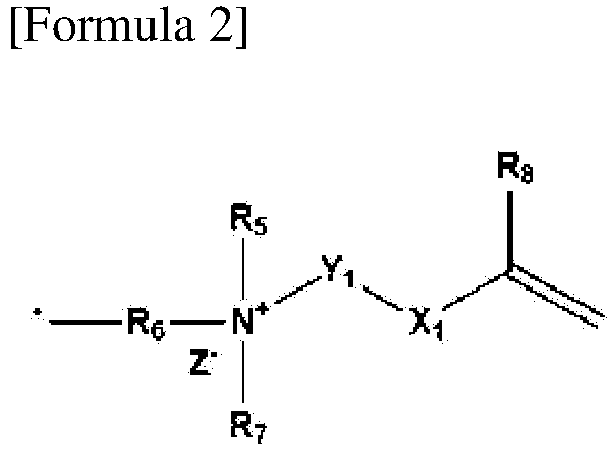
- In Formula 2, * is a site bonded with N+ in Formula 1, R6 is an alkylene group or an arylene group, R5 and R7 are each independently an alkyl group, an ester group- containing alkylalkanoate group or a benzyl group, Y1 is an alkylene group, X1 is an ester bond, an amide bond, a sulfonamide bond, a phosphoramide bond or an arylene group, R8 is hydrogen or an alkyl group, and Z- is an anion.
- Specifically, in Formula 1 above, R1 may be hydrogen or an alkyl group having 1 to 6 carbon atoms. In Formula 1 above, X may be an ester bond or an arylene group, and specifically, X may be an ester bond or a phenylene group. In Formula 1 above, Y may be an alkylene group having 1 to 20 carbon atoms. In Formula 1 above, R2 and R4 may be each independently an alkyl group having 1 to 30 carbon atoms, an ester group-containing alkyl alkanoate group having 1 to 30 carbon atoms or an aryl group, specifically may be an alkyl group having 1 to 30 carbon atoms or a benzyl group, and more specifically may be an alkyl group having 1 to 30 carbon atoms. In Formula 1 above, R3 may be an alkyl group having 1 to 30 carbon atoms, an ester group-containing alkyl alkanoate group having 1 to 30 carbon atoms, an aryl group or a functional group represented by Formula 2 above. Also, Z- in Formula 1 above may be Cl-, Br-, I-, CH3SO3 - or CH3CO2 -. R2 and R4 in Formula 1 may be each independently an alkyl group having 10 or more carbon atoms or 12 or more carbon atoms, and may be an alkyl group having 18 or less carbon atoms or 16 or less carbon atoms.
- In Formula 2 above, * may be a site bonded with N+ in Formula 1. In Formula 2 above, R6 may be an alkylene group having 1 to 30 carbon atoms. In Formula 2 above, R5 and R7 may be each independently an alkyl group having 1 to 30 carbon atoms, an ester group-containing alkyl alkanoate group having 1 to 30 carbon atoms or an aryl group, specifically may be an alkyl group having 1 to 30 carbon atoms or a benzyl group, and more specifically may be an alkyl group having 1 to 30 carbon atoms. R5 and R7 in Formula 2 may be each independently an alkyl group having 10 or more carbon atoms or 12 or more carbon atoms, and may be an alkyl group having 18 or less carbon atoms or 16 or less carbon atoms. In Formula 2 above, Y1 may be an alkylene group having 1 to 20 carbon atoms. In Formula 2 above, X1 may be an ester bond or an arylene group, and specifically may be an ester bond or a phenylene group. In Formula 2 above, R8 may be hydrogen or an alkyl group, specifically hydrogen or an alkyl group having 1 to 6 carbon atoms. In Formula 2 above, Z- may be Cl-, Br-, I-, CH3SO3 - or CH3CO2 -.
- The compound represented by Formula 1 above may be included in the polymerizable composition of the present application as a cationic surfactant and/or a crosslinkable monomer.
- When the compound represented by Formula 1 above is included as a crosslinkable monomer, the compound represented by Formula 1 above may be a compound represented by Formula 3 below:


- In Formula 3, R9 and R15 are each independently hydrogen or an alkyl group, X2 and X3 are each independently an ester bond, an amide bond, a sulfonamide bond, a phosphoramide bond or an arylene group, Y2 and Y3 are each independently an alkylene group, R10, R11, R13 and R14 are each independently hydrogen or an alkyl group, R12 is an alkylene group or an arylene group, and Z- is an anion.
- In Formula 3 above, R9 and R15 may be each independently hydrogen or an alkyl group having 1 to 6 carbon atoms. In Formula 3 above, X2 and X3 may be each independently an ester bond or an arylene group, and specifically may be an ester bond or a benzyl group. In Formula 3, Y2 and Y3 may be each independently an alkylene group having 1 to 20 carbon atoms. In Formula 3, R10, R11, R13 and R14 may be each independently hydrogen or an alkyl group having 1 to 6 carbon atoms. In Formula 3, R12 may be an alkylene group having 1 to 30 carbon atoms. In Formula 3, Z- may be Cl-, Br-, I-, CH3SO3 - or CH3CO2 -. R10, R11, R13 and R14 in Formula 3 may be each independently an alkyl group having 10 or more carbon atoms or 12 or more carbon atoms, and may be an alkyl group having 18 or less carbon atoms or 16 or less carbon atoms.
- When the polymerizable composition of the present application contains the compound of Formula 3 above as a crosslinkable monomer, the cationic group may be introduced on the surface of the polymer capsule derived from the composition. Specifically, the cationic group may be introduced on the surface of the capsule by chemical bonding. More specifically, the cationic group may be introduced on the surface of the capsule by covalent bonding.
- In addition to the cationic group, the compound of Formula 3 additionally includes two kinds of vinyl groups, so that the compound represented by Formula 3 above can crosslink the shell of the polymer capsule derived from the polymerizable composition. Also, the crosslinkable monomer of Formula 3 contains an alkyl group or a phenyl group, which is non-polar, simultaneously with an ammonium group (N+), which is a cation, whereby the polymer capsule derived from the polymerizable composition can have amphiphilicity. Furthermore, the compound represented by Formula 3 can make the polymer capsule to have amphiphilicity, and thus can also serve as a surfactant capable of forming emulsified particles during emulsion polymerization.
- In one example of the present application, the compound represented by Formula 3 can be represented by Formula 3-1 or 3-2 below:


- In Formulas 3-1 and 3-2 above, R1 may be hydrogen or an alkyl group having 1 to 6 carbon atoms or 1 to 4 carbon atoms, and Z- may be Cl-, Br-, I-, CH3SO3 - or CH3CO2 -.
- In Formula 3-1 above, n may be an integer of 1 to 28, 1 to 24, 2 to 20 or 2 to 16. In Formula 3-2 above, n may be an integer of 1 to 28, 1 to 24, 1 to 20, 2 to 16 or 2 to 12.
- When the compound represented by Formula 1 above is included as a cationic surfactant, the compound represented by Formula 1 above may be a compound represented by Formula 4 below:


- In Formula 4, R16 is hydrogen or an alkyl group, X4 is an ester bond, an amide bond, a sulfonamide bond, a phosphoramide bond or an arylene group, Y4 is an alkylene group, R17, R18 and R19 are each independently an alkyl group, an ester group-containing alkylalkanoate group or an aryl group, and Z- is an anion.
- Specifically, R16 in Formula 4 may be hydrogen or an alkyl group having 1 to 6 carbon atoms. In Formula 4, X4 may be an ester bond or an arylene group, and specifically may be an ester bond or a benzyl group. In Formula 4, Y4 may be an alkylene group having 1 to 20 carbon atoms. In Formula 4, R17, R18 and R19 may be each independently an alkyl group having 1 to 30 carbon atoms, an ester group-containing alkylalkanoate group having 1 to 30 carbon atoms or a benzyl group, and specifically may be an alkyl group having 1 to 30 carbon atoms or 8 to 20 carbon atoms. In Formula 4, Z- may be Cl-, Br-, I-, CH3SO3 - or CH3CO2 -. R17, R18 and R19 in Formula 4 may be each independently an alkyl group having 10 or more carbon atoms or 12 or more carbon atoms, and may be an alkyl group having 18 or less carbon atoms or 16 or less carbon atoms.
- When the compound represented by Formula 4 above is contained in the polymerizable composition as the cationic surfactant, the content of the cationic group imparted to the surface of the polymer capsule derived from the polymerizable composition can be increased and stability, fabric adhesion or the like of the polymer capsules can be improved
- An example of the compound represented by Formula 4 above may include compounds of Formulas 4-1 to 4-4 below:


- In Formulas 4-1 to 4-4 above, R1 may be hydrogen or an alkyl group having 1 to 6 carbon atoms or 1 to 4 carbon atoms, and Z- may be Cl-, Br-, I-, CH3SO3 - or CH3CO2 -. In Formulas 4-1 to 4-4 above, each n may be independently an integer of 1 to 28, 1 to 24 or 2 to 20.
- When the compound represented by Formula 1 above is included in the polymerizable composition as the crosslinkable monomer and the cationic surfactant, the polymerizable composition may comprise the compound represented by Formula 3 above and the compound represented by Formula 4. That is, when the compound represented by Formula 1 above is included in the polymerizable composition as the crosslinkable monomer and the cationic surfactant, the compound represented by Formula 1 above may comprise the compounds represented by Formula 3 and Formula 4 above.
- As long as a radical polymerizable monomer contained in the polymerizable composition of the present application is one capable of forming polymer capsules by polymerization with the compound represented by Formula 1 above, and specifically one capable of forming polymer capsules by polymerization with the crosslinkable monomer, which is a compound represented by Formula 3 above, and/or the cationic surfactant, which is a compound represented by Formula 4 above, it is not particularly limited. An example of the radical polymerizable monomer may include a (meth)acrylic acid ester compound, a (meth)acrylamide compound, a styrene compound, a vinyl ether compound, a vinyl ester compound, a (meth)acrylonitrile compound, and the like. Specifically, as the radical polymerizable polymer, a (meth)acrylic acid ester compound or a styrene compound can be used, without being limited thereto.
- The (meth)acrylic acid ester compound may be an alkyl (meth)acrylate having an alkyl group having 1 or more carbon atoms, where an alkyl (meth)acrylate having an alkyl group having 20 or less carbon atoms, 18 or less carbon atoms, 16 or less carbon atoms, 14 or less carbon atoms or 12 or less carbon atoms may be used. An examples of such a monomer may include methyl (meth)acrylate, ethyl (meth)acrylate, n-propyl (meth)acrylate, isopropyl (meth)acrylate, n-butyl (meth)acrylate, t-butyl (meth)acrylate, sec-butyl (meth)acrylate, pentyl (meth)acrylate, 2-ethylhexyl (meth)acrylate, 2-ethylbutyl (meth)acrylate, n-octyl (meth)acrylate, isobornyl (meth)acrylate, isooctyl (meth)acrylate, isononyl (meth)acrylate, lauryl (meth)acrylate, and the like.
- The styrene compound may be styrene or alkyl styrene. The alkylstyrene may be styrene to which an alkyl group having 1 to 8 carbon atoms, 1 to 6 carbon atoms or 1 to 4 carbon atoms is bonded. The alkylstyrene can be exemplified by a nuclear alkyl-substituted styrene such as p-methylstyrene, 2,4-dimethylstyrene or ethylstyrene; or α-alkyl-substituted styrene such as α-methylstyrene or α-methyl-p-methylstyrene, and the like, but is not limited thereto.
- The polymerizable composition may comprise the radical polymerizable monomer in an amount of 15 wt% to 85 wt%. Specifically, the polymerizable composition may comprise the radical polymerizable monomer in a content of 17 wt% or more, 19 wt% or more, 21 wt% or more, 23 wt% or more, 25 wt% or more, 27 wt% or more, 29 wt% or more, 31 wt% or more, 33 wt% or more, 35 wt% or more, or 37 wt% or more, and may comprise it in a content of 83 wt% or less, 81 wt% or less, 79 wt% or less, 77 wt% or less, 75 wt% or less, 73 wt% or less, 71 wt% or less, 69 wt% or less, 67 wt% or less, 65 wt% or less, 63 wt% or less, 61 wt% or less, 59 wt% or less, 57 wt% or less, 55 wt% or less, 53 wt% or less, 51 wt% or less, or 49 wt% or less. As the content of the radical polymerizable monomer contained in the polymerizable composition satisfies the above range, the polymer capsules can be effectively formed.
- When the polymerizable composition of the present application comprises the compound represented by Formula 3 above as the crosslinkable monomer, the polymerizable composition may comprise the compound represented by Formula 3 in a range of 0.1 parts by weight to 30 parts by weight per 100 parts by weight of the radical polymerizable monomer. Specifically, the polymerizable composition may comprise the compound represented by Formula 3 above in an amount of 0.5 part by weight or more, 0.75 part by weight or more, or 1 part by weight or more, and 10 parts by weight or less, 7.5 parts by weight or less, or 6 parts by weight or less, per 100 parts by weight of the radical polymerizable monomer.
- In addition, when the polymerizable composition comprises the compound represented by Formula 3 above as the crosslinkable monomer, the polymerizable composition may comprise the compound represented by Formula 3 in an amount of 0.1 wt% to 5 wt%. Specifically, the polymerizable composition may comprise the compound represented by Formula 3 in an amount of 0.2 wt% or more, 0.3 wt% or more, or 0.4 wt% or more, and may comprise it in a content of 4 wt% or less, 3 wt% or less, or 2.5 wt% or less.
- When the content of the compound of Formula 3 satisfies the above range, polymer capsules in which cationic groups are introduced on the surfaces through emulsion polymerization can be effectively produced, and polymer capsules containing an active substance such as a fragrance therein can be produced.
- When the polymerizable compound of the present application comprises the compound represented by Formula 4 above as the cationic surfactant, the polymerizable composition may comprise the compound represented by Formula 4 above in an amount of 1 part by weight to 30 parts by weight per100 parts by weight of the radical polymerizable monomer. Specifically, the polymerizable composition may comprise the compound represented by Formula 4 above in an amount of 1 part by weight or more, 2 parts by weight or more, 3 parts by weight or more, 4 parts by weight or more, or 5 parts by weight or more, and 30 parts by weight or less, 29 parts by weight or less, 28 parts by weight or less, 27 parts by weight or less, 26 parts by weight or less, or 25 parts by weight or less, per 100 parts by weight of the radical polymerizable monomer.
- In addition, the polymerizable composition may comprise the compound represented by Formula 4 above in an amount of 0.5 wt% to 10 wt%. Specifically, the polymerizable composition may comprise the compound represented by Formula 4 above in an amount of 1 wt% or more, 1.5 wt% or more, 2 wt% or more, and may comprise it an amount of 9.5 wt% or less, 9 wt% or less, or 8 wt% or less. When the content of the compound represented by Formula 4 above is included in the polymerizable composition to satisfy the above range, an effective component such as a fragrance can be effectively supported inside the polymer capsules formed from the polymerizable composition of the present application.
- The polymerizable composition of the present application may further comprise a second crosslinkable monomer and/or a second ionic surfactant, in addition to the above-described compound and the radical polymerizable monomer.
- The second crosslinkable monomer is not particularly limited as long as it is a compound having two or more unsaturated vinyl groups in one molecule and is capable of inducing the crosslinking structure of the polymer during polymerization. For example, the second crosslinkable monomer may include ethylene glycol di(meth)acrylate, diethylene glycol di(meth)acrylate, 1,6-hexyl di(meth)acrylate, divinylbenzene, trimethylolpropane tri(meth)acrylate, pentaerythritol tetra(meth)acrylate or the like, but is limited thereto.
- The second crosslinkable monomer may be contained in the polymerizable composition in an amount of 0.1 wt% to 5 wt%. In addition, when the compound represented by Formula 3 above and the second crosslinkable monomer are simultaneously contained in the polymerizable composition, the sum of the used amounts of the compound represented by Formula 3) and the second crosslinking monomer may be in a range of 0.2 wt% to 10 wt% per the polymerizable composition.
- The second ionic surfactant may comprise one or more selected from cationic surfactants for general fabric softeners, and the kind thereof is not particularly limited. For example, the second ionic surfactant may comprise one or more selected from the group consisting of diester ammonium methosulfate, imidazoline ammonium methosulfate, cetyltrimethylammonium chloride, dipalmitoylethylhydroxyethylammonium methosulfate, behentrimonium chloride, steatrimonium chloride, cetrimonium bromide, behentrimonium methosulfate and stearamidopropyldimethylamine.
- The second ionic surfactant may be included in the polymerizable composition in an amount of 0.1 wt% to 5 wt%. In addition, when the compound represented by Formula 4 above and the second ionic surfactant are simultaneously contained in the polymerizable composition, the sum of the used amounts of the compound represented by Formula 4 and the second ionic surfactant may be in a range of 0.2 wt% to 10 wt% per the polymerizable composition.
- The polymerizable composition of the present application may further comprise a radical initiator. Specifically, the radical initiator may be a photopolymerization initiator or a thermal polymerization initiator, and more specifically, may be a thermal polymerization initiator. The thermal polymerization initiator is not particularly limited as long as it is a substance which is decomposed by heat to generate a radical and is capable of initiating polymerization of a vinyl compound. As the thermal polymerization initiator, for example, a known substance such as an azo-based compound or an organic peroxide may be used, and it may include, for example, at least one of azobisisobutyronitrile, azobiscyanovaleric acid, 2,2'-azobis-(2,4-dimethyl)valeronitrile, dilauryl peroxide, tertiary butyl peroxide and diisopropyl peroxydicarbonate, but is not limited thereto.
- The polymerizable composition may comprise the radical initiator in an amount of 0.5 parts by weight to 5 parts by weight per 100 parts by weight of the radical polymerizable monomer. Specifically, the polymerizable composition may comprise the radical initiator in an amount of 0.75 parts by weight or more, or 1 part by weight or more, and 3 parts by weight or less, or 1.5 parts by weight or less, per 100 parts by weight of the radical polymerizable monomer.
- The polymerizable composition of the present application may comprise the radical initiator in an amount of 0.1 wt% or more and 1 wt% or less. Specifically, the polymerizable composition may comprise the radical initiator in an amount of 0.2 wt% or more, 0.3 wt% or more, or 0.4 wt% or more, and may comprise it in an amount of 0.9 wt% or less, 0.8 wt% or less, 0.7 wt% or less, 0.6 wt% or less, or 0.5 wt% or less. When the content of the radical initiator is adjusted to the above range, the yield of the polymerization reaction is sufficiently high, so that it is possible to form rigid polymer capsules.
- The polymerizable composition may further comprise a fragrance. Specifically, as the polymerizable composition further comprises a fragrance, when it is polymerized to form polymer capsules, the fragmace can be supported inside the polymer capsules.
- A specific example of the fragrance that can be included in the polymerizable composition of the present application may include one or more selected from the group consisting of benzylisoeugenol, dimethyl anthranilate (2-methyl-aminomethyl benzoate), cetyl acetate, 5-(2-methylene-6,6-dimethylcyclohexyl)-4-penten-3-one, 2-methyl-4-(2,2,3-trimethyl-3-1-yl)-2-buten-1-ol), tricyclodecylpropyl oleate, tricyclodecyl acetate, α-hexylcinnamic aldehyde, 3a,6,6,9a-tetramethyldodecahydronaphtho[2,1-b]furan, methyl-3-(trimethyl-2,2,3-cyclopenten-3-yl)-5-pentanol-2, 2,6-dinitro-3,4,5-trimethyl-tert-butyl benzene, 2-acetyl-1,2,3,4,5,6,7,8-octahydro-2,3,8,8-tetramethylnaphthalene, p-tert-butyl-α-methylhydrocinnamic aldehyde, trichloromethylphenylvinyl acetate, β-naphthol methyl ether, acetyl cetylene, anisyl acetone (p-methoxyphenyl butanone), 4-(4-hydroxy-4-methylpentyl-3-cyclohexen-1-carboxy aldehyde, a terpene-based alcohol having 10 to 15 carbon atoms, and an aromatic alcohol having 7 to 15 carbon atoms. However, the type of the fragrance is not particularly limited, which may be selected from fragrances known in the art which can be applied to fabric softeners.
- The polymerizable composition may comprise the fragrance in an amount of 15 parts by weight to 75 parts by weight per 100 parts by weight of the radical polymerizable monomer. Specifically, the polymerizable composition may comprise the fragrance in an amount of 17 parts by weight or more, 19 parts by weight or more, 21 parts by weight or more, 22 parts by weight or more, 23 parts by weight or more, 24 parts by weight or more, or 25 parts by weight or more, and 70 parts by weight or less, 65 parts by weight or less, 60 parts by weight or less, or 55 parts by weight or less, per 100 parts by weight of the radical polymerizable monomer.
- The polymerizable composition may comprise the fragrance in an amount of 5 wt% to 30 wt%. Specifically, the polymerizable composition may comprise the fragrance in an amount of 9 wt% or more, or 12 wt% or more, and may comprise it in an amount of 25 wt% or less, or 20 wt% or less.
- Within the above-described content of the fragrance, the polymer capsules derived from the polymerizable composition sufficiently collect the fragrance, whereby sufficient aroma transmission force can be ensured. In addition, the polymer capsules can be stably polymerized within the above-described content range of the fragrance.
- The polymerizable composition of the present application may further comprise an aqueous solvent, specifically water, in order to form polymer capsules more effectively. The polymer capsules of the present application can be formed by emulsion polymerization of the components contained in the polymerizable composition. Accordingly, when the polymerizable composition comprises an aqueous solvent, the cationic surfactant contained in the polymerizable composition can smoothly flocculate, so that the polymer capsules can be formed into the form of particles, as described below. In addition, the content of the aqueous solvent is not particularly limited, which may be 100 parts by weight to 500 parts by weight, specifically 150 parts by weight or more, 200 parts by weight or more, or 240 parts by weight or more, and may be 450 parts by weight or less, 400 parts by weight or less, 350 parts by weight or less, 300 parts by weight or less, or 250 parts by weight or less, per 100 parts by weight of the polymerizable composition excluding the aqueous solvent.
- The present application also relates to polymer capsules.
- The polymer capsules of the present application comprises a shell material containing a unit of the compound represented by Formula 1 above and a unit of the polymerizable monomer. In the present application, the unit of a certain compound or a certain monomer may mean a form in which the compound or monomer undergoes polymerization to form a skeleton of the polymer, for example, a main chain or a side chain.
- The polymer capsules may be formed from the above-described polymerizable composition, and specifically may be a reaction product of the polymerizable composition, more specifically, may be a polymer of the polymerizable composition, and most specifically, may be an emulsion polymer of the polymerizable composition.
- The details of the cationic surfactant; the radical polymerizable monomer; and the compound of Formula 1 below are the same as those described above, and thus their details will be omitted. In addition, when the compound of Formula 1 is contained in the polymerizable composition in the form of Formula 3 and/or Formula 4 above, the shell material may comprise the unit represented by Formula 3 above and/or Formula 4 above.
- The shell material may comprise a reaction product of the polymerizable composition as a main component. In this specification, the fact that a certain component comprises any other component as a main component means that it may comprise any other component in an amount of 55 wt% or more, 60 wt% or more, 65 wt% or more, 70 wt% or more, 75 wt% or more, 80 wt% or more, 85 wt% or more, or 90 wt% or more, relative to the total weight of a certain component, where the upper limit thereof is not particularly limited, but may be, for example, about 98 wt% or less, or 95 wt% or less.
- The polymer capsule may be one that a cation exists on the surface thereof, and specifically, the polymer capsule may be one that a cationic group is introduced on the surface by chemical bonding. That is, the polymer capsules of the present application may be cationic polymer capsules.
- Also, the cation group may be a quaternary ammonium group. That is, the polymer capsules may be those that cations derived from the crosslinkable monomer represented by Formula 1, specifically Formula 3 and/or the ionic surfactant represented by Formula 4 are present on the surfaces. This can improve adhesion to fibers and the like.
- Furthermore, when the polymerizable composition further comprises a fragrance, the polymer capsule prepared therefrom may further comprise the fragrance supported therein as well. Since the fragrance is the same as that contained in the polymerizable composition, the detail thereof will be omitted.
- The shape of the polymer capsules of the present application is not particularly limited, but may be, for example, a particle shape. When the shape of the polymer capsules of the present application is a particle type, the particle diameter of the particles may be in a range of 50 nm to 750 nm. In this specification, the term particle diameter may mean particle diameter, and the particle diameter may be a Z-average value of diameters of polymer capsules measured by a dynamic light scattering method after diluting the polymer capsules with 1% aqueous solution.
- Specifically, the particle diameter of the polymer capsules may be 60 nm or more, 70 nm or more, 80 nm or more, 90 nm or more, or 100 nm or more, and may be 740 nm or less, 730 nm or less, 720 nm or less, 710 nm or less, 700 nm or less, 690 nm or less, 680 nm or less, or 670 nm or less.
- The present application relates to a method for producing polymer capsules.
- The method for producing polymer capsules of the present application may comprise a step of emulsion-polymerizing the polymerizable composition. For example, in order to prepare the polymer capsules of the present application, oil-in-water type emulsion polymerization can be preferably applied. A pre-emulsion is prepared by adding the compound of Formula 1 as described above to the water from which the ionic components are removed and applying strong shear force thereto, and a mixture of the surfactant, the radical polymerizable monomer and the fragrance as described above is introduced thereto to form emulsified liquid droplets. Thereafter, the polymer capsules can be prepared by removing oxygen through nitrogen purging, heating the reactant to an appropriate reaction temperature, and then introducing a thermal polymerization initiator as a radical initiator.
- The present application also relates to a fabric softener composition comprising the above polymer capsules, or polymer capsules prepared as above.
- The fabric softener composition of the present application may comprise the polymer capsules in a content of 30 wt% or more, 35 wt% or more, 40 wt% or more, 45 wt% or more, or 50 wt% or more and a content of 80 wt% or less, 75 wt% or less, 70 wt% or less, 65 wt% or less, 60 wt% or less, 55 wt% or less, or 50 wt% or less, per the total weight of the fabric softener composition. The content of the polymer capsules in the fabric softener composition may be measured based on the solid content of the polymer capsules.
- The fabric softener composition of the present application may further comprise a cationic softening component and/or an emulsion stabilizing agent.
- The cationic softening component is for imparting soft texture to the fibers, and for example, a cationic surfactant can be used. The cationic surfactant may be the same as or different from the above-mentioned cationic surfactant, which may be exemplified by diester ammonium methosulfate, imidazoline ammonium methosulfate, cetyltrimethylammonium chloride, dipalmitoylethylhydroxyethylammonium methosulfate, behentrimonium chloride, steatrimonium chloride, cetrimonium bromide, behentrimonium methosulfate or stearamidopropyldimethylamine, and the like, but is not limited thereto. The cationic softening component may be included in a ratio of 10 wt% to 99 wt% per the total fabric softener composition, but is not limited thereto.
- As the emulsion stabilizing agent, a nonionic surfactant or an amphoteric surfactant can be used. An example of the nonionic surfactants may include polyoxyethylene alkyl or alkenyl ethers and alkyl phenyl ethers, polyoxyethylene alkyl or alkenyl esters and hydroxy fatty acid esters, sorbitan fatty acid alkyl esters and their ethylene oxide adducts, polyoxyethylene alkyl or alkenyl amine, or glyceryl monoalkyl and alkenyl esters, having 10 to 20 carbon atoms, and the like, and an example of the amphoteric surfactant may include alkyldimethyl betaine, alkyldimethylhydroxyethyl or alkyldimethylhydroxypropyl betaine, having 8 to 22 carbon atoms, or lecithin, and the like, without being limited thereto. These surfactants are suitably used alone or in a mixture of two or more thereof in an amount of 5 to 40 wt% relative to the content of the cationic softening component. Stability of the product and adsorption of the cationic softening component to clothes can be smoothly achieved within the range of the emulsion stabilizing agent, and accordingly the softening effect can be improved.
- The fabric softener composition according to the present application may also comprise an organic dispersion stabilizer or an inorganic dispersion stabilizer. As the suitable organic or inorganic dispersion stabilizer, an organic compound such as a lower alcohol or glycol of less than C8, a higher alcohol of C14 or more and urea, and an inorganic compound such as magnesium chloride, sodium chloride, calcium chloride and sodium nitrate, and the like may be used alone or in a mixture of two or more thereof, but preferably, ethanol, isopropyl alcohol, methyl alcohol, ethylene glycol, propylene glycol, hexylene glycol, cetyl alcohol, stearyl alcohol, magnesium chloride, sodium chloride, calcium chloride, sodium nitrate, and the like may be used alone or in a mixture of two or more thereof. The dispersion stabilizer may be contained in a ratio of 0.01 wt% to 10 wt% per the entire fiber softener composition, but is not limited thereto.
- Besides, preservatives, fungicides, pigments, antioxidants, antifoaming agents, and the like, which are used as additives for a general fabric softener, can be added in a small amount of less than 3 wt% per the entire fabric softener composition in the range without affecting the product stability.
- The present application can provide a polymerizable composition capable of effectively encapsulating a fragrance material and chemically bonding a cationic group to the surface thereof to enhance adhesion to fibers.
- In addition, since the polymer capsules according to the present invention can minimize the amount of the fragrance discharged without being attached to the fibers during washing, sufficient aromas can be provided even if a small amount of fragrance is used.
- Hereinafter, the present application will be described with reference to examples. However, the following examples are provided to illustrate the present application and the scope of the present application is not limited to the following examples.
- Compounds obtained in Preparation Examples were mixed in a solvent for NMR measurement (DMSO-D6, dimethyl sulfoxide-d6, Cambridge Isotope Laboratories) to prepare a sample having a concentration of about 10 mg/mL. NMR analysis of the sample was performed using a magnetic resonance apparatus (Varian Unity Inova 500 MHz).
- The particle diameter of the polymer capsules was measured at a temperature of 25°C using a Zetasizer 3000 from Malvern after dispersing the polymer capsules in water to have a concentration of 0.1 wt%.
- A commercially available 100% cotton towel was washed and dewatered 5 times using a general laundry detergent in a standard usage with a washing machine, and then rinsed with each of fabric softener compositions according to Examples and Comparative Examples. The fabric softening agent was dissolved in water at 25°C as a standard usage and used. The cotton towel was subjected to softening treatment in rinsing water (25°C) and then dewatered, and conditioned at 20°C and 65% relative humidity conditions for 24 hours. After conditioning, the aroma intensity was given as a score from a minimum of 1 point to a maximum of 5 points by an organoleptic evaluation test of skilled panelists (subjects), and the lingering aroma effect was quantified as a mean value of three times. Other test conditions are based on the test method in EL306 (fabric softener) among eco-label certification criteria of the Korea Environmental Industry & Technology Institute. As a result of the evaluation, when the score of the quantified lingering aroma effect was 4.5 points or more, it was evaluated as "very good (⊚)"; when the score was 3.5 points or more and less than 4.5 points, it was evaluated as "good (O)"; when the score was 2.5 points or more and less than 3.5 points, it was evaluated as "normal (Δ)"; and when the score was less than 2.5 points, it was evaluated as "poor (X)."
- 57 g of 2-(N,N-dimethylamino)ethyl methacrylate, 50 g of 1,12-dibromododecane and 250 g of a mixed solvent (methanol: acetonitrile mixed in a mass ratio of 3:7) were placed in a 500 mL round bottom flask, stirred at 50°C for 24 hours and reacted. As a result of performing NMR analysis of the reaction product, it was confirmed that the N-CH3 peak near 2.5 ppm was shifted to near 3.5 ppm, whereby it contained an N+-CH3 cation as in Formula A below. After the reaction, the resulting precipitate was removed with a vacuum filter, washed with acetone, and then dried to obtain a crosslinkable monomer XL1 of Formula A below:

- In Formula A, R1 is a methyl group, R2 is an ethylene group, Z- is a bromine ion, and n is 10.
- 6.07 (2H, vinyl), 5.76 (2H, vinyl), 4.51 (4H, CO2CH2C), 3.71 (4H, CCH2N+), 3.37 (4H, N+CH2C), 3.09 (12H, N+CH3), 1.90 (6H, C=C-CH3), 1.66 (4H, N+CCH2), 1.26 (16H, CCH2C)
- 35 g of N,N,N',N'-tetramethyl-1,6-hexanediamine, 74 g of 4-vinylbenzyl chloride and 250 g of a mixed solvent (methanol: acetonitrile mixed in a mass ratio of 3 to 7) were placed in a 500 mL round bottom flask, stirred at 50°C for 24 hours and reacted. As a result of performing NMR analysis of the reaction product, it was confirmed that the N-CH3 peak near 2.5 ppm was shifted to near 3.5 ppm, whereby it contained an N+-CH3 cation as in Formula A below. After the reaction, the resulting precipitate was removed with a vacuum filter, washed with acetone, and then dried to obtain a crosslinkable monomer XL2 of Formula B below.

- In Formula B, R1 is hydrogen, R2 is a methylene group, Z- is a chlorine ion, and n is 4.
- 7.60 (4H, aromatic), 7.11 (4H, aromatic), 6.72 (2H, vinyl), 5.76 (2H, vinyl), 5.25 (2H, vinyl), 4.50 (4H, Phenyl-CH2-N+), 3.38 (4H, N+CH2C), 3.10 (12H, N+CH3), 1.76 (4H, N+CCH2), 1.30 (4H, CCH2C)
- 34 g of 2-(N,N-dimethylamino)ethyl methacrylate and 250 g of acetone were placed in a 500 mL round bottom flask and stirred, and 70 g of 1-bromohexadecane was slowly added in drops. After the introduction was completed, the reaction mixture was stirred at 35°C for 48 hours and reacted. The precipitate generated after the reaction was removed with a vacuum filter, washed with hexane and then dried to obtain a cationic surfactant S1 of Formula C below.


- In Formula C, R1 is a methyl group, R2 is an alkyl group having 16 carbon atoms, and Z- is a bromine ion.
- 6.16 (1H, vinyl), 5.69 (1H, vinyl), 4.66 (2H, CO2CH2C), 4.19 (2H, CCH2N+), 3.62 (2H, N+CH2C), 3.52 (6H, N+CH3), 1.96 (3H, C=C-CH3), 1.76 (2H, N+CCH2), 1.26 (26H, CCH2C), 0.89 (3H, CCH3)
- 53 g of N,N-dimethyldodecylamine and 250 g of acetone were placed in a 500 mL round bottom flask and stirred, and 40 g of 4-vinylbenzyl chloride was slowly added in drops thereto. After the introduction was completed, the reaction mixture was stirred at 35°C for 48 hours and reacted. After the reaction, the resulting precipitate was removed with a vacuum filter, washed with hexane and then dried to obtain a cationic surfactant S2 of Formula D below.


- In Formula D, R1 is a hydrogen atom, R2 is an alkyl group having 12 carbon atoms, and Z- is a chlorine ion.
- 7.59 (2H, aromatic), 7.11 (2H, aromatic), 6.71 (1H, vinyl), 5.76 (1H, vinyl), 5.26 (1H, vinyl), 4.48 (2H, phenyl-CH2-N+), 3.35 (2H, N+CH2C), 3.12 (6H, N+CH3), 1.76 (2H, N+CCH2), 1.30 (18H, CCH2C), 0.90 (3H, CCH3)
- 2 g of cetrimonium bromide (CTAB) and 266 g of distilled water were placed in a 500 mL round bottom flask and stirred at 600 rpm for 30 minutes. A mixed liquid of 38 g of methyl methacrylate (MMA), 2 g of the crosslinkable monomer XL1 in Preparation Example 1, and 20 g of Comely 450 from IFF Co., Ltd. as a fragrance was introduced thereto, and then the reactor was sealed. The mixture was purged with nitrogen for 30 minutes with stirring to remove dissolved oxygen. After the reaction mixture was heated to a temperature of 60°C, 0.4 g of sodium persulfate (SPS) was introduced as a thermal polymerization initiator and after the reaction was performed for 5 hours, the reaction was completed to prepare the polymer capsules C1.
- 2 g of cetrimonium bromide (CTAB) and 266 g of distilled water were placed in a 500 mL round bottom flask and stirred at 600 rpm for 30 minutes. A mixed liquid of 38 g of styrene (ST), 2 g of the crosslinkable monomer XL2 in Preparation Example 2, and 20 g of Comely 450 from IFF Co., Ltd. as a fragrance were introduced thereto, and then the reactor was sealed. The mixture was purged with nitrogen for 30 minutes with stirring to remove dissolved oxygen. After the reaction mixture was heated to a temperature of 60°C, 0.4 g of sodium persulfate (SPS) was introduced as a thermal polymerization initiator and after the reaction was performed for 5 hours, the reaction was completed to prepare the polymer capsules C2.
- The polymer capsules were prepared in the same method as the polymerization method shown in Preparation Example 5 and Preparation Example 6, except that the employed materials and their contents were adjusted as shown in Tables 1 to 3 below.
- The polymer capsules were prepared in the same manner as in Preparation Example 5, except that a nonionic crosslinkable monomer, ethylene glycol dimethacrylate (EGDMA), was used instead of XL1 in Preparation Example 1 as the crosslinkable monomer, and the results were shown in Table 3 below.
- The polymer capsules were prepared in the same manner as in Preparation Example 5, except that 2 g of a nonionic surfactant, Brij® L23 (Sigma Aldrich) was used as the surfactant, and a nonionic crosslinkable monomer, ethylene glycol dimethacrylate (EGDMA), was used instead of XL1 in Preparation Example 1 as the crosslinkable monomer, and the results were shown in Table 3 below.
[Table 1] C1 C2 C3 C4 C5 Surfactant Type CTAB CTAB CTAB CTAB CTAB Content 2 2 2 2 2 Radical polymerizable monomer Type MMA ST MMA MMA ST Content 38 38 47.5 39.6 47.5 Crosslinkable monomer Type XL1 XL2 XL1 XL1 XL2 Content 2 2 2.5 0.4 2.5 Fragrance Type Comely 450 Comely 450 Comely 450 Comely 450 Comely 450 Content 20 20 12 20 12 Thermal polymerization initiator Type SPS SPS SPS SPS SPS Content 0.4 0.4 0.5 0.4 0.5 Water 248 248 248 248 248 Particle diameter (nm) 560 370 140 640 110 CTAB: cetrimonium bromide, MMA: methyl methacrylate, ST: stylene, EGDMA: ethylene glycol dimethacrylate, SPS: sodium persulfate, Content unit: weight (g) [Table 2] C6 C7 C8 C9 C10 Surfactant Type S1 S2 S1 S1 S2 Content 2 2 2 2 2 Radical polymerizable monomer Type MMA ST MMA MMA MMA Content 38 38 47.5 39.6 38 Crosslinkable monomer Type EGDMA DVB EGDMA EGDMA EGDMA Content 2 2 2.5 0.4 2 Fragrance Type Comely 450 Comely 450 Comely 450 Comely 450 Comely 450 Content 20 20 12 20 20 Thermal polymerization initiator Type SPS SPS SPS SPS SPS Content 0.4 0.4 0.5 0.4 0.5 Water 248 248 248 248 248 Particle diameter (nm) 670 440 65 870 710 CTAB: cetrimonium bromide, MMA: methyl methacrylate, ST: stylene, DVB: divinylbenzene, EGDMA: ethylene glycol dimethacrylate, SPS: sodium persulfate, Content unit: weight (g) [Table 3] C11 C12 C13 C14 B1 B2 Surfactant Type S1 S1 S1 S1 CTAB Brij® L23 Content 8 8 4 2 2 2 Radical polymerizable monomer Type MMA MMA MMA MMA MMA MMA Content 38 39.6 38 38 38 38 Crosslinkable monomer Type XL1 XL1 XL1 XL1 EGDMA EGDMA Content 2 0.4 2 2 2 2 Fragrance Type Comely 450 Comely 450 Comely 450 Comely 450 Comely 450 Comely 450 Content 20 20 20 20 20 20 Thermal polymerization initiator Type SPS SPS SPS SPS SPS SPS Content 0.4 0.4 0.4 0.4 0.4 0.4 Water 242 242 246 248 248 248 Particle diameter (nm) 250 100 670 210 450 710 CTAB: cetrimonium bromide, MMA: methyl methacrylate, ST: stylene, EGDMA: ethylene glycol methacrylate, SPS: sodium persulfate, Content unit: weight (g) - A fabric softener composition was prepared using the polymer capsules C1 of Preparation Example 1. Specifically, the polymer capsules C1 of Preparation Example 1 were mixed with diester ammonium methosulfate, polyoxyethylene alkyl ether, ethylene glycol and additives (dye, preservative, antioxidant, defoamer, etc.) in the ratios of Table 4 below to prepare a fabric softener. The residual amount of water means purified water added so that the sum of all components is 100.
- Fabric softener compositions were prepared in the same manner as in Example 1, except that the kinds and contents of the polymer capsules were adjusted as shown in Tables 4 and 5 below.
- The non-encapsulated commercial fragrance Comely 450 (IFF), and diester ammonium methosulfate, polyoxyethylene alkyl ether, ethylene glycol and additives (dye, preservative, antioxidant, defoamer, etc.) were adopted in the composition of Table 5 below to prepare a fabric softener composition.
- A fabric softener composition was prepared in the same manner as in Example 1, except that the polymer capsules B1 of Preparation Example 14 were used.
- A fabric softener composition was prepared in the same manner as in Example 1, except that the polymer capsules B2 of Preparation Example 15 were used.
- The constituents of the fabric softener compositions according to Examples and Comparative Examples, their contents and their lingering aroma effect evaluation results were described in Tables 4 to 6 below.
[Table 4] Example 1 2 3 4 5 6 Polymer capsules Type C1 C2 C3 C4 C5 C6 Content* 4.7 (0.3) 4.7 (0.3) 7.9 (0.3) 4.7 (0.3) 7.9 (0.3) 4.7 (0.3) Surfactant 5 5 5 5 5 5 Emulsion stabilizing agent 0.5 0.5 0.5 0.5 0.5 0.5 Dispersion stabilizer 0.05 0.05 0.05 0.05 0.05 0.05 Others** suitable amount suitable amount suitable amount suitable amount suitable amount suitable amount Water residual amount residual amount residual amount residual amount residual amount residual amount Lingering aroma effect ⊚ ⊚ ⊚ ⊚ ⊚ ⊚ Surfactant: diester ammonium mehosulfate, Emulsion stabilizing agent: polyoxyethylene alkyl ether, Dispersion stabilizer: ethylene glycol, Not-encapsulated Fragrance: Comely 450 (IFF Co., Ltd.), Content unit: part by weight (g), Content* of polymer capsules: g number of capsule emulsion, where number in parentheses is the content (g) of the supported fragrance, **Others: to represent small amounts of additives such as pigments, antiseptics, antioxidants and defoamers [Table 5] Example 7 8 9 10 11 12 Polymer capsules Type C7 C8 C9 C10 C11 C12 Content* 4.7 (0.3) 7.9 (0.3) 4.7 (0.3) 7.9 (0.3) 4.7 (0.3) 4.7 (0.3) Surfactant 5 5 5 5 5 5 Emulsion stabilizing agent 0.5 0.5 0.5 0.5 0.5 0.5 Dispersion stabilizer 0.05 0.05 0.05 0.05 0.05 0.05 Others** suitable amount suitable amount suitable amount suitable amount suitable amount suitable amount Water residual amount residual amount residual amount residual amount residual amount residual amount Lingering aroma effect ⊚ ⊚ ⊚ ⊚ ⊚ ⊚ Surfactant: diester ammonium mehosulfate, Emulsion stabilizing agent: polyoxyethylene alkyl ether Dispersion stabilizer: ethylene glycol, Not-encapsulated Fragrance: Comely 450 (IFF Co., Ltd.), Content unit: part by weight (g), Content* of polymer capsules: g number of capsule emulsion, where number in parentheses is the content (g) of the supported fragrance, **Others: to represent small amounts of additives such as pigments, antiseptics, antioxidants and defoamers [Table 6] Example Comparative Example 13 14 1 2 3 Polymer capsules Type C13 C14 B1 B2 Content* 4.7 (0.3) 4.7 (0.3) 4.7 (0.3) 4.7 (0.3) Not-encapsulated fragrance 0.3 Surfactant 5 5 5 5 5 Emulsion stabilizing agent 0.5 0.5 0.5 0.5 0.5 Dispersion stabilizer 0.05 0.05 0.05 0.05 0.05 Others suitable amount suitable amount suitable amount suitable amount suitable amount Water residual amount residual amount residual amount residual amount residual amount Lingering aroma effect ⊚ ⊚ Δ Δ Δ - As can be seen from Tables 4 to 6 above, it can be confirmed that the fabric softener compositions according to Examples 1 to 14 using the compounds of the present application show excellent lingering aroma effect. On the other hand, despite the use of the same fragrance, it can be seen that the fabric softener compositions using only the non-encapsulated fragrance show slight lingering aroma effect. Also, it can be confirmed that the fabric softeners in accordance with Comparative Example 2 and Comparative Example 3 without using the compounds of the present application show slight lingering aroma effect. Accordingly, it can be seen that the fabric softener compositions comprising the polymer capsules prepared from the polymerizable composition of the present application show excellent lingering aroma effect.
Claims (15)
- A polymerizable composition comprising a compound represented by Formula 1 below and a polymerizable monomer:

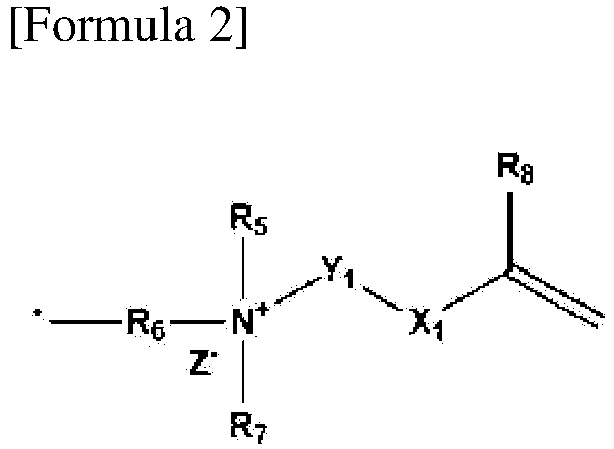
- The polymerizable composition according to claim 1, wherein the compound represented by Formula 1 is a compound represented by Formula 3 below:

- The polymerizable composition according to Claim 2, wherein X2 and X3 in Formula 3 are each independently an ester bond or an arylene group, and R12 is an alkylene group having 2 to 12 carbon atoms.
- The polymerizable composition according to claim 1, wherein the compound represented by Formula 1 is represented by Formula 4 below:

- The polymerizable composition according to claim 4, wherein X4 in Formula 4 is an ester bond or an arylene group, and R17, R18 and R19 are each independently an alkyl group having 8 to 20 carbon atoms.
- The polymerizable composition according to claim 1, wherein the compound of Formula 1 comprises compounds represented by Formula 3 and Formula 4 below:


- The polymerizable composition according to claim 1, wherein the polymerizable composition comprises a radical polymerizable monomer in an amount of 15 wt% to 85 wt%.
- The polymerizable composition according to claim 2, wherein the polymerizable composition comprises the compound represented by Formula 3 in an amount of 0.1 parts by weight to 15 parts by weight per 100 parts by weight of the radical polymerizable monomer.
- The polymerizable composition according to claim 4, wherein the polymerizable composition comprises the compound represented by Formula 4 in an amount of 1 part by weight to 30 parts by weight per 100 parts by weight of the radical polymerizable monomer.
- The polymerizable composition according to claim 1, further comprising a fragrance.
- The polymerizable composition according to claim 10, wherein the polymerizable composition comprises the fragrance in an amount of 15 parts by weight to 75 parts by weight per 100 parts by weight of the radical polymerizable monomer.
- Polymer capsules comprising a shell material containing a unit of a compound represented by Formula 1 below and a unit of a polymerizable monomer:


- The polymer capsules according to claim 12, wherein cations derived from the compound represented by Formula 1 are present on the surfaces.
- The polymer capsules according to claim 12, further comprising a fragrance supported therein.
- A fabric softener composition comprising the polymer capsules of claim 12.
Applications Claiming Priority (3)
| Application Number | Priority Date | Filing Date | Title |
|---|---|---|---|
| KR20170118725 | 2017-09-15 | ||
| KR20170118724 | 2017-09-15 | ||
| PCT/KR2018/010844 WO2019054797A1 (en) | 2017-09-15 | 2018-09-14 | POLYMERIC COMPOSITION, POLYMERIC CAPSULE AND TEXTILE SOFTENING COMPOSITION COMPRISING THE SAME |
Publications (3)
| Publication Number | Publication Date |
|---|---|
| EP3680289A1 true EP3680289A1 (en) | 2020-07-15 |
| EP3680289A4 EP3680289A4 (en) | 2020-11-11 |
| EP3680289B1 EP3680289B1 (en) | 2022-06-15 |
Family
ID=65723007
Family Applications (1)
| Application Number | Title | Priority Date | Filing Date |
|---|---|---|---|
| EP18857309.1A Active EP3680289B1 (en) | 2017-09-15 | 2018-09-14 | Polymeric composition, polymer capsule, and fabric softener composition including same |
Country Status (6)
| Country | Link |
|---|---|
| US (1) | US11214759B2 (en) |
| EP (1) | EP3680289B1 (en) |
| JP (1) | JP7025091B2 (en) |
| KR (1) | KR102159515B1 (en) |
| CN (1) | CN111065673B (en) |
| WO (1) | WO2019054797A1 (en) |
Families Citing this family (3)
| Publication number | Priority date | Publication date | Assignee | Title |
|---|---|---|---|---|
| CN114672053A (en) * | 2022-03-11 | 2022-06-28 | 山东大学 | Method for preparing anion exchange membrane based on ternary liquid crystal system |
| CN114941196A (en) * | 2022-03-30 | 2022-08-26 | 绍兴市劲松针纺有限公司 | Aromatic fabric production process |
| CN119490613B (en) * | 2024-10-23 | 2025-11-11 | 山东大学 | Nitrogen-containing polyion liquid and preparation method and application thereof |
Family Cites Families (26)
| Publication number | Priority date | Publication date | Assignee | Title |
|---|---|---|---|---|
| US4017440A (en) * | 1973-10-10 | 1977-04-12 | Rohm And Haas Company | Polymers stabilized with polymerizable vinylbenzyltrialkyl ammonium salt surfactant |
| JPS5316265Y2 (en) | 1973-10-18 | 1978-04-28 | ||
| JP3989054B2 (en) * | 1996-07-29 | 2007-10-10 | 株式会社メニコン | Cleaning material for contact lenses |
| DE19705963A1 (en) | 1997-02-17 | 1998-08-20 | Hoechst Ag | Crosslinked vinyl polymers with bile acid adsorber effect |
| KR100441900B1 (en) | 2002-02-08 | 2004-07-27 | 나재운 | A nanocapsules containing natural perfume and its preparation |
| US20040071742A1 (en) * | 2002-10-10 | 2004-04-15 | Popplewell Lewis Michael | Encapsulated fragrance chemicals |
| US7125835B2 (en) * | 2002-10-10 | 2006-10-24 | International Flavors & Fragrances Inc | Encapsulated fragrance chemicals |
| KR20040085417A (en) | 2003-03-31 | 2004-10-08 | 주식회사 엘지생활건강 | Fabric softener composition |
| ES2431836T3 (en) * | 2003-04-23 | 2013-11-28 | The Procter & Gamble Company | A composition comprising a cationic polymer that enhances surface deposition |
| JP4846433B2 (en) | 2006-05-08 | 2011-12-28 | 花王株式会社 | Textile product wrinkle remover composition |
| CA2656326A1 (en) * | 2006-06-30 | 2008-01-10 | Colgate-Palmolive Company | Cationic polymer stabilized microcapsule composition |
| JP4944756B2 (en) | 2006-12-28 | 2012-06-06 | 花王株式会社 | Textile treatment agent |
| ES2386241T3 (en) * | 2008-01-15 | 2012-08-14 | Basf Se | Microcapsules containing fragrance with improved release behavior |
| KR101050726B1 (en) | 2011-03-22 | 2011-07-20 | 주식회사 선진화학 | Fabric softener and preparation method thereof |
| CN105431227B (en) * | 2013-07-29 | 2018-01-30 | 高砂香料工业株式会社 | Microcapsule |
| US9610228B2 (en) * | 2013-10-11 | 2017-04-04 | International Flavors & Fragrances Inc. | Terpolymer-coated polymer encapsulated active material |
| CN106029717B (en) | 2013-12-17 | 2019-07-16 | 路博润先进材料公司 | Surfactant responsiveness emulsion polymerization microgel |
| JP6071957B2 (en) | 2014-03-07 | 2017-02-01 | 富士フイルム株式会社 | Ion exchange polymer and production method thereof, electrolyte membrane and production method thereof, and composition for producing ion exchange polymer |
| WO2016027595A1 (en) | 2014-08-19 | 2016-02-25 | 富士フイルム株式会社 | Composition for forming polymeric membrane, process for producing same, polymeric membrane, separation membrane module, and ion exchange device |
| FR3031589B1 (en) | 2015-01-13 | 2018-11-16 | Hutchinson | INDUCTIVE DISPLACEMENT SENSORS |
| FR3031588B1 (en) | 2015-01-13 | 2018-11-16 | Hutchinson | INDUCTIVE DISPLACEMENT SENSORS |
| US20180272308A1 (en) * | 2015-09-28 | 2018-09-27 | International Flavors & Fragrances Inc. | Hybrid capsules |
| SG11201803900UA (en) * | 2015-12-15 | 2018-06-28 | Firmenich & Cie | Process for preparing polyurea microcapsules with improved deposition |
| EA034518B1 (en) * | 2015-12-22 | 2020-02-17 | Юнилевер Н.В. | Microcapsule, process for the production of microcapsule and laundry composition comprising microcapsule |
| CN108778730B (en) * | 2016-01-14 | 2021-02-09 | Isp投资有限公司 | Fragile shell microcapsules, methods of making the same and methods of using the same |
| BR112018076803B1 (en) * | 2016-07-01 | 2022-05-03 | International Flavors & Fragrances Inc | STABLE COMPOSITION OF MICROCAPSULA, AND, CONSUMABLES |
-
2018
- 2018-09-14 CN CN201880059063.0A patent/CN111065673B/en active Active
- 2018-09-14 JP JP2020515080A patent/JP7025091B2/en active Active
- 2018-09-14 US US16/646,221 patent/US11214759B2/en active Active
- 2018-09-14 EP EP18857309.1A patent/EP3680289B1/en active Active
- 2018-09-14 WO PCT/KR2018/010844 patent/WO2019054797A1/en not_active Ceased
- 2018-09-14 KR KR1020180110428A patent/KR102159515B1/en active Active
Also Published As
| Publication number | Publication date |
|---|---|
| KR102159515B1 (en) | 2020-09-24 |
| CN111065673B (en) | 2021-10-01 |
| EP3680289B1 (en) | 2022-06-15 |
| EP3680289A4 (en) | 2020-11-11 |
| US11214759B2 (en) | 2022-01-04 |
| KR20190031179A (en) | 2019-03-25 |
| CN111065673A (en) | 2020-04-24 |
| US20200277551A1 (en) | 2020-09-03 |
| WO2019054797A1 (en) | 2019-03-21 |
| JP7025091B2 (en) | 2022-02-24 |
| JP2020533465A (en) | 2020-11-19 |
Similar Documents
| Publication | Publication Date | Title |
|---|---|---|
| EP3172301B1 (en) | Fabric and home care treatment compositions | |
| CA2952990C (en) | Treatment compositions | |
| EP3172302B1 (en) | Fabric and home care treatment compositions | |
| EP3172298B1 (en) | Fabric and home care treatment compositions | |
| EP3172303B1 (en) | Fabric and home care treatment compositions | |
| JP6793713B2 (en) | Microcapsules | |
| EP3680289B1 (en) | Polymeric composition, polymer capsule, and fabric softener composition including same | |
| EP3172305B1 (en) | Fabric and home care treatment compositions | |
| DE202017007590U1 (en) | Highly effective, density-balanced perfume microcapsules | |
| WO2017132101A1 (en) | Treatment compositions | |
| WO2016014741A2 (en) | Treatment compositions | |
| BRPI0915228B1 (en) | PREPARATION PROCESS OF POLYUREA MICROCapsules | |
| EP2046927A1 (en) | Esterquats containing oh groups for improved fragrance effect | |
| CN107787357B (en) | Improvements in or related to encapsulated fragrance compositions | |
| EP3636734A1 (en) | Textile washing articles which are polyorganosiloxane coated and / or amorphous silica-coated |
Legal Events
| Date | Code | Title | Description |
|---|---|---|---|
| STAA | Information on the status of an ep patent application or granted ep patent |
Free format text: STATUS: THE INTERNATIONAL PUBLICATION HAS BEEN MADE |
|
| PUAI | Public reference made under article 153(3) epc to a published international application that has entered the european phase |
Free format text: ORIGINAL CODE: 0009012 |
|
| STAA | Information on the status of an ep patent application or granted ep patent |
Free format text: STATUS: REQUEST FOR EXAMINATION WAS MADE |
|
| 17P | Request for examination filed |
Effective date: 20200410 |
|
| AK | Designated contracting states |
Kind code of ref document: A1 Designated state(s): AL AT BE BG CH CY CZ DE DK EE ES FI FR GB GR HR HU IE IS IT LI LT LU LV MC MK MT NL NO PL PT RO RS SE SI SK SM TR |
|
| AX | Request for extension of the european patent |
Extension state: BA ME |
|
| A4 | Supplementary search report drawn up and despatched |
Effective date: 20201008 |
|
| RIC1 | Information provided on ipc code assigned before grant |
Ipc: C08F 220/14 20060101ALI20201002BHEP Ipc: C11D 17/00 20060101AFI20201002BHEP Ipc: C08F 12/08 20060101ALI20201002BHEP Ipc: C11D 3/37 20060101ALI20201002BHEP Ipc: C08F 18/04 20060101ALI20201002BHEP Ipc: C11D 3/50 20060101ALI20201002BHEP Ipc: C08F 16/12 20060101ALI20201002BHEP Ipc: C08F 212/08 20060101ALI20201002BHEP |
|
| DAV | Request for validation of the european patent (deleted) | ||
| DAX | Request for extension of the european patent (deleted) | ||
| REG | Reference to a national code |
Ref country code: DE Ref legal event code: R079 Ref document number: 602018036870 Country of ref document: DE Free format text: PREVIOUS MAIN CLASS: C08K0005190000 Ipc: C11D0017000000 |
|
| GRAP | Despatch of communication of intention to grant a patent |
Free format text: ORIGINAL CODE: EPIDOSNIGR1 |
|
| STAA | Information on the status of an ep patent application or granted ep patent |
Free format text: STATUS: GRANT OF PATENT IS INTENDED |
|
| RIC1 | Information provided on ipc code assigned before grant |
Ipc: D06M 15/267 20060101ALI20220128BHEP Ipc: D06M 23/12 20060101ALI20220128BHEP Ipc: D06M 13/00 20060101ALI20220128BHEP Ipc: C11D 3/50 20060101ALI20220128BHEP Ipc: C11D 3/00 20060101ALI20220128BHEP Ipc: C08F 220/14 20060101ALI20220128BHEP Ipc: C08F 212/08 20060101ALI20220128BHEP Ipc: C11D 17/00 20060101AFI20220128BHEP |
|
| INTG | Intention to grant announced |
Effective date: 20220214 |
|
| GRAS | Grant fee paid |
Free format text: ORIGINAL CODE: EPIDOSNIGR3 |
|
| GRAA | (expected) grant |
Free format text: ORIGINAL CODE: 0009210 |
|
| STAA | Information on the status of an ep patent application or granted ep patent |
Free format text: STATUS: THE PATENT HAS BEEN GRANTED |
|
| AK | Designated contracting states |
Kind code of ref document: B1 Designated state(s): AL AT BE BG CH CY CZ DE DK EE ES FI FR GB GR HR HU IE IS IT LI LT LU LV MC MK MT NL NO PL PT RO RS SE SI SK SM TR |
|
| REG | Reference to a national code |
Ref country code: CH Ref legal event code: EP Ref country code: GB Ref legal event code: FG4D |
|
| REG | Reference to a national code |
Ref country code: IE Ref legal event code: FG4D |
|
| REG | Reference to a national code |
Ref country code: DE Ref legal event code: R096 Ref document number: 602018036870 Country of ref document: DE |
|
| REG | Reference to a national code |
Ref country code: AT Ref legal event code: REF Ref document number: 1498431 Country of ref document: AT Kind code of ref document: T Effective date: 20220715 |
|
| REG | Reference to a national code |
Ref country code: LT Ref legal event code: MG9D |
|
| REG | Reference to a national code |
Ref country code: NL Ref legal event code: MP Effective date: 20220615 |
|
| PG25 | Lapsed in a contracting state [announced via postgrant information from national office to epo] |
Ref country code: SE Free format text: LAPSE BECAUSE OF FAILURE TO SUBMIT A TRANSLATION OF THE DESCRIPTION OR TO PAY THE FEE WITHIN THE PRESCRIBED TIME-LIMIT Effective date: 20220615 Ref country code: NO Free format text: LAPSE BECAUSE OF FAILURE TO SUBMIT A TRANSLATION OF THE DESCRIPTION OR TO PAY THE FEE WITHIN THE PRESCRIBED TIME-LIMIT Effective date: 20220915 Ref country code: LT Free format text: LAPSE BECAUSE OF FAILURE TO SUBMIT A TRANSLATION OF THE DESCRIPTION OR TO PAY THE FEE WITHIN THE PRESCRIBED TIME-LIMIT Effective date: 20220615 Ref country code: HR Free format text: LAPSE BECAUSE OF FAILURE TO SUBMIT A TRANSLATION OF THE DESCRIPTION OR TO PAY THE FEE WITHIN THE PRESCRIBED TIME-LIMIT Effective date: 20220615 Ref country code: GR Free format text: LAPSE BECAUSE OF FAILURE TO SUBMIT A TRANSLATION OF THE DESCRIPTION OR TO PAY THE FEE WITHIN THE PRESCRIBED TIME-LIMIT Effective date: 20220916 Ref country code: FI Free format text: LAPSE BECAUSE OF FAILURE TO SUBMIT A TRANSLATION OF THE DESCRIPTION OR TO PAY THE FEE WITHIN THE PRESCRIBED TIME-LIMIT Effective date: 20220615 Ref country code: BG Free format text: LAPSE BECAUSE OF FAILURE TO SUBMIT A TRANSLATION OF THE DESCRIPTION OR TO PAY THE FEE WITHIN THE PRESCRIBED TIME-LIMIT Effective date: 20220915 |
|
| REG | Reference to a national code |
Ref country code: AT Ref legal event code: MK05 Ref document number: 1498431 Country of ref document: AT Kind code of ref document: T Effective date: 20220615 |
|
| PG25 | Lapsed in a contracting state [announced via postgrant information from national office to epo] |
Ref country code: RS Free format text: LAPSE BECAUSE OF FAILURE TO SUBMIT A TRANSLATION OF THE DESCRIPTION OR TO PAY THE FEE WITHIN THE PRESCRIBED TIME-LIMIT Effective date: 20220615 Ref country code: LV Free format text: LAPSE BECAUSE OF FAILURE TO SUBMIT A TRANSLATION OF THE DESCRIPTION OR TO PAY THE FEE WITHIN THE PRESCRIBED TIME-LIMIT Effective date: 20220615 |
|
| PG25 | Lapsed in a contracting state [announced via postgrant information from national office to epo] |
Ref country code: NL Free format text: LAPSE BECAUSE OF FAILURE TO SUBMIT A TRANSLATION OF THE DESCRIPTION OR TO PAY THE FEE WITHIN THE PRESCRIBED TIME-LIMIT Effective date: 20220615 |
|
| PG25 | Lapsed in a contracting state [announced via postgrant information from national office to epo] |
Ref country code: SM Free format text: LAPSE BECAUSE OF FAILURE TO SUBMIT A TRANSLATION OF THE DESCRIPTION OR TO PAY THE FEE WITHIN THE PRESCRIBED TIME-LIMIT Effective date: 20220615 Ref country code: SK Free format text: LAPSE BECAUSE OF FAILURE TO SUBMIT A TRANSLATION OF THE DESCRIPTION OR TO PAY THE FEE WITHIN THE PRESCRIBED TIME-LIMIT Effective date: 20220615 Ref country code: RO Free format text: LAPSE BECAUSE OF FAILURE TO SUBMIT A TRANSLATION OF THE DESCRIPTION OR TO PAY THE FEE WITHIN THE PRESCRIBED TIME-LIMIT Effective date: 20220615 Ref country code: PT Free format text: LAPSE BECAUSE OF FAILURE TO SUBMIT A TRANSLATION OF THE DESCRIPTION OR TO PAY THE FEE WITHIN THE PRESCRIBED TIME-LIMIT Effective date: 20221017 Ref country code: ES Free format text: LAPSE BECAUSE OF FAILURE TO SUBMIT A TRANSLATION OF THE DESCRIPTION OR TO PAY THE FEE WITHIN THE PRESCRIBED TIME-LIMIT Effective date: 20220615 Ref country code: EE Free format text: LAPSE BECAUSE OF FAILURE TO SUBMIT A TRANSLATION OF THE DESCRIPTION OR TO PAY THE FEE WITHIN THE PRESCRIBED TIME-LIMIT Effective date: 20220615 Ref country code: CZ Free format text: LAPSE BECAUSE OF FAILURE TO SUBMIT A TRANSLATION OF THE DESCRIPTION OR TO PAY THE FEE WITHIN THE PRESCRIBED TIME-LIMIT Effective date: 20220615 Ref country code: AT Free format text: LAPSE BECAUSE OF FAILURE TO SUBMIT A TRANSLATION OF THE DESCRIPTION OR TO PAY THE FEE WITHIN THE PRESCRIBED TIME-LIMIT Effective date: 20220615 |
|
| PG25 | Lapsed in a contracting state [announced via postgrant information from national office to epo] |
Ref country code: PL Free format text: LAPSE BECAUSE OF FAILURE TO SUBMIT A TRANSLATION OF THE DESCRIPTION OR TO PAY THE FEE WITHIN THE PRESCRIBED TIME-LIMIT Effective date: 20220615 Ref country code: IS Free format text: LAPSE BECAUSE OF FAILURE TO SUBMIT A TRANSLATION OF THE DESCRIPTION OR TO PAY THE FEE WITHIN THE PRESCRIBED TIME-LIMIT Effective date: 20221015 |
|
| REG | Reference to a national code |
Ref country code: DE Ref legal event code: R097 Ref document number: 602018036870 Country of ref document: DE |
|
| PG25 | Lapsed in a contracting state [announced via postgrant information from national office to epo] |
Ref country code: AL Free format text: LAPSE BECAUSE OF FAILURE TO SUBMIT A TRANSLATION OF THE DESCRIPTION OR TO PAY THE FEE WITHIN THE PRESCRIBED TIME-LIMIT Effective date: 20220615 |
|
| PLBE | No opposition filed within time limit |
Free format text: ORIGINAL CODE: 0009261 |
|
| STAA | Information on the status of an ep patent application or granted ep patent |
Free format text: STATUS: NO OPPOSITION FILED WITHIN TIME LIMIT |
|
| PG25 | Lapsed in a contracting state [announced via postgrant information from national office to epo] |
Ref country code: MC Free format text: LAPSE BECAUSE OF FAILURE TO SUBMIT A TRANSLATION OF THE DESCRIPTION OR TO PAY THE FEE WITHIN THE PRESCRIBED TIME-LIMIT Effective date: 20220615 Ref country code: DK Free format text: LAPSE BECAUSE OF FAILURE TO SUBMIT A TRANSLATION OF THE DESCRIPTION OR TO PAY THE FEE WITHIN THE PRESCRIBED TIME-LIMIT Effective date: 20220615 |
|
| REG | Reference to a national code |
Ref country code: CH Ref legal event code: PL |
|
| 26N | No opposition filed |
Effective date: 20230316 |
|
| REG | Reference to a national code |
Ref country code: BE Ref legal event code: MM Effective date: 20220930 |
|
| PG25 | Lapsed in a contracting state [announced via postgrant information from national office to epo] |
Ref country code: SI Free format text: LAPSE BECAUSE OF FAILURE TO SUBMIT A TRANSLATION OF THE DESCRIPTION OR TO PAY THE FEE WITHIN THE PRESCRIBED TIME-LIMIT Effective date: 20220615 |
|
| PG25 | Lapsed in a contracting state [announced via postgrant information from national office to epo] |
Ref country code: LU Free format text: LAPSE BECAUSE OF NON-PAYMENT OF DUE FEES Effective date: 20220914 |
|
| PG25 | Lapsed in a contracting state [announced via postgrant information from national office to epo] |
Ref country code: LI Free format text: LAPSE BECAUSE OF NON-PAYMENT OF DUE FEES Effective date: 20220930 Ref country code: IE Free format text: LAPSE BECAUSE OF NON-PAYMENT OF DUE FEES Effective date: 20220914 Ref country code: CH Free format text: LAPSE BECAUSE OF NON-PAYMENT OF DUE FEES Effective date: 20220930 |
|
| PG25 | Lapsed in a contracting state [announced via postgrant information from national office to epo] |
Ref country code: BE Free format text: LAPSE BECAUSE OF NON-PAYMENT OF DUE FEES Effective date: 20220930 |
|
| PG25 | Lapsed in a contracting state [announced via postgrant information from national office to epo] |
Ref country code: IT Free format text: LAPSE BECAUSE OF FAILURE TO SUBMIT A TRANSLATION OF THE DESCRIPTION OR TO PAY THE FEE WITHIN THE PRESCRIBED TIME-LIMIT Effective date: 20220615 |
|
| PG25 | Lapsed in a contracting state [announced via postgrant information from national office to epo] |
Ref country code: CY Free format text: LAPSE BECAUSE OF FAILURE TO SUBMIT A TRANSLATION OF THE DESCRIPTION OR TO PAY THE FEE WITHIN THE PRESCRIBED TIME-LIMIT Effective date: 20220615 |
|
| PG25 | Lapsed in a contracting state [announced via postgrant information from national office to epo] |
Ref country code: MK Free format text: LAPSE BECAUSE OF FAILURE TO SUBMIT A TRANSLATION OF THE DESCRIPTION OR TO PAY THE FEE WITHIN THE PRESCRIBED TIME-LIMIT Effective date: 20220615 Ref country code: HU Free format text: LAPSE BECAUSE OF FAILURE TO SUBMIT A TRANSLATION OF THE DESCRIPTION OR TO PAY THE FEE WITHIN THE PRESCRIBED TIME-LIMIT; INVALID AB INITIO Effective date: 20180914 |
|
| PG25 | Lapsed in a contracting state [announced via postgrant information from national office to epo] |
Ref country code: MT Free format text: LAPSE BECAUSE OF FAILURE TO SUBMIT A TRANSLATION OF THE DESCRIPTION OR TO PAY THE FEE WITHIN THE PRESCRIBED TIME-LIMIT Effective date: 20220615 |
|
| PG25 | Lapsed in a contracting state [announced via postgrant information from national office to epo] |
Ref country code: BG Free format text: LAPSE BECAUSE OF FAILURE TO SUBMIT A TRANSLATION OF THE DESCRIPTION OR TO PAY THE FEE WITHIN THE PRESCRIBED TIME-LIMIT Effective date: 20220615 |
|
| PG25 | Lapsed in a contracting state [announced via postgrant information from national office to epo] |
Ref country code: BG Free format text: LAPSE BECAUSE OF FAILURE TO SUBMIT A TRANSLATION OF THE DESCRIPTION OR TO PAY THE FEE WITHIN THE PRESCRIBED TIME-LIMIT Effective date: 20220615 |
|
| PGFP | Annual fee paid to national office [announced via postgrant information from national office to epo] |
Ref country code: DE Payment date: 20250820 Year of fee payment: 8 |
|
| PGFP | Annual fee paid to national office [announced via postgrant information from national office to epo] |
Ref country code: GB Payment date: 20250820 Year of fee payment: 8 |
|
| PGFP | Annual fee paid to national office [announced via postgrant information from national office to epo] |
Ref country code: FR Payment date: 20250821 Year of fee payment: 8 |
|
| PG25 | Lapsed in a contracting state [announced via postgrant information from national office to epo] |
Ref country code: TR Free format text: LAPSE BECAUSE OF FAILURE TO SUBMIT A TRANSLATION OF THE DESCRIPTION OR TO PAY THE FEE WITHIN THE PRESCRIBED TIME-LIMIT Effective date: 20220615 |