EP3680255A1 - Production method for medical and cosmetic material, and medical and cosmetic material - Google Patents
Production method for medical and cosmetic material, and medical and cosmetic material Download PDFInfo
- Publication number
- EP3680255A1 EP3680255A1 EP18851040.8A EP18851040A EP3680255A1 EP 3680255 A1 EP3680255 A1 EP 3680255A1 EP 18851040 A EP18851040 A EP 18851040A EP 3680255 A1 EP3680255 A1 EP 3680255A1
- Authority
- EP
- European Patent Office
- Prior art keywords
- water
- medical
- soluble
- cosmetic material
- shaped body
- Prior art date
- Legal status (The legal status is an assumption and is not a legal conclusion. Google has not performed a legal analysis and makes no representation as to the accuracy of the status listed.)
- Withdrawn
Links
- 239000000463 material Substances 0.000 title claims abstract description 69
- 239000002537 cosmetic Substances 0.000 title claims abstract description 68
- 238000004519 manufacturing process Methods 0.000 title claims abstract description 38
- 229920001282 polysaccharide Polymers 0.000 claims abstract description 60
- 239000005017 polysaccharide Substances 0.000 claims abstract description 60
- 150000003839 salts Chemical class 0.000 claims abstract description 50
- 239000002994 raw material Substances 0.000 claims abstract description 17
- 238000007493 shaping process Methods 0.000 claims abstract description 8
- 150000004804 polysaccharides Chemical class 0.000 claims description 59
- 239000007788 liquid Substances 0.000 claims description 29
- WFDIJRYMOXRFFG-UHFFFAOYSA-N Acetic anhydride Chemical compound CC(=O)OC(C)=O WFDIJRYMOXRFFG-UHFFFAOYSA-N 0.000 claims description 18
- 150000008065 acid anhydrides Chemical class 0.000 claims description 17
- 238000000034 method Methods 0.000 claims description 17
- KIUKXJAPPMFGSW-DNGZLQJQSA-N (2S,3S,4S,5R,6R)-6-[(2S,3R,4R,5S,6R)-3-Acetamido-2-[(2S,3S,4R,5R,6R)-6-[(2R,3R,4R,5S,6R)-3-acetamido-2,5-dihydroxy-6-(hydroxymethyl)oxan-4-yl]oxy-2-carboxy-4,5-dihydroxyoxan-3-yl]oxy-5-hydroxy-6-(hydroxymethyl)oxan-4-yl]oxy-3,4,5-trihydroxyoxane-2-carboxylic acid Chemical compound CC(=O)N[C@H]1[C@H](O)O[C@H](CO)[C@@H](O)[C@@H]1O[C@H]1[C@H](O)[C@@H](O)[C@H](O[C@H]2[C@@H]([C@@H](O[C@H]3[C@@H]([C@@H](O)[C@H](O)[C@H](O3)C(O)=O)O)[C@H](O)[C@@H](CO)O2)NC(C)=O)[C@@H](C(O)=O)O1 KIUKXJAPPMFGSW-DNGZLQJQSA-N 0.000 claims description 7
- 229920002674 hyaluronan Polymers 0.000 claims description 7
- 229960003160 hyaluronic acid Drugs 0.000 claims description 7
- 239000001768 carboxy methyl cellulose Substances 0.000 claims description 4
- 235000010443 alginic acid Nutrition 0.000 claims description 3
- 239000000783 alginic acid Substances 0.000 claims description 3
- 229920000615 alginic acid Polymers 0.000 claims description 3
- 229960001126 alginic acid Drugs 0.000 claims description 3
- 150000004781 alginic acids Chemical class 0.000 claims description 3
- WYVAMUWZEOHJOQ-UHFFFAOYSA-N propionic anhydride Chemical compound CCC(=O)OC(=O)CC WYVAMUWZEOHJOQ-UHFFFAOYSA-N 0.000 claims description 3
- 229920002134 Carboxymethyl cellulose Polymers 0.000 claims description 2
- 235000010948 carboxy methyl cellulose Nutrition 0.000 claims description 2
- 239000008112 carboxymethyl-cellulose Substances 0.000 claims description 2
- 229940105329 carboxymethylcellulose Drugs 0.000 claims 1
- 150000004676 glycans Chemical class 0.000 abstract description 3
- 229920002385 Sodium hyaluronate Polymers 0.000 description 34
- 229940010747 sodium hyaluronate Drugs 0.000 description 34
- YWIVKILSMZOHHF-QJZPQSOGSA-N sodium;(2s,3s,4s,5r,6r)-6-[(2s,3r,4r,5s,6r)-3-acetamido-2-[(2s,3s,4r,5r,6r)-6-[(2r,3r,4r,5s,6r)-3-acetamido-2,5-dihydroxy-6-(hydroxymethyl)oxan-4-yl]oxy-2-carboxy-4,5-dihydroxyoxan-3-yl]oxy-5-hydroxy-6-(hydroxymethyl)oxan-4-yl]oxy-3,4,5-trihydroxyoxane-2- Chemical compound [Na+].CC(=O)N[C@H]1[C@H](O)O[C@H](CO)[C@@H](O)[C@@H]1O[C@H]1[C@H](O)[C@@H](O)[C@H](O[C@H]2[C@@H]([C@@H](O[C@H]3[C@@H]([C@@H](O)[C@H](O)[C@H](O3)C(O)=O)O)[C@H](O)[C@@H](CO)O2)NC(C)=O)[C@@H](C(O)=O)O1 YWIVKILSMZOHHF-QJZPQSOGSA-N 0.000 description 34
- OKKJLVBELUTLKV-UHFFFAOYSA-N Methanol Chemical compound OC OKKJLVBELUTLKV-UHFFFAOYSA-N 0.000 description 18
- XLYOFNOQVPJJNP-UHFFFAOYSA-N water Substances O XLYOFNOQVPJJNP-UHFFFAOYSA-N 0.000 description 17
- 239000007864 aqueous solution Substances 0.000 description 16
- 239000002585 base Substances 0.000 description 12
- LFQSCWFLJHTTHZ-UHFFFAOYSA-N Ethanol Chemical compound CCO LFQSCWFLJHTTHZ-UHFFFAOYSA-N 0.000 description 7
- IAZDPXIOMUYVGZ-UHFFFAOYSA-N Dimethylsulphoxide Chemical compound CS(C)=O IAZDPXIOMUYVGZ-UHFFFAOYSA-N 0.000 description 6
- 239000007853 buffer solution Substances 0.000 description 6
- -1 hyaluronic acid Chemical class 0.000 description 6
- 239000000843 powder Substances 0.000 description 6
- 230000008961 swelling Effects 0.000 description 6
- 230000000694 effects Effects 0.000 description 5
- PEDCQBHIVMGVHV-UHFFFAOYSA-N Glycerine Chemical compound OCC(O)CO PEDCQBHIVMGVHV-UHFFFAOYSA-N 0.000 description 4
- FAPWRFPIFSIZLT-UHFFFAOYSA-M Sodium chloride Chemical compound [Na+].[Cl-] FAPWRFPIFSIZLT-UHFFFAOYSA-M 0.000 description 4
- 238000005259 measurement Methods 0.000 description 4
- 239000002609 medium Substances 0.000 description 4
- 239000003960 organic solvent Substances 0.000 description 4
- 230000000717 retained effect Effects 0.000 description 4
- 239000007787 solid Substances 0.000 description 4
- 238000012360 testing method Methods 0.000 description 4
- WEVYAHXRMPXWCK-UHFFFAOYSA-N Acetonitrile Chemical compound CC#N WEVYAHXRMPXWCK-UHFFFAOYSA-N 0.000 description 3
- HEMHJVSKTPXQMS-UHFFFAOYSA-M Sodium hydroxide Chemical compound [OH-].[Na+] HEMHJVSKTPXQMS-UHFFFAOYSA-M 0.000 description 3
- 125000000129 anionic group Chemical group 0.000 description 3
- 239000003431 cross linking reagent Substances 0.000 description 3
- 230000002950 deficient Effects 0.000 description 3
- 238000001035 drying Methods 0.000 description 3
- 238000002156 mixing Methods 0.000 description 3
- 239000000047 product Substances 0.000 description 3
- IXPNQXFRVYWDDI-UHFFFAOYSA-N 1-methyl-2,4-dioxo-1,3-diazinane-5-carboximidamide Chemical compound CN1CC(C(N)=N)C(=O)NC1=O IXPNQXFRVYWDDI-UHFFFAOYSA-N 0.000 description 2
- 229920001287 Chondroitin sulfate Polymers 0.000 description 2
- 229920002971 Heparan sulfate Polymers 0.000 description 2
- HTTJABKRGRZYRN-UHFFFAOYSA-N Heparin Chemical compound OC1C(NC(=O)C)C(O)OC(COS(O)(=O)=O)C1OC1C(OS(O)(=O)=O)C(O)C(OC2C(C(OS(O)(=O)=O)C(OC3C(C(O)C(O)C(O3)C(O)=O)OS(O)(=O)=O)C(CO)O2)NS(O)(=O)=O)C(C(O)=O)O1 HTTJABKRGRZYRN-UHFFFAOYSA-N 0.000 description 2
- XEEYBQQBJWHFJM-UHFFFAOYSA-N Iron Chemical compound [Fe] XEEYBQQBJWHFJM-UHFFFAOYSA-N 0.000 description 2
- WYURNTSHIVDZCO-UHFFFAOYSA-N Tetrahydrofuran Chemical compound C1CCOC1 WYURNTSHIVDZCO-UHFFFAOYSA-N 0.000 description 2
- DPXJVFZANSGRMM-UHFFFAOYSA-N acetic acid;2,3,4,5,6-pentahydroxyhexanal;sodium Chemical compound [Na].CC(O)=O.OCC(O)C(O)C(O)C(O)C=O DPXJVFZANSGRMM-UHFFFAOYSA-N 0.000 description 2
- 239000003795 chemical substances by application Substances 0.000 description 2
- 238000004132 cross linking Methods 0.000 description 2
- 238000000354 decomposition reaction Methods 0.000 description 2
- 238000004925 denaturation Methods 0.000 description 2
- 230000036425 denaturation Effects 0.000 description 2
- 238000004090 dissolution Methods 0.000 description 2
- 235000013305 food Nutrition 0.000 description 2
- 238000004108 freeze drying Methods 0.000 description 2
- 235000011187 glycerol Nutrition 0.000 description 2
- 238000004128 high performance liquid chromatography Methods 0.000 description 2
- 235000010413 sodium alginate Nutrition 0.000 description 2
- 239000000661 sodium alginate Substances 0.000 description 2
- 229940005550 sodium alginate Drugs 0.000 description 2
- 235000019812 sodium carboxymethyl cellulose Nutrition 0.000 description 2
- 229920001027 sodium carboxymethylcellulose Polymers 0.000 description 2
- 239000011780 sodium chloride Substances 0.000 description 2
- 239000002904 solvent Substances 0.000 description 2
- 229910001220 stainless steel Inorganic materials 0.000 description 2
- 239000010935 stainless steel Substances 0.000 description 2
- 239000000126 substance Substances 0.000 description 2
- FALRKNHUBBKYCC-UHFFFAOYSA-N 2-(chloromethyl)pyridine-3-carbonitrile Chemical compound ClCC1=NC=CC=C1C#N FALRKNHUBBKYCC-UHFFFAOYSA-N 0.000 description 1
- SQDAZGGFXASXDW-UHFFFAOYSA-N 5-bromo-2-(trifluoromethoxy)pyridine Chemical compound FC(F)(F)OC1=CC=C(Br)C=N1 SQDAZGGFXASXDW-UHFFFAOYSA-N 0.000 description 1
- 229920000045 Dermatan sulfate Polymers 0.000 description 1
- DGAQECJNVWCQMB-PUAWFVPOSA-M Ilexoside XXIX Chemical compound C[C@@H]1CC[C@@]2(CC[C@@]3(C(=CC[C@H]4[C@]3(CC[C@@H]5[C@@]4(CC[C@@H](C5(C)C)OS(=O)(=O)[O-])C)C)[C@@H]2[C@]1(C)O)C)C(=O)O[C@H]6[C@@H]([C@H]([C@@H]([C@H](O6)CO)O)O)O.[Na+] DGAQECJNVWCQMB-PUAWFVPOSA-M 0.000 description 1
- LGRFSURHDFAFJT-UHFFFAOYSA-N Phthalic anhydride Natural products C1=CC=C2C(=O)OC(=O)C2=C1 LGRFSURHDFAFJT-UHFFFAOYSA-N 0.000 description 1
- ZLMJMSJWJFRBEC-UHFFFAOYSA-N Potassium Chemical compound [K] ZLMJMSJWJFRBEC-UHFFFAOYSA-N 0.000 description 1
- 229920002472 Starch Polymers 0.000 description 1
- 238000005411 Van der Waals force Methods 0.000 description 1
- 229920002522 Wood fibre Polymers 0.000 description 1
- HCHKCACWOHOZIP-UHFFFAOYSA-N Zinc Chemical compound [Zn] HCHKCACWOHOZIP-UHFFFAOYSA-N 0.000 description 1
- 238000000862 absorption spectrum Methods 0.000 description 1
- 229910052783 alkali metal Inorganic materials 0.000 description 1
- 150000001340 alkali metals Chemical class 0.000 description 1
- 229910052784 alkaline earth metal Inorganic materials 0.000 description 1
- 150000003863 ammonium salts Chemical class 0.000 description 1
- 239000012736 aqueous medium Substances 0.000 description 1
- 238000009835 boiling Methods 0.000 description 1
- YHASWHZGWUONAO-UHFFFAOYSA-N butanoyl butanoate Chemical compound CCCC(=O)OC(=O)CCC YHASWHZGWUONAO-UHFFFAOYSA-N 0.000 description 1
- JHIWVOJDXOSYLW-UHFFFAOYSA-N butyl 2,2-difluorocyclopropane-1-carboxylate Chemical compound CCCCOC(=O)C1CC1(F)F JHIWVOJDXOSYLW-UHFFFAOYSA-N 0.000 description 1
- 239000006227 byproduct Substances 0.000 description 1
- 159000000007 calcium salts Chemical class 0.000 description 1
- 125000003178 carboxy group Chemical group [H]OC(*)=O 0.000 description 1
- 125000004181 carboxyalkyl group Chemical group 0.000 description 1
- 229920003064 carboxyethyl cellulose Polymers 0.000 description 1
- 125000002057 carboxymethyl group Chemical group [H]OC(=O)C([H])([H])[*] 0.000 description 1
- 235000010418 carrageenan Nutrition 0.000 description 1
- 239000000679 carrageenan Substances 0.000 description 1
- 229920001525 carrageenan Polymers 0.000 description 1
- 229940113118 carrageenan Drugs 0.000 description 1
- 239000001913 cellulose Substances 0.000 description 1
- 229920002678 cellulose Polymers 0.000 description 1
- 238000006243 chemical reaction Methods 0.000 description 1
- 229940094517 chondroitin 4-sulfate Drugs 0.000 description 1
- KXKPYJOVDUMHGS-OSRGNVMNSA-N chondroitin sulfate Chemical compound CC(=O)N[C@H]1[C@H](O)O[C@H](OS(O)(=O)=O)[C@H](O)[C@@H]1O[C@H]1[C@H](O)[C@@H](O)[C@H](O)[C@@H](C(O)=O)O1 KXKPYJOVDUMHGS-OSRGNVMNSA-N 0.000 description 1
- 229940059329 chondroitin sulfate Drugs 0.000 description 1
- 239000011248 coating agent Substances 0.000 description 1
- 238000000576 coating method Methods 0.000 description 1
- 230000000052 comparative effect Effects 0.000 description 1
- 238000007796 conventional method Methods 0.000 description 1
- 229940051593 dermatan sulfate Drugs 0.000 description 1
- AVJBPWGFOQAPRH-FWMKGIEWSA-L dermatan sulfate Chemical compound CC(=O)N[C@H]1[C@H](O)O[C@H](CO)[C@H](OS([O-])(=O)=O)[C@@H]1O[C@H]1[C@H](O)[C@@H](O)[C@H](O)[C@H](C([O-])=O)O1 AVJBPWGFOQAPRH-FWMKGIEWSA-L 0.000 description 1
- 238000010586 diagram Methods 0.000 description 1
- 238000010894 electron beam technology Methods 0.000 description 1
- 238000001523 electrospinning Methods 0.000 description 1
- 238000011156 evaluation Methods 0.000 description 1
- 238000011049 filling Methods 0.000 description 1
- 125000000524 functional group Chemical class 0.000 description 1
- 238000012812 general test Methods 0.000 description 1
- 238000010438 heat treatment Methods 0.000 description 1
- 229920000669 heparin Polymers 0.000 description 1
- 229960002897 heparin Drugs 0.000 description 1
- 229910052739 hydrogen Inorganic materials 0.000 description 1
- 239000001257 hydrogen Substances 0.000 description 1
- 230000002209 hydrophobic effect Effects 0.000 description 1
- 229910052742 iron Inorganic materials 0.000 description 1
- 230000001678 irradiating effect Effects 0.000 description 1
- 239000006210 lotion Substances 0.000 description 1
- 230000014759 maintenance of location Effects 0.000 description 1
- FPYJFEHAWHCUMM-UHFFFAOYSA-N maleic anhydride Chemical compound O=C1OC(=O)C=C1 FPYJFEHAWHCUMM-UHFFFAOYSA-N 0.000 description 1
- 238000000691 measurement method Methods 0.000 description 1
- 239000012567 medical material Substances 0.000 description 1
- 229910052751 metal Inorganic materials 0.000 description 1
- 239000002184 metal Substances 0.000 description 1
- 229910021645 metal ion Inorganic materials 0.000 description 1
- 239000002121 nanofiber Substances 0.000 description 1
- 235000010987 pectin Nutrition 0.000 description 1
- 229920001277 pectin Polymers 0.000 description 1
- 239000001814 pectin Substances 0.000 description 1
- 229960000292 pectin Drugs 0.000 description 1
- 239000000825 pharmaceutical preparation Substances 0.000 description 1
- 229940127557 pharmaceutical product Drugs 0.000 description 1
- 230000000704 physical effect Effects 0.000 description 1
- 229920000139 polyethylene terephthalate Polymers 0.000 description 1
- 239000005020 polyethylene terephthalate Substances 0.000 description 1
- 229910052700 potassium Inorganic materials 0.000 description 1
- 239000011591 potassium Substances 0.000 description 1
- BDERNNFJNOPAEC-UHFFFAOYSA-N propan-1-ol Chemical compound CCCO BDERNNFJNOPAEC-UHFFFAOYSA-N 0.000 description 1
- 229910052708 sodium Inorganic materials 0.000 description 1
- 239000011734 sodium Substances 0.000 description 1
- 239000000243 solution Substances 0.000 description 1
- 238000005507 spraying Methods 0.000 description 1
- 239000008107 starch Substances 0.000 description 1
- 235000019698 starch Nutrition 0.000 description 1
- 229940014800 succinic anhydride Drugs 0.000 description 1
- 125000001273 sulfonato group Chemical group [O-]S(*)(=O)=O 0.000 description 1
- 238000013268 sustained release Methods 0.000 description 1
- 239000012730 sustained-release form Substances 0.000 description 1
- YLQBMQCUIZJEEH-UHFFFAOYSA-N tetrahydrofuran Natural products C=1C=COC=1 YLQBMQCUIZJEEH-UHFFFAOYSA-N 0.000 description 1
- 238000009777 vacuum freeze-drying Methods 0.000 description 1
- 210000001835 viscera Anatomy 0.000 description 1
- 238000005406 washing Methods 0.000 description 1
- 239000002025 wood fiber Substances 0.000 description 1
- 230000037303 wrinkles Effects 0.000 description 1
- 229910052725 zinc Inorganic materials 0.000 description 1
- 239000011701 zinc Substances 0.000 description 1
- UHVMMEOXYDMDKI-JKYCWFKZSA-L zinc;1-(5-cyanopyridin-2-yl)-3-[(1s,2s)-2-(6-fluoro-2-hydroxy-3-propanoylphenyl)cyclopropyl]urea;diacetate Chemical compound [Zn+2].CC([O-])=O.CC([O-])=O.CCC(=O)C1=CC=C(F)C([C@H]2[C@H](C2)NC(=O)NC=2N=CC(=CC=2)C#N)=C1O UHVMMEOXYDMDKI-JKYCWFKZSA-L 0.000 description 1
Images



Classifications
-
- A—HUMAN NECESSITIES
- A61—MEDICAL OR VETERINARY SCIENCE; HYGIENE
- A61K—PREPARATIONS FOR MEDICAL, DENTAL OR TOILETRY PURPOSES
- A61K8/00—Cosmetics or similar toiletry preparations
- A61K8/18—Cosmetics or similar toiletry preparations characterised by the composition
- A61K8/72—Cosmetics or similar toiletry preparations characterised by the composition containing organic macromolecular compounds
- A61K8/73—Polysaccharides
- A61K8/735—Mucopolysaccharides, e.g. hyaluronic acid; Derivatives thereof
-
- C—CHEMISTRY; METALLURGY
- C08—ORGANIC MACROMOLECULAR COMPOUNDS; THEIR PREPARATION OR CHEMICAL WORKING-UP; COMPOSITIONS BASED THEREON
- C08L—COMPOSITIONS OF MACROMOLECULAR COMPOUNDS
- C08L1/00—Compositions of cellulose, modified cellulose or cellulose derivatives
- C08L1/08—Cellulose derivatives
- C08L1/26—Cellulose ethers
- C08L1/28—Alkyl ethers
- C08L1/286—Alkyl ethers substituted with acid radicals, e.g. carboxymethyl cellulose [CMC]
-
- A—HUMAN NECESSITIES
- A61—MEDICAL OR VETERINARY SCIENCE; HYGIENE
- A61K—PREPARATIONS FOR MEDICAL, DENTAL OR TOILETRY PURPOSES
- A61K47/00—Medicinal preparations characterised by the non-active ingredients used, e.g. carriers or inert additives; Targeting or modifying agents chemically bound to the active ingredient
- A61K47/30—Macromolecular organic or inorganic compounds, e.g. inorganic polyphosphates
- A61K47/36—Polysaccharides; Derivatives thereof, e.g. gums, starch, alginate, dextrin, hyaluronic acid, chitosan, inulin, agar or pectin
-
- A—HUMAN NECESSITIES
- A61—MEDICAL OR VETERINARY SCIENCE; HYGIENE
- A61K—PREPARATIONS FOR MEDICAL, DENTAL OR TOILETRY PURPOSES
- A61K47/00—Medicinal preparations characterised by the non-active ingredients used, e.g. carriers or inert additives; Targeting or modifying agents chemically bound to the active ingredient
- A61K47/30—Macromolecular organic or inorganic compounds, e.g. inorganic polyphosphates
- A61K47/36—Polysaccharides; Derivatives thereof, e.g. gums, starch, alginate, dextrin, hyaluronic acid, chitosan, inulin, agar or pectin
- A61K47/38—Cellulose; Derivatives thereof
-
- A—HUMAN NECESSITIES
- A61—MEDICAL OR VETERINARY SCIENCE; HYGIENE
- A61K—PREPARATIONS FOR MEDICAL, DENTAL OR TOILETRY PURPOSES
- A61K8/00—Cosmetics or similar toiletry preparations
- A61K8/02—Cosmetics or similar toiletry preparations characterised by special physical form
- A61K8/0204—Specific forms not provided for by any of groups A61K8/0208 - A61K8/14
-
- A—HUMAN NECESSITIES
- A61—MEDICAL OR VETERINARY SCIENCE; HYGIENE
- A61K—PREPARATIONS FOR MEDICAL, DENTAL OR TOILETRY PURPOSES
- A61K8/00—Cosmetics or similar toiletry preparations
- A61K8/02—Cosmetics or similar toiletry preparations characterised by special physical form
- A61K8/0212—Face masks
-
- A—HUMAN NECESSITIES
- A61—MEDICAL OR VETERINARY SCIENCE; HYGIENE
- A61K—PREPARATIONS FOR MEDICAL, DENTAL OR TOILETRY PURPOSES
- A61K8/00—Cosmetics or similar toiletry preparations
- A61K8/18—Cosmetics or similar toiletry preparations characterised by the composition
- A61K8/72—Cosmetics or similar toiletry preparations characterised by the composition containing organic macromolecular compounds
- A61K8/73—Polysaccharides
-
- A—HUMAN NECESSITIES
- A61—MEDICAL OR VETERINARY SCIENCE; HYGIENE
- A61K—PREPARATIONS FOR MEDICAL, DENTAL OR TOILETRY PURPOSES
- A61K8/00—Cosmetics or similar toiletry preparations
- A61K8/18—Cosmetics or similar toiletry preparations characterised by the composition
- A61K8/72—Cosmetics or similar toiletry preparations characterised by the composition containing organic macromolecular compounds
- A61K8/73—Polysaccharides
- A61K8/731—Cellulose; Quaternized cellulose derivatives
-
- A—HUMAN NECESSITIES
- A61—MEDICAL OR VETERINARY SCIENCE; HYGIENE
- A61K—PREPARATIONS FOR MEDICAL, DENTAL OR TOILETRY PURPOSES
- A61K8/00—Cosmetics or similar toiletry preparations
- A61K8/18—Cosmetics or similar toiletry preparations characterised by the composition
- A61K8/72—Cosmetics or similar toiletry preparations characterised by the composition containing organic macromolecular compounds
- A61K8/73—Polysaccharides
- A61K8/733—Alginic acid; Salts thereof
-
- A—HUMAN NECESSITIES
- A61—MEDICAL OR VETERINARY SCIENCE; HYGIENE
- A61K—PREPARATIONS FOR MEDICAL, DENTAL OR TOILETRY PURPOSES
- A61K9/00—Medicinal preparations characterised by special physical form
- A61K9/70—Web, sheet or filament bases ; Films; Fibres of the matrix type containing drug
- A61K9/7007—Drug-containing films, membranes or sheets
-
- A—HUMAN NECESSITIES
- A61—MEDICAL OR VETERINARY SCIENCE; HYGIENE
- A61Q—SPECIFIC USE OF COSMETICS OR SIMILAR TOILETRY PREPARATIONS
- A61Q19/00—Preparations for care of the skin
-
- A—HUMAN NECESSITIES
- A61—MEDICAL OR VETERINARY SCIENCE; HYGIENE
- A61Q—SPECIFIC USE OF COSMETICS OR SIMILAR TOILETRY PREPARATIONS
- A61Q19/00—Preparations for care of the skin
- A61Q19/08—Anti-ageing preparations
-
- C—CHEMISTRY; METALLURGY
- C08—ORGANIC MACROMOLECULAR COMPOUNDS; THEIR PREPARATION OR CHEMICAL WORKING-UP; COMPOSITIONS BASED THEREON
- C08B—POLYSACCHARIDES; DERIVATIVES THEREOF
- C08B15/00—Preparation of other cellulose derivatives or modified cellulose, e.g. complexes
-
- C—CHEMISTRY; METALLURGY
- C08—ORGANIC MACROMOLECULAR COMPOUNDS; THEIR PREPARATION OR CHEMICAL WORKING-UP; COMPOSITIONS BASED THEREON
- C08B—POLYSACCHARIDES; DERIVATIVES THEREOF
- C08B37/00—Preparation of polysaccharides not provided for in groups C08B1/00 - C08B35/00; Derivatives thereof
- C08B37/006—Heteroglycans, i.e. polysaccharides having more than one sugar residue in the main chain in either alternating or less regular sequence; Gellans; Succinoglycans; Arabinogalactans; Tragacanth or gum tragacanth or traganth from Astragalus; Gum Karaya from Sterculia urens; Gum Ghatti from Anogeissus latifolia; Derivatives thereof
- C08B37/0063—Glycosaminoglycans or mucopolysaccharides, e.g. keratan sulfate; Derivatives thereof, e.g. fucoidan
- C08B37/0072—Hyaluronic acid, i.e. HA or hyaluronan; Derivatives thereof, e.g. crosslinked hyaluronic acid (hylan) or hyaluronates
-
- C—CHEMISTRY; METALLURGY
- C08—ORGANIC MACROMOLECULAR COMPOUNDS; THEIR PREPARATION OR CHEMICAL WORKING-UP; COMPOSITIONS BASED THEREON
- C08B—POLYSACCHARIDES; DERIVATIVES THEREOF
- C08B37/00—Preparation of polysaccharides not provided for in groups C08B1/00 - C08B35/00; Derivatives thereof
- C08B37/006—Heteroglycans, i.e. polysaccharides having more than one sugar residue in the main chain in either alternating or less regular sequence; Gellans; Succinoglycans; Arabinogalactans; Tragacanth or gum tragacanth or traganth from Astragalus; Gum Karaya from Sterculia urens; Gum Ghatti from Anogeissus latifolia; Derivatives thereof
- C08B37/0084—Guluromannuronans, e.g. alginic acid, i.e. D-mannuronic acid and D-guluronic acid units linked with alternating alpha- and beta-1,4-glycosidic bonds; Derivatives thereof, e.g. alginates
-
- C—CHEMISTRY; METALLURGY
- C08—ORGANIC MACROMOLECULAR COMPOUNDS; THEIR PREPARATION OR CHEMICAL WORKING-UP; COMPOSITIONS BASED THEREON
- C08L—COMPOSITIONS OF MACROMOLECULAR COMPOUNDS
- C08L1/00—Compositions of cellulose, modified cellulose or cellulose derivatives
- C08L1/08—Cellulose derivatives
- C08L1/26—Cellulose ethers
- C08L1/28—Alkyl ethers
-
- C—CHEMISTRY; METALLURGY
- C08—ORGANIC MACROMOLECULAR COMPOUNDS; THEIR PREPARATION OR CHEMICAL WORKING-UP; COMPOSITIONS BASED THEREON
- C08L—COMPOSITIONS OF MACROMOLECULAR COMPOUNDS
- C08L5/00—Compositions of polysaccharides or of their derivatives not provided for in groups C08L1/00 or C08L3/00
- C08L5/04—Alginic acid; Derivatives thereof
-
- C—CHEMISTRY; METALLURGY
- C08—ORGANIC MACROMOLECULAR COMPOUNDS; THEIR PREPARATION OR CHEMICAL WORKING-UP; COMPOSITIONS BASED THEREON
- C08L—COMPOSITIONS OF MACROMOLECULAR COMPOUNDS
- C08L5/00—Compositions of polysaccharides or of their derivatives not provided for in groups C08L1/00 or C08L3/00
- C08L5/08—Chitin; Chondroitin sulfate; Hyaluronic acid; Derivatives thereof
-
- A—HUMAN NECESSITIES
- A61—MEDICAL OR VETERINARY SCIENCE; HYGIENE
- A61K—PREPARATIONS FOR MEDICAL, DENTAL OR TOILETRY PURPOSES
- A61K2800/00—Properties of cosmetic compositions or active ingredients thereof or formulation aids used therein and process related aspects
- A61K2800/80—Process related aspects concerning the preparation of the cosmetic composition or the storage or application thereof
- A61K2800/87—Application Devices; Containers; Packaging
Definitions
- the present invention relates to a method for producing a medical/cosmetic material, and a medical/cosmetic material.
- polyanionic polysaccharides such as hyaluronic acid and alginic acid
- these polyanionic polysaccharides and salts thereof are widely used as a raw material for medical materials, food materials, cosmetic materials, and the like.
- hyaluronic acid is excellent in characteristic physical properties, such as water retention; exhibits a high level of safety and biocompatibility; and therefore is utilized in various applications, such as food, cosmetics, and pharmaceutical products.
- a cosmetic sheet intended to give moisture to skin and prevent wrinkles is attracting attention.
- a wrinkle-improving sheet obtained by sticking a moisture-retaining agent or the like on wood fiber-derived paper is proposed (Patent Literature 1).
- a decorative sheet obtained by allowing a net-like structure formed with a nanofiber made of hyaluronic acid to retain a moisture-retaining agent is proposed (Patent Literature 2).
- an electrospun sheet obtained by allowing a base material composed of a water-soluble polysaccharide, such as hyaluronic acid, to contain a moisture-retaining component is proposed (Patent Literature 3).
- the wrinkle-improving sheet proposed in Patent Literature 1 is easily broken because the base material is paper, and has been deficient in adhesion to skin and sense of wearing.
- the sheets proposed in Patent Literatures 2 and 3 need to be produced by an electrospinning method, and therefore production processes thereof have been complicated. Further, the sheets proposed in Patent Literatures 2 and 3 as well as the wrinkle-improving sheet proposed in Patent Literature 1 have been deficient in adhesion to skin and sense of wearing.
- a functional component such as a polyanionic polysaccharide such as hyaluronic acid, and a salt thereof, is released gradually to be supplied continuously to a treatment area or an affected area.
- a functional component such as a polyanionic polysaccharide such as hyaluronic acid, and a salt thereof
- a method for producing a medical/cosmetic material including a step of shaping a raw material containing: a water-soluble salt of a first polyanionic polysaccharide having a viscosity-average molecular weight of 10,000 or lower; and a water-soluble salt of a second polyanionic polysaccharide having a viscosity-average molecular weight of 50, 000 or higher, thereby obtaining a water-soluble shaped body (hereinafter, also written as "the first production method").
- a method for producing a medical/cosmetic material including: a step of shaping a raw material containing: a water-soluble salt of a first polyanionic polysaccharide having a viscosity-average molecular weight of 10,000 or lower; and a water-soluble salt of a second polyanionic polysaccharide having a viscosity-average molecular weight of 50, 000 or higher, thereby obtaining a water-soluble shaped body; and a step of subjecting the obtained water-soluble shaped body to a water-insolubilization treatment (also written as "the second production method").
- the present invention there is provided a medical/cosmetic material produced by the first production method (hereinafter, also written as "the first medical/cosmetic material").
- the present invention there is provided a medical/cosmetic material produced by the second production method (hereinafter, also written as "the second medical/cosmetic material").
- a simple method for producing a medical/cosmetic sheet that is excellent in adhesion to skin or the like and sense of wearing, and is capable of releasing a functional component gradually and suppling it continuously to a treatment area or the like can be provided.
- a medical/cosmetic sheet that is excellent in adhesion to skin or the like and sense of wearing, and is capable of releasing a functional component gradually and supplying it continuously to a treatment area or the like can be provided.
- a method for producing a medical/cosmetic material (the first production method) of the present invention includes a step of shaping a raw material containing: a water-soluble salt of a first polyanionic polysaccharide having a viscosity-average molecular weight of 10,000 or lower; and a water-soluble salt of a second polyanionic polysaccharide having a viscosity-average molecular weight of 50, 000 or higher, thereby obtaining a water-soluble shaped body.
- the first medical/cosmetic material of the present invention is the one produced by the first production method.
- a method for producing a medical/cosmetic material (the second production method) of the present invention includes: a step of shaping a raw material containing: a water-soluble salt of a first polyanionic polysaccharide having a viscosity-average molecular weight of 10,000 or lower; and a water-soluble salt of a second polyanionic polysaccharide having a viscosity-average molecular weight of 50, 000 or higher, thereby obtaining a water-soluble shaped body; and a step of subjecting the obtained water-soluble shaped body to a water-insolubilization treatment.
- the second medical/cosmetic material of the present invention is the one produced by the second production method.
- the water-soluble shaped body is formed using a raw material containing a water-soluble salt of a polyanionic polysaccharide.
- the polyanionic polysaccharide is a polysaccharide having at least one negatively charged anionic group, such as a carboxy group or a sulfonate group, in a molecular structure thereof.
- the water-soluble salt of a polyanionic polysaccharide is obtained in such a way that at least part of the anionic groups in the polyanionic polysaccharide forms a salt. It is to be noted that the anionic group in the polyanionic polysaccharide may be the one introduced in the molecule of the polysaccharide.
- polyanionic polysaccharide examples include carboxyalkyl cellulose such as carboxymethyl cellulose and carboxyethyl cellulose, carboxymethyl starch, carboxymethylamylose, chondroitin sulfate (including chondroitin-4-sulfate and chondroitin-6-sulfate), hyaluronic acid, heparin, heparin sulfate, heparan sulfate, alginic acid, pectin, carrageenan, dermatan sulfate, and dermatan-6-sulfate.
- These polyanionic polysaccharides can be used singly, or two or more thereof can be used in combination.
- water-soluble salt of the polyanionic polysaccharide examples include inorganic salts, ammonium salts, and organic amine salts.
- inorganic salts include: salts of an alkali metal such as sodium or potassium; alkali earth metal salts such as calcium salts; and salts of a metal such as zinc or iron.
- the viscosity-average molecular weight of the water-soluble salt of the first polyanionic polysaccharide is 10,000 or lower, preferably 1,000 to 5, 000.
- the viscosity-average molecular weight of the water-soluble salt of the second polyanionic polysaccharide is 50, 000 or higher, preferably 100,000 to 2, 000, 000.
- the intrinsic viscosity ( ⁇ ) is measured by Method I: Viscosity measurement by capillary tube viscometer of Viscosity Measurement, GENERAL TESTS in The Japanese Pharmacopoeia, Sixteenth Edition.
- a base material that is excellent in adhesion to skin or the like and sense of wearing is more specifically formed with the water-soluble salt of the high-molecular-weight second polyanionic polysaccharide, the water-soluble salt having a relatively large viscosity-average molecular weight.
- the water-soluble salt of the low-molecular-weight first polyanionic polysaccharide, the water-soluble salt having a relatively small viscosity-average molecular weight is retained. Therefore, it is considered that the water-soluble salt of the first polyanionic polysaccharide is released gradually from the base material to be supplied continuously to a treatment area or the like.
- a water-insoluble base material that is excellent in adhesion to skin or the like and sense of wearing is more specifically formed in such a way that a base material formed with the water-soluble salt of the high-molecular-weight second polyanionic polysaccharide, the water-soluble salt having a relatively large viscosity-average molecular weight, is subjected to a water-insolubilization treatment.
- the water-soluble salt of the lower-molecular-weight first polyanionic polysaccharide has a relatively small viscosity-average molecular weight, therefore hardly constitutes the base material even if it is subjected to a water-insolubilization treatment, and gets into a state of being retained in the base material formed with the high-molecular-weight second polyanionic polysaccharide. Therefore, it is considered that the low-molecular-weight polyanionic polysaccharide is released gradually from the base material to be supplied continuously to a treatment are or the like.
- the amount of the water-soluble salt of the first polyanionic polysaccharide contained in the raw material for obtaining the water-soluble shaped body (the first medical/cosmetic material) is preferably 1 to 150 parts by mass, more preferably 10 to 100 parts by mass based on 100 parts by mass of the water-soluble salt of the second polyanionic polysaccharide.
- the amount of the water-soluble salt of the first polyanionic polysaccharide is less than 1 part by mass based on 100 parts by mass of the water-soluble salt of the second polyanionic polysaccharide, the amount of the functional component to be released is made small, and the effects as a medical/cosmetic sheet are somewhat deficient in some cases.
- the amount of the water-soluble salt of the first polyanionic polysaccharide exceeds 150 parts by mass based on 100 parts by mass of the water-soluble salt of the second polyanionic polysaccharide, the amount of the base material to retain the functional component is made small, and therefore handling properties and strength are somewhat deteriorated in some cases.
- the first medical/cosmetic material being a water-soluble shaped body can be obtained by, for example, shaping a raw material (aqueous solution) obtained by dissolving a water-soluble salt of a polyanionic polysaccharide in water into a desired shape and then drying a resultant shaped body.
- a raw material aqueous solution
- examples of the shape of the water-soluble shaped body include a sheet-like shape, a film-like shape, a sponge-like shape, a powdery shape, and a string-like shape.
- the second medical/cosmetic material having a shape such as a sheet-like shape, a film-like shape, a sponge-like shape, a powdery shape, or a string-like shape, according to the application can be obtained by subjecting the water-soluble shaped body having any one of these shapes to a water-insolubilization treatment. It is to be noted that if necessary, the obtained medical/cosmetic material may further be shaped to be processed into a desired shape.
- a sheet-like, film-like, or sponge-like water-soluble shaped body can be obtained by pouring a raw material (aqueous solution) into a suitable container and then drying or freeze-drying the raw material (aqueous solution).
- a fiber-like water-soluble shaped body can be obtained by extruding a raw material (aqueous solution) into a poor solvent from a nozzle.
- a string-like raw material-shaped body can be obtained by filling a suitable tube with a raw material (aqueous solution) and then drying or freeze-drying the raw material (aqueous solution).
- the method of subjecting the water-soluble shaped body to a water-insolubilization treatment is not particularly limited, and a conventionally known method can be adopted.
- Specific examples of the method of subjecting the water-soluble shaped body to a water-insolubilization treatment include: a method of water-insolubilizing the water-soluble shaped body by chemically crosslinking the water-soluble shaped body using a crosslinking agent; a method of water-insolubilizing the water-soluble shaped body by irradiating the water-soluble shaped body with an electron beam to crosslink the water-soluble shaped body; a method of water-insolubilizing the water-soluble shaped body by crosslinking the water-soluble shaped body through ionic bonds using a polyvalent metal ion; and a method of water-insolubilizing the water-soluble shaped body by bringing the water-soluble shaped body into contact with a treatment liquid containing an acid anhydride.
- the method of bringing a raw material-shaped body into contact with a treatment liquid containing an acid anhydride is preferable because the method is simple and can subject the water-soluble shaped body to a water-insolubilization treatment sufficiently and quickly.
- the reaction mechanism or the like supposed in the case where the water-soluble shaped body formed using a water-soluble salt of a polyanionic polysaccharide is treated with a treatment liquid containing an acid anhydride, such as acetic anhydride, is disclosed in, for example, International Publication No. WO 2015029892 , Japanese Patent Laid-Open No. 2016-163695 , and the like.
- the acid anhydride for use in the treatment liquid include acetic anhydride, propionic anhydride, succinic anhydride, butyric anhydride, phthalic anhydride, and maleic anhydride.
- acetic anhydride and propionic anhydride are preferable. These acid anhydrides can be used singly, or two or more thereof can be used in combination.
- the treatment liquid preferably further contains at least any one of media of water and water-soluble organic solvents, and the acid anhydride is preferably dissolved or dispersed in this medium.
- the treatment liquid in which the acid anhydride is dissolved or dispersed in such a medium, the water-soluble shaped body can be water-insolubilized sufficiently and quickly.
- water-soluble organic solvents include methanol, ethanol, propanol, dimethyl sulfoxide (DMSO), acetonitrile, and tetrahydrofuran. Among them, methanol, ethanol, and dimethyl sulfoxide are preferable. These water-soluble organic solvents can be used singly, or two or more thereof can be used in combination.
- the concentration of the acid anhydride in the treatment liquid is usually 0.1 to 50% by mass and is preferably 5 to 30% by mass.
- concentration of the acid anhydride is less than 0.1% by mass, the extent of water-insolubilization of a resultant second medical/cosmetic material is made insufficient, or there is a tendency that the water-insolubilization requires a long time.
- concentration of the acid anhydride exceeds 50% by mass, there is a tendency that the effects hit the ceiling.
- the treatment liquid preferably contains water as a medium from the viewpoint of water-insolubilizing the water-soluble shaped body more sufficiently and quickly.
- the content of water in the treatment liquid is preferably set to such an extent that the water-soluble shaped body does not dissolve or swell.
- the content of water in the treatment liquid is preferably 0.01 to 50% by mass, more preferably 5 to 20% by mass.
- the content of water in the treatment liquid is less than 0.01% by mass, the water-insolubilization is made insufficient in the solvents other than methanol in some cases.
- the content of water in the treatment liquid exceeds 50% by mass, keeping the shape of a resultant medical/cosmetic material is made difficult in some cases.
- the water-insolubilization step it is preferable to water-insolubilize the water-soluble shaped body by bringing the water-soluble shaped body into contact with the treatment liquid containing an acid anhydride.
- the water-soluble shaped body By bringing the water-soluble shaped body into contact with the treatment liquid, the water-soluble shaped body can be water-insolubilized while keeping the shape thereof, and a medical/cosmetic material having a corresponding shape can be obtained.
- the method of bringing the water-soluble shaped body into contact with the treatment liquid is not particularly limited, but it is preferable to perform the treatment in such a way that the treatment liquid comes into contact with the whole water-soluble shaped body and the treatment liquid penetrates the inside of the water-soluble shaped body.
- Specific treatment methods include methods such as immersing the water-soluble shaped body in the treatment liquid and applying or spraying (nebulizing) the treatment liquid to the water-soluble shaped body.
- the temperature during the water-insolubilization treatment is not particularly limited as long as the temperature does not exceed the boiling point of the treatment liquid. It is preferable to set the temperature during the treatment to 0 to 80°C, more preferably 0 to 70°C, and particularly preferably room temperature (25°C) to 60°C from the viewpoint of suppressing the decomposition and denaturation of the polyanionic polysaccharide and from the viewpoint of suppressing the volatilization of the medium, byproducts, and the like.
- the treatment when the treatment is conducted under the condition in which the treatment liquid does not volatilize during the treatment, for example, the treatment is conducted with a heat press, a heat roller, or the like, the treatment can be conducted in a shorter time without causing the decomposition and denaturation, and the like.
- the treatment in the case where the treatment is conducted with a heat press, a heat roller, or the like, it is preferable to set the temperature during the treatment to 50 to 90°C and to set the treatment time to 30 minutes or shorter.
- the second medical/cosmetic material can be obtained, if necessary, through washing or the like with water or a water-soluble organic solvent.
- the second medical/cosmetic material obtained by bringing the water-soluble shaped body into contact with the treatment liquid containing an acid anhydride, thereby subjecting the water-soluble shaped body to a water-insolubilization treatment is more suitable as a medical/cosmetic material because the characteristics inherent in the polyanionic polysaccharide which is a raw material is retained therein and the safety thereof is higher.
- the thickness of the medical/cosmetic material is not particularly limited, but is preferably 20 to 200 ⁇ m, more preferably 60 to 120 ⁇ m.
- water-insolubility in the present specification means a characteristic of not easily dissolving in water. More specifically, with respect to the second medical/cosmetic material of the present invention, the mass of a dried body obtained by repeating twice the operation in which the second medical/cosmetic material is made into a swollen state with water and is then dried is 80% or more of the dry mass before this operation.
- the swelling ratio of the second medical/cosmetic material of the present invention is preferably 6, 000% by mass or less, more preferably 900% by mass or less, particularly preferably 100 to 500% by mass, and most preferably 150 to 350% by mass.
- the "swelling ratio" in the present specification means a ratio (% by mass) of the "mass of the second medical/cosmetic material after retaining water (after swelling)" to the "mass of the second medical/cosmetic material before retaining water (before swelling)".
- the second medical/cosmetic material having a relatively low swelling ratio (for example, of 6, 000% by mass or less) can be produced by increasing the amount of water in the treatment liquid to be used in the water-insolubilization step within a range not exceeding, for example, 20% by mass.
- the second medical/cosmetic material having a relatively low swelling ratio (for example, of 6, 000% by mass or less) can be produced by increasing the amount of the acid anhydride in the treatment liquid (for example, the upper limit is 20% by mass).
- the water-soluble shaped body is water-insolubilized by bringing the water-soluble shaped body into contact with the treatment liquid containing an acid anhydride
- molecules of the polyanionic polysaccharide that constitutes a resultant second medical/cosmetic material are not substantially crosslinked. Further, a new covalent bond is not substantially formed in the polyanionic polysaccharide.
- a physical bond such as a hydrogen bond, a hydrophobic bond, and Van der Waals force, is formed between the molecules of the polyanionic polysaccharide. Whether such a physical bond is formed between the molecules of the polyanionic polysaccharide can be checked by measuring an infrared absorption spectrum.
- the second medical/cosmetic material of the present invention is water-insoluble stably in a wide pH region from acidity to alkalinity.
- the second medical/cosmetic material of the present invention when, for example, brought into contact with or immersed in an aqueous medium having a pH of 12 or higher, can easily dissolves because the physical bond between molecules dissociates.
- it is harder to water-insolubilize the water-soluble salt of the first polyanionic polysaccharide as compared to the water-soluble salt of the second polyanionic polysaccharide. Therefore, in the second medical/cosmetic material of the present invention, the water-soluble salt of the first polyanionic polysaccharide relatively easily dissolves out of the base material composed of the second polyanionic polysaccharide which has been water-insolubilized.
- FIG. 1 shows chromatograms obtained by analyzing sodium hyaluronate having a viscosity-average molecular weight of 1,500,000 Da and sodium hyaluronate having a viscosity-average molecular weight of 10,000 Da.
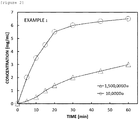
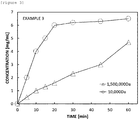
- the films produced in Examples 1 and 3 were each cut to prepare test pieces of 2 cm ⁇ 2 cm.
- the prepared test pieces were each put into a container having a diameter of 3.5 cm and a depth of 1.5 cm, and 5 mL of a PBS buffer solution (pH of 6.8) was added thereto.
- a PBS buffer solution pH of 6.8
- Each of these containers was put into a thermostatic chamber adjusted to 37°C to be left standing.
- the buffer solution was taken out over time to measure the concentration of sodium hyaluronate.
- Figures 2 and 3 show the results of measuring the concentration of sodium hyaluronate in the buffer solution.
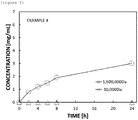
- the films produced in Examples 2 and 4 were each cut to prepare test pieces of 2 cm ⁇ 2 cm.
- the prepared test pieces were each put into a container having a diameter of 3.5 cm and a depth of 1.5 cm, and 5 mL of a PBS buffer solution (pH of 6.8) was added thereto.
- a PBS buffer solution pH of 6.8
- Each of these containers was put into a thermostatic chamber adjusted to 37°C, and was shaken using a shaker at 10 to 20 rpm for 24 hours.
- the buffer solution was taken out over time to measure the concentration of sodium hyaluronate.
- Figures 4 and 5 show the results of measuring the concentration of sodium hyaluronate in the buffer solution.
- the prepared aqueous solution was cast into the holes 5 of this tray 10 in an amount of 1 mL for each hole 5 and was then placed in a freezer of -80°C to be frozen. Frozen products obtained were subjected to vacuum-freeze drying (degree of vacuum of -20 Pa, shelf temperature of 25°C) to obtain 20 pieces of sponge-like solids. A piece of the obtained sponge-like solids was placed on the back of a hand and was spread with a lotion. Thereby, it was found that the low-molecular-weight sodium hyaluronate is supplied to skin, and skin-protecting and moisture-retaining effects by the high-molecular-weight sodium hyaluronate are obtained.
- a sponge-like solid composed of high-molecular-weight sodium alginate/low-molecular-weight sodium hyaluronate was obtained in the same manner as in previously described Example 5, except that sodium alginate (viscosity-average molecular weight of 400, 000 Da, manufactured by FUJIFILM Wako Pure Chemical Corporation) was used in place of sodium hyaluronate (viscosity-average molecular weight of 1,500,000 Da).
- a sponge-like solid composed of high-molecular-weight sodium carboxymethyl cellulose/low-molecular-weight sodium hyaluronate was obtained in the same manner as in previously described Example 5, except that sodium carboxymethyl cellulose (viscosity-average molecular weight of 150,000 Da, manufactured by Tokyo Chemical Industry Co., Ltd.) was used in place of sodium hyaluronate (viscosity-average molecular weight of 1,500,000 Da).
- the medical/cosmetic material of the present invention is useful as a medical/cosmetic material because it is easy for a low-molecular-weight polyanionic polysaccharide (or a salt thereof), which easily penetrates into skin, to dissolve out efficiently, and a high-molecular-weight polyanionic polysaccharide (or a salt thereof), which exhibits a high protection effect, is retained in a treatment area over long hours.
Landscapes
- Health & Medical Sciences (AREA)
- Chemical & Material Sciences (AREA)
- Life Sciences & Earth Sciences (AREA)
- General Health & Medical Sciences (AREA)
- Animal Behavior & Ethology (AREA)
- Public Health (AREA)
- Veterinary Medicine (AREA)
- Medicinal Chemistry (AREA)
- Epidemiology (AREA)
- Chemical Kinetics & Catalysis (AREA)
- Organic Chemistry (AREA)
- Polymers & Plastics (AREA)
- Birds (AREA)
- Pharmacology & Pharmacy (AREA)
- Engineering & Computer Science (AREA)
- Inorganic Chemistry (AREA)
- Dermatology (AREA)
- Biochemistry (AREA)
- Materials Engineering (AREA)
- Bioinformatics & Cheminformatics (AREA)
- Molecular Biology (AREA)
- Gerontology & Geriatric Medicine (AREA)
- Cosmetics (AREA)
- Polysaccharides And Polysaccharide Derivatives (AREA)
- Medicinal Preparation (AREA)
- Pharmaceuticals Containing Other Organic And Inorganic Compounds (AREA)
Abstract
Description
- The present invention relates to a method for producing a medical/cosmetic material, and a medical/cosmetic material.
- It is known that polyanionic polysaccharides, such as hyaluronic acid and alginic acid, exhibit moderate viscosity, adhesiveness, moisture retention, and biocompatibility. Therefore, these polyanionic polysaccharides and salts thereof are widely used as a raw material for medical materials, food materials, cosmetic materials, and the like. Among others, hyaluronic acid is excellent in characteristic physical properties, such as water retention; exhibits a high level of safety and biocompatibility; and therefore is utilized in various applications, such as food, cosmetics, and pharmaceutical products.
- In addition, a cosmetic sheet (decorative sheet) intended to give moisture to skin and prevent wrinkles is attracting attention. For example, a wrinkle-improving sheet obtained by sticking a moisture-retaining agent or the like on wood fiber-derived paper is proposed (Patent Literature 1). Moreover, a decorative sheet obtained by allowing a net-like structure formed with a nanofiber made of hyaluronic acid to retain a moisture-retaining agent is proposed (Patent Literature 2). Further, an electrospun sheet obtained by allowing a base material composed of a water-soluble polysaccharide, such as hyaluronic acid, to contain a moisture-retaining component is proposed (Patent Literature 3).
-
- Patent Literature 1: Japanese Patent No.
3215852 - Patent Literature 2: Japanese Patent Laid-Open No.
2008-179629 - Patent Literature 3: International Publication No.
WO2009036120 - However, the wrinkle-improving sheet proposed in
Patent Literature 1 is easily broken because the base material is paper, and has been deficient in adhesion to skin and sense of wearing. In addition, the sheets proposed inPatent Literatures Patent Literatures Patent Literature 1 have been deficient in adhesion to skin and sense of wearing. - It is to be noted that desirably, a functional component, such as a polyanionic polysaccharide such as hyaluronic acid, and a salt thereof, is released gradually to be supplied continuously to a treatment area or an affected area. However, with respect to the sheets proposed in
Patent Literatures 1 to 3, the sustained release of the functional component has not been studied at all. - The present invention has been completed in view of the problems of such conventional techniques, and an object of the present invention is to provide a simple method for producing a medical/cosmetic sheet that is excellent in adhesion to skin or the like and sense of wearing, and is capable of releasing a functional component gradually and supplying it continuously to a treatment area or the like. Another object of the present invention is to provide a medical/cosmetic sheet that is excellent in adhesion to skin or the like and sense of wearing, and is capable of releasing a functional component gradually and supplying it continuously to a treatment area or the like.
- That is, according to the present invention, there is provided a method for producing a medical/cosmetic material, the method including a step of shaping a raw material containing: a water-soluble salt of a first polyanionic polysaccharide having a viscosity-average molecular weight of 10,000 or lower; and a water-soluble salt of a second polyanionic polysaccharide having a viscosity-average molecular weight of 50, 000 or higher, thereby obtaining a water-soluble shaped body (hereinafter, also written as "the first production method").
- In addition, according to the present invention, there is provided a method for producing a medical/cosmetic material including: a step of shaping a raw material containing: a water-soluble salt of a first polyanionic polysaccharide having a viscosity-average molecular weight of 10,000 or lower; and a water-soluble salt of a second polyanionic polysaccharide having a viscosity-average molecular weight of 50, 000 or higher, thereby obtaining a water-soluble shaped body; and a step of subjecting the obtained water-soluble shaped body to a water-insolubilization treatment (also written as "the second production method").
- Further, according to the present invention, there is provided a medical/cosmetic material produced by the first production method (hereinafter, also written as "the first medical/cosmetic material").
- Moreover, according to the present invention, there is provided a medical/cosmetic material produced by the second production method (hereinafter, also written as "the second medical/cosmetic material").
- According to the present invention, a simple method for producing a medical/cosmetic sheet that is excellent in adhesion to skin or the like and sense of wearing, and is capable of releasing a functional component gradually and suppling it continuously to a treatment area or the like can be provided. In addition, according to the present invention, a medical/cosmetic sheet that is excellent in adhesion to skin or the like and sense of wearing, and is capable of releasing a functional component gradually and supplying it continuously to a treatment area or the like can be provided.
-
- [
Figure 1] Figure 1 shows chromatograms obtained by analyzing sodium hyaluronate having a viscosity-average molecular weight of 1,500,000 (1,500,000 Da) and of 10,000 (10, 000 Da). - [
Figure 2] Figure 2 is a graph showing changes with time in concentrations of sodium hyaluronate dissolving out of a film produced in Example 1. - [
Figure 3] Figure 3 is a graph showing changes with time in concentrations of sodium hyaluronate dissolving out of a film produced in Example 3. - [
Figure 4] Figure 4 is a graph showing changes with time in concentrations of sodium hyaluronate dissolving out of a film produced in Example 2. - [
Figure 5] Figure 5 is a graph showing changes with time in concentrations of sodium hyaluronate dissolving out of a film produced in Example 4. - [
Figure 6] Figure 6 is a schematic diagram describing a shape of a tray used in Example 5. - Hereinafter, embodiments of the present invention will be described, but the present invention is not limited to the following embodiments.
- A method for producing a medical/cosmetic material (the first production method) of the present invention includes a step of shaping a raw material containing: a water-soluble salt of a first polyanionic polysaccharide having a viscosity-average molecular weight of 10,000 or lower; and a water-soluble salt of a second polyanionic polysaccharide having a viscosity-average molecular weight of 50, 000 or higher, thereby obtaining a water-soluble shaped body. In addition, the first medical/cosmetic material of the present invention is the one produced by the first production method. Further, a method for producing a medical/cosmetic material (the second production method) of the present invention includes: a step of shaping a raw material containing: a water-soluble salt of a first polyanionic polysaccharide having a viscosity-average molecular weight of 10,000 or lower; and a water-soluble salt of a second polyanionic polysaccharide having a viscosity-average molecular weight of 50, 000 or higher, thereby obtaining a water-soluble shaped body; and a step of subjecting the obtained water-soluble shaped body to a water-insolubilization treatment. The second medical/cosmetic material of the present invention is the one produced by the second production method. Hereinafter, details on the medical/cosmetic material of the present invention and the method for producing the medical/cosmetic material of the present invention will be described.
- The water-soluble shaped body is formed using a raw material containing a water-soluble salt of a polyanionic polysaccharide. The polyanionic polysaccharide is a polysaccharide having at least one negatively charged anionic group, such as a carboxy group or a sulfonate group, in a molecular structure thereof. In addition, the water-soluble salt of a polyanionic polysaccharide is obtained in such a way that at least part of the anionic groups in the polyanionic polysaccharide forms a salt. It is to be noted that the anionic group in the polyanionic polysaccharide may be the one introduced in the molecule of the polysaccharide.
- Specific examples of the polyanionic polysaccharide include carboxyalkyl cellulose such as carboxymethyl cellulose and carboxyethyl cellulose, carboxymethyl starch, carboxymethylamylose, chondroitin sulfate (including chondroitin-4-sulfate and chondroitin-6-sulfate), hyaluronic acid, heparin, heparin sulfate, heparan sulfate, alginic acid, pectin, carrageenan, dermatan sulfate, and dermatan-6-sulfate. These polyanionic polysaccharides can be used singly, or two or more thereof can be used in combination.
- Examples of the water-soluble salt of the polyanionic polysaccharide include inorganic salts, ammonium salts, and organic amine salts. Specific examples of the inorganic salts include: salts of an alkali metal such as sodium or potassium; alkali earth metal salts such as calcium salts; and salts of a metal such as zinc or iron.
- The viscosity-average molecular weight of the water-soluble salt of the first polyanionic polysaccharide is 10,000 or lower, preferably 1,000 to 5, 000. In addition, the viscosity-average molecular weight of the water-soluble salt of the second polyanionic polysaccharide is 50, 000 or higher, preferably 100,000 to 2, 000, 000. By using two types of water-soluble salts of polyanionic polysaccharides each having a different viscosity-average molecular weight in combination, the medical/cosmetic sheet of the present invention that is excellent in adhesion to skin or the like and sense of wearing, and is capable of releasing a functional component gradually and supplying it continuously to a treatment area or the like can be obtained.
- The viscosity-average molecular weight can be determined by a known measurement method. Specifically, a polyanionic polysaccharide or a salt thereof (dried product) is dissolved in a 0.2 M sodium chloride aqueous solution to determine the intrinsic viscosity (η) at 30±0°C with a Ubellohde viscometer, and the viscosity-average molecular weight is calculated based on the Laurent equation (η (intrinsic viscosity) = 3.6 × 10-4.M0.78 (M: viscosity-average molecular weight). The intrinsic viscosity (η) is measured by Method I: Viscosity measurement by capillary tube viscometer of Viscosity Measurement, GENERAL TESTS in The Japanese Pharmacopoeia, Sixteenth Edition.
- In the case of the first production method, a base material that is excellent in adhesion to skin or the like and sense of wearing is more specifically formed with the water-soluble salt of the high-molecular-weight second polyanionic polysaccharide, the water-soluble salt having a relatively large viscosity-average molecular weight. In the formed base material, the water-soluble salt of the low-molecular-weight first polyanionic polysaccharide, the water-soluble salt having a relatively small viscosity-average molecular weight, is retained. Therefore, it is considered that the water-soluble salt of the first polyanionic polysaccharide is released gradually from the base material to be supplied continuously to a treatment area or the like.
- In addition, in the case of the second production method, a water-insoluble base material that is excellent in adhesion to skin or the like and sense of wearing is more specifically formed in such a way that a base material formed with the water-soluble salt of the high-molecular-weight second polyanionic polysaccharide, the water-soluble salt having a relatively large viscosity-average molecular weight, is subjected to a water-insolubilization treatment. On the other hand, the water-soluble salt of the lower-molecular-weight first polyanionic polysaccharide has a relatively small viscosity-average molecular weight, therefore hardly constitutes the base material even if it is subjected to a water-insolubilization treatment, and gets into a state of being retained in the base material formed with the high-molecular-weight second polyanionic polysaccharide. Therefore, it is considered that the low-molecular-weight polyanionic polysaccharide is released gradually from the base material to be supplied continuously to a treatment are or the like.
- The amount of the water-soluble salt of the first polyanionic polysaccharide contained in the raw material for obtaining the water-soluble shaped body (the first medical/cosmetic material) is preferably 1 to 150 parts by mass, more preferably 10 to 100 parts by mass based on 100 parts by mass of the water-soluble salt of the second polyanionic polysaccharide. When the amount of the water-soluble salt of the first polyanionic polysaccharide is less than 1 part by mass based on 100 parts by mass of the water-soluble salt of the second polyanionic polysaccharide, the amount of the functional component to be released is made small, and the effects as a medical/cosmetic sheet are somewhat deficient in some cases. On the other hand, when the amount of the water-soluble salt of the first polyanionic polysaccharide exceeds 150 parts by mass based on 100 parts by mass of the water-soluble salt of the second polyanionic polysaccharide, the amount of the base material to retain the functional component is made small, and therefore handling properties and strength are somewhat deteriorated in some cases.
- The first medical/cosmetic material being a water-soluble shaped body can be obtained by, for example, shaping a raw material (aqueous solution) obtained by dissolving a water-soluble salt of a polyanionic polysaccharide in water into a desired shape and then drying a resultant shaped body. Examples of the shape of the water-soluble shaped body include a sheet-like shape, a film-like shape, a sponge-like shape, a powdery shape, and a string-like shape. The second medical/cosmetic material having a shape, such as a sheet-like shape, a film-like shape, a sponge-like shape, a powdery shape, or a string-like shape, according to the application can be obtained by subjecting the water-soluble shaped body having any one of these shapes to a water-insolubilization treatment. It is to be noted that if necessary, the obtained medical/cosmetic material may further be shaped to be processed into a desired shape.
- For example, a sheet-like, film-like, or sponge-like water-soluble shaped body can be obtained by pouring a raw material (aqueous solution) into a suitable container and then drying or freeze-drying the raw material (aqueous solution). A fiber-like water-soluble shaped body can be obtained by extruding a raw material (aqueous solution) into a poor solvent from a nozzle. A string-like raw material-shaped body can be obtained by filling a suitable tube with a raw material (aqueous solution) and then drying or freeze-drying the raw material (aqueous solution). In this way, according to the production method of the present invention, a medical/cosmetic material having a shape according to the application can be obtained.
- In the second production method, the method of subjecting the water-soluble shaped body to a water-insolubilization treatment is not particularly limited, and a conventionally known method can be adopted. Specific examples of the method of subjecting the water-soluble shaped body to a water-insolubilization treatment include: a method of water-insolubilizing the water-soluble shaped body by chemically crosslinking the water-soluble shaped body using a crosslinking agent; a method of water-insolubilizing the water-soluble shaped body by irradiating the water-soluble shaped body with an electron beam to crosslink the water-soluble shaped body; a method of water-insolubilizing the water-soluble shaped body by crosslinking the water-soluble shaped body through ionic bonds using a polyvalent metal ion; and a method of water-insolubilizing the water-soluble shaped body by bringing the water-soluble shaped body into contact with a treatment liquid containing an acid anhydride. Among others, the method of bringing a raw material-shaped body into contact with a treatment liquid containing an acid anhydride is preferable because the method is simple and can subject the water-soluble shaped body to a water-insolubilization treatment sufficiently and quickly. It is to be noted that the reaction mechanism or the like supposed in the case where the water-soluble shaped body formed using a water-soluble salt of a polyanionic polysaccharide is treated with a treatment liquid containing an acid anhydride, such as acetic anhydride, is disclosed in, for example, International Publication No.
WO 2015029892 , Japanese Patent Laid-Open No.2016-163695 , and the like. - Specific examples of the acid anhydride for use in the treatment liquid include acetic anhydride, propionic anhydride, succinic anhydride, butyric anhydride, phthalic anhydride, and maleic anhydride. Among others, acetic anhydride and propionic anhydride are preferable. These acid anhydrides can be used singly, or two or more thereof can be used in combination.
- The treatment liquid preferably further contains at least any one of media of water and water-soluble organic solvents, and the acid anhydride is preferably dissolved or dispersed in this medium. By using the treatment liquid in which the acid anhydride is dissolved or dispersed in such a medium, the water-soluble shaped body can be water-insolubilized sufficiently and quickly.
- Specific examples of the water-soluble organic solvents include methanol, ethanol, propanol, dimethyl sulfoxide (DMSO), acetonitrile, and tetrahydrofuran. Among them, methanol, ethanol, and dimethyl sulfoxide are preferable. These water-soluble organic solvents can be used singly, or two or more thereof can be used in combination.
- The concentration of the acid anhydride in the treatment liquid is usually 0.1 to 50% by mass and is preferably 5 to 30% by mass. When the concentration of the acid anhydride is less than 0.1% by mass, the extent of water-insolubilization of a resultant second medical/cosmetic material is made insufficient, or there is a tendency that the water-insolubilization requires a long time. On the other hand, when the concentration of the acid anhydride exceeds 50% by mass, there is a tendency that the effects hit the ceiling.
- It is to be noted that the polyanionic polysaccharide has a high hydrophilicity, and therefore the treatment liquid preferably contains water as a medium from the viewpoint of water-insolubilizing the water-soluble shaped body more sufficiently and quickly. The content of water in the treatment liquid is preferably set to such an extent that the water-soluble shaped body does not dissolve or swell. Specifically, the content of water in the treatment liquid is preferably 0.01 to 50% by mass, more preferably 5 to 20% by mass. When the content of water in the treatment liquid is less than 0.01% by mass, the water-insolubilization is made insufficient in the solvents other than methanol in some cases. In addition, when the content of water in the treatment liquid exceeds 50% by mass, keeping the shape of a resultant medical/cosmetic material is made difficult in some cases.
- In the water-insolubilization step, it is preferable to water-insolubilize the water-soluble shaped body by bringing the water-soluble shaped body into contact with the treatment liquid containing an acid anhydride. By bringing the water-soluble shaped body into contact with the treatment liquid, the water-soluble shaped body can be water-insolubilized while keeping the shape thereof, and a medical/cosmetic material having a corresponding shape can be obtained. The method of bringing the water-soluble shaped body into contact with the treatment liquid is not particularly limited, but it is preferable to perform the treatment in such a way that the treatment liquid comes into contact with the whole water-soluble shaped body and the treatment liquid penetrates the inside of the water-soluble shaped body. Specific treatment methods include methods such as immersing the water-soluble shaped body in the treatment liquid and applying or spraying (nebulizing) the treatment liquid to the water-soluble shaped body.
- The temperature during the water-insolubilization treatment is not particularly limited as long as the temperature does not exceed the boiling point of the treatment liquid. It is preferable to set the temperature during the treatment to 0 to 80°C, more preferably 0 to 70°C, and particularly preferably room temperature (25°C) to 60°C from the viewpoint of suppressing the decomposition and denaturation of the polyanionic polysaccharide and from the viewpoint of suppressing the volatilization of the medium, byproducts, and the like. However, when the treatment is conducted under the condition in which the treatment liquid does not volatilize during the treatment, for example, the treatment is conducted with a heat press, a heat roller, or the like, the treatment can be conducted in a shorter time without causing the decomposition and denaturation, and the like. For example, in the case where the treatment is conducted with a heat press, a heat roller, or the like, it is preferable to set the temperature during the treatment to 50 to 90°C and to set the treatment time to 30 minutes or shorter. In the second production method, after the water-insolubilization treatment is completed, the second medical/cosmetic material can be obtained, if necessary, through washing or the like with water or a water-soluble organic solvent.
- When the water-soluble shaped body is brought into contact with the treatment liquid containing an acid anhydride to be subjected to a water-insolubilization treatment, that is, when the water-soluble shaped body is subjected to a water-insolubilization treatment without using a crosslinking agent, a structure of a functional group or the like derived from the crosslinking agent is not incorporated into the molecule that constitutes a resultant medical/cosmetic material. Therefore, the second medical/cosmetic material obtained by bringing the water-soluble shaped body into contact with the treatment liquid containing an acid anhydride, thereby subjecting the water-soluble shaped body to a water-insolubilization treatment is more suitable as a medical/cosmetic material because the characteristics inherent in the polyanionic polysaccharide which is a raw material is retained therein and the safety thereof is higher. It is to be noted that the thickness of the medical/cosmetic material is not particularly limited, but is preferably 20 to 200 µm, more preferably 60 to 120 µm.
- The "water-insolubility" in the present specification means a characteristic of not easily dissolving in water. More specifically, with respect to the second medical/cosmetic material of the present invention, the mass of a dried body obtained by repeating twice the operation in which the second medical/cosmetic material is made into a swollen state with water and is then dried is 80% or more of the dry mass before this operation.
- The swelling ratio of the second medical/cosmetic material of the present invention is preferably 6, 000% by mass or less, more preferably 900% by mass or less, particularly preferably 100 to 500% by mass, and most preferably 150 to 350% by mass. The "swelling ratio" in the present specification means a ratio (% by mass) of the "mass of the second medical/cosmetic material after retaining water (after swelling)" to the "mass of the second medical/cosmetic material before retaining water (before swelling)". It is to be noted that the second medical/cosmetic material having a relatively low swelling ratio (for example, of 6, 000% by mass or less) can be produced by increasing the amount of water in the treatment liquid to be used in the water-insolubilization step within a range not exceeding, for example, 20% by mass. In addition, the second medical/cosmetic material having a relatively low swelling ratio (for example, of 6, 000% by mass or less) can be produced by increasing the amount of the acid anhydride in the treatment liquid (for example, the upper limit is 20% by mass).
- In the case where the water-soluble shaped body is water-insolubilized by bringing the water-soluble shaped body into contact with the treatment liquid containing an acid anhydride, molecules of the polyanionic polysaccharide that constitutes a resultant second medical/cosmetic material are not substantially crosslinked. Further, a new covalent bond is not substantially formed in the polyanionic polysaccharide. However, it is inferred that a physical bond, such as a hydrogen bond, a hydrophobic bond, and Van der Waals force, is formed between the molecules of the polyanionic polysaccharide. Whether such a physical bond is formed between the molecules of the polyanionic polysaccharide can be checked by measuring an infrared absorption spectrum.
- The second medical/cosmetic material of the present invention is water-insoluble stably in a wide pH region from acidity to alkalinity. However, the second medical/cosmetic material of the present invention, when, for example, brought into contact with or immersed in an aqueous medium having a pH of 12 or higher, can easily dissolves because the physical bond between molecules dissociates. In addition, it is harder to water-insolubilize the water-soluble salt of the first polyanionic polysaccharide as compared to the water-soluble salt of the second polyanionic polysaccharide. Therefore, in the second medical/cosmetic material of the present invention, the water-soluble salt of the first polyanionic polysaccharide relatively easily dissolves out of the base material composed of the second polyanionic polysaccharide which has been water-insolubilized.
- Hereinafter, the present invention will be described specifically based on Examples, but the present invention is not limited to these Examples. It is to be noted that "parts" and "%" in Examples and Comparative Examples are each on a mass basis unless otherwise noted.
- By mixing 1 g of a powder of sodium hyaluronate (viscosity-average molecular weight of 1,500,000 Da, manufactured by Kikkoman Biochemifa Company), 1 g of a powder of sodium hyaluronate (viscosity-average molecular weight of 10,000 Da, manufactured by Kikkoman Biochemifa Company), 0.5 g of glycerin (the Japan Pharmacopoeia), and 97.5 g of water, 100 g of an aqueous solution was prepared. In a stainless steel tray of 12 cm in length × 10 cm in width, 100 g of the prepared aqueous solution was cast and dried in a thermostatic chamber of 20°C to obtain a film (water-soluble film) containing glycerin and having a thickness of about 50 µm.
- The water-soluble film produced in Example 1 was immersed in a treatment liquid (acetic anhydride:ethanol = 20:80) to be left standing at 50°C for 1 hour and was thereby subjected to a water-insolubilization treatment to obtain a film having a thickness of about 55 µm.
- By mixing 1 g of a powder of sodium hyaluronate (viscosity-average molecular weight of 1,500,000 Da, manufactured by Kikkoman Biochemifa Company), 1 g of a powder of sodium hyaluronate (viscosity-average molecular weight of 10,000 Da, manufactured by Kikkoman Biochemifa Company), and 98 g of water, 100 g of an aqueous solution was obtained. In a stainless steel vat, the prepared aqueous solution was cast and frozen at -30°C, and was then freeze-dried at a shelf-heating temperature of 120°C to obtain a sponge-like shaped body (water-soluble shaped body).
- The water-soluble shaped body produced in Example 3 was immersed in a treatment liquid (acetic anhydride:methanol = 10:90) to be left standing at room temperature for 18 hours and was thereby subjected to a water-insolubilization treatment. Subsequently, a resultant product was washed with methanol, an 80% by volume methanol aqueous solution, and water in the mentioned order to obtain a sponge-like shaped body.
- The concentration of sodium hyaluronate in a sample (10 µL) prepared by dissolving an object of measurement with a 0.3% NaOH aqueous solution was measured using an HPLC system having the following constitution.
Figure 1 shows chromatograms obtained by analyzing sodium hyaluronate having a viscosity-average molecular weight of 1,500,000 Da and sodium hyaluronate having a viscosity-average molecular weight of 10,000 Da. -
- Pump: trade name "PU-980" (manufactured by JASCO Corporation)
- Autosampler: trade name "AS-950-10" (manufactured by JASCO Corporation)
- Column oven: trade name "CO-965" (manufactured by JASCO Corporation)
- UV detector: trade name "UV-970" (manufactured by JASCO Corporation)
- GPC column: trade name "TSKgel PWXL (diameter of 4.6 mm × 300 mm × 2 columns, manufactured by Tosoh Corporation)
- Mobile phase: 0. 1N NaCl aqueous solution
- Flow rate: 1.0 mL/min
- Column temperature: 40°C
- The films produced in Examples 1 and 3 were each cut to prepare test pieces of 2 cm × 2 cm. The prepared test pieces were each put into a container having a diameter of 3.5 cm and a depth of 1.5 cm, and 5 mL of a PBS buffer solution (pH of 6.8) was added thereto. Each of these containers was put into a thermostatic chamber adjusted to 37°C to be left standing. The buffer solution was taken out over time to measure the concentration of sodium hyaluronate.
Figures 2 and3 show the results of measuring the concentration of sodium hyaluronate in the buffer solution. As shown inFigures 2 and3 , the low-molecular-weight sodium hyaluronate dissolved out quickly, and then the high-molecular-weight sodium hyaluronate dissolved out slowly in the films produced in Examples 1 and 3. Thereby, it is found that a medical/cosmetic sheet from which the low-molecular-weight sodium hyaluronate which has a high penetrability to skin is released quickly, and the high-molecular-weight sodium hyaluronate dissolves gradually to form a coating film, thereby capable of protecting the surface or the like of the skin, can be provided. - The films produced in Examples 2 and 4 were each cut to prepare test pieces of 2 cm × 2 cm. The prepared test pieces were each put into a container having a diameter of 3.5 cm and a depth of 1.5 cm, and 5 mL of a PBS buffer solution (pH of 6.8) was added thereto. Each of these containers was put into a thermostatic chamber adjusted to 37°C, and was shaken using a shaker at 10 to 20 rpm for 24 hours. The buffer solution was taken out over time to measure the concentration of sodium hyaluronate.
Figures 4 and5 show the results of measuring the concentration of sodium hyaluronate in the buffer solution. As shown inFigures 4 and5 , dissolving-out of the low-molecular-weight sodium hyaluronate was detected, but dissolving-out of the high-molecular-weight sodium hyaluronate was not detected in the films produced in Examples 2 and 4. Thereby, it is found that a medical/cosmetic sheet from which the low-molecular-weight sodium hyaluronate is released quickly, thereby supplying the low-molecular-weight sodium hyaluronate continuously to a treatment area or the like, and which is capable of protecting the surface of skin or of an internal organ by the high-molecular-weight sodium hyaluronate can be provided. - By mixing 1 g of a powder of sodium hyaluronate (viscosity-average molecular weight of 1,500,000 Da, manufactured by Kikkoman Biochemifa Company), 0.5 g of a powder of sodium hyaluronate (viscosity-average molecular weight of 5, 000 Da, manufactured by Kikkoman Biochemifa Company), and 98.5 g of water, 100 g of an aqueous solution was prepared. A
polyethylene terephthalate tray 10 provided with 20holes 5 each having a side of 1.5 cm and a depth of 1 cm, as shown inFigure 6 , was prepared. The prepared aqueous solution was cast into theholes 5 of thistray 10 in an amount of 1 mL for eachhole 5 and was then placed in a freezer of -80°C to be frozen. Frozen products obtained were subjected to vacuum-freeze drying (degree of vacuum of -20 Pa, shelf temperature of 25°C) to obtain 20 pieces of sponge-like solids. A piece of the obtained sponge-like solids was placed on the back of a hand and was spread with a lotion. Thereby, it was found that the low-molecular-weight sodium hyaluronate is supplied to skin, and skin-protecting and moisture-retaining effects by the high-molecular-weight sodium hyaluronate are obtained. - A sponge-like solid composed of high-molecular-weight sodium alginate/low-molecular-weight sodium hyaluronate was obtained in the same manner as in previously described Example 5, except that sodium alginate (viscosity-average molecular weight of 400, 000 Da, manufactured by FUJIFILM Wako Pure Chemical Corporation) was used in place of sodium hyaluronate (viscosity-average molecular weight of 1,500,000 Da).
- A sponge-like solid composed of high-molecular-weight sodium carboxymethyl cellulose/low-molecular-weight sodium hyaluronate was obtained in the same manner as in previously described Example 5, except that sodium carboxymethyl cellulose (viscosity-average molecular weight of 150,000 Da, manufactured by Tokyo Chemical Industry Co., Ltd.) was used in place of sodium hyaluronate (viscosity-average molecular weight of 1,500,000 Da).
- The medical/cosmetic material of the present invention is useful as a medical/cosmetic material because it is easy for a low-molecular-weight polyanionic polysaccharide (or a salt thereof), which easily penetrates into skin, to dissolve out efficiently, and a high-molecular-weight polyanionic polysaccharide (or a salt thereof), which exhibits a high protection effect, is retained in a treatment area over long hours.
-
- 5:
- Hole
- 10:
- Tray
Claims (8)
- A method for producing a medical/cosmetic material, the method comprising a step of shaping a raw material comprising: a water-soluble salt of a first polyanionic polysaccharide having a viscosity-average molecular weight of 10,000 or lower; and a water-soluble salt of a second polyanionic polysaccharide having a viscosity-average molecular weight of 50, 000 or higher, thereby obtaining a water-soluble shaped body.
- A method for producing a medical/cosmetic material, the method comprising:a step of shaping a raw material comprising: a water-soluble salt of a first polyanionic polysaccharide having a viscosity-average molecular weight of 10,000 or lower; and a water-soluble salt of a second polyanionic polysaccharide having a viscosity-average molecular weight of 50, 000 or higher, thereby obtaining a water-soluble shaped body; anda step of subjecting the obtained water-soluble shaped body to a water-insolubilization treatment.
- The method for producing a medical/cosmetic material according to claim 2, wherein the water-soluble shaped body is subjected to the water-insolubilization treatment by bringing the water-soluble shaped body into contact with a treatment liquid comprising an acid anhydride.
- The method for producing a medical/cosmetic material according to claim 3, wherein the acid anhydride is at least any one of acetic anhydride and propionic anhydride.
- The method for producing a medical/cosmetic material according to any one of claims 1 to 4, wherein the water-soluble shaped body has a sheet-like, film-like, sponge-like, powdery, or string-like shape.
- The method for producing a medical/cosmetic material according to any one of claims 1 to 5, wherein the polyanionic polysaccharides are each at least one selected from the group consisting of hyaluronic acid, carboxymethyl cellulose, and alginic acid.
- A medical/cosmetic material produced by the production method according to any one of claims 1, 5, and 6.
- A medical/cosmetic material produced by the production method according to any one of claims 2 to 6.
Applications Claiming Priority (2)
| Application Number | Priority Date | Filing Date | Title |
|---|---|---|---|
| JP2017169099A JP6912327B2 (en) | 2017-09-04 | 2017-09-04 | Manufacturing method of medical / beauty materials and medical / beauty materials |
| PCT/JP2018/030400 WO2019044519A1 (en) | 2017-09-04 | 2018-08-16 | Production method for medical and cosmetic material, and medical and cosmetic material |
Publications (2)
| Publication Number | Publication Date |
|---|---|
| EP3680255A1 true EP3680255A1 (en) | 2020-07-15 |
| EP3680255A4 EP3680255A4 (en) | 2021-06-09 |
Family
ID=65525244
Family Applications (1)
| Application Number | Title | Priority Date | Filing Date |
|---|---|---|---|
| EP18851040.8A Withdrawn EP3680255A4 (en) | 2017-09-04 | 2018-08-16 | MEDICAL AND COSMETIC MATERIAL PRODUCTION PROCESS AND MEDICAL AND COSMETIC MATERIAL |
Country Status (10)
| Country | Link |
|---|---|
| US (1) | US11491097B2 (en) |
| EP (1) | EP3680255A4 (en) |
| JP (1) | JP6912327B2 (en) |
| KR (1) | KR102322976B1 (en) |
| CN (1) | CN111051351A (en) |
| AU (1) | AU2018326846B2 (en) |
| CA (1) | CA3074674C (en) |
| SG (1) | SG11202001216WA (en) |
| TW (1) | TWI820037B (en) |
| WO (1) | WO2019044519A1 (en) |
Families Citing this family (4)
| Publication number | Priority date | Publication date | Assignee | Title |
|---|---|---|---|---|
| KR101887980B1 (en) | 2016-11-09 | 2018-08-13 | 현대오트론 주식회사 | Method for Controlling Automatic Transmission of Vehicle Having Dual Clutch Transmission |
| JP7104942B2 (en) * | 2020-08-28 | 2022-07-22 | 日本コルマー株式会社 | gel composition |
| KR102412497B1 (en) * | 2021-12-01 | 2022-06-23 | (주)진우바이오 | Hyaluronic acid film with excellent transdermal performance and preparing method thereof |
| JPWO2024219410A1 (en) * | 2023-04-17 | 2024-10-24 |
Family Cites Families (17)
| Publication number | Priority date | Publication date | Assignee | Title |
|---|---|---|---|---|
| JP2835632B2 (en) | 1990-01-19 | 1998-12-14 | コニカ株式会社 | Silver halide color negative photographic material |
| JP3215852B2 (en) | 1997-04-30 | 2001-10-09 | カネボウ株式会社 | Wrinkle-reducing sheet, method of using the same, and water-activating patch for wrinkle-reducing sheet |
| FR2861734B1 (en) * | 2003-04-10 | 2006-04-14 | Corneal Ind | CROSSLINKING OF LOW AND HIGH MOLECULAR MASS POLYSACCHARIDES; PREPARATION OF INJECTABLE SINGLE PHASE HYDROGELS; POLYSACCHARIDES AND HYDROGELS OBTAINED |
| JP5066342B2 (en) * | 2006-04-28 | 2012-11-07 | キユーピー株式会社 | Novel hyaluronic acid and / or salt thereof, and cosmetics, pharmaceutical compositions, food compositions, and cosmetic kits using the same |
| CN101500535A (en) * | 2006-06-28 | 2009-08-05 | 诺维信生物聚合物公司 | Compositions with several hyaluronic acid fractions for cosmetic and medical uses |
| JP2008179629A (en) | 2006-12-27 | 2008-08-07 | Snt Co | Cosmetic sheet |
| WO2009036120A1 (en) | 2007-09-11 | 2009-03-19 | Cornell Research Foundation, Inc. | Cellular antioxidant activity (caa) assay |
| KR101449687B1 (en) | 2008-03-13 | 2014-10-14 | 주식회사 바이오랜드 | Anti-aging composition containing a polysaccharide extract separated from low molecular weight and high molecular weight hyaluronic acid and rhizome |
| JP5472673B2 (en) * | 2008-09-29 | 2014-04-16 | コスメディ製薬株式会社 | Microneedle array |
| JP5840107B2 (en) * | 2012-06-17 | 2016-01-06 | コスメディ製薬株式会社 | Hyaluronic acid gel and method for producing the same |
| CN105163716B (en) * | 2013-07-03 | 2019-02-12 | 株式会社利他药业 | Water-soluble hyaluronic acid gel and method for producing the same |
| JP6077663B2 (en) | 2013-08-29 | 2017-02-08 | 大日精化工業株式会社 | Method for producing water-insoluble molded body and water-insoluble molded body |
| JP6374089B2 (en) * | 2015-02-27 | 2018-08-15 | 大日精化工業株式会社 | Medical / beauty materials and anti-adhesion materials |
| EP3263146A4 (en) | 2015-02-27 | 2018-06-20 | Dainichiseika Color & Chemicals Mfg. Co., Ltd. | Method for manufacturing medical material, medical material, and anti-adhesion material |
| JP6474360B2 (en) | 2015-02-27 | 2019-02-27 | 大日精化工業株式会社 | Manufacturing method of medical material, medical material, and anti-adhesion material |
| JP2016166133A (en) * | 2015-03-09 | 2016-09-15 | キユーピー株式会社 | Pack cosmetics |
| JP6369992B2 (en) * | 2015-03-19 | 2018-08-08 | ライオン株式会社 | Dissolving microneedle formulation |
-
2017
- 2017-09-04 JP JP2017169099A patent/JP6912327B2/en active Active
-
2018
- 2018-08-16 SG SG11202001216WA patent/SG11202001216WA/en unknown
- 2018-08-16 US US16/636,547 patent/US11491097B2/en active Active
- 2018-08-16 WO PCT/JP2018/030400 patent/WO2019044519A1/en not_active Ceased
- 2018-08-16 KR KR1020207007072A patent/KR102322976B1/en active Active
- 2018-08-16 AU AU2018326846A patent/AU2018326846B2/en not_active Ceased
- 2018-08-16 CN CN201880055978.4A patent/CN111051351A/en active Pending
- 2018-08-16 EP EP18851040.8A patent/EP3680255A4/en not_active Withdrawn
- 2018-08-16 CA CA3074674A patent/CA3074674C/en active Active
- 2018-08-28 TW TW107129995A patent/TWI820037B/en not_active IP Right Cessation
Also Published As
| Publication number | Publication date |
|---|---|
| CA3074674C (en) | 2022-01-04 |
| SG11202001216WA (en) | 2020-03-30 |
| US20210154126A1 (en) | 2021-05-27 |
| TWI820037B (en) | 2023-11-01 |
| CN111051351A (en) | 2020-04-21 |
| AU2018326846A1 (en) | 2020-02-27 |
| EP3680255A4 (en) | 2021-06-09 |
| WO2019044519A1 (en) | 2019-03-07 |
| AU2018326846B2 (en) | 2021-07-22 |
| JP6912327B2 (en) | 2021-08-04 |
| JP2019044086A (en) | 2019-03-22 |
| CA3074674A1 (en) | 2019-03-07 |
| KR20200041343A (en) | 2020-04-21 |
| US11491097B2 (en) | 2022-11-08 |
| KR102322976B1 (en) | 2021-11-08 |
| TW201919575A (en) | 2019-06-01 |
Similar Documents
| Publication | Publication Date | Title |
|---|---|---|
| US11491097B2 (en) | Production method for medical and cosmetic material, and medical and cosmetic material | |
| Emami et al. | Controlling alginate oxidation conditions for making alginate-gelatin hydrogels | |
| Jejurikar et al. | Degradable alginate hydrogels crosslinked by the macromolecular crosslinker alginate dialdehyde | |
| Ström et al. | Preparation and physical properties of hyaluronic acid‐based cryogels | |
| Sibaja et al. | Preparation of alginate–chitosan fibers with potential biomedical applications | |
| CN117343213B (en) | Variable-size hydrophobic modified polymers | |
| Ajovalasit et al. | Xyloglucan-based hydrogel films for wound dressing: Structure-property relationships | |
| Chiu et al. | pH-triggered injectable hydrogels prepared from aqueous N-palmitoyl chitosan: in vitro characteristics and in vivo biocompatibility | |
| Rimdusit et al. | Comparison of gamma radiation crosslinking and chemical crosslinking on properties of methylcellulose hydrogel | |
| Lü et al. | An injectable oxidized carboxymethylcellulose/N-succinyl-chitosan hydrogel system for protein delivery | |
| Yang et al. | pH-sensitive interpenetrating network hydrogels based on chitosan derivatives and alginate for oral drug delivery | |
| Bhuvaneshwari et al. | Development and characterization of chitosan film | |
| Zarbab et al. | Synthesis and characterization of Guar gum based biopolymeric hydrogels as carrier materials for controlled delivery of methotrexate to treat colon cancer | |
| JP6077663B2 (en) | Method for producing water-insoluble molded body and water-insoluble molded body | |
| Horn et al. | Influence of collagen addition on the thermal and morphological properties of chitosan/xanthan hydrogels | |
| Hamcerencu et al. | Stimuli-sensitive xanthan derivatives/N-isopropylacrylamide hydrogels: influence of cross-linking agent on interpenetrating polymer network properties | |
| Onyianta et al. | The effects of morpholine pre-treated and carboxymethylated cellulose nanofibrils on the properties of alginate-based hydrogels | |
| Rivera-Hernández et al. | Mixed gels based on low acyl gellan and citrus pectin: A linear viscoelastic analysis | |
| Endres et al. | Sorption-active transparent films based on chitosan | |
| Oh et al. | Preparation and characterization of an in situ crosslinkable glycol chitosan thermogel for biomedical applications | |
| EP3263141A1 (en) | Medical material and anti-adhesion material | |
| Weska et al. | Improvement of collagen hydrogel scaffolds properties by the addition of konjac glucomannan | |
| Nafisah et al. | Enhanced Superabsorbency of Cellulose-Based Hydrogels in NaOH Solution: Synthesis, Characterization, and Performance Evaluation | |
| Akbari et al. | Supercritical CO2 generation of nanometric structure from Ocimum basilicum mucilage prepared for pharmaceutical applications | |
| Zhang et al. | Design and in vitro evaluation of a film-controlled dosage form self-converted from monolithic tablet in gastrointestinal environment |
Legal Events
| Date | Code | Title | Description |
|---|---|---|---|
| STAA | Information on the status of an ep patent application or granted ep patent |
Free format text: STATUS: THE INTERNATIONAL PUBLICATION HAS BEEN MADE |
|
| PUAI | Public reference made under article 153(3) epc to a published international application that has entered the european phase |
Free format text: ORIGINAL CODE: 0009012 |
|
| STAA | Information on the status of an ep patent application or granted ep patent |
Free format text: STATUS: REQUEST FOR EXAMINATION WAS MADE |
|
| 17P | Request for examination filed |
Effective date: 20200130 |
|
| AK | Designated contracting states |
Kind code of ref document: A1 Designated state(s): AL AT BE BG CH CY CZ DE DK EE ES FI FR GB GR HR HU IE IS IT LI LT LU LV MC MK MT NL NO PL PT RO RS SE SI SK SM TR |
|
| AX | Request for extension of the european patent |
Extension state: BA ME |
|
| DAV | Request for validation of the european patent (deleted) | ||
| DAX | Request for extension of the european patent (deleted) | ||
| A4 | Supplementary search report drawn up and despatched |
Effective date: 20210510 |
|
| RIC1 | Information provided on ipc code assigned before grant |
Ipc: C08B 37/04 20060101AFI20210503BHEP Ipc: A61K 8/73 20060101ALI20210503BHEP Ipc: A61K 47/36 20060101ALI20210503BHEP Ipc: A61K 47/38 20060101ALI20210503BHEP Ipc: A61Q 19/00 20060101ALI20210503BHEP Ipc: C08B 15/00 20060101ALI20210503BHEP Ipc: C08B 37/08 20060101ALI20210503BHEP Ipc: C08L 1/28 20060101ALI20210503BHEP Ipc: C08L 5/04 20060101ALI20210503BHEP Ipc: C08L 5/08 20060101ALI20210503BHEP Ipc: C08B 37/00 20060101ALI20210503BHEP |
|
| STAA | Information on the status of an ep patent application or granted ep patent |
Free format text: STATUS: EXAMINATION IS IN PROGRESS |
|
| 17Q | First examination report despatched |
Effective date: 20220816 |
|
| STAA | Information on the status of an ep patent application or granted ep patent |
Free format text: STATUS: THE APPLICATION IS DEEMED TO BE WITHDRAWN |
|
| 18D | Application deemed to be withdrawn |
Effective date: 20240914 |