EP3677586A1 - Method for manufacturing silsesquioxane compound - Google Patents
Method for manufacturing silsesquioxane compound Download PDFInfo
- Publication number
- EP3677586A1 EP3677586A1 EP18852486.2A EP18852486A EP3677586A1 EP 3677586 A1 EP3677586 A1 EP 3677586A1 EP 18852486 A EP18852486 A EP 18852486A EP 3677586 A1 EP3677586 A1 EP 3677586A1
- Authority
- EP
- European Patent Office
- Prior art keywords
- group
- general formula
- carbon atoms
- compound represented
- manufacturing
- Prior art date
- Legal status (The legal status is an assumption and is not a legal conclusion. Google has not performed a legal analysis and makes no representation as to the accuracy of the status listed.)
- Withdrawn
Links
- 150000001875 compounds Chemical class 0.000 title claims abstract description 97
- 238000000034 method Methods 0.000 title claims abstract description 30
- 238000004519 manufacturing process Methods 0.000 title claims abstract description 28
- 125000004432 carbon atom Chemical group C* 0.000 claims abstract description 48
- 125000003277 amino group Chemical group 0.000 claims abstract description 36
- 125000000217 alkyl group Chemical group 0.000 claims abstract description 33
- 125000003118 aryl group Chemical group 0.000 claims abstract description 27
- 125000000524 functional group Chemical group 0.000 claims abstract description 26
- ZOXJGFHDIHLPTG-UHFFFAOYSA-N Boron Chemical compound [B] ZOXJGFHDIHLPTG-UHFFFAOYSA-N 0.000 claims abstract description 15
- 125000004103 aminoalkyl group Chemical group 0.000 claims abstract description 15
- 229910052796 boron Inorganic materials 0.000 claims abstract description 15
- 125000003647 acryloyl group Chemical group O=C([*])C([H])=C([H])[H] 0.000 claims abstract description 12
- 125000004435 hydrogen atom Chemical group [H]* 0.000 claims abstract description 12
- 125000001309 chloro group Chemical group Cl* 0.000 claims abstract description 11
- 125000002560 nitrile group Chemical group 0.000 claims abstract description 11
- 125000000391 vinyl group Chemical group [H]C([*])=C([H])[H] 0.000 claims abstract description 10
- 125000001246 bromo group Chemical group Br* 0.000 claims abstract description 9
- DGAQECJNVWCQMB-PUAWFVPOSA-M Ilexoside XXIX Chemical compound C[C@@H]1CC[C@@]2(CC[C@@]3(C(=CC[C@H]4[C@]3(CC[C@@H]5[C@@]4(CC[C@@H](C5(C)C)OS(=O)(=O)[O-])C)C)[C@@H]2[C@]1(C)O)C)C(=O)O[C@H]6[C@@H]([C@H]([C@@H]([C@H](O6)CO)O)O)O.[Na+] DGAQECJNVWCQMB-PUAWFVPOSA-M 0.000 claims abstract description 7
- WHXSMMKQMYFTQS-UHFFFAOYSA-N Lithium Chemical compound [Li] WHXSMMKQMYFTQS-UHFFFAOYSA-N 0.000 claims abstract description 7
- ZLMJMSJWJFRBEC-UHFFFAOYSA-N Potassium Chemical compound [K] ZLMJMSJWJFRBEC-UHFFFAOYSA-N 0.000 claims abstract description 7
- 229910052744 lithium Inorganic materials 0.000 claims abstract description 7
- 229910052700 potassium Inorganic materials 0.000 claims abstract description 7
- 239000011591 potassium Substances 0.000 claims abstract description 7
- 229910052708 sodium Inorganic materials 0.000 claims abstract description 7
- 239000011734 sodium Substances 0.000 claims abstract description 7
- 239000001257 hydrogen Substances 0.000 claims abstract description 4
- 229910052739 hydrogen Inorganic materials 0.000 claims abstract description 4
- -1 3-aminopropyl group Chemical group 0.000 claims description 15
- IJGRMHOSHXDMSA-UHFFFAOYSA-N Atomic nitrogen Chemical compound N#N IJGRMHOSHXDMSA-UHFFFAOYSA-N 0.000 description 30
- 238000005133 29Si NMR spectroscopy Methods 0.000 description 26
- WYURNTSHIVDZCO-UHFFFAOYSA-N Tetrahydrofuran Chemical compound C1CCOC1 WYURNTSHIVDZCO-UHFFFAOYSA-N 0.000 description 20
- HEDRZPFGACZZDS-MICDWDOJSA-N Trichloro(2H)methane Chemical compound [2H]C(Cl)(Cl)Cl HEDRZPFGACZZDS-MICDWDOJSA-N 0.000 description 19
- 239000007787 solid Substances 0.000 description 16
- 238000001228 spectrum Methods 0.000 description 16
- XEKOWRVHYACXOJ-UHFFFAOYSA-N Ethyl acetate Chemical compound CCOC(C)=O XEKOWRVHYACXOJ-UHFFFAOYSA-N 0.000 description 15
- 229910052757 nitrogen Inorganic materials 0.000 description 15
- 239000002904 solvent Substances 0.000 description 15
- 230000015572 biosynthetic process Effects 0.000 description 14
- 238000003786 synthesis reaction Methods 0.000 description 14
- 238000003756 stirring Methods 0.000 description 13
- KFZMGEQAYNKOFK-UHFFFAOYSA-N Isopropanol Chemical compound CC(C)O KFZMGEQAYNKOFK-UHFFFAOYSA-N 0.000 description 12
- CSCPPACGZOOCGX-WFGJKAKNSA-N acetone d6 Chemical compound [2H]C([2H])([2H])C(=O)C([2H])([2H])[2H] CSCPPACGZOOCGX-WFGJKAKNSA-N 0.000 description 12
- PUUOOWSPWTVMDS-UHFFFAOYSA-N difluorosilane Chemical compound F[SiH2]F PUUOOWSPWTVMDS-UHFFFAOYSA-N 0.000 description 12
- 239000002243 precursor Substances 0.000 description 11
- XLYOFNOQVPJJNP-UHFFFAOYSA-N water Substances O XLYOFNOQVPJJNP-UHFFFAOYSA-N 0.000 description 11
- 238000001644 13C nuclear magnetic resonance spectroscopy Methods 0.000 description 10
- 238000005160 1H NMR spectroscopy Methods 0.000 description 10
- WTEOIRVLGSZEPR-UHFFFAOYSA-N boron trifluoride Chemical compound FB(F)F WTEOIRVLGSZEPR-UHFFFAOYSA-N 0.000 description 10
- YLQBMQCUIZJEEH-UHFFFAOYSA-N tetrahydrofuran Natural products C=1C=COC=1 YLQBMQCUIZJEEH-UHFFFAOYSA-N 0.000 description 10
- OKKJLVBELUTLKV-UHFFFAOYSA-N Methanol Chemical compound OC OKKJLVBELUTLKV-UHFFFAOYSA-N 0.000 description 9
- 238000005481 NMR spectroscopy Methods 0.000 description 9
- 238000006243 chemical reaction Methods 0.000 description 9
- 239000000203 mixture Substances 0.000 description 9
- 239000000126 substance Substances 0.000 description 9
- 239000012298 atmosphere Substances 0.000 description 8
- 238000004821 distillation Methods 0.000 description 8
- 238000004293 19F NMR spectroscopy Methods 0.000 description 7
- WYURNTSHIVDZCO-SVYQBANQSA-N oxolane-d8 Chemical compound [2H]C1([2H])OC([2H])([2H])C([2H])([2H])C1([2H])[2H] WYURNTSHIVDZCO-SVYQBANQSA-N 0.000 description 7
- 239000000725 suspension Substances 0.000 description 7
- ZWEHNKRNPOVVGH-UHFFFAOYSA-N 2-Butanone Chemical compound CCC(C)=O ZWEHNKRNPOVVGH-UHFFFAOYSA-N 0.000 description 6
- CSCPPACGZOOCGX-UHFFFAOYSA-N Acetone Chemical compound CC(C)=O CSCPPACGZOOCGX-UHFFFAOYSA-N 0.000 description 6
- WEVYAHXRMPXWCK-UHFFFAOYSA-N Acetonitrile Chemical compound CC#N WEVYAHXRMPXWCK-UHFFFAOYSA-N 0.000 description 6
- 229910015900 BF3 Inorganic materials 0.000 description 6
- RTZKZFJDLAIYFH-UHFFFAOYSA-N Diethyl ether Chemical compound CCOCC RTZKZFJDLAIYFH-UHFFFAOYSA-N 0.000 description 6
- LFQSCWFLJHTTHZ-UHFFFAOYSA-N Ethanol Chemical compound CCO LFQSCWFLJHTTHZ-UHFFFAOYSA-N 0.000 description 6
- LRHPLDYGYMQRHN-UHFFFAOYSA-N N-Butanol Chemical compound CCCCO LRHPLDYGYMQRHN-UHFFFAOYSA-N 0.000 description 6
- HEMHJVSKTPXQMS-UHFFFAOYSA-M Sodium hydroxide Chemical compound [OH-].[Na+] HEMHJVSKTPXQMS-UHFFFAOYSA-M 0.000 description 6
- YXFVVABEGXRONW-UHFFFAOYSA-N Toluene Chemical compound CC1=CC=CC=C1 YXFVVABEGXRONW-UHFFFAOYSA-N 0.000 description 6
- BTANRVKWQNVYAZ-UHFFFAOYSA-N butan-2-ol Chemical compound CCC(C)O BTANRVKWQNVYAZ-UHFFFAOYSA-N 0.000 description 6
- VLKZOEOYAKHREP-UHFFFAOYSA-N n-Hexane Chemical compound CCCCCC VLKZOEOYAKHREP-UHFFFAOYSA-N 0.000 description 6
- KZMGYPLQYOPHEL-UHFFFAOYSA-N Boron trifluoride etherate Chemical compound FB(F)F.CCOCC KZMGYPLQYOPHEL-UHFFFAOYSA-N 0.000 description 5
- 238000001035 drying Methods 0.000 description 5
- 238000005259 measurement Methods 0.000 description 5
- YNQLUTRBYVCPMQ-UHFFFAOYSA-N Ethylbenzene Chemical compound CCC1=CC=CC=C1 YNQLUTRBYVCPMQ-UHFFFAOYSA-N 0.000 description 4
- IMNFDUFMRHMDMM-UHFFFAOYSA-N N-Heptane Chemical compound CCCCCCC IMNFDUFMRHMDMM-UHFFFAOYSA-N 0.000 description 4
- BGTOWKSIORTVQH-UHFFFAOYSA-N cyclopentanone Chemical compound O=C1CCCC1 BGTOWKSIORTVQH-UHFFFAOYSA-N 0.000 description 4
- 239000007788 liquid Substances 0.000 description 4
- 125000001997 phenyl group Chemical group [H]C1=C([H])C([H])=C(*)C([H])=C1[H] 0.000 description 4
- HXLAEGYMDGUSBD-UHFFFAOYSA-N 3-[diethoxy(methyl)silyl]propan-1-amine Chemical compound CCO[Si](C)(OCC)CCCN HXLAEGYMDGUSBD-UHFFFAOYSA-N 0.000 description 3
- WMFOQBRAJBCJND-UHFFFAOYSA-M Lithium hydroxide Chemical compound [Li+].[OH-] WMFOQBRAJBCJND-UHFFFAOYSA-M 0.000 description 3
- KWYUFKZDYYNOTN-UHFFFAOYSA-M Potassium hydroxide Chemical compound [OH-].[K+] KWYUFKZDYYNOTN-UHFFFAOYSA-M 0.000 description 3
- 125000001495 ethyl group Chemical group [H]C([H])([H])C([H])([H])* 0.000 description 3
- 125000000959 isobutyl group Chemical group [H]C([H])([H])C([H])(C([H])([H])[H])C([H])([H])* 0.000 description 3
- 125000001449 isopropyl group Chemical group [H]C([H])([H])C([H])(*)C([H])([H])[H] 0.000 description 3
- 125000002496 methyl group Chemical group [H]C([H])([H])* 0.000 description 3
- 125000004108 n-butyl group Chemical group [H]C([H])([H])C([H])([H])C([H])([H])C([H])([H])* 0.000 description 3
- 125000001436 propyl group Chemical group [H]C([*])([H])C([H])([H])C([H])([H])[H] 0.000 description 3
- 125000002914 sec-butyl group Chemical group [H]C([H])([H])C([H])([H])C([H])(*)C([H])([H])[H] 0.000 description 3
- 125000000999 tert-butyl group Chemical group [H]C([H])([H])C(*)(C([H])([H])[H])C([H])([H])[H] 0.000 description 3
- LZMNXXQIQIHFGC-UHFFFAOYSA-N 3-[dimethoxy(methyl)silyl]propyl 2-methylprop-2-enoate Chemical compound CO[Si](C)(OC)CCCOC(=O)C(C)=C LZMNXXQIQIHFGC-UHFFFAOYSA-N 0.000 description 2
- 239000005046 Chlorosilane Substances 0.000 description 2
- LCGLNKUTAGEVQW-UHFFFAOYSA-N Dimethyl ether Chemical compound COC LCGLNKUTAGEVQW-UHFFFAOYSA-N 0.000 description 2
- NTIZESTWPVYFNL-UHFFFAOYSA-N Methyl isobutyl ketone Chemical compound CC(C)CC(C)=O NTIZESTWPVYFNL-UHFFFAOYSA-N 0.000 description 2
- UIHCLUNTQKBZGK-UHFFFAOYSA-N Methyl isobutyl ketone Natural products CCC(C)C(C)=O UIHCLUNTQKBZGK-UHFFFAOYSA-N 0.000 description 2
- CTQNGGLPUBDAKN-UHFFFAOYSA-N O-Xylene Chemical compound CC1=CC=CC=C1C CTQNGGLPUBDAKN-UHFFFAOYSA-N 0.000 description 2
- 238000004220 aggregation Methods 0.000 description 2
- 230000002776 aggregation Effects 0.000 description 2
- 239000006227 byproduct Substances 0.000 description 2
- 239000003153 chemical reaction reagent Substances 0.000 description 2
- KOPOQZFJUQMUML-UHFFFAOYSA-N chlorosilane Chemical compound Cl[SiH3] KOPOQZFJUQMUML-UHFFFAOYSA-N 0.000 description 2
- AHUXYBVKTIBBJW-UHFFFAOYSA-N dimethoxy(diphenyl)silane Chemical compound C=1C=CC=CC=1[Si](OC)(OC)C1=CC=CC=C1 AHUXYBVKTIBBJW-UHFFFAOYSA-N 0.000 description 2
- 238000000921 elemental analysis Methods 0.000 description 2
- ZLNAFSPCNATQPQ-UHFFFAOYSA-N ethenyl-dimethoxy-methylsilane Chemical compound CO[Si](C)(OC)C=C ZLNAFSPCNATQPQ-UHFFFAOYSA-N 0.000 description 2
- 125000001153 fluoro group Chemical group F* 0.000 description 2
- GJRQTCIYDGXPES-UHFFFAOYSA-N iso-butyl acetate Natural products CC(C)COC(C)=O GJRQTCIYDGXPES-UHFFFAOYSA-N 0.000 description 2
- FGKJLKRYENPLQH-UHFFFAOYSA-M isocaproate Chemical compound CC(C)CCC([O-])=O FGKJLKRYENPLQH-UHFFFAOYSA-M 0.000 description 2
- OQAGVSWESNCJJT-UHFFFAOYSA-N isovaleric acid methyl ester Natural products COC(=O)CC(C)C OQAGVSWESNCJJT-UHFFFAOYSA-N 0.000 description 2
- LLHKCFNBLRBOGN-UHFFFAOYSA-N propylene glycol methyl ether acetate Chemical compound COCC(C)OC(C)=O LLHKCFNBLRBOGN-UHFFFAOYSA-N 0.000 description 2
- 229920005989 resin Polymers 0.000 description 2
- 239000011347 resin Substances 0.000 description 2
- 229910000077 silane Inorganic materials 0.000 description 2
- 239000008096 xylene Substances 0.000 description 2
- DURPTKYDGMDSBL-UHFFFAOYSA-N 1-butoxybutane Chemical compound CCCCOCCCC DURPTKYDGMDSBL-UHFFFAOYSA-N 0.000 description 1
- 125000001731 2-cyanoethyl group Chemical group [H]C([H])(*)C([H])([H])C#N 0.000 description 1
- 101150041968 CDC13 gene Proteins 0.000 description 1
- OKTJSMMVPCPJKN-UHFFFAOYSA-N Carbon Chemical group [C] OKTJSMMVPCPJKN-UHFFFAOYSA-N 0.000 description 1
- CURLTUGMZLYLDI-UHFFFAOYSA-N Carbon dioxide Chemical compound O=C=O CURLTUGMZLYLDI-UHFFFAOYSA-N 0.000 description 1
- KRHYYFGTRYWZRS-UHFFFAOYSA-N Fluorane Chemical compound F KRHYYFGTRYWZRS-UHFFFAOYSA-N 0.000 description 1
- VEXZGXHMUGYJMC-UHFFFAOYSA-N Hydrochloric acid Chemical compound Cl VEXZGXHMUGYJMC-UHFFFAOYSA-N 0.000 description 1
- 229910002808 Si–O–Si Inorganic materials 0.000 description 1
- 125000002015 acyclic group Chemical group 0.000 description 1
- 125000003282 alkyl amino group Chemical group 0.000 description 1
- 125000002947 alkylene group Chemical group 0.000 description 1
- 238000004458 analytical method Methods 0.000 description 1
- QVGXLLKOCUKJST-UHFFFAOYSA-N atomic oxygen Chemical compound [O] QVGXLLKOCUKJST-UHFFFAOYSA-N 0.000 description 1
- 150000007514 bases Chemical class 0.000 description 1
- 125000001797 benzyl group Chemical group [H]C1=C([H])C([H])=C(C([H])=C1[H])C([H])([H])* 0.000 description 1
- 235000011089 carbon dioxide Nutrition 0.000 description 1
- 239000011203 carbon fibre reinforced carbon Substances 0.000 description 1
- 125000004218 chloromethyl group Chemical group [H]C([H])(Cl)* 0.000 description 1
- 238000002485 combustion reaction Methods 0.000 description 1
- 230000000536 complexating effect Effects 0.000 description 1
- 238000009833 condensation Methods 0.000 description 1
- 230000005494 condensation Effects 0.000 description 1
- 238000001816 cooling Methods 0.000 description 1
- 125000004122 cyclic group Chemical group 0.000 description 1
- BOMPXIHODLVNMC-UHFFFAOYSA-N difluoro(diphenyl)silane Chemical compound C=1C=CC=CC=1[Si](F)(F)C1=CC=CC=C1 BOMPXIHODLVNMC-UHFFFAOYSA-N 0.000 description 1
- KPUWHANPEXNPJT-UHFFFAOYSA-N disiloxane Chemical class [SiH3]O[SiH3] KPUWHANPEXNPJT-UHFFFAOYSA-N 0.000 description 1
- 230000000694 effects Effects 0.000 description 1
- 239000012776 electronic material Substances 0.000 description 1
- 239000003480 eluent Substances 0.000 description 1
- JDVIRCVIXCMTPU-UHFFFAOYSA-N ethanamine;trifluoroborane Chemical compound CCN.FB(F)F JDVIRCVIXCMTPU-UHFFFAOYSA-N 0.000 description 1
- XPBBUZJBQWWFFJ-UHFFFAOYSA-N fluorosilane Chemical compound [SiH3]F XPBBUZJBQWWFFJ-UHFFFAOYSA-N 0.000 description 1
- 239000011521 glass Substances 0.000 description 1
- 238000010438 heat treatment Methods 0.000 description 1
- 239000001307 helium Substances 0.000 description 1
- 229910052734 helium Inorganic materials 0.000 description 1
- SWQJXJOGLNCZEY-UHFFFAOYSA-N helium atom Chemical compound [He] SWQJXJOGLNCZEY-UHFFFAOYSA-N 0.000 description 1
- IXCSERBJSXMMFS-UHFFFAOYSA-N hydrogen chloride Substances Cl.Cl IXCSERBJSXMMFS-UHFFFAOYSA-N 0.000 description 1
- 229910000041 hydrogen chloride Inorganic materials 0.000 description 1
- 229910000040 hydrogen fluoride Inorganic materials 0.000 description 1
- 230000007062 hydrolysis Effects 0.000 description 1
- 238000006460 hydrolysis reaction Methods 0.000 description 1
- 230000003301 hydrolyzing effect Effects 0.000 description 1
- 125000002887 hydroxy group Chemical group [H]O* 0.000 description 1
- 239000002198 insoluble material Substances 0.000 description 1
- 231100000053 low toxicity Toxicity 0.000 description 1
- 229910052751 metal Inorganic materials 0.000 description 1
- 239000002184 metal Substances 0.000 description 1
- 229910001512 metal fluoride Inorganic materials 0.000 description 1
- 239000003607 modifier Substances 0.000 description 1
- 239000012299 nitrogen atmosphere Substances 0.000 description 1
- 230000003287 optical effect Effects 0.000 description 1
- 125000000962 organic group Chemical group 0.000 description 1
- 150000003961 organosilicon compounds Chemical class 0.000 description 1
- CHNLPLHJUPMEOI-UHFFFAOYSA-N oxolane;trifluoroborane Chemical compound FB(F)F.C1CCOC1 CHNLPLHJUPMEOI-UHFFFAOYSA-N 0.000 description 1
- 239000001301 oxygen Substances 0.000 description 1
- 229910052760 oxygen Inorganic materials 0.000 description 1
- VENBJVSTINLYEU-UHFFFAOYSA-N phenol;trifluoroborane Chemical compound FB(F)F.OC1=CC=CC=C1 VENBJVSTINLYEU-UHFFFAOYSA-N 0.000 description 1
- DBIWHDFLQHGOCS-UHFFFAOYSA-N piperidine;trifluoroborane Chemical compound FB(F)F.C1CCNCC1 DBIWHDFLQHGOCS-UHFFFAOYSA-N 0.000 description 1
- 229920000642 polymer Polymers 0.000 description 1
- 239000002244 precipitate Substances 0.000 description 1
- 230000001737 promoting effect Effects 0.000 description 1
- 238000000746 purification Methods 0.000 description 1
- 239000008213 purified water Substances 0.000 description 1
- 239000011541 reaction mixture Substances 0.000 description 1
- 238000010992 reflux Methods 0.000 description 1
- 239000004065 semiconductor Substances 0.000 description 1
- 238000000926 separation method Methods 0.000 description 1
- 229920002050 silicone resin Polymers 0.000 description 1
- 125000001424 substituent group Chemical group 0.000 description 1
- 230000002194 synthesizing effect Effects 0.000 description 1
- 231100000331 toxic Toxicity 0.000 description 1
- 230000002588 toxic effect Effects 0.000 description 1
- ZNOCGWVLWPVKAO-UHFFFAOYSA-N trimethoxy(phenyl)silane Chemical compound CO[Si](OC)(OC)C1=CC=CC=C1 ZNOCGWVLWPVKAO-UHFFFAOYSA-N 0.000 description 1
- 238000005406 washing Methods 0.000 description 1
- 238000005303 weighing Methods 0.000 description 1
Images

Classifications
-
- C—CHEMISTRY; METALLURGY
- C07—ORGANIC CHEMISTRY
- C07F—ACYCLIC, CARBOCYCLIC OR HETEROCYCLIC COMPOUNDS CONTAINING ELEMENTS OTHER THAN CARBON, HYDROGEN, HALOGEN, OXYGEN, NITROGEN, SULFUR, SELENIUM OR TELLURIUM
- C07F7/00—Compounds containing elements of Groups 4 or 14 of the Periodic Table
- C07F7/02—Silicon compounds
- C07F7/21—Cyclic compounds having at least one ring containing silicon, but no carbon in the ring
Definitions
- One embodiment of the present invention relates to a method for manufacturing a silsesquioxane compound.
- Silsesquioxanes represented by (RSiO 1.5 ) n are known as compounds that can be obtained by subjecting an organosilicon compound having three hydrolyzable groups to hydrolysis followed by condensation. These compounds have a chemical structure that can also be said to exist between silicone resins and glass, and because they have excellent properties including heat resistance, transparency and weather resistance, they are attracting much attention as optical, semiconductor and electronic materials, with a large amount of research continuing to be reported.
- silsesquioxanes include random structures with no specific structure, as well as double-decker structures, ladder structures and cage structures for which the structure can be determined. Although all of these structures have excellent properties, when used as a resin modifier, aggregation can sometimes occur in mixed resins, making it difficult to achieve the expected properties.
- Patent Document 1 proposes a difunctional silsesquioxane that can be introduced into a main chain. Further, Patent Documents 2 and 3 propose the introduction of double-decker silsesquioxanes into the main chain.
- the double-decker silsesquioxanes are synthesized by a reaction between a precursor and a chlorosilane.
- chlorosilanes suffer from problems of poor handling, and react with water to instantly form hydrogen chloride.
- One embodiment of the present invention enables synthesis of a double-decker silsesquioxane compound that can be introduced into a main chain simply and at low cost.
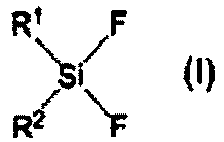
- a method for manufacturing a silsesquioxane compound represented by general formula (III) has a step of reacting a compound represented by general formula (I) (hereafter also referred to as a difluorosilane) and a compound represented by general formula (II) (hereafter also referred to as a silsesquioxane precursor).
- the difluorosilane according to one embodiment has a structure represented by general formula (I) shown below.
- each of R 1 and R 2 independently represents a hydrogen atom, an alkyl group of 1 to 8 carbon atoms, an aryl group of 6 to 14 carbon atoms, an aminoalkyl group, an amino group-containing group, a nitrile group-containing group, a vinyl group-containing group, a (meth)acryloyl group-containing group, a chloro group-containing group, a bromo group-containing group, or a functional group containing a boron trifluoride-complexed amino group.
- R 1 and R 2 may be the same or different.
- Alkyl groups represented by R 1 and R 2 preferably have 1 to 8 carbon atoms and more preferably 1 to 4 carbon atoms, may be linear or branched, and may be acyclic or cyclic. Examples include a methyl group, ethyl group, propyl group, isopropyl group, n-butyl group, tert-butyl group, sec-butyl group and iso-butyl group.
- Aryl groups represented by R 1 and R 2 preferably have 6 to 14 carbon atoms, and more preferably 6 to 8 carbon atoms. Within this range for the number of carbon atoms, the aryl group may have an alkyl group with a linear or branched chain bonded to at least one of the carbon atoms that form the carbon ring.
- aryl group examples include a phenyl group and a benzyl group.
- Each alkyl group and aryl group may be unsubstituted or may have a substituent.
- a polymerizable group such as a carbon-carbon double bond, vinyl group or (meth)acryloyl group, or a reactive group such as a hydroxyl group or amino group may be introduced into the alkyl group or aryl group. This enables a polymerizable group or reactive group to be introduced into the polysesquioxane compound as a portion of an alkyl groups or aryl group, meaning the polysesquioxane compound can be provided favorably as a polymerizable compound.
- Aminoalkyl groups represented by R 1 and R 2 preferably have an alkyl group portion of 1 to 8 carbon atoms, and particularly preferably 1 to 4 carbon atoms, and an amino group portion.
- the aminoalkyl group is preferably a group represented by R"-NH-R'- (wherein R' represents an alkylene group of 1 to 8 carbon atoms, and R" represents a hydrogen atom, an alkyl group, an aryl group, or an aminoalkyl group).
- R' represents an alkylene group of 1 to 8 carbon atoms
- R" represents a hydrogen atom, an alkyl group, an aryl group, or an aminoalkyl group.
- Specific examples include a 3-aminopropyl group, N-2-(aminoethyl)-3-aminopropyl group, and N-phenyl-3-aminopropyl group.
- the amino group-containing group, nitrile group-containing group, vinyl group-containing group, (meth)acryloyl group-containing group, chloro group-containing group or bromo group-containing group may be an amino group, nitrile group, vinyl group, (meth)acryloyl group, chloro group or bromo group respectively, or may be a monovalent organic group having one functional group or two or more functional groups selected from among these functional groups.
- an alkyl group or aryl group having one functional group or two or more functional groups selected from among these functional groups can be used favorably.
- an amino group-containing group, nitrile group-containing group, (meth)acryloyl group-containing group or chloro group-containing group is preferred.
- amino group-containing groups include an N-(2-aminoethyl)-3-aminopropyl group and a 3-aminopropyl group.
- nitrile group-containing groups include a 2-cyanoethyl group and a 3-cyanopropyl group.
- (meth)acryloyl group-containing groups include a 3-methacryloxypropyl group and a 3-acryloxypropyl group.
- chloro group-containing groups include a chloromethyl group and a 3-chloropropyl group.
- the functional group containing a boron trifluoride-complexed amino group is a functional group obtained by complexing the amino group of a functional group containing an amino group with boron trifluoride.
- Examples of the functional group containing an amino group include an amino group, and the aminoalkyl groups and amino group-containing groups described above.
- a functional group in which boron trifluoride is coordinated to an amino group or the amino group of an alkylamino group can be used favorably.
- a silsesquioxane precursor according to one embodiment has a structure represented by general formula (II) shown below.
- each of R 3 to R 10 independently represents an alkyl group or an aryl group, and preferably represents an alkyl group of 1 to 8 carbon atoms or an aryl group of 6 to 14 carbon atoms.
- a substituted or unsubstituted aryl group of 6 to 8 carbon atoms is more preferred, and among such groups, a phenyl group can be used particularly favorably.
- R 3 to R 10 may all be the same, or may be partially or completely different from each other.
- M is preferably at least one element selected from the group consisting of hydrogen, lithium, sodium and potassium. From the viewpoint of suppressing the generation of hydrogen fluoride as a highly toxic reaction by-product, and instead generating a metal fluoride of low toxicity as a by-product, at least one element selected from the group consisting of lithium, sodium and potassium is more preferred.
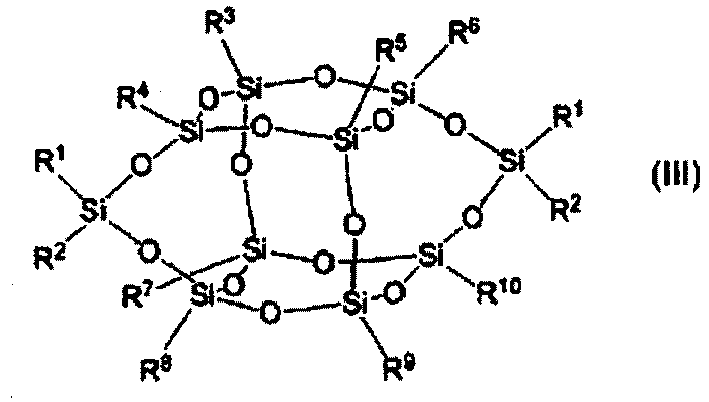
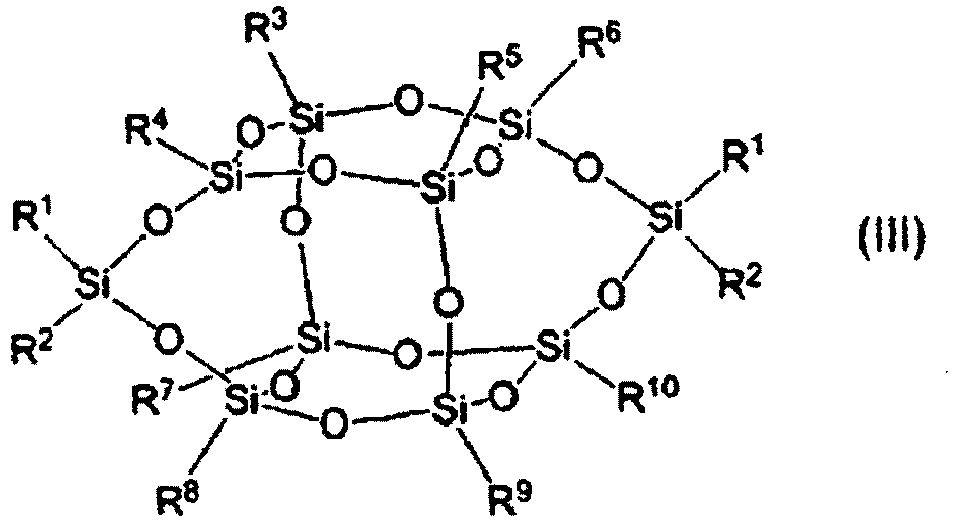
- a silsesquioxane according to one embodiment has a structure represented by general formula (III) shown below.
- each of R 1 and R 2 independently represents a hydrogen atom, an alkyl group of 1 to 8 carbon atoms, an aryl group of 6 to 14 carbon atoms, an aminoalkyl group, an amino group-containing group, a nitrile group-containing group, a vinyl group-containing group, a (meth)acryloyl group-containing group, a chloro group-containing group, a bromo group-containing group, or a functional group containing a boron trifluoride-complexed amino group, and each of R 3 to R 10 independently represents an alkyl group of 1 to 8 carbon atoms or an aryl group of 6 to 14 carbon atoms.
- R 1 and R 2 are introduced functional groups derived from R 1 and R 2 in the above general formula (I), and details relating to these groups are as described above for R 1 and R 2 in general formula (I).
- R 3 to R 10 are introduced functional groups derived from R 3 to R 10 in the above general formula (II), and details relating to these groups are as described above for R 3 to R 10 in general formula (II).
- R 1 and R 2 may be the same or different. In those cases where R 1 and R 2 are mutually different, the silsesquioxane precursor may be provided as a mixture of two geometrical isomers.
- the method for manufacturing a silsesquioxane compound represented by general formula (III) preferably includes a step of reacting a difluorosilane represented by general formula (I) and a silsesquioxane precursor represented by general formula (II).
- the step of reacting a difluorosilane represented by general formula (I) and a silsesquioxane precursor represented by general formula (II) is preferably conducted in a solvent.
- a solvent There are no particular limitations on the solvent used, but specific examples include toluene, ethylbenzene, xylene, hexane, heptane, methyl ethyl ketone, methyl isobutyl ketone, cyclopentanone, tetrahydrofuran, propylene glycol monomethyl ether acetate, ethyl acetate, isobutyl acetate, diethyl ether, acetone, acetonitrile, methanol, ethanol, 2-propanol, 1-butanol and 2-butanol.
- a single solvent may be used alone, or a mixture of these solvents may be used.
- reaction is preferably performed within a range from -78°C to 30°C that can be achieved by cooling with dry ice.
- the method for manufacturing a difluorosilane represented by general formula (I) preferably includes a step of performing manufacture using a compound represented by general formula (IV) shown below.
- each of R 1 and R 2 is independently the same as defined for general formula (I), and R 11 is preferably an alkyl group of 1 to 8 carbon atoms.
- R 11 is more preferably an alkyl group of 1 to 4 carbon atoms, and may have a linear or branched chain. Examples include a methyl group, ethyl group, propyl group, isopropyl group, n-butyl group, tert-butyl group, sec-butyl group and iso-butyl group.
- Examples of the compound represented by general formula (IV) include 3-aminopropylmethyldiethoxysilane, diphenyldimethoxysilane, 3-methacryloxypropylmethyldimethoxysilane, and dimethoxymethylvinylsilane.
- a boron trifluoride complex is preferred as the reagent used in the step of manufacturing a difluorosilane represented by general formula (I) using a compound represented by general formula (IV).
- Specific examples include trifluoroborane dimethyl ether complex, trifluoroborane diethyl ether complex, trifluoroborane monoethylamine complex, trifluoroborane dibutyl ether complex, trifluoroborane phenol complex, trifluoroborane tetrahydrofuran complex, and trifluoroborane piperidine complex.
- a solvent need not necessarily be used in the step of manufacturing a difluorosilane represented by general formula (I) using a compound represented by general formula (IV).
- specific examples of the solvent include toluene, ethylbenzene, xylene, hexane, heptane, methyl ethyl ketone, methyl isobutyl ketone, cyclopentanone, tetrahydrofuran, propylene glycol monomethyl ether acetate, ethyl acetate, isobutyl acetate, diethyl ether, acetone, acetonitrile, methanol, ethanol, 2-propanol, 1-butanol and 2-butanol.
- a single solvent may be used alone, or a mixture of these solvents may be used.
- reaction is preferably performed within a range from room temperature to 200°C, with heating being performed as required.
- the silsesquioxane precursor represented by general formula (II) can be obtained by hydrolyzing and condensing an organic silane compound having three hydrolyzable groups.
- a compound represented by general formula (II) can be obtained.
- X represents a monovalent metal element.
- the compound represented by general formula (II) can be manufactured using the compounds represented by general formula (V) shown below.
- each of R 3 to R 10 independently represents an alkyl group or an aryl group
- R 12 represents an alkyl group
- R 3 to R 10 in general formula (V) are introduced as R 3 to R 10 in general formula (II). Details are as described above in relation to general formula (II).
- R 12 is preferably an alkyl group of 1 to 8 carbon atoms, and more preferably an alkyl group of 1 to 4 carbon atoms. Specific examples include a methyl group, ethyl group, propyl group, isopropyl group, n-butyl group, tert-butyl group, sec-butyl group and isobutyl group.
- a base may be used to accelerate the reaction.
- a basic compound represented by X(OH) may be used, with specific examples including lithium hydroxide, sodium hydroxide and potassium hydroxide.
- Elemental analysis was conducted using a fully automatic elemental analyzer, by accurately weighing the sample to 0.0001 mg, and then performing simultaneous analysis of the CHN content.
- a compound represented by the structural formula (X) shown below was synthesized using the following procedure.
- C 6 H 5 indicates a phenyl group (this also applies in each subsequent formula).
- a 200 mL round-bottom flask was charged with 3.21 g of ground sodium hydroxide, 2.50 g of purified water and 94.18 g of 2-propanol. With the mixture undergo vigorous stirring with a magnetic stirrer, 24.01 g of phenyltrimethoxysilane (KBM-103, manufactured by Shin-Etsu Chemical Co., Ltd.) was added gradually in a dropwise manner. Under a nitrogen atmosphere, the flask was heated in an oil bath until the solvent reached reflux temperature, stirring under heat was then continued for 4 hours, and the reaction mixture was then left to stand overnight. The produced white precipitate was filtered using a Hirsch funnel, and the solid was washed with 2-propanol and then dried under reduced pressure at 70°C, yielding 4.05 g of a white powdery solid.
- KBM-103 phenyltrimethoxysilane
- a compound represented by the structural formula (Y1) shown below was synthesized using the following procedure.
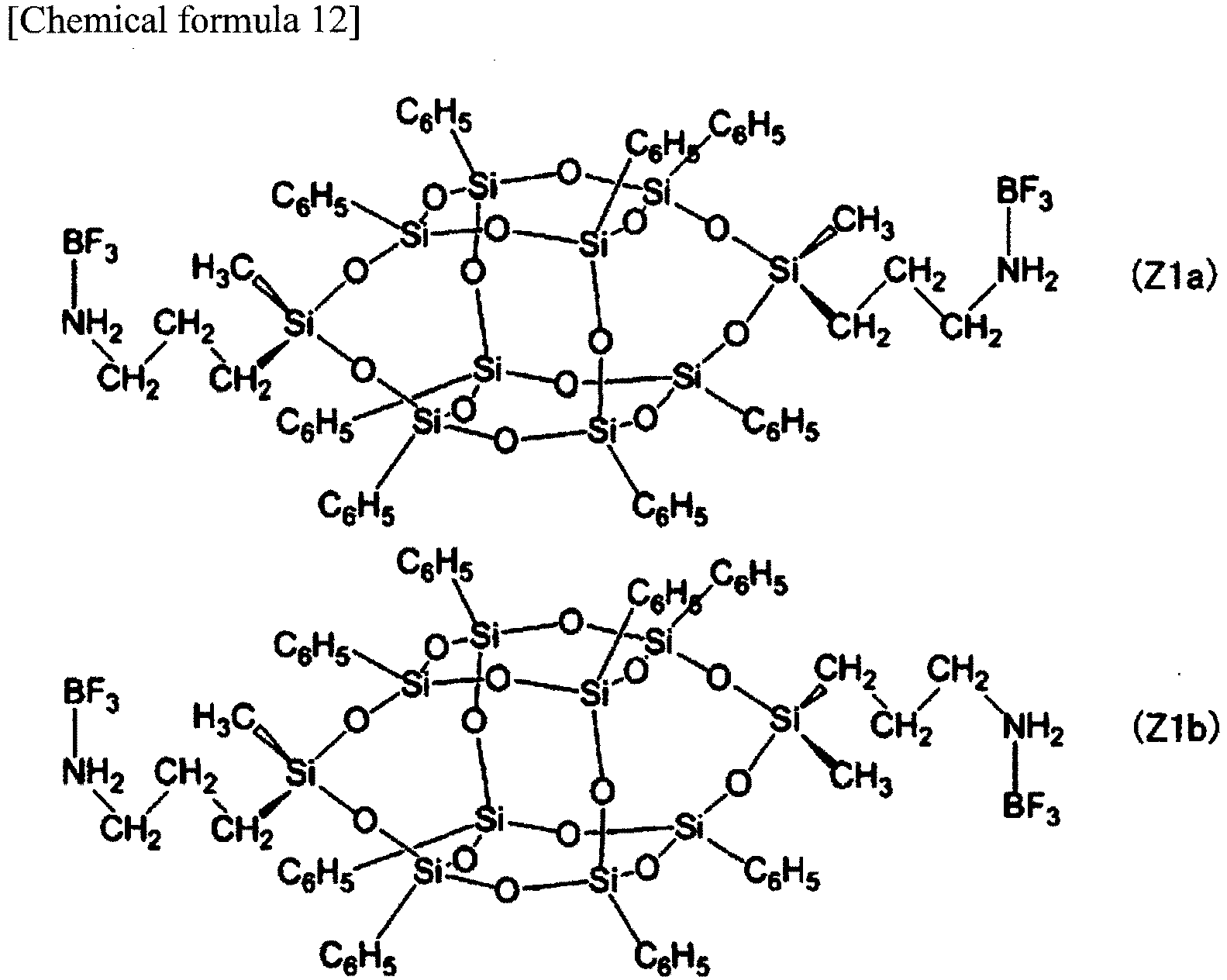
- a compound represented by the structural formula (Z1) shown below was synthesized using the following procedure.
- a 200 mL three-neck flask was fitted with a dropping funnel and a nitrogen inlet, the flask was then charged with 5.01 g of the compound represented by the above structural formula (X), and the atmosphere inside the flask was flushed with nitrogen.
- tetrahydrofuran anhydrous, manufactured by Wako Pure Chemical Industries, Ltd., this also applies to subsequent mentions of tetrahydrofuran
- the flask was then cooled to 0°C in an ice bath.
- a separate 100 mL two-neck flask was fitted with a septum rubber and a nitrogen inlet, the flask was then charged with 1.65 g of the compound represented by the above structural formula (Y), and the atmosphere inside the flask was flushed with nitrogen.
- Y the atmosphere inside the flask was flushed with nitrogen.
- 50 mL of tetrahydrofuran was added and stirred, a colorless transparent solution was obtained.
- This solution was extracted using a syringe, transferred to the dropping funnel, and then added gradually over a period of 20 minutes to the white suspension mentioned above. Stirring was then continued for three hours at 0°C, and when the ice bath was then removed and stirring was continued until the temperature gradually returned to room temperature, a transparent solution was obtained.
- This white solid was composed of compounds represented by structural formulas (Z1a) and (Z1b), and the fact that these compounds represented by structural formulas (Z1a) and (Z1b) represented a mixture of two geometrical isomers was determined by NMR. The presumed structures of the isomers are shown below. Further, the 29 Si NMR spectrum of these compounds is shown in FIG. 2 .
- a 50 mL two-neck flask was fitted with a nitrogen inlet, the flask was charged with 0.709 g of the compound represented by the above structural formula (X), and the atmosphere inside the flask was flushed with nitrogen.
- X the compound represented by the above structural formula (X)
- Y2 the atmosphere inside the flask was flushed with nitrogen.
- This white solid was a compound represented by structural formula (Z2), and the structure of this compound represented by structural formula (Z2) was determined by NMR. Further, the 29 Si NMR spectrum of this compound is shown in FIG. 4 .
- a 50 mL two-neck flask was fitted with a nitrogen inlet, the flask was charged with 0.706 g of the compound represented by the above structural formula (X), and the atmosphere inside the flask was flushed with nitrogen.
- X the compound represented by the above structural formula (X)
- tetrahydrofuran 20 mL was added and stirred, a white suspension was obtained.
- the flask was then cooled to 0°C in an ice bath.
- a separate 50 mL two-neck flask was fitted with a septum rubber and a nitrogen inlet, the flask was charged with 0.28 g of the compound represented by the above structural formula (Y3), and the atmosphere inside the flask was flushed with nitrogen.
- This white solid was composed of compounds represented by structural formulas (Z3a) and (Z3b), and the structures of these compounds represented by structural formulas (Z3a) and (Z3b) were determined by NMR. Further, the 29 Si NMR spectrum of these compounds is shown in FIG. 6 .
- a 50 mL two-neck flask was fitted with a nitrogen inlet, the flask was charged with 2.002 g of the compound represented by the above structural formula (X), and the atmosphere inside the flask was flushed with nitrogen.
- 20 mL of tetrahydrofuran was added and stirred, a white suspension was obtained.
- the flask was then cooled to 0°C in an ice bath.
- 0.730 g of the colorless transparent liquid containing 47.7% of the compound represented by the above structural formula (Y4) was added gradually. Stirring was continued for 30 minutes at 0°C, and the ice bath was then removed and stirring was continued until the temperature gradually returned to room temperature.
- the resulting solution was transferred to a round-bottom flask, the solvent was removed by distillation using a rotary evaporator, and drying was then performed under reduced pressure using an oil pump, thus obtaining 2.80 g of a white solid.
- 10 mL of ethyl acetate was added, and following removal of the insoluble material by centrifugal separation, the solution was transferred to a round-bottom flask, the solvent was removed by distillation using a rotary evaporator, and drying was then performed under reduced pressure using an oil pump, yielding a white solid. Following washing with methanol, the solid was dried under reduced pressure using an oil pump, thus obtaining 0.68 g of a white solid.
- This white solid was composed of compounds represented by structural formulas (Z4a) and (Z4b), and the structures of these compounds represented by structural formulas (Z4a) and (Z4b) were determined by NMR. Further, the 29 Si NMR spectrum of these compounds is shown in FIG. 8 .
Landscapes
- Chemical & Material Sciences (AREA)
- Organic Chemistry (AREA)
- Silicon Polymers (AREA)
Abstract

Description
- One embodiment of the present invention relates to a method for manufacturing a silsesquioxane compound.
- Silsesquioxanes represented by (RSiO1.5)n are known as compounds that can be obtained by subjecting an organosilicon compound having three hydrolyzable groups to hydrolysis followed by condensation. These compounds have a chemical structure that can also be said to exist between silicone resins and glass, and because they have excellent properties including heat resistance, transparency and weather resistance, they are attracting much attention as optical, semiconductor and electronic materials, with a large amount of research continuing to be reported.
- Known structures for these silsesquioxanes include random structures with no specific structure, as well as double-decker structures, ladder structures and cage structures for which the structure can be determined. Although all of these structures have excellent properties, when used as a resin modifier, aggregation can sometimes occur in mixed resins, making it difficult to achieve the expected properties.
- Accordingly, techniques have been developed for introducing a silsesquioxane into the main chain of a polymer to suppress aggregation. Patent Document 1 proposes a difunctional silsesquioxane that can be introduced into a main chain. Further, Patent Documents 2 and 3 propose the introduction of double-decker silsesquioxanes into the main chain.
-
- Patent Document 1:
JP 4379120 B - Patent Document 2:
JP 4946169 B - Patent Document 3:
JP 5082258 B - In these patent documents, the double-decker silsesquioxanes are synthesized by a reaction between a precursor and a chlorosilane. However, chlorosilanes suffer from problems of poor handling, and react with water to instantly form hydrogen chloride.
- Specific aspects for addressing the above problems are as follows.
- [1] A method for manufacturing a silsesquioxane compound represented by general formula (III) shown below, the method comprising a step of reacting a compound represented by general formula (I) shown below and a compound represented by general formula (II) shown below.

[In general formula (I), each of R1 and R2 independently represents a hydrogen atom, an alkyl group of 1 to 8 carbon atoms, an aryl group of 6 to 14 carbon atoms, an aminoalkyl group, an amino group-containing group, a nitrile group-containing group, a vinyl group-containing group, a (meth)acryloyl group-containing group, a chloro group-containing group, a bromo group-containing group, or a functional group containing a boron trifluoride-complexed amino group.

[In general formula (II), each of R3 to R10 independently represents an alkyl group of 1 to 8 carbon atoms or an aryl group of 6 to 14 carbon atoms, and M represents at least one element selected from the group consisting of hydrogen, lithium, sodium and potassium.
[In general formula (III), each of R1 and R2 independently represents a hydrogen atom, an alkyl group of 1 to 8 carbon atoms, an aryl group of 6 to 14 carbon atoms, an aminoalkyl group, an amino group-containing group, a nitrile group-containing group, a vinyl group-containing group, a (meth)acryloyl group-containing group, a chloro group-containing group, a bromo group-containing group, or a functional group containing a boron trifluoride-complexed amino group, and each of R3 to R10 independently represents an alkyl group of 1 to 8 carbon atoms or an aryl group of 6 to 14 carbon atoms.] - [2] The method for manufacturing a silsesquioxane according to [1], including a step of manufacturing the compound represented by the general formula (I) using a compound represented by general formula (IV) shown below.


[In general formula (IV), each of R1 and R2 is independently the same as defined for general formula (I), and R11 represents an alkyl group of 1 to 8 carbon atoms.] - [3] The method for manufacturing a silsesquioxane according to [1] or [2], wherein in the general formula (II), M represents at least one element selected from the group consisting of lithium, sodium and potassium.
- [4] The method for manufacturing a silsesquioxane according to any one of [1] to [3], wherein in the general formula (I), each of R1 and R2 independently represents an alkyl group of 1 to 8 carbon atoms, an aminoalkyl group, or a functional group containing a boron trifluoride-complexed amino group, and at least one of R1 and R2 is an aminoalkyl group or a functional group containing a boron trifluoride-complexed amino group.
- [5] The method for manufacturing a silsesquioxane according to [4], wherein in the general formula (I), at least one of R1 and R2 is a 3-aminopropyl group, an N-2-(aminoethyl)-3-aminopropyl group, an N-phenyl-3-aminopropyl group, or a functional group containing a boron trifluoride-complexed amino group.
- [6] The method for manufacturing a silsesquioxane according to any one of [1] to [5], wherein in the general formula (II), R3 to R10 are aryl groups of 6 to 8 carbon atoms.
- One embodiment of the present invention enables synthesis of a double-decker silsesquioxane compound that can be introduced into a main chain simply and at low cost.
-
-
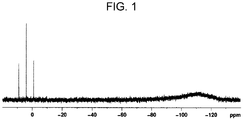
FIG. 1 is a graph illustrating the 29Si NMR spectrum of a compound represented by general formula (Y1) obtained in the examples. -
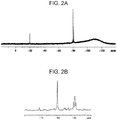
FIG. 2A is a graph illustrating the 29Si NMR spectrum of a compound represented by general formula (Z1) obtained in the examples. -
FIG. 2B is a partially expanded view ofFIG. 2A . -
FIG. 3 is a graph illustrating the 29Si NMR spectrum of a compound represented by general formula (Y2) obtained in the examples. -
FIG. 4 is a graph illustrating the 29Si NMR spectrum of a compound represented by general formula (Z2) obtained in the examples. -
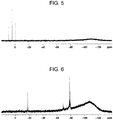
FIG. 5 is a graph illustrating the 29Si NMR spectrum of a compound represented by general formula (Y3) obtained in the examples. -
FIG. 6 is a graph illustrating the 29Si NMR spectrum of a compound represented by general formula (Z3) obtained in the examples. -
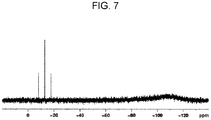
FIG. 7 is a graph illustrating the 29Si NMR spectrum of a compound represented by general formula (Y4) obtained in the examples. -
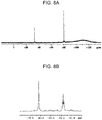
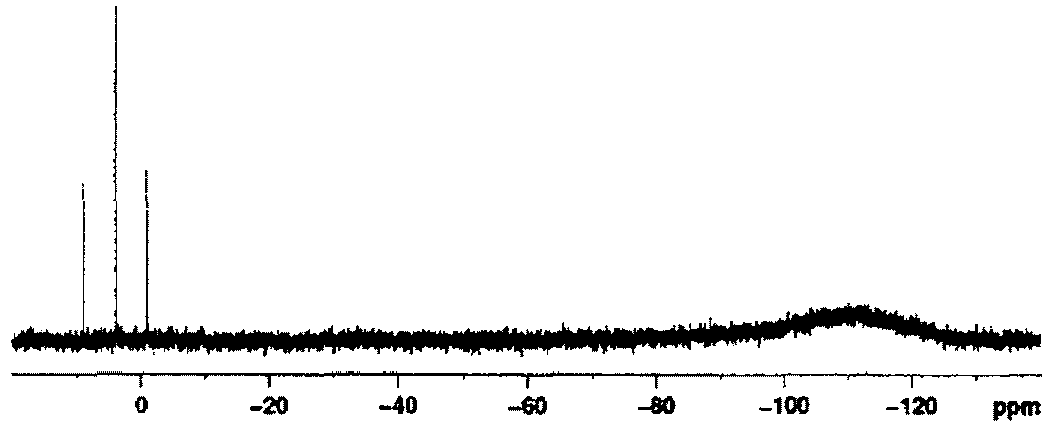
FIG. 8A is a graph illustrating the 29Si NMR spectrum of a compound represented by general formula (Z4) obtained in the examples. -
FIG. 8B is a partially expanded view ofFIG. 8A . - Embodiments of the present invention are described below, but the present invention is in no way limited by the following examples.
- A method for manufacturing a silsesquioxane compound represented by general formula (III) has a step of reacting a compound represented by general formula (I) (hereafter also referred to as a difluorosilane) and a compound represented by general formula (II) (hereafter also referred to as a silsesquioxane precursor).
- The difluorosilane according to one embodiment has a structure represented by general formula (I) shown below.

- In general formula (I), each of R1 and R2 independently represents a hydrogen atom, an alkyl group of 1 to 8 carbon atoms, an aryl group of 6 to 14 carbon atoms, an aminoalkyl group, an amino group-containing group, a nitrile group-containing group, a vinyl group-containing group, a (meth)acryloyl group-containing group, a chloro group-containing group, a bromo group-containing group, or a functional group containing a boron trifluoride-complexed amino group. R1 and R2 may be the same or different.
- Alkyl groups represented by R1 and R2 preferably have 1 to 8 carbon atoms and more preferably 1 to 4 carbon atoms, may be linear or branched, and may be acyclic or cyclic. Examples include a methyl group, ethyl group, propyl group, isopropyl group, n-butyl group, tert-butyl group, sec-butyl group and iso-butyl group.
- Aryl groups represented by R1 and R2 preferably have 6 to 14 carbon atoms, and more preferably 6 to 8 carbon atoms. Within this range for the number of carbon atoms, the aryl group may have an alkyl group with a linear or branched chain bonded to at least one of the carbon atoms that form the carbon ring.
- Examples of the aryl group include a phenyl group and a benzyl group.
- Each alkyl group and aryl group may be unsubstituted or may have a substituent. A polymerizable group such as a carbon-carbon double bond, vinyl group or (meth)acryloyl group, or a reactive group such as a hydroxyl group or amino group may be introduced into the alkyl group or aryl group. This enables a polymerizable group or reactive group to be introduced into the polysesquioxane compound as a portion of an alkyl groups or aryl group, meaning the polysesquioxane compound can be provided favorably as a polymerizable compound.
- Aminoalkyl groups represented by R1 and R2 preferably have an alkyl group portion of 1 to 8 carbon atoms, and particularly preferably 1 to 4 carbon atoms, and an amino group portion. For example, the aminoalkyl group is preferably a group represented by R"-NH-R'- (wherein R' represents an alkylene group of 1 to 8 carbon atoms, and R" represents a hydrogen atom, an alkyl group, an aryl group, or an aminoalkyl group). Specific examples include a 3-aminopropyl group, N-2-(aminoethyl)-3-aminopropyl group, and N-phenyl-3-aminopropyl group.
- In general formula (I), the amino group-containing group, nitrile group-containing group, vinyl group-containing group, (meth)acryloyl group-containing group, chloro group-containing group or bromo group-containing group may be an amino group, nitrile group, vinyl group, (meth)acryloyl group, chloro group or bromo group respectively, or may be a monovalent organic group having one functional group or two or more functional groups selected from among these functional groups. For example, an alkyl group or aryl group having one functional group or two or more functional groups selected from among these functional groups can be used favorably. Among the various possibilities, an amino group-containing group, nitrile group-containing group, (meth)acryloyl group-containing group or chloro group-containing group is preferred.
- Specific examples of amino group-containing groups include an N-(2-aminoethyl)-3-aminopropyl group and a 3-aminopropyl group. Specific examples of nitrile group-containing groups include a 2-cyanoethyl group and a 3-cyanopropyl group. Specific examples of (meth)acryloyl group-containing groups include a 3-methacryloxypropyl group and a 3-acryloxypropyl group. Specific examples of chloro group-containing groups include a chloromethyl group and a 3-chloropropyl group.
- The functional group containing a boron trifluoride-complexed amino group is a functional group obtained by complexing the amino group of a functional group containing an amino group with boron trifluoride. Examples of the functional group containing an amino group include an amino group, and the aminoalkyl groups and amino group-containing groups described above.
- A functional group in which boron trifluoride is coordinated to an amino group or the amino group of an alkylamino group can be used favorably.
- A silsesquioxane precursor according to one embodiment has a structure represented by general formula (II) shown below.


- In general formula (II), each of R3 to R10 independently represents an alkyl group or an aryl group, and preferably represents an alkyl group of 1 to 8 carbon atoms or an aryl group of 6 to 14 carbon atoms. A substituted or unsubstituted aryl group of 6 to 8 carbon atoms is more preferred, and among such groups, a phenyl group can be used particularly favorably. R3 to R10 may all be the same, or may be partially or completely different from each other.
- In general formula (II), M is preferably at least one element selected from the group consisting of hydrogen, lithium, sodium and potassium. From the viewpoint of suppressing the generation of hydrogen fluoride as a highly toxic reaction by-product, and instead generating a metal fluoride of low toxicity as a by-product, at least one element selected from the group consisting of lithium, sodium and potassium is more preferred.
- A silsesquioxane according to one embodiment has a structure represented by general formula (III) shown below.

- In general formula (III), each of R1 and R2 independently represents a hydrogen atom, an alkyl group of 1 to 8 carbon atoms, an aryl group of 6 to 14 carbon atoms, an aminoalkyl group, an amino group-containing group, a nitrile group-containing group, a vinyl group-containing group, a (meth)acryloyl group-containing group, a chloro group-containing group, a bromo group-containing group, or a functional group containing a boron trifluoride-complexed amino group, and each of R3 to R10 independently represents an alkyl group of 1 to 8 carbon atoms or an aryl group of 6 to 14 carbon atoms.
- In general formula (III), R1 and R2 are introduced functional groups derived from R1 and R2 in the above general formula (I), and details relating to these groups are as described above for R1 and R2 in general formula (I).
- In general formula (III), R3 to R10 are introduced functional groups derived from R3 to R10 in the above general formula (II), and details relating to these groups are as described above for R3 to R10 in general formula (II).
- In general formula (III), R1 and R2 may be the same or different. In those cases where R1 and R2 are mutually different, the silsesquioxane precursor may be provided as a mixture of two geometrical isomers.
- One example of a method for manufacturing a silsesquioxane compound represented by general formula (III) is described below.
- In a reaction between a fluorosilane and Si-O-M+, a siloxane linkage Si-O-Si is formed. One example of synthesizing a cage silsesquioxane using this reaction is described in a Non-Patent Document (Angew. Chem. Int. Ed. 2016, 55, 9336 to 9339).
- The method for manufacturing a silsesquioxane compound represented by general formula (III) preferably includes a step of reacting a difluorosilane represented by general formula (I) and a silsesquioxane precursor represented by general formula (II).
- The step of reacting a difluorosilane represented by general formula (I) and a silsesquioxane precursor represented by general formula (II) is preferably conducted in a solvent. There are no particular limitations on the solvent used, but specific examples include toluene, ethylbenzene, xylene, hexane, heptane, methyl ethyl ketone, methyl isobutyl ketone, cyclopentanone, tetrahydrofuran, propylene glycol monomethyl ether acetate, ethyl acetate, isobutyl acetate, diethyl ether, acetone, acetonitrile, methanol, ethanol, 2-propanol, 1-butanol and 2-butanol. A single solvent may be used alone, or a mixture of these solvents may be used.
- There are no particular limitations on the temperature during the step of reacting a difluorosilane represented by general formula (I) and a silsesquioxane precursor represented by general formula (II), but the reaction is preferably performed within a range from -78°C to 30°C that can be achieved by cooling with dry ice.
- In the step of reacting a difluorosilane represented by general formula (I) and a silsesquioxane precursor represented by general formula (II), the presence of a trace amount of water presents no particular problems. Further, there are no particular limitations on the reaction atmosphere, and the reaction may be performed under nitrogen or under normal atmospheric conditions.
- The method for manufacturing a difluorosilane represented by general formula (I) preferably includes a step of performing manufacture using a compound represented by general formula (IV) shown below.

- In the compound represented by general formula (IV), each of R1 and R2 is independently the same as defined for general formula (I), and R11 is preferably an alkyl group of 1 to 8 carbon atoms. R11 is more preferably an alkyl group of 1 to 4 carbon atoms, and may have a linear or branched chain. Examples include a methyl group, ethyl group, propyl group, isopropyl group, n-butyl group, tert-butyl group, sec-butyl group and iso-butyl group.
- Examples of the compound represented by general formula (IV) include 3-aminopropylmethyldiethoxysilane, diphenyldimethoxysilane, 3-methacryloxypropylmethyldimethoxysilane, and dimethoxymethylvinylsilane.
- A boron trifluoride complex is preferred as the reagent used in the step of manufacturing a difluorosilane represented by general formula (I) using a compound represented by general formula (IV). Specific examples include trifluoroborane dimethyl ether complex, trifluoroborane diethyl ether complex, trifluoroborane monoethylamine complex, trifluoroborane dibutyl ether complex, trifluoroborane phenol complex, trifluoroborane tetrahydrofuran complex, and trifluoroborane piperidine complex.
- By conducting a reaction of the compound represented by general formula (IV) in the presence of a boron trifluoride complex, the alkoxy group bond of the compound represented by general formula (IV) can be broken, promoting the introduction of a fluoro group. Moreover, in those cases where a compound is used that has an amino group in at least one of R1 and R2 in general formula (IV), not only is a fluoro group introduced, but at least one of R1 and R2 is observed as a boron trifluoride-complexed amino group in the compound represented by general formula (I).
- A solvent need not necessarily be used in the step of manufacturing a difluorosilane represented by general formula (I) using a compound represented by general formula (IV). In those cases where a solvent is used, specific examples of the solvent include toluene, ethylbenzene, xylene, hexane, heptane, methyl ethyl ketone, methyl isobutyl ketone, cyclopentanone, tetrahydrofuran, propylene glycol monomethyl ether acetate, ethyl acetate, isobutyl acetate, diethyl ether, acetone, acetonitrile, methanol, ethanol, 2-propanol, 1-butanol and 2-butanol. A single solvent may be used alone, or a mixture of these solvents may be used.
- There are no particular limitations on the temperature during the step of manufacturing a difluorosilane represented by general formula (I) using a compound represented by general formula (IV), but the reaction is preferably performed within a range from room temperature to 200°C, with heating being performed as required.
- [Method for Manufacturing Silsesquioxane Precursor Represented by General Formula (II)]
- The silsesquioxane precursor represented by general formula (II) can be obtained by hydrolyzing and condensing an organic silane compound having three hydrolyzable groups.
- For example, by reacting an organic silane compound having three hydrolyzable groups with a base represented by X(OH), a compound represented by general formula (II) can be obtained. Here, X represents a monovalent metal element.
- In one example, the compound represented by general formula (II) can be manufactured using the compounds represented by general formula (V) shown below.

- In general formula (V), each of R3 to R10 independently represents an alkyl group or an aryl group , and R12 represents an alkyl group.
- R3 to R10 in general formula (V) are introduced as R3 to R10 in general formula (II). Details are as described above in relation to general formula (II).
- In general formula (V), R12 is preferably an alkyl group of 1 to 8 carbon atoms, and more preferably an alkyl group of 1 to 4 carbon atoms. Specific examples include a methyl group, ethyl group, propyl group, isopropyl group, n-butyl group, tert-butyl group, sec-butyl group and isobutyl group.
- In those cases where the compound represented by general formula (V) is produced from a compound represented by general formula (II), a base may be used to accelerate the reaction. There are no particular limitations on the base, and a basic compound represented by X(OH) may be used, with specific examples including lithium hydroxide, sodium hydroxide and potassium hydroxide.
- The present invention is described below in further detail using a series of examples, but the present invention is not limited to these examples.
- The structure and purity of each obtained compound was determined as required using NMR techniques such as 1H NMR, 13C NMR, 29Si NMR and 19F NMR. The measurement conditions were as follows.
- Apparatus: Avance 300 (manufactured by Bruker Corporation)
Observed nucleus: 1H
Resonance frequency: 300 MHz
Measurement temperature: 25°C - Apparatus: Avance 300 (manufactured by Bruker Corporation)
Observed nucleus: 1H
Resonance frequency: 75 MHz
Measurement temperature: 25°C - Apparatus: Avance 300 (manufactured by Bruker Corporation)
Resonance frequency: 60 MHz
Measurement temperature: 25°C - Apparatus: Avance 300 (manufactured by Bruker Corporation)
Resonance frequency: 282 MHz
Measurement temperature: 25°C - Elemental analysis was conducted using a fully automatic elemental analyzer, by accurately weighing the sample to 0.0001 mg, and then performing simultaneous analysis of the CHN content.
- System: vario MICRO cube (manufactured by Elementar Analysensysteme GmbH)
Combustion furnace: 1,150°C
Reducing furnace: 850°C
Helium flow rate: 200 ml/min
Oxygen flow rate: 25 to 30 ml/min - A compound represented by the structural formula (X) shown below was synthesized using the following procedure. In the structural formula (X), C6H5 indicates a phenyl group (this also applies in each subsequent formula). Components for which there are no particular descriptions used reagents manufactured by Wako Pure Chemical Industries, Ltd., and components of the same label employed the same component through all of the examples (this also applies below).
- A 200 mL round-bottom flask was charged with 3.21 g of ground sodium hydroxide, 2.50 g of purified water and 94.18 g of 2-propanol. With the mixture undergo vigorous stirring with a magnetic stirrer, 24.01 g of phenyltrimethoxysilane (KBM-103, manufactured by Shin-Etsu Chemical Co., Ltd.) was added gradually in a dropwise manner. Under a nitrogen atmosphere, the flask was heated in an oil bath until the solvent reached reflux temperature, stirring under heat was then continued for 4 hours, and the reaction mixture was then left to stand overnight. The produced white precipitate was filtered using a Hirsch funnel, and the solid was washed with 2-propanol and then dried under reduced pressure at 70°C, yielding 4.05 g of a white powdery solid.
-

- A compound represented by the structural formula (Y1) shown below was synthesized using the following procedure.
- A 25 mL round-bottom flask was charged with 8.47 g of 3-aminopropylmethyldiethoxysilane (KBE-902, manufactured by Shin-Etsu Chemical Co., Ltd.) and 25.15 g of trifluoroborane diethyl ether complex (manufactured by Wako Pure Chemical Industries, Ltd.), and the mixture was stirred using a magnetic stirrer. After stirring for 24 hours, the flask was heated to 140°C using an oil bath, and the volatile fraction was removed by distillation under reduced pressure, yielding 8.90 g of a white solid. The structure of the compound represented by the structural formula (Y1) was determined by NMR. The 29Si NMR spectrum of this compound is shown in
FIG. 1 . - 1H NMR (300 MHz, acetone-d6) δ = 5.58 (br, 2H), 2.92 (m, 2H), 1.90 (m, 2H), 0.99 (m, 2H), 0.39 (t, 3H). 13C NMR (75 MHz, acetone-d6) δ = 44.66, 22.03, 11.550, - 4.01. 29Si NMR (60 MHz, acetone-d6) δ = 4.04 (t). 19F NMR (282 MHz, acetone-d6) δ = - 136.11, -51.78 (m).
- Elemental analysis: C 23.11% (theoretical value 23.21%), H 5.29% (theoretical value 5.36%), N 6.69% (theoretical value 6.77%).

- A compound represented by the structural formula (Z1) shown below was synthesized using the following procedure.
- A 200 mL three-neck flask was fitted with a dropping funnel and a nitrogen inlet, the flask was then charged with 5.01 g of the compound represented by the above structural formula (X), and the atmosphere inside the flask was flushed with nitrogen. When 100 mL of tetrahydrofuran (anhydrous, manufactured by Wako Pure Chemical Industries, Ltd., this also applies to subsequent mentions of tetrahydrofuran) was added and stirred, a white suspension was obtained. The flask was then cooled to 0°C in an ice bath. A separate 100 mL two-neck flask was fitted with a septum rubber and a nitrogen inlet, the flask was then charged with 1.65 g of the compound represented by the above structural formula (Y), and the atmosphere inside the flask was flushed with nitrogen. When 50 mL of tetrahydrofuran was added and stirred, a colorless transparent solution was obtained. This solution was extracted using a syringe, transferred to the dropping funnel, and then added gradually over a period of 20 minutes to the white suspension mentioned above. Stirring was then continued for three hours at 0°C, and when the ice bath was then removed and stirring was continued until the temperature gradually returned to room temperature, a transparent solution was obtained. This solution was transferred to a round-bottom flask, the solvent was removed by distillation using a rotary evaporator, and drying was then performed under reduced pressure using an oil pump, thus obtaining 6.33 g of a white solid. Subsequently, 25 mL of ethyl acetate was added to this solid, and a fractionation-purification was performed using a medium-pressure column (universal column AMINO column (4 L size) manufactured by Yamazen Corporation), using ethyl acetate as the eluent, yielding 1.99 g of a white solid.
- This white solid was composed of compounds represented by structural formulas (Z1a) and (Z1b), and the fact that these compounds represented by structural formulas (Z1a) and (Z1b) represented a mixture of two geometrical isomers was determined by NMR. The presumed structures of the isomers are shown below. Further, the 29Si NMR spectrum of these compounds is shown in
FIG. 2 . - 1H NMR (300 MHz, tetrahydrofuran-d8) δ = 7.80 to 7.20 (m, 40H), 5.50 (m, 4H), 2.89 (m, 4H), 1.80 (m, 4H), 1.03 (m, 4H), 0.44 (m, 6H). 13C NMR (75 MHz, tetrahydrofuran-d8) δ = 135.06, 132.90, 131.94, 131.77, 129.16, 129.06, 129.01, 128.95, 128.90, 45.54, 23.51, 14.88, -0.70. 29Si NMR (60 MHz, tetrahydrofuran-d8) δ = -19.86, - 80.01, -80.92, -81.01, -81.12. 19F NMR (282 MHz, tetrahydrofuran-d8) δ = -155.75 (m).
- A 50 mL round-bottom flask was charged with 15.10 g of diphenyldimethoxysilane (KBM-202SS, manufactured by Shin-Etsu Chemical Co., Ltd.) and 5.80 g of trifluoroborane diethyl ether complex (manufactured by Wako Pure Chemical Industries, Ltd.), and the mixture was stirred with a magnetic stirrer. After stirring for 24 hours, the flask was heated to 40°C using an oil bath, and the volatile fraction was removed by distillation under reduced pressure, yielding 7.57 g of a colorless transparent liquid. The structure of the compound represented by the structural formula (Y2) (difluorodiphenylsilane) was determined by NMR. Further, the 29Si NMR spectrum of this compound is shown in
FIG. 3 . - 1H NMR (300 MHz, acetone-d6) δ = 7.83 to 7.25 (m, 10H). 13C NMR (75 MHz, acetone-d6) δ = 135.95, 135.92, 135.90, 134.02, 130.20. 29Si NMR (60 MHz, acetone-d6) δ = -29.12 (t). 19F NMR (282 MHz, acetone-d6) δ = -143.29.

- A 50 mL two-neck flask was fitted with a nitrogen inlet, the flask was charged with 0.709 g of the compound represented by the above structural formula (X), and the atmosphere inside the flask was flushed with nitrogen. When 20 mL of tetrahydrofuran was added and stirred, a white suspension was obtained. The flask was then cooled to 0°C in an ice bath. A separate 50 mL two-neck flask was fitted with a septum rubber and a nitrogen inlet, the flask was charged with 0.28 g of the compound represented by the above structural formula (Y2), and the atmosphere inside the flask was flushed with nitrogen. When 10 mL of tetrahydrofuran was added and stirred, a colorless transparent solution was obtained. This solution was extracted using a syringe, and added gradually to the white suspension mentioned above. Stirring was then continued for one hour at 0°C, and when the ice bath was then removed and stirring was continued until the temperature gradually returned to room temperature, a transparent solution was obtained. This solution was transferred to a round-bottom flask, the solvent was removed by distillation using a rotary evaporator, and drying was then performed under reduced pressure using an oil pump, thus obtaining 0.84 g of a white solid.
- This white solid was a compound represented by structural formula (Z2), and the structure of this compound represented by structural formula (Z2) was determined by NMR. Further, the 29Si NMR spectrum of this compound is shown in
FIG. 4 . - 1H NMR (300 MHz, CDC13) δ = 7.83 to 7.14 (m, 60 H). 13C NMR (75 MHz, CDCl3) δ = 134.57, 134.25, 134.09. 134.10. 131.54, 130.48, 130.40, 130.19, 130.10, 127.80, 127.77, 127.39. 29Si NMR (60 MHz, CDCl3) δ = -45.29, -77.99, -79.25.

- A 50 mL round-bottom flask was charged with 1.15 g of 3-methacryloxypropylmethyldimethoxysilane (KBE502, manufactured by Shin-Etsu Chemical Co., Ltd.) and 1.46 g of trifluoroborane diethyl ether complex (manufactured by Wako Pure Chemical Industries, Ltd.), and the mixture was stirred with a magnetic stirrer. After stirring for 24 hours, the flask was heated to 40°C using an oil bath, and the volatile fraction was removed by distillation under reduced pressure, yielding 0.72 g of a colorless transparent liquid. The structure of the compound represented by the structural formula (Y3) was determined by NMR. Further, the 29Si NMR spectrum of this compound is shown in
FIG. 5 . - 1H NMR (300 MHz, acetone-d6) δ = 6.11 (m, 1H), 5.66 (t, 1H), 4.17 (t, 2H), 1.95 (m, 3H), 1.87 (m, 2H), 0.98 (m, 2H), 0.43 (t, 3H). 13C NMR (75 MHz, acetone-d6) δ = 166.96, 137.03, 125.00, 66.14, 21.21, 17.92, 9.58, -5.10. 29Si NMR (60 MHz, acetone-d6) δ = 4.13 (t). 19F NMR (282 MHz, acetone-d6) δ = -136.69.


- A 50 mL two-neck flask was fitted with a nitrogen inlet, the flask was charged with 0.706 g of the compound represented by the above structural formula (X), and the atmosphere inside the flask was flushed with nitrogen. When 20 mL of tetrahydrofuran was added and stirred, a white suspension was obtained. The flask was then cooled to 0°C in an ice bath. A separate 50 mL two-neck flask was fitted with a septum rubber and a nitrogen inlet, the flask was charged with 0.28 g of the compound represented by the above structural formula (Y3), and the atmosphere inside the flask was flushed with nitrogen. When 10 mL of tetrahydrofuran was added and stirred, a colorless transparent solution was obtained. This solution was extracted using a syringe, and added gradually to the white suspension mentioned above. Stirring was then continued for one hour at 0°C, and when the ice bath was then removed and stirring was continued until the temperature gradually returned to room temperature, a transparent solution was obtained. This solution was transferred to a round-bottom flask, the solvent was removed by distillation using a rotary evaporator, and drying was then performed under reduced pressure using an oil pump, thus obtaining 0.44 g of a white solid.
- This white solid was composed of compounds represented by structural formulas (Z3a) and (Z3b), and the structures of these compounds represented by structural formulas (Z3a) and (Z3b) were determined by NMR. Further, the 29Si NMR spectrum of these compounds is shown in
FIG. 6 . - 1H NMR (300 MHz, CDCl3) δ = 7.80 to 7.10 (m, 40H), 5.97 (m, 2H), 5.44 (t, 2H), 4.00 (m, 4H), 1.85 (m, 6H), 1.62 (m, 4H), 0.75 (m, 4H), 0.32 (t, 6H). 13C NMR (75 MHz, CDCl3) δ = 167.34, 136.28, 134.17, 133.92, 133.82, 133.76, 131.79, 130.37, 127.77, 127.73, 127.64, 125.11, 66.11, 21.30, 18.16, 12.80, -0.99. 29Si NMR (60 MHz, CDCl3) δ = -17.87, -78.43, -79.39, -79.42, -79.87.

- A 50 mL round-bottom flask was charged with 5.00 g of dimethoxymethylvinylsilane (manufactured by Tokyo Chemical Industry Co., Ltd.) and 3.57 g of trifluoroborane diethyl ether complex (manufactured by Wako Pure Chemical Industries, Ltd.), and the mixture was stirred for 24 hours with a magnetic stirrer, thus obtaining 8.57 g of a colorless transparent liquid. The mass ratio of the compound represented by the structural formula (Y4) was 47.7%, and the structure of the compound was determined by NMR. Further, the 29Si NMR spectrum of this compound is shown in
FIG. 7 . - 1H NMR (300 MHz, CDCl3) δ = 6.25 to 5.90 (m, 3H), 0.36 (t, 3H). 13C NMR (75 MHz, CDCl3) δ = 138.67, 129.42, -5.21. 29Si NMR (60 MHz, CDCl3) δ = -12.88 (t). 19F NMR (282 MHz, CDCl3) δ = -137.34.


- A 50 mL two-neck flask was fitted with a nitrogen inlet, the flask was charged with 2.002 g of the compound represented by the above structural formula (X), and the atmosphere inside the flask was flushed with nitrogen. When 20 mL of tetrahydrofuran was added and stirred, a white suspension was obtained. The flask was then cooled to 0°C in an ice bath. Next, 0.730 g of the colorless transparent liquid containing 47.7% of the compound represented by the above structural formula (Y4) was added gradually. Stirring was continued for 30 minutes at 0°C, and the ice bath was then removed and stirring was continued until the temperature gradually returned to room temperature. The resulting solution was transferred to a round-bottom flask, the solvent was removed by distillation using a rotary evaporator, and drying was then performed under reduced pressure using an oil pump, thus obtaining 2.80 g of a white solid. Next, 10 mL of ethyl acetate was added, and following removal of the insoluble material by centrifugal separation, the solution was transferred to a round-bottom flask, the solvent was removed by distillation using a rotary evaporator, and drying was then performed under reduced pressure using an oil pump, yielding a white solid. Following washing with methanol, the solid was dried under reduced pressure using an oil pump, thus obtaining 0.68 g of a white solid.
- This white solid was composed of compounds represented by structural formulas (Z4a) and (Z4b), and the structures of these compounds represented by structural formulas (Z4a) and (Z4b) were determined by NMR. Further, the 29Si NMR spectrum of these compounds is shown in
FIG. 8 . - 1H NMR (300 MHz, tetrahydrofuran-d8) δ = 7.80 to 7.20 (m, 40H), 6.42 to 6.05 (m, 6H), 0.51 (s, 6H). 13C NMR (75 MHz, tetrahydrofuran-d8) δ = 137.07, 135.78, 135.72, 135.71, 135.69, 135.63, 133.61, 132.18, 132.14, 129.53, 129.39, 129.35, 129.30, -0.19. 29Si NMR (60 MHz, tetrahydrofuran-d8) δ = -33.26, -79.92, -81.06, -81.10, -81.13.


Claims (6)
- A method for manufacturing a silsesquioxane compound represented by general formula (III) shown below, the method comprising a step of reacting a compound represented by general formula (I) shown below and a compound represented by general formula (II) shown below:

a (meth)acryloyl group-containing group, a chloro group-containing group, a bromo group-containing group, or a functional group containing a boron trifluoride-complexed amino group,

- The method for manufacturing a silsesquioxane according to Claim 1, comprising a step of manufacturing the compound represented by the general formula (I) using a compound represented by general formula (IV) shown below:

- The method for manufacturing a silsesquioxane according to Claim 1 or 2, wherein in the general formula (II), M represents at least one element selected from the group consisting of lithium, sodium and potassium.
- The method for manufacturing a silsesquioxane according to any one of Claims 1 to 3, wherein in the general formula (I), each of R1 and R2 independently represents an alkyl group of 1 to 8 carbon atoms, an aminoalkyl group, or a functional group containing a boron trifluoride-complexed amino group, and at least one of R1 and R2 is an aminoalkyl group or a functional group containing a boron trifluoride-complexed amino group.
- The method for manufacturing a silsesquioxane according to Claim 4, wherein in the general formula (I), at least one of R1 and R2 is a 3-aminopropyl group, an N-2-(aminoethyl)-3-aminopropyl group, an N-phenyl-3-aminopropyl group, or a functional group containing a boron trifluoride-complexed amino group.
- The method for manufacturing a silsesquioxane according to any one of Claims 1 to 5, wherein in the general formula (II), R3 to R10 are aryl groups of 6 to 8 carbon atoms.
Applications Claiming Priority (2)
| Application Number | Priority Date | Filing Date | Title |
|---|---|---|---|
| JP2017163285 | 2017-08-28 | ||
| PCT/JP2018/031655 WO2019044793A1 (en) | 2017-08-28 | 2018-08-28 | Method for manufacturing silsesquioxane compound |
Publications (2)
| Publication Number | Publication Date |
|---|---|
| EP3677586A1 true EP3677586A1 (en) | 2020-07-08 |
| EP3677586A4 EP3677586A4 (en) | 2021-04-21 |
Family
ID=65525604
Family Applications (1)
| Application Number | Title | Priority Date | Filing Date |
|---|---|---|---|
| EP18852486.2A Withdrawn EP3677586A4 (en) | 2017-08-28 | 2018-08-28 | Method for manufacturing silsesquioxane compound |
Country Status (7)
| Country | Link |
|---|---|
| US (1) | US20210061828A1 (en) |
| EP (1) | EP3677586A4 (en) |
| JP (1) | JPWO2019044793A1 (en) |
| KR (1) | KR20200043997A (en) |
| CN (1) | CN111032666A (en) |
| TW (1) | TW201920213A (en) |
| WO (1) | WO2019044793A1 (en) |
Families Citing this family (3)
| Publication number | Priority date | Publication date | Assignee | Title |
|---|---|---|---|---|
| CN110041914B (en) * | 2019-04-22 | 2022-08-19 | 天津大学 | Carbon quantum dot organic silicon resin with adjustable fluorescence and luminescence, preparation method and application |
| KR102423912B1 (en) * | 2020-06-29 | 2022-07-20 | 한양대학교 산학협력단 | Intermediate for preparation of porous silicon oxycarbide, preparation method thereof and lithium secondary battery comprising the porous silicon oxycarbide prepared therefrom as anode active material |
| JP2024065537A (en) * | 2022-10-31 | 2024-05-15 | 国立大学法人京都工芸繊維大学 | Photosensitive composition |
Family Cites Families (4)
| Publication number | Priority date | Publication date | Assignee | Title |
|---|---|---|---|---|
| JPS4946169B1 (en) | 1969-12-11 | 1974-12-09 | ||
| US7169873B2 (en) * | 2001-09-18 | 2007-01-30 | Chisso Corporation | Silsesquioxane derivatives and process for production thereof |
| JP5082258B2 (en) | 2005-02-28 | 2012-11-28 | Jnc株式会社 | Organosilicon compound and polymer compound having cage silicon skeleton |
| CN101348568B (en) * | 2008-08-22 | 2013-01-02 | 东华大学 | Accurate structure POSS hybridization low dielectric material preparation |
-
2018
- 2018-08-28 CN CN201880054412.XA patent/CN111032666A/en active Pending
- 2018-08-28 KR KR1020207004958A patent/KR20200043997A/en not_active Withdrawn
- 2018-08-28 EP EP18852486.2A patent/EP3677586A4/en not_active Withdrawn
- 2018-08-28 WO PCT/JP2018/031655 patent/WO2019044793A1/en not_active Ceased
- 2018-08-28 TW TW107130023A patent/TW201920213A/en unknown
- 2018-08-28 US US16/642,553 patent/US20210061828A1/en not_active Abandoned
- 2018-08-28 JP JP2019539508A patent/JPWO2019044793A1/en not_active Withdrawn
Also Published As
| Publication number | Publication date |
|---|---|
| CN111032666A (en) | 2020-04-17 |
| TW201920213A (en) | 2019-06-01 |
| WO2019044793A1 (en) | 2019-03-07 |
| US20210061828A1 (en) | 2021-03-04 |
| KR20200043997A (en) | 2020-04-28 |
| JPWO2019044793A1 (en) | 2020-09-24 |
| EP3677586A4 (en) | 2021-04-21 |
Similar Documents
| Publication | Publication Date | Title |
|---|---|---|
| EP1208105B1 (en) | Process for the formation of polyhedral oligomeric silsesquioxanes | |
| US6972312B1 (en) | Process for the formation of polyhedral oligomeric silsesquioxanes | |
| KR20160103047A (en) | Silicate resins and methods of preparing same | |
| CN100348645C (en) | Cage type sesquialter oxosilane resin with functional group and its preparation method | |
| US7880018B2 (en) | Epoxy compound and production process of same | |
| CN103224511A (en) | Hydrophobic-surface treatment agent and preparation method thereof | |
| US20210061828A1 (en) | Method for manufacturing silsesquioxane compound | |
| US8426614B2 (en) | Epoxy compound and process for producing the epoxy compound | |
| WO2011028142A1 (en) | Synthesis of fluorocarbofunctional silsesquioxanes | |
| JP2016204288A (en) | Epoxy group-containing cyclic organosiloxane | |
| JP6111174B2 (en) | Glycoluril ring-containing organosilane, glycoluril ring-containing organosiloxane and process for producing them | |
| CN115947750A (en) | Carboxylated silane coupling agent and preparation method thereof | |
| US20180201633A1 (en) | Organosilicon compounds having (meth)acrylate groups and a process for preparation thereof | |
| EP1600450B1 (en) | Silane compound having at least two protected functional groups and method for preparing the same | |
| WO2016170851A1 (en) | Hydrolyzable-silyl-group-containing cyclic organohydrogen siloxane | |
| US7402648B2 (en) | Method for producing cyclic organic silicon compound and organic silicon resin having alcoholic hydroxyl group | |
| CN117417531A (en) | A kind of cage polysilsesquioxane containing both ethoxy group and fluorine group and its preparation method and application | |
| EP1604968B1 (en) | Acetylene alcohols having a fluoroalkyl group and methods for preparing the same | |
| US7365213B2 (en) | Organosilicon compound, organosilicon resin having diol, and processes for producing these | |
| CN115505126B (en) | Preparation method of beta-end siloxane-based polydimethylsiloxane | |
| EP1233020B1 (en) | Fluorinated organosilicon compounds | |
| US8742051B2 (en) | Method of preparing a bodied siloxane resin including M, Q, and T-propyl units and capped with additional M units | |
| JP6844384B2 (en) | Liquid silicon compound and its manufacturing method | |
| WO2023196158A1 (en) | Acylphosphine oxide photoinitiator | |
| EP3632960A1 (en) | Silicon compound and method for producing same |
Legal Events
| Date | Code | Title | Description |
|---|---|---|---|
| STAA | Information on the status of an ep patent application or granted ep patent |
Free format text: STATUS: THE INTERNATIONAL PUBLICATION HAS BEEN MADE |
|
| PUAI | Public reference made under article 153(3) epc to a published international application that has entered the european phase |
Free format text: ORIGINAL CODE: 0009012 |
|
| STAA | Information on the status of an ep patent application or granted ep patent |
Free format text: STATUS: REQUEST FOR EXAMINATION WAS MADE |
|
| 17P | Request for examination filed |
Effective date: 20200227 |
|
| AK | Designated contracting states |
Kind code of ref document: A1 Designated state(s): AL AT BE BG CH CY CZ DE DK EE ES FI FR GB GR HR HU IE IS IT LI LT LU LV MC MK MT NL NO PL PT RO RS SE SI SK SM TR |
|
| AX | Request for extension of the european patent |
Extension state: BA ME |
|
| DAV | Request for validation of the european patent (deleted) | ||
| DAX | Request for extension of the european patent (deleted) | ||
| STAA | Information on the status of an ep patent application or granted ep patent |
Free format text: STATUS: EXAMINATION IS IN PROGRESS |
|
| A4 | Supplementary search report drawn up and despatched |
Effective date: 20210319 |
|
| RIC1 | Information provided on ipc code assigned before grant |
Ipc: C07F 7/21 20060101AFI20210315BHEP |
|
| 17Q | First examination report despatched |
Effective date: 20210407 |
|
| STAA | Information on the status of an ep patent application or granted ep patent |
Free format text: STATUS: THE APPLICATION HAS BEEN WITHDRAWN |
|
| 18W | Application withdrawn |
Effective date: 20210803 |