EP3677028B1 - Gruppen von transformationen zur lokalen auswahl eines satzes von transformationen in videocodierung - Google Patents
Gruppen von transformationen zur lokalen auswahl eines satzes von transformationen in videocodierung Download PDFInfo
- Publication number
- EP3677028B1 EP3677028B1 EP18769568.9A EP18769568A EP3677028B1 EP 3677028 B1 EP3677028 B1 EP 3677028B1 EP 18769568 A EP18769568 A EP 18769568A EP 3677028 B1 EP3677028 B1 EP 3677028B1
- Authority
- EP
- European Patent Office
- Prior art keywords
- transforms
- index
- transform
- block
- region
- Prior art date
- Legal status (The legal status is an assumption and is not a legal conclusion. Google has not performed a legal analysis and makes no representation as to the accuracy of the status listed.)
- Active
Links
Images




Classifications
-
- H—ELECTRICITY
- H04—ELECTRIC COMMUNICATION TECHNIQUE
- H04N—PICTORIAL COMMUNICATION, e.g. TELEVISION
- H04N19/00—Methods or arrangements for coding, decoding, compressing or decompressing digital video signals
- H04N19/10—Methods or arrangements for coding, decoding, compressing or decompressing digital video signals using adaptive coding
- H04N19/102—Methods or arrangements for coding, decoding, compressing or decompressing digital video signals using adaptive coding characterised by the element, parameter or selection affected or controlled by the adaptive coding
- H04N19/12—Selection from among a plurality of transforms or standards, e.g. selection between discrete cosine transform [DCT] and sub-band transform or selection between H.263 and H.264
-
- G—PHYSICS
- G06—COMPUTING OR CALCULATING; COUNTING
- G06N—COMPUTING ARRANGEMENTS BASED ON SPECIFIC COMPUTATIONAL MODELS
- G06N20/00—Machine learning
-
- H—ELECTRICITY
- H04—ELECTRIC COMMUNICATION TECHNIQUE
- H04N—PICTORIAL COMMUNICATION, e.g. TELEVISION
- H04N19/00—Methods or arrangements for coding, decoding, compressing or decompressing digital video signals
- H04N19/10—Methods or arrangements for coding, decoding, compressing or decompressing digital video signals using adaptive coding
- H04N19/134—Methods or arrangements for coding, decoding, compressing or decompressing digital video signals using adaptive coding characterised by the element, parameter or criterion affecting or controlling the adaptive coding
- H04N19/146—Data rate or code amount at the encoder output
- H04N19/147—Data rate or code amount at the encoder output according to rate distortion criteria
-
- H—ELECTRICITY
- H04—ELECTRIC COMMUNICATION TECHNIQUE
- H04N—PICTORIAL COMMUNICATION, e.g. TELEVISION
- H04N19/00—Methods or arrangements for coding, decoding, compressing or decompressing digital video signals
- H04N19/10—Methods or arrangements for coding, decoding, compressing or decompressing digital video signals using adaptive coding
- H04N19/169—Methods or arrangements for coding, decoding, compressing or decompressing digital video signals using adaptive coding characterised by the coding unit, i.e. the structural portion or semantic portion of the video signal being the object or the subject of the adaptive coding
- H04N19/17—Methods or arrangements for coding, decoding, compressing or decompressing digital video signals using adaptive coding characterised by the coding unit, i.e. the structural portion or semantic portion of the video signal being the object or the subject of the adaptive coding the unit being an image region, e.g. an object
- H04N19/176—Methods or arrangements for coding, decoding, compressing or decompressing digital video signals using adaptive coding characterised by the coding unit, i.e. the structural portion or semantic portion of the video signal being the object or the subject of the adaptive coding the unit being an image region, e.g. an object the region being a block, e.g. a macroblock
-
- H—ELECTRICITY
- H04—ELECTRIC COMMUNICATION TECHNIQUE
- H04N—PICTORIAL COMMUNICATION, e.g. TELEVISION
- H04N19/00—Methods or arrangements for coding, decoding, compressing or decompressing digital video signals
- H04N19/10—Methods or arrangements for coding, decoding, compressing or decompressing digital video signals using adaptive coding
- H04N19/169—Methods or arrangements for coding, decoding, compressing or decompressing digital video signals using adaptive coding characterised by the coding unit, i.e. the structural portion or semantic portion of the video signal being the object or the subject of the adaptive coding
- H04N19/1883—Methods or arrangements for coding, decoding, compressing or decompressing digital video signals using adaptive coding characterised by the coding unit, i.e. the structural portion or semantic portion of the video signal being the object or the subject of the adaptive coding the unit relating to sub-band structure, e.g. hierarchical level, directional tree, e.g. low-high [LH], high-low [HL], high-high [HH]
-
- H—ELECTRICITY
- H04—ELECTRIC COMMUNICATION TECHNIQUE
- H04N—PICTORIAL COMMUNICATION, e.g. TELEVISION
- H04N19/00—Methods or arrangements for coding, decoding, compressing or decompressing digital video signals
- H04N19/10—Methods or arrangements for coding, decoding, compressing or decompressing digital video signals using adaptive coding
- H04N19/189—Methods or arrangements for coding, decoding, compressing or decompressing digital video signals using adaptive coding characterised by the adaptation method, adaptation tool or adaptation type used for the adaptive coding
- H04N19/192—Methods or arrangements for coding, decoding, compressing or decompressing digital video signals using adaptive coding characterised by the adaptation method, adaptation tool or adaptation type used for the adaptive coding the adaptation method, adaptation tool or adaptation type being iterative or recursive
-
- H—ELECTRICITY
- H04—ELECTRIC COMMUNICATION TECHNIQUE
- H04N—PICTORIAL COMMUNICATION, e.g. TELEVISION
- H04N19/00—Methods or arrangements for coding, decoding, compressing or decompressing digital video signals
- H04N19/46—Embedding additional information in the video signal during the compression process
- H04N19/463—Embedding additional information in the video signal during the compression process by compressing encoding parameters before transmission
-
- H—ELECTRICITY
- H04—ELECTRIC COMMUNICATION TECHNIQUE
- H04N—PICTORIAL COMMUNICATION, e.g. TELEVISION
- H04N19/00—Methods or arrangements for coding, decoding, compressing or decompressing digital video signals
- H04N19/60—Methods or arrangements for coding, decoding, compressing or decompressing digital video signals using transform coding
-
- H—ELECTRICITY
- H04—ELECTRIC COMMUNICATION TECHNIQUE
- H04N—PICTORIAL COMMUNICATION, e.g. TELEVISION
- H04N19/00—Methods or arrangements for coding, decoding, compressing or decompressing digital video signals
- H04N19/70—Methods or arrangements for coding, decoding, compressing or decompressing digital video signals characterised by syntax aspects related to video coding, e.g. related to compression standards
-
- H—ELECTRICITY
- H04—ELECTRIC COMMUNICATION TECHNIQUE
- H04N—PICTORIAL COMMUNICATION, e.g. TELEVISION
- H04N19/00—Methods or arrangements for coding, decoding, compressing or decompressing digital video signals
- H04N19/10—Methods or arrangements for coding, decoding, compressing or decompressing digital video signals using adaptive coding
- H04N19/169—Methods or arrangements for coding, decoding, compressing or decompressing digital video signals using adaptive coding characterised by the coding unit, i.e. the structural portion or semantic portion of the video signal being the object or the subject of the adaptive coding
- H04N19/17—Methods or arrangements for coding, decoding, compressing or decompressing digital video signals using adaptive coding characterised by the coding unit, i.e. the structural portion or semantic portion of the video signal being the object or the subject of the adaptive coding the unit being an image region, e.g. an object
- H04N19/174—Methods or arrangements for coding, decoding, compressing or decompressing digital video signals using adaptive coding characterised by the coding unit, i.e. the structural portion or semantic portion of the video signal being the object or the subject of the adaptive coding the unit being an image region, e.g. an object the region being a slice, e.g. a line of blocks or a group of blocks
-
- H—ELECTRICITY
- H04—ELECTRIC COMMUNICATION TECHNIQUE
- H04N—PICTORIAL COMMUNICATION, e.g. TELEVISION
- H04N19/00—Methods or arrangements for coding, decoding, compressing or decompressing digital video signals
- H04N19/10—Methods or arrangements for coding, decoding, compressing or decompressing digital video signals using adaptive coding
- H04N19/169—Methods or arrangements for coding, decoding, compressing or decompressing digital video signals using adaptive coding characterised by the coding unit, i.e. the structural portion or semantic portion of the video signal being the object or the subject of the adaptive coding
- H04N19/187—Methods or arrangements for coding, decoding, compressing or decompressing digital video signals using adaptive coding characterised by the coding unit, i.e. the structural portion or semantic portion of the video signal being the object or the subject of the adaptive coding the unit being a scalable video layer
-
- H—ELECTRICITY
- H04—ELECTRIC COMMUNICATION TECHNIQUE
- H04N—PICTORIAL COMMUNICATION, e.g. TELEVISION
- H04N19/00—Methods or arrangements for coding, decoding, compressing or decompressing digital video signals
- H04N19/30—Methods or arrangements for coding, decoding, compressing or decompressing digital video signals using hierarchical techniques, e.g. scalability
- H04N19/31—Methods or arrangements for coding, decoding, compressing or decompressing digital video signals using hierarchical techniques, e.g. scalability in the temporal domain
-
- H—ELECTRICITY
- H04—ELECTRIC COMMUNICATION TECHNIQUE
- H04N—PICTORIAL COMMUNICATION, e.g. TELEVISION
- H04N19/00—Methods or arrangements for coding, decoding, compressing or decompressing digital video signals
- H04N19/90—Methods or arrangements for coding, decoding, compressing or decompressing digital video signals using coding techniques not provided for in groups H04N19/10-H04N19/85, e.g. fractals
- H04N19/96—Tree coding, e.g. quad-tree coding
Definitions
- the present principles relate to video compression and more particularly to performing video coding and decoding with block transforms.
- a first category is a change of the transform itself.
- the most sophisticated methods use learning of the transform on real content.
- a second category is putting several transforms into competition at the local level, say at a block level.
- JEM4 Joint Exploration Test Model 4
- MPEG MEETING 17-10-2016 - 21-10-2016
- CHENGDU CHENGDU
- AMT Adaptive Multiple Transform
- an encoding method is provided as set out in claim 1
- a decoding method is provided as set out in claim 2
- an encoding apparatus is provided as set out in claim 3
- a decoding apparatus is provided as set out in claim 4
- a computer readable medium is provided as set out in claim 10
- a signal is provided as set out in claim 11
- a computer program is provided as set out in claim 12.
- the technical problem solved by the following described embodiments is to improve the capability of transforms used in block-based codecs, to compact the information contained in transformed coefficients such that the compression capability of the codec is increased, i.e. the same quality for lower bit-rate.
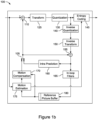
- the image is segmented in square or rectangular blocks, then a transform T (DCT, DST, etc.) is applied to the pixels of each block to obtain transformed coefficients.
- a quantizer Q then quantizes the coefficients to obtain quantized coefficients which are encoded by an entropy coder, such as VLC, arithmetic coder, CABAC, for example.
- a block can be predicted from already encoded blocks to obtain a residual.
- This prediction can be performed from spatially neighboring blocks (intra prediction) or a portion of a temporally different encoded frame (inter prediction).
- the information contained in the residual block is usually smaller than the information in the original block, thus leading to better compression performance.
- the described embodiments focus on the improvement of the transform T to obtain better coding performance compared to other coding schemes.
- the embodiments describe a new scheme and syntax for deciding which transform to be used in a block.
- the main approach is to split the transform signaling syntax in two levels as follows:
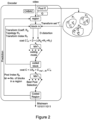
- FIG. 2 One embodiment of the encoding method of the described embodiments is as depicted in Figure 2 .
- the choice of the transforms from the pool is performed in an RDO loop that adds a dedicated syntax to the bitstream.
- a video signal is first split into regions where each region is further split into blocks or sub-regions.
- a first element P i i.e. a set of transforms
- T j i a second element
- This second element (transform) is then used to transform the block into coefficients.
- a set of transform P i with minimum coding cost is selected to encode that region.
- the coded regions can be used for predicting the next regions still to be coded in a picture.
- One approach uses systematic transforms, i.e., already known transforms, to achieve better compression.
- Some recent work involves use of multiple systematic transforms obtained from the family of sinusoidal transforms, namely, DCT-II, DCT-V, DCT-VIII, DST-I, DST-VIII, for example, in an adaptive way to compress the video signal.
- the algorithm is split into two parts: a classification of the residual blocks, and a generation of a new set of transforms.
- the first step classifies the residual blocks into K different classes (S 1 ...S K ) based on the equation below which shows the Rate-Distortion (R-D) cost of coding a residual block r j using a transform T k and further labels the residual with the transform index that provides minimum R-D cost.
- R-D Rate-Distortion
- a new transform T k ′ is obtained for each class k using minimization of the reconstruction error for that class and is obtained by solving the equation below.
- T k ′ argmin H ⁇ j ⁇ S k ⁇ r j ⁇ Hc k j ⁇ 2 2 s . t .
- H T H I , k ⁇ 1 , ... , K
- Singular Value Decomposition SVD
- the input to the system is a training set consisting of large collections of residuals along with some initial set of transforms ( T 1 ... T K ).
- the system outputs a set of learned transforms ( T 1 ′ ... T K ′ ) after the iterative learning scheme.
- a set of K transforms can be generated using an offline learning scheme.
- an un-biased training set is constructed by extracting residuals from different video sequences that are diverse in terms of their content, resolution, bit-depth or other factors. Therefore, the transforms learned on this general training set are not biased towards a particular content type or resolution type and are generic.
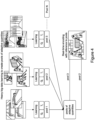
- Another approach is to split the training set into multiple smaller training sets where the residuals in each of the training set are extracted from video sequences or images that are highly correlated to each other.
- An example is illustrated in Figure 4 where a collection of sequences taken from Rolland Garros, ice hockey and a forest are taken to generate three separate training sets. Each training set is used to generate a set of transforms. These sets are finally pooled together to be used for real-time encoding.
- a picture inside a video sequence is split into multiple regions where each region uses a set of transforms from a pool of more than one sets of transforms learned on different sequences.
- each block obtained through a typical tree-based splitting, is coded using a single transform from the set of transforms chosen for that region.
- an index is coded to signal the choice of the set of transforms from the pool of sets of transforms.
- another index is coded to signal the choice of transform within the set that is used to code at that local level.
- a pool of sets of transforms is computed offline using methods described in the previous sections and is made available at both encoder and decoder sides of a video codec. The following steps are performed by the encoder:
- a method for encoding a picture characterized in that the method comprises, for at least a first set of blocks, first, selecting an element from a superset (or group or pool) of second sets of at least two transforms. Then, selecting a transform, for at least two subsets of the first set, from the selected second set of at least two transforms and transforming at least one block, for each of the at least two subsets, into coefficients using the selected transform. Finally, encode, into at least one bitstream, at least an index identifying the selected element, indexes identifying the selected transforms, and the coefficients.
- a block can be a picture block or residual block.
- a set of blocks, subsets of blocks are determined using trees, such as quadtrees, or binary trees.
- subsets of blocks can be children of the set of blocks in the tree structure.
- the set can be defined as the largest coding unit (LCU) or equivalently as Coding Tree Unit (CTU).
- a subset can be defined as a Transform Unit (TU) or Coding Unit (CU) or as any child node in the tree.
- a default pool of transforms is defined and always activated.
- the default pool is then complemented by sub-pools, that can be adaptively selected.
- the selection can be typically made at the picture, slice, CTU, or CU level.
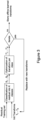
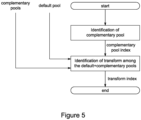
- a default pool is defined and is systematically used for coding the considered unit to be coded, the unit being, for example, a CTU, a CU, or a slice.
- a first step "identification of complementary pool” identifies the index of the complementary pool to be used for the considered unit to be coded.
- a second step identifies the index of the transform to be used among the set of transforms made of the transforms of the default pool, and of the transform of the selected complementary pool. This provides a transform index for the transform to be applied to the considered unit.
- the transform selection process ends after this step. This concept can be generalized to more than two levels of pools.
- the complementary pool is signaled at a higher syntax level, such as at the SPS or slice level, than the considered unit.
- the complementary pool signaling is made at the SPS level, and the transform signaling is done at the considered unit level.
- the concept can also be generalized to more than two levels of pools.
- An example is given below.
- one additional step of identification of the set of complementary pools is inserted as a first step of the transform selection process. This step in this example applies at the SPS or PPS level.
- the second step of selecting the complementary pool among the selected set of complementary pools is done at the slice level.
- the third step of selecting the transform among the default pool and a selected complementary pool is done at the considered unit level, such as the CTU or the CU level.
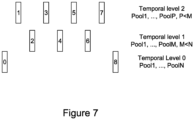
- a separate set of candidate pools of transforms is considered for each temporal level in the video sequence to encode.
- the set of candidate pools associated with a higher temporal level is a truncated version of the set of candidate pools of transforms associated to a lower temporal level.
- the concept is illustrated in the Figure 7 , which shows the pictures for three temporal levels, and for each temporal level, a set of pools is enabled.
- the set of pools for temporal level 1 is a subset of the set of pools for temporal level 0
- the set of pools for temporal level 2 is a subset of the set of pools for temporal level 1.
- the pools themselves are temporal-level dependent. For instance, a pool is enabled for temporal level 0 (noted Pool0). For temporal level 1, a subset of this pool is enabled (noted Pool1). In Pool1, only some of the transforms from Pool0 are included. For temporal level 1, a subset of this pool is enabled (noted Pool2). In Pool2, only some of the transforms from Pool0 are included. Pool2 can be a subset of Pool1.
- One advantage of the described embodiments over the prior art is an improvement in compression compared to the prior art with only one set of transforms.
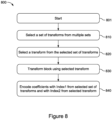
- FIG. 8 One embodiment of a method 800 for encoding a block in a video image is shown in Figure 8 .
- the method commences at Start block 801 and proceeds to block 810 for selecting a set of transforms from a plurality of sets of transforms, wherein the set of transforms is associated with a first index.
- the method proceeds from block 810 to block 820 for selecting a transform from among a plurality of transforms comprising the selected set of transforms from block 810, wherein the selected transform is associated with a second index.
- Control then proceeds from block 820 to block 830 for transforming at least a block in a region of the video image into transform coefficients using the selected transform.
- Control proceeds from block 830 to block 840 for encoding the transformed coefficients along with the first index and the second index into a bitstream.
- FIG. 9 One embodiment of a method 900 for decoding a block in a video image is shown in Figure 9 .
- the method commences at Start block 901 and control proceeds to block 910 for decoding a video bitstream to generate a first index and a second index.
- Control proceeds from block 910 to block 920 for selecting a set of transforms associated with the first index from a plurality of sets of transforms to be used for decoding blocks within a region of a video image.
- Control proceeds from block 920 to block 930 for selecting a transform associated with the second index from among a plurality of transforms comprising the selected set of transforms, to use in decoding a block in the region of the video image.
- Control proceeds from block 930 to block 940 for inverse transforming coefficients of at least a block in the region of the video image using the selected transform.
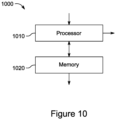
- the apparatus comprises a Processor 1010 and a Memory 1020.
- the Processor 1010 is configured, for encoding, to perform the steps of Figure 8 , that is selecting a set of transforms from among a plurality of sets of transforms to be used for encoding blocks within a region of a video image, wherein the selected set of transforms is associated with a first index; selecting a transform from among a plurality of transforms comprising the selected set of transforms associated with the first index to use for encoding a block, wherein the selected transform is associated with a second index; transforming at least a block in the region of the video image using the selected transform into transformed coefficients, and encoding the transformed coefficients along with the first index and the second index into a bitstream.
- Processor 1010 When Processor 1010 is configured for decoding, it performs the steps of Figure 9 , that is, decoding a video bitstream to generate a first index and a second index; selecting a set of transforms associated with the first index from among a plurality of sets of transforms to be used for decoding blocks within a region of a video image; selecting a transform associated with the second index from among a plurality of transforms comprising the selected set of transforms, associated with the first index, to use for decoding a block within the region of the video image, and inverse transforming coefficients of at least a block in the region of the video image using the selected transform.
- processor or “controller” should not be construed to refer exclusively to hardware capable of executing software, and may implicitly include, without limitation, digital signal processor (“DSP”) hardware, read-only memory (“ROM”) for storing software, random access memory (“RAM”), and non-volatile storage.
- DSP digital signal processor
- ROM read-only memory
- RAM random access memory
- any switches shown in the figures are conceptual only. Their function may be carried out through the operation of program logic, through dedicated logic, through the interaction of program control and dedicated logic, or even manually, the particular technique being selectable by the implementer as more specifically understood from the context.
- any element expressed as a means for performing a specified function is intended to encompass any way of performing that function including, for example, a) a combination of circuit elements that performs that function or b) software in any form, including, therefore, firmware, microcode or the like, combined with appropriate circuitry for executing that software to perform the function.
- the present principles as defined by such claims reside in the fact that the functionalities provided by the various recited means are combined and brought together in the manner which the claims call for. It is thus regarded that any means that can provide those functionalities are equivalent to those shown herein.
- improved methods and apparatus for improving the performance of video encoders and decoders involves selecting a set of transforms from among a plurality of sets of transforms that can be used for coding blocks in a region of a video image. Within a region, selection of a particular transform from among a plurality of transforms comprising the selected set of transforms is used to encoder or decode at least one block in the region. Associated indices representing the set of transforms to be used within a region and the selected transform for a block can be sent in a bitstream. In an alternate embodiment, a default set of transforms is complemented by selection of an additional set of transforms on a block or region basis.
Landscapes
- Engineering & Computer Science (AREA)
- Multimedia (AREA)
- Signal Processing (AREA)
- Physics & Mathematics (AREA)
- General Physics & Mathematics (AREA)
- Discrete Mathematics (AREA)
- Theoretical Computer Science (AREA)
- Software Systems (AREA)
- Data Mining & Analysis (AREA)
- Evolutionary Computation (AREA)
- Medical Informatics (AREA)
- Computer Vision & Pattern Recognition (AREA)
- Computing Systems (AREA)
- General Engineering & Computer Science (AREA)
- Mathematical Physics (AREA)
- Artificial Intelligence (AREA)
- Compression Or Coding Systems Of Tv Signals (AREA)
Claims (12)
- Verfahren, das umfasst:Auswählen (810) eines Pools von Transformationen unter einer Menge von Kandidaten-Pools von Transformationen, die zum Codieren von Blöcken innerhalb eines Gebiets eines Videobilds einer Videofolge verwendet werden sollen, wobei dem ausgewählten Pool von Transformationen ein erster Index zugeordnet wird, wobei für jede Zeitebene in der Videofolge eine jeweilige Menge von Kandidaten-Pools von Transformationen für die Auswahl betrachtet wird, und wobei die Menge von Kandidaten-Pools, denen eine erste Zeitebene zugeordnet ist, eine Teilmenge einer anderen Menge von Kandidatenpools ist, denen eine zweite, niedrigere Zeitschicht zugeordnet ist,Auswählen (820) einer Transformation unter mehreren Transformationen, die in dem ausgewählten Pool von Transformationen enthalten sind, dem der erste Index zugeordnet ist, zur Verwendung zum Codieren eines Blocks, wobei der ausgewählten Transformation ein zweiter Index zugeordnet wird;Transformieren (830) wenigstens eines Blocks in dem Gebiet des Videobilds unter Verwendung der ausgewählten Transformation in transformierte Koeffizienten; undCodieren (840) der transformierten Koeffizienten zusammen mit dem ersten Index und mit dem zweiten Index in einen Bitstrom.
- Verfahren, das umfasst:Decodieren (910) eines ersten Index und eines zweiten Index aus einem Videobitstrom;Auswählen (920) eines Pools von Transformationen, dem der erste Index zugeordnet ist, die zum Decodieren von Blöcken innerhalb eines Gebiets eines Videobilds einer Videofolge verwendet werden sollen, unter einer Menge von Kandidaten-Pools von Transformationen, wobei für jede Zeitebene in der Videofolge eine jeweilige Menge von Kandidaten-Pools von Transformationen für die Auswahl betrachtet wird, und wobei die Menge von Kandidaten-Pools, denen eine erste Zeitebene zugeordnet ist, eine Teilmenge einer anderen Menge von Kandidatenpools ist, denen eine zweite, niedrigere Zeitschicht zugeordnet ist,Auswählen (930) einer Transformation, der der zweite Index zugeordnet ist, unter mehreren Transformationen, die in dem ausgewählten Pool von Transformationen enthalten sind, dem der erste Index zugeordnet ist, zur Verwendung zum Decodieren eines Blocks innerhalb des Gebiets des Videobilds; undRücktransformieren (940) von Koeffizienten wenigstens des Blocks in dem Gebiet des Videobilds unter Verwendung der ausgewählten Transformation.
- Vorrichtung, die umfasst:einen Speicher, undeinen Prozessor, der dafür konfiguriert ist, Folgendes auszuführen:Auswählen (810) eines Pools von Transformationen unter einer Menge von Kandidaten-Pools von Transformationen, die zum Codieren von Blöcken innerhalb eines Gebiets eines Videobilds verwendet werden sollen, wobei dem ausgewählten Pool von Transformationen ein erster Index zugeordnet wird, wobei für jede Zeitebene in der Videofolge eine jeweilige Menge von Kandidaten-Pools von Transformationen für die Auswahl betrachtet wird, und wobei die Menge von Kandidaten-Pools, denen eine erste Zeitebene zugeordnet ist, eine Teilmenge einer anderen Menge von Kandidatenpools ist, denen eine zweite, niedrigere Zeitschicht zugeordnet ist,Auswählen (820) einer Transformation unter mehreren Transformationen, die in dem ausgewählten Pool von Transformationen enthalten sind, dem der erste Index zugeordnet ist, zur Verwendung zum Codieren eines Blocks, wobei der ausgewählten Transformation ein zweiter Index zugeordnet wird;Transformieren (830) wenigstens eines Blocks in dem Gebiet des Videobilds unter Verwendung der ausgewählten Transformation in transformierte Koeffizienten; undCodieren (840) der transformierten Koeffizienten zusammen mit dem ersten Index und mit dem zweiten Index in einen Bitstrom.
- Vorrichtung, die umfasst:einen Speicher, undeinen Prozessor, der dafür konfiguriert ist, Folgendes auszuführen:Decodieren (910) eines ersten Index und eines zweiten Index aus einem Videobitstrom;Auswählen (920) eines Pools von Transformationen, dem der erste Index zugeordnet ist, die zum Decodieren von Blöcken innerhalb eines Gebiets eines Videobilds einer Videofolge verwendet werden sollen, unter einer Menge von Kandidaten-Pools von Transformationen, wobei für jede Zeitebene in der Videofolge eine jeweilige Menge von Kandidaten-Pools von Transformationen für die Auswahl betrachtet wird, und wobei die Menge von Kandidaten-Pools, denen eine erste Zeitebene zugeordnet ist, eine Teilmenge einer anderen Menge von Kandidatenpools ist, denen eine zweite, niedrigere Zeitschicht zugeordnet ist,Auswählen (930) einer Transformation, der der zweite Index zugeordnet ist, unter mehreren Transformationen, die in dem ausgewählten Pool von Transformationen enthalten sind, dem der erste Index zugeordnet ist, zur Verwendung zum Decodieren eines Blocks innerhalb des Gebiets des Videobilds; undRücktransformieren (940) von Koeffizienten wenigstens des Blocks in dem Gebiet des Videobilds unter Verwendung der ausgewählten Transformation.
- Verfahren nach Anspruch 1 oder 2 oder Vorrichtung nach Anspruch 3 oder 4, wobei der erste Index und der zweite Index in unterschiedlichen Ebenen einer Videocodierungshierarchie signalisiert werden.
- Verfahren nach Anspruch 1 oder 2 oder Vorrichtung nach Anspruch 3 oder 4, das bzw. die ferner das Hinzufügen des ausgewählten Pools von Transformationen zu einem Standard-Pool von Transformationen vor dem Auswählen einer Transformation zur Verwendung zum Codieren des Blocks umfasst.
- Verfahren oder Vorrichtung nach Anspruch 5 oder Anspruch 6, wobei eine Ebene in einer Videocodierungshierarchie, in der der erste Index signalisiert wird, höher als eine Ebene in der Videocodierungshierarchie, in der der zweite Index signalisiert wird, ist.
- Verfahren oder Vorrichtung nach Anspruch 1 oder 2 oder Vorrichtung nach Anspruch 3 oder 4, wobei die Menge von Kandidatenpools von Transformationen durch ein Offline-Transformations-Lernschema abgeleitet wird.
- Verfahren oder Vorrichtung nach Anspruch 1 oder 2 oder Vorrichtung nach Anspruch 3 oder 4, wobei die Menge von Kandidatenpools von Transformationen systematische Transformationen sinusförmiger Transformationsfamilien umfasst.
- Nichttransitorisches computerlesbares Medium, das Dateninhalt enthält, der gemäß dem Verfahren nach einem der Ansprüche 1 und 5 bis 9 oder durch die Vorrichtung nach einem der Ansprüche 3 und 5 bis 9 zur Wiedergabe unter Verwendung eines Prozessors erzeugt wurde.
- Signal, das Videodaten umfasst, die gemäß dem Verfahren nach einem der Ansprüche 1 und 5 bis 9 oder durch die Vorrichtung nach einem der Ansprüche 3 und 5 bis 9 zur Wiedergabe unter Verwendung eines Prozessors erzeugt wurden.
- Computerprogrammprodukt, das Anweisungen umfasst, die, wenn das Programm durch einen Computer ausgeführt wird, veranlassen, dass der Computer das Verfahren nach einem der Ansprüche 2 und 5 bis 9 ausführt.
Applications Claiming Priority (2)
| Application Number | Priority Date | Filing Date | Title |
|---|---|---|---|
| EP17306121.9A EP3451663A1 (de) | 2017-08-31 | 2017-08-31 | Pools aus transformationen zur lokalen auswahl eines satzes von transformationen in videocodierung |
| PCT/US2018/049006 WO2019046671A1 (en) | 2017-08-31 | 2018-08-31 | TRANSFORMER GROUPS FOR LOCALLY SELECTING A TRANSFORMER ASSEMBLY IN VIDEO CODING |
Publications (2)
| Publication Number | Publication Date |
|---|---|
| EP3677028A1 EP3677028A1 (de) | 2020-07-08 |
| EP3677028B1 true EP3677028B1 (de) | 2023-12-13 |
Family
ID=59846533
Family Applications (2)
| Application Number | Title | Priority Date | Filing Date |
|---|---|---|---|
| EP17306121.9A Withdrawn EP3451663A1 (de) | 2017-08-31 | 2017-08-31 | Pools aus transformationen zur lokalen auswahl eines satzes von transformationen in videocodierung |
| EP18769568.9A Active EP3677028B1 (de) | 2017-08-31 | 2018-08-31 | Gruppen von transformationen zur lokalen auswahl eines satzes von transformationen in videocodierung |
Family Applications Before (1)
| Application Number | Title | Priority Date | Filing Date |
|---|---|---|---|
| EP17306121.9A Withdrawn EP3451663A1 (de) | 2017-08-31 | 2017-08-31 | Pools aus transformationen zur lokalen auswahl eines satzes von transformationen in videocodierung |
Country Status (6)
| Country | Link |
|---|---|
| US (1) | US11936863B2 (de) |
| EP (2) | EP3451663A1 (de) |
| KR (1) | KR20200043399A (de) |
| CN (1) | CN111052743B (de) |
| BR (1) | BR112020003220A2 (de) |
| WO (1) | WO2019046671A1 (de) |
Families Citing this family (3)
| Publication number | Priority date | Publication date | Assignee | Title |
|---|---|---|---|---|
| WO2020216288A1 (en) * | 2019-04-23 | 2020-10-29 | Beijing Bytedance Network Technology Co., Ltd. | Conditional use of multiple transform matrices in video coding |
| US11683490B2 (en) * | 2020-09-10 | 2023-06-20 | Tencent America LLC | Context adaptive transform set |
| CN115174908B (zh) * | 2022-06-30 | 2023-09-15 | 北京百度网讯科技有限公司 | 视频编码的变换量化方法、装置、设备以及存储介质 |
Family Cites Families (27)
| Publication number | Priority date | Publication date | Assignee | Title |
|---|---|---|---|---|
| US6640015B1 (en) * | 1998-06-05 | 2003-10-28 | Interuniversitair Micro-Elektronica Centrum (Imec Vzw) | Method and system for multi-level iterative filtering of multi-dimensional data structures |
| US6795504B1 (en) * | 2000-06-21 | 2004-09-21 | Microsoft Corporation | Memory efficient 3-D wavelet transform for video coding without boundary effects |
| CN1606880A (zh) * | 2001-12-20 | 2005-04-13 | 皇家飞利浦电子股份有限公司 | 视频编码和解码方法及设备 |
| US7830963B2 (en) * | 2003-07-18 | 2010-11-09 | Microsoft Corporation | Decoding jointly coded transform type and subblock pattern information |
| US7991051B2 (en) * | 2003-11-21 | 2011-08-02 | Electronics And Telecommunications Research Institute | Interframe wavelet coding apparatus and method capable of adjusting computational complexity |
| KR100597402B1 (ko) * | 2003-12-01 | 2006-07-06 | 삼성전자주식회사 | 스케일러블 비디오 코딩 및 디코딩 방법, 이를 위한 장치 |
| US8340177B2 (en) * | 2004-07-12 | 2012-12-25 | Microsoft Corporation | Embedded base layer codec for 3D sub-band coding |
| US8548261B2 (en) * | 2007-04-11 | 2013-10-01 | Samsung Electronics Co., Ltd. | Method and apparatus for encoding and decoding multi-view image |
| JP2012516627A (ja) | 2009-01-27 | 2012-07-19 | トムソン ライセンシング | ビデオ符号化およびビデオ復号における変換の選択のための方法および装置 |
| WO2010120338A2 (en) * | 2009-04-14 | 2010-10-21 | Thomson Licensing | Methods and apparatus for filter parameter determination and selection responsive to variable transforms in sparsity-based de-artifact filtering |
| CN102474607B (zh) | 2009-07-23 | 2016-05-11 | 汤姆森许可贸易公司 | 用于视频编码和解码的自适应变换选择的方法和设备 |
| US20110090952A1 (en) | 2009-10-21 | 2011-04-21 | Cohen Robert A | Directional Transforms for Video and Image Coding |
| US9215470B2 (en) | 2010-07-09 | 2015-12-15 | Qualcomm Incorporated | Signaling selected directional transform for video coding |
| US9787982B2 (en) * | 2011-09-12 | 2017-10-10 | Qualcomm Incorporated | Non-square transform units and prediction units in video coding |
| US9325991B2 (en) * | 2012-04-11 | 2016-04-26 | Qualcomm Incorporated | Motion vector rounding |
| US9031137B2 (en) * | 2012-05-03 | 2015-05-12 | Texas Instruments Incorporated | Signaling signed band offset values for sample adaptive offset (SAO) filtering in video coding |
| US20130294524A1 (en) * | 2012-05-04 | 2013-11-07 | Qualcomm Incorporated | Transform skipping and lossless coding unification |
| AU2012232992A1 (en) * | 2012-09-28 | 2014-04-17 | Canon Kabushiki Kaisha | Method, apparatus and system for encoding and decoding the transform units of a coding unit |
| US9674530B1 (en) | 2013-04-30 | 2017-06-06 | Google Inc. | Hybrid transforms in video coding |
| JP6401290B2 (ja) * | 2014-04-01 | 2018-10-10 | ホアウェイ・テクノロジーズ・カンパニー・リミテッド | 多層構造化コーディングユニットのデータ隠蔽のための方法および装置 |
| WO2015169207A1 (en) * | 2014-05-05 | 2015-11-12 | Mediatek Singapore Pte. Ltd. | Method and apparatus for determining residue transform tree representation |
| US10306229B2 (en) * | 2015-01-26 | 2019-05-28 | Qualcomm Incorporated | Enhanced multiple transforms for prediction residual |
| WO2016206590A1 (en) * | 2015-06-23 | 2016-12-29 | Mediatek Singapore Pte. Ltd. | Method and apparatus for transform coefficient coding of non-square blocks |
| US10694210B2 (en) * | 2016-05-28 | 2020-06-23 | Microsoft Technology Licensing, Llc | Scalable point cloud compression with transform, and corresponding decompression |
| US10652575B2 (en) * | 2016-09-15 | 2020-05-12 | Qualcomm Incorporated | Linear model chroma intra prediction for video coding |
| US10880564B2 (en) * | 2016-10-01 | 2020-12-29 | Qualcomm Incorporated | Transform selection for video coding |
| US10694202B2 (en) * | 2016-12-01 | 2020-06-23 | Qualcomm Incorporated | Indication of bilateral filter usage in video coding |
-
2017
- 2017-08-31 EP EP17306121.9A patent/EP3451663A1/de not_active Withdrawn
-
2018
- 2018-08-31 BR BR112020003220-4A patent/BR112020003220A2/pt unknown
- 2018-08-31 KR KR1020207005625A patent/KR20200043399A/ko active Pending
- 2018-08-31 US US16/642,554 patent/US11936863B2/en active Active
- 2018-08-31 EP EP18769568.9A patent/EP3677028B1/de active Active
- 2018-08-31 WO PCT/US2018/049006 patent/WO2019046671A1/en not_active Ceased
- 2018-08-31 CN CN201880056231.0A patent/CN111052743B/zh active Active
Also Published As
| Publication number | Publication date |
|---|---|
| KR20200043399A (ko) | 2020-04-27 |
| US11936863B2 (en) | 2024-03-19 |
| CN111052743A (zh) | 2020-04-21 |
| BR112020003220A2 (pt) | 2020-10-06 |
| EP3677028A1 (de) | 2020-07-08 |
| US20210084300A1 (en) | 2021-03-18 |
| EP3451663A1 (de) | 2019-03-06 |
| CN111052743B (zh) | 2024-03-12 |
| WO2019046671A1 (en) | 2019-03-07 |
Similar Documents
| Publication | Publication Date | Title |
|---|---|---|
| US11750841B2 (en) | Methods and apparatuses for coding transform blocks | |
| EP2869563B1 (de) | Verfahren zur entropiedecodierung eines videos | |
| EP3101900B1 (de) | Vorrichtung zur entropiedecodierung eines transformationskoeffizienten | |
| CN103220528B (zh) | 通过使用大型变换单元编码和解码图像的方法和设备 | |
| US20090067503A1 (en) | Method and apparatus for video data encoding and decoding | |
| US20150110181A1 (en) | Methods for palette prediction and intra block copy padding | |
| US10027983B2 (en) | Adaptive coding of a prediction error in hybrid video coding | |
| CN111954894A (zh) | 用于视频压缩的基于深度学习的图像分区 | |
| US20180020239A1 (en) | Method and apparatus for entropy encoding/decoding a transform coefficient | |
| US11936863B2 (en) | Pools of transforms for local selection of a set of transforms in video coding | |
| US20260095581A1 (en) | A method, an apparatus and a computer program product for image and video processing using a neural network |
Legal Events
| Date | Code | Title | Description |
|---|---|---|---|
| STAA | Information on the status of an ep patent application or granted ep patent |
Free format text: STATUS: UNKNOWN |
|
| STAA | Information on the status of an ep patent application or granted ep patent |
Free format text: STATUS: THE INTERNATIONAL PUBLICATION HAS BEEN MADE |
|
| PUAI | Public reference made under article 153(3) epc to a published international application that has entered the european phase |
Free format text: ORIGINAL CODE: 0009012 |
|
| STAA | Information on the status of an ep patent application or granted ep patent |
Free format text: STATUS: REQUEST FOR EXAMINATION WAS MADE |
|
| 17P | Request for examination filed |
Effective date: 20200221 |
|
| AK | Designated contracting states |
Kind code of ref document: A1 Designated state(s): AL AT BE BG CH CY CZ DE DK EE ES FI FR GB GR HR HU IE IS IT LI LT LU LV MC MK MT NL NO PL PT RO RS SE SI SK SM TR |
|
| AX | Request for extension of the european patent |
Extension state: BA ME |
|
| DAV | Request for validation of the european patent (deleted) | ||
| DAX | Request for extension of the european patent (deleted) | ||
| RAP1 | Party data changed (applicant data changed or rights of an application transferred) |
Owner name: INTERDIGITAL MADISON PATENT HOLDINGS, SAS |
|
| RAP3 | Party data changed (applicant data changed or rights of an application transferred) |
Owner name: INTERDIGITAL MADISON PATENT HOLDINGS, SAS |
|
| STAA | Information on the status of an ep patent application or granted ep patent |
Free format text: STATUS: EXAMINATION IS IN PROGRESS |
|
| 17Q | First examination report despatched |
Effective date: 20230301 |
|
| GRAP | Despatch of communication of intention to grant a patent |
Free format text: ORIGINAL CODE: EPIDOSNIGR1 |
|
| STAA | Information on the status of an ep patent application or granted ep patent |
Free format text: STATUS: GRANT OF PATENT IS INTENDED |
|
| RIC1 | Information provided on ipc code assigned before grant |
Ipc: H04N 19/192 20140101ALI20230703BHEP Ipc: H04N 19/463 20140101ALI20230703BHEP Ipc: H04N 19/12 20140101ALI20230703BHEP Ipc: H04N 19/147 20140101ALI20230703BHEP Ipc: H04N 19/176 20140101AFI20230703BHEP |
|
| INTG | Intention to grant announced |
Effective date: 20230718 |
|
| GRAS | Grant fee paid |
Free format text: ORIGINAL CODE: EPIDOSNIGR3 |
|
| P01 | Opt-out of the competence of the unified patent court (upc) registered |
Effective date: 20231003 |
|
| GRAA | (expected) grant |
Free format text: ORIGINAL CODE: 0009210 |
|
| STAA | Information on the status of an ep patent application or granted ep patent |
Free format text: STATUS: THE PATENT HAS BEEN GRANTED |
|
| AK | Designated contracting states |
Kind code of ref document: B1 Designated state(s): AL AT BE BG CH CY CZ DE DK EE ES FI FR GB GR HR HU IE IS IT LI LT LU LV MC MK MT NL NO PL PT RO RS SE SI SK SM TR |
|
| REG | Reference to a national code |
Ref country code: GB Ref legal event code: FG4D |
|
| REG | Reference to a national code |
Ref country code: CH Ref legal event code: EP |
|
| REG | Reference to a national code |
Ref country code: DE Ref legal event code: R096 Ref document number: 602018062617 Country of ref document: DE |
|
| REG | Reference to a national code |
Ref country code: IE Ref legal event code: FG4D |
|
| REG | Reference to a national code |
Ref country code: NL Ref legal event code: FP |
|
| PG25 | Lapsed in a contracting state [announced via postgrant information from national office to epo] |
Ref country code: GR Free format text: LAPSE BECAUSE OF FAILURE TO SUBMIT A TRANSLATION OF THE DESCRIPTION OR TO PAY THE FEE WITHIN THE PRESCRIBED TIME-LIMIT Effective date: 20240314 |
|
| REG | Reference to a national code |
Ref country code: LT Ref legal event code: MG9D |
|
| PG25 | Lapsed in a contracting state [announced via postgrant information from national office to epo] |
Ref country code: LT Free format text: LAPSE BECAUSE OF FAILURE TO SUBMIT A TRANSLATION OF THE DESCRIPTION OR TO PAY THE FEE WITHIN THE PRESCRIBED TIME-LIMIT Effective date: 20231213 |
|
| PG25 | Lapsed in a contracting state [announced via postgrant information from national office to epo] |
Ref country code: ES Free format text: LAPSE BECAUSE OF FAILURE TO SUBMIT A TRANSLATION OF THE DESCRIPTION OR TO PAY THE FEE WITHIN THE PRESCRIBED TIME-LIMIT Effective date: 20231213 |
|
| PG25 | Lapsed in a contracting state [announced via postgrant information from national office to epo] |
Ref country code: LT Free format text: LAPSE BECAUSE OF FAILURE TO SUBMIT A TRANSLATION OF THE DESCRIPTION OR TO PAY THE FEE WITHIN THE PRESCRIBED TIME-LIMIT Effective date: 20231213 Ref country code: GR Free format text: LAPSE BECAUSE OF FAILURE TO SUBMIT A TRANSLATION OF THE DESCRIPTION OR TO PAY THE FEE WITHIN THE PRESCRIBED TIME-LIMIT Effective date: 20240314 Ref country code: ES Free format text: LAPSE BECAUSE OF FAILURE TO SUBMIT A TRANSLATION OF THE DESCRIPTION OR TO PAY THE FEE WITHIN THE PRESCRIBED TIME-LIMIT Effective date: 20231213 Ref country code: BG Free format text: LAPSE BECAUSE OF FAILURE TO SUBMIT A TRANSLATION OF THE DESCRIPTION OR TO PAY THE FEE WITHIN THE PRESCRIBED TIME-LIMIT Effective date: 20240313 |
|
| REG | Reference to a national code |
Ref country code: AT Ref legal event code: MK05 Ref document number: 1641472 Country of ref document: AT Kind code of ref document: T Effective date: 20231213 |
|
| PG25 | Lapsed in a contracting state [announced via postgrant information from national office to epo] |
Ref country code: SE Free format text: LAPSE BECAUSE OF FAILURE TO SUBMIT A TRANSLATION OF THE DESCRIPTION OR TO PAY THE FEE WITHIN THE PRESCRIBED TIME-LIMIT Effective date: 20231213 Ref country code: RS Free format text: LAPSE BECAUSE OF FAILURE TO SUBMIT A TRANSLATION OF THE DESCRIPTION OR TO PAY THE FEE WITHIN THE PRESCRIBED TIME-LIMIT Effective date: 20231213 Ref country code: NO Free format text: LAPSE BECAUSE OF FAILURE TO SUBMIT A TRANSLATION OF THE DESCRIPTION OR TO PAY THE FEE WITHIN THE PRESCRIBED TIME-LIMIT Effective date: 20240313 Ref country code: LV Free format text: LAPSE BECAUSE OF FAILURE TO SUBMIT A TRANSLATION OF THE DESCRIPTION OR TO PAY THE FEE WITHIN THE PRESCRIBED TIME-LIMIT Effective date: 20231213 Ref country code: HR Free format text: LAPSE BECAUSE OF FAILURE TO SUBMIT A TRANSLATION OF THE DESCRIPTION OR TO PAY THE FEE WITHIN THE PRESCRIBED TIME-LIMIT Effective date: 20231213 |
|
| PG25 | Lapsed in a contracting state [announced via postgrant information from national office to epo] |
Ref country code: IS Free format text: LAPSE BECAUSE OF FAILURE TO SUBMIT A TRANSLATION OF THE DESCRIPTION OR TO PAY THE FEE WITHIN THE PRESCRIBED TIME-LIMIT Effective date: 20240413 |
|
| PG25 | Lapsed in a contracting state [announced via postgrant information from national office to epo] |
Ref country code: AT Free format text: LAPSE BECAUSE OF FAILURE TO SUBMIT A TRANSLATION OF THE DESCRIPTION OR TO PAY THE FEE WITHIN THE PRESCRIBED TIME-LIMIT Effective date: 20231213 Ref country code: CZ Free format text: LAPSE BECAUSE OF FAILURE TO SUBMIT A TRANSLATION OF THE DESCRIPTION OR TO PAY THE FEE WITHIN THE PRESCRIBED TIME-LIMIT Effective date: 20231213 |
|
| PG25 | Lapsed in a contracting state [announced via postgrant information from national office to epo] |
Ref country code: SK Free format text: LAPSE BECAUSE OF FAILURE TO SUBMIT A TRANSLATION OF THE DESCRIPTION OR TO PAY THE FEE WITHIN THE PRESCRIBED TIME-LIMIT Effective date: 20231213 |
|
| PG25 | Lapsed in a contracting state [announced via postgrant information from national office to epo] |
Ref country code: SM Free format text: LAPSE BECAUSE OF FAILURE TO SUBMIT A TRANSLATION OF THE DESCRIPTION OR TO PAY THE FEE WITHIN THE PRESCRIBED TIME-LIMIT Effective date: 20231213 Ref country code: SK Free format text: LAPSE BECAUSE OF FAILURE TO SUBMIT A TRANSLATION OF THE DESCRIPTION OR TO PAY THE FEE WITHIN THE PRESCRIBED TIME-LIMIT Effective date: 20231213 Ref country code: RO Free format text: LAPSE BECAUSE OF FAILURE TO SUBMIT A TRANSLATION OF THE DESCRIPTION OR TO PAY THE FEE WITHIN THE PRESCRIBED TIME-LIMIT Effective date: 20231213 Ref country code: IT Free format text: LAPSE BECAUSE OF FAILURE TO SUBMIT A TRANSLATION OF THE DESCRIPTION OR TO PAY THE FEE WITHIN THE PRESCRIBED TIME-LIMIT Effective date: 20231213 Ref country code: IS Free format text: LAPSE BECAUSE OF FAILURE TO SUBMIT A TRANSLATION OF THE DESCRIPTION OR TO PAY THE FEE WITHIN THE PRESCRIBED TIME-LIMIT Effective date: 20240413 Ref country code: EE Free format text: LAPSE BECAUSE OF FAILURE TO SUBMIT A TRANSLATION OF THE DESCRIPTION OR TO PAY THE FEE WITHIN THE PRESCRIBED TIME-LIMIT Effective date: 20231213 Ref country code: CZ Free format text: LAPSE BECAUSE OF FAILURE TO SUBMIT A TRANSLATION OF THE DESCRIPTION OR TO PAY THE FEE WITHIN THE PRESCRIBED TIME-LIMIT Effective date: 20231213 Ref country code: AT Free format text: LAPSE BECAUSE OF FAILURE TO SUBMIT A TRANSLATION OF THE DESCRIPTION OR TO PAY THE FEE WITHIN THE PRESCRIBED TIME-LIMIT Effective date: 20231213 |
|
| PG25 | Lapsed in a contracting state [announced via postgrant information from national office to epo] |
Ref country code: PL Free format text: LAPSE BECAUSE OF FAILURE TO SUBMIT A TRANSLATION OF THE DESCRIPTION OR TO PAY THE FEE WITHIN THE PRESCRIBED TIME-LIMIT Effective date: 20231213 Ref country code: PT Free format text: LAPSE BECAUSE OF FAILURE TO SUBMIT A TRANSLATION OF THE DESCRIPTION OR TO PAY THE FEE WITHIN THE PRESCRIBED TIME-LIMIT Effective date: 20240415 |
|
| PG25 | Lapsed in a contracting state [announced via postgrant information from national office to epo] |
Ref country code: PT Free format text: LAPSE BECAUSE OF FAILURE TO SUBMIT A TRANSLATION OF THE DESCRIPTION OR TO PAY THE FEE WITHIN THE PRESCRIBED TIME-LIMIT Effective date: 20240415 Ref country code: PL Free format text: LAPSE BECAUSE OF FAILURE TO SUBMIT A TRANSLATION OF THE DESCRIPTION OR TO PAY THE FEE WITHIN THE PRESCRIBED TIME-LIMIT Effective date: 20231213 |
|
| REG | Reference to a national code |
Ref country code: DE Ref legal event code: R097 Ref document number: 602018062617 Country of ref document: DE |
|
| PG25 | Lapsed in a contracting state [announced via postgrant information from national office to epo] |
Ref country code: DK Free format text: LAPSE BECAUSE OF FAILURE TO SUBMIT A TRANSLATION OF THE DESCRIPTION OR TO PAY THE FEE WITHIN THE PRESCRIBED TIME-LIMIT Effective date: 20231213 |
|
| PLBE | No opposition filed within time limit |
Free format text: ORIGINAL CODE: 0009261 |
|
| STAA | Information on the status of an ep patent application or granted ep patent |
Free format text: STATUS: NO OPPOSITION FILED WITHIN TIME LIMIT |
|
| PG25 | Lapsed in a contracting state [announced via postgrant information from national office to epo] |
Ref country code: SI Free format text: LAPSE BECAUSE OF FAILURE TO SUBMIT A TRANSLATION OF THE DESCRIPTION OR TO PAY THE FEE WITHIN THE PRESCRIBED TIME-LIMIT Effective date: 20231213 |
|
| PG25 | Lapsed in a contracting state [announced via postgrant information from national office to epo] |
Ref country code: SI Free format text: LAPSE BECAUSE OF FAILURE TO SUBMIT A TRANSLATION OF THE DESCRIPTION OR TO PAY THE FEE WITHIN THE PRESCRIBED TIME-LIMIT Effective date: 20231213 Ref country code: DK Free format text: LAPSE BECAUSE OF FAILURE TO SUBMIT A TRANSLATION OF THE DESCRIPTION OR TO PAY THE FEE WITHIN THE PRESCRIBED TIME-LIMIT Effective date: 20231213 |
|
| 26N | No opposition filed |
Effective date: 20240916 |
|
| REG | Reference to a national code |
Ref country code: CH Ref legal event code: PL |
|
| PG25 | Lapsed in a contracting state [announced via postgrant information from national office to epo] |
Ref country code: LU Free format text: LAPSE BECAUSE OF NON-PAYMENT OF DUE FEES Effective date: 20240831 |
|
| PG25 | Lapsed in a contracting state [announced via postgrant information from national office to epo] |
Ref country code: MC Free format text: LAPSE BECAUSE OF FAILURE TO SUBMIT A TRANSLATION OF THE DESCRIPTION OR TO PAY THE FEE WITHIN THE PRESCRIBED TIME-LIMIT Effective date: 20231213 Ref country code: CH Free format text: LAPSE BECAUSE OF NON-PAYMENT OF DUE FEES Effective date: 20240831 |
|
| REG | Reference to a national code |
Ref country code: BE Ref legal event code: MM Effective date: 20240831 |
|
| PG25 | Lapsed in a contracting state [announced via postgrant information from national office to epo] |
Ref country code: BE Free format text: LAPSE BECAUSE OF NON-PAYMENT OF DUE FEES Effective date: 20240831 |
|
| PG25 | Lapsed in a contracting state [announced via postgrant information from national office to epo] |
Ref country code: IE Free format text: LAPSE BECAUSE OF NON-PAYMENT OF DUE FEES Effective date: 20240831 |
|
| PGFP | Annual fee paid to national office [announced via postgrant information from national office to epo] |
Ref country code: NL Payment date: 20250825 Year of fee payment: 8 |
|
| PG25 | Lapsed in a contracting state [announced via postgrant information from national office to epo] |
Ref country code: FI Free format text: LAPSE BECAUSE OF FAILURE TO SUBMIT A TRANSLATION OF THE DESCRIPTION OR TO PAY THE FEE WITHIN THE PRESCRIBED TIME-LIMIT Effective date: 20231213 |
|
| PGFP | Annual fee paid to national office [announced via postgrant information from national office to epo] |
Ref country code: DE Payment date: 20250827 Year of fee payment: 8 |
|
| PGFP | Annual fee paid to national office [announced via postgrant information from national office to epo] |
Ref country code: GB Payment date: 20250826 Year of fee payment: 8 |
|
| PGFP | Annual fee paid to national office [announced via postgrant information from national office to epo] |
Ref country code: FR Payment date: 20250825 Year of fee payment: 8 |
|
| PG25 | Lapsed in a contracting state [announced via postgrant information from national office to epo] |
Ref country code: CY Free format text: LAPSE BECAUSE OF FAILURE TO SUBMIT A TRANSLATION OF THE DESCRIPTION OR TO PAY THE FEE WITHIN THE PRESCRIBED TIME-LIMIT; INVALID AB INITIO Effective date: 20180831 |
|
| PG25 | Lapsed in a contracting state [announced via postgrant information from national office to epo] |
Ref country code: HU Free format text: LAPSE BECAUSE OF FAILURE TO SUBMIT A TRANSLATION OF THE DESCRIPTION OR TO PAY THE FEE WITHIN THE PRESCRIBED TIME-LIMIT; INVALID AB INITIO Effective date: 20180831 |