EP3675317A1 - Inductive charger with rotatable magnetic mount - Google Patents
Inductive charger with rotatable magnetic mount Download PDFInfo
- Publication number
- EP3675317A1 EP3675317A1 EP19214118.2A EP19214118A EP3675317A1 EP 3675317 A1 EP3675317 A1 EP 3675317A1 EP 19214118 A EP19214118 A EP 19214118A EP 3675317 A1 EP3675317 A1 EP 3675317A1
- Authority
- EP
- European Patent Office
- Prior art keywords
- dock
- stator
- inductive charging
- inductive
- circular bearing
- Prior art date
- Legal status (The legal status is an assumption and is not a legal conclusion. Google has not performed a legal analysis and makes no representation as to the accuracy of the status listed.)
- Granted
Links
Images




Classifications
-
- H—ELECTRICITY
- H02—GENERATION; CONVERSION OR DISTRIBUTION OF ELECTRIC POWER
- H02J—ELECTRIC POWER NETWORKS; CIRCUIT ARRANGEMENTS OR SYSTEMS FOR SUPPLYING OR DISTRIBUTING ELECTRIC POWER; SYSTEMS FOR STORING ELECTRIC ENERGY
- H02J7/00—Circuit arrangements for charging or discharging batteries or for supplying loads from batteries
- H02J7/70—Circuit arrangements for charging or discharging batteries or for supplying loads from batteries characterised by the mechanical construction
-
- H—ELECTRICITY
- H02—GENERATION; CONVERSION OR DISTRIBUTION OF ELECTRIC POWER
- H02J—ELECTRIC POWER NETWORKS; CIRCUIT ARRANGEMENTS OR SYSTEMS FOR SUPPLYING OR DISTRIBUTING ELECTRIC POWER; SYSTEMS FOR STORING ELECTRIC ENERGY
- H02J50/00—Circuit arrangements or systems for wireless supply or distribution of electric power
- H02J50/10—Circuit arrangements or systems for wireless supply or distribution of electric power using inductive coupling
-
- F—MECHANICAL ENGINEERING; LIGHTING; HEATING; WEAPONS; BLASTING
- F16—ENGINEERING ELEMENTS AND UNITS; GENERAL MEASURES FOR PRODUCING AND MAINTAINING EFFECTIVE FUNCTIONING OF MACHINES OR INSTALLATIONS; THERMAL INSULATION IN GENERAL
- F16M—FRAMES, CASINGS OR BEDS OF ENGINES, MACHINES OR APPARATUS, NOT SPECIFIC TO ENGINES, MACHINES OR APPARATUS PROVIDED FOR ELSEWHERE; STANDS; SUPPORTS
- F16M11/00—Stands or trestles as supports for apparatus or articles placed thereon ; Stands for scientific apparatus such as gravitational force meters
- F16M11/02—Heads
- F16M11/04—Means for attachment of apparatus; Means allowing adjustment of the apparatus relatively to the stand
- F16M11/041—Allowing quick release of the apparatus
-
- F—MECHANICAL ENGINEERING; LIGHTING; HEATING; WEAPONS; BLASTING
- F16—ENGINEERING ELEMENTS AND UNITS; GENERAL MEASURES FOR PRODUCING AND MAINTAINING EFFECTIVE FUNCTIONING OF MACHINES OR INSTALLATIONS; THERMAL INSULATION IN GENERAL
- F16M—FRAMES, CASINGS OR BEDS OF ENGINES, MACHINES OR APPARATUS, NOT SPECIFIC TO ENGINES, MACHINES OR APPARATUS PROVIDED FOR ELSEWHERE; STANDS; SUPPORTS
- F16M11/00—Stands or trestles as supports for apparatus or articles placed thereon ; Stands for scientific apparatus such as gravitational force meters
- F16M11/02—Heads
- F16M11/04—Means for attachment of apparatus; Means allowing adjustment of the apparatus relatively to the stand
- F16M11/06—Means for attachment of apparatus; Means allowing adjustment of the apparatus relatively to the stand allowing pivoting
- F16M11/12—Means for attachment of apparatus; Means allowing adjustment of the apparatus relatively to the stand allowing pivoting in more than one direction
- F16M11/14—Means for attachment of apparatus; Means allowing adjustment of the apparatus relatively to the stand allowing pivoting in more than one direction with ball-joint
-
- F—MECHANICAL ENGINEERING; LIGHTING; HEATING; WEAPONS; BLASTING
- F16—ENGINEERING ELEMENTS AND UNITS; GENERAL MEASURES FOR PRODUCING AND MAINTAINING EFFECTIVE FUNCTIONING OF MACHINES OR INSTALLATIONS; THERMAL INSULATION IN GENERAL
- F16M—FRAMES, CASINGS OR BEDS OF ENGINES, MACHINES OR APPARATUS, NOT SPECIFIC TO ENGINES, MACHINES OR APPARATUS PROVIDED FOR ELSEWHERE; STANDS; SUPPORTS
- F16M13/00—Other supports for positioning apparatus or articles; Means for steadying hand-held apparatus or articles
-
- H—ELECTRICITY
- H02—GENERATION; CONVERSION OR DISTRIBUTION OF ELECTRIC POWER
- H02J—ELECTRIC POWER NETWORKS; CIRCUIT ARRANGEMENTS OR SYSTEMS FOR SUPPLYING OR DISTRIBUTING ELECTRIC POWER; SYSTEMS FOR STORING ELECTRIC ENERGY
- H02J7/00—Circuit arrangements for charging or discharging batteries or for supplying loads from batteries
-
- H—ELECTRICITY
- H02—GENERATION; CONVERSION OR DISTRIBUTION OF ELECTRIC POWER
- H02J—ELECTRIC POWER NETWORKS; CIRCUIT ARRANGEMENTS OR SYSTEMS FOR SUPPLYING OR DISTRIBUTING ELECTRIC POWER; SYSTEMS FOR STORING ELECTRIC ENERGY
- H02J7/00—Circuit arrangements for charging or discharging batteries or for supplying loads from batteries
- H02J7/70—Circuit arrangements for charging or discharging batteries or for supplying loads from batteries characterised by the mechanical construction
- H02J7/731—Circuit arrangements for charging or discharging batteries or for supplying loads from batteries characterised by the mechanical construction specially adapted for holding portable devices containing batteries
-
- H—ELECTRICITY
- H02—GENERATION; CONVERSION OR DISTRIBUTION OF ELECTRIC POWER
- H02K—DYNAMO-ELECTRIC MACHINES
- H02K1/00—Details of the magnetic circuit
- H02K1/06—Details of the magnetic circuit characterised by the shape, form or construction
- H02K1/22—Rotating parts of the magnetic circuit
- H02K1/27—Rotor cores with permanent magnets
-
- H—ELECTRICITY
- H02—GENERATION; CONVERSION OR DISTRIBUTION OF ELECTRIC POWER
- H02K—DYNAMO-ELECTRIC MACHINES
- H02K5/00—Casings; Enclosures; Supports
- H02K5/04—Casings or enclosures characterised by the shape, form or construction thereof
-
- H—ELECTRICITY
- H02—GENERATION; CONVERSION OR DISTRIBUTION OF ELECTRIC POWER
- H02K—DYNAMO-ELECTRIC MACHINES
- H02K7/00—Arrangements for handling mechanical energy structurally associated with dynamo-electric machines, e.g. structural association with mechanical driving motors or auxiliary dynamo-electric machines
- H02K7/08—Structural association with bearings
-
- H—ELECTRICITY
- H04—ELECTRIC COMMUNICATION TECHNIQUE
- H04B—TRANSMISSION
- H04B1/00—Details of transmission systems, not covered by a single one of groups H04B3/00 - H04B13/00; Details of transmission systems not characterised by the medium used for transmission
- H04B1/38—Transceivers, i.e. devices in which transmitter and receiver form a structural unit and in which at least one part is used for functions of transmitting and receiving
- H04B1/3827—Portable transceivers
- H04B1/3877—Arrangements for enabling portable transceivers to be used in a fixed position, e.g. cradles or boosters
-
- H—ELECTRICITY
- H04—ELECTRIC COMMUNICATION TECHNIQUE
- H04M—TELEPHONIC COMMUNICATION
- H04M1/00—Substation equipment, e.g. for use by subscribers
- H04M1/02—Constructional features of telephone sets
- H04M1/04—Supports for telephone transmitters or receivers
-
- H—ELECTRICITY
- H04—ELECTRIC COMMUNICATION TECHNIQUE
- H04M—TELEPHONIC COMMUNICATION
- H04M1/00—Substation equipment, e.g. for use by subscribers
- H04M1/02—Constructional features of telephone sets
- H04M1/0202—Portable telephone sets, e.g. cordless phones, mobile phones or bar type handsets
Definitions
- the present disclosure relates generally to mounts for securing mobile electronic devices and chargers for batteries of mobile electronic devices. More particularly, the present disclosure relates to inductive chargers with a rotatable magnetic mount.
- a wide variety of portable electronic devices are currently in existence on the market, though there has been a recent convergence towards a fewer category of devices that fulfill many needs.
- these are smartphones that which integrate functions and features that may have earlier been provided in separate, independent devices such as music players, gaming consoles, personal digital assistants, digital still and video cameras, electronic readers, mapping and navigation devices, and so on.
- Several short-to-medium range communications modalities are also integrated, including WiFi and Bluetooth for short-range/local data transfer links, as well as cellular communications systems implementing such standards as GSM (Global System for Mobile Communications), EDGE (Enhanced Data Rates for GSM Evolution), LTE (Long Term Evolution) and the like that can substantially extend its communicative range.
- GSM Global System for Mobile Communications
- EDGE Enhanced Data Rates for GSM Evolution
- LTE Long Term Evolution
- smartphones incorporate an onboard battery.
- Such batteries may either be removable or permanently installed and have power capacities that accommodate active use extending a few hours, and standby operation for over an entire day.
- smartphones incorporate on-board charging circuits connectible to an external power supply, which may range from the electrical power grid, a battery/electrical system of a vehicle, to a portable external battery, among others.
- connection modalities between the smartphone and an electrical power source are known in the art.
- One of the simplest is an AC (alternating current) power adapter with a coaxial connector plug that is received within a corresponding socket on the device.
- AC alternating current
- the size and shape of the plug and sockets may be varied.
- This variety and lack of standardization amongst manufacturers led to the proliferation of numerous proprietary, manufacturer-specific connectors and adapters that were not compatible with other devices with similar power requirements. Accordingly, there has been a drive towards standardizing power connections for portable electronic devices.
- USB Universal Serial Bus
- the USB standard as well as its associated connector configurations, have evolved over many years, and different generations of connectors are in current use.
- a USB interconnection is comprised of a plug that is receptively engaged in a socket, though the shape and sizes of these connectors differ depending on type.
- USB is primarily a data transfer link, the standard defines one line for supplying 5V DC (direct current) power at different current levels, allowing for the standardization of chargers and connector cables that are manufacturer and device-agnostic.
- any standard USB cable can be used to connect to any USB port, whether that USB port is incorporated into an AC adapter plugged into a wall socket, a cigarette lighter adapter plugged into a 12V vehicle socket, or a portable battery - a consistent voltage and power can be expected to be delivered to the connecting device.
- the adapter end is oftentimes a USB type-A connector, while the smartphone-end is typically a smaller footprint connector such as a Micro B connector, or a type C connector
- USB charging cables For the most part, connecting a charging cable to smartphone is a relatively trivial manual step.
- USB connectors are directional, that is, the plug must be oriented in the same direction as the socket, otherwise it cannot be inserted.
- USB charging cables also share the limitations common across all cable or wire-based connections in that unsightly cables must be positioned to be readily accessible, even when not in use.
- inductive charging was developed.
- On the charger end there is an induction coil that is connected to power source and generates an electromagnetic field. This electromagnetic energy is captured by a corresponding induction coil on the electronic device, and passed to the charging circuit without requiring an electrical connection.
- the Qi charging standard governs the operating parameters and configuration of the device-end and charger-end inductive couplings.
- the smartphone Whether using a wireless inductive charging modality like Qi, or a wired charging modality over a USB cable, the smartphone is typically laid horizontally on a flat surface without being actively operated or viewed. When interacting with the smartphone for a brief moment, it may be held in the hand and placed back down following use. However, there may be some situations in which the user is performing a primary task not with or relating to the smartphone, e.g., driving a vehicle, working on a computer, cooking, and so on, but would nevertheless desire to access a function or view something on the smartphone.
- One configuration is a cradle that mechanically retains the smartphone, with the cradle being mounted to a surface via suction cup, adhesive, or other attachment modality.
- the compressive retention mechanisms are oftentimes cumbersome to engage and/or disengage, particularly when coupled with the need to connect the charging cable.
- magnetic mounts are being utilized, where a mount head including one or more permanent magnets are fixed to a surface, with a metallic plate being attached to the rear of the smartphone. The magnets on the mount engage the metallic plate, thereby releasably engaging the smartphone to the mount.
- the charging coil in smartphones incorporating inductive charging functionality occupies much of the real estate on the backside of its body.
- the rear facing camera which may include two, possibly more lenses
- a flash or illumination unit there may be a reduced area in which the metallic plate, which must be of a sufficient size for the permanent magnet to hold the entire weight of the smartphone, to be attached.
- the space is also limited with respect to the specific location of the body, as the charging coil occupies a central region that is idea for mounting the plate in a manner that facilitates the most balanced attachment to the magnetic head.
- the plate must be placed in off-center areas, resulting in less optimal mounting engagements.
- conventional smartphone devices are capable of sensing its orientation and adjusting the display to landscape or portrait views depending on the detected orientation, mounting the smartphone to the head at off-center locations precludes switching to a different orientation, typically the horizontal orientation.
- the present disclosure contemplates various embodiments of an inductive charger rotatable dock.
- the dock may include a stator cap with a structural mount interface attached thereto. Additionally, the dock may include a rotor frame with a circular bearing defined by a central opening. The rotor frame may also have a pair of opposed magnet support arms extending radially from the circular bearing.
- There may be a stator base to which the rotor frame is rotatably engaged within the circular bearing thereof.
- the stator base may be coupled to the stator cap through the central opening of the rotor frame.
- the sock may also include an inductive charging coil mounted to the stator base. Additionally, there may be one or more permanent magnets mounted to each of the pair of opposed magnet support arms.
- an inductive charger rotatable dock comprising: a stator cap including a structural mount interface attached thereto; a rotor frame with a circular bearing defined by a central opening, and a pair of opposed magnet support arms extending radially from the circular bearing; a stator base to which the rotor frame is rotatably engaged within the circular bearing thereof, the stator base being coupled to the stator cap through the central opening of the rotor frame; an inductive charging coil mounted to the stator base; and one or more permanent magnets mounted to each of the pair of opposed magnet support arms.
- the circular bearing defines a plurality of detents around an interior circumference thereof.
- stator base includes one or more radially facing projections spaced around an outer perimeter thereof, each projection being engageable to one of the plurality of detents defined by the circular bearing to limit rotational movement of the rotor frame within the stator base.
- the circular bearing defines an interior circumferential flange; and the stator cap defines a rim in sliding rotational engagement with the interior circumferential flange of the circular bearing.
- stator base further includes a retainer hub attached to the stator cap.
- the dock further comprises a power interconnect interface attached to the stator base and including an electrical connection to the inductive charging coil.
- the power interconnect interface is a Universal Serial Bus (USB) port.
- USB Universal Serial Bus
- the dock further comprises a printed circuit board with the power interconnect interface being connected thereto, the printed circuit board including an inductive charging circuit selectively delivering electrical power to the inductive charging coil.
- the dock further comprises an indicator light connected to the inductive charging circuit, predefined outputs on the indicator light being generated in response to corresponding charging circuit statuses as evaluated by the inductive charging circuit.
- the dock further comprises a light guide bezel attached to the stator base and being in optical communication with the indicator light.
- the dock further comprises: a stator cover attached to the inductive charging coil and defining a stator face; and magnet covers attached to each of the pair of opposed magnet support arms and defining a device engagement face.
- the device engagement face extends outwardly further than the stator face.
- the structural mount interface is a joint ball engageable to a corresponding joint socket fixed to a structure.
- the mount may include a static inductive charging head with an inductive coil delivering a charging current to the electronic device with the inductive charging receiver being in axial alignment with the inductive coil.
- the mount may also include a back plate with a circular frame in rotating engagement with the static inductive charging head.
- the back plate may also include one or more magnet support arms on which permanent magnets are mounted to magnetically couple with the one or more engagement points on the electronic device.
- a magnetic mount for an electronic device with an inductive charging receiver and one or more engagement points comprising: a static inductive charging head including an inductive coil delivering a charging current to the electronic device with the inductive charging receiver being in axial alignment with the inductive coil; and a back plate with a circular frame in rotating engagement with the static inductive charging head, and one or more magnet support arms on which permanent magnets are mounted to magnetically couple with the one or more engagement points on the electronic device.
- the magnetic mount further comprises a structural mount interface extending from the static inductive charging head.
- the circular frame is defined by a flanged central opening with a front end and a back end.
- the static inductive charging head includes a stator base that faces the front end of the circular frame and is in a rotating engagement therewith, and a stator cap that is coupled to the stator base, faces the rear end of the circular frame, and is in a rotating engagement therewith.
- the magnetic mount further comprises a power interconnect interface attached to the static inductive charging head and including an electrical connection to the inductive coil.
- the static inductive charging head defines a front face; the magnet support arms each define a device engagement face; and the front face of the static inductive charging head is set back from the device engagement face of the magnet support arms.
- the circular frame defines a plurality of detents around an interior circumference thereof; and the static inductive charging head includes one or more radially facing projections spaced around an outer perimeter thereof, each projection being engageable to one of the plurality of detents defined by the circular frame to limit rotational movement of the back plate.
- FIGS. 1 and 2 show the front and the rear, respectively, of one embodiment of an inductive charger rotatable dock 10 to which a mobile device 12 as shown in FIG. 3 may be mounted.
- the dock 10 is generally comprised of a pair of cradle arms 14 including a first or upper cradle arm 14a, and a second or lower cradle arm 14b that are each include magnets 15, along with an inductive charging head 16.
- cradle arms 14 as specifically the upper cradle arm 14a or the lower cradle arm 14b is for purposes of consistency and convenience only, as they are configured to be fully rotatable according to the various embodiments of the present disclosure.
- the mobile device 12 is understood to be a smartphone and is characterized by a body with a flat rear face 18, as shown. Underneath an outer cover of the mobile device 12, and centrally located in the body may be an inductive charging receiver 20 that, when electromagnetically coupled with a corresponding coil of the inductive charging head 16, transfers electrical energy to charge the onboard battery of the mobile device 12 or to otherwise provide power thereto.
- the charging modality implemented by the dock 10 and the mobile device 12 is in accordance with the open Qi specification for wireless power transfer as set by the Wireless Power Consortium.
- the dock 10 may be configured as a base station with a system unit that controls a power conversion unit and a communications and control unit that regulates the output electrical signal to an inductive charging coil based upon requests from the receiving mobile device 12.
- the mobile device 12 is understood to include a power pick-up unit with a secondary coil electrically connected to a battery or other load.
- the power pick-up unit may be connected to a communications and control unit that regulates the power transferred to the load. Up to ten (10) watts of power may be delivered to the receiving mobile device 12.
- the mobile device 12 includes one or more magnetic mount engagement points 22, and the exemplary configuration shown includes a first or upper magnetic mount engagement point 22a and a second or lower magnetic mount engagement point 22b.
- These magnetic mount engagement points 22 are understood to interact with the magnets 15 in the cradle arms 14 to mechanically retain, hold, or otherwise mount the mobile device 12 to the dock 10.
- the magnetic mount engagement points 22 are ferromagnetic plates that are affixed to the rear face 18 via an adhesive strip. Alternative attachment modalities such as glue, solder, or the like may be utilized, though because the plates are installed by a user as an aftermarket accessory, simpler securement methods may be preferable.
- no known current manufacturer of mobile devices 12 incorporate magnetic mount engagement points 22, it is also possible for the cover to include specifically positioned metal sections that may serve as the magnetic mount engagement points 22.
- the magnetic mount engagement points 22 or plates may be fixed to the rear face 18 to be in alignment with the magnets 15 within the cradle arms 14.
- the vertical separation between the first or upper magnetic mount engagement point 22a and the second or lower magnetic mount engagement point 22b may be the same or similar separation between the first or upper cradle arm 14a and the second or lower cradle arm 14b.
- the specific separation distance between the first or upper magnetic mount engagement point 22a and the second or lower magnetic mount engagement point 22b may be varied, though preferably, they should not overlap with the inductive charging receiver 20 to avoid electromagnetic interference with the inductive charging head 16 while in operation.
- the rear face 18 may include other features such as camera lenses 24, flash/illumination units, and so forth that should likewise be avoided when placing the plates.
- different templates to guide the positioning of the plates may be provided therewith, since the specific available space on the rear face 18 of the mobile device 12 may differ from one to the other.
- any other suitable electronic device having at least the above noted basic elements of a flat, or substantially flat rear face 18 on which one or more magnetic mount engagement points 22 can be placed for magnetic mounting, and the inductive charging receiver 20 may also be utilized.
- the size and weight of the mobile device 12 may be limited.
- the mobile device 12 is attached to the dock 10 in accordance with various embodiments of the present disclosure, and in turn, the dock 10 may be mounted to a structure.
- a structure Such structures include surfaces within or on a vehicle such as dashboards and windshields, as well as air conditioning vents, tubular structures, and the like. Beyond vehicle installations, the dock 10 may be mounted to other surfaces such as kitchen countertops, desks, shelves, and the like.
- the dock 10 may include a structural mount interface 26.
- the structural mount interface 26 is a joint ball mounted to or otherwise integrally formed with a stalk 28 extending from the dock 10.
- the joint ball is understood to be engageable to a corresponding joint socket to define a ball-and-socket joint.
- the joint socket in turn, may be part of a structure mount that may be detachably coupled to the structure.
- the structure mount may be a suction cup mount, an adhesive mount, a clamp mount, or any other type of mount that is known in the art.
- the embodiments of the present disclosure contemplate the cradle arms 14, and a rotor frame of which it is a part, to rotate about the static inductive charging head 16.
- the mobile device 12 mounted thereto may be rotated between a landscape orientation to a portrait orientation, all the while maintaining a wireless charging link with the inductive charging receiver 20.
- the mobile device 12 can continue to be charged uninterruptedly without removing and inserting charging cables.
- the mobile device 12 may be readily removed from the dock 10 as desired, with one manual motion stopping both the mechanical connection to the dock 10 as well as the charging link to the inductive charging head 16.
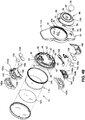
- the structure of the dock 10 for achieving this functionality will now be described in further detail with additional to the exploded perspective views of FIGS. 4A and 4B .
- the dock 10 is generally comprised of a rotor frame 30, which may also be referred to as a back plate.
- the rotor frame 30 has a circular bearing 32 or frame portion, and extending therefrom is the aforementioned pair of opposed cradle arms 14a, 14b. Because the cradle arms 14 incorporate the magnets 15, they may also be referred to as magnet support arms.
- the cradle arms 14 extend radially from the circular bearing 32, that is, perpendicularly to a circumference of the circular bearing 32 along a central axis as defined by a given radius. As shown, the rotor frame 30 further defines a central opening 34.
- the circular bearing 32 has an arcuate cross-section with a predefined thickness, and further, an interior circumferential flange 36.
- the inductive charging head 16 includes a stator base assembly 38 that is received within the circular bearing 32 of the rotor frame 30.
- the interior circumferential flange 36 is defined by a front-facing rim side 40a and an opposed rear-facing rim side 40b.
- the stator base assembly 38 is positioned opposing the front-facing rim side 40a, and is contemplated to rotate within the circular bearing 32.
- the circular bearing 32 also defines a plurality of detents 41 around the interior circumference thereof. As shown in the cross-sectional view of FIG. 5B taken along axis Y-Y of FIG. 2 , these detents 41 are contemplated to engage a set of radially facing projections 42, which may compress against the interior circumference of the circular bearing 32. With sufficient rotational force being applied to the rotor frame 30, the frictional locking force of the projections 42 against the detents 41 can be overcome, allowing the circular bearing 32 to be further rotated.
- FIG. 6 illustrates additional details of the stator base assembly 38, which includes a stator base frame 44 and a retainer hub 46.
- the stator base frame 44 has an annular configuration with a bottom rim portion 48 and a raised inner flange portion 50 that is inset from an outer rim circumference 52. Extending from the raised inner flange portion 50 are a set of projection platforms 54 which may be integrally formed with the stator base frame 44.
- first projection platform 54a there is a first projection platform 54a, a second projection platform 54b, and a third projection platform 54c that are spaced in an equidistant relationship to each other around the raised inner flange portion 50.
- the projection platforms 54 each define a respective cross bore 56 that receives the projections 42.
- the projection platforms 54 are positioned along the edges of the raised inner flange portion 50 such that the projections 42 extend slightly beyond the extent thereof to make contact with the circular bearing 32 of the rotor frame 30. In this regard, it is understood that the edges of the raised inner flange portion 50 do not make contact with the circular bearing 32.
- a set of track platforms 58 including a first track platform 58a, a second track platform 58b, and a third track platform 58c.
- the track platforms 58 thus alternate with the projection platforms 54, with each projection platform 54 being circumferentially centered between one track platform 58 and another.
- the track platform 58 defines a top transverse groove 60 that has a partial arc dimension generally corresponding to that of the raised inner flange portion 50.
- the stator base frame 44 defines a central opening 62 through which the retainer hub 46 is positioned. More particularly, the retainer hub 46 is a circular disk defined by a series of stepped flange portions, with a bottom rim portion 64a and a middle rim portion 64b, and a central platform 66. The retainer hub 46 is axially aligned with the stator base frame 44.
- the stator cap 68 likewise has a circular configuration defined by an outer rim 70 that is in rotating engagement with the rear-facing rim 40b of the circular bearing 32.
- the outer rim 70 is defined by a shoulder 72, while the rear-facing rim 40b of the circular bearing 32 defines an inner flange 74, with the shoulder 72 facing the inner flange 74.
- FIG. 5A shows the shoulder 72 being slightly separated from the inner flange 74, these two surfaces are understood to be in a sliding engagement with each other.
- the outer rim 70 of the circular bearing 32 further includes a set of circumferentially spaced and arcuately shaped rails 76 that are configured to be received within the top transverse grooves 60 defined on the track platforms 58 of the stator base frame 44. This is envisioned to aid in maintaining the axial alignment of the stator base frame 44 and the stator cap 68.
- stator cap 68 is attached to the stator base assembly 38.
- stator cap 68 defines a plurality of spaced apart bosses 78 projecting therefrom.
- the bosses 78 are each understood to define a fastener through hole 79 that are in alignment with corresponding fastener holes 80 defined on the central platform 66 of the retainer hub 46.
- the cross-sectional view of FIG. 5B best illustrates the relationship between the boss 78 and the central platform 66.
- a fastener such as a screw may be inserted from either the retainer hub end or the stator cap end to secure the retainer hub 46 to the stator cap 68.
- a second modality by which the stator cap 68 is coupled to the stator base assembly 38 are a set of spaced apart clips 82 extending therefrom.
- the clips 82 are defined by a wedge end 84 with a hook portion 86 that is configured to engage a bottom lip 88 of the stator base frame 44, and more specifically, as defined by the raised inner flange portion 50.
- Each of the track platforms 58 extend vertically from the raised inner flange portion 50, and on each opposed ends of the same, a foot 90 extends horizontally and radially inwardly. An opening between the two feet 90 is where the clips 82 are inserted.
- the wedge end 84 is flexed as it is pressed against inside rim of the track platforms 58, and once the hook portion 86 clears the bottom of the track platform 58, snaps back against the bottom lip 88 with the hook portion 86 being locked thereto.
- the circumferential width of the clips 82 is understood to be substantially coextensive with the spacing between the two feet 90 defined on the stator base frame 44.
- the relative position of each of the clips 82 are understood to coincide with the openings 92 defined between the respective feet 90 of the track platforms 58.
- the stator cap 68 is mounted to the rear of the stator cap 68.
- the stator cap 68 is defined by an interior side 94 from which the aforementioned bosses 78 and clips 82 extend, and an opposed exterior side 96.
- the center of the stator cap 68 defines a mounting recess 98 through which at least a portion of the stalk 28 is inserted.
- the interior side 94 defines another boss 100 with a center through-hole 102 extending from the interior side 94 to the exterior side 96.
- a threaded fastener 104 is inserted from the interior side 94, and engages with the female threading in the structural mount interface 26. The head 105 of the threaded fastener 104 is compressed against the boss 100, thereby coupling the structural mount interface 26 to the stator cap 68.
- the power interconnect interface 106 may be a Universal Serial Bus (USB) port. Any USB port socket type may be utilized such as Type C, Mini Type B, and Micro Type B, though in a preferred, but optional embodiment, the power interconnect interface 106 is a USB Type C socket.
- USB Universal Serial Bus
- the power interconnect interface 106 is located toward the interior side 96 of the stator cap 68.
- defined by the stator cap 68 is a bottom-facing opening 108.
- the power transmission pin of the power interconnect interface 106 may be electrically connected to a printed circuit board 112 that is mounted to the bottom of the retainer hub 46.
- the printed circuit board 112 may incorporate integrated circuits utilized in an implementation of the Qi charging system, such as the above-mentioned power conversion unit, the communications and control unit, and the like.
- the printed circuit board 112 is understood to be shaped circularly, though this is by way of example only and not of limitation.
- the printed circuit board 112 is mounted to a circular mounting board 114 as illustrated in the cross-sectional view of FIG. 5A . Additional details regarding the circular mounting board 114 will be considered below.
- the dock 10 has inductive charging features, and accordingly the inductive charging head 16 includes an charging coil assembly 116 therefor.
- the charging coil assembly 116 is comprised of an inductive coil 118 and a coil frame 120 to which the inductive coil 118 is mounted.
- the coil frame 120 mechanically, and to a certain extent, electromagnetically isolates the inductive coil 118 from the printed circuit board 112 to avoid interference while an electromagnetic field is being generated thereby.
- the ends of the inductive coil 118 are electrically connected to the charging circuit mounted to the printed circuit board 112.
- the embodiments of the dock 10 may implement the Qi wireless charging standard, and therefore the size and configuration of the inductive coil 118 is likewise understood to correspond thereto.
- Exposed wire of the inductive coil 118 may be disposed toward the front face of the inductive charging head 16 to maximize power transfer to the counterpart inductive charging receiver.
- There may additionally be a protective sheet panel 122 with a circular configuration positioned in front of the inductive coil 118 for retention purposes.
- the inductive charging head 16 further includes a head cover 124 that is fitted over the charging coil assembly 116 and coupled to the stator base assembly 38.
- a connector bezel 126 between the head cover 124 and the stator base assembly 38. It is possible to configure the connector bezel 126 as a light guide that is in optical communication with an illumination driver, e.g., a light emitting diode, on the printed circuit board 112.
- the connector bezel 126 may generate different light outputs that vary in color and pulsing pattern. For example, the connector bezel 126 may be flashed in red color while the mobile device 12 is being actively charged. Once charging is complete, the connector bezel 126 may be illuminated a steady green color. Other outputs corresponding to different operational statuses may be incorporated, and deemed to be within the purview of those ordinary skilled in the art.
- the cradle arms 14 each define cavities 128 that hold the magnets 15.
- the first or upper cradle arm 14a is engageable to a first magnet receptacle 130a that is defined by a receptacle frame 132, a left magnet slot 134a, and a right magnet slot 134b.
- a left magnet 15a is received within the left magnet slot 134a
- a right magnet 15b is received within the right magnet slot 134b.
- the first magnet receptacle 130a is understood to incorporate an integrated arm fillet cover 136, though this is optional, as will be illustrated in a different embodiment in which the arm fillet cover 136 is separate.
- the arm fillet cover 136 may be configured to conform to the outer curvature of the stator base assembly 38.
- a rear magnet cover 138 encloses the magnets 15 within the respective magnet slots 134.
- the assembly comprising the receptacle frame 132, the magnets 15, and the rear magnet cover 138 is disposed within the first cavity 128a, and a first arm cover 140a is attached to the upper cradle arm 14a.
- the second or lower cradle arm 14b is engageable to a second magnet receptacle 130b defined by a receptacle frame 142 that is configured slightly differently than the receptacle frame 132 of the first magnet receptacle 130a described above. Namely, there is no integrated arm fillet cover, but there is a separable/separate arm fillet cover 144.
- the second magnet receptacle 130b similarly includes a left magnet slot 146a and a right magnet slot 146b that receive the left magnet 15a, and the right magnet 15b, respectively, and secured into position with another rear magnet cover 138.
- the assembly of the second magnet receptacle 130b, the magnets 15, and the rear magnet cover 138 is mounted to an arm platform 148.
- the arm platform 148 is attached to the second or lower cradle arm 14b.
- a second arm cover 140b Mounted over the second magnet receptacle 130b is a second arm cover 140b.
- the arm covers 140 may be made of a non-scratch, flexible, and/or elastomeric material that can impart a frictional retention force upon the magnetic mount engagement points 22.
- the inductive charging head 16 also defines a head face 152 that is opposite the inductive charging receiver 20 of the mobile device 12 when it is mounted to the cradle arms 14. The head face 152, however, is not understood to make contact with the cover of the mobile device 12, and spaced slightly apart.
- the head face 152 is set back from the device engagement surface 150 of the arm covers 140, or alternatively stated, the device engagement surface 150 extends outwardly further than the head face 152. In this way, when turning the mobile device 12 with it being mounted to the rotor frame 30, no frictional resistance from the inductive charging head 16 is encountered. However, the head face 152 is understood to be sufficiently proximal to the inductive charging receiver 20 to still achieve the electromagnetic interaction that allows for the wireless transfer electrical power to the mobile device 12.
Landscapes
- Engineering & Computer Science (AREA)
- Power Engineering (AREA)
- General Engineering & Computer Science (AREA)
- Computer Networks & Wireless Communication (AREA)
- Mechanical Engineering (AREA)
- Signal Processing (AREA)
- Charge And Discharge Circuits For Batteries Or The Like (AREA)
- Telephone Set Structure (AREA)
Abstract
Description
- The application relates to and claims the benefit under 35 U.S.C. § 119(e) to
U.S. Provisional Patent Application No. 62/787,154 filed December 31, 2018 - The present disclosure relates generally to mounts for securing mobile electronic devices and chargers for batteries of mobile electronic devices. More particularly, the present disclosure relates to inductive chargers with a rotatable magnetic mount.
- A wide variety of portable electronic devices are currently in existence on the market, though there has been a recent convergence towards a fewer category of devices that fulfill many needs. Typically, these are smartphones that which integrate functions and features that may have earlier been provided in separate, independent devices such as music players, gaming consoles, personal digital assistants, digital still and video cameras, electronic readers, mapping and navigation devices, and so on. Several short-to-medium range communications modalities are also integrated, including WiFi and Bluetooth for short-range/local data transfer links, as well as cellular communications systems implementing such standards as GSM (Global System for Mobile Communications), EDGE (Enhanced Data Rates for GSM Evolution), LTE (Long Term Evolution) and the like that can substantially extend its communicative range.
- As with any electronic device, continuing functioning depends on the availability of a power source, and so smartphones incorporate an onboard battery. Such batteries may either be removable or permanently installed and have power capacities that accommodate active use extending a few hours, and standby operation for over an entire day. In order to recharge these batteries, smartphones incorporate on-board charging circuits connectible to an external power supply, which may range from the electrical power grid, a battery/electrical system of a vehicle, to a portable external battery, among others.
- A variety of connection modalities between the smartphone and an electrical power source are known in the art. One of the simplest is an AC (alternating current) power adapter with a coaxial connector plug that is received within a corresponding socket on the device. Depending on the needed current capacity, the size and shape of the plug and sockets may be varied. This variety and lack of standardization amongst manufacturers led to the proliferation of numerous proprietary, manufacturer-specific connectors and adapters that were not compatible with other devices with similar power requirements. Accordingly, there has been a drive towards standardizing power connections for portable electronic devices.
- Most manufacturers now utilize Universal Serial Bus (USB) connectors to supply power to its devices. The USB standard, as well as its associated connector configurations, have evolved over many years, and different generations of connectors are in current use. A USB interconnection is comprised of a plug that is receptively engaged in a socket, though the shape and sizes of these connectors differ depending on type. Although USB is primarily a data transfer link, the standard defines one line for supplying 5V DC (direct current) power at different current levels, allowing for the standardization of chargers and connector cables that are manufacturer and device-agnostic. In other words, any standard USB cable can be used to connect to any USB port, whether that USB port is incorporated into an AC adapter plugged into a wall socket, a cigarette lighter adapter plugged into a 12V vehicle socket, or a portable battery - a consistent voltage and power can be expected to be delivered to the connecting device. The adapter end is oftentimes a USB type-A connector, while the smartphone-end is typically a smaller footprint connector such as a Micro B connector, or a type C connector
- For the most part, connecting a charging cable to smartphone is a relatively trivial manual step. However, there may be a number of limitations that can become substantial user experience deficiencies over repeated encounters therewith. One is that most USB connectors are directional, that is, the plug must be oriented in the same direction as the socket, otherwise it cannot be inserted. USB charging cables also share the limitations common across all cable or wire-based connections in that unsightly cables must be positioned to be readily accessible, even when not in use.
- As a response to these deficiencies, inductive charging was developed. On the charger end, there is an induction coil that is connected to power source and generates an electromagnetic field. This electromagnetic energy is captured by a corresponding induction coil on the electronic device, and passed to the charging circuit without requiring an electrical connection. The Qi charging standard governs the operating parameters and configuration of the device-end and charger-end inductive couplings.
- Whether using a wireless inductive charging modality like Qi, or a wired charging modality over a USB cable, the smartphone is typically laid horizontally on a flat surface without being actively operated or viewed. When interacting with the smartphone for a brief moment, it may be held in the hand and placed back down following use. However, there may be some situations in which the user is performing a primary task not with or relating to the smartphone, e.g., driving a vehicle, working on a computer, cooking, and so on, but would nevertheless desire to access a function or view something on the smartphone.
- In response to these needs, various mounting devices have been developed. One configuration is a cradle that mechanically retains the smartphone, with the cradle being mounted to a surface via suction cup, adhesive, or other attachment modality. The compressive retention mechanisms are oftentimes cumbersome to engage and/or disengage, particularly when coupled with the need to connect the charging cable. More recently, magnetic mounts are being utilized, where a mount head including one or more permanent magnets are fixed to a surface, with a metallic plate being attached to the rear of the smartphone. The magnets on the mount engage the metallic plate, thereby releasably engaging the smartphone to the mount.
- The charging coil in smartphones incorporating inductive charging functionality occupies much of the real estate on the backside of its body. With additional features such as the rear facing camera (which may include two, possibly more lenses), along with a flash or illumination unit, there may be a reduced area in which the metallic plate, which must be of a sufficient size for the permanent magnet to hold the entire weight of the smartphone, to be attached. The space is also limited with respect to the specific location of the body, as the charging coil occupies a central region that is idea for mounting the plate in a manner that facilitates the most balanced attachment to the magnetic head. Thus, the plate must be placed in off-center areas, resulting in less optimal mounting engagements. Furthermore, although conventional smartphone devices are capable of sensing its orientation and adjusting the display to landscape or portrait views depending on the detected orientation, mounting the smartphone to the head at off-center locations precludes switching to a different orientation, typically the horizontal orientation.
- Accordingly, there is a need in the art for an improved magnetic smartphone mount that incorporates inductive charging features. There is also a need in the art for such magnetic mounts to be rotatable, and freely switch between different device orientations. In short, there is a need for an inductive charger with a rotatable magnetic mount.
- The present disclosure contemplates various embodiments of an inductive charger rotatable dock. The dock may include a stator cap with a structural mount interface attached thereto. Additionally, the dock may include a rotor frame with a circular bearing defined by a central opening. The rotor frame may also have a pair of opposed magnet support arms extending radially from the circular bearing. There may be a stator base to which the rotor frame is rotatably engaged within the circular bearing thereof. The stator base may be coupled to the stator cap through the central opening of the rotor frame. The sock may also include an inductive charging coil mounted to the stator base. Additionally, there may be one or more permanent magnets mounted to each of the pair of opposed magnet support arms.
- According to an aspect of the present invention there is provided an inductive charger rotatable dock, the dock comprising: a stator cap including a structural mount interface attached thereto; a rotor frame with a circular bearing defined by a central opening, and a pair of opposed magnet support arms extending radially from the circular bearing; a stator base to which the rotor frame is rotatably engaged within the circular bearing thereof, the stator base being coupled to the stator cap through the central opening of the rotor frame; an inductive charging coil mounted to the stator base; and one or more permanent magnets mounted to each of the pair of opposed magnet support arms.
- Preferably the circular bearing defines a plurality of detents around an interior circumference thereof.
- Preferably the stator base includes one or more radially facing projections spaced around an outer perimeter thereof, each projection being engageable to one of the plurality of detents defined by the circular bearing to limit rotational movement of the rotor frame within the stator base.
- Preferably the circular bearing defines an interior circumferential flange; and
the stator cap defines a rim in sliding rotational engagement with the interior circumferential flange of the circular bearing. - Preferably the stator base further includes a retainer hub attached to the stator cap.
- Preferably the dock further comprises a power interconnect interface attached to the stator base and including an electrical connection to the inductive charging coil.
- Preferably the power interconnect interface is a Universal Serial Bus (USB) port.
- Preferably the dock further comprises a printed circuit board with the power interconnect interface being connected thereto, the printed circuit board including an inductive charging circuit selectively delivering electrical power to the inductive charging coil.
- Preferably the dock further comprises an indicator light connected to the inductive charging circuit, predefined outputs on the indicator light being generated in response to corresponding charging circuit statuses as evaluated by the inductive charging circuit.
- Preferably the dock further comprises a light guide bezel attached to the stator base and being in optical communication with the indicator light.
- Preferably the dock further comprises: a stator cover attached to the inductive charging coil and defining a stator face; and magnet covers attached to each of the pair of opposed magnet support arms and defining a device engagement face.
- Preferably the device engagement face extends outwardly further than the stator face. Preferably the structural mount interface is a joint ball engageable to a corresponding joint socket fixed to a structure.
- Another embodiment contemplates a magnetic mount for an electronic device with an inductive charging receiver and one or more engagement points. The mount may include a static inductive charging head with an inductive coil delivering a charging current to the electronic device with the inductive charging receiver being in axial alignment with the inductive coil. The mount may also include a back plate with a circular frame in rotating engagement with the static inductive charging head. The back plate may also include one or more magnet support arms on which permanent magnets are mounted to magnetically couple with the one or more engagement points on the electronic device.
- According to another aspect of the invention there is provided a magnetic mount for an electronic device with an inductive charging receiver and one or more engagement points, the magnetic mount comprising: a static inductive charging head including an inductive coil delivering a charging current to the electronic device with the inductive charging receiver being in axial alignment with the inductive coil; and a back plate with a circular frame in rotating engagement with the static inductive charging head, and one or more magnet support arms on which permanent magnets are mounted to magnetically couple with the one or more engagement points on the electronic device.
- Preferably the magnetic mount further comprises a structural mount interface extending from the static inductive charging head.
- Preferably the circular frame is defined by a flanged central opening with a front end and a back end.
- Preferably the static inductive charging head includes a stator base that faces the front end of the circular frame and is in a rotating engagement therewith, and a stator cap that is coupled to the stator base, faces the rear end of the circular frame, and is in a rotating engagement therewith.
- Preferably the magnetic mount further comprises a power interconnect interface attached to the static inductive charging head and including an electrical connection to the inductive coil.
- Preferably the static inductive charging head defines a front face; the magnet support arms each define a device engagement face; and the front face of the static inductive charging head is set back from the device engagement face of the magnet support arms.
- Preferably the circular frame defines a plurality of detents around an interior circumference thereof; and the static inductive charging head includes one or more radially facing projections spaced around an outer perimeter thereof, each projection being engageable to one of the plurality of detents defined by the circular frame to limit rotational movement of the back plate.
- The presently contemplated embodiments will be best understood by reference to the following detailed description when read in conjunction with the accompanying drawings.
- These and other features and advantages of the various embodiments disclosed herein will be better understood with respect to the following description and drawings, in which like numbers refer to like parts throughout, and in which:
-
FIG. 1 is a front perspective view of an inductive charger rotatable dock in accordance with one embodiment of the present disclosure; -
FIG. 2 is a rear perspective view of the inductive charger rotatable dock shown inFIG. 1 ; -
FIG. 3 is a rear plan view of an exemplary mobile device including an inductive charging receiver and mount engagement points that may be mounted to the inductive charger rotatable dock in accordance with various embodiments of the present disclosure; -
FIG. 4A is an exploded front perspective view of the inductive charger rotatable dock; -
FIG. 4B is an exploded rear perspective view of the inductive charger rotatable dock. -
FIG. 5A is a cross-sectional view of an assembled inductive charger rotatable dock taken along axis X-X ofFIG. 2 ; -
FIG. 5B is a cross sectional view of the assembled inductive charger rotatable dock taken along axis Y-Y ofFIG. 2 ; and -
FIG. 6 is a perspective view of astator base assembly 38 utilized in various embodiments of the inductive charger rotatable dock. - The detailed description set forth below in connection with the appended drawings is intended as a description of the presently preferred embodiment of an inductive charger rotatable dock and is not intended to represent the only form in which it can be developed or utilized. The description sets forth the functions for developing and operating the dock in connection with the illustrated embodiments. It is to be understood, however, that the same or equivalent functions may be accomplished by different embodiments that are also intended to be encompassed within the scope of the present disclosure. It is further understood that the use of relational terms such as first, second, distal, proximal, left, right, and the like are used solely to distinguish one from another element without necessarily requiring or implying any actual such relationship or order between such elements.
-
FIGS. 1 and 2 show the front and the rear, respectively, of one embodiment of an inductivecharger rotatable dock 10 to which amobile device 12 as shown inFIG. 3 may be mounted. Thedock 10 is generally comprised of a pair ofcradle arms 14 including a first or upper cradle arm 14a, and a second orlower cradle arm 14b that are each includemagnets 15, along with aninductive charging head 16. Referring to thecradle arms 14 as specifically the upper cradle arm 14a or thelower cradle arm 14b is for purposes of consistency and convenience only, as they are configured to be fully rotatable according to the various embodiments of the present disclosure. - The
mobile device 12 is understood to be a smartphone and is characterized by a body with a flatrear face 18, as shown. Underneath an outer cover of themobile device 12, and centrally located in the body may be an inductive charging receiver 20 that, when electromagnetically coupled with a corresponding coil of theinductive charging head 16, transfers electrical energy to charge the onboard battery of themobile device 12 or to otherwise provide power thereto. - According to one embodiment, the charging modality implemented by the
dock 10 and themobile device 12 is in accordance with the open Qi specification for wireless power transfer as set by the Wireless Power Consortium. In this regard, thedock 10 may be configured as a base station with a system unit that controls a power conversion unit and a communications and control unit that regulates the output electrical signal to an inductive charging coil based upon requests from the receivingmobile device 12. Further, themobile device 12 is understood to include a power pick-up unit with a secondary coil electrically connected to a battery or other load. The power pick-up unit may be connected to a communications and control unit that regulates the power transferred to the load. Up to ten (10) watts of power may be delivered to the receivingmobile device 12. Because a Qi charger implementation is well known in the art, additional details thereof will be omitted. It will be appreciated that theinductive charging head 16 need not conform to the Qi standard, and any other wireless power transfer modality may be substituted without departing from the scope of the present disclosure. - The
mobile device 12 includes one or more magnetic mount engagement points 22, and the exemplary configuration shown includes a first or upper magnetic mount engagement point 22a and a second or lower magnetic mount engagement point 22b. These magnetic mount engagement points 22 are understood to interact with themagnets 15 in thecradle arms 14 to mechanically retain, hold, or otherwise mount themobile device 12 to thedock 10. In the example illustrated, the magnetic mount engagement points 22 are ferromagnetic plates that are affixed to therear face 18 via an adhesive strip. Alternative attachment modalities such as glue, solder, or the like may be utilized, though because the plates are installed by a user as an aftermarket accessory, simpler securement methods may be preferable. Although no known current manufacturer ofmobile devices 12 incorporate magnetic mount engagement points 22, it is also possible for the cover to include specifically positioned metal sections that may serve as the magnetic mount engagement points 22. - The magnetic mount engagement points 22 or plates may be fixed to the
rear face 18 to be in alignment with themagnets 15 within thecradle arms 14. Thus, the vertical separation between the first or upper magnetic mount engagement point 22a and the second or lower magnetic mount engagement point 22b may be the same or similar separation between the first or upper cradle arm 14a and the second orlower cradle arm 14b. The specific separation distance between the first or upper magnetic mount engagement point 22a and the second or lower magnetic mount engagement point 22b may be varied, though preferably, they should not overlap with the inductive charging receiver 20 to avoid electromagnetic interference with theinductive charging head 16 while in operation. Additionally, therear face 18 may include other features such ascamera lenses 24, flash/illumination units, and so forth that should likewise be avoided when placing the plates. In this regard, different templates to guide the positioning of the plates may be provided therewith, since the specific available space on therear face 18 of themobile device 12 may differ from one to the other. - Although the various embodiments will be described as a dock for a smartphone, this is by way of example only and not of limitation. Any other suitable electronic device having at least the above noted basic elements of a flat, or substantially flat
rear face 18 on which one or more magnetic mount engagement points 22 can be placed for magnetic mounting, and the inductive charging receiver 20 may also be utilized. Depending on the strength of the magnets utilized, as well as available space of and around the structure on which thedock 10 is mounted, the size and weight of themobile device 12 may be limited. - The
mobile device 12 is attached to thedock 10 in accordance with various embodiments of the present disclosure, and in turn, thedock 10 may be mounted to a structure. Such structures include surfaces within or on a vehicle such as dashboards and windshields, as well as air conditioning vents, tubular structures, and the like. Beyond vehicle installations, thedock 10 may be mounted to other surfaces such as kitchen countertops, desks, shelves, and the like. To this end, thedock 10 may include astructural mount interface 26. With the example shown inFIGS. 1 and 2 , thestructural mount interface 26 is a joint ball mounted to or otherwise integrally formed with astalk 28 extending from thedock 10. The joint ball is understood to be engageable to a corresponding joint socket to define a ball-and-socket joint. The joint socket, in turn, may be part of a structure mount that may be detachably coupled to the structure. The structure mount may be a suction cup mount, an adhesive mount, a clamp mount, or any other type of mount that is known in the art. - The embodiments of the present disclosure contemplate the
cradle arms 14, and a rotor frame of which it is a part, to rotate about the staticinductive charging head 16. Thus, themobile device 12 mounted thereto may be rotated between a landscape orientation to a portrait orientation, all the while maintaining a wireless charging link with the inductive charging receiver 20. Themobile device 12 can continue to be charged uninterruptedly without removing and inserting charging cables. Furthermore, themobile device 12 may be readily removed from thedock 10 as desired, with one manual motion stopping both the mechanical connection to thedock 10 as well as the charging link to theinductive charging head 16. The structure of thedock 10 for achieving this functionality will now be described in further detail with additional to the exploded perspective views ofFIGS. 4A and4B . - The
dock 10 is generally comprised of arotor frame 30, which may also be referred to as a back plate. Therotor frame 30 has acircular bearing 32 or frame portion, and extending therefrom is the aforementioned pair ofopposed cradle arms 14a, 14b. Because thecradle arms 14 incorporate themagnets 15, they may also be referred to as magnet support arms. Thecradle arms 14 extend radially from thecircular bearing 32, that is, perpendicularly to a circumference of thecircular bearing 32 along a central axis as defined by a given radius. As shown, therotor frame 30 further defines acentral opening 34. Thecircular bearing 32 has an arcuate cross-section with a predefined thickness, and further, an interiorcircumferential flange 36. - As mentioned above, the
cradle arms 14, and by extension, therotor frame 30 of which they are apart, are rotatably engaged or coupled to theinductive charging head 16. In further detail, theinductive charging head 16 includes astator base assembly 38 that is received within thecircular bearing 32 of therotor frame 30. With additional reference to the cross-sectional view ofFIG. 5A taken along axis X-X ofFIG. 2 , the interiorcircumferential flange 36 is defined by a front-facingrim side 40a and an opposed rear-facingrim side 40b. Thestator base assembly 38 is positioned opposing the front-facingrim side 40a, and is contemplated to rotate within thecircular bearing 32. - Various embodiments further contemplate limiting this rotation of the
circular bearing 32, so as to temporarily lock the same into position relative to theinductive charging head 16. To this end, thecircular bearing 32 also defines a plurality ofdetents 41 around the interior circumference thereof. As shown in the cross-sectional view ofFIG. 5B taken along axis Y-Y ofFIG. 2 , thesedetents 41 are contemplated to engage a set of radially facingprojections 42, which may compress against the interior circumference of thecircular bearing 32. With sufficient rotational force being applied to therotor frame 30, the frictional locking force of theprojections 42 against thedetents 41 can be overcome, allowing thecircular bearing 32 to be further rotated. - Aside from the contact of the
projections 42 to thecircular bearing 32, there is understood to be only incidental contact between other parts of therotor frame 30 and thestator base assembly 38.FIG. 6 illustrates additional details of thestator base assembly 38, which includes astator base frame 44 and aretainer hub 46. Thestator base frame 44 has an annular configuration with abottom rim portion 48 and a raisedinner flange portion 50 that is inset from anouter rim circumference 52. Extending from the raisedinner flange portion 50 are a set ofprojection platforms 54 which may be integrally formed with thestator base frame 44. In particular, there is afirst projection platform 54a, asecond projection platform 54b, and athird projection platform 54c that are spaced in an equidistant relationship to each other around the raisedinner flange portion 50. As best shown inFIG. 4B , theprojection platforms 54 each define a respective cross bore 56 that receives theprojections 42. Theprojection platforms 54 are positioned along the edges of the raisedinner flange portion 50 such that theprojections 42 extend slightly beyond the extent thereof to make contact with thecircular bearing 32 of therotor frame 30. In this regard, it is understood that the edges of the raisedinner flange portion 50 do not make contact with thecircular bearing 32. - Also extending from the raised
inner flange portion 50 are a set oftrack platforms 58, including afirst track platform 58a, asecond track platform 58b, and athird track platform 58c. Thetrack platforms 58 thus alternate with theprojection platforms 54, with eachprojection platform 54 being circumferentially centered between onetrack platform 58 and another. Thetrack platform 58 defines a toptransverse groove 60 that has a partial arc dimension generally corresponding to that of the raisedinner flange portion 50. - The
stator base frame 44 defines acentral opening 62 through which theretainer hub 46 is positioned. More particularly, theretainer hub 46 is a circular disk defined by a series of stepped flange portions, with abottom rim portion 64a and amiddle rim portion 64b, and acentral platform 66. Theretainer hub 46 is axially aligned with thestator base frame 44. On the other side of therotor frame 30, that is, the rear-facingrim 40b, there is astator cap 68 that is coupled or attached to thestator base assembly 38 through thecentral opening 34 of thecircular bearing 32. Thestator cap 68 likewise has a circular configuration defined by anouter rim 70 that is in rotating engagement with the rear-facingrim 40b of thecircular bearing 32. In further detail, theouter rim 70 is defined by ashoulder 72, while the rear-facingrim 40b of thecircular bearing 32 defines aninner flange 74, with theshoulder 72 facing theinner flange 74. AlthoughFIG. 5A shows theshoulder 72 being slightly separated from theinner flange 74, these two surfaces are understood to be in a sliding engagement with each other. Theouter rim 70 of thecircular bearing 32 further includes a set of circumferentially spaced and arcuately shapedrails 76 that are configured to be received within the toptransverse grooves 60 defined on thetrack platforms 58 of thestator base frame 44. This is envisioned to aid in maintaining the axial alignment of thestator base frame 44 and thestator cap 68. - There is a first modality by which the
stator cap 68 is attached to thestator base assembly 38. In particular, thestator cap 68 defines a plurality of spaced apartbosses 78 projecting therefrom. Thebosses 78 are each understood to define a fastener throughhole 79 that are in alignment with corresponding fastener holes 80 defined on thecentral platform 66 of theretainer hub 46. The cross-sectional view ofFIG. 5B best illustrates the relationship between theboss 78 and thecentral platform 66. A fastener such as a screw may be inserted from either the retainer hub end or the stator cap end to secure theretainer hub 46 to thestator cap 68. - A second modality by which the
stator cap 68 is coupled to thestator base assembly 38 are a set of spaced apart clips 82 extending therefrom. With particular reference toFIG. 5B , theclips 82 are defined by awedge end 84 with ahook portion 86 that is configured to engage abottom lip 88 of thestator base frame 44, and more specifically, as defined by the raisedinner flange portion 50. Each of thetrack platforms 58 extend vertically from the raisedinner flange portion 50, and on each opposed ends of the same, afoot 90 extends horizontally and radially inwardly. An opening between the twofeet 90 is where theclips 82 are inserted. Thewedge end 84 is flexed as it is pressed against inside rim of thetrack platforms 58, and once thehook portion 86 clears the bottom of thetrack platform 58, snaps back against thebottom lip 88 with thehook portion 86 being locked thereto. Thus the circumferential width of theclips 82 is understood to be substantially coextensive with the spacing between the twofeet 90 defined on thestator base frame 44. Along these lines, the relative position of each of theclips 82 are understood to coincide with theopenings 92 defined between therespective feet 90 of thetrack platforms 58. - Mounted to the rear of the
stator cap 68 is the aforementionedstructural mount interface 26. In further detail, thestator cap 68 is defined by aninterior side 94 from which theaforementioned bosses 78 and clips 82 extend, and an opposedexterior side 96. The center of thestator cap 68 defines a mountingrecess 98 through which at least a portion of thestalk 28 is inserted. Theinterior side 94 defines anotherboss 100 with a center through-hole 102 extending from theinterior side 94 to theexterior side 96. A threadedfastener 104 is inserted from theinterior side 94, and engages with the female threading in thestructural mount interface 26. Thehead 105 of the threadedfastener 104 is compressed against theboss 100, thereby coupling thestructural mount interface 26 to thestator cap 68. - With reference to
FIG. 4B , also mounted to theretainer hub 46 is apower interconnect interface 106. According to one embodiment, thepower interconnect interface 106 may be a Universal Serial Bus (USB) port. Any USB port socket type may be utilized such as Type C, Mini Type B, and Micro Type B, though in a preferred, but optional embodiment, thepower interconnect interface 106 is a USB Type C socket. With thestator base assembly 38 and thestator cap 68 attached together sandwiching therotor frame 30, thepower interconnect interface 106 is located toward theinterior side 96 of thestator cap 68. Thus, as best shown inFIG.4A , defined by thestator cap 68 is a bottom-facingopening 108. There may also be anengagement platform 110 that mechanically supports thepower interconnect interface 106. - The power transmission pin of the
power interconnect interface 106 may be electrically connected to a printedcircuit board 112 that is mounted to the bottom of theretainer hub 46. The printedcircuit board 112 may incorporate integrated circuits utilized in an implementation of the Qi charging system, such as the above-mentioned power conversion unit, the communications and control unit, and the like. In order to fit within the interior of theretainer hub 46, the printedcircuit board 112 is understood to be shaped circularly, though this is by way of example only and not of limitation. In addition to the printedcircuit board 112 being positioned within thebottom rim portion 48 of theretainer hub 46, the printedcircuit board 112 is mounted to a circular mountingboard 114 as illustrated in the cross-sectional view ofFIG. 5A . Additional details regarding the circular mountingboard 114 will be considered below. - The
dock 10 has inductive charging features, and accordingly theinductive charging head 16 includes an chargingcoil assembly 116 therefor. Specifically, the chargingcoil assembly 116 is comprised of aninductive coil 118 and acoil frame 120 to which theinductive coil 118 is mounted. Thecoil frame 120 mechanically, and to a certain extent, electromagnetically isolates theinductive coil 118 from the printedcircuit board 112 to avoid interference while an electromagnetic field is being generated thereby. The ends of theinductive coil 118 are electrically connected to the charging circuit mounted to the printedcircuit board 112. As indicated above, the embodiments of thedock 10 may implement the Qi wireless charging standard, and therefore the size and configuration of theinductive coil 118 is likewise understood to correspond thereto. Exposed wire of theinductive coil 118 may be disposed toward the front face of theinductive charging head 16 to maximize power transfer to the counterpart inductive charging receiver. There may additionally be aprotective sheet panel 122 with a circular configuration positioned in front of theinductive coil 118 for retention purposes. - The
inductive charging head 16 further includes ahead cover 124 that is fitted over the chargingcoil assembly 116 and coupled to thestator base assembly 38. In one embodiment, there may be aconnector bezel 126 between thehead cover 124 and thestator base assembly 38. It is possible to configure theconnector bezel 126 as a light guide that is in optical communication with an illumination driver, e.g., a light emitting diode, on the printedcircuit board 112. Theconnector bezel 126, then, may generate different light outputs that vary in color and pulsing pattern. For example, theconnector bezel 126 may be flashed in red color while themobile device 12 is being actively charged. Once charging is complete, theconnector bezel 126 may be illuminated a steady green color. Other outputs corresponding to different operational statuses may be incorporated, and deemed to be within the purview of those ordinary skilled in the art. - The
cradle arms 14 each define cavities 128 that hold themagnets 15. In further detail, the first or upper cradle arm 14a is engageable to afirst magnet receptacle 130a that is defined by areceptacle frame 132, aleft magnet slot 134a, and aright magnet slot 134b. Aleft magnet 15a is received within theleft magnet slot 134a, and aright magnet 15b is received within theright magnet slot 134b. Thefirst magnet receptacle 130a is understood to incorporate an integratedarm fillet cover 136, though this is optional, as will be illustrated in a different embodiment in which thearm fillet cover 136 is separate. Thearm fillet cover 136 may be configured to conform to the outer curvature of thestator base assembly 38. Arear magnet cover 138 encloses themagnets 15 within the respective magnet slots 134. The assembly comprising thereceptacle frame 132, themagnets 15, and therear magnet cover 138 is disposed within the first cavity 128a, and afirst arm cover 140a is attached to the upper cradle arm 14a. - The second or
lower cradle arm 14b is engageable to asecond magnet receptacle 130b defined by areceptacle frame 142 that is configured slightly differently than thereceptacle frame 132 of thefirst magnet receptacle 130a described above. Namely, there is no integrated arm fillet cover, but there is a separable/separatearm fillet cover 144. Thesecond magnet receptacle 130b similarly includes aleft magnet slot 146a and aright magnet slot 146b that receive theleft magnet 15a, and theright magnet 15b, respectively, and secured into position with anotherrear magnet cover 138. The assembly of thesecond magnet receptacle 130b, themagnets 15, and therear magnet cover 138 is mounted to anarm platform 148. In turn, thearm platform 148 is attached to the second orlower cradle arm 14b. Mounted over thesecond magnet receptacle 130b is asecond arm cover 140b. - The
cradle arms 14, and specifically the arm covers 140 attached thereto, each define adevice engagement surface 150 that contacts the magnetic mount engagement points 22 of themobile device 12 when mounted. In this regard, the arm covers 140 may be made of a non-scratch, flexible, and/or elastomeric material that can impart a frictional retention force upon the magnetic mount engagement points 22. Theinductive charging head 16 also defines ahead face 152 that is opposite the inductive charging receiver 20 of themobile device 12 when it is mounted to thecradle arms 14. Thehead face 152, however, is not understood to make contact with the cover of themobile device 12, and spaced slightly apart. Thus, thehead face 152 is set back from thedevice engagement surface 150 of the arm covers 140, or alternatively stated, thedevice engagement surface 150 extends outwardly further than thehead face 152. In this way, when turning themobile device 12 with it being mounted to therotor frame 30, no frictional resistance from theinductive charging head 16 is encountered. However, thehead face 152 is understood to be sufficiently proximal to the inductive charging receiver 20 to still achieve the electromagnetic interaction that allows for the wireless transfer electrical power to themobile device 12. - The particulars shown herein are by way of example and for purposes of illustrative discussion of the embodiments of the present disclosure only and are presented in the cause of providing what is believed to be the most useful and readily understood description of the principles and conceptual aspects. In this regard, no attempt is made to show details with more particularity than is necessary, the description taken with the drawings making apparent to those skilled in the art how the several forms of the present disclosure may be embodied in practice. The following numbered clauses provide further disclosure of the embodiments and options, and also indicate potential scopes of protection within the contemplation of the applicant.
- 1. An inductive charger rotatable dock, the dock comprising:
- a stator cap including a structural mount interface attached thereto;
- a rotor frame with a circular bearing defined by a central opening, and a pair of opposed magnet support arms extending radially from the circular bearing;
- a stator base to which the rotor frame is rotatably engaged within the circular bearing thereof, the stator base being coupled to the stator cap through the central opening of the rotor frame;
- an inductive charging coil mounted to the stator base; and
- one or more permanent magnets mounted to each of the pair of opposed magnet support arms.
- 2. The dock of
Clause 1, wherein the circular bearing defines a plurality of detents around an interior circumference thereof. - 3. The dock of Clause 2, wherein the stator base includes one or more radially facing projections spaced around an outer perimeter thereof, each projection being engageable to one of the plurality of detents defined by the circular bearing to limit rotational movement of the rotor frame within the stator base.
- 4. The dock of any preceding Clause, wherein:
- the circular bearing defines an interior circumferential flange; and
- the stator cap defines a rim in sliding rotational engagement with the interior circumferential flange of the circular bearing.
- 5. The dock of any preceding Clause, wherein the stator base further includes a retainer hub attached to the stator cap.
- 6. The dock of any preceding Clause, further comprising a power interconnect interface attached to the stator base and including an electrical connection to the inductive charging coil.
- 7. The dock of Clause 6, wherein the power interconnect interface is a Universal Serial Bus (USB) port.
- 8. The dock of Clause 6, further comprising a printed circuit board with the power interconnect interface being connected thereto, the printed circuit board including an inductive charging circuit selectively delivering electrical power to the inductive charging coil.
- 9. The dock of Clause 8, further comprising an indicator light connected to the inductive charging circuit, predefined outputs on the indicator light being generated in response to corresponding charging circuit statuses as evaluated by the inductive charging circuit.
- 10. The dock of Clause 9, further comprising a light guide bezel attached to the stator base and being in optical communication with the indicator light.
- 11. The dock of any preceding Clause, further comprising:
- a stator cover attached to the inductive charging coil and defining a stator face; and
- magnet covers attached to each of the pair of opposed magnet support arms and defining a device engagement face.
- 12. The dock of Clause 11, wherein the device engagement face extends outwardly further than the stator face.
- 13. The dock of any preceding Clause, wherein the structural mount interface is a joint ball engageable to a corresponding joint socket fixed to a structure.
- 14. A magnetic mount for an electronic device with an inductive charging receiver and one or more engagement points, the magnetic mount comprising:
- a static inductive charging head including an inductive coil delivering a charging current to the electronic device with the inductive charging receiver being in axial alignment with the inductive coil; and
- a back plate with a circular frame in rotating engagement with the static inductive charging head, and one or more magnet support arms on which permanent magnets are mounted to magnetically couple with the one or more engagement points on the electronic device.
- 15. The magnetic mount of
Clause 14, further comprising a structural mount interface extending from the static inductive charging head. - 16. The magnetic mount of
Clause 14 orClause 15, wherein the circular frame is defined by a flanged central opening with a front end and a back end. - 17. The magnetic mount of
Clause 16, wherein the static inductive charging head includes a stator base that faces the front end of the circular frame and is in a rotating engagement therewith, and a stator cap that is coupled to the stator base, faces the rear end of the circular frame, and is in a rotating engagement therewith. - 18. The magnetic mount of any of
Clauses 14 to 17, further comprising a power interconnect interface attached to the static inductive charging head and including an electrical connection to the inductive coil. - 19. The magnetic mount of any of
Clauses 14 to 18, wherein:- the static inductive charging head defines a front face;
- the magnet support arms each define a device engagement face; and
- the front face of the static inductive charging head is set back from the device engagement face of the magnet support arms.
- 20. The magnetic mount of any of
Clauses 14 to 19, wherein:- the circular frame defines a plurality of detents around an interior circumference thereof; and
- the static inductive charging head includes one or more radially facing projections spaced around an outer perimeter thereof, each projection being engageable to one of the plurality of detents defined by the circular frame to limit rotational movement of the back plate.
Claims (13)
- An inductive charger rotatable dock, the dock comprising:a stator cap including a structural mount interface attached thereto;a rotor frame with a circular bearing defined by a central opening, and a pair of opposed magnet support arms extending radially from the circular bearing;a stator base to which the rotor frame is rotatably engaged within the circular bearing thereof, the stator base being coupled to the stator cap through the central opening of the rotor frame;an inductive charging coil mounted to the stator base; andone or more permanent magnets mounted to each of the pair of opposed magnet support arms.
- The dock of Claim 1, wherein the circular bearing defines a plurality of detents around an interior circumference thereof.
- The dock of Claim 2, wherein the stator base includes one or more radially facing projections spaced around an outer perimeter thereof, each projection being engageable to one of the plurality of detents defined by the circular bearing to limit rotational movement of the rotor frame within the stator base.
- The dock of any preceding claim, wherein:the circular bearing defines an interior circumferential flange; andthe stator cap defines a rim in sliding rotational engagement with the interior circumferential flange of the circular bearing.
- The dock of any preceding claim, wherein the stator base further includes a retainer hub attached to the stator cap.
- The dock of any preceding claim, further comprising a power interconnect interface attached to the stator base and including an electrical connection to the inductive charging coil.
- The dock of Claim 6, wherein the power interconnect interface is a Universal Serial Bus (USB) port.
- The dock of Claim 6, further comprising a printed circuit board with the power interconnect interface being connected thereto, the printed circuit board including an inductive charging circuit selectively delivering electrical power to the inductive charging coil.
- The dock of Claim 8, further comprising an indicator light connected to the inductive charging circuit, predefined outputs on the indicator light being generated in response to corresponding charging circuit statuses as evaluated by the inductive charging circuit.
- The dock of Claim 9, further comprising a light guide bezel attached to the stator base and being in optical communication with the indicator light.
- The dock of any preceding claim, further comprising:a stator cover attached to the inductive charging coil and defining a stator face; andmagnet covers attached to each of the pair of opposed magnet support arms and defining a device engagement face.
- The dock of Claim 11, wherein the device engagement face extends outwardly further than the stator face.
- The dock of any preceding claim, wherein the structural mount interface is a joint ball engageable to a corresponding joint socket fixed to a structure.
Applications Claiming Priority (2)
| Application Number | Priority Date | Filing Date | Title |
|---|---|---|---|
| US201862787154P | 2018-12-31 | 2018-12-31 | |
| US16/238,379 US11011921B2 (en) | 2018-12-31 | 2019-01-02 | Inductive charger with rotatable magnetic mount |
Publications (2)
| Publication Number | Publication Date |
|---|---|
| EP3675317A1 true EP3675317A1 (en) | 2020-07-01 |
| EP3675317B1 EP3675317B1 (en) | 2022-02-09 |
Family
ID=68808172
Family Applications (1)
| Application Number | Title | Priority Date | Filing Date |
|---|---|---|---|
| EP19214118.2A Not-in-force EP3675317B1 (en) | 2018-12-31 | 2019-12-06 | Inductive charger with rotatable magnetic mount |
Country Status (6)
| Country | Link |
|---|---|
| US (2) | US11011921B2 (en) |
| EP (1) | EP3675317B1 (en) |
| JP (1) | JP2020110038A (en) |
| KR (1) | KR20200083248A (en) |
| CN (1) | CN111384750A (en) |
| CA (1) | CA3030713A1 (en) |
Cited By (2)
| Publication number | Priority date | Publication date | Assignee | Title |
|---|---|---|---|---|
| DE102021108726B3 (en) | 2021-04-08 | 2022-08-04 | memperience GmbH | Photo book with media playback |
| US20240106271A1 (en) * | 2022-09-28 | 2024-03-28 | Lenovo (Singapore) Pte. Ltd. | Power Supply System |
Families Citing this family (36)
| Publication number | Priority date | Publication date | Assignee | Title |
|---|---|---|---|---|
| US10915153B2 (en) * | 2017-11-01 | 2021-02-09 | Joseph Todrzak | Device for mobile device temperature control |
| USD968125S1 (en) * | 2020-06-19 | 2022-11-01 | Xiaowei Chen | Magnetic gun mount |
| USD969259S1 (en) * | 2020-06-19 | 2022-11-08 | Xiaowei Chen | Magnetic gun mount |
| US12040643B2 (en) * | 2020-08-05 | 2024-07-16 | Apple Inc. | Magnetically attachable charging devices |
| CN113227636B (en) * | 2020-08-25 | 2023-10-20 | 深圳市大疆创新科技有限公司 | Handheld gimbal, load connector, gimbal assembly and quick release connection assembly |
| WO2022140501A1 (en) * | 2020-12-23 | 2022-06-30 | Velocity Magnetics, Inc. | Method, system, and computer program product for charging an electric vehicle using ultra-capacitors |
| KR102539844B1 (en) * | 2021-01-08 | 2023-06-07 | (주)주파집 | A Charging Device with a Structure Capable of Changing a Standing Direction |
| WO2022160126A1 (en) * | 2021-01-27 | 2022-08-04 | 广东高普达集团股份有限公司 | Support and intelligent photographing system |
| USD1027612S1 (en) * | 2021-04-07 | 2024-05-21 | Peter Jon Rubenzer | Load carrying holder |
| CN115447661B (en) * | 2021-06-08 | 2025-05-23 | 操纵技术Ip控股公司 | Flexible motor mount |
| US20220416590A1 (en) * | 2021-06-23 | 2022-12-29 | Apple Inc. | Bimodal magnetic alignment components for alignment of devices |
| KR102868830B1 (en) * | 2021-07-20 | 2025-10-13 | 엘지전자 주식회사 | Multi-coil wireless charging system with permanent magnets |
| DE102021125539A1 (en) * | 2021-10-01 | 2023-04-06 | Bayerische Motoren Werke Aktiengesellschaft | Charging socket for a motor vehicle and motor vehicle equipped therewith |
| WO2023080681A1 (en) * | 2021-11-05 | 2023-05-11 | 엘지전자 주식회사 | Multi-coil wireless charging system comprising permanent magnets |
| US11945371B2 (en) * | 2021-12-08 | 2024-04-02 | 1LSS Inc. | Fixed angle car mount for a mobile device |
| CN116266717A (en) * | 2021-12-17 | 2023-06-20 | 致伸科技股份有限公司 | wireless charging device |
| USD1044476S1 (en) * | 2022-03-04 | 2024-10-01 | Magever Co., Ltd. | Magnet mount |
| USD1051047S1 (en) * | 2022-04-14 | 2024-11-12 | Xia Li | Wireless magnetic car charger |
| USD1061434S1 (en) * | 2022-05-27 | 2025-02-11 | Guangdong Mcdodo Industrial Company Limited | Wireless charger |
| USD1110844S1 (en) * | 2022-06-02 | 2026-02-03 | Fidlock Gmbh | Part of coupler |
| USD1024049S1 (en) * | 2022-06-28 | 2024-04-23 | Annex Products Pty Ltd | Mounting head |
| USD1024048S1 (en) * | 2022-06-28 | 2024-04-23 | Annex Products Pty Ltd | Mounting head |
| US12549213B2 (en) * | 2022-09-23 | 2026-02-10 | Apple Inc. | Magnetic accessory for electronic devices |
| USD1049034S1 (en) * | 2022-09-27 | 2024-10-29 | Virtuefan Roc Llc | Wireless car charger |
| USD1116781S1 (en) * | 2022-12-01 | 2026-03-10 | Coast Cutlery Co. | Magnetic clip mount |
| USD1116782S1 (en) * | 2022-12-01 | 2026-03-10 | Coast Cutlery Co. | Magnetic mount |
| USD1116721S1 (en) * | 2022-12-01 | 2026-03-10 | Coast Cutlery Co. | Magnetic mount and ball joint |
| USD998745S1 (en) * | 2023-03-31 | 2023-09-12 | Meiqin Chu | Gun magnet |
| USD1074653S1 (en) * | 2023-05-05 | 2025-05-13 | Winners' Sun Plastic & Electronic (Shenzhen) Co., Ltd. | Portable electronic device stabilizer |
| USD1054981S1 (en) * | 2023-05-23 | 2024-12-24 | Shenzhen Xianyang Innovation Technology Co., Ltd. | Wireless charger |
| USD1073440S1 (en) * | 2023-06-09 | 2025-05-06 | Scosche Industries, Inc. | Container magnetic device mount |
| USD1032516S1 (en) * | 2023-09-08 | 2024-06-25 | Xiaodong Chen | Wireless charger for vehicle |
| TWI885510B (en) * | 2023-10-03 | 2025-06-01 | 和碩聯合科技股份有限公司 | Magnetic buckle device |
| USD1052379S1 (en) * | 2024-04-25 | 2024-11-26 | Dongguan RunYuanTianHong Technology Co., Ltd | Suction cup |
| EP4645634A1 (en) | 2024-04-30 | 2025-11-05 | Anker Innovations Technology Co., Ltd. | A wireless charging device |
| WO2026080106A1 (en) | 2024-10-08 | 2026-04-16 | Addition Llc | Wireless charging disks and base station for charging a plurality thereof |
Citations (5)
| Publication number | Priority date | Publication date | Assignee | Title |
|---|---|---|---|---|
| KR101718729B1 (en) * | 2016-10-28 | 2017-03-22 | 비클시스템주식회사 | Structure for charging and supporting mobile-phone |
| WO2017069326A1 (en) * | 2015-10-21 | 2017-04-27 | 권의준 | Portable-terminal cradle capable of wirelessly charging portable terminal |
| US20170214260A1 (en) * | 2014-08-08 | 2017-07-27 | Igc Co., Ltd. | Set for holding and charging mobile device |
| KR101790891B1 (en) * | 2016-10-04 | 2017-10-26 | 박서우 | The magnetic attaching type wireless charger |
| CN108306391A (en) * | 2018-03-28 | 2018-07-20 | 北京微格互动科技股份有限公司 | magnetic charging bracket |
Family Cites Families (115)
| Publication number | Priority date | Publication date | Assignee | Title |
|---|---|---|---|---|
| US3329277A (en) | 1965-06-02 | 1967-07-04 | Orlando A Gaudino | Coin, key and paper holder mountable on dashboard |
| US3642122A (en) | 1969-10-13 | 1972-02-15 | Dennis W Henderson | Receptacle and retainer means |
| USD306396S (en) | 1987-03-05 | 1990-03-06 | Donald Brushaber | Adjustable mooring bracket |
| USD317697S (en) | 1988-08-22 | 1991-06-25 | Quick Point, Inc. | Combined coaster and cup cover |
| USD327840S (en) | 1989-09-29 | 1992-07-14 | Fairchild Industrial Products Company | Flexible leaf suspension spring |
| US5213240A (en) | 1991-05-06 | 1993-05-25 | H. Dietz & Company, Inc. | Magnetic tool holder |
| US5369565A (en) | 1991-10-04 | 1994-11-29 | Innova Electronics Corp. | Modular power supply system |
| USD362230S (en) | 1994-03-31 | 1995-09-12 | SKM Corporation | Car battery plug |
| USD362657S (en) | 1994-06-17 | 1995-09-26 | Oki Electric Cable Co., Ltd. | Vehicle power adapter with voltage dropper |
| ITAN960024A1 (en) | 1996-06-27 | 1997-12-29 | Prisma Di Tarulli Dario | UNIVERSAL MAGNETIC SUPPORT TO SUPPORT A MOBILE PHONE |
| USD398796S (en) | 1996-11-22 | 1998-09-29 | Uniclip As | Mountable holding device for securing automotive accessories |
| GB2325377A (en) | 1997-05-16 | 1998-11-18 | Northern Telecom Ltd | A method of installing and aligning an antenna using an adjustable mount |
| DE19800174C2 (en) | 1998-01-05 | 2000-08-31 | Herbert Richter | bracket |
| US6594051B1 (en) | 1998-03-31 | 2003-07-15 | Radix Micro Devices Plc | Data communication system for hand-held computers |
| KR19990022405U (en) | 1999-02-12 | 1999-07-05 | 김영훈 | Holder for hand phone |
| JP2000231910A (en) | 1999-02-12 | 2000-08-22 | Tookado:Kk | Battery pack mounting structure |
| US6305656B1 (en) | 1999-02-26 | 2001-10-23 | Dash-It Usa Inc. | Magnetic coupler and various embodiments thereof |
| US6135408A (en) | 1999-06-19 | 2000-10-24 | Richter; Herbert | Mobile telephone holder |
| US6888940B1 (en) | 2000-04-12 | 2005-05-03 | Daniel Deppen | Magnetic holder for cell phones and the like |
| TW468410U (en) | 2001-01-03 | 2001-12-11 | Ying-Kai Jau | Assembly of eyeglass case and its seat |
| US6502727B1 (en) | 2001-07-26 | 2003-01-07 | Daniel Decoteau | Device and method for holding a handheld object |
| USD479196S1 (en) | 2002-04-16 | 2003-09-02 | Jen Hsieh Shih | Plug for a vehicle |
| USD551058S1 (en) | 2003-03-27 | 2007-09-18 | Carnevali Jeffrey D | Magnetic mounting platform |
| US7431251B2 (en) | 2003-03-27 | 2008-10-07 | Carnevali Jeffrey D | Magnetic mounting platform |
| US7374142B2 (en) | 2003-03-27 | 2008-05-20 | Carnevali Jeffrey D | Magnetic mounting apparatus |
| USD489578S1 (en) | 2003-09-03 | 2004-05-11 | Peng Hsiang Lai | Lighted coaster |
| US7286881B2 (en) * | 2003-10-02 | 2007-10-23 | Medtronic, Inc. | External power source having an adjustable magnetic core and method of use |
| US7481404B2 (en) | 2003-10-31 | 2009-01-27 | Carnevali Jeffrey D | Flexible support arm |
| USD521850S1 (en) | 2003-11-20 | 2006-05-30 | Panavise Products, Inc. | Window grip |
| USD530333S1 (en) | 2004-02-03 | 2006-10-17 | Herbert Richter | Article support device |
| USD552454S1 (en) | 2004-08-27 | 2007-10-09 | Custom Plastics, Inc. | Monitor support |
| US7021593B1 (en) | 2004-10-26 | 2006-04-04 | Eagle Fan | Vacuum suction apparatus |
| USD543439S1 (en) | 2005-03-08 | 2007-05-29 | Paul Brassard | Pedestal mount |
| US20060290654A1 (en) | 2005-06-06 | 2006-12-28 | Chin-Yang Wang | Holder for electronic apparatus |
| US7480138B2 (en) | 2005-06-30 | 2009-01-20 | Symbol Technologies, Inc. | Reconfigurable mobile device docking cradle |
| US7219867B2 (en) | 2005-07-14 | 2007-05-22 | Garmin Ltd. | Mount assembly for electronic devices |
| US20070018064A1 (en) | 2005-07-20 | 2007-01-25 | Chin-Yang Wang | Holder |
| USD662491S1 (en) | 2005-09-02 | 2012-06-26 | Apple Inc. | Docking station |
| USD565937S1 (en) | 2006-01-26 | 2008-04-08 | Kohler Co. | Support |
| USD554984S1 (en) | 2006-02-08 | 2007-11-13 | Johan Stenberg | Spring |
| USD553959S1 (en) | 2006-02-14 | 2007-10-30 | Paul Brassard | Single connector windshield mount |
| USD554042S1 (en) | 2006-12-08 | 2007-10-30 | Harald Richter | Object carrier with exchangable flexible support arm |
| USD563309S1 (en) | 2007-01-05 | 2008-03-04 | Harald Richter | Object carrier with exchangeable flexible support arm |
| USD570836S1 (en) | 2007-03-14 | 2008-06-10 | Wen Jye Chen | Mobile electronics holder |
| USD576865S1 (en) | 2007-07-02 | 2008-09-16 | Kinpo Electronics, Inc. | Suction cup |
| CN201113495Y (en) | 2007-08-03 | 2008-09-10 | 刘昌荣 | Induction charger |
| USD560592S1 (en) | 2007-08-30 | 2008-01-29 | Paul Brassard | Low-profile, self-adhesive vehicle dashboard mount device holder with easily adjustable and removable pedestal |
| US20090134838A1 (en) * | 2007-11-27 | 2009-05-28 | Puthalath Koroth Raghuprasad | Circular self-powered magnetic generator |
| USD588903S1 (en) | 2007-12-24 | 2009-03-24 | Carnevali Jeffrey D | Suction cup clamp assembly |
| USD590835S1 (en) | 2007-12-27 | 2009-04-21 | Harald Richter | Apparatus support device holder |
| USD592205S1 (en) | 2007-12-31 | 2009-05-12 | Harman International Industries, Incorporated | Electronic device mount |
| USD677709S1 (en) | 2011-10-27 | 2013-03-12 | Avaak, Inc. | Electronic device mount |
| US8083370B2 (en) | 2008-05-09 | 2011-12-27 | The Sloan Company, Inc. | Low profile extrusion |
| USD600991S1 (en) | 2008-06-18 | 2009-09-29 | Chin-Tsai Lai | Handle of a ratchet screwdriver |
| US8054042B2 (en) | 2008-08-11 | 2011-11-08 | Griffin Technology, Inc. | Modular power supply |
| TW201018098A (en) | 2008-10-29 | 2010-05-01 | bi-fen Lin | Remote control and an attracting plate thereof |
| US20110192857A1 (en) | 2008-12-18 | 2011-08-11 | Wayne Philip Rothbaum | Magnetically Attached Accessories (For A Case) for a Portable Electronics Device |
| US8242741B2 (en) * | 2008-12-18 | 2012-08-14 | Motorola Mobility Llc | Systems, apparatus and devices for wireless charging of electronic devices |
| NZ593750A (en) * | 2009-01-06 | 2013-09-27 | Access Business Group Int Llc | Inductive power supply |
| USD609644S1 (en) | 2009-02-20 | 2010-02-09 | Beyond Electronics Inc. | Piggyback dual car charger |
| USD603322S1 (en) | 2009-05-26 | 2009-11-03 | Usa Wireless Solutions | Windshield mounting assembly for handheld GPS device |
| KR20110034773A (en) * | 2009-09-29 | 2011-04-06 | 삼성전자주식회사 | Wireless Charger Using Inductive Coupling |
| US8400104B2 (en) | 2010-04-06 | 2013-03-19 | L & P Property Management Company | Gangable inductive battery charger |
| USD671074S1 (en) | 2010-04-16 | 2012-11-20 | Fujikura Ltd. | Charging connector for electric vehicle |
| CN101881367B (en) | 2010-07-13 | 2013-05-22 | 广东铁将军防盗设备有限公司 | scaffold coordination structure |
| USD656899S1 (en) | 2010-09-24 | 2012-04-03 | Brad Webb | Mobile vehicle dual power adapter |
| US20130187020A1 (en) | 2010-11-17 | 2013-07-25 | Octa Llc | Mobile electronic device positioning unit |
| USD638008S1 (en) | 2010-11-27 | 2011-05-17 | Harald Richter | Suction cup apparatus holder |
| CN202042680U (en) | 2010-12-11 | 2011-11-16 | 张志平 | Power supply socket equipped with wireless induction charging module |
| TWI432347B (en) | 2011-03-11 | 2014-04-01 | Wistron Corp | Holder device which could adjust positions automatically, and the combination of the holder device and the electronic device |
| USD681867S1 (en) | 2011-03-11 | 2013-05-07 | GE Lighting Solutions, LLC | Suspended luminaire |
| KR20120129488A (en) | 2011-05-20 | 2012-11-28 | (주)에스피에스 | Magnetic connecting device |
| US8393584B2 (en) | 2011-05-20 | 2013-03-12 | Salih Maurice Burns | Apparatus for holding a portable electronic device |
| TWM414057U (en) * | 2011-06-01 | 2011-10-11 | ming-xiang Ye | Handheld electronic device with positioning function |
| US20130043827A1 (en) | 2011-08-10 | 2013-02-21 | Nathan Daniel Weinstein | Portable power charger |
| USD654874S1 (en) | 2011-08-19 | 2012-02-28 | Ever Win International Corporation | USB vehicle power adapter |
| USD670157S1 (en) | 2011-08-30 | 2012-11-06 | Arkon Resources, Inc. | Windshield suction pedestal |
| USD656465S1 (en) | 2011-09-07 | 2012-03-27 | Ever Win International Corporation | Vehicle power adapter |
| GB201121098D0 (en) | 2011-12-07 | 2012-01-18 | Signals It Ltd | Modular charging device |
| CN103166037B (en) | 2011-12-15 | 2017-02-01 | 富泰华工业(深圳)有限公司 | Mobile power source |
| USD719959S1 (en) | 2012-05-31 | 2014-12-23 | Nite Ize, Inc. | Large socket |
| US20150207351A1 (en) | 2012-07-09 | 2015-07-23 | Google Inc. | Mobile charging device for a mobile device |
| USD694249S1 (en) | 2012-09-11 | 2013-11-26 | Apple Inc. | Stand |
| USD687441S1 (en) | 2012-10-04 | 2013-08-06 | Tony H. Janzen | Locking tablet support |
| USD705211S1 (en) | 2013-02-12 | 2014-05-20 | Nokia Corporation | Handset cradle |
| CN203193688U (en) | 2013-02-19 | 2013-09-11 | 广东欧珀移动通信有限公司 | a mobile phone |
| USD709072S1 (en) | 2013-02-26 | 2014-07-15 | Palladium Safety Solutions, Inc. | Releasable attachable holder for a computer tablet |
| USD700175S1 (en) | 2013-04-17 | 2014-02-25 | Bell Automotive Products, Inc. | Mobile device mounting apparatus |
| USD713398S1 (en) | 2013-04-24 | 2014-09-16 | Custom Accessories Inc. | Cell phone holder |
| KR101451277B1 (en) | 2013-05-23 | 2014-10-15 | 송순영 | holder for helmet |
| US20140357094A1 (en) | 2013-06-04 | 2014-12-04 | Justin Chiwon Kim | Auxiliary battery device for electronic device |
| US9543780B2 (en) | 2013-06-18 | 2017-01-10 | Alvin Felix Ho | Modular wireless charging station and assembly |
| USD709066S1 (en) | 2013-09-04 | 2014-07-15 | Iottie, Inc. | Mount for mobile device |
| CN203416030U (en) | 2013-09-18 | 2014-01-29 | 吴伟 | Induction charger of USB (Universal Serial Bus) interface |
| USD718612S1 (en) | 2013-12-12 | 2014-12-02 | Scosche Industries, Inc. | Magnetic mounting system with angled stalk |
| USD715132S1 (en) | 2013-12-12 | 2014-10-14 | Scosche Industries, Inc. | Magnetic mounting system with straight stalk |
| US20150288204A1 (en) | 2014-04-03 | 2015-10-08 | Nathan Daniel Weinstein | Pouch with embedded portable power charger |
| US9853507B2 (en) * | 2014-05-05 | 2017-12-26 | Apple Inc. | Self-locating inductive coil |
| US9711980B2 (en) | 2014-11-25 | 2017-07-18 | Microsoft Technology Licensing, Llc | Charging device for removable input modules |
| JP6485080B2 (en) * | 2015-02-02 | 2019-03-20 | 株式会社Ihi | Coil device mounting structure and coil device |
| US10283984B2 (en) | 2015-07-31 | 2019-05-07 | Bretford Manufacturing, Inc. | Charging locker |
| US20170104297A1 (en) * | 2015-10-13 | 2017-04-13 | Plugg Home Innovations LLC | USB Lamp Base |
| US20170271900A1 (en) | 2016-03-21 | 2017-09-21 | Richcom Power LLC | Charging system |
| US10374467B2 (en) * | 2016-03-30 | 2019-08-06 | Tdk Corporation | Coil unit, wireless power feeding device, wireless power receiving device and wireless power transmission device |
| US10439411B2 (en) * | 2016-04-30 | 2019-10-08 | Lydia Ranjini Narayanasamy | Method and apparatus for battery connection by magnetic means |
| EP3472918A1 (en) * | 2016-06-17 | 2019-04-24 | Koninklijke Philips N.V. | Portable device docking station charge mechanism |
| WO2018057717A1 (en) * | 2016-09-24 | 2018-03-29 | Radiant Physics Inc. | Pressurized gas bearings for rotating machinery |
| CN206195404U (en) | 2016-11-21 | 2017-05-24 | 珠海市古鑫电子科技有限公司 | Monomer seat formula charger and combination formula seat formula charger |
| US10132482B1 (en) * | 2017-05-18 | 2018-11-20 | Richard Redpath | Ergonomic torch apparatus |
| CN207427260U (en) * | 2017-11-29 | 2018-05-29 | 深圳市泰丰顺科技有限公司 | Magnet external wireless charging onboard handset bracket |
| CN208046701U (en) * | 2018-04-23 | 2018-11-02 | 深圳市伟博新智能科技有限公司 | A kind of wireless charging mobile phone support |
| CN208272666U (en) * | 2018-04-28 | 2018-12-21 | 深圳九五互联技术有限公司 | Onboard wireless charger |
| US10797496B2 (en) | 2018-05-02 | 2020-10-06 | Rufus Labs, Inc. | Modular charging station |
| CN109038844B (en) * | 2018-07-24 | 2020-12-22 | 深圳市零壹创新科技有限公司 | A wireless charging device |
| US10778020B1 (en) | 2018-12-04 | 2020-09-15 | Michael K. Torem | Multiport portable power bank |
-
2019
- 2019-01-02 US US16/238,379 patent/US11011921B2/en not_active Expired - Fee Related
- 2019-01-21 CA CA3030713A patent/CA3030713A1/en active Pending
- 2019-11-27 JP JP2019214276A patent/JP2020110038A/en active Pending
- 2019-12-06 EP EP19214118.2A patent/EP3675317B1/en not_active Not-in-force
- 2019-12-19 KR KR1020190171263A patent/KR20200083248A/en not_active Withdrawn
- 2019-12-31 CN CN201911414499.XA patent/CN111384750A/en active Pending
-
2021
- 2021-04-19 US US17/234,125 patent/US11750031B2/en active Active
Patent Citations (5)
| Publication number | Priority date | Publication date | Assignee | Title |
|---|---|---|---|---|
| US20170214260A1 (en) * | 2014-08-08 | 2017-07-27 | Igc Co., Ltd. | Set for holding and charging mobile device |
| WO2017069326A1 (en) * | 2015-10-21 | 2017-04-27 | 권의준 | Portable-terminal cradle capable of wirelessly charging portable terminal |
| KR101790891B1 (en) * | 2016-10-04 | 2017-10-26 | 박서우 | The magnetic attaching type wireless charger |
| KR101718729B1 (en) * | 2016-10-28 | 2017-03-22 | 비클시스템주식회사 | Structure for charging and supporting mobile-phone |
| CN108306391A (en) * | 2018-03-28 | 2018-07-20 | 北京微格互动科技股份有限公司 | magnetic charging bracket |
Cited By (4)
| Publication number | Priority date | Publication date | Assignee | Title |
|---|---|---|---|---|
| DE102021108726B3 (en) | 2021-04-08 | 2022-08-04 | memperience GmbH | Photo book with media playback |
| WO2022214583A1 (en) | 2021-04-08 | 2022-10-13 | memperience GmbH | Photo book with media playback |
| US20240106271A1 (en) * | 2022-09-28 | 2024-03-28 | Lenovo (Singapore) Pte. Ltd. | Power Supply System |
| US12451728B2 (en) * | 2022-09-28 | 2025-10-21 | Lenovo (Singapore) Pte. Ltd. | Power supply system |
Also Published As
| Publication number | Publication date |
|---|---|
| US11011921B2 (en) | 2021-05-18 |
| CA3030713A1 (en) | 2020-06-30 |
| US11750031B2 (en) | 2023-09-05 |
| JP2020110038A (en) | 2020-07-16 |
| EP3675317B1 (en) | 2022-02-09 |
| CN111384750A (en) | 2020-07-07 |
| KR20200083248A (en) | 2020-07-08 |
| US20200212693A1 (en) | 2020-07-02 |
| US20210242696A1 (en) | 2021-08-05 |
Similar Documents
| Publication | Publication Date | Title |
|---|---|---|
| EP3675317B1 (en) | Inductive charger with rotatable magnetic mount | |
| US10601972B2 (en) | Rotatable electrical connector | |
| US7868585B2 (en) | Wireless charging device | |
| US9312706B2 (en) | Reconfigurable energy storage and power supply device | |
| US9074761B2 (en) | Composite table lighting structure for wired charging and wireless charging | |
| US9496642B1 (en) | Charging connector having a body with a magnetic member | |
| US20200212689A1 (en) | Modular device charging station | |
| US20200329177A1 (en) | Camera and docking station | |
| TWI360764B (en) | Input device charging system | |
| US20130069583A1 (en) | Power module for portable devices | |
| US10778020B1 (en) | Multiport portable power bank | |
| US12230772B2 (en) | Shareable battery pack, trolley, power supply system, and portable ultrasonic system | |
| KR102797333B1 (en) | Modular electronic device system | |
| JP2013529365A (en) | Power module for portable devices | |
| US20210226459A1 (en) | Wireless charger device | |
| KR101845832B1 (en) | Integrated wireless charging device with adapter | |
| US20200244083A1 (en) | Adapter for a Charging Station for Telecommunication Terminals | |
| CN113454521A (en) | Modular eye-worn device leg | |
| EP3214703B1 (en) | Assembly comprising a power line assembly and an electronic device | |
| KR200483292Y1 (en) | A mobile device wireless charger combined with outlet | |
| US20240146109A1 (en) | Wireless power apparatus, charging dock and electronic equipment | |
| HK40057717A (en) | Modular device charging station | |
| CN210327161U (en) | Multi-output interface vehicle-mounted mobile phone wireless charger | |
| CN210518484U (en) | Mobile phone casing | |
| HK1184316A (en) | Power module for portable devices |
Legal Events
| Date | Code | Title | Description |
|---|---|---|---|
| PUAI | Public reference made under article 153(3) epc to a published international application that has entered the european phase |
Free format text: ORIGINAL CODE: 0009012 |
|
| STAA | Information on the status of an ep patent application or granted ep patent |
Free format text: STATUS: THE APPLICATION HAS BEEN PUBLISHED |
|
| AK | Designated contracting states |
Kind code of ref document: A1 Designated state(s): AL AT BE BG CH CY CZ DE DK EE ES FI FR GB GR HR HU IE IS IT LI LT LU LV MC MK MT NL NO PL PT RO RS SE SI SK SM TR |
|
| AX | Request for extension of the european patent |
Extension state: BA ME |
|
| STAA | Information on the status of an ep patent application or granted ep patent |
Free format text: STATUS: REQUEST FOR EXAMINATION WAS MADE |
|
| 17P | Request for examination filed |
Effective date: 20201222 |
|
| RBV | Designated contracting states (corrected) |
Designated state(s): AL AT BE BG CH CY CZ DE DK EE ES FI FR GB GR HR HU IE IS IT LI LT LU LV MC MK MT NL NO PL PT RO RS SE SI SK SM TR |
|
| RIN1 | Information on inventor provided before grant (corrected) |
Inventor name: ALVES, KASIDY |
|
| GRAP | Despatch of communication of intention to grant a patent |
Free format text: ORIGINAL CODE: EPIDOSNIGR1 |
|
| STAA | Information on the status of an ep patent application or granted ep patent |
Free format text: STATUS: GRANT OF PATENT IS INTENDED |
|
| INTG | Intention to grant announced |
Effective date: 20210713 |
|
| GRAS | Grant fee paid |
Free format text: ORIGINAL CODE: EPIDOSNIGR3 |
|
| GRAA | (expected) grant |
Free format text: ORIGINAL CODE: 0009210 |
|
| STAA | Information on the status of an ep patent application or granted ep patent |
Free format text: STATUS: THE PATENT HAS BEEN GRANTED |
|
| AK | Designated contracting states |
Kind code of ref document: B1 Designated state(s): AL AT BE BG CH CY CZ DE DK EE ES FI FR GB GR HR HU IE IS IT LI LT LU LV MC MK MT NL NO PL PT RO RS SE SI SK SM TR |
|
| REG | Reference to a national code |
Ref country code: GB Ref legal event code: FG4D |
|
| REG | Reference to a national code |
Ref country code: CH Ref legal event code: EP Ref country code: AT Ref legal event code: REF Ref document number: 1468102 Country of ref document: AT Kind code of ref document: T Effective date: 20220215 |
|
| REG | Reference to a national code |
Ref country code: DE Ref legal event code: R096 Ref document number: 602019011469 Country of ref document: DE |
|
| REG | Reference to a national code |
Ref country code: IE Ref legal event code: FG4D |
|
| REG | Reference to a national code |
Ref country code: LT Ref legal event code: MG9D |
|
| REG | Reference to a national code |
Ref country code: NL Ref legal event code: MP Effective date: 20220209 |
|
| REG | Reference to a national code |
Ref country code: AT Ref legal event code: MK05 Ref document number: 1468102 Country of ref document: AT Kind code of ref document: T Effective date: 20220209 |
|
| PG25 | Lapsed in a contracting state [announced via postgrant information from national office to epo] |
Ref country code: SE Free format text: LAPSE BECAUSE OF FAILURE TO SUBMIT A TRANSLATION OF THE DESCRIPTION OR TO PAY THE FEE WITHIN THE PRESCRIBED TIME-LIMIT Effective date: 20220209 Ref country code: RS Free format text: LAPSE BECAUSE OF FAILURE TO SUBMIT A TRANSLATION OF THE DESCRIPTION OR TO PAY THE FEE WITHIN THE PRESCRIBED TIME-LIMIT Effective date: 20220209 Ref country code: PT Free format text: LAPSE BECAUSE OF FAILURE TO SUBMIT A TRANSLATION OF THE DESCRIPTION OR TO PAY THE FEE WITHIN THE PRESCRIBED TIME-LIMIT Effective date: 20220609 Ref country code: NO Free format text: LAPSE BECAUSE OF FAILURE TO SUBMIT A TRANSLATION OF THE DESCRIPTION OR TO PAY THE FEE WITHIN THE PRESCRIBED TIME-LIMIT Effective date: 20220509 Ref country code: NL Free format text: LAPSE BECAUSE OF FAILURE TO SUBMIT A TRANSLATION OF THE DESCRIPTION OR TO PAY THE FEE WITHIN THE PRESCRIBED TIME-LIMIT Effective date: 20220209 Ref country code: LT Free format text: LAPSE BECAUSE OF FAILURE TO SUBMIT A TRANSLATION OF THE DESCRIPTION OR TO PAY THE FEE WITHIN THE PRESCRIBED TIME-LIMIT Effective date: 20220209 Ref country code: HR Free format text: LAPSE BECAUSE OF FAILURE TO SUBMIT A TRANSLATION OF THE DESCRIPTION OR TO PAY THE FEE WITHIN THE PRESCRIBED TIME-LIMIT Effective date: 20220209 Ref country code: ES Free format text: LAPSE BECAUSE OF FAILURE TO SUBMIT A TRANSLATION OF THE DESCRIPTION OR TO PAY THE FEE WITHIN THE PRESCRIBED TIME-LIMIT Effective date: 20220209 Ref country code: BG Free format text: LAPSE BECAUSE OF FAILURE TO SUBMIT A TRANSLATION OF THE DESCRIPTION OR TO PAY THE FEE WITHIN THE PRESCRIBED TIME-LIMIT Effective date: 20220509 |
|
| PG25 | Lapsed in a contracting state [announced via postgrant information from national office to epo] |
Ref country code: PL Free format text: LAPSE BECAUSE OF FAILURE TO SUBMIT A TRANSLATION OF THE DESCRIPTION OR TO PAY THE FEE WITHIN THE PRESCRIBED TIME-LIMIT Effective date: 20220209 Ref country code: LV Free format text: LAPSE BECAUSE OF FAILURE TO SUBMIT A TRANSLATION OF THE DESCRIPTION OR TO PAY THE FEE WITHIN THE PRESCRIBED TIME-LIMIT Effective date: 20220209 Ref country code: GR Free format text: LAPSE BECAUSE OF FAILURE TO SUBMIT A TRANSLATION OF THE DESCRIPTION OR TO PAY THE FEE WITHIN THE PRESCRIBED TIME-LIMIT Effective date: 20220510 Ref country code: FI Free format text: LAPSE BECAUSE OF FAILURE TO SUBMIT A TRANSLATION OF THE DESCRIPTION OR TO PAY THE FEE WITHIN THE PRESCRIBED TIME-LIMIT Effective date: 20220209 Ref country code: AT Free format text: LAPSE BECAUSE OF FAILURE TO SUBMIT A TRANSLATION OF THE DESCRIPTION OR TO PAY THE FEE WITHIN THE PRESCRIBED TIME-LIMIT Effective date: 20220209 |
|
| PG25 | Lapsed in a contracting state [announced via postgrant information from national office to epo] |
Ref country code: IS Free format text: LAPSE BECAUSE OF FAILURE TO SUBMIT A TRANSLATION OF THE DESCRIPTION OR TO PAY THE FEE WITHIN THE PRESCRIBED TIME-LIMIT Effective date: 20220609 |
|
| PG25 | Lapsed in a contracting state [announced via postgrant information from national office to epo] |
Ref country code: SM Free format text: LAPSE BECAUSE OF FAILURE TO SUBMIT A TRANSLATION OF THE DESCRIPTION OR TO PAY THE FEE WITHIN THE PRESCRIBED TIME-LIMIT Effective date: 20220209 Ref country code: SK Free format text: LAPSE BECAUSE OF FAILURE TO SUBMIT A TRANSLATION OF THE DESCRIPTION OR TO PAY THE FEE WITHIN THE PRESCRIBED TIME-LIMIT Effective date: 20220209 Ref country code: RO Free format text: LAPSE BECAUSE OF FAILURE TO SUBMIT A TRANSLATION OF THE DESCRIPTION OR TO PAY THE FEE WITHIN THE PRESCRIBED TIME-LIMIT Effective date: 20220209 Ref country code: EE Free format text: LAPSE BECAUSE OF FAILURE TO SUBMIT A TRANSLATION OF THE DESCRIPTION OR TO PAY THE FEE WITHIN THE PRESCRIBED TIME-LIMIT Effective date: 20220209 Ref country code: DK Free format text: LAPSE BECAUSE OF FAILURE TO SUBMIT A TRANSLATION OF THE DESCRIPTION OR TO PAY THE FEE WITHIN THE PRESCRIBED TIME-LIMIT Effective date: 20220209 Ref country code: CZ Free format text: LAPSE BECAUSE OF FAILURE TO SUBMIT A TRANSLATION OF THE DESCRIPTION OR TO PAY THE FEE WITHIN THE PRESCRIBED TIME-LIMIT Effective date: 20220209 |
|
| REG | Reference to a national code |
Ref country code: DE Ref legal event code: R097 Ref document number: 602019011469 Country of ref document: DE |
|
| PG25 | Lapsed in a contracting state [announced via postgrant information from national office to epo] |
Ref country code: AL Free format text: LAPSE BECAUSE OF FAILURE TO SUBMIT A TRANSLATION OF THE DESCRIPTION OR TO PAY THE FEE WITHIN THE PRESCRIBED TIME-LIMIT Effective date: 20220209 |
|
| PLBE | No opposition filed within time limit |
Free format text: ORIGINAL CODE: 0009261 |
|
| STAA | Information on the status of an ep patent application or granted ep patent |
Free format text: STATUS: NO OPPOSITION FILED WITHIN TIME LIMIT |
|
| 26N | No opposition filed |
Effective date: 20221110 |
|
| PG25 | Lapsed in a contracting state [announced via postgrant information from national office to epo] |
Ref country code: SI Free format text: LAPSE BECAUSE OF FAILURE TO SUBMIT A TRANSLATION OF THE DESCRIPTION OR TO PAY THE FEE WITHIN THE PRESCRIBED TIME-LIMIT Effective date: 20220209 |
|
| REG | Reference to a national code |
Ref country code: DE Ref legal event code: R119 Ref document number: 602019011469 Country of ref document: DE |
|
| PG25 | Lapsed in a contracting state [announced via postgrant information from national office to epo] |
Ref country code: IT Free format text: LAPSE BECAUSE OF FAILURE TO SUBMIT A TRANSLATION OF THE DESCRIPTION OR TO PAY THE FEE WITHIN THE PRESCRIBED TIME-LIMIT Effective date: 20220209 |
|
| REG | Reference to a national code |
Ref country code: CH Ref legal event code: PL |
|
| REG | Reference to a national code |
Ref country code: BE Ref legal event code: MM Effective date: 20221231 |
|
| PG25 | Lapsed in a contracting state [announced via postgrant information from national office to epo] |
Ref country code: LU Free format text: LAPSE BECAUSE OF NON-PAYMENT OF DUE FEES Effective date: 20221206 |
|
| PG25 | Lapsed in a contracting state [announced via postgrant information from national office to epo] |
Ref country code: LI Free format text: LAPSE BECAUSE OF NON-PAYMENT OF DUE FEES Effective date: 20221231 Ref country code: IE Free format text: LAPSE BECAUSE OF NON-PAYMENT OF DUE FEES Effective date: 20221206 Ref country code: DE Free format text: LAPSE BECAUSE OF NON-PAYMENT OF DUE FEES Effective date: 20230701 Ref country code: CH Free format text: LAPSE BECAUSE OF NON-PAYMENT OF DUE FEES Effective date: 20221231 |
|
| PG25 | Lapsed in a contracting state [announced via postgrant information from national office to epo] |
Ref country code: FR Free format text: LAPSE BECAUSE OF NON-PAYMENT OF DUE FEES Effective date: 20221231 Ref country code: BE Free format text: LAPSE BECAUSE OF NON-PAYMENT OF DUE FEES Effective date: 20221231 |
|
| PG25 | Lapsed in a contracting state [announced via postgrant information from national office to epo] |
Ref country code: HU Free format text: LAPSE BECAUSE OF FAILURE TO SUBMIT A TRANSLATION OF THE DESCRIPTION OR TO PAY THE FEE WITHIN THE PRESCRIBED TIME-LIMIT; INVALID AB INITIO Effective date: 20191206 |
|
| PG25 | Lapsed in a contracting state [announced via postgrant information from national office to epo] |
Ref country code: CY Free format text: LAPSE BECAUSE OF FAILURE TO SUBMIT A TRANSLATION OF THE DESCRIPTION OR TO PAY THE FEE WITHIN THE PRESCRIBED TIME-LIMIT Effective date: 20220209 |
|
| PG25 | Lapsed in a contracting state [announced via postgrant information from national office to epo] |
Ref country code: MK Free format text: LAPSE BECAUSE OF FAILURE TO SUBMIT A TRANSLATION OF THE DESCRIPTION OR TO PAY THE FEE WITHIN THE PRESCRIBED TIME-LIMIT Effective date: 20220209 |
|
| PG25 | Lapsed in a contracting state [announced via postgrant information from national office to epo] |
Ref country code: MC Free format text: LAPSE BECAUSE OF FAILURE TO SUBMIT A TRANSLATION OF THE DESCRIPTION OR TO PAY THE FEE WITHIN THE PRESCRIBED TIME-LIMIT Effective date: 20220209 |
|
| PG25 | Lapsed in a contracting state [announced via postgrant information from national office to epo] |
Ref country code: MC Free format text: LAPSE BECAUSE OF FAILURE TO SUBMIT A TRANSLATION OF THE DESCRIPTION OR TO PAY THE FEE WITHIN THE PRESCRIBED TIME-LIMIT Effective date: 20220209 |
|
| GBPC | Gb: european patent ceased through non-payment of renewal fee |
Effective date: 20231206 |
|
| PG25 | Lapsed in a contracting state [announced via postgrant information from national office to epo] |
Ref country code: MT Free format text: LAPSE BECAUSE OF FAILURE TO SUBMIT A TRANSLATION OF THE DESCRIPTION OR TO PAY THE FEE WITHIN THE PRESCRIBED TIME-LIMIT Effective date: 20220209 |
|
| PG25 | Lapsed in a contracting state [announced via postgrant information from national office to epo] |
Ref country code: GB Free format text: LAPSE BECAUSE OF NON-PAYMENT OF DUE FEES Effective date: 20231206 |
|
| PG25 | Lapsed in a contracting state [announced via postgrant information from national office to epo] |
Ref country code: GB Free format text: LAPSE BECAUSE OF NON-PAYMENT OF DUE FEES Effective date: 20231206 |
|
| PG25 | Lapsed in a contracting state [announced via postgrant information from national office to epo] |
Ref country code: TR Free format text: LAPSE BECAUSE OF FAILURE TO SUBMIT A TRANSLATION OF THE DESCRIPTION OR TO PAY THE FEE WITHIN THE PRESCRIBED TIME-LIMIT Effective date: 20220209 |