EP3674846A1 - Verfahren und vorrichtung zur komprimierung und dekomprimierung eines speichers, der von einem prozessor belegt ist - Google Patents
Verfahren und vorrichtung zur komprimierung und dekomprimierung eines speichers, der von einem prozessor belegt ist Download PDFInfo
- Publication number
- EP3674846A1 EP3674846A1 EP17928601.8A EP17928601A EP3674846A1 EP 3674846 A1 EP3674846 A1 EP 3674846A1 EP 17928601 A EP17928601 A EP 17928601A EP 3674846 A1 EP3674846 A1 EP 3674846A1
- Authority
- EP
- European Patent Office
- Prior art keywords
- memory page
- physical memory
- page
- terminal device
- compressed
- Prior art date
- Legal status (The legal status is an assumption and is not a legal conclusion. Google has not performed a legal analysis and makes no representation as to the accuracy of the status listed.)
- Granted
Links
Images




Classifications
-
- G—PHYSICS
- G06—COMPUTING OR CALCULATING; COUNTING
- G06F—ELECTRIC DIGITAL DATA PROCESSING
- G06F12/00—Accessing, addressing or allocating within memory systems or architectures
- G06F12/02—Addressing or allocation; Relocation
- G06F12/0223—User address space allocation, e.g. contiguous or non contiguous base addressing
- G06F12/023—Free address space management
-
- G—PHYSICS
- G06—COMPUTING OR CALCULATING; COUNTING
- G06F—ELECTRIC DIGITAL DATA PROCESSING
- G06F2212/00—Indexing scheme relating to accessing, addressing or allocation within memory systems or architectures
- G06F2212/10—Providing a specific technical effect
- G06F2212/1041—Resource optimization
- G06F2212/1044—Space efficiency improvement
-
- G—PHYSICS
- G06—COMPUTING OR CALCULATING; COUNTING
- G06F—ELECTRIC DIGITAL DATA PROCESSING
- G06F2212/00—Indexing scheme relating to accessing, addressing or allocation within memory systems or architectures
- G06F2212/17—Embedded application
- G06F2212/171—Portable consumer electronics, e.g. mobile phone
-
- G—PHYSICS
- G06—COMPUTING OR CALCULATING; COUNTING
- G06F—ELECTRIC DIGITAL DATA PROCESSING
- G06F2212/00—Indexing scheme relating to accessing, addressing or allocation within memory systems or architectures
- G06F2212/30—Providing cache or TLB in specific location of a processing system
- G06F2212/302—In image processor or graphics adapter
-
- G—PHYSICS
- G06—COMPUTING OR CALCULATING; COUNTING
- G06F—ELECTRIC DIGITAL DATA PROCESSING
- G06F2212/00—Indexing scheme relating to accessing, addressing or allocation within memory systems or architectures
- G06F2212/40—Specific encoding of data in memory or cache
- G06F2212/401—Compressed data
Definitions
- This application relates to the field of terminal technologies, and in particular, to a method for compressing memory occupied by a processor, a method for decompressing memory occupied by a processor, and an apparatus.
- a mobile phone is used as an example.
- the mobile phone may run an application in a foreground, or may run an application in a background.
- a processor of the mobile phone usually occupies relatively large memory.
- the mobile phone runs an application in the background, although the user is not performing any operation on the application, the processor of the mobile phone still occupies relatively large memory.
- the application may be disabled to reduce the memory occupied by the processor of the mobile phone.
- This application provides a method for compressing memory occupied by a processor, a method for decompressing memory occupied by a processor, and an apparatus, so that when a terminal device runs an application in a background, memory occupied by a processor of the terminal device can be reduced.
- a method for compressing memory occupied by a processor includes: determining at least one virtual memory page included in a virtual memory address range occupied by a processor (a range of all or some of virtual memory addresses occupied by the processor of the terminal device) when the terminal device runs the first application in the foreground; determining, in a page table (namely, a first page table) of a process of the first application based on the at least one virtual memory page, each physical memory page corresponding to each virtual memory page; and compressing each physical memory page by using a predefined compression algorithm.
- the terminal device may compress, by using the predefined algorithm, the physical memory page occupied by the processor of the terminal device when the terminal device runs the first application in the foreground. Therefore, when the terminal device runs an application in the background, memory occupied by the processor of the terminal device can be reduced.
- the compression algorithm in this application may be an ARM frame buffer compression (ARM frame buffer compress, AFBC) algorithm or an LZ4 compression algorithm.
- the method may further include: creating a compression index table. In this way, a status of compressing the physical memory page may be recorded.
- the method may further include: setting a flag bit (which is used to indicate that a physical memory page for which the flag bit is set is compressed) for each physical memory page in the first page table.
- a flag bit which is used to indicate that a physical memory page for which the flag bit is set is compressed
- the method of compressing each physical memory page by using a predefined compression algorithm may include: performing the following method for each physical memory page, to compress each physical memory page: using a predefined compression algorithm corresponding to one physical memory page to compress the physical memory page.
- the method of using a predefined compression algorithm corresponding to one physical memory page to compress the physical memory page may include: obtaining a content type of the physical memory page; determining, based on the content type of the physical memory page, a predefined compression algorithm corresponding to the content type of the physical memory page; and compressing the physical memory page by using the predefined compression algorithm corresponding to the content type of the physical memory page.
- each physical memory page may be compressed by using a compression algorithm corresponding to each physical memory page. Therefore, an optimal compression ratio and an optimal compression speed can be achieved.
- the method may be applied to a scenario in which the first application run by the terminal device is switched from the background to the foreground, and after the creating a compression index table, the method may further include: allocating at least one new physical memory page based on the compression index table; decompressing each compressed physical memory page by using a predefined decompression algorithm; and filling the at least one physical memory page with content of each decompressed physical memory page.
- the terminal device may further decompress the compressed physical memory page, to restore the memory occupied by the processor.
- the method may further include: modifying the compression index table. In this way, accuracy of the compression index table may be ensured.
- the method may further include: performing the following method for each physical memory page for which the flag bit is set in the first page table, to restore the first page table: overwriting, by using an address range of a newly allocated physical memory page, an address range of a physical memory page for which the flag bit is set in the first page table. In this way, accuracy of the first page table may be ensured.
- the method may further include: detecting a page fault interrupt (the page fault interrupt is an interrupt generated when it is detected in the first page table that the flag bit set for the compressed physical memory page is an invalid physical address); and calling a page fault interrupt handling function in response to the page fault interrupt, and obtaining the compression index table based on a process number of the process of the first application.
- a page fault interrupt is an interrupt generated when it is detected in the first page table that the flag bit set for the compressed physical memory page is an invalid physical address
- calling a page fault interrupt handling function in response to the page fault interrupt, and obtaining the compression index table based on a process number of the process of the first application.
- a method for decompressing memory occupied by a processor includes: obtaining a compression index table created when each to-be-compressed physical memory page is compressed; allocating at least one new physical memory page based on the compression index table; decompressing each compressed physical memory page by using a predefined decompression algorithm; and filling the at least one physical memory page with content of each decompressed physical memory page.
- the compressed physical memory page may be decompressed, to restore memory occupied by the processor.
- the method may further include: modifying the compression index table. In this way, accuracy of the compression index table may be ensured.
- a flag bit (which is used to indicate that a physical memory page for which the flag bit is set is compressed) is set for each compressed physical memory page in a page table (namely, a first page table) of a process of the first application; and after the filling the at least one physical memory page with content of each decompressed physical memory page, the method may further include: performing the following method for each physical memory page for which the flag bit is set in the first page table, to restore the first page table: overwriting, by using an address range of a newly allocated physical memory page, an address range of a physical memory page for which the flag bit is set in the first page table. In this way, accuracy of the first page table may be ensured.
- the method may further include: detecting a page fault interrupt (an interrupt generated when it is detected in the first page table that the flag bit set for the compressed physical memory page is an invalid physical address); and the method of obtaining a compression index table may include: calling a page fault interrupt handling function in response to the page fault interrupt, and obtaining the compression index table based on a process number of the process of the first application run by the terminal device. In this way, when the page fault interrupt is detected, a procedure of decompressing the physical memory page (namely, the compressed physical memory page) for which the flag bit is set can be automatically triggered.
- a page fault interrupt an interrupt generated when it is detected in the first page table that the flag bit set for the compressed physical memory page is an invalid physical address
- the method of obtaining a compression index table may include: calling a page fault interrupt handling function in response to the page fault interrupt, and obtaining the compression index table based on a process number of the process of the first application run by the terminal device.
- the method of decompressing each compressed physical memory page by using a predefined decompression algorithm may include: performing the following method for each compressed physical memory page, to decompress each compressed physical memory page: using a predefined decompression algorithm corresponding to one compressed physical memory page to decompress the physical memory page.
- the method of using a predefined decompression algorithm corresponding to one compressed physical memory page to decompress the physical memory page may include: obtaining a content type of the physical memory page; determining, based on the content type of the physical memory page, a predefined decompression algorithm corresponding to the content type of the physical memory page; and decompressing the physical memory page by using the predefined decompression algorithm corresponding to the content type of the physical memory page.
- each compressed physical memory page may be decompressed by using a decompression algorithm corresponding to each physical memory page. Therefore, an optimal decompression ratio and an optimal decompression speed can be achieved.
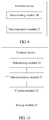
- a terminal device where a first application run by the terminal device is switched from a foreground to a background, and the terminal device may include a determining module and a decompression module.
- the determining module is configured to: determine at least one virtual memory page included in a virtual memory address range occupied by a processor (a range of all or some of virtual memory addresses occupied by the processor of the terminal device) when the terminal device runs the first application in the foreground; and determine, in a page table (namely, a first page table) of a process of the first application based on the at least one virtual memory page, each physical memory page corresponding to each virtual memory page.
- the decompression module is configured to compress, by using a predefined compression algorithm, each physical memory page determined by the determining module.
- the terminal device may further include a creation module, where the creation module is configured to create a compression index table after the decompression module compresses each physical memory page by using the predefined compression algorithm.
- the terminal device may further include a setting module, where the setting module is configured to set a flag bit (which is used to indicate that a physical memory page for which the flag bit is set is compressed) for each physical memory page in the first page table after the decompression module compresses each physical memory page by using the predefined compression algorithm.
- the setting module is configured to set a flag bit (which is used to indicate that a physical memory page for which the flag bit is set is compressed) for each physical memory page in the first page table after the decompression module compresses each physical memory page by using the predefined compression algorithm.
- the decompression module is specifically configured to perform the following method for each physical memory page, to compress each physical memory page: using a predefined compression algorithm corresponding to one physical memory page to compress the physical memory page.
- the decompression module is specifically configured to: obtain a content type of the physical memory page; determine, based on the content type of the physical memory page, a predefined compression algorithm corresponding to the content type of the physical memory page; and compress the physical memory page by using the predefined compression algorithm corresponding to the content type of the physical memory page.
- the first application run by the terminal device is switched from the background to the foreground, and the terminal device may further include an allocation module and a filling module.
- the allocation module is configured to allocate at least one new physical memory page based on the compression index table after the creation module creates the compression index table;
- the decompression module is further configured to decompress each compressed physical memory page by using a predefined decompression algorithm;
- the filling module is configured to fill the at least one new physical memory page allocated by the allocation module with content of each physical memory page decompressed by the decompression module.
- the creation module is further configured to modify the compression index table after the filling module fills the at least one physical memory page with the content of each decompressed physical memory page.
- the filling module is further configured to, after filling the at least one physical memory page with the content of each decompressed physical memory page, perform the following method for each physical memory page for which the flag bit is set in the first page table, to restore the first page table: overwriting, by using an address range of a newly allocated physical memory page, an address range of a physical memory page for which the flag bit is set in the first page table.
- the terminal device may further include a detection module and an obtaining module.
- the detection module is configured to detect a page fault interrupt (the page fault interrupt is an interrupt generated when it is detected in the first page table that the flag bit set for the compressed physical memory page is an invalid physical address) before the allocation module allocates the at least one new physical memory page based on the compression index table; and the obtaining module is configured to: call a page fault interrupt handling function in response to the page fault interrupt detected by the detection module, and obtain the compression index table based on a process number of the process of the first application.
- a terminal device where a first application run by the terminal device is switched from a background to a foreground, and the terminal device may include an obtaining module, an allocation module, a decompression module, and a filling module.
- the obtaining module is configured to obtain a compression index table created when each to-be-compressed physical memory page is compressed;
- the allocation module is configured to allocate at least one new physical memory page based on the compression index table obtained by the obtaining module;
- the decompression module is configured to decompress each compressed physical memory page by using a predefined decompression algorithm;
- the filling module is configured to fill the at least one new physical memory page allocated by the allocation module with content of each physical memory page decompressed by the decompression module.
- the terminal device may further include a creation module, where the creation module is configured to, after the filling module fills the at least one physical memory page with the content of each decompressed physical memory page, modify the compression index table obtained by the obtaining module.
- a flag bit (which is used to indicate that a physical memory page for which the flag bit is set is compressed) is set for each compressed physical memory page in a page table (namely, a first page table) of a process of the first application
- the filling module is further configured to, after filling the at least one physical memory page with the content of each decompressed physical memory page, perform the following method for each physical memory page for which the flag bit is set in the first page table, to restore the first page table: overwriting, by using an address range of a newly allocated physical memory page, an address range of a physical memory page for which the flag bit is set in the first page table.
- the terminal device may further include a detection module, where the detection module is configured to detect a page fault interrupt (an interrupt generated when it is detected in the first page table that the flag bit set for the compressed physical memory page is an invalid physical address) before the obtaining module obtains the compression index table.
- the obtaining module is specifically configured to call a page fault interrupt handling function in response to the page fault interrupt detected by the detection module, and obtain the compression index table based on a process number of the process of the first application run by the terminal device.
- the decompression module is specifically configured to perform the following method for each compressed physical memory page, to decompress each compressed physical memory page: using a predefined decompression algorithm corresponding to one compressed physical memory page to decompress the physical memory page.
- the decompression module is specifically configured to obtain a content type of the physical memory page, determine, based on the content type of the physical memory page, a predefined decompression algorithm corresponding to the content type of the physical memory page, and decompress the physical memory page by using the predefined decompression algorithm corresponding to the content type of the physical memory page.
- the compression index table includes a plurality of first entries, where each first entry includes an index number (which is used to indicate a page number of a physical memory page corresponding to a virtual memory page), an address range of the virtual memory page, an address range of a compressed physical memory page (a physical memory page obtained by compressing the physical memory page corresponding to the virtual memory page), and a content type of the compressed physical memory page.
- a modified compression index table includes a plurality of second entries, where each second entry includes an index number, an address range of a virtual memory page, an address range of a restored physical memory page (a physical memory page that is in the at least one physical memory page and filled with decompressed content, where the decompressed content is content obtained after the compressed physical memory page is decompressed), and a content type of the restored physical memory page.
- the content type of the physical memory page is a zero page, a texture page, a vertex queue, or a drawing command queue.
- a terminal device may include a memory and one or more processors coupled to the memory.
- the memory is configured to store one or more programs, where the one or more programs include a computer instruction; and when the one or more processors execute the computer instruction, the terminal device is enabled to perform the method in any one of the first aspect, the optional implementations of the first aspect, the second aspect, or the optional implementations of the second aspect.
- a computer readable storage medium may include a computer instruction.
- the terminal device When the computer instruction runs on a terminal device, the terminal device is enabled to perform the method in any one of the first aspect, the optional implementations of the first aspect, the second aspect, or the optional implementations of the second aspect.
- a computer program product including a computer instruction is provided, where when the computer program product runs on a terminal device, the terminal device is enabled to perform the method in any one of the first aspect, the optional implementations of the first aspect, the second aspect, or the optional implementations of the second aspect.
- a and/or B may represent the following three cases: Only A exists, both A and B exist, and only B exists.
- the symbol "/" in this specification indicates an "or" relationship between associated objects. For example, A/B indicates A or B.
- first the terms “first”, “second”, and the like are intended to distinguish between different objects, but do not indicate a particular order of the objects.
- a first entry, a second entry, and the like are intended to distinguish between different entries, but do not indicate a particular order of the entries.
- the word such as “example” or “for example” is used to represent giving an example, an illustration, or a description. Any embodiment or design scheme described as an “example” or “for example” in the embodiments of the present invention should not be explained as being more preferred or having more advantages than another embodiment or design scheme. Exactly, use of the word such as “example” or “for example” is intended to present a related concept in a specific manner.
- a plurality of' means two or more.
- a plurality of first entries mean two or more first entries
- a plurality of second entries mean two or more second entries.
- a virtual memory address is a logical address used by a processor to access a memory, for example, a logical address used by a processor of a terminal device to access a memory when the terminal device runs a first application.
- a physical memory address is an actual address at which a memory stores data, and is also referred to as an actual memory address or an absolute memory address.
- the physical memory address is in a one-to-one correspondence with a virtual memory address.
- a processor may find, in the memory based on a virtual memory address, a physical memory address corresponding to the virtual memory address, and then access the physical memory address (for example, perform a read/write operation on the physical memory address).
- a virtual memory address range is a range of several consecutive virtual memory addresses.
- a physical memory address range is a range of several consecutive physical memory addresses.
- a virtual memory page is obtained by dividing a virtual memory address range into several equal-sized segments, where each segment may be referred to as a virtual memory page.
- Each virtual memory page may have a page number.
- a physical memory page is obtained by dividing a physical memory address range into several equal-sized segments, where each segment may be referred to as a physical memory page.
- Each virtual memory page may also have a page number.
- Each physical memory page has a same size as each virtual memory page. For example, for a 32-bit processor, a size of each physical memory page and a size of each virtual memory page each are 4 kilobytes (KB).
- a page table is a table that stores a correspondence between a virtual memory page and a physical memory page.
- Each process has a page table.
- a process of a first application run by a terminal device has a page table, where the page table is referred to as a first page table in the embodiments of this application.
- the embodiments of this application provide a method for compressing memory occupied by a processor, a method for decompressing memory occupied by a processor, and an apparatus.
- a virtual memory address range occupied by a processor (a range of all or some of virtual memory addresses occupied by a processor of the terminal device) when the terminal device runs the first application in the foreground may be determined, each physical memory page corresponding to each virtual memory page may be determined in a first page table of a process of the first application based on at least one virtual memory page in the virtual memory address range, and then each physical memory page may be compressed by using a predefined compression algorithm.
- the physical memory page occupied by the processor of the terminal device when the terminal device runs the first application in the foreground may be compressed by using the predefined algorithm. Therefore, when the terminal device runs an application in the background, memory occupied by the processor of the terminal device can be reduced.
- the memory occupied by the processor of the terminal device is memory occupied by the processor when the terminal device runs the first application.
- the memory occupied by the processor when the terminal device runs the first application includes memory occupied by the processor when the terminal device runs the first application in the foreground and memory occupied by the processor when the terminal device runs the first application in the background.
- the memory occupied by the processor of the terminal device is the memory occupied by the processor when the terminal device runs the first application in the foreground.
- the memory occupied by the processor of the terminal device is the memory occupied by the processor when the terminal device runs the first application in the background.
- the method for compressing memory occupied by a processor and the method for decompressing memory occupied by a processor that are provided in the embodiments of this application may be applied to a terminal device, or may be applied to a function module or a function entity, in a terminal device, that can implement the methods.
- the methods may be applied to an application management system (application management system, AMS) in the terminal device.
- An execution body may be specifically determined based on an actual application scenario. This is not specifically limited in the embodiments of this application.
- the processor in the embodiments of this application may be one or a combination of a GPU, a central processing unit (central processing unit, CPU), a digital signal processor (digital signal processing, DSP), an application processor (application processor, AP), a general purpose processor, an application-specific integrated circuit (application-specific integrated circuit, ASIC), a field programmable gate array (field programmable gate array, FPGA), and the like.
- a GPU central processing unit
- CPU central processing unit
- DSP digital signal processing
- application processor application processor
- AP application processor
- general purpose processor an application-specific integrated circuit
- ASIC application-specific integrated circuit
- FPGA field programmable gate array
- the terminal device in the embodiments of this application may be a terminal device with an operating system.
- the operating system may be an Android (Android) operating system, an iOS operating system, or another possible operating system. This is not specifically limited in the embodiments of this application.
- a software environment to which the method for compressing memory occupied by a processor and the method for decompressing memory occupied by a processor that are provided in the embodiments of this application are applied is described below by using the Android operating system as an example.
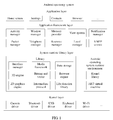
- FIG. 1 is a possible schematic diagram of an architecture of an Android operating system according to an embodiment of this application.
- the architecture of the Android operating system includes four layers: an application layer, an application framework layer, a system runtime library layer, and a kernel layer (which may be specifically a Linux kernel layer).
- the application layer is a set of applications in the Android operating system. As shown in FIG. 1 , the Android operating system provides many system applications such as a home screen, settings, contacts, and a browser. In addition, using the application framework layer, an application developer may develop another application, for example, a third-party application that may be installed and run on a terminal device.
- the application framework layer is actually an application framework, and the developer may develop some applications based on the application framework layer by following a development rule of the application framework.
- some important components included at the application framework layer include an activity manager, a window manager, a memory provider, a view system, a notification manager, a package manager, a telephone manager, a resource manager, a local manager, an extensible messaging and presence protocol (extensible messaging and presence protocol, XMPP) service, and the like.
- the system runtime library layer includes a library (which is also referred to as a system library) and an Android operating system runtime environment.
- the library mainly includes an interface manager, a media frame, data storage, a three-dimensional (three-dimensional, 3D) engine, a bitmap and vector, a browser engine, a two-dimensional (two dimensional, 2D) graphics engine, an intermediate protocol, and a Libc function library (a function library of the C Language).
- the Android operating system runtime environment includes an Android runtime environment (Android runtime, ART) virtual machine and a kernel library.
- the ART virtual machine is configured to run an application in the Android operating system based on the kernel library. For each application in the Android operating system, one ART virtual machine serves the application.
- the kernel layer is an operating system layer of the Android operating system, and is a bottom layer in Android operating system software layers.
- the kernel layer provides core system services based on a Linux kernel.
- the kernel layer further provides drivers related to hardware of a terminal device, for example, a camera driver, a bluetooth driver, a universal serial bus (universal serial bus, USB) driver, a keyboard driver, and a wireless fidelity (wireless-fidelity, Wi-Fi) driver shown in FIG. 1 .
- An Android operating system is used as an example.
- the developer may develop, based on the system architecture of the Android operating system shown in FIG. 1 , a software program for implementing the method for compressing memory occupied by a processor and the method for decompressing memory occupied by a processor that are provided in the embodiments of this application, so that the method for compressing memory occupied by a processor and the method for decompressing memory occupied by a processor can be performed based on the Android operating system shown in FIG. 1 .
- a processor or a terminal device may implement, by running the software program in the Android operating system, the method for compressing memory occupied by a processor and the method for decompressing memory occupied by a processor that are provided in the embodiments of this application.
- the terminal device in the embodiments of this application may include a mobile terminal device and a non-mobile terminal device.
- the mobile terminal device may be a terminal device such as a mobile phone, a tablet computer, a notebook computer, an ultra-mobile personal computer (ultra-mobile personal computer, UMPC), a netbook, a personal digital assistant (personal digital assistant, PDA), a smartwatch, or a smart band.
- the non-mobile terminal device may be a terminal device such as a personal computer (personal computer, PC), a television (television, TV), a counter machine, or a self-service machine. This is not specifically limited in the embodiments of this application.
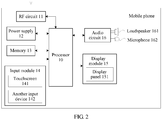
- the terminal device provided in the embodiments of this application is a mobile phone. Components of the mobile phone are described in detail with reference to FIG. 2 .
- the mobile phone provided in the embodiments of this application may include components such as a processor 10, a radio frequency (radio frequency, RF) circuit 11, a power supply 12, a memory 13, an input module 14, a display module 15, and an audio circuit 16.
- RF radio frequency
- FIG. 2 a structure of the mobile phone shown in FIG. 2 constitutes no limitation on the mobile phone, and the mobile phone may include more or fewer components than those shown in FIG. 2 , or may include a combination of some of the components shown in FIG. 2 , or may include components arranged differently from those shown in FIG. 2 .
- the processor 10 is a control center of the mobile phone, is connected to all parts of the entire mobile phone by using various interfaces and lines, and executes various functions of the mobile phone and processes data by running or executing a software program and/or a module stored in the memory 13 and by invoking data stored in the memory 13, to perform overall monitoring on the mobile phone.
- the processor 10 may include one or more processing modules.
- an application processor and a modem processor may be integrated into the processor 10.
- the application processor mainly processes an operating system, a user interface, an application, and the like.
- the modem processor mainly processes wireless communication. It may be understood that the modem processor may be alternatively a processor separated from the processor 10.
- the RF circuit 11 may be configured to receive and send a signal in an information receiving/sending process or a call process. For example, after receiving downlink information from a base station, the RF circuit 11 sends the downlink information to the processor 10 for processing, and sends uplink data to the base station.
- the RF circuit usually includes but is not limited to an antenna, at least one amplifier, a transceiver, a coupler, a low noise amplifier (low noise amplifier, LNA), a duplexer, and the like.
- the mobile phone may further implement wireless communication with another device in a network by using the RF circuit 11.
- Any communication standard or protocol may be used for the wireless communication, and includes but is not limited to a global system for mobile communications (global system of mobile communication, GSM), a general packet radio service (general packet radio service, GPRS), code division multiple access (code division multiple access, CDMA), wideband code division multiple access (wideband code division multiple access, WCDMA), long term evolution (long term evolution, LTE), email, a short message service (short messaging service, SMS), or the like.
- GSM global system of mobile communication
- GPRS general packet radio service
- code division multiple access code division multiple access
- CDMA wideband code division multiple access
- WCDMA wideband code division multiple access
- long term evolution long term evolution
- SMS short message service
- the power supply 12 may be configured to supply power to each component of the mobile phone, and the power supply 12 may be a battery.
- the power supply may be logically connected to the processor 10 by using a power management system, to implement functions such as charging management, discharging management, and power consumption management by using the power management system.
- the memory 13 may be configured to store the software program and/or the module.
- the processor 10 executes various function applications of the mobile phone and processes data by running the software program and/or the module stored in the memory 13.
- the memory 13 may mainly include a program storage area and a data storage area.
- the program storage area may store an operating system, an application required by at least one function (such as a sound play function and an image play function), and the like.
- the data storage area may store data (such as audio data, image data, and an address book) created based on use of the mobile phone, and the like.
- the memory 13 may include a high-speed random access memory, and may further include a nonvolatile memory, for example, at least one magnetic disk storage device, a flash storage device, or another volatile solid-state storage device.
- the input module 14 may be configured to receive entered digit or character information, and generate key signal input related to user setting and function control of the mobile phone.
- the input module 14 may include a touchscreen 141 and other input devices 142.
- the touchscreen 141 also referred to as a touch panel, may collect a touch operation (for example, an operation performed by a user on the touchscreen 141 or near the touchscreen 141 by using any appropriate object or accessory such as a finger or a stylus) performed by the user on or near the touchscreen 141, and drive a corresponding connected apparatus based on a preset program.
- the touchscreen 141 may include two parts: a touch detection apparatus and a touch controller.
- the touch detection apparatus detects a touch orientation of the user, detects a signal brought by a touch operation, and transfers the signal to the touch controller.
- the touch controller receives touch information from the touch detection apparatus, converts the touch information into coordinates of a touch point, sends the coordinates to the processor 10, and can receive and execute a command sent by the processor 10.
- the touchscreen 141 may be implemented by using a plurality of types such as a resistive type, a capacitive type, an infrared type, and a surface acoustic wave type.
- the other input devices 142 may include but are not limited to one or more of a physical keyboard, a function key (such as a volume control key or an on/off key), a trackball, a mouse, a joystick, and the like.
- the display module 15 may be configured to display information entered by the user or information provided for the user and various menus of the mobile phone.
- the display module 15 may include a display panel 151.
- the display panel 151 may be configured in a form of a liquid crystal display (liquid crystal display, LCD), an organic light-emitting diode (organic light-emitting diode, OLED), or the like.
- the touchscreen 141 may cover the display panel 151. After detecting a touch operation performed on or near the touchscreen 141, the touchscreen 141 transfers the touch operation to the processor 10 to determine a type of a touch event, and then the processor 10 provides corresponding visual output on the display panel 151 based on the type of the touch event.
- the touchscreen 141 and the display panel 151 serve as two independent components to implement input and output functions of the mobile phone.
- the touchscreen 141 and the display panel 151 may be integrated to implement the input and output functions of the mobile phone.
- the audio circuit 16, a loudspeaker 161, and a microphone 162 are configured to provide an audio interface between the user and the mobile phone.
- the audio circuit 16 may convert received audio data into an electrical signal, and transmit the electrical signal to the loudspeaker 161, and the loudspeaker 161 converts the electrical signal into a sound signal for output.
- the microphone 162 converts a collected sound signal into an electrical signal, and the audio circuit 16 receives the electrical signal, converts the electrical signal into audio data, and then outputs the audio data to the RF circuit 11 by using the processor 10, to send the audio data to, for example, another mobile phone, or outputs the audio data to the memory 13 by using the processor 10 for further processing.
- the mobile phone shown in FIG. 2 may further include various sensors, for example, a gyroscope sensor, a hygrometer sensor, an infrared sensor, and a magnetometer sensor. Details are not described herein.
- the mobile phone shown in FIG. 2 may further include a Wi-Fi module, a bluetooth module, and the like. Details are not described herein.
- the method for compressing memory occupied by a processor and the method for decompressing memory occupied by a processor that are provided in the embodiments of this application are described below by using an example in which the method for compressing memory occupied by a processor and the method for decompressing memory occupied by a processor that are provided in the embodiments of this application are applied to a terminal device, and the processor is a GPU.
- the processor provided in the embodiments of this application is a GPU
- the method for compressing memory occupied by a processor and the method for decompressing memory occupied by a processor that are provided in the embodiments of this application may be a method for compressing memory occupied by a GPU and a method for decompressing memory occupied by a GPU.
- the terminal device performs the method for compressing memory occupied by a GPU and the method for decompressing memory occupied by a GPU that are provided in the embodiments of this application may be that a CPU of the terminal device performs the methods. Specifically, the CPU of the terminal device may perform the methods by invoking the foregoing AMS. In the following embodiments of this application, description is provided by using an example in which the terminal device performs the methods.
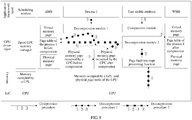
- an embodiment of this application provides a method for compressing memory occupied by a GPU.
- the method is applied to a scenario in which a first application run by a terminal device is switched from a foreground to a background (in other words, the terminal device changes from running the first application in the foreground to running the first application in the background).
- the method may include the following steps S101 to S105.
- the terminal device determines a virtual memory address range.
- the virtual memory address range is a range of all or some of virtual memory addresses occupied by a GPU when the terminal device runs the first application in the foreground.
- the virtual memory address range includes at least one virtual memory page.
- the GPU is also referred to as a display core, a visual processor, or a display chip.
- the GPU is a microprocessor that specifically performs an image operation on a terminal device (for example, the several terminal devices listed in the foregoing embodiments of this application).
- the GPU is configured to convert display information required by a computer system, and provide a row scan signal for a display, to control correct display of the display.
- the GPU is an important component, in the terminal device, connecting the display and a main board, and is also one of important components for "man-machine interaction".
- the GPU is similar to a CPU, but the GPU is specifically designed to perform complex mathematical and geometric operations that are necessary for graphics drawing and rendering.
- the CPU needs to draw a two-dimensional graph on the display
- the CPU only needs to send a drawing instruction to the GPU.
- the drawing instruction instructs to "draw a rectangle with a length of a and a width of b at coordinates (x, y)".
- the GPU may quickly calculate all pixels of the two-dimensional graph based on the drawing instruction, and draw the corresponding graph at a specified location on the display.
- the GPU notifies the CPU that "the drawing is completed", and then the GPU waits for the CPU to send a next graphics operation instruction.
- the terminal device when the terminal device runs the first application in the foreground, the terminal device responds to various operations performed by a user on the first application. For example, after the user performs a tap operation on a current interface of the first application, the terminal device switches the current interface to a target interface in response to the tap operation. In this case, the GPU of the terminal device needs to draw a new interface. Therefore, the GPU usually occupies relatively large memory.
- the terminal device switches the first application to the background for running, in other words, when the terminal device runs the first application in the background, because the user cannot perform any operation on the first application, the terminal device does not need to respond. In this case, memory occupied by the GPU is not released. Consequently, memory waste is caused, in other words, another component cannot use the memory occupied by the GPU, resulting in relatively low memory utilization.
- this embodiment of this application provides the method for compressing memory occupied by a GPU.
- the terminal device When the terminal device performs the method, the terminal device first determines the range of all of the virtual memory addresses occupied by the GPU when the terminal device runs the first application in the foreground, and then the terminal device determines a final virtual memory address range based on a compression requirement. Specifically, if the memory occupied by the GPU needs to be totally compressed, the final virtual memory address range is the range of all of the virtual memory addresses. If the memory occupied by the GPU needs to be partially compressed, the final virtual memory address range is a part of the range of all of the virtual memory addresses, namely, the range of some of the virtual memory addresses.
- the range of all of the virtual memory addresses occupied by the GPU when the terminal device runs the first application in the foreground is 000000 to 2FFFFF.
- the virtual memory address range may be 000000 to 2FFFFF or a part (for example, 010000 to 03FFFF) of 000000 to 2FFFFF.
- the terminal device determines, in a first page table based on the at least one virtual memory page in the virtual memory address range, each physical memory page corresponding to each virtual memory page.
- the first page table is a page table of a process of the first application.
- the first page table includes a correspondence between a plurality of virtual memory pages and a plurality of physical memory pages.
- the at least one virtual memory page in S102 is a virtual memory page in the plurality of virtual memory pages, and each physical memory page corresponding to each virtual memory page in the at least one virtual memory page in S102 is a physical memory page in the plurality of physical memory pages.
- the first page table includes a correspondence between at least one virtual memory page and at least one physical memory page (the at least one physical memory page is a physical memory page that is in a one-to-one correspondence with the at least one virtual memory page).
- the first page table is described below by using Table 1 as an example.
- Table 1 Virtual memory page Physical memory page Flag bit 0 (000000 to 00FFFF) 2 (020000 to 02FFFF) 1 (010000 to 01FFFF) 3 (030000 to 03FFFF) 1 2 (020000 to 02FFFF) 6 (060000 to 06FFFF) 1 3 (030000 to 03FFFF) 8 (080000 to 08FFFF) 1 4 (040000 to 04FFFF) 9 (090000 to 09FFFF) 5 (050000 to 05FFFF) 1 (010000 to 01FFFF) 6 (060000 to 06FFFF) 4 (040000 to 04FFFF) 7 (070000 to 07FFFF) 5 (050000 to 05FFFF) ... ... ...
- the digits 0, 1, 2, 3, 4, 5, 6, and 7 in the virtual memory page column indicate page numbers of virtual memory pages, and the page number is used to indicate the virtual memory page. For example, 0 is used to indicate a virtual memory page 0, and 1 is used to indicate a virtual memory page 1.
- the address range following each digit in the virtual memory page column indicates an address range of a virtual memory page. For example, (000000 to 00FFFF) indicates an address range of the virtual memory page 0, and (010000 to 01FFFF) indicates an address range of the virtual memory page 1.
- the digits 2, 3, 6, 8, 9, 1, 4, and 5 in the physical memory page column indicate page numbers of physical memory pages, and the page number is used to indicate the physical memory page.
- 2 is used to indicate a physical memory page 2
- 3 is used to indicate a physical memory page 3.
- the address range following each digit in the physical memory page column indicates an address range of a physical memory page.
- (020000 to 02FFFF) indicates an address range of the physical memory page 2
- (030000 to 03FFFF) indicates an address range of the physical memory page 3. It may be learned that the page numbers of the virtual memory pages and the address ranges of the virtual memory pages are consecutive, and the page numbers of the physical memory pages and the address ranges of the physical memory pages are inconsecutive. This is because in actual application, virtual memory is specifically allocated to the GPU to access a memory, physical memory is actual memory, and the physical memory may be jointly occupied by a plurality of components in the terminal device.
- the GPU when accessing the memory, the GPU may find, based on the first page table shown in Table 1, a physical memory page corresponding to a specific virtual memory page, and then access the physical memory page.
- the terminal device may determine, in the first page table based on the at least one virtual memory page in the virtual memory address range, each physical memory page corresponding to each virtual memory page.
- the terminal device determines, in the first page table based on the virtual memory page 1, the virtual memory page 2, and the virtual memory page 3, each physical memory page corresponding to each of the three virtual memory pages. For example, the terminal device determines, in the first page table shown in Table 1, a physical memory page 3 corresponding to the virtual memory page 1, a physical memory page 6 corresponding to the virtual memory page 2, and a physical memory page 8 corresponding to the virtual memory page 3.
- the terminal device compresses each physical memory page by using a predefined compression algorithm.
- one or more compression algorithms may be predefined.
- the terminal device may compress the to-be-compressed physical memory page by using the one or more compression algorithms.
- the terminal device may compress different to-be-compressed physical memory pages by using a same compression algorithm, or may compress different to-be-compressed physical memory pages by using different compression algorithms. Specifically, this may be determined based on an actual compression requirement. This is not specifically limited in this embodiment of this application.
- the terminal device may compress each physical memory page by using a compression algorithm corresponding to the physical memory page. In this way, a compression ratio and a compression speed may be increased to some extent.
- the terminal device may perform S103a for each physical memory page determined in S102, to compress each physical memory page.
- S103 may be specifically implemented by repeatedly performing S103a.
- the terminal device uses a predefined compression algorithm corresponding to one physical memory page to compress the physical memory page.
- the three physical memory pages namely, the physical memory page 3, the physical memory page 6, and the physical memory page 8, determined in S102 are still used as an example. It is assumed that the physical memory page 3 corresponds to a compression algorithm 1, the physical memory page 6 corresponds to a compression algorithm 2, and the physical memory page 8 corresponds to a compression algorithm 3. In this case, the terminal device may compress the physical memory page 3 by using the compression algorithm 1, compress the physical memory page 6 by using the compression algorithm 2, and compress the physical memory page 8 by using the compression algorithm 3.
- the physical memory page 3, the physical memory page 6, and the physical memory page 8 correspond to different compression algorithms respectively.
- all or some of the physical memory page 3, the physical memory page 6, and the physical memory page 8 may correspond to a same compression algorithm.
- the physical memory page 3 and the physical memory page 6 correspond to a same compression algorithm
- the physical memory page 8 corresponds to another different compression algorithm.
- content types of a plurality of physical memory pages may be exactly the same or partially the same or totally different. Therefore, in this embodiment of this application, to further increase the compression ratio and the compression speed, the terminal device may determine, based on a content type of each physical memory page, a compression algorithm corresponding to the content type, and then compress the corresponding physical memory page by using the compression algorithm.
- S103a may be specifically implemented by performing S103a1 to S 103a3.
- the terminal device obtains a content type of a physical memory page.
- the terminal device determines, based on the content type of the physical memory page, a predefined compression algorithm corresponding to the content type of the physical memory page.
- the terminal device compresses the physical memory page by using the predefined compression algorithm corresponding to the content type of the physical memory page.
- the content type of the physical memory page may be a zero page, a texture page, a vertex queue (buffer), a drawing command queue, or the like.
- the compression algorithm may be an AFBC algorithm, an LZ4 compression algorithm, or the like.
- the zero page is a physical memory page that includes no content. Therefore, the zero page may not be compressed, and in a compression process, only a page number of the zero page needs to be recorded in a compression index table.
- the texture page usually includes content in a picture format, and the AFBC algorithm is mainly used to compress content in the picture format. Therefore, the AFBC algorithm is used to compress the texture page, to achieve an optimal compression ratio and an optimal compression speed.
- the vertex queue and the drawing command queue usually include content in a format such as a data or text format, and the LZ4 compression algorithm is mainly used to compress content in a format such as the data or text format. Therefore, the LZ4 compression algorithm is used to compress the vertex queue and the drawing command queue, to achieve an optimal compression ratio and an optimal compression speed.
- a method using which the terminal device obtains the content type of the physical memory page may be as follows: The terminal device obtains the content type of the physical memory page by reading a bit mode of the physical memory page.
- Each physical memory page has a bit mode, where the bit mode may be used to indicate a type of content of the physical memory page.
- bit mode may be represented by using two bits.
- two bits of different values may be used to indicate content types of all physical memory pages. Description is provided below by using Table 2 as an example.
- each value of the bit mode may alternatively indicate a content type of a physical memory page that is different from that in Table 2. For example, 00 may be used to indicate the texture page, 01 may be used to indicate the zero page, 10 may be used to indicate the vertex queue, and 11 may be used to indicate the drawing command queue. Specifically, this may be determined based on an actual situation. Examples are not listed one by one herein.
- the terminal device creates a compression index table.
- the compression index table may include a plurality of first entries. Each first entry includes an index number, an address range of a virtual memory page, an address range of a compressed physical memory page, and a content type of the compressed physical memory page.
- the index number may be used to indicate a page number of a physical memory page corresponding to the virtual memory page, and the compressed physical memory page is a physical memory page obtained by compressing the physical memory page corresponding to the virtual memory page.
- the terminal device compresses the memory occupied by the GPU when the terminal device runs the first application in the foreground. Therefore, the compression index table created by the terminal device corresponds to an application, for example, corresponds to the first application.
- that the terminal device runs the first application may be that the terminal device runs the process of the first application. Therefore, in this embodiment of this application, after creating the compression index table, the terminal device may further save a correspondence between the compression index table and a process number of the process of the first application.
- a compression index table 1 corresponds to the process number of the process of the first application
- a compression index table 2 corresponds to a process number of a process of a second application.
- Table 3 Index number Address range of a virtual memory page Address range of a compressed physical memory page Content type of the compressed physical memory page 3 010000 to 01FFFF 030000 to 0300A1 Texture page 6 020000 to 02FFFF 060000 to 061B4F Vertex queue 8 030000 to 03FFFF 080000 to 0825F3 Vertex queue
- the index number 3 in Table 3 is used to indicate a page number of a physical memory page corresponding to a virtual memory page whose address range is 010000 to 01FFFF after the terminal device performs the compression procedure, in other words, the index number 3 is used to indicate a physical memory page 3, and indicates that the physical memory page 3 is a compressed physical memory page. Meanings of the index numbers 6 and 8 in Table 3 are similar to the meaning of the index number 3. For details, refer to related description of the index number 3. Details are not described herein again.
- the terminal device sets a flag bit for each physical memory page in the first page table.
- the flag bit may be used to indicate that a physical memory page for which the flag bit is set is compressed. In this way, when reading the flag bit, the terminal device may learn that the physical memory page for which the flag bit is set is compressed. Therefore, efficiency and accuracy of identifying the compressed physical memory page can be improved.
- the flag bit may be one or a combination of an address, a number, a letter, a sequence, and a character. Specifically, this may be set based on an actual use requirement. This is not specifically limited in this embodiment of this application.
- the flag bit may be set to an invalid physical address (in other words, the physical address does not exist).
- a page fault interrupt may be generated, and then a procedure of decompressing the physical memory page for which the flag bit is set is automatically triggered.
- the terminal device may set a flag bit 1 for each of the three physical memory pages, to indicate that the corresponding physical memory page is compressed.
- no flag bit or a flag bit 0 may be set for another physical memory page that is not compressed, to indicate that the corresponding physical memory page is not compressed.
- S104 and S105 may not be limited in this embodiment of this application.
- S104 may be performed before S105, or S105 may be performed before S104, or S104 and S105 may be simultaneously performed.
- FIG. 3 description is provided by using an example in which S104 is performed before S 105.
- the terminal device may compress, by using the predefined algorithm, the physical memory page occupied by the GPU of the terminal device when the terminal device runs the first application in the foreground. Therefore, when the terminal device runs an application in the background, memory occupied by the GPU of the terminal device can be reduced.
- the terminal device may further decompress the compressed physical memory page, to restore the memory occupied by the GPU.
- the terminal device may perform the decompressing before the first application is switched from the background to the foreground (which corresponds to the following decompression procedure 1), or may decompress the compressed physical memory page after the first application is switched from the background to the foreground but before the terminal device displays an interface of the first application (which corresponds to the following decompression procedure 2).
- the two decompression procedures are separately described below by using examples.
- the method for compressing memory occupied by a GPU provided in this embodiment of this application may further include S106 to S110.
- the terminal device allocates at least one new physical memory page based on the compression index table.
- the compression index table is created when the terminal device compresses the physical memory page.
- the terminal device may allocate at least one new physical memory page based on the compression index table created in the compression process.
- the at least one physical memory page is used to store content obtained after the compressed physical memory page is decompressed.
- the terminal device After the terminal device compresses the physical memory page, the physical memory page may be used by another component. Therefore, in a decompression process, the terminal device may allocate a new physical memory page, to store the content obtained after the compressed physical memory page is decompressed.
- Table 3 is still used as an example.
- the terminal device may determine, based on the compression index table shown in Table 3, that there are three compressed physical memory pages: the physical memory page 3, the physical memory page 6, and the physical memory page 8.
- the terminal device may allocate three new physical memory pages, to store content obtained after the three compressed physical memory pages are decompressed.
- the terminal device may allocate three new physical memory pages, namely, a physical memory page 4, a physical memory page 5, and a physical memory page 9, to store the content obtained after the compressed physical memory page 3, the compressed physical memory page 6, and the compressed physical memory page 8 are decompressed.
- the terminal device decompresses each compressed physical memory page by using a predefined decompression algorithm.
- one or more decompression algorithms may be predefined.
- the terminal device may decompress the compressed physical memory page by using the one or more decompression algorithms.
- the terminal device may decompress different compressed physical memory pages by using a same decompression algorithm, or may decompress different compressed physical memory pages by using different decompression algorithms. Specifically, this may be determined based on an actual compression requirement. This is not specifically limited in this embodiment of this application.
- the terminal device may decompress each compressed physical memory page by using a decompression algorithm corresponding to the physical memory page. In this way, a decompression ratio and a decompression speed may be increased. Specifically, the terminal device may perform S107a for each compressed physical memory page, to decompress each compressed physical memory page. In other words, S107 may be specifically implemented by repeatedly performing S107a.
- the terminal device uses a predefined decompression algorithm corresponding to one compressed physical memory page to decompress the physical memory page.
- the three physical memory pages namely, the compressed physical memory page 3, the compressed physical memory page 6, and the compressed physical memory page 8, determined in S106 are still used as an example. It is assumed that the compressed physical memory page 3 corresponds to a decompression algorithm 1, the compressed physical memory page 6 corresponds to a decompression algorithm 2, and the compressed physical memory page 8 corresponds to a decompression algorithm 3. In this case, the terminal device may decompress the compressed physical memory page 3 by using the decompression algorithm 1, decompress the compressed physical memory page 6 by using the decompression algorithm 2, and decompress the compressed physical memory page 8 by using the decompression algorithm 3.
- the compressed physical memory page 3 corresponds to different decompression algorithms respectively.
- all or some of the compressed physical memory page 3, the compressed physical memory page 6, and the compressed physical memory page 8 may correspond to a same decompression algorithm.
- the compressed physical memory page 3 and the compressed physical memory page 6 correspond to a same decompression algorithm
- the compressed physical memory page 8 corresponds to another different decompression algorithm.
- content types of a plurality of compressed physical memory pages may be exactly the same or partially the same or totally different. Therefore, in this embodiment of this application, to further increase the decompression ratio and the decompression speed, the terminal device may determine, based on a content type of each compressed physical memory page, a decompression algorithm corresponding to the content type, and then decompress the corresponding compressed physical memory page by using the decompression algorithm. In this way, one physical memory page may be compressed and decompressed by using a compression algorithm and a decompression algorithm that are of a same type.
- S107a may be specifically implemented by performing S107a1 to S107a3.
- the terminal device obtains a content type of a physical memory page.
- the terminal device determines, based on the content type of the physical memory page, a predefined decompression algorithm corresponding to the content type of the physical memory page.
- the terminal device decompresses the physical memory page by using the predefined decompression algorithm corresponding to the content type of the physical memory page.
- the decompression algorithm may be an ARM frame buffer compression (ARM frame buffer compress, AFBC) algorithm, an LZ4 decompression algorithm, or the like.
- a quantity of zero pages may be directly determined based on the page number of the zero page that is recorded in the compression index table, and then a same quantity of newly allocated physical memory pages are emptied.
- the texture page usually includes content in a picture format, and the AFBC algorithm is mainly used to decompress content in the picture format. Therefore, the AFBC algorithm is used to decompress the texture page, to achieve an optimal decompression ratio and an optimal decompression speed.
- the vertex queue and the drawing command queue usually include content in a format such as a data or text format, and the LZ4 decompression algorithm is mainly used to decompress content in a format such as the data or text format. Therefore, the LZ4 decompression algorithm is used to decompress the vertex queue and the drawing command queue, to achieve an optimal decompression ratio and an optimal decompression speed.
- the terminal device fills the at least one physical memory page with content of each decompressed physical memory page.
- the terminal device After decompressing the compressed physical memory page, the terminal device fills the at least one newly allocated physical memory page with the content of each decompressed physical memory page, to restore the compressed physical memory page. For example, the terminal device may fill the newly allocated physical memory page 4, the newly allocated physical memory page 5, and the newly allocated physical memory page 9 with the content obtained after the compressed physical memory page 3, the compressed physical memory page 6, and the compressed physical memory page 8 are decompressed.
- the terminal device modifies the compression index table.
- a modified compression index table includes a plurality of second entries. Each second entry includes an index number, an address range of a virtual memory page, an address range of a restored physical memory page, and a content type of the restored physical memory page.
- the restored physical memory page is a physical memory page that is in the at least one physical memory page and that is filled with decompressed content.
- the decompressed content is content obtained after the compressed physical memory page is decompressed.
- Table 4 Index number Address range of a virtual memory page Address range of a restored physical memory page Content type of the compressed physical memory page 4 010000 to 01FFFF 040000 to 04FFFF Texture page 5 020000 to 02FFFF 050000 to 05FFFF Vertex queue 9 030000 to 03FFFF 090000 to 09FFFF Vertex queue
- the index number 4 in Table 4 is used to indicate a page number of a physical memory page corresponding to a virtual memory page whose address range is 010000 to 01FFFF after the decompression procedure is performed, in other words, the index number 4 is used to indicate a physical memory page 4, and indicates that the physical memory page 4 is a restored physical memory page. Meanings of the index numbers 5 and 9 in Table 4 are similar to the meaning of the index number 4. For details, refer to related description of the index number 4. Details are not described herein again.
- the terminal device may further modify the first page table to restore the first page table, to ensure accuracy of the first page table.
- the terminal device performs a method shown in S110a for each physical memory page for which the flag bit is set in the first page table, to restore the first page table.
- the terminal device overwrites, by using an address range of a newly allocated physical memory page, an address range of a physical memory page for which the flag bit is set in the first page table.
- a restored first page table is described below by using Table 5 as an example.
- Table 5 Virtual memory page Physical memory page Flag bit 0 (000000 to 00FFFF) 2 (020000 to 02FFFF) 1 (010000 to 01FFFF) 4 (040000 to 04FFFF) 1 2 (020000 to 02FFFF) 5 (050000 to 05FFFF) 1 3 (030000 to 03FFFF) 9 (090000 to 09FFFF) 1 4 (040000 to 04FFFF) 3 (030000 to 03FFFF) 5 (050000 to 05FFFF) 1 (010000 to 01FFFF) 6 (060000 to 06FFFF) 6 (060000 to 06FFFF) 7 (070000 to 07FFFF) 8 (080000 to 08FFFF) ... ... ... ...
- the terminal device overwrites, by using an address range of the newly allocated physical memory page 4, an address range of the physical memory page 3 for which the flag bit 1 is set in the first page table shown in Table 1; the terminal device overwrites, by using an address range of the newly allocated physical memory page 5, an address range of the physical memory page 6 for which the flag bit 1 is set in the first page table shown in Table 1; and the terminal device overwrites, by using an address range of the newly allocated physical memory page 9, an address range of the physical memory page 8 for which the flag bit 1 is set in the first page table shown in Table 1.
- the physical memory page 3, the physical memory page 6, and the physical memory page 8 may be idle or used by other components.
- the method for compressing memory occupied by a GPU provided in this embodiment of this application may further include S111 to S117.
- the terminal device detects a page fault interrupt.
- the page fault interrupt is an interrupt generated when the terminal device detects that in the first page table, the flag bit set for the compressed physical memory page is an invalid physical address.
- the flag bit set by the terminal device for the compressed physical memory page in the first page table is an invalid physical address (in other words, the physical address does not exist). Therefore, when the terminal device reads the flag bit in the first page table, because the physical address does not exist, the page fault interrupt may be generated, and then a procedure of decompressing the physical memory page for which the flag bit is set is automatically triggered. In other words, after the terminal device detects the page fault interrupt, the terminal device may automatically perform S112, to start to decompress the compressed physical memory page.
- the terminal device calls a page fault interrupt handling function in response to the page fault interrupt, and obtains, based on the process number of the process of the first application, the compression index table corresponding to the process number.
- the terminal device in the compression process, after creating the compression index table, the terminal device saves the correspondence between the compression index table and the process number of the process of the first application. Therefore, in this embodiment of this application, the terminal device may obtain, based on the process number of the process of the first application, the compression index table, namely, a compression index table obtained after the terminal device compresses the memory occupied by the GPU when the terminal device runs the first application in the foreground, corresponding to the process number.
- the page fault interrupt handling function may include three functions: a page fault interrupt function, a page fault processing function, and an interrupt function of a memory management unit (memory management unit, MMU).
- a page fault interrupt function a page fault interrupt function
- a page fault processing function a page fault processing function
- an interrupt function of a memory management unit memory management unit (memory management unit, MMU).
- MMU memory management unit
- the page fault interrupt function is kbase_gmc_handle_gpu_page_fault; the page fault processing function is page_fault_worker; and the interrupt function of the MMU is Kbase_mmu_irq_handle.
- the terminal device allocates at least one new physical memory page based on the compression index table.
- the terminal device decompresses each compressed physical memory page by using a predefined decompression algorithm.
- the terminal device fills the at least one physical memory page with content of each decompressed physical memory page.
- the terminal device modifies the compression index table.
- the terminal device performs a method shown in S117a for each physical memory page for which the flag bit is set in the first page table, to restore the first page table.
- the terminal device overwrites, by using an address range of a newly allocated physical memory page, an address range of a physical memory page for which the flag bit is set in the first page table.
- the memory occupied by the GPU may be restored by decompressing the compressed physical memory page.
- An embodiment of this application further provides a method for decompressing memory occupied by a CPU.
- the method is applied to a scenario in which a first application run by a terminal device is switched from a background to a foreground (in other words, the terminal device changes from running the first application in the background to running the first application in the foreground), and memory occupied by a GPU is compressed when the terminal device runs the first application in the background.
- the terminal device when the terminal device decompresses a compressed physical memory page, the terminal device may decompress the compressed physical memory page before the first application is switched from the background to the foreground (which corresponds to the following decompression procedure shown in FIG. 6 ), or may decompress the compressed physical memory page after the first application is switched from the background to the foreground but before the terminal device displays an interface of the first application (which corresponds to the following decompression procedure shown in FIG. 7 ).
- the two decompression procedures are separately described below by using examples.
- the method for decompressing memory occupied by a GPU may include S201 to S206.
- the terminal device obtains a compression index table.
- the compression index table is created when the terminal device compresses each to-be-compressed physical memory page.
- the terminal device may create the compression index table, to record information about a compressed physical memory page. In this way, when needing to decompress each compressed physical memory page, the terminal device may decompress each compressed physical memory page based on the compression index table.
- the terminal device allocates at least one new physical memory page based on the compression index table.
- the terminal device decompresses each compressed physical memory page by using a predefined decompression algorithm.
- the terminal device fills the at least one physical memory page with content of each decompressed physical memory page.
- the terminal device modifies the compression index table.
- the terminal device performs a method shown in S206a for each physical memory page for which a flag bit is set in a first page table, to restore the first page table.
- the flag bit is set for each compressed physical memory page in the first page table.
- the flag bit is used to indicate that a physical memory page for which the flag bit is set is compressed.
- the first page table is a page table of a process of the first application run by the terminal device.
- the terminal device overwrites, by using an address range of a newly allocated physical memory page, an address range of a physical memory page for which the flag bit is set in the first page table.
- the method for decompressing memory occupied by a GPU provided in this embodiment of this application may include S301 to S307.
- the terminal device detects a page fault interrupt.
- the page fault interrupt is an interrupt generated when the terminal device detects that in a first page table, a flag bit set for a compressed physical memory page is an invalid physical address.
- the terminal device calls a page fault interrupt handling function in response to the page fault interrupt, and obtains a compression index table based on a process number of a process of the first application run by the terminal device.
- the terminal device allocates at least one new physical memory page based on the compression index table.
- the terminal device decompresses each compressed physical memory page by using a predefined decompression algorithm.
- the terminal device fills the at least one physical memory page with content of each decompressed physical memory page.
- the terminal device modifies the compression index table.
- the terminal device performs a method shown in S307a for each physical memory page for which the flag bit is set in the first page table, to restore the first page table.
- the terminal device overwrites, by using an address range of a newly allocated physical memory page, an address range of a physical memory page for which the flag bit is set in the first page table.
- the memory occupied by the GPU may be restored by decompressing the compressed physical memory page.
- FIG. 8 is a schematic diagram of an architecture in which a method for compressing memory occupied by a GPU and a method for decompressing memory occupied by a GPU are implemented based on an Android operating system according to an embodiment of this application.
- the method for compressing memory occupied by a GPU provided in the embodiments of this application may be implemented by using a function module, and the function module may be denoted as a gmc_compress module.
- the method for decompressing memory occupied by a GPU namely, the foregoing decompression procedure 1 or the decompression procedure shown in FIG. 6
- the function module may be denoted as a gmc_decompress_write module.
- the method for decompressing memory occupied by a GPU namely, the foregoing decompression procedure 2 or the decompression procedure shown in FIG.
- the function module may be denoted as a gmc_decompress module. It may be understood that all of the gmc_compress module, the gmc_decompress_write module, and the gmc_decompress module may be implemented by a developer through programming based on the Android operating system shown in FIG. 1 . Specific implementation of the three function modules is not limited in this embodiment of this application. In other words, all function modules that can implement the method for compressing memory occupied by a GPU and the method for decompressing memory occupied by a GPU that are provided in the embodiments of this application are within the protection scope of this application.
- the schematic diagram of the architecture includes four modules: an application framework layer, a GPU driver layer, a memory, and a system on chip (system on chip, SoC).
- an application framework layer As shown in FIG. 8 , the schematic diagram of the architecture includes four modules: an application framework layer, a GPU driver layer, a memory, and a system on chip (system on chip, SoC).
- SoC system on chip
- the application framework layer includes a scheduling module (iAware), an AMS, a process (denoted as a process 1 in FIG. 8 ) of a first application run by a terminal device, a fast visible (fast visible) attribute, and a window management system (window management system, WMS).
- a scheduling module iAware
- AMS AMS
- process denoted as a process 1 in FIG. 8
- WMS window management system
- the GPU driver layer includes a Zpool GPU memory manager, a page table (including a correspondence between a virtual memory page and a physical memory page occupied by a GPU before compression) of the process 1 before compression, a physical memory page occupied by the GPU before compression, a physical memory page occupied by the GPU after compression, a compression module (namely, the gmc_compress module), a decompression module 1 (namely, the gmc_decompress_write module), a decompression module 2 (namely, the gmc_decompress module), a page fault interrupt handling function, and a page table (including a correspondence between a virtual memory page and a physical memory page occupied by the GPU after compression) of the process 1 after compression.
- the memory includes memory occupied by a CPU, memory occupied by the GPU, and a physical page table of the GPU.
- the system on chip includes the CPU and the GPU.
- modules at the application framework layer shown in FIG. 8 may be implemented at the application framework layer of the Android operating system shown in FIG. 1
- modules at the GPU driver layer may be implemented at the kernel layer of the Android operating system shown in FIG. 1
- the memory and the SoC are hardware components applied to the Android operating system shown in FIG. 1 .
- the AMS may perform, by invoking the compression module (namely, the gmc_compress module), the method for compressing memory occupied by a GPU provided in the embodiments of this application.
- the AMS may determine, in the page table of the process 1 before compression based on a virtual memory page occupied by the GPU when the terminal device runs the first application in the foreground, a physical memory page corresponding to the virtual memory page, then compress the physical memory page, and set a flag bit for each compressed physical memory page in the page table of the process 1 before compression.
- the AMS may perform, by invoking the decompression module 1 (namely, the gmc_decompress_write module), the method for decompressing memory occupied by a GPU (namely, the foregoing decompression procedure 1 or the decompression procedure shown in FIG. 6 ) provided in the embodiments of this application.
- the AMS may decompress a compressed physical memory page, and restore the page table of the process 1 after compression.
- a decompression procedure 2 in FIG. 8 when the AMS determines that the first application run by the terminal device is switched from the background to the foreground, after the first application is switched but before an interface of the first application is displayed, the AMS performs the method for decompressing memory occupied by a GPU (namely, the foregoing decompression procedure 2 or the decompression procedure shown in FIG. 7 ) provided in the embodiments of this application.
- the AMS may call a page fault interrupt handling function in response to the page fault interrupt, and then by invoking the decompression module 2 (namely, the gmc_decompress module), the AMS decompresses a compressed physical memory page, and restores the page table of the process 1 after compression.
- the decompression module 2 namely, the gmc_decompress module
- the decompression procedure 1 For detailed description of the compression procedure, the decompression procedure 1, and the decompression procedure 2 shown in FIG. 8 , refer to related description, in the foregoing method embodiments, of the method for compressing memory occupied by a GPU and the method for decompressing memory occupied by a GPU that are provided in the embodiments of this application. Details are not described herein again.
- the solutions provided in the embodiments of this application are mainly described from a perspective of the terminal device. It may be understood that to implement the foregoing functions, the terminal device provided in the embodiments of this application includes corresponding hardware structures and/or software modules for executing the functions.
- the terminal device provided in the embodiments of this application includes corresponding hardware structures and/or software modules for executing the functions.
- a person skilled in the art may easily be aware that in combination with the modules, algorithms, and steps described in the examples of the embodiments disclosed in this specification, the embodiments of this application can be implemented by using hardware or a combination of hardware and computer software. Whether a function is performed by hardware or hardware driven by computer software depends on particular applications and design constraints of the technical solutions. A person skilled in the art may use different methods to implement the described functions for each particular application, but it should not be considered that the implementation goes beyond the scope of this application.
- the terminal device may be divided into function modules based on the foregoing method examples.
- each function module may be obtained through division based on a corresponding function, or two or more functions may be integrated into one module.
- the integrated module may be implemented in a form of hardware, or may be implemented in a form of a software function module.
- module division is an example, and is merely logical function division. In actual implementation, another division manner may be used.
- FIG. 9 is a possible schematic structural diagram of a terminal device according to an embodiment of this application.
- the terminal device may include a determining module 20 and a decompression module 21.
- the determining module 20 may be configured to support the terminal device in performing S101 and S102 that are performed by the terminal device in the foregoing method embodiment.
- the decompression module 21 may be configured to support the terminal device in performing S103 (including S103a or S103a1 to S103a3), S107 (including S107a or S107a1 to S107a3), and S114 that are performed by the terminal device in the foregoing method embodiment.
- S103 including S103a or S103a1 to S103a3
- S107 including S107a or S107a1 to S107a3
- S114 that are performed by the terminal device in the foregoing method embodiment.
- the terminal device provided in this embodiment of this application may further include a creation module 22 and a setting module 23.
- the creation module 22 may be configured to support the terminal device in performing S104, S109, and S116 that are performed by the terminal device in the foregoing method embodiment.
- the setting module 23 may be configured to support the terminal device in performing S105 performed by the terminal device in the foregoing method embodiment.
- the terminal device provided in this embodiment of this application may further include an allocation module 24 and a filling module 25.
- the allocation module 24 may be configured to support the terminal device in performing S106 and S113 that are performed by the terminal device in the foregoing method embodiment.
- the filling module 25 may be configured to support the terminal device in performing S108, S 110 (including S110a), S115, and S117 (including S117a) that are performed by the terminal device in the foregoing method embodiment.
- the terminal device provided in this embodiment of this application may further include a detection module 26 and an obtaining module 27.
- the detection module 26 may be configured to support the terminal device in performing Sill performed by the terminal device in the foregoing method embodiment.
- the obtaining module 27 may be configured to support the terminal device in performing S 112 performed by the terminal device in the foregoing method embodiment. All content related to the steps in the foregoing method embodiment may be cited in function description of the corresponding function modules. Details are not described herein again.
- FIG. 13 is another possible schematic structural diagram of a terminal device according to an embodiment of this application.
- the terminal device may include an obtaining module 30, an allocation module 31, a decompression module 32, and a filling module 33.
- the obtaining module 30 may be configured to support the terminal device in performing S201 and S302 that are performed by the terminal device in the foregoing method embodiments.
- the allocation module 31 may be configured to support the terminal device in performing S202 and S303 that are performed by the terminal device in the foregoing method embodiments.
- the decompression module 32 may be configured to support the terminal device in performing S203 and S304 that are performed by the terminal device in the foregoing method embodiments.
- the filling module 33 may be configured to support the terminal device in performing S204, S206 (including S206a), S305, and S307 (including S307a) that are performed by the terminal device in the foregoing method embodiments.
- the terminal device provided in this embodiment of this application may further include a creation module 34.
- the creation module 34 may be configured to support the terminal device in performing S205 and S306 that are performed by the terminal device in the foregoing method embodiments.
- the terminal device provided in this embodiment of this application may further include a detection module 35.
- the detection module 35 may be configured to support the terminal device in performing S301 performed by the terminal device in the foregoing method embodiment. All content related to the steps in the foregoing method embodiments may be cited in function description of the corresponding function modules. Details are not described herein again.
- FIG. 16 is a possible schematic structural diagram of a terminal device according to an embodiment of this application.
- the terminal device may include a processing module 40, a communications module 41, and a storage module 42.
- the processing module 40 may be configured to control and manage an action of the terminal device.
- the processing module 40 may be configured to support the terminal device in performing all the steps performed by the terminal device in the foregoing method embodiment and/or another process of the technology described in this specification.
- the communications module 41 may be configured to support communication between the terminal device and another device.
- the communications module 41 may be configured to support interaction between the terminal device and another terminal device.
- the storage module 42 may be configured to store program code and data of the terminal device.
- the processing module 40 may be a processor or a controller, for example, may be a GPU, a CPU, a DSP, an AP, a general purpose processor, an ASIC, an FPGA, another programmable logic device, a transistor logic device, a hardware component, or any combination thereof.
- the controller/processor may implement or execute various example logical blocks, modules, and circuits described with reference to content disclosed in the present invention.
- the processor may be a combination of processors implementing a computing function, for example, a combination of one or more microprocessors, or a combination of a DSP and a microprocessor.
- the communications module 41 may be a transceiver, a transceiver circuit, a communications interface, or the like.
- the storage module 42 may be a memory.
- the processing module 40 may be the processor 10 shown in FIG. 2 .
- the communications interface 41 may be a communications interface such as the RF circuit 11 and/or the input module 14 shown in FIG. 2 .
- the storage module 42 may be the memory 13 shown in FIG. 2 .
- FIG. 17 is a schematic diagram of hardware of a terminal device according to an embodiment of this application.
- the terminal device includes a processor 50, a memory 51, and a transceiver 52.
- the processor 50, the memory 51, and the transceiver 52 may be connected to each other by using a bus 53.
- the bus 53 may be a peripheral component interconnect (peripheral component interconnect, PCI) bus, an extended industry standard architecture (extended Industry standard architecture, EISA) bus, or the like.
- the bus 53 may be classified into an address bus, a data bus, a control bus, and the like.
- All or some of the foregoing embodiments may be implemented by using software, hardware, firmware, or any combination thereof.
- a software program is used to implement the embodiments, all or some of the embodiments may be implemented in a form of a computer program product.
- the computer program product includes one or more computer instructions.
- the computer may be a general purpose computer, a dedicated computer, a computer network, or another programmable apparatus.
- the computer instruction may be stored in a computer readable storage medium or may be transmitted from a computer readable storage medium to another computer readable storage medium.
- the computer instruction may be transmitted from a website, computer, server, or data center to another website, computer, server, or data center in a wired (for example, a coaxial cable, an optical fiber, or a digital subscriber line (digital subscriber line, DSL)) or wireless (for example, infrared, radio, or microwave) manner.
- the computer readable storage medium may be any usable medium accessible by a computer, or a data storage device, such as a server or a data center, integrating one or more usable media.
- the usable medium may be a magnetic medium (for example, a floppy disk, a magnetic disk, or a magnetic tape), an optical medium (for example, a digital video disc (digital video disc, DVD)), a semiconductor medium (for example, a solid state drive (solid state drives, SSD)), or the like.
- a magnetic medium for example, a floppy disk, a magnetic disk, or a magnetic tape
- an optical medium for example, a digital video disc (digital video disc, DVD)
- a semiconductor medium for example, a solid state drive (solid state drives, SSD)
- the disclosed system, apparatus, and methods may be implemented in other manners.
- the described apparatus embodiment is merely an example.
- the module or unit division is merely logical function division and may be other division in actual implementation.
- a plurality of units or components may be combined or integrated into another system, or some features may be ignored or not performed.
- the displayed or discussed mutual couplings or direct couplings or communication connections may be implemented by using some interfaces.
- the indirect couplings or communication connections between the apparatuses or units may be implemented in an electronic form, a mechanical form, or other forms.
- the units described as separate parts may or may not be physically separate, and parts displayed as units may or may not be physical units, may be located in one position, or may be distributed on a plurality of network units. Some or all of the units may be selected based on actual requirements to achieve the objectives of the solutions of the embodiments.
- function units in the embodiments of this application may be integrated into one processing unit, or each of the units may exist alone physically, or two or more units may be integrated into one unit.
- the integrated unit may be implemented in a form of hardware, or may be implemented in a form of a software function unit.
- the integrated unit When the integrated unit is implemented in the form of a software function unit and sold or used as an independent product, the integrated unit may be stored in a computer readable storage medium.
- the computer software product is stored in a storage medium and includes several instructions for instructing a computer device (which may be a personal computer, a server, a network device, or the like) or a processor to perform all or some of the steps of the methods described in the embodiments of this application.
- the foregoing storage medium includes any medium that can store program code, such as a flash memory, a removable hard disk, a read-only memory, a random access memory, a magnetic disk, or an optical disc.
Landscapes
- Engineering & Computer Science (AREA)
- Theoretical Computer Science (AREA)
- Physics & Mathematics (AREA)
- General Engineering & Computer Science (AREA)
- General Physics & Mathematics (AREA)
- Memory System Of A Hierarchy Structure (AREA)
Applications Claiming Priority (1)
| Application Number | Priority Date | Filing Date | Title |
|---|---|---|---|
| PCT/CN2017/106173 WO2019071610A1 (zh) | 2017-10-13 | 2017-10-13 | 一种压缩和解压处理器所占内存的方法及装置 |
Publications (3)
| Publication Number | Publication Date |
|---|---|
| EP3674846A1 true EP3674846A1 (de) | 2020-07-01 |
| EP3674846A4 EP3674846A4 (de) | 2020-09-30 |
| EP3674846B1 EP3674846B1 (de) | 2023-12-06 |
Family
ID=66101271
Family Applications (1)
| Application Number | Title | Priority Date | Filing Date |
|---|---|---|---|
| EP17928601.8A Active EP3674846B1 (de) | 2017-10-13 | 2017-10-13 | Verfahren und vorrichtung zur komprimierung und dekomprimierung eines speichers, der von einem prozessor belegt ist |
Country Status (3)
| Country | Link |
|---|---|
| EP (1) | EP3674846B1 (de) |
| CN (1) | CN110023906A (de) |
| WO (1) | WO2019071610A1 (de) |
Cited By (2)
| Publication number | Priority date | Publication date | Assignee | Title |
|---|---|---|---|---|
| US20220188145A1 (en) * | 2020-12-11 | 2022-06-16 | Samsung Electronics Co., Ltd. | Method and system for managing memory for applications in a computing system |
| US12498968B2 (en) * | 2020-12-11 | 2025-12-16 | Samsung Electronics Co., Ltd. | Method and system for managing memory for applications in a computing system |
Families Citing this family (10)
| Publication number | Priority date | Publication date | Assignee | Title |
|---|---|---|---|---|
| CN111367828B (zh) * | 2020-02-27 | 2023-10-20 | Oppo广东移动通信有限公司 | 内存压缩方法、装置、终端及存储介质 |
| CN111400052A (zh) * | 2020-04-22 | 2020-07-10 | Oppo广东移动通信有限公司 | 解压缩方法、装置、电子设备及存储介质 |
| CN113835872B (zh) * | 2020-06-24 | 2025-08-26 | 北京小米移动软件有限公司 | 一种用于减少内存开销的数据处理方法、装置及存储介质 |
| CN112114965A (zh) * | 2020-09-15 | 2020-12-22 | 深圳市欢太科技有限公司 | 应用程序的运行方法、装置、终端及存储介质 |
| CN114647423B (zh) * | 2020-12-17 | 2025-04-08 | 深圳Tcl新技术有限公司 | 一种桌面启动器的升级方法、电子设备及存储介质 |
| CN113296940B (zh) * | 2021-03-31 | 2023-12-08 | 阿里巴巴新加坡控股有限公司 | 数据处理方法及装置 |
| CN116244067B (zh) * | 2021-06-10 | 2024-05-03 | 荣耀终端有限公司 | 虚拟内存管理方法和电子设备 |
| CN115712500A (zh) * | 2022-11-10 | 2023-02-24 | 阿里云计算有限公司 | 内存释放、内存恢复方法、装置、计算机设备及存储介质 |
| CN115794413B (zh) * | 2023-01-09 | 2024-05-14 | 荣耀终端有限公司 | 一种内存处理方法及相关装置 |
| CN119987995A (zh) * | 2024-06-19 | 2025-05-13 | 华为技术有限公司 | 内存管理方法、电子设备及计算机可读存储介质 |
Family Cites Families (13)
| Publication number | Priority date | Publication date | Assignee | Title |
|---|---|---|---|---|
| US6879266B1 (en) * | 1997-08-08 | 2005-04-12 | Quickshift, Inc. | Memory module including scalable embedded parallel data compression and decompression engines |
| JP3729759B2 (ja) * | 2001-08-07 | 2005-12-21 | 株式会社ルネサステクノロジ | 圧縮された命令コードを読み出すマイクロコントローラ、命令コードを圧縮して格納するプログラムメモリ |
| CN101315602B (zh) * | 2008-05-09 | 2011-01-26 | 浙江大学 | 硬件化的进程内存管理核的方法 |
| US9007239B1 (en) * | 2012-07-02 | 2015-04-14 | Amazon Technologies, Inc. | Reduction of memory consumption |
| CN105468542B (zh) * | 2014-09-03 | 2019-03-26 | 杭州华为数字技术有限公司 | 地址分配方法及装置 |
| CN104503740A (zh) * | 2014-12-01 | 2015-04-08 | 小米科技有限责任公司 | 内存管理方法和装置 |
| CN105740303B (zh) * | 2014-12-12 | 2019-09-06 | 国际商业机器公司 | 改进的对象存储的方法及装置 |
| CN105357260B (zh) * | 2015-09-28 | 2019-03-26 | 深信服科技股份有限公司 | 实现虚拟桌面的系统、vdi数据缓存方法和vdi缓存设备 |
| CN105468426A (zh) * | 2016-01-05 | 2016-04-06 | 珠海市魅族科技有限公司 | 一种应用冻结的方法及终端 |
| CN106844032A (zh) * | 2017-01-23 | 2017-06-13 | 努比亚技术有限公司 | 一种终端应用的存储处理方法和装置 |
| CN106844033B (zh) * | 2017-01-23 | 2020-07-28 | 努比亚技术有限公司 | 一种应用快速启动方法和终端 |
| CN106843450A (zh) * | 2017-01-23 | 2017-06-13 | 努比亚技术有限公司 | 一种终端应用的存储处理方法和装置 |
| CN106803860B (zh) * | 2017-01-23 | 2020-12-29 | 努比亚技术有限公司 | 一种终端应用的存储处理方法和装置 |
-
2017
- 2017-10-13 CN CN201780074040.2A patent/CN110023906A/zh active Pending
- 2017-10-13 WO PCT/CN2017/106173 patent/WO2019071610A1/zh not_active Ceased
- 2017-10-13 EP EP17928601.8A patent/EP3674846B1/de active Active
Cited By (4)
| Publication number | Priority date | Publication date | Assignee | Title |
|---|---|---|---|---|
| US20220188145A1 (en) * | 2020-12-11 | 2022-06-16 | Samsung Electronics Co., Ltd. | Method and system for managing memory for applications in a computing system |
| US11861395B2 (en) * | 2020-12-11 | 2024-01-02 | Samsung Electronics Co., Ltd. | Method and system for managing memory for applications in a computing system |
| US20240086232A1 (en) * | 2020-12-11 | 2024-03-14 | Samsung Electronics Co., Ltd. | Method and system for managing memory for applications in a computing system |
| US12498968B2 (en) * | 2020-12-11 | 2025-12-16 | Samsung Electronics Co., Ltd. | Method and system for managing memory for applications in a computing system |
Also Published As
| Publication number | Publication date |
|---|---|
| EP3674846A4 (de) | 2020-09-30 |
| CN110023906A (zh) | 2019-07-16 |
| WO2019071610A1 (zh) | 2019-04-18 |
| EP3674846B1 (de) | 2023-12-06 |
Similar Documents
| Publication | Publication Date | Title |
|---|---|---|
| EP3674846B1 (de) | Verfahren und vorrichtung zur komprimierung und dekomprimierung eines speichers, der von einem prozessor belegt ist | |
| US10908789B2 (en) | Application switching method and apparatus and graphical user interface | |
| US11765557B2 (en) | Short message processing method and apparatus, and electronic device | |
| AU2013277002B2 (en) | Touch event processing method and portable device implementing the same | |
| US20190220216A1 (en) | Memory reclaiming method and terminal | |
| CN109101318B (zh) | 一种虚拟机迁移控制方法及装置 | |
| EP3514684A1 (de) | Verfahren und vorrichtung zur speicherrückgewinnung | |
| CN105786878B (zh) | 一种浏览对象的显示方法及装置 | |
| CN110609748A (zh) | 一种内存分配方法、电子设备及存储介质 | |
| CN110752981B (zh) | 一种信息控制方法及电子设备 | |
| CN109584341B (zh) | 在画板上绘图的方法及装置 | |
| CN113129417B (zh) | 一种全景应用中图像渲染的方法及终端设备 | |
| CN109144723B (zh) | 一种分配存储空间的方法和终端 | |
| CN109828705B (zh) | 一种显示图标的方法及终端设备 | |
| CN110502163A (zh) | 终端设备的控制方法及终端设备 | |
| CN110837343A (zh) | 处理快照的方法、装置及终端 | |
| CN106776030A (zh) | 一种动态管理内存的方法及移动终端 | |
| CN110457235A (zh) | 内存压缩方法、装置、终端及存储介质 | |
| CN105095259B (zh) | 瀑布流对象显示方法及装置 | |
| CN109151843B (zh) | 数据传输方法、移动终端、基站及计算机可读存储介质 | |
| CN109992192A (zh) | 一种界面显示方法及终端设备 | |
| CN114691531A (zh) | 内存回收方法及相关设备 | |
| US20200004386A1 (en) | User interface display method, apparatus, and user interface | |
| CN110162234A (zh) | 一种应用控制方法及终端设备 | |
| US20250199636A1 (en) | Touch system control methods and electronic device |
Legal Events
| Date | Code | Title | Description |
|---|---|---|---|
| STAA | Information on the status of an ep patent application or granted ep patent |
Free format text: STATUS: THE INTERNATIONAL PUBLICATION HAS BEEN MADE |
|
| PUAI | Public reference made under article 153(3) epc to a published international application that has entered the european phase |
Free format text: ORIGINAL CODE: 0009012 |
|
| STAA | Information on the status of an ep patent application or granted ep patent |
Free format text: STATUS: REQUEST FOR EXAMINATION WAS MADE |
|
| 17P | Request for examination filed |
Effective date: 20200323 |
|
| AK | Designated contracting states |
Kind code of ref document: A1 Designated state(s): AL AT BE BG CH CY CZ DE DK EE ES FI FR GB GR HR HU IE IS IT LI LT LU LV MC MK MT NL NO PL PT RO RS SE SI SK SM TR |
|
| AX | Request for extension of the european patent |
Extension state: BA ME |
|
| A4 | Supplementary search report drawn up and despatched |
Effective date: 20200831 |
|
| RIC1 | Information provided on ipc code assigned before grant |
Ipc: G06F 1/32 20190101AFI20200825BHEP Ipc: G06F 12/02 20060101ALI20200825BHEP |
|
| DAV | Request for validation of the european patent (deleted) | ||
| DAX | Request for extension of the european patent (deleted) | ||
| STAA | Information on the status of an ep patent application or granted ep patent |
Free format text: STATUS: EXAMINATION IS IN PROGRESS |
|
| 17Q | First examination report despatched |
Effective date: 20220221 |
|
| GRAP | Despatch of communication of intention to grant a patent |
Free format text: ORIGINAL CODE: EPIDOSNIGR1 |
|
| STAA | Information on the status of an ep patent application or granted ep patent |
Free format text: STATUS: GRANT OF PATENT IS INTENDED |
|
| INTG | Intention to grant announced |
Effective date: 20230606 |
|
| GRAS | Grant fee paid |
Free format text: ORIGINAL CODE: EPIDOSNIGR3 |
|
| GRAA | (expected) grant |
Free format text: ORIGINAL CODE: 0009210 |
|
| STAA | Information on the status of an ep patent application or granted ep patent |
Free format text: STATUS: THE PATENT HAS BEEN GRANTED |
|
| AK | Designated contracting states |
Kind code of ref document: B1 Designated state(s): AL AT BE BG CH CY CZ DE DK EE ES FI FR GB GR HR HU IE IS IT LI LT LU LV MC MK MT NL NO PL PT RO RS SE SI SK SM TR |
|
| REG | Reference to a national code |
Ref country code: GB Ref legal event code: FG4D |
|
| REG | Reference to a national code |
Ref country code: DE Ref legal event code: R096 Ref document number: 602017077381 Country of ref document: DE |
|
| REG | Reference to a national code |
Ref country code: CH Ref legal event code: EP |
|
| REG | Reference to a national code |
Ref country code: IE Ref legal event code: FG4D |
|
| REG | Reference to a national code |
Ref country code: LT Ref legal event code: MG9D |
|
| PG25 | Lapsed in a contracting state [announced via postgrant information from national office to epo] |
Ref country code: GR Free format text: LAPSE BECAUSE OF FAILURE TO SUBMIT A TRANSLATION OF THE DESCRIPTION OR TO PAY THE FEE WITHIN THE PRESCRIBED TIME-LIMIT Effective date: 20240307 |
|
| REG | Reference to a national code |
Ref country code: NL Ref legal event code: MP Effective date: 20231206 |
|
| PG25 | Lapsed in a contracting state [announced via postgrant information from national office to epo] |
Ref country code: LT Free format text: LAPSE BECAUSE OF FAILURE TO SUBMIT A TRANSLATION OF THE DESCRIPTION OR TO PAY THE FEE WITHIN THE PRESCRIBED TIME-LIMIT Effective date: 20231206 |
|
| PG25 | Lapsed in a contracting state [announced via postgrant information from national office to epo] |
Ref country code: ES Free format text: LAPSE BECAUSE OF FAILURE TO SUBMIT A TRANSLATION OF THE DESCRIPTION OR TO PAY THE FEE WITHIN THE PRESCRIBED TIME-LIMIT Effective date: 20231206 |
|
| PG25 | Lapsed in a contracting state [announced via postgrant information from national office to epo] |
Ref country code: LT Free format text: LAPSE BECAUSE OF FAILURE TO SUBMIT A TRANSLATION OF THE DESCRIPTION OR TO PAY THE FEE WITHIN THE PRESCRIBED TIME-LIMIT Effective date: 20231206 Ref country code: GR Free format text: LAPSE BECAUSE OF FAILURE TO SUBMIT A TRANSLATION OF THE DESCRIPTION OR TO PAY THE FEE WITHIN THE PRESCRIBED TIME-LIMIT Effective date: 20240307 Ref country code: ES Free format text: LAPSE BECAUSE OF FAILURE TO SUBMIT A TRANSLATION OF THE DESCRIPTION OR TO PAY THE FEE WITHIN THE PRESCRIBED TIME-LIMIT Effective date: 20231206 Ref country code: BG Free format text: LAPSE BECAUSE OF FAILURE TO SUBMIT A TRANSLATION OF THE DESCRIPTION OR TO PAY THE FEE WITHIN THE PRESCRIBED TIME-LIMIT Effective date: 20240306 |
|
| REG | Reference to a national code |
Ref country code: AT Ref legal event code: MK05 Ref document number: 1639025 Country of ref document: AT Kind code of ref document: T Effective date: 20231206 |
|
| PG25 | Lapsed in a contracting state [announced via postgrant information from national office to epo] |
Ref country code: NL Free format text: LAPSE BECAUSE OF FAILURE TO SUBMIT A TRANSLATION OF THE DESCRIPTION OR TO PAY THE FEE WITHIN THE PRESCRIBED TIME-LIMIT Effective date: 20231206 |
|
| PG25 | Lapsed in a contracting state [announced via postgrant information from national office to epo] |
Ref country code: SE Free format text: LAPSE BECAUSE OF FAILURE TO SUBMIT A TRANSLATION OF THE DESCRIPTION OR TO PAY THE FEE WITHIN THE PRESCRIBED TIME-LIMIT Effective date: 20231206 Ref country code: RS Free format text: LAPSE BECAUSE OF FAILURE TO SUBMIT A TRANSLATION OF THE DESCRIPTION OR TO PAY THE FEE WITHIN THE PRESCRIBED TIME-LIMIT Effective date: 20231206 Ref country code: NO Free format text: LAPSE BECAUSE OF FAILURE TO SUBMIT A TRANSLATION OF THE DESCRIPTION OR TO PAY THE FEE WITHIN THE PRESCRIBED TIME-LIMIT Effective date: 20240306 Ref country code: NL Free format text: LAPSE BECAUSE OF FAILURE TO SUBMIT A TRANSLATION OF THE DESCRIPTION OR TO PAY THE FEE WITHIN THE PRESCRIBED TIME-LIMIT Effective date: 20231206 Ref country code: LV Free format text: LAPSE BECAUSE OF FAILURE TO SUBMIT A TRANSLATION OF THE DESCRIPTION OR TO PAY THE FEE WITHIN THE PRESCRIBED TIME-LIMIT Effective date: 20231206 Ref country code: HR Free format text: LAPSE BECAUSE OF FAILURE TO SUBMIT A TRANSLATION OF THE DESCRIPTION OR TO PAY THE FEE WITHIN THE PRESCRIBED TIME-LIMIT Effective date: 20231206 |
|
| PG25 | Lapsed in a contracting state [announced via postgrant information from national office to epo] |
Ref country code: IS Free format text: LAPSE BECAUSE OF FAILURE TO SUBMIT A TRANSLATION OF THE DESCRIPTION OR TO PAY THE FEE WITHIN THE PRESCRIBED TIME-LIMIT Effective date: 20240406 |
|
| PG25 | Lapsed in a contracting state [announced via postgrant information from national office to epo] |
Ref country code: AT Free format text: LAPSE BECAUSE OF FAILURE TO SUBMIT A TRANSLATION OF THE DESCRIPTION OR TO PAY THE FEE WITHIN THE PRESCRIBED TIME-LIMIT Effective date: 20231206 Ref country code: CZ Free format text: LAPSE BECAUSE OF FAILURE TO SUBMIT A TRANSLATION OF THE DESCRIPTION OR TO PAY THE FEE WITHIN THE PRESCRIBED TIME-LIMIT Effective date: 20231206 |
|
| PG25 | Lapsed in a contracting state [announced via postgrant information from national office to epo] |
Ref country code: SK Free format text: LAPSE BECAUSE OF FAILURE TO SUBMIT A TRANSLATION OF THE DESCRIPTION OR TO PAY THE FEE WITHIN THE PRESCRIBED TIME-LIMIT Effective date: 20231206 |
|
| PG25 | Lapsed in a contracting state [announced via postgrant information from national office to epo] |
Ref country code: SM Free format text: LAPSE BECAUSE OF FAILURE TO SUBMIT A TRANSLATION OF THE DESCRIPTION OR TO PAY THE FEE WITHIN THE PRESCRIBED TIME-LIMIT Effective date: 20231206 Ref country code: SK Free format text: LAPSE BECAUSE OF FAILURE TO SUBMIT A TRANSLATION OF THE DESCRIPTION OR TO PAY THE FEE WITHIN THE PRESCRIBED TIME-LIMIT Effective date: 20231206 Ref country code: RO Free format text: LAPSE BECAUSE OF FAILURE TO SUBMIT A TRANSLATION OF THE DESCRIPTION OR TO PAY THE FEE WITHIN THE PRESCRIBED TIME-LIMIT Effective date: 20231206 Ref country code: IT Free format text: LAPSE BECAUSE OF FAILURE TO SUBMIT A TRANSLATION OF THE DESCRIPTION OR TO PAY THE FEE WITHIN THE PRESCRIBED TIME-LIMIT Effective date: 20231206 Ref country code: IS Free format text: LAPSE BECAUSE OF FAILURE TO SUBMIT A TRANSLATION OF THE DESCRIPTION OR TO PAY THE FEE WITHIN THE PRESCRIBED TIME-LIMIT Effective date: 20240406 Ref country code: EE Free format text: LAPSE BECAUSE OF FAILURE TO SUBMIT A TRANSLATION OF THE DESCRIPTION OR TO PAY THE FEE WITHIN THE PRESCRIBED TIME-LIMIT Effective date: 20231206 Ref country code: CZ Free format text: LAPSE BECAUSE OF FAILURE TO SUBMIT A TRANSLATION OF THE DESCRIPTION OR TO PAY THE FEE WITHIN THE PRESCRIBED TIME-LIMIT Effective date: 20231206 Ref country code: AT Free format text: LAPSE BECAUSE OF FAILURE TO SUBMIT A TRANSLATION OF THE DESCRIPTION OR TO PAY THE FEE WITHIN THE PRESCRIBED TIME-LIMIT Effective date: 20231206 |
|
| PG25 | Lapsed in a contracting state [announced via postgrant information from national office to epo] |
Ref country code: PL Free format text: LAPSE BECAUSE OF FAILURE TO SUBMIT A TRANSLATION OF THE DESCRIPTION OR TO PAY THE FEE WITHIN THE PRESCRIBED TIME-LIMIT Effective date: 20231206 Ref country code: PT Free format text: LAPSE BECAUSE OF FAILURE TO SUBMIT A TRANSLATION OF THE DESCRIPTION OR TO PAY THE FEE WITHIN THE PRESCRIBED TIME-LIMIT Effective date: 20240408 |
|
| PG25 | Lapsed in a contracting state [announced via postgrant information from national office to epo] |
Ref country code: PT Free format text: LAPSE BECAUSE OF FAILURE TO SUBMIT A TRANSLATION OF THE DESCRIPTION OR TO PAY THE FEE WITHIN THE PRESCRIBED TIME-LIMIT Effective date: 20240408 Ref country code: PL Free format text: LAPSE BECAUSE OF FAILURE TO SUBMIT A TRANSLATION OF THE DESCRIPTION OR TO PAY THE FEE WITHIN THE PRESCRIBED TIME-LIMIT Effective date: 20231206 |
|
| REG | Reference to a national code |
Ref country code: DE Ref legal event code: R097 Ref document number: 602017077381 Country of ref document: DE |
|
| PG25 | Lapsed in a contracting state [announced via postgrant information from national office to epo] |
Ref country code: DK Free format text: LAPSE BECAUSE OF FAILURE TO SUBMIT A TRANSLATION OF THE DESCRIPTION OR TO PAY THE FEE WITHIN THE PRESCRIBED TIME-LIMIT Effective date: 20231206 |
|
| PLBE | No opposition filed within time limit |
Free format text: ORIGINAL CODE: 0009261 |
|
| STAA | Information on the status of an ep patent application or granted ep patent |
Free format text: STATUS: NO OPPOSITION FILED WITHIN TIME LIMIT |
|
| PG25 | Lapsed in a contracting state [announced via postgrant information from national office to epo] |
Ref country code: SI Free format text: LAPSE BECAUSE OF FAILURE TO SUBMIT A TRANSLATION OF THE DESCRIPTION OR TO PAY THE FEE WITHIN THE PRESCRIBED TIME-LIMIT Effective date: 20231206 |
|
| PG25 | Lapsed in a contracting state [announced via postgrant information from national office to epo] |
Ref country code: SI Free format text: LAPSE BECAUSE OF FAILURE TO SUBMIT A TRANSLATION OF THE DESCRIPTION OR TO PAY THE FEE WITHIN THE PRESCRIBED TIME-LIMIT Effective date: 20231206 Ref country code: DK Free format text: LAPSE BECAUSE OF FAILURE TO SUBMIT A TRANSLATION OF THE DESCRIPTION OR TO PAY THE FEE WITHIN THE PRESCRIBED TIME-LIMIT Effective date: 20231206 |
|
| 26N | No opposition filed |
Effective date: 20240909 |
|
| PGFP | Annual fee paid to national office [announced via postgrant information from national office to epo] |
Ref country code: DE Payment date: 20240904 Year of fee payment: 8 |
|
| REG | Reference to a national code |
Ref country code: CH Ref legal event code: PL |
|
| PG25 | Lapsed in a contracting state [announced via postgrant information from national office to epo] |
Ref country code: MC Free format text: LAPSE BECAUSE OF FAILURE TO SUBMIT A TRANSLATION OF THE DESCRIPTION OR TO PAY THE FEE WITHIN THE PRESCRIBED TIME-LIMIT Effective date: 20231206 |
|
| PG25 | Lapsed in a contracting state [announced via postgrant information from national office to epo] |
Ref country code: LU Free format text: LAPSE BECAUSE OF NON-PAYMENT OF DUE FEES Effective date: 20241013 Ref country code: BE Free format text: LAPSE BECAUSE OF NON-PAYMENT OF DUE FEES Effective date: 20241031 |
|
| PG25 | Lapsed in a contracting state [announced via postgrant information from national office to epo] |
Ref country code: FR Free format text: LAPSE BECAUSE OF NON-PAYMENT OF DUE FEES Effective date: 20241031 |
|
| PG25 | Lapsed in a contracting state [announced via postgrant information from national office to epo] |
Ref country code: CH Free format text: LAPSE BECAUSE OF NON-PAYMENT OF DUE FEES Effective date: 20241031 |
|
| REG | Reference to a national code |
Ref country code: BE Ref legal event code: MM Effective date: 20241031 |
|
| PG25 | Lapsed in a contracting state [announced via postgrant information from national office to epo] |
Ref country code: FI Free format text: LAPSE BECAUSE OF FAILURE TO SUBMIT A TRANSLATION OF THE DESCRIPTION OR TO PAY THE FEE WITHIN THE PRESCRIBED TIME-LIMIT Effective date: 20231207 |
|
| PGFP | Annual fee paid to national office [announced via postgrant information from national office to epo] |
Ref country code: GB Payment date: 20250904 Year of fee payment: 9 |
|
| PG25 | Lapsed in a contracting state [announced via postgrant information from national office to epo] |
Ref country code: IE Free format text: LAPSE BECAUSE OF NON-PAYMENT OF DUE FEES Effective date: 20241013 |