EP3674741A1 - Identifizierungssystem und -verfahren einer radarquelle - Google Patents
Identifizierungssystem und -verfahren einer radarquelle Download PDFInfo
- Publication number
- EP3674741A1 EP3674741A1 EP19219570.9A EP19219570A EP3674741A1 EP 3674741 A1 EP3674741 A1 EP 3674741A1 EP 19219570 A EP19219570 A EP 19219570A EP 3674741 A1 EP3674741 A1 EP 3674741A1
- Authority
- EP
- European Patent Office
- Prior art keywords
- radar
- grouping
- model
- data
- pulse
- Prior art date
- Legal status (The legal status is an assumption and is not a legal conclusion. Google has not performed a legal analysis and makes no representation as to the accuracy of the status listed.)
- Granted
Links
Images







Classifications
-
- G—PHYSICS
- G01—MEASURING; TESTING
- G01S—RADIO DIRECTION-FINDING; RADIO NAVIGATION; DETERMINING DISTANCE OR VELOCITY BY USE OF RADIO WAVES; LOCATING OR PRESENCE-DETECTING BY USE OF THE REFLECTION OR RERADIATION OF RADIO WAVES; ANALOGOUS ARRANGEMENTS USING OTHER WAVES
- G01S7/00—Details of systems according to groups G01S13/00, G01S15/00, G01S17/00
- G01S7/02—Details of systems according to groups G01S13/00, G01S15/00, G01S17/00 of systems according to group G01S13/00
- G01S7/021—Auxiliary means for detecting or identifying radar signals or the like, e.g. radar jamming signals
-
- G—PHYSICS
- G06—COMPUTING OR CALCULATING; COUNTING
- G06F—ELECTRIC DIGITAL DATA PROCESSING
- G06F18/00—Pattern recognition
- G06F18/20—Analysing
- G06F18/23—Clustering techniques
- G06F18/232—Non-hierarchical techniques
- G06F18/2321—Non-hierarchical techniques using statistics or function optimisation, e.g. modelling of probability density functions
-
- G—PHYSICS
- G06—COMPUTING OR CALCULATING; COUNTING
- G06F—ELECTRIC DIGITAL DATA PROCESSING
- G06F18/00—Pattern recognition
- G06F18/20—Analysing
- G06F18/24—Classification techniques
- G06F18/241—Classification techniques relating to the classification model, e.g. parametric or non-parametric approaches
- G06F18/2413—Classification techniques relating to the classification model, e.g. parametric or non-parametric approaches based on distances to training or reference patterns
- G06F18/24133—Distances to prototypes
- G06F18/24143—Distances to neighbourhood prototypes, e.g. restricted Coulomb energy networks [RCEN]
-
- G—PHYSICS
- G06—COMPUTING OR CALCULATING; COUNTING
- G06N—COMPUTING ARRANGEMENTS BASED ON SPECIFIC COMPUTATIONAL MODELS
- G06N3/00—Computing arrangements based on biological models
- G06N3/02—Neural networks
- G06N3/04—Architecture, e.g. interconnection topology
- G06N3/044—Recurrent networks, e.g. Hopfield networks
- G06N3/0442—Recurrent networks, e.g. Hopfield networks characterised by memory or gating, e.g. long short-term memory [LSTM] or gated recurrent units [GRU]
-
- G—PHYSICS
- G06—COMPUTING OR CALCULATING; COUNTING
- G06N—COMPUTING ARRANGEMENTS BASED ON SPECIFIC COMPUTATIONAL MODELS
- G06N3/00—Computing arrangements based on biological models
- G06N3/02—Neural networks
- G06N3/04—Architecture, e.g. interconnection topology
- G06N3/045—Combinations of networks
-
- G—PHYSICS
- G06—COMPUTING OR CALCULATING; COUNTING
- G06N—COMPUTING ARRANGEMENTS BASED ON SPECIFIC COMPUTATIONAL MODELS
- G06N3/00—Computing arrangements based on biological models
- G06N3/02—Neural networks
- G06N3/04—Architecture, e.g. interconnection topology
- G06N3/0464—Convolutional networks [CNN, ConvNet]
-
- G—PHYSICS
- G06—COMPUTING OR CALCULATING; COUNTING
- G06N—COMPUTING ARRANGEMENTS BASED ON SPECIFIC COMPUTATIONAL MODELS
- G06N3/00—Computing arrangements based on biological models
- G06N3/02—Neural networks
- G06N3/04—Architecture, e.g. interconnection topology
- G06N3/0499—Feedforward networks
-
- G—PHYSICS
- G06—COMPUTING OR CALCULATING; COUNTING
- G06N—COMPUTING ARRANGEMENTS BASED ON SPECIFIC COMPUTATIONAL MODELS
- G06N3/00—Computing arrangements based on biological models
- G06N3/02—Neural networks
- G06N3/08—Learning methods
-
- G—PHYSICS
- G06—COMPUTING OR CALCULATING; COUNTING
- G06N—COMPUTING ARRANGEMENTS BASED ON SPECIFIC COMPUTATIONAL MODELS
- G06N3/00—Computing arrangements based on biological models
- G06N3/02—Neural networks
- G06N3/08—Learning methods
- G06N3/09—Supervised learning
-
- G—PHYSICS
- G06—COMPUTING OR CALCULATING; COUNTING
- G06V—IMAGE OR VIDEO RECOGNITION OR UNDERSTANDING
- G06V10/00—Arrangements for image or video recognition or understanding
- G06V10/70—Arrangements for image or video recognition or understanding using pattern recognition or machine learning
- G06V10/764—Arrangements for image or video recognition or understanding using pattern recognition or machine learning using classification, e.g. of video objects
-
- G—PHYSICS
- G06—COMPUTING OR CALCULATING; COUNTING
- G06F—ELECTRIC DIGITAL DATA PROCESSING
- G06F2218/00—Aspects of pattern recognition specially adapted for signal processing
- G06F2218/12—Classification; Matching
Definitions
- the present invention relates to the field of RADAR, sources of radar radiation and Intelligence of Electro-Magnetic Origin (ROEM) in general.
- the present invention relates more particularly to a method and a system for identifying radar sources.
- An object of the present invention is to overcome at least certain drawbacks of the prior art by proposing a system and a method for identifying a radar source which is rapid, efficient and reliable.
- a radar source identification method from a signal generated by at least one radar pulse sensor, implemented in a radar identification system accessing at least one database.
- Intelligence the method comprising at least one data processing by at least one model of multi-layer neural networks, said sensor detecting and characterizing the pulses produced by the radars in presence around the sensor by generating said signal in the form of pulse descriptors (PDW), the method being characterized in that it comprises a conditioning step prior to said treatment, the conditioning step comprising a grouping of pulse descriptors (PDW) by comparison of at least one parameter among at least the frequency and duration of the pulses.
- BDR Intelligence
- the method comprising at least one data processing by at least one model of multi-layer neural networks, said sensor detecting and characterizing the pulses produced by the radars in presence around the sensor by generating said signal in the form of pulse descriptors (PDW), the method being characterized in that it comprises a conditioning step prior to said treatment, the conditioning step comprising a grouping of pulse descriptors
- a radar source identification system comprising computer data processing means capable of processing the data generated by radar sensors, characterized in that the computer means execute instructions allowing the implementation of the process according to the invention.
- the models are trained on the basis of the validated results provided by the intelligence database (BDR).
- said model of neural networks is a multi-layer perceptron type (MLP) model.
- MLP multi-layer perceptron type
- said model of neural networks is a model of the convolutional neural network (CNN) type.
- said model of neural networks is a model of the recurrent neural network (RNN) type.
- the supervised treatment uses a deep learning algorithm.
- the unsupervised processing uses a cluster classification algorithm
- the present invention relates to a radar source identification system and method.
- the system includes computer means executing instructions allowing the implementation of the method. No details will be provided on the computer means well known to those skilled in the art, because the present invention can be implemented on various devices or IT infrastructure, networked or not.
- the processing method detailed in this document is a classification method for radar signals. It makes it possible from signals recorded by any sensor to determine which were the radars at the origin of these signals.
- the classification results at least in the identification of a radar signature relative to a model of radar. If data allow, classification can lead to the identification of a physical instance of speed camera.
- the models used for this supervised classification learn from results from a database (BDR).
- BDR database
- This BDR brings together a large set of radar signals for which a classification has already been carried out and validated by algorithms or directly by operators.
- models learn from the results obtained whatever their origin and therefore benefit from all the techniques already used in the field.
- the proposed functions require consultation of the databases (BTI, BDR) of a radar intelligence system / ROEM. They benefit from the evolutions of these bases during the learning increments. The results obtained are fed back into specific databases different from the BTI / BDR to guarantee total independence from the ROEM system. However, the injection into the databases (BTI, BDR) on explicit action of the user of the manual chain (CTE_M) is feasible.
- the radar data input to the processing is the data produced by a radar sensor capable of detecting and characterizing the pulses produced by the radars present around the sensor. This detection and characterization of the pulses is synthesized in the form of “pulse descriptor words” or PDW (for English “Puise Description Word”) summarizing the content of the pulses.
- the speed camera data therefore boils down to a list of PDWs that grows as the pulses from surrounding speed cameras arrive at the sensor.
- the accuracy of the information contained in the PDWs depends on the performance of the sensor and may vary depending on the interception conditions (a distant radar emitting at low power will generally be less well perceived by the sensor and therefore its pulses will be less well characterized).
- the data relating to the radar signals collected by the ROEM systems are generally processed by models of neural networks, for example of the MLP, CNN or RNN type.
- the figure 5 illustrates an example of such a model.
- the number of layers for each model is not fixed and can be adapted according to the data available for training.
- the choice of model can also vary depending on the parameter studied. For example, in the case of packaging by tiling, the images produced on the frequency can supply MLPs while the images produced on the level will supply CNNs.
- the activation functions of neurons are defined by the existing methods conventionally provided in the libraries of “Deep Learning” and “Machine Learning” models: sigmoid, ReLu, etc.
- the models are trained on the basis of validated results supplied by the RDB using, by gradient descent, a cost function of the cross entropy type. Other types of cost function may be used depending on the data made available.
- the method includes a decision step generating data consolidated by a decision threshold relating to their consistency.
- Such a decision step is based on a threshold to select the identified sources that have the best correspondence rate with the existing radar classes.
- the models used output a rate of correspondence to each of the radar classes existing in the database. If the base contains the records of N different radars, then one obtains as an output a vector of size N containing a matching score for each radar class.
- the matching score may suffice as a result of data interpretation by the model, however for a radar operator it is quickly tedious to visualize this result when the number of radar classes to find becomes large.
- the matching score is therefore post-processed by a thresholding function included in the models and trained on the learning data. So there is a decision-specific layer in the model.
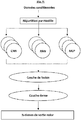
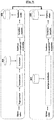
- system and the method use processing in two successive phases: supervised processing and unsupervised processing, as indicated in the figure 1 .
- a first algorithm uses artificial intelligence in supervised mode, that is to say by searching for transmitters already known and identified in databases (BTI or BDR).
- the second algorithm uses artificial intelligence in NON-supervised mode, that is to say by looking for unknown transmitters which are not referenced in databases (BTI or BDR).
- the supervised treatment is preferably based on at least one algorithm of the Deep Learning type.
- the model used preferably performs learning on BDR and classifies the pulses according to the referenced transmitters.
- a completeness analysis (checking that all the pulses have been allocated to a radar source) makes it possible to recover any unclassified pulses, in order to inject them into the unsupervised treatment.
- Unsupervised processing is preferably based on at least one clustering algorithm.
- the model preferably performs learning on RDB and makes it possible to find a new signature in the unclassified pulses.
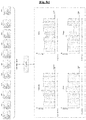
- the figure 2 shows the principle of processing in two successive phases, in the example of a collected signal containing the nesting of pulses from four radar sources, assuming that two of these radars are referenced in the database (BTI / BDR) and that 'there are two new speed cameras, unknown in the database (BTI / BDR).
- the first phase is supervised processing, the aim of which is to find in the input signals of the radars referenced in the database (BTI / BDR).
- This phase allows you to find, in the complex signal (in black, top line on the Fig. 2 ) the two known radars (one in gray and the other in white, in the middle line on the Fig. 2 ).
- the pulses attached to these two known radars are injected in an unsupervised treatment.
- This unsupervised processing must appropriately distribute the pulses into several radars (two in this example), but this is done without knowing a priori neither the number nor the type of radars.
- the pulses thus grouped are used to characterize two new radars recorded in the database (BDR) (gray and white, bottom line on the Fig. 2 ), for example operator approval.
- the four radars can be detected optimally in supervised mode because they will all be referenced in the database (BTI or BDR)
- FIG presented in figure 3b shows the treatment in its operating phase after learning, while the figure 3a shows the treatment in its learning phase.
- a cost function collects the output classes at the output of the model and calculates the variations of parameters to apply to the model to minimize the cost.
- the figure 9 illustrates a comparison between, on the one hand, the classic approach (above) in which operators must recognize the signals themselves, by grouping, characterization and crossing with a BDR to provide a list of validated transmitters and, on the other hand, an artificial intelligence approach as in the present invention.
- an additional alternative algorithm is provided for manual recovery, allowing the operator to combine these approaches.
- the present invention takes advantage of this possible combination by learning from the raw inputs and the final outputs of validated transmitters, to integrate and merge the content of the three processing steps: grouping, characterization and crossover.
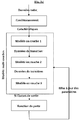
- the system and the method use a preprocessing of the data collected, here called “conditioning”, as indicated in figure 1 .
- the conditioning uses at least one piece of information from the PDWs and preferably at least the frequency and the duration of the pulse.
- Conditioning is a step which consists in formatting the radar data so as to reduce and homogenize the data which will feed the models. This layout results in the development of features that will be analyzed by the models to operate the classification.
- the pulses are not processed directly in a raw way, but on the contrary, groups (or pre-clusters) are constructed upstream on analysis of the signals.
- the conditioned data and their characteristics (“features”) are constructed from basic PDW information: frequency, level, duration, arrival time, modulation and position.
- features are constructed from basic PDW information: frequency, level, duration, arrival time, modulation and position.
- the interest of conditioning is to submit the models to uniform data, whatever the contexts of radar data capture.
- Other advantages are also to simplify the problem of regrouping to a few entities, to take advantage of radar business knowledge and reduce the complexity of the algorithms used in radar source identification models.
- the figure 4 shows an example of the results of a treatment using conditioning according to various embodiments.
- pre-clustering we obtain a plurality of potential groups (pre-clusters) which accelerate supervised and unsupervised processing.
- the top line shows the raw signal to be processed
- the middle line shows the various groups in various shades of gray
- the bottom line shows the four radar sources identified in the signal (one black, one gray, one white and one hatched) ).
- the conditioning of the data is carried out by parametric grouping, an example of which is represented on the figure 8a .
- Parametric grouping consists of grouping the starting PDWs into groups of PDWs with similar parameters. Each group contains PDWs whose frequency, duration, modulation and position parameters are identical to tolerances (the level and time of arrival parameters are generally ignored). The choice of tolerances is made empirically from the analysis of a large amount of radar data.
- the groups resulting from the parametric grouping constitute radar emissions.
- a radar broadcast is constructed from a variable number of PDWs according to the dispersion of the basic radar data. Each program is characterized by new metrics calculated on the PDW it contains.
- the conditioning by parametric grouping can be carried out on all the PDWs generated by the sensor or by time slices so as to preserve a temporal timing of the features. This temporal timing allows the use of convolutional type models.
- the data is packaged by densitometric grouping, an example of which is shown in the Figure 8b .
- Conditioning by densitometric grouping consists of creating groups of PDWs by analyzing the density of PDWs in a multidimensional space where each dimension represents a PDW parameter.
- the density analysis uses the frequency, duration, modulation and position parameters (the level and instant arrival parameters are generally ignored).
- the condition for creating a group is that it contains a sufficient number of PDWs in a finite search space.
- the search space can be dynamically adapted according to the number of PDWs put into groups and thus make it possible to have groups of various morphologies.
- the technique here is similar to a density clustering function (type DBSCAN or OPTICS).
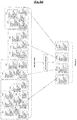
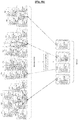
- the data is packaged by tiling, an example of operation of which is illustrated on the figures 8c and 8d .
- the conditioning by tiling consists in obtaining a graphic representation of the starting PDW on certain parameters by carrying out a temporal sampling.
- the parameters used by the tiling are the frequency, the pulse duration, the level and the DTOA.
- the DTOA is the difference between the successive arrival times of the PDWs.
- the figure 8c illustrates the calculation of sorting grids for each parameter used.
- sorting grids are calculated empirically after analysis of a large amount of radar data and make it possible to define for each parameter a list of borders which will be used to sort the PDWs. Borders are not regularly spaced and are more concentrated for areas over-represented in radar data.
- the radar data are then sorted according to these grids by successive time slice.
- the time slicing is fixed by a time resolution parameter.
- the figure 8c illustrates the sorting for each time slice.
- the pixel value represents the population of PDW present in the pixel.
- the basic radar data are processed in blocks, each block corresponding to a fixed duration, for example 10 seconds.
- the size of the images obtained only depends on the number of boxes in the grid and on the temporal resolution chosen. This size is fixed regardless of the data processed.
Landscapes
- Engineering & Computer Science (AREA)
- Theoretical Computer Science (AREA)
- Physics & Mathematics (AREA)
- General Physics & Mathematics (AREA)
- Data Mining & Analysis (AREA)
- Artificial Intelligence (AREA)
- Evolutionary Computation (AREA)
- Software Systems (AREA)
- General Engineering & Computer Science (AREA)
- Health & Medical Sciences (AREA)
- Computing Systems (AREA)
- Life Sciences & Earth Sciences (AREA)
- General Health & Medical Sciences (AREA)
- Biomedical Technology (AREA)
- Biophysics (AREA)
- Mathematical Physics (AREA)
- Molecular Biology (AREA)
- Computational Linguistics (AREA)
- Computer Vision & Pattern Recognition (AREA)
- Radar, Positioning & Navigation (AREA)
- Remote Sensing (AREA)
- Medical Informatics (AREA)
- Databases & Information Systems (AREA)
- Multimedia (AREA)
- Computer Networks & Wireless Communication (AREA)
- Bioinformatics & Cheminformatics (AREA)
- Bioinformatics & Computational Biology (AREA)
- Evolutionary Biology (AREA)
- Probability & Statistics with Applications (AREA)
- Radar Systems Or Details Thereof (AREA)
Applications Claiming Priority (1)
| Application Number | Priority Date | Filing Date | Title |
|---|---|---|---|
| FR1874115A FR3091355B1 (fr) | 2018-12-27 | 2018-12-27 | Système et procédé d’identification de source radar |
Publications (2)
| Publication Number | Publication Date |
|---|---|
| EP3674741A1 true EP3674741A1 (de) | 2020-07-01 |
| EP3674741B1 EP3674741B1 (de) | 2023-11-22 |
Family
ID=67185161
Family Applications (1)
| Application Number | Title | Priority Date | Filing Date |
|---|---|---|---|
| EP19219570.9A Active EP3674741B1 (de) | 2018-12-27 | 2019-12-23 | Identifizierungssystem und -verfahren einer radarquelle |
Country Status (2)
| Country | Link |
|---|---|
| EP (1) | EP3674741B1 (de) |
| FR (1) | FR3091355B1 (de) |
Cited By (10)
| Publication number | Priority date | Publication date | Assignee | Title |
|---|---|---|---|---|
| CN111913156A (zh) * | 2020-08-05 | 2020-11-10 | 电子科技大学 | 基于深度学习模型与特征联合的雷达辐射源个体识别方法 |
| CN114254141A (zh) * | 2021-12-20 | 2022-03-29 | 哈尔滨工程大学 | 一种基于深度分割的端到端雷达信号分选方法 |
| CN115166679A (zh) * | 2022-09-06 | 2022-10-11 | 中国人民解放军海军工程大学 | 基于任务属性的未知雷达辐射源目标的表征识别方法 |
| CN115616503A (zh) * | 2022-11-10 | 2023-01-17 | 西北工业大学 | 一种基于卷积神经网络模型的雷达干扰信号类型识别方法 |
| CN116466314A (zh) * | 2023-03-31 | 2023-07-21 | 科大讯飞股份有限公司 | 一种雷达个体分选方法、装置、存储介质及设备 |
| CN116955930A (zh) * | 2023-07-31 | 2023-10-27 | 电子科技大学 | 一种针对雷达脉冲描述字序列的增量式机器学习识别系统 |
| CN117289218A (zh) * | 2023-11-24 | 2023-12-26 | 西安电子科技大学 | 一种基于注意力级联网络的有源干扰识别方法 |
| CN119414343A (zh) * | 2024-10-18 | 2025-02-11 | 南栖仙策(南京)科技有限公司 | 干扰方案确定方法、装置、电子设备及存储介质 |
| EP4556939A1 (de) * | 2023-11-20 | 2025-05-21 | Thales | Verbessertes radarsystem, konfigurationsverfahren und computerprogrammprodukte dafür |
| EP4776018A1 (de) | 2025-01-09 | 2026-07-15 | Fraunhofer-Gesellschaft zur Förderung der angewandten Forschung e.V. | Verfahren zur trackerbasierten identifikation agiler radarsendertypen |
Families Citing this family (2)
| Publication number | Priority date | Publication date | Assignee | Title |
|---|---|---|---|---|
| US20260010819A1 (en) * | 2024-07-02 | 2026-01-08 | Raytheon Company | System and method for automated machine learning support in an electronic warfare environment |
| US20260009880A1 (en) * | 2024-07-02 | 2026-01-08 | Raytheon Company | System and method for learned emitter identification and tracking |
Citations (4)
| Publication number | Priority date | Publication date | Assignee | Title |
|---|---|---|---|---|
| CN101893704A (zh) | 2010-07-20 | 2010-11-24 | 哈尔滨工业大学 | 一种基于粗糙集的雷达辐射源信号识别方法 |
| CN105631484A (zh) | 2016-03-10 | 2016-06-01 | 江苏信息职业技术学院 | 基于等价型模糊神经网络电子对抗辐射源识别方法 |
| CN108416290A (zh) | 2018-03-06 | 2018-08-17 | 中国船舶重工集团公司第七二四研究所 | 基于残差深度学习的雷达信号特征提取方法 |
| US20180313880A1 (en) * | 2017-04-26 | 2018-11-01 | Raytheon Company | Analysis of a radio-frequency environment utilizing pulse masking |
-
2018
- 2018-12-27 FR FR1874115A patent/FR3091355B1/fr active Active
-
2019
- 2019-12-23 EP EP19219570.9A patent/EP3674741B1/de active Active
Patent Citations (4)
| Publication number | Priority date | Publication date | Assignee | Title |
|---|---|---|---|---|
| CN101893704A (zh) | 2010-07-20 | 2010-11-24 | 哈尔滨工业大学 | 一种基于粗糙集的雷达辐射源信号识别方法 |
| CN105631484A (zh) | 2016-03-10 | 2016-06-01 | 江苏信息职业技术学院 | 基于等价型模糊神经网络电子对抗辐射源识别方法 |
| US20180313880A1 (en) * | 2017-04-26 | 2018-11-01 | Raytheon Company | Analysis of a radio-frequency environment utilizing pulse masking |
| CN108416290A (zh) | 2018-03-06 | 2018-08-17 | 中国船舶重工集团公司第七二四研究所 | 基于残差深度学习的雷达信号特征提取方法 |
Non-Patent Citations (4)
| Title |
|---|
| CAIN LINDSAY ET AL: "Convolutional neural networks for radar emitter classification", 2018 IEEE 8TH ANNUAL COMPUTING AND COMMUNICATION WORKSHOP AND CONFERENCE (CCWC), IEEE, 8 January 2018 (2018-01-08), pages 79 - 83, XP033326743, DOI: 10.1109/CCWC.2018.8301627 * |
| SHAPERO SAMUEL A ET AL: "Identifying Agile Waveforms with Neural Networks", 2018 21ST INTERNATIONAL CONFERENCE ON INFORMATION FUSION (FUSION), ISIF, 10 July 2018 (2018-07-10), pages 745 - 752, XP033397854, DOI: 10.23919/ICIF.2018.8455370 * |
| ZHANG XIAONAN ET AL: "A hybrid method for classification and identification of emitter signals", 2017 4TH INTERNATIONAL CONFERENCE ON SYSTEMS AND INFORMATICS (ICSAI), IEEE, 11 November 2017 (2017-11-11), pages 1060 - 1065, XP033292621, DOI: 10.1109/ICSAI.2017.8248442 * |
| ZHOU ZHIWEN ET AL: "Automatic Radar Waveform Recognition Based on Deep Convolutional Denoising Auto-encoders", CIRCUITS, SYSTEMS AND SIGNAL PROCESSING, CAMBRIDGE, MS, US, vol. 37, no. 9, 29 January 2018 (2018-01-29), pages 4034 - 4048, XP036566766, ISSN: 0278-081X, [retrieved on 20180129], DOI: 10.1007/S00034-018-0757-0 * |
Cited By (14)
| Publication number | Priority date | Publication date | Assignee | Title |
|---|---|---|---|---|
| CN111913156A (zh) * | 2020-08-05 | 2020-11-10 | 电子科技大学 | 基于深度学习模型与特征联合的雷达辐射源个体识别方法 |
| CN114254141A (zh) * | 2021-12-20 | 2022-03-29 | 哈尔滨工程大学 | 一种基于深度分割的端到端雷达信号分选方法 |
| CN115166679A (zh) * | 2022-09-06 | 2022-10-11 | 中国人民解放军海军工程大学 | 基于任务属性的未知雷达辐射源目标的表征识别方法 |
| CN115166679B (zh) * | 2022-09-06 | 2022-12-16 | 中国人民解放军海军工程大学 | 基于任务属性的未知雷达辐射源目标的表征识别方法 |
| CN115616503A (zh) * | 2022-11-10 | 2023-01-17 | 西北工业大学 | 一种基于卷积神经网络模型的雷达干扰信号类型识别方法 |
| CN116466314A (zh) * | 2023-03-31 | 2023-07-21 | 科大讯飞股份有限公司 | 一种雷达个体分选方法、装置、存储介质及设备 |
| CN116955930A (zh) * | 2023-07-31 | 2023-10-27 | 电子科技大学 | 一种针对雷达脉冲描述字序列的增量式机器学习识别系统 |
| CN116955930B (zh) * | 2023-07-31 | 2025-11-11 | 电子科技大学 | 一种针对雷达脉冲描述字序列的增量式机器学习识别系统 |
| EP4556939A1 (de) * | 2023-11-20 | 2025-05-21 | Thales | Verbessertes radarsystem, konfigurationsverfahren und computerprogrammprodukte dafür |
| FR3155597A1 (fr) * | 2023-11-20 | 2025-05-23 | Thales | Système radar amélioré ; Procédé de configutation et produits programme d'ordinateur associés. |
| CN117289218A (zh) * | 2023-11-24 | 2023-12-26 | 西安电子科技大学 | 一种基于注意力级联网络的有源干扰识别方法 |
| CN117289218B (zh) * | 2023-11-24 | 2024-02-06 | 西安电子科技大学 | 一种基于注意力级联网络的有源干扰识别方法 |
| CN119414343A (zh) * | 2024-10-18 | 2025-02-11 | 南栖仙策(南京)科技有限公司 | 干扰方案确定方法、装置、电子设备及存储介质 |
| EP4776018A1 (de) | 2025-01-09 | 2026-07-15 | Fraunhofer-Gesellschaft zur Förderung der angewandten Forschung e.V. | Verfahren zur trackerbasierten identifikation agiler radarsendertypen |
Also Published As
| Publication number | Publication date |
|---|---|
| FR3091355A1 (fr) | 2020-07-03 |
| EP3674741B1 (de) | 2023-11-22 |
| FR3091355B1 (fr) | 2021-05-21 |
Similar Documents
| Publication | Publication Date | Title |
|---|---|---|
| EP3674741B1 (de) | Identifizierungssystem und -verfahren einer radarquelle | |
| EP3238137B1 (de) | Semantische darstellung des inhalts eines bildes | |
| EP2696344B1 (de) | Verfahren und System zum Erfassen von Schallereignissen in einer gegebenen Umgebung | |
| EP3707676B1 (de) | Verfahren zur schätzung der installation einer kamera im referenzrahmen einer dreidimensionalen szene, vorrichtung, system mit erweiterter realität und zugehöriges computerprogramm | |
| US11443553B1 (en) | Scalable training data preparation pipeline and efficient distributed trainer for deep neural networks in facial recognition | |
| US8526728B2 (en) | Establishing clusters of user preferences for image enhancement | |
| EP3588301B1 (de) | Automatische und selbstoptimierte bestimmung der ausführungsparameter einer softwareanwendung auf einer informationsverarbeitungsplattform | |
| WO2010066563A1 (fr) | Dispositif a architecture pipeline de flot de donnees pour la reconnaissance et la localisation d'objets dans une image par balayage de fenetres de detection | |
| EP3633552B1 (de) | Verfahren zum lernen von parametern in einem neuronalen netzwerk mit konvolution und zum erkennen von wichtigen elementen, die auf einem bild sichtbar sind | |
| CN119849580B (zh) | 一种面向星载边缘计算的目标检测模型轻量化方法 | |
| FR3087032A1 (fr) | Procedes d'apprentissage de parametres d'un reseau de neurones a convolution, de detection d'elements d'interet visibles dans une image et d'association d'elements d'interet visibles dans une image | |
| WO2023031305A1 (fr) | Procédé de mise en relation d'une image candidate avec une image de référence | |
| CN115311581A (zh) | 一种基于无人机高光谱的红树林生态健康评估系统 | |
| Yuan et al. | Lightweight object detection model with data augmentation for tiny pest detection | |
| FR3026526A1 (fr) | Procede et systeme de detection d'evenements de nature connue | |
| FR2882171A1 (fr) | Procede et dispositif de generation d'un arbre de classification permettant d'unifier les approches supervisees et non supervisees, produit programme d'ordinateur et moyen de stockage correspondants | |
| Imron et al. | Cloud storage for object detection using esp32-cam | |
| WO2020249719A1 (fr) | Procede et systeme de fusion d'informations | |
| FR2938951A1 (fr) | Procede de structuration d'une base de donnees d'objets. | |
| FR2939537A1 (fr) | Systeme de recherche d'information visuelle | |
| CN115587297B (zh) | 构建图像识别模型和图像识别的方法、装置、设备及介质 | |
| WO2023237498A1 (fr) | Dispositif de traitement de donnees par voie d'apprentissage, procede, programme et systeme correspondant | |
| Rajyalakshmi et al. | Comparative study of satellite multispectral image data processing with MapReduce and classification algorithm | |
| EP3622445A1 (de) | Verfahren, durch computer implementiert, zum suchen von regeln der assoziation in einer datenbank | |
| Xie | Impact of raw vs. RGB images on low-light object detection in autonomous driving |
Legal Events
| Date | Code | Title | Description |
|---|---|---|---|
| PUAI | Public reference made under article 153(3) epc to a published international application that has entered the european phase |
Free format text: ORIGINAL CODE: 0009012 |
|
| STAA | Information on the status of an ep patent application or granted ep patent |
Free format text: STATUS: THE APPLICATION HAS BEEN PUBLISHED |
|
| AK | Designated contracting states |
Kind code of ref document: A1 Designated state(s): AL AT BE BG CH CY CZ DE DK EE ES FI FR GB GR HR HU IE IS IT LI LT LU LV MC MK MT NL NO PL PT RO RS SE SI SK SM TR |
|
| AX | Request for extension of the european patent |
Extension state: BA ME |
|
| STAA | Information on the status of an ep patent application or granted ep patent |
Free format text: STATUS: REQUEST FOR EXAMINATION WAS MADE |
|
| 17P | Request for examination filed |
Effective date: 20201228 |
|
| RBV | Designated contracting states (corrected) |
Designated state(s): AL AT BE BG CH CY CZ DE DK EE ES FI FR GB GR HR HU IE IS IT LI LT LU LV MC MK MT NL NO PL PT RO RS SE SI SK SM TR |
|
| STAA | Information on the status of an ep patent application or granted ep patent |
Free format text: STATUS: EXAMINATION IS IN PROGRESS |
|
| 17Q | First examination report despatched |
Effective date: 20220617 |
|
| GRAP | Despatch of communication of intention to grant a patent |
Free format text: ORIGINAL CODE: EPIDOSNIGR1 |
|
| P01 | Opt-out of the competence of the unified patent court (upc) registered |
Effective date: 20230330 |
|
| RIC1 | Information provided on ipc code assigned before grant |
Ipc: G06V 10/764 20220101ALI20230505BHEP Ipc: G06N 3/045 20230101ALI20230505BHEP Ipc: G06N 3/044 20230101ALI20230505BHEP Ipc: G06F 18/2413 20230101ALI20230505BHEP Ipc: G06F 18/2321 20230101ALI20230505BHEP Ipc: G06N 3/08 20060101ALI20230505BHEP Ipc: G01S 7/02 20060101AFI20230505BHEP |
|
| STAA | Information on the status of an ep patent application or granted ep patent |
Free format text: STATUS: GRANT OF PATENT IS INTENDED |
|
| INTG | Intention to grant announced |
Effective date: 20230615 |
|
| GRAS | Grant fee paid |
Free format text: ORIGINAL CODE: EPIDOSNIGR3 |
|
| GRAA | (expected) grant |
Free format text: ORIGINAL CODE: 0009210 |
|
| STAA | Information on the status of an ep patent application or granted ep patent |
Free format text: STATUS: THE PATENT HAS BEEN GRANTED |
|
| AK | Designated contracting states |
Kind code of ref document: B1 Designated state(s): AL AT BE BG CH CY CZ DE DK EE ES FI FR GB GR HR HU IE IS IT LI LT LU LV MC MK MT NL NO PL PT RO RS SE SI SK SM TR |
|
| REG | Reference to a national code |
Ref country code: GB Ref legal event code: FG4D Free format text: NOT ENGLISH |
|
| REG | Reference to a national code |
Ref country code: CH Ref legal event code: EP Ref country code: DE Ref legal event code: R096 Ref document number: 602019041813 Country of ref document: DE |
|
| REG | Reference to a national code |
Ref country code: IE Ref legal event code: FG4D Free format text: LANGUAGE OF EP DOCUMENT: FRENCH |
|
| REG | Reference to a national code |
Ref country code: LT Ref legal event code: MG9D |
|
| REG | Reference to a national code |
Ref country code: NL Ref legal event code: MP Effective date: 20231122 |
|
| PG25 | Lapsed in a contracting state [announced via postgrant information from national office to epo] |
Ref country code: GR Free format text: LAPSE BECAUSE OF FAILURE TO SUBMIT A TRANSLATION OF THE DESCRIPTION OR TO PAY THE FEE WITHIN THE PRESCRIBED TIME-LIMIT Effective date: 20240223 |
|
| PG25 | Lapsed in a contracting state [announced via postgrant information from national office to epo] |
Ref country code: IS Free format text: LAPSE BECAUSE OF FAILURE TO SUBMIT A TRANSLATION OF THE DESCRIPTION OR TO PAY THE FEE WITHIN THE PRESCRIBED TIME-LIMIT Effective date: 20240322 |
|
| PG25 | Lapsed in a contracting state [announced via postgrant information from national office to epo] |
Ref country code: LT Free format text: LAPSE BECAUSE OF FAILURE TO SUBMIT A TRANSLATION OF THE DESCRIPTION OR TO PAY THE FEE WITHIN THE PRESCRIBED TIME-LIMIT Effective date: 20231122 |
|
| REG | Reference to a national code |
Ref country code: AT Ref legal event code: MK05 Ref document number: 1634306 Country of ref document: AT Kind code of ref document: T Effective date: 20231122 |
|
| PG25 | Lapsed in a contracting state [announced via postgrant information from national office to epo] |
Ref country code: NL Free format text: LAPSE BECAUSE OF FAILURE TO SUBMIT A TRANSLATION OF THE DESCRIPTION OR TO PAY THE FEE WITHIN THE PRESCRIBED TIME-LIMIT Effective date: 20231122 |
|
| PG25 | Lapsed in a contracting state [announced via postgrant information from national office to epo] |
Ref country code: AT Free format text: LAPSE BECAUSE OF FAILURE TO SUBMIT A TRANSLATION OF THE DESCRIPTION OR TO PAY THE FEE WITHIN THE PRESCRIBED TIME-LIMIT Effective date: 20231122 |
|
| PG25 | Lapsed in a contracting state [announced via postgrant information from national office to epo] |
Ref country code: ES Free format text: LAPSE BECAUSE OF FAILURE TO SUBMIT A TRANSLATION OF THE DESCRIPTION OR TO PAY THE FEE WITHIN THE PRESCRIBED TIME-LIMIT Effective date: 20231122 |
|
| PG25 | Lapsed in a contracting state [announced via postgrant information from national office to epo] |
Ref country code: NL Free format text: LAPSE BECAUSE OF FAILURE TO SUBMIT A TRANSLATION OF THE DESCRIPTION OR TO PAY THE FEE WITHIN THE PRESCRIBED TIME-LIMIT Effective date: 20231122 Ref country code: LT Free format text: LAPSE BECAUSE OF FAILURE TO SUBMIT A TRANSLATION OF THE DESCRIPTION OR TO PAY THE FEE WITHIN THE PRESCRIBED TIME-LIMIT Effective date: 20231122 Ref country code: IS Free format text: LAPSE BECAUSE OF FAILURE TO SUBMIT A TRANSLATION OF THE DESCRIPTION OR TO PAY THE FEE WITHIN THE PRESCRIBED TIME-LIMIT Effective date: 20240322 Ref country code: GR Free format text: LAPSE BECAUSE OF FAILURE TO SUBMIT A TRANSLATION OF THE DESCRIPTION OR TO PAY THE FEE WITHIN THE PRESCRIBED TIME-LIMIT Effective date: 20240223 Ref country code: ES Free format text: LAPSE BECAUSE OF FAILURE TO SUBMIT A TRANSLATION OF THE DESCRIPTION OR TO PAY THE FEE WITHIN THE PRESCRIBED TIME-LIMIT Effective date: 20231122 Ref country code: BG Free format text: LAPSE BECAUSE OF FAILURE TO SUBMIT A TRANSLATION OF THE DESCRIPTION OR TO PAY THE FEE WITHIN THE PRESCRIBED TIME-LIMIT Effective date: 20240222 Ref country code: AT Free format text: LAPSE BECAUSE OF FAILURE TO SUBMIT A TRANSLATION OF THE DESCRIPTION OR TO PAY THE FEE WITHIN THE PRESCRIBED TIME-LIMIT Effective date: 20231122 Ref country code: PT Free format text: LAPSE BECAUSE OF FAILURE TO SUBMIT A TRANSLATION OF THE DESCRIPTION OR TO PAY THE FEE WITHIN THE PRESCRIBED TIME-LIMIT Effective date: 20240322 |
|
| PG25 | Lapsed in a contracting state [announced via postgrant information from national office to epo] |
Ref country code: SE Free format text: LAPSE BECAUSE OF FAILURE TO SUBMIT A TRANSLATION OF THE DESCRIPTION OR TO PAY THE FEE WITHIN THE PRESCRIBED TIME-LIMIT Effective date: 20231122 Ref country code: RS Free format text: LAPSE BECAUSE OF FAILURE TO SUBMIT A TRANSLATION OF THE DESCRIPTION OR TO PAY THE FEE WITHIN THE PRESCRIBED TIME-LIMIT Effective date: 20231122 Ref country code: PL Free format text: LAPSE BECAUSE OF FAILURE TO SUBMIT A TRANSLATION OF THE DESCRIPTION OR TO PAY THE FEE WITHIN THE PRESCRIBED TIME-LIMIT Effective date: 20231122 Ref country code: NO Free format text: LAPSE BECAUSE OF FAILURE TO SUBMIT A TRANSLATION OF THE DESCRIPTION OR TO PAY THE FEE WITHIN THE PRESCRIBED TIME-LIMIT Effective date: 20240222 Ref country code: LV Free format text: LAPSE BECAUSE OF FAILURE TO SUBMIT A TRANSLATION OF THE DESCRIPTION OR TO PAY THE FEE WITHIN THE PRESCRIBED TIME-LIMIT Effective date: 20231122 Ref country code: HR Free format text: LAPSE BECAUSE OF FAILURE TO SUBMIT A TRANSLATION OF THE DESCRIPTION OR TO PAY THE FEE WITHIN THE PRESCRIBED TIME-LIMIT Effective date: 20231122 |
|
| PG25 | Lapsed in a contracting state [announced via postgrant information from national office to epo] |
Ref country code: DK Free format text: LAPSE BECAUSE OF FAILURE TO SUBMIT A TRANSLATION OF THE DESCRIPTION OR TO PAY THE FEE WITHIN THE PRESCRIBED TIME-LIMIT Effective date: 20231122 |
|
| PG25 | Lapsed in a contracting state [announced via postgrant information from national office to epo] |
Ref country code: CZ Free format text: LAPSE BECAUSE OF FAILURE TO SUBMIT A TRANSLATION OF THE DESCRIPTION OR TO PAY THE FEE WITHIN THE PRESCRIBED TIME-LIMIT Effective date: 20231122 |
|
| PG25 | Lapsed in a contracting state [announced via postgrant information from national office to epo] |
Ref country code: SK Free format text: LAPSE BECAUSE OF FAILURE TO SUBMIT A TRANSLATION OF THE DESCRIPTION OR TO PAY THE FEE WITHIN THE PRESCRIBED TIME-LIMIT Effective date: 20231122 |
|
| PG25 | Lapsed in a contracting state [announced via postgrant information from national office to epo] |
Ref country code: SM Free format text: LAPSE BECAUSE OF FAILURE TO SUBMIT A TRANSLATION OF THE DESCRIPTION OR TO PAY THE FEE WITHIN THE PRESCRIBED TIME-LIMIT Effective date: 20231122 Ref country code: SK Free format text: LAPSE BECAUSE OF FAILURE TO SUBMIT A TRANSLATION OF THE DESCRIPTION OR TO PAY THE FEE WITHIN THE PRESCRIBED TIME-LIMIT Effective date: 20231122 Ref country code: RO Free format text: LAPSE BECAUSE OF FAILURE TO SUBMIT A TRANSLATION OF THE DESCRIPTION OR TO PAY THE FEE WITHIN THE PRESCRIBED TIME-LIMIT Effective date: 20231122 Ref country code: IT Free format text: LAPSE BECAUSE OF FAILURE TO SUBMIT A TRANSLATION OF THE DESCRIPTION OR TO PAY THE FEE WITHIN THE PRESCRIBED TIME-LIMIT Effective date: 20231122 Ref country code: EE Free format text: LAPSE BECAUSE OF FAILURE TO SUBMIT A TRANSLATION OF THE DESCRIPTION OR TO PAY THE FEE WITHIN THE PRESCRIBED TIME-LIMIT Effective date: 20231122 Ref country code: DK Free format text: LAPSE BECAUSE OF FAILURE TO SUBMIT A TRANSLATION OF THE DESCRIPTION OR TO PAY THE FEE WITHIN THE PRESCRIBED TIME-LIMIT Effective date: 20231122 Ref country code: CZ Free format text: LAPSE BECAUSE OF FAILURE TO SUBMIT A TRANSLATION OF THE DESCRIPTION OR TO PAY THE FEE WITHIN THE PRESCRIBED TIME-LIMIT Effective date: 20231122 |
|
| REG | Reference to a national code |
Ref country code: CH Ref legal event code: PL |
|
| PG25 | Lapsed in a contracting state [announced via postgrant information from national office to epo] |
Ref country code: LU Free format text: LAPSE BECAUSE OF NON-PAYMENT OF DUE FEES Effective date: 20231223 |
|
| REG | Reference to a national code |
Ref country code: DE Ref legal event code: R097 Ref document number: 602019041813 Country of ref document: DE |
|
| PG25 | Lapsed in a contracting state [announced via postgrant information from national office to epo] |
Ref country code: MC Free format text: LAPSE BECAUSE OF FAILURE TO SUBMIT A TRANSLATION OF THE DESCRIPTION OR TO PAY THE FEE WITHIN THE PRESCRIBED TIME-LIMIT Effective date: 20231122 |
|
| REG | Reference to a national code |
Ref country code: BE Ref legal event code: MM Effective date: 20231231 |
|
| PG25 | Lapsed in a contracting state [announced via postgrant information from national office to epo] |
Ref country code: MC Free format text: LAPSE BECAUSE OF FAILURE TO SUBMIT A TRANSLATION OF THE DESCRIPTION OR TO PAY THE FEE WITHIN THE PRESCRIBED TIME-LIMIT Effective date: 20231122 Ref country code: LU Free format text: LAPSE BECAUSE OF NON-PAYMENT OF DUE FEES Effective date: 20231223 |
|
| PLBE | No opposition filed within time limit |
Free format text: ORIGINAL CODE: 0009261 |
|
| STAA | Information on the status of an ep patent application or granted ep patent |
Free format text: STATUS: NO OPPOSITION FILED WITHIN TIME LIMIT |
|
| REG | Reference to a national code |
Ref country code: IE Ref legal event code: MM4A |
|
| PG25 | Lapsed in a contracting state [announced via postgrant information from national office to epo] |
Ref country code: IE Free format text: LAPSE BECAUSE OF NON-PAYMENT OF DUE FEES Effective date: 20231223 |
|
| PG25 | Lapsed in a contracting state [announced via postgrant information from national office to epo] |
Ref country code: BE Free format text: LAPSE BECAUSE OF NON-PAYMENT OF DUE FEES Effective date: 20231231 |
|
| PG25 | Lapsed in a contracting state [announced via postgrant information from national office to epo] |
Ref country code: CH Free format text: LAPSE BECAUSE OF NON-PAYMENT OF DUE FEES Effective date: 20231231 |
|
| PG25 | Lapsed in a contracting state [announced via postgrant information from national office to epo] |
Ref country code: SI Free format text: LAPSE BECAUSE OF FAILURE TO SUBMIT A TRANSLATION OF THE DESCRIPTION OR TO PAY THE FEE WITHIN THE PRESCRIBED TIME-LIMIT Effective date: 20231122 |
|
| 26N | No opposition filed |
Effective date: 20240823 |
|
| PG25 | Lapsed in a contracting state [announced via postgrant information from national office to epo] |
Ref country code: SI Free format text: LAPSE BECAUSE OF FAILURE TO SUBMIT A TRANSLATION OF THE DESCRIPTION OR TO PAY THE FEE WITHIN THE PRESCRIBED TIME-LIMIT Effective date: 20231122 Ref country code: IE Free format text: LAPSE BECAUSE OF NON-PAYMENT OF DUE FEES Effective date: 20231223 Ref country code: CH Free format text: LAPSE BECAUSE OF NON-PAYMENT OF DUE FEES Effective date: 20231231 Ref country code: BE Free format text: LAPSE BECAUSE OF NON-PAYMENT OF DUE FEES Effective date: 20231231 |
|
| PG25 | Lapsed in a contracting state [announced via postgrant information from national office to epo] |
Ref country code: FI Free format text: LAPSE BECAUSE OF FAILURE TO SUBMIT A TRANSLATION OF THE DESCRIPTION OR TO PAY THE FEE WITHIN THE PRESCRIBED TIME-LIMIT Effective date: 20231122 |
|
| PG25 | Lapsed in a contracting state [announced via postgrant information from national office to epo] |
Ref country code: CY Free format text: LAPSE BECAUSE OF FAILURE TO SUBMIT A TRANSLATION OF THE DESCRIPTION OR TO PAY THE FEE WITHIN THE PRESCRIBED TIME-LIMIT; INVALID AB INITIO Effective date: 20191223 |
|
| PG25 | Lapsed in a contracting state [announced via postgrant information from national office to epo] |
Ref country code: HU Free format text: LAPSE BECAUSE OF FAILURE TO SUBMIT A TRANSLATION OF THE DESCRIPTION OR TO PAY THE FEE WITHIN THE PRESCRIBED TIME-LIMIT; INVALID AB INITIO Effective date: 20191223 |
|
| PG25 | Lapsed in a contracting state [announced via postgrant information from national office to epo] |
Ref country code: TR Free format text: LAPSE BECAUSE OF FAILURE TO SUBMIT A TRANSLATION OF THE DESCRIPTION OR TO PAY THE FEE WITHIN THE PRESCRIBED TIME-LIMIT Effective date: 20231122 |
|
| PGFP | Annual fee paid to national office [announced via postgrant information from national office to epo] |
Ref country code: GB Payment date: 20251218 Year of fee payment: 7 |
|
| PGFP | Annual fee paid to national office [announced via postgrant information from national office to epo] |
Ref country code: FR Payment date: 20251217 Year of fee payment: 7 |
|
| PGFP | Annual fee paid to national office [announced via postgrant information from national office to epo] |
Ref country code: DE Payment date: 20251222 Year of fee payment: 7 |