EP3673992A1 - Methane oxidizing catalyst - Google Patents
Methane oxidizing catalyst Download PDFInfo
- Publication number
- EP3673992A1 EP3673992A1 EP18848176.6A EP18848176A EP3673992A1 EP 3673992 A1 EP3673992 A1 EP 3673992A1 EP 18848176 A EP18848176 A EP 18848176A EP 3673992 A1 EP3673992 A1 EP 3673992A1
- Authority
- EP
- European Patent Office
- Prior art keywords
- platinum
- methane oxidation
- oxidation catalyst
- oxide
- tin oxide
- Prior art date
- Legal status (The legal status is an assumption and is not a legal conclusion. Google has not performed a legal analysis and makes no representation as to the accuracy of the status listed.)
- Granted
Links
Images

Classifications
-
- F—MECHANICAL ENGINEERING; LIGHTING; HEATING; WEAPONS; BLASTING
- F01—MACHINES OR ENGINES IN GENERAL; ENGINE PLANTS IN GENERAL; STEAM ENGINES
- F01N—GAS-FLOW SILENCERS OR EXHAUST APPARATUS FOR MACHINES OR ENGINES IN GENERAL; GAS-FLOW SILENCERS OR EXHAUST APPARATUS FOR INTERNAL-COMBUSTION ENGINES
- F01N3/00—Exhaust or silencing apparatus having means for purifying, rendering innocuous, or otherwise treating exhaust
- F01N3/08—Exhaust or silencing apparatus having means for purifying, rendering innocuous, or otherwise treating exhaust for rendering innocuous
- F01N3/10—Exhaust or silencing apparatus having means for purifying, rendering innocuous, or otherwise treating exhaust for rendering innocuous by thermal or catalytic conversion of noxious components of exhaust
- F01N3/103—Oxidation catalysts for HC and CO only
-
- B—PERFORMING OPERATIONS; TRANSPORTING
- B01—PHYSICAL OR CHEMICAL PROCESSES OR APPARATUS IN GENERAL
- B01D—SEPARATION
- B01D53/00—Separation of gases or vapours; Recovering vapours of volatile solvents from gases; Chemical or biological purification of waste gases, e.g. engine exhaust gases, smoke, fumes, flue gases, aerosols
- B01D53/34—Chemical or biological purification of waste gases
- B01D53/74—General processes for purification of waste gases; Apparatus or devices specially adapted therefor
- B01D53/86—Catalytic processes
-
- B—PERFORMING OPERATIONS; TRANSPORTING
- B01—PHYSICAL OR CHEMICAL PROCESSES OR APPARATUS IN GENERAL
- B01D—SEPARATION
- B01D53/00—Separation of gases or vapours; Recovering vapours of volatile solvents from gases; Chemical or biological purification of waste gases, e.g. engine exhaust gases, smoke, fumes, flue gases, aerosols
- B01D53/34—Chemical or biological purification of waste gases
- B01D53/92—Chemical or biological purification of waste gases of engine exhaust gases
- B01D53/94—Chemical or biological purification of waste gases of engine exhaust gases by catalytic processes
-
- B—PERFORMING OPERATIONS; TRANSPORTING
- B01—PHYSICAL OR CHEMICAL PROCESSES OR APPARATUS IN GENERAL
- B01J—CHEMICAL OR PHYSICAL PROCESSES, e.g. CATALYSIS OR COLLOID CHEMISTRY; THEIR RELEVANT APPARATUS
- B01J23/00—Catalysts comprising metals or metal oxides or hydroxides, not provided for in group B01J21/00
- B01J23/38—Catalysts comprising metals or metal oxides or hydroxides, not provided for in group B01J21/00 of noble metals
- B01J23/54—Catalysts comprising metals or metal oxides or hydroxides, not provided for in group B01J21/00 of noble metals combined with metals, oxides or hydroxides provided for in groups B01J23/02 - B01J23/36
- B01J23/56—Platinum group metals
- B01J23/62—Platinum group metals with gallium, indium, thallium, germanium, tin or lead
-
- F—MECHANICAL ENGINEERING; LIGHTING; HEATING; WEAPONS; BLASTING
- F01—MACHINES OR ENGINES IN GENERAL; ENGINE PLANTS IN GENERAL; STEAM ENGINES
- F01N—GAS-FLOW SILENCERS OR EXHAUST APPARATUS FOR MACHINES OR ENGINES IN GENERAL; GAS-FLOW SILENCERS OR EXHAUST APPARATUS FOR INTERNAL-COMBUSTION ENGINES
- F01N2330/00—Structure of catalyst support or particle filter
- F01N2330/02—Metallic plates or honeycombs, e.g. superposed or rolled-up corrugated or otherwise deformed sheet metal
-
- F—MECHANICAL ENGINEERING; LIGHTING; HEATING; WEAPONS; BLASTING
- F01—MACHINES OR ENGINES IN GENERAL; ENGINE PLANTS IN GENERAL; STEAM ENGINES
- F01N—GAS-FLOW SILENCERS OR EXHAUST APPARATUS FOR MACHINES OR ENGINES IN GENERAL; GAS-FLOW SILENCERS OR EXHAUST APPARATUS FOR INTERNAL-COMBUSTION ENGINES
- F01N2330/00—Structure of catalyst support or particle filter
- F01N2330/06—Ceramic, e.g. monoliths
-
- F—MECHANICAL ENGINEERING; LIGHTING; HEATING; WEAPONS; BLASTING
- F01—MACHINES OR ENGINES IN GENERAL; ENGINE PLANTS IN GENERAL; STEAM ENGINES
- F01N—GAS-FLOW SILENCERS OR EXHAUST APPARATUS FOR MACHINES OR ENGINES IN GENERAL; GAS-FLOW SILENCERS OR EXHAUST APPARATUS FOR INTERNAL-COMBUSTION ENGINES
- F01N2330/00—Structure of catalyst support or particle filter
- F01N2330/08—Granular material
-
- F—MECHANICAL ENGINEERING; LIGHTING; HEATING; WEAPONS; BLASTING
- F01—MACHINES OR ENGINES IN GENERAL; ENGINE PLANTS IN GENERAL; STEAM ENGINES
- F01N—GAS-FLOW SILENCERS OR EXHAUST APPARATUS FOR MACHINES OR ENGINES IN GENERAL; GAS-FLOW SILENCERS OR EXHAUST APPARATUS FOR INTERNAL-COMBUSTION ENGINES
- F01N3/00—Exhaust or silencing apparatus having means for purifying, rendering innocuous, or otherwise treating exhaust
- F01N3/08—Exhaust or silencing apparatus having means for purifying, rendering innocuous, or otherwise treating exhaust for rendering innocuous
- F01N3/10—Exhaust or silencing apparatus having means for purifying, rendering innocuous, or otherwise treating exhaust for rendering innocuous by thermal or catalytic conversion of noxious components of exhaust
- F01N3/24—Exhaust or silencing apparatus having means for purifying, rendering innocuous, or otherwise treating exhaust for rendering innocuous by thermal or catalytic conversion of noxious components of exhaust characterised by constructional aspects of converting apparatus
- F01N3/28—Construction of catalytic reactors
- F01N3/2803—Construction of catalytic reactors characterised by structure, by material or by manufacturing of catalyst support
- F01N3/2807—Metal other than sintered metal
- F01N3/281—Metallic honeycomb monoliths made of stacked or rolled sheets, foils or plates
-
- F—MECHANICAL ENGINEERING; LIGHTING; HEATING; WEAPONS; BLASTING
- F01—MACHINES OR ENGINES IN GENERAL; ENGINE PLANTS IN GENERAL; STEAM ENGINES
- F01N—GAS-FLOW SILENCERS OR EXHAUST APPARATUS FOR MACHINES OR ENGINES IN GENERAL; GAS-FLOW SILENCERS OR EXHAUST APPARATUS FOR INTERNAL-COMBUSTION ENGINES
- F01N3/00—Exhaust or silencing apparatus having means for purifying, rendering innocuous, or otherwise treating exhaust
- F01N3/08—Exhaust or silencing apparatus having means for purifying, rendering innocuous, or otherwise treating exhaust for rendering innocuous
- F01N3/10—Exhaust or silencing apparatus having means for purifying, rendering innocuous, or otherwise treating exhaust for rendering innocuous by thermal or catalytic conversion of noxious components of exhaust
- F01N3/24—Exhaust or silencing apparatus having means for purifying, rendering innocuous, or otherwise treating exhaust for rendering innocuous by thermal or catalytic conversion of noxious components of exhaust characterised by constructional aspects of converting apparatus
- F01N3/28—Construction of catalytic reactors
- F01N3/2803—Construction of catalytic reactors characterised by structure, by material or by manufacturing of catalyst support
- F01N3/2825—Ceramics
-
- F—MECHANICAL ENGINEERING; LIGHTING; HEATING; WEAPONS; BLASTING
- F01—MACHINES OR ENGINES IN GENERAL; ENGINE PLANTS IN GENERAL; STEAM ENGINES
- F01N—GAS-FLOW SILENCERS OR EXHAUST APPARATUS FOR MACHINES OR ENGINES IN GENERAL; GAS-FLOW SILENCERS OR EXHAUST APPARATUS FOR INTERNAL-COMBUSTION ENGINES
- F01N3/00—Exhaust or silencing apparatus having means for purifying, rendering innocuous, or otherwise treating exhaust
- F01N3/08—Exhaust or silencing apparatus having means for purifying, rendering innocuous, or otherwise treating exhaust for rendering innocuous
- F01N3/10—Exhaust or silencing apparatus having means for purifying, rendering innocuous, or otherwise treating exhaust for rendering innocuous by thermal or catalytic conversion of noxious components of exhaust
- F01N3/24—Exhaust or silencing apparatus having means for purifying, rendering innocuous, or otherwise treating exhaust for rendering innocuous by thermal or catalytic conversion of noxious components of exhaust characterised by constructional aspects of converting apparatus
- F01N3/28—Construction of catalytic reactors
- F01N3/2803—Construction of catalytic reactors characterised by structure, by material or by manufacturing of catalyst support
- F01N3/2832—Construction of catalytic reactors characterised by structure, by material or by manufacturing of catalyst support granular, e.g. pellets
Definitions
- the present invention relates to a methane oxidation catalyst for oxidizing unburnt methane contained in exhaust gas.
- a typical internal combustion engine using CH 4 fuel is a "gas engine”.
- a gas engine is one of the engines used in the so-called “co-generation,” which is a cogeneration that generates electricity by utilizing the combustion of gas while utilizing the waste heat for cooling and heating, and thermal demand such as the hot water supply.
- Gas engines not only emit a small amount of CO 2 , but also have the advantage of being able to be operated with high efficiency even by using natural gas and city gas, as well as low-calorie gases such as those generated in gasification and melting furnaces.
- city gas is a gaseous fuel mainly composed of natural gas and typically contains 87 vol % or more of methane.
- Methane slip there has been a problem that unburnt methane, the so-called “methane slip", is generated in a small amount.
- Methane (CH 4 ) is said to have a global warming potential 25 times than that of CO 2 , and unburnt methane contained in the exhaust gas must be oxidized and removed. Therefore, various oxidation catalysts have been developed for oxidizing such unburnt methane and the like.
- Patent Document 1 proposes a catalyst in which platinum is supported on a porous tin oxide, and by use of the catalyst, methane can be oxidized and removed even at a relatively low temperature of 500 °C or less, and also since poisoning degradation due to sulfur oxides is suppressed, methane in the combustion exhaust gas can be oxidized and removed effectively for a long period.
- Patent Document 2 proposes a catalyst in which iridium is supported as a promoter on a catalyst in which platinum is supported on a tin oxide, and by supporting iridium as a promoter, methane can be removed by oxidation over a longer period.
- Patent Document 3 proposes a catalyst in which rhenium together with platinum and iridium is supported on a titanium oxide support or a tin oxide carrier, and it is considered that the catalyst can effectively oxidize and remove methane in the combustion exhaust gas even at a low temperature of 400 °C or less.
- the concentration of methane gas in the exhaust gas during the normal cycle is about 0.2 % (2000 ppm); however when ignition failure (a misfire) occurs, the concentration of methane in the exhaust gas temporarily increases, and the catalyst temperature rises by about 200 °C from the normal temperature (300 to 500 °C).
- the present inventors have now found that, in a methane oxidation catalyst in which platinum is supported on a tin oxide, the oxidation of platinum allows the methane oxidation activity of the platinum-supported tin oxide catalyst to be maintained at a low temperature and to maintain the methane oxidation activity even after the catalyst is exposed to a high temperature such as a misfire.
- the present invention is based on such findings.
- the methane oxidation catalyst according to the present invention is a methane oxidation catalyst in which a platinum oxide is supported on a tin oxide carrier, wherein the intensity of an absorption peak obtained in the range of 11555 to 11570 eV in the L 3 edge X-ray absorption near-edge structure (XANES) spectrum of the platinum atom is 1.4 times or more the intensity of the absorption peak measured using a standard platinum foil.
- XANES X-ray absorption near-edge structure
- the methane oxidation catalyst in which a platinum oxide is supported on a tin oxide carrier can maintain the methane oxidation activity in the same level as in the normal cycle even after the catalyst is exposed to a high temperature, such as during a misfire, by using a methane oxidation catalyst having the intensity of an absorption peak obtained in the range of 11555 to 11570 eV in the L 3 edge X-ray absorption near-edge structure spectrum of the platinum atom 1.4 times or more than the intensity of an absorption peak measured using a standard platinum foil.
- the methane oxidation catalyst of the present invention has a structure in which a platinum oxide is supported on a tin oxide carrier, including a catalyst in which platinum is supported on a tin oxide carrier other than the platinum oxide, without limiting to a catalyst in which only a platinum oxide is supported; however it is clearly distinguished from a methane oxidation catalyst in which platinum is supported on a tin oxide carrier. That is, the present invention is characterized in that the intensity of an absorption peak obtained in the range of 11555 to 11570 eV in the L 3 edge X-ray absorption near-edge structure (hereinafter can be abbreviated as XANES) spectrum of a platinum atom is 1.4 times or more the intensity of an absorption peak measured using a standard platinum foil.
- the "absorption peak obtained in the range of 11555 to 11570 eV" refers to an absorption peak obtained in the range of 11555 to 11570 eV in the normalized spectrum in the range of 11750 to 11850 eV.
- the X-ray absorption fine structure (XAFS) measurement is a measurement technique that measures the wavelength dependence of the X-ray absorption intensity (absorbance) of a substance to obtain the information of the local structure of a substance, such as the chemical bonding state of an absorbed atom, the coordination number and valence of the absorbed atom, and the distribution of the distance between the surroundings of the absorbed atom and its neighboring atoms.
- XAFS X-ray absorption fine structure
- X-ray absorption near-edge structure which appears at about several 10 eV from the absorption edge
- the absorption spectrum appears due to the effect of electron transition from the inner shell to the unoccupied level, and the information of the chemical bonding state such as the coordination number and valence of the absorption atom is very sensitively reflected in the spectrum shape.
- extended X-ray absorption fine structure which appears at about 1000 eV from the absorption edge
- photoelectrons emitted from the absorption atoms are scattered by the surrounding atoms so that the interference between the emitted electron wave and the scattered electron wave modulate the transition probability of the photoelectrons to express a wave-like spectrum. Analyzing of this spectral shape allows one to obtain information of the interatomic distance distribution around the absorption atoms from the absorption atoms.
- Excitation of an electron in the inner shell 2p orbital of a platinum atom causes a transition to an empty Pt5d orbital due to electric dipole transition.
- the state density of the Pt5d empty orbital is reflected in the absorption intensity of the X-ray absorption spectrum at the L 3 absorption edge or the L 2 absorption edge when X-rays are irradiated having energy equal to or greater than the transition energy.
- the X-ray absorption near-edge structure (XANES) of a methane oxidation catalyst was analyzed to find that, when the intensity of the absorption peak derived from a platinum oxide appearing in the range of 11555 to 11570 eV among the absorption peaks of the L 3 edge XANES spectrum of the platinum atoms is 1.4 times or more the absorption peak intensity measured using a standard platinum foil, the same methane oxidation activity as in the normal cycle can be maintained even after the catalyst is exposed to a high temperature, such as in the case of a misfire.
- XANES X-ray absorption near-edge structure
- the methane oxidation catalysts in which the intensity of the absorption peak derived from a platinum oxide appearing in the range of 11555 to 11570 eV in the XANES spectrum is 1.4 times or more the intensity of the absorption peak measured using a standard platinum foil have the platinum oxides supported by tin oxide in a high proportion, and the proportion is low of platinum supported in a non-oxidized platinum metal state.
- the methane oxidation catalyst in which the intensity of the absorption peak derived from a platinum oxide appearing in the range of 11555 to 11570 eV in the XANES spectrum is 1.4 times or more the intensity of the absorption peak measured using a standard platinum foil as in the present invention has platinum oxides as the particles supported on a tin oxide so that the aggregation at high temperatures of the particles is considered to be suppressed compared with the platinum metal particles, and as a result, the methane oxidation activity can be maintained even after the catalyst temperature is exposed to a high temperature.
- the intensity of the absorption peak derived from a platinum oxide appearing in the range of 11555 to 11570 eV in the XANES spectrum is preferably at least 1.5 times or more the intensity of the absorption peak measured using a standard platinum foil and more preferably at least 1.7 times or more.
- the intensity of the absorption peak derived from a platinum oxide as above is preferably 2.8 times or less the intensity of the absorption peak measured using a standard platinum foil.
- a catalyst in which platinum is supported on a tin oxide the conventional methane oxidation catalyst, has the intensity of the absorption peak derived from a platinum oxide appearing in the range of 11555 to 11570 eV in the XANES spectrum of about 1.3 times of the intensity of the absorption peak measured using a standard platinum foil.
- standard platinum foil refers to a platinum foil available from The Nilaco Co., Ltd having the product number PT-353138.
- the XANES spectrum may be measured by either a transmission method or a fluorescence method.
- the proportion of platinum oxides in the catalyst particles supported on the tin oxides can also be evaluated by extended X-ray absorption fine structure (EXAFS) spectrum.
- EXAFS extended X-ray absorption fine structure
- the ratio of I pt-o to I Pt-Pt is preferably 2.0 or more, more preferably 5.0 or more, and particularly preferably 7.0 or more.
- I Pt-Pt is the maximum peak intensity in the range of 0.20 to 0.25 nm
- I pt-o is the maximum peak intensity in the range of 0.10 to 0.20 nm.
- the XANES spectrum and the EXAFS spectrum can be measured, for example, by the XAFS analyzer (BL11S2) of the Aichi Synchrotron Light Center (AichiSR), which is conducted by a public foundation.
- the measurement conditions are as follows.
- the platinum oxide supported on the tin oxide includes a divalent platinum oxide having a valence of platinum of 2 and a quadrivalent platinum oxide having a valence of platinum of 4.
- the oxidation state (valence) of platinum can be evaluated by X-ray photoelectron spectroscopy (hereinafter can be abbreviated as XPS).
- XPS X-ray photoelectron spectroscopy
- the ratio of I Pt2 to I Pt4 is preferably greater than 1.
- the presence of a larger amount of the divalent platinum oxide than the quadrivalent platinum oxide among the platinum oxides makes it possible to further improve the methane oxidation activity during the normal cycle in the gas engine, and to maintain the same methane oxidation activity during the normal cycle even after the catalyst is exposed to a high temperature, such as during a misfire.
- the peak derived from the divalent platinum oxide corresponds to the peak of Pt4f 7/2 with the peak top appearing at the position of 70.0 to 74.0 eV
- the peak derived from the quadrivalent platinum oxide corresponds to the peak of Pt4f 5/2 with the peak top appearing at the position of 77.0 to 79.0 eV.
- I Pt2 / I Pt4 has a lower limit value of 1.1 or more.
- the upper limit of I Pt2 / I Pt4 is preferably 4.5 or less.
- the value of I Pt2 / I Pt4 increases, the proportion of platinum metal tends to increase; however, by setting the value of I Pt2 / I Pt4 to 4.5 or less, the absolute amount of platinum oxide can be maintained, and the methane oxidation activity during the normal cycle and after exposure to a high temperature can both be improved.
- a methane oxidation catalyst is achieved that is capable of suppressing both the aggregation of platinum oxide when the catalyst is exposed to a high temperature and the change of oxidation state of platinum from a divalent to a quadrivalent platinum oxide, and of maintaining the methane oxidation activity equal to that in the normal cycle even after the catalyst is exposed to a high temperature such as during a misfire by controlling the oxidation state of platinum so as to satisfy the conditions of the intensity of the absorption peak obtainable in the range of 11555 to 11570 eV in the XANES spectrum and, preferably, the conditions of the I pt-o / I Pt-Pt ratio obtainable from the radial distribution function and the I Pt2 / I Pt4 ratio obtainable from the XPS measurement as above.
- the average primary particle diameter of the platinum oxide supported on the tin oxide is preferably 0.5 nm to 2.5 nm.
- the platinum oxide particles can exist in a highly dispersed state on the surface of the tin oxide, and can have a high methane oxidation activity.
- the average primary particle size of the platinum oxide is an average value obtained by observing the methane oxidation catalyst with a transmission electron microscope (TEM) and measuring the primary particle size of 200 platinum oxide particles.
- the average primary particle diameter of the platinum oxide is more preferably 0.5 nm to 2.0 nm, and further preferably 0.7 nm to 1.5 nm.
- the average primary particle size of the platinum oxide can be determined, for example, by appropriately adjusting the supporting conditions such as the type of platinum salt, the temperature, the pH, and the concentration of the platinum solution when the platinum oxide is supported on the tin oxide as described below.
- the content ratio of platinum element to tin element contained in the methane oxidation catalyst is preferably 0.3 to 40 mol %.
- the content of the platinum oxide when the content ratio of the platinum element is 0.3 mol % or more based on the tin element, the methane oxidation activity can be further expressed, and when the content is 40 mol % or less, the formation of coarse particles of the platinum oxide having an average primary particle size of about 50 nm or more can be suppressed.
- a more preferred content ratio of platinum element to tin element is 3.2 to 11 mol %.
- ICP emission spectrometry is a method that uses plasma to excite atoms, and is characterized by its ability to measure multiple elements with a high sensitivity.
- a high-temperature argon plasma is generated using a plasma torch, and atoms and ions constituting a sample are excited by the high-temperature argon plasma.
- the energy is emitted as light of a wavelength specific to that element (e.g., Sn, Pt, Ir), and the amount of a particular element is quantified by spectroscopic detection of the light.
- a wavelength specific to that element e.g., Sn, Pt, Ir
- an iridium oxide may be further supported on the tin oxide in addition to the platinum oxide. Further supporting of the iridium oxide will suppress aggregation of the platinum oxide particles when the catalyst is exposed to a high temperature, and therefore, the methane oxidation activity after the catalyst is exposed to a high temperature can be made equal to that in the normal cycle.
- the content ratio of iridium element to tin element contained in the methane oxidation catalyst is preferably 0.03 to 20 mol %. Further supporting of the iridium oxide on the tin oxide such that the content ratio of the iridium element to the tin element is in the above range will allow the methane oxidation activity after the catalyst is further exposed to a high temperature to be equal to that in the normal cycle.
- the above-mentioned platinum oxide and, if desired, the tin oxide used as a carrier for supporting an iridium oxide can be any kind used for the general methane oxidation catalyst without any limitation; however the specific surface area is preferably 10 to 100 m 2 / g.
- the use of tin oxide having a specific surface area in the above range as a carrier will allow support of the platinum oxide particles (or both particles of the platinum oxide and the iridium oxide) in a uniformly dispersed state on the surface of the tin oxide without aggregation.
- the specific surface area of tin oxide is preferably 20 to 90 m 2 / g, and more preferably 35 to 60 m 2 / g.
- the specific surface area means a value measured by the BET method, and more specifically, the specific surface area can be calculated from the absorption amount and the area occupied by inert gas by absorbing an inert gas (for example, nitrogen gas) having a known molecular size on the surface of the measurement sample.
- an inert gas for example, nitrogen gas
- the present invention is not limited to such method.
- various elements may be used to form a solid-solution with the tin oxide or the surface of the tin oxide may be coated with a compound of various elements.
- the various elements include Si, Al, Zr, Ce, La, Fe, Mn, Ni, Co, Cu, W, Mo, V, Ca, Ba, Mg, Pd, Rh, and Ru.
- a tin oxide having an average particle size in the range of 0.1 ⁇ m to 100 ⁇ m It is preferable to use a tin oxide having an average particle size in the range of 0.1 ⁇ m to 100 ⁇ m.
- the use of the tin oxide having an average particle size in the above range will allow the platinum oxide particles to be uniformly dispersed and supported on the surface of the tin oxide particles, with the strength to be increased when formed into a honeycomb shape or a pellet shape.
- the average particle size of the tin oxide is preferably in the range of 0.5 ⁇ m to 50 ⁇ m and particularly preferably in the range of 1.0 ⁇ m to 20 ⁇ m. Note that, in the present specification, the average particle size means the volume accumulated particle size D50 measured by the laser diffraction particle size distribution measuring apparatus.
- the present invention is not limited to such method.
- the crystallite diameter of the tin oxide is preferably 5 nm to 100 nm.
- the platinum oxide particles can be uniformly dispersed and supported on the surface of the tin oxide, and the supported platinum oxide can be present on the surface of the tin oxide in a highly dispersed state. More preferably, the crystallite diameter is 10 nm to 50 nm and particularly preferably 12 nm to 35 nm.
- the present invention is not limited to such method.
- the methane oxidation catalyst in which the platinum oxide is supported on the tin oxide can be produced by applying a known method capable of uniformly supporting platinum on the tin oxide and oxidizing the supported platinum as described below.
- tin oxide powder SnO 2 particles
- Pt solution platinum solution
- a methane oxidation catalyst can be produced by dissolving dinitrodiamine Pt in nitric acid to prepare a platinum solution having a pH of 2 or less, preferably 1 or less, further heating the solution to a temperature of 50 °C to 80 °C, adding tin oxide powder to the solution, evaporating the solution to dryness, and after supporting platinum on the tin oxide particles, burning the resultant in an oxygen atmosphere.
- the methane oxidation catalyst obtained by supporting the platinum oxide and the iridium oxide on the tin oxide can be produced by applying a known method capable of uniformly supporting platinum and iridium on the tin oxide and oxidizing the supported platinum and iridium as described below.
- tin oxide powder SnO 2 particles
- Pt solution platinum solution
- Ir solution iridium solution
- dinitrodiamine Pt is dissolved in nitric acid to prepare a platinum solution having a pH of 2 or less, preferably 1 or less.
- hexachloroiridate hydrate is dissolved in nitric acid to prepare an iridium solution having a pH of 2 or less, preferably 1 or less.
- a methane oxidation catalyst can be produced by mixing a prepared platinum solution and an iridium solution, heating the resulting mixed solution to a temperature of 50 °C to 80 °C, adding tin oxide powder to the solution, evaporating the solution to dryness, supporting platinum and iridium on the tin oxide particles, and burning the mixture in an oxygen atmosphere.
- tin oxide SnO 2 particles
- Pt solution platinum solution
- the solution is heated and evaporated to dryness, Pt is supported on the SnO 2 particles, and then the SnO 2 particles are burnt in an oxygen atmosphere to obtain catalyst particles in which a platinum oxide is supported on the tin oxide (SnO 2 particles), then the catalyst particles are added to an iridium solution (Ir solution), the solution is heated and evaporated to dryness, and the SnO 2 particles are supported on Ir and then burnt in an oxygen atmosphere.
- Ir solution iridium solution
- a methane oxidation catalyst having excellent methane oxidation activity is more likely to be obtainable by using a mixed solution of a Pt solution and an Ir solution.
- the sintering conditions in the oxygen atmosphere are preferably 400 to 700 °C for 2 to 24 hours and preferably 3 to 6 hours.
- the oxidation state of platinum can be controlled so as to satisfy the conditions of the intensity of the absorption peak obtained in the range of 11555 to 11570 eV in the XANES spectrum and preferably the conditions of the I pt-o / I Pt-Pt ratio obtained from the radial distribution function and the I Pt2 / I Pt4 ratio obtained from the XPS measurement.
- the oxygen atmosphere in which the sintering is performed preferably has an oxygen concentration of 22 % by volume or more, more preferably 40 % by volume or more, and particularly preferably is performed in an atmosphere having an oxygen concentration of 50 % by volume or more.
- the above-mentioned methane oxidation catalyst in which a platinum oxide (and optionally an iridium oxide) is supported on a tin oxide can also be produced by a method other than burning in an oxygen atmosphere.
- Examples of the form of the methane oxidation catalyst of the present invention include, but are not limited to, powder, particulate and granular (including spherical) forms.
- the methane oxidation catalyst can be used as a pellet (cylindrical and circular), a tablet (pill), honeycomb (monolith), or plate (layered) molding, i.e., a methane oxidation catalyst molding, by molding a methane oxidation catalyst in a powder form for example, or can be used as a form in which the molding is laminated on a substrate made of a ceramic or a metal material.
- Examples of the material of the substrate include heat-resistant materials such as ceramics and metallic materials.
- Examples of the material of the ceramic substrate include heat-resistant ceramic materials such as cordierite, cordierite-alpha alumina, silicon nitride, zirconium mullite, alumina-silica magnesia, zirconium silicate, sillimanite, magnesium silicate, zirconium, petalite, alpha alumina, and aluminosilicates.
- the metal substrate material may be heat-resistant metals, such as stainless steel or other suitable iron-based heat-resistant alloys.
- the shape of the substrate is not particularly limited and may be a honeycomb, pellet, or spherical shape.
- a method of forming a catalyst layer on the surface of a substrate by mixing and stirring a powder of a methane oxidation catalyst according to the present invention with a binder and water as required to form a slurry, coating the obtained slurry on a substrate such as a ceramic honeycomb body, and baking the same.
- Any known method may be employed for the method for producing the catalyst, without being limited to the above example.
- the catalyst layer may be a single layer or a multilayer of 2 or more layers.
- 3.3g of hexachloroiridate hydrate was dissolved in a solution prepared by diluting 3.5 g of concentrated nitric acid with 1000 ml of pure water to prepare an Ir solution having a pH of 1.5 or less.
- the Ir solution and the Pt solution prepared in Example 1 were mixed at a mass ratio of 2:5 to prepare a Pt / Ir mixed solution.
- To this Pt / Ir mixed solution was added 120 g of the tin oxide particles used in Example 1, the solution was heated to 80 °C to evaporate the solution to dryness, and platinum and iridium were supported on the tin oxide particles.
- Tin oxide powder on which platinum was supported was obtained in the same manner as in Example 1, except that burning was performed at 550 °C for 3 hours in an air atmosphere (oxygen concentration: about 21 vol %), instead of burning at 550 °C for 3 hours in an oxygen atmosphere (oxygen concentration: 50 vol %).
- hexachloroiridate hydrate was dissolved in a solution prepared by diluting 3.5g of concentrated nitric acid with 500 ml of pure water to prepare an Ir solution having a pH of 1 or less, 120g of platinum-supported tin oxide powder obtained was added to the Ir solution, the solution was heated to 80 °C to evaporate the solution to dryness, and then the resultant was burnt at 550 °C for 3 hours in an air atmosphere (oxygen concentration: 21 vol %) to obtain tin oxide powder on which platinum and iridium were supported.
- the X-ray absorption fine structure spectrum of each methane oxidation catalyst obtained as described above was measured using the XAFS analyzer (BL11S2) of the Aichi Synchrotron Light Center (AichiSR). Also, 2 samples of the standard platinum foil and the standard PtO 2 were measured for the X-ray absorption fine structure spectrum in the same manner.
- a platinum foil manufactured by Nicola Co., Ltd. (product number: PT - 353138) was used as the standard platinum foil, and PtO 2 (459925) manufactured by Sigma Aldrich was used as the standard PtO 2 .
- the measurement conditions were as follows.
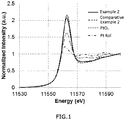
- FIG. 1 shows the L 3 edge XANES spectrum of the platinum atoms measured by the transmission method for the methane oxidation catalysts of Example 2 and Comparative Example 2 together with the XANES spectrum of the standard platinum foil and the standard PtO 2 .
- the intensity of each absorption peaks obtained in the range of 11555 to 11570 eV in each methane oxidation catalyst and standard platinum foil obtained from the L 3 edge XANES spectrum of the platinum atoms and the value obtained by dividing the intensity of the absorption peaks of each methane oxidation catalyst by the absorption peak intensity of the standard platinum foil were as shown in Table 1.
- FIG. 2 shows a radial distribution function obtained by Fourier transformation of the L 3 edge EXAFS spectrum of the platinum atoms for each of the methane oxidation catalyst of Example 2 and Comparative Example 2, and the standard platinum foil and the standard PtO 2 .
- the maximum peak intensity corresponding to the bond length of platinum atom-platinum atom bonds (0.20 to 0.25 nm) obtained from the radial distribution function of each methane oxidation catalyst was expressed as I Pt-Pt and the maximum peak intensity corresponding to the bond length of platinum atom-oxygen atom bonds (0.10 to 0.20 nm) was expressed as I Pt-o , and the ratio of I Pt-o to I Pt-Pt (I Pt-Po / I Pt-Pt ) was as shown in Table 1.
- the surfaces of the methane oxidation catalysts of each Example were analyzed by X-ray photoelectron spectroscopy (XPS) using an X-ray photoelectron spectroscopy apparatus (VersaProbe II, manufactured by Ulvac-Phi Incorporated).
- XPS X-ray photoelectron spectroscopy
- VersaProbe II manufactured by Ulvac-Phi Incorporated
- the peak intensity derived from the divalent platinum oxide (70.0 to 74.0 eV) was expressed as I Pt2
- the peak intensity derived from the quadrivalent platinum oxide (77.0 to 79.0 eV) was expressed as I Pt4
- the ratios of I Pt2 to I Pt4 obtained from the XPS spectrum of the methane oxidation catalysts of the respective Examples and Comparative Examples were as shown in Table 1.
- Each methane oxidation catalyst was dissolved in alkali and diluted with hydrochloric acid to prepare a solution, and this solution was analyzed by an ICP emission spectroscope (SPS-3000 (product name) manufactured by SII Nanotechnology Inc.) to determine the concentration (mol %) of tin element, the concentration (mol %) of platinum element and the concentration (mol %) of iridium element.
- SPS-3000 product name
- the obtained values were used to calculate the content ratio of platinum element to tin element and the content ratio of iridium element to tin element.
- the content of platinum element and the content of iridium element with respect to tin element of each methane oxidation catalyst were as shown in Table 1.
- Each methane oxidation catalyst was compression molded, and the molding was subsequently ground to obtain catalyst particles sized from 0.35 mm to 0.6 mm.
- the obtained catalyst particles (0.1g) were charged into a ⁇ 9 mm-quartz reactor, and a model gas (inlet gas) having a composition of CH 4 : 0.2 %, O 2 : 10%, CO 2 : 4.9 %, H 2 O 10 %, and N 2 balance: 74.9% was supplied at a space velocity (SV) of 150,000h -1 , and while elevating the temperature to 600 °C at a temperature elevation rate of 10 °C / min, the CH 4 concentration of the gas which passed through the above-described catalyst particles was measured by a hydrogen flame ionization detector.
- the value of dividing the difference between the CH 4 concentration of the inlet gas and the outlet gas by the CH 4 concentration of the inlet gas and multiplying 100 was calculated as the conversion ratio, and the temperature at which the conversion ratio became 50 % was defined as T 50 (°
- each methane oxidation catalyst was burnt at 650 °C for 12 hours in an air atmosphere, and T 50 (°C) of each burnt methane oxidation catalyst was measured in the same manner as described above.
- the T 50 (°C) before and after the high-temperature durability test was as shown in Table 1.
- the methane oxidation catalysts in which the platinum oxides were supported on the tin oxides had T 50 (°C) that is equal to or lower than that of the methane oxidation catalyst in which platinum was supported on the tin oxide (Comparative Example 1) before the high-temperature durability test, and it can be seen that the methane oxidation activity was equal to or superior to that of the methane oxidation catalyst in which platinum was supported on the tin oxide.
- T 50 (°C) of the methane oxidation catalyst in which platinum was supported on the tin oxide was remarkably increased, and it can be seen that the methane oxidation activity was significantly reduced when the catalyst temperature became high.
- the methane oxidation catalysts in which the platinum oxides are supported on the tin oxides having the intensity of the absorption peak obtained in the range of 11555 to 11570 eV in the XANES spectrum 1.4 times or more the intensity of the absorption peak measured using the standard platinum foil had low T 50 (°C) even after the high-temperature durability test, and can maintain the methane oxidation activity before the catalyst is exposed to a high temperature (that is, the temperature of the catalyst in the normal cycle, which is about 300 to 500 °C).
- the methane oxidation catalyst of Comparative Example 2 burnt in the air atmosphere had higher T 50 (°C) both before and after the high-temperature durability test than the methane oxidation catalysts of Examples 1 to 3 burnt in the oxygen atmosphere, and is inferior in methane oxidation activity.
Landscapes
- Engineering & Computer Science (AREA)
- Chemical & Material Sciences (AREA)
- Chemical Kinetics & Catalysis (AREA)
- Environmental & Geological Engineering (AREA)
- Health & Medical Sciences (AREA)
- General Chemical & Material Sciences (AREA)
- Combustion & Propulsion (AREA)
- Biomedical Technology (AREA)
- Analytical Chemistry (AREA)
- Materials Engineering (AREA)
- Oil, Petroleum & Natural Gas (AREA)
- Mechanical Engineering (AREA)
- General Engineering & Computer Science (AREA)
- Toxicology (AREA)
- Organic Chemistry (AREA)
- Catalysts (AREA)
- Exhaust Gas Treatment By Means Of Catalyst (AREA)
- Exhaust Gas After Treatment (AREA)
Abstract
Description
- The present invention relates to a methane oxidation catalyst for oxidizing unburnt methane contained in exhaust gas.
- Currently, fuel used for diesel engines for generators, ships and the like is heavy oil; however, there has begun serious review in transition to CH4 fuel in response to the request for preservation and improvement of the environment.
- A typical internal combustion engine using CH4 fuel is a "gas engine". A gas engine is one of the engines used in the so-called "co-generation," which is a cogeneration that generates electricity by utilizing the combustion of gas while utilizing the waste heat for cooling and heating, and thermal demand such as the hot water supply.
- Gas engines not only emit a small amount of CO2, but also have the advantage of being able to be operated with high efficiency even by using natural gas and city gas, as well as low-calorie gases such as those generated in gasification and melting furnaces. Note that, city gas is a gaseous fuel mainly composed of natural gas and typically contains 87 vol % or more of methane.
- On the other hand, there has been a problem that unburnt methane, the so-called "methane slip", is generated in a small amount. Methane (CH4) is said to have a global warming potential 25 times than that of CO2, and unburnt methane contained in the exhaust gas must be oxidized and removed. Therefore, various oxidation catalysts have been developed for oxidizing such unburnt methane and the like.
- For example,
Patent Document 1 proposes a catalyst in which platinum is supported on a porous tin oxide, and by use of the catalyst, methane can be oxidized and removed even at a relatively low temperature of 500 °C or less, and also since poisoning degradation due to sulfur oxides is suppressed, methane in the combustion exhaust gas can be oxidized and removed effectively for a long period. - Further,
Patent Document 2 proposes a catalyst in which iridium is supported as a promoter on a catalyst in which platinum is supported on a tin oxide, and by supporting iridium as a promoter, methane can be removed by oxidation over a longer period. - Further, Patent Document 3 proposes a catalyst in which rhenium together with platinum and iridium is supported on a titanium oxide support or a tin oxide carrier, and it is considered that the catalyst can effectively oxidize and remove methane in the combustion exhaust gas even at a low temperature of 400 °C or less.
-
- [Patent Document 1]
JP 2004 - 351236 A - [Patent Document 2]
JP 2006 - 272079 A - [Patent Document 3]
JP 2012 - 196664 A - In an internal combustion engine using methane gas, cycles of intake, compression, ignition combustion, and exhaust of methane gas are repeated. The concentration of methane gas in the exhaust gas during the normal cycle is about 0.2 % (2000 ppm); however when ignition failure (a misfire) occurs, the concentration of methane in the exhaust gas temporarily increases, and the catalyst temperature rises by about 200 °C from the normal temperature (300 to 500 °C).
- The methane oxidation catalysts described in
Patent Documents 1 to 3, in which platinum is supported on a tin oxide, can effectively oxidize and remove methane even at a low temperature such as 300 to 500 °C; however, at the time of a misfire as described above, the catalyst temperature rises to about 650 °C, causing significant decrease in the catalytic performance. As a result, it was found that once a misfire occurs and the catalytic performance decreases, methane in the combustion exhaust gas cannot be effectively oxidized and removed even when the cycle returns normal. - Accordingly, it is an object of the present invention to further improve the oxidation catalyst in which platinum is supported on a tin oxide, and to provide a new oxidation catalyst capable of maintaining the methane oxidation activity even after the catalyst has been exposed to a high temperature.
- The present inventors have now found that, in a methane oxidation catalyst in which platinum is supported on a tin oxide, the oxidation of platinum allows the methane oxidation activity of the platinum-supported tin oxide catalyst to be maintained at a low temperature and to maintain the methane oxidation activity even after the catalyst is exposed to a high temperature such as a misfire. The present invention is based on such findings.
- The methane oxidation catalyst according to the present invention is a methane oxidation catalyst in which a platinum oxide is supported on a tin oxide carrier, wherein
the intensity of an absorption peak obtained in the range of 11555 to 11570 eV in the L3 edge X-ray absorption near-edge structure (XANES) spectrum of the platinum atom is 1.4 times or more the intensity of the absorption peak measured using a standard platinum foil. - According to the present invention, the methane oxidation catalyst in which a platinum oxide is supported on a tin oxide carrier can maintain the methane oxidation activity in the same level as in the normal cycle even after the catalyst is exposed to a high temperature, such as during a misfire, by using a methane oxidation catalyst having the intensity of an absorption peak obtained in the range of 11555 to 11570 eV in the L3 edge X-ray absorption near-edge structure spectrum of the platinum atom 1.4 times or more than the intensity of an absorption peak measured using a standard platinum foil.
-
-
FIG. 1 shows the L3 edge XANES spectra of platinum atoms as measured by the transmission method for the respective methane oxidation catalysts of Example 2 and Comparative Example 2, and the respective standard samples of Pt foil and PtO2. -
FIG. 2 shows a radial distribution function obtained by Fourier transforming the L3 edge EXAFS spectrum of platinum atoms for the respective methane oxidation catalysts of Example 2 and Comparative Example 2, and the respective standard samples of Pt foil and PtO2. - The methane oxidation catalyst of the present invention has a structure in which a platinum oxide is supported on a tin oxide carrier, including a catalyst in which platinum is supported on a tin oxide carrier other than the platinum oxide, without limiting to a catalyst in which only a platinum oxide is supported; however it is clearly distinguished from a methane oxidation catalyst in which platinum is supported on a tin oxide carrier. That is, the present invention is characterized in that the intensity of an absorption peak obtained in the range of 11555 to 11570 eV in the L3 edge X-ray absorption near-edge structure (hereinafter can be abbreviated as XANES) spectrum of a platinum atom is 1.4 times or more the intensity of an absorption peak measured using a standard platinum foil. In the present invention, the "absorption peak obtained in the range of 11555 to 11570 eV" refers to an absorption peak obtained in the range of 11555 to 11570 eV in the normalized spectrum in the range of 11750 to 11850 eV.
- First, the XANES spectrum will be described.
- The X-ray absorption fine structure (XAFS) measurement is a measurement technique that measures the wavelength dependence of the X-ray absorption intensity (absorbance) of a substance to obtain the information of the local structure of a substance, such as the chemical bonding state of an absorbed atom, the coordination number and valence of the absorbed atom, and the distribution of the distance between the surroundings of the absorbed atom and its neighboring atoms.
- In the X-ray absorption near-edge structure (XANES) which appears at about several 10 eV from the absorption edge, the absorption spectrum appears due to the effect of electron transition from the inner shell to the unoccupied level, and the information of the chemical bonding state such as the coordination number and valence of the absorption atom is very sensitively reflected in the spectrum shape. In the extended X-ray absorption fine structure (EXAFS), which appears at about 1000 eV from the absorption edge, photoelectrons emitted from the absorption atoms are scattered by the surrounding atoms so that the interference between the emitted electron wave and the scattered electron wave modulate the transition probability of the photoelectrons to express a wave-like spectrum. Analyzing of this spectral shape allows one to obtain information of the interatomic distance distribution around the absorption atoms from the absorption atoms.
- Excitation of an electron in the inner shell 2p orbital of a platinum atom causes a transition to an empty Pt5d orbital due to electric dipole transition. The state density of the Pt5d empty orbital is reflected in the absorption intensity of the X-ray absorption spectrum at the L3 absorption edge or the L2 absorption edge when X-rays are irradiated having energy equal to or greater than the transition energy.
- In the present invention, the X-ray absorption near-edge structure (XANES) of a methane oxidation catalyst was analyzed to find that, when the intensity of the absorption peak derived from a platinum oxide appearing in the range of 11555 to 11570 eV among the absorption peaks of the L3 edge XANES spectrum of the platinum atoms is 1.4 times or more the absorption peak intensity measured using a standard platinum foil, the same methane oxidation activity as in the normal cycle can be maintained even after the catalyst is exposed to a high temperature, such as in the case of a misfire. Without being bound by theory, the methane oxidation catalysts in which the intensity of the absorption peak derived from a platinum oxide appearing in the range of 11555 to 11570 eV in the XANES spectrum is 1.4 times or more the intensity of the absorption peak measured using a standard platinum foil have the platinum oxides supported by tin oxide in a high proportion, and the proportion is low of platinum supported in a non-oxidized platinum metal state. In the case of a catalyst in which platinum is supported on a tin oxide, as in the conventional methane oxidation catalyst, since the individual platinum particles are supported on the tin oxide carrier at the catalyst temperature (300 to 500 °C) during the normal cycle of a gas engine, the platinum particles have the methane oxidation activity; however, when the temperature becomes high (650 °C), the platinum particles aggregate on the tin oxide carrier, so the methane oxidation activity is considered to decrease. On the other hand, the methane oxidation catalyst in which the intensity of the absorption peak derived from a platinum oxide appearing in the range of 11555 to 11570 eV in the XANES spectrum is 1.4 times or more the intensity of the absorption peak measured using a standard platinum foil as in the present invention has platinum oxides as the particles supported on a tin oxide so that the aggregation at high temperatures of the particles is considered to be suppressed compared with the platinum metal particles, and as a result, the methane oxidation activity can be maintained even after the catalyst temperature is exposed to a high temperature.
- The intensity of the absorption peak derived from a platinum oxide appearing in the range of 11555 to 11570 eV in the XANES spectrum is preferably at least 1.5 times or more the intensity of the absorption peak measured using a standard platinum foil and more preferably at least 1.7 times or more. The intensity of the absorption peak derived from a platinum oxide as above is preferably 2.8 times or less the intensity of the absorption peak measured using a standard platinum foil.
- A catalyst in which platinum is supported on a tin oxide, the conventional methane oxidation catalyst, has the intensity of the absorption peak derived from a platinum oxide appearing in the range of 11555 to 11570 eV in the XANES spectrum of about 1.3 times of the intensity of the absorption peak measured using a standard platinum foil.
- In the present specification, the "standard platinum foil" refers to a platinum foil available from The Nilaco Co., Ltd having the product number PT-353138.
- In the present invention, the XANES spectrum may be measured by either a transmission method or a fluorescence method.
- The proportion of platinum oxides in the catalyst particles supported on the tin oxides can also be evaluated by extended X-ray absorption fine structure (EXAFS) spectrum. In the present invention, in the radial distribution function obtained by Fourier transformation of the L3 edge extended X-ray absorption fine structure (EXAFS) spectrum of a platinum atom, when the maximum peak intensity corresponding to the bond distance between a platinum atom and a platinum atom is expressed as IPt-Pt and the maximum peak intensity corresponding to the bond distance between a platinum atom and an oxygen atom is expressed as IPt-o, the ratio of Ipt-o to IPt-Pt (IPt-o / IPt-Pt) is preferably 2.0 or more, more preferably 5.0 or more, and particularly preferably 7.0 or more. When the ratio of the platinum oxides to platinum in the catalyst particles supported on the tin oxides is about the above ratios, the methane oxidation activity can be further maintained even after the catalyst is exposed to a high temperature. Note that, in the radial distribution function obtained by Fourier transformation of the EXAFS spectrum, IPt-Pt is the maximum peak intensity in the range of 0.20 to 0.25 nm, and Ipt-o is the maximum peak intensity in the range of 0.10 to 0.20 nm.
- The XANES spectrum and the EXAFS spectrum can be measured, for example, by the XAFS analyzer (BL11S2) of the Aichi Synchrotron Light Center (AichiSR), which is conducted by a public foundation. The measurement conditions are as follows.
- Beamline
- Light energy: 11 to 13 keV
- Beam size: 0.50 mm × 0.30 mm (H × V)
- Detection system
- Spectrograph: Si (111) 2 crystal spectrograph
- Detector: Ion chamber
- Analysis software
Athena (ver.0.8.056) - The platinum oxide supported on the tin oxide includes a divalent platinum oxide having a valence of platinum of 2 and a quadrivalent platinum oxide having a valence of platinum of 4. The oxidation state (valence) of platinum can be evaluated by X-ray photoelectron spectroscopy (hereinafter can be abbreviated as XPS). According to the present invention, in the X-ray photoelectron spectroscopy spectrum obtained by the XPS measurement,
when the peak intensity derived from the divalent platinum oxide is expressed as IPt2, and
the peak intensity derived from the quadrivalent platinum oxide is expressed as IPt4,
the ratio of IPt2 to IPt4 (IPt2 / IPt4) is preferably greater than 1. That is, the presence of a larger amount of the divalent platinum oxide than the quadrivalent platinum oxide among the platinum oxides makes it possible to further improve the methane oxidation activity during the normal cycle in the gas engine, and to maintain the same methane oxidation activity during the normal cycle even after the catalyst is exposed to a high temperature, such as during a misfire. The peak derived from the divalent platinum oxide corresponds to the peak of Pt4f7/2 with the peak top appearing at the position of 70.0 to 74.0 eV, and the peak derived from the quadrivalent platinum oxide corresponds to the peak of Pt4f5/2 with the peak top appearing at the position of 77.0 to 79.0 eV. It is preferable that IPt2 / IPt4 has a lower limit value of 1.1 or more. On the other hand, the upper limit of IPt2 / IPt4 is preferably 4.5 or less. As the value of IPt2 / IPt4 increases, the proportion of platinum metal tends to increase; however, by setting the value of IPt2 / IPt4 to 4.5 or less, the absolute amount of platinum oxide can be maintained, and the methane oxidation activity during the normal cycle and after exposure to a high temperature can both be improved. - In the present invention, a methane oxidation catalyst is achieved that is capable of suppressing both the aggregation of platinum oxide when the catalyst is exposed to a high temperature and the change of oxidation state of platinum from a divalent to a quadrivalent platinum oxide, and of maintaining the methane oxidation activity equal to that in the normal cycle even after the catalyst is exposed to a high temperature such as during a misfire by controlling the oxidation state of platinum so as to satisfy the conditions of the intensity of the absorption peak obtainable in the range of 11555 to 11570 eV in the XANES spectrum and, preferably, the conditions of the Ipt-o / IPt-Pt ratio obtainable from the radial distribution function and the IPt2 / IPt4 ratio obtainable from the XPS measurement as above.
- The average primary particle diameter of the platinum oxide supported on the tin oxide is preferably 0.5 nm to 2.5 nm. When the average primary particle size of the platinum oxide is within the above range, the platinum oxide particles can exist in a highly dispersed state on the surface of the tin oxide, and can have a high methane oxidation activity. The average primary particle size of the platinum oxide is an average value obtained by observing the methane oxidation catalyst with a transmission electron microscope (TEM) and measuring the primary particle size of 200 platinum oxide particles. The average primary particle diameter of the platinum oxide is more preferably 0.5 nm to 2.0 nm, and further preferably 0.7 nm to 1.5 nm. The average primary particle size of the platinum oxide can be determined, for example, by appropriately adjusting the supporting conditions such as the type of platinum salt, the temperature, the pH, and the concentration of the platinum solution when the platinum oxide is supported on the tin oxide as described below.
- The content ratio of platinum element to tin element contained in the methane oxidation catalyst is preferably 0.3 to 40 mol %. With respect to the content of the platinum oxide, when the content ratio of the platinum element is 0.3 mol % or more based on the tin element, the methane oxidation activity can be further expressed, and when the content is 40 mol % or less, the formation of coarse particles of the platinum oxide having an average primary particle size of about 50 nm or more can be suppressed. A more preferred content ratio of platinum element to tin element is 3.2 to 11 mol %. Note that, the content ratio of the platinum element to the tin element can be measured by inductively coupled plasma emission spectrometry (hereinafter also referred to as ICP emission spectrometry). ICP emission spectrometry is a method that uses plasma to excite atoms, and is characterized by its ability to measure multiple elements with a high sensitivity. A high-temperature argon plasma is generated using a plasma torch, and atoms and ions constituting a sample are excited by the high-temperature argon plasma. When an excited atom or ion returns to the ground state, the energy is emitted as light of a wavelength specific to that element (e.g., Sn, Pt, Ir), and the amount of a particular element is quantified by spectroscopic detection of the light.
- In the methane oxidation catalyst of the present invention, an iridium oxide may be further supported on the tin oxide in addition to the platinum oxide. Further supporting of the iridium oxide will suppress aggregation of the platinum oxide particles when the catalyst is exposed to a high temperature, and therefore, the methane oxidation activity after the catalyst is exposed to a high temperature can be made equal to that in the normal cycle.
- When the iridium oxide is further supported on the tin oxide, the content ratio of iridium element to tin element contained in the methane oxidation catalyst is preferably 0.03 to 20 mol %. Further supporting of the iridium oxide on the tin oxide such that the content ratio of the iridium element to the tin element is in the above range will allow the methane oxidation activity after the catalyst is further exposed to a high temperature to be equal to that in the normal cycle.
- The above-mentioned platinum oxide and, if desired, the tin oxide used as a carrier for supporting an iridium oxide can be any kind used for the general methane oxidation catalyst without any limitation; however the specific surface area is preferably 10 to 100 m2 / g. The use of tin oxide having a specific surface area in the above range as a carrier will allow support of the platinum oxide particles (or both particles of the platinum oxide and the iridium oxide) in a uniformly dispersed state on the surface of the tin oxide without aggregation. The specific surface area of tin oxide is preferably 20 to 90 m2 / g, and more preferably 35 to 60 m2 / g. The specific surface area means a value measured by the BET method, and more specifically, the specific surface area can be calculated from the absorption amount and the area occupied by inert gas by absorbing an inert gas (for example, nitrogen gas) having a known molecular size on the surface of the measurement sample.
- In order to adjust the specific surface area of the tin oxide, for example, it may be appropriate to optimize the synthesis, drying, and burning conditions in the tin oxide production process, and carry out mechanical pulverization of the tin oxide by a bead mill or the like. However, the present invention is not limited to such method.
- For the purpose of suppressing sintering of the tin oxide and suppressing the decrease in specific surface area after burning, various elements may be used to form a solid-solution with the tin oxide or the surface of the tin oxide may be coated with a compound of various elements. Examples of the various elements include Si, Al, Zr, Ce, La, Fe, Mn, Ni, Co, Cu, W, Mo, V, Ca, Ba, Mg, Pd, Rh, and Ru.
- It is preferable to use a tin oxide having an average particle size in the range of 0.1 µm to 100 µm. The use of the tin oxide having an average particle size in the above range will allow the platinum oxide particles to be uniformly dispersed and supported on the surface of the tin oxide particles, with the strength to be increased when formed into a honeycomb shape or a pellet shape. The average particle size of the tin oxide is preferably in the range of 0.5 µm to 50 µm and particularly preferably in the range of 1.0 µm to 20 µm. Note that, in the present specification, the average particle size means the volume accumulated particle size D50 measured by the laser diffraction particle size distribution measuring apparatus.
- For the purpose of setting the average particle size of the tin oxide within the above range, for example, it may be appropriate to optimize the drying and burning conditions in the tin oxide production process, and carry out mechanical pulverization by a bead mill or the like of the tin oxide before or after being supported by the platinum oxide. However, the present invention is not limited to such method.
- In the methane oxidation catalyst, the crystallite diameter of the tin oxide is preferably 5 nm to 100 nm. When the crystallite diameter of tin oxide is 5 nm to 100 nm, the platinum oxide particles can be uniformly dispersed and supported on the surface of the tin oxide, and the supported platinum oxide can be present on the surface of the tin oxide in a highly dispersed state. More preferably, the crystallite diameter is 10 nm to 50 nm and particularly preferably 12 nm to 35 nm.
- For the purpose of adjusting the crystallite diameter of the tin oxide, for example, it may be appropriate to optimize the synthesis, drying, and burning conditions in the tin oxide production process, and carry out mechanical pulverization by a bead mill or the like of the tin oxide. However, the present invention is not limited to such method.
- The methane oxidation catalyst in which the platinum oxide is supported on the tin oxide can be produced by applying a known method capable of uniformly supporting platinum on the tin oxide and oxidizing the supported platinum as described below.
- As an example, there is a method in which tin oxide powder (SnO2 particles) is added to a platinum solution (Pt solution), then the solution is heated and evaporated to dryness and Pt is supported on the SnO2 particles, and subsequently, the resultant is burnt in an oxygen atmosphere.
- Specifically, a methane oxidation catalyst can be produced by dissolving dinitrodiamine Pt in nitric acid to prepare a platinum solution having a pH of 2 or less, preferably 1 or less, further heating the solution to a temperature of 50 °C to 80 °C, adding tin oxide powder to the solution, evaporating the solution to dryness, and after supporting platinum on the tin oxide particles, burning the resultant in an oxygen atmosphere.
- Further, the methane oxidation catalyst obtained by supporting the platinum oxide and the iridium oxide on the tin oxide can be produced by applying a known method capable of uniformly supporting platinum and iridium on the tin oxide and oxidizing the supported platinum and iridium as described below.
- As an example, there is a method in which tin oxide powder (SnO2 particles) is added to a mixed solution of a platinum solution (Pt solution) and an iridium solution (Ir solution), the solution is heated and evaporated to dryness, Pt and Ir are supported on the SnO2 particles, and then the resultant is burnt in an oxygen atmosphere.
- Specifically, dinitrodiamine Pt is dissolved in nitric acid to prepare a platinum solution having a pH of 2 or less, preferably 1 or less. Then, hexachloroiridate hydrate is dissolved in nitric acid to prepare an iridium solution having a pH of 2 or less, preferably 1 or less. A methane oxidation catalyst can be produced by mixing a prepared platinum solution and an iridium solution, heating the resulting mixed solution to a temperature of 50 °C to 80 °C, adding tin oxide powder to the solution, evaporating the solution to dryness, supporting platinum and iridium on the tin oxide particles, and burning the mixture in an oxygen atmosphere.
- As another example, there can be mentioned a method in which tin oxide (SnO2 particles) is added to a platinum solution (Pt solution), the solution is heated and evaporated to dryness, Pt is supported on the SnO2 particles, and then the SnO2 particles are burnt in an oxygen atmosphere to obtain catalyst particles in which a platinum oxide is supported on the tin oxide (SnO2 particles), then the catalyst particles are added to an iridium solution (Ir solution), the solution is heated and evaporated to dryness, and the SnO2 particles are supported on Ir and then burnt in an oxygen atmosphere.
- Among the above 2 exemplified methods, a methane oxidation catalyst having excellent methane oxidation activity is more likely to be obtainable by using a mixed solution of a Pt solution and an Ir solution.
- The sintering conditions in the oxygen atmosphere are preferably 400 to 700 °C for 2 to 24 hours and preferably 3 to 6 hours. By appropriately adjusting the burning conditions, the oxidation state of platinum can be controlled so as to satisfy the conditions of the intensity of the absorption peak obtained in the range of 11555 to 11570 eV in the XANES spectrum and preferably the conditions of the Ipt-o / IPt-Pt ratio obtained from the radial distribution function and the IPt2 / I Pt4 ratio obtained from the XPS measurement. The oxygen atmosphere in which the sintering is performed preferably has an oxygen concentration of 22 % by volume or more, more preferably 40 % by volume or more, and particularly preferably is performed in an atmosphere having an oxygen concentration of 50 % by volume or more.
- The above-mentioned methane oxidation catalyst in which a platinum oxide (and optionally an iridium oxide) is supported on a tin oxide can also be produced by a method other than burning in an oxygen atmosphere. For example, it is also possible to directly support the platinum oxide (or the platinum oxide and the iridium oxide) on the tin oxide particles by adding tin oxide powder to a platinum solution (or a mixed solution of a platinum solution and an iridium solution), subjecting the solution to aeration treatment such as air bubbling or the like, and then heating and evaporating the solution to dryness.
- Examples of the form of the methane oxidation catalyst of the present invention include, but are not limited to, powder, particulate and granular (including spherical) forms. The methane oxidation catalyst can be used as a pellet (cylindrical and circular), a tablet (pill), honeycomb (monolith), or plate (layered) molding, i.e., a methane oxidation catalyst molding, by molding a methane oxidation catalyst in a powder form for example, or can be used as a form in which the molding is laminated on a substrate made of a ceramic or a metal material.
- Examples of the material of the substrate include heat-resistant materials such as ceramics and metallic materials. Examples of the material of the ceramic substrate include heat-resistant ceramic materials such as cordierite, cordierite-alpha alumina, silicon nitride, zirconium mullite, alumina-silica magnesia, zirconium silicate, sillimanite, magnesium silicate, zirconium, petalite, alpha alumina, and aluminosilicates. The metal substrate material may be heat-resistant metals, such as stainless steel or other suitable iron-based heat-resistant alloys.
- The shape of the substrate is not particularly limited and may be a honeycomb, pellet, or spherical shape.
- For example, mention can be made to a method of forming a catalyst layer on the surface of a substrate by mixing and stirring a powder of a methane oxidation catalyst according to the present invention with a binder and water as required to form a slurry, coating the obtained slurry on a substrate such as a ceramic honeycomb body, and baking the same. Any known method may be employed for the method for producing the catalyst, without being limited to the above example. In any of the production methods, the catalyst layer may be a single layer or a multilayer of 2 or more layers.
- Next, the embodiments of the present invention will be specifically described with reference to the following Examples, without being limited thereby.
- 8.2g of dinitrodiammine Pt was dissolved in a solution prepared by diluting 3.5g of concentrated nitric acid with 1000 ml of pure water to prepare a Pt solution having a pH of 1.5 or less. To this Pt solution was added 120 g of tin oxide particles (specific surface area determined by the BET method is 40 m2 / g, D50 = 1.3 µm), the solution was heated to 70 °C to evaporate the solution to dryness, and platinum was supported on the tin oxide particles. Subsequently, the resultant was burnt at 550 °C for 3 hours in an oxygen atmosphere (oxygen concentration = 50 % by volume), and the obtained particles were crushed in a mortar to obtain a tin oxide powder on which platinum oxides were supported.
- 3.3g of hexachloroiridate hydrate was dissolved in a solution prepared by diluting 3.5 g of concentrated nitric acid with 1000 ml of pure water to prepare an Ir solution having a pH of 1.5 or less. The Ir solution and the Pt solution prepared in Example 1 were mixed at a mass ratio of 2:5 to prepare a Pt / Ir mixed solution. To this Pt / Ir mixed solution was added 120 g of the tin oxide particles used in Example 1, the solution was heated to 80 °C to evaporate the solution to dryness, and platinum and iridium were supported on the tin oxide particles. Subsequently, the resultant was burnt at 550 °C for 3 hours in an oxygen atmosphere (oxygen concentration = 50 vol %), and the obtained particles were crushed in a mortar to obtain tin oxide powder on which platinum oxides and iridium oxides were supported.
- To the Pt solution prepared in Example 1, 120g of tin oxide particles (specific surface area determined by the BET method is 14 m2 / g and D50 = 44 µm) were added, the solution was heated to 80 °C to evaporate the solution to dryness, and platinum was supported on the tin oxide particles. Subsequently, the resultant was burnt at 550 °C for 3 hours in an oxygen atmosphere (oxygen concentration = 50 % by volume), and the obtained particles were crushed in a mortar to obtain tin oxide powder on which platinum oxides were supported.
- Next, 40 mass % of the Ir solution prepared in Example 2 was added to the tin oxide powder obtained above, the solution was heated to 80 °C to evaporate the solution to dryness, and iridium was supported on the tin oxide particles on which platinum oxides were supported. Subsequently, the resultant was burnt at 550 °C for 3 hours in an oxygen atmosphere (oxygen concentration = 50 vol %), and the obtained particles were crushed in a mortar to obtain tin oxide powder on which platinum oxides and iridium oxides were supported.
- Tin oxide powder on which platinum was supported was obtained in the same manner as in Example 1, except that burning was carried out at 100 °C for 3 hours in a hydrogen gas atmosphere instead of burning at 550 °C for 3 hours in an oxygen atmosphere (oxygen concentration = 50 vol %).
- Tin oxide powder on which platinum was supported was obtained in the same manner as in Example 1, except that burning was performed at 550 °C for 3 hours in an air atmosphere (oxygen concentration: about 21 vol %), instead of burning at 550 °C for 3 hours in an oxygen atmosphere (oxygen concentration: 50 vol %). Next, 3.3g of hexachloroiridate hydrate was dissolved in a solution prepared by diluting 3.5g of concentrated nitric acid with 500 ml of pure water to prepare an Ir solution having a pH of 1 or less, 120g of platinum-supported tin oxide powder obtained was added to the Ir solution, the solution was heated to 80 °C to evaporate the solution to dryness, and then the resultant was burnt at 550 °C for 3 hours in an air atmosphere (oxygen concentration: 21 vol %) to obtain tin oxide powder on which platinum and iridium were supported.
- The X-ray absorption fine structure spectrum of each methane oxidation catalyst obtained as described above was measured using the XAFS analyzer (BL11S2) of the Aichi Synchrotron Light Center (AichiSR). Also, 2 samples of the standard platinum foil and the standard PtO2 were measured for the X-ray absorption fine structure spectrum in the same manner. A platinum foil manufactured by Nicola Co., Ltd. (product number: PT - 353138) was used as the standard platinum foil, and PtO2 (459925) manufactured by Sigma Aldrich was used as the standard PtO2. The measurement conditions were as follows.
- Beamline
- Light energy: 11 to 13 keV
- Beam size: 0.50 mm × 0.30 mm (H × V)
- Detection system
- Spectrograph: Si (111) 2 crystal spectrograph
- Detector: Ion chamber
- Analysis software
Athena (ver.0.8.056) -
FIG. 1 shows the L3 edge XANES spectrum of the platinum atoms measured by the transmission method for the methane oxidation catalysts of Example 2 and Comparative Example 2 together with the XANES spectrum of the standard platinum foil and the standard PtO2. The intensity of each absorption peaks obtained in the range of 11555 to 11570 eV in each methane oxidation catalyst and standard platinum foil obtained from the L3 edge XANES spectrum of the platinum atoms and the value obtained by dividing the intensity of the absorption peaks of each methane oxidation catalyst by the absorption peak intensity of the standard platinum foil were as shown in Table 1. -
FIG. 2 shows a radial distribution function obtained by Fourier transformation of the L3 edge EXAFS spectrum of the platinum atoms for each of the methane oxidation catalyst of Example 2 and Comparative Example 2, and the standard platinum foil and the standard PtO2. In addition, the maximum peak intensity corresponding to the bond length of platinum atom-platinum atom bonds (0.20 to 0.25 nm) obtained from the radial distribution function of each methane oxidation catalyst was expressed as IPt-Pt and the maximum peak intensity corresponding to the bond length of platinum atom-oxygen atom bonds (0.10 to 0.20 nm) was expressed as IPt-o, and the ratio of IPt-o to IPt-Pt (IPt-Po / IPt-Pt) was as shown in Table 1. - The surfaces of the methane oxidation catalysts of each Example were analyzed by X-ray photoelectron spectroscopy (XPS) using an X-ray photoelectron spectroscopy apparatus (VersaProbe II, manufactured by Ulvac-Phi Incorporated). The measurement conditions were as follows.
- X-ray source: Al ray (1486.6 eV)
- Irradiation power: 100 W
- The peak intensity derived from the divalent platinum oxide (70.0 to 74.0 eV) was expressed as IPt2, and the peak intensity derived from the quadrivalent platinum oxide (77.0 to 79.0 eV) was expressed as IPt4, and the ratios of IPt2 to IPt4 (IPt2 / IPt4) obtained from the XPS spectrum of the methane oxidation catalysts of the respective Examples and Comparative Examples were as shown in Table 1.
- Each methane oxidation catalyst was dissolved in alkali and diluted with hydrochloric acid to prepare a solution, and this solution was analyzed by an ICP emission spectroscope (SPS-3000 (product name) manufactured by SII Nanotechnology Inc.) to determine the concentration (mol %) of tin element, the concentration (mol %) of platinum element and the concentration (mol %) of iridium element. The obtained values were used to calculate the content ratio of platinum element to tin element and the content ratio of iridium element to tin element. The content of platinum element and the content of iridium element with respect to tin element of each methane oxidation catalyst were as shown in Table 1.
- Each methane oxidation catalyst was compression molded, and the molding was subsequently ground to obtain catalyst particles sized from 0.35 mm to 0.6 mm. The obtained catalyst particles (0.1g) were charged into a ϕ 9 mm-quartz reactor, and a model gas (inlet gas) having a composition of CH4: 0.2 %, O2: 10%, CO2: 4.9 %, H2O 10 %, and N2 balance: 74.9% was supplied at a space velocity (SV) of 150,000h-1, and while elevating the temperature to 600 °C at a temperature elevation rate of 10 °C / min, the CH4 concentration of the gas which passed through the above-described catalyst particles was measured by a hydrogen flame ionization detector. The value of dividing the difference between the CH4 concentration of the inlet gas and the outlet gas by the CH4 concentration of the inlet gas and multiplying 100 was calculated as the conversion ratio, and the temperature at which the conversion ratio became 50 % was defined as T50 (°C).
- In order to evaluate the high-temperature durability of the methane oxidation catalysts, each methane oxidation catalyst was burnt at 650 °C for 12 hours in an air atmosphere, and T50 (°C) of each burnt methane oxidation catalyst was measured in the same manner as described above. The T50 (°C) before and after the high-temperature durability test was as shown in Table 1.
Table 1 Sample XANES Peak Intensity XANES Peak Intensity of each sample/Peak Intensity of standard Pt foil EXAFS IPt-O/IPt-Pt XPS IPt2/IPt4 Pt Element Ratio (mol %) Ir Element Ratio (mol %) Before high-temperature durability test T50 (°C) After high-temperature durability T50 (°C) Standard Pt foil 1.2 - - - - - - - Standard PtO2 2.2 - - - - - - - Example 1 2.2 1.8 14.6 3.9 3.2 - 450 508 Example 2 2.1 1.8 7.1 1.8 3.3 0.34 442 471 Example 3 2.07 1.7 5.3 2.0 3.3 0.34 460 550 Comparative Example 1 1.4 1.2 0.88 0.8 3.4 - 462 574 Comparative Example 2 1.6 1.3 0.79 0.2 3.2 0.34 515 557 - As is clear from Table 1, the methane oxidation catalysts in which the platinum oxides were supported on the tin oxides (Examples 1 to 3) had T50 (°C) that is equal to or lower than that of the methane oxidation catalyst in which platinum was supported on the tin oxide (Comparative Example 1) before the high-temperature durability test, and it can be seen that the methane oxidation activity was equal to or superior to that of the methane oxidation catalyst in which platinum was supported on the tin oxide. After the high-temperature durability test, T50 (°C) of the methane oxidation catalyst in which platinum was supported on the tin oxide (Comparative Example 1) was remarkably increased, and it can be seen that the methane oxidation activity was significantly reduced when the catalyst temperature became high.
- On the other hand, it can be seen that the methane oxidation catalysts in which the platinum oxides are supported on the tin oxides (Examples 1 to 3) having the intensity of the absorption peak obtained in the range of 11555 to 11570 eV in the XANES spectrum 1.4 times or more the intensity of the absorption peak measured using the standard platinum foil had low T50 (°C) even after the high-temperature durability test, and can maintain the methane oxidation activity before the catalyst is exposed to a high temperature (that is, the temperature of the catalyst in the normal cycle, which is about 300 to 500 °C).
- Note that, the methane oxidation catalyst of Comparative Example 2 burnt in the air atmosphere had higher T50 (°C) both before and after the high-temperature durability test than the methane oxidation catalysts of Examples 1 to 3 burnt in the oxygen atmosphere, and is inferior in methane oxidation activity.
Claims (7)
- A methane oxidation catalyst on which a platinum oxide is supported on a tin oxide carrier, wherein
the intensity of an absorption peak obtained in the range of 11555 to 11570 eV in the L3 edge X-ray absorption near-edge structure (XANES) spectrum of a platinum atom is 1.4 times or more the intensity of an absorption peak measured using a standard platinum foil. - The methane oxidation catalyst according to claim 1, wherein
the platinum oxide comprises a divalent platinum oxide having a valence of platinum of 2 and a quadrivalent platinum oxide having a valence of platinum of 4. - The methane oxidation catalyst according to claim 2, wherein,
the case when the peak intensity derived from the divalent platinum oxide is expressed as IPt2 and the peak intensity derived from the quadrivalent platinum oxide is expressed as IPt4 in the X-ray photoelectron spectroscopy spectrum measured by X-ray photoelectron spectroscopy (XPS), the ratio of IPt2 to IPt4 (IPt2 / IPt4) is greater than 1. - The methane oxidation catalyst according to any one of claims 1 to 3, wherein
the case when the maximum peak intensity corresponding to the bond length of the platinum atom-platinum atom bond is expressed as IPt-Pt and the maximum peak intensity corresponding to the bond length of the platinum atom-oxygen atom bond is expressed as Ipt-o in the radial distribution function obtained by Fourier transformation of the L3 edge extended X-ray absorption fine structure (EXAFS) spectrum of the platinum atom, the ratio of IPt-o to IPt-Pt (IPt-o / IPt-Pt) is 2.0 or more. - The methane oxidation catalyst according to any one of claims 1 to 4, wherein the content ratio of platinum element to tin element contained in the methane oxidation catalyst is 0.3 to 40 mol %.
- The methane oxidation catalyst according to any one of claims 1 to 5, wherein
an iridium oxide is further supported on the tin oxide carrier. - The methane oxidation catalyst according to claim 6, wherein
the content ratio of iridium element to tin element contained in the methane oxidation catalyst is 0.03 to 20 mol %.
Applications Claiming Priority (2)
| Application Number | Priority Date | Filing Date | Title |
|---|---|---|---|
| JP2017159397 | 2017-08-22 | ||
| PCT/JP2018/031015 WO2019039513A1 (en) | 2017-08-22 | 2018-08-22 | Methane oxidizing catalyst |
Publications (3)
| Publication Number | Publication Date |
|---|---|
| EP3673992A1 true EP3673992A1 (en) | 2020-07-01 |
| EP3673992A4 EP3673992A4 (en) | 2021-06-30 |
| EP3673992B1 EP3673992B1 (en) | 2024-02-07 |
Family
ID=65439127
Family Applications (1)
| Application Number | Title | Priority Date | Filing Date |
|---|---|---|---|
| EP18848176.6A Active EP3673992B1 (en) | 2017-08-22 | 2018-08-22 | Methane oxidizing catalyst |
Country Status (4)
| Country | Link |
|---|---|
| EP (1) | EP3673992B1 (en) |
| JP (1) | JP7197484B2 (en) |
| CN (1) | CN110997134A (en) |
| WO (1) | WO2019039513A1 (en) |
Cited By (2)
| Publication number | Priority date | Publication date | Assignee | Title |
|---|---|---|---|---|
| US20240058790A1 (en) * | 2021-01-07 | 2024-02-22 | Tanaka Kikinzoku Kogyo K.K. | Methane combustion catalyst and method for producing same, and method for purifying combustion exhaust gas |
| US12528075B2 (en) | 2020-05-15 | 2026-01-20 | Tanaka Kikinzoku Kogyo K.K. | Methane combustion catalyst, method for producing the same and method for purifying combustion exhaust gas |
Families Citing this family (4)
| Publication number | Priority date | Publication date | Assignee | Title |
|---|---|---|---|---|
| CN115916398A (en) * | 2020-06-09 | 2023-04-04 | 三井金属矿业株式会社 | Composition for undercoat layer, undercoat layer, catalyst for purifying exhaust gas and exhaust gas purifying device provided with undercoat layer |
| GB2593786B (en) | 2020-07-07 | 2023-01-25 | Daphne Tech Sa | Apparatus and method for electron irradiation scrubbing |
| CN111997718B (en) * | 2020-08-18 | 2022-05-17 | 无锡威孚环保催化剂有限公司 | Post-processing method applied to diesel-natural gas dual-fuel vehicle |
| WO2022149319A1 (en) * | 2021-01-07 | 2022-07-14 | 田中貴金属工業株式会社 | Methane combustion catalyst, production method therefor, and combustion exhaust gas cleaning method |
Family Cites Families (11)
| Publication number | Priority date | Publication date | Assignee | Title |
|---|---|---|---|---|
| JPS6052755A (en) * | 1983-08-31 | 1985-03-26 | Matsushita Electric Works Ltd | Manufacture of gas-detecting element |
| JPH09271640A (en) * | 1996-02-06 | 1997-10-21 | Tosoh Corp | Method for removing nitrogen oxide, catalyst for removing nitrogen oxide, and method for producing catalyst |
| JP3376833B2 (en) * | 1996-10-01 | 2003-02-10 | トヨタ自動車株式会社 | Exhaust gas purification catalyst |
| US6132694A (en) * | 1997-12-16 | 2000-10-17 | The United States Of America As Represented By The Administrator Of The National Aeronautics And Space Administration | Catalyst for oxidation of volatile organic compounds |
| JP4283037B2 (en) | 2003-05-26 | 2009-06-24 | 東京瓦斯株式会社 | Catalyst for oxidation removal of methane in exhaust gas and exhaust gas purification method |
| JP4429950B2 (en) | 2005-03-28 | 2010-03-10 | 東京瓦斯株式会社 | Catalyst for removing oxidation of methane from combustion exhaust gas and exhaust gas purification method |
| DE102006024546A1 (en) * | 2006-05-23 | 2007-11-29 | Bayer Materialscience Ag | Process for producing chlorine by gas phase oxidation |
| KR101363797B1 (en) * | 2007-11-09 | 2014-02-14 | 고쿠리쓰다이가쿠호진 규슈다이가쿠 | Method for producing electrode material for fuel cell, electrode material for fuel cell, and fuel cell using the electrode material for fuel cell |
| JP5836149B2 (en) | 2011-03-08 | 2015-12-24 | 大阪瓦斯株式会社 | Methane oxidation removal catalyst and methane oxidation removal method |
| GB201206066D0 (en) * | 2012-04-04 | 2012-05-16 | Johnson Matthey Plc | High temperature combustion catalyst |
| JP2016137458A (en) * | 2015-01-28 | 2016-08-04 | スズキ株式会社 | Exhaust gas purification catalyst |
-
2018
- 2018-08-22 JP JP2019537658A patent/JP7197484B2/en active Active
- 2018-08-22 EP EP18848176.6A patent/EP3673992B1/en active Active
- 2018-08-22 WO PCT/JP2018/031015 patent/WO2019039513A1/en not_active Ceased
- 2018-08-22 CN CN201880054255.2A patent/CN110997134A/en active Pending
Cited By (2)
| Publication number | Priority date | Publication date | Assignee | Title |
|---|---|---|---|---|
| US12528075B2 (en) | 2020-05-15 | 2026-01-20 | Tanaka Kikinzoku Kogyo K.K. | Methane combustion catalyst, method for producing the same and method for purifying combustion exhaust gas |
| US20240058790A1 (en) * | 2021-01-07 | 2024-02-22 | Tanaka Kikinzoku Kogyo K.K. | Methane combustion catalyst and method for producing same, and method for purifying combustion exhaust gas |
Also Published As
| Publication number | Publication date |
|---|---|
| WO2019039513A1 (en) | 2019-02-28 |
| EP3673992B1 (en) | 2024-02-07 |
| EP3673992A4 (en) | 2021-06-30 |
| CN110997134A (en) | 2020-04-10 |
| JPWO2019039513A1 (en) | 2020-08-06 |
| JP7197484B2 (en) | 2022-12-27 |
Similar Documents
| Publication | Publication Date | Title |
|---|---|---|
| EP3673992B1 (en) | Methane oxidizing catalyst | |
| Kang et al. | Solution combustion synthesis of high surface area CeO2 nanopowders for catalytic applications: reaction mechanism and properties | |
| EP2436442B1 (en) | Method for manufacturing an exhaust gas-purifying catalyst | |
| JP6670386B2 (en) | Methane oxidation catalyst | |
| EP3444030B1 (en) | Exhaust gas purification system | |
| JP6438819B2 (en) | Microwave heating catalyst material, method for producing the same, and microwave heating catalyst body | |
| Nascimento et al. | Catalytic combustion of soot over ceria-zinc mixed oxides catalysts supported onto cordierite | |
| JP2016168586A (en) | Core shell carrier and production method therefor, exhaust emission control catalyst using the core shell carrier and production method therefor, and exhaust emission control method using the exhaust emission control catalyst | |
| Serve et al. | Impact of the support on the catalytic activity of Ag nanoparticles for soot combustion | |
| JPWO2014185501A1 (en) | Exhaust gas purification catalyst system and exhaust gas purification method | |
| JP2012120940A (en) | Production method for exhaust gas-purifying catalyst, and motor vehicle | |
| WO2019131176A1 (en) | Hydrogen production catalyst and exhaust gas purification catalyst using same | |
| CN117504842B (en) | Catalyst for exhaust purification | |
| JP4670603B2 (en) | Catalyst particles and method for producing the same | |
| WO2016047504A1 (en) | Steam reforming catalyst composition and steam reforming catalyst | |
| WO2019097878A1 (en) | Exhaust gas purging composition | |
| JP4250971B2 (en) | Inorganic material and shift catalyst using the same | |
| CN103732322B (en) | Exhaust gas purification catalyst and manufacture method thereof | |
| JP2005349383A (en) | Catalyst particles | |
| EP3560576B1 (en) | Use of a nitrogen oxide storage material and exhaust gas purification method | |
| JP6627417B2 (en) | Method for removing unburned components in exhaust gas and method for removing nitrogen oxides in exhaust gas | |
| Schafer et al. | Controlling the atomic distribution in PtPd nanoparticles: thermal stability and reactivity during NO abatement | |
| JP5935816B2 (en) | Exhaust gas purification catalyst | |
| RU2712587C1 (en) | Material for nitrogen oxide accumulation and exhaust gas purification method | |
| US20250229256A1 (en) | Exhaust gas purifying catalyst |
Legal Events
| Date | Code | Title | Description |
|---|---|---|---|
| STAA | Information on the status of an ep patent application or granted ep patent |
Free format text: STATUS: THE INTERNATIONAL PUBLICATION HAS BEEN MADE |
|
| PUAI | Public reference made under article 153(3) epc to a published international application that has entered the european phase |
Free format text: ORIGINAL CODE: 0009012 |
|
| STAA | Information on the status of an ep patent application or granted ep patent |
Free format text: STATUS: REQUEST FOR EXAMINATION WAS MADE |
|
| 17P | Request for examination filed |
Effective date: 20200305 |
|
| AK | Designated contracting states |
Kind code of ref document: A1 Designated state(s): AL AT BE BG CH CY CZ DE DK EE ES FI FR GB GR HR HU IE IS IT LI LT LU LV MC MK MT NL NO PL PT RO RS SE SI SK SM TR |
|
| AX | Request for extension of the european patent |
Extension state: BA ME |
|
| DAV | Request for validation of the european patent (deleted) | ||
| DAX | Request for extension of the european patent (deleted) | ||
| A4 | Supplementary search report drawn up and despatched |
Effective date: 20210531 |
|
| RIC1 | Information provided on ipc code assigned before grant |
Ipc: B01J 23/62 20060101AFI20210525BHEP Ipc: B01D 53/86 20060101ALI20210525BHEP Ipc: B01D 53/94 20060101ALI20210525BHEP Ipc: F01N 3/10 20060101ALI20210525BHEP Ipc: F01N 3/28 20060101ALI20210525BHEP |
|
| STAA | Information on the status of an ep patent application or granted ep patent |
Free format text: STATUS: EXAMINATION IS IN PROGRESS |
|
| 17Q | First examination report despatched |
Effective date: 20220902 |
|
| GRAP | Despatch of communication of intention to grant a patent |
Free format text: ORIGINAL CODE: EPIDOSNIGR1 |
|
| STAA | Information on the status of an ep patent application or granted ep patent |
Free format text: STATUS: GRANT OF PATENT IS INTENDED |
|
| INTG | Intention to grant announced |
Effective date: 20230908 |
|
| GRAS | Grant fee paid |
Free format text: ORIGINAL CODE: EPIDOSNIGR3 |
|
| GRAA | (expected) grant |
Free format text: ORIGINAL CODE: 0009210 |
|
| STAA | Information on the status of an ep patent application or granted ep patent |
Free format text: STATUS: THE PATENT HAS BEEN GRANTED |
|
| AK | Designated contracting states |
Kind code of ref document: B1 Designated state(s): AL AT BE BG CH CY CZ DE DK EE ES FI FR GB GR HR HU IE IS IT LI LT LU LV MC MK MT NL NO PL PT RO RS SE SI SK SM TR |
|
| REG | Reference to a national code |
Ref country code: GB Ref legal event code: FG4D |
|
| REG | Reference to a national code |
Ref country code: CH Ref legal event code: EP |
|
| REG | Reference to a national code |
Ref country code: IE Ref legal event code: FG4D |
|
| REG | Reference to a national code |
Ref country code: DE Ref legal event code: R096 Ref document number: 602018065010 Country of ref document: DE |
|
| REG | Reference to a national code |
Ref country code: LT Ref legal event code: MG9D |
|
| REG | Reference to a national code |
Ref country code: NL Ref legal event code: MP Effective date: 20240207 |
|
| PG25 | Lapsed in a contracting state [announced via postgrant information from national office to epo] |
Ref country code: IS Free format text: LAPSE BECAUSE OF FAILURE TO SUBMIT A TRANSLATION OF THE DESCRIPTION OR TO PAY THE FEE WITHIN THE PRESCRIBED TIME-LIMIT Effective date: 20240607 |
|
| PG25 | Lapsed in a contracting state [announced via postgrant information from national office to epo] |
Ref country code: LT Free format text: LAPSE BECAUSE OF FAILURE TO SUBMIT A TRANSLATION OF THE DESCRIPTION OR TO PAY THE FEE WITHIN THE PRESCRIBED TIME-LIMIT Effective date: 20240207 |
|
| PG25 | Lapsed in a contracting state [announced via postgrant information from national office to epo] |
Ref country code: GR Free format text: LAPSE BECAUSE OF FAILURE TO SUBMIT A TRANSLATION OF THE DESCRIPTION OR TO PAY THE FEE WITHIN THE PRESCRIBED TIME-LIMIT Effective date: 20240508 |
|
| REG | Reference to a national code |
Ref country code: AT Ref legal event code: MK05 Ref document number: 1655023 Country of ref document: AT Kind code of ref document: T Effective date: 20240207 |
|
| PG25 | Lapsed in a contracting state [announced via postgrant information from national office to epo] |
Ref country code: RS Free format text: LAPSE BECAUSE OF FAILURE TO SUBMIT A TRANSLATION OF THE DESCRIPTION OR TO PAY THE FEE WITHIN THE PRESCRIBED TIME-LIMIT Effective date: 20240507 Ref country code: HR Free format text: LAPSE BECAUSE OF FAILURE TO SUBMIT A TRANSLATION OF THE DESCRIPTION OR TO PAY THE FEE WITHIN THE PRESCRIBED TIME-LIMIT Effective date: 20240207 Ref country code: NL Free format text: LAPSE BECAUSE OF FAILURE TO SUBMIT A TRANSLATION OF THE DESCRIPTION OR TO PAY THE FEE WITHIN THE PRESCRIBED TIME-LIMIT Effective date: 20240207 |
|
| PG25 | Lapsed in a contracting state [announced via postgrant information from national office to epo] |
Ref country code: ES Free format text: LAPSE BECAUSE OF FAILURE TO SUBMIT A TRANSLATION OF THE DESCRIPTION OR TO PAY THE FEE WITHIN THE PRESCRIBED TIME-LIMIT Effective date: 20240207 |
|
| PG25 | Lapsed in a contracting state [announced via postgrant information from national office to epo] |
Ref country code: AT Free format text: LAPSE BECAUSE OF FAILURE TO SUBMIT A TRANSLATION OF THE DESCRIPTION OR TO PAY THE FEE WITHIN THE PRESCRIBED TIME-LIMIT Effective date: 20240207 |
|
| PG25 | Lapsed in a contracting state [announced via postgrant information from national office to epo] |
Ref country code: RS Free format text: LAPSE BECAUSE OF FAILURE TO SUBMIT A TRANSLATION OF THE DESCRIPTION OR TO PAY THE FEE WITHIN THE PRESCRIBED TIME-LIMIT Effective date: 20240507 Ref country code: NO Free format text: LAPSE BECAUSE OF FAILURE TO SUBMIT A TRANSLATION OF THE DESCRIPTION OR TO PAY THE FEE WITHIN THE PRESCRIBED TIME-LIMIT Effective date: 20240507 Ref country code: NL Free format text: LAPSE BECAUSE OF FAILURE TO SUBMIT A TRANSLATION OF THE DESCRIPTION OR TO PAY THE FEE WITHIN THE PRESCRIBED TIME-LIMIT Effective date: 20240207 Ref country code: LT Free format text: LAPSE BECAUSE OF FAILURE TO SUBMIT A TRANSLATION OF THE DESCRIPTION OR TO PAY THE FEE WITHIN THE PRESCRIBED TIME-LIMIT Effective date: 20240207 Ref country code: IS Free format text: LAPSE BECAUSE OF FAILURE TO SUBMIT A TRANSLATION OF THE DESCRIPTION OR TO PAY THE FEE WITHIN THE PRESCRIBED TIME-LIMIT Effective date: 20240607 Ref country code: HR Free format text: LAPSE BECAUSE OF FAILURE TO SUBMIT A TRANSLATION OF THE DESCRIPTION OR TO PAY THE FEE WITHIN THE PRESCRIBED TIME-LIMIT Effective date: 20240207 Ref country code: GR Free format text: LAPSE BECAUSE OF FAILURE TO SUBMIT A TRANSLATION OF THE DESCRIPTION OR TO PAY THE FEE WITHIN THE PRESCRIBED TIME-LIMIT Effective date: 20240508 Ref country code: FI Free format text: LAPSE BECAUSE OF FAILURE TO SUBMIT A TRANSLATION OF THE DESCRIPTION OR TO PAY THE FEE WITHIN THE PRESCRIBED TIME-LIMIT Effective date: 20240207 Ref country code: ES Free format text: LAPSE BECAUSE OF FAILURE TO SUBMIT A TRANSLATION OF THE DESCRIPTION OR TO PAY THE FEE WITHIN THE PRESCRIBED TIME-LIMIT Effective date: 20240207 Ref country code: BG Free format text: LAPSE BECAUSE OF FAILURE TO SUBMIT A TRANSLATION OF THE DESCRIPTION OR TO PAY THE FEE WITHIN THE PRESCRIBED TIME-LIMIT Effective date: 20240207 Ref country code: AT Free format text: LAPSE BECAUSE OF FAILURE TO SUBMIT A TRANSLATION OF THE DESCRIPTION OR TO PAY THE FEE WITHIN THE PRESCRIBED TIME-LIMIT Effective date: 20240207 |
|
| PG25 | Lapsed in a contracting state [announced via postgrant information from national office to epo] |
Ref country code: PL Free format text: LAPSE BECAUSE OF FAILURE TO SUBMIT A TRANSLATION OF THE DESCRIPTION OR TO PAY THE FEE WITHIN THE PRESCRIBED TIME-LIMIT Effective date: 20240207 Ref country code: PT Free format text: LAPSE BECAUSE OF FAILURE TO SUBMIT A TRANSLATION OF THE DESCRIPTION OR TO PAY THE FEE WITHIN THE PRESCRIBED TIME-LIMIT Effective date: 20240607 |
|
| PG25 | Lapsed in a contracting state [announced via postgrant information from national office to epo] |
Ref country code: SE Free format text: LAPSE BECAUSE OF FAILURE TO SUBMIT A TRANSLATION OF THE DESCRIPTION OR TO PAY THE FEE WITHIN THE PRESCRIBED TIME-LIMIT Effective date: 20240207 Ref country code: PT Free format text: LAPSE BECAUSE OF FAILURE TO SUBMIT A TRANSLATION OF THE DESCRIPTION OR TO PAY THE FEE WITHIN THE PRESCRIBED TIME-LIMIT Effective date: 20240607 Ref country code: PL Free format text: LAPSE BECAUSE OF FAILURE TO SUBMIT A TRANSLATION OF THE DESCRIPTION OR TO PAY THE FEE WITHIN THE PRESCRIBED TIME-LIMIT Effective date: 20240207 Ref country code: LV Free format text: LAPSE BECAUSE OF FAILURE TO SUBMIT A TRANSLATION OF THE DESCRIPTION OR TO PAY THE FEE WITHIN THE PRESCRIBED TIME-LIMIT Effective date: 20240207 |
|
| PG25 | Lapsed in a contracting state [announced via postgrant information from national office to epo] |
Ref country code: DK Free format text: LAPSE BECAUSE OF FAILURE TO SUBMIT A TRANSLATION OF THE DESCRIPTION OR TO PAY THE FEE WITHIN THE PRESCRIBED TIME-LIMIT Effective date: 20240207 |
|
| PG25 | Lapsed in a contracting state [announced via postgrant information from national office to epo] |
Ref country code: SM Free format text: LAPSE BECAUSE OF FAILURE TO SUBMIT A TRANSLATION OF THE DESCRIPTION OR TO PAY THE FEE WITHIN THE PRESCRIBED TIME-LIMIT Effective date: 20240207 |
|
| PG25 | Lapsed in a contracting state [announced via postgrant information from national office to epo] |
Ref country code: EE Free format text: LAPSE BECAUSE OF FAILURE TO SUBMIT A TRANSLATION OF THE DESCRIPTION OR TO PAY THE FEE WITHIN THE PRESCRIBED TIME-LIMIT Effective date: 20240207 Ref country code: CZ Free format text: LAPSE BECAUSE OF FAILURE TO SUBMIT A TRANSLATION OF THE DESCRIPTION OR TO PAY THE FEE WITHIN THE PRESCRIBED TIME-LIMIT Effective date: 20240207 |
|
| PG25 | Lapsed in a contracting state [announced via postgrant information from national office to epo] |
Ref country code: SK Free format text: LAPSE BECAUSE OF FAILURE TO SUBMIT A TRANSLATION OF THE DESCRIPTION OR TO PAY THE FEE WITHIN THE PRESCRIBED TIME-LIMIT Effective date: 20240207 |
|
| PG25 | Lapsed in a contracting state [announced via postgrant information from national office to epo] |
Ref country code: SM Free format text: LAPSE BECAUSE OF FAILURE TO SUBMIT A TRANSLATION OF THE DESCRIPTION OR TO PAY THE FEE WITHIN THE PRESCRIBED TIME-LIMIT Effective date: 20240207 Ref country code: SK Free format text: LAPSE BECAUSE OF FAILURE TO SUBMIT A TRANSLATION OF THE DESCRIPTION OR TO PAY THE FEE WITHIN THE PRESCRIBED TIME-LIMIT Effective date: 20240207 Ref country code: RO Free format text: LAPSE BECAUSE OF FAILURE TO SUBMIT A TRANSLATION OF THE DESCRIPTION OR TO PAY THE FEE WITHIN THE PRESCRIBED TIME-LIMIT Effective date: 20240207 Ref country code: EE Free format text: LAPSE BECAUSE OF FAILURE TO SUBMIT A TRANSLATION OF THE DESCRIPTION OR TO PAY THE FEE WITHIN THE PRESCRIBED TIME-LIMIT Effective date: 20240207 Ref country code: DK Free format text: LAPSE BECAUSE OF FAILURE TO SUBMIT A TRANSLATION OF THE DESCRIPTION OR TO PAY THE FEE WITHIN THE PRESCRIBED TIME-LIMIT Effective date: 20240207 Ref country code: CZ Free format text: LAPSE BECAUSE OF FAILURE TO SUBMIT A TRANSLATION OF THE DESCRIPTION OR TO PAY THE FEE WITHIN THE PRESCRIBED TIME-LIMIT Effective date: 20240207 |
|
| REG | Reference to a national code |
Ref country code: DE Ref legal event code: R097 Ref document number: 602018065010 Country of ref document: DE |
|
| PG25 | Lapsed in a contracting state [announced via postgrant information from national office to epo] |
Ref country code: IT Free format text: LAPSE BECAUSE OF FAILURE TO SUBMIT A TRANSLATION OF THE DESCRIPTION OR TO PAY THE FEE WITHIN THE PRESCRIBED TIME-LIMIT Effective date: 20240207 |
|
| PLBE | No opposition filed within time limit |
Free format text: ORIGINAL CODE: 0009261 |
|
| STAA | Information on the status of an ep patent application or granted ep patent |
Free format text: STATUS: NO OPPOSITION FILED WITHIN TIME LIMIT |
|
| PG25 | Lapsed in a contracting state [announced via postgrant information from national office to epo] |
Ref country code: IT Free format text: LAPSE BECAUSE OF FAILURE TO SUBMIT A TRANSLATION OF THE DESCRIPTION OR TO PAY THE FEE WITHIN THE PRESCRIBED TIME-LIMIT Effective date: 20240207 |
|
| 26N | No opposition filed |
Effective date: 20241108 |
|
| REG | Reference to a national code |
Ref country code: CH Ref legal event code: PL |
|
| PG25 | Lapsed in a contracting state [announced via postgrant information from national office to epo] |
Ref country code: LU Free format text: LAPSE BECAUSE OF NON-PAYMENT OF DUE FEES Effective date: 20240822 |
|
| PG25 | Lapsed in a contracting state [announced via postgrant information from national office to epo] |
Ref country code: CH Free format text: LAPSE BECAUSE OF NON-PAYMENT OF DUE FEES Effective date: 20240831 Ref country code: SI Free format text: LAPSE BECAUSE OF FAILURE TO SUBMIT A TRANSLATION OF THE DESCRIPTION OR TO PAY THE FEE WITHIN THE PRESCRIBED TIME-LIMIT Effective date: 20240207 Ref country code: MC Free format text: LAPSE BECAUSE OF FAILURE TO SUBMIT A TRANSLATION OF THE DESCRIPTION OR TO PAY THE FEE WITHIN THE PRESCRIBED TIME-LIMIT Effective date: 20240207 |
|
| REG | Reference to a national code |
Ref country code: BE Ref legal event code: MM Effective date: 20240831 |
|
| PG25 | Lapsed in a contracting state [announced via postgrant information from national office to epo] |
Ref country code: BE Free format text: LAPSE BECAUSE OF NON-PAYMENT OF DUE FEES Effective date: 20240831 |
|
| PG25 | Lapsed in a contracting state [announced via postgrant information from national office to epo] |
Ref country code: IE Free format text: LAPSE BECAUSE OF NON-PAYMENT OF DUE FEES Effective date: 20240822 |
|
| PGFP | Annual fee paid to national office [announced via postgrant information from national office to epo] |
Ref country code: DE Payment date: 20250702 Year of fee payment: 8 |
|
| PGFP | Annual fee paid to national office [announced via postgrant information from national office to epo] |
Ref country code: GB Payment date: 20250703 Year of fee payment: 8 |
|
| PGFP | Annual fee paid to national office [announced via postgrant information from national office to epo] |
Ref country code: FR Payment date: 20250703 Year of fee payment: 8 |
|
| PG25 | Lapsed in a contracting state [announced via postgrant information from national office to epo] |
Ref country code: CY Free format text: LAPSE BECAUSE OF FAILURE TO SUBMIT A TRANSLATION OF THE DESCRIPTION OR TO PAY THE FEE WITHIN THE PRESCRIBED TIME-LIMIT; INVALID AB INITIO Effective date: 20180822 |
|
| PG25 | Lapsed in a contracting state [announced via postgrant information from national office to epo] |
Ref country code: HU Free format text: LAPSE BECAUSE OF FAILURE TO SUBMIT A TRANSLATION OF THE DESCRIPTION OR TO PAY THE FEE WITHIN THE PRESCRIBED TIME-LIMIT; INVALID AB INITIO Effective date: 20180822 |
|
| REG | Reference to a national code |
Ref country code: DE Ref legal event code: R081 Ref document number: 602018065010 Country of ref document: DE Owner name: MITSUI KINZOKU COMPANY, LIMITED, JP Free format text: FORMER OWNER: MITSUI MINING & SMELTING CO., LTD., TOKYO, JP |