EP3673411B1 - Netzwerk zur adaptiven echtzeiterfassung und -untersuchung (arden) - Google Patents
Netzwerk zur adaptiven echtzeiterfassung und -untersuchung (arden) Download PDFInfo
- Publication number
- EP3673411B1 EP3673411B1 EP18758768.8A EP18758768A EP3673411B1 EP 3673411 B1 EP3673411 B1 EP 3673411B1 EP 18758768 A EP18758768 A EP 18758768A EP 3673411 B1 EP3673411 B1 EP 3673411B1
- Authority
- EP
- European Patent Office
- Prior art keywords
- cnn
- image frames
- objects
- providing
- relative velocity
- Prior art date
- Legal status (The legal status is an assumption and is not a legal conclusion. Google has not performed a legal analysis and makes no representation as to the accuracy of the status listed.)
- Active
Links
Images


Classifications
-
- G—PHYSICS
- G06—COMPUTING OR CALCULATING; COUNTING
- G06F—ELECTRIC DIGITAL DATA PROCESSING
- G06F18/00—Pattern recognition
- G06F18/20—Analysing
- G06F18/24—Classification techniques
- G06F18/241—Classification techniques relating to the classification model, e.g. parametric or non-parametric approaches
- G06F18/2413—Classification techniques relating to the classification model, e.g. parametric or non-parametric approaches based on distances to training or reference patterns
- G06F18/24133—Distances to prototypes
- G06F18/24143—Distances to neighbourhood prototypes, e.g. restricted Coulomb energy networks [RCEN]
-
- G—PHYSICS
- G06—COMPUTING OR CALCULATING; COUNTING
- G06F—ELECTRIC DIGITAL DATA PROCESSING
- G06F18/00—Pattern recognition
- G06F18/20—Analysing
- G06F18/24—Classification techniques
- G06F18/241—Classification techniques relating to the classification model, e.g. parametric or non-parametric approaches
- G06F18/2415—Classification techniques relating to the classification model, e.g. parametric or non-parametric approaches based on parametric or probabilistic models, e.g. based on likelihood ratio or false acceptance rate versus a false rejection rate
-
- G—PHYSICS
- G06—COMPUTING OR CALCULATING; COUNTING
- G06N—COMPUTING ARRANGEMENTS BASED ON SPECIFIC COMPUTATIONAL MODELS
- G06N3/00—Computing arrangements based on biological models
- G06N3/02—Neural networks
- G06N3/04—Architecture, e.g. interconnection topology
- G06N3/044—Recurrent networks, e.g. Hopfield networks
-
- G—PHYSICS
- G06—COMPUTING OR CALCULATING; COUNTING
- G06N—COMPUTING ARRANGEMENTS BASED ON SPECIFIC COMPUTATIONAL MODELS
- G06N3/00—Computing arrangements based on biological models
- G06N3/02—Neural networks
- G06N3/04—Architecture, e.g. interconnection topology
- G06N3/044—Recurrent networks, e.g. Hopfield networks
- G06N3/0442—Recurrent networks, e.g. Hopfield networks characterised by memory or gating, e.g. long short-term memory [LSTM] or gated recurrent units [GRU]
-
- G—PHYSICS
- G06—COMPUTING OR CALCULATING; COUNTING
- G06N—COMPUTING ARRANGEMENTS BASED ON SPECIFIC COMPUTATIONAL MODELS
- G06N3/00—Computing arrangements based on biological models
- G06N3/02—Neural networks
- G06N3/04—Architecture, e.g. interconnection topology
- G06N3/045—Combinations of networks
-
- G—PHYSICS
- G06—COMPUTING OR CALCULATING; COUNTING
- G06N—COMPUTING ARRANGEMENTS BASED ON SPECIFIC COMPUTATIONAL MODELS
- G06N3/00—Computing arrangements based on biological models
- G06N3/02—Neural networks
- G06N3/04—Architecture, e.g. interconnection topology
- G06N3/0464—Convolutional networks [CNN, ConvNet]
-
- G—PHYSICS
- G06—COMPUTING OR CALCULATING; COUNTING
- G06N—COMPUTING ARRANGEMENTS BASED ON SPECIFIC COMPUTATIONAL MODELS
- G06N3/00—Computing arrangements based on biological models
- G06N3/02—Neural networks
- G06N3/08—Learning methods
- G06N3/09—Supervised learning
-
- G—PHYSICS
- G06—COMPUTING OR CALCULATING; COUNTING
- G06N—COMPUTING ARRANGEMENTS BASED ON SPECIFIC COMPUTATIONAL MODELS
- G06N3/00—Computing arrangements based on biological models
- G06N3/02—Neural networks
- G06N3/08—Learning methods
- G06N3/098—Distributed learning, e.g. federated learning
-
- G—PHYSICS
- G06—COMPUTING OR CALCULATING; COUNTING
- G06T—IMAGE DATA PROCESSING OR GENERATION, IN GENERAL
- G06T11/00—Two-dimensional [2D] image generation
- G06T11/60—Creating or editing images; Combining images with text
-
- G—PHYSICS
- G06—COMPUTING OR CALCULATING; COUNTING
- G06T—IMAGE DATA PROCESSING OR GENERATION, IN GENERAL
- G06T7/00—Image analysis
- G06T7/20—Analysis of motion
- G06T7/246—Analysis of motion using feature-based methods, e.g. the tracking of corners or segments
-
- G—PHYSICS
- G06—COMPUTING OR CALCULATING; COUNTING
- G06T—IMAGE DATA PROCESSING OR GENERATION, IN GENERAL
- G06T7/00—Image analysis
- G06T7/70—Determining position or orientation of objects or cameras
- G06T7/73—Determining position or orientation of objects or cameras using feature-based methods
-
- G—PHYSICS
- G06—COMPUTING OR CALCULATING; COUNTING
- G06V—IMAGE OR VIDEO RECOGNITION OR UNDERSTANDING
- G06V10/00—Arrangements for image or video recognition or understanding
- G06V10/40—Extraction of image or video features
- G06V10/44—Local feature extraction by analysis of parts of the pattern, e.g. by detecting edges, contours, loops, corners, strokes or intersections; Connectivity analysis, e.g. of connected components
- G06V10/443—Local feature extraction by analysis of parts of the pattern, e.g. by detecting edges, contours, loops, corners, strokes or intersections; Connectivity analysis, e.g. of connected components by matching or filtering
- G06V10/449—Biologically inspired filters, e.g. difference of Gaussians [DoG] or Gabor filters
- G06V10/451—Biologically inspired filters, e.g. difference of Gaussians [DoG] or Gabor filters with interaction between the filter responses, e.g. cortical complex cells
- G06V10/454—Integrating the filters into a hierarchical structure, e.g. convolutional neural networks [CNN]
-
- G—PHYSICS
- G06—COMPUTING OR CALCULATING; COUNTING
- G06V—IMAGE OR VIDEO RECOGNITION OR UNDERSTANDING
- G06V10/00—Arrangements for image or video recognition or understanding
- G06V10/70—Arrangements for image or video recognition or understanding using pattern recognition or machine learning
- G06V10/764—Arrangements for image or video recognition or understanding using pattern recognition or machine learning using classification, e.g. of video objects
-
- G—PHYSICS
- G06—COMPUTING OR CALCULATING; COUNTING
- G06V—IMAGE OR VIDEO RECOGNITION OR UNDERSTANDING
- G06V10/00—Arrangements for image or video recognition or understanding
- G06V10/70—Arrangements for image or video recognition or understanding using pattern recognition or machine learning
- G06V10/82—Arrangements for image or video recognition or understanding using pattern recognition or machine learning using neural networks
-
- G—PHYSICS
- G06—COMPUTING OR CALCULATING; COUNTING
- G06V—IMAGE OR VIDEO RECOGNITION OR UNDERSTANDING
- G06V20/00—Scenes; Scene-specific elements
- G06V20/10—Terrestrial scenes
-
- G—PHYSICS
- G06—COMPUTING OR CALCULATING; COUNTING
- G06V—IMAGE OR VIDEO RECOGNITION OR UNDERSTANDING
- G06V20/00—Scenes; Scene-specific elements
- G06V20/40—Scenes; Scene-specific elements in video content
- G06V20/41—Higher-level, semantic clustering, classification or understanding of video scenes, e.g. detection, labelling or Markovian modelling of sport events or news items
-
- G—PHYSICS
- G06—COMPUTING OR CALCULATING; COUNTING
- G06T—IMAGE DATA PROCESSING OR GENERATION, IN GENERAL
- G06T2207/00—Indexing scheme for image analysis or image enhancement
- G06T2207/10—Image acquisition modality
- G06T2207/10016—Video; Image sequence
-
- G—PHYSICS
- G06—COMPUTING OR CALCULATING; COUNTING
- G06T—IMAGE DATA PROCESSING OR GENERATION, IN GENERAL
- G06T2207/00—Indexing scheme for image analysis or image enhancement
- G06T2207/20—Special algorithmic details
- G06T2207/20076—Probabilistic image processing
-
- G—PHYSICS
- G06—COMPUTING OR CALCULATING; COUNTING
- G06T—IMAGE DATA PROCESSING OR GENERATION, IN GENERAL
- G06T2207/00—Indexing scheme for image analysis or image enhancement
- G06T2207/20—Special algorithmic details
- G06T2207/20081—Training; Learning
-
- G—PHYSICS
- G06—COMPUTING OR CALCULATING; COUNTING
- G06T—IMAGE DATA PROCESSING OR GENERATION, IN GENERAL
- G06T2207/00—Indexing scheme for image analysis or image enhancement
- G06T2207/20—Special algorithmic details
- G06T2207/20084—Artificial neural networks [ANN]
-
- G—PHYSICS
- G06—COMPUTING OR CALCULATING; COUNTING
- G06T—IMAGE DATA PROCESSING OR GENERATION, IN GENERAL
- G06T2207/00—Indexing scheme for image analysis or image enhancement
- G06T2207/30—Subject of image; Context of image processing
- G06T2207/30236—Traffic on road, railway or crossing
Definitions
- This invention relates generally to a system and method for detecting and classifying objects in a two-dimensional digital image and, more particularly, to a system and method for detecting and classifying objects in a stream of pixilated two-dimensional digital images, identifying a location of the detected objects in the image and determining the relative velocity and direction of the objects that are moving, where the system includes a multi-layer feed-forward convolutional neural network (CNN) for detecting and classifying the objects and a recurrent neural network (RNN) for determining the relative velocity of the objects.
- CNN multi-layer feed-forward convolutional neural network
- RNN recurrent neural network
- Deep learning typically employs a software structure comprising several layers of neural networks that perform nonlinear processing, where each successive layer receives the output from the previous layer.
- the layers include an input layer that receives raw data from a sensor, a number of hidden layers that extract abstract features from the data, and an output layer that identifies a certain thing based on the feature extraction from the hidden layers.
- the neural networks include neurons or nodes that each has a "weight" that is multiplied by the input to the node to obtain a probability of whether something is correct. More specifically, each of the nodes has a weight that is a floating point number that is multiplied with the input to the node to generate an output for that node that is some proportion of the input.
- the weights are initially "trained” or set by causing the neural networks to analyze a set of known data under supervised processing and through minimizing a cost function to allow the network to obtain the highest probability of a correct output.
- Deep learning neural networks are usually employed to provide image feature extraction and transformation for the visual detection and classification of objects in an image, where a video or stream of images can be analyzed by the network to identify and classify objects and learn through the process to better recognize the objects.
- the system can use the same processing configuration to detect certain objects and classify them differently based on how the algorithm has learned to recognize the objects.
- Deep learning algorithms and networks continue to improve as data processing capabilities increase. Specific areas of improvement include discriminators that increase the detection quality of the images and the speed at which the objects are recognized and classified.
- the present invention discloses and describes an adaptive real-time detection and examination network that employs deep learning to detect and recognize objects in pixilated two-dimensional digital images.
- the network provides the images from an image source as pixilated image frames to a CNN having an input layer and output layer, where the CNN identifies and classifies the objects in the image.
- the network also provides metadata relating to the image source and its location, and provides the object classification data and the metadata to an RNN that identifies motion and relative velocity of the classified objects in the images, and predicts future locations of the objects that are moving.
- the network combines the object classification data from the CNN and the motion and prediction data from the RNN, and correlates the combined data to define boundary boxes around each of the classified objects and an indicator of relative velocity and direction of movement of the classified objects, which can be displayed on the display device.
- Figure 1 is an illustration of a pixilated two-dimensional digital image 10 showing a city intersection 12 defined by crossing roadways 14 and 16, where sidewalks 18 are provided adjacent to the roadways 14 and 16.
- a number of vehicles 20, including trucks, cars, etc. are shown traveling along the roadways 14 and 16 at varying speeds.
- a number of pedestrians 22 are shown walking on the sidewalks 18 and in cross-walks 24.
- the digital image 10 can be a single still image or can be a frame from a video stream of images.
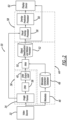
- the CNN 38 is a multi-layer neural network including overlapping input regions and multiple layers of receptive fields having trained and weighted nodes in each layer, where the CNN 38 specifically has an absence of fully connected layers, which supports the adaptive feature of the system 30 and allows for a more flexible resizing of the first input layer.
- the trained CNN weights from a lower image resolution training set can be used as a starting point for inference or training on other higher image resolutions.
- Each node in the CNN 38 is provided with a bias and a weight that defines how it outputs data to subsequent nodes.
- An output layer 40 of the CNN 38 provides the raw digital data that identifies the detected and classified objects in the image 10 and their respective location in the image 10. As will be discussed in further detail below, the detected and classified objects are identified in the image 10 by a bounding box and a label.
- the system 30 includes a prediction engine 44 to provide these functions.
- the video source 32 provides metadata represented by box 46 that is received by the prediction engine 44, where the metadata 46 includes various and specific information for the particular application, such as the location of the video source 32, i.e., its GPS coordinates, time of day, weather conditions, battery life, etc., and where the metadata 46 is correlated to the image frames 34 in time.
- the metadata 46 is provided to a metadata extraction database 48 in the prediction engine 44 that selects those pieces of the metadata 46 that are desirable for the object location prediction process for the specific location.
- the metadata extraction database 48 uses the same input layer that is derived from the image frames 34 that is provided as the input layer for the CNN 38.
- the raw object classification data from the output layer 40 and the extracted metadata from the database 48 are sent to a recurrent neural network (RNN) 50 in the prediction engine 44 that determines the relative velocity and direction of the objects in the image frames 34 based on where the objects were in previous image frames 34.
- RNN recurrent neural network
- a recurrent neural network is a class of artificial neural networks, also including multiple layers having trained and weighted nodes, that has particular application for processing sequential data, where connections between nodes form a directed cycle.
- the configuration of the RNN 50 creates an internal state of the network that allows it to exhibit dynamic temporal behavior, where unlike feed-forward neural networks, RNNs can use their internal memory to process an arbitrary sequences of inputs.
- the RNN 50 is designed using a long short-term memory (LSTM) architecture known to those skilled in the art.
- the RNN 50 provides a fusion of the content from the metadata extraction database 48 and the CNN output layer 40 to create metadata that contains object classification, prediction of angle (direction) of each classified object, prediction of the location of objects that may not be moving in a linear manner, prediction of the relative velocity of each classified object, which will be in units only meaningful to the input layer, such as pixels per metric unit of time, and a translation of pixels per metric unit of time into GPS coordinates, or other coordinate system based units of movement, depending on the availability of the metadata.
- LSTM long short-term memory
- the RNN 50 includes an internal memory state that allows it to use previous image frames 34 in combination with the current image frame 34 to provide the relative velocity of the classified objects. If the system 30 is only processing a single still image from the source 32, then previous image frames are not available, and thus, the RNN 50 is unable to provide an indication of the relative velocity of the objects.
- the data generated by the RNN 50 identifying the motion of the objects in the image frames 34 that were identified by the classification engine 36 is then sent to an object classification and motion vector metadata processor 52 in the prediction engine 44 that combines the detection of the objects in the image frames 34 provided by the CNN 38 with the motion of those objects determined by the RNN 50.
- the combination of data including object location and object relative velocity is then provided along with the image frames 34 to a visual overlay of object classification and motion vector metadata processor 56 in a visualization engine 58 that provides bounding boxes around each detected object in the frames 34 and an indication of object relative velocity and predicted future location. That correlation is provided to an image frame and classification overlay and motion vector object prediction processor 60 in the visualization engine 58 that generates an image indicating the location and relative velocity of the objects in the image 10.
- That image and the combination of data including object location and object relative velocity from the processor 52 is provided to a display device 62 to display the image.
- the display device 62 can be any display device suitable for the purposes described herein, such as a monitor, head-up display (HUD), goggles, projector, smart phone, computer, etc.
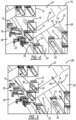
- FIG 4 is an illustration of an image 70 that is an example of what might be displayed on the display device 62 by processing of the image 10 through the system 30, as described.
- each of the objects identified and classified is surrounded by a bounding box 72 indicating that it has been identified and classified and includes a label 74 identifying its classification, i.e., vehicle, person, etc.
- a number of chevrons 76 are provided in association with the bounding box 72, where the direction of the chevrons 76 indicates the direction of travel of the object, and the number of the chevrons 76 indicates the relative velocity of the object.
- Figure 5 is an illustration of an image 80 that is another example of what might be displayed on the display device 62 by processing of the image 10 through the system 30 that includes the bounding boxes 72 around each of the objects and the labels 74 identifying the objects.
- the image 80 instead of the chevrons 76, the image 80 includes arrows 82 indicating the direction of movement of the objects and the relative velocity of the objects, where the length of the arrow 82 indicates the relative velocity.
- the present invention also includes a system whereby an object detection and classification system of the type shown in figure 2 that already includes trained nodes in the CNN 38 and the RNN 50 can have those nodes revised and updated by a training system that receives images from other object detection and classification systems, where the training system uses those images to further train a representative neural network.
- FIG. 6 is a schematic block diagram of an object detection network 90 that provides distributive training and weight distribution of the nodes in a neural network illustrating this feature of the present invention.
- the network 90 includes a training system 92 located at a training facility and a plurality of object detection and classification systems 94 located separate from the training system 92 and being used in the field, where the systems 94 are similar to the system 30. It is noted that the number of the systems 94 can be any suitable number of two or more.
- the training system 92 includes a training tools suite 96 that is a computer system operating suitable algorithms and the necessary accessories, all of which are well known to those skilled in the art.
- a technician will inspect a set of training images including objects that may be images to be classified by the systems 94 using the tools suite 96 and will draw bounding boxes around the objects in the training images and will classify them, where the technician identifies the classified objects by labels representing the objects.
- the labels and images, represented by box 98, are provided to a classification and prediction engine 100 that includes a training CNN and RNN that are the same or similar networks used in the systems 94 that are to be trained.
- the engine 100 also includes an evaluation and back propagation feature that are used to adjust the value of the weights for the nodes in the CNN and the RNN therein to more accurately cause it to classify objects in other images.
- the weights are evaluated in a controlled manner so that the training CNN and RNN classifies objects correctly as the weights are being adjusted, where the weights have the property of being static data that can be extracted, saved, transferred and refined through an evaluation function and recursively updated during that propagation while training.
- the classification and prediction engine 100 provides data to and receives data from a graphical processing unit (GPU) cluster 102, whose operation is well understood to those skilled in the art, that provides parallel data processing to increase data throughput.
- GPU graphical processing unit
- the training system 92 also includes a transceiver or networked router 106 for transmitting the trained weights 104 and receiving images.
- Each object detection and classification system 94 includes a sensor 110, intended to represent the video source 32, that generates images 112 that are provided to a detector 114 intended to represent the combined classification engine 36, the prediction engine 44 and the visualization engine 58.
- Each system 94 also includes a transceiver or networked router 116 that allows it to be in wireless communication with the networked router 106 in the system 92, where the networked router 116 also receives the images 112 from the sensor 110.
- this embodiment shows the networked routers 106 and 116 in wireless communication with each other, it is noted that any suitable communications configuration can be employed.
- the images 112 are sent by the networked router 116 to the training system 92 where they are provided to the tools suite 96 and then to the classification and prediction engine 100 for further training of the weights for the nodes in the training CNN and RNN to help detect objects that are at the location of the specific system 94. Further, the networked router 116 is capable of receiving the trained weights 104 from the system 92, which are provided to the detector 114 at box 118 to update the weights in the CNN and RNN in the detector 114.
- adaptively trained weights using images from one of the systems 94 can be used to update the weights for the nodes in the CNN and RNN in another one of the systems 94 so that the detector 114 in that system 94 can be trained to classify objects that may not be in the images received by that system 94.
Landscapes
- Engineering & Computer Science (AREA)
- Theoretical Computer Science (AREA)
- Physics & Mathematics (AREA)
- General Physics & Mathematics (AREA)
- Evolutionary Computation (AREA)
- Artificial Intelligence (AREA)
- Multimedia (AREA)
- General Health & Medical Sciences (AREA)
- Health & Medical Sciences (AREA)
- Software Systems (AREA)
- Computer Vision & Pattern Recognition (AREA)
- Computing Systems (AREA)
- Life Sciences & Earth Sciences (AREA)
- Data Mining & Analysis (AREA)
- Computational Linguistics (AREA)
- Molecular Biology (AREA)
- Biomedical Technology (AREA)
- General Engineering & Computer Science (AREA)
- Mathematical Physics (AREA)
- Biophysics (AREA)
- Medical Informatics (AREA)
- Databases & Information Systems (AREA)
- Biodiversity & Conservation Biology (AREA)
- Bioinformatics & Cheminformatics (AREA)
- Bioinformatics & Computational Biology (AREA)
- Evolutionary Biology (AREA)
- Probability & Statistics with Applications (AREA)
- Image Analysis (AREA)
Claims (15)
- Ein Verfahren zum Identifizieren, Klassifizieren und Anzeigen der relativen Geschwindigkeit von Objekten in einem Videostrom von einer Bildquelle (32), wobei das Verfahren umfasst:Bereitstellen einer Folge von Bildrahmen (34) aus dem Videostrom für ein neuronales Faltungsnetzwerk, CNN, (38), wobei das CNN (38) eine Eingangsschicht und eine Ausgangsschicht (40) enthält;Identifizieren und Klassifizieren von Objekten in den Bildrahmen (34) unter Verwendung des CNN (38) und Bereitstellung von Objektklassifizierungsdaten in der Ausgabeschicht (40);Bereitstellen von Metadaten (46) aus der Bildquelle (32);Bereitstellen der Objektklassifizierungsdaten in der Ausgabeschicht (40) und der Metadaten (46) für ein rekurrentes neuronales Netz, RNN, (50);Identifizieren der Bewegungsrichtung und der relativen Geschwindigkeit der klassifizierten Objekte in den Bildrahmen unter Verwendung des RNN (50) und Bereitstellung von Objektbewegungsdaten daraus;Kombinieren der Objektklassifizierungsdaten aus dem CNN (38) und der Objektbewegungsdaten aus dem RNN (50) durch eine Vorhersagemaschine (44);Korrelieren der kombinierten Objektklassifizierungsdaten und der Objektbewegungsdaten mit den Bildrahmen (34) durch eine Visualisierungsmaschine (58), um korrelierte Bilder bereitzustellen, die Begrenzungsboxen (72) um jedes klassifizierte Objekt und einen Indikator (76, 82) für die relative Geschwindigkeit und die Bewegungsrichtung der klassifizierten Objekte enthalten; undAnzeigen der korrelierten Bilder auf einer Anzeigevorrichtung (62).
- Das Verfahren nach Anspruch 1, wobei das Bereitstellen der Bildrahmen (34) für ein CNN (38) das Bereitstellen der Bildrahmen (34) für ein mehrschichtiges Feed-Forward-CNN beinhaltet.
- Das Verfahren nach Anspruch 2, bei dem das Bereitstellen der Bildrahmen (34) für ein CNN (38) das Bereitstellen der Bildrahmen für ein CNN (38) einschließt, das speziell keine vollständig verbundenen Schichten aufweist.
- Das Verfahren nach Anspruch 1, wobei das Bereitstellen der Bildrahmen (34) für ein CNN (38) das Bereitstellen der Bildrahmen (38) für die Eingabeschicht des CNN (38) umfasst.
- Das Verfahren nach Anspruch 4, wobei das Bereitstellen von Metadaten (46) das Bereitstellen von Metadaten (46) umfasst, die dieselben Daten enthalten, die der Eingabeschicht im CNN (38) bereitgestellt werden.
- Das Verfahren nach Anspruch 1, wobei das Bereitstellen von Objektklassifizierungsdaten und der Metadaten (46) an ein RNN (50) das Bereitstellen der Klassifizierungsdaten und der Metadaten (46) an ein RNN (50) umfasst, das einen Langzeitspeicher umfasst.
- Das Verfahren nach Anspruch 1, bei dem die Identifizierung der Bewegungsrichtung und der Relativgeschwindigkeit der klassifizierten Objekte die Vorhersage einer zukünftigen Position von Objekten, die sich drehen, einschließt.
- Das Verfahren nach Anspruch 1, wobei der Indikator (76, 82) für die Relativgeschwindigkeit in den korrelierten Bildern mindestens ein Winkel (76) ist, das einem sich bewegenden Objekt zugeordnet ist, wobei die Richtung des Winkels (76) die Bewegungsrichtung des Objekts und eine Anzahl der Winkel (76) die Relativgeschwindigkeit des Objekts anzeigt.
- Das Verfahren nach Anspruch 1, bei dem der Indikator (76, 82) für die relative Geschwindigkeit in den korrelierten Bildern ein Pfeil (82) ist, wobei die Richtung des Pfeils (82) die Bewegungsrichtung des Objekts und die Länge des Pfeils (82) die relative Geschwindigkeit des Objekts angibt.
- Das Verfahren nach Anspruch 1 umfasst ferner das Übertragen der Bildrahmen (34) von der Videoquelle (32) zu einer Trainingseinrichtung, wo die Bildrahmen (34) zum Trainieren von Gewichten in neuronalen Netzknoten in einem Trainings-CNN und einem Trainings-RNN in der Trainingseinrichtung verwendet werden.
- Das Verfahren nach Anspruch 10, wobei das Verfahren zum Identifizieren, Klassifizieren und Anzeigen der relativen Geschwindigkeit von Objekten in einem Videostrom (32) aus einer Bildquelle (34) in einem Objekterkennungs- und - klassifizierungssystem (30) durchgeführt wird, wobei das Verfahren ferner das Übertragen der trainierten neuronalen Netzwerkgewichte aus der Trainingseinrichtung an ein oder mehrere andere Objekterkennungs- und - klassifizierungssysteme (94) umfasst, die die relative Geschwindigkeit von Objekten in anderen Videoströmen (34) aus anderen Bildquellen (32) identifizieren, klassifizieren und anzeigen.
- Das Verfahren nach Anspruch 11, bei dem die anderen Objekterkennungs- und -klassifizierungssysteme (94) ihre Bilddaten an die Trainingseinrichtung übertragen, um die Gewichte in den neuronalen Netzknoten für das CNN- und RNN-Training weiter zu trainieren.
- Das Verfahren nach Anspruch 1, bei dem die Bildquelle (32) aus der Gruppe ausgewählt wird, die aus Kameras, elektrooptischen Infrarotsensoren, LIDAR-Sensoren, Röntgengeräten, Magnetresonanztomographiegeräten (MRI) und Radargeräten mit synthetischer Apertur (SAR) besteht.
- Das Verfahren nach Anspruch 1, wobei die Anzeigevorrichtung (62) aus der Gruppe ausgewählt ist, die aus einem Monitor, einem Head-up-Display, HUD, Gerät, Brille, Projektoren, Smartphones und Computern besteht.
- Ein Objekterkennungs- und Klassifizierungssystem (30) zum Identifizieren, Klassifizieren und Anzeigen der relativen Geschwindigkeit von Objekten in einem Bild (34), wobei das System umfasst:eine Videoquelle (32), die einen Strom von Bildrahmen (34) und Metadaten (46) liefert;eine Klassifizierungsmaschine (36), die ein mehrschichtiges Vorwärtsfaltungs-Neuronalnetzwerk, CNN (38), enthält, wobei das CNN (38) eine Eingabeschicht und eine Ausgabeschicht (40) enthält, wobei das CNN (38) auf die Bildrahmen (34) an der Eingabeschicht anspricht und Objekte in den Bildrahmen (34) identifiziert und klassifiziert und Objektklassifizierungsdaten in der Ausgabeschicht (40) bereitstellt;eine Vorhersagemaschine (44), die ein rekurrentes neuronales Netz, RNN (50), enthält, wobei das RNN (50) auf die Objektklassifizierungsdaten in der Ausgabeschicht (40) und die Metadaten (46) anspricht, wobei das RNN (50) die Bewegungsrichtung und die relative Geschwindigkeit der klassifizierten Objekte in den Bildrahmen identifiziert und Objektbewegungsdaten bereitstellt, wobei die Vorhersagemaschine ferner einen Objektklassifizierungs- und Bewegungsvektorprozessor enthält, der die Objektklassifizierungsdaten von dem CNN und die Objektbewegungsdaten von dem RNN kombiniert;eine Visualisierungsmaschine, die auf die Bildrahmen und die kombinierten Objektklassifizierungsdaten und die Objektbewegungsdaten von der Vorhersagemaschine anspricht, wobei die Visualisierungsmaschine die kombinierten Objektklassifizierungsdaten und die Objektbewegungsdaten mit den Bildrahmen korreliert, um korrelierte Bilder zu liefern, die Begrenzungsboxen um jedes klassifizierte Objekt und einen Indikator der relativen Geschwindigkeit und der Bewegungsrichtung der klassifizierten Objekte enthalten; undeine Anzeigevorrichtung, die die korrelierten Bilder anzeigt.
Applications Claiming Priority (2)
| Application Number | Priority Date | Filing Date | Title |
|---|---|---|---|
| US15/683,483 US10275691B2 (en) | 2017-08-22 | 2017-08-22 | Adaptive real-time detection and examination network (ARDEN) |
| PCT/US2018/043128 WO2019040213A1 (en) | 2017-08-22 | 2018-07-20 | ADAPTIVE REAL TIME DETECTION AND EXAMINATION NETWORK (ARDEN) |
Publications (2)
| Publication Number | Publication Date |
|---|---|
| EP3673411A1 EP3673411A1 (de) | 2020-07-01 |
| EP3673411B1 true EP3673411B1 (de) | 2025-06-25 |
Family
ID=63294422
Family Applications (1)
| Application Number | Title | Priority Date | Filing Date |
|---|---|---|---|
| EP18758768.8A Active EP3673411B1 (de) | 2017-08-22 | 2018-07-20 | Netzwerk zur adaptiven echtzeiterfassung und -untersuchung (arden) |
Country Status (4)
| Country | Link |
|---|---|
| US (1) | US10275691B2 (de) |
| EP (1) | EP3673411B1 (de) |
| KR (1) | KR102599212B1 (de) |
| WO (1) | WO2019040213A1 (de) |
Families Citing this family (27)
| Publication number | Priority date | Publication date | Assignee | Title |
|---|---|---|---|---|
| US10878592B2 (en) * | 2018-05-23 | 2020-12-29 | Apical Limited | Video data processing |
| JP6988698B2 (ja) * | 2018-05-31 | 2022-01-05 | トヨタ自動車株式会社 | 物体認識装置 |
| KR102727289B1 (ko) * | 2018-06-27 | 2024-11-07 | 삼성전자주식회사 | 모션 인식 모델을 이용한 자체 운동 추정 장치 및 방법, 모션 인식 모델 트레이닝 장치 및 방법 |
| US11423284B2 (en) * | 2018-09-07 | 2022-08-23 | Black Sesame Technologies, Inc | Subgraph tile fusion in a convolutional neural network |
| JP7402606B2 (ja) * | 2018-10-31 | 2023-12-21 | ソニーセミコンダクタソリューションズ株式会社 | 固体撮像装置及び電子機器 |
| KR102770344B1 (ko) * | 2018-12-18 | 2025-02-20 | 구글 엘엘씨 | 지오로케이션 예측을 위한 시스템 및 방법 |
| CN109919087B (zh) * | 2019-03-06 | 2022-03-08 | 腾讯科技(深圳)有限公司 | 一种视频分类的方法、模型训练的方法及装置 |
| CN109829451B (zh) * | 2019-03-22 | 2021-08-24 | 京东方科技集团股份有限公司 | 生物体动作识别方法、装置、服务器及存储介质 |
| CN110020693B (zh) * | 2019-04-15 | 2021-06-08 | 西安电子科技大学 | 基于特征注意和特征改善网络的极化sar图像分类方法 |
| US20200356812A1 (en) * | 2019-05-10 | 2020-11-12 | Moley Services Uk Limited | Systems and methods for automated training of deep-learning-based object detection |
| CN110472483B (zh) * | 2019-07-02 | 2022-11-15 | 五邑大学 | 一种面向sar图像的小样本语义特征增强的方法及装置 |
| CN110415297B (zh) * | 2019-07-12 | 2021-11-05 | 北京三快在线科技有限公司 | 定位方法、装置及无人驾驶设备 |
| WO2021008702A1 (en) | 2019-07-17 | 2021-01-21 | Telefonaktiebolaget Lm Ericsson (Publ) | A computer software module arrangement, a circuitry arrangement, an arrangement and a method for improved object detection |
| US11447063B2 (en) * | 2019-07-18 | 2022-09-20 | GM Global Technology Operations LLC | Steerable scanning and perception system with active illumination |
| CN110414414B (zh) * | 2019-07-25 | 2022-02-18 | 合肥工业大学 | 基于多层级特征深度融合的sar图像舰船目标鉴别方法 |
| US10970602B1 (en) * | 2019-10-08 | 2021-04-06 | Mythical, Inc. | Systems and methods for converting video information into electronic output files |
| CN110728695B (zh) * | 2019-10-22 | 2022-03-04 | 西安电子科技大学 | 基于图像区域积累的视频sar运动目标检测方法 |
| US11113584B2 (en) * | 2020-02-04 | 2021-09-07 | Nio Usa, Inc. | Single frame 4D detection using deep fusion of camera image, imaging RADAR and LiDAR point cloud |
| US11270170B2 (en) * | 2020-03-18 | 2022-03-08 | GM Global Technology Operations LLC | Object detection using low level camera radar fusion |
| CN113466877B (zh) * | 2020-03-30 | 2024-03-01 | 北京轻舟智航智能技术有限公司 | 一种实时物体检测的方法、装置及电子设备 |
| CN112419413B (zh) * | 2020-12-07 | 2024-01-05 | 萱闱(北京)生物科技有限公司 | 终端设备的运动方向监测方法、介质、装置和计算设备 |
| CN114937221A (zh) * | 2021-02-05 | 2022-08-23 | Tcl科技集团股份有限公司 | 一种视频分类方法、装置、终端设备和存储介质 |
| CN112926448B (zh) * | 2021-02-24 | 2022-06-14 | 重庆交通大学 | 一种相干斑模式起伏稳健的sar图像分类方法 |
| CN113111909B (zh) * | 2021-03-04 | 2024-03-12 | 西北工业大学 | 一种面向训练目标视角不完备的sar目标识别的自学习方法 |
| KR102746260B1 (ko) | 2021-08-24 | 2024-12-26 | 한국과학기술연구원 | 다중 카메라에서 대상 객체를 추적하기 위한 질의 정보를 업데이트하는 방법 및 이를 수행하는 다중 카메라 시스템 |
| KR102511315B1 (ko) * | 2022-09-07 | 2023-03-17 | 주식회사 스마트인사이드에이아이 | 환경 변수 데이터 학습에 기초한 영상 기반 객체 인식 방법 및 시스템 |
| US12546881B2 (en) * | 2022-10-11 | 2026-02-10 | Gm Cruise Holdings Llc | Curvelet-based low level fusion of camera and radar sensor information |
Citations (2)
| Publication number | Priority date | Publication date | Assignee | Title |
|---|---|---|---|---|
| US20110135159A1 (en) * | 2008-08-01 | 2011-06-09 | Naohide Uchida | Image processing device |
| US20170193310A1 (en) * | 2015-12-31 | 2017-07-06 | Pinhole (Beijing) Technology Co., Ltd. | Method and apparatus for detecting a speed of an object |
Family Cites Families (2)
| Publication number | Priority date | Publication date | Assignee | Title |
|---|---|---|---|---|
| US20150104149A1 (en) * | 2013-10-15 | 2015-04-16 | Electronics And Telecommunications Research Institute | Video summary apparatus and method |
| US10949059B2 (en) * | 2016-05-23 | 2021-03-16 | King.Com Ltd. | Controlling movement of an entity displayed on a user interface |
-
2017
- 2017-08-22 US US15/683,483 patent/US10275691B2/en active Active
-
2018
- 2018-07-20 WO PCT/US2018/043128 patent/WO2019040213A1/en not_active Ceased
- 2018-07-20 KR KR1020207004307A patent/KR102599212B1/ko active Active
- 2018-07-20 EP EP18758768.8A patent/EP3673411B1/de active Active
Patent Citations (2)
| Publication number | Priority date | Publication date | Assignee | Title |
|---|---|---|---|---|
| US20110135159A1 (en) * | 2008-08-01 | 2011-06-09 | Naohide Uchida | Image processing device |
| US20170193310A1 (en) * | 2015-12-31 | 2017-07-06 | Pinhole (Beijing) Technology Co., Ltd. | Method and apparatus for detecting a speed of an object |
Also Published As
| Publication number | Publication date |
|---|---|
| KR20200043985A (ko) | 2020-04-28 |
| US10275691B2 (en) | 2019-04-30 |
| US20190065910A1 (en) | 2019-02-28 |
| KR102599212B1 (ko) | 2023-11-08 |
| WO2019040213A1 (en) | 2019-02-28 |
| EP3673411A1 (de) | 2020-07-01 |
Similar Documents
| Publication | Publication Date | Title |
|---|---|---|
| EP3673417B1 (de) | System und verfahren für verteiltes training und gewichtsverteilung in einem neuronalen netzwerk | |
| US10275691B2 (en) | Adaptive real-time detection and examination network (ARDEN) | |
| Kyrkou et al. | EmergencyNet: Efficient aerial image classification for drone-based emergency monitoring using atrous convolutional feature fusion | |
| JP7335274B2 (ja) | ジオロケーションの予測のためのシステムおよび方法 | |
| Abu-Khadrah et al. | Drone-assisted adaptive object detection and privacy-preserving surveillance in smart cities using whale-optimized deep reinforcement learning techniques | |
| WO2018121690A1 (zh) | 对象属性检测、神经网络训练、区域检测方法和装置 | |
| US20210103744A1 (en) | Spatio-temporal embeddings | |
| Praneeth et al. | Scaling object detection to the edge with yolov4, tensorflow lite | |
| Charouh et al. | Improved background subtraction-based moving vehicle detection by optimizing morphological operations using machine learning | |
| An et al. | DCE-YOLOv8: Lightweight and accurate object detection for drone vision | |
| Du et al. | F-yolov7: fast and robust real-time UAV detection: Y. Du et al. | |
| Koch et al. | Estimating Object Perception Performance in Aerial Imagery Using a Bayesian Approach | |
| Sathyamoorthy et al. | Ensemble deep learning approach for traffic video analytics in edge computing | |
| US20230260259A1 (en) | Method and device for training a neural network | |
| Delleji et al. | Electro-optical monitoring system for early-warning detection of mini-UAVs | |
| Lange et al. | Lopr: Latent occupancy prediction using generative models | |
| Tsekhmystro et al. | Study of methods for searching and localizing objects in images from aircraft using convolutional neural networks | |
| WO2019228654A1 (en) | Method for training a prediction system and system for sequence prediction | |
| Jebadurai et al. | Efficient traffic signal detection with tiny YOLOv4: enhancing road safety through computer vision | |
| Lakshmi Priya et al. | Vehicle Detection in Autonomous Vehicles Using Computer Vision | |
| Arivazhagan et al. | FPGA implementation of GMM algorithm for background subtractions in video sequences | |
| Wu | Data-Efficient Object Detection Combining YOLO with Few-Shot Learning Techniques | |
| CN115131412B (zh) | 多光谱图像融合过程中的图像处理方法 | |
| Dettinger et al. | Situation Awareness for Intelligent Data Distribution in Connected Vehicles | |
| Sahay et al. | Multi-object detection and tracking using machine learning |
Legal Events
| Date | Code | Title | Description |
|---|---|---|---|
| STAA | Information on the status of an ep patent application or granted ep patent |
Free format text: STATUS: UNKNOWN |
|
| STAA | Information on the status of an ep patent application or granted ep patent |
Free format text: STATUS: THE INTERNATIONAL PUBLICATION HAS BEEN MADE |
|
| PUAI | Public reference made under article 153(3) epc to a published international application that has entered the european phase |
Free format text: ORIGINAL CODE: 0009012 |
|
| STAA | Information on the status of an ep patent application or granted ep patent |
Free format text: STATUS: REQUEST FOR EXAMINATION WAS MADE |
|
| 17P | Request for examination filed |
Effective date: 20200213 |
|
| AK | Designated contracting states |
Kind code of ref document: A1 Designated state(s): AL AT BE BG CH CY CZ DE DK EE ES FI FR GB GR HR HU IE IS IT LI LT LU LV MC MK MT NL NO PL PT RO RS SE SI SK SM TR |
|
| AX | Request for extension of the european patent |
Extension state: BA ME |
|
| DAV | Request for validation of the european patent (deleted) | ||
| DAX | Request for extension of the european patent (deleted) | ||
| STAA | Information on the status of an ep patent application or granted ep patent |
Free format text: STATUS: EXAMINATION IS IN PROGRESS |
|
| 17Q | First examination report despatched |
Effective date: 20211012 |
|
| P01 | Opt-out of the competence of the unified patent court (upc) registered |
Effective date: 20230607 |
|
| REG | Reference to a national code |
Ref legal event code: R079 Ipc: G06V0010440000 Ref country code: DE Ref legal event code: R079 Ref document number: 602018082922 Country of ref document: DE Free format text: PREVIOUS MAIN CLASS: G06K0009620000 Ipc: G06V0010440000 |
|
| GRAP | Despatch of communication of intention to grant a patent |
Free format text: ORIGINAL CODE: EPIDOSNIGR1 |
|
| STAA | Information on the status of an ep patent application or granted ep patent |
Free format text: STATUS: GRANT OF PATENT IS INTENDED |
|
| INTG | Intention to grant announced |
Effective date: 20250210 |
|
| RIC1 | Information provided on ipc code assigned before grant |
Ipc: G06V 20/40 20220101ALI20250203BHEP Ipc: G06V 20/10 20220101ALI20250203BHEP Ipc: G06V 10/82 20220101ALI20250203BHEP Ipc: G06V 10/764 20220101ALI20250203BHEP Ipc: G06V 10/44 20220101AFI20250203BHEP |
|
| GRAS | Grant fee paid |
Free format text: ORIGINAL CODE: EPIDOSNIGR3 |
|
| GRAA | (expected) grant |
Free format text: ORIGINAL CODE: 0009210 |
|
| STAA | Information on the status of an ep patent application or granted ep patent |
Free format text: STATUS: THE PATENT HAS BEEN GRANTED |
|
| AK | Designated contracting states |
Kind code of ref document: B1 Designated state(s): AL AT BE BG CH CY CZ DE DK EE ES FI FR GB GR HR HU IE IS IT LI LT LU LV MC MK MT NL NO PL PT RO RS SE SI SK SM TR |
|
| REG | Reference to a national code |
Ref country code: GB Ref legal event code: FG4D |
|
| REG | Reference to a national code |
Ref country code: CH Ref legal event code: EP |
|
| REG | Reference to a national code |
Ref country code: DE Ref legal event code: R096 Ref document number: 602018082922 Country of ref document: DE |
|
| REG | Reference to a national code |
Ref country code: CH Ref legal event code: EP |
|
| REG | Reference to a national code |
Ref country code: IE Ref legal event code: FG4D |
|
| PG25 | Lapsed in a contracting state [announced via postgrant information from national office to epo] |
Ref country code: FI Free format text: LAPSE BECAUSE OF FAILURE TO SUBMIT A TRANSLATION OF THE DESCRIPTION OR TO PAY THE FEE WITHIN THE PRESCRIBED TIME-LIMIT Effective date: 20250625 |
|
| PGFP | Annual fee paid to national office [announced via postgrant information from national office to epo] |
Ref country code: DE Payment date: 20250730 Year of fee payment: 8 |
|
| REG | Reference to a national code |
Ref country code: LT Ref legal event code: MG9D |
|
| PG25 | Lapsed in a contracting state [announced via postgrant information from national office to epo] |
Ref country code: NO Free format text: LAPSE BECAUSE OF FAILURE TO SUBMIT A TRANSLATION OF THE DESCRIPTION OR TO PAY THE FEE WITHIN THE PRESCRIBED TIME-LIMIT Effective date: 20250925 Ref country code: GR Free format text: LAPSE BECAUSE OF FAILURE TO SUBMIT A TRANSLATION OF THE DESCRIPTION OR TO PAY THE FEE WITHIN THE PRESCRIBED TIME-LIMIT Effective date: 20250926 |
|
| PG25 | Lapsed in a contracting state [announced via postgrant information from national office to epo] |
Ref country code: BG Free format text: LAPSE BECAUSE OF FAILURE TO SUBMIT A TRANSLATION OF THE DESCRIPTION OR TO PAY THE FEE WITHIN THE PRESCRIBED TIME-LIMIT Effective date: 20250625 |
|
| PGFP | Annual fee paid to national office [announced via postgrant information from national office to epo] |
Ref country code: GB Payment date: 20250730 Year of fee payment: 8 |
|
| PG25 | Lapsed in a contracting state [announced via postgrant information from national office to epo] |
Ref country code: HR Free format text: LAPSE BECAUSE OF FAILURE TO SUBMIT A TRANSLATION OF THE DESCRIPTION OR TO PAY THE FEE WITHIN THE PRESCRIBED TIME-LIMIT Effective date: 20250625 |
|
| PGFP | Annual fee paid to national office [announced via postgrant information from national office to epo] |
Ref country code: FR Payment date: 20250828 Year of fee payment: 8 |
|
| PG25 | Lapsed in a contracting state [announced via postgrant information from national office to epo] |
Ref country code: RS Free format text: LAPSE BECAUSE OF FAILURE TO SUBMIT A TRANSLATION OF THE DESCRIPTION OR TO PAY THE FEE WITHIN THE PRESCRIBED TIME-LIMIT Effective date: 20250925 |
|
| PG25 | Lapsed in a contracting state [announced via postgrant information from national office to epo] |
Ref country code: LV Free format text: LAPSE BECAUSE OF FAILURE TO SUBMIT A TRANSLATION OF THE DESCRIPTION OR TO PAY THE FEE WITHIN THE PRESCRIBED TIME-LIMIT Effective date: 20250625 |
|
| PG25 | Lapsed in a contracting state [announced via postgrant information from national office to epo] |
Ref country code: NL Free format text: LAPSE BECAUSE OF FAILURE TO SUBMIT A TRANSLATION OF THE DESCRIPTION OR TO PAY THE FEE WITHIN THE PRESCRIBED TIME-LIMIT Effective date: 20250625 |
|
| PG25 | Lapsed in a contracting state [announced via postgrant information from national office to epo] |
Ref country code: PT Free format text: LAPSE BECAUSE OF FAILURE TO SUBMIT A TRANSLATION OF THE DESCRIPTION OR TO PAY THE FEE WITHIN THE PRESCRIBED TIME-LIMIT Effective date: 20251027 |
|
| REG | Reference to a national code |
Ref country code: AT Ref legal event code: MK05 Ref document number: 1807337 Country of ref document: AT Kind code of ref document: T Effective date: 20250625 |
|
| PG25 | Lapsed in a contracting state [announced via postgrant information from national office to epo] |
Ref country code: IS Free format text: LAPSE BECAUSE OF FAILURE TO SUBMIT A TRANSLATION OF THE DESCRIPTION OR TO PAY THE FEE WITHIN THE PRESCRIBED TIME-LIMIT Effective date: 20251025 |
|
| PG25 | Lapsed in a contracting state [announced via postgrant information from national office to epo] |
Ref country code: AT Free format text: LAPSE BECAUSE OF FAILURE TO SUBMIT A TRANSLATION OF THE DESCRIPTION OR TO PAY THE FEE WITHIN THE PRESCRIBED TIME-LIMIT Effective date: 20250625 Ref country code: SM Free format text: LAPSE BECAUSE OF FAILURE TO SUBMIT A TRANSLATION OF THE DESCRIPTION OR TO PAY THE FEE WITHIN THE PRESCRIBED TIME-LIMIT Effective date: 20250625 |
|
| PG25 | Lapsed in a contracting state [announced via postgrant information from national office to epo] |
Ref country code: CZ Free format text: LAPSE BECAUSE OF FAILURE TO SUBMIT A TRANSLATION OF THE DESCRIPTION OR TO PAY THE FEE WITHIN THE PRESCRIBED TIME-LIMIT Effective date: 20250625 |
|
| PG25 | Lapsed in a contracting state [announced via postgrant information from national office to epo] |
Ref country code: PL Free format text: LAPSE BECAUSE OF FAILURE TO SUBMIT A TRANSLATION OF THE DESCRIPTION OR TO PAY THE FEE WITHIN THE PRESCRIBED TIME-LIMIT Effective date: 20250625 |
|
| PG25 | Lapsed in a contracting state [announced via postgrant information from national office to epo] |
Ref country code: EE Free format text: LAPSE BECAUSE OF FAILURE TO SUBMIT A TRANSLATION OF THE DESCRIPTION OR TO PAY THE FEE WITHIN THE PRESCRIBED TIME-LIMIT Effective date: 20250625 |
|
| PG25 | Lapsed in a contracting state [announced via postgrant information from national office to epo] |
Ref country code: SK Free format text: LAPSE BECAUSE OF FAILURE TO SUBMIT A TRANSLATION OF THE DESCRIPTION OR TO PAY THE FEE WITHIN THE PRESCRIBED TIME-LIMIT Effective date: 20250625 |
|
| PG25 | Lapsed in a contracting state [announced via postgrant information from national office to epo] |
Ref country code: ES Free format text: LAPSE BECAUSE OF FAILURE TO SUBMIT A TRANSLATION OF THE DESCRIPTION OR TO PAY THE FEE WITHIN THE PRESCRIBED TIME-LIMIT Effective date: 20250625 |
|
| REG | Reference to a national code |
Ref country code: CH Ref legal event code: H13 Free format text: ST27 STATUS EVENT CODE: U-0-0-H10-H13 (AS PROVIDED BY THE NATIONAL OFFICE) Effective date: 20260224 |
|
| PG25 | Lapsed in a contracting state [announced via postgrant information from national office to epo] |
Ref country code: LU Free format text: LAPSE BECAUSE OF NON-PAYMENT OF DUE FEES Effective date: 20250720 Ref country code: RO Free format text: LAPSE BECAUSE OF FAILURE TO SUBMIT A TRANSLATION OF THE DESCRIPTION OR TO PAY THE FEE WITHIN THE PRESCRIBED TIME-LIMIT Effective date: 20250625 |
|
| REG | Reference to a national code |
Ref country code: BE Ref legal event code: MM Effective date: 20250731 Ref country code: DE Ref legal event code: R097 Ref document number: 602018082922 Country of ref document: DE |
|
| PG25 | Lapsed in a contracting state [announced via postgrant information from national office to epo] |
Ref country code: MC Free format text: LAPSE BECAUSE OF FAILURE TO SUBMIT A TRANSLATION OF THE DESCRIPTION OR TO PAY THE FEE WITHIN THE PRESCRIBED TIME-LIMIT Effective date: 20250625 |
|
| PG25 | Lapsed in a contracting state [announced via postgrant information from national office to epo] |
Ref country code: DK Free format text: LAPSE BECAUSE OF FAILURE TO SUBMIT A TRANSLATION OF THE DESCRIPTION OR TO PAY THE FEE WITHIN THE PRESCRIBED TIME-LIMIT Effective date: 20250625 |
|
| PG25 | Lapsed in a contracting state [announced via postgrant information from national office to epo] |
Ref country code: BE Free format text: LAPSE BECAUSE OF NON-PAYMENT OF DUE FEES Effective date: 20250731 Ref country code: IT Free format text: LAPSE BECAUSE OF FAILURE TO SUBMIT A TRANSLATION OF THE DESCRIPTION OR TO PAY THE FEE WITHIN THE PRESCRIBED TIME-LIMIT Effective date: 20250625 |
|
| PG25 | Lapsed in a contracting state [announced via postgrant information from national office to epo] |
Ref country code: CH Free format text: LAPSE BECAUSE OF NON-PAYMENT OF DUE FEES Effective date: 20250731 |
|
| PLBE | No opposition filed within time limit |
Free format text: ORIGINAL CODE: 0009261 |
|
| STAA | Information on the status of an ep patent application or granted ep patent |
Free format text: STATUS: NO OPPOSITION FILED WITHIN TIME LIMIT |
|
| REG | Reference to a national code |
Ref country code: CH Ref legal event code: L10 Free format text: ST27 STATUS EVENT CODE: U-0-0-L10-L00 (AS PROVIDED BY THE NATIONAL OFFICE) Effective date: 20260507 |
|
| 26N | No opposition filed |
Effective date: 20260326 |
|
| PG25 | Lapsed in a contracting state [announced via postgrant information from national office to epo] |
Ref country code: LT Free format text: LAPSE BECAUSE OF FAILURE TO SUBMIT A TRANSLATION OF THE DESCRIPTION OR TO PAY THE FEE WITHIN THE PRESCRIBED TIME-LIMIT Effective date: 20250625 |
|
| PG25 | Lapsed in a contracting state [announced via postgrant information from national office to epo] |
Ref country code: IE Free format text: LAPSE BECAUSE OF NON-PAYMENT OF DUE FEES Effective date: 20250720 |
|
| PG25 | Lapsed in a contracting state [announced via postgrant information from national office to epo] |
Ref country code: CY Free format text: LAPSE BECAUSE OF FAILURE TO SUBMIT A TRANSLATION OF THE DESCRIPTION OR TO PAY THE FEE WITHIN THE PRESCRIBED TIME-LIMIT Effective date: 20250625 Ref country code: SE Free format text: LAPSE BECAUSE OF FAILURE TO SUBMIT A TRANSLATION OF THE DESCRIPTION OR TO PAY THE FEE WITHIN THE PRESCRIBED TIME-LIMIT Effective date: 20250625 |