EP3673387B1 - Kompression von worteinbettungen für systeme zur verarbeitung von natürlicher sprache - Google Patents
Kompression von worteinbettungen für systeme zur verarbeitung von natürlicher sprache Download PDFInfo
- Publication number
- EP3673387B1 EP3673387B1 EP18740062.7A EP18740062A EP3673387B1 EP 3673387 B1 EP3673387 B1 EP 3673387B1 EP 18740062 A EP18740062 A EP 18740062A EP 3673387 B1 EP3673387 B1 EP 3673387B1
- Authority
- EP
- European Patent Office
- Prior art keywords
- circuitry
- word embeddings
- encoder
- natural language
- electronic device
- Prior art date
- Legal status (The legal status is an assumption and is not a legal conclusion. Google has not performed a legal analysis and makes no representation as to the accuracy of the status listed.)
- Active
Links
Images




Classifications
-
- G—PHYSICS
- G06—COMPUTING OR CALCULATING; COUNTING
- G06F—ELECTRIC DIGITAL DATA PROCESSING
- G06F40/00—Handling natural language data
- G06F40/40—Processing or translation of natural language
- G06F40/42—Data-driven translation
- G06F40/44—Statistical methods, e.g. probability models
-
- G—PHYSICS
- G06—COMPUTING OR CALCULATING; COUNTING
- G06F—ELECTRIC DIGITAL DATA PROCESSING
- G06F40/00—Handling natural language data
- G06F40/30—Semantic analysis
-
- G—PHYSICS
- G06—COMPUTING OR CALCULATING; COUNTING
- G06F—ELECTRIC DIGITAL DATA PROCESSING
- G06F40/00—Handling natural language data
- G06F40/10—Text processing
- G06F40/12—Use of codes for handling textual entities
- G06F40/126—Character encoding
-
- G—PHYSICS
- G06—COMPUTING OR CALCULATING; COUNTING
- G06N—COMPUTING ARRANGEMENTS BASED ON SPECIFIC COMPUTATIONAL MODELS
- G06N20/00—Machine learning
-
- G—PHYSICS
- G06—COMPUTING OR CALCULATING; COUNTING
- G06N—COMPUTING ARRANGEMENTS BASED ON SPECIFIC COMPUTATIONAL MODELS
- G06N3/00—Computing arrangements based on biological models
- G06N3/02—Neural networks
- G06N3/04—Architecture, e.g. interconnection topology
- G06N3/044—Recurrent networks, e.g. Hopfield networks
-
- G—PHYSICS
- G06—COMPUTING OR CALCULATING; COUNTING
- G06N—COMPUTING ARRANGEMENTS BASED ON SPECIFIC COMPUTATIONAL MODELS
- G06N3/00—Computing arrangements based on biological models
- G06N3/02—Neural networks
- G06N3/04—Architecture, e.g. interconnection topology
- G06N3/045—Combinations of networks
-
- G—PHYSICS
- G06—COMPUTING OR CALCULATING; COUNTING
- G06N—COMPUTING ARRANGEMENTS BASED ON SPECIFIC COMPUTATIONAL MODELS
- G06N3/00—Computing arrangements based on biological models
- G06N3/02—Neural networks
- G06N3/04—Architecture, e.g. interconnection topology
- G06N3/045—Combinations of networks
- G06N3/0455—Auto-encoder networks; Encoder-decoder networks
-
- G—PHYSICS
- G06—COMPUTING OR CALCULATING; COUNTING
- G06N—COMPUTING ARRANGEMENTS BASED ON SPECIFIC COMPUTATIONAL MODELS
- G06N3/00—Computing arrangements based on biological models
- G06N3/02—Neural networks
- G06N3/04—Architecture, e.g. interconnection topology
- G06N3/0495—Quantised networks; Sparse networks; Compressed networks
-
- G—PHYSICS
- G06—COMPUTING OR CALCULATING; COUNTING
- G06N—COMPUTING ARRANGEMENTS BASED ON SPECIFIC COMPUTATIONAL MODELS
- G06N3/00—Computing arrangements based on biological models
- G06N3/02—Neural networks
- G06N3/08—Learning methods
-
- G—PHYSICS
- G06—COMPUTING OR CALCULATING; COUNTING
- G06N—COMPUTING ARRANGEMENTS BASED ON SPECIFIC COMPUTATIONAL MODELS
- G06N3/00—Computing arrangements based on biological models
- G06N3/02—Neural networks
- G06N3/08—Learning methods
- G06N3/09—Supervised learning
-
- G—PHYSICS
- G06—COMPUTING OR CALCULATING; COUNTING
- G06N—COMPUTING ARRANGEMENTS BASED ON SPECIFIC COMPUTATIONAL MODELS
- G06N5/00—Computing arrangements using knowledge-based models
- G06N5/04—Inference or reasoning models
-
- G—PHYSICS
- G10—MUSICAL INSTRUMENTS; ACOUSTICS
- G10L—SPEECH ANALYSIS TECHNIQUES OR SPEECH SYNTHESIS; SPEECH RECOGNITION; SPEECH OR VOICE PROCESSING TECHNIQUES; SPEECH OR AUDIO CODING OR DECODING
- G10L13/00—Speech synthesis; Text to speech systems
- G10L13/02—Methods for producing synthetic speech; Speech synthesisers
- G10L13/027—Concept to speech synthesisers; Generation of natural phrases from machine-based concepts
Definitions
- NLPS natural language processing systems
- word embeddings that model or represent words and phrases from a vocabulary.
- the word embeddings typically map the words and phrases to vectors of real numbers.
- a NLPS obtains the corresponding word embedding for some or all of the words in the language input.
- the word embeddings are stored in a matrix that can be quite large. For example, a large vocabulary can produce a large matrix, or the language type (e.g., English) can result in a large matrix. It can be difficult to store a large matrix in an electronic device that has a limited amount of memory.
- a system includes an auto-encoder processing unit, a first storage device, and a second storage device.
- the auto-encoder processing unit includes encoder circuitry and decoder circuitry.
- the first storage device stores computer executable instructions that when executed by the auto-encoder processing unit performs a method.
- the method includes compressing, by the encoder circuitry, one or more uncompressed word embeddings to produce one or more compressed word embeddings.
- the one or more compressed word embeddings are decompressed by the decoder circuitry.
- each of the one or more uncompressed word embeddings includes a vector of real numbers
- each of the one or more compressed word embeddings comprises a vector of binary numbers
- each of the one or more decompressed word embeddings comprises a vector of real numbers.
- the second storage device stores one or more parameters of the decoder circuitry.
- a method in another aspect, includes training at a first time a natural language processing system (NLPS) using uncompressed word embeddings and training decoder circuitry in an auto-encoder processing unit with compressed word embeddings that correspond to the uncompressed word embeddings.
- NLPS natural language processing system
- each uncompressed word embedding comprises a vector of real numbers and each compressed word embedding includes a vector of binary numbers.
- the compressed word embeddings are produced by encoder circuitry in the auto-encoder processing unit.
- One or more parameters in the NLPS are replaced with one or more parameters in the trained decoder circuitry.
- the NLPS is trained using the compressed word embeddings.
- an electronic device in yet another aspect, includes an input device for receiving a natural language input, a storage device for storing compressed word embeddings, and a natural language processing system.
- the natural language processing system includes natural language understanding (NLU) circuitry that is connected to the storage device, and processing circuitry operably connected to the NLU circuitry.
- NLU natural language understanding
- the NLU circuitry obtains one or more compressed word embeddings that represent at least one word in the natural language input.
- the processing circuitry receives the compressed word embeddings, decompresses the compressed word embeddings, and processes the decompressed word embeddings to determine an action to be taken by the electronic device in response the natural language input.
- each compressed word embedding comprises a vector of binary numbers and each decompressed word embedding comprises a vector of real numbers.
- Embodiments described herein provide a natural language processing system (NLPS) that employs compressed word embeddings.
- NLPS natural language processing system
- word embeddings model or represent words and/or phrases from a vocabulary.
- the word embeddings are stored in a large matrix, making it difficult to store the matrix in an electronic device that has a limited amount of memory.
- the compressed word embeddings can be binary numbers that may be stored compactly as bits instead of bytes (float number) in electronic devices that have limited amounts of storage. Additionally, an electronic device may operate a NLPS independent of any other computing devices when the compressed word embeddings are stored in the electronic device.
- Embodiments disclosed herein use an auto-encoder that includes encoder circuitry and decoder circuitry.
- the auto-encoder can be implemented as a multi-layer neural network, where the encoder circuitry is one layer and the decoder circuitry is another layer.
- the encoder circuitry is used to produce the compressed word embeddings.
- the decoder circuitry is trained to decompress the word embeddings with reduced or minimal differences between the original uncompressed word embeddings and the corresponding decompressed word embeddings.
- One or more parameters of the trained decoder circuitry are transferred to the NLPS, where the NLPS is then trained using the compressed word embeddings to improve the correctness of the responses or actions determined by the NLPS.
- FIG. 1 illustrates an example system that can include a natural language processing system.
- the system 100 generates and controls responses to a natural language inputs (e.g., spoken and textual inputs).
- the system 100 allows a user 105 to submit the language input through a client-computing device 110.
- the client-computing device 110 includes one or more input devices 115 that receive the language input.
- the input device(s) 115 may be any suitable type of input device configured to receive a language input.
- the input device(s) 120 may be a microphone (using a speech-to-text application (STT) 120) and/or a keyboard.
- STT speech-to-text application
- the client-computing device 110 is configured to access one or more server-computing devices (represented by server-computing device 125) through one or more networks (represented by network 130) to interact with a natural language processing system (NLPS) 135 stored on one or more storage devices (represented by storage device 140) and executed by server-computing device 125.
- NLPS natural language processing system
- the network 130 is illustrative of any suitable type of network, for example, an intranet, and/or a distributed computing network (e.g., the Internet) over which the user 105 may communicate with other users and with other computing systems.
- the NLPS 135 can include a computer-executable program that may be stored in the storage device 140 and executed by the server-computing device 125.
- the NLPS 135 receives and processes the language input and determines what action is to be taken in response to the language input.
- the action may include asking the user 105 for more information or for confirmation through one or more output devices 145 included in the client-computing device 110 or connected to the client-computing device 110.
- Example output devices 145 include, but are not limited to, a speaker (using a text-to-speech (TTS) application 120) and a display.
- TTS text-to-speech
- the client-computing device 110 is a personal or handheld computing device having both the input and output devices 115, 145.
- the client-computing device 110 may be one of: a mobile telephone; a smart phone; a tablet; a phablet; a smart watch; a wearable computer; a personal computer; a desktop computer; a laptop computer; a gaming device/computer (e.g., Xbox); a television; and the like.
- This list of example client-computing devices is for example purposes only and should not be considered as limiting. Any suitable client-computing device that provides and/or interacts with a NLPS using word embeddings may be utilized.
- the client-computing device 110 can have limited storage and/or may operate as a stand-alone device (e.g., limited or no access to network 130).
- the limited access to, or absence of the network 130 is represented by the dashed line 150 in FIG. 1 .
- the client-computing device 110 can include a NLPS 155 that accesses compressed word embeddings that are stored in a storage device included in, or connected to the client-computing device 110.
- the processes for training the NLPS 155, for compressing the word embeddings, and for decompressing the word embeddings are described in more detail in conjunction with FIGS. 3-8 .
- FIG. 1 is described for purposes of illustrating the present methods and systems and is not intended to limit the disclosure to a particular sequence of steps or a particular combination of hardware or software components.
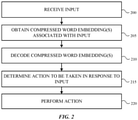
- FIG. 2 is flowchart depicting a method of operating a NLPS that uses compressed word embeddings.
- the NLPS receives text input that is, or represents a natural language input that is received by a computing device (e.g., client-computing device 110 via input device 115 in FIG. 1 ).
- a computing device e.g., client-computing device 110 via input device 115 in FIG. 1 .
- the user 105 can ask the client-computing device 110 to perform an action, and the spoken input is converted to text using the STT application 120.
- Example requested actions include, but are not limited to, a request to call a named person, to provide directions to a location, or to find a restaurant.
- the NLPS obtains one or more compressed word embeddings from a storage device (block 205).
- the word embeddings can be mathematical representations of words and/or phrases in a vocabulary.
- the word embeddings map the words and/or phrases to vectors of real numbers.
- the original mathematical representation of each word embedding eg., N real/float numbers
- a compressed second mathematical representation e.g., M bits where M can be larger than N).
- the compression process is a binary compression process that transforms the real number of each word embedding (e.g., a vector of real numbers) into a binary word embedding of ones and zeros (e.g., a vector of binary numbers).
- the one or more word embeddings are decompressed.
- the NLPS determines an action that a machine (e.g., a client-computing device) should perform in response to the text input (block 215).
- the action is then performed by the machine at block 220. For example, if the request is to call a friend, the action performed by the machine may be to ask the user to confirm the friend's name and number prior to initiating the call. Alternatively, the action performed by the machine can be to call the friend.
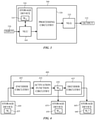
- FIG. 3 is a block diagram illustrating an example NLPS.
- the NLPS 300 can be the NLPS 135 and/or the NLPS 155 in FIG. 1 . Although the NLPS 300 includes four blocks or operations, other embodiments are not limited to this configuration. A NLPS may include different and/or additional blocks or operations.
- the NLPS 300 includes natural language understanding (NLU) circuitry 305 operably connected to a storage device 310 that stores compressed word embeddings (W ec ) 315.
- the compressed word embeddings 315 comprise vectors of binary numbers that are stored in a matrix.
- the NLU circuitry 305 can be implemented with hardware (e.g., circuits), with software, or with a combination of hardware and software.
- the NLU circuitry 305 is also operably connected to an input of processing circuitry 320.
- the processing circuitry 320 is a neural network, such as a recurrent neural network.
- An output of the processing circuitry 320 is operably connected to natural language generation (NLG) circuitry 325.
- NLG natural language generation
- a text input 330 is received by the NLU circuitry 305.
- the NLU circuitry 305 converts the text input 330 into a structured input that the processing circuitry 320 can understand and process.
- the NLU circuitry 305 may analyze the semantic features of the text input 330 and access the storage device 310 to obtain the compressed word embeddings 315 for some or all of the words in the text input 330.
- the processing circuitry 320 decompresses the compressed word embeddings, determines or predicts an action to be taken in response to the text input 330, and outputs an internal representation of the determined action.
- the NLG circuitry 325 receives the internal representation of the determined action and coverts the internal representation into a natural language output 335.
- the natural language output 335 may then be presented to a user via a computing device (e.g., client-computing device 110 using output device 145 in FIG. 1 ).
- the natural language output 335 can be an audio output that is presented to the user 105 using a speaker (output device 145 via TTS application 120) within or connected to the client-computing device 110.
- compressed word embeddings consume a reduced amount of storage compared to uncompressed word embeddings. This allows the compressed word embeddings to be stored in a client-computing device and used by a NLPS that is also included in the client-computing device. Compressed word embeddings may be stored in the client-computing device when the client-computing device has limited storage, limited, intermittent, or no network access, and/or when the client-computing device is to operate as a stand-along computing device.
- FIG. 4 is a block diagram depicting an auto-encoder processing unit that may be used to produce compressed word embeddings.
- the auto-encoder processing unit 400 includes encoder circuitry 405 operably connected to activation function circuitry 410.
- the encoder circuitry 405 and the activation function circuitry 410 are used to produce the compressed word embeddings.
- the auto-encoder processing unit 400 further includes decoder circuitry 415 operably connected to the activation function circuitry 410.
- the auto-encoder processing unit 400 is implemented as a multi-layer neural network with one layer comprising the encoder circuitry 405, a second layer including the activation function circuitry 410, and a third layer comprising the decoder circuitry 415.
- One example of the multi-layer neural network is a multi-layer bi-directional recurrent neural network.
- one or more parameters of the decoder circuitry 415 can be used in a NLPS.
- An input of the encoder circuitry 405 is operably connected to a storage device 420 that stores uncompressed word embeddings (We) 425.
- the uncompressed word embeddings 425 are vectors of real numbers that are stored in a matrix and each uncompressed word embedding (We) 425 is received by the encoder circuitry 405.
- the encoder circuitry 405 is a linear transformation circuit that transforms the mathematical representation (e.g., real number or vector) of each word embedding from a linear space to another linear space.
- the activation function circuitry 410 is a non-linear function or program that transforms the higher dimensional mathematical representation (e.g., real number) into a binary representation or number.
- the equation for f(x) can include a value for f(x) that is used when x is equal to or less than (or greater than) zero.
- f(x) can be 0 if x is less than 0.5 and 1 if greater than or equal to 0.5.
- the compressed word embeddings (Wee) 430 are output from the activation function circuitry 410 and received by the decoder circuitry 415.
- the compressed word embeddings 430 are vectors of binary numbers that may be stored in a storage device 435 that is separate from and not part of the auto-encoder processing unit 400.
- the decoder circuitry 415 acts as a decompression circuit that transforms the compressed word embedding (Wee) 430 back into a mathematical representation in the original space (e.g., a real number).
- the decoder circuitry 415 is a linear transformation circuit that maps the binary representation back to the original space.
- the decompressed word embeddings (W e ⁇ ) 440 are vectors of real numbers that can be stored in a storage device 445.
- the mathematical representation of a decompressed word embedding (W e ⁇ ) 440 does not match or equal the corresponding mathematical representation of the original uncompressed word embedding (We).
- a training process is used to train the decoder circuitry 415 to minimize the differences between the mathematical representations of the decompressed word embedding (W e ⁇ ) 440 and the corresponding original uncompressed word embedding (W e ). Once trained, one or more parameters of the decoder circuitry 415 can be used in a NLPS.
- FIG. 5 is a flowchart illustrating an example method of training an auto-encoder.
- the parameter(s) of the encoder circuitry may be determined using a variety of techniques.
- the parameter(s) are randomly initialized and fixed.
- the encoder circuitry transforms the word embeddings from a d i -dim manifold (e.g., a linear sub-space) onto a do-dim space which is typically chosen to be larger than d i . With a probability of 1, this transformation retains the algebraic relations of the word embeddings.
- the activation function when the transformed word embeddings are processed by the activation function circuitry (e.g., activation function circuitry 410 in FIG. 4 ), the activation function is a non-linear transformation that produces a binary value for the word embeddings.
- the activation function circuitry stretches in the do-dim space. This binary value transformation operation substantially keeps most of the original word relationships. For example, if a word A is closer to word B than word C in the original space, these relationships may be substantially maintained after processing by the activation function circuitry.
- the one or more parameters of the encoder circuitry may be determined by training the encoder circuitry.
- the encoder circuitry can be trained by using a first activation function with binary output in the forward propagation phase and second continuous activation function that outputs any time ranging from 0 to 1 in the backward propagation phase.
- the variable c can have a different value in other embodiments (e.g., any real number).
- f b can be a sigmoid-like function.
- the word embeddings are compressed using the encoder circuitry and the activation function circuitry (block 505).
- the compressed word embeddings are stored in a storage device (e.g., storage device 435 in FIG. 4 ).
- the decoder circuitry is then trained using the compressed word embeddings (block 515).
- one or more parameters of the decoder circuitry may be adjusted to reduce or minimize the differences between the original uncompressed word embeddings and the decompressed word embeddings.
- the decoder circuitry is a layer in a neural network.
- one or more network parameters in the neural network can be updated to reduce or minimize the differences between the original uncompressed word embeddings and the decompressed word embeddings.
- the final decoder parameters are stored in a storage device.
- the one or more parameters of the decoder circuitry 415 can be stored in a storage device, such as the storage device 435.
- the decoder parameters are used in the NLPS to train the NPLS.
- FIG. 6 is a process flow diagram depicting an example method of training the decoder circuitry. This operation may be performed at block 510 in FIG. 5 .
- the training process includes the decoder circuitry 600 receiving one or more compressed word embeddings (Wee) 605.
- the decoder circuitry 600 decompresses the compressed word embedding(s) 605 to produce decompressed word embeddings (W e ⁇ ) 610.
- one or more decompressed word embeddings 610 may not equal or match a corresponding original uncompressed word embedding We 615.
- the asterisk in FIG. 6 represents the difference in the decompressed word embeddings 610.
- the original and the corresponding decompressed word embeddings 610, 615 are received and compared by a processing unit 620.
- Any suitable processing unit 620 may be used.
- the processing unit 620 is a comparator circuit. Based on the comparison, the processing unit 610 provides one or more compensation or correction values (CV) 625 to the decoder circuitry 600.
- CV compensation or correction values
- One or more parameters of the decoder circuitry 600 can be updated based on the compensation value(s) 625.
- the training process repeats a given number of times or until the differences between the decompressed and the original uncompressed word embeddings are at a given amount or level, or do not decrease any more. For example, in one embodiment, the training process repeats until the differences between the decompressed and the original uncompressed word embeddings equal or are less than a threshold value (or do not decrease).
- FIG. 7 is a flowchart illustrating an example method of training a natural language processing system.
- a NLPS is trained using original uncompressed word embeddings to produce a first set of actions that have been determined by the NLPS.
- the NLPS is trained using word embeddings from one or more known datasets.
- one or more parameters of the NLPS are updated or replaced with the parameter(s) of the trained decoder circuitry (block 705).
- the NLPS is implemented as a neural network.
- one or more network parameters in the neural network can be updated with the parameter(s) of the decoder circuitry.
- the NLPS is trained a second time using compressed word embeddings that correspond to the original uncompressed word embeddings.
- an auto-encoder described in conjunction with FIGS. 4-6 is used to generate the compressed word embeddings.
- a second set of actions are determined by the NLPS based on the compressed word embeddings.
- One or more parameters in the NLPS are updated to improve the correctness or accuracy of the actions determined by the NLPS.
- the parameter(s) in the NLPS are adjusted to have the second set of actions match, substantially match, or be closer to the first set of actions produced at block 700.
- FIG. 8 is a process flow diagram depicting an example method of training the NLPS using the compressed word embeddings. This operation may be performed at block 710 in FIG. 7 .
- the training process includes the NLPS 800 receiving one or more compressed word embeddings (Wee) 805.
- the NLPS 800 decompresses the compressed word embedding(s) 805 and processes the decompressed word embeddings to produce one or more predicted actions 810.
- the predicted action(s) and the corresponding expected action(s) 815 are received and compared by a processing unit 820. Any suitable processing unit 820 may be used. Based on the comparison, the processing unit 820 provides one or more compensation or correction values (CV) 825 to the NLPS 800.
- CV compensation or correction values
- One or more parameters of the NLPS 800 e.g., one or more network parameters of the neural network
- the training process repeats a given number of times or until the differences between the expected and the predicted actions are at a given level. For example, in one embodiment, the training process repeats until the correctness or accuracy of the predicted responses equals or is greater than a particular confidence value (or do not improve).
- FIGS. 9-11 and the associated descriptions provide a discussion of a variety of operating environments in which aspects of the disclosure may be practiced.
- the devices and systems illustrated and discussed with respect to FIGS. 9-11 are for purposes of example and illustration and are not limiting of a vast number of electronic device configurations that may be utilized for practicing aspects of the disclosure, as described herein.
- FIG. 9 is a block diagram depicting physical components (e.g., hardware) of an electronic device 900 with which aspects of the disclosure may be practiced.
- the components described below may be suitable for the computing devices described above, including the client-computing device 110 in FIG. 1 .
- the electronic device 900 may include at least one processing unit 905 and a system memory 910.
- the system memory 910 may comprise, but is not limited to, volatile storage (e.g., random access memory), non-volatile storage (e.g., read-only memory), flash memory, or any combination of such memories.
- the system memory 910 may include a number of program modules and data files, such as an operating system 915, one or more program modules 920 suitable for parsing received input, determining subject matter of received input, determining actions associated with the input and so on, a NLPS 925, and compressed word embeddings 930. While executing on the processing unit 905, the NLPS 925 may perform and/or cause to be performed processes including, but not limited to, the aspects as described herein.
- the operating system 915 may be suitable for controlling the operation of the electronic device 900.
- embodiments of the disclosure may be practiced in conjunction with a graphics library, other operating systems, or any other application program and is not limited to any particular application or system. This basic configuration is illustrated in FIG. 9 by those components within a dashed line 935.
- the electronic device 900 may have additional features or functionality.
- the electronic device 900 may also include additional data storage devices (removable and/or non-removable) such as, for example, magnetic disks, optical disks, or tape.
- additional storage is illustrated in FIG. 9 by a removable storage device 940 and a non-removable storage device 945.
- the electronic device 900 may also have one or more input device(s) 950 such as a keyboard, a trackpad, a mouse, a pen, a sound or voice input device, a touch, force and/or swipe input device, etc.
- the output device(s) 955 such as a display, speakers, a printer, etc. may also be included.
- the aforementioned devices are examples and others may be used.
- the electronic device 900 may include one or more communication devices 960 allowing communications with other electronic devices 965. Examples of suitable communication devices 960 include, but are not limited to, a radio frequency (RF) transmitter, a receiver, and/or transceiver circuitry, network circuitry, and universal serial bus (USB), parallel, and/or serial ports.
- RF radio frequency
- USB universal serial bus
- Computer-readable media may include computer storage media or devices.
- Computer storage devices may include volatile and nonvolatile, removable and non-removable storage devices implemented in any method or technology for storage of information, such as computer readable instructions, data structures, or program modules.
- the system memory 910, the removable storage device 940, and the non-removable storage device 945 are all computer storage device examples (e.g., memory storage).
- Computer storage devices may include RAM, ROM, electrically erasable read-only memory (EEPROM), flash memory or other memory technology, CD-ROM, digital versatile disks (DVD) or other optical storage, magnetic cassettes, magnetic tape, magnetic disk storage or other magnetic storage devices, or any other article of manufacture which can be used to store information and which can be accessed by the electronic device 900. Any such computer storage device may be part of the electronic device 900.
- Computer storage device does not include a carrier wave or other propagated or modulated data signal.
- Communication media may be embodied by computer readable instructions, data structures, program modules, or other data in a modulated data signal, such as a carrier wave or other transport mechanism, and includes any information delivery media.
- modulated data signal may describe a signal that has one or more characteristics set or changed in such a manner as to encode information in the signal.
- communication media may include wired media such as a wired network or direct-wired connection, and wireless media such as acoustic, radio frequency (RF), infrared, and other wireless media.
- RF radio frequency
- embodiments of the disclosure may be practiced in an electrical circuit comprising discrete electronic elements, packaged or integrated electronic chips containing logic gates, a circuit utilizing a microprocessor, or on a single chip containing electronic elements or microprocessors.
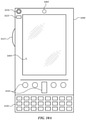
- FIGS. 10A and 10B illustrate a mobile electronic device 1000, for example, a mobile telephone, a smart phone, wearable computer (such as a smart watch), a tablet computer, a laptop computer, a navigation device, a gaming device, and the like, with which embodiments of the disclosure may be practiced.
- a mobile electronic device 1000 for example, a mobile telephone, a smart phone, wearable computer (such as a smart watch), a tablet computer, a laptop computer, a navigation device, a gaming device, and the like, with which embodiments of the disclosure may be practiced.
- wearable computer such as a smart watch
- the mobile electronic device 1000 is a handheld computer having both input elements and output elements.
- the mobile electronic device 1000 typically includes a display 1005 and one or more input buttons 1010 that allow the user to enter information into the mobile electronic device 1000.
- the display 1005 of the mobile electronic device 1000 may also function as an input device (e.g., a display that accepts touch and/or force input).
- an optional side input element 1015 allows further user input.
- the side input element 1015 may be a rotary switch, a button, or any other type of manual input element.
- mobile electronic device 1000 may incorporate more or less input elements.
- the display 1005 may not be a touch screen in some embodiments.
- the mobile electronic device 1000 is a portable phone system, such as a cellular phone.
- the mobile electronic device 1000 may also include an optional keypad 1020.
- Optional keypad 1020 may be a physical keypad or a "soft" keypad generated on the touch screen display.
- the output elements include the display 1005 for showing a graphical user interface (GUI) and a set of available templates, a visual indicator 1025 (e.g., a light emitting diode), and/or an audio transducer 1030 (e.g., a speaker).
- GUI graphical user interface
- the mobile electronic device 1000 incorporates a vibration transducer for providing the user with tactile feedback.
- the mobile electronic device 1000 incorporates input and/or output ports, such as an audio input (e.g., a microphone jack), an audio output (e.g., a headphone jack), and a video output (e.g., a HDMI port) for sending signals to or receiving signals from an external device.
- FIG. 10B is a block diagram illustrating the architecture of one aspect of a mobile electronic device 1000. That is, the mobile electronic device 1000 can incorporate a system (e.g., an architecture) 1035 to implement some aspects.
- the system 1035 is implemented as a "smart phone" capable of running one or more applications (e.g., browser, e-mail, calendaring, contact managers, messaging clients, games, media clients/players, content selection and sharing applications and so on).
- the system 1035 is integrated as an electronic device, such as an integrated personal digital assistant (PDA) and wireless phone
- PDA personal digital assistant
- One or more application programs 1040 may be loaded into the memory 1045 and run on or in association with the operating system 1050.
- Examples of the application programs include phone dialer programs, navigation programs, e-mail programs, personal information management (PIM) programs, word processing programs, spreadsheet programs, Internet browser programs, messaging programs, and so forth.
- PIM personal information management
- the system 1035 also includes a non-volatile storage area 1055 within the memory 1045.
- the non-volatile storage area 1055 may be used to store persistent information that should not be lost if the system 1035 is powered down.
- the application programs 1040 may use and store information in the non-volatile storage area 1055, such as an NLPS, compressed word embeddings, and the like.
- a synchronization application (not shown) also resides on the system 1035 and is programmed to interact with a corresponding synchronization application resident on a host computer to keep the information stored in the non-volatile storage area 1055 synchronized with corresponding information stored at the host computer.
- the system 1035 has a power supply 1060, which may be implemented as one or more batteries.
- the power supply 1060 may further include an external power source, such as an AC adapter or a powered docking cradle that supplements or recharges the batteries.
- the system 1035 may also include a radio interface layer 1065 that performs the function of transmitting and receiving radio frequency communications.
- the radio interface layer 1065 facilitates wireless connectivity between the system 1035 and the "outside world," via a communications carrier or service provider. Transmissions to and from the radio interface layer 1065 are conducted under control of the operating system 1050. In other words, communications received by the radio interface layer 1065 may be disseminated to the application programs 1040 via the operating system 1050, and vice versa.
- the visual indicator 1025 may be used to provide visual notifications, and/or an audio interface 1070 may be used for producing audible notifications via an audio transducer (e.g., audio transducer 1030 illustrated in FIG. 10A ).
- the visual indicator 1025 is a light emitting diode (LED) and the audio transducer 1030 may be a speaker.
- LED light emitting diode
- the LED may be programmed to remain on indefinitely until the user takes action to indicate the powered-on status of the device.
- the audio interface 1070 is used to provide audible signals to and receive audible signals from the user (e.g., voice input such as described above).
- the audio interface 1070 may also be coupled to a microphone to receive audible input, such as to facilitate a telephone conversation.
- the microphone may also serve as an audio sensor to facilitate control of notifications, as will be described below.
- the system 1035 may further include a video interface 1080 that enables an operation of peripheral device 1085 (e.g., on-board camera) to record still images, video stream, and the like.
- peripheral device 1085 e.g., on-board camera
- a mobile electronic device 1000 implementing the system 1035 may have additional features or functionality.
- the mobile electronic device 1000 may also include additional data storage devices (removable and/or non-removable) such as, magnetic disks, optical disks, or tape.
- additional storage is illustrated in FIG. 10B by the non-volatile storage area 1055.
- Data/information generated or captured by the mobile electronic device 1000 and stored via the system 1035 may be stored locally on the mobile electronic device 1000, as described above, or the data may be stored on any number of storage media that may be accessed by the device via the radio interface layer 1065 or via a wired connection between the mobile electronic device 1000 and a separate electronic device associated with the mobile electronic device 1000, for example, a server-computing device in a distributed computing network, such as the Internet (e.g., server-computing device 125 in FIG. 1 ).
- a server-computing device in a distributed computing network such as the Internet (e.g., server-computing device 125 in FIG. 1 ).
- data/information may be accessed via the mobile electronic device 1000 via the radio interface layer 1065 or via a distributed computing network.
- data/information may be readily transferred between electronic devices for storage and use according to well-known data/information transfer and storage means, including electronic mail and collaborative data/information sharing systems.
- FIG. 10A and FIG. 10B are described for purposes of illustrating the present methods and systems and is not intended to limit the disclosure to a particular sequence of steps or a particular combination of hardware or software components.
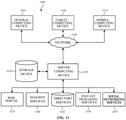
- FIG. 11 is a block diagram illustrating a distributed system in which aspects of the disclosure may be practiced.
- the system 1100 allows a user to interact with a NLSP using, or through a general computing device 1105 (e.g., a desktop computer), a tablet computing device 1110, and/or a mobile computing device 1115.
- the general computing device 1105, the tablet computing device 1110, and the mobile computing device 1115 can each include the components, or be connected to the components, that are shown associated with the electronic device 900 in FIG. 9 .
- the general computing device 1105, the tablet computing device 1110, and the mobile computing device 1115 are each configured to access one or more networks (represented by network 1120) to interact with one or more programs (not shown) stored in one or more storage devices (represented by storage device 1125).
- the program(s) stored on storage device 1125 can be executed on one or more server-computing devices (represented by server-computing device 1130).
- the server-computing device 1130 can access and/or receive various types of services, communications, documents and information transmitted from other sources, such as a web portal 1135, a mailbox services 1140, a directory services 1145, instant messaging services 1150, and/or social networking services 1155.
- these sources may provide robust reporting, analytics, data compilation and/or storage service, etc., whereas other services may provide search engines or other access to data and information, images, videos, document processing and the like.
- FIG. 11 is described for purposes of illustrating the present methods and systems and is not intended to limit the disclosure to a particular sequence of steps or a particular combination of hardware or software components.
Landscapes
- Engineering & Computer Science (AREA)
- Theoretical Computer Science (AREA)
- Physics & Mathematics (AREA)
- Computational Linguistics (AREA)
- Artificial Intelligence (AREA)
- General Physics & Mathematics (AREA)
- General Engineering & Computer Science (AREA)
- Health & Medical Sciences (AREA)
- General Health & Medical Sciences (AREA)
- Software Systems (AREA)
- Data Mining & Analysis (AREA)
- Evolutionary Computation (AREA)
- Mathematical Physics (AREA)
- Computing Systems (AREA)
- Biophysics (AREA)
- Molecular Biology (AREA)
- Biomedical Technology (AREA)
- Life Sciences & Earth Sciences (AREA)
- Audiology, Speech & Language Pathology (AREA)
- Human Computer Interaction (AREA)
- Acoustics & Sound (AREA)
- Multimedia (AREA)
- Computer Vision & Pattern Recognition (AREA)
- Medical Informatics (AREA)
- Probability & Statistics with Applications (AREA)
- Compression, Expansion, Code Conversion, And Decoders (AREA)
Claims (13)
- Elektronische Vorrichtung, umfassend:eine Eingabevorrichtung (115, 950) zum Empfangen einer Eingabe in natürlicher Sprache;eine Speichervorrichtung (435, 910), die komprimierte Worteinbettungen (930) speichert, die jeweils einen Vektor aus Binärzahlen umfassen; undein System (155, 300, 925) zur Verarbeitung natürlicher Sprache, umfassend:
eine Schaltung (305) zum Verstehen natürlicher Sprache (NLU), die betriebsfähig mit der Speichervorrichtung (435, 910) verbunden ist, wobei die NLU-Schaltung (305) eine oder mehrere komprimierte Worteinbettungen erhält, die mindestens ein Wort in der Eingabe in natürlicher Sprache darstellen; undeinen Autoencoder, der betriebsfähig mit der NLU-Schaltung (305) verbunden ist, wobei der Autoencoder eine Encoderschaltung und eine Decoderschaltung umfasst, wobei die Encoderschaltung betriebsfähig ist, um:unkomprimierte Worteinbettungen, die Vektoren aus reellen Zahlen umfassen, zu komprimieren, um die komprimierten Worteinbettungen aus Binärzahlen zu erzeugen, wobei die Encoderschaltung die unkomprimierten Worteinbettungen aus einer di-dim-Mannigfaltigkeit in einen d0-dim-Mannigfaltigkeitsraum, der größer als di ist, transformiert;und wobei die Decoderschaltung betriebsfähig ist, um:die komprimierten Worteinbettungen (930) zu empfangen, die komprimierten Worteinbettungen zu dekomprimieren unddie dekomprimierten Worteinbettungen (440) zu verarbeiten, um eine Aktion zu bestimmen, die von der elektronischen Vorrichtung als Reaktion auf die Eingabe in natürlicher Sprache ausgeführt werden soll, wobei jede dekomprimierte Worteinbettung einen Vektor aus reellen Zahlen umfasst. - Elektronische Vorrichtung nach Anspruch 1, wobei die Verarbeitungsschaltung (320) bewirkt, dass die bestimme Aktion an eine Ausgabevorrichtung (145, 955) bereitgestellt wird.
- Elektronische Vorrichtung nach Anspruch 1, wobei:die Eingabevorrichtung (115, 950) eines von einem Mikrofon oder einer Tastatur umfasst; unddie Ausgabevorrichtung (145, 955) eines von einer Anzeige oder einem Lautsprecher umfasst.
- Elektronische Vorrichtung nach Anspruch 1, weiter umfassend eine Schaltung (325) zur Generierung natürlicher Sprache (NLG), die betriebsfähig mit der Verarbeitungsschaltung (320) verbunden ist, wobei die NLG-Schaltung (325) die bestimmte Aktion in eine Ausgabe in natürlicher Sprache umwandelt.
- Verfahren, umfassend:Trainieren (700), zu einem ersten Zeitpunkt, eines Systems (155, 300, 925) zur Verarbeitung natürlicher Sprache (NLPS), das in eine elektronische Vorrichtung eingeschlossen sein soll, unter Verwendung unkomprimierter Worteinbettungen;Komprimieren von unkomprimierten Worteinbettungen, die jeweils einen reellen Vektor aus reellen Zahlen umfassen, durch eine Encoderschaltung in einer Autoencoder-Verarbeitungseinheit (400), um komprimierte Worteinbettungen zu erzeugen, die jeweils einen Vektor aus Binärzahlen umfassen, wobei die Encoderschaltung die unkomprimierten Worteinbettungen aus einer di-dim-Mannigfaltigkeit in einen d0-dim-Mannigfaltigkeitsraum, der größer als di ist, transformiert;Trainieren (515) einer Decoderschaltung (415) in der Autoencoder-Verarbeitungseinheit (400) mit den komprimierten Worteinbettungen;Ersetzen (705) eines oder mehrerer Parameter in der NLPS (155, 300, 925) durch einen oder mehrere Parameter in der trainierten Decoderschaltung; undTrainieren (710) der NLPS (155, 300, 925) unter Verwendung der komprimierten Worteinbettungen zu einem zweiten Zeitpunkt.
- Verfahren nach Anspruch 5, wobei:die Autoencoder-Verarbeitungsschaltung (400) ein mehrschichtiges neuronales Netz umfasst;die Encoderschaltung (405) eine erste Schicht in dem neuronalen Netz umfasst;die Decoderschaltung (415) eine zweite Schicht in dem neuronalen Netz umfasst;eine dritte Schicht in dem neuronalen Netz eine Aktivierungsfunktionsschicht (410) umfasst; undder Vorgang des Komprimierens der unkomprimierten Worteinbettungen ein Komprimieren der unkomprimierten Worteinbettungen durch eine Encoderschaltung (405) und die Aktivierungsfunktionsschicht (410) umfasst, um die komprimierten Worteinbettungen zu erzeugen.
- Verfahren nach Anspruch 5, wobei die elektronische Vorrichtung eine tragbare elektronische Vorrichtung umfasst.
- System, umfassend:eine Autoencoder-Verarbeitungseinheit, umfassend:eine Encoderschaltung; undeine Decoderschaltung, die betriebsfähig mit der Encoderschaltung verbunden ist; undeine erste Speichervorrichtung, die computerausführbare Anweisungen speichert, die, wenn sie von der Autoencoder-Verarbeitungseinheit ausgeführt werden, ein Verfahren durchführen, das umfasst:Komprimieren einer oder mehrerer unkomprimierter Worteinbettungen durch die Encoderschaltung, um eine oder mehrere komprimierte Worteinbettungen zur Verwendung in einem System zur Verarbeitung natürlicher Sprache zu erzeugen, wobei die Encoderschaltung die unkomprimierten Worteinbettungen aus einer di-dim-Mannigfaltigkeit in einen d0-dim-Mannigfaltigkeitsraum, der größer als di ist, transformiert;Dekomprimieren der einen oder mehreren komprimierten Worteinbettungen durch die Decoderschaltung, um eine oder mehrere dekomprimierte Worteinbettungen zu erzeugen; undeine zweite Speichervorrichtung, die einen oder mehrere Parameter der Decoderschaltung speichert.
- System nach Anspruch 8, wobei die Autoencoder-Verarbeitungseinheit weiter eine Aktivierungsfunktionsschaltung umfasst, die betriebsfähig mit der Encoderschaltung verbunden ist, und der Vorgang des Komprimierens der einen oder mehreren unkomprimierten Worteinbettungen ein Komprimieren der einen oder mehreren unkomprimierten Worteinbettungen durch die Encoderschaltung und die Aktivierungsschaltung umfasst, um die eine oder mehreren komprimierten Worteinbettungen zu erzeugen.
- System nach Anspruch 9, wobei die Autoencoder-Verarbeitungseinheit ein mehrschichtiges neuronales Netz umfasst, wobei die Encoderschaltung eine erste Schicht, die Aktivierungsfunktionsschaltung eine zweite Schicht und die Decoderschaltung eine dritte Schicht umfasst.
- System nach Anspruch 10, wobei:die Aktivierungsfunktionsschaltung eine nichtlineare Aktivierungsfunktion umfasst;die Encoderschaltung einen ersten linearen Transformationsschaltkreis umfasst; unddie Decoderschaltung einen zweiten linearen Transformationsschaltkreis umfasst.
- System nach Anspruch 10, wobei die Encoderschaltung einen oder mehrere Parameter umfasst, die zufällig initialisiert werden, und die Decoderschaltung einen oder mehrere Parameter umfasst, die durch einen Trainingsprozess bestimmt werden.
- System nach Anspruch 11, wobei die Encoderschaltung einen oder mehrere Parameter umfasst, die durch einen ersten Trainingsprozess bestimmt werden, und die Decoderschaltung einen oder mehrere Parameter umfasst, die durch einen zweiten Trainingsprozess bestimmt werden.
Applications Claiming Priority (2)
| Application Number | Priority Date | Filing Date | Title |
|---|---|---|---|
| US15/685,929 US20190065486A1 (en) | 2017-08-24 | 2017-08-24 | Compression of word embeddings for natural language processing systems |
| PCT/US2018/038683 WO2019040173A1 (en) | 2017-08-24 | 2018-06-21 | WORK COMPRESSION INTEGRATIONS FOR NATURAL LANGUAGE PROCESSING SYSTEMS |
Publications (2)
| Publication Number | Publication Date |
|---|---|
| EP3673387A1 EP3673387A1 (de) | 2020-07-01 |
| EP3673387B1 true EP3673387B1 (de) | 2022-03-16 |
Family
ID=62875360
Family Applications (1)
| Application Number | Title | Priority Date | Filing Date |
|---|---|---|---|
| EP18740062.7A Active EP3673387B1 (de) | 2017-08-24 | 2018-06-21 | Kompression von worteinbettungen für systeme zur verarbeitung von natürlicher sprache |
Country Status (4)
| Country | Link |
|---|---|
| US (2) | US20190065486A1 (de) |
| EP (1) | EP3673387B1 (de) |
| CN (1) | CN111602133B (de) |
| WO (1) | WO2019040173A1 (de) |
Cited By (2)
| Publication number | Priority date | Publication date | Assignee | Title |
|---|---|---|---|---|
| US12500997B2 (en) | 2024-01-31 | 2025-12-16 | Livearena Technologies Ab | Method and device for producing a video stream |
| SE548021C2 (en) * | 2024-08-16 | 2026-01-13 | Livearena Tech Inc | Method, system and software for processing text |
Families Citing this family (9)
| Publication number | Priority date | Publication date | Assignee | Title |
|---|---|---|---|---|
| EP3745412A1 (de) * | 2019-05-28 | 2020-12-02 | Corti ApS | Intelligentes computergestütztes entscheidungsunterstützungssystem |
| US11455471B2 (en) * | 2019-07-26 | 2022-09-27 | Samsung Electronics Co., Ltd. | System and method for explaining and compressing deep learning natural language understanding (NLU) models |
| CN111816158B (zh) | 2019-09-17 | 2023-08-04 | 北京京东尚科信息技术有限公司 | 一种语音合成方法及装置、存储介质 |
| CN110942782A (zh) * | 2019-12-10 | 2020-03-31 | 北京搜狗科技发展有限公司 | 一种语音压缩、解压缩方法、装置和电子设备 |
| US11455555B1 (en) | 2019-12-31 | 2022-09-27 | Meta Platforms, Inc. | Methods, mediums, and systems for training a model |
| CN111507100B (zh) * | 2020-01-14 | 2023-05-05 | 上海勃池信息技术有限公司 | 一种卷积自编码器及基于该编码器的词嵌入向量压缩方法 |
| US12130864B2 (en) | 2020-08-07 | 2024-10-29 | International Business Machines Corporation | Discrete representation learning |
| US11802894B2 (en) * | 2020-09-17 | 2023-10-31 | Silicon Laboratories Inc. | Compressing information in an end node using an autoencoder neural network |
| US20230102226A1 (en) * | 2021-09-28 | 2023-03-30 | Samsung Electronics Co., Ltd. | Computational storage device for deep-learning recommendation system and method of operating the same |
Family Cites Families (6)
| Publication number | Priority date | Publication date | Assignee | Title |
|---|---|---|---|---|
| US9779085B2 (en) * | 2015-05-29 | 2017-10-03 | Oracle International Corporation | Multilingual embeddings for natural language processing |
| US10083157B2 (en) * | 2015-08-07 | 2018-09-25 | Google Llc | Text classification and transformation based on author |
| CN105043433B (zh) * | 2015-08-28 | 2016-12-21 | 北京理工大学 | 一种基于神经网络的光电编码器快速补偿方法 |
| CN106202010B (zh) * | 2016-07-12 | 2019-11-26 | 重庆兆光科技股份有限公司 | 基于深度神经网络构建法律文本语法树的方法和装置 |
| CN106448660B (zh) * | 2016-10-31 | 2019-09-17 | 闽江学院 | 一种引入大数据分析的自然语言模糊边界确定方法 |
| CN107025219B (zh) * | 2017-04-19 | 2019-07-26 | 厦门大学 | 一种基于内部语义层次结构的词嵌入表示方法 |
-
2017
- 2017-08-24 US US15/685,929 patent/US20190065486A1/en not_active Abandoned
-
2018
- 2018-06-21 WO PCT/US2018/038683 patent/WO2019040173A1/en not_active Ceased
- 2018-06-21 CN CN201880053393.9A patent/CN111602133B/zh active Active
- 2018-06-21 EP EP18740062.7A patent/EP3673387B1/de active Active
-
2022
- 2022-11-18 US US18/057,018 patent/US20230083335A1/en active Pending
Cited By (3)
| Publication number | Priority date | Publication date | Assignee | Title |
|---|---|---|---|---|
| US12500997B2 (en) | 2024-01-31 | 2025-12-16 | Livearena Technologies Ab | Method and device for producing a video stream |
| SE548021C2 (en) * | 2024-08-16 | 2026-01-13 | Livearena Tech Inc | Method, system and software for processing text |
| SE2450846A1 (en) * | 2024-08-16 | 2026-01-13 | Livearena Tech Inc | Method, system and software for processing text |
Also Published As
| Publication number | Publication date |
|---|---|
| CN111602133B (zh) | 2024-03-22 |
| WO2019040173A1 (en) | 2019-02-28 |
| US20230083335A1 (en) | 2023-03-16 |
| US20190065486A1 (en) | 2019-02-28 |
| CN111602133A (zh) | 2020-08-28 |
| EP3673387A1 (de) | 2020-07-01 |
Similar Documents
| Publication | Publication Date | Title |
|---|---|---|
| US20230083335A1 (en) | Compression of word embeddings for natural language processing systems | |
| US11603017B2 (en) | Query rewriting and interactive inquiry framework | |
| US10909325B2 (en) | Multi-turn cross-domain natural language understanding systems, building platforms, and methods | |
| CN112069309B (zh) | 信息获取方法、装置、计算机设备及存储介质 | |
| US9978361B2 (en) | Systems and methods for building state specific multi-turn contextual language understanding systems | |
| US10007660B2 (en) | Contextual language understanding for multi-turn language tasks | |
| US12530362B2 (en) | Machine reading comprehension system for answering queries related to a document | |
| WO2017210613A1 (en) | Natural language generation in a spoken dialogue system | |
| EP3155612A1 (de) | Fortschrittliches buchstabe-zu-laut auf basis von rekurrenter neuronaler netze | |
| CN116863935B (zh) | 语音识别方法、装置、电子设备与计算机可读介质 | |
| US11831698B2 (en) | Data streaming protocols in edge computing | |
| CN110852043B (zh) | 一种文本转写方法、装置、设备及存储介质 | |
| CN115700513B (zh) | 一种基于社交文本的问题生成方法和相关装置 | |
| CN119853854A (zh) | 一种语义通信方法、装置、网络设备及介质 | |
| CN118796580A (zh) | 日志异常检测方法、装置、设备和计算机可读介质 | |
| CN120931769B (zh) | 一种图像编辑方法及相关装置 | |
| HK40035349A (en) | Information acquisition method and device, computer apparatus and storage medium | |
| WO2026072122A1 (en) | Accelerated model inference using compressed model weights | |
| CN120257992A (zh) | 信息处理方法、装置及电子设备 |
Legal Events
| Date | Code | Title | Description |
|---|---|---|---|
| STAA | Information on the status of an ep patent application or granted ep patent |
Free format text: STATUS: UNKNOWN |
|
| STAA | Information on the status of an ep patent application or granted ep patent |
Free format text: STATUS: THE INTERNATIONAL PUBLICATION HAS BEEN MADE |
|
| PUAI | Public reference made under article 153(3) epc to a published international application that has entered the european phase |
Free format text: ORIGINAL CODE: 0009012 |
|
| STAA | Information on the status of an ep patent application or granted ep patent |
Free format text: STATUS: REQUEST FOR EXAMINATION WAS MADE |
|
| 17P | Request for examination filed |
Effective date: 20200128 |
|
| AK | Designated contracting states |
Kind code of ref document: A1 Designated state(s): AL AT BE BG CH CY CZ DE DK EE ES FI FR GB GR HR HU IE IS IT LI LT LU LV MC MK MT NL NO PL PT RO RS SE SI SK SM TR |
|
| AX | Request for extension of the european patent |
Extension state: BA ME |
|
| DAV | Request for validation of the european patent (deleted) | ||
| DAX | Request for extension of the european patent (deleted) | ||
| REG | Reference to a national code |
Ref country code: DE Ref legal event code: R079 Ref document number: 602018032328 Country of ref document: DE Free format text: PREVIOUS MAIN CLASS: G06F0017270000 Ipc: G06F0040300000 |
|
| RAP3 | Party data changed (applicant data changed or rights of an application transferred) |
Owner name: MICROSOFT TECHNOLOGY LICENSING, LLC |
|
| GRAP | Despatch of communication of intention to grant a patent |
Free format text: ORIGINAL CODE: EPIDOSNIGR1 |
|
| STAA | Information on the status of an ep patent application or granted ep patent |
Free format text: STATUS: GRANT OF PATENT IS INTENDED |
|
| RIC1 | Information provided on ipc code assigned before grant |
Ipc: G06F 40/30 20200101AFI20211103BHEP |
|
| INTG | Intention to grant announced |
Effective date: 20211117 |
|
| GRAS | Grant fee paid |
Free format text: ORIGINAL CODE: EPIDOSNIGR3 |
|
| GRAA | (expected) grant |
Free format text: ORIGINAL CODE: 0009210 |
|
| STAA | Information on the status of an ep patent application or granted ep patent |
Free format text: STATUS: THE PATENT HAS BEEN GRANTED |
|
| AK | Designated contracting states |
Kind code of ref document: B1 Designated state(s): AL AT BE BG CH CY CZ DE DK EE ES FI FR GB GR HR HU IE IS IT LI LT LU LV MC MK MT NL NO PL PT RO RS SE SI SK SM TR |
|
| REG | Reference to a national code |
Ref country code: GB Ref legal event code: FG4D |
|
| REG | Reference to a national code |
Ref country code: CH Ref legal event code: EP Ref country code: DE Ref legal event code: R096 Ref document number: 602018032328 Country of ref document: DE |
|
| REG | Reference to a national code |
Ref country code: IE Ref legal event code: FG4D |
|
| REG | Reference to a national code |
Ref country code: AT Ref legal event code: REF Ref document number: 1476418 Country of ref document: AT Kind code of ref document: T Effective date: 20220415 |
|
| REG | Reference to a national code |
Ref country code: LT Ref legal event code: MG9D |
|
| REG | Reference to a national code |
Ref country code: NL Ref legal event code: MP Effective date: 20220316 |
|
| PG25 | Lapsed in a contracting state [announced via postgrant information from national office to epo] |
Ref country code: SE Free format text: LAPSE BECAUSE OF FAILURE TO SUBMIT A TRANSLATION OF THE DESCRIPTION OR TO PAY THE FEE WITHIN THE PRESCRIBED TIME-LIMIT Effective date: 20220316 Ref country code: RS Free format text: LAPSE BECAUSE OF FAILURE TO SUBMIT A TRANSLATION OF THE DESCRIPTION OR TO PAY THE FEE WITHIN THE PRESCRIBED TIME-LIMIT Effective date: 20220316 Ref country code: NO Free format text: LAPSE BECAUSE OF FAILURE TO SUBMIT A TRANSLATION OF THE DESCRIPTION OR TO PAY THE FEE WITHIN THE PRESCRIBED TIME-LIMIT Effective date: 20220616 Ref country code: LT Free format text: LAPSE BECAUSE OF FAILURE TO SUBMIT A TRANSLATION OF THE DESCRIPTION OR TO PAY THE FEE WITHIN THE PRESCRIBED TIME-LIMIT Effective date: 20220316 Ref country code: HR Free format text: LAPSE BECAUSE OF FAILURE TO SUBMIT A TRANSLATION OF THE DESCRIPTION OR TO PAY THE FEE WITHIN THE PRESCRIBED TIME-LIMIT Effective date: 20220316 Ref country code: BG Free format text: LAPSE BECAUSE OF FAILURE TO SUBMIT A TRANSLATION OF THE DESCRIPTION OR TO PAY THE FEE WITHIN THE PRESCRIBED TIME-LIMIT Effective date: 20220616 |
|
| REG | Reference to a national code |
Ref country code: AT Ref legal event code: MK05 Ref document number: 1476418 Country of ref document: AT Kind code of ref document: T Effective date: 20220316 |
|
| PG25 | Lapsed in a contracting state [announced via postgrant information from national office to epo] |
Ref country code: LV Free format text: LAPSE BECAUSE OF FAILURE TO SUBMIT A TRANSLATION OF THE DESCRIPTION OR TO PAY THE FEE WITHIN THE PRESCRIBED TIME-LIMIT Effective date: 20220316 Ref country code: GR Free format text: LAPSE BECAUSE OF FAILURE TO SUBMIT A TRANSLATION OF THE DESCRIPTION OR TO PAY THE FEE WITHIN THE PRESCRIBED TIME-LIMIT Effective date: 20220617 Ref country code: FI Free format text: LAPSE BECAUSE OF FAILURE TO SUBMIT A TRANSLATION OF THE DESCRIPTION OR TO PAY THE FEE WITHIN THE PRESCRIBED TIME-LIMIT Effective date: 20220316 |
|
| PG25 | Lapsed in a contracting state [announced via postgrant information from national office to epo] |
Ref country code: NL Free format text: LAPSE BECAUSE OF FAILURE TO SUBMIT A TRANSLATION OF THE DESCRIPTION OR TO PAY THE FEE WITHIN THE PRESCRIBED TIME-LIMIT Effective date: 20220316 |
|
| PG25 | Lapsed in a contracting state [announced via postgrant information from national office to epo] |
Ref country code: SM Free format text: LAPSE BECAUSE OF FAILURE TO SUBMIT A TRANSLATION OF THE DESCRIPTION OR TO PAY THE FEE WITHIN THE PRESCRIBED TIME-LIMIT Effective date: 20220316 Ref country code: SK Free format text: LAPSE BECAUSE OF FAILURE TO SUBMIT A TRANSLATION OF THE DESCRIPTION OR TO PAY THE FEE WITHIN THE PRESCRIBED TIME-LIMIT Effective date: 20220316 Ref country code: RO Free format text: LAPSE BECAUSE OF FAILURE TO SUBMIT A TRANSLATION OF THE DESCRIPTION OR TO PAY THE FEE WITHIN THE PRESCRIBED TIME-LIMIT Effective date: 20220316 Ref country code: PT Free format text: LAPSE BECAUSE OF FAILURE TO SUBMIT A TRANSLATION OF THE DESCRIPTION OR TO PAY THE FEE WITHIN THE PRESCRIBED TIME-LIMIT Effective date: 20220718 Ref country code: ES Free format text: LAPSE BECAUSE OF FAILURE TO SUBMIT A TRANSLATION OF THE DESCRIPTION OR TO PAY THE FEE WITHIN THE PRESCRIBED TIME-LIMIT Effective date: 20220316 Ref country code: EE Free format text: LAPSE BECAUSE OF FAILURE TO SUBMIT A TRANSLATION OF THE DESCRIPTION OR TO PAY THE FEE WITHIN THE PRESCRIBED TIME-LIMIT Effective date: 20220316 Ref country code: CZ Free format text: LAPSE BECAUSE OF FAILURE TO SUBMIT A TRANSLATION OF THE DESCRIPTION OR TO PAY THE FEE WITHIN THE PRESCRIBED TIME-LIMIT Effective date: 20220316 Ref country code: AT Free format text: LAPSE BECAUSE OF FAILURE TO SUBMIT A TRANSLATION OF THE DESCRIPTION OR TO PAY THE FEE WITHIN THE PRESCRIBED TIME-LIMIT Effective date: 20220316 |
|
| PG25 | Lapsed in a contracting state [announced via postgrant information from national office to epo] |
Ref country code: PL Free format text: LAPSE BECAUSE OF FAILURE TO SUBMIT A TRANSLATION OF THE DESCRIPTION OR TO PAY THE FEE WITHIN THE PRESCRIBED TIME-LIMIT Effective date: 20220316 Ref country code: IS Free format text: LAPSE BECAUSE OF FAILURE TO SUBMIT A TRANSLATION OF THE DESCRIPTION OR TO PAY THE FEE WITHIN THE PRESCRIBED TIME-LIMIT Effective date: 20220716 Ref country code: AL Free format text: LAPSE BECAUSE OF FAILURE TO SUBMIT A TRANSLATION OF THE DESCRIPTION OR TO PAY THE FEE WITHIN THE PRESCRIBED TIME-LIMIT Effective date: 20220316 |
|
| REG | Reference to a national code |
Ref country code: DE Ref legal event code: R097 Ref document number: 602018032328 Country of ref document: DE |
|
| PLBE | No opposition filed within time limit |
Free format text: ORIGINAL CODE: 0009261 |
|
| STAA | Information on the status of an ep patent application or granted ep patent |
Free format text: STATUS: NO OPPOSITION FILED WITHIN TIME LIMIT |
|
| PG25 | Lapsed in a contracting state [announced via postgrant information from national office to epo] |
Ref country code: MC Free format text: LAPSE BECAUSE OF FAILURE TO SUBMIT A TRANSLATION OF THE DESCRIPTION OR TO PAY THE FEE WITHIN THE PRESCRIBED TIME-LIMIT Effective date: 20220316 Ref country code: DK Free format text: LAPSE BECAUSE OF FAILURE TO SUBMIT A TRANSLATION OF THE DESCRIPTION OR TO PAY THE FEE WITHIN THE PRESCRIBED TIME-LIMIT Effective date: 20220316 |
|
| REG | Reference to a national code |
Ref country code: CH Ref legal event code: PL |
|
| REG | Reference to a national code |
Ref country code: BE Ref legal event code: MM Effective date: 20220630 |
|
| 26N | No opposition filed |
Effective date: 20221219 |
|
| PG25 | Lapsed in a contracting state [announced via postgrant information from national office to epo] |
Ref country code: SI Free format text: LAPSE BECAUSE OF FAILURE TO SUBMIT A TRANSLATION OF THE DESCRIPTION OR TO PAY THE FEE WITHIN THE PRESCRIBED TIME-LIMIT Effective date: 20220316 |
|
| PG25 | Lapsed in a contracting state [announced via postgrant information from national office to epo] |
Ref country code: LU Free format text: LAPSE BECAUSE OF NON-PAYMENT OF DUE FEES Effective date: 20220621 Ref country code: LI Free format text: LAPSE BECAUSE OF NON-PAYMENT OF DUE FEES Effective date: 20220630 Ref country code: IE Free format text: LAPSE BECAUSE OF NON-PAYMENT OF DUE FEES Effective date: 20220621 Ref country code: CH Free format text: LAPSE BECAUSE OF NON-PAYMENT OF DUE FEES Effective date: 20220630 |
|
| PG25 | Lapsed in a contracting state [announced via postgrant information from national office to epo] |
Ref country code: BE Free format text: LAPSE BECAUSE OF NON-PAYMENT OF DUE FEES Effective date: 20220630 |
|
| P01 | Opt-out of the competence of the unified patent court (upc) registered |
Effective date: 20230501 |
|
| PG25 | Lapsed in a contracting state [announced via postgrant information from national office to epo] |
Ref country code: IT Free format text: LAPSE BECAUSE OF FAILURE TO SUBMIT A TRANSLATION OF THE DESCRIPTION OR TO PAY THE FEE WITHIN THE PRESCRIBED TIME-LIMIT Effective date: 20220316 |
|
| PG25 | Lapsed in a contracting state [announced via postgrant information from national office to epo] |
Ref country code: MK Free format text: LAPSE BECAUSE OF FAILURE TO SUBMIT A TRANSLATION OF THE DESCRIPTION OR TO PAY THE FEE WITHIN THE PRESCRIBED TIME-LIMIT Effective date: 20220316 Ref country code: CY Free format text: LAPSE BECAUSE OF FAILURE TO SUBMIT A TRANSLATION OF THE DESCRIPTION OR TO PAY THE FEE WITHIN THE PRESCRIBED TIME-LIMIT Effective date: 20220316 |
|
| PG25 | Lapsed in a contracting state [announced via postgrant information from national office to epo] |
Ref country code: HU Free format text: LAPSE BECAUSE OF FAILURE TO SUBMIT A TRANSLATION OF THE DESCRIPTION OR TO PAY THE FEE WITHIN THE PRESCRIBED TIME-LIMIT; INVALID AB INITIO Effective date: 20180621 |
|
| PG25 | Lapsed in a contracting state [announced via postgrant information from national office to epo] |
Ref country code: TR Free format text: LAPSE BECAUSE OF FAILURE TO SUBMIT A TRANSLATION OF THE DESCRIPTION OR TO PAY THE FEE WITHIN THE PRESCRIBED TIME-LIMIT Effective date: 20220316 |
|
| PGFP | Annual fee paid to national office [announced via postgrant information from national office to epo] |
Ref country code: FR Payment date: 20240521 Year of fee payment: 7 |
|
| PG25 | Lapsed in a contracting state [announced via postgrant information from national office to epo] |
Ref country code: MT Free format text: LAPSE BECAUSE OF FAILURE TO SUBMIT A TRANSLATION OF THE DESCRIPTION OR TO PAY THE FEE WITHIN THE PRESCRIBED TIME-LIMIT Effective date: 20220316 |
|
| PGFP | Annual fee paid to national office [announced via postgrant information from national office to epo] |
Ref country code: DE Payment date: 20250520 Year of fee payment: 8 |
|
| PGFP | Annual fee paid to national office [announced via postgrant information from national office to epo] |
Ref country code: GB Payment date: 20250520 Year of fee payment: 8 |
|
| PG25 | Lapsed in a contracting state [announced via postgrant information from national office to epo] |
Ref country code: FR Free format text: LAPSE BECAUSE OF NON-PAYMENT OF DUE FEES Effective date: 20250630 |