EP3672093A1 - A method for cooperative use of a wireless communication interface and a wireless charging interface - Google Patents
A method for cooperative use of a wireless communication interface and a wireless charging interface Download PDFInfo
- Publication number
- EP3672093A1 EP3672093A1 EP18465644.5A EP18465644A EP3672093A1 EP 3672093 A1 EP3672093 A1 EP 3672093A1 EP 18465644 A EP18465644 A EP 18465644A EP 3672093 A1 EP3672093 A1 EP 3672093A1
- Authority
- EP
- European Patent Office
- Prior art keywords
- charging
- wireless
- wireless communication
- searching
- supports
- Prior art date
- Legal status (The legal status is an assumption and is not a legal conclusion. Google has not performed a legal analysis and makes no representation as to the accuracy of the status listed.)
- Granted
Links
Images

Classifications
-
- H—ELECTRICITY
- H04—ELECTRIC COMMUNICATION TECHNIQUE
- H04B—TRANSMISSION
- H04B5/00—Near-field transmission systems, e.g. inductive or capacitive transmission systems
- H04B5/70—Near-field transmission systems, e.g. inductive or capacitive transmission systems specially adapted for specific purposes
- H04B5/79—Near-field transmission systems, e.g. inductive or capacitive transmission systems specially adapted for specific purposes for data transfer in combination with power transfer
-
- H—ELECTRICITY
- H04—ELECTRIC COMMUNICATION TECHNIQUE
- H04W—WIRELESS COMMUNICATION NETWORKS
- H04W48/00—Access restriction; Network selection; Access point selection
- H04W48/08—Access restriction or access information delivery, e.g. discovery data delivery
-
- H—ELECTRICITY
- H02—GENERATION; CONVERSION OR DISTRIBUTION OF ELECTRIC POWER
- H02J—ELECTRIC POWER NETWORKS; CIRCUIT ARRANGEMENTS OR SYSTEMS FOR SUPPLYING OR DISTRIBUTING ELECTRIC POWER; SYSTEMS FOR STORING ELECTRIC ENERGY
- H02J50/00—Circuit arrangements or systems for wireless supply or distribution of electric power
- H02J50/40—Circuit arrangements or systems for wireless supply or distribution of electric power using two or more transmitting or receiving devices
-
- H—ELECTRICITY
- H02—GENERATION; CONVERSION OR DISTRIBUTION OF ELECTRIC POWER
- H02J—ELECTRIC POWER NETWORKS; CIRCUIT ARRANGEMENTS OR SYSTEMS FOR SUPPLYING OR DISTRIBUTING ELECTRIC POWER; SYSTEMS FOR STORING ELECTRIC ENERGY
- H02J50/00—Circuit arrangements or systems for wireless supply or distribution of electric power
- H02J50/80—Circuit arrangements or systems for wireless supply or distribution of electric power involving the exchange of data, concerning supply or distribution of electric power, between transmitting devices and receiving devices
-
- H—ELECTRICITY
- H04—ELECTRIC COMMUNICATION TECHNIQUE
- H04B—TRANSMISSION
- H04B5/00—Near-field transmission systems, e.g. inductive or capacitive transmission systems
- H04B5/70—Near-field transmission systems, e.g. inductive or capacitive transmission systems specially adapted for specific purposes
- H04B5/77—Near-field transmission systems, e.g. inductive or capacitive transmission systems specially adapted for specific purposes for interrogation
-
- H—ELECTRICITY
- H04—ELECTRIC COMMUNICATION TECHNIQUE
- H04W—WIRELESS COMMUNICATION NETWORKS
- H04W48/00—Access restriction; Network selection; Access point selection
- H04W48/20—Selecting an access point
-
- H—ELECTRICITY
- H04—ELECTRIC COMMUNICATION TECHNIQUE
- H04W—WIRELESS COMMUNICATION NETWORKS
- H04W52/00—Power management, e.g. Transmission Power Control [TPC] or power classes
- H04W52/02—Power saving arrangements
- H04W52/0209—Power saving arrangements in terminal devices
- H04W52/0225—Power saving arrangements in terminal devices using monitoring of external events, e.g. the presence of a signal
- H04W52/0229—Power saving arrangements in terminal devices using monitoring of external events, e.g. the presence of a signal where the received signal is a wanted signal
-
- H—ELECTRICITY
- H04—ELECTRIC COMMUNICATION TECHNIQUE
- H04B—TRANSMISSION
- H04B5/00—Near-field transmission systems, e.g. inductive or capacitive transmission systems
- H04B5/20—Near-field transmission systems, e.g. inductive or capacitive transmission systems characterised by the transmission technique; characterised by the transmission medium
Definitions
- the invention relates to a method for cooperative use of a wireless communication interface and a wireless charging interface, particularly in a vehicle. Furthermore, the invention relates to an apparatus, a vehicle, a program element, and a computer-readable medium.
- Wireless charging may be performed by using a protocol by the Wireless Power Consortium (WPC).
- WPC Wireless Power Consortium
- at least some of these electric devices also support wireless communication interfaces.
- Some devices, which support at least some of these wireless communication interfaces, may be sensitive to the energy provided by the wireless charging. Examples may be devices that support the so-called Near Field Communication (NFC) interface and/or other wireless communication protocols. In at least some cases, these devices or parts of them, which are configured to support wireless communication protocols, may even have a higher risk to be damaged by wireless charging.
- NFC Near Field Communication
- One object of the invention is to provide a method for improving these drawbacks at least partly.
- a first aspect of the invention relates to a method for cooperative use of a wireless communication interface and a wireless charging interface, wherein the wireless charging interface supports a first searching mode and a second searching mode.
- the method comprises the steps of:
- the wireless communication interface may comprise an interface that supports wireless data communication protocols and/or other wireless communication protocols, such as speech and/or signal communication protocols.
- the wireless communication interface may comprise protocols like Wireless LAN (e.g. WLAN according to 802.11a/b/g/n or 802.11p), ZigBee, WiMax, Ultra-Wide Band (UWB), Bluetooth, Near Field Communication (NFC), GSM, UMTS, LTE, or others.
- the wireless charging interface may support a protocol by the Wireless Power Consortium (WPC).
- the wireless charging interface supports a first searching mode and a second searching mode.
- the first and the second searching mode is configured to find and/or detect an electric device that supports a charging protocol and/or the wireless charging interface.
- the first and the second searching mode may support the same searching protocol or a different searching protocol.
- the first searching mode is a low-power searching mode, i.e.
- the electric power used for searching, finding and/or detecting an electric device that supports the charging protocol is so low that there is only a low risk - at least for some devices a very low risk or even no risk - that the device's circuits and/or subsystems are damaged by the electric power used for the first searching mode, particularly the device's commun ⁇ cation protocol circuits and/or communication protocol subsystems.
- the second searching mode may use a higher power or the same power than the first searching mode.
- the cooperative use of a wireless communication interface and a wireless charging interface comprises the support of at least one wireless communication protocol and at least one wireless charging protocol.
- the method comprises to search for a wireless communication device that supports the wireless communication interface.
- the searching for a wireless communication device depends on the wireless communication interface and/or its protocol suite.
- the searching is initiated and/or performed by the wireless docking station.
- the searching for a wireless communication device may comprise the searching for more than one wireless communication protocol. This may include to search for wireless communication devices whose protocols are not supported - at least not actively supported - by the wireless docking station.
- the wireless docking station may be placed at a desk, a table, and/or in a vehicle. For cars, trucks, ships or other vehicles it may be advantageous to place the wireless docking station close to the driver and/or some passenger.
- the searching for the wireless communication device is the first step of the method.
- the searching comprises a polling, i.e. the searching is performed in an iterative way.
- the wireless docking station searches for a wireless charging device according to the first searching mode.
- the first searching mode is configured to use electric power that is so low, that there is only a low risk (or no risk) to damage the device's circuits and/or subsystems.
- the wireless docking station searches for a wireless charging device according to the second searching mode. This is advantageous, because the searching performance may be improved by using the second searching mode.
- the first searching mode supports searching with limited power
- the second searching mode supports searching with normal power.
- This embodiment has the advantage of, on the one hand, providing protection against high-power immission when necessary, and, on the other hand, enables high-power searching when possible without damaging devices.
- the method comprises the further steps of:
- the first charging mode is a low-power charging mode, i.e. the electric power used for charging the electric device that supports the charging protocol is so low that there is only a low risk - at least for some devices a very low risk or even no risk - that the device's circuits and/or subsystems are damaged by the electric power used for the first charging mode, particularly the risk that the device's communication protocol circuits and/or communication protocol subsystems are damaged.
- This embodiment is advantageous, because the charging speed may be improved by using the second charging mode.
- this method provides means for a quick charging, when feasible, and prevents at least some device's circuits and/or subsystems from being damaged, when such kind of devices are detected.
- the method comprises the further steps of:
- the second charging mode may be a high-power charging mode.
- the searching for a wireless commun ⁇ cation device may include to switch off (i.e. to pause) the charging according to the second charging mode, e.g. in a cyclic way, particularly in cases when charging according to the second charging mode is done with an electric power that is so high that it "shades" the searching for a wireless commun ⁇ cation device. For instance, NFC search would not work while high power WPC charging is active.
- the length of the time-intervals between the switch-off or pausing periods may depend on an estimation how long commun ⁇ cation devices may bear the high-power immission, caused by the second charging mode, without being damaged by this.
- this method is advantageous, because it prevents - due to its "quasi-continuous" polling - also communication devices from being damaged, that have come “later” into the reach of the charging device and, thus, have not been detected by the first searching for wireless devices. Whenever such "late” communication devices have been detected, the second charging mode is changed to the first charging mode, thus having only a low risk (or no risk) to damage the device's circuits and/or subsystems, even during charging.
- the method comprises the further steps of:
- This method is advantageous, because it increases the charging speed, when feasible.
- the wireless docking station is connected to more than one antenna that is configured to support the searching for any wireless communication device that supports the wireless communication interface.
- the first charging mode supports charging with limited power
- the second charging mode supports charging with normal power. This combines the advantages of quick charging, when feasible, with protecting sensitive communication devices.
- the method comprises the further steps of:
- the charging periods are reduced to periods when there is a high necessity of charging.
- This may be combined with a kind of "hysteresis behaviour", i.e. the WPC- devices are not loaded when their energy store below 99 %, but only at lower load levels, e.g. below 95 %, 90 %, or 80 %.
- a kind of (real or virtual) button may be provided, which overrules this strategy.
- the wireless communication interface is a Near Field Communication, NFC, interface.
- NFC Near Field Communication
- Devices with an NFC interface may be particularly sensitive against high-power immissions, because their devices may be designed for low-power applications.
- the wireless charging interface is a Qi interface and/or supports an interface according to a Wireless Power Consortium, WPC, standard.
- the wireless docking station is a Multi Function Smartdevice Terminal, MFST.
- the MFST may comprise design-elements that make it particularly advantageous for vehicles. Such design-elements may comprise some robustness against high and/or low temperatures and/or other vehicle-specifics.
- a further aspect of the invention relates to a Multi Function Smartdevice Terminal, MFST, that is configured to support a method according to any one of the preceding claims.
- a further aspect of the invention relates to a vehicle comprising a Multi Function Smartdevice Terminal, MFST, as described above.
- the vehicle may be a car, a bus, a truck, a multi-purpose vehicle, a ship or boat, an airplane or helicopter, or any kind of bike.
- a further aspect of the invention relates to a program element that is configured to perform a method as described above and/or below, when executed on a computing system.
- a further aspect of the invention relates to a computer-readable medium, where a program element as described above and/or below is stored on.
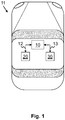
- a vehicle 11 as shown in Fig. 1 comprises a docking station 10, which may be arranged inside the vehicle 11, for instance close to the driver. Inside the vehicle 11 is further arranged a communication device 20 and a charging device 30.
- the communication device 20 and the charging device 30 may be arranged in the same device or in different devices.
- Each charging device 30 is connected to the docking station 10 by a charging interface 13.
- the connection to the communication device 20 and the charging device 30 is a wireless one.
- Each communication device 20 is connected to the docking station 10 by a communication interface 12.
- the communication interface 12 may support more than one commun ⁇ cation protocol.
- the communication interface 12 may support more communication protocols than the docking station 10 is able to support actively.
- the communication interface 12 may be configured to detect communication devices 20 only for determining their presence, in order to prevent their damaging and only optionally to communicate with them. The risk of being damaged may be caused by the charging interface 13, particularly by running the charging interface 13 in a high-power mode.
- the method depicted in a flow-diagram 50 of Fig. 2 shows an embodiment to run a docking station 10, where an example is shown, for instance, in Fig. 1 .
- the method starts in a step 51.
- the docking station 10 searches for a wireless communication device 20 that supports the wireless communication interface 12.
- a step 53 there is a branch depending on the result of this searching. If any wireless communication device 20 that supports the wireless communi-cation interface 12 has been found, the method goes to a step 54, otherwise to a step 56.
- the wireless docking station 10 searches for a wireless charging device 30 that supports the wireless charging interface 13 according to a first searching mode.
- the first searching mode may be a "safe" one, i.e.
- the wireless charging device 30 is charged according to a first charging mode.
- the first charging mode may be a "safe" one, i.e. with reduced risk (or no risk) of damaging communication devices 20 during charging. If no wireless charging device 30 that supports the wireless charging interface 13 has been found, the method goes to the step 52 again. After charging or - depending on the embodiment - during charging, the method goes to a joining step 58.
- the wireless docking station 10 searches for a wireless charging device 30 that supports the wireless charging interface 13 according to a second charging mode. If such a charging device 30 has been found, the wireless docking station 10 charges the charging device 30 according to a second charging mode.
- the second charging mode may be a "fast" one, i.e. with increased power transferred wirelessly via the charging interface 13. If no wireless charging device 30 that supports the wireless charging interface 13 has been found, the method goes to the step 52 again. After charging or - depending on the embodiment - during charging, the method goes to the joining step 58. After the joining step 58, the method goes to an end step 59. After the end step 59, the method may start again at the starting step 51.
- the method described here, or another method according to an embodiment may be run "quasi-continuously". This may include a "quasi-continuous" polling for charging devices 30 and/or communication devices 20.
Landscapes
- Engineering & Computer Science (AREA)
- Computer Networks & Wireless Communication (AREA)
- Signal Processing (AREA)
- Computer Security & Cryptography (AREA)
- Power Engineering (AREA)
- Charge And Discharge Circuits For Batteries Or The Like (AREA)
Abstract
wireless communication interface (12) and a wireless charging interface (13), wherein the wireless charging interface (13) supports a first searching mode and a second searching mode. The method comprises the steps of:
- Searching, by a wireless docking station (10), for a wireless communication device (20) that supports the wireless communication interface (12);
- If any wireless communication device (20) that supports the wireless communication interface (12) has been found, searching, by the wireless docking station (10), for a wireless charging device (30) according to the first searching mode; and
- If no wireless communication device (20) that supports the wireless communication interface (12) has been found, searching, by the wireless docking station (10), for a wireless charging device (30) according to the second searching mode.
Description
- The invention relates to a method for cooperative use of a wireless communication interface and a wireless charging interface, particularly in a vehicle. Furthermore, the invention relates to an apparatus, a vehicle, a program element, and a computer-readable medium.
- In at least some vehicles, there is a requirement to support wireless charging of electric devices such as smartphones, tablets, or other kind of electric devices. Wireless charging may be performed by using a protocol by the Wireless Power Consortium (WPC). However, at least some of these electric devices also support wireless communication interfaces. Some devices, which support at least some of these wireless communication interfaces, may be sensitive to the energy provided by the wireless charging. Examples may be devices that support the so-called Near Field Communication (NFC) interface and/or other wireless communication protocols. In at least some cases, these devices or parts of them, which are configured to support wireless communication protocols, may even have a higher risk to be damaged by wireless charging.
- One object of the invention is to provide a method for improving these drawbacks at least partly.
- This is solved by the subject-matter of the independent claims. Further advantageous embodiments result from dependent claims, the description, and the figures.
- A first aspect of the invention relates to a method for cooperative use of a wireless communication interface and a wireless charging interface, wherein the wireless charging interface supports a first searching mode and a second searching mode. The method comprises the steps of:
- Searching, by a wireless docking station, for a wireless communication device that supports the wireless communication interface;
- If any wireless communication device that supports the wireless communication interface has been found, searching, by the wireless docking station, for a wireless charging device according to the first searching mode; and
- If no wireless communication device that supports the wireless communication interface has been found, searching, by the wireless docking station, for a wireless charging device according to the second searching mode.
- The wireless communication interface may comprise an interface that supports wireless data communication protocols and/or other wireless communication protocols, such as speech and/or signal communication protocols. The wireless communication interface may comprise protocols like Wireless LAN (e.g. WLAN according to 802.11a/b/g/n or 802.11p), ZigBee, WiMax, Ultra-Wide Band (UWB), Bluetooth, Near Field Communication (NFC), GSM, UMTS, LTE, or others.
- The wireless charging interface may support a protocol by the Wireless Power Consortium (WPC). The wireless charging interface supports a first searching mode and a second searching mode. The first and the second searching mode is configured to find and/or detect an electric device that supports a charging protocol and/or the wireless charging interface. The first and the second searching mode may support the same searching protocol or a different searching protocol. The first searching mode is a low-power searching mode, i.e. the electric power used for searching, finding and/or detecting an electric device that supports the charging protocol is so low that there is only a low risk - at least for some devices a very low risk or even no risk - that the device's circuits and/or subsystems are damaged by the electric power used for the first searching mode, particularly the device's commun¬cation protocol circuits and/or communication protocol subsystems. The second searching mode may use a higher power or the same power than the first searching mode.
- The cooperative use of a wireless communication interface and a wireless charging interface comprises the support of at least one wireless communication protocol and at least one wireless charging protocol.
- The method comprises to search for a wireless communication device that supports the wireless communication interface. The searching for a wireless communication device depends on the wireless communication interface and/or its protocol suite. The searching is initiated and/or performed by the wireless docking station. The searching for a wireless communication device may comprise the searching for more than one wireless communication protocol. This may include to search for wireless communication devices whose protocols are not supported - at least not actively supported - by the wireless docking station.
- The wireless docking station may be placed at a desk, a table, and/or in a vehicle. For cars, trucks, ships or other vehicles it may be advantageous to place the wireless docking station close to the driver and/or some passenger. In some embodiments, the searching for the wireless communication device is the first step of the method. In some embodiments, the searching comprises a polling, i.e. the searching is performed in an iterative way.
- If any wireless communication device that supports the wireless communication interface has been found, the wireless docking station searches for a wireless charging device according to the first searching mode. This is advantageous, because the first searching mode is configured to use electric power that is so low, that there is only a low risk (or no risk) to damage the device's circuits and/or subsystems.
- If no wireless communication device that supports the wireless communication interface has been found, the wireless docking station searches for a wireless charging device according to the second searching mode. This is advantageous, because the searching performance may be improved by using the second searching mode.
- In an embodiment, the first searching mode supports searching with limited power, and the second searching mode supports searching with normal power. This embodiment has the advantage of, on the one hand, providing protection against high-power immission when necessary, and, on the other hand, enables high-power searching when possible without damaging devices.
- In an embodiment, the method comprises the further steps of:
- If any wireless charging device that supports the wireless charging interface and any wireless communication device that supports the wireless communication interface has been found, charging, by the wireless docking station, according to a first charging mode; and
- If any wireless charging device that supports the wireless charging interface and no wireless communication device that supports the wireless communication interface has been found, charging, by the wireless docking station, according to a second charging mode.
- The first charging mode is a low-power charging mode, i.e. the electric power used for charging the electric device that supports the charging protocol is so low that there is only a low risk - at least for some devices a very low risk or even no risk - that the device's circuits and/or subsystems are damaged by the electric power used for the first charging mode, particularly the risk that the device's communication protocol circuits and/or communication protocol subsystems are damaged.
- This embodiment is advantageous, because the charging speed may be improved by using the second charging mode. Thus, this method provides means for a quick charging, when feasible, and prevents at least some device's circuits and/or subsystems from being damaged, when such kind of devices are detected.
- In an embodiment, the method comprises the further steps of:
- When charging any wireless charging device according to the second charging mode,
- The second charging mode may be a high-power charging mode. Hence, there may be some risk to damage communication devices and/or parts of them. The searching for a wireless commun¬cation device may include to switch off (i.e. to pause) the charging according to the second charging mode, e.g. in a cyclic way, particularly in cases when charging according to the second charging mode is done with an electric power that is so high that it "shades" the searching for a wireless commun¬cation device. For instance, NFC search would not work while high power WPC charging is active. The length of the time-intervals between the switch-off or pausing periods may depend on an estimation how long commun¬cation devices may bear the high-power immission, caused by the second charging mode, without being damaged by this.
- Using this method is advantageous, because it prevents - due to its "quasi-continuous" polling - also communication devices from being damaged, that have come "later" into the reach of the charging device and, thus, have not been detected by the first searching for wireless devices. Whenever such "late" communication devices have been detected, the second charging mode is changed to the first charging mode, thus having only a low risk (or no risk) to damage the device's circuits and/or subsystems, even during charging.
- In an embodiment, the method comprises the further steps of:
- When charging any wireless charging device according to the first charging mode, searching, by the wireless docking station, for a wireless communication device that supports the wireless communication interface; and
- This method is advantageous, because it increases the charging speed, when feasible.
- In an embodiment, the wireless docking station is connected to more than one antenna that is configured to support the searching for any wireless communication device that supports the wireless communication interface.
- This is advantageous, because it increases the sensitivity for communication devices that may come across. This may be particularly advantageous when performed in combination with "quasi-continuous" polling for communication devices.
- In an embodiment, the first charging mode supports charging with limited power, and the second charging mode supports charging with normal power. This combines the advantages of quick charging, when feasible, with protecting sensitive communication devices.
- In an embodiment, the method comprises the further steps of:
- When charging any wireless charging device according to the first charging mode and/or the second charging mode,
- By this method, the charging periods are reduced to periods when there is a high necessity of charging. This may be combined with a kind of "hysteresis behaviour", i.e. the WPC- devices are not loaded when their energy store below 99 %, but only at lower load levels, e.g. below 95 %, 90 %, or 80 %. In addition, a kind of (real or virtual) button may be provided, which overrules this strategy.
- In an embodiment, the wireless communication interface is a Near Field Communication, NFC, interface. Devices with an NFC interface may be particularly sensitive against high-power immissions, because their devices may be designed for low-power applications.
- In an embodiment, the wireless charging interface is a Qi interface and/or supports an interface according to a Wireless Power Consortium, WPC, standard.
- In an embodiment, the wireless docking station is a Multi Function Smartdevice Terminal, MFST. The MFST may comprise design-elements that make it particularly advantageous for vehicles. Such design-elements may comprise some robustness against high and/or low temperatures and/or other vehicle-specifics.
- A further aspect of the invention relates to a Multi Function Smartdevice Terminal, MFST, that is configured to support a method according to any one of the preceding claims.
- A further aspect of the invention relates to a vehicle comprising a Multi Function Smartdevice Terminal, MFST, as described above. The vehicle may be a car, a bus, a truck, a multi-purpose vehicle, a ship or boat, an airplane or helicopter, or any kind of bike.
- A further aspect of the invention relates to a program element that is configured to perform a method as described above and/or below, when executed on a computing system.
- A further aspect of the invention relates to a computer-readable medium, where a program element as described above and/or below is stored on.
- The invention is further described by embodiments shown in the figures. These embodiments are shown as examples, but are not to be considered as limitations.
- The figures depict:
-
Fig. 1 depicts a schematic representation of a vehicle according to an embodiment; -
Fig. 2 depicts schematically a method according to an embodiment. - A
vehicle 11 as shown inFig. 1 comprises adocking station 10, which may be arranged inside thevehicle 11, for instance close to the driver. Inside thevehicle 11 is further arranged acommunication device 20 and a chargingdevice 30. Thecommunication device 20 and the chargingdevice 30 may be arranged in the same device or in different devices. There may be one orseveral communication devices 20 and/or chargingdevices 30 inside thevehicle 11, particularly within reach ofdocking station 10. Each chargingdevice 30 is connected to thedocking station 10 by a charginginterface 13. The connection to thecommunication device 20 and the chargingdevice 30 is a wireless one. - Each
communication device 20 is connected to thedocking station 10 by acommunication interface 12. Thecommunication interface 12 may support more than one commun¬cation protocol. Thecommunication interface 12 may support more communication protocols than thedocking station 10 is able to support actively. Thecommunication interface 12 may be configured to detectcommunication devices 20 only for determining their presence, in order to prevent their damaging and only optionally to communicate with them. The risk of being damaged may be caused by the charginginterface 13, particularly by running the charginginterface 13 in a high-power mode. - The method depicted in a flow-diagram 50 of
Fig. 2 shows an embodiment to run adocking station 10, where an example is shown, for instance, inFig. 1 . The method starts in astep 51. In astep 52, thedocking station 10 searches for awireless communication device 20 that supports thewireless communication interface 12. In astep 53, there is a branch depending on the result of this searching. If anywireless communication device 20 that supports the wireless communi-cation interface 12 has been found, the method goes to astep 54, otherwise to astep 56. In thestep 54, thewireless docking station 10 searches for awireless charging device 30 that supports thewireless charging interface 13 according to a first searching mode. The first searching mode may be a "safe" one, i.e. with reduced risk (or no risk) ofdamaging communication devices 20. If anywireless charging device 30 that supports thewireless charging interface 13 and anywireless communication device 20 that supports thewireless communication interface 12 has been found, thewireless charging device 30 is charged according to a first charging mode. The first charging mode may be a "safe" one, i.e. with reduced risk (or no risk) ofdamaging communication devices 20 during charging. If nowireless charging device 30 that supports thewireless charging interface 13 has been found, the method goes to thestep 52 again. After charging or - depending on the embodiment - during charging, the method goes to a joiningstep 58. - In the
step 56, thewireless docking station 10 searches for awireless charging device 30 that supports thewireless charging interface 13 according to a second charging mode. If such acharging device 30 has been found, thewireless docking station 10 charges the chargingdevice 30 according to a second charging mode. The second charging mode may be a "fast" one, i.e. with increased power transferred wirelessly via the charginginterface 13. If nowireless charging device 30 that supports thewireless charging interface 13 has been found, the method goes to thestep 52 again. After charging or - depending on the embodiment - during charging, the method goes to the joiningstep 58. After the joiningstep 58, the method goes to anend step 59. After theend step 59, the method may start again at the startingstep 51. The method described here, or another method according to an embodiment, may be run "quasi-continuously". This may include a "quasi-continuous" polling for chargingdevices 30 and/orcommunication devices 20. -
- 10
- docking station
- 11
- vehicle
- 12
- communication interface
- 13
- charging interface
- 20
- communication device
- 30
- charging device
if any wireless communication device has been found, changing from the second charging mode to the first charging mode.
if charging of any wireless charging device is no longer required and/or no wireless charging device is found, refrain from charging.
Claims (15)
- A method for cooperative use of a wireless communication interface (12) and a wireless charging interface (13), wherein the wireless charging interface (13) supports a first searching mode and a second searching mode, the method comprising the steps of:- Searching, by a wireless docking station (10), for a wireless communication device (20) that supports the wireless communication interface (12);- If any wireless communication device (20) that supports the wireless communication interface (12) has been found, searching, by the wireless docking station (10), for a wireless charging device (30) according to the first searching mode; and- If no wireless communication device (20) that supports the wireless communication interface (12) has been found, searching, by the wireless docking station (10), for a wireless charging device (30) according to the second searching mode.
- The method of claim 1,
wherein the first searching mode supports searching with limited power, and
wherein the second searching mode supports searching with normal power. - The method of claim 1 or 2, comprising the further steps of:- If any wireless charging device (30) that supports the wireless charging interface (13) and any wireless communication device (20) that supports the wireless communication interface (12) has been found, charging, by the wireless docking station (10), according to a first charging mode; and- If any wireless charging device (30) that supports the wireless charging interface (13) and no wireless communication device (20) that supports the wireless communication interface (12) has been found, charging, by the wireless docking station (10), according to a second charging mode.
- The method of claim 3, comprising the further steps of:- When charging any wireless charging device (30) according to the second charging mode,searching, by the wireless docking station (10), for a wireless communication device (20) that supports the wireless communication interface (12); and
if any wireless communication device (20) has been found, changing from the second charging mode to the first charging mode. - The method of claim 4, comprising the further step of:- Before searching for a wireless communication device (20), pausing the charging of the wireless charging device (30) according to the second charging mode.
- The method of claim 3, comprising the further steps of:- When charging any wireless charging device (30) according to the first charging mode,searching, by the wireless docking station (10), for a wireless communication device (20) that supports the wireless communication interface (12); and
if no wireless communication device is found, changing from the first charging mode to the second charging mode. - The method of claim 4, 5 or 6,
wherein the wireless docking station (10) is connected to more than one antenna that is configured to support the searching for any wireless communication device (20) that supports the wireless communication interface (12). - The method of any one of the preceding claims,
wherein the first charging mode supports charging with limited power, and
wherein the second charging mode supports charging with normal power. - The method of any one of the preceding claims, comprising the further step of:- When charging any wireless charging device (30) according to the first charging mode and/or the second charging mode,determining, by the wireless docking station (10), if charging of any wireless charging device (30) is still required; and
if charging of any wireless charging device (30) is no longer required and/or no wireless charging device is found, refrain from charging. - The method of any one of the preceding claims,
wherein the wireless communication interface (12) is a Near Field Communication, NFC, interface, and/or
wherein the wireless charging interface (13) is a Qi interface and/or supports an interface according to a Wireless Power Consortium, WPC, standard. - The method of any one of the preceding claims,
wherein the wireless docking station (10) is a Multi Function Smartdevice Terminal, MFST. - A Multi Function Smartdevice Terminal, MFST, that is configured to support a method according to any one of the preceding claims.
- A vehicle (11) comprising a Multi Function Smartdevice Terminal, MFST, according to claim 12.
- A program element that is configured to perform a method according to any one of claims 1 to 11, when executed on a computing system.
- A computer-readable medium, where a program element according to claim 14 is stored on.
Priority Applications (2)
| Application Number | Priority Date | Filing Date | Title |
|---|---|---|---|
| EP18465644.5A EP3672093B1 (en) | 2018-12-19 | 2018-12-19 | A method for cooperative use of a wireless communication interface and a wireless charging interface |
| US16/695,846 US11304119B2 (en) | 2018-12-19 | 2019-11-26 | Method for cooperative use of a wireless communication interface and a wireless charging interface |
Applications Claiming Priority (1)
| Application Number | Priority Date | Filing Date | Title |
|---|---|---|---|
| EP18465644.5A EP3672093B1 (en) | 2018-12-19 | 2018-12-19 | A method for cooperative use of a wireless communication interface and a wireless charging interface |
Publications (2)
| Publication Number | Publication Date |
|---|---|
| EP3672093A1 true EP3672093A1 (en) | 2020-06-24 |
| EP3672093B1 EP3672093B1 (en) | 2024-02-21 |
Family
ID=65041536
Family Applications (1)
| Application Number | Title | Priority Date | Filing Date |
|---|---|---|---|
| EP18465644.5A Active EP3672093B1 (en) | 2018-12-19 | 2018-12-19 | A method for cooperative use of a wireless communication interface and a wireless charging interface |
Country Status (2)
| Country | Link |
|---|---|
| US (1) | US11304119B2 (en) |
| EP (1) | EP3672093B1 (en) |
Citations (3)
| Publication number | Priority date | Publication date | Assignee | Title |
|---|---|---|---|---|
| WO2010093964A2 (en) * | 2009-02-13 | 2010-08-19 | Qualcomm Incorporated | Wireless power from renewable energy |
| US20160322853A1 (en) * | 2015-04-28 | 2016-11-03 | Intel Corporation | System and method for safe wireless charging station |
| US20180241223A1 (en) * | 2015-08-13 | 2018-08-23 | Lg Innotek Co., Ltd. | Wireless power transfer system and driving method therefor |
Family Cites Families (11)
| Publication number | Priority date | Publication date | Assignee | Title |
|---|---|---|---|---|
| US8983639B2 (en) * | 2008-12-14 | 2015-03-17 | Apple Inc. | Techniques for facilitating interoperation between a host device and a digital RF tuner accessory |
| US8335764B2 (en) * | 2010-03-19 | 2012-12-18 | International Business Machines Corporation | Multicast address search including multiple search modes |
| US8717987B2 (en) * | 2011-01-18 | 2014-05-06 | Qualcomm Incorporated | Femtocell beacon interference mitigation with out-of-band links |
| EP2744182B1 (en) * | 2012-12-13 | 2016-11-23 | Panasonic Corporation | Radio communication system and mobile information terminal |
| KR102076859B1 (en) * | 2013-04-17 | 2020-05-18 | 인텔렉추얼디스커버리 주식회사 | Apparatus and method for transmitting wireless power |
| US20160336807A1 (en) * | 2014-01-19 | 2016-11-17 | Powermat Technologies Ltd. | Wireless power outlet and method of transferring power thereby |
| US9281706B2 (en) * | 2014-01-23 | 2016-03-08 | Qualcomm Technologies International Ltd. | Object detection in a wireless charging field |
| US9939539B2 (en) * | 2014-04-04 | 2018-04-10 | Texas Instruments Incorporated | Wireless power receiver and/or foreign object detection by a wireless power transmitter |
| CN105140985B (en) * | 2015-08-05 | 2017-08-25 | 青岛海信移动通信技术股份有限公司 | Mobile terminal, can directly charge source adapter and charging method |
| US9953174B2 (en) * | 2015-08-31 | 2018-04-24 | Nxp B.V. | Method and system for in-band password management for inductive wireless charging |
| KR101683651B1 (en) * | 2015-10-21 | 2016-12-20 | 현대자동차주식회사 | Noise reducing apparatus and method of the wireless charging device |
-
2018
- 2018-12-19 EP EP18465644.5A patent/EP3672093B1/en active Active
-
2019
- 2019-11-26 US US16/695,846 patent/US11304119B2/en active Active
Patent Citations (3)
| Publication number | Priority date | Publication date | Assignee | Title |
|---|---|---|---|---|
| WO2010093964A2 (en) * | 2009-02-13 | 2010-08-19 | Qualcomm Incorporated | Wireless power from renewable energy |
| US20160322853A1 (en) * | 2015-04-28 | 2016-11-03 | Intel Corporation | System and method for safe wireless charging station |
| US20180241223A1 (en) * | 2015-08-13 | 2018-08-23 | Lg Innotek Co., Ltd. | Wireless power transfer system and driving method therefor |
Also Published As
| Publication number | Publication date |
|---|---|
| EP3672093B1 (en) | 2024-02-21 |
| US11304119B2 (en) | 2022-04-12 |
| US20200205057A1 (en) | 2020-06-25 |
Similar Documents
| Publication | Publication Date | Title |
|---|---|---|
| US9434263B2 (en) | Multi-mode battery charger | |
| CN105743151B (en) | Charging vehicle, charging system, and driving method of charging system | |
| US10390177B2 (en) | Alert for left-behind mobile device | |
| KR20150130144A (en) | Mobile terminal and method for controlling application for vehicle | |
| JPS63127625A (en) | On-vehicle adaptor for portable radio equipment | |
| US9277385B2 (en) | 911 assist by wireless charger with NFC in the vehicle | |
| CN105790799A (en) | Bluetooth Pairing System And Method | |
| US9887554B2 (en) | Power transmitting apparatus, power receiving apparatus, control methods therefor, programs, and storage medium | |
| EP4207539A1 (en) | Apparatus for managing battery pack | |
| JP6349384B2 (en) | Method and structure for controlling charging of an energy storage system | |
| US20130045683A1 (en) | Vehicle wireless hub | |
| JP2017073915A (en) | vehicle | |
| JP2014093686A (en) | On-vehicle communication device | |
| EP3672093B1 (en) | A method for cooperative use of a wireless communication interface and a wireless charging interface | |
| KR101867916B1 (en) | Detecting Module Of Attaching Or Detaching Service Plug Adhesion to Vehicle | |
| US12128789B2 (en) | Devices, systems, and methods for mitigating vehicle power loss in battery mode | |
| US10169998B2 (en) | System and method for configuring lane node tree | |
| WO2014208012A1 (en) | Communication device for vehicle | |
| EP4360958A1 (en) | Vehicle power management system and operation method thereof | |
| US12315267B2 (en) | Systems and methods for detecting obstacles in the vicinity of power cables | |
| CN215204457U (en) | Rectifying unit, vehicle-mounted charging device and vehicle | |
| US20220385201A1 (en) | Smart transformer device | |
| CN105025248A (en) | Wireless vehicle environment image system and display method thereof | |
| CN110213432A (en) | A kind of setting method of working frequency of chip, mobile terminal and storage medium | |
| US9973025B2 (en) | Power providing equipment, mobile device, operating method of mobile device |
Legal Events
| Date | Code | Title | Description |
|---|---|---|---|
| PUAI | Public reference made under article 153(3) epc to a published international application that has entered the european phase |
Free format text: ORIGINAL CODE: 0009012 |
|
| STAA | Information on the status of an ep patent application or granted ep patent |
Free format text: STATUS: THE APPLICATION HAS BEEN PUBLISHED |
|
| AK | Designated contracting states |
Kind code of ref document: A1 Designated state(s): AL AT BE BG CH CY CZ DE DK EE ES FI FR GB GR HR HU IE IS IT LI LT LU LV MC MK MT NL NO PL PT RO RS SE SI SK SM TR |
|
| AX | Request for extension of the european patent |
Extension state: BA ME |
|
| STAA | Information on the status of an ep patent application or granted ep patent |
Free format text: STATUS: REQUEST FOR EXAMINATION WAS MADE |
|
| 17P | Request for examination filed |
Effective date: 20210111 |
|
| RBV | Designated contracting states (corrected) |
Designated state(s): AL AT BE BG CH CY CZ DE DK EE ES FI FR GB GR HR HU IE IS IT LI LT LU LV MC MK MT NL NO PL PT RO RS SE SI SK SM TR |
|
| STAA | Information on the status of an ep patent application or granted ep patent |
Free format text: STATUS: EXAMINATION IS IN PROGRESS |
|
| 17Q | First examination report despatched |
Effective date: 20220307 |
|
| RAP1 | Party data changed (applicant data changed or rights of an application transferred) |
Owner name: CONTINENTAL AUTOMOTIVE TECHNOLOGIES GMBH |
|
| GRAP | Despatch of communication of intention to grant a patent |
Free format text: ORIGINAL CODE: EPIDOSNIGR1 |
|
| STAA | Information on the status of an ep patent application or granted ep patent |
Free format text: STATUS: GRANT OF PATENT IS INTENDED |
|
| RIC1 | Information provided on ipc code assigned before grant |
Ipc: H02J 50/80 20160101ALI20230914BHEP Ipc: H02J 50/40 20160101ALI20230914BHEP Ipc: H04B 5/00 20060101AFI20230914BHEP |
|
| INTG | Intention to grant announced |
Effective date: 20231005 |
|
| GRAS | Grant fee paid |
Free format text: ORIGINAL CODE: EPIDOSNIGR3 |
|
| GRAA | (expected) grant |
Free format text: ORIGINAL CODE: 0009210 |
|
| STAA | Information on the status of an ep patent application or granted ep patent |
Free format text: STATUS: THE PATENT HAS BEEN GRANTED |
|
| AK | Designated contracting states |
Kind code of ref document: B1 Designated state(s): AL AT BE BG CH CY CZ DE DK EE ES FI FR GB GR HR HU IE IS IT LI LT LU LV MC MK MT NL NO PL PT RO RS SE SI SK SM TR |
|
| REG | Reference to a national code |
Ref country code: GB Ref legal event code: FG4D |
|
| REG | Reference to a national code |
Ref country code: DE Ref legal event code: R081 Ref document number: 602018065484 Country of ref document: DE Owner name: CONTINENTAL AUTOMOTIVE TECHNOLOGIES GMBH, DE Free format text: FORMER OWNER: CONTINENTAL AUTOMOTIVE TECHNOLOGIES GMBH, 30165 HANNOVER, DE Ref country code: DE Ref legal event code: R081 Ref document number: 602018065484 Country of ref document: DE Owner name: AUMOVIO GERMANY GMBH, DE Free format text: FORMER OWNER: CONTINENTAL AUTOMOTIVE TECHNOLOGIES GMBH, 30165 HANNOVER, DE |
|
| REG | Reference to a national code |
Ref country code: CH Ref legal event code: EP |
|
| REG | Reference to a national code |
Ref country code: IE Ref legal event code: FG4D |
|
| REG | Reference to a national code |
Ref country code: DE Ref legal event code: R096 Ref document number: 602018065484 Country of ref document: DE |
|
| RAP4 | Party data changed (patent owner data changed or rights of a patent transferred) |
Owner name: CONTINENTAL AUTOMOTIVE TECHNOLOGIES GMBH |
|
| REG | Reference to a national code |
Ref country code: CH Ref legal event code: PK Free format text: DIE PUBLIKATION VOM 27.03.2024 WURDE AM 24.04.2024 IRRTUEMLICHERWEISE ERNEUT PUBLIZIERT. LA PUBLICATION DU 27.03.2024 A ETE REPUBLIEE PAR ERREUR LE 24.04.2024. LA PUBBLICAZIONE DEL 27.03.2024 E STATA ERRONEAMENTE RIPUBBLICATA IL 24.04.2024. |
|
| REG | Reference to a national code |
Ref country code: LT Ref legal event code: MG9D |
|
| REG | Reference to a national code |
Ref country code: NL Ref legal event code: MP Effective date: 20240221 |
|
| PG25 | Lapsed in a contracting state [announced via postgrant information from national office to epo] |
Ref country code: IS Free format text: LAPSE BECAUSE OF FAILURE TO SUBMIT A TRANSLATION OF THE DESCRIPTION OR TO PAY THE FEE WITHIN THE PRESCRIBED TIME-LIMIT Effective date: 20240621 |
|
| PG25 | Lapsed in a contracting state [announced via postgrant information from national office to epo] |
Ref country code: LT Free format text: LAPSE BECAUSE OF FAILURE TO SUBMIT A TRANSLATION OF THE DESCRIPTION OR TO PAY THE FEE WITHIN THE PRESCRIBED TIME-LIMIT Effective date: 20240221 |
|
| PG25 | Lapsed in a contracting state [announced via postgrant information from national office to epo] |
Ref country code: GR Free format text: LAPSE BECAUSE OF FAILURE TO SUBMIT A TRANSLATION OF THE DESCRIPTION OR TO PAY THE FEE WITHIN THE PRESCRIBED TIME-LIMIT Effective date: 20240522 |
|
| REG | Reference to a national code |
Ref country code: AT Ref legal event code: MK05 Ref document number: 1660009 Country of ref document: AT Kind code of ref document: T Effective date: 20240221 |
|
| PG25 | Lapsed in a contracting state [announced via postgrant information from national office to epo] |
Ref country code: NL Free format text: LAPSE BECAUSE OF FAILURE TO SUBMIT A TRANSLATION OF THE DESCRIPTION OR TO PAY THE FEE WITHIN THE PRESCRIBED TIME-LIMIT Effective date: 20240221 Ref country code: HR Free format text: LAPSE BECAUSE OF FAILURE TO SUBMIT A TRANSLATION OF THE DESCRIPTION OR TO PAY THE FEE WITHIN THE PRESCRIBED TIME-LIMIT Effective date: 20240221 Ref country code: RS Free format text: LAPSE BECAUSE OF FAILURE TO SUBMIT A TRANSLATION OF THE DESCRIPTION OR TO PAY THE FEE WITHIN THE PRESCRIBED TIME-LIMIT Effective date: 20240521 |
|
| PG25 | Lapsed in a contracting state [announced via postgrant information from national office to epo] |
Ref country code: ES Free format text: LAPSE BECAUSE OF FAILURE TO SUBMIT A TRANSLATION OF THE DESCRIPTION OR TO PAY THE FEE WITHIN THE PRESCRIBED TIME-LIMIT Effective date: 20240221 |
|
| PG25 | Lapsed in a contracting state [announced via postgrant information from national office to epo] |
Ref country code: AT Free format text: LAPSE BECAUSE OF FAILURE TO SUBMIT A TRANSLATION OF THE DESCRIPTION OR TO PAY THE FEE WITHIN THE PRESCRIBED TIME-LIMIT Effective date: 20240221 |
|
| PG25 | Lapsed in a contracting state [announced via postgrant information from national office to epo] |
Ref country code: RS Free format text: LAPSE BECAUSE OF FAILURE TO SUBMIT A TRANSLATION OF THE DESCRIPTION OR TO PAY THE FEE WITHIN THE PRESCRIBED TIME-LIMIT Effective date: 20240521 Ref country code: NO Free format text: LAPSE BECAUSE OF FAILURE TO SUBMIT A TRANSLATION OF THE DESCRIPTION OR TO PAY THE FEE WITHIN THE PRESCRIBED TIME-LIMIT Effective date: 20240521 Ref country code: NL Free format text: LAPSE BECAUSE OF FAILURE TO SUBMIT A TRANSLATION OF THE DESCRIPTION OR TO PAY THE FEE WITHIN THE PRESCRIBED TIME-LIMIT Effective date: 20240221 Ref country code: LT Free format text: LAPSE BECAUSE OF FAILURE TO SUBMIT A TRANSLATION OF THE DESCRIPTION OR TO PAY THE FEE WITHIN THE PRESCRIBED TIME-LIMIT Effective date: 20240221 Ref country code: IS Free format text: LAPSE BECAUSE OF FAILURE TO SUBMIT A TRANSLATION OF THE DESCRIPTION OR TO PAY THE FEE WITHIN THE PRESCRIBED TIME-LIMIT Effective date: 20240621 Ref country code: HR Free format text: LAPSE BECAUSE OF FAILURE TO SUBMIT A TRANSLATION OF THE DESCRIPTION OR TO PAY THE FEE WITHIN THE PRESCRIBED TIME-LIMIT Effective date: 20240221 Ref country code: GR Free format text: LAPSE BECAUSE OF FAILURE TO SUBMIT A TRANSLATION OF THE DESCRIPTION OR TO PAY THE FEE WITHIN THE PRESCRIBED TIME-LIMIT Effective date: 20240522 Ref country code: FI Free format text: LAPSE BECAUSE OF FAILURE TO SUBMIT A TRANSLATION OF THE DESCRIPTION OR TO PAY THE FEE WITHIN THE PRESCRIBED TIME-LIMIT Effective date: 20240221 Ref country code: ES Free format text: LAPSE BECAUSE OF FAILURE TO SUBMIT A TRANSLATION OF THE DESCRIPTION OR TO PAY THE FEE WITHIN THE PRESCRIBED TIME-LIMIT Effective date: 20240221 Ref country code: BG Free format text: LAPSE BECAUSE OF FAILURE TO SUBMIT A TRANSLATION OF THE DESCRIPTION OR TO PAY THE FEE WITHIN THE PRESCRIBED TIME-LIMIT Effective date: 20240221 Ref country code: AT Free format text: LAPSE BECAUSE OF FAILURE TO SUBMIT A TRANSLATION OF THE DESCRIPTION OR TO PAY THE FEE WITHIN THE PRESCRIBED TIME-LIMIT Effective date: 20240221 |
|
| PG25 | Lapsed in a contracting state [announced via postgrant information from national office to epo] |
Ref country code: PL Free format text: LAPSE BECAUSE OF FAILURE TO SUBMIT A TRANSLATION OF THE DESCRIPTION OR TO PAY THE FEE WITHIN THE PRESCRIBED TIME-LIMIT Effective date: 20240221 Ref country code: PT Free format text: LAPSE BECAUSE OF FAILURE TO SUBMIT A TRANSLATION OF THE DESCRIPTION OR TO PAY THE FEE WITHIN THE PRESCRIBED TIME-LIMIT Effective date: 20240621 |
|
| PG25 | Lapsed in a contracting state [announced via postgrant information from national office to epo] |
Ref country code: SE Free format text: LAPSE BECAUSE OF FAILURE TO SUBMIT A TRANSLATION OF THE DESCRIPTION OR TO PAY THE FEE WITHIN THE PRESCRIBED TIME-LIMIT Effective date: 20240221 Ref country code: PT Free format text: LAPSE BECAUSE OF FAILURE TO SUBMIT A TRANSLATION OF THE DESCRIPTION OR TO PAY THE FEE WITHIN THE PRESCRIBED TIME-LIMIT Effective date: 20240621 Ref country code: PL Free format text: LAPSE BECAUSE OF FAILURE TO SUBMIT A TRANSLATION OF THE DESCRIPTION OR TO PAY THE FEE WITHIN THE PRESCRIBED TIME-LIMIT Effective date: 20240221 Ref country code: LV Free format text: LAPSE BECAUSE OF FAILURE TO SUBMIT A TRANSLATION OF THE DESCRIPTION OR TO PAY THE FEE WITHIN THE PRESCRIBED TIME-LIMIT Effective date: 20240221 |
|
| PG25 | Lapsed in a contracting state [announced via postgrant information from national office to epo] |
Ref country code: DK Free format text: LAPSE BECAUSE OF FAILURE TO SUBMIT A TRANSLATION OF THE DESCRIPTION OR TO PAY THE FEE WITHIN THE PRESCRIBED TIME-LIMIT Effective date: 20240221 |
|
| PG25 | Lapsed in a contracting state [announced via postgrant information from national office to epo] |
Ref country code: SM Free format text: LAPSE BECAUSE OF FAILURE TO SUBMIT A TRANSLATION OF THE DESCRIPTION OR TO PAY THE FEE WITHIN THE PRESCRIBED TIME-LIMIT Effective date: 20240221 |
|
| PG25 | Lapsed in a contracting state [announced via postgrant information from national office to epo] |
Ref country code: EE Free format text: LAPSE BECAUSE OF FAILURE TO SUBMIT A TRANSLATION OF THE DESCRIPTION OR TO PAY THE FEE WITHIN THE PRESCRIBED TIME-LIMIT Effective date: 20240221 Ref country code: CZ Free format text: LAPSE BECAUSE OF FAILURE TO SUBMIT A TRANSLATION OF THE DESCRIPTION OR TO PAY THE FEE WITHIN THE PRESCRIBED TIME-LIMIT Effective date: 20240221 |
|
| PG25 | Lapsed in a contracting state [announced via postgrant information from national office to epo] |
Ref country code: SK Free format text: LAPSE BECAUSE OF FAILURE TO SUBMIT A TRANSLATION OF THE DESCRIPTION OR TO PAY THE FEE WITHIN THE PRESCRIBED TIME-LIMIT Effective date: 20240221 |
|
| PG25 | Lapsed in a contracting state [announced via postgrant information from national office to epo] |
Ref country code: SM Free format text: LAPSE BECAUSE OF FAILURE TO SUBMIT A TRANSLATION OF THE DESCRIPTION OR TO PAY THE FEE WITHIN THE PRESCRIBED TIME-LIMIT Effective date: 20240221 Ref country code: SK Free format text: LAPSE BECAUSE OF FAILURE TO SUBMIT A TRANSLATION OF THE DESCRIPTION OR TO PAY THE FEE WITHIN THE PRESCRIBED TIME-LIMIT Effective date: 20240221 Ref country code: RO Free format text: LAPSE BECAUSE OF FAILURE TO SUBMIT A TRANSLATION OF THE DESCRIPTION OR TO PAY THE FEE WITHIN THE PRESCRIBED TIME-LIMIT Effective date: 20240221 Ref country code: EE Free format text: LAPSE BECAUSE OF FAILURE TO SUBMIT A TRANSLATION OF THE DESCRIPTION OR TO PAY THE FEE WITHIN THE PRESCRIBED TIME-LIMIT Effective date: 20240221 Ref country code: DK Free format text: LAPSE BECAUSE OF FAILURE TO SUBMIT A TRANSLATION OF THE DESCRIPTION OR TO PAY THE FEE WITHIN THE PRESCRIBED TIME-LIMIT Effective date: 20240221 Ref country code: CZ Free format text: LAPSE BECAUSE OF FAILURE TO SUBMIT A TRANSLATION OF THE DESCRIPTION OR TO PAY THE FEE WITHIN THE PRESCRIBED TIME-LIMIT Effective date: 20240221 |
|
| REG | Reference to a national code |
Ref country code: DE Ref legal event code: R097 Ref document number: 602018065484 Country of ref document: DE |
|
| PG25 | Lapsed in a contracting state [announced via postgrant information from national office to epo] |
Ref country code: IT Free format text: LAPSE BECAUSE OF FAILURE TO SUBMIT A TRANSLATION OF THE DESCRIPTION OR TO PAY THE FEE WITHIN THE PRESCRIBED TIME-LIMIT Effective date: 20240221 |
|
| PLBE | No opposition filed within time limit |
Free format text: ORIGINAL CODE: 0009261 |
|
| STAA | Information on the status of an ep patent application or granted ep patent |
Free format text: STATUS: NO OPPOSITION FILED WITHIN TIME LIMIT |
|
| PG25 | Lapsed in a contracting state [announced via postgrant information from national office to epo] |
Ref country code: IT Free format text: LAPSE BECAUSE OF FAILURE TO SUBMIT A TRANSLATION OF THE DESCRIPTION OR TO PAY THE FEE WITHIN THE PRESCRIBED TIME-LIMIT Effective date: 20240221 |
|
| 26N | No opposition filed |
Effective date: 20241122 |
|
| PG25 | Lapsed in a contracting state [announced via postgrant information from national office to epo] |
Ref country code: SI Free format text: LAPSE BECAUSE OF FAILURE TO SUBMIT A TRANSLATION OF THE DESCRIPTION OR TO PAY THE FEE WITHIN THE PRESCRIBED TIME-LIMIT Effective date: 20240221 |
|
| PG25 | Lapsed in a contracting state [announced via postgrant information from national office to epo] |
Ref country code: MC Free format text: LAPSE BECAUSE OF FAILURE TO SUBMIT A TRANSLATION OF THE DESCRIPTION OR TO PAY THE FEE WITHIN THE PRESCRIBED TIME-LIMIT Effective date: 20240221 |
|
| REG | Reference to a national code |
Ref country code: CH Ref legal event code: PL |
|
| PG25 | Lapsed in a contracting state [announced via postgrant information from national office to epo] |
Ref country code: LU Free format text: LAPSE BECAUSE OF NON-PAYMENT OF DUE FEES Effective date: 20241219 |
|
| REG | Reference to a national code |
Ref country code: BE Ref legal event code: MM Effective date: 20241231 |
|
| PG25 | Lapsed in a contracting state [announced via postgrant information from national office to epo] |
Ref country code: BE Free format text: LAPSE BECAUSE OF NON-PAYMENT OF DUE FEES Effective date: 20241231 |
|
| PG25 | Lapsed in a contracting state [announced via postgrant information from national office to epo] |
Ref country code: CH Free format text: LAPSE BECAUSE OF NON-PAYMENT OF DUE FEES Effective date: 20241231 |
|
| PG25 | Lapsed in a contracting state [announced via postgrant information from national office to epo] |
Ref country code: IE Free format text: LAPSE BECAUSE OF NON-PAYMENT OF DUE FEES Effective date: 20241219 |
|
| PGFP | Annual fee paid to national office [announced via postgrant information from national office to epo] |
Ref country code: GB Payment date: 20251223 Year of fee payment: 8 |
|
| PGFP | Annual fee paid to national office [announced via postgrant information from national office to epo] |
Ref country code: FR Payment date: 20251223 Year of fee payment: 8 |
|
| REG | Reference to a national code |
Ref country code: DE Ref legal event code: R081 Ref document number: 602018065484 Country of ref document: DE Owner name: AUMOVIO GERMANY GMBH, DE Free format text: FORMER OWNER: CONTINENTAL AUTOMOTIVE TECHNOLOGIES GMBH, 30175 HANNOVER, DE |
|
| PGFP | Annual fee paid to national office [announced via postgrant information from national office to epo] |
Ref country code: DE Payment date: 20251231 Year of fee payment: 8 |