EP3672003B1 - Use of a feed through for casting into a wall element - Google Patents
Use of a feed through for casting into a wall element Download PDFInfo
- Publication number
- EP3672003B1 EP3672003B1 EP18213036.9A EP18213036A EP3672003B1 EP 3672003 B1 EP3672003 B1 EP 3672003B1 EP 18213036 A EP18213036 A EP 18213036A EP 3672003 B1 EP3672003 B1 EP 3672003B1
- Authority
- EP
- European Patent Office
- Prior art keywords
- section
- fold
- protective tube
- item
- step according
- Prior art date
- Legal status (The legal status is an assumption and is not a legal conclusion. Google has not performed a legal analysis and makes no representation as to the accuracy of the status listed.)
- Active
Links
Images

Classifications
-
- H—ELECTRICITY
- H02—GENERATION; CONVERSION OR DISTRIBUTION OF ELECTRIC POWER
- H02G—INSTALLATION OF ELECTRIC CABLES OR LINES, OR OF COMBINED OPTICAL AND ELECTRIC CABLES OR LINES
- H02G3/00—Installations of electric cables or lines or protective tubing therefor in or on buildings, equivalent structures or vehicles
- H02G3/22—Installations of cables or lines through walls, floors or ceilings, e.g. into buildings
-
- F—MECHANICAL ENGINEERING; LIGHTING; HEATING; WEAPONS; BLASTING
- F16—ENGINEERING ELEMENTS AND UNITS; GENERAL MEASURES FOR PRODUCING AND MAINTAINING EFFECTIVE FUNCTIONING OF MACHINES OR INSTALLATIONS; THERMAL INSULATION IN GENERAL
- F16L—PIPES; JOINTS OR FITTINGS FOR PIPES; SUPPORTS FOR PIPES, CABLES OR PROTECTIVE TUBING; MEANS FOR THERMAL INSULATION IN GENERAL
- F16L5/00—Devices for use where pipes, cables or protective tubing pass through walls or partitions
- F16L5/02—Sealing
Definitions
- the present invention relates to a feedthrough for pouring into a wall element and passing a line through it.
- the implementation is usually poured in during the production of the wall element, for example when it is cast from concrete.
- the bushing can be mounted on formwork and is then structurally integrated into the concrete wall. It keeps a passage opening between the opposite side surfaces of the wall through which a cable or other line can then be laid.
- the DE 21 20 070 A1 relates to a bushing with an accordion-shaped insulating tube, which is cast into the bushing and then pulled out to seal against a cable or pipe.
- the DE 30 05 144 A1 also relates to a bushing that has connecting pieces which are folded out after the bushing has been poured.
- the EP 3 255 330 A1 relates to a cylindrical sealing sleeve which has everting sections at its ends.
- the US 5,941,535 A concerns a bushing for concrete tanks in sewage treatment plants, through which a pipe is laid after pouring.
- the US 2015/263498 A1 relates to a water-protected or water-tight housing for electrical cables, which is equipped with a fitting.
- the EP 3 061 890 A1 concerns a bushing that is pre-equipped with several fittings and is cast into a wall.
- the FR 2 557 388 A1 concerns a feedthrough for telecommunications cables that are routed in protective tubes and sealed with shrink tubing.
- the DE 100 07 527 A1 relates to a press seal with a removable elastomer insert, with a protective tube being positioned on the press seal.
- the present invention is based on the technical problem of specifying a particularly advantageous use or implementation as the object of use.
- the bushing has an everted section which is everted during the pouring of the bushing and is everted after pouring, with a protective tube then being inserted into the everted everted section.
- the actual cable is laid in the protective tube, such as the cable in the example at the beginning.
- step i the implementation in the indented state (step i) is compact, which can simplify shuttering, for example. Installation in wall elements with a comparatively small thickness is also possible. However, the everted section can then be easily accessible, which can simplify the insertion of the protective tube or any attachment thereof.
- the protective tube is typically placed in a trench or under otherwise cramped conditions (e.g. several protective tubes next to or on top of each other, see below) are guided to the wall element, which is why good and easy handling is an advantage.
- everting out the everting section is also a comparatively simple process; for example, a connecting sleeve or the like does not have to be laboriously mounted on the cast-in bushing.
- This can also be advantageous, for example, in terms of reducing the number of connection points; Especially when working on the ground, every connection point increases the risk of possible contamination during assembly and thus a possible later leak.
- the protective tube can, for example, have an outer diameter of at least 50 mm, 70 mm, 90 mm or 100 mm, with possible (independent) upper limits at e.g. B. a maximum of 300 mm, 250 mm, 200 mm or 180 mm (increasingly preferred in the order in which they are mentioned).
- the everted section has a suitable inner diameter and can also be stretched slightly when the protective tube is inserted. In the diameter range mentioned, on the one hand, everting may be possible (it becomes increasingly difficult with smaller diameters), but on the other hand, the forces caused by the weight of the protective tube are not too great.
- the everted everting section is preferably attached to the protective tube; particularly preferably, a clamping means is arranged on an outer wall surface of the everting section, with which the everting section is pressed onto the protective tube. An inner wall surface of the everting section then rests reliably and sealingly against an outer wall surface of the protective tube.
- a tensioning band or a tensioning clamp (with a screw drive), for example, can be provided as a tensioning device.
- inside and outside refer to directions perpendicular to a tube axis of the protective tube and pointing away from it (hereinafter also referred to as “radial directions”).
- the pipe axis which, for example, also coincides with a longitudinal axis of the through opening kept free of the bushing, results from the orientation of the protective pipe where it is inserted into the everted section (to what extent the protective pipe is then spaced from the wall, e.g. curved, extends). is therefore irrelevant).
- a "longitudinal direction of the line” referred to below is preferably parallel to the pipe axis (in practice, of course, there may be no further relevant deviations from exact parallelism in the present context).
- the “inside”/“outside” assignment is based on the inverted state (the inner wall surface can therefore be turned outwards, see below).
- the specification “circumferential” refers to a revolution around the pipe axis.
- the everting section is preferably a part or section of an everting sleeve. This is made of an elastomeric material, preferably it has a substantially hollow cylindrical shape (i.e. a circular shape in the section just mentioned). To form a film hinge, the wall thickness of the inverting sleeve can be locally reduced when viewed in an axial section, compared to the inverting section and/or an assembly section (see below).
- an inverted sleeve i.e. a sleeve formed entirely from the elastomeric material
- the inverted section could generally also be molded directly onto a tubular element made of hard plastic as an elastomeric part. So, for example, in a 2K injection molding process, a pipe element made of hard plastic and the everting section made of, for example, a thermoplastic elastomer, could be injection molded onto it.
- the inverted sleeve (with mounting section, etc.) could be molded directly onto the tubular element, but they are preferably separately manufactured, assembled parts.
- the “elastomeric material” is generally a plastic with elastic behavior. Its Shore hardness (Shore A) can be, for example, a maximum of 90 Shore, 80 Shore, 75 Shore or 70 Shore and (independently) at least 20 Shore, 25 Shore, 30 Shore, 35 Shore or 40 Shore . It can be, for example, a rubber material, preferably a synthetic rubber, such as EPDM (ethylene-propylene-diene, M group). However, it can also be, for example, a thermoplastic elastomer (TPE) or a silicone-based material, such as silicone rubber or silicone elastomer.
- TPE thermoplastic elastomer
- the pipe element can, for example, have a Shore hardness (D) of at least 50 Shore, 60 Shore or 70 Shore, with possible upper limits of a maximum of 85 Shore or 80 Shore, at least in the case of plastic.
- the everting section is arranged inside the wall element in the step according to number i.) and then outside the wall element in the step according to number ii.).
- the inverted section protrudes outwards and is therefore particularly easily accessible, in particular for placing or operating a clamping device.
- the everting section is part of an everting sleeve (see above), this everting sleeve having a circumferential lip which is monolithically shaped with the everting section.
- This lip rests against the formwork when pouring.
- the unloaded state i.e. when no formwork element is pressing against it, it extends towards its free end, preferably obliquely outwards, i.e. in the direction of the everted everting section and away from the pipe axis.
- the lip is preferably arranged radially outside the film hinge of the inverting sleeve, so that it remains easily movable when kept free of the casting material.
- “monolithic” means free of internal material boundaries, i.e. material boundaries between different materials or materials with different manufacturing histories, at least apart from statistically distributed inclusions (e.g. dye particles).
- the “monolithic” sleeve is preferably a molded part that is produced in one step by casting or pressing into a mold.
- the feedthrough has a toothed ring.
- the protective tube is inserted into this in the step according to point iii.), the toothed ring then keeps it secured against slipping out.
- the force required to pull the protective tube out of the toothed ring is greater than the force required to push it in; for example, it can be at least 2, 4, 6, 8 or 10 times as much (with possible upper limits, for example . at most 1000, 500, 100 or 50 times).
- the toothed ring has a large number of teeth distributed all around (at least 10, 20, 30, 40 or 50, with possible upper limits of e.g. a maximum of 500 or 100), which latch onto the protective tube after it has been inserted (as soon as it is...
- the toothed ring can reliably hold the inserted protective tube, which can also be an advantage during assembly, for example.
- pressing the everting section onto the inserted protective tube using a clamping device, see above
- fixing it using a toothed ring are combined measures, whereby the toothed ring can also simplify the subsequent pressing of the everting section (it holds the protective tube and thus prevents assembly errors).
- an advantage of the toothed ring is the automatic fixation achieved simply by inserting the protective tube.
- a toothed ring made of a hard plastic is also conceivable, especially in the case of a protective tube intended as a corrugated tube or spiral hose.
- the toothed ring is a metal part.
- a milled part is also conceivable, but the toothed ring is preferably machined from a sheet metal, for example by laser cutting or preferably stamping (the toothed ring is then a stamped part).
- the toothed ring can preferably be self-contained all around, but in general it can also be provided with a parting line (or even in several parts).
- the teeth of the toothed ring still have an orientation corresponding to the surface material or sheet metal before the protective tube is inserted, i.e. are not bent out of the plane or are at most slightly bent out of the plane. For example, they can extend inwards at an angle, in particular perpendicular to the pipe axis, and then when pushed in of the protective tube must be bent in the direction of insertion (and create a claw in the opposite direction).
- the teeth of the toothed ring intended as a laser or stamped part are preferably already bent beforehand, so, for example, when viewed in an axial section, they have a horizontal U or V shape. This shape is closed against the insertion direction, i.e. open in the insertion direction. The protective tube slides along the teeth when it is pushed in; in the opposite direction, they latch on.
- the indented inverted section covers the toothed ring on the inside; this is protected during pouring or beforehand (storage and transport).
- the toothed ring could, for example, also be molded into the sealing sleeve or into a tubular element of the bushing, for example overmolded as an insert. It is preferably a separate, inserted part (also independent of the cover on the inside).
- the preferred cover on the inside can also help ensure that the toothed ring does not slip or fall out, i.e. that it sits in the desired position when the protective tube is inserted.
- a closure is inserted into the inserted everting section, which closes the feedthrough to this side of the wall element (to the side from which the protective tube is inserted).
- This can be, for example, a pipe closure cover, a lamella plug or even a foam body, such as a blank made of expanded polypropylene. If a toothed ring is provided, the cover just discussed can also advantageously prevent the closure from getting caught due to the indented inverted section.
- the everting section is part of a sealing sleeve (see above) and the toothed ring is arranged in a mounting section of the sealing sleeve.
- This assembly section sits within the wall element both in the step according to point i.) and in that according to iii.) and is then stable embedded.
- the toothed ring arranged there can hold the protective tube reliably.
- the protective tube is pushed in so far that the end of the protective tube then lies within the wall element.
- the end of the protective tube inserted through the everted section comes to lie within the wall element and is therefore arranged there when the protective tube is fully or fully inserted (in this position, according to the invention, the line is laid through the protective tube and in particular sealed against the bushing) .
- the protective tube is therefore inserted a piece into a passage opening that is kept free of the passage in the casting material (usually concrete), so that according to the invention, the wall element itself takes on a stabilizing or supporting function.
- the latter can be particularly advantageous in comparison to attaching a separate pipe sleeve, which was described at the beginning as an alternative solution.
- the support function can be advantageous, for example, during the construction phase if, for example, a transverse load occurs due to improper handling (entering the protective pipe) or afterwards, for example due to the soil sinking due to insufficient compaction.
- the everting section is part of an everting sleeve with a mounting section.
- the protective tube is preferably pushed into the assembly section (regardless of whether without or preferably with a toothed ring there).
- the slip sleeve or the mounting section preferably forms a stop up to which the protective tube is inserted.
- an inwardly protruding, circumferential (preferably completely circumferential) elevation is provided on an inner wall surface of the mounting section.
- this can ensure a contact with the then inserted protective tube, for example also have relevance with regard to the tightness.
- it can be used in combination
- several elevations are provided, particularly preferably exactly two, and the toothed ring is then axially secured between them.
- a recess is provided on an inner wall surface of the everting section, in which the elevation is arranged on the inner wall surface of the mounting section when the everting section is indented, i.e. its inner wall surface is turned outwards (see also the above comments).
- the recess represents an inwardly open groove; in the everted state it is open to the outside (and accommodates the elevation).
- these can each be assigned their own recess or they can also be arranged in a common recess.
- a toothed ring is provided, this is also preferably arranged in a recess on the inner wall surface of the inverted everting section, particularly preferably together with the elevation(s) axially surrounding it.
- a tab is arranged on the everting section, on which the everted everting section can be gripped for everting, preferably by hand (or with pliers).
- the tab is preferably arranged at its axial end and extends radially outwards.
- the feedthrough preferably has a tubular element which remains in the wall element after it has been poured into it, i.e. is not removed.
- the everting sleeve and the tubular element have an axial overlap; in any case, the everted everting section then protrudes axially relative to the tubular element.
- the tubular element is preferably made of a hard plastic material, e.g. B. ABS or PVC.
- such a pipe element of the feedthrough can also keep the entire through opening free and the inverted sleeve or the inverted inverted section can be arranged radially within it.
- a mounting section of the sleeve delimits at least a section of the through opening in the wall element.
- the potting material therefore lies against an outer wall surface of the mounting section when pouring.
- the inverting sleeve which is made of a soft material with regard to invertability, forms an interface to the casting material. This hardens after casting, which can result in shrinkage.
- the soft material of the sleeve can then remain in contact with the hardened casting material with a certain degree of elasticity, thus helping to prevent gap formation and thus possible creep paths for moisture.
- a combination with inserting the protective tube into the mounting section and thus into the wall element can be particularly advantageous, because then the inserted protective tube also presses the mounting section outwards and thus into contact with the hardened casting material.
- an outwardly rising, preferably completely self-contained, circumferential web seal is provided on the outer wall surface of the mounting section, on which the potting material is applied.
- the web seal is enclosed axially and towards the outside by the casting material.
- several web seals can be provided, i.e. at least two and, for example, not more than five or four, three are particularly preferred.
- the inserted protective tube can then also push the web seals slightly outwards and thus into a sealing system.
- a respective web seal can widen towards its free end, i.e. then sit in the hardened casting material with an undercut.
- a respective web seal preferably rises without an undercut, because this significantly simplifies the manufacturability of the bushing or sleeve in a forming process, However, there is no loss of sealing, especially in connection with the pressure to the outside through the inserted protective tube.
- the mounting section of the slip sleeve is mounted on a tubular element of the bushing, so the tubular element supports the mounting section radially inwards during pouring.
- the tubular element is preferably arranged only in one section of the assembly section (not in the entire assembly section) and the protective tube is inserted into another section, see above.
- the tubular element supports the inverted sleeve during pouring, but then remains in the wall element together with the inverted sleeve; The two are therefore permanently structurally integrated, for example surrounded by concrete.
- the permanently installed pipe element can, for example, also be advantageous with a view to later guiding or threading the cable through, namely preventing the individual components of the bushing from slipping within the wall element (the end of the pipe could get caught and individual parts could move, creating the pipe element). this provides additional stability).
- the everting section when the everting section is everted from the retracted to the everted state, exactly one film hinge is everted.
- This can, for example, represent a certain disadvantage compared to everting out around two film hinges (double everting) in that the outer wall surface (everded state) is turned inwards in the everted state.
- no clamping clamp can then be placed as an integral part in the indented state, which automatically sits in the right place after being indented.
- double eversion Simple everting is nevertheless preferred in terms of stability. Since the everted everting section and the mounting section are then essentially aligned axially with one another, the protective tube inserted into the mounting section can then be supported radially in this and thus in the wall element without significant play.
- the inverting sleeve is equipped with a further inverting section at its end opposite the inverting section.
- this serves to adapt to the pipe element of the bushing. If the tubular element of the bushing has a smaller outside diameter, the further inverted section can be indented and the inverted sleeve can thus be placed in contact with the tubular element. This can be the case in particular with thicker walls if a pipe socket arranged on a flange plate does not itself or alone form the pipe element, but an extension pipe is also inserted, see also the exemplary embodiment for illustration.
- the flange plate with pipe socket is opposite the end into which the protective pipe is inserted.
- Such a flange plate which lies as part of the passage after pouring on the opposite side surface of the wall element, can generally be preferred.
- the flange plate can be used for mounting on a formwork element; on the other hand, the feedthrough can also be assembled in a modular manner via the flange plate with other feedthroughs.
- form-fitting elements can be provided on the outer edges of the flange plate, preferably all bushings or flange plates of a module are identical in construction, i.e. each form-fitting element has form-fitting element parts that are complementary to one another (male/female).
- the above-discussed pipe element of the bushing or at least a section (pipe socket) thereof is preferably provided in one piece or monolithically with the flange plate, even regardless of whether it is equipped with form-fitting elements etc.
- another piece of pipe can then be connected to the pipe socket of the flange plate be assembled to provide a longer pipe element for thicker walls.
- the sleeve can sit on the pipe socket of the flange plate itself (thin walls) or on a piece of pipe assembled with it (thick walls).
- the wall element is an outer wall of a building, i.e. a room that is enclosed on several sides, preferably as a whole.
- a residential building is also conceivable; it is preferably a technical building, for example a transformer station.
- the protective tube extends to the outside of the building, and the folding section is also turned out towards the outside of the building.
- a seal is preferably placed on the bushing, which then seals the line against the bushing. This can be done, for example, with a press seal (elastomer body that is axially compressed with clamping bolts and creates a radial seal), or a shrink tube insert can also be used, for example.
- the wall element is preferably cast from concrete, with the bushing preferably being attached to a formwork which is removed after the wall element has been cast.
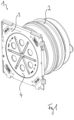
- Figure 1 shows an implementation 1 in an oblique view.
- the bushing 1 has an inverted sleeve 2, discussed in detail below, which is pushed onto a tubular element 20, see also the section Figure 2 .
- the pipe element 20 extends away from a flange plate 3, with which the bushing 1 rests against a formwork when poured into a wall element, see also Figure 3 for illustration.
- the bushing 1 is closed at the end with the flange plate 3 with a closure cover 4. This can be removed after concreting and the actual line can then be laid.
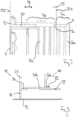
- FIG. 2 the concrete wall element 21 is indicated by dashed lines.
- An inverted section 2a is, based on a longitudinal direction 22 of the line, in the situation according to Figure 2 arranged outside the wall element 21.
- a mounting section 2b of the slip sleeve 2 lies within it.
- the inverting section 2a is also arranged within the wall element 21, namely it is indented inwards.
- the inverting section 2a and the mounting section 2b are connected to one another via a film hinge 2c.
- an inner wall surface 2aa of the inverting section 2a rests on an inner wall surface 2ba of the mounting section 2b. Since the bushing 1 is cast in with the inverted section 2a, a flat formwork element can be placed on both side surfaces 21.1, 21.2 of the wall element, which simplifies the formwork. Small wall thicknesses are also possible.
- a closure (not shown here) can also be inserted into the indented everting section 2a, which covers the bushing 1 in the illustration Figure 2 closed to the right side. This is then removed after pouring and the everting section 2a is turned out.
- a protective tube 31 can then be inserted from the outside of the building 30, namely into the assembly section 2b and thus into the wall element 21.
- the protective tube 31 is thus kept stable even against transverse forces.
- a clamping means 32 is arranged, which presses the everting section 2a onto the protective tube 31.
- the concrete borders the outer wall surface 2bb of the mounting section 2b, with the inserted protective tube 31 also causing an outward pressure and thus a tightness of this interface.
- Figure 4 shows the implementation 1 again in a side view on the outer wall surface 2bb of the mounting section 2b, web seals 40.1-40.3 can be seen, which together form a multi-web seal. This is also pressed towards the outside in a sealing manner by the inserted protective tube 31.
- a circumferential lip 41 can be seen, which rests against a formwork when the bushing 1 is poured.
- a tab 42 can be seen at the end of the everted section 2a, which makes it easier for a fitter to evert it.
- the everting sleeve is provided with a further everting section 2d, which hangs on the mounting section 2b via a film hinge 2e.
- the further everting section 2d can be everted to adapt to a tubular element with a smaller diameter.
- a clamping means can be arranged on the outside of the further everting section 2a in order to fix the everting sleeve 2 relative to the tubular element.
- the sectioned oblique view according to Figure 5 also allows features arranged on the inside to be recognized.
- the sleeve forms a stop 50 up to which the protective tube 31 can be inserted.
- two circumferential elevations 51 are formed on the inner wall surface 2ba in the mounting section 2b, which may be of interest, for example, with regard to a sealing contact with the protective tube 31.
- complementary depressions 52 are provided, in which the elevations 51 come to rest when the everting section 2a is indented.
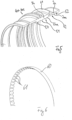
- Figure 6 shows a section of a toothed ring 60, namely from a Figure 5 opposite direction of view, i.e. from the direction from which the protective tube 31 is inserted.
- the toothed ring 60 is arranged in the mounting section 2b on the inside and between the elevations 51.
- the toothed ring 60 is in the present case formed as a punched and bent sheet metal part. It has a large number of teeth 61 all around, along which the protective tube 31 can slide when inserted, but which, when moved in opposite directions, claw into its outer wall surface.
- the toothed ring 60 holds the protective tube 31 in position after insertion, even before the clamping means 32 presses the everting section 2ab onto the protective tube 31.
- the toothed ring 60 can be arranged in the mounting section 2b between the elevations 51, in which case the depressions 52 can also be combined in the inverting section 2a, so the two elevations 51 together with the toothed ring 60 can be placed in a common depression 52.
Landscapes
- Engineering & Computer Science (AREA)
- Architecture (AREA)
- Civil Engineering (AREA)
- Structural Engineering (AREA)
- Forms Removed On Construction Sites Or Auxiliary Members Thereof (AREA)
Description
Die vorliegende Erfindung betrifft eine Durchführung zum Eingießen in ein Wandelement und Hindurchführen einer Leitung.The present invention relates to a feedthrough for pouring into a wall element and passing a line through it.
Das Eingießen der Durchführung erfolgt in der Regel im Zuge der Herstellung des Wandelements, wenn dieses also bspw. aus Beton gegossen wird. Die Durchführung kann dabei an einer Schalung montiert werden, anschließend sitzt sie baulich integriert in der Betonwand. Sie hält eine Durchgangsöffnung zwischen den einander entgegengesetzten Seitenflächen der Wand frei, durch die dann ein Kabel oder eine anderweitige Leitung verlegt werden kann.The implementation is usually poured in during the production of the wall element, for example when it is cast from concrete. The bushing can be mounted on formwork and is then structurally integrated into the concrete wall. It keeps a passage opening between the opposite side surfaces of the wall through which a cable or other line can then be laid.
Die
Die
Die
Die
Die
Die
Die
Die
Der vorliegenden Erfindung liegt das technische Problem zugrunde, eine besonders vorteilhafte Verwendung bzw. Durchführung als Gegenstand der Verwendung anzugeben.The present invention is based on the technical problem of specifying a particularly advantageous use or implementation as the object of use.
Dies wird erfindungsgemäß mit der Verwendung gemäß Anspruch 1 gelöst. Die Durchführung weist einen Stülpabschnitt auf, der während des Eingießens der Durchführung eingestülpt ist und nach dem Eingießen ausgestülpt wird, wobei anschließend in den ausgestülpten Stülpabschnitt ein Schutzrohr eingeschoben wird. In dem Schutzrohr wird die eigentliche Leitung verlegt, etwa das Kabel bei dem Beispiel eingangs.This is achieved according to the invention with the use according to
Diese Durchführung bzw. das Vorgehen nach den Schritten i.) - iii.) gemäß Anspruch 1 kann bspw. insoweit von Vorteil sein, als die Durchführung im eingestülpten Zustand (Schritt i) kompakt ist, was bspw. das Einschalen vereinfachen kann. Zudem ist auch ein Einbau in Wandelemente mit vergleichsweise geringer Dicke möglich. Der ausgestülpte Stülpabschnitt kann dann hingegen gut zugänglich sein, was das Einschieben des Schutzrohres bzw. ein etwaiges Befestigen davon vereinfachen kann. Das Schutzrohr wird typischerweise in einem Graben bzw. unter anderweitig beengten Verhältnissen (z. B. mehrere Schutzrohre neben- bzw. übereinander, siehe unten) an das Wandelement geführt, weswegen eine gute und einfache Handhabbarkeit von Vorteil ist. Das Ausstülpen des Stülpabschnitts ist insoweit auch ein vergleichsweise einfacher Vorgang, es muss bspw. nicht erst aufwendig eine Anschlussmuffe oder dergleichen an der eingegossenen Durchführung montiert werden. Dies kann bspw. auch hinsichtlich einer Verringerung der Zahl an Verbindungsstellen von Vorteil sein; speziell bei Arbeiten am Erdreich erhöht jede Verbindungsstelle die Gefahr einer möglichen Verschmutzung bei der Montage und damit einer möglichen späteren Undichtigkeit.This implementation or the procedure according to steps i.) - iii.) according to
Dies kann speziell hinsichtlich des zweischrittigen Verlegens von zunächst dem Schutzrohr und dann später der Leitung von Vorteil sein, das Anschließen des Schutzrohres kann dann nämlich in einer frühen Bauphase auf relativ einfache Weise möglich sein. Die eigentliche Leitung wird typischerweise erst deutlich später durch das Schutzrohr hindurch verlegt (durchgeschoben), bevorzugt ist das Schutzrohr in diesem Zeitpunkt dann bereits mit Erdreich bedeckt. Es ist dann also auch die Anschlussstelle von Durchführung und Schutzrohr nicht mehr zugänglich, weswegen der Qualität der zuvor durchgeführten Montagearbeiten besondere Bedeutung zukommt. Das Anschließen des Schutzrohres in der frühen Bauphase verdient also besondere Beachtung, zumal diese Arbeiten im Kontext der Erdarbeiten oftmals unter hohem Zeitdruck erfolgen (Kosten der Maschinen etc.). Die später hindurchgeführte Leitung wird zwar bevorzugt auch gesondert zur Durchführung hin abgedichtet, im Falle eines mangelhaft angeschlossenen Schutzrohres könnte jedoch bspw. ein zwischenzeitlicher Verschmutzungseintrag auch diese Dichtstelle beeinträchtigen.This can be particularly advantageous with regard to the two-step laying of first the protective pipe and then later the line; connecting the protective pipe can then be possible in a relatively simple manner in an early construction phase. The actual line is typically laid (pushed through) through the protective pipe much later; the protective pipe is preferably already covered with soil at this point. The connection point between the bushing and the protective pipe is then no longer accessible, which is why the quality of the previously carried out assembly work is particularly important. Connecting the protective pipe in the early construction phase therefore deserves special attention, especially since this work in the context of earthworks is often carried out under high time pressure (cost of the machines, etc.). The line that is passed through later is preferably also sealed separately from the feedthrough, but in the case of a poorly connected protective tube, an interim entry of contamination could also affect this sealing point.
Weitere bevorzugte Ausgestaltungen finden sich in den abhängigen Ansprüchen und der gesamten Offenbarung. Diese richtet sich sowohl auf die Verwendung als auch auf ein entsprechendes Montageverfahren bzw. Verfahren zum Herstellen eines Wandelements mit eingegossener Durchführung.Further preferred embodiments can be found in the dependent claims and the entire disclosure. This is aimed at both the use and a corresponding assembly method or method for producing a wall element with a cast-in bushing.
Das Schutzrohr kann bspw. einen Außendurchmesser von mindestens 50 mm, 70 mm, 90 mm bzw. 100 mm haben, mit möglichen (davon unabhängigen) Obergrenzen bei z. B. höchstens 300 mm, 250 mm, 200 mm bzw. 180 mm (jeweils in Reihenfolge der Nennung zunehmend bevorzugt). Der ausgestülpte Stülpabschnitt hat einen passenden Innendurchmesser, er kann beim Einschieben des Schutzrohres auch etwas gedehnt werden. In dem genannten Durchmesserbereich kann einerseits das Ausstülpen gut möglich sein (wird bei kleineren Durchmessern zunehmend schwieriger), andererseits sind die durch das Eigengewicht des Schutzrohres bedingten Kräfte dann auch noch nicht zu groß.The protective tube can, for example, have an outer diameter of at least 50 mm, 70 mm, 90 mm or 100 mm, with possible (independent) upper limits at e.g. B. a maximum of 300 mm, 250 mm, 200 mm or 180 mm (increasingly preferred in the order in which they are mentioned). The everted section has a suitable inner diameter and can also be stretched slightly when the protective tube is inserted. In the diameter range mentioned, on the one hand, everting may be possible (it becomes increasingly difficult with smaller diameters), but on the other hand, the forces caused by the weight of the protective tube are not too great.
Wie bereits erwähnt, wird der ausgestülpte Stülpabschnitt bevorzugt an dem Schutzrohr befestigt, besonders bevorzugt wird auf einer Außenwandfläche des Stülpabschnitts ein Spannmittel angeordnet, mit dem der Stülpabschnitt auf das Schutzrohr angedrückt wird. Es liegt dann eine Innenwandfläche des Stülpabschnitts zuverlässig dichtend gegen eine Außenwandfläche des Schutzrohres an. Als Spannmittel kann bspw. ein Spannband oder eine Spannschelle (mit Schraubenantrieb) vorgesehen sein.As already mentioned, the everted everting section is preferably attached to the protective tube; particularly preferably, a clamping means is arranged on an outer wall surface of the everting section, with which the everting section is pressed onto the protective tube. An inner wall surface of the everting section then rests reliably and sealingly against an outer wall surface of the protective tube. A tensioning band or a tensioning clamp (with a screw drive), for example, can be provided as a tensioning device.
Ohne ausdrücklich gegenteilige Angabe beziehen sich im Rahmen dieser Offenbarung "innen" und "außen" auf zu einer Rohrachse des Schutzrohres senkrechte, davon weg weisende Richtungen (im Folgenden auch als "Radialrichtungen" bezeichnet). Die Rohrachse, die bspw. auch mit einer Längsachse der von der Durchführung freigehaltenen Durchgangsöffnung zusammenfällt, ergibt sich aus der Orientierung des Schutzrohres dort, wo es in den Stülpabschnitt eingeschoben ist (inwiefern sich das Schutzrohr dann zur Wand beabstandet z. B. gekrümmt, erstreckt ist insofern unerheblich). Eine nachstehend in Bezug genommene "Längsrichtung der Leitung" liegt bevorzugt parallel zur Rohrachse (in der Praxis kann es selbstverständlich im vorliegenden Zusammenhang nicht weiter relevante Abweichungen von einer exakten Parallelität geben). Im Falle des Stülpabschnitts wird hinsichtlich der Zuordnung "innen"/"außen" der ausgestülpte Zustand zugrunde gelegt (eingestülpt kann also die Innenwandfläche nach außen gewandt sein, siehe unten). Die Angabe "umlaufend" bezieht sich auf einen Umlauf um die Rohrachse.Unless expressly stated to the contrary, in the context of this disclosure, “inside” and “outside” refer to directions perpendicular to a tube axis of the protective tube and pointing away from it (hereinafter also referred to as “radial directions”). The pipe axis, which, for example, also coincides with a longitudinal axis of the through opening kept free of the bushing, results from the orientation of the protective pipe where it is inserted into the everted section (to what extent the protective pipe is then spaced from the wall, e.g. curved, extends). is therefore irrelevant). A "longitudinal direction of the line" referred to below is preferably parallel to the pipe axis (in practice, of course, there may be no further relevant deviations from exact parallelism in the present context). In the case of the inverted section, the “inside”/“outside” assignment is based on the inverted state (the inner wall surface can therefore be turned outwards, see below). The specification “circumferential” refers to a revolution around the pipe axis.
In einem Schnitt senkrecht zur Rohr- bzw. Durchgangsöffnungs-Längsachse sind Kreisgeometrien bevorzugt, jedenfalls bei Stülpabschnitt und Schutzrohr bzw. auch der Durchgangsöffnung (diese wird in der Regel von einem Rohrelement freigehalten, siehe unten). Wie nachstehend im Kontext unterschiedlicher Merkmale deutlich wird, ist der Stülpabschnitt bevorzugt ein Teil bzw. Abschnitt einer Stülphülse. Diese ist aus einem Elastomermaterial vorgesehen, bevorzugt hat sie eine im Wesentlichen hohlzylindrische Form (also im eben genannten Schnitt eine Kreisform). Zur Ausbildung eines Filmscharniers kann die Wandstärke der Stülphülse in einem Axialschnitt betrachtet lokal verringert sein, im Vergleich zum Stülpabschnitt und/oder einem Montageabschnitt (siehe unten). Wenngleich eine Stülphülse bevorzugt ist, also eine im Gesamten aus dem Elastomermaterial geformte Hülse, könnte der Stülpabschnitt im Allgemeinen auch als Elastomerteil direkt an ein Rohrelement aus Hartkunststoff angeformt sein. Es könnte also bspw. in einem 2K-Spritzgussverfahren ein Rohrelement aus Hartkunststoff und an dieses der Stülpabschnitt aus bspw. einem thermoplastischen Elastomer gespritzt sein. Ebenso könnte die Stülphülse (mit Montageabschnitt etc.) direkt an das Rohrelement angespritzt sein, bevorzugt handelt es sich jedoch um separat hergestellte, zusammengesetzte Teile.In a section perpendicular to the longitudinal axis of the pipe or through-opening, circular geometries are preferred, at least for the inverted section and protective tube or also the through-opening (this is usually kept free by a pipe element, see below). As will become clear below in the context of different features, the everting section is preferably a part or section of an everting sleeve. This is made of an elastomeric material, preferably it has a substantially hollow cylindrical shape (i.e. a circular shape in the section just mentioned). To form a film hinge, the wall thickness of the inverting sleeve can be locally reduced when viewed in an axial section, compared to the inverting section and/or an assembly section (see below). Although an inverted sleeve is preferred, i.e. a sleeve formed entirely from the elastomeric material, the inverted section could generally also be molded directly onto a tubular element made of hard plastic as an elastomeric part. So, for example, in a 2K injection molding process, a pipe element made of hard plastic and the everting section made of, for example, a thermoplastic elastomer, could be injection molded onto it. Likewise, the inverted sleeve (with mounting section, etc.) could be molded directly onto the tubular element, but they are preferably separately manufactured, assembled parts.
Das "Elastomermaterial" ist ganz allgemein ein Kunststoff mit elastischem Verhalten. Dessen Shore-Härte (Shore A) kann bspw. bei höchstens 90 Shore, 80 Shore, 75 Shore bzw. 70 Shore und (davon unabhängig) bspw. bei mindestens 20 Shore, 25 Shore, 30 Shore, 35 Shore bzw. 40 Shore liegen. Es kann sich bspw. um ein Kautschukmaterial handeln, vorzugsweise um einen Synthesekautschuk, etwa EPDM (Ethylen-Propylen-Dien, M-Gruppe). Ebenso kann es sich aber bspw. auch um einen Thermoplastischen Elastomer (TPE) oder ein Silikonbasiertes Material handeln, etwa Silikonkautschuk bzw. Silikonelastomer. Das Rohrelement kann bspw. eine Shore-Härte (D) von mindestens 50 Shore, 60 Shore bzw. 70 Shore haben, mit möglichen Obergrenzen bei höchstens 85 Shore bzw. 80 Shore, jedenfalls im Falle von Kunststoff.The “elastomeric material” is generally a plastic with elastic behavior. Its Shore hardness (Shore A) can be, for example, a maximum of 90 Shore, 80 Shore, 75 Shore or 70 Shore and (independently) at least 20 Shore, 25 Shore, 30 Shore, 35 Shore or 40 Shore . It can be, for example, a rubber material, preferably a synthetic rubber, such as EPDM (ethylene-propylene-diene, M group). However, it can also be, for example, a thermoplastic elastomer (TPE) or a silicone-based material, such as silicone rubber or silicone elastomer. The pipe element can, for example, have a Shore hardness (D) of at least 50 Shore, 60 Shore or 70 Shore, with possible upper limits of a maximum of 85 Shore or 80 Shore, at least in the case of plastic.
In bevorzugter Ausgestaltung ist der Stülpabschnitt in dem Schritt gemäß Ziffer i.) innerhalb und dann in dem Schritt gemäß Ziffer ii.) außerhalb des Wandelements angeordnet. Dies bezieht sich auf die Längsrichtung der Leitung, der Stülpabschnitt ist also aus Sicht des Wandelements gesehen eingestülpt diesseits einer Seitenfläche der Wand und ausgestülpt jenseits davon angeordnet. Dies kann bspw. insoweit von Vorteil sein, als beim Eingießen bspw. auch ein flächiges Schalungselement anliegen kann, also keine Überstände zu berücksichtigen sind. Anschließend beim Einschieben des Schutzrohres steht der Stülpabschnitt nach außen hervor und ist er damit besonders gut zugänglich, insbesondere zum Platzieren bzw. Betätigen eines Spannmittels.In a preferred embodiment, the everting section is arranged inside the wall element in the step according to number i.) and then outside the wall element in the step according to number ii.). This refers to the longitudinal direction of the line, so when viewed from the view of the wall element, the inverted section is arranged on this side of a side surface of the wall and on the other side of it. This can be advantageous, for example, in that, for example, a flat formwork element can also rest against it when pouring, so no protrusions have to be taken into account. Subsequently, when the protective tube is inserted, the inverted section protrudes outwards and is therefore particularly easily accessible, in particular for placing or operating a clamping device.
Gemäß einer bevorzugten Ausführungsform ist der Stülpabschnitt Teil einer Stülphülse (siehe vorne), wobei diese Stülphülse eine monolithisch mit dem Stülpabschnitt geformte, umlaufende Lippe aufweist. Diese Lippe liegt beim Eingießen an der Schalung an. Dazu erstreckt sie sich im unbelasteten Zustand, wenn also kein Schalungselement dagegen drückt, zu ihrem freien Ende hin bevorzugt schräg nach außen, also in Richtung des ausgestülpten Stülpabschnitts und dabei von der Rohrachse weg. Die Lippe ist bevorzugt radial außerhalb des Filmscharniers der Stülphülse angeordnet, sodass dieses von dem Vergussmaterial freigehalten gut beweglich bleibt.According to a preferred embodiment, the everting section is part of an everting sleeve (see above), this everting sleeve having a circumferential lip which is monolithically shaped with the everting section. This lip rests against the formwork when pouring. For this purpose, in the unloaded state, i.e. when no formwork element is pressing against it, it extends towards its free end, preferably obliquely outwards, i.e. in the direction of the everted everting section and away from the pipe axis. The lip is preferably arranged radially outside the film hinge of the inverting sleeve, so that it remains easily movable when kept free of the casting material.
"Monolithisch" meint im Rahmen dieser Offenbarung frei von Materialgrenzen im Inneren, also Materialgrenzen zwischen unterschiedlichen Materialien bzw. Materialien unterschiedlicher Herstellungsgeschichte, jedenfalls von statistisch verteilten Einschlüssen abgesehen (z. B. Farbstoffpartikeln). Die "monolithische" Stülphülse ist bevorzugt ein Formteil, das in einem Schritt durch Gießen bzw. Pressen in eine Form hergestellt ist.In the context of this disclosure, “monolithic” means free of internal material boundaries, i.e. material boundaries between different materials or materials with different manufacturing histories, at least apart from statistically distributed inclusions (e.g. dye particles). The “monolithic” sleeve is preferably a molded part that is produced in one step by casting or pressing into a mold.
Gemäß einer bevorzugten Ausführungsform weist die Durchführung einen Zahnring auf. In diesen wird das Schutzrohr in dem Schritt gemäß Ziffer iii.) eingeschoben, der Zahnring hält es dann gegen ein Herausrutschen gesichert. Die zum Herausziehen des Schutzrohres aus dem Zahnring notwendige Kraft ist größer als die zum Einschieben notwendige Kraft, sie kann bspw. mindestens das 2-, 4-, 6-, 8- bzw. 10-fache ausmachen (mit möglichen Obergrenzen bei z. B. höchstens dem 1000-, 500-, 100- bzw. 50-fachen). Der Zahnring weist umlaufend verteilt eine Vielzahl Zähne auf (mindestens 10, 20, 30, 40 bzw. 50, mit möglichen Obergrenzen bei z. B. höchstens 500 bzw. 100), die sich nach dem Einschieben des Schutzrohres an diesem verkrallen (sobald dieses auch nur geringfügig entgegengesetzt der Einschieberichtung bewegt wird bzw. würde). Der Zahnring kann das eingeschobene Schutzrohr zuverlässig halten, was bspw. auch bereits während der Montage von Vorteil sein kann. Bevorzugt sind das Andrücken des Stülpabschnitts auf das eingeschobene Schutzrohr (mithilfe eines Spannmittels, siehe vorne) und die Fixierung mittels Zahnring kombinierte Maßnahmen, wobei der Zahnring auch das anschließende Andrücken des Stülpabschnitts vereinfachen kann (er hält das Schutzrohr und beugt so Montagefehlern vor). Generell liegt ein Vorteil des Zahnrings in der selbsttätigen, allein durch das Einschieben des Schutzrohres erreichten Fixierung.According to a preferred embodiment, the feedthrough has a toothed ring. The protective tube is inserted into this in the step according to point iii.), the toothed ring then keeps it secured against slipping out. The force required to pull the protective tube out of the toothed ring is greater than the force required to push it in; for example, it can be at least 2, 4, 6, 8 or 10 times as much (with possible upper limits, for example . at most 1000, 500, 100 or 50 times). The toothed ring has a large number of teeth distributed all around (at least 10, 20, 30, 40 or 50, with possible upper limits of e.g. a maximum of 500 or 100), which latch onto the protective tube after it has been inserted (as soon as it is... is or would be moved even slightly in the opposite direction to the insertion direction). The toothed ring can reliably hold the inserted protective tube, which can also be an advantage during assembly, for example. Preferably, pressing the everting section onto the inserted protective tube (using a clamping device, see above) and fixing it using a toothed ring are combined measures, whereby the toothed ring can also simplify the subsequent pressing of the everting section (it holds the protective tube and thus prevents assembly errors). In general, an advantage of the toothed ring is the automatic fixation achieved simply by inserting the protective tube.
Im Allgemeinen ist bspw. auch ein Zahnring aus einem Hartkunststoff denkbar, speziell im Falle eines als Wellrohr bzw. Spiralschlauch vorgesehenen Schutzrohres. In bevorzugter Ausgestaltung ist der Zahnring jedoch ein Metallteil. Prinzipiell ist auch ein Frästeil denkbar, bevorzugt ist der Zahnring jedoch aus einem Blech herausgearbeitet, etwa durch Laserschneiden oder bevorzugt Stanzen (der Zahnring ist dann also ein Stanzteil). Der Zahnring kann bevorzugt umlaufend in sich geschlossen, im Allgemeinem aber bspw. auch mit einer Trennfuge vorgesehen sein (oder sogar auch mehrteilig). Prinzipiell ist denkbar, dass die Zähne des Zahnrings vor dem Einschieben des Schutzrohres noch eine dem Flächenmaterial bzw. Blech entsprechende Ausrichtung haben, also nicht bzw. allenfalls geringfügig aus der Ebene herausgebogen sind. Sie können sich bspw. gewinkelt, insbesondere senkrecht zur Rohrachse nach innen erstrecken und dann beim Einschieben des Schutzrohres von diesem in Einschieberichtung gebogen werden (und entgegen gesetzt eine Verkrallung schaffen). Bevorzugt sind die Zähne des als Laser- bzw. Stanzteil vorgesehenen Zahnrings jedoch bereits zuvor gebogen, haben Sie also bspw. in einem Axialschnitt betrachtet eine liegende U-bzw. V-Form. Diese Form ist entgegen der Einschieberichtung geschlossen, also in Einschieberichtung offen. Das Schutzrohr gleitet entsprechend beim Einschieben entlang der Zähne, in entgegengesetzter Richtung verkrallen sich diese.In general, for example, a toothed ring made of a hard plastic is also conceivable, especially in the case of a protective tube intended as a corrugated tube or spiral hose. In a preferred embodiment, however, the toothed ring is a metal part. In principle, a milled part is also conceivable, but the toothed ring is preferably machined from a sheet metal, for example by laser cutting or preferably stamping (the toothed ring is then a stamped part). The toothed ring can preferably be self-contained all around, but in general it can also be provided with a parting line (or even in several parts). In principle, it is conceivable that the teeth of the toothed ring still have an orientation corresponding to the surface material or sheet metal before the protective tube is inserted, i.e. are not bent out of the plane or are at most slightly bent out of the plane. For example, they can extend inwards at an angle, in particular perpendicular to the pipe axis, and then when pushed in of the protective tube must be bent in the direction of insertion (and create a claw in the opposite direction). However, the teeth of the toothed ring intended as a laser or stamped part are preferably already bent beforehand, so, for example, when viewed in an axial section, they have a horizontal U or V shape. This shape is closed against the insertion direction, i.e. open in the insertion direction. The protective tube slides along the teeth when it is pushed in; in the opposite direction, they latch on.
Gemäß einer bevorzugten Ausführungsform deckt der eingestülpte Stülpabschnitt den Zahnring nach innen ab, dieser ist während des Eingießens bzw. auch bereits zuvor (Lagerhaltung und Transport) geschützt. Prinzipiell könnte der Zahnring bspw. auch in die Dichthülse bzw. in ein Rohrelement der Durchführung eingeformt sein, also bspw. als Einlegeteil umspritzt. Bevorzugt handelt es sich um ein separates, eingesetztes Teil (auch unabhängig von der Abdeckung nach innen). Die bevorzugte Abdeckung nach innen kann in diesem Zusammenhang auch sicherstellen helfen, dass der Zahnring nicht verrutscht bzw. herausfällt, also dann beim Einschieben des Schutzrohres an der gewünschten Position sitzt.According to a preferred embodiment, the indented inverted section covers the toothed ring on the inside; this is protected during pouring or beforehand (storage and transport). In principle, the toothed ring could, for example, also be molded into the sealing sleeve or into a tubular element of the bushing, for example overmolded as an insert. It is preferably a separate, inserted part (also independent of the cover on the inside). In this context, the preferred cover on the inside can also help ensure that the toothed ring does not slip or fall out, i.e. that it sits in the desired position when the protective tube is inserted.
In bevorzugter Ausgestaltung ist während des Eingießen der Durchführung gemäß Ziffer i.) in den eingestülpten Stülpabschnitt ein Verschluss eingesetzt, der die Durchführung zu dieser Seite des Wandelements hin verschließt (zu der Seite, von welcher aus das Schutzrohr eingeschoben wird). Hierbei kann es sich bspw. um einen Rohrverschlussdeckel, einen Lamellenstopfen oder auch einen Schaumstoffkörper handeln, etwa eine Ronde aus expandiertem Polypropylen. Ist ein Zahnring vorgesehen, kann die eben diskutierte Abdeckung durch den eingestülpten Stülpabschnitt vorteilhafterweise auch einem Verkrallen des Verschlusses vorbeugen.In a preferred embodiment, while the feedthrough is being poured in according to point i.), a closure is inserted into the inserted everting section, which closes the feedthrough to this side of the wall element (to the side from which the protective tube is inserted). This can be, for example, a pipe closure cover, a lamella plug or even a foam body, such as a blank made of expanded polypropylene. If a toothed ring is provided, the cover just discussed can also advantageously prevent the closure from getting caught due to the indented inverted section.
Gemäß einer bevorzugten Ausführungsform ist der Stülpabschnitt Teil einer Dichthülse (siehe vorne) und ist der Zahnring in einem Montageabschnitt der Dichthülse angeordnet. Dieser Montageabschnitt sitzt sowohl bei dem Schritt gemäß Ziffer i.) als auch bei jenem gemäß iii.) innerhalb des Wandelements, ist dann also stabil eingebettet. Der dort angeordnete Zahnring kann das Schutzrohr entsprechend zuverlässig halten.According to a preferred embodiment, the everting section is part of a sealing sleeve (see above) and the toothed ring is arranged in a mounting section of the sealing sleeve. This assembly section sits within the wall element both in the step according to point i.) and in that according to iii.) and is then stable embedded. The toothed ring arranged there can hold the protective tube reliably.
Ganz allgemein wird das Schutzrohr entsprechend der Erfindung soweit eingeschoben, dass das Ende des Schutzrohres dann innerhalb des Wandelements liegt. Es kommt also das durch den ausgestülpten Stülpabschnitt eingeschobene Ende des Schutzrohres innerhalb des Wandelements zu liegen, ist also bei fertig bzw. vollständig eingeschobenen Schutzrohr dort angeordnet (in dieser Position wird entsprechend der Erfindung die Leitung durch das Schutzrohr verlegt und insbesondere gegen die Durchführung gedichtet). Das Schutzrohr wird also ein Stück in eine von der Durchführung in dem Vergussmaterial (in der Regel Beton) freigehaltene Durchgangsöffnung eingeschoben, sodass entsprechend der Erfindung das Wandelement selbst eine Stabilisierungs- bzw. Stützfunktion übernimmt. Letzteres kann speziell im Vergleich zu dem eingangs als Alternativlösung geschilderten Ansetzen einer gesonderten Rohrmuffe von Vorteil sein. Die Abstützfunktion kann bspw. während der Bauphase vorteilhaft sein, wenn es bspw. durch unsachgemäße Handhabung (Betreten des Schutzrohres) oder auch anschließend zu einer Querbelastung kommt, bspw. durch ein Absacken des Erdreichs bei nicht hinreichender Verdichtung.In general, according to the invention, the protective tube is pushed in so far that the end of the protective tube then lies within the wall element. The end of the protective tube inserted through the everted section comes to lie within the wall element and is therefore arranged there when the protective tube is fully or fully inserted (in this position, according to the invention, the line is laid through the protective tube and in particular sealed against the bushing) . The protective tube is therefore inserted a piece into a passage opening that is kept free of the passage in the casting material (usually concrete), so that according to the invention, the wall element itself takes on a stabilizing or supporting function. The latter can be particularly advantageous in comparison to attaching a separate pipe sleeve, which was described at the beginning as an alternative solution. The support function can be advantageous, for example, during the construction phase if, for example, a transverse load occurs due to improper handling (entering the protective pipe) or afterwards, for example due to the soil sinking due to insufficient compaction.
Wie bereits erwähnt, ist der Stülpabschnitt in bevorzugter Ausgestaltung Teil einer Stülphülse mit einem Montageabschnitt. Bevorzugt wird das Schutzrohr in dem Schritt gemäß Ziffer iii.) bis in den Montageabschnitt hinein eingeschoben (egal ob ohne oder bevorzugt mit einem Zahnring dort). Bevorzugt bildet die Stülphülse bzw. der Montageabschnitt einen Anschlag, bis zu welchem das Schutzrohr eingeschoben wird.As already mentioned, in a preferred embodiment the everting section is part of an everting sleeve with a mounting section. In the step according to point iii.), the protective tube is preferably pushed into the assembly section (regardless of whether without or preferably with a toothed ring there). The slip sleeve or the mounting section preferably forms a stop up to which the protective tube is inserted.
Gemäß einer bevorzugten Ausführungsform ist an einer Innenwandfläche des Montageabschnitts eine nach innen hervortretende, sich umlaufend (bevorzugt vollständig umlaufend) erstreckende Erhebung vorgesehen. Diese kann zum einen eine Anlage an dem dann eingeschobenen Schutzrohr sicherstellen, bspw. auch hinsichtlich der Dichtigkeit Relevanz haben. Zum anderen kann sie in Kombination mit dem Zahnring diesem eine definierte Axialposition vorgeben, ihn also gegen ein Verrutschen sichern. Bevorzugt sind mehrere Erhebungen vorgesehen, besonders bevorzugt genau zwei, dazwischen ist dann der Zahnring axial gesichert.According to a preferred embodiment, an inwardly protruding, circumferential (preferably completely circumferential) elevation is provided on an inner wall surface of the mounting section. On the one hand, this can ensure a contact with the then inserted protective tube, for example also have relevance with regard to the tightness. On the other hand, it can be used in combination Use the toothed ring to give it a defined axial position, thus securing it against slipping. Preferably, several elevations are provided, particularly preferably exactly two, and the toothed ring is then axially secured between them.
In bevorzugter Ausgestaltung ist an einer Innenwandfläche des Stülpabschnitts eine Vertiefung vorgesehen, in welcher die Erhebung an der Innenwandfläche des Montageabschnitts angeordnet ist, wenn der Stülpabschnitt eingestülpt ist, also seine Innenwandfläche nach außen gewandt ist (vergleiche auch die vorstehenden Anmerkungen). Ist der Stülpabschnitt ausgestülpt, so stellt die Vertiefung eine nach innen offene Nut dar, im eingestülpten Zustand ist sie nach außen offen (und nimmt sie die Erhebung auf). Sind in dem Montageabschnitt mehrere Erhebungen vorgesehen, kann diesen jeweils eine eigene Vertiefung zugeordnet oder können sie auch in einer gemeinsamen Vertiefung angeordnet sein. Ist ein Zahnring vorgesehen, ist auch dieser bevorzugt in einer Vertiefung an der Innenwandfläche des eingestülpten Stülpabschnitts angeordnet, besonders bevorzugt gemeinsam mit dem bzw. den ihn axial einfassenden Erhebungen.In a preferred embodiment, a recess is provided on an inner wall surface of the everting section, in which the elevation is arranged on the inner wall surface of the mounting section when the everting section is indented, i.e. its inner wall surface is turned outwards (see also the above comments). If the everted section is everted, the recess represents an inwardly open groove; in the everted state it is open to the outside (and accommodates the elevation). If several elevations are provided in the mounting section, these can each be assigned their own recess or they can also be arranged in a common recess. If a toothed ring is provided, this is also preferably arranged in a recess on the inner wall surface of the inverted everting section, particularly preferably together with the elevation(s) axially surrounding it.
In bevorzugter Ausgestaltung ist an dem Stülpabschnitt eine Lasche angeordnet, an welcher der eingestülpte Stülpabschnitt zum Ausstülpen gegriffen werden kann, vorzugsweise mit der Hand (oder auch mit einer Zange). Beim ausgestülpten Stülpabschnitt ist die Lasche bevorzugt an dessen axialem Ende angeordnet und erstreckt sie sich nach radial außen.In a preferred embodiment, a tab is arranged on the everting section, on which the everted everting section can be gripped for everting, preferably by hand (or with pliers). In the everted everting section, the tab is preferably arranged at its axial end and extends radially outwards.
Ganz allgemein weist die Durchführung bevorzugt ein Rohrelement auf, das nach dem Eingießen in das Wandelement in diesem verbleibt, also nicht herausgenommen wird. Die Stülphülse und das Rohrelement haben axial einen Überlapp, jedenfalls der ausgestülpte Stülpabschnitt steht dann gegenüber dem Rohrelement axial hervor. Das Rohrelement ist bevorzugt aus einem Hartkunststoffmaterial vorgesehen, z. B. ABS oder PVC. Im Allgemeinen kann ein solches Rohrelement der Durchführung auch für sich die gesamte Durchgangsöffnung freihalten und kann die Stülphülse bzw. der eingestülpte Stülpabschnitt radial innerhalb davon angeordnet sein.In general, the feedthrough preferably has a tubular element which remains in the wall element after it has been poured into it, i.e. is not removed. The everting sleeve and the tubular element have an axial overlap; in any case, the everted everting section then protrudes axially relative to the tubular element. The tubular element is preferably made of a hard plastic material, e.g. B. ABS or PVC. In general, such a pipe element of the feedthrough can also keep the entire through opening free and the inverted sleeve or the inverted inverted section can be arranged radially within it.
Gemäß einer bevorzugten Ausführungsform begrenzt jedoch ein Montageabschnitt der Stülphülse zumindest einen Abschnitt der Durchgangsöffnung in dem Wandelement. Es legt sich also das Vergussmaterial beim Eingießen an eine Außenwandfläche des Montageabschnitts an. Dies kann bspw. insoweit von Vorteil sein, als dann die Stülphülse, die hinsichtlich der Stülpbarkeit aus einem weichen Material vorgesehen ist, eine Grenzfläche zu dem Vergussmaterial bildet. Dieses härtet nach dem Gießen aus, wobei es zu einem Schrumpfen kommen kann. Das weiche Material der Stülphülse kann dann mit einer gewissen Elastizität noch in Kontakt mit dem gehärteten Vergussmaterial bleiben, also einer Spaltbildung und damit möglichen Kriechpfaden für Feuchtigkeit vorbeugen helfen. Besonders vorteilhaft kann insofern eine Kombination mit dem Einschieben des Schutzrohres in den Montageabschnitt und damit in das Wandelement hinein sein, weil dann zusätzlich das eingeschobene Schutzrohr den Montageabschnitt nach außen und damit in die Anlage an dem gehärteten Vergussmaterial drückt.According to a preferred embodiment, however, a mounting section of the sleeve delimits at least a section of the through opening in the wall element. The potting material therefore lies against an outer wall surface of the mounting section when pouring. This can be advantageous, for example, in that the inverting sleeve, which is made of a soft material with regard to invertability, forms an interface to the casting material. This hardens after casting, which can result in shrinkage. The soft material of the sleeve can then remain in contact with the hardened casting material with a certain degree of elasticity, thus helping to prevent gap formation and thus possible creep paths for moisture. In this respect, a combination with inserting the protective tube into the mounting section and thus into the wall element can be particularly advantageous, because then the inserted protective tube also presses the mounting section outwards and thus into contact with the hardened casting material.
In bevorzugter Ausgestaltung ist an der Außenwandfläche des Montageabschnitts, an welche sich das Vergussmaterial angelegt, eine sich nach außen erhebende, bevorzugt vollständig in sich geschlossen umlaufende Stegdichtung vorgesehen. Die Stegdichtung wird axial und nach außen hin von dem Vergussmaterial umschlossen. Bevorzugt können mehrere Stegdichtungen vorgesehen sein, also mindestens zwei und bspw. nicht mehr als fünf bzw. vier, besonders bevorzugt sind drei. Wie eben geschildert, kann das eingeschobene Schutzrohr dann auch die Stegdichtungen etwas nach außen und damit in eine dichtende Anlage drücken. Hinsichtlich einer Verkrallungsfunktion in dem Vergussmaterial kann sich eine jeweilige Stegdichtung zu ihrem freien Ende hin weiten, dann also mit einem Hinterschnitt in dem gehärteten Vergussmaterial sitzen. Bevorzugt erhebt sich eine jeweilige Stegdichtung jedoch hinterschnittfrei, weil dies die Herstellbarkeit der Durchführung bzw. Stülphülse in einem formenden Verfahren deutlich vereinfacht, speziell in Zusammenhang mit dem Andrücken nach außen durch das eingeschobene Schutzrohr jedoch keine Dichteinbußen ergibt.In a preferred embodiment, an outwardly rising, preferably completely self-contained, circumferential web seal is provided on the outer wall surface of the mounting section, on which the potting material is applied. The web seal is enclosed axially and towards the outside by the casting material. Preferably, several web seals can be provided, i.e. at least two and, for example, not more than five or four, three are particularly preferred. As just described, the inserted protective tube can then also push the web seals slightly outwards and thus into a sealing system. With regard to a clawing function in the casting material, a respective web seal can widen towards its free end, i.e. then sit in the hardened casting material with an undercut. However, a respective web seal preferably rises without an undercut, because this significantly simplifies the manufacturability of the bushing or sleeve in a forming process, However, there is no loss of sealing, especially in connection with the pressure to the outside through the inserted protective tube.
Gemäß einer bevorzugten Ausführungsform ist der Montageabschnitt der Stülphülse auf ein Rohrelement der Durchführung aufgezogen, stützt also das Rohrelement den Montageabschnitt beim Eingießen nach radial innen ab. Bevorzugt ist das Rohrelement nur in einem Abschnitt des Montageabschnitts angeordnet (nicht im gesamten Montageabschnitt) und wird in einen anderen Abschnitt das Schutzrohr eingeschoben, siehe vorne. Das Rohrelement stützt die Stülphülse während des Eingießens ab, verbleibt dann jedoch auch darüber hinaus gemeinsam mit der Stülphülse in dem Wandelement; die beiden sind also dauerhaft baulich integriert, bspw. von Beton umschlossen. Das dauerhaft eingebaute Rohrelement kann bspw. auch mit Blick auf das spätere Hindurchführen bzw. -fädeln der Leitung vorteilhaft sein, hierbei nämlich einem Verrutschen der einzelnen Bestandteile der Durchführung innerhalb des Wandelements vorbeugen (das Leitungsende könnte sich verfangen und einzelne Teile verschieben, das Rohrelement schafft hierbei zusätzliche Stabilität).According to a preferred embodiment, the mounting section of the slip sleeve is mounted on a tubular element of the bushing, so the tubular element supports the mounting section radially inwards during pouring. The tubular element is preferably arranged only in one section of the assembly section (not in the entire assembly section) and the protective tube is inserted into another section, see above. The tubular element supports the inverted sleeve during pouring, but then remains in the wall element together with the inverted sleeve; The two are therefore permanently structurally integrated, for example surrounded by concrete. The permanently installed pipe element can, for example, also be advantageous with a view to later guiding or threading the cable through, namely preventing the individual components of the bushing from slipping within the wall element (the end of the pipe could get caught and individual parts could move, creating the pipe element). this provides additional stability).
Gemäß einer bevorzugten Ausführungsform wird beim Ausstülpen des Stülpabschnitts aus dem ein- in den ausgestülpten Zustand um genau ein Filmscharnier gestülpt. Dies kann bspw. im Vergleich zu einem Ausstülpen um zwei Filmscharniere (zweifaches Ausstülpen) einen gewissen Nachteil dahingehend darstellen, dass die Außenwandfläche (ausgestülpter Zustand) im eingestülpten Zustand nach innen gewandt ist. Es kann dann bspw. keine Spannschelle als integrales Teil bereits im eingestülpten Zustand platziert sein, die entsprechend nach dem Ausstülpen automatisch an der richtigen Stelle sitzt. Bei dem zweifachen Ausstülpen ist dies hingegen möglich. Das einfache Ausstülpen ist dennoch hinsichtlich der Stabilität bevorzugt. Da der ausgestülpte Stülpabschnitt und der Montageabschnitt dann axial im Wesentlichen miteinander fluchten, kann das bis in den Montageabschnitt eingeschobene Schutzrohr dann in diesem und damit in dem Wandelement radial ohne maßgebliches Spiel abgestützt sein.According to a preferred embodiment, when the everting section is everted from the retracted to the everted state, exactly one film hinge is everted. This can, for example, represent a certain disadvantage compared to everting out around two film hinges (double everting) in that the outer wall surface (everded state) is turned inwards in the everted state. For example, no clamping clamp can then be placed as an integral part in the indented state, which automatically sits in the right place after being indented. However, this is possible with double eversion. Simple everting is nevertheless preferred in terms of stability. Since the everted everting section and the mounting section are then essentially aligned axially with one another, the protective tube inserted into the mounting section can then be supported radially in this and thus in the wall element without significant play.
Bei einer bevorzugten Ausführungsform ist die Stülphülse an ihren dem Stülpabschnitt entgegengesetzten Ende mit einem weiteren Stülpabschnitt ausgestattet. Dieser dient im Unterschied zu dem Stülpabschnitt für das Schutzrohr einer Anpassung an das Rohrelement der Durchführung. Hat das Rohrelement der Durchführung einen kleineren Außendurchmesser, kann der weitere Stülpabschnitt eingestülpt und kann so eine Anlage der Stülphülse an dem Rohrelement sichergestellt werden. Dies kann insbesondere bei dickeren Wänden der Fall sein, wenn nicht ein an einer Flanschplatte angeordneter Rohrstutzen selbst bzw. allein das Rohrelement bildet, sondern zusätzlich ein Verlängerungsrohr eingeschoben ist, vergleiche auch das Ausführungsbeispiel zur Illustration. Die Flanschplatte mit Rohrstutzen ist jenem Ende, in das das Schutzrohr eingeschoben wird, entgegengesetzt.In a preferred embodiment, the inverting sleeve is equipped with a further inverting section at its end opposite the inverting section. In contrast to the slip section for the protective tube, this serves to adapt to the pipe element of the bushing. If the tubular element of the bushing has a smaller outside diameter, the further inverted section can be indented and the inverted sleeve can thus be placed in contact with the tubular element. This can be the case in particular with thicker walls if a pipe socket arranged on a flange plate does not itself or alone form the pipe element, but an extension pipe is also inserted, see also the exemplary embodiment for illustration. The flange plate with pipe socket is opposite the end into which the protective pipe is inserted.
Eine solche Flanschplatte, die als Teil der Durchführung nach dem Eingießen an der entgegengesetzten Seitenfläche des Wandelements liegt, kann generell bevorzugt sein. Die Flanschplatte kann einerseits der Montage an einem Schalungselement dienen, andererseits kann die Durchführung über die Flanschplatte auch mit weiteren Durchführungen modulartig zusammengebaut werden. Dazu können an den Außenkanten der Flanschplatte Formschlusselemente vorgesehen sein, bevorzugt sind sämtliche Durchführungen bzw. Flanschplatten eines Moduls baugleich, weist also jedes Formschlusselement zueinander komplementäre Formschlusselementteile auf (männlich/weiblich). Das vorstehend diskutierte Rohrelement der Durchführung bzw. zumindest ein Abschnitt (Rohrstutzen) davon ist bevorzugt einstückig bzw. monolithisch mit der Flanschplatte vorgesehen, auch unabhängig von deren Ausstattung mit Formschlusselementen etc. Je nach Dicke des Wandelements kann mit dem Rohrstutzen der Flanschplatte dann ein weiteres Rohrstück zusammengesetzt sein, um bei dickeren Wänden ein längeres Rohrelement zur Verfügung zu stellen. Die Stülphülse kann einerseits auf dem Rohrstutzen der Flanschplatte selbst sitzen (dünne Wände) oder auf einem damit zusammengesetzten Rohrstück (dicke Wände).Such a flange plate, which lies as part of the passage after pouring on the opposite side surface of the wall element, can generally be preferred. On the one hand, the flange plate can be used for mounting on a formwork element; on the other hand, the feedthrough can also be assembled in a modular manner via the flange plate with other feedthroughs. For this purpose, form-fitting elements can be provided on the outer edges of the flange plate, preferably all bushings or flange plates of a module are identical in construction, i.e. each form-fitting element has form-fitting element parts that are complementary to one another (male/female). The above-discussed pipe element of the bushing or at least a section (pipe socket) thereof is preferably provided in one piece or monolithically with the flange plate, even regardless of whether it is equipped with form-fitting elements etc. Depending on the thickness of the wall element, another piece of pipe can then be connected to the pipe socket of the flange plate be assembled to provide a longer pipe element for thicker walls. The sleeve can sit on the pipe socket of the flange plate itself (thin walls) or on a piece of pipe assembled with it (thick walls).
In bevorzugter Ausgestaltung ist das Wandelement eine Außenwand eines Gebäudes, also eines zu mehreren Seiten, bevorzugt insgesamt umbauten Raumes. Prinzipiell ist auch ein Wohngebäude denkbar, bevorzugt handelt es sich um ein Technikgebäude, bspw. eine Transformatorenstation (Umspannwerk). Das Schutzrohr erstreckt sich gebäudeaußenseitig, entsprechend wird auch der Stülpabschnitt zur Gebäudeaußenseite hin ausgestülpt. Von der Gebäudeinnenseite her wird bevorzugt eine Dichtung an die Durchführung gesetzt, welche dann die Leitung gegen die Durchführung dichtet. Dies kann bspw. mit einer Pressdichtung erfolgen (Elastomerkörper, der mit Spannbolzen axial komprimiert wird und sich radial dichtend anlegt), oder es kann bspw. auch ein Schrumpfschlauch-Einsatz Anwendung finden.In a preferred embodiment, the wall element is an outer wall of a building, i.e. a room that is enclosed on several sides, preferably as a whole. In principle, a residential building is also conceivable; it is preferably a technical building, for example a transformer station. The protective tube extends to the outside of the building, and the folding section is also turned out towards the outside of the building. From the inside of the building, a seal is preferably placed on the bushing, which then seals the line against the bushing. This can be done, for example, with a press seal (elastomer body that is axially compressed with clamping bolts and creates a radial seal), or a shrink tube insert can also be used, for example.
Das Wandelement wird bevorzugt aus Beton gegossen, wobei die Durchführung vorzugsweise an einer Schalung befestigt wird, die nach dem Gießen des Wandelements entfernt wird.The wall element is preferably cast from concrete, with the bushing preferably being attached to a formwork which is removed after the wall element has been cast.
Im Folgenden wird die Erfindung anhand eines Ausführungsbeispiels näher erläutert, wobei die einzelnen Merkmale im Rahmen des Hauptanspruchs auch in anderer Kombination erfindungswesentlich sein können.The invention is explained in more detail below using an exemplary embodiment, whereby the individual features within the scope of the main claim can also be essential to the invention in other combinations.
Im Einzelnen zeigt
Figur 1- eine Durchführung mit einer Stülphülse in einer Schrägansicht;
Figur 2- eine geschnittene Seitenansicht zu der Durchführung gemäß
Figur 1 ; Figur 3- in schematischer Darstellung die Installation einer Durchführung gemäß
den Figuren 1 und2 ; Figur 4- zu der Durchführung gemäß
den Figuren 1 und2 eine Seitenansicht; - Figur 5
- die Stülphülse der Durchführung gemäß
den Figuren 1 ,2 und4 in einer geschnittenen Schrägansicht; Figur 6- einen Zahnring zum Anordnen in der Stülphülse.
- Figure 1
- a feedthrough with an inverted sleeve in an oblique view;
- Figure 2
- a sectioned side view of the implementation according to
Figure 1 ; - Figure 3
- a schematic representation of the installation of a bushing in accordance with
Figures 1 and2 ; - Figure 4
- for implementation in accordance with
Figures 1 and2 a side view; - Figure 5
- the sleeve of the bushing according to the
Figures 1 ,2 and4 in a sectioned oblique view; - Figure 6
- a toothed ring for placing in the sleeve.
In
Während des Einbetonierens kann in den eingestülpten Stülpabschnitt 2a zusätzlich ein hier nicht dargestellter Verschluss eingesetzt sein, der die Durchführung 1 in der Darstellung gemäß
Wie
Nach dem Anschließen des Schutzrohres 31 kann auf der Gebäudeaußenseite 30 bereits mit Erdreich aufgeschüttet werden und ist die Installation insoweit abgeschlossen. Zum Verlegen einer Leitung 33 wird später der Verschlussdeckel 4 aus dem Rohrelement 20 genommen, die Leitung 33 kann von der Gebäudeinnenseite 35 oder auch von einer gebäudeaußenseitigen Zugangsstelle durch das Schutzrohr 31 geschoben werden. Anschließend wird eine Dichtung 36 platziert, welche die Durchführung 1 gegen die Leitung 33 abdichtet.After connecting the
An dem dem Stülpabschnitt 2a entgegengesetzten Ende ist die Stülphülse mit einem weiteren Stülpabschnitt 2d versehen, der über ein Filmscharnier 2e an dem Montageabschnitt 2b hängt. In
Die geschnittene Schrägansicht gemäß
Bezogen auf die Darstellung gemäß
Claims (14)
- Use of a duct (1) for casting into a wall element (21) and leading through a line (33),wherein the duct (1) comprises a fold section (2a) whichi.) is folded in during the casting of the duct (1), andii.) is folded out after casting of the duct (1), wherein subsequentlyiii.) a protective tube (31) is pushed into the folded out fold section (2a),in which protective tube (31) the line (33) is laid,characterized in that the protective tube (31) is pushed in to such an extent in the step according to item iii.) that the end of the protective tube (31) then lies inside the wall element (21) with respect to a longitudinal direction (22) of the line (33) and the wall element (21) assumes a support function for the pushed in protective tube (31).
- Use according to claim 1, wherein the fold section (2a) is part of a fold sleeve (2) which further has a circumferential lip monolithic with the fold section (2a), which lip abuts against a formwork in the step according to item i.).
- Use according to any one of the preceding claims, wherein the duct (1) comprises a toothed ring (60), the protective tube (31) being pushed into the toothed ring (60) in the step according to item iii.) and then being held secured by the toothed ring (60) against slipping out.
- Use according to claim 3, in which the toothed ring (60) is a metal part.
- Use according to claim 3 or 4, in which the folded in fold section (2a) in the step according to item i.) covers the toothed ring (60) inwardly with respect to radial directions.
- Use according to any one of claims 3 to 5, wherein the fold section (2a) is part of a fold sleeve (2) further comprising a mounting section (2b) monolithic with the fold section (2a), wherein the protective tube (31) is pushed into the mounting section (2b) in the step according to item iii.), wherein the toothed ring (60) is arranged in the mounting section (2b).
- Use according to any one of the preceding claims, wherein the fold section (2a) is part of a fold sleeve (2) further comprising a mounting section (2b) monolithic with the fold section (2a), wherein the protective tube (31) is pushed into the mounting section (2b) in the step according to item iii.), wherein a circumferentially extending projection (51) protruding inwardly with respect to radial directions is provided on an inner wall surface (2ba) of the mounting section (2b).
- Use according to claim 7, wherein an inner wall surface (2aa) of the fold section (2a) facing inward after the step according to item ii.) is abutted against the inner wall surface (2ba) of the mounting section (2b) facing outward in the step according to item i.), wherein a depression (52) is provided on the inner wall surface (2aa) of the fold section (2a), in which the projection (51) provided on the inner wall surface (2ba) of the mounting section (2b) is arranged in the step according to item i.).
- Use according to any one of the preceding claims, wherein the fold section (2a) is part of a fold sleeve (2) further comprising a mounting section (2b) monolithic with the fold section (2a), wherein in the step according to item ii.) a casting material of the wall member (21) abuts against an outer wall surface (2bb) of the mounting section (2b).
- Use according to claim 9, wherein an outwardly projecting, circumferential projecting seal (40.1-40.3) is formed on the outer wall surface (2bb) of the mounting section (2b), preferably a multiple projecting seal (40.1-40.3) consisting of several projecting seals (40.1-40.3).
- Use according to claim 9 or 10, wherein the mounting section (2b) is arranged on a tube element (20) of the duct (1) which remains structurally integrated in an unchanged position in the wall element (21) after casting.
- Use according to any one of the preceding claims, wherein the fold section (2a) is once folded out in the step according to item ii.), such that after the step according to item i.) and before the step according to item iii.) folding occurs around exactly one film hinge (2c).
- Use according to any one of the preceding claims, wherein the fold section (2a) is part of a fold sleeve (2) which has, at an end opposite the fold section (2a), a further fold section (2d) which, when the duct (1) is cast, is arranged on a tube element (20) of the duct (1) and, after casting, remains structurally integrated together with the tube element (20) in an unchanged position in the wall element (21).
- Use according to one of the preceding claims, wherein the duct (1) is cast into an outer wall of a building, the fold section (2a) being folded out towards the building exterior (20) in the step according to item ii.) and accordingly the protective tube (31) being pushed in from the building exterior (30) in the step according to item iii.).
Priority Applications (2)
| Application Number | Priority Date | Filing Date | Title |
|---|---|---|---|
| EP18213036.9A EP3672003B1 (en) | 2018-12-17 | 2018-12-17 | Use of a feed through for casting into a wall element |
| PL18213036.9T PL3672003T3 (en) | 2018-12-17 | 2018-12-17 | Use of a feed through for casting into a wall element |
Applications Claiming Priority (1)
| Application Number | Priority Date | Filing Date | Title |
|---|---|---|---|
| EP18213036.9A EP3672003B1 (en) | 2018-12-17 | 2018-12-17 | Use of a feed through for casting into a wall element |
Publications (3)
| Publication Number | Publication Date |
|---|---|
| EP3672003A1 EP3672003A1 (en) | 2020-06-24 |
| EP3672003C0 EP3672003C0 (en) | 2023-11-22 |
| EP3672003B1 true EP3672003B1 (en) | 2023-11-22 |
Family
ID=64744425
Family Applications (1)
| Application Number | Title | Priority Date | Filing Date |
|---|---|---|---|
| EP18213036.9A Active EP3672003B1 (en) | 2018-12-17 | 2018-12-17 | Use of a feed through for casting into a wall element |
Country Status (2)
| Country | Link |
|---|---|
| EP (1) | EP3672003B1 (en) |
| PL (1) | PL3672003T3 (en) |
Citations (2)
| Publication number | Priority date | Publication date | Assignee | Title |
|---|---|---|---|---|
| FR2557388A1 (en) * | 1983-09-23 | 1985-06-28 | Lebrun Marie Therese | Prefabricated mask and associated lead-ins (glands) for sealed passage through a wall |
| DE10007527A1 (en) * | 2000-02-18 | 2001-09-13 | Hauff Technik Gmbh & Co Kg | Seal between building service pipe or conduit and surrounding wall structure |
Family Cites Families (7)
| Publication number | Priority date | Publication date | Assignee | Title |
|---|---|---|---|---|
| DE2120070A1 (en) * | 1971-04-24 | 1972-11-16 | Beton-Bau Gmbh, 6833 Kirrlach | Waterproof wall duct for electrical cables |
| DE3005144A1 (en) * | 1980-02-12 | 1981-08-20 | Hans 8100 Garmisch-Partenkirchen Langmatz | Flush-fitting embedded cable seal - has cover incorporating sealing sleeves with locating flange fitting over open mouth of base |
| US5941535A (en) * | 1997-05-29 | 1999-08-24 | Richard; James G. | Cast-in-place pipe support having a reversible pipe seal and removable closure disk |
| PL2899332T3 (en) * | 2014-01-23 | 2016-09-30 | Use of a feed-through for installation in a wall or floor element | |
| US10044177B2 (en) * | 2014-03-13 | 2018-08-07 | Hubbell Incorporated | Push to connect weatherproof box |
| EP3061890B1 (en) * | 2015-02-26 | 2017-09-20 | Hauff-Technik GmbH & Co. KG | Feed-through for casting with concrete |
| PL3255330T3 (en) * | 2016-06-09 | 2020-09-07 | Hauff-Technik Gmbh & Co. Kg | Use of a sealing sleeve |
-
2018
- 2018-12-17 EP EP18213036.9A patent/EP3672003B1/en active Active
- 2018-12-17 PL PL18213036.9T patent/PL3672003T3/en unknown
Patent Citations (2)
| Publication number | Priority date | Publication date | Assignee | Title |
|---|---|---|---|---|
| FR2557388A1 (en) * | 1983-09-23 | 1985-06-28 | Lebrun Marie Therese | Prefabricated mask and associated lead-ins (glands) for sealed passage through a wall |
| DE10007527A1 (en) * | 2000-02-18 | 2001-09-13 | Hauff Technik Gmbh & Co Kg | Seal between building service pipe or conduit and surrounding wall structure |
Also Published As
| Publication number | Publication date |
|---|---|
| EP3672003C0 (en) | 2023-11-22 |
| EP3672003A1 (en) | 2020-06-24 |
| PL3672003T3 (en) | 2024-03-04 |
Similar Documents
| Publication | Publication Date | Title |
|---|---|---|
| EP2899332B1 (en) | Use of a feed-through for installation in a wall or floor element | |
| EP1288554A1 (en) | Connection means for a pipe | |
| DE69408863T2 (en) | Manhole | |
| EP0975914B1 (en) | Threaded branching for thin-walled channel pipes | |
| WO2009109386A1 (en) | Connecting piece for a clamping connector | |
| DE69616381T2 (en) | LOCKING DEVICE | |
| EP3327884B1 (en) | Pipe introduction | |
| EP3288130B1 (en) | Use of an inlet in a building for insertion into an outer wall of a building | |
| EP2028740A1 (en) | Mounting plate for electric installations | |
| DE19834317C2 (en) | Process for the rehabilitation of the bottom of sewage shafts | |
| EP3061890B1 (en) | Feed-through for casting with concrete | |
| EP3672003A1 (en) | Use of a feed through for casting into a wall element | |
| DE102018005720B4 (en) | Use of a grommet for pouring into a floor slab | |
| EP0154926A1 (en) | Method of manufacturing a connecting insert for hoses | |
| DE102015105651A1 (en) | Sealing element for a ventilation duct | |
| DE102022124664A1 (en) | Use of an insert for mounting in a wall or floor element | |
| DE102010044420A1 (en) | Zentrierdichtring for a sanitary fitting, in particular a sentry fitting | |
| DE102004040374B4 (en) | Wall duct | |
| EP4036448B1 (en) | PASSAGE FOR POURING INTO A WALL OR FLOOR ELEMENT | |
| DE102015211773B4 (en) | Sealing sleeve for cable bushings | |
| EP4594663A1 (en) | Use of an elastomer sleeve for assembly on a line | |
| DE102022107221B4 (en) | Use of a feedthrough system | |
| DE102022124662A1 (en) | Use of an insert for mounting in a wall or floor element | |
| DE202012001169U1 (en) | Use of a plug together with an expansion seal | |
| DE102023127011A1 (en) | Press seal for sealing a pipe against a side surface of a wall or floor element |
Legal Events
| Date | Code | Title | Description |
|---|---|---|---|
| PUAI | Public reference made under article 153(3) epc to a published international application that has entered the european phase |
Free format text: ORIGINAL CODE: 0009012 |
|
| STAA | Information on the status of an ep patent application or granted ep patent |
Free format text: STATUS: THE APPLICATION HAS BEEN PUBLISHED |
|
| AK | Designated contracting states |
Kind code of ref document: A1 Designated state(s): AL AT BE BG CH CY CZ DE DK EE ES FI FR GB GR HR HU IE IS IT LI LT LU LV MC MK MT NL NO PL PT RO RS SE SI SK SM TR |
|
| AX | Request for extension of the european patent |
Extension state: BA ME |
|
| STAA | Information on the status of an ep patent application or granted ep patent |
Free format text: STATUS: REQUEST FOR EXAMINATION WAS MADE |
|
| 17P | Request for examination filed |
Effective date: 20201222 |
|
| RBV | Designated contracting states (corrected) |
Designated state(s): AL AT BE BG CH CY CZ DE DK EE ES FI FR GB GR HR HU IE IS IT LI LT LU LV MC MK MT NL NO PL PT RO RS SE SI SK SM TR |
|
| STAA | Information on the status of an ep patent application or granted ep patent |
Free format text: STATUS: EXAMINATION IS IN PROGRESS |
|
| 17Q | First examination report despatched |
Effective date: 20211222 |
|
| 17Q | First examination report despatched |
Effective date: 20220217 |
|
| GRAP | Despatch of communication of intention to grant a patent |
Free format text: ORIGINAL CODE: EPIDOSNIGR1 |
|
| STAA | Information on the status of an ep patent application or granted ep patent |
Free format text: STATUS: GRANT OF PATENT IS INTENDED |
|
| RIC1 | Information provided on ipc code assigned before grant |
Ipc: F16L 5/02 20060101ALN20230624BHEP Ipc: F16L 5/00 20060101ALI20230624BHEP Ipc: H02G 3/22 20060101AFI20230624BHEP |
|
| INTG | Intention to grant announced |
Effective date: 20230707 |
|
| GRAS | Grant fee paid |
Free format text: ORIGINAL CODE: EPIDOSNIGR3 |
|
| GRAA | (expected) grant |
Free format text: ORIGINAL CODE: 0009210 |
|
| STAA | Information on the status of an ep patent application or granted ep patent |
Free format text: STATUS: THE PATENT HAS BEEN GRANTED |
|
| AK | Designated contracting states |
Kind code of ref document: B1 Designated state(s): AL AT BE BG CH CY CZ DE DK EE ES FI FR GB GR HR HU IE IS IT LI LT LU LV MC MK MT NL NO PL PT RO RS SE SI SK SM TR |
|
| REG | Reference to a national code |
Ref country code: GB Ref legal event code: FG4D Free format text: NOT ENGLISH |
|
| REG | Reference to a national code |
Ref country code: CH Ref legal event code: EP Ref country code: DE Ref legal event code: R096 Ref document number: 502018013662 Country of ref document: DE |
|
| REG | Reference to a national code |
Ref country code: IE Ref legal event code: FG4D Free format text: LANGUAGE OF EP DOCUMENT: GERMAN |
|
| U01 | Request for unitary effect filed |
Effective date: 20231123 |
|
| U07 | Unitary effect registered |
Designated state(s): AT BE BG DE DK EE FI FR IT LT LU LV MT NL PT SE SI Effective date: 20231129 |
|
| U20 | Renewal fee for the european patent with unitary effect paid |
Year of fee payment: 6 Effective date: 20240215 |
|
| PG25 | Lapsed in a contracting state [announced via postgrant information from national office to epo] |
Ref country code: GR Free format text: LAPSE BECAUSE OF FAILURE TO SUBMIT A TRANSLATION OF THE DESCRIPTION OR TO PAY THE FEE WITHIN THE PRESCRIBED TIME-LIMIT Effective date: 20240223 |
|
| PG25 | Lapsed in a contracting state [announced via postgrant information from national office to epo] |
Ref country code: IS Free format text: LAPSE BECAUSE OF FAILURE TO SUBMIT A TRANSLATION OF THE DESCRIPTION OR TO PAY THE FEE WITHIN THE PRESCRIBED TIME-LIMIT Effective date: 20240322 |
|
| PG25 | Lapsed in a contracting state [announced via postgrant information from national office to epo] |
Ref country code: ES Free format text: LAPSE BECAUSE OF FAILURE TO SUBMIT A TRANSLATION OF THE DESCRIPTION OR TO PAY THE FEE WITHIN THE PRESCRIBED TIME-LIMIT Effective date: 20231122 |
|
| PG25 | Lapsed in a contracting state [announced via postgrant information from national office to epo] |
Ref country code: IS Free format text: LAPSE BECAUSE OF FAILURE TO SUBMIT A TRANSLATION OF THE DESCRIPTION OR TO PAY THE FEE WITHIN THE PRESCRIBED TIME-LIMIT Effective date: 20240322 Ref country code: GR Free format text: LAPSE BECAUSE OF FAILURE TO SUBMIT A TRANSLATION OF THE DESCRIPTION OR TO PAY THE FEE WITHIN THE PRESCRIBED TIME-LIMIT Effective date: 20240223 Ref country code: ES Free format text: LAPSE BECAUSE OF FAILURE TO SUBMIT A TRANSLATION OF THE DESCRIPTION OR TO PAY THE FEE WITHIN THE PRESCRIBED TIME-LIMIT Effective date: 20231122 |
|
| PG25 | Lapsed in a contracting state [announced via postgrant information from national office to epo] |
Ref country code: RS Free format text: LAPSE BECAUSE OF FAILURE TO SUBMIT A TRANSLATION OF THE DESCRIPTION OR TO PAY THE FEE WITHIN THE PRESCRIBED TIME-LIMIT Effective date: 20231122 Ref country code: NO Free format text: LAPSE BECAUSE OF FAILURE TO SUBMIT A TRANSLATION OF THE DESCRIPTION OR TO PAY THE FEE WITHIN THE PRESCRIBED TIME-LIMIT Effective date: 20240222 Ref country code: HR Free format text: LAPSE BECAUSE OF FAILURE TO SUBMIT A TRANSLATION OF THE DESCRIPTION OR TO PAY THE FEE WITHIN THE PRESCRIBED TIME-LIMIT Effective date: 20231122 |
|
| PG25 | Lapsed in a contracting state [announced via postgrant information from national office to epo] |
Ref country code: SK Free format text: LAPSE BECAUSE OF FAILURE TO SUBMIT A TRANSLATION OF THE DESCRIPTION OR TO PAY THE FEE WITHIN THE PRESCRIBED TIME-LIMIT Effective date: 20231122 |
|
| PG25 | Lapsed in a contracting state [announced via postgrant information from national office to epo] |
Ref country code: SM Free format text: LAPSE BECAUSE OF FAILURE TO SUBMIT A TRANSLATION OF THE DESCRIPTION OR TO PAY THE FEE WITHIN THE PRESCRIBED TIME-LIMIT Effective date: 20231122 Ref country code: SK Free format text: LAPSE BECAUSE OF FAILURE TO SUBMIT A TRANSLATION OF THE DESCRIPTION OR TO PAY THE FEE WITHIN THE PRESCRIBED TIME-LIMIT Effective date: 20231122 Ref country code: RO Free format text: LAPSE BECAUSE OF FAILURE TO SUBMIT A TRANSLATION OF THE DESCRIPTION OR TO PAY THE FEE WITHIN THE PRESCRIBED TIME-LIMIT Effective date: 20231122 |
|
| REG | Reference to a national code |
Ref country code: DE Ref legal event code: R097 Ref document number: 502018013662 Country of ref document: DE |
|
| PG25 | Lapsed in a contracting state [announced via postgrant information from national office to epo] |
Ref country code: MC Free format text: LAPSE BECAUSE OF FAILURE TO SUBMIT A TRANSLATION OF THE DESCRIPTION OR TO PAY THE FEE WITHIN THE PRESCRIBED TIME-LIMIT Effective date: 20231122 |
|
| PG25 | Lapsed in a contracting state [announced via postgrant information from national office to epo] |
Ref country code: MC Free format text: LAPSE BECAUSE OF FAILURE TO SUBMIT A TRANSLATION OF THE DESCRIPTION OR TO PAY THE FEE WITHIN THE PRESCRIBED TIME-LIMIT Effective date: 20231122 |
|
| PLBE | No opposition filed within time limit |
Free format text: ORIGINAL CODE: 0009261 |
|
| STAA | Information on the status of an ep patent application or granted ep patent |
Free format text: STATUS: NO OPPOSITION FILED WITHIN TIME LIMIT |
|
| REG | Reference to a national code |
Ref country code: IE Ref legal event code: MM4A |
|
| PG25 | Lapsed in a contracting state [announced via postgrant information from national office to epo] |
Ref country code: IE Free format text: LAPSE BECAUSE OF NON-PAYMENT OF DUE FEES Effective date: 20231217 |
|
| 26N | No opposition filed |
Effective date: 20240823 |
|
| PG25 | Lapsed in a contracting state [announced via postgrant information from national office to epo] |
Ref country code: IE Free format text: LAPSE BECAUSE OF NON-PAYMENT OF DUE FEES Effective date: 20231217 |
|
| U20 | Renewal fee for the european patent with unitary effect paid |
Year of fee payment: 7 Effective date: 20241219 |
|
| PG25 | Lapsed in a contracting state [announced via postgrant information from national office to epo] |
Ref country code: CY Free format text: LAPSE BECAUSE OF FAILURE TO SUBMIT A TRANSLATION OF THE DESCRIPTION OR TO PAY THE FEE WITHIN THE PRESCRIBED TIME-LIMIT; INVALID AB INITIO Effective date: 20181217 |
|
| PG25 | Lapsed in a contracting state [announced via postgrant information from national office to epo] |
Ref country code: HU Free format text: LAPSE BECAUSE OF FAILURE TO SUBMIT A TRANSLATION OF THE DESCRIPTION OR TO PAY THE FEE WITHIN THE PRESCRIBED TIME-LIMIT; INVALID AB INITIO Effective date: 20181217 |
|
| PG25 | Lapsed in a contracting state [announced via postgrant information from national office to epo] |
Ref country code: TR Free format text: LAPSE BECAUSE OF FAILURE TO SUBMIT A TRANSLATION OF THE DESCRIPTION OR TO PAY THE FEE WITHIN THE PRESCRIBED TIME-LIMIT Effective date: 20231122 |
|
| REG | Reference to a national code |
Ref country code: CH Ref legal event code: U11 Free format text: ST27 STATUS EVENT CODE: U-0-0-U10-U11 (AS PROVIDED BY THE NATIONAL OFFICE) Effective date: 20260101 |
|
| PGFP | Annual fee paid to national office [announced via postgrant information from national office to epo] |
Ref country code: GB Payment date: 20251216 Year of fee payment: 8 |
|
| PGFP | Annual fee paid to national office [announced via postgrant information from national office to epo] |
Ref country code: CZ Payment date: 20251204 Year of fee payment: 8 |
|
| U20 | Renewal fee for the european patent with unitary effect paid |
Year of fee payment: 8 Effective date: 20251216 |
|
| PGFP | Annual fee paid to national office [announced via postgrant information from national office to epo] |
Ref country code: PL Payment date: 20251209 Year of fee payment: 8 |
|
| PGFP | Annual fee paid to national office [announced via postgrant information from national office to epo] |
Ref country code: CH Payment date: 20260101 Year of fee payment: 8 |