EP3671635B1 - Krummlinige objektsegmentierung mit rausch-a-priori-verteilungen - Google Patents
Krummlinige objektsegmentierung mit rausch-a-priori-verteilungen Download PDFInfo
- Publication number
- EP3671635B1 EP3671635B1 EP19216743.5A EP19216743A EP3671635B1 EP 3671635 B1 EP3671635 B1 EP 3671635B1 EP 19216743 A EP19216743 A EP 19216743A EP 3671635 B1 EP3671635 B1 EP 3671635B1
- Authority
- EP
- European Patent Office
- Prior art keywords
- training
- noise
- curvilinear
- segmentation
- image
- Prior art date
- Legal status (The legal status is an assumption and is not a legal conclusion. Google has not performed a legal analysis and makes no representation as to the accuracy of the status listed.)
- Active
Links
Images




Classifications
-
- G—PHYSICS
- G06—COMPUTING OR CALCULATING; COUNTING
- G06T—IMAGE DATA PROCESSING OR GENERATION, IN GENERAL
- G06T7/00—Image analysis
- G06T7/10—Segmentation; Edge detection
- G06T7/12—Edge-based segmentation
-
- G—PHYSICS
- G06—COMPUTING OR CALCULATING; COUNTING
- G06F—ELECTRIC DIGITAL DATA PROCESSING
- G06F18/00—Pattern recognition
- G06F18/20—Analysing
- G06F18/24—Classification techniques
- G06F18/241—Classification techniques relating to the classification model, e.g. parametric or non-parametric approaches
- G06F18/2413—Classification techniques relating to the classification model, e.g. parametric or non-parametric approaches based on distances to training or reference patterns
- G06F18/24133—Distances to prototypes
- G06F18/24143—Distances to neighbourhood prototypes, e.g. restricted Coulomb energy networks [RCEN]
-
- G—PHYSICS
- G06—COMPUTING OR CALCULATING; COUNTING
- G06N—COMPUTING ARRANGEMENTS BASED ON SPECIFIC COMPUTATIONAL MODELS
- G06N20/00—Machine learning
-
- G—PHYSICS
- G06—COMPUTING OR CALCULATING; COUNTING
- G06N—COMPUTING ARRANGEMENTS BASED ON SPECIFIC COMPUTATIONAL MODELS
- G06N3/00—Computing arrangements based on biological models
- G06N3/02—Neural networks
- G06N3/04—Architecture, e.g. interconnection topology
- G06N3/045—Combinations of networks
-
- G—PHYSICS
- G06—COMPUTING OR CALCULATING; COUNTING
- G06N—COMPUTING ARRANGEMENTS BASED ON SPECIFIC COMPUTATIONAL MODELS
- G06N3/00—Computing arrangements based on biological models
- G06N3/02—Neural networks
- G06N3/04—Architecture, e.g. interconnection topology
- G06N3/0464—Convolutional networks [CNN, ConvNet]
-
- G—PHYSICS
- G06—COMPUTING OR CALCULATING; COUNTING
- G06N—COMPUTING ARRANGEMENTS BASED ON SPECIFIC COMPUTATIONAL MODELS
- G06N3/00—Computing arrangements based on biological models
- G06N3/02—Neural networks
- G06N3/08—Learning methods
- G06N3/084—Backpropagation, e.g. using gradient descent
-
- G—PHYSICS
- G06—COMPUTING OR CALCULATING; COUNTING
- G06N—COMPUTING ARRANGEMENTS BASED ON SPECIFIC COMPUTATIONAL MODELS
- G06N3/00—Computing arrangements based on biological models
- G06N3/02—Neural networks
- G06N3/08—Learning methods
- G06N3/09—Supervised learning
-
- G—PHYSICS
- G06—COMPUTING OR CALCULATING; COUNTING
- G06T—IMAGE DATA PROCESSING OR GENERATION, IN GENERAL
- G06T5/00—Image enhancement or restoration
- G06T5/70—Denoising; Smoothing
-
- G—PHYSICS
- G06—COMPUTING OR CALCULATING; COUNTING
- G06T—IMAGE DATA PROCESSING OR GENERATION, IN GENERAL
- G06T7/00—Image analysis
- G06T7/10—Segmentation; Edge detection
- G06T7/168—Segmentation; Edge detection involving transform domain methods
-
- G—PHYSICS
- G06—COMPUTING OR CALCULATING; COUNTING
- G06V—IMAGE OR VIDEO RECOGNITION OR UNDERSTANDING
- G06V10/00—Arrangements for image or video recognition or understanding
- G06V10/40—Extraction of image or video features
- G06V10/44—Local feature extraction by analysis of parts of the pattern, e.g. by detecting edges, contours, loops, corners, strokes or intersections; Connectivity analysis, e.g. of connected components
- G06V10/443—Local feature extraction by analysis of parts of the pattern, e.g. by detecting edges, contours, loops, corners, strokes or intersections; Connectivity analysis, e.g. of connected components by matching or filtering
- G06V10/449—Biologically inspired filters, e.g. difference of Gaussians [DoG] or Gabor filters
- G06V10/451—Biologically inspired filters, e.g. difference of Gaussians [DoG] or Gabor filters with interaction between the filter responses, e.g. cortical complex cells
- G06V10/454—Integrating the filters into a hierarchical structure, e.g. convolutional neural networks [CNN]
-
- G—PHYSICS
- G06—COMPUTING OR CALCULATING; COUNTING
- G06V—IMAGE OR VIDEO RECOGNITION OR UNDERSTANDING
- G06V10/00—Arrangements for image or video recognition or understanding
- G06V10/70—Arrangements for image or video recognition or understanding using pattern recognition or machine learning
- G06V10/764—Arrangements for image or video recognition or understanding using pattern recognition or machine learning using classification, e.g. of video objects
-
- G—PHYSICS
- G06—COMPUTING OR CALCULATING; COUNTING
- G06V—IMAGE OR VIDEO RECOGNITION OR UNDERSTANDING
- G06V10/00—Arrangements for image or video recognition or understanding
- G06V10/70—Arrangements for image or video recognition or understanding using pattern recognition or machine learning
- G06V10/82—Arrangements for image or video recognition or understanding using pattern recognition or machine learning using neural networks
-
- G—PHYSICS
- G06—COMPUTING OR CALCULATING; COUNTING
- G06T—IMAGE DATA PROCESSING OR GENERATION, IN GENERAL
- G06T2207/00—Indexing scheme for image analysis or image enhancement
- G06T2207/10—Image acquisition modality
- G06T2207/10072—Tomographic images
- G06T2207/10081—Computed x-ray tomography [CT]
-
- G—PHYSICS
- G06—COMPUTING OR CALCULATING; COUNTING
- G06T—IMAGE DATA PROCESSING OR GENERATION, IN GENERAL
- G06T2207/00—Indexing scheme for image analysis or image enhancement
- G06T2207/20—Special algorithmic details
- G06T2207/20081—Training; Learning
-
- G—PHYSICS
- G06—COMPUTING OR CALCULATING; COUNTING
- G06T—IMAGE DATA PROCESSING OR GENERATION, IN GENERAL
- G06T2207/00—Indexing scheme for image analysis or image enhancement
- G06T2207/20—Special algorithmic details
- G06T2207/20084—Artificial neural networks [ANN]
-
- G—PHYSICS
- G06—COMPUTING OR CALCULATING; COUNTING
- G06T—IMAGE DATA PROCESSING OR GENERATION, IN GENERAL
- G06T2207/00—Indexing scheme for image analysis or image enhancement
- G06T2207/20—Special algorithmic details
- G06T2207/20112—Image segmentation details
- G06T2207/20116—Active contour; Active surface; Snakes
-
- G—PHYSICS
- G06—COMPUTING OR CALCULATING; COUNTING
- G06T—IMAGE DATA PROCESSING OR GENERATION, IN GENERAL
- G06T2207/00—Indexing scheme for image analysis or image enhancement
- G06T2207/30—Subject of image; Context of image processing
- G06T2207/30004—Biomedical image processing
- G06T2207/30041—Eye; Retina; Ophthalmic
-
- G—PHYSICS
- G06—COMPUTING OR CALCULATING; COUNTING
- G06T—IMAGE DATA PROCESSING OR GENERATION, IN GENERAL
- G06T2207/00—Indexing scheme for image analysis or image enhancement
- G06T2207/30—Subject of image; Context of image processing
- G06T2207/30004—Biomedical image processing
- G06T2207/30101—Blood vessel; Artery; Vein; Vascular
-
- G—PHYSICS
- G06—COMPUTING OR CALCULATING; COUNTING
- G06V—IMAGE OR VIDEO RECOGNITION OR UNDERSTANDING
- G06V40/00—Recognition of biometric, human-related or animal-related patterns in image or video data
- G06V40/10—Human or animal bodies, e.g. vehicle occupants or pedestrians; Body parts, e.g. hands
- G06V40/14—Vascular patterns
Definitions
- the present disclosure is directed to image processing and particularly to image segmentation.
- Curvilinear objects are found in many scenes in nature, common examples including wrinkles on a human face, cracks on a road, blood vessels in the retina, and roads in a satellite image. Automatic pixel-wise detection and segmentation of curvilinear objects is thus an important computer vision task impacting a wide variety of applications.
- Automated blood vessel segmentation based on denoising auto-encoder and neural network by Zhun Fan et al describes an automated approach for vessel segmentation in digital retinal imaged based on de-noising auto-encoders layer-wise initialized neural networks.
- Embodiments described herein involve a computer-implemented method according to claim 1.
- a system for curvilinear object segmentation is provided according to claim 9.
- a non-transitory computer readable medium according to claim 15 is provided.
- Image segmentation refers to grouping of parts of an image that have similar image characteristics.
- embodiments described herein involve segmentation of curvilinear objects.
- a deep learning architecture can be used for curvilinear segmentation of images.
- a significant challenge with deep learning is the need to acquire a large volume of training examples.
- annotation of training images is an arduous, time consuming, and costly task.
- One way to tackle this problem is to incorporate prior knowledge about the domain and/or task. This prior information effectively reduces the dependence of network optimization on training samples.
- Embodiments described herein involve a set of regularizers that are introduced in the early representation layers of a neural network.
- the regularizers may be used to train filters to respond strongly to curvilinear image features at multiple scales and orientations. According to various embodiments, the regularizers are used to train filters to suppress noise in output segmentation maps. Prior information, expressed via the regularizers, is incorporated directly into network training by introducing an additional term in the network loss function that captures domain and/or task constraints.
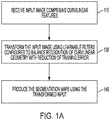
- FIGS. 1A illustrates a method for curvilinear object segmentation in accordance with embodiments described herein.
- the input image comprises at least one curvilinear feature.
- the input image may include one or more of roads, blood vessels, machine cracks, and wrinkles on skin.
- the image is mapped to segmentation maps of the curvilinear features using a processor.
- the at least one image is mapped by minimizing the output of a loss function that is configured to balance recognition of curvilinear features with reduction of training error.
- the input image is transformed 130 using learnable filters configured to balance a recognition of curvilinear geometry with reduction of training error.
- the transformed image is used to produce 140 the segmentation maps.
- a deep network is used to produce the segmentation maps.
- the deep network may include a representation module and a task module, for example.
- the input image is transformed 130 in the representation module using learnable filters trained to recognize curvilinear geometries of interest.
- the task module is configured to produce 140 the segmentation maps using the transformed input image received from the representation module.
- the representation module and the task module are configured to be in series such that the input image is transformed in the representation module before entering the task module.
- the task module is a U-Net deep neural network.
- At least one of the learnable filters is initialized as a Gabor filter.
- the Gabor filter may be configured to change during a training process to balance recognition of curvilinear geometry with reduction of training error.
- at least one of the learnable filters has at least one learnable parameter.
- the at least one learnable parameter may include one or more of a carrier frequency, an eccentricity, an orientation, and a scale.
- FIG. 1B illustrates a process for training the curvilinear object segmentation network with geometric constraints in accordance with embodiments described herein.
- the training proceeds as an iterative process as follows.
- the deep curvilinear segmentation network is initialized with a set of filter weights.
- Input training images containing curvilinear features are received 150.
- the input images are sent through the deep curvilinear segmentation network comprising a mapping through learnable representation filters 155 in a representation network and task network 160 to produce estimated segmentation maps.
- the first training geometric pattern image is of a first orientation and the second training geometric pattern image is of a second orientation that is different than the first orientation.
- the first orientation may be orthogonal to the second orientation.
- the estimated segmentation maps from 160 and true segmentation maps 162 corresponding to training input images are sent to a loss computation module 165, which computes a measure of the error between true and estimated segmentation maps. Additionally, the filtered geometric pattern images from 157 are input to the loss computation module 165 in order to ensure orientation preservation.
- the loss function balances the network's dual goal of minimizing the segmentation error and preserving geometric orientation constraints. Geometric constraints are preserved by favoring a high response from the first training geometric pattern image and low response from the second training geometric pattern image.
- the learnable filters are derived at multiple spatial scales so that curvilinear structures of different sizes and thicknesses may be detected.
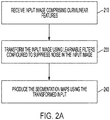
- FIG. 2A illustrates a process for noise suppression in curvilinear object segmentation in accordance with embodiments described herein.
- At least one input image is received 210.
- the input image comprises at least one curvilinear feature.
- the at least one image is mapped to segmentation maps of the curvilinear features using a processor.
- the at least one image is mapped to segmentation maps by minimizing the output of a loss function that is configured to balance noise suppression with curvilinear segmentation error in training images.
- the loss function comprises a sum of a training error between estimated and true segmentation maps corresponding to training images and a noise regularization term.
- the input image is transformed 230 using learnable filters configured to suppress noise in one or more of a domain and a task of the at least one input image.
- learnable filters configured to suppress noise in one or more of a domain and a task of the at least one input image.
- at least one of the learnable filters is initialized as a Gabor filter.
- the transformed image is used to produce 240 the segmentation maps.
- the task module is a U-Net deep neural network.
- a deep network is used to produce the segmentation maps.
- the deep network includes a representation module and a task module.
- the input image is transformed 230 in the representation module using learnable filters configured to balance noise suppression with curvilinear segmentation.
- the task module is configured to produce 240 the segmentation maps using the transformed input image received from the representation module.
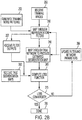
- FIG. 2B illustrates a process for training the curvilinear object segmentation network with noise constraints in accordance with embodiments described herein.
- the training proceeds as an iterative process as follows.
- the deep curvilinear segmentation network is initialized with a set of filter weights.
- Input training images containing curvilinear features are received 250.
- the input images are sent through the deep curvilinear segmentation network comprising a mapping through learnable representation filters 255 in a representation network and task network 260 to produce estimated segmentation maps.
- At least one training noise image is generated 252 and mapped through the learnable filters 255 to produce filtered noise patterns 257.
- the at least one training noise image comprises a noise patterns unique to the domain and the task of the input image.
- One or more of the noise images may be generated by extracting background patches from the training images that do not contain any labeled curvilinear objects of interest, processing the extracted background patches through filters that are responsive to curvilinear structures, and selecting a predetermined number of background patches having the highest filter responses as the training noise images.
- the filters that are responsive to curvilinear structures are chosen as Gabor filters.
- the estimated segmentation maps from 260 and true segmentation maps 262 corresponding to training input images are sent to a loss computation module 265, which computes a measure of the error between true and estimated segmentation maps. Additionally, the filtered noise pattern images from 257 are input to the loss computation module 265 to provide a measure of noise in the estimated segmentation map.
- the loss function balances the network's dual goal of minimizing the segmentation error and minimizing noise in the estimated segmentation map.
- At least one input image comprising curvilinear features is received 260.
- the image is mapped 270 to segmentation maps of the curvilinear features using a processor.
- the input image is transformed 280 using the learnable filters configured to suppress noise.
- the transformed image is used to produce 290 the segmentation maps. It is to be understood that any combination of filters that are configured balance recognition of curvilinear geometry with reduction of training error and filters that are configured to suppress noise may be used to produce the segmentation maps.
- FIG. 3 illustrates a deep learning architecture for curvilinear segmentation in accordance with embodiments described herein.
- the system includes a representation module 310 and a task module 320.
- An image 310 is input into the representation module.
- the representation module uses learnable filters 330 trained with one or more geometric training images 340 and/or one or more noise training images 345.
- the learnable filters 350 output a transformed input image 360.
- the transformed input image 360 is input into the task module 320 and the transformed image is input into one or more filters 370 in the task module which are trained to produce a segmentation map.
- An output segmentation map 380 is output from the task module.
- geometric priors are introduced into the representation network to encourage the learnable filters to respond strongly to curvilinear image geometry.
- the learnable filters may be trained to respond to fine lines that are commonly associated with curvilinear features.
- the overall system is optimized to balance training error with respect for curvilinear geometries using the loss function of Equation 1.
- E L Y g , F f X ⁇ R , ⁇ T + L R ⁇ R
- f() represents the representation module function having parameters with parameters ⁇ R and F() represents the task module having parameters ⁇ T .
- Y g is the ground truth segmentation map
- L() represents network error on training samples
- L R () is the geometric regularization term that incorporates prior knowledge about the task of curvilinear segmentation and is shown in Equation 2.
- I Sik represents a first training geometric pattern image comprising strong curvilinear line patterns along the i-th orientation and k-th scale (denoted Sik).
- I Oik represents a second training image with patterns oriented orthogonal to Isik. Examples of these two images are shown in FIGS. 4A and 4B.
- FIG. 4A shows an example first geometric training image
- FIG. 4B illustrates an example second geometric training image.
- the image patterns are formed by a two dimensional Gaussian function at a given scale k applied on the coordinates obtained by rotating a rectangular grid of given size (e.g., 22X22) by a specific angle i. While the example rectangular grid is represented as a square, it is to be understood that the rectangular grid may not be a square.
- the ⁇ R parameters are initialized as Gabor filters and then evolve during the network training process to meet the balanced objective of minimizing training error, L, while respecting curvilinear geometry, L R1 .
- the learnable filters are Gabor filters before a training process and the learnable filters are configured to change during the training process to provide a targeted segmentation for curvilinear features.
- FIG. 5A illustrates visualizations of filters learned from training that does not incorporate prior knowledge about the domain and/or task in early stages.
- FIG. 5B illustrates static Gabor filters.
- FIG. 5C shows visualizations of learnable filters after training for curvilinear feature recognition in accordance with embodiments described herein. Using learnable Gabor filters as described herein preserves a Gabor-like structure that is responsive to curvilinear geometry in images, while retaining the ability to modulate and adapt the Gabor structure based on training exemplars.
- the learnable filters are Gabor filters that have at least one learnable parameter.
- Equation 3 illustrates an equation that represents a Gabor filter in accordance with embodiments described herein.
- W R i j K R 1 e ⁇ i 2 + ⁇ j 2 2 ⁇ 2 cos 2 ⁇ f icos ⁇ + jsin ⁇
- Equation 3 [i,j] are pixel coordinates of an image, ⁇ represents the eccentricity, f is the carrier frequency, ⁇ is the orientation, and ⁇ is the scale.
- ⁇ , f, ⁇ , and ⁇ is a learnable value using training data during training of the system.
- the loss function comprises only the data network error on training samples term, L(), and the second regularization term (L R1 ) in Equation 1 is not used as shown in Equation 4.
- E L X g , F f X ⁇ R , ⁇ T
- using filters with learnable parameters as described herein represents a significant reduction in the number of trainable parameters when compared to a traditional convolutional neural network where all filter weights must be learned.
- a reduction in training parameters results in less complexity and reduced training requirements than conventional methods.
- the ability to learn a few key parameters based on training exemplars endows the network with greater adaptability and expressive power than a static filter representation. Since Equation 4 is smooth and differentiable with respect to all four Gabor parameters, the parameters may be learned via back-propagation.
- the network used for image segmentation can become more sensitive to noise when training is sparse.
- Embodiments described herein are configured to improve the robustness of the deep segmentation network to noise in the data.
- the issue of false positives that can occur when the background contains features similar to foreground objects is addressed.
- Incorporating prior knowledge about the domain and/or task into the deep learning task can be used to reduce the dependence of network optimization on noisy training samples.
- Embodiments described herein describe systems and methods for performing segmentation in a manner that is robust to noise.
- learnable filters can be used to suppress noise in curvilinear image segmentation.
- Equation 5 shows a loss function that is configured to balance training error with noise suppression in curvilinear image segmentation.
- E L Y g , F f X ⁇ R , ⁇ T + L R 2 ⁇ R
- L R2 is configured to model noise in curvilinear data segmentation. The calculation for L R2 is shown in Equation 6.
- Ij are a set of auxiliary training images comprising noise patterns unique to the domain and task and W ik are the weights of filters of scale k in ⁇ R .
- the representation module balances task performance (i.e. curvilinear segmentation) with noise suppression.
- the noise patterns are generated by extracting background patches from the training images that do not contain any labeled curvilinear objects. These patches are sent through filters such as Gabor filters, for example. A predetermined number of patches that give a maximum response are selected as potential noisy patches (i.e. patches that are most likely to be confused with curvilinear structures). According to various implementations, the patch size of noisy patches is selected to be 64X64 and 100 patches with maximum response are chosen.
- Embodiments described herein are demonstrated for the example application of retinal vessel segmentation. This is an important capability that enables medical experts to quickly diagnose pathology in vascular pathways in the human retina.
- the DRIVE [11] and STARE datasets were used to train and evaluate the techniques.
- the network architecture is as follows. For the representation layer, 12 Gabor filters of size 11X11 of orientations sampled uniformly between 0 and 180 degrees were used. For the task network, a U-Net architecture was used. The representation network was trained using standard stochastic gradient optimization technique with the help of the Adam optimizer and the learning rate was set to .0005. Patches of size 128X128 were extracted from the training images, resulting in about 7000 patches from 20 training images.
- a limited training scenario was also evaluated, wherein 700 patches from 2 images were extracted. A batch size of 64 for training the network was used. For initial validation, only a single scale of Gabor regularization was tested. For inference, the network was used on the entire image instead of patches. The following methods were evaluated Gabor regularized, Gabor parameterized, and Deep Retinal Image Understanding (DRIU).
- DRIU Deep Retinal Image Understanding
- Tables 1 and 2 show results for the full training and limited training scenarios, respectively. Results are presented in terms of the Dice coefficient, which is a normalized measure of overlap between two binary maps.
- the Gabor-regularized and a Gabor-parameterized methods are competitive in both scenarios, and outperform the state of art DRIU by a significant margin in the limited training scenario.
- the proposed approach trained with the limited dataset outperforms DRIU trained with the full dataset.
- Table 1 Method Dice Overlap Score DRIU 0.7389 Gabor Regularized 0.8031 Gabor Parameterized 0.7956
- Table 2 Method Dice Overlap Score DRIU 0.6318 Gabor Regularized 0.7430
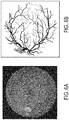
- FIG. 6A shows the original input for Example 1.
- the ground truth map of the desired curvilinear features is shown in FIG. 6B .
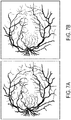
- FIG. 7A shows the result segmentation map using DRIU where the grey portions represent an incorrect result and the white portions represent a correct result.
- FIG. 7B shows the result using the Gabor Regularized system described herein. As can be observed from FIG. 7A and 7B , more white and less grey is present in the Gabor regularized segmentation results when compared with the DRIU result.
- Example 2 shows the results of noise suppression in retinal image segmentation. Accurate and robust segmentation is useful for accurate and robust diagnostics of disease.
- the DRIVE and STARE image datasets were used to both train and test the various techniques.
- 12 Gabor filters of size 11X11, with orientations sampled uniformly between 0 and 180 degrees were used.
- U net architecture was used for segmentation.
- the network was trained using standard stochastic gradient optimization techniques with the help of the Adam optimizer and the learning rate was set to .0005. Patches of size 128X128 were extracted from the training images. A total of about 7000 patches were extracted from 20 training images. For limited training scenario, patches from 2 images were extracted for a total of almost 700 patches. A batch size of 64 patches was used for training. For inference, the network was used on the entire image instead of patches.
- FIG. 6A shows the original input for Example 2.
- the ground truth map of the desired curvilinear features is shown in FIG. 6B .
- FIG. 8A shows the result segmentation map using DRIU where the grey portions represent an incorrect result and the white portions represent a correct result.
- FIG. 8B shows the result using the NRCSN system described herein. As can be observed from FIG. 8A and 8B , more white and less grey is present in the NRCSN segmentation results when compared to the DRIU results.
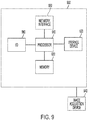
- Computer 900 contains a processor 910, which controls the overall operation of the computer 900 by executing computer program instructions which define such operation.
- the computer program instructions may be stored in a storage device 920 (e.g., magnetic disk) and loaded into memory 930 when execution of the computer program instructions is desired.
- a storage device 920 e.g., magnetic disk
- An image acquisition device 940 may be connected to the computer 900 to input image data to the computer 900.
- the image acquisition device 940 is disposed on the computer 900.
- the image acquisition device 840 and the computer 900 communicate wirelessly through a network.
- the computer 900 may be located remotely from the image acquisition device 940, and the computer 900 may perform method steps as part of a server or cloud based service.
- the computer 900 may include one or more network interfaces 950 for communicating with other devices via a network.
- the computer 900 also includes other input/output devices 960 that enable user interaction with the computer 900 (e.g., display, keyboard, mouse, speakers, buttons, etc.). Such input/output devices 960 may be used in conjunction with a set of computer programs as an annotation tool to annotate volumes received from the image acquisition device 900.
- FIG. 9 is a high level representation of possible components of a computer for illustrative purposes and the computer may contain other components.
Landscapes
- Engineering & Computer Science (AREA)
- Theoretical Computer Science (AREA)
- Physics & Mathematics (AREA)
- General Physics & Mathematics (AREA)
- Evolutionary Computation (AREA)
- Artificial Intelligence (AREA)
- Software Systems (AREA)
- Computer Vision & Pattern Recognition (AREA)
- Health & Medical Sciences (AREA)
- General Health & Medical Sciences (AREA)
- Computing Systems (AREA)
- Data Mining & Analysis (AREA)
- Life Sciences & Earth Sciences (AREA)
- General Engineering & Computer Science (AREA)
- Molecular Biology (AREA)
- Biomedical Technology (AREA)
- Mathematical Physics (AREA)
- Multimedia (AREA)
- Biophysics (AREA)
- Computational Linguistics (AREA)
- Medical Informatics (AREA)
- Databases & Information Systems (AREA)
- Biodiversity & Conservation Biology (AREA)
- Bioinformatics & Cheminformatics (AREA)
- Bioinformatics & Computational Biology (AREA)
- Evolutionary Biology (AREA)
- Image Analysis (AREA)
Claims (15)
- Computer-implementiertes Verfahren zur Segmentierung von krummlinigen Objekten, umfassend:Empfangen (110) mindestens eines Eingabebildes mit krummlinigen Merkmalen; undAbbilden, unter Verwendung eines Prozessors, des mindestens einen Bildes auf Ausgabesegmentierungskarten unter Verwendung eines Deep Networks mit einem Darstellungsmodul und einem Aufgabenmodul, wobei das Abbilden umfasst:Transformieren (130) des Eingabebildes in dem Darstellungsmodul unter Verwendung von lernfähigen Filtern, die trainiert sind, um Rauschen in einer oder mehreren aus einer Domäne und einer Aufgabe des mindestens einen Eingabebildes zu unterdrücken; undErzeugen (140) der Segmentierungskarten unter Verwendung des transformierten Eingabebildes in dem Aufgabenmodul;wobei die lernfähigen Filter trainiert sind, um Rauschunterdrückung mit krummlinigen Segmentierungsfehler in Trainingsbildern auszugleichen, wobei das Training der lernfähigen Filter das Minimieren der Ausgabe einer Verlustfunktion umfasst, wobei die Verlustfunktion konfiguriert ist, um Rauschunterdrückung mit einem Minimieren des krummlinigen Segmentierungsfehlers in Trainingsbildern auszugleichen; wobei die Verlustfunktion gegeben ist durch
 wobei f() das Darstellungsmodul mit den Parametern ΘR darstellt, F() das Aufgabenmodul mit den Parametern ΘT darstellt, Yg eine Ground-Truth-Segmentierungskarte ist, L() den Netzwerkfehler bei Trainingsproben darstellt und LR2() der Rauschregularisierungsterm zur Unterdrückung von Rauschen in den Daten ist, gegeben durch
 wobei Ij eine Reihe von Hilfstrainingsbildern umfassend Rauschmuster ist und Wik die Gewichte der lernfähigen Filter der Skala k in ΘR sind.
 - Verfahren nach Anspruch 1, wobei das Eingabebild eines oder mehrere umfasst aus: Straßen, Blutgefäße, Maschinenrisse und Falten auf der Haut.
- Verfahren nach Anspruch 1, wobei mindestens einer der lernfähigen Filter als ein Gabor-Filter initialisiert wird.
- Verfahren nach Anspruch 1, ferner umfassend das Trainieren der lernfähigen Filter mit mindestens einem Trainingsrauschbild, wobei das mindestens eine Trainingsrauschbild mindestens ein Trainingsbild mit für die Domäne und die Aufgabe des Eingabebildes einzigartigen Rauschmustern umfasst.
- Verfahren nach Anspruch 4, wobei das mindestens eine Trainingsrauschbild mindestens einen Bereich des Eingabetrainingsbildes enthält, der keine markierten krummlinigen Objekte enthält.
- Verfahren nach Anspruch 4, ferner umfassend das Erzeugen der Rauschmuster, die für die Domäne und die Aufgabe des Eingangsbildes einzigartig sind.
- Verfahren nach Anspruch 6, wobei das Erzeugen der Rauschbilder umfasst:Extrahieren von Hintergrundpatches aus den Trainingsbildern, die keine markierten krummlinigen Objekte enthalten;Verarbeiten der extrahierten Hintergrundpatches durch Gabor-Filter; undAuswählen einer vorbestimmten Anzahl von verarbeiteten Hintergrundpatches mit der höchsten Response als Rauschmuster.
- Verfahren nach Anspruch 1, wobei das Aufgabenmodul ein U-Net Deep Neural Network ist.
- System zur krummlinigen Objektsegmentierung, umfassend:einen Prozessor (910); undeinen Speicher (930), der Computerprogrammanweisungen speichert, die, wenn sie von dem Prozessor ausgeführt werden, den Prozessor veranlassen, Operationen durchzuführen, umfassend:Empfangen mindestens eines Eingabebildes mit krummlinigen Merkmalen; undAbbilden, unter Verwendung eines Prozessors, des mindestens einen Bildes auf Ausgabesegmentierungskarten unter Verwendung eines Deep Networks mit einem Darstellungsmodul und einem Aufgabenmodul, wobei das Abbilden umfasst:Transformieren des Eingabebildes in dem Darstellungsmodul unter Verwendung von lernfähigen Filtern, die trainiert sind, um Rauschen in einer oder mehreren aus einer Domäne und einer Aufgabe des mindestens einen Eingabebildes zu unterdrücken; undErzeugen der Segmentierungskarten unter Verwendung des transformierten Eingabebildes in dem Aufgabenmodul;wobei die lernfähigen Filter trainiert sind, um Rauschunterdrückung mit krummlinigen Segmentierungsfehler in Trainingsbildern auszugleichen, wobei das Training das Minimieren der Ausgabe einer Verlustfunktion umfasst, wobei die Verlustfunktion konfiguriert ist, um Rauschunterdrückung mit einem Minimieren des krummlinigen Segmentierungsfehlers in Trainingsbildern auszugleichen; wobei die Verlustfunktion gegeben ist durch
 wobei f() das Darstellungsmodul mit den Parametern ΘR darstellt, F() das Aufgabenmodul mit den Parametern ΘT darstellt, Yg eine Ground-Truth-Segmentierungskarte ist, L() den Netzwerkfehler bei Trainingsproben darstellt und LR2() der Rauschregularisierungsterm zur Unterdrückung von Rauschen in den Daten ist, gegeben durch
 wobei Ij eine Reihe von Hilfstrainingsbildern umfassend Rauschmuster ist und Wik die Gewichte der lernfähigen Filter der Skala k in ΘR sind.
 - System nach Anspruch 9, ferner umfassend das Trainieren der lernfähigen Filter mit mindestens einem Trainingsbild, das Rauschmuster aufweist, die für die Domäne und die Aufgabe des Eingangsbildes einzigartig sind.
- System nach Anspruch 10, wobei das mindestens eine Trainingsbild mindestens einen Bereich enthält, der keine markierten krummlinigen Objekte enthält.
- System nach Anspruch 10, wobei der Prozessor ferner konfiguriert ist, um für die Domäne und die Aufgabe des Eingabebildes eindeutigen Rauschmuster zu erzeugen.
- System nach Anspruch 12, wobei der Prozessor ferner konfiguriert ist, um:Hintergrundpatches aus den Trainingsbildern zu extrahieren, die keine markierten gekrümmten Objekte enthalten;die Hintergrundpatches durch Gabor-Filter zu verarbeiten; undeine vorbestimmte Anzahl von verarbeiteten Hintergrundpatches mit der höchsten Response als Rauschmuster auszuwählen.
- System nach Anspruch 9, wobei mindestens einer der lernfähigen Filter als Gabor-Filter initialisiert ist.
- Nicht-transitorisches computerlesbares Medium, das Computerprogrammanweisungen für die Segmentierung krummliniger Objekte speichert, wobei die Computerprogrammanweisungen, wenn sie von einem Prozessor ausgeführt werden, den Prozessor veranlassen, Operationen durchzuführen, die Folgendes umfassen
Empfangen mindestens eines Eingabebildes mit krummlinigen Merkmalen; und
Abbilden, unter Verwendung eines Prozessors, des mindestens einen Bildes auf Ausgabesegmentierungskarten unter Verwendung eines Deep Networks mit einem Darstellungsmodul und einem Aufgabenmodul, wobei das Abbilden umfasst:Transformieren des Eingabebildes in dem Darstellungsmodul unter Verwendung von lernfähigen Filtern, die trainiert sind, um Rauschen in einer oder mehreren von einer Domäne und einer Aufgabe des mindestens einen Eingangsbildes zu unterdrücken; undErzeugen der Segmentierungskarten unter Verwendung des transformierten Eingabebildes in dem Aufgabenmodul:
wobei die lernfähigen Filter trainiert sind, um Rauschunterdrückung mit krummlinigen Segmentierungsfehler in Trainingsbildern auszugleichen, wobei das Training der lernfähigen Filter das Minimieren der Ausgabe einer Verlustfunktion umfasst, wobei die Verlustfunktion konfiguriert ist, um Rauschunterdrückung mit einem Minimieren des krummlinigen Segmentierungsfehlers in Trainingsbildern auszugleichen; wobei die Verlustfunktion gegeben ist durch

Applications Claiming Priority (1)
| Application Number | Priority Date | Filing Date | Title |
|---|---|---|---|
| US16/223,495 US10885635B2 (en) | 2018-12-18 | 2018-12-18 | Curvilinear object segmentation with noise priors |
Publications (2)
| Publication Number | Publication Date |
|---|---|
| EP3671635A1 EP3671635A1 (de) | 2020-06-24 |
| EP3671635B1 true EP3671635B1 (de) | 2021-08-04 |
Family
ID=68917735
Family Applications (1)
| Application Number | Title | Priority Date | Filing Date |
|---|---|---|---|
| EP19216743.5A Active EP3671635B1 (de) | 2018-12-18 | 2019-12-16 | Krummlinige objektsegmentierung mit rausch-a-priori-verteilungen |
Country Status (3)
| Country | Link |
|---|---|
| US (1) | US10885635B2 (de) |
| EP (1) | EP3671635B1 (de) |
| JP (1) | JP7277341B2 (de) |
Families Citing this family (3)
| Publication number | Priority date | Publication date | Assignee | Title |
|---|---|---|---|---|
| CN112200802B (zh) * | 2020-10-30 | 2022-04-26 | 上海商汤智能科技有限公司 | 图像检测模型的训练方法及相关装置、设备、存储介质 |
| GB2605580B (en) * | 2021-03-31 | 2024-10-23 | Seechange Tech Limited | Apparatus and method of image processing to detect a substance spill on a solid surface |
| CN115019163A (zh) * | 2022-04-01 | 2022-09-06 | 湖南大学 | 基于多源大数据的城市要素识别方法 |
Family Cites Families (7)
| Publication number | Priority date | Publication date | Assignee | Title |
|---|---|---|---|---|
| US20060155394A1 (en) * | 2004-12-16 | 2006-07-13 | International Business Machines Corporation | Method and apparatus for order-preserving clustering of multi-dimensional data |
| US20090226057A1 (en) * | 2008-03-04 | 2009-09-10 | Adi Mashiach | Segmentation device and method |
| WO2010138645A2 (en) * | 2009-05-29 | 2010-12-02 | University Of Pittsburgh - Of The Commonwealth System Of Higher Education | Blood vessel segmentation with three-dimensional spectral domain optical coherence tomography |
| US8750615B2 (en) * | 2010-08-02 | 2014-06-10 | Case Western Reserve University | Segmentation and quantification for intravascular optical coherence tomography images |
| WO2018001099A1 (zh) * | 2016-06-30 | 2018-01-04 | 上海联影医疗科技有限公司 | 一种血管提取方法与系统 |
| US10610098B1 (en) * | 2017-04-11 | 2020-04-07 | VisionQuest Biomedical LLC | Generalized retinal image screening system (GRIS) |
| US10891778B2 (en) * | 2018-01-10 | 2021-01-12 | The Board Of Trustees Of The University Of Illinois | Apparatus and method for producing three-dimensional models from magnetic resonance imaging |
-
2018
- 2018-12-18 US US16/223,495 patent/US10885635B2/en active Active
-
2019
- 2019-11-25 JP JP2019212324A patent/JP7277341B2/ja active Active
- 2019-12-16 EP EP19216743.5A patent/EP3671635B1/de active Active
Also Published As
| Publication number | Publication date |
|---|---|
| EP3671635A1 (de) | 2020-06-24 |
| JP7277341B2 (ja) | 2023-05-18 |
| JP2020098588A (ja) | 2020-06-25 |
| US20200193610A1 (en) | 2020-06-18 |
| US10885635B2 (en) | 2021-01-05 |
Similar Documents
| Publication | Publication Date | Title |
|---|---|---|
| CN115115601B (zh) | 一种基于形变注意金字塔的遥感舰船目标检测方法 | |
| Yi et al. | An end‐to‐end steel strip surface defects recognition system based on convolutional neural networks | |
| US10713563B2 (en) | Object recognition using a convolutional neural network trained by principal component analysis and repeated spectral clustering | |
| Karn et al. | Robust retinal blood vessel segmentation using hybrid active contour model | |
| CN104299006B (zh) | 一种基于深度神经网络的车牌识别方法 | |
| CN111652317B (zh) | 基于贝叶斯深度学习的超参数图像分割方法 | |
| CN117079098B (zh) | 一种基于位置编码的空间小目标检测方法 | |
| CN110210493B (zh) | 基于非经典感受野调制神经网络的轮廓检测方法及系统 | |
| CN112598708B (zh) | 一种基于四特征融合和权重系数的高光谱目标跟踪方法 | |
| EP3671635B1 (de) | Krummlinige objektsegmentierung mit rausch-a-priori-verteilungen | |
| CN108932455B (zh) | 遥感图像场景识别方法及装置 | |
| CN109461163A (zh) | 一种用于磁共振标准水模的边缘检测提取算法 | |
| CN111951283A (zh) | 一种基于深度学习的医学图像识别方法及系统 | |
| Wu et al. | Image edge detection based on Sobel with morphology | |
| CN117854155B (zh) | 一种人体骨骼动作识别方法及系统 | |
| CN115424093A (zh) | 一种识别眼底图像中细胞的方法及装置 | |
| EP3671634B1 (de) | Krummlinige objektsegmentierung mit geometrischen a-priori-verteilungen | |
| CN118799827A (zh) | 一种双极化sar图像海面舰船目标智能检测定位方法 | |
| CN111626379B (zh) | 肺炎x光图像检测方法 | |
| CN114022877B (zh) | 一种基于自适应阈值三维sar图像感兴趣目标提取方法 | |
| Maitra et al. | Seismic data interpretation using hough transformation technique | |
| CN121459082B (zh) | 基于类激活图算法的图像识别方法及相关装置 | |
| US20260120507A1 (en) | Human body information extraction method, robot and computer-readable storage medium | |
| Badsha et al. | Segmentation of overlapping Cryptosporidium and Giardia (oo) cysts using bidirectional contour tracing | |
| Zhang et al. | Research on segmentation of sonar image based on features learning |
Legal Events
| Date | Code | Title | Description |
|---|---|---|---|
| PUAI | Public reference made under article 153(3) epc to a published international application that has entered the european phase |
Free format text: ORIGINAL CODE: 0009012 |
|
| STAA | Information on the status of an ep patent application or granted ep patent |
Free format text: STATUS: THE APPLICATION HAS BEEN PUBLISHED |
|
| AK | Designated contracting states |
Kind code of ref document: A1 Designated state(s): AL AT BE BG CH CY CZ DE DK EE ES FI FR GB GR HR HU IE IS IT LI LT LU LV MC MK MT NL NO PL PT RO RS SE SI SK SM TR |
|
| AX | Request for extension of the european patent |
Extension state: BA ME |
|
| STAA | Information on the status of an ep patent application or granted ep patent |
Free format text: STATUS: REQUEST FOR EXAMINATION WAS MADE |
|
| 17P | Request for examination filed |
Effective date: 20210111 |
|
| RBV | Designated contracting states (corrected) |
Designated state(s): AL AT BE BG CH CY CZ DE DK EE ES FI FR GB GR HR HU IE IS IT LI LT LU LV MC MK MT NL NO PL PT RO RS SE SI SK SM TR |
|
| GRAP | Despatch of communication of intention to grant a patent |
Free format text: ORIGINAL CODE: EPIDOSNIGR1 |
|
| STAA | Information on the status of an ep patent application or granted ep patent |
Free format text: STATUS: GRANT OF PATENT IS INTENDED |
|
| INTG | Intention to grant announced |
Effective date: 20210224 |
|
| GRAS | Grant fee paid |
Free format text: ORIGINAL CODE: EPIDOSNIGR3 |
|
| GRAA | (expected) grant |
Free format text: ORIGINAL CODE: 0009210 |
|
| STAA | Information on the status of an ep patent application or granted ep patent |
Free format text: STATUS: THE PATENT HAS BEEN GRANTED |
|
| AK | Designated contracting states |
Kind code of ref document: B1 Designated state(s): AL AT BE BG CH CY CZ DE DK EE ES FI FR GB GR HR HU IE IS IT LI LT LU LV MC MK MT NL NO PL PT RO RS SE SI SK SM TR |
|
| REG | Reference to a national code |
Ref country code: GB Ref legal event code: FG4D |
|
| REG | Reference to a national code |
Ref country code: AT Ref legal event code: REF Ref document number: 1417773 Country of ref document: AT Kind code of ref document: T Effective date: 20210815 |
|
| REG | Reference to a national code |
Ref country code: CH Ref legal event code: EP |
|
| REG | Reference to a national code |
Ref country code: DE Ref legal event code: R096 Ref document number: 602019006637 Country of ref document: DE |
|
| REG | Reference to a national code |
Ref country code: IE Ref legal event code: FG4D |
|
| REG | Reference to a national code |
Ref country code: LT Ref legal event code: MG9D |
|
| REG | Reference to a national code |
Ref country code: NL Ref legal event code: MP Effective date: 20210804 |
|
| REG | Reference to a national code |
Ref country code: AT Ref legal event code: MK05 Ref document number: 1417773 Country of ref document: AT Kind code of ref document: T Effective date: 20210804 |
|
| PG25 | Lapsed in a contracting state [announced via postgrant information from national office to epo] |
Ref country code: LT Free format text: LAPSE BECAUSE OF FAILURE TO SUBMIT A TRANSLATION OF THE DESCRIPTION OR TO PAY THE FEE WITHIN THE PRESCRIBED TIME-LIMIT Effective date: 20210804 Ref country code: BG Free format text: LAPSE BECAUSE OF FAILURE TO SUBMIT A TRANSLATION OF THE DESCRIPTION OR TO PAY THE FEE WITHIN THE PRESCRIBED TIME-LIMIT Effective date: 20211104 Ref country code: AT Free format text: LAPSE BECAUSE OF FAILURE TO SUBMIT A TRANSLATION OF THE DESCRIPTION OR TO PAY THE FEE WITHIN THE PRESCRIBED TIME-LIMIT Effective date: 20210804 Ref country code: NO Free format text: LAPSE BECAUSE OF FAILURE TO SUBMIT A TRANSLATION OF THE DESCRIPTION OR TO PAY THE FEE WITHIN THE PRESCRIBED TIME-LIMIT Effective date: 20211104 Ref country code: PT Free format text: LAPSE BECAUSE OF FAILURE TO SUBMIT A TRANSLATION OF THE DESCRIPTION OR TO PAY THE FEE WITHIN THE PRESCRIBED TIME-LIMIT Effective date: 20211206 Ref country code: FI Free format text: LAPSE BECAUSE OF FAILURE TO SUBMIT A TRANSLATION OF THE DESCRIPTION OR TO PAY THE FEE WITHIN THE PRESCRIBED TIME-LIMIT Effective date: 20210804 Ref country code: HR Free format text: LAPSE BECAUSE OF FAILURE TO SUBMIT A TRANSLATION OF THE DESCRIPTION OR TO PAY THE FEE WITHIN THE PRESCRIBED TIME-LIMIT Effective date: 20210804 Ref country code: RS Free format text: LAPSE BECAUSE OF FAILURE TO SUBMIT A TRANSLATION OF THE DESCRIPTION OR TO PAY THE FEE WITHIN THE PRESCRIBED TIME-LIMIT Effective date: 20210804 Ref country code: SE Free format text: LAPSE BECAUSE OF FAILURE TO SUBMIT A TRANSLATION OF THE DESCRIPTION OR TO PAY THE FEE WITHIN THE PRESCRIBED TIME-LIMIT Effective date: 20210804 Ref country code: ES Free format text: LAPSE BECAUSE OF FAILURE TO SUBMIT A TRANSLATION OF THE DESCRIPTION OR TO PAY THE FEE WITHIN THE PRESCRIBED TIME-LIMIT Effective date: 20210804 |
|
| PG25 | Lapsed in a contracting state [announced via postgrant information from national office to epo] |
Ref country code: PL Free format text: LAPSE BECAUSE OF FAILURE TO SUBMIT A TRANSLATION OF THE DESCRIPTION OR TO PAY THE FEE WITHIN THE PRESCRIBED TIME-LIMIT Effective date: 20210804 Ref country code: LV Free format text: LAPSE BECAUSE OF FAILURE TO SUBMIT A TRANSLATION OF THE DESCRIPTION OR TO PAY THE FEE WITHIN THE PRESCRIBED TIME-LIMIT Effective date: 20210804 Ref country code: GR Free format text: LAPSE BECAUSE OF FAILURE TO SUBMIT A TRANSLATION OF THE DESCRIPTION OR TO PAY THE FEE WITHIN THE PRESCRIBED TIME-LIMIT Effective date: 20211105 |
|
| PG25 | Lapsed in a contracting state [announced via postgrant information from national office to epo] |
Ref country code: NL Free format text: LAPSE BECAUSE OF FAILURE TO SUBMIT A TRANSLATION OF THE DESCRIPTION OR TO PAY THE FEE WITHIN THE PRESCRIBED TIME-LIMIT Effective date: 20210804 |
|
| PG25 | Lapsed in a contracting state [announced via postgrant information from national office to epo] |
Ref country code: DK Free format text: LAPSE BECAUSE OF FAILURE TO SUBMIT A TRANSLATION OF THE DESCRIPTION OR TO PAY THE FEE WITHIN THE PRESCRIBED TIME-LIMIT Effective date: 20210804 |
|
| REG | Reference to a national code |
Ref country code: DE Ref legal event code: R097 Ref document number: 602019006637 Country of ref document: DE |
|
| PG25 | Lapsed in a contracting state [announced via postgrant information from national office to epo] |
Ref country code: SM Free format text: LAPSE BECAUSE OF FAILURE TO SUBMIT A TRANSLATION OF THE DESCRIPTION OR TO PAY THE FEE WITHIN THE PRESCRIBED TIME-LIMIT Effective date: 20210804 Ref country code: SK Free format text: LAPSE BECAUSE OF FAILURE TO SUBMIT A TRANSLATION OF THE DESCRIPTION OR TO PAY THE FEE WITHIN THE PRESCRIBED TIME-LIMIT Effective date: 20210804 Ref country code: RO Free format text: LAPSE BECAUSE OF FAILURE TO SUBMIT A TRANSLATION OF THE DESCRIPTION OR TO PAY THE FEE WITHIN THE PRESCRIBED TIME-LIMIT Effective date: 20210804 Ref country code: EE Free format text: LAPSE BECAUSE OF FAILURE TO SUBMIT A TRANSLATION OF THE DESCRIPTION OR TO PAY THE FEE WITHIN THE PRESCRIBED TIME-LIMIT Effective date: 20210804 Ref country code: CZ Free format text: LAPSE BECAUSE OF FAILURE TO SUBMIT A TRANSLATION OF THE DESCRIPTION OR TO PAY THE FEE WITHIN THE PRESCRIBED TIME-LIMIT Effective date: 20210804 Ref country code: AL Free format text: LAPSE BECAUSE OF FAILURE TO SUBMIT A TRANSLATION OF THE DESCRIPTION OR TO PAY THE FEE WITHIN THE PRESCRIBED TIME-LIMIT Effective date: 20210804 |
|
| PLBE | No opposition filed within time limit |
Free format text: ORIGINAL CODE: 0009261 |
|
| STAA | Information on the status of an ep patent application or granted ep patent |
Free format text: STATUS: NO OPPOSITION FILED WITHIN TIME LIMIT |
|
| 26N | No opposition filed |
Effective date: 20220506 |
|
| PG25 | Lapsed in a contracting state [announced via postgrant information from national office to epo] |
Ref country code: MC Free format text: LAPSE BECAUSE OF FAILURE TO SUBMIT A TRANSLATION OF THE DESCRIPTION OR TO PAY THE FEE WITHIN THE PRESCRIBED TIME-LIMIT Effective date: 20210804 Ref country code: IT Free format text: LAPSE BECAUSE OF FAILURE TO SUBMIT A TRANSLATION OF THE DESCRIPTION OR TO PAY THE FEE WITHIN THE PRESCRIBED TIME-LIMIT Effective date: 20210804 |
|
| PG25 | Lapsed in a contracting state [announced via postgrant information from national office to epo] |
Ref country code: SI Free format text: LAPSE BECAUSE OF FAILURE TO SUBMIT A TRANSLATION OF THE DESCRIPTION OR TO PAY THE FEE WITHIN THE PRESCRIBED TIME-LIMIT Effective date: 20210804 |
|
| REG | Reference to a national code |
Ref country code: BE Ref legal event code: MM Effective date: 20211231 |
|
| PG25 | Lapsed in a contracting state [announced via postgrant information from national office to epo] |
Ref country code: LU Free format text: LAPSE BECAUSE OF NON-PAYMENT OF DUE FEES Effective date: 20211216 Ref country code: IE Free format text: LAPSE BECAUSE OF NON-PAYMENT OF DUE FEES Effective date: 20211216 |
|
| PG25 | Lapsed in a contracting state [announced via postgrant information from national office to epo] |
Ref country code: BE Free format text: LAPSE BECAUSE OF NON-PAYMENT OF DUE FEES Effective date: 20211231 |
|
| PG25 | Lapsed in a contracting state [announced via postgrant information from national office to epo] |
Ref country code: CY Free format text: LAPSE BECAUSE OF FAILURE TO SUBMIT A TRANSLATION OF THE DESCRIPTION OR TO PAY THE FEE WITHIN THE PRESCRIBED TIME-LIMIT Effective date: 20210804 |
|
| PG25 | Lapsed in a contracting state [announced via postgrant information from national office to epo] |
Ref country code: HU Free format text: LAPSE BECAUSE OF FAILURE TO SUBMIT A TRANSLATION OF THE DESCRIPTION OR TO PAY THE FEE WITHIN THE PRESCRIBED TIME-LIMIT; INVALID AB INITIO Effective date: 20191216 |
|
| REG | Reference to a national code |
Ref country code: CH Ref legal event code: PL |
|
| PG25 | Lapsed in a contracting state [announced via postgrant information from national office to epo] |
Ref country code: LI Free format text: LAPSE BECAUSE OF NON-PAYMENT OF DUE FEES Effective date: 20221231 Ref country code: CH Free format text: LAPSE BECAUSE OF NON-PAYMENT OF DUE FEES Effective date: 20221231 |
|
| PGFP | Annual fee paid to national office [announced via postgrant information from national office to epo] |
Ref country code: GB Payment date: 20231121 Year of fee payment: 5 |
|
| PGFP | Annual fee paid to national office [announced via postgrant information from national office to epo] |
Ref country code: FR Payment date: 20231122 Year of fee payment: 5 Ref country code: DE Payment date: 20231121 Year of fee payment: 5 |
|
| PG25 | Lapsed in a contracting state [announced via postgrant information from national office to epo] |
Ref country code: MK Free format text: LAPSE BECAUSE OF FAILURE TO SUBMIT A TRANSLATION OF THE DESCRIPTION OR TO PAY THE FEE WITHIN THE PRESCRIBED TIME-LIMIT Effective date: 20210804 |
|
| PG25 | Lapsed in a contracting state [announced via postgrant information from national office to epo] |
Ref country code: TR Free format text: LAPSE BECAUSE OF FAILURE TO SUBMIT A TRANSLATION OF THE DESCRIPTION OR TO PAY THE FEE WITHIN THE PRESCRIBED TIME-LIMIT Effective date: 20210804 |
|
| PG25 | Lapsed in a contracting state [announced via postgrant information from national office to epo] |
Ref country code: MT Free format text: LAPSE BECAUSE OF FAILURE TO SUBMIT A TRANSLATION OF THE DESCRIPTION OR TO PAY THE FEE WITHIN THE PRESCRIBED TIME-LIMIT Effective date: 20210804 |
|
| REG | Reference to a national code |
Ref country code: DE Ref legal event code: R119 Ref document number: 602019006637 Country of ref document: DE |
|
| GBPC | Gb: european patent ceased through non-payment of renewal fee |
Effective date: 20241216 |
|
| PG25 | Lapsed in a contracting state [announced via postgrant information from national office to epo] |
Ref country code: DE Free format text: LAPSE BECAUSE OF NON-PAYMENT OF DUE FEES Effective date: 20250701 |
|
| PG25 | Lapsed in a contracting state [announced via postgrant information from national office to epo] |
Ref country code: GB Free format text: LAPSE BECAUSE OF NON-PAYMENT OF DUE FEES Effective date: 20241216 |
|
| PG25 | Lapsed in a contracting state [announced via postgrant information from national office to epo] |
Ref country code: FR Free format text: LAPSE BECAUSE OF NON-PAYMENT OF DUE FEES Effective date: 20241231 |