EP3671387B1 - Überwachung eines verfahrens zur generativen fertigung durch maschinenlernalgorithmen - Google Patents
Überwachung eines verfahrens zur generativen fertigung durch maschinenlernalgorithmen Download PDFInfo
- Publication number
- EP3671387B1 EP3671387B1 EP18382967.0A EP18382967A EP3671387B1 EP 3671387 B1 EP3671387 B1 EP 3671387B1 EP 18382967 A EP18382967 A EP 18382967A EP 3671387 B1 EP3671387 B1 EP 3671387B1
- Authority
- EP
- European Patent Office
- Prior art keywords
- parameters
- additive manufacturing
- risk
- product
- laser
- Prior art date
- Legal status (The legal status is an assumption and is not a legal conclusion. Google has not performed a legal analysis and makes no representation as to the accuracy of the status listed.)
- Active
Links
Images



Classifications
-
- G—PHYSICS
- G05—CONTROLLING; REGULATING
- G05B—CONTROL OR REGULATING SYSTEMS IN GENERAL; FUNCTIONAL ELEMENTS OF SUCH SYSTEMS; MONITORING OR TESTING ARRANGEMENTS FOR SUCH SYSTEMS OR ELEMENTS
- G05B19/00—Program-control systems
- G05B19/02—Program-control systems electric
- G05B19/18—Numerical control [NC], i.e. automatically operating machines, in particular machine tools, e.g. in a manufacturing environment, so as to execute positioning, movement or co-ordinated operations by means of program data in numerical form
- G05B19/4097—Numerical control [NC], i.e. automatically operating machines, in particular machine tools, e.g. in a manufacturing environment, so as to execute positioning, movement or co-ordinated operations by means of program data in numerical form characterised by using design data to control NC machines, e.g. CAD/CAM
- G05B19/4099—Surface or curve machining, making three-dimensional [3D] objects, e.g. desktop manufacturing
-
- G—PHYSICS
- G05—CONTROLLING; REGULATING
- G05B—CONTROL OR REGULATING SYSTEMS IN GENERAL; FUNCTIONAL ELEMENTS OF SUCH SYSTEMS; MONITORING OR TESTING ARRANGEMENTS FOR SUCH SYSTEMS OR ELEMENTS
- G05B23/00—Testing or monitoring of control systems or parts thereof
- G05B23/02—Electric testing or monitoring
- G05B23/0205—Electric testing or monitoring by means of a monitoring system capable of detecting and responding to faults
- G05B23/0259—Electric testing or monitoring by means of a monitoring system capable of detecting and responding to faults characterized by the response to fault detection
- G05B23/0283—Predictive maintenance, e.g. involving the monitoring of a system and, based on the monitoring results, taking decisions on the maintenance schedule of the monitored system; Estimating remaining useful life [RUL]
-
- B—PERFORMING OPERATIONS; TRANSPORTING
- B33—ADDITIVE MANUFACTURING TECHNOLOGY
- B33Y—ADDITIVE MANUFACTURING, i.e. MANUFACTURING OF THREE-DIMENSIONAL [3D] OBJECTS BY ADDITIVE DEPOSITION, ADDITIVE AGGLOMERATION OR ADDITIVE LAYERING, e.g. BY 3D PRINTING, STEREOLITHOGRAPHY OR SELECTIVE LASER SINTERING
- B33Y50/00—Data acquisition or data processing for additive manufacturing
Definitions
- the present invention relates to the field of additive manufacturing. In particular, it concerns the monitoring in real-time of additive manufacturing processes for determining anomalies.
- Additive manufacturing is a the set of any of various processes in which material is joined or solidified under computer control to create a three-dimensional object, with material being added together (such as liquid molecules or powder grains being fused together).
- the manufactured objects can be of almost any shape or geometry and typically are produced using digital model data from a 3D model.
- FDM Fused Deposition Modeling
- SLS Selective Laser Singering
- SLM Selective Laser Melting
- the object of the present invention is to alleviate at least partly the above mentioned drawbacks.
- the invention can apply, in particular, to the SLM additive manufacturing process.
- SLM selective laser melting
- DMLS direct metal laser sintering
- LPBF laser powder bed fusion
- SLM is a rapid prototyping, 3D printing, or additive manufacturing technique designed to use a high power-density laser to melt and fuse metallic powders together.
- SLM is sometimes considered to be a subcategory of selective laser sintering (SLS).
- SLM process has the ability to fully melt the metal material into a solid three-dimensional part unlike other types of SLS.
- the SLM process has been described for instance in the European patent EP0946325 .
- the invention aims in characterize in real-time the SLM materials and processes, so as to trigger alarms in case of anomalies, or defects, or risk situations. Doing so, the number of trials and errors (and resulting waste of time and resources) can be dramatically reduced.
- defect, or anomaly can be understood as a structural deviation from a desired uniform, isotropic, fully dense solid.
- Typical defects can be classified into
- the inventors consider it crucial to gather as many parameters as possible so as to avoid any pieces of information which could be of importance to determine a defect in the resulting product or at least a risk of defect.
- parameters which can be both static (parameters of the used materials, for instance), or dynamic (measurement on the used materials or on the on-going additive manufacturing process) Those parameters may include:
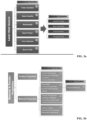
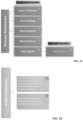
- FIGS. 3a, 3b , 3c, 3d , 3e , 3g provides further examples of parameters which can be used, and how they can be classified and interrelated.
- dynamic parameters may (at least partly) provided by sensors arranged in the vicinity of an additive manufacturing system 1.
- the AM system 1 may be any machine known in the art or still to be designed aiming in producing a product 3 from materials 2.
- a product should be here understood as any solid object built by an AM machine. Accordingly a product may be a "sub product" of a final product. It can be sold as it, or assembled to other products, parts or components, at a later stage to produce a final product. These aspects are not part of the invention and will thus not be further described.
- the term "vicinity” should be understood here, as accessible to the skilled person, so that the technical function of the sensors can be fulfilled so as to measure meaningful data on the AM process.
- the actual meaning of the "vicinity” i.e. the range in mms or cent-meters is therefore dependent on the type of sensors and on its technology.
- Some of these sensors can be integrated into the AM system 1 itself, like to one providing the scan speed for instance.
- Some other parameters can be retrieved from status information of the AM system 1.
- Some static parameters can be fed by a process operator into a database associated with the monitoring system 5. These information can come from databooks, specifications of the AM system 1 and of the materials 1.
- the measurements of the process parameters shall not be destructive, i.e. they need to not modify the behavior of the manufacturing process and, at least, to have no impact on the quality of the product 3.
- the monitoring system 5 can perform a data transformation step S2 for transforming said parameters into data vectors.
- these data vectors are constituted by data based on the acquired parameters values but to which a mathematical transformation have been applied. They are therefore different data than the acquired ones.
- a data may be based on several parameters.
- step S2 can then be considered as a data reduction and formatting step, aggregating raw parameter values into structured data.
- the monitoring system 5 outputs a risk of defect on the basis of this trained classification model, which can be stored in a memory 6 and trained beforehand on a training set.
- the automatic prediction step S3 can be embodied by various machine learning algorithms based on classifier, including for instance:
- Support Vector Machine can be used for the automatic prediction step S3.
- Support vector machines SVM also known as support vector networks
- SVM are supervised learning models with associated learning algorithms that analyze data used for classification and regression analysis. Given a set of training examples, each marked as belonging to one or the other of two categories, an SVM training algorithm builds a model that assigns new examples to one category or the other, making it a non-probabilistic binary linear classifier (although methods such as Platt scaling exist to use SVM in a probabilistic classification setting).
- An SVM model is a representation of the examples as points in space, mapped so that the examples of the separate categories are divided by a clear gap that is as wide as possible. New examples are then mapped into that same space and predicted to belong to a category based on which side of the gap they fall.
- the automatic prediction outputs figures representative of a risk of defects.
- an alert can be triggered on the basis of such a risk. For instance, the alert can be fired if the risk value is above a preset threshold.
- the alert can be produced to a human process operator by a man-machine interface. It can be an alert message on computer screen, a sound alert, a flashing light, or whatever means for alerting a human for prompting to react quickly. His reaction can be to stop immediately the AM process, or to survey further information before deciding doing so.
- the alert may automatically put the Additive Manufacturing system 1 on hold.
- the monitoring system 5 is configured so as to output risks of defect in real time, according to the fed flow of parameters. Consequently, the output risk is representative of the situation at the time of the measurement of the dynamical parameter (with a negligible delay due to the processing time). Accordingly, the process operator can instantaneously react on the risk of defect and decide to interrupt the process by stopping the Additive Manufacturing system 1.
- the classification model 5 and the considered parameters are determined so as to capture the characteristics and behavior of the weld profile in laser conduction, in terms of fundamental laser material interaction parameters.
- the objective is to monitor the weld geometry during the SLM process in order to get high quality welding (i.e. by getting a risk of defect on the contrary situation), and thus to minimize the porosity.
- these fundamental parameters are the scan speed v, the beam diameter D b , the laser power P and the scan strategy. They are ones of the most important parameters due to their influence in the temperature.
- the classification model should be trained on a training set constituted by the same parameters, so that it can reflect the considered physical phenomenon, i.e. the weld profile in laser conduction.
- the monitoring system 5 From the acquired parameters, the monitoring system 5 performs a data transformation step S2 for transforming said parameters into data vectors.
- a thermal map is obtained with a simulation software.
- the idea is to generate another analytic algorithm trained with thermal simulation results from software in order to predict the thermal mapping as function of scan strategy geometry and the most influence parameters in the temperature. Then, this thermal map, dependent of time, will be used as a new input variable together other variables in the classification algorithm for the porosity prediction.
- T peak z T 0 + 2 ⁇ A ⁇ P v e ⁇ ⁇ ⁇ ⁇ C p ⁇ z + z 0 2
- E Melt 1 2 ⁇ ⁇ ⁇ z Melt 2 ⁇ l ⁇ ⁇ ⁇ C p ⁇ T M ⁇ T 0 + H m
- E Melt the energy utilized for melting
- z Melt depth of the melt zone
- l the length of scan vector
- ⁇ density
- Cp heat capacity
- T M melting temperature
- T 0 room temperature
- H m enthalpy of meting.
- E Loss ⁇ 1 2 ⁇ ⁇ ⁇ z Melt 2 ⁇ z 1400 2 ⁇ l ⁇ ⁇ ⁇ Cp ⁇ T M ⁇ T 0 + 1 2 ⁇ ⁇ ⁇ z 1300 2 ⁇ z 1400 2 ⁇ l ⁇ ⁇ ⁇ Cp ⁇ T 1300 ⁇ T 0 + ... . + 1 2 ⁇ ⁇ ⁇ z 200 2 ⁇ z 300 2 ⁇ l ⁇ ⁇ Cp ⁇ T 200 ⁇ T 0
- All these transformed data can be considered as a vector, which can then be used for the automatic prediction step S3 for deriving a risk of defect of said product on the basis of the trained classification model; and for the alerting step S4 for triggering an alert according to this risk.
- One aspect of the invention lies in the fact that instead of considering various process parameters as independent, the invention aims in considering them are interrelated and « as a whole » e.g. as forming a vector of parameters' values, and tries to match them to potential resulting defects by a classification method.
- the thermal process is modeled by Finite Element Model (FEM), in order to compact a lot of variables into a few ones which describe the thermal map during time.
- FEM medialization can be performed by software products available on the market.
- the invention considers all parameters as a whole in the classification method, so that the bar of the number of considered process parameters is raised. This allows then to incorporate as many process parameters as possible so as to capture the most comprehensive view (or model) of the manufacturing process.
Landscapes
- Engineering & Computer Science (AREA)
- Physics & Mathematics (AREA)
- General Physics & Mathematics (AREA)
- Automation & Control Theory (AREA)
- Manufacturing & Machinery (AREA)
- Human Computer Interaction (AREA)
- Powder Metallurgy (AREA)
Claims (5)
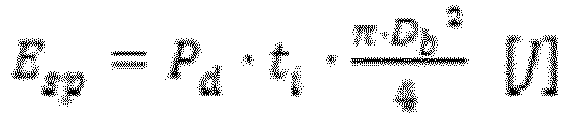
- Verfahren zum Überwachen eines Additivfertigungsprozesses eines Produkts (3) durch den Prozess des selektiven Laserschmelzens (SLM), der von einem Additivfertigungssystem (1) aus mindestens einem Material (2) durchgeführt wird, wobei das Verfahren den Erfassungsschritt (S1) von Parametern umfasst, darunter statische Parameter bezüglich des mindestens einen Materials und dynamische Parameter, die von in der Nähe des Additivfertigungssystems platzierten Sensoren (4) gemessen werden; einen Datentransformationsschritt (S2) zum Transformieren der Parameter in Datenvektoren; einen automatischen Vorhersageschritt (S3) zum Ableiten eines Defektrisikos für das Produkt auf der Grundlage eines trainierten Klassifizierungsmodells unter Verwendung der Datenvektoren als Eingabe; und einen Warnschritt (S4) zum Auslösen einer Warnung entsprechend dem Risiko;wobei das Klassifizierungsmodell und die Parameter so bestimmt werden, dass die Eigenschaften und das Verhalten des Schweißprofils bei der Laserleitung erfasst werden; undwobei die Parameter eine Scan-Geschwindigkeit v, eine Laserleistung P und einen Strahldurchmesser Db umfassen und der Transformationsschritt die Bestimmung einer Leistungsdichte Pd, einer Interaktionszeit ti, einer bestimmten Punktenergie Esp und einer Energiedichte Ed umfasst, so dass:



- Verfahren nach dem vorstehenden Anspruch, wobei der automatische Vorhersageschritt (S3) das Ausführen eines Support Vector Machine-Algorithmus (SVM-Algorithmus) umfasst.
- Verfahren nach dem vorstehenden Anspruch, wobei eine Wärmekarte erstellt wird.
- Überwachungssystem (5) für ein Additivfertigungssystem (1), das dazu konfiguriert ist, einen Additivfertigungsprozess eines Produkts (3) durch den Prozess des selektiven Laserschmelzens (Selective Laser Melting, SLM) aus mindestens einem Material (2) durchzuführen, umfassend Mittel, die konfiguriert sind zum:- Erfassen von Parametern, einschließlich statischer Parameter bezüglich des mindestens einen Materials und dynamischer Parameter, die durch in der Nähe des Additivfertigungssystems platzierte Sensoren (4) gemessen werden;- Transformieren der Parameter in Datenvektoren;- automatisches Ableiten eines Defektrisikos für das Produkt auf der Grundlage eines trainierten Klassifizierungsmodells unter Verwendung der Datenvektoren als Eingaben; und- Auslösen einer Warnung entsprechend dem Risiko;wobei das Klassifizierungsmodell und die Parameter so bestimmt werden, dass die Eigenschaften und das Verhalten des Schweißprofils bei der Laserleitung erfasst werden; undwobei die Parameter eine Scan-Geschwindigkeit v, eine Laserleistung P und einen Strahldurchmesser Db umfassen und der Transformationsschritt die Bestimmung einer Leistungsdichte Pd, einer Interaktionszeit ti, einer bestimmten Punktenergie Esp und einer Energiedichte Ed umfasst, so dass:


- Überwachungssystem (5) nach dem vorstehenden Anspruch, das ferner dazu konfiguriert ist, das Risiko durch Ausführen eines Support Vector Machine-Algorithmus (SVM-Algorithmus) abzuleiten.
Priority Applications (1)
| Application Number | Priority Date | Filing Date | Title |
|---|---|---|---|
| EP18382967.0A EP3671387B1 (de) | 2018-12-21 | 2018-12-21 | Überwachung eines verfahrens zur generativen fertigung durch maschinenlernalgorithmen |
Applications Claiming Priority (1)
| Application Number | Priority Date | Filing Date | Title |
|---|---|---|---|
| EP18382967.0A EP3671387B1 (de) | 2018-12-21 | 2018-12-21 | Überwachung eines verfahrens zur generativen fertigung durch maschinenlernalgorithmen |
Publications (2)
| Publication Number | Publication Date |
|---|---|
| EP3671387A1 EP3671387A1 (de) | 2020-06-24 |
| EP3671387B1 true EP3671387B1 (de) | 2024-10-23 |
Family
ID=65013515
Family Applications (1)
| Application Number | Title | Priority Date | Filing Date |
|---|---|---|---|
| EP18382967.0A Active EP3671387B1 (de) | 2018-12-21 | 2018-12-21 | Überwachung eines verfahrens zur generativen fertigung durch maschinenlernalgorithmen |
Country Status (1)
| Country | Link |
|---|---|
| EP (1) | EP3671387B1 (de) |
Families Citing this family (4)
| Publication number | Priority date | Publication date | Assignee | Title |
|---|---|---|---|---|
| EP3933528B1 (de) * | 2020-06-30 | 2024-10-02 | Bull SAS | Vorhersagesystem in einem prozess zur generativen fertigung durch maschinenlernalgorithmen |
| CN117983962B (zh) * | 2024-04-03 | 2024-07-02 | 成都环龙智能机器人有限公司 | 一种全流程自动焊接智能工作站的工作方法 |
| CN118363355B (zh) * | 2024-06-19 | 2024-08-30 | 武汉名实生物医药科技有限责任公司 | 一种产品生产实时监控系统 |
| CN118768537B (zh) * | 2024-09-12 | 2025-02-11 | 河北恒工精密装备股份有限公司 | 一种基于水平连铸工艺的参数异常监测方法、系统及介质 |
Family Cites Families (2)
| Publication number | Priority date | Publication date | Assignee | Title |
|---|---|---|---|---|
| DE19649865C1 (de) | 1996-12-02 | 1998-02-12 | Fraunhofer Ges Forschung | Verfahren zur Herstellung eines Formkörpers |
| US10234848B2 (en) * | 2017-05-24 | 2019-03-19 | Relativity Space, Inc. | Real-time adaptive control of additive manufacturing processes using machine learning |
-
2018
- 2018-12-21 EP EP18382967.0A patent/EP3671387B1/de active Active
Also Published As
| Publication number | Publication date |
|---|---|
| EP3671387A1 (de) | 2020-06-24 |
Similar Documents
| Publication | Publication Date | Title |
|---|---|---|
| Hashemi et al. | Computational modelling of process–structure–property–performance relationships in metal additive manufacturing: a review | |
| Mahadevan et al. | Uncertainty quantification for additive manufacturing process improvement: Recent advances | |
| Chen et al. | Defect inspection technologies for additive manufacturing | |
| Snyder et al. | Understanding laser powder bed fusion surface roughness | |
| Seifi et al. | Layer-wise modeling and anomaly detection for laser-based additive manufacturing | |
| Roy et al. | Prediction and experimental validation of part thermal history in the fused filament fabrication additive manufacturing process | |
| Williams et al. | A pragmatic part scale model for residual stress and distortion prediction in powder bed fusion | |
| Mani et al. | A review on measurement science needs for real-time control of additive manufacturing metal powder bed fusion processes | |
| Taufik et al. | A study of build edge profile for prediction of surface roughness in fused deposition modeling | |
| CA3064593C (en) | Real-time adaptive control of additive manufacturing processes using machine learning | |
| EP3671387A1 (de) | Überwachung eines verfahrens zur generativen fertigung durch maschinenlernalgorithmen | |
| Kumar et al. | Faster temperature prediction in the powder bed fusion process through the development of a surrogate model | |
| Nath et al. | Probabilistic digital twin for additive manufacturing process design and control | |
| Xi | Model predictive control of melt pool size for the laser powder bed fusion process under process uncertainty | |
| Negi et al. | Study on shrinkage behaviour of laser sintered PA 3200GF specimens using RSM and ANN | |
| EP3388907A1 (de) | Verfahren zur bereitstellung eines datensatzes zur generativen fertigung und zugehöriges qualitätskontrollverfahren | |
| Tabei et al. | Dynamic recrystallization of Al alloy 7075 in turning | |
| Li et al. | Thermal modeling of 304L stainless steel selective laser melting | |
| Tang et al. | Build rate optimization for powder bed fusion | |
| CN118690970B (zh) | 基于人工智能的增材制造流程优化方法及系统 | |
| Clijsters et al. | A priori process parameter adjustment for SLM process optimization | |
| Feng et al. | Functional requirements of software tools for laser-based powder bed fusion additive manufacturing for metals | |
| Terrenoir et al. | Influence of wire feed speed and torch speed on the mechanical properties of wire arc additively manufactured stainless steel | |
| Yeh et al. | A thermal fluid dynamic model for the melt region during the laser powder bed fusion of polyamide 11 (PA11) | |
| Kuşhan et al. | Systematical review on the numerical simulations of laser powder bed additive manufacturing |
Legal Events
| Date | Code | Title | Description |
|---|---|---|---|
| PUAI | Public reference made under article 153(3) epc to a published international application that has entered the european phase |
Free format text: ORIGINAL CODE: 0009012 |
|
| STAA | Information on the status of an ep patent application or granted ep patent |
Free format text: STATUS: THE APPLICATION HAS BEEN PUBLISHED |
|
| AK | Designated contracting states |
Kind code of ref document: A1 Designated state(s): AL AT BE BG CH CY CZ DE DK EE ES FI FR GB GR HR HU IE IS IT LI LT LU LV MC MK MT NL NO PL PT RO RS SE SI SK SM TR |
|
| AX | Request for extension of the european patent |
Extension state: BA ME |
|
| STAA | Information on the status of an ep patent application or granted ep patent |
Free format text: STATUS: REQUEST FOR EXAMINATION WAS MADE |
|
| 17P | Request for examination filed |
Effective date: 20201222 |
|
| RBV | Designated contracting states (corrected) |
Designated state(s): AL AT BE BG CH CY CZ DE DK EE ES FI FR GB GR HR HU IE IS IT LI LT LU LV MC MK MT NL NO PL PT RO RS SE SI SK SM TR |
|
| STAA | Information on the status of an ep patent application or granted ep patent |
Free format text: STATUS: EXAMINATION IS IN PROGRESS |
|
| 17Q | First examination report despatched |
Effective date: 20211203 |
|
| RAP1 | Party data changed (applicant data changed or rights of an application transferred) |
Owner name: BULL SAS |
|
| P01 | Opt-out of the competence of the unified patent court (upc) registered |
Effective date: 20230330 |
|
| GRAP | Despatch of communication of intention to grant a patent |
Free format text: ORIGINAL CODE: EPIDOSNIGR1 |
|
| STAA | Information on the status of an ep patent application or granted ep patent |
Free format text: STATUS: GRANT OF PATENT IS INTENDED |
|
| INTG | Intention to grant announced |
Effective date: 20240719 |
|
| GRAS | Grant fee paid |
Free format text: ORIGINAL CODE: EPIDOSNIGR3 |
|
| GRAA | (expected) grant |
Free format text: ORIGINAL CODE: 0009210 |
|
| STAA | Information on the status of an ep patent application or granted ep patent |
Free format text: STATUS: THE PATENT HAS BEEN GRANTED |
|
| AK | Designated contracting states |
Kind code of ref document: B1 Designated state(s): AL AT BE BG CH CY CZ DE DK EE ES FI FR GB GR HR HU IE IS IT LI LT LU LV MC MK MT NL NO PL PT RO RS SE SI SK SM TR |
|
| REG | Reference to a national code |
Ref country code: GB Ref legal event code: FG4D |
|
| REG | Reference to a national code |
Ref country code: CH Ref legal event code: EP |
|
| REG | Reference to a national code |
Ref country code: DE Ref legal event code: R096 Ref document number: 602018075688 Country of ref document: DE |
|
| REG | Reference to a national code |
Ref country code: IE Ref legal event code: FG4D |
|
| REG | Reference to a national code |
Ref country code: LT Ref legal event code: MG9D |
|
| REG | Reference to a national code |
Ref country code: NL Ref legal event code: MP Effective date: 20241023 |
|
| REG | Reference to a national code |
Ref country code: AT Ref legal event code: MK05 Ref document number: 1735342 Country of ref document: AT Kind code of ref document: T Effective date: 20241023 |
|
| PG25 | Lapsed in a contracting state [announced via postgrant information from national office to epo] |
Ref country code: NL Free format text: LAPSE BECAUSE OF FAILURE TO SUBMIT A TRANSLATION OF THE DESCRIPTION OR TO PAY THE FEE WITHIN THE PRESCRIBED TIME-LIMIT Effective date: 20241023 |
|
| PG25 | Lapsed in a contracting state [announced via postgrant information from national office to epo] |
Ref country code: NL Free format text: LAPSE BECAUSE OF FAILURE TO SUBMIT A TRANSLATION OF THE DESCRIPTION OR TO PAY THE FEE WITHIN THE PRESCRIBED TIME-LIMIT Effective date: 20241023 |
|
| PG25 | Lapsed in a contracting state [announced via postgrant information from national office to epo] |
Ref country code: HR Free format text: LAPSE BECAUSE OF FAILURE TO SUBMIT A TRANSLATION OF THE DESCRIPTION OR TO PAY THE FEE WITHIN THE PRESCRIBED TIME-LIMIT Effective date: 20241023 Ref country code: PT Free format text: LAPSE BECAUSE OF FAILURE TO SUBMIT A TRANSLATION OF THE DESCRIPTION OR TO PAY THE FEE WITHIN THE PRESCRIBED TIME-LIMIT Effective date: 20250224 Ref country code: IS Free format text: LAPSE BECAUSE OF FAILURE TO SUBMIT A TRANSLATION OF THE DESCRIPTION OR TO PAY THE FEE WITHIN THE PRESCRIBED TIME-LIMIT Effective date: 20250223 |
|
| PG25 | Lapsed in a contracting state [announced via postgrant information from national office to epo] |
Ref country code: FI Free format text: LAPSE BECAUSE OF FAILURE TO SUBMIT A TRANSLATION OF THE DESCRIPTION OR TO PAY THE FEE WITHIN THE PRESCRIBED TIME-LIMIT Effective date: 20241023 |
|
| PG25 | Lapsed in a contracting state [announced via postgrant information from national office to epo] |
Ref country code: BG Free format text: LAPSE BECAUSE OF FAILURE TO SUBMIT A TRANSLATION OF THE DESCRIPTION OR TO PAY THE FEE WITHIN THE PRESCRIBED TIME-LIMIT Effective date: 20241023 |
|
| PG25 | Lapsed in a contracting state [announced via postgrant information from national office to epo] |
Ref country code: ES Free format text: LAPSE BECAUSE OF FAILURE TO SUBMIT A TRANSLATION OF THE DESCRIPTION OR TO PAY THE FEE WITHIN THE PRESCRIBED TIME-LIMIT Effective date: 20241023 |
|
| PG25 | Lapsed in a contracting state [announced via postgrant information from national office to epo] |
Ref country code: NO Free format text: LAPSE BECAUSE OF FAILURE TO SUBMIT A TRANSLATION OF THE DESCRIPTION OR TO PAY THE FEE WITHIN THE PRESCRIBED TIME-LIMIT Effective date: 20250123 |
|
| PG25 | Lapsed in a contracting state [announced via postgrant information from national office to epo] |
Ref country code: LV Free format text: LAPSE BECAUSE OF FAILURE TO SUBMIT A TRANSLATION OF THE DESCRIPTION OR TO PAY THE FEE WITHIN THE PRESCRIBED TIME-LIMIT Effective date: 20241023 Ref country code: AT Free format text: LAPSE BECAUSE OF FAILURE TO SUBMIT A TRANSLATION OF THE DESCRIPTION OR TO PAY THE FEE WITHIN THE PRESCRIBED TIME-LIMIT Effective date: 20241023 Ref country code: GR Free format text: LAPSE BECAUSE OF FAILURE TO SUBMIT A TRANSLATION OF THE DESCRIPTION OR TO PAY THE FEE WITHIN THE PRESCRIBED TIME-LIMIT Effective date: 20250124 |
|
| PG25 | Lapsed in a contracting state [announced via postgrant information from national office to epo] |
Ref country code: PL Free format text: LAPSE BECAUSE OF FAILURE TO SUBMIT A TRANSLATION OF THE DESCRIPTION OR TO PAY THE FEE WITHIN THE PRESCRIBED TIME-LIMIT Effective date: 20241023 |
|
| PG25 | Lapsed in a contracting state [announced via postgrant information from national office to epo] |
Ref country code: RS Free format text: LAPSE BECAUSE OF FAILURE TO SUBMIT A TRANSLATION OF THE DESCRIPTION OR TO PAY THE FEE WITHIN THE PRESCRIBED TIME-LIMIT Effective date: 20250123 |
|
| PG25 | Lapsed in a contracting state [announced via postgrant information from national office to epo] |
Ref country code: SM Free format text: LAPSE BECAUSE OF FAILURE TO SUBMIT A TRANSLATION OF THE DESCRIPTION OR TO PAY THE FEE WITHIN THE PRESCRIBED TIME-LIMIT Effective date: 20241023 |
|
| PG25 | Lapsed in a contracting state [announced via postgrant information from national office to epo] |
Ref country code: MC Free format text: LAPSE BECAUSE OF FAILURE TO SUBMIT A TRANSLATION OF THE DESCRIPTION OR TO PAY THE FEE WITHIN THE PRESCRIBED TIME-LIMIT Effective date: 20241023 |
|
| PG25 | Lapsed in a contracting state [announced via postgrant information from national office to epo] |
Ref country code: DK Free format text: LAPSE BECAUSE OF FAILURE TO SUBMIT A TRANSLATION OF THE DESCRIPTION OR TO PAY THE FEE WITHIN THE PRESCRIBED TIME-LIMIT Effective date: 20241023 |
|
| PG25 | Lapsed in a contracting state [announced via postgrant information from national office to epo] |
Ref country code: EE Free format text: LAPSE BECAUSE OF FAILURE TO SUBMIT A TRANSLATION OF THE DESCRIPTION OR TO PAY THE FEE WITHIN THE PRESCRIBED TIME-LIMIT Effective date: 20241023 |
|
| PG25 | Lapsed in a contracting state [announced via postgrant information from national office to epo] |
Ref country code: RO Free format text: LAPSE BECAUSE OF FAILURE TO SUBMIT A TRANSLATION OF THE DESCRIPTION OR TO PAY THE FEE WITHIN THE PRESCRIBED TIME-LIMIT Effective date: 20241023 |
|
| REG | Reference to a national code |
Ref country code: DE Ref legal event code: R097 Ref document number: 602018075688 Country of ref document: DE |
|
| PG25 | Lapsed in a contracting state [announced via postgrant information from national office to epo] |
Ref country code: SK Free format text: LAPSE BECAUSE OF FAILURE TO SUBMIT A TRANSLATION OF THE DESCRIPTION OR TO PAY THE FEE WITHIN THE PRESCRIBED TIME-LIMIT Effective date: 20241023 |
|
| PG25 | Lapsed in a contracting state [announced via postgrant information from national office to epo] |
Ref country code: CZ Free format text: LAPSE BECAUSE OF FAILURE TO SUBMIT A TRANSLATION OF THE DESCRIPTION OR TO PAY THE FEE WITHIN THE PRESCRIBED TIME-LIMIT Effective date: 20241023 |
|
| PG25 | Lapsed in a contracting state [announced via postgrant information from national office to epo] |
Ref country code: IT Free format text: LAPSE BECAUSE OF FAILURE TO SUBMIT A TRANSLATION OF THE DESCRIPTION OR TO PAY THE FEE WITHIN THE PRESCRIBED TIME-LIMIT Effective date: 20241023 |
|
| REG | Reference to a national code |
Ref country code: CH Ref legal event code: PL |
|
| PG25 | Lapsed in a contracting state [announced via postgrant information from national office to epo] |
Ref country code: LU Free format text: LAPSE BECAUSE OF NON-PAYMENT OF DUE FEES Effective date: 20241221 |
|
| PLBE | No opposition filed within time limit |
Free format text: ORIGINAL CODE: 0009261 |
|
| STAA | Information on the status of an ep patent application or granted ep patent |
Free format text: STATUS: NO OPPOSITION FILED WITHIN TIME LIMIT |
|
| PG25 | Lapsed in a contracting state [announced via postgrant information from national office to epo] |
Ref country code: SE Free format text: LAPSE BECAUSE OF FAILURE TO SUBMIT A TRANSLATION OF THE DESCRIPTION OR TO PAY THE FEE WITHIN THE PRESCRIBED TIME-LIMIT Effective date: 20241023 |
|
| 26N | No opposition filed |
Effective date: 20250724 |
|
| REG | Reference to a national code |
Ref country code: BE Ref legal event code: MM Effective date: 20241231 |
|
| PG25 | Lapsed in a contracting state [announced via postgrant information from national office to epo] |
Ref country code: BE Free format text: LAPSE BECAUSE OF NON-PAYMENT OF DUE FEES Effective date: 20241231 |
|
| PG25 | Lapsed in a contracting state [announced via postgrant information from national office to epo] |
Ref country code: CH Free format text: LAPSE BECAUSE OF NON-PAYMENT OF DUE FEES Effective date: 20241231 |
|
| PG25 | Lapsed in a contracting state [announced via postgrant information from national office to epo] |
Ref country code: IE Free format text: LAPSE BECAUSE OF NON-PAYMENT OF DUE FEES Effective date: 20241221 |
|
| PGFP | Annual fee paid to national office [announced via postgrant information from national office to epo] |
Ref country code: GB Payment date: 20251218 Year of fee payment: 8 |
|
| PGFP | Annual fee paid to national office [announced via postgrant information from national office to epo] |
Ref country code: FR Payment date: 20251218 Year of fee payment: 8 |
|
| PGFP | Annual fee paid to national office [announced via postgrant information from national office to epo] |
Ref country code: DE Payment date: 20251222 Year of fee payment: 8 |
|
| PG25 | Lapsed in a contracting state [announced via postgrant information from national office to epo] |
Ref country code: CY Free format text: LAPSE BECAUSE OF FAILURE TO SUBMIT A TRANSLATION OF THE DESCRIPTION OR TO PAY THE FEE WITHIN THE PRESCRIBED TIME-LIMIT Effective date: 20241023 |