EP3667219A1 - Method for performing a drying function after a cooking func-tion or steam cooking function - Google Patents
Method for performing a drying function after a cooking func-tion or steam cooking function Download PDFInfo
- Publication number
- EP3667219A1 EP3667219A1 EP18212515.3A EP18212515A EP3667219A1 EP 3667219 A1 EP3667219 A1 EP 3667219A1 EP 18212515 A EP18212515 A EP 18212515A EP 3667219 A1 EP3667219 A1 EP 3667219A1
- Authority
- EP
- European Patent Office
- Prior art keywords
- function
- drying
- cooking
- cooking function
- steam
- Prior art date
- Legal status (The legal status is an assumption and is not a legal conclusion. Google has not performed a legal analysis and makes no representation as to the accuracy of the status listed.)
- Granted
Links
Images



Classifications
-
- F—MECHANICAL ENGINEERING; LIGHTING; HEATING; WEAPONS; BLASTING
- F24—HEATING; RANGES; VENTILATING
- F24C—DOMESTIC STOVES OR RANGES ; DETAILS OF DOMESTIC STOVES OR RANGES, OF GENERAL APPLICATION
- F24C15/00—Details
- F24C15/20—Removing cooking fumes
- F24C15/2007—Removing cooking fumes from oven cavities
-
- F—MECHANICAL ENGINEERING; LIGHTING; HEATING; WEAPONS; BLASTING
- F24—HEATING; RANGES; VENTILATING
- F24C—DOMESTIC STOVES OR RANGES ; DETAILS OF DOMESTIC STOVES OR RANGES, OF GENERAL APPLICATION
- F24C15/00—Details
- F24C15/20—Removing cooking fumes
- F24C15/2021—Arrangement or mounting of control or safety systems
-
- A—HUMAN NECESSITIES
- A21—BAKING; EDIBLE DOUGHS
- A21B—BAKERS' OVENS; MACHINES OR EQUIPMENT FOR BAKING
- A21B3/00—Parts or accessories of ovens
- A21B3/04—Air-treatment devices for ovens, e.g. regulating humidity
-
- F—MECHANICAL ENGINEERING; LIGHTING; HEATING; WEAPONS; BLASTING
- F24—HEATING; RANGES; VENTILATING
- F24C—DOMESTIC STOVES OR RANGES ; DETAILS OF DOMESTIC STOVES OR RANGES, OF GENERAL APPLICATION
- F24C15/00—Details
- F24C15/32—Arrangements of ducts for hot gases, e.g. in or around baking ovens
- F24C15/322—Arrangements of ducts for hot gases, e.g. in or around baking ovens with forced circulation
- F24C15/327—Arrangements of ducts for hot gases, e.g. in or around baking ovens with forced circulation with air moisturising
-
- F—MECHANICAL ENGINEERING; LIGHTING; HEATING; WEAPONS; BLASTING
- F24—HEATING; RANGES; VENTILATING
- F24C—DOMESTIC STOVES OR RANGES ; DETAILS OF DOMESTIC STOVES OR RANGES, OF GENERAL APPLICATION
- F24C7/00—Stoves or ranges heated by electric energy
- F24C7/08—Arrangement or mounting of control or safety devices
- F24C7/082—Arrangement or mounting of control or safety devices on ranges, e.g. control panels, illumination
-
- F—MECHANICAL ENGINEERING; LIGHTING; HEATING; WEAPONS; BLASTING
- F26—DRYING
- F26B—DRYING SOLID MATERIALS OR OBJECTS BY REMOVING LIQUID THEREFROM
- F26B21/00—Arrangements for supplying or controlling air or other gases for drying solid materials or objects
- F26B21/30—Controlling, e.g. regulating, parameters of gas supply
- F26B21/33—Humidity
Definitions
- the present invention relates to a method for performing a drying function after a cooking function, in particular after a steam cooking function. Further, the present invention relates to a cooking oven, in particular a cooking oven with at least one steam cooking function.
- condensate is generated inside the oven cavity. Said condensate is annoying for the user and may by disadvantageous for the cooking process. After the cooking process the condensate must to be removed.
- the object is achieved by the method according to claim 1.
- a method for performing a drying function after a cooking function, in particular after a steam cooking function comprises the steps of:
- the main idea of the present invention is that the drying function is activated only if necessary, wherein the necessity is checked by using at least one parameter value.
- the drying function is immediately started, after the cooking function or steam cooking function has been finished. This allows an optimal adaption of the drying function to the requirements by minimum energy consumption.
- the method of the present invention is suitable for cooking ovens with and without steam functions.
- the method of the present invention may be also applied to cooking ovens with radiant heating, convection heat and even microwave heating functions.
- the drying function is required, then the need of said drying function is indicated on a user interface and/or said drying function is started automatically.
- the need of the drying function is indicated on the user interface by showing a pop-up interacting with the user.
- the drying function may be started or not by user interaction.
- the drying function could be started manually or automatically at the end of the cooking process, in particular at the end of the steam cooking process.
- drying function may be finished either after a predetermined time or if the detected or calculated parameter value falls below a corresponding threshold parameter value.
- the weight of the selected cooking function SF or steam cooking function SF depends on the amount of steam and/or humidity generated for said function and/or on the condensation expected at the end of the cooking process.
- the amount of steam depends on the number of activations of the steam generator, on which heating elements are activated and/or on the food inserted into the oven cavity.
- the characteristic value may be compared with a corresponding threshold characteristic value, wherein said threshold characteristic value is a function of the selected steam function SF, the time t said cooking function or steam cooking function was running and the temperature T during the cooking function or steam cooking function.
- the drying function is required and started manually or automatically, if the characteristic value exceeds the threshold characteristic value, and is finished, if the characteristic value falls below the threshold characteristic value.
- the humidity inside the oven cavity is detected after the end of the cooking function or steam cooking function.
- the drying function is required and started manually or automatically.
- the humidity inside the oven cavity may be detected during the drying function, wherein said drying function is continued, if the detected humidity exceeds the threshold humidity value, while said drying function is finished, if the detected humidity falls below the threshold humidity value.
- the present invention relates to a cooking, in particular a cooking oven with at least one steam cooking function, wherein the cooking oven is provided for the method mentioned above.
- FIG 1 illustrates a schematic flow chart diagram of a method for determining a condensation in an oven cavity according to a first embodiment of the present invention.
- a steam cooking function is selected.
- said steam cooking function is running.
- the steam cooking function is ended either automatically by a timer or manually by a user.
- the coefficients k1 and k2 may be different or identical. For example, if the cooking oven is a microwave oven, then the coefficient k1 depends on the power of said microwave oven.
- a next step 18 the calculated characteristic value Y is compared with a threshold characteristic value Yth. If the characteristic value Y exceeds the threshold characteristic value Yth, then an acoustic and/or optical signal is indicated by a user interface in a step 20 in order to inform the user that a drying function is required. Alternatively, the drying function is automatically started, if the calculated value Y exceeds the threshold characteristic value Yth. Said drying function is provided for remove the condensate from the oven cavity.
- step 22 the drying function is running for a predetermined time. After the drying function has been ended, the method ends in a last step 24.
- the method is ended in the last step 24.
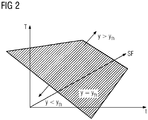
- FIG 2 illustrates a schematic graphical representation of the characteristic value Y as function of the selected steam function SF, the time t and the temperature T according to the first embodiment of the present invention.
- the selected steam function SF, the time t and the temperature T form three cartesian variables of a three-dimensional space.
- the threshold characteristic value Yth is represented by a plane surface in said three-dimensional space. In general, the threshold characteristic value Yth may be represented by an arbitrary surface in the three-dimensional space.
- the characteristic value Y exceeding the threshold value Yth form a half-space above the surface of the threshold characteristic value Yth, while the characteristic value Y falling below the threshold characteristic value Yth form the half-space beneath the surface of the threshold characteristic value Yth.
- FIG 3 illustrates a schematic flow chart diagram of the method for determining the condensation in the oven cavity according to a second embodiment of the present invention.
- the steam cooking function is selected.
- said steam cooking function is running.
- the steam cooking function is ended either automatically by the timer or manually by the user.
- a step 26 the humidity H in the oven cavity is detected.
- the detected humidity H is compared with a threshold humidity value Hth. If the humidity value H exceeds the threshold humidity value Hth, then the acoustic and/or optical signal is indicated by the user interface in the step 20 in order to inform the user that the drying function is required. Alternatively, the drying function is automatically started, if the calculated value Y exceeds the threshold characteristic value Yth. Said drying function is provided for remove the condensate from the oven cavity.
- the drying function is running.
- the humidity H in the oven cavity is detected continuously or at certain times.
- the detected humidity H is compared with the threshold humidity value Hth. If the humidity value H exceeds the threshold humidity value Hth, then the drying function is continued in the step 22. If the humidity value H falls below the threshold humidity value Hth, then the method is ended in the last step 24.
- FIG 4 illustrates a schematic flow chart diagram of the method for determining the condensation in the oven cavity according to a third embodiment of the present invention.
- the steam cooking function is selected.
- said steam cooking function is running.
- an estimation algorithm is running in a step 32.
- the steam cooking function is ended either automatically by the timer or manually by the user. From the estimation algorithm of step 32 an estimated run time t e for the drying function is calculated in a step 34.
- the detected humidity H is used to calculate the estimated run time t e for the drying function.
- the estimated run time t e is compared with a threshold value t e th, wherein the decision if the drying function is running or not depends on said comparison.
- a step 36 the estimated run time t e is compared with the corresponding threshold value t e th. If the estimated run time t e exceeds the threshold value t e th, then the acoustic and/or optical signal is indicated by the user interface in the step 20 in order to inform the user that the drying function is required. The user may decide to start the drying function. Alternatively, the drying function is automatically started, if the estimated run time t e exceeds the threshold value t e th. Said drying function is provided for removing the condensate from the oven cavity.
- the drying function is running.
- the estimation algorithm is running and the estimated run time t e is adjusted in a step 38.
- the step 36 is repeated, wherein the estimated run time t e is compared with the corresponding threshold value t e th again. If the estimated run time t e exceeds the threshold value t e th, then the drying function is continued in the step 22, wherein the estimation algorithm is running and the estimated run time t e is adjusted in the step 38. If the estimated run time t e falls below the threshold value t e th, then the method is ended in the last step 24.
- the estimated run time t e from the step 34 is checked at step 36. If the remaining estimated run time t e is bigger than zero, then an adjusted estimated run time t' e is calculated in the step 38.
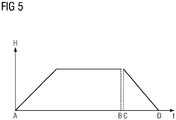
- FIG 5 illustrates a schematic diagram of the humidity inside the oven cavity as function of the time t during a steam cooking function and a drying function according to the third embodiment of the present invention.
- the humidity H increases linearly in the beginning of the steam cooking function, is constant during the remaining steam cooking function and decreases linearly during the drying function.
- the real steam cooking function and drying function are more complex, so that the humidity H may increase arbitrarily in the beginning of the steam cooking function, may fluctuate during the remaining steam cooking function and may decrease in an arbitrary way during the drying function.
- the humidity factor k represents the quantity of the humidity generated during the steam cooking function per second.
- the estimated time te is a preliminary value for the duration of the drying function.
- the adjusted estimated time t' e is an actual value for the duration of the drying function.
- the adjusted estimated run time is stored for further steam cooking and drying functions.
Landscapes
- Engineering & Computer Science (AREA)
- Mechanical Engineering (AREA)
- General Engineering & Computer Science (AREA)
- Chemical & Material Sciences (AREA)
- Combustion & Propulsion (AREA)
- Life Sciences & Earth Sciences (AREA)
- Food Science & Technology (AREA)
- Electric Ovens (AREA)
- Drying Of Solid Materials (AREA)
Abstract
Description
- The present invention relates to a method for performing a drying function after a cooking function, in particular after a steam cooking function. Further, the present invention relates to a cooking oven, in particular a cooking oven with at least one steam cooking function.
- During a steam cooking process condensate is generated inside the oven cavity. Said condensate is annoying for the user and may by disadvantageous for the cooking process. After the cooking process the condensate must to be removed.
- It is an object of the present invention to provide a method for performing a drying function after a cooking function or steam cooking function, wherein said drying function is adapted to the remaining humidity in the oven cavity by minimum energy consumption.
- The object is achieved by the method according to claim 1.
- According to the present invention a method for performing a drying function after a cooking function, in particular after a steam cooking function, is provided, wherein said method comprises the steps of:
- running the cooking function or steam cooking function for a predetermined time or being manually finished by the user,
- detecting and/or calculating at least one parameter value after the cooking function or steam cooking function has been finished,
- comparing the detected and/or calculated parameter value with a corresponding threshold parameter value,
- checking, if the drying function is required, and
- running the drying function if required.
- The main idea of the present invention is that the drying function is activated only if necessary, wherein the necessity is checked by using at least one parameter value. The drying function is immediately started, after the cooking function or steam cooking function has been finished. This allows an optimal adaption of the drying function to the requirements by minimum energy consumption. The method of the present invention is suitable for cooking ovens with and without steam functions. The method of the present invention may be also applied to cooking ovens with radiant heating, convection heat and even microwave heating functions.
- For example, if the drying function is required, then the need of said drying function is indicated on a user interface and/or said drying function is started automatically. For example, the need of the drying function is indicated on the user interface by showing a pop-up interacting with the user. The drying function may be started or not by user interaction. The drying function could be started manually or automatically at the end of the cooking process, in particular at the end of the steam cooking process.
- Further, the drying function may be finished either after a predetermined time or if the detected or calculated parameter value falls below a corresponding threshold parameter value.
- According to a first embodiment of the present invention, after the cooking function or steam cooking function a characteristic value is calculated by the formula

- Then, the characteristic value may be compared with a corresponding threshold characteristic value, wherein said threshold characteristic value is a function of the selected steam function SF, the time t said cooking function or steam cooking function was running and the temperature T during the cooking function or steam cooking function.
- Particularly, the drying function is required and started manually or automatically, if the characteristic value exceeds the threshold characteristic value, and is finished, if the characteristic value falls below the threshold characteristic value.
- According to a second embodiment of the present invention, the humidity inside the oven cavity is detected after the end of the cooking function or steam cooking function.
- For example, if the detected humidity exceeds a threshold humidity value, then the drying function is required and started manually or automatically.
- Moreover, the humidity inside the oven cavity may be detected during the drying function, wherein said drying function is continued, if the detected humidity exceeds the threshold humidity value, while said drying function is finished, if the detected humidity falls below the threshold humidity value.
- According to a third embodiment of the present invention, an estimated run time te for the drying function is calculated after the cooking function or steam cooking function by the formula

- Additionally, an adjusted estimated run time for the drying function may be calculated during the drying function by the formula

- Further, the present invention relates to a cooking, in particular a cooking oven with at least one steam cooking function, wherein the cooking oven is provided for the method mentioned above.
- Novel and inventive features of the present invention are set forth in the appended claims.
- The present invention will be described in further detail with reference to the drawings, in which
- FIG 1
- illustrates a schematic flow chart diagram of a method for determining a condensation in an oven cavity according to a first embodiment of the present invention,
- FIG 2
- illustrates a schematic graphical representation of a characteristic value Y as function of a selected steam function SF, the time t and the temperature T according to the first embodiment of the present invention,
- FIG 3
- illustrates a schematic flow chart diagram of the method for determining the condensation in the oven cavity according to a second embodiment of the present invention,
- FIG 4
- illustrates a schematic flow chart diagram of the method for determining the condensation in the oven cavity according to a third embodiment of the present invention, and
- FIG 5
- illustrates a schematic diagram of the humidity inside the oven cavity as function of the time t during a steam cooking function and a drying function according to the third embodiment of the present invention.
-
FIG 1 illustrates a schematic flow chart diagram of a method for determining a condensation in an oven cavity according to a first embodiment of the present invention. - In a first step 10 a steam cooking function is selected. In a
next step 12 said steam cooking function is running. In afurther step 14 the steam cooking function is ended either automatically by a timer or manually by a user. - In a step 16 a characteristic value Y is calculated by the formula

- In a
next step 18 the calculated characteristic value Y is compared with a threshold characteristic value Yth. If the characteristic value Y exceeds the threshold characteristic value Yth, then an acoustic and/or optical signal is indicated by a user interface in astep 20 in order to inform the user that a drying function is required. Alternatively, the drying function is automatically started, if the calculated value Y exceeds the threshold characteristic value Yth. Said drying function is provided for remove the condensate from the oven cavity. - In a
further step 22 the drying function is running for a predetermined time. After the drying function has been ended, the method ends in alast step 24. - However, if the characteristic value Y falls below the threshold characteristic value Yth in the
step 18, then the method is ended in thelast step 24. -
FIG 2 illustrates a schematic graphical representation of the characteristic value Y as function of the selected steam function SF, the time t and the temperature T according to the first embodiment of the present invention. - The selected steam function SF, the time t and the temperature T form three cartesian variables of a three-dimensional space. The threshold characteristic value Yth is represented by a plane surface in said three-dimensional space. In general, the threshold characteristic value Yth may be represented by an arbitrary surface in the three-dimensional space.
- The characteristic value Y exceeding the threshold value Yth form a half-space above the surface of the threshold characteristic value Yth, while the characteristic value Y falling below the threshold characteristic value Yth form the half-space beneath the surface of the threshold characteristic value Yth.
-
FIG 3 illustrates a schematic flow chart diagram of the method for determining the condensation in the oven cavity according to a second embodiment of the present invention. - In the
first step 10 the steam cooking function is selected. In thenext step 12 said steam cooking function is running. In thefurther step 14 the steam cooking function is ended either automatically by the timer or manually by the user. - In a
step 26 the humidity H in the oven cavity is detected. In anext step 28 the detected humidity H is compared with a threshold humidity value Hth. If the humidity value H exceeds the threshold humidity value Hth, then the acoustic and/or optical signal is indicated by the user interface in thestep 20 in order to inform the user that the drying function is required. Alternatively, the drying function is automatically started, if the calculated value Y exceeds the threshold characteristic value Yth. Said drying function is provided for remove the condensate from the oven cavity. - In the
next step 22 the drying function is running. During thestep 22 the humidity H in the oven cavity is detected continuously or at certain times. In afurther step 30 the detected humidity H is compared with the threshold humidity value Hth. If the humidity value H exceeds the threshold humidity value Hth, then the drying function is continued in thestep 22. If the humidity value H falls below the threshold humidity value Hth, then the method is ended in thelast step 24. -
FIG 4 illustrates a schematic flow chart diagram of the method for determining the condensation in the oven cavity according to a third embodiment of the present invention. - In the
first step 10 the steam cooking function is selected. In thenext step 12 said steam cooking function is running. At the same time an estimation algorithm is running in astep 32. In thefurther step 14 the steam cooking function is ended either automatically by the timer or manually by the user. From the estimation algorithm ofstep 32 an estimated run time te for the drying function is calculated in astep 34. - In this embodiment the detected humidity H is used to calculate the estimated run time te for the drying function. The estimated run time te is compared with a threshold value teth, wherein the decision if the drying function is running or not depends on said comparison.
- In a
step 36 the estimated run time te is compared with the corresponding threshold value teth. If the estimated run time te exceeds the threshold value teth, then the acoustic and/or optical signal is indicated by the user interface in thestep 20 in order to inform the user that the drying function is required. The user may decide to start the drying function. Alternatively, the drying function is automatically started, if the estimated run time te exceeds the threshold value teth. Said drying function is provided for removing the condensate from the oven cavity. - In the
next step 22 the drying function is running. During thestep 22 the estimation algorithm is running and the estimated run time te is adjusted in astep 38. Then, thestep 36 is repeated, wherein the estimated run time te is compared with the corresponding threshold value teth again. If the estimated run time te exceeds the threshold value teth, then the drying function is continued in thestep 22, wherein the estimation algorithm is running and the estimated run time te is adjusted in thestep 38. If the estimated run time te falls below the threshold value teth, then the method is ended in thelast step 24. - The estimated run time te from the
step 34 is checked atstep 36. If the remaining estimated run time te is bigger than zero, then an adjusted estimated run time t'e is calculated in thestep 38. -
FIG 5 illustrates a schematic diagram of the humidity inside the oven cavity as function of the time t during a steam cooking function and a drying function according to the third embodiment of the present invention. - The steam cooking function is started at t = A and is finished at t = B. The drying function is started after the steam cooking function at t = C and is finished at t = D. In this schematic example, the humidity H increases linearly in the beginning of the steam cooking function, is constant during the remaining steam cooking function and decreases linearly during the drying function. However, the real steam cooking function and drying function are more complex, so that the humidity H may increase arbitrarily in the beginning of the steam cooking function, may fluctuate during the remaining steam cooking function and may decrease in an arbitrary way during the drying function.
- The estimated run time te for the drying function is calculated in the
step 34 inFIG 4 by the formula
- The adjusted estimated run time t'e is given by the formula

- Optionally, the adjusted estimated run time is stored for further steam cooking and drying functions.
- Although illustrative embodiments of the present invention have been described herein with reference to the accompanying drawings, it is to be understood that the present invention is not limited to those precise embodiments, and that various other changes and modifications may be affected therein by one skilled in the art without departing from the scope or spirit of the invention. All such changes and modifications are intended to be included within the scope of the invention as defined by the appended claims.
-
- 10
- step of selecting a steam cooking function
- 12
- step of running the steam cooking function
- 14
- step of ending the steam cooking function
- 16
- step of calculating a characteristic value
- 18
- step of comparing the characteristic value with a threshold characteristic value
- 20
- step of indication the need of a drying function
- 22
- step of running the drying function
- 24
- step of ending the method
- 26
- step of detecting the humidity
- 28
- step of comparing the detected humidity with a threshold humidity value
- 30
- step of comparing the detected humidity with a threshold humidity value during the drying function
- 32
- step of running an estimation algorithm
- 34
- step of calculating the estimated run time for the drying function
- 36
- step of comparing the estimated run time with a threshold value
- 38
- step of running the estimation algorithm and adjusting the estimated run time
- t
- time
- T
- temperature
- SF
- selected steam function
- Y
- characteristic value
- Yth
- threshold characteristic value
- H
- humidity
- Hth
- threshold humidity value
- k1
- first coefficient
- k2
- second coefficient
- A
- start of steam cooking function
- B
- end of steam cooking function
- C
- start of drying function
- D
- end of drying function
- k
- humidity factor
- k'
- drying factor
- te
- estimated run time for drying function
- teth
- threshold value for the estimated run time
- t'e
- adjusted estimated run time for drying function
Claims (12)
- A method for performing a drying function after a cooking function, in particular after a steam cooking function, wherein said method comprises the steps of:- running the cooking function or steam cooking function (12) for a predetermined time or being manually finished by the user,- detecting and/or calculating (16; 26) at least one parameter value (Y; H; te) after the cooking function or steam cooking function has been finished,- comparing (18; 28) the detected and/or calculated parameter value (Y; H; te) with a corresponding threshold parameter value (Yth; Hth; teth),- checking, if the drying function is required, and- running the drying function (22) if required.
- The method according to claim 1,
characterised in that
if the drying function is required, then the need of said drying function is indicated (20) on a user interface and/or said drying function is started automatically, wherein preferably the user interface asks the user if the drying function should be started manually by said user or automatically. - The method according to claim 1 or 2,
characterised in that
the drying function is finished either after a predetermined time or if the detected or calculated parameter value falls below a corresponding threshold parameter value. - The method according to any one of the preceding claims,
characterised in that
after the cooking function or steam cooking function a characteristic value (Y) is calculated (16) by the formula
- The operating device according to claim 4,
characterised in that
the characteristic value (Y) is compared (18) with a corresponding threshold characteristic value (Yth), wherein said threshold characteristic value (Yth) is a function of the selected steam function (SF), the time (t) said steam function was running and the temperature (T) during the steam function. - The operating device according to the claims 4 and 5,
characterised in that
the drying function is required and started manually or automatically, if the characteristic value (Y) exceeds the threshold characteristic value (Yth), and is finished, if the characteristic value (Y) falls below the threshold characteristic value (Yth). - The method according to any one of the claims 1 to 3,
characterised in that
the humidity (H) inside the oven cavity is detected after the end (14) of the cooking function or steam cooking function (12). - The operating device according to claim 7,
characterised in that
if the detected humidity (H) exceeds a threshold humidity value (Hth), then the drying function is required and started manually or automatically. - The operating device according to claim 8,
characterised in that
the humidity (H) inside the oven cavity is detected during the drying function, wherein said drying function is continued, if the detected humidity (H) exceeds the threshold humidity value (Hth), while said drying function is finished, if the detected humidity (H) falls below the threshold humidity value (Hth). - The method according to any one of the claims 7 to 9,
characterised in that
an estimated run time (te) for the drying function is calculated after the cooking function or steam cooking function by the formula
- The method according to any one of the claims 7 to 10,
characterised in that
an adjusted estimated run time (t'e) for the drying function is calculated during the drying function by the formula
- A cooking oven, in particular a cooking function with at least one steam cooking function,
characterised in that
the cooking oven is provided for a method according to any one of the preceding claims.
Priority Applications (4)
| Application Number | Priority Date | Filing Date | Title |
|---|---|---|---|
| EP18212515.3A EP3667219B1 (en) | 2018-12-14 | 2018-12-14 | Method for performing a drying function after a cooking func-tion or steam cooking function |
| PCT/EP2019/083447 WO2020120221A1 (en) | 2018-12-14 | 2019-12-03 | Method for performing a drying function after a cooking function or steam cooking function |
| AU2019398265A AU2019398265B2 (en) | 2018-12-14 | 2019-12-03 | Method for performing a drying function after a cooking function or steam cooking function |
| US17/413,615 US12055301B2 (en) | 2018-12-14 | 2019-12-03 | Method for performing a drying function after a cooking function or steam cooking function |
Applications Claiming Priority (1)
| Application Number | Priority Date | Filing Date | Title |
|---|---|---|---|
| EP18212515.3A EP3667219B1 (en) | 2018-12-14 | 2018-12-14 | Method for performing a drying function after a cooking func-tion or steam cooking function |
Publications (2)
| Publication Number | Publication Date |
|---|---|
| EP3667219A1 true EP3667219A1 (en) | 2020-06-17 |
| EP3667219B1 EP3667219B1 (en) | 2025-09-03 |
Family
ID=64665522
Family Applications (1)
| Application Number | Title | Priority Date | Filing Date |
|---|---|---|---|
| EP18212515.3A Active EP3667219B1 (en) | 2018-12-14 | 2018-12-14 | Method for performing a drying function after a cooking func-tion or steam cooking function |
Country Status (4)
| Country | Link |
|---|---|
| US (1) | US12055301B2 (en) |
| EP (1) | EP3667219B1 (en) |
| AU (1) | AU2019398265B2 (en) |
| WO (1) | WO2020120221A1 (en) |
Cited By (1)
| Publication number | Priority date | Publication date | Assignee | Title |
|---|---|---|---|---|
| DE102023205000A1 (en) | 2023-05-30 | 2024-12-05 | BSH Hausgeräte GmbH | Household appliance and method for reducing humidity in a treatment room |
Citations (3)
| Publication number | Priority date | Publication date | Assignee | Title |
|---|---|---|---|---|
| CH696039A5 (en) * | 2004-02-20 | 2006-11-30 | V Zug Ag | Combined oven with microwave and drying function. |
| JP2017026214A (en) * | 2015-07-22 | 2017-02-02 | シャープ株式会社 | Heating cooker |
| DE102016215647A1 (en) * | 2016-08-19 | 2018-02-22 | BSH Hausgeräte GmbH | Dehumidifying a cooking chamber |
Family Cites Families (10)
| Publication number | Priority date | Publication date | Assignee | Title |
|---|---|---|---|---|
| DE8902903U1 (en) * | 1989-03-09 | 1989-08-10 | Lechmetall Landsberg GmbH Edelstahlerzeugnisse, 8910 Landsberg | Cooking appliance |
| US6197358B1 (en) * | 1999-03-29 | 2001-03-06 | Miles Willard Technologies, L.L.P. | Waterless process and system for making dehydrated potato products |
| DE60334571D1 (en) * | 2002-12-23 | 2010-11-25 | Premark Feg Llc | OVEN FOR COOKING FOODSTUFFS |
| DE10309486B4 (en) * | 2003-03-05 | 2006-05-24 | Rational Ag | Method for regulating a cooking process |
| IT1399944B1 (en) * | 2010-05-11 | 2013-05-09 | Giorik Spa | COOKING OVEN WITH STEAM CONVENTION EQUIPPED WITH A HUMIDITY DETECTION AND ADJUSTMENT SYSTEM |
| DE102013214848A1 (en) * | 2013-07-30 | 2015-02-05 | BSH Bosch und Siemens Hausgeräte GmbH | Oven with humidity sensor and air management system |
| EP3049727A1 (en) * | 2013-09-27 | 2016-08-03 | Arçelik Anonim Sirketi | Cooking oven having a cooling fan and improved method of controlling the cooling fan of the cooking oven |
| WO2016105955A2 (en) * | 2014-12-23 | 2016-06-30 | Middleby Marshall Holdings LLC d/b/a NUVU Food Service Systems | Forced moisture evacuation for rapid baking or cooking |
| EP3365605B1 (en) * | 2015-10-22 | 2020-04-08 | Electrolux Appliances Aktiebolag | Method and household appliance for controlling humidity |
| EP3437477B1 (en) * | 2017-07-31 | 2020-03-18 | Miele & Cie. KG | Cooking device and method for operating a cooking device |
-
2018
- 2018-12-14 EP EP18212515.3A patent/EP3667219B1/en active Active
-
2019
- 2019-12-03 AU AU2019398265A patent/AU2019398265B2/en active Active
- 2019-12-03 WO PCT/EP2019/083447 patent/WO2020120221A1/en not_active Ceased
- 2019-12-03 US US17/413,615 patent/US12055301B2/en active Active
Patent Citations (3)
| Publication number | Priority date | Publication date | Assignee | Title |
|---|---|---|---|---|
| CH696039A5 (en) * | 2004-02-20 | 2006-11-30 | V Zug Ag | Combined oven with microwave and drying function. |
| JP2017026214A (en) * | 2015-07-22 | 2017-02-02 | シャープ株式会社 | Heating cooker |
| DE102016215647A1 (en) * | 2016-08-19 | 2018-02-22 | BSH Hausgeräte GmbH | Dehumidifying a cooking chamber |
Cited By (2)
| Publication number | Priority date | Publication date | Assignee | Title |
|---|---|---|---|---|
| DE102023205000A1 (en) | 2023-05-30 | 2024-12-05 | BSH Hausgeräte GmbH | Household appliance and method for reducing humidity in a treatment room |
| WO2024246022A1 (en) | 2023-05-30 | 2024-12-05 | BSH Hausgeräte GmbH | Domestic appliance and method for reducing a moisture level in a treatment space |
Also Published As
| Publication number | Publication date |
|---|---|
| AU2019398265B2 (en) | 2025-04-24 |
| US12055301B2 (en) | 2024-08-06 |
| WO2020120221A1 (en) | 2020-06-18 |
| EP3667219B1 (en) | 2025-09-03 |
| US20220034518A1 (en) | 2022-02-03 |
| AU2019398265A1 (en) | 2021-05-20 |
Similar Documents
| Publication | Publication Date | Title |
|---|---|---|
| CN113133679B (en) | Cooking equipment and control method and device thereof | |
| EP0024798A2 (en) | Method of food heating control and apparatus therefor | |
| CA2146835C (en) | Heating time control apparatus and method thereof for microwave oven | |
| CN110664233B (en) | Control method and device for steaming and baking oven | |
| CN105496216A (en) | Device and method for determining food temperature, temperature control system and cooking device | |
| CN107124780B (en) | Electromagnetic heating temperature control method and device and electromagnetic heating equipment | |
| EP3767183A1 (en) | Method for recognising pollution of a domestic appliance and pol-lution recognition system for a domestic appliance | |
| US12055301B2 (en) | Method for performing a drying function after a cooking function or steam cooking function | |
| CN111096650B (en) | Cooking control method, cooking control device, cooking appliance and computer readable storage medium | |
| KR101917798B1 (en) | Electric rice cooker having function for determining amount of cooked rice and method for determining amount of cooked rice | |
| CN110149741A (en) | Control method of semiconductor microwave equipment and semiconductor microwave equipment | |
| CN115405959B (en) | Dry burning prevention method, dry burning prevention system, stove and storage medium | |
| EP2092827A1 (en) | A method for performing an automatic cooking process | |
| CN109932930B (en) | Heating control method, heating control device, heating appliance and computer-readable storage medium | |
| CN119755681B (en) | A microwave oven control method | |
| EP2296435A1 (en) | Method for detecting and compensating noises in induction heating systems for domestic and professional kitchen and induction heating system using such method | |
| JP2698165B2 (en) | Cooking device | |
| US20160088972A1 (en) | Method for providing cooking programs | |
| CN113408197A (en) | Training method of temperature field mathematical model | |
| KR100191505B1 (en) | Weight value method | |
| JP3600058B2 (en) | Cooking device | |
| KR0146098B1 (en) | Automatic thawing method of microwave oven | |
| KR0162400B1 (en) | Heating time control method according to container lid of microwave oven | |
| KR0128552B1 (en) | Humidity Detection Control Method of Microwave Oven | |
| KR0128563B1 (en) | Humidity Detection Auto Cooking Control Method of Microwave Oven |
Legal Events
| Date | Code | Title | Description |
|---|---|---|---|
| PUAI | Public reference made under article 153(3) epc to a published international application that has entered the european phase |
Free format text: ORIGINAL CODE: 0009012 |
|
| STAA | Information on the status of an ep patent application or granted ep patent |
Free format text: STATUS: THE APPLICATION HAS BEEN PUBLISHED |
|
| AK | Designated contracting states |
Kind code of ref document: A1 Designated state(s): AL AT BE BG CH CY CZ DE DK EE ES FI FR GB GR HR HU IE IS IT LI LT LU LV MC MK MT NL NO PL PT RO RS SE SI SK SM TR |
|
| AX | Request for extension of the european patent |
Extension state: BA ME |
|
| STAA | Information on the status of an ep patent application or granted ep patent |
Free format text: STATUS: REQUEST FOR EXAMINATION WAS MADE |
|
| 17P | Request for examination filed |
Effective date: 20201217 |
|
| RBV | Designated contracting states (corrected) |
Designated state(s): AL AT BE BG CH CY CZ DE DK EE ES FI FR GB GR HR HU IE IS IT LI LT LU LV MC MK MT NL NO PL PT RO RS SE SI SK SM TR |
|
| STAA | Information on the status of an ep patent application or granted ep patent |
Free format text: STATUS: EXAMINATION IS IN PROGRESS |
|
| 17Q | First examination report despatched |
Effective date: 20210127 |
|
| GRAP | Despatch of communication of intention to grant a patent |
Free format text: ORIGINAL CODE: EPIDOSNIGR1 |
|
| STAA | Information on the status of an ep patent application or granted ep patent |
Free format text: STATUS: GRANT OF PATENT IS INTENDED |
|
| INTG | Intention to grant announced |
Effective date: 20250403 |
|
| P01 | Opt-out of the competence of the unified patent court (upc) registered |
Free format text: CASE NUMBER: APP_17863/2025 Effective date: 20250411 |
|
| GRAS | Grant fee paid |
Free format text: ORIGINAL CODE: EPIDOSNIGR3 |
|
| GRAA | (expected) grant |
Free format text: ORIGINAL CODE: 0009210 |
|
| STAA | Information on the status of an ep patent application or granted ep patent |
Free format text: STATUS: THE PATENT HAS BEEN GRANTED |
|
| AK | Designated contracting states |
Kind code of ref document: B1 Designated state(s): AL AT BE BG CH CY CZ DE DK EE ES FI FR GB GR HR HU IE IS IT LI LT LU LV MC MK MT NL NO PL PT RO RS SE SI SK SM TR |
|
| REG | Reference to a national code |
Ref country code: GB Ref legal event code: FG4D |
|
| REG | Reference to a national code |
Ref country code: CH Ref legal event code: EP |
|
| REG | Reference to a national code |
Ref country code: DE Ref legal event code: R096 Ref document number: 602018085154 Country of ref document: DE |
|
| REG | Reference to a national code |
Ref country code: IE Ref legal event code: FG4D |
|
| REG | Reference to a national code |
Ref country code: DE Ref legal event code: R079 Ref document number: 602018085154 Country of ref document: DE Free format text: PREVIOUS MAIN CLASS: F26B0021080000 Ipc: F26B0021330000 |
|
| REG | Reference to a national code |
Ref country code: CH Ref legal event code: U11 Free format text: ST27 STATUS EVENT CODE: U-0-0-U10-U11 (AS PROVIDED BY THE NATIONAL OFFICE) Effective date: 20260101 |
|
| REG | Reference to a national code |
Ref country code: NL Ref legal event code: MP Effective date: 20250903 |
|
| PG25 | Lapsed in a contracting state [announced via postgrant information from national office to epo] |
Ref country code: NO Free format text: LAPSE BECAUSE OF FAILURE TO SUBMIT A TRANSLATION OF THE DESCRIPTION OR TO PAY THE FEE WITHIN THE PRESCRIBED TIME-LIMIT Effective date: 20251203 |
|
| REG | Reference to a national code |
Ref country code: LT Ref legal event code: MG9D |
|
| PG25 | Lapsed in a contracting state [announced via postgrant information from national office to epo] |
Ref country code: FI Free format text: LAPSE BECAUSE OF FAILURE TO SUBMIT A TRANSLATION OF THE DESCRIPTION OR TO PAY THE FEE WITHIN THE PRESCRIBED TIME-LIMIT Effective date: 20250903 |
|
| PGFP | Annual fee paid to national office [announced via postgrant information from national office to epo] |
Ref country code: IT Payment date: 20251218 Year of fee payment: 8 |
|
| PG25 | Lapsed in a contracting state [announced via postgrant information from national office to epo] |
Ref country code: HR Free format text: LAPSE BECAUSE OF FAILURE TO SUBMIT A TRANSLATION OF THE DESCRIPTION OR TO PAY THE FEE WITHIN THE PRESCRIBED TIME-LIMIT Effective date: 20250903 |
|
| PG25 | Lapsed in a contracting state [announced via postgrant information from national office to epo] |
Ref country code: GR Free format text: LAPSE BECAUSE OF FAILURE TO SUBMIT A TRANSLATION OF THE DESCRIPTION OR TO PAY THE FEE WITHIN THE PRESCRIBED TIME-LIMIT Effective date: 20251204 |
|
| PG25 | Lapsed in a contracting state [announced via postgrant information from national office to epo] |
Ref country code: SE Free format text: LAPSE BECAUSE OF FAILURE TO SUBMIT A TRANSLATION OF THE DESCRIPTION OR TO PAY THE FEE WITHIN THE PRESCRIBED TIME-LIMIT Effective date: 20250903 |
|
| PG25 | Lapsed in a contracting state [announced via postgrant information from national office to epo] |
Ref country code: LV Free format text: LAPSE BECAUSE OF FAILURE TO SUBMIT A TRANSLATION OF THE DESCRIPTION OR TO PAY THE FEE WITHIN THE PRESCRIBED TIME-LIMIT Effective date: 20250903 |
|
| PG25 | Lapsed in a contracting state [announced via postgrant information from national office to epo] |
Ref country code: PL Free format text: LAPSE BECAUSE OF FAILURE TO SUBMIT A TRANSLATION OF THE DESCRIPTION OR TO PAY THE FEE WITHIN THE PRESCRIBED TIME-LIMIT Effective date: 20250903 Ref country code: BG Free format text: LAPSE BECAUSE OF FAILURE TO SUBMIT A TRANSLATION OF THE DESCRIPTION OR TO PAY THE FEE WITHIN THE PRESCRIBED TIME-LIMIT Effective date: 20250903 |
|
| PG25 | Lapsed in a contracting state [announced via postgrant information from national office to epo] |
Ref country code: RS Free format text: LAPSE BECAUSE OF FAILURE TO SUBMIT A TRANSLATION OF THE DESCRIPTION OR TO PAY THE FEE WITHIN THE PRESCRIBED TIME-LIMIT Effective date: 20251203 |
|
| PG25 | Lapsed in a contracting state [announced via postgrant information from national office to epo] |
Ref country code: ES Free format text: LAPSE BECAUSE OF FAILURE TO SUBMIT A TRANSLATION OF THE DESCRIPTION OR TO PAY THE FEE WITHIN THE PRESCRIBED TIME-LIMIT Effective date: 20250903 |
|
| REG | Reference to a national code |
Ref country code: AT Ref legal event code: MK05 Ref document number: 1833491 Country of ref document: AT Kind code of ref document: T Effective date: 20250903 |
|
| PG25 | Lapsed in a contracting state [announced via postgrant information from national office to epo] |
Ref country code: NL Free format text: LAPSE BECAUSE OF FAILURE TO SUBMIT A TRANSLATION OF THE DESCRIPTION OR TO PAY THE FEE WITHIN THE PRESCRIBED TIME-LIMIT Effective date: 20250903 |
|
| PG25 | Lapsed in a contracting state [announced via postgrant information from national office to epo] |
Ref country code: SM Free format text: LAPSE BECAUSE OF FAILURE TO SUBMIT A TRANSLATION OF THE DESCRIPTION OR TO PAY THE FEE WITHIN THE PRESCRIBED TIME-LIMIT Effective date: 20250903 |
|
| PGFP | Annual fee paid to national office [announced via postgrant information from national office to epo] |
Ref country code: DE Payment date: 20251229 Year of fee payment: 8 |
|
| PG25 | Lapsed in a contracting state [announced via postgrant information from national office to epo] |
Ref country code: AT Free format text: LAPSE BECAUSE OF FAILURE TO SUBMIT A TRANSLATION OF THE DESCRIPTION OR TO PAY THE FEE WITHIN THE PRESCRIBED TIME-LIMIT Effective date: 20250903 |
|
| PG25 | Lapsed in a contracting state [announced via postgrant information from national office to epo] |
Ref country code: RO Free format text: LAPSE BECAUSE OF FAILURE TO SUBMIT A TRANSLATION OF THE DESCRIPTION OR TO PAY THE FEE WITHIN THE PRESCRIBED TIME-LIMIT Effective date: 20250903 |
|
| PG25 | Lapsed in a contracting state [announced via postgrant information from national office to epo] |
Ref country code: IS Free format text: LAPSE BECAUSE OF FAILURE TO SUBMIT A TRANSLATION OF THE DESCRIPTION OR TO PAY THE FEE WITHIN THE PRESCRIBED TIME-LIMIT Effective date: 20260103 |
|
| PG25 | Lapsed in a contracting state [announced via postgrant information from national office to epo] |
Ref country code: PT Free format text: LAPSE BECAUSE OF FAILURE TO SUBMIT A TRANSLATION OF THE DESCRIPTION OR TO PAY THE FEE WITHIN THE PRESCRIBED TIME-LIMIT Effective date: 20260105 Ref country code: CZ Free format text: LAPSE BECAUSE OF FAILURE TO SUBMIT A TRANSLATION OF THE DESCRIPTION OR TO PAY THE FEE WITHIN THE PRESCRIBED TIME-LIMIT Effective date: 20250903 |
|
| PGFP | Annual fee paid to national office [announced via postgrant information from national office to epo] |
Ref country code: CH Payment date: 20260101 Year of fee payment: 8 |
|
| PG25 | Lapsed in a contracting state [announced via postgrant information from national office to epo] |
Ref country code: SK Free format text: LAPSE BECAUSE OF FAILURE TO SUBMIT A TRANSLATION OF THE DESCRIPTION OR TO PAY THE FEE WITHIN THE PRESCRIBED TIME-LIMIT Effective date: 20250903 Ref country code: EE Free format text: LAPSE BECAUSE OF FAILURE TO SUBMIT A TRANSLATION OF THE DESCRIPTION OR TO PAY THE FEE WITHIN THE PRESCRIBED TIME-LIMIT Effective date: 20250903 |