EP3665623B1 - Maschine zur verwaltung von multiplattformmodellverarbeitung und -ausführung - Google Patents
Maschine zur verwaltung von multiplattformmodellverarbeitung und -ausführung Download PDFInfo
- Publication number
- EP3665623B1 EP3665623B1 EP17920743.6A EP17920743A EP3665623B1 EP 3665623 B1 EP3665623 B1 EP 3665623B1 EP 17920743 A EP17920743 A EP 17920743A EP 3665623 B1 EP3665623 B1 EP 3665623B1
- Authority
- EP
- European Patent Office
- Prior art keywords
- model
- dataset
- execution
- computing device
- internal
- Prior art date
- Legal status (The legal status is an assumption and is not a legal conclusion. Google has not performed a legal analysis and makes no representation as to the accuracy of the status listed.)
- Active
Links
Images



Classifications
-
- G—PHYSICS
- G06—COMPUTING OR CALCULATING; COUNTING
- G06F—ELECTRIC DIGITAL DATA PROCESSING
- G06F9/00—Arrangements for program control, e.g. control units
- G06F9/06—Arrangements for program control, e.g. control units using stored programs, i.e. using an internal store of processing equipment to receive or retain programs
- G06F9/46—Multiprogramming arrangements
- G06F9/48—Program initiating; Program switching, e.g. by interrupt
- G06F9/4806—Task transfer initiation or dispatching
- G06F9/4843—Task transfer initiation or dispatching by program, e.g. task dispatcher, supervisor, operating system
- G06F9/4881—Scheduling strategies for dispatcher, e.g. round robin, multi-level priority queues
-
- G—PHYSICS
- G06—COMPUTING OR CALCULATING; COUNTING
- G06F—ELECTRIC DIGITAL DATA PROCESSING
- G06F30/00—Computer-aided design [CAD]
- G06F30/20—Design optimisation, verification or simulation
-
- G—PHYSICS
- G06—COMPUTING OR CALCULATING; COUNTING
- G06F—ELECTRIC DIGITAL DATA PROCESSING
- G06F9/00—Arrangements for program control, e.g. control units
- G06F9/06—Arrangements for program control, e.g. control units using stored programs, i.e. using an internal store of processing equipment to receive or retain programs
- G06F9/46—Multiprogramming arrangements
-
- G—PHYSICS
- G06—COMPUTING OR CALCULATING; COUNTING
- G06F—ELECTRIC DIGITAL DATA PROCESSING
- G06F9/00—Arrangements for program control, e.g. control units
- G06F9/06—Arrangements for program control, e.g. control units using stored programs, i.e. using an internal store of processing equipment to receive or retain programs
- G06F9/46—Multiprogramming arrangements
- G06F9/50—Allocation of resources, e.g. of the central processing unit [CPU]
- G06F9/5005—Allocation of resources, e.g. of the central processing unit [CPU] to service a request
- G06F9/5027—Allocation of resources, e.g. of the central processing unit [CPU] to service a request the resource being a machine, e.g. CPUs, Servers, Terminals
- G06F9/5038—Allocation of resources, e.g. of the central processing unit [CPU] to service a request the resource being a machine, e.g. CPUs, Servers, Terminals considering the execution order of a plurality of tasks, e.g. taking priority or time dependency constraints into consideration
Definitions
- aspects of the disclosure generally relate to computing systems directed to the processing of multi-platform models and management of execution of these models.
- US 2016/132787 relates to a distributed, multi-model, self-learning platform for machine learning.
- a multi-model execution module specifying a sequence of models to be executed may be determined.
- a multi-platform model processing and execution management engine may execute the multi-model execution module internally, or outsource the execution to a distributed model execution orchestration engine.
- a model data monitoring and analysis engine may monitor the internal and/or distributed execution of the multi-model execution module, and may further transmit notifications to various computing systems. According to an aspect of the present disclosure, there is provided a method as set out in claim 1.
- FIG. 1 illustrates an example of a suitable computing system 100 that may be used according to one or more illustrative embodiments.
- the computing system 100 is only one example of a suitable computing environment and is not intended to suggest any limitation as to the scope of use or functionality contained in the disclosure.
- the computing system 100 should not be interpreted as having any dependency or requirement relating to any one or combination of components shown in the illustrative computing system 100.
- the disclosure is operational with numerous other special purpose computing systems or configurations.
- Examples of computing systems, environments, and/or configurations that may be suitable for use with the disclosed embodiments include, but are not limited to, personal computers (PCs), server computers, hand-held or laptop devices, mobile devices, tablets, multiprocessor systems, microprocessor-based systems, set-top boxes, programmable consumer electronics, network PCs, minicomputers, mainframe computers, distributed computing environments that include any of the above systems or devices, and the like and are configured to perform the functions described herein.
- the mobile devices for example, may have virtual displays or keyboards.
- the computing system 100 may include a computing device (e.g., server 101) wherein the processes discussed herein may be implemented.
- the server 101 may have a processor 103 for controlling the overall operation of the server 101 and its associated components, including random-access memory (RAM) 105, read-only memory (ROM) 107, input/output module 109, and memory 115.
- RAM random-access memory
- ROM read-only memory
- Processor 103 and its associated components may allow the server 101 to receive one or models from one or more platforms, process these models to generate standardized models, receive one or more multi-model execution modules utilizing one or more of the standardized models, and execute the multi-model execution module locally or outsource the multi-model execution module to a distributed model execution orchestration engine.
- Server 101 may include a variety of computer-readable media.
- Computer-readable media may be any available media that may be accessed by server 101 and include both volatile and non-volatile media, removable and non-removable media.
- Computer-readable media may comprise a combination of computer storage media and communication media.
- Computer storage media include volatile and non-volatile, removable and non-removable media implemented in any method or technology for storage of information such as computer-readable instructions, data structures, program modules, or other data.
- Computer storage media include, but are not limited to, random access memory (RAM), read only memory (ROM), electronically erasable programmable read only memory (EEPROM), flash memory or other memory technology, CD-ROM, digital versatile disks (DVD) or other optical disk storage, magnetic cassettes, magnetic tape, magnetic disk storage or other magnetic storage devices, or any other medium that can be used to store the desired information that can be accessed by server 101.
- Computing system 100 may also include optical scanners (not shown). Exemplary usages include scanning and converting paper documents, such as correspondence, data, and the like to digital files.
- RAM 105 may include one or more applications representing the application data stored in RAM 105 while the server 101 is on and corresponding software applications (e.g., software tasks) are running on the server 101.
- software applications e.g., software tasks
- Input/output module 109 may include a microphone, keypad, touch screen, and/or stylus through which a customer of server 101 may provide input, and may also include one or more of a speaker for providing audio output and a video display device for providing textual, audiovisual and/or graphical output.
- Software may be stored within memory 115 and/or storage to provide instructions to processor 103 for enabling server 101 to perform various functions.
- memory 115 may store software used by the server 101, such as an operating system 117, application programs 119, and an associated database 121.
- some or all of the computer executable instructions for server 101 may be embodied in hardware or firmware.
- Server 101 may operate in a networked environment supporting connections to one or more remote computing devices, such as computing devices 141, 143, and 151.
- the computing devices 141, 143, and 151 may be personal computing devices or servers that include many or all of the elements described above relative to the server 101.
- the computing devices 141, 143, 151 may be a mobile computing devices or servers that include many or all of the elements described above relative to server 101.
- the network connections depicted in FIG. 1 include a local area network (LAN) 125 and a wide area network (WAN) 129, but may also include other networks.
- server 101 may be connected to the LAN 125 through a network interface (e.g., LAN interface 123) or adapter in the communications module 109.
- the server 101 may include a modem 127 or other means for establishing communications over the WAN 129, such as the Internet 131 or other type of computer network. It will be appreciated that the network connections shown are illustrative and other means of establishing a communications link between the computing devices may be used.
- one or more application programs 119 used by the server 101 may include computer executable instructions for invoking functionality related to communication including, for example, email short message service (SMS), and voice input and speech recognition applications.
- SMS email short message service
- voice input and speech recognition applications may include computer executable instructions for invoking functionality related to communication including, for example, email short message service (SMS), and voice input and speech recognition applications.
- Embodiments of the disclosure may include forms of computer-readable media.
- Computer-readable media include any available media that can be accessed by a server 101.
- Computer-readable media may comprise storage media and communication media and in some examples may be non-transitory.
- Storage media include volatile and nonvolatile, removable and non-removable media implemented in any method or technology for storage of information such as computer-readable instructions, object code, data structures, program modules, or other data.
- Communication media include any information delivery media and typically embody data in a modulated data signal such as a carrier wave or other transport mechanism.
- Memory 115 may also store data 121 used in performance of one or more aspects of this disclosure.
- data 121 may include received from modeling platforms, post-processed standardized models, multi-model execution modules, data sets for the multi-model execution modules, and results from execution of the multi-model execution modules.
- aspects described herein may be embodied as a method, a data processing system, or as a computer-readable medium storing computer-executable instructions.
- a computer-readable medium storing instructions to cause a processor to perform steps of a method in accordance with aspects of the disclosed embodiments is contemplated.
- aspects of the method steps disclosed herein may be executed on a processor 103 on server 101.
- Such a processor may execute computer-executable instructions stored on a computer-readable medium.
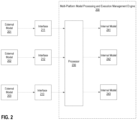
- FIG. 2 illustrates an example of a multi-platform model processing and execution management engine 200 that may be used according to one or more illustrative embodiments.
- Multi-platform model processing and execution management engine 200 may include a processor 230.
- Processor 230 is configured to receive data from one or more interfaces. The data received from these interfaces comprise models that have been developed on different modeling platforms. For example, processor 230 may receive a first external model 201 via interface 211, a second external model 202 via interface 212, and/or a third external model 203 via interface 213. Each of first external model 201, second external model 202, and third external model 203 have been developed on different modeling platforms.
- these different modeling platforms may include frameworks in R such as glm, glmnet, gbm, xgboost, frameworks in Python such as scikitlearn and xgboost, and standalone tools, such as H2O.
- each of interface 211, interface 212, and interface 213 may be different types of interfaces.
- interface 211 may be a graphical user interface that may be accessed via a web service.
- interface 212 may be an application programmable interface (API) in R, Python, Java, PHP, Ruby, or scala, and/or the like.
- the interface may be a command line interface (CLI) executed in the shell.
- CLI command line interface
- processor 230 Upon receiving an external model from an interface, processor 230 is configured to process the model to generate an internal model. Continuing with the example above, processor 230 processes first external model 201 to generate first internal model 241, process second external model 202 to generate internal model 242, and process third external model 203 to generate internal model 243. Each of these internal models are in a standard format such that these internal models may be executed by multi-platform model processing and execution management engine 200, or outsourced for execution by multi-platform model processing and execution management engine 200. Processing of these external models may include translating the model from an external language to an internal language. Processing may additionally or alternatively include verifying that the internal models are functional. For example, calls to the internal model from a computing device may be simulated via processor 230.
- one or more converters may be utilized to convert the external models to internal models.
- one or more converters may be located external to multi-platform model processing and execution management engine 200. These one or more converters may receive the external models 201, 202, and 203 from interfaces 211, 212, and 213, respectively. Additionally, or alternatively, the one or more converters may receive the external models 201, 202, and 203 directly from the modeling engines in which the external models were generated. The one or more converters may process external models 201, 202, and 203 to generate internal models 241, 242, and 243, respectively. In one instance, each modeling framework may have its own dedicated converter (or converters).
- a first converter may be utilized to transform an external model, that was created within the Python modeling framework, to an internal framework used by multi-platform model processing and execution management engine 200, such as JSON.
- a second converter may be utilized to transform an external model that was created within the R modeling framework to an internal framework used by multi-platform model processing and execution management engine 200 (such as JSON).
- the one or more converters may then transmit internal models 241, 242, and 243 to processor 230 of multi-platform model processing and execution management engine 200.
- these models may be stored within one or more storage devices of multi-platform model processing and execution management engine 200.
- One or more of the internal models may additionally or alternatively be stored on external storage devices.
- the internal models may be modified on an as-needed basis.
- Processor 230 may be configured to generate and transmit notifications to one or more computing devices subsequent to generation of an internal model. These notifications may indicate that the processing of the corresponding external model is complete. These notifications may additionally include information about and access to the internal model.
- one or more multi-model execution modules may be created, each of which may include calls to one or more internal models.
- multi-platform model processing and execution management engine 200 may outsource the execution of these multi-model execution modules to various model execution environments.
- a first multi-model execution module is deployed on a mobile device, while a second multi-model execution module is deployed on a cluster/cloud environment, such as Hadoop.
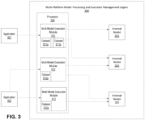
- FIG. 3 illustrates additional example aspects of a multi-platform model processing and execution management engine 200 that may be used according to one or more illustrative embodiments.
- Processor 330, internal model 321, internal model 322, and internal model 323, shown in FIG. 3 may correspond to processor 230, internal model 241, internal model 242, and internal model 243, shown in FIG. 2 , respectively.
- Application 301 and application 302 may each be executing on computing devices external to multi-platform model processing and execution management engine 200.
- Application 301 and application 302 may each communicate with processor 330 via one or more interfaces (not shown).
- the applications may communicate with processor 330 to create one or more multi-model execution modules.
- application 301 may create and configure multi-model execution module 311.
- Application 302 may communicate with processor 330 to create and configure multi-model execution module 312 and multi-model execution module 313.
- Each multi-model execution module may comprise one or more datasets and calls to one or more internal models.
- multi-model execution module 311 may include dataset 311a and dataset 311b, and may include calls to both internal model 321 and internal model 322.
- multi-model execution module 312 may include dataset 312a and may include calls to both internal model 322 and internal model 323.
- multi-model execution module 313 may include dataset 313a and may include a call to internal model 323.
- a multi-model execution module may include a sequence of calls to various internal models.
- the sequence of calls may be pre-configured by the application associated with the multi-model execution module. Alternatively, the sequence of calls may be dynamically determined during the execution of the multi-model execution module (discussed in detail below in reference to FIG. 5 ).
- Each call to an internal model within the multi-model execution module may be associated with a different dataset. For example, in multi-model execution module 311, the call to internal model 321 may be associated with dataset 311a, and the call to internal model 322 may be associated with dataset 311b.
- the datasets may be stored within the multi-model execution module, processor 330, a storage device internal to multi-platform model processing and execution management engine 200, an external storage device, and/or on a cloud-based storage device.
- the calls to the internal models may include the actual datasets themselves, or may alternatively include information identifying the location of the datasets. In the case of the latter, the dataset may be retrieved from its location during the execution of the internal model.
- one or more of the datasets may be created and propagated with data during the configuration of the multi-model execution module.
- one or more of the datasets may be dynamically created and/or propagated with data during the execution of the multi-model execution module.
- Processor 330 may execute multiple multi-model execution modules simultaneously.
- a multi-model execution module may be configured to be executed locally by processor 330.
- application 301 may create and configure multi-model execution module 311 on processor 330.
- multi-model execution module 311 may be locally executed by processor 330.
- Execution of multi-model execution module 311 locally by processor 330 may include one or more local calls from processor 330 to internal models.
- processor 330 may call internal model 321.
- Processor 330 may transmit dataset 311a to internal model 321 as part of the call to the internal model 321.
- processor 330 may transmit instructions to internal model 321 to access dataset 311 as needed during the execution of internal model 321.
- Dataset 311a may include data to be utilized by internal model 321 during execution of internal model 321.
- Internal model 321 may store the results of the execution to dataset 311a. These results may also be transmitted from internal model 321 to processor 330 (where they may be stored), or to another internal model.
- processor 330 calls internal model 322.
- internal model 321 may be configured by multi-model execution module 311 to call internal model 322 once execution of internal model 321 is complete.
- the call to internal model 322 includes dataset 311b.
- Dataset 311b includes data that is to be used in the execution of internal model 322.
- a portion of the data in dataset 311b is output data generated by execution of one or more additional internal models.
- Internal model 322 may store the results of the execution of internal model 322 to dataset 311b. These results may also be transmitted from internal model to processor 330 (where they may be stored), or to another internal model.
- processor 330 may call one or more additional models as specified within multi-model execution module 311. If no additional internal models are to be called, processor 330 aggregates the results of multi-model execution module 311 (i.e., the data produced by the execution of the internal models). Processor 330 may then transmit a notification to application 301 (or the corresponding computing device) indicating that execution of multi-model execution module 311 is complete. Additionally, or alternatively, processor 330 may transmit the aggregated results of the execution of multi-model execution module 311 to the corresponding computing device. In one instance, processor 330 may process the aggregated results data prior to transmitting the data to the corresponding computing device. Processor 330 may be configured to similarly locally execute multi-model execution module 312 and/or multi-model execution module 313.
- processor 330 may be configured to outsource the execution of one or more multi-model execution modules.
- processor 330 may be configured to outsource the execution of multi-model execution module 312 to a distributed model execution orchestration engine (discussed below in reference to FIG. 5 ).
- FIG. 4 illustrates computing environment 400 comprising a plurality of multi-platform model processing and execution management engines.
- Each of multi-platform model processing and execution management engine 400a, multi-platform model processing and execution management engine 400b, and multi-platform model processing and execution management engine 400c may be an instantiation of multi-platform model processing and execution management engines 200.
- Application 401 may be an instantiation of application 301 or 302. Although only one application is shown for purposes of illustratively clarity, multiple applications be present in environment 400 (for example, as shown in FIG. 3 ).
- Application 401 may create one or more multi-model execution modules on each of multi-platform model processing and execution management engine 400a, multi-platform model processing and execution management engine 400b, and multi-platform model processing and execution management engine 400b. As discussed above in reference to FIG. 3 , creation of the multi-model execution modules may include the transmittal of data between application 401 and the multi-platform model processing and execution management engines.
- application 401 may create a first multi-model execution module on multi-platform model processing and execution management engine 400a.
- the first multi-model execution module may be an interactive multi-model execution module.
- application 401 may transmit data (or location of data) needed for the creation of the first multi-model execution module to multi-platform model processing and execution management engine 400a, and may further transmit data (or the location of data) needed for the execution of the first multi-model execution module.
- application 401 may transmit, to multi-platform model processing and execution management engine 400a, one or more datasets that are to be utilized during execution of the first multi-model execution module on multi-platform model processing and execution management engine 400a.
- multi-platform model processing and execution management engine 400a may initiate execution of the first multi-model execution module.
- multi-platform model processing and execution management engine 400a may utilize datasets that have been transmitted from application 401. Additionally, or alternatively, multi-platform model processing and execution management engine 400a may utilize datasets that are stored on external storage devices, such as database 402. Execution of the first multi-model execution module may include calls to one or more internal models. Instantiations of these one or more internal models may also be stored on external storage devices, such as database 402.
- multi-platform model processing and execution management engine 400a may transmit data to (such as datasets to be utilized as inputs for one or more internal models), and may receive data from (such as internal model data) the external storage devices. Once execution of the first multi-model execution module is complete, multi-platform model processing and execution management engine 400a may transmit the results of the execution of the first multi-model execution module to application 401.
- application 401 may create and store the first multi-model execution module on an external storage device, such as database 402.
- Application 401 may then transmit execution instructions to the multi-platform model processing and execution management engine 400a.
- the execution instructions may include instructions that trigger multi-platform model processing and execution management engine 400a to retrieve the first multi-model execution module from the external storage device, and to execute the first multi-model execution module.
- multi-platform model processing and execution management engine 400a may transmit the results of the execution of the first multi-model execution module to application 401.
- application 401 may create a second multi-model execution module on multi-platform model processing and execution management engine 400b.
- the second multi-model execution module may be a batch multi-model execution module.
- Batch multi-model execution modules may include multiple executions of a same sequence of internal models. Each execution of the sequence of internal models may utilize different datasets.
- application 401 may transmit data (or location of data) needed for the creation of the first multi-model execution module to multi-platform model processing and execution management engine 400b, and may further transmit the location of the datasets needed for the execution of the second multi-model execution module.
- a first execution of the sequence of internal models may require a first set of datasets
- a second execution of the sequence of internal models may require a second set of datasets
- execution of the batch multi-model execution module may include thousands of executions of the sequence of internal models.
- the datasets of the first set of datasets and the second set of datasets may be stored on different external storage devices. The locations of each of these datasets may be transmitted from application 401 during creation of the second multi-model execution module.
- execution of the second multi-model execution module may include thousands of executions of a same sequence of internal models, each of the executions utilizing different datasets.
- multi-platform model processing and execution management engine 400b may store the results of that execution on external storage devices, such as database 403.
- the particular external storage devices to be utilized for storage may be specified within the second multi-model execution module, or may be dynamically determined by multi-platform model processing and execution management engine 400b.
- the results of different executions of the sequence of internal models may be stored on the same external storage device, or may be stored on different external storage devices.
- Multi-platform model processing and execution management engine 400b may tag the results so that the results identify the particular dataset(s) used during the execution of the sequence of internal models.
- application 401 may create a third multi-model execution module on multi-platform model processing and execution management engine 400c.
- the third multi-model execution module may be an outsourced multi-model execution module.
- application 401 may transmit data (or location of data) needed for the creation of the third multi-model execution module to multi-platform model processing and execution management engine 400c, and may further transmit data (or the location of data) needed for the execution of the third multi-model execution module to multi-platform model processing and execution management engine 400c.
- application 401 may transmit, to multi-platform model processing and execution management engine 400c, the location of one or more datasets that are to be utilized during execution of the third multi-model execution module.
- multi-platform model processing and execution management engine 400c may outsource execution of the third multi-model execution module to distributed model execution orchestration engine 420c. This is discussed in detail below in reference to FIG. 5 .
- FIG. 5 illustrates an example environment for an outsourced execution of a multi-model execution module.
- Multi-platform model processing and execution management engine 200 may be configured to transmit multi-model execution module data (and corresponding datasets) and internal model data to the distributed model execution orchestration engine 510.
- Transmittal of the multi-model execution module data may comprise transmittal of the multi-model execution module, a portion of the multi-model execution module, or information identifying a location of the multi-model execution module.
- Transmittal of the multi-model execution module data may further include transmittal of one or more datasets of the multi-model execution module, and/or information identifying locations of the one or more datasets of the datasets.
- Transmittal of the internal model data may comprise transmittal of one or more internal models, portions of one or more internal models, and/or information identifying the location of one or more internal models.
- Distributed model execution orchestration engine 510 may be configured to receive the multi-model execution module and internal model data from multi-platform model processing and execution management engine 200. Distributed model execution orchestration engine 510 may further be configured to orchestrate execution of the multi-model execution module across a plurality of distributed processing engines, such as processing engine 521, processing engine 522, and/or processing engine 523. One or more of the execution and orchestration features discussed below may be performed by a controller located on distributed model execution orchestration engine 150 and associated with the multi-platform model processing and execution management engine.
- Distributed model execution orchestration engine may distribute the execution of the multi-model execution module based on a plurality of different factors, such as processing capabilities of the various processing engines, locations of the datasets needed for the internal models, and/or availabilities of the various processing engines.
- the execution of the multi-model execution module may require calls to three internal models.
- a first dataset needed for a first internal model of the three internal models may be located on processing engine 521.
- distributed model execution orchestration engine 510 may transmit data to processing engine 521, wherein the data may include instructions to execute the first internal model using data stored on processing engine 521.
- the data transmitted to processing engine 521 may include the first internal model, or information identifying a location of the first internal model.
- a second dataset needed for a second internal model of the three internal models may be located on processing engine 522. Accordingly, distributed model execution orchestration engine 510 may transmit data to processing engine 522, wherein the data may include instructions to execute the second internal model using data stored on processing engine 522. The data transmitted to processing engine 522 may include the second internal model, or information identifying a location of the second internal model.
- a third dataset needed for a third internal model of the three internal models may be located on processing engine 523. Accordingly, distributed model execution orchestration engine 510 may transmit data to processing engine 523, wherein the data may include instructions to execute the third internal model using data stored on processing engine 523. The data transmitted to processing engine 523 may include the third internal model, or information identifying a location of the third internal model.
- the processing engines may intermittently return status updates to distributed model execution orchestration engine 510.
- distributed model execution orchestration engine 510 may intermittently forward these status updates to multi-platform model processing and execution management engine 200.
- the processing engines may further transmit results of the execution of the internal models to distributed model execution orchestration engine 510.
- distributed model execution orchestration engine 510 may forward these results to multi-platform model processing and execution management engine 200 as they are transmitted to distributed model execution orchestration engine 510.
- distributed model execution orchestration engine 510 may wait and aggregate all the results from the various processing engines, and then transmit the aggregated results to multi-platform model processing and execution management engine 200.
- multi-platform model processing and execution management engine 200 may transmit these results to one or more external computing devices.
- FIG. 6 illustrates a sequence of steps that is executed by a processor (for example, processor 230) of multi-platform model processing and execution management engine 200 during execution of a multi-model execution module.
- a multi-model execution module may comprise a series of calls to different internal models. Each of the calls is associated with a dataset that is to be utilized by a particular internal model when it is called. Each of the calls further results in the generation of new output data, resulting from the execution of the corresponding internal model.
- the processor determines the first internal model to be called.
- the first internal model to be called may be identified within the multi-model execution module.
- the processor then retrieves the dataset that is to be used by the first internal model during its execution.
- the dataset may already be stored within the multi-model execution module.
- the multi-model execution module may identify the location of the dataset, and the processor may retrieve the dataset from the identified location.
- the processor calls the first internal model.
- Calling the first internal model comprises transmitting data to the first internal model.
- the data includes an instruction and a dataset, wherein the instruction indicates that the first internal model is to execute using the transmitted dataset.
- the instructions further indicate that the dataset output from the first internal model is to be transmitted to the processor.
- Calling the first internal model triggers the execution of the first internal model.
- the processor receives a dataset output from the first internal model.
- the first internal model may transmit the dataset itself to the processor.
- the first internal model may transmit the location of the dataset to the processor, and the processor may retrieve the dataset from the location.
- the processor updates one or more downstream datasets based on the dataset received from the first internal model.
- the multi-model execution module may comprise a sequence of calls to various internal models.
- a dataset output by a first internal model during execution of the multi-model execution module (or a portion thereof) may be used as input data for a subsequent internal model during execution of the multi-model execution module.
- the processor may determine whether the dataset (or a portion thereof) is to be used during any subsequent calls of the multi-model execution module. If so, the processor propagates these downstream input datasets with data from the dataset returned by the first internal model.
- the processor determines if additional internal models are to be called during execution of the multi-model execution module.
- the multi-model execution module may indicate that no additional internal models are to be called.
- the multi-model execution module may indicate the internal model that is to be called next.
- the multi-model execution module may indicate that the determination of whether or not another internal model to be called (and the identity of that internal model) is to be dynamically determined based on the dataset returned by the first internal model.
- the processor analyses the dataset returned by the first internal model and automatically determine which internal model, if any, is to be called next. For example, the processor compares one or more values of the dataset to one or more threshold values, and select the next internal model based on a result of the comparison.
- the processor may compare a first value of the dataset to a first threshold value. If the first value of the dataset is above the first threshold value, the processor automatically determines that a second internal model is to be called as the next internal model; if the first value of the dataset is below the first threshold value, the processor may automatically determine that a third internal model is to be called as the next internal model. If, at step 604, the processor determines (based on an explicit indication in the multi-model execution module or an analysis of the dataset returned by the first internal model) that a particular internal model is to be called next, the processor may proceed to step 605.
- the processor calls the next internal model. Similar to calling the first internal model, calling the next internal model comprises transmitting data to the next internal model.
- the data may include an instruction and a dataset, wherein the instruction indicates that the next internal model is to execute using the transmitted dataset.
- the instructions may further indicate that the dataset output from the next internal model is to be transmitted to the processor.
- Calling the next internal model may trigger the execution of the next internal model.
- the processor may receive a dataset output from the next internal model. In one instance, the next internal model may transmit the dataset itself to the processor. In another instance, the next internal model may transmit the location of the dataset to the processor, and the processor may retrieve the dataset from the location.
- the processor may update one or more downstream datasets based on the dataset received from the next internal model. The processor may then return to step 604, where the processor may determine whether additional internal models are to be called during execution of the multi-model execution module.
- the processor may proceed to step 608.
- the processor aggregates each of the datasets returned from the internal models called during execution of the multi-model execution module.
- the multi-model execution module may specify that only a subset of the aggregated data is to be stored as the final output data. In these instances, the multi-model execution module may process the aggregated data to filter out the unnecessary data.
- the processor may send the results of the execution of the multi-model execution module to one or more computing devices. The results may comprise all or a subset of the aggregated data.
- FIG. 7 illustrates an example operating environment of a multi-platform model processing and execution management engine.
- Multi-model execution module 711, internal model 712, and distributed model execution orchestration engine 720 may correspond to multi-model execution module 311, internal model 321, and distributed model execution orchestration engine 410, respectively.
- One or more elements of multi-platform model processing and execution management engine 200 may transmit data to and/or receive data from model data monitoring and analysis engine 700.
- multi-model execution module 711 and/or internal model 712 may transmit data to or receive data from model data monitoring and analysis engine 700.
- a processor within multi-platform model processing and execution management engine 200 may transmit data to or receive data from model data monitoring and analysis engine 700.
- distributed model execution orchestration engine 720 and model data monitoring and analysis engine 700 may be configured to exchange data.
- Model data monitoring and analysis engine 700 may be configured to monitor data generated within multi-platform model processing and execution management engine 200.
- One or more computing systems such as computing system 731 and/or computer system 732, may be utilized to configure model data monitoring and analysis engine 700.
- multi-model execution module 711 may receive data from one or more internal models.
- Multi-model execution module 711 may be configured to transmit the data received from internal models to model data monitoring and analysis engine 700.
- model data monitoring and analysis engine 700 may be configured to periodically transmit requests for data to multi-model execution module 711.
- the periodic requests may be automatically transmitted by model data monitoring and analysis engine 700, and may be sent every few seconds, every minute, every hour, daily, weekly, and/or the like.
- the particular intervals at which the requests from model data monitoring and analysis engine 700 are to be automatically transmitted may be configured by computing systems, such as computing system 731 and/or computer system 732.
- multi-model execution module 711 may transmit any new data received from internal models (i.e., since a last request for data was received from model data monitoring and analysis engine 700) to model data monitoring and analysis engine 700. Additionally or alternatively, a similar exchange of data may occur between model data monitoring and analysis engine 700 and one or more internal models of multi-platform model processing and execution management engine 200, such as internal model 712. As discussed above with respect to FIGS. 2 and 3 , the execution of internal models may result in a generation of one or more datasets.
- the internal models may be configured to transmit the generated datasets to model data monitoring and analysis engine 700. Additionally or alternatively, model data monitoring and analysis engine 700 may be configured to periodically transmit requests for data to internal model 712. In response, internal model 712 may transmit any new generated datasets (i.e., since a last request for data was received from model data monitoring and analysis engine 700) to model data monitoring and analysis engine 700.
- distributed model execution orchestration engine 720 may be configured to receive output data from one or more processing engines that execute internal models. Distributed model execution orchestration engine 720 may be configured to transmit these datasets as they are received from the processing engines to model data monitoring and analysis engine 700. Additionally or alternatively, model data monitoring and analysis engine 700 may be configured to periodically transmit requests for data to distributed model execution orchestration engine 720. In response, distributed model execution orchestration engine 720 may transmit any new datasets received from the processing engines (i.e., since a last request for data was received from model data monitoring and analysis engine 700) to model data monitoring and analysis engine 700.
- Model data monitoring and analysis engine 700 is configured to aggregate and analyze the model data received from distributed model execution orchestration engine 720 and multi-platform model processing and execution management engine 200.
- the specific type(s) of analysis to be performed on the data may vary based on the source of data, the type of data, etc., and may be configured by external computing systems, such as computing system 731 and/or computer system 732.
- computing system 731 may access model data monitoring and analysis engine 700 via one or more interfaces (not shown).
- Computing system 731 may create one or more analysis modules (not shown) within model data monitoring and analysis engine 700.
- Computing system 731 may create a first analysis module within model data monitoring and analysis engine 700.
- Computing system 731 may configure the first analysis module to periodically request model data from one or more sources.
- computing system 731 may configure the first analysis module to request first model data from distributed model execution orchestration engine 720 at a first time interval, second model data from multi-model execution module 711 at a second time interval, and/or third model data from internal model 712 at a third time interval.
- Computing device 731 may further configure the first analysis module to perform one or more analysis functions on the received model data.
- computing device 731 may configure the first analysis module to perform stability analysis on the third model data received from internal model 712.
- the stability analysis may track the outputs of the internal model 712 over pre-determined time intervals, and determine whether the outputs are deviating from an expected output, or whether the outputs indicate that internal model 712 is degrading and requires updating.
- internal model 712 may be forecasted to degrade at a first rate, and the stability analysis may include analyzing the output data to determine if the actual degradation of internal model 712 is tracking or exceeding the forecasted degradation of internal model 712.
- Computing device 731 may configure the first analysis module to send automatic alerts to computing device 731 (or another computing device).
- computing device 731 may configure the first analysis module to send an automatic alert upon detection of an unexpected deviation of the outputs. Additionally or alternatively, computing device 731 may configure the first analysis module to send an automatic alert upon determining that the outputs have drifted beyond a specified value or range of values. For example, computing device 731 may configure the first analysis module to send an automatic alert upon determining that the outputs (or values produced during and/or as a result of analysis of the outputs) fall within (or outside) a predefined range of values, above a threshold, below a threshold, and the like.
- computing device 732 may be configured to create a second analysis module within model data monitoring and analysis engine 700.
- Computing device 732 may configure the second analysis module to automatically retrieve all of the datasets of multi-model execution module 711.
- multi-model execution module 711 may include calls to multiple internal models, and the second analysis module may be configured to retrieve each of the input datasets and output datasets of each of the multiple internal models.
- Computing device 732 may configure the second analysis module to perform a traceability analysis on these datasets.
- the second analysis module may analyze each of these datasets to determine the effects of particular datasets and/or internal models on the final output of the multi-model execution module.
- the second analysis module may analyze the datasets and internal models to determine which one of (or combination of) the datasets and internal models had a substantial effect on the output.
- the analysis may include re-running of the models using various what-if scenarios. For example, one or more input datasets may be changed, and the multi-model execution module (or a portion thereof) may be re-executed using the modified input datasets. This process may be repeated a number of times, until the second analysis module is able to identify the one or more factors driving the outlying output.
- computing device 732 may configure the second analysis module to automatically monitor and send alerts to computing device 732 (or another computing device) regarding the input datasets and output datasets.
- the second analysis module may be configured to automatically request the output datasets from multi-model execution module 711 via automated, periodic requests.
- Computing device 732 may configure the particular time periods at which different output datasets are to be requested from multi-model execution module 711 within the second analysis module.
- the analysis of the output datasets received from the multi-model execution module 711 may be similar to that discussed above with reference to the first analysis module.
- computing device 732 may configure the second analysis module to automatically send alerts to computing device 732 when the output values fall within or outside of a predetermined range of values, above a predefined threshold, below a predefined threshold, and/or the like.
- computing device 732 may configure the second analysis module to automatically request the input datasets from multi-model execution module 711 via automated requests.
- the automated requests may be a one-off event, or may occur on a periodic basis.
- the computing device 732 may further configure the second analysis module to automatically analyze the input datasets received from the multi-model execution module 711.
- the second analysis module is configured to determine a current distribution of values of the input datasets.
- the second analysis module is further configured to compare the current distribution of values to an older distribution of values determined from a prior input dataset received from multi-model execution module 711 (or from multi-platform model processing and execution management engine 200). The second analysis module determines, based on the comparison, whether there was a significant shift in the distribution of values.
- the second analysis module determines if the change in distribution (i.e., the difference between the current distribution of values and the older distribution of values) is within a range of predefined values, above a predefined threshold, below a predefined threshold, etc. If there is a significant shift in the distribution of the values, the second analysis module is configured to automatically send an alert indicating the shift to computing device 732 (or another computing device).
- the analysis modules within the model data monitoring and analysis engine 700 may be executed as a one-time use case, or may be configured to execute periodically.
- the analysis modules may be configured to automatically transmit notifications and/or data to one or more computing systems.
- the first analysis module may be configured to transmit data/notifications to computing system 731
- the second analysis module may be configured to transmit data/notifications to computing system 732.
- the specific data and/or notifications to be transmitted may be configured at the time the analysis modules are configured, and may additionally be dynamically modified on an as-needed basis.
- an analysis module may be configured to transmit a notification upon detecting an unexpected output from an internal model and/or a multi-model execution module.
- the analysis module may additionally or alternatively be configured to transmit data reporting the results of an analysis.
- the second analysis module may be configured to transmit data indicating the specific datasets and/or internal models that are substantially affecting the final output of the multi-model execution module.
- the analysis modules may be configured to store all analysis results on one or more storage devices. These stored results may subsequently be used by the same or different analysis modules when performing automated analysis of data.
Landscapes
- Engineering & Computer Science (AREA)
- Theoretical Computer Science (AREA)
- Software Systems (AREA)
- Physics & Mathematics (AREA)
- General Engineering & Computer Science (AREA)
- General Physics & Mathematics (AREA)
- Computer Hardware Design (AREA)
- Evolutionary Computation (AREA)
- Geometry (AREA)
- Stored Programmes (AREA)
- Debugging And Monitoring (AREA)
Claims (7)
- Computer-implementiertes Verfahren, umfassend:Empfangen eines ersten externen Modells, das in einem ersten Modellierungsrahmen erzeugt wurde, durch eine Rechenvorrichtung (101);Empfangen eines zweiten externen Modells, das in einem zweiten Modellierungsrahmen erzeugt wurde, der sich von dem ersten Modellierungsrahmen unterscheidet, durch die Rechenvorrichtung (101);Erzeugen eines ersten Modells durch die Rechenvorrichtung (101) durch Verarbeitung des ersten externen Modells, wobei das erste Modell unter Verwendung eines gemeinsamen Modellierungsrahmens formatiert wird;Erzeugen eines zweiten Modells durch die Rechenvorrichtung (101) durch Verarbeitung des zweiten externen Modells, wobei das zweite Modell unter Verwendung des gemeinsamen Modellierungsrahmens formatiert wird;Übertragen des ersten Modells durch die Rechenvorrichtung (101) an ein mobiles Gerät;Veranlassen der Ausführung des ersten Modells durch das mobile Gerät durch die Rechenvorrichtung (101);Empfangen eines Datensatzes, der auf der Grundlage der Ausführung des ersten Modells durch das mobile Gerät erzeugt wurde, durch die Rechenvorrichtung (101) und von dem mobilen Gerät;Erhalten einer historischen statistischen Verteilung, die auf der Grundlage des Datensatzes erzeugt wurde, durch die Rechenvorrichtung (101);Berechnen einer statistischen Verteilung auf der Grundlage des Datensatzes durch die Rechenvorrichtung (101);Bestimmen einer Verschiebung in der Werteverteilung zwischen der historischen statistischen Verteilung und der berechneten statistischen Verteilung durch die Rechenvorrichtung (101);Senden einer Benachrichtigung durch die Rechenvorrichtung (101), die die Verschiebung in der Werteverteilung anzeigt, basierend auf der Verschiebung, die einen Schwellenwert überschreitet;automatisches Bestimmen des zweiten auszuführenden Modells durch die Rechenvorrichtung (101) auf der Grundlage des Datensatzes und der Verschiebung der Verteilung der den Schwellenwert überschreitenden Werte;Übertragen des Datensatzes durch die Rechenvorrichtung (101) an eine Cloud-Rechenvorrichtung;Veranlassen der Ausführung des zweiten Modells durch die Rechenvorrichtung (101) durch die Cloud-Rechenvorrichtung, wobei die Ausführung des zweiten Modells auf der Grundlage des Datensatzes erfolgt;Empfangen eines zweiten Datensatzes von der Cloud-Rechenvorrichtung durch die Rechenvorrichtung (101), wobei der zweite Datensatz auf der Grundlage der Ausführung des zweiten Modells erzeugt wird;Erzeugen eines aggregierten Datensatzes auf der Grundlage des Datensatzes und des zweiten Datensatzes durch die Rechenvorrichtung (101); undErzeugen einer Teilmenge des aggregierten Datensatzes, die als endgültige Ausgabedaten zu speichern ist, durch die Rechenvorrichtung (101), indem der aggregierte Datensatz verarbeitet wird, um Daten herauszufiltern, die nicht für die Speicherung bestimmt sind.
- Verfahren nach Anspruch 1, weiter umfassend:Identifizieren eines Ortes eines ersten Datensatzes, der als Eingabedaten für das erste Modell verwendet werden soll, durch die Rechenvorrichtung (101);Abrufen des ersten Datensatzes von dem identifizierten Ort durch die Rechenvorrichtung (101); undÜbertragen des ersten Datensatzes an das mobile Gerät durch ein Kommunikationsmodul (109) der Rechenvorrichtung (101), wobei der von dem mobilen Gerät empfangene Datensatz auf der Grundlage des ersten Datensatzes erzeugt wird.
- Verfahren nach Anspruch 1, weiter umfassend:Bestimmen, durch die Rechenvorrichtung (101), ob ein Teil des Datensatzes als Eingabe für ein oder mehrere zusätzliche Modelle verwendet werden soll; undals Reaktion auf eine Bestimmung, dass ein Teil des Datensatzes als Eingabe von einem ersten zusätzlichen Modell verwendet werden soll, Aktualisieren eines dem ersten zusätzlichen Modell zugeordneten Datensatzes mit dem Teil des Datensatzes durch die Rechenvorrichtung (101).
- Verfahren nach Anspruch 1, wobei das Verfahren weiter Folgendes umfasst:
Übertragen des aggregierten Datensatzes oder der Teilmenge des aggregierten Datensatzes durch ein Kommunikationsmodul (109) der Rechenvorrichtung (101) an das mobile Gerät. - Verfahren nach Anspruch 1, wobei das Verfahren weiter Folgendes umfasst:
Speichern des Datensatzes in einer oder mehreren externen Speichervorrichtungen durch die Rechenvorrichtung (101). - Nicht-transitorisches computerlesbares Medium, das Anweisungen speichert, die, wenn sie von einer Multiplattform-Modellverarbeitungs- und Ausführungsmanagementmaschine ausgeführt werden, die Multiplattform-Modellverarbeitungs- und Ausführungsmanagementmaschine veranlassen, das Verfahren nach einem der Ansprüche 1 bis 5 auszuführen.
- Einrichtung (101), umfassend:einen Prozessor (103); undSpeicher (115), der computerausführbare Befehle speichert, die, wenn sie vom Prozessor ausgeführt werden, die Einrichtung veranlassen, das Verfahren nach einem der Ansprüche 1 bis 5 durchzuführen.
Applications Claiming Priority (2)
| Application Number | Priority Date | Filing Date | Title |
|---|---|---|---|
| US15/673,872 US10878144B2 (en) | 2017-08-10 | 2017-08-10 | Multi-platform model processing and execution management engine |
| PCT/US2017/063277 WO2019032133A1 (en) | 2017-08-10 | 2017-11-27 | ENGINE FOR MANAGING THE PROCESSING AND EXECUTION OF MULTIPLATFORM MODELS |
Publications (3)
| Publication Number | Publication Date |
|---|---|
| EP3665623A1 EP3665623A1 (de) | 2020-06-17 |
| EP3665623A4 EP3665623A4 (de) | 2021-04-28 |
| EP3665623B1 true EP3665623B1 (de) | 2025-05-07 |
Family
ID=65272424
Family Applications (1)
| Application Number | Title | Priority Date | Filing Date |
|---|---|---|---|
| EP17920743.6A Active EP3665623B1 (de) | 2017-08-10 | 2017-11-27 | Maschine zur verwaltung von multiplattformmodellverarbeitung und -ausführung |
Country Status (5)
| Country | Link |
|---|---|
| US (3) | US10878144B2 (de) |
| EP (1) | EP3665623B1 (de) |
| CA (1) | CA3072450A1 (de) |
| MX (1) | MX2020001595A (de) |
| WO (1) | WO2019032133A1 (de) |
Families Citing this family (12)
| Publication number | Priority date | Publication date | Assignee | Title |
|---|---|---|---|---|
| WO2020033804A1 (en) * | 2018-08-09 | 2020-02-13 | Walmart Apollo, Llc | System and method for electronic text classification |
| US11423326B2 (en) * | 2018-09-14 | 2022-08-23 | Microsoft Technology Licensing, Llc | Using machine-learning methods to facilitate experimental evaluation of modifications to a computational environment within a distributed system |
| WO2021108553A1 (en) * | 2019-11-25 | 2021-06-03 | Zest Finance, Inc. | Systems and methods for automatic model generation |
| WO2021179165A1 (zh) * | 2020-03-10 | 2021-09-16 | Oppo广东移动通信有限公司 | 模型协调方法及装置 |
| CN112464454B (zh) * | 2020-11-19 | 2024-04-05 | 广东电网有限责任公司电力调度控制中心 | 一种基于预计算优化的分布式执行优化方法及系统 |
| KR102928347B1 (ko) | 2021-02-05 | 2026-02-19 | 삼성전자주식회사 | 스토리지 장치의 신뢰성 정보 예측 방법 및 이를 이용한 스토리지 장치의 구동 방법 |
| EP4095713A1 (de) * | 2021-05-27 | 2022-11-30 | Ovh | Systeme und verfahren zur erzeugung eines zieldatensatzes mit einem zieldatenformat auf einer benutzervorrichtung |
| CA3175194A1 (en) * | 2021-09-22 | 2023-03-22 | Rps Canada Inc. | Systems and methods for integrated orchestration of machine learning operations |
| US20230393896A1 (en) * | 2022-06-02 | 2023-12-07 | Cisco Technology, Inc. | Dynamic scheduling of multiple machine learning models |
| US12614094B2 (en) | 2022-11-30 | 2026-04-28 | Dell Products L.P. | System and method for managing data processing systems hosting distributed inference models |
| US12619892B2 (en) | 2022-11-30 | 2026-05-05 | Dell Products L.P. | System and method for managing inference model performance through proactive communication system analysis |
| US12380340B1 (en) * | 2024-03-18 | 2025-08-05 | Wayfound INC. | Systems and methods for AI agent control layer through performance evaluation of artificial intelligence agents |
Family Cites Families (42)
| Publication number | Priority date | Publication date | Assignee | Title |
|---|---|---|---|---|
| US6658395B1 (en) * | 1998-05-01 | 2003-12-02 | Biowulf Technologies, L.L.C. | Enhancing knowledge discovery from multiple data sets using multiple support vector machines |
| US6192360B1 (en) | 1998-06-23 | 2001-02-20 | Microsoft Corporation | Methods and apparatus for classifying text and for building a text classifier |
| US6369811B1 (en) | 1998-09-09 | 2002-04-09 | Ricoh Company Limited | Automatic adaptive document help for paper documents |
| US6925432B2 (en) | 2000-10-11 | 2005-08-02 | Lucent Technologies Inc. | Method and apparatus using discriminative training in natural language call routing and document retrieval |
| US7295977B2 (en) | 2001-08-27 | 2007-11-13 | Nec Laboratories America, Inc. | Extracting classifying data in music from an audio bitstream |
| US7185317B2 (en) | 2002-02-14 | 2007-02-27 | Hubbard & Wells | Logical data modeling and integrated application framework |
| US20060149693A1 (en) | 2005-01-04 | 2006-07-06 | Isao Otsuka | Enhanced classification using training data refinement and classifier updating |
| US8589140B1 (en) * | 2005-06-10 | 2013-11-19 | Wapp Tech Corp. | System and method for emulating and profiling a frame-based application playing on a mobile device |
| US20070083365A1 (en) | 2005-10-06 | 2007-04-12 | Dts, Inc. | Neural network classifier for separating audio sources from a monophonic audio signal |
| US8019763B2 (en) | 2006-02-27 | 2011-09-13 | Microsoft Corporation | Propagating relevance from labeled documents to unlabeled documents |
| US7792353B2 (en) | 2006-10-31 | 2010-09-07 | Hewlett-Packard Development Company, L.P. | Retraining a machine-learning classifier using re-labeled training samples |
| US9235442B2 (en) * | 2010-10-05 | 2016-01-12 | Accenture Global Services Limited | System and method for cloud enterprise services |
| US20120130771A1 (en) | 2010-11-18 | 2012-05-24 | Kannan Pallipuram V | Chat Categorization and Agent Performance Modeling |
| US10678602B2 (en) * | 2011-02-09 | 2020-06-09 | Cisco Technology, Inc. | Apparatus, systems and methods for dynamic adaptive metrics based application deployment on distributed infrastructures |
| EP2610776B1 (de) * | 2011-09-16 | 2019-08-21 | Veracode, Inc. | Automatisierte verhaltens- und statische analyse unter verwendung eines instrumentierten sandkastens und maschinenlernklassifizierung für mobile sicherheit |
| US20130097103A1 (en) | 2011-10-14 | 2013-04-18 | International Business Machines Corporation | Techniques for Generating Balanced and Class-Independent Training Data From Unlabeled Data Set |
| US8954358B1 (en) | 2011-11-03 | 2015-02-10 | Google Inc. | Cluster-based video classification |
| US10089582B2 (en) * | 2013-01-02 | 2018-10-02 | Qualcomm Incorporated | Using normalized confidence values for classifying mobile device behaviors |
| US9439081B1 (en) * | 2013-02-04 | 2016-09-06 | Further LLC | Systems and methods for network performance forecasting |
| CA2899314C (en) | 2013-02-14 | 2018-11-27 | 24/7 Customer, Inc. | Categorization of user interactions into predefined hierarchical categories |
| US9491187B2 (en) * | 2013-02-15 | 2016-11-08 | Qualcomm Incorporated | APIs for obtaining device-specific behavior classifier models from the cloud |
| US9652362B2 (en) * | 2013-12-06 | 2017-05-16 | Qualcomm Incorporated | Methods and systems of using application-specific and application-type-specific models for the efficient classification of mobile device behaviors |
| US9563407B2 (en) * | 2014-02-03 | 2017-02-07 | Richard Salter | Computer implemented modeling system and method |
| CN105373800A (zh) | 2014-08-28 | 2016-03-02 | 百度在线网络技术(北京)有限公司 | 分类方法及装置 |
| US11200581B2 (en) | 2018-05-10 | 2021-12-14 | Hubspot, Inc. | Multi-client service system platform |
| US20160132787A1 (en) | 2014-11-11 | 2016-05-12 | Massachusetts Institute Of Technology | Distributed, multi-model, self-learning platform for machine learning |
| KR102357351B1 (ko) * | 2015-01-07 | 2022-01-28 | 삼성전자주식회사 | 복수의 배터리 셀들을 포함하는 배터리 팩의 상태를 추정하는 장치 및 방법 |
| CN107430715A (zh) * | 2015-03-11 | 2017-12-01 | 西门子工业公司 | 建筑物自动化中的级联识别 |
| US10229357B2 (en) * | 2015-09-11 | 2019-03-12 | Facebook, Inc. | High-capacity machine learning system |
| US20170185898A1 (en) * | 2015-12-26 | 2017-06-29 | Arnab Paul | Technologies for distributed machine learning |
| US11170293B2 (en) | 2015-12-30 | 2021-11-09 | Microsoft Technology Licensing, Llc | Multi-model controller |
| RU2628431C1 (ru) | 2016-04-12 | 2017-08-16 | Общество с ограниченной ответственностью "Аби Продакшн" | Подбор параметров текстового классификатора на основе семантических признаков |
| US10650285B1 (en) | 2016-09-23 | 2020-05-12 | Aon Benfield Inc. | Platform, systems, and methods for identifying property characteristics and property feature conditions through aerial imagery analysis |
| CN110168579B (zh) | 2016-11-23 | 2024-12-06 | 启创互联公司 | 用于利用机器学习分类器来使用知识表示的系统和方法 |
| CN106709453B (zh) | 2016-12-24 | 2020-04-17 | 北京工业大学 | 一种基于深度学习的体育视频关键姿态提取方法 |
| US9978067B1 (en) | 2017-07-17 | 2018-05-22 | Sift Science, Inc. | System and methods for dynamic digital threat mitigation |
| US20190140994A1 (en) | 2017-11-03 | 2019-05-09 | Notion Ai, Inc. | Systems and method classifying online communication nodes based on electronic communication data using machine learning |
| US10303978B1 (en) | 2018-03-26 | 2019-05-28 | Clinc, Inc. | Systems and methods for intelligently curating machine learning training data and improving machine learning model performance |
| GB201805293D0 (en) | 2018-03-29 | 2018-05-16 | Benevolentai Tech Limited | Attention filtering for multiple instance learning |
| US11068942B2 (en) | 2018-10-19 | 2021-07-20 | Cerebri AI Inc. | Customer journey management engine |
| US20210192496A1 (en) | 2019-12-18 | 2021-06-24 | Paypal, Inc. | Digital wallet reward optimization using reverse-engineering |
| US11164044B2 (en) | 2019-12-20 | 2021-11-02 | Capital One Services, Llc | Systems and methods for tagging datasets using models arranged in a series of nodes |
-
2017
- 2017-08-10 US US15/673,872 patent/US10878144B2/en active Active
- 2017-11-27 CA CA3072450A patent/CA3072450A1/en active Pending
- 2017-11-27 MX MX2020001595A patent/MX2020001595A/es unknown
- 2017-11-27 EP EP17920743.6A patent/EP3665623B1/de active Active
- 2017-11-27 WO PCT/US2017/063277 patent/WO2019032133A1/en not_active Ceased
-
2020
- 2020-09-28 US US17/034,807 patent/US12190026B2/en active Active
-
2024
- 2024-11-26 US US18/960,987 patent/US20250265383A1/en active Pending
Also Published As
| Publication number | Publication date |
|---|---|
| MX2020001595A (es) | 2020-07-28 |
| US20250265383A1 (en) | 2025-08-21 |
| US12190026B2 (en) | 2025-01-07 |
| US10878144B2 (en) | 2020-12-29 |
| EP3665623A1 (de) | 2020-06-17 |
| WO2019032133A1 (en) | 2019-02-14 |
| US20210012047A1 (en) | 2021-01-14 |
| EP3665623A4 (de) | 2021-04-28 |
| US20190050505A1 (en) | 2019-02-14 |
| CA3072450A1 (en) | 2019-02-14 |
Similar Documents
| Publication | Publication Date | Title |
|---|---|---|
| US20250265383A1 (en) | Multi-platform model processing and execution management engine | |
| US11327749B2 (en) | System and method for generating documentation for microservice based applications | |
| US20240211804A1 (en) | Multi-Platform Machine Learning Systems | |
| US11373131B1 (en) | Automatically identifying and correcting erroneous process actions using artificial intelligence techniques | |
| JP2023538923A (ja) | テキスト分類についての説明を与えるための技術 | |
| US11070449B2 (en) | Intelligent application deployment to distributed ledger technology nodes | |
| US10101995B2 (en) | Transforming data manipulation code into data workflow | |
| US12555055B2 (en) | Centralized orchestration of workflow component executions across software services | |
| US20220108147A1 (en) | Predictive microservices activation using machine learning | |
| US11941414B2 (en) | Unstructured extensions to rpa | |
| CN112947919B (zh) | 构建业务模型和处理业务请求的方法和装置 | |
| US20250094599A1 (en) | Multi-computer system for performing vulnerability analysis and alert generation | |
| EP4005155B1 (de) | Prädiktiver ki-automatisierter cloud-service-auftritt | |
| US11645599B2 (en) | System and method for autonomous workflow management and execution | |
| CN115238047A (zh) | 用于监视的机器人程序 | |
| US11314621B2 (en) | Software application validation | |
| US20220255989A1 (en) | Systems and methods for hybrid burst optimized regulated workload orchestration for infrastructure as a service | |
| WO2023207213A1 (zh) | 数据处理方法及装置 | |
| US11671385B1 (en) | Automated communication exchange programs for attended robotic process automation | |
| CN119025514A (zh) | 数据质量检测方法、装置、设备及存储介质 | |
| CN112306680B (zh) | 一种异构资源的编排方法、装置、设备和存储介质 | |
| US20240004698A1 (en) | Distributed process engine in a distributed computing environment | |
| US20260044313A1 (en) | System and method for passing determined parameters in artificial intelligence assistant flows | |
| US20260044365A1 (en) | Framework and processes for artificial intelligence guided interactive agents | |
| US20240103955A1 (en) | Method and system for actionable smart monitoring of error messages |
Legal Events
| Date | Code | Title | Description |
|---|---|---|---|
| STAA | Information on the status of an ep patent application or granted ep patent |
Free format text: STATUS: THE INTERNATIONAL PUBLICATION HAS BEEN MADE |
|
| PUAI | Public reference made under article 153(3) epc to a published international application that has entered the european phase |
Free format text: ORIGINAL CODE: 0009012 |
|
| STAA | Information on the status of an ep patent application or granted ep patent |
Free format text: STATUS: REQUEST FOR EXAMINATION WAS MADE |
|
| 17P | Request for examination filed |
Effective date: 20200309 |
|
| AK | Designated contracting states |
Kind code of ref document: A1 Designated state(s): AL AT BE BG CH CY CZ DE DK EE ES FI FR GB GR HR HU IE IS IT LI LT LU LV MC MK MT NL NO PL PT RO RS SE SI SK SM TR |
|
| AX | Request for extension of the european patent |
Extension state: BA ME |
|
| DAV | Request for validation of the european patent (deleted) | ||
| DAX | Request for extension of the european patent (deleted) | ||
| REG | Reference to a national code |
Ref country code: DE Ref legal event code: R079 Free format text: PREVIOUS MAIN CLASS: G06N0020000000 Ipc: G06F0009480000 Ref document number: 602017089398 Country of ref document: DE |
|
| A4 | Supplementary search report drawn up and despatched |
Effective date: 20210330 |
|
| RIC1 | Information provided on ipc code assigned before grant |
Ipc: G06F 9/48 20060101AFI20210324BHEP Ipc: G06N 20/00 20190101ALI20210324BHEP |
|
| STAA | Information on the status of an ep patent application or granted ep patent |
Free format text: STATUS: EXAMINATION IS IN PROGRESS |
|
| 17Q | First examination report despatched |
Effective date: 20220714 |
|
| P01 | Opt-out of the competence of the unified patent court (upc) registered |
Effective date: 20230601 |
|
| GRAP | Despatch of communication of intention to grant a patent |
Free format text: ORIGINAL CODE: EPIDOSNIGR1 |
|
| STAA | Information on the status of an ep patent application or granted ep patent |
Free format text: STATUS: GRANT OF PATENT IS INTENDED |
|
| INTG | Intention to grant announced |
Effective date: 20241128 |
|
| GRAS | Grant fee paid |
Free format text: ORIGINAL CODE: EPIDOSNIGR3 |
|
| GRAA | (expected) grant |
Free format text: ORIGINAL CODE: 0009210 |
|
| STAA | Information on the status of an ep patent application or granted ep patent |
Free format text: STATUS: THE PATENT HAS BEEN GRANTED |
|
| AK | Designated contracting states |
Kind code of ref document: B1 Designated state(s): AL AT BE BG CH CY CZ DE DK EE ES FI FR GB GR HR HU IE IS IT LI LT LU LV MC MK MT NL NO PL PT RO RS SE SI SK SM TR |
|
| REG | Reference to a national code |
Ref country code: GB Ref legal event code: FG4D |
|
| REG | Reference to a national code |
Ref country code: CH Ref legal event code: EP |
|
| REG | Reference to a national code |
Ref country code: DE Ref legal event code: R096 Ref document number: 602017089398 Country of ref document: DE |
|
| REG | Reference to a national code |
Ref country code: IE Ref legal event code: FG4D |
|
| REG | Reference to a national code |
Ref country code: NL Ref legal event code: MP Effective date: 20250507 |
|
| PG25 | Lapsed in a contracting state [announced via postgrant information from national office to epo] |
Ref country code: PT Free format text: LAPSE BECAUSE OF FAILURE TO SUBMIT A TRANSLATION OF THE DESCRIPTION OR TO PAY THE FEE WITHIN THE PRESCRIBED TIME-LIMIT Effective date: 20250908 Ref country code: FI Free format text: LAPSE BECAUSE OF FAILURE TO SUBMIT A TRANSLATION OF THE DESCRIPTION OR TO PAY THE FEE WITHIN THE PRESCRIBED TIME-LIMIT Effective date: 20250507 Ref country code: ES Free format text: LAPSE BECAUSE OF FAILURE TO SUBMIT A TRANSLATION OF THE DESCRIPTION OR TO PAY THE FEE WITHIN THE PRESCRIBED TIME-LIMIT Effective date: 20250507 |
|
| REG | Reference to a national code |
Ref country code: LT Ref legal event code: MG9D |
|
| PG25 | Lapsed in a contracting state [announced via postgrant information from national office to epo] |
Ref country code: NO Free format text: LAPSE BECAUSE OF FAILURE TO SUBMIT A TRANSLATION OF THE DESCRIPTION OR TO PAY THE FEE WITHIN THE PRESCRIBED TIME-LIMIT Effective date: 20250807 Ref country code: GR Free format text: LAPSE BECAUSE OF FAILURE TO SUBMIT A TRANSLATION OF THE DESCRIPTION OR TO PAY THE FEE WITHIN THE PRESCRIBED TIME-LIMIT Effective date: 20250808 |
|
| PG25 | Lapsed in a contracting state [announced via postgrant information from national office to epo] |
Ref country code: NL Free format text: LAPSE BECAUSE OF FAILURE TO SUBMIT A TRANSLATION OF THE DESCRIPTION OR TO PAY THE FEE WITHIN THE PRESCRIBED TIME-LIMIT Effective date: 20250507 Ref country code: PL Free format text: LAPSE BECAUSE OF FAILURE TO SUBMIT A TRANSLATION OF THE DESCRIPTION OR TO PAY THE FEE WITHIN THE PRESCRIBED TIME-LIMIT Effective date: 20250507 |
|
| REG | Reference to a national code |
Ref country code: AT Ref legal event code: MK05 Ref document number: 1793233 Country of ref document: AT Kind code of ref document: T Effective date: 20250507 |
|
| PG25 | Lapsed in a contracting state [announced via postgrant information from national office to epo] |
Ref country code: BG Free format text: LAPSE BECAUSE OF FAILURE TO SUBMIT A TRANSLATION OF THE DESCRIPTION OR TO PAY THE FEE WITHIN THE PRESCRIBED TIME-LIMIT Effective date: 20250507 |
|
| PG25 | Lapsed in a contracting state [announced via postgrant information from national office to epo] |
Ref country code: HR Free format text: LAPSE BECAUSE OF FAILURE TO SUBMIT A TRANSLATION OF THE DESCRIPTION OR TO PAY THE FEE WITHIN THE PRESCRIBED TIME-LIMIT Effective date: 20250507 |
|
| PG25 | Lapsed in a contracting state [announced via postgrant information from national office to epo] |
Ref country code: AT Free format text: LAPSE BECAUSE OF FAILURE TO SUBMIT A TRANSLATION OF THE DESCRIPTION OR TO PAY THE FEE WITHIN THE PRESCRIBED TIME-LIMIT Effective date: 20250507 |
|
| PG25 | Lapsed in a contracting state [announced via postgrant information from national office to epo] |
Ref country code: RS Free format text: LAPSE BECAUSE OF FAILURE TO SUBMIT A TRANSLATION OF THE DESCRIPTION OR TO PAY THE FEE WITHIN THE PRESCRIBED TIME-LIMIT Effective date: 20250807 |
|
| PG25 | Lapsed in a contracting state [announced via postgrant information from national office to epo] |
Ref country code: IS Free format text: LAPSE BECAUSE OF FAILURE TO SUBMIT A TRANSLATION OF THE DESCRIPTION OR TO PAY THE FEE WITHIN THE PRESCRIBED TIME-LIMIT Effective date: 20250907 |
|
| PG25 | Lapsed in a contracting state [announced via postgrant information from national office to epo] |
Ref country code: LV Free format text: LAPSE BECAUSE OF FAILURE TO SUBMIT A TRANSLATION OF THE DESCRIPTION OR TO PAY THE FEE WITHIN THE PRESCRIBED TIME-LIMIT Effective date: 20250507 |
|
| PGFP | Annual fee paid to national office [announced via postgrant information from national office to epo] |
Ref country code: DE Payment date: 20251128 Year of fee payment: 9 |
|
| PGFP | Annual fee paid to national office [announced via postgrant information from national office to epo] |
Ref country code: GB Payment date: 20251127 Year of fee payment: 9 |
|
| PG25 | Lapsed in a contracting state [announced via postgrant information from national office to epo] |
Ref country code: DK Free format text: LAPSE BECAUSE OF FAILURE TO SUBMIT A TRANSLATION OF THE DESCRIPTION OR TO PAY THE FEE WITHIN THE PRESCRIBED TIME-LIMIT Effective date: 20250507 Ref country code: SM Free format text: LAPSE BECAUSE OF FAILURE TO SUBMIT A TRANSLATION OF THE DESCRIPTION OR TO PAY THE FEE WITHIN THE PRESCRIBED TIME-LIMIT Effective date: 20250507 |
|
| PG25 | Lapsed in a contracting state [announced via postgrant information from national office to epo] |
Ref country code: CZ Free format text: LAPSE BECAUSE OF FAILURE TO SUBMIT A TRANSLATION OF THE DESCRIPTION OR TO PAY THE FEE WITHIN THE PRESCRIBED TIME-LIMIT Effective date: 20250507 |
|
| PG25 | Lapsed in a contracting state [announced via postgrant information from national office to epo] |
Ref country code: EE Free format text: LAPSE BECAUSE OF FAILURE TO SUBMIT A TRANSLATION OF THE DESCRIPTION OR TO PAY THE FEE WITHIN THE PRESCRIBED TIME-LIMIT Effective date: 20250507 |
|
| PG25 | Lapsed in a contracting state [announced via postgrant information from national office to epo] |
Ref country code: RO Free format text: LAPSE BECAUSE OF FAILURE TO SUBMIT A TRANSLATION OF THE DESCRIPTION OR TO PAY THE FEE WITHIN THE PRESCRIBED TIME-LIMIT Effective date: 20250507 Ref country code: SK Free format text: LAPSE BECAUSE OF FAILURE TO SUBMIT A TRANSLATION OF THE DESCRIPTION OR TO PAY THE FEE WITHIN THE PRESCRIBED TIME-LIMIT Effective date: 20250507 |
|
| PG25 | Lapsed in a contracting state [announced via postgrant information from national office to epo] |
Ref country code: IT Free format text: LAPSE BECAUSE OF FAILURE TO SUBMIT A TRANSLATION OF THE DESCRIPTION OR TO PAY THE FEE WITHIN THE PRESCRIBED TIME-LIMIT Effective date: 20250507 |
|
| REG | Reference to a national code |
Ref country code: DE Ref legal event code: R097 Ref document number: 602017089398 Country of ref document: DE |
|
| PLBE | No opposition filed within time limit |
Free format text: ORIGINAL CODE: 0009261 |
|
| STAA | Information on the status of an ep patent application or granted ep patent |
Free format text: STATUS: NO OPPOSITION FILED WITHIN TIME LIMIT |
|
| REG | Reference to a national code |
Ref country code: CH Ref legal event code: L10 Free format text: ST27 STATUS EVENT CODE: U-0-0-L10-L00 (AS PROVIDED BY THE NATIONAL OFFICE) Effective date: 20260318 |
|
| 26N | No opposition filed |
Effective date: 20260210 |