EP3664213A2 - Electrolyte for lithium metal battery and lithium metal battery comprising same - Google Patents
Electrolyte for lithium metal battery and lithium metal battery comprising same Download PDFInfo
- Publication number
- EP3664213A2 EP3664213A2 EP18868454.2A EP18868454A EP3664213A2 EP 3664213 A2 EP3664213 A2 EP 3664213A2 EP 18868454 A EP18868454 A EP 18868454A EP 3664213 A2 EP3664213 A2 EP 3664213A2
- Authority
- EP
- European Patent Office
- Prior art keywords
- group
- lithium metal
- lithium
- fluoro
- electrolyte
- Prior art date
- Legal status (The legal status is an assumption and is not a legal conclusion. Google has not performed a legal analysis and makes no representation as to the accuracy of the status listed.)
- Granted
Links
Images

Classifications
-
- H—ELECTRICITY
- H01—ELECTRIC ELEMENTS
- H01M—PROCESSES OR MEANS, e.g. BATTERIES, FOR THE DIRECT CONVERSION OF CHEMICAL ENERGY INTO ELECTRICAL ENERGY
- H01M10/00—Secondary cells; Manufacture thereof
- H01M10/05—Accumulators with non-aqueous electrolyte
- H01M10/056—Accumulators with non-aqueous electrolyte characterised by the materials used as electrolytes, e.g. mixed inorganic/organic electrolytes
- H01M10/0564—Accumulators with non-aqueous electrolyte characterised by the materials used as electrolytes, e.g. mixed inorganic/organic electrolytes the electrolyte being constituted of organic materials only
- H01M10/0566—Liquid materials
- H01M10/0568—Liquid materials characterised by the solutes
-
- H—ELECTRICITY
- H01—ELECTRIC ELEMENTS
- H01M—PROCESSES OR MEANS, e.g. BATTERIES, FOR THE DIRECT CONVERSION OF CHEMICAL ENERGY INTO ELECTRICAL ENERGY
- H01M10/00—Secondary cells; Manufacture thereof
- H01M10/05—Accumulators with non-aqueous electrolyte
- H01M10/056—Accumulators with non-aqueous electrolyte characterised by the materials used as electrolytes, e.g. mixed inorganic/organic electrolytes
- H01M10/0564—Accumulators with non-aqueous electrolyte characterised by the materials used as electrolytes, e.g. mixed inorganic/organic electrolytes the electrolyte being constituted of organic materials only
- H01M10/0566—Liquid materials
- H01M10/0567—Liquid materials characterised by the additives
-
- H—ELECTRICITY
- H01—ELECTRIC ELEMENTS
- H01M—PROCESSES OR MEANS, e.g. BATTERIES, FOR THE DIRECT CONVERSION OF CHEMICAL ENERGY INTO ELECTRICAL ENERGY
- H01M10/00—Secondary cells; Manufacture thereof
- H01M10/05—Accumulators with non-aqueous electrolyte
- H01M10/052—Li-accumulators
-
- H—ELECTRICITY
- H01—ELECTRIC ELEMENTS
- H01M—PROCESSES OR MEANS, e.g. BATTERIES, FOR THE DIRECT CONVERSION OF CHEMICAL ENERGY INTO ELECTRICAL ENERGY
- H01M4/00—Electrodes
- H01M4/02—Electrodes composed of, or comprising, active material
- H01M4/36—Selection of substances as active materials, active masses, active liquids
- H01M4/38—Selection of substances as active materials, active masses, active liquids of elements or alloys
-
- H—ELECTRICITY
- H01—ELECTRIC ELEMENTS
- H01M—PROCESSES OR MEANS, e.g. BATTERIES, FOR THE DIRECT CONVERSION OF CHEMICAL ENERGY INTO ELECTRICAL ENERGY
- H01M4/00—Electrodes
- H01M4/02—Electrodes composed of, or comprising, active material
- H01M4/36—Selection of substances as active materials, active masses, active liquids
- H01M4/38—Selection of substances as active materials, active masses, active liquids of elements or alloys
- H01M4/381—Alkaline or alkaline earth metals elements
- H01M4/382—Lithium
-
- H—ELECTRICITY
- H01—ELECTRIC ELEMENTS
- H01M—PROCESSES OR MEANS, e.g. BATTERIES, FOR THE DIRECT CONVERSION OF CHEMICAL ENERGY INTO ELECTRICAL ENERGY
- H01M4/00—Electrodes
- H01M4/02—Electrodes composed of, or comprising, active material
- H01M4/36—Selection of substances as active materials, active masses, active liquids
- H01M4/38—Selection of substances as active materials, active masses, active liquids of elements or alloys
- H01M4/40—Alloys based on alkali metals
- H01M4/405—Alloys based on lithium
-
- H—ELECTRICITY
- H01—ELECTRIC ELEMENTS
- H01M—PROCESSES OR MEANS, e.g. BATTERIES, FOR THE DIRECT CONVERSION OF CHEMICAL ENERGY INTO ELECTRICAL ENERGY
- H01M4/00—Electrodes
- H01M4/02—Electrodes composed of, or comprising, active material
- H01M4/36—Selection of substances as active materials, active masses, active liquids
- H01M4/58—Selection of substances as active materials, active masses, active liquids of inorganic compounds other than oxides or hydroxides, e.g. sulfides, selenides, tellurides, halogenides or LiCoFy; of polyanionic structures, e.g. phosphates, silicates or borates
-
- H—ELECTRICITY
- H01—ELECTRIC ELEMENTS
- H01M—PROCESSES OR MEANS, e.g. BATTERIES, FOR THE DIRECT CONVERSION OF CHEMICAL ENERGY INTO ELECTRICAL ENERGY
- H01M4/00—Electrodes
- H01M4/02—Electrodes composed of, or comprising, active material
- H01M4/36—Selection of substances as active materials, active masses, active liquids
- H01M4/58—Selection of substances as active materials, active masses, active liquids of inorganic compounds other than oxides or hydroxides, e.g. sulfides, selenides, tellurides, halogenides or LiCoFy; of polyanionic structures, e.g. phosphates, silicates or borates
- H01M4/581—Chalcogenides or intercalation compounds thereof
- H01M4/5815—Sulfides
-
- H—ELECTRICITY
- H01—ELECTRIC ELEMENTS
- H01M—PROCESSES OR MEANS, e.g. BATTERIES, FOR THE DIRECT CONVERSION OF CHEMICAL ENERGY INTO ELECTRICAL ENERGY
- H01M4/00—Electrodes
- H01M4/02—Electrodes composed of, or comprising, active material
- H01M4/36—Selection of substances as active materials, active masses, active liquids
- H01M4/60—Selection of substances as active materials, active masses, active liquids of organic compounds
-
- H—ELECTRICITY
- H01—ELECTRIC ELEMENTS
- H01M—PROCESSES OR MEANS, e.g. BATTERIES, FOR THE DIRECT CONVERSION OF CHEMICAL ENERGY INTO ELECTRICAL ENERGY
- H01M2300/00—Electrolytes
- H01M2300/0017—Non-aqueous electrolytes
- H01M2300/0025—Organic electrolyte
-
- H—ELECTRICITY
- H01—ELECTRIC ELEMENTS
- H01M—PROCESSES OR MEANS, e.g. BATTERIES, FOR THE DIRECT CONVERSION OF CHEMICAL ENERGY INTO ELECTRICAL ENERGY
- H01M4/00—Electrodes
- H01M4/02—Electrodes composed of, or comprising, active material
- H01M4/36—Selection of substances as active materials, active masses, active liquids
- H01M4/38—Selection of substances as active materials, active masses, active liquids of elements or alloys
- H01M4/40—Alloys based on alkali metals
-
- Y—GENERAL TAGGING OF NEW TECHNOLOGICAL DEVELOPMENTS; GENERAL TAGGING OF CROSS-SECTIONAL TECHNOLOGIES SPANNING OVER SEVERAL SECTIONS OF THE IPC; TECHNICAL SUBJECTS COVERED BY FORMER USPC CROSS-REFERENCE ART COLLECTIONS [XRACs] AND DIGESTS
- Y02—TECHNOLOGIES OR APPLICATIONS FOR MITIGATION OR ADAPTATION AGAINST CLIMATE CHANGE
- Y02E—REDUCTION OF GREENHOUSE GAS [GHG] EMISSIONS, RELATED TO ENERGY GENERATION, TRANSMISSION OR DISTRIBUTION
- Y02E60/00—Enabling technologies; Technologies with a potential or indirect contribution to GHG emissions mitigation
- Y02E60/10—Energy storage using batteries
Definitions
- the present invention relates to an electrolyte for a lithium metal battery and a lithium metal battery comprising the same.
- the lithium secondary battery has a structure in which an electrode assembly comprising a positive electrode, a negative electrode and a separator interposed between the positive electrode and the negative electrode are laminated or wound, and the lithium secondary battery is composed by embedding this electrode assembly in the battery case and injecting a non-aqueous electrolyte into the inside thereof.
- the capacities of lithium secondary batteries differ depending on the type of electrode active materials and the capacity at the time of actual driving cannot be secured by a sufficient capacity as much as the theoretical capacity, and thus such batteries have not been commercialized.
- metallic materials having high storage capacity characteristics through the alloying reaction with lithium such as silicon (4,200 mAh/g) and tin (990 mAh/g) are used as the negative electrode active material.
- the metals such as silicon and tin are used as a negative electrode active material, the volume expands by about 4 times in the charging process, which performs the alloying with lithium, and shrinks in the discharging process. Due to the large volume changes of the electrode that occur repeatedly during the charging/discharging processes, the active materials were gradually micronized and dropped off from the electrode, and thus, the capacity was rapidly reduced, thereby making it difficult to ensure stability and reliability and thus failing commercialization.
- lithium metal has an excellent theoretical capacity of 3,860 mAh/g and a low potential with respect to standard hydrogen electrode (SHE) of -3.045 V as compared to the negative electrode active material mentioned above, and thus enables the implementation of batteries with high capacity and high energy density, there are many studies on lithium metal batteries (LMB) using lithium metal as a negative electrode active material for the lithium secondary battery.
- SHE standard hydrogen electrode
- the lithium metal reacts easily with electrolyte, impurities, and lithium salts due to its high chemical/electrochemical reactivity and forms a solid electrolyte interphase (SEI) on the surface of the electrode, and such a solid electrolyte interphase induces a localized current density difference to form dendrites on the surface of lithium metal.
- SEI solid electrolyte interphase
- the lithium dendrite not only shortens the life of the lithium secondary battery but also induces short circuit and dead lithium in the battery to increase the physical and chemical instability of the lithium secondary battery, reduce the capacity of the battery, reducing the cycling life, and adversely affects the stability of the battery.
- the solid electrolyte interphase is thermally unstable, so that the charging/discharging process of the battery can be continuously proceeded, or the solid electrolyte interphase can be slowly collapsed by increased electrochemical energy and thermal energy, especially during high temperature storage in a fully charged state. Due to the collapse of the solid electrolyte interphase, a side reaction in which the exposed surface of lithium metal is decomposed by direct reaction with the electrolyte solvent is continuously generated, and thus the resistance of the negative electrode is increased, and the charging/discharging efficiency of the battery is lowered.
- the lithium metal battery using lithium metal as a negative electrode is not commercialized because of the high instability of lithium metal.
- Korean Patent Application Publication No. 2016-0034183 discloses that the loss of electrolyte solution and the generation of dendrites can be prevented by forming a protective layer with a polymer matrix, which can protect the negative electrode and accumulate the electrolyte, on the negative electrode active layer containing lithium metal or lithium alloy.
- Korean Patent Application Publication No. 2016-0052351 discloses that the stability and life characteristics of the lithium secondary battery can be improved by incorporating a lithium dendrite-absorbing material into the polymeric protective film formed on the surface of lithium metal and thus suppressing the growth of the lithium dendrites.
- each of Jiangfeng Qian et al. and Korean Patent Application Publication No. 2013-0079126 discloses that the characteristics of the lithium metal battery can be improved by increasing the concentration of lithium salts or by incorporating a non-aqueous organic solvent including 1,3,5-trioxane, 1,3-dioxolane and fluorine-based cyclic carbonate.
- the inventors of the present invention have identified that when an additive including specific functional groups is comprised in the electrolyte for the lithium metal battery, the electrochemical characteristics and stability of the lithium metal electrode are improved, thereby improving the capacity and life of the battery, and thus have completed the present invention.
- an electrolyte for a lithium metal battery comprising a lithium salt, an organic solvent and an additive, wherein the additive may comprise a functional group capable of binding to lithium metal at one end thereof and a fluorinated hydrocarbon group at the other end.
- the functional group capable of binding to lithium metal may comprise at least one selected from the group consisting of a thiol group, an amine group and a hydroxy group.
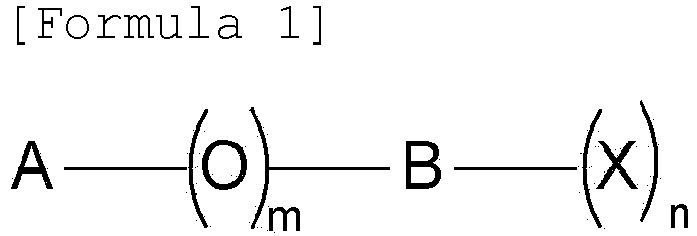
- the additive may be represented by the following Formula 1: wherein A, B, O, X, m and n are as described in the specification.
- the additive may comprise at least one selected from the group consisting of 1H,1H,2H,2H,3H,3H- perfluoroundecylthiol, 1H,1H,2H,2H -perfluorodecanethiol, 1H,1H,2H,2H -perfluorononanethiol, 1H,1H,2H,2H -perfluoro-1-octanethiol, 1H,1H -perfluorooctylthiol, 1H,1H- perfluoropropylthiol, 2,2,2 -trifluoroethanethiol, 1H,1H,2H,2H -perfluoro-1-hexanethiol, 2,3,4,5,6-pentafluorothiophenol, 2,3,5,6-tetrafluorobenzenethiol, 2,4-difluorothiophenol, 3,4-difluoro
- the additive may be comprised in an amount of from 0.01 to 5 % by weight, based on the total weight of the electrolyte for the lithium metal battery.
- a lithium metal battery comprising the electrolyte.
- the electrolyte of the lithium metal battery according to the present invention enables the lithium metal battery to have high capacity and long life by comprising an additive that includes a functional group capable of binding to lithium metal at one end thereof and a fluorinated hydrocarbon group at the other end, and thus improving the stability of lithium metal and at the same time, suppressing side reactions at the surface of lithium metal.
- the lithium metal used as the negative electrode active material has a high energy density (3,860 mAh/g) while having low oxidation/reduction potential (-3.045 V vs. standard hydrogen electrode) and atomic weight (6.94 g/a.u.). Therefore, since it is possible to achieve a high capacity and a high energy density while enabling miniaturization and weight reduction, the lithium metal battery is attracting attention as a next-generation battery.
- lithium metal has high reactivity and thus is very weak in terms of stability.
- the lithium polysulfide released from the positive electrode causes a side reaction with the lithium metal, and thus the lithium sulfide adheres to the surface of lithium metal. Therefore, there are problems that the reaction activity and potential characteristics are deteriorated and the lowering of the efficiency and life of the lithium metal electrode is accelerated.
- the present invention provides an electrolyte for a lithium metal battery comprising an additive including specific functional groups.
- the electrolyte for the lithium metal battery according to the present invention comprises a lithium salt, an organic solvent and an additive, wherein the additive comprises a functional group capable of binding to lithium metal at one end thereof and a fluorinated hydrocarbon group at the other end.
- the additive may form a stable protective film on the surface of the lithium metal electrode by forming a bond with lithium metal through the functional group capable of binding to lithium metal located at one end, which comprises a fluorinated hydrocarbon group at the other end of the additive.
- the fluorinated hydrocarbon groups originated from the above additive can block the reaction of lithium metal and lithium salts or other impurities in the lithium metal battery using lithium metal or lithium alloys as a negative electrode and thus can increase the reaction efficiency of lithium, thereby improving the discharge amount and extending the life.
- the protective layer formed from the additive can prevent the lithium polysulfide generated from the positive electrode from reacting with lithium metal, thereby effectively suppressing the overcharge phenomenon of the battery and thus enhancing the stability of the battery.
- the additive of the present invention can be used in the electrolyte to form the above-described protective film on the lithium metal electrode through an in-situ reaction with lithium metal during the operation of the battery, there is an advantage that a process for forming a separate layer as in the prior art is not necessary.
- the additive may be represented by the following Formula 1:
- hydrocarbon group refers to all organic groups consisting of carbon and hydrogen and may comprise any known structures such as an alkyl group, an alkenyl group, an alkynyl group, an aryl group, an aralkyl group, a heteroaryl group, and the like.
- the carbon in the hydrocarbon group may be replaced with at least one selected from the group consisting of oxygen (O), nitrogen (N), and sulfur (S).
- the hydrocarbon group comprises straight chain, branched chain, monocyclic or polycyclic groups, and at least one hydrogen atom contained in the hydrocarbon group is optionally substituted with one or more substituents (e.g., alkyl, alkenyl, alkynyl, heterocyclic, aryl, heteroaryl, acyl, oxo, imino, thiooxo, cyano, isocyano, amino, azido, nitro, hydroxyl, thiol, halo and the like)
- substituents e.g., alkyl, alkenyl, alkynyl, heterocyclic, aryl, heteroaryl, acyl, oxo, imino, thiooxo, cyano, isocyano, amino, azido, nitro, hydroxyl, thiol, halo and the like
- alkyl group used in the present invention may be a straight chain or branched chain, and the number of carbon atoms is not particularly limited, but is preferably 1 to 20, specifically 1 to 10. Specific examples thereof comprise, but are not limited to, methyl group, ethyl group, propyl group, isopropyl group, butyl group, t-butyl group, pentyl group, hexyl group and heptyl group.
- alkenyl group used in the present invention refers to a hydrocarbon group having 2 to 20 carbon atoms and including at least one carbon-carbon double bond unless otherwise stated, but is not limited thereto.
- alkynyl group used in the present invention refers to a hydrocarbon group having 2 to 20 carbon atoms and including at least one carbon-carbon triple bond unless otherwise stated, but is not limited thereto.
- cycloalkyl group refers to a non-aromatic carbon-based ring having at least 3 carbon atoms.
- the cycloalkyl group comprises, but is not limited to, cyclopropyl, cyclobutyl, cyclopentyl, cyclohexyl, and the like.
- aryl group used in the present invention refers to a single or multiple aromatic carbon-based ring having 6 to 20 carbon atoms. Examples thereof comprise, but are not limited to, phenyl group, biphenyl group, fluorene group and the like.
- alkanediyl as used in the present invention is a divalent atomic group obtained by subtracting two hydrogen atoms from an alkane, and may be represented by the general formula -C n H 2n -.
- alkenediyl as used in the present invention is a divalent atomic group obtained by subtracting two hydrogen atoms from an alkene, and may be represented by the general formula -C n H n -.
- alkynediyl as used in the present invention is a divalent atomic group obtained by subtracting two hydrogen atoms from an alkyne.
- arylene group used in the present invention means a divalent aromatic carbon-based ring, and its carbon number may be 6 to 40, specifically 6 to 20.
- the arylene group may comprise a structure in which two or more rings are condensed or bonded, and the other rings may be aromatic, non-aromatic, or a combination thereof.
- the arylene group comprises, but is not limited to, phenylene, biphenylene, naphthylene, anthracenylene, and the like.
- single bond used in the present invention refers to a bonding relationship between elements connected with B in the case where B in the above Formula 1 does not exist.
- A may represent a monovalent hydrocarbon group substituted by at least one fluorine.
- A may be an alkyl group having 1 to 10 carbon atoms which is substituted or unsubstituted with fluorine; an alkenyl group having 2 to 10 carbon atoms which is substituted or unsubstituted with fluorine; an alkynyl group having 2 to 10 carbon atoms which is substituted or unsubstituted with fluorine; a cycloalkyl group having 3 to 15 carbon atoms which is substituted or unsubstituted with fluorine; or an aryl group having 6 to 20 carbon atoms which is substituted or unsubstituted with fluorine, more preferably, an alkyl group having 1 to 10 carbon atoms which is substituted or unsubstituted with fluorine.
- B may represent a single bond or a divalent hydrocarbon group substituted by at least one fluorine.
- B may be an alkanediyl group having 1 to 5 carbon atoms which is substituted or unsubstituted with fluorine; an alkenediyl group having 2 to 5 carbon atoms which is substituted or unsubstituted with fluorine; or an unsubstituted alkynediyl group having 2 to 10 carbon atoms, more preferably an alkanediyl group having 1 to 5 carbon atoms which is substituted or unsubstituted with fluorine.
- X may be a functional group capable of binding to lithium metal.
- X may comprise a polar functional group so as to dissolve well in the electrolyte and at the same time to facilitate easy bonding with the surface of the lithium metal.
- X may be at least one selected from the group consisting of a thiol group (-SH), an amine group (-NH 2 ) and a hydroxy group (-OH), more preferably a thiol group.
- the sum of the carbon numbers of A and B may be 1 to 30.
- the additive represented by the Formula 1 may be, for example, at least one selected from the group consisting of 1H,1H,2H,2H,3H,3H -perfluoroundecylthiol, 1H,1H,2H,2H- perfluorodecanethiol, 1H,1H,2H,2H -perfluorononanethiol, 1H,1H,2H,2H -perfluoro-1-octanethiol, 1H,1H- perfluorooctylthiol, 1H,1H -perfluoropropylthiol, 2,2,2- trifluoroethanethiol, 1H,1H,2H,2H -perfluoro-1-hexanethiol, 2,3,4,5,6-Pentafluorothiophenol, 2,3,5,6-tetrafluorobenzenethiol, 2,4-difluorothiophenol, 3,
- the additive may be included in an amount of from 0.01 to 5 % by weight, preferably from 0.05 to 1 % by weight, based on the total weight of the electrolyte for the lithium metal battery.
- the content of the additive is less than the above range, the protective film is not uniformly formed on the surface of the lithium metal electrode and thus the desired effect cannot be obtained.
- the content of the additive exceeds the above range, an unnecessary reaction may occur when driving the battery, so that the performance of the battery may be deteriorated.
- the electrolyte for the lithium metal battery of the present invention comprises a lithium salt as an electrolyte salt.
- the lithium salt is not particularly limited in the present invention and can be used without limitation as long as it is commonly used in the electrolyte for the lithium secondary battery.
- the lithium salt may comprise at least one selected from the group consisting of LiCl, LiBr, LiI, LiClO 4 , LiBF 4 , LiB 10 Cl 10 , LiPF 6 , LiCF 3 SO 3 , LiCF 3 CO 2 , LiC 4 BO 8 , LiAsF 6 , LiSbF 6 , LiAlCl 4 , CH 3 SO 3 Li, CF 3 SO 3 Li, (CF 3 SO 2 ) 2 NLi, (C 2 F 5 SO 2 ) 2 NLi, (SO 2 F) 2 NLi, (CF 3 SO 2 ) 3 CLi, lithium chloroborane, lithium lower aliphatic carboxylate having 4 or less carbon atoms, 4-phenyl lithium borate, and lithium imide.
- the lithium salt may be Lithium bis (trifluoromethanesulfonyl) imide (LiTFSI), (CF 3 SO 2 ) 2 NLi).
- the concentration of the lithium salt may be appropriately determined in consideration of ion conductivity, solubility and the like, and may be, for example, from 0.1 to 4.0 M, preferably from 0.5 to 2.0 M.
- concentration of the lithium salt is less than the above range, it is difficult to ensure ion conductivity suitable for driving the battery.
- concentration exceeds the above range, the viscosity of the electrolyte solution is increased to lower the mobility of the lithium ion and the decomposition reaction of the lithium salt itself may increase to deteriorate the performance of the battery. Therefore, the concentration is adjusted appropriately within the above range.
- the electrolyte for the lithium metal battery of the present invention comprises an organic solvent, and those commonly used in the electrolyte for the lithium secondary battery can be used without limitation.
- organic solvent ether, ester, amide, linear carbonate, cyclic carbonate, etc.
- organic solvent ether, ester, amide, linear carbonate, cyclic carbonate, etc.
- ether-based compounds may be typically comprised.
- the ether-based compound may comprise, but is not limited to, at least one selected from the group consisting of dimethyl ether, diethyl ether, dipropyl ether, methylethyl ether, methylpropyl ether, ethylpropyl ether, dimethoxyethane, diethoxyethane, methoxyethoxyethane, diethylene glycol dimethyl ether, diethylene glycol diethyl ether, diethylene glycol methylethyl ether, triethylene glycol dimethyl ether, triethylene glycol diethyl ether, triethylene glycol methylethyl ether, tetraethylene glycol dimethyl ether, tetraethylene glycol diethyl ether, tetraethylene glycol methylethyl ether, polyethylene glycol dimethyl ether, polyethylene glycol diethyl ether, polyethylene glycol methylethyl ether, 1,3-dioxolane, tetra
- ester of the organic solvent may comprise, but is not limited to, at least one selected from the group consisting of methyl acetate, ethyl acetate, propyl acetate, methyl propionate, ethyl propionate, propyl propionate, ⁇ -butyrolactone, ⁇ -valerolactone, ⁇ -caprolactone, ⁇ -valerolactone, and ⁇ -caprolactone, or a mixture of two or more thereof.
- linear carbonate compound may comprise, but is not limited to, at least one selected from the group consisting of dimethyl carbonate (DMC), diethyl carbonate (DEC), dipropyl carbonate, ethylmethyl carbonate (EMC), methylpropyl carbonate and ethylpropyl carbonate, or a mixture of two or more thereof.
- DMC dimethyl carbonate
- DEC diethyl carbonate
- EMC ethylmethyl carbonate
- methylpropyl carbonate and ethylpropyl carbonate or a mixture of two or more thereof.
- cyclic carbonate compound may comprise at least one selected from the group consisting of ethylene carbonate (EC), propylene carbonate (PC), 1,2-butylene carbonate, 2,3-butylene carbonate, 1,2-pentylene carbonate, 2,3-pentylene carbonate, vinylene carbonate, vinylethylene carbonate, and halides thereof, or a mixture of two or more thereof.
- halides comprise, but are not limited to, fluoroethylene carbonate (FEC) and the like.
- N-methyl pyrrolidone dimethyl sulfoxide, sulfolane and the like.
- the electrolyte for the lithium secondary battery of the present invention may further comprise nitric acid-based compounds commonly used in the related art in addition to the above-mentioned components.
- nitric acid-based compounds commonly used in the related art in addition to the above-mentioned components.
- examples thereof may be lithium nitrate (LiNO 3 ), potassium nitrate (KNO 3 ), cesium nitrate (CsNO 3 ), magnesium nitrate (Mg(NO 3 ) 2 ), barium nitrate (Ba(NO 3 ) 2 ), lithium nitrite (LiNO 2 ), potassium nitrite (KNO 2 ), cesium nitrite (CsNO 2 ) and the like.
- the electrolyte for the lithium metal battery according to the present invention including the above-mentioned components can improve the instability of the negative electrode, lithium metal, by including the additive represented by the Formula 1. Also, it is possible to effectively suppress the side reaction between the lithium metal and the material generated during the operation of the battery, such as lithium polysulfide, in the electrolyte or particularly the lithium-sulfur battery, thereby ensuring excellent stability and thus improving the performance and lifetime of the charging/discharging process of the battery.
- the present invention provides a lithium metal battery comprising the electrolyte for the lithium metal battery.
- the lithium-sulfur battery comprises a positive electrode, a negative electrode and an electrolyte interposed between the positive electrode and the negative electrode wherein the electrolyte comprises the electrolyte for the lithium metal battery according to the present invention.
- the positive electrode may comprise a positive electrode current collector and a positive electrode active material coated on one or both sides of the positive electrode current collector.
- the positive electrode current collector supports the positive electrode active material and is not particularly limited as long as it has high conductivity without causing chemical change in the battery.
- copper, stainless steel, aluminum, nickel, titanium, palladium, sintered carbon; copper or stainless steel surface-treated with carbon, nickel, silver or the like; aluminum-cadmium alloy or the like may be used as the positive electrode current collector.
- the positive electrode current collector can enhance the bonding force with the positive electrode active material by having fine irregularities on its surface, and may be formed in various forms such as film, sheet, foil, mesh, net, porous body, foam or nonwoven fabric.
- the positive electrode active material may comprise a positive electrode active material and optionally a conductive material and a binder.
- elemental sulfur S 8
- Li 2 S n (n ⁇ 1) disulfide compound such as 2,5-dimercapto-1,3,4-thiadiazole and 1,3,5-trithiocyanuic acid
- inorganic sulfur (S 8 ) may be used.
- the positive electrode may further comprise at least one additive selected from a transition metal element, a group IIIA element, a group IVA element, a sulfur compound of these elements, and an alloy of these elements and sulfur, in addition to the positive electrode active material.
- the transition metal element may comprise Sc, Ti, V, Cr, Mn, Fe, Co, Ni, Cu, Zn, Y, Zr, Nb, Mo, Tc, Ru, Rh, Pd, Os, Ir, Pt, Au, Hg and the like
- the group IIIA element may comprise Al, Ga, In, Ti and the like
- the group IVA element may comprise Ge, Sn, Pb, and the like.
- the conductive material is intended to improve electrical conductivity and is not particularly limited as long as it is an electron conductive material that does not cause chemical change in the lithium secondary battery.
- carbon black, graphite, carbon fiber, carbon nanotube, metal powder, conductive metal oxide, organic conductive material and the like may be used.
- Products that are currently marketed as conductive materials may comprise acetylene black series (products from Chevron Chemical Company or Gulf Oil Company), Ketjen Black EC series (products from Armak Company), Vulcan XC-72(a product from Cabot Company) and Super P (a product from MMM). Examples thereof may comprise acetylene black, carbon black, graphite and the like.
- the positive electrode active material may further comprise a binder having a function of holding the positive electrode active material on the positive electrode current collector and connecting between active materials.
- a binder for example, various types of binders such as polyvinylidene fluoride-hexafluoropropylene (PVDF-co-HFP), polyvinylidene fluoride (PVDF), polyacrylonitrile, polymethyl methacrylate, styrene-butadiene rubber (SBR), carboxyl methyl cellulose (CMC), poly(acrylic acid) (PAA), poly(vinyl alcohol)(PVA) and the like may be used.
- PVDF-co-HFP polyvinylidene fluoride-hexafluoropropylene
- PVDF polyvinylidene fluoride
- SBR styrene-butadiene rubber
- CMC carboxyl methyl cellulose
- PAA poly(acrylic acid)
- PVA poly(vinyl alcohol)(P
- the negative electrode may comprise a negative electrode current collector and a negative electrode active material on the negative electrode current collector, or the negative electrode may be a lithium metal plate.
- the negative electrode current collector is for supporting a negative electrode active material and is not particularly limited as long as it is electrochemically stable in the voltage range of the lithium secondary battery while having excellent conductivity.
- a negative electrode active material for example, copper, stainless steel, aluminum, nickel, titanium, palladium, sintered carbon; copper or stainless steel surface-treated with carbon, nickel, silver or the like; aluminum-cadmium alloy or the like may be used as the negative electrode current collector.
- the negative electrode current collector can enhance the bonding force with the negative electrode active material by having fine irregularities formed on its surface, and may be formed in various forms such as film, sheet, foil, mesh, net, porous body, foam or nonwoven fabric.
- the negative electrode active material may comprise a material capable of reversibly intercalating or deintercalating lithium ion (Li + ), a material capable of reversibly forming lithium containing compounds by reacting with lithium ion, or lithium metal or lithium alloy.
- the material capable of reversibly intercalating or deintercalating lithium ion (Li + ) may be, for example, crystalline carbon, amorphous carbon, or a mixture thereof.
- the material capable of reacting with lithium ion (Li + ) to reversibly form lithium containing compounds may be, for example, tin oxide, titanium nitrate or silicon.
- the lithium alloy may be, for example, an alloy of lithium (Li) and a metal selected from the group consisting of sodium (Na), potassium (K), rubidium (Rb), cesium (Cs), francium (Fr), beryllium (Be), magnesium (Mg), calcium (Ca), strontium (Sr), barium (Ba), radium (Ra), aluminum (Al), and tin (Sn).
- the negative electrode active material may be lithium metal, and specifically may be in the form of a lithium metal thin film or lithium metal powder.
- the method for forming the negative electrode active material is not particularly limited, and a layer or film forming method commonly used in the art can be used. For example, methods such as compression, coating, or deposition may be used.
- a metal lithium thin film formed on a metal plate by initial charging after assembling the battery without the lithium thin film in the current collector is also comprised in the negative electrode of the present invention.
- the electrolyte comprises lithium ions and is for causing an electrochemical oxidation or reduction reaction between the positive electrode and the negative electrode through these lithium ions, and is as described above.
- the injection of the electrolyte solution may be performed at an appropriate stage of the electrochemical device manufacturing process depending on the manufacturing process and required properties of the final product. That is, the injection of the electrolyte solution may be applied before assembling the electrochemical device or in the final stage of assembling the electrochemical device.
- a separator may be additionally comprised between the positive electrode and the negative electrode.
- the separator is used to physically separate both electrodes in the lithium secondary battery of the present invention, and may be used without any particular limitations as long as it is commonly used as a separator in the lithium secondary battery. Particularly, it is desirable to use a separator having excellent wettability to the electrolyte solution while having low resistance to ion migration of the electrolyte.
- the separator may be formed of a porous substrate, and the porous substrate may be any porous substrate commonly used in an electrochemical device.
- the porous substrate may be any porous substrate commonly used in an electrochemical device.
- a polyolefin-based porous membrane or a nonwoven fabric may be used as the porous substrate, but it is not particularly limited thereto.
- polyolefin-based porous membrane may comprise a membrane formed of polyolefin-based polymer such as polyethylene such as high-density polyethylene, linear low-density polyethylene, low density polyethylene and ultra-high molecular weight polyethylene, polypropylene, polybutylene and polypentene alone or a mixture thereof.
- polyethylene such as high-density polyethylene, linear low-density polyethylene, low density polyethylene and ultra-high molecular weight polyethylene, polypropylene, polybutylene and polypentene alone or a mixture thereof.
- the nonwoven fabric may comprise, in addition to the polyolefin-based nonwoven fabric, for example, a nonwoven fabric formed of polyethyleneterephthalate, polybutyleneterephthalate, polyester, polyacetal, polyamide, polycarbonate, polyimide, polyetheretherketone, polyethersulfone, polyphenyleneoxide, polyphenylene sulfide and polyethylenenaphthalate alone or a mixture thereof.
- the structure of the nonwoven fabric may be a spun bond nonwoven fabric or a melt blown nonwoven fabric composed of long fibers.
- the thickness of the porous substrate is not particularly limited, but may be from 1 to 100 ⁇ m, preferably from 5 to 50 ⁇ m.
- the size and porosity of the pores present in the porous substrate are also not particularly limited, but may be from 0.001 to 50 ⁇ m and from 10 to 95%, respectively.
- the lithium-sulfur battery according to the present invention may be manufactured by lamination, stacking and folding processes of the separator and the electrodes, in addition to the usual winding process.
- the shape of the lithium-sulfur battery is not particularly limited, and may be various shapes such as a cylindrical shape, a laminate shape and a coin shape.
- the present invention provides a battery module including the lithium metal battery as a unit battery.
- the battery module may be used as a power source for medium to large-sized devices requiring high temperature stability, long cycle characteristics, high capacity characteristics and the like.
- Examples of such medium to large-sized devices may comprise, but is not limited to, a power tool powered by an electric motor; an electric car including an electric vehicle (EV), a hybrid electric vehicle (HEV), a plug-in hybrid electric vehicle (PHEV) and the like; an electric motorcycle including an electric bike (E-bike) and an electric scooter (E-scooter); an electric golf cart; a power storage system, etc.
- a power tool powered by an electric motor an electric car including an electric vehicle (EV), a hybrid electric vehicle (HEV), a plug-in hybrid electric vehicle (PHEV) and the like
- EV electric vehicle
- HEV hybrid electric vehicle
- PHEV plug-in hybrid electric vehicle
- E-bike electric bike
- E-scooter electric scooter
- an electric golf cart a power storage system, etc.
- a solution prepared by dissolving 1.0 M LiTFSI and 1.0 % by weight of lithium nitrate in the organic solvent consisting of 1,3-dioxolane and dimethyl ether (DOL : DME 1 : 1 (volume ratio)) was prepared, and 0.1 % by weight of 1 H ,1 H ,2 H ,2 H -perfluorodecanethiol was added to this solution to prepare an electrolyte.
- Sulfur was mixed with conductive material and binder in acetonitrile using a ball mill to prepare a slurry of positive electrode active material.
- carbon black was used as a conductive material and polyethylene oxide (molecular weight: 5,000,000 g/mol) was used as a binder, and a mixing ratio of sulfur: conductive material: binder was 60:20:20 by weight.
- the slurry of positive electrode active material was coated on the aluminum current collector and then dried to produce a positive electrode.
- a thin film of lithium metal with a thickness of 40 ⁇ m was used as a negative electrode.
- the prepared positive electrode and negative electrode were placed facing each other, and a polyethylene separator was interposed therebetween. Thereafter, 70 ⁇ l of the electrolyte was injected to prepare a coin-type battery.
- a coin-type battery was manufactured in the same manner as Example 1 above except that in the preparation of the electrolyte, 0.5 % by weight of 1H,1H,2H,2H- perfluorodecanethiol was used.
- a coin-type battery was manufactured in the same manner as Example 1 above except that in the preparation of the electrolyte, the lithium nitrate was not used.
- a coin-type battery was manufactured in the same manner as Example 1 above except that in the preparation of the electrolyte, 1.0 % by weight of 1H,1H,2H,2H- perfluorodecanethiol was used and the lithium nitrate was not used.
- a coin-type battery was manufactured in the same manner as Example 1 above except that in the preparation of the positive electrode, sulfur : conductive material : binder were mixed at a weight ratio of 70 : 15 : 15.
- a coin-type battery was manufactured in the same manner as Example 1 above except that in the preparation of the electrolyte, 0.5 % by weight of 1H,1H,2H,2H- perfluorodecanethiol was used and sulfur : conductive material : binder were mixed at a weight ratio of 70 : 15 : 15.
- a coin-type battery was manufactured in the same manner as Example 1 above except that in the preparation of the positive electrode, sulfur : conductive material : binder were mixed at a weight ratio of 80 : 10 : 10.
- a coin-type battery was manufactured in the same manner as Example 1 above except that in the preparation of the electrolyte, 0.5 % by weight of 1H,1H,2H,2H- perfluorodecanethiol was used and sulfur : conductive material : binder were mixed at a weight ratio of 80 : 10 : 10.
- a coin-type battery was manufactured in the same manner as Example 1 above except that in the preparation of the electrolyte, 2,4-difluorothiophenol instead of 1H,1H,2H,2H- perfluorodecanethiol was used in the same amount, and in the preparation of the positive electrode, sulfur : conductive material : binder were mixed at a weight ratio of 80 : 10 : 10.
- a coin-type battery was manufactured in the same manner as Example 1 above except that in the preparation of the electrolyte, 2,4-difluorothiophenol instead of 1H,1H,2H,2H- perfluorodecanethiol was used in the amount of 1.0 % by weight, and in the preparation of the positive electrode, sulfur : conductive material : binder were mixed at a weight ratio of 80 : 10 : 10.
- a coin-type battery was manufactured in the same manner as Example 1 above except that in the preparation of the electrolyte, 4-fluorothiophenol instead of 1H,1H,2H,2H- perfluorodecanethiol was used in the same amount, and in the preparation of the positive electrode, sulfur : conductive material : binder were mixed at a weight ratio of 80 : 10 : 10.
- a coin-type battery was manufactured in the same manner as Example 1 above except that in the preparation of the electrolyte, 4-fluorothiophenol instead of 1 H, 1 H, 2 H, 2 H- perfluorodecanethiol was used in the amount of 1.0 % by weight, and in the preparation of the positive electrode, sulfur : conductive material : binder were mixed at a weight ratio of 80 : 10 : 10.
- a coin-type battery was manufactured in the same manner as Example 1 above except that in the preparation of the electrolyte, 1 H ,1 H ,2 H ,2 H -perfluorodecanethiol was not used.
- a coin-type battery was manufactured in the same manner as Example 1 above except that in the preparation of the electrolyte, 1 H ,1 H ,2 H ,2 H -perfluorodecanethiol and lithium nitrate were not used.
- a coin-type battery was manufactured in the same manner as Example 1 above except that in the preparation of the electrolyte, 1 H ,1 H ,2 H ,2 H -perfluorodecanethiol was not used, and in the preparation of the positive electrode, sulfur : conductive material : binder were mixed at a weight ratio of 75 : 15 : 15.
- a coin-type battery was manufactured in the same manner as Example 1 above except that in the preparation of the electrolyte, 1 H ,1 H ,2 H ,2 H -perfluorodecanethiol was not used, and in the preparation of the positive electrode, sulfur : conductive material : binder were mixed at a weight ratio of 80 : 10 : 10.
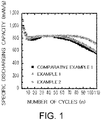
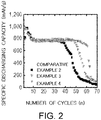
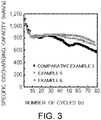
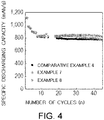
- the batteries manufactured in the above Examples and Comparative Examples were repeatedly discharged and charged 2.5 times at a current density of 0.1 C and then charged and discharged three times each at a current density of 0.2 C, and thereafter were checked for the performance of the batteries while cycling at a current density of 0.3 C (charging) and 0.5 C (discharging). The results thus obtained are shown in FIGs. 1 to 6 .
- FIGs. 3 and 4 show a case where the composition of the positive electrode active material is different. It is seen that the batteries of Examples 5, 6, 7 and 8 using the electrolyte containing the additive have improved specific capacity and life characteristics compared to Comparative Examples 3 and 4.
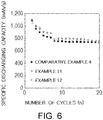
- FIGs. 5 and 6 show a case where the kind of additive is different. It is identified that the batteries of Examples 9, 10, 11, and 12 using the electrolyte containing each additive have improved capacity and life characteristics compared to Comparative Example 4.
Landscapes
- Chemical & Material Sciences (AREA)
- Chemical Kinetics & Catalysis (AREA)
- Electrochemistry (AREA)
- General Chemical & Material Sciences (AREA)
- Engineering & Computer Science (AREA)
- Manufacturing & Machinery (AREA)
- Inorganic Chemistry (AREA)
- General Physics & Mathematics (AREA)
- Condensed Matter Physics & Semiconductors (AREA)
- Physics & Mathematics (AREA)
- Materials Engineering (AREA)
- Secondary Cells (AREA)
- Battery Electrode And Active Subsutance (AREA)
Abstract
Description
- The present application claims the benefits of Korean Patent Application No.
10-2017-0134320 filed on October 17, 2017 10-2018-0118569 filed on October 5, 2018 - The present invention relates to an electrolyte for a lithium metal battery and a lithium metal battery comprising the same.
- With the rapid development of the electrical, electronic, communication and computer industries, the demand for the secondary battery with high performance and high stability is increasing rapidly. Particularly, the weight reduction and miniaturization for the secondary battery, which is a core part, are also required, in accordance with the trend of weight reduction, thinning, miniaturization and portability of batteries and electronic products. In addition, as the need for a new type of energy supply source has arisen due to environmental pollution problems and oil depletion, there has been an increasing need to develop electric vehicles capable of addressing such need. Among secondary batteries, a lithium secondary battery which has a long cycle life, is lightweight and exhibits high energy density and operating potential is in the spotlight recently.
- The lithium secondary battery has a structure in which an electrode assembly comprising a positive electrode, a negative electrode and a separator interposed between the positive electrode and the negative electrode are laminated or wound, and the lithium secondary battery is composed by embedding this electrode assembly in the battery case and injecting a non-aqueous electrolyte into the inside thereof. In that case, the capacities of lithium secondary batteries differ depending on the type of electrode active materials and the capacity at the time of actual driving cannot be secured by a sufficient capacity as much as the theoretical capacity, and thus such batteries have not been commercialized.
- In order to obtain a lithium secondary battery with high capacity, metallic materials having high storage capacity characteristics through the alloying reaction with lithium, such as silicon (4,200 mAh/g) and tin (990 mAh/g) are used as the negative electrode active material. However, when the metals such as silicon and tin are used as a negative electrode active material, the volume expands by about 4 times in the charging process, which performs the alloying with lithium, and shrinks in the discharging process. Due to the large volume changes of the electrode that occur repeatedly during the charging/discharging processes, the active materials were gradually micronized and dropped off from the electrode, and thus, the capacity was rapidly reduced, thereby making it difficult to ensure stability and reliability and thus failing commercialization.
- Since lithium metal has an excellent theoretical capacity of 3,860 mAh/g and a low potential with respect to standard hydrogen electrode (SHE) of -3.045 V as compared to the negative electrode active material mentioned above, and thus enables the implementation of batteries with high capacity and high energy density, there are many studies on lithium metal batteries (LMB) using lithium metal as a negative electrode active material for the lithium secondary battery.
- However, in the case of lithium metal battery, the lithium metal reacts easily with electrolyte, impurities, and lithium salts due to its high chemical/electrochemical reactivity and forms a solid electrolyte interphase (SEI) on the surface of the electrode, and such a solid electrolyte interphase induces a localized current density difference to form dendrites on the surface of lithium metal. The lithium dendrite not only shortens the life of the lithium secondary battery but also induces short circuit and dead lithium in the battery to increase the physical and chemical instability of the lithium secondary battery, reduce the capacity of the battery, reducing the cycling life, and adversely affects the stability of the battery. In addition, the solid electrolyte interphase is thermally unstable, so that the charging/discharging process of the battery can be continuously proceeded, or the solid electrolyte interphase can be slowly collapsed by increased electrochemical energy and thermal energy, especially during high temperature storage in a fully charged state. Due to the collapse of the solid electrolyte interphase, a side reaction in which the exposed surface of lithium metal is decomposed by direct reaction with the electrolyte solvent is continuously generated, and thus the resistance of the negative electrode is increased, and the charging/discharging efficiency of the battery is lowered. Also, there are problems that the solvent of the electrolyte is consumed during the formation of the solid electrolyte interphase, and the life of the battery is reduced due to the by-products, gas, and the like generated during various side reactions such as the formation and collapse of the solid electrolyte interphase and the decomposition of the electrolyte.
- The lithium metal battery using lithium metal as a negative electrode is not commercialized because of the high instability of lithium metal.
- In order to solve these problems, various methods such as a method of introducing a protective layer on the surface of lithium metal or a method of changing the composition of an electrolyte have been studied.
- For example, Korean Patent Application Publication No.
2016-0034183 - In addition, Korean Patent Application Publication No.
2016-0052351 - In addition, each of Jiangfeng Qian et al. and Korean Patent Application Publication No.
2013-0079126 - These prior documents have stabilized the surface of lithium metal and thus inhibited the side reaction between the electrolyte and lithium metal to some extent, but the effect was not sufficient. In addition, the protective layer becomes hard during the charging/discharging process of the battery, or when the protective layer comes into contact with the electrolyte, deformation such as swelling occurs, and thus, application to the lithium secondary battery is limited. In addition, the use of the electrolyte having a specific composition may cause deterioration of battery performance. Accordingly, it is necessary to develop a technique for stabilizing the interface of lithium metal, which is a negative electrode in the lithium metal battery.
-
- Korean Patent Application Publication No.
2016-0034183 (March 29, 2016 - Korean Patent Application Publication No.
2016-0052351 (May 12, 2016 - Korean Patent Application Publication No.
2013-0079126 (July 10, 2013 - Jiangfeng Qian et al., High rate and stable cycling of lithium metal anode, Nature Communications, 2015, 6, 6362.
- As a result of various studies to solve the above problems, the inventors of the present invention have identified that when an additive including specific functional groups is comprised in the electrolyte for the lithium metal battery, the electrochemical characteristics and stability of the lithium metal electrode are improved, thereby improving the capacity and life of the battery, and thus have completed the present invention.
- Accordingly, it is an object of the present invention to provide an electrolyte for a lithium metal battery having excellent capacity and life characteristics.
- Also, it is another object of the present invention to provide a lithium metal battery comprising the above electrolyte.
- According to an aspect of the present invention, provided an electrolyte for a lithium metal battery comprising a lithium salt, an organic solvent and an additive, wherein the additive may comprise a functional group capable of binding to lithium metal at one end thereof and a fluorinated hydrocarbon group at the other end.
- The functional group capable of binding to lithium metal may comprise at least one selected from the group consisting of a thiol group, an amine group and a hydroxy group.
- The additive may be represented by the following Formula 1:
- The additive may comprise at least one selected from the group consisting of 1H,1H,2H,2H,3H,3H-perfluoroundecylthiol, 1H,1H,2H,2H-perfluorodecanethiol, 1H,1H,2H,2H-perfluorononanethiol, 1H,1H,2H,2H-perfluoro-1-octanethiol, 1H,1H-perfluorooctylthiol, 1H,1H-perfluoropropylthiol, 2,2,2-trifluoroethanethiol, 1H,1H,2H,2H-perfluoro-1-hexanethiol, 2,3,4,5,6-pentafluorothiophenol, 2,3,5,6-tetrafluorobenzenethiol, 2,4-difluorothiophenol, 3,4-difluorothiophenol, 2-fluorothiophenol, 3-fluorothiophenol, 4-fluorothiophenol, 2-(trifluoromethoxy)thiophenol, 3-(trifluoromethoxy)thiophenol, 2-(trifluoromethyl)benzenethiol, 2,6-difluorobenzyl mercaptan, 3,4-difluorobenzyl mercaptan, 3,5-difluorobenzyl mercaptan, 4-fluorobenzyl mercaptan, 3,5-bis(trifluoromethyl)benzenethiol, 4-trifluoromethylbenzyl mercaptan, 1H,1H-perfluorooctylamine, 1H,1H-heptafluorobutylamine, 1H,1H-perfluorononylamine, 4-(1H,1H,2H,2H-perfluorodecyl)benzylamine, 2,2,3,3,4,4,4-heptafluorobutylamine, 2,2,3,3,3-pentafluoropropylamine, 3,3,3-trifluoropropylamine, 4-fluoro-α-methylbenzyl alcohol, 2-fluoro-3-methylbenzyl alcohol, 4-fluoro-3-methylbenzyl alcohol, 5-fluoro-2-methylbenzyl alcohol, 4-fluoro-3-nitrobenzyl alcohol, 2-fluoro-5-nitrobenzyl alcohol, 2-fluoro-3-(trifluoromethoxy)benzyl alcohol, 2-fluoro-3-nitrobenzyl alcohol, 2-fluoro-5-methoxybenzyl alcohol, 3-fluoro-5-(trifluoromethyl)benzyl alcohol, 3-fluoro-5-methoxybenzyl alcohol, 4-fluoro-3-(trifluoromethyl)benzyl alcohol, 4-fluoro-3-methoxybenzyl alcohol, 5-fluoro-2-(trifluoromethyl)benzyl alcohol, 5-fluoro-2-nitrobenzyl alcohol, DL-4-fluoro-α-propylbenzyl alcohol, 3-fluorobenzyl alcohol and 4-fluorophenethyl alcohol.
- The additive may be comprised in an amount of from 0.01 to 5 % by weight, based on the total weight of the electrolyte for the lithium metal battery.
- According to another aspect of the present invention, there is provided a lithium metal battery comprising the electrolyte.
- The electrolyte of the lithium metal battery according to the present invention enables the lithium metal battery to have high capacity and long life by comprising an additive that includes a functional group capable of binding to lithium metal at one end thereof and a fluorinated hydrocarbon group at the other end, and thus improving the stability of lithium metal and at the same time, suppressing side reactions at the surface of lithium metal.
-
-
FIG. 1 is a graph showing the results of performance evaluations of the batteries manufactured in Example 1 and Example 2 of the present invention and Comparative Example 1. -
FIG. 2 is a graph showing the results of performance evaluations of the batteries manufactured in Example 3 and Example 4 of the present invention and Comparative Example 2. -
FIG. 3 is a graph showing the results of performance evaluations of the batteries manufactured in Example 5 and Example 6 of the present invention and Comparative Example 3. -
FIG. 4 is a graph showing the results of performance evaluations of the batteries manufactured in Example 7 and Example 8 of the present invention and Comparative Example 4. -
FIG. 5 is a graph showing the results of performance evaluations of the batteries manufactured in Example 9 and Example 10 of the present invention and Comparative Example 4. -
FIG. 6 is a graph showing the results of performance evaluations of the batteries manufactured in Example 11 and Example 12 of the present invention and Comparative Example 4. - Hereinafter, the present invention will be described in more detail.
- The terms and words used in the present specification and claims should not be construed as limited to ordinary or dictionary terms, and should be construed in a sense and concept consistent with the technical idea of the present invention, based on the principle that the inventor can properly define the concept of a term to describe his invention in the best way possible.
- The terminology used herein is for the purpose of describing particular embodiments only and is not intended to be limiting of the invention. The singular forms "a", "an" and "the" comprise plural referents unless the context clearly dictates otherwise. It is to be understood that the terms such as "comprise" or "have" as used in the present specification, are intended to designate the presence of stated features, numbers, steps, operations, components, parts or combinations thereof, but not to preclude the possibility of the presence or addition of one or more other features, numbers, steps, operations, components, parts, or combinations thereof.
- For the lithium metal battery, the lithium metal used as the negative electrode active material has a high energy density (3,860 mAh/g) while having low oxidation/reduction potential (-3.045 V vs. standard hydrogen electrode) and atomic weight (6.94 g/a.u.). Therefore, since it is possible to achieve a high capacity and a high energy density while enabling miniaturization and weight reduction, the lithium metal battery is attracting attention as a next-generation battery.
- However, as described above, lithium metal has high reactivity and thus is very weak in terms of stability. Also, when sulfur-based materials are used as positive electrode active material, among lithium polysulfide (Li2Sx, x = 8, 6, 4, 2) formed in the positive electrode during the operation of the battery, lithium polysulfide (Li2Sx, usually x > 4), which has the high oxidation number of sulfur, has a high solubility in the electrolyte including a hydrophilic organic solvent and thus is continuously dissolved therein and released outside the reaction zone of the positive electrode, thereby moving to the negative electrode. At this time, the lithium polysulfide released from the positive electrode causes a side reaction with the lithium metal, and thus the lithium sulfide adheres to the surface of lithium metal. Therefore, there are problems that the reaction activity and potential characteristics are deteriorated and the lowering of the efficiency and life of the lithium metal electrode is accelerated.
- In the prior art, methods such as a method of introducing a polymer protective layer or an inorganic solid protective layer on the surface of lithium metal or a method of changing the composition of an electrolyte have been used in order to prevent these problems, but the stability of the lithium metal electrode was not effectively improved.
- Therefore, in order to improve the stability of the lithium metal electrode and secure the effect of improving the performance and life of the lithium metal battery including it, the present invention provides an electrolyte for a lithium metal battery comprising an additive including specific functional groups.
- Specifically, the electrolyte for the lithium metal battery according to the present invention comprises a lithium salt, an organic solvent and an additive, wherein the additive comprises a functional group capable of binding to lithium metal at one end thereof and a fluorinated hydrocarbon group at the other end.
- In the present invention, the additive may form a stable protective film on the surface of the lithium metal electrode by forming a bond with lithium metal through the functional group capable of binding to lithium metal located at one end, which comprises a fluorinated hydrocarbon group at the other end of the additive. In that case, the fluorinated hydrocarbon groups originated from the above additive can block the reaction of lithium metal and lithium salts or other impurities in the lithium metal battery using lithium metal or lithium alloys as a negative electrode and thus can increase the reaction efficiency of lithium, thereby improving the discharge amount and extending the life.
- In particular, when the lithium metal battery of the present invention is a lithium-sulfur battery including sulfur as a positive electrode active material, the protective layer formed from the additive can prevent the lithium polysulfide generated from the positive electrode from reacting with lithium metal, thereby effectively suppressing the overcharge phenomenon of the battery and thus enhancing the stability of the battery.
- In addition, since the additive of the present invention can be used in the electrolyte to form the above-described protective film on the lithium metal electrode through an in-situ reaction with lithium metal during the operation of the battery, there is an advantage that a process for forming a separate layer as in the prior art is not necessary.
- In the present invention, the additive may be represented by the following Formula 1:

- wherein A is an alkyl group having 1 to 20 carbon atoms which is substituted or unsubstituted with fluorine; an alkenyl group having 2 to 20 carbon atoms which is substituted or unsubstituted with fluorine; an alkynyl group having 2 to 20 carbon atoms which is substituted or unsubstituted with fluorine; a cycloalkyl group having 3 to 20 carbon atoms which is substituted or unsubstituted with fluorine; or an aryl group having 6 to 40 carbon atoms which is substituted or unsubstituted with fluorine,
- B is a single bond; an alkanediyl group having 1 to 10 carbon atoms which is substituted or unsubstituted with fluorine; an alkenediyl group having 2 to 10 carbon atoms which is substituted or unsubstituted with fluorine; an unsubstituted alkynediyl group having 2 to 10 carbon atoms; a cycloalkyl group having 3 to 20 carbon atoms which is substituted or unsubstituted with fluorine; or an arylene group having 6 to 40 carbon atoms which is substituted or unsubstituted with fluorine,
- at least one of A and B is substituted with fluorine,
- O is oxygen,
- X is independently selected from a thiol group, an amine group or a hydroxy group,
- m is 0 or 1, and
- n is an integer of 1 to 3.
- The term "hydrocarbon group" as used in the present invention refers to all organic groups consisting of carbon and hydrogen and may comprise any known structures such as an alkyl group, an alkenyl group, an alkynyl group, an aryl group, an aralkyl group, a heteroaryl group, and the like. The carbon in the hydrocarbon group may be replaced with at least one selected from the group consisting of oxygen (O), nitrogen (N), and sulfur (S). The hydrocarbon group comprises straight chain, branched chain, monocyclic or polycyclic groups, and at least one hydrogen atom contained in the hydrocarbon group is optionally substituted with one or more substituents (e.g., alkyl, alkenyl, alkynyl, heterocyclic, aryl, heteroaryl, acyl, oxo, imino, thiooxo, cyano, isocyano, amino, azido, nitro, hydroxyl, thiol, halo and the like)
- The term "alkyl group" used in the present invention may be a straight chain or branched chain, and the number of carbon atoms is not particularly limited, but is preferably 1 to 20, specifically 1 to 10. Specific examples thereof comprise, but are not limited to, methyl group, ethyl group, propyl group, isopropyl group, butyl group, t-butyl group, pentyl group, hexyl group and heptyl group.
- The term "alkenyl group" used in the present invention refers to a hydrocarbon group having 2 to 20 carbon atoms and including at least one carbon-carbon double bond unless otherwise stated, but is not limited thereto.
- The term "alkynyl group" used in the present invention refers to a hydrocarbon group having 2 to 20 carbon atoms and including at least one carbon-carbon triple bond unless otherwise stated, but is not limited thereto.
- The term "cycloalkyl group" as used in the present invention refers to a non-aromatic carbon-based ring having at least 3 carbon atoms. The cycloalkyl group comprises, but is not limited to, cyclopropyl, cyclobutyl, cyclopentyl, cyclohexyl, and the like.
- The term "aryl group" used in the present invention refers to a single or multiple aromatic carbon-based ring having 6 to 20 carbon atoms. Examples thereof comprise, but are not limited to, phenyl group, biphenyl group, fluorene group and the like.
- The term "alkanediyl" as used in the present invention is a divalent atomic group obtained by subtracting two hydrogen atoms from an alkane, and may be represented by the general formula -CnH2n-.
- The term "alkenediyl" as used in the present invention is a divalent atomic group obtained by subtracting two hydrogen atoms from an alkene, and may be represented by the general formula -CnHn-.
- The term "alkynediyl" as used in the present invention is a divalent atomic group obtained by subtracting two hydrogen atoms from an alkyne.
- The term "arylene group" used in the present invention means a divalent aromatic carbon-based ring, and its carbon number may be 6 to 40, specifically 6 to 20. The arylene group may comprise a structure in which two or more rings are condensed or bonded, and the other rings may be aromatic, non-aromatic, or a combination thereof. For example, the arylene group comprises, but is not limited to, phenylene, biphenylene, naphthylene, anthracenylene, and the like.
- The term "single bond" used in the present invention refers to a bonding relationship between elements connected with B in the case where B in the
above Formula 1 does not exist. - In the
Formula 1, A may represent a monovalent hydrocarbon group substituted by at least one fluorine. Preferably, A may be an alkyl group having 1 to 10 carbon atoms which is substituted or unsubstituted with fluorine; an alkenyl group having 2 to 10 carbon atoms which is substituted or unsubstituted with fluorine; an alkynyl group having 2 to 10 carbon atoms which is substituted or unsubstituted with fluorine; a cycloalkyl group having 3 to 15 carbon atoms which is substituted or unsubstituted with fluorine; or an aryl group having 6 to 20 carbon atoms which is substituted or unsubstituted with fluorine, more preferably, an alkyl group having 1 to 10 carbon atoms which is substituted or unsubstituted with fluorine. - In the
Formula 1, B may represent a single bond or a divalent hydrocarbon group substituted by at least one fluorine. Preferably, B may be an alkanediyl group having 1 to 5 carbon atoms which is substituted or unsubstituted with fluorine; an alkenediyl group having 2 to 5 carbon atoms which is substituted or unsubstituted with fluorine; or an unsubstituted alkynediyl group having 2 to 10 carbon atoms, more preferably an alkanediyl group having 1 to 5 carbon atoms which is substituted or unsubstituted with fluorine. - In these cases, X may be a functional group capable of binding to lithium metal. X may comprise a polar functional group so as to dissolve well in the electrolyte and at the same time to facilitate easy bonding with the surface of the lithium metal. Preferably, X may be at least one selected from the group consisting of a thiol group (-SH), an amine group (-NH2) and a hydroxy group (-OH), more preferably a thiol group.
- Also, from the viewpoint of improving the stability and effectively suppressing side reactions by being stably introduced onto the surface of lithium metal, the sum of the carbon numbers of A and B may be 1 to 30.
- The additive represented by the Formula 1 may be, for example, at least one selected from the group consisting of 1H,1H,2H,2H,3H,3H-perfluoroundecylthiol, 1H,1H,2H,2H-perfluorodecanethiol, 1H,1H,2H,2H-perfluorononanethiol, 1H,1H,2H,2H-perfluoro-1-octanethiol, 1H,1H-perfluorooctylthiol, 1H,1H-perfluoropropylthiol, 2,2,2-trifluoroethanethiol, 1H,1H,2H,2H-perfluoro-1-hexanethiol, 2,3,4,5,6-Pentafluorothiophenol, 2,3,5,6-tetrafluorobenzenethiol, 2,4-difluorothiophenol, 3,4-difluorothiophenol, 2-fluorothiophenol, 3-fluorothiophenol, 4-fluorothiophenol, 2-(trifluoromethoxy)thiophenol, 3-(trifluoromethoxy)thiophenol, 2-(trifluoromethyl)benzenethiol, 2,6-difluorobenzyl mercaptan, 3,4-difluorobenzyl mercaptan, 3,5-difluorobenzyl mercaptan, 4-fluorobenzyl mercaptan, 3,5-bis(trifluoromethyl)benzenethiol, 4-trifluoromethylbenzyl mercaptan, 1H,1H-perfluorooctylamine, 1H,1H-heptafluorobutylamine, 1H,1H-perfluorononylamine, 4-(1H,1H,2H,2H-perfluorodecyl)benzylamine, 2,2,3,3,4,4,4-heptafluorobutylamine, 2,2,3,3,3-pentafluoropropylamine, 3,3,3-trifluoropropylamine, 4-fluoro-α-methylbenzyl alcohol, 2-fluoro-3-methylbenzyl alcohol, 4-fluoro-3-methylbenzyl alcohol, 5-fluoro-2-methylbenzyl alcohol, 4-fluoro-3-nitrobenzyl alcohol, 2-fluoro-5-nitrobenzyl alcohol, 2-fluoro-3-(trifluoromethoxy)benzyl alcohol, 2-fluoro-3-nitrobenzyl alcohol, 2-fluoro-5-methoxybenzyl alcohol, 3-fluoro-5-(trifluoromethyl)benzyl alcohol, 3-fluoro-5-methoxybenzyl alcohol, 4-fluoro-3-(trifluoromethyl)benzyl alcohol, 4-fluoro-3-methoxybenzyl alcohol, 5-fluoro-2-(trifluoromethyl)benzyl alcohol, 5-fluoro-2-nitrobenzyl alcohol, DL-4-fluoro-α-propylbenzyl alcohol, 3-fluorobenzyl alcohol and 4-fluorophenethyl alcohol, and preferably, may be at least one selected from the group consisting of 1H,1H,2H,2H,3H,3H-perfluoroundecylthiol, 1H,1H,2H,2H-perfluoro-1-hexanethiol, 1H,1H,2H,2H-perfluorodecanethiol, 1H,1H,2H,2H-perfluorononanethiol, 1H,1H,2H,2H-perfluoro-1-octanethiol, 1H,1H-perfluorooctylthiol and 1H,1H-perfluorooctylamine, and more preferably, may be at least one selected from the group consisting of 1H,1H,2H,2H-perfluoro-1-hexanethiol, 1H,1H,2H,2H-perfluorodecanethiol, 1H,1H,2H,2H-perfluorononanethiol and 1H,1H,2H,2H-perfluoro-1-octanethiol.
- The additive may be included in an amount of from 0.01 to 5 % by weight, preferably from 0.05 to 1 % by weight, based on the total weight of the electrolyte for the lithium metal battery. When the content of the additive is less than the above range, the protective film is not uniformly formed on the surface of the lithium metal electrode and thus the desired effect cannot be obtained. On the contrary, when the content of the additive exceeds the above range, an unnecessary reaction may occur when driving the battery, so that the performance of the battery may be deteriorated.
- The electrolyte for the lithium metal battery of the present invention comprises a lithium salt as an electrolyte salt. The lithium salt is not particularly limited in the present invention and can be used without limitation as long as it is commonly used in the electrolyte for the lithium secondary battery.
- For example, the lithium salt may comprise at least one selected from the group consisting of LiCl, LiBr, LiI, LiClO4, LiBF4, LiB10Cl10, LiPF6, LiCF3SO3, LiCF3CO2, LiC4BO8, LiAsF6, LiSbF6, LiAlCl4, CH3SO3Li, CF3SO3Li, (CF3SO2)2NLi, (C2F5SO2)2NLi, (SO2F)2NLi, (CF3SO2)3CLi, lithium chloroborane, lithium lower aliphatic carboxylate having 4 or less carbon atoms, 4-phenyl lithium borate, and lithium imide. Preferably, the lithium salt may be Lithium bis (trifluoromethanesulfonyl) imide (LiTFSI), (CF3SO2)2NLi).
- The concentration of the lithium salt may be appropriately determined in consideration of ion conductivity, solubility and the like, and may be, for example, from 0.1 to 4.0 M, preferably from 0.5 to 2.0 M. When the concentration of the lithium salt is less than the above range, it is difficult to ensure ion conductivity suitable for driving the battery. On the contrary, when the concentration exceeds the above range, the viscosity of the electrolyte solution is increased to lower the mobility of the lithium ion and the decomposition reaction of the lithium salt itself may increase to deteriorate the performance of the battery. Therefore, the concentration is adjusted appropriately within the above range.
- The electrolyte for the lithium metal battery of the present invention comprises an organic solvent, and those commonly used in the electrolyte for the lithium secondary battery can be used without limitation.
- For example, as the organic solvent, ether, ester, amide, linear carbonate, cyclic carbonate, etc. may be used alone or in combination of two or more. Among them, ether-based compounds may be typically comprised.
- For example, the ether-based compound may comprise, but is not limited to, at least one selected from the group consisting of dimethyl ether, diethyl ether, dipropyl ether, methylethyl ether, methylpropyl ether, ethylpropyl ether, dimethoxyethane, diethoxyethane, methoxyethoxyethane, diethylene glycol dimethyl ether, diethylene glycol diethyl ether, diethylene glycol methylethyl ether, triethylene glycol dimethyl ether, triethylene glycol diethyl ether, triethylene glycol methylethyl ether, tetraethylene glycol dimethyl ether, tetraethylene glycol diethyl ether, tetraethylene glycol methylethyl ether, polyethylene glycol dimethyl ether, polyethylene glycol diethyl ether, polyethylene glycol methylethyl ether, 1,3-dioxolane, tetrahydrofuran, and 2-methyltetrahydrofuran.
- Examples of the ester of the organic solvent may comprise, but is not limited to, at least one selected from the group consisting of methyl acetate, ethyl acetate, propyl acetate, methyl propionate, ethyl propionate, propyl propionate, γ-butyrolactone, γ-valerolactone, γ-caprolactone, σ-valerolactone, and ε-caprolactone, or a mixture of two or more thereof.
- Specific examples of the linear carbonate compound may comprise, but is not limited to, at least one selected from the group consisting of dimethyl carbonate (DMC), diethyl carbonate (DEC), dipropyl carbonate, ethylmethyl carbonate (EMC), methylpropyl carbonate and ethylpropyl carbonate, or a mixture of two or more thereof.
- In addition, specific examples of the cyclic carbonate compound may comprise at least one selected from the group consisting of ethylene carbonate (EC), propylene carbonate (PC), 1,2-butylene carbonate, 2,3-butylene carbonate, 1,2-pentylene carbonate, 2,3-pentylene carbonate, vinylene carbonate, vinylethylene carbonate, and halides thereof, or a mixture of two or more thereof. Examples of such halides comprise, but are not limited to, fluoroethylene carbonate (FEC) and the like.
- In addition to the above-mentioned organic solvents, there are N-methyl pyrrolidone, dimethyl sulfoxide, sulfolane and the like.
- The electrolyte for the lithium secondary battery of the present invention may further comprise nitric acid-based compounds commonly used in the related art in addition to the above-mentioned components. Examples thereof may be lithium nitrate (LiNO3), potassium nitrate (KNO3), cesium nitrate (CsNO3), magnesium nitrate (Mg(NO3)2), barium nitrate (Ba(NO3)2), lithium nitrite (LiNO2), potassium nitrite (KNO2), cesium nitrite (CsNO2) and the like.
- The electrolyte for the lithium metal battery according to the present invention including the above-mentioned components can improve the instability of the negative electrode, lithium metal, by including the additive represented by the
Formula 1. Also, it is possible to effectively suppress the side reaction between the lithium metal and the material generated during the operation of the battery, such as lithium polysulfide, in the electrolyte or particularly the lithium-sulfur battery, thereby ensuring excellent stability and thus improving the performance and lifetime of the charging/discharging process of the battery. - Also, the present invention provides a lithium metal battery comprising the electrolyte for the lithium metal battery.
- The lithium-sulfur battery comprises a positive electrode, a negative electrode and an electrolyte interposed between the positive electrode and the negative electrode wherein the electrolyte comprises the electrolyte for the lithium metal battery according to the present invention.
- The positive electrode may comprise a positive electrode current collector and a positive electrode active material coated on one or both sides of the positive electrode current collector.
- The positive electrode current collector supports the positive electrode active material and is not particularly limited as long as it has high conductivity without causing chemical change in the battery. For example, copper, stainless steel, aluminum, nickel, titanium, palladium, sintered carbon; copper or stainless steel surface-treated with carbon, nickel, silver or the like; aluminum-cadmium alloy or the like may be used as the positive electrode current collector.
- The positive electrode current collector can enhance the bonding force with the positive electrode active material by having fine irregularities on its surface, and may be formed in various forms such as film, sheet, foil, mesh, net, porous body, foam or nonwoven fabric.
- The positive electrode active material may comprise a positive electrode active material and optionally a conductive material and a binder.
- The positive electrode active material may comprise at least one selected from the group consisting of elemental sulfur (S8), Li2Sn(n≥1), disulfide compound such as 2,5-dimercapto-1,3,4-thiadiazole and 1,3,5-trithiocyanuic acid, an organic sulfur compound or a carbon-sulfur polymer ((C2Sx)n: x=2.5 ∼ 50, n≥2) and the like. Preferably, inorganic sulfur (S8) may be used.
- The positive electrode may further comprise at least one additive selected from a transition metal element, a group IIIA element, a group IVA element, a sulfur compound of these elements, and an alloy of these elements and sulfur, in addition to the positive electrode active material.
- The transition metal element may comprise Sc, Ti, V, Cr, Mn, Fe, Co, Ni, Cu, Zn, Y, Zr, Nb, Mo, Tc, Ru, Rh, Pd, Os, Ir, Pt, Au, Hg and the like, and the group IIIA element may comprise Al, Ga, In, Ti and the like, and the group IVA element may comprise Ge, Sn, Pb, and the like.
- The conductive material is intended to improve electrical conductivity and is not particularly limited as long as it is an electron conductive material that does not cause chemical change in the lithium secondary battery.
- Generally, carbon black, graphite, carbon fiber, carbon nanotube, metal powder, conductive metal oxide, organic conductive material and the like may be used. Products that are currently marketed as conductive materials may comprise acetylene black series (products from Chevron Chemical Company or Gulf Oil Company), Ketjen Black EC series (products from Armak Company), Vulcan XC-72(a product from Cabot Company) and Super P (a product from MMM). Examples thereof may comprise acetylene black, carbon black, graphite and the like.
- In addition, the positive electrode active material may further comprise a binder having a function of holding the positive electrode active material on the positive electrode current collector and connecting between active materials. As the binder, for example, various types of binders such as polyvinylidene fluoride-hexafluoropropylene (PVDF-co-HFP), polyvinylidene fluoride (PVDF), polyacrylonitrile, polymethyl methacrylate, styrene-butadiene rubber (SBR), carboxyl methyl cellulose (CMC), poly(acrylic acid) (PAA), poly(vinyl alcohol)(PVA) and the like may be used.
- The negative electrode may comprise a negative electrode current collector and a negative electrode active material on the negative electrode current collector, or the negative electrode may be a lithium metal plate.
- The negative electrode current collector is for supporting a negative electrode active material and is not particularly limited as long as it is electrochemically stable in the voltage range of the lithium secondary battery while having excellent conductivity. For example, copper, stainless steel, aluminum, nickel, titanium, palladium, sintered carbon; copper or stainless steel surface-treated with carbon, nickel, silver or the like; aluminum-cadmium alloy or the like may be used as the negative electrode current collector.
- The negative electrode current collector can enhance the bonding force with the negative electrode active material by having fine irregularities formed on its surface, and may be formed in various forms such as film, sheet, foil, mesh, net, porous body, foam or nonwoven fabric.
- The negative electrode active material may comprise a material capable of reversibly intercalating or deintercalating lithium ion (Li+), a material capable of reversibly forming lithium containing compounds by reacting with lithium ion, or lithium metal or lithium alloy. The material capable of reversibly intercalating or deintercalating lithium ion (Li+) may be, for example, crystalline carbon, amorphous carbon, or a mixture thereof. The material capable of reacting with lithium ion (Li+) to reversibly form lithium containing compounds may be, for example, tin oxide, titanium nitrate or silicon. The lithium alloy may be, for example, an alloy of lithium (Li) and a metal selected from the group consisting of sodium (Na), potassium (K), rubidium (Rb), cesium (Cs), francium (Fr), beryllium (Be), magnesium (Mg), calcium (Ca), strontium (Sr), barium (Ba), radium (Ra), aluminum (Al), and tin (Sn). Preferably, the negative electrode active material may be lithium metal, and specifically may be in the form of a lithium metal thin film or lithium metal powder.
- The method for forming the negative electrode active material is not particularly limited, and a layer or film forming method commonly used in the art can be used. For example, methods such as compression, coating, or deposition may be used. In addition, a metal lithium thin film formed on a metal plate by initial charging after assembling the battery without the lithium thin film in the current collector is also comprised in the negative electrode of the present invention.
- The electrolyte comprises lithium ions and is for causing an electrochemical oxidation or reduction reaction between the positive electrode and the negative electrode through these lithium ions, and is as described above.
- The injection of the electrolyte solution may be performed at an appropriate stage of the electrochemical device manufacturing process depending on the manufacturing process and required properties of the final product. That is, the injection of the electrolyte solution may be applied before assembling the electrochemical device or in the final stage of assembling the electrochemical device.
- A separator may be additionally comprised between the positive electrode and the negative electrode. The separator is used to physically separate both electrodes in the lithium secondary battery of the present invention, and may be used without any particular limitations as long as it is commonly used as a separator in the lithium secondary battery. Particularly, it is desirable to use a separator having excellent wettability to the electrolyte solution while having low resistance to ion migration of the electrolyte.
- The separator may be formed of a porous substrate, and the porous substrate may be any porous substrate commonly used in an electrochemical device. For example, a polyolefin-based porous membrane or a nonwoven fabric may be used as the porous substrate, but it is not particularly limited thereto.
- Examples of the polyolefin-based porous membrane may comprise a membrane formed of polyolefin-based polymer such as polyethylene such as high-density polyethylene, linear low-density polyethylene, low density polyethylene and ultra-high molecular weight polyethylene, polypropylene, polybutylene and polypentene alone or a mixture thereof.
- The nonwoven fabric may comprise, in addition to the polyolefin-based nonwoven fabric, for example, a nonwoven fabric formed of polyethyleneterephthalate, polybutyleneterephthalate, polyester, polyacetal, polyamide, polycarbonate, polyimide, polyetheretherketone, polyethersulfone, polyphenyleneoxide, polyphenylene sulfide and polyethylenenaphthalate alone or a mixture thereof. The structure of the nonwoven fabric may be a spun bond nonwoven fabric or a melt blown nonwoven fabric composed of long fibers.
- The thickness of the porous substrate is not particularly limited, but may be from 1 to 100 µm, preferably from 5 to 50 µm.
- The size and porosity of the pores present in the porous substrate are also not particularly limited, but may be from 0.001 to 50 µm and from 10 to 95%, respectively.
- The lithium-sulfur battery according to the present invention may be manufactured by lamination, stacking and folding processes of the separator and the electrodes, in addition to the usual winding process.
- The shape of the lithium-sulfur battery is not particularly limited, and may be various shapes such as a cylindrical shape, a laminate shape and a coin shape.
- Also, the present invention provides a battery module including the lithium metal battery as a unit battery.
- The battery module may be used as a power source for medium to large-sized devices requiring high temperature stability, long cycle characteristics, high capacity characteristics and the like.
- Examples of such medium to large-sized devices may comprise, but is not limited to, a power tool powered by an electric motor; an electric car including an electric vehicle (EV), a hybrid electric vehicle (HEV), a plug-in hybrid electric vehicle (PHEV) and the like; an electric motorcycle including an electric bike (E-bike) and an electric scooter (E-scooter); an electric golf cart; a power storage system, etc.
- Hereinafter, preferred examples of the present invention will be described in order to facilitate understanding of the present invention. It will be apparent to those skilled in the art, however, that the following examples are illustrative of the present invention and that various changes and modifications can be made within the scope and spirit of the present invention. Such variations and modifications are within the scope of the appended claims.
- A solution prepared by dissolving 1.0 M LiTFSI and 1.0 % by weight of lithium nitrate in the organic solvent consisting of 1,3-dioxolane and dimethyl ether (DOL : DME = 1 : 1 (volume ratio)) was prepared, and 0.1 % by weight of 1H,1H,2H,2H-perfluorodecanethiol was added to this solution to prepare an electrolyte.
- Sulfur was mixed with conductive material and binder in acetonitrile using a ball mill to prepare a slurry of positive electrode active material. At this time, carbon black was used as a conductive material and polyethylene oxide (molecular weight: 5,000,000 g/mol) was used as a binder, and a mixing ratio of sulfur: conductive material: binder was 60:20:20 by weight. The slurry of positive electrode active material was coated on the aluminum current collector and then dried to produce a positive electrode.
- A thin film of lithium metal with a thickness of 40 µm was used as a negative electrode.
- The prepared positive electrode and negative electrode were placed facing each other, and a polyethylene separator was interposed therebetween. Thereafter, 70 µl of the electrolyte was injected to prepare a coin-type battery.
- A coin-type battery was manufactured in the same manner as Example 1 above except that in the preparation of the electrolyte, 0.5 % by weight of 1H,1H,2H,2H-perfluorodecanethiol was used.
- A coin-type battery was manufactured in the same manner as Example 1 above except that in the preparation of the electrolyte, the lithium nitrate was not used.
- A coin-type battery was manufactured in the same manner as Example 1 above except that in the preparation of the electrolyte, 1.0 % by weight of 1H,1H,2H,2H-perfluorodecanethiol was used and the lithium nitrate was not used.
- A coin-type battery was manufactured in the same manner as Example 1 above except that in the preparation of the positive electrode, sulfur : conductive material : binder were mixed at a weight ratio of 70 : 15 : 15.
- A coin-type battery was manufactured in the same manner as Example 1 above except that in the preparation of the electrolyte, 0.5 % by weight of 1H,1H,2H,2H-perfluorodecanethiol was used and sulfur : conductive material : binder were mixed at a weight ratio of 70 : 15 : 15.
- A coin-type battery was manufactured in the same manner as Example 1 above except that in the preparation of the positive electrode, sulfur : conductive material : binder were mixed at a weight ratio of 80 : 10 : 10.
- A coin-type battery was manufactured in the same manner as Example 1 above except that in the preparation of the electrolyte, 0.5 % by weight of 1H,1H,2H,2H-perfluorodecanethiol was used and sulfur : conductive material : binder were mixed at a weight ratio of 80 : 10 : 10.
- A coin-type battery was manufactured in the same manner as Example 1 above except that in the preparation of the electrolyte, 2,4-difluorothiophenol instead of 1H,1H,2H,2H-perfluorodecanethiol was used in the same amount, and in the preparation of the positive electrode, sulfur : conductive material : binder were mixed at a weight ratio of 80 : 10 : 10.
- A coin-type battery was manufactured in the same manner as Example 1 above except that in the preparation of the electrolyte, 2,4-difluorothiophenol instead of 1H,1H,2H,2H-perfluorodecanethiol was used in the amount of 1.0 % by weight, and in the preparation of the positive electrode, sulfur : conductive material : binder were mixed at a weight ratio of 80 : 10 : 10.
- A coin-type battery was manufactured in the same manner as Example 1 above except that in the preparation of the electrolyte, 4-fluorothiophenol instead of 1H,1H,2H,2H-perfluorodecanethiol was used in the same amount, and in the preparation of the positive electrode, sulfur : conductive material : binder were mixed at a weight ratio of 80 : 10 : 10.
- A coin-type battery was manufactured in the same manner as Example 1 above except that in the preparation of the electrolyte, 4-fluorothiophenol instead of 1H,1H,2H,2H-perfluorodecanethiol was used in the amount of 1.0 % by weight, and in the preparation of the positive electrode, sulfur : conductive material : binder were mixed at a weight ratio of 80 : 10 : 10.
- A coin-type battery was manufactured in the same manner as Example 1 above except that in the preparation of the electrolyte, 1H,1H,2H,2H-perfluorodecanethiol was not used.
- A coin-type battery was manufactured in the same manner as Example 1 above except that in the preparation of the electrolyte, 1H,1H,2H,2H-perfluorodecanethiol and lithium nitrate were not used.
- A coin-type battery was manufactured in the same manner as Example 1 above except that in the preparation of the electrolyte, 1H,1H,2H,2H-perfluorodecanethiol was not used, and in the preparation of the positive electrode, sulfur : conductive material : binder were mixed at a weight ratio of 75 : 15 : 15.
- A coin-type battery was manufactured in the same manner as Example 1 above except that in the preparation of the electrolyte, 1H,1H,2H,2H-perfluorodecanethiol was not used, and in the preparation of the positive electrode, sulfur : conductive material : binder were mixed at a weight ratio of 80 : 10 : 10.
- The batteries manufactured in the above Examples and Comparative Examples were repeatedly discharged and charged 2.5 times at a current density of 0.1 C and then charged and discharged three times each at a current density of 0.2 C, and thereafter were checked for the performance of the batteries while cycling at a current density of 0.3 C (charging) and 0.5 C (discharging). The results thus obtained are shown in
FIGs. 1 to 6 . - Referring to
FIGs. 1 to 6 , it is identified that the capacity and life characteristics of the batteries including the electrolytes of the Examples according to the invention are superior to those of the batteries including the electrolytes of the Comparative Examples. - Specifically, it is seen from
FIG.1 that specific capacities and life characteristics are improved for Examples 1 and 2 as compared to Comparative Example 1 which comprises the electrolyte without the additive, 1H,1H,2H,2H-perfluorodecanethiol. Particularly, it is identified that in the case of Example 1, as the specific capacity is stably maintained up to 90 cycles, the life is increased by about 50% compared to Comparative Example 1. - It is seen from
FIG. 2 that the specific capacity of the battery comprising the electrolyte of Examples 3 and 4 which is the case of using the electrolyte without containing a nitric acid-based compound is higher than that of Comparative Example 2 which does not use the additive in the electrolyte. Also, it is identified that when comparing with Comparative Example 2 in which the specific capacity is maintained for about 40 cycles, Examples 3 and 4 including the electrolyte according to the present invention are stably maintained for 50 cycles or more to further improve capacity retention and life characteristics. - Each of
FIGs. 3 and4 show a case where the composition of the positive electrode active material is different. It is seen that the batteries of Examples 5, 6, 7 and 8 using the electrolyte containing the additive have improved specific capacity and life characteristics compared to Comparative Examples 3 and 4. - Each of
FIGs. 5 and6 show a case where the kind of additive is different. It is identified that the batteries of Examples 9, 10, 11, and 12 using the electrolyte containing each additive have improved capacity and life characteristics compared to Comparative Example 4.
Claims (8)
- An electrolyte for a lithium metal battery comprising:a lithium salt;an organic solvent; andan additive,wherein the additive comprises a first end and a second end opposite the first end, wherein a functional group that binds to lithium metal is present at the first end and a fluorinated hydrocarbon group is present at the second end.
- The electrolyte for the lithium metal battery according to claim 1, wherein the functional group that binds to the lithium metal comprises at least one selected from the group consisting of a thiol group, an amine group and a hydroxy group.
- The electrolyte for the lithium metal battery according to claim 1, wherein the additive is represented by the following Formula 1:
 wherein A is an alkyl group having 1 to 20 carbon atoms which is substituted or unsubstituted with fluorine; an alkenyl group having 2 to 20 carbon atoms which is substituted or unsubstituted with fluorine; an alkynyl group having 2 to 20 carbon atoms which is substituted or unsubstituted with fluorine; a cycloalkyl group having 3 to 20 carbon atoms which is substituted or unsubstituted with fluorine; or an aryl group having 6 to 40 carbon atoms which is substituted or unsubstituted with fluorine,B is a single bond; an alkanediyl group having 1 to 10 carbon atoms which is substituted or unsubstituted with fluorine; an alkenediyl group having 2 to 10 carbon atoms which is substituted or unsubstituted with fluorine; an unsubstituted alkynediyl group having 2 to 10 carbon atoms; a cycloalkyl group having 3 to 20 carbon atoms which is substituted or unsubstituted with fluorine; or an arylene group having 6 to 40 carbon atoms which is substituted or unsubstituted with fluorine,at least one of A and B is substituted with fluorine,O is oxygen,X is independently selected from a thiol group, an amine group or a hydroxy group,m is 0 or 1, andn is an integer of 1 to 3.
 - The electrolyte for the lithium metal battery according to claim 1, wherein the additive comprises at least one selected from the group consisting of 1H,1H,2H,2H,3H,3H-perfluoroundecylthiol, 1H,1H,2H,2H-perfluorodecanethiol, 1H,1H,2H,2H-perfluorononanethiol, 1H,1H,2H,2H-perfluoro-1-octanethiol, 1H,1H-perfluorooctylthiol, 1H,1H-perfluoropropylthiol, 2,2,2-trifluoroethanethiol, 1H,1H,2H,2H-perfluoro-1-hexanethiol, 2,3,4,5,6-pentafluorothiophenol, 2,3,5,6-tetrafluorobenzenethiol, 2,4-difluorothiophenol, 3,4-difluorothiophenol, 2-fluorothiophenol, 3-fluorothiophenol, 4-fluorothiophenol, 2-(trifluoromethoxy)thiophenol, 3-(trifluoromethoxy)thiophenol, 2-(trifluoromethyl)benzenethiol, 2,6-difluorobenzyl mercaptan, 3,4-difluorobenzyl mercaptan, 3,5-difluorobenzyl mercaptan, 4-fluorobenzyl mercaptan, 3,5-bis(trifluoromethyl)benzenethiol, 4-trifluoromethylbenzyl mercaptan, 1H,1H-perfluorooctylamine, 1H,1H-heptafluorobutylamine, 1H,1H-perfluorononylamine, 4-(1H,1H,2H,2H-perfluorodecyl)benzylamine, 2,2,3,3,4,4,4-heptafluorobutylamine, 2,2,3,3,3-pentafluoropropylamine, 3,3,3-trifluoropropylamine, 4-fluoro-α-methylbenzyl alcohol, 2-fluoro-3-methylbenzyl alcohol, 4-fluoro-3-methylbenzyl alcohol, 5-fluoro-2-methylbenzyl alcohol, 4-fluoro-3-nitrobenzyl alcohol, 2-fluoro-5-nitrobenzyl alcohol, 2-fluoro-3-(trifluoromethoxy)benzyl alcohol, 2-fluoro-3-nitrobenzyl alcohol, 2-fluoro-5-methoxybenzyl alcohol, 3-fluoro-5-(trifluoromethyl)benzyl alcohol, 3-fluoro-5-methoxybenzyl alcohol, 4-fluoro-3-(trifluoromethyl)benzyl alcohol, 4-fluoro-3-methoxybenzyl alcohol, 5-fluoro-2-(trifluoromethyl)benzyl alcohol, 5-fluoro-2-nitrobenzyl alcohol, DL-4-fluoro-α-propylbenzyl alcohol, 3-fluorobenzyl alcohol and 4-fluorophenethyl alcohol.
- The electrolyte for the lithium metal battery according to claim 1, wherein the additive is present in an amount of from 0.01 % by weight to 5 % by weight, based on a total weight of the electrolyte for the lithium metal battery.
- The electrolyte for the lithium metal battery according to claim 1, wherein the lithium salt comprises at least one selected from the group consisting of LiCl, LiBr, LiI, LiClO4, LiBF4, LiB10Cl10, LiPF6, LiCF3SO3, LiCF3CO2, LiC4BO8, LiAsF6, LiSbF6, LiAlCl4, CH3SO3Li, CF3SO3Li, (CF3SO2)2NLi, (C2F5SO2)2NLi, (SO2F)2NLi, (CF3SO2)3CLi, lithium chloroborane, lithium lower aliphatic carboxylate having 4 or less carbon atoms, 4-phenyl lithium borate and lithium imide.
- A lithium metal battery comprising:a positive electrode comprising a positive electrode active material;a negative electrode comprising lithium metal or lithium alloy; andthe electrolyte according to any one of claims 1 to 6.
- The lithium metal battery according to claim 7, wherein the positive electrode active material comprises at least one selected from the group consisting of an elemental sulfur and a sulfur-containing compound.
Applications Claiming Priority (3)
| Application Number | Priority Date | Filing Date | Title |
|---|---|---|---|
| KR20170134320 | 2017-10-17 | ||
| KR1020180118569A KR102328258B1 (en) | 2017-10-17 | 2018-10-05 | Electrolyte for lithium metal battery and lithium metal battery comprising thereof |
| PCT/KR2018/011813 WO2019078526A2 (en) | 2017-10-17 | 2018-10-08 | Electrolyte for lithium metal battery and lithium metal battery comprising same |
Publications (3)
| Publication Number | Publication Date |
|---|---|
| EP3664213A2 true EP3664213A2 (en) | 2020-06-10 |
| EP3664213A4 EP3664213A4 (en) | 2020-11-18 |
| EP3664213B1 EP3664213B1 (en) | 2023-09-13 |
Family
ID=66283759
Family Applications (1)
| Application Number | Title | Priority Date | Filing Date |
|---|---|---|---|
| EP18868454.2A Active EP3664213B1 (en) | 2017-10-17 | 2018-10-08 | Electrolyte for lithium metal battery and lithium metal battery comprising same |
Country Status (8)
| Country | Link |
|---|---|
| US (1) | US11495824B2 (en) |
| EP (1) | EP3664213B1 (en) |
| JP (1) | JP6963679B2 (en) |
| KR (1) | KR102328258B1 (en) |
| CN (1) | CN111033864B (en) |
| ES (1) | ES2960507T3 (en) |
| HU (1) | HUE063191T2 (en) |
| PL (1) | PL3664213T3 (en) |
Families Citing this family (5)
| Publication number | Priority date | Publication date | Assignee | Title |
|---|---|---|---|---|
| CN111969249A (en) * | 2020-07-30 | 2020-11-20 | 北京理工大学 | Lithium-sulfur battery electrolyte containing negative electrode protection additive |
| US12362369B2 (en) * | 2021-02-24 | 2025-07-15 | Massachusetts Institute Of Technology | Electrochemical reduction of halogenated compounds comprising a sulfur pentahalide group |
| CN113394460A (en) * | 2021-06-24 | 2021-09-14 | 郑州大学 | Lithium-sulfur battery electrolyte containing benzenetrithiol additive and lithium-sulfur battery |
| EP4475255A4 (en) * | 2022-01-31 | 2025-12-10 | Panasonic Ip Man Co Ltd | Non-aqueous electrolyte for a cell with non-aqueous electrolyte and cell with non-aqueous electrolyte |
| CN116365029A (en) * | 2023-02-14 | 2023-06-30 | 广东金光高科股份有限公司 | A kind of lithium ion electrolyte and preparation method thereof |
Family Cites Families (42)
| Publication number | Priority date | Publication date | Assignee | Title |
|---|---|---|---|---|
| JP3102215B2 (en) | 1993-07-23 | 2000-10-23 | 上村工業株式会社 | Negative electrode for lithium ion secondary battery and method for producing the same |
| JP2000156245A (en) | 1998-11-19 | 2000-06-06 | Japan Storage Battery Co Ltd | Non-aqueous electrolyte battery |
| JP4529274B2 (en) * | 2000-04-18 | 2010-08-25 | ソニー株式会社 | Non-aqueous electrolyte battery |
| SE0001522L (en) | 2000-04-27 | 2001-10-28 | Skf Nova Ab | Method and apparatus for compacting a powder material into a homogeneous article |
| JP5162803B2 (en) | 2001-02-15 | 2013-03-13 | 三菱化学株式会社 | Non-aqueous electrolyte secondary battery and non-aqueous electrolyte used therefor |
| KR100413796B1 (en) | 2001-05-31 | 2004-01-03 | 삼성에스디아이 주식회사 | Method of manufacturing lithium metal anode protective layer for lithium battery |
| JP4269137B2 (en) | 2002-07-19 | 2009-05-27 | ダイキン工業株式会社 | Electrode surface film forming agent. |
| KR100485092B1 (en) | 2002-08-06 | 2005-04-22 | 삼성에스디아이 주식회사 | Lithium-suflur battery |
| KR100467435B1 (en) * | 2002-09-06 | 2005-01-24 | 삼성에스디아이 주식회사 | An electrolyte for a lithium battery and a lithium battery comprising the same |
| KR100450208B1 (en) | 2002-09-23 | 2004-09-24 | 삼성에스디아이 주식회사 | Negative electrode for lithium battery and lithium battery comprising same |
| US7585590B2 (en) | 2006-02-17 | 2009-09-08 | 3M Innovative Properties Company | Rechargeable lithium-ion cell with triphenylamine redox shuttle |
| JP5079461B2 (en) * | 2007-11-14 | 2012-11-21 | ソニー株式会社 | Positive electrode for lithium ion secondary battery, method for producing the same, and lithium ion secondary battery |
| US9566475B2 (en) * | 2007-11-14 | 2017-02-14 | Acushnet Company | Golf ball having a thermoplastic positive hardness gradient inner core layer and a thermostat shallow positive hardness gradient outer core layer |
| KR101451805B1 (en) | 2008-01-25 | 2014-10-16 | 삼성에스디아이 주식회사 | Additive for electrolyte of lithium secondary battery, organic electrolytic solution comprising the same and Lithium battery using the solution |
| CN102449842B (en) | 2009-06-10 | 2015-03-04 | 旭化成电子材料株式会社 | Electrolytic solution and lithium ion secondary battery utilizing same |
| WO2011051275A1 (en) | 2009-10-27 | 2011-05-05 | Solvay Fluor Gmbh | Lithium sulfur battery |
| US9806377B2 (en) | 2009-12-07 | 2017-10-31 | Sony Corporation | Secondary battery, electrolytic solution, battery pack, electronic device, and electrical vehicle |
| US20130095605A1 (en) | 2010-06-15 | 2013-04-18 | Ricoh Company, Ltd. | Leaving substituent-containing compound, organic semiconductor material formed therefrom, organic electronic device, organic thin-film transistor and display device using the organic semiconductor material, method for producing film-like product, pi-electron conjugated compound and method for producing the pi electron conjugated compound |
| KR101270175B1 (en) * | 2010-11-16 | 2013-05-31 | 삼성전자주식회사 | Electrolyte solution for lithium secondary battery and lithium secondary battery using the same |
| US9525165B2 (en) | 2011-03-07 | 2016-12-20 | Samsung Sdi Co., Ltd. | Electrode for rechargeable lithium battery and rechargeable lithium battery including the same |
| KR20130079126A (en) | 2011-12-30 | 2013-07-10 | 국립대학법인 울산과학기술대학교 산학협력단 | Electrolyte for lithium metal battery and lithium metal battery including the same |
| PL2741356T3 (en) | 2012-08-28 | 2019-09-30 | Lg Chem, Ltd. | Lithium ion secondary battery preventing internal short |
| KR101579648B1 (en) | 2012-08-28 | 2015-12-22 | 주식회사 엘지화학 | Lithium-ion secondary battery without internal short |
| JP2014137843A (en) | 2013-01-15 | 2014-07-28 | Sanyo Chem Ind Ltd | Electrode protection film-forming agent |
| KR20140125970A (en) | 2013-04-19 | 2014-10-30 | 국립대학법인 울산과학기술대학교 산학협력단 | Lithium metal battery and method of preparing the same |
| KR102161266B1 (en) * | 2013-08-30 | 2020-09-29 | 삼성전자주식회사 | Electrolyte solution for seconndary lithium battery and secondary lithium battery using the same |
| JP6123912B2 (en) * | 2013-12-05 | 2017-05-10 | ダイキン工業株式会社 | Electrolytic solution, electrochemical device, lithium ion secondary battery, and module |
| CN104716381A (en) * | 2013-12-15 | 2015-06-17 | 中国科学院大连化学物理研究所 | Method for protecting negative electrode of lithium sulfur battery |
| KR20150085670A (en) * | 2014-01-16 | 2015-07-24 | 삼성에스디아이 주식회사 | Electrolyte additive for lithium battery, electrolyte including the same and lithium battery using the electrolyte |
| WO2016036121A1 (en) * | 2014-09-05 | 2016-03-10 | 주식회사 엘지화학 | Lithium electrode, lithium secondary battery comprising same, battery module comprising lithium secondary battery, and preparation method of lithium electrode |
| KR101811495B1 (en) | 2014-09-19 | 2017-12-20 | 주식회사 엘지화학 | Negative electrode for rechargeable lithium battery and rechargeable lithium battery comprising same |
| KR101755121B1 (en) | 2014-10-31 | 2017-07-06 | 주식회사 엘지화학 | Lithium metal electrode for lithium secondary battery with safe protective layer and lithium secondary battery comprising the same |
| CN105655638B (en) | 2014-11-14 | 2019-12-13 | 宁德时代新能源科技股份有限公司 | Lithium metal battery and its electrolyte |
| KR101601066B1 (en) | 2015-03-13 | 2016-03-08 | (주)코이즈 | Elctrolyte for secondary battery, and manufacturing the thereof and lithium secondary battery or hybrid capacitor comprising the thereof |
| JP6460400B2 (en) | 2015-03-31 | 2019-01-30 | Tdk株式会社 | Stabilized lithium powder and lithium ion secondary battery using the same |
| JP2017004692A (en) | 2015-06-08 | 2017-01-05 | ダイキン工業株式会社 | Electrolytic solution, electrochemical device, lithium ion secondary battery, and module |
| JP2017004691A (en) | 2015-06-08 | 2017-01-05 | ダイキン工業株式会社 | Electrolyte, electrochemical device, lithium ion secondary battery, and module |
| CN105161757B (en) | 2015-07-24 | 2017-08-22 | 张家港市国泰华荣化工新材料有限公司 | A kind of lithium-ion battery electrolytes containing the anti-overcharge additive of oxidation-reduction type |
| CN105449275A (en) | 2015-11-16 | 2016-03-30 | 深圳市沃特玛电池有限公司 | Lithium ion battery electrolyte and lithium ion battery |
| CN105914399B (en) * | 2016-05-04 | 2019-02-22 | 宁德新能源科技有限公司 | A kind of electrolyte and lithium ion battery containing the electrolyte |
| JP2018068983A (en) * | 2016-11-04 | 2018-05-10 | 住友ゴム工業株式会社 | Golf ball |
| JP6821867B2 (en) | 2016-12-13 | 2021-01-27 | 三菱ケミカル株式会社 | Non-aqueous electrolyte solution and non-aqueous electrolyte secondary battery using it |
-
2018
- 2018-10-05 KR KR1020180118569A patent/KR102328258B1/en active Active
- 2018-10-08 JP JP2020512473A patent/JP6963679B2/en active Active
- 2018-10-08 ES ES18868454T patent/ES2960507T3/en active Active
- 2018-10-08 PL PL18868454.2T patent/PL3664213T3/en unknown
- 2018-10-08 US US16/643,819 patent/US11495824B2/en active Active
- 2018-10-08 HU HUE18868454A patent/HUE063191T2/en unknown
- 2018-10-08 EP EP18868454.2A patent/EP3664213B1/en active Active
- 2018-10-08 CN CN201880054087.7A patent/CN111033864B/en active Active
Also Published As
| Publication number | Publication date |
|---|---|
| ES2960507T3 (en) | 2024-03-05 |
| KR102328258B1 (en) | 2021-11-18 |
| PL3664213T3 (en) | 2024-01-03 |
| US20200203759A1 (en) | 2020-06-25 |
| JP6963679B2 (en) | 2021-11-10 |
| EP3664213B1 (en) | 2023-09-13 |
| CN111033864A (en) | 2020-04-17 |
| CN111033864B (en) | 2022-08-12 |
| HUE063191T2 (en) | 2023-12-28 |
| EP3664213A4 (en) | 2020-11-18 |
| KR20190043087A (en) | 2019-04-25 |
| JP2020532081A (en) | 2020-11-05 |
| US11495824B2 (en) | 2022-11-08 |
Similar Documents
| Publication | Publication Date | Title |
|---|---|---|
| JP6732299B2 (en) | Lithium secondary battery | |
| US8673506B2 (en) | Non-aqueous electrolyte and lithium secondary battery having the same | |
| KR102168352B1 (en) | Lithium electrode and lithium battery compring the same | |
| EP3664213B1 (en) | Electrolyte for lithium metal battery and lithium metal battery comprising same | |
| US11539076B2 (en) | Electrolyte and lithium secondary battery comprising same | |
| KR102543244B1 (en) | Electrolyte for lithium metal battery and lithium metal battery comprising thereof | |
| CN110199426B (en) | Electrolyte for lithium-sulfur battery and lithium-sulfur battery comprising same | |
| KR20190012858A (en) | Positive electrode for lithium-sulfur battery and lithium-sulfur battery comprising the same | |
| EP4614651A1 (en) | Lithium secondary battery | |
| US20230369647A1 (en) | Electrolyte solution and lithium secondary battery comprising the same | |
| EP4142009B1 (en) | Electrolyte solution for lithium-sulfur secondary battery, and lithium-sulfur secondary battery comprising same | |
| KR102468498B1 (en) | Electrolyte and Lithium Metal Electrode Comprising the Same | |
| KR20250033028A (en) | Electrolyte additives for secondary battery, non-aqueous electrolyte for secondary battery comprising same and secondary battery | |
| KR20260052771A (en) | Lithium secondary battery |
Legal Events
| Date | Code | Title | Description |
|---|---|---|---|
| STAA | Information on the status of an ep patent application or granted ep patent |
Free format text: STATUS: THE INTERNATIONAL PUBLICATION HAS BEEN MADE |
|
| PUAI | Public reference made under article 153(3) epc to a published international application that has entered the european phase |
Free format text: ORIGINAL CODE: 0009012 |
|
| STAA | Information on the status of an ep patent application or granted ep patent |
Free format text: STATUS: REQUEST FOR EXAMINATION WAS MADE |
|
| 17P | Request for examination filed |
Effective date: 20200302 |
|
| AK | Designated contracting states |
Kind code of ref document: A2 Designated state(s): AL AT BE BG CH CY CZ DE DK EE ES FI FR GB GR HR HU IE IS IT LI LT LU LV MC MK MT NL NO PL PT RO RS SE SI SK SM TR |
|
| AX | Request for extension of the european patent |
Extension state: BA ME |
|
| A4 | Supplementary search report drawn up and despatched |
Effective date: 20201016 |
|
| RIC1 | Information provided on ipc code assigned before grant |
Ipc: H01M 10/0568 20100101ALI20201012BHEP Ipc: H01M 4/38 20060101ALI20201012BHEP Ipc: H01M 4/40 20060101ALI20201012BHEP Ipc: H01M 10/0567 20100101AFI20201012BHEP Ipc: H01M 10/052 20100101ALI20201012BHEP Ipc: H01M 4/58 20100101ALI20201012BHEP |
|
| DAV | Request for validation of the european patent (deleted) | ||
| DAX | Request for extension of the european patent (deleted) | ||
| RAP1 | Party data changed (applicant data changed or rights of an application transferred) |
Owner name: LG ENERGY SOLUTION LTD. |
|
| RAP3 | Party data changed (applicant data changed or rights of an application transferred) |
Owner name: LG ENERGY SOLUTION, LTD. |
|
| GRAP | Despatch of communication of intention to grant a patent |
Free format text: ORIGINAL CODE: EPIDOSNIGR1 |
|
| STAA | Information on the status of an ep patent application or granted ep patent |
Free format text: STATUS: GRANT OF PATENT IS INTENDED |
|
| INTG | Intention to grant announced |
Effective date: 20230411 |
|
| RIC1 | Information provided on ipc code assigned before grant |
Ipc: H01M 4/58 20100101ALI20230324BHEP Ipc: H01M 4/40 20060101ALI20230324BHEP Ipc: H01M 4/38 20060101ALI20230324BHEP Ipc: H01M 10/052 20100101ALI20230324BHEP Ipc: H01M 10/0568 20100101ALI20230324BHEP Ipc: H01M 10/0567 20100101AFI20230324BHEP |
|
| P01 | Opt-out of the competence of the unified patent court (upc) registered |
Effective date: 20230522 |
|
| GRAS | Grant fee paid |
Free format text: ORIGINAL CODE: EPIDOSNIGR3 |
|
| GRAA | (expected) grant |
Free format text: ORIGINAL CODE: 0009210 |
|
| STAA | Information on the status of an ep patent application or granted ep patent |
Free format text: STATUS: THE PATENT HAS BEEN GRANTED |
|
| AK | Designated contracting states |
Kind code of ref document: B1 Designated state(s): AL AT BE BG CH CY CZ DE DK EE ES FI FR GB GR HR HU IE IS IT LI LT LU LV MC MK MT NL NO PL PT RO RS SE SI SK SM TR |
|
| REG | Reference to a national code |
Ref country code: CH Ref legal event code: EP |
|
| REG | Reference to a national code |
Ref country code: DE Ref legal event code: R096 Ref document number: 602018057681 Country of ref document: DE |
|
| REG | Reference to a national code |
Ref country code: IE Ref legal event code: FG4D |
|
| REG | Reference to a national code |
Ref country code: SE Ref legal event code: TRGR |
|
| REG | Reference to a national code |
Ref country code: HU Ref legal event code: AG4A Ref document number: E063191 Country of ref document: HU |
|
| REG | Reference to a national code |
Ref country code: LT Ref legal event code: MG9D |
|
| REG | Reference to a national code |
Ref country code: NL Ref legal event code: MP Effective date: 20230913 |
|
| PG25 | Lapsed in a contracting state [announced via postgrant information from national office to epo] |
Ref country code: GR Free format text: LAPSE BECAUSE OF FAILURE TO SUBMIT A TRANSLATION OF THE DESCRIPTION OR TO PAY THE FEE WITHIN THE PRESCRIBED TIME-LIMIT Effective date: 20231214 |
|
| PG25 | Lapsed in a contracting state [announced via postgrant information from national office to epo] |
Ref country code: RS Free format text: LAPSE BECAUSE OF FAILURE TO SUBMIT A TRANSLATION OF THE DESCRIPTION OR TO PAY THE FEE WITHIN THE PRESCRIBED TIME-LIMIT Effective date: 20230913 Ref country code: NO Free format text: LAPSE BECAUSE OF FAILURE TO SUBMIT A TRANSLATION OF THE DESCRIPTION OR TO PAY THE FEE WITHIN THE PRESCRIBED TIME-LIMIT Effective date: 20231213 Ref country code: LV Free format text: LAPSE BECAUSE OF FAILURE TO SUBMIT A TRANSLATION OF THE DESCRIPTION OR TO PAY THE FEE WITHIN THE PRESCRIBED TIME-LIMIT Effective date: 20230913 Ref country code: LT Free format text: LAPSE BECAUSE OF FAILURE TO SUBMIT A TRANSLATION OF THE DESCRIPTION OR TO PAY THE FEE WITHIN THE PRESCRIBED TIME-LIMIT Effective date: 20230913 Ref country code: HR Free format text: LAPSE BECAUSE OF FAILURE TO SUBMIT A TRANSLATION OF THE DESCRIPTION OR TO PAY THE FEE WITHIN THE PRESCRIBED TIME-LIMIT Effective date: 20230913 Ref country code: GR Free format text: LAPSE BECAUSE OF FAILURE TO SUBMIT A TRANSLATION OF THE DESCRIPTION OR TO PAY THE FEE WITHIN THE PRESCRIBED TIME-LIMIT Effective date: 20231214 Ref country code: FI Free format text: LAPSE BECAUSE OF FAILURE TO SUBMIT A TRANSLATION OF THE DESCRIPTION OR TO PAY THE FEE WITHIN THE PRESCRIBED TIME-LIMIT Effective date: 20230913 |
|
| REG | Reference to a national code |
Ref country code: AT Ref legal event code: MK05 Ref document number: 1612217 Country of ref document: AT Kind code of ref document: T Effective date: 20230913 |
|
| PG25 | Lapsed in a contracting state [announced via postgrant information from national office to epo] |
Ref country code: NL Free format text: LAPSE BECAUSE OF FAILURE TO SUBMIT A TRANSLATION OF THE DESCRIPTION OR TO PAY THE FEE WITHIN THE PRESCRIBED TIME-LIMIT Effective date: 20230913 |
|
| REG | Reference to a national code |
Ref country code: ES Ref legal event code: FG2A Ref document number: 2960507 Country of ref document: ES Kind code of ref document: T3 Effective date: 20240305 |
|
| PG25 | Lapsed in a contracting state [announced via postgrant information from national office to epo] |
Ref country code: IS Free format text: LAPSE BECAUSE OF FAILURE TO SUBMIT A TRANSLATION OF THE DESCRIPTION OR TO PAY THE FEE WITHIN THE PRESCRIBED TIME-LIMIT Effective date: 20240113 |
|
| PG25 | Lapsed in a contracting state [announced via postgrant information from national office to epo] |
Ref country code: AT Free format text: LAPSE BECAUSE OF FAILURE TO SUBMIT A TRANSLATION OF THE DESCRIPTION OR TO PAY THE FEE WITHIN THE PRESCRIBED TIME-LIMIT Effective date: 20230913 |
|
| PG25 | Lapsed in a contracting state [announced via postgrant information from national office to epo] |
Ref country code: SM Free format text: LAPSE BECAUSE OF FAILURE TO SUBMIT A TRANSLATION OF THE DESCRIPTION OR TO PAY THE FEE WITHIN THE PRESCRIBED TIME-LIMIT Effective date: 20230913 Ref country code: RO Free format text: LAPSE BECAUSE OF FAILURE TO SUBMIT A TRANSLATION OF THE DESCRIPTION OR TO PAY THE FEE WITHIN THE PRESCRIBED TIME-LIMIT Effective date: 20230913 Ref country code: IS Free format text: LAPSE BECAUSE OF FAILURE TO SUBMIT A TRANSLATION OF THE DESCRIPTION OR TO PAY THE FEE WITHIN THE PRESCRIBED TIME-LIMIT Effective date: 20240113 Ref country code: EE Free format text: LAPSE BECAUSE OF FAILURE TO SUBMIT A TRANSLATION OF THE DESCRIPTION OR TO PAY THE FEE WITHIN THE PRESCRIBED TIME-LIMIT Effective date: 20230913 Ref country code: CZ Free format text: LAPSE BECAUSE OF FAILURE TO SUBMIT A TRANSLATION OF THE DESCRIPTION OR TO PAY THE FEE WITHIN THE PRESCRIBED TIME-LIMIT Effective date: 20230913 Ref country code: AT Free format text: LAPSE BECAUSE OF FAILURE TO SUBMIT A TRANSLATION OF THE DESCRIPTION OR TO PAY THE FEE WITHIN THE PRESCRIBED TIME-LIMIT Effective date: 20230913 Ref country code: PT Free format text: LAPSE BECAUSE OF FAILURE TO SUBMIT A TRANSLATION OF THE DESCRIPTION OR TO PAY THE FEE WITHIN THE PRESCRIBED TIME-LIMIT Effective date: 20240115 Ref country code: SK Free format text: LAPSE BECAUSE OF FAILURE TO SUBMIT A TRANSLATION OF THE DESCRIPTION OR TO PAY THE FEE WITHIN THE PRESCRIBED TIME-LIMIT Effective date: 20230913 |
|
| PG25 | Lapsed in a contracting state [announced via postgrant information from national office to epo] |
Ref country code: IT Free format text: LAPSE BECAUSE OF FAILURE TO SUBMIT A TRANSLATION OF THE DESCRIPTION OR TO PAY THE FEE WITHIN THE PRESCRIBED TIME-LIMIT Effective date: 20230913 |
|
| REG | Reference to a national code |
Ref country code: CH Ref legal event code: PL |
|
| REG | Reference to a national code |
Ref country code: DE Ref legal event code: R097 Ref document number: 602018057681 Country of ref document: DE |
|
| REG | Reference to a national code |
Ref country code: BE Ref legal event code: MM Effective date: 20231031 |
|
| PG25 | Lapsed in a contracting state [announced via postgrant information from national office to epo] |
Ref country code: LU Free format text: LAPSE BECAUSE OF NON-PAYMENT OF DUE FEES Effective date: 20231008 |
|
| PG25 | Lapsed in a contracting state [announced via postgrant information from national office to epo] |
Ref country code: LU Free format text: LAPSE BECAUSE OF NON-PAYMENT OF DUE FEES Effective date: 20231008 |
|
| PG25 | Lapsed in a contracting state [announced via postgrant information from national office to epo] |
Ref country code: MC Free format text: LAPSE BECAUSE OF FAILURE TO SUBMIT A TRANSLATION OF THE DESCRIPTION OR TO PAY THE FEE WITHIN THE PRESCRIBED TIME-LIMIT Effective date: 20230913 |
|
| PG25 | Lapsed in a contracting state [announced via postgrant information from national office to epo] |
Ref country code: DK Free format text: LAPSE BECAUSE OF FAILURE TO SUBMIT A TRANSLATION OF THE DESCRIPTION OR TO PAY THE FEE WITHIN THE PRESCRIBED TIME-LIMIT Effective date: 20230913 |
|
| PG25 | Lapsed in a contracting state [announced via postgrant information from national office to epo] |
Ref country code: CH Free format text: LAPSE BECAUSE OF NON-PAYMENT OF DUE FEES Effective date: 20231031 |
|
| PLBE | No opposition filed within time limit |
Free format text: ORIGINAL CODE: 0009261 |
|
| STAA | Information on the status of an ep patent application or granted ep patent |
Free format text: STATUS: NO OPPOSITION FILED WITHIN TIME LIMIT |
|
| PG25 | Lapsed in a contracting state [announced via postgrant information from national office to epo] |
Ref country code: MC Free format text: LAPSE BECAUSE OF FAILURE TO SUBMIT A TRANSLATION OF THE DESCRIPTION OR TO PAY THE FEE WITHIN THE PRESCRIBED TIME-LIMIT Effective date: 20230913 Ref country code: DK Free format text: LAPSE BECAUSE OF FAILURE TO SUBMIT A TRANSLATION OF THE DESCRIPTION OR TO PAY THE FEE WITHIN THE PRESCRIBED TIME-LIMIT Effective date: 20230913 Ref country code: CH Free format text: LAPSE BECAUSE OF NON-PAYMENT OF DUE FEES Effective date: 20231031 |
|
| 26N | No opposition filed |
Effective date: 20240614 |
|
| PG25 | Lapsed in a contracting state [announced via postgrant information from national office to epo] |
Ref country code: BE Free format text: LAPSE BECAUSE OF NON-PAYMENT OF DUE FEES Effective date: 20231031 |
|
| PG25 | Lapsed in a contracting state [announced via postgrant information from national office to epo] |
Ref country code: IE Free format text: LAPSE BECAUSE OF NON-PAYMENT OF DUE FEES Effective date: 20231008 |
|
| PG25 | Lapsed in a contracting state [announced via postgrant information from national office to epo] |
Ref country code: SI Free format text: LAPSE BECAUSE OF FAILURE TO SUBMIT A TRANSLATION OF THE DESCRIPTION OR TO PAY THE FEE WITHIN THE PRESCRIBED TIME-LIMIT Effective date: 20230913 |
|
| PG25 | Lapsed in a contracting state [announced via postgrant information from national office to epo] |
Ref country code: SI Free format text: LAPSE BECAUSE OF FAILURE TO SUBMIT A TRANSLATION OF THE DESCRIPTION OR TO PAY THE FEE WITHIN THE PRESCRIBED TIME-LIMIT Effective date: 20230913 Ref country code: IE Free format text: LAPSE BECAUSE OF NON-PAYMENT OF DUE FEES Effective date: 20231008 |
|
| PG25 | Lapsed in a contracting state [announced via postgrant information from national office to epo] |
Ref country code: BG Free format text: LAPSE BECAUSE OF FAILURE TO SUBMIT A TRANSLATION OF THE DESCRIPTION OR TO PAY THE FEE WITHIN THE PRESCRIBED TIME-LIMIT Effective date: 20230913 |
|
| PG25 | Lapsed in a contracting state [announced via postgrant information from national office to epo] |
Ref country code: BG Free format text: LAPSE BECAUSE OF FAILURE TO SUBMIT A TRANSLATION OF THE DESCRIPTION OR TO PAY THE FEE WITHIN THE PRESCRIBED TIME-LIMIT Effective date: 20230913 |
|
| PG25 | Lapsed in a contracting state [announced via postgrant information from national office to epo] |
Ref country code: CY Free format text: LAPSE BECAUSE OF FAILURE TO SUBMIT A TRANSLATION OF THE DESCRIPTION OR TO PAY THE FEE WITHIN THE PRESCRIBED TIME-LIMIT; INVALID AB INITIO Effective date: 20181008 |
|
| PGFP | Annual fee paid to national office [announced via postgrant information from national office to epo] |
Ref country code: PL Payment date: 20250924 Year of fee payment: 8 |
|
| PGFP | Annual fee paid to national office [announced via postgrant information from national office to epo] |
Ref country code: GB Payment date: 20250922 Year of fee payment: 8 |
|
| PGFP | Annual fee paid to national office [announced via postgrant information from national office to epo] |
Ref country code: FR Payment date: 20250925 Year of fee payment: 8 |
|
| PGFP | Annual fee paid to national office [announced via postgrant information from national office to epo] |
Ref country code: SE Payment date: 20250923 Year of fee payment: 8 |
|
| PGFP | Annual fee paid to national office [announced via postgrant information from national office to epo] |
Ref country code: HU Payment date: 20251029 Year of fee payment: 8 |
|
| PG25 | Lapsed in a contracting state [announced via postgrant information from national office to epo] |
Ref country code: TR Free format text: LAPSE BECAUSE OF FAILURE TO SUBMIT A TRANSLATION OF THE DESCRIPTION OR TO PAY THE FEE WITHIN THE PRESCRIBED TIME-LIMIT Effective date: 20230913 |
|
| PGFP | Annual fee paid to national office [announced via postgrant information from national office to epo] |
Ref country code: DE Payment date: 20250922 Year of fee payment: 8 |
|
| PGFP | Annual fee paid to national office [announced via postgrant information from national office to epo] |
Ref country code: ES Payment date: 20251117 Year of fee payment: 8 |