EP3663945A1 - Verbindbarer elektronikmodul umfassend gesicherte cluster-elemente - Google Patents
Verbindbarer elektronikmodul umfassend gesicherte cluster-elemente Download PDFInfo
- Publication number
- EP3663945A1 EP3663945A1 EP19212398.2A EP19212398A EP3663945A1 EP 3663945 A1 EP3663945 A1 EP 3663945A1 EP 19212398 A EP19212398 A EP 19212398A EP 3663945 A1 EP3663945 A1 EP 3663945A1
- Authority
- EP
- European Patent Office
- Prior art keywords
- secure elements
- cryptographic
- elementary
- data
- secure
- Prior art date
- Legal status (The legal status is an assumption and is not a legal conclusion. Google has not performed a legal analysis and makes no representation as to the accuracy of the status listed.)
- Granted
Links
Images




Classifications
-
- G—PHYSICS
- G06—COMPUTING OR CALCULATING; COUNTING
- G06F—ELECTRIC DIGITAL DATA PROCESSING
- G06F21/00—Security arrangements for protecting computers, components thereof, programs or data against unauthorised activity
- G06F21/70—Protecting specific internal or peripheral components, in which the protection of a component leads to protection of the entire computer
- G06F21/71—Protecting specific internal or peripheral components, in which the protection of a component leads to protection of the entire computer to assure secure computing or processing of information
- G06F21/72—Protecting specific internal or peripheral components, in which the protection of a component leads to protection of the entire computer to assure secure computing or processing of information in cryptographic circuits
-
- G—PHYSICS
- G06—COMPUTING OR CALCULATING; COUNTING
- G06F—ELECTRIC DIGITAL DATA PROCESSING
- G06F21/00—Security arrangements for protecting computers, components thereof, programs or data against unauthorised activity
- G06F21/30—Authentication, i.e. establishing the identity or authorisation of security principals
- G06F21/31—User authentication
- G06F21/34—User authentication involving the use of external additional devices, e.g. dongles or smart cards
-
- G—PHYSICS
- G06—COMPUTING OR CALCULATING; COUNTING
- G06F—ELECTRIC DIGITAL DATA PROCESSING
- G06F21/00—Security arrangements for protecting computers, components thereof, programs or data against unauthorised activity
- G06F21/50—Monitoring users, programs or devices to maintain the integrity of platforms, e.g. of processors, firmware or operating systems
- G06F21/57—Certifying or maintaining trusted computer platforms, e.g. secure boots or power-downs, version controls, system software checks, secure updates or assessing vulnerabilities
-
- G—PHYSICS
- G06—COMPUTING OR CALCULATING; COUNTING
- G06F—ELECTRIC DIGITAL DATA PROCESSING
- G06F21/00—Security arrangements for protecting computers, components thereof, programs or data against unauthorised activity
- G06F21/70—Protecting specific internal or peripheral components, in which the protection of a component leads to protection of the entire computer
- G06F21/71—Protecting specific internal or peripheral components, in which the protection of a component leads to protection of the entire computer to assure secure computing or processing of information
- G06F21/76—Protecting specific internal or peripheral components, in which the protection of a component leads to protection of the entire computer to assure secure computing or processing of information in application-specific integrated circuits [ASIC] or field-programmable devices, e.g. field-programmable gate arrays [FPGA] or programmable logic devices [PLD]
-
- H—ELECTRICITY
- H04—ELECTRIC COMMUNICATION TECHNIQUE
- H04L—TRANSMISSION OF DIGITAL INFORMATION, e.g. TELEGRAPHIC COMMUNICATION
- H04L9/00—Cryptographic mechanisms or cryptographic arrangements for secret or secure communications; Network security protocols
- H04L9/08—Key distribution or management, e.g. generation, sharing or updating, of cryptographic keys or passwords
- H04L9/0861—Generation of secret information including derivation or calculation of cryptographic keys or passwords
- H04L9/0877—Generation of secret information including derivation or calculation of cryptographic keys or passwords using additional device, e.g. trusted platform module [TPM], smartcard, USB or hardware security module [HSM]
-
- H—ELECTRICITY
- H04—ELECTRIC COMMUNICATION TECHNIQUE
- H04L—TRANSMISSION OF DIGITAL INFORMATION, e.g. TELEGRAPHIC COMMUNICATION
- H04L9/00—Cryptographic mechanisms or cryptographic arrangements for secret or secure communications; Network security protocols
- H04L9/08—Key distribution or management, e.g. generation, sharing or updating, of cryptographic keys or passwords
- H04L9/0894—Escrow, recovery or storing of secret information, e.g. secret key escrow or cryptographic key storage
- H04L9/0897—Escrow, recovery or storing of secret information, e.g. secret key escrow or cryptographic key storage involving additional devices, e.g. trusted platform module [TPM], smartcard or USB
-
- H—ELECTRICITY
- H04—ELECTRIC COMMUNICATION TECHNIQUE
- H04L—TRANSMISSION OF DIGITAL INFORMATION, e.g. TELEGRAPHIC COMMUNICATION
- H04L9/00—Cryptographic mechanisms or cryptographic arrangements for secret or secure communications; Network security protocols
- H04L9/32—Cryptographic mechanisms or cryptographic arrangements for secret or secure communications; Network security protocols including means for verifying the identity or authority of a user of the system or for message authentication, e.g. authorization, entity authentication, data integrity or data verification, non-repudiation, key authentication or verification of credentials
- H04L9/3234—Cryptographic mechanisms or cryptographic arrangements for secret or secure communications; Network security protocols including means for verifying the identity or authority of a user of the system or for message authentication, e.g. authorization, entity authentication, data integrity or data verification, non-repudiation, key authentication or verification of credentials involving additional secure or trusted devices, e.g. TPM, smartcard, USB or software token
-
- H—ELECTRICITY
- H04—ELECTRIC COMMUNICATION TECHNIQUE
- H04L—TRANSMISSION OF DIGITAL INFORMATION, e.g. TELEGRAPHIC COMMUNICATION
- H04L9/00—Cryptographic mechanisms or cryptographic arrangements for secret or secure communications; Network security protocols
- H04L9/32—Cryptographic mechanisms or cryptographic arrangements for secret or secure communications; Network security protocols including means for verifying the identity or authority of a user of the system or for message authentication, e.g. authorization, entity authentication, data integrity or data verification, non-repudiation, key authentication or verification of credentials
- H04L9/3247—Cryptographic mechanisms or cryptographic arrangements for secret or secure communications; Network security protocols including means for verifying the identity or authority of a user of the system or for message authentication, e.g. authorization, entity authentication, data integrity or data verification, non-repudiation, key authentication or verification of credentials involving digital signatures
-
- H—ELECTRICITY
- H04—ELECTRIC COMMUNICATION TECHNIQUE
- H04W—WIRELESS COMMUNICATION NETWORKS
- H04W12/00—Security arrangements; Authentication; Protecting privacy or anonymity
- H04W12/03—Protecting confidentiality, e.g. by encryption
-
- H—ELECTRICITY
- H04—ELECTRIC COMMUNICATION TECHNIQUE
- H04W—WIRELESS COMMUNICATION NETWORKS
- H04W12/00—Security arrangements; Authentication; Protecting privacy or anonymity
- H04W12/30—Security of mobile devices; Security of mobile applications
- H04W12/35—Protecting application or service provisioning, e.g. securing SIM application provisioning
-
- H—ELECTRICITY
- H04—ELECTRIC COMMUNICATION TECHNIQUE
- H04W—WIRELESS COMMUNICATION NETWORKS
- H04W12/00—Security arrangements; Authentication; Protecting privacy or anonymity
- H04W12/40—Security arrangements using identity modules
-
- H—ELECTRICITY
- H04—ELECTRIC COMMUNICATION TECHNIQUE
- H04L—TRANSMISSION OF DIGITAL INFORMATION, e.g. TELEGRAPHIC COMMUNICATION
- H04L2209/00—Additional information or applications relating to cryptographic mechanisms or cryptographic arrangements for secret or secure communication H04L9/00
- H04L2209/80—Wireless
Definitions
- the invention is in the field of hardware security modules ( Hardware Security Module or HSM in English). It relates, in particular, to an electronic module, of the electronic card type, connectable to a host device.
- Hardware Security Module or HSM in English
- HSM modules typically take the form of on-board cryptographic electronic cards, with for example a PCI type connection interface for Peripheral Component Interconnect in English, PCI-express or even USB for Universal Serial Bus in English, or the form external SCSI / IP boxes (Net HSM) for example.
- PCI type connection interface for Peripheral Component Interconnect in English, PCI-express or even USB for Universal Serial Bus in English, or the form external SCSI / IP boxes (Net HSM) for example.
- HSM modules include cryptographic processing means, typically crypto-processors.
- the material is welded onto the HSM modules, and the latter can be sealed with sometimes self-destruct functionality. It is thus not possible to modify the structure of such an HSM module for example to add a crypto-processor, without having to ask the manufacturer again.
- the HSM module since the HSM module must guarantee sufficient security levels, it is traditionally certified. Also, when a modification must be made, it is necessary to re-certify the HSM module once modified. However, such regular modifications appear necessary since the volume of data to be processed regularly increases as well as the required computing capacity and the necessary storage space.
- HSM hardware modules also leads to an energy increase, and therefore requires suitable thermal regulation.
- the remote update of 3.3 million SIM cards of mobile phones in one day requires the computing power of 150 to 200 servers embedding HSM hardware modules.
- the present invention thus aims to overcome at least one of these drawbacks.
- the basic cryptographic tasks are similar in the sense that they are based on, for example, the same basic cryptographic operation or function, using all or part of different information / data.
- an elementary task implements an elementary cryptographic operation chosen from a data encryption operation, a data decryption operation, a data signature calculation, a data signature verification, a data calculation of integrity, verification of integrity data, generation of cryptographic keys, for example RSA.
- the result of an elementary task can in particular be used for carrying out a following elementary task in the same secure element, or even for the elementary task of another secure element.
- a module thus defined is scalable without requiring re-certification with each modification. Indeed, it is easy to add new secure elements already certified in an existing cluster or in the form of a new cluster to increase the capacities of cryptographic processing and secure storage. In addition, since the module controller, which does not carry out any delicate operation and is content to train and dispatch basic tasks, does not have to be modified from a security point of view (i.e. in connection with a cryptographic operation), no re-certification is necessary.
- each secure element for a particular elementary task (or operation) in order to take advantage of all its cryptographic processing capacities.
- a server may include a processing unit and a plurality of electronic modules as defined above connected to the processing unit.
- elementary cryptographic tasks executed simultaneously by the secure elements implement the same elementary cryptographic operation on data using a cryptographic key specific to each secure element.
- the simultaneity can be total or partial (to take into account a time lag in the transmission of elementary commands corresponding to the secure elements). We can thus parallelize the same operation for different cryptographic keys.
- the elementary cryptographic task comprises the generation of encrypted data dedicated to a remote fleet of target equipment, for example secure elements
- the secure elements of the electronic module each implement a cryptographic key, for example a session key, specific to a target equipment / secure element respective to the remote fleet.
- the fleet is "remote" in that it is distinct from the host equipment receiving the electronic module.
- it can be a fleet of mobile terminals in the field or a fleet of smart cards to configure.
- each of all or part of the secure elements of the electronic module can thus be paired with a secure element of said remote fleet, said remote secure element.
- Each of these secure elements of the electronic module can then for example generate (notably by diversification) a cryptographic key from secret information shared with the paired secure element, such as a master key, and a serial number. , for the purpose of processing (for example encrypting or decrypting) data specific to the paired secure element.
- the secure elements of the electronic module are of the same type as that of the secure elements of the remote fleet.
- the electronic module advantageously does not require any additional certification of the material to that already carried out for the SEs of the fleet.
- the data simultaneously processed by the secure elements of the electronic module are identical and include data for updating an operating system (OS) of the secure elements of the fleet. distant.
- OS operating system
- the same OS data is encrypted, by the secure elements of the electronic module, using different cryptographic keys corresponding respectively to the remote secure elements.
- the inventors have found that such an electronic module according to the invention offers advantageous performances, in particular for the encryption of an updated OS (or application) to be distributed to a large number of SIM or eUICC cards.
- Conventional means OTA type (for “over-the-air”) via SMS with encrypted protocol, or, for example, via HTTPs protocol (for “Hypertext Transfer Protocol Secure” in English) based on HTTP (for “Hypertext Transfer Protocol”) secured by PSK TLS (for “Pre-Shared Key Transport Layer Security”) can be used to send the encrypted blocks of the updated OS to these remote cards.
- the data simultaneously processed by the secure elements of the electronic module comprise data of mobile telephone profiles specific to the respective secure elements of the remote fleet.
- a mobile telephony profile contains for example all the data or characteristics necessary for a mobile telephony operator (denoted MNO for “mobile network operator”) to identify the secure element (generally a SIM, UICC or eUICC card) on its mobile network and thus offer it communication and connectivity capabilities.
- MNO mobile telephony operator
- the electronic module of the invention here allows a MNO mobile operator to efficiently manage the profiles to be loaded with its subscribers.
- elementary cryptographic tasks executed simultaneously (again at least partially) by the secure elements of a cluster implement the same elementary cryptographic operation on different data using the same key cryptographic shared by secure elements.
- This approach makes it possible to process, for example encrypt or decrypt, efficiently and at low cost, a data stream by operating at least partially parallel processing on constituent blocks (typically consecutive) of the stream.
- the different data correspond to different portions (eg blocks) of the same data stream.
- the invention proposes a system comprising two devices communicating with each other, each device comprising an electronic module as defined above, the secure elements of one of the two devices implementing elementary cryptographic tasks which are complementary (it that is to say reciprocal, such encryption / decryption, signature / signature verification, etc.) of those implemented by the secure elements of the other device.
- the data processed by one of the electronic modules is transmitted to the other electronic module for reverse or reciprocal processing.
- all of the secure elements of a cluster are configured to implement the same elementary cryptographic operation using different information and at least two clusters are configured to implement two different elementary cryptographic operations. It is thus possible to dedicate different hardware portions of the electronic module to different tasks, possibly complementary. In particular, this arrangement allows the long-term establishment of the secure link mentioned above, each computer being able to implement the various cryptographic operations for a secure two-way communication (for example a cluster for encryption before transmission and the other cluster for decryption of data received).
- the module controller communicates with the secure elements in a master / slave mode for the execution of elementary cryptographic tasks. This allows precise control of the plurality of secure elements.
- the secure elements are certified, in particular the secure elements comply with at least one of the following security standards: FIPS 140-3 / 4, Common Criteria EAL4 + or version 3.1 release 4, MEPS, MEPS2, ISO / IEC19790: 2012. Electronic module security is guaranteed by the certification of each secure element it contains.
- a bus connecting the secure elements of a cluster to said module controller is a SPI or I2C or I3C bus or ISO or UART (for "Universal Asynchronous Receiver Transmitter” or universal asynchronous transceiver).
- the controller has an interface (with a corresponding microcontroller) SPI, ISO, UART, I2C (version 6.0 of April 4, 2014) or I3C (MIPI I3C v1.0).
- the secure elements of the cluster or clusters are arranged on two opposite faces of the electronic card. This arrangement makes it possible to increase the processing capacity of the electronic module, at reduced cost.
- the secure elements of a cluster are arranged so as to execute in parallel similar elementary cryptographic tasks using different information.
- the control of the execution (at least partially) parallel is notably carried out by the module controller which can, for example, act as a master towards the secure elements acting as slaves.
- the module controller can, for example, act as a master towards the secure elements acting as slaves.
- this arrangement makes it possible to optimize the use of the cryptographic resources formed by the secure elements.
- Parallel execution by the secure elements is repeated over time (generally on the following data blocks to be processed), making it possible to obtain processing performance at least equivalent to that of the HSM modules of the prior art.
- the module controller is configured to time multiplex on the cluster bus, during a time interval corresponding to an estimated period of execution of an elementary cryptographic task by a secure element, elementary commands intended for secure elements of the cluster for the execution (at least partially) simultaneously of elementary cryptographic tasks by these secure elements during a following execution period.
- the module controller transmits to them the following command to be executed during the following period.
- This command can in particular include the block of data to be processed during this following period.
- a full duplex bus allows the module controller at the same time to receive the blocks processed by the secure elements during a previous period.
- the number of secure elements on the cluster is limited (that is to say less than or equal) to the ratio between the duration of the estimated period of execution of a cryptographic task and the time of transmission of a basic command (to an SE).
- This arrangement guarantees that the module controller can address each secure element of the cluster during each estimated period. All the secure elements can thus execute an elementary task at each successive period, thereby optimizing the use of the cryptographic resources of the electronic module.
- the electronic module is in the form of an electronic card pluggable into a computer.
- the different steps of the above method are determined by instructions from computer programs.
- the invention also relates to a computer program on an information medium, this program being capable of being implemented by a processing unit, this program comprising instructions adapted to the implementation of the steps of the process as mentioned above.
- This program can use any programming language, and be in the form of source code, object code, or intermediate code between source code and object code, such as in a partially compiled form, or in any other desirable form.
- the invention also relates to an information medium readable by a processing unit, and comprising instructions of a computer program as mentioned above.
- the information medium can be any entity or device capable of storing the program.
- the support may include a storage means, such as a ROM, for example a microcircuit ROM, or else a magnetic recording means, for example a hard disk, or even a flash memory.
- the information medium can be a transmissible medium such as an electrical or optical signal, which can be routed via an electrical or optical cable, by radio or by other means.
- the program according to the invention can in particular be downloaded to a storage platform of an Internet type network.
- the information medium can be an integrated circuit in which the program is incorporated, the circuit being adapted to execute or to be used in the execution of the process in question.
- the invention relates to an electronic module connectable to a host device, respecting the security standards of an HSM security hardware module.
- this electronic module is designed to, for example, connect to a rack forming a server, thus ensuring its modularity and scalability.
- the server can thus include a processing unit and a plurality of such electronic modules, plugged into the bay, connected to the processing unit.
- the Figure 1 schematically represents a context of the prior art, in which a set of conventional servers 14-X provided with HSM modules is necessary to carry out cryptographic processing intended for one or more target devices 10-X of a set 10 of equipment.
- the target equipment may be mobile terminals 10-1, 10-2, 10-3, 10-4 and 10-5, 10-6, 10-7, 10-8 forming a fleet on the ground. secure elements (not shown) incorporated, or even welded, in the terminals.
- the target equipment 10-X can be in the factory, ready to be personalized following the cryptographic processing here mentioned.
- the terminals 10-1, 10-2, 10-3, 10-4 are basic mobile telephones incorporating a removable secure element (first type of secure element), for example a UICC ( Universal Integrated Circuit Card in English). ) complies with ETSI TS 102 221 v.11.0.0, and terminals 10-5, 10-6, 10-7, 10-8 are smartphones ( smartphones in English) in which on-board secure elements are welded (second type of secure element), for example an eUICC ( embedded Universal Integrated Circuit Card in English), as referred to in the standard ETSI TS 103 383 v.13.2.0.
- first type of secure element for example a UICC ( Universal Integrated Circuit Card in English).
- terminals 10-5, 10-6, 10-7, 10-8 are smartphones ( smartphones in English) in which on-board secure elements are welded (second type of secure element), for example an eUICC ( embedded Universal Integrated Circuit Card in English), as referred to in the standard ETSI TS 103 383 v.13.2.0.
- the target devices are designated by the generic reference 10, unless otherwise stated.
- all or part of the target equipment does not necessarily incorporate secure elements.
- cryptographic processing can implement a secure data transport protocol, for example the TLS protocol (for Transport Layer Security) for conventional equipment (without secure elements ).
- the network 12 is for example a mobile telephone network conventionally comprising base stations (not shown) for connecting the mobile terminals, as well as a plurality of entities (GMSC gateway type, HLR, MSC, VLR servers, etc. not shown).
- the network 12 comprises for example a subscription management server (not shown, Subscription Manager in English) whose conventional role is to manage the fleets of secure elements, and more precisely to manage (load on, update in, delete from mobile terminals) the subscriber profiles with MNO mobile operators.
- the network 12 can be a simple communication bus.
- the secure elements incorporated in the target devices 10 are equipped with an operating system in which secure functions offered to the applications of the terminals are executed, by example of the encryption functions for payment transactions via a mobile payment application provided in the terminals.
- This operating system for secure elements can be updated, generally under the responsibility of the MNO operator.
- the subscriber profiles can be updated in the secure elements, under the action of the subscription management server.
- the update that is to say the update data, must be loaded on all the terminals of the fleet, that is to say on a large number of secure elements.
- HSM Hossion Encryption Standard
- 3DES Triple DES
- AES Advanced Encryption Standard
- RSA Rivest, Shamir and Adelman
- ECC Cerptography on elliptic curves
- MD5 Message Digest 5
- SHA-1 Secure Hash Algorithm 1
- SHA-2 Secure Hash Algorithm 2
- An electronic module, of the electronic card type, connectable to a host device is thus designed as an alternative to the expensive HSM modules that are not modular or not very scalable in the prior art. It comprises, in addition to a module controller configured to communicate with the host device, one or more clusters of secure elements connected, within the same cluster, to the same bus, that is to say a common bus, which connects them to the controller.
- the scalability and modularity resides partly in the organization of the secure elements in clusters which makes it possible to add or delete one or more clusters, but also in the use of elementary processing entities, here the secure elements, that it is easy to add or delete on request.
- the module controller is then configured to convert a cryptographic operation (for example a command or request received from the host device via a host interface of the controller) into a plurality of similar basic cryptographic tasks using different information and then to control execution elementary cryptographic tasks by the secure elements, that is to say send corresponding commands to the various secure elements.
- a cryptographic operation for example a command or request received from the host device via a host interface of the controller
- the secure elements of the electronic module ensure its security, without the need for any additional security component on the card.
- these secure elements can be managed by an insecure module controller, for example an FPGA circuit (“Field-Programmable Gate Array” for a network of programmable doors), without this affecting the security of the module, both at the level of the protection of data (in particular secrets such as cryptographic keys) that vis-à-vis physical attacks against the module.
- the security inherent in secure elements when certified, makes it possible to perform cryptographic operations in a completely secure environment, and this at low cost.
- the plurality of secure elements also makes it possible to carry out these operations in parallel (at least partially), so that the overall computing power of the electronic module at a given time makes it possible to ensure the cryptographic functions of the HSM modules of the art. earlier, for a much lower cost.
- the Figure 2 shows schematically a system in which an electronic module 22 according to the invention is used.
- This figure illustrates two typical applications for using this module, depending for example on whether the target device or devices are a fleet of mobile terminals 10 equipped with secure elements or either a device 10 ′ itself equipped with one or more modules.
- electronics according to the invention can be simple computers or servers with or without secure elements, or even simply be secure elements (for example smart cards to be configured at the factory).
- the server 20 communicates with the target devices 10, 10 ′, this communication implying the performance of a cryptographic operation, such as for example the encryption of data to be transmitted to the target devices, the decryption of encrypted data received from target devices, the signature of data to be transmitted, the verification of a received signature, the calculation of integrity data on data to be transmitted, the verification of integrity data, the generation of cryptographic keys to personalize the target devices (typical smart cards), etc.
- a cryptographic operation such as for example the encryption of data to be transmitted to the target devices, the decryption of encrypted data received from target devices, the signature of data to be transmitted, the verification of a received signature, the calculation of integrity data on data to be transmitted, the verification of integrity data, the generation of cryptographic keys to personalize the target devices (typical smart cards), etc.
- each electronic module 22 individually respects the security standards of a conventional HSM module, in particular thanks to the individual certification of each of the secure elements constituting it, for example in accordance with one of the Federal Information Processing Standards FIPS 140-3 / 4 (140-3 project of 7 March 2013 or 140-4 project 1 July 2014); Common criteria CC EAL4 + or version 3.1; Minimum Energy Performance Standard MEPS or MEPS2, ISO / IEC19790: 2012.
- Such an array comprising a plurality of connectable electronic modules can thus advantageously constitute a modular server offering cryptographic functionalities making it possible to ensure a level of security comparable to conventional HSM modules while being much less expensive, more convenient to certify, and less bulky.
- An electronic module 22 includes an electronic card, a means of connection 30 to the bay (for example a PCI interface, preferably PCI-Express, with a host device, here the server 20), a module controller 32, one or more clusters 34-1 , 34-2, 34-3, 34-4, 34-5, 34-6 (referenced more generally 34) of secure elements 35-1, 35-2, 35-3 (referenced more generally 35) connected to the within the same cluster 34, to the same bus 36-1, 36-2, 36-3, 36-4, 36-5, 36-6 (more generally referenced 36) which connects them to the controller, as well as a volatile working memory 37, RAM type (for “random access memory”).
- RAM type for “random access memory”.
- the bus connecting the secure elements of a cluster 34 to said module controller 32 is typically a bus preferably SPI or alternatively I2C or I3C or ISO or UART, and the controller 32 then includes communication interfaces 33-1, 33- 2, 33-3, 33-4, 33-5, 33-6 (referenced more generally 33) corresponding, one per cluster 34.
- Different types of internal bus 36 can be used, even if preferably the same type of bus is used.
- connection means 30 is connected by a communication bus 31 to the controller 32.
- the bus 31 is for example of PCI or PCI-e type (for Peripheral Component Interconnect Express in English), of I2C type (for Inter-Integrated Circuit in English) or I3C type.
- PCI-e, I2C and I3C are trademarks.
- the module controller 32 can be reconfigurable, for example being an FPGA programmable door network.
- the module controller 32 typically communicates with the secure elements in a master / slave mode for the execution of elementary cryptographic tasks by the secure elements.
- each cluster 34 consists of a plurality of secure elements 35 (even if punctually a cluster may contain a single secure element for sizing reasons if the other clusters are full), each playing the role of slave in the communication with the controller 32.
- the size of the clusters depends on the capacities of the communication interfaces 33.
- the number of secure elements in a cluster can correspond (in any case be limited, that is to say less or equal) to the relationship between duration (T over the Figure 6 described below) of the processing, for example of encryption, of a block of size given by a given secure element (and more generally, an estimated duration of execution of a cryptographic task by a secure element) and the duration of transport (T1 on the Figure 6 described below) of this block on the communication bus (in other words the transmission time of the corresponding elementary command, which includes the block to be processed).
- duration T over the Figure 6 described below
- the secure elements of the cluster or clusters are arranged on two opposite faces of the electronic card, this in order to increase the processing performance of the electronic module, as long as the controller 32 has enough interfaces 33.
- the clusters 34 may be of different sizes, that is to say comprising a different number of secure elements 35.
- the use of clusters of the same size makes it possible to simplify their management by the controller 32.
- a module 22 conforming to embodiments supports APIs (for Application Programming Interface in English) conventional for communicate with the host equipment 20, for example of the PKCS # 11, Open SSL, MS CAPI, Java JCE / JCA type. Windows (brand) and Linux (brand) are also supported.
- APIs for Application Programming Interface in English
- the host equipment 20 for example of the PKCS # 11, Open SSL, MS CAPI, Java JCE / JCA type. Windows (brand) and Linux (brand) are also supported.
- the embodiments provided are not limited to the number of interfaces 33, of clusters 34, of secure elements 35 shown.
- the controller 32 decomposes, that is to say converts, this cryptographic operation into a plurality of similar elementary cryptographic tasks which it must assign to the various secure elements 35 that it has at its disposal.
- the dimensioning of the clusters 34 of secure elements 35 can be carried out beforehand from a volume of predefined cryptographic processing, for example the updating of the OS of 3.3 million target devices per day (as shown in an example below).
- the module controller 32 thus knows which interfaces 33 are connected to clusters 34, and the number of secure elements 35 on each cluster.
- conventional means of addressing on the buses 36 can be used to allow communication between the controller 32 and each of the secure elements 35.
- the module controller 32 controls the secure elements 35 of a cluster 34 so as to execute (at least partially) in parallel similar elementary cryptographic tasks using different information.
- the controller can for example take advantage of a multiplexing of commands aimed at sending these elementary tasks on the buses connecting each of the clusters.
- the module controller 32 can temporally multiplex on the bus of a cluster, during a time interval T corresponding to an estimated period of execution of an elementary cryptographic task by a secure element, elementary commands intended for the elements security of the cluster for the simultaneous execution of elementary cryptographic tasks by these secure elements during a following execution period.
- the dotted lines in the first line illustrate the sending of multiplexed commands (with blocks to be encrypted for example - generally any data for processing) to four other elements secured during the allotted period T (top frieze), then the reception of the four corresponding responses (encrypted blocks) with a shift of a period T (middle frieze).
- the five secure elements of this example process (encrypt) the data simultaneously at least partially (during the allocated period T, as shown by the overlapping of the processing operations shown at the bottom of the figure).
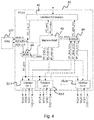
- the Figure 4 schematically represents a possible logical architecture for a controller according to a particular embodiment, for example the controller 32 of the previous figure.
- the controller 32 is an FPGA. It includes a PCI-Express 40 interface. This interface 40 is configured to communicate with the connection means 30 represented on the Figure 3 , via a bus 31 also shown on the Figure 3 .
- the controller 32 includes a state machine 42 ( Data Dispatcher in English) configured to manage the transport of data in the logical architecture. It is also configured to communicate with the RAM memory 37 of the Figure 3 .
- a state machine 42 Data Dispatcher in English
- each interface 33-i has an internal RAM buffer memory (not shown) for storing the data to be processed by the secure elements 35 of the corresponding cluster 34-i, for example diversification data for the generation of keys.
- cryptographic, data blocks eg OS update block or subscriber profile block
- signatures to verify integrity information to verify, etc.
- the communication interfaces are of the SPI type.
- the interface communicates a clock signal noted SCLK, a MOSI signal (for Master Out Slave In in English) transmitting data coming from the controller (master) to one of the secure elements (slaves) of the cluster, a MISO signal (for Master In Slave Out in English) transmitting data from a secure element (slave) to the controller (master), a signal selection (noted CS [0, n-1]) of a secure element given on the bus.
- CS Signal selection
- the communication interfaces are of the I2C type.
- the interface communicates a clock signal SCL (for Serial Clock Line ) and a signal from SDA (for Serial Data Line ) transmitting data coming from the controller and secure elements of the cluster.
- SCL for Serial Clock Line
- SDA for Serial Data Line
- the Figure 6 illustrates the time sequencing of the exchanges between the interfaces 33 of the controller 32 and the secure elements 35 connected, in a particular embodiment.
- This sequencing is carried out at an interface 33 for example on an SPI bus allowing the controller to transmit and receive simultaneously.
- Sequencing is based on time multiplexing, by period T, elementary commands intended for the secure elements 35, and consequently for a time multiplexing in return for the responses of the secure elements 35.
- first elementary commands are sent from the interface 33 to the secure elements 35 of the cluster 34 considered according to a time multiplexing.
- the solid line corresponds to the sending (of duration T1) to a first given secure element.
- the broken lines in the first line show the shipments (of duration T1) to the other secure elements of the cluster during the predefined period T, here four others.
- the first elementary command can simply contain diversification data (sometimes specific to secure elements) to allow the secure elements to generate their own cryptographic key and / or a first block of data to be processed (for example first block of OS updated or subscriber profile).
- a status message is returned by each secure element upon receipt of its elementary order.
- each secure element 35 On receipt of these first elementary commands, each secure element 35 starts the generation (by diversification) of its cryptographic key and / or the cryptographic processing, for example of encryption of a data block, using this key (or any other key already memorized). This is step 62 where the various secure elements 35 of the cluster operate in parallel (see the five overlapping processing blocks 62 at the bottom of the figure).
- step 63 which begins at the end of the first period T, the following elementary commands (comprising a following block of data) are successively sent by the interface 33 to the secure elements 35 always according to the same time division multiplexing.
- each secure element 35 When it receives this new elementary command, each secure element 35 has finished processing the previous block. It then begins the cryptographic processing of the next block thus received (step 66).
- the interface 33 of the controller 32 thus receives all the results of the different secure elements always according to the same time-division multiplexing (in solid line on the second line, the return of the first secure element, and in broken lines the returns of the other secure elements in the same order as the sending of the elementary commands).
- This process is repeated as long as there are blocks of data to be processed (sending of the following elementary command in step 65, reception of the second block processed in step 67).
- the controller 32 can send a simplified elementary command (without data block) to request the result of the last block processed.
- the Figure 5 represents the main steps of a method implemented by the electronic module 22 according to a particular embodiment.
- the module 22 is initialized. His electronic card is therefore powered. This has the effect of initializing a communication channel between the module and the host equipment 20.
- the module 22 (more precisely the controller 32 via the interface 30/31) receives in step 51 a command from the host equipment 20 in order to perform a cryptographic operation.
- This cryptographic operation (examples of which are introduced above) can be all or part of a task requested by a user from the host equipment.
- the controller 32 then operates a conversion 52 of this cryptographic operation into a multitude of elementary tasks to be performed by the secure elements 35.
- This conversion 52 can for example include the division 520 of data to be processed into data blocks, the optional recovery 521 of diversification data by secure element, the formation 522 of elementary commands then the allocation and scheduling 523 of these elementary commands by SPI 33 interface.
- the data to be split are for example OS update data, subscriber profile data, or a data stream, for example multimedia.
- the splitting is carried out in successive blocks of 240 bytes.
- Step 521 is optional because it is carried out if it is necessary to generate a cryptographic key per secure element 35.
- the diversification data can include an identifier of a target device 10, 10 ′ and / or session data (for example a random value shared with the target equipment).
- three types of elementary command can be created in step 522 for each secure element 35 to be requested.
- the first elementary command includes for example the first block of data to be processed by this secure element 35 as well as the diversification data which is assigned to it (for example the identifier of a paired target device).
- Subsequent elementary commands include only the subsequent blocks of data to be processed by this secure element 35.
- the response to each of these subsequent elementary commands is the result (block processed) of the processing of the preceding elementary command.
- the last command does not include any data block and requests only the result (block processed) of the processing of the previous elementary command (that is to say the penultimate elementary command).
- the data blocks sent to the secure elements 35 can be identical (the case for example of updating the OS of target devices 10): each secure element 35 therefore processes the same data for a given target device.
- the data blocks sent to the secure elements 35 can be different, for example being successive blocks of a file: the secure elements 35 therefore perform in parallel the processing by blocks of said file, using for example the same cryptographic key (used by target equipment in particular).
- Step 523 allows the controller 32 to assign the various elementary commands thus created to the SPI interfaces 33 which are going well, and in an order suitable for time multiplexing as shown for example in Figure 6 .
- the ordered elementary commands are for example stored in RAM memory of the SPI 33 interfaces.
- step 53 the sending of the elementary commands ordered on the corresponding SPI interface 33. This results in successive shipments to the secure elements 35 as shown in Figure 6 .
- the processing at the level of the secure elements 35 consists simply in executing the elementary commands received and in returning the results obtained (block processed) as responses. These treatments are clocked by the sending of the elementary commands by the controller 32.
- step 54 the controller 32 thus receives the responses from the requested secure elements, that is to say mainly from the blocks processed (for example encrypted or decrypted).
- each secure element 35 processes the same data for a given target device, it is the processed blocks received from the same secure element 35 which are aggregated together so as to form a global processed file or package for the target device, for example encrypted update data ready to send.
- the controller 32 makes sure to keep the same order for the aggregation as that used for cutting the initial file into blocks.
- the sending 53, the receiving 54 and the aggregation 55 are repeated as long as there are elementary commands not sent on the SPI interfaces 33 (test 56).
- the aggregated data (for example either a global processed file, or data processed by target equipment) form the response to the command initially received in step 51. Also, this aggregated data is returned to the host equipment 20 as a response, in step 57.
- the secure elements 35 making up the electronic module 22 can be of the same type (or of the same types) as that (those) of the secure elements equipping the mobile terminals 10 of the remote fleet.
- the expression “secure elements of the same type” means that these elements secured meet the same card standard. For example, two SIM cards are of the same type while a SIM card and an eUICC card are of different types. This allows the invention not to require another certification than that already provided for the secure elements of the remote fleet to be managed.
- the secure elements 35 can be of a different nature from that of the secure elements of the remote fleet to be managed.
- the remote fleet may also not be made up of secure components, but only conventional electronic equipment.
- each secure element 35 of the module 22 is paired with a secure element of the remote fleet so that the secure element of the module can generate a cryptographic key from secret information (for example an encryption function or even a secret key) and information (identification number of the secure element) shared with the paired secure element or may alternatively hold such a cryptographic key shared with the paired secure element.
- secret information for example an encryption function or even a secret key
- information identification number of the secure element
- mobile terminals 10-1, 10-2, 10-3, 10-4 each incorporate at least one secure element of a first type (here, removable, for example a SIM card) while mobile terminals 10 -5, 10-6, 10-7, 10-8 each integrate at least one secure element of a second type, here embedded (eg eUICC).
- a first type here, removable, for example a SIM card
- mobile terminals 10 -5, 10-6, 10-7, 10-8 each integrate at least one secure element of a second type, here embedded (eg eUICC).
- eUICC embedded
- part of the secure elements 35 of the module 22 are of the first type, while another part of the secure elements 35 are of the second type.
- those of a cluster are all of the first type while those of another cluster are all of the second type, which simplifies management for the controller 32 of the module 22.
- the modular HSM 20 comprises several modules 22, for example a module 22 with secure elements of the first type and another module 22 with secure elements of the second type.
- the secure elements 10 of the fleet and those 35 of the module 22 can have the same countermeasures provided in the event of an attack (eg electromagnetic). They can also have the same cryptographic functions installed to encrypt / decrypt data that they exchange such as for example OS updates.
- the first typical application relates to the encryption of data in the clusters 34 of secure elements 35, this data being intended to be transmitted to the secure elements 10 of the fleet.
- the controller 32 can receive, from the host terminal, an instruction / request / command to load new data into the secure elements of the fleet. This data must then be processed, in particular encrypted, using a key specific to each of the secure elements of the fleet.
- the first typical example concerns OS update data (or any other application) of these remote secure elements (possibly a whole compiled OS).
- the data simultaneously processed by the secure elements of the electronic module are identical and include data for updating an operating system (OS - or any other application) of the secure elements of the remote fleet. This allows an entire fleet of secure items to be updated.
- the second typical example concerns subscriber profile data that an MNO operator wishes to load onto the SIM or UICC or eUICC cards of its subscribers.
- the data simultaneously processed by the secure elements of the electronic module comprise data of mobile telephone profiles specific to the respective secure elements of the remote fleet.
- the profile to load (or update) differs from one subscriber to another. This allows to load effectively different profiles on a large number of remote secure elements.
- the data processing process according to the invention is similar (see Figure 5 ).
- the OS to be encrypted is cut into blocks (for example of 240 bytes) then a copy of each block is sent, block by block, by the controller 32 to the secure elements 35 of one or more clusters 34 so that everything or part of these secure elements encrypt (block after block) a copy of the OS with its own encryption key, in particular the cryptographic key (obtained by diversification) of a secure element of the remote fleet which is allocated to it (for example via the pairing mentioned above).
- the secure elements 35 encrypt in parallel (with a slight offset as shown on the Figure 6 ) the same block received from the controller substantially during the same duration T (see Figure 6 ), before moving on to the next block. It follows that all the blocks of the OS are ultimately encrypted for each secure element 10 of the fleet for which a secure encryption element 35 is assigned.
- This application requires about fifty secure elements 35 on the module 20 to allow the daily updating of the OS of a fleet of 3.3 million secure elements.
- each secure element 35 can generate its own encryption key, corresponding to the cryptographic key of the remote secure element with which it is paired.
- the encryption key is calculated by the secure element 35 from a root or master key common to all the secure elements 35 of the module 22 and from diversification data which are sent to it by the controller.
- the generation of the encryption key, possibly a session key can in particular result from a double diversification of the root key, firstly using a preferentially unique identifier of the remote secure element to which the secure element 35 is assigned, then using a session identifier.
- multiple cryptographic keys can be generated according to the protocol and the secure channel between the server 20 and the secure elements of the remote fleet.
- the electronic module 22 is concerned with processing a large file, for example a multimedia stream, exchanged with target equipment 10 ′.
- target equipment 10 ′ is dimensioned similarly to the host equipment 20, so that it comprises the same number of electronic modules 22 or at least enough electronic modules 22 to be able to process the exchanged file.
- a dimensioning asymmetry can also be implemented for example if the cryptographic processing implemented in one is less consuming in cryptographic resources than the complementary cryptographic processing implemented in the other.
- the use of electronic modules 22 at two remote devices is intended to allow the establishment of a highly secure communication, capable of offering high performance.
- the two electronic modules 22 at the two ends of the communication are typically complementary in that their secure elements implementing elementary cryptographic tasks which are complementary (that is to say reciprocal, such encryption / decryption, signature / signature verification , etc.).
- the elementary cryptographic tasks executed simultaneously (at least in part) by the secure elements of a cluster implement the same elementary cryptographic operation (encryption or decryption for example) on different data (each block making up the file to process) using the same cryptographic key shared by the secure elements.
- This key is the same at both devices (symmetric cryptographic algorithm) or is associated with that used in the other equipment (private key-public key in the case of asymmetric cryptographic algorithm).
- the two devices can be two servers on two sites communicating with each other, or a USB key (or equivalent) of an employee communicating with a server of his company, or a mobile terminal or object connected in the field communicating with a server of a data center.
- the secure elements 35 of the electronic module 22 can each contain a first cryptographic key KEY1 for processing data (file / flow) exchanged or to be exchanged with a first target device 10 'and one or more second cryptographic keys KEY2 -KEYn to process data (file / flow) exchanged or to be exchanged with one or more second target devices 10 'respectively.
- different clusters 34 can be dedicated to processing the data (file / stream) exchanged or to be exchanged with different target devices 10 ′.
- all the secure elements 35 of a cluster 34 are configured to implement the same elementary cryptographic operation using different information (but preferably the same cryptographic key) and at least two clusters are configured to implement two different elementary cryptographic operations.
- a cluster 34 (or a corresponding SPI bus 36) is dedicated to encryption operations and / or another cluster to decryption operations and / or another cluster to signature operations (or signature verification) of messages and / or another cluster to message integrity operations (calculation or verification).
Landscapes
- Engineering & Computer Science (AREA)
- Computer Security & Cryptography (AREA)
- Theoretical Computer Science (AREA)
- Computer Hardware Design (AREA)
- Computer Networks & Wireless Communication (AREA)
- Signal Processing (AREA)
- Physics & Mathematics (AREA)
- Software Systems (AREA)
- General Engineering & Computer Science (AREA)
- General Physics & Mathematics (AREA)
- Mathematical Physics (AREA)
- Microelectronics & Electronic Packaging (AREA)
- Storage Device Security (AREA)
- Credit Cards Or The Like (AREA)
Applications Claiming Priority (1)
| Application Number | Priority Date | Filing Date | Title |
|---|---|---|---|
| FR1872297A FR3089377B1 (fr) | 2018-12-04 | 2018-12-04 | Module électronique connectable formé de grappes d’éléments sécurisés |
Publications (3)
| Publication Number | Publication Date |
|---|---|
| EP3663945A1 true EP3663945A1 (de) | 2020-06-10 |
| EP3663945C0 EP3663945C0 (de) | 2023-08-09 |
| EP3663945B1 EP3663945B1 (de) | 2023-08-09 |
Family
ID=66530147
Family Applications (1)
| Application Number | Title | Priority Date | Filing Date |
|---|---|---|---|
| EP19212398.2A Active EP3663945B1 (de) | 2018-12-04 | 2019-11-29 | Verbindbarer elektronikmodul umfassend gesicherte cluster-elemente |
Country Status (3)
| Country | Link |
|---|---|
| EP (1) | EP3663945B1 (de) |
| ES (1) | ES2962688T3 (de) |
| FR (1) | FR3089377B1 (de) |
Cited By (1)
| Publication number | Priority date | Publication date | Assignee | Title |
|---|---|---|---|---|
| EP4485262A1 (de) | 2023-06-29 | 2025-01-01 | IDEMIA France | Anschliessbares elektronisches modul mit sicheren elementclustern |
Families Citing this family (1)
| Publication number | Priority date | Publication date | Assignee | Title |
|---|---|---|---|---|
| FR3153022B1 (fr) | 2023-09-18 | 2026-01-09 | Idemia Identity & Security France | Procédés et entités pour sécuriser la gestion de données de trajets |
Citations (3)
| Publication number | Priority date | Publication date | Assignee | Title |
|---|---|---|---|---|
| US20170103217A1 (en) * | 2015-10-09 | 2017-04-13 | Microsoft Technology Licensing, Llc | Controlling secure processing of confidential data in untrusted devices |
| WO2018005248A1 (en) * | 2016-06-30 | 2018-01-04 | Microsoft Technology Licensing, Llc | Targeted secure software deployment |
| US20180234455A1 (en) * | 2017-02-14 | 2018-08-16 | International Business Machines Corporation | Protection for computing systems from revoked system updates |
-
2018
- 2018-12-04 FR FR1872297A patent/FR3089377B1/fr active Active
-
2019
- 2019-11-29 ES ES19212398T patent/ES2962688T3/es active Active
- 2019-11-29 EP EP19212398.2A patent/EP3663945B1/de active Active
Patent Citations (3)
| Publication number | Priority date | Publication date | Assignee | Title |
|---|---|---|---|---|
| US20170103217A1 (en) * | 2015-10-09 | 2017-04-13 | Microsoft Technology Licensing, Llc | Controlling secure processing of confidential data in untrusted devices |
| WO2018005248A1 (en) * | 2016-06-30 | 2018-01-04 | Microsoft Technology Licensing, Llc | Targeted secure software deployment |
| US20180234455A1 (en) * | 2017-02-14 | 2018-08-16 | International Business Machines Corporation | Protection for computing systems from revoked system updates |
Cited By (3)
| Publication number | Priority date | Publication date | Assignee | Title |
|---|---|---|---|---|
| EP4485262A1 (de) | 2023-06-29 | 2025-01-01 | IDEMIA France | Anschliessbares elektronisches modul mit sicheren elementclustern |
| FR3150608A1 (fr) | 2023-06-29 | 2025-01-03 | Idemia France Sas | Module électronique connectable comprenant des grappes d’éléments sécurisés |
| AU2024204382B2 (en) * | 2023-06-29 | 2025-12-18 | Idemia France | Connectable electronic module comprising clusters of secure elements |
Also Published As
| Publication number | Publication date |
|---|---|
| EP3663945C0 (de) | 2023-08-09 |
| FR3089377B1 (fr) | 2020-12-25 |
| FR3089377A1 (fr) | 2020-06-05 |
| ES2962688T3 (es) | 2024-03-20 |
| EP3663945B1 (de) | 2023-08-09 |
Similar Documents
| Publication | Publication Date | Title |
|---|---|---|
| EP1427231B1 (de) | Verfahren zur Herstellung und Verwaltung eines Vertrauensmodells zwischen einer SIM-Karte und einem mobilen Terminal | |
| EP3010175B1 (de) | Wiedergabe eines batchs von gesicherten steuerbefehlen in einem gesicherten kanal | |
| WO2001099448A1 (fr) | Procede pour le traitement et la transmission de donnees sur un reseau de telephonie mobile et systeme embarque a puce electronique | |
| EP3238474B1 (de) | Verfahren zur sicherung kontaktloser transaktionen | |
| FR3022053A1 (fr) | Procede d'authentification d'une premiere entite electronique par une seconde entite electronique et entite electronique mettant en œuvre un tel procede | |
| FR3034550A1 (fr) | Procede de chargement d'une cle au sein d'un terminal utilisateur et terminal utilisateur associe | |
| EP3663945B1 (de) | Verbindbarer elektronikmodul umfassend gesicherte cluster-elemente | |
| EP3238200A1 (de) | Sichere elektronische entität, elektronische vorrichtung und verfahren zur verifizierung der integrität von gespeicherten daten in einer derartigen sicheren elektronischen entität | |
| FR3034549A1 (fr) | Procede de chargement d'une cle virtuelle et terminal utilisateur associe | |
| EP3136283B1 (de) | Vorrichtung und verfahren zur sicherung der ausgetauschten befehle zwischen einem endgerät und einem integrierten schaltkreis | |
| FR3066342A1 (fr) | Singularisation de trames a emettre par un objet connecte et blocage de trames reemises sur un reseau de communication sans-fil basse consommation | |
| EP2692113A1 (de) | Verfahren zur aktualisierung sicherer elemente in endgeräten eines telekommunikationsnetzes und entsprechender aktualisierungsserver | |
| CA3100170C (fr) | Procede de securisation de flux de donnees entre un equipement de communication et un terminal distant, equipement mettant en oeuvre le procede | |
| FR2943198A1 (fr) | Procede de production de donnees de securisation, dispositif et programme d'ordinateur correspondant | |
| EP3665922B1 (de) | Verwaltung der kommunikation zwischen einem endgerät und einem netzwerkserver | |
| WO2007060334A2 (fr) | Entite electronique portable destinee a etablir une communication voix sur ip securisee | |
| FR2992817A1 (fr) | Technique de traitement pour proposer un contenu temps reel a des entites clientes | |
| EP3709185A1 (de) | Optimierungsverfahren für den datenaustausch in einer infrastruktur von vernetzten objekten | |
| EP2290901A1 (de) | Mobile elektronische Vorrichtung, die konfiguriert ist, um eine gesicherte drahtlose Kommunikation aufzubauen | |
| FR3074634A1 (fr) | Gestion de communication entre un terminal et un serveur d’un reseau | |
| EP1737191A1 (de) | Verfahren zur Erstellung eines User Equipment Splits zwischen einem Endgerät und seriell verbundenen Geräten | |
| FR3071943A1 (fr) | Controle d'acces a un service | |
| FR3147925A1 (fr) | Procédé et dispositif de déploiement d’une fonction de sécurité pour au moins un dispositif client | |
| EP3360293A1 (de) | Mittel zur verwaltung des zugriffs auf daten | |
| FR3100407A1 (fr) | Procédé pour activer des droits d’accès à un service auquel a souscrit un abonné |
Legal Events
| Date | Code | Title | Description |
|---|---|---|---|
| PUAI | Public reference made under article 153(3) epc to a published international application that has entered the european phase |
Free format text: ORIGINAL CODE: 0009012 |
|
| STAA | Information on the status of an ep patent application or granted ep patent |
Free format text: STATUS: THE APPLICATION HAS BEEN PUBLISHED |
|
| AK | Designated contracting states |
Kind code of ref document: A1 Designated state(s): AL AT BE BG CH CY CZ DE DK EE ES FI FR GB GR HR HU IE IS IT LI LT LU LV MC MK MT NL NO PL PT RO RS SE SI SK SM TR |
|
| AX | Request for extension of the european patent |
Extension state: BA ME |
|
| STAA | Information on the status of an ep patent application or granted ep patent |
Free format text: STATUS: REQUEST FOR EXAMINATION WAS MADE |
|
| 17P | Request for examination filed |
Effective date: 20201116 |
|
| RBV | Designated contracting states (corrected) |
Designated state(s): AL AT BE BG CH CY CZ DE DK EE ES FI FR GB GR HR HU IE IS IT LI LT LU LV MC MK MT NL NO PL PT RO RS SE SI SK SM TR |
|
| STAA | Information on the status of an ep patent application or granted ep patent |
Free format text: STATUS: EXAMINATION IS IN PROGRESS |
|
| 17Q | First examination report despatched |
Effective date: 20211118 |
|
| REG | Reference to a national code |
Ref country code: DE Ref legal event code: R079 Free format text: PREVIOUS MAIN CLASS: G06F0021340000 Ipc: H04W0012030000 Ref country code: DE Ref legal event code: R079 Ref document number: 602019034475 Country of ref document: DE Free format text: PREVIOUS MAIN CLASS: G06F0021340000 Ipc: H04W0012030000 |
|
| GRAP | Despatch of communication of intention to grant a patent |
Free format text: ORIGINAL CODE: EPIDOSNIGR1 |
|
| STAA | Information on the status of an ep patent application or granted ep patent |
Free format text: STATUS: GRANT OF PATENT IS INTENDED |
|
| RIC1 | Information provided on ipc code assigned before grant |
Ipc: G06F 21/57 20130101ALI20230301BHEP Ipc: H04L 9/32 20060101ALI20230301BHEP Ipc: H04L 9/08 20060101ALI20230301BHEP Ipc: G06F 21/76 20130101ALI20230301BHEP Ipc: G06F 21/72 20130101ALI20230301BHEP Ipc: G06F 21/34 20130101ALI20230301BHEP Ipc: H04W 12/40 20210101ALI20230301BHEP Ipc: H04W 12/30 20210101ALI20230301BHEP Ipc: H04W 12/03 20210101AFI20230301BHEP |
|
| INTG | Intention to grant announced |
Effective date: 20230320 |
|
| RIN1 | Information on inventor provided before grant (corrected) |
Inventor name: VIELLEPEAU, JOEL Inventor name: DEPRUN, JEAN-FRANCOIS Inventor name: MORIN, NICOLAS Inventor name: DOTTAX, EMMANUELLE |
|
| GRAS | Grant fee paid |
Free format text: ORIGINAL CODE: EPIDOSNIGR3 |
|
| GRAA | (expected) grant |
Free format text: ORIGINAL CODE: 0009210 |
|
| STAA | Information on the status of an ep patent application or granted ep patent |
Free format text: STATUS: THE PATENT HAS BEEN GRANTED |
|
| AK | Designated contracting states |
Kind code of ref document: B1 Designated state(s): AL AT BE BG CH CY CZ DE DK EE ES FI FR GB GR HR HU IE IS IT LI LT LU LV MC MK MT NL NO PL PT RO RS SE SI SK SM TR |
|
| REG | Reference to a national code |
Ref country code: GB Ref legal event code: FG4D Free format text: NOT ENGLISH |
|
| REG | Reference to a national code |
Ref country code: CH Ref legal event code: EP |
|
| REG | Reference to a national code |
Ref country code: IE Ref legal event code: FG4D Free format text: LANGUAGE OF EP DOCUMENT: FRENCH |
|
| REG | Reference to a national code |
Ref country code: DE Ref legal event code: R096 Ref document number: 602019034475 Country of ref document: DE |
|
| U01 | Request for unitary effect filed |
Effective date: 20230810 |
|
| U07 | Unitary effect registered |
Designated state(s): AT BE BG DE DK EE FI FR IT LT LU LV MT NL PT SE SI Effective date: 20230817 |
|
| U20 | Renewal fee for the european patent with unitary effect paid |
Year of fee payment: 5 Effective date: 20231019 |
|
| PG25 | Lapsed in a contracting state [announced via postgrant information from national office to epo] |
Ref country code: GR Free format text: LAPSE BECAUSE OF FAILURE TO SUBMIT A TRANSLATION OF THE DESCRIPTION OR TO PAY THE FEE WITHIN THE PRESCRIBED TIME-LIMIT Effective date: 20231110 |
|
| PG25 | Lapsed in a contracting state [announced via postgrant information from national office to epo] |
Ref country code: IS Free format text: LAPSE BECAUSE OF FAILURE TO SUBMIT A TRANSLATION OF THE DESCRIPTION OR TO PAY THE FEE WITHIN THE PRESCRIBED TIME-LIMIT Effective date: 20231209 |
|
| PG25 | Lapsed in a contracting state [announced via postgrant information from national office to epo] |
Ref country code: RS Free format text: LAPSE BECAUSE OF FAILURE TO SUBMIT A TRANSLATION OF THE DESCRIPTION OR TO PAY THE FEE WITHIN THE PRESCRIBED TIME-LIMIT Effective date: 20230809 Ref country code: NO Free format text: LAPSE BECAUSE OF FAILURE TO SUBMIT A TRANSLATION OF THE DESCRIPTION OR TO PAY THE FEE WITHIN THE PRESCRIBED TIME-LIMIT Effective date: 20231109 Ref country code: IS Free format text: LAPSE BECAUSE OF FAILURE TO SUBMIT A TRANSLATION OF THE DESCRIPTION OR TO PAY THE FEE WITHIN THE PRESCRIBED TIME-LIMIT Effective date: 20231209 Ref country code: HR Free format text: LAPSE BECAUSE OF FAILURE TO SUBMIT A TRANSLATION OF THE DESCRIPTION OR TO PAY THE FEE WITHIN THE PRESCRIBED TIME-LIMIT Effective date: 20230809 Ref country code: GR Free format text: LAPSE BECAUSE OF FAILURE TO SUBMIT A TRANSLATION OF THE DESCRIPTION OR TO PAY THE FEE WITHIN THE PRESCRIBED TIME-LIMIT Effective date: 20231110 |
|
| PG25 | Lapsed in a contracting state [announced via postgrant information from national office to epo] |
Ref country code: PL Free format text: LAPSE BECAUSE OF FAILURE TO SUBMIT A TRANSLATION OF THE DESCRIPTION OR TO PAY THE FEE WITHIN THE PRESCRIBED TIME-LIMIT Effective date: 20230809 |
|
| REG | Reference to a national code |
Ref country code: ES Ref legal event code: FG2A Ref document number: 2962688 Country of ref document: ES Kind code of ref document: T3 Effective date: 20240320 |
|
| PG25 | Lapsed in a contracting state [announced via postgrant information from national office to epo] |
Ref country code: SM Free format text: LAPSE BECAUSE OF FAILURE TO SUBMIT A TRANSLATION OF THE DESCRIPTION OR TO PAY THE FEE WITHIN THE PRESCRIBED TIME-LIMIT Effective date: 20230809 Ref country code: RO Free format text: LAPSE BECAUSE OF FAILURE TO SUBMIT A TRANSLATION OF THE DESCRIPTION OR TO PAY THE FEE WITHIN THE PRESCRIBED TIME-LIMIT Effective date: 20230809 Ref country code: CZ Free format text: LAPSE BECAUSE OF FAILURE TO SUBMIT A TRANSLATION OF THE DESCRIPTION OR TO PAY THE FEE WITHIN THE PRESCRIBED TIME-LIMIT Effective date: 20230809 Ref country code: SK Free format text: LAPSE BECAUSE OF FAILURE TO SUBMIT A TRANSLATION OF THE DESCRIPTION OR TO PAY THE FEE WITHIN THE PRESCRIBED TIME-LIMIT Effective date: 20230809 |
|
| REG | Reference to a national code |
Ref country code: DE Ref legal event code: R097 Ref document number: 602019034475 Country of ref document: DE |
|
| PLBE | No opposition filed within time limit |
Free format text: ORIGINAL CODE: 0009261 |
|
| STAA | Information on the status of an ep patent application or granted ep patent |
Free format text: STATUS: NO OPPOSITION FILED WITHIN TIME LIMIT |
|
| REG | Reference to a national code |
Ref country code: CH Ref legal event code: PL |
|
| PG25 | Lapsed in a contracting state [announced via postgrant information from national office to epo] |
Ref country code: MC Free format text: LAPSE BECAUSE OF FAILURE TO SUBMIT A TRANSLATION OF THE DESCRIPTION OR TO PAY THE FEE WITHIN THE PRESCRIBED TIME-LIMIT Effective date: 20230809 |
|
| 26N | No opposition filed |
Effective date: 20240513 |
|
| PG25 | Lapsed in a contracting state [announced via postgrant information from national office to epo] |
Ref country code: CH Free format text: LAPSE BECAUSE OF NON-PAYMENT OF DUE FEES Effective date: 20231130 |
|
| PG25 | Lapsed in a contracting state [announced via postgrant information from national office to epo] |
Ref country code: MC Free format text: LAPSE BECAUSE OF FAILURE TO SUBMIT A TRANSLATION OF THE DESCRIPTION OR TO PAY THE FEE WITHIN THE PRESCRIBED TIME-LIMIT Effective date: 20230809 Ref country code: CH Free format text: LAPSE BECAUSE OF NON-PAYMENT OF DUE FEES Effective date: 20231130 |
|
| REG | Reference to a national code |
Ref country code: IE Ref legal event code: MM4A |
|
| PG25 | Lapsed in a contracting state [announced via postgrant information from national office to epo] |
Ref country code: IE Free format text: LAPSE BECAUSE OF NON-PAYMENT OF DUE FEES Effective date: 20231129 |
|
| PG25 | Lapsed in a contracting state [announced via postgrant information from national office to epo] |
Ref country code: IE Free format text: LAPSE BECAUSE OF NON-PAYMENT OF DUE FEES Effective date: 20231129 |
|
| U20 | Renewal fee for the european patent with unitary effect paid |
Year of fee payment: 6 Effective date: 20241022 |
|
| PG25 | Lapsed in a contracting state [announced via postgrant information from national office to epo] |
Ref country code: CY Free format text: LAPSE BECAUSE OF FAILURE TO SUBMIT A TRANSLATION OF THE DESCRIPTION OR TO PAY THE FEE WITHIN THE PRESCRIBED TIME-LIMIT; INVALID AB INITIO Effective date: 20191129 |
|
| PG25 | Lapsed in a contracting state [announced via postgrant information from national office to epo] |
Ref country code: HU Free format text: LAPSE BECAUSE OF FAILURE TO SUBMIT A TRANSLATION OF THE DESCRIPTION OR TO PAY THE FEE WITHIN THE PRESCRIBED TIME-LIMIT; INVALID AB INITIO Effective date: 20191129 |
|
| U20 | Renewal fee for the european patent with unitary effect paid |
Year of fee payment: 7 Effective date: 20251022 |
|
| PG25 | Lapsed in a contracting state [announced via postgrant information from national office to epo] |
Ref country code: TR Free format text: LAPSE BECAUSE OF FAILURE TO SUBMIT A TRANSLATION OF THE DESCRIPTION OR TO PAY THE FEE WITHIN THE PRESCRIBED TIME-LIMIT Effective date: 20230809 |
|
| PGFP | Annual fee paid to national office [announced via postgrant information from national office to epo] |
Ref country code: GB Payment date: 20251023 Year of fee payment: 7 |
|
| PGFP | Annual fee paid to national office [announced via postgrant information from national office to epo] |
Ref country code: ES Payment date: 20251201 Year of fee payment: 7 |