EP3663329A1 - Method for preparing halogen-functionalized polysiloxanes - Google Patents
Method for preparing halogen-functionalized polysiloxanes Download PDFInfo
- Publication number
- EP3663329A1 EP3663329A1 EP18209736.0A EP18209736A EP3663329A1 EP 3663329 A1 EP3663329 A1 EP 3663329A1 EP 18209736 A EP18209736 A EP 18209736A EP 3663329 A1 EP3663329 A1 EP 3663329A1
- Authority
- EP
- European Patent Office
- Prior art keywords
- halogen
- group
- integer
- platinum
- heteroatom
- Prior art date
- Legal status (The legal status is an assumption and is not a legal conclusion. Google has not performed a legal analysis and makes no representation as to the accuracy of the status listed.)
- Granted
Links
- 0 CC1(C*)[Si](C)(*)O[Si](C)O1 Chemical compound CC1(C*)[Si](C)(*)O[Si](C)O1 0.000 description 1
Images


Classifications
-
- C—CHEMISTRY; METALLURGY
- C08—ORGANIC MACROMOLECULAR COMPOUNDS; THEIR PREPARATION OR CHEMICAL WORKING-UP; COMPOSITIONS BASED THEREON
- C08G—MACROMOLECULAR COMPOUNDS OBTAINED OTHERWISE THAN BY REACTIONS ONLY INVOLVING UNSATURATED CARBON-TO-CARBON BONDS
- C08G77/00—Macromolecular compounds obtained by reactions forming a linkage containing silicon with or without sulfur, nitrogen, oxygen or carbon in the main chain of the macromolecule
- C08G77/04—Polysiloxanes
- C08G77/38—Polysiloxanes modified by chemical after-treatment
- C08G77/382—Polysiloxanes modified by chemical after-treatment containing atoms other than carbon, hydrogen, oxygen or silicon
- C08G77/385—Polysiloxanes modified by chemical after-treatment containing atoms other than carbon, hydrogen, oxygen or silicon containing halogens
-
- B—PERFORMING OPERATIONS; TRANSPORTING
- B01—PHYSICAL OR CHEMICAL PROCESSES OR APPARATUS IN GENERAL
- B01J—CHEMICAL OR PHYSICAL PROCESSES, e.g. CATALYSIS OR COLLOID CHEMISTRY; THEIR RELEVANT APPARATUS
- B01J23/00—Catalysts comprising metals or metal oxides or hydroxides, not provided for in group B01J21/00
- B01J23/38—Catalysts comprising metals or metal oxides or hydroxides, not provided for in group B01J21/00 of noble metals
- B01J23/40—Catalysts comprising metals or metal oxides or hydroxides, not provided for in group B01J21/00 of noble metals of the platinum group metals
- B01J23/42—Platinum
-
- C—CHEMISTRY; METALLURGY
- C08—ORGANIC MACROMOLECULAR COMPOUNDS; THEIR PREPARATION OR CHEMICAL WORKING-UP; COMPOSITIONS BASED THEREON
- C08G—MACROMOLECULAR COMPOUNDS OBTAINED OTHERWISE THAN BY REACTIONS ONLY INVOLVING UNSATURATED CARBON-TO-CARBON BONDS
- C08G77/00—Macromolecular compounds obtained by reactions forming a linkage containing silicon with or without sulfur, nitrogen, oxygen or carbon in the main chain of the macromolecule
- C08G77/04—Polysiloxanes
- C08G77/045—Polysiloxanes containing less than 25 silicon atoms
-
- C—CHEMISTRY; METALLURGY
- C08—ORGANIC MACROMOLECULAR COMPOUNDS; THEIR PREPARATION OR CHEMICAL WORKING-UP; COMPOSITIONS BASED THEREON
- C08G—MACROMOLECULAR COMPOUNDS OBTAINED OTHERWISE THAN BY REACTIONS ONLY INVOLVING UNSATURATED CARBON-TO-CARBON BONDS
- C08G77/00—Macromolecular compounds obtained by reactions forming a linkage containing silicon with or without sulfur, nitrogen, oxygen or carbon in the main chain of the macromolecule
- C08G77/04—Polysiloxanes
- C08G77/06—Preparatory processes
- C08G77/08—Preparatory processes characterised by the catalysts used
-
- C—CHEMISTRY; METALLURGY
- C08—ORGANIC MACROMOLECULAR COMPOUNDS; THEIR PREPARATION OR CHEMICAL WORKING-UP; COMPOSITIONS BASED THEREON
- C08G—MACROMOLECULAR COMPOUNDS OBTAINED OTHERWISE THAN BY REACTIONS ONLY INVOLVING UNSATURATED CARBON-TO-CARBON BONDS
- C08G77/00—Macromolecular compounds obtained by reactions forming a linkage containing silicon with or without sulfur, nitrogen, oxygen or carbon in the main chain of the macromolecule
- C08G77/04—Polysiloxanes
- C08G77/12—Polysiloxanes containing silicon bound to hydrogen
-
- C—CHEMISTRY; METALLURGY
- C08—ORGANIC MACROMOLECULAR COMPOUNDS; THEIR PREPARATION OR CHEMICAL WORKING-UP; COMPOSITIONS BASED THEREON
- C08G—MACROMOLECULAR COMPOUNDS OBTAINED OTHERWISE THAN BY REACTIONS ONLY INVOLVING UNSATURATED CARBON-TO-CARBON BONDS
- C08G77/00—Macromolecular compounds obtained by reactions forming a linkage containing silicon with or without sulfur, nitrogen, oxygen or carbon in the main chain of the macromolecule
- C08G77/04—Polysiloxanes
- C08G77/22—Polysiloxanes containing silicon bound to organic groups containing atoms other than carbon, hydrogen and oxygen
- C08G77/24—Polysiloxanes containing silicon bound to organic groups containing atoms other than carbon, hydrogen and oxygen halogen-containing groups
-
- C—CHEMISTRY; METALLURGY
- C08—ORGANIC MACROMOLECULAR COMPOUNDS; THEIR PREPARATION OR CHEMICAL WORKING-UP; COMPOSITIONS BASED THEREON
- C08L—COMPOSITIONS OF MACROMOLECULAR COMPOUNDS
- C08L83/00—Compositions of macromolecular compounds obtained by reactions forming in the main chain of the macromolecule a linkage containing silicon with or without sulfur, nitrogen, oxygen or carbon only; Compositions of derivatives of such polymers
- C08L83/04—Polysiloxanes
Definitions
- the present invention relates to a method for preparing halogen-functionalized polysiloxanes in the presence of a platinum catalyst. More particularly, the present invention is directed to a method for preparing halogen-functionalized polysiloxanes by reacting at least one polysiloxane comprising at least one hydrogen atom bonded to a silicon atom, at least one heterocyclic compound, and at least one halogen-containing compound, wherein the reaction is catalyzed by at least one platinum catalyst. In addition, the present invention is directed to a halogen-functionalized polysiloxane obtained thereby.
- halogen-functionalized polysiloxanes are often formed by the condensation of halogen-functionalized silanes as described in P. Liu, et al., Materials Science and Engineering: C, 33 (2013), 3865 and G. Sauvet, et al., J. Appl. Polym. Sci. 75 (2000), 1005-1012 or by the hydrosilylation or condensation where polysiloxanes with Si-C bonds are formed.
- the present invention achieves said object by providing a method for preparing halogen-functionalized polysiloxanes, wherein the reaction is catalyzed by at least one platinum catalyst. It has been found that the use of a platinum catalyst leads to an easier working-up and a better removing of catalyst from the final product.
- the platinum-catalyzed reaction process according to the present invention need a lower amount of catalyst compared to the conventional procedure, e.g., based on palladium catalyst. Hence, the obtained products according to the present invention can be purified easily and no substantial amount of remaining catalyst is found.
- reaction catalyzed by platinum catalyst according to the present invention follows a zero-order kinetic, meaning that the reaction rate does not depend on the concentration of any monomer, the reaction speed remains constant during the whole reaction time. Hence, the high yield in a short time is achieved compared to the reaction following the first order kinetic regime.
- a method for preparing halogen-functionalized polysiloxanes by reacting a) at least one polysiloxane comprising at least one hydrogen atom bonded to a silicon atom; b) at least one heterocyclic compound; and c) at least one halogen-containing compound, wherein the reaction is catalyzed by at least one platinum catalyst.
- Transparent and colorless halogen-functionalized polysiloxanes can be obtained according to the present invention.
- the polysiloxane comprising at least one hydrogen atom bonded to a silicon atom can be a linear- or cyclopolysiloxane, or a mixture thereof.
- halogen-functionalized polysiloxanes obtainable by the method defined herein.
- room temperature is 23°C plus or minus 2°C.
- the molecular weights given in the present text refer to number average molecular weights (Mn), unless otherwise stipulated. All molecular weight data refer to values obtained by gel permeation chromatography (GPC) carried out using HP1090 II Chromatography with DAD detector (HEWLETT PACKARD) at 40 °C. Tetrahydrofuran (THF) was used as an eluent. THF was passed through three PSS SDV gel columns with molecular weight ranges of 102, 103 and 104 g ⁇ mol -1 with a flow rate of 0.9 ml ⁇ min -1 . The calibration of the device was carried out using polystyrene standards"
- polydispersity refers to a measure of the distribution of molecular mass in a given polymer sample. The polydispersity is calculated by dividing the weight average molecular weight (Mw) by the number average molecular weight (Mn).
- C 1 -C 8 alkyl refers to a monovalent group that contains 1 to 8 carbons atoms, that is a radical of an alkane and includes linear and branched organic groups.
- alkyl groups include, but are not limited to: methyl; ethyl; propyl; isopropyl; n-butyl; isobutyl; sec-butyl; tert-butyl; n-pentyl; n-hexyl; n-heptyl; and, 2-ethylhexyl.
- alkyl groups may be unsubstituted or may be substituted with one or more substituents such as halo, nitro, cyano, amido, amino, sulfonyl, sulfinyl, sulfanyl, sulfoxy, urea, thiourea, sulfamoyl, sulfamide and hydroxy.
- substituents such as halo, nitro, cyano, amido, amino, sulfonyl, sulfinyl, sulfanyl, sulfoxy, urea, thiourea, sulfamoyl, sulfamide and hydroxy.
- C 2 -C 8 alkenyl refers to an aliphatic hydrocarbon group which contains 2 to 8 carbon atoms and at least one carbon-carbon double bond, e.g., ethenyl, propenyl, butenyl, or pentenyl and structural isomers thereof such as 1- or 2-propenyl, 1-, 2-, or 3-butenyl, etc.
- Alkenyl groups can be linear or branched and substituted or unsubstituted. If they are substituted, the substituents are as defined above for alkyl.
- C 2 -C 8 alkynyl refers to an aliphatic hydrocarbon group which contains 2 to 8 carbon atoms and at least one carbon-carbon triple bond, e.g., ethynyl (acetylene), propynyl, butynyl, or pentynyl and structural isomers thereof as described above.
- Alkynyl groups can be linear or branched and substituted or unsubstituted.
- C 3 -C 10 cycloalkyl is understood to mean a saturated, mono-, bi- or tricyclic hydrocarbon group having from 3 to 10 carbon atoms.
- cycloalkyl groups include: cyclopropyl; cyclobutyl; cyclopentyl; cyclohexyl; cycloheptyl; cyclooctyl; adamantane; and, norbornane.
- an "C 6 -C 18 aryl” group used alone or as part of a larger moiety - as in "aralkyl group” - refers to optionally substituted, monocyclic, bicyclic and tricyclic ring systems in which the monocyclic ring system is aromatic or at least one of the rings in a bicyclic or tricyclic ring system is aromatic.
- the bicyclic and tricyclic ring systems include benzofused 2-3 membered carbocyclic rings.
- aryl groups include: phenyl; indenyl; naphthalenyl, tetrahydronaphthyl, tetrahydroindenyl; tetrahydroanthracenyl; and, anthracenyl. And a preference for phenyl groups may be noted.
- an "aralkyl” group refers to an alkyl group that is substituted with an aryl group.
- An example of an aralkyl group is benzyl.
- C 1 -C 60 alkylene group and “C 1 -C 20 alkylene” group refer respectively to divalent groups that contain from 1 to 60 or from 1 to 20 carbon atoms, that are radicals of an alkane and include linear, branched or cyclic groups, which groups may be substituted or substituted and may optionally be interrupted by at least one heteroatom.
- alkenylene refers to a divalent aliphatic hydrocarbon group having at least one carbon-carbon double bond that is a radical of an alkene.
- An alkenylene group can be linear or branched and substituted or unsubstituted.
- alkynylene refers to a divalent aliphatic hydrocarbon group having at least one carbon-carbon triple bond, that is a radical of an alkyne.
- An alkynylene group can also have one or more carbon-carbon double bonds.
- An alkynylene group can be linear or branched and substituted or unsubstituted.
- arylene group refers to a divalent group that is a radical of an aryl group. Suitable arylene group includes phenylene, furanylene, piperidylene, and naphthylene.
- aralkylene refers to a divalent group that is a radical of an aralkyl group.
- An aralkylene can be represented by the formula -R-Ar- where R is an alkylene and Ar is an arylene, i.e., an alkylene is bonded to an arylene.
- Suitable aralkylene groups includes xylylene and toluenylene.
- heteroatom means that the main chain or side chain of a residue comprises at least one atom that differs from carbon atom and hydrogen.
- heteroatom refers to nitrogen, oxygen, silicon, sulfur, phosphorus, halogens such as Cl, Br, F. Oxygen (O) and nitrogen (N) may be mentioned as typical heteroatoms in the context of the present invention.
- hydrocarbon residue includes saturated or unsaturated hydrocarbon residues.
- heterocyclic compound refers to a saturated or unsaturated, monocyclic, bicyclic, polycyclic or fused compound containing at least one heteroatom, preferably O, S, N, and/or P, in the ring structure.
- halogen refers to fluorine, chlorine, bromine or iodine and correspondingly the term “halide” denotes fluoride, chloride, bromide or iodide anions.
- the reaction method according to the present invention is catalyzed by a platinum catalyst.
- the platinum catalyst can be selected from the group consisting of chloroplatinic acids, preferably hexachloroplatinic acid; alcohol modified chloroplatinic acids; olefin complexes of chloroplatinic acid; complexes of chloroplatinic acid and divinyltetramethyldisiloxane; fine platinum particles adsorbed on carbon carriers; platinum supported on metal oxide carriers, preferably Pt(Al 2 O 3 ); platinum black; platinum acetylacetonate; platinous halides, preferably PtCl 2 , PtCl 4 , Pt(CN) 2 ; complexes of platinous halides with unsaturated compounds, preferably ethylene, propylene, and organovinylsiloxanes; styrene hexamethyldiplatinum; platinum divinyltetramethyldisiloxane complex; the reaction product of chloroplatinic
- the platinum catalyst is hexachloroplatinic acid, commonly referred to as Speier's catalyst, which is described in US Patent Nos. 2,823,218 and 3,923,705 , or Karstedt's catalyst, which is described in US Patent Nos. 3,715,334 and 3,814,730 .
- Karstedt's catalyst is a platinum divinyltetramethyldisiloxane complex typically containing about one-weight percent of platinum in a solvent such as toluene.
- the platinum catalyst is present in an amount of from 0.0001mol% to 10mol%, more preferably 0.001mol% to 0.1mol%, of platinum based on the molar quantity of silicon-bonded hydrogen in the polysiloxane.
- the obtained halogen-functionalized polysiloxane has a number average molecular weight of from 100 to 50,000g/mol, preferably from 100 to 25,000 g/mol, more preferably 100 to 15,000 g/mol.
- the obtained halogen-functionalized polysiloxane has the general Formula (I) or (I-A) or is a mixture thereof: wherein:
- the method is further characterized in that said polysiloxane comprising at least one hydrogen atom bonded to a silicon atom has the general Formula (II) or (II-A) or is a mixture thereof (component a)) and said halogen-containing compound has the general formula (III) (component c)): wherein:
- the different siloxane subunits n, n1, n2, and p are not necessarily present in the order illustrated herein.
- the subunits n, n1, n2, and p can be randomly distributed in the polysiloxane backbone in every possible combination.
- R 1 , R 2 , R 3 , R 4 , R 5 and R 6 may be the same or different and each is independently selected from a hydrogen atom or a linear, branched or cyclic hydrocarbon residue having 1 to 20 carbon atoms which may contain at least one heteroatom, preferably selected from O, N, S, Si, P, Cl, Br or F.
- R 1 , R 2 , R 3 , R 4 , R 5 and R 6 are the same or different and each is independently selected from the group consisting of a C 1 -C 12 alkyl group, more preferably C 1 -C 8 alkyl group, a C 2 -C 8 alkenyl group, a C 2 -C 8 alkynyl group, a C 3 -C 10 cycloalkyl group, a C 6 -C 18 aryl group and a C 6 -C 18 aralkyl group, which may contain at least one heteroatom, preferably selected from O, N, S, Si, P, CI, Br or F.
- R 1 , R 2 , R 3 , R 4 , R 5 and R 6 are the same or different and each is independently selected from a C 1 -C 8 alkyl group which may contain at least one heteroatom, preferably selected from O, N, S, Si, P, Cl, Br or F, in particular methyl, ethyl, n-propyl, fluoropropyl, n-butyl, sec-butyl, or tert-butyl, or a C 6 -C 18 aryl group which may contain at least one heteroatom, preferably selected from O, N, S, Si, P, Cl, Br or F, in particular phenyl, tolyl or benzoyl.
- R 1 , R 2 , R 3 , R 4 , R 5 and R 6 are the same or different and independently selected from methyl or phenyl.
- A is preferably selected from O, S, NR 7 or PR 7 , where R 7 is selected from a hydrogen atom, a C 1 -C 8 alkyl group, a C 3 -C 10 cycloalkyl group, a C 6 -C 18 aryl group or a C 6 -C 18 aralkyl group, which may contain at least one heteroatom, preferably selected from O, N, S, P, Cl, Br or F. In more preferred embodiments, A is selected from O or S, in particular O.
- Z is selected from a linear, branched or cyclic hydrocarbon residue having 2 to 60 carbon atoms, preferably 2 to 20 carbon atoms, which may contain at least one heteroatom, preferably selected from O, N, S, P, Si, Cl, Br or F.
- Z is selected from the group consisting of a C 2 -C 20 alkylene group, a C 2 -C 20 alkenylene group, C 2 -C 20 alkynylene group, a C 6 -C 18 arylene group and a C 6 -C 18 aralkylene group, which may contain at least one heteroatom, preferably selected from O, N, S, P, Si, Cl, Br or F.
- heterocyclic compounds are: ethylene oxide, 1,2-propylene oxide, tetrahydrofuran, 2-Methyltetrahydrofuran, oxetane, oxetene, tetrahydropyrane, oxepane, 1,4-dioxane, crown ethers, epichlorhydrin, 1,2-butylene oxide, 2,3-butylene oxide, 1,2-pentylene oxide, isopentylene oxide, 1,2-hexylene oxide, 1,2-heptylene oxide, styrene oxide, cyclohexene oxide, methylglycidyl ether, ethylglycidyl ether, allylglycidyl ether, phenylglycidyl ether, butadiene monoxide, isoprene monoxide, tolylglycidyl ether, cyclohexene oxide, cyclooctane
- Particularly preferred for this invention are 1,2-propylene oxide, 1,2-butylene oxide, 2,3-butylene oxide, styrene oxide, cyclohexene oxide, tetrahydrofuran, tetrahydropyrane, oxepane, 1,4-dioxane, ⁇ -caprolactones, thiolane and crown ethers.
- X is a halogen atom, preferably selected from Br, I or Cl
- R a is selected from a hydrogen atom or a linear, branched or cyclic hydrocarbon residue having 1 to 20 carbon atoms which may contain at least one heteroatom, preferably selected from O, N, S, Si, Cl, Br or F.
- X is selected from Br, I or Cl, more preferably Br or I, in particular Br.
- R a is selected from the group consisting of a hydrogen atom, a C 1 -C 12 alkyl group, more preferably C 1 -C 8 alkyl group, a C 2 -C 8 alkenyl group, a C 2 -C 8 alkynyl group, a C 3 -C 10 cycloalkyl group, a C 6 -C 18 aryl group and a C 6 -C 18 aralkyl group, which may contain at least one heteroatom, preferably selected from O, N, S, Si, Cl, Br or F.
- R a is a C 2 -C 8 alkenyl group, more preferably selected from ethenyl, propenyl, butenyl, or pentenyl and structural isomers thereof such as 1- or 2-propenyl, 1-, 2-, or 3-butenyl.
- n is the sum n1+n2 of Formula (I) or (I-A).
- n or the sum n1+n2 is an integer from 1 to 500, more preferably from 1 to 100; and/or p is an integer from 0 to 500, more preferably from 0 to 100.
- the polysiloxane may contain diorganosiloxane units, such as dimethylsiloxane or diphenylsiloxane units, in the backbone. The ratio between n units and p units can be varied.
- n or the sum n1+n2 is an integer from 1 to 50, more preferably from 1 to 30; and/or p is an integer from 0 to 50, more preferably from 0 to 30, wherein the sum p+n or the sum p+n1+n2 is equal to or higher than 3.
- the halogen-functionalized polysiloxane is obtained by reacting at least one polysiloxane containing at least one hydrogen atom bonded to a silicon atom and at least one heterocyclic compound in the presence of a platinum catalyst and a halogen source.
- the synthetic pathway is a so-called "halosilation" reaction in which the heterocyclic compound is ring-opened in the presence of a platinum catalyst and a halogen source, resulting in a formal insertion of the opened heterocycle into the SiH bond.
- the heteroatom of the former heterocyclic compound is bonded to the silicon atom from the former SiH moiety while and the halogen is bonded to the last carbon atom of the opened chain.
- the reaction is carried out for a time sufficient to yield a halogen-functionalized polysiloxane that the SiH moieties in the polysiloxane are substantially completely converted to the halogen-functionalized moiety.
- the obtained halogen-functionalized polysiloxane contains less than 5 mol%, more preferably less than 1 mol%, in particular less than 0.5 mol% of SiH moiety-which is not converted - based on the total moles of the silicon atom which constitutes the obtained polysiloxane backbone.
- the platinum can be removed after the reaction by methods known in the art, such as filtration, preferably by filtration through celite after decolorizing by adding activated carbon and an excess of pentane at room temperature.
- the solvents and volatiles can be evaporated under vacuum.
- This reaction follows a zero-order kinetic regime allowing to have a complete control of the reaction progress and hence of the number of halosilated side groups in the polysiloxane backbone.
- the degree of halogenation can be calculated and controlled with the amount of the heterocyclic compound and the halogen source used and SiH moieties contained.
- the "halosilation" reaction according to the present invention can be performed under solvent-free conditions, as well as in polar or non-polar solvents, such as alcohols, aromatic or aliphatic alkanes, alkenes or alkynes, halogen-functionalized aromatic or aliphatic hydrocarbons and hydrocarbons containing at least one heteroatom, such as O, N, S, P, Cl, Br or F.
- polar or non-polar solvents such as alcohols, aromatic or aliphatic alkanes, alkenes or alkynes, halogen-functionalized aromatic or aliphatic hydrocarbons and hydrocarbons containing at least one heteroatom, such as O, N, S, P, Cl, Br or F.
- solvents such as toluene, THF, heptane, hexane or chloroform. Any residual solvent is preferably removed after completion of the reaction.
- the reaction can be carried out at a reaction temperature in the range from 0 to 200 °C, preferably from 50 to 150 °C, and/or at a reaction pressure from 1 to 50 bar, preferably from 1 to 10 bar.
- a 250 ml three neck round bottomed flask was degassed under high vacuum (1 -3 mbar) and flushed with argon. Then, 200 ⁇ L of Karstedt (2% of Pt in the catalyst, 0.1% mol in the mixture) and toluene (50 mL, dried over molecular sieves) were added into the flask under argon atmosphere and stirred at room temperature (20°C) for a couple of minutes. Then tetrahydrofuran (18.5 mL, dried over molecular sieves) and allyl bromide (19.8 mL, 97%) were added into the system. Polyhydridomethylsiloxane (14.9 mL, Mn 1900 g/mol) were added dropwise.
- Example 2 The procedure was the same as shown in Example 1 except that the inside temperature was 75°C.
- the obtained product (yield 59%) was a colorless, transparent viscous liquid.
- a 250 ml three neck round bottomed flask was degassed under high vacuum (1 -3 mbar) and flushed with argon. Then, 270 ⁇ L of Karstedt (2% of Pt in the catalyst, 0.1% mol in the mixture) and THF (40 mL, dried over molecular sieves) were added into the flask under argon atmosphere and stirred at room temperature (20°C) for a couple of minutes. Then allyl bromide (11.78 mL, 97%) were added into the system. Polyhydridomethylsiloxane-co-polydimethylsiloxane (19.9 mL, Mn 2200 g/mol) were added dropwise.
- a 50 ml three neck round bottomed flask was degassed under high vacuum (1 -3 mbar) and flushed with argon. Then, 400 ⁇ L of Karstedt (2% of Pt in the catalyst, 0.1% mol in the mixture) and THF (10 mL, dried over molecular sieves) were added into the flask under argon atmosphere and stirred at room temperature (20°C) for a couple of minutes. Then allyl bromide (1.5 mL, 97%) were added into the system. 1,1',3,3',5,5',7-Heptamethylcyclotetrasiloxane (5.3 mL, Mn 282 g/mol) were added dropwise.
- a 250 ml three neck round bottomed flask was degassed under high vacuum (1 -3 mbar) and flushed with argon. Then, PdCl 2 (208 mg, 1.6mol-% in the mixture) and THF (18.5 mL, dried over molecular sieves) were added into the flask under argon atmosphere and stirred at room temperature (20°C) for a couple of minutes. Then allyl bromide (7.29 mL, 97%) was added into the system. Polyhydridomethylsiloxane (5.0 mL, Mn 1900 g/mol) were added dropwise. The mixture was stirred (oil bath temperature: 50°C) under inert atmosphere (Ar) for 24 hours.
- the color values were measured with a LCS III from BYK.
- the LCS III is a VIS spectrophotometer with a wavelength range of 320 to 1100 nm.
- the Hazen color value (ISO 6271, also known as "AHPA-method " or Platinum-Cobalt Scale) is defined as mg of platinum per 1 litre of solution.
- the Yellowness Index was calculated and displayed in accordance with ASTM D 1925 for illuminant C and a 2 ° standard observer. The instrument was calibrated with distilled water.
- Fig. 1 shows the conversion of SiH groups compared to the time (measured by integration of 1H-NMR spectra) of Example 1 to 3 with different temperatures.
- the linear shape of the curves proves that the reactions follows a zero-order kinetic with platinum as catalyst.
- activation energies s. A. Cornish-Bowden, Fundamentals of Enzyme Kinetics, John Wiley & Sons, 2012 or S. K. Upadhyay, Chemical Kinetics and Reaction Dynamics, Springer, 2006 is included as a reference.
- the activation energy can be calculated with the slope of the curve at different temperatures by using the Arrhenius equation. Calculations were done with the temperature inside of the flask. An activation energy of 45.1 ⁇ 2.2 kJ/mol could be calculated.
- Fig. 2 shows the logarithmic plotted conversion of SiH groups compared to the time (measured by integration of 1H-NMR spectra) of Comparative Example 6 to 8 with different temperatures which follows the first order kinetic regime.
- the reaction needed more time for a full conversion, because the reaction speed depends on the concentration of monomer. The more monomer is converted, the slower the reaction speed is.
- An activation energy of 77.3 ⁇ 3.1 kJ/mol could be calculated, which is twice as much as the invention.
- Table 1 shows the difficulties of removing the palladium catalyst after the reaction.
- the amount of platinum in Example 1 is more than 100 times lower than the amount of palladium in Comparative Example 6.
- the high amount of palladium causes a contamination of the product.
- Table 2 shows the Hazen Factor and Yellowness Index of Examples 1 and 4 and Comparative Example 6. Compared to Examples 1 and 4, Comparative Example 6 shows a very high Hazen Factor, as well as Yellowness Index, which are more than five times higher. Comparative Example 6 could only be measured in solution (THF, ratio 1:3) as the purified product got darker during time and showed results out of the working area of the instrument. The color changed from yellow to brown and then to dark brown during time. This was caused by the palladium, which cannot be removed with mentioned working-ups. In literature there is no filtration step mentioned (only removing solvent by vacuo), so the palladium was not removed at all. Table 2: Determination of Hazen Factor and Yellowness Index Hazen Factor Yellowness Index Example 1 112 26.4 Example 4 42 10.6 Comparative Example 6 734 103.9
Landscapes
- Chemical & Material Sciences (AREA)
- Chemical Kinetics & Catalysis (AREA)
- Organic Chemistry (AREA)
- Health & Medical Sciences (AREA)
- Medicinal Chemistry (AREA)
- Polymers & Plastics (AREA)
- General Chemical & Material Sciences (AREA)
- Engineering & Computer Science (AREA)
- Materials Engineering (AREA)
- Silicon Polymers (AREA)
Abstract
Description
- The present invention relates to a method for preparing halogen-functionalized polysiloxanes in the presence of a platinum catalyst. More particularly, the present invention is directed to a method for preparing halogen-functionalized polysiloxanes by reacting at least one polysiloxane comprising at least one hydrogen atom bonded to a silicon atom, at least one heterocyclic compound, and at least one halogen-containing compound, wherein the reaction is catalyzed by at least one platinum catalyst. In addition, the present invention is directed to a halogen-functionalized polysiloxane obtained thereby.
- Processes for the introduction of halogen functionalities into a polysiloxane are known in technical literature. The introduction of said functionalities as side groups poses several challenges compared to the end-chain functionalization which is rather straightforward. The steric hindrance through the tail or entanglements causes a lower conversion and a longer reaction time. Therefore, halogen-functionalized polysiloxanes are often formed by the condensation of halogen-functionalized silanes as described in P. Liu, et al., Materials Science and Engineering: C, 33 (2013), 3865 and G. Sauvet, et al., J. Appl. Polym. Sci. 75 (2000), 1005-1012 or by the hydrosilylation or condensation where polysiloxanes with Si-C bonds are formed.
- J. Ohshita, et al., The Journal of Organic Chemistry 1999, 64, 8024-8026, A. Iwata et al., The Journal of Organic Chemistry 2002, 67, 3927-3929, and J. Ohshita, et a/., J. Organomet. Chem. 2006, 691, 1907-1911 disclose ring-opening halosilation of cyclic ethers with the use of iodosilane or bromosilane in the presence of a palladium catalyst. In addition, J. Ohshita, et al., J. Organomet. Chem. 2007, 692, 3526-3531 discloses the treatment of poly(hydromethylsilxoane)s with mixtures of allyl bromide and cyclic ethers in the presence of a palladium catalyst to form poly[(bromoalkoxy)methylsiloxane]s. Halosilation reactions of polysiloxanes with different starting materials are also described in Z. Lu, et al., J. Organomet. Chem. 2012, 697, 51-56, C. H. L. Dong, Zhou et al., Adv. Mater. Res. 2014, 998-999, 15, C. L. Dong, Zhou et al., J. Eng. Fibers Fabr. 2015, 10, 171, and
CN Patent 102408570 . - In the above-described literature, palladium chloride was used as catalyst, which has to be added as solid to the reaction mixture. Furthermore, high amount of catalyst was employed, which leads to high costs by up-scaling processes. As the palladium cannot be removed completely by the described working-up processes, the purified products can get brown to black by precipitation of Pd0. The remaining palladium starts to agglomerate and colors the product. Such palladium contamination can affect further reactions or other applications.
- Therefore, it is an object of the present invention to provide a method for preparing halogen-functionalized polysiloxanes which overcomes at least some of drawbacks of the known systems. The present invention achieves said object by providing a method for preparing halogen-functionalized polysiloxanes, wherein the reaction is catalyzed by at least one platinum catalyst. It has been found that the use of a platinum catalyst leads to an easier working-up and a better removing of catalyst from the final product. The platinum-catalyzed reaction process according to the present invention need a lower amount of catalyst compared to the conventional procedure, e.g., based on palladium catalyst. Hence, the obtained products according to the present invention can be purified easily and no substantial amount of remaining catalyst is found.
- Furthermore, as the reaction catalyzed by platinum catalyst according to the present invention follows a zero-order kinetic, meaning that the reaction rate does not depend on the concentration of any monomer, the reaction speed remains constant during the whole reaction time. Hence, the high yield in a short time is achieved compared to the reaction following the first order kinetic regime.
- In accordance with the first aspect of the invention there is provided a method for preparing halogen-functionalized polysiloxanes by reacting a) at least one polysiloxane comprising at least one hydrogen atom bonded to a silicon atom; b) at least one heterocyclic compound; and c) at least one halogen-containing compound, wherein the reaction is catalyzed by at least one platinum catalyst. Transparent and colorless halogen-functionalized polysiloxanes can be obtained according to the present invention.
- The polysiloxane comprising at least one hydrogen atom bonded to a silicon atom can be a linear- or cyclopolysiloxane, or a mixture thereof.
- In accordance with the second aspect of the invention there is provided halogen-functionalized polysiloxanes obtainable by the method defined herein.
- As used herein, the singular forms "a", "an" and "the" include plural referents unless the context clearly dictates otherwise.
- The terms "comprising" and "comprises" as used herein are synonymous with "including", "includes", "containing" or "contains", and are inclusive or open-ended and do not exclude additional, non-recited members, elements or method steps.
- When amounts, concentrations, dimensions and other parameters are expressed in the form of a range, a preferable range, an upper limit value, a lower limit value or preferable upper and limit values, it should be understood that any ranges obtainable by combining any upper limit or preferable value with any lower limit or preferable value are also specifically disclosed, irrespective of whether the obtained ranges are clearly mentioned in the context.
- The words "preferred" and "preferably" are used frequently herein to refer to embodiments of the disclosure that may afford particular benefits, under certain circumstances. However, the recitation of one or more preferable or preferred embodiments does not imply that other embodiments are not useful and is not intended to exclude those other embodiments from the scope of the disclosure.
- As used herein, room temperature is 23°C plus or minus 2°C.
- The molecular weights given in the present text refer to number average molecular weights (Mn), unless otherwise stipulated. All molecular weight data refer to values obtained by gel permeation chromatography (GPC) carried out using HP1090 II Chromatography with DAD detector (HEWLETT PACKARD) at 40 °C. Tetrahydrofuran (THF) was used as an eluent. THF was passed through three PSS SDV gel columns with molecular weight ranges of 102, 103 and 104 g·mol-1 with a flow rate of 0.9 ml·min-1. The calibration of the device was carried out using polystyrene standards"
- As used herein, "polydispersity" refers to a measure of the distribution of molecular mass in a given polymer sample. The polydispersity is calculated by dividing the weight average molecular weight (Mw) by the number average molecular weight (Mn).
- For convenience in the description of the process of this invention, unsaturation provided by CH2=CH-CH2- terminal group is referred to as "allyl" unsaturation.
- As used herein, "C1-C8 alkyl" group refers to a monovalent group that contains 1 to 8 carbons atoms, that is a radical of an alkane and includes linear and branched organic groups. Examples of alkyl groups include, but are not limited to: methyl; ethyl; propyl; isopropyl; n-butyl; isobutyl; sec-butyl; tert-butyl; n-pentyl; n-hexyl; n-heptyl; and, 2-ethylhexyl. In the present invention, such alkyl groups may be unsubstituted or may be substituted with one or more substituents such as halo, nitro, cyano, amido, amino, sulfonyl, sulfinyl, sulfanyl, sulfoxy, urea, thiourea, sulfamoyl, sulfamide and hydroxy. The halogenated derivatives of the exemplary hydrocarbon radicals listed above might, in particular, be mentioned as examples of suitable substituted alkyl groups. In general, however, a preference for unsubstituted alkyl groups containing from 1 to 6 carbon atoms (C1-C6 alkyl) - for example unsubstituted alkyl groups containing from 1 to 4 carbon atoms (C1-C4 alkyl) - should be noted.
- As used herein, the term "C2-C8 alkenyl" group refers to an aliphatic hydrocarbon group which contains 2 to 8 carbon atoms and at least one carbon-carbon double bond, e.g., ethenyl, propenyl, butenyl, or pentenyl and structural isomers thereof such as 1- or 2-propenyl, 1-, 2-, or 3-butenyl, etc. Alkenyl groups can be linear or branched and substituted or unsubstituted. If they are substituted, the substituents are as defined above for alkyl.
- As used herein, the term "C2-C8 alkynyl" group refers to an aliphatic hydrocarbon group which contains 2 to 8 carbon atoms and at least one carbon-carbon triple bond, e.g., ethynyl (acetylene), propynyl, butynyl, or pentynyl and structural isomers thereof as described above. Alkynyl groups can be linear or branched and substituted or unsubstituted.
- The term "C3-C10 cycloalkyl" is understood to mean a saturated, mono-, bi- or tricyclic hydrocarbon group having from 3 to 10 carbon atoms. Examples of cycloalkyl groups include: cyclopropyl; cyclobutyl; cyclopentyl; cyclohexyl; cycloheptyl; cyclooctyl; adamantane; and, norbornane.
- As used herein, an "C6-C18 aryl" group used alone or as part of a larger moiety - as in "aralkyl group" - refers to optionally substituted, monocyclic, bicyclic and tricyclic ring systems in which the monocyclic ring system is aromatic or at least one of the rings in a bicyclic or tricyclic ring system is aromatic. The bicyclic and tricyclic ring systems include benzofused 2-3 membered carbocyclic rings. Exemplary aryl groups include: phenyl; indenyl; naphthalenyl, tetrahydronaphthyl, tetrahydroindenyl; tetrahydroanthracenyl; and, anthracenyl. And a preference for phenyl groups may be noted.
- As used herein, an "aralkyl" group refers to an alkyl group that is substituted with an aryl group. An example of an aralkyl group is benzyl.
- The terms "C1-C60 alkylene" group and "C1-C20 alkylene" group refer respectively to divalent groups that contain from 1 to 60 or from 1 to 20 carbon atoms, that are radicals of an alkane and include linear, branched or cyclic groups, which groups may be substituted or substituted and may optionally be interrupted by at least one heteroatom.
- As used herein, the term "alkenylene" group refers to a divalent aliphatic hydrocarbon group having at least one carbon-carbon double bond that is a radical of an alkene. An alkenylene group can be linear or branched and substituted or unsubstituted.
- As used herein, the term "alkynylene" group refers to a divalent aliphatic hydrocarbon group having at least one carbon-carbon triple bond, that is a radical of an alkyne. An alkynylene group can also have one or more carbon-carbon double bonds. An alkynylene group can be linear or branched and substituted or unsubstituted.
- As used herein, the term "arylene" group refers to a divalent group that is a radical of an aryl group. Suitable arylene group includes phenylene, furanylene, piperidylene, and naphthylene.
- As used herein, the term "aralkylene" group refers to a divalent group that is a radical of an aralkyl group. An aralkylene can be represented by the formula -R-Ar- where R is an alkylene and Ar is an arylene, i.e., an alkylene is bonded to an arylene. Suitable aralkylene groups includes xylylene and toluenylene.
- Where mentioned, the expression "contain at least one heteroatom" means that the main chain or side chain of a residue comprises at least one atom that differs from carbon atom and hydrogen. Preferably the term "heteroatom" refers to nitrogen, oxygen, silicon, sulfur, phosphorus, halogens such as Cl, Br, F. Oxygen (O) and nitrogen (N) may be mentioned as typical heteroatoms in the context of the present invention.
- As used herein, the term "hydrocarbon residue" includes saturated or unsaturated hydrocarbon residues.
- As used herein, the "heterocyclic compound" refers to a saturated or unsaturated, monocyclic, bicyclic, polycyclic or fused compound containing at least one heteroatom, preferably O, S, N, and/or P, in the ring structure.
- As used herein, the term "halogen" refers to fluorine, chlorine, bromine or iodine and correspondingly the term "halide" denotes fluoride, chloride, bromide or iodide anions.
- The reaction method according to the present invention is catalyzed by a platinum catalyst. The platinum catalyst can be selected from the group consisting of chloroplatinic acids, preferably hexachloroplatinic acid; alcohol modified chloroplatinic acids; olefin complexes of chloroplatinic acid; complexes of chloroplatinic acid and divinyltetramethyldisiloxane; fine platinum particles adsorbed on carbon carriers; platinum supported on metal oxide carriers, preferably Pt(Al2O3); platinum black; platinum acetylacetonate; platinous halides, preferably PtCl2, PtCl4, Pt(CN)2; complexes of platinous halides with unsaturated compounds, preferably ethylene, propylene, and organovinylsiloxanes; styrene hexamethyldiplatinum; platinum divinyltetramethyldisiloxane complex; the reaction product of chloroplatinic acid and an unsaturated aliphatic group-containing organosilicon compound; and a neutralized complex of platinous chloride and divinyltetramethyldisiloxane.
- In preferred embodiments, the platinum catalyst is hexachloroplatinic acid, commonly referred to as Speier's catalyst, which is described in
US Patent Nos. 2,823,218 and3,923,705 , or Karstedt's catalyst, which is described inUS Patent Nos. 3,715,334 and3,814,730 . Karstedt's catalyst is a platinum divinyltetramethyldisiloxane complex typically containing about one-weight percent of platinum in a solvent such as toluene. - In preferred embodiments, the platinum catalyst is present in an amount of from 0.0001mol% to 10mol%, more preferably 0.001mol% to 0.1mol%, of platinum based on the molar quantity of silicon-bonded hydrogen in the polysiloxane.
- In certain embodiments, the obtained halogen-functionalized polysiloxane has a number average molecular weight of from 100 to 50,000g/mol, preferably from 100 to 25,000 g/mol, more preferably 100 to 15,000 g/mol.
- In preferred embodiments, the obtained halogen-functionalized polysiloxane has the general Formula (I) or (I-A) or is a mixture thereof:

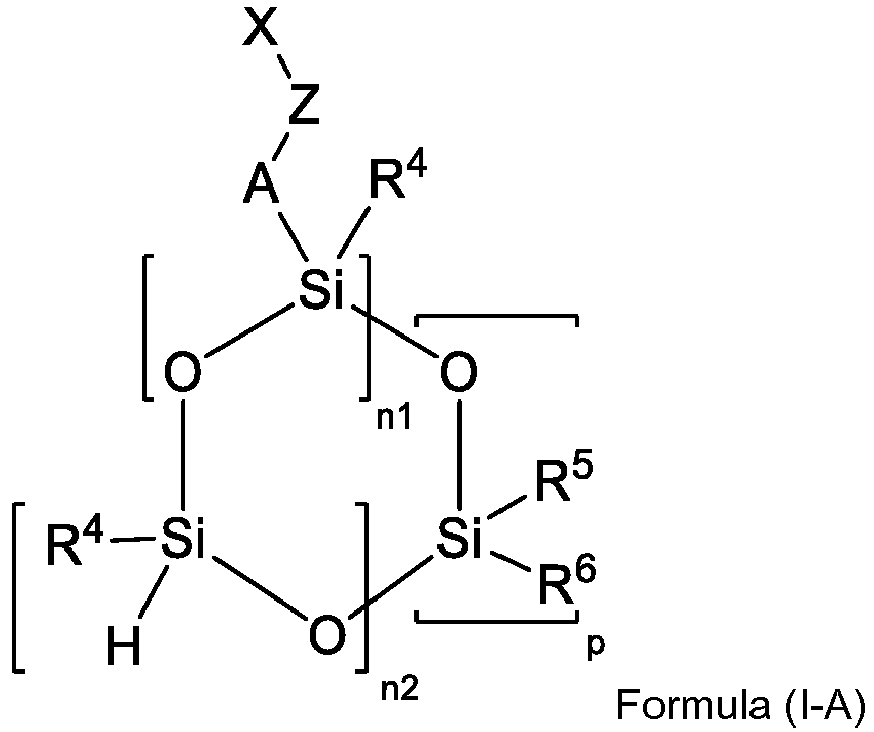
- R1, R2, R3, R4, R5 and R6 may be the same or different and each is independently selected from a hydrogen atom or a linear, branched or cyclic hydrocarbon residue having 1 to 20 carbon atoms which may contain at least one heteroatom;
- A is a heteroatom, preferably O or S, or a heteroatom-containing group, preferably NR7 or PR7, where R7 is selected from a hydrogen atom, a C1-C8 alkyl group, a C3-C10 cycloalkyl group, a C6-C18 aryl group or a C6-C18aralkyl group, which may contain at least one heteroatom;
- Z is selected from a linear, branched or cyclic hydrocarbon residue having 2 to 60 carbon atoms which may contain at least one heteroatom;
- X is a halogen atom;
- in Formula (I) n1 is an integer from 1 to 1000, n2 is an integer from 0 to 100, and p is an integer from 0 to 1000;
- in Formula (I-A) n1 is an integer from 1 to 100, n2 is an integer from 0 to 10, and p is an integer from 0 to 100, wherein the sum p+n1+n2 is equal to or higher than 3.
- The method is further characterized in that said polysiloxane comprising at least one hydrogen atom bonded to a silicon atom has the general Formula (II) or (II-A) or is a mixture thereof (component a)) and said halogen-containing compound has the general formula (III) (component c)):


- R1, R2, R3, R4, R5 and R6 may be the same or different and each is independently selected from a hydrogen atom or a linear, branched or cyclic hydrocarbon residue having 1 to 20 carbon atoms which may contain at least one heteroatom;
- in Formula (II) n is an integer from 1 to 1000 and p is an integer from 0 to 1000; and
- in Formula (II-A) n is an integer from 1 to 100 and p is an integer from 0 to 100, wherein the sum p+n is equal to or higher than 3,

- X is a halogen atom; and
- Ra is selected from the group consisting of a hydrogen atom or a linear, branched or cyclic hydrocarbon residue having 1 to 20 carbon atoms which may contain at least one heteroatom.
- In Formula (I), (I-A), (II), or (II-A), the different siloxane subunits n, n1, n2, and p are not necessarily present in the order illustrated herein. The subunits n, n1, n2, and p can be randomly distributed in the polysiloxane backbone in every possible combination.
- In Formula (I), (I-A), (II), or (II-A), R1, R2, R3, R4, R5 and R6 may be the same or different and each is independently selected from a hydrogen atom or a linear, branched or cyclic hydrocarbon residue having 1 to 20 carbon atoms which may contain at least one heteroatom, preferably selected from O, N, S, Si, P, Cl, Br or F.
- In preferred embodiments, R1, R2, R3, R4, R5 and R6 are the same or different and each is independently selected from the group consisting of a C1-C12 alkyl group, more preferably C1-C8 alkyl group, a C2-C8 alkenyl group, a C2-C8 alkynyl group, a C3-C10 cycloalkyl group, a C6-C18 aryl group and a C6-C18 aralkyl group, which may contain at least one heteroatom, preferably selected from O, N, S, Si, P, CI, Br or F.
- In more preferred embodiments, R1, R2, R3, R4, R5 and R6 are the same or different and each is independently selected from a C1-C8 alkyl group which may contain at least one heteroatom, preferably selected from O, N, S, Si, P, Cl, Br or F, in particular methyl, ethyl, n-propyl, fluoropropyl, n-butyl, sec-butyl, or tert-butyl, or a C6-C18 aryl group which may contain at least one heteroatom, preferably selected from O, N, S, Si, P, Cl, Br or F, in particular phenyl, tolyl or benzoyl. In most preferred embodiments, R1, R2, R3, R4, R5 and R6 are the same or different and independently selected from methyl or phenyl.
- In Formula (I) or (I-A), A is preferably selected from O, S, NR7 or PR7, where R7 is selected from a hydrogen atom, a C1-C8 alkyl group, a C3-C10 cycloalkyl group, a C6-C18 aryl group or a C6-C18aralkyl group, which may contain at least one heteroatom, preferably selected from O, N, S, P, Cl, Br or F. In more preferred embodiments, A is selected from O or S, in particular O.
- In Formula (I) or (I-A), Z is selected from a linear, branched or cyclic hydrocarbon residue having 2 to 60 carbon atoms, preferably 2 to 20 carbon atoms, which may contain at least one heteroatom, preferably selected from O, N, S, P, Si, Cl, Br or F.
- In preferred embodiments, Z is selected from the group consisting of a C2-C20 alkylene group, a C2-C20 alkenylene group, C2-C20 alkynylene group, a C6-C18 arylene group and a C6-C18 aralkylene group, which may contain at least one heteroatom, preferably selected from O, N, S, P, Si, Cl, Br or F.
- Exemplary heterocyclic compounds (component b)) are: ethylene oxide, 1,2-propylene oxide, tetrahydrofuran, 2-Methyltetrahydrofuran, oxetane, oxetene, tetrahydropyrane, oxepane, 1,4-dioxane, crown ethers, epichlorhydrin, 1,2-butylene oxide, 2,3-butylene oxide, 1,2-pentylene oxide, isopentylene oxide, 1,2-hexylene oxide, 1,2-heptylene oxide, styrene oxide, cyclohexene oxide, methylglycidyl ether, ethylglycidyl ether, allylglycidyl ether, phenylglycidyl ether, butadiene monoxide, isoprene monoxide, tolylglycidyl ether, cyclohexene oxide, cyclooctanee epoxide, cyclododecane epoxide, (+)-cis-limonene oxide, (+)-cis, trans-limonene oxide and (-)-cis, trans-limonene oxide, lactones, such as β-propiolactones, γ-butyrolactones, D-glucono-δ-lactones or ε-caprolactones, dilactones, lactams, lactides and thiolactones, thiolane, other heterocyclic rings such as piperidine, pyrroline or pyrrolidine, aziridine, azirine, oxirene, thiirane (episulfides), thiirene, phosphirane, phosphirene, azetidine, azete, thietane and thiete.
- Particularly preferred for this invention are 1,2-propylene oxide, 1,2-butylene oxide, 2,3-butylene oxide, styrene oxide, cyclohexene oxide, tetrahydrofuran, tetrahydropyrane, oxepane, 1,4-dioxane, ε-caprolactones, thiolane and crown ethers.
- In Formula (III), X is a halogen atom, preferably selected from Br, I or Cl, and Ra is selected from a hydrogen atom or a linear, branched or cyclic hydrocarbon residue having 1 to 20 carbon atoms which may contain at least one heteroatom, preferably selected from O, N, S, Si, Cl, Br or F.
- In preferred embodiments, X is selected from Br, I or Cl, more preferably Br or I, in particular Br.
- In preferred embodiments, Ra is selected from the group consisting of a hydrogen atom, a C1-C12 alkyl group, more preferably C1-C8 alkyl group, a C2-C8 alkenyl group, a C2-C8 alkynyl group, a C3-C10 cycloalkyl group, a C6-C18 aryl group and a C6-C18 aralkyl group, which may contain at least one heteroatom, preferably selected from O, N, S, Si, Cl, Br or F.
- In more preferred embodiments, Ra is a C2-C8 alkenyl group, more preferably selected from ethenyl, propenyl, butenyl, or pentenyl and structural isomers thereof such as 1- or 2-propenyl, 1-, 2-, or 3-butenyl.
- In Formula (II) or (II-A), n is the sum n1+n2 of Formula (I) or (I-A).
- In some embodiments, in Formulae (I) and (II), n or the sum n1+n2 is an integer from 1 to 500, more preferably from 1 to 100; and/or p is an integer from 0 to 500, more preferably from 0 to 100. In some embodiments, the polysiloxane may contain diorganosiloxane units, such as dimethylsiloxane or diphenylsiloxane units, in the backbone. The ratio between n units and p units can be varied.
- In some embodiments, in Formulae (I-A) and (II-A), n or the sum n1+n2 is an integer from 1 to 50, more preferably from 1 to 30; and/or p is an integer from 0 to 50, more preferably from 0 to 30, wherein the sum p+n or the sum p+n1+n2 is equal to or higher than 3.
- The halogen-functionalized polysiloxane is obtained by reacting at least one polysiloxane containing at least one hydrogen atom bonded to a silicon atom and at least one heterocyclic compound in the presence of a platinum catalyst and a halogen source. The synthetic pathway is a so-called "halosilation" reaction in which the heterocyclic compound is ring-opened in the presence of a platinum catalyst and a halogen source, resulting in a formal insertion of the opened heterocycle into the SiH bond. On the final product, the heteroatom of the former heterocyclic compound is bonded to the silicon atom from the former SiH moiety while and the halogen is bonded to the last carbon atom of the opened chain.
- In preferred embodiments, the reaction is carried out for a time sufficient to yield a halogen-functionalized polysiloxane that the SiH moieties in the polysiloxane are substantially completely converted to the halogen-functionalized moiety. Preferably, the obtained halogen-functionalized polysiloxane contains less than 5 mol%, more preferably less than 1 mol%, in particular less than 0.5 mol% of SiH moiety-which is not converted - based on the total moles of the silicon atom which constitutes the obtained polysiloxane backbone.
- In certain embodiments, the platinum can be removed after the reaction by methods known in the art, such as filtration, preferably by filtration through celite after decolorizing by adding activated carbon and an excess of pentane at room temperature. The solvents and volatiles can be evaporated under vacuum.
- This reaction follows a zero-order kinetic regime allowing to have a complete control of the reaction progress and hence of the number of halosilated side groups in the polysiloxane backbone. The degree of halogenation can be calculated and controlled with the amount of the heterocyclic compound and the halogen source used and SiH moieties contained.
- The "halosilation" reaction according to the present invention can be performed under solvent-free conditions, as well as in polar or non-polar solvents, such as alcohols, aromatic or aliphatic alkanes, alkenes or alkynes, halogen-functionalized aromatic or aliphatic hydrocarbons and hydrocarbons containing at least one heteroatom, such as O, N, S, P, Cl, Br or F. Preferably, the reaction is carried out in solvents such as toluene, THF, heptane, hexane or chloroform. Any residual solvent is preferably removed after completion of the reaction.
- The reaction can be carried out at a reaction temperature in the range from 0 to 200 °C, preferably from 50 to 150 °C, and/or at a reaction pressure from 1 to 50 bar, preferably from 1 to 10 bar.
-
-
Fig. 1 shows the conversion of SiH moieties compared to the time of Examples 1 to 3. -
Fig. 2 shows the logarithmic plotted conversion of SiH moieties compared to the time of Comparative Examples 6 to 8. - Various features and embodiments of the disclosure are described in the following examples, which are intended to be representative and not limiting. The following examples serve to explain the invention, but the invention is not limited thereto.
-

- A 250 ml three neck round bottomed flask was degassed under high vacuum (1-3 mbar) and flushed with argon. Then, 200µL of Karstedt (2% of Pt in the catalyst, 0.1% mol in the mixture) and toluene (50 mL, dried over molecular sieves) were added into the flask under argon atmosphere and stirred at room temperature (20°C) for a couple of minutes. Then tetrahydrofuran (18.5 mL, dried over molecular sieves) and allyl bromide (19.8 mL, 97%) were added into the system. Polyhydridomethylsiloxane (14.9 mL, Mn 1900 g/mol) were added dropwise. The mixture was stirred and refluxed at 100°C inside under inert atmosphere (Ar) until complete conversion of the SiH groups was achieved (the reaction was followed by 1H-NMR). The mixture (when necessary) was decolorized by adding activated carbon and an excess of pentane and stirred for 16 h at room temperature. The crude was filtrated trough celite, and the solvents and volatiles were evaporated under vacuum. The obtained product (yield 80-90%) was a colorless, transparent viscous liquid. The molecular weight and structure of the product was confirmed by GPC (Mn = 4882 g/mol, PDI 2.190) and NMR spectroscopy.
- The procedure was the same as shown in Example 1 except that the inside temperature was 75°C. The obtained product (yield 59%) was a colorless, transparent viscous liquid. The molecular weight and structure of the product was confirmed by GPC (Mn = 1616 g/mol, PDI 2.228) and NMR spectroscopy.
- The procedure was the same as shown in Example 1 except that the inside temperature was 90°C. The obtained product (yield 81%) was a colorless, transparent viscous liquid. The molecular weight and structure of the product was confirmed by GPC (Mn = 5113 g/mol, PDI 2.118) and NMR spectroscopy.
-

- A 250 ml three neck round bottomed flask was degassed under high vacuum (1-3 mbar) and flushed with argon. Then, 270µL of Karstedt (2% of Pt in the catalyst, 0.1% mol in the mixture) and THF (40 mL, dried over molecular sieves) were added into the flask under argon atmosphere and stirred at room temperature (20°C) for a couple of minutes. Then allyl bromide (11.78 mL, 97%) were added into the system. Polyhydridomethylsiloxane-co-polydimethylsiloxane (19.9 mL, Mn 2200 g/mol) were added dropwise. The mixture was stirred and refluxed (oil bath temperature: 100°C) under inert atmosphere (Ar) until complete conversion of the SiH groups was achieved (the reaction was followed by 1H-NMR). The mixture (when necessary) was decolorized by adding activated carbon and an excess of pentane and stirred for 16 h at room temperature. The crude was filtrated trough celite, and the solvents and volatiles were evaporated under vacuum. The obtained product (yield 80-90%) was a colorless, transparent viscous liquid. The molecular weight and structure of the product was confirmed by GPC (Mn = 4495 g/mol, PDI 1.837) and NMR spectroscopy.
-

- A 50 ml three neck round bottomed flask was degassed under high vacuum (1-3 mbar) and flushed with argon. Then, 400µL of Karstedt (2% of Pt in the catalyst, 0.1% mol in the mixture) and THF (10 mL, dried over molecular sieves) were added into the flask under argon atmosphere and stirred at room temperature (20°C) for a couple of minutes. Then allyl bromide (1.5 mL, 97%) were added into the system. 1,1',3,3',5,5',7-Heptamethylcyclotetrasiloxane (5.3 mL, Mn 282 g/mol) were added dropwise. The mixture was stirred and refluxed (oil bath temperature: 80°C) under inert atmosphere (Ar) until complete conversion of the SiH groups was achieved (the reaction was followed by 1H-NMR). The mixture (when necessary) was decolorized by adding activated carbon and an excess of pentane and stirred for 16 h at room temperature. The crude was filtrated trough celite, and the solvents and volatiles were evaporated under vacuum. The obtained product (isolated yield 84%; conversion 89.1%) was a colorless to slightly yellow, transparent low viscous liquid. The molecular weight and structure of the product was confirmed by GPC (Mn = 463 g/mol, PDI 1.055) and NMR spectroscopy.
-

- A 250 ml three neck round bottomed flask was degassed under high vacuum (1-3 mbar) and flushed with argon. Then, PdCl2 (208 mg, 1.6mol-% in the mixture) and THF (18.5 mL, dried over molecular sieves) were added into the flask under argon atmosphere and stirred at room temperature (20°C) for a couple of minutes. Then allyl bromide (7.29 mL, 97%) was added into the system. Polyhydridomethylsiloxane (5.0 mL, Mn 1900 g/mol) were added dropwise. The mixture was stirred (oil bath temperature: 50°C) under inert atmosphere (Ar) for 24 hours. The solvents and volatiles were evaporated under vacuum. The obtained product (yield -70%) was a black viscous liquid with precipitation. The molecular weight and structure of the product was confirmed by GPC (Mn = 6105g/mol, PDI 3.872) and NMR spectroscopy.
- The procedure was the same as shown in Comparative Example 6 except that the temperature was 60°C. For comparison reasons this product was decolorized by adding activated carbon and an excess of pentane and stirred for 16 h at room temperature. The crude was filtrated trough celite, and the solvents and volatiles were evaporated under vacuum. The purified product was yellow colored, which changes during time to black. The molecular weight and structure of the product was confirmed by GPC (Mn = 2395 g/mol, PDI 2.678) and NMR spectroscopy.
- The procedure is the same as shown in Comparative Example 6 except that the temperature was 70°C. For comparison reasons this product was decolorized by adding activated carbon and an excess of pentane and stirred for 16 h at room temperature. The crude was filtrated trough celite, and the solvents and volatiles were evaporated under vacuum. The purified product was yellow colored, which changes during time to black. The molecular weight and structure of the product was confirmed by GPC (Mn = 5536 g/mol, PDI 2.483) and NMR spectroscopy.
-

- A 50 ml three neck round bottomed flask was degassed under high vacuum (1-3 mbar) and flushed with argon. Then, PdCl2(24 mg, 1.6mol-% in the mixture) and THF (5 mL, dried over molecular sieves) were added into the flask under argon atmosphere and stirred at room temperature (20°C) for a couple of minutes. Then allyl bromide (0.84 mL, 97%) was added into the system. 1,1',3,3',5,5',7-Heptamethylcyclotetrasiloxane (3.3 mL, Mn 282 g/mol) were added dropwise. The mixture was stirred (oil bath temperature: 50°C) under inert atmosphere (Ar) for 24 hours. The solvents and volatiles were evaporated under vacuum. The obtained product (isolated yield 83%; conversion 84.6%) was a clear viscous slightly yellow liquid with black precipitation. The molecular weight and structure of the product was confirmed by GPC (Mn = 443 g/mol, PDI 1.042) and NMR spectroscopy.
- All NMR measurements were done on a Bruker 300MHz and 400MHz instrument with deuterated chloroform as solvent. All the samples were measured at room temperature (297 K). The chemical shifts are given in ppm. The calibration of the chemical shifts in 1H spectra was carried out by using the shifts of the deuterated solvents (CDCl3; δH 7.26).
- Gel permeation chromatography was carried out using HP1090 II Chromatography with DAD detector (HEWLETT PACKARD) at 40 °C. Tetrahydrofuran (THF) was used as an eluent. THF was passed through three PSS SDV gel columns with molecular weight ranges of 102, 103 and 104 g·mol-1 with a flow rate of 0.9 ml·min-1. The calibration of the device was carried out using polystyrene standards.
- Elemental analyses were performed on a flame atomic absorption spectrometer Perkin-Elmer Analyst 300 (Pd and Pt).
- The color values were measured with a LCS III from BYK. The LCS III is a VIS spectrophotometer with a wavelength range of 320 to 1100 nm. The Hazen color value (ISO 6271, also known as "AHPA-method " or Platinum-Cobalt Scale) is defined as mg of platinum per 1 litre of solution. The Yellowness Index was calculated and displayed in accordance with ASTM D 1925 for illuminant C and a 2 ° standard observer. The instrument was calibrated with distilled water.
-
Fig. 1 shows the conversion of SiH groups compared to the time (measured by integration of 1H-NMR spectra) of Example 1 to 3 with different temperatures. The linear shape of the curves proves that the reactions follows a zero-order kinetic with platinum as catalyst. For an overview of reaction kinetics and calculation of activation energies, s. A. Cornish-Bowden, Fundamentals of Enzyme Kinetics, John Wiley & Sons, 2012 or S. K. Upadhyay, Chemical Kinetics and Reaction Dynamics, Springer, 2006 is included as a reference. During the whole reaction time there was no change in the reaction speed. The reaction speed does not depend on the concentration of any monomer. The activation energy can be calculated with the slope of the curve at different temperatures by using the Arrhenius equation. Calculations were done with the temperature inside of the flask. An activation energy of 45.1 ± 2.2 kJ/mol could be calculated. -
Fig. 2 shows the logarithmic plotted conversion of SiH groups compared to the time (measured by integration of 1H-NMR spectra) of Comparative Example 6 to 8 with different temperatures which follows the first order kinetic regime. The reaction needed more time for a full conversion, because the reaction speed depends on the concentration of monomer. The more monomer is converted, the slower the reaction speed is. An activation energy of 77.3 ± 3.1 kJ/mol could be calculated, which is twice as much as the invention. - Table 1 shows the difficulties of removing the palladium catalyst after the reaction. The amount of platinum in Example 1 is more than 100 times lower than the amount of palladium in Comparative Example 6. The high amount of palladium causes a contamination of the product.
Table 1: Determination of Pt and Pd by elemental analysis Pt [wt-%] Pd [wt-%] Example 1 0.0108 ± 0.0079 Comparative Example 6 5.3048 ± 1.4691 - Table 2 shows the Hazen Factor and Yellowness Index of Examples 1 and 4 and Comparative Example 6. Compared to Examples 1 and 4, Comparative Example 6 shows a very high Hazen Factor, as well as Yellowness Index, which are more than five times higher. Comparative Example 6 could only be measured in solution (THF, ratio 1:3) as the purified product got darker during time and showed results out of the working area of the instrument. The color changed from yellow to brown and then to dark brown during time. This was caused by the palladium, which cannot be removed with mentioned working-ups. In literature there is no filtration step mentioned (only removing solvent by vacuo), so the palladium was not removed at all.
Table 2: Determination of Hazen Factor and Yellowness Index Hazen Factor Yellowness Index Example 1 112 26.4 Example 4 42 10.6 Comparative Example 6 734 103.9
Claims (11)
- A method for preparing a halogen-functionalized polysiloxane by reactinga) at least one polysiloxane comprising at least one hydrogen atom bonded to a silicon atom;b) at least one heterocyclic compound; andc) at least one halogen-containing compound,wherein the reaction is catalyzed by at least one platinum catalyst.
- The method according to claim 1, wherein the platinum catalyst is selected from the group consisting of chloroplatinic acids, preferably hexachloroplatinic acid; alcohol modified chloroplatinic acids; olefin complexes of chloroplatinic acid; complexes of chloroplatinic acid and divinyltetramethyldisiloxane; fine platinum particles adsorbed on carbon carriers; platinum supported on metal oxide carriers, preferably Pt(Al2O3); platinum black; platinum acetylacetonate; platinous halides, preferably PtCl2, PtCl4, Pt(CN)2; complexes of platinous halides with unsaturated compounds, preferably ethylene, propylene, and organovinylsiloxanes; styrene hexamethyldiplatinum; platinum divinyltetramethyldisiloxane complex; the reaction product of chloroplatinic acid and an unsaturated aliphatic group-containing organosilicon compound; and a neutralized complex of platinous chloride and divinyltetramethyldisiloxane.
- The method according to claim 1 or 2, wherein the platinum catalyst is hexachloroplatinic acid or platinum divinyltetramethyldisiloxane complex.
- The method according to any one of claims 1 to 3, the platinum catalyst is present in an amount of from 0.0001mol% to 10mol%, more preferably 0.001mol% to 0.1mol%, of platinum based on the molar quantity of silicon-bonded hydrogen in the polysiloxane.
- The method according to any one of claims 1 to 4, wherein the polysiloxane comprising at least one hydrogen atom bonded to a silicon atom is a linear- or cyclopolysiloxane, or a mixture thereof.
- The method according to any one of claim 1 to 5, wherein the obtained halogen-functionalized polysiloxane has a number average molecular weight of from 100 to 50,000g/mol.
- The method according to any one of claims 1 to 6, wherein said halogen-functionalized polysiloxane has the general Formula (I) or (I-A) or is a mixture thereof:

 R1, R2, R3, R4, R5 and R6 may be the same or different and each is independently selected from a hydrogen atom or a linear, branched or cyclic hydrocarbon residue having 1 to 20 carbon atoms which may contain at least one heteroatom;A is a heteroatom, preferably O or S, or a heteroatom-containing group, preferably NR7 or PR7, where R7 is selected from a hydrogen atom, a C1-C8 alkyl group, a C3-C10 cycloalkyl group, a C6-C18 aryl group or a C6-C18aralkyl group, which may contain at least one heteroatom;Z is selected from a linear, branched or cyclic hydrocarbon residue having 2 to 60 carbon atoms which may contain at least one heteroatom;X is a halogen atom;in Formula (I) n1 is an integer from 1 to 1000, n2 is an integer from 0 to 100, and p is an integer from 0 to 1000;in Formula (I-A) n1 is an integer from 1 to 100, n2 is an integer from 0 to 10, and p is an integer from 0 to 100, wherein the sum p+n1+n2 is equal to or higher than 3.
 - The method according to any one of claims 1 to 7, wherein
said polysiloxane comprising at least one hydrogen atom bonded to a silicon atom has the general Formula (II) or (II-A) or is a mixture thereof and said halogen-containing compound has the general formula (III):
 R1, R2, R3, R4, R5 and R6 may be the same or different and each is independently selected from a hydrogen atom or a linear, branched or cyclic hydrocarbon residue having 1 to 20 carbon atoms which may contain at least one heteroatom;in Formula (II) n is an integer from 1 to 1000 and p is an integer from 0 to 1000; andin Formula (II-A) n is an integer from 1 to 100 and p is an integer from 0 to 100, wherein the sum p+n is equal to or higher than 3,wherein:
 X is a halogen atom; andRa is selected from the group consisting of a hydrogen atom or a linear, branched or cyclic hydrocarbon residue having 1 to 20 carbon atoms which may contain at least one heteroatom.
 - The method according to any one of claims 1 to 8, wherein the reaction is carried out in at least one solvent.
- The method according to any one of claims 1 to 9, wherein the reaction is carried out at the temperature of from 0 to 200 °C and/or a reaction pressure of from 1 to 50 bar.
- A halogen-functionalized polysiloxane obtained by the method according to any one of claims 1 to 10.
Priority Applications (5)
| Application Number | Priority Date | Filing Date | Title |
|---|---|---|---|
| EP18209736.0A EP3663329B1 (en) | 2018-12-03 | 2018-12-03 | Method for preparing halogen-functionalized polysiloxanes |
| PL18209736.0T PL3663329T3 (en) | 2018-12-03 | 2018-12-03 | Method for preparing halogen-functionalized polysiloxanes |
| ES18209736T ES2975061T3 (en) | 2018-12-03 | 2018-12-03 | Preparation method of halogen-functionalized polysiloxanes |
| PCT/EP2019/082318 WO2020114809A1 (en) | 2018-12-03 | 2019-11-22 | Method for preparing halogen-functionalized polysiloxanes |
| US17/335,258 US12129340B2 (en) | 2018-12-03 | 2021-06-01 | Method for preparing halogen-functionalized polysiloxanes |
Applications Claiming Priority (1)
| Application Number | Priority Date | Filing Date | Title |
|---|---|---|---|
| EP18209736.0A EP3663329B1 (en) | 2018-12-03 | 2018-12-03 | Method for preparing halogen-functionalized polysiloxanes |
Publications (2)
| Publication Number | Publication Date |
|---|---|
| EP3663329A1 true EP3663329A1 (en) | 2020-06-10 |
| EP3663329B1 EP3663329B1 (en) | 2024-02-21 |
Family
ID=64572163
Family Applications (1)
| Application Number | Title | Priority Date | Filing Date |
|---|---|---|---|
| EP18209736.0A Active EP3663329B1 (en) | 2018-12-03 | 2018-12-03 | Method for preparing halogen-functionalized polysiloxanes |
Country Status (5)
| Country | Link |
|---|---|
| US (1) | US12129340B2 (en) |
| EP (1) | EP3663329B1 (en) |
| ES (1) | ES2975061T3 (en) |
| PL (1) | PL3663329T3 (en) |
| WO (1) | WO2020114809A1 (en) |
Cited By (1)
| Publication number | Priority date | Publication date | Assignee | Title |
|---|---|---|---|---|
| US12247106B2 (en) | 2019-05-31 | 2025-03-11 | Henkel Ag & Co. Kgaa | Onium-functionalized siloxanes |
Citations (5)
| Publication number | Priority date | Publication date | Assignee | Title |
|---|---|---|---|---|
| US2823218A (en) | 1955-12-05 | 1958-02-11 | Dow Corning | Process for the production of organo-silicon compounds |
| US3715334A (en) | 1970-11-27 | 1973-02-06 | Gen Electric | Platinum-vinylsiloxanes |
| US3814730A (en) | 1970-08-06 | 1974-06-04 | Gen Electric | Platinum complexes of unsaturated siloxanes and platinum containing organopolysiloxanes |
| US3923705A (en) | 1974-10-30 | 1975-12-02 | Dow Corning | Method of preparing fire retardant siloxane foams and foams prepared therefrom |
| CN102408570A (en) | 2011-10-12 | 2012-04-11 | 青岛大学 | Preparation method of novel organic silicone oil water repellent agent used for cotton fabric |
Family Cites Families (2)
| Publication number | Priority date | Publication date | Assignee | Title |
|---|---|---|---|---|
| CA2025304A1 (en) * | 1990-02-02 | 1991-08-03 | Karen D. Riding | Platinum catalyzed heterocyclic compound compositions |
| FR2781491B1 (en) * | 1998-07-21 | 2002-12-20 | Rhodia Chimie Sa | USE OF A FUNCTIONALIZED SILICONE COMPOSITION FOR THE PRODUCTION OF HYDROPHOBIC AND / OR OLEOPHOBIC COATING AND / OR IMPREGNATION, WITH LOW SURFACE ENERGY |
-
2018
- 2018-12-03 EP EP18209736.0A patent/EP3663329B1/en active Active
- 2018-12-03 PL PL18209736.0T patent/PL3663329T3/en unknown
- 2018-12-03 ES ES18209736T patent/ES2975061T3/en active Active
-
2019
- 2019-11-22 WO PCT/EP2019/082318 patent/WO2020114809A1/en not_active Ceased
-
2021
- 2021-06-01 US US17/335,258 patent/US12129340B2/en active Active
Patent Citations (5)
| Publication number | Priority date | Publication date | Assignee | Title |
|---|---|---|---|---|
| US2823218A (en) | 1955-12-05 | 1958-02-11 | Dow Corning | Process for the production of organo-silicon compounds |
| US3814730A (en) | 1970-08-06 | 1974-06-04 | Gen Electric | Platinum complexes of unsaturated siloxanes and platinum containing organopolysiloxanes |
| US3715334A (en) | 1970-11-27 | 1973-02-06 | Gen Electric | Platinum-vinylsiloxanes |
| US3923705A (en) | 1974-10-30 | 1975-12-02 | Dow Corning | Method of preparing fire retardant siloxane foams and foams prepared therefrom |
| CN102408570A (en) | 2011-10-12 | 2012-04-11 | 青岛大学 | Preparation method of novel organic silicone oil water repellent agent used for cotton fabric |
Non-Patent Citations (12)
| Title |
|---|
| A. CORNISH-BOWDEN: "Fundamentals of Enzyme Kinetics", 2012, JOHN WILEY & SONS |
| C. H. L. DONG, ZHOU ET AL., ADV. MATER. RES., vol. 15, 2014, pages 998 - 999 |
| C. L. DONG, ZHOU ET AL., J. ENG. FIBERS FABR., vol. 1, 17 October 2015 (2015-10-17) |
| G. SAUVET ET AL., J. APPL. POLYM. SCI, vol. 75, 2000, pages 1005 - 1012 |
| IWATA ET AL., THE JOURNAL OF ORGANIC CHEMISTRY, vol. 67, 2002, pages 3927 - 3929 |
| J. OHSHITA ET AL., J. ORGANOMET. CHEM., vol. 691, 2006, pages 1907 - 1911 |
| J. OHSHITA ET AL., J. ORGANOMET. CHEM., vol. 692, 2007, pages 3526 - 3531 |
| J. OHSHITA ET AL., THE JOURNAL OF ORGANIC CHEMISTRY, vol. 64, 1999, pages 8024 - 8026 |
| P. LIU ET AL., MATERIALS SCIENCE AND ENGINEERING: C, vol. 33, 2013, pages 3865 |
| S. K. UPADHYAY: "Chemical Kinetics and Reaction Dynamics", 2006, SPRINGER |
| Z. LU ET AL., J. ORGANOMET. CHEM., vol. 697, 2012, pages 51 - 56 |
| Z. LU ET AL., J. ORGANOMET. CHEM., vol. 697, 2012, pages 51 - 56, XP002788304 * |
Cited By (1)
| Publication number | Priority date | Publication date | Assignee | Title |
|---|---|---|---|---|
| US12247106B2 (en) | 2019-05-31 | 2025-03-11 | Henkel Ag & Co. Kgaa | Onium-functionalized siloxanes |
Also Published As
| Publication number | Publication date |
|---|---|
| ES2975061T3 (en) | 2024-07-03 |
| EP3663329B1 (en) | 2024-02-21 |
| US20210292486A1 (en) | 2021-09-23 |
| US12129340B2 (en) | 2024-10-29 |
| PL3663329T3 (en) | 2024-06-03 |
| WO2020114809A1 (en) | 2020-06-11 |
Similar Documents
| Publication | Publication Date | Title |
|---|---|---|
| CN103588804B (en) | Dehydrosilylation and crosslinking using cobalt catalysts | |
| KR20140116100A (en) | Non-precious metal-based hydrosilylation catalysts | |
| US10421839B2 (en) | Aminoalkyl group-containing siloxane and a method for preparing the same | |
| US12129340B2 (en) | Method for preparing halogen-functionalized polysiloxanes | |
| KR20240052812A (en) | Hydrosilylation method catalyzed by iron complexes | |
| EP1437374B1 (en) | Highly pure polyethersilicone | |
| US20020068807A1 (en) | Method for preparing silicone oils by hydrosilylation with polyorganohydrogenosiloxanes and units containing at least one hydrocarbon ring including an oxygen atom, in the presence of a heterogeneous catalytic composition | |
| JP3661810B2 (en) | Method for producing hydroxyl group-containing siloxane compound | |
| CA2098633A1 (en) | Selective catalysts for the synthesis of epoxysilicone monomers and polymers | |
| EP3663371B1 (en) | Preparation of polysiloxane polyalkyleneglycol brush copolymers | |
| EP3262103B1 (en) | Reactive polysiloxanes and copolymers made therefrom | |
| US12247106B2 (en) | Onium-functionalized siloxanes | |
| JP3661807B2 (en) | Method for producing hydroxyl group-containing siloxane compound | |
| EP3498719B1 (en) | Tertiary hydroxyl functional alkoxysilanes and methods for preparing thereof | |
| EP3932973B1 (en) | Bi-functionalized polysiloxane brush copolymers | |
| KR20200020682A (en) | Isocyanuric acid derivative having an alkoxyalkyl group and method for producing the same | |
| CN103906791A (en) | Method for preparing (hydroxymethyl)polysiloxanes | |
| JP4276805B2 (en) | Novel silazane compound and method for producing the same, and novel silazane compound polymer and method for producing the same | |
| WO2024081505A1 (en) | Method for making ether-functional silicones | |
| CN119487043A (en) | Synthesis and use of carbamate functionalized alkoxysilanesilane compounds | |
| US20100137545A1 (en) | Novel process | |
| EP4567019A1 (en) | Fluorene compound having halogen atom and allyl group, and method for producing same | |
| US20050038277A1 (en) | Use of a catalyst system based on a platinum group metal and a heterocyclic organic compound for hydrosilylation of unsaturated reagents | |
| Trofimov et al. | Poly (methylhydrosiloxane) Homodehydrocondensation Catalysis with Poly (ethylene Glycol) Chains | |
| Schüle et al. | Hyperbranched polycarbosilanes and polycarbosiloxanes via hydrosilylation polymerization |
Legal Events
| Date | Code | Title | Description |
|---|---|---|---|
| PUAI | Public reference made under article 153(3) epc to a published international application that has entered the european phase |
Free format text: ORIGINAL CODE: 0009012 |
|
| STAA | Information on the status of an ep patent application or granted ep patent |
Free format text: STATUS: THE APPLICATION HAS BEEN PUBLISHED |
|
| AK | Designated contracting states |
Kind code of ref document: A1 Designated state(s): AL AT BE BG CH CY CZ DE DK EE ES FI FR GB GR HR HU IE IS IT LI LT LU LV MC MK MT NL NO PL PT RO RS SE SI SK SM TR |
|
| AX | Request for extension of the european patent |
Extension state: BA ME |
|
| STAA | Information on the status of an ep patent application or granted ep patent |
Free format text: STATUS: REQUEST FOR EXAMINATION WAS MADE |
|
| 17P | Request for examination filed |
Effective date: 20201008 |
|
| RBV | Designated contracting states (corrected) |
Designated state(s): AL AT BE BG CH CY CZ DE DK EE ES FI FR GB GR HR HU IE IS IT LI LT LU LV MC MK MT NL NO PL PT RO RS SE SI SK SM TR |
|
| P01 | Opt-out of the competence of the unified patent court (upc) registered |
Effective date: 20230531 |
|
| GRAP | Despatch of communication of intention to grant a patent |
Free format text: ORIGINAL CODE: EPIDOSNIGR1 |
|
| STAA | Information on the status of an ep patent application or granted ep patent |
Free format text: STATUS: GRANT OF PATENT IS INTENDED |
|
| INTG | Intention to grant announced |
Effective date: 20230914 |
|
| GRAS | Grant fee paid |
Free format text: ORIGINAL CODE: EPIDOSNIGR3 |
|
| GRAA | (expected) grant |
Free format text: ORIGINAL CODE: 0009210 |
|
| STAA | Information on the status of an ep patent application or granted ep patent |
Free format text: STATUS: THE PATENT HAS BEEN GRANTED |
|
| AK | Designated contracting states |
Kind code of ref document: B1 Designated state(s): AL AT BE BG CH CY CZ DE DK EE ES FI FR GB GR HR HU IE IS IT LI LT LU LV MC MK MT NL NO PL PT RO RS SE SI SK SM TR |
|
| REG | Reference to a national code |
Ref country code: GB Ref legal event code: FG4D |
|
| REG | Reference to a national code |
Ref country code: CH Ref legal event code: EP |
|
| REG | Reference to a national code |
Ref country code: IE Ref legal event code: FG4D |
|
| REG | Reference to a national code |
Ref country code: DE Ref legal event code: R096 Ref document number: 602018065466 Country of ref document: DE |
|
| REG | Reference to a national code |
Ref country code: NL Ref legal event code: FP |
|
| REG | Reference to a national code |
Ref country code: LT Ref legal event code: MG9D |
|
| PG25 | Lapsed in a contracting state [announced via postgrant information from national office to epo] |
Ref country code: IS Free format text: LAPSE BECAUSE OF FAILURE TO SUBMIT A TRANSLATION OF THE DESCRIPTION OR TO PAY THE FEE WITHIN THE PRESCRIBED TIME-LIMIT Effective date: 20240621 |
|
| REG | Reference to a national code |
Ref country code: ES Ref legal event code: FG2A Ref document number: 2975061 Country of ref document: ES Kind code of ref document: T3 Effective date: 20240703 |
|
| PG25 | Lapsed in a contracting state [announced via postgrant information from national office to epo] |
Ref country code: LT Free format text: LAPSE BECAUSE OF FAILURE TO SUBMIT A TRANSLATION OF THE DESCRIPTION OR TO PAY THE FEE WITHIN THE PRESCRIBED TIME-LIMIT Effective date: 20240221 |
|
| PG25 | Lapsed in a contracting state [announced via postgrant information from national office to epo] |
Ref country code: GR Free format text: LAPSE BECAUSE OF FAILURE TO SUBMIT A TRANSLATION OF THE DESCRIPTION OR TO PAY THE FEE WITHIN THE PRESCRIBED TIME-LIMIT Effective date: 20240522 |
|
| REG | Reference to a national code |
Ref country code: AT Ref legal event code: MK05 Ref document number: 1659068 Country of ref document: AT Kind code of ref document: T Effective date: 20240221 |
|
| PG25 | Lapsed in a contracting state [announced via postgrant information from national office to epo] |
Ref country code: HR Free format text: LAPSE BECAUSE OF FAILURE TO SUBMIT A TRANSLATION OF THE DESCRIPTION OR TO PAY THE FEE WITHIN THE PRESCRIBED TIME-LIMIT Effective date: 20240221 Ref country code: RS Free format text: LAPSE BECAUSE OF FAILURE TO SUBMIT A TRANSLATION OF THE DESCRIPTION OR TO PAY THE FEE WITHIN THE PRESCRIBED TIME-LIMIT Effective date: 20240521 |
|
| PG25 | Lapsed in a contracting state [announced via postgrant information from national office to epo] |
Ref country code: AT Free format text: LAPSE BECAUSE OF FAILURE TO SUBMIT A TRANSLATION OF THE DESCRIPTION OR TO PAY THE FEE WITHIN THE PRESCRIBED TIME-LIMIT Effective date: 20240221 |
|
| PG25 | Lapsed in a contracting state [announced via postgrant information from national office to epo] |
Ref country code: RS Free format text: LAPSE BECAUSE OF FAILURE TO SUBMIT A TRANSLATION OF THE DESCRIPTION OR TO PAY THE FEE WITHIN THE PRESCRIBED TIME-LIMIT Effective date: 20240521 Ref country code: NO Free format text: LAPSE BECAUSE OF FAILURE TO SUBMIT A TRANSLATION OF THE DESCRIPTION OR TO PAY THE FEE WITHIN THE PRESCRIBED TIME-LIMIT Effective date: 20240521 Ref country code: LT Free format text: LAPSE BECAUSE OF FAILURE TO SUBMIT A TRANSLATION OF THE DESCRIPTION OR TO PAY THE FEE WITHIN THE PRESCRIBED TIME-LIMIT Effective date: 20240221 Ref country code: IS Free format text: LAPSE BECAUSE OF FAILURE TO SUBMIT A TRANSLATION OF THE DESCRIPTION OR TO PAY THE FEE WITHIN THE PRESCRIBED TIME-LIMIT Effective date: 20240621 Ref country code: HR Free format text: LAPSE BECAUSE OF FAILURE TO SUBMIT A TRANSLATION OF THE DESCRIPTION OR TO PAY THE FEE WITHIN THE PRESCRIBED TIME-LIMIT Effective date: 20240221 Ref country code: GR Free format text: LAPSE BECAUSE OF FAILURE TO SUBMIT A TRANSLATION OF THE DESCRIPTION OR TO PAY THE FEE WITHIN THE PRESCRIBED TIME-LIMIT Effective date: 20240522 Ref country code: FI Free format text: LAPSE BECAUSE OF FAILURE TO SUBMIT A TRANSLATION OF THE DESCRIPTION OR TO PAY THE FEE WITHIN THE PRESCRIBED TIME-LIMIT Effective date: 20240221 Ref country code: BG Free format text: LAPSE BECAUSE OF FAILURE TO SUBMIT A TRANSLATION OF THE DESCRIPTION OR TO PAY THE FEE WITHIN THE PRESCRIBED TIME-LIMIT Effective date: 20240221 Ref country code: AT Free format text: LAPSE BECAUSE OF FAILURE TO SUBMIT A TRANSLATION OF THE DESCRIPTION OR TO PAY THE FEE WITHIN THE PRESCRIBED TIME-LIMIT Effective date: 20240221 |
|
| PG25 | Lapsed in a contracting state [announced via postgrant information from national office to epo] |
Ref country code: PT Free format text: LAPSE BECAUSE OF FAILURE TO SUBMIT A TRANSLATION OF THE DESCRIPTION OR TO PAY THE FEE WITHIN THE PRESCRIBED TIME-LIMIT Effective date: 20240621 |
|
| PG25 | Lapsed in a contracting state [announced via postgrant information from national office to epo] |
Ref country code: SE Free format text: LAPSE BECAUSE OF FAILURE TO SUBMIT A TRANSLATION OF THE DESCRIPTION OR TO PAY THE FEE WITHIN THE PRESCRIBED TIME-LIMIT Effective date: 20240221 Ref country code: PT Free format text: LAPSE BECAUSE OF FAILURE TO SUBMIT A TRANSLATION OF THE DESCRIPTION OR TO PAY THE FEE WITHIN THE PRESCRIBED TIME-LIMIT Effective date: 20240621 Ref country code: LV Free format text: LAPSE BECAUSE OF FAILURE TO SUBMIT A TRANSLATION OF THE DESCRIPTION OR TO PAY THE FEE WITHIN THE PRESCRIBED TIME-LIMIT Effective date: 20240221 |
|
| PG25 | Lapsed in a contracting state [announced via postgrant information from national office to epo] |
Ref country code: DK Free format text: LAPSE BECAUSE OF FAILURE TO SUBMIT A TRANSLATION OF THE DESCRIPTION OR TO PAY THE FEE WITHIN THE PRESCRIBED TIME-LIMIT Effective date: 20240221 |
|
| PG25 | Lapsed in a contracting state [announced via postgrant information from national office to epo] |
Ref country code: SM Free format text: LAPSE BECAUSE OF FAILURE TO SUBMIT A TRANSLATION OF THE DESCRIPTION OR TO PAY THE FEE WITHIN THE PRESCRIBED TIME-LIMIT Effective date: 20240221 |
|
| PG25 | Lapsed in a contracting state [announced via postgrant information from national office to epo] |
Ref country code: CZ Free format text: LAPSE BECAUSE OF FAILURE TO SUBMIT A TRANSLATION OF THE DESCRIPTION OR TO PAY THE FEE WITHIN THE PRESCRIBED TIME-LIMIT Effective date: 20240221 Ref country code: EE Free format text: LAPSE BECAUSE OF FAILURE TO SUBMIT A TRANSLATION OF THE DESCRIPTION OR TO PAY THE FEE WITHIN THE PRESCRIBED TIME-LIMIT Effective date: 20240221 |
|
| PG25 | Lapsed in a contracting state [announced via postgrant information from national office to epo] |
Ref country code: SK Free format text: LAPSE BECAUSE OF FAILURE TO SUBMIT A TRANSLATION OF THE DESCRIPTION OR TO PAY THE FEE WITHIN THE PRESCRIBED TIME-LIMIT Effective date: 20240221 |
|
| PG25 | Lapsed in a contracting state [announced via postgrant information from national office to epo] |
Ref country code: SM Free format text: LAPSE BECAUSE OF FAILURE TO SUBMIT A TRANSLATION OF THE DESCRIPTION OR TO PAY THE FEE WITHIN THE PRESCRIBED TIME-LIMIT Effective date: 20240221 Ref country code: SK Free format text: LAPSE BECAUSE OF FAILURE TO SUBMIT A TRANSLATION OF THE DESCRIPTION OR TO PAY THE FEE WITHIN THE PRESCRIBED TIME-LIMIT Effective date: 20240221 Ref country code: RO Free format text: LAPSE BECAUSE OF FAILURE TO SUBMIT A TRANSLATION OF THE DESCRIPTION OR TO PAY THE FEE WITHIN THE PRESCRIBED TIME-LIMIT Effective date: 20240221 Ref country code: EE Free format text: LAPSE BECAUSE OF FAILURE TO SUBMIT A TRANSLATION OF THE DESCRIPTION OR TO PAY THE FEE WITHIN THE PRESCRIBED TIME-LIMIT Effective date: 20240221 Ref country code: DK Free format text: LAPSE BECAUSE OF FAILURE TO SUBMIT A TRANSLATION OF THE DESCRIPTION OR TO PAY THE FEE WITHIN THE PRESCRIBED TIME-LIMIT Effective date: 20240221 Ref country code: CZ Free format text: LAPSE BECAUSE OF FAILURE TO SUBMIT A TRANSLATION OF THE DESCRIPTION OR TO PAY THE FEE WITHIN THE PRESCRIBED TIME-LIMIT Effective date: 20240221 |
|
| REG | Reference to a national code |
Ref country code: DE Ref legal event code: R097 Ref document number: 602018065466 Country of ref document: DE |
|
| PG25 | Lapsed in a contracting state [announced via postgrant information from national office to epo] |
Ref country code: IT Free format text: LAPSE BECAUSE OF FAILURE TO SUBMIT A TRANSLATION OF THE DESCRIPTION OR TO PAY THE FEE WITHIN THE PRESCRIBED TIME-LIMIT Effective date: 20240221 |
|
| PLBE | No opposition filed within time limit |
Free format text: ORIGINAL CODE: 0009261 |
|
| STAA | Information on the status of an ep patent application or granted ep patent |
Free format text: STATUS: NO OPPOSITION FILED WITHIN TIME LIMIT |
|
| PG25 | Lapsed in a contracting state [announced via postgrant information from national office to epo] |
Ref country code: IT Free format text: LAPSE BECAUSE OF FAILURE TO SUBMIT A TRANSLATION OF THE DESCRIPTION OR TO PAY THE FEE WITHIN THE PRESCRIBED TIME-LIMIT Effective date: 20240221 |
|
| 26N | No opposition filed |
Effective date: 20241122 |
|
| PG25 | Lapsed in a contracting state [announced via postgrant information from national office to epo] |
Ref country code: SI Free format text: LAPSE BECAUSE OF FAILURE TO SUBMIT A TRANSLATION OF THE DESCRIPTION OR TO PAY THE FEE WITHIN THE PRESCRIBED TIME-LIMIT Effective date: 20240221 |
|
| PG25 | Lapsed in a contracting state [announced via postgrant information from national office to epo] |
Ref country code: MC Free format text: LAPSE BECAUSE OF FAILURE TO SUBMIT A TRANSLATION OF THE DESCRIPTION OR TO PAY THE FEE WITHIN THE PRESCRIBED TIME-LIMIT Effective date: 20240221 |
|
| REG | Reference to a national code |
Ref country code: CH Ref legal event code: PL |
|
| PG25 | Lapsed in a contracting state [announced via postgrant information from national office to epo] |
Ref country code: LU Free format text: LAPSE BECAUSE OF NON-PAYMENT OF DUE FEES Effective date: 20241203 |
|
| PG25 | Lapsed in a contracting state [announced via postgrant information from national office to epo] |
Ref country code: CH Free format text: LAPSE BECAUSE OF NON-PAYMENT OF DUE FEES Effective date: 20241231 |
|
| PG25 | Lapsed in a contracting state [announced via postgrant information from national office to epo] |
Ref country code: IE Free format text: LAPSE BECAUSE OF NON-PAYMENT OF DUE FEES Effective date: 20241203 |
|
| PGFP | Annual fee paid to national office [announced via postgrant information from national office to epo] |
Ref country code: DE Payment date: 20251211 Year of fee payment: 8 |
|
| PGFP | Annual fee paid to national office [announced via postgrant information from national office to epo] |
Ref country code: GB Payment date: 20251219 Year of fee payment: 8 |
|
| PGFP | Annual fee paid to national office [announced via postgrant information from national office to epo] |
Ref country code: FR Payment date: 20251229 Year of fee payment: 8 Ref country code: NL Payment date: 20251219 Year of fee payment: 8 |
|
| PGFP | Annual fee paid to national office [announced via postgrant information from national office to epo] |
Ref country code: BE Payment date: 20251219 Year of fee payment: 8 |
|
| PGFP | Annual fee paid to national office [announced via postgrant information from national office to epo] |
Ref country code: PL Payment date: 20251121 Year of fee payment: 8 |
|
| PG25 | Lapsed in a contracting state [announced via postgrant information from national office to epo] |
Ref country code: CY Free format text: LAPSE BECAUSE OF FAILURE TO SUBMIT A TRANSLATION OF THE DESCRIPTION OR TO PAY THE FEE WITHIN THE PRESCRIBED TIME-LIMIT; INVALID AB INITIO Effective date: 20181203 |
|
| PGFP | Annual fee paid to national office [announced via postgrant information from national office to epo] |
Ref country code: ES Payment date: 20260130 Year of fee payment: 8 |