EP3662899A1 - Apixaban formulations - Google Patents
Apixaban formulations Download PDFInfo
- Publication number
- EP3662899A1 EP3662899A1 EP20151141.7A EP20151141A EP3662899A1 EP 3662899 A1 EP3662899 A1 EP 3662899A1 EP 20151141 A EP20151141 A EP 20151141A EP 3662899 A1 EP3662899 A1 EP 3662899A1
- Authority
- EP
- European Patent Office
- Prior art keywords
- tablet
- apixaban
- less
- dissolution
- tablets
- Prior art date
- Legal status (The legal status is an assumption and is not a legal conclusion. Google has not performed a legal analysis and makes no representation as to the accuracy of the status listed.)
- Withdrawn
Links
Images


Classifications
-
- A—HUMAN NECESSITIES
- A61—MEDICAL OR VETERINARY SCIENCE; HYGIENE
- A61K—PREPARATIONS FOR MEDICAL, DENTAL OR TOILETRY PURPOSES
- A61K9/00—Medicinal preparations characterised by special physical form
- A61K9/0012—Galenical forms characterised by the site of application
- A61K9/0053—Mouth and digestive tract, i.e. intraoral and peroral administration
-
- A—HUMAN NECESSITIES
- A61—MEDICAL OR VETERINARY SCIENCE; HYGIENE
- A61K—PREPARATIONS FOR MEDICAL, DENTAL OR TOILETRY PURPOSES
- A61K31/00—Medicinal preparations containing organic active ingredients
- A61K31/33—Heterocyclic compounds
- A61K31/395—Heterocyclic compounds having nitrogen as a ring hetero atom, e.g. guanethidine or rifamycins
- A61K31/435—Heterocyclic compounds having nitrogen as a ring hetero atom, e.g. guanethidine or rifamycins having six-membered rings with one nitrogen as the only ring hetero atom
- A61K31/44—Non condensed pyridines; Hydrogenated derivatives thereof
- A61K31/445—Non condensed piperidines, e.g. piperocaine
- A61K31/4523—Non condensed piperidines, e.g. piperocaine containing further heterocyclic ring systems
- A61K31/4545—Non condensed piperidines, e.g. piperocaine containing further heterocyclic ring systems containing a six-membered ring with nitrogen as a ring hetero atom, e.g. pipamperone, anabasine
-
- A—HUMAN NECESSITIES
- A61—MEDICAL OR VETERINARY SCIENCE; HYGIENE
- A61K—PREPARATIONS FOR MEDICAL, DENTAL OR TOILETRY PURPOSES
- A61K47/00—Medicinal preparations characterised by the non-active ingredients used, e.g. carriers or inert additives; Targeting or modifying agents chemically bound to the active ingredient
-
- A—HUMAN NECESSITIES
- A61—MEDICAL OR VETERINARY SCIENCE; HYGIENE
- A61K—PREPARATIONS FOR MEDICAL, DENTAL OR TOILETRY PURPOSES
- A61K9/00—Medicinal preparations characterised by special physical form
- A61K9/14—Particulate form, e.g. powders, Processes for size reducing of pure drugs or the resulting products, Pure drug nanoparticles
-
- A—HUMAN NECESSITIES
- A61—MEDICAL OR VETERINARY SCIENCE; HYGIENE
- A61K—PREPARATIONS FOR MEDICAL, DENTAL OR TOILETRY PURPOSES
- A61K9/00—Medicinal preparations characterised by special physical form
- A61K9/14—Particulate form, e.g. powders, Processes for size reducing of pure drugs or the resulting products, Pure drug nanoparticles
- A61K9/16—Agglomerates; Granulates; Microbeadlets ; Microspheres; Pellets; Solid products obtained by spray drying, spray freeze drying, spray congealing,(multiple) emulsion solvent evaporation or extraction
-
- A—HUMAN NECESSITIES
- A61—MEDICAL OR VETERINARY SCIENCE; HYGIENE
- A61K—PREPARATIONS FOR MEDICAL, DENTAL OR TOILETRY PURPOSES
- A61K9/00—Medicinal preparations characterised by special physical form
- A61K9/20—Pills, tablets, discs, rods
-
- A—HUMAN NECESSITIES
- A61—MEDICAL OR VETERINARY SCIENCE; HYGIENE
- A61K—PREPARATIONS FOR MEDICAL, DENTAL OR TOILETRY PURPOSES
- A61K9/00—Medicinal preparations characterised by special physical form
- A61K9/20—Pills, tablets, discs, rods
- A61K9/2004—Excipients; Inactive ingredients
- A61K9/2013—Organic compounds, e.g. phospholipids, fats
-
- A—HUMAN NECESSITIES
- A61—MEDICAL OR VETERINARY SCIENCE; HYGIENE
- A61K—PREPARATIONS FOR MEDICAL, DENTAL OR TOILETRY PURPOSES
- A61K9/00—Medicinal preparations characterised by special physical form
- A61K9/20—Pills, tablets, discs, rods
- A61K9/2004—Excipients; Inactive ingredients
- A61K9/2013—Organic compounds, e.g. phospholipids, fats
- A61K9/2018—Sugars, or sugar alcohols, e.g. lactose, mannitol; Derivatives thereof, e.g. polysorbates
-
- A—HUMAN NECESSITIES
- A61—MEDICAL OR VETERINARY SCIENCE; HYGIENE
- A61K—PREPARATIONS FOR MEDICAL, DENTAL OR TOILETRY PURPOSES
- A61K9/00—Medicinal preparations characterised by special physical form
- A61K9/20—Pills, tablets, discs, rods
- A61K9/2004—Excipients; Inactive ingredients
- A61K9/2022—Organic macromolecular compounds
- A61K9/205—Polysaccharides, e.g. alginate, gums; Cyclodextrin
- A61K9/2054—Cellulose; Cellulose derivatives, e.g. hydroxypropyl methylcellulose
-
- A—HUMAN NECESSITIES
- A61—MEDICAL OR VETERINARY SCIENCE; HYGIENE
- A61K—PREPARATIONS FOR MEDICAL, DENTAL OR TOILETRY PURPOSES
- A61K9/00—Medicinal preparations characterised by special physical form
- A61K9/20—Pills, tablets, discs, rods
- A61K9/2095—Tabletting processes
-
- A—HUMAN NECESSITIES
- A61—MEDICAL OR VETERINARY SCIENCE; HYGIENE
- A61K—PREPARATIONS FOR MEDICAL, DENTAL OR TOILETRY PURPOSES
- A61K9/00—Medicinal preparations characterised by special physical form
- A61K9/48—Preparations in capsules, e.g. of gelatin, of chocolate
-
- A—HUMAN NECESSITIES
- A61—MEDICAL OR VETERINARY SCIENCE; HYGIENE
- A61K—PREPARATIONS FOR MEDICAL, DENTAL OR TOILETRY PURPOSES
- A61K9/00—Medicinal preparations characterised by special physical form
- A61K9/48—Preparations in capsules, e.g. of gelatin, of chocolate
- A61K9/4833—Encapsulating processes; Filling of capsules
-
- A—HUMAN NECESSITIES
- A61—MEDICAL OR VETERINARY SCIENCE; HYGIENE
- A61P—SPECIFIC THERAPEUTIC ACTIVITY OF CHEMICAL COMPOUNDS OR MEDICINAL PREPARATIONS
- A61P1/00—Drugs for disorders of the alimentary tract or the digestive system
-
- A—HUMAN NECESSITIES
- A61—MEDICAL OR VETERINARY SCIENCE; HYGIENE
- A61P—SPECIFIC THERAPEUTIC ACTIVITY OF CHEMICAL COMPOUNDS OR MEDICINAL PREPARATIONS
- A61P7/00—Drugs for disorders of the blood or the extracellular fluid
- A61P7/02—Antithrombotic agents; Anticoagulants; Platelet aggregation inhibitors
-
- A—HUMAN NECESSITIES
- A61—MEDICAL OR VETERINARY SCIENCE; HYGIENE
- A61K—PREPARATIONS FOR MEDICAL, DENTAL OR TOILETRY PURPOSES
- A61K31/00—Medicinal preparations containing organic active ingredients
- A61K31/33—Heterocyclic compounds
- A61K31/395—Heterocyclic compounds having nitrogen as a ring hetero atom, e.g. guanethidine or rifamycins
- A61K31/41—Heterocyclic compounds having nitrogen as a ring hetero atom, e.g. guanethidine or rifamycins having five-membered rings with two or more ring hetero atoms, at least one of which being nitrogen, e.g. tetrazole
- A61K31/415—1,2-Diazoles
- A61K31/4162—1,2-Diazoles condensed with heterocyclic ring systems
-
- A—HUMAN NECESSITIES
- A61—MEDICAL OR VETERINARY SCIENCE; HYGIENE
- A61K—PREPARATIONS FOR MEDICAL, DENTAL OR TOILETRY PURPOSES
- A61K31/00—Medicinal preparations containing organic active ingredients
- A61K31/33—Heterocyclic compounds
- A61K31/395—Heterocyclic compounds having nitrogen as a ring hetero atom, e.g. guanethidine or rifamycins
- A61K31/435—Heterocyclic compounds having nitrogen as a ring hetero atom, e.g. guanethidine or rifamycins having six-membered rings with one nitrogen as the only ring hetero atom
- A61K31/4353—Heterocyclic compounds having nitrogen as a ring hetero atom, e.g. guanethidine or rifamycins having six-membered rings with one nitrogen as the only ring hetero atom ortho- or peri-condensed with heterocyclic ring systems
- A61K31/437—Heterocyclic compounds having nitrogen as a ring hetero atom, e.g. guanethidine or rifamycins having six-membered rings with one nitrogen as the only ring hetero atom ortho- or peri-condensed with heterocyclic ring systems the heterocyclic ring system containing a five-membered ring having nitrogen as a ring hetero atom, e.g. indolizine, beta-carboline
-
- A—HUMAN NECESSITIES
- A61—MEDICAL OR VETERINARY SCIENCE; HYGIENE
- A61K—PREPARATIONS FOR MEDICAL, DENTAL OR TOILETRY PURPOSES
- A61K31/00—Medicinal preparations containing organic active ingredients
- A61K31/33—Heterocyclic compounds
- A61K31/395—Heterocyclic compounds having nitrogen as a ring hetero atom, e.g. guanethidine or rifamycins
- A61K31/435—Heterocyclic compounds having nitrogen as a ring hetero atom, e.g. guanethidine or rifamycins having six-membered rings with one nitrogen as the only ring hetero atom
- A61K31/44—Non condensed pyridines; Hydrogenated derivatives thereof
- A61K31/4412—Non condensed pyridines; Hydrogenated derivatives thereof having oxo groups directly attached to the heterocyclic ring
Definitions
- This invention relates to apixaban pharmaceutical formulations comprising crystalline apixaban particles having a maximum size cutoff, and methods of using them, for example, for the treatment and/or prophylaxis of thromboembolic disorders.
- Apixaban is a known compound having the structure:
- apixaban is 4,5,6,7-tetrahydro-1-(4-methoxyphenyl)-7-oxo-6-[4-(2-oxo-1-piperidinyl)phenyl]-1H-pyrazolo[3,4-c]pyridine-3-carboxamide (CAS name) or 1-(4-methoxyphenyl)-7-oxo-6-[4-(2-oxo-1-piperidinyl)phenyl]-4,5,6,7-tetrahydro-1H-pyrazolo[3,4-c]pyridine-3-carboxamide (IUPAC name).
- Apixaban is disclosed in U.S. Patent No. 6,967,208 (based on U.S. Application Serial No. 10/245,122 filed September 17, 2002 ), which is herein incorporated by reference in its entirety, has utility as a Factor Xa inhibitor, and is being developed for oral administration in a variety of indications that require the use of an antithrombotic agent.
- aqueous solubility 40 ⁇ g/mL at all physiological pH
- the particle size of the compound should not be critical for achieving consistent plasma profiles, according to the prediction based on the Biopharmaceutics Classification System (BCS; Amidon, G. L. et al., Pharmaceutical Research, 12: 413-420 (1995 )).
- BCS Biopharmaceutics Classification System
- compositions for tablets comprising up to 5 mg, apixaban particles having a D 90 (90% of the volume) less than 89 microns ( ⁇ m) lead to consistent in-vivo dissolution in humans (at physiologic pH), hence, consistent exposure and consistent Factor Xa inhibition that will lead to consistency in therapeutic effect. Consistent exposure is defined as that where in-vivo exposure from tablets is similar to that from a solution and not affected by the differences in dissolution rates.
- the compositions were prepared using a dry granulation process.
- the invention provides a pharmaceutical composition
- a pharmaceutical composition comprising crystalline apixaban particles having a D 90 equal to or less than about 89 ⁇ m as measured by laser light scattering method, and a pharmaceutically acceptable diluent or carrier.
- the apixaban particles in the composition have a D 90 not exceeding 89 ⁇ m.
- the notation D x means that X% of the volume of particles have a diameter less than a specified diameter D.
- a D 90 of 89 ⁇ m means that 90% of the volume of particles in an apixaban composition have a diameter less than 89 ⁇ m.
- the range of particle sizes preferred for use in the invention is D 90 less than 89 ⁇ m, more preferably D 90 less than 50 ⁇ m, even more preferably D 90 less than 30 ⁇ m, and most preferably D 90 less than 25 ⁇ m.
- the particle sizes stipulated herein and in the claims refer to particle sizes were determined using a laser light scattering technique.
- the invention further provides the pharmaceutical composition further comprising a surfactant from 0.25% to 2% by weight, preferably from 1% to 2% by weight.
- a surfactant it is generally used to aid in wetting of a hydrophobic drug in a tablet formulation to ensure efficient dissolution of the drug, for example, sodium lauryl sulfate, sodium stearate, polysorbate 80 and poloxamers, preferably sodium lauryl sulfate.
- the invention further provides a method for the treatment or prophylaxis of thromboembolic disorders, comprising administering to a patient in need of such treatment or prophylaxis a therapeutically effective amount of a composition comprising crystalline apixaban particles having a D 90 equal to or less than about 89 ⁇ m as measured by laser light scattering, and a pharmaceutically acceptable carrier.
- the present invention also provides a dry granulation process for preparing a composition comprising crystalline apixaban particles having a D 90 equal to or less than about 89 ⁇ m as measured by laser light scattering, and a pharmaceutically acceptable carrier.
- the formulations of this invention are advantageous because, inter alia, as noted above, they lead to consistent human in-vivo dissolution.
- the invention is surprising in this respect, however, in that exposures are variable even though apixaban has adequate aqueous solubility that would allow the drug to dissolve rapidly. That is, one would expect dissolution rate for a drug that has high solubility (as defined by the Biopharmaceutical Classification System) would not be limited by the particle size. It has surprisingly been found, however, that the particle size that impacts apixaban absorption rate is about a D 90 of 89 ⁇ m.
- apixaban can be formulated in a composition having a reasonable particle size using dry granulation process, to achieve and maintain relatively fine particles to facilitate consistent in vivo dissolution.
- Formulations according to this invention when dissolution tested in vitro preferably exhibit the following dissolution criteria. That is, the formulation exhibits dissolution properties such that, when an amount of the drug equivalent to 77% therein dissolves within 30 minutes.
- the test result is established as an average for a pre-determined number of dosages (e.g., tablets, capsules, suspensions, or other dosage form), usually 6.
- the dissolution test is typically performed in an aqueous media bufferred to a pH range (1 to 7.4) observed in the gastrointestinal tract and controlled at 37° C ( ⁇ 1°C), together maintaining a physilogical relevance. It is noted that if the dosage form being tested is a tablet, typically paddles rotating at 50-75 rpm are used to test the dissolution rate of the tablets.
- the amount of dissolved apixaban can be determined conventionally by HPLC, as hereinafter described.
- the dissolution (in-vitro) test is developed to serve as a quality control tool, and more preferably to predict the biological (invivo) performance of the tablet, where invivo-invitro relationships (IVIVR) are established.
- apixaban refers to individual drug substance particles whether the particles exist singly or are agglomerated.
- a composition comprising particulate apixaban may contain agglomerates that are well beyond the size limit of about 89 ⁇ m specified herein.
- the mean size of the primary drug substance particles (i.e., apixaban) comprising the agglomerate are less than about 89 ⁇ m individually, then the agglomerate itself is considered to satisfy the particle size constraints defined herein and the composition is within the scope of the invention.
- references to apixaban particles having "a mean particle size” (herein also used interchangeably with “VMD” for "volume mean diameter”) equal to or less than a given diameter or being within a given particle size range means that the average of all apixaban particles in the sample have an estimated volume, based on an assumption of spherical shape, less than or equal to the volume calculated for a spherical particle with a diameter equal to the given diameter.
- Particle size distribution can be measured by laser light scattering technique as known to those skilled in the art and as further disclosed and discussed below.
- Bioequivalent as employed herein means that if a dosage form is tested in a crossover study (usually comprising a cohort of at least 10 or more human subjects), the average Area under the Curve (AUC) and/or the C max for each crossover group is at least 80% of the (corresponding) mean AUC and/or C max observed when the same cohort of subjects is dosed with an equivalent formulation and that formulation differs only in that the apixaban has a preferred particle size with a D 90 in the range from 30 to 89 ⁇ m. The 30 ⁇ m particle size is, in effect, a standard against which other different formulations can be compared.
- AUCs are plots of serum concentration of apixaban along the ordinate (Y-axis) against time for the abscissa (X-axis).
- the values for AUC represent a number of values taken from all the subjects in a patient population and are, therefore, mean values averaged over the entire test population.
- C.sub.max the observed maximum in a plot of serum level concentration of apixaban (Y-axis) versus time (X-axis) is likewise an average value.
- AUCs, C max , and crossover studies is, of course otherwise well understood in the art.
- the invention can indeed be viewed in alternative terms as a composition comprising crystalline apixaban particles having a mean particle size equal to or less than about 89 ⁇ m, as measured by Malvern light scattering, and a pharmaceutically acceptable carrier, said composition exhibiting a mean AUC and/or mean C max which are at least 80% of the corresponding mean AUC and/or C max values exhibited by a composition equivalent thereto (i.e., in terms of excipients employed and the amount of apixaban) but having an apixaban mean particle size of 30 ⁇ m.
- AUC for purposes of this invention implies crossover testing within a cohort of at least 10 healthy subjects for all compositions tested, including the "standard" 30 ⁇ m particle size composition.
- apixaban in any form which will crystallize can be used in this invention.
- Apixaban may be obtained directly via the synthesis described in U.S. Pat. No. 6,967,208 and/or US20060069258A1 (based on U.S. Application Serial No. 11/235,510 filed September 26, 2005 ), herein incorporated by reference.
- Form N-1 (neat) and Form H2-2 (hydrate) of apixaban may be characterized by unit cell parameters substantially equal to the following shown in Table 1.
- Table 1 Form N-1 H2-2 Solvate None Dihydrate T +22 +22 a( ⁇ ) 10.233(1) 6.193(1) b( ⁇ ) 13.852(1) 30.523(1) c( ⁇ ) 15.806(1) 13.046(1) ⁇ ,° 90 90 ⁇ ,° 92.98(1) 90.95(1) ⁇ ,° 90 90 V( ⁇ 3 ) 2237.4(5) 2466.0(5) Z' 1 1 Vm 559 617 SG P2 1 /n P2 1 /n Dcalc 1.364 1.335 R 0.05 0.09 Sol.sites None 2 H 2 O
- the dry granulation process that produces crystalline apixaban particles having a mean particle size equal to or less than about 89 ⁇ m, is believed to be novel, and is accordingly provided as a further feature of the invention.
- the invention provides a drug product manufacturing process, comprising the steps:
- the invention provides a drug product manufacturing process, comprising the steps:
- a dry granulation process is employed.
- the amount of apixaban contained in a tablet, capsule, or other dosage form containing a composition of this invention will usually be between 2.5 and 5 mg, usually administered orally twice a day, although amounts outside this range and different frequencies of administration are feasible for use in therapy as well.
- dosage forms are useful, inter alia, in the prevention and/or treatment of thromboembolic disorders, for example, deep vein thrombosis, acute coronary syndrome, stroke, and pulmonary embolism, as disclosed in U.S. Pat. No. 6,967,208 .
- average particle size can be determined by Malvern light scattering, a laser light scattering technique.
- particle size for apixaban drug substance was measured using a Malvern particle size analyzer.
- the sample cell was emptied and cleaned, refilled with suspending medium, and the sampling procedure repeated for a total of three measurements.
- the dissolution test is performed in 900 mL of dissolution medium at 37 °C, using USP Apparatus 2 (paddles) method at a rotation speed of 75 rpm. Samples are removed after 10, 20, 30, 45, and 60 minutes from test initiation and analyzed for apixaban by HPLC at 280 nm. 0.1 N HCl or 0.05 M sodium phosphate pH 6.8 with 0.05% SDS solution has been used as dissolution medium during formulation development. While both methods serve the purposes as quality control tests (with adequate discrimination ability), and in establishing IVIVR, the latter was preferred from the standpoint of method robustness.
- SDS surfactant
- Blood samples are drawn at predetermined time points following drug administration as specified in the clinical study protocol. Concentrations of the samples are measured using a validated analytical method (Liquid Chromatography with Tandem Mass Spectrometry). Individual subject pharmacokinetic parameters (eg, Cmax, AUC, T-HALF) are derived by non-compartmental methods using Kinetica® software from the time-concentration profiles.
- Table 3 shows apixaban tablet compositions prepared using the drygranulation process that were evaluated in bioequivalence (BE) study.
- Table 3 Ingredients Dry Granulation 5% w/w Drug Loaded Granulation (% w/w) 20 mg Tablet (mg/tablet) Intragranular Apixaban 5.00 20.00 Lactose Anhydrous 49.25 197.00 Microcrystalline Cellulose 39.50 158.00 Croscarmellose Sodium 2.00 8.00 Magnesium Stearate 0.50 2.00 Sodium Lauryl Sulfate 1.00 4.00 Extragranular Croscarmellose Sodium 2.00 8.00 Magnesium Stearate 0.75 3.00 Total 100.00 mg 400 mg Film Coat 3.5 14.0 Total 103.5 mg 414 mg
- Table 4 shows apixaban tablet compositions prepared using the wet granulation process that were evaluated in BE study.
- Table 4 Ingredients Wet Granulation 5% w/w Drug Loaded Granulation (% w/w) 20 mg Tablet (mg/tablet) Intragranular Apixaban 5.00 20.00 Lactose Monohydrate 70.00 280.00 Microcrystalline Cellulose 5.00 60.00 Croscarmellose Sodium 2.50 10.00 Povidone 4.50 18.00 Purified Water 17.40 69.60 Extragranular Croscarmellose Sodium 2.50 10.00 Magnesium Stearate 0.50 2.09 Microcrystalline Cellulose 10.00 10.09 Total 100.00 400.00 Film Coat 3.5 14.0 Total 103.5 mg 414.0
- Table 5 and Table 5a show the dissolution data that indicates that having a dry granulation process will result in faster dissolution compared to that from a wet granulation process.
- the 20 mg tablets made using a dry granulation process had 79% apixaban dissolved in 30 minutes versus 62% apixaban dissolved at 30 minutes for the 20 mg tablets made using a wet granulation process.
- Dissolution test in 0.1N HCl also indicated a similar behavior of faster dissolution from tablets made using dry granulation process (58% in 30min), compared to wet granulation process (45% in 30min).
- Table 6 and Table 6a provides the dissolution data from tablets made with different manufacturing pprocesses (wet and dry granulation) and drug substance different particle sizes.
- apixaban tablets that had 77% dissolved in 30 minutes or 86% dissolved in 30 minutes both had AUC values that met bioequivalence criteria (Confidence Interval between 80% to 125%) when compared to the tablets that had 89% dissolved at 30 minutes.
- Similar rank order of the dissolution rates were observed for these tablets (A, B & C) when tested in 0.1N HCl.
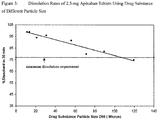
- Figures 3 and 4 illustrate the dissolution data that shows that while particle size impacts dissolution, controlling the particle size to less than 89 microns will result in a dissolution rate that will ensure consistent in-vivo exposures.
- consistent exposures are expected once apixaban tablets have greater than 77% apixaban dissolved in 30 minutes. Since the tablets with 89 microns have >77% dissolved at 30 minutes, these tablets will also exhibit exposures that are equivalent to the exposures from tablets made with smaller particles (such as the tablets with 10 micron particles shown below).
Landscapes
- Health & Medical Sciences (AREA)
- Life Sciences & Earth Sciences (AREA)
- Chemical & Material Sciences (AREA)
- Medicinal Chemistry (AREA)
- Pharmacology & Pharmacy (AREA)
- Animal Behavior & Ethology (AREA)
- General Health & Medical Sciences (AREA)
- Public Health (AREA)
- Veterinary Medicine (AREA)
- Epidemiology (AREA)
- Engineering & Computer Science (AREA)
- Bioinformatics & Cheminformatics (AREA)
- Biophysics (AREA)
- Molecular Biology (AREA)
- Nuclear Medicine, Radiotherapy & Molecular Imaging (AREA)
- General Chemical & Material Sciences (AREA)
- Organic Chemistry (AREA)
- Chemical Kinetics & Catalysis (AREA)
- Hematology (AREA)
- Diabetes (AREA)
- Nutrition Science (AREA)
- Physiology (AREA)
- Pharmaceuticals Containing Other Organic And Inorganic Compounds (AREA)
- Medicinal Preparation (AREA)
- Polyurethanes Or Polyureas (AREA)
- Acyclic And Carbocyclic Compounds In Medicinal Compositions (AREA)
Abstract
Description
- This invention relates to apixaban pharmaceutical formulations comprising crystalline apixaban particles having a maximum size cutoff, and methods of using them, for example, for the treatment and/or prophylaxis of thromboembolic disorders.
- Apixaban is a known compound having the structure:

- The chemical name for apixaban is 4,5,6,7-tetrahydro-1-(4-methoxyphenyl)-7-oxo-6-[4-(2-oxo-1-piperidinyl)phenyl]-1H-pyrazolo[3,4-c]pyridine-3-carboxamide (CAS name) or 1-(4-methoxyphenyl)-7-oxo-6-[4-(2-oxo-1-piperidinyl)phenyl]-4,5,6,7-tetrahydro-1H-pyrazolo[3,4-c]pyridine-3-carboxamide (IUPAC name).
- Apixaban is disclosed in
U.S. Patent No. 6,967,208 (based onU.S. Application Serial No. 10/245,122 filed September 17, 2002 - The aqueous solubility (40 µg/mL at all physiological pH) of apixaban suggests that the tablets with less than 10 mg apixaban (dose/solubility ratio = 250 mL) should not demonstrate dissolution rate limited absorption since dissolution rate limitations are only expected when the dose/solubility ratio is greater than 250 mL. Based on this dose and solubility consideration, the particle size of the compound should not be critical for achieving consistent plasma profiles, according to the prediction based on the Biopharmaceutics Classification System (BCS; Amidon, G. L. et al., Pharmaceutical Research, 12: 413-420 (1995)). However, it was determined that formulations that were made using a wet granulation process as well as those using large particles of apixaban drug substance resulted in less than optimal exposures, which can present quality control challenges.
- Surprisingly and unexpectedly, it has been found that compositions for tablets comprising up to 5 mg, apixaban particles having a D90 (90% of the volume) less than 89 microns (µm) lead to consistent in-vivo dissolution in humans (at physiologic pH), hence, consistent exposure and consistent Factor Xa inhibition that will lead to consistency in therapeutic effect. Consistent exposure is defined as that where in-vivo exposure from tablets is similar to that from a solution and not affected by the differences in dissolution rates. The compositions were prepared using a dry granulation process. Accordingly, the invention provides a pharmaceutical composition comprising crystalline apixaban particles having a D90 equal to or less than about 89 µm as measured by laser light scattering method, and a pharmaceutically acceptable diluent or carrier. It is preferred that the apixaban particles in the composition have a D90 not exceeding 89 µm. It is noted the notation Dx means that X% of the volume of particles have a diameter less than a specified diameter D. Thus a D90 of 89 µm means that 90% of the volume of particles in an apixaban composition have a diameter less than 89 µm.
- The range of particle sizes preferred for use in the invention is D90 less than 89 µm, more preferably D90 less than 50 µm, even more preferably D90 less than 30 µm, and most preferably D90 less than 25 µm. The particle sizes stipulated herein and in the claims refer to particle sizes were determined using a laser light scattering technique.
- The invention further provides the pharmaceutical composition further comprising a surfactant from 0.25% to 2% by weight, preferably from 1% to 2% by weight. As regards the surfactant, it is generally used to aid in wetting of a hydrophobic drug in a tablet formulation to ensure efficient dissolution of the drug, for example, sodium lauryl sulfate, sodium stearate,
polysorbate 80 and poloxamers, preferably sodium lauryl sulfate. - The invention further provides a method for the treatment or prophylaxis of thromboembolic disorders, comprising administering to a patient in need of such treatment or prophylaxis a therapeutically effective amount of a composition comprising crystalline apixaban particles having a D90 equal to or less than about 89 µm as measured by laser light scattering, and a pharmaceutically acceptable carrier.
- The present invention also provides a dry granulation process for preparing a composition comprising crystalline apixaban particles having a D90 equal to or less than about 89 µm as measured by laser light scattering, and a pharmaceutically acceptable carrier.
- The formulations of this invention are advantageous because, inter alia, as noted above, they lead to consistent human in-vivo dissolution. The invention is surprising in this respect, however, in that exposures are variable even though apixaban has adequate aqueous solubility that would allow the drug to dissolve rapidly. That is, one would expect dissolution rate for a drug that has high solubility (as defined by the Biopharmaceutical Classification System) would not be limited by the particle size. It has surprisingly been found, however, that the particle size that impacts apixaban absorption rate is about a D90 of 89 µm. Thus apixaban can be formulated in a composition having a reasonable particle size using dry granulation process, to achieve and maintain relatively fine particles to facilitate consistent in vivo dissolution.
- In a relative bioavailabiltiy study where various apixaban formulations were evaluated, it was determined that formulations made using a wet granulation process resulted in lower exposures compared to the exposures obtained from a dry granulation process. Additionally, tablets made using larger particles (D90 of 89 µm) had lower exposures compared to tablets made using the same process but with particle size of D90 of 50 µm. In a dry granulation process, water is not used during manufacturing to develop granules containing apixaban and the excipients.
- Formulations according to this invention, when dissolution tested in vitro preferably exhibit the following dissolution criteria. That is, the formulation exhibits dissolution properties such that, when an amount of the drug equivalent to 77% therein dissolves within 30 minutes. Usually the test result is established as an average for a pre-determined number of dosages (e.g., tablets, capsules, suspensions, or other dosage form), usually 6. The dissolution test is typically performed in an aqueous media bufferred to a pH range (1 to 7.4) observed in the gastrointestinal tract and controlled at 37° C (±1°C), together maintaining a physilogical relevance. It is noted that if the dosage form being tested is a tablet, typically paddles rotating at 50-75 rpm are used to test the dissolution rate of the tablets. The amount of dissolved apixaban can be determined conventionally by HPLC, as hereinafter described. The dissolution (in-vitro) test is developed to serve as a quality control tool, and more preferably to predict the biological (invivo) performance of the tablet, where invivo-invitro relationships (IVIVR) are established.
- The term "particles" refers to individual drug substance particles whether the particles exist singly or are agglomerated. Thus, a composition comprising particulate apixaban may contain agglomerates that are well beyond the size limit of about 89 µm specified herein. However, if the mean size of the primary drug substance particles (i.e., apixaban) comprising the agglomerate are less than about 89 µm individually, then the agglomerate itself is considered to satisfy the particle size constraints defined herein and the composition is within the scope of the invention.
- Reference to apixaban particles having "a mean particle size" (herein also used interchangeably with "VMD" for "volume mean diameter") equal to or less than a given diameter or being within a given particle size range means that the average of all apixaban particles in the sample have an estimated volume, based on an assumption of spherical shape, less than or equal to the volume calculated for a spherical particle with a diameter equal to the given diameter. Particle size distribution can be measured by laser light scattering technique as known to those skilled in the art and as further disclosed and discussed below.
- "Bioequivalent" as employed herein means that if a dosage form is tested in a crossover study (usually comprising a cohort of at least 10 or more human subjects), the average Area under the Curve (AUC) and/or the Cmax for each crossover group is at least 80% of the (corresponding) mean AUC and/or Cmax observed when the same cohort of subjects is dosed with an equivalent formulation and that formulation differs only in that the apixaban has a preferred particle size with a D90 in the range from 30 to 89 µm. The 30 µm particle size is, in effect, a standard against which other different formulations can be compared. AUCs are plots of serum concentration of apixaban along the ordinate (Y-axis) against time for the abscissa (X-axis). Generally, the values for AUC represent a number of values taken from all the subjects in a patient population and are, therefore, mean values averaged over the entire test population. C.sub.max, the observed maximum in a plot of serum level concentration of apixaban (Y-axis) versus time (X-axis) is likewise an average value.
- Use of AUCs, Cmax, and crossover studies is, of course otherwise well understood in the art. The invention can indeed be viewed in alternative terms as a composition comprising crystalline apixaban particles having a mean particle size equal to or less than about 89 µm, as measured by Malvern light scattering, and a pharmaceutically acceptable carrier, said composition exhibiting a mean AUC and/or mean Cmax which are at least 80% of the corresponding mean AUC and/or Cmax values exhibited by a composition equivalent thereto (i.e., in terms of excipients employed and the amount of apixaban) but having an apixaban mean particle size of 30 µm. Use of the term "AUC" for purposes of this invention implies crossover testing within a cohort of at least 10 healthy subjects for all compositions tested, including the "standard" 30 µm particle size composition.
- The present invention may be embodied in other specific forms without departing from the spirit or essential attributes thereof. Thus, the above embodiments should not be considered limiting. Any and all embodiments of the present invention may be taken in conjunction with any other embodiment or embodiments to describe additional embodiments. Each individual element of the embodiments is its own independent embodiment. Furthermore, any element of an embodiment is meant to be combined with any and all other elements from any embodiment to describe an additional embodiment. In addition, the present invention encompasses combinations of different embodiment, parts of embodiments, definitions, descriptions, and examples of the invention noted herein.
- As previously stated, apixaban in any form which will crystallize can be used in this invention. Apixaban may be obtained directly via the synthesis described in
U.S. Pat. No. 6,967,208 and/orUS20060069258A1 (based on U.S. Application Serial No.11/235,510 filed September 26, 2005 - Form N-1 (neat) and Form H2-2 (hydrate) of apixaban may be characterized by unit cell parameters substantially equal to the following shown in Table 1.
Table 1 Form N-1 H2-2 Solvate None Dihydrate T +22 +22 a(Å) 10.233(1) 6.193(1) b(Å) 13.852(1) 30.523(1) c(Å) 15.806(1) 13.046(1) α,° 90 90 β,° 92.98(1) 90.95(1) γ,° 90 90 V(Å3) 2237.4(5) 2466.0(5) Z' 1 1 Vm 559 617 SG P21/n P21/n Dcalc 1.364 1.335 R 0.05 0.09 Sol.sites None 2 H2O - Z' is the number of molecules per asymmetric unit.
- T(°C) is the temperature for the crystallographic data.

- Characteristic X-ray diffraction peak positions (degrees 2θ±0.1) at room temperature, based on a high quality pattern collected with a diffractometer (CuKα) with a spinning capillary with 2θ calibrated with a NIST suitable standard are shown in Table 2 below.
Table 2 Form N-1 Form H2-2 10.0 5.8 10.6 7.4 12.3 16.0 12.9 20.2 18.5 23.5 27.1 25.2 - It will be appreciated by those skilled in the art of manufacturing and granulation processes that there are numerous known methods which can be applied to producing apixaban solid dosage forms. The feature of this invention, however, involves processes that produce apixaban dosage forms with an ability to produce primary particles at the site of dissolution with a d90<89 µm. Examples of such methods include as well as dry granulation or wet-granulation by low or high-shear techniques
- The dry granulation process that produces crystalline apixaban particles having a mean particle size equal to or less than about 89 µm, is believed to be novel, and is accordingly provided as a further feature of the invention. Thus, the invention provides a drug product manufacturing process, comprising the steps:
- (1) Blend the raw materials required prior to granulation;
- (2) Granulate the raw materials from
Step 1 using a dry or wet granulation process; - (3) Blend the sized granules from
step 3 with extragranular raw materials; - (4) Compress the blend from
Step 3 into tablets; and - (5) Film coat the tablets from step 4.
- In another embodiment, the invention provides a drug product manufacturing process, comprising the steps:
- (1) Blend the raw materials, with apixaban of controlled particle size;
- (2) Include intragranular portions of binder, disintegrant and other fillers in the mix from step (1);
- (3) Granulate the materials from step (2) using process (3a) or (3b):
- (3a) DRY GRANULATION: Delump the intragranular lubricant using a suitable screen or mill. Add the lubricant to the blend from step (2) and blend. Compact the lubricated blend to ribbons of density in the range of 1.0 to 1.2 g/cc and size the compacted ribbons using a roller compactor; or
- (3b) WET GRANULATION: Wet granulate the composition from step (2) using water to a target end point and optionally, size the wet-granules by passing through a screen/mill. Remove water for granulation by drying in a convection oven or a fluid-bed dryer. Size the dried granules by passing through a screen/mill;
- (4) Blend the sized granules from step (3) and the extragranular disintegrant in a suitable blender;
- (5) Delump the extragranular lubricant using a suitable screen/mill and blend with granules from step (4);
- (6) Compress the blend from (5) into tablets;
- (7) Film coat the tablets from step (6).
- In a preferred embodiment, a dry granulation process is employed.
- In a preferred embodiment, the surfactant (SLS) in the composition serves as a wetting aid for inherently hydrophobic apixaban drug substance (contact angle=54° with water), further exacerbated as part of air-jet milling process that is used to reduce apixaban particle size to the desired size.
- The amount of apixaban contained in a tablet, capsule, or other dosage form containing a composition of this invention will usually be between 2.5 and 5 mg, usually administered orally twice a day, although amounts outside this range and different frequencies of administration are feasible for use in therapy as well. As previously mentioned, such dosage forms are useful, inter alia, in the prevention and/or treatment of thromboembolic disorders, for example, deep vein thrombosis, acute coronary syndrome, stroke, and pulmonary embolism, as disclosed in
U.S. Pat. No. 6,967,208 . - As noted, average particle size can be determined by Malvern light scattering, a laser light scattering technique. In the examples below, the particle size for apixaban drug substance was measured using a Malvern particle size analyzer.
- Upon measurement completion, the sample cell was emptied and cleaned, refilled with suspending medium, and the sampling procedure repeated for a total of three measurements.
- The dissolution test is performed in 900 mL of dissolution medium at 37 °C, using USP Apparatus 2 (paddles) method at a rotation speed of 75 rpm. Samples are removed after 10, 20, 30, 45, and 60 minutes from test initiation and analyzed for apixaban by HPLC at 280 nm. 0.1 N HCl or 0.05 M sodium phosphate pH 6.8 with 0.05% SDS solution has been used as dissolution medium during formulation development. While both methods serve the purposes as quality control tests (with adequate discrimination ability), and in establishing IVIVR, the latter was preferred from the standpoint of method robustness. A role of SDS (surfactant) in the latter dissolution medium is as a wetting aid to facilitate complete dissolution of hydrophobic apixaban from tablets, rather than to increase the solubility of apixaban. Dissolution data from both the tests are included in this invention record and unless otherwise specified, the results reported were averages of values from six tablets.
- Blood samples are drawn at predetermined time points following drug administration as specified in the clinical study protocol. Concentrations of the samples are measured using a validated analytical method (Liquid Chromatography with Tandem Mass Spectrometry). Individual subject pharmacokinetic parameters (eg, Cmax, AUC, T-HALF) are derived by non-compartmental methods using Kinetica® software from the time-concentration profiles.
- The invention is further exemplified and disclosed by the following nonlimiting examples:
- Table 3 shows apixaban tablet compositions prepared using the drygranulation process that were evaluated in bioequivalence (BE) study.
Table 3 Ingredients Dry Granulation 5% w/w Drug Loaded Granulation (% w/w) 20 mg Tablet (mg/tablet) Intragranular Apixaban 5.00 20.00 Lactose Anhydrous 49.25 197.00 Microcrystalline Cellulose 39.50 158.00 Croscarmellose Sodium 2.00 8.00 Magnesium Stearate 0.50 2.00 Sodium Lauryl Sulfate 1.00 4.00 Extragranular Croscarmellose Sodium 2.00 8.00 Magnesium Stearate 0.75 3.00 Total 100.00 mg 400 mg Film Coat 3.5 14.0 Total 103.5 mg 414 mg - Table 4 shows apixaban tablet compositions prepared using the wet granulation process that were evaluated in BE study.
Table 4 Ingredients Wet Granulation 5% w/w Drug Loaded Granulation (% w/w) 20 mg Tablet (mg/tablet) Intragranular Apixaban 5.00 20.00 Lactose Monohydrate 70.00 280.00 Microcrystalline Cellulose 5.00 60.00 Croscarmellose Sodium 2.50 10.00 Povidone 4.50 18.00 Purified Water 17.40 69.60 Extragranular Croscarmellose Sodium 2.50 10.00 Magnesium Stearate 0.50 2.09 Microcrystalline Cellulose 10.00 10.09 Total 100.00 400.00 Film Coat 3.5 14.0 Total 103.5 mg 414.0 - Table 5 and Table 5a show the dissolution data that indicates that having a dry granulation process will result in faster dissolution compared to that from a wet granulation process. As shown in Table 5, the 20 mg tablets made using a dry granulation process had 79% apixaban dissolved in 30 minutes versus 62% apixaban dissolved at 30 minutes for the 20 mg tablets made using a wet granulation process. Dissolution test in 0.1N HCl also indicated a similar behavior of faster dissolution from tablets made using dry granulation process (58% in 30min), compared to wet granulation process (45% in 30min).
Table 5 Time (minutes) % apixaban dissolved (USP II, 75 rpm, 0.05% SLS in 50mM phosphate, pH 6.8) Wet Granulation 20 mgTablets Dry Granulation 20 mg Tablets 10 38 47 20 54 70 30 62 79 45 71 86 60 76 90 API Particle Size D90 (µm) 83.8 83.8 Table 5a Time (minutes) % apixaban dissolved (USP II, 75 rpm, 0.1N HCl) Wet Granulation 20 mgTablets Dry Granulation 20 mg Tablets 10 30 41 20 39 52 30 45 58 45 51 64 60 56 68 90 64 74 API Particle Size D90 (µm) 83.8 83.8 - Table 6 and Table 6a provides the dissolution data from tablets made with different manufacturing pprocesses (wet and dry granulation) and drug substance different particle sizes. As shown Table 6, apixaban tablets that had 77% dissolved in 30 minutes or 86% dissolved in 30 minutes both had AUC values that met bioequivalence criteria (Confidence Interval between 80% to 125%) when compared to the tablets that had 89% dissolved at 30 minutes. Similar rank order of the dissolution rates were observed for these tablets (A, B & C) when tested in 0.1N HCl.
Table 6 Time (minutes) % apixaban dissolved (USP II, 75 rpm, 0.05% SLS in 50mM phosphate, pH 6.8) Wet Granulation 2 x 2.5 mg Tablets (A) Wet Granulation 2 x 2.5 mg Tablets (B) Dry Granulation 2 x 2.5 mg Tablets (C) 10 63 42 70 20 79 64 84 30 86 77 89 45 91 87 94 60 94 93 96 Cmax (ng/mL) 101.8 (21) 87.8(24) 108.3 (24) AUC(INF) (ng∗hr/mL) 1088 (32) 1030 (25) 1153 (26) Geomean (CV%) are presented for Cmax and AUC(INF) Table 6a Time (minutes) % apixaban dissolved (USP II, 75 rpm, 0.1N HCl) Wet Granulation 2 x 2.5 mg Tablets (A) Wet Granulation 2 x 2.5 mg Tablets (B) Dry Granulation 2 x 2.5 mg Tablets (C) 10 44 25 56 20 62 43 71 30 72 54 79 45 80 66 85 60 84 74 88 AUC(INF) (ng∗hr/mL) 1088 (32) 1030 (25) 1153 (26) Geomean (CV%) are presented for Cmax and AUC(INF) - The results of clinical studies demonstrated that, for tablets with similar dissolution rates (89% and 86% at 30 min in pH 6.8 phosphate buffer containing 0.05% SLS), Cmax and AUC of the
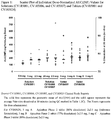
coated Phase 3 tablet (C) relative to theuncoated Phase 2 tablet (A), met bioequivalence criteria. Tablets with different dissolution rates (77% and 86% at 30 min) had similar AUCs, but did not meet equivalence criteria for Cmax. The lower boundary of the 90% confidence interval of ratio of geometric mean Cmax was 0.788, indicating the rate of absorption, as defined by Cmax, was lower for the slower dissolving tablet (77% at 30 min). Since the oral bioavailability from these tablets is shown to be comparable to that from solution (seeFigures 1 and2 below), this dissolution rate (77% in 30min) is defined as the threshold for achieving consistent exposure. -
Figures 3 and4 illustrate the dissolution data that shows that while particle size impacts dissolution, controlling the particle size to less than 89 microns will result in a dissolution rate that will ensure consistent in-vivo exposures. As indicated inFigures 3 and4 , consistent exposures are expected once apixaban tablets have greater than 77% apixaban dissolved in 30 minutes. Since the tablets with 89 microns have >77% dissolved at 30 minutes, these tablets will also exhibit exposures that are equivalent to the exposures from tablets made with smaller particles (such as the tablets with 10 micron particles shown below). Whilst dissolution rate at an apixaban particle size of 119 microns is marginally greater than 77% in 30-min for the 5-mg apixaban tablets (Figure-4), the particle size threshold claimed is less than 89 microns. This allows for the typical variability (RSD=2 to 3%) in the dissolution results, such that the oral bioavailability from tablets consistently matches that from solution. - The following represent further embodiments of the present invention:
- 1. A composition comprising crystalline apixaban particles having a mean particle size equal to or less than about 89 µm and a pharmaceutical acceptable diluent or carrier.
- 2. A composition comprising crystalline apixaban particles having a mean particle size equal to or less than about 85 µm and a pharmaceutical acceptable diluent or carrier.
- 3. A composition as defined in
embodiment 1 orembodiment 2, wherein said composition comprises FormN-1 of apixaban. - 4. A composition as defined in
embodiment 1, wherein particles with a D90 equal to or less than 89 µm. - 5. A composition as defined in
embodiment 2, wherein particles with a D90 equal to or less than 85 µm. - 6. A composition as defined in any one of embodiments 1-5, wherein particles with a D90 equal to or less than 50 µm.
- 7. A composition as defined in any one of embodiments 1-5, wherein particles with a D90 equal to or less than 30 µm.
- 8. A composition as defined in any one of embodiments 1-5, wherein particles with a D90 equal to or less than 25 µm.
- 9. A composition as defined in
embodiment 1 which exhibits an AUC and/or Cmax that is at least 80% of the mean AUC and/or Cmax observed for an equivalent formulation differing only in that the apixaban mean particle size is 89 µm. - 10. A composition as defined in
embodiment 1 which exhibits an AUC and/or Cmax that is at least 80% of the mean AUC and/or Cmax observed for an equivalent formulation differing only in that the apixaban mean particle size is 85 µm. - 11. A composition as defined in any one of embodiments 1-10, further comprising: from 1% to 2 % by weight of a surfactant.
- 12. A composition as defined in embodiment 11, wherein the surfactant is sodium lauryl sulfate.
- 13. A composition as defined in any one of embodiments 1-12 for use in treating a thromboembolic disorder.
- 14. Use of a composition as defined in any one of embodiments 1-12 in the treatment of a thromboembolic disorder.
- 15. Use of a composition as defined in any one of embodiments 1-12 in the preparation of a medicament for use in treating a thromboembolic disorder.
- 16. A process of manufacturing apixaban tablets having a composition as defined in any one of embodiments 1-12, comprising the steps of:
- (1) blending raw materials prior to granulation;
- (2) granulating the raw materials from the step (1) using a wet or dry granulation process;
- (3) blending the granules obtained in the step (2) with extragranular raw materials;
- (4) compressing the blend from the step (3) into tablets; and
- (5) film coating the tablets from the step (4).
- 17. A process of manufacturing apixaban tablets having a composition as defined in any one of embodiments 1-12, comprising the steps of:
- (1) blending raw materials with apixaban of controlled particle size to form a mix;
- (2) adding intragranular portions of a binder, a disintegrant and at least one filler to the mix from the step (1) to form a blend;
- (3) granulating the materials from the step (2) using a dry granulation process or a wet granulation process,
wherein the dry granulation process comprises:- delumping an intragranular lubricant using a screen or mill; adding the intragranular lubricant to the blend from the step (2) and blending to form a lubricated blend;
- compacting the lubricated blend to ribbons of density in a range of 1.1 to 1.2 g/cc and sizing the compacted ribbons using a roller compactor, and
- wet granulating the blend from the step (2) using water to a target end point and, optionally, sizing the wet-granules by passing through a screen or mill;
- removing the water from the granulation by drying in a convection oven or a fluid-bed dryer; and
- sizing the dried granules by passing through a screen or mill;
- (4) blending the granules obtained in the step (3) and an extragranular disintegrant in a blender;
- (5) delumping an extragranular lubricant using a screen or mill and blending with granules from the step (4);
- (6) compressing the blend from the step (5) into tablets; and
- (7) film coating the tablets from the step (6).
- 18. A process of manufacturing apixaban tablets according to embodiment 17, wherein the dry granulation process is used.
Claims (11)
- A tablet comprising crystalline apixaban particles and a pharmaceutically acceptable diluent or carrier, wherein the apixaban in the tablet has a dose/solubility ratio ≤ 250 mL and wherein the tablet exhibits dissolution properties such that an amount of the drug equivalent to at least 77% dissolves within 30 minutes, wherein the test result is established as an average 6 tablets and wherein dissolution test is performed in an aqueous media buffered to a pH in the range of 1 to 7.4 and controlled at 37 °C (±1°C).
- A tablet as defined in claim 1, wherein the particles have a D90 less than 89 µm, D90 less than 85 µm, a D90 less than 50 µm, a D90 less than 30 µm or a D90 less than 25 µm.
- A tablet as defined in claim 1 or 2, wherein said tablet comprises Form N-1 of apixaban.
- A tablet as defined in any one of claims 1 to 3, wherein the amount of apixaban contained in the tablet is:(a) up to 5 mg;(b) between 2.5 and 5 mg; or(b) 2.5 mg or 5 mg.
- A tablet as defined in any one of claims 1 to 4, wherein the dissolution test is performed in 900 mL of dissolution medium containing 0.05 M sodium phosphate at pH 6.8 with 0.05% SDS at 37 °C using USP Apparatus 2 (paddles) at a rotation speed of 50-75 rpm.
- A tablet as defined in claim 5, wherein the dissolution test is performed at a rotation speed of 75 rpm.
- A tablet as defined in any one of claims 1 to 6, wherein the tablet is prepared using a dry granulation process.
- A tablet as defined in any one of claims 1 to 7, wherein the tablet further comprises a surfactant from 0.25% to 2% by weight, preferably from 1 % to 2% by weight.
- A tablet as defined in claim 8, wherein the surfactant is used to aid in wetting of a hydrophobic drug in the tablet formulation to ensure efficient dissolution of the drug.
- A tablet as defined in claim 8 or 9, wherein the surfactant is selected from, sodium lauryl sulfate, sodium stearate, polysorbate 80 and poloxamers.
- A tablet as defined in one of claims 1 to 10 for use in the treatment of a thromboembolic disorder.
Applications Claiming Priority (6)
| Application Number | Priority Date | Filing Date | Title |
|---|---|---|---|
| US30805610P | 2010-02-25 | 2010-02-25 | |
| EP11707284.3A EP2538925B1 (en) | 2010-02-25 | 2011-02-24 | Apixaban formulations |
| EP19199147.0A EP3643301A1 (en) | 2010-02-25 | 2011-02-24 | Apixaban formulations |
| EP17175788.3A EP3251660B1 (en) | 2010-02-25 | 2011-02-24 | Apixaban formulations |
| EP15190823.3A EP3017811B1 (en) | 2010-02-25 | 2011-02-24 | Apixaban formulations |
| PCT/US2011/025994 WO2011106478A2 (en) | 2010-02-25 | 2011-02-24 | Apixaban formulations |
Related Parent Applications (5)
| Application Number | Title | Priority Date | Filing Date |
|---|---|---|---|
| EP17175788.3A Division EP3251660B1 (en) | 2010-02-25 | 2011-02-24 | Apixaban formulations |
| EP11707284.3A Division EP2538925B1 (en) | 2010-02-25 | 2011-02-24 | Apixaban formulations |
| EP19199147.0A Division-Into EP3643301A1 (en) | 2010-02-25 | 2011-02-24 | Apixaban formulations |
| EP19199147.0A Division EP3643301A1 (en) | 2010-02-25 | 2011-02-24 | Apixaban formulations |
| EP15190823.3A Division EP3017811B1 (en) | 2010-02-25 | 2011-02-24 | Apixaban formulations |
Publications (1)
| Publication Number | Publication Date |
|---|---|
| EP3662899A1 true EP3662899A1 (en) | 2020-06-10 |
Family
ID=43901603
Family Applications (7)
| Application Number | Title | Priority Date | Filing Date |
|---|---|---|---|
| EP15190823.3A Revoked EP3017811B1 (en) | 2010-02-25 | 2011-02-24 | Apixaban formulations |
| EP17175864.2A Revoked EP3246021B1 (en) | 2010-02-25 | 2011-02-24 | Apixaban formulations |
| EP17178613.0A Revoked EP3257500B1 (en) | 2010-02-25 | 2011-02-24 | Apixaban formulations |
| EP11707284.3A Revoked EP2538925B1 (en) | 2010-02-25 | 2011-02-24 | Apixaban formulations |
| EP17175788.3A Revoked EP3251660B1 (en) | 2010-02-25 | 2011-02-24 | Apixaban formulations |
| EP19199147.0A Withdrawn EP3643301A1 (en) | 2010-02-25 | 2011-02-24 | Apixaban formulations |
| EP20151141.7A Withdrawn EP3662899A1 (en) | 2010-02-25 | 2011-02-24 | Apixaban formulations |
Family Applications Before (6)
| Application Number | Title | Priority Date | Filing Date |
|---|---|---|---|
| EP15190823.3A Revoked EP3017811B1 (en) | 2010-02-25 | 2011-02-24 | Apixaban formulations |
| EP17175864.2A Revoked EP3246021B1 (en) | 2010-02-25 | 2011-02-24 | Apixaban formulations |
| EP17178613.0A Revoked EP3257500B1 (en) | 2010-02-25 | 2011-02-24 | Apixaban formulations |
| EP11707284.3A Revoked EP2538925B1 (en) | 2010-02-25 | 2011-02-24 | Apixaban formulations |
| EP17175788.3A Revoked EP3251660B1 (en) | 2010-02-25 | 2011-02-24 | Apixaban formulations |
| EP19199147.0A Withdrawn EP3643301A1 (en) | 2010-02-25 | 2011-02-24 | Apixaban formulations |
Country Status (31)
| Country | Link |
|---|---|
| US (5) | US9326945B2 (en) |
| EP (7) | EP3017811B1 (en) |
| JP (4) | JP5846647B2 (en) |
| KR (4) | KR20170126016A (en) |
| CN (3) | CN102770126A (en) |
| AU (1) | AU2011220775B2 (en) |
| BR (1) | BR112012021337A8 (en) |
| CA (1) | CA2791171C (en) |
| CO (1) | CO6640207A2 (en) |
| CY (5) | CY1117434T1 (en) |
| DK (5) | DK3251660T3 (en) |
| ES (5) | ES2714363T3 (en) |
| HK (2) | HK1243947B (en) |
| HR (5) | HRP20160179T1 (en) |
| HU (4) | HUE047139T2 (en) |
| IL (3) | IL309564A (en) |
| IN (1) | IN2012DN06587A (en) |
| LT (4) | LT3251660T (en) |
| MX (3) | MX353145B (en) |
| NZ (1) | NZ601738A (en) |
| PE (3) | PE20210468A1 (en) |
| PL (5) | PL2538925T3 (en) |
| PT (5) | PT3017811T (en) |
| RS (5) | RS59593B1 (en) |
| RU (1) | RU2685724C2 (en) |
| SG (2) | SG182750A1 (en) |
| SI (5) | SI2538925T1 (en) |
| SM (5) | SMT201900212T1 (en) |
| TR (1) | TR201903195T4 (en) |
| WO (1) | WO2011106478A2 (en) |
| ZA (1) | ZA201205807B (en) |
Cited By (2)
| Publication number | Priority date | Publication date | Assignee | Title |
|---|---|---|---|---|
| WO2022115051A1 (en) | 2020-11-27 | 2022-06-02 | Santa Farma Ilac Sanayii A.S. | Direct compression method for non-micronised apixaban formulations |
| WO2022115052A1 (en) | 2020-11-27 | 2022-06-02 | Santa Farma Ilac Sanayii A.S. | Improved wet granulation processes for apixaban comprising formulations |
Families Citing this family (51)
| Publication number | Priority date | Publication date | Assignee | Title |
|---|---|---|---|---|
| IL309564A (en) * | 2010-02-25 | 2024-02-01 | Pfizer | Apixaban formulations |
| WO2013164839A2 (en) * | 2012-03-06 | 2013-11-07 | Cadila Healthcare Limited | Amorphous form of apixaban, process of preparation and compositions thereof |
| EP2854759B1 (en) * | 2012-05-24 | 2019-12-18 | ratiopharm GmbH | Dosage forms comprising apixaban and matrix former |
| RU2660358C2 (en) * | 2012-09-26 | 2018-07-05 | Бристол-Майерс Сквибб Холдингс Айеленд | Apixaban liquid formulations |
| CN102908324A (en) * | 2012-10-31 | 2013-02-06 | 南京正科制药有限公司 | Apixaban tablet |
| EP2752414A1 (en) | 2013-01-04 | 2014-07-09 | Sandoz AG | Crystalline form of apixaban |
| CZ2013305A3 (en) | 2013-04-23 | 2014-11-05 | Zentiva, K.S. | Novel crystalline forms of APIXABAN and process of their preparation |
| WO2014203275A2 (en) * | 2013-06-18 | 2014-12-24 | Cadila Healthcare Limited | An improved process for the preparation of apixaban and intermediates thereof |
| EP2907507A1 (en) | 2014-02-17 | 2015-08-19 | Sandoz Ag | Pharmaceutical composition comprising apixaban |
| CN103830199A (en) * | 2014-03-24 | 2014-06-04 | 重庆东得医药科技有限公司 | Medicine preparation containing apixaban and preparation method of medicine preparation |
| SG10201900648SA (en) | 2014-07-25 | 2019-02-27 | Novartis Ag | Tablet formulation of 2-fluoro-n-methyl-4-[7-(quinolin-6-ylmethyl)imidazo[1,2-b][1,2,4]triazin-2-yl]benzamide |
| CN104316637B (en) * | 2014-10-30 | 2016-08-17 | 江苏宝众宝达药业有限公司 | High effective liquid chromatography for measuring Eliquis cleans residual quantity |
| US9603846B2 (en) | 2014-11-25 | 2017-03-28 | Cadila Healthcare Limited | Process for the preparation of apixaban |
| AU2016259897A1 (en) * | 2015-05-08 | 2017-08-17 | Wockhardt Limited | Stable pharmaceutical compositions comprising antibacterial agent |
| WO2017088841A1 (en) | 2015-11-26 | 2017-06-01 | Zentiva, K.S. | Preparation of a drug form containing amorphous apixaban |
| CN106913528A (en) * | 2015-12-25 | 2017-07-04 | 中美华世通生物医药科技(武汉)有限公司 | Eliquis micropill and preparation method thereof |
| US10537524B2 (en) * | 2016-01-12 | 2020-01-21 | North & South Brother Pharmacy Investment Company Limited | Apixaban solid composition and preparation method thereof |
| EP3195860A1 (en) * | 2016-01-22 | 2017-07-26 | STADA Arzneimittel AG | Method for producing an apixaban granulate |
| WO2017163170A1 (en) * | 2016-03-21 | 2017-09-28 | Sun Pharmaceutical Industries Limited | Pharmaceutical composition comprising apixaban |
| WO2017182908A1 (en) * | 2016-04-18 | 2017-10-26 | Emcure Pharmaceuticals Limited | Pharmaceutical compositions of apixaban |
| EP3243505A1 (en) | 2016-05-13 | 2017-11-15 | Zaklady Farmaceutyczne Polpharma SA | A pharmaceutical composition comprising amorphous apixaban |
| CN106822006B (en) * | 2016-06-08 | 2020-08-28 | 北京普德康利医药科技发展有限公司 | Apixaban tablet and preparation method thereof |
| WO2017221209A1 (en) | 2016-06-23 | 2017-12-28 | Lupin Limited | Pharmaceutical formulations of apixaban |
| WO2018054357A1 (en) * | 2016-09-24 | 2018-03-29 | 山东亨利医药科技有限责任公司 | Pharmaceutical composition comprising mineralocorticoid receptor antagonist and use thereof |
| CN106420651B (en) * | 2016-09-28 | 2019-03-08 | 乐普药业股份有限公司 | A kind of preparation method of Apixaban tablet |
| EP3582777A4 (en) | 2017-02-17 | 2020-12-23 | Unichem Laboratories Ltd | PHARMACEUTICAL COMPOSITION OF APIXABAN |
| JP7044115B2 (en) | 2017-11-27 | 2022-03-30 | 三菱ケミカル株式会社 | A resin modification composition for a thermoplastic resin containing a rubber-containing graft polymer composition, a rubber-containing graft polymer-containing resin composition and a molded product thereof. |
| KR20190075566A (en) | 2017-12-21 | 2019-07-01 | 전자부품연구원 | Monitoring system and method for using a multi-sensor |
| TR201722523A2 (en) | 2017-12-28 | 2019-07-22 | Sanovel Ilac Sanayi Ve Ticaret Anonim Sirketi | SOLID ORAL PHARMACEUTICAL COMPOSITIONS CONTAINING APIXABAN |
| CN108236604A (en) * | 2018-02-07 | 2018-07-03 | 中国药科大学 | Eliquis flexible lipidosome |
| MX2020010673A (en) | 2018-04-16 | 2020-10-28 | Bristol Myers Squibb Co | Apixaban formulations. |
| KR20190130411A (en) | 2018-05-14 | 2019-11-22 | 신일제약주식회사 | Pharmaceutical formulation comprising apixaban and method for preparing the same |
| WO2020034989A1 (en) | 2018-08-14 | 2020-02-20 | 江苏恒瑞医药股份有限公司 | Injectable pharmaceutical composition and preparation method therefor |
| EP3666773A1 (en) | 2018-12-11 | 2020-06-17 | KRKA, D.D., Novo Mesto | Process for preparing apixaban |
| EP3669866A1 (en) | 2018-12-19 | 2020-06-24 | KRKA, d.d., Novo mesto | Pharmaceutical composition comprising apixaban |
| CN111377915B (en) * | 2018-12-30 | 2023-10-24 | 鲁南制药集团股份有限公司 | Pyrazolo-pyridone compound crystal form D |
| CN109464415B (en) * | 2019-01-09 | 2021-08-17 | 常州恒邦药业有限公司 | Apixaban pharmaceutical composition and preparation method thereof |
| KR20220101103A (en) | 2019-11-13 | 2022-07-19 | 유니슨 파마슈티컬스 피브이티. 엘티디. | Orally disintegrating pharmaceutical composition of apixaban |
| CN111214442B (en) * | 2020-02-13 | 2021-12-10 | 山东百诺医药股份有限公司 | Apixaban co-micropowder |
| CN111494326A (en) * | 2020-04-11 | 2020-08-07 | 南京正大天晴制药有限公司 | Apixaban tablet and preparation method thereof |
| TR202100250A2 (en) | 2021-01-08 | 2022-07-21 | Sanovel Ilac Sanayi Ve Ticaret Anonim Sirketi | FILM COATED TABLET WITH APIKSABAN |
| WO2022150030A2 (en) | 2021-01-08 | 2022-07-14 | Sanovel Ilac Sanayi Ve Ticaret Anonim Sirketi | A film coated tablet of apixaban |
| JP2022112698A (en) * | 2021-01-22 | 2022-08-03 | 東和薬品株式会社 | Pharmaceutical composition containing apixaban |
| GB202102575D0 (en) | 2021-02-23 | 2021-04-07 | Teva Pharmaceutical Industries Ltd | Fixed-dose pharmaceutical compositions |
| AU2022288053B2 (en) * | 2021-06-08 | 2025-08-07 | Taho Pharmaceuticals Ltd. | Apixaban film product and uses thereof |
| AU2022374714B2 (en) | 2021-10-27 | 2024-05-23 | Pharma-Data Research And Development Single Member S.A. | Apixaban suspension and preparation method |
| JP7834007B2 (en) * | 2022-10-12 | 2026-03-23 | 日本ジェネリック株式会社 | Tablets containing apixaban |
| JP2024064876A (en) * | 2022-10-28 | 2024-05-14 | ニプロ株式会社 | Pharmaceutical Compositions |
| KR102760108B1 (en) | 2024-04-09 | 2025-01-24 | 에바바이오 주식회사 | Enhanced bioavailability of amorphous Apixaban solid dispersion formulation by improving solubility and permeability and extended-release tablet thereof |
| JP7854233B2 (en) * | 2024-10-10 | 2026-05-01 | 富士化学工業株式会社 | Apixaban-containing composition, apixaban-containing solid preparation, and method for producing apixaban-containing solid preparation. |
| EP4759304A1 (en) | 2024-12-10 | 2026-06-17 | Laboratoires S.M.B. | Pellet compositions comprising apixaban and methods for the production thereof |
Citations (5)
| Publication number | Priority date | Publication date | Assignee | Title |
|---|---|---|---|---|
| US6967208B2 (en) | 2001-09-21 | 2005-11-22 | Bristol-Myers Squibb Pharma Company | Lactam-containing compounds and derivatives thereof as factor Xa inhibitors |
| US20060069258A1 (en) | 2004-09-28 | 2006-03-30 | Rafael Shapiro | Process for preparing 4,5-dihydro-pyrazolo[3,4-c]pyrid-2-ones |
| US20060160841A1 (en) * | 2005-01-19 | 2006-07-20 | Chenkou Wei | Crystallization via high-shear transformation |
| WO2008031782A1 (en) * | 2006-09-12 | 2008-03-20 | Glaxo Group Limited | Pharmaceutical composition comprising a plurality of mini-tablets comprising a factor xa inhibitor |
| WO2010147978A1 (en) * | 2009-06-16 | 2010-12-23 | Pfizer Inc. | Dosage forms of apixaban |
Family Cites Families (21)
| Publication number | Priority date | Publication date | Assignee | Title |
|---|---|---|---|---|
| US6150366A (en) | 1998-06-15 | 2000-11-21 | Pfizer Inc. | Ziprasidone formulations |
| NZ511674A (en) | 1998-12-23 | 2003-11-28 | Du Pont Pharm Co | Nitrogen containing heterobicycles as factor Xa inhibitors |
| AU2002341693B2 (en) | 2001-09-21 | 2008-05-29 | Bristol-Myers Squibb Holdings Ireland Unlimited Company | Lactam-containing compounds and derivatives thereof as factor Xa inhibitors |
| US20070025991A1 (en) * | 2003-03-19 | 2007-02-01 | Charalabos Pothoulakis | Use of antagonists of ghrelin or ghrelin receptor to treat intestinal inflammation |
| US20050059719A1 (en) * | 2003-09-16 | 2005-03-17 | Badawy Sherif Ibrahim Farag | Solid dosage formulation containing a Factor Xa inhibitor and method |
| DE10355461A1 (en) * | 2003-11-27 | 2005-06-23 | Bayer Healthcare Ag | Solid, high bioavailabilty oral formulations of N-substituted 5-chloro-2-thiophene-carboxamide derivative in hydrophilized form, useful for combating thrombo-embolic diseases |
| US7434502B2 (en) | 2004-07-21 | 2008-10-14 | Husqvarna Outdoor Products Inc. | Bar knob with cam-operated locking mechanism |
| US20060016084A1 (en) * | 2004-07-24 | 2006-01-26 | Ching-Lin Liao | Laser-Based datum instrument |
| GB0507577D0 (en) | 2005-04-14 | 2005-05-18 | Novartis Ag | Organic compounds |
| US20070191306A1 (en) * | 2005-08-17 | 2007-08-16 | Bristol-Myers Squibb Company | FACTOR Xa INHIBITOR FORMULATION AND METHOD |
| US9034381B2 (en) | 2005-11-10 | 2015-05-19 | Alphapharm Pty Ltd | Process to control particle size |
| US20070259913A1 (en) | 2006-05-04 | 2007-11-08 | David Deitchman | Prophylaxis of thromboembolic events in cancer patients |
| FI20080351A0 (en) | 2008-05-09 | 2008-05-09 | Atacama Labs Oy | Process for preparing a tablet with low drug content |
| KR101509829B1 (en) * | 2007-05-02 | 2015-04-06 | 포톨라 파마슈티컬스, 인코포레이티드 | Combination therapy with a compound acting as a platelet adp receptor inhibitor |
| US20090143343A1 (en) * | 2007-11-13 | 2009-06-04 | Meritage Pharma, Inc. | Compositions for the treatment of inflammation of the gastrointestinal tract |
| WO2009135946A1 (en) * | 2008-05-09 | 2009-11-12 | Atacama Labs Oy | Method and apparatus for dry granulation |
| CN102089051A (en) | 2008-07-11 | 2011-06-08 | 巴斯夫欧洲公司 | Amphiphilic proteins as morphology modifiers |
| US20100018486A1 (en) * | 2008-07-22 | 2010-01-28 | Hung-Tao Liu | Cathode energy fuel-saving device |
| CN107233337A (en) * | 2009-04-29 | 2017-10-10 | 阿马里纳药物爱尔兰有限公司 | Pharmaceutical composition containing EPA and cardiovascular agents and use its method |
| IL309564A (en) * | 2010-02-25 | 2024-02-01 | Pfizer | Apixaban formulations |
| AU2011225810B2 (en) * | 2010-03-10 | 2014-11-06 | Lupin Limited | Rifaximin ready-to-use suspension |
-
2011
- 2011-02-24 IL IL309564A patent/IL309564A/en unknown
- 2011-02-24 EP EP15190823.3A patent/EP3017811B1/en not_active Revoked
- 2011-02-24 RU RU2012140690A patent/RU2685724C2/en active
- 2011-02-24 PL PL11707284T patent/PL2538925T3/en unknown
- 2011-02-24 SI SI201130742T patent/SI2538925T1/en unknown
- 2011-02-24 DK DK17175788T patent/DK3251660T3/en active
- 2011-02-24 MX MX2015007763A patent/MX353145B/en unknown
- 2011-02-24 SG SG2012055547A patent/SG182750A1/en unknown
- 2011-02-24 SM SM20190212T patent/SMT201900212T1/en unknown
- 2011-02-24 MX MX2017016605A patent/MX364938B/en unknown
- 2011-02-24 PT PT15190823T patent/PT3017811T/en unknown
- 2011-02-24 US US13/579,796 patent/US9326945B2/en active Active
- 2011-02-24 IN IN6587DEN2012 patent/IN2012DN06587A/en unknown
- 2011-02-24 DK DK17175864.2T patent/DK3246021T3/en active
- 2011-02-24 CN CN201180011229XA patent/CN102770126A/en active Pending
- 2011-02-24 RS RS20191493A patent/RS59593B1/en unknown
- 2011-02-24 JP JP2012555127A patent/JP5846647B2/en active Active
- 2011-02-24 MX MX2012009244A patent/MX2012009244A/en active IP Right Grant
- 2011-02-24 SI SI201131811T patent/SI3251660T1/en unknown
- 2011-02-24 BR BR112012021337A patent/BR112012021337A8/en not_active Application Discontinuation
- 2011-02-24 DK DK15190823.3T patent/DK3017811T3/en active
- 2011-02-24 PL PL17175788T patent/PL3251660T3/en unknown
- 2011-02-24 PE PE2020000316A patent/PE20210468A1/en unknown
- 2011-02-24 SM SM20190650T patent/SMT201900650T1/en unknown
- 2011-02-24 KR KR1020177031997A patent/KR20170126016A/en not_active Ceased
- 2011-02-24 SI SI201131813T patent/SI3257500T1/en unknown
- 2011-02-24 EP EP17175864.2A patent/EP3246021B1/en not_active Revoked
- 2011-02-24 SG SG10201501349VA patent/SG10201501349VA/en unknown
- 2011-02-24 PL PL17175864T patent/PL3246021T3/en unknown
- 2011-02-24 KR KR1020237035193A patent/KR20230149861A/en not_active Ceased
- 2011-02-24 HU HUE17175788A patent/HUE047139T2/en unknown
- 2011-02-24 CN CN201810769647.9A patent/CN109602716A/en active Pending
- 2011-02-24 HR HRP20160179TT patent/HRP20160179T1/en unknown
- 2011-02-24 PL PL17178613T patent/PL3257500T3/en unknown
- 2011-02-24 RS RS20200017A patent/RS59810B1/en unknown
- 2011-02-24 DK DK17178613T patent/DK3257500T3/en active
- 2011-02-24 TR TR2019/03195T patent/TR201903195T4/en unknown
- 2011-02-24 PT PT171758642T patent/PT3246021T/en unknown
- 2011-02-24 WO PCT/US2011/025994 patent/WO2011106478A2/en not_active Ceased
- 2011-02-24 KR KR1020217031947A patent/KR20210124532A/en not_active Ceased
- 2011-02-24 SM SM20190649T patent/SMT201900649T1/en unknown
- 2011-02-24 EP EP17178613.0A patent/EP3257500B1/en not_active Revoked
- 2011-02-24 PE PE2015002402A patent/PE20160042A1/en unknown
- 2011-02-24 RS RS20190290A patent/RS58699B1/en unknown
- 2011-02-24 EP EP11707284.3A patent/EP2538925B1/en not_active Revoked
- 2011-02-24 KR KR1020127022152A patent/KR101796300B1/en not_active Ceased
- 2011-02-24 ES ES15190823T patent/ES2714363T3/en active Active
- 2011-02-24 RS RS20160088A patent/RS54559B1/en unknown
- 2011-02-24 AU AU2011220775A patent/AU2011220775B2/en active Active
- 2011-02-24 SI SI201131665T patent/SI3017811T1/en unknown
- 2011-02-24 ES ES17178613T patent/ES2757603T3/en active Active
- 2011-02-24 ES ES17175788T patent/ES2758031T3/en active Active
- 2011-02-24 EP EP17175788.3A patent/EP3251660B1/en not_active Revoked
- 2011-02-24 PL PL15190823T patent/PL3017811T3/en unknown
- 2011-02-24 PE PE2012001362A patent/PE20130378A1/en not_active Application Discontinuation
- 2011-02-24 EP EP19199147.0A patent/EP3643301A1/en not_active Withdrawn
- 2011-02-24 RS RS20191468A patent/RS59576B1/en unknown
- 2011-02-24 ES ES11707284.3T patent/ES2562279T3/en active Active
- 2011-02-24 CN CN201811354155.XA patent/CN109602713A/en active Pending
- 2011-02-24 HU HUE17178613A patent/HUE047140T2/en unknown
- 2011-02-24 NZ NZ601738A patent/NZ601738A/en unknown
- 2011-02-24 PT PT171786130T patent/PT3257500T/en unknown
- 2011-02-24 LT LT17175788T patent/LT3251660T/en unknown
- 2011-02-24 HU HUE15190823A patent/HUE043932T2/en unknown
- 2011-02-24 LT LT17178613T patent/LT3257500T/en unknown
- 2011-02-24 PT PT117072843T patent/PT2538925E/en unknown
- 2011-02-24 SM SM20200034T patent/SMT202000034T1/en unknown
- 2011-02-24 PT PT171757883T patent/PT3251660T/en unknown
- 2011-02-24 EP EP20151141.7A patent/EP3662899A1/en not_active Withdrawn
- 2011-02-24 DK DK11707284.3T patent/DK2538925T3/en active
- 2011-02-24 HU HUE11707284A patent/HUE027168T2/en unknown
- 2011-02-24 LT LTEP15190823.3T patent/LT3017811T/en unknown
- 2011-02-24 LT LTEP17175864.2T patent/LT3246021T/en unknown
- 2011-02-24 CA CA2791171A patent/CA2791171C/en active Active
- 2011-02-24 ES ES17175864T patent/ES2767848T3/en active Active
- 2011-02-24 SI SI201131827T patent/SI3246021T1/en unknown
-
2012
- 2012-07-22 IL IL221064A patent/IL221064A0/en unknown
- 2012-08-01 ZA ZA2012/05807A patent/ZA201205807B/en unknown
- 2012-09-05 CO CO12152138A patent/CO6640207A2/en not_active Application Discontinuation
-
2015
- 2015-11-19 JP JP2015226794A patent/JP6033945B2/en active Active
-
2016
- 2016-02-17 SM SM201600049T patent/SMT201600049B/en unknown
- 2016-03-07 CY CY20161100194T patent/CY1117434T1/en unknown
- 2016-03-31 US US15/086,447 patent/US20160243101A1/en not_active Abandoned
- 2016-10-26 JP JP2016209347A patent/JP6192078B2/en active Active
-
2017
- 2017-03-30 US US15/474,236 patent/US20170202824A1/en not_active Abandoned
- 2017-03-30 US US15/474,264 patent/US20170202825A1/en not_active Abandoned
- 2017-04-27 IL IL251991A patent/IL251991A0/en unknown
- 2017-08-02 JP JP2017149644A patent/JP6577980B2/en active Active
-
2018
- 2018-03-14 HK HK18103544.5A patent/HK1243947B/en not_active IP Right Cessation
- 2018-03-14 HK HK18103542.7A patent/HK1243945B/en not_active IP Right Cessation
-
2019
- 2019-02-28 CY CY20191100249T patent/CY1121597T1/en unknown
- 2019-03-05 HR HRP20190430TT patent/HRP20190430T8/en unknown
- 2019-11-15 HR HRP20192064TT patent/HRP20192064T1/en unknown
- 2019-11-18 HR HRP20192069TT patent/HRP20192069T1/en unknown
- 2019-11-21 CY CY20191101226T patent/CY1122382T1/en unknown
- 2019-11-22 CY CY20191101231T patent/CY1122384T1/en unknown
-
2020
- 2020-01-13 HR HRP20200046TT patent/HRP20200046T1/en unknown
- 2020-01-28 CY CY20201100074T patent/CY1122529T1/en unknown
- 2020-05-14 US US15/931,910 patent/US20200375968A1/en not_active Abandoned
Patent Citations (5)
| Publication number | Priority date | Publication date | Assignee | Title |
|---|---|---|---|---|
| US6967208B2 (en) | 2001-09-21 | 2005-11-22 | Bristol-Myers Squibb Pharma Company | Lactam-containing compounds and derivatives thereof as factor Xa inhibitors |
| US20060069258A1 (en) | 2004-09-28 | 2006-03-30 | Rafael Shapiro | Process for preparing 4,5-dihydro-pyrazolo[3,4-c]pyrid-2-ones |
| US20060160841A1 (en) * | 2005-01-19 | 2006-07-20 | Chenkou Wei | Crystallization via high-shear transformation |
| WO2008031782A1 (en) * | 2006-09-12 | 2008-03-20 | Glaxo Group Limited | Pharmaceutical composition comprising a plurality of mini-tablets comprising a factor xa inhibitor |
| WO2010147978A1 (en) * | 2009-06-16 | 2010-12-23 | Pfizer Inc. | Dosage forms of apixaban |
Non-Patent Citations (3)
| Title |
|---|
| AMIDON, G. L. ET AL., PHARMACEUTICAL RESEARCH, vol. 12, 1995, pages 413 - 420 |
| ANONYMOUS: "Efficacy and Safety Study of Apixaban for the Treatment of Deep Vein Thrombosis or Pulmonary Embolism", CLINICAL TRIALS.GOV, NCT00643201, 18 February 2010 (2010-02-18), XP055640665, Retrieved from the Internet <URL:https://clinicaltrials.gov/archive/NCT00643201 /2010_02_18> [retrieved on 20191108] * |
| HENNING H BLUME ET AL: "The biopharmaceutics classification system (BCS): Class III drugs - better candidates for BA/BE waiver?", EUROPEAN JOURNAL OF PHARMACEUTICAL SCIENCES, vol. 9, no. 2, 1 December 1999 (1999-12-01), NL, pages 117 - 121, XP055308358, ISSN: 0928-0987, DOI: 10.1016/S0928-0987(99)00076-7 * |
Cited By (2)
| Publication number | Priority date | Publication date | Assignee | Title |
|---|---|---|---|---|
| WO2022115051A1 (en) | 2020-11-27 | 2022-06-02 | Santa Farma Ilac Sanayii A.S. | Direct compression method for non-micronised apixaban formulations |
| WO2022115052A1 (en) | 2020-11-27 | 2022-06-02 | Santa Farma Ilac Sanayii A.S. | Improved wet granulation processes for apixaban comprising formulations |
Also Published As
Similar Documents
| Publication | Publication Date | Title |
|---|---|---|
| EP3251660B1 (en) | Apixaban formulations | |
| HK1243945A1 (en) | Apixaban formulations | |
| HK1243947A1 (en) | Apixaban formulations | |
| AU2017228681B2 (en) | Apixaban formulations | |
| HK40031930A (en) | Apixaban formulations | |
| HK40029900A (en) | Apixaban formulations | |
| HK1243946B (en) | Apixaban formulations | |
| HK1224216B (en) | Apixaban formulations | |
| HK1180248B (en) | Apixaban formulations |
Legal Events
| Date | Code | Title | Description |
|---|---|---|---|
| PUAI | Public reference made under article 153(3) epc to a published international application that has entered the european phase |
Free format text: ORIGINAL CODE: 0009012 |
|
| STAA | Information on the status of an ep patent application or granted ep patent |
Free format text: STATUS: THE APPLICATION HAS BEEN PUBLISHED |
|
| AC | Divisional application: reference to earlier application |
Ref document number: 3643301 Country of ref document: EP Kind code of ref document: P Ref document number: 2538925 Country of ref document: EP Kind code of ref document: P Ref document number: 3017811 Country of ref document: EP Kind code of ref document: P Ref document number: 3251660 Country of ref document: EP Kind code of ref document: P |
|
| AK | Designated contracting states |
Kind code of ref document: A1 Designated state(s): AL AT BE BG CH CY CZ DE DK EE ES FI FR GB GR HR HU IE IS IT LI LT LU LV MC MK MT NL NO PL PT RO RS SE SI SK SM TR |
|
| STAA | Information on the status of an ep patent application or granted ep patent |
Free format text: STATUS: REQUEST FOR EXAMINATION WAS MADE |
|
| 17P | Request for examination filed |
Effective date: 20201209 |
|
| RBV | Designated contracting states (corrected) |
Designated state(s): AL AT BE BG CH CY CZ DE DK EE ES FI FR GB GR HR HU IE IS IT LI LT LU LV MC MK MT NL NO PL PT RO RS SE SI SK SM TR |
|
| REG | Reference to a national code |
Ref country code: HK Ref legal event code: DE Ref document number: 40031930 Country of ref document: HK |
|
| TPAC | Observations filed by third parties |
Free format text: ORIGINAL CODE: EPIDOSNTIPA |
|
| STAA | Information on the status of an ep patent application or granted ep patent |
Free format text: STATUS: EXAMINATION IS IN PROGRESS |
|
| 17Q | First examination report despatched |
Effective date: 20220520 |
|
| TPAC | Observations filed by third parties |
Free format text: ORIGINAL CODE: EPIDOSNTIPA |
|
| STAA | Information on the status of an ep patent application or granted ep patent |
Free format text: STATUS: THE APPLICATION HAS BEEN WITHDRAWN |
|
| 18W | Application withdrawn |
Effective date: 20241209 |