EP3662002B1 - Expandable granulates containing propellant on the basis of high-temperature thermoplastic - Google Patents
Expandable granulates containing propellant on the basis of high-temperature thermoplastic Download PDFInfo
- Publication number
- EP3662002B1 EP3662002B1 EP18742513.7A EP18742513A EP3662002B1 EP 3662002 B1 EP3662002 B1 EP 3662002B1 EP 18742513 A EP18742513 A EP 18742513A EP 3662002 B1 EP3662002 B1 EP 3662002B1
- Authority
- EP
- European Patent Office
- Prior art keywords
- blowing agent
- range
- polymer melt
- temperature
- acetone
- Prior art date
- Legal status (The legal status is an assumption and is not a legal conclusion. Google has not performed a legal analysis and makes no representation as to the accuracy of the status listed.)
- Active
Links
Images
Classifications
-
- C—CHEMISTRY; METALLURGY
- C08—ORGANIC MACROMOLECULAR COMPOUNDS; THEIR PREPARATION OR CHEMICAL WORKING-UP; COMPOSITIONS BASED THEREON
- C08J—WORKING-UP; GENERAL PROCESSES OF COMPOUNDING; AFTER-TREATMENT NOT COVERED BY SUBCLASSES C08B, C08C, C08F, C08G or C08H
- C08J9/00—Working-up of macromolecular substances to porous or cellular articles or materials; After-treatment thereof
- C08J9/16—Making expandable particles
- C08J9/18—Making expandable particles by impregnating polymer particles with the blowing agent
-
- B—PERFORMING OPERATIONS; TRANSPORTING
- B29—WORKING OF PLASTICS; WORKING OF SUBSTANCES IN A PLASTIC STATE IN GENERAL
- B29B—PREPARATION OR PRETREATMENT OF THE MATERIAL TO BE SHAPED; MAKING GRANULES OR PREFORMS; RECOVERY OF PLASTICS OR OTHER CONSTITUENTS OF WASTE MATERIAL CONTAINING PLASTICS
- B29B7/00—Mixing; Kneading
- B29B7/30—Mixing; Kneading continuous, with mechanical mixing or kneading devices
- B29B7/34—Mixing; Kneading continuous, with mechanical mixing or kneading devices with movable mixing or kneading devices
- B29B7/38—Mixing; Kneading continuous, with mechanical mixing or kneading devices with movable mixing or kneading devices rotary
- B29B7/46—Mixing; Kneading continuous, with mechanical mixing or kneading devices with movable mixing or kneading devices rotary with more than one shaft
-
- B—PERFORMING OPERATIONS; TRANSPORTING
- B29—WORKING OF PLASTICS; WORKING OF SUBSTANCES IN A PLASTIC STATE IN GENERAL
- B29B—PREPARATION OR PRETREATMENT OF THE MATERIAL TO BE SHAPED; MAKING GRANULES OR PREFORMS; RECOVERY OF PLASTICS OR OTHER CONSTITUENTS OF WASTE MATERIAL CONTAINING PLASTICS
- B29B7/00—Mixing; Kneading
- B29B7/30—Mixing; Kneading continuous, with mechanical mixing or kneading devices
- B29B7/58—Component parts, details or accessories; Auxiliary operations
- B29B7/60—Component parts, details or accessories; Auxiliary operations for feeding, e.g. end guides for the incoming material
- B29B7/603—Component parts, details or accessories; Auxiliary operations for feeding, e.g. end guides for the incoming material in measured doses, e.g. proportioning of several materials
-
- B—PERFORMING OPERATIONS; TRANSPORTING
- B29—WORKING OF PLASTICS; WORKING OF SUBSTANCES IN A PLASTIC STATE IN GENERAL
- B29B—PREPARATION OR PRETREATMENT OF THE MATERIAL TO BE SHAPED; MAKING GRANULES OR PREFORMS; RECOVERY OF PLASTICS OR OTHER CONSTITUENTS OF WASTE MATERIAL CONTAINING PLASTICS
- B29B7/00—Mixing; Kneading
- B29B7/74—Mixing; Kneading using other mixers or combinations of mixers, e.g. of dissimilar mixers ; Plant
- B29B7/7404—Mixing devices specially adapted for foamable substances
-
- B—PERFORMING OPERATIONS; TRANSPORTING
- B29—WORKING OF PLASTICS; WORKING OF SUBSTANCES IN A PLASTIC STATE IN GENERAL
- B29B—PREPARATION OR PRETREATMENT OF THE MATERIAL TO BE SHAPED; MAKING GRANULES OR PREFORMS; RECOVERY OF PLASTICS OR OTHER CONSTITUENTS OF WASTE MATERIAL CONTAINING PLASTICS
- B29B7/00—Mixing; Kneading
- B29B7/80—Component parts, details or accessories; Auxiliary operations
- B29B7/88—Adding charges, i.e. additives
-
- B—PERFORMING OPERATIONS; TRANSPORTING
- B29—WORKING OF PLASTICS; WORKING OF SUBSTANCES IN A PLASTIC STATE IN GENERAL
- B29B—PREPARATION OR PRETREATMENT OF THE MATERIAL TO BE SHAPED; MAKING GRANULES OR PREFORMS; RECOVERY OF PLASTICS OR OTHER CONSTITUENTS OF WASTE MATERIAL CONTAINING PLASTICS
- B29B9/00—Making granules
- B29B9/12—Making granules characterised by structure or composition
-
- B—PERFORMING OPERATIONS; TRANSPORTING
- B29—WORKING OF PLASTICS; WORKING OF SUBSTANCES IN A PLASTIC STATE IN GENERAL
- B29C—SHAPING OR JOINING OF PLASTICS; SHAPING OF MATERIAL IN A PLASTIC STATE, NOT OTHERWISE PROVIDED FOR; AFTER-TREATMENT OF THE SHAPED PRODUCTS, e.g. REPAIRING
- B29C44/00—Shaping by internal pressure generated in the material, e.g. swelling or foaming ; Producing porous or cellular expanded plastics articles
- B29C44/02—Shaping by internal pressure generated in the material, e.g. swelling or foaming ; Producing porous or cellular expanded plastics articles for articles of definite length, i.e. discrete articles
-
- B—PERFORMING OPERATIONS; TRANSPORTING
- B29—WORKING OF PLASTICS; WORKING OF SUBSTANCES IN A PLASTIC STATE IN GENERAL
- B29C—SHAPING OR JOINING OF PLASTICS; SHAPING OF MATERIAL IN A PLASTIC STATE, NOT OTHERWISE PROVIDED FOR; AFTER-TREATMENT OF THE SHAPED PRODUCTS, e.g. REPAIRING
- B29C44/00—Shaping by internal pressure generated in the material, e.g. swelling or foaming ; Producing porous or cellular expanded plastics articles
- B29C44/34—Auxiliary operations
- B29C44/3461—Making or treating expandable particles
-
- C—CHEMISTRY; METALLURGY
- C08—ORGANIC MACROMOLECULAR COMPOUNDS; THEIR PREPARATION OR CHEMICAL WORKING-UP; COMPOSITIONS BASED THEREON
- C08J—WORKING-UP; GENERAL PROCESSES OF COMPOUNDING; AFTER-TREATMENT NOT COVERED BY SUBCLASSES C08B, C08C, C08F, C08G or C08H
- C08J9/00—Working-up of macromolecular substances to porous or cellular articles or materials; After-treatment thereof
- C08J9/0066—Use of inorganic compounding ingredients
-
- C—CHEMISTRY; METALLURGY
- C08—ORGANIC MACROMOLECULAR COMPOUNDS; THEIR PREPARATION OR CHEMICAL WORKING-UP; COMPOSITIONS BASED THEREON
- C08J—WORKING-UP; GENERAL PROCESSES OF COMPOUNDING; AFTER-TREATMENT NOT COVERED BY SUBCLASSES C08B, C08C, C08F, C08G or C08H
- C08J9/00—Working-up of macromolecular substances to porous or cellular articles or materials; After-treatment thereof
- C08J9/04—Working-up of macromolecular substances to porous or cellular articles or materials; After-treatment thereof using blowing gases generated by a previously added blowing agent
- C08J9/12—Working-up of macromolecular substances to porous or cellular articles or materials; After-treatment thereof using blowing gases generated by a previously added blowing agent by a physical blowing agent
- C08J9/125—Water, e.g. hydrated salts
-
- C—CHEMISTRY; METALLURGY
- C08—ORGANIC MACROMOLECULAR COMPOUNDS; THEIR PREPARATION OR CHEMICAL WORKING-UP; COMPOSITIONS BASED THEREON
- C08J—WORKING-UP; GENERAL PROCESSES OF COMPOUNDING; AFTER-TREATMENT NOT COVERED BY SUBCLASSES C08B, C08C, C08F, C08G or C08H
- C08J9/00—Working-up of macromolecular substances to porous or cellular articles or materials; After-treatment thereof
- C08J9/04—Working-up of macromolecular substances to porous or cellular articles or materials; After-treatment thereof using blowing gases generated by a previously added blowing agent
- C08J9/12—Working-up of macromolecular substances to porous or cellular articles or materials; After-treatment thereof using blowing gases generated by a previously added blowing agent by a physical blowing agent
- C08J9/14—Working-up of macromolecular substances to porous or cellular articles or materials; After-treatment thereof using blowing gases generated by a previously added blowing agent by a physical blowing agent organic
- C08J9/141—Hydrocarbons
-
- C—CHEMISTRY; METALLURGY
- C08—ORGANIC MACROMOLECULAR COMPOUNDS; THEIR PREPARATION OR CHEMICAL WORKING-UP; COMPOSITIONS BASED THEREON
- C08J—WORKING-UP; GENERAL PROCESSES OF COMPOUNDING; AFTER-TREATMENT NOT COVERED BY SUBCLASSES C08B, C08C, C08F, C08G or C08H
- C08J9/00—Working-up of macromolecular substances to porous or cellular articles or materials; After-treatment thereof
- C08J9/04—Working-up of macromolecular substances to porous or cellular articles or materials; After-treatment thereof using blowing gases generated by a previously added blowing agent
- C08J9/12—Working-up of macromolecular substances to porous or cellular articles or materials; After-treatment thereof using blowing gases generated by a previously added blowing agent by a physical blowing agent
- C08J9/14—Working-up of macromolecular substances to porous or cellular articles or materials; After-treatment thereof using blowing gases generated by a previously added blowing agent by a physical blowing agent organic
- C08J9/142—Compounds containing oxygen but no halogen atom
-
- C—CHEMISTRY; METALLURGY
- C08—ORGANIC MACROMOLECULAR COMPOUNDS; THEIR PREPARATION OR CHEMICAL WORKING-UP; COMPOSITIONS BASED THEREON
- C08J—WORKING-UP; GENERAL PROCESSES OF COMPOUNDING; AFTER-TREATMENT NOT COVERED BY SUBCLASSES C08B, C08C, C08F, C08G or C08H
- C08J9/00—Working-up of macromolecular substances to porous or cellular articles or materials; After-treatment thereof
- C08J9/16—Making expandable particles
-
- C—CHEMISTRY; METALLURGY
- C08—ORGANIC MACROMOLECULAR COMPOUNDS; THEIR PREPARATION OR CHEMICAL WORKING-UP; COMPOSITIONS BASED THEREON
- C08J—WORKING-UP; GENERAL PROCESSES OF COMPOUNDING; AFTER-TREATMENT NOT COVERED BY SUBCLASSES C08B, C08C, C08F, C08G or C08H
- C08J9/00—Working-up of macromolecular substances to porous or cellular articles or materials; After-treatment thereof
- C08J9/22—After-treatment of expandable particles; Forming foamed products
- C08J9/228—Forming foamed products
- C08J9/232—Forming foamed products by sintering expandable particles
-
- C—CHEMISTRY; METALLURGY
- C08—ORGANIC MACROMOLECULAR COMPOUNDS; THEIR PREPARATION OR CHEMICAL WORKING-UP; COMPOSITIONS BASED THEREON
- C08K—Use of inorganic or non-macromolecular organic substances as compounding ingredients
- C08K3/00—Use of inorganic substances as compounding ingredients
- C08K3/01—Use of inorganic substances as compounding ingredients characterized by their specific function
- C08K3/013—Fillers, pigments or reinforcing additives
-
- B—PERFORMING OPERATIONS; TRANSPORTING
- B29—WORKING OF PLASTICS; WORKING OF SUBSTANCES IN A PLASTIC STATE IN GENERAL
- B29B—PREPARATION OR PRETREATMENT OF THE MATERIAL TO BE SHAPED; MAKING GRANULES OR PREFORMS; RECOVERY OF PLASTICS OR OTHER CONSTITUENTS OF WASTE MATERIAL CONTAINING PLASTICS
- B29B7/00—Mixing; Kneading
- B29B7/80—Component parts, details or accessories; Auxiliary operations
- B29B7/88—Adding charges, i.e. additives
- B29B7/90—Fillers or reinforcements, e.g. fibres
-
- B—PERFORMING OPERATIONS; TRANSPORTING
- B29—WORKING OF PLASTICS; WORKING OF SUBSTANCES IN A PLASTIC STATE IN GENERAL
- B29B—PREPARATION OR PRETREATMENT OF THE MATERIAL TO BE SHAPED; MAKING GRANULES OR PREFORMS; RECOVERY OF PLASTICS OR OTHER CONSTITUENTS OF WASTE MATERIAL CONTAINING PLASTICS
- B29B9/00—Making granules
- B29B9/02—Making granules by dividing preformed material
- B29B9/06—Making granules by dividing preformed material in the form of filamentary material, e.g. combined with extrusion
- B29B9/065—Making granules by dividing preformed material in the form of filamentary material, e.g. combined with extrusion under-water, e.g. underwater pelletizers
-
- B—PERFORMING OPERATIONS; TRANSPORTING
- B29—WORKING OF PLASTICS; WORKING OF SUBSTANCES IN A PLASTIC STATE IN GENERAL
- B29K—INDEXING SCHEME ASSOCIATED WITH SUBCLASSES B29B, B29C OR B29D, RELATING TO MOULDING MATERIALS OR TO MATERIALS FOR MOULDS, REINFORCEMENTS, FILLERS OR PREFORMED PARTS, e.g. INSERTS
- B29K2081/00—Use of polymers having sulfur, with or without nitrogen, oxygen or carbon only, in the main chain, as moulding material
- B29K2081/06—PSU, i.e. polysulfones; PES, i.e. polyethersulfones or derivatives thereof
-
- B—PERFORMING OPERATIONS; TRANSPORTING
- B29—WORKING OF PLASTICS; WORKING OF SUBSTANCES IN A PLASTIC STATE IN GENERAL
- B29K—INDEXING SCHEME ASSOCIATED WITH SUBCLASSES B29B, B29C OR B29D, RELATING TO MOULDING MATERIALS OR TO MATERIALS FOR MOULDS, REINFORCEMENTS, FILLERS OR PREFORMED PARTS, e.g. INSERTS
- B29K2507/00—Use of elements other than metals as filler
- B29K2507/04—Carbon
-
- B—PERFORMING OPERATIONS; TRANSPORTING
- B29—WORKING OF PLASTICS; WORKING OF SUBSTANCES IN A PLASTIC STATE IN GENERAL
- B29K—INDEXING SCHEME ASSOCIATED WITH SUBCLASSES B29B, B29C OR B29D, RELATING TO MOULDING MATERIALS OR TO MATERIALS FOR MOULDS, REINFORCEMENTS, FILLERS OR PREFORMED PARTS, e.g. INSERTS
- B29K2509/00—Use of inorganic materials not provided for in groups B29K2503/00 - B29K2507/00, as filler
- B29K2509/02—Ceramics
-
- C—CHEMISTRY; METALLURGY
- C08—ORGANIC MACROMOLECULAR COMPOUNDS; THEIR PREPARATION OR CHEMICAL WORKING-UP; COMPOSITIONS BASED THEREON
- C08J—WORKING-UP; GENERAL PROCESSES OF COMPOUNDING; AFTER-TREATMENT NOT COVERED BY SUBCLASSES C08B, C08C, C08F, C08G or C08H
- C08J2203/00—Foams characterized by the expanding agent
- C08J2203/10—Water or water-releasing compounds
-
- C—CHEMISTRY; METALLURGY
- C08—ORGANIC MACROMOLECULAR COMPOUNDS; THEIR PREPARATION OR CHEMICAL WORKING-UP; COMPOSITIONS BASED THEREON
- C08J—WORKING-UP; GENERAL PROCESSES OF COMPOUNDING; AFTER-TREATMENT NOT COVERED BY SUBCLASSES C08B, C08C, C08F, C08G or C08H
- C08J2203/00—Foams characterized by the expanding agent
- C08J2203/12—Organic compounds only containing carbon, hydrogen and oxygen atoms, e.g. ketone or alcohol
-
- C—CHEMISTRY; METALLURGY
- C08—ORGANIC MACROMOLECULAR COMPOUNDS; THEIR PREPARATION OR CHEMICAL WORKING-UP; COMPOSITIONS BASED THEREON
- C08J—WORKING-UP; GENERAL PROCESSES OF COMPOUNDING; AFTER-TREATMENT NOT COVERED BY SUBCLASSES C08B, C08C, C08F, C08G or C08H
- C08J2203/00—Foams characterized by the expanding agent
- C08J2203/14—Saturated hydrocarbons, e.g. butane; Unspecified hydrocarbons
-
- C—CHEMISTRY; METALLURGY
- C08—ORGANIC MACROMOLECULAR COMPOUNDS; THEIR PREPARATION OR CHEMICAL WORKING-UP; COMPOSITIONS BASED THEREON
- C08J—WORKING-UP; GENERAL PROCESSES OF COMPOUNDING; AFTER-TREATMENT NOT COVERED BY SUBCLASSES C08B, C08C, C08F, C08G or C08H
- C08J2300/00—Characterised by the use of unspecified polymers
- C08J2300/22—Thermoplastic resins
-
- C—CHEMISTRY; METALLURGY
- C08—ORGANIC MACROMOLECULAR COMPOUNDS; THEIR PREPARATION OR CHEMICAL WORKING-UP; COMPOSITIONS BASED THEREON
- C08J—WORKING-UP; GENERAL PROCESSES OF COMPOUNDING; AFTER-TREATMENT NOT COVERED BY SUBCLASSES C08B, C08C, C08F, C08G or C08H
- C08J2381/00—Characterised by the use of macromolecular compounds obtained by reactions forming in the main chain of the macromolecule a linkage containing sulfur with or without nitrogen, oxygen, or carbon only; Polysulfones; Derivatives of such polymers
- C08J2381/06—Polysulfones; Polyethersulfones
-
- C—CHEMISTRY; METALLURGY
- C08—ORGANIC MACROMOLECULAR COMPOUNDS; THEIR PREPARATION OR CHEMICAL WORKING-UP; COMPOSITIONS BASED THEREON
- C08J—WORKING-UP; GENERAL PROCESSES OF COMPOUNDING; AFTER-TREATMENT NOT COVERED BY SUBCLASSES C08B, C08C, C08F, C08G or C08H
- C08J2481/00—Characterised by the use of macromolecular compounds obtained by reactions forming in the main chain of the macromolecule a linkage containing sulfur with or without nitrogen, oxygen, or carbon only; Polysulfones; Derivatives of such polymers
- C08J2481/06—Polysulfones; Polyethersulfones
Definitions
- the present invention relates to processes for the production of expandable, blowing agent-containing granules based on high-temperature thermoplastics and particle foams obtainable therefrom and their use for the production of components for aviation.
- the WO 2013/092689 describes a process for the production of foam sheets by extrusion of a blowing agent-laden polymer melt from polyphenylene ether sulfone (PPSU).
- PPSU polyphenylene ether sulfone
- a mixture of isopropanol is preferably used as the propellant.
- the foam sheet obtained was then shaped into a molded foam molding under vacuum and temperature.
- the WO 2014/057042 describes a high temperature resistant foam with a homogeneous cell size distribution based on a mixture of polyether sulfones.
- the EP 1 333 051 A2 describes a process for the production of foam sheets from high-temperature-resistant polysulfones or polyether sulfones by foam extrusion of a mixture of a polysulfone or a polyether sulfone and a volatile blowing agent.
- the propellant used is preferably water or a mixture of water with an alcohol or a ketone.
- the EP 0 411 437 describes a process for the production of expandable granules based on polyaryl ether sulfones, containing 5 to 20 wt .-%, based on the granules, methyl ethyl ketone or acetone as blowing agent, the blowing agent and the polymers in an extruder at a barrel temperature of at least 50 ° C and a maximum of 170 ° C and then extruded directly into a medium with a temperature of less than 40 ° C.
- This method is limited to low throughputs.
- the granules are pressed in a dipped edge mold into 10 mm thick, blowing agent-containing panels and then foamed to form a 20 cm thick foam block.
- the cell diameters are in the range from 0.2 to 0.8 mm.
- EP 3 202 837 A1 describes a process for the production of particle foams by sintering foam particles from a polymer with a glass transition temperature of at least 180 ° C, in particular polyethersulfone (PESU), polyetherimide (PEI), polyphenylsulfone (PPSU) or polysulfone (PSU).
- the foam particles preferably have a density in the range from 40 to 900 kg / m 3 and average cell diameters Range from 180 - 1500 ⁇ m.
- the particle foams obtained therefrom have a high open-cell content in the range from 33 to 64%.
- the object of the present invention was to provide a process for the production of storage-stable expandable granules based on high-temperature-resistant polymers, in particular polyethersulfones, which have a low loss of blowing agent over several weeks of storage and can be foamed or welded to form foam particles or particle foams with low density.
- the expandable granules should be available with high throughputs and be easy to process into particle foams with a homogeneous, fine-celled cell structure.
- the object was achieved by the method for producing expandable, blowing agent-containing granules based on high-temperature thermoplastics according to claim 1 and particle foams according to claim 9.
- the expandable granules are preferably spherical.
- Spherical means that the granules have no corners or edges, such as, for example, cylindrical strand granules.
- the ratio of the shortest to the longest diameter of the spherical granules is preferably in the range from 0.9 to 1.0, particularly preferably in the range from 0.95 to 0.99. Due to the spherical shape, the preferred expandable, blowing agent-containing granules and the foam particles obtainable by pre-foaming can easily be conveyed by pneumatic conveying systems and blown into foam molds.
- the expandable, blowing agent-containing granules based on high-temperature thermoplastics have a bulk density according to DIN ISO 697: 1982 in the range from 400 to 900 kg / m 3 , preferably in the range from 450 to 700 kg / m 3 and particularly preferably in the range from 500 to 680 kg / m 3. They have a mass in the range from 1 to 10 mg / granulate, preferably in the range from 2 to 4 mg / granulate.
- Thermoplastic polymers with a glass transition temperature of at least 180 ° C., preferably in the range from 200 to 240 ° C., determined by DSC according to ISO 11357-2-1999 (E) with a heating rate of 10 K / min, are suitable as high-temperature thermoplastics.
- the high-temperature thermoplastic is preferably at least one polyether sulfone or mixtures of polyether sulfones with different weight-average molecular weights M w or with different viscosity numbers.
- the expandable granules contain alcohols, ketones or hydrocarbons with 1 to 4 carbon atoms, preferably acetone, methyl ethyl ketone, ethanol, isopropanol, isobutane, water or mixtures thereof in amounts of 3 to 15% by weight, preferably in amounts of 5 to 10, as blowing agents %
- the expandable granules particularly preferably contain 3 to 10% by weight of acetone.
- the bulk density of the expandable granules has an influence on the blowing agent holding capacity / storage stability and thus also influences the density reduction that can be achieved during prefoaming.
- Both the expandable granules and the expanded foam particles preferably contain talc, titanium dioxide, graphite, carbon black or mixtures thereof as nucleating agents. Both expandable granules and the expanded foam particles preferably contain 0.01 to 2.0% by weight, particularly preferably 0.05 to 1.5% by weight, of talc, titanium dioxide, graphite, carbon black or mixtures thereof as nucleating agents the sum of high temperature thermoplastic and nucleating agent.
- Both the expandable granules and the expanded foam particles preferably exclusively contain at least one polyether sulfone as a high-temperature thermoplastic.
- Steps b) and c) can be carried out simultaneously or in succession.
- Stage c) is preferably carried out after stage b).
- the polymer melt containing blowing agent is cooled to a temperature in the range from 180.degree. C. to 250.degree. C. by adding the blowing agent and / or external cooling.
- the blowing agent-containing polymer melt with a melt temperature in the range from 180 ° C. to 250 ° C. can be conveyed through a heated perforated plate and granulated.
- Nucleating agents or flame retardants can be added to the polymer melt as additives. Preference is given to using talc, titanium dioxide, graphite, carbon black or mixtures thereof.
- thermoplastics described above are used as high-temperature thermoplastics in the method according to the invention.
- the preferred high-temperature thermoplastic is at least one polyether sulfone or mixtures of polyether sulfones with different weight-average molecular weights M w or with different viscosity numbers. Mixtures of a polyether sulfone with a viscosity number in the range from 46 to 50 cm 3 / g and a polyether sulfone with a viscosity number in the range from 54 to 58 cm 3 / g, measured according to ISO 307, 1157, 1628 (in 0.01 g / ml phenol / 1,2, ortho-dichlorobenzene, 1: 1).
- the high bulk density of the expandable granules in the range from 400 to 900 kg / m 3 could be achieved by high water pressure in the underwater granulation and the choice of blowing agent and its concentration as well as the temperature profile in the extrusion plant with underwater granulation.
- the expanded foam particles based on high-temperature thermoplastics contain at least one nucleating agent and have a bulk density according to DIN ISO 697: 1982 in the range from 10 to 200 kg / m 3 .
- the mean cell diameter of the expanded foam particles according to the invention is generally in the range from 30 to 150 ⁇ m, preferably in the range from 50 to 100 ⁇ m. 90% of the cells, particularly preferably 99% of the cells, preferably have a cell diameter of less than 150 ⁇ m.
- the mean length / width ratio is preferably below 2.0, particularly preferably below 1.6.
- a process for the production of foam particles based on high-temperature thermoplastics is suitable, in which the above-described, expandable, blowing agent-containing granules, eg. B. in a convection oven, for 5 to 300 seconds, preferably 10 to 150 seconds at temperatures in the range from 180 to 280 ° C, preferably in the range from 220 ° to 250 ° C foamed.
- Particle foam molded parts can be obtained from the expanded foam particles obtainable in this way by welding.
- Processes for producing a particle foam based on high-temperature thermoplastics are suitable for this, in which the above-described expandable, blowing agent-containing granules are welded after or expanded foam particles in a mold by means of steam, hot air, IR or electromagnetic radiation or hot pressing.
- the particle foams obtained in this way are generally closed-cell. They preferably have a density in the range from 20 to 250 kg / m 3 , particularly preferably in the range from 40 to 150 kg / m 3 .
- the foam particles are particularly suitable in composite panels for aerospace applications.
- the expandable propellant-containing granules obtained by the process according to the invention can also be delivered at low transport costs over further transport routes to processing companies that pre-foam them into expanded foam particles and then process them into foam molded parts of any three-dimensional shapes can.
- PESU Ultrason E0510 Polyethersulfone (PESU) from BASF SE density 1370 kg / m 3 , viscosity number 40 cm 3 / g (in 0.01 g / ml phenol / 1,2-ortho-dichlorobenzene, 1: 1), glass transition temperature DSC (10 ° C / min) 222 ° C)
- PESU Polyethersulfone
- density 1370 kg / m 3 viscosity number 48 cm 3 / g (in 0.01 g / ml phenol / 1,2-ortho-dichlorobenzene, 1: 1), glass transition temperature DSC (10 ° C / min) 222 ° C)
- Ultrason E2010 Polyethersulfone (PESU) from BASF SE density 1370 kg / m 3 , viscosity number 56 cm 3 / g (in 0.01 g / ml phenol / 1,2-
- the bulk density of the blowing agent-containing, expandable granules was determined in accordance with DIN ISO 697: 1982.
- the propellant content of the expandable granules was determined gravimetrically as volatile components. For this purpose, about 20 g of the propellant-containing granules were weighed into a small aluminum dish and dried in a convection oven at 250 ° C. for at least 2 hours and reweighed.
- the cell size distribution and mean cell diameter were determined by recording the cross section of the foam particles with a camera and evaluating them with a PORE! SCAN from Goldlücke Engineering. For this purpose, 10 foam particles were applied to a pressboard (10x10 cm) with double-sided adhesive tape and cut through in the middle. Approx. 1500 cells were evaluated to determine the mean cell area and mean cell diameter.
- melt impregnation was carried out in an apparatus consisting of a twin-screw extruder from Leistritz divided into eight zones of equal length (Z1 ... Z8) 18 mm screw diameter and a length to diameter ratio of 40, a melt pump (gear pump ZRP), start-up valve (AV), melt filter, perforated plate (LP) and an underwater pelletizer (UWG).
- a melt pump gear pump ZRP
- AV start-up valve
- melt filter melt filter
- LP perforated plate
- UWG underwater pelletizer
- Polyethersulfone (PESU) was mixed with the additives (talc, titanium dioxide, graphite) in a polyethylene bag, dosed into the twin-screw extruder and melted. After about 2/3 of the length of the extruder, the blowing agent was injected into the extruder in zone Z5 with the aid of Isco pumps (piston pumps from Axel Semrau) and an injector built into the extruder. From zone Z6, the polymer melt was cooled via the temperature control of the twin screw extruder. The temperature of the polymer melt as it passed through the perforated plate corresponded to the temperature set in zone 8.
- the additives talc, titanium dioxide, graphite
- the pressure profile in the extruder was set (pressure-speed control) so that the blowing agent was completely mixed into the polymer melt.
- the melt pump also serves to convey the blowing agent-impregnated polymer melt through the downstream devices (the start-up valve, the melt screen and the perforated plate).
- the strand of melt emerging through the perforated plate (1 hole with 1.0 mm diameter) was in the underwater granulator (UWG) cut under pressure into expandable polyether sulfone granules with a granule weight of approx. 2.3 mg.
- the total throughput of the extruder was kept constant at 5 kg / h.
- the strand in the water box was cut by 10 knives attached to the knife ring.
- the blade ring rotates at 3600 rpm in Examples 2-12 and Comparative Example C3. This results in expandable granules with a granule weight of 2.3 mg, which are transported by the water cycle from the perforated plate to the dryer and from there separated into a collecting container (here a tin can).
- the proportions by weight of the raw materials used are listed in Table 1.
- the proportions by weight are based on 100% by weight of solids (polymer and additives without blowing agent).
- the propellant content is based on 100% by weight solids (polymer and additives).
- the process parameters are summarized in Table 2.
- the temperatures relate to the temperature values set and measured on the respective parts of the apparatus.
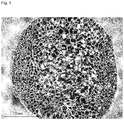
- Fig. 1 shows a cross section with the cell distribution through a foam particle foamed to a density of 81 g / l according to comparative example C3.
- the mean cell diameter was 64 ⁇ m.
- Foam particles from Examples 19-22 were poured into a mold with internal dimensions 200 ⁇ 300 ⁇ 12 mm and welded to foam sheets by means of steam in an automatic high-pressure molding machine. Density and compressive stresses at different compressions are summarized in Table 5.
- Table 5 Mechanical properties of foam boards example Compressive stress at 10% compression [kPa] Compressive stress at 25% compression [kPa] Compressive stress at 50% compression [kPa] Density [g / L] Thickness [mm] V19 326 409 573 78 12th 152 206 311 50 12th V20 434 597 898 80 12th 181 279 433 48 12th V22 423 561 792 80 12th 156 297 440 45 12th
Landscapes
- Chemical & Material Sciences (AREA)
- Engineering & Computer Science (AREA)
- Materials Engineering (AREA)
- Health & Medical Sciences (AREA)
- Chemical Kinetics & Catalysis (AREA)
- Medicinal Chemistry (AREA)
- Polymers & Plastics (AREA)
- Organic Chemistry (AREA)
- Mechanical Engineering (AREA)
- Inorganic Chemistry (AREA)
- Manufacture Of Porous Articles, And Recovery And Treatment Of Waste Products (AREA)
- Molding Of Porous Articles (AREA)
Description
Die vorliegende Erfindung betrifft Verfahren zur Herstellung von expandierbaren, treibmittelhaltigen Granulaten auf Basis von Hochtemperaturthermoplasten sowie daraus erhältliche Partikelschaumstoffe und deren Verwendung zur Herstellung von Bauteilen für die Luftfahrt.The present invention relates to processes for the production of expandable, blowing agent-containing granules based on high-temperature thermoplastics and particle foams obtainable therefrom and their use for the production of components for aviation.
Die
Die
Die
Die
Die
Aufgabe der vorliegenden Erfindung war es, ein Verfahren zur Herstellung von lagerstabilen expandierbaren Granulaten auf Basis von hochtemperaturbeständigen Polymeren, insbesondere Polyethersulfonen, bereitzustellen, die über mehrere Wochen Lagerzeit einen geringen Treibmittelverlust aufweisen und zu Schaumpartikeln oder Partikelschaumstoffen mit niedriger Dichte verschäumt bzw. verschweißt werden können. Außerdem sollten die expandierbaren Granulate mit hohen Durchsätzen erhältlich und auf einfache Weise zu Partikelschaumstoffen mit homogener, feinzelliger Zellstruktur verarbeitbar sein.The object of the present invention was to provide a process for the production of storage-stable expandable granules based on high-temperature-resistant polymers, in particular polyethersulfones, which have a low loss of blowing agent over several weeks of storage and can be foamed or welded to form foam particles or particle foams with low density. In addition, the expandable granules should be available with high throughputs and be easy to process into particle foams with a homogeneous, fine-celled cell structure.
Die Aufgabe wurde durch das Verfahren zur Herstellung von expandierbaren, treibmittelhaltigen Granulaten auf Basis von Hochtemperaturthermoplasten gemäß Anspruch 1 und Partikelschaumstoffen nach Anspruch 9 gelöst.The object was achieved by the method for producing expandable, blowing agent-containing granules based on high-temperature thermoplastics according to
Bevorzugte Ausführungsformen sind den Unteransprüchen zu entnehmen.Preferred embodiments can be found in the subclaims.
Bevorzugt sind die expandierbaren Granulat kugelförmig. Kugelförmig bedeutet, dass die Granulate keine Ecken oder Kanten, wie beispielsweise zylinderförmige Stranggranulate aufweisen. Das Verhältnis von kürzestem zu längstem Durchmesser der kugelförmigen Granulate liegt bevorzugt im Bereich von 0,9 bis 1,0, besonders bevorzugt im Bereich von 0,95 bis 0,99. Aufgrund der Kugelform können die bevorzugten expandierbaren, treibmittelhaltigen Granulate und die durch vorschäumen erhältlichen Schaumstoffpartikel durch pneumatische Förderanlagen leicht gefördert und in Schaumstoffformen eingeblasen werden.The expandable granules are preferably spherical. Spherical means that the granules have no corners or edges, such as, for example, cylindrical strand granules. The ratio of the shortest to the longest diameter of the spherical granules is preferably in the range from 0.9 to 1.0, particularly preferably in the range from 0.95 to 0.99. Due to the spherical shape, the preferred expandable, blowing agent-containing granules and the foam particles obtainable by pre-foaming can easily be conveyed by pneumatic conveying systems and blown into foam molds.
Die expandierbaren, treibmittelhaltigen Granulate auf Basis von Hochtemperaturthermoplasten weisen einer Schüttdichte nach DIN ISO 697:1982 im Bereich von 400 bis 900 kg/m3, bevorzugt im Bereich von 450 bis 700 kg/m3 und besonders bevorzugt im Bereich von 500 bis 680 kg/m3 .Sie weisen einer Masse im Bereich von 1 bis 10 mg/Granulat, bevorzugt im Bereich von 2 bis 4 mg/Granulat auf.The expandable, blowing agent-containing granules based on high-temperature thermoplastics have a bulk density according to DIN ISO 697: 1982 in the range from 400 to 900 kg / m 3 , preferably in the range from 450 to 700 kg / m 3 and particularly preferably in the range from 500 to 680 kg / m 3. They have a mass in the range from 1 to 10 mg / granulate, preferably in the range from 2 to 4 mg / granulate.
Als Hochtemperaturthermoplasten eigen sich thermoplastische Polymere mit einer Glasüberganstemperatur von mindestens 180°C, bevorzugt im Bereich von 200 bis 240°C, bestimmt mittels DSC nach ISO 11357-2-1999(E) mit einer Aufheizrate von 10 K/min. Bevorzugt ist der Hochtemperaturthermoplast mindestens ein Polyethersulfon oder Mischungen von Polyethersulfonen mit unterschiedlichem gewichtmittleren Molekulargewicht Mw oder mit unterschiedlichen Viskositätszahlen. Bevorzugt werden Mischungen von einem Polyethersulfon mit einer Viskositätszahl im Bereich von 46 bis 50 cm3/g und einem Polyethersulfon mit einer Viskositätszahl im Bereich von 54 bis 58 cm3/g, gemessen nach ISO 307, 1157,1628 (in 0,01 g/ml Phenol/1,2, ortho-Dichlorbenzol, 1:1) eingesetzt.Thermoplastic polymers with a glass transition temperature of at least 180 ° C., preferably in the range from 200 to 240 ° C., determined by DSC according to ISO 11357-2-1999 (E) with a heating rate of 10 K / min, are suitable as high-temperature thermoplastics. The high-temperature thermoplastic is preferably at least one polyether sulfone or mixtures of polyether sulfones with different weight-average molecular weights M w or with different viscosity numbers. Mixtures of a polyether sulfone with a viscosity number in the range from 46 to 50 cm 3 / g and a polyether sulfone with a viscosity number in the range from 54 to 58 cm 3 / g, measured according to ISO 307, 1157, 1628 (in 0.01 g / ml phenol / 1,2, ortho-dichlorobenzene, 1: 1).
Als Treibmittel enthalten die expandierbaren Granulate Alkohole, Ketone oder Kohlenwasserstoffe mit 1 bis 4 Kohlenstoffatomen, bevorzugt Aceton, Methylethylketon, Ethanol, Isopropanol, Isobutan, Wasser oder Mischungen davon in Mengen von 3 bis 15 Gew.-%, bevorzugt in Mengen von 5 bis 10 Gew.-%, Besonders bevorzugt enthalten die expandierbaren Granulate 3 bis 10 Gew.-% Aceton.The expandable granules contain alcohols, ketones or hydrocarbons with 1 to 4 carbon atoms, preferably acetone, methyl ethyl ketone, ethanol, isopropanol, isobutane, water or mixtures thereof in amounts of 3 to 15% by weight, preferably in amounts of 5 to 10, as blowing agents % By weight, the expandable granules particularly preferably contain 3 to 10% by weight of acetone.
Überraschend konnte gefunden werden, dass die Schüttdichte der expandierbaren Granulate einen Einfluss auf das Treibmittelhaltevermögen / Lagerstabilität besitzt und somit auch die erzielbare Dichtereduktion beim Vorschäumen beeinflusst.Surprisingly, it was found that the bulk density of the expandable granules has an influence on the blowing agent holding capacity / storage stability and thus also influences the density reduction that can be achieved during prefoaming.
Sowohl die expandierbaren Granulate als auch die expandierten Schaumstoffpartikel enthalten als Nukleierungsmittel bevorzugt Talkum, Titandioxid, Graphit, Ruß oder Mischungen davon. Bevorzugt enthalten sowohl expandierbaren Granulate als auch die expandierten Schaumstoffpartikel als Nukleierungsmittel 0,01 bis 2,0 Gew.-%, besonders bevorzugt 0,05 bis 1,5 Gew.-% Talkum, Titandioxid, Graphit, Ruß oder Mischungen davon, bezogen auf die Summe von Hochtemperaturthermoplast und Nukleierugnsmittel.Both the expandable granules and the expanded foam particles preferably contain talc, titanium dioxide, graphite, carbon black or mixtures thereof as nucleating agents. Both expandable granules and the expanded foam particles preferably contain 0.01 to 2.0% by weight, particularly preferably 0.05 to 1.5% by weight, of talc, titanium dioxide, graphite, carbon black or mixtures thereof as nucleating agents the sum of high temperature thermoplastic and nucleating agent.
Sowohl die expandierbaren Granulate als auch die expandierten Schaumstoffpartikel enthalten bevorzugt ausschließlich mindestens ein Polyethersulfon als Hochtemperaturthermoplast.Both the expandable granules and the expanded foam particles preferably exclusively contain at least one polyether sulfone as a high-temperature thermoplastic.
Gegenstand der Erfindung ist auch ein Verfahren zur Herstellung von expandierbaren, treibmittelhaltigen Granulaten auf Basis von Hochtemperaturthermoplasten umfassend die Stufen:
- a) Herstellen einer Polymerschmelze durch Aufschmelzen von mindestens einem Polymer mit einer Glasübergangstemperatur nach ISO 11357-2-1999 von mindestens 180°C und Vermischen mit mindestens einem Nukleierungsmittel in einem Extruder bei Temperaturen im Bereich von 300° bis 350°C,
- b) Zugabe eines Treibmittels zu der Polymerschmelze
- c) Abkühlen der Polymerschmelze auf eine Temperatur im Bereich von 180° bis 250°C,
- d) gegebenenfalls Fördern der Polymerschmelze über eine Zahnradpumpe
- e) ) Fördern der treibmittaltigen Polymerschmelze bei einer Temperatur im Bereich von 180° bis 250°C durch eine Lochplatte und Granulieren der treibmittelbeladenen Polymerschmelze in einem bei einer Wassertemperatur im Bereich von 75 bis 99°C und einem Druck im Bereich von 10 bis 20 bar betriebenen Unterwassergranulator.
- a) Production of a polymer melt by melting at least one polymer with a glass transition temperature according to ISO 11357-2-1999 of at least 180 ° C and mixing with at least one nucleating agent in an extruder at temperatures in the range from 300 ° to 350 ° C,
- b) adding a blowing agent to the polymer melt
- c) cooling the polymer melt to a temperature in the range from 180 ° to 250 ° C,
- d) if necessary, conveying the polymer melt via a gear pump
- e)) Conveying the blowing agent-containing polymer melt at a temperature in the range from 180 ° to 250 ° C through a perforated plate and granulating the blowing agent-laden polymer melt in a at a water temperature in the range from 75 to 99 ° C and a pressure in the range from 10 to 20 bar operated underwater granulator.
Die Stufen b) und c) können gleichzeitig oder nacheinander ausgeführt werden. Bevorzugt wird die Stufe c) nach der Stufe b) durchgeführt. Das bedeutet, die treibmittelhaltige Polymerschmelze wird durch die Zugabe des Treibmittels und/oder externe Kühlung auf eine Temperatur im Bereich von 180°C bis 250°C abgekühlt. Auf diese Weise kann die treibmittelhaltige Polymerschmelze mit einer Schmelzetemperatur im Bereich von 180°C bis 250°C durch eine beheizte Lochplatte gefördert und granuliert werden.Steps b) and c) can be carried out simultaneously or in succession. Stage c) is preferably carried out after stage b). This means that the polymer melt containing blowing agent is cooled to a temperature in the range from 180.degree. C. to 250.degree. C. by adding the blowing agent and / or external cooling. In this way, the blowing agent-containing polymer melt with a melt temperature in the range from 180 ° C. to 250 ° C. can be conveyed through a heated perforated plate and granulated.
Als Treibmittel können in dem erfindungsgemäßen Verfahren Alkohole, Ketone oder Kohlenwasserstoffe mit 1 bis 4 Kohlenstoffatomen, bevorzugt Aceton, Methylethylketon, Ethanol, Isopropanol, Isobutan, Wasser oder Mischungen davon in Mengen von 3 bis 15 Gew.-%, bevorzugt in Mengen von 5 bis 10 Gew.-%, bezogen auf die Polymerschmelze einschließlich ihrer Additive, eingesetzt werden. Besonders bevorzugt werden 3 bis 10 Gew.-% Aceton zur Polymerschmelze zugegeben.Alcohols, ketones or hydrocarbons having 1 to 4 carbon atoms, preferably acetone, methyl ethyl ketone, ethanol, isopropanol, isobutane, water or mixtures thereof in amounts of 3 to 15% by weight, preferably in amounts of 5 to 10% by weight, based on the polymer melt including its additives, are used. 3 to 10% by weight of acetone are particularly preferably added to the polymer melt.
Als Additive können der Polymerschmelze Nukleierungsmittel oder Flammschutzmittel zugegeben werden. Bevorzugt werden Talkum, Titandioxid, Graphit, Russ oder Mischungen davon eingesetzt.Nucleating agents or flame retardants can be added to the polymer melt as additives. Preference is given to using talc, titanium dioxide, graphite, carbon black or mixtures thereof.
Als Hochtemperaturthermoplasten werden in dem erfindungsgemäßen Verfahren die oben beschriebenen Thermoplasten eingesetzt. Bevorzugt wird als Hochtemperaturthermoplast mindestens ein Polyethersulfon oder Mischungen von Polyethersulfonen mit unterschiedlichem gewichtmittleren Molekulargewicht Mw oder mit unterschiedlichen Viskositätszahlen. Bevorzugt werden Mischungen von einem Polyethersulfon mit einer Viskositätszahl im Bereich von 46 bis 50 cm3/g und einem Polyethersulfon mit einer Viskositätszahl im Bereich von 54 bis 58 cm3/g, gemessen nach ISO 307, 1157,1628 (in 0,01 g/ml Phenol/1,2, ortho-Dichlorbenzol, 1:1) eingesetzt.The thermoplastics described above are used as high-temperature thermoplastics in the method according to the invention. The preferred high-temperature thermoplastic is at least one polyether sulfone or mixtures of polyether sulfones with different weight-average molecular weights M w or with different viscosity numbers. Mixtures of a polyether sulfone with a viscosity number in the range from 46 to 50 cm 3 / g and a polyether sulfone with a viscosity number in the range from 54 to 58 cm 3 / g, measured according to ISO 307, 1157, 1628 (in 0.01 g / ml phenol / 1,2, ortho-dichlorobenzene, 1: 1).
Die hohe Schüttdichte der expandierbaren Granulate im Bereich von 400 bis 900 kg/m3 konnte hierbei durch einen hohen Wasserdruck in der Unterwassergranulierung und die Wahl des Treibmittels und deren Konzentration sowie das Temperaturprofil in der Extrusionsanlage mit Unterwassergranulierung erzielt werden.The high bulk density of the expandable granules in the range from 400 to 900 kg / m 3 could be achieved by high water pressure in the underwater granulation and the choice of blowing agent and its concentration as well as the temperature profile in the extrusion plant with underwater granulation.
Die expandierten Schaumstoffpartikel auf Basis von Hochtemperaturthermoplasten enthalten mindestens ein Nukleierungsmittel und weisen eine Schüttdichte nach DIN ISO 697:1982 im Bereich von 10 bis 200 kg/m3auf.The expanded foam particles based on high-temperature thermoplastics contain at least one nucleating agent and have a bulk density according to DIN ISO 697: 1982 in the range from 10 to 200 kg / m 3 .
Der mittlere Zelldurchmesser der erfindungsgemäßen expandierten Schaumstoffpartikel liegt in der Regel im Bereiche von 30 bis 150 µm, bevorzugt im Bereich von betrug 50 bis 100 µm. Bevorzugt weisen 90% der Zellen, besonders bevorzugt 99% der Zellen einen Zelldurchmesser von weniger als 150 µm auf. Das mittlere Länge/Breite-Verhältnis liegt bevorzugt unter 2,0, besonders bevorzugt unter 1,6.The mean cell diameter of the expanded foam particles according to the invention is generally in the range from 30 to 150 μm, preferably in the range from 50 to 100 μm. 90% of the cells, particularly preferably 99% of the cells, preferably have a cell diameter of less than 150 μm. The mean length / width ratio is preferably below 2.0, particularly preferably below 1.6.
Diese können durch Vorschäumen der expandierbaren Partikel erhalten werden. Hierzu eignet sich ein Verfahren zur Herstellung von Schaumstoffpartikeln auf Basis von Hochtemperaturthermoplasten, bei dem man die oben beschriebenen, expandierbaren, treibmittelhaltigen Granulate, z. B. in einem Umluftofen, für 5 bis 300 Sekunden, bevorzugt 10 bis 150 Sekunden bei Temperaturen im Bereich von 180 bis 280°C, bevorzugt im Bereich von 220° bis 250°C verschäumt.These can be obtained by prefoaming the expandable particles. For this purpose, a process for the production of foam particles based on high-temperature thermoplastics is suitable, in which the above-described, expandable, blowing agent-containing granules, eg. B. in a convection oven, for 5 to 300 seconds, preferably 10 to 150 seconds at temperatures in the range from 180 to 280 ° C, preferably in the range from 220 ° to 250 ° C foamed.
Aus den so erhältlichen expandierten Schaumpartikeln lassen sich Partikelschaumstoffformteile durch Verschweißen erhalten. Hierfür eignen sich Verfahren zur Herstellung eines Partikelschaumstoffes auf Basis von Hochtemperaturthermoplasten, bei denen man die oben beschriebenen expandierbaren, treibmittelhaltigen Granulate nach oder expandierten Schaumstoffpartikel in einer Form mittels Wasserdampf, Heißluft, IR- oder elektromagnetischer Strahlung oder Heißpressen verschweißt.Particle foam molded parts can be obtained from the expanded foam particles obtainable in this way by welding. Processes for producing a particle foam based on high-temperature thermoplastics are suitable for this, in which the above-described expandable, blowing agent-containing granules are welded after or expanded foam particles in a mold by means of steam, hot air, IR or electromagnetic radiation or hot pressing.
Die so erhaltenen Partikelschaumstoffe sind in der Regel geschlossenzellig. Sie weisen bevorzugt eine Dichte im Bereich von 20 bis 250 kg/m3, besonders bevorzugt im Bereich von 40 bis 150 kg/m3auf.The particle foams obtained in this way are generally closed-cell. They preferably have a density in the range from 20 to 250 kg / m 3 , particularly preferably in the range from 40 to 150 kg / m 3 .
Die Schaumstoffpartikel eignen sich insbesondere in Verbundplatten für Luftfahrtanwendungen.The foam particles are particularly suitable in composite panels for aerospace applications.
Aufgrund der hohen Schüttdichte der nach dem erfindungsgemäßen Verfahren erhaltenen expandierbaren treibmittelhaltigen Granulate und guten Lagerstabilität aufgrund des geringen Treibmittelverlustes, können diese mit geringen Transportkosten auch über weitere Transportstrecken an verarbeitende Betriebe geliefert werden, die diese zu expandierten Schaumstoffpartikeln vorschäumen und anschließend zu Schaumstoffformteilen beliebiger dreidimensionaler Formen verarbeiten können.Due to the high bulk density of the expandable propellant-containing granules obtained by the process according to the invention and good storage stability due to the low loss of propellant, they can also be delivered at low transport costs over further transport routes to processing companies that pre-foam them into expanded foam particles and then process them into foam molded parts of any three-dimensional shapes can.
Eingesetzte Rohstoffe:
Die Schüttdichte der treibmittelhaltigen, expandierbaren Granulate wurde nach DIN ISO 697:1982 bestimmt.The bulk density of the blowing agent-containing, expandable granules was determined in accordance with DIN ISO 697: 1982.
Der Treibmittelgehalt der expandierbaren Granulate wurde gravimetrisch als flüchtige Anteile bestimmt. Hierzu wurden ca. 20 g der treibmittlelhaltigen Granulate in ein Aluminumschälchen eingewogen und im Umluftofen bei 250°C für mindestens 2 Stunden getrocknet und zurückgewogen.The propellant content of the expandable granules was determined gravimetrically as volatile components. For this purpose, about 20 g of the propellant-containing granules were weighed into a small aluminum dish and dried in a convection oven at 250 ° C. for at least 2 hours and reweighed.
Die Druckspannungen wurden nach DIN EN ISO 844:2014 bestimmt.The compressive stresses were determined in accordance with DIN EN ISO 844: 2014.
Die Bestimmung der Zellgrößenverteilung und mittleren Zelldurchmesser erfolgte durch Bildaufnahme des Querschnittes der Schaumpartikel mit einer Kamera und Auswertung mit einem PORE!SCAN der Fa. Goldlücke Ingenieurleistungen. Hierzu wurden 10 Schaumpartikel mit doppelseitigem Klebeband auf eine Pressspanplatte (10x10 cm) aufgebracht und in der Mitte durchgeschnitten. Zur Bestimmung der mittleren Zellflächen und mittleren Zelldurchmesser wurden ca. 1500 Zellen ausgewertet.The cell size distribution and mean cell diameter were determined by recording the cross section of the foam particles with a camera and evaluating them with a PORE! SCAN from Goldlücke Engineering. For this purpose, 10 foam particles were applied to a pressboard (10x10 cm) with double-sided adhesive tape and cut through in the middle. Approx. 1500 cells were evaluated to determine the mean cell area and mean cell diameter.
Beispiele 2-16 und 24-26, Vergleichsbeispiele V3 und V17-V23 Herstellung von expandierbaren PESU-Granulaten durch Schmelzeimprägnierung Die Schmelzeimprägnierung erfolgte in einer Apparatur bestehend aus einem in acht gleich langen Zonen (Z1...Z8) unterteilten Doppelschneckenextruder der Firma Leistritz mit 18 mm Schneckendurchmesser und einem Längen zu Durchmesserverhältnis von 40, einer Schmelzepumpe (Zahnradpumpe ZRP), Anfahrventil (AV), Schmelzefilter, Lochplatte (LP) und einer Unterwassergranulierung (UWG).Examples 2-16 and 24-26, Comparative Examples C3 and C17-C23 Production of expandable PESU granules by melt impregnation The melt impregnation was carried out in an apparatus consisting of a twin-screw extruder from Leistritz divided into eight zones of equal length (Z1 ... Z8) 18 mm screw diameter and a length to diameter ratio of 40, a melt pump (gear pump ZRP), start-up valve (AV), melt filter, perforated plate (LP) and an underwater pelletizer (UWG).
Polyethersulfon (PESU) wurde zusammen mit den Additiven (Talkum, Titandioxid, Graphit) in einem Polyethylen-Beutel vermischt in den Doppeschneckenextruders dosiert und aufgeschmolzen. Nach ca. 2/3 der Länge des Extruders wurde das Treibmittel mit Hilfe von Isco-Pumpen (Kolbenpumpen der Firma Axel Semrau) und einem in den Extruder eingebauten Injektor in Zone Z5 in den Extruder injiziert. Ab Zone Z6 wurde die Polymerschmelze über die Temperierung des Doppelschneckenextruders gekühlt. Die Temperatur der Polymerschmelze beim Durchtritt durch die Lochplatte entsprach der an Zone 8 eingestellten Temperatur. Mittels der Schmelzepumpe (ZRP) wurde das Druckprofil im Extruder so eingestellt (Druck-Drehzahl-Steuerung), dass das Treibmittel vollständig in die Polymerschmelze eingemischt wurde. Neben der Einstellung des Druckprofils in dem Doppelschneckenextruder dient die Schmelzepumpe auch zur Förderung der Treibmittel-imprägnierten Polymerschmelze durch die Nachfolgeeinrichtungen (das Anfahrventil, das Schmelzesieb und die Lochplatte). Der durch die Lochplatte (1 Loch mit 1,0 mm Durchmesser) austretende Schmelzestrang wurde in dem Unterwassergranulator (UWG) unter Druck zu expandierbaren Polyerthersulfongranulaten mit einem Granulatgewicht von ca. 2,3 mg geschnitten. Dabei wurde der Gesamtdurchsatz des Extruders konstant bei 5 kg/h gehalten. Der Strang in der Wasserbox wurde durch 10 am Messerkranz befestigte Messer geschnitten. Der Messerkranz rotiert dabei mit 3600 U/min in den Beispielen 2-12 und Vergleichsbeispiel V3. Dabei entstehen expandierbare Granulate mit einem Granulatgewicht von 2,3 mg, welche durch den Wasserkreislauf von der Lochplatte in den Trockner transportiert werden und von dort in einen Auffangbehälter (hier Weißblechkanne) abgeschieden werden.Polyethersulfone (PESU) was mixed with the additives (talc, titanium dioxide, graphite) in a polyethylene bag, dosed into the twin-screw extruder and melted. After about 2/3 of the length of the extruder, the blowing agent was injected into the extruder in zone Z5 with the aid of Isco pumps (piston pumps from Axel Semrau) and an injector built into the extruder. From zone Z6, the polymer melt was cooled via the temperature control of the twin screw extruder. The temperature of the polymer melt as it passed through the perforated plate corresponded to the temperature set in zone 8. Using the melt pump (ZRP), the pressure profile in the extruder was set (pressure-speed control) so that the blowing agent was completely mixed into the polymer melt. In addition to setting the pressure profile in the twin screw extruder, the melt pump also serves to convey the blowing agent-impregnated polymer melt through the downstream devices (the start-up valve, the melt screen and the perforated plate). The strand of melt emerging through the perforated plate (1 hole with 1.0 mm diameter) was in the underwater granulator (UWG) cut under pressure into expandable polyether sulfone granules with a granule weight of approx. 2.3 mg. The total throughput of the extruder was kept constant at 5 kg / h. The strand in the water box was cut by 10 knives attached to the knife ring. The blade ring rotates at 3600 rpm in Examples 2-12 and Comparative Example C3. This results in expandable granules with a granule weight of 2.3 mg, which are transported by the water cycle from the perforated plate to the dryer and from there separated into a collecting container (here a tin can).
Die Gewichtsanteile der eingesetzten Rohstoffe sind in Tabelle 1 zusammengestellt. Die Gewichtsanteile beziehen sich auf 100 Gew.-% Feststoff (Polymer und Additive ohne Treibmittel). Der Treibmittelanteil bezieht sich auf 100 Gew.-% Feststoff (Polymer und Additive). Die Prozessparameter sind in Tabelle 2 zusammengestellt. Die Temperaturen beziehen sich auf die an den jeweiligen Apparateteilen eingestellten und gemessenen Temperaturwerte.The proportions by weight of the raw materials used are listed in Table 1. The proportions by weight are based on 100% by weight of solids (polymer and additives without blowing agent). The propellant content is based on 100% by weight solids (polymer and additives). The process parameters are summarized in Table 2. The temperatures relate to the temperature values set and measured on the respective parts of the apparatus.
In den Beispielen 2-12, 24 und in den Vergleichsbeispielen V3, V17, V20-V23 wurde Aceton als Treibmittel eingesetzt. In den Beispielen 13 - 16 und in den Vergleichsbeispielen V18-V19 wurden Mischungen von Aceton mit Wasser, Ethanol oder Isopropanol in dem in der Tabelle 1 angegebenen Gewichtsverhältnis eingesetzt.In Examples 2-12, 24 and in Comparative Examples C3, C17, C20-C23, acetone was used as the blowing agent. In Examples 13-16 and in Comparative Examples C18-C19, mixtures of acetone with water, ethanol or isopropanol in the weight ratio given in Table 1 were used.
In den Beispielen 13-16 und in den Vergleichsbeispielen V17-V23 wurde die Messerdrehzahl auf den in der Tabelle 2 angegebenen Wert eingestellt. Dabei wurden Granulatgewichte von 2,8 mg (3000 Upm), 2,4 mg (3500 Upm) bzw. 3,3 mg (2500 Upm) erhalten, Vergleichsbeispiele V1 und V2In Examples 13-16 and in Comparative Examples C17-C23, the blade speed was set to the value given in Table 2. Granulate weights of 2.8 mg (3000 rpm), 2.4 mg (3500 rpm) and 3.3 mg (2500 rpm) were obtained, comparative examples V1 and V2
In den Vergleichsbeispiele V1 und V2 wurde die Temperatur der treibmittelhaltigen Polymerschmelze konstant gehalten und nicht gekühlt.
Die expandierbaren Granulate aus den Beispielen 2-3 und Vergleichsbeispiel V3 wurden im Umluftofen wie folgt zu Schaumstoffpartikeln geschäumt.
- 1.) Der Ofen wird auf 230 °C gestellt da es sonst zu lange dauert bis die Temperatur von 220 °C erreicht wird und 2 Aluschalen (ca. 500 ml) in den Ofen gestellt um ebenfalls auf die Temperatur zu kommen.
- 2.) Nachdem der Ofen eine Temperatur von 225 °C anzeigt werden ca. 6 g expandierbare Granulate auf die beiden Aluschalen aufgeteilt indem die Ofentür geöffnet und die Granulate aus der Hand oder einem kleinen Plastikgefäß in die Aluschalen gekippt werden. Dabei wird darauf geachtet, dass die Partikel nicht auf einem Haufen liegen. Durch das Öffnen der Ofentür fällt die Temperatur im Ofen um ca. 5 °C auf 220 °C ab. Die eingestellten 230 °C bewirken auch, dass die Temperatur nicht weiter abfällt.
- 3.) Mit dem Schließen der Ofentür wird eine Stoppuhr gestartet und nach der definierten Zeit (hier 60 s und 120 s) wieder geöffnet und die Aluschälchen mit den expandierten Granulaten entnommen und auf den Labortisch zum Abkühlen gestellt werden.
- 4.) Sobald die Aluschälchen mit den Granulaten abgekühlt sind wird die Schüttdichte analog zu DIN ISO 697:1982 gemessen. Analog da ein Messbecher mit 50 ml Inhalt verwendet wird da die für die Messung exakt nach Norm zu viel Granulat geschäumt werden müsste.
- 1.) The oven is set to 230 ° C, otherwise it will take too long until the temperature of 220 ° C is reached and 2 aluminum dishes (approx. 500 ml) are placed in the oven to also come up to the temperature.
- 2.) After the oven shows a temperature of 225 ° C, approx. 6 g of expandable granules are divided between the two aluminum trays by opening the oven door and tipping the granules out of the hand or a small plastic container into the aluminum trays. Care is taken to ensure that the particles are not in a heap. When the oven door is opened, the temperature in the oven drops by approx. 5 ° C to 220 ° C. The set 230 ° C also means that the temperature does not drop any further.
- 3.) When the oven door is closed, a stopwatch is started and opened again after the defined time (here 60 s and 120 s) and the aluminum dishes with the expanded granules are removed and placed on the laboratory table to cool down.
- 4.) As soon as the aluminum dishes with the granules have cooled down, the bulk density is measured analogously to DIN ISO 697: 1982. Analogous because a measuring cup with 50 ml content is used because too much granulate would have to be foamed for the measurement exactly according to the standard.
Die gemessenen Schüttdichten nach dem Schäumen der expandierbaren Granulate in der 1. Woche ist in Tabelle 4 dargestellt.The bulk densities measured after the expandable granules were foamed in the 1st week is shown in Table 4.
Der mittlere Zelldurchmesser betrug 64 µm.The mean cell diameter was 64 µm.
99% der Zellen weisen einen Zelldurchmesser von weniger als 150 µm und 90% der Zellen weisen einen Zelldurchmesser von weniger als 110 µm auf. Das mittlere Länge/Breite-Verhältnis der Zellen betrug 1,4.
Schaumstoffpartikel der Beispiele 19 ― 22 wurden in eine Form mit den Innenmaßen 200 x 300 x 12 mm eingefüllt und mittels Wasserdampf in einem Hochdruckformteilautomaten zu Schaumstoffplatten verschweißt. Dichte und Druckspannungen bei unterschiedlichen Stauchungen sind in Tabelle 5 zusammengestellt.
Claims (7)
- A process for producing expandable, blowing agent-containing pellets based on high temperature thermoplastics comprising the steps of:a) producing a polymer melt by melting at least one polyethersulfone having a glass transition temperature according to ISO 11357-2-1999 of at least 180°C and mixing with at least one nucleating agent in an extruder at temperatures in the range from 300°C to 350°C,b) addition of a blowing agent to the polymer meltc) cooling the blowing agent-containing polymer melt to a temperature in the range from 180°C to 250°C,d) optionally conveying the polymer melt by means of a gear pumpe) conveying the blowing agent-containing polymer melt at a temperature in the range from 180°C to 250°C through a perforated plate and pelletizing the blowing agent-laden polymer melt in an underwater pelletizer operated at a water temperature in the range from 75°C to 99°C and a pressure in the range from 10 to 20 bar.
- The process according to claim 1, wherein acetone, isobutane, ethanol, isopropanol, water or mixtures thereof are employed as the blowing agent.
- The process according to claim 1 or 2, wherein talc, titanium dioxide, graphite, carbon black or mixtures thereof are employed as the nucleating agent.
- The process according to any of claims 1 to 3, wherein mixtures of polyethersulfones having different average molecular weights Mw are employed as the polymer.
- The process according to any of claims 2 to 4, wherein 3% to 10% by weight of acetone based on the polymer melt are employed as the blowing agent.
- The process according to any of claims 3 to 5, wherein 0.01 % to 2.0% by weight, based on the polymer melt, of talc, titanium dioxide, graphite, carbon black or mixtures thereof are employed as the nucleating agent.
- A process for producing particle foams, wherein expandable, blowing agent-containing pellets obtained according to the process of claims 1 to 6 are pre-foamed to afford expanded foam particles having a poured density according to DIN ISO 697:1982 in the range from 10 to 200 kg/m3 and welded in a mold using steam, hot air, IR or electromagnetic radiation or hot pressing.
Applications Claiming Priority (2)
| Application Number | Priority Date | Filing Date | Title |
|---|---|---|---|
| EP17184924 | 2017-08-04 | ||
| PCT/EP2018/070084 WO2019025245A1 (en) | 2017-08-04 | 2018-07-25 | EXPANDABLE, WEATHER-BASED GRANULES BASED ON HIGH-TEMPERATURE THERMOPLASTS |
Publications (2)
| Publication Number | Publication Date |
|---|---|
| EP3662002A1 EP3662002A1 (en) | 2020-06-10 |
| EP3662002B1 true EP3662002B1 (en) | 2021-10-27 |
Family
ID=59676991
Family Applications (1)
| Application Number | Title | Priority Date | Filing Date |
|---|---|---|---|
| EP18742513.7A Active EP3662002B1 (en) | 2017-08-04 | 2018-07-25 | Expandable granulates containing propellant on the basis of high-temperature thermoplastic |
Country Status (6)
| Country | Link |
|---|---|
| US (1) | US11499028B2 (en) |
| EP (1) | EP3662002B1 (en) |
| JP (1) | JP7216071B2 (en) |
| KR (1) | KR102614476B1 (en) |
| CN (1) | CN111032756B (en) |
| WO (1) | WO2019025245A1 (en) |
Cited By (1)
| Publication number | Priority date | Publication date | Assignee | Title |
|---|---|---|---|---|
| WO2025261825A1 (en) * | 2024-06-19 | 2025-12-26 | Neue Materialien Bayreuth Gmbh | Method for producing expanded granulates |
Families Citing this family (14)
| Publication number | Priority date | Publication date | Assignee | Title |
|---|---|---|---|---|
| MX2020005297A (en) * | 2017-11-27 | 2020-08-13 | Evonik Operations Gmbh | Pesu particle foams for applications in aviation interiors. |
| US11046027B2 (en) * | 2018-08-02 | 2021-06-29 | The Boeing Company | Expandable tooling systems and methods |
| US11426951B2 (en) * | 2019-01-02 | 2022-08-30 | The Boeing Company | Expandable bladders as tooling for composite parts |
| WO2020161012A1 (en) * | 2019-02-04 | 2020-08-13 | Basf Se | Easily soluble and free-flowing granular material on the basis of high-temperature thermoplastics with a low content of volatile organic compounds |
| US11298892B2 (en) | 2019-07-01 | 2022-04-12 | The Boeing Company | Expandable tooling systems and methods |
| US11325282B2 (en) | 2019-07-01 | 2022-05-10 | The Boeing Company | Method of manufacturing a composite workpiece |
| US11872776B2 (en) | 2019-12-19 | 2024-01-16 | The Boeing Company | Methods for recovering expanded polymer tooling |
| EP3889212A1 (en) * | 2020-04-03 | 2021-10-06 | Evonik Operations GmbH | Pei or pei-peek- particle foams for lightweight applications |
| US12496753B2 (en) * | 2020-08-18 | 2025-12-16 | Evonik Operations Gmbh | Production of high temperature polymer based pellets by underwater pelletization at elevated water temperature to produce (rigid) bead foams |
| AU2021391376A1 (en) | 2020-12-02 | 2023-07-06 | Evonik Operations Gmbh | Adhesion of blowing agent-containing particles based on polyimides or polyacrylates |
| DE102021111247A1 (en) * | 2021-04-30 | 2022-11-03 | Fox Velution Gmbh | Process for the production of cellular plastic particles |
| TWI856461B (en) * | 2022-01-14 | 2024-09-21 | 臺灣塑膠工業股份有限公司 | Thermoplastic and thermoset foam nucleation additive and foamed material |
| US12692364B2 (en) | 2022-01-14 | 2026-07-28 | Formosa Plastics Corporation | Thermoplastic and thermoset foam nucleation additive and foamed material |
| DE102022204208A1 (en) | 2022-04-29 | 2023-11-02 | Evonik Operations Gmbh | Water-assisted pre-foaming of blowing agent-loaded polymer granules |
Family Cites Families (15)
| Publication number | Priority date | Publication date | Assignee | Title |
|---|---|---|---|---|
| WO1987005518A1 (en) * | 1986-03-17 | 1987-09-24 | Schering Corporation | Treatment of cancers with gamma interferon |
| DE3925740A1 (en) * | 1989-08-03 | 1991-02-07 | Basf Ag | METHOD FOR PRODUCING EXPANDABLE GRANULES AND FOAMS THEREOF |
| DE10162602A1 (en) | 2001-12-20 | 2003-07-10 | Basf Ag | Production of foam sheet from polysulfone or polyether-sulfone involves extruding with a blowing agent consisting of water or a mixture of water and volatile alkanol or aliphatic ketone |
| DE10358801A1 (en) * | 2003-12-12 | 2005-07-14 | Basf Ag | Particle foam moldings of expandable styrene polymers and blends with thermoplastic polymers |
| DE10358786A1 (en) * | 2003-12-12 | 2005-07-14 | Basf Ag | Particle foam moldings of expandable, filler-containing polymer granules |
| PL1998948T3 (en) * | 2006-03-22 | 2011-04-29 | Basf Se | Method and device for granulating polymer melts containing blowing agent |
| ES2590469T3 (en) | 2011-12-22 | 2016-11-22 | Solvay Specialty Polymers Usa, Llc. | Thermoformed foam articles |
| US9650485B2 (en) | 2012-10-12 | 2017-05-16 | Solvay Specialty Polymers Usa, Llc. | High temperature sulfone (HTS) foam materials |
| KR101967142B1 (en) * | 2014-09-30 | 2019-04-09 | 세키스이가세이힝코교가부시키가이샤 | Bead foam molded body, resin foam particles, method for producing resin foam particles, foamable resin particles and method for producing bead foam molded body |
| SG11201807775SA (en) | 2016-03-10 | 2018-10-30 | Basf Se | Aqueous polymer dispersions, a method for their preparation and the use thereof as pour-point depressants for crude oil, petroleum, and petroleum products |
| JP7034099B2 (en) | 2016-05-25 | 2022-03-11 | ビーエーエスエフ ソシエタス・ヨーロピア | Fiber reinforcement of reactive foam material obtained by double strip foaming method or block foaming method |
| WO2017211660A1 (en) | 2016-06-07 | 2017-12-14 | Basf Se | Process for producing expandable polylactic acid-containing pellets |
| EP3475352B1 (en) | 2016-06-23 | 2026-04-29 | Basf Se | Method for the preparation of foam particles out of thermoplastic elastomers with polyamide segments |
| EP3497155A1 (en) * | 2016-08-08 | 2019-06-19 | Basf Se | Method for producing expanded granular material |
| EP3538578B1 (en) | 2016-11-14 | 2025-03-05 | Basf Se | Expanded thermoplastic polyurethane particles, method for their manufacture and method for producing a moulded part |
-
2018
- 2018-07-25 JP JP2020505850A patent/JP7216071B2/en active Active
- 2018-07-25 US US16/627,501 patent/US11499028B2/en active Active
- 2018-07-25 CN CN201880050814.2A patent/CN111032756B/en active Active
- 2018-07-25 WO PCT/EP2018/070084 patent/WO2019025245A1/en not_active Ceased
- 2018-07-25 KR KR1020207006408A patent/KR102614476B1/en active Active
- 2018-07-25 EP EP18742513.7A patent/EP3662002B1/en active Active
Cited By (1)
| Publication number | Priority date | Publication date | Assignee | Title |
|---|---|---|---|---|
| WO2025261825A1 (en) * | 2024-06-19 | 2025-12-26 | Neue Materialien Bayreuth Gmbh | Method for producing expanded granulates |
Also Published As
| Publication number | Publication date |
|---|---|
| KR102614476B1 (en) | 2023-12-15 |
| EP3662002A1 (en) | 2020-06-10 |
| US11499028B2 (en) | 2022-11-15 |
| JP2021503513A (en) | 2021-02-12 |
| US20200148851A1 (en) | 2020-05-14 |
| JP7216071B2 (en) | 2023-01-31 |
| WO2019025245A1 (en) | 2019-02-07 |
| CN111032756A (en) | 2020-04-17 |
| KR20200039711A (en) | 2020-04-16 |
| CN111032756B (en) | 2023-01-24 |
Similar Documents
| Publication | Publication Date | Title |
|---|---|---|
| WO2019025245A1 (en) | EXPANDABLE, WEATHER-BASED GRANULES BASED ON HIGH-TEMPERATURE THERMOPLASTS | |
| EP1454946B1 (en) | Open celled foam of high melting point polymer | |
| EP0411437B1 (en) | Process for producing expansible granulates and foam obtained thereby | |
| EP4200111B1 (en) | Manufacture of granules based on high-temperature polymers by underwater pelletization at an elevated temperature of the water | |
| EP2782735B1 (en) | Method for continuous production of nanoporous polymer foams | |
| EP3055351A1 (en) | Method for producing expanded polyester foam particles | |
| DE10358786A1 (en) | Particle foam moldings of expandable, filler-containing polymer granules | |
| EP2437905B1 (en) | Method for producing porous metallic sintered bodies | |
| EP1333051B1 (en) | Process for making high temperature resistant foam sheets of polysulfones or polyethersulfones | |
| EP3921362A1 (en) | Easily soluble and free-flowing granular material on the basis of high-temperature thermoplastics with a low content of volatile organic compounds | |
| EP2475711B1 (en) | San extruded foams | |
| AT509268A1 (en) | EXPANDABLE POLYMERISES FROM CELLULOSE ACETATE BUTYRATE | |
| EP3622013B1 (en) | Z-hfo-1336mzz blowing agent blends for foaming thermoplastic polymers comprising polystyrene | |
| EP2565224A1 (en) | Expandable temperature-resistant styrole copolymers | |
| EP3889212A1 (en) | Pei or pei-peek- particle foams for lightweight applications | |
| EP1702945B2 (en) | Polyolefin foam particles containing fillers | |
| EP3576947B1 (en) | Material for processing in selective laser sintering method, moulded body produced therefrom, and use in sls method | |
| EP1144491B1 (en) | Expanded polypropylene particles | |
| EP1535955B1 (en) | Process for producing expandable polyolefin particles by impregnation at low temperatures | |
| WO2025261825A1 (en) | Method for producing expanded granulates | |
| DE102005013040A1 (en) | Expandable polyolefin particle or expanded polyolefin foam particle, useful for producing shaped parts that are useful as e.g. shock proof packing materials, comprises polyolefin and organic or inorganic fillers (e.g. talc and chalk) | |
| EP1544234B1 (en) | Shaped foam articles made from open celled EPP | |
| EP1602684B1 (en) | Polyolefin foam particles containing metal particles | |
| EP1544246B1 (en) | Expandable Polyolefin with DSC double peak | |
| DE102024128677A1 (en) | Foam particles, foam bead molded product, base resin composition for foaming, and base resin composition pellet |
Legal Events
| Date | Code | Title | Description |
|---|---|---|---|
| STAA | Information on the status of an ep patent application or granted ep patent |
Free format text: STATUS: UNKNOWN |
|
| STAA | Information on the status of an ep patent application or granted ep patent |
Free format text: STATUS: THE INTERNATIONAL PUBLICATION HAS BEEN MADE |
|
| PUAI | Public reference made under article 153(3) epc to a published international application that has entered the european phase |
Free format text: ORIGINAL CODE: 0009012 |
|
| STAA | Information on the status of an ep patent application or granted ep patent |
Free format text: STATUS: REQUEST FOR EXAMINATION WAS MADE |
|
| 17P | Request for examination filed |
Effective date: 20200304 |
|
| AK | Designated contracting states |
Kind code of ref document: A1 Designated state(s): AL AT BE BG CH CY CZ DE DK EE ES FI FR GB GR HR HU IE IS IT LI LT LU LV MC MK MT NL NO PL PT RO RS SE SI SK SM TR |
|
| AX | Request for extension of the european patent |
Extension state: BA ME |
|
| DAV | Request for validation of the european patent (deleted) | ||
| DAX | Request for extension of the european patent (deleted) | ||
| STAA | Information on the status of an ep patent application or granted ep patent |
Free format text: STATUS: EXAMINATION IS IN PROGRESS |
|
| 17Q | First examination report despatched |
Effective date: 20201207 |
|
| GRAP | Despatch of communication of intention to grant a patent |
Free format text: ORIGINAL CODE: EPIDOSNIGR1 |
|
| STAA | Information on the status of an ep patent application or granted ep patent |
Free format text: STATUS: GRANT OF PATENT IS INTENDED |
|
| INTG | Intention to grant announced |
Effective date: 20210521 |
|
| GRAS | Grant fee paid |
Free format text: ORIGINAL CODE: EPIDOSNIGR3 |
|
| GRAA | (expected) grant |
Free format text: ORIGINAL CODE: 0009210 |
|
| STAA | Information on the status of an ep patent application or granted ep patent |
Free format text: STATUS: THE PATENT HAS BEEN GRANTED |
|
| AK | Designated contracting states |
Kind code of ref document: B1 Designated state(s): AL AT BE BG CH CY CZ DE DK EE ES FI FR GB GR HR HU IE IS IT LI LT LU LV MC MK MT NL NO PL PT RO RS SE SI SK SM TR |
|
| REG | Reference to a national code |
Ref country code: GB Ref legal event code: FG4D Free format text: NOT ENGLISH |
|
| REG | Reference to a national code |
Ref country code: CH Ref legal event code: EP |
|
| REG | Reference to a national code |
Ref country code: DE Ref legal event code: R096 Ref document number: 502018007603 Country of ref document: DE |
|
| REG | Reference to a national code |
Ref country code: AT Ref legal event code: REF Ref document number: 1441766 Country of ref document: AT Kind code of ref document: T Effective date: 20211115 |
|
| REG | Reference to a national code |
Ref country code: IE Ref legal event code: FG4D Free format text: LANGUAGE OF EP DOCUMENT: GERMAN |
|
| REG | Reference to a national code |
Ref country code: LT Ref legal event code: MG9D |
|
| REG | Reference to a national code |
Ref country code: NL Ref legal event code: MP Effective date: 20211027 |
|
| PG25 | Lapsed in a contracting state [announced via postgrant information from national office to epo] |
Ref country code: RS Free format text: LAPSE BECAUSE OF FAILURE TO SUBMIT A TRANSLATION OF THE DESCRIPTION OR TO PAY THE FEE WITHIN THE PRESCRIBED TIME-LIMIT Effective date: 20211027 Ref country code: LT Free format text: LAPSE BECAUSE OF FAILURE TO SUBMIT A TRANSLATION OF THE DESCRIPTION OR TO PAY THE FEE WITHIN THE PRESCRIBED TIME-LIMIT Effective date: 20211027 Ref country code: FI Free format text: LAPSE BECAUSE OF FAILURE TO SUBMIT A TRANSLATION OF THE DESCRIPTION OR TO PAY THE FEE WITHIN THE PRESCRIBED TIME-LIMIT Effective date: 20211027 Ref country code: BG Free format text: LAPSE BECAUSE OF FAILURE TO SUBMIT A TRANSLATION OF THE DESCRIPTION OR TO PAY THE FEE WITHIN THE PRESCRIBED TIME-LIMIT Effective date: 20220127 |
|
| PG25 | Lapsed in a contracting state [announced via postgrant information from national office to epo] |
Ref country code: IS Free format text: LAPSE BECAUSE OF FAILURE TO SUBMIT A TRANSLATION OF THE DESCRIPTION OR TO PAY THE FEE WITHIN THE PRESCRIBED TIME-LIMIT Effective date: 20220227 Ref country code: SE Free format text: LAPSE BECAUSE OF FAILURE TO SUBMIT A TRANSLATION OF THE DESCRIPTION OR TO PAY THE FEE WITHIN THE PRESCRIBED TIME-LIMIT Effective date: 20211027 Ref country code: PT Free format text: LAPSE BECAUSE OF FAILURE TO SUBMIT A TRANSLATION OF THE DESCRIPTION OR TO PAY THE FEE WITHIN THE PRESCRIBED TIME-LIMIT Effective date: 20220228 Ref country code: PL Free format text: LAPSE BECAUSE OF FAILURE TO SUBMIT A TRANSLATION OF THE DESCRIPTION OR TO PAY THE FEE WITHIN THE PRESCRIBED TIME-LIMIT Effective date: 20211027 Ref country code: NO Free format text: LAPSE BECAUSE OF FAILURE TO SUBMIT A TRANSLATION OF THE DESCRIPTION OR TO PAY THE FEE WITHIN THE PRESCRIBED TIME-LIMIT Effective date: 20220127 Ref country code: NL Free format text: LAPSE BECAUSE OF FAILURE TO SUBMIT A TRANSLATION OF THE DESCRIPTION OR TO PAY THE FEE WITHIN THE PRESCRIBED TIME-LIMIT Effective date: 20211027 Ref country code: LV Free format text: LAPSE BECAUSE OF FAILURE TO SUBMIT A TRANSLATION OF THE DESCRIPTION OR TO PAY THE FEE WITHIN THE PRESCRIBED TIME-LIMIT Effective date: 20211027 Ref country code: HR Free format text: LAPSE BECAUSE OF FAILURE TO SUBMIT A TRANSLATION OF THE DESCRIPTION OR TO PAY THE FEE WITHIN THE PRESCRIBED TIME-LIMIT Effective date: 20211027 Ref country code: GR Free format text: LAPSE BECAUSE OF FAILURE TO SUBMIT A TRANSLATION OF THE DESCRIPTION OR TO PAY THE FEE WITHIN THE PRESCRIBED TIME-LIMIT Effective date: 20220128 Ref country code: ES Free format text: LAPSE BECAUSE OF FAILURE TO SUBMIT A TRANSLATION OF THE DESCRIPTION OR TO PAY THE FEE WITHIN THE PRESCRIBED TIME-LIMIT Effective date: 20211027 |
|
| REG | Reference to a national code |
Ref country code: DE Ref legal event code: R097 Ref document number: 502018007603 Country of ref document: DE |
|
| PG25 | Lapsed in a contracting state [announced via postgrant information from national office to epo] |
Ref country code: SM Free format text: LAPSE BECAUSE OF FAILURE TO SUBMIT A TRANSLATION OF THE DESCRIPTION OR TO PAY THE FEE WITHIN THE PRESCRIBED TIME-LIMIT Effective date: 20211027 Ref country code: SK Free format text: LAPSE BECAUSE OF FAILURE TO SUBMIT A TRANSLATION OF THE DESCRIPTION OR TO PAY THE FEE WITHIN THE PRESCRIBED TIME-LIMIT Effective date: 20211027 Ref country code: RO Free format text: LAPSE BECAUSE OF FAILURE TO SUBMIT A TRANSLATION OF THE DESCRIPTION OR TO PAY THE FEE WITHIN THE PRESCRIBED TIME-LIMIT Effective date: 20211027 Ref country code: EE Free format text: LAPSE BECAUSE OF FAILURE TO SUBMIT A TRANSLATION OF THE DESCRIPTION OR TO PAY THE FEE WITHIN THE PRESCRIBED TIME-LIMIT Effective date: 20211027 Ref country code: DK Free format text: LAPSE BECAUSE OF FAILURE TO SUBMIT A TRANSLATION OF THE DESCRIPTION OR TO PAY THE FEE WITHIN THE PRESCRIBED TIME-LIMIT Effective date: 20211027 Ref country code: CZ Free format text: LAPSE BECAUSE OF FAILURE TO SUBMIT A TRANSLATION OF THE DESCRIPTION OR TO PAY THE FEE WITHIN THE PRESCRIBED TIME-LIMIT Effective date: 20211027 |
|
| PLBE | No opposition filed within time limit |
Free format text: ORIGINAL CODE: 0009261 |
|
| STAA | Information on the status of an ep patent application or granted ep patent |
Free format text: STATUS: NO OPPOSITION FILED WITHIN TIME LIMIT |
|
| 26N | No opposition filed |
Effective date: 20220728 |
|
| PG25 | Lapsed in a contracting state [announced via postgrant information from national office to epo] |
Ref country code: AL Free format text: LAPSE BECAUSE OF FAILURE TO SUBMIT A TRANSLATION OF THE DESCRIPTION OR TO PAY THE FEE WITHIN THE PRESCRIBED TIME-LIMIT Effective date: 20211027 |
|
| PG25 | Lapsed in a contracting state [announced via postgrant information from national office to epo] |
Ref country code: SI Free format text: LAPSE BECAUSE OF FAILURE TO SUBMIT A TRANSLATION OF THE DESCRIPTION OR TO PAY THE FEE WITHIN THE PRESCRIBED TIME-LIMIT Effective date: 20211027 |
|
| PG25 | Lapsed in a contracting state [announced via postgrant information from national office to epo] |
Ref country code: MC Free format text: LAPSE BECAUSE OF FAILURE TO SUBMIT A TRANSLATION OF THE DESCRIPTION OR TO PAY THE FEE WITHIN THE PRESCRIBED TIME-LIMIT Effective date: 20211027 |
|
| REG | Reference to a national code |
Ref country code: CH Ref legal event code: PL |
|
| GBPC | Gb: european patent ceased through non-payment of renewal fee |
Effective date: 20220725 |
|
| REG | Reference to a national code |
Ref country code: BE Ref legal event code: MM Effective date: 20220731 |
|
| PG25 | Lapsed in a contracting state [announced via postgrant information from national office to epo] |
Ref country code: LU Free format text: LAPSE BECAUSE OF NON-PAYMENT OF DUE FEES Effective date: 20220725 Ref country code: LI Free format text: LAPSE BECAUSE OF NON-PAYMENT OF DUE FEES Effective date: 20220731 Ref country code: CH Free format text: LAPSE BECAUSE OF NON-PAYMENT OF DUE FEES Effective date: 20220731 |
|
| PG25 | Lapsed in a contracting state [announced via postgrant information from national office to epo] |
Ref country code: IT Free format text: LAPSE BECAUSE OF FAILURE TO SUBMIT A TRANSLATION OF THE DESCRIPTION OR TO PAY THE FEE WITHIN THE PRESCRIBED TIME-LIMIT Effective date: 20211027 Ref country code: GB Free format text: LAPSE BECAUSE OF NON-PAYMENT OF DUE FEES Effective date: 20220725 Ref country code: BE Free format text: LAPSE BECAUSE OF NON-PAYMENT OF DUE FEES Effective date: 20220731 |
|
| PG25 | Lapsed in a contracting state [announced via postgrant information from national office to epo] |
Ref country code: IE Free format text: LAPSE BECAUSE OF NON-PAYMENT OF DUE FEES Effective date: 20220725 |
|
| PG25 | Lapsed in a contracting state [announced via postgrant information from national office to epo] |
Ref country code: MK Free format text: LAPSE BECAUSE OF FAILURE TO SUBMIT A TRANSLATION OF THE DESCRIPTION OR TO PAY THE FEE WITHIN THE PRESCRIBED TIME-LIMIT Effective date: 20211027 Ref country code: CY Free format text: LAPSE BECAUSE OF FAILURE TO SUBMIT A TRANSLATION OF THE DESCRIPTION OR TO PAY THE FEE WITHIN THE PRESCRIBED TIME-LIMIT Effective date: 20211027 |
|
| PG25 | Lapsed in a contracting state [announced via postgrant information from national office to epo] |
Ref country code: HU Free format text: LAPSE BECAUSE OF FAILURE TO SUBMIT A TRANSLATION OF THE DESCRIPTION OR TO PAY THE FEE WITHIN THE PRESCRIBED TIME-LIMIT; INVALID AB INITIO Effective date: 20180725 |
|
| PG25 | Lapsed in a contracting state [announced via postgrant information from national office to epo] |
Ref country code: TR Free format text: LAPSE BECAUSE OF FAILURE TO SUBMIT A TRANSLATION OF THE DESCRIPTION OR TO PAY THE FEE WITHIN THE PRESCRIBED TIME-LIMIT Effective date: 20211027 |
|
| REG | Reference to a national code |
Ref country code: AT Ref legal event code: MM01 Ref document number: 1441766 Country of ref document: AT Kind code of ref document: T Effective date: 20230725 |
|
| PG25 | Lapsed in a contracting state [announced via postgrant information from national office to epo] |
Ref country code: MT Free format text: LAPSE BECAUSE OF FAILURE TO SUBMIT A TRANSLATION OF THE DESCRIPTION OR TO PAY THE FEE WITHIN THE PRESCRIBED TIME-LIMIT Effective date: 20211027 |
|
| PG25 | Lapsed in a contracting state [announced via postgrant information from national office to epo] |
Ref country code: AT Free format text: LAPSE BECAUSE OF NON-PAYMENT OF DUE FEES Effective date: 20230725 |
|
| PG25 | Lapsed in a contracting state [announced via postgrant information from national office to epo] |
Ref country code: AT Free format text: LAPSE BECAUSE OF NON-PAYMENT OF DUE FEES Effective date: 20230725 |
|
| PGFP | Annual fee paid to national office [announced via postgrant information from national office to epo] |
Ref country code: DE Payment date: 20250728 Year of fee payment: 8 |
|
| PGFP | Annual fee paid to national office [announced via postgrant information from national office to epo] |
Ref country code: FR Payment date: 20250725 Year of fee payment: 8 |
|
| PGFP | Annual fee paid to national office [announced via postgrant information from national office to epo] |
Ref country code: AT Payment date: 20260410 Year of fee payment: 5 |