EP3661900B1 - Iron-catalyzed transfer hydrogenation of esters to alcohols - Google Patents
Iron-catalyzed transfer hydrogenation of esters to alcohols Download PDFInfo
- Publication number
- EP3661900B1 EP3661900B1 EP18755626.1A EP18755626A EP3661900B1 EP 3661900 B1 EP3661900 B1 EP 3661900B1 EP 18755626 A EP18755626 A EP 18755626A EP 3661900 B1 EP3661900 B1 EP 3661900B1
- Authority
- EP
- European Patent Office
- Prior art keywords
- process according
- catalyst
- ester
- alkyl
- formula
- Prior art date
- Legal status (The legal status is an assumption and is not a legal conclusion. Google has not performed a legal analysis and makes no representation as to the accuracy of the status listed.)
- Active
Links
Classifications
-
- B—PERFORMING OPERATIONS; TRANSPORTING
- B01—PHYSICAL OR CHEMICAL PROCESSES OR APPARATUS IN GENERAL
- B01J—CHEMICAL OR PHYSICAL PROCESSES, e.g. CATALYSIS OR COLLOID CHEMISTRY; THEIR RELEVANT APPARATUS
- B01J31/00—Catalysts comprising hydrides, coordination complexes or organic compounds
- B01J31/16—Catalysts comprising hydrides, coordination complexes or organic compounds containing coordination complexes
- B01J31/18—Catalysts comprising hydrides, coordination complexes or organic compounds containing coordination complexes containing nitrogen, phosphorus, arsenic or antimony as complexing atoms, e.g. in pyridine ligands, or in resonance therewith, e.g. in isocyanide ligands C=N-R or as complexed central atoms
- B01J31/189—Catalysts comprising hydrides, coordination complexes or organic compounds containing coordination complexes containing nitrogen, phosphorus, arsenic or antimony as complexing atoms, e.g. in pyridine ligands, or in resonance therewith, e.g. in isocyanide ligands C=N-R or as complexed central atoms containing both nitrogen and phosphorus as complexing atoms, including e.g. phosphino moieties, in one at least bidentate or bridging ligand
-
- C—CHEMISTRY; METALLURGY
- C07—ORGANIC CHEMISTRY
- C07C—ACYCLIC OR CARBOCYCLIC COMPOUNDS
- C07C29/00—Preparation of compounds having hydroxy or O-metal groups bound to a carbon atom not belonging to a six-membered aromatic ring
- C07C29/128—Preparation of compounds having hydroxy or O-metal groups bound to a carbon atom not belonging to a six-membered aromatic ring by alcoholysis
- C07C29/1285—Preparation of compounds having hydroxy or O-metal groups bound to a carbon atom not belonging to a six-membered aromatic ring by alcoholysis of esters of organic acids
-
- B—PERFORMING OPERATIONS; TRANSPORTING
- B01—PHYSICAL OR CHEMICAL PROCESSES OR APPARATUS IN GENERAL
- B01J—CHEMICAL OR PHYSICAL PROCESSES, e.g. CATALYSIS OR COLLOID CHEMISTRY; THEIR RELEVANT APPARATUS
- B01J31/00—Catalysts comprising hydrides, coordination complexes or organic compounds
- B01J31/16—Catalysts comprising hydrides, coordination complexes or organic compounds containing coordination complexes
- B01J31/20—Carbonyls
-
- B—PERFORMING OPERATIONS; TRANSPORTING
- B01—PHYSICAL OR CHEMICAL PROCESSES OR APPARATUS IN GENERAL
- B01J—CHEMICAL OR PHYSICAL PROCESSES, e.g. CATALYSIS OR COLLOID CHEMISTRY; THEIR RELEVANT APPARATUS
- B01J31/00—Catalysts comprising hydrides, coordination complexes or organic compounds
- B01J31/16—Catalysts comprising hydrides, coordination complexes or organic compounds containing coordination complexes
- B01J31/24—Phosphines, i.e. phosphorus bonded to only carbon atoms, or to both carbon and hydrogen atoms, including e.g. sp2-hybridised phosphorus compounds such as phosphabenzene, phosphole or anionic phospholide ligands
-
- C—CHEMISTRY; METALLURGY
- C07—ORGANIC CHEMISTRY
- C07C—ACYCLIC OR CARBOCYCLIC COMPOUNDS
- C07C29/00—Preparation of compounds having hydroxy or O-metal groups bound to a carbon atom not belonging to a six-membered aromatic ring
- C07C29/132—Preparation of compounds having hydroxy or O-metal groups bound to a carbon atom not belonging to a six-membered aromatic ring by reduction of an oxygen containing functional group
- C07C29/136—Preparation of compounds having hydroxy or O-metal groups bound to a carbon atom not belonging to a six-membered aromatic ring by reduction of an oxygen containing functional group of >C=O containing groups, e.g. —COOH
- C07C29/147—Preparation of compounds having hydroxy or O-metal groups bound to a carbon atom not belonging to a six-membered aromatic ring by reduction of an oxygen containing functional group of >C=O containing groups, e.g. —COOH of carboxylic acids or derivatives thereof
-
- C—CHEMISTRY; METALLURGY
- C07—ORGANIC CHEMISTRY
- C07F—ACYCLIC, CARBOCYCLIC OR HETEROCYCLIC COMPOUNDS CONTAINING ELEMENTS OTHER THAN CARBON, HYDROGEN, HALOGEN, OXYGEN, NITROGEN, SULFUR, SELENIUM OR TELLURIUM
- C07F15/00—Compounds containing elements of Groups 8, 9, 10 or 18 of the Periodic Table
- C07F15/02—Iron compounds
- C07F15/025—Iron compounds without a metal-carbon linkage
-
- B—PERFORMING OPERATIONS; TRANSPORTING
- B01—PHYSICAL OR CHEMICAL PROCESSES OR APPARATUS IN GENERAL
- B01J—CHEMICAL OR PHYSICAL PROCESSES, e.g. CATALYSIS OR COLLOID CHEMISTRY; THEIR RELEVANT APPARATUS
- B01J2231/00—Catalytic reactions performed with catalysts classified in B01J31/00
- B01J2231/60—Reduction reactions, e.g. hydrogenation
- B01J2231/64—Reductions in general of organic substrates, e.g. hydride reductions or hydrogenations
- B01J2231/641—Hydrogenation of organic substrates, i.e. H2 or H-transfer hydrogenations, e.g. Fischer-Tropsch processes
-
- B—PERFORMING OPERATIONS; TRANSPORTING
- B01—PHYSICAL OR CHEMICAL PROCESSES OR APPARATUS IN GENERAL
- B01J—CHEMICAL OR PHYSICAL PROCESSES, e.g. CATALYSIS OR COLLOID CHEMISTRY; THEIR RELEVANT APPARATUS
- B01J2231/00—Catalytic reactions performed with catalysts classified in B01J31/00
- B01J2231/60—Reduction reactions, e.g. hydrogenation
- B01J2231/64—Reductions in general of organic substrates, e.g. hydride reductions or hydrogenations
- B01J2231/641—Hydrogenation of organic substrates, i.e. H2 or H-transfer hydrogenations, e.g. Fischer-Tropsch processes
- B01J2231/643—Hydrogenation of organic substrates, i.e. H2 or H-transfer hydrogenations, e.g. Fischer-Tropsch processes of R2C=O or R2C=NR (R= C, H)
-
- B—PERFORMING OPERATIONS; TRANSPORTING
- B01—PHYSICAL OR CHEMICAL PROCESSES OR APPARATUS IN GENERAL
- B01J—CHEMICAL OR PHYSICAL PROCESSES, e.g. CATALYSIS OR COLLOID CHEMISTRY; THEIR RELEVANT APPARATUS
- B01J2531/00—Additional information regarding catalytic systems classified in B01J31/00
- B01J2531/02—Compositional aspects of complexes used, e.g. polynuclearity
- B01J2531/0238—Complexes comprising multidentate ligands, i.e. more than 2 ionic or coordinative bonds from the central metal to the ligand, the latter having at least two donor atoms, e.g. N, O, S, P
- B01J2531/0258—Flexible ligands, e.g. mainly sp3-carbon framework as exemplified by the "tedicyp" ligand, i.e. cis-cis-cis-1,2,3,4-tetrakis(diphenylphosphinomethyl)cyclopentane
-
- B—PERFORMING OPERATIONS; TRANSPORTING
- B01—PHYSICAL OR CHEMICAL PROCESSES OR APPARATUS IN GENERAL
- B01J—CHEMICAL OR PHYSICAL PROCESSES, e.g. CATALYSIS OR COLLOID CHEMISTRY; THEIR RELEVANT APPARATUS
- B01J2531/00—Additional information regarding catalytic systems classified in B01J31/00
- B01J2531/80—Complexes comprising metals of Group VIII as the central metal
- B01J2531/84—Metals of the iron group
- B01J2531/842—Iron
-
- B—PERFORMING OPERATIONS; TRANSPORTING
- B01—PHYSICAL OR CHEMICAL PROCESSES OR APPARATUS IN GENERAL
- B01J—CHEMICAL OR PHYSICAL PROCESSES, e.g. CATALYSIS OR COLLOID CHEMISTRY; THEIR RELEVANT APPARATUS
- B01J31/00—Catalysts comprising hydrides, coordination complexes or organic compounds
- B01J31/02—Catalysts comprising hydrides, coordination complexes or organic compounds containing organic compounds or metal hydrides
- B01J31/0201—Oxygen-containing compounds
- B01J31/0202—Alcohols or phenols
-
- B—PERFORMING OPERATIONS; TRANSPORTING
- B01—PHYSICAL OR CHEMICAL PROCESSES OR APPARATUS IN GENERAL
- B01J—CHEMICAL OR PHYSICAL PROCESSES, e.g. CATALYSIS OR COLLOID CHEMISTRY; THEIR RELEVANT APPARATUS
- B01J31/00—Catalysts comprising hydrides, coordination complexes or organic compounds
- B01J31/02—Catalysts comprising hydrides, coordination complexes or organic compounds containing organic compounds or metal hydrides
- B01J31/12—Catalysts comprising hydrides, coordination complexes or organic compounds containing organic compounds or metal hydrides containing organo-metallic compounds or metal hydrides
- B01J31/121—Metal hydrides
-
- C—CHEMISTRY; METALLURGY
- C07—ORGANIC CHEMISTRY
- C07C—ACYCLIC OR CARBOCYCLIC COMPOUNDS
- C07C2601/00—Systems containing only non-condensed rings
- C07C2601/12—Systems containing only non-condensed rings with a six-membered ring
- C07C2601/14—The ring being saturated
Definitions
- the invention generally relates to the field of organic chemistry. It particularly relates to the catalytic transfer of hydrogen from alcohols to esters to form corresponding alcohols from the esters.
- esters Hydrogenation of esters is an important process. It is often used to manufacture alcohols on an industrial scale for numerous applications, including plasticizer and polyester synthesis. Industrially, ester hydrogenation is typically performed with heterogeneous catalysts like copper chromite under very harsh reaction conditions (250-300oC and 2000-5000 psig of H2 pressure). These harsh conditions often lead to lower selectivity to the desired alcohol product by forming multiple side products. From the energy cost and safety standpoint, developing a homogeneous catalytic system for ester hydrogenation is highly desirable, because of its potential to be effective under much milder conditions and achieving higher selectivity.
- US 2015/274621 A1 discloses a process for reducing an ester to an alcohol with molecular hydrogen in the presence of an iron catalyst complex with aminophosphine pincer ligands.
- the invention provides a process for preparing an alcohol from an ester.
- the process comprises contacting an ester with an anhydrous C 2 -C 12 alcohol in the presence of a catalyst of the formula (I):
- the iron catalysts described herein can selectively reduce dimethyl-1,4-cyclohexanedicarboxylate (DMCD), a model substrate, to 1,4-cyclohexanedimethanol (CHDM) at 100oC in the presence of excess of ethanol. No high-pressure H2 gas is required to reduce DMCD into CHDM.
- DMCD dimethyl-1,4-cyclohexanedicarboxylate
- CHDM 1,4-cyclohexanedimethanol
- the present invention provides a process for preparing an alcohol from an ester.
- the process comprises contacting an ester with an anhydrous C 2 -C 12 alcohol in the presence of a catalyst of the formula (I): in a reactor at ambient pressure and elevated temperature for a time sufficient to form a corresponding alcohol from the ester.
- R 1 and R 2 in the formula (I) are each independently an alkyl, aryl, alkoxy, aryloxy, dialkylamido, diarylamido, or alkylarylamido group having 1 to 12 carbon atoms.
- R3 and R4 in the formula (I) are each independently an alkyl or aryl group having 1 to 12 carbon atoms, if E is nitrogen.
- R3 and R4 in the formula (I) are each independently an alkyl, aryl, alkoxy, aryloxy, dialkylamido, diarylamido, or alkylarylamido group having 1 to 12 carbon atoms, if E is phosphorus.
- the reaction mixture contains less than 1 wt% of water based on the total weight of the reaction mixture, wherein further alkyl refers to straight, branched, and cyclic alkyl groups and aryl refers to phenyl and naphthyl.
- R5 and R6 in the formula (I) are each independently a C1-C6 alkylene or arylene group.
- E in the formula (I) is phosphorus or nitrogen.
- L in the formula (I) is a neutral ligand.
- R1, R2, and P in the formula (I) may be connected to form a 5 or 6-membered heterocyclic ring.
- R3, R4, and E in the formula (I) may be connected to form a 5 or 6-membered heterocyclic ring.
- R1, R2, R3, and R4 may be substituted with one or more groups selected from, from methoxy, ethoxy, isopropanoxy, dimethylamido, diethylamido and diisopropylamido.
- the substituents on R1, R2, R3, and R4, if any, may be the same or different.
- alkyl refers to straight, branched, or cyclic alkyl groups. Examples of such groups include methyl, ethyl, n-propyl, isopropyl, n-butyl, sec-butyl, isobutyl, tert-butyl, n-pentyl, tert-pentyl, neopentyl, isopentyl, sec-pentyl, 3-pentyl, cyclopentyl, n-hexyl, isohexyl, cyclohexyl, and the like.
- aryl refers to phenyl or naphthyl.
- alkylene refers to a divalent alkyl group.
- arylene refers to a divalent aryl group.
- alkoxy refers to an -OR group, such as -OCH3, -OEt, - OiPr, -OBu, -OiBu, and the like.
- aryloxy refers to an -OAr group, such as -OPh, -O(substituted Ph), -Onaphthyl, and the like.
- dialkylamido refers to an -NR'R" group, such as dimethylamido, diethylamido, diisopropylamido, and the like.
- diarylamido refers to an -NAr'Ar” group, such as diphenylamido.
- alkylarylamido refers to an -NRAr group, such as methylphenylamido.
- neutral ligand refers to a ligand with a neutral charge.
- neutral ligands include carbon monoxide, an ether compound, a phosphine compound, an amine compound, an amide compound, a nitrile compound, and an N-containing heterocyclic compound.
- neutral phosphine ligands include trimethylphosphine, tricyclohexylphosphine, triphenylphosphine, and the like.
- neutral amine ligands include trialkylamines, alkylarylamines, and dialkylarylamines, such as trimethylamine and N,N-dimethylanaline.
- neutral nitrile ligands include acetonitrile.
- neutral N-containing heterocyclic ligands include pyridine and 1,3-dialkyl- or diaryl-imidazole carbenes.
- R1, R2, R3, and R4 are all isopropyl. In another embodiment, R1, R2, R3, and R4 are all phenyl.
- R5 and R6 are both -(CH2CH2)-.
- E is phosphorus
- the catalyst of the formula (I) has the formula (1c): where i Pr represents an isopropyl group.
- he esters useful in the present invention are not particularly limiting.
- the esters may be aliphatic or aromatic.
- the aliphatic esters may be branched, straight-chained, or cyclic.
- the esters may have 3 to 40 carbon atoms, 3 to 30 carbon atoms, 3 to 20 carbon atoms, 4 to 20 carbon atoms, 6 to 20 carbon atoms, 8 to 20 carbon atoms, 10 to 20 carbon atoms, or 12 to 20 carbon atoms.
- the esters may have one or more ester groups, such as one, two, or three ester groups.
- the ester may be alkyl carboxylates.
- the alkyl carboxylates may have the formula R10CO2R10, wherein R10 each independently represents an alkyl or aryl group having 1 to 12 carbon atoms.
- Specific examples of alkyl carboxylates include methyl acetate, ethyl acetate, propyl acetate, isopropyl acetate, butyl acetate, isobutyl acetate, sec-butyl acetate, tert-butyl acetate, propyl propionate, butyl butyrate, isobutyl isobutyrate, 2-ethylhexanyl-2-ethylhexanoate, methyl isobutyrate, methyl butyrate, methyl propionate, methyl cyclohexanoate, ethyl cyclohexanoate, propyl cyclohexanoate, isopropyl cyclohexano
- the ester may be alkyl fatty carboxylates (fatty acid esters).
- the alkyl fatty carboxylates may have the formula CH3(CH2)nCO2R10, wherein R10 represents an alkyl or aryl group having 1 to 12 carbon atoms and n is an integer from 2 to 20.
- R10 represents an alkyl or aryl group having 1 to 12 carbon atoms and n is an integer from 2 to 20.
- the fatty acid esters have a total of 10 to 28 carbon atoms.
- the fatty acid esters have a total of 10 to 20 carbon atoms.
- alkyl fatty carboxylates include methyl hepanoate, methyl octanoate, methyl nonanoate, methyl decanoate, methyl undecanoate, methyl laurate, methyl myristate, methyl palmitate, methyl stearate, methyl arachidate, methyl behenate, methyl linoleate, methyl oleate, methyl linolenate, etc.
- Other specific examples of alkyl fatty carboxylates include, for example, the ethyl, propyl, and butyl derivatives of the enumerated methyl fatty carboxylates.
- the ester may be alkyl dicarboxylates.
- the alkyl dicarboxylates may have the formula R10O2C(CH2)mCO2R10, wherein R10 each independently represents an alkyl or aryl group having 1 to 12 carbon atoms and m represents an integer from 1 to 12.
- alkyl dicarboxylates include dimethyl cyclohexane dicarboxylate, diethyl cyclohexane dicarboxylate, dipropyl cyclohexane dicarboxylate, diisopropyl cyclohexane dicarboxylate, dibutyl cyclohexane dicarboxylate, diisobutyl cyclohexane dicarboxylate, di-sec-butyl cyclohexane dicarboxylate, bis(2-ethylhexanyl) cyclohexane dicarboxylate, di-tert-butyl cyclohexane dicarboxylate, dimethyl propane dicarboxylate, diethyl propane dicarboxylate, dipropyl propane dicarboxylate, diisopropyl propane dicarboxylate, dibutyl propane dicarboxylate, diisobutyl propane dicarboxylate, di-sec-
- the ester may be aryl carboxylates.
- aryl includes not only phenyl and naphthyl, but also other hydrocarbon rings containing alternating single and double bonds, such as indene, acenaphthylene, anthracene, phenanthrene, tryphenylene, pyrene, etc.
- the aryl carboxylates may have one or more ester groups, such as one, two, or three ester groups.
- aryl dicarboxylates include methyl benzoate, ethyl benzoate, propyl benzoate, isopropyl benzoate, butyl benzoate, isobutyl benzoate, sec-butyl benzoate, tert-butyl benzoate, cyclohexyl benzoate, benzyl benzoate, naphthyl benzoate, dimethyl benzene dicarboxylate (3 isomers), diethyl benzene dicarboxylate (3 isomers), dipropyl benzene dicarboxylate (3 isomers), diisopropyl benzene dicarboxylate (3 isomers), dibutyl benzene dicarboxylate (3 isomers), diisobutyl benzene dicarboxylate (3 isomers), di-sec-butyl benzene dicarboxylate (3 isomers), bis(2-ethylhexanyl) benzene
- the ester may be glycerides.
- the glycerides may have the formula: wherein R 10 each independently represents an alkyl or aryl group having 1 to 12 carbon atoms.
- Examples of glycerides include triglyceride, diglyceride, and monoglyceride derivatives of glycerol.
- the glycerides may be hydrogenated to varying degrees to form, for example, diglycerides, monoglycerides, and/or glycerol.
- the ester may be cyclic esters (lactones).
- lactones include ⁇ -propiolactone, ⁇ -butyrolactone, ⁇ -valerolactone, ⁇ -caprolactone, etc.
- the anhydrous alcohols useful in the present invention contain 2 to 12 carbon atoms.
- the alcohols may be straight-chained, branched, or cyclic.
- Specific examples of suitable alcohols include ethanol, n-propanol, isopropanol, n-butanol, isobutanol, etc.
- the alcohol is ethanol.
- Anhydrous ethanol is commercially available in various grades, such as 200 proof, ⁇ 99% of ethanol by volume, ⁇ 99.5% of ethanol by volume, ⁇ 1% of water by volume, ⁇ 0.5% of water by volume, or ⁇ 0.005% of water by volume. Any of these grades may be used in the TH reaction.
- the reaction mixture contains less than 1 wt%, preferably less than 0.5 wt%, less than 0.4 wt%, less than 0.3 wt%, less than 0.2 wt%, less than 0.1 wt%, less than 0.05 wt%, less than 0.01 wt%, less than 0.005 wt%, or less than 0.001 wt% of water, based on the total weight of the reaction mixture.
- the TH reaction is carried out in the absence of water.
- the contacting step/TH reaction is preferably carried out using excess alcohol.
- the molar ratio of the C2-C12 alcohol to the ester can be from 2:1 to 100:1, and all ranges in between including 2:1 to 50:1 and 10:1 to 30:1.
- the ester comprises methyl acetate
- the C2-C12 alcohol comprises isobutanol
- the corresponding alcohol comprises methanol and ethanol.
- the ester comprises dimethyl-1,4-cyclohexanedicarboxylate (DMCD), the C2-C12 alcohol comprises ethanol, and the corresponding alcohol comprises 1,4-cyclohexanedimethanol.
- DMCD dimethyl-1,4-cyclohexanedicarboxylate
- the C2-C12 alcohol comprises ethanol
- the corresponding alcohol comprises 1,4-cyclohexanedimethanol.
- the catalyst of the formula (I) may be prepared in multiple ways.
- the catalyst may be formed in situ by introducing a pre-catalyst of the formulas (Ila) or (IIb): into the reactor and exposing the pre-catalyst to heat, an acid, a base, or combinations thereof to form the catalyst of the formula (I).
- R1, R2, R3, R4, R5, R6, E, and L in the formulas (Ila) or (IIb) are as defined in formula (I).
- Z in the formula (Ila) is R7 or X.
- R7 is hydrogen or straight, branched or cyclic alkyl or phenyl or naphtyl group.
- X is [BH4]- or a halide.
- L2 in the formula (IIb) is a neutral ligand.
- the alkyl or aryl group represented by R7 may contain from 1 to 12 carbon atoms.
- halides represented by X include chloride, bromide, and iodide. In one embodiment, X is chloride or bromide.
- Examples of the neutral ligand L2 include an ether compound, an amide compound, a nitrile compound, and an N-containing heterocyclic compound.
- the pre-catalyst is exposed to a base and optionally to heat to generate the catalyst.
- the pre-catalyst when X is [BH4]-, the pre-catalyst is exposed to heat, but optionally in the absence of a base, to generate the catalyst.
- the expression "in the absence of” means that the referenced component is not added from an external source (i.e., one that is independent of the reactants).
- the pre-catalyst of the formula (Ila) has the formula (1a): where i Pr represents an isopropyl group.
- the pre-catalyst of the formula (IIb) has the formula (1b): where i Pr represents an isopropyl group.
- the catalyst of the formula (I) may be formed in situ by the steps of:
- R1, R2, R3, R4, R5, R6, and E in the formula (III) are as defined in formula (I).
- iron salts suitable for making the catalyst of the formula (I) include [Fe(H2O)6](BF4)2, Fe(CO)5, FeCl2, FeBr2, FeI2, [Fe3(CO)12], Fe(NO3)2, FeSO4, and the like.
- Iron complexes comprising the neutral ligand (L) may be made by methods known in the art and/or are commercially available.
- Ligands of the formula (III) may be made by methods known in the art and/or are commercially available.
- the heat employed for generating the catalyst is not particularly limiting. It may be the same as the heat used for the TH reaction.
- the pre-catalyst or pre-catalyst mixture may be exposed to elevated temperatures, such as from 40 to 200oC, 40 to 160oC, 40 to 150oC, 40 to 140oC, 40 to 130oC, 40 to 120oC, 40 to 100oC, 80 to 160oC, 80 to 150oC, 80 to 140oC, 80 to 130oC, 80 to 120oC, or 80 to 100oC, to form the catalyst.
- the acid for forming the catalyst is not particularly limiting.
- suitable acids include formic acid, HBF4, HPF6, HOSO2CF3, and the like.
- the base for forming the catalyst is not particularly limiting. Both inorganic as well as organic bases may be used. Examples of suitable inorganic bases include Na, K, NaH, NaOH, KOH, CsOH, LiHCOs, NaHCOs, KHCOs, CsHCOs, Li 2 CO 3 , Na 2 CO 3 , K 2 CO 3 , Cs 2 CO 3 , and the like.
- Suitable organic bases include metal alkoxides and nitrogen-containing compounds. Examples of suitable metal alkoxides include alkali-metal C 1 -C 6 alkoxides, such as LiOEt, NaOEt, KOEt, and KOt-Bu.
- the base is sodium methoxide (NaOMe).
- the base is sodium ethoxide (NaOEt).
- nitrogen-containing bases include trialkylamines, such as triethylamine.
- a 1:1 molar equivalent of base to catalyst precursor is used to generate the catalyst. More than a 1:1 molar equivalent ratio may be used, e.g., a 2:1 ratio of base to catalyst precursor. However, using a large excess amount of base should be avoided, as it may suppress the formation of the corresponding alcohol.
- the conditions effective for forming the corresponding alcohol include an elevated temperature.
- the temperature conducive for the TH reaction may range, for example, from 50 to 180oC, including all ranges in between, such as from 75 to 100oC.
- the TH reaction is be conducted at ambient pressure.
- the process of the invention does not require a molecular hydrogen atmosphere. Therefore, preferably, the reaction is conducted in the absence of exogenous molecular hydrogen (H2).
- the contacting step/TH reaction is carried out in the absence of a base.
- Basic conditions during the reaction may tend to suppress the formation of the corresponding alcohol.
- the TH reaction may be conducted in the presence or absence of a solvent. In one embodiment, the contacting step/TH reaction is conducted in the presence of a solvent. In another embodiment, the contacting step/TH reaction is conducted in the absence of a solvent.
- the TH reaction may be performed in common non-polar solvents, such as aliphatic or aromatic hydrocarbons, or in slightly polar, aprotic solvents, such as ethers.
- aliphatic solvents include pentanes and hexanes.
- aromatic solvents include benzene, xylenes, toluene, and trimethylbenzenes.
- ethers include tetrahydrofuran, dioxane, diethyl ether, and polyethers.
- the reaction is conducted in benzene, xylene(s), mesitylene, or toluene at atmospheric pressure.
- the solvent may be added in amounts of 1:1 to 100:1 or 1:1 to 20:1 (v/v), relative to the amount of the alcohol reactant.
- the TH reaction can take place with catalyst loadings of ⁇ 10 ppm (0.001 mol%).
- the reaction may be carried out with catalyst loadings of 10 to 20,000 ppm (0.001 to 2 mol%), 10 to 15,000 ppm (0.001 to 1.5 mol%), 10 to 10,000 ppm (0.001 to 1 mol%), 10 to 1,000 ppm (0.001 to 0.1 mol%), or 10 to 500 ppm (0.01 to 0.05 mol%).
- the process of the invention may be carried out in a batch or continuous mode.
- the reaction product(s) may be separated by conventional means, and the catalyst may be recycled.
- the process according to the invention can produce the corresponding alcohols with yields of at least 50%, at least 60%, at least 70%, at least 80%, at least 85%, at least 90%, at least 95%, or at least 99%.
- the reaction times in which these yields may be achieved include 20 hours or less, 18 hours or less, 16 hours or less, 12 hours or less, 10 hours or less, or 8 hour or less.
- the present invention includes and expressly contemplates any and all combinations of embodiments, features, characteristics, parameters, and/or ranges disclosed herein. That is, the invention may be defined by any combination of embodiments, features, characteristics, parameters, and/or ranges mentioned herein.
- organometallic compounds were prepared and handled under a nitrogen atmosphere using standard Schlenk and glovebox techniques.
- Anhydrous EtOH (200 proof) and toluene were purchased from Sigma Aldrich and stored with 4 ⁇ molecular sieves. Both EtOH and toluene were freshly distilled prior to use.
- Dimethyl 1,4-cyclohexanedicarboxylate (DMCD, a mixture of cis and trans isomers, >90% purity) was purchased from Alfa Aesar and used withour further purification.
- DMCD dimethyl 1,4-cyclohexanedicarboxylate
- Compounds 1a-c have been previously reported in the literature. They were synthesized according to procedures that are slightly modified from the literature procedures.
Landscapes
- Chemical & Material Sciences (AREA)
- Organic Chemistry (AREA)
- Inorganic Chemistry (AREA)
- Engineering & Computer Science (AREA)
- Materials Engineering (AREA)
- Chemical Kinetics & Catalysis (AREA)
- Organic Low-Molecular-Weight Compounds And Preparation Thereof (AREA)
Description
- The invention generally relates to the field of organic chemistry. It particularly relates to the catalytic transfer of hydrogen from alcohols to esters to form corresponding alcohols from the esters.
- Hydrogenation of esters is an important process. It is often used to manufacture alcohols on an industrial scale for numerous applications, including plasticizer and polyester synthesis. Industrially, ester hydrogenation is typically performed with heterogeneous catalysts like copper chromite under very harsh reaction conditions (250-300ºC and 2000-5000 psig of H2 pressure). These harsh conditions often lead to lower selectivity to the desired alcohol product by forming multiple side products. From the energy cost and safety standpoint, developing a homogeneous catalytic system for ester hydrogenation is highly desirable, because of its potential to be effective under much milder conditions and achieving higher selectivity.
- Efforts have been made toward this end. However, such efforts suffer from one or more drawbacks, such as requiring the use of expensive precious metal catalysts, high temperatures, and/or high hydrogen pressures.
- Thus, there is a need in the art for a process for hydrogenating esters that does not suffer from these drawbacks.
- The present invention addresses this need as well as others, which will become apparent from the following description and the appended claims.
-
US 2015/274621 A1 discloses a process for reducing an ester to an alcohol with molecular hydrogen in the presence of an iron catalyst complex with aminophosphine pincer ligands. - The invention is as set forth in the appended claims.
- Briefly, the invention provides a process for preparing an alcohol from an ester. The process comprises contacting an ester with an anhydrous C2-C12 alcohol in the presence of a catalyst of the formula (I):

- in a reactor at ambient pressure and elevated temperature for a time sufficient to form a corresponding alcohol from the ester,
- wherein
- R1 and R2 are each independently an alkyl, aryl, alkoxy, aryloxy, dialkylamido, diarylamido, or alkylarylamido group having 1 to 12 carbon atoms;
- R3 and R4 are each independently an alkyl or aryl group having 1 to 12 carbon atoms, if E is nitrogen;
- R3 and R4 are each independently an alkyl, aryl, alkoxy, aryloxy, dialkylamido, diarylamido, or alkylarylamido group having 1 to 12 carbon atoms, if E is phosphorus;
- R1, R2, and P may be connected to form a 5 or 6-membered heterocyclic ring;
- R3, R4, and E may be connected to form a 5 or 6-membered heterocyclic ring;
- R5 and R6 are each independently a C1-C6 alkylene or arylene group;
- E is phosphorus or nitrogen; and
- L is a neutral ligand,
- wherein the reaction mixture contains less than 1 wt% of water based on the total weight of the reaction mixture,
- wherein further alkyl refers to straight, branched, and cyclic alkyl groups and aryl refers to phenyl and naphthyl,
- and wherein one or more of R1, R2, R3 and R4 may be substituted with one or more groups selected from methoxy, ethoxy, isopropoxy, dimethylamido, diethylamido and diisopropylamido.
- It has been surprisingly discovered that certain iron-based catalystsare effective for the transfer hydrogenation of esters to alcohols in the presence of an alcohol as a sacrificial donor. The transfer hydrogenation (TH) uses a sacrificial alcohol (RR'CHOH) donor molecule instead of H2 gas as the reducing agent. Since no additional H2 pressure is required, these reactions can be run under ambient pressure and at mild temperatures (e.g., ~100oC).
- For example, the iron catalysts described herein can selectively reduce dimethyl-1,4-cyclohexanedicarboxylate (DMCD), a model substrate, to 1,4-cyclohexanedimethanol (CHDM) at 100oC in the presence of excess of ethanol. No high-pressure H2 gas is required to reduce DMCD into CHDM.
- Thus, the present invention provides a process for preparing an alcohol from an ester. The process comprises contacting an ester with an anhydrous C2-C12 alcohol in the presence of a catalyst of the formula (I):

- R1 and R2 in the formula (I) are each independently an alkyl, aryl, alkoxy, aryloxy, dialkylamido, diarylamido, or alkylarylamido group having 1 to 12 carbon atoms.
- R3 and R4 in the formula (I) are each independently an alkyl or aryl group having 1 to 12 carbon atoms, if E is nitrogen.
- R3 and R4 in the formula (I) are each independently an alkyl, aryl, alkoxy, aryloxy, dialkylamido, diarylamido, or alkylarylamido group having 1 to 12 carbon atoms, if E is phosphorus.
- The
reaction mixture contains less than 1 wt% of water based on the total weight of the reaction mixture, wherein further alkyl refers to straight, branched, and cyclic alkyl groups and aryl refers to phenyl and naphthyl. - R5 and R6 in the formula (I) are each independently a C1-C6 alkylene or arylene group.
- E in the formula (I) is phosphorus or nitrogen.
- L in the formula (I) is a neutral ligand.
- R1, R2, and P in the formula (I) may be connected to form a 5 or 6-membered heterocyclic ring.
- R3, R4, and E in the formula (I) may be connected to form a 5 or 6-membered heterocyclic ring.
- One or more of R1, R2, R3, and R4 may be substituted with one or more groups selected from, from methoxy, ethoxy, isopropanoxy, dimethylamido, diethylamido and diisopropylamido. The substituents on R1, R2, R3, and R4, if any, may be the same or different.
- As used herein, the term "alkyl" refers to straight, branched, or cyclic alkyl groups. Examples of such groups include methyl, ethyl, n-propyl, isopropyl, n-butyl, sec-butyl, isobutyl, tert-butyl, n-pentyl, tert-pentyl, neopentyl, isopentyl, sec-pentyl, 3-pentyl, cyclopentyl, n-hexyl, isohexyl, cyclohexyl, and the like.
- The term "aryl" refers to phenyl or naphthyl.
- The term "alkylene" refers to a divalent alkyl group.
- The term "arylene" refers to a divalent aryl group.
- The term "alkoxy" refers to an -OR group, such as -OCH3, -OEt, - OiPr, -OBu, -OiBu, and the like.
- The term "aryloxy" refers to an -OAr group, such as -OPh, -O(substituted Ph), -Onaphthyl, and the like.
- The term "dialkylamido" refers to an -NR'R" group, such as dimethylamido, diethylamido, diisopropylamido, and the like.
- The term "diarylamido" refers to an -NAr'Ar" group, such as diphenylamido.
- The term "alkylarylamido" refers to an -NRAr group, such as methylphenylamido.
- The term "neutral ligand" refers to a ligand with a neutral charge. Examples of neutral ligands include carbon monoxide, an ether compound, a phosphine compound, an amine compound, an amide compound, a nitrile compound, and an N-containing heterocyclic compound. Examples of neutral phosphine ligands include trimethylphosphine, tricyclohexylphosphine, triphenylphosphine, and the like. Examples of neutral amine ligands include trialkylamines, alkylarylamines, and dialkylarylamines, such as trimethylamine and N,N-dimethylanaline. Examples of neutral nitrile ligands include acetonitrile. Examples of neutral N-containing heterocyclic ligands include pyridine and 1,3-dialkyl- or diaryl-imidazole carbenes.
- In one embodiment, R1, R2, R3, and R4 are all isopropyl. In another embodiment, R1, R2, R3, and R4 are all phenyl.
- In one embodiment, R5 and R6 are both -(CH2CH2)-.
- In one embodiment, E is phosphorus.
- In various embodiments, the catalyst of the formula (I) has the formula (1c):

he esters useful in the present invention are not particularly limiting. The esters may be aliphatic or aromatic. The aliphatic esters may be branched, straight-chained, or cyclic. In various embodiments, the esters may have 3 to 40 carbon atoms, 3 to 30 carbon atoms, 3 to 20 carbon atoms, 4 to 20 carbon atoms, 6 to 20 carbon atoms, 8 to 20 carbon atoms, 10 to 20 carbon atoms, or 12 to 20 carbon atoms. The esters may have one or more ester groups, such as one, two, or three ester groups. - In various embodiments, the ester may be alkyl carboxylates. The alkyl carboxylates may have the formula R10CO2R10, wherein R10 each independently represents an alkyl or aryl group having 1 to 12 carbon atoms. Specific examples of alkyl carboxylates include methyl acetate, ethyl acetate, propyl acetate, isopropyl acetate, butyl acetate, isobutyl acetate, sec-butyl acetate, tert-butyl acetate, propyl propionate, butyl butyrate, isobutyl isobutyrate, 2-ethylhexanyl-2-ethylhexanoate, methyl isobutyrate, methyl butyrate, methyl propionate, methyl cyclohexanoate, ethyl cyclohexanoate, propyl cyclohexanoate, isopropyl cyclohexanoate, butyl cyclohexanoate, isobutyl cyclohexanoate, sec-butyl cyclohexanoate, tert-butyl cyclohexanoate, 2-ethylhexanyl cyclohexanoate, cyclohexyl cyclohexanoate, methyl cinnamate, ethyl cinnamate, propyl cinnamate, isopropyl cinnamate, butyl cinnamate, isobutyl cinnamate, sec-butyl cinnamate, etc.
- In various other embodiments, the ester may be alkyl fatty carboxylates (fatty acid esters). The alkyl fatty carboxylates may have the formula CH3(CH2)nCO2R10, wherein R10 represents an alkyl or aryl group having 1 to 12 carbon atoms and n is an integer from 2 to 20. In one embodiment, the fatty acid esters have a total of 10 to 28 carbon atoms. In another embodiment, the fatty acid esters have a total of 10 to 20 carbon atoms. Specific examples of alkyl fatty carboxylates include methyl hepanoate, methyl octanoate, methyl nonanoate, methyl decanoate, methyl undecanoate, methyl laurate, methyl myristate, methyl palmitate, methyl stearate, methyl arachidate, methyl behenate, methyl linoleate, methyl oleate, methyl linolenate, etc. Other specific examples of alkyl fatty carboxylates include, for example, the ethyl, propyl, and butyl derivatives of the enumerated methyl fatty carboxylates.
- In yet various other embodiments, the ester may be alkyl dicarboxylates. The alkyl dicarboxylates may have the formula R10O2C(CH2)mCO2R10, wherein R10 each independently represents an alkyl or aryl group having 1 to 12 carbon atoms and m represents an integer from 1 to 12. Specific examples of alkyl dicarboxylates include dimethyl cyclohexane dicarboxylate, diethyl cyclohexane dicarboxylate, dipropyl cyclohexane dicarboxylate, diisopropyl cyclohexane dicarboxylate, dibutyl cyclohexane dicarboxylate, diisobutyl cyclohexane dicarboxylate, di-sec-butyl cyclohexane dicarboxylate, bis(2-ethylhexanyl) cyclohexane dicarboxylate, di-tert-butyl cyclohexane dicarboxylate, dimethyl propane dicarboxylate, diethyl propane dicarboxylate, dipropyl propane dicarboxylate, diisopropyl propane dicarboxylate, dibutyl propane dicarboxylate, diisobutyl propane dicarboxylate, di-sec-butyl propane dicarboxylate, bis(2-ethylhexanyl) propane dicarboxylate, di-tert-butyl propane dicarboxylate, dimethyl butane dicarboxylate, diethyl butane dicarboxylate, dipropyl butane dicarboxylate, diisopropyl butane dicarboxylate, dibutyl butane dicarboxylate, diisobutyl butane dicarboxylate, di-sec-butyl butane dicarboxylate, di-tert-butyl butane dicarboxylate, bis(2-ethylhexanyl) butane dicarboxylate, etc.
- In yet various other embodiments, the ester may be aryl carboxylates. In this connection, the term "aryl" includes not only phenyl and naphthyl, but also other hydrocarbon rings containing alternating single and double bonds, such as indene, acenaphthylene, anthracene, phenanthrene, tryphenylene, pyrene, etc. The aryl carboxylates may have one or more ester groups, such as one, two, or three ester groups. Specific examples of aryl dicarboxylates include methyl benzoate, ethyl benzoate, propyl benzoate, isopropyl benzoate, butyl benzoate, isobutyl benzoate, sec-butyl benzoate, tert-butyl benzoate, cyclohexyl benzoate, benzyl benzoate, naphthyl benzoate, dimethyl benzene dicarboxylate (3 isomers), diethyl benzene dicarboxylate (3 isomers), dipropyl benzene dicarboxylate (3 isomers), diisopropyl benzene dicarboxylate (3 isomers), dibutyl benzene dicarboxylate (3 isomers), diisobutyl benzene dicarboxylate (3 isomers), di-sec-butyl benzene dicarboxylate (3 isomers), bis(2-ethylhexanyl) benzene dicarboxylate (3 isomers), bis(benzyl) benzene dicarboxylate (3 isomers), bis(naphthyl) benzene dicarboxylate (3 isomers), methyl naphthalate, ethyl naphthalate, propyl naphthalate, butyl naphthalate, isobutyl naphthalate, sec-butyl naphthalate, tert-butyl naphthalate, cyclohexyl naphthalate, naphthyl naphthalate, benzyl naphthalate, dimethyl naphthalene dicarboxylate, diethyl naphthalene dicarboxylate, dipropyl naphthalene dicarboxylate, diisopropyl naphthalene dicarboxylate, dibutyl naphthalene dicarboxylate, diisobutyl naphthalene dicarboxylate, di-sec-butyl naphthalene dicarboxylate, di-tert-butyl naphthalene dicarboxylate, bis(2-ethylhexanyl) naphthalene dicarboxylate, bis(benzyl) naphthalene dicarboxylate, etc.
- In yet various other embodiments, the ester may be glycerides. The glycerides may have the formula:

- The glycerides may be hydrogenated to varying degrees to form, for example, diglycerides, monoglycerides, and/or glycerol.
- In yet various other embodiments, the ester may be cyclic esters (lactones). Examples of lactones include β-propiolactone, γ-butyrolactone, δ-valerolactone, ε-caprolactone, etc.
- The anhydrous alcohols useful in the present invention contain 2 to 12 carbon atoms. The alcohols may be straight-chained, branched, or cyclic. Specific examples of suitable alcohols include ethanol, n-propanol, isopropanol, n-butanol, isobutanol, etc.
- In various embodiments, the alcohol is ethanol. Anhydrous ethanol is commercially available in various grades, such as 200 proof, ≥99% of ethanol by volume, ≥99.5% of ethanol by volume, <1% of water by volume, <0.5% of water by volume, or <0.005% of water by volume. Any of these grades may be used in the TH reaction.
- The reaction mixture contains less than 1 wt%, preferably less than 0.5 wt%, less than 0.4 wt%, less than 0.3 wt%, less than 0.2 wt%, less than 0.1 wt%, less than 0.05 wt%, less than 0.01 wt%, less than 0.005 wt%, or less than 0.001 wt% of water, based on the total weight of the reaction mixture. In one embodiment, the TH reaction is carried out in the absence of water.
- The contacting step/TH reaction is preferably carried out using excess alcohol. For example, the molar ratio of the C2-C12 alcohol to the ester can be from 2:1 to 100:1, and all ranges in between including 2:1 to 50:1 and 10:1 to 30:1.
- In one embodiment, the ester comprises methyl acetate, the C2-C12 alcohol comprises isobutanol, and the corresponding alcohol comprises methanol and ethanol.
- In another embodiment, the ester comprises dimethyl-1,4-cyclohexanedicarboxylate (DMCD), the C2-C12 alcohol comprises ethanol, and the corresponding alcohol comprises 1,4-cyclohexanedimethanol.
- The catalyst of the formula (I) may be prepared in multiple ways. For example, the catalyst may be formed in situ by introducing a pre-catalyst of the formulas (Ila) or (IIb):

- R1, R2, R3, R4, R5, R6, E, and L in the formulas (Ila) or (IIb) are as defined in formula (I).
- Z in the formula (Ila) is R7 or X.
- R7 is hydrogen or straight, branched or cyclic alkyl or phenyl or naphtyl group.
- X is [BH4]- or a halide.
- L2 in the formula (IIb) is a neutral ligand.
- The alkyl or aryl group represented by R7 may contain from 1 to 12 carbon atoms.
- The halides represented by X include chloride, bromide, and iodide. In one embodiment, X is chloride or bromide.
- Examples of the neutral ligand L2 include an ether compound, an amide compound, a nitrile compound, and an N-containing heterocyclic compound.
- In one embodiment, when X is a halide, the pre-catalyst is exposed to a base and optionally to heat to generate the catalyst.
- In another embodiment, when X is [BH4]-, the pre-catalyst is exposed to heat, but optionally in the absence of a base, to generate the catalyst.
- Unless the context clearly suggests otherwise, as used herein, the expression "in the absence of" means that the referenced component is not added from an external source (i.e., one that is independent of the reactants).
- In various embodiments, the pre-catalyst of the formula (Ila) has the formula (1a):

- In various embodiments, the pre-catalyst of the formula (IIb) has the formula (1b):

- Alternatively, the catalyst of the formula (I) may be formed in situ by the steps of:
- (a) introducing (i) an iron salt or an iron complex comprising the neutral ligand (L), (ii) a ligand of the formula (III):

- (b) optionally exposing the pre-catalyst mixture to heat, an acid, a base, or combinations thereof to form the catalyst of the formula (I).
- R1, R2, R3, R4, R5, R6, and E in the formula (III) are as defined in formula (I).
- Examples of iron salts suitable for making the catalyst of the formula (I) include [Fe(H2O)6](BF4)2, Fe(CO)5, FeCl2, FeBr2, FeI2, [Fe3(CO)12], Fe(NO3)2, FeSO4, and the like.
- Iron complexes comprising the neutral ligand (L) may be made by methods known in the art and/or are commercially available.
- Ligands of the formula (III) may be made by methods known in the art and/or are commercially available.
- The heat employed for generating the catalyst is not particularly limiting. It may be the same as the heat used for the TH reaction. For example, the pre-catalyst or pre-catalyst mixture may be exposed to elevated temperatures, such as from 40 to 200ºC, 40 to 160ºC, 40 to 150ºC, 40 to 140ºC, 40 to 130ºC, 40 to 120ºC, 40 to 100ºC, 80 to 160ºC, 80 to 150ºC, 80 to 140ºC, 80 to 130ºC, 80 to 120ºC, or 80 to 100ºC, to form the catalyst.
- The acid for forming the catalyst is not particularly limiting. Examples of suitable acids include formic acid, HBF4, HPF6, HOSO2CF3, and the like.
- The base for forming the catalyst is not particularly limiting. Both inorganic as well as organic bases may be used. Examples of suitable inorganic bases include Na, K, NaH, NaOH, KOH, CsOH, LiHCOs, NaHCOs, KHCOs, CsHCOs, Li2CO3, Na2CO3, K2CO3, Cs2CO3, and the like. Suitable organic bases include metal alkoxides and nitrogen-containing compounds. Examples of suitable metal alkoxides include alkali-metal C1-C6 alkoxides, such as LiOEt, NaOEt, KOEt, and KOt-Bu. In one embodiment, the base is sodium methoxide (NaOMe). In another embodiment, the base is sodium ethoxide (NaOEt). Examples of nitrogen-containing bases include trialkylamines, such as triethylamine.
- Typically, a 1:1 molar equivalent of base to catalyst precursor is used to generate the catalyst. More than a 1:1 molar equivalent ratio may be used, e.g., a 2:1 ratio of base to catalyst precursor. However, using a large excess amount of base should be avoided, as it may suppress the formation of the corresponding alcohol.
- The conditions effective for forming the corresponding alcohol include an elevated temperature. The temperature conducive for the TH reaction may range, for example, from 50 to 180ºC, including all ranges in between, such as from 75 to 100ºC.
- Advantageously, the TH reaction is be conducted at ambient pressure. As noted, the process of the invention does not require a molecular hydrogen atmosphere. Therefore, preferably, the reaction is conducted in the absence of exogenous molecular hydrogen (H2).
- Preferably, the contacting step/TH reaction is carried out in the absence of a base. Basic conditions during the reaction may tend to suppress the formation of the corresponding alcohol.
- The TH reaction may be conducted in the presence or absence of a solvent. In one embodiment, the contacting step/TH reaction is conducted in the presence of a solvent. In another embodiment, the contacting step/TH reaction is conducted in the absence of a solvent.
- If desired, the TH reaction may be performed in common non-polar solvents, such as aliphatic or aromatic hydrocarbons, or in slightly polar, aprotic solvents, such as ethers. Examples of aliphatic solvents include pentanes and hexanes. Examples of aromatic solvents include benzene, xylenes, toluene, and trimethylbenzenes. Examples of ethers include tetrahydrofuran, dioxane, diethyl ether, and polyethers.
- In various embodiments, the reaction is conducted in benzene, xylene(s), mesitylene, or toluene at atmospheric pressure.
- If used, the solvent may be added in amounts of 1:1 to 100:1 or 1:1 to 20:1 (v/v), relative to the amount of the alcohol reactant.
- The TH reaction can take place with catalyst loadings of ≥10 ppm (0.001 mol%). For example, the reaction may be carried out with catalyst loadings of 10 to 20,000 ppm (0.001 to 2 mol%), 10 to 15,000 ppm (0.001 to 1.5 mol%), 10 to 10,000 ppm (0.001 to 1 mol%), 10 to 1,000 ppm (0.001 to 0.1 mol%), or 10 to 500 ppm (0.01 to 0.05 mol%).
- The process of the invention may be carried out in a batch or continuous mode. The reaction product(s) may be separated by conventional means, and the catalyst may be recycled.
- The process according to the invention can produce the corresponding alcohols with yields of at least 50%, at least 60%, at least 70%, at least 80%, at least 85%, at least 90%, at least 95%, or at least 99%. The reaction times in which these yields may be achieved include 20 hours or less, 18 hours or less, 16 hours or less, 12 hours or less, 10 hours or less, or 8 hour or less.
- The present invention includes and expressly contemplates any and all combinations of embodiments, features, characteristics, parameters, and/or ranges disclosed herein. That is, the invention may be defined by any combination of embodiments, features, characteristics, parameters, and/or ranges mentioned herein.
- As used herein, the indefinite articles "a" and "an" mean one or more, unless the context clearly suggests otherwise. Similarly, the singular form of nouns includes their plural form, and vice versa, unless the context clearly suggests otherwise.
- While attempts have been made to be precise, the numerical values and ranges described herein should be considered to be approximations (even when not qualified by the term "about"). These values and ranges may vary from their stated numbers depending upon the desired properties sought to be obtained by the present invention as well as the variations resulting from the standard deviation found in the measuring techniques. Moreover, the ranges described herein are intended and specifically contemplated to include all sub-ranges and values within the stated ranges. For example, a range of 50 to 100 is intended to describe and include all values within the range including sub-ranges such as 60 to 90 and 70 to 80.
- This invention can be further illustrated by the following examples of preferred embodiments thereof, although it will be understood that these examples are included merely for purposes of illustration and are not intended to limit the scope of the invention unless otherwise specifically indicated.
- Unless otherwise noted, all the organometallic compounds were prepared and handled under a nitrogen atmosphere using standard Schlenk and glovebox techniques. Anhydrous EtOH (200 proof) and toluene were purchased from Sigma Aldrich and stored with 4Å molecular sieves. Both EtOH and toluene were freshly distilled prior to use. Dimethyl 1,4-cyclohexanedicarboxylate (DMCD, a mixture of cis and trans isomers, >90% purity) was purchased from Alfa Aesar and used withour further purification. Compounds 1a-c have been previously reported in the literature. They were synthesized according to procedures that are slightly modified from the literature procedures.
-

- In a glovebox, under a nitrogen atmosphere, a 200-mL oven-dried Schlenk flask was charged with complex [iPrPNHP]FeBr2(CO) (850 mg, 1.545 mmol), NaBH4 (60 mg, 1.545 mmol, 98% purity), and 100 mL of dry EtOH. The resulting yellow solution was stirred for 18 hours at room temperature and filtered through Celite. The filtrate was evaporated to dryness to obtain pure 1a (86% isolated yield). The 1H and 31P{1H} NMR spectra of 1a agreed well with the reported values (see S. Chakraborty et al., J. Am. Chem. Soc. 2014, 136, 7869).
-
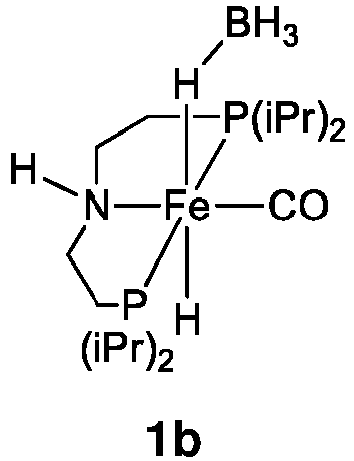
- In a glovebox, under a nitrogen atmosphere, a 200-mL oven-dried Schlenk flask was charged with complex [iPrPNHP]FeBr2(CO) (850 mg, 1.545 mmol), NaBH4 (131 mg, 3.399 mmol, 98% purity), and 100 mL of dry EtOH. The resulting yellow solution was stirred for 18 hours at room temperature and filtered through Celite. The filtrate was evaporated to dryness to obtain pure 1b (84% isolated yield). The 1H and 31P{1H} NMR spectra of 1b agreed well with the reported values (see S. Chakraborty et al., J. Am. Chem. Soc. 2014, 136, 7869).
-

- In a glovebox, under a nitrogen atmosphere, a 200-mL oven-dried Schlenk flask was charged with complex 1b (500 mg, 1.06 mmol), NaO t Bu (106 mg, 1.07 mmol, 97% purity), and 60 mL of dry THF. Immediately, a deep red solution resulted, which was stirred for an additional 30 minutes at room temperature. After that, the solvent was removed under vacuum, and the desired product was extracted into pentane and filtered through a plug of Celite to remove NaBr. The resulting filtrate was evaporated under vacuum to afford pure 1c (76% isolated yield). The 1H and 31P{1H} NMR spectra of 1c agreed well with the reported values (see S. Chakaraborty et al., J. Am. Chem. Soc. 2014, 136, 8564).
- Under an inert atmosphere, an oven-dried 200-mL thick-wall Schlenk tube equipped with a stir-bar was charged with the iron complex 1b (0.1 mmol), DMCD (0.01 mol, 2.00 g), anhydrous EtOH (0.2 mol, 11.7 mL), and 20 mL of anhydrous toluene. The resulting mixture was heated to 100ºC for 8.5 h using an oil-bath. After 8.5 h, the brown colored solution was cooled to room temperature, volatiles were carefully vented inside a hood, and the resulting solution was analyzed by gas chromatography (GC).
- 87.1% of DMCD was converted under these conditions. The GC yield of CHDM was 78.7%. Other DMCD-derived organic materials were present at 8.4% (combined yield).
- Under an inert atmosphere, an oven-dried 200-mL thick-wall Schlenk tube equipped with a stir-bar was charged with the iron catalyst 1c (0.1 mmol), DMCD (0.01 mol, 2.00 g), anhydrous EtOH (0.2 mol, 11.7 mL), and 20 mL of anhydrous toluene. The resulting mixture was heated to 100ºC for 8.5 h using an oil-bath. After 8.5 h, the brown colored solution was cooled to room temperature, volatiles were carefully vented inside a hood, and the resulting solution was analyzed by gas chromatography (GC).
- 74.3% of CHDM was produced under these conditions. EtOAc, MeOH, and trace amounts of methyl formate were observed as other volatile byproducts.
- Under an inert atmosphere, an oven-dried 200-mL thick-wall Schlenk tube equipped with a stir-bar was charged with the iron catalyst 1c (0.1 mmol), DMCD (0.01 mol, 2.00 g), anhydrous iPrOH (0.2 mol, 15.3 mL), and 16.4 mL of anhydrous toluene. The resulting mixture was heated to 100ºC for 8.5 h using an oil-bath. After 8.5 h, the brown colored solution was cooled to room temperature, volatiles were carefully vented inside a hood, and the resulting solution was analyzed by gas chromatography (GC). 62.9% of DMCD was converted under these conditions. The GC yield of CHDM was 57.4%. Other DMCD-derived organic materials were present at 5.5% (combined yield). Acetone and MeOH were observed as other volatile byproducts.
- Under an inert atmosphere, an oven-dried 200-mL thick-wall Schlenk tube equipped with a stir-bar was charged with the iron catalyst 1c (0.1 mmol), DMCD (0.01 mol, 2.00 g), anhydrous MeOH (0.2 mol, 8.1 mL), and 23.6 mL of anhydrous toluene. The resulting mixture was heated to 100ºC for 8.5 h using an oil-bath. After 8.5 h, the brown colored solution was cooled to room temperature, volatiles were carefully vented inside a hood, and the resulting solution was analyzed by gas chromatography (GC).
- No CHDM was produced. 30.5% of DMCD was converted under these conditions to yield methyl and ethyl ester derivatives. MeOCHO was produced as the byproduct of MeOH dehydrocoupling, but the % yield of MeOCHO could not be accurately measured because of its high volatility.
- In the specification, there have been disclosed certain embodiments of the invention and, although specific terms are employed, they are used in a generic and descriptive sense only and not for purposes of limitation, the scope of the invention being set forth in the following claims.
Claims (15)
- A process for preparing an alcohol from an ester, the process comprising contacting an ester with an anhydrous C2-C12 alcohol, in the presence of a catalyst of the formula (I):
 in a reactor at ambient pressure and elevated temperature for a time sufficient to form a corresponding alcohol from the ester,whereinR1 and R2 are each independently an alkyl, aryl, alkoxy, aryloxy, dialkylamido, diarylamido, or alkylarylamido group having 1 to 12 carbon atoms;R3 and R4 are each independently an alkyl or aryl group having 1 to 12 carbon atoms, if E is nitrogen;R3 and R4 are each independently an alkyl, aryl, alkoxy, aryloxy, dialkylamido, diarylamido, or alkylarylamido group having 1 to 12 carbon atoms, if E is phosphorus;R1, R2, and P may be connected to form a 5 or 6-membered heterocyclic ring;R3, R4, and E may be connected to form a 5 or 6-membered heterocyclic ring;R5 and R6 are each independently a C1-C6 alkylene or arylene group;E is phosphorus or nitrogen; andL is a neutral ligand,wherein the reaction mixture contains less than 1 wt% of water based on the total weight of the reaction mixture,wherein alkyl refers to straight, branched, and cyclic alkyl groups and aryl refers to phenyl and naphthyl,and wherein one or more of R1, R2, R3 and R4 may be substituted with one or more groups selected from methoxy, ethoxy, isopropoxy, dimethylamido, diethylamido and diisopropylamido.
 - The process according to claim 1, wherein the process comprises forming the catalyst by introducing a pre-catalyst of the formulas (IIa) or (IIb):
 into the reactor and exposing the pre-catalyst to heat, an acid, a base, or combinations thereof; andwhereinR1, R2, R3, R4, R5, R6, E, and L are as defined in formula (I);Z is R7 orX;R7 is hydrogen or straight, branched or cyclic alkyl or phenyl or naphthyl group; X is [BH4]- or a halide; andL2 is a neutral ligand.
 - The process according to claim 1, wherein the process comprises forming the catalyst by:(a) introducing (i) an iron salt or an iron complex comprising the neutral ligand (L), (ii) a ligand of the formula (III):
 (b) optionally exposing the pre-catalyst mixture to heat, an acid, a base, or combinations thereof;wherein R1, R2, R3, R4, R5, R6, and E are as defined in formula (I).
 - The process according to claim 1, wherein one or more of R1, R2, R3, and R4 are substituted with one or more groups selected from methoxy, ethoxy, isopropoxy, dimethylamido, diethylamido and diisopropylamido.
- The process according to claim 1, wherein R1, R2, R3, and R4 are each independently a methyl, ethyl, propyl, isopropyl, butyl, pentyl, isopentyl, cyclopentyl, hexyl, cyclohexyl, or phenyl group.
- The process according to claim 5, wherein each of R1, R2, R3, and R4 is isopropyl or
wherein each of R1, R2, R3, and R4 is phenyl. - The process according to claim 1, wherein each of R5 and R6 is -(CH2CH2)-.
- The process according to claim 1, wherein E is phosphorus.
- The process according to claim 1, wherein L is carbon monoxide, a phosphine, an amine, a nitrile, or an N-containing heterocyclic ligand.
- The process according to claim 2, wherein L2 is an ether, an amide, a nitrile, or an N-containing heterocyclic ligand.
- The process according to claim 1, wherein the contacting step is conducted at a temperature of 50 to 180°C or wherein the contacting step is conducted in the absence of exogenous molecular hydrogen (H2).
- The process according to claim 2, wherein the base is a metal alkoxide or a nitrogen-containing compound or wherein the base is sodium methoxide, sodium ethoxide, or triethylamine.
- The process according to claim 1, wherein the molar ratio of the C2-C12 alcohol to the ester ranges from 2:1 to 100:1.
- The process according to claim 1, wherein the C2-C12 alcohol comprises ethanol, isopropanol, or isobutanol.
- The process according to claim 1, wherein the ester comprises glycerides or wherein the ester comprises lactones.
Applications Claiming Priority (3)
| Application Number | Priority Date | Filing Date | Title |
|---|---|---|---|
| US201762540344P | 2017-08-02 | 2017-08-02 | |
| US16/043,317 US10266466B2 (en) | 2017-08-02 | 2018-07-24 | Iron-catalyzed transfer hydrogenation of esters to alcohols |
| PCT/US2018/044521 WO2019027967A1 (en) | 2017-08-02 | 2018-07-31 | Iron-catalyzed transfer hydrogenation of esters to alcohols |
Publications (2)
| Publication Number | Publication Date |
|---|---|
| EP3661900A1 EP3661900A1 (en) | 2020-06-10 |
| EP3661900B1 true EP3661900B1 (en) | 2023-11-01 |
Family
ID=65232047
Family Applications (1)
| Application Number | Title | Priority Date | Filing Date |
|---|---|---|---|
| EP18755626.1A Active EP3661900B1 (en) | 2017-08-02 | 2018-07-31 | Iron-catalyzed transfer hydrogenation of esters to alcohols |
Country Status (4)
| Country | Link |
|---|---|
| US (1) | US10266466B2 (en) |
| EP (1) | EP3661900B1 (en) |
| CN (1) | CN111032603B (en) |
| WO (1) | WO2019027967A1 (en) |
Family Cites Families (51)
| Publication number | Priority date | Publication date | Assignee | Title |
|---|---|---|---|---|
| US1400195A (en) | 1918-12-24 | 1921-12-13 | Us Ind Alcohol Co | Process of making methyl formate |
| US1999403A (en) | 1928-03-24 | 1935-04-30 | Dreyfus Henry | Manufacture of hydroxy aliphatic acids |
| BE361508A (en) | 1928-06-14 | |||
| US2060880A (en) | 1933-09-23 | 1936-11-17 | Du Pont | Process of producing ethylene glycol |
| GB472905A (en) | 1936-04-01 | 1937-10-01 | British Celanese | Improvements in the manufacture and treatment of textile materials |
| US2305104A (en) | 1939-10-25 | 1942-12-15 | Du Pont | Hydrogenation of alkyl glycolates |
| US2504497A (en) | 1947-02-11 | 1950-04-18 | Normande De Prod Chim Soc | Catalysts suitable for dehydrogenation processes |
| US2607805A (en) | 1949-06-10 | 1952-08-19 | Du Pont | Hydrogenation of glycolic acid to ethylene glycol |
| US3911003A (en) | 1974-06-19 | 1975-10-07 | Chevron Res | Process for the production of glycolic acid and oxydiacetic acid |
| US4217460A (en) | 1975-10-11 | 1980-08-12 | Basf Aktiengesellschaft | Isolation of formic acid from its aqueous solutions |
| DE2545730A1 (en) | 1975-10-11 | 1977-04-21 | Basf Ag | METHOD FOR REPRESENTING ANTIC ACID |
| GB1511961A (en) | 1976-03-12 | 1978-05-24 | Ucb Sa | Process for the production of methyl formate |
| DE2716842C2 (en) | 1976-04-16 | 1984-08-30 | Mitsubishi Gas Chemical Co., Inc., Tokio/Tokyo | Process for the preparation of methyl formate |
| JPS5371008A (en) | 1976-12-02 | 1978-06-24 | Mitsubishi Gas Chem Co Inc | Preparation of methyl formate |
| US4112245A (en) | 1976-08-18 | 1978-09-05 | Atlantic Richfield Company | Process for the preparation of ethylene glycol |
| US4052424A (en) | 1976-09-01 | 1977-10-04 | Celanese Corporation | Production of esters from alcohols |
| DE2715666A1 (en) | 1977-04-07 | 1978-10-12 | Hoechst Ag | PROCESS FOR THE MANUFACTURING OF ETHYLENE GLYCOL |
| DE2744313A1 (en) | 1977-10-01 | 1979-04-12 | Basf Ag | PROCESS FOR THE PRODUCTION OF FORM ACID |
| JPS54141716A (en) | 1978-04-21 | 1979-11-05 | Mitsubishi Gas Chem Co Inc | Preparation of methyl formate |
| DE2914671A1 (en) | 1979-04-11 | 1980-10-23 | Basf Ag | METHOD FOR DETERMINING WATER-FREE OR MOSTLY WATER-FREE FORMIC ACID |
| US4366333A (en) | 1979-06-27 | 1982-12-28 | Chevron Research Company | Process of prolonging the life of ester hydrogenation catalyst |
| IN154274B (en) | 1980-09-02 | 1984-10-13 | Ube Industries | |
| IT1190783B (en) | 1981-04-29 | 1988-02-24 | Davy Mckee Oil & Chem | PROCESS FOR HYDROGENOLYSIS OF ESTERS OF CARBOXYLIC ACIDS |
| JPS6045938B2 (en) | 1981-04-30 | 1985-10-12 | 宇部興産株式会社 | Method for producing oxalic acid diester hydrogenation catalyst |
| JPS5933418B2 (en) | 1982-03-24 | 1984-08-15 | 三菱瓦斯化学株式会社 | Catalyst manufacturing method |
| JPS58193735A (en) | 1982-05-06 | 1983-11-11 | Ube Ind Ltd | Method for producing catalyst for hydrogenation of lower hydroxycarboxylic acid esters |
| US4480122A (en) | 1982-09-27 | 1984-10-30 | Celanese Corporation | Process for producing methyl formate |
| US4792620A (en) | 1983-10-14 | 1988-12-20 | Bp Chemicals Limited | Carbonylation catalysts |
| DE3411384A1 (en) | 1984-03-28 | 1985-10-10 | Basf Ag, 6700 Ludwigshafen | METHOD FOR THE EXTRACTION OF WATER-FREE OR MOSTLY WATER-FREE FORMIC ACID BY HYDROLYSIS OF METHYLFORMIAT |
| DE3417790A1 (en) | 1984-05-14 | 1985-11-14 | Basf Ag, 6700 Ludwigshafen | METHOD FOR PRODUCING FORMIC ACID |
| US4677234A (en) | 1985-02-04 | 1987-06-30 | Union Carbide Corporation | Process for the preparation of ethylene glycol |
| AU573016B2 (en) | 1985-08-06 | 1988-05-26 | Sakai, T. | Rapid freezing of fish in brine |
| US5144062A (en) | 1989-04-19 | 1992-09-01 | Dairen Chemical Corporation | Process for producing methyl formate |
| DE3936854A1 (en) | 1989-11-06 | 1991-05-08 | Basf Ag | METHOD FOR PRODUCING METHYL FORMATE |
| US6455742B1 (en) | 1999-09-02 | 2002-09-24 | Wisconsin Alumni Research Foundation | Method for catalytically reducing carboxylic acid groups to hydroxyl groups in hydroxycarboxylic acids |
| US6376723B2 (en) | 1999-12-29 | 2002-04-23 | Shell Oil Company | Process for the carbonylation of formaldehyde |
| US6841085B2 (en) | 2001-10-23 | 2005-01-11 | Battelle Memorial Institute | Hydrogenolysis of 6-carbon sugars and other organic compounds |
| US6956134B2 (en) | 2004-01-08 | 2005-10-18 | The Regents Of The University Of California | Oxidation of methanol and/or dimethyl ether using supported molybdenum-containing heteropolyacid catalysts |
| EP1868965B1 (en) | 2005-04-05 | 2013-08-28 | Firmenich Sa | Hydrogenation of esters with ru/tetradentate ligands complexes |
| BRPI0608687A2 (en) | 2005-04-05 | 2016-11-08 | Firmenich & Cie | process for reducing a substrate by binding and complexing |
| US7615671B2 (en) | 2007-11-30 | 2009-11-10 | Eastman Chemical Company | Hydrogenation process for the preparation of 1,2-diols |
| JP5376114B2 (en) | 2008-09-26 | 2013-12-25 | 三菱瓦斯化学株式会社 | Methanol dehydrogenation catalyst for methyl formate production and method for producing methyl formate |
| EP2599544A1 (en) | 2011-12-01 | 2013-06-05 | Leibniz-Institut für Katalyse e.V. an der Universität Rostock | A process for producing alkyl esters by dehydrogenation of a primary alcohol using a homogenous catalyst system |
| US8969632B2 (en) | 2012-03-23 | 2015-03-03 | Eastman Chemical Company | Passivation of a homogeneous hydrogenation catalyst for the production of ethylene glycol |
| US9597673B2 (en) | 2012-05-25 | 2017-03-21 | The Governing Council Of The University Of Toronto | Iron catalysts with unsymmetrical PNN'P ligands |
| US9040748B2 (en) | 2012-06-08 | 2015-05-26 | Eastman Chemical Company | Hydrocarboxylation of aqueous formaldehyde using a dehydrating recycle stream to decrease water concentration |
| CN105829330B (en) | 2013-12-18 | 2019-08-16 | 弗门尼舍有限公司 | Hydrogenation of esters using Fe/tridentate ligand complexes |
| WO2015103703A1 (en) | 2014-01-08 | 2015-07-16 | The Governing Council Of The University Of Toronto | Iron(ii) catalysts containing tridentate pnp ligands, their synthesis, and use thereof |
| US20150274621A1 (en) | 2014-03-31 | 2015-10-01 | The Procter & Gamble Company | Homogeneous Hydrogenation of Esters Employing a Complex of Iron as Catalyst |
| US9493395B2 (en) | 2015-04-07 | 2016-11-15 | Eastman Chemical Company | Production of two esters using homogeneous catalyst |
| WO2017194663A1 (en) | 2016-05-13 | 2017-11-16 | Dsm Ip Assets B.V. | Selective reduction of esters to alcohols |
-
2018
- 2018-07-24 US US16/043,317 patent/US10266466B2/en active Active
- 2018-07-31 EP EP18755626.1A patent/EP3661900B1/en active Active
- 2018-07-31 WO PCT/US2018/044521 patent/WO2019027967A1/en not_active Ceased
- 2018-07-31 CN CN201880050163.7A patent/CN111032603B/en active Active
Also Published As
| Publication number | Publication date |
|---|---|
| CN111032603B (en) | 2023-07-25 |
| US10266466B2 (en) | 2019-04-23 |
| WO2019027967A1 (en) | 2019-02-07 |
| EP3661900A1 (en) | 2020-06-10 |
| US20190039977A1 (en) | 2019-02-07 |
| CN111032603A (en) | 2020-04-17 |
Similar Documents
| Publication | Publication Date | Title |
|---|---|---|
| CA2932568A1 (en) | Metal-ligand cooperative catalysis through n-h arm deprotonation/pyridine dearomatiztion for efficient hydrogen generation from formic acid | |
| EP2074076A2 (en) | Production of amines by catalytic hydrogenation of carboxylic acid derivatives | |
| US9284248B2 (en) | Process for producing α-fluoroaldehydes | |
| EP3661900B1 (en) | Iron-catalyzed transfer hydrogenation of esters to alcohols | |
| US9061960B2 (en) | Method for working up mixtures | |
| EP4419500A1 (en) | Processes for producing alkyl acrylate dimers | |
| Zhang et al. | Cobalt carbonyl ionic liquids based on the 1, 1, 3, 3-tetra-alkylguanidine cation: Novel, highly efficient, and reusable catalysts for the carbonylation of epoxides | |
| EP3661901B1 (en) | Synthesis of glycols via transfer hydrogenation of alpha-functional esters with alcohols | |
| WO2023066844A1 (en) | Bis-aminophosphines as catalysts for the dimerization of alkyl acrylates | |
| WO2019027959A1 (en) | Homogeneous iron catalysts for the conversion of methanol to methyl formate and hydrogen | |
| EP3661908A1 (en) | Homogeneous iron catalysts for the conversion of ethanol to ethyl acetate and hydrogen | |
| US10710956B2 (en) | Process for the preparation of acrylate esters from alkyl lactates | |
| EP3604319B1 (en) | Cationic ruthenium complex, and production method therefor and use thereof | |
| US10407448B2 (en) | N-N-bis(2-dialkylphosphinoethyl)amine-borane complex and production method therefor, and method for producing ruthenium complex containing N,N-bis(2-dialkylphosphinoethyl)amine as ligand | |
| KR20240006443A (en) | Process for the preparation of dicidal | |
| US10435349B2 (en) | Iron-catalyzed cross-coupling of methanol with secondary or tertiary alcohols to produce formate esters | |
| CA1094095A (en) | Asymmetric catalysis | |
| KR20250125294A (en) | Method for preparing trioxane derivatives | |
| AU2006259086A1 (en) | Process for synthesis of dialkoxyorganoboranes |
Legal Events
| Date | Code | Title | Description |
|---|---|---|---|
| STAA | Information on the status of an ep patent application or granted ep patent |
Free format text: STATUS: UNKNOWN |
|
| STAA | Information on the status of an ep patent application or granted ep patent |
Free format text: STATUS: THE INTERNATIONAL PUBLICATION HAS BEEN MADE |
|
| PUAI | Public reference made under article 153(3) epc to a published international application that has entered the european phase |
Free format text: ORIGINAL CODE: 0009012 |
|
| STAA | Information on the status of an ep patent application or granted ep patent |
Free format text: STATUS: REQUEST FOR EXAMINATION WAS MADE |
|
| 17P | Request for examination filed |
Effective date: 20191216 |
|
| AK | Designated contracting states |
Kind code of ref document: A1 Designated state(s): AL AT BE BG CH CY CZ DE DK EE ES FI FR GB GR HR HU IE IS IT LI LT LU LV MC MK MT NL NO PL PT RO RS SE SI SK SM TR |
|
| AX | Request for extension of the european patent |
Extension state: BA ME |
|
| DAV | Request for validation of the european patent (deleted) | ||
| DAX | Request for extension of the european patent (deleted) | ||
| STAA | Information on the status of an ep patent application or granted ep patent |
Free format text: STATUS: EXAMINATION IS IN PROGRESS |
|
| 17Q | First examination report despatched |
Effective date: 20210217 |
|
| GRAP | Despatch of communication of intention to grant a patent |
Free format text: ORIGINAL CODE: EPIDOSNIGR1 |
|
| STAA | Information on the status of an ep patent application or granted ep patent |
Free format text: STATUS: GRANT OF PATENT IS INTENDED |
|
| INTG | Intention to grant announced |
Effective date: 20230606 |
|
| GRAS | Grant fee paid |
Free format text: ORIGINAL CODE: EPIDOSNIGR3 |
|
| P01 | Opt-out of the competence of the unified patent court (upc) registered |
Effective date: 20230816 |
|
| GRAA | (expected) grant |
Free format text: ORIGINAL CODE: 0009210 |
|
| STAA | Information on the status of an ep patent application or granted ep patent |
Free format text: STATUS: THE PATENT HAS BEEN GRANTED |
|
| AK | Designated contracting states |
Kind code of ref document: B1 Designated state(s): AL AT BE BG CH CY CZ DE DK EE ES FI FR GB GR HR HU IE IS IT LI LT LU LV MC MK MT NL NO PL PT RO RS SE SI SK SM TR |
|
| REG | Reference to a national code |
Ref country code: GB Ref legal event code: FG4D |
|
| REG | Reference to a national code |
Ref country code: CH Ref legal event code: EP |
|
| REG | Reference to a national code |
Ref country code: DE Ref legal event code: R096 Ref document number: 602018060394 Country of ref document: DE |
|
| REG | Reference to a national code |
Ref country code: IE Ref legal event code: FG4D |
|
| REG | Reference to a national code |
Ref country code: LT Ref legal event code: MG9D |
|
| REG | Reference to a national code |
Ref country code: NL Ref legal event code: MP Effective date: 20231101 |
|
| PG25 | Lapsed in a contracting state [announced via postgrant information from national office to epo] |
Ref country code: GR Free format text: LAPSE BECAUSE OF FAILURE TO SUBMIT A TRANSLATION OF THE DESCRIPTION OR TO PAY THE FEE WITHIN THE PRESCRIBED TIME-LIMIT Effective date: 20240202 |
|
| PG25 | Lapsed in a contracting state [announced via postgrant information from national office to epo] |
Ref country code: IS Free format text: LAPSE BECAUSE OF FAILURE TO SUBMIT A TRANSLATION OF THE DESCRIPTION OR TO PAY THE FEE WITHIN THE PRESCRIBED TIME-LIMIT Effective date: 20240301 |
|
| PG25 | Lapsed in a contracting state [announced via postgrant information from national office to epo] |
Ref country code: LT Free format text: LAPSE BECAUSE OF FAILURE TO SUBMIT A TRANSLATION OF THE DESCRIPTION OR TO PAY THE FEE WITHIN THE PRESCRIBED TIME-LIMIT Effective date: 20231101 |
|
| REG | Reference to a national code |
Ref country code: AT Ref legal event code: MK05 Ref document number: 1627080 Country of ref document: AT Kind code of ref document: T Effective date: 20231101 |
|
| PG25 | Lapsed in a contracting state [announced via postgrant information from national office to epo] |
Ref country code: NL Free format text: LAPSE BECAUSE OF FAILURE TO SUBMIT A TRANSLATION OF THE DESCRIPTION OR TO PAY THE FEE WITHIN THE PRESCRIBED TIME-LIMIT Effective date: 20231101 |
|
| PG25 | Lapsed in a contracting state [announced via postgrant information from national office to epo] |
Ref country code: AT Free format text: LAPSE BECAUSE OF FAILURE TO SUBMIT A TRANSLATION OF THE DESCRIPTION OR TO PAY THE FEE WITHIN THE PRESCRIBED TIME-LIMIT Effective date: 20231101 |
|
| PG25 | Lapsed in a contracting state [announced via postgrant information from national office to epo] |
Ref country code: ES Free format text: LAPSE BECAUSE OF FAILURE TO SUBMIT A TRANSLATION OF THE DESCRIPTION OR TO PAY THE FEE WITHIN THE PRESCRIBED TIME-LIMIT Effective date: 20231101 |
|
| PG25 | Lapsed in a contracting state [announced via postgrant information from national office to epo] |
Ref country code: NL Free format text: LAPSE BECAUSE OF FAILURE TO SUBMIT A TRANSLATION OF THE DESCRIPTION OR TO PAY THE FEE WITHIN THE PRESCRIBED TIME-LIMIT Effective date: 20231101 Ref country code: LT Free format text: LAPSE BECAUSE OF FAILURE TO SUBMIT A TRANSLATION OF THE DESCRIPTION OR TO PAY THE FEE WITHIN THE PRESCRIBED TIME-LIMIT Effective date: 20231101 Ref country code: IS Free format text: LAPSE BECAUSE OF FAILURE TO SUBMIT A TRANSLATION OF THE DESCRIPTION OR TO PAY THE FEE WITHIN THE PRESCRIBED TIME-LIMIT Effective date: 20240301 Ref country code: GR Free format text: LAPSE BECAUSE OF FAILURE TO SUBMIT A TRANSLATION OF THE DESCRIPTION OR TO PAY THE FEE WITHIN THE PRESCRIBED TIME-LIMIT Effective date: 20240202 Ref country code: ES Free format text: LAPSE BECAUSE OF FAILURE TO SUBMIT A TRANSLATION OF THE DESCRIPTION OR TO PAY THE FEE WITHIN THE PRESCRIBED TIME-LIMIT Effective date: 20231101 Ref country code: BG Free format text: LAPSE BECAUSE OF FAILURE TO SUBMIT A TRANSLATION OF THE DESCRIPTION OR TO PAY THE FEE WITHIN THE PRESCRIBED TIME-LIMIT Effective date: 20240201 Ref country code: AT Free format text: LAPSE BECAUSE OF FAILURE TO SUBMIT A TRANSLATION OF THE DESCRIPTION OR TO PAY THE FEE WITHIN THE PRESCRIBED TIME-LIMIT Effective date: 20231101 Ref country code: PT Free format text: LAPSE BECAUSE OF FAILURE TO SUBMIT A TRANSLATION OF THE DESCRIPTION OR TO PAY THE FEE WITHIN THE PRESCRIBED TIME-LIMIT Effective date: 20240301 |
|
| PG25 | Lapsed in a contracting state [announced via postgrant information from national office to epo] |
Ref country code: SE Free format text: LAPSE BECAUSE OF FAILURE TO SUBMIT A TRANSLATION OF THE DESCRIPTION OR TO PAY THE FEE WITHIN THE PRESCRIBED TIME-LIMIT Effective date: 20231101 Ref country code: RS Free format text: LAPSE BECAUSE OF FAILURE TO SUBMIT A TRANSLATION OF THE DESCRIPTION OR TO PAY THE FEE WITHIN THE PRESCRIBED TIME-LIMIT Effective date: 20231101 Ref country code: PL Free format text: LAPSE BECAUSE OF FAILURE TO SUBMIT A TRANSLATION OF THE DESCRIPTION OR TO PAY THE FEE WITHIN THE PRESCRIBED TIME-LIMIT Effective date: 20231101 Ref country code: NO Free format text: LAPSE BECAUSE OF FAILURE TO SUBMIT A TRANSLATION OF THE DESCRIPTION OR TO PAY THE FEE WITHIN THE PRESCRIBED TIME-LIMIT Effective date: 20240201 Ref country code: LV Free format text: LAPSE BECAUSE OF FAILURE TO SUBMIT A TRANSLATION OF THE DESCRIPTION OR TO PAY THE FEE WITHIN THE PRESCRIBED TIME-LIMIT Effective date: 20231101 Ref country code: HR Free format text: LAPSE BECAUSE OF FAILURE TO SUBMIT A TRANSLATION OF THE DESCRIPTION OR TO PAY THE FEE WITHIN THE PRESCRIBED TIME-LIMIT Effective date: 20231101 |
|
| PG25 | Lapsed in a contracting state [announced via postgrant information from national office to epo] |
Ref country code: DK Free format text: LAPSE BECAUSE OF FAILURE TO SUBMIT A TRANSLATION OF THE DESCRIPTION OR TO PAY THE FEE WITHIN THE PRESCRIBED TIME-LIMIT Effective date: 20231101 |
|
| PG25 | Lapsed in a contracting state [announced via postgrant information from national office to epo] |
Ref country code: CZ Free format text: LAPSE BECAUSE OF FAILURE TO SUBMIT A TRANSLATION OF THE DESCRIPTION OR TO PAY THE FEE WITHIN THE PRESCRIBED TIME-LIMIT Effective date: 20231101 |
|
| PG25 | Lapsed in a contracting state [announced via postgrant information from national office to epo] |
Ref country code: SK Free format text: LAPSE BECAUSE OF FAILURE TO SUBMIT A TRANSLATION OF THE DESCRIPTION OR TO PAY THE FEE WITHIN THE PRESCRIBED TIME-LIMIT Effective date: 20231101 |
|
| PG25 | Lapsed in a contracting state [announced via postgrant information from national office to epo] |
Ref country code: SM Free format text: LAPSE BECAUSE OF FAILURE TO SUBMIT A TRANSLATION OF THE DESCRIPTION OR TO PAY THE FEE WITHIN THE PRESCRIBED TIME-LIMIT Effective date: 20231101 Ref country code: SK Free format text: LAPSE BECAUSE OF FAILURE TO SUBMIT A TRANSLATION OF THE DESCRIPTION OR TO PAY THE FEE WITHIN THE PRESCRIBED TIME-LIMIT Effective date: 20231101 Ref country code: IT Free format text: LAPSE BECAUSE OF FAILURE TO SUBMIT A TRANSLATION OF THE DESCRIPTION OR TO PAY THE FEE WITHIN THE PRESCRIBED TIME-LIMIT Effective date: 20231101 Ref country code: EE Free format text: LAPSE BECAUSE OF FAILURE TO SUBMIT A TRANSLATION OF THE DESCRIPTION OR TO PAY THE FEE WITHIN THE PRESCRIBED TIME-LIMIT Effective date: 20231101 Ref country code: DK Free format text: LAPSE BECAUSE OF FAILURE TO SUBMIT A TRANSLATION OF THE DESCRIPTION OR TO PAY THE FEE WITHIN THE PRESCRIBED TIME-LIMIT Effective date: 20231101 Ref country code: CZ Free format text: LAPSE BECAUSE OF FAILURE TO SUBMIT A TRANSLATION OF THE DESCRIPTION OR TO PAY THE FEE WITHIN THE PRESCRIBED TIME-LIMIT Effective date: 20231101 |
|
| REG | Reference to a national code |
Ref country code: DE Ref legal event code: R097 Ref document number: 602018060394 Country of ref document: DE |
|
| PLBE | No opposition filed within time limit |
Free format text: ORIGINAL CODE: 0009261 |
|
| STAA | Information on the status of an ep patent application or granted ep patent |
Free format text: STATUS: NO OPPOSITION FILED WITHIN TIME LIMIT |
|
| 26N | No opposition filed |
Effective date: 20240802 |
|
| PG25 | Lapsed in a contracting state [announced via postgrant information from national office to epo] |
Ref country code: SI Free format text: LAPSE BECAUSE OF FAILURE TO SUBMIT A TRANSLATION OF THE DESCRIPTION OR TO PAY THE FEE WITHIN THE PRESCRIBED TIME-LIMIT Effective date: 20231101 |
|
| PG25 | Lapsed in a contracting state [announced via postgrant information from national office to epo] |
Ref country code: SI Free format text: LAPSE BECAUSE OF FAILURE TO SUBMIT A TRANSLATION OF THE DESCRIPTION OR TO PAY THE FEE WITHIN THE PRESCRIBED TIME-LIMIT Effective date: 20231101 |
|
| PG25 | Lapsed in a contracting state [announced via postgrant information from national office to epo] |
Ref country code: MC Free format text: LAPSE BECAUSE OF FAILURE TO SUBMIT A TRANSLATION OF THE DESCRIPTION OR TO PAY THE FEE WITHIN THE PRESCRIBED TIME-LIMIT Effective date: 20231101 |
|
| REG | Reference to a national code |
Ref country code: CH Ref legal event code: PL |
|
| PG25 | Lapsed in a contracting state [announced via postgrant information from national office to epo] |
Ref country code: LU Free format text: LAPSE BECAUSE OF NON-PAYMENT OF DUE FEES Effective date: 20240731 |
|
| GBPC | Gb: european patent ceased through non-payment of renewal fee |
Effective date: 20240731 |
|
| PG25 | Lapsed in a contracting state [announced via postgrant information from national office to epo] |
Ref country code: LU Free format text: LAPSE BECAUSE OF NON-PAYMENT OF DUE FEES Effective date: 20240731 |
|
| PG25 | Lapsed in a contracting state [announced via postgrant information from national office to epo] |
Ref country code: CH Free format text: LAPSE BECAUSE OF NON-PAYMENT OF DUE FEES Effective date: 20240731 Ref country code: BE Free format text: LAPSE BECAUSE OF NON-PAYMENT OF DUE FEES Effective date: 20240731 |
|
| PG25 | Lapsed in a contracting state [announced via postgrant information from national office to epo] |
Ref country code: GB Free format text: LAPSE BECAUSE OF NON-PAYMENT OF DUE FEES Effective date: 20240731 |
|
| REG | Reference to a national code |
Ref country code: BE Ref legal event code: MM Effective date: 20240731 |
|
| PGFP | Annual fee paid to national office [announced via postgrant information from national office to epo] |
Ref country code: FR Payment date: 20250612 Year of fee payment: 8 |
|
| PG25 | Lapsed in a contracting state [announced via postgrant information from national office to epo] |
Ref country code: IE Free format text: LAPSE BECAUSE OF NON-PAYMENT OF DUE FEES Effective date: 20240731 |
|
| PG25 | Lapsed in a contracting state [announced via postgrant information from national office to epo] |
Ref country code: FI Free format text: LAPSE BECAUSE OF FAILURE TO SUBMIT A TRANSLATION OF THE DESCRIPTION OR TO PAY THE FEE WITHIN THE PRESCRIBED TIME-LIMIT Effective date: 20231101 |
|
| PGFP | Annual fee paid to national office [announced via postgrant information from national office to epo] |
Ref country code: DE Payment date: 20250616 Year of fee payment: 8 |
|
| PG25 | Lapsed in a contracting state [announced via postgrant information from national office to epo] |
Ref country code: RO Free format text: LAPSE BECAUSE OF FAILURE TO SUBMIT A TRANSLATION OF THE DESCRIPTION OR TO PAY THE FEE WITHIN THE PRESCRIBED TIME-LIMIT Effective date: 20231101 |
|
| PG25 | Lapsed in a contracting state [announced via postgrant information from national office to epo] |
Ref country code: CY Free format text: LAPSE BECAUSE OF FAILURE TO SUBMIT A TRANSLATION OF THE DESCRIPTION OR TO PAY THE FEE WITHIN THE PRESCRIBED TIME-LIMIT; INVALID AB INITIO Effective date: 20180731 |