EP3661001A1 - Device and system for power transmission - Google Patents
Device and system for power transmission Download PDFInfo
- Publication number
- EP3661001A1 EP3661001A1 EP19216505.8A EP19216505A EP3661001A1 EP 3661001 A1 EP3661001 A1 EP 3661001A1 EP 19216505 A EP19216505 A EP 19216505A EP 3661001 A1 EP3661001 A1 EP 3661001A1
- Authority
- EP
- European Patent Office
- Prior art keywords
- power
- voltage
- power transmission
- impedance
- section
- Prior art date
- Legal status (The legal status is an assumption and is not a legal conclusion. Google has not performed a legal analysis and makes no representation as to the accuracy of the status listed.)
- Granted
Links
Images






Classifications
-
- H—ELECTRICITY
- H04—ELECTRIC COMMUNICATION TECHNIQUE
- H04B—TRANSMISSION
- H04B5/00—Near-field transmission systems, e.g. inductive or capacitive transmission systems
- H04B5/70—Near-field transmission systems, e.g. inductive or capacitive transmission systems specially adapted for specific purposes
- H04B5/79—Near-field transmission systems, e.g. inductive or capacitive transmission systems specially adapted for specific purposes for data transfer in combination with power transfer
-
- A—HUMAN NECESSITIES
- A01—AGRICULTURE; FORESTRY; ANIMAL HUSBANDRY; HUNTING; TRAPPING; FISHING
- A01K—ANIMAL HUSBANDRY; AVICULTURE; APICULTURE; PISCICULTURE; FISHING; REARING OR BREEDING ANIMALS, NOT OTHERWISE PROVIDED FOR; NEW BREEDS OF ANIMALS
- A01K29/00—Other apparatus for animal husbandry
-
- H—ELECTRICITY
- H02—GENERATION; CONVERSION OR DISTRIBUTION OF ELECTRIC POWER
- H02J—ELECTRIC POWER NETWORKS; CIRCUIT ARRANGEMENTS OR SYSTEMS FOR SUPPLYING OR DISTRIBUTING ELECTRIC POWER; SYSTEMS FOR STORING ELECTRIC ENERGY
- H02J50/00—Circuit arrangements or systems for wireless supply or distribution of electric power
- H02J50/10—Circuit arrangements or systems for wireless supply or distribution of electric power using inductive coupling
- H02J50/12—Circuit arrangements or systems for wireless supply or distribution of electric power using inductive coupling of the resonant type
-
- H—ELECTRICITY
- H02—GENERATION; CONVERSION OR DISTRIBUTION OF ELECTRIC POWER
- H02J—ELECTRIC POWER NETWORKS; CIRCUIT ARRANGEMENTS OR SYSTEMS FOR SUPPLYING OR DISTRIBUTING ELECTRIC POWER; SYSTEMS FOR STORING ELECTRIC ENERGY
- H02J50/00—Circuit arrangements or systems for wireless supply or distribution of electric power
- H02J50/40—Circuit arrangements or systems for wireless supply or distribution of electric power using two or more transmitting or receiving devices
-
- H—ELECTRICITY
- H02—GENERATION; CONVERSION OR DISTRIBUTION OF ELECTRIC POWER
- H02J—ELECTRIC POWER NETWORKS; CIRCUIT ARRANGEMENTS OR SYSTEMS FOR SUPPLYING OR DISTRIBUTING ELECTRIC POWER; SYSTEMS FOR STORING ELECTRIC ENERGY
- H02J50/00—Circuit arrangements or systems for wireless supply or distribution of electric power
- H02J50/60—Circuit arrangements or systems for wireless supply or distribution of electric power responsive to the presence of foreign objects, e.g. detection of living beings
-
- H—ELECTRICITY
- H02—GENERATION; CONVERSION OR DISTRIBUTION OF ELECTRIC POWER
- H02J—ELECTRIC POWER NETWORKS; CIRCUIT ARRANGEMENTS OR SYSTEMS FOR SUPPLYING OR DISTRIBUTING ELECTRIC POWER; SYSTEMS FOR STORING ELECTRIC ENERGY
- H02J50/00—Circuit arrangements or systems for wireless supply or distribution of electric power
- H02J50/80—Circuit arrangements or systems for wireless supply or distribution of electric power involving the exchange of data, concerning supply or distribution of electric power, between transmitting devices and receiving devices
-
- H—ELECTRICITY
- H02—GENERATION; CONVERSION OR DISTRIBUTION OF ELECTRIC POWER
- H02J—ELECTRIC POWER NETWORKS; CIRCUIT ARRANGEMENTS OR SYSTEMS FOR SUPPLYING OR DISTRIBUTING ELECTRIC POWER; SYSTEMS FOR STORING ELECTRIC ENERGY
- H02J50/00—Circuit arrangements or systems for wireless supply or distribution of electric power
- H02J50/90—Circuit arrangements or systems for wireless supply or distribution of electric power involving detection or optimisation of position, e.g. alignment
-
- H—ELECTRICITY
- H02—GENERATION; CONVERSION OR DISTRIBUTION OF ELECTRIC POWER
- H02J—ELECTRIC POWER NETWORKS; CIRCUIT ARRANGEMENTS OR SYSTEMS FOR SUPPLYING OR DISTRIBUTING ELECTRIC POWER; SYSTEMS FOR STORING ELECTRIC ENERGY
- H02J7/00—Circuit arrangements for charging or discharging batteries or for supplying loads from batteries
- H02J7/90—Regulation of charging or discharging current or voltage
- H02J7/94—Regulation of charging or discharging current or voltage in response to battery current
-
- H—ELECTRICITY
- H02—GENERATION; CONVERSION OR DISTRIBUTION OF ELECTRIC POWER
- H02J—ELECTRIC POWER NETWORKS; CIRCUIT ARRANGEMENTS OR SYSTEMS FOR SUPPLYING OR DISTRIBUTING ELECTRIC POWER; SYSTEMS FOR STORING ELECTRIC ENERGY
- H02J2105/00—Networks for supplying or distributing electric power characterised by their spatial reach or by the load
- H02J2105/40—Networks for supplying or distributing electric power characterised by their spatial reach or by the load characterised by the loads connecting to the networks or being supplied by the networks
- H02J2105/44—Portable electronic devices
Definitions
- the disclosure relates to a system that performs noncontact power supply (electric power transmission) to a device to be power-supplied (an electronic device and the like), and a device applied to such a system.
- a feed system (a noncontact feed system or a wireless charging system) that performs noncontact power supply (electric power transmission) to a CE device (Consumer Electronics Device) such as a portable telephone or a portable music player.
- a CE device Consumer Electronics Device
- a feed unit a primary-side device
- a secondary-side device a device to be power-supplied
- the feed unit keeps supplying the power, thereby causing wasteful power consumption.
- PTLs 1 to 3 each propose a technique of detecting whether a device to be power-supplied is in proximity to a feed unit.
- a disadvantage of lacking in convenience because, for example, a configuration, a technique, and the like are complicated.
- a device for power transmission includes a power transmission section configured to transmit an electric power wirelessly, and a detection section operatively connected to the power transmission section and configured to detect an object within a range from the power transmission section based on a change in impedance in vicinity of the power transmission section.
- a system for power transmission includes a transmitting device and a receiving device.
- the transmitting device includes a power transmission section configured to transmit an electric power wirelessly and a detection section operatively connected to the power transmission section and configured to detect a receiving device within a range from the power transmission section based on a change in impedance in vicinity of the power transmission section.
- the receiving device includes a power reception unit configured to receive the electric power wirelessly, and a load operatively connected to the power reception unit and configured to perform an operation based on the received electric power.
- the device and the system for power transmission of the embodiments of the disclosure whether the device to be power-supplied by the power transmission section is in proximity or not is detected using the change in the impedance in the vicinity of the power transmission section. Therefore, it is possible to perform detection of the device to be power-supplied without complicating a configuration and a technique, for example. Hence, it is possible to detect the device to be power-supplied conveniently when the power transmission section is performed using the magnetic field.
- FIG. 1 illustrates an appearance configuration example of a feed system (a feed system 4) according to the first embodiment of the disclosure
- FIG. 2 illustrates a block configuration example of this feed system 4.
- the feed system 4 is a system (a noncontact-type feed system) that performs electric power transmission (power supply, or power feeding) in a noncontact manner by using a magnetic field (by using electromagnetic induction, magnetic resonance, or the like, for example; likewise hereinafter).
- This feed system 4 includes a feed unit 1 (a primary-side device) and one or a plurality of electronic devices (here, two electronic devices 2A and 2B; secondary-side devices) each serving as a device to be power-supplied.
- the feed unit 1 In this feed system 4, electric power transmission from the feed unit 1 to the electronic devices 2A and 2B is performed by placing the electronic devices 2A and 2B on (or brought close to) a power feeding surface (a power transmission surface) S1 in the feed unit 1, as illustrated in FIG 1 , for example.
- the feed unit 1 is shaped like a mat (a tray) in which the area of the power feeding surface S1 is larger than the electronic devices 2A and 2B to be supplied with the power.
- the feed unit 1 is a unit (a charging tray) that performs the electric power transmission to the electronic devices 2A and 2B by using a magnetic field as described above.
- This feed unit 1 includes a power transmission unit 11 having a power transmission section 110, a power circuit 111, a high-frequency power generation circuit (an AC signal generation circuit) 112, a current-voltage detection section 113, a control section 114, and a capacitor C1 (a capacitive element) as illustrated in FIG. 2 , for example.
- the current-voltage detection section 113 and the control section 114 correspond to a specific example of a "detection section" of the disclosure
- the control section 114 corresponds to a specific example of a "control section" of the disclosure.
- the power transmission section 110 is configured to include a power transmission coil (a primary-side coil) L1 to be described later, and the like.
- the power transmission section 110 uses the power transmission coil L1 and the capacitor C1, thereby performing the electric power transmission to the electronic devices 2A and 2B (specifically, a power reception section 210 to be described later) through use of the magnetic field.
- the power transmission section 110 has a function of emitting a magnetic field (a magnetic flux) from the power feeding surface S1 to the electronic devices 2A and 2B. It is to be noted that a configuration of this power transmission section 110 will be described later in detail ( FIG. 3 ).
- the power circuit 111 is, for example, a circuit that generates a predetermined DC voltage based on electric power (AC power or DC power) supplied from a power supply source 9 external to the feed unit 1, and outputs the generated DC voltage to the high-frequency power generation circuit 112.
- a power circuit 111 is configured to include, for example, a DC-DC converter or an AC-DC converter. It is to be noted that this power circuit 111 may not be provided in some cases.
- the high-frequency power generation circuit 112 is a circuit that generates predetermined high-frequency electric power (an AC signal) used to perform the electric power transmission in the power transmission section 110, based on the DC voltage outputted from the power circuit 111.
- a high-frequency power generation circuit 112 is configured using, for example, a switching amplifier to be described later. It is to be noted that a configuration of this high-frequency power generation circuit 112 will also be described later in detail ( FIG. 3 ).
- the current-voltage detection section 113 has a current detection section 1131 and a voltage detection section 113V which will be described later, and detects an alternating current (a current I1) and an AC voltage (a voltage V1) in the vicinity of the power transmission section 110 (here, on a load side of the high-frequency power generation circuit 112), respectively. It is to be noted that a configuration of this current-voltage detection section 113 will also be described later in detail ( FIG. 3 ).
- the control section 114 has a function of controlling operation of each of the power circuit 111 and the high-frequency power generation circuit 112. Specifically, the control section 114 drives the high-frequency power generation circuit 112 by using a control signal CTL having a predetermined frequency and a predetermined duty ratio, as will be described later in detail. Further, the control section 114 also has a function of detecting whether or not a device (the secondary-side device; here, the electronic devices 2A and 2B) to be supplied with power by the power transmission section 110 is in proximity (in the vicinity of the power feeding surface S1; for example, in a region where power feeding is possible, likewise hereinafter), based on the current I1 and the voltage VI detected in the current-voltage detection section 113.
- a device the secondary-side device; here, the electronic devices 2A and 2B
- this control section 114 detects the device to be power-supplied by using a change in impedance (here, a load impedance of the high-frequency power generation circuit 112 (the switching amplifier to be described later)) in the vicinity of the power transmission section 110.
- this load impedance is impedance of a load connected to the switching amplifier to be described later, and is determined by the alternating current (the current I1) and the AC voltage (the voltage V1) described above.
- a control section 114 is, for example, a microcomputer or the like.
- the capacitor C1 is disposed to be connected to the power transmission coil L1 electrically in parallel or in a combination of parallel and series.
- the electronic devices 2A and 2B are, for example, stationary electronic devices represented by television receivers, portable electronic devices containing a chargeable battery (battery) represented by portable telephones and digital cameras, and the like. As illustrated in, for example, FIG. 2 , these electronic devices 2A and 2B each include a power reception unit 21, and a load 22 that performs predetermined operation (operation of performing functions of serving as the electronic device) based on electric power supplied from this power reception unit 21. Further, the power reception unit 21 includes the power reception section 210, a rectifying and smoothing circuit 211, a voltage stabilizing circuit 212, and a capacitor (a capacitive element) C2.
- the power reception section 210 is configured to include a power reception coil (a secondary-side coil) L2.
- the power reception section 210 has a function of receiving electric power transmitted from the power transmission section 110 in the feed unit 1 by using this power reception coil L2 and the capacitor C2. It is to be noted that a configuration of this power reception section 210 will also be described later in detail ( FIG. 3 ).
- the rectifying and smoothing circuit 211 is a circuit that generates DC power by rectifying and smoothing electric power (AC power) supplied from the power reception section 210.
- the voltage stabilizing circuit 212 is a circuit that performs predetermined voltage stabilization operation based on the DC power supplied from the rectifying and smoothing circuit 211, thereby charging a battery (not illustrated) in the load 22. It is to be noted that such a battery is configured using, for example, a chargeable battery (a secondary battery) such as a lithium ion battery.
- the capacitor C2 is disposed to be connected to the power reception coil L2 electrically in parallel or in a combination of parallel and series.
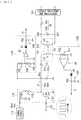
- FIG 3 is a circuit diagram illustrating a detailed-configuration example of the power transmission section 110, the capacitor C1, the high-frequency power generation circuit 112, the current-voltage detection section 113 (the current detection section 1131 and the voltage detection section 113V), the power reception section 210, and the capacitor C2.
- the power transmission section 110 has the power transmission coil L1, and the power reception section 210 has the power reception coil L2.
- the power transmission coil L1 is the coil used to perform the electric power transmission using the magnetic field (to cause the magnetic flux), as described above.
- the power reception coil L2 is the coil used to receive the electric power transmitted from the power transmission section 110 (from the magnetic flux).
- the high-frequency power generation circuit 112 is the circuit that generates the high-frequency electric power (the AC signal) made of an AC voltage Vac and an alternating current lac based on a DC voltage Vdc (a direct current Idc) supplied from the power circuit 111.
- this high-frequency power generation circuit 112 is configured using a switching amplifier (a so-called class E amplifier) including a single transistor 112T as a switching element.
- This switching amplifier includes a capacitor 112C used for ripple removal, a coil 112L serving as a choke coil, and the transistor 112T that is an N-type FET (Field Effective Transistor).
- One end of the capacitor 112C is connected to an output line from the power circuit 111 as well as one end of the coil 112L, and the other end is grounded.
- the other end of the coil 112L is connected to a drain of the transistor 112T and one end of each of capacitors C1p and C1s at a connection point P21.
- a source of the transistor 112T is grounded, and to a gate, the control signal CTL supplied from the control section 114 as described above is inputted.
- the other end of the capacitor C1s is connected to one end of the power transmission coil L1, and the other end of the capacitor C1p is grounded.
- the high-frequency electric power described above is generated in the high-frequency power generation circuit 112 by causing the transistor 112T to perform ON/OFF operation (switching operation including a predetermined switching frequency and a predetermined duty ratio) according to the control signal CTL.
- the current detection section 1131 is a circuit that detects the current I1 (the alternating current) described above, and here, is disposed between the other end of the power transmission coil L1 and a ground.
- This current detection section 113I includes a resistance R11, an amplifier A1, a diode D1, and a capacitor C31.
- the resistance R11 is disposed between the other end (a connection point P22) of the power transmission coil L1 and the ground.
- the amplifier A1 one input terminal is connected to the connection point P22, the other input terminal is connected to the ground, and an output terminal is connected to an anode of the diode D1. In other words, a potential difference between both ends of the resistance R11 is inputted into this amplifier A1.
- a cathode of the diode D1 is connected to one end (a connection point P23) of the capacitor C31, and the other end of the capacitor C31 is grounded. Based on such a configuration, in the current detection section 1131, a detection result of the current I1 (the alternating current) described above is outputted from the cathode side (the connection point P23) of the diode D1.
- the voltage detection section 113V is a circuit that detects the voltage VI (the AC voltage) described above, and here, is disposed between the connection point P21 and the ground.
- This voltage detection section 113V has resistances R21 and R22, an amplifier A2, a diode D2, and a capacitor C32.
- One end of the resistance R21 is connected to the connection point P21, and the other end is connected to a connection point P24.
- One end of the resistance R22 is connected to the connection point P24, and the other end is connected to the ground.
- the amplifier A2 one input terminal is connected to the connection point P24, the other input terminal is connected to the ground, and an output terminal is connected to an anode of the diode D2.
- a cathode of the diode D2 is connected to one end (a connection point P25) of the capacitor C32, and the other end of the capacitor C32 is grounded. Based on such a configuration, in the voltage detection section 113V, a detection result of the voltage V1 (the AC voltage) described above is outputted from the cathode side (the connection point P25) of the diode D2.
- One end of a capacitor C2p is connected to one end of the power reception coil L2 at a connection point P26, and the other end is connected to the other end of the power reception coil L2 at a connection point P27.
- One end of a capacitor C2s is connected to the connection point P26, and the other end is connected to one input terminal of the rectifying and smoothing circuit 211. It is to be noted that the other input terminal of the rectifying and smoothing circuit 211 is connected to the connection point P27.
- the predetermined high-frequency electric power (the AC signal) for the electric power transmission is supplied to the power transmission coil L1 and the capacitor C1 in the power transmission section 110 by the high-frequency power generation circuit 112, in the feed unit 1.
- This causes the magnetic field (the magnetic flux) in the power transmission coil L1 in the power transmission section 110.
- the electronic devices 2A and 2B each serving as the device to be power-supplied (the device to be charged) are placed on (or brought close to) the top surface (the feeding surface S1) of the feed unit 1, the power transmission coil L1 in the feed unit 1 and the power reception coil L2 in each of the electronic devices 2A and 2B are in proximity to each other in the vicinity of the power feeding surface S1.
- the AC power received by the power reception coil L2 is supplied to the rectifying and smoothing circuit 211 and the voltage stabilizing circuit 212, and the following charging operation is performed. That is, after this AC power is converted into predetermined DC power by the rectifying and smoothing circuit 211, the voltage stabilization operation based on this DC power is performed by the voltage stabilizing circuit 212, and the battery (not illustrated) in the load 22 is charged. In this way, in the electronic devices 2A and 2B, the charging operation based on the electric power received by the power reception section 210 is performed.
- noncontact power feeding has advantages including preventing characteristic deterioration due to abrasion of contacts and no concern about an electric shock due to touching a contact by a person. Furthermore, there is also such an advantage that it is possible to prevent a contact from corroding by becoming wet, in a case of application to, for example, a device used in a wet environment, such as a toothbrush or a shaver.
- FIG. 4 is a flowchart illustrating an example of this operation in the feed unit 1.
- the feed unit 1 performs predetermined activation processing such as initialization of a control terminal (not illustrated), for example (step S101).
- the current-voltage detection section 113 detects the alternating current (the current I1) and the AC voltage (the voltage V1) in the vicinity of the power transmission section 110 (on the load side of the high-frequency power generation circuit 112), respectively, by the technique described above (step S102).
- the control section 114 calculates impedance Z1 (the load impedance of the high-frequency power generation circuit 112 (the switching amplifier); see FIG. 3 ) in the vicinity of the power transmission section 110 by using the current I1 and the voltage VI detected by the current-voltage detection section 113 (step S103). Specifically, it is possible to determine an absolute value
- Z 1 V 1 / I 1
- a non-detection period (a detection stop period) Ts
- Ts a detection stop period
- the interval (the non-detection period Ts) between the detection periods (the detection periods Td) of detecting the device to be power-supplied be freely controllable manually or automatically, for example.
- the detection of the device to be power-supplied (the secondary-side device) by the control section 114 described above is specifically performed as follows. That is, at first, as indicated by a sign G0 in FIG. 6A , for example, the frequency characteristics of the absolute value
- this resonance frequency f0 may be expressed by the following expressions (2) and (3).
- of the impedance Z1 exhibit a so-called double hump characteristics when the secondary-side device is in proximity (is present).
- a peak is exhibited at each of a frequency f1H on a high frequency side and a frequency f1L on a low frequency side, of the resonance frequency f0.
- a variation ⁇ Z (a variation from the time when the secondary-side device is absent to the time when the secondary-side device is present) in the absolute value
- the control section 114 determines the presence or absence of the device to be power-supplied, based on an increment (the variation ⁇ Z) in the absolute value
- step S104 N
- ⁇ Z ⁇ ⁇ Zth the threshold ⁇ Zth ( ⁇ Z ⁇ ⁇ Zth)
- of the impedance Z1 in the vicinity of the frequencies f1H and f1L when the secondary-side device is placed in proximity to the primary-side device depends on the magnitude of a Q value in a resonance circuit of the secondary-side device.
- control section 114 control one or both of a frequency CTL(f) and a duty ratio CTL(D) in the control signal CTL, thereby adjusting the variation ⁇ Z in the absolute value
- detectability is enhanced by setting the difference (the variation ⁇ Z) in
- control section 114 controls the frequency CTL(f) in the control signal CTL to become a frequency in the vicinity of the frequencies f1H and f1L, as illustrated in FIG. 6A , for example.
- the control section 114 controls the duty ratio CTL(D) in the control signal CTL so that the variation ⁇ Z in the absolute value
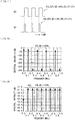
- This control is performed using the following phenomena. That is, for example, as indicated by signs P51 and P52 in FIGs. 8A and 8B , there is a difference in terms of the magnitude of a harmonic component in the absolute value
- of the impedance Z1, between a case where the duty ratio CTL(D) about 50% which is relatively high (corresponding to Part (A) of FIG.
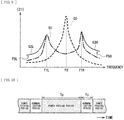
- control section 114 adjust the variation ⁇ Z by taking account of the fact that the magnitude of the harmonic component in the absolute value
- step S106 when it is determined that the secondary-side device is in proximity in step S106, predetermined device authentication is then performed for the secondary-side device (the electronic devices 2A and 2B) by the feed unit 1 (step S107), for example. Subsequently, the feed unit 1 performs the noncontact feeding operation described above, thereby charging the electronic devices 2A and 2B which are the devices to be power-supplied (step S108). In other words, the power transmission section 110 starts the electric power transmission to the device to be power-supplied after the device to be power-supplied is detected.
- a feeding period Tp and a communication period Tc are provided time-divisionally and periodically, as illustrated in FIG. 10 , for example.
- the feed unit 1 determines whether or not to terminate whole processing illustrated in FIG. 4 , for example (step S109).
- step S109: N the feed unit 1 the determines whether predetermined time that is set beforehand has elapsed (step S110 for example.
- step S110: N the flow returns to step S108 to continue the power feeding operation
- step S110: Y the flow returns to step S102 to perform the detection operation of the secondary-side device. In this way, it is desirable that the current-voltage detection section 113 and the control section 114 perform the detection of the device to be power-supplied periodically also after the electric power transmission is started.
- step S109: Y when it is determined that the whole processing is to be terminated (step S109: Y), the operation (whole processing) in the feed unit 1 illustrate in FIG. 4 ends.
- the current-voltage detection section 113 may not be provided in a case where a circuit detecting a current or a voltage is already provided in a feed unit for the purpose of measuring its own power consumption, for example. In that case, additional hardware is unnecessary.
- FIG. 11 illustrates an example of an overall block configuration of a feed system (a feed system 4A) according to the second embodiment.
- the feed system 4A of the present embodiment also is a feed system that performs noncontact electric power transmission using a magnetic field, and includes a feed unit 1A (a primary-side device) and one or more electronic devices (here, two electronic devices 2A and 2B; secondary-side devices) each serving as a device to be power-supplied.
- this feed system 4A includes the feed unit 1A in place of the feed unit 1 in the feed system 4 of the first embodiment, and is otherwise similar in configuration to the feed system 4.
- the feed unit 1A performs the electric power transmission to the electronic devices 2A and 2B using the magnetic field in a manner similar to the feed unit 1.
- This feed unit 1A includes a power transmission unit 11A having a power transmission section 110, a power circuit 111, a high-frequency power generation circuit 112, a current-voltage detection section 113A, a control section 114, and a capacitor C1.
- this power transmission unit 11A is provided with the current-voltage detection section 113A in place of the current-voltage detection section 113 in the power transmission unit 11 described in the first embodiment.
- the current-voltage detection section 113A and the control section 114 correspond to a specific example of a "detection section" of the disclosure.
- the current-voltage detection section 113A detects a direct current (a current 12) and a DC voltage (a voltage V2) in the vicinity of the power transmission section 110, instead of the alternating current (the current I1) and the AC voltage (the voltage V1) described in the first embodiment.
- the current 12 and the voltage V2 correspond to a direct current and a DC voltage to be supplied from the power circuit 111 to the high-frequency power generation circuit 112, respectively.
- a DC resistance value R2 determined based on the direct current (the current 12) and the DC voltage (the voltage V2) is used as impedance in the vicinity of the power transmission section 110.
- This DC resistance value R2 is determined by the following expression (4).
- R 2 V 2 / I 2
- the control section 114 uses the DC resistance value R2 described above, a variation ⁇ R thereof, and a threshold ⁇ Rth thereof, instead of the absolute value
- the current-voltage detection section 113A may not be provided in some cases, and in that case, additional hardware is unnecessary in the present embodiment as well.
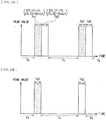
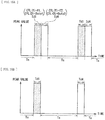
- FIG. 13A is a timing chart illustrating detection periods Td1 and Td2 as well as the non-detection period Ts according to the modification 1
- FIG. 13B is a timing chart illustrating the detection periods Td1 and Td2 as well as the non-detection period Ts according to the modification 2.
- a plurality of kinds of value here, two kinds; frequencies f1 and f2 are used for the frequency (CTL(f)) in the control signal CTL, as will be described below.
- the control section 114 adjusts the variation in the impedance by using the plurality of kinds of value for the frequency (CTL(f)) in the control signal CTL.
- the control section 114 sequentially uses the two kinds of value (the frequencies f1 and f2) one by one during the detection period of detecting the device to be power-supplied (a period corresponding to the detection periods Td1 and Td2 as a whole). This makes it possible to shorten the time for the detection relatively as compared with a technique in FIG. 13B which will be described below.
- control section 114 selectively uses one of the two kinds of value (the frequencies f1 and f2), for every detection period of detecting the device to be power-supplied (for each of the detection periods Td1 and Td2). This makes it possible to reduce the power consumption in the detection operation relatively as compared with the technique of FIG. 13A described above.
- FIG. 14A is a timing chart illustrating detection periods Td1 and Td3 as well as the non-detection period Ts according to the modification 3
- FIG. 14B is a timing chart illustrating the detection periods Td1 and Td3 as well as the non-detection period Ts according to the modification 4.
- a plurality of kinds of value here, two kinds of duty ratio; Duty1 and Duty2 are used for the duty ratio (CTL(D)) in the control signal CTL, as will be described below.
- the control section 114 sequentially uses the two kinds of value (the duty ratios Duty1 and Duty2) one by one in the detection period of detecting the device to be power-supplied (the detection periods Td1 and Td3). This makes it possible to shorten the time for the detection relatively as compared with a technique of FIG. 14B which will be described below.
- control section 114 selectively uses one of the two kinds of value (the duty ratios Duty1 and Duty2) for every detection period of detecting the device to be power-supplied (for each of the detection periods Td1 and Td3). This makes it possible to reduce the power consumption in the detection operation relatively as compared with the technique of FIG. 14A described above.
- FIG. 15A is a timing chart illustrating detection periods Td1 and Td4 as well as the non-detection period Ts according to the modification 5
- FIG. 15B is a timing chart illustrating the detection periods Td1 and Td4 as well as the non-detection period Ts according to the modification 6.
- a plurality of kinds of value here, the two kinds of frequency; f1 and f2, and the two kinds of duty ratio; Duty1 and Duty2
- CTL(f) the frequency
- CTL(D) duty ratio
- the control section 114 uses sequentially the two kinds of value (the frequencies f1 and f2 as well as the duty ratios Duty1 and Duty2) one by one during the detection period of detecting the device to be power-supplied (the detection periods Td1 and Td4). This makes it possible to shorten the time for the detection relatively as compared with a technique of FIG. 15B which will be described below.
- control section 114 selectively uses by one of the two kinds of value (the frequencies f1 and f2 as well as the duty ratios Duty1 and Duty2), for every detection period of detecting the device to be power-supplied (for each of the detection periods Td1 and Td4). This makes it possible to reduce the power consumption in the detection operation relatively as compared with the technique of FIG. 15A described above.
- the description has been provided specifically using the configuration of the high-frequency power generation circuit, although it is not limited thereto.
- a configuration employing a half-bridge circuit or a full-bridge circuit may be provided.
- Devices to be power-supplied other than the electronic devices may be used (for example, vehicles such as electric cars).
- each of the feeding unit and the device to be power-supplied the electronic device etc.
- a battery for charge may be provided also in the power reception unit 21 in some cases.
- the description has been provided by taking the case where the plurality of (two) devices to be power-supplied (electronic devices) are provided in the feed system as an example, although it is not limited thereto. Only one device to be power-supplied may be provided in the feed system.
- the feed unit is not limited to such a home charging tray, and is applicable to chargers for various devices to be power-supplied (electronic devices etc.).
- the feed unit may not be a tray, and may be a stand for an electronic device such as a so-called cradle, for example.
Landscapes
- Engineering & Computer Science (AREA)
- Computer Networks & Wireless Communication (AREA)
- Power Engineering (AREA)
- Life Sciences & Earth Sciences (AREA)
- Environmental Sciences (AREA)
- Signal Processing (AREA)
- Animal Husbandry (AREA)
- Biodiversity & Conservation Biology (AREA)
- Charge And Discharge Circuits For Batteries Or The Like (AREA)
- Near-Field Transmission Systems (AREA)
Abstract
Description
- The disclosure relates to a system that performs noncontact power supply (electric power transmission) to a device to be power-supplied (an electronic device and the like), and a device applied to such a system.
- In recent years, attention has been given to a feed system (a noncontact feed system or a wireless charging system) that performs noncontact power supply (electric power transmission) to a CE device (Consumer Electronics Device) such as a portable telephone or a portable music player. This makes it possible to start the charge merely by placing an electronic device (a secondary-side device) on a charging tray (a primary-side device), instead of starting the charge by inserting (connecting) a connector of a power-supply unit such as an AC adapter into the device. In other words, terminal connection between the electronic device and the charging tray become unnecessary.
- As a method of thus performing noncontact power supply, an electromagnetic induction method is well known. In recent years, a noncontact feed system using a method called a magnetic resonance method has also been receiving attention. Such noncontact feed systems are disclosed in
PTLs 1 to 3, for example. -
- PTL1: Japanese Patent No.
3179802 - PTL2: Japanese Unexamined Patent Application Publication No.
2008-167582 - PTL3: Japanese Unexamined Patent Application Publication No.
2010-119251 - Incidentally, in a noncontact feed system like those described above, when a feed unit (a primary-side device) is not allowed to determine whether a device to be power-supplied (a secondary-side device) is in proximity (close to the feed unit; in a region where power feeding is possible, for example), the feed unit keeps supplying the power, thereby causing wasteful power consumption.
- Here,
PTLs 1 to 3 each propose a technique of detecting whether a device to be power-supplied is in proximity to a feed unit. However, there is a disadvantage of lacking in convenience because, for example, a configuration, a technique, and the like are complicated. - Therefore, suggestion of a technique capable of conveniently detecting a device to be power-supplied at the time of electric power transmission (noncontact power feeding) using a magnetic field has been expected.
- It is desirable to provide a device and a system capable of conveniently detecting a device to be power-supplied when electric power transmission is performed using a magnetic field.
- A device for power transmission according to an embodiment of the disclosure includes a power transmission section configured to transmit an electric power wirelessly, and a detection section operatively connected to the power transmission section and configured to detect an object within a range from the power transmission section based on a change in impedance in vicinity of the power transmission section.
- A system for power transmission according to an embodiment of the disclosure includes a transmitting device and a receiving device. The transmitting device includes a power transmission section configured to transmit an electric power wirelessly and a detection section operatively connected to the power transmission section and configured to detect a receiving device within a range from the power transmission section based on a change in impedance in vicinity of the power transmission section. The receiving device includes a power reception unit configured to receive the electric power wirelessly, and a load operatively connected to the power reception unit and configured to perform an operation based on the received electric power.
- In the device and the system for power transmission according to the embodiments of the disclosure, whether the device to be power-supplied by the power transmission section is in proximity or not is detected using the change in the impedance in the vicinity of the power transmission section. This makes it possible to perform detection of the device to be power-supplied without complicating a configuration and a technique, for example.
- According to the device and the system for power transmission of the embodiments of the disclosure, whether the device to be power-supplied by the power transmission section is in proximity or not is detected using the change in the impedance in the vicinity of the power transmission section. Therefore, it is possible to perform detection of the device to be power-supplied without complicating a configuration and a technique, for example. Hence, it is possible to detect the device to be power-supplied conveniently when the power transmission section is performed using the magnetic field.
- It is to be understood that both the foregoing general description and the following detailed description are exemplary, and are intended to provide further explanation of the technology as claimed.
- The accompanying drawings are included to provide a further understanding of the disclosure, and are incorporated in and constitute a part of this specification. The drawings illustrate embodiments and, together with the specification, serve to explain the principles of the technology.
- [
FIG. 1] FIG. 1 is a perspective diagram illustrating an appearance configuration example of a feed system according to a first embodiment of the disclosure. - [
FIG. 2] FIG. 2 is a block diagram illustrating a detailed configuration example of the feed system depicted inFIG. 1 . - [
FIG. 3] FIG. 3 is a circuit diagram illustrating a detailed configuration example of part of blocks depicted inFIG. 2 . - [
FIG. 4] FIG. 4 is a flowchart illustrating an operation example of a feed unit according to the first embodiment. - [
FIG. 5] FIG. 5 is a timing chart illustrating an example of a detection period and a non-detection period for detection of a secondary-side device. - [
FIG. 6A] and [FIG. 6B] FIGs. 6A and 6B are characteristic diagrams used to explain a change in impedance characteristics in response to the presence or absence of the secondary-side device and a metallic foreign object. - [
FIG. 7] FIG. 7 is a diagram illustrating timing waveforms each representing an example of a control signal for a high-frequency power generation circuit. - [
FIG. 8A] and [FIG. 8B] FIGs. 8A and 8B are characteristic diagrams used to explain a change in harmonic component corresponding to a duty ratio of the control signal. - [
FIG. 9] FIG. 9 is a characteristic diagram used to explain a change in impedance characteristics in response to a change in the harmonic component. - [
FIG. 10] FIG. 10 is a timing chart illustrating an example of a power feeding period and a communication period. - [
FIG. 11] FIG. 11 is a block diagram illustrating a configuration example of a feed system according to a second embodiment. - [
FIG. 12] FIG. 12 is a flowchart illustrating an operation example of a feed unit according to the second embodiment. - [
FIG. 13A] and [Fig. 13B] FIGs. 13A and 13B are timing charts illustrating a detection period and a non-detection period according tomodifications 1 and 2. - [
FIG. 14A] and [FIG. 14B] FIGs. 14A and 14B are timing charts illustrating a detection period and a non-detection period according tomodifications 3 and 4. - [
FIG. 15A] and [FIG. 15B] FIGs. 15A and 15B are timing charts illustrating a detection period and a non-detection period according to modifications 5 and 6. - Embodiments of the disclosure will be described below in detail with reference to the drawings. It is to be noted that the description will be provided in the following order.
- 1. First embodiment (an example using impedance determined from an alternating current and an AC voltage)
- 2. Second embodiment (an example using direct-current resistance determined from a direct current and a DC voltage).
- 3. Modifications common to the first and second embodiments
-
Modifications 1 and 2 (examples each using a plurality of kinds of value for a frequency of a control signal) - Modifications 3 and 4 (examples each using a plurality of kinds of value for a duty ratio of the control signal)
- Modifications 5 and 6 (examples each using a plurality of kinds of value for the frequency and the duty ratio of the control signal)
-
- 4. Other modifications
-
FIG. 1 illustrates an appearance configuration example of a feed system (a feed system 4) according to the first embodiment of the disclosure, andFIG. 2 illustrates a block configuration example of thisfeed system 4. Thefeed system 4 is a system (a noncontact-type feed system) that performs electric power transmission (power supply, or power feeding) in a noncontact manner by using a magnetic field (by using electromagnetic induction, magnetic resonance, or the like, for example; likewise hereinafter). Thisfeed system 4 includes a feed unit 1 (a primary-side device) and one or a plurality of electronic devices (here, twoelectronic devices - In this
feed system 4, electric power transmission from thefeed unit 1 to theelectronic devices electronic devices feed unit 1, as illustrated inFIG 1 , for example. Here, in consideration of a case where the electric power transmission to theelectronic devices feed unit 1 is shaped like a mat (a tray) in which the area of the power feeding surface S1 is larger than theelectronic devices - The
feed unit 1 is a unit (a charging tray) that performs the electric power transmission to theelectronic devices feed unit 1 includes apower transmission unit 11 having apower transmission section 110, apower circuit 111, a high-frequency power generation circuit (an AC signal generation circuit) 112, a current-voltage detection section 113, acontrol section 114, and a capacitor C1 (a capacitive element) as illustrated inFIG. 2 , for example. Of these, the current-voltage detection section 113 and thecontrol section 114 correspond to a specific example of a "detection section" of the disclosure, and thecontrol section 114 corresponds to a specific example of a "control section" of the disclosure. - The
power transmission section 110 is configured to include a power transmission coil (a primary-side coil) L1 to be described later, and the like. Thepower transmission section 110 uses the power transmission coil L1 and the capacitor C1, thereby performing the electric power transmission to theelectronic devices power reception section 210 to be described later) through use of the magnetic field. Specifically, thepower transmission section 110 has a function of emitting a magnetic field (a magnetic flux) from the power feeding surface S1 to theelectronic devices power transmission section 110 will be described later in detail (FIG. 3 ). - The
power circuit 111 is, for example, a circuit that generates a predetermined DC voltage based on electric power (AC power or DC power) supplied from apower supply source 9 external to thefeed unit 1, and outputs the generated DC voltage to the high-frequencypower generation circuit 112. Such apower circuit 111 is configured to include, for example, a DC-DC converter or an AC-DC converter. It is to be noted that thispower circuit 111 may not be provided in some cases. - The high-frequency
power generation circuit 112 is a circuit that generates predetermined high-frequency electric power (an AC signal) used to perform the electric power transmission in thepower transmission section 110, based on the DC voltage outputted from thepower circuit 111. Such a high-frequencypower generation circuit 112 is configured using, for example, a switching amplifier to be described later. It is to be noted that a configuration of this high-frequencypower generation circuit 112 will also be described later in detail (FIG. 3 ). - The current-
voltage detection section 113 has a current detection section 1131 and avoltage detection section 113V which will be described later, and detects an alternating current (a current I1) and an AC voltage (a voltage V1) in the vicinity of the power transmission section 110 (here, on a load side of the high-frequency power generation circuit 112), respectively. It is to be noted that a configuration of this current-voltage detection section 113 will also be described later in detail (FIG. 3 ). - The
control section 114 has a function of controlling operation of each of thepower circuit 111 and the high-frequencypower generation circuit 112. Specifically, thecontrol section 114 drives the high-frequencypower generation circuit 112 by using a control signal CTL having a predetermined frequency and a predetermined duty ratio, as will be described later in detail. Further, thecontrol section 114 also has a function of detecting whether or not a device (the secondary-side device; here, theelectronic devices power transmission section 110 is in proximity (in the vicinity of the power feeding surface S1; for example, in a region where power feeding is possible, likewise hereinafter), based on the current I1 and the voltage VI detected in the current-voltage detection section 113. Specifically, as will be described later in detail, thiscontrol section 114 detects the device to be power-supplied by using a change in impedance (here, a load impedance of the high-frequency power generation circuit 112 (the switching amplifier to be described later)) in the vicinity of thepower transmission section 110. Here, this load impedance is impedance of a load connected to the switching amplifier to be described later, and is determined by the alternating current (the current I1) and the AC voltage (the voltage V1) described above. It is to be noted that such acontrol section 114 is, for example, a microcomputer or the like. - The capacitor C1 is disposed to be connected to the power transmission coil L1 electrically in parallel or in a combination of parallel and series.
- The
electronic devices FIG. 2 , theseelectronic devices power reception unit 21, and aload 22 that performs predetermined operation (operation of performing functions of serving as the electronic device) based on electric power supplied from thispower reception unit 21. Further, thepower reception unit 21 includes thepower reception section 210, a rectifying and smoothingcircuit 211, avoltage stabilizing circuit 212, and a capacitor (a capacitive element) C2. - The
power reception section 210 is configured to include a power reception coil (a secondary-side coil) L2. Thepower reception section 210 has a function of receiving electric power transmitted from thepower transmission section 110 in thefeed unit 1 by using this power reception coil L2 and the capacitor C2. It is to be noted that a configuration of thispower reception section 210 will also be described later in detail (FIG. 3 ). - The rectifying and smoothing
circuit 211 is a circuit that generates DC power by rectifying and smoothing electric power (AC power) supplied from thepower reception section 210. - The
voltage stabilizing circuit 212 is a circuit that performs predetermined voltage stabilization operation based on the DC power supplied from the rectifying and smoothingcircuit 211, thereby charging a battery (not illustrated) in theload 22. It is to be noted that such a battery is configured using, for example, a chargeable battery (a secondary battery) such as a lithium ion battery. - The capacitor C2 is disposed to be connected to the power reception coil L2 electrically in parallel or in a combination of parallel and series.
-
FIG 3 is a circuit diagram illustrating a detailed-configuration example of thepower transmission section 110, the capacitor C1, the high-frequencypower generation circuit 112, the current-voltage detection section 113 (the current detection section 1131 and thevoltage detection section 113V), thepower reception section 210, and the capacitor C2. - The
power transmission section 110 has the power transmission coil L1, and thepower reception section 210 has the power reception coil L2. The power transmission coil L1 is the coil used to perform the electric power transmission using the magnetic field (to cause the magnetic flux), as described above. On the other hand, the power reception coil L2 is the coil used to receive the electric power transmitted from the power transmission section 110 (from the magnetic flux). - The high-frequency
power generation circuit 112 is the circuit that generates the high-frequency electric power (the AC signal) made of an AC voltage Vac and an alternating current lac based on a DC voltage Vdc (a direct current Idc) supplied from thepower circuit 111. Here, this high-frequencypower generation circuit 112 is configured using a switching amplifier (a so-called class E amplifier) including asingle transistor 112T as a switching element. This switching amplifier includes acapacitor 112C used for ripple removal, acoil 112L serving as a choke coil, and thetransistor 112T that is an N-type FET (Field Effective Transistor). One end of thecapacitor 112C is connected to an output line from thepower circuit 111 as well as one end of thecoil 112L, and the other end is grounded. The other end of thecoil 112L is connected to a drain of thetransistor 112T and one end of each of capacitors C1p and C1s at a connection point P21. A source of thetransistor 112T is grounded, and to a gate, the control signal CTL supplied from thecontrol section 114 as described above is inputted. It is to be noted that the other end of the capacitor C1s is connected to one end of the power transmission coil L1, and the other end of the capacitor C1p is grounded. Based on such a configuration, the high-frequency electric power described above is generated in the high-frequencypower generation circuit 112 by causing thetransistor 112T to perform ON/OFF operation (switching operation including a predetermined switching frequency and a predetermined duty ratio) according to the control signal CTL. - The current detection section 1131 is a circuit that detects the current I1 (the alternating current) described above, and here, is disposed between the other end of the power transmission coil L1 and a ground. This
current detection section 113I includes a resistance R11, an amplifier A1, a diode D1, and a capacitor C31. The resistance R11 is disposed between the other end (a connection point P22) of the power transmission coil L1 and the ground. As for the amplifier A1, one input terminal is connected to the connection point P22, the other input terminal is connected to the ground, and an output terminal is connected to an anode of the diode D1. In other words, a potential difference between both ends of the resistance R11 is inputted into this amplifier A1. A cathode of the diode D1 is connected to one end (a connection point P23) of the capacitor C31, and the other end of the capacitor C31 is grounded. Based on such a configuration, in the current detection section 1131, a detection result of the current I1 (the alternating current) described above is outputted from the cathode side (the connection point P23) of the diode D1. - The
voltage detection section 113V is a circuit that detects the voltage VI (the AC voltage) described above, and here, is disposed between the connection point P21 and the ground. Thisvoltage detection section 113V has resistances R21 and R22, an amplifier A2, a diode D2, and a capacitor C32. One end of the resistance R21 is connected to the connection point P21, and the other end is connected to a connection point P24. One end of the resistance R22 is connected to the connection point P24, and the other end is connected to the ground. As for the amplifier A2, one input terminal is connected to the connection point P24, the other input terminal is connected to the ground, and an output terminal is connected to an anode of the diode D2. A cathode of the diode D2 is connected to one end (a connection point P25) of the capacitor C32, and the other end of the capacitor C32 is grounded. Based on such a configuration, in thevoltage detection section 113V, a detection result of the voltage V1 (the AC voltage) described above is outputted from the cathode side (the connection point P25) of the diode D2. - One end of a capacitor C2p is connected to one end of the power reception coil L2 at a connection point P26, and the other end is connected to the other end of the power reception coil L2 at a connection point P27. One end of a capacitor C2s is connected to the connection point P26, and the other end is connected to one input terminal of the rectifying and smoothing
circuit 211. It is to be noted that the other input terminal of the rectifying and smoothingcircuit 211 is connected to the connection point P27. - In this
feed system 4, the predetermined high-frequency electric power (the AC signal) for the electric power transmission is supplied to the power transmission coil L1 and the capacitor C1 in thepower transmission section 110 by the high-frequencypower generation circuit 112, in thefeed unit 1. This causes the magnetic field (the magnetic flux) in the power transmission coil L1 in thepower transmission section 110. At this moment, when theelectronic devices feed unit 1, the power transmission coil L1 in thefeed unit 1 and the power reception coil L2 in each of theelectronic devices - In this way, when the power reception coil L2 is placed in proximity to the power transmission coil L1 producing the magnetic field (the magnetic flux), an electromotive force is evoked in the power reception coil L2 by the magnetic flux produced by the power transmission coil L1. As a result, electric power is transmitted from the power transmission coil L1 side (a primary side, the
feed unit 1 side, and thepower transmission section 110 side) to the power reception coil L2 side (a secondary side, theelectronic devices power reception section 210 side) (see electric power P1 illustrated inFIG. 2 andFIG. 3 ). - Then, in the
electronic devices circuit 211 and thevoltage stabilizing circuit 212, and the following charging operation is performed. That is, after this AC power is converted into predetermined DC power by the rectifying and smoothingcircuit 211, the voltage stabilization operation based on this DC power is performed by thevoltage stabilizing circuit 212, and the battery (not illustrated) in theload 22 is charged. In this way, in theelectronic devices power reception section 210 is performed. - In other words, in the present embodiment, at the time of charging the
electronic devices electronic devices electronic devices - Next, operation (detection operation and the like of the
electronic devices FIG. 4 to FIG. 10 .FIG. 4 is a flowchart illustrating an example of this operation in thefeed unit 1. - First, the
feed unit 1 performs predetermined activation processing such as initialization of a control terminal (not illustrated), for example (step S101). - Then, the current-voltage detection section 113 (the current detection section 1131 and the
voltage detection section 113V) detects the alternating current (the current I1) and the AC voltage (the voltage V1) in the vicinity of the power transmission section 110 (on the load side of the high-frequency power generation circuit 112), respectively, by the technique described above (step S102). - Next, the
control section 114 calculates impedance Z1 (the load impedance of the high-frequency power generation circuit 112 (the switching amplifier); seeFIG. 3 ) in the vicinity of thepower transmission section 110 by using the current I1 and the voltage VI detected by the current-voltage detection section 113 (step S103). Specifically, it is possible to determine an absolute value |Z1| of this impedance Z1 by the following expression (1).
- Subsequently, through use of a change in the impedance Z1 calculated as described above, whether the secondary-side device (the
electronic devices control section 114 as follows. - Here, it is desirable that, specifically, such detection of the device to be power-supplied be performed intermittently at a predetermined interval (a non-detection period (a detection stop period) Ts), as illustrated in
FIG. 5 , for example. This is because performing such detection constantly increases power consumption for the detection operation. However, when this non-detection period Ts is set to be longer than necessary, time for the detection of the device to be power-supplied tends to become longer as well and therefore, it is necessary to set the non-detection period Ts appropriately. It may be said that, by taking account of a balance between these facts, it is desirable that the interval (the non-detection period Ts) between the detection periods (the detection periods Td) of detecting the device to be power-supplied be freely controllable manually or automatically, for example. - The detection of the device to be power-supplied (the secondary-side device) by the
control section 114 described above is specifically performed as follows. That is, at first, as indicated by a sign G0 inFIG. 6A , for example, the frequency characteristics of the absolute value |Z1| of the impedance Z1 exhibits a peak at a resonance frequency f0 when the secondary-side device is not in proximity (is absent). Here, this resonance frequency f0 may be expressed by the following expressions (2) and (3).

- On the other hand, as indicated by arrows P3L and P3H as well as a sign G1 in
FIG. 6A , the frequency characteristics of the absolute value |Z1| of the impedance Z1 exhibit a so-called double hump characteristics when the secondary-side device is in proximity (is present). In other words, a peak is exhibited at each of a frequency f1H on a high frequency side and a frequency f1L on a low frequency side, of the resonance frequency f0. For this reason, a variation ΔZ (a variation from the time when the secondary-side device is absent to the time when the secondary-side device is present) in the absolute value |Z1| of the impedance Z1 is a positive value (ΔZ > 0) at frequencies in the neighborhood of the frequency f1H and the frequency f1L, as illustrated inFIG. 6A , for example. - Using this, the
control section 114 determines the presence or absence of the device to be power-supplied, based on an increment (the variation ΔZ) in the absolute value |Z1| of the impedance Z1. Specifically, thecontrol section 114 determines the presence or absence of the device to be power-supplied by comparing the variation ΔZ (> 0) in the impedance with a predetermined threshold ΔZth (step S104). In other words, when this variation ΔZ (the increment) is greater than the threshold ΔZth (ΔZ > ΔZth) (step S104: Y), it is determined that the secondary-side device (the device to be power-supplied) is in proximity (is present) (step S106). On the other hand, when this variation ΔZ (the increment) is equal to or less than the threshold ΔZth (ΔZ ≤ ΔZth) (step S104: N), it is determined that the secondary-side device (the device to be power-supplied) is not in proximity (is absent) (step S105). - At this moment, it is also possible to distinguish between the presence and absence of a foreign object (metallic foreign object) different from the device to be power-supplied. In other words, as indicated by signs G0 and G2 as well as an arrow P4 in
FIG. 6B , for example, in a case where a metallic foreign object exists (is present) in proximity to the feed unit 1 (the feeding surface S1), the absolute value |Z1| of the impedance Z1 tends to decrease, as compared with a case where a metallic foreign object does not exist (is absent). This is because an eddy current is produced in the metallic foreign object, resulting in a loss of electric power. Therefore, it is possible to determine the presence or absence of such a foreign object according to whether the absolute value |Z1| of the impedance Z1 exhibits an increasing change or a decreasing change (whether the variation ΔZ is a positive value or a negative value) at frequencies in the neighborhood of the frequencies f1H and f1L described above, for example. This makes it possible to avoid applying electric power to the power transmission coil L1 wastefully, and also to evade fears such as heat generation of the metallic foreign object. - It is to be noted that the value of the absolute value |Z1| of the impedance Z1 in the vicinity of the frequencies f1H and f1L when the secondary-side device is placed in proximity to the primary-side device depends on the magnitude of a Q value in a resonance circuit of the secondary-side device. In other words, the higher this Q value is, the greater the value of the absolute value |Z1| is, and therefore, it may be said that, desirably, the load of the secondary-side device is a highest possible resistance value at the time of the detection operation.
- Here, it is desirable that the
control section 114 control one or both of a frequency CTL(f) and a duty ratio CTL(D) in the control signal CTL, thereby adjusting the variation ΔZ in the absolute value |Z1| of the impedance Z1. This is because detectability is enhanced by setting the difference (the variation ΔZ) in |Z1| between the time when the device to be power-supplied is present and the time when it is absent to be as large as possible (maximum), like the frequencies in the vicinity of the frequencies f1H and f1L described above. - Specifically, the
control section 114 controls the frequency CTL(f) in the control signal CTL to become a frequency in the vicinity of the frequencies f1H and f1L, as illustrated inFIG. 6A , for example. - In addition, as illustrated in Parts (A) and (B) of
FIG. 7 , for example, thecontrol section 114 controls the duty ratio CTL(D) in the control signal CTL so that the variation ΔZ in the absolute value |Z1| of the impedance Z1 becomes as large as possible. This control is performed using the following phenomena. That is, for example, as indicated by signs P51 and P52 inFIGs. 8A and 8B , there is a difference in terms of the magnitude of a harmonic component in the absolute value |Z1| of the impedance Z1, between a case where the duty ratio CTL(D) = about 50% which is relatively high (corresponding to Part (A) ofFIG. 7 ) and a case where the duty ratio CTL(D) = about 10% which is relatively low (corresponding to Part (B) ofFIG. 7 ). Therefore, it is desirable that thecontrol section 114 adjust the variation ΔZ by taking account of the fact that the magnitude of the harmonic component in the absolute value |Z1| of the impedance Z1 changes in response to a change in the duty ratio CTL(D), as indicated by signs G3L and G3H as well as arrows P5L and P5H inFIG. 9 , for example. - Here, when it is determined that the secondary-side device is in proximity in step S106, predetermined device authentication is then performed for the secondary-side device (the
electronic devices feed unit 1 performs the noncontact feeding operation described above, thereby charging theelectronic devices power transmission section 110 starts the electric power transmission to the device to be power-supplied after the device to be power-supplied is detected. In this feeding operation, specifically, a feeding period Tp and a communication period Tc (a period in which predetermined communication operation is performed between the primary-side device and the secondary-side device) are provided time-divisionally and periodically, as illustrated inFIG. 10 , for example. - Subsequently, the
feed unit 1 determines whether or not to terminate whole processing illustrated inFIG. 4 , for example (step S109). Here, when it is determined that the whole processing is not to be terminated yet (step S109: N), thefeed unit 1 the determines whether predetermined time that is set beforehand has elapsed (step S110 for example. When it is determined that the predetermined time has not elapsed y (step S110: N), the flow returns to step S108 to continue the power feeding operation On the other hand, when it is determined that the predetermined time has elapsed (step S110: Y), the flow returns to step S102 to perform the detection operation of the secondary-side device. In this way, it is desirable that the current-voltage detection section 113 and thecontrol section 114 perform the detection of the device to be power-supplied periodically also after the electric power transmission is started. - It is to be noted that when it is determined that the whole processing is to be terminated (step S109: Y), the operation (whole processing) in the
feed unit 1 illustrate inFIG. 4 ends. - In this way, in the present embodiment, whether the device to be supplie with the power by the
power transmission section 110 is in proximity or not is detected using the change in the impedance Z1 in the vicinity of thepower transmission section 110. This makes it possible to perform the detection of the device to be power-supplied without complicating the configuration, the technique, and the like, for example. - In the present embodiment as described above, whether the device to be supplied with the power by the
power transmission section 110 is in proximity or not is detected using the change in the impedance Z1 in the vicinity of thepower transmission section 110 and thus, it is possible to perform the detection of the device to be power-supplied without complicating the configuration, the technique, and the like, for example. Therefore, it is possible to detect the device to be power-supplied conveniently when the electric power transmission is performed using the magnetic field. This makes it possible to detect the device to be power-supplied even when a coefficient of coupling between the power transmission coil L1 and the power reception coil L2 is low, about 0.4 or less, for example. - Further, for instance, addition of a magnet and a circuit such as a magnetic sensor is unnecessary and thus, it is possible to reduce the cost and size, and also a frequency for the detection is allowed to be set freely. Therefore, for example, application to circuits other than a self-excited oscillation circuit is possible.
- It is to be noted that the current-
voltage detection section 113 may not be provided in a case where a circuit detecting a current or a voltage is already provided in a feed unit for the purpose of measuring its own power consumption, for example. In that case, additional hardware is unnecessary. - Next, the second embodiment of the disclosure will be described. It is to be noted that the same elements as those of the first embodiment will be provided with the same characters as those of the first embodiment, and the description will be omitted as appropriate.
-
FIG. 11 illustrates an example of an overall block configuration of a feed system (afeed system 4A) according to the second embodiment. Thefeed system 4A of the present embodiment also is a feed system that performs noncontact electric power transmission using a magnetic field, and includes a feed unit 1A (a primary-side device) and one or more electronic devices (here, twoelectronic devices feed system 4A includes the feed unit 1A in place of thefeed unit 1 in thefeed system 4 of the first embodiment, and is otherwise similar in configuration to thefeed system 4. - The feed unit 1A performs the electric power transmission to the
electronic devices feed unit 1. This feed unit 1A includes apower transmission unit 11A having apower transmission section 110, apower circuit 111, a high-frequencypower generation circuit 112, a current-voltage detection section 113A, acontrol section 114, and a capacitor C1. In other words, thispower transmission unit 11A is provided with the current-voltage detection section 113A in place of the current-voltage detection section 113 in thepower transmission unit 11 described in the first embodiment. It is to be noted that the current-voltage detection section 113A and thecontrol section 114 correspond to a specific example of a "detection section" of the disclosure. - The current-
voltage detection section 113A detects a direct current (a current 12) and a DC voltage (a voltage V2) in the vicinity of thepower transmission section 110, instead of the alternating current (the current I1) and the AC voltage (the voltage V1) described in the first embodiment. The current 12 and the voltage V2 correspond to a direct current and a DC voltage to be supplied from thepower circuit 111 to the high-frequencypower generation circuit 112, respectively. - Then, in the
control section 114 of the present embodiment, instead of the impedance Z1 described in the first embodiment, a DC resistance value R2 determined based on the direct current (the current 12) and the DC voltage (the voltage V2) is used as impedance in the vicinity of thepower transmission section 110. This DC resistance value R2 is determined by the following expression (4).
- Specifically, for example, as in an operation example of the feed unit 1A (the
power transmission unit 11A) of the present embodiment illustrated inFIG. 12 , thecontrol section 114 uses the DC resistance value R2 described above, a variation ΔR thereof, and a threshold ΔRth thereof, instead of the absolute value |Z1| of the impedance Z1 described in the first embodiment, the variation ΔR thereof, and the threshold ΔRth thereof (steps S202 to S204). - Here, electric power consumed in or after the high-frequency power generation circuit 112 (a switching amplifier) is determined based on this DC resistance value R2. On the other hand, an increase in the impedance Z1 reduces a current flowing into the
power transmission section 110 and therefore, power consumption in thepower transmission section 110 is reduced, and as a result, the DC resistance value R2 is increased. For this reason, it is possible to determine the presence or absence of the secondary-side device by judging the magnitude of the DC resistance value R2, like the case of the impedance Z1. - At this moment, when power consumption except the one in the
power transmission section 110 is large, a tendency of the impedance Z1 and a tendency of the DC resistance value R2 disagree with each other, reducing accuracy of detecting the secondary-side device. Most of such power consumption except the one in thepower transmission section 110 is a loss by acoil 112L and a switching element (atransistor 112T). In order to reduce the electric power loss by these, it is conceivable to perform driving with a high DC voltage to reduce the ratio of a current, or to shorten an ON period of the switching element by reducing a driving duty ratio of the switching amplifier, besides selecting a low-loss element. - In this way, it is possible to obtain similar effects by similar operation to those of the first embodiment, in the present embodiment as well. In other words, it is possible to detect the device to be power-supplied conveniently when performing the electric power transmission using the magnetic field.
- It is to be noted that the current-
voltage detection section 113A may not be provided in some cases, and in that case, additional hardware is unnecessary in the present embodiment as well. - Next, modifications (
modifications 1 to 6) common to the first and second embodiments will be described. It is to be noted that the same elements as those of these embodiments will be provided with the same characters as those of these embodiments, and the description thereof will be omitted as appropriate. -
FIG. 13A is a timing chart illustrating detection periods Td1 and Td2 as well as the non-detection period Ts according to themodification 1, andFIG. 13B is a timing chart illustrating the detection periods Td1 and Td2 as well as the non-detection period Ts according to the modification 2. In thesemodifications 1 and 2, a plurality of kinds of value (here, two kinds; frequencies f1 and f2) are used for the frequency (CTL(f)) in the control signal CTL, as will be described below. In other words, thecontrol section 114 adjusts the variation in the impedance by using the plurality of kinds of value for the frequency (CTL(f)) in the control signal CTL. - Specifically, in the
modification 1 illustrated inFIG. 13A , thecontrol section 114 sequentially uses the two kinds of value (the frequencies f1 and f2) one by one during the detection period of detecting the device to be power-supplied (a period corresponding to the detection periods Td1 and Td2 as a whole). This makes it possible to shorten the time for the detection relatively as compared with a technique inFIG. 13B which will be described below. - In the modification 2 illustrated in
FIG. 13B on the other hand, thecontrol section 114 selectively uses one of the two kinds of value (the frequencies f1 and f2), for every detection period of detecting the device to be power-supplied (for each of the detection periods Td1 and Td2). This makes it possible to reduce the power consumption in the detection operation relatively as compared with the technique ofFIG. 13A described above. -
FIG. 14A is a timing chart illustrating detection periods Td1 and Td3 as well as the non-detection period Ts according to the modification 3, andFIG. 14B is a timing chart illustrating the detection periods Td1 and Td3 as well as the non-detection period Ts according to themodification 4. In thesemodifications 3 and 4, a plurality of kinds of value (here, two kinds of duty ratio; Duty1 and Duty2) are used for the duty ratio (CTL(D)) in the control signal CTL, as will be described below. - Specifically, in the modification 3 illustrated in
FIG. 14A , thecontrol section 114 sequentially uses the two kinds of value (the duty ratios Duty1 and Duty2) one by one in the detection period of detecting the device to be power-supplied (the detection periods Td1 and Td3). This makes it possible to shorten the time for the detection relatively as compared with a technique ofFIG. 14B which will be described below. - In the
modification 4 illustrated inFIG. 14B on the other hand, thecontrol section 114 selectively uses one of the two kinds of value (the duty ratios Duty1 and Duty2) for every detection period of detecting the device to be power-supplied (for each of the detection periods Td1 and Td3). This makes it possible to reduce the power consumption in the detection operation relatively as compared with the technique ofFIG. 14A described above. -
FIG. 15A is a timing chart illustrating detection periods Td1 and Td4 as well as the non-detection period Ts according to the modification 5, andFIG. 15B is a timing chart illustrating the detection periods Td1 and Td4 as well as the non-detection period Ts according to the modification 6. In these modifications 5 and 6, a plurality of kinds of value (here, the two kinds of frequency; f1 and f2, and the two kinds of duty ratio; Duty1 and Duty2) are used for both of the frequency (CTL(f)) and the duty ratio (CTL(D)) of the control signal CTL, as will be described below. In other words, in these modifications 5 and 6, themodifications 1 and 2 are combined with themodifications 3 and 4. - Specifically, in the modification 5 illustrated in
FIG. 15A , thecontrol section 114 uses sequentially the two kinds of value (the frequencies f1 and f2 as well as the duty ratios Duty1 and Duty2) one by one during the detection period of detecting the device to be power-supplied (the detection periods Td1 and Td4). This makes it possible to shorten the time for the detection relatively as compared with a technique ofFIG. 15B which will be described below. - In the modification 6 illustrated in
FIG. 15B on the other hand, thecontrol section 114 selectively uses by one of the two kinds of value (the frequencies f1 and f2 as well as the duty ratios Duty1 and Duty2), for every detection period of detecting the device to be power-supplied (for each of the detection periods Td1 and Td4). This makes it possible to reduce the power consumption in the detection operation relatively as compared with the technique ofFIG. 15A described above. - The technology of the disclosure has been described using some embodiments and modifications, but is not limited to these embodiments and modifications, and may be variously modified.
- For example, in the embodiments and modifications, the description has been provided specifically using the configuration of the high-frequency power generation circuit, although it is not limited thereto. For example, a configuration employing a half-bridge circuit or a full-bridge circuit may be provided.
- Further, in the embodiments and modifications, the description has been provided specifically using the configuration of the current-voltage detection section and the detection operation, although it is not limited thereto. Other configuration and detection operation may be employed.
- Furthermore, in the embodiments and modifications, the description has been provided by taking the electronic device as an example of the device to be power-supplied, although it is not limited thereto. Devices to be power-supplied other than the electronic devices may be used (for example, vehicles such as electric cars).
- In addition, in the embodiments and modifications, the description has been provided specifically using the configuration of each of the feeding unit and the device to be power-supplied (the electronic device etc.). However, it is not necessary to provide all the elements, and other configuration may be further provided. For instance, a battery for charge may be provided also in the
power reception unit 21 in some cases. - Moreover, in the embodiments and modifications, the description has been provided by taking the case where the plurality of (two) devices to be power-supplied (electronic devices) are provided in the feed system as an example, although it is not limited thereto. Only one device to be power-supplied may be provided in the feed system.
- Furthermore, in the embodiments and modifications, the description has been provided by taking the charging tray for the small electronic devices (CE devices) such as portable telephones as an example of the feed unit. However, the feed unit is not limited to such a home charging tray, and is applicable to chargers for various devices to be power-supplied (electronic devices etc.). In addition, the feed unit may not be a tray, and may be a stand for an electronic device such as a so-called cradle, for example.
- It is possible to achieve at least the following configurations from the above-described example embodiments and the modifications of the disclosure.
- (1) A device for power transmission including:
- a power transmission section configured to transmit an electric power wirelessly; and
- a detection section operatively connected to the power transmission section and configured to detect an object within a range from the power transmission section based on a change in impedance in vicinity of the power transmission section.
- (2) The device of (1), further including a power generation circuit operatively connected to the power transmission section and configured to generate the electric power.
- (3) The device of (2), wherein the electric power is a high-frequency electric power.
- (4) The device of (2), wherein the detection section comprises:
- a current-voltage detection unit configured to detect a current and a voltage in vicinity of the power transmission section; and
- a control unit operatively connected to the current-voltage detection unit and configured to detect the object based on the change in impedance calculated by the detected current and voltage in vicinity of the power transmission section.
- (5) The device of (4), wherein the detected current is an alternating current and the detected voltage is an AC voltage.
- (6) The device of (4), wherein:
- the detected current is a direct current and the detected voltage is a DC voltage; and
- the change in impedance is a change in resistance calculated by the direct current and the DC voltage.
- (7) The device of (1), wherein the detection section is configured to determine whether the detected object is a device to be power-supplied by the power transmission section or a foreign object based on whether the impedance increases or decreases.
- (8) The device of (7), wherein the determination is made based on whether an absolute value of the impedance increases or decreases.
- (9) The device of (7), wherein the determination is made based on whether a resistance value increases or decreases.
- (10) The device of (7), wherein the detected object is a device to be power-supplied by the power transmission section if the impedance increases.
- (11) The device of (7), wherein the detected object is a foreign object if the impedance decreases.
- (12) The device of (1), wherein the detection section is configured to detect the object intermittently at an interval.
- (13) The device of (1), wherein the detection section is configured to detect the object by comparing the change in impedance with a threshold value.
- (14) The device of (4), wherein the control section is configured to sequentially provide two control signals during each detection period for detecting the object, the two control signals having a same duty ratio but different frequencies.
- (15) The device of (4), wherein the control section is configured to sequentially provide two control signals for each two subsequent detection periods for detecting the object, the two control signals having a same duty ratio but different frequencies.
- (16) The device of (4), wherein the control section is configured to sequentially provide two control signals during each detection period for detecting the object, the two control signals having a same frequency but different duty ratios.
- (17) The device of (4), wherein the control section is configured to sequentially provide two control signals for each two subsequent detection periods for detecting the object, the two control signals having a same frequency but different duty ratios.
- (18) The device of (4), wherein the control section is configured to sequentially provide two control signals during each detection period for detecting the object, the two control signals having different duty ratios and different frequencies.
- (19) The device of (4), wherein the control section is configured to sequentially provide two control signals for each two subsequent detection periods for detecting the object, the two control signals having different duty ratios and different frequencies.
- (20) The device of (4), wherein the control section is configured to control at least one of a frequency and a duty ratio in the control signal to adjust the change in impedance.
- (21) A system for power transmission including:
- a transmitting device including (a) a power transmission section configured to transmit an electric power wirelessly, and (b) a detection section operatively connected to the power transmission section and configured to detect a receiving device within a range from the power transmission section based on a change in impedance in vicinity of the power transmission section; and
- a receiving device including (c) a power reception unit configured to receive the electric power wirelessly, and (d) a load operatively connected to the power reception unit and configured to perform an operation based on the received electric power.
- (22) The system of (21), wherein the transmitting device further comprises a power generation circuit operatively connected to the power transmission section and configured to generate the electric power.
- (23) The system of (22), wherein the detection section comprises:
- a current-voltage detection unit configured to detect a current and a voltage in vicinity of the power transmission section; and
- a control unit operatively connected to the current-voltage detection unit and configured to detect the object based on the change in impedance calculated by the detected current and voltage in vicinity of the power transmission section.
- (24) A method for detecting an object including:
- detecting a current and a voltage in vicinity of a power transmitting device;
- calculating an impedance based on the detected current and voltage; and
- detecting an object within a range from the power transmitting device based on a change in the impedance.
- (25) The method of (24), further including determining whether the detected object is a power receiving device to be power-supplied by the power transmission device or a foreign object based on whether the impedance increases or decreases.
- (26) The method of (25), wherein the determination is made based on whether an absolute value of the impedance increases or decreases.
- (27) The method of (25), wherein the determination is made based on whether a resistance value increases or decreases.
- (28) The method of (25), wherein the detected object is a power receiving device if the impedance increases.
- (29) The method of (25), wherein the detected object is a foreign object if the impedance decreases.
- (30) The method of (24), further including comparing the change in the impedance with a threshold value.
- (31) The method of (24), wherein the object is detected intermittently at an interval.
- (32) The method of (25), further including, in response to determining that the detected object is a power receiving device, transmitting an electric power wirelessly from the power transmitting device to the power receiving device.
- The present application contains subject matter related to that disclosed in Japanese Priority Patent Application
JP 2011-197865 - It should be understood by those skilled in the art that various modifications, combinations, sub-combinations, and alterations may occur depending on design requirements and other factors insofar as they are within the scope of the appended claims or the equivalents thereof.
- Further examples useful for understanding the invention are indicated in the following itemized list:
- [Item 1] A device for power transmission comprising:
- a power transmission section configured to transmit an electric power wirelessly; and
- a detection section operatively connected to the power transmission section and configured to detect an object within a range from the power transmission section based on a change in impedance in vicinity of the power transmission section.
- [Item 2] The device of
Item 1 , further comprising a power generation circuit operatively connected to the power transmission section and configured to generate the electric power. - [Item 3] The device of Item 2 wherein the detection section comprises:
- a current-voltage detection unit configured to detect a current and a voltage in vicinity of the power transmission section; and
- a control unit operatively connected to the current-voltage detection unit and configured to detect the object based on the change in impedance calculated by the detected current and voltage in vicinity of the power transmission section.
- [Item 4] The device of Item 3, wherein the detected current is an alternating current and the detected voltage is an AC voltage.
- [Item 5] The device of Item 3 , wherein:
- the detected current is a direct current and the detected voltage is a DC voltage; and
- the change in impedance is a change in resistance calculated by the direct current and the DC voltage.
- [Item 6] The device of
Item 1 , wherein the detection section is configured to determine whether the detected object is a device to be power-supplied by the power transmission section or a foreign object based on whether the impedance increases or decreases. - [Item 7] The device of Item 6 , wherein the determination is made based on whether an absolute value of the impedance increases or decreases.
- [Item 8] The device of Item 6, wherein the determination is made based on whether a resistance value increases or decreases.
- [Item 9] The device of Item 6 , wherein the detected object is a device to be power-supplied by the power transmission section if the impedance increases.
- [Item 10] The device of Item 6 , wherein the detected object is a foreign object if the impedance decreases.
- [Item 11] The device of
Item 1 , wherein the detection section is configured to detect the object intermittently at an interval. - [Item 12] The device of
Item 1 , wherein the detection section is configured to detect the object by comparing the change in impedance with a threshold value. - [Item 13] A system for power transmission comprising:
- a transmitting device comprising
- (a) a power transmission section configured to transmit an electric power wirelessly, and
- (b) a detection section operatively connected to the power transmission section and configured to detect a receiving device within a range from the power transmission section based on a change in impedance in vicinity of the power transmission section; and
- a receiving device comprising
- (c) a power reception unit configured to receive the electric power wirelessly, and
- (d) a load operatively connected to the power reception unit and configured to perform an operation based on the received electric power.
- a transmitting device comprising
- [Item 14] The system of Item 13 , wherein the transmitting device further comprises a power generation circuit operatively connected to the power transmission section and configured to generate the electric power.
- [Item 15] A method for detecting an object comprising:
- detecting a current and a voltage in vicinity of a power transmitting device;
- calculating an impedance based on the detected current and voltage; and
- detecting an object within a range from the power transmitting device based on a change in the impedance.
- [Item 16] The method of Item 15 , further comprising determining whether the detected object is a power receiving device to be power-supplied by the power transmission device or a foreign object based on whether the impedance increases or decreases.
- [Item 17] The method of Item 16 , wherein the detected object is a power receiving device if the impedance increases.
- [Item 18] The method of Item 16 , wherein the detected object is a foreign object if the impedance decreases.
- [Item 19] The method of Item 15 , further comprising comparing the change in the impedance with a threshold value.
- [Item 20] The method of Item 15 , wherein the object is detected intermittently at an interval.
- [Item 21] The method of Item 16 , further comprising, in response to determining that the detected object is a power receiving device, transmitting an electric power wirelessly from the power transmitting device to the power receiving device.
Claims (13)
- A power transmitter (1), comprising:a coil (L1) configured to carry out noncontact power feeding of a power receiver (2A, 2B);a resistor (R11) mounted in series with the coil (L1);a detection section (A1) configured to measure a voltage across the resistor (R11); anda control section (114) configured to detect a foreign object within a range from the coil (L1) based on the voltage, whereinthe detection section (A1) is configured to measure the voltage and the control section is configured to detect the foreign object before the noncontact power feeding of the power receiver is carried out.
- The power transmitter (1) of claim 1, wherein
for noncontact power feeding the coil (L1) is configured to transmit an electric power wirelessly to a power reception unit (21) of the power receiver (2A, 2B), the power receiver (2A, 2B) comprising a load (22) that is configured to perform predetermined operations based on the electric power transmitted to the power reception unit (21); and
the control section is configured to detect the foreign object before electric power to perform operations by the load (22) is wirelessly transmitted to the power receiver by the coil. - The power transmitter of claim 2, wherein the load (22) is configured to charge a battery based on the electric power transmitted to the power reception unit (21).
- The power transmitter of claim 1, wherein the detection section (A1) is configured to measure the voltage periodically.
- The power transmitter of claim 1, wherein the control section (114) is configured to detect the foreign object periodically.
- The power transmitter of claim 1, wherein the control section (114) is configured to monitor impedance based on the voltage and detect the foreign object based on the impedance.
- The power transmitter of claim 6, wherein:a change in the impedance is caused by a change in resonance frequency of the power receiver (2A, 2B) ; anda first resonance frequency of the power receiver (2A, 2B) when the coil (L1) carries out noncontact power feeding and a second resonance frequency of the power receiver (2A, 2B) when the control section (114) detects the foreign object are different from each other.
- The power transmitter of claim 6, wherein the control section (114) is operatively connected to the detection section (A1), and configured to monitor the impedance based on the voltage and to detect the foreign object based on the impedance.
- The power transmitter of claim 6, wherein the control section (114) is configured to compare the impedance with a threshold value and detect the foreign object based on the comparison result.
- The power transmitter of claim 1, wherein the coil (L1) is further configured to be connected to a capacitor (C1) electrically in parallel, in series or in a combination of parallel and series.
- The power transmitter of claim 1, wherein the control section (114) is further configured to detect the power receiver (2A, 2B) based on the voltage.
- A method, comprising:measuring a voltage across a resistor (R11), the resistor (R11) is mounted in series with a coil (L1);detecting a foreign object within a range from the coil (L1) based on the voltage; andcarry out noncontact power feeding of a power receiver (2A, 2B) with the coil (L1), after the step of measuring the voltage and after the step of detecting the foreign object, if no foreign object is present.
- A power feeding system (4) comprising:
a power transmitter (1) according to claim 1 and a power receiver (2A, 2B).
Applications Claiming Priority (5)
| Application Number | Priority Date | Filing Date | Title |
|---|---|---|---|
| JP2011197865A JP5794056B2 (en) | 2011-09-12 | 2011-09-12 | Power supply device and power supply system |
| PCT/JP2012/068546 WO2013038808A1 (en) | 2011-09-12 | 2012-07-17 | Device and system for power transmission |
| EP17195420.9A EP3293849B1 (en) | 2011-09-12 | 2012-07-17 | Device and system for power transmission |
| EP12831652.8A EP2756581B1 (en) | 2011-09-12 | 2012-07-17 | Device and system for power transmission |
| JP2015159564A JP6070789B2 (en) | 2011-09-12 | 2015-08-12 | Power supply device and power supply system |
Related Parent Applications (2)
| Application Number | Title | Priority Date | Filing Date |
|---|---|---|---|
| EP17195420.9A Division EP3293849B1 (en) | 2011-09-12 | 2012-07-17 | Device and system for power transmission |
| EP12831652.8A Division EP2756581B1 (en) | 2011-09-12 | 2012-07-17 | Device and system for power transmission |
Publications (2)
| Publication Number | Publication Date |
|---|---|
| EP3661001A1 true EP3661001A1 (en) | 2020-06-03 |
| EP3661001B1 EP3661001B1 (en) | 2024-02-21 |
Family
ID=56976843
Family Applications (3)
| Application Number | Title | Priority Date | Filing Date |
|---|---|---|---|
| EP19216505.8A Active EP3661001B1 (en) | 2011-09-12 | 2012-07-17 | Device and system for power transmission |
| EP17195420.9A Active EP3293849B1 (en) | 2011-09-12 | 2012-07-17 | Device and system for power transmission |
| EP12831652.8A Active EP2756581B1 (en) | 2011-09-12 | 2012-07-17 | Device and system for power transmission |
Family Applications After (2)
| Application Number | Title | Priority Date | Filing Date |
|---|---|---|---|
| EP17195420.9A Active EP3293849B1 (en) | 2011-09-12 | 2012-07-17 | Device and system for power transmission |
| EP12831652.8A Active EP2756581B1 (en) | 2011-09-12 | 2012-07-17 | Device and system for power transmission |
Country Status (6)
| Country | Link |
|---|---|
| US (3) | US9729204B2 (en) |
| EP (3) | EP3661001B1 (en) |
| JP (2) | JP5794056B2 (en) |
| KR (1) | KR101951063B1 (en) |
| CN (2) | CN107394907B (en) |
| WO (1) | WO2013038808A1 (en) |
Families Citing this family (54)
| Publication number | Priority date | Publication date | Assignee | Title |
|---|---|---|---|---|
| CN108173350B (en) | 2012-05-02 | 2021-06-15 | 苹果公司 | Inductive power transmitter and method for detecting and identifying receiver |
| JP5929493B2 (en) * | 2012-05-17 | 2016-06-08 | ソニー株式会社 | Power receiving device and power supply system |
| KR101950688B1 (en) * | 2012-07-09 | 2019-02-21 | 삼성전자주식회사 | Wireless power transmitter and method for controlling thereof |
| KR20210096686A (en) | 2012-11-05 | 2021-08-05 | 애플 인크. | Inductively coupled power transfer systems |
| CN103887985B (en) | 2013-04-12 | 2019-05-10 | 台湾快捷国际股份有限公司 | control device and control method of wireless induction type power supply |
| JP2014212662A (en) | 2013-04-19 | 2014-11-13 | キヤノン株式会社 | Transmission device and control method therefor, power transmission system |
| KR102187962B1 (en) * | 2013-05-10 | 2020-12-08 | 삼성전자주식회사 | Differential load detection method for detecting a wireless power receiver in wireless power network and wireless power transmitter |
| JP6026354B2 (en) * | 2013-05-14 | 2016-11-16 | 東光株式会社 | Wireless power transmission equipment |
| JP2014241667A (en) | 2013-06-11 | 2014-12-25 | 日東電工株式会社 | Power supply module used for wireless power transmission, and power supply method for power supply module |
| JP2014241668A (en) | 2013-06-11 | 2014-12-25 | 日東電工株式会社 | Wireless power transmission device and power supply method for wireless power transmission device |
| EP3028367A4 (en) | 2013-07-19 | 2017-03-22 | Intel Corporation | Apparatus, system and method of wireless power transfer |
| KR101809811B1 (en) | 2013-07-19 | 2017-12-15 | 인텔 코포레이션 | Apparatus, system and method of multiple device wireless power transfer |
| KR102122514B1 (en) * | 2013-07-22 | 2020-06-12 | 삼성전자주식회사 | Power Transmitting Unit, and Power Receiving Unit and Method for Communication in Wireless Power Transfer System |
| JP5622901B1 (en) | 2013-07-29 | 2014-11-12 | 日東電工株式会社 | Wireless power transmission device and method for controlling power supply of wireless power transmission device |
| WO2015033860A1 (en) * | 2013-09-04 | 2015-03-12 | 株式会社村田製作所 | Power transmission device, wireless power transmission system, and power transmission discrimination method |
| JP6315382B2 (en) * | 2013-12-19 | 2018-04-25 | パナソニックIpマネジメント株式会社 | Power transmission device, power reception device, and wireless power transmission system for wireless power transmission |
| JP2015146722A (en) * | 2014-01-06 | 2015-08-13 | 日東電工株式会社 | Wireless power transmission device |
| JP2015146723A (en) | 2014-01-06 | 2015-08-13 | 日東電工株式会社 | Wireless power transmission device |
| US10193392B2 (en) | 2014-01-08 | 2019-01-29 | Lg Innotek Co., Ltd. | Wireless power transfer device and wireless power transfer system |
| JP2015133834A (en) * | 2014-01-14 | 2015-07-23 | 日東電工株式会社 | Wireless power transmission device and manufacturing method thereof |
| KR101943082B1 (en) * | 2014-01-23 | 2019-04-18 | 한국전자통신연구원 | Wireless power transmission device, wireless power receiving device and wireless power transmission system |
| US9995777B2 (en) | 2014-02-14 | 2018-06-12 | Qualcomm Incorporated | Device detection through dynamic impedance change measurement |
| JP6471965B2 (en) * | 2014-05-27 | 2019-02-20 | パナソニックIpマネジメント株式会社 | Power transmission device and wireless power transmission system |
| CN107257167B (en) * | 2014-05-27 | 2020-01-21 | 松下知识产权经营株式会社 | Power transmission device and wireless power transmission system |
| JP6205308B2 (en) * | 2014-05-29 | 2017-09-27 | 日東電工株式会社 | Wireless power transmission device |
| JP6633066B2 (en) | 2014-06-20 | 2020-01-22 | アップル インコーポレイテッドApple Inc. | Foreign object detection in inductive power transmission field |
| EP3158622B1 (en) * | 2014-06-20 | 2020-09-09 | LG Electronics Inc. | Wireless power transfer method, apparatus and system |
| WO2016067447A1 (en) | 2014-10-31 | 2016-05-06 | 富士通株式会社 | Power receiver and power transmission system |
| JP5872742B1 (en) * | 2014-11-19 | 2016-03-01 | 中国電力株式会社 | Exploration object exploration system and exploration method |
| US20160172867A1 (en) * | 2014-12-12 | 2016-06-16 | Freescale Semiconductor, Inc. | Control of power transfer |
| CN112564299B (en) | 2015-03-04 | 2024-03-05 | 苹果公司 | Inductive power transmitter |
| CA2981695A1 (en) | 2015-04-02 | 2016-10-06 | Powerbyproxi Limited | Inductive power transmitter |
| WO2017018668A1 (en) * | 2015-07-27 | 2017-02-02 | 엘지이노텍(주) | Method and apparatus for identifying wireless power receiver |
| US10277062B2 (en) * | 2015-07-30 | 2019-04-30 | Qualcomm Incorporated | System and method for detecting and characterizing an object for wireless charging |
| US10756559B2 (en) | 2015-09-11 | 2020-08-25 | Rohm Co., Ltd. | Non-contact power feeding system |
| KR101879577B1 (en) * | 2015-10-15 | 2018-07-19 | (주)창성 | A foreign object detector with carbon micro coils for wireless charging apparatus and a manufacturing method thereof |
| JP6600413B2 (en) | 2015-11-19 | 2019-10-30 | アップル インコーポレイテッド | Inductive power transmitter |
| KR102196897B1 (en) | 2016-04-04 | 2020-12-31 | 애플 인크. | Inductive power transmitter |
| US10128698B2 (en) * | 2016-06-20 | 2018-11-13 | Hyundai America Technical Center, Inc | Device and method for detecting an object within a wireless charging region |
| EP3493363B1 (en) * | 2016-07-29 | 2020-07-01 | Sony Semiconductor Solutions Corporation | Power-supplying device |
| US11011915B2 (en) * | 2016-08-26 | 2021-05-18 | Nucurrent, Inc. | Method of making a wireless connector transmitter module |
| KR102605844B1 (en) * | 2017-01-13 | 2023-11-27 | 주식회사 위츠 | Foreign object detection circuit and apparatus for transmiting power wirelessly using the same |
| DE102017202025A1 (en) * | 2017-02-09 | 2018-08-09 | Bayerische Motoren Werke Aktiengesellschaft | Method for checking a primary or secondary unit of an inductive charging system |
| WO2018146786A1 (en) * | 2017-02-10 | 2018-08-16 | 富士通株式会社 | Power transmission device, power transmission system, and control method of power transmission device |
| US10476307B2 (en) * | 2017-03-13 | 2019-11-12 | Dell Products, Lp | Wireless power system with foreign object detection and method therefor |
| JP6652098B2 (en) * | 2017-03-31 | 2020-02-19 | Tdk株式会社 | Magnetic coupling device and wireless power transmission system using the same |
| JP7102104B2 (en) * | 2017-05-02 | 2022-07-19 | キヤノン株式会社 | Transmission equipment, wireless power transmission systems, control methods and programs |
| EP3553917B1 (en) | 2018-04-09 | 2021-09-01 | NXP USA, Inc. | A power transmitter unit |
| EP3553918B1 (en) | 2018-04-09 | 2020-11-25 | NXP USA, Inc. | A power transmitter unit |
| WO2021055900A1 (en) | 2019-09-20 | 2021-03-25 | Energous Corporation | Classifying and detecting foreign objects using a power amplifier controller integrated circuit in wireless power transmission systems |
| WO2021055898A1 (en) | 2019-09-20 | 2021-03-25 | Energous Corporation | Systems and methods for machine learning based foreign object detection for wireless power transmission |
| KR102484207B1 (en) * | 2020-09-02 | 2023-01-04 | 한국전자기술연구원 | System for wireless power transmission |
| EP4366087A4 (en) | 2021-08-30 | 2024-11-13 | Samsung Electronics Co., Ltd. | WIRELESS POWER TRANSMISSION DEVICE FOR DETECTING AN EXTERNAL OBJECT AND METHOD THEREFOR |
| JP7755958B2 (en) | 2021-08-30 | 2025-10-17 | 三星電子株式会社 | Energy Supply Device |
Citations (6)
| Publication number | Priority date | Publication date | Assignee | Title |
|---|---|---|---|---|
| JP3179802B2 (en) | 1991-07-25 | 2001-06-25 | 松下電工株式会社 | Contactless charging device |
| JP2006060909A (en) * | 2004-08-19 | 2006-03-02 | Seiko Epson Corp | Non-contact power transmission device |
| JP2008167582A (en) | 2006-12-28 | 2008-07-17 | Toko Inc | Non-contact power transmission device |
| EP2079146A2 (en) * | 2008-01-09 | 2009-07-15 | Seiko Epson Corporation | Power transmission control device, power transmitting device, non-contact power transmitting system, and electronic instrument |
| JP2010119251A (en) | 2008-11-14 | 2010-05-27 | Toko Inc | Contactless power transmission system |
| JP2011197865A (en) | 2010-03-18 | 2011-10-06 | Laurel Machinery Co Ltd | Coin discrimination device for coin processing machine |
Family Cites Families (42)
| Publication number | Priority date | Publication date | Assignee | Title |
|---|---|---|---|---|
| DE19901983A1 (en) * | 1999-01-20 | 2000-08-10 | Perdix Oy Helsinki | Control device for an inductive battery charger |
| JP2004096852A (en) * | 2002-08-30 | 2004-03-25 | Aichi Electric Co Ltd | Non-contact feeder device |
| JP4353970B2 (en) * | 2006-08-08 | 2009-10-28 | 日立オムロンターミナルソリューションズ株式会社 | Foreign object detection device |
| KR101253669B1 (en) | 2006-10-10 | 2013-04-11 | 엘에스전선 주식회사 | A contact-less charger |
| EP2882070B1 (en) * | 2006-11-08 | 2016-08-31 | Panasonic Corporation | Non-contact charger and non-contact charge system |
| JP2008141940A (en) * | 2006-11-10 | 2008-06-19 | Sanyo Electric Co Ltd | Battery charging cradle and mobile electronic device |
| US7683572B2 (en) | 2006-11-10 | 2010-03-23 | Sanyo Electric Co., Ltd. | Battery charging cradle and mobile electronic device |
| JP5122796B2 (en) * | 2006-11-30 | 2013-01-16 | 明日香エレクトロン株式会社 | Contactless transmission device |
| JP4525747B2 (en) * | 2007-02-20 | 2010-08-18 | セイコーエプソン株式会社 | Power transmission control device, power transmission device, electronic device, and non-contact power transmission system |
| JP5063208B2 (en) * | 2007-06-19 | 2012-10-31 | リコーエレメックス株式会社 | Device charger |
| JP4525710B2 (en) * | 2007-06-29 | 2010-08-18 | セイコーエプソン株式会社 | Power transmission control device, power transmission device, electronic device, and non-contact power transmission system |
| JP2009027781A (en) | 2007-07-17 | 2009-02-05 | Seiko Epson Corp | Power reception control device, power reception device, non-contact power transmission system, charge control device, battery device, and electronic device |
| WO2009014125A1 (en) * | 2007-07-23 | 2009-01-29 | Universal Device Technology Co., Ltd. | Charging battery unit, power transmission system and power transmission method for it |
| JP2009112137A (en) * | 2007-10-31 | 2009-05-21 | Meleagros Corp | Power transmission device of power transmission apparatus |
| JP2009112153A (en) * | 2007-10-31 | 2009-05-21 | Meleagros Corp | Power reception device of power transmission apparatus |
| JP4600462B2 (en) * | 2007-11-16 | 2010-12-15 | セイコーエプソン株式会社 | Power transmission control device, power transmission device, electronic device, and non-contact power transmission system |
| CN103259344B (en) | 2007-12-21 | 2016-08-10 | 捷通国际有限公司 | Circuit for induced power transmission |
| EP2396896B1 (en) * | 2009-02-10 | 2018-03-21 | Qualcomm Incorporated | Wireless power transfer for furnishings and building elements |
| JP4865001B2 (en) * | 2009-04-13 | 2012-02-01 | 株式会社日本自動車部品総合研究所 | Non-contact power supply equipment, non-contact power receiving device and non-contact power supply system |
| JP5554937B2 (en) | 2009-04-22 | 2014-07-23 | パナソニック株式会社 | Contactless power supply system |
| US8988048B2 (en) * | 2009-04-28 | 2015-03-24 | Semiconductor Components Industries, Llc | Circuit for generating a clock signal for interleaved PFC stages and method thereof |
| DE202009009693U1 (en) * | 2009-07-14 | 2010-11-25 | Conductix-Wampfler Ag | Device for inductive transmission of electrical energy |
| JP2011050140A (en) * | 2009-08-26 | 2011-03-10 | Sony Corp | Non-contact electric power feeding apparatus, non-contact power electric receiver receiving apparatus, non-contact electric power feeding method, non-contact electric power receiving method and non-contact electric power feeding system |
| JP5484843B2 (en) * | 2009-09-24 | 2014-05-07 | パナソニック株式会社 | Contactless charging system |
| KR101059657B1 (en) * | 2009-10-07 | 2011-08-25 | 삼성전기주식회사 | Wireless power transceiver and method |
| JP5170054B2 (en) * | 2009-10-07 | 2013-03-27 | 国立大学法人宇都宮大学 | Power supply system, and movable body and fixed body therefor |
| KR101423406B1 (en) * | 2009-11-18 | 2014-07-24 | 가부시끼가이샤 도시바 | Wireless power transmission device |
| JP2011205850A (en) * | 2010-03-26 | 2011-10-13 | Panasonic Electric Works Co Ltd | Noncontact power-receiving apparatus and noncontact charging system |
| JP2011223739A (en) * | 2010-04-09 | 2011-11-04 | Sony Corp | Power supply device, power reception device, and wireless power supply system |
| JP2011229264A (en) * | 2010-04-19 | 2011-11-10 | Panasonic Electric Works Co Ltd | Non-contact transmission equipment, non-contact reception equipment and non-contact charging system |
| CN105914904B (en) * | 2010-05-03 | 2019-07-26 | 松下知识产权经营株式会社 | Power generator and the device used in power generator |
| KR101744162B1 (en) * | 2010-05-03 | 2017-06-07 | 삼성전자주식회사 | Apparatus and Method of control of matching of source-target structure |
| US9010123B2 (en) * | 2010-07-26 | 2015-04-21 | Honeywell International Inc. | Combustors with quench inserts |
| JP5605153B2 (en) * | 2010-10-15 | 2014-10-15 | ソニー株式会社 | Power supply device, power supply method, and power supply system |
| JP5625723B2 (en) * | 2010-10-15 | 2014-11-19 | ソニー株式会社 | Electronic device, power supply method and power supply system |
| DE102011105063B4 (en) * | 2011-06-21 | 2023-09-21 | Airbus Operations Gmbh | Detection of a foreign body in an inductive transmission path |
| JP5688546B2 (en) * | 2011-07-25 | 2015-03-25 | パナソニックIpマネジメント株式会社 | Contactless power supply system |
| KR101255924B1 (en) * | 2011-09-30 | 2013-04-17 | 삼성전기주식회사 | Low-Power Wireless Charging Apparatus and Method thereof |
| JP2013115978A (en) * | 2011-11-30 | 2013-06-10 | Sanyo Electric Co Ltd | Portable device and electric power feeding base, and power feeding method for portable device |
| KR101951358B1 (en) * | 2011-12-15 | 2019-02-22 | 삼성전자주식회사 | Wireless power transmitter, wireless power receiver and method for controlling each thereof |
| JP5966538B2 (en) * | 2012-04-10 | 2016-08-10 | ソニー株式会社 | Power receiving device, power receiving device control method, and power feeding system |
| US9726518B2 (en) * | 2012-07-13 | 2017-08-08 | Qualcomm Incorporated | Systems, methods, and apparatus for detection of metal objects in a predetermined space |
-
2011
- 2011-09-12 JP JP2011197865A patent/JP5794056B2/en active Active
-
2012
- 2012-07-17 US US14/343,737 patent/US9729204B2/en active Active
- 2012-07-17 CN CN201710531646.6A patent/CN107394907B/en active Active
- 2012-07-17 KR KR1020147004450A patent/KR101951063B1/en active Active
- 2012-07-17 EP EP19216505.8A patent/EP3661001B1/en active Active
- 2012-07-17 CN CN201280043223.5A patent/CN103782485B/en active Active
- 2012-07-17 WO PCT/JP2012/068546 patent/WO2013038808A1/en not_active Ceased
- 2012-07-17 EP EP17195420.9A patent/EP3293849B1/en active Active
- 2012-07-17 EP EP12831652.8A patent/EP2756581B1/en active Active
-
2015
- 2015-08-12 JP JP2015159564A patent/JP6070789B2/en active Active
-
2017
- 2017-07-18 US US15/652,576 patent/US10530425B2/en active Active
-
2019
- 2019-08-20 US US16/545,234 patent/US11063635B2/en active Active
Patent Citations (6)
| Publication number | Priority date | Publication date | Assignee | Title |
|---|---|---|---|---|
| JP3179802B2 (en) | 1991-07-25 | 2001-06-25 | 松下電工株式会社 | Contactless charging device |
| JP2006060909A (en) * | 2004-08-19 | 2006-03-02 | Seiko Epson Corp | Non-contact power transmission device |
| JP2008167582A (en) | 2006-12-28 | 2008-07-17 | Toko Inc | Non-contact power transmission device |
| EP2079146A2 (en) * | 2008-01-09 | 2009-07-15 | Seiko Epson Corporation | Power transmission control device, power transmitting device, non-contact power transmitting system, and electronic instrument |
| JP2010119251A (en) | 2008-11-14 | 2010-05-27 | Toko Inc | Contactless power transmission system |
| JP2011197865A (en) | 2010-03-18 | 2011-10-06 | Laurel Machinery Co Ltd | Coin discrimination device for coin processing machine |
Also Published As
| Publication number | Publication date |
|---|---|
| EP2756581A1 (en) | 2014-07-23 |
| US20140225452A1 (en) | 2014-08-14 |
| US11063635B2 (en) | 2021-07-13 |
| JP5794056B2 (en) | 2015-10-14 |
| CN107394907A (en) | 2017-11-24 |
| JP6070789B2 (en) | 2017-02-01 |
| KR101951063B1 (en) | 2019-02-21 |
| JP2013062895A (en) | 2013-04-04 |
| US9729204B2 (en) | 2017-08-08 |
| EP2756581B1 (en) | 2018-06-06 |
| US20190379424A1 (en) | 2019-12-12 |
| CN103782485A (en) | 2014-05-07 |
| KR20140065396A (en) | 2014-05-29 |
| CN103782485B (en) | 2017-07-28 |
| EP3293849B1 (en) | 2020-01-01 |
| US20170317721A1 (en) | 2017-11-02 |
| US10530425B2 (en) | 2020-01-07 |
| EP2756581A4 (en) | 2015-06-03 |
| WO2013038808A1 (en) | 2013-03-21 |
| JP2015195728A (en) | 2015-11-05 |
| CN107394907B (en) | 2021-05-25 |
| EP3293849A1 (en) | 2018-03-14 |
| EP3661001B1 (en) | 2024-02-21 |
Similar Documents
| Publication | Publication Date | Title |
|---|---|---|
| EP3661001B1 (en) | Device and system for power transmission | |
| US12512521B2 (en) | Feed unit, feed system, and electronic device for increasing power supplied to a battery based on a device state and/or a control of a charging current | |
| US10778035B2 (en) | Feed unit and feed system | |
| EP2720341B1 (en) | Wireless Electric Power Receiver for Wirelessly Regulating Electric Power Using Switch | |
| US9847813B2 (en) | Feed unit and feed system for non-contact power transmission | |
| US10938238B2 (en) | Electronic apparatus and feed system | |
| US9577475B2 (en) | Electronic device, feed unit, and feed system for reliably informing user of electronic device state during wireless electric power transmission | |
| KR102071833B1 (en) | Device and system for power transmission | |
| WO2013077140A1 (en) | Contactless power supply apparatus | |
| KR102531671B1 (en) | Wireless Power Transmitter |
Legal Events
| Date | Code | Title | Description |
|---|---|---|---|
| PUAI | Public reference made under article 153(3) epc to a published international application that has entered the european phase |
Free format text: ORIGINAL CODE: 0009012 |
|
| STAA | Information on the status of an ep patent application or granted ep patent |
Free format text: STATUS: REQUEST FOR EXAMINATION WAS MADE |
|
| 17P | Request for examination filed |
Effective date: 20191216 |
|
| AC | Divisional application: reference to earlier application |
Ref document number: 3293849 Country of ref document: EP Kind code of ref document: P Ref document number: 2756581 Country of ref document: EP Kind code of ref document: P |
|
| AK | Designated contracting states |
Kind code of ref document: A1 Designated state(s): AL AT BE BG CH CY CZ DE DK EE ES FI FR GB GR HR HU IE IS IT LI LT LU LV MC MK MT NL NO PL PT RO RS SE SI SK SM TR |
|
| STAA | Information on the status of an ep patent application or granted ep patent |
Free format text: STATUS: EXAMINATION IS IN PROGRESS |
|
| 17Q | First examination report despatched |
Effective date: 20201223 |
|
| RAP3 | Party data changed (applicant data changed or rights of an application transferred) |
Owner name: SONY GROUP CORPORATION |
|
| REG | Reference to a national code |
Ref country code: DE Ref legal event code: R079 Ref document number: 602012080570 Country of ref document: DE Free format text: PREVIOUS MAIN CLASS: H02J0005000000 Ipc: H02J0050120000 Ref country code: DE Ref legal event code: R079 Free format text: PREVIOUS MAIN CLASS: H02J0005000000 Ipc: H02J0050120000 |
|
| GRAP | Despatch of communication of intention to grant a patent |
Free format text: ORIGINAL CODE: EPIDOSNIGR1 |
|
| STAA | Information on the status of an ep patent application or granted ep patent |
Free format text: STATUS: GRANT OF PATENT IS INTENDED |
|
| RIC1 | Information provided on ipc code assigned before grant |
Ipc: A01K 29/00 20060101ALI20230809BHEP Ipc: H04B 5/00 20060101ALI20230809BHEP Ipc: H02J 50/60 20160101ALI20230809BHEP Ipc: H02J 50/90 20160101ALI20230809BHEP Ipc: H02J 50/80 20160101ALI20230809BHEP Ipc: H02J 50/12 20160101AFI20230809BHEP |
|
| INTG | Intention to grant announced |
Effective date: 20230913 |
|
| GRAS | Grant fee paid |
Free format text: ORIGINAL CODE: EPIDOSNIGR3 |
|
| GRAA | (expected) grant |
Free format text: ORIGINAL CODE: 0009210 |
|
| STAA | Information on the status of an ep patent application or granted ep patent |
Free format text: STATUS: THE PATENT HAS BEEN GRANTED |
|
| P01 | Opt-out of the competence of the unified patent court (upc) registered |
Effective date: 20231228 |
|
| AC | Divisional application: reference to earlier application |
Ref document number: 2756581 Country of ref document: EP Kind code of ref document: P Ref document number: 3293849 Country of ref document: EP Kind code of ref document: P |
|
| AK | Designated contracting states |
Kind code of ref document: B1 Designated state(s): AL AT BE BG CH CY CZ DE DK EE ES FI FR GB GR HR HU IE IS IT LI LT LU LV MC MK MT NL NO PL PT RO RS SE SI SK SM TR |
|
| REG | Reference to a national code |
Ref country code: GB Ref legal event code: FG4D |
|
| REG | Reference to a national code |
Ref country code: CH Ref legal event code: EP |
|
| REG | Reference to a national code |
Ref country code: IE Ref legal event code: FG4D |
|
| REG | Reference to a national code |
Ref country code: DE Ref legal event code: R096 Ref document number: 602012080570 Country of ref document: DE |
|
| REG | Reference to a national code |
Ref country code: LT Ref legal event code: MG9D |
|
| REG | Reference to a national code |
Ref country code: NL Ref legal event code: MP Effective date: 20240221 |
|
| PG25 | Lapsed in a contracting state [announced via postgrant information from national office to epo] |
Ref country code: IS Free format text: LAPSE BECAUSE OF FAILURE TO SUBMIT A TRANSLATION OF THE DESCRIPTION OR TO PAY THE FEE WITHIN THE PRESCRIBED TIME-LIMIT Effective date: 20240621 |
|
| PGFP | Annual fee paid to national office [announced via postgrant information from national office to epo] |
Ref country code: GB Payment date: 20240620 Year of fee payment: 13 |
|
| PG25 | Lapsed in a contracting state [announced via postgrant information from national office to epo] |
Ref country code: LT Free format text: LAPSE BECAUSE OF FAILURE TO SUBMIT A TRANSLATION OF THE DESCRIPTION OR TO PAY THE FEE WITHIN THE PRESCRIBED TIME-LIMIT Effective date: 20240221 |
|
| PG25 | Lapsed in a contracting state [announced via postgrant information from national office to epo] |
Ref country code: GR Free format text: LAPSE BECAUSE OF FAILURE TO SUBMIT A TRANSLATION OF THE DESCRIPTION OR TO PAY THE FEE WITHIN THE PRESCRIBED TIME-LIMIT Effective date: 20240522 |
|
| REG | Reference to a national code |
Ref country code: AT Ref legal event code: MK05 Ref document number: 1659966 Country of ref document: AT Kind code of ref document: T Effective date: 20240221 |
|
| PG25 | Lapsed in a contracting state [announced via postgrant information from national office to epo] |
Ref country code: HR Free format text: LAPSE BECAUSE OF FAILURE TO SUBMIT A TRANSLATION OF THE DESCRIPTION OR TO PAY THE FEE WITHIN THE PRESCRIBED TIME-LIMIT Effective date: 20240221 Ref country code: NL Free format text: LAPSE BECAUSE OF FAILURE TO SUBMIT A TRANSLATION OF THE DESCRIPTION OR TO PAY THE FEE WITHIN THE PRESCRIBED TIME-LIMIT Effective date: 20240221 Ref country code: RS Free format text: LAPSE BECAUSE OF FAILURE TO SUBMIT A TRANSLATION OF THE DESCRIPTION OR TO PAY THE FEE WITHIN THE PRESCRIBED TIME-LIMIT Effective date: 20240521 |
|
| PG25 | Lapsed in a contracting state [announced via postgrant information from national office to epo] |
Ref country code: ES Free format text: LAPSE BECAUSE OF FAILURE TO SUBMIT A TRANSLATION OF THE DESCRIPTION OR TO PAY THE FEE WITHIN THE PRESCRIBED TIME-LIMIT Effective date: 20240221 |
|
| PG25 | Lapsed in a contracting state [announced via postgrant information from national office to epo] |
Ref country code: AT Free format text: LAPSE BECAUSE OF FAILURE TO SUBMIT A TRANSLATION OF THE DESCRIPTION OR TO PAY THE FEE WITHIN THE PRESCRIBED TIME-LIMIT Effective date: 20240221 |
|
| PG25 | Lapsed in a contracting state [announced via postgrant information from national office to epo] |
Ref country code: RS Free format text: LAPSE BECAUSE OF FAILURE TO SUBMIT A TRANSLATION OF THE DESCRIPTION OR TO PAY THE FEE WITHIN THE PRESCRIBED TIME-LIMIT Effective date: 20240521 Ref country code: NO Free format text: LAPSE BECAUSE OF FAILURE TO SUBMIT A TRANSLATION OF THE DESCRIPTION OR TO PAY THE FEE WITHIN THE PRESCRIBED TIME-LIMIT Effective date: 20240521 Ref country code: NL Free format text: LAPSE BECAUSE OF FAILURE TO SUBMIT A TRANSLATION OF THE DESCRIPTION OR TO PAY THE FEE WITHIN THE PRESCRIBED TIME-LIMIT Effective date: 20240221 Ref country code: LT Free format text: LAPSE BECAUSE OF FAILURE TO SUBMIT A TRANSLATION OF THE DESCRIPTION OR TO PAY THE FEE WITHIN THE PRESCRIBED TIME-LIMIT Effective date: 20240221 Ref country code: IS Free format text: LAPSE BECAUSE OF FAILURE TO SUBMIT A TRANSLATION OF THE DESCRIPTION OR TO PAY THE FEE WITHIN THE PRESCRIBED TIME-LIMIT Effective date: 20240621 Ref country code: HR Free format text: LAPSE BECAUSE OF FAILURE TO SUBMIT A TRANSLATION OF THE DESCRIPTION OR TO PAY THE FEE WITHIN THE PRESCRIBED TIME-LIMIT Effective date: 20240221 Ref country code: GR Free format text: LAPSE BECAUSE OF FAILURE TO SUBMIT A TRANSLATION OF THE DESCRIPTION OR TO PAY THE FEE WITHIN THE PRESCRIBED TIME-LIMIT Effective date: 20240522 Ref country code: FI Free format text: LAPSE BECAUSE OF FAILURE TO SUBMIT A TRANSLATION OF THE DESCRIPTION OR TO PAY THE FEE WITHIN THE PRESCRIBED TIME-LIMIT Effective date: 20240221 Ref country code: ES Free format text: LAPSE BECAUSE OF FAILURE TO SUBMIT A TRANSLATION OF THE DESCRIPTION OR TO PAY THE FEE WITHIN THE PRESCRIBED TIME-LIMIT Effective date: 20240221 Ref country code: BG Free format text: LAPSE BECAUSE OF FAILURE TO SUBMIT A TRANSLATION OF THE DESCRIPTION OR TO PAY THE FEE WITHIN THE PRESCRIBED TIME-LIMIT Effective date: 20240221 Ref country code: AT Free format text: LAPSE BECAUSE OF FAILURE TO SUBMIT A TRANSLATION OF THE DESCRIPTION OR TO PAY THE FEE WITHIN THE PRESCRIBED TIME-LIMIT Effective date: 20240221 |
|
| PGFP | Annual fee paid to national office [announced via postgrant information from national office to epo] |
Ref country code: FR Payment date: 20240619 Year of fee payment: 13 |
|
| PG25 | Lapsed in a contracting state [announced via postgrant information from national office to epo] |
Ref country code: PL Free format text: LAPSE BECAUSE OF FAILURE TO SUBMIT A TRANSLATION OF THE DESCRIPTION OR TO PAY THE FEE WITHIN THE PRESCRIBED TIME-LIMIT Effective date: 20240221 Ref country code: PT Free format text: LAPSE BECAUSE OF FAILURE TO SUBMIT A TRANSLATION OF THE DESCRIPTION OR TO PAY THE FEE WITHIN THE PRESCRIBED TIME-LIMIT Effective date: 20240621 |
|
| PG25 | Lapsed in a contracting state [announced via postgrant information from national office to epo] |
Ref country code: SE Free format text: LAPSE BECAUSE OF FAILURE TO SUBMIT A TRANSLATION OF THE DESCRIPTION OR TO PAY THE FEE WITHIN THE PRESCRIBED TIME-LIMIT Effective date: 20240221 Ref country code: PT Free format text: LAPSE BECAUSE OF FAILURE TO SUBMIT A TRANSLATION OF THE DESCRIPTION OR TO PAY THE FEE WITHIN THE PRESCRIBED TIME-LIMIT Effective date: 20240621 Ref country code: PL Free format text: LAPSE BECAUSE OF FAILURE TO SUBMIT A TRANSLATION OF THE DESCRIPTION OR TO PAY THE FEE WITHIN THE PRESCRIBED TIME-LIMIT Effective date: 20240221 Ref country code: LV Free format text: LAPSE BECAUSE OF FAILURE TO SUBMIT A TRANSLATION OF THE DESCRIPTION OR TO PAY THE FEE WITHIN THE PRESCRIBED TIME-LIMIT Effective date: 20240221 |
|
| PG25 | Lapsed in a contracting state [announced via postgrant information from national office to epo] |
Ref country code: DK Free format text: LAPSE BECAUSE OF FAILURE TO SUBMIT A TRANSLATION OF THE DESCRIPTION OR TO PAY THE FEE WITHIN THE PRESCRIBED TIME-LIMIT Effective date: 20240221 |
|
| PG25 | Lapsed in a contracting state [announced via postgrant information from national office to epo] |
Ref country code: SM Free format text: LAPSE BECAUSE OF FAILURE TO SUBMIT A TRANSLATION OF THE DESCRIPTION OR TO PAY THE FEE WITHIN THE PRESCRIBED TIME-LIMIT Effective date: 20240221 |
|
| PG25 | Lapsed in a contracting state [announced via postgrant information from national office to epo] |
Ref country code: CZ Free format text: LAPSE BECAUSE OF FAILURE TO SUBMIT A TRANSLATION OF THE DESCRIPTION OR TO PAY THE FEE WITHIN THE PRESCRIBED TIME-LIMIT Effective date: 20240221 Ref country code: EE Free format text: LAPSE BECAUSE OF FAILURE TO SUBMIT A TRANSLATION OF THE DESCRIPTION OR TO PAY THE FEE WITHIN THE PRESCRIBED TIME-LIMIT Effective date: 20240221 |
|
| PG25 | Lapsed in a contracting state [announced via postgrant information from national office to epo] |
Ref country code: SK Free format text: LAPSE BECAUSE OF FAILURE TO SUBMIT A TRANSLATION OF THE DESCRIPTION OR TO PAY THE FEE WITHIN THE PRESCRIBED TIME-LIMIT Effective date: 20240221 |
|
| PG25 | Lapsed in a contracting state [announced via postgrant information from national office to epo] |
Ref country code: SM Free format text: LAPSE BECAUSE OF FAILURE TO SUBMIT A TRANSLATION OF THE DESCRIPTION OR TO PAY THE FEE WITHIN THE PRESCRIBED TIME-LIMIT Effective date: 20240221 Ref country code: SK Free format text: LAPSE BECAUSE OF FAILURE TO SUBMIT A TRANSLATION OF THE DESCRIPTION OR TO PAY THE FEE WITHIN THE PRESCRIBED TIME-LIMIT Effective date: 20240221 Ref country code: RO Free format text: LAPSE BECAUSE OF FAILURE TO SUBMIT A TRANSLATION OF THE DESCRIPTION OR TO PAY THE FEE WITHIN THE PRESCRIBED TIME-LIMIT Effective date: 20240221 Ref country code: EE Free format text: LAPSE BECAUSE OF FAILURE TO SUBMIT A TRANSLATION OF THE DESCRIPTION OR TO PAY THE FEE WITHIN THE PRESCRIBED TIME-LIMIT Effective date: 20240221 Ref country code: DK Free format text: LAPSE BECAUSE OF FAILURE TO SUBMIT A TRANSLATION OF THE DESCRIPTION OR TO PAY THE FEE WITHIN THE PRESCRIBED TIME-LIMIT Effective date: 20240221 Ref country code: CZ Free format text: LAPSE BECAUSE OF FAILURE TO SUBMIT A TRANSLATION OF THE DESCRIPTION OR TO PAY THE FEE WITHIN THE PRESCRIBED TIME-LIMIT Effective date: 20240221 |
|
| REG | Reference to a national code |
Ref country code: DE Ref legal event code: R097 Ref document number: 602012080570 Country of ref document: DE |
|
| PG25 | Lapsed in a contracting state [announced via postgrant information from national office to epo] |
Ref country code: IT Free format text: LAPSE BECAUSE OF FAILURE TO SUBMIT A TRANSLATION OF THE DESCRIPTION OR TO PAY THE FEE WITHIN THE PRESCRIBED TIME-LIMIT Effective date: 20240221 |
|
| PLBE | No opposition filed within time limit |
Free format text: ORIGINAL CODE: 0009261 |
|
| STAA | Information on the status of an ep patent application or granted ep patent |
Free format text: STATUS: NO OPPOSITION FILED WITHIN TIME LIMIT |
|
| PG25 | Lapsed in a contracting state [announced via postgrant information from national office to epo] |
Ref country code: IT Free format text: LAPSE BECAUSE OF FAILURE TO SUBMIT A TRANSLATION OF THE DESCRIPTION OR TO PAY THE FEE WITHIN THE PRESCRIBED TIME-LIMIT Effective date: 20240221 |
|
| 26N | No opposition filed |
Effective date: 20241122 |
|
| PG25 | Lapsed in a contracting state [announced via postgrant information from national office to epo] |
Ref country code: MC Free format text: LAPSE BECAUSE OF FAILURE TO SUBMIT A TRANSLATION OF THE DESCRIPTION OR TO PAY THE FEE WITHIN THE PRESCRIBED TIME-LIMIT Effective date: 20240221 |
|
| REG | Reference to a national code |
Ref country code: CH Ref legal event code: PL |
|
| PG25 | Lapsed in a contracting state [announced via postgrant information from national office to epo] |
Ref country code: LU Free format text: LAPSE BECAUSE OF NON-PAYMENT OF DUE FEES Effective date: 20240717 |
|
| PG25 | Lapsed in a contracting state [announced via postgrant information from national office to epo] |
Ref country code: LU Free format text: LAPSE BECAUSE OF NON-PAYMENT OF DUE FEES Effective date: 20240717 |
|
| PG25 | Lapsed in a contracting state [announced via postgrant information from national office to epo] |
Ref country code: SI Free format text: LAPSE BECAUSE OF FAILURE TO SUBMIT A TRANSLATION OF THE DESCRIPTION OR TO PAY THE FEE WITHIN THE PRESCRIBED TIME-LIMIT Effective date: 20240221 Ref country code: CH Free format text: LAPSE BECAUSE OF NON-PAYMENT OF DUE FEES Effective date: 20240731 Ref country code: BE Free format text: LAPSE BECAUSE OF NON-PAYMENT OF DUE FEES Effective date: 20240731 |
|
| REG | Reference to a national code |
Ref country code: BE Ref legal event code: MM Effective date: 20240731 |
|
| PG25 | Lapsed in a contracting state [announced via postgrant information from national office to epo] |
Ref country code: IE Free format text: LAPSE BECAUSE OF NON-PAYMENT OF DUE FEES Effective date: 20240717 |
|
| PGFP | Annual fee paid to national office [announced via postgrant information from national office to epo] |
Ref country code: DE Payment date: 20250620 Year of fee payment: 14 |
|
| PG25 | Lapsed in a contracting state [announced via postgrant information from national office to epo] |
Ref country code: CY Free format text: LAPSE BECAUSE OF FAILURE TO SUBMIT A TRANSLATION OF THE DESCRIPTION OR TO PAY THE FEE WITHIN THE PRESCRIBED TIME-LIMIT; INVALID AB INITIO Effective date: 20120717 |
|
| PG25 | Lapsed in a contracting state [announced via postgrant information from national office to epo] |
Ref country code: HU Free format text: LAPSE BECAUSE OF FAILURE TO SUBMIT A TRANSLATION OF THE DESCRIPTION OR TO PAY THE FEE WITHIN THE PRESCRIBED TIME-LIMIT; INVALID AB INITIO Effective date: 20120717 |
|
| GBPC | Gb: european patent ceased through non-payment of renewal fee |
Effective date: 20250717 |
|
| PG25 | Lapsed in a contracting state [announced via postgrant information from national office to epo] |
Ref country code: GB Free format text: LAPSE BECAUSE OF NON-PAYMENT OF DUE FEES Effective date: 20250717 |
|
| PG25 | Lapsed in a contracting state [announced via postgrant information from national office to epo] |
Ref country code: FR Free format text: LAPSE BECAUSE OF NON-PAYMENT OF DUE FEES Effective date: 20250731 |