Technical Field
-
The present invention relates to a steel sheet for carburizing, and a method for manufacturing the steel sheet for carburizing.
Background Art
-
In recent years, mechanical and structural parts such as automotive gear, clutch plate and damper have been required to be highly durable, and in addition to be manufacturable at low costs. These parts have widely been manufactured by cutting and carburizing using hot-forged materials. However, in response to increasing need for cost reduction, having been developed are technologies by which hot-rolled steel sheet or cold-rolled steel sheet, employed as a starting material, is cold-worked into shapes of the parts, followed by carburizing. In the cold-working, components are formed by punching materials, followed by bending, drawing, hole expansion or the like. In this process, a steel sheet for carburizing to be worked is required to have good bendability which relates to a most basic deformation mode. In addition, automotive components such as damper for torque converter are required to have excellent impact resistant characteristics including toughness. From this point of view, a variety of technologies have recently been proposed.
-
For example, Patent Literature 1 listed below proposes a technology for forming a structure of a hot-rolled steel sheet with ferrite and pearlite, and then spherodizing carbide by spherodizing annealing.
-
Meanwhile, Patent Literature 2 listed below proposes a technology for improving impact characteristics of a carburized member, by controlling particle size of carbide, as well as controlling percentage of the number of carbides at ferrite crystal grain boundaries relative to the number of carbides within ferrite particles, and further by controlling crystal size of the ferrite matrix.
-
Moreover, Patent Literature 3 listed below proposes a technology for improving cold workability, by controlling particle size and aspect ratio of carbide, as well as controlling crystal size of ferrite matrix, and further by controlling aspect ratio of ferrite.
Citation List
Patent Literature
-
Summary of Invention
Technical Problem
-
The aforementioned mechanical and structural parts are required to be hardenable for enhanced strength. That is, the materials used for mechanical and structural parts are required to satisfy formability, while keeping hardenability. In addition, the mechanical and structural parts after carburized are required to have impact resistance characteristics (particularly, toughness after carburizing).
-
With the manufacturing method disclosed in Patent Literature 1, mainly relying upon control of a microstructure of carbide, is however not expected to effectively improve the toughness after carburizing, although the method might improve impact resistance characteristics originated from cracks that may be introduced during the cold-working. Meanwhile, the manufacturing method proposed in Patent Literature 2, mainly relying upon control of microstructures of carbide and ferrite, might improve the formability, but still have room for improvement in pursuit of more advanced toughness, if intended to be applied to specific automotive components such as damper for automotive torque converter, for which a high level of impact resistance is required. Furthermore, use of the technology proposed in Patent Literature 3 might improve the formability, but still have room for improvement in pursuit of more advanced toughness, if intended to be applied to specific automotive components such as damper of automotive torque converter, for which a high level of impact resistance is required. As described above, the ever-proposed technologies still have room for improvement in an effort to obtain a sufficient level of toughness after carburizing, while keeping formability and hardenability of the steel sheet for carburizing. Hence, there has been desired the steel sheet for carburizing, which is more suitably applicable to specific automotive components such as damper of torque converter, for which a high level of impact resistance is required.
-
The present invention was made in consideration of the aforementioned problems, an object of which is to provide a steel sheet for carburizing further improved in the formability, and toughness after carburizing, and a method for manufacturing the same.
Solution to Problem
-
The present inventors made thorough investigations into methods of solving the aforementioned problems, and consequently reached an idea that, as detailed later, the formability during cold-working and the toughness after carburizing may be improved while keeping the hardenability, by appropriately controlling position of production of carbides in ferrite crystal grain, and nitrogen concentration in a skin layer of the steel sheet, to complete the present invention.
-
Summary of the present invention reached on the basis of such idea is as follows.
- [1] A steel sheet for carburizing consisting of, in mass%,
- C: more than or equal to 0.02%, and less than 0.30%,
- Si: more than or equal to 0.005%, and less than or equal to 0.5%,
- Mn: more than or equal to 0.01%, and less than or equal to 3.0%,
- P: less than or equal to 0.1%,
- S: less than or equal to 0.1%,
- sol. Al: more than or equal to 0.0002%, and less than or equal to 3.0%,
- N: more than or equal to 0.0001, and less than or equal to 0.035%, and the balance: Fe and impurities,
- in which average crystal grain size of ferrite is smaller than 10 µm,
- average equivalent circle diameter of carbide is 5.0 µm or smaller,
- percentage of number of carbides with an aspect ratio of 2.0 or smaller is 80% or larger relative to the total carbides,
- percentage of number of carbides present in ferrite crystal grain is 60% or larger relative to the total carbides, and
- average nitrogen concentration in a region ranging from topmost surface of steel sheet to a depth of 50 µm is 0.040 mass% or higher and 0.200 mass% or lower.
- [2] The steel sheet for carburizing according to [1], further including, in place of part of the balance Fe, one of, or two or more of, in mass%,
- Cr: more than or equal to 0.005%, and less than or equal to 3.0%,
- Mo: more than or equal to 0.005%, and less than or equal to 1.0%,
- Ni: more than or equal to 0.010%, and less than or equal to 3.0%,
- Cu: more than or equal to 0.001%, and less than or equal to 2.0%,
- Co: more than or equal to 0.001%, and less than or equal to 2.0%,
- Nb: more than or equal to 0.010%, and less than or equal to 0.150%,
- Ti: more than or equal to 0.010%, and less than or equal to 0.150%,
- V: more than or equal to 0.0005%, and less than or equal to 1.0%, and
- B: more than or equal to 0.0005%, and less than or equal to 0.01%.
- [3] The steel sheet for carburizing according to [1] or [2], further including, in place of part of the balance Fe, at least either one of, in mass%,
- W: less than or equal to 1.0%, or
- Ca: less than or equal to 0.01%.
- [4] A method for manufacturing the steel sheet for carburizing according to any one of [1] to [3], the method including:
- a hot-rolling step, in which a steel material having the chemical composition according to any one of [1] to [3] is heated, hot finish rolling is terminated in a temperature range of 800°C or higher and lower than 920°C, followed by winding at a temperature of 700°C or lower; and
- an annealing step, in which the steel sheet obtained by the hot-rolling step, or, the steel sheet having been cold-rolled subsequently to the hot-rolling step is heated in an atmosphere with nitrogen concentration controlled to 25% or higher in volume fraction, at an average heating rate of 5°C/h or higher and 100°C/h or lower, up into a temperature range not higher than point Ac1 defined by equation (1) below, annealed in the temperature range not higher than the point Ac1 for 10 h or longer and 100 h or shorter, and then cooled at an average cooling rate of 5°C/h or higher and 100°C/h or lower in a temperature range from a temperature at the end of annealing down to 550°C,
- in the hot-rolling step, cooling being started within one second after end of the hot finish rolling, at an average cooling rate of higher than 50°C/s, and
- an average grain size of ferrite after the annealing being controlled to smaller than 10 µm.
- [5] A method for manufacturing the steel sheet for carburizing according to [4], which further includes a continuous casting step for obtaining the steel material to be subjected to the hot-rolling step, in which at least either soundness enhancing treatment of the steel material, namely production of a predetermined inclusion, or reduction of center segregation of a predetermined element, is carried out.
[Math. 1]
-
In equation (1) above, notation [X] represents the content of element X (in mass %), which is substituted by zero if such element X is absent.
Advantageous Effects of Invention
-
As explained above, according to the present invention, it now becomes possible to provide a steel sheet for carburizing having further improved formability and toughness after carburizing.
Description of Embodiments
-
Preferred embodiments of the present invention will be detailed below.
(Details of Examination Made by Present Inventors, and Reached Idea)
-
Prior to description on the steel sheet for carburizing and the method for manufacturing the same according to the present invention, the examination made by the present inventors, aimed at solving the aforementioned problems, will be detailed below.
-
In the examination, the present inventors started first by examining a method for improving formability (particularly, bendability) before carburizing.
-
In order to improve the formability (particularly, bendability) before carburizing, it is important to suppress cracking during bending deformation, and further to suppress, if the cracking once occurred, propagation of the produced crack. Control of the aspect ratio (long axis/short axis) of carbide produced in the steel sheet is effective to suppress the cracking, posing importance of reduction of the aspect ratio of carbide by spherodizing annealing. Meanwhile, suppression of production of coarse carbide, and control of position of precipitation of carbide are effective to suppress propagation of the crack. That is, since carbide produced in the grain boundary of ferrite can promote the crack to propagate while routed through the grain boundary, so that it is important to produce carbide inside crystal grains of ferrite. Such propagation of crack through the grain boundary is considered to be suppressed by producing carbide inside the crystal grains of ferrite.
-
After employing such structural control, the present inventors further focused on improvement of toughness through condensation of nitrogen in a skin layer of the steel sheet for carburizing, in pursuit of a method for improving the impact resistance characteristics after carburizing, and made thorough investigations and researches on operations and effects of the nitrogen condensation in the skin layer of the steel sheet. The present inventors consequently found that the toughness after carburizing (particularly, impact value at room temperature) may be dramatically improved by controlling the nitrogen concentration in the skin layer of the steel sheet. More specifically, it was found that nitrogen, in the process of annealing a hot-rolled steel sheet or a cold-rolled steel sheet, was successfully condensed in the skin layer of the steel sheet for carburizing, by controlling the nitrogen concentration in an atmosphere at a level not lower than a predetermined threshold value, and that the impact value at room temperature of carburized member made of the steel sheet for carburizing was dramatically improved as a consequence.
-
A possible mechanism of improvement of toughness after carburizing is as follows. By annealing the steel sheet in a nitrogen-rich atmosphere, the atmospheric nitrogen enters the steel sheet to form nitride in the skin layer of the steel sheet. The thus formed nitride is mainly composed of fine AlN, and can demonstrate an effect of suppressing growth of grains of prior austenite during carburizing heat treatment. Grain size of prior austenite and grain size of transformed martensite are in a proportional relationship. It is therefore contemplated that if the grains of prior austenite are suppressed from growing by such fine AlN, also the grain size of martensite in a structure of carburized member will be micronized, and the impact value dramatically increased as a consequence. Extensive investigations by the present inventors revealed that fine AlN was found to be produced in the skin layer of the steel sheet for carburizing, resulted in increase of impact value in the carburized member.
-
Note that the aforementioned bendability and toughness after carburizing will become inferior as the strength of steel sheet increases. Meanwhile from the viewpoint of satisfying a necessary level of hardenability for the steel sheet for carburizing, the steel sheet is desired to be strengthened. In order to balance these contradictory characteristics, the key is to satisfy the hardenability by way of the above-outlined structural control, as well as to improve the bendability and toughness after carburizing. Hence, through the above-outlined structural control, obtainable is the steel sheet for carburizing that is well balanced among the hardenability, bendability, and toughness after carburizing.
-
The present inventors have succeeded, by the aforementioned structural control of steel sheet, in improving the bendability during cold-working and the toughness after carburizing, while keeping the hardenability. In this way, it now becomes possible to obtain the steel sheet for carburizing well balanced among the hardenability, formability, and toughness after carburizing.
-
The steel sheet for carburizing and the method for manufacturing the same according to embodiments of the present invention, as detailed later, have been reached on the basis of the aforementioned findings. Paragraphs below will detail the steel sheet for carburizing and the method for manufacturing the same according to the embodiments reached on the basis of the findings.
(Steel Sheet for Carburizing)
-
First, the steel sheet for carburizing according to the embodiment of the present invention will be detailed.
-
The steel sheet for carburizing according to the embodiment has a predetermined chemical composition detailed below. In addition, the steel sheet for carburizing according to this embodiment has a specific microstructure featured by that the average equivalent circle diameter of carbide is 5.0 µm or smaller; that the percentage of the number of carbides with an aspect ratio of 2.0 or smaller is 80% or larger relative to the total carbides; that the percentage of the number of carbides present in ferrite crystal grain is 60% or larger relative to the total carbides; and that the nitrogen concentration in a region ranging from the topmost surface of the steel sheet to a depth of 50 µm is 0.040 mass% or higher and 0.200 mass% or lower. Hence the steel sheet for carburizing according to this embodiment will have further improved formability and toughness after carburizing, while keeping the hardenability.
<Chemical Composition of Steel Sheet for Carburizing>
-
First, chemical ingredients at the middle-thickness portion of the steel sheet for carburizing according to this embodiment will be detailed. Note that in the following description, notation "%" relevant to the chemical components means "mass%", unless otherwise specifically noted.
[C: More than or Equal to 0.02%, and Less than 0.30%]
-
C (carbon) is an element necessary for keeping strength at the center of thickness of a finally obtainable carburized member. In the steel sheet for carburizing, C is also an element solid-soluted into the grain boundary of ferrite to enhance the strength of the grain boundary, to thereby contribute to improvement of the bendability.
-
With the content of C less than 0.02%, the aforementioned effect of improving the bendability will not be obtained. Hence the content of C in the steel sheet for carburizing according to the embodiment is specified to be more than or equal to 0.02%. The content of C is preferably more than or equal to 0.05%. Meanwhile, with the content of C more than or equal to 0.30%, carbide will have an average equivalent circle diameter exceeding 5.0 µm, thereby the bendability will degrade. Hence the content of C in the steel sheet for carburizing according to the embodiment is specified to be less than 0.30%. The content of C is preferably less than or equal to 0.20%. Note that, taking a balance between bendability and hardenability into account, the content of C is further preferably be less than or equal to 0.10%.
[Si: More than or Equal to 0.005%, and Less than or Equal to 0.5%]
-
Si (silicon) is an element that acts to deoxidize molten steel to improve soundness of the steel. With the content of Si less than 0.005%, the molten steel will not thoroughly be deoxidized. Hence the content of silicon in the steel sheet for carburizing according to the embodiment is specified to be more than or equal to 0.005%. The content of Si is preferably more than or equal to 0.01%. Meanwhile, with the content of Si more than 0.5%, Si having been solid-soluted in carbide will stabilize the carbide and will allow the carbide to have an average equivalent circle diameter exceeding 5.0 µm, degrading the bendability. Hence the content of Si in the steel sheet for carburizing according to the embodiment is specified to be less than or equal to 0.5%. The content of Si is preferably less than or equal to 0.3%.
[Mn: More than or Equal to 0.01%, and Less than or Equal to 3.0%]
-
Mn (manganese) is an element that acts to deoxidize molten steel to improve soundness of the steel. With the content of Mn less than 0.01%, the molten steel will not thoroughly be deoxidized. Hence the content of Mn in the steel sheet for carburizing according to the embodiment is specified to be more than or equal to 0.01%. The content of Mn is preferably more than or equal to 0.1%. Meanwhile, with the content of Mn more than 3.0%, Mn having been solid-soluted in carbide will stabilize the carbide and will allow the carbide to have an average equivalent circle diameter exceeding 5.0 µm, degrading the bendability. Hence the content of Mn is specified to be less than or equal to 3.0. The content of Mn is more preferably less than or equal to 2.0%, and even more preferably less than or equal to 1.0%.
[P: Less than or Equal to 0.1%]
-
P (phosphorus) is an element that segregates in the grain boundary of ferrite to degrade the bendability. With the content of P exceeding 0.1%, the grain boundary will have considerably reduced strength, and thereby the bendability will degrade. Hence, the content of P in the steel sheet for carburizing according to the embodiment is specified to be less than or equal to 0.1%. The content of P is preferably less than or equal to 0.050%, and more preferably less than or equal to 0.020%. Note that the lower limit of the content of P is not specifically limited. The content of P reduced below 0.0001% will however considerably increase cost for dephosphorization, causing economic disadvantage. Hence the lower limit of content of P will substantially be 0.0001% for practical steel sheet.
[S: Less than or Equal to 0.1%]
-
S (sulfur) is an element that can form an inclusion to degrade the bendability. With the content of S exceeding 0.1%, a coarse inclusion will be produced, and thereby the bendability will degrade. Hence the content of S in the steel sheet for carburizing according to the embodiment is specified to be less than or equal to 0.1%. The content of S is preferably less than or equal to 0.010%, and more preferably less than or equal to 0.008%. Note that the lower limit of content of S is not specifically limited. The content of S reduced below 0.0005% will however considerably increase cost for desulfurization, causing economic disadvantage. Hence, the lower limit of content of S will substantially be 0.0005% for practical steel sheet.
[sol. Al: More than or Equal to 0.0002%, and Less than or Equal to 3.0%]
-
Al (aluminum) is an element that acts to deoxidize molten steel to improve soundness of the steel. With the content of Al less than 0.0002%, the molten steel will not thoroughly be deoxidized. Hence the content of Al (in more detail, the content of sol. Al) in the steel sheet for carburizing according to the embodiment is specified to be more than or equal to 0.0002%. The content of Al is preferably more than or equal to 0.0010%, more preferably more than or equal to 0.0050%, and even more preferably more than or equal to 0.010%. Meanwhile, with the content of Al exceeding 3.0%, coarse oxide will be produced, and thereby the bendability will degrade. Hence the content of Al is specified to be less than or equal to 3.0%. The content of Al is preferably less than or equal to 2.5%, more preferably less than or equal to 1.0%, even more preferably less than or equal to 0.2%, and yet more preferably less than or equal to 0.05%.
[N: More than or Equal to 0.0001%, and Less than or Equal to 0.035%]
-
The content of N (nitrogen) in the steel sheet for carburizing according to this embodiment need be less than or equal to 0.035%. Note that the content of N defined now is an average value of N present throughout the thickness direction of the steel sheet (an average value of the content of N in the thickness direction). With the content of N exceeding 0.035%, a large amount of nitride will be precipitated throughout the thickness direction of the steel sheet for carburizing, making it difficult to obtain desired bendability. Hence, the content of N in the steel sheet for carburizing according to the embodiment is specified to be less than or equal to 0.035%. The content of N is preferably less than or equal to 0.030%, more preferably less than or equal to 0.020%, and even more preferably less than or equal to 0.010%. The lower limit of content of N is not specifically limited. The content of N reduced below 0.0001% will however considerably increase cost for denitrification, causing economic disadvantage. Hence, the lower limit of content of N will substantially be 0.0001% for practical steel sheet. Alternatively, in consideration of fully introducing nitrogen into the skin layer of the steel sheet, the content of N may be specified to be 0.0020% or larger.
[Cr: More than or Equal to 0.005%, and Less than or Equal to 3.0%]
-
Cr (chromium) is an element having an effect of increasing the hardenability of the finally obtainable carburized member, and is also an element, for the steel sheet for carburizing, having an effect of micronizing ferrite crystal grains to further improve the toughness after carburizing. Hence in the steel sheet for carburizing according to the embodiment, Cr may be contained as needed. In order to obtain more enhanced effect of toughness after carburizing, the content of Cr, if contained, is preferably specified to be more than or equal to 0.005%. The content of Cr is more preferably more than or equal to 0.010%. Further, in consideration of the effects of production of carbide and nitride, the content of Cr is preferably less than or equal to 3.0%, in view of obtaining more enhanced effect of toughness after carburizing. The content of Cr is more preferably less than or equal to 2.0%, and even more preferably less than or equal to 1.6%.
[Mo: More than or Equal to 0.005%, and Less than or Equal to 1.0%]
-
Mo (molybdenum) is an element having an effect of increasing the hardenability of the finally obtainable carburized member, and is also an element, for the steel sheet for carburizing, having an effect of micronizing ferrite crystal grains to further improve the toughness after carburizing. Hence in the steel sheet for carburizing according to the embodiment, Mo may be contained as needed. In order to obtain more enhanced effect of toughness after carburizing, the content of Mo, if contained, is preferably specified to be more than or equal to 0.005%. The content of Mo is more preferably more than or equal to 0.010%. Further, in consideration of the effects of production of carbide and nitride, the content of Mo is preferably less than or equal to 1.0%, in view of obtaining more enhanced effect of toughness after carburizing. The content of Mo is more preferably less than or equal to 0.8%.
[Ni: More than or Equal to 0.010%, and Less than or Equal to 3.0%]
-
Ni (nickel) is an element having an effect of increasing the hardenability of the finally obtainable carburized member, and is also an element, for the steel sheet for carburizing, having an effect of micronizing ferrite crystal grains to further improve the toughness after carburizing. Hence in the steel sheet for carburizing according to the embodiment, Ni may be contained as needed. In order to obtain more enhanced effect of toughness after carburizing, the content of Ni, if contained, is preferably specified to be more than or equal to 0.010%. The content of Ni is more preferably more than or equal to 0.050%. Further, in consideration of the effects of segregation of Ni in the grain boundary of ferrite, the content of Ni is preferably less than or equal to 3.0%, in view of obtaining more enhanced effect of toughness after carburizing. The content of Ni is more preferably less than or equal to 2.0%, even more preferably less than or equal to 1.0%, and yet more preferably less than or equal to 0.5%.
[Cu: More than or Equal to 0.001%, and Less than or Equal to 2.0%]
-
Cu (copper) is an element having an effect of increasing the hardenability of the finally obtainable carburized member, and is also an element, for the steel sheet for carburizing, having an effect of micronizing ferrite crystal grains to further improve the toughness after carburizing. Hence in the steel sheet for carburizing according to the embodiment, Cu may be contained as needed. In order to obtain more enhanced effect of toughness after carburizing, the content of Cu, if contained, is preferably specified to be more than or equal to 0.001%. The content of Cu is more preferably more than or equal to 0.010%. Further, in consideration of the effects of segregation of Cu in the grain boundary of ferrite, the content of Cu is preferably less than or equal to 2.0%, in view of obtaining more enhanced effect of toughness after carburizing. The content of Cu is more preferably less than or equal to 0.80%.
[Co: More than or Equal to 0.001%, and Less than or Equal to 2.0%]
-
Co (cobalt) is an element having an effect of increasing the hardenability of the finally obtainable carburized member, and is also an element, for the steel sheet for carburizing, having an effect of micronizing crystal grains to further improve the toughness after carburizing. Hence in the steel sheet for carburizing according to the embodiment, Co may be contained as needed. In order to obtain more enhanced effect of toughness after carburizing, the content of Co, if contained, is preferably specified to be more than or equal to 0.001%. The content of Co is more preferably more than or equal to 0.010%. Further, in consideration of the effects of segregation of Co in the grain boundary of ferrite, the content of Co is preferably less than or equal to 2.0%, in view of obtaining more enhanced effect of toughness after carburizing. The content of Co is more preferably less than or equal to 0.80%.
[Nb: More than or Equal to 0.010%, and Less than or Equal to 0.150%]
-
Nb (niobium) is an element that contributes to micronize ferrite crystal grains to further improve the toughness after carburizing. Hence in the steel sheet for carburizing according to the embodiment, Nb may be contained as needed. In order to obtain more enhanced effect of toughness after carburizing, the content of Nb, if contained, is preferably specified to be more than or equal to 0.010%. The content of Nb is more preferably more than or equal to 0.035% Further, in consideration of the effects of production of carbide and nitride, the content of Nb is preferably less than or equal to 0.150%, in view of obtaining more enhanced effect of toughness after carburizing. The content of Nb is more preferably less than or equal to 0.120%, even more preferably less than or equal to 0.100%, and yet more preferably less than or equal to 0.050%.
[Ti: More than or Equal to 0.010%, and Less than or Equal to 0.150%]
-
Ti (titanium) is an element that contributes to micronize ferrite crystal grains to further improve the toughness after carburizing. Hence in the steel sheet for carburizing according to the embodiment, Ti may be contained as needed. In order to obtain more enhanced effect of toughness after carburizing, the content of Ti, if contained, is preferably specified to be more than or equal to 0.010%. The content of Ti is more preferably more than or equal to 0.035% Further, in consideration of the effects of production of carbide and nitride, the content of Ti is preferably less than or equal to 0.150%, in view of obtaining more enhanced effect of toughness after carburizing. The content of Ti is more preferably less than or equal to 0.120%, even more preferably less than or equal to 0.050%, and yet more preferably less than or equal to 0.020%.
[V: More than or Equal to 0.0005%, and Less than or Equal to 1.0%]
-
V (vanadium) is an element that contributes to micronize ferrite crystal grains to further improve the toughness after carburizing. Hence in the steel sheet for carburizing according to the embodiment, V may be contained as needed. In order to obtain more enhanced effect of toughness after carburizing, the content of V, if contained, is preferably specified to be more than or equal to 0.0005%. The content of V is more preferably more than or equal to 0.0010% Further, in consideration of the effects of production of carbide and nitride, the content of V is preferably less than or equal to 1.0%, in view of obtaining more enhanced effect of toughness after carburizing. The content of V is more preferably less than or equal to 0.80%.
[B: More than or Equal to 0.0005%, and Less than or Equal to 0.01%]
-
B (boron) is an element that segregates in the grain boundary of ferrite to enhance strength of the grain boundary, to thereby further improve the toughness after carburizing. Hence in the steel sheet for carburizing according to the embodiment, B may be contained as needed. In order to obtain more enhanced effect of toughness after carburizing, the content of B, if added, is preferably specified to be more than or equal to 0.0005%. The content of B is more preferably more than or equal to 0.0010% Note that, such more enhanced effect of toughness after carburizing will saturate if the content of B exceeds 0.01%, so that the content of B is preferably specified to be less than or equal to 0.01%. The content of B is more preferably less than or equal to 0.0075%, even more preferably less than or equal to 0.0050%, and yet more preferably less than or equal to 0.0020%.
[W: Less than or Equal to 1.0%]
-
W (tungsten) is an element that acts to deoxidize molten steel to improve soundness of the steel. Hence in the steel sheet for carburizing according to the embodiment, W may be contained as needed at a maximum content of 1.0%. The content of W is more preferably less than or equal to 0.5%.
[Ca: Less than or Equal to 0.01%]
-
Ca (calcium) is an element that acts to deoxidize molten steel to improve soundness of the steel. Hence in the steel sheet for carburizing according to the embodiment, Ca may be contained as needed at a maximum content of 0.01%. The content of Ca is more preferably less than or equal to 0.005%.
[Balance: Fe and Impurities]
-
The balance of the component composition at the center of thickness includes Fe and impurities. For example, the impurities are exemplified by elements derived from the starting steel or scrap, and/or incorporated in the process of steel making, which are acceptable so long as characteristics of the steel sheet for carburizing according to the embodiment will not be adversely affected.
-
Chemical components contained in the steel sheet for carburizing according to the embodiment have been detailed.
<Microstructure of Steel Sheet for Carburizing>
-
Next, the microstructure that makes up the steel sheet for carburizing according to the embodiment will be detailed.
-
The microstructure of the steel sheet for carburizing according to the embodiment is substantially composed of ferrite and carbide. In more detail, the microstructure of the steel sheet for carburizing according to the embodiment is composed so that the average crystal grain size of ferrite is smaller than 10 µm, the percentage of area of ferrite typically falls in the range from 80 to 95%, the percentage of area of carbide typically falls in the range from 5 to 20%, and the total percentage of area of ferrite and carbide will not exceed 100%.
-
Such percentages of area of ferrite and carbide are measured by using a sample sampled from the steel sheet for carburizing so as to produce the cross section to be observed in the direction perpendicular to the width direction. A length of sample of 10 mm to 25 mm or around will suffice, although depending on types of measuring instrument. The surface to be observed of the sample is polished, and then etched using nital. The surface to be observed, after etched with nital, is observed in regions at a quarter thickness position (which means a position in the thickness direction of the steel sheet for carburizing, quarter thickness away from the surface), at a 3/8 thickness position, and at the half thickness position, under a thermal-field-emission type scanning electron microscope (for example, JSM-7001F from JEOL, Ltd.).
-
Each sample is observed for the regions having an area of 2500 µm2 in ten fields of view, and percentages of areas occupied by ferrite and carbide relative to the area of field of view are measured for each field of view. An average value of percentages of area occupied by ferrite, being averaged from all fields of view, and, an average value of percentages of area occupied by carbide, being averaged from all fields of view, are respectively denoted as the percentage of area of ferrite, and, the percentage of area of carbide.
-
Now the carbide in the microstructure according to the embodiment is mainly iron carbide such as cementite which is a compound of iron and carbon (Fe3C), and, ε carbide (Fe2-3C). Alternatively, besides the aforementioned iron carbide, the carbide in the microstructure occasionally contains a compound derived from cementite having Fe atoms substituted by Mn, Cr and so forth, and alloy carbides (such as M23C6, M6C and MC, where M represents Fe and other metal element). Most part of the carbide in the microstructure according to the embodiment is composed of iron carbide. Hence, focusing now on the later-detailed number of such carbides, the number may be the total number of the aforementioned various carbides, or may be the number of iron carbide only. That is, the later-described various percentages of the number of carbides may be defined on the basis of a population that contains various carbides including iron carbide, or may be defined on the basis of a population that contains iron carbide only. The iron carbide may be identified typically by subjecting the sample to diffractometry or EDS (Energy Dispersive X-ray spectrometry).
-
In bending deformation, deformation stress is concentrated at the interface between a soft structure and a hard structure. It is therefore desired to reduce as possible difference of hardness between the soft structure and hard structure, or, to control geometry of the hard structure so as to relieve the stress concentration. Now the cracks may be suppressed from generating by reducing the aspect ratio of carbide through spherodizing annealing. As the bending deformation further proceeds, the produced cracks may extend. Since the cracks propagate through regions where fracture is likely to occur, grain boundary of ferrite, and, interface between ferrite and carbide may serve as routes for propagation. In this process, since the carbide if produced in the grain boundary of ferrite can assist extension of the cracks while routed through the grain boundary, the carbide is desired to be produced within crystal grains of ferrite. Propagation of cracks through the grain boundary is considered to be suppressible, by producing the carbide within the ferrite crystal grains.
-
The carburized member will have carbon introduced by carburizing in the skin layer, so that the member will have high strength in the skin layer, whereas the steel material as a starting material for the carburized member will become brittle as the strength increases. Hence, the toughness of the skin layer holds the key for the steel sheet for carburizing as the starting material. Regarding this point, the toughness is improved by micronizing crystal grains in the skin layer of the steel sheet. As will be detailed below, by annealing the steel sheet in a nitrogen-rich atmosphere, the atmospheric nitrogen enters the steel sheet to form nitride in the skin layer of the steel sheet. The thus formed nitride is mainly composed of fine AlN, and can demonstrate an effect of suppressing growth of grains of prior austenite during carburizing heat treatment. Grain size of prior austenite and grain size of transformed martensite are in a proportional relationship. It was therefore made clear that if the grains of prior austenite are suppressed from growing by such fine AlN, also the grain size of martensite in a structure of carburized member can be micronized.
-
Reasons for limitations of the microstructure that composes the steel sheet for carburizing according to this embodiment will be detailed below.
[Average Crystal grain size of Ferrite: Smaller than 10 µm]
-
In the microstructure of the steel sheet for carburizing according to this embodiment, the average crystal grain size of ferrite is specified to be smaller than 10 µm as described above. With the average crystal grain size of ferrite specified to be smaller than 10 µm, the aforementioned effect through micronization of crystal grains may be demonstrated, and the impact value after carburizing may be improved. With the average crystal grain size of ferrite set to 10 µm or larger, the aforementioned effect through micronization of crystal grains will not be obtained, failing in improving the impact value after carburizing. The average crystal grain size of ferrite is preferably smaller than 8 µm. The lower limit value of the average crystal grain size of ferrite is not specifically limited. Since, however, it is difficult to control the average crystal grain size of ferrite smaller than 0.1 µm in practical operation, 0.1 µm is understood as a substantial lower limit.
[Percentage of Number of Carbides with Aspect Ratio of 2.0 or Smaller, Relative to Total Carbides: 80% or Larger]
-
As described previously, the carbide according to the embodiment is mainly composed of iron carbides such as cementite (Fe3C) and, ε carbide (Fe2-3C). Investigation by the present inventors revealed that good bendability is obtainable, if the percentage of the number of carbides with an aspect ratio of 2.0 or smaller, relative to the total carbides, is 80% or larger. With the percentage of the number of carbides with an aspect ratio of 2.0 or smaller relative to the total carbides fallen below 80%, good bendability will not be obtained due to accelerated cracking during bending deformation. Therefore in the steel sheet for carburizing according to the embodiment, the lower limit value of the percentage of the number of carbides with an aspect ratio of 2.0 or smaller, relative to the total carbides, is specified to be 80%. The percentage of the number of carbides with an aspect ratio of 2.0 or smaller relative to the total carbides is more preferably 85% or larger, for further improvement of the bendability. Note that there is no special limitation on the upper limit of the percentage of the number of carbides with an aspect ratio of 2.0 or smaller relative to the total carbides. Since, however, it is difficult to achieve 98% or larger in practical operation, 98% will be a substantial upper limit.
[Percentage of Number of Carbides Present in Ferrite crystal grain, Relative to Total Carbides: 60% or Larger]
-
Investigations by the present inventors revealed that good bendability is obtainable, if the percentage of the number of carbides present in ferrite crystal grain, relative to total carbides, is 60% or larger. With the percentage of the number of carbides present in ferrite crystal grain relative to total carbides fallen under 60%, good bendability will not be obtained due to accelerated cracking during bending deformation. Therefore in the steel sheet for carburizing according to the embodiment, the lower limit value of the percentage of the number of carbides present in ferrite crystal grain, relative to total carbides, is specified to be 60%. The percentage of the number of carbides present in ferrite crystal grain relative to total carbides is more preferably 65% or larger, for further improvement of the bendability. Note that there is no special limitation on the upper limit of the percentage of the number of carbides present in ferrite crystal grain relative to the total carbides. Since, however, it is difficult to achieve 98% or larger in practical operation, 98% will be a substantial upper limit.
[Average Equivalent Circle Diameter of Carbide: 5.0 µm or Smaller]
-
In the microstructure of the steel sheet for carburizing according to the embodiment, the average equivalent circle diameter of carbide need be 5.0 µm or smaller. With the average equivalent circle diameter of carbide exceeding 5.0 µm, good bendability will not be obtained due to cracking that occurs during bending deformation. The smaller the average equivalent circle diameter of carbide is, the better the bendability. The average equivalent circle diameter is preferably 1.0 µm or smaller, more preferably 0.8 µm or smaller, and even more preferably 0.6 µm or smaller. The lower limit value of the average equivalent circle diameter of carbide is not specifically limited. Since, however, it is difficult to achieve an average equivalent circle diameter of carbide of 0.01 µm or smaller in practical operation, 0.01 µm will be a substantial lower limit.
-
Next, methods for measuring the average grain size of ferrite in the microstructure, and, various percentages of the number of carbides and the average equivalent circle diameter of carbide will be detailed. Note that the measurement below employed fixed positions of observation of samples, but there is no large difference between the states of ferrite and carbide measured in the samples, and the states of ferrite and carbide in the skin layer (nitrogen-rich region) of the steel sheet according to this embodiment.
-
First, a sample is cut out from the steel sheet for carburizing, so as to produce a cross section to be observed, which is perpendicular to the surface (thickness-wise cross section). A length of sample of 10 mm or around will suffice, although depending on types of measuring instrument. The cross section is polished and corroded, and is then subjected to measurement of position of precipitation, aspect ratio, and average equivalent circle diameter of carbide. For the polishing, it suffices for example to polish the surface to be measured using a 600-grit to 1500-grit silicon carbide sandpaper, and then to specularly finish the surface using a liquid having diamond powder of 1 µm to 6 µm in diameter dispersed in a diluent such as alcohol or in water. The corrosion is not specifically limited so long as the shape and position of precipitation of carbide can be observed. In order to corrode the grain boundary between carbide and matrix iron, it is suitable to employ, for example, etching using a saturated picric acid-alcohol solution; or a method for removing the matrix iron to a depth of several micrometers typically by potentiostatic electrolytic etching using a nonaqueous solvent-based electrolyte (Fumio Kurosawa et al., Journal of the Japan Institute of Metals and Materials (in Japanese), 43, 1068, (1979)), so as to allow the carbide only to remain.
-
The average crystal grain size of ferrite is estimated by photographing a 2500 µm2 area at around a quarter thickness position of the sample under a thermal-field-emission type scanning electron microscope (for example, JSM-7001F from JEOL, Ltd.), and by applying the line segment method to the captured images.
-
The aspect ratio of carbide is estimated by observing a 10000 µm2 area at around a quarter thickness position of the sample, under a thermal-field-emission type scanning electron microscope (for example, JSM-7001F from JEOL, Ltd.). All carbides contained in an observed field of view are measured regarding the long axes and the short axes to calculate aspect ratios (long axis/short axis), and an average value of the aspect ratios is determined. Such observation is made in five fields of view, and an average value for these five fields of view is determined as the aspect ratio of carbide in the sample. Referring to the thus obtained aspect ratio of carbide, the percentage of the number of carbides with an aspect ratio of 2.0 or smaller relative to the total carbides is calculated, on the basis of the total number of carbides with an aspect ratio of 2.0 or smaller, and the total number of carbides present in the five fields of view.
-
The position of precipitation of carbide is confirmed by observing a 10000 µm2 area at around a quarter thickness position of the sample, under a thermal-field-emission type scanning electron microscope (for example, JSM-7001F from JEOL, Ltd.). All carbides contained in an observed field of view are measured regarding the position of precipitation, and percentage of carbides that precipitated within the ferrite crystal grain, relative to the total number of carbides, is calculated. The observation is made in five fields of view, and an average value for these five fields of view is determined as the percentage of carbides formed within the ferrite crystal grain, among from the carbides (that is, the percentage of the number of carbides present within the ferrite crystal grain, among from the total carbides).
-
The average equivalent circle diameter of carbide is estimated by observing a 600 µm2 area at around a quarter thickness position of the sample in four fields of view, under a thermal-field-emission type scanning electron microscope (for example, JSM-7001F from JEOL, Ltd.). For each field of view, the long axes and the short axes of captured carbides are individually measured, using image analysis software
-
(for example, IMage-Pro Plus from Media Cybernetics, Inc.). For each carbide in the field of view, the long axis and the short axis are averaged to obtain the diameter of carbide, and the diameters obtained from all carbides captured in the field of view are averaged. The thus obtained average values of the diameter of carbides from four fields of view are further averaged by the number of fields of view, to determine the average equivalent circle diameter of carbide.
-
The microstructure possessed by the steel sheet for carburizing according to the embodiment has been detailed.
[Average Nitrogen Concentration of Skin Layer of Steel Sheet: 0.040 mass% or Higher, and 0.20 mass% or Smaller]
-
Next, the average nitrogen concentration in the skin layer of the steel sheet for carburizing will be explained. Investigations by the present inventors revealed that, with the average nitrogen concentration in the skin layer of the steel sheet for carburizing controlled to 0.040 mass% or higher, the carburized members made of the steel sheet for carburizing were successful in obtaining good toughness. Such findings will be detailed below.
-
The present inventors sampled a thin film sample of 40 µm long and 25 µm deep from a region around the skin layer of a carburized member which was found to show good toughness, using a focused ion beam processing/observation apparatus, and observed the microstructure under a transmission electron microscope. As a consequence, fine AlN with an average diameter of 50 nm or smaller was found to be produced in the thin film sample.
-
The present inventors further made an analysis as described below to investigate correlation between the position of production of AlN and a matrix structure. That is, a thin film sample of 100 µm long and 100 µm deep, sampled using the focused ion beam processing/observation apparatus was fixed on a mesh holder made of copper, and analyzed using a transmission electron backscatter diffractometer equipped on a thermal-field-emission type scanning electron microscope (JSM-6500F, from JEOL, Ltd.). A crystal orientation map of prior austenite was reorganized referring to the measurement results obtained from the electron backscatter diffractometry, and compared with an image obtained under the transmission electron microscope. It was consequently made clear that the fine AlN resides at around grain boundary of prior austenite, and that the grain boundary of prior austenite in which the fine AlN precipitated was found to reside over a range from the topmost surface of steel sheet to a depth of 50 µm or around. More specifically, it was contemplated that the fine AlN, produced in the skin layer of the steel sheet (a region ranging from the topmost surface of steel sheet to a depth of 50 µm) suppressed the prior austenite grains from growing during carburization heat treatment, so that the grain size of martensite was micronized in the structure of carburized member, and the impact value dramatically increased. Note that the topmost surface of the steel sheet in this context means the surface of the base material of steel sheet, while excluding various layers including a scale layer which possibly resides on the surface of the base material of steel sheet.
-
The present inventors further analyzed the carburized member whose toughness was found to be good, regarding a profile of nitrogen concentration over a range from the surface of steel sheet up to the center of steel sheet, using an electron probe microanalyzer equipped with a wavelength dispersive X-ray spectrometer and a field-emission electron gun. As a consequence, the skin layer of the steel sheet (that is, the region ranging from the topmost surface of steel sheet to a depth of 50 µm) was confirmed to have an average nitrogen concentration of 0.040 mass% or higher.
-
The present inventors confirmed after thorough investigations that the skin layer of the steel sheet will have an average nitrogen concentration of 0.040 mass% or higher and 0.200 mass% or lower, by using as a material the steel sheet with the average nitrogen concentration in the middle-thickness portion (in more detail, the average nitrogen concentration over a range from the middle-thickness portion up to 100 µm away towards the surface) controlled to 0.2 mass% or lower, by heating the steel sheet used as the material in an atmosphere with the nitrogen concentration controlled to 25% or higher in volume fraction, at an average heating rate of 5°C/h or higher and 100°C/h or lower, up into a temperature range not higher than point Ac1; by keeping the steel sheet in the temperature range not higher than the point Ac1 for 10 h or longer and 100 h or shorter; and then by cooling the steel sheet at an average cooling rate of 5°C/h or higher and 100°C/h or lower. That is, by heating the steel sheet in an atmosphere with the nitrogen concentration controlled to 25% or higher in volume fraction, at an average heating rate of 5°C/h or higher and 100°C/h or lower, up into a temperature range not higher than point Ac1; by keeping the steel sheet in the temperature range not higher than the point Ac1 for 10 h or longer and 100 h or shorter, and then by cooling the steel sheet at an average cooling rate of 5°C/h or higher and 100°C/h or lower, the skin layer of the steel sheet will have produced therein fine AlN of 50 nm or smaller. As a consequence, the skin layer of the steel sheet is understood to have an average nitrogen concentration of 0.040 mass% or higher and 0.200 mass% or lower. Note that the aforementioned structure of fine AlN produced by annealing will remain almost unmodified throughout cold-working, and will contribute to suppress the prior austenite grains from growing during carburization heat treatment.
-
As described above, the thorough investigations by the present inventors revealed that, with the average nitrogen concentration controlled to 0.040 mass% or higher in the skin layer of steel sheet (the region ranging from the topmost surface of steel sheet to a depth of 50 µm) of the steel sheet for carburizing, the skin layer of the steel sheet will have produced therein fine AlN, and the impact value will be improved in the carburized member. The average nitrogen concentration in the skin layer of the steel sheet is preferably 0.045 mass% or higher. Meanwhile, with the average nitrogen concentration exceeding 0.200 mass% in the skin layer of the steel sheet, coarse nitride will be produced to degrade the toughness. The average nitrogen concentration in the skin layer of the steel sheet is therefore specified to be 0.200 mass% at maximum. The average nitrogen concentration in the skin layer of the steel sheet is preferably 0.150 mass% or lower.
-
Next, a method for determining the average nitrogen concentration on the surface of steel sheet will be explained.
-
As mentioned previously, the structure of fine AlN produced by annealing will remain almost unchanged throughout cold-working, and contributes to suppress the prior austenite grains from growing during carburization heat treatment. Hence, it suffices to examine the nitrogen profile, using the steel sheet for carburizing obtained after annealing a hot-rolled steel sheet or a cold-rolled steel sheet.
-
More specifically, a sample is cut out from the steel sheet for carburizing, so as to produce a cross section to be observed, which is perpendicular to the surface (thickness-wise cross section). A length of sample of 10 mm to 25 mm or around will suffice, although depending on types of measuring instrument. The surface to be measured is prepared under argon ion beam so as not to produce streak-like irregularity over the surface to be measured, using a cross section polisher from JEOL, Ltd. and a sample rotating holder from JEOL, Ltd. Thereafter by using an electron probe microanalyzer equipped with a wavelength dispersive X-ray spectrometer and an field-emission electron gun, the nitrogen concentration profile is measured over a range from the topmost surface of the steel sheet up to the middle-thickness portion (half-thickness position) at 50 nm intervals. An average value of the nitrogen concentration (in mass%) over a range from the topmost surface of the steel sheet up to a 50 µm deep point is then calculated, and is specified to be aforementioned average nitrogen concentration of the skin layer of the steel sheet. In addition, the average value of the nitrogen concentration (in mass%) over a range from the middle-thickness portion up to 100 µm away towards the surface is specified to be the average nitrogen concentration in the middle-thickness portion. Note that the amount of intrusion of nitrogen in the annealing step does not largely differ between the top and back surfaces of a coil, so that the measurement made only either on the top or back surface of the steel sheet will suffice.
<Thickness of Steel Sheet for Carburizing>
-
The thickness of the steel sheet for carburizing according to the embodiment is not specifically limited, but is preferably 2 mm or larger, for example. With the thickness of the steel sheet for carburizing specified to be 2 mm or larger, difference of thickness in the coil width direction may further be reduced. The thickness of the steel sheet for carburizing is more preferably 2.3 mm or larger. Further, the thickness of the steel sheet for carburizing is not specifically limited, but is preferably 6 mm or smaller. With the thickness of the steel sheet for carburizing specified to be 6 mm or smaller, load of press forming may be reduced, making forming into components easier. The thickness of the steel sheet for carburizing is more preferably 5.8 mm or smaller.
-
The steel sheet for carburizing according to the embodiment has been detailed.
(Method for Manufacturing Steel Sheet for Carburizing)
-
Next, a method for manufacturing the above-explained steel sheet for carburizing according to the embodiment will be detailed.
-
The method for manufacturing the above-explained steel sheet for carburizing according to the embodiment includes (A) a hot-rolling step in which a steel material having the chemical composition explained above is used to manufacture the hot-rolled steel sheet according to predetermined conditions, and (B) an annealing step in which the thus obtained hot-rolled steel sheet, or the steel sheet having been cold-rolled subsequently to the hot-rolling step is annealed according to predetermined heat treatment conditions.
-
The hot-rolling step and the annealing step will be detailed below.
<Hot-Rolling Step>
-
The hot-rolling step described below is a step in which a steel material having the predetermined chemical composition is used to manufacture the hot-rolled steel sheet according to the predetermined conditions.
-
Steel billet (steel material) subjected now to hot-rolling may be any billet manufactured by any of usual methods. For example, employable is a billet manufactured by any of usual methods, such as continuously cast slab and thin slab caster.
-
In addition, from the viewpoint of improving the toughness and regarding the inclusions such as MnS or center segregation of Mn in the steel material to be hot-rolled, the fewer the better. Hence, for example, in the continuous casting step for obtaining a billet to be hot-rolled, it is preferable to carry out soundness enhancing treatment of the steel material, such as producing a predetermined inclusion by controlling the amount of pouring of molten steel per unit time, or such as reducing the center segregation before the billet completely solidifies.
-
In more detail, using the steel material having the aforementioned chemical composition, the steel material is heated and subjected to hot-rolling, the hot finish rolling is terminated in the temperature range of 800°C or higher and lower than 920°C, and then wound up at a temperature of 700°C or lower, to thereby manufacture the hot-rolled steel sheet. In this process, the cooling after the hot finish rolling is started within one second after the end of the hot finish rolling, and the average cooling rate after the hot finish rolling is specified to be higher than 50°C/s.
[Rolling Temperature in Hot Finish Rolling: 800°C or Higher, and Lower than 920°C]
-
In the hot-rolling step according to this embodiment, rolling in the hot finish rolling need take place at a rolling temperature of 800°C or higher. With the rolling temperature during the hot finish rolling (that is, the finish rolling temperature) dropped below 800°C, also temperature at which ferrite transformation starts will drop, to thereby coarsen the carbides to be precipitated. As a consequence, these coarse carbides are acceleratingly grown in the annealing step in the succeeding stage, to degrade the bendability. The finish rolling temperature in the hot-rolling step according to this embodiment is therefore specified to be 800°C or higher. The finish rolling temperature is preferably 830°C or higher. Meanwhile, with the finish rolling temperature reached 920°C or higher, austenite grains will be distinctively coarsened to reduce sites of nucleation of ferrite, the temperature at which ferrite transformation starts will thus be lowered, making the carbides to be precipitated more easily be coarsened. In this case, theses coarse carbides are acceleratingly grown in the annealing step in the succeeding stage, to degrade the bendability. The finish rolling temperature in the hot-rolling step according to this embodiment is therefore specified to be lower than 920°C. The finish rolling temperature is preferably lower than 900°C.
[Winding Temperature: 700°C or Lower]
-
As mentioned previously, the microstructure of the steel sheet for carburizing need be featured by that the percentage of the number of carbides with an aspect ratio of 2.0 or smaller relative to the total carbides is 80% or larger; that the percentage of the number of carbides present in ferrite crystal grain relative to the total carbides is 60% or larger; that the average equivalent circle diameter of carbide is 5.0 µm or smaller; and that the average nitrogen concentration in the skin layer of the steel sheet is 0.040 mass% or higher and 0.200 mass% or lower. Accordingly, the steel sheet before being subjected to the annealing step in the succeeding stage (in more detail, spherodizing annealing) preferably has a structure (hot-rolled steel sheet structure) that mainly includes 10% or more and 80% or less, in percentage of area, of ferrite, and 10% or more and 60% or less, in percentage of area, of pearlite, totaling 100% or less in percentage of area, and the balance that preferably includes at least any of bainite, martensite, tempered martensite and residual austenite.
-
If the winding temperature in the hot-rolling step according to the embodiment exceeds 700°C, ferrite transformation will be excessively promoted to suppress production of pearlite, making it difficult to control, in the steel sheet for carburizing after the annealing, the percentage of number of carbides with an aspect ratio of 2.0 or smaller, among from the total carbides, to 80% or larger. Hence in the hot-rolling step according to the embodiment, the upper limit of the winding temperature is specified to be 700°C. The lower limit of the winding temperature in the hot-rolling step according to the embodiment is not specifically limited. Since, however, winding at room temperature or below is difficult in practical operation, room temperature will be a substantial lower limit. Note that the winding temperature in the hot-rolling step according to the embodiment is preferably 400°C or higher, from the viewpoint of further reducing the aspect ratio of carbide in the annealing step in the succeeding stage.
[Cooling Start Time after Hot Finish Rolling: within One Minute after End of Hot Finish Rolling]
[Average Cooling Rate after Hot Finish Rolling: Higher than 50°C/s]
-
In the hot-rolling step according to this embodiment, cooling at an average cooling rate of higher than 50°C/s is started within one second after the end of the hot finish rolling. In this way, austenite grains after the hot finish rolling may be micronized. With the austenite grains micronized after the hot finish rolling, it now becomes possible to control the average grain size of ferrite, after the annealing step (in more detail, spherodizing annealing) in the succeeding stage to smaller than 10 µm.
-
With the cooling start time fallen behind one second after the end of hot finish rolling, the austenite grains will be coarsened, so that the average crystal grain size of ferrite after spherodizing annealing will exceed 10 µm, making it unable to exhibit the effect of micronizing the crystal grains. The cooling start time after the hot finish rolling preferably falls within 0.8 seconds after the end. The lower limit of the cooling start time is not specifically limited. Note however that it is difficult to allow the cooling start time to fall within 0.01 seconds after the end in practical operation, so that 0.01 seconds is understood as a substantial lower limit.
-
Meanwhile, with the average cooling rate after the hot finish rolling fallen to 50°C/s or lower, the austenite grains will be coarsened, so that the average crystal grain size of ferrite after spherodizing annealing in the succeeding stage will exceed 10 µm. The average cooling rate after the hot finish rolling is preferably 55°C/s or higher. The upper limit of the average cooling rate is not specifically limited. Note however that it is difficult to control the average cooling rate to 300°C/s or higher in practical operation, so that 300°C/s is understood as a substantial upper limit.
-
Alternatively, the steel sheet thus wound up in the aforementioned hot-rolling step (hot-rolled steel sheet) may be unwound, pickled, and then cold-rolled. Through removal of oxide on the surface of steel sheet by pickling, the hole expandability may further be improved. The pickling may be carried out once, or may be carried out in multiple times. The cold-rolling may be carried out at an ordinary draft (30 to 90%, for example). The hot-rolled steel sheet and cold-rolled steel sheet also include steel sheet temper-rolled under usual conditions, besides the steel sheets that are left unmodified after hot-rolled or cold-rolled.
-
The hot-rolled steel sheet is manufactured as described above, in the hot-rolling step according to the embodiment. The thus manufactured hot-rolled steel sheet, or, the steel sheet having been cold-rolled subsequently to the hot-rolling step may further be subjected to specific annealing in the annealing step detailed below, to obtain the steel sheet for carburizing according to the embodiment.
<Annealing Step>
-
The annealing step detailed below is a step in which the hot-rolled steel sheet obtained in the aforementioned hot-rolling step, or, the steel sheet having been cold-rolled subsequently to the hot-rolling step is subjected to annealing (spherodizing annealing) under predetermined heat treatment conditions. Through the annealing, pearlite having been produced in the hot-rolling step is spherodized, and the average crystal grain size of ferrite after spherodizing annealing is controlled to smaller than 10 µm.
-
In more detail, the hot-rolled steel sheet obtained as described above, or, the steel sheet having been cold-rolled subsequently to the hot-rolling step is heated in an atmosphere with nitrogen concentration controlled to 25% or higher in volume fraction, at an average heating rate of 5°C/h or higher and 100°C/h or lower, up into a temperature range not higher than point Ac1 defined by equation (101) below, annealed in a temperature range not higher than the point Ac1 for 10 h or longer and 100 h or shorter, and then cooled at an average cooling rate of 5°C/h or higher and 100°C/h or lower in a temperature range from a temperature at the end of annealing down to 550°C.
-
Now in the equation (101) below, the notation [X] represents the content of element X (in mass %), which will be substituted by zero if such element X is absent.
[Math. 2]
[Annealing Atmosphere: Atmosphere with Nitrogen Concentration Controlled to 25% or Higher in Volume Fraction]
-
In the aforementioned annealing step, the annealing atmosphere will be controlled to have a nitrogen concentration of 25% or higher in volume fraction. With the nitrogen concentration fallen below 25% in volume fraction, the average nitrogen concentration in the skin layer of the steel sheet will no longer be controlled to 0.040 mass% or higher and 0.200 mass% or lower. Hence, in the annealing step according to this embodiment, the nitrogen concentration in the annealing atmosphere is specified to be 25% or higher in volume fraction. The nitrogen concentration in the annealing atmosphere is preferably 75% or higher in volume fraction, and even more preferably 80% or higher in volume fraction. Note that the higher the nitrogen concentration, the better. Since it is, however, not cost-effective to control the nitrogen concentration to 99% or higher in volume fraction, 99% in volume fraction is understood as a substantial upper limit.
-
In the annealing step according to this embodiment, the heat treatment is carried out while introducing, as the atmospheric gas, a gas that is composed of a molecule containing nitrogen atom, while controlling the annealing atmosphere. For example, it suffices to control the annealing atmosphere typically by regulating flow rate of the atmospheric gas to be introduced into a heating furnace used for the annealing step, using a gas concentration gauge installed in an annealing furnace.
-
Note that the balance of the atmospheric gas may be mainly composed of any inert gas other than nitrogen, allowing appropriate use of reducing gas such as hydrogen and argon, for example. More specifically, the annealing atmosphere may have a nitrogen concentration of 75% or higher in volume fraction, with the balance of hydrogen. Alternatively, the atmospheric gas may contain a gas such as oxygen if the content is not so large.
[Heating Condition: at Average Heating Rate of 5°C/h or Higher and 100°C/h or Lower, up into Temperature Range not Higher than Point Ac1]
-
In the annealing step according to the embodiment, the aforementioned hot-rolled steel sheet, or, the steel sheet having been cold-rolled subsequently to the hot-rolling step need be heated at an average heating rate of 5°C/h or higher and 100°C/h or lower, up into a temperature range not higher than point Ac1 defined by the equation (101) above. With the average heating rate set lower than 5°C/h, the average equivalent circle diameter of carbide will exceed 5.0 µm, degrading the bendability. Meanwhile, with an average heating rate exceeding 100°C/h, spherodizing of carbide will not be fully promoted, making it difficult to control the percentage of the number of carbides with an aspect ratio of 2.0 or smaller, among from the total carbides, to 80% or larger. Further, at a heating temperature exceeding point AC1 defined by the equation (101) above, the percentage of the number of carbides formed within the ferrite crystal grains among from the total carbides will fall under 60%, making it unsuccessful to obtain good bendability. Note that the lower limit of the temperature range of heating temperature is not specifically limited. However, in the temperature range of heating temperature below 600°C, retention time in annealing process will become longer, making the process not cost-effective. Hence, the temperature range of heating temperature is preferably specified to be 600°C or higher. For more proper control of the state of carbide, the average heating rate in the annealing step according to the embodiment is preferably specified to be 20°C/h or higher. Further, for more proper control of the state of carbide, the average heating temperature in the annealing step according to the embodiment is preferably specified to be 50°C/h or lower. For more proper control of the state of carbide, the temperature range of heating temperature in the annealing step according to the embodiment is more preferably specified to be 630°C or higher. Furthermore, for more proper control of the state of carbide, the temperature range of heating temperature in the annealing step according to the embodiment is more preferably specified to be 670°C or lower.
[Retention Time: in Temperature Range not Higher than Point Ac1, for 10 h or Longer and 100 h or Shorter]
-
In the annealing step according to the embodiment, the aforementioned temperature range not higher than point Ac1 (preferably, 600°C or higher and point Ac1 or lower) need be kept for 10 h or longer and 100 h or shorter. With the retention time set shorter than 10 h, spherodizing of carbide will not be fully promoted, making it difficult to control the percentage of the number of carbides with an aspect ratio of 2.0 or smaller, among from the total carbides, to 80% or larger. Meanwhile, with the retention time exceeding 100 h, the average equivalent circle diameter of carbide will exceed 5.0 µm, degrading the bendability. For more proper control of the state of carbide, the retention time in the annealing step according to the embodiment is preferably 20 h or longer. Further, for more proper control of the state of carbide, the retention time in the annealing step according to the embodiment is preferably 80 h or shorter.
[Cooling Conditions: Cooled at Average Cooling Rate of 5°C/h or Higher and 100°C/h or Lower]
-
In the annealing step according to the embodiment, the steel sheet after the aforementioned retention under heating, is cooled at an average cooling rate of 5°C/h or higher and 100°C/h or lower. Now the average cooling rate in this context means an average cooling rate over the range from the temperature of retention under heating (in other words, the temperature at the end of annealing) down to 550°C. With the average cooling rate set below 5°C/h, the carbide will be excessively coarsened, degrading the bendability. Meanwhile, with the average cooling rate exceeding 100°C/h, spherodizing of carbide will not be fully promoted, making it difficult to control the percentage of the number of carbides with an aspect ratio of 2.0 or smaller, among from the total carbides, to 80% or larger. For more proper control of the state of carbide, the average cooling rate over the range from the temperature of retention under heating down to 550°C is preferably specified to be 20°C/h or higher. Further, for more proper control of the state of carbide, the average cooling rate over the range from the temperature of retention under heating down to 550°C in the annealing step according to the embodiment is preferably specified to be 50°C/h or lower.
-
Note that, in the annealing step according to the embodiment, the average cooling rate in a temperature range below 550°C is not specifically limited, allowing cooling at a freely selectable average cooling rate down into a predetermined temperature range. The lower limit of temperature at which the cooling is terminated is not specifically limited. Since, however, cooling below room temperature is difficult in practical operation, room temperature will be a substantial lower limit.
-
The annealing step according to the embodiment has been detailed.
-
By carrying out the aforementioned hot-rolling step and annealing step, the above-explained steel sheet for carburizing according to the embodiment may be manufactured.
-
Note that, prior to the above-explained annealing step, the hot-rolled steel sheet may be retained in the atmospheric air within the temperature range of 40°C or higher and 70°C or lower, for 72 h or longer and 350 h or shorter. Through such retention, it now becomes possible to form an aggregate of carbon solid-soluted in the ferrite crystal grain. The aggregate of carbon is an article formed by several carbon atoms aggregated in the ferrite crystal grain. Formation of such aggregate of carbon can further promote formation of carbide in the annealing step in the succeeding stage. As a consequence, mobility of dislocation in the annealed steel sheet may further be improved, and thereby formability of the annealed steel sheet may further be improved.
-
Moreover, the thus obtained steel sheet for carburizing may be, for example, subjected to cold working as a post-process. Further, the thus cold-worked steel sheet for carburizing may be subjected to carburization heat treatment, typically within a carbon potential range of 0.4 to 1.0 mass%. Conditions for the carburization heat treatment are not specifically limited, and may be appropriately controlled so as to obtain desired characteristics. For example, the steel sheet for carburizing may be heated up to a temperature that corresponds to the austenitic single phase, carburized, and then cooled naturally down to room temperature; or may be cooled once down to room temperature, reheated, and then quickly quenched. Furthermore, for the purpose of controlling the strength, the entire portion or part of the member may be tempered. Alternatively, the steel sheet may be plated on the surface for the purpose of obtaining a rust-proofing effect, or may be subjected to shot peening on the surface for the purpose of improving fatigue characteristics.
[Examples]
-
Next, examples of the present invention will be explained. Note that conditions described in examples are merely exemplary conditions employed in order to confirm feasibility and effects of the present invention. The present invention is not limited to these exemplary conditions. The present invention can employ various conditions without departing from the spirit of the present invention, insofar as the purpose of the present invention will be achieved.
(Test Examples)
-
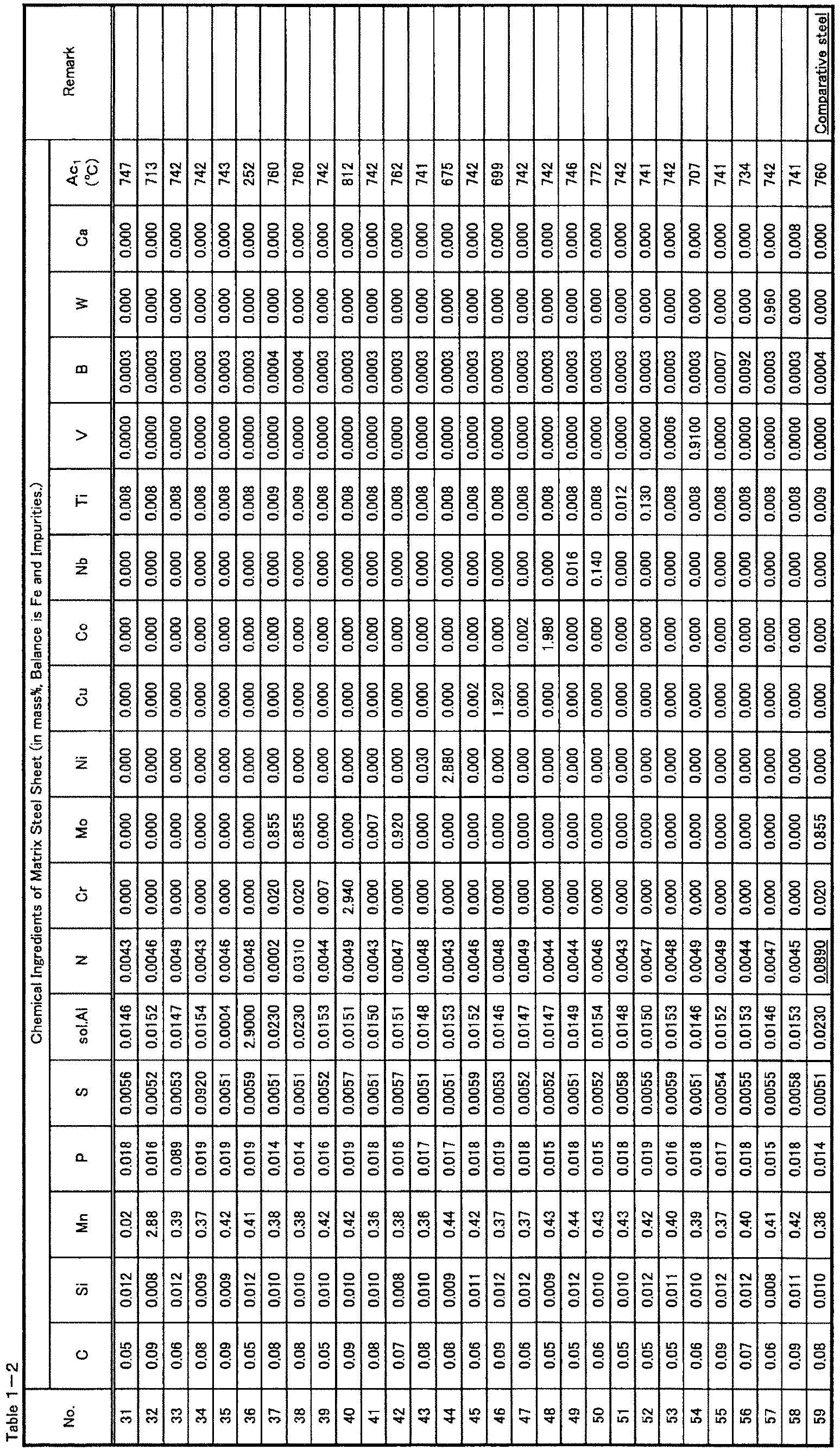
Steel materials having chemical compositions listed in Table 1 below were hot-rolled (and cold-rolled) according to conditions listed in Table 2, and then annealed, to obtain the steel sheets for carburizing. The hot-rolling according to the conditions listed in Table 2 below was followed by retention in the atmospheric air at 55°C for 105 hours, and by annealing according to conditions listed in Table 2. Now in exemplary conditions listed in Table 2 below, in the continuous casting step for obtaining the steel material to be subjected to hot-rolling, the soundness enhancing treatment of the steel material was carried out by controlling the amount of pouring of molten steel per unit time. Note that in Table 1 and Table 2, the underlines are used to indicate deviation from the scope of invention.
[Table 2-1]
-
Table 2-1
| No. |
Steel No. |
Continuous casting |
Hot-rolling |
Cold-rolling |
Spherodizing annealing |
Thickness (mm) |
Remark |
| Soundness enhancing treatment of steel material Yes/No |
Finish rolling temperature (°C) |
Winding temperature (°C) |
Cooling start time (s) |
Average cooling rate (°C/s) |
Draft in cold-rolling (%) |
Nitrogen concentration in annealing atmosphere (%) |
Average heating rate (°C/h) |
Heating temperature (°C) |
Retention time (h) |
Average cooling rate (°C/h) |
| 1 |
1 |
No |
868 |
595 |
0.7 |
99 |
- |
84 |
16 |
659 |
66 |
45 |
5.5 |
Example |
| 2 |
2 |
No |
884 |
596 |
0.8 |
57 |
- |
76 |
47 |
662 |
47 |
35 |
5.5 |
Example |
| 3 |
3 |
No |
856 |
593 |
0.7 |
80 |
- |
85 |
31 |
640 |
20 |
40 |
5.4 |
Example |
| 4 |
4 |
No |
880 |
565 |
0.8 |
80 |
- |
70 |
50 |
648 |
78 |
43 |
4.6 |
Example |
| 5 |
5 |
No |
879 |
469 |
0.6 |
61 |
- |
17
|
11 |
731
|
4
|
11 |
5.2 |
Comparative Example
|
| 6 |
6 |
No |
908 |
504 |
0.4 |
99 |
- |
19
|
99 |
720 |
33 |
84 |
5.3 |
Comparative Example
|
| 7 |
7 |
No |
851 |
585 |
0.4 |
64 |
- |
83 |
26 |
664 |
27 |
27 |
5.1 |
Comparative Example
|
| 8 |
8 |
No |
871 |
608 |
0.5 |
99 |
- |
72 |
48 |
659 |
45 |
20 |
5.3 |
Example |
| 9 |
9 |
No |
865 |
504 |
0.4 |
58 |
- |
73 |
27 |
645 |
60 |
27 |
5.5 |
Example |
| 10 |
10 |
No |
879 |
491 |
0.7 |
56 |
- |
75 |
25 |
645 |
22 |
23 |
5.3 |
Example |
| 11 |
11 |
No |
871 |
595 |
0.6 |
86 |
- |
71 |
35 |
645 |
74 |
34 |
5.0 |
Comparative
Example
|
| 12 |
12 |
No |
874 |
610 |
0.7 |
99 |
- |
82 |
29 |
661 |
71 |
44 |
5.7 |
Comparative Example
|
| 13 |
13 |
No |
852 |
489 |
0.5 |
98 |
- |
81 |
20 |
684 |
38 |
34 |
4.6 |
Comparative Example
|
| 14 |
14 |
No |
848 |
564 |
0.8 |
96 |
- |
84 |
22 |
665 |
34 |
31 |
5.1 |
Comparative Example
|
| 15 |
15 |
No |
868 |
546 |
0.4 |
96 |
- |
85 |
18 |
625 |
68 |
20 |
4.5 |
Comparative Example
|
| 16 |
16 |
No |
851 |
604 |
0.5 |
60 |
- |
79 |
41 |
685 |
48 |
28 |
4.2 |
Example |
| 17 |
17 |
No |
857 |
598 |
0.4 |
96 |
- |
74 |
24 |
675 |
60 |
19 |
5.6 |
Example |
| 18 |
18 |
No |
877 |
502 |
0.7 |
56 |
- |
80 |
31 |
611 |
66 |
19 |
4.3 |
Example |
| 19 |
19 |
No |
840 |
611 |
0.5 |
70 |
- |
71 |
50 |
639 |
36 |
40 |
5.2 |
Example |
| 20 |
20 |
No |
866 |
612 |
0.4 |
59 |
- |
81 |
26 |
655 |
45 |
19 |
4.0 |
Example |
| 21 |
21 |
No |
866 |
541 |
0.8 |
90 |
- |
73 |
24 |
682 |
50 |
48 |
4.6 |
Example |
| 22 |
22 |
No |
848 |
599 |
0.6 |
70 |
- |
84 |
15 |
658 |
44 |
35 |
5.1 |
Example |
| 23 |
23 |
No |
841 |
544 |
0.5 |
61 |
- |
81 |
23 |
656 |
26 |
30 |
5.2 |
Example |
| 24 |
24 |
No |
846 |
501 |
0.6 |
82 |
- |
81 |
28 |
661 |
63 |
31 |
5.6 |
Example |
| 25 |
25 |
No |
853 |
490 |
0.6 |
58 |
- |
70 |
28 |
661 |
23 |
43 |
5.4 |
Example |
| 26 |
26 |
No |
862 |
480 |
0.8 |
58 |
- |
85 |
41 |
655 |
37 |
37 |
5.3 |
Example |
| 27 |
27 |
No |
874 |
582 |
0.8 |
59 |
- |
72 |
19 |
655 |
30 |
29 |
4.4 |
Example |
| 28 |
28 |
No |
867 |
515 |
0.6 |
87 |
- |
70 |
24 |
668 |
47 |
26 |
5.5 |
Example |
| 29 |
2 |
No |
922
|
608 |
0.6 |
93 |
- |
83 |
49 |
673 |
34 |
26 |
4.1 |
Comparative Example
|
| 30 |
2 |
No |
847 |
453 |
0.6 |
55 |
- |
85 |
47 |
673 |
65 |
27 |
4.7 |
Example |
| 31 |
2 |
No |
782
|
475 |
0.8 |
94 |
- |
85 |
34 |
653 |
62 |
18 |
4.5 |
Comparative Example
|
| 32 |
2 |
No |
851 |
756
|
0.6 |
64 |
- |
80 |
32 |
663 |
27 |
28 |
4.9 |
Comparative Example
|
| 33 |
2 |
No |
871 |
560 |
0.7 |
84 |
- |
75 |
49 |
661 |
60 |
35 |
5.7 |
Example |
[Table 2-2]
-
Table 2-2
| No. |
Steel No. |
Continuous casting |
Hot-rolling |
Cold-rolling |
Spherodizing annealing |
Thickness (mm) |
Remark |
| Soundness enhancing treatment of steel material Yes/No |
Finish rolling temperature (°C) |
Winding temperature (°C) |
Cooling start time (s) |
Average cooling rate (°C/s) |
Draft in cold-rolling (%) |
Nitrogen concentration in annealing atmosphere (%) |
Average heating rate (°C/h) |
Heating temperature (°C) |
Retention time (h) |
Average cooling rate (°C/h) |
| 34 |
2 |
No |
861 |
451 |
0.6 |
73 |
51 |
74 |
19 |
659 |
51 |
20 |
2.8 |
Example |
| 35 |
2 |
No |
861 |
580 |
0.4 |
78 |
- |
19
|
33 |
661 |
67 |
49 |
4.5 |
Comparative Example
|
| 36 |
2 |
No |
861 |
520 |
0.5 |
79 |
- |
74 |
38 |
679 |
72 |
49 |
4.6 |
Example |
| 37 |
2 |
No |
857 |
522 |
0.4 |
99 |
- |
88 |
34 |
674 |
59 |
41 |
4.6 |
Example |
| 38 |
2 |
No |
862 |
515 |
0.5 |
74 |
- |
97 |
38 |
671 |
73 |
26 |
4.7 |
Example |
| 39 |
2 |
No |
860 |
450 |
0.6 |
55 |
- |
78 |
130
|
666 |
55 |
37 |
4.8 |
Comparative Example
|
| 40 |
2 |
No |
883 |
583 |
0.7 |
80 |
- |
83 |
45 |
664 |
35 |
39 |
4.2 |
Example |
| 41 |
2 |
No |
882 |
553 |
0.4 |
56 |
- |
77 |
2
|
668 |
30 |
39 |
4.9 |
Comparative Example
|
| 42 |
2 |
No |
864 |
450 |
0.4 |
90 |
- |
78 |
24 |
773
|
26 |
42 |
4.6 |
Comparative Example |
| 43 |
2 |
No |
860 |
459 |
0.4 |
84 |
- |
71 |
37 |
662 |
78 |
25 |
4.5 |
Example |
| 44 |
2 |
No |
863 |
575 |
0.5 |
68 |
- |
84 |
41 |
617 |
43 |
44 |
4.7 |
Example |
| 45 |
2 |
No |
876 |
553 |
0.6 |
100 |
- |
77 |
40 |
679 |
146
|
22 |
5.8 |
Comparative Example
|
| 46 |
2 |
No |
883 |
535 |
0.4 |
79 |
- |
82 |
20 |
662 |
24 |
41 |
5.3 |
Example |
| 47 |
2 |
No |
870 |
502 |
0.7 |
84 |
- |
79 |
27 |
664 |
2 |
23 |
5.6 |
Comparative Example
|
| 48 |
2 |
No |
868 |
471 |
0.6 |
85 |
- |
81 |
48 |
659 |
31 |
130
|
4.5 |
Comparative Example |
| 49 |
2 |
No |
863 |
487 |
0.4 |
63 |
- |
85 |
32 |
657 |
71 |
21 |
4.9 |
Example |
| 50 |
2 |
No |
867 |
518 |
0.6 |
97 |
- |
80 |
44 |
668 |
22 |
2 |
5.4 |
Comparative Example
|
| 51 |
2 |
Yes |
865 |
501 |
0.8 |
65 |
- |
84 |
30 |
667 |
67 |
19 |
4.8 |
Example |
| 52 |
29 |
No |
889 |
595 |
0.5 |
91 |
- |
76 |
51 |
667 |
43 |
30 |
5.6 |
Example |
| 53 |
30 |
No |
875 |
600 |
0.4 |
71 |
- |
77 |
47 |
657 |
48 |
32 |
5.3 |
Example |
| 54 |
31 |
No |
891 |
592 |
0.5 |
95 |
- |
79 |
45 |
665 |
48 |
35 |
5.3 |
Example |
| 55 |
32 |
No |
880 |
597 |
0.4 |
57 |
- |
81 |
55 |
660 |
42 |
36 |
5.5 |
Example |
| 56 |
33 |
No |
889 |
603 |
0.4 |
91 |
- |
72 |
38 |
663 |
46 |
35 |
5.6 |
Example |
| 57 |
34 |
No |
882 |
599 |
0.5 |
81 |
- |
81 |
38 |
658 |
51 |
34 |
5.3 |
Example |
| 58 |
35 |
No |
890 |
605 |
0.6 |
63 |
- |
75 |
56 |
657 |
47 |
34 |
5.7 |
Example |
| 59 |
36 |
No |
892 |
594 |
0.7 |
94 |
- |
81 |
57 |
662 |
42 |
33 |
5.3 |
Example |
| 60 |
37 |
No |
894 |
606 |
0.8 |
67 |
- |
76 |
44 |
662 |
48 |
40 |
5.3 |
Example |
| 61 |
38 |
No |
882 |
598 |
0.5 |
55 |
- |
80 |
48 |
666 |
45 |
34 |
5.4 |
Example |
| 62 |
39 |
No |
890 |
587 |
0.5 |
57 |
- |
75 |
44 |
658 |
47 |
38 |
5.3 |
Example |
| 63 |
40 |
No |
884 |
590 |
0.4 |
91 |
- |
76 |
40 |
658 |
52 |
37 |
5.6 |
Example |
| 64 |
41 |
No |
886 |
606 |
0.7 |
96 |
- |
71 |
41 |
661 |
43 |
39 |
5.4 |
Example |
| 65 |
42 |
No |
876 |
593 |
0.6 |
69 |
- |
72 |
47 |
663 |
50 |
33 |
5.6 |
Example |
| 66 |
43 |
No |
879 |
602 |
0.4 |
64 |
- |
75 |
39 |
666 |
44 |
35 |
5.3 |
Example |
[Table 2-3]
-
Table 2-3
| No. |
Steel No. |
Continuous casting |
Hot-rolling |
Cold-rolling |
Spherodizing annealing |
Thickness (mm) |
Remark |
| Soundness enhancing treatment of steel material Yes/No |
Finish rolling temperature (°C) |
Winding temperature (°C) |
Cooling start time (s) |
Average cooling rate (°C/s) |
Draft in cold-rolling (%) |
Nitrogen concentration in annealing atmosphere (%) |
Average heating rate (°C/h) |
Heating temperature (°C) |
Retention time (h) |
Average cooling rate (°C/h) |
| 67 |
44 |
No |
878 |
601 |
0.4 |
70 |
- |
77 |
47 |
659 |
48 |
40 |
5.6 |
Example |
| 68 |
45 |
No |
889 |
591 |
0.7 |
65 |
- |
78 |
37 |
667 |
47 |
37 |
5.6 |
Example |
| 69 |
46 |
No |
881 |
590 |
0.7 |
58 |
- |
79 |
40 |
659 |
42 |
39 |
5.4 |
Example |
| 70 |
47 |
No |
887 |
597 |
0.5 |
75 |
- |
76 |
49 |
662 |
51 |
31 |
5.3 |
Example |
| 71 |
48 |
No |
881 |
587 |
0.4 |
59 |
- |
75 |
47 |
658 |
49 |
38 |
5.6 |
Example |
| 72 |
49 |
No |
886 |
592 |
0.4 |
83 |
- |
75 |
47 |
657 |
44 |
36 |
5.6 |
Example |
| 73 |
50 |
No |
883 |
589 |
0.7 |
61 |
- |
80 |
43 |
662 |
45 |
40 |
5.3 |
Example |
| 74 |
51 |
No |
890 |
593 |
0.4 |
60 |
- |
75 |
40 |
658 |
47 |
36 |
5.7 |
Example |
| 75 |
52 |
No |
887 |
590 |
0.4 |
74 |
- |
73 |
54 |
667 |
45 |
37 |
5.5 |
Example |
| 76 |
53 |
No |
890 |
598 |
0.6 |
80 |
- |
76 |
40 |
661 |
47 |
32 |
5.4 |
Example |
| 77 |
54 |
No |
879 |
604 |
0.7 |
60 |
- |
81 |
42 |
665 |
42 |
36 |
5.7 |
Example |
| 78 |
55 |
No |
882 |
592 |
0.8 |
62 |
- |
80 |
57 |
657 |
44 |
31 |
5.5 |
Example |
| 79 |
56 |
No |
886 |
604 |
0.5 |
93 |
- |
80 |
52 |
661 |
52 |
39 |
5.3 |
Example |
| 80 |
57 |
No |
878 |
602 |
0.5 |
89 |
- |
75 |
46 |
666 |
48 |
33 |
5.4 |
Example |
| 81 |
58 |
No |
893 |
593 |
0.7 |
56 |
- |
73 |
38 |
659 |
51 |
30 |
5.6 |
Example |
| 82 |
2 |
No |
809 |
606 |
0.5 |
67 |
- |
81 |
53 |
659 |
47 |
30 |
5.7 |
Example |
| 83 |
2 |
No |
877 |
691 |
0.8 |
61 |
- |
79 |
38 |
665 |
43 |
30 |
5.5 |
Example |
| 84 |
2 |
No |
892 |
603 |
0.6 |
88 |
- |
28 |
57 |
665 |
45 |
30 |
5.7 |
Example |
| 85 |
2 |
No |
877 |
603 |
0.5 |
98 |
- |
75 |
7 |
660 |
42 |
32 |
5.3 |
Example |
| 86 |
2 |
No |
881 |
586 |
0.5 |
98 |
- |
74 |
94 |
664 |
52 |
32 |
5.6 |
Example |
| 87 |
2 |
No |
881 |
593 |
0.7 |
55 |
- |
73 |
55 |
660 |
12 |
38 |
5.5 |
Example |
| 88 |
2 |
No |
894 |
597 |
0.4 |
83 |
- |
81 |
37 |
667 |
97 |
35 |
5.6 |
Example |
| 89 |
2 |
No |
893 |
587 |
0.7 |
98 |
- |
73 |
53 |
666 |
46 |
8 |
5.5 |
Example |
| 90 |
2 |
No |
893 |
605 |
0.5 |
75 |
- |
75 |
51 |
662 |
42 |
94 |
5.5 |
Example |
| 91 |
2 |
No |
895 |
612 |
1.8 |
74 |
- |
77 |
48 |
660 |
42 |
31 |
5.5 |
Comparative Example
|
| 92 |
2 |
No |
880 |
560 |
0.9 |
57 |
- |
77 |
37 |
651 |
48 |
30 |
5.7 |
Example |
| 93 |
2 |
No |
881 |
577 |
0.1 |
57 |
- |
71 |
39 |
649 |
48 |
36 |
5.4 |
Example |
| 94 |
2 |
No |
888 |
587 |
0.5 |
43 |
- |
70 |
39 |
643 |
40 |
30 |
5.5 |
Comparative Example
|
| 95 |
2 |
No |
889 |
588 |
0.8 |
151 |
- |
75 |
42 |
653 |
47 |
34 |
5.6 |
Example |
| 96 |
2 |
No |
876 |
591 |
0.8 |
203 |
- |
76 |
40 |
655 |
49 |
31 |
5.5 |
Example |
| 97 |
2 |
No |
884 |
596 |
0.8 |
57 |
- |
96 |
47 |
660 |
47 |
35 |
5.5 |
Example |
| 98 |
59 |
No |
882 |
600 |
0.5 |
56 |
- |
82 |
51 |
666 |
48 |
34 |
5.4 |
Comparative Example
|
-
Each of the obtained steel sheets for carburizing was measured regarding (1) percentage of the number of carbides with an aspect ratio of 2.0 or smaller, among from the total carbides, (2) percentage of the number of carbides produced in the ferrite crystal grains, among from the total carbides, (3) average equivalent circle diameter of carbides, (4) average nitrogen concentration in the skin layer of the steel sheet, and, (5) average crystal grain size of ferrite after spherodizing annealing, according to the methods described previously. Note that the average crystal grain size of ferrite after spherodizing annealing is understood to be the average crystal grain size of ferrite of the obtained steel sheet for carburizing.
-
In addition, in order to evaluate bendability of the obtained individual steel sheets for carburizing, specimens were sampled from freely selectable positions of the steel sheets for carburizing, and measured regarding bendability under the following conditions, in compliance with the VDA Standards (VDA238-100) specified by Verband der Automobilindustrie e.V. In this test example, dislocation under maximum load obtainable in the bend test was converted to angle according to the VDA Standards, to determine maximum angle of bend (in degree).
- Size of test specimen: 30 mm (rolling direction) × 60 mm (direction perpendicular to rolling direction)
- Bending ridge: laid in parallel with rolling direction
- Test method: roll-supported, punch-pressed
- Roll diameter: ϕ 30 mm
- Punch shape: end with R = 0.4 mm
- Roll-to-roll distance: 2.0 × sheet thickness (mm) + 0.5 mm
- Pressing velocity: 20 mm/min
- Tester: Shimadzu Autograph (registered trademark) 20 kN
-
Also in order to evaluate toughness after carburizing of the obtained individual steel sheets for carburizing, each of the thus obtained steel sheets for carburizing was carburized as described below. That is, each of the steel sheets for carburizing was carburized while being kept in a gas atmosphere with a carbon potential of 0.8 mass% at 900°C for 2.5 hr, and further being kept at 850°C for 0.5 hr, and then oil-quenched at 100°C. The steel sheet was then kept at 160°C for 2.0 hr for tempering, and cooled down to room temperature. A 2 mm V-notched Charpy test piece was sampled from a freely selectable position of the steel sheet after carburizing heat treatment, and subjected to Charpy test at room temperature in compliance with a method specified in JIS Z2242, to measure the impact value (J/cm2).
-
As a reference, also ideal critical diameter, which is an index for hardenability after carburizing, was calculated. The ideal critical diameter D
i is an index calculated from ingredients of the steel sheet, and may be determined using the equation (201) according to Grossmann/Hollomon, Jaffe's method. The larger the value of ideal critical diameter D
i, the more excellent the hardenability.
[Math. 3]
-
In this test example, the cases where the maximum bending angle of the steel sheet for carburizing is 100° or larger, and the impact value after carburizing is 60 J/cm2 or larger were judged to show high bendability during cold-working and high toughness after carburizing, and were accepted as "examples".
-
Microstructures and characteristics of the individual steel sheets for carburizing thus obtained were collectively summarized in Table 3 below.
[Table 3-1]
-
Table 3-1
| No. |
Steel No. |
Microstructure |
Mechanical characteristics |
Hardenability |
Remark |
| Average nitrogen concentration in skin layer of steel sheet (mass%) |
Percentage of number of carbides with aspect ratio of 2.0 or smaller (%) |
Percentage of number of carbides within ferrite crystal grain (%) |
Average circle equivalent diameter of carbide (µ m) |
Average crystal grain size of ferrite after spherodizing annealing (µm) |
Maximum bending angle (deg) |
Impact value after carburizing (J/cm2) |
Ideal critical diameter (-) |
| 1 |
1 |
0.051 |
97 |
75 |
0.54 |
7.7 |
120 |
82 |
20.7 |
Example |
| 2 |
2 |
0.056 |
97 |
81 |
0.61 |
7.0 |
113 |
85 |
43.9 |
Example |
| 3 |
3 |
0.051 |
86 |
83 |
0.47 |
7.1 |
108 |
66 |
23.2 |
Example |
| 4 |
4 |
0.045 |
91 |
87 |
0.60 |
6.8 |
120 |
78 |
135.1 |
Example |
| 5 |
5 |
0.006
|
89 |
31 |
0.46 |
4.8 |
88
|
81 |
20.5 |
Comparative Exemple
|
| 6 |
6 |
0.007
|
91 |
89 |
0.56 |
7.2 |
72
|
64 |
108.5 |
Comparative Exemple
|
| 7 |
7 |
0.051 |
82 |
45
|
0.61 |
4.1 |
69
|
63 |
1.5 |
Comparative Example
|
| 8 |
8 |
0.054 |
92 |
69 |
0.35 |
5.5 |
105 |
64 |
9.7 |
Example |
| 9 |
9 |
0.053 |
86 |
68 |
0.36 |
6.0 |
106 |
66 |
9.5 |
Example |
| 10 |
10 |
0.054 |
85 |
86 |
0.45 |
4.0 |
101 |
71 |
9.6 |
Example |
| 11 |
11 |
0.060 |
84 |
68 |
7.58
|
7.0 |
79
|
67 |
13.9 |
Comparative Example
|
| 12 |
12 |
0.058 |
85 |
86 |
6.85
|
6.6 |
67 |
85 |
5.3 |
Comparative Example
|
| 13 |
13 |
0.051 |
96 |
68 |
6.46
|
8.0 |
69 |
83 |
12.6 |
Comparative Example
|
| 14 |
14 |
0.056 |
97 |
87 |
6.95
|
5.6 |
77
|
83 |
1.8 |
Comparative Example
|
| 15 |
15 |
0.050 |
90 |
83 |
6.99
|
8.0 |
85
|
83 |
31.4 |
Comparative Example
|
| 16 |
16 |
0.055 |
84 |
77 |
0.49 |
4.5 |
114 |
80 |
23.5 |
Example |
| 17 |
17 |
0.049 |
94 |
74 |
0.37 |
5.3 |
118 |
75 |
15.7 |
Example |
| 18 |
18 |
0.049 |
88 |
89 |
0.57 |
6.4 |
113 |
82 |
7.8 |
Example |
| 19 |
19 |
0.048 |
92 |
83 |
0.58 |
6.0 |
115 |
84 |
7.8 |
Example |
| 20 |
20 |
0.051 |
96 |
82 |
0.65 |
6.1 |
111 |
80 |
5.6 |
Example |
| 21 |
21 |
0.054 |
84 |
78 |
0.59 |
4.2 |
113 |
76 |
5.6 |
Example |
| 22 |
22 |
0.049 |
83 |
71 |
0.47 |
4.3 |
120 |
83 |
5.6 |
Example |
| 23 |
23 |
0.045 |
90 |
76 |
0.52 |
7.5 |
111 |
80 |
5.9 |
Example |
| 24 |
24 |
0.061 |
97 |
78 |
0.42 |
6.1 |
117 |
81 |
13.5 |
Example |
| 25 |
25 |
0.061 |
86 |
88 |
0.39 |
5.4 |
110 |
82 |
5.9 |
Example |
| 26 |
26 |
0.056 |
89 |
86 |
0.42 |
4.0 |
116 |
81 |
6.4 |
Example |
| 27 |
27 |
0.053 |
82 |
68 |
0.48 |
6.2 |
114 |
85 |
5.8 |
Example |
| 28 |
28 |
0.053 |
90 |
78 |
0.53 |
4.7 |
113 |
82 |
5.2 |
Example |
| 29 |
2 |
0.058 |
49 |
78 |
0.35 |
4.4 |
11 |
81 |
43.9 |
Comparative Example
|
| 30 |
2 |
0.047 |
84 |
80 |
0.35 |
4.8 |
110 |
81 |
43.9 |
Example |
| 31 |
2 |
0.060 |
98 |
73 |
7.25
|
4.3 |
79
|
80 |
43.9 |
Comparative Example
|
| 32 |
2 |
0.047 |
66
|
69 |
0.55 |
7.2 |
86
|
85 |
43.9 |
Comparative Example
|
| 33 |
2 |
0.045 |
84 |
89 |
0.59 |
5.5 |
119 |
82 |
43.9 |
Example |
[Table 3-2]
-
Table 3-2
| No. |
Steel No. |
Microstructure |
Mechanical characteristics |
Hardenability |
Remark |
| Average nitrogen concentration in skin layer of steel sheet (mass%) |
Percentage of number of carbides with aspect ratio of 2.0 or smaller (%) |
Percentage of number of carbides within ferrite crystal grain (%) |
Average circle equivalent diameter of carbide (µm) |
Average crystal grain size of ferrite after spherodizing annealing (µm) |
Maximum bending angle (deg) |
Impact value after carburizing (J/cm2) |
Ideal critical diameter (-) |
| 34 |
2 |
0.047 |
85 |
73 |
0.58 |
4.5 |
110 |
82 |
43.9 |
Example |
| 35 |
2 |
0.007
|
96 |
84 |
6.37
|
7.0 |
71 |
55
|
43.9 |
Comparative Example
|
| 36 |
2 |
0.055 |
86 |
80 |
0.35 |
4.6 |
114 |
85 |
43.9 |
Example |
| 37 |
2 |
0.188 |
86 |
80 |
0.35 |
6.9 |
117 |
94 |
43.9 |
Example |
| 38 |
2 |
0.181 |
66 |
80 |
0.35 |
5.0 |
113 |
87 |
43.9 |
Example |
| 39 |
2 |
0.057 |
41
|
75 |
0.51 |
7.1 |
81
|
76 |
43.9 |
Comparative Example
|
| 40 |
2 |
0.048 |
90 |
71 |
0.54 |
7.5 |
111 |
79 |
43.9 |
Example |
| 41 |
2 |
0.047 |
92 |
72 |
6.69
|
65 |
86
|
75 |
43.9 |
Comparative Example
|
| 42 |
2 |
0.055 |
85 |
36 |
0.43 |
6.8 |
78
|
80 |
43.9 |
Comparative Example
|
| 43 |
2 |
0.057 |
96 |
85 |
0.58 |
5.7 |
113 |
79 |
43.9 |
Example |
| 44 |
2 |
0.061 |
96 |
78 |
0.57 |
7.9 |
112 |
83 |
43.9 |
Example |
| 45 |
2 |
0.056 |
88 |
68 |
5.95
|
7.2 |
87
|
85 |
43.9 |
Comparative Example
|
| 46 |
2 |
0.055 |
92 |
86 |
0.59 |
7.2 |
117 |
77 |
43.9 |
Example |
| 47 |
2 |
0.050 |
65
|
70 |
0.48 |
5.0 |
71
|
85 |
43.9 |
Comparative Example
|
| 48 |
2 |
0.049 |
71
|
68 |
0.49 |
5.9 |
74
|
78 |
43.9 |
Comparative Exemple
|
| 49 |
2 |
0.048 |
95 |
82 |
0.42 |
7.2 |
116 |
84 |
43.9 |
Example |
| 50 |
2 |
0.054 |
88 |
79 |
7.61
|
5.0 |
82
|
79 |
43.9 |
Comparative Example
|
| 51 |
2 |
0.055 |
96 |
81 |
0.41 |
5.9 |
131 |
95 |
43.9 |
Example |
| 52 |
29 |
0.056 |
88 |
75 |
0.63 |
5.6 |
103 |
90 |
11.4 |
Example |
| 53 |
30 |
0.050 |
90 |
80 |
4.70 |
7.7 |
102 |
89 |
14.4 |
Example |
| 54 |
31 |
0.061 |
91 |
80 |
0.71 |
5.9 |
104 |
81 |
5.9 |
Example |
| 55 |
32 |
0.050 |
88 |
77 |
4.81 |
7.8 |
101 |
76 |
60.3 |
Example |
| 56 |
33 |
0.064 |
91 |
78 |
0.64 |
4.3 |
105 |
78 |
12.2 |
Example |
| 57 |
34 |
0.059 |
90 |
77 |
0.51 |
7.5 |
101 |
87 |
10.7 |
Example |
| 58 |
35 |
0.061 |
88 |
74 |
0.65 |
7.2 |
102 |
80 |
12.9 |
Example |
| 59 |
36 |
0.046 |
87 |
77 |
0.62 |
5.9 |
104 |
85 |
9.8 |
Example |
| 60 |
37 |
0.057 |
87 |
72 |
0.62 |
7.8 |
128 |
82 |
43.9 |
Example |
| 61 |
38 |
0.052 |
89 |
82 |
0.58 |
5.8 |
102 |
81 |
43.9 |
Example |
| 62 |
39 |
0.061 |
92 |
81 |
0.67 |
9.5 |
114 |
64 |
9.9 |
Example |
| 63 |
40 |
0.056 |
90 |
79 |
0.56 |
5.1 |
115 |
71 |
101.6 |
Example |
| 64 |
41 |
0.061 |
92 |
73 |
0.60 |
9.7 |
113 |
62 |
11.4 |
Example |
| 65 |
42 |
0.047 |
92 |
81 |
0.66 |
8.0 |
116 |
70 |
41.9 |
Example |
| 66 |
43 |
0.066 |
89 |
76 |
0.55 |
9.1 |
110 |
63 |
11.3 |
Example |
[Table 3-3]
-
Table 3-3
| No. |
Steel No. |
Microstructure |
Mechanical characteristics |
Hardenability |
Remark |
| Average nitrogen concentration in skin layer of steel sheet (mass%) |
Percentage of number of carbides with aspect ratio of 2.0 or smaller (%) |
Percentage of number of carbides within ferrite crystal grain (%) |
Average circle equivalent diameter of carbide (µ m) |
Average crystal grain size of ferrite after spherodizing annealing (µm) |
Maximum bending angle (deg) |
Impact value after carburizing (J/cm2) |
Ideal critical diameter (-) |
| 67 |
44 |
0.050 |
90 |
77 |
0.58 |
4.6 |
111 |
65 |
31.4 |
Example |
| 68 |
45 |
0.059 |
91 |
80 |
0.64 |
9.4 |
117 |
63 |
10.8 |
Example |
| 69 |
46 |
0.058 |
90 |
73 |
0.57 |
4.1 |
116 |
62 |
18.2 |
Example |
| 70 |
47 |
0.050 |
92 |
78 |
0.70 |
9.4 |
118 |
65 |
10.0 |
Example |
| 71 |
48 |
0.064 |
92 |
80 |
0.66 |
6.1 |
115 |
62 |
9.9 |
Example |
| 72 |
49 |
0.059 |
92 |
76 |
0.55 |
9.1 |
101 |
81 |
10.2 |
Example |
| 73 |
50 |
0.059 |
91 |
77 |
0.55 |
5.1 |
103 |
80 |
10.8 |
Example |
| 74 |
51 |
0.064 |
90 |
78 |
0.51 |
9.3 |
103 |
87 |
10.0 |
Example |
| 75 |
52 |
0.055 |
91 |
83 |
0.57 |
4.0 |
105 |
84 |
99 |
Example |
| 76 |
53 |
0.055 |
90 |
74 |
0.63 |
9.5 |
103 |
78 |
9.5 |
Example |
| 77 |
54 |
0.056 |
91 |
75 |
0.63 |
7.0 |
104 |
76 |
10.3 |
Example |
| 78 |
55 |
0.066 |
91 |
79 |
0.64 |
6.4 |
102 |
81 |
11.9 |
Example |
| 79 |
56 |
0.052 |
90 |
81 |
0.61 |
6.6 |
125 |
75 |
11.2 |
Example |
| 80 |
57 |
0.058 |
89 |
82 |
0.70 |
5.1 |
121 |
84 |
10.5 |
Example |
| 81 |
58 |
0.046 |
88 |
80 |
0.69 |
7.6 |
118 |
78 |
12.9 |
Example |
| 82 |
2 |
0.052 |
87 |
75 |
4.66 |
6.2 |
103 |
83 |
43.9 |
Example |
| 83 |
2 |
0.058 |
81 |
75 |
0.68 |
6.8 |
101 |
79 |
43.9 |
Example |
| 84 |
2 |
0.041 |
92 |
62 |
0.60 |
5.4 |
110 |
62 |
43.9 |
Example |
| 85 |
2 |
0.066 |
90 |
79 |
4.71 |
4.8 |
103 |
76 |
43.9 |
Example |
| 86 |
2 |
0.052 |
82 |
77 |
0.63 |
5.5 |
104 |
79 |
43.9 |
Example |
| 87 |
2 |
0.046 |
81 |
71 |
0.69 |
7.6 |
103 |
88 |
43.9 |
Example |
| 88 |
2 |
0.057 |
91 |
82 |
4.81 |
6.8 |
101 |
83 |
43.9 |
Example |
| 89 |
2 |
0.048 |
92 |
71 |
4.71 |
4.6 |
101 |
85 |
43.9 |
Example |
| 90 |
2 |
0.057 |
81 |
73 |
0.63 |
6.4 |
102 |
76 |
43.9 |
Example |
| 91 |
2 |
0.064 |
92 |
71 |
0.71 |
13.0
|
110 |
51
|
43.9 |
Comparative Example
|
| 92 |
2 |
0.066 |
92 |
79 |
0.54 |
9.1 |
118 |
62 |
43.9 |
Example |
| 93 |
2 |
0.054 |
89 |
81 |
0.56 |
2.3 |
118 |
93 |
43.9 |
Example |
| 94 |
2 |
0.060 |
92 |
73 |
0.64 |
12.5
|
107 |
52
|
43.9 |
Comparative Example
|
| 95 |
2 |
0.058 |
89 |
79 |
0.60 |
3.2 |
108 |
91 |
43.9 |
Example |
| 96 |
2 |
0.065 |
92 |
77 |
0.68 |
1.8 |
109 |
97 |
43.9 |
Example |
| 97 |
2 |
0.050 |
91 |
76 |
0.70 |
4.1 |
114 |
99 |
43.9 |
Example |
| 98 |
59 |
0.289
|
89 |
81 |
0.54 |
5.7 |
54
|
82 |
43.9 |
Comparative Example
|
-
As is clear from Table 3 above, the steel sheets for carburizing that correspond to the examples of this invention were found to have good formability and toughness after carburizing, showing maximum bending angles of the steel sheet for carburizing of 100° or larger, and impact values after carburizing of 60 J/cm2 or larger. Also the ideal critical diameter, described for reference, was found to be 5 or larger, teaching that the steel sheets for carburizing that come under examples of the present invention also excel in hardenability.
-
Meanwhile, as is clear from Table 3 above, the steel sheets for carburizing that correspond to comparative examples of this invention were found to be ill-balanced between the formability and the toughness after carburizing, showing at least either of maximum bending angle or impact value after carburizing dropped below the standard values.
-
Although having detailed the preferred embodiments of the present invention, the present invention is not limited to these examples. It is obvious that those having general knowledge in the technical field to which the present invention pertains will easily arrive at various modified examples or revised examples within the scope of technical concept described in claims, and also these examples are naturally understood to come under the technical scope of the present invention.