EP3656872A1 - Label-free analysis of rna capping efficiency using rnase h, probes and liquid chromatography/mass spectrometry - Google Patents
Label-free analysis of rna capping efficiency using rnase h, probes and liquid chromatography/mass spectrometry Download PDFInfo
- Publication number
- EP3656872A1 EP3656872A1 EP19186124.4A EP19186124A EP3656872A1 EP 3656872 A1 EP3656872 A1 EP 3656872A1 EP 19186124 A EP19186124 A EP 19186124A EP 3656872 A1 EP3656872 A1 EP 3656872A1
- Authority
- EP
- European Patent Office
- Prior art keywords
- rna
- nonradiolabeled
- mrna
- target rna
- duplex polynucleotide
- Prior art date
- Legal status (The legal status is an assumption and is not a legal conclusion. Google has not performed a legal analysis and makes no representation as to the accuracy of the status listed.)
- Withdrawn
Links
- 239000000523 sample Substances 0.000 title claims abstract description 115
- 238000004949 mass spectrometry Methods 0.000 title claims description 14
- 238000004811 liquid chromatography Methods 0.000 title claims description 13
- 238000004458 analytical method Methods 0.000 title description 12
- 108020004999 messenger RNA Proteins 0.000 claims abstract description 211
- 238000000034 method Methods 0.000 claims abstract description 125
- 230000000295 complement effect Effects 0.000 claims abstract description 20
- 239000013614 RNA sample Substances 0.000 claims abstract description 5
- 229920002477 rna polymer Polymers 0.000 claims description 197
- YBJHBAHKTGYVGT-ZKWXMUAHSA-N (+)-Biotin Chemical compound N1C(=O)N[C@@H]2[C@H](CCCCC(=O)O)SC[C@@H]21 YBJHBAHKTGYVGT-ZKWXMUAHSA-N 0.000 claims description 84
- 102000040430 polynucleotide Human genes 0.000 claims description 77
- 108091033319 polynucleotide Proteins 0.000 claims description 77
- 239000002157 polynucleotide Substances 0.000 claims description 77
- 125000003729 nucleotide group Chemical group 0.000 claims description 69
- 239000002773 nucleotide Substances 0.000 claims description 67
- 239000011324 bead Substances 0.000 claims description 47
- 239000012634 fragment Substances 0.000 claims description 46
- 229960002685 biotin Drugs 0.000 claims description 42
- 235000020958 biotin Nutrition 0.000 claims description 42
- 239000011616 biotin Substances 0.000 claims description 42
- 239000001226 triphosphate Substances 0.000 claims description 40
- 235000011178 triphosphate Nutrition 0.000 claims description 39
- 239000000758 substrate Substances 0.000 claims description 37
- 238000000338 in vitro Methods 0.000 claims description 33
- UNXRWKVEANCORM-UHFFFAOYSA-N triphosphoric acid Chemical compound OP(O)(=O)OP(O)(=O)OP(O)(O)=O UNXRWKVEANCORM-UHFFFAOYSA-N 0.000 claims description 33
- 239000003153 chemical reaction reagent Substances 0.000 claims description 30
- 238000006243 chemical reaction Methods 0.000 claims description 26
- PTJWIQPHWPFNBW-GBNDHIKLSA-N pseudouridine Chemical compound O[C@@H]1[C@H](O)[C@@H](CO)O[C@H]1C1=CNC(=O)NC1=O PTJWIQPHWPFNBW-GBNDHIKLSA-N 0.000 claims description 26
- 229930185560 Pseudouridine Natural products 0.000 claims description 25
- PTJWIQPHWPFNBW-UHFFFAOYSA-N Pseudouridine C Natural products OC1C(O)C(CO)OC1C1=CNC(=O)NC1=O PTJWIQPHWPFNBW-UHFFFAOYSA-N 0.000 claims description 25
- WGDUUQDYDIIBKT-UHFFFAOYSA-N beta-Pseudouridine Natural products OC1OC(CN2C=CC(=O)NC2=O)C(O)C1O WGDUUQDYDIIBKT-UHFFFAOYSA-N 0.000 claims description 25
- VZQXUWKZDSEQRR-SDBHATRESA-N 2-methylthio-N(6)-(Delta(2)-isopentenyl)adenosine Chemical compound C12=NC(SC)=NC(NCC=C(C)C)=C2N=CN1[C@@H]1O[C@H](CO)[C@@H](O)[C@H]1O VZQXUWKZDSEQRR-SDBHATRESA-N 0.000 claims description 24
- MVCRZALXJBDOKF-JPZHCBQBSA-N beta-hydroxywybutosine 5'-monophosphate Chemical compound C1=NC=2C(=O)N3C(CC(O)[C@H](NC(=O)OC)C(=O)OC)=C(C)N=C3N(C)C=2N1[C@@H]1O[C@H](COP(O)(O)=O)[C@@H](O)[C@H]1O MVCRZALXJBDOKF-JPZHCBQBSA-N 0.000 claims description 24
- 101710131879 RNA pyrophosphohydrolase Proteins 0.000 claims description 22
- 229910019142 PO4 Inorganic materials 0.000 claims description 21
- 239000010452 phosphate Substances 0.000 claims description 20
- ZAYHVCMSTBRABG-UHFFFAOYSA-N 5-Methylcytidine Natural products O=C1N=C(N)C(C)=CN1C1C(O)C(O)C(CO)O1 ZAYHVCMSTBRABG-UHFFFAOYSA-N 0.000 claims description 19
- ZAYHVCMSTBRABG-JXOAFFINSA-N 5-methylcytidine Chemical compound O=C1N=C(N)C(C)=CN1[C@H]1[C@H](O)[C@H](O)[C@@H](CO)O1 ZAYHVCMSTBRABG-JXOAFFINSA-N 0.000 claims description 19
- NBIIXXVUZAFLBC-UHFFFAOYSA-K phosphate Chemical compound [O-]P([O-])([O-])=O NBIIXXVUZAFLBC-UHFFFAOYSA-K 0.000 claims description 17
- HXVKEKIORVUWDR-FDDDBJFASA-N 1-[(2r,3r,4s,5r)-3,4-dihydroxy-5-(hydroxymethyl)oxolan-2-yl]-5-(methylaminomethyl)-2-sulfanylidenepyrimidin-4-one Chemical compound S=C1NC(=O)C(CNC)=CN1[C@H]1[C@H](O)[C@H](O)[C@@H](CO)O1 HXVKEKIORVUWDR-FDDDBJFASA-N 0.000 claims description 16
- SXUXMRMBWZCMEN-UHFFFAOYSA-N 2'-O-methyl uridine Natural products COC1C(O)C(CO)OC1N1C(=O)NC(=O)C=C1 SXUXMRMBWZCMEN-UHFFFAOYSA-N 0.000 claims description 16
- GJTBSTBJLVYKAU-XVFCMESISA-N 2-thiouridine Chemical compound O[C@@H]1[C@H](O)[C@@H](CO)O[C@H]1N1C(=S)NC(=O)C=C1 GJTBSTBJLVYKAU-XVFCMESISA-N 0.000 claims description 16
- BINGDNLMMYSZFR-QYVSTXNMSA-N 3-[(2r,3r,4s,5r)-3,4-dihydroxy-5-(hydroxymethyl)oxolan-2-yl]-6,7-dimethyl-5h-imidazo[1,2-a]purin-9-one Chemical compound C1=NC=2C(=O)N3C(C)=C(C)N=C3NC=2N1[C@@H]1O[C@H](CO)[C@@H](O)[C@H]1O BINGDNLMMYSZFR-QYVSTXNMSA-N 0.000 claims description 16
- QUZQVVNSDQCAOL-WOUKDFQISA-N 4-demethylwyosine Chemical compound N1C(C)=CN(C(C=2N=C3)=O)C1=NC=2N3[C@@H]1O[C@H](CO)[C@@H](O)[C@H]1O QUZQVVNSDQCAOL-WOUKDFQISA-N 0.000 claims description 16
- VSCNRXVDHRNJOA-PNHWDRBUSA-N 5-(carboxymethylaminomethyl)uridine Chemical compound O[C@@H]1[C@H](O)[C@@H](CO)O[C@H]1N1C(=O)NC(=O)C(CNCC(O)=O)=C1 VSCNRXVDHRNJOA-PNHWDRBUSA-N 0.000 claims description 16
- VKLFQTYNHLDMDP-PNHWDRBUSA-N 5-carboxymethylaminomethyl-2-thiouridine Chemical compound O[C@@H]1[C@H](O)[C@@H](CO)O[C@H]1N1C(=S)NC(=O)C(CNCC(O)=O)=C1 VKLFQTYNHLDMDP-PNHWDRBUSA-N 0.000 claims description 16
- QXDXBKZJFLRLCM-UAKXSSHOSA-N 5-hydroxyuridine Chemical compound O[C@@H]1[C@H](O)[C@@H](CO)O[C@H]1N1C(=O)NC(=O)C(O)=C1 QXDXBKZJFLRLCM-UAKXSSHOSA-N 0.000 claims description 16
- HLZXTFWTDIBXDF-PNHWDRBUSA-N 5-methoxycarbonylmethyl-2-thiouridine Chemical compound S=C1NC(=O)C(CC(=O)OC)=CN1[C@H]1[C@H](O)[C@H](O)[C@@H](CO)O1 HLZXTFWTDIBXDF-PNHWDRBUSA-N 0.000 claims description 16
- YIZYCHKPHCPKHZ-PNHWDRBUSA-N 5-methoxycarbonylmethyluridine Chemical compound O=C1NC(=O)C(CC(=O)OC)=CN1[C@H]1[C@H](O)[C@H](O)[C@@H](CO)O1 YIZYCHKPHCPKHZ-PNHWDRBUSA-N 0.000 claims description 16
- SNNBPMAXGYBMHM-JXOAFFINSA-N 5-methyl-2-thiouridine Chemical compound S=C1NC(=O)C(C)=CN1[C@H]1[C@H](O)[C@H](O)[C@@H](CO)O1 SNNBPMAXGYBMHM-JXOAFFINSA-N 0.000 claims description 16
- FPUGCISOLXNPPC-IOSLPCCCSA-N cordysinin B Chemical compound CO[C@@H]1[C@H](O)[C@@H](CO)O[C@H]1N1C2=NC=NC(N)=C2N=C1 FPUGCISOLXNPPC-IOSLPCCCSA-N 0.000 claims description 16
- XOTXNXXJZCFUOA-UGKPPGOTSA-N methyl 2-[1-[(2r,3r,4r,5r)-4-hydroxy-5-(hydroxymethyl)-3-methoxyoxolan-2-yl]-2,4-dioxopyrimidin-5-yl]acetate Chemical compound CO[C@@H]1[C@H](O)[C@@H](CO)O[C@H]1N1C(=O)NC(=O)C(CC(=O)OC)=C1 XOTXNXXJZCFUOA-UGKPPGOTSA-N 0.000 claims description 16
- 108010090804 Streptavidin Proteins 0.000 claims description 15
- 238000002360 preparation method Methods 0.000 claims description 15
- 108090000765 processed proteins & peptides Proteins 0.000 claims description 14
- 238000013518 transcription Methods 0.000 claims description 14
- 230000035897 transcription Effects 0.000 claims description 14
- 230000004044 response Effects 0.000 claims description 12
- 108090001008 Avidin Proteins 0.000 claims description 11
- SHIBSTMRCDJXLN-UHFFFAOYSA-N Digoxigenin Natural products C1CC(C2C(C3(C)CCC(O)CC3CC2)CC2O)(O)C2(C)C1C1=CC(=O)OC1 SHIBSTMRCDJXLN-UHFFFAOYSA-N 0.000 claims description 11
- QONQRTHLHBTMGP-UHFFFAOYSA-N digitoxigenin Natural products CC12CCC(C3(CCC(O)CC3CC3)C)C3C11OC1CC2C1=CC(=O)OC1 QONQRTHLHBTMGP-UHFFFAOYSA-N 0.000 claims description 11
- SHIBSTMRCDJXLN-KCZCNTNESA-N digoxigenin Chemical compound C1([C@@H]2[C@@]3([C@@](CC2)(O)[C@H]2[C@@H]([C@@]4(C)CC[C@H](O)C[C@H]4CC2)C[C@H]3O)C)=CC(=O)OC1 SHIBSTMRCDJXLN-KCZCNTNESA-N 0.000 claims description 11
- 239000012535 impurity Substances 0.000 claims description 11
- 230000001745 anti-biotin effect Effects 0.000 claims description 10
- 230000002788 anti-peptide Effects 0.000 claims description 10
- DWRXFEITVBNRMK-UHFFFAOYSA-N Beta-D-1-Arabinofuranosylthymine Natural products O=C1NC(=O)C(C)=CN1C1C(O)C(O)C(CO)O1 DWRXFEITVBNRMK-UHFFFAOYSA-N 0.000 claims description 9
- 229930010555 Inosine Natural products 0.000 claims description 9
- UGQMRVRMYYASKQ-KQYNXXCUSA-N Inosine Chemical compound O[C@@H]1[C@H](O)[C@@H](CO)O[C@H]1N1C2=NC=NC(O)=C2N=C1 UGQMRVRMYYASKQ-KQYNXXCUSA-N 0.000 claims description 9
- SLEHROROQDYRAW-KQYNXXCUSA-N N(2)-methylguanosine Chemical compound C1=NC=2C(=O)NC(NC)=NC=2N1[C@@H]1O[C@H](CO)[C@@H](O)[C@H]1O SLEHROROQDYRAW-KQYNXXCUSA-N 0.000 claims description 9
- 206010046865 Vaccinia virus infection Diseases 0.000 claims description 9
- 229960003786 inosine Drugs 0.000 claims description 9
- 208000007089 vaccinia Diseases 0.000 claims description 9
- DJONVIMMDYQLKR-WOUKDFQISA-N (2r,3r,4r,5r)-2-(hydroxymethyl)-5-(6-imino-1-methylpurin-9-yl)-4-methoxyoxolan-3-ol Chemical compound CO[C@@H]1[C@H](O)[C@@H](CO)O[C@H]1N1C(N=CN(C)C2=N)=C2N=C1 DJONVIMMDYQLKR-WOUKDFQISA-N 0.000 claims description 8
- PHFMCMDFWSZKGD-IOSLPCCCSA-N (2r,3s,4r,5r)-2-(hydroxymethyl)-5-[6-(methylamino)-2-methylsulfanylpurin-9-yl]oxolane-3,4-diol Chemical compound C1=NC=2C(NC)=NC(SC)=NC=2N1[C@@H]1O[C@H](CO)[C@@H](O)[C@H]1O PHFMCMDFWSZKGD-IOSLPCCCSA-N 0.000 claims description 8
- MYUOTPIQBPUQQU-CKTDUXNWSA-N (2s,3r)-2-amino-n-[[9-[(2r,3r,4s,5r)-3,4-dihydroxy-5-(hydroxymethyl)oxolan-2-yl]-2-methylsulfanylpurin-6-yl]carbamoyl]-3-hydroxybutanamide Chemical compound C12=NC(SC)=NC(NC(=O)NC(=O)[C@@H](N)[C@@H](C)O)=C2N=CN1[C@@H]1O[C@H](CO)[C@@H](O)[C@H]1O MYUOTPIQBPUQQU-CKTDUXNWSA-N 0.000 claims description 8
- GPTUGCGYEMEAOC-IBZYUGMLSA-N (2s,3r)-2-amino-n-[[9-[(2r,3r,4s,5r)-3,4-dihydroxy-5-(hydroxymethyl)oxolan-2-yl]purin-6-yl]-methylcarbamoyl]-3-hydroxybutanamide Chemical compound C1=NC=2C(N(C)C(=O)NC(=O)[C@@H](N)[C@H](O)C)=NC=NC=2N1[C@@H]1O[C@H](CO)[C@@H](O)[C@H]1O GPTUGCGYEMEAOC-IBZYUGMLSA-N 0.000 claims description 8
- JZSSTKLEXRQFEA-HEIFUQTGSA-N (2s,3r,4s,5r)-2-(6-aminopurin-9-yl)-3,4-dihydroxy-5-(hydroxymethyl)oxolane-2-carboxamide Chemical compound C1=NC2=C(N)N=CN=C2N1[C@]1(C(=O)N)O[C@H](CO)[C@@H](O)[C@H]1O JZSSTKLEXRQFEA-HEIFUQTGSA-N 0.000 claims description 8
- XBBQCOKPWNZHFX-TYASJMOZSA-N (3r,4s,5r)-2-[(2r,3r,4r,5r)-2-(6-aminopurin-9-yl)-4-hydroxy-5-(hydroxymethyl)oxolan-3-yl]oxy-5-(hydroxymethyl)oxolane-3,4-diol Chemical compound O([C@@H]1[C@H](O)[C@@H](CO)O[C@H]1N1C=2N=CN=C(C=2N=C1)N)C1O[C@H](CO)[C@@H](O)[C@H]1O XBBQCOKPWNZHFX-TYASJMOZSA-N 0.000 claims description 8
- XIJAZGMFHRTBFY-FDDDBJFASA-N 1-[(2r,3r,4s,5r)-3,4-dihydroxy-5-(hydroxymethyl)oxolan-2-yl]-2-$l^{1}-selanyl-5-(methylaminomethyl)pyrimidin-4-one Chemical compound [Se]C1=NC(=O)C(CNC)=CN1[C@H]1[C@H](O)[C@H](O)[C@@H](CO)O1 XIJAZGMFHRTBFY-FDDDBJFASA-N 0.000 claims description 8
- UTQUILVPBZEHTK-ZOQUXTDFSA-N 1-[(2r,3r,4s,5r)-3,4-dihydroxy-5-(hydroxymethyl)oxolan-2-yl]-3-methylpyrimidine-2,4-dione Chemical compound O=C1N(C)C(=O)C=CN1[C@H]1[C@H](O)[C@H](O)[C@@H](CO)O1 UTQUILVPBZEHTK-ZOQUXTDFSA-N 0.000 claims description 8
- BTFXIEGOSDSOGN-KWCDMSRLSA-N 1-[(2r,3r,4s,5r)-3,4-dihydroxy-5-(hydroxymethyl)oxolan-2-yl]-5-methyl-1,3-diazinane-2,4-dione Chemical compound O=C1NC(=O)C(C)CN1[C@H]1[C@H](O)[C@H](O)[C@@H](CO)O1 BTFXIEGOSDSOGN-KWCDMSRLSA-N 0.000 claims description 8
- BNXGRQLXOMSOMV-UHFFFAOYSA-N 1-[4-hydroxy-5-(hydroxymethyl)-3-methoxyoxolan-2-yl]-4-(methylamino)pyrimidin-2-one Chemical compound O=C1N=C(NC)C=CN1C1C(OC)C(O)C(CO)O1 BNXGRQLXOMSOMV-UHFFFAOYSA-N 0.000 claims description 8
- GFYLSDSUCHVORB-IOSLPCCCSA-N 1-methyladenosine Chemical compound C1=NC=2C(=N)N(C)C=NC=2N1[C@@H]1O[C@H](CO)[C@@H](O)[C@H]1O GFYLSDSUCHVORB-IOSLPCCCSA-N 0.000 claims description 8
- UTAIYTHAJQNQDW-KQYNXXCUSA-N 1-methylguanosine Chemical compound C1=NC=2C(=O)N(C)C(N)=NC=2N1[C@@H]1O[C@H](CO)[C@@H](O)[C@H]1O UTAIYTHAJQNQDW-KQYNXXCUSA-N 0.000 claims description 8
- WJNGQIYEQLPJMN-IOSLPCCCSA-N 1-methylinosine Chemical compound C1=NC=2C(=O)N(C)C=NC=2N1[C@@H]1O[C@H](CO)[C@@H](O)[C@H]1O WJNGQIYEQLPJMN-IOSLPCCCSA-N 0.000 claims description 8
- FPUGCISOLXNPPC-UHFFFAOYSA-N 2'-O-Methyladenosine Natural products COC1C(O)C(CO)OC1N1C2=NC=NC(N)=C2N=C1 FPUGCISOLXNPPC-UHFFFAOYSA-N 0.000 claims description 8
- RFCQJGFZUQFYRF-UHFFFAOYSA-N 2'-O-Methylcytidine Natural products COC1C(O)C(CO)OC1N1C(=O)N=C(N)C=C1 RFCQJGFZUQFYRF-UHFFFAOYSA-N 0.000 claims description 8
- OVYNGSFVYRPRCG-UHFFFAOYSA-N 2'-O-Methylguanosine Natural products COC1C(O)C(CO)OC1N1C(NC(N)=NC2=O)=C2N=C1 OVYNGSFVYRPRCG-UHFFFAOYSA-N 0.000 claims description 8
- RFCQJGFZUQFYRF-ZOQUXTDFSA-N 2'-O-methylcytidine Chemical compound CO[C@@H]1[C@H](O)[C@@H](CO)O[C@H]1N1C(=O)N=C(N)C=C1 RFCQJGFZUQFYRF-ZOQUXTDFSA-N 0.000 claims description 8
- OVYNGSFVYRPRCG-KQYNXXCUSA-N 2'-O-methylguanosine Chemical compound CO[C@@H]1[C@H](O)[C@@H](CO)O[C@H]1N1C(N=C(N)NC2=O)=C2N=C1 OVYNGSFVYRPRCG-KQYNXXCUSA-N 0.000 claims description 8
- HPHXOIULGYVAKW-IOSLPCCCSA-N 2'-O-methylinosine Chemical compound CO[C@@H]1[C@H](O)[C@@H](CO)O[C@H]1N1C(N=CNC2=O)=C2N=C1 HPHXOIULGYVAKW-IOSLPCCCSA-N 0.000 claims description 8
- HPHXOIULGYVAKW-UHFFFAOYSA-N 2'-O-methylinosine Natural products COC1C(O)C(CO)OC1N1C(NC=NC2=O)=C2N=C1 HPHXOIULGYVAKW-UHFFFAOYSA-N 0.000 claims description 8
- SXUXMRMBWZCMEN-ZOQUXTDFSA-N 2'-O-methyluridine Chemical compound CO[C@@H]1[C@H](O)[C@@H](CO)O[C@H]1N1C(=O)NC(=O)C=C1 SXUXMRMBWZCMEN-ZOQUXTDFSA-N 0.000 claims description 8
- IQZWKGWOBPJWMX-UHFFFAOYSA-N 2-Methyladenosine Natural products C12=NC(C)=NC(N)=C2N=CN1C1OC(CO)C(O)C1O IQZWKGWOBPJWMX-UHFFFAOYSA-N 0.000 claims description 8
- VHXUHQJRMXUOST-PNHWDRBUSA-N 2-[1-[(2r,3r,4r,5r)-4-hydroxy-5-(hydroxymethyl)-3-methoxyoxolan-2-yl]-2,4-dioxopyrimidin-5-yl]acetamide Chemical compound CO[C@@H]1[C@H](O)[C@@H](CO)O[C@H]1N1C(=O)NC(=O)C(CC(N)=O)=C1 VHXUHQJRMXUOST-PNHWDRBUSA-N 0.000 claims description 8
- SFFCQAIBJUCFJK-UGKPPGOTSA-N 2-[[1-[(2r,3r,4r,5r)-4-hydroxy-5-(hydroxymethyl)-3-methoxyoxolan-2-yl]-2,4-dioxopyrimidin-5-yl]methylamino]acetic acid Chemical compound CO[C@@H]1[C@H](O)[C@@H](CO)O[C@H]1N1C(=O)NC(=O)C(CNCC(O)=O)=C1 SFFCQAIBJUCFJK-UGKPPGOTSA-N 0.000 claims description 8
- VJKJOPUEUOTEBX-TURQNECASA-N 2-[[1-[(2r,3r,4s,5r)-3,4-dihydroxy-5-(hydroxymethyl)oxolan-2-yl]-2,4-dioxopyrimidin-5-yl]methylamino]ethanesulfonic acid Chemical compound O[C@@H]1[C@H](O)[C@@H](CO)O[C@H]1N1C(=O)NC(=O)C(CNCCS(O)(=O)=O)=C1 VJKJOPUEUOTEBX-TURQNECASA-N 0.000 claims description 8
- SOEYIPCQNRSIAV-IOSLPCCCSA-N 2-amino-5-(aminomethyl)-7-[(2r,3r,4s,5r)-3,4-dihydroxy-5-(hydroxymethyl)oxolan-2-yl]-1h-pyrrolo[2,3-d]pyrimidin-4-one Chemical compound C1=2NC(N)=NC(=O)C=2C(CN)=CN1[C@@H]1O[C@H](CO)[C@@H](O)[C@H]1O SOEYIPCQNRSIAV-IOSLPCCCSA-N 0.000 claims description 8
- BIRQNXWAXWLATA-IOSLPCCCSA-N 2-amino-7-[(2r,3r,4s,5r)-3,4-dihydroxy-5-(hydroxymethyl)oxolan-2-yl]-4-oxo-1h-pyrrolo[2,3-d]pyrimidine-5-carbonitrile Chemical compound C1=C(C#N)C=2C(=O)NC(N)=NC=2N1[C@@H]1O[C@H](CO)[C@@H](O)[C@H]1O BIRQNXWAXWLATA-IOSLPCCCSA-N 0.000 claims description 8
- NTYZLKZZBRSAPT-DBINCYRJSA-N 2-amino-9-[(2r,3r,4r,5r)-3-[(3r,4s,5r)-3,4-dihydroxy-5-(hydroxymethyl)oxolan-2-yl]oxy-4-hydroxy-5-(hydroxymethyl)oxolan-2-yl]-3h-purin-6-one Chemical compound O([C@@H]1[C@H](O)[C@@H](CO)O[C@H]1N1C=NC=2C(=O)N=C(NC=21)N)C1O[C@H](CO)[C@@H](O)[C@H]1O NTYZLKZZBRSAPT-DBINCYRJSA-N 0.000 claims description 8
- JLYURAYAEKVGQJ-IOSLPCCCSA-N 2-amino-9-[(2r,3r,4r,5r)-4-hydroxy-5-(hydroxymethyl)-3-methoxyoxolan-2-yl]-1-methylpurin-6-one Chemical compound CO[C@@H]1[C@H](O)[C@@H](CO)O[C@H]1N1C(N=C(N)N(C)C2=O)=C2N=C1 JLYURAYAEKVGQJ-IOSLPCCCSA-N 0.000 claims description 8
- PBFLIOAJBULBHI-JJNLEZRASA-N 2-amino-n-[[9-[(2r,3r,4s,5r)-3,4-dihydroxy-5-(hydroxymethyl)oxolan-2-yl]purin-6-yl]carbamoyl]acetamide Chemical compound C1=NC=2C(NC(=O)NC(=O)CN)=NC=NC=2N1[C@@H]1O[C@H](CO)[C@@H](O)[C@H]1O PBFLIOAJBULBHI-JJNLEZRASA-N 0.000 claims description 8
- VWSLLSXLURJCDF-UHFFFAOYSA-N 2-methyl-4,5-dihydro-1h-imidazole Chemical compound CC1=NCCN1 VWSLLSXLURJCDF-UHFFFAOYSA-N 0.000 claims description 8
- IQZWKGWOBPJWMX-IOSLPCCCSA-N 2-methyladenosine Chemical compound C12=NC(C)=NC(N)=C2N=CN1[C@@H]1O[C@H](CO)[C@@H](O)[C@H]1O IQZWKGWOBPJWMX-IOSLPCCCSA-N 0.000 claims description 8
- QEWSGVMSLPHELX-UHFFFAOYSA-N 2-methylthio-N6-(cis-hydroxyisopentenyl) adenosine Chemical compound C12=NC(SC)=NC(NCC=C(C)CO)=C2N=CN1C1OC(CO)C(O)C1O QEWSGVMSLPHELX-UHFFFAOYSA-N 0.000 claims description 8
- RHFUOMFWUGWKKO-XVFCMESISA-N 2-thiocytidine Chemical compound S=C1N=C(N)C=CN1[C@H]1[C@H](O)[C@H](O)[C@@H](CO)O1 RHFUOMFWUGWKKO-XVFCMESISA-N 0.000 claims description 8
- YXNIEZJFCGTDKV-JANFQQFMSA-N 3-(3-amino-3-carboxypropyl)uridine Chemical compound O=C1N(CCC(N)C(O)=O)C(=O)C=CN1[C@H]1[C@H](O)[C@H](O)[C@@H](CO)O1 YXNIEZJFCGTDKV-JANFQQFMSA-N 0.000 claims description 8
- RDPUKVRQKWBSPK-UHFFFAOYSA-N 3-Methylcytidine Natural products O=C1N(C)C(=N)C=CN1C1C(O)C(O)C(CO)O1 RDPUKVRQKWBSPK-UHFFFAOYSA-N 0.000 claims description 8
- UTQUILVPBZEHTK-UHFFFAOYSA-N 3-Methyluridine Natural products O=C1N(C)C(=O)C=CN1C1C(O)C(O)C(CO)O1 UTQUILVPBZEHTK-UHFFFAOYSA-N 0.000 claims description 8
- HOEIPINIBKBXTJ-IDTAVKCVSA-N 3-[(2r,3r,4s,5r)-3,4-dihydroxy-5-(hydroxymethyl)oxolan-2-yl]-4,6,7-trimethylimidazo[1,2-a]purin-9-one Chemical compound C1=NC=2C(=O)N3C(C)=C(C)N=C3N(C)C=2N1[C@@H]1O[C@H](CO)[C@@H](O)[C@H]1O HOEIPINIBKBXTJ-IDTAVKCVSA-N 0.000 claims description 8
- RDPUKVRQKWBSPK-ZOQUXTDFSA-N 3-methylcytidine Chemical compound O=C1N(C)C(=N)C=CN1[C@H]1[C@H](O)[C@H](O)[C@@H](CO)O1 RDPUKVRQKWBSPK-ZOQUXTDFSA-N 0.000 claims description 8
- ZLOIGESWDJYCTF-UHFFFAOYSA-N 4-Thiouridine Natural products OC1C(O)C(CO)OC1N1C(=O)NC(=S)C=C1 ZLOIGESWDJYCTF-UHFFFAOYSA-N 0.000 claims description 8
- YBBDRHCNZBVLGT-FDDDBJFASA-N 4-amino-1-[(2r,3r,4r,5r)-4-hydroxy-5-(hydroxymethyl)-3-methoxyoxolan-2-yl]-2-oxopyrimidine-5-carbaldehyde Chemical compound CO[C@@H]1[C@H](O)[C@@H](CO)O[C@H]1N1C(=O)N=C(N)C(C=O)=C1 YBBDRHCNZBVLGT-FDDDBJFASA-N 0.000 claims description 8
- OCMSXKMNYAHJMU-JXOAFFINSA-N 4-amino-1-[(2r,3r,4s,5r)-3,4-dihydroxy-5-(hydroxymethyl)oxolan-2-yl]-2-oxopyrimidine-5-carbaldehyde Chemical compound C1=C(C=O)C(N)=NC(=O)N1[C@H]1[C@H](O)[C@H](O)[C@@H](CO)O1 OCMSXKMNYAHJMU-JXOAFFINSA-N 0.000 claims description 8
- ZLOIGESWDJYCTF-XVFCMESISA-N 4-thiouridine Chemical compound O[C@@H]1[C@H](O)[C@@H](CO)O[C@H]1N1C(=O)NC(=S)C=C1 ZLOIGESWDJYCTF-XVFCMESISA-N 0.000 claims description 8
- CNVRVGAACYEOQI-FDDDBJFASA-N 5,2'-O-dimethylcytidine Chemical compound CO[C@@H]1[C@H](O)[C@@H](CO)O[C@H]1N1C(=O)N=C(N)C(C)=C1 CNVRVGAACYEOQI-FDDDBJFASA-N 0.000 claims description 8
- YHRRPHCORALGKQ-UHFFFAOYSA-N 5,2'-O-dimethyluridine Chemical compound COC1C(O)C(CO)OC1N1C(=O)NC(=O)C(C)=C1 YHRRPHCORALGKQ-UHFFFAOYSA-N 0.000 claims description 8
- UVGCZRPOXXYZKH-QADQDURISA-N 5-(carboxyhydroxymethyl)uridine Chemical compound O[C@@H]1[C@H](O)[C@@H](CO)O[C@H]1N1C(=O)NC(=O)C(C(O)C(O)=O)=C1 UVGCZRPOXXYZKH-QADQDURISA-N 0.000 claims description 8
- FAWQJBLSWXIJLA-VPCXQMTMSA-N 5-(carboxymethyl)uridine Chemical compound O[C@@H]1[C@H](O)[C@@H](CO)O[C@H]1N1C(=O)NC(=O)C(CC(O)=O)=C1 FAWQJBLSWXIJLA-VPCXQMTMSA-N 0.000 claims description 8
- NFEXJLMYXXIWPI-JXOAFFINSA-N 5-Hydroxymethylcytidine Chemical compound C1=C(CO)C(N)=NC(=O)N1[C@H]1[C@H](O)[C@H](O)[C@@H](CO)O1 NFEXJLMYXXIWPI-JXOAFFINSA-N 0.000 claims description 8
- ZYEWPVTXYBLWRT-UHFFFAOYSA-N 5-Uridinacetamid Natural products O=C1NC(=O)C(CC(=O)N)=CN1C1C(O)C(O)C(CO)O1 ZYEWPVTXYBLWRT-UHFFFAOYSA-N 0.000 claims description 8
- LOEDKMLIGFMQKR-JXOAFFINSA-N 5-aminomethyl-2-thiouridine Chemical compound S=C1NC(=O)C(CN)=CN1[C@H]1[C@H](O)[C@H](O)[C@@H](CO)O1 LOEDKMLIGFMQKR-JXOAFFINSA-N 0.000 claims description 8
- ZYEWPVTXYBLWRT-VPCXQMTMSA-N 5-carbamoylmethyluridine Chemical compound O=C1NC(=O)C(CC(=O)N)=CN1[C@H]1[C@H](O)[C@H](O)[C@@H](CO)O1 ZYEWPVTXYBLWRT-VPCXQMTMSA-N 0.000 claims description 8
- ZXIATBNUWJBBGT-JXOAFFINSA-N 5-methoxyuridine Chemical compound O=C1NC(=O)C(OC)=CN1[C@H]1[C@H](O)[C@H](O)[C@@H](CO)O1 ZXIATBNUWJBBGT-JXOAFFINSA-N 0.000 claims description 8
- HXVKEKIORVUWDR-UHFFFAOYSA-N 5-methylaminomethyl-2-thiouridine Natural products S=C1NC(=O)C(CNC)=CN1C1C(O)C(O)C(CO)O1 HXVKEKIORVUWDR-UHFFFAOYSA-N 0.000 claims description 8
- ZXQHKBUIXRFZBV-FDDDBJFASA-N 5-methylaminomethyluridine Chemical compound O=C1NC(=O)C(CNC)=CN1[C@H]1[C@H](O)[C@H](O)[C@@H](CO)O1 ZXQHKBUIXRFZBV-FDDDBJFASA-N 0.000 claims description 8
- MEYMBLGOKYDGLZ-UHFFFAOYSA-N 7-aminomethyl-7-deazaguanine Chemical compound N1=C(N)NC(=O)C2=C1NC=C2CN MEYMBLGOKYDGLZ-UHFFFAOYSA-N 0.000 claims description 8
- FMKSMYDYKXQYRV-UHFFFAOYSA-N 7-cyano-7-deazaguanine Chemical compound O=C1NC(N)=NC2=C1C(C#N)=CN2 FMKSMYDYKXQYRV-UHFFFAOYSA-N 0.000 claims description 8
- JSRIPIORIMCGTG-WOUKDFQISA-N 9-[(2R,3R,4R,5R)-4-hydroxy-5-(hydroxymethyl)-3-methoxyoxolan-2-yl]-1-methylpurin-6-one Chemical compound CO[C@@H]1[C@H](O)[C@@H](CO)O[C@H]1N1C(N=CN(C)C2=O)=C2N=C1 JSRIPIORIMCGTG-WOUKDFQISA-N 0.000 claims description 8
- OJTAZBNWKTYVFJ-IOSLPCCCSA-N 9-[(2r,3r,4r,5r)-4-hydroxy-5-(hydroxymethyl)-3-methoxyoxolan-2-yl]-2-(methylamino)-3h-purin-6-one Chemical compound C1=2NC(NC)=NC(=O)C=2N=CN1[C@@H]1O[C@H](CO)[C@@H](O)[C@H]1OC OJTAZBNWKTYVFJ-IOSLPCCCSA-N 0.000 claims description 8
- PEMQXWCOMFJRLS-UHFFFAOYSA-N Archaeosine Natural products C1=2NC(N)=NC(=O)C=2C(C(=N)N)=CN1C1OC(CO)C(O)C1O PEMQXWCOMFJRLS-UHFFFAOYSA-N 0.000 claims description 8
- IYYIBFCJILKPCO-WOUKDFQISA-O N(2),N(2),N(7)-trimethylguanosine Chemical compound C1=2NC(N(C)C)=NC(=O)C=2N(C)C=[N+]1[C@@H]1O[C@H](CO)[C@@H](O)[C@H]1O IYYIBFCJILKPCO-WOUKDFQISA-O 0.000 claims description 8
- RSPURTUNRHNVGF-IOSLPCCCSA-N N(2),N(2)-dimethylguanosine Chemical compound C1=NC=2C(=O)NC(N(C)C)=NC=2N1[C@@H]1O[C@H](CO)[C@@H](O)[C@H]1O RSPURTUNRHNVGF-IOSLPCCCSA-N 0.000 claims description 8
- ZBYRSRLCXTUFLJ-IOSLPCCCSA-O N(2),N(7)-dimethylguanosine Chemical compound CNC=1NC(C=2[N+](=CN([C@H]3[C@H](O)[C@H](O)[C@@H](CO)O3)C=2N=1)C)=O ZBYRSRLCXTUFLJ-IOSLPCCCSA-O 0.000 claims description 8
- NIDVTARKFBZMOT-PEBGCTIMSA-N N(4)-acetylcytidine Chemical compound O=C1N=C(NC(=O)C)C=CN1[C@H]1[C@H](O)[C@H](O)[C@@H](CO)O1 NIDVTARKFBZMOT-PEBGCTIMSA-N 0.000 claims description 8
- WVGPGNPCZPYCLK-WOUKDFQISA-N N(6),N(6)-dimethyladenosine Chemical compound C1=NC=2C(N(C)C)=NC=NC=2N1[C@@H]1O[C@H](CO)[C@@H](O)[C@H]1O WVGPGNPCZPYCLK-WOUKDFQISA-N 0.000 claims description 8
- USVMJSALORZVDV-SDBHATRESA-N N(6)-(Delta(2)-isopentenyl)adenosine Chemical compound C1=NC=2C(NCC=C(C)C)=NC=NC=2N1[C@@H]1O[C@H](CO)[C@@H](O)[C@H]1O USVMJSALORZVDV-SDBHATRESA-N 0.000 claims description 8
- VQAYFKKCNSOZKM-IOSLPCCCSA-N N(6)-methyladenosine Chemical compound C1=NC=2C(NC)=NC=NC=2N1[C@@H]1O[C@H](CO)[C@@H](O)[C@H]1O VQAYFKKCNSOZKM-IOSLPCCCSA-N 0.000 claims description 8
- UNUYMBPXEFMLNW-DWVDDHQFSA-N N-[(9-beta-D-ribofuranosylpurin-6-yl)carbamoyl]threonine Chemical compound C1=NC=2C(NC(=O)N[C@@H]([C@H](O)C)C(O)=O)=NC=NC=2N1[C@@H]1O[C@H](CO)[C@@H](O)[C@H]1O UNUYMBPXEFMLNW-DWVDDHQFSA-N 0.000 claims description 8
- SLLVJTURCPWLTP-UHFFFAOYSA-N N-[9-[3,4-dihydroxy-5-(hydroxymethyl)oxolan-2-yl]purin-6-yl]acetamide Chemical compound C1=NC=2C(NC(=O)C)=NC=NC=2N1C1OC(CO)C(O)C1O SLLVJTURCPWLTP-UHFFFAOYSA-N 0.000 claims description 8
- LZCNWAXLJWBRJE-ZOQUXTDFSA-N N4-Methylcytidine Chemical compound O=C1N=C(NC)C=CN1[C@H]1[C@H](O)[C@H](O)[C@@H](CO)O1 LZCNWAXLJWBRJE-ZOQUXTDFSA-N 0.000 claims description 8
- GOSWTRUMMSCNCW-UHFFFAOYSA-N N6-(cis-hydroxyisopentenyl)adenosine Chemical compound C1=NC=2C(NCC=C(CO)C)=NC=NC=2N1C1OC(CO)C(O)C1O GOSWTRUMMSCNCW-UHFFFAOYSA-N 0.000 claims description 8
- JXNORPPTKDEAIZ-QOCRDCMYSA-N O-4''-alpha-D-mannosylqueuosine Chemical compound NC(N1)=NC(N([C@@H]([C@@H]2O)O[C@H](CO)[C@H]2O)C=C2CN[C@H]([C@H]3O)C=C[C@@H]3O[C@H]([C@H]([C@H]3O)O)O[C@H](CO)[C@H]3O)=C2C1=O JXNORPPTKDEAIZ-QOCRDCMYSA-N 0.000 claims description 8
- XMIFBEZRFMTGRL-TURQNECASA-N OC[C@H]1O[C@H]([C@H](O)[C@@H]1O)n1cc(CNCCS(O)(=O)=O)c(=O)[nH]c1=S Chemical compound OC[C@H]1O[C@H]([C@H](O)[C@@H]1O)n1cc(CNCCS(O)(=O)=O)c(=O)[nH]c1=S XMIFBEZRFMTGRL-TURQNECASA-N 0.000 claims description 8
- JCZSFCLRSONYLH-UHFFFAOYSA-N Wyosine Natural products N=1C(C)=CN(C(C=2N=C3)=O)C=1N(C)C=2N3C1OC(CO)C(O)C1O JCZSFCLRSONYLH-UHFFFAOYSA-N 0.000 claims description 8
- YXNIEZJFCGTDKV-UHFFFAOYSA-N X-Nucleosid Natural products O=C1N(CCC(N)C(O)=O)C(=O)C=CN1C1C(O)C(O)C(CO)O1 YXNIEZJFCGTDKV-UHFFFAOYSA-N 0.000 claims description 8
- TVGUROHJABCRTB-MHJQXXNXSA-N [(2r,3s,4r,5s)-5-[(2r,3r,4r,5r)-2-(2-amino-6-oxo-3h-purin-9-yl)-4-hydroxy-5-(hydroxymethyl)oxolan-3-yl]oxy-3,4-dihydroxyoxolan-2-yl]methyl dihydrogen phosphate Chemical compound O([C@@H]1[C@H](O)[C@@H](CO)O[C@H]1N1C=NC=2C(=O)N=C(NC=21)N)[C@@H]1O[C@H](COP(O)(O)=O)[C@@H](O)[C@H]1O TVGUROHJABCRTB-MHJQXXNXSA-N 0.000 claims description 8
- PEMQXWCOMFJRLS-RPKMEZRRSA-N archaeosine Chemical compound C1=2NC(N)=NC(=O)C=2C(C(=N)N)=CN1[C@@H]1O[C@H](CO)[C@@H](O)[C@H]1O PEMQXWCOMFJRLS-RPKMEZRRSA-N 0.000 claims description 8
- ZPTBLXKRQACLCR-XVFCMESISA-N dihydrouridine Chemical compound O[C@@H]1[C@H](O)[C@@H](CO)O[C@H]1N1C(=O)NC(=O)CC1 ZPTBLXKRQACLCR-XVFCMESISA-N 0.000 claims description 8
- RRCFLRBBBFZLSB-XIFYLAFSSA-N epoxyqueuosine Chemical compound C1=C(CN[C@@H]2[C@H]([C@@H](O)[C@@H]3O[C@@H]32)O)C=2C(=O)NC(N)=NC=2N1[C@@H]1O[C@H](CO)[C@@H](O)[C@H]1O RRCFLRBBBFZLSB-XIFYLAFSSA-N 0.000 claims description 8
- HLZXTFWTDIBXDF-UHFFFAOYSA-N mcm5sU Natural products COC(=O)Cc1cn(C2OC(CO)C(O)C2O)c(=S)[nH]c1=O HLZXTFWTDIBXDF-UHFFFAOYSA-N 0.000 claims description 8
- GWKIZNPISGBQGY-GNLDREGESA-N methyl (2S)-4-[4,6-dimethyl-9-oxo-3-[(2R,3R,4S,5R)-2,3,4-trihydroxy-5-(hydroxymethyl)oxolan-2-yl]imidazo[1,2-a]purin-7-yl]-2-(methoxycarbonylamino)butanoate Chemical class O[C@@]1([C@H](O)[C@H](O)[C@@H](CO)O1)N1C=NC=2C(=O)N3C(CC[C@@H](C(=O)OC)NC(=O)OC)=C(C)N=C3N(C)C21 GWKIZNPISGBQGY-GNLDREGESA-N 0.000 claims description 8
- JNVLKTZUCGRYNN-LQGIRWEJSA-N methyl 2-[1-[(2r,3r,4s,5r)-3,4-dihydroxy-5-(hydroxymethyl)oxolan-2-yl]-2,4-dioxopyrimidin-5-yl]-2-hydroxyacetate Chemical compound O=C1NC(=O)C(C(O)C(=O)OC)=CN1[C@H]1[C@H](O)[C@H](O)[C@@H](CO)O1 JNVLKTZUCGRYNN-LQGIRWEJSA-N 0.000 claims description 8
- WCNMEQDMUYVWMJ-UHFFFAOYSA-N methyl 4-[3-[3,4-dihydroxy-5-(hydroxymethyl)oxolan-2-yl]-4,6-dimethyl-9-oxoimidazo[1,2-a]purin-7-yl]-3-hydroperoxy-2-(methoxycarbonylamino)butanoate Chemical compound C1=NC=2C(=O)N3C(CC(C(NC(=O)OC)C(=O)OC)OO)=C(C)N=C3N(C)C=2N1C1OC(CO)C(O)C1O WCNMEQDMUYVWMJ-UHFFFAOYSA-N 0.000 claims description 8
- WZRYXYRWFAPPBJ-PNHWDRBUSA-N methyl uridin-5-yloxyacetate Chemical compound O=C1NC(=O)C(OCC(=O)OC)=CN1[C@H]1[C@H](O)[C@H](O)[C@@H](CO)O1 WZRYXYRWFAPPBJ-PNHWDRBUSA-N 0.000 claims description 8
- 101150084874 mimG gene Proteins 0.000 claims description 8
- CYDFBLGNJUNSCC-QCNRFFRDSA-N n-[1-[(2r,3r,4r,5r)-4-hydroxy-5-(hydroxymethyl)-3-methoxyoxolan-2-yl]-2-oxopyrimidin-4-yl]acetamide Chemical compound CO[C@@H]1[C@H](O)[C@@H](CO)O[C@H]1N1C(=O)N=C(NC(C)=O)C=C1 CYDFBLGNJUNSCC-QCNRFFRDSA-N 0.000 claims description 8
- QQXQGKSPIMGUIZ-AEZJAUAXSA-N queuosine Chemical compound C1=2C(=O)NC(N)=NC=2N([C@H]2[C@@H]([C@H](O)[C@@H](CO)O2)O)C=C1CN[C@H]1C=C[C@H](O)[C@@H]1O QQXQGKSPIMGUIZ-AEZJAUAXSA-N 0.000 claims description 8
- DWRXFEITVBNRMK-JXOAFFINSA-N ribothymidine Chemical compound O=C1NC(=O)C(C)=CN1[C@H]1[C@H](O)[C@H](O)[C@@H](CO)O1 DWRXFEITVBNRMK-JXOAFFINSA-N 0.000 claims description 8
- RHFUOMFWUGWKKO-UHFFFAOYSA-N s2C Natural products S=C1N=C(N)C=CN1C1C(O)C(O)C(CO)O1 RHFUOMFWUGWKKO-UHFFFAOYSA-N 0.000 claims description 8
- RVCNQQGZJWVLIP-VPCXQMTMSA-N uridin-5-yloxyacetic acid Chemical compound O[C@@H]1[C@H](O)[C@@H](CO)O[C@H]1N1C(=O)NC(=O)C(OCC(O)=O)=C1 RVCNQQGZJWVLIP-VPCXQMTMSA-N 0.000 claims description 8
- YIZYCHKPHCPKHZ-UHFFFAOYSA-N uridine-5-acetic acid methyl ester Natural products COC(=O)Cc1cn(C2OC(CO)C(O)C2O)c(=O)[nH]c1=O YIZYCHKPHCPKHZ-UHFFFAOYSA-N 0.000 claims description 8
- QAOHCFGKCWTBGC-QHOAOGIMSA-N wybutosine Chemical compound C1=NC=2C(=O)N3C(CC[C@H](NC(=O)OC)C(=O)OC)=C(C)N=C3N(C)C=2N1[C@@H]1O[C@H](CO)[C@@H](O)[C@H]1O QAOHCFGKCWTBGC-QHOAOGIMSA-N 0.000 claims description 8
- QAOHCFGKCWTBGC-UHFFFAOYSA-N wybutosine Natural products C1=NC=2C(=O)N3C(CCC(NC(=O)OC)C(=O)OC)=C(C)N=C3N(C)C=2N1C1OC(CO)C(O)C1O QAOHCFGKCWTBGC-UHFFFAOYSA-N 0.000 claims description 8
- JCZSFCLRSONYLH-QYVSTXNMSA-N wyosin Chemical compound N=1C(C)=CN(C(C=2N=C3)=O)C=1N(C)C=2N3[C@@H]1O[C@H](CO)[C@@H](O)[C@H]1O JCZSFCLRSONYLH-QYVSTXNMSA-N 0.000 claims description 8
- GRYSXUXXBDSYRT-WOUKDFQISA-N (2r,3r,4r,5r)-2-(hydroxymethyl)-4-methoxy-5-[6-(methylamino)purin-9-yl]oxolan-3-ol Chemical compound C1=NC=2C(NC)=NC=NC=2N1[C@@H]1O[C@H](CO)[C@@H](O)[C@H]1OC GRYSXUXXBDSYRT-WOUKDFQISA-N 0.000 claims description 7
- YUCFXTKBZFABID-WOUKDFQISA-N 2-(dimethylamino)-9-[(2r,3r,4r,5r)-4-hydroxy-5-(hydroxymethyl)-3-methoxyoxolan-2-yl]-3h-purin-6-one Chemical compound CO[C@@H]1[C@H](O)[C@@H](CO)O[C@H]1N1C(NC(=NC2=O)N(C)C)=C2N=C1 YUCFXTKBZFABID-WOUKDFQISA-N 0.000 claims description 6
- 239000011541 reaction mixture Substances 0.000 claims description 3
- 108091032973 (ribonucleotides)n+m Proteins 0.000 abstract description 4
- 238000004895 liquid chromatography mass spectrometry Methods 0.000 abstract 1
- 238000003776 cleavage reaction Methods 0.000 description 60
- 230000007017 scission Effects 0.000 description 58
- 241000894007 species Species 0.000 description 28
- 239000000047 product Substances 0.000 description 26
- 101150077194 CAP1 gene Proteins 0.000 description 24
- 101100245221 Mus musculus Prss8 gene Proteins 0.000 description 24
- UYTPUPDQBNUYGX-UHFFFAOYSA-N guanine Chemical group O=C1NC(N)=NC2=C1N=CN2 UYTPUPDQBNUYGX-UHFFFAOYSA-N 0.000 description 23
- 150000007523 nucleic acids Chemical class 0.000 description 22
- 102000039446 nucleic acids Human genes 0.000 description 20
- 108020004707 nucleic acids Proteins 0.000 description 20
- 239000001177 diphosphate Substances 0.000 description 18
- 235000011180 diphosphates Nutrition 0.000 description 18
- 235000021317 phosphate Nutrition 0.000 description 18
- 125000000956 methoxy group Chemical group [H]C([H])([H])O* 0.000 description 16
- XPPKVPWEQAFLFU-UHFFFAOYSA-J diphosphate(4-) Chemical compound [O-]P([O-])(=O)OP([O-])([O-])=O XPPKVPWEQAFLFU-UHFFFAOYSA-J 0.000 description 15
- 108020004414 DNA Proteins 0.000 description 14
- 102000053602 DNA Human genes 0.000 description 14
- 150000002500 ions Chemical class 0.000 description 14
- 239000000203 mixture Substances 0.000 description 13
- 108091034117 Oligonucleotide Proteins 0.000 description 11
- 102100034343 Integrase Human genes 0.000 description 10
- 101710203526 Integrase Proteins 0.000 description 10
- PYMYPHUHKUWMLA-LMVFSUKVSA-N aldehydo-D-ribose Chemical compound OC[C@@H](O)[C@@H](O)[C@@H](O)C=O PYMYPHUHKUWMLA-LMVFSUKVSA-N 0.000 description 10
- 238000004128 high performance liquid chromatography Methods 0.000 description 10
- 238000010348 incorporation Methods 0.000 description 10
- 230000004048 modification Effects 0.000 description 10
- 238000012986 modification Methods 0.000 description 10
- 239000002777 nucleoside Substances 0.000 description 10
- OGHAROSJZRTIOK-KQYNXXCUSA-O 7-methylguanosine Chemical compound C1=2N=C(N)NC(=O)C=2[N+](C)=CN1[C@@H]1O[C@H](CO)[C@@H](O)[C@H]1O OGHAROSJZRTIOK-KQYNXXCUSA-O 0.000 description 9
- 102000004190 Enzymes Human genes 0.000 description 9
- 108090000790 Enzymes Proteins 0.000 description 9
- OKKJLVBELUTLKV-UHFFFAOYSA-N Methanol Chemical compound OC OKKJLVBELUTLKV-UHFFFAOYSA-N 0.000 description 9
- 238000003556 assay Methods 0.000 description 9
- 239000011535 reaction buffer Substances 0.000 description 9
- 235000000346 sugar Nutrition 0.000 description 9
- FAPWRFPIFSIZLT-UHFFFAOYSA-M Sodium chloride Chemical compound [Na+].[Cl-] FAPWRFPIFSIZLT-UHFFFAOYSA-M 0.000 description 8
- HMFHBZSHGGEWLO-UHFFFAOYSA-N alpha-D-Furanose-Ribose Natural products OCC1OC(O)C(O)C1O HMFHBZSHGGEWLO-UHFFFAOYSA-N 0.000 description 8
- 229910052736 halogen Inorganic materials 0.000 description 8
- 150000002367 halogens Chemical class 0.000 description 8
- 125000002496 methyl group Chemical group [H]C([H])([H])* 0.000 description 8
- 125000003835 nucleoside group Chemical group 0.000 description 8
- 108090000623 proteins and genes Proteins 0.000 description 8
- 102000004169 proteins and genes Human genes 0.000 description 8
- 238000012360 testing method Methods 0.000 description 8
- OTFGHFBGGZEXEU-PEBGCTIMSA-N 1-[(2r,3r,4r,5r)-4-hydroxy-5-(hydroxymethyl)-3-methoxyoxolan-2-yl]-3-methylpyrimidine-2,4-dione Chemical compound CO[C@@H]1[C@H](O)[C@@H](CO)O[C@H]1N1C(=O)N(C)C(=O)C=C1 OTFGHFBGGZEXEU-PEBGCTIMSA-N 0.000 description 7
- HMFHBZSHGGEWLO-SOOFDHNKSA-N D-ribofuranose Chemical compound OC[C@H]1OC(O)[C@H](O)[C@@H]1O HMFHBZSHGGEWLO-SOOFDHNKSA-N 0.000 description 7
- 108091028043 Nucleic acid sequence Proteins 0.000 description 7
- -1 Nucleosides Nucleotides Nucleic Acids Chemical class 0.000 description 7
- 230000015572 biosynthetic process Effects 0.000 description 7
- 230000002255 enzymatic effect Effects 0.000 description 7
- 239000013615 primer Substances 0.000 description 7
- 230000008569 process Effects 0.000 description 7
- 238000003786 synthesis reaction Methods 0.000 description 7
- 230000008859 change Effects 0.000 description 6
- 238000009396 hybridization Methods 0.000 description 6
- 238000010369 molecular cloning Methods 0.000 description 6
- 238000013519 translation Methods 0.000 description 6
- 102000039471 Small Nuclear RNA Human genes 0.000 description 5
- DRTQHJPVMGBUCF-XVFCMESISA-N Uridine Chemical compound O[C@@H]1[C@H](O)[C@@H](CO)O[C@H]1N1C(=O)NC(=O)C=C1 DRTQHJPVMGBUCF-XVFCMESISA-N 0.000 description 5
- OIRDTQYFTABQOQ-KQYNXXCUSA-N adenosine Chemical compound C1=NC=2C(N)=NC=NC=2N1[C@@H]1O[C@H](CO)[C@@H](O)[C@H]1O OIRDTQYFTABQOQ-KQYNXXCUSA-N 0.000 description 5
- 150000004712 monophosphates Chemical class 0.000 description 5
- 238000002264 polyacrylamide gel electrophoresis Methods 0.000 description 5
- 229920000642 polymer Polymers 0.000 description 5
- 238000003752 polymerase chain reaction Methods 0.000 description 5
- 238000011084 recovery Methods 0.000 description 5
- RYYWUUFWQRZTIU-UHFFFAOYSA-K thiophosphate Chemical compound [O-]P([O-])([O-])=S RYYWUUFWQRZTIU-UHFFFAOYSA-K 0.000 description 5
- 239000003643 water by type Substances 0.000 description 5
- 108020004705 Codon Proteins 0.000 description 4
- 108020004688 Small Nuclear RNA Proteins 0.000 description 4
- ISAKRJDGNUQOIC-UHFFFAOYSA-N Uracil Chemical compound O=C1C=CNC(=O)N1 ISAKRJDGNUQOIC-UHFFFAOYSA-N 0.000 description 4
- JLCPHMBAVCMARE-UHFFFAOYSA-N [3-[[3-[[3-[[3-[[3-[[3-[[3-[[3-[[3-[[3-[[3-[[5-(2-amino-6-oxo-1H-purin-9-yl)-3-[[3-[[3-[[3-[[3-[[3-[[5-(2-amino-6-oxo-1H-purin-9-yl)-3-[[5-(2-amino-6-oxo-1H-purin-9-yl)-3-hydroxyoxolan-2-yl]methoxy-hydroxyphosphoryl]oxyoxolan-2-yl]methoxy-hydroxyphosphoryl]oxy-5-(5-methyl-2,4-dioxopyrimidin-1-yl)oxolan-2-yl]methoxy-hydroxyphosphoryl]oxy-5-(6-aminopurin-9-yl)oxolan-2-yl]methoxy-hydroxyphosphoryl]oxy-5-(6-aminopurin-9-yl)oxolan-2-yl]methoxy-hydroxyphosphoryl]oxy-5-(6-aminopurin-9-yl)oxolan-2-yl]methoxy-hydroxyphosphoryl]oxy-5-(6-aminopurin-9-yl)oxolan-2-yl]methoxy-hydroxyphosphoryl]oxyoxolan-2-yl]methoxy-hydroxyphosphoryl]oxy-5-(5-methyl-2,4-dioxopyrimidin-1-yl)oxolan-2-yl]methoxy-hydroxyphosphoryl]oxy-5-(4-amino-2-oxopyrimidin-1-yl)oxolan-2-yl]methoxy-hydroxyphosphoryl]oxy-5-(5-methyl-2,4-dioxopyrimidin-1-yl)oxolan-2-yl]methoxy-hydroxyphosphoryl]oxy-5-(5-methyl-2,4-dioxopyrimidin-1-yl)oxolan-2-yl]methoxy-hydroxyphosphoryl]oxy-5-(6-aminopurin-9-yl)oxolan-2-yl]methoxy-hydroxyphosphoryl]oxy-5-(6-aminopurin-9-yl)oxolan-2-yl]methoxy-hydroxyphosphoryl]oxy-5-(4-amino-2-oxopyrimidin-1-yl)oxolan-2-yl]methoxy-hydroxyphosphoryl]oxy-5-(4-amino-2-oxopyrimidin-1-yl)oxolan-2-yl]methoxy-hydroxyphosphoryl]oxy-5-(4-amino-2-oxopyrimidin-1-yl)oxolan-2-yl]methoxy-hydroxyphosphoryl]oxy-5-(6-aminopurin-9-yl)oxolan-2-yl]methoxy-hydroxyphosphoryl]oxy-5-(4-amino-2-oxopyrimidin-1-yl)oxolan-2-yl]methyl [5-(6-aminopurin-9-yl)-2-(hydroxymethyl)oxolan-3-yl] hydrogen phosphate Polymers Cc1cn(C2CC(OP(O)(=O)OCC3OC(CC3OP(O)(=O)OCC3OC(CC3O)n3cnc4c3nc(N)[nH]c4=O)n3cnc4c3nc(N)[nH]c4=O)C(COP(O)(=O)OC3CC(OC3COP(O)(=O)OC3CC(OC3COP(O)(=O)OC3CC(OC3COP(O)(=O)OC3CC(OC3COP(O)(=O)OC3CC(OC3COP(O)(=O)OC3CC(OC3COP(O)(=O)OC3CC(OC3COP(O)(=O)OC3CC(OC3COP(O)(=O)OC3CC(OC3COP(O)(=O)OC3CC(OC3COP(O)(=O)OC3CC(OC3COP(O)(=O)OC3CC(OC3COP(O)(=O)OC3CC(OC3COP(O)(=O)OC3CC(OC3COP(O)(=O)OC3CC(OC3COP(O)(=O)OC3CC(OC3COP(O)(=O)OC3CC(OC3CO)n3cnc4c(N)ncnc34)n3ccc(N)nc3=O)n3cnc4c(N)ncnc34)n3ccc(N)nc3=O)n3ccc(N)nc3=O)n3ccc(N)nc3=O)n3cnc4c(N)ncnc34)n3cnc4c(N)ncnc34)n3cc(C)c(=O)[nH]c3=O)n3cc(C)c(=O)[nH]c3=O)n3ccc(N)nc3=O)n3cc(C)c(=O)[nH]c3=O)n3cnc4c3nc(N)[nH]c4=O)n3cnc4c(N)ncnc34)n3cnc4c(N)ncnc34)n3cnc4c(N)ncnc34)n3cnc4c(N)ncnc34)O2)c(=O)[nH]c1=O JLCPHMBAVCMARE-UHFFFAOYSA-N 0.000 description 4
- 229910052799 carbon Inorganic materials 0.000 description 4
- OPTASPLRGRRNAP-UHFFFAOYSA-N cytosine Chemical compound NC=1C=CNC(=O)N=1 OPTASPLRGRRNAP-UHFFFAOYSA-N 0.000 description 4
- 239000003814 drug Substances 0.000 description 4
- 125000001495 ethyl group Chemical group [H]C([H])([H])C([H])([H])* 0.000 description 4
- 230000014759 maintenance of location Effects 0.000 description 4
- 239000000463 material Substances 0.000 description 4
- 239000000178 monomer Substances 0.000 description 4
- 125000004123 n-propyl group Chemical group [H]C([H])([H])C([H])([H])C([H])([H])* 0.000 description 4
- 229920001184 polypeptide Polymers 0.000 description 4
- 102000004196 processed proteins & peptides Human genes 0.000 description 4
- 239000011780 sodium chloride Substances 0.000 description 4
- 238000006467 substitution reaction Methods 0.000 description 4
- 239000011800 void material Chemical group 0.000 description 4
- XLYOFNOQVPJJNP-UHFFFAOYSA-N water Substances O XLYOFNOQVPJJNP-UHFFFAOYSA-N 0.000 description 4
- QFMZQPDHXULLKC-UHFFFAOYSA-N 1,2-bis(diphenylphosphino)ethane Chemical compound C=1C=CC=CC=1P(C=1C=CC=CC=1)CCP(C=1C=CC=CC=1)C1=CC=CC=C1 QFMZQPDHXULLKC-UHFFFAOYSA-N 0.000 description 3
- UHDGCWIWMRVCDJ-UHFFFAOYSA-N 1-beta-D-Xylofuranosyl-NH-Cytosine Natural products O=C1N=C(N)C=CN1C1C(O)C(O)C(CO)O1 UHDGCWIWMRVCDJ-UHFFFAOYSA-N 0.000 description 3
- 229930024421 Adenine Natural products 0.000 description 3
- GFFGJBXGBJISGV-UHFFFAOYSA-N Adenine Chemical compound NC1=NC=NC2=C1N=CN2 GFFGJBXGBJISGV-UHFFFAOYSA-N 0.000 description 3
- 239000002126 C01EB10 - Adenosine Substances 0.000 description 3
- OKTJSMMVPCPJKN-UHFFFAOYSA-N Carbon Chemical compound [C] OKTJSMMVPCPJKN-UHFFFAOYSA-N 0.000 description 3
- UHDGCWIWMRVCDJ-PSQAKQOGSA-N Cytidine Natural products O=C1N=C(N)C=CN1[C@@H]1[C@@H](O)[C@@H](O)[C@H](CO)O1 UHDGCWIWMRVCDJ-PSQAKQOGSA-N 0.000 description 3
- 230000005526 G1 to G0 transition Effects 0.000 description 3
- 241000254158 Lampyridae Species 0.000 description 3
- 108060001084 Luciferase Proteins 0.000 description 3
- 239000005089 Luciferase Substances 0.000 description 3
- 241000254064 Photinus pyralis Species 0.000 description 3
- 102000001708 Protein Isoforms Human genes 0.000 description 3
- 108010029485 Protein Isoforms Proteins 0.000 description 3
- KDCGOANMDULRCW-UHFFFAOYSA-N Purine Natural products N1=CNC2=NC=NC2=C1 KDCGOANMDULRCW-UHFFFAOYSA-N 0.000 description 3
- 108010009413 Pyrophosphatases Proteins 0.000 description 3
- 102000009609 Pyrophosphatases Human genes 0.000 description 3
- HEMHJVSKTPXQMS-UHFFFAOYSA-M Sodium hydroxide Chemical compound [OH-].[Na+] HEMHJVSKTPXQMS-UHFFFAOYSA-M 0.000 description 3
- ZMANZCXQSJIPKH-UHFFFAOYSA-N Triethylamine Chemical compound CCN(CC)CC ZMANZCXQSJIPKH-UHFFFAOYSA-N 0.000 description 3
- FHHZHGZBHYYWTG-INFSMZHSSA-N [(2r,3s,4r,5r)-5-(2-amino-7-methyl-6-oxo-3h-purin-9-ium-9-yl)-3,4-dihydroxyoxolan-2-yl]methyl [[[(2r,3s,4r,5r)-5-(2-amino-6-oxo-3h-purin-9-yl)-3,4-dihydroxyoxolan-2-yl]methoxy-hydroxyphosphoryl]oxy-hydroxyphosphoryl] phosphate Chemical compound N1C(N)=NC(=O)C2=C1[N+]([C@H]1[C@@H]([C@H](O)[C@@H](COP([O-])(=O)OP(O)(=O)OP(O)(=O)OC[C@@H]3[C@H]([C@@H](O)[C@@H](O3)N3C4=C(C(N=C(N)N4)=O)N=C3)O)O1)O)=CN2C FHHZHGZBHYYWTG-INFSMZHSSA-N 0.000 description 3
- 229960000643 adenine Drugs 0.000 description 3
- 229960005305 adenosine Drugs 0.000 description 3
- 238000000137 annealing Methods 0.000 description 3
- 230000027455 binding Effects 0.000 description 3
- 150000001720 carbohydrates Chemical class 0.000 description 3
- 235000014633 carbohydrates Nutrition 0.000 description 3
- 210000004027 cell Anatomy 0.000 description 3
- 239000007795 chemical reaction product Substances 0.000 description 3
- 150000001875 compounds Chemical class 0.000 description 3
- UHDGCWIWMRVCDJ-ZAKLUEHWSA-N cytidine Chemical compound O=C1N=C(N)C=CN1[C@H]1[C@H](O)[C@@H](O)[C@H](CO)O1 UHDGCWIWMRVCDJ-ZAKLUEHWSA-N 0.000 description 3
- 238000001514 detection method Methods 0.000 description 3
- 229940079593 drug Drugs 0.000 description 3
- 238000010828 elution Methods 0.000 description 3
- 238000005516 engineering process Methods 0.000 description 3
- 238000001819 mass spectrum Methods 0.000 description 3
- 150000003833 nucleoside derivatives Chemical class 0.000 description 3
- 239000000243 solution Substances 0.000 description 3
- 239000000126 substance Substances 0.000 description 3
- 239000006228 supernatant Substances 0.000 description 3
- 230000001225 therapeutic effect Effects 0.000 description 3
- AXVOAMVQOCBPQT-UHFFFAOYSA-N triphos Chemical compound C=1C=CC=CC=1P(C=1C=CC=CC=1)CCP(C=1C=CC=CC=1)CCP(C=1C=CC=CC=1)C1=CC=CC=C1 AXVOAMVQOCBPQT-UHFFFAOYSA-N 0.000 description 3
- FZWGECJQACGGTI-UHFFFAOYSA-N 2-amino-7-methyl-1,7-dihydro-6H-purin-6-one Chemical compound NC1=NC(O)=C2N(C)C=NC2=N1 FZWGECJQACGGTI-UHFFFAOYSA-N 0.000 description 2
- PZOUSPYUWWUPPK-UHFFFAOYSA-N 4-methyl-1h-indole Chemical compound CC1=CC=CC2=C1C=CN2 PZOUSPYUWWUPPK-UHFFFAOYSA-N 0.000 description 2
- OIVLITBTBDPEFK-UHFFFAOYSA-N 5,6-dihydrouracil Chemical compound O=C1CCNC(=O)N1 OIVLITBTBDPEFK-UHFFFAOYSA-N 0.000 description 2
- LRSASMSXMSNRBT-UHFFFAOYSA-N 5-methylcytosine Chemical compound CC1=CNC(=O)N=C1N LRSASMSXMSNRBT-UHFFFAOYSA-N 0.000 description 2
- PEHVGBZKEYRQSX-UHFFFAOYSA-N 7-deaza-adenine Chemical compound NC1=NC=NC2=C1C=CN2 PEHVGBZKEYRQSX-UHFFFAOYSA-N 0.000 description 2
- LOSIULRWFAEMFL-UHFFFAOYSA-N 7-deazaguanine Chemical compound O=C1NC(N)=NC2=C1CC=N2 LOSIULRWFAEMFL-UHFFFAOYSA-N 0.000 description 2
- 108090000626 DNA-directed RNA polymerases Proteins 0.000 description 2
- 102000004163 DNA-directed RNA polymerases Human genes 0.000 description 2
- KCXVZYZYPLLWCC-UHFFFAOYSA-N EDTA Chemical compound OC(=O)CN(CC(O)=O)CCN(CC(O)=O)CC(O)=O KCXVZYZYPLLWCC-UHFFFAOYSA-N 0.000 description 2
- NYHBQMYGNKIUIF-UUOKFMHZSA-N Guanosine Chemical compound C1=NC=2C(=O)NC(N)=NC=2N1[C@@H]1O[C@H](CO)[C@@H](O)[C@H]1O NYHBQMYGNKIUIF-UUOKFMHZSA-N 0.000 description 2
- 241000208125 Nicotiana Species 0.000 description 2
- 235000002637 Nicotiana tabacum Nutrition 0.000 description 2
- 108020005187 Oligonucleotide Probes Proteins 0.000 description 2
- 230000026279 RNA modification Effects 0.000 description 2
- 108010083644 Ribonucleases Proteins 0.000 description 2
- 102000006382 Ribonucleases Human genes 0.000 description 2
- NINIDFKCEFEMDL-UHFFFAOYSA-N Sulfur Chemical group [S] NINIDFKCEFEMDL-UHFFFAOYSA-N 0.000 description 2
- 241000906446 Theraps Species 0.000 description 2
- IQFYYKKMVGJFEH-XLPZGREQSA-N Thymidine Chemical compound O=C1NC(=O)C(C)=CN1[C@@H]1O[C@H](CO)[C@@H](O)C1 IQFYYKKMVGJFEH-XLPZGREQSA-N 0.000 description 2
- 108030003004 Triphosphatases Proteins 0.000 description 2
- YDHWWBZFRZWVHO-UHFFFAOYSA-H [oxido-[oxido(phosphonatooxy)phosphoryl]oxyphosphoryl] phosphate Chemical compound [O-]P([O-])(=O)OP([O-])(=O)OP([O-])(=O)OP([O-])([O-])=O YDHWWBZFRZWVHO-UHFFFAOYSA-H 0.000 description 2
- 239000002253 acid Substances 0.000 description 2
- 150000001413 amino acids Chemical class 0.000 description 2
- 238000013459 approach Methods 0.000 description 2
- QVGXLLKOCUKJST-UHFFFAOYSA-N atomic oxygen Chemical compound [O] QVGXLLKOCUKJST-UHFFFAOYSA-N 0.000 description 2
- DRTQHJPVMGBUCF-PSQAKQOGSA-N beta-L-uridine Natural products O[C@H]1[C@@H](O)[C@H](CO)O[C@@H]1N1C(=O)NC(=O)C=C1 DRTQHJPVMGBUCF-PSQAKQOGSA-N 0.000 description 2
- 239000000872 buffer Substances 0.000 description 2
- 238000011088 calibration curve Methods 0.000 description 2
- 125000004432 carbon atom Chemical group C* 0.000 description 2
- 239000003795 chemical substances by application Substances 0.000 description 2
- 238000004587 chromatography analysis Methods 0.000 description 2
- 229940104302 cytosine Drugs 0.000 description 2
- 238000011161 development Methods 0.000 description 2
- 239000012153 distilled water Substances 0.000 description 2
- 230000000694 effects Effects 0.000 description 2
- 238000002330 electrospray ionisation mass spectrometry Methods 0.000 description 2
- 238000002474 experimental method Methods 0.000 description 2
- 230000002068 genetic effect Effects 0.000 description 2
- 125000000623 heterocyclic group Chemical group 0.000 description 2
- 125000002887 hydroxy group Chemical group [H]O* 0.000 description 2
- FDGQSTZJBFJUBT-UHFFFAOYSA-N hypoxanthine Chemical compound O=C1NC=NC2=C1NC=N2 FDGQSTZJBFJUBT-UHFFFAOYSA-N 0.000 description 2
- DRAVOWXCEBXPTN-UHFFFAOYSA-N isoguanine Chemical compound NC1=NC(=O)NC2=C1NC=N2 DRAVOWXCEBXPTN-UHFFFAOYSA-N 0.000 description 2
- 238000002955 isolation Methods 0.000 description 2
- 239000003446 ligand Substances 0.000 description 2
- 229920002521 macromolecule Polymers 0.000 description 2
- 239000002751 oligonucleotide probe Substances 0.000 description 2
- 150000002972 pentoses Chemical group 0.000 description 2
- 125000002467 phosphate group Chemical group [H]OP(=O)(O[H])O[*] 0.000 description 2
- 230000001124 posttranscriptional effect Effects 0.000 description 2
- 230000035945 sensitivity Effects 0.000 description 2
- 238000000926 separation method Methods 0.000 description 2
- 238000001228 spectrum Methods 0.000 description 2
- 229910052717 sulfur Inorganic materials 0.000 description 2
- 239000011593 sulfur Substances 0.000 description 2
- RWQNBRDOKXIBIV-UHFFFAOYSA-N thymine Chemical compound CC1=CNC(=O)NC1=O RWQNBRDOKXIBIV-UHFFFAOYSA-N 0.000 description 2
- WYWHKKSPHMUBEB-UHFFFAOYSA-N tioguanine Chemical compound N1C(N)=NC(=S)C2=C1N=CN2 WYWHKKSPHMUBEB-UHFFFAOYSA-N 0.000 description 2
- 125000002264 triphosphate group Chemical class [H]OP(=O)(O[H])OP(=O)(O[H])OP(=O)(O[H])O* 0.000 description 2
- 238000004704 ultra performance liquid chromatography Methods 0.000 description 2
- 229940035893 uracil Drugs 0.000 description 2
- DRTQHJPVMGBUCF-UHFFFAOYSA-N uracil arabinoside Natural products OC1C(O)C(CO)OC1N1C(=O)NC(=O)C=C1 DRTQHJPVMGBUCF-UHFFFAOYSA-N 0.000 description 2
- 229940045145 uridine Drugs 0.000 description 2
- 239000011534 wash buffer Substances 0.000 description 2
- STGXGJRRAJKJRG-JDJSBBGDSA-N (3r,4r,5r)-5-(hydroxymethyl)-3-methoxyoxolane-2,4-diol Chemical compound CO[C@H]1C(O)O[C@H](CO)[C@H]1O STGXGJRRAJKJRG-JDJSBBGDSA-N 0.000 description 1
- 125000004169 (C1-C6) alkyl group Chemical group 0.000 description 1
- 102000040650 (ribonucleotides)n+m Human genes 0.000 description 1
- BYEAHWXPCBROCE-UHFFFAOYSA-N 1,1,1,3,3,3-hexafluoropropan-2-ol Chemical compound FC(F)(F)C(O)C(F)(F)F BYEAHWXPCBROCE-UHFFFAOYSA-N 0.000 description 1
- QUKPALAWEPMWOS-UHFFFAOYSA-N 1h-pyrazolo[3,4-d]pyrimidine Chemical class C1=NC=C2C=NNC2=N1 QUKPALAWEPMWOS-UHFFFAOYSA-N 0.000 description 1
- QKNYBSVHEMOAJP-UHFFFAOYSA-N 2-amino-2-(hydroxymethyl)propane-1,3-diol;hydron;chloride Chemical compound Cl.OCC(N)(CO)CO QKNYBSVHEMOAJP-UHFFFAOYSA-N 0.000 description 1
- XQCZBXHVTFVIFE-UHFFFAOYSA-N 2-amino-4-hydroxypyrimidine Chemical compound NC1=NC=CC(O)=N1 XQCZBXHVTFVIFE-UHFFFAOYSA-N 0.000 description 1
- MWBWWFOAEOYUST-UHFFFAOYSA-N 2-aminopurine Chemical compound NC1=NC=C2N=CNC2=N1 MWBWWFOAEOYUST-UHFFFAOYSA-N 0.000 description 1
- HCGYMSSYSAKGPK-UHFFFAOYSA-N 2-nitro-1h-indole Chemical compound C1=CC=C2NC([N+](=O)[O-])=CC2=C1 HCGYMSSYSAKGPK-UHFFFAOYSA-N 0.000 description 1
- FTBBGQKRYUTLMP-UHFFFAOYSA-N 2-nitro-1h-pyrrole Chemical compound [O-][N+](=O)C1=CC=CN1 FTBBGQKRYUTLMP-UHFFFAOYSA-N 0.000 description 1
- OGVOXGPIHFKUGM-UHFFFAOYSA-N 3H-imidazo[2,1-i]purine Chemical compound C12=NC=CN2C=NC2=C1NC=N2 OGVOXGPIHFKUGM-UHFFFAOYSA-N 0.000 description 1
- OVONXEQGWXGFJD-UHFFFAOYSA-N 4-sulfanylidene-1h-pyrimidin-2-one Chemical compound SC=1C=CNC(=O)N=1 OVONXEQGWXGFJD-UHFFFAOYSA-N 0.000 description 1
- NBAKTGXDIBVZOO-UHFFFAOYSA-N 5,6-dihydrothymine Chemical compound CC1CNC(=O)NC1=O NBAKTGXDIBVZOO-UHFFFAOYSA-N 0.000 description 1
- GSPMCUUYNASDHM-UHFFFAOYSA-N 5-methyl-4-sulfanylidene-1h-pyrimidin-2-one Chemical compound CC1=CNC(=O)N=C1S GSPMCUUYNASDHM-UHFFFAOYSA-N 0.000 description 1
- XZLIYCQRASOFQM-UHFFFAOYSA-N 5h-imidazo[4,5-d]triazine Chemical compound N1=NC=C2NC=NC2=N1 XZLIYCQRASOFQM-UHFFFAOYSA-N 0.000 description 1
- BXJHWYVXLGLDMZ-UHFFFAOYSA-N 6-O-methylguanine Chemical compound COC1=NC(N)=NC2=C1NC=N2 BXJHWYVXLGLDMZ-UHFFFAOYSA-N 0.000 description 1
- QNNARSZPGNJZIX-UHFFFAOYSA-N 6-amino-5-prop-1-ynyl-1h-pyrimidin-2-one Chemical compound CC#CC1=CNC(=O)N=C1N QNNARSZPGNJZIX-UHFFFAOYSA-N 0.000 description 1
- RYYIULNRIVUMTQ-UHFFFAOYSA-N 6-chloroguanine Chemical compound NC1=NC(Cl)=C2N=CNC2=N1 RYYIULNRIVUMTQ-UHFFFAOYSA-N 0.000 description 1
- CKOMXBHMKXXTNW-UHFFFAOYSA-N 6-methyladenine Chemical compound CNC1=NC=NC2=C1N=CN2 CKOMXBHMKXXTNW-UHFFFAOYSA-N 0.000 description 1
- LHCPRYRLDOSKHK-UHFFFAOYSA-N 7-deaza-8-aza-adenine Chemical compound NC1=NC=NC2=C1C=NN2 LHCPRYRLDOSKHK-UHFFFAOYSA-N 0.000 description 1
- DKVRNHPCAOHRSI-KQYNXXCUSA-N 7-methyl-GTP Chemical compound C1=2N=C(N)NC(=O)C=2[N+](C)=CN1[C@@H]1O[C@H](COP(O)(=O)OP(O)(=O)OP(O)([O-])=O)[C@@H](O)[C@H]1O DKVRNHPCAOHRSI-KQYNXXCUSA-N 0.000 description 1
- 229960005508 8-azaguanine Drugs 0.000 description 1
- MSSXOMSJDRHRMC-UHFFFAOYSA-N 9H-purine-2,6-diamine Chemical compound NC1=NC(N)=C2NC=NC2=N1 MSSXOMSJDRHRMC-UHFFFAOYSA-N 0.000 description 1
- 241000894006 Bacteria Species 0.000 description 1
- SNYLDXPIOFLJSX-APXOSEMHSA-N CC/C(/C)=C(/CC)\C(C)C=N Chemical compound CC/C(/C)=C(/CC)\C(C)C=N SNYLDXPIOFLJSX-APXOSEMHSA-N 0.000 description 1
- AZUNUCDKUYSXLG-WOUKDFQISA-N CN1C=NC(C=2N=CN([C@H]3[C@H](OC)[C@H](O)[C@@H](CO)O3)C1=2)=N Chemical compound CN1C=NC(C=2N=CN([C@H]3[C@H](OC)[C@H](O)[C@@H](CO)O3)C1=2)=N AZUNUCDKUYSXLG-WOUKDFQISA-N 0.000 description 1
- 108091026890 Coding region Proteins 0.000 description 1
- MIKUYHXYGGJMLM-GIMIYPNGSA-N Crotonoside Natural products C1=NC2=C(N)NC(=O)N=C2N1[C@H]1O[C@@H](CO)[C@H](O)[C@@H]1O MIKUYHXYGGJMLM-GIMIYPNGSA-N 0.000 description 1
- NYHBQMYGNKIUIF-UHFFFAOYSA-N D-guanosine Natural products C1=2NC(N)=NC(=O)C=2N=CN1C1OC(CO)C(O)C1O NYHBQMYGNKIUIF-UHFFFAOYSA-N 0.000 description 1
- 239000003155 DNA primer Substances 0.000 description 1
- 241000196324 Embryophyta Species 0.000 description 1
- 108010042407 Endonucleases Proteins 0.000 description 1
- 102000004533 Endonucleases Human genes 0.000 description 1
- 241000233866 Fungi Species 0.000 description 1
- UFHFLCQGNIYNRP-UHFFFAOYSA-N Hydrogen Chemical compound [H][H] UFHFLCQGNIYNRP-UHFFFAOYSA-N 0.000 description 1
- UGQMRVRMYYASKQ-UHFFFAOYSA-N Hypoxanthine nucleoside Natural products OC1C(O)C(CO)OC1N1C(NC=NC2=O)=C2N=C1 UGQMRVRMYYASKQ-UHFFFAOYSA-N 0.000 description 1
- DGAQECJNVWCQMB-PUAWFVPOSA-M Ilexoside XXIX Chemical compound C[C@@H]1CC[C@@]2(CC[C@@]3(C(=CC[C@H]4[C@]3(CC[C@@H]5[C@@]4(CC[C@@H](C5(C)C)OS(=O)(=O)[O-])C)C)[C@@H]2[C@]1(C)O)C)C(=O)O[C@H]6[C@@H]([C@H]([C@@H]([C@H](O6)CO)O)O)O.[Na+] DGAQECJNVWCQMB-PUAWFVPOSA-M 0.000 description 1
- 241001465754 Metazoa Species 0.000 description 1
- 108060004795 Methyltransferase Proteins 0.000 description 1
- 102000016397 Methyltransferase Human genes 0.000 description 1
- MRWXACSTFXYYMV-UHFFFAOYSA-N Nebularine Natural products OC1C(O)C(CO)OC1N1C2=NC=NC=C2N=C1 MRWXACSTFXYYMV-UHFFFAOYSA-N 0.000 description 1
- NWUTZAVMDAGNIG-UHFFFAOYSA-N O(4)-methylthymine Chemical compound COC=1NC(=O)N=CC=1C NWUTZAVMDAGNIG-UHFFFAOYSA-N 0.000 description 1
- 108010010677 Phosphodiesterase I Proteins 0.000 description 1
- 102000004160 Phosphoric Monoester Hydrolases Human genes 0.000 description 1
- 108090000608 Phosphoric Monoester Hydrolases Proteins 0.000 description 1
- 108091036407 Polyadenylation Proteins 0.000 description 1
- 108091028664 Ribonucleotide Proteins 0.000 description 1
- 241000700618 Vaccinia virus Species 0.000 description 1
- 238000002835 absorbance Methods 0.000 description 1
- 125000003275 alpha amino acid group Chemical group 0.000 description 1
- 230000003321 amplification Effects 0.000 description 1
- 239000012491 analyte Substances 0.000 description 1
- 238000005349 anion exchange Methods 0.000 description 1
- PYMYPHUHKUWMLA-UHFFFAOYSA-N arabinose Natural products OCC(O)C(O)C(O)C=O PYMYPHUHKUWMLA-UHFFFAOYSA-N 0.000 description 1
- 125000003118 aryl group Chemical group 0.000 description 1
- SRBFZHDQGSBBOR-UHFFFAOYSA-N beta-D-Pyranose-Lyxose Natural products OC1COC(O)C(O)C1O SRBFZHDQGSBBOR-UHFFFAOYSA-N 0.000 description 1
- IQFYYKKMVGJFEH-UHFFFAOYSA-N beta-L-thymidine Natural products O=C1NC(=O)C(C)=CN1C1OC(CO)C(O)C1 IQFYYKKMVGJFEH-UHFFFAOYSA-N 0.000 description 1
- 125000002619 bicyclic group Chemical group 0.000 description 1
- 238000011953 bioanalysis Methods 0.000 description 1
- 239000012620 biological material Substances 0.000 description 1
- 230000015556 catabolic process Effects 0.000 description 1
- 230000003197 catalytic effect Effects 0.000 description 1
- 230000001413 cellular effect Effects 0.000 description 1
- 238000005119 centrifugation Methods 0.000 description 1
- 238000012512 characterization method Methods 0.000 description 1
- 238000009614 chemical analysis method Methods 0.000 description 1
- 238000004140 cleaning Methods 0.000 description 1
- 238000004440 column chromatography Methods 0.000 description 1
- 230000008878 coupling Effects 0.000 description 1
- 238000010168 coupling process Methods 0.000 description 1
- 238000005859 coupling reaction Methods 0.000 description 1
- 231100000433 cytotoxic Toxicity 0.000 description 1
- 230000001472 cytotoxic effect Effects 0.000 description 1
- 238000006731 degradation reaction Methods 0.000 description 1
- 239000008367 deionised water Substances 0.000 description 1
- 229910021641 deionized water Inorganic materials 0.000 description 1
- 239000005547 deoxyribonucleotide Substances 0.000 description 1
- 125000002637 deoxyribonucleotide group Chemical group 0.000 description 1
- 230000029087 digestion Effects 0.000 description 1
- 238000001035 drying Methods 0.000 description 1
- 239000000975 dye Substances 0.000 description 1
- 230000006862 enzymatic digestion Effects 0.000 description 1
- 230000009483 enzymatic pathway Effects 0.000 description 1
- 210000003527 eukaryotic cell Anatomy 0.000 description 1
- 238000000605 extraction Methods 0.000 description 1
- 239000012530 fluid Substances 0.000 description 1
- 238000001502 gel electrophoresis Methods 0.000 description 1
- 230000014509 gene expression Effects 0.000 description 1
- 229940029575 guanosine Drugs 0.000 description 1
- 125000005843 halogen group Chemical group 0.000 description 1
- 229910052739 hydrogen Inorganic materials 0.000 description 1
- 239000001257 hydrogen Substances 0.000 description 1
- 230000003301 hydrolyzing effect Effects 0.000 description 1
- 230000036039 immunity Effects 0.000 description 1
- 230000002163 immunogen Effects 0.000 description 1
- 230000005847 immunogenicity Effects 0.000 description 1
- 230000006872 improvement Effects 0.000 description 1
- 230000003993 interaction Effects 0.000 description 1
- 230000002452 interceptive effect Effects 0.000 description 1
- 210000004962 mammalian cell Anatomy 0.000 description 1
- 239000003550 marker Substances 0.000 description 1
- 230000007246 mechanism Effects 0.000 description 1
- 230000001404 mediated effect Effects 0.000 description 1
- MBKDYNNUVRNNRF-UHFFFAOYSA-N medronic acid Chemical group OP(O)(=O)CP(O)(O)=O MBKDYNNUVRNNRF-UHFFFAOYSA-N 0.000 description 1
- 229910021645 metal ion Inorganic materials 0.000 description 1
- 230000011987 methylation Effects 0.000 description 1
- 238000007069 methylation reaction Methods 0.000 description 1
- 238000002156 mixing Methods 0.000 description 1
- 230000035772 mutation Effects 0.000 description 1
- MRWXACSTFXYYMV-FDDDBJFASA-N nebularine Chemical compound O[C@@H]1[C@H](O)[C@@H](CO)O[C@H]1N1C2=NC=NC=C2N=C1 MRWXACSTFXYYMV-FDDDBJFASA-N 0.000 description 1
- 239000013642 negative control Substances 0.000 description 1
- 238000003199 nucleic acid amplification method Methods 0.000 description 1
- 229910052760 oxygen Inorganic materials 0.000 description 1
- 239000001301 oxygen Substances 0.000 description 1
- 238000012856 packing Methods 0.000 description 1
- 150000003013 phosphoric acid derivatives Chemical class 0.000 description 1
- 239000013641 positive control Substances 0.000 description 1
- 150000003109 potassium Chemical class 0.000 description 1
- 125000000561 purinyl group Chemical group N1=C(N=C2N=CNC2=C1)* 0.000 description 1
- HBCQSNAFLVXVAY-UHFFFAOYSA-N pyrimidine-2-thiol Chemical compound SC1=NC=CC=N1 HBCQSNAFLVXVAY-UHFFFAOYSA-N 0.000 description 1
- 125000000714 pyrimidinyl group Chemical group 0.000 description 1
- 239000002096 quantum dot Substances 0.000 description 1
- 230000002285 radioactive effect Effects 0.000 description 1
- 238000011160 research Methods 0.000 description 1
- 238000004366 reverse phase liquid chromatography Methods 0.000 description 1
- 238000012552 review Methods 0.000 description 1
- 108090000446 ribonuclease T(2) Proteins 0.000 description 1
- 239000002342 ribonucleoside Substances 0.000 description 1
- 239000002336 ribonucleotide Substances 0.000 description 1
- 125000002652 ribonucleotide group Chemical group 0.000 description 1
- 150000003839 salts Chemical class 0.000 description 1
- 230000037432 silent mutation Effects 0.000 description 1
- 108091029842 small nuclear ribonucleic acid Proteins 0.000 description 1
- 239000011734 sodium Substances 0.000 description 1
- 229910052708 sodium Inorganic materials 0.000 description 1
- 239000002904 solvent Substances 0.000 description 1
- 230000009870 specific binding Effects 0.000 description 1
- 238000012421 spiking Methods 0.000 description 1
- 210000000130 stem cell Anatomy 0.000 description 1
- 239000012536 storage buffer Substances 0.000 description 1
- 238000002560 therapeutic procedure Methods 0.000 description 1
- 239000005451 thionucleotide Substances 0.000 description 1
- 229940104230 thymidine Drugs 0.000 description 1
- 229940113082 thymine Drugs 0.000 description 1
- 229960003087 tioguanine Drugs 0.000 description 1
- 230000014621 translational initiation Effects 0.000 description 1
- 125000005208 trialkylammonium group Chemical group 0.000 description 1
- 238000011144 upstream manufacturing Methods 0.000 description 1
- 238000005406 washing Methods 0.000 description 1
Images


Classifications
-
- C—CHEMISTRY; METALLURGY
- C12—BIOCHEMISTRY; BEER; SPIRITS; WINE; VINEGAR; MICROBIOLOGY; ENZYMOLOGY; MUTATION OR GENETIC ENGINEERING
- C12Q—MEASURING OR TESTING PROCESSES INVOLVING ENZYMES, NUCLEIC ACIDS OR MICROORGANISMS; COMPOSITIONS OR TEST PAPERS THEREFOR; PROCESSES OF PREPARING SUCH COMPOSITIONS; CONDITION-RESPONSIVE CONTROL IN MICROBIOLOGICAL OR ENZYMOLOGICAL PROCESSES
- C12Q1/00—Measuring or testing processes involving enzymes, nucleic acids or microorganisms; Compositions therefor; Processes of preparing such compositions
- C12Q1/68—Measuring or testing processes involving enzymes, nucleic acids or microorganisms; Compositions therefor; Processes of preparing such compositions involving nucleic acids
- C12Q1/6813—Hybridisation assays
Definitions
- the invention relates generally to modified forms of RNA not used in recombinant technology and to measuring processes involving enzymes, with the release of a bound marker.
- published PCT application WO 2012/135805 discloses the detection of capped mRNA by LC-MS, corresponding to capping reaction efficiency.
- Published PCT application WO 2014/152659 discloses and claims a method of quantifying mRNA capping efficiency by chromatography.
- WO2015101416 discloses and claims a method for analyzing RNA having a cleavage site for a catalytic nucleic acid molecule, in which the amount of capped RNA can be measured by quantitative mass spectroscopy.
- Lapham & Crothers, RNA 2(3): 289-296 (1996 ) disclosed a method of cleaving short sequences from the 5' end of the mRNA at a specific location.
- the invention provides a radiolabel free method for identifying a 5' end cap on a target ribonucleic acid (RNA), comprising the steps of: (a) hybridizing a nonradiolabeled tagged probe to the target RNA, wherein the nucleotide sequence of the nonradiolabeled tagged probe is complementary to the 5' end of the target RNA, thus forming a duplex polynucleotide; (b) treating the duplex polynucleotide with RNAse H, thus cleaving the 5' end of the target RNA and forming a duplex polynucleotide containing the 5' end of the target RNA; (c) isolating the duplex polynucleotide, using a surface coated substrate that is coated with a reagent that binds to the nonradiolabeled tagged probe; (d) removing the duplex polynucleotide from the surface coated substrate; (e) denaturing the duplex polynu
- RNA
- the method of the invention provides those of skill in the biotechnological arts with a way of identifying the 5' cap without the need for radiolabels, by using liquid chromatography coupled to electrospray mass spectrometry (LC-MS) and detecting their differences in mass and retention time.
- LC-MS electrospray mass spectrometry
- mass spectrometry as the detector allows identification based on an intrinsic property of the species that can be measured accurately and with high-resolution. Unambiguous identification of 5' cap cleavage products by mass spectrometry also enables identification of a variety of uncapped species.
- the substrate of the surface coated substrate is magnetic beads.
- the reagent on the surface coated substrate that binds to the nonradiolabeled tagged probe is (a) streptavidin, where the nonradiolabeled tag is biotin; (b) avidin, where the nonradiolabeled tag is biotin; (c) an anti-biotin antibody, where the nonradiolabeled tag is biotin; (d) an anti-digoxigenin antibody, where the nonradiolabeled tag is digoxigenin; or (e) an anti-peptide antibody, where the nonradiolabeled tag is a peptide.
- the target RNA is synthesized in vitro.
- the method of identification further comprises determining quantitative and qualitative information on the 5' cap from the unique mass of the single-stranded fragment of the 5' end of the target RNA.
- the method of the invention can qualitatively and quantitatively determine mRNA capping, 5' capping efficiency and 5' cap identity in mRNA samples.
- the also provides a radiolabel free method for determining the 5' end orientation on target RNA, comprising the steps of: (a) hybridizing a nonradiolabeled tagged probe to the target RNA to form a partially duplex polynucleotide, wherein the nucleotide sequence of the nonradiolabeled tagged probe is complementary to the 5' end of the target RNA; (b) treating the duplex polynucleotide with RNAse H, to cleave the 5' end of the RNA and to form a duplex polynucleotide; (c) isolating the duplex polynucleotide containing the 5' end of the target RNA, using magnetic beads coated with a reagent that binds to the nonradiolabeled tagged probe; (d) treating the duplex polynucleotide with 5' RNA pyrophosphohydrolase (RppH); (e) removing the duplex polynucleotide from the magnetic beads
- RNAse H cleavage probe with a 5' RNA pyrophosphohydrolase (RppH) allowed for determination of capping orientation, which can be helpful when working with methods that co-transcriptionally cap mRNA.
- RppH 5' RNA pyrophosphohydrolase
- the target RNA is a messenger RNA (mRNA). In a ninth embodiment, the target RNA is a eukaryotic messenger RNA.
- the 5' end cap has a structure of formula I: where B is a nucleobase; R 1 is selected from a halogen, OH, and OCH 3 ; R 2 is selected from H, OH, and OCH 3 ; R 3 is CH 3 , CH 2 CH 3 , CH 2 CH 2 CH 3 or void; R 4 is NH 2 ; R 5 is selected from OH, OCH 3 or a halogen; n is 1, 2, or 3, or a phosphorothioate; and M is a nucleotide of the mRNA.
- the nucleobase is guanine.
- the 5' end cap is a m 7 G cap with a structure of formula II: where, R 2 is H or CH 3 ; R 4 is NH 2 ; R 6 is OH or OCH 3 ; and M is a nucleotide of the RNA; or (in a thirteenth embodiment) an unmethylated cap with a structure of formula III where M is a nucleotide of the RNA.
- the target RNA is synthesized in vitro.
- the in vitro synthesized RNA contains one or more nucleotides selected from ⁇ (pseudouridine); m 5 C (5-methylcytidine); m 5 U (5-methyluridine); m 6 A (N 6 -methyladenosine); s 2 U (2-thiouridine); Um (2'-O-methyl-U; 2'-O-methyluridine); m 1 A (1-methyladenosine); m 2 A (2-methyladenosine); Am (2'-O-methyladenosine); ms 2 m 6 A (2-methylthio-N 6 -methyladenosine); i 6 A (N 6 -isopentenyladenosine); ms 2 i6A (2-methylthio-N 6 isopentenyladenosine); io 6 A (N 6 -(cis-hydroxyisopentenyl)
- the substrate of the surface coated substrate is magnetic beads.
- the reagent on the surface coated substrate that binds to the nonradiolabeled tagged probe is: (a) streptavidin, wherein the nonradiolabeled tag is biotin; (b) avidin, wherein the nonradiolabeled tag is biotin; (c) an anti-biotin antibody, wherein the nonradiolabeled tag is biotin; (d) an anti-digoxigenin antibody, wherein the nonradiolabeled tag is digoxigenin; or (e) an anti-peptide antibody, wherein the nonradiolabeled tag is a peptide.
- the invention further provides a radiolabel free method for determining capping efficiency, comprising the steps of: (a) providing an RNA sample comprising capped RNA and uncapped RNA; (b) hybridizing a nonradiolabeled tagged probe to the target RNA to form a duplex polynucleotide, wherein the nucleotide sequence of the nonradiolabeled tagged probe is complementary to the 5' end of the target RNA; (c) treating the duplex polynucleotide with RNAse H, to cleave the 5' end of the RNA and to form a duplex polynucleotide; (d) isolating the duplex polynucleotide containing the 5' end of the target RNA, using magnetic beads coated with a reagent that binds to the nonradiolabeled tagged probe; (e) removing the duplex polynucleotide from the magnetic beads; (f) denaturing the duplex polynucleo
- the method of the invention provides a way of differentiating capped from uncapped RNA without the need for radiolabels, by using liquid chromatography coupled to electrospray mass spectrometry (LC-MS) and detecting their differences in mass and retention time.
- LC-MS electrospray mass spectrometry
- the LC-MS based approach described above is automated to run in a high-throughput format for analyzing larger numbers of samples.
- the method of the invention can be advantageously applied to determine the capping efficiency of in vitro transcription (IVT) synthesized mRNAs.
- the method of the invention is used to analyze mRNA of 2.2K and 9K nucleotides in length that contained the modified nucleotides pseudouridine ( ⁇ ) and 5-methylcytidine (m 5 C).
- ⁇ pseudouridine
- m 5 C 5-methylcytidine
- Uncapped triphosphate mRNA of 2.2K bases in the presence of 100 picomoles capped mRNA could be detected over the tested range of 0.5 to 25%.
- the analysis of several batches of capped mRNA revealed capping efficiencies ranging from 88-98%, which appears to be consistent with the V accinia capping enzyme system.
- mRNA capped using the ARCA system was found to have a capping efficiency of 70%, which is in agreement with that reported by Grudzien E et al., RNA 10(9): 1479-1487 (2004 ).
- the method of the invention is used to troubleshoot the IVT capping process.
- the presence of diphosphate in the capped material indicated that the initial triphosphatase that removes one phosphate from the uncapped triphosphate mRNA was working well, but that the guanyltransferase that adds GTP to the diphosphate needed improvement.
- the presence of unmethylated G-capped mRNA indicated that the N7-methyltransferase needed adjustment.
- the 5' end cap has a structure of formula I: where B is a nucleobase; R 1 is selected from a halogen, OH, and OCH 3 ; R 2 is selected from H, OH, and OCH 3 ; R 3 is CH 3 , CH 2 CH 3 , CH 2 CH 2 CH 3 or void; R 4 is NH 2 ; R 5 is selected from OH, OCH 3 or a halogen; n is 1, 2, or 3, or a phosphorothioate; and M is a nucleotide of the mRNA.
- the nucleobase is guanine.
- the cap is a m 7 G cap with a structure of formula II: where R 2 is H or CH 3 ; R 4 is NH 2 ; R 6 is OH or OCH 3 ; and M is a nucleotide of the RNA; or (in a twenty-sixth embodiment) an unmethylated cap with a structure of formula III: where M is a nucleotide of the RNA.
- the RNA sample is an in vitro transcription (IVT) reaction mixture.
- the IVT reaction is a Vaccinia capped mRNA preparation.
- the in vitro synthesized RNA contains one or more nucleosides selected from ⁇ (pseudouridine); m 5 C (5-methylcytidine); m 5 U (5-methyluridine); m 6 A (N 6 -methyladenosine); s 2 U (2-thiouridine); Um (2'-O-methyl-U; 2'-O-methyluridine); m 1 A (1-methyladenosine); m 2 A (2-methyladenosine); Am (2'-O-methyladenosine); ms 2 m 6 A (2-methylthio-N 6 -methyladenosine); i 6 A (N 6 -isopentenyladenosine); ms 2 i6
- the surface coated substrate comprises magnetic beads.
- the reagent on the surface coated substrate that binds to the nonradiolabeled tagged probe is: (a) streptavidin, wherein the nonradiolabeled tag is biotin; (b) avidin, wherein the nonradiolabeled tag is biotin; (c) an anti-biotin antibody, wherein the nonradiolabeled tag is biotin; (d) an anti-digoxigenin antibody, wherein the nonradiolabeled tag is digoxigenin; and (e) an anti-peptide antibody, wherein the nonradiolabeled tag is a peptide.
- the uncapped triphosphate mRNA is detectable over a tested range of 0.1 to 90% with a linear response. In a thirty-fourth embodiment, the uncapped triphosphate mRNA is detectable over a tested range of 0.5 to 25% with a linear response.
- the invention provides a radiolabel free method for detecting a capping reaction impurity in an RNA preparation, comprising the steps of: (a) hybridizing a nonradiolabeled tagged probe with the target RNA, wherein the nonradiolabeled tagged probe is complementary to the 5' end of the target RNA; (b) treating the hybridized RNA with RNAse H to cleave the 5' end of the RNA; (c) isolating the cleaved 5' end sequence, using magnetic beads coated with a reagent that binds to the nonradiolabeled tagged probe; (e) analyzing the cleaved 5' end sequence by LC-MS, and (f) detecting a capping reaction impurity in an RNA preparation.
- the method further includes the step of: (f) identifying a capping reaction impurity in an RNA preparation.
- the method of the invention showed good sensitivity for detecting capping reaction impurities. Uncapped triphosphate mRNA spiked into 100 picomoles capped mRNA could be detected over the tested range of 0.5 to 25% with a linear response. The capping efficiency of several Vaccinia capped mRNA preparations was determined to be between 88 and 98% depending on the modification type and length of the mRNA.
- the target RNA is synthesized in vitro.
- the in vitro synthesized RNA comprises a nucleotide selected from the group consisting of ⁇ (pseudouridine); m 5 C (5-methylcytidine); m 5 U (5-methyluridine); m 6 A (N 6 -methyladenosine); s 2 U (2-thiouridine); Um (2'-O-methyl-U; 2'-O-methyluridine); m 1 A (1-methyladenosine); m 2 A (2-methyladenosine); Am (2'-O-methyladenosine); ms 2 m 6 A (2-methylthio-N 6 -methyladenosine); i 6 A (N 6 -isopentenyladenosine); ms 2 i6A (2-methylthio-N 6 isopentenyladenosine); io 6 A (N 6 -(cis-hydroxyisopen
- the in vitro synthesized RNA comprises ⁇ (pseudouridine), m 5 C (5-methylcytidine), or both nucleosides.
- the substrate of the surface coated substrate is magnetic beads.
- the reagent on the surface coated substrate that binds to the nonradiolabeled tagged probe is: (a) streptavidin, wherein the nonradiolabeled tag is biotin; (b) avidin, wherein the nonradiolabeled tag is biotin; (c) an anti-biotin antibody, wherein the nonradiolabeled tag is biotin; (d) an anti-digoxigenin antibody, wherein the nonradiolabeled tag is digoxigenin; or (e) an anti-peptide antibody, wherein the nonradiolabeled tag is a peptide.
- 3' when used in a nucleotide position refers to a region or position in a polynucleotide or oligonucleotide 3' ( i.e., downstream) from another region or position in the same polynucleotide or oligonucleotide.
- oligonucleotide primers comprise tracts of poly-adenosine at their 5' termini.
- Affinity is a measure of the tightness with which a particular ligand binds to (e.g ., associates non-covalently with) and/or the rate or frequency with which it dissociates from, its partner. The skilled artisan will know that several methods have been and can be used to determine affinity. Affinity is a measure of specific binding.
- Anneal,” “hybridization”, “hybridize” and grammatical equivalents thereof mean the formation of complexes (also called “duplexes” or “hybrids”) between nucleotide sequences that are sufficiently complementary to form complexes by Watson-Crick base pairing or non-canonical base pairing. Annealing or hybridizing sequences need not have perfect complementary to provide stable hybrids. Stable hybrids can usually form where fewer than about 10% of the bases are mismatches.
- the term "complementary” refers to a nucleic acid molecule that forms a stable duplex with its complement under particular conditions, generally where there is about 90%> or greater homology (e.g ., about 95% or greater, about 98%> or greater, or about 99% or greater homology).
- the skilled artisan understands how to estimate and adjust the stringency of hybridization conditions such that sequences that have at least a desired level of complementarity will stably hybridize, while those having lower complementarity will not.
- a different cap can be incorporated in the mRNA transcription (e.g., by in vitro transcription) by including a mixture of cap analog and GTP. Thus, approximately 80% of synthesized mRNA will possess a 5' cap, while the remaining 20% will have a 5' triphosphate.
- the first cap analog to be introduced was m 7 G(5')ppp(5')G.
- ARCA can only insert in the proper orientation, resulting in capped mRNAs that are translated twice as efficiently as those initiated with m 7 G(5')ppp(5')G.
- Efficient translation of the mRNA into protein also requires a poly(A) tail. This can be introduced by including a poly(dT) stretch at the end of the transcription template. Often this is accomplished by a PCR step that utilizes a primer containing the poly(dT) stretch.
- a “biotin tag” is a biotin chemically attached to a compound of interest.
- a “biotin tagged probe” is a polynucleotide probe that has a biotin tag covalently attached to the probe.
- Cap0 is a m7GpppG cap. See, FIG. 1 and SEQ ID NO.: 1. 5' terminal caps are commercially available, e.g., from TriLink BioTechnologies, Inc., San Diego CA USA.
- Cap1 is a m7GpppmG cap, wherein Cap0 further methylated on the 2' OH of the penultimate guanine. See, FIG. 1 and SEQ ID NO.: 6. 5' terminal caps are commercially available, e.g., from TriLink BioTechnologies, Inc., San Diego CA USA.
- Chromatography is a technique for separation of mixtures.
- the mixture is typically dissolved in a fluid called the “mobile phase,” which carries it through a structure holding another material called the “stationary phase.”
- Examples include LC and HPLC.
- Compound is any naturally occurring or non-naturally occurring (i.e., synthetic or recombinant) molecule, such as a biological macromolecule (e.g ., nucleic acid, polypeptide or protein), organic or inorganic molecule, or an extract made from biological materials such as bacteria, plants, fungi, or animal (particularly mammalian, including human) cells or tissues.
- a biological macromolecule e.g ., nucleic acid, polypeptide or protein
- organic or inorganic molecule e.g ., organic or inorganic molecule, or an extract made from biological materials such as bacteria, plants, fungi, or animal (particularly mammalian, including human) cells or tissues.
- the compound may be a single molecule or a mixture or complex of at least two molecules.
- Control has the art-understood meaning of being a standard against which results are compared.
- a control is a reaction or assay that is performed simultaneously with a test reaction or assay to provide a comparator. In one experiment, the "test” (i.e., the variable being tested) is applied. In the second experiment, the "control," the variable being tested is not applied.
- a control is a historical control (i.e., of a test or assay performed previously, or an amount or result that is previously known). In some embodiments, a control is or comprises a printed or otherwise saved record. A control may be a positive control or a negative control.
- Homology means the overall relatedness between nucleic acid molecules (e.g. DNA molecules or RNA molecules) or between polypeptide molecules.
- the term “homologous” necessarily refers to a comparison between at least two sequences (polynucleotide or polypeptide sequences).
- HPLC is high performance liquid chromatography, previously known as high pressure liquid chromatography, a form of column chromatography that pumps a sample mixture or analyte in a solvent (known as the mobile phase) at high pressure through a column with chromatographic packing material (stationary phase).
- a solvent known as the mobile phase
- HPLC techniques are known in the biotechnological arts. For more information, see the HPLC Primer (2015) available from Waters Corporation, Milford MA USA .
- IVT is in vitro transcription of ribonucleic acid (RNA) from a deoxyribonucleic acid (DNA) template.
- RNA ribonucleic acid
- DNA deoxyribonucleic acid
- IVT techniques are known in the biotechnological arts. For information, see The Basics: In Vitro Transcription (2015), available from Thermo Fisher Scientific Inc., Waltham MA USA.
- LC liquid chromatography
- Modified means a changed state or structure of a molecule of the invention.
- a “modified” mRNA contains ribonucleosides that encompass modifications relative to the standard guanine (G), adenine (A), cytidine (C), and uridine (U) nucleosides.
- the nonstandard nucleosides can be naturally occurring or non-naturally occurring.
- RNA can be modified in many ways including chemically, structurally, and functionally, by methods known to those of skill in the biotechnological arts. Such RNA modifications can include, e.g., modifications normally introduced post-transcriptionally to mammalian cell mRNA.
- mRNA molecules can be modified by the introduction during transcription of natural and non-natural nucleosides or nucleotides, as described in U.S. Pat. No. 8,278,036 (Karikó et al. ); U.S. Pat. Appl. No. 2013/0102034 (Schrum ); U.S. Pat. Appl. No. 2013/0115272 (deFougerolles et al. ) and U.S. Pat. Appl. No. 2013/0123481 (deFougerolles et al. ).
- MS mass spectrometry
- An analytical chemistry technique that helps identify the amount and type of chemicals present in a sample by measuring the mass-to-charge ratio and abundance of gas-phase ions.
- a mass spectrum (plural spectra) is a plot of the ion signal as a function of the mass-to-charge ratio.
- MS techniques are known in the biotechnological arts. For more information, see the MS Primer (2015) available from Waters Corporation, Milford MA USA . See also, Basiri et al., Bioanalysis 6(11): 1525-1542 (2014 ).
- mRNA is messenger RNA, including eukaryotic messenger RNA. mRNAs convey genetic information from DNA to the ribosome, where they specify the amino acid sequence of the protein products of gene expression by a process known as transcription. Structurally and informationally, mRNA encodes the information for a protein in a coding region. Eukaryotic mRNA can begin at the 5' end with an mRNA cap that is enzymatically synthesized after the mRNA has been transcribed by an RNA polymerase in vitro. The mRNA cap facilitates translation initiation while avoiding recognition of the mRNA as foreign and protects the mRNA from 5' exonuclease mediated degradation.
- the 5' cap can be a modified guanine nucleotide that is linked to the 5' end of an RNA molecule using a 5'-5' triphosphate linkage.
- the 5' cap can also be a 5' cap analog, such as 5' diguanosine cap, tetraphosphate cap analogs having a methylene-bis(phosphonate) moiety (see e.g., Rydzik AM et al., Org. Biomol. Chem.
- RNA 10(9):1479-1487 (2004 )), or anti-reverse cap analogs see e.g., Jemielity J et al., (2003) RNA 9(9): 1108-1122 and Stepinski J et al., RNA 7(10):1486-1495 (2001 )).
- the 5' cap analog can be a 5' diguanosine cap. See also, methods for capping by New England Biolabs (Beverly MA USA).
- a “nonradiolabeled tag” is one or more non-radioactive markers, signals, or moieties which are attached, incorporated or associated with another entity (such as a polynucleotide, such as RNA) that is readily detected by methods known in the art including fluorescence, chemiluminescence, enzymatic activity, absorbance and the like.
- Detectable labels include fluorophores, chromophores, enzymes, dyes, metal ions, ligands such as biotin, avidin, strepavidin, digoxigenin and haptens, quantum dots, and the like. Detectable labels may be located at any position in the RNAs disclosed herein.
- a “nonradiolabeled tagged probe” is a polynucleotide probe that has a covalently attached nonradiolabeled tag.
- Nucleoside or “nucleobase” refer to a base (adenine (A), guanine (G), cytosine (C), uracil (U), thymine (T) and analogs thereof) linked to a carbohydrate, for example D-ribose (in RNA) or 2'-deoxy-D-ribose (in DNA), through an N-glycosidic bond between the anomeric carbon of the carbohydrate and the nucleobase.
- the nucleobase is purine (e.g., A or G)
- the ribose sugar is generally attached to the N9-position of the heterocyclic ring of the purine.
- the sugar is usually attached to the N1 -position of the heterocyclic ring.
- the carbohydrate may be substituted or unsubstituted.
- Substituted ribose sugars include, but are not limited to, those in which one or more of the carbon atoms, for example the 2'-carbon atom, is substituted with one or more of the same or different -Cl, -F, -R, -OR, -NR 2 or halogen groups, where each R is independently H, C 1 -C 6 alkyl or C 5 -C 14 aryl.
- Ribose examples include ribose, 2'-deoxyribose, 2',3'-dideoxyribose, 2'-haloribose, 2'-fluororibose, 2'-chlororibose, and 2'-alkylribose, e.g., 2'-O-methyl, 4'-alpha-anomeric nucleotides, 2*-4*- and 3*-4*-linked and other "locked" or "LNA,” bicyclic sugar modifications. See, WO 98/22489 (Takeshi Imanishi); WO 98/39352 (Exiqon A/S, Santaris Pharma A/S); and WO 99/14226 (Exiqon A/S).
- Nucleotide is a nucleoside in a phosphorylated form (a phosphate ester of a nucleoside), as a monomer unit or within a polynucleotide polymer.
- a "nucleotide 5'-triphosphate” is a nucleotide with a triphosphate ester group at the 5' position, sometimes denoted as “NTP", or “dNTP” and “ddNTP” to particularly point out the structural features of the ribose sugar.
- the triphosphate ester group may include sulfur substitutions for the various oxygen moieties, e.g., ⁇ -thio-nucleotide 5'- triphosphates.
- Nucleotides can exist in the mono-, di-, or tri-phosphorylated forms.
- the carbon atoms of the ribose present in nucleotides are designated with a prime character (') to distinguish them from the backbone numbering in the bases.
- ' prime character
- Nucleic acid refers interchangeably to polymers of nucleotide monomers or analogs thereof, such as deoxyribonucleic acid (DNA) and ribonucleic acid (RNA) and combinations thereof.
- the nucleotides may be genomic, synthetic or semi-synthetic in origin. Unless otherwise stated, the terms encompass nucleic acid-like structures with synthetic backbones, as well as amplification products.
- the length of these polymers i.e., the number of nucleotides it contains
- Polynucleotides can be linear, branched linear, or circular molecules.
- Polynucleotides also have associated counter ions, such as H + , NH 4 + , trialkylammonium, Mg + , Na + and the like.
- a polynucleotide may be composed entirely of deoxyribonucleotides, entirely of ribonucleotides, or chimeric mixtures thereof.
- Polynucleotides may be composed of internucleotide nucleobase and sugar analogs.
- oligonucleotide is a polynucleotide that comprises between about 5 and about 150 nucleotides, e.g., between about 10 and about 100 nucleotides, between about 15 and about 75 nucleotides, or between about 15 and about 50 nucleotides.
- oligonucleotide is represented by a sequence of letters (chosen, for example, from the four base letters: A (adenosine), C (cytidine), G (guanosine), and T (thymidine), the nucleotides are presented in the 5' to 3' order from the left to the right.
- a "polynucleotide sequence” refers to the sequence of nucleotide monomers along the polymer. Unless denoted otherwise, whenever a polynucleotide sequence is represented, the nucleotides are in 5' to 3' orientation from left to right. Nucleic acids, polynucleotides and oligonucleotides may be comprised of standard nucleotide bases or substituted with nucleotide isoform analogs, including, but not limited to iso-C and iso-G bases, which may hybridize more or less permissibly than standard bases, and which will preferentially hybridize with complementary isoform analog bases.
- Analogs of naturally occurring nucleotide monomers include, for example, 7-deazaadenine, 7-deazaguanine, 7-deaza-8-azaguanine, 7-deaza-8-azaadenine, 7-methylguanine, inosine, nebularine, nitropyrrole, nitroindole, 2-aminopurine, 2-amino-6-chloropurine, 2,6-diaminopurine, hypoxanthine, pseudouridine ( ⁇ ), pseudocytosine.
- pseudoisocytosine 5-propynylcytosine, isocytosine, isoguanine), 7-deazaguanine, 2-azapurine, 2-thiopyrimidine, 6-thioguanine, 4-thiothymine, 4-thiouracil, O-6-methylguanine, N6-methyladenine, O-4-methylthymine, 5,6-dihydrothymine, 5,6-dihydrouracil, 4-methylindole, pyrazolo[3,4-D]pyrimidines, "PPG" ( U.S. Pat. Nos. 6,143,877 (Meyer )) and ethenoadenine ( Fasman, in Practical Handbook of Biochemistry and Molecular Biology, pp.
- PAGE is polyacrylamide gel electrophoresis, a technique widely used in the biotechnological arts to separate biological macromolecules, e.g., nucleic acids, according to their electrophoretic mobility. Many PAGE techniques are known in the biotechnological arts. For more information, see Green & Sambrook, Molecular Cloning: A Laboratory Manual, Fourth Edition (Cold Spring Harbor Press, Plainview, NY, 2012 ).
- Primers are short nucleic acid sequences.
- Polymerase chain reaction (PCR) primers are typically oligonucleotides of short length (e.g ., 8-30 nucleotides) that are used in polymerase chain reactions.
- PCR primers and hybridization probes can readily be developed and produced by those of skill in the art, using sequence information from the target sequence. See, Green & Sambrook, Molecular Cloning: A Laboratory Manual, Fourth Edition (Cold Spring Harbor Press, Plainview, NY, 2012 ).
- a “probe” as used herein is an oligonucleotide probe, a nucleic acid molecule which typically ranges in size from about 50-100 nucleotides to several hundred nucleotides to several thousand nucleotides in length, in whole number increments.
- a probe can be any suitable length for use in the method of the invention described herein.
- Such a molecule is typically used to identify a specific nucleic acid sequence in a sample by hybridizing to the specific nucleic acid sequence under stringent hybridization conditions. Hybridization conditions are known in the biotechnological arts. See, e.g., Green & Sambrook, Molecular Cloning: A Laboratory Manual, Fourth Edition (Cold Spring Harbor Press, Plainview, NY, 2012 ).
- a "reagent that binds to a nonradiolabeled tagged probe” or a "reagent that binds to a nonradiolabeled tag” is a reagent that binds to a nonradiolabeled tag that can be attached to the oligonucleotide probe used in the method of the invention.
- Examples of a reagent that binds to a nonradiolabeled tagged probe include (a) streptavidin, where the nonradiolabeled tag is biotin; (b) avidin, where the nonradiolabeled tag is biotin; (c) an anti-biotin antibody, where the nonradiolabeled tag is biotin; (d) an anti-digoxigenin antibody, where the nonradiolabeled tag is digoxigenin; and (e) an anti-peptide antibody, wherein the nonradiolabeled tag is a peptide.
- Other pairs of nonradiolabeled tags and reagents that bind to the nonradiolabeled tagged probe are known to those of skill in the biotechnological arts. See, e.g., Green & Sambrook, Molecular Cloning: A Laboratory Manual, Fourth Edition (Cold Spring Harbor Press, Plainview, NY, 2012 ).
- RNA is ribonucleic acid, a ribonuceloside polymer. Each nucleotide in an RNA molecule contains a ribose sugar, with carbons numbered 1' through 5'. A base is attached to the 1' position. In general, the bases are adenine (A), cytosine (C), guanine (G), or uracil (U), although many modifications are known to those of skill in the art.
- an RNA may contain one or more pseudouracil ( ⁇ ) base, such that the pseudouridine nucleotides are substituted for uridine nucleotides. Many other RNA modifications are known to those of skill in the art, as described herein. Procedures for isolating and producing RNA are known to the skilled artisan, such as a laboratory scientist. See, Green & Sambrook, Molecular Cloning: A Laboratory Manual, Fourth Edition (Cold Spring Harbor Press, Plainview NY, 2012 ).
- RNase H is ribonuclease H, a family of non-sequence-specific endonucleases that catalyze the cleavage of RNA by a hydrolytic mechanism.
- RNase H's ribonuclease activity cleaves the 3' O-P bond of RNA in a DNA/RNA duplex substrate to produce 3'-hydroxyl and 5'-phosphate terminated products.
- RppH is the 5' RNA pyrophosphohydrolase enzyme.
- snRNA is small nuclear RNA. snRNAs contain unique 5'-caps. Sm-class snRNAs are found with 5'-trimethylguanosine caps, while Lsm-class snRNAs are found with 5'-monomethylphosphate caps. See, Matera, A et al., Nature Rev. Mol. Cell Biol. 8(3): 209-220 (March 2007 ).
- substitution is a mutation that exchanges one base for another (i.e., a change in a single "chemical letter” such as switching an A to a G).
- a substitution could (a) change a codon to one that encodes a different amino acid and cause a small change in the protein produced; (b) change a codon to one that encodes the same amino acid and causes no change in the protein produced ("silent mutations"); or (c) change an amino-acid-coding codon to a single "stop” codon and cause an incomplete protein.
- a “surface coated substrate” is a substrate that is coated with a reagent that binds to a nonradiolabeled tagged probe.
- the substrate of the surface coated substrate is magnetic beads.
- Synthetic means produced, prepared, or manufactured by the human intervention. Synthesis of polynucleotides or polypeptides or other molecules of the invention may be chemical or enzymatic.
- Target refers to a molecule of interest.
- Target RNA is an RNA of interest, which can be analyzed by the method of the invention.
- N7-methylguanosine triphosphate cap m7GpppG....mRNA
- N7-methylguanosine is the final base present on the 5' end of mRNA.
- This 5' dinucleotide cap is an important transcriptional regulatory element, and its role in eukaryotic mRNA translation has been widely studied.
- mRNA without the m7GpppG cap are not recognized by the initiation factor protein complex elF4E and are not exported from the nucleus and translated.
- the 5' dinucleotide cap influences the lifetime of mRNA by protecting the 5' end of the mRNA from exonuclease degradation.
- mRNA that is produced by in vitro transcription (IVT) from a DNA template must be capped to be translated.
- the mRNA is capped "co-transcriptionally" as it is transcribed, by adding the dinucleotide cap analogue m 7 GpppG to the IVT reaction.
- the RNA polymerase incorporates the m7GpppG into the 5' terminal of the mRNA in place of GTP.
- mRNA produced this way is not 100% capped due to the competition between GTP and the dinucleotide cap analogue during synthesis.
- Dinucleotide cap analogues can be incorporated in the reverse orientation (GpppGm 7 ) so that the m 7 G is no longer the terminal base.
- Up to 50% of mRNA capped "co-transcriptionally” can contain reverse caps. Pasquinelli AE et al., RNA 1(9): 957-967 (1995 ).
- cap orientation is critical to translation of mRNA
- anti-reverse cap analogues (ARCA) were developed to ensure that caps are incorporated in the correct orientation.
- Peng ZH et al. Org. Lett. 4 (2):161-164 (2002 ); Stepinski J et al., RNA 7(10): 1486-1495 (2001 ).
- ARCA dinucleotides With ARCA dinucleotides, the 3' ribose -OH on the N7-methylguanosine is methylated in ARCA dinucleotides to prevent capping from that side of the dinucleotide.
- RNA 2(3): 289-296 (1996 ) Full-length mRNA is much too large to be analyzed directly by LC-MS, so the method of the invention first uses a technique first described by Lapham & Crothers, RNA 2(3): 289-296 (1996 ), to cleave short sequences from the 5' end of the mRNA at a specific location.
- This technique uses a biotin tagged RNAse H cleavage probe that is complementary to the 5' end of the mRNA (see, e.g. SEQ ID NO.: 15, which is complementary to the 5' end of a 2.2K mRNA and 9K mRNA, both described below).
- FIG. 2 presents a schematic of this workflow.
- the cleavage probe has an RNA sequence that contains 2' O-methyl modifications except at the 3' end cleavage site, which contains 4-6 DNA nucleotides (see, e.g. SEQ ID NO.: 15).
- the terminal stretch of DNA directs the RNAse H to cleave the mRNA at a specific location, because the 2' O-methyl modified RNA is not recognized by RNAse H as a cleavage site. Inoue H et al., FEBS Lett. 215(2): 327-330 (1987 ).
- RNA was prepared using standard in vitro transcription (IVT) procedures and then capped using the Vaccinia Capping System from New England Biolabs, Ipswich MA USA (Part# M2080S). Following capping, the mRNA was precipitated with LiCI and then taken up in water.
- IVT in vitro transcription
- m 5 U (5-methyluridine); m 6 A (N 6 -methyladenosine); s 2 U (2-thiouridine); Um (2'-O-methyl-U; 2'-O-methyluridine); m 1 A (1-methyladenosine); m 2 A (2-methyladenosine); Am (2'-O-methyladenosine); ms 2 m 6 A (2-methylthio-N 6 -methyladenosine); i 6 A (N 6 -isopentenyladenosine); ms 2 i6A (2-methylthio-N 6 isopentenyladenosine); io 6 A (N 6 -(cis-hydroxyisopentenyl)adenosine); ms 2 i 6 A (2-methylthio-N 6 -(cis-hydroxyisopentenyl)adenosine); ms 2 i 6 A (2-methylthio-N 6 -(cis-hydroxyisopentenyl)a
- Annealing mRNA and cleavage probe was done in 100-120 ⁇ L of the RNAse H reaction buffer.
- a typical mixture consisted of 500 pmol RNAse H probe (5 ⁇ L), 10X RNase H reaction buffer, (12 ⁇ L), and 100 pmol mRNA (103 ⁇ L) to ensure that the RNAse H reaction buffer was at the recommended 1X concentration.
- the RNAse H cleavage probe was ordered from Integrated DNA Technologies (Coralville IA USA) and used directly.
- the cleavage probe had the following sequence, 5' to 3': TTTGTTmAmUmUmUmAmAmCmAmCmGmCmGmUmCmUmCmCmC/3BioTEG/ (SEQ ID NO.: 15).
- Bases with a preceding m are 2' O-methylribose modified RNA; bases with no lower case prefix are DNA.
- cleavage probe To ensure that all mRNA was bound to the cleavage probe, a 5:1 excess of probe was used. The 500 pmol is the maximum amount of biotin tagged oligo that can be bound to the bead according to the manufacturer and our own tests have supported this number.
- the mixture of cleavage probe and mRNA was annealed in a thermocycler at 95°C for 5 minutes, then ramped down at 2 minute intervals to 65°C, 55°C, 40°C and finally to 22°C.
- Streptavidin coated magnetic beads (Dynabeads MyOne Streptavidin C1, 10mg/mL part # 65002) were obtained from Invitrogen (Life Technologies, Grand Island NY USA) and prepared for use according to manufacturer protocols. Briefly, using a magnet to condense the beads, the storage solution was removed and the beads were mixed with an equal volume of 0.1 M NaOH + 0.05 M NaCl. This solution was removed and the beads were then resuspended in an equal volume of 0.1M NaCl and kept until needed.
- immobilization of the cleavage probe was done with 100 ⁇ L of the 10mg/ml beads that had been prepared according to Invitrogen procedure. Prior to use, the 0.1M NaCl storage buffer was removed from the beads by magnet or centrifugation at 15000xg for 5 minutes. The annealed mRNA and probe solution (120 ⁇ L) was added to the streptavidin beads and incubated for 30 minutes at room temperature with gentle rotation of the tube to ensure all biotin labeled probe was bound.
- RNAse H 50 units was added, mixed with a pipette, and incubated for 3 hours at 37°C.
- RNAse H and RNase H reaction buffer were obtained from New England Biolabs, Ipswich MA USA (Part # M0297L).
- the nonradiolabeled tagged cleavage probe (see, e.g. SEQ ID NO.: 15, which is a biotin tagged probe) is still bound to the cleaved fragment as a duplex.
- This duplex containing the 5' fragment is captured on streptavidin magnetic beads, to isolate the cleaved fragment from the remaining mRNA and reaction buffer.
- the beads were magnetically condensed and the supernatant was removed and discarded without touching the beads.
- the beads were then washed with 100 ⁇ L of washing buffer (5 mM Tris-HCl, (Ph7.5), 0.5 mM EDTA, 1M NaCl) by pipetting up and down. After mixing, samples were placed on a magnet for two minutes and the supernatant removed. This washing step was repeated three times with washing buffer to remove enzyme, mRNA, and reaction buffer and then followed by three washes with distilled water to remove excess salt.
- washing buffer 5 mM Tris-HCl, (Ph7.5), 0.5 mM EDTA, 1M NaCl
- the duplex containing the 5' fragment is released from the beads and analyzed with LC-MS.
- the coupling of the RNase H cleavage probe to a magnetic bead provides an easy platform for isolating and cleaning the cleavage product from buffers not compatible with LC-MS.
- LC-MS Analysis Analysis of the cleaved 5' mRNA fragment was conducted with an Acuity UPLC (Waters, Milford MA USA) connected to a QExactive orbitrap (Thermo Scientific, Grand Island NY USA). Mobile phase A consisted of 200 mM hexafluoroisopropanol + 8.15 mM triethylamine, pH7.9 and mobile phase B was 100% methanol. A Waters Acuity C18, 2.1X50mm column heated to 75°C with a flowrate of 300 ⁇ l/min was used for all analyses. The gradient profile for elution started at 5% B for 1 minute followed by a linear ramp to 25% over 12 minutes. At twelve minutes, a one-minute rinse at 90% B began, followed by a return to 5% B at 13 minutes.
- Mass spectra were obtained in the negative ion mode, over a scan range of 600-3000 m / z at either 70,000 or 140,000 resolution. Source and capillary temperatures were set to 400°C. Spectra were analyzed using Promass Software (Novatia, Newtown PA USA) in the high-resolution mode.
- Cap orientation analysis In this forty-second embodiment, once separated from the mRNA, the cap can be identified by differences in HPLC retention times. Since cap orientation is important to translation efficiency, we wanted to see if our system of cleaving and analyzing the 5' end of mRNA could also be used to determine cap orientation.
- capped mRNA by adding a dinucleotide (m7GpppG) into the mixture of triphosphates can result in a cap with two orientations on the mRNA : m7GpppG....mRNA or Gpppm7G....mRNA.
- m7GpppG dinucleotide
- Gpppm7G....mRNA Gpppm7G....mRNA.
- anti-reverse cap analogues to allow correct orientation of the cap relied on several methods to assess capping orientation.
- Methods to study cap orientation have used 5' RNA pyrophosphohydrolase (RppH, New England Biolabs, Ipswich MA USA), tobacco acid pyrophosphatase, or other pyrophosphatases to selectively cleave off the cap.
- the enzymatic strategy consisted of adding RppH enzyme to the RNAse H cleaved CapO fragment and then detecting the mass difference in the product to determine the orientation of the cap. See, FIG. 3 .
- the RNase H reaction was carried out as originally described, and the beads were washed of RNAse H buffer, enzyme and unbound mRNA, but not eluted. The RppH reaction was then carried out on the bound CapO cleavage product.
- RNAse H, RNase H reaction buffer and RNA 5'-pyrophosphohydrolase (RppH) with NEbuffer 2 were obtained from New England Biolabs (part #s M0297L and M0356S, Ipswich MA USA).
- RppH enzyme 10 units
- the results from LC-MS analysis of the reaction products show the expected RNAse H cleavage fragment for the probe along with smaller peaks corresponding to the RppH reaction products (see, TABLE 2). While the RppH enzyme did not completely cleave all of the available RNase H fragment substrate as seen by the large peak at m/z 2548, enough of the product was produced to determine cap orientation.
- the observed peak at m / z 2401 is the expected peak for the RppH enzymatic product with the correct orientation (pGGGAGACGCGUGUUAAAUAACA) (SEQ. ID. NO.: 4) and no product for the reverse orientation at m/z 2405 was observed.
- Uncapped spiking assays In a forty-fourth embodiment, to determine the amount of uncapped mRNA (5' triphosphate) the assay was capable of detecting, 100 pmol of CapO mRNA was spiked with 0.5, 1, 5, 10 and 25 pmol of uncapped mRNA. The peak areas of the CapO and triphosphate ions were recorded. The background area of triphosphate present in the CapO sample alone was subtracted from the spiked samples and the areas were then plotted versus spike percentage.
- biotin cleavage probe was a result of harsh elution conditions that are used to release the bound 5' cleavage fragment. Part of the procedure involves drying down and re-suspending the samples, which others have reported as being problematic for oligonucleotides by Zhang G et al., Anal. Chem. 79(9): 3416-3424 (2007 ).
- the diphosphate ion was observed in both capped and uncapped samples. It does not appear to be created by LC-MS conditions. Altering source temperatures, column temperatures and lens voltages did not affect the observed diphosphate ion.
- TABLE 3 shows the linear response and calculated values of the assay from 25% down to 0.5% uncapped mRNA in 100 pmols of capped mRNA. The percent coefficient of variance was above 10 for the 25% spike series.
- Total percent uncapped is determined by calculating the (peak area of all uncapped species/peak area of capped and uncapped species)*100.
- the mRNA capped with the ARCA procedure was treated with diphosphatase and therefore has only 5' OH as the uncapped species detected.
- TABLE 5 shows the raw data for TABLE 4.
- TABLE 6 provides the data for producing a calibration curve.
- the peak areas are for the -8 charge state.
- the assay of the invention was used to analyze mRNA of different lengths (2.2K and 9K), as well as mRNA synthesized with Cap1, CapO and with the modified nucleotide 5-methylcytosine and pseudouridine. These two modifications were tested. Others have reported that incorporation of pseudouridine and 5-methylcytosine into mRNA results in lower immunogenicity and stability of therapeutic mRNA, but the capping efficiency of these incorporations was not reported by Kormann MS et al., Nat. Biotechnol.
- RNAse H cleavage efficiency, specificity and recovery .
- Examination of the enzymatic steps involved in the Vaccinia mRNA capping gives insight into how the observed uncapped species are created. Ghosh & Lima, Wiley Interdiscip. Rev. RNA 1(1): 152-172 (2010 ). See also, FIG. 1 .
- the initial enzyme in the process works well, judging by the presence of diphosphate on the 5' end of the cleaved sequence.
- the next step in the process the addition of GTP to diphosphate by guanyltransferase, is also functioning, by the observation of the G capped sequence, but the presence of remaining diphosphate is a signal that the guanlytransferase could be more efficient.
- the observance of unmethylated G capped species indicates that the methylation of the terminal guanine via N7-methyltransferase is inefficient leaving unmethylated G Cap species. Observations on the Cap1 sample are interesting; unmethylated G cap was observed, but not CapO. The 2' O-ribose methyltransferase required to produce Cap1 therefore appears more efficient compared to the N7-methyltransferase.
- the 48mer mRNA substrate used to determine recovery and reaction efficiency had the following 5' to 3' RNA sequence: rGrGrGrArGrArCrGrCrGrUrGrUrUrArArArArUrCrUrCrArArCrArArArUrCrArArCrArArCrArArCrArArCrArArArArArArArArArArArArArArArArArArArArArArArAr UrArUrArCrArArArArArCrA (SEQ ID NO.: 16).
- the probe used in these tests contained six DNA nucleotides (see, SEQ ID NO.: 15). The probe cleaved at two adjacent positions to form two products differing by one adenosine, as shown by the arrows in FIG.
- CAA longer cleavage product
- the efficiency of the RNAse H cleavage reaction and recovery of the cleavage product from the bead was tested with a 48mer RNA synthesized with the same sequence as the 5' end of the mRNA.
- the 48mer RNA at 200 pmol was put through the cleavage and isolation procedure without adding RNAse H and the peak area was compared to the 48mer alone pre-extraction. Recovery was found to be 94% demonstrating that little of the oligo was lost once bound to the bead.
- the procedure was then carried out with the RNAse H enzyme and cleavage peak areas were compared between the 48mer RNA and the 2.2 kb mRNA (both at 200 pmol).
- mRNA cleavage peak was 58% of the 48mer, which suggests that it is either the initial binding of the cleavage probe to the mRNA and/or the RNase H cleavage reaction that is the cause of the lower recovery compared to the 48mer.
- the method of the invention showed good sensitivity for detecting capping reaction impurities. Uncapped triphosphate mRNA spiked into 100 picomoles capped mRNA could be detected over the tested range of 0.5 to 25% with a linear response. The capping efficiency of several Vaccinia capped mRNA preparations was determined to be between 88 and 98% depending on the modification type and length of the mRNA.
Landscapes
- Chemical & Material Sciences (AREA)
- Organic Chemistry (AREA)
- Life Sciences & Earth Sciences (AREA)
- Zoology (AREA)
- Wood Science & Technology (AREA)
- Proteomics, Peptides & Aminoacids (AREA)
- Health & Medical Sciences (AREA)
- Engineering & Computer Science (AREA)
- Microbiology (AREA)
- Biochemistry (AREA)
- Physics & Mathematics (AREA)
- Molecular Biology (AREA)
- Biotechnology (AREA)
- Biophysics (AREA)
- Analytical Chemistry (AREA)
- Immunology (AREA)
- Bioinformatics & Cheminformatics (AREA)
- General Engineering & Computer Science (AREA)
- General Health & Medical Sciences (AREA)
- Genetics & Genomics (AREA)
- Measuring Or Testing Involving Enzymes Or Micro-Organisms (AREA)
- Other Investigation Or Analysis Of Materials By Electrical Means (AREA)
Abstract
Description
- The invention relates generally to modified forms of RNA not used in recombinant technology and to measuring processes involving enzymes, with the release of a bound marker.
- The growing interest in developing mRNA for therapeutic purposes will require a thorough characterization of the mRNA, including the 5' cap. Thess A et al., Mol. Ther. 23(9): 1456-1464 (2015); Weissman D et al., Mol. Ther. 23(9): 1416-1417 (2015). Such a development will need methods that are robust, accurate, and able to process many samples quickly.
- Previous methods for characterizing the 5' cap have used enzymatic digestion of the mRNA into mononucleotides, followed by polyacrylamide gel electrophoresis (PAGE) or anion exchange high performance liquid chromatography (HPLC) of the cleavage products, along with radiolabel detection of P32 incorporated as the 5' terminal phosphate. Cleavage of the mRNA with RNAse T2 permitted a determination of capping efficiency. Using RNase T2 digestion followed by tobacco acid pyrophosphatase has provided information on cap orientation. Pasquinelli AE et al., RNA 1(9): 957-967 (1995); Peng ZH et al., Org. Lett. 4(2):161-164 (2002); Stepinski J et al., RNA 7 (10):1486-1495 (2001); Jemielity J et al., RNA 9(9): 1108-1122 (2003); Jemielity J et al., Nucleosides Nucleotides Nucleic Acids 22(5-8): 691-694 (2003); Grudzien E et al., RNA 10(9): 1479-1487 (2004). This combination of enzymes produced either pGp (if the cap is in the forward or correct orientation) or pm7Gp (if in the reverse orientation). These two species were then separated by HPLC and quantified by measuring P32.
- Capping efficiency of the reaction has also been determined using sequence specific RNAse H probes to cleave off small sections from the 5' end of the mRNA and resolving the uncapped triphosphate from the m7GppG capped mRNA using PAGE with radiolabeled detection. Peng ZH et al., Org. Lett. 4(2):161-164 (2002); Tcherepanova IY et al., BMC Mol. Biol. 9: 90 (2008).
- Regarding other methods, published
PCT application WO 2012/135805 (Moderna Therapeutics) disclosed the detection of capped mRNA by LC-MS, corresponding to capping reaction efficiency. PublishedPCT application WO 2014/152659 (Shire Human Genetic Therapies) discloses and claims a method of quantifying mRNA capping efficiency by chromatography.WO2015101416 (Curevac GmbH) discloses and claims a method for analyzing RNA having a cleavage site for a catalytic nucleic acid molecule, in which the amount of capped RNA can be measured by quantitative mass spectroscopy. Lapham & Crothers, RNA 2(3): 289-296 (1996) disclosed a method of cleaving short sequences from the 5' end of the mRNA at a specific location. - While prior art methods provided information on the cap structure and orientation, they are limited to radiolabeled mRNA. These methods are also limited to the identification of different cap species based on the chromatographic resolution and retention time of standards. As research into using mRNA for therapeutic purposes increases, there is a need in the biotechnological arts for characterizing in vitro transcribed (IVT) synthesized mRNA. Sahin U et al., Nat. Rev. Drug Discov. 13(10):759-780 (2014); Geall AJ et al., Semin. Immunol. 25(2):152-159 (2013).
- In a first embodiment, the invention provides a radiolabel free method for identifying a 5' end cap on a target ribonucleic acid (RNA), comprising the steps of: (a) hybridizing a nonradiolabeled tagged probe to the target RNA, wherein the nucleotide sequence of the nonradiolabeled tagged probe is complementary to the 5' end of the target RNA, thus forming a duplex polynucleotide; (b) treating the duplex polynucleotide with RNAse H, thus cleaving the 5' end of the target RNA and forming a duplex polynucleotide containing the 5' end of the target RNA; (c) isolating the duplex polynucleotide, using a surface coated substrate that is coated with a reagent that binds to the nonradiolabeled tagged probe; (d) removing the duplex polynucleotide from the surface coated substrate; (e) denaturing the duplex polynucleotide, thus producing a single-stranded fragment of the 5' end of the target RNA and the nonradiolabeled tagged probe; (f) isolating the single-stranded fragment of the 5' end of the target RNA; (g) analyzing the single-stranded fragment of the 5' end of the target RNA by liquid chromatography/mass spectrometry (LC-MS); and (h) identifying the 5' end cap. In one embodiment, the target RNA is a messenger RNA (mRNA). In a second embodiment, the target RNA is a eukaryotic messenger RNA.
- The method of the invention provides those of skill in the biotechnological arts with a way of identifying the 5' cap without the need for radiolabels, by using liquid chromatography coupled to electrospray mass spectrometry (LC-MS) and detecting their differences in mass and retention time. Using mass spectrometry as the detector allows identification based on an intrinsic property of the species that can be measured accurately and with high-resolution. Unambiguous identification of 5' cap cleavage products by mass spectrometry also enables identification of a variety of uncapped species.
- In a third embodiment, the substrate of the surface coated substrate is magnetic beads. In a fourth embodiment, the reagent on the surface coated substrate that binds to the nonradiolabeled tagged probe is (a) streptavidin, where the nonradiolabeled tag is biotin; (b) avidin, where the nonradiolabeled tag is biotin; (c) an anti-biotin antibody, where the nonradiolabeled tag is biotin; (d) an anti-digoxigenin antibody, where the nonradiolabeled tag is digoxigenin; or (e) an anti-peptide antibody, where the nonradiolabeled tag is a peptide. In a fifth embodiment, the target RNA is synthesized in vitro.
- In a sixth embodiment, the method of identification further comprises determining quantitative and qualitative information on the 5' cap from the unique mass of the single-stranded fragment of the 5' end of the target RNA. The method of the invention can qualitatively and quantitatively determine mRNA capping, 5' capping efficiency and 5' cap identity in mRNA samples.
- In a seventh embodiment, the also provides a radiolabel free method for determining the 5' end orientation on target RNA, comprising the steps of: (a) hybridizing a nonradiolabeled tagged probe to the target RNA to form a partially duplex polynucleotide, wherein the nucleotide sequence of the nonradiolabeled tagged probe is complementary to the 5' end of the target RNA; (b) treating the duplex polynucleotide with RNAse H, to cleave the 5' end of the RNA and to form a duplex polynucleotide; (c) isolating the duplex polynucleotide containing the 5' end of the target RNA, using magnetic beads coated with a reagent that binds to the nonradiolabeled tagged probe; (d) treating the duplex polynucleotide with 5' RNA pyrophosphohydrolase (RppH); (e) removing the duplex polynucleotide from the magnetic beads; (f) denaturing the duplex polynucleotide, to produce a single-stranded fragment of the 5' end of the target RNA and the nonradiolabeled tagged probe; (g) isolating the single-stranded fragment of the 5' end of the target RNA; (h) analyzing the single-stranded fragment of the 5' end of the RNA by liquid chromatography/mass spectrometry (LC-MS); and (i) detecting the mass difference in the product to determine the orientation of the 5' cap.
- The method of the invention was used to straightforwardly assay for cap orientation. Combining the RNAse H cleavage probe with a 5' RNA pyrophosphohydrolase (RppH) allowed for determination of capping orientation, which can be helpful when working with methods that co-transcriptionally cap mRNA.
- In an eighth embodiment, the target RNA is a messenger RNA (mRNA). In a ninth embodiment, the target RNA is a eukaryotic messenger RNA.
- In a tenth embodiment, the 5' end cap has a structure of formula I:

- In a twelfth embodiment, the 5' end cap is a m7G cap with a structure of formula II:
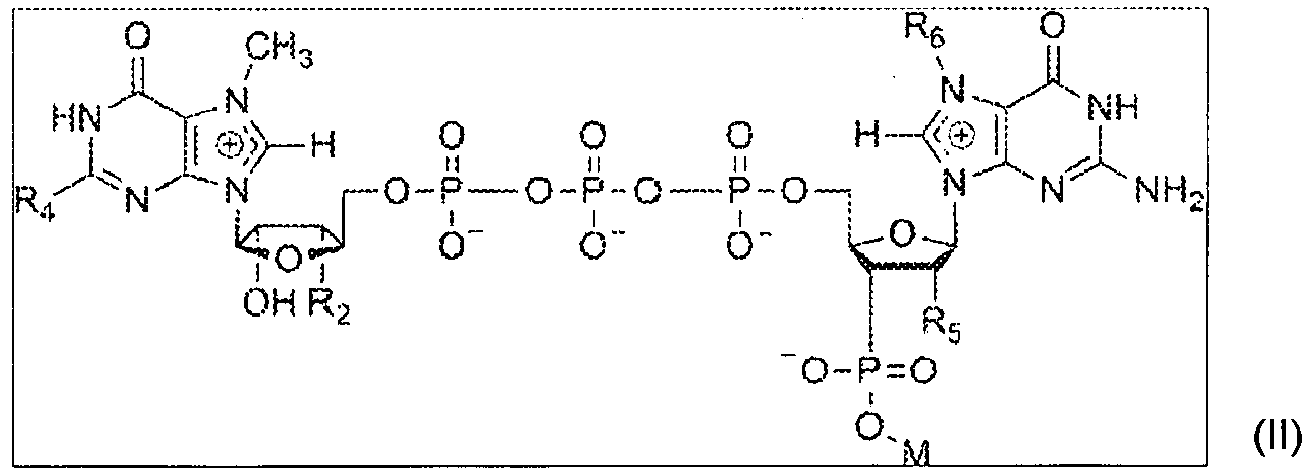

- In a fourteenth embodiment, the target RNA is synthesized in vitro. In a fifteenth, more specific embodiment, the in vitro synthesized RNA contains one or more nucleotides selected from Ψ (pseudouridine); m5C (5-methylcytidine); m5U (5-methyluridine); m6A (N6-methyladenosine); s2U (2-thiouridine); Um (2'-O-methyl-U; 2'-O-methyluridine); m1A (1-methyladenosine); m2A (2-methyladenosine); Am (2'-O-methyladenosine); ms2 m6A (2-methylthio-N6-methyladenosine); i6A (N6-isopentenyladenosine); ms2i6A (2-methylthio-N6isopentenyladenosine); io6A (N6-(cis-hydroxyisopentenyl)adenosine); ms2i6A (2-methylthio-N6-(cis-hydroxyisopentenyl)adenosine); g6A (N6-glycinylcarbamoyladenosine); t6A (N6-threonylcarbamoyladenosine); ms2t6A (2-methylthio-N6-threonyl carbamoyladenosine); m6t6A (N6-methyl-N6-threonylcarbamoyladenosine); hn6A(N6-hydroxynorvalylcarbamoyladenosine); ms2hn6A (2-methylthio-N6-hydroxynorvalyl carbamoyladenosine); Ar(p) (2'-O-ribosyladenosine (phosphate)); I (inosine); m1I (1-methylinosine); m1Im (1,2'-O-dimethylinosine); m3C (3-methylcytidine); Cm (2'-O-methylcytidine); s2C (2-thiocytidine); ac4C(N4-acetylcytidine); f5C (5-formylcytidine); m5 Cm (5,2'-O-dimethylcytidine); ac4Cm (N4-acetyl-2'-O-methylcytidine); k2C (lysidine); m1G (1-methylguanosine); m2G (N2-methylguanosine); m7G (7-methylguanosine); Gm (2'-O-methylguanosine); m2 2G (N2,N2-dimethylguanosine); m2Gm (N2,2'-O-dimethylguanosine); m2 2Gm (N2,N22'-O-trimethylguanosine); Gr(p) (2'-O-ribosylguanosine (phosphate)); yW (wybutosine); o2yW (peroxywybutosine); OHyW (hydroxywybutosine); OHyW* (undermodified hydroxywybutosine); imG (wyosine); mimG (methylwyosine); Q (queuosine); oQ (epoxyqueuosine); galQ (galactosyl-queuosine); manQ (mannosyl-queuosine); preQ0 (7-cyano-7-deazaguanosine); preQ1 (7-aminomethyl-7-deazaguanosine); G+ (archaeosine); D (dihydrouridine); m5Um (5,2'-O-dimethyluridine); s4U (4-thiouridine); m5s2U (5-methyl-2-thiouridine); s2Um (2-thio-2'-O-methyluridine); acp3U (3-(3-amino-3-carboxypropyl)uridine); ho5U (5-hydroxyuridine); mo5U (5-methoxyuridine); cmo5U (uridine 5-oxyacetic acid); mcmo5U (uridine 5-oxyacetic acid methyl ester); chm5U (5-(carboxyhydroxymethyl)uridine)); mchm5U (5-(carboxyhydroxymethyl)uridine methyl ester); mcm5U (5-methoxycarbonylmethyluridine); mcm5Um (5-methoxycarbonylmethyl-2'-O-methyluridine); mcm5s2U (5-methoxycarbonylmethyl-2-thiouridine); nm5s2U (5-aminomethyl-2-thiouridine); mnm5U (5-methylaminomethyluridine); mnm5s2U (5-methylaminomethyl-2-thiouridine); mnm5se2U (5-methylaminomethyl-2-selenouridine); ncm5U (5-carbamoylmethyluridine); ncm5Um (5-carbamoylmethyl-2'-O-methyluridine); cmnm5U (5-carboxymethylaminomethyluridine); cmnm5Um (5-carboxymethylaminomethyl-2'-O-methyluridine); cmnm5s2U (5-carboxymethylaminomethyl-2-thiouridine); m6 2A (N6,N6-dimethyladenosine); Im (2'-O-methylinosine); m4C(N4-methylcytidine); m4 Cm (N4,2'-O-dimethylcytidine); hm5C (5-hydroxymethylcytidine); m3U (3-methyluridine); cm5U (5-carboxymethyluridine); m6Am (N3,2'-O-dimethyladenosine); m6 2Am (N6,N6,O-2'-trimethyladenosine); m2,7G (N2,7-dimethylguanosine); m2,2,7G (N2,N2,7-trimethylguanosine); m3Um (3,2'-O-dimethyluridine); m5D (5-methyldihydrouridine); f5Cm (5-formyl-2'-O-methylcytidine); m1Gm (1,2'-O-dimethylguanosine); m1Am (1,2'-O-dimethyladenosine); τm5U (5-taurinomethyluridine); τm5s2U (5-taurinomethyl-2-thiouridine)); imG-14 (4-demethylwyosine); imG2 (isowyosine); andac6A (N6-acetyladenosine). In a sixteenth, specific embodiment, the in vitro synthesized RNA contains one or more nucleotides selected from Ψ (pseudouridine), m5C (5-methylcytidine) or both.
- In a seventeenth embodiment, the substrate of the surface coated substrate is magnetic beads. In another embodiment, the reagent on the surface coated substrate that binds to the nonradiolabeled tagged probe is: (a) streptavidin, wherein the nonradiolabeled tag is biotin; (b) avidin, wherein the nonradiolabeled tag is biotin; (c) an anti-biotin antibody, wherein the nonradiolabeled tag is biotin; (d) an anti-digoxigenin antibody, wherein the nonradiolabeled tag is digoxigenin; or (e) an anti-peptide antibody, wherein the nonradiolabeled tag is a peptide.
- In an eighteenth embodiment, the invention further provides a radiolabel free method for determining capping efficiency, comprising the steps of: (a) providing an RNA sample comprising capped RNA and uncapped RNA; (b) hybridizing a nonradiolabeled tagged probe to the target RNA to form a duplex polynucleotide, wherein the nucleotide sequence of the nonradiolabeled tagged probe is complementary to the 5' end of the target RNA; (c) treating the duplex polynucleotide with RNAse H, to cleave the 5' end of the RNA and to form a duplex polynucleotide; (d) isolating the duplex polynucleotide containing the 5' end of the target RNA, using magnetic beads coated with a reagent that binds to the nonradiolabeled tagged probe; (e) removing the duplex polynucleotide from the magnetic beads; (f) denaturing the duplex polynucleotide, to produce a single-stranded fragment of the 5' end of the target RNA and the nonradiolabeled tagged probe; (g) isolating the single-stranded fragment of the 5' end of the target RNA; (h) analyzing the single-stranded fragment of the 5' end of the RNA by liquid chromatography/mass spectrometry (LC-MS); and (i) determining relative amount of the capped and uncapped single-stranded fragments, thereby quantifying mRNA capping efficiency.
- In a nineteenth embodiment, the method of the invention provides a way of differentiating capped from uncapped RNA without the need for radiolabels, by using liquid chromatography coupled to electrospray mass spectrometry (LC-MS) and detecting their differences in mass and retention time. In a twentieth embodiment, the LC-MS based approach described above is automated to run in a high-throughput format for analyzing larger numbers of samples.
- The method of the invention can be advantageously applied to determine the capping efficiency of in vitro transcription (IVT) synthesized mRNAs. In a twenty-first embodiment, the method of the invention is used to analyze mRNA of 2.2K and 9K nucleotides in length that contained the modified nucleotides pseudouridine (Ψ) and 5-methylcytidine (m5C). The successful result from the use of this embodiment demonstrated the utility of the method of the invention to study mRNA capping and the functionality over a range of mRNA lengths and with common modification types. The assay response for uncapped mRNA was linear, allowing quantitative determination of uncapped species. Uncapped triphosphate mRNA of 2.2K bases in the presence of 100 picomoles capped mRNA could be detected over the tested range of 0.5 to 25%. The analysis of several batches of capped mRNA revealed capping efficiencies ranging from 88-98%, which appears to be consistent with the Vaccinia capping enzyme system. mRNA capped using the ARCA system was found to have a capping efficiency of 70%, which is in agreement with that reported by Grudzien E et al., RNA 10(9): 1479-1487 (2004).
- In a twenty-second embodiment, the method of the invention is used to troubleshoot the IVT capping process. In the use of this embodiment, the presence of diphosphate in the capped material indicated that the initial triphosphatase that removes one phosphate from the uncapped triphosphate mRNA was working well, but that the guanyltransferase that adds GTP to the diphosphate needed improvement. Similarly, the presence of unmethylated G-capped mRNA indicated that the N7-methyltransferase needed adjustment.
- In a twenty-third embodiment, the 5' end cap has a structure of formula I:

- In a twenty-fifth embodiment, the, the cap is a m7G cap with a structure of formula II:


- In a twenty-seventh embodiment, the RNA sample is an in vitro transcription (IVT) reaction mixture. In a twenty-eighth, more specific embodiment, the IVT reaction is a Vaccinia capped mRNA preparation. In a twenty-ninth embodiment, the in vitro synthesized RNA contains one or more nucleosides selected from Ψ (pseudouridine); m5C (5-methylcytidine); m5U (5-methyluridine); m6A (N6-methyladenosine); s2U (2-thiouridine); Um (2'-O-methyl-U; 2'-O-methyluridine); m1A (1-methyladenosine); m2A (2-methyladenosine); Am (2'-O-methyladenosine); ms2 m6A (2-methylthio-N6-methyladenosine); i6A (N6-isopentenyladenosine); ms2i6A (2-methylthio-N6isopentenyladenosine); io6A (N6-(cis-hydroxyisopentenyl)adenosine); ms2i6A (2-methylthio-N6-(cis-hydroxyisopentenyl)adenosine); g6A (N6-glycinylcarbamoyladenosine); t6A (N6-threonylcarbamoyladenosine); ms2t6A (2-methylthio-N6-threonyl carbamoyladenosine); m6t6A (N6-methyl-N6-threonylcarbamoyladenosine); hn6A(N6-hydroxynorvalylcarbamoyladenosine); ms2hn6A (2-methylthio-N6-hydroxynorvalyl carbamoyladenosine); Ar(p) (2'-O-ribosyladenosine (phosphate)); I (inosine); m1I (1-methylinosine); m1Im (1,2'-O-dimethylinosine); m3C (3-methylcytidine); Cm (2'-O-methylcytidine); s2C (2-thiocytidine); ac4C(N4-acetylcytidine); f5C (5-formylcytidine); m5 Cm (5,2'-O-dimethylcytidine); ac4Cm (N4-acetyl-2'-O-methylcytidine); k2C (lysidine); m1G (1-methylguanosine); m2G (N2-methylguanosine); m7G (7-methylguanosine); Gm (2'-O-methylguanosine); m2 2G (N2,N2-dimethylguanosine); m2Gm (N2,2'-O-dimethylguanosine); m2 2Gm (N2,N2,2'-O-trimethylguanosine); Gr(p) (2'-O-ribosylguanosine (phosphate)); yW (wybutosine); o2yW (peroxywybutosine); OHyW (hydroxywybutosine); OHyW* (undermodified hydroxywybutosine); imG (wyosine); mimG (methylwyosine); Q (queuosine); oQ (epoxyqueuosine); galQ (galactosyl-queuosine); manQ (mannosyl-queuosine); preQ0 (7-cyano-7-deazaguanosine); preQ1 (7-aminomethyl-7-deazaguanosine); G+ (archaeosine); D (dihydrouridine); m5Um (5,2'-O-dimethyluridine); s4U (4-thiouridine); m5s2U (5-methyl-2-thiouridine); s2Um (2-thio-2'-O-methyluridine); acp3U (3-(3-amino-3-carboxypropyl)uridine); ho5U (5-hydroxyuridine); mo6U (5-methoxyuridine); cmo5U (uridine 5-oxyacetic acid); mcmo5U (uridine 5-oxyacetic acid methyl ester); chm5U (5-(carboxyhydroxymethyl)uridine)); mchm5U (5-(carboxyhydroxymethyl)uridine methyl ester); mcm5U (5-methoxycarbonylmethyluridine); mcm5Um (5-methoxycarbonylmethyl-2'-O-methyluridine); mcm5s2U (5-methoxycarbonylmethyl-2-thiouridine); nm5s2U (5-aminomethyl-2-thiouridine); mnm5U (5-methylaminomethyluridine); mnm5s2U (5-methylaminomethyl-2-thiouridine); mnm5se2U (5-methylaminomethyl-2-selenouridine); ncm5U (5-carbamoylmethyluridine); ncm5Um (5-carbamoylmethyl-2'-O-methyluridine); cmnm5U (5-carboxymethylaminomethyluridine); cmnm6Um (5-carboxymethylaminomethyl-2'-O-methyluridine); cmnm5s2U (5-carboxymethylaminomethyl-2-thiouridine); m6 2A (N6,N6-dimethyladenosine); Im (2'-O-methylinosine); m4C(N4-methylcytidine); m4 Cm (N4,2'-O-dimethylcytidine); hm5C (5-hydroxymethylcytidine); m3U (3-methyluridine); cm5U (5-carboxymethyluridine); m6Am (N6,2'-O-dimethyladenosine); m6 2Am (N6,N6,O-2'-trimethyladenosine); m2,7G (N2,7-dimethylguanosine); m2,2,7G (N2,N2,7-trimethylguanosine); m3Um (3,2'-O-dimethyluridine); m5D (5-methyldihydrouridine); f5Cm (5-formyl-2'-O-methylcytidine); m1Gm (1,2'-O-dimethylguanosine); m1Am (1,2'-O-dimethyladenosine); τm5U (5-taurinomethyluridine); τm5s2U (5-taurinomethyl-2-thiouridine)); imG-14 (4-demethylwyosine); imG2 (isowyosine); andac6A (N6-acetyladenosine). In a thirtieth embodiment, the in vitro synthesized RNA contains one or more nucleotides selected from Ψ (pseudouridine), m5C (5-methylcytidine) or both.
- In a thirty-first embodiment, the surface coated substrate comprises magnetic beads.
- In a thirty-second embodiment, the reagent on the surface coated substrate that binds to the nonradiolabeled tagged probe is: (a) streptavidin, wherein the nonradiolabeled tag is biotin; (b) avidin, wherein the nonradiolabeled tag is biotin; (c) an anti-biotin antibody, wherein the nonradiolabeled tag is biotin; (d) an anti-digoxigenin antibody, wherein the nonradiolabeled tag is digoxigenin; and (e) an anti-peptide antibody, wherein the nonradiolabeled tag is a peptide.
- In a thirty-third embodiment, the uncapped triphosphate mRNA is detectable over a tested range of 0.1 to 90% with a linear response. In a thirty-fourth embodiment, the uncapped triphosphate mRNA is detectable over a tested range of 0.5 to 25% with a linear response.
- In a thirty-fifth embodiment, the invention provides a radiolabel free method for detecting a capping reaction impurity in an RNA preparation, comprising the steps of: (a) hybridizing a nonradiolabeled tagged probe with the target RNA, wherein the nonradiolabeled tagged probe is complementary to the 5' end of the target RNA; (b) treating the hybridized RNA with RNAse H to cleave the 5' end of the RNA; (c) isolating the cleaved 5' end sequence, using magnetic beads coated with a reagent that binds to the nonradiolabeled tagged probe; (e) analyzing the cleaved 5' end sequence by LC-MS, and (f) detecting a capping reaction impurity in an RNA preparation. In a thirty-sixth embodiment, the method further includes the step of: (f) identifying a capping reaction impurity in an RNA preparation.
- The method of the invention showed good sensitivity for detecting capping reaction impurities. Uncapped triphosphate mRNA spiked into 100 picomoles capped mRNA could be detected over the tested range of 0.5 to 25% with a linear response. The capping efficiency of several Vaccinia capped mRNA preparations was determined to be between 88 and 98% depending on the modification type and length of the mRNA.
- In a thirty-seventh embodiment, the target RNA is synthesized in vitro. In a more specific embodiment, the in vitro synthesized RNA comprises a nucleotide selected from the group consisting of Ψ (pseudouridine); m5C (5-methylcytidine); m5U (5-methyluridine); m6A (N6-methyladenosine); s2U (2-thiouridine); Um (2'-O-methyl-U; 2'-O-methyluridine); m1A (1-methyladenosine); m2A (2-methyladenosine); Am (2'-O-methyladenosine); ms2 m6A (2-methylthio-N6-methyladenosine); i6A (N6-isopentenyladenosine); ms2i6A (2-methylthio-N6isopentenyladenosine); io6A (N6-(cis-hydroxyisopentenyl)adenosine); ms2i6A (2-methylthio-N6-(cis-hydroxyisopentenyl)adenosine); g6A (N6-glycinylcarbamoyladenosine); t6A (N6-threonylcarbamoyladenosine); ms2t6A (2-methylthio-N6-threonyl carbamoyladenosine); m6t6A (N6-methyl-N6-threonylcarbamoyladenosine); hn6A(N6-hydroxynorvalylcarbamoyladenosine); ms2hn6A (2-methylthio-N6-hydroxynorvalyl carbamoyladenosine); Ar(p) (2'-O-ribosyladenosine (phosphate)); I (inosine); m1I (1-methylinosine); m1Im (1,2'-O-dimethylinosine); m3C (3-methylcytidine); Cm (2'-O-methylcytidine); s2C (2-thiocytidine); ac4C(N4-acetylcytidine); f5C (5-formylcytidine); m5 Cm (5,2'-O-dimethylcytidine); ac4Cm (N4-acetyl-2'-O-methylcytidine); k2C (lysidine); m1G (1-methylguanosine); m2G (N2-methylguanosine); m7G (7-methylguanosine); Gm (2'-O-methylguanosine); m2 2G (N2,N2-dimethylguanosine); m2Gm (N2,2'-O-dimethylguanosine); m2 2Gm (N2,N22'-O-trimethylguanosine); Gr(p) (2'-O-ribosylguanosine (phosphate)); yW (wybutosine); o2yW (peroxywybutosine); OHyW (hydroxywybutosine); OHyW* (undermodified hydroxywybutosine); imG (wyosine); mimG (methylwyosine); Q (queuosine); oQ (epoxyqueuosine); galQ (galactosyl-queuosine); manQ (mannosyl-queuosine); preQ0 (7-cyano-7-deazaguanosine); preQ1 (7-aminomethyl-7-deazaguanosine); G+ (archaeosine); D (dihydrouridine); m5Um (5,2'-O-dimethyluridine); s4U (4-thiouridine); m5s2U (5-methyl-2-thiouridine); s2Um (2-thio-2'-O-methyluridine); acp3U (3-(3-amino-3-carboxypropyl)uridine); ho5U (5-hydroxyuridine); mo5U (5-methoxyuridine); cmo5U (uridine 5-oxyacetic acid); mcmo5U (uridine 5-oxyacetic acid methyl ester); chm5U (5-(carboxyhydroxymethyl)uridine)); mchm5U (5-(carboxyhydroxymethyl)uridine methyl ester); mcm5U (5-methoxycarbonylmethyluridine); mcm5Um (5-methoxycarbonylmethyl-2'-O-methyluridine); mcm5s2U (5-methoxycarbonylmethyl-2-thiouridine); nm5s2U (5-aminomethyl-2-thiouridine); mnm5U (5-methylaminomethyluridine); mnm5s2U (5-methylaminomethyl-2-thiouridine); mnm5se2U (5-methylaminomethyl-2-selenouridine); ncm5U (5-carbamoylmethyluridine); ncm5Um (5-carbamoylmethyl-2'-O-methyluridine); cmnm5U (5-carboxymethylaminomethyluridine); cmnm5Um (5-carboxymethylaminomethyl-2'-O-methyluridine); cmnm5s2U (5-carboxymethylaminomethyl-2-thiouridine); m6 2A (N6,N6-dimethyladenosine); Im (2'-O-methylinosine); m4C(N4-methylcytidine); m4 Cm (N4,2'-O-dimethylcytidine); hm5C (5-hydroxymethylcytidine); m3U (3-methyluridine); cm5U (5-carboxymethyluridine); m6Am (N6,2'-O-dimethyladenosine); m6 2Am (N6,N6,O-2'-trimethyladenosine); m2,7G (N2,7-dimethylguanosine); m2,2,7G (N2,N2,7-trimethylguanosine); m3Um (3,2'-O-dimethyluridine); m5D (5-methyldihydrouridine); f5Cm (5-formyl-2'-O-methylcytidine); m1Gm (1,2'-O-dimethylguanosine); m1Am (1,2'-O-dimethyladenosine); τm5U (5-taurinomethyluridine); τm5s2U (5-taurinomethyl-2-thiouridine)); imG-14 (4-demethylwyosine); imG2 (isowyosine); andac6A (N6-acetyladenosine). In a thirty-eighth, specific embodiment, the in vitro synthesized RNA comprises Ψ (pseudouridine), m5C (5-methylcytidine), or both nucleosides. In a thirty-ninth embodiment, the substrate of the surface coated substrate is magnetic beads.
- In a fortieth embodiment, the reagent on the surface coated substrate that binds to the nonradiolabeled tagged probe is: (a) streptavidin, wherein the nonradiolabeled tag is biotin; (b) avidin, wherein the nonradiolabeled tag is biotin; (c) an anti-biotin antibody, wherein the nonradiolabeled tag is biotin; (d) an anti-digoxigenin antibody, wherein the nonradiolabeled tag is digoxigenin; or (e) an anti-peptide antibody, wherein the nonradiolabeled tag is a peptide.
-
-
FIG. 1 shows the enzymatic pathway involved in capping mRNA resulting in Cap0 and Cap1 (adopted from Ghosh & Lima, Wiley Interdiscip. Rev. RNA 1(1): 152-172 (2010)). -
FIG. 2 is a schematic of the procedure for RNAse H cleavage of the mRNA and isolation of the cleavage fragment by magnetic beads. The arrows indicate the two cleavage sites observed by LC-MS. -
FIG. 3 shows the workflow of cap orientation analysis showing the reaction products from the RppH enzyme treatment added to the RNAse H cleavage sequence. The reverse cap orientation p7mG... has a different mass than the monophosphate. - So that the invention can be more readily understood, some terms are here defined. Additional definitions may be set forth throughout the specification.
- "3'" when used in a nucleotide position refers to a region or position in a polynucleotide or oligonucleotide 3' (i.e., downstream) from another region or position in the same polynucleotide or oligonucleotide. The terms "3' end" and "3' terminus", as used herein in reference to a nucleic acid molecule, refer to the end of the nucleic acid which contains a free hydroxyl group attached to the 3' carbon of the terminal pentose sugar.
- "5'" when used in a nucleotide position refers to a region or position in a polynucleotide or oligonucleotide 5' (i.e., upstream) from another region or position in the same polynucleotide or oligonucleotide. The term "5' end" and "5' terminus", as used herein in reference to a nucleic acid molecule, refers to the end of the nucleic acid molecule which contains a free hydroxyl or phosphate group attached to the 5' carbon of the terminal pentose sugar. In some embodiments of the invention, oligonucleotide primers comprise tracts of poly-adenosine at their 5' termini.
- "Affinity", as used in the art, is a measure of the tightness with which a particular ligand binds to (e.g., associates non-covalently with) and/or the rate or frequency with which it dissociates from, its partner. The skilled artisan will know that several methods have been and can be used to determine affinity. Affinity is a measure of specific binding.
- "Anneal," "hybridization", "hybridize" and grammatical equivalents thereof mean the formation of complexes (also called "duplexes" or "hybrids") between nucleotide sequences that are sufficiently complementary to form complexes by Watson-Crick base pairing or non-canonical base pairing. Annealing or hybridizing sequences need not have perfect complementary to provide stable hybrids. Stable hybrids can usually form where fewer than about 10% of the bases are mismatches. Accordingly, as used herein, the term "complementary" refers to a nucleic acid molecule that forms a stable duplex with its complement under particular conditions, generally where there is about 90%> or greater homology (e.g., about 95% or greater, about 98%> or greater, or about 99% or greater homology). The skilled artisan understands how to estimate and adjust the stringency of hybridization conditions such that sequences that have at least a desired level of complementarity will stably hybridize, while those having lower complementarity will not. For examples of hybridization conditions, see Green & Sambrook, Molecular Cloning: A Laboratory Manual, Fourth Edition (Cold Spring Harbor Press, Plainview, NY, 2012) and Ausubel, Current Protocols in Molecular Biology (John Wiley & Sons, Somerset NJ USA, 2016). Complementarity between two nucleic acid molecules and duplex formation is "complete", "total" or "perfect" if all the nucleic acid's bases are matched, and is otherwise "partial".
- "ARCA" are anti-reverse" cap analogues, which are commercially available from TriLink, San Diego CA 92121 USA. In cells, the ribosome translates mRNA into proteins. mRNA in eukaryotic cells have a 5' cap [m7G(5')ppp(5')G]. A different cap can be incorporated in the mRNA transcription (e.g., by in vitro transcription) by including a mixture of cap analog and GTP. Thus, approximately 80% of synthesized mRNA will possess a 5' cap, while the remaining 20% will have a 5' triphosphate. The first cap analog to be introduced was m7G(5')ppp(5')G. 50% of the time, this cap is inserted in the correct orientation to enhance translation. The other 50% of molecules are not substrates for efficient translation, reducing the specific activity of the RNA transcript. More recently, Anti-Reverse Cap Analog (ARCA) (Trilink, part # N-7003) was introduced [3' O-Me-m7G(5')ppp(5')G] Stepinski J et al., RNA 7(10):1486-95 (October 2001). ARCA can only insert in the proper orientation, resulting in capped mRNAs that are translated twice as efficiently as those initiated with m7G(5')ppp(5')G. Efficient translation of the mRNA into protein also requires a poly(A) tail. This can be introduced by including a poly(dT) stretch at the end of the transcription template. Often this is accomplished by a PCR step that utilizes a primer containing the poly(dT) stretch.
- A "biotin tag" is a biotin chemically attached to a compound of interest. Thus, a "biotin tagged probe" is a polynucleotide probe that has a biotin tag covalently attached to the probe.
- "Cap0" is a m7GpppG cap. See,
FIG. 1 and SEQ ID NO.: 1. 5' terminal caps are commercially available, e.g., from TriLink BioTechnologies, Inc., San Diego CA USA. - "Cap1" is a m7GpppmG cap, wherein Cap0 further methylated on the 2' OH of the penultimate guanine. See,
FIG. 1 and SEQ ID NO.: 6. 5' terminal caps are commercially available, e.g., from TriLink BioTechnologies, Inc., San Diego CA USA. - "Chromatography" is a technique for separation of mixtures. The mixture is typically dissolved in a fluid called the "mobile phase," which carries it through a structure holding another material called the "stationary phase." Examples include LC and HPLC.
- "Compound" is any naturally occurring or non-naturally occurring (i.e., synthetic or recombinant) molecule, such as a biological macromolecule (e.g., nucleic acid, polypeptide or protein), organic or inorganic molecule, or an extract made from biological materials such as bacteria, plants, fungi, or animal (particularly mammalian, including human) cells or tissues. The compound may be a single molecule or a mixture or complex of at least two molecules.
- "Control" has the art-understood meaning of being a standard against which results are compared. In some embodiments, a control is a reaction or assay that is performed simultaneously with a test reaction or assay to provide a comparator. In one experiment, the "test" (i.e., the variable being tested) is applied. In the second experiment, the "control," the variable being tested is not applied. In some embodiments, a control is a historical control (i.e., of a test or assay performed previously, or an amount or result that is previously known). In some embodiments, a control is or comprises a printed or otherwise saved record. A control may be a positive control or a negative control.
- Homology" means the overall relatedness between nucleic acid molecules (e.g. DNA molecules or RNA molecules) or between polypeptide molecules. The term "homologous" necessarily refers to a comparison between at least two sequences (polynucleotide or polypeptide sequences).
- "HPLC" is high performance liquid chromatography, previously known as high pressure liquid chromatography, a form of column chromatography that pumps a sample mixture or analyte in a solvent (known as the mobile phase) at high pressure through a column with chromatographic packing material (stationary phase). Many HPLC techniques are known in the biotechnological arts. For more information, see the HPLC Primer (2015) available from Waters Corporation, Milford MA USA.
- "IVT" is in vitro transcription of ribonucleic acid (RNA) from a deoxyribonucleic acid (DNA) template. Many IVT techniques are known in the biotechnological arts. For information, see The Basics: In Vitro Transcription (2015), available from Thermo Fisher Scientific Inc., Waltham MA USA.
- "LC" is liquid chromatography, a technique used to separate a sample into its individual parts. This separation occurs based on the interactions of the sample with the mobile and stationary phases. Many LC techniques are known in the biotechnological arts. For more information, see the Beginners Guide to UPLC (2015) and the HPLC Primer (2015), both available from Waters Corporation, Milford MA USA.
- "Modified" means a changed state or structure of a molecule of the invention. A "modified" mRNA contains ribonucleosides that encompass modifications relative to the standard guanine (G), adenine (A), cytidine (C), and uridine (U) nucleosides. The nonstandard nucleosides can be naturally occurring or non-naturally occurring. RNA can be modified in many ways including chemically, structurally, and functionally, by methods known to those of skill in the biotechnological arts. Such RNA modifications can include, e.g., modifications normally introduced post-transcriptionally to mammalian cell mRNA. Moreover, mRNA molecules can be modified by the introduction during transcription of natural and non-natural nucleosides or nucleotides, as described in
U.S. Pat. No. 8,278,036 (Karikó et al. );U.S. Pat. Appl. No. 2013/0102034 (Schrum );U.S. Pat. Appl. No. 2013/0115272 (deFougerolles et al. ) andU.S. Pat. Appl. No. 2013/0123481 (deFougerolles et al. ). - "MS" is mass spectrometry, an analytical chemistry technique that helps identify the amount and type of chemicals present in a sample by measuring the mass-to-charge ratio and abundance of gas-phase ions. A mass spectrum (plural spectra) is a plot of the ion signal as a function of the mass-to-charge ratio. Many MS techniques are known in the biotechnological arts. For more information, see the MS Primer (2015) available from Waters Corporation, Milford MA USA. See also, Basiri et al., Bioanalysis 6(11): 1525-1542 (2014).
- "mRNA" is messenger RNA, including eukaryotic messenger RNA. mRNAs convey genetic information from DNA to the ribosome, where they specify the amino acid sequence of the protein products of gene expression by a process known as transcription. Structurally and informationally, mRNA encodes the information for a protein in a coding region. Eukaryotic mRNA can begin at the 5' end with an mRNA cap that is enzymatically synthesized after the mRNA has been transcribed by an RNA polymerase in vitro. The mRNA cap facilitates translation initiation while avoiding recognition of the mRNA as foreign and protects the mRNA from 5' exonuclease mediated degradation. The 5' cap can be a modified guanine nucleotide that is linked to the 5' end of an RNA molecule using a 5'-5' triphosphate linkage. The 5' cap can also be a 5' cap analog, such as 5' diguanosine cap, tetraphosphate cap analogs having a methylene-bis(phosphonate) moiety (see e.g., Rydzik AM et al., Org. Biomol. Chem. 7(22):4763-76) (2009), dinucleotide cap analogs having a phosphorothioate modification (see e.g., Kowalska J et al., RNA 14(6):1119-1131 (2008)), cap analogs having a sulfur substitution for a non-bridging oxygen (see e.g., Grudzien-Nogalska E et al., RNA 13(10): 1745-1755 (2007)), N7-benzylated dinucleoside tetraphosphate analogs (see e.g., Grudzien E et al. RNA 10(9):1479-1487 (2004)), or anti-reverse cap analogs (see e.g., Jemielity J et al., (2003) RNA 9(9): 1108-1122 and Stepinski J et al., RNA 7(10):1486-1495 (2001)). The 5' cap analog can be a 5' diguanosine cap. See also, methods for capping by New England Biolabs (Beverly MA USA).
- A "nonradiolabeled tag" is one or more non-radioactive markers, signals, or moieties which are attached, incorporated or associated with another entity (such as a polynucleotide, such as RNA) that is readily detected by methods known in the art including fluorescence, chemiluminescence, enzymatic activity, absorbance and the like. Detectable labels include fluorophores, chromophores, enzymes, dyes, metal ions, ligands such as biotin, avidin, strepavidin, digoxigenin and haptens, quantum dots, and the like. Detectable labels may be located at any position in the RNAs disclosed herein. A "nonradiolabeled tagged probe" is a polynucleotide probe that has a covalently attached nonradiolabeled tag.
- "Nucleoside" or "nucleobase" refer to a base (adenine (A), guanine (G), cytosine (C), uracil (U), thymine (T) and analogs thereof) linked to a carbohydrate, for example D-ribose (in RNA) or 2'-deoxy-D-ribose (in DNA), through an N-glycosidic bond between the anomeric carbon of the carbohydrate and the nucleobase. When the nucleobase is purine (e.g., A or G), the ribose sugar is generally attached to the N9-position of the heterocyclic ring of the purine. When the nucleobase is pyrimidine (e.g., C, T or U), the sugar is usually attached to the N1 -position of the heterocyclic ring. The carbohydrate may be substituted or unsubstituted. Substituted ribose sugars include, but are not limited to, those in which one or more of the carbon atoms, for example the 2'-carbon atom, is substituted with one or more of the same or different -Cl, -F, -R, -OR, -NR2 or halogen groups, where each R is independently H, C1-C6 alkyl or C5-C14 aryl. Ribose examples include ribose, 2'-deoxyribose, 2',3'-dideoxyribose, 2'-haloribose, 2'-fluororibose, 2'-chlororibose, and 2'-alkylribose, e.g., 2'-O-methyl, 4'-alpha-anomeric nucleotides, 2*-4*- and 3*-4*-linked and other "locked" or "LNA," bicyclic sugar modifications. See,
WO 98/22489 WO 98/39352 WO 99/14226 - "Nucleotide" is a nucleoside in a phosphorylated form (a phosphate ester of a nucleoside), as a monomer unit or within a polynucleotide polymer. A "nucleotide 5'-triphosphate" is a nucleotide with a triphosphate ester group at the 5' position, sometimes denoted as "NTP", or "dNTP" and "ddNTP" to particularly point out the structural features of the ribose sugar. The triphosphate ester group may include sulfur substitutions for the various oxygen moieties, e.g., α-thio-nucleotide 5'- triphosphates. Nucleotides can exist in the mono-, di-, or tri-phosphorylated forms. The carbon atoms of the ribose present in nucleotides are designated with a prime character (') to distinguish them from the backbone numbering in the bases. For a review of polynucleotide and nucleic acid chemistry see Shabarova Z & Bogdanov A, Advanced Organic Chemistry of Nucleic Acids (VCH, New York, 1994).
- "Nucleic acid", "nucleic acid molecule", "polynucleotide" and "oligonucleotide" refer interchangeably to polymers of nucleotide monomers or analogs thereof, such as deoxyribonucleic acid (DNA) and ribonucleic acid (RNA) and combinations thereof. The nucleotides may be genomic, synthetic or semi-synthetic in origin. Unless otherwise stated, the terms encompass nucleic acid-like structures with synthetic backbones, as well as amplification products. The length of these polymers (i.e., the number of nucleotides it contains) can vary widely, often depending on their intended function or use. Polynucleotides can be linear, branched linear, or circular molecules. Polynucleotides also have associated counter ions, such as H+, NH4 +, trialkylammonium, Mg+, Na+ and the like. A polynucleotide may be composed entirely of deoxyribonucleotides, entirely of ribonucleotides, or chimeric mixtures thereof. Polynucleotides may be composed of internucleotide nucleobase and sugar analogs.
- An "oligonucleotide" is a polynucleotide that comprises between about 5 and about 150 nucleotides, e.g., between about 10 and about 100 nucleotides, between about 15 and about 75 nucleotides, or between about 15 and about 50 nucleotides. Throughout the specification, whenever an oligonucleotide is represented by a sequence of letters (chosen, for example, from the four base letters: A (adenosine), C (cytidine), G (guanosine), and T (thymidine), the nucleotides are presented in the 5' to 3' order from the left to the right. A "polynucleotide sequence" refers to the sequence of nucleotide monomers along the polymer. Unless denoted otherwise, whenever a polynucleotide sequence is represented, the nucleotides are in 5' to 3' orientation from left to right. Nucleic acids, polynucleotides and oligonucleotides may be comprised of standard nucleotide bases or substituted with nucleotide isoform analogs, including, but not limited to iso-C and iso-G bases, which may hybridize more or less permissibly than standard bases, and which will preferentially hybridize with complementary isoform analog bases. Many such isoform bases are described, e.g., by Benner et al., Cold Spring Harb. Symp. Quant. Biol. 52: 53-63 (1987). Analogs of naturally occurring nucleotide monomers include, for example, 7-deazaadenine, 7-deazaguanine, 7-deaza-8-azaguanine, 7-deaza-8-azaadenine, 7-methylguanine, inosine, nebularine, nitropyrrole, nitroindole, 2-aminopurine, 2-amino-6-chloropurine, 2,6-diaminopurine, hypoxanthine, pseudouridine (Ψ), pseudocytosine. pseudoisocytosine, 5-propynylcytosine, isocytosine, isoguanine), 7-deazaguanine, 2-azapurine, 2-thiopyrimidine, 6-thioguanine, 4-thiothymine, 4-thiouracil, O-6-methylguanine, N6-methyladenine, O-4-methylthymine, 5,6-dihydrothymine, 5,6-dihydrouracil, 4-methylindole, pyrazolo[3,4-D]pyrimidines, "PPG" (
U.S. Pat. Nos. 6,143,877 (Meyer )) and ethenoadenine (Fasman, in Practical Handbook of Biochemistry and Molecular Biology, pp. 385-394 (CRC Press, Boca Raton FL USA, 1989)). See also, the nucleosides described inU.S. Pat. No. 8,278,036 (Karikó et al. );WO 2015/095351 (Novartis AG); Karikó K et al. Curr. Opin. Drug Disc. Devel. 10(5): 523-532 (2007); Karikó K et al. Mol. Therap. 16(11): 1833-1840 (2008) and Anderson BR et al., Nucleic Acids Res. 38(17): 5884-5892 (2010). - "PAGE" is polyacrylamide gel electrophoresis, a technique widely used in the biotechnological arts to separate biological macromolecules, e.g., nucleic acids, according to their electrophoretic mobility. Many PAGE techniques are known in the biotechnological arts. For more information, see Green & Sambrook, Molecular Cloning: A Laboratory Manual, Fourth Edition (Cold Spring Harbor Press, Plainview, NY, 2012).
- "Primers" are short nucleic acid sequences. Polymerase chain reaction (PCR) primers are typically oligonucleotides of short length (e.g., 8-30 nucleotides) that are used in polymerase chain reactions. PCR primers and hybridization probes can readily be developed and produced by those of skill in the art, using sequence information from the target sequence. See, Green & Sambrook, Molecular Cloning: A Laboratory Manual, Fourth Edition (Cold Spring Harbor Press, Plainview, NY, 2012).
- A "probe" as used herein is an oligonucleotide probe, a nucleic acid molecule which typically ranges in size from about 50-100 nucleotides to several hundred nucleotides to several thousand nucleotides in length, in whole number increments. A probe can be any suitable length for use in the method of the invention described herein. Such a molecule is typically used to identify a specific nucleic acid sequence in a sample by hybridizing to the specific nucleic acid sequence under stringent hybridization conditions. Hybridization conditions are known in the biotechnological arts. See, e.g., Green & Sambrook, Molecular Cloning: A Laboratory Manual, Fourth Edition (Cold Spring Harbor Press, Plainview, NY, 2012).
- A "reagent that binds to a nonradiolabeled tagged probe" or a "reagent that binds to a nonradiolabeled tag" is a reagent that binds to a nonradiolabeled tag that can be attached to the oligonucleotide probe used in the method of the invention. Examples of a reagent that binds to a nonradiolabeled tagged probe include (a) streptavidin, where the nonradiolabeled tag is biotin; (b) avidin, where the nonradiolabeled tag is biotin; (c) an anti-biotin antibody, where the nonradiolabeled tag is biotin; (d) an anti-digoxigenin antibody, where the nonradiolabeled tag is digoxigenin; and (e) an anti-peptide antibody, wherein the nonradiolabeled tag is a peptide. Other pairs of nonradiolabeled tags and reagents that bind to the nonradiolabeled tagged probe are known to those of skill in the biotechnological arts. See, e.g., Green & Sambrook, Molecular Cloning: A Laboratory Manual, Fourth Edition (Cold Spring Harbor Press, Plainview, NY, 2012).
- "RNA" is ribonucleic acid, a ribonuceloside polymer. Each nucleotide in an RNA molecule contains a ribose sugar, with carbons numbered 1' through 5'. A base is attached to the 1' position. In general, the bases are adenine (A), cytosine (C), guanine (G), or uracil (U), although many modifications are known to those of skill in the art. For example, as described herein, an RNA may contain one or more pseudouracil (Ψ) base, such that the pseudouridine nucleotides are substituted for uridine nucleotides. Many other RNA modifications are known to those of skill in the art, as described herein. Procedures for isolating and producing RNA are known to the skilled artisan, such as a laboratory scientist. See, Green & Sambrook, Molecular Cloning: A Laboratory Manual, Fourth Edition (Cold Spring Harbor Press, Plainview NY, 2012).
- "RNase H" is ribonuclease H, a family of non-sequence-specific endonucleases that catalyze the cleavage of RNA by a hydrolytic mechanism. RNase H's ribonuclease activity cleaves the 3' O-P bond of RNA in a DNA/RNA duplex substrate to produce 3'-hydroxyl and 5'-phosphate terminated products.
- "RppH" is the 5' RNA pyrophosphohydrolase enzyme.
- "snRNA" is small nuclear RNA. snRNAs contain unique 5'-caps. Sm-class snRNAs are found with 5'-trimethylguanosine caps, while Lsm-class snRNAs are found with 5'-monomethylphosphate caps. See, Matera, A et al., Nature Rev. Mol. Cell Biol. 8(3): 209-220 (March 2007).
- A "substitution" is a mutation that exchanges one base for another (i.e., a change in a single "chemical letter" such as switching an A to a G). Such a substitution could (a) change a codon to one that encodes a different amino acid and cause a small change in the protein produced; (b) change a codon to one that encodes the same amino acid and causes no change in the protein produced ("silent mutations"); or (c) change an amino-acid-coding codon to a single "stop" codon and cause an incomplete protein.
- A "surface coated substrate" is a substrate that is coated with a reagent that binds to a nonradiolabeled tagged probe. In one embodiment, the substrate of the surface coated substrate is magnetic beads.
- "Synthetic" means produced, prepared, or manufactured by the human intervention. Synthesis of polynucleotides or polypeptides or other molecules of the invention may be chemical or enzymatic.
- The term "target" refers to a molecule of interest. "Target RNA" is an RNA of interest, which can be analyzed by the method of the invention.
-
TABLE 1 Nucleotide Sequences Polynucleotide (with 5' cap) Sequence SEQ ID NO. Cap0 m7GpppGGGAGACGCGUGUUAAAUAACA 1 uncapped triphosphate pppGGGAGACGCGUGUUAAAUAACA 2 uncapped diphosphate ppGGGAGACGCGUGUUAAAUAACA 3 uncapped monophosphate (the expected peak for the RppH enzymatic product with the correct orientation) 
4 Rev cap pm7GGGAGACGCGUGUUAAAUAACA 5 Cap1 m7GpppmGGGAGACGCGUGUUAAAUAACA 6 Cap1 triphosphate pppmGGGAGACGCGUGUUAAAUAACA 7 Cap1 diphosphate ppmGGGAGACGCGUGUUAAAUAACA 8 Cap1 monophosphate pmGGGAGACGCGUGUUAAAUAACA 9 G cap GpppGGGAGACGCGUGUUAAAUAACA 10 5mC Cap0 m7GpppGGGAGAmCGmCGUGUUAAAUAAmCA 11 5mC uncapped triphosphate pppGGGAGAmCGmCGUGUUAAAUAAmCA 12 5mC uncapped diphosphate ppGGGAGAmCGmCGUGUUAAAUAAmCA 13 5mC G cap GpppGGGAGAmCGmCGUGUUAAAUAAmCA 14 Cleavage probe 
15 "48mer" mRNA substrate 
16 Photinus pyralis (firefly) luciferase mRNA 
17 
- Eukaryotic cellular mRNA is modified on the 5' end by the incorporation of a N7-methylguanosine triphosphate cap (m7GpppG....mRNA). Thus, N7-methylguanosine is the final base present on the 5' end of mRNA. Muthukrishnan S et al., Nature 255 (5503): 33-37 (1975); Shatkin AJ et al., Cell 9(4 PT 2): 645-653 (1976). This 5' dinucleotide cap is an important transcriptional regulatory element, and its role in eukaryotic mRNA translation has been widely studied. mRNA without the m7GpppG cap are not recognized by the initiation factor protein complex elF4E and are not exported from the nucleus and translated. Topisirovic I et al., Wiley Interdiscip Rev. RNA 2(2): 277-298 (2011). The 5' dinucleotide cap influences the lifetime of mRNA by protecting the 5' end of the mRNA from exonuclease degradation. Green MR et al., Cell 32 (3):681-694 (1983); Furuichi Y et al., Nature 266(5599): 235-239 (1997); Coutts M et al., Biochim. Biophys. Acta 1173(1): 49-56 (1993). mRNA that is produced by in vitro transcription (IVT) from a DNA template must be capped to be translated.
- There were two frequently used ways of capping mRNA produced by IVT. In the first way, a cocktail of capping enzymes (usually from Vaccinia virus) can be added to the synthesized mRNA. This mixture will add guanine from GTP to form the terminal 5'-5' GpppG cap which is then methylated to produce the m7GpppG cap (CapO) or further methylated on the 2' OH of the penultimate guanine to produce m7GpppmG (Cap1) See,
FIG. 1 . This approach is known to as "post-transcriptional" capping. Tcherepanova IY et al., BMC Mol. Biol. 9: 90 (2008). - In the second way, the mRNA is capped "co-transcriptionally" as it is transcribed, by adding the dinucleotide cap analogue m7GpppG to the IVT reaction. The RNA polymerase incorporates the m7GpppG into the 5' terminal of the mRNA in place of GTP. mRNA produced this way is not 100% capped due to the competition between GTP and the dinucleotide cap analogue during synthesis. Dinucleotide cap analogues can be incorporated in the reverse orientation (GpppGm7) so that the m7G is no longer the terminal base. Up to 50% of mRNA capped "co-transcriptionally" can contain reverse caps. Pasquinelli AE et al., RNA 1(9): 957-967 (1995).
- Because cap orientation is critical to translation of mRNA, "anti-reverse" cap analogues (ARCA) were developed to ensure that caps are incorporated in the correct orientation. Peng ZH et al., Org. Lett. 4 (2):161-164 (2002); Stepinski J et al., RNA 7(10): 1486-1495 (2001). With ARCA dinucleotides, the 3' ribose -OH on the N7-methylguanosine is methylated in ARCA dinucleotides to prevent capping from that side of the dinucleotide. Although the ARCA capping method ensures correct orientation of the 5' cap, "co-transcriptionally" produced mRNA inherently produces mRNA with a triphosphate on the 5' end, due to the competition between GTP and the cap motif during transcription. The 5' triphosphate is immunogenic. Its presence must be mitigated for the mRNA not to be cytotoxic. Hornung V et al., Science 314(5801): 994-997 (2006). Due to the importance of the 5' cap, knowing the extent of capping and the orientation of that cap is vital to understanding the efficiency of mRNA translation.
- Full-length mRNA is much too large to be analyzed directly by LC-MS, so the method of the invention first uses a technique first described by Lapham & Crothers, RNA 2(3): 289-296 (1996), to cleave short sequences from the 5' end of the mRNA at a specific location. This technique uses a biotin tagged RNAse H cleavage probe that is complementary to the 5' end of the mRNA (see, e.g. SEQ ID NO.: 15, which is complementary to the 5' end of a 2.2K mRNA and 9K mRNA, both described below).
FIG. 2 presents a schematic of this workflow. - Materials and methods In this forty-first embodiment, the cleavage probe has an RNA sequence that contains 2' O-methyl modifications except at the 3' end cleavage site, which contains 4-6 DNA nucleotides (see, e.g. SEQ ID NO.: 15). The terminal stretch of DNA directs the RNAse H to cleave the mRNA at a specific location, because the 2' O-methyl modified RNA is not recognized by RNAse H as a cleavage site. Inoue H et al., FEBS Lett. 215(2): 327-330 (1987).
- In one example, we tested the method of the invention using two target RNA, which were two different length mRNAs, one roughly 2200 nucleotides (Photinus pyralis (firefly) luciferase mRNA, SEQ ID NO.: 17) and another roughly 9000 nucleotides. The first 50 nucleotides on the 5' end of each mRNA were the same sequence, so we used one RNAse H cleavage probe for both. The mRNA was prepared using standard in vitro transcription (IVT) procedures and then capped using the Vaccinia Capping System from New England Biolabs, Ipswich MA USA (Part# M2080S). Following capping, the mRNA was precipitated with LiCI and then taken up in water.
- For mRNA containing Ψ (pseudouridine) or m5C (5-methylcytidine), the corresponding modified NTPs were used instead of U (uridine) or C (cytidine) in the regular mRNA synthesis reactions.
- For examples of incorporation of Ψ (pseudouridine) or m5C (5-methylcytidine) into mRNA, see,
U.S. Pat. No. 8,278,036 (Karikó et al. );WO 2015/095351 (Novartis AG); Karikó K et al. Curr. Opin. Drug Disc. Devel. 10(5): 523-532 (2007); Karikó K et al. Mol. Therap. 16(11): 1833-1840 (2008) and Anderson BR et al., Nucleic Acids Res. 38(17): 5884-5892 (2010).U.S. Pat. No. 8,278,036 (Karikó et al. ) also describes the incorporation of other nucleotides into mRNA, including m5U (5-methyluridine); m6A (N6-methyladenosine); s2U (2-thiouridine); Um (2'-O-methyl-U; 2'-O-methyluridine); m1A (1-methyladenosine); m2A (2-methyladenosine); Am (2'-O-methyladenosine); ms2 m6A (2-methylthio-N6-methyladenosine); i6A (N6-isopentenyladenosine); ms2i6A (2-methylthio-N6isopentenyladenosine); io6A (N6-(cis-hydroxyisopentenyl)adenosine); ms2i6A (2-methylthio-N6-(cis-hydroxyisopentenyl)adenosine); g6A (N6-glycinylcarbamoyladenosine); t6A (N6-threonylcarbamoyladenosine); ms2t6A (2-methylthio-N6-threonyl carbamoyladenosine); m6t6A (N6-methyl-N6-threonylcarbamoyladenosine); hn6A(N6-hydroxynorvalylcarbamoyladenosine); ms2hn6A (2-methylthio-N6-hydroxynorvalyl carbamoyladenosine); Ar(p) (2'-O-ribosyladenosine (phosphate)); I (inosine); m1I (1-methylinosine); m1Im (1,2'-O-dimethylinosine); m3C (3-methylcytidine); Cm (2'-O-methylcytidine); s2C (2-thiocytidine); ac4C(N4-acetylcytidine); f3C (5-formylcytidine); m5 Cm (5,2'-O-dimethylcytidine); ac4Cm (N4-acetyl-2'-O-methylcytidine); k2C (lysidine); m1G (1-methylguanosine); m2G (N2-methylguanosine); m7G (7-methylguanosine); Gm (2'-O-methylguanosine); m2 2G (N2,N2-dimethylguanosine); m2Gm (N2,2'-O-dimethylguanosine); m2 2Gm (N2,N2,2'-O-trimethylguanosine); Gr(p) (2'-O-ribosylguanosine (phosphate)); yW (wybutosine); o2yW (peroxywybutosine); OHyW (hydroxywybutosine); OHyW* (undermodified hydroxywybutosine); imG (wyosine); mimG (methylwyosine); Q (queuosine); oQ (epoxyqueuosine); galQ (galactosyl-queuosine); manQ (mannosyl-queuosine); preQ0 (7-cyano-7-deazaguanosine); preQ1 (7-aminomethyl-7-deazaguanosine); G+ (archaeosine); D (dihydrouridine); m5Um (5,2'-O-dimethyluridine); s4U (4-thiouridine); m5s2U (5-methyl-2-thiouridine); s2Um (2-thio-2'-O-methyluridine); acp3U (3-(3-amino-3-carboxypropyl)uridine); ho5U (5-hydroxyuridine); mo5U (5-methoxyuridine); cmo5U (uridine 5-oxyacetic acid); mcmo5U (uridine 5-oxyacetic acid methyl ester); chm5U (5-(carboxyhydroxymethyl)uridine)); mchm5U (5-(carboxyhydroxymethyl)uridine methyl ester); mcm5U (5-methoxycarbonylmethyluridine); mcm5Um (5-methoxycarbonylmethyl-2'-O-methyluridine); mcm5s2U (5-methoxycarbonylmethyl-2-thiouridine); nm5s2U (5-aminomethyl-2-thiouridine); mnm5U (5-methylaminomethyluridine); mnm5s2U (5-methylaminomethyl-2-thiouridine); mnm5se2U (5-methylaminomethyl-2-selenouridine); ncm5U (5-carbamoylmethyluridine); ncm5Um (5-carbamoylmethyl-2'-O-methyluridine); cmnm5U (5-carboxymethylaminomethyluridine); cmnm5Um (5-carboxymethylaminomethyl-2'-O-methyluridine); cmnm5s2U (5-carboxymethylaminomethyl-2-thiouridine); m6 2A (N6,N6-dimethyladenosine); Im (2'-O-methylinosine); m4C(N4-methylcytidine); m4 Cm (N4,2'-O-dimethylcytidine); hm5C (5-hydroxymethylcytidine); m3U (3-methyluridine); cm5U (5-carboxymethyluridine); m6Am (N6,2'-O-dimethyladenosine); m6 2Am (N6,N6,O-2'-trimethyladenosine); m2,7G (N2,7-dimethylguanosine); m2,2,7G (N2,N2,7-trimethylguanosine); m3Um (3,2'-O-dimethyluridine); m5D (5-methyldihydrouridine); f5Cm (5-formyl-2'-O-methylcytidine); m1Gm (1,2'-O-dimethylguanosine); m1Am (1,2'-O-dimethyladenosine); τm5U (5-taurinomethyluridine); τm5s2U (5-taurinomethyl-2-thiouridine)); imG-14 (4-demethylwyosine); imG2 (isowyosine); or ac6A (N6-acetyladenosine). Each possibility represents a separate embodiment of the method of the invention. - The length and integrity of both the 2K mRNA the 9K mRNA was confirmed by gel electrophoresis on a BioRad Experion RNA analyzer (Hercules CA USA).
- Annealing mRNA and cleavage probe: Annealing the cleavage probe and mRNA was done in 100-120 µL of the RNAse H reaction buffer. A typical mixture consisted of 500 pmol RNAse H probe (5 µL), 10X RNase H reaction buffer, (12 µL), and 100 pmol mRNA (103 µL) to ensure that the RNAse H reaction buffer was at the recommended 1X concentration. The RNAse H cleavage probe was ordered from Integrated DNA Technologies (Coralville IA USA) and used directly. The cleavage probe had the following sequence, 5' to 3':
TTTGTTmAmUmUmUmAmAmCmAmCmGmCmGmUmCmUmCmCmC/3BioTEG/ (SEQ ID NO.: 15). Bases with a preceding m are 2' O-methylribose modified RNA; bases with no lower case prefix are DNA. - To ensure that all mRNA was bound to the cleavage probe, a 5:1 excess of probe was used. The 500 pmol is the maximum amount of biotin tagged oligo that can be bound to the bead according to the manufacturer and our own tests have supported this number. The mixture of cleavage probe and mRNA was annealed in a thermocycler at 95°C for 5 minutes, then ramped down at 2 minute intervals to 65°C, 55°C, 40°C and finally to 22°C.
- Binding to beads and RNAse H cleavage: Streptavidin coated magnetic beads (Dynabeads MyOne Streptavidin C1, 10mg/mL part # 65002) were obtained from Invitrogen (Life Technologies, Grand Island NY USA) and prepared for use according to manufacturer protocols. Briefly, using a magnet to condense the beads, the storage solution was removed and the beads were mixed with an equal volume of 0.1 M NaOH + 0.05 M NaCl. This solution was removed and the beads were then resuspended in an equal volume of 0.1M NaCl and kept until needed.
- In one example, immobilization of the cleavage probe was done with 100 µL of the 10mg/ml beads that had been prepared according to Invitrogen procedure. Prior to use, the 0.1M NaCl storage buffer was removed from the beads by magnet or centrifugation at 15000xg for 5 minutes. The annealed mRNA and probe solution (120 µL) was added to the streptavidin beads and incubated for 30 minutes at room temperature with gentle rotation of the tube to ensure all biotin labeled probe was bound.
- Next, 10 µL of RNAse H (50 units) was added, mixed with a pipette, and incubated for 3 hours at 37°C. RNAse H and RNase H reaction buffer were obtained from New England Biolabs, Ipswich MA USA (Part # M0297L).
- After the 5' end of the mRNA is cleaved, the nonradiolabeled tagged cleavage probe (see, e.g. SEQ ID NO.: 15, which is a biotin tagged probe) is still bound to the cleaved fragment as a duplex. This duplex containing the 5' fragment is captured on streptavidin magnetic beads, to isolate the cleaved fragment from the remaining mRNA and reaction buffer.
- After three hours, the beads were magnetically condensed and the supernatant was removed and discarded without touching the beads. The beads were then washed with 100 µL of washing buffer (5 mM Tris-HCl, (Ph7.5), 0.5 mM EDTA, 1M NaCl) by pipetting up and down. After mixing, samples were placed on a magnet for two minutes and the supernatant removed. This washing step was repeated three times with washing buffer to remove enzyme, mRNA, and reaction buffer and then followed by three washes with distilled water to remove excess salt.
- Once cleaned of the reaction components, the duplex containing the 5' fragment is released from the beads and analyzed with LC-MS. The coupling of the RNase H cleavage probe to a magnetic bead provides an easy platform for isolating and cleaning the cleavage product from buffers not compatible with LC-MS.
- Elution: The distilled water was removed from the beads and the bound mRNA was released from the probe by adding 100 µL of 75% MeOH that had been heated to 80°C. This mixture was heated to 80°C on a hot plate for 3 minutes, then placed on a magnet for 3 minutes. The supernatant containing the cleavage product and released probe was then collected and dried down to 10 µL with an evaporative centrifuge at RT for ∼45 min. The sample was then re-suspended in 50 µL of 100 µM EDTA/1% MeOH for LC-MS analysis.
- LC-MS Analysis: Analysis of the cleaved 5' mRNA fragment was conducted with an Acuity UPLC (Waters, Milford MA USA) connected to a QExactive orbitrap (Thermo Scientific, Grand Island NY USA). Mobile phase A consisted of 200 mM hexafluoroisopropanol + 8.15 mM triethylamine, pH7.9 and mobile phase B was 100% methanol. A Waters Acuity C18, 2.1X50mm column heated to 75°C with a flowrate of 300 µl/min was used for all analyses. The gradient profile for elution started at 5% B for 1 minute followed by a linear ramp to 25% over 12 minutes. At twelve minutes, a one-minute rinse at 90% B began, followed by a return to 5% B at 13 minutes.
- Mass spectra were obtained in the negative ion mode, over a scan range of 600-3000 m/z at either 70,000 or 140,000 resolution. Source and capillary temperatures were set to 400°C. Spectra were analyzed using Promass Software (Novatia, Newtown PA USA) in the high-resolution mode.
- Results for identification of cleavage products: The unique mass of cleavage fragments having an m7GpppG cap compared to those that contain a diphosphate, triphosphate, or unmethylated G cap (GpppG) enables identification of these fragments and an estimate of capping efficiency, as shown in TABLE 2.
TABLE 2 Observed and theoretical cleavage ions for various mRNA cleavage products Probe Cleavage products 5' to 3' Mono iso mol wt. -3 Charge state* observed Cap0 m7GpppGGGAGACG CGUGUUAAAU AACA 7645.0256 2546.9980 2546.9993 uncapped triphos pppGGGAGACG CGUGUUAAAU AACA 7364.9205 2453.9656 2453.9678 diphos ppGGGAGACG CGUGUUAAAU AACA 7284.9547 2427.3103 2427.3105 mon phos pGGGAGACG CGUGUUAAAU AACA 7204.9879 2400.6547 2400.6563 Rev cap pm7GGGAGACG CGUGUUAAAU AACA 7220.0035 2405.3240 2405.3271 Cap1 m7GpppmGGGAGACG CGUGUUAAAU AACA 7659.0412 2551.6699 2551.6707 Cap1 triphos pppmGGGAGACG CGUGUUAAAU AACA 7378.9361 2458.6375 not observed Cap1 diphos ppmGGGAGACG CGUGUUAAAU AACA 7298.9702 2431.9822 not observed Cap1 monphos pmGGGAGACG CGUGUUAAAU AACA 7219.0039 2405.3267 2405.3271 G cap GpppGGGAGACG CGUGUUAAAU AACA 7630.0021 25423261 2542.3219 5mC Cap0 m7GpppGGGAGAmCG mCGUGUUAAAU AAmCA 7687.0731 2561.0138 2561.0137 5mC uncap triphos pppGGGAGAmCG mCGUGUUAAAU AAmCA 7406.9685 2467.9816 2467.9686 5mC uncap diphos ppGGGAGAmCG mCGUGUUAAAU AAmCA 7327.0022 2441.3262 2441.327 5mC G cap GpppGGGAGAmCG mCGUGUUAAAU AAmCA 7672.0496 2556.3420 2556.3487 *m7G has a positive charge so an extra hydrogen must be removed to yield a ne gative charge. - See TABLE 1 for the corresponding SEQ ID NOs.
- Cap orientation analysis: In this forty-second embodiment, once separated from the mRNA, the cap can be identified by differences in HPLC retention times. Since cap orientation is important to translation efficiency, we wanted to see if our system of cleaving and analyzing the 5' end of mRNA could also be used to determine cap orientation.
- As described above, the synthesis of capped mRNA by adding a dinucleotide (m7GpppG) into the mixture of triphosphates can result in a cap with two orientations on the mRNA : m7GpppG....mRNA or Gpppm7G....mRNA. The development of anti-reverse cap analogues (ARCA) to allow correct orientation of the cap relied on several methods to assess capping orientation. Methods to study cap orientation have used 5' RNA pyrophosphohydrolase (RppH, New England Biolabs, Ipswich MA USA), tobacco acid pyrophosphatase, or other pyrophosphatases to selectively cleave off the cap. Pasquinelli AE et al., RNA 1(9):957-967 (1995); Peng ZH et al., Org. Lett. 4(2): 161-164 (2002); Stepinski J et al., RNA 7(10): 1486-1495 (2001); Jemielity J et al., RNA 9(9): 1108-1122 (2003); Grudzien E et al., RNA 10(9): 1479-1487 (2003); and Grudzien-Nogalska E et al., Methods Enzymol. 431: 203-227 (2007).
- The enzymatic strategy consisted of adding RppH enzyme to the RNAse H cleaved CapO fragment and then detecting the mass difference in the product to determine the orientation of the cap. See,
FIG. 3 . In this embodiment, the RNase H reaction was carried out as originally described, and the beads were washed of RNAse H buffer, enzyme and unbound mRNA, but not eluted. The RppH reaction was then carried out on the bound CapO cleavage product. - In one example of a forty-third embodiment of the invention, RNAse H, RNase H reaction buffer and RNA 5'-pyrophosphohydrolase (RppH) with
NEbuffer 2 were obtained from New England Biolabs (part #s M0297L and M0356S, Ipswich MA USA). For cap orientation analysis, a step was added to the method of the invention, whereby the RppH enzyme (10 units) along with its reaction buffer was added to the washed beads and reacted for one hour at room temperature. After this reaction, the beads were washed three times with deionized water before eluting. - The results from LC-MS analysis of the reaction products show the expected RNAse H cleavage fragment for the probe along with smaller peaks corresponding to the RppH reaction products (see, TABLE 2). While the RppH enzyme did not completely cleave all of the available RNase H fragment substrate as seen by the large peak at m/z 2548, enough of the product was produced to determine cap orientation. The observed peak at m/z 2401 is the expected peak for the RppH enzymatic product with the correct orientation (pGGGAGACGCGUGUUAAAUAACA) (SEQ. ID. NO.: 4) and no product for the reverse orientation at m/z 2405 was observed.
- While the reverse cap species was not expected to be observed with the "post-transcriptional" capping procedure that we used to produce the mRNA, this result demonstrates the feasibility of using the RNase cleavage process to examine orientation.
- Uncapped spiking assays. In a forty-fourth embodiment, to determine the amount of uncapped mRNA (5' triphosphate) the assay was capable of detecting, 100 pmol of CapO mRNA was spiked with 0.5, 1, 5, 10 and 25 pmol of uncapped mRNA. The peak areas of the CapO and triphosphate ions were recorded. The background area of triphosphate present in the CapO sample alone was subtracted from the spiked samples and the areas were then plotted versus spike percentage.
- Measuring capping efficiency. To quantify the various 5' end species and calculate the amount of capping in a given mRNA sample, we assumed that the ionization efficiency of the different cleavage species were the same. Tests with equal amounts of capped and uncapped sample gave similar responses by UV (260 nm) and ion counts, so our assumption was reasonable.
- To test the linearity and reproducibility of the procedure, varying percentages of uncapped mRNA were spiked into 100 picomoles of capped 2.2K mRNA. Spiked samples were run through the procedure as separate samples, three at each percentage level. Peak areas of the most intense charge state ion, -8, for capped and uncapped species were measured and used to determine the amount of uncapped sample present. The peak area of uncapped triphosphate mRNA species present as background in the CapO sample was subtracted from the spiked samples when determining the amount of uncapped mRNA present.
- Results from mixture of Cap1 and uncapped 2.2K mRNA 5' cleavage fragments. Reversed-phase chromatography easily separated the triphosphate or uncapped cleavage product from the Cap1 cleavage product. The electrospray mass spectra of the capped and uncapped RNA consisted of charge states from -9 to -3 with the -8 being the most intense. The -3 charge state ions from the Cap1 and uncapped sample (triphosphate) were roughly equivalent. Both showed a small amount of sodium and potassium adducts from the reaction buffer. In addition to the expected cleavage fragments, there were also ions corresponding to the biotin cleavage probe and ions identifying a second RNAse H cleavage site, as shown in
FIG. 2 as the small arrow. - The appearance of the biotin cleavage probe was a result of harsh elution conditions that are used to release the bound 5' cleavage fragment. Part of the procedure involves drying down and re-suspending the samples, which others have reported as being problematic for oligonucleotides by Zhang G et al., Anal. Chem. 79(9): 3416-3424 (2007).
- The diphosphate ion was observed in both capped and uncapped samples. It does not appear to be created by LC-MS conditions. Altering source temperatures, column temperatures and lens voltages did not affect the observed diphosphate ion.
- The results showed the observed percent uncapped versus known percent uncapped mRNA for 100 pmol 2.2K mRNA spiked with uncapped triphosphate mRNA. For the data in TABLE 3, three individual samples were spiked at each percentage and analyzed. The CapO mRNA contained 0.36% uncapped triphosphate and this background level was subtracted from the spiked samples.

- TABLE 3 shows the linear response and calculated values of the assay from 25% down to 0.5% uncapped mRNA in 100 pmols of capped mRNA. The percent coefficient of variance was above 10 for the 25% spike series.
- For the tests shown in TABLE 4, 100 pmol 2.2K mRNA spiked with various amounts of uncapped triphosphate mRNA and analyzed by LC-MS. The major cleavage species identified in the tested samples are listed, along with their percentages. Percentages were calculated from the peak areas of the -8 charge state ions for each individual species.
TABLE 4 Calculated % capping species determined using selected ion peak areas for capped and uncapped species observed in IVT synthesized mRNA % capping species mRNA Information % capped = m7GpppN % G cap = GpppN % diphosphate = ppN % triphosphate = pppN Total % Uncapped 2.2K mRNA-Pseudo U CapO 95.3 2.59 1.77 0.29 4.7 2.2K mRNA-Pseudo U CapO 94.9 2.91 1.93 0.22 5.1 2.2K mRNA wt CapO 98.0 1.32 0.56 0.14 2.0 2.2K mRNA wt CapO 97.4 1.60 0.77 0.23 2.6 2.2K mRNA psU 5MeC CapO 87.8 7.44 4.15 0.62 12.2 2.2K mRNA Pseudo U-Cap1 97.5 1.38 0.91 0.25 2.5 9K mRNA wt CapO 96.5 2.19 1.05 0.25 3.5 9K mRNA wt CapO 95.4 3.71 0.87 0.00 4.6 9K mRNA wt CapO 91.7 5.16 2.78 0.36 8.3 9K mRNA wt CapO 95.1 3.94 0.82 0.12 4.9 9K mRNA wt CapO 95.9 3.37 0.60 0.17 4.1 % capped = m7GpppN after capping dephosphatase reacted 5' OH = N 9K mRNA ARCA Cap 0 71.9 0.0 0.0 28.12 28.1 * No CapO was observed in the Cap1 sample. - Each sample represents a separate IVT synthesis preparation. Total percent uncapped is determined by calculating the (peak area of all uncapped species/peak area of capped and uncapped species)*100. The mRNA capped with the ARCA procedure was treated with diphosphatase and therefore has only 5' OH as the uncapped species detected.
- TABLE 5 shows the raw data for TABLE 4.
TABLE 5 Peak areas of selected ion chromatograms for capped and uncapped species detected in IVT reactions mRNA Information Area Cleavage Peak Cap 0= m7GpppN unmethylated G from m7G = GpppN (uncapped) Area Uncapped diphosphate = ppN Area Uncapped triphosphate = pppN Total Area Uncapped 2.2K mRNA-Pseudo U CapO 143,866,658 3,913,867 2,663,938 438,836 7,016,641 2.2K mRNA-Pseudo U CapO 127,157,089 3,893,792 2,590,580 294,181 6,778,553 2.2K mRNA wt CapO 135,857,464 1,835,325 770,040 187,661 2,793,026 2.2K mRNA wt CapO 115,067,975 1,889,422 915,586 269,918 3,074,926 2.2K mRNA psU 5MeC CapO 122,150,875 10,350,263 5,778,955 867,862 16,997,080 9K mRNA wt CapO 10,042,471 227,905 108,761 26,249 362,915 9K mRNA wt CapO 6,592,062 256,475 59,804 0 316,279 9K mRNA wt CapO 14,609,106 822,621 443,386 57,059 1,323,066 9K mRNA wt CapO 6,206,318 256,904 53,268 7,853 318,025 9K mRNA wt CapO 7,166,897 252,037 44,698 12,831 309,566 Area Cleavage Peak Capl = m7GpppmN Area unmethylated G from m7G = GpppN (uncapped) Area Uncapped diphosphate = ppN Area Uncapped triphosphate = pppN Total Area Uncapped* 2.2K mRNA Pseudo U-Cap1 151,688,119 2,141,731 1,411,031 382,468 3,935,230 % capped = m7GpppN after capping dephosphatase reacted 5' OH=N 9K mRNA ARCA Cap 0 27,070,588 0 0 10,592,109 10,592,109 * No CapO was observed in the Cap1 sample. - Analysis revealed that all the studied mRNAs, regardless of size, cap type, or modified base, contained unmethylated G cap, di and triphosphates as the major uncapped species. Individual IVT synthesis reactions were largely consistent within a given set of reaction conditions. For example, all the batches of wild type (wt) 2.2K mRNAs had similar capping profiles as did all the batches of pseudouridine 2.2K mRNA and 9K wt mRNA. Capping efficiency was calculated by dividing the peak area of all the identified uncapped species by the peak area of the uncapped plus the capped species. The calculated capping efficiencies of the wild type mRNA was 98 and 95% for the 2.2K and 9K mRNA respectively.
- These results are consistent with the product literature supplied with the Vaccinia Capping system (New England Biolabs, Ipswich MA USA), which states that capping efficiencies are expected to be close to 100%. However, we are not aware that determinations of this have been reported in the scientific literature. The mRNA capped using the ARCA system and then treated with phosphatase to remove any free phosphates on the 5' end had significantly lower capping efficiency. This result is consistent with a 70% capping efficiency with ARCA observed by Grudzien E et al., RNA 10(9): 1479-1487 (2004).
- In a forty-sixth embodiment, TABLE 6 provides the data for producing a calibration curve. The peak areas are for the -8 charge state.

- While the calibration curve was not extended past 25%, there is no reason to expect that the response would not remain linear. The size of the peak areas of a 50% mixture (as shown in
FIG. 2 ) supports this rationale. - Analysis of IVT mRNA synthesis incorporating modified nucleosides. In a forty-seventh embodiment, the assay of the invention was used to analyze mRNA of different lengths (2.2K and 9K), as well as mRNA synthesized with Cap1, CapO and with the modified nucleotide 5-methylcytosine and pseudouridine. These two modifications were tested. Others have reported that incorporation of pseudouridine and 5-methylcytosine into mRNA results in lower immunogenicity and stability of therapeutic mRNA, but the capping efficiency of these incorporations was not reported by Kormann MS et al., Nat. Biotechnol. 29(2): 154-157 (2011); Warren L et al., Cell Stem Cell 7(5): 618-630 (2010); Karikó K et al., Immunity 23 (2):165-175 (2005); or Karikó K et al., Mol. Ther. 16(11): 1833-1840 (2008).
- In general, it appears that incorporation of pseudouridine and/or 5-methylcytidine into mRNA increases the amount of uncapped mRNA present although the results are not clear for the 2.2K mRNA. Compared to wild type, the incorporation of pseudouridine into the 2.2K CapO mRNA increased the amount of uncapped species by a small amount; roughly 2.5%. However, the incorporation of pseudouridine into 2.2 K mRNA that was further methylated to Cap1 did not show an increase in uncapped species. In contrast, the incorporation of pseudouridine and 5-methylcytidine into the 9K mRNA resulted in a significant increase in uncapped mRNA over the wild type. These two nucleosides have been shown to increase the Tm of oligonucleotides, so it is possible that their incorporation alters the structure of the mRNA making the 5' end less accessible for capping. Davis DR et al., J. Biomol. Struct. Dyn. 15(6): 1121-1132 (1998).
- RNAse H cleavage efficiency, specificity and recovery. Examination of the enzymatic steps involved in the Vaccinia mRNA capping gives insight into how the observed uncapped species are created. Ghosh & Lima, Wiley Interdiscip. Rev. RNA 1(1): 152-172 (2010). See also,
FIG. 1 . - Using the percentages or peak areas as a guide to the amount of each species present, the initial enzyme in the process (triphosphatase) works well, judging by the presence of diphosphate on the 5' end of the cleaved sequence. The next step in the process, the addition of GTP to diphosphate by guanyltransferase, is also functioning, by the observation of the G capped sequence, but the presence of remaining diphosphate is a signal that the guanlytransferase could be more efficient. Similarly, the observance of unmethylated G capped species indicates that the methylation of the terminal guanine via N7-methyltransferase is inefficient leaving unmethylated G Cap species. Observations on the Cap1 sample are interesting; unmethylated G cap was observed, but not CapO. The 2' O-ribose methyltransferase required to produce Cap1 therefore appears more efficient compared to the N7-methyltransferase.
- The 48mer mRNA substrate used to determine recovery and reaction efficiency had the following 5' to 3' RNA sequence:
rGrGrGrArGrArCrGrCrGrUrGrUrUrArArArUrArArCrArArArUrCrUrCrArArCrArCrArArCrAr UrArUrArCrArArArArCrA (SEQ ID NO.: 16). The probe used in these tests contained six DNA nucleotides (see, SEQ ID NO.: 15). The probe cleaved at two adjacent positions to form two products differing by one adenosine, as shown by the arrows inFIG. 2 . - Comparing ion peak areas, the longer cleavage product (CAA) was 7 to 8% of the shorter (CA) cleavage product.
- In a forty-eighth embodiment, the efficiency of the RNAse H cleavage reaction and recovery of the cleavage product from the bead was tested with a 48mer RNA synthesized with the same sequence as the 5' end of the mRNA. The 48mer RNA at 200 pmol was put through the cleavage and isolation procedure without adding RNAse H and the peak area was compared to the 48mer alone pre-extraction. Recovery was found to be 94% demonstrating that little of the oligo was lost once bound to the bead. The procedure was then carried out with the RNAse H enzyme and cleavage peak areas were compared between the 48mer RNA and the 2.2 kb mRNA (both at 200 pmol). Here the mRNA cleavage peak was 58% of the 48mer, which suggests that it is either the initial binding of the cleavage probe to the mRNA and/or the RNase H cleavage reaction that is the cause of the lower recovery compared to the 48mer.
- This result is not surprising, considering the size of the mRNA and the structural elements that could be interfering with the binding of the mRNA to the biotin cleavage probe.
- In a forty-ninth embodiment, the method of the invention showed good sensitivity for detecting capping reaction impurities. Uncapped triphosphate mRNA spiked into 100 picomoles capped mRNA could be detected over the tested range of 0.5 to 25% with a linear response. The capping efficiency of several Vaccinia capped mRNA preparations was determined to be between 88 and 98% depending on the modification type and length of the mRNA.
- The following embodiments are provided by the disclosure of the invention:
- 1. A radiolabel free method for identifying a 5' end cap on a target ribonucleic acid (RNA), comprising the steps of:
- (a) hybridizing a nonradiolabeled tagged probe to the target RNA, wherein the nucleotide sequence of the nonradiolabeled tagged probe is complementary to the 5' end of the target RNA, thus forming a duplex polynucleotide;
- (b) treating the duplex polynucleotide with RNAse H, thus cleaving the 5' end of the target RNA and forming a duplex polynucleotide containing the 5' end of the target RNA;
- (c) isolating the duplex polynucleotide, using a surface coated substrate that is coated with a reagent that binds to the nonradiolabeled tagged probe;
- (d) removing the duplex polynucleotide from the surface coated substrate;
- (e) denaturing the duplex polynucleotide, thus producing a single-stranded fragment of the 5' end of the target RNA and the nonradiolabeled tagged probe;
- (f) isolating the single-stranded fragment of the 5' end of the target RNA;
- (g) analyzing the single-stranded fragment of the 5' end of the target RNA by liquid chromatography/mass spectrometry (LC-MS); and
- (h) identifying the 5' end cap.
- 2. The method of
embodiment 1, wherein the target RNA is a messenger RNA (mRNA). - 3. The method of
embodiment 1, wherein the target RNA is a eukaryotic messenger RNA. - 4. The method of
embodiment 1, wherein the surface coated substrate comprises magnetic beads. - 5. The method of
embodiment 1, wherein the reagent on the surface coated substrate that binds to the nonradiolabeled tagged probe is selected from the group consisting of:- (a) streptavidin, wherein the nonradiolabeled tag is biotin;
- (b) avidin, wherein the nonradiolabeled tag is biotin;
- (c) an anti-biotin antibody, wherein the nonradiolabeled tag is biotin;
- (d) an anti-digoxigenin antibody, wherein the nonradiolabeled tag is digoxigenin; and
- (e) an anti-peptide antibody, wherein the nonradiolabeled tag is a peptide.
- 6. The method of
embodiment 1, wherein the target RNA is synthesized in vitro. - 7. The method of
embodiment 1, further determining quantitative and qualitative information on the 5' cap from the unique mass of the single-stranded fragment of the 5' end of the target RNA. - 8. A radiolabel free method for determining the 5' end orientation on target RNA, comprising the steps of:
- (a) hybridizing a nonradiolabeled tagged probe to the target RNA to form a duplex polynucleotide, wherein the nucleotide sequence of the nonradiolabeled tagged probe is complementary to the 5' end of the target RNA;
- (b) treating the duplex polynucleotide with RNAse H, to cleave the 5' end of the RNA and to form a duplex polynucleotide;
- (c) isolating the duplex polynucleotide containing the 5' end of the target RNA, using magnetic beads coated with a reagent that binds to the nonradiolabeled tagged probe;
- (d) treating the duplex polynucleotide with 5' RNA pyrophosphohydrolase (RppH);
- (e) removing the duplex polynucleotide from the magnetic beads;
- (e) denaturing the duplex polynucleotide, to produce a single-stranded fragment of the 5' end of the target RNA and the nonradiolabeled tagged probe;
- (f) isolating the single-stranded fragment of the 5' end of the target RNA;
- (g) analyzing the single-stranded fragment of the 5' end of the RNA by liquid chromatography/mass spectrometry (LC-MS); and
- (h) detecting the mass difference in the product to determine the orientation of the 5' cap.
- 9. The method of embodiment 8, wherein the target RNA is a messenger RNA (mRNA) .
- 10. The method of embodiment 8, wherein the target RNA is a eukaryotic messenger RNA.
- 11. The method of embodiment 8, wherein the 5'end cap has a structure of formula I:

- B is a nucleobase;
- R1 is selected from a halogen, OH, and OCH3;
- R2 is selected from H, OH, and OCH3;
- R3 is CH3, CH2CH3, CH2CH2CH3 or void;
- R4 is NH2;
- R5 is selected from OH, OCH3 or a halogen;
- n is 1, 2, or 3, or a phosphorothioate; and
- M is a nucleotide of the mRNA.
- 12. The method of embodiment 11, wherein the nucleobase is guanine.
- 13. The method of embodiment 8, wherein the cap is a m7G cap with a structure of formula II or an unmethylated cap with a structure of formula III:

- R2 is H or CH3;
- R4 is NH2;
- R6 is OH or OCH3;
- M is a nucleotide of the RNA; or

- 14. The method of embodiment 8, wherein the target RNA is synthesized in vitro.
- 15. The method of embodiment 14, wherein the in vitro synthesized RNA comprises a nucleotide selected from the group consisting of Ψ (pseudouridine); m5C (5-methylcytidine); m5U (5-methyluridine); m6A (N6-methyladenosine); s2U (2-thiouridine); Um (2'-O-methyl-U; 2'-O-methyluridine); m1A (1-methyladenosine); m2A (2-methyladenosine); Am (2'-O-methyladenosine); ms2 m6A (2-methylthio-N6-methyladenosine); i6A (N6-isopentenyladenosine); ms2i6A (2-methylthio-N6isopentenyladenosine); io6A (N6-(cis-hydroxyisopentenyl)adenosine); ms2i6A (2-methylthio-N6-(cis-hydroxyisopentenyl)adenosine); g6A (N6-glycinylcarbamoyladenosine); t6A (N6-threonylcarbamoyladenosine); ms2t6A (2-methylthio-N6-threonyl carbamoyladenosine); m6t6A (N6-methyl-N6-threonylcarbamoyladenosine); hn6A(N6-hydroxynorvalylcarbamoyladenosine); ms2hn6A (2-methylthio-N6-hydroxynorvalyl carbamoyladenosine); Ar(p) (2'-O-ribosyladenosine (phosphate)); I (inosine); m1I (1-methylinosine); m1Im (1,2'-O-dimethylinosine); m3C (3-methylcytidine); Cm (2'-O-methylcytidine); s2C (2-thiocytidine); ac4C(N4-acetylcytidine); f5C (5-formylcytidine); m5Cm (5,2'-O-dimethylcytidine); ac4Cm (N4-acetyl-2'-O-methylcytidine); k2C (lysidine); m1G (1-methylguanosine); m2G (N2-methylguanosine); m7G (7-methylguanosine); Gm (2'-O-methylguanosine); m2 2G (N2,N2-dimethylguanosine); m2Gm (N2,2'-O-dimethylguanosine); m2 2Gm (N2,N2,2'-O-trimethylguanosine); Gr(p) (2'-O-ribosylguanosine (phosphate)); yW (wybutosine); o2yW (peroxywybutosine); OHyW (hydroxywybutosine); OHyW* (undermodified hydroxywybutosine); imG (wyosine); mimG (methylwyosine); Q (queuosine); oQ (epoxyqueuosine); galQ (galactosyl-queuosine); manQ (mannosyl-queuosine); preQ0 (7-cyano-7-deazaguanosine); preQ1 (7-aminomethyl-7-deazaguanosine); G+ (archaeosine); D (dihydrouridine); m5Um (5,2'-O-dimethyluridine); s4U (4-thiouridine); m5s2U (5-methyl-2-thiouridine); s2Um (2-thio-2'-O-methyluridine); acp3U (3-(3-amino-3-carboxypropyl)uridine); ho5U (5-hydroxyuridine); mo5U (5-methoxyuridine); cmo5U (uridine 5-oxyacetic acid); mcmo5U (uridine 5-oxyacetic acid methyl ester); chm5U (5-(carboxyhydroxymethyl)uridine)); mchm5U (5-(carboxyhydroxymethyl)uridine methyl ester); mcm5U (5-methoxycarbonylmethyluridine); mcm5Um (5-methoxycarbonylmethyl-2'-O-methyluridine); mcm5s2U (5-methoxycarbonylmethyl-2-thiouridine); nm5s2U (5-aminomethyl-2-thiouridine); mnm5U (5-methylaminomethyluridine); mnm5s2U (5-methylaminomethyl-2-thiouridine); mnm5se2U (5-methylaminomethyl-2-selenouridine); ncm5U (5-carbamoylmethyluridine); ncm5Um (5-carbamoylmethyl-2'-O-methyluridine); cmnm5U (5-carboxymethylaminomethyluridine); cmnm5Um (5-carboxymethylaminomethyl-2'-O-methyluridine); cmnm5s2U (5-carboxymethylaminomethyl-2-thiouridine); m6 2A (N6,N6-dimethyladenosine); Im (2'-O-methylinosine); m4C(N4-methylcytidine); m4 Cm (N4,2'-O-dimethylcytidine); hm5C (5-hydroxymethylcytidine); m3U (3-methyluridine); cm5U (5-carboxymethyluridine); m6Am (N6,2'-O-dimethyladenosine); m3 2Am (N6,N6,O-2'-trimethyladenosine); m2,7G (N2,7-dimethylguanosine); m2,2,7G (N2,N2,7-trimethylguanosine); m3Um (3,2'-O-dimethyluridine); m5D (5-methyldihydrouridine); f5Cm (5-formyl-2'-O-methylcytidine); m1Gm (1,2'-O-dimethylguanosine); m1Am (1,2'-O-dimethyladenosine); τm5U (5-taurinomethyluridine); τm5s2U (5-taurinomethyl-2-thiouridine)); imG-14 (4-demethylwyosine); imG2 (isowyosine); andac6A (N6-acetyladenosine).
- 16. The method of embodiment 14, wherein the in vitro synthesized RNA comprises a nucleotide selected from the group consisting of Ψ (pseudouridine) and m5C (5-methylcytidine).
- 17. The method of embodiment 8, wherein the surface coated substrate comprises magnetic beads.
- 18. The method of embodiment 8, wherein the reagent on the surface coated substrate that binds to the nonradiolabeled tagged probe is a reagent selected from the group consisting of:
- (a) streptavidin, wherein the nonradiolabeled tag is biotin;
- (b) avidin, wherein the nonradiolabeled tag is biotin;
- (c) an anti-biotin antibody, wherein the nonradiolabeled tag is biotin;
- (d) an anti-digoxigenin antibody, wherein the nonradiolabeled tag is digoxigenin; and
- (e) an anti-peptide antibody, wherein the nonradiolabeled tag is a peptide.
- 19. A radiolabel free method for determining capping efficiency, comprising the steps of:
- (a) providing an RNA sample comprising capped RNA and uncapped RNA;
- (b) hybridizing a nonradiolabeled tagged probe to the target RNA to form a duplex polynucleotide, wherein the nucleotide sequence of the nonradiolabeled tagged probe is complementary to the 5' end of the target RNA;
- (c) treating the duplex polynucleotide with RNAse H, to cleave the 5' end of the RNA and to form a duplex polynucleotide;
- (d) isolating the duplex polynucleotide containing the 5' end of the target RNA, using magnetic beads coated with a reagent that binds to the nonradiolabeled tagged probe;
- (e) removing the duplex polynucleotide from the magnetic beads;
- (f) denaturing the duplex polynucleotide, to produce a single-stranded fragment of the 5' end of the target RNA and the nonradiolabeled tagged probe;
- (g) isolating the single-stranded fragment of the 5' end of the target RNA;
- (h) analyzing the single-stranded fragment of the 5' end of the RNA by liquid chromatography/mass spectrometry (LC-MS); and
- (i) determining relative amount of the capped and uncapped single-stranded fragments, thereby quantifying mRNA capping efficiency.
- 20. The method of embodiment 19, wherein the 5' end cap has a structure of formula I:

- B is a nucleobase;
- R1 is selected from a halogen, OH, and OCH3;
- R2 is selected from H, OH, and OCH3;
- R3 is CH3, CH2CH3, CH2CH2CH3 or void;
- R4 is NH2;
- R5 is selected from OH, OCH3 or a halogen;
- n is 1, 2, or 3, or a phosphorothioate; and
- M is a nucleotide of the mRNA.
- 21. The method of embodiment 20, wherein the nucleobase is guanine.
- 22. The method of embodiment 19, wherein the cap is a m7G cap with a structure of formula II or an unmethylated cap with a structure of formula III:

- R2 is H or CH3;
- R4 is NH2;
- R6 is OH or OCH3;
- M is a nucleotide of the RNA; or

- 23. The method of embodiment 19, wherein the target RNA is an in vitro transcription (IVT) reaction mixture.
- 24. The method of embodiment 23, wherein the IVT reaction is a Vaccinia capped mRNA preparation.
- 25. The method of embodiment 23, wherein the in vitro synthesized RNA comprises a nucleotide selected from the group consisting of Ψ (pseudouridine); m5C (5-methylcytidine); m5U (5-methyluridine); m6A (N6-methyladenosine); s2U (2-thiouridine); Um (2'-O-methyl-U; 2'-O-methyluridine); m1A (1-methyladenosine); m2A (2-methyladenosine); Am (2'-O-methyladenosine); ms2 m6A (2-methylthio-N6-methyladenosine); i6A (N6-isopentenyladenosine); ms2i6A (2-methylthio-N6isopentenyladenosine); io6A (N6-(cis-hydroxyisopentenyl)adenosine); ms2i6A (2-methylthio-N6-(cis-hydroxyisopentenyl)adenosine); g6A (N6-glycinylcarbamoyladenosine); t6A (N6-threonylcarbamoyladenosine); ms2t6A (2-methylthio-N6-threonyl carbamoyladenosine); m6t6A (N6-methyl-N6-threonylcarbamoyladenosine); hn6A(N6-hydroxynorvalylcarbamoyladenosine); ms2hn6A (2-methylthio-N6-hydroxynorvalyl carbamoyladenosine); Ar(p) (2'-O-ribosyladenosine (phosphate)); I (inosine); m1I (1-methylinosine); m1Im (1,2'-O-dimethylinosine); m3C (3-methylcytidine); Cm (2'-O-methylcytidine); s2C (2-thiocytidine); ac4C(N4-acetylcytidine); f5C (5-formylcytidine); m5Cm (5,2'-O-dimethylcytidine); ac4Cm (N4-acetyl-2'-O-methylcytidine); k2C (lysidine); m1G (1-methylguanosine); m2G (N2-methylguanosine); m7G (7-methylguanosine); Gm (2'-O-methylguanosine); m3 2G (N2,N2-dimethylguanosine); m2Gm (N2,2'-O-dimethylguanosine); m2 2Gm (N2,N2,2'-O-trimethylguanosine); Gr(p) (2'-O-ribosylguanosine (phosphate)); yW (wybutosine); o2yW (peroxywybutosine); OHyW (hydroxywybutosine); OHyW* (undermodified hydroxywybutosine); imG (wyosine); mimG (methylwyosine); Q (queuosine); oQ (epoxyqueuosine); galQ (galactosyl-queuosine); manQ (mannosyl-queuosine); preQ0 (7-cyano-7-deazaguanosine); preQ1 (7-aminomethyl-7-deazaguanosine); G+ (archaeosine); D (dihydrouridine); m5Um (5,2'-O-dimethyluridine); s4U (4-thiouridine); m5s2U (5-methyl-2-thiouridine); s2Um (2-thio-2'-O-methyluridine); acp3U (3-(3-amino-3-carboxypropyl)uridine); ho5U (5-hydroxyuridine); mo5U (5-methoxyuridine); cmo5U (uridine 5-oxyacetic acid); mcmo5U (uridine 5-oxyacetic acid methyl ester); chm5U (5-(carboxyhydroxymethyl)uridine)); mchm5U (5-(carboxyhydroxymethyl)uridine methyl ester); mcm5U (5-methoxycarbonylmethyluridine); mcm5Um (5-methoxycarbonylmethyl-2'-O-methyluridine); mcm5s2U (5-methoxycarbonylmethyl-2-thiouridine); nm5s2U (5-aminomethyl-2-thiouridine); mnm5U (5-methylaminomethyluridine); mnm5s2U (5-methylaminomethyl-2-thiouridine); mnm5se2U (5-methylaminomethyl-2-selenouridine); ncm5U (5-carbamoylmethyluridine); ncm5Um (5-carbamoylmethyl-2'-O-methyluridine); cmnm5U (5-carboxymethylaminomethyluridine); cmnm5Um (5-carboxymethylaminomethyl-2'-O-methyluridine); cmnm5s2U (5-carboxymethylaminomethyl-2-thiouridine); m6 2A (N6,N6-dimethyladenosine); Im (2'-O-methylinosine); m4C(N4-methylcytidine); m4 Cm (N4,2'-O-dimethylcytidine); hm5C (5-hydroxymethylcytidine); m3U (3-methyluridine); cm5U (5-carboxymethyluridine); m6Am (N6,2'-O-dimethyladenosine); m6 2Am (N6,N6,O-2'-trimethyladenosine); m2,7G (N2,7-dimethylguanosine); m2,2,7G (N2,N2,7-trimethylguanosine); m3Um (3,2'-O-dimethyluridine); m5D (5-methyldihydrouridine); f5Cm (5-formyl-2'-O-methylcytidine); m1Gm (1,2'-O-dimethylguanosine); m1Am (1,2'-O-dimethyladenosine); τm5U (5-taurinomethyluridine); τm5s2U (5-taurinomethyl-2-thiouridine)); imG-14 (4-demethylwyosine); imG2 (isowyosine); andac6A (N6-acetyladenosine).
- 26. The method of embodiment 23, wherein the in vitro synthesized RNA comprises a nucleotide selected from the group consisting of Ψ (pseudouridine) and m5C (5-methylcytidine).
- 27. The method of embodiment 19, wherein the surface coated substrate comprises magnetic beads.
- 28. The method of embodiment 19, wherein the reagent on the surface coated substrate that binds to the nonradiolabeled tagged probe is a reagent selected from the group consisting of:
- (a) streptavidin, wherein the nonradiolabeled tag is biotin;
- (b) avidin, wherein the nonradiolabeled tag is biotin;
- (c) an anti-biotin antibody, wherein the nonradiolabeled tag is biotin;
- (d) an anti-digoxigenin antibody, wherein the nonradiolabeled tag is digoxigenin; and
- (e) an anti-peptide antibody, wherein the nonradiolabeled tag is a peptide.
- 29. The method of embodiment 19, wherein the uncapped triphosphate mRNA is detectable over a tested range of 0.1 to 90% with a linear response.
- 30. The method of embodiment 19, wherein the uncapped triphosphate mRNA is detectable over a tested range of 0.5 to 25% with a linear response.
- 31. A radiolabel free method for detecting a capping reaction impurity in an RNA preparation, comprising the steps of:
- (a) hybridizing a nonradiolabeled tagged probe with the target RNA, wherein the nonradiolabeled tagged probe is complementary to the 5' end of the target RNA;
- (b) treating the hybridized RNA with RNAse H to cleave the 5' end of the RNA;
- (c) isolating the cleaved 5' end sequence, using magnetic beads coated with a reagent that binds to the nonradiolabeled tagged probe;
- (d) analyzing the cleaved 5' end sequence by LC-MS; and
- (e) detecting a capping reaction impurity in an RNA preparation.
- 32. The method of embodiment 31, further comprising the step of:
(f) identifying a capping reaction impurity in an RNA preparation. - 33. The method of embodiment 31, wherein the target RNA is synthesized in vitro.
- 34. The method of embodiment 33, wherein the in vitro synthesized RNA comprises a nucleotide selected from the group consisting of Ψ (pseudouridine); m5C (5-methylcytidine); m5U (5-methyluridine); m6A (N6-methyladenosine); s2U (2-thiouridine); Um (2'-O-methyl-U; 2'-O-methyluridine); m1A (1-methyladenosine); m2A (2-methyladenosine); Am (2'-O-methyladenosine); ms2 m6A (2-methylthio-N6-methyladenosine); i6A (N6-isopentenyladenosine); ms2i6A (2-methylthio-N6isopentenyladenosine); io6A (N6-(cis-hydroxyisopentenyl)adenosine); ms2i6A (2-methylthio-N6-(cis-hydroxyisopentenyl)adenosine); g6A (N6-glycinylcarbamoyladenosine); t6A (N6-threonylcarbamoyladenosine); ms2t6A (2-methylthio-N6-threonyl carbamoyladenosine); m6t6A (N6-methyl-N6-threonylcarbamoyladenosine); hn6A(N6-hydroxynorvalylcarbamoyladenosine); ms2hn6A (2-methylthio-N6-hydroxynorvalyl carbamoyladenosine); Ar(p) (2'-O-ribosyladenosine (phosphate)); I (inosine); m1I (1-methylinosine); m1Im (1,2'-O-dimethylinosine); m3C (3-methylcytidine); Cm (2'-O-methylcytidine); s2C (2-thiocytidine); ac4C(N4-acetylcytidine); f5C (5-formylcytidine); m5Cm (5,2'-O-dimethylcytidine); ac4Cm (N4-acetyl-2'-O-methylcytidine); k2C (lysidine); m1G (1-methylguanosine); m2G (N2-methylguanosine); m7G (7-methylguanosine); Gm (2'-O-methylguanosine); m2 2G (N2,N2-dimethylguanosine); m2Gm (N2,2'-O-dimethylguanosine); m2 2Gm (N2,N2,2'-O-trimethylguanosine); Gr(p) (2'-O-ribosylguanosine (phosphate)); yW (wybutosine); o2yW (peroxywybutosine); OHyW (hydroxywybutosine); OHyW* (undermodified hydroxywybutosine); imG (wyosine); mimG (methylwyosine); Q (queuosine); oQ (epoxyqueuosine); galQ (galactosyl-queuosine); manQ (mannosyl-queuosine); preQ0 (7-cyano-7-deazaguanosine); preQ1 (7-aminomethyl-7-deazaguanosine); G+ (archaeosine); D (dihydrouridine); m5Um (5,2'-O-dimethyluridine); s4U (4-thiouridine); m5s2U (5-methyl-2-thiouridine); s2Um (2-thio-2'-O-methyluridine); acp3U (3-(3-amino-3-carboxypropyl)uridine); ho5U (5-hydroxyuridine); mo5U (5-methoxyuridine); cmo5U (uridine 5-oxyacetic acid); mcmo5U (uridine 5-oxyacetic acid methyl ester); chm5U (5-(carboxyhydroxymethyl)uridine)); mchm5U (5-(carboxyhydroxymethyl)uridine methyl ester); mcm5U (5-methoxycarbonylmethyluridine); mcm5Um (5-methoxycarbonylmethyl-2'-O-methyluridine); mcm5s2U (5-methoxycarbonylmethyl-2-thiouridine); nm5s2U (5-aminomethyl-2-thiouridine); mnm5U (5-methylaminomethyluridine); mnm5s2U (5-methylaminomethyl-2-thiouridine); mnm5se2U (5-methylaminomethyl-2-selenouridine); ncm5U (5-carbamoylmethyluridine); ncm5Um (5-carbamoylmethyl-2'-O-methyluridine); cmnm5U (5-carboxymethylaminomethyluridine); cmnm5Um (5-carboxymethylaminomethyl-2'-O-methyluridine); cmnm5s2U (5-carboxymethylaminomethyl-2-thiouridine); m6 2A (N6,N6-dimethyladenosine); Im (2'-O-methylinosine); m4C(N4-methylcytidine); m4 Cm (N4,2'-O-dimethylcytidine); hm5C (5-hydroxymethylcytidine); m3U (3-methyluridine); cm5U (5-carboxymethyluridine); m6Am (N6,2'-O-dimethyladenosine); m6 2Am (N6,N6,O-2'-trimethyladenosine); m2,7G (N2,7-dimethylguanosine); m2,2,7G (N2,N2,7-trimethylguanosine); m3Um (3,2'-O-dimethyluridine); m5D (5-methyldihydrouridine); f5Cm (5-formyl-2'-O-methylcytidine); m1Gm (1,2'-O-dimethylguanosine); m1Am (1,2'-O-dimethyladenosine); τm5U (5-taurinomethyluridine); τm5s2U (5-taurinomethyl-2-thiouridine)); imG-14 (4-demethylwyosine); imG2 (isowyosine); andac6A (N6-acetyladenosine).
- 35. The method of embodiment 33, wherein the in vitro synthesized RNA comprises a nucleotide selected from the group consisting of Ψ (pseudouridine) and m5C (5-methylcytidine).
- 36. The method of embodiment 31, wherein the surface coated substrate comprises magnetic beads.
- 37. The method of embodiment 31, wherein the reagent on the surface coated substrate that binds to the nonradiolabeled tagged probe is a reagent selected from the group consisting of:
- (a) streptavidin, wherein the nonradiolabeled tag is biotin;
- (b) avidin, wherein the nonradiolabeled tag is biotin;
- (c) an anti-biotin antibody, wherein the nonradiolabeled tag is biotin;
- (d) an anti-digoxigenin antibody, wherein the nonradiolabeled tag is digoxigenin; and
- (e) an anti-peptide antibody, wherein the nonradiolabeled tag is a peptide.
- The contents of each of the patents and publications cited herein are incorporated by reference in their entirety.
- The detailed description provided herein is to illustrate the invention, but not to limit its scope. Other variants of the invention will be readily apparent to one of ordinary skill in the biotechnological arts and are encompassed by the appended claims.
TABLE Nucleotide Sequences Polynucleotide (with 5' cap) Sequence SEQ ID NO. Cap0 m7GpppGGGAGACGCGUGUUAAAUAACA 1 uncapped triphosphate pppGGGAGACGCGUGUUAAAUAACA 2 uncapped diphosphate ppGGGAGACGCGUGUUAAAUAACA 3 uncapped monophosphate (the expected peak for the RppH enzymatic product with the correct orientation) 
4 Rev cap pm7GGGAGACGCGUGUUAAAUAACA 5 Cap1 m7GpppmGGGAGACGCGUGUUAAAUAACA 6 Cap1 triphosphate pppmGGGAGACGCGUGUUAAAUAACA 7 Cap1 diphosphate ppmGGGAGACGCGUGUUAAAUAACA 8 Cap1 monophosphate pmGGGAGACGCGUGUUAAAUAACA 9 G cap GpppGGGAGACGCGUGUUAAAUAACA 10 5mC Cap0 m7GpppGGGAGAmCGmCGUGUUAAAUAAmCA 11 5mC uncapped triphosphate pppGGGAGAmCGmCGUGUUAAAUAAmCA 12 5mC uncapped diphosphate ppGGGAGAmCGmCGUGUUAAAUAAmCA 13 5mC G cap GpppGGGAGAmCGmCGUGUUAAAUAAmCA 14 Cleavage probe 
15 "48mer" mRNA substrate 
16 Photinus pyralis (firefly) luciferase mRNA 
17 


Claims (15)
- A radiolabel free method for identifying a 5' end cap on a target ribonucleic acid (RNA), comprising the steps of:(a) hybridizing a nonradiolabeled tagged probe to the target RNA, wherein the nucleotide sequence of the nonradiolabeled tagged probe is complementary to the 5' end of the target RNA, thus forming a duplex polynucleotide;(b) treating the duplex polynucleotide with RNAse H, thus cleaving the 5' end of the target RNA and forming a duplex polynucleotide containing the 5' end of the target RNA;(c) isolating the duplex polynucleotide, using a surface coated substrate that is coated with a reagent that binds to the nonradiolabeled tagged probe;(d) removing the duplex polynucleotide from the surface coated substrate;(e) denaturing the duplex polynucleotide, thus producing a single-stranded fragment of the 5' end of the target RNA and the nonradiolabeled tagged probe;(f) isolating the single-stranded fragment of the 5' end of the target RNA;(g) analyzing the single-stranded fragment of the 5' end of the target RNA by liquid chromatography/mass spectrometry (LC-MS); and(h) identifying the 5' end cap.
- The method of claim 1, wherein the target RNA is a eukaryotic messenger RNA.
- The method of claim 1, wherein the surface coated substrate comprises magnetic beads.
- The method of claim 1, wherein the reagent on the surface coated substrate that binds to the nonradiolabeled tagged probe is selected from the group consisting of:(a) streptavidin, wherein the nonradiolabeled tag is biotin;(b) avidin, wherein the nonradiolabeled tag is biotin;(c) an anti-biotin antibody, wherein the nonradiolabeled tag is biotin;(d) an anti-digoxigenin antibody, wherein the nonradiolabeled tag is digoxigenin; and(e) an anti-peptide antibody, wherein the nonradiolabeled tag is a peptide.
- A radiolabel free method for determining the 5' end orientation on target RNA, comprising the steps of:(a) hybridizing a nonradiolabeled tagged probe to the target RNA to form a duplex polynucleotide, wherein the nucleotide sequence of the nonradiolabeled tagged probe is complementary to the 5' end of the target RNA;(b) treating the duplex polynucleotide with RNAse H, to cleave the 5' end of the RNA and to form a duplex polynucleotide;(c) isolating the duplex polynucleotide containing the 5' end of the target RNA, using magnetic beads coated with a reagent that binds to the nonradiolabeled tagged probe;(d) treating the duplex polynucleotide with 5' RNA pyrophosphohydrolase (RppH);(e) removing the duplex polynucleotide from the magnetic beads;(f) denaturing the duplex polynucleotide, to produce a single-stranded fragment of the 5' end of the target RNA and the nonradiolabeled tagged probe;(g) isolating the single-stranded fragment of the 5' end of the target RNA;(h) analyzing the single-stranded fragment of the 5' end of the RNA by liquid chromatography/mass spectrometry (LC-MS); and(i) detecting the mass difference in the product to determine the orientation of the 5' cap.
- The method of claim 5, wherein the target RNA is synthesized in vitro.
- The method of embodiment 33, wherein the in vitro synthesized RNA comprises a nucleotide selected from the group consisting of Ψ (pseudouridine); m5C (5-methylcytidine); m5U (5-methyluridine); m6A (N6-methyladenosine); s2U (2-thiouridine); Um (2'-O-methyl-U; 2'-O-methyluridine); m1A (1-methyladenosine); m2A (2-methyladenosine); Am (2'-O-methyladenosine); ms2m6A (2-methylthio-N6-methyladenosine); i6A (N6-isopentenyladenosine); ms2i6A (2-methylthio-N6isopentenyladenosine); io6A (N6-(cis-hydroxyisopentenyl)adenosine); ms2i6A (2-methylthio-N6-(cis-hydroxyisopentenyl)adenosine); g6A (N6-glycinylcarbamoyladenosine); t6A (N6-threonylcarbamoyladenosine); ms2t6A (2-methylthio-N6-threonyl carbamoyladenosine); m6t6A (N6-methyl-N6-threonylcarbamoyladenosine); hn6A(N6-hydroxynorvalylcarbamoyladenosine); ms2hn6A (2-methylthio-N6-hydroxynorvalyl carbamoyladenosine); Ar(p) (2'-O-ribosyladenosine (phosphate)); I (inosine); m1I (1-methylinosine); m1Im (1,2'-O-dimethylinosine); m3C (3-methylcytidine); Cm (2'-O-methylcytidine); s2C (2-thiocytidine); ac4C(N4-acetylcytidine); f5C (5-formylcytidine); m5Cm (5,2'-O-dimethylcytidine); ac4Cm (N4-acetyl-2'-O-methylcytidine); k2C (lysidine); m1G (1-methylguanosine); m2G (N2-methylguanosine); m7G (7-methylguanosine); Gm (2'-O-methylguanosine); m2 2G (N2,N2-dimethylguanosine); m2Gm (N2,2'-O-dimethylguanosine); m2 2Gm (N2,N2,2'-O-trimethylguanosine); Gr(p) (2'-O-ribosylguanosine (phosphate)); yW (wybutosine); o2yW (peroxywybutosine); OHyW (hydroxywybutosine); OHyW* (undermodified hydroxywybutosine); imG (wyosine); mimG (methylwyosine); Q (queuosine); oQ (epoxyqueuosine); galQ (galactosyl-queuosine); manQ (mannosyl-queuosine); preQ0 (7-cyano-7-deazaguanosine); preQ1 (7-aminomethyl-7-deazaguanosine); G+ (archaeosine); D (dihydrouridine); m5Um (5,2'-O-dimethyluridine); s4U (4-thiouridine); m5s2U (5-methyl-2-thiouridine); s2Um (2-thio-2'-O-methyluridine); acp3U (3-(3-amino-3-carboxypropyl)uridine); ho5U (5-hydroxyuridine); mo5U (5-methoxyuridine); cmo5U (uridine 5-oxyacetic acid); mcmo5U (uridine 5-oxyacetic acid methyl ester); chm5U (5-(carboxyhydroxymethyl)uridine)); mchm5U (5-(carboxyhydroxymethyl)uridine methyl ester); mcm5U (5-methoxycarbonylmethyluridine); mcm5Um (5-methoxycarbonylmethyl-2'-O-methyluridine); mcm5s2U (5-methoxycarbonylmethyl-2-thiouridine); nm5s2U (5-aminomethyl-2-thiouridine); mnm5U (5-methylaminomethyluridine); mnm5s2U (5-methylaminomethyl-2-thiouridine); mnm5se2U (5-methylaminomethyl-2-selenouridine); ncm5U (5-carbamoylmethyluridine); ncm5Um (5-carbamoylmethyl-2'-O-methyluridine); cmnm5U (5-carboxymethylaminomethyluridine); cmnm5Um (5-carboxymethylaminomethyl-2'-O-methyluridine); cmnm5s2U (5-carboxymethylaminomethyl-2-thiouridine); m6 2A (N6,N6-dimethyladenosine); Im (2'-O-methylinosine); m4C(N4-methylcytidine); m4 Cm (N4,2'-O-dimethylcytidine); hm5C (5-hydroxymethylcytidine); m3U (3-methyluridine); cm5U (5-carboxymethyluridine); m6Am (N6,2'-O-dimethyladenosine); m6 2Am (N6,N6,O-2'-trimethyladenosine); m2,7G (N2,7-dimethylguanosine); m2,2,7G (N2,N2,7-trimethylguanosine); m3Um (3,2-O-dimethyluridine); m5D (5-methyldihydrouridine); f5Cm (5-formyl-2'-O-methylcytidine); m1Gm (1,2'-O-dimethylguanosine); m1Am (1,2'-O-dimethyladenosine); τm5U (5-taurinomethyluridine); τm5s2U (5-taurinomethyl-2-thiouridine)); imG-14 (4-demethylwyosine); imG2 (isowyosine); andac6A (N6-acetyladenosine).
- The method of claim 5, wherein the in vitro synthesized RNA comprises a nucleotide selected from the group consisting of Ψ (pseudouridine) and m5C (5-methylcytidine).
- A radiolabel free method for determining capping efficiency, comprising the steps of:(a) providing an RNA sample comprising capped RNA and uncapped RNA;(b) hybridizing a nonradiolabeled tagged probe to the target RNA to form a duplex polynucleotide, wherein the nucleotide sequence of the nonradiolabeled tagged probe is complementary to the 5' end of the target RNA;(c) treating the duplex polynucleotide with RNAse H, to cleave the 5' end of the RNA and to form a duplex polynucleotide;(d) isolating the duplex polynucleotide containing the 5' end of the target RNA, using magnetic beads coated with a reagent that binds to the nonradiolabeled tagged probe;(e) removing the duplex polynucleotide from the magnetic beads;(f) denaturing the duplex polynucleotide, to produce a single-stranded fragment of the 5' end of the target RNA and the nonradiolabeled tagged probe;(g) isolating the single-stranded fragment of the 5' end of the target RNA;(h) analyzing the single-stranded fragment of the 5' end of the RNA by liquid chromatography/mass spectrometry (LC-MS); and(i) determining relative amount of the capped and uncapped single-stranded fragments, thereby quantifying mRNA capping efficiency.
- The method of claim 9, wherein the target RNA is an in vitro transcription (IVT) reaction mixture.
- The method of claim 10, wherein the IVT reaction is a Vaccinia capped mRNA preparation.
- The method of claim 9, wherein the uncapped triphosphate mRNA is detectable over a tested range of 0.1 to 90% with a linear response.
- The method of claim 9, wherein the uncapped triphosphate mRNA is detectable over a tested range of 0.5 to 25% with a linear response.
- A radiolabel free method for detecting a capping reaction impurity in an RNA preparation, comprising the steps of:(a) hybridizing a nonradiolabeled tagged probe with the target RNA, wherein the nonradiolabeled tagged probe is complementary to the 5' end of the target RNA;(b) treating the hybridized RNA with RNAse H to cleave the 5' end of the RNA;(c) isolating the cleaved 5' end sequence, using magnetic beads coated with a reagent that binds to the nonradiolabeled tagged probe;(d) analyzing the cleaved 5' end sequence by LC-MS; and(e) detecting a capping reaction impurity in an RNA preparation.
- The method of claim 14, wherein the target RNA is synthesized in vitro.
Applications Claiming Priority (3)
| Application Number | Priority Date | Filing Date | Title |
|---|---|---|---|
| US201562265099P | 2015-12-09 | 2015-12-09 | |
| PCT/IB2016/057499 WO2017098468A1 (en) | 2015-12-09 | 2016-12-09 | Label-free analysis of rna capping efficiency using rnase h, probes and liquid chromatography/mass spectrometry |
| EP16820351.1A EP3387150B1 (en) | 2015-12-09 | 2016-12-09 | Label-free analysis of rna capping efficiency using rnase h, probes and liquid chromatography/mass spectrometry |
Related Parent Applications (3)
| Application Number | Title | Priority Date | Filing Date |
|---|---|---|---|
| PCT/IB2016/057499 Previously-Filed-Application WO2017098468A1 (en) | 2015-12-09 | 2016-12-09 | Label-free analysis of rna capping efficiency using rnase h, probes and liquid chromatography/mass spectrometry |
| EP16820351.1A Division EP3387150B1 (en) | 2015-12-09 | 2016-12-09 | Label-free analysis of rna capping efficiency using rnase h, probes and liquid chromatography/mass spectrometry |
| EP16820351.1A Division-Into EP3387150B1 (en) | 2015-12-09 | 2016-12-09 | Label-free analysis of rna capping efficiency using rnase h, probes and liquid chromatography/mass spectrometry |
Publications (1)
| Publication Number | Publication Date |
|---|---|
| EP3656872A1 true EP3656872A1 (en) | 2020-05-27 |
Family
ID=57708619
Family Applications (2)
| Application Number | Title | Priority Date | Filing Date |
|---|---|---|---|
| EP16820351.1A Active EP3387150B1 (en) | 2015-12-09 | 2016-12-09 | Label-free analysis of rna capping efficiency using rnase h, probes and liquid chromatography/mass spectrometry |
| EP19186124.4A Withdrawn EP3656872A1 (en) | 2015-12-09 | 2016-12-09 | Label-free analysis of rna capping efficiency using rnase h, probes and liquid chromatography/mass spectrometry |
Family Applications Before (1)
| Application Number | Title | Priority Date | Filing Date |
|---|---|---|---|
| EP16820351.1A Active EP3387150B1 (en) | 2015-12-09 | 2016-12-09 | Label-free analysis of rna capping efficiency using rnase h, probes and liquid chromatography/mass spectrometry |
Country Status (4)
| Country | Link |
|---|---|
| US (1) | US20210108252A1 (en) |
| EP (2) | EP3387150B1 (en) |
| ES (1) | ES2763822T3 (en) |
| WO (1) | WO2017098468A1 (en) |
Families Citing this family (29)
| Publication number | Priority date | Publication date | Assignee | Title |
|---|---|---|---|---|
| EP4289965A3 (en) | 2016-02-12 | 2024-02-21 | CureVac SE | Method for analyzing rna |
| US11920174B2 (en) | 2016-03-03 | 2024-03-05 | CureVac SE | RNA analysis by total hydrolysis and quantification of released nucleosides |
| US12180581B2 (en) | 2017-09-18 | 2024-12-31 | Waters Technologies Corporation | Use of vapor deposition coated flow paths for improved chromatography of metal interacting analytes |
| US12181452B2 (en) | 2017-09-18 | 2024-12-31 | Waters Technologies Corporation | Use of vapor deposition coated flow paths for improved chromatography of metal interacting analytes |
| EP3724355A1 (en) | 2017-12-15 | 2020-10-21 | Novartis AG | Polya tail length analysis of rna by mass spectrometry |
| US12492425B2 (en) | 2018-12-21 | 2025-12-09 | CureVac SE | Methods for RNA analysis |
| CN113874502A (en) | 2019-03-11 | 2021-12-31 | 摩登纳特斯有限公司 | Fed-batch in vitro transcription method |
| CA3155014A1 (en) * | 2019-09-19 | 2021-03-25 | Modernatx, Inc. | Cap guides and methods of use thereof for rna mapping |
| US11918936B2 (en) | 2020-01-17 | 2024-03-05 | Waters Technologies Corporation | Performance and dynamic range for oligonucleotide bioanalysis through reduction of non specific binding |
| CN112111558A (en) * | 2020-08-19 | 2020-12-22 | 翌圣生物科技(上海)有限公司 | Method for determining activity of capping enzyme of vaccinia virus |
| EP4208549A4 (en) | 2020-09-04 | 2025-04-16 | Verve Therapeutics, Inc. | Compositions and methods for capping rnas |
| EP4628889A3 (en) | 2020-09-24 | 2025-12-10 | Waters Technologies Corporation | Chromatographic hardware improvements for the separation of reactive molecules |
| US20220363937A1 (en) | 2021-05-14 | 2022-11-17 | Armstrong World Industries, Inc. | Stabilization of antimicrobial coatings |
| WO2022256597A1 (en) | 2021-06-04 | 2022-12-08 | Translate Bio, Inc. | Assay for quantitative assessment of mrna capping efficiency |
| CN115678968A (en) * | 2021-07-22 | 2023-02-03 | 仁景(苏州)生物科技有限公司 | Method for detecting mRNA capping efficiency |
| CN114250268A (en) * | 2021-12-23 | 2022-03-29 | 北京毅新博创生物科技有限公司 | Product for detecting capping efficiency of mRNA sample and application |
| WO2023167880A2 (en) * | 2022-03-01 | 2023-09-07 | Verve Therapeutics, Inc. | Compositions and methods for capping rnas |
| US12173368B2 (en) | 2022-03-11 | 2024-12-24 | New England Biolabs, Inc. | Compositions and analysis of dephosphorylated oligoribonucleotides |
| CN114894916A (en) * | 2022-04-02 | 2022-08-12 | 翌圣生物科技(上海)股份有限公司 | Method for detecting RNA capping efficiency |
| US20240240236A1 (en) * | 2022-04-15 | 2024-07-18 | Thermo Finnigan Llc | Method for quantitative monitoring mrna capping efficiency |
| US20240043907A1 (en) | 2022-08-08 | 2024-02-08 | Waters Technologies Corporation | Mrna analysis using restriction enzymes |
| CN116735729B (en) * | 2023-01-07 | 2025-12-16 | 武汉瀚海新酶生物科技有限公司 | MRNA and capping enzyme activity detection kit, detection system, detection method and application |
| AU2024213258A1 (en) * | 2023-01-31 | 2025-06-26 | Seqirus Inc. | Capping assay |
| EP4414460B1 (en) * | 2023-02-07 | 2026-04-29 | Arcticzymes AS | Compositions comprising a sequence specific endoribonuclease and methods of use |
| WO2024249045A2 (en) * | 2023-05-26 | 2024-12-05 | Thermo Finnigan Llc | Method for analyzing mrna capping using an internal dna motif |
| CN116426610B (en) * | 2023-06-08 | 2024-01-05 | 启辰生生物科技(珠海)有限公司 | Method for accurately quantifying mRNA capping efficiency by LC-MS method |
| IL325280A (en) * | 2023-06-14 | 2026-02-01 | Sanofi Pasteur Inc | Methods of simultaneously identifying or quantifying capping and tailing modifications of messenger rna |
| CN116550006B (en) * | 2023-07-07 | 2023-11-10 | 上海奥浦迈生物科技股份有限公司 | Formula, preparation method and application of chromatographic combination liquid |
| CN116590382B (en) * | 2023-07-12 | 2023-11-10 | 上海奥浦迈生物科技股份有限公司 | Probe for detecting capping rate of mRNA sample, kit and use method thereof |
Citations (13)
| Publication number | Priority date | Publication date | Assignee | Title |
|---|---|---|---|---|
| WO1998022489A1 (en) | 1996-11-18 | 1998-05-28 | Takeshi Imanishi | Novel nucleotide analogues |
| WO1998039352A1 (en) | 1997-03-07 | 1998-09-11 | Takeshi Imanishi | Novel bicyclonucleoside and oligonucleotide analogues |
| WO1999014226A2 (en) | 1997-09-12 | 1999-03-25 | Exiqon A/S | Bi- and tri-cyclic nucleoside, nucleotide and oligonucleotide analogues |
| US6143877A (en) | 1997-04-30 | 2000-11-07 | Epoch Pharmaceuticals, Inc. | Oligonucleotides including pyrazolo[3,4-D]pyrimidine bases, bound in double stranded nucleic acids |
| US20020018774A1 (en) * | 1998-12-17 | 2002-02-14 | Simon Green | CANDIDA ALBICANS mRNA 5'5-TRIPHOSPHATASE (CET-1) POLYNUCLEOTIDES |
| US8278036B2 (en) | 2005-08-23 | 2012-10-02 | The Trustees Of The University Of Pennsylvania | RNA containing modified nucleosides and methods of use thereof |
| WO2012135805A2 (en) | 2011-03-31 | 2012-10-04 | modeRNA Therapeutics | Delivery and formulation of engineered nucleic acids |
| US20130102034A1 (en) | 2010-10-01 | 2013-04-25 | Jason P. Schrum | Modified nucleosides, nucleotides, and nucleic acids, and uses thereof |
| US20130115272A1 (en) | 2011-10-03 | 2013-05-09 | modeRNA Therapeutics | Modified nucleosides, nucleotides, and nucleic acids, and uses thereof |
| WO2014152659A1 (en) | 2013-03-14 | 2014-09-25 | Shire Human Genetic Therapies, Inc. | Quantitative assessment for cap efficiency of messenger rna |
| WO2014152673A1 (en) * | 2013-03-14 | 2014-09-25 | Shire Human Genetic Therapies, Inc. | Quantitative assessment for cap efficiency of messenger rna |
| WO2015095351A1 (en) | 2013-12-19 | 2015-06-25 | Novartis Ag | LEPTIN mRNA COMPOSITIONS AND FORMULATIONS |
| WO2015101416A1 (en) | 2013-12-30 | 2015-07-09 | Curevac Gmbh | Methods for rna analysis |
-
2016
- 2016-12-09 WO PCT/IB2016/057499 patent/WO2017098468A1/en not_active Ceased
- 2016-12-09 US US15/780,771 patent/US20210108252A1/en not_active Abandoned
- 2016-12-09 ES ES16820351T patent/ES2763822T3/en active Active
- 2016-12-09 EP EP16820351.1A patent/EP3387150B1/en active Active
- 2016-12-09 EP EP19186124.4A patent/EP3656872A1/en not_active Withdrawn
Patent Citations (14)
| Publication number | Priority date | Publication date | Assignee | Title |
|---|---|---|---|---|
| WO1998022489A1 (en) | 1996-11-18 | 1998-05-28 | Takeshi Imanishi | Novel nucleotide analogues |
| WO1998039352A1 (en) | 1997-03-07 | 1998-09-11 | Takeshi Imanishi | Novel bicyclonucleoside and oligonucleotide analogues |
| US6143877A (en) | 1997-04-30 | 2000-11-07 | Epoch Pharmaceuticals, Inc. | Oligonucleotides including pyrazolo[3,4-D]pyrimidine bases, bound in double stranded nucleic acids |
| WO1999014226A2 (en) | 1997-09-12 | 1999-03-25 | Exiqon A/S | Bi- and tri-cyclic nucleoside, nucleotide and oligonucleotide analogues |
| US20020018774A1 (en) * | 1998-12-17 | 2002-02-14 | Simon Green | CANDIDA ALBICANS mRNA 5'5-TRIPHOSPHATASE (CET-1) POLYNUCLEOTIDES |
| US8278036B2 (en) | 2005-08-23 | 2012-10-02 | The Trustees Of The University Of Pennsylvania | RNA containing modified nucleosides and methods of use thereof |
| US20130102034A1 (en) | 2010-10-01 | 2013-04-25 | Jason P. Schrum | Modified nucleosides, nucleotides, and nucleic acids, and uses thereof |
| WO2012135805A2 (en) | 2011-03-31 | 2012-10-04 | modeRNA Therapeutics | Delivery and formulation of engineered nucleic acids |
| US20130115272A1 (en) | 2011-10-03 | 2013-05-09 | modeRNA Therapeutics | Modified nucleosides, nucleotides, and nucleic acids, and uses thereof |
| US20130123481A1 (en) | 2011-10-03 | 2013-05-16 | modeRNA Therapeutics | Modified nucleosides, nucleotides, and nucleic acids, and uses thereof |
| WO2014152659A1 (en) | 2013-03-14 | 2014-09-25 | Shire Human Genetic Therapies, Inc. | Quantitative assessment for cap efficiency of messenger rna |
| WO2014152673A1 (en) * | 2013-03-14 | 2014-09-25 | Shire Human Genetic Therapies, Inc. | Quantitative assessment for cap efficiency of messenger rna |
| WO2015095351A1 (en) | 2013-12-19 | 2015-06-25 | Novartis Ag | LEPTIN mRNA COMPOSITIONS AND FORMULATIONS |
| WO2015101416A1 (en) | 2013-12-30 | 2015-07-09 | Curevac Gmbh | Methods for rna analysis |
Non-Patent Citations (44)
| Title |
|---|
| ANDERSON BR ET AL., NUCLEIC ACIDS RES., vol. 38, no. 17, 2010, pages 5884 - 5892 |
| AUSUBEL: "Current Protocols in Molecular Biology", 2016, JOHN WILEY & SONS |
| BASIRI ET AL., B/'OANA/YS/S, vol. 6, no. 11, 2014, pages 1525 - 1542 |
| BENNER, COLD SPRING HARB. SYMP. QUANT. BIOL., vol. 52, 1987, pages 53 - 63 |
| BEVERLY MICHAEL ET AL: "Label-free analysis of mRNA capping efficiency using RNase H probes and LC-MS", ANALYTICAL AND BIOANALYTICAL CHEMISTRY, SPRINGER, DE, vol. 408, no. 18, 18 May 2016 (2016-05-18), pages 5021 - 5030, XP035985831, ISSN: 1618-2642, [retrieved on 20160518], DOI: 10.1007/S00216-016-9605-X * |
| COUTTS M ET AL., BIOCHIM. BIOPHYS. ACTA, vol. 1173, no. 1, 1993, pages 49 - 56 |
| DAVIS DR ET AL., J. BIOMOL. STRUCT. DYN., vol. 15, no. 6, 1998, pages 1121 - 1132 |
| FASMAN: "Practical Handbook of Biochemistry and Molecular Biology", 1989, CRC PRESS, pages: 385 - 394 |
| FURUICHI Y ET AL., NATURE, vol. 266, no. 5599, 1997, pages 235 - 239 |
| GEALL AJ ET AL., SEMIN. IMMUNOL., vol. 25, no. 2, 2013, pages 152 - 159 |
| GHOSHLIMA, WILEY INTERDISCIP. REV. RNA, vol. 1, no. 1, 2010, pages 152 - 172 |
| GREEN MR ET AL., CELL, vol. 32, no. 3, 1983, pages 681 - 694 |
| GREENSAMBROOK: "Molecular Cloning: A Laboratory Manual", 2012, COLD SPRING HARBOR PRESS |
| GRUDZIEN E ET AL., RNA, vol. 10, no. 9, 2004, pages 1479 - 1487 |
| GRUDZIEN-NOGALSKA E ET AL., METHODS ENZYMOL., vol. 431, 2007, pages 203 - 227 |
| GRUDZIEN-NOGALSKA E ET AL., RNA, vol. 13, no. 10, 2007, pages 1745 - 1755 |
| HORNUNG V ET AL., SCIENCE, vol. 314, no. 5801, 2006, pages 994 - 997 |
| INOUE H ET AL., FEBS LETT., vol. 215, no. 2, 1987, pages 327 - 330 |
| J LAPHAM ET AL: "RNase H cleavage for processing of in vitro transcribed RNA for NMR studies and RNA ligation", RNA, vol. 2, no. 3, 1 March 1996 (1996-03-01), US, pages 289 - 296, XP055352700, ISSN: 1355-8382 * |
| JEMIELITY J ET AL., NUCLEOSIDES NUCLEOTIDES NUCLEIC ACIDS, vol. 22, no. 5-8, 2003, pages 691 - 694 |
| JEMIELITY J ET AL., RNA, vol. 10, no. 9, 2003, pages 1479 - 1487 |
| KARIKO K ET AL., CURR. OPIN. DRUG DISC. DEVEL., vol. 10, no. 5, 2007, pages 523 - 532 |
| KARIKO K ET AL., IMMUNITY, vol. 23, no. 2, 2005, pages 165 - 175 |
| KARIKO K ET AL., MOL. THERAP., vol. 16, no. 11, 2008, pages 1833 - 1840 |
| KARIKO K, MOL. THER., vol. 16, no. 11, 2008, pages 1833 - 1840 |
| KORMANN MS ET AL., NAT. BIOTECHNOL., vol. 29, no. 2, 2011, pages 154 - 157 |
| KOWALSKA J ET AL., RNA, vol. 14, no. 6, 2008, pages 1119 - 1131 |
| LAPHAMCROTHERS, RNA, vol. 2, no. 3, 1996, pages 289 - 296 |
| MATERA, A ET AL., NATURE REV. MOL. CELL BIOL., vol. 8, no. 3, March 2007 (2007-03-01), pages 209 - 220 |
| MUTHUKRISHNAN S ET AL., NATURE, vol. 255, no. 5503, 1975, pages 33 - 37 |
| PASQUINELLI AE ET AL., RNA, vol. 1, no. 9, 1995, pages 957 - 967 |
| PENG ZH ET AL., ORG. LETT., vol. 4, no. 2, 2002, pages 161 - 164 |
| RYDZIK AM ET AL., ORG. BIOMOL. CHEM., vol. 7, no. 22, 2009, pages 4763 - 76 |
| SAHIN U ET AL., NAT. REV. DRUG DISCOV., vol. 13, no. 10, 2014, pages 759 - 780 |
| SHABAROVA ZBOGDANOV A: "Advanced Organic Chemistry of Nucleic Acids", 1994, VCH |
| SHATKIN AJ ET AL., CEL/, vol. 9, no. 2, 1976, pages 645 - 653 |
| STEPINSKI J ET AL., RNA, vol. 7, no. 10, 2001, pages 1486 - 1495 |
| STEPINSKI J ET AL., RNA, vol. 7, no. 10, October 2001 (2001-10-01), pages 1486 - 95 |
| TCHEREPANOVA IRINA Y ET AL: "Ectopic expression of a truncated CD40L protein from synthetic post-transcriptionally capped RNA in dendritic cells induces high levels of IL-12 secretion", BMC MOLECULAR BIOLOGY, BIOMED CENTRAL LTD, GB, vol. 9, no. 1, 17 October 2008 (2008-10-17), pages 90, XP021042442, ISSN: 1471-2199, DOI: 10.1186/1471-2199-9-90 * |
| TCHEREPANOVA IY ET AL., BMC MOL. BIOL., vol. 9, 2008, pages 90 |
| TOPISIROVIC I ET AL., WILEY INTERDISCIP REV. RNA, vol. 2, no. 2, 2011, pages 277 - 298 |
| WARREN L ET AL., CELL STEM CELL, vol. 7, no. 5, 2010, pages 618 - 630 |
| WEISSMAN D ET AL., MOL. THER., vol. 23, no. 9, 2015, pages 1416 - 1417 |
| ZHANG G ET AL., ANAL CHEM., vol. 79, no. 9, 2007, pages 3416 - 3424 |
Also Published As
| Publication number | Publication date |
|---|---|
| EP3387150A1 (en) | 2018-10-17 |
| ES2763822T3 (en) | 2020-06-01 |
| US20210108252A1 (en) | 2021-04-15 |
| WO2017098468A1 (en) | 2017-06-15 |
| EP3387150B1 (en) | 2019-10-02 |
Similar Documents
| Publication | Publication Date | Title |
|---|---|---|
| EP3387150B1 (en) | Label-free analysis of rna capping efficiency using rnase h, probes and liquid chromatography/mass spectrometry | |
| US20240393297A1 (en) | Method for analyzing by-products of rna in vitro transcription | |
| Beverly et al. | Label-free analysis of mRNA capping efficiency using RNase H probes and LC-MS | |
| US20200325532A1 (en) | Polya tail length analysis of rna by mass spectrometry | |
| Kellner et al. | Detection of RNA modifications | |
| AU732167B2 (en) | Process for detecting nucleic acids by mass determination | |
| US20220073962A1 (en) | Methods for rna analysis | |
| US20160032273A1 (en) | Characterization of mrna molecules | |
| JP2022548957A (en) | CAP GUIDE AND ITS USE FOR RNA MAPPING | |
| Guymon et al. | Influence of phylogeny on posttranscriptional modification of rRNA in thermophilic prokaryotes: the complete modification map of 16S rRNA of Thermus thermophilus | |
| WO2018081462A1 (en) | Methods and compositions for rna mapping | |
| CN105229170A (en) | Nucleic acid target identification by structure-based probe cleavage | |
| ES2392783T3 (en) | Nucleic acid detection with labeled tagged ribonucleotides | |
| US20040058349A1 (en) | Methods for identifying nucleotides at defined positions in target nucleic acids | |
| CN106687597A (en) | Identification of nucleic acid targets by structure-based probe cleavage | |
| Koculi et al. | RNA post-transcriptional modifications in two large subunit intermediates populated in E. coli cells expressing helicase inactive R331A DbpA | |
| EP3704245A1 (en) | Synthetic rnas and methods of use | |
| CN105899676A (en) | Multiplexed nucleic acid target identification via structure-based probe cleavage | |
| EP3665306B1 (en) | Rna identity method using rnase h digestion and size fractionating | |
| US20250101499A1 (en) | Analysis of rna molecules using catalytic nucleic acids | |
| JP2012512665A (en) | Diagnostic test for mutations in codons 12-13 of human K-RAS | |
| Bahena-Ceron et al. | Methods to Analyze Post-transcriptional Modifications Applied to Stable RNAs in Staphylococcus aureus | |
| Basturea | Research methods for detection and quantitation of RNA modifications | |
| Bahena-Ceron et al. | in Staphylococcus aureus | |
| US20220073903A1 (en) | Methods of purifying ribonucleic acid species |
Legal Events
| Date | Code | Title | Description |
|---|---|---|---|
| PUAI | Public reference made under article 153(3) epc to a published international application that has entered the european phase |
Free format text: ORIGINAL CODE: 0009012 |
|
| STAA | Information on the status of an ep patent application or granted ep patent |
Free format text: STATUS: THE APPLICATION HAS BEEN PUBLISHED |
|
| AC | Divisional application: reference to earlier application |
Ref document number: 3387150 Country of ref document: EP Kind code of ref document: P |
|
| AK | Designated contracting states |
Kind code of ref document: A1 Designated state(s): AL AT BE BG CH CY CZ DE DK EE ES FI FR GB GR HR HU IE IS IT LI LT LU LV MC MK MT NL NO PL PT RO RS SE SI SK SM TR |
|
| STAA | Information on the status of an ep patent application or granted ep patent |
Free format text: STATUS: REQUEST FOR EXAMINATION WAS MADE |
|
| 17P | Request for examination filed |
Effective date: 20201127 |
|
| RBV | Designated contracting states (corrected) |
Designated state(s): AL AT BE BG CH CY CZ DE DK EE ES FI FR GB GR HR HU IE IS IT LI LT LU LV MC MK MT NL NO PL PT RO RS SE SI SK SM TR |
|
| STAA | Information on the status of an ep patent application or granted ep patent |
Free format text: STATUS: THE APPLICATION IS DEEMED TO BE WITHDRAWN |
|
| 18D | Application deemed to be withdrawn |
Effective date: 20201128 |