EP3656010B1 - Phosphorus-containing electrolytes - Google Patents
Phosphorus-containing electrolytes Download PDFInfo
- Publication number
- EP3656010B1 EP3656010B1 EP18835804.8A EP18835804A EP3656010B1 EP 3656010 B1 EP3656010 B1 EP 3656010B1 EP 18835804 A EP18835804 A EP 18835804A EP 3656010 B1 EP3656010 B1 EP 3656010B1
- Authority
- EP
- European Patent Office
- Prior art keywords
- electrolyte
- alkyl
- lithium
- containing compound
- sulfur
- Prior art date
- Legal status (The legal status is an assumption and is not a legal conclusion. Google has not performed a legal analysis and makes no representation as to the accuracy of the status listed.)
- Active
Links
Images


Classifications
-
- H—ELECTRICITY
- H01—ELECTRIC ELEMENTS
- H01G—CAPACITORS; CAPACITORS, RECTIFIERS, DETECTORS, SWITCHING DEVICES, LIGHT-SENSITIVE OR TEMPERATURE-SENSITIVE DEVICES OF THE ELECTROLYTIC TYPE
- H01G11/00—Hybrid capacitors, i.e. capacitors having different positive and negative electrodes; Electric double-layer [EDL] capacitors; Processes for the manufacture thereof or of parts thereof
- H01G11/04—Hybrid capacitors
- H01G11/06—Hybrid capacitors with one of the electrodes allowing ions to be reversibly doped thereinto, e.g. lithium ion capacitors [LIC]
-
- H—ELECTRICITY
- H01—ELECTRIC ELEMENTS
- H01G—CAPACITORS; CAPACITORS, RECTIFIERS, DETECTORS, SWITCHING DEVICES, LIGHT-SENSITIVE OR TEMPERATURE-SENSITIVE DEVICES OF THE ELECTROLYTIC TYPE
- H01G11/00—Hybrid capacitors, i.e. capacitors having different positive and negative electrodes; Electric double-layer [EDL] capacitors; Processes for the manufacture thereof or of parts thereof
- H01G11/54—Electrolytes
- H01G11/58—Liquid electrolytes
- H01G11/60—Liquid electrolytes characterised by the solvent
-
- H—ELECTRICITY
- H01—ELECTRIC ELEMENTS
- H01G—CAPACITORS; CAPACITORS, RECTIFIERS, DETECTORS, SWITCHING DEVICES, LIGHT-SENSITIVE OR TEMPERATURE-SENSITIVE DEVICES OF THE ELECTROLYTIC TYPE
- H01G11/00—Hybrid capacitors, i.e. capacitors having different positive and negative electrodes; Electric double-layer [EDL] capacitors; Processes for the manufacture thereof or of parts thereof
- H01G11/54—Electrolytes
- H01G11/58—Liquid electrolytes
- H01G11/64—Liquid electrolytes characterised by additives
-
- H—ELECTRICITY
- H01—ELECTRIC ELEMENTS
- H01M—PROCESSES OR MEANS, e.g. BATTERIES, FOR THE DIRECT CONVERSION OF CHEMICAL ENERGY INTO ELECTRICAL ENERGY
- H01M10/00—Secondary cells; Manufacture thereof
- H01M10/05—Accumulators with non-aqueous electrolyte
- H01M10/052—Li-accumulators
-
- H—ELECTRICITY
- H01—ELECTRIC ELEMENTS
- H01M—PROCESSES OR MEANS, e.g. BATTERIES, FOR THE DIRECT CONVERSION OF CHEMICAL ENERGY INTO ELECTRICAL ENERGY
- H01M10/00—Secondary cells; Manufacture thereof
- H01M10/05—Accumulators with non-aqueous electrolyte
- H01M10/054—Accumulators with insertion or intercalation of metals other than lithium, e.g. with magnesium or aluminium
-
- H—ELECTRICITY
- H01—ELECTRIC ELEMENTS
- H01M—PROCESSES OR MEANS, e.g. BATTERIES, FOR THE DIRECT CONVERSION OF CHEMICAL ENERGY INTO ELECTRICAL ENERGY
- H01M10/00—Secondary cells; Manufacture thereof
- H01M10/05—Accumulators with non-aqueous electrolyte
- H01M10/056—Accumulators with non-aqueous electrolyte characterised by the materials used as electrolytes, e.g. mixed inorganic/organic electrolytes
- H01M10/0564—Accumulators with non-aqueous electrolyte characterised by the materials used as electrolytes, e.g. mixed inorganic/organic electrolytes the electrolyte being constituted of organic materials only
- H01M10/0566—Liquid materials
- H01M10/0567—Liquid materials characterised by the additives
-
- H—ELECTRICITY
- H01—ELECTRIC ELEMENTS
- H01M—PROCESSES OR MEANS, e.g. BATTERIES, FOR THE DIRECT CONVERSION OF CHEMICAL ENERGY INTO ELECTRICAL ENERGY
- H01M10/00—Secondary cells; Manufacture thereof
- H01M10/05—Accumulators with non-aqueous electrolyte
- H01M10/056—Accumulators with non-aqueous electrolyte characterised by the materials used as electrolytes, e.g. mixed inorganic/organic electrolytes
- H01M10/0564—Accumulators with non-aqueous electrolyte characterised by the materials used as electrolytes, e.g. mixed inorganic/organic electrolytes the electrolyte being constituted of organic materials only
- H01M10/0566—Liquid materials
- H01M10/0569—Liquid materials characterised by the solvents
-
- H—ELECTRICITY
- H01—ELECTRIC ELEMENTS
- H01M—PROCESSES OR MEANS, e.g. BATTERIES, FOR THE DIRECT CONVERSION OF CHEMICAL ENERGY INTO ELECTRICAL ENERGY
- H01M10/00—Secondary cells; Manufacture thereof
- H01M10/42—Methods or arrangements for servicing or maintenance of secondary cells or secondary half-cells
- H01M10/4235—Safety or regulating additives or arrangements in electrodes, separators or electrolyte
-
- H—ELECTRICITY
- H01—ELECTRIC ELEMENTS
- H01M—PROCESSES OR MEANS, e.g. BATTERIES, FOR THE DIRECT CONVERSION OF CHEMICAL ENERGY INTO ELECTRICAL ENERGY
- H01M6/00—Primary cells; Manufacture thereof
- H01M6/14—Cells with non-aqueous electrolyte
- H01M6/16—Cells with non-aqueous electrolyte with organic electrolyte
- H01M6/162—Cells with non-aqueous electrolyte with organic electrolyte characterised by the electrolyte
- H01M6/164—Cells with non-aqueous electrolyte with organic electrolyte characterised by the electrolyte by the solvent
-
- H—ELECTRICITY
- H01—ELECTRIC ELEMENTS
- H01M—PROCESSES OR MEANS, e.g. BATTERIES, FOR THE DIRECT CONVERSION OF CHEMICAL ENERGY INTO ELECTRICAL ENERGY
- H01M6/00—Primary cells; Manufacture thereof
- H01M6/14—Cells with non-aqueous electrolyte
- H01M6/16—Cells with non-aqueous electrolyte with organic electrolyte
- H01M6/162—Cells with non-aqueous electrolyte with organic electrolyte characterised by the electrolyte
- H01M6/168—Cells with non-aqueous electrolyte with organic electrolyte characterised by the electrolyte by additives
-
- H—ELECTRICITY
- H01—ELECTRIC ELEMENTS
- H01G—CAPACITORS; CAPACITORS, RECTIFIERS, DETECTORS, SWITCHING DEVICES, LIGHT-SENSITIVE OR TEMPERATURE-SENSITIVE DEVICES OF THE ELECTROLYTIC TYPE
- H01G9/00—Electrolytic capacitors, rectifiers, detectors, switching devices, light-sensitive or temperature-sensitive devices; Processes of their manufacture
- H01G9/20—Light-sensitive devices
- H01G9/2004—Light-sensitive devices characterised by the electrolyte, e.g. comprising an organic electrolyte
-
- H—ELECTRICITY
- H01—ELECTRIC ELEMENTS
- H01M—PROCESSES OR MEANS, e.g. BATTERIES, FOR THE DIRECT CONVERSION OF CHEMICAL ENERGY INTO ELECTRICAL ENERGY
- H01M2300/00—Electrolytes
- H01M2300/0017—Non-aqueous electrolytes
- H01M2300/0025—Organic electrolyte
-
- H—ELECTRICITY
- H01—ELECTRIC ELEMENTS
- H01M—PROCESSES OR MEANS, e.g. BATTERIES, FOR THE DIRECT CONVERSION OF CHEMICAL ENERGY INTO ELECTRICAL ENERGY
- H01M2300/00—Electrolytes
- H01M2300/0017—Non-aqueous electrolytes
- H01M2300/0025—Organic electrolyte
- H01M2300/0028—Organic electrolyte characterised by the solvent
- H01M2300/0037—Mixture of solvents
-
- H—ELECTRICITY
- H01—ELECTRIC ELEMENTS
- H01M—PROCESSES OR MEANS, e.g. BATTERIES, FOR THE DIRECT CONVERSION OF CHEMICAL ENERGY INTO ELECTRICAL ENERGY
- H01M2300/00—Electrolytes
- H01M2300/0017—Non-aqueous electrolytes
- H01M2300/0025—Organic electrolyte
- H01M2300/0045—Room temperature molten salts comprising at least one organic ion
-
- Y—GENERAL TAGGING OF NEW TECHNOLOGICAL DEVELOPMENTS; GENERAL TAGGING OF CROSS-SECTIONAL TECHNOLOGIES SPANNING OVER SEVERAL SECTIONS OF THE IPC; TECHNICAL SUBJECTS COVERED BY FORMER USPC CROSS-REFERENCE ART COLLECTIONS [XRACs] AND DIGESTS
- Y02—TECHNOLOGIES OR APPLICATIONS FOR MITIGATION OR ADAPTATION AGAINST CLIMATE CHANGE
- Y02E—REDUCTION OF GREENHOUSE GAS [GHG] EMISSIONS, RELATED TO ENERGY GENERATION, TRANSMISSION OR DISTRIBUTION
- Y02E60/00—Enabling technologies; Technologies with a potential or indirect contribution to GHG emissions mitigation
- Y02E60/10—Energy storage using batteries
Definitions
- This disclosure is directed towards phosphorus based thermal runaway inhibiting (TRI) materials, electrolytes containing the materials, and electrical energy storage device containing the electrolytes.
- TRI phosphorus based thermal runaway inhibiting
- U.S. Patent No. 5,830,600 to Narang et al. and U.S. Patent No. 8,795,903 to Smart et al. teach the use of flame retardant electrolyte compositions containing select phosphate-based non-aqueous solvents. Therefore, there is a need to incorporate novel multi-functional TRI additives to improve the safety of high energy lithium ion batteries and lithium metal anode batteries.
- EP3131152 describes battery electrolytes with very low flammability, and the use of certain phosphoric acid esters in an amount of 30 to 70 by weight based on the total weight of the flame-retardant electrolyte for producing the battery electrolytes.
- EP2249426 discloses a nonaqueous electrolytic solution comprising an electrolyte and a nonaqueous solvent, having high capacity and excellent storage characteristics at high temperatures.
- EP2280444 discloses a secondary battery containing an electrolyte solution formed of an ion liquid and a phosphoric acid ester derivative.
- KR20160011548 describes a flame-retardant electrolyte composition for enhancing the safety of a lithium secondary battery, comprising 79.6 to 96.2 wt% of an electrolyte material, 1/0 to 7.7 wt% of a triphenyl phosphate compound and 2.9 to 15.4 wt% of a fluorinated benzene solvent.
- WO2006/016733 describes a nonaqueous electrolyte for lithium secondary batteries comprising an additive capable for forming a passivation layer on the surface of an anode.
- US2007/092803 discloses a nonaqueous electrolyte secondary battery, including a nonaqueous electrolyte containing a chain phosphoric acid ester and at least one imide salt.
- EP2012386 describes a nonaqueous liquid electrolyte secondary battery wherein the liquid electrolyte contains a carbonate having unsaturated bonds and/or halogen and a lithium salt.
- US2013/164604 describes a high performance secondary battery having good flame retardancy, comprising an electrolyte liquid comprising a supporting salt and an electrolytic solvent, the solvent comprising at least one phosphate ester compound selected from phosphite esters, phosphonate esters and bisphosphonate esters.
- WO2012/142060 discloses a nonaqueous electrolyte solution for use in a lithium secondary battery comprising a lithium salt, a carbonate, a substituted phosphazene, a fluorinated solvent and an organic phosphate or organic phosphonate.
- US2007/087270 discloses an electrolyte solution and secondary battery which comprises solute, phosphinic ester compound and nonaqueous organic solvent.
- US2016/351945 describes an electrolytic solution including a nonaqueous solvent and an alkali metal salt.
- US2015/364794 describes a nonaqueous electrolyte solution for a secondary battery that inhibits increases in resistance during high-temperature storage in a charged state and decreases in capacity, as well as a secondary battery that uses this lithium nonaqueous electrolyte solution.
- This disclosure is directed towards phosphorus based thermal runaway inhibiting (TRI) materials, electrolytes containing the materials, and electrochemical cells containing the electrolytes.
- TRI phosphorus based thermal runaway inhibiting
- an electrolyte for use in an electrical storage device, the electrolyte includes an aprotic organic solvent, an alkali metal salt, an additive and TRI compound that contains at least one phosphorus moiety.
- an electrolyte in an electrical energy storage device includes an aprotic organic solvent, an alkali metal salt, an additive and a TRI compound that contains at least one phosphorus moiety, wherein the organic solvent is open-chain or cyclic carbonates, carboxylic acid esters, nitrites, ethers, sulfones, sulfoxides, ketones, lactones, dioxolanes, glymes, crown ethers, siloxanes, phosphoric acid esters, phosphates, phosphites, mono- or polyphosphazenes or mixtures thereof.
- an electrolyte in an electrical energy storage device includes an aprotic organic solvent, an alkali metal salt, an additive and the TRI compound that contains at least one phosphorus moiety, wherein the cation of the alkali metal salt is lithium or sodium, or wherein the alkali metal salt is replaced with an aluminium salt or a magnesium salt.
- an electrolyte in an electrical energy storage device including an aprotic organic solvent, an alkali metal salt, an additive and a TRI compound that contains at least one phosphorus moiety, wherein the additive contains sulfur-containing compounds, phosphorus-containing compounds, boron-containing compounds, silicon-containing compounds, fluorine-containing compouds, nitrogen-containing compounds, compounds containing at least one unsaturated carbon-carbon bond, carboxylic acid anhydrides or mixtures thereof.
- This disclosure is directed phosphorus based thermal runaway inhibiting (TRI) materials, electrolytes containing the materials, and electrochemical cells containing the electrolytes.
- TRI phosphorus based thermal runaway inhibiting
- an electrical energy storage device electrolyte includes a) an aprotic organic solvent system; b) an alkali metal salt; and c) a phosphorus based TRI materials.
- an electrical energy storage device electrolyte includes a) an aprotic organic solvent system; b) an alkali metal salt; c) an additive; and d) a phosphorus based TRI materials.
- the phosphorous containing TRI material is present in an amount of from about 0.01 wt. % to about 60 wt.%.
- an electrolyte includes a TRI phosphorus compound, an alkali metal, such as lithium, an additive and an aprotic solvent for use in an electrochemical cell.
- the electrolyte further comprises an ionic liquid.
- the ionic liquid contains an organic cation and an inorganic/organic anion, with suitable organic cations including N-alkyl-N-alkyl-pyrrolidinium, N-alkyl-N-alkyl-pyridinium, N-alkyl-N-alkyl-sulfonium, N-alkyl-N-alkyl-ammonium, N-alkyl-N-alkyl-piperidinium or the like, and suitable anions including tetrafluoroborate, hexafluorophosphate, bis(trifluoromethylsulfonyl)imide, bis(pentafluoroethylsulfonyl)imide, trifluoroacetate or the like.
- the polymer in the electrolyte includes poly(ethylene glycol) derivatives, with varying molecular weights ranging from about 150 g/mol to about 10,000,000 g/mol.
- Suitable aprotic solvents include carbonates, ethers, acetamides, acetonitrile, symmetric sulfones, 1,3-dioxolanes, dimethoxyethanes, glymes, siloxanes and their blends.
- the alkali metal salt can be LiBF 4 , LiNO 3 , LiPF 6 , LiAsF 6 , lithium bis(trifluoromethylsulfonyl)imide (LiTFSI), lithium bis(pentafluoroethylsulfonyl)imide, lithium trifluoroacetate, or a similar compound.
- the electrolyte includes a lithium salt in addition to the ionic liquid.
- a variety of lithium salts may be used, including, for example, Li[CF 3 CO 2 ]; Li[C 2 F 5 CO 2 ]; Li[ClO 4 ]; Li[BF 4 ]; Li[AsF 6 ]; Li[PF 6 ]; Li[PF 2 (C 2 O 4 ) 2 ]; Li[PF 4 C 2 O 4 ]; Li[CF 3 SO 3 ]; Li[N(CP 3 SO 2 ) 2 ]; Li[C(CF 3 SO 2 ) 3 ]; Li[N(SO 2 C 2 F 5 ) 2 ]; lithium alkyl fluorophosphates; Li[B(C 2 O 4 ) 2 ]; Li[BF 2 C 2 O 4 ]; Li 2 [B 12 Z 12-j H j ]; Li 2 [B 10 X 10-j' H j' ]; or a mixture of any two or more thereof, wherein Z is independent at each lithium salt
- aprotic solvents are combined with the present ionic liquids to decrease the viscosity and increase the conductivity of the electrolyte.
- the most appropriate aprotic solvents lack exchangeable protons, including cyclic carbonic acid esters, linear carbonic acid esters, phosphoric acid esters, oligoether substituted siloxanes/silanes, cyclic ethers, chain ethers, lactone compounds, chain esters, nitrile compounds, amide compounds, sulfone compounds, siloxanes, phosphoric acid esters, phosphates, phosphites, mono- or polyphosphazenes and the like.
- aprotic solvents or carriers for forming the electrolyte systems include but are not limited to dimethyl carbonate, ethyl methyl carbonate, diethyl carbonate, methyl propyl carbonate, ethyl propyl carbonate, dipropyl carbonate, bis(trifluoroethyl) carbonate, bis(pentafluoropropyl) carbonate, trifluoroethyl methyl carbonate, pentafluoroethyl methyl carbonate, heptafluoropropyl methyl carbonate, perfluorobutyl methyl carbonate, trifluoroethyl ethyl carbonate, pentafluoroethyl ethyl carbonate, heptafluoropropyl ethyl carbonate, perfluorobutyl ethyl carbonate, etc., fluorinated oligo
- the electrolytes further include an additive to protect the electrodes from degradation.
- electrolytes of the present technology may include an additive that is reduced or polymerized on the surface of a negative electrode to form a passivation film on the surface of the negative electrode.
- electrolytes can include an additive that can be oxidized or polymerized on the surface of the positive electrode to form a passivation film on the surface of the positive electrode.
- electrolytes of the present technology further include mixtures of the two types of additives.
- Representative additives include glyoxal bis(diallyl acetal), tetra(ethylene glycol) divinyl ether, 1,3,5-triallyl-1,3,5-triazine-2,4,6(1H,3H,5H)-trione, 1,3,5,7-tetravinyl-1,3,5,7-tetramethylcyclotetrasiloxane, 2,4,6-triallyloxy-1,3,5-triazine, 1,3,5-triacryloylhexahydro-1,3,5-triazine, 1,2-divinyl furoate, 1,3-butadiene carbonate, 1-vinylazetidin-2-one, 1-vinylaziridin-2-one, 1-vinylpiperidin-2-one, 1 vinylpyrrolidin-2-one, 2,4-divinyl-1,3-dioxane, 2-amino-3-vinylcyclohexanone, 2-amino-3-vinylcyclopropanone,
- the additive may be a cyclotriphosphazene that is substituted with F, alkyloxy, alkenyloxy, aryloxy, methoxy, allyloxy groups or combinations thereof.
- the additive may be a (divinyl)-(methoxy)(trifluoro)cyclotriphosphazene, (trivinyl)(difluoro)(methoxy)cyclotriphosphazene, (vinyl)(methoxy)(tetrafluoro)cyclotriphosphazene, (aryloxy)(tetrafluoro)(methoxy)cyclotriphosphazene or (diaryloxy)(trifluoro)(methoxy)cyclotriphosphazene compounds or a mixture of two or more such compounds.
- the additive is vinyl ethylene carbonate, vinyl carbonate, or 1,2-diphenyl ether, or a mixture of any two or more such compounds.
- additives include compounds with phenyl, naphthyl, anthracenyl, pyrrolyl, oxazolyl, furanyl, indolyl, carbazolyl, imidazolyl, thiophenyl, fluorinated carbonates, sultone, sulfide, anhydride, silane, siloxy, phosphate or phosphite groups.
- additives may be phenyl trifluoromethyl sulfide, fluoroethylene carbonate, 1,3,2-dioxathiolane 2,2-dioxide, 1-propene 1,3-sultone, 1,3-propanesultone, 1,3-dioxolan-2-one, 4-[(2,2,2-trifluoroethoxy)methyl], 1,3-dioxolan-2-one, 4-[[2,2,2-trifluoro-1-(trifluoromethyl)ethoxy]methyl]-, methyl 2,2,2-trifluoroethyl carbonate, nonafluorohexyltriethoxysilane, octamethyltrisiloxane, methyltris(trimethylsiloxy)silane, tetrakis(trimethylsiloxy)silane, (tridecafluoro-1,1,2,2-tetrahydrooctyl)triethoxysilane, tris(1H.1H-h
- the electrolyte of the present technology includes an aprotic gel polymer carrier/solvent.
- Suitable gel polymer carrier/solvents include polyethers, polyethylene oxides, polyimides, polyphosphazines, polyacrylonitriles, polysiloxanes, polyether grafted polysiloxanes, derivatives of the foregoing, copolymers of the foregoing, cross-linked and network structures of the foregoing, blends of the foregoing and the like, to which is added a suitable ionic electrolyte salt.
- gel-polymer carrier/solvents include those prepared from polymer matrices derived from polypropylene oxides, polysiloxanes, sulfonated polyimides, perfluorinated membranes (Nafion resins), divinyl polyethylene glycols, polyethylene glycol-bis-(methyl acrylates), polyethylene glycol-bis(methyl methacrylates), derivatives of the foregoing, copolymers of the foregoing and cross-linked and network structures of the foregoing.
- the phosphorus based TRI materials have high solubility in organic solvents. Electrolyte solutions containing these phosphorous TRI material have high ionic conductivity and are suitable for use as an electrolytic solution for electrochemical devices. Examples of electrochemical devices are electric double-layer capacitor, secondary batteries, solar cells of the pigment sensitizer type, electrochromic devices and condensers, and this list is not limitative. Especially suitable as electrochemical devices are electric double-layer capacitor and secondary batteries, such as a lithium ion battery.
- an electrochemical device that includes a cathode, an anode and an electrolyte as described herein, which optionally further includes an ionic liquid.
- the electrochemical device is a lithium secondary battery.
- the secondary battery is a lithium battery, a lithium-ion battery, a lithium-sulfur battery, a lithium-air battery, a sodium ion battery or a magnesium battery.
- the electrochemical device is an electrochemical cell, such as a capacitor.
- the capacitor is an asymmetric capacitor or supercapacitor.
- the electrochemical cell is a primary cell.
- the primary cell is a lithium/MnO 2 battery or Li/poly(carbon monofluoride) battery.
- the electrochemical cell is a solar cell.
- Suitable cathodes include those such as, but not limited to, a lithium metal oxide, spinel, olivine, carbon-coated olivine, LiFePO 4 , LiCoO 2 , LiNiO 2 , LiNi 1x Co y Met z O 2 , LiMn 0.5 Ni 0.5 O 2 , LiMn 0.3 Co 0.3 Ni 0.3 O 2 , LiMn 2 O 4 , LiFeO 2 , Li 1+x' Ni ⁇ Mn ⁇ Co ⁇ Met' ⁇ O 2-z' F z' , A n' B 2 (XO 4 ) 3 (NASICON), vanadium oxide, lithium peroxide, sulfur, polysulfide, a lithium carbon monofluoride (also known as LiCFx) or mixtures of any two or more thereof, where Met is Al, Mg, Ti, B, Ga, Si, Mn or Co; Met' is Mg, Zn, Al, Ga, B, Zr or Ti; A is Li, Ag, Cu,
- the olivine has a formula of Li 1+x Fe 1z Met" y PO 4-m X' n , wherein Met" is Al, Mg, Ti, B, Ga, Si, Ni, Mn or Co; X' is S or F; and wherein 0 ⁇ x ⁇ 0.3, 0 0 ⁇ y ⁇ 0.5, 0 ⁇ z ⁇ 0.5, 0 ⁇ m ⁇ 0.5 and 0 ⁇ n ⁇ 0.5.
- Suitable anodes include those such as lithium metal, graphitic materials, amorphous carbon, Li 4 Ti 5 O 12 , tin alloys, silicon alloys, intermetallic compounds or mixtures of any two or more such materials.
- Suitable graphitic materials include natural graphite, artificial graphite, graphitized meso-carbon microbeads (MCMB) and graphite fibers, as well as any amorphous carbon materials.
- the anode and cathode are separated from each other by a porous separator.
- the separator for the lithium battery often is a microporous polymer film.
- polymers for forming films include: nylon, cellulose, nitrocellulose, polysulfone, polyacrylonitrile, polyvinylidene fluoride, polypropylene, polyethylene, polybutene, or co-polymers or blends of any two or more such polymers.
- the separator is an electron beam-treated micro-porous polyolefin separator. The electron treatment can improve the deformation temperature of the separator and can accordingly enhance the high temperature performance of the separator.
- the separator can be a shut-down separator.
- the shut-down separator can have a trigger temperature above about 130 °C to permit the electrochemical cells to operate at temperatures up to about 130 °C.
- Electrolyte formulations were prepared in a dry argon filled glovebox by combining all the electrolyte components in a vial and stirring for 24 hours to ensure complete dissolution of the salts.
- the phosphorous based TRI material is added as a co-solvent to a base electrolyte formulation comprising a 3:7 by weight mixture of ethylene carbonate, "EC”, and ethyl methyl carbonate, "EMC", with 1 M lithium hexafluorophosphate, "LiPF6", dissolved therein.
- the electrolyte formulations prepared are summarized in Table A. Table A. Electrolyte formulations. Electrolyte Base Phosphorous based TRI material Co-solvent (18 wt.
- the electrolyte formulations prepared are used as the electrolyte in nine 5 Ah Li-ion polymer pouch cells comprising Lithium cobalt oxide cathode active material and graphite as the anode active material. Each electrolyte is filled in three cells. In each cell 14.3 g of electrolyte formulation is added and allowed to soak in the cell for 1 hour prior to vacuum sealing and testing. The cells were then charged to 4.2 V and discharged to 3.0 V at a C/15 rate. The results averages are summarized in Table B. Table B. 5Ah Cell initial discharge results. Averages of three. Electrolyte iCL (%) Discharge Capacity (mAh) Comparative Example 0 7.8 5866 2 7.0 5659 3 6.8 5686
- Initial capacity loss is a metric of cell performance measuring how much lithium is consumed during the initial charge-discharge cycle and formation of the solid-electrolyte-interface, "SEI", on the anode surface. It is the aim of cell and electrolyte design for the iCL to be minimized.
- the addition of a fluorinated phosphate ester in Electrolyte 2 improves the iCL.
- Electrolyte 3 provides further improves the iCL with additional fluorination on the phosphate ester.
- the measured discharge capacities reaching or going above the rated capacity of the cell demonstrate good wetting of the electrodes and separator.
- the electrolyte formulations prepared are used as the electrolyte in nine 200 mAh 403520 Li-ion polymer pouch cells comprising Lithium NMC622 cathode active material and graphite as the anode active material. Each electrolyte is filled in three cells. In each cell 1.1 g of electrolyte formulation is added and allowed to soak in the cell for 1 hour prior to vacuum sealing and testing. The cells were then charged to 4.35 V and discharged to 3.0 V at a C/15 rate. The results averages are summarized in Table C. Table C. 5Ah Cell initial discharge results. Averages of three. Electrolyte iCL (%) Discharge Capacity (mAh) Comparative Example 0 14.9 196 2 14.6 183 3 13.9 196
- Electrolyte 2 improves the iCL.
- Electrolyte 3 provides further improves the iCL with additional fluorination on the phosphate ester.
- the measured discharge capacities reaching or going above the rated capacity of the cell demonstrate good wetting of the electrodes and separator.
- the same pattern with respect to incorporating modified phosphates into Li-ion electrolyte formulations is observed independent of cell chemistry.
- the electrolyte formulations prepared are used as the electrolyte in two 40 Ah Li-ion polymer pouch cells comprising Lithium NMC622 cathode active material and graphite as the anode active material.
- each cell 170 g of electrolyte formulation is added.
- the cells are subjected to a wetting procedure where the pressure in increased and decreased repeatedly over the course of 70 minutes.
- the cells are then vacuum sealed and ready for electrochemical testing after a 10 hour wait period.
- the cells are then charged to 4.2 V and discharged to 3.0 V at a C/15 rate for formation and then by C/2 discharge and charge for 500 cycles at room temperature.
- the results of this cycling test are summarized in Figure 1 .
- Electrolyte 2 demonstrates a performance comparable to that of the Comparable Example electrolyte even in large format cells.
- Electrolyte formulations were prepared in a dry argon filled glovebox by combining all the electrolyte components in a vial and stirring for 24 hours to ensure complete dissolution of the salts.
- the phosphorous based TRI material is added as a cosolvent to a base electrolyte formulation comprising a 3:7 by weight mixture of ethylene carbonate, "EC”, and ethyl methyl carbonate, "EMC", with 1 M lithium hexafluorophosphate, "LiPF 6 ", dissolved therein.
- the electrolyte formulations prepared are summarized in Table E. Table E Electrolyte formulations.
- Viscosity is an important measurement of the transport properties of an electrolyte formulation that influences electrochemical performance.
- Table E it is demonstrated that modifying phosphate esters with a single fluorophenyl group instead of two, a lower viscosity electrolyte formulation is achieved. Additionally, using phenyl groups with two fluorines over one achieves an even lower overall viscosity in the electrolyte formulation.
- Triethylamine was added portionwise and the mixture stirred for 20 min. An exotherm to 39°C was observed.
- the crude oil (>615 g) was slurried in DCM (400 mL) and common silica gel (100 g) for 2 h. The oil was collected by vacuum filtration. The silica gel was washed with DCM (4 x 100 mL) and the solvent was stripped by rotary evaporation and pumped under high vacuum for 2 h. Yield: pale oil, 603.0 g, (98%).
- Table H1 summarizes the electrolyte composition, TRI material molecular structure and corresponding weight percentage in the base electrolyte (EC:EMC 3:7 w/w%) solvents.
- Figure 2 depicts the nail penetration setup and Figure 3 depicts photographs of punctured cells.
- the tests were conducted according USCAR specifications, using a 3 mm sharp nail with a displacement rate of 8 mm/s.
- the cells were clamped during the test to maintain a consistent stack pressure.
- the cell skin temperature and voltage were recorded.
- ,Peak temperature measured during the nail penetration tests are compared in Table H2.
- the peak temperature results demonstrate that the electrolyte formulations comprising the phosphorous based TRI material overcome the thermal runaway challenges presented by state of the art electrolyte formulations, as exemplified by the Comparative Examples.
Landscapes
- Chemical & Material Sciences (AREA)
- Engineering & Computer Science (AREA)
- Electrochemistry (AREA)
- Chemical Kinetics & Catalysis (AREA)
- Manufacturing & Machinery (AREA)
- General Chemical & Material Sciences (AREA)
- Inorganic Chemistry (AREA)
- Physics & Mathematics (AREA)
- General Physics & Mathematics (AREA)
- Condensed Matter Physics & Semiconductors (AREA)
- Power Engineering (AREA)
- Microelectronics & Electronic Packaging (AREA)
- Materials Engineering (AREA)
- Secondary Cells (AREA)
- Electric Double-Layer Capacitors Or The Like (AREA)
- Cell Separators (AREA)
- Primary Cells (AREA)
- Hybrid Cells (AREA)
- Battery Electrode And Active Subsutance (AREA)
Description
- This disclosure is directed towards phosphorus based thermal runaway inhibiting (TRI) materials, electrolytes containing the materials, and electrical energy storage device containing the electrolytes.
- Despite the recent progress and improvements in safety of the lithium ion batteries (such as PTC, CID, shutdown separators), chemical shuttles, cathode additives etc. used in portable electronics, there are still safety concerns associated with the high energy density large scale batteries for electric vehicles and consumer applications. Flame retardant additives are added to the electrolyte to prevent or delay the onset of thermal runaway in the battery due mechanical, electrical or thermal abuse.
- However, there are still safety challenges such as flammability of lithium-ion batteries under abuse conditions or even normal conditions.
U.S. Patent No. 5,830,600 to Narang et al. andU.S. Patent No. 8,795,903 to Smart et al. teach the use of flame retardant electrolyte compositions containing select phosphate-based non-aqueous solvents. Therefore, there is a need to incorporate novel multi-functional TRI additives to improve the safety of high energy lithium ion batteries and lithium metal anode batteries.
EP3131152 describes battery electrolytes with very low flammability, and the use of certain phosphoric acid esters in an amount of 30 to 70 by weight based on the total weight of the flame-retardant electrolyte for producing the battery electrolytes.
EP2249426 discloses a nonaqueous electrolytic solution comprising an electrolyte and a nonaqueous solvent, having high capacity and excellent storage characteristics at high temperatures.
EP2280444 discloses a secondary battery containing an electrolyte solution formed of an ion liquid and a phosphoric acid ester derivative.
KR20160011548 WO2006/016733 describes a nonaqueous electrolyte for lithium secondary batteries comprising an additive capable for forming a passivation layer on the surface of an anode.US2007/092803 discloses a nonaqueous electrolyte secondary battery, including a nonaqueous electrolyte containing a chain phosphoric acid ester and at least one imide salt.
EP2012386 describes a nonaqueous liquid electrolyte secondary battery wherein the liquid electrolyte contains a carbonate having unsaturated bonds and/or halogen and a lithium salt.US2013/164604 describes a high performance secondary battery having good flame retardancy, comprising an electrolyte liquid comprising a supporting salt and an electrolytic solvent, the solvent comprising at least one phosphate ester compound selected from phosphite esters, phosphonate esters and bisphosphonate esters.
WO2012/142060 discloses a nonaqueous electrolyte solution for use in a lithium secondary battery comprising a lithium salt, a carbonate, a substituted phosphazene, a fluorinated solvent and an organic phosphate or organic phosphonate.
US2007/087270 discloses an electrolyte solution and secondary battery which comprises solute, phosphinic ester compound and nonaqueous organic solvent.
US2016/351945 describes an electrolytic solution including a nonaqueous solvent and an alkali metal salt.
US2015/364794 describes a nonaqueous electrolyte solution for a secondary battery that inhibits increases in resistance during high-temperature storage in a charged state and decreases in capacity, as well as a secondary battery that uses this lithium nonaqueous electrolyte solution. - This disclosure is directed towards phosphorus based thermal runaway inhibiting (TRI) materials, electrolytes containing the materials, and electrochemical cells containing the electrolytes.
- In accordance with one aspect of the present disclosure, there is provided an electrolyte for use in an electrical storage device, the electrolyte includes an aprotic organic solvent, an alkali metal salt, an additive and TRI compound that contains at least one phosphorus moiety.
- In accordance with another aspect of the present disclosure, there is provided an electrolyte in an electrical energy storage device, the electrolyte includes an aprotic organic solvent, an alkali metal salt, an additive and a TRI compound that contains at least one phosphorus moiety, wherein the organic solvent is open-chain or cyclic carbonates, carboxylic acid esters, nitrites, ethers, sulfones, sulfoxides, ketones, lactones, dioxolanes, glymes, crown ethers, siloxanes, phosphoric acid esters, phosphates, phosphites, mono- or polyphosphazenes or mixtures thereof.
- In accordance with another aspect of the present disclosure, there is provided an electrolyte in an electrical energy storage device, the electrolyte includes an aprotic organic solvent, an alkali metal salt, an additive and the TRI compound that contains at least one phosphorus moiety, wherein the cation of the alkali metal salt is lithium or sodium, or wherein the alkali metal salt is replaced with an aluminium salt or a magnesium salt.
- In accordance with another aspect of the present disclosure, there is provided an electrolyte in an electrical energy storage device, the electrolyte including an aprotic organic solvent, an alkali metal salt, an additive and a TRI compound that contains at least one phosphorus moiety, wherein the additive contains sulfur-containing compounds, phosphorus-containing compounds, boron-containing compounds, silicon-containing compounds, fluorine-containing compouds, nitrogen-containing compounds, compounds containing at least one unsaturated carbon-carbon bond, carboxylic acid anhydrides or mixtures thereof.
- These and other aspects of the present disclosure will become apparent upon a review of the following detailed description and the claims appended thereto.
-
-
Fig. 1 is a graph of room temperature cycle life comparison between a Comparative Example 0 electrolyte andElectrolyte 2 containing a phosphorus based thermal runaway inhibiting (TRI) materials; -
Fig. 2 is a photograph of a nail penetration setup; and -
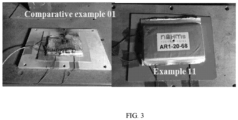
Fig. 3 is a pair of photographs of punctured cells containing commercial electrolyte (EC:EMC 3:7 1M LiPF6) of Comparative Example 01 and electrolyte of Example 11 containing NMC532 pouch cells. - This disclosure is directed phosphorus based thermal runaway inhibiting (TRI) materials, electrolytes containing the materials, and electrochemical cells containing the electrolytes.
- In an embodiment, an electrical energy storage device electrolyte includes a) an aprotic organic solvent system; b) an alkali metal salt; and c) a phosphorus based TRI materials.
- In an embodiment, an electrical energy storage device electrolyte includes a) an aprotic organic solvent system; b) an alkali metal salt; c) an additive; and d) a phosphorus based TRI materials.
- In an embodiment, the molecular structures of a phosphorus based TRI materials are depicted below:
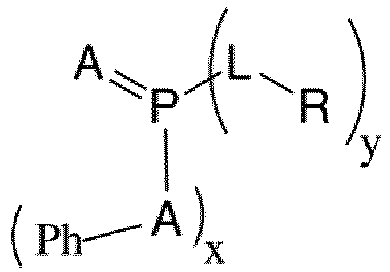
- A is oxygen or sulfur;
- Ph is a phenyl group;
- L is oxygen or sulfur;
- x and y are either 1 or 2, but must sum to equal 3;
- R is a phenyl ring with at least one of the hydrogen atoms on the ring being replaced by a halogen, alkoxy, silyl, amide, perfluorinated alkyl, sulfoxide, azo, thiyl group or combination thereof.
- In an embodiment, the phosphorous containing TRI material is present in an amount of from about 0.01 wt. % to about 60 wt.%.
- In an embodiment, an electrolyte includes a TRI phosphorus compound, an alkali metal, such as lithium, an additive and an aprotic solvent for use in an electrochemical cell. In an embodiment, the electrolyte further comprises an ionic liquid. The ionic liquid contains an organic cation and an inorganic/organic anion, with suitable organic cations including N-alkyl-N-alkyl-pyrrolidinium, N-alkyl-N-alkyl-pyridinium, N-alkyl-N-alkyl-sulfonium, N-alkyl-N-alkyl-ammonium, N-alkyl-N-alkyl-piperidinium or the like, and suitable anions including tetrafluoroborate, hexafluorophosphate, bis(trifluoromethylsulfonyl)imide, bis(pentafluoroethylsulfonyl)imide, trifluoroacetate or the like. The polymer in the electrolyte includes poly(ethylene glycol) derivatives, with varying molecular weights ranging from about 150 g/mol to about 10,000,000 g/mol. Suitable aprotic solvents include carbonates, ethers, acetamides, acetonitrile, symmetric sulfones, 1,3-dioxolanes, dimethoxyethanes, glymes, siloxanes and their blends. The alkali metal salt can be LiBF4, LiNO3, LiPF6, LiAsF6, lithium bis(trifluoromethylsulfonyl)imide (LiTFSI), lithium bis(pentafluoroethylsulfonyl)imide, lithium trifluoroacetate, or a similar compound.
- In an embodiment, the electrolyte includes a lithium salt in addition to the ionic liquid. A variety of lithium salts may be used, including, for example, Li[CF3CO2]; Li[C2F5CO2]; Li[ClO4]; Li[BF4]; Li[AsF6]; Li[PF6]; Li[PF2(C2O4)2]; Li[PF4C2O4]; Li[CF3SO3]; Li[N(CP3SO2)2]; Li[C(CF3SO2)3]; Li[N(SO2C2F5)2]; lithium alkyl fluorophosphates; Li[B(C2O4)2]; Li[BF2C2O4]; Li2[B12Z12-jHj]; Li2[B10X10-j'Hj']; or a mixture of any two or more thereof, wherein Z is independent at each occurrence a halogen, j is an integer from 0 to 12 and j' is an integer from 1 to 10.
- In an embodiment of the present electrolyte, such as a formulation for a lithium ion battery, aprotic solvents are combined with the present ionic liquids to decrease the viscosity and increase the conductivity of the electrolyte. The most appropriate aprotic solvents lack exchangeable protons, including cyclic carbonic acid esters, linear carbonic acid esters, phosphoric acid esters, oligoether substituted siloxanes/silanes, cyclic ethers, chain ethers, lactone compounds, chain esters, nitrile compounds, amide compounds, sulfone compounds, siloxanes, phosphoric acid esters, phosphates, phosphites, mono- or polyphosphazenes and the like. These solvents may be used singly, or at least two of them in admixture. Examples of aprotic solvents or carriers for forming the electrolyte systems include but are not limited to dimethyl carbonate, ethyl methyl carbonate, diethyl carbonate, methyl propyl carbonate, ethyl propyl carbonate, dipropyl carbonate, bis(trifluoroethyl) carbonate, bis(pentafluoropropyl) carbonate, trifluoroethyl methyl carbonate, pentafluoroethyl methyl carbonate, heptafluoropropyl methyl carbonate, perfluorobutyl methyl carbonate, trifluoroethyl ethyl carbonate, pentafluoroethyl ethyl carbonate, heptafluoropropyl ethyl carbonate, perfluorobutyl ethyl carbonate, etc., fluorinated oligomers, methyl propionate, ethyl propionate, butyl propionate, dimethoxyethane, triglyme, dimethylvinylene carbonate, tetraethyleneglycol, dimethyl ether, polyethylene glycols, triphenyl phosphate, tributyl phosphate, hexafluorocyclotriphosphazene, 2-Ethoxy-2,4,4,6,6-pentafluoro-1,3,5,2-5,4-5,6-5 triazatriphosphinine, triphenyl phosphite, sulfolane, dimethyl sulfoxide, ethyl methyl sulfone, ethylvinyl sulfone, allyl methyl sulfone, divinyl sulfone, fluorophynelmethyl sulfone and gamma-butyrolactone.
- In some embodiments, the electrolytes further include an additive to protect the electrodes from degradation. Thus, electrolytes of the present technology may include an additive that is reduced or polymerized on the surface of a negative electrode to form a passivation film on the surface of the negative electrode. Likewise, electrolytes can include an additive that can be oxidized or polymerized on the surface of the positive electrode to form a passivation film on the surface of the positive electrode. In some embodiments, electrolytes of the present technology further include mixtures of the two types of additives.
- In some embodiments, an additive is a substituted or unsubstituted linear, branched or cyclic hydrocarbon including at least one oxygen atom and at least one aryl, alkenyl or alkynyl group. The passivating film formed from such additives may also be formed from a substituted aryl compound or a substituted or unsubstituted heteroaryl compound where the additive includes at least one oxygen atom.
- Representative additives include glyoxal bis(diallyl acetal), tetra(ethylene glycol) divinyl ether, 1,3,5-triallyl-1,3,5-triazine-2,4,6(1H,3H,5H)-trione, 1,3,5,7-tetravinyl-1,3,5,7-tetramethylcyclotetrasiloxane, 2,4,6-triallyloxy-1,3,5-triazine, 1,3,5-triacryloylhexahydro-1,3,5-triazine, 1,2-divinyl furoate, 1,3-butadiene carbonate, 1-vinylazetidin-2-one, 1-vinylaziridin-2-one, 1-vinylpiperidin-2-one, 1 vinylpyrrolidin-2-one, 2,4-divinyl-1,3-dioxane, 2-amino-3-vinylcyclohexanone, 2-amino-3-vinylcyclopropanone, 2 amino-4-vinylcyclobutanone, 2-amino-5-vinylcyclopentanone, 2-aryloxy-cyclopropanone, 2-vinyl-[1,2]oxazetidine, 2 vinylaminocyclohexanol, 2-vinylaminocyclopropanone, 2-vinyloxetane, 2-vinyloxy-cyclopropanone, 3-(N-vinylamino)cyclohexanone, 3,5-divinyl furoate, 3-vinylazetidin-2-one, 3 vinylaziridin-2-one, 3-vinylcyclobutanone, 3-vinylcyclopentanone, 3-vinyloxaziridine, 3-vinyloxetane, 3-vinylpyrrolidin-2-one, 2-vinyl-1,3-dioxolane, acrolein diethyl acetal, acrolein dimethyl acetal, 4,4-divinyl-3-dioxolan-2-one, 4-vinyltetrahydropyran, 5-vinylpiperidin-3-one, allylglycidyl ether, butadiene monoxide, butyl-vinyl-ether, dihydropyran-3-one, divinyl butyl carbonate, divinyl carbonate, divinyl crotonate, divinyl ether, divinyl ethylene carbonate, divinyl ethylene silicate, divinyl ethylene sulfate, divinyl ethylene sulfite, divinyl methoxypyrazine, divinyl methylphosphate, divinyl propylene carbonate, ethyl phosphate, methoxy-o-terphenyl, methyl phosphate, oxetan-2-yl-vinylamine, oxiranylvinylamine, vinyl carbonate, vinyl crotonate, vinyl cyclopentanone, vinyl ethyl-2-furoate, vinyl ethylene carbonate, vinyl ethylene silicate, vinyl ethylene sulfate, vinyl ethylene sulfite, vinyl methacrylate, vinyl phosphate, vinyl-2-furoate, vinylcylopropanone, vinylethylene oxide, β-vinyl-γ-butyrolactone or a mixture of any two or more thereof. In some embodiments, the additive may be a cyclotriphosphazene that is substituted with F, alkyloxy, alkenyloxy, aryloxy, methoxy, allyloxy groups or combinations thereof. For example, the additive may be a (divinyl)-(methoxy)(trifluoro)cyclotriphosphazene, (trivinyl)(difluoro)(methoxy)cyclotriphosphazene, (vinyl)(methoxy)(tetrafluoro)cyclotriphosphazene, (aryloxy)(tetrafluoro)(methoxy)cyclotriphosphazene or (diaryloxy)(trifluoro)(methoxy)cyclotriphosphazene compounds or a mixture of two or more such compounds. In some embodiments, the additive is vinyl ethylene carbonate, vinyl carbonate, or 1,2-diphenyl ether, or a mixture of any two or more such compounds.
- Other representative additives include compounds with phenyl, naphthyl, anthracenyl, pyrrolyl, oxazolyl, furanyl, indolyl, carbazolyl, imidazolyl, thiophenyl, fluorinated carbonates, sultone, sulfide, anhydride, silane, siloxy, phosphate or phosphite groups. For example, additives may be phenyl trifluoromethyl sulfide, fluoroethylene carbonate, 1,3,2-dioxathiolane 2,2-dioxide, 1-propene 1,3-sultone, 1,3-propanesultone, 1,3-dioxolan-2-one, 4-[(2,2,2-trifluoroethoxy)methyl], 1,3-dioxolan-2-one, 4-[[2,2,2-trifluoro-1-(trifluoromethyl)ethoxy]methyl]-, methyl 2,2,2-trifluoroethyl carbonate, nonafluorohexyltriethoxysilane, octamethyltrisiloxane, methyltris(trimethylsiloxy)silane, tetrakis(trimethylsiloxy)silane, (tridecafluoro-1,1,2,2-tetrahydrooctyl)triethoxysilane, tris(1H.1H-heptafluorobutyl)phosphate, 3,3,3-trifluoropropyltris(3,3,3-trifluoropropyldimethylsiloxy)silane, (3,3,3-trifluoropropyl)trimethoxysilane, trimethylsilyl trifluoromethanesulfonate, tris(trimethylsilyl) borate, tripropyl phosphate, bis(trimethylsilylmethyl)benzylamine, phenyltris(trimethylsiloxy)silane, 1,3-bis(trifluoropropyl)tetramethyldisiloxane, triphenyl phosphate, tris(trimethylsilyl)phosphate, tris(1H.1H,5H-octafluoropentyl)phosphate, triphenyl phosphite, trilauryl trithiophosphite, tris(2,4-di-tert-butylphenyl) phosphite, tri-p-tolyl phosphite, tris(2,2,3,3,3-pentafluoropropyl)phosphate, succinic anhydride, 1,5,2,4-dioxadithiane 2,2,4,4-tetraoxide, tripropyl trithiophosphate, aryloxpyrrole, aryloxy ethylene sulfate, aryloxy pyrazine, aryloxy-carbazole trivinylphosphate, aryloxy-ethyl-2-furoate, aryloxy-o-terphenyl, aryloxy-pyridazine, butyl-aryloxy-ether, divinyl diphenyl ether, (tetrahydrofuran-2-yl)-vinylamine, divinyl methoxybipyridine, methoxy-4-vinylbiphenyl, vinyl methoxy carbazole, vinyl methoxy piperidine, vinyl methoxypyrazine, vinyl methyl carbonate-allylanisole, vinyl pyridazine, 1-divinylimidazole, 3-vinyltetrahydrofuran, divinyl furan, divinyl methoxy furan, divinylpyrazine, vinyl methoxy imidazole, vinylmethoxy pyrrole, vinyl-tetrahydrofuran, 2,4-divinyl isooxazole, 3,4 divinyl-1-methyl pyrrole, aryloxyoxetane, aryloxy-phenyl carbonate, aryloxy-piperidine, aryloxy-tetrahydrofuran, 2-aryl-cyclopropanone, 2-diaryloxy-furoate, 4-allylanisole, aryloxy-carbazole, aryloxy-2-furoate, aryloxy-crotonate, aryloxy-cyclobutane, aryloxy-cyclopentanone, aryloxy-cyclopropanone, aryloxy-cycolophosphazene, aryloxy-ethylene silicate, aryloxy-ethylene sulfate, aryloxy-ethylene sulfite, aryloxy-imidazole, aryloxy-methacrylate, aryloxy-phosphate, aryloxy-pyrrole, aryloxyquinoline, diaryloxycyclotriphosphazene, diaryloxy ethylene carbonate, diaryloxy furan, diaryloxy methyl phosphate, diaryloxy-butyl carbonate, diaryloxy-crotonate, diaryloxy-diphenyl ether, diaryloxy-ethyl silicate, diaryloxy-ethylene silicate, diaryloxy-ethylene sulfate, diaryloxyethylene sulfite, diaryloxy-phenyl carbonate, diaryloxy-propylene carbonate, diphenyl carbonate, diphenyl diaryloxy silicate, diphenyl divinyl silicate, diphenyl ether, diphenyl silicate, divinyl methoxydiphenyl ether, divinyl phenyl carbonate, methoxycarbazole, or 2,4-dimethyl-6-hydroxy-pyrimidine, vinyl methoxyquinoline, pyridazine, vinyl pyridazine, quinoline, vinyl quinoline, pyridine, vinyl pyridine, indole, vinyl indole, triethanolamine, 1,3-dimethyl butadiene, butadiene, vinyl ethylene carbonate, vinyl carbonate, imidazole, vinyl imidazole, piperidine, vinyl piperidine, pyrimidine, vinyl pyrimidine, pyrazine, vinyl pyrazine, isoquinoline, vinyl isoquinoline, quinoxaline, vinyl quinoxaline, biphenyl, 1,2-diphenyl ether, 1,2-diphenylethane, o terphenyl, N-methyl pyrrole, naphthalene or a mixture of any two or more such compounds.
- In an embodiment, the electrolyte of the present technology includes an aprotic gel polymer carrier/solvent. Suitable gel polymer carrier/solvents include polyethers, polyethylene oxides, polyimides, polyphosphazines, polyacrylonitriles, polysiloxanes, polyether grafted polysiloxanes, derivatives of the foregoing, copolymers of the foregoing, cross-linked and network structures of the foregoing, blends of the foregoing and the like, to which is added a suitable ionic electrolyte salt. Other gel-polymer carrier/solvents include those prepared from polymer matrices derived from polypropylene oxides, polysiloxanes, sulfonated polyimides, perfluorinated membranes (Nafion resins), divinyl polyethylene glycols, polyethylene glycol-bis-(methyl acrylates), polyethylene glycol-bis(methyl methacrylates), derivatives of the foregoing, copolymers of the foregoing and cross-linked and network structures of the foregoing.
- The phosphorus based TRI materials have high solubility in organic solvents. Electrolyte solutions containing these phosphorous TRI material have high ionic conductivity and are suitable for use as an electrolytic solution for electrochemical devices. Examples of electrochemical devices are electric double-layer capacitor, secondary batteries, solar cells of the pigment sensitizer type, electrochromic devices and condensers, and this list is not limitative. Especially suitable as electrochemical devices are electric double-layer capacitor and secondary batteries, such as a lithium ion battery.
- In an embodiment, an electrochemical device is provided that includes a cathode, an anode and an electrolyte as described herein, which optionally further includes an ionic liquid. In one embodiment, the electrochemical device is a lithium secondary battery. In some embodiments, the secondary battery is a lithium battery, a lithium-ion battery, a lithium-sulfur battery, a lithium-air battery, a sodium ion battery or a magnesium battery. In some embodiments, the electrochemical device is an electrochemical cell, such as a capacitor. In some embodiments, the capacitor is an asymmetric capacitor or supercapacitor. In some embodiments, the electrochemical cell is a primary cell. In some embodiments, the primary cell is a lithium/MnO2 battery or Li/poly(carbon monofluoride) battery. In some embodiments, the electrochemical cell is a solar cell.
- Suitable cathodes include those such as, but not limited to, a lithium metal oxide, spinel, olivine, carbon-coated olivine, LiFePO4, LiCoO2, LiNiO2, LiNi1xCoyMetzO2, LiMn0.5Ni0.5O2, LiMn0.3Co0.3Ni0.3O2, LiMn2O4, LiFeO2, Li1+x'NiαMnβCoγMet'δO2-z'Fz', An'B2(XO4)3 (NASICON), vanadium oxide, lithium peroxide, sulfur, polysulfide, a lithium carbon monofluoride (also known as LiCFx) or mixtures of any two or more thereof, where Met is Al, Mg, Ti, B, Ga, Si, Mn or Co; Met' is Mg, Zn, Al, Ga, B, Zr or Ti; A is Li, Ag, Cu, Na, Mn, Fe, Co, Ni, Cu or Zn; B is Ti, V, Cr, Fe or Zr; X is P, S, Si, W or Mo; and wherein 0≤x≤0.3, 0≤y≤0.5, 0≤z≤0.5, 0≤x'≤0.4, 0≤α≤1, 0≤β≤1, 0≤γ≤1, 0≤δ≤0.4, 0≤z'≤0.4 and 0≤n'≤3. According to some embodiments, the spinel is a spinel manganese oxide with the formula of Li1+xMn2-zMet‴yO4-mX'n, wherein Met‴ is Al, Mg, Ti, B, Ga, Si, Ni or Co; X' is S or F; and wherein 0≤x≤0.3, 0≤y≤0.5, 0≤z≤0.5, 0≤m≤0.5 and 0≤n≤0.5. In other embodiments, the olivine has a formula of Li1+xFe1zMet"yPO4-mX'n, wherein Met" is Al, Mg, Ti, B, Ga, Si, Ni, Mn or Co; X' is S or F; and wherein 0≤x≤0.3, 0 0≤y≤0.5, 0≤z≤0.5, 0≤m≤0.5 and 0≤n≤0.5.
- Suitable anodes include those such as lithium metal, graphitic materials, amorphous carbon, Li4Ti5O12, tin alloys, silicon alloys, intermetallic compounds or mixtures of any two or more such materials. Suitable graphitic materials include natural graphite, artificial graphite, graphitized meso-carbon microbeads (MCMB) and graphite fibers, as well as any amorphous carbon materials. In some embodiments, the anode and cathode are separated from each other by a porous separator.
- The separator for the lithium battery often is a microporous polymer film. Examples of polymers for forming films include: nylon, cellulose, nitrocellulose, polysulfone, polyacrylonitrile, polyvinylidene fluoride, polypropylene, polyethylene, polybutene, or co-polymers or blends of any two or more such polymers. In some instances, the separator is an electron beam-treated micro-porous polyolefin separator. The electron treatment can improve the deformation temperature of the separator and can accordingly enhance the high temperature performance of the separator. Additionally, or alternatively, the separator can be a shut-down separator. The shut-down separator can have a trigger temperature above about 130 °C to permit the electrochemical cells to operate at temperatures up to about 130 °C.
- The disclosure will be further illustrated with reference to the following specific examples. It is understood that these examples are given by way of illustration and are not meant to limit the disclosure or the claims to follow.
- Electrolyte formulations were prepared in a dry argon filled glovebox by combining all the electrolyte components in a vial and stirring for 24 hours to ensure complete dissolution of the salts. The phosphorous based TRI material is added as a co-solvent to a base electrolyte formulation comprising a 3:7 by weight mixture of ethylene carbonate, "EC", and ethyl methyl carbonate, "EMC", with 1 M lithium hexafluorophosphate, "LiPF6", dissolved therein. The electrolyte formulations prepared are summarized in Table A.
Table A. Electrolyte formulations. Electrolyte Base Phosphorous based TRI material Co-solvent (18 wt. %) Comparative Example 0 1 M Li PF6; EC:EMC; 3:7 w/w NONE Comparative Example 1 1.2 M Li PF6; EC:EMC; 3:7 w/ w 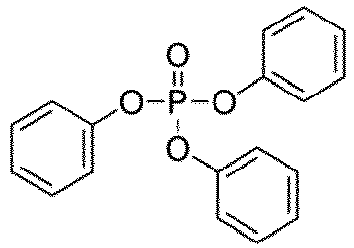
2 1.2 M Li PF6; EC:EMC; 3:7 w/w 
3 1.2 M Li PF6; EC:EMC; 3:7 w/w 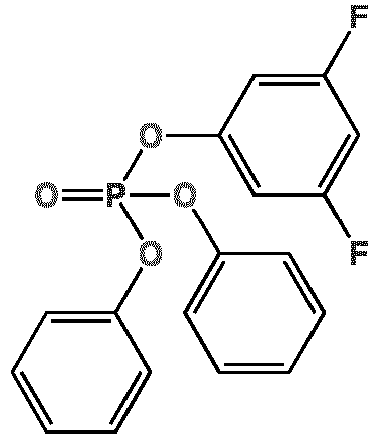
- The electrolyte formulations prepared are used as the electrolyte in nine 5 Ah Li-ion polymer pouch cells comprising Lithium cobalt oxide cathode active material and graphite as the anode active material. Each electrolyte is filled in three cells. In each cell 14.3 g of electrolyte formulation is added and allowed to soak in the cell for 1 hour prior to vacuum sealing and testing. The cells were then charged to 4.2 V and discharged to 3.0 V at a C/15 rate. The results averages are summarized in Table B.
Table B. 5Ah Cell initial discharge results. Averages of three. Electrolyte iCL (%) Discharge Capacity (mAh) Comparative Example 0 7.8 5866 2 7.0 5659 3 6.8 5686 - Initial capacity loss, "iCL" is a metric of cell performance measuring how much lithium is consumed during the initial charge-discharge cycle and formation of the solid-electrolyte-interface, "SEI", on the anode surface. It is the aim of cell and electrolyte design for the iCL to be minimized. In this example, the addition of a fluorinated phosphate ester in
Electrolyte 2 improves the iCL. Electrolyte 3 provides further improves the iCL with additional fluorination on the phosphate ester. The measured discharge capacities reaching or going above the rated capacity of the cell demonstrate good wetting of the electrodes and separator. - The electrolyte formulations prepared are used as the electrolyte in nine 200 mAh 403520 Li-ion polymer pouch cells comprising Lithium NMC622 cathode active material and graphite as the anode active material. Each electrolyte is filled in three cells. In each cell 1.1 g of electrolyte formulation is added and allowed to soak in the cell for 1 hour prior to vacuum sealing and testing. The cells were then charged to 4.35 V and discharged to 3.0 V at a C/15 rate. The results averages are summarized in Table C.
Table C. 5Ah Cell initial discharge results. Averages of three. Electrolyte iCL (%) Discharge Capacity (mAh) Comparative Example 0 14.9 196 2 14.6 183 3 13.9 196 - In this example, the addition of a fluorinated phosphate ester in
Electrolyte 2 improves the iCL. Electrolyte 3 provides further improves the iCL with additional fluorination on the phosphate ester. The measured discharge capacities reaching or going above the rated capacity of the cell demonstrate good wetting of the electrodes and separator. The same pattern with respect to incorporating modified phosphates into Li-ion electrolyte formulations is observed independent of cell chemistry. - The electrolyte formulations prepared are used as the electrolyte in two 40 Ah Li-ion polymer pouch cells comprising Lithium NMC622 cathode active material and graphite as the anode active material. In each cell 170 g of electrolyte formulation is added. The cells are subjected to a wetting procedure where the pressure in increased and decreased repeatedly over the course of 70 minutes. The cells are then vacuum sealed and ready for electrochemical testing after a 10 hour wait period. The cells are then charged to 4.2 V and discharged to 3.0 V at a C/15 rate for formation and then by C/2 discharge and charge for 500 cycles at room temperature. The results of this cycling test are summarized in
Figure 1 . - In
Figure 1 , it is shown thatElectrolyte 2 demonstrates a performance comparable to that of the Comparable Example electrolyte even in large format cells. - Electrolyte formulations were prepared in a dry argon filled glovebox by combining all the electrolyte components in a vial and stirring for 24 hours to ensure complete dissolution of the salts. The phosphorous based TRI material is added as a cosolvent to a base electrolyte formulation comprising a 3:7 by weight mixture of ethylene carbonate, "EC", and ethyl methyl carbonate, "EMC", with 1 M lithium hexafluorophosphate, "LiPF6", dissolved therein. The electrolyte formulations prepared are summarized in Table E.
Table E Electrolyte formulations. Electrolyte Base Phosphorous based TRI materialCo-solvent (20 wt. %) Comparative Example 0 1 M Li PF6; EC:EMC; 3:7 w/w NONE 4 1.2 M Li PF6; EC:EMC; 3:7 w/w 
5 1.2 M Li PF6; EC:EMC; 3:7 w/w 
3 1.2 M Li PF6; EC:EMC; 3:7 w/w 
- The viscosity of the electrolyte formulations were measured at 25.0°C with a Brookfield Ametek DV2T viscometer attached to a PolyScience Circulating Bath. This experimental set-up allows for viscosity to be measured at a precise temperature. The viscosity results are summarized in Table F.
Table F. Viscosities of electrolyte formulations Electrolyte Viscosity at 25.0°C (cP) Comparative Example 0 3.2 4 5.9 5 6.5 6 5.7 - Viscosity is an important measurement of the transport properties of an electrolyte formulation that influences electrochemical performance. In Table E it is demonstrated that modifying phosphate esters with a single fluorophenyl group instead of two, a lower viscosity electrolyte formulation is achieved. Additionally, using phenyl groups with two fluorines over one achieves an even lower overall viscosity in the electrolyte formulation.
-

Reagent MW Equiv Mol Mass (g) Density Volume (mL) Conc Yield (calc) diphenylchlorophosphate 268.63 1.00 1.787 480.0 1.296 370.4 4-fluorophenol 112.10 1.00 1.787 200.3 #DIV/0! triethylamine 101.19 1.00 1.787 180.8 0.723 250.1 DCM 850.4 1.326 641.3 80% 4-fluorophenyl-DPP 344.23 1.00 0.000 615.1 triethylamine-HCl 137.65 1.00 245.96 - To a 2 L 3-neck flask equipped with a mechanical stirrer, water-cooled condenser, thermocouple, N2 inlet and addition funnel was dissolved 4-fluorophenol (TCI) in DCM (200 mL). Note: only one-third of the calculated amount of solvent was used in this reaction and only small amounts of solvent were used to rinse residual reagents into the reaction mixture.
- Triethylamine was added portionwise and the mixture stirred for 20 min. An exotherm to 39°C was observed.
- While stirring at RT, diphenylchlorophosphate (AK Science) was slowly added by addition funnel over 2 h and an exotherm was observed with a temperature range of 36- 55°C. As the reaction proceeded, the pale mixture slowly turned colorless as a white solid ppt (triethylamine-HCl) formed and addition became complete. The mixture slowly returned to RT and stirred for 6 h.
- DI water (2 x 300 mL) was added and the mixture was poured into a separatory funnel. The organic phase was extracted into DCM, separated, dried over MgSO4, filtered and the solvent stripped by rotary evaporation. Yield: pale oil, 615.1 g, (>99%).
- The crude oil (>615 g) was slurried in DCM (400 mL) and common silica gel (100 g) for 2 h. The oil was collected by vacuum filtration. The silica gel was washed with DCM (4 x 100 mL) and the solvent was stripped by rotary evaporation and pumped under high vacuum for 2 h. Yield: pale oil, 603.0 g, (98%).
- FTIR: 948, 1176, 1487 cm-1; Karl Fischer: 11.8 ppm; Density =1.4245 g/mL.
- H NMR: (CDCl3) δ ppm 7.36-7.20(m, 12H), 7.02(t, 2H). F NMR: (CDCl3) δ ppm -116.92(s). P NMR: (CDCl3) δ ppm -17.47(s).
- Nail penetration tests were conducted on 5 Ah NMC 532-Graphite and LCO-Graphite polymer pouch cells at 100 % SOC. Table H1 summarizes the electrolyte composition, TRI material molecular structure and corresponding weight percentage in the base electrolyte (EC:EMC 3:7 w/w%) solvents.
-
Figure 2 depicts the nail penetration setup andFigure 3 depicts photographs of punctured cells. The tests were conducted according USCAR specifications, using a 3 mm sharp nail with a displacement rate of 8 mm/s. The cells were clamped during the test to maintain a consistent stack pressure. The cell skin temperature and voltage were recorded. ,Peak temperature measured during the nail penetration tests are compared in Table H2. The peak temperature results demonstrate that the electrolyte formulations comprising the phosphorous based TRI material overcome the thermal runaway challenges presented by state of the art electrolyte formulations, as exemplified by the Comparative Examples.Table H1- TRI molecular structure and corresponding weight percentage in the base electrolyte (EC:EMC 3:7 w/w%) solvents Electrolyte Base TRI and (wt. % in base) Comparative Example 01 1 M Li PF6; EC:EMC; 3:7 w/w NONE Comparative Example 02 1.2 M Li PF6; EC:EMC; 3:7 w/w Ionic liquid Pyr14 TFSI (18.5%) 
Comparative Example 03 1.2 M Li PF6; EC:EMC; 3:7 w/w Cyclophosphazene (18%) 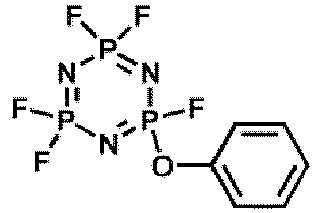
Comparative Example 4 1.2 M Li PF6; EC:EMC; 3:7 w/w Triphenyl phosphate (TPP) (40%) 
Example 11 1.2 M Li PF6; EC:EMC; 3:7 w/w 4-Fluoro phenyl di-phenyl phosphate (TPP-F) (40.3%) 
Example 21 1.2 M Li PF6; EC:EMC; 3:7 w/w 4-Fluoro phenyl di-phenyl phosphate (TPP-F) (18.3%) 
Example 24 1.2 M Li PF6; EC:EMC; 3:7 w/w 3,5-Di-fluoro phenyl di-phenyl phosphate (TPP-3,5F) (19.1%) 
Example 13 (Reference) 1.2 M Li PF6; EC:EMC; 3:7 w/w Heptafluoropropyl di-phenyl phosphate (C3F7-DPP) (40.2%) 
Table H2- Cell chemistry and capacity and peak temperature measured during the nail penetration tests for variety of TRI compounds. Cell Chemistry Cell Capacity (Ah) Electrolyte TRI TRI wt% Average Peak T (°C) NMC532-Graphite 5 Comparative Electrolyte 01None 0.0 593 NMC532-Graphite 5 Electrolyte 10TPP 40.6 162 NMC532-Graphite 5 Electrolyte 11TPP-F 40.3 52 LCO-Graphite 4.8 Comparative Electrolyte 01None 0.0 745 LCO-Graphite 4.8 Electrolyte 21 TPP-F 18.3 69 LCO-Graphite 4.8 Comparative Electrolyte 02 Pyr14 TFSI 18.5 703 LCO-Graphite 4.8 Comparative Electrolyte 03 Cyclophos phazene 18.0 578 LCO-Graphite 5 Electrolyte 21 TPP-F 18.3 100 LCO-Graphite 5 Electrolyte 24 TPP-3,5F 19.1 107 LCO-Graphite 5 Electrolyte 13 C3F7-DPP 40.2 72
Claims (24)
- An electrical energy storage device electrolyte comprising:a) an aprotic organic solvent system;b) an alkali metal salt; andc) at least one of the following phosphate based compoundswherein:
 A is oxygen or sulfur;Ph is a phenyl ring;L is oxygen or sulfur;x and y are either 1 or 2, but must sum to equal 3;R is a phenyl ring with at least one of the hydrogen atoms on the ring being replaced by a halogen, alkoxy, silyl, sulfoxide, perfluorinated alkyl, azo, amide, thiyl group or combination thereof.
 - The electrolyte of claim 1, wherein the aprotic organic solvent comprises an open-chain or cyclic carbonate, carboxylic acid ester, nitrite, ether, sulfone, ketone, lactone, dioxolane, glyme, crown ether, siloxane, phosphoric acid ester, phosphite, mono- or polyphosphazene or mixtures thereof.
- The electrolyte of claim 1, wherein the cation of the alkali metal salt comprises lithium or sodium.
- The electrolyte of claim 1, further comprising an additive.
- The electrolyte of claim 4, wherein the additive comprises a sulfur-containing compound, phosphorus-containing compound, boron-containing compound, silicon-containing compound, fluorine-containing compound, nitrogen-containing compound, compound containing at least one unsaturated carbon-carbon bond, carboxylic acid anhydride or the mixtures thereof.
- The electrolyte of claim 1, wherein the additive comprises a concentration in the electrolyte of from 0.01 wt. % to 5 wt. %.
- The electrolyte of claim 1, further comprising an ionic liquid.
- The electrolyte of claim 7, wherein the ionic liquid comprises an organic cation comprising N-alkyl-N-alkyl-pyrrolidinium, N-alkyl-N-alkyl pyridinium, N-alkyl-N-alkyl-sulfonium, N-alkyl-N-alkyl-ammonium, or N-alkyl-N-alkyl piperidinium.
- The electrolyte of claim 7, wherein the ionic liquid comprises an anion comprising tetrafluoroborate, hexafluorophosphate, bis(trifluoromethylsulfonyl)imide, bis(pentafluoroethylsulfonyl)imide, or trifluoroacetate.
- An electrical energy storage device comprising:a cathode;an anode; andan electrolyte comprising:a) an aprotic organic solvent system;b) an alkali metal salt; andc) at least one of the following phosphate based compoundswherein:
 A is oxygen or sulfur;Ph is a phenyl ring;L is oxygen or sulfur;x and y are either 1 or 2, but must sum to equal 3;R is a phenyl ring with at least one of the hydrogen atoms on the ring being replaced by a halogen, alkoxy, silyl, sulfoxide, perfluorinated alkyl, azo, amide, thiyl group or combination thereof.
 - The device of claim 10, wherein the cathode comprises a lithium metal oxide, spinel, olivine, carbon-coated olivine, LiFePO4, LiCoO2, LiNiO2, LiNi1xCoyMetzO2, LiMn0.5Ni0.5O2, LiMn0.3Co0.3Ni0.3O2, LiMn2O4, LiFeO2, Li1+x'NiαMnβCoγMet'δO2-z'Fz', An'B2(XO4)3 (NASICON), vanadium oxide, lithium peroxide, sulfur, polysulfide, a lithium carbon monofluoride or mixtures of any two or more thereof, where Met is Al, Mg, Ti, B, Ga, Si, Mn or Co; Met' is Mg, Zn, Al, Ga, B, Zr or Ti; A is Li, Ag, Cu, Na, Mn, Fe, Co, Ni, Cu or Zn; B is Ti, V, Cr, Fe or Zr; X is P, S, Si, W or Mo; and wherein 0≤x≤0.3, 0≤y≤0.5, 0≤z≤0.5, 0≤x'≤0.4, 0≤α≤1, 0≤β≤1, 0≤γ≤1, 0≤δ≤0.4, 0≤z'≤0.4 and 0≤n'≤3.
- The device of claim 10, wherein the anode comprises lithium metal, graphitic material, amorphous carbon, Li4Ti5O12, tin alloy, silicon alloy, intermetallic compound or mixtures thereof.
- The device of claim 10, wherein the device comprises a lithium battery, lithium-ion battery, lithium-sulfur battery, lithium-air battery, sodium ion battery, magnesium battery, electrochemical cell, capacitor, lithium/MnO2 battery, Li/poly(carbon monofluoride) battery, or solar cell.
- The device of claim 10, further comprising a porous separator separating the anode and cathode from each other.
- The device of claim 14, wherein the porous separator comprises an electron beam-treated micro-porous polyolefin separator or a microporous polymer film comprising nylon, cellulose, nitrocellulose, polysulfone, polyacrylonitrile, polyvinylidene fluoride, polypropylene, polyethylene, polybutene, or co-polymers or blends of any two or more such polymers.
- The device of claim 10, wherein the aprotic organic solvent comprises an open-chain or cyclic carbonate, carboxylic acid ester, nitrite, ether, sulfone, ketone, lactone, dioxolane, glyme, crown ether, siloxane, phosphoric acid ester, phosphite, mono- or polyphosphazene or mixtures thereof.
- The device of claim 10, wherein the cation of the alkali metal salt comprises lithium or sodium.
- The device of claim 10, wherein the electrolyte further comprises an additive.
- The device of claim 18, wherein the additive comprises a sulfur-containing compound, phosphorus-containing compound, boron-containing compound, silicon-containing compound, fluorine-containing compound, nitrogen-containing compound, compound containing at least one unsaturated carbon-carbon bond, carboxylic acid anhydride or the mixtures thereof.
- The device of claim 10, wherein the electrolyte further comprises an ionic liquid.
- The device of claim 20, wherein the ionic liquid comprises an organic cation comprising N-alkyl-N-alkyl-pyrrolidinium, N-alkyl-N-alkyl pyridinium, N-alkyl-N-alkyl-sulfonium, N-alkyl-N-alkyl-ammonium, or N-alkyl-N-alkyl piperidinium.
- The device of claim 20, wherein the ionic liquid comprises an anion comprising tetrafluoroborate, hexafluorophosphate, bis(trifluoromethylsulfonyl)imide, bis(pentafluoroethylsulfonyl)imide, or trifluoroacetate.
- The electrolyte of claim 1, wherein the alkali metal salt is replaced with an aluminum salt or a magnesium salt.
- The device of claim 10, wherein the alkali metal salt is replaced with an aluminum salt or a magnesium salt.
Priority Applications (2)
| Application Number | Priority Date | Filing Date | Title |
|---|---|---|---|
| EP22181038.5A EP4106070A1 (en) | 2017-07-17 | 2018-07-17 | Phosphorus-containing electrolytes |
| EP22181041.9A EP4087005A1 (en) | 2017-07-17 | 2018-07-17 | Phosphorus-containing electrolytes |
Applications Claiming Priority (2)
| Application Number | Priority Date | Filing Date | Title |
|---|---|---|---|
| US201762533277P | 2017-07-17 | 2017-07-17 | |
| PCT/US2018/042543 WO2019018432A1 (en) | 2017-07-17 | 2018-07-17 | Phosphorus containing electrolytes |
Related Child Applications (4)
| Application Number | Title | Priority Date | Filing Date |
|---|---|---|---|
| EP22181038.5A Division EP4106070A1 (en) | 2017-07-17 | 2018-07-17 | Phosphorus-containing electrolytes |
| EP22181038.5A Division-Into EP4106070A1 (en) | 2017-07-17 | 2018-07-17 | Phosphorus-containing electrolytes |
| EP22181041.9A Division-Into EP4087005A1 (en) | 2017-07-17 | 2018-07-17 | Phosphorus-containing electrolytes |
| EP22181041.9A Division EP4087005A1 (en) | 2017-07-17 | 2018-07-17 | Phosphorus-containing electrolytes |
Publications (4)
| Publication Number | Publication Date |
|---|---|
| EP3656010A1 EP3656010A1 (en) | 2020-05-27 |
| EP3656010A4 EP3656010A4 (en) | 2021-08-11 |
| EP3656010C0 EP3656010C0 (en) | 2025-03-26 |
| EP3656010B1 true EP3656010B1 (en) | 2025-03-26 |
Family
ID=64999706
Family Applications (3)
| Application Number | Title | Priority Date | Filing Date |
|---|---|---|---|
| EP18835804.8A Active EP3656010B1 (en) | 2017-07-17 | 2018-07-17 | Phosphorus-containing electrolytes |
| EP22181038.5A Pending EP4106070A1 (en) | 2017-07-17 | 2018-07-17 | Phosphorus-containing electrolytes |
| EP22181041.9A Pending EP4087005A1 (en) | 2017-07-17 | 2018-07-17 | Phosphorus-containing electrolytes |
Family Applications After (2)
| Application Number | Title | Priority Date | Filing Date |
|---|---|---|---|
| EP22181038.5A Pending EP4106070A1 (en) | 2017-07-17 | 2018-07-17 | Phosphorus-containing electrolytes |
| EP22181041.9A Pending EP4087005A1 (en) | 2017-07-17 | 2018-07-17 | Phosphorus-containing electrolytes |
Country Status (7)
| Country | Link |
|---|---|
| US (1) | US10665899B2 (en) |
| EP (3) | EP3656010B1 (en) |
| JP (1) | JP7296893B2 (en) |
| KR (1) | KR102638417B1 (en) |
| CN (1) | CN110915037B (en) |
| CA (1) | CA3069973A1 (en) |
| WO (1) | WO2019018432A1 (en) |
Families Citing this family (19)
| Publication number | Priority date | Publication date | Assignee | Title |
|---|---|---|---|---|
| KR102459623B1 (en) * | 2017-12-27 | 2022-10-28 | 삼성전자주식회사 | Organic electrolyte and Lithium battery comprising organic electrolyte |
| ES3053603T3 (en) * | 2019-06-21 | 2026-01-23 | Imec Vzw | Solid electrolyte, electrode, power storage element, and method for producing solid electrolyte |
| CN111261942B (en) * | 2020-03-30 | 2022-03-08 | 山东海容电源材料有限公司 | Flame-retardant lithium ion battery electrolyte |
| CN112110953B (en) * | 2020-04-29 | 2024-01-12 | 湖州师范学院 | Phosphate ester compound, synthesis method and non-aqueous electrolyte thereof |
| US11876181B2 (en) | 2020-06-01 | 2024-01-16 | NOHMs Technologies, Inc. | Lithium ion battery electrolyte additive |
| CN111769324A (en) * | 2020-06-18 | 2020-10-13 | 合肥国轩高科动力能源有限公司 | A high-voltage lithium ion battery electrolyte additive and lithium ion battery electrolyte containing the additive |
| CA3188985A1 (en) * | 2020-08-10 | 2022-02-17 | Surya MOGANTY | Unsaturated additive for lithium ion battery |
| CN112010894B (en) * | 2020-08-17 | 2023-08-11 | 湖州师范学院 | A kind of phosphoric acid ester compound, non-aqueous lithium-ion battery electrolyte containing it and lithium-ion battery |
| AU2021335036A1 (en) * | 2020-08-27 | 2023-02-16 | Sionic Energy, Inc. | Epoxy modified additives for lithium ion batteries |
| CN112310478B (en) * | 2020-10-23 | 2022-04-01 | 惠州锂威新能源科技有限公司 | Electrolyte and electrochemical device thereof |
| CN114583265B (en) * | 2020-11-30 | 2023-07-14 | 比亚迪股份有限公司 | Electrolyte, positive electrode, Li-ion battery and vehicle |
| US11631897B2 (en) * | 2021-01-21 | 2023-04-18 | High Tech Battery Inc. | Ionic liquid additive for lithium-ion battery |
| CN113161615B (en) * | 2021-06-04 | 2023-04-25 | 湖州昆仑亿恩科电池材料有限公司 | Non-aqueous electrolyte of lithium ion battery and lithium ion battery |
| KR20230069427A (en) * | 2021-11-12 | 2023-05-19 | 주식회사 엘지에너지솔루션 | Lithium secondary battery with improved high temperature safety |
| CN115051031A (en) * | 2022-06-22 | 2022-09-13 | 上海领钫新能源科技有限公司 | Electrolyte for sodium ion battery and sodium ion battery |
| EP4562705A4 (en) * | 2022-07-25 | 2026-02-25 | Sionic Energy Inc | Functionalized crown ethers for lithium-ion batteries |
| CN118352623A (en) * | 2023-01-16 | 2024-07-16 | 宁德时代新能源科技股份有限公司 | Electrolyte for sodium secondary battery, sodium secondary battery and power-using device |
| CN120642091A (en) * | 2023-02-08 | 2025-09-12 | 松下知识产权经营株式会社 | Battery |
| CN117457987B (en) * | 2023-11-28 | 2024-06-21 | 广东聚圣科技有限公司 | Electrolyte additive, preparation method thereof and battery |
Family Cites Families (269)
| Publication number | Priority date | Publication date | Assignee | Title |
|---|---|---|---|---|
| US2922738A (en) | 1955-05-17 | 1960-01-26 | Exxon Research Engineering Co | Fungicidal compositions |
| US3308208A (en) | 1964-05-04 | 1967-03-07 | Douglas Aircraft Co Inc | Polyfluorinated phosphate esters |
| US3384686A (en) | 1964-12-28 | 1968-05-21 | Mc Donnell Douglas Corp | Fluorochloroaryl phosphate esters |
| US3384685A (en) | 1964-12-28 | 1968-05-21 | Mc Donnell Douglas Corp | Fluoroaryl phosphate esters |
| US3318810A (en) | 1965-11-04 | 1967-05-09 | Gulf Research Development Co | Phosphomolybdenum derivatives and their lubricant compositions |
| US4000101A (en) | 1970-07-14 | 1976-12-28 | Weston Chemical Corporation | Thiophosphites and ultraviolet light stabilizer for olefin polymers |
| US3661843A (en) | 1970-10-27 | 1972-05-09 | Cincinnati Milacron Chem | Transition metal complexes with trivalent phosphorus compounds useful as stabilizers for polymers |
| JPH0613539B2 (en) | 1984-07-04 | 1994-02-23 | 旭電化工業株式会社 | Organic phosphite composition |
| DE59107135D1 (en) | 1990-01-18 | 1996-02-08 | Ciba Geigy Ag | Phosphonic acid and thionophosphonic acid derivatives |
| DE69508671T2 (en) | 1994-07-07 | 1999-10-14 | Mitsui Chemicals | Non-aqueous electrolyte solutions and secondary cells containing them |
| JPH09223516A (en) * | 1996-02-14 | 1997-08-26 | Fuji Photo Film Co Ltd | Nonaqueous electrolyte secondary battery |
| US5830600A (en) | 1996-05-24 | 1998-11-03 | Sri International | Nonflammable/self-extinguishing electrolytes for batteries |
| GB2321460B (en) | 1996-09-25 | 2000-09-13 | Ciba Sc Holding Ag | Monomeric and oligomeric bisphosphites as stabilisers for polymers such as PVC and as additives for lubricants, hydraulic fluids and metal processing fluids |
| JP3687283B2 (en) | 1997-07-10 | 2005-08-24 | トヨタ自動車株式会社 | Solvent for lithium ion secondary battery |
| CA2283670C (en) | 1998-02-03 | 2011-06-07 | Acep Inc. | Materials useful as electrolytic solutes |
| NZ507650A (en) | 1998-03-19 | 2003-12-19 | Eco Solutions Ltd | Aqueous composition for removing coatings |
| US6919141B2 (en) | 1998-10-22 | 2005-07-19 | Wilson Greatbatch Technologies, Inc. | Phosphate additives for nonaqueous electrolyte rechargeable electrochemical cells |
| US6200701B1 (en) | 1999-01-25 | 2001-03-13 | Wilson Greatbatch Ltd. | Phosphonate additives for nonaqueous electrolyte in rechargeable cells |
| DE10038858A1 (en) | 2000-08-04 | 2002-02-14 | Merck Patent Gmbh | Fluoroalkyl phosphates for use in electrochemical cells |
| DE10103994B4 (en) | 2001-01-30 | 2005-04-28 | Epcos Ag | Electrolytic solution for electrochemical double-layer capacitors |
| US6939647B1 (en) | 2001-02-13 | 2005-09-06 | The United States Of America As Represented By The Secretary Of The Army | Non-aqueous electrolyte solutions and non-aqueous electrolyte cells comprising the same |
| US6746794B2 (en) | 2001-06-12 | 2004-06-08 | Tech Drive, Inc | Thermal runaway inhibitors |
| DE10128581B4 (en) | 2001-06-13 | 2005-04-07 | Epcos Ag | Electrolytic solution for electrochemical capacitors |
| CN100444455C (en) | 2001-09-21 | 2008-12-17 | Tdk株式会社 | Lithium secondary battery |
| US7026074B2 (en) | 2002-02-15 | 2006-04-11 | The University Of Chicago | Lithium ion battery with improved safety |
| DE10212609B4 (en) | 2002-03-21 | 2015-03-26 | Epcos Ag | Electrolytic solution and its use |
| ITVA20020029A1 (en) | 2002-03-22 | 2003-09-22 | Lamberti Spa | COMPOSITIONS FOR POSITIVE THERMAL LITHOGRAPHIC PLATES |
| CN1449069A (en) | 2002-04-02 | 2003-10-15 | 株式会社日本触媒 | Materials for electrolytic solution and uses thereof |
| US20040091772A1 (en) | 2002-06-20 | 2004-05-13 | Boris Ravdel | Lithium-ion battery electrolytes with improved thermal stability |
| BR0305630A (en) | 2002-06-21 | 2004-11-30 | Univ California | Electrolyte solution for electro-optical devices comprising ionic liquids, electro-optical device, compound and method for filling an electro-optical device |
| JP2004146346A (en) | 2002-08-28 | 2004-05-20 | Nisshinbo Ind Inc | Non-aqueous electrolyte and non-aqueous electrolyte secondary battery |
| US6902684B1 (en) | 2002-09-16 | 2005-06-07 | Lithdyne International | Non-aqueous electrolytes for electrical storage devices |
| US20060134525A1 (en) | 2002-09-27 | 2006-06-22 | Christian Kleijnen | Rechargeable lithium battery |
| WO2004038846A1 (en) | 2002-10-22 | 2004-05-06 | Mitsubishi Chemical Corporation | Nonaqueous electrolytic solution and nonaqueous electrolyte secondary battery containing the same |
| US20040086782A1 (en) | 2002-11-01 | 2004-05-06 | Celgard Inc. | Explosion-proof separator for Li-ion secondary batteries |
| JP4951855B2 (en) | 2002-11-29 | 2012-06-13 | 株式会社Gsユアサ | Non-aqueous electrolyte battery |
| JP4407237B2 (en) * | 2002-12-24 | 2010-02-03 | 三菱化学株式会社 | Non-aqueous electrolyte and non-aqueous electrolyte secondary battery using the same |
| KR100509604B1 (en) | 2003-01-14 | 2005-08-22 | 삼성에스디아이 주식회사 | Organic electrolytic solution and lithium battery employing the same |
| DE10302626A1 (en) | 2003-01-23 | 2004-07-29 | Basf Ag | New polybutylphenyl phosphate esters, used e.g. as surface modifier, corrosion inhibitor, dispersant or adhesion promoter, are prepared by corresponding phenol with phosphorus oxyhalide and optionally water, alcohol, thiol or amine |
| AU2003901144A0 (en) | 2003-03-13 | 2003-03-27 | Monash University School Of Chemistry | Room temperature ionic liquid electrolytes for lithium secondary batteries |
| KR100757166B1 (en) | 2003-07-01 | 2007-09-07 | 오츠카 가가쿠 가부시키가이샤 | Quaternary ammonium salt, electrolyte, and electrochemical device |
| US7968235B2 (en) * | 2003-07-17 | 2011-06-28 | Uchicago Argonne Llc | Long life lithium batteries with stabilized electrodes |
| PL1660095T3 (en) | 2003-07-25 | 2010-07-30 | Cancer Research Tech Ltd | Tricyclic parp inhibitors |
| WO2005020365A1 (en) | 2003-08-26 | 2005-03-03 | Japan Aerospace Exploration Agency | Nonflammable nonaqueous electrolyte and lithium-ion battery containing the same |
| JP4041044B2 (en) | 2003-09-18 | 2008-01-30 | Tdk株式会社 | Method for manufacturing electrochemical device |
| JP4554911B2 (en) | 2003-11-07 | 2010-09-29 | パナソニック株式会社 | Nonaqueous electrolyte secondary battery |
| CN100468856C (en) | 2003-12-29 | 2009-03-11 | 国际壳牌研究有限公司 | Electrochemical components used at high temperatures |
| CN1329491C (en) | 2003-12-30 | 2007-08-01 | 中国科学院兰州化学物理研究所 | Ionic liquid containing phosphonate ester functional group, process for preparing same and use thereof |
| EP1702374B1 (en) | 2003-12-30 | 2015-11-18 | LG Chem, Ltd. | Ionic liquid-modified cathode and electrochemical device using the same |
| CA2492344C (en) | 2004-01-15 | 2010-08-10 | Matsushita Electric Industrial Co., Ltd. | Nonaqueous electrolyte for electrochemical devices |
| JP4537726B2 (en) | 2004-02-16 | 2010-09-08 | 株式会社Gsユアサ | Non-aqueous electrolyte flame retardant, non-aqueous electrolyte and non-aqueous electrolyte battery |
| US7626804B2 (en) | 2004-03-10 | 2009-12-01 | Masaki Yoshio | Power storage element and electric double layer capacitor |
| JP3769291B2 (en) | 2004-03-31 | 2006-04-19 | 株式会社東芝 | Non-aqueous electrolyte battery |
| DE102004018929A1 (en) | 2004-04-20 | 2005-11-17 | Degussa Ag | Electrolyte composition and its use as electrolyte material for electrochemical energy storage systems |
| DE102004018930A1 (en) | 2004-04-20 | 2005-11-17 | Degussa Ag | Use of a ceramic separator in lithium-ion batteries having an electrolyte containing ionic liquids |
| KR100838932B1 (en) * | 2004-07-16 | 2008-06-16 | 마쯔시다덴기산교 가부시키가이샤 | Nonaqueous Electrolyte Secondary Battery |
| KR20060014280A (en) | 2004-08-10 | 2006-02-15 | 제일모직주식회사 | Non-aqueous electrolyte for lithium secondary battery and lithium secondary battery comprising same |
| JP4830279B2 (en) | 2004-09-14 | 2011-12-07 | パナソニック株式会社 | Nonaqueous electrolyte secondary battery |
| KR100570359B1 (en) | 2004-12-23 | 2006-04-12 | 비나텍주식회사 | Hybrid battery |
| CN100438198C (en) | 2004-12-31 | 2008-11-26 | 比亚迪股份有限公司 | Mixed additive and electrolyte and lithium ion secondary battery containing same |
| DE602006012933D1 (en) | 2005-01-12 | 2010-04-29 | Otsuka Chemical Co Ltd | QUATERNARY AMMONIUM SALT, ELECTROLYTE, ELECTROLYTE SOLUTION, AND ELECTROCHEMICAL APPARATUS |
| EP1837333B1 (en) | 2005-01-12 | 2013-04-10 | Otsuka Chemical Co., Ltd. | Quaternary ammonium salt, electrolyte, electrolyte solution and electrochemical device |
| JP4519685B2 (en) | 2005-03-14 | 2010-08-04 | 株式会社東芝 | Non-aqueous electrolyte battery |
| KR100660065B1 (en) | 2005-03-29 | 2006-12-21 | 한국과학기술연구원 | Lithium salt using pyrrolidinium-based amphoteric ion and method for preparing same |
| JP5153060B2 (en) | 2005-06-16 | 2013-02-27 | パナソニック株式会社 | Lithium ion secondary battery |
| US8034227B2 (en) | 2005-06-30 | 2011-10-11 | Akzo Nobel N.V. | Chemical process |
| GB0700819D0 (en) | 2006-01-19 | 2007-02-21 | Sumitomo Chemical Co | Polymer electrolyte composition and application thereof |
| JP5032773B2 (en) | 2006-02-03 | 2012-09-26 | 第一工業製薬株式会社 | Lithium secondary battery using ionic liquid |
| JP2007280740A (en) | 2006-04-06 | 2007-10-25 | Hitachi Ltd | Electrolyte, electrolyte membrane, membrane electrode assembly using the same, fuel cell power supply and fuel cell power supply system |
| AU2007240125B2 (en) | 2006-04-18 | 2012-05-24 | Commonwealth Scientific And Industrial Research Organisation | Flexible energy storage devices |
| EP2359830B1 (en) | 2006-04-26 | 2012-09-19 | Supernus Pharmaceuticals, Inc. | Controlled released preparations of oxcarbazepine having sigmoidal release profile |
| CN103259044B (en) | 2006-04-27 | 2016-02-10 | 三菱化学株式会社 | Nonaqueous electrolyte and nonaqueous electrolyte secondary battery |
| EP2423298A1 (en) | 2006-07-06 | 2012-02-29 | Nippon Oil Corporation | Compressor oil composition |
| FR2903692B1 (en) | 2006-07-17 | 2009-07-31 | Inst Nat Polytech Grenoble | AROMATIC SULFONYLIMIDURES AND THEIR PREPARATION. |
| JP2008041375A (en) | 2006-08-04 | 2008-02-21 | Hitachi Ltd | Electrolyte, electrolyte membrane, membrane electrode assembly using the same, fuel cell power supply and fuel cell power supply system |
| US20080137265A1 (en) | 2006-12-12 | 2008-06-12 | Venkateswaran Sagar N | High voltage non-toxic electrolytes for ultracapacitors |
| DE102007004698A1 (en) | 2007-01-31 | 2008-08-07 | Merck Patent Gmbh | Compounds containing Organofluorochlorophosphatanionen |
| CN101037388A (en) | 2007-04-17 | 2007-09-19 | 华东师范大学 | Multifunctional ion liquid system, preparation and application thereof |
| KR100853615B1 (en) | 2007-04-26 | 2008-08-22 | 성균관대학교산학협력단 | Electrolyte for lithium ion secondary battery and lithium ion secondary battery comprising same |
| FR2917537B1 (en) | 2007-06-15 | 2009-09-25 | Saft Groupe Sa | LITHIUM-ION BATTERY CONTAINING ELECTROLYTE COMPRISING IONIC LIQUID |
| JP2010532071A (en) | 2007-06-29 | 2010-09-30 | コモンウェルス サイエンティフィック アンド インダストリアル リサーチ オーガニゼイション | Lithium energy storage device |
| JP5215307B2 (en) | 2007-07-18 | 2013-06-19 | 第一工業製薬株式会社 | Lithium secondary battery |
| EP2023434B1 (en) | 2007-07-23 | 2016-09-07 | Litarion GmbH | Electrolyte preparations for energy storage devices based on ionic fluids |
| WO2009016235A2 (en) | 2007-08-02 | 2009-02-05 | Akzo Nobel N.V. | Chelating agent based ionic liquids, a process to prepare them, and their use |
| US20110143212A1 (en) | 2007-09-28 | 2011-06-16 | Charles Austen Angell | Non-Aqueous Electrolyte Solution for Rechargeable Lithium Batteries |
| KR20090076410A (en) | 2008-01-08 | 2009-07-13 | 삼성에스디아이 주식회사 | Gel-type electrolyte for dye-sensitized solar cell, manufacturing method thereof, and solar cell comprising said gel-type electrolyte |
| US20090286163A1 (en) | 2008-02-29 | 2009-11-19 | The Regents Of The University Of California | Electrolyte mixtures useful for li-ion batteries |
| KR101658678B1 (en) * | 2008-02-29 | 2016-09-21 | 미쓰비시 가가꾸 가부시키가이샤 | Nonaqueous electrolyte solution and nonaqueous electrolyte battery |
| DE102008021271A1 (en) | 2008-04-29 | 2010-01-28 | Merck Patent Gmbh | Reactive ionic liquids |
| US8404876B2 (en) | 2008-05-08 | 2013-03-26 | 3M Innovative Properties Company | Process for producing nanoparticles |
| KR20110005880A (en) * | 2008-05-19 | 2011-01-19 | 닛본 덴끼 가부시끼가이샤 | Secondary battery |
| US20110113507A1 (en) | 2008-07-01 | 2011-05-12 | Arcadia Biosciences, Inc. | Tomatoes That Soften More Slowly Post-Harvest Due To Non-Transgenic Alterations In An Expansin Gene |
| FR2933814B1 (en) | 2008-07-11 | 2011-03-25 | Commissariat Energie Atomique | IONIC LIQUID ELECTROLYTES COMPRISING A SURFACTANT AND ELECTROCHEMICAL DEVICES SUCH AS ACCUMULATORS COMPRISING SAME |
| KR101002566B1 (en) | 2008-07-29 | 2010-12-17 | 삼성에스디아이 주식회사 | Electrolyte for lithium ion secondary battery and lithium ion secondary battery comprising same |
| US20110136018A1 (en) | 2008-08-06 | 2011-06-09 | Mitsui Chemicals, Inc. | Non-aqueous electrolytic solution, lithium secondary battery and method for producing same, and mixed-type non-aqueous electrolytic solution |
| US8795903B2 (en) | 2008-08-19 | 2014-08-05 | California Institute Of Technology | Lithium-ion electrolytes containing flame retardant additives for increased safety characteristics |
| FR2935547B1 (en) | 2008-08-29 | 2011-03-25 | Commissariat Energie Atomique | IONIC LIQUID ELECTROLYTES AND ELECTROCHEMICAL DEVICES SUCH AS ACCUMULATORS COMPRISING SAME. |
| WO2010030008A1 (en) | 2008-09-11 | 2010-03-18 | 日本電気株式会社 | Secondary battery |
| EP2202826B1 (en) | 2008-12-23 | 2013-06-05 | SMR Patents S.à.r.l. | Polymer Electrolytes and Devices containing them |
| FR2942235B1 (en) | 2009-02-13 | 2011-07-22 | Centre Nat Rech Scient | IONIC CONDUCTIVE GELS, PROCESS FOR THEIR PREPARATION AND THEIR USE AS ELECTROLYTE |
| JP4864107B2 (en) | 2009-02-17 | 2012-02-01 | 株式会社日立製作所 | Block copolymer and solid polymer electrolyte for fuel cell using the same, solid polymer electrolyte membrane for fuel cell, membrane electrode assembly and fuel cell |
| DE102009009357B4 (en) | 2009-02-18 | 2011-03-03 | Fraunhofer-Gesellschaft zur Förderung der angewandten Forschung e.V. | Redox flow battery for storing electrical energy in ionic liquids |
| EP2415793B1 (en) | 2009-03-30 | 2015-01-14 | Piotrek Co., Ltd. | Method of producing fluorinated polymer |
| US9293786B1 (en) | 2009-05-12 | 2016-03-22 | Clarkson University | Solid organic electrolytes |
| US9076996B2 (en) | 2009-07-20 | 2015-07-07 | Massachusetts Institute Of Technology | Liquid metal alloy energy storage device |
| WO2011029006A2 (en) | 2009-09-04 | 2011-03-10 | Board Of Regents, The University Of Texas System | Ionic liquids for use in ultracapacitor and graphene-based ultracapacitor |
| WO2011061728A1 (en) | 2009-11-19 | 2011-05-26 | Technion Research & Development Foundation Ltd. | Silicon-air batteries |
| KR20110056150A (en) | 2009-11-20 | 2011-05-26 | 삼성에스디아이 주식회사 | Flame retardant electrolyte for lithium secondary batteries and lithium secondary battery comprising same |
| KR101183557B1 (en) | 2009-12-21 | 2012-09-17 | 주식회사 이아이지 | Case for electrochemical device with a flame retardant and heat resistant material and electrochemical device comprising thereof |
| EP2535975B1 (en) | 2010-02-10 | 2020-01-08 | Envision AESC Energy Devices Ltd. | Nonaqueous electrolyte solution, and lithium ion secondary battery using same |
| EP2548258A4 (en) | 2010-03-18 | 2013-08-07 | Commw Scient Ind Res Org | IONIC LIQUIDS FOR BATTERIES |
| CN101826635A (en) | 2010-04-09 | 2010-09-08 | 广州天赐高新材料股份有限公司 | Polymer electrolyte for lithium battery and manufacturing method of battery thereof |
| US9079156B2 (en) | 2010-06-29 | 2015-07-14 | Reliance Industries Ltd. | Ionic fluids |
| US8795544B2 (en) | 2010-06-30 | 2014-08-05 | Semiconductor Energy Laboratory Co., Ltd. | Power storage device, lithium-ion secondary battery, electric double layer capacitor and lithium-ion capacitor |
| US9493882B2 (en) | 2010-07-21 | 2016-11-15 | Ceramatec, Inc. | Custom ionic liquid electrolytes for electrolytic decarboxylation |
| JP5978999B2 (en) * | 2010-09-02 | 2016-08-24 | 日本電気株式会社 | Secondary battery |
| JP2012074324A (en) | 2010-09-30 | 2012-04-12 | Hitachi Ltd | Solid polymer fuel cell |
| US9130240B2 (en) | 2010-10-12 | 2015-09-08 | Toyota Jidosha Kabushiki Kaisha | Ionic liquid, lithium secondary battery electrolyte comprising the ionic liquid, and lithium secondary battery comprising the electrolyte |
| JP5389768B2 (en) | 2010-11-02 | 2014-01-15 | 株式会社日立製作所 | POLYMER ELECTROLYTE MEMBRANE, MEMBRANE ELECTRODE ASSEMBLY USING SAME, AND SOLID POLYMER FUEL CELL |
| KR101137379B1 (en) | 2010-11-23 | 2012-04-20 | 삼성에스디아이 주식회사 | Gel electrolyte for dye sensitized fuel cell and dye sensitized fuel cell including the same |
| US9196926B2 (en) | 2010-12-27 | 2015-11-24 | Nec Energy Devices, Ltd. | Gel electrolyte for lithium ion secondary battery, and lithium ion secondary battery |
| EP2665121A1 (en) | 2011-01-13 | 2013-11-20 | Dai-Ichi Kogyo Seiyaku Co., Ltd. | Photoelectric conversion element |
| JP5459248B2 (en) | 2011-03-25 | 2014-04-02 | 株式会社デンソー | Air battery |
| KR20140034179A (en) * | 2011-04-11 | 2014-03-19 | 바스프 코포레이션 | Non-aqueous electrolytic solutions and electrochemical cells comprising the same |
| CN103688400A (en) | 2011-04-27 | 2014-03-26 | 联邦科学与工业研究组织 | Lithium energy storage device |
| JP5778625B2 (en) | 2011-06-03 | 2015-09-16 | 株式会社半導体エネルギー研究所 | Ionic liquid and power storage device including ionic liquid |
| US9391341B2 (en) | 2011-06-29 | 2016-07-12 | Sumitomo Electric Industries, Ltd. | Manufacturing method for molten salt battery and molten salt battery |
| US9558894B2 (en) | 2011-07-08 | 2017-01-31 | Fastcap Systems Corporation | Advanced electrolyte systems and their use in energy storage devices |
| JP2014524917A (en) | 2011-07-11 | 2014-09-25 | コーネル・ユニバーシティー | Compositions, methods and uses of ionic liquid nanoscale ionic materials (IL-NIM) |
| DE102011052156A1 (en) | 2011-07-26 | 2013-01-31 | Jacobs University Bremen Ggmbh | Lithium 2-methoxy-1,1,2,2-tetrafluoroethanesulfonate and its use as a conductive salt in lithium-based energy storage |
| JP5894388B2 (en) | 2011-07-26 | 2016-03-30 | 住友金属鉱山株式会社 | Cathode active material for non-aqueous electrolyte secondary battery, method for producing the same, and non-aqueous electrolyte secondary battery using the same |
| KR101223736B1 (en) | 2011-07-29 | 2013-01-21 | 삼성에스디아이 주식회사 | Electrolyte for dye sensitized solar cell and dye sensitized solar cell using the same |
| US9673452B2 (en) | 2011-09-30 | 2017-06-06 | The Regents Of The University Of California | Graphene oxide as a sulfur immobilizer in high performance lithium/sulfur cells |
| US9206210B2 (en) | 2011-10-05 | 2015-12-08 | Battelle Energy Alliance, Llc | Ionic liquids, electrolyte solutions including the ionic liquids, and energy storage devices including the ionic liquids |
| US20130106029A1 (en) | 2011-10-27 | 2013-05-02 | Infinite Power Solutions, Inc. | Fabrication of High Energy Density Battery |
| JP6151910B2 (en) | 2011-12-23 | 2017-06-21 | 株式会社半導体エネルギー研究所 | Ionic liquid, non-aqueous solvent, electrolyte, power storage device |
| KR101893959B1 (en) | 2011-12-30 | 2018-09-03 | 삼성에스디아이 주식회사 | Cathode Active Material for Lithium Secondary Battery, Method for Preparing Cathode Active Material, and Lithium Secondary Battery Using the Same |
| KR20130099706A (en) | 2012-02-29 | 2013-09-06 | 삼성전자주식회사 | Electrolyte and lithium air battery including the same |
| DE102012101670A1 (en) | 2012-02-29 | 2013-08-29 | Jacobs University Bremen Ggmbh | Conducting salt for lithium-based energy storage |
| US9012093B2 (en) * | 2012-03-02 | 2015-04-21 | Nec Corporation | Secondary battery |
| WO2013134566A2 (en) | 2012-03-07 | 2013-09-12 | Massachusetts Institute Of Technology | Rechargeable lithium battery for wide temperature operation |
| US9177721B2 (en) | 2012-03-14 | 2015-11-03 | Rutgers, The State University Of New Jersey | Electrochemical devices and methods of fabrication |
| WO2013148138A1 (en) | 2012-03-29 | 2013-10-03 | Pellion Technologies, Inc. | Layered materials with improved magnesium intercalation for rechargeable magnesium ion cells |
| KR101381873B1 (en) | 2012-04-13 | 2014-04-14 | 한국과학기술연구원 | Polymer gel electrolyte composition, the preparing method for the composition, and dye-sensitized solar cell comprising the electrolyte |
| CN103374035B (en) | 2012-04-24 | 2016-01-06 | 宁波大学 | A kind of method of Microwave synthesize organic phosphine functionalization glyoxaline ion liquid |
| CN103374034B (en) | 2012-04-24 | 2016-01-06 | 宁波大学 | Pyridine ionic liquid of a kind of organic phosphine functionalization and preparation method thereof |
| US9431672B2 (en) | 2012-05-16 | 2016-08-30 | Worcester Polytechnic Institute | Molten-salt electrolyte unitized regenerative hydrogen-halogen fuel cell with anion transfer |
| WO2013180781A1 (en) | 2012-06-01 | 2013-12-05 | E. I. Du Pont De Nemours And Company | Lithium- ion battery |
| US20140017558A1 (en) | 2012-07-16 | 2014-01-16 | Nthdegree Technologies Worldwide Inc. | Diatomaceous Ionic Gel Separation Layer for Energy Storage Devices and Printable Composition Therefor |
| JP6290205B2 (en) | 2012-07-20 | 2018-03-07 | ビーエーエスエフ ソシエタス・ヨーロピアBasf Se | Electrochemical cell |
| CN102776053B (en) | 2012-08-03 | 2013-12-18 | 山东源根石油化工有限公司 | Composite extreme pressure anti-wear agent and total-synthesis anti-wear hydraulic oil containing same |
| EP2969917B1 (en) | 2012-09-12 | 2022-11-02 | Drexel University | Polymerized ionic liquid block copolymers as battery membranes |
| CN104685591B (en) | 2012-09-28 | 2017-07-04 | 住友电气工业株式会社 | Capacitor electrode active material and the capacitor using the electrode active material |
| KR20140045880A (en) | 2012-10-09 | 2014-04-17 | 가부시키가이샤 한도오따이 에네루기 켄큐쇼 | Power storage device |
| US9300009B2 (en) | 2012-10-22 | 2016-03-29 | Ut-Battelle, Llc | Electrolyte compositions for lithium ion batteries |
| EP2731181B1 (en) | 2012-11-12 | 2019-01-09 | Karlsruher Institut für Technologie | Secondary battery and method for its manufacturing |
| CN105283983B (en) | 2012-11-19 | 2018-08-31 | 苏里亚·S·莫甘缇 | Sulfur-infused carbon for secondary battery materials |
| US9145341B2 (en) | 2012-11-19 | 2015-09-29 | Technion Research & Development Foundation Limited | Process of preparing Grignard reagent |
| KR101994261B1 (en) | 2012-12-12 | 2019-06-28 | 삼성에스디아이 주식회사 | Solid electrolyte containing ionic liquid |
| FR3002086B1 (en) | 2013-02-13 | 2015-03-27 | Commissariat Energie Atomique | PROCESS FOR THE SYNTHESIS OF IONIC LIQUIDS WITH CARBONATE FUNCTIONAL GROUP AND IONIC LIQUIDS THUS OBTAINED |
| US20140315096A1 (en) | 2013-02-26 | 2014-10-23 | Universidade Federal De Minas Gerais | Clay- based energy storage compositions for high temperature applications |
| JP6364812B2 (en) | 2013-02-27 | 2018-08-01 | 三菱ケミカル株式会社 | Non-aqueous electrolyte and non-aqueous electrolyte battery using the same |
| WO2014133107A1 (en) | 2013-02-27 | 2014-09-04 | 三菱化学株式会社 | Nonaqueous electrolyte solution and nonaqueous electrolyte battery using same |
| JP2014170689A (en) | 2013-03-04 | 2014-09-18 | Mitsui Chemicals Inc | Nonaqueous electrolyte and lithium secondary battery |
| US9627713B2 (en) | 2013-03-29 | 2017-04-18 | NOHMs Technologies, Inc. | Composite electrolyte including polymeric ionic liquid matrix and embedded nanoparticles, and method of making the same |
| KR20140122361A (en) | 2013-04-09 | 2014-10-20 | 삼성에스디아이 주식회사 | Electrolyte for dye sensitized solar cell and dye sensitized solar cell using the same |
| US9190696B2 (en) | 2013-05-16 | 2015-11-17 | Nanotek Instruments, Inc. | Lithium secondary batteries containing lithium salt-ionic liquid solvent electrolyte |
| KR101503879B1 (en) | 2013-05-24 | 2015-03-20 | 한국과학기술연구원 | Magnesium hybrid battery and its fabrication method |
| US9368831B2 (en) | 2013-06-10 | 2016-06-14 | Nanotek Instruments, Inc. | Lithium secondary batteries containing non-flammable quasi-solid electrolyte |
| JP6342230B2 (en) | 2013-06-21 | 2018-06-13 | 株式会社半導体エネルギー研究所 | Nonaqueous solvent, nonaqueous electrolyte and power storage device |
| KR20160021848A (en) | 2013-06-21 | 2016-02-26 | 더 리젠츠 오브 더 유니버시티 오브 캘리포니아 | A long-life, ligh rate lithium/sulfur cell utilizing a holistic approach to enhancing cell performance |
| US9601803B2 (en) | 2013-07-22 | 2017-03-21 | Nanotek Instruments, Inc. | Non-flammable quasi-solid electrolyte-separator layer product for lithium battery applications |
| US9601805B2 (en) | 2013-07-22 | 2017-03-21 | Nanotek Instruments, Inc. | Process for producing non-flammable quasi-solid electrolyte and electrolyte-separator for lithium battery applications |
| JP6220973B2 (en) | 2013-07-29 | 2017-10-25 | ハチンソン | Monolithic ionogel containing biopolymer matrix and method for producing the same |
| CN103483381B (en) | 2013-08-22 | 2016-08-17 | 青岛科技大学 | The preparation of one class phosphine functionalized ion liquid and the application in hydroformylation reaction thereof |
| US9059481B2 (en) | 2013-08-30 | 2015-06-16 | Nanotek Instruments, Inc. | Non-flammable quasi-solid electrolyte and non-lithium alkali metal or alkali-ion secondary batteries containing same |
| US9812736B2 (en) | 2013-09-03 | 2017-11-07 | Nanotek Instruments, Inc. | Lithium-selenium secondary batteries having non-flammable electrolyte |
| US20160240885A1 (en) | 2013-09-30 | 2016-08-18 | Hitachi Chemical Company, Ltd. | Lithium ion secondary battery |
| DE102013111853A1 (en) | 2013-10-28 | 2015-04-30 | Rockwood Lithium GmbH | Carbon-coated lithium sulfide |
| US9034517B1 (en) | 2013-11-06 | 2015-05-19 | Retriev Technologies Incorporated | Capacitors having conditioned carbon for electrodes |
| US8785057B1 (en) | 2013-11-06 | 2014-07-22 | Retriev Technologies Incorporated | Electrolyte solution for capacitors and batteries |
| US9458180B2 (en) | 2013-11-11 | 2016-10-04 | Lonza Ltd. | Method for preparation of cyano compounds of the 13th group with a lewis acid |
| JP6299251B2 (en) | 2014-02-10 | 2018-03-28 | セイコーエプソン株式会社 | Electrode composite manufacturing method, electrode composite, and battery |
| JP6086249B2 (en) | 2014-03-26 | 2017-03-01 | トヨタ自動車株式会社 | Nonaqueous electrolyte secondary battery |
| JP6370584B2 (en) | 2014-04-04 | 2018-08-08 | 学校法人早稲田大学 | Lithium sulfur secondary battery |
| DE102014209209A1 (en) | 2014-05-15 | 2015-11-19 | Bayerische Motoren Werke Aktiengesellschaft | Lithium-air battery |
| DE102014221731A1 (en) | 2014-06-06 | 2016-01-21 | Robert Bosch Gmbh | Polymer electrolyte for lithium-sulfur cell |
| US10629894B2 (en) | 2014-06-06 | 2020-04-21 | Robert Bosch Gmbh | Cathode material for a lithium-sulphur cell |
| WO2015185731A2 (en) | 2014-06-06 | 2015-12-10 | Robert Bosch Gmbh | Polymer electrlyte for a lithium sulfur cell |
| GB201411065D0 (en) | 2014-06-20 | 2014-08-06 | Eco Solutions Ltd | Aqueous composition for cleaning or removing coatings |
| FR3023417B1 (en) | 2014-07-01 | 2016-07-15 | I-Ten | COMPLETELY SOLID BATTERY COMPRISING SOLID ELECTROLYTE AND LAYER OF SOLID POLYMERIC MATERIAL |
| FR3023418B1 (en) | 2014-07-01 | 2016-07-15 | I Ten | COMPLETELY SOLID BATTERY COMPRISING AN ELECTROLYTE IN RETICULATED SOLID POLYMERIC MATERIAL |
| JP2016029641A (en) | 2014-07-14 | 2016-03-03 | 株式会社リコー | Power storage device |
| KR102207927B1 (en) | 2014-07-14 | 2021-01-26 | 삼성전자주식회사 | Electrolyte, lithium battery and lithium metal battery including the same, and method for preparation the electrolyte |
| US9627727B2 (en) | 2014-07-22 | 2017-04-18 | Toyota Motor Engineering & Manufacturing North America, Inc. | Lithium-air battery with cathode separated from free lithium ion |
| KR20160011548A (en) | 2014-07-22 | 2016-02-01 | 주식회사 예스셀 | Flame retardant electrolyte composite for safety improvement of lithium secondary battery, the lithium secondary battery including the electrolyte composite and the manufacturing method thereof |
| WO2016011613A1 (en) | 2014-07-23 | 2016-01-28 | Basf Corporation | Electrolytes for lithium transition metal phosphate batteries |
| KR101708463B1 (en) | 2014-07-25 | 2017-03-08 | 한국과학기술연구원 | Electrolyte for magnesium battery and preparation method thereof |
| US9343787B2 (en) | 2014-07-30 | 2016-05-17 | Toyota Motor Engineering & Manufacturing North America, Inc. | Lithium-air battery with sodium salt as mediator |
| EP3001495B1 (en) | 2014-08-29 | 2018-06-06 | Samsung Electronics Co., Ltd. | Composite, method of preparing the composite, electrolyte comprising the composite, and lithium secondary battery comprising the electrolyte |
| KR102280682B1 (en) | 2014-09-15 | 2021-07-22 | 삼성전자주식회사 | Cathode and lithium air battery comprising the cathode, and preparation method thereof |
| EP3001494B1 (en) | 2014-09-19 | 2018-08-15 | Samsung Electronics Co., Ltd. | Electrolyte, method of preparing the electrolyte, and lithium secondary battery comprising the electrolyte |
| US10361456B2 (en) | 2014-09-26 | 2019-07-23 | Samsung Electronics Co., Ltd. | Electrolyte, method of preparing the electrolyte, and secondary battery including the electrolyte |
| EP3213363B1 (en) | 2014-10-30 | 2021-01-06 | The Regents of The University of Colorado, A Body Corporate | Stable silicon-ionic liquid interface lithium-ion batteries |
| US10693188B2 (en) | 2014-10-30 | 2020-06-23 | Clemson University | Thermally responsive electrolytes |
| US9666916B2 (en) | 2014-11-05 | 2017-05-30 | Toyota Motor Engineering & Manufacturing North America, Inc. | Biphase electrolyte for a metal-air battery |
| US9941559B2 (en) | 2014-11-11 | 2018-04-10 | Toyota Motor Engineering & Manufacturing North America, Inc. | Water enhanced ionic liquid electrolytes for metal-air batteries |
| US20160141725A1 (en) | 2014-11-13 | 2016-05-19 | Basf Corporation | Electrolytes and Metal Hydride Batteries |
| US20160141723A1 (en) | 2014-11-13 | 2016-05-19 | Basf Corporation | Electrolytes and Metal Hydride Batteries |
| US20160141727A1 (en) | 2014-11-13 | 2016-05-19 | Basf Corporation | Electrolytes and Metal Hydride Batteries |
| MA40985A (en) | 2014-11-17 | 2017-09-26 | Biogen Ma Inc | MULTIPLE SCLEROSIS TREATMENT METHODS |
| EP3222753B1 (en) | 2014-11-17 | 2019-05-08 | Korea Institute of Energy Research | Ammonia synthesis apparatus |
| US20160156062A1 (en) | 2014-12-02 | 2016-06-02 | Intermolecular, Inc. | Solid-State Batteries with Electrodes Infused with Ionically Conductive Material and Methods for Forming the Same |
| KR101628555B1 (en) | 2014-12-03 | 2016-06-08 | 현대자동차주식회사 | An anode of litium-air battery |
| US10593488B2 (en) | 2014-12-11 | 2020-03-17 | Otsuka Chemical Co., Ltd. | Nonaqueous electrolytic solution for electric double layer capacitors |
| EP3231034B1 (en) | 2014-12-14 | 2023-04-19 | The Board of Trustees of the University of Illinois | Catalyst system for advanced metal-air batteries |
| KR102303831B1 (en) | 2014-12-26 | 2021-09-17 | 삼성전자주식회사 | Polymer, electrolyte comprising the polymer, and lithium secondary battery comprising the electrolyte |
| US10077231B2 (en) | 2015-02-03 | 2018-09-18 | Blue Current, Inc. | Functionalized fluoropolymers and electrolyte compositions |
| WO2016136924A1 (en) | 2015-02-26 | 2016-09-01 | 国立大学法人東京工業大学 | Molten salt composition, electrolyte, and electricity storage device, and method for thickening liquefied molten salt |
| EP3076470B1 (en) | 2015-04-03 | 2019-10-16 | Samsung Electronics Co., Ltd. | Lithium secondary battery |
| US20160301107A1 (en) | 2015-04-07 | 2016-10-13 | Blue Current, Inc. | Functionalized perfluoroalkanes and electrolyte compositions |
| US9799881B2 (en) | 2015-04-27 | 2017-10-24 | Toyota Motor Engineering & Manufacturing North America, Inc. | Alloys as cathode materials for lithium-air batteries |
| EP3088571B1 (en) | 2015-04-28 | 2021-06-02 | The Boeing Company | Environmentally friendly aluminum coatings as sacrificial coatings for high strength steel alloys |
| KR102411660B1 (en) | 2015-05-06 | 2022-06-21 | 삼성전자주식회사 | Negative electrode for lithium battery and lithium battery comprising the same |
| KR102452944B1 (en) | 2015-05-12 | 2022-10-11 | 삼성전자주식회사 | Electrolyte composite, and negative electrode and lithium second battery including the electrolyte composite |
| US10573933B2 (en) | 2015-05-15 | 2020-02-25 | Samsung Electronics Co., Ltd. | Lithium metal battery |
| KR102390373B1 (en) | 2015-05-21 | 2022-04-25 | 삼성전자주식회사 | Lithium air battery and preparing method thereof |
| US9780379B2 (en) * | 2015-05-21 | 2017-10-03 | Nanotek Instruments, Inc. | Alkali metal secondary battery containing a carbon matrix- or carbon matrix composite-based dendrite intercepting layer |
| CN106207262A (en) | 2015-05-25 | 2016-12-07 | 松下知识产权经营株式会社 | Electrolyte and battery |
| DE102015210402A1 (en) | 2015-06-05 | 2016-12-08 | Robert Bosch Gmbh | Cathode material for lithium-sulfur cell |
| KR20180016486A (en) | 2015-06-09 | 2018-02-14 | 스텔라 케미파 코포레이션 | Non-aqueous electrolyte for secondary battery and secondary battery having same |
| US10347904B2 (en) | 2015-06-19 | 2019-07-09 | Solidenergy Systems, Llc | Multi-layer polymer coated Li anode for high density Li metal battery |
| US20180183038A1 (en) | 2015-06-19 | 2018-06-28 | University Of Houston System | Method of activating two-dimensional materials for multivalent/polyatomic-ion intercalation battery electrodes |
| KR102420011B1 (en) | 2015-06-22 | 2022-07-12 | 삼성전자주식회사 | Secondary battery |
| KR102475886B1 (en) | 2015-06-25 | 2022-12-08 | 삼성전자주식회사 | Negative electrode for lithium metal battery and lithium metal battery including the same |
| FR3040060B1 (en) | 2015-08-10 | 2017-08-11 | Centre Nat Rech Scient | METHODS OF EXTRACTING AND RECOVERING THE TANTALE PRESENT IN AN ACOUSTIC AQUEOUS PHASE USING AN IONIC LIQUID, AND USE OF SUCH A LIQUID IONIC TO EXTRACT THE TANTAL FROM AN ACOUSIC AQUEOUS PHASE |
| EP3131152A1 (en) * | 2015-08-10 | 2017-02-15 | LANXESS Deutschland GmbH | Flame retardant battery electrolytes containing phosphoric acid esters |
| US20190036167A1 (en) | 2015-08-31 | 2019-01-31 | Lintec Corporation | Electrolyte composition, secondary battery, and method for using secondary battery |
| EP3136475B1 (en) | 2015-08-31 | 2021-09-22 | Samsung Electronics Co., Ltd. | Lithium metal battery |
| US10312551B2 (en) | 2015-09-11 | 2019-06-04 | Microvast Power Systems Co., Ltd. | Preparation method of ionic liquids and secondary batteries |
| US9735445B2 (en) | 2015-09-14 | 2017-08-15 | Nanotek Instruments, Inc. | Alkali metal or alkali-ion batteries having high volumetric and gravimetric energy densities |
| US9564656B1 (en) | 2015-09-14 | 2017-02-07 | Nanotek Instruments, Inc. | Process for producing alkali metal or alkali-ion batteries having high volumetric and gravimetric energy densities |
| JP6601094B2 (en) | 2015-09-25 | 2019-11-06 | 日清紡ホールディングス株式会社 | Additive for electrolyte |
| US20170098858A1 (en) | 2015-10-01 | 2017-04-06 | Samsung Electronics Co., Ltd. | Lithium metal battery |
| US11603321B2 (en) | 2015-10-08 | 2023-03-14 | Everon24, Inc. | Rechargeable aluminum ion battery |
| KR102547797B1 (en) | 2015-11-04 | 2023-06-26 | 삼성전자주식회사 | Polymer electrolyte and battery including the same |
| FR3043404B1 (en) | 2015-11-05 | 2017-11-24 | Hutchinson | IONOGEL FORMING A SELF-SUPPORTED SOLOH ELECTROLYTE FILM, ELECTROCHEMICAL DEVICE INCORPORATING SAME, AND IONOGEL MANUFACTURING METHOD. |
| CN105254667B (en) | 2015-11-17 | 2017-06-23 | 中国科学院兰州化学物理研究所 | Functionalization oil-soluble ionic liquid and its preparation method and application |
| US10128551B2 (en) | 2015-11-20 | 2018-11-13 | Samsung Electronics Co., Ltd. | Electrolyte for lithium air battery and lithium air battery including the same |
| CN108701794A (en) | 2015-12-23 | 2018-10-23 | 索尔维特殊聚合物意大利有限公司 | Composite material |
| KR102553839B1 (en) | 2015-12-24 | 2023-07-10 | 삼성전자주식회사 | Lithium secondary battery |
| US10622672B2 (en) | 2015-12-28 | 2020-04-14 | Seeo, Inc | Ceramic-polymer composite electrolytes for lithium polymer batteries |
| US10026995B2 (en) | 2016-01-15 | 2018-07-17 | Nanotek Instruments, Inc. | Method of producing alkali metal or alkali-ion batteries having high volumetric and gravimetric energy densities |
| US11152639B2 (en) | 2016-01-15 | 2021-10-19 | Global Graphene Group, Inc. | Alkali metal-sulfur batteries having high volumetric and gravimetric energy densities |
| US9917339B2 (en) | 2016-03-11 | 2018-03-13 | Toyota Motor Engineering & Manufacturing North America, Inc. | Non-aqueous lithium-air battery |
| CA3019132A1 (en) | 2016-04-01 | 2017-10-05 | NOHMs Technologies, Inc. | Modified ionic liquids containing phosphorus |
| CN107394115B (en) | 2016-04-29 | 2022-03-29 | 三星电子株式会社 | Negative electrode for lithium metal battery and lithium metal battery including the same |
| US10741846B2 (en) | 2016-05-09 | 2020-08-11 | Samsung Electronics Co., Ltd. | Negative electrode for lithium metal battery and lithium metal battery comprising the same |
| US20180151887A1 (en) | 2016-11-29 | 2018-05-31 | GM Global Technology Operations LLC | Coated lithium metal negative electrode |
| US20180183052A1 (en) | 2016-12-27 | 2018-06-28 | Nanotek Instruments, Inc. | Process for Flexible and Shape-Conformal Cable-Shape Alkali Metal-Sulfur Batteries |
| US10158121B2 (en) | 2016-12-27 | 2018-12-18 | Nanotek Instruments, Inc. | Flexible and shape-conformal cable-shape alkali metal-sulfur batteries |
| US9905856B1 (en) | 2016-12-28 | 2018-02-27 | Nanotek Instruments, Inc. | Flexible and shape-conformal rope-shape alkali metal-sulfur batteries |
| US20180277913A1 (en) | 2017-03-23 | 2018-09-27 | Nanotek Instruments, Inc. | Non-flammable Quasi-Solid Electrolyte and Lithium Secondary Batteries Containing Same |
| KR20180112334A (en) | 2017-04-03 | 2018-10-12 | 삼성전자주식회사 | Electrochemical Mirror |
| WO2018195478A1 (en) | 2017-04-20 | 2018-10-25 | Auburn University | Electrochemical systems comprising mxenes and max phase compositions and methods of using the same |
| US10731635B2 (en) | 2017-05-17 | 2020-08-04 | The University Of Akron | Polymer electrolyte membrane assembly |
| US10505219B2 (en) | 2017-05-26 | 2019-12-10 | Toyota Motor Engineering & Manufacturing North America, Inc. | Artificial SEI transplantation |
| US11335946B2 (en) | 2017-06-02 | 2022-05-17 | Global Graphene Group, Inc. | Shape-conformable alkali metal-sulfur battery |
| US11258101B2 (en) | 2017-06-26 | 2022-02-22 | Global Graphene Group, Inc. | Non-flammable electrolyte containing liquefied gas and lithium secondary batteries containing same |
-
2018
- 2018-07-17 EP EP18835804.8A patent/EP3656010B1/en active Active
- 2018-07-17 CN CN201880047006.0A patent/CN110915037B/en active Active
- 2018-07-17 EP EP22181038.5A patent/EP4106070A1/en active Pending
- 2018-07-17 US US16/038,046 patent/US10665899B2/en active Active
- 2018-07-17 JP JP2019570086A patent/JP7296893B2/en active Active
- 2018-07-17 CA CA3069973A patent/CA3069973A1/en active Pending
- 2018-07-17 EP EP22181041.9A patent/EP4087005A1/en active Pending
- 2018-07-17 WO PCT/US2018/042543 patent/WO2019018432A1/en not_active Ceased
- 2018-07-17 KR KR1020207002132A patent/KR102638417B1/en active Active
Also Published As
| Publication number | Publication date |
|---|---|
| US20190020069A1 (en) | 2019-01-17 |
| EP3656010A4 (en) | 2021-08-11 |
| KR102638417B1 (en) | 2024-02-19 |
| JP7296893B2 (en) | 2023-06-23 |
| US10665899B2 (en) | 2020-05-26 |
| WO2019018432A1 (en) | 2019-01-24 |
| EP4106070A1 (en) | 2022-12-21 |
| CN110915037B (en) | 2023-11-07 |
| CN110915037A (en) | 2020-03-24 |
| EP3656010C0 (en) | 2025-03-26 |
| EP4087005A1 (en) | 2022-11-09 |
| JP2020527823A (en) | 2020-09-10 |
| KR20200029484A (en) | 2020-03-18 |
| CA3069973A1 (en) | 2019-01-24 |
| EP3656010A1 (en) | 2020-05-27 |
Similar Documents
| Publication | Publication Date | Title |
|---|---|---|
| US10665899B2 (en) | Phosphorus containing electrolytes | |
| US11489201B2 (en) | Modified ionic liquids containing phosphorus | |
| US10483591B2 (en) | Modified triazine functional compounds | |
| EP3391454B1 (en) | Silane-functionalized ionic liquids and electrolytes comprising the same | |
| US11949069B2 (en) | Lithium ion battery electrolyte additive | |
| EP3656009B1 (en) | Modified ionic liquids containing triazine | |
| US10781225B1 (en) | Modified ionic liquids containing cyclic phosphorus moiety | |
| US20230352736A1 (en) | Epoxy modified additives for lithium ion batteries | |
| EP4283739A1 (en) | Non-aqueous electrolyte, non-aqueous electrolyte battery, and compound | |
| KR102709320B1 (en) | Modified ionic liquid containing boron |
Legal Events
| Date | Code | Title | Description |
|---|---|---|---|
| STAA | Information on the status of an ep patent application or granted ep patent |
Free format text: STATUS: THE INTERNATIONAL PUBLICATION HAS BEEN MADE |
|
| PUAI | Public reference made under article 153(3) epc to a published international application that has entered the european phase |
Free format text: ORIGINAL CODE: 0009012 |
|
| STAA | Information on the status of an ep patent application or granted ep patent |
Free format text: STATUS: REQUEST FOR EXAMINATION WAS MADE |
|
| 17P | Request for examination filed |
Effective date: 20200127 |
|
| AK | Designated contracting states |
Kind code of ref document: A1 Designated state(s): AL AT BE BG CH CY CZ DE DK EE ES FI FR GB GR HR HU IE IS IT LI LT LU LV MC MK MT NL NO PL PT RO RS SE SI SK SM TR |
|
| AX | Request for extension of the european patent |
Extension state: BA ME |
|
| RIN1 | Information on inventor provided before grant (corrected) |
Inventor name: ABBATE, LUIGI Inventor name: SINICROPI, JOHN Inventor name: WU, YUE Inventor name: MOGANTY, SURYA, S. Inventor name: TORRES, GABRIEL Inventor name: RAGHUNATHAN, ADITYA |
|
| DAV | Request for validation of the european patent (deleted) | ||
| DAX | Request for extension of the european patent (deleted) | ||
| RIN1 | Information on inventor provided before grant (corrected) |
Inventor name: SINICROPI, JOHN Inventor name: ABBATE, LUIGI Inventor name: TORRES, GABRIEL Inventor name: WU, YUE Inventor name: RAGHUNATHAN, ADITYA Inventor name: MOGANTY, SURYA, S. |
|
| RIC1 | Information provided on ipc code assigned before grant |
Ipc: H01M 10/0567 20100101AFI20210315BHEP Ipc: H01M 10/0569 20100101ALI20210315BHEP Ipc: H01M 10/052 20100101ALI20210315BHEP Ipc: H01M 10/054 20100101ALI20210315BHEP Ipc: H01M 10/42 20060101ALI20210315BHEP Ipc: H01M 6/16 20060101ALI20210315BHEP Ipc: H01G 9/20 20060101ALI20210315BHEP Ipc: H01G 11/06 20130101ALI20210315BHEP Ipc: H01G 11/60 20130101ALI20210315BHEP Ipc: H01G 11/64 20130101ALI20210315BHEP |
|
| REG | Reference to a national code |
Ref country code: DE Ref legal event code: R079 Free format text: PREVIOUS MAIN CLASS: H01M0004380000 Ipc: H01M0010056700 Ref document number: 602018080537 Country of ref document: DE |
|
| A4 | Supplementary search report drawn up and despatched |
Effective date: 20210713 |
|
| RIC1 | Information provided on ipc code assigned before grant |
Ipc: H01M 10/0567 20100101AFI20210707BHEP Ipc: H01M 10/0569 20100101ALI20210707BHEP Ipc: H01M 10/052 20100101ALI20210707BHEP Ipc: H01M 10/054 20100101ALI20210707BHEP Ipc: H01M 10/42 20060101ALI20210707BHEP Ipc: H01M 6/16 20060101ALI20210707BHEP Ipc: H01G 9/20 20060101ALI20210707BHEP Ipc: H01G 11/06 20130101ALI20210707BHEP Ipc: H01G 11/60 20130101ALI20210707BHEP Ipc: H01G 11/64 20130101ALI20210707BHEP |
|
| RIN1 | Information on inventor provided before grant (corrected) |
Inventor name: WU, YUE Inventor name: RAGHUNATHAN, ADITYA Inventor name: ABBATE, LUIGI Inventor name: SINICROPI, JOHN Inventor name: TORRES, GABRIEL Inventor name: MOGANTY, SURYA, S. |
|
| P01 | Opt-out of the competence of the unified patent court (upc) registered |
Effective date: 20230524 |
|
| RAP3 | Party data changed (applicant data changed or rights of an application transferred) |
Owner name: SIONIC ENERGY, INC. |
|
| GRAP | Despatch of communication of intention to grant a patent |
Free format text: ORIGINAL CODE: EPIDOSNIGR1 |
|
| STAA | Information on the status of an ep patent application or granted ep patent |
Free format text: STATUS: GRANT OF PATENT IS INTENDED |
|
| RIC1 | Information provided on ipc code assigned before grant |
Ipc: H01G 9/20 20060101ALN20241031BHEP Ipc: H01G 11/64 20130101ALI20241031BHEP Ipc: H01G 11/60 20130101ALI20241031BHEP Ipc: H01G 11/06 20130101ALI20241031BHEP Ipc: H01M 6/16 20060101ALI20241031BHEP Ipc: H01M 10/42 20060101ALI20241031BHEP Ipc: H01M 10/054 20100101ALI20241031BHEP Ipc: H01M 10/052 20100101ALI20241031BHEP Ipc: H01M 10/0569 20100101ALI20241031BHEP Ipc: H01M 10/0567 20100101AFI20241031BHEP |
|
| INTG | Intention to grant announced |
Effective date: 20241113 |
|
| GRAS | Grant fee paid |
Free format text: ORIGINAL CODE: EPIDOSNIGR3 |
|
| GRAA | (expected) grant |
Free format text: ORIGINAL CODE: 0009210 |
|
| STAA | Information on the status of an ep patent application or granted ep patent |
Free format text: STATUS: THE PATENT HAS BEEN GRANTED |
|
| AK | Designated contracting states |
Kind code of ref document: B1 Designated state(s): AL AT BE BG CH CY CZ DE DK EE ES FI FR GB GR HR HU IE IS IT LI LT LU LV MC MK MT NL NO PL PT RO RS SE SI SK SM TR |
|
| REG | Reference to a national code |
Ref country code: GB Ref legal event code: FG4D |
|
| REG | Reference to a national code |
Ref country code: CH Ref legal event code: EP |
|
| REG | Reference to a national code |
Ref country code: DE Ref legal event code: R096 Ref document number: 602018080537 Country of ref document: DE |
|
| REG | Reference to a national code |
Ref country code: IE Ref legal event code: FG4D |
|
| U01 | Request for unitary effect filed |
Effective date: 20250424 |
|
| P04 | Withdrawal of opt-out of the competence of the unified patent court (upc) registered |
Free format text: CASE NUMBER: APP_20248/2025 Effective date: 20250429 |
|
| U07 | Unitary effect registered |
Designated state(s): AT BE BG DE DK EE FI FR IT LT LU LV MT NL PT RO SE SI Effective date: 20250502 |
|
| PG25 | Lapsed in a contracting state [announced via postgrant information from national office to epo] |
Ref country code: RS Free format text: LAPSE BECAUSE OF FAILURE TO SUBMIT A TRANSLATION OF THE DESCRIPTION OR TO PAY THE FEE WITHIN THE PRESCRIBED TIME-LIMIT Effective date: 20250626 |
|
| PG25 | Lapsed in a contracting state [announced via postgrant information from national office to epo] |
Ref country code: NO Free format text: LAPSE BECAUSE OF FAILURE TO SUBMIT A TRANSLATION OF THE DESCRIPTION OR TO PAY THE FEE WITHIN THE PRESCRIBED TIME-LIMIT Effective date: 20250626 |
|
| PG25 | Lapsed in a contracting state [announced via postgrant information from national office to epo] |
Ref country code: HR Free format text: LAPSE BECAUSE OF FAILURE TO SUBMIT A TRANSLATION OF THE DESCRIPTION OR TO PAY THE FEE WITHIN THE PRESCRIBED TIME-LIMIT Effective date: 20250326 |
|
| PG25 | Lapsed in a contracting state [announced via postgrant information from national office to epo] |
Ref country code: GR Free format text: LAPSE BECAUSE OF FAILURE TO SUBMIT A TRANSLATION OF THE DESCRIPTION OR TO PAY THE FEE WITHIN THE PRESCRIBED TIME-LIMIT Effective date: 20250627 |
|
| U20 | Renewal fee for the european patent with unitary effect paid |
Year of fee payment: 8 Effective date: 20250709 |
|
| PG25 | Lapsed in a contracting state [announced via postgrant information from national office to epo] |
Ref country code: SM Free format text: LAPSE BECAUSE OF FAILURE TO SUBMIT A TRANSLATION OF THE DESCRIPTION OR TO PAY THE FEE WITHIN THE PRESCRIBED TIME-LIMIT Effective date: 20250326 |
|
| PG25 | Lapsed in a contracting state [announced via postgrant information from national office to epo] |
Ref country code: ES Free format text: LAPSE BECAUSE OF FAILURE TO SUBMIT A TRANSLATION OF THE DESCRIPTION OR TO PAY THE FEE WITHIN THE PRESCRIBED TIME-LIMIT Effective date: 20250326 |
|
| PG25 | Lapsed in a contracting state [announced via postgrant information from national office to epo] |
Ref country code: PL Free format text: LAPSE BECAUSE OF FAILURE TO SUBMIT A TRANSLATION OF THE DESCRIPTION OR TO PAY THE FEE WITHIN THE PRESCRIBED TIME-LIMIT Effective date: 20250326 |
|
| PGFP | Annual fee paid to national office [announced via postgrant information from national office to epo] |
Ref country code: GB Payment date: 20250718 Year of fee payment: 8 |
|
| PG25 | Lapsed in a contracting state [announced via postgrant information from national office to epo] |
Ref country code: SK Free format text: LAPSE BECAUSE OF FAILURE TO SUBMIT A TRANSLATION OF THE DESCRIPTION OR TO PAY THE FEE WITHIN THE PRESCRIBED TIME-LIMIT Effective date: 20250326 |
|
| PG25 | Lapsed in a contracting state [announced via postgrant information from national office to epo] |
Ref country code: IS Free format text: LAPSE BECAUSE OF FAILURE TO SUBMIT A TRANSLATION OF THE DESCRIPTION OR TO PAY THE FEE WITHIN THE PRESCRIBED TIME-LIMIT Effective date: 20250726 |
|
| PG25 | Lapsed in a contracting state [announced via postgrant information from national office to epo] |
Ref country code: CZ Free format text: LAPSE BECAUSE OF FAILURE TO SUBMIT A TRANSLATION OF THE DESCRIPTION OR TO PAY THE FEE WITHIN THE PRESCRIBED TIME-LIMIT Effective date: 20250326 |
|
| PLBE | No opposition filed within time limit |
Free format text: ORIGINAL CODE: 0009261 |
|
| STAA | Information on the status of an ep patent application or granted ep patent |
Free format text: STATUS: NO OPPOSITION FILED WITHIN TIME LIMIT |
|
| REG | Reference to a national code |
Ref country code: CH Ref legal event code: L10 Free format text: ST27 STATUS EVENT CODE: U-0-0-L10-L00 (AS PROVIDED BY THE NATIONAL OFFICE) Effective date: 20260211 |
|
| REG | Reference to a national code |
Ref country code: CH Ref legal event code: H13 Free format text: ST27 STATUS EVENT CODE: U-0-0-H10-H13 (AS PROVIDED BY THE NATIONAL OFFICE) Effective date: 20260224 |
|
| 26N | No opposition filed |
Effective date: 20260105 |
|
| PG25 | Lapsed in a contracting state [announced via postgrant information from national office to epo] |
Ref country code: CH Free format text: LAPSE BECAUSE OF NON-PAYMENT OF DUE FEES Effective date: 20250731 |