EP3654833B1 - Earphones for measuring and entraining respiration - Google Patents
Earphones for measuring and entraining respiration Download PDFInfo
- Publication number
- EP3654833B1 EP3654833B1 EP18753505.9A EP18753505A EP3654833B1 EP 3654833 B1 EP3654833 B1 EP 3654833B1 EP 18753505 A EP18753505 A EP 18753505A EP 3654833 B1 EP3654833 B1 EP 3654833B1
- Authority
- EP
- European Patent Office
- Prior art keywords
- audio signals
- heart rate
- frequency
- input audio
- instantaneous heart
- Prior art date
- Legal status (The legal status is an assumption and is not a legal conclusion. Google has not performed a legal analysis and makes no representation as to the accuracy of the status listed.)
- Active
Links
Images

Classifications
-
- A—HUMAN NECESSITIES
- A61—MEDICAL OR VETERINARY SCIENCE; HYGIENE
- A61M—DEVICES FOR INTRODUCING MEDIA INTO, OR ONTO, THE BODY; DEVICES FOR TRANSDUCING BODY MEDIA OR FOR TAKING MEDIA FROM THE BODY; DEVICES FOR PRODUCING OR ENDING SLEEP OR STUPOR
- A61M21/00—Other devices or methods to cause a change in the state of consciousness; Devices for producing or ending sleep by mechanical, optical, or acoustical means, e.g. for hypnosis
- A61M21/02—Other devices or methods to cause a change in the state of consciousness; Devices for producing or ending sleep by mechanical, optical, or acoustical means, e.g. for hypnosis for inducing sleep or relaxation, e.g. by direct nerve stimulation, hypnosis, analgesia
-
- A—HUMAN NECESSITIES
- A61—MEDICAL OR VETERINARY SCIENCE; HYGIENE
- A61B—DIAGNOSIS; SURGERY; IDENTIFICATION
- A61B5/00—Measuring for diagnostic purposes; Identification of persons
- A61B5/02—Detecting, measuring or recording for evaluating the cardiovascular system, e.g. pulse, heart rate, blood pressure or blood flow
- A61B5/024—Measuring pulse rate or heart rate
- A61B5/02438—Measuring pulse rate or heart rate with portable devices, e.g. worn by the patient
-
- A—HUMAN NECESSITIES
- A61—MEDICAL OR VETERINARY SCIENCE; HYGIENE
- A61B—DIAGNOSIS; SURGERY; IDENTIFICATION
- A61B5/00—Measuring for diagnostic purposes; Identification of persons
- A61B5/08—Measuring devices for evaluating the respiratory organs
- A61B5/0816—Measuring devices for examining respiratory frequency
-
- A—HUMAN NECESSITIES
- A61—MEDICAL OR VETERINARY SCIENCE; HYGIENE
- A61B—DIAGNOSIS; SURGERY; IDENTIFICATION
- A61B5/00—Measuring for diagnostic purposes; Identification of persons
- A61B5/68—Arrangements of detecting, measuring or recording means, e.g. sensors, in relation to patient
- A61B5/6801—Arrangements of detecting, measuring or recording means, e.g. sensors, in relation to patient specially adapted to be attached to or worn on the body surface
- A61B5/6802—Sensor mounted on worn items
- A61B5/6803—Head-worn items, e.g. helmets, masks, headphones or goggles
-
- A—HUMAN NECESSITIES
- A61—MEDICAL OR VETERINARY SCIENCE; HYGIENE
- A61B—DIAGNOSIS; SURGERY; IDENTIFICATION
- A61B5/00—Measuring for diagnostic purposes; Identification of persons
- A61B5/68—Arrangements of detecting, measuring or recording means, e.g. sensors, in relation to patient
- A61B5/6801—Arrangements of detecting, measuring or recording means, e.g. sensors, in relation to patient specially adapted to be attached to or worn on the body surface
- A61B5/6813—Specially adapted to be attached to a specific body part
- A61B5/6814—Head
- A61B5/6815—Ear
- A61B5/6817—Ear canal
-
- A—HUMAN NECESSITIES
- A61—MEDICAL OR VETERINARY SCIENCE; HYGIENE
- A61B—DIAGNOSIS; SURGERY; IDENTIFICATION
- A61B5/00—Measuring for diagnostic purposes; Identification of persons
- A61B5/68—Arrangements of detecting, measuring or recording means, e.g. sensors, in relation to patient
- A61B5/6887—Arrangements of detecting, measuring or recording means, e.g. sensors, in relation to patient mounted on external non-worn devices, e.g. non-medical devices
- A61B5/6898—Portable consumer electronic devices, e.g. music players, telephones, tablet computers
-
- H—ELECTRICITY
- H04—ELECTRIC COMMUNICATION TECHNIQUE
- H04R—LOUDSPEAKERS, MICROPHONES, GRAMOPHONE PICK-UPS OR LIKE ACOUSTIC ELECTROMECHANICAL TRANSDUCERS; ELECTRIC HEARING AIDS; PUBLIC ADDRESS SYSTEMS
- H04R1/00—Details of transducers, loudspeakers or microphones
- H04R1/10—Earpieces; Attachments therefor ; Earphones; Monophonic headphones
- H04R1/1016—Earpieces of the intra-aural type
-
- H—ELECTRICITY
- H04—ELECTRIC COMMUNICATION TECHNIQUE
- H04R—LOUDSPEAKERS, MICROPHONES, GRAMOPHONE PICK-UPS OR LIKE ACOUSTIC ELECTROMECHANICAL TRANSDUCERS; ELECTRIC HEARING AIDS; PUBLIC ADDRESS SYSTEMS
- H04R1/00—Details of transducers, loudspeakers or microphones
- H04R1/10—Earpieces; Attachments therefor ; Earphones; Monophonic headphones
- H04R1/1041—Mechanical or electronic switches, or control elements
-
- H—ELECTRICITY
- H04—ELECTRIC COMMUNICATION TECHNIQUE
- H04R—LOUDSPEAKERS, MICROPHONES, GRAMOPHONE PICK-UPS OR LIKE ACOUSTIC ELECTROMECHANICAL TRANSDUCERS; ELECTRIC HEARING AIDS; PUBLIC ADDRESS SYSTEMS
- H04R1/00—Details of transducers, loudspeakers or microphones
- H04R1/10—Earpieces; Attachments therefor ; Earphones; Monophonic headphones
- H04R1/1058—Manufacture or assembly
- H04R1/1075—Mountings of transducers in earphones or headphones
-
- H—ELECTRICITY
- H04—ELECTRIC COMMUNICATION TECHNIQUE
- H04R—LOUDSPEAKERS, MICROPHONES, GRAMOPHONE PICK-UPS OR LIKE ACOUSTIC ELECTROMECHANICAL TRANSDUCERS; ELECTRIC HEARING AIDS; PUBLIC ADDRESS SYSTEMS
- H04R3/00—Circuits for transducers
- H04R3/005—Circuits for transducers for combining the signals of two or more microphones
-
- A—HUMAN NECESSITIES
- A61—MEDICAL OR VETERINARY SCIENCE; HYGIENE
- A61M—DEVICES FOR INTRODUCING MEDIA INTO, OR ONTO, THE BODY; DEVICES FOR TRANSDUCING BODY MEDIA OR FOR TAKING MEDIA FROM THE BODY; DEVICES FOR PRODUCING OR ENDING SLEEP OR STUPOR
- A61M21/00—Other devices or methods to cause a change in the state of consciousness; Devices for producing or ending sleep by mechanical, optical, or acoustical means, e.g. for hypnosis
- A61M2021/0005—Other devices or methods to cause a change in the state of consciousness; Devices for producing or ending sleep by mechanical, optical, or acoustical means, e.g. for hypnosis by the use of a particular sense, or stimulus
- A61M2021/0027—Other devices or methods to cause a change in the state of consciousness; Devices for producing or ending sleep by mechanical, optical, or acoustical means, e.g. for hypnosis by the use of a particular sense, or stimulus by the hearing sense
-
- A—HUMAN NECESSITIES
- A61—MEDICAL OR VETERINARY SCIENCE; HYGIENE
- A61M—DEVICES FOR INTRODUCING MEDIA INTO, OR ONTO, THE BODY; DEVICES FOR TRANSDUCING BODY MEDIA OR FOR TAKING MEDIA FROM THE BODY; DEVICES FOR PRODUCING OR ENDING SLEEP OR STUPOR
- A61M21/00—Other devices or methods to cause a change in the state of consciousness; Devices for producing or ending sleep by mechanical, optical, or acoustical means, e.g. for hypnosis
- A61M2021/0005—Other devices or methods to cause a change in the state of consciousness; Devices for producing or ending sleep by mechanical, optical, or acoustical means, e.g. for hypnosis by the use of a particular sense, or stimulus
- A61M2021/0061—Simulated heartbeat pulsed or modulated
-
- A—HUMAN NECESSITIES
- A61—MEDICAL OR VETERINARY SCIENCE; HYGIENE
- A61M—DEVICES FOR INTRODUCING MEDIA INTO, OR ONTO, THE BODY; DEVICES FOR TRANSDUCING BODY MEDIA OR FOR TAKING MEDIA FROM THE BODY; DEVICES FOR PRODUCING OR ENDING SLEEP OR STUPOR
- A61M21/00—Other devices or methods to cause a change in the state of consciousness; Devices for producing or ending sleep by mechanical, optical, or acoustical means, e.g. for hypnosis
- A61M2021/0005—Other devices or methods to cause a change in the state of consciousness; Devices for producing or ending sleep by mechanical, optical, or acoustical means, e.g. for hypnosis by the use of a particular sense, or stimulus
- A61M2021/0083—Other devices or methods to cause a change in the state of consciousness; Devices for producing or ending sleep by mechanical, optical, or acoustical means, e.g. for hypnosis by the use of a particular sense, or stimulus especially for waking up
-
- A—HUMAN NECESSITIES
- A61—MEDICAL OR VETERINARY SCIENCE; HYGIENE
- A61M—DEVICES FOR INTRODUCING MEDIA INTO, OR ONTO, THE BODY; DEVICES FOR TRANSDUCING BODY MEDIA OR FOR TAKING MEDIA FROM THE BODY; DEVICES FOR PRODUCING OR ENDING SLEEP OR STUPOR
- A61M21/00—Other devices or methods to cause a change in the state of consciousness; Devices for producing or ending sleep by mechanical, optical, or acoustical means, e.g. for hypnosis
- A61M2021/0005—Other devices or methods to cause a change in the state of consciousness; Devices for producing or ending sleep by mechanical, optical, or acoustical means, e.g. for hypnosis by the use of a particular sense, or stimulus
- A61M2021/0088—Other devices or methods to cause a change in the state of consciousness; Devices for producing or ending sleep by mechanical, optical, or acoustical means, e.g. for hypnosis by the use of a particular sense, or stimulus modulated by a simulated respiratory frequency
-
- A—HUMAN NECESSITIES
- A61—MEDICAL OR VETERINARY SCIENCE; HYGIENE
- A61M—DEVICES FOR INTRODUCING MEDIA INTO, OR ONTO, THE BODY; DEVICES FOR TRANSDUCING BODY MEDIA OR FOR TAKING MEDIA FROM THE BODY; DEVICES FOR PRODUCING OR ENDING SLEEP OR STUPOR
- A61M2205/00—General characteristics of the apparatus
- A61M2205/33—Controlling, regulating or measuring
- A61M2205/3303—Using a biosensor
-
- A—HUMAN NECESSITIES
- A61—MEDICAL OR VETERINARY SCIENCE; HYGIENE
- A61M—DEVICES FOR INTRODUCING MEDIA INTO, OR ONTO, THE BODY; DEVICES FOR TRANSDUCING BODY MEDIA OR FOR TAKING MEDIA FROM THE BODY; DEVICES FOR PRODUCING OR ENDING SLEEP OR STUPOR
- A61M2205/00—General characteristics of the apparatus
- A61M2205/33—Controlling, regulating or measuring
- A61M2205/3375—Acoustical, e.g. ultrasonic, measuring means
-
- A—HUMAN NECESSITIES
- A61—MEDICAL OR VETERINARY SCIENCE; HYGIENE
- A61M—DEVICES FOR INTRODUCING MEDIA INTO, OR ONTO, THE BODY; DEVICES FOR TRANSDUCING BODY MEDIA OR FOR TAKING MEDIA FROM THE BODY; DEVICES FOR PRODUCING OR ENDING SLEEP OR STUPOR
- A61M2205/00—General characteristics of the apparatus
- A61M2205/42—Reducing noise
-
- A—HUMAN NECESSITIES
- A61—MEDICAL OR VETERINARY SCIENCE; HYGIENE
- A61M—DEVICES FOR INTRODUCING MEDIA INTO, OR ONTO, THE BODY; DEVICES FOR TRANSDUCING BODY MEDIA OR FOR TAKING MEDIA FROM THE BODY; DEVICES FOR PRODUCING OR ENDING SLEEP OR STUPOR
- A61M2205/00—General characteristics of the apparatus
- A61M2205/50—General characteristics of the apparatus with microprocessors or computers
-
- A—HUMAN NECESSITIES
- A61—MEDICAL OR VETERINARY SCIENCE; HYGIENE
- A61M—DEVICES FOR INTRODUCING MEDIA INTO, OR ONTO, THE BODY; DEVICES FOR TRANSDUCING BODY MEDIA OR FOR TAKING MEDIA FROM THE BODY; DEVICES FOR PRODUCING OR ENDING SLEEP OR STUPOR
- A61M2205/00—General characteristics of the apparatus
- A61M2205/82—Internal energy supply devices
- A61M2205/8206—Internal energy supply devices battery-operated
- A61M2205/8212—Internal energy supply devices battery-operated with means or measures taken for minimising energy consumption
-
- A—HUMAN NECESSITIES
- A61—MEDICAL OR VETERINARY SCIENCE; HYGIENE
- A61M—DEVICES FOR INTRODUCING MEDIA INTO, OR ONTO, THE BODY; DEVICES FOR TRANSDUCING BODY MEDIA OR FOR TAKING MEDIA FROM THE BODY; DEVICES FOR PRODUCING OR ENDING SLEEP OR STUPOR
- A61M2210/00—Anatomical parts of the body
- A61M2210/06—Head
- A61M2210/0662—Ears
-
- A—HUMAN NECESSITIES
- A61—MEDICAL OR VETERINARY SCIENCE; HYGIENE
- A61M—DEVICES FOR INTRODUCING MEDIA INTO, OR ONTO, THE BODY; DEVICES FOR TRANSDUCING BODY MEDIA OR FOR TAKING MEDIA FROM THE BODY; DEVICES FOR PRODUCING OR ENDING SLEEP OR STUPOR
- A61M2230/00—Measuring parameters of the user
- A61M2230/04—Heartbeat characteristics, e.g. ECG, blood pressure modulation
- A61M2230/06—Heartbeat rate only
-
- A—HUMAN NECESSITIES
- A61—MEDICAL OR VETERINARY SCIENCE; HYGIENE
- A61M—DEVICES FOR INTRODUCING MEDIA INTO, OR ONTO, THE BODY; DEVICES FOR TRANSDUCING BODY MEDIA OR FOR TAKING MEDIA FROM THE BODY; DEVICES FOR PRODUCING OR ENDING SLEEP OR STUPOR
- A61M2230/00—Measuring parameters of the user
- A61M2230/40—Respiratory characteristics
- A61M2230/42—Rate
Definitions
- Document WO 2010/054863 shows a earphone comprising a loudspeaker, a microphone, a housing supporting the loudspeaker and the microphone, an ear tip surrounding the housing and configured to acoustically couple both the loudspeaker and the microphone to an ear canal of a user, and to acoustically close the entrance to the user's ear canal, and a processor configured to receive input audio signals from the microphone, to compute a rate of respiration from the input audio signals, to adjust output audio signals based on the rate of respiration, and to provide the adjusted output audio signals to the loudspeaker.
- Sleeplessness and poor or interrupted sleep may significantly affect a person's health. Poor sleep may be caused by such factors as ambient noise, stress, medical conditions, or discomfort. Thus, there exists a need for a sleep aid that can help address the underlying causes of poor sleep without adversely affecting the user's health in other, unintended ways.
- a system according to claim 1 is disclosed.
- Implementations may include one or more of the following, in any combination.
- the processor may measure the frequency of the oscillation within the instantaneous heart rate by computing a fast Fourier transform (FFT) of the instantaneous heart rate.
- the processor may measure the frequency of the oscillation within the instantaneous heart rate by computing a gradient of the instantaneous heart rate, and computing a fast Fourier transform (FFT) of the gradient of the instantaneous heart rate.
- the processor may measure the frequency of the oscillation within the instantaneous heart rate by fitting a sine function to the instantaneous heart rate, the frequency of the sine being the frequency of the oscillation.
- the system includes a second earphone, which includes a second loudspeaker, a second microphone, a second housing supporting the second loudspeaker and second microphone, and a second ear tip surrounding the second housing and configured to acoustically couple both the second loudspeaker and the second microphone to a second ear canal of the user, and to acoustically close the entrance to the user's second ear canal, with the processor receiving second input audio signals from the microphone, and detecting the peaks having a frequency of around 1 Hz by combining the input audio signals from the first microphone with the second input audio signals, and detecting peaks within the result of the combination.
- a second earphone which includes a second loudspeaker, a second microphone, a second housing supporting the second loudspeaker and second microphone, and a second ear tip surrounding the second housing and configured to acoustically couple both the second loudspeaker and the second microphone to a second ear canal of the user, and to acoustically close the entrance to
- Combining the input audio signals may include multiplying the amplitude of the first input audio signals by the amplitude of the second input audio signal, at each time that the two signals may be sampled.
- the processor may adjust output audio signals based on the rate of respiration, and provide the output audio signals to the loudspeaker. Adjusting the output audio signals may include adjusting a rhythm of the output audio signals to be about one cycle per minute less than the detected respiration rate. Adjusting the output audio signals may include transitioning the output audio signals from respiration entrainment sounds to masking sounds. Adjusting the output audio signals may include transitioning the output audio signals from masking sounds to awakening sounds.
- the earphone may include a memory storing sound files, and providing the output audio signals may include retrieving a first sound file from the memory. Adjusting the output audio signals may include retrieving a second sound file from the memory and using the second sound file to generate the output audio signal.
- the processor may be integrated within the earphone. The processor may be integrated within a portable computing device.
- a method of measuring the respiration rate of a user of earphones according to claim 13 is disclosed.
- Advantages include acoustically sensing the respiration rate at the ear without interference from audio signals being generated by the earphone.
- a bedside system that detects a user's respiration rate and uses that to infer and manage their sleep state.
- the system plays sounds that have a rhythm slightly slower than the user's own respiration rate . This naturally leads the user to slow their breathing to match the rhythm of the sounds, in a process referred to as entrainment. As the user slows their rate of respiration, the rate of the sounds is further reduced, in a feedback loop that leads the user gradually to sleep.
- the system switches to playing masking sounds, which diminish the user's ability to detect, and be disturbed by, external sounds.
- the system may coordinate wake-up sounds with the user's sleep state and other information to wake the user in the least-disruptive way possible.
- This disclosure describes how to add respiration sensing to the earplugs themselves, so that the external system is not required, and the earplugs can operate fully autonomously, or with only a smart phone to control them.
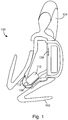
- sleep-sensing earphones 100 or 200 include an ear tip sealing structure 102 that blocks, or occludes, the entrance to the ear canal.
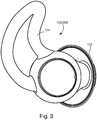
- Figures 1 and 2 show cross-sections of two different earphone examples, while figure 2 shows an exterior view, which is the same for the examples of either figure 1 or 2 , for reference.
- a retaining structure 104 helps retain the earphone in the ear, and puts pressure on the sealing structure 102 to maintain the seal by pushing on the concha, opposite to where the sealing structure meets the ear canal.
- the sealing structure 102 helps to passively block outside sounds from entering the ear, increasing the effectiveness of the masking sounds played by the earphones.
- FIG. 1 Another result of occluding the ear canal is that sounds produced by the body, such as the heartbeat and respiration sounds, are amplified within the ear canal.
- a microphone 106 figure 1
- 206 figure 2
- the processor 108 on-board each earphone can then extract the respiration rate from the heartbeat signal, and adjust the timing of entrainment sounds being played to the user through a speaker 110.
- the microphone 106 and speaker 110 are shown behind a screen 112, as described in U.S. Patent 9,635,452 , which is incorporated here by reference.
- the microphone may be mounted near or on the speaker 110, or integrated into the speaker housing.
- the microphone 206 is mounted directly to the PCB 208 and the screen 112 is flat, or may not be needed; the volume inside the earbud is coupled to the ear canal via space around the driver 110. As long as the earbud/ear canal system is effectively sealed at the frequencies of interest, the microphone will detect the targeted sounds coming from inside the ear canal.
- the heartbeat is derived from the microphone signals, and the respiration rate is derived from the heart rate variability.
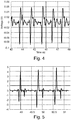
- the microphone coupled to the occluded ear canal detects heartbeats as energy peaks in a signal with a frequency of around 8-10 Hz (the heart rate itself is around 1 Hz). As this rate is far below the frequency range of the masking sounds, those sounds will not interfere with detecting the heartbeat.
- both ears are equipped with microphones, and the signals are transmitted to the smart phone (or from one ear to the other) for analysis, combining the amplitudes of the two signals at each time sample, such as by multiplication, can greatly increase the signal to noise ratio, as shown in figure 5 .
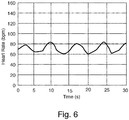
- Applying a peak-finding algorithm to the microphone signal and observing the distance between consecutive peaks yields the beat-to-beat, or instantaneous, heart rate value, shown in figure 6 .
- Figure 6 shows that there is a cyclic variability to the instantaneous heart rate.
- the period of this variability happens to be the respiration rate - as the user inhales, their heart rate increases, and as they exhale, their heart rate decreases.
- Applying another peak detection step, or other frequency analysis such as a fast Fourier transform (FFT) or fitting a sine to the curve, to the instantaneous heart rate or to its gradient, reveals the respiration rate.
- FFT fast Fourier transform
- the system microphone of the ANR system would be more than adequate for detecting the sound of blood flow and measuring the heart rate.
- ANR active noise reduction
- an ANR system is likely to consume a lot of power, and may not be suitable or necessary for sleep-focused earphones. Since the respiration and heart rate sensing is very narrow-band, a simpler MEMS microphone should be sufficient, and a much lower-power component may be used, benefiting the overall battery life and component size of the earphones.
- an external device such as a smartphone
- filter and demodulate the microphone signals may be used to filter and demodulate the microphone signals to detect the heart rate and extract the respiration rate from it, and to modify the output sounds accordingly, but battery life may be better served by doing all the processing within the earphones.
- the trade-off between power for processing and power for communication may depend on factors unrelated to the acoustics, including battery size, antenna placement, and memory requirements, to name a few.
- Embodiments of the systems and methods described above comprise computer components and computer-implemented steps that will be apparent to those skilled in the art.
- the computer-implemented steps maybe stored as computer-executable instructions on a computer-readable medium such as, for example, hard disks, optical disks, solid-state disks, flash ROMS, nonvolatile ROM, and RAM.
- the computer-executable instructions may be executed on a variety of processors such as, for example, microprocessors, digital signal processors, and gate arrays.
Landscapes
- Health & Medical Sciences (AREA)
- Life Sciences & Earth Sciences (AREA)
- Engineering & Computer Science (AREA)
- Physics & Mathematics (AREA)
- General Health & Medical Sciences (AREA)
- Public Health (AREA)
- Veterinary Medicine (AREA)
- Biomedical Technology (AREA)
- Heart & Thoracic Surgery (AREA)
- Animal Behavior & Ethology (AREA)
- Acoustics & Sound (AREA)
- Molecular Biology (AREA)
- Surgery (AREA)
- Medical Informatics (AREA)
- Biophysics (AREA)
- Pathology (AREA)
- Signal Processing (AREA)
- Otolaryngology (AREA)
- Anesthesiology (AREA)
- Psychology (AREA)
- Pain & Pain Management (AREA)
- Hematology (AREA)
- Pulmonology (AREA)
- Physiology (AREA)
- Cardiology (AREA)
- Manufacturing & Machinery (AREA)
- Multimedia (AREA)
- Measuring Pulse, Heart Rate, Blood Pressure Or Blood Flow (AREA)
Description
- This application is related to
U.S. Patent Application 15/106,989, filed June 21, 2016Application 15/348,400, filed November 10, 2016Application 15/352,034, filed November 17, 2016U.S. , entitled Sleep Assistance Device;Patent Application 15/267,567Application 15/267,464 Application 15/267,552 Application 15/267,848 Application 15/267,858 Application 15/267,886 - This disclosure relates to earphones for measuring and entraining respiration. Document
WO 2010/054863 shows a earphone comprising a loudspeaker, a microphone, a housing supporting the loudspeaker and the microphone, an ear tip surrounding the housing and configured to acoustically couple both the loudspeaker and the microphone to an ear canal of a user, and to acoustically close the entrance to the user's ear canal, and a processor configured to receive input audio signals from the microphone, to compute a rate of respiration from the input audio signals, to adjust output audio signals based on the rate of respiration, and to provide the adjusted output audio signals to the loudspeaker. - Sleeplessness and poor or interrupted sleep may significantly affect a person's health. Poor sleep may be caused by such factors as ambient noise, stress, medical conditions, or discomfort. Thus, there exists a need for a sleep aid that can help address the underlying causes of poor sleep without adversely affecting the user's health in other, unintended ways.
- In one aspect, a system according to
claim 1 is disclosed. - Implementations may include one or more of the following, in any combination. The processor may measure the frequency of the oscillation within the instantaneous heart rate by computing a fast Fourier transform (FFT) of the instantaneous heart rate. The processor may measure the frequency of the oscillation within the instantaneous heart rate by computing a gradient of the instantaneous heart rate, and computing a fast Fourier transform (FFT) of the gradient of the instantaneous heart rate. The processor may measure the frequency of the oscillation within the instantaneous heart rate by fitting a sine function to the instantaneous heart rate, the frequency of the sine being the frequency of the oscillation.
- The system includes a second earphone, which includes a second loudspeaker, a second microphone, a second housing supporting the second loudspeaker and second microphone, and a second ear tip surrounding the second housing and configured to acoustically couple both the second loudspeaker and the second microphone to a second ear canal of the user, and to acoustically close the entrance to the user's second ear canal, with the processor receiving second input audio signals from the microphone, and detecting the peaks having a frequency of around 1 Hz by combining the input audio signals from the first microphone with the second input audio signals, and detecting peaks within the result of the combination. Combining the input audio signals may include multiplying the amplitude of the first input audio signals by the amplitude of the second input audio signal, at each time that the two signals may be sampled. The processor may adjust output audio signals based on the rate of respiration, and provide the output audio signals to the loudspeaker. Adjusting the output audio signals may include adjusting a rhythm of the output audio signals to be about one cycle per minute less than the detected respiration rate. Adjusting the output audio signals may include transitioning the output audio signals from respiration entrainment sounds to masking sounds. Adjusting the output audio signals may include transitioning the output audio signals from masking sounds to awakening sounds. The earphone may include a memory storing sound files, and providing the output audio signals may include retrieving a first sound file from the memory. Adjusting the output audio signals may include retrieving a second sound file from the memory and using the second sound file to generate the output audio signal. The processor may be integrated within the earphone. The processor may be integrated within a portable computing device.
- In another aspect, a method of measuring the respiration rate of a user of earphones according to claim 13 is disclosed.
- Advantages include acoustically sensing the respiration rate at the ear without interference from audio signals being generated by the earphone.
- Other features and advantages will be apparent from the description and the claims.
-
-
Figures 1 and2 show cross-sectional views of earphones with an integrated microphones. -
Figure 3 shows an external view of the system offigure 1 or2 . -
Figures 4-6 show graphs of sensor readings - Several of the above-referenced applications describe a bedside system that detects a user's respiration rate and uses that to infer and manage their sleep state. In particular, to assist the user with falling to sleep, the system plays sounds that have a rhythm slightly slower than the user's own respiration rate . This naturally leads the user to slow their breathing to match the rhythm of the sounds, in a process referred to as entrainment. As the user slows their rate of respiration, the rate of the sounds is further reduced, in a feedback loop that leads the user gradually to sleep. Once the user falls asleep (as indicated by artifacts in their respiration rate), the system switches to playing masking sounds, which diminish the user's ability to detect, and be disturbed by, external sounds. If the user is detected to be waking up too early, entrainment may be reactivated. When it is time for the user to wake up, the system may coordinate wake-up sounds with the user's sleep state and other information to wake the user in the least-disruptive way possible.
- Others of the above-referenced applications describe intelligent earplugs which the user can wear while sleeping, and which provide masking sounds through the night, and alarm or alert sounds when needed. These earplugs are controlled by a smartphone, but principally operate autonomously, playing stored masking sounds until instructed otherwise by the controlling phone, or based on an internal clock. It would be advantageous if the intelligent earplugs could play the respiration-entraining sounds of the bedside systems, to help the user fall asleep without disturbing others who may be sharing the bed or room. One solution to that, described in co-pending application {attorney docket RS-16-247}, is for the sleep system to inform the earplugs of the user's respiration rate and sleep state, and for the earplugs to adjust the rate of a rhythmic component in stored entrainment sounds as in the out-loud system.
- This disclosure describes how to add respiration sensing to the earplugs themselves, so that the external system is not required, and the earplugs can operate fully autonomously, or with only a smart phone to control them.
- As shown in
figures 1 ,2 and3 , sleep-sensingearphones tip sealing structure 102 that blocks, or occludes, the entrance to the ear canal.Figures 1 and2 show cross-sections of two different earphone examples, whilefigure 2 shows an exterior view, which is the same for the examples of eitherfigure 1 or2 , for reference. Aretaining structure 104 helps retain the earphone in the ear, and puts pressure on thesealing structure 102 to maintain the seal by pushing on the concha, opposite to where the sealing structure meets the ear canal. Thesealing structure 102 helps to passively block outside sounds from entering the ear, increasing the effectiveness of the masking sounds played by the earphones. - Another result of occluding the ear canal is that sounds produced by the body, such as the heartbeat and respiration sounds, are amplified within the ear canal. With the addition of a microphone 106 (
figure 1 ) or 206 (figure 2 ), the heartbeat can be sensed and its rate determined. Theprocessor 108 on-board each earphone (or in one, if they coordinate their action) can then extract the respiration rate from the heartbeat signal, and adjust the timing of entrainment sounds being played to the user through aspeaker 110. In the example offigure 1 , themicrophone 106 andspeaker 110 are shown behind ascreen 112, as described inU.S. Patent 9,635,452 speaker 110, or integrated into the speaker housing. In the example offigure 2 , themicrophone 206 is mounted directly to the PCB 208 and thescreen 112 is flat, or may not be needed; the volume inside the earbud is coupled to the ear canal via space around thedriver 110. As long as the earbud/ear canal system is effectively sealed at the frequencies of interest, the microphone will detect the targeted sounds coming from inside the ear canal. Other configurations that couple the microphone - The heartbeat is derived from the microphone signals, and the respiration rate is derived from the heart rate variability. Specifically, as shown in
figure 4 , the microphone coupled to the occluded ear canal detects heartbeats as energy peaks in a signal with a frequency of around 8-10 Hz (the heart rate itself is around 1 Hz). As this rate is far below the frequency range of the masking sounds, those sounds will not interfere with detecting the heartbeat. If both ears are equipped with microphones, and the signals are transmitted to the smart phone (or from one ear to the other) for analysis, combining the amplitudes of the two signals at each time sample, such as by multiplication, can greatly increase the signal to noise ratio, as shown infigure 5 . Applying a peak-finding algorithm to the microphone signal and observing the distance between consecutive peaks yields the beat-to-beat, or instantaneous, heart rate value, shown infigure 6 . -
Figure 6 shows that there is a cyclic variability to the instantaneous heart rate. The period of this variability happens to be the respiration rate - as the user inhales, their heart rate increases, and as they exhale, their heart rate decreases. Applying another peak detection step, or other frequency analysis such as a fast Fourier transform (FFT) or fitting a sine to the curve, to the instantaneous heart rate or to its gradient, reveals the respiration rate. - If the earphones happen to include a feedback-based active noise reduction (ANR) system, to further block environmental sounds, the system microphone of the ANR system would be more than adequate for detecting the sound of blood flow and measuring the heart rate. However, an ANR system is likely to consume a lot of power, and may not be suitable or necessary for sleep-focused earphones. Since the respiration and heart rate sensing is very narrow-band, a simpler MEMS microphone should be sufficient, and a much lower-power component may be used, benefiting the overall battery life and component size of the earphones. Similarly, it may be possible to use an external device, such as a smartphone, to filter and demodulate the microphone signals to detect the heart rate and extract the respiration rate from it, and to modify the output sounds accordingly, but battery life may be better served by doing all the processing within the earphones. The trade-off between power for processing and power for communication may depend on factors unrelated to the acoustics, including battery size, antenna placement, and memory requirements, to name a few.
- Embodiments of the systems and methods described above comprise computer components and computer-implemented steps that will be apparent to those skilled in the art. For example, it should be understood by one of skill in the art that the computer-implemented steps maybe stored as computer-executable instructions on a computer-readable medium such as, for example, hard disks, optical disks, solid-state disks, flash ROMS, nonvolatile ROM, and RAM. Furthermore, it should be understood by one of skill in the art that the computer-executable instructions may be executed on a variety of processors such as, for example, microprocessors, digital signal processors, and gate arrays. For ease of exposition, not every step or element of the systems and methods described above is described herein as part of a computer system, but those skilled in the art will recognize that each step or element may have a corresponding computer system or software component. Such computer system and software components are therefore enabled by describing their corresponding steps or elements (that is, their functionality), and are within the scope of the disclosure.
- A number of implementations have been described. Nevertheless, it will be understood that additional modifications may be made without departing from the scope of the invention as defined by the following claims.
Claims (15)
- A system comprising:an earphone comprising:a loudspeaker;a microphone;a housing supporting the loudspeaker and the microphone; andan ear tip surrounding the housing and configured to acoustically couple both the loudspeaker and the microphone to an ear canal of a user, and to acoustically close the entrance to the user's ear canal;a second earphone comprising:a second loudspeaker;a second microphone;a second housing supporting the second loudspeaker and second microphone; anda second ear tip surrounding the second housing and configured to acoustically couple both the second loudspeaker and the second microphone to a second ear canal of the user, and to acoustically close the entrance to the user's second ear canal;anda processor configured to:receive first input audio signals from the microphone;receive second input audio signals from the second microphone;detect peaks having a frequency of around 1 Hz in the input audio signals by combining the first input audio signals with the second input audio signals, and detecting peaks within the result of the combination;based on the detected peaks, compute an instantaneous heart rate;measure a frequency of an oscillation within the instantaneous heart rate;based on the frequency of the oscillation, compute a rate of respiration,wherein the processor is further configured to adjust output audio signals based on the rate of respiration, and provide the adjusted output audio signals to the loudspeakers.
- The system of claim 1, wherein the processor is configured to measure the frequency of the oscillation within the instantaneous heart rate by computing a fast Fourier transform (FFT) of the instantaneous heart rate.
- The system of claim 1, wherein the processor is configured to measure the frequency of the oscillation within the instantaneous heart rate by computing a gradient of the instantaneous heart rate; and
computing a fast Fourier transform (FFT) of the gradient of the instantaneous heart rate. - The system of claim 1, wherein the processor is configured to measure the frequency of the oscillation within the instantaneous heart rate by detecting peaks of the instantaneous heart rate.
- The system of claim 1, wherein the processor is configured to measure the frequency of the oscillation within the instantaneous heart rate by fitting a sine function to the instantaneous heart rate, the frequency of the sine being the frequency of the oscillation.
- The system of claim 1, wherein combining the input audio signals comprises multiplying the amplitude of the first input audio signals by the amplitude of the second input audio signals, at each time that the two signals are sampled.
- The system of claim 1, wherein adjusting the output audio signals comprises adjusting a rhythm of the output audio signals to be about one cycle per minute less than the detected respiration rate.
- The system of claim 1, wherein adjusting the output audio signals comprises transitioning the output audio signals from respiration entrainment sounds to masking sounds.
- The system of claim 1, wherein adjusting the output audio signals comprises transitioning the output audio signals from masking sounds to awakening sounds.
- The system of claim 1, whereinthe earphone further includes a memory storing sound files; andproviding the output audio signals comprises retrieving a first sound file from the memory.
- The system of claim 10, wherein adjusting the output audio signals comprises retrieving a second sound file from the memory and using the second sound file to generate the output audio signal.
- The system of claim 1, wherein the processor is integrated within the earphone.
- A method of measuring the respiration rate of a user of earphones, the method comprising:receiving first input audio signals from a microphone supported by a housing and acoustically coupled to a user's ear canal by an ear tip surrounding the housing and acoustically closing the entrance to the user's ear canal;receiving second input audio signals from a second microphone supported by a second housing and acoustically coupled to a user's second ear canal by a second ear tip surrounding the second housing and acoustically closing the entrance to the user's second ear canal;in a processor,detecting peaks having a frequency of around 1 Hz in the input audio signals by combining the first input audio signals with the second input audio signals, and detecting peaks within the result of the combination,based on the detected peaks, computing an instantaneous heart rate, measuring a frequency of an oscillation within the instantaneous heart rate, based on the frequency of the oscillation, computing a rate of respiration, adjusting output audio signals based on the rate of respiration, and providing the adjusted output audio signals to loudspeakers of the earphones.
- The method of claim 13, wherein measuring the frequency of the oscillation within the instantaneous heart rate comprises computing a fast Fourier transform (FFT) of the instantaneous heart rate.
- The method of claim 13, wherein combining the input audio signals comprises multiplying the amplitude of the first input audio signals by the amplitude of the second input audio signals, at each time that the two signals are sampled.
Applications Claiming Priority (2)
| Application Number | Priority Date | Filing Date | Title |
|---|---|---|---|
| US15/655,853 US10632278B2 (en) | 2017-07-20 | 2017-07-20 | Earphones for measuring and entraining respiration |
| PCT/US2018/043061 WO2019018750A1 (en) | 2017-07-20 | 2018-07-20 | Earphones for measuring and entraining respiration |
Publications (2)
| Publication Number | Publication Date |
|---|---|
| EP3654833A1 EP3654833A1 (en) | 2020-05-27 |
| EP3654833B1 true EP3654833B1 (en) | 2021-10-13 |
Family
ID=63174400
Family Applications (1)
| Application Number | Title | Priority Date | Filing Date |
|---|---|---|---|
| EP18753505.9A Active EP3654833B1 (en) | 2017-07-20 | 2018-07-20 | Earphones for measuring and entraining respiration |
Country Status (4)
| Country | Link |
|---|---|
| US (1) | US10632278B2 (en) |
| EP (1) | EP3654833B1 (en) |
| CN (1) | CN110891478B (en) |
| WO (1) | WO2019018750A1 (en) |
Families Citing this family (18)
| Publication number | Priority date | Publication date | Assignee | Title |
|---|---|---|---|---|
| US10848848B2 (en) | 2017-07-20 | 2020-11-24 | Bose Corporation | Earphones for measuring and entraining respiration |
| US10632278B2 (en) | 2017-07-20 | 2020-04-28 | Bose Corporation | Earphones for measuring and entraining respiration |
| US10682491B2 (en) | 2017-07-20 | 2020-06-16 | Bose Corporation | Earphones for measuring and entraining respiration |
| US11013416B2 (en) | 2018-01-26 | 2021-05-25 | Bose Corporation | Measuring respiration with an in-ear accelerometer |
| US10327073B1 (en) * | 2018-08-31 | 2019-06-18 | Bose Corporation | Externalized audio modulated by respiration rate |
| WO2020168448A1 (en) * | 2019-02-18 | 2020-08-27 | 深圳市欢太科技有限公司 | Sleep prediction method and apparatus, and storage medium and electronic device |
| CN113440127B (en) * | 2020-03-25 | 2022-10-18 | 华为技术有限公司 | Method and device for acquiring respiratory data and electronic equipment |
| US11287877B2 (en) | 2020-05-25 | 2022-03-29 | Bayerische Motoren Werke Aktiengesellschaft | System and method for applying entrainment and biofeedback techniques to a user |
| CN111586524A (en) * | 2020-06-15 | 2020-08-25 | 南京信息职业技术学院 | A device and method for automatically removing earplugs during sleep |
| CN111966319B (en) * | 2020-07-16 | 2024-04-23 | 珠海市杰理科技股份有限公司 | Audio control method, device, system, storage medium and terminal |
| WO2022159543A1 (en) * | 2021-01-20 | 2022-07-28 | The Regents Of The University Of California | System and method for masking tinnitus |
| US20250318800A1 (en) * | 2022-06-10 | 2025-10-16 | Google Llc | Active Acoustic Sensing |
| JP7843376B2 (en) * | 2022-06-10 | 2026-04-09 | グーグル エルエルシー | Audio plethysmography calibration |
| EP4344403A1 (en) * | 2022-06-10 | 2024-04-03 | Google Technology Holdings LLC | Respiration rate sensing |
| CN115089152B (en) * | 2022-06-10 | 2026-03-24 | 维沃移动通信有限公司 | Heart rate detection methods, devices, wearable devices and media |
| DE102022206012B3 (en) * | 2022-06-14 | 2023-08-31 | Sivantos Pte. Ltd. | Method for measuring a person's heart rate using a hearing system |
| WO2024191456A1 (en) | 2023-03-13 | 2024-09-19 | Google Llc | Detecting heart rate variability using a hearable |
| EP4529220A1 (en) * | 2023-09-19 | 2025-03-26 | Starkey Laboratories, Inc. | Hearing device |
Family Cites Families (58)
| Publication number | Priority date | Publication date | Assignee | Title |
|---|---|---|---|---|
| US5143078A (en) | 1987-08-04 | 1992-09-01 | Colin Electronics Co., Ltd. | Respiration rate monitor |
| DE69204555T2 (en) * | 1991-06-07 | 1996-05-02 | Philips Electronics N.V., Eindhoven | Hearing aid for attachment in the ear canal. |
| ATE211339T1 (en) * | 1992-05-11 | 2002-01-15 | Jabra Corp | UNIDIRECTIONAL EAR MICROPHONE AND METHOD THEREOF |
| US6650327B1 (en) | 1998-06-16 | 2003-11-18 | Silicon Graphics, Inc. | Display system having floating point rasterization and floating point framebuffering |
| IL130818A (en) * | 1999-07-06 | 2005-07-25 | Intercure Ltd | Interventive-diagnostic device |
| JP2001344352A (en) * | 2000-05-31 | 2001-12-14 | Toshiba Corp | Life support apparatus, life support method, and advertisement information providing method |
| US6808473B2 (en) * | 2001-04-19 | 2004-10-26 | Omron Corporation | Exercise promotion device, and exercise promotion method employing the same |
| US6775389B2 (en) * | 2001-08-10 | 2004-08-10 | Advanced Bionics Corporation | Ear auxiliary microphone for behind the ear hearing prosthetic |
| KR100571811B1 (en) * | 2003-05-09 | 2006-04-17 | 삼성전자주식회사 | Boundary signal measuring device |
| CA2574642A1 (en) | 2004-07-23 | 2006-01-26 | Intercure Ltd. | Apparatus and method for breathing pattern determination using a non-contact microphone |
| US9779751B2 (en) * | 2005-12-28 | 2017-10-03 | Breath Research, Inc. | Respiratory biofeedback devices, systems, and methods |
| US7539533B2 (en) * | 2006-05-16 | 2009-05-26 | Bao Tran | Mesh network monitoring appliance |
| US8652040B2 (en) * | 2006-12-19 | 2014-02-18 | Valencell, Inc. | Telemetric apparatus for health and environmental monitoring |
| US20080171945A1 (en) * | 2007-01-15 | 2008-07-17 | Dotter James E | Apparatus and method for measuring heart rate and other physiological data |
| US7689274B2 (en) * | 2007-11-30 | 2010-03-30 | Palo Alto Research Center Incorporated | Brain-wave aware sleep management |
| US8622919B2 (en) * | 2008-11-17 | 2014-01-07 | Sony Corporation | Apparatus, method, and computer program for detecting a physiological measurement from a physiological sound signal |
| US8199956B2 (en) * | 2009-01-23 | 2012-06-12 | Sony Ericsson Mobile Communications | Acoustic in-ear detection for earpiece |
| CN102104815A (en) * | 2009-12-18 | 2011-06-22 | 富港电子(东莞)有限公司 | Auto-tuning earphone and earphone tuning method |
| TW201123929A (en) * | 2009-12-18 | 2011-07-01 | Cheng Uei Prec Ind Co Ltd | Automatic tunable earphone and method |
| PL2543027T3 (en) * | 2009-12-31 | 2017-02-28 | Nightbalance B.V. | Device for monitoring sleep position |
| US8882676B2 (en) * | 2010-06-03 | 2014-11-11 | Zinc Software Ltd. | Method and device for measuring the RSA component from heart rate data |
| CN103596492B (en) | 2011-02-09 | 2017-02-22 | 麻省理工学院 | Ear-Worn Vital Signs Monitor |
| JP2014525086A (en) * | 2011-07-05 | 2014-09-25 | サウジ アラビアン オイル カンパニー | Floor mat system and associated computer media for monitoring and improving employee health and productivity, and computer-implemented methods |
| US8600096B2 (en) * | 2011-08-02 | 2013-12-03 | Bose Corporation | Surface treatment for ear tips |
| EP3603502B1 (en) | 2011-10-13 | 2023-10-04 | Masimo Corporation | Physiological acoustic monitoring system |
| US9002023B2 (en) * | 2012-04-17 | 2015-04-07 | Bose Corporation | In-ear audio device customization |
| GB201209413D0 (en) | 2012-05-28 | 2012-07-11 | Obs Medical Ltd | Respiration rate extraction from cardiac signals |
| US8897459B2 (en) * | 2012-09-12 | 2014-11-25 | Bose Corporation | Two-way audio communication system with reduced ground noise |
| RU2613595C2 (en) * | 2012-11-22 | 2017-03-17 | Киосера Корпорейшн | Ear model unit, artificial head and measuring device and method using said ear model unit and artificial head |
| WO2014116942A2 (en) * | 2013-01-28 | 2014-07-31 | Valencell, Inc. | Physiological monitoring devices having sensing elements decoupled from body motion |
| CN104207755B (en) * | 2013-06-03 | 2018-06-29 | 飞比特公司 | Wearable heart rate monitor |
| JP6698521B2 (en) * | 2013-07-08 | 2020-05-27 | レスメッド センサー テクノロジーズ リミテッド | Sleep management method and system |
| US9445184B2 (en) * | 2013-12-03 | 2016-09-13 | Bose Corporation | Active noise reduction headphone |
| US9906636B2 (en) | 2014-02-23 | 2018-02-27 | Hush Technology Inc. | Intelligent earplug system |
| EP3565272A1 (en) | 2014-02-23 | 2019-11-06 | Bose Corporation | Intelligent earplug system |
| EP3146896B1 (en) | 2014-02-28 | 2020-04-01 | Valencell, Inc. | Method and apparatus for generating assessments using physical activity and biometric parameters |
| US20150258301A1 (en) | 2014-03-14 | 2015-09-17 | Aliphcom | Sleep state management by selecting and presenting audio content |
| CN104244125B (en) * | 2014-08-25 | 2018-01-09 | 歌尔股份有限公司 | A kind of heart rate detection method applied to earphone and the earphone that heart rate can be detected |
| KR101598400B1 (en) * | 2014-09-17 | 2016-02-29 | 해보라 주식회사 | Earset and the control method for the same |
| CN104257354A (en) * | 2014-10-24 | 2015-01-07 | 马利东 | Mobile phone with body health assessment function |
| GB2532745B (en) | 2014-11-25 | 2017-11-22 | Inova Design Solution Ltd | Portable physiology monitor |
| US11058304B2 (en) | 2015-07-15 | 2021-07-13 | Valencell, Inc. | Methods of controlling biometric parameters via musical audio |
| US9635452B2 (en) | 2015-08-05 | 2017-04-25 | Bose Corporation | Noise reduction with in-ear headphone |
| WO2017068571A1 (en) | 2015-10-20 | 2017-04-27 | Lifebeam Technologies Ltd. | Wired audio headset with physiological monitoring |
| US20170325718A1 (en) | 2016-05-12 | 2017-11-16 | Bragi GmbH | Neuropathic Diagnosis and Monitoring Using Earpiece Device, System, and Method |
| GB2554632B (en) | 2016-05-24 | 2021-02-24 | Inova Design Solution Ltd | Portable physiology monitor |
| US20170347177A1 (en) | 2016-05-25 | 2017-11-30 | Smartear, Inc. | In-Ear Utility Device Having Sensors |
| US10517527B2 (en) | 2016-09-16 | 2019-12-31 | Bose Corporation | Sleep quality scoring and improvement |
| US10434279B2 (en) | 2016-09-16 | 2019-10-08 | Bose Corporation | Sleep assistance device |
| US10561362B2 (en) | 2016-09-16 | 2020-02-18 | Bose Corporation | Sleep assessment using a home sleep system |
| US10653856B2 (en) | 2016-09-16 | 2020-05-19 | Bose Corporation | Sleep system |
| US10963146B2 (en) | 2016-09-16 | 2021-03-30 | Bose Corporation | User interface for a sleep system |
| US11594111B2 (en) | 2016-09-16 | 2023-02-28 | Bose Corporation | Intelligent wake-up system |
| CN106725488B (en) * | 2016-12-27 | 2023-08-18 | 深圳大学 | A wireless field strength respiration detection method, device and respiration detector |
| CN106851459A (en) * | 2017-03-22 | 2017-06-13 | 广州三星通信技术研究有限公司 | In-Ear Headphones |
| US10142720B1 (en) | 2017-05-17 | 2018-11-27 | Bose Corporation | Headphones with external pressure equalization path |
| US10848848B2 (en) | 2017-07-20 | 2020-11-24 | Bose Corporation | Earphones for measuring and entraining respiration |
| US10632278B2 (en) | 2017-07-20 | 2020-04-28 | Bose Corporation | Earphones for measuring and entraining respiration |
-
2017
- 2017-07-20 US US15/655,853 patent/US10632278B2/en active Active
-
2018
- 2018-07-20 CN CN201880047064.3A patent/CN110891478B/en active Active
- 2018-07-20 EP EP18753505.9A patent/EP3654833B1/en active Active
- 2018-07-20 WO PCT/US2018/043061 patent/WO2019018750A1/en not_active Ceased
Also Published As
| Publication number | Publication date |
|---|---|
| US20190022349A1 (en) | 2019-01-24 |
| CN110891478A (en) | 2020-03-17 |
| EP3654833A1 (en) | 2020-05-27 |
| WO2019018750A1 (en) | 2019-01-24 |
| CN110891478B (en) | 2022-07-05 |
| US10632278B2 (en) | 2020-04-28 |
Similar Documents
| Publication | Publication Date | Title |
|---|---|---|
| US10632278B2 (en) | Earphones for measuring and entraining respiration | |
| US11534572B2 (en) | Earphones for measuring and entraining respiration | |
| US12016662B2 (en) | Measuring respiration with an in-ear accelerometer | |
| US10848848B2 (en) | Earphones for measuring and entraining respiration | |
| US11705100B2 (en) | Dynamic sound masking based on monitoring biosignals and environmental noises | |
| US10027787B2 (en) | Intelligent earplug system | |
| EP2883494A1 (en) | Sound stimulator for memory enhancement | |
| US20190239772A1 (en) | Detecting respiration rate | |
| EP3021599A1 (en) | Hearing device having several modes | |
| US12057097B2 (en) | Earphone system and method for operating an earphone system | |
| JP4374929B2 (en) | Sleep promotion device | |
| CN115278446A (en) | Directional sound and control method thereof | |
| US20220273909A1 (en) | Fade-out of audio to minimize sleep disturbance field |
Legal Events
| Date | Code | Title | Description |
|---|---|---|---|
| STAA | Information on the status of an ep patent application or granted ep patent |
Free format text: STATUS: UNKNOWN |
|
| STAA | Information on the status of an ep patent application or granted ep patent |
Free format text: STATUS: THE INTERNATIONAL PUBLICATION HAS BEEN MADE |
|
| PUAI | Public reference made under article 153(3) epc to a published international application that has entered the european phase |
Free format text: ORIGINAL CODE: 0009012 |
|
| STAA | Information on the status of an ep patent application or granted ep patent |
Free format text: STATUS: REQUEST FOR EXAMINATION WAS MADE |
|
| 17P | Request for examination filed |
Effective date: 20200129 |
|
| AK | Designated contracting states |
Kind code of ref document: A1 Designated state(s): AL AT BE BG CH CY CZ DE DK EE ES FI FR GB GR HR HU IE IS IT LI LT LU LV MC MK MT NL NO PL PT RO RS SE SI SK SM TR |
|
| AX | Request for extension of the european patent |
Extension state: BA ME |
|
| DAV | Request for validation of the european patent (deleted) | ||
| DAX | Request for extension of the european patent (deleted) | ||
| GRAP | Despatch of communication of intention to grant a patent |
Free format text: ORIGINAL CODE: EPIDOSNIGR1 |
|
| STAA | Information on the status of an ep patent application or granted ep patent |
Free format text: STATUS: GRANT OF PATENT IS INTENDED |
|
| INTG | Intention to grant announced |
Effective date: 20210720 |
|
| GRAS | Grant fee paid |
Free format text: ORIGINAL CODE: EPIDOSNIGR3 |
|
| GRAA | (expected) grant |
Free format text: ORIGINAL CODE: 0009210 |
|
| STAA | Information on the status of an ep patent application or granted ep patent |
Free format text: STATUS: THE PATENT HAS BEEN GRANTED |
|
| AK | Designated contracting states |
Kind code of ref document: B1 Designated state(s): AL AT BE BG CH CY CZ DE DK EE ES FI FR GB GR HR HU IE IS IT LI LT LU LV MC MK MT NL NO PL PT RO RS SE SI SK SM TR |
|
| REG | Reference to a national code |
Ref country code: GB Ref legal event code: FG4D |
|
| REG | Reference to a national code |
Ref country code: CH Ref legal event code: EP |
|
| REG | Reference to a national code |
Ref country code: DE Ref legal event code: R096 Ref document number: 602018025032 Country of ref document: DE |
|
| REG | Reference to a national code |
Ref country code: IE Ref legal event code: FG4D |
|
| REG | Reference to a national code |
Ref country code: AT Ref legal event code: REF Ref document number: 1437510 Country of ref document: AT Kind code of ref document: T Effective date: 20211115 |
|
| REG | Reference to a national code |
Ref country code: LT Ref legal event code: MG9D |
|
| REG | Reference to a national code |
Ref country code: NL Ref legal event code: MP Effective date: 20211013 |
|
| REG | Reference to a national code |
Ref country code: AT Ref legal event code: MK05 Ref document number: 1437510 Country of ref document: AT Kind code of ref document: T Effective date: 20211013 |
|
| PG25 | Lapsed in a contracting state [announced via postgrant information from national office to epo] |
Ref country code: RS Free format text: LAPSE BECAUSE OF FAILURE TO SUBMIT A TRANSLATION OF THE DESCRIPTION OR TO PAY THE FEE WITHIN THE PRESCRIBED TIME-LIMIT Effective date: 20211013 Ref country code: LT Free format text: LAPSE BECAUSE OF FAILURE TO SUBMIT A TRANSLATION OF THE DESCRIPTION OR TO PAY THE FEE WITHIN THE PRESCRIBED TIME-LIMIT Effective date: 20211013 Ref country code: FI Free format text: LAPSE BECAUSE OF FAILURE TO SUBMIT A TRANSLATION OF THE DESCRIPTION OR TO PAY THE FEE WITHIN THE PRESCRIBED TIME-LIMIT Effective date: 20211013 Ref country code: BG Free format text: LAPSE BECAUSE OF FAILURE TO SUBMIT A TRANSLATION OF THE DESCRIPTION OR TO PAY THE FEE WITHIN THE PRESCRIBED TIME-LIMIT Effective date: 20220113 Ref country code: AT Free format text: LAPSE BECAUSE OF FAILURE TO SUBMIT A TRANSLATION OF THE DESCRIPTION OR TO PAY THE FEE WITHIN THE PRESCRIBED TIME-LIMIT Effective date: 20211013 |
|
| PG25 | Lapsed in a contracting state [announced via postgrant information from national office to epo] |
Ref country code: IS Free format text: LAPSE BECAUSE OF FAILURE TO SUBMIT A TRANSLATION OF THE DESCRIPTION OR TO PAY THE FEE WITHIN THE PRESCRIBED TIME-LIMIT Effective date: 20220213 Ref country code: SE Free format text: LAPSE BECAUSE OF FAILURE TO SUBMIT A TRANSLATION OF THE DESCRIPTION OR TO PAY THE FEE WITHIN THE PRESCRIBED TIME-LIMIT Effective date: 20211013 Ref country code: PT Free format text: LAPSE BECAUSE OF FAILURE TO SUBMIT A TRANSLATION OF THE DESCRIPTION OR TO PAY THE FEE WITHIN THE PRESCRIBED TIME-LIMIT Effective date: 20220214 Ref country code: PL Free format text: LAPSE BECAUSE OF FAILURE TO SUBMIT A TRANSLATION OF THE DESCRIPTION OR TO PAY THE FEE WITHIN THE PRESCRIBED TIME-LIMIT Effective date: 20211013 Ref country code: NO Free format text: LAPSE BECAUSE OF FAILURE TO SUBMIT A TRANSLATION OF THE DESCRIPTION OR TO PAY THE FEE WITHIN THE PRESCRIBED TIME-LIMIT Effective date: 20220113 Ref country code: NL Free format text: LAPSE BECAUSE OF FAILURE TO SUBMIT A TRANSLATION OF THE DESCRIPTION OR TO PAY THE FEE WITHIN THE PRESCRIBED TIME-LIMIT Effective date: 20211013 Ref country code: LV Free format text: LAPSE BECAUSE OF FAILURE TO SUBMIT A TRANSLATION OF THE DESCRIPTION OR TO PAY THE FEE WITHIN THE PRESCRIBED TIME-LIMIT Effective date: 20211013 Ref country code: HR Free format text: LAPSE BECAUSE OF FAILURE TO SUBMIT A TRANSLATION OF THE DESCRIPTION OR TO PAY THE FEE WITHIN THE PRESCRIBED TIME-LIMIT Effective date: 20211013 Ref country code: GR Free format text: LAPSE BECAUSE OF FAILURE TO SUBMIT A TRANSLATION OF THE DESCRIPTION OR TO PAY THE FEE WITHIN THE PRESCRIBED TIME-LIMIT Effective date: 20220114 Ref country code: ES Free format text: LAPSE BECAUSE OF FAILURE TO SUBMIT A TRANSLATION OF THE DESCRIPTION OR TO PAY THE FEE WITHIN THE PRESCRIBED TIME-LIMIT Effective date: 20211013 |
|
| REG | Reference to a national code |
Ref country code: DE Ref legal event code: R097 Ref document number: 602018025032 Country of ref document: DE |
|
| PG25 | Lapsed in a contracting state [announced via postgrant information from national office to epo] |
Ref country code: SM Free format text: LAPSE BECAUSE OF FAILURE TO SUBMIT A TRANSLATION OF THE DESCRIPTION OR TO PAY THE FEE WITHIN THE PRESCRIBED TIME-LIMIT Effective date: 20211013 Ref country code: SK Free format text: LAPSE BECAUSE OF FAILURE TO SUBMIT A TRANSLATION OF THE DESCRIPTION OR TO PAY THE FEE WITHIN THE PRESCRIBED TIME-LIMIT Effective date: 20211013 Ref country code: RO Free format text: LAPSE BECAUSE OF FAILURE TO SUBMIT A TRANSLATION OF THE DESCRIPTION OR TO PAY THE FEE WITHIN THE PRESCRIBED TIME-LIMIT Effective date: 20211013 Ref country code: EE Free format text: LAPSE BECAUSE OF FAILURE TO SUBMIT A TRANSLATION OF THE DESCRIPTION OR TO PAY THE FEE WITHIN THE PRESCRIBED TIME-LIMIT Effective date: 20211013 Ref country code: DK Free format text: LAPSE BECAUSE OF FAILURE TO SUBMIT A TRANSLATION OF THE DESCRIPTION OR TO PAY THE FEE WITHIN THE PRESCRIBED TIME-LIMIT Effective date: 20211013 Ref country code: CZ Free format text: LAPSE BECAUSE OF FAILURE TO SUBMIT A TRANSLATION OF THE DESCRIPTION OR TO PAY THE FEE WITHIN THE PRESCRIBED TIME-LIMIT Effective date: 20211013 |
|
| PLBE | No opposition filed within time limit |
Free format text: ORIGINAL CODE: 0009261 |
|
| STAA | Information on the status of an ep patent application or granted ep patent |
Free format text: STATUS: NO OPPOSITION FILED WITHIN TIME LIMIT |
|
| 26N | No opposition filed |
Effective date: 20220714 |
|
| PG25 | Lapsed in a contracting state [announced via postgrant information from national office to epo] |
Ref country code: AL Free format text: LAPSE BECAUSE OF FAILURE TO SUBMIT A TRANSLATION OF THE DESCRIPTION OR TO PAY THE FEE WITHIN THE PRESCRIBED TIME-LIMIT Effective date: 20211013 |
|
| PG25 | Lapsed in a contracting state [announced via postgrant information from national office to epo] |
Ref country code: SI Free format text: LAPSE BECAUSE OF FAILURE TO SUBMIT A TRANSLATION OF THE DESCRIPTION OR TO PAY THE FEE WITHIN THE PRESCRIBED TIME-LIMIT Effective date: 20211013 |
|
| PG25 | Lapsed in a contracting state [announced via postgrant information from national office to epo] |
Ref country code: MC Free format text: LAPSE BECAUSE OF FAILURE TO SUBMIT A TRANSLATION OF THE DESCRIPTION OR TO PAY THE FEE WITHIN THE PRESCRIBED TIME-LIMIT Effective date: 20211013 |
|
| REG | Reference to a national code |
Ref country code: CH Ref legal event code: PL |
|
| REG | Reference to a national code |
Ref country code: BE Ref legal event code: MM Effective date: 20220731 |
|
| PG25 | Lapsed in a contracting state [announced via postgrant information from national office to epo] |
Ref country code: LU Free format text: LAPSE BECAUSE OF NON-PAYMENT OF DUE FEES Effective date: 20220720 Ref country code: LI Free format text: LAPSE BECAUSE OF NON-PAYMENT OF DUE FEES Effective date: 20220731 Ref country code: CH Free format text: LAPSE BECAUSE OF NON-PAYMENT OF DUE FEES Effective date: 20220731 |
|
| PG25 | Lapsed in a contracting state [announced via postgrant information from national office to epo] |
Ref country code: IT Free format text: LAPSE BECAUSE OF FAILURE TO SUBMIT A TRANSLATION OF THE DESCRIPTION OR TO PAY THE FEE WITHIN THE PRESCRIBED TIME-LIMIT Effective date: 20211013 Ref country code: BE Free format text: LAPSE BECAUSE OF NON-PAYMENT OF DUE FEES Effective date: 20220731 |
|
| PG25 | Lapsed in a contracting state [announced via postgrant information from national office to epo] |
Ref country code: IE Free format text: LAPSE BECAUSE OF NON-PAYMENT OF DUE FEES Effective date: 20220720 |
|
| PG25 | Lapsed in a contracting state [announced via postgrant information from national office to epo] |
Ref country code: MK Free format text: LAPSE BECAUSE OF FAILURE TO SUBMIT A TRANSLATION OF THE DESCRIPTION OR TO PAY THE FEE WITHIN THE PRESCRIBED TIME-LIMIT Effective date: 20211013 Ref country code: CY Free format text: LAPSE BECAUSE OF FAILURE TO SUBMIT A TRANSLATION OF THE DESCRIPTION OR TO PAY THE FEE WITHIN THE PRESCRIBED TIME-LIMIT Effective date: 20211013 |
|
| PG25 | Lapsed in a contracting state [announced via postgrant information from national office to epo] |
Ref country code: HU Free format text: LAPSE BECAUSE OF FAILURE TO SUBMIT A TRANSLATION OF THE DESCRIPTION OR TO PAY THE FEE WITHIN THE PRESCRIBED TIME-LIMIT; INVALID AB INITIO Effective date: 20180720 |
|
| REG | Reference to a national code |
Ref country code: DE Ref legal event code: R081 Ref document number: 602018025032 Country of ref document: DE Owner name: DROWSY DIGITAL, INC., DOVER, US Free format text: FORMER OWNER: BOSE CORPORATION, FRAMINGHAM, MA, US |
|
| REG | Reference to a national code |
Ref country code: GB Ref legal event code: 732E Free format text: REGISTERED BETWEEN 20240628 AND 20240703 |
|
| PG25 | Lapsed in a contracting state [announced via postgrant information from national office to epo] |
Ref country code: MT Free format text: LAPSE BECAUSE OF FAILURE TO SUBMIT A TRANSLATION OF THE DESCRIPTION OR TO PAY THE FEE WITHIN THE PRESCRIBED TIME-LIMIT Effective date: 20211013 |
|
| PGFP | Annual fee paid to national office [announced via postgrant information from national office to epo] |
Ref country code: DE Payment date: 20250723 Year of fee payment: 8 |
|
| PGFP | Annual fee paid to national office [announced via postgrant information from national office to epo] |
Ref country code: GB Payment date: 20250724 Year of fee payment: 8 |
|
| PGFP | Annual fee paid to national office [announced via postgrant information from national office to epo] |
Ref country code: FR Payment date: 20250717 Year of fee payment: 8 |
|
| PG25 | Lapsed in a contracting state [announced via postgrant information from national office to epo] |
Ref country code: TR Free format text: LAPSE BECAUSE OF FAILURE TO SUBMIT A TRANSLATION OF THE DESCRIPTION OR TO PAY THE FEE WITHIN THE PRESCRIBED TIME-LIMIT Effective date: 20211013 |