EP3652159B1 - Substituted thiazole derivatives as rad51 inhibitors for the treatment of cancer diseases, autoimmune and neurodegenerative conditions - Google Patents
Substituted thiazole derivatives as rad51 inhibitors for the treatment of cancer diseases, autoimmune and neurodegenerative conditions Download PDFInfo
- Publication number
- EP3652159B1 EP3652159B1 EP18746518.2A EP18746518A EP3652159B1 EP 3652159 B1 EP3652159 B1 EP 3652159B1 EP 18746518 A EP18746518 A EP 18746518A EP 3652159 B1 EP3652159 B1 EP 3652159B1
- Authority
- EP
- European Patent Office
- Prior art keywords
- nhc
- phenyl
- alkyl
- nhch
- och
- Prior art date
- Legal status (The legal status is an assumption and is not a legal conclusion. Google has not performed a legal analysis and makes no representation as to the accuracy of the status listed.)
- Active
Links
Classifications
-
- A—HUMAN NECESSITIES
- A61—MEDICAL OR VETERINARY SCIENCE; HYGIENE
- A61K—PREPARATIONS FOR MEDICAL, DENTAL OR TOILETRY PURPOSES
- A61K31/00—Medicinal preparations containing organic active ingredients
- A61K31/33—Heterocyclic compounds
- A61K31/395—Heterocyclic compounds having nitrogen as a ring hetero atom, e.g. guanethidine or rifamycins
- A61K31/41—Heterocyclic compounds having nitrogen as a ring hetero atom, e.g. guanethidine or rifamycins having five-membered rings with two or more ring hetero atoms, at least one of which being nitrogen, e.g. tetrazole
- A61K31/425—Thiazoles
- A61K31/427—Thiazoles not condensed and containing further heterocyclic rings
-
- C—CHEMISTRY; METALLURGY
- C07—ORGANIC CHEMISTRY
- C07D—HETEROCYCLIC COMPOUNDS
- C07D277/00—Heterocyclic compounds containing 1,3-thiazole or hydrogenated 1,3-thiazole rings
- C07D277/02—Heterocyclic compounds containing 1,3-thiazole or hydrogenated 1,3-thiazole rings not condensed with other rings
- C07D277/20—Heterocyclic compounds containing 1,3-thiazole or hydrogenated 1,3-thiazole rings not condensed with other rings having two or three double bonds between ring members or between ring members and non-ring members
- C07D277/22—Heterocyclic compounds containing 1,3-thiazole or hydrogenated 1,3-thiazole rings not condensed with other rings having two or three double bonds between ring members or between ring members and non-ring members with only hydrogen atoms, hydrocarbon or substituted hydrocarbon radicals, directly attached to ring carbon atoms
- C07D277/28—Radicals substituted by nitrogen atoms
-
- A—HUMAN NECESSITIES
- A61—MEDICAL OR VETERINARY SCIENCE; HYGIENE
- A61K—PREPARATIONS FOR MEDICAL, DENTAL OR TOILETRY PURPOSES
- A61K31/00—Medicinal preparations containing organic active ingredients
- A61K31/33—Heterocyclic compounds
- A61K31/395—Heterocyclic compounds having nitrogen as a ring hetero atom, e.g. guanethidine or rifamycins
- A61K31/41—Heterocyclic compounds having nitrogen as a ring hetero atom, e.g. guanethidine or rifamycins having five-membered rings with two or more ring hetero atoms, at least one of which being nitrogen, e.g. tetrazole
- A61K31/425—Thiazoles
- A61K31/426—1,3-Thiazoles
-
- A—HUMAN NECESSITIES
- A61—MEDICAL OR VETERINARY SCIENCE; HYGIENE
- A61K—PREPARATIONS FOR MEDICAL, DENTAL OR TOILETRY PURPOSES
- A61K31/00—Medicinal preparations containing organic active ingredients
- A61K31/33—Heterocyclic compounds
- A61K31/395—Heterocyclic compounds having nitrogen as a ring hetero atom, e.g. guanethidine or rifamycins
- A61K31/495—Heterocyclic compounds having nitrogen as a ring hetero atom, e.g. guanethidine or rifamycins having six-membered rings with two or more nitrogen atoms as the only ring heteroatoms, e.g. piperazine or tetrazines
- A61K31/496—Non-condensed piperazines containing further heterocyclic rings, e.g. rifampin, thiothixene or sparfloxacin
-
- A—HUMAN NECESSITIES
- A61—MEDICAL OR VETERINARY SCIENCE; HYGIENE
- A61K—PREPARATIONS FOR MEDICAL, DENTAL OR TOILETRY PURPOSES
- A61K45/00—Medicinal preparations containing active ingredients not provided for in groups A61K31/00 - A61K41/00
- A61K45/06—Mixtures of active ingredients without chemical characterisation, e.g. antiphlogistics and cardiaca
-
- C—CHEMISTRY; METALLURGY
- C07—ORGANIC CHEMISTRY
- C07D—HETEROCYCLIC COMPOUNDS
- C07D417/00—Heterocyclic compounds containing two or more hetero rings, at least one ring having nitrogen and sulfur atoms as the only ring hetero atoms, not provided for by group C07D415/00
- C07D417/02—Heterocyclic compounds containing two or more hetero rings, at least one ring having nitrogen and sulfur atoms as the only ring hetero atoms, not provided for by group C07D415/00 containing two hetero rings
- C07D417/10—Heterocyclic compounds containing two or more hetero rings, at least one ring having nitrogen and sulfur atoms as the only ring hetero atoms, not provided for by group C07D415/00 containing two hetero rings linked by a carbon chain containing aromatic rings
-
- C—CHEMISTRY; METALLURGY
- C07—ORGANIC CHEMISTRY
- C07D—HETEROCYCLIC COMPOUNDS
- C07D417/00—Heterocyclic compounds containing two or more hetero rings, at least one ring having nitrogen and sulfur atoms as the only ring hetero atoms, not provided for by group C07D415/00
- C07D417/02—Heterocyclic compounds containing two or more hetero rings, at least one ring having nitrogen and sulfur atoms as the only ring hetero atoms, not provided for by group C07D415/00 containing two hetero rings
- C07D417/12—Heterocyclic compounds containing two or more hetero rings, at least one ring having nitrogen and sulfur atoms as the only ring hetero atoms, not provided for by group C07D415/00 containing two hetero rings linked by a chain containing hetero atoms as chain links
Definitions
- This application is directed to inhibitors of RAD51, and these compounds for use in methods such as to treat conditions such as cancer, autoimmune disease, immune deficiency, or neurodegenerative disease.
- Homologous recombination has multiple roles in DNA repair including the repair of DNA double-strand breaks (DSBs) and recovery from the replication blocking lesions formed by DNA cross-linking agents. HR repairs DSBs by locating a homologous stretch of DNA and replicating the missing genetic information from the homologous template. Numerous studies have also shown HR to be critically important in the maintenance of genomic stability ( Thompson and Schild, "Homologous recombinational repair of DNA ensures mammalian chromosome stability," Mutat.
- RAD51 is a eukaryote gene.
- the protein encoded by this gene is a member of the RAD51 protein family which assists in repair of DNA double strand breaks.
- RAD51 family members are homologous to the bacterial RecA, Archaeal RadA and yeast Rad51. The protein is highly conserved in most eukaryotes, from yeast to humans.
- RAD51 is a 339-amino acid protein that plays a major role in homologous recombination of DNA during double strand break (DSB) repair.
- RAD51 catalyzes strand transfer between a broken sequence and its undamaged homologue to allow re-synthesis of the damaged region (see homologous recombination models).
- HR can be partially inhibited in order to sensitize cells to DNA damaging therapies.
- Inhibition of XRCC3 (a RAD51 paralog protein) has been demonstrated using a synthetic peptide corresponding to another paralog protein.
- Other researchers have inhibited the expression of the RAD51 protein itself ( Russell et al., Cancer Res., 63:7377-7383, 2003 ; Hansen et al., Int. J.
- the present invention provides a compound represented by Structural Formula I: or a pharmaceutically acceptable salt thereof.
- the definition of each variable is provided below.
- the present invention also provides a pharmaceutical composition
- a pharmaceutical composition comprising a compound as described herein and a pharmaceutically acceptable carrier or diluent.
- the present invention further provides a compound as disclosed herein or a pharmaceutically acceptable salt thereof, or a corresponding pharmaceutical composition, for use in a method of treating cancer, autoimmune disease, immune deficiency, or neurodegenerative disease, the method comprises administering to a subject in need thereof an effective amount of the compound or pharmaceutical composition.
- the disclosed compounds, or a pharmaceutically acceptable salt thereof, or the pharmaceutical compositions disclosed herein are for use in treating cancer, autoimmune disease, immune deficiency, or neurodegenerative disease.
- the present invention provides a compound as disclosed herein or a pharmaceutically acceptable salt thereof, or a corresponding pharmaceutical composition, for use in a method of treating a subject with cancer, the method comprises administering to a subject in need thereof an effective amount of of the compound or pharmaceutical composition, wherein the cancer is selected from the group consisting of lymphoma, leukemia, and a plasma cell neoplasm.
- the disclosed compounds, or a pharmaceutically acceptable salt thereof, or the pharmaceutical compositions disclosed herein are for use in treating cancer, wherein the cancer is selected from the group consisting of lymphoma, leukemia, and a plasma cell neoplasm.
- the invention provides a compound represented by Structural Formula I: II or a pharmaceutically acceptable salt thereof, wherein:
- the invention provides a compound represented by Structural Formula III: or a pharmaceutically acceptable salt thereof, wherein R 3 is -H, halogen, -C(O)O(C 1 -C 4 )alkyl, - S(O) 2 NH 2 , or -SO 2 NR a (C 1 -C 4 )alkyl; and the remaining variables are as defined in the first embodiment.
- the invention provides a compound according to Structural Formula II , or III , or a pharmaceutically acceptable salt thereof, wherein:
- the invention provides a compound according to Structural Formula II, or III , or a pharmaceutically acceptable salt thereof, wherein:
- the invention provides a compound according to Structural Formula II, or III , or a pharmaceutically acceptable salt thereof, wherein:
- the invention provides a compound according to Structural Formula II, or III , or a pharmaceutically acceptable salt thereof, wherein:
- the invention provides a compound according to Structural Formula II, or III , or a pharmaceutically acceptable salt thereof, wherein:
- the invention provides a compound according to Structural Formula II, or III , or a pharmaceutically acceptable salt thereof, wherein:
- the invention provides a compound represented by Structural Formula IV or V: or a pharmaceutically acceptable salt thereof, wherein the thiazole ring is optionally substituted with -F or -Cl.
- the thiazole ring is unsubstituted;
- R 3 is -H, halogen, - C(O)O(C 1 -C 4 )alkyl, -S(O) 2 NH 2 , or -SO 2 NR a (C 1 -C 4 )alkyl; and the remainder of the variables are as defined in the first embodiment.
- the invention provides a compound according to Structural Formula IV or V, or a pharmaceutically acceptable salt thereof, wherein:
- the invention provides a compound according to Structural Formula IV or V, or a pharmaceutically acceptable salt thereof, wherein:
- pharmaceutically acceptable salt refers to a pharmaceutical salt that is, within the scope of sound medical judgment, suitable for use in contact with the tissues of humans and lower animals without undue toxicity, irritation, and allergic response, and is commensurate with a reasonable benefit/risk ratio.
- Pharmaceutically-acceptable salts are well known in the art. For example, S. M. Berge et al. describes pharmacologically acceptable salts in J. Pharm. Sci., 1977, 66, 1-19 .
- Suitable pharmaceutically acceptable salts of the compounds disclosed herein include salts of inorganic acids (such as hydrochloric acid, hydrobromic, phosphoric, metaphosphoric, nitric, and sulfuric acids) and of organic acids (such as acetic acid, benzenesulfonic, benzoic, ethanesulfonic, methanesulfonic, succinic, and trifluoroacetic acid acids).
- acidic groups such as carboxylic acids can form pharmaceutically acceptable salts with pharmaceutically acceptable base(s).
- Suitable pharmaceutically acceptable basic salts include ammonium salts, alkali metal salts (such as sodium and potassium salts) and alkaline earth metal salts (such as magnesium and calcium salts).
- halo as used herein means halogen and includes fluoro, chloro, bromo and iodo.
- alkyl used alone or as part of a larger moiety, such as “alkoxy” or “haloalkyl” and the like, means saturated aliphatic straight-chain or branched monovalent hydrocarbon radical. Unless otherwise specified, an alkyl group typically has 1-5 carbon atoms, i.e. (C 1 -C 5 )alkyl. As used herein, a "(C 1 -C 5 )alkyl” group means a radical having from 1 to 5 carbon atoms in a linear or branched arrangement. Examples include methyl, ethyl, n -propyl, iso -propyl, and the like.
- alkoxy means an alkyl radical attached through an oxygen linking atom, represented by -O-alkyl.
- alkoxy means an alkyl radical attached through an oxygen linking atom, represented by -O-alkyl.
- (C 1 -C 4 )alkoxy includes methoxy, ethoxy, propoxy, and butoxy.
- haloalkyl and “haloalkoxy” means alkyl or alkoxy, as the case may be, substituted with one or more halogen atoms.
- alkylene group is a saturated aliphatic branched or straight-chain divalent hydrocarbon radical. Unless otherwise specified, an alkylene group typically has 2-6 carbon atoms, i.e. (C 2 -C 6 )alkylene.
- alkenyl means branched or straight-chain monovalent hydrocarbon radical containing at least one double bond. Alkenyl may be mono or polyunsaturated, and may exist in the E or Z configuration. Unless otherwise specified, an alkenyl group typically has 2-6 carbon atoms, i.e. (C 2 -C 6 )alkenyl. For example, “(C 2 -C 4 )alkenyl” means a radical having from 2-4 carbon atoms in a linear or branched arrangement.
- cycloalkyl means a monocyclic saturated hydrocarbon ring system.
- a C 3-6 cycloalkyl includes cyclopropyl, cyclobutyl, cyclopentyl and cyclohexyl.
- a "cycloalkyl” has from three to seven ring carbon atoms.
- cycloalkenyl means a non-aromatic monocyclic ring system containing a carbon-carbon double bond and having 3 to 7 ring carbon atoms.
- heterocyclyl or “heterocyclic ring” means a saturated or unsaturated non-aromatic 3-12 membered ring radical containing from 1 to 4 ring heteroatoms, which may be the same or different, selected from N, O or S. It can be monocyclic, bicyclic or tricyclic ( e.g. , a fused or bridged bicyclic or tricyclic ring).
- a heterocyclyl optionally contains one or more double bonds and/or is optionally fused with one or more aromatic rings (for example, tetrahydronaphthyridine, indolinone, dihydropyrrolotriazole, imidazopyrimidine, quinolinone, dioxaspirodecane).
- 3-7 membered monocyclic heterocyclic ring means a radical having from 3-7 atoms arranged in a monocyclic ring.
- heterocyclyl is intended to include all the possible isomeric forms.
- Examples of 3-7 membered monocyclic heterocyclic ring include, but are not limited to, azetidinyl, morpholinyl, thiomorpholinyl, pyrrolidinonyl, pyrrolidinyl, piperidinyl, piperazinyl, hydantoinyl, valerolactamyl, oxiranyl, oxetanyl, dihydroimidazole, dihydrofuranyl, dihydropyranyl, dihydropyridinyl, dihydropyrimidinyl, dihydrothienyl, dihydrothiophenyl, dihydrothiopyranyl, tetrahydroimidazole, tetrahydrofuranyl, te
- bicyclic heterocyclic groups include dihydroindolyl, dihydroisoindolyl, dihydrobenzimidazolyl, dihydrobenzothienyl, dihydrobenzofuranyl, dihydroisobenzofuranyl, dihydrobenzotriazolyl, dihydrobenzothiazolyl, dihydrobenzoxazolyl, dihydroquinolinyl, tetrahydroquinolinyl, dihydroisoquinolinyl, tetrahydroisoquinolinyl, dihydroindazolyl, dihydroacridinyl, tetrahydroacridinyl, dihydrobenzisoxazolyl, chroman, chromene, isochroman and isochromene.
- bridged bicyclic group refers to a ring system which includes two rings that share at least three adjacent ring atoms.
- "Nitrogen-containing bridged bicyclic groups” are bridged bicyclic groups with a ring nitrogen atom. Examples include azabicyclo[3.2.1]octane, azabicyclo[2.2.1]heptane, azabicyclo[3.1.0]hexane, and the like.
- fused bicyclic group refers to a ring system which includes two rings that share at two adjacent ring atoms.
- N -nitrogen containing heterocyclyl ring means that the nitrogen containing heterocyclic is attached to the reminder of the compound through a ring nitrogen atom.
- N -piperidinyl means that the piperidinyl is connected with the remaining part of a compound through the ring nitrogen ring atom in the piperidinyl.
- heteroaryl when used alone or as part of a larger moiety as in “heteroaralkyl” or “heteroarylalkoxy”, refers to aromatic ring groups having five to ten ring atoms selected from carbon and at least one (typically 1 to 4, more typically 1 or 2) heteroatoms ( e.g ., oxygen, nitrogen or sulfur).
- Heteroaryl includes monocyclic rings and polycyclic rings in which a monocyclic heteroaromatic ring is fused to one or more other aromatic or heteroaromatic rings. “Heteroaryl” includes monocyclic and bicyclic ring systems.
- “Monocyclic 5-6 membered heteroaryl” means a monocyclic aromatic ring system having five or six ring atoms selected from carbon and at least one (typically 1 to 3, more typically 1 or 2) heteroatoms (e.g ., oxygen, nitrogen or sulfur).
- Examples of monocyclic 5-6 membered heteroaryl groups include furanyl (e.g., 2-furanyl, 3-furanyl), imidazolyl ( e.g., N-imidazolyl, 2-imidazolyl, 4-imidazolyl, 5-imidazolyl), isoxazolyl ( e.g., 3-isoxazolyl, 4-isoxazolyl, 5-isoxazolyl), oxadiazolyl ( e.g., 2-oxadiazolyl, 5-oxadiazolyl), oxazolyl ( e.g., 2-oxazolyl, 4-oxazolyl, 5-oxazolyl), pyrazolyl ( e.g., 3-pyrazolyl, 4-pyrazolyl), pyrrolyl ( e.g.
- pyridyl e.g., 2-pyridyl, 3-pyridyl, 4-pyridyl
- bicyclic aromatic heteroaryl groups include carbazolyl, benzimidazolyl, benzothienyl, benzofuranyl, isobenzofuranyl, indolyl, benzotriazolyl, benzothiazolyl, benzoxazolyl, quinolinyl, isoquinolinyl, indazolyl, isoindolyl, acridinyl, or benzisoxazolyl.
- phenylene refers to a group (C 6 H 4 ) based on a di-substituted benzene ring.
- a non-hydrogen substituent replaces a hydrogen on a carbon or nitrogen of the substituent.
- a substituted alkyl is an alkyl wherein at least one non-hydrogen substituent is in the place of a hydrogen substituent on the alkyl substituent.
- monofluoroalkyl is alkyl substituted with a fluoro substituent
- difluoroalkyl is alkyl substituted with two fluoro substituents. It should be recognized that if there is more than one substitution on a substituent, each non-hydrogen substituent can be identical or different (unless otherwise stated).
- many moieties e.g.
- alkyl, alkylene, cycloalkyl, cycloalkylene, aryl, arylene, heteroaryl, heteroarylene, heterocyclyl or heterocyclylene) are referred to as being either "substituted” or “optionally substituted”.
- a moiety is modified by one of these terms, unless otherwise noted, it denotes that any portion of the moiety that is known to one skilled in the art as being available for substitution can be substituted, which includes one or more substituents. If more than one substituent is present, then each substituent is independently selected. Such means for substitution are well-known in the art and/or taught by the instant disclosure.
- the optional substituents can be any substituents that are suitable to attach to the moiety.
- Suitable substituents are those which do not have a significant adverse effect on the ability of the compound to inhibit RAD51.
- exemplary substituents include, but are not limited to: halo, -CN, alkyl, alkoxy, halomethyl, halomethoxy, (C 1 -C 5 )alkyl, halo(C 1 -C 5 )alkyl, (C 1 -C 5 )alkoxy, -NO 2 , -OR c' , -NR a' R b' , -S(O) i R a' ,-NR a S(O) i R b' , -S(O) i NR a' R b' ,
- Stereoisomers are compounds that differ only in their spatial arrangement. Stereoisomers include all diastereomeric, enantiomeric, and epimeric forms as well as racemates and mixtures thereof.
- the term "geometric isomer” refers to compounds having at least one double bond, wherein the double bond(s) may exist in cis (also referred to as syn or Delta ( E )) or trans (also referred to as anti or sixteen ( Z )) forms as well as mixtures thereof.
- geometric isomer When a geometric isomer is depicted by name or structure, it is to be understood that the named or depicted isomer exists to a greater degree than another isomer, that is that the geometric isomeric purity of the named or depicted geometric isomer is greater than 50%, such as at least 60%, 70%, 80%, 90%, 99%, or 99.9% pure by weight. Geometric isomeric purity is determined by dividing the weight of the named or depicted geometric isomer in the mixture by the total weight of all of the geomeric isomers in the mixture.
- Racemic mixture means 50% of one enantiomer and 50% of is corresponding enantiomer.
- a compound with one chiral center is named or depicted without indicating the stereochemistry of the chiral center, it is understood that the name or structure encompasses both possible enantiomeric forms ( e.g ., both enantiomerically-pure, enantiomerically-enriched or racemic ) of the compound.
- Enantiomeric and diastereomeric mixtures can be resolved into their component enantiomers or stereoisomers by well-known methods, such as chiral-phase gas chromatography, chiral-phase high performance liquid chromatography, crystallizing the compound as a chiral salt complex, or crystallizing the compound in a chiral solvent.
- Enantiomers and diastereomers also can be obtained from diastereomerically- or enantiomerically-pure intermediates, reagents, and catalysts by well-known asymmetric synthetic methods.
- a compound When a compound is designated by a name or structure that indicates a single enantiomer, unless indicated otherwise, the compound is at least 60%, 70%, 80%, 90%, 99% or 99.9% optically pure (also referred to as "enantiomerically pure").
- Optical purity is the weight in the mixture of the named or depicted enantiomer divided by the total weight in the mixture of both enantiomers.
- stereochemistry of a disclosed compound is named or depicted by structure, and the named or depicted structure encompasses more than one stereoisomer (e.g. , as in a diastereomeric pair), it is to be understood that one of the encompassed stereoisomers or any mixture of the encompassed stereoisomers is included. It is to be further understood that the stereoisomeric purity of the named or depicted stereoisomers at least 60%, 70%, 80%, 90%, 99% or 99.9% by weight. The stereoisomeric purity in this case is determined by dividing the total weight in the mixture of the stereoisomers encompassed by the name or structure by the total weight in the mixture of all of the stereoisomers.
- the compounds disclosed therein are RAD51 inhibitors.
- the pharmaceutical composition of the present invention comprises one or more RAD51 inhibitors, or a pharmaceutically acceptable salt thereof, and a pharmaceutically acceptable carrier or diluent.
- “Pharmaceutically acceptable carrier” and “pharmaceutically acceptable diluent” refer to a substance that aids the formulation and/or administration of an active agent to and/or absorption by a subject and can be included in the compositions of the present disclosure without causing a significant adverse toxicological effect on the subject.
- Non-limiting examples of pharmaceutically acceptable carriers and/or diluents include water, NaCl, normal saline solutions, lactated Ringer's, normal sucrose, normal glucose, binders, fillers, disintegrants, lubricants, coatings, sweeteners, flavors, salt solutions (such as Ringer's solution), alcohols, oils, gelatins, carbohydrates such as lactose, amylose or starch, fatty acid esters, hydroxymethycellulose, polyvinyl pyrrolidine, and colors, and the like.
- Such preparations can be sterilized and, if desired, mixed with auxiliary agents such as lubricants, preservatives, stabilizers, wetting agents, emulsifiers, salts for influencing osmotic pressure, buffers, coloring, and/or aromatic substances and the like that do not deleteriously react with or interfere with the activity of the compounds provided herein.
- auxiliary agents such as lubricants, preservatives, stabilizers, wetting agents, emulsifiers, salts for influencing osmotic pressure, buffers, coloring, and/or aromatic substances and the like that do not deleteriously react with or interfere with the activity of the compounds provided herein.
- auxiliary agents such as lubricants, preservatives, stabilizers, wetting agents, emulsifiers, salts for influencing osmotic pressure, buffers, coloring, and/or aromatic substances and the like that do not deleteriously react with or interfere with the activity of the compounds provided herein.
- auxiliary agents such
- compositions of the present teachings optionally include one or more pharmaceutically acceptable carriers and/or diluents therefor, such as lactose, starch, cellulose and dextrose.
- pharmaceutically acceptable carriers and/or diluents therefor such as lactose, starch, cellulose and dextrose.
- Other excipients such as flavoring agents; sweeteners; and preservatives, such as methyl, ethyl, propyl and butyl parabens, can also be included. More complete listings of suitable excipients can be found in the Handbook of Pharmaceutical Excipients (5th Ed., Pharmaceutical Press (2005 )). A person skilled in the art would know how to prepare formulations suitable for various types of administration routes.
- references to methods of treatment in the subsequent paragraphs of this description are to be interpreted as references to the compounds, pharmaceutical compositions and medicaments of the present invention for use in a method for treatment of the human (or animal) body by therapy (or for diagnosis).
- the present application discloses for reference a method of treating a subject with a disease which can be ameliorated by inhibition of RAD51, by administering to the subject an effective amount of one or more disclosed compounds, or a pharmaceutically acceptable salt thereof, or the corresponding pharmaceutical composition.
- the present invention also provides a compound or composition as defined above for use in a method of treating cancer, autoimmune disease, immune deficiency, or neurodegenerative disease, by administering to the subject in need thereof an effective amount of one or more disclosed compounds, or a pharmaceutically acceptable salt thereof, or the pharmaceutical composition thereof.
- cancers that can be treated by methods and, in one embodiment cancers that can be treated by compositions of the invention include cancer of the bladder, blood, bone, bone marrow, brain, breast, colon, esophagus, gastrointestine, gum, head, kidney, liver, lung, nasopharynx, neck, ovary, prostate, skin, stomach, testis, tongue, or uterus.
- the cancer may specifically be of the following histological type, though it is not limited to these: neoplasm, malignant; carcinoma; carcinoma, undifferentiated; giant and spindle cell carcinoma; small cell carcinoma; papillary carcinoma; squamous cell carcinoma; lymphoepithelial carcinoma; basal cell carcinoma; pilomatrix carcinoma; transitional cell carcinoma; papillary transitional cell carcinoma; adenocarcinoma; gastrinoma, malignant; cholangiocarcinoma; hepatocellular carcinoma; combined hepatocellular carcinoma and cholangiocarcinoma; trabecular adenocarcinoma; adenoid cystic carcinoma; adenocarcinoma in adenomatous polyp; adenocarcinoma, familial polyposis coli; solid carcinoma; carcinoid tumor, malignant; branchiolo-alveolar adenocarcinoma; papillary adenocarcinoma; chromophobe carcinoma; acid
- Another embodiment is a compound or composition for use in a method of treating a cancer selected from the group consisting of lymphoma, leukemia, and a plasma cell neoplasm.
- the cancer is lymphoma and the lymphoma is selected from the group consisting of Non-Hodgkin's lymphoma; Burkitt's lymphoma; small lymphocytic lymphoma; lymphoplasmacylic lymphoma; MALT lymphoma; follicular lymphoma; diffuse large B-celllymphoma; and T-cell lymphoma.
- the cancer is leukemia and the leukemia is selected from the group consisting of acute lymphoblastic leukemia (ALL); Burkitt's leukemia; B-cellieukemia; B-cell acute lymphoblastic leukemia; chronic lymphocytic leukemia (CLL); acute myelogenous leukemia (AML); chronic myelogenous leukemia (CML); and T-cell acute lymphoblastic leukemia (T -ALL).
- ALL acute lymphoblastic leukemia
- Burkitt's leukemia B-cellieukemia
- B-cell acute lymphoblastic leukemia chronic lymphocytic leukemia
- AML acute myelogenous leukemia
- CML chronic myelogenous leukemia
- T -ALL T-cell acute lymphoblastic leukemia
- the cancer is plasma cell neoplasm and the plasma cell neoplasm is selected from the group consisting of multiple myeloma; plasma cell myeloma; plasma cell leukemia; and plasmacytoma.
- the method is a method of treating cancer and the cancer is selected from the group consisting of epithelial cell cancer; colon cancer; liver cancer; gastric cancer; intestinal cancer; esophageal cancer; breast cancer; ovarian cancer; head and neck cancer; lung cancer; and thyroid cancer.
- the method is a method of treating autoimmune disease and the autoimmune disease is selected from the group consisting of lupus erythematosus; Wiskott-Aldrich syndrome; autoimmune lymphoproliferative syndrome; myasthenia gravis; rheumatoid arthritis (RA); lupus nephritis; multiple sclerosis; systemic lupus erythematosis; discoid lupus; subacute cutaneous lupus erythematosus; cutaneous lupus erythematosus including chilblain lupus erythematosus; chronic arthritis; Sjogren's syndrome; inflammatory chronic rhinosinusitis; colitis; celiac disease; inflammatory bowel disease; Barrett's esophagus; inflammatory gastritis; autoimmune nephritis; autoimmune vasculitis; autoimmune hepatitis; autoimmune carditis; autoimmune
- a "subject” is a mammal, preferably a human, but can also be an animal in need of veterinary treatment, e.g., companion animals (e.g., dogs, cats, and the like), farm animals (e.g., cows, sheep, pigs, horses, and the like) and laboratory animals (e.g. , rats, mice, guinea pigs, and the like).
- companion animals e.g., dogs, cats, and the like
- farm animals e.g., cows, sheep, pigs, horses, and the like
- laboratory animals e.g. , rats, mice, guinea pigs, and the like.
- the methods disclosed herein further comprise co-administering an effective amount of a DNA damaging agent to the subject being treated for cancer, in addition to an effective amount of a disclosed RAD51 inhibitor.
- DNA damaging agent refers to any agent that directly or indirectly damages DNA for which homologous recombination could repair the damage.
- the DNA damaging agents is selected from the group consisting of: exposure to a DNA damaging chemical; exposure to a chemotherapeutic agent; exposure to a radiochemotherapy, and exposure to ionizing or ultraviolet radiation.
- Specific examples of DNA-damaging chemotherapeutic agents include alkylating agents, nitrosoureas, anti-metabolites, plant alkaloids, plant extracts and radioisotopes.
- chemotherapeutic agents also include DNA-damaging drugs, for example, 5-fluorouracil (5-FU), capecitabine, S-1 (Tegafur, 5-chloro-2,4-dihydroxypyridine and oxonic acid), 5-ethynyluracil, arabinosyl cytosine (ara-C), 5-azacytidine (5-AC), 2',2'-difluoro-2'-deoxycytidine (dFdC), purine antimetabolites (mercaptopurine, azathiopurine, thioguanine), gemcitabine hydrochlorine (Gemzar), pentostatin, allopurinol, 2-fluoro-arabinosyl-adenine (2F-ara-A), hydroxyurea, sulfur mustard (bischloroetyhylsulfide), mechlorethamine, melphalan, chlorambucil, cyclophosphamide, ifosfamide,
- nucleic acid damaging treatments include radiation e.g., ultraviolet (UV), infrared (IR), or .alpha.-, .beta.-, or .gamma.-radiation, as well as environmental shock, e.g., hyperthermia.
- UV ultraviolet
- IR infrared
- environmental shock e.g., hyperthermia.
- the subject is determined to have an increased level and/or activity of a DNA damage process or DNA editing enzyme.
- a "DNA editing enzyme” refers to an enzyme which normally catalyzes the mutation, exchange or excision of DNA segments, particularly enzymes which can generate or promote the generation of point mutations, DNA single strand breaks, DNA double straned breaks or protein-DNA adducts.
- the DNA editing enzyme is selected from the group consisting of activation induced cytidine deaminase (AID or AICDA), APOBEC2, APOBEC3A, APOBEC3C, APOBEC3D, APOBEC3F, APOBEC3G, APOBEC3H,APOBEC4, a Type 1 Topoisomerase, a Type 2 Topoisomerase, Recombination Activating Gene 1 (RAG 1), and Recombination Activating Gene 2 (RAG2).
- blood cells obtained from the subject have been determined to have a detectable level of activation-induced cytidine deaminase (AID).
- AID activation-induced cytidine deaminase
- B cells obtained from the subject have been determined to have a detectable level of activation-induced cytidine deaminase (AID).
- AID activation-induced cytidine deaminase
- the detectable level of activation-induced cytidine deaminase is statistically significantly higher than the level of AID expressed in unactivated B-cells or normal non-immune cells from a healthy subject.
- the disclosure provides methods for using the compounds of the invention, or the pharmaceutically acceptable salts, or the pharmaceutical compositions thereof.
- the compounds of the invention, or the pharmaceutically acceptable salts, or the pharmaceutical compositions thereof may be useful for a variety of therapeutic applications including treating and/or reducing a wide variety of diseases and disorders including, for example, cancer, autoimmune disease, immune deficiency, or neurodegenerative disease.
- the methods comprise administering to a subject in need thereof an effective amount of one or more compounds of the invention, or a pharmaceutically acceptable salt thereof, or the pharmaceutical compositions thereof.
- an "effective amount” to the subject will depend on the mode of administration, the type, and severity of the disease, and on the characteristics of the subject, such as general health, age, sex, body weight, and tolerance to drugs. The skilled artisan will be able to determine appropriate dosages depending on these and other factors.
- an "effective amount" of any additional therapeutic agent(s) will depend on the type of drug used.
- Suitable dosages are known for approved therapeutic agents and can be adjusted by the skilled artisan according to the condition of the subject, the type of condition(s) being treated and the amount of a compound of the invention being used by following, for example, dosages reported in the literature and recommended in the Physician's Desk Reference (57th ed., 2003 ).
- a therapeutically effective amount means an amount when administered to the subject which results in beneficial or desired results, including clinical results, e.g., inhibits, suppresses or reduces the symptoms of the condition being treated in the subject as compared to a control.
- a therapeutically effective amount can be given in unit dosage form (e.g ., 0.1 mg to about 50 g per day, alternatively from 1 mg to about 5 grams per day; and in another alternatively from 10 mg to 1 gram per day).
- administer refers to methods that may be used to enable delivery of compositions to the desired site of biological action. These methods include, but are not limited to, intraarticular (in the joints), intravenous, intramuscular, intratumoral, intradermal, intraperitoneal, subcutaneous, orally, topically, intrathecally, inhalationally, transdermally, rectally, and the like. Administration techniques that can be employed with the agents and methods described herein are found in e.g., Goodman and Gilman, The Pharmacological Basis of Therapeutics, current ed.; Pergamon ; and Remington's, Pharmaceutical Sciences (current edition), Mack Publishing Co., Easton, Pa .
- the disclosed RAD51 inhibitors can be co-administered with other therapeutic agents.
- co-administration are meant to encompass administration of two or more therapeutic agents to a single subject, and are intended to include treatment regimens in which the agents are administered by the same or different route of administration or at the same or different times.
- the one or more compounds described herein will be co-administered with other agents. These terms encompass administration of two or more agents to the subject so that both agents and/or their metabolites are present in the subject at the same time.
- the compounds described herein and the other agent(s) are administered in a single composition. In some embodiments, the compounds described herein and the other agent(s) are admixed in the composition.
- the particular mode of administration and the dosage regimen will be selected by the attending clinician, taking into account the particulars of the case (e.g. the subject, the disease, the disease state involved, the particular treatment). Treatment can involve daily or multi-daily or less than daily (such as weekly or monthly etc.) doses over a period of a few days to months, or even years. However, a person of ordinary skill in the art would immediately recognize appropriate and/or equivalent doses looking at dosages of approved compositions for treating a a RAD51 mediated disease using the disclosed RAD51 inhibitors for guidance.
- the compounds or the corresponding pharmaceutical compositions taught herein can be administered to a patient in a variety of forms depending on the selected route of administration, as will be understood by those skilled in the art.
- the compounds of the present teachings may be administered, for example, by oral, parenteral, buccal, sublingual, nasal, rectal, patch, pump or transdermal administration and the pharmaceutical compositions formulated accordingly.
- Parenteral administration includes intravenous, intraperitoneal, subcutaneous, intramuscular, transepithelial, nasal, intrapulmonary, intrathecal, rectal and topical modes of administration. Parenteral administration can be by continuous infusion over a selected period of time.
- the pharmaceutical composition of the invention is formulated to be compatible with its intended route of administration.
- the composition is formulated in accordance with routine procedures as a pharmaceutical composition adapted for intravenous, subcutaneous, intramuscular, oral, intranasal, or topical administration to human beings.
- the pharmaceutical composition is formulated for intravenous administration.
- a compound of the present teachings may be incorporated with excipient and used in the form of ingestible tablets, buccal tablets, troches, capsules, elixirs, suspensions, syrups, wafers, and the like.
- solutions of a compound of the present teachings can generally be prepared in water suitably mixed with a surfactant such as hydroxypropylcellulose.
- Dispersions can also be prepared in glycerol, liquid polyethylene glycols, DMSO and mixtures thereof with or without alcohol, and in oils. Under ordinary conditions of storage and use, these preparations contain a preservative to prevent the growth of microorganisms.
- sterile aqueous solutions or dispersion of, and sterile powders of, a compound described herein for the extemporaneous preparation of sterile injectable solutions or dispersions are appropriate.
- Compound A3 was prepared from intermediate compound 14 via general method E (supra).
- Compound A6 was prepared from intermediate compound 34 via general method A (supra).
- Compound D31 was prepared using the conditions set forth in general methods A and G.
- Compound E5 was prepared via general method G (shown in Example 1).
- Compound E6 was prepared from intermediate 21 via general method H.
- Compound E7 was prepared from compound E6 via general method G.
- Compound E9 was prepared from compound E8 via general method G (shown in Example 1) .
- Intermediate compound 22 was prepared from intermediate compound 3 via general method B (shown in Example 1).
- Intermediate compound 23 was prepared from intermediate compound 3 via general method A (shown in Example 1).
- Compound E12 was prepared from intermediate 24 via genral method B (shown in Example 1).
- Compound E13 was prepared from compound E12 via general method G (shown in Example 1).
- Compound E14 was prepared from intermediate compound 22 via general method A (shown in Example 1).
- Compound E15 was prepared from compound E14 via general method G (shown in Example 1).
- Compound E16 was prepared from intermediate compound 25 via general method B (shown in Example 1).
- Compound E17 was prepared from compound E16 via general method G (shown in Example 1).
- Compound E18 was prepared from intermediate compound 26 via general method B (shown in Example 1).
- Compound E20 was prepared from compound E14 via general method C (shown in Example 1).
- Compound E21 was prepared from intermediate compound 20 via general method G (shown in Example 1).
- Intermediate compound 28 was prepared from intermediate 27 via general method A (shown in Example 1).
- Intermediate compound 29 was prepared from intermediate compound 28 via general method A (shown in Example 1).
- Compound G10 was prepared from intetermediate 5 via general method I (shown in Example 1).
- Compound H1 was prepared from intermediate compound 30 via general method E (shown in Example 1).
- 2,2,2-trifluoroacetaldehyde (10.03 mg, 102.33 ⁇ mol, 2.50 eq.) was then added at 0°C and the mixture was stirred at 20°C for 30 mins. LCMS showed the reaction was complete. The mixture was washed with sat.aq.NaHCO3 (10 mL) and the aqueous phase was extracted with DCM (20 mL ⁇ 3). The combined organic phase was dried, filtered and concentrated.
- Intermediate compound 32 was prepared from intermediate compound 22 via general method C (shown in Example 1).
- Compound I5 was prepared from intermediate compound 32 via general method A (shown in Example 1).
- Compound I6 was prepared from intermediate compound 32 via general method A (shown in Example 1).
- Compound J2 was prepared from intermediate compound 34 via general method E (shown in Example 1).
- Trifluoroacetone 14.33 mg, 127.90 ⁇ mol, 11.46 ul, 2.50 eq.
- LCMS showed the reaction was complete.
- the mixture was washed with sat.aq. NaHCO 3 (10 mL) and the aqueous phase was extracted with DCM (20 mL ⁇ 3). The combined organic phase was dried, filtered and concentrated.
- Intermediate compound 36 was prepared from intermediate compound 7 via general method C (shown in Example 1).
- Compound J5 was prepared from intermediate compound 39 via general method C (shown in Example 1).
- Compound J6 was prepared from intermediate compound 32 via general method A (shown in Example 1).
- Compound J11 was prepared from compound J10 via general method K (shown in Example 1).
- Compound J13 was prepared from compound J12 via general method K (shown in Example 1).
- Compound J14 was prepared from intermediate compound 49 via general method C (shown in Example 1).
- Compound J15 was prepared from intermediate compound 51 via general method I (shown in Example 1).
- Compound J16 was prepared from intermediate compound 55 via general method C (shown in Example 1).
- Compound J17 was prepared from intermediate compound 59 via general method C (shown in Example 1).
- Compound J18 was prepared from intermediate compound 60 via general method C (shown in Example 1).
- Compound J21 was prepared from intermediate compound 32 via general method A (shown in Example 1).
- Compound J22 was prepared from intermediate compound 104 via general method G (shown in Example 1).
- Compound J27 was prepared from intermediate compound 107 via general method K (shown in Example 1).
- Compound L1 was prepared from intermediate compound 129 via general method C (shown in Example 1).
- Compound L2 was prepared from intermediate compound 129 via general method C (shown in Example 1).
- Compound L5 was prepared from intermediate compound 134 via general method G (shown in Example 1).
- Compound L6 was prepared from intermediate compound 136 via general method G (shown in Example 1).
- Compound L7 was prepared from intermediate compound 138 via general method G (shown in Example 1).
- Compound L8 was prepared from intermediate compound 7 via general method G (shown in Example 1).
- Compound L9 was prepared from intermediate compound 7 via general method G (shown in Example 1).
- Compound L10 was prepared from intermediate compound 141 via general method G (shown in Example 1).
- Compound O1 was prepared from intermediate compound 147 via general method E (shown in Example 1).
- Compound Q3 was prepared from intermediate compound 165 via general method G (shown in Example 1).
- Compound Q4 was prepared from intermediate compound 167 via general method G (shown in Example 1).
- Compound Q6 was prepared from intermediate compound 185 via general method F (shown in Example 1).
- Plastic ware and consumables needed for this experiment include: Cell Culture media; Evaporation Buffer media; 100% DMSO; 96 well U-bottom sterile culture plates; 250mL bottle; 1.5mL Opaque amber epi tubes; Epi Tube rack; 300mL reservoirs; 25mL reservoir; 25mL serological pipette tips; 5mL serological pipette tips P1000 Pipette Tips; and P200 Pipette Tips.
- Equipment needed for this experiment include: Viaflo 384 liquid handler; Eppendorf serological pipette; Eppendorf P1000 Pipette; and Eppendorf P200 Pipette Daudi Cell Culture is also needed for this experiment.
- the cell density information from the culture was used to calculate the number of cells and volume of media needed for the assay to seed 1250 cells in 130ul of media per available culture well in the 96 well u-bottom plate. Rows B through F were used for cells (50 wells in total), with row G left for an empty media control. The calculation was overestimated by 10mL to account for the dead volume in the 300ml reservoir. Once the media volume was calculated, the appropriate volume of media was pipetted in 25mL increments into the 250mL bottle using a 25mL serological pipette. The 250ml bottle was capped tightly, and placed into a 37°C water bath for 2 minutes.
- Two 96 well u-bottom plates were prepared by writing the master plate name in the upper right corner of the plate lid. Labeling one DMSO master and the other Media Master.
- the compounds of interest were obtained from the laboratory freezer, and placed into a 25 well storage box with a lid, and set the box aside. The compounds were vortexed after thawing but before use.
- 20ul of 100% DMSO was pipetted into wells B3-B11 through G3-G11 of the DMSO master plate.
- 50ul of the compound were pipetted in the appropriate well of row 2 (reference plate map to determine appropriate well).
- a serial dilution was prepared beginning by aspirating 20ul from row 2 and mixing with row 3, repeating until row 11 was reached.
- 194ul of Daudi media was dispensed into wells B2-B11 through G2-G11 of the Media master plate.
- 6ul from the DMSO master plate was aspirated and dispensed into the media master plate, mixing 100ul twice.
Landscapes
- Chemical & Material Sciences (AREA)
- Health & Medical Sciences (AREA)
- Organic Chemistry (AREA)
- Public Health (AREA)
- Medicinal Chemistry (AREA)
- Life Sciences & Earth Sciences (AREA)
- Animal Behavior & Ethology (AREA)
- General Health & Medical Sciences (AREA)
- Pharmacology & Pharmacy (AREA)
- Veterinary Medicine (AREA)
- Epidemiology (AREA)
- Pharmaceuticals Containing Other Organic And Inorganic Compounds (AREA)
- Saccharide Compounds (AREA)
- Thiazole And Isothizaole Compounds (AREA)
- Nitrogen Condensed Heterocyclic Rings (AREA)
- Plural Heterocyclic Compounds (AREA)
- Medicines That Contain Protein Lipid Enzymes And Other Medicines (AREA)
- Acyclic And Carbocyclic Compounds In Medicinal Compositions (AREA)
- Indole Compounds (AREA)
Description
- This application is directed to inhibitors of RAD51, and these compounds for use in methods such as to treat conditions such as cancer, autoimmune disease, immune deficiency, or neurodegenerative disease.
- Homologous recombination (HR) has multiple roles in DNA repair including the repair of DNA double-strand breaks (DSBs) and recovery from the replication blocking lesions formed by DNA cross-linking agents. HR repairs DSBs by locating a homologous stretch of DNA and replicating the missing genetic information from the homologous template. Numerous studies have also shown HR to be critically important in the maintenance of genomic stability (Thompson and Schild, "Homologous recombinational repair of DNA ensures mammalian chromosome stability," Mutat. Res., 477:131-153, 2001; Godthelp et al., "Mammalian Rad51C contributes to DNA cross-link resistance, sister chromatid cohesion and genomic stability," Nucleic Acids Res., 30:2172-2182, 2002; Tebbs et al., "Correction of chromosomal instability and sensitivity to diverse mutagens by a cloned cDNA of the XRCC3 DNA repair gene," Proc. Natl. Acad. Sci. USA, 92:6354-6358, 1995; Takata et al., "Chromosome instability and defective recombinational repair in knockout mutants of the five Rad51 paralogs," Mol. Cell Biol., 21:2858-2866, 2001; Liu et al., "Involvement of Rad51C in two distinct protein complexes of Rad51 paralogs in human cells," Nucleic Acids Res., 30:1009-1015, 2002; Cui et al., "The XRCC2 and XRCC3 repair genes are required for chromosome stability in mammalian cells," Mutat. Res., 434:75-88, 1999; Thompson and Schild, "Homologous recombinational repair of DNA ensures mammalian chromosome stability," Mutat. Res., 477:131-153, 2001).
- RAD51 is a eukaryote gene. The protein encoded by this gene is a member of the RAD51 protein family which assists in repair of DNA double strand breaks. RAD51 family members are homologous to the bacterial RecA, Archaeal RadA and yeast Rad51. The protein is highly conserved in most eukaryotes, from yeast to humans. In humans, RAD51 is a 339-amino acid protein that plays a major role in homologous recombination of DNA during double strand break (DSB) repair. RAD51 catalyzes strand transfer between a broken sequence and its undamaged homologue to allow re-synthesis of the damaged region (see homologous recombination models).
- Studies have demonstrated a sensitization to certain DNA damaging therapies associated with cellular defects in proteins that promote HR DNA repair. This sensitization is particularly dramatic for DNA cross-linking chemotherapeutic drugs (30-100 times) and ionizing radiation (3-5 times) (Godthelp et al., "Mammalian Rad51C contributes to DNA cross-link resistance, sister chromatid cohesion and genomic stability," Nucleic Acids Res., 30:2172-2182, 2002; Tebbs et al., "Correction of chromosomal instability and sensitivity to diverse mutagens by a cloned cDNA of the XRCC3 DNA repair gene," Proc. Natl. Acad. Sci. USA, 92:6354-6358, 1995; Takata et al., "Chromosome instability and defective recombinational repair in knockout mutants of the five Rad51 paralogs," Mol. Cell Biol., 21:2858-2866, 2001; Liu et al., "XRCC2 and XRCC3, new human Rad51-family members, promote chromosome stability and protect against DNA cross-links and other damages," Mol. Cell, 1:783-793, 1998).
- Several groups have recently demonstrated that HR can be partially inhibited in order to sensitize cells to DNA damaging therapies. Inhibition of XRCC3 (a RAD51 paralog protein), has been demonstrated using a synthetic peptide corresponding to another paralog protein. This peptide sensitized Chinese Hamster Ovary (CHO) cells to cisplatin and inhibited the formation of sub-nuclear RAD51 foci in response to DNA damage (Connell et al., Cancer Res., 64:3002-3005, 2004). Other researchers have inhibited the expression of the RAD51 protein itself (Russell et al., Cancer Res., 63:7377-7383, 2003; Hansen et al., Int. J. Cancer, 105:472-479, 2003; Ohnishi et al., Biochem. Biophys. Res. Commun., 245:319-324, 1998; Ito et al., J. Gene Med., 7(8):1044-1052, 2005; Collins et al., Nucleic Acids Res., 29:1534-1538, 2001) or blocked its function by over-expressing a dominant negative BRC peptide fragment derived from BRCA2 (Chen et al., J. Biol. Chem., 274:32931-32935, 1999).
WO2016/140971 discloses also RAD51 inhibitors. - In view of the connection between increased sensitivity to certain DNA damaging therapies and cellular defects in HR DNA repair-related proteins, there is a need for additional compounds that inhibit RAD51.
- Applicant has now discovered novel compounds which are effective inhibitors of RAD51 (see Examples 1-18).
- The present invention provides a compound represented by Structural Formula I:

- The present invention also provides a pharmaceutical composition comprising a compound as described herein and a pharmaceutically acceptable carrier or diluent.
- The present invention further provides a compound as disclosed herein or a pharmaceutically acceptable salt thereof, or a corresponding pharmaceutical composition, for use in a method of treating cancer, autoimmune disease, immune deficiency, or neurodegenerative disease, the method comprises administering to a subject in need thereof an effective amount of the compound or pharmaceutical composition.
- In another embodiment provided herein, the disclosed compounds, or a pharmaceutically acceptable salt thereof, or the pharmaceutical compositions disclosed herein are for use in treating cancer, autoimmune disease, immune deficiency, or neurodegenerative disease.
- In another embodiment, the present invention provides a compound as disclosed herein or a pharmaceutically acceptable salt thereof, or a corresponding pharmaceutical composition, for use in a method of treating a subject with cancer, the method comprises administering to a subject in need thereof an effective amount of of the compound or pharmaceutical composition, wherein the cancer is selected from the group consisting of lymphoma, leukemia, and a plasma cell neoplasm.
- In another embodiment, provided herein the disclosed compounds, or a pharmaceutically acceptable salt thereof, or the pharmaceutical compositions disclosed herein are for use in treating cancer, wherein the cancer is selected from the group consisting of lymphoma, leukemia, and a plasma cell neoplasm.
- In a first embodiment, the invention provides a compound represented by Structural Formula I:

- the thiazole ring is optionally substituted with -F or -Cl. Alternatively, ths thiazole ring is unsubstituted;
- R1 is -ORa, -NH2, -N((C1-C5)alkyl)2, -NRa(C1-C5)alkyl, -NRa-(C3-C6)cycloalkyl, -NRa-phenyl, -NRa-monocyclic 3-7 membered heterocyclic ring, -N-monocyclic 4-7 membered nitrogen containing heterocyclic ring (wherein the nitrogen atom of the heterocyclic ring is attached to the sulfur atom), or -N-5-8 membered nitrogen containing bridged bicyclic heterocyclyl (wherein the nitrogen atom of the bridged bicyclic heterocyclyl is attached to the sulfur atom);
wherein a (C1-C5)alkyl in the group represented by R1 is optionally substituted with -ORa, -OC(C1-C3)alkylene-OH, -CO(O)CH3, -NRaRa, -(C3-C6)cycloalkyl, phenyl, monocyclic 3-7 membered heterocyclic ring, or monocyclic 5-6 membered heteroaromatic ring; wherein a (C3-C6)cycloalkyl in the group represented by R1 is optionally substituted with halogen or -ORa; wherein a phenyl in the group represented by R1 is optionally substituted with halogen, -CH3, halomethyl, halomethoxy, -OH, or -NH2; - R2 is -H, -(C1-C4)alkyl; -NH2, -NO2, -ORa; -(CH2)mC(O)NH2; -(CH2)mNRaC(O)NH2;
- -(CH2)mC(O)NRa(C1-C4)alkyl; -(CH2)mC(O)NRa(C2-C4)alkenyl; -(CH2)mC(O)NRa-(C3-C6)cycloalkyl; -(CH2)mC(O)NRa-phenyl; -(CH2)mC(O)NRa-monocyclic 3-7 membered heterocyclic ring; -(CH2)mC(O)NRa-5-10 membered heteroaromatic ring;
- -(CH2)mNRa(C1-C4)alkyl; -(CH2)mNRa(C2-C4)alkenyl; -(CH2)mNRa-(C3-C6)cycloalkyl; - (CH2)mNRa-phenyl; -(CH2)mNRa-monocyclic 3-7 membered heterocyclic ring; - (CH2)mNRa-5-10 membered heteroaromatic ring;
- -(CH2)mNRaC(O)(C1-C4)alkyl; -(CH2)mNRaC(O)(C2-C4)alkenyl; -(CH2)mNRaC(O)-(C3-C6)cycloalkyl; -(CH2)mNRaC(O)-phenyl; -(CH2)mNRaC(O)-monocyclic 3-7 membered heterocyclic ring; -(CH2)mNRaC(O)-5-10 membered heteroaromatic ring;
- -(CH2)mNRaC(O)O(C1-C4)alkyl; -(CH2)mNRaC(O)O(C2-C4)alkenyl; -(CH2)mNRaC(O)O-(C3-C6)cycloalkyl; -(CH2)mNRaC(O)O-phenyl; -(CH2)mNRaC(O)O-monocyclic 3-7 membered heterocyclic ring; -(CH2)mNRaC(O)O-5-10 membered heteroaromatic ring;
- -(CH2)mNRaC(O)NRa(C1-C4)alkyl; -(CH2)mNRaC(O)NRa(C2-C4)alkenyl; - (CH2)mNRaC(O)NRa-(C3-C6)cycloalkyl; -(CH2)mNRaC(O)NRa-phenyl; - (CH2)mNRaC(O)NRa-monocyclic 3-7 membered heterocyclic ring; - (CH2)mNRaC(O)NRa-5-10 membered heteroaromatic ring;
- -(CH2)mNRaC(S)(C1-C4)alkyl; -(CH2)mNRaC(S)(C2-C4)alkenyl; -(CH2)mNRaC(S)-(C3-C6)cycloalkyl; -(CH2)mNRaC(S)-phenyl; -(CH2)mNRaC(S)-monocyclic 3-7 membered heterocyclic ring; -(CH2)mNRaC(S)-5-10 membered heteroaromatic ring;
- -(CH2)mNRaC(S)NRa(C1-C4)alkyl; -(CH2)mNRaC(S)NRa(C2-C4)alkenyl; -(CH2)mNRaC(S)NRa-(C3-C6)cycloalkyl; -(CH2)mNRaC(S)NRa-phenyl; -(CH2)mNRaC(S)NRa-monocyclic 3-7 membered heterocyclic ring; -(CH2)mNRaC(S)NRa-5-10 membered heteroaromatic ring;
- -(CH2)mNRaS(O)2-(C1-C4)alkyl; -(CH2)mNRaS(O)2-(C2-C4)alkenyl; -(CH2)mNRaS(O)2-(C3-C6)cycloalkyl; -(CH2)mNRaS(O)2-phenyl; -(CH2)mNRaS(O)2-monocyclic 3-7 membered heterocyclic ring; -(CH2)mNRaS(O)2-5-10 membered heteroaromatic ring;
- monocyclic 3-10 membered heterocyclic ring; or 5-10 membered heteroaromatic ring;
wherein the (C1-C4)alkyl represented by R2 or a (C1-C4)alkyl in the group represented by R2 is optionally substituted with halogen, -ORa, -NRaRa, -(C3-C6)cycloalkyl, phenyl, monocyclic 3-7 membered heterocyclic ring, or monocyclic 5-6 membered heteroaromatic ring; wherein a (C3-C6)cycloalkyl in the group represented by R2 is optionally substituted with halogen, -ORa or -NRaRa; wherein a phenyl in the group represented by R2 is optionally substituted with halogen, -CH3, halomethyl, halomethoxy, -ORa, or -N3; wherein the heterocyclic ring represented by R2 or a heterocyclic ring in the group represented by R2 is optionally substituted with =O, -CH3, halomethyl, halomethoxy, phenyl, or benzyl; wherein the heteroaromatic ring represented by R2 or a heteroaromatic ring in the group represented by R2 is optionally substituted with halogen, -CH3, halomethyl, or halomethoxy; - R3 is -H, halogen, -C(O)O(C1-C4)alkyl, -S(O)2NH2, or -SO2NRa(C1-C4)alkyl;
- R4 is -H; -NH2; -NO2; -NRa(C1-C4)alkyl; -NRaC(O)(C1-C4)alkyl; -NRaC(O)O(C1-C4)alkyl; -NRaC(O)NRa(C1-C4)alkyl; -NRaC(S)NRa(C1-C4)alkyl; -NRaS(O)2(C1-C4)alkyl; -NRaS(O)2NRa(C1-C4)alkyl; -NRaS(O)2-phenyl; -OC(O)NRa(C1-C4)alkyl; - NRaC(S)O(C1-C4)alkyl; -NRa-monocyclic 5 or 6 membered nitrogen containing heteroaromatic ring; -NRaC(S)-N-monocyclic 4-7 membered nitrogen containing heterocyclic ring; -NRaC(S)NRa-monocyclic 3-7 membered heterocyclic ring; - NRaC(S)NRa-monocyclic 5 or 6 membered nitrogen containing heteroaromatic ring; monocyclic 5 or 6 membered nitrogen containing heterocyclic ring; or -NRa-(C3-C6)cycloalkenyl optionally substituted with =O or -NRa(C1-C4)alkyl;
wherein a (C1-C4)alkyl in the group represented by R4 is optionally substituted with -ORa, phenyl, -C(O)NRaRa, or -NRaRa; wherein a heterocyclic ring in the group represented by R4 is optionally subsitued with -CH3, halomethyl, halomethoxy, or - ORa; - each R5 is independently -H, -(C1-C4)alkyl, -O(C1-C4)alkyl, halogen, -CN, halomethyl, halomethoxy, -OCH2CH2R1, -C(O)O(C1-C4)alkyl, -S(O)2NH2, or -SO2NRa(C1-C4)alkyl;
- each Ra is independently -H or -CH3; and
- m is 0 or 1.
- In a second embodiment, the invention provides a compound represented by Structural Formula III:

- In a third embodiment, the invention provides a compound according to Structural Formula II, or III, or a pharmaceutically acceptable salt thereof, wherein:
- the thiazole ring is optionally substituted with -F or -Cl. Alternatively, the thiazole ring is unsubsituted;
- R1 is -NH2, -NRa(C1-C5)alkyl, -NRa-(C3-C6)cycloalkyl, -N-monocyclic 4-7 membered nitrogen containing heterocyclic ring (wherein the nitrogen atom of the heterocyclic ring is attached to the sulfur atom), or -N-5-8 membered nitrogen containing bridged bicyclic heterocyclyl (wherein the nitrogen atom of the bridged bicyclic heterocyclyl is attached to the sulfur atom);
wherein a (C1-C5)alkyl in the group represented by R1 is optionally substituted with -ORa, -OC(C1-C3)alkylene-OH, -CO(O)CH3, -NRaRa, -(C3-C6)cycloalkyl, phenyl, monocyclic 3-7 membered heterocyclic ring, or monocyclic 5-6 membered heteroaromatic ring; wherein a (C3-C6)cycloalkyl in the group represented by R1 is optionally substituted with -ORa; wherein a phenyl in the group represented by R1 is optionally substituted with halogen, -CH3, halomethyl, halomethoxy, -OH, or -NH2; - R2 is -H, -(C1-C4)alkyl; -(CH2)mC(O)NH2; -(CH2)mC(O)NRa(C1-C4)alkyl; -ORa; - (CH2)mNRaC(O)NRaRa; -(CH2)mNRa(C1-C4)alkyl; -(CH2)mNRaC(O)(C1-C4)alkyl; - (CH2)mNRaC(O)O(C1-C4)alkyl; -(CH2)mNRaC(O)O(C2-C4)alkenyl; - (CH2)mNRaC(O)NRa(C1-C4)alkyl; -(CH2)mNRaC(O)-(C3-C6)cycloalkyl; - (CH2)mNRaC(O)NRa-(C3-C6)cycloalkyl; -(CH2)mNRaC(O)-phenyl; - (CH2)mNRaC(O)O-phenyl; -(CH2)mNRa-monocyclic 3-7 membered heterocyclic ring; -(CH2)mNRa-monocyclic 5-6 membered heteroaromatic ring; -(CH2)mNRaC(O)-monocyclic 3-7 membered heterocyclic ring; -(CH2)mNRaC(O)-monocyclic 5-6 membered heteroaromatic ring; -(CH2)mNRaC(O)O-monocyclic 3-7 membered heterocyclic ring; -(CH2)mNRaC(O)O-monocyclic 5-6 membered heteroaromatic ring; monocyclic 3-7 membered heterocyclic ring; monocyclic 5-6 membered heteroaromatic ring; -(CH2)m-NRaC(O)NRa-monocyclic 3-7 membered heterocyclic ring; -(CH2)m-NRaC(O)NRa-monocyclic 5-6 membered heteroaromatic ring; - NRaC(S)NRa(C1-C4)alkyl; -(CH2)mNRaS(O)2-(C1-C4)alkyl; or -CH2NRaS(O)2-phenyl;
wherein the (C1-C4)alkyl represented by R2 or a (C1-C4)alkyl in the group represented by R2 is optionally substituted with halogen, -ORa, -NRaRa, -(C3-C6)cycloalkyl, phenyl, monocyclic 3-7 membered heterocyclic ring, or monocyclic 5-6 membered heteroaromatic ring; wherein a (C3-C6)cycloalkyl in the group represented by R2 is optionally substituted with halogen, -ORa or -NRaRa; wherein a phenyl in the group represented by R2 is optionally substituted with halogen, -CH3, halomethyl, halomethoxy, -ORa, or -N3; wherein the monocyclic 3-7 membered heterocyclic ring represented by R2 or a monocyclic 3-7 membered heterocyclic ring in the group represented by R2 is optionally substituted with =O, -CH3, halomethyl, halomethoxy, phenyl, or benzyl; wherein the 5-6 membered heteroaromatic ring represented by R2 or a 5-6 membered heteroaromatic ring in the group represented by R2 is optionally substituted with halogen, -CH3, halomethyl, or halomethoxy; - R3 is -H, halogen, or -SO2NRa(C1-C4)alkyl;
- R4 is -H; -NH2; -NRa(C1-C4)alkyl; -NRaC(O)(C1-C4)alkyl; -NRaC(O)O(C1-C4)alkyl; -NRaC(O)NRa(C1-C4)alkyl; -NRaC(S)NRa(C1-C4)alkyl; -NRaS(O)2(C1-C4)alkyl; -NRaS(O)2NRa(C1-C4)alkyl; -NRaS(O)2-phenyl; -OC(O)NRa(C1-C4)alkyl; or monocyclic 5 or 6 membered nitrogen containing heterocyclic ring optionally substituted with methyl; wherein a (C1-C4)alkyl in the group represented by R4 is optionally substituted with -ORa or phenyl;
- each Ra is independently -H or -CH3;
- and the remaining variables are as defined in the first embodiment.
- In a fourth embodiment, the invention provides a compound according to Structural Formula II, or III, or a pharmaceutically acceptable salt thereof, wherein:
- R1 is -NH2, -NHCH3, -NHCH2CH3, -N(CH3)2, -NHC(CH3)3, -NHCH2CH2NH2, -NHCH2CH2NHCH3, -NHCH2CH2N(CH3)2, -NHCH2CH2CH2NH2, -NHCH2CH2CH2NHCH3, -NHCH2CH2CH2N(CH3)2, -NHCH2C(O)OCH3, -NHCH(CH(CH3)2)C(O)OCH3, -NHCH2-phenyl, -NHCH2-pyridyl, -NHCH2CH2OH, -NHCH2CH2OCH3, -NHCH2C(CH3)2CH2OH, -NHCH(CH3)CH2OH, -NHCH2CH2OCH2CH2OH, -NHCH(CH2OH)C(O)OCH3, -NHCH(CH2OH)2, -NH-cyclohexyl (wherein the cyclohexyl is optionally substituted with -OH); N-morpholinyl, N-piperidinyl, N-piperazinyl, N-pyrrolidinyl, or 7-azabicyclo[2.2.1]heptanyl;
- R2 is -H, -CH2OH, -CH2NHC(O)CH3, -CH2NHC(O)OCH3, -CH2NHC(O)CH2CH3, - CH2NHC(O)CH2CH2OH, -CH2NHC(O)CH2CH2OCH3,-CH2NHC(O)OCH2CH3, - CH2NHC(O)CH(CH3)2, -CH2NHC(O)OCH(CH3)2, -CH2NHC(O)C(CH3)3, - CH2NHC(O)-phenyl, -CH2NHC(O)-piperidinyl, -CH2NHC(O)-pyridyl, - CH2NHC(O)-pyrimidinyl, -CH2NHC(O)CH2-phenyl, -CH2NHC(O)CH2-pyridyl, - CH2NHC(O)OCH2-phenyl, -CH2NHS(O)2CH3, -CH2NHS(O)2-phenyl, -CF3, - C(O)NH2, -C(O)NHCH3, -C(O)NHCH2-phenyl, -OH, -NHCH2CH3, -NHCH2CF3, - NHCH(CH3)CF3, -NHCH2CH(OH)CH3, -NH-oxetanyl substituted with methyl, - NHC(O)CH3, -NHC(O)CH2CH3, -N(CH3)C(O)CH3, -NHC(O)CH(CH3)2, -NHC(O)-cyclopropyl, -NHC(O)-pyrrolidinyl, -NHC(O)-phenyl, -NHC(O)-CH2-CH2-phenyl, -NHC(O)NH-CH2CH2NH2, -NHC(O)N(CH3)2, -NHC(O)NH-CH2CH2NHCH3, - NHC(O)NH-azetidinyl, -NHC(O)NH-cyclohexyl (wherein the cyclohexyl is optionally substituted with -NH2 or -N(CH3)2), -NHC(O)NHCH2-azepanyl, - NHC(O)NHCH2-azetidinyl, -NHC(O)NH-CH2-phenyl (wherein the phenyl is optionally substituted with -OH or N3), -NHC(O)NH-CH(CH3)-phenyl, - NHC(O)N(CH3)-CH2-phenyl, -N(CH3)C(O)NH-CH2-phenyl,-N(CH3)C(O)N(CH3)-CH2-phenyl, -NHC(O)NH-CH2-imidazolyl, -NHC(O)NH-CH2-pyrazolyl, - NHC(O)NH-CH2-pyridyl, -NHC(O)NH-CH2-pyrimidinyl, -NHC(O)NH-CH2-pyrrolidinyl (wherein the pyrrolidinyl is optionally substituted with -CH3),-NHC(O)N(CH3)-CH2-pyrrolidinyl, -NHC(O)NH-CH2-thiazolyl, -NHC(O)OCH3,-NHC(O)OCH2CH3, -NHC(O)OCH(CH3)2, -NHC(O)OCH2CH3,-NHC(O)OCH2CH2NH2, -NHC(O)OCH2C(CH3)=CH2, -NHC(O)OCH=CH(CH3),-NHC(O)OCH2CH2OH, -NHC(O)OCH2CH2OCH3, -NHC(O)O-CH2-cyclohexyl,-NHC(O)O-CH2-imidazolyl,-NHC(O)O-CH2-phenyl,-NHC(O)O-CH(CH3)-phenyl,-NHC(O)O-CH2-CH2-phenyl,-NHC(O)O-CH2-pyridyl, -NHC(O)O-CH2-pyrrolidinyl, -NHC(O)O-CH2-CH2-thiazolyl, -NHC(S)NHCH(CH3)2, -NHC(S)NHCH2-phenyl,-NH-thiazolyl, -NH-imidazolyl (substituted with methyl), -NHS(O)2CH3, -NHS(O)2-phenyl, -NHS(O)2-CH2-phenyl, -N(CH3)S(O)2CH3, imidazolyl, pyrazolyl, triazolyl,


- R3 is -H, -F, or -SO2NHC(CH3)3; and
- R4 is -H, -NH2, -NHCH2CH(OH)CH3, -NHCH2C(CH3)2OH, -NHC(O)CH3,-NHC(O)CH2CH(CH3)2, -NHC(O)OCH3, -NHC(O)OC(CH3)3, -NHC(O)OCH2CH3,-NHC(O)OCH(CH3)2, , -NHC(O)OCH2CH(CH3)2, -NHC(O)NHCH(CH3)2,-NHC(O)N(CH3)CH(CH3)2, -N(CH3)C(O)NHCH(CH3)2, -NHC(S)NHCH(CH3)2,-NHC(S)NHCH2-phenyl, -NHS(O)2CH3, -NHS(O)2CH2CH3, -NHS(O)2CH2CH2OCH3, -NHS(O)2-phenyl, -NHS(O)2NHCH3, -OC(O)NHCH(CH3)2, or

and the remaining variables are as defined in the first embodiment. - In a fifth embodiment, the invention provides a compound according to Structural Formula II, or III, or a pharmaceutically acceptable salt thereof, wherein:
- R1 is -NH(C1-C4)alkyl; -N-monocyclic 5 or 6 membered nitrogen containing heterocyclic ring (wherein the nitrogen atom of the heterocyclic ring is attached to the sulfur atom); or -N-5-8 membered nitrogen containing bridged bicyclic heterocyclyl (wherein the nitrogen atom of the bridged bicyclic heterocyclyl is attached to the sulfur atom);
- R2 is -H; -CH2ORa; -C(O)NRaRa; -ORa; -(CH2)mNHC(O)(C1-C4)alkyl; -NHC(O)NRaRa; - NH(C1-C4)alkyl; -NHC(O)(C1-C4)alkyl; -NHC(O)NH(C1-C4)alkyl; -NHC(O)O(C1-C4)alkyl; -NHC(O)O(C2-C4)alkenyl; -NHC(O)-(C3-C6)cycloalkyl; -NHC(O)OCH2-(C3-C6)cycloalkyl; -NHC(O)NH-(CH2)n-(C3-C6)cycloalkyl; -NRaC(O)-(CHRa)n-phenyl; -NRaC(O)O-(CHRa)n-phenyl; -NRaC(O)NRa-(CHRa)n-phenyl; -NRaC(S)NRa-(CH2)-phenyl; -NH-monocyclic 3-7 membered heterocyclic ring optionally substituted with -CH3; -NH-monocyclic 5-6 membered heteroaromatic ring; - NHC(O)-monocyclic 3-7 membered heterocyclic ring; -NHC(O)-monocyclic 5-6 membered heteroaromatic ring; -(CH2)mNHC(O)-(CH2)n-monocyclic 5 or 6 membered nitrogen containing heterocyclic or heteroaromatic ring; -NHC(O)O-(CH2)n-monocyclic 5 or 6 membered nitrogen containing heterocyclic or heteroaromatic ring optionally substituted with -CH3; monocyclic 5 or 6 membered nitrogen containing heteroaromatic ring; -NRaC(O)NRa-(CH2)n-monocyclic 3-7 membered heterocyclic ring; -NRaC(O)NRa-(CH2)n-monocyclic 5 or 6 membered nitrogen containing heteroaromatic ring; -NRaC(S)NRa(C1-C4)alkyl; -NRaC(S)NRa-(CHRa)n-phenyl; -NRaS(O)2-(C1-C4)alkyl;
wherein a (C1-C4)alkyl in the group represented by R2 is optionally substituted with halogen, -ORa, or -NRaRa; wherein a (C3-C6)cycloalkyl in the group represented by R2 is optionally substituted with -NRaRa; wherein the phenyl represented by R2 or a phenyl in the group represented by R2 is optionally substituted with halogen, -ORa or -N3; - R3 is -H or halogen;
- R4 is -H, -NRaC(O)O(C1-C4)alkyl, -OC(O)NRa(C1-C4)alkyl, or -NRaC(S)NRa(C1-C4)alkyl optionally substituted with phenyl;
- each Ra is independently -H or -CH3;
- m is 0 or 1; and
- n is 0, 1, or 2;
- and the remaining variables are as defined in the first embodiment.
- In a sixth embodiment, the invention provides a compound according to Structural Formula II, or III, or a pharmaceutically acceptable salt thereof, wherein:
- R1 is -N(CH3)2, -NHC(CH3)3, -N-piperazinyl, or 7-azabicyclo[2.2.1]heptanyl;
- R2 is -H, -CH2OH, -CH2NHC(O)CH(CH3)2, -CH2NHC(O)-pyridyl, -CH2NHC(O)CH2-pyridyl, -C(O)NH2, -C(O)NHCH3, -OH, -NHCH2CH3, -NHCH2CF3,-NHCH(CH3)CF3, -NHCH2CH(OH)CH3, -NH-oxetanyl substituted with methyl,-NHC(O)CH3, -NHC(O)CH2CH3, -NHC(O)CH(CH3)2, -NHC(O)-cyclopropyl,-NHC(O)-pyrrolidinyl, -NHC(O)-phenyl, -NHC(O)-CH2-CH2-phenyl, -NHC(O)NH-CH2CH2NH2, -NHC(O)N(CH3)2, -NHC(O)NH-CH2CH2NHCH3, -NHC(O)NH-azetidinyl, -NHC(O)NH-cyclohexyl (wherein the cyclohexyl is optionally substituted with -NH2 or -N(CH3)2), -NHC(O)NHCH2-azepanyl, -NHC(O)NHCH2-azetidinyl, -NHC(O)NH-CH2-phenyl (wherein the phenyl is optionally substituted with -OH or N3), -NHC(O)NH-CH(CH3)-phenyl, -N(CH3)C(O)NH-CH2-phenyl,-N(CH3)C(O)N(CH3)-CH2-phenyl, -NHC(O)NH-CH2-pyridyl, -NHC(O)NH-CH2-pyrrolidinyl (wherein the pyrrolidinyl is optionally substituted with -CH3),-NHC(O)N(CH3)-CH2-pyrrolidinyl, -NHC(O)OCH3, -NHC(O)OCH2CH3,-NHC(O)OCH(CH3)2, -NHC(O)OCH2CH3, -NHC(O)OCH2CH2NH2,-NHC(O)OCH2C(CH3)=CH2, -NHC(O)OCH=CH(CH3), -NHC(O)OCH2CH2OH,-NHC(O)OCH2CH2OCH3, -NHC(O)O-CH2-cyclohexyl, -NHC(O)O-CH2-phenyl,-NHC(O)O-CH(CH3)-phenyl, -NHC(O)O-CH2-CH2-phenyl, -NHC(O)O-CH2-pyridyl, -NHC(O)O-CH2-pyrrolidinyl,-NHC(O)O-CH2-CH2-thiazolyl,-NHC(S)NHCH(CH3)2, -NHC(S)NHCH2-phenyl,-N(CH3)S(O)2CH3, imidazolyl, pyrazolyl, or triazolyl,
- R3 is -H or -F; and
- R4 is -H, -NHC(O)OCH2CH3, -NHC(O)OCH(CH3)2, -NHC(O)OCH2CH(CH3)2,-NHC(S)NHCH(CH3)2, -NHC(S)NHCH2-phenyl, or -OC(O)NHCH(CH3)2; and the remaining variables are as defined in the first embodiment.
- In a seventh embodiment, the invention provides a compound according to Structural Formula II, or III, or a pharmaceutically acceptable salt thereof, wherein:
- R1 is -NH(C1-C4)alkyl or 7-azabicyclo[2.2.1]heptanyl;
- R2 is -H, -NHC(O)(C1-C4)alkyl; -NHC(O)O(C1-C4)alkyl; -NHC(O)O(C2-C4)alkenyl; - NHC(O)OCH2-(C3-C6)cycloalkyl; -NHC(O)NH-(CH2)n-(C3-C6)cycloalkyl; - NRaC(O)-(CHRa)n-phenyl; -NRaC(O)O-(CHRa)n-phenyl; -NRaC(O)NRa-(CHRa)n-phenyl; -NRaC(S)NRa-(CHRa)n-phenyl; -NHC(O)O-(CH2)n-monocyclic 5 or 6 membered nitrogen containing heterocyclic or heteroaromatic ring optionally substituted with -CH3; or -NRaC(O)NRa-(CH2)n-monocyclic 5 or 6 membered nitrogen containing heterocyclic or heteroaromatic ring;
wherein a (C1-C4)alkyl in the group represented by R2 is optionally substituted with -ORa; wherein a (C3-C6)cycloalkyl in the group represented by R2 is optionally substituted with -NRa; wherein a phenyl in the group represented by R2 is optionally substituted with -ORa or -N3; - R3 is -H or halogen;
- R4 is -H, -NRaC(O)O(C1-C4)alkyl or -NRaC(S)NRa(C1-C4)alkyl;
- each Ra is independently -H or -CH3; and
- n is 0, 1, or 2;
- and the remaining variables are as defined in the first embodiment.
- In an eighth embodiment, the invention provides a compound according to Structural Formula II, or III, or a pharmaceutically acceptable salt thereof, wherein:
- R1 is -N(CH3)2, -NHC(CH3)3, or 7-azabicyclo[2.2.1]heptanyl;
- R2 is -H; -NHC(O)CH3; -NHC(O)CH2CH3; -NHC(O)CH(CH3)2; -NHC(O)-phenyl;-NHC(O)-CH2-CH2-phenyl; -NHC(O)NH-cyclohexyl (wherein the cyclohexyl is optionally substituted with -NH2 or -N(CH3)2); -NHC(O)NH-CH2-phenyl (wherein the phenyl is optionally substituted with -OH or N3); -NHC(O)NH-CH(CH3)-phenyl; -N(CH3)C(O)NH-CH2-phenyl,-N(CH3)C(O)N(CH3)-CH2-phenyl; -NHC(O)NH-CH2-pyrrolidinyl (wherein the pyrrolidinyl is optionally substituted with -CH3);-NHC(O)OCH3; -NHC(O)OCH(CH3)2; -NHC(O)OCH2CH3; - NHC(O)OCH2C(CH3)=CH2; -NHC(O)OCH=CH(CH3); -NHC(O)OCH2CH2OCH3;-NHC(O)O-CH2-cyclohexyl; -NHC(O)O-CH2-phenyl; -NHC(O)O-CH(CH3)-phenyl;-NHC(O)O-CH2-CH2-phenyl; -NHC(O)O-CH2-pyridyl; -NHC(O)O-CH2-CH2-thiazolyl; or -NHC(S)NHCH2-phenyl;
- R3 is -H or -F; and
- R4 is -H, -NHC(O)OCH2CH3, -NHC(O)OCH(CH3)2, or -NHC(S)NHCH(CH3)2;
- and the remaining variables are as defined in the first embodiment.
- In a ninth embodiment, the invention provides a compound represented by Structural Formula IV or V:


- In a tenth embodiment, the invention provides a compound according to Structural Formula IV or V, or a pharmaceutically acceptable salt thereof, wherein:
- the thiazole ring is optionally substituted with -F or -Cl. Alternatively, the thiazole ring is unsubstituted;
- R1 is -NRaRa, -NRa(C1-C5)alkyl, or -N-monocyclic 4-7 membered nitrogen containing heterocyclic ring (wherein the nitrogen atom of the heterocyclic ring is attached to the sulfur atom);
wherein a (C1-C5)alkyl in the group represented by R1 is optionally substituted with -ORa, -OC(C1-C3)alkylene-OH, -CO(O)CH3, -NRaRa, -(C3-C6)cycloalkyl, phenyl, or monocyclic 5-6 membered heteroaromatic ring; wherein a phenyl in the group represented by R1 is optionally substituted with halogen, -CH3, halomethyl, halomethoxy, -OH, or -NH2; - R2 is -H, -NH2, -NO2, -NRaC(O)(C1-C4)alkyl, -NRaC(O)O(C1-C4)alkyl, or-NRaC(S)NRa(C1-C4)alkyl;
- R3 is -H or -S(O)2NRa(C1-C4)alkyl;
- R4 is -H, -NH2, -NO2, -NRaC(O)(C1-C4)alkyl, -NRaC(O)O(C1-C4)alkyl, or-NRaC(S)NRa(C1-C4)alkyl; and
- each Ra is independently -H or -CH3;
- and the remaining variables are as defined in the first embodiment.
- In an eleventh embodiment, the invention provides a compound according to Structural Formula IV or V, or a pharmaceutically acceptable salt thereof, wherein:
- the thiazole ring is optionally substituted with -F or -Cl. Alternatively, the thiazole ring is unsubstituted;
- R1 is -NHCH3, -NHCH2CH3, -N(CH3)2, -NHC(CH3)3, -NHCH2CH2OH,-NHCH(CH3)CH2OH, -NHCH2C(CH3)2CH2OH, -NHCH2CH2OCH3,-NHCH2C(O)OCH3, -NHCH2CH2OCH2CH2OH, -NHCH(CH2OH)2,-NHCH2CH2NH2, -NHCH2CH2NHCH3, -NHCH2CH2N(CH3)2, -NHCH2CH2CH2NH2, -NHCH2CH2CH2NHCH3, -NHCH2CH2CH2N(CH3)2, -NHCH2-phenyl, -NHCH2-pyridyl, -NH-cyclobutyl, or -N-pyrrolidinyl;
- R2 is -H, -NH2, -NO2, -NHC(O)CH3, -NHC(O)OCH(CH3)2, or -NHC(S)NHCH(CH3)2,;
- R3 is -H or -S(O)2NHC(CH3)3; and
- R4 is -H, -NH2, -NO2, -NHC(O)CH3, -NHC(O)OCH(CH3)2, or -NHC(S)NHCH(CH3)2;
- and the remaining variables are as defined in the first embodiment.
- The term "pharmaceutically acceptable salt" refers to a pharmaceutical salt that is, within the scope of sound medical judgment, suitable for use in contact with the tissues of humans and lower animals without undue toxicity, irritation, and allergic response, and is commensurate with a reasonable benefit/risk ratio. Pharmaceutically-acceptable salts are well known in the art. For example, S. M. Berge et al. describes pharmacologically acceptable salts in J. Pharm. Sci., 1977, 66, 1-19.
- Included in the present teachings are pharmaceutically acceptable salts of the compounds disclosed herein. Compounds having basic groups can form pharmaceutically acceptable salts with pharmaceutically acceptable acid(s). Suitable pharmaceutically acceptable acid addition salts of the compounds described herein include salts of inorganic acids (such as hydrochloric acid, hydrobromic, phosphoric, metaphosphoric, nitric, and sulfuric acids) and of organic acids (such as acetic acid, benzenesulfonic, benzoic, ethanesulfonic, methanesulfonic, succinic, and trifluoroacetic acid acids). Compounds of the present teachings with acidic groups such as carboxylic acids can form pharmaceutically acceptable salts with pharmaceutically acceptable base(s). Suitable pharmaceutically acceptable basic salts include ammonium salts, alkali metal salts (such as sodium and potassium salts) and alkaline earth metal salts (such as magnesium and calcium salts).
- The term "halo" as used herein means halogen and includes fluoro, chloro, bromo and iodo.
- The term "alkyl" used alone or as part of a larger moiety, such as "alkoxy" or "haloalkyl" and the like, means saturated aliphatic straight-chain or branched monovalent hydrocarbon radical. Unless otherwise specified, an alkyl group typically has 1-5 carbon atoms, i.e. (C1-C5)alkyl. As used herein, a "(C1-C5)alkyl" group means a radical having from 1 to 5 carbon atoms in a linear or branched arrangement. Examples include methyl, ethyl, n-propyl, iso-propyl, and the like.
- The term "alkoxy" means an alkyl radical attached through an oxygen linking atom, represented by -O-alkyl. For example, "(C1-C4)alkoxy" includes methoxy, ethoxy, propoxy, and butoxy.
- The terms "haloalkyl" and "haloalkoxy" means alkyl or alkoxy, as the case may be, substituted with one or more halogen atoms.
- An "alkylene group" is a saturated aliphatic branched or straight-chain divalent hydrocarbon radical. Unless otherwise specified, an alkylene group typically has 2-6 carbon atoms, i.e. (C2-C6)alkylene.
- The term "alkenyl" means branched or straight-chain monovalent hydrocarbon radical containing at least one double bond. Alkenyl may be mono or polyunsaturated, and may exist in the E or Z configuration. Unless otherwise specified, an alkenyl group typically has 2-6 carbon atoms, i.e. (C2-C6)alkenyl. For example, "(C2-C4)alkenyl" means a radical having from 2-4 carbon atoms in a linear or branched arrangement.
- The term "cycloalkyl" means a monocyclic saturated hydrocarbon ring system. For example, a C3-6 cycloalkyl includes cyclopropyl, cyclobutyl, cyclopentyl and cyclohexyl. Unless otherwise described, a "cycloalkyl" has from three to seven ring carbon atoms.
- The term "cycloalkenyl" means a non-aromatic monocyclic ring system containing a carbon-carbon double bond and having 3 to 7 ring carbon atoms.
- The term "heterocyclyl" or "heterocyclic ring" means a saturated or unsaturated non-aromatic 3-12 membered ring radical containing from 1 to 4 ring heteroatoms, which may be the same or different, selected from N, O or S. It can be monocyclic, bicyclic or tricyclic (e.g., a fused or bridged bicyclic or tricyclic ring). A heterocyclyl optionally contains one or more double bonds and/or is optionally fused with one or more aromatic rings (for example, tetrahydronaphthyridine, indolinone, dihydropyrrolotriazole, imidazopyrimidine, quinolinone, dioxaspirodecane).
- "3-7 membered monocyclic heterocyclic ring" means a radical having from 3-7 atoms arranged in a monocyclic ring. The term "heterocyclyl" is intended to include all the possible isomeric forms. Examples of 3-7 membered monocyclic heterocyclic ring include, but are not limited to, azetidinyl, morpholinyl, thiomorpholinyl, pyrrolidinonyl, pyrrolidinyl, piperidinyl, piperazinyl, hydantoinyl, valerolactamyl, oxiranyl, oxetanyl, dihydroimidazole, dihydrofuranyl, dihydropyranyl, dihydropyridinyl, dihydropyrimidinyl, dihydrothienyl, dihydrothiophenyl, dihydrothiopyranyl, tetrahydroimidazole, tetrahydrofuranyl, tetrahydropyranyl, tetrahydrothienyl, tetrahydropyridinyl, tetrahydropyrimidinyl, tetrahydrothiophenyl, and tetrahydrothiopyranyl.
- Examples of bicyclic heterocyclic groups include dihydroindolyl, dihydroisoindolyl, dihydrobenzimidazolyl, dihydrobenzothienyl, dihydrobenzofuranyl, dihydroisobenzofuranyl, dihydrobenzotriazolyl, dihydrobenzothiazolyl, dihydrobenzoxazolyl, dihydroquinolinyl, tetrahydroquinolinyl, dihydroisoquinolinyl, tetrahydroisoquinolinyl, dihydroindazolyl, dihydroacridinyl, tetrahydroacridinyl, dihydrobenzisoxazolyl, chroman, chromene, isochroman and isochromene.
- The term "bridged bicyclic group" refers to a ring system which includes two rings that share at least three adjacent ring atoms. "Nitrogen-containing bridged bicyclic groups" are bridged bicyclic groups with a ring nitrogen atom. Examples include azabicyclo[3.2.1]octane, azabicyclo[2.2.1]heptane, azabicyclo[3.1.0]hexane, and the like.
- The term "fused bicyclic group" refers to a ring system which includes two rings that share at two adjacent ring atoms.
- "-N-nitrogen containing heterocyclyl ring" means that the nitrogen containing heterocyclic is attached to the reminder of the compound through a ring nitrogen atom. For example, N-piperidinyl means that the piperidinyl is connected with the remaining part of a compound through the ring nitrogen ring atom in the piperidinyl.
- The term "heteroaryl", "heteroaromatic", "heteroaryl ring", "heteroaryl group", "heteroaromatic ring", and "heteroaromatic group", are used interchangeably herein. "Heteroaryl" when used alone or as part of a larger moiety as in "heteroaralkyl" or "heteroarylalkoxy", refers to aromatic ring groups having five to ten ring atoms selected from carbon and at least one (typically 1 to 4, more typically 1 or 2) heteroatoms (e.g., oxygen, nitrogen or sulfur). "Heteroaryl" includes monocyclic rings and polycyclic rings in which a monocyclic heteroaromatic ring is fused to one or more other aromatic or heteroaromatic rings. "Heteroaryl" includes monocyclic and bicyclic ring systems.
- "Monocyclic 5-6 membered heteroaryl" means a monocyclic aromatic ring system having five or six ring atoms selected from carbon and at least one (typically 1 to 3, more typically 1 or 2) heteroatoms (e.g., oxygen, nitrogen or sulfur). Examples of monocyclic 5-6 membered heteroaryl groups include furanyl (e.g., 2-furanyl, 3-furanyl), imidazolyl (e.g., N-imidazolyl, 2-imidazolyl, 4-imidazolyl, 5-imidazolyl), isoxazolyl (e.g., 3-isoxazolyl, 4-isoxazolyl, 5-isoxazolyl), oxadiazolyl (e.g., 2-oxadiazolyl, 5-oxadiazolyl), oxazolyl (e.g., 2-oxazolyl, 4-oxazolyl, 5-oxazolyl), pyrazolyl (e.g., 3-pyrazolyl, 4-pyrazolyl), pyrrolyl (e.g., 1-pyrrolyl, 2-pyrrolyl, 3-pyrrolyl), pyridyl (e.g., 2-pyridyl, 3-pyridyl, 4-pyridyl), pyrimidinyl (e.g., 2-pyrimidinyl, 4-pyrimidinyl, 5-pyrimidinyl), pyridazinyl (e.g., 3-pyridazinyl), thiazolyl (e.g., 2-thiazolyl, 4-thiazolyl, 5-thiazolyl), isothiazolyl, triazolyl (e.g., 2-triazolyl, 5-triazolyl), tetrazolyl (e.g., tetrazolyl), and thienyl (e.g., 2-thienyl, 3-thienyl).
- Examples of bicyclic aromatic heteroaryl groups include carbazolyl, benzimidazolyl, benzothienyl, benzofuranyl, isobenzofuranyl, indolyl, benzotriazolyl, benzothiazolyl, benzoxazolyl, quinolinyl, isoquinolinyl, indazolyl, isoindolyl, acridinyl, or benzisoxazolyl.
- The term "phenylene" refers to a group (C6H4) based on a di-substituted benzene ring.
- If a group is described as being "substituted," a non-hydrogen substituent replaces a hydrogen on a carbon or nitrogen of the substituent. Thus, for example, a substituted alkyl is an alkyl wherein at least one non-hydrogen substituent is in the place of a hydrogen substituent on the alkyl substituent. To illustrate, monofluoroalkyl is alkyl substituted with a fluoro substituent, and difluoroalkyl is alkyl substituted with two fluoro substituents. It should be recognized that if there is more than one substitution on a substituent, each non-hydrogen substituent can be identical or different (unless otherwise stated). As used herein, many moieties (e.g., alkyl, alkylene, cycloalkyl, cycloalkylene, aryl, arylene, heteroaryl, heteroarylene, heterocyclyl or heterocyclylene) are referred to as being either "substituted" or "optionally substituted". When a moiety is modified by one of these terms, unless otherwise noted, it denotes that any portion of the moiety that is known to one skilled in the art as being available for substitution can be substituted, which includes one or more substituents. If more than one substituent is present, then each substituent is independently selected. Such means for substitution are well-known in the art and/or taught by the instant disclosure. The optional substituents can be any substituents that are suitable to attach to the moiety. A person of ordinary skill in the art will recognize that the compounds and definitions provided do not include impermissible substituent patterns (e.g., methyl substituted with 5 different groups, and the like). Such impermissible substitution patterms are clearly recognized by a person of ordinary skill in the art.
- Suitable substituents are those which do not have a significant adverse effect on the ability of the compound to inhibit RAD51. Where suitable substituents are not specifically enumerated, exemplary substituents include, but are not limited to: halo, -CN, alkyl, alkoxy, halomethyl, halomethoxy, (C1-C5)alkyl, halo(C1-C5)alkyl, (C1-C5)alkoxy, -NO2, -ORc', -NRa'Rb', -S(O)iRa',-NRaS(O)iRb', -S(O)iNRa'Rb',
- -C(=O)ORa', -OC(=O)ORa', -C(=S)ORa', -O(C=S)Ra', -C(=O)NRa'Rb', -NRa'C(=O)Rb',-C(=S)NRa'Rb',
- -NRa'C(=S)Rb', -NRa'(C=O)ORb', -O(C=O)NRa'Rb', -NRa'(C=S)ORb', -O(C=S)NRa'Rb',
- -NRa'(C=O)NRa'Rb', -NRa'(C=S)NRa'Rb', -C(=S)Ra', -C(=O)Ra', (C3-C6)cycloalkyl, monocyclic heteroaryl and phenyl, wherein the (C3-C6)cycloalkyl, monocyclic heteroaryl and phenyl substituents are optionally and independently substituted with -CH3, halomethyl, halo, methoxy or halomethoxy. Each Ra' and each Rb' are independently selected from -H and (C1-C5)alkyl, wherein the (C1-C5)alkyl group represented by Ra' or Rb' is optionally substituted with hydroxyl or (C1-C3)alkoxy; Rc' is -H, halo(C1-C5)alkyl or (C1-C5)alkyl, wherein the (C1-C5)alkyl group represented by Rc is optionally substituted with hydroxyl or (C1-C3)alkoxy; and i is 0, 1, or 2. =O is also a suitable substituent for alkyl, cycloalkyl, cycloalkenyl and hetercyclyl.
- Compounds having one or more chiral centers can exist in various stereoisomeric forms. Stereoisomers are compounds that differ only in their spatial arrangement. Stereoisomers include all diastereomeric, enantiomeric, and epimeric forms as well as racemates and mixtures thereof. The term "geometric isomer" refers to compounds having at least one double bond, wherein the double bond(s) may exist in cis (also referred to as syn or entgegen (E)) or trans (also referred to as anti or zusammen (Z)) forms as well as mixtures thereof. When a disclosed compound is named or depicted by structure without indicating stereochemistry, it is understood that the name or the structure encompasses one or more of the possible stereoisomers, or geometric isomers, or a mixture of the encompassed stereoisomers or geometric isomers.
- When a geometric isomer is depicted by name or structure, it is to be understood that the named or depicted isomer exists to a greater degree than another isomer, that is that the geometric isomeric purity of the named or depicted geometric isomer is greater than 50%, such as at least 60%, 70%, 80%, 90%, 99%, or 99.9% pure by weight. Geometric isomeric purity is determined by dividing the weight of the named or depicted geometric isomer in the mixture by the total weight of all of the geomeric isomers in the mixture.
- Racemic mixture means 50% of one enantiomer and 50% of is corresponding enantiomer. When a compound with one chiral center is named or depicted without indicating the stereochemistry of the chiral center, it is understood that the name or structure encompasses both possible enantiomeric forms (e.g., both enantiomerically-pure, enantiomerically-enriched or racemic ) of the compound. When a compound with two or more chiral centers is named or depicted without indicating the stereochemistry of the chiral centers, it is understood that the name or structure encompasses all possible diasteriomeric forms (e.g., diastereomerically pure, diastereomerically enriched and equimolar mixtures of one or more diastereomers (e.g., racemic mixtures) of the compound.
- Enantiomeric and diastereomeric mixtures can be resolved into their component enantiomers or stereoisomers by well-known methods, such as chiral-phase gas chromatography, chiral-phase high performance liquid chromatography, crystallizing the compound as a chiral salt complex, or crystallizing the compound in a chiral solvent. Enantiomers and diastereomers also can be obtained from diastereomerically- or enantiomerically-pure intermediates, reagents, and catalysts by well-known asymmetric synthetic methods.
- When a compound is designated by a name or structure that indicates a single enantiomer, unless indicated otherwise, the compound is at least 60%, 70%, 80%, 90%, 99% or 99.9% optically pure (also referred to as "enantiomerically pure"). Optical purity is the weight in the mixture of the named or depicted enantiomer divided by the total weight in the mixture of both enantiomers.
- When the stereochemistry of a disclosed compound is named or depicted by structure, and the named or depicted structure encompasses more than one stereoisomer (e.g., as in a diastereomeric pair), it is to be understood that one of the encompassed stereoisomers or any mixture of the encompassed stereoisomers is included. It is to be further understood that the stereoisomeric purity of the named or depicted stereoisomers at least 60%, 70%, 80%, 90%, 99% or 99.9% by weight. The stereoisomeric purity in this case is determined by dividing the total weight in the mixture of the stereoisomers encompassed by the name or structure by the total weight in the mixture of all of the stereoisomers.
- The compounds disclosed therein are RAD51 inhibitors. The pharmaceutical composition of the present invention comprises one or more RAD51 inhibitors, or a pharmaceutically acceptable salt thereof, and a pharmaceutically acceptable carrier or diluent.
- "Pharmaceutically acceptable carrier" and "pharmaceutically acceptable diluent" refer to a substance that aids the formulation and/or administration of an active agent to and/or absorption by a subject and can be included in the compositions of the present disclosure without causing a significant adverse toxicological effect on the subject. Non-limiting examples of pharmaceutically acceptable carriers and/or diluents include water, NaCl, normal saline solutions, lactated Ringer's, normal sucrose, normal glucose, binders, fillers, disintegrants, lubricants, coatings, sweeteners, flavors, salt solutions (such as Ringer's solution), alcohols, oils, gelatins, carbohydrates such as lactose, amylose or starch, fatty acid esters, hydroxymethycellulose, polyvinyl pyrrolidine, and colors, and the like. Such preparations can be sterilized and, if desired, mixed with auxiliary agents such as lubricants, preservatives, stabilizers, wetting agents, emulsifiers, salts for influencing osmotic pressure, buffers, coloring, and/or aromatic substances and the like that do not deleteriously react with or interfere with the activity of the compounds provided herein. One of ordinary skill in the art will recognize that other pharmaceutical excipients are suitable for use with disclosed compounds.
- The pharmaceutical compositions of the present teachings optionally include one or more pharmaceutically acceptable carriers and/or diluents therefor, such as lactose, starch, cellulose and dextrose. Other excipients, such as flavoring agents; sweeteners; and preservatives, such as methyl, ethyl, propyl and butyl parabens, can also be included. More complete listings of suitable excipients can be found in the Handbook of Pharmaceutical Excipients (5th Ed., Pharmaceutical Press (2005)). A person skilled in the art would know how to prepare formulations suitable for various types of administration routes. Conventional procedures and ingredients for the selection and preparation of suitable formulations are described, for example, in Remington's Pharmaceutical Sciences (2003 - 20th edition) and in The United States Pharmacopeia: The National Formulary (USP 24 NF19) published in 1999. The carriers, diluents and/or excipients are "acceptable" in the sense of being compatible with the other ingredients of the pharmaceutical composition and not deleterious to the recipient thereof.
- The references to methods of treatment in the subsequent paragraphs of this description are to be interpreted as references to the compounds, pharmaceutical compositions and medicaments of the present invention for use in a method for treatment of the human (or animal) body by therapy (or for diagnosis).
- The present application discloses for reference a method of treating a subject with a disease which can be ameliorated by inhibition of RAD51, by administering to the subject an effective amount of one or more disclosed compounds, or a pharmaceutically acceptable salt thereof, or the corresponding pharmaceutical composition.
- The present invention also provides a compound or composition as defined above for use in a method of treating cancer, autoimmune disease, immune deficiency, or neurodegenerative disease, by administering to the subject in need thereof an effective amount of one or more disclosed compounds, or a pharmaceutically acceptable salt thereof, or the pharmaceutical composition thereof.
- In one example, cancers that can be treated by methods and, in one embodiment cancers that can be treated by compositions of the invention, include cancer of the bladder, blood, bone, bone marrow, brain, breast, colon, esophagus, gastrointestine, gum, head, kidney, liver, lung, nasopharynx, neck, ovary, prostate, skin, stomach, testis, tongue, or uterus. In addition, the cancer may specifically be of the following histological type, though it is not limited to these: neoplasm, malignant; carcinoma; carcinoma, undifferentiated; giant and spindle cell carcinoma; small cell carcinoma; papillary carcinoma; squamous cell carcinoma; lymphoepithelial carcinoma; basal cell carcinoma; pilomatrix carcinoma; transitional cell carcinoma; papillary transitional cell carcinoma; adenocarcinoma; gastrinoma, malignant; cholangiocarcinoma; hepatocellular carcinoma; combined hepatocellular carcinoma and cholangiocarcinoma; trabecular adenocarcinoma; adenoid cystic carcinoma; adenocarcinoma in adenomatous polyp; adenocarcinoma, familial polyposis coli; solid carcinoma; carcinoid tumor, malignant; branchiolo-alveolar adenocarcinoma; papillary adenocarcinoma; chromophobe carcinoma; acidophil carcinoma; oxyphilic adenocarcinoma; basophil carcinoma; clear cell adenocarcinoma; granular cell carcinoma; follicular adenocarcinoma; papillary and follicular adenocarcinoma; nonencapsulating sclerosing carcinoma; adrenal cortical carcinoma; endometroid carcinoma; skin appendage carcinoma; apocrine adenocarcinoma; sebaceous adenocarcinoma; ceruminous adenocarcinoma; mucoepidermoid carcinoma; cystadenocarcinoma; papillary cystadenocarcinoma; papillary serous cystadenocarcinoma; mucinous cystadenocarcinoma; mucinous adenocarcinoma; signet ring cell carcinoma; infiltrating duct carcinoma; medullary carcinoma; lobular carcinoma; inflammatory carcinoma; paget's disease, mammary; acinar cell carcinoma; adenosquamous carcinoma; adenocarcinoma w/squamous metaplasia; thymoma, malignant; ovarian stromal tumor, malignant; thecoma, malignant; granulosa cell tumor, malignant; androblastoma, malignant; sertoli cell carcinoma; leydig cell tumor, malignant; lipid cell tumor, malignant; paraganglioma, malignant; extra-mammary paraganglioma, malignant; pheochromocytoma; glomangiosarcoma; malignant melanoma; amelanotic melanoma; superficial spreading melanoma; malig melanoma in giant pigmented nevus; epithelioid cell melanoma; blue nevus, malignant; sarcoma; fibrosarcoma; fibrous histiocytoma, malignant; myxosarcoma; liposarcoma; leiomyosarcoma; rhabdomyosarcoma; embryonal rhabdomyosarcoma; alveolar rhabdomyosarcoma; stromal sarcoma; mixed tumor, malignant; mullerian mixed tumor; nephroblastoma; hepatoblastoma; carcinosarcoma; mesenchymoma, malignant; brenner tumor, malignant; phyllodes tumor, malignant; synovial sarcoma; mesothelioma, malignant; dysgerminoma; embryonal carcinoma; teratoma, malignant; struma ovarii, malignant; choriocarcinoma; mesonephroma, malignant; hemangiosarcoma; hemangioendothelioma, malignant; Kaposi's sarcoma; hemangiopericytoma, malignant; lymphangiosarcoma; osteosarcoma; juxtacortical osteosarcoma; chondrosarcoma; chondroblastoma, malignant; mesenchymal chondrosarcoma; giant cell tumor of bone; Ewing's sarcoma; odontogenic tumor, malignant; ameloblastic odontosarcoma; ameloblastoma, malignant; ameloblastic fibrosarcoma; pinealoma, malignant; chordoma; glioma, malignant; ependymoma; astrocytoma; protoplasmic astrocytoma; fibrillary astrocytoma; astroblastoma; glioblastoma; oligodendroglioma; oligodendroblastoma; primitive neuroectodermal; cerebellar sarcoma; ganglioneuroblastoma; neuroblastoma; retinoblastoma; olfactory neurogenic tumor; meningioma, malignant; neurofibrosarcoma; neurilemmoma, malignant; granular cell tumor, malignant; malignant lymphoma; Hodgkin's disease; hodgkin's; paragranuloma; malignant lymphoma, small lymphocytic; malignant lymphoma, large cell, diffuse; malignant lymphoma, follicular; mycosis fungoides; other specified non-Hodgkin's lymphomas; malignant histiocytosis; multiple myeloma; mast cell sarcoma; immunoproliferative small intestinal disease; leukemia; lymphoid leukemia; plasma cell leukemia; erythroleukemia; lymphosarcoma cell leukemia; myeloid leukemia; basophilic leukemia; eosinophilic leukemia; monocytic leukemia; mast cell leukemia; megakaryoblastic leukemia; myeloid sarcoma; and hairy cell leukemia.
- Another embodiment is a compound or composition for use in a method of treating a cancer selected from the group consisting of lymphoma, leukemia, and a plasma cell neoplasm.
- In one aspect of this embodiment, the cancer is lymphoma and the lymphoma is selected from the group consisting of Non-Hodgkin's lymphoma; Burkitt's lymphoma; small lymphocytic lymphoma; lymphoplasmacylic lymphoma; MALT lymphoma; follicular lymphoma; diffuse large B-celllymphoma; and T-cell lymphoma.
- In another aspect of this embodiment, the cancer is leukemia and the leukemia is selected from the group consisting of acute lymphoblastic leukemia (ALL); Burkitt's leukemia; B-cellieukemia; B-cell acute lymphoblastic leukemia; chronic lymphocytic leukemia (CLL); acute myelogenous leukemia (AML); chronic myelogenous leukemia (CML); and T-cell acute lymphoblastic leukemia (T -ALL).
- In another aspect of this embodiment, the cancer is plasma cell neoplasm and the plasma cell neoplasm is selected from the group consisting of multiple myeloma; plasma cell myeloma; plasma cell leukemia; and plasmacytoma.
- In another embodiment, the method is a method of treating cancer and the cancer is selected from the group consisting of epithelial cell cancer; colon cancer; liver cancer; gastric cancer; intestinal cancer; esophageal cancer; breast cancer; ovarian cancer; head and neck cancer; lung cancer; and thyroid cancer.
- In yet another embodiment, the method is a method of treating autoimmune disease and the autoimmune disease is selected from the group consisting of lupus erythematosus; Wiskott-Aldrich syndrome; autoimmune lymphoproliferative syndrome; myasthenia gravis; rheumatoid arthritis (RA); lupus nephritis; multiple sclerosis; systemic lupus erythematosis; discoid lupus; subacute cutaneous lupus erythematosus; cutaneous lupus erythematosus including chilblain lupus erythematosus; chronic arthritis; Sjogren's syndrome; inflammatory chronic rhinosinusitis; colitis; celiac disease; inflammatory bowel disease; Barrett's esophagus; inflammatory gastritis; autoimmune nephritis; autoimmune vasculitis; autoimmune hepatitis; autoimmune carditis; autoimmune encephalitis; autoimmune diabetes; autoimmune diabetes nephritis; and autoimmune mediated hematological disease.
- A "subject" is a mammal, preferably a human, but can also be an animal in need of veterinary treatment, e.g., companion animals (e.g., dogs, cats, and the like), farm animals (e.g., cows, sheep, pigs, horses, and the like) and laboratory animals (e.g., rats, mice, guinea pigs, and the like).
- In certain embodiments, the methods disclosed herein further comprise co-administering an effective amount of a DNA damaging agent to the subject being treated for cancer, in addition to an effective amount of a disclosed RAD51 inhibitor. The term "DNA damaging agent" refers to any agent that directly or indirectly damages DNA for which homologous recombination could repair the damage. The DNA damaging agents is selected from the group consisting of: exposure to a DNA damaging chemical; exposure to a chemotherapeutic agent; exposure to a radiochemotherapy, and exposure to ionizing or ultraviolet radiation. Specific examples of DNA-damaging chemotherapeutic agents include alkylating agents, nitrosoureas, anti-metabolites, plant alkaloids, plant extracts and radioisotopes. Specific examples of the chemotherapeutic agents also include DNA-damaging drugs, for example, 5-fluorouracil (5-FU), capecitabine, S-1 (Tegafur, 5-chloro-2,4-dihydroxypyridine and oxonic acid), 5-ethynyluracil, arabinosyl cytosine (ara-C), 5-azacytidine (5-AC), 2',2'-difluoro-2'-deoxycytidine (dFdC), purine antimetabolites (mercaptopurine, azathiopurine, thioguanine), gemcitabine hydrochlorine (Gemzar), pentostatin, allopurinol, 2-fluoro-arabinosyl-adenine (2F-ara-A), hydroxyurea, sulfur mustard (bischloroetyhylsulfide), mechlorethamine, melphalan, chlorambucil, cyclophosphamide, ifosfamide, thiotepa, AZQ, mitomycin C, dianhydrogalactitol, dibromoducitol, alkyl sulfonate (busulfan), nitrosoureas (BCNU, CCNU, 4-methyl CCNU or ACNU), procarbazine, decarbazine, rebeccamycin, anthracyclins such as doxorubicin (adriamycin; ADR), daunorubicin (Cerubicine), idarubicin (Idamycin) and epirubicin (Ellence), anthracyclin analogs such as mitoxantrone, actinimycin D, non-intercalating topoisomerase inhibitors such as epipodophyllotoxins (etoposide or VP16, teniposide or VM-26), podophylotoxin, bleomycin (Bleo), pepleomycin, compounds that form adducts with nucleic acid including platinum derivatives, e.g., cisplatin (CDDP), trans analog of cisplatin, carboplatin, iproplatin, tetraplatin and oxaliplatin, as well as camptothecin, topotecan, irinotecan (CPT-11), and SN-38. Specific examples of nucleic acid damaging treatments include radiation e.g., ultraviolet (UV), infrared (IR), or .alpha.-, .beta.-, or .gamma.-radiation, as well as environmental shock, e.g., hyperthermia.
- In certain embodiments, the subject is determined to have an increased level and/or activity of a DNA damage process or DNA editing enzyme. A "DNA editing enzyme" refers to an enzyme which normally catalyzes the mutation, exchange or excision of DNA segments, particularly enzymes which can generate or promote the generation of point mutations, DNA single strand breaks, DNA double straned breaks or protein-DNA adducts. In one aspect of this embodiment, the DNA editing enzyme is selected from the group consisting of activation induced cytidine deaminase (AID or AICDA), APOBEC2, APOBEC3A, APOBEC3C, APOBEC3D, APOBEC3F, APOBEC3G, APOBEC3H,APOBEC4, a Type 1 Topoisomerase, a Type 2 Topoisomerase, Recombination Activating Gene 1 (RAG 1), and Recombination Activating Gene 2 (RAG2).
- In certain embodiments, blood cells obtained from the subject have been determined to have a detectable level of activation-induced cytidine deaminase (AID).
- In certain embodiments, B cells obtained from the subject have been determined to have a detectable level of activation-induced cytidine deaminase (AID).
- In certain embodiments, the detectable level of activation-induced cytidine deaminase (AID) is statistically significantly higher than the level of AID expressed in unactivated B-cells or normal non-immune cells from a healthy subject.
- In certain examples, the disclosure provides methods for using the compounds of the invention, or the pharmaceutically acceptable salts, or the pharmaceutical compositions thereof. The compounds of the invention, or the pharmaceutically acceptable salts, or the pharmaceutical compositions thereof may be useful for a variety of therapeutic applications including treating and/or reducing a wide variety of diseases and disorders including, for example, cancer, autoimmune disease, immune deficiency, or neurodegenerative disease. The methods comprise administering to a subject in need thereof an effective amount of one or more compounds of the invention, or a pharmaceutically acceptable salt thereof, or the pharmaceutical compositions thereof.
- The precise amount of compound administered to provide an "effective amount" to the subject will depend on the mode of administration, the type, and severity of the disease, and on the characteristics of the subject, such as general health, age, sex, body weight, and tolerance to drugs. The skilled artisan will be able to determine appropriate dosages depending on these and other factors. When administered in combination with other therapeutic agents, e.g., when administered in combination with an anti-cancer agent, an "effective amount" of any additional therapeutic agent(s) will depend on the type of drug used. Suitable dosages are known for approved therapeutic agents and can be adjusted by the skilled artisan according to the condition of the subject, the type of condition(s) being treated and the amount of a compound of the invention being used by following, for example, dosages reported in the literature and recommended in the Physician's Desk Reference (57th ed., 2003).
- The term "effective amount" means an amount when administered to the subject which results in beneficial or desired results, including clinical results, e.g., inhibits, suppresses or reduces the symptoms of the condition being treated in the subject as compared to a control. For example, a therapeutically effective amount can be given in unit dosage form (e.g., 0.1 mg to about 50 g per day, alternatively from 1 mg to about 5 grams per day; and in another alternatively from 10 mg to 1 gram per day).
- The terms "administer", "administering", "administration", and the like, as used herein, refer to methods that may be used to enable delivery of compositions to the desired site of biological action. These methods include, but are not limited to, intraarticular (in the joints), intravenous, intramuscular, intratumoral, intradermal, intraperitoneal, subcutaneous, orally, topically, intrathecally, inhalationally, transdermally, rectally, and the like. Administration techniques that can be employed with the agents and methods described herein are found in e.g., Goodman and Gilman, The Pharmacological Basis of Therapeutics, current ed.; Pergamon; and Remington's, Pharmaceutical Sciences (current edition), Mack Publishing Co., Easton, Pa.
- In addition, the disclosed RAD51 inhibitors can be co-administered with other therapeutic agents. As used herein, the terms "co-administration", "administered in combination with", and their grammatical equivalents, are meant to encompass administration of two or more therapeutic agents to a single subject, and are intended to include treatment regimens in which the agents are administered by the same or different route of administration or at the same or different times. In some embodiments the one or more compounds described herein will be co-administered with other agents. These terms encompass administration of two or more agents to the subject so that both agents and/or their metabolites are present in the subject at the same time. They include simultaneous administration in separate compositions, administration at different times in separate compositions, and/or administration in a composition in which both agents are present. Thus, in some embodiments, the compounds described herein and the other agent(s) are administered in a single composition. In some embodiments, the compounds described herein and the other agent(s) are admixed in the composition.
- The particular mode of administration and the dosage regimen will be selected by the attending clinician, taking into account the particulars of the case (e.g. the subject, the disease, the disease state involved, the particular treatment). Treatment can involve daily or multi-daily or less than daily (such as weekly or monthly etc.) doses over a period of a few days to months, or even years. However, a person of ordinary skill in the art would immediately recognize appropriate and/or equivalent doses looking at dosages of approved compositions for treating a a RAD51 mediated disease using the disclosed RAD51 inhibitors for guidance.
- The compounds or the corresponding pharmaceutical compositions taught herein can be administered to a patient in a variety of forms depending on the selected route of administration, as will be understood by those skilled in the art. The compounds of the present teachings may be administered, for example, by oral, parenteral, buccal, sublingual, nasal, rectal, patch, pump or transdermal administration and the pharmaceutical compositions formulated accordingly. Parenteral administration includes intravenous, intraperitoneal, subcutaneous, intramuscular, transepithelial, nasal, intrapulmonary, intrathecal, rectal and topical modes of administration. Parenteral administration can be by continuous infusion over a selected period of time.
- The pharmaceutical composition of the invention is formulated to be compatible with its intended route of administration. In an embodiment, the composition is formulated in accordance with routine procedures as a pharmaceutical composition adapted for intravenous, subcutaneous, intramuscular, oral, intranasal, or topical administration to human beings. In preferred embodiments, the pharmaceutical composition is formulated for intravenous administration.
- Typically, for oral therapeutic administration, a compound of the present teachings may be incorporated with excipient and used in the form of ingestible tablets, buccal tablets, troches, capsules, elixirs, suspensions, syrups, wafers, and the like.
- Typically for parenteral administration, solutions of a compound of the present teachings can generally be prepared in water suitably mixed with a surfactant such as hydroxypropylcellulose. Dispersions can also be prepared in glycerol, liquid polyethylene glycols, DMSO and mixtures thereof with or without alcohol, and in oils. Under ordinary conditions of storage and use, these preparations contain a preservative to prevent the growth of microorganisms.
- Typically, for injectable use, sterile aqueous solutions or dispersion of, and sterile powders of, a compound described herein for the extemporaneous preparation of sterile injectable solutions or dispersions are appropriate.
-

-

- A mixture of 4-nitrophenyl)boronic acid (23.00 g, 137.78 mmol, 1.00 eq.), 2-bromothiazole (25.54 g, 155.69 mmol, 14.03 mL, 1.13 eq.), Na2CO3 (36.51 g, 344.45 mmol, 2.50 eq.) and Pd(dppf)Cl2.CH2Cl2 (6.75 g, 8.27 mmol, 0.06 eq.) in Tol. (250.00 mL)/H2O (100.00 mL)/dioxane (250.00 mL) was degassed and purged with N2 for 3 times. The mixture was stirred at 80°C for 12 hrs under N2 atmosphere and LCMS showed the reaction was complete. The mixture was concentrated and the residue was purified by column chromatography (Petroleum ether:Ethyl acetate=50:1 to 5:1) to give 2-(4-nitrophenyl)thiazole (14.00 g, 67.89 mmol, 56.00% yield) as a yellow solid. 1H NMR (400MHz, CHLOROFORM-d) δ = 8.35 - 8.29 (m, 2H), 8.21 - 8.12 (m, 2H), 7.99 (d, J = 3.2 Hz, 1H), 7.50 (d, J = 3.2 Hz, 1H).
-

- To a solution of 2-(4-nitrophenyl)thiazole (6 g, 29.10 mmol, 1 eq.) in DMF (50 mL), was added NBS (15.54 g, 87.29 mmol, 3 eq.). The mixture was stirred at 80°C for 15 mins and LCMS showed the reaction was complete. The mixture was poured into water (1L) and filtered. The filter cake was washed with MeOH (50 mL) and dried to give 5-bromo-2- (4-nitrophenyl)thiazole (7.3 g, crude) as a yellow solid. 1H NMR (400MHz, METHANOL-d4) δ = 8.35 (br s, 2H), 8.18 (br s, 2H), 8.07 - 7.88 (m, 1H).
-

- A mixture of N-[3-(tert-butylsulfamoyl)-4-(4,4,5,5-tetramethyl- 1,3,2-dioxaborolan- 2-yl)phenyl]acetamide (5 g, 12.62 mmol, 1 eq.), 5-bromo-2- (4-nitrophenyl)thiazole (4.32 g, 15.14 mmol, 1.2 eq.), Na2CO3 (4.01 g, 37.85 mmol, 3 eq.) and Pd(dppf)Cl2 (923.16 mg, 1.26 mmol, 0.1 eq.) in dioxane (50 mL) and H2O (10 mL) was degassed and purged with N2 for 3 times. Then the mixture was stirred at 80°C for 12 hrs under N2 atmosphere and LCMS showed the reaction was complete. The mixture was concentrated, diluted with H2O (50 mL) and extracted with EtOAc (40 mL × 3). The combined organic layers were washed with brine (40 mL), dried over Na2SO4, filtered and concentrated to give N-[3-(tert-butylsulfamoyl)-4-[2-(4-nitrophenyl) thiazol- 5-yl]phenyl]acetamide (8.9 g, crude) as black brown oil, which was used directly without further purification. ESI [M+H] = 475.1
-
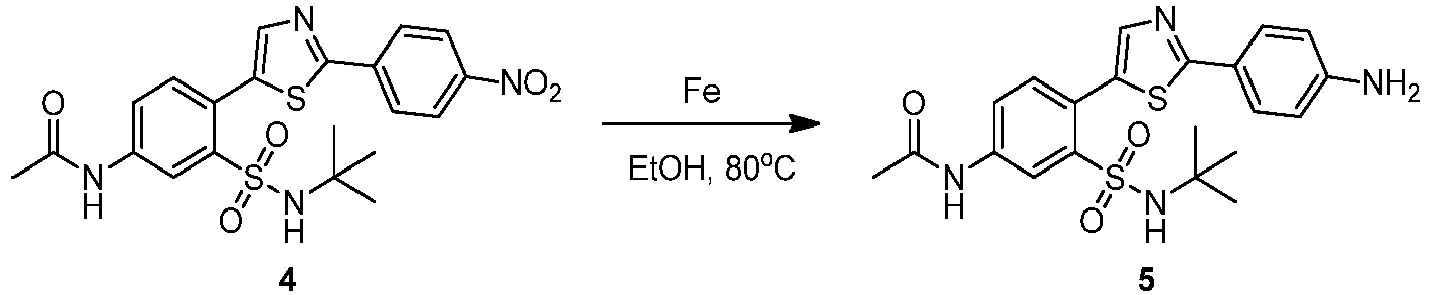
- A mixture of N-[3-(tert-butylsulfamoyl)-4-[2-(4-nitrophenyl)thiazol-5-yl]phenyl] acetamide (800 mg, 1.69 mmol, 1 eq.), NH4Cl (450.87 mg, 8.43 mmol, 294.68 ul, 5 eq.) and Fe (470.76 mg, 8.43 mmol, 5 eq.) in EtOH (20 mL), THF (20 mL) and H2O (10 mL) was stirred at 80°C for 2 hrs and LCMS showed the reaction was complete. The mixture was filtered, the filtrate was diluted with H2O (20 mL) and extracted with EtOAc (20 mL × 3). The combined organic layers were washed with brine (20 mL), dried over Na2SO4, filtered and concentrated. The residue was purified by column chromatography (Petroleum ether:Ethyl acetate=10:1∼1:2) to give N-[4-[2- (4-aminophenyl)thiazol-5-yl]-3-(tert-butylsulfamoyl)phenyl]acetamide (0.6 g, 1.35 mmol, 80.06% yield) as a yellow solid. ESI [M+H] = 445.1
-

- A mixture of N-[4-[2-(4-aminophenyl)thiazol-5-yl]-3-(tert-butylsulfamoyl) phenyl]acetamide (1.3 g, 2.92 mmol, 1 eq.), DMAP (35.72 mg, 292.42 µmol, 0.1 eq.) and Pyridine (1.16 g, 14.62 mmol, 1.18 mL, 5 eq.) in DCM (20 mL) was added isopropyl carbonochloridate (716.72 mg, 5.85 mmol, 811.68 ul, 2 eq.) at 0°C. Then the mixture was stirred at 20°C for 1 hr under N2 atmosphere. TLC (Petroleum ether:Ethyl acetate=1:1, Rf=0.3) indicated the reaction was complete. The reaction mixture was washed with IN HCl (50 mL) and sat.aq.Na2CO3 (50 mL), dried over Na2SO4, filtered and concentrated. The residue was purified by column chromatography (Petroleum ether:Ethyl acetate= 1:1) to give isopropyl N-[4-[5-[4-acetamido-2-(tert- butylsulfamoyl)phenyl]thiazol-2-yl]phenyl]carbamate (1.5 g, 2.83 mmol, 96.67% yield) as a yellow solid.
-

- Isopropyl N-[4-[5-[4-acetamido-2-(tert-butylsulfamoyl)phenyl]thiazol-2-yl] phenyl]carbamate (1.5 g, 2.83 mmol, 1 eq.) was dissolved into HCl/MeOH (4 M, 17.65 mL, 24.97 eq.) and the mixture was stirred at 30°C for 2 hrs. LCMS showed the reaction was complete. The mixture concentrated and the residue was dissolved into sat.aq.Na2CO3 (50 mL) and extracted with EtOAc (50 mL × 3). The combined organic phase was dried over Na2SO4, filtered and concentrated to give intermediate compound 7 (1.3 g, 2.66 mmol, 94.12% yield) as a yellow solid, which was used directly without further purification. ESI [M+H] = 489.1
-

- To a mixture of isopropyl N-[4-[5-[4-amino-2-(tert-butylsulfamoyl)phenyl] thiazol-2-yl]phenyl]carbamate (0.5 g, 1.02 mmol, 1 eq.), DMAP (12.50 mg, 102.33 µmol, 0.1 eq.) and Pyridine (404.71 mg, 5.12 mmol, 412.97 ul, 5 eq.) in DCM (10 mL) was added (4-nitrophenyl) carbonochloridate (412.52 mg, 2.05 mmol, 2 eq.) at 0°C, and then the mixture was stirred at 20°C for 2 hrs under N2 atmosphere. LCMS showed the reaction was complete. The mixture was used for next step without any purification. ESI [M+H] = 654.1
-

- A mixture of tert-butyl (2S)-2-(hydroxymethyl)pyrrolidine-1-carboxylate (60 mg, 298.12 µmol, 3.90 eq.), DIEA (25 mg, 193.43 µmol, 33.69 ul, 2.53 eq.) and (4-nitrophenyl) N-[3-(tert-butylsulfamoyl) -4-[2-[4-(isopropoxycarbonylamino) phenyl]thiazol-5-yl]phenyl]carbamate (50 mg, 76.48 µmol, 1 eq.) in MeCN (2 mL) was stirred at 80°C for 1 hour. LCMS showed the reaction was complete. The mixture was diluted with EtOAc (4 mL) and THF (1 mL), washed with H2O (5 mL), dried over Na2SO4, filtered and concentrated to give tert-butyl (2S)-2-[[3-(tert-butylsulfamoyl)-4-[2-[4-(isopropoxycarbonylamino)phenyl]thiazol-5-yl]phenyl]carbamoyloxymethyl]pyrrolidine-1-carboxylate (80 mg, crude) as a yellow gum, which was used directly. ESI [M+H] = 716.2
-

- To a solution of tert-butyl (2S)-2-[[3-(tert-butylsulfamoyl)-4-[2-[4-(isopropoxycarbonylamino)phenyl]thiazol-5-yl]phenyl]carbamoyloxymethyl]pyrrolidine-1-carboxylate (80 mg, 111.75 µmol, 1 eq.) in DCM (1 mL) was added TFA (1 mL) dropwise and the mixture was stirred at 15°C for 1 hour. LCMS showed the reaction was complete. The mixture was concentrated and the residue was purified by prep-HPLC (column: Luna C18 100∗30 5u;mobile phase: [water(0.1%TFA)-ACN];B%: 20%-60%,10min) to give compound A1 (4.54 mg, 6.10 µmol, 5.46% yield, 98.064% purity, TFA) as a brown solid. 1H NMR (400MHz, METHANOL-d4) δ = 8.41 (d, J = 2.2 Hz, 1H), 7.91 - 7.84 (m, 3H), 7.75 (dd, J = 2.0, 8.4 Hz, 1H), 7.57 (d, J = 8.8 Hz, 2H), 7.50 (d, J = 8.4 Hz, 1H), 5.02 - 4.93 (m, 1H), 4.50 (dd, J = 3.3, 12.6 Hz, 1H), 4.35 (dd, J = 7.8, 12.5 Hz, 1H), 3.95 (dq, J = 3.4, 8.1 Hz, 1H), 3.42 - 3.33 (m, 2H), 2.31 - 2.02 (m, 3H), 1.93 - 1.81 (m, 1H), 1.32 (d, J = 6.4 Hz, 6H), 1.12 (s, 9H). ESI [M+H] =616.2
-

- To a solution of phenylmethanamine (14.47 g, 135.06 mmol, 14.72 mL, 3 eq.) and DIEA (23.27 g, 180.08 mmol, 31.37 mL, 4 eq.) in DCM (500 mL) was added (4-nitrophenyl) N-[3-(tert-butylsulfamoyl)-4-[2-[4-(isopropoxycarbonylamino) phenyl]thiazol-5-yl]phenyl]carbamate (29.43 g, 45.02 mmol, 1 eq.) in DCM (500 mL). The mixture was stirred at 20°C for 15 mins and LCMS showed the reaction was complete. The mixture was washed with 1 N HCl (500 mL) and sat.aq.Na2CO3 (500 mL). Then the organic phase was dried over Na2SO4, filtered and concentrated. The residue was purified by silica gel chromatography eluted with Petroleum ether:Ethyl acetate=3:1 to give compound A2 (10.23 g, 15.47 mmol, 34.37% yield, 94.09% purity) as a yellow solid. 1H NMR (400MHz, METHANOL-d4) δ = 8.29 (d, J = 2.4 Hz, 1H), 7.93 - 7.84 (m, 3H), 7.74 (dd, J = 2.2, 8.6 Hz, 1H), 7.59 (d, J = 8.8 Hz, 2H), 7.45 (d, J = 8.3 Hz, 1H), 7.40 - 7.32 (m, 4H), 7.27 (dt, J = 2.7, 5.7 Hz, 1H), 5.07 - 4.95 (m, 1H), 4.44 (s, 2H), 1.33 (d, J = 6.4 Hz, 6H), 1.15 (s, 9H). ESI [M+H] = 622.2


-

- 1H NMR (400MHz, DMSO-d6) δ = 9.85 (s, 1H), 8.36 - 8.31 (m, 2H), 8.22 - 8.16 (m, 2H), 8.10 (s, 1H), 7.24 - 7.16 (m, 2H), 6.84 (dd, J = 2.0, 8.4 Hz, 1H), 5.35 (s, 2H), 2.02 (s, 3H).
-

- To a mixture of N-[3-amino-4-[2-(4-nitrophenyl)thiazol-5-yl]phenyl]acetamide (2.00 g, 5.64 mmol, 1.00 eq.) in H2O (5 mL) and AcOH (15 mL) was added conc. HCl (20.00 mL) at 0°C followed by a solution of NaNO2 (2.00 g, 28.99 mmol, 1.57 mL, 5.14 eq.) in H2O (5 mL). The mixture was stirred at 0°C for 2.5 hrs (mixture 1). Another mixture of CuCl2 (758.79 mg, 5.64 mmol, 1.00 eq.) in a solution of SO2 in AcOH (15 g in 20 mL) and H2O (5 mL) was stirred at 20°C for 1 hour (mixture 2). Then the mixture 2 was cooled to 0°C and mixture 1 was added into dropwise. The reaction mixture was stirred at 0°C for another 0.5 hour. HPLC showed the reaction was complete. The mixture was poured into ice-water mixture (70 mL) and the resulting precipitate was collected by filtration, then washed with water (10 mL × 3) and dried to give 5-acetamido-2-[2-(4-nitrophenyl) thiazol-5-yl]benzenesulfonyl chloride (2.50 g, crude) as a black brown solid, which was used directly.
-

- To a solution of tert-butyl piperazine-1-carboxylate (191.41 mg, 1.03 mmol, 3.00 eq.) and DMAP (4.19 mg, 34.26 µmol, 0.10 eq.) in DCM (1.00 mL) was added a solution of 5-acetamido-2-[2-(4-nitrophenyl)thiazol-5-yl]benzenesulfonyl chloride (150.00 mg, 342.56 µmol, 1.00 eq.) in THF (5.00 mL) dropwise. The mixture was stirred at 25°C for 1 hour and LCMS showed the reaction was complete. The mixture was poured into 0.5 N HCl (6 mL) and extracted with EtOAc/THF (3 mL/1 mL × 3). The combined organic layers were washed with brine (3 mL × 2), dried over Na2SO4, filtered and concentrated to give tert-butyl 4-[5-acetamido-2- [2-(4-nitrophenyl)thiazol-5-yl]phenyl] sulfonylpiperazine-1-carboxylate (200.00 mg, crude) without any purification. ESI [M+Na] = 610.2
-

- A mixture of 2-isothiocyanatopropane (261.23 mg, 2.58 mmol, 274.98 ul, 10.00 eq.) and tert-butyl 4-[5-acetamido-2-[2-(4-aminophenyl)thiazol-5-yl]phenyl]sulfonyl piperazine-1-carboxylate (180.00 mg, 258.21 µmol, 1.00 eq.) in EtOH (3.00 mL) was stirred at 80°C for 2 hrs and LCMS showed the reaction was complete. The mixture was concentrated and the residue was purified by prep-TLC (Petroleum ether: Ethyl acetate = 1:2) to give tert-butyl 4-[5-acetamido-2-[2-[4-(isopropylcarbamo thioylamino)phenyl]thiazol-5-yl]phenyl]sulfonylpiperazine-1-carboxylate (90.00 mg, crude) as a yellow solid. ESI [M+H] = 659.3
-

- 1H NMR (400MHz, DMSO-d6) δ = 10.54 (s, 1H), 9.70 (br s, 1H), 8.75 (br s, 2H), 8.42 (d, J = 1.8 Hz, 1H), 8.00 - 7.80 (m, 5H), 7.68 (d, J = 8.6 Hz, 2H), 7.61 (d, J = 8.4 Hz, 1H), 4.39 (br d, J = 6.4 Hz, 1H), 3.12 (br s, 4H), 3.05 - 2.97 (m, 4H), 2.11 (s, 3H), 1.18 (d, J = 6.6 Hz, 6H). ESI [M+H] = 558.9
-

- A mixture of 4-(5-bromothiazol-2-yl)aniline (80.00 mg, 313.57 µmol, 1.00 eq.), N-[3-(tert-butylsulfamoyl)-4-(4,4,5,5-tetramethyl-1,3,2-dioxaborolan-2-yl)phenyl]acetamide (149.13 mg, 376.28 µmol, 1.20 eq.), Pd(PPh3)2Cl2 (22.01 mg, 31.36 µmol, 0.10 eq.) and K2CO3 (86.68 mg, 627.14 µmol, 2.00 eq.) in the mixture of EtOH (900.00 ul), toluene (900.00 ul) and H2O (300.00 ul) was heated to 80°C for 16 hrs under N2. LCMS showed the reaction was complete. The mixture was diluted with EtOAc (20 mL) and washed with H2O (7 mL). The aqueous phase was extracted with EtOAc (7 mL × 2). The combined organic phase was dried over Na2SO4, filtered, concentrated in vacuum and purified by acidic prep-HPLC to give compound A4 (90.00 mg, 143.73 µmol, 45.84% yield, 71% purity) as a yellow solid. 1H NMR (400MHz, DMSO-d6) δ = 10.36 (s, 1H), 8.39 (d, J = 2.2 Hz, 1H), 7.81 (dd, J = 2.0, 8.6 Hz, 1H), 7.73 (s, 1H), 7.65 (br d, J = 6.6 Hz, 2H), 7.45 (d, J = 8.3 Hz, 1H), 7.09 (s, 1H), 6.76 - 6.64 (m, 2H), 2.08 (s, 3H), 1.07 (s, 9H). ESI [M+H] = 445.2
-

- To a solution of N-[3-(tert-butylsulfamoyl)-4-[2-(4-hydroxyphenyl)thiazol-5-yl] phenyl]acetamide (50.00 mg, 112.22 µmol, 1.00 eq.) in Py (2.00 mL) was added 2-isocyanatopropane (28.65 mg, 336.66 µmol, 32.93 ul, 3.00 eq.) and the mixture was stirred at 80°C for 16 hrs. LCMS showed the reaction was complete. The mixture was concentrated and the residue was purified by acidic prep-HPLC to give compound A5 (3.68 mg, 6.84 µmol, 6.09% yield, 98.6% purity) as a brown solid. 1H NMR (400MHz, METHANOL-d4) δ = 8.48 (s, 1H), 7.98 (d, J = 8.8 Hz, 2H), 7.91 - 7.84 (m, 2H), 7.50 (d, J = 8.3 Hz, 1H), 7.24 (d, J = 8.8 Hz, 2H), 3.78 (br d, J = 7.9 Hz, 1H), 2.17 (s, 3H), 1.22 (d, J = 6.6 Hz, 6H), 1.13 (s, 9H). ESI [M+H] = 530.9

-

- To a solution of isopropyl N-[4-[5-[4-bromo-2-(tert-butylsulfamoyl)phenyl] thiazol-2-yl]phenyl]carbamate (100.00 mg, 181.00 µmol, 1.00 eq.) in dioxane (3.00 mL) was added 4,4,5,5-tetramethyl-2-(4,4,5,5-tetramethyl-1,3,2-dioxaborolan-2-yl)- 1,3,2-dioxaborolane (183.85 mg, 724.00 µmol, 4.00 eq.), Na2CO3 (38.37 mg, 362.00 µmol, 2.00 eq.) and Pd(dppf)Cl2.CH2Cl2 (14.78 mg, 18.10 µmol, 0.10 eq.) and the mixture was stirred at 80°C under N2 for 16 hrs. LCMS showed the reaction was complete. The mixture was diluted with water (30 mL) and extracted with EtOAc (30mL × 3). The combined organic phase was dried, filtered and concentrated. The residue was purified by prep-TLC (PE:EtOAc=2:1) to giv intermediate compound 34 (90.00 mg, 150.11 µmol, 82.93% yield) as a yellow solid. ESI [M+H] =600.3
-

- 1H NMR (400MHz, METHANOL-d4) δ = 9.05 (s, 1H), 8.60 (d, J = 2.0 Hz, 1H), 8.13 (d, J = 1.2 Hz, 1H), 8.04 (dd, J = 2.0, 7.9 Hz, 1H), 8.00 (s, 1H), 7.96 - 7.92 (m, 2H), 7.75 (d, J = 8.1 Hz, 1H), 7.61 (d, J = 8.7 Hz, 2H), 5.01 (td, J = 6.2, 12.5 Hz, 1H), 1.34 (d, J = 6.2 Hz, 6H), 1.12 (s, 9H). ESI [M+H] = 540.2
-

- To a solution of N-methylpropan-2-amine (124.33 mg, 1.70 mmol, 177.61 ul, 10.00 eq.) in DCM (2.00 mL) was added DIPEA (109.85 mg, 849.95 µmol, 148.45 ul, 5.00 eq.) and bis(trichloromethyl)carbonate (227.00 mg, 764.96 µmol, 4.50 eq.) at 0°C. The mixture was stirred at 0°C for 0.5 hr and then added 2-[2-(4-aminophenyl) thiazol-5-yl]-N-tert-butyl-5-(2-oxopyrrolidin-1-yl)benzenesulfonamide (80.00 mg, 169.99 µmol, 1.00 eq.) in DMF (2.00 mL). The mixture was stirred at 80°C for another 0.5 hr and LCMS showed the reaction was complete. The mixture was concentrated and the residue was purified by acidic prep-HPLC to give compound A7 (4.83 mg, 8.27 µmol, 4.87% yield, 97.6% purity) as a yellow solid. 1H NMR (400MHz, METHANOL-d4) δ = 8.66 (d, J = 2.2 Hz, 1H), 7.92 - 7.80 (m, 4H), 7.60 - 7.49 (m, 3H), 4.54 (td, J = 6.7, 13.5 Hz, 1H), 3.99 (t, J = 7.1 Hz, 2H), 2.90 (s, 3H), 2.65 (t, J = 8.0 Hz, 2H), 2.22 (quin, J = 7.6 Hz, 2H), 1.19 (d, J = 6.6 Hz, 6H), 1.14 (s, 9H). ESI [M+H] = 570.2
-

- 1H NMR (400MHz, METHANOL-d4) δ = 8.39 (d, J=2.0 Hz, 1H), 7.93 - 7.86 (m, 3H), 7.75 (dd, J=2.0, 8.3 Hz, 1H), 7.61 - 7.57 (m, 2H), 7.49 (d, J=8.8 Hz, 1H), 5.00 (td, J=6.2, 12.6 Hz, 1H), 4.32 - 4.22 (m, 2H), 3.87 - 3.76 (m, 2H), 1.34 (d, J=6.4 Hz, 6H), 1.16 (s, 9H). ESI [M+H] = 577.2

- 1H NMR (400MHz, METHANOL-d4) δ = 8.37 (d, J = 2.2 Hz, 1H), 7.90 - 7.82 (m, 3H), 7.70 (dd, J = 2.2, 8.4 Hz, 1H), 7.56 (d, J = 8.6 Hz, 2H), 7.45 (d, J = 8.4 Hz, 1H), 5.04 - 4.93 (m, 1H), 4.34 - 4.26 (m, 2H), 3.66 (dd, J = 3.9, 5.4 Hz, 2H), 3.40 (s, 3H), 1.31 (d, J = 6.2 Hz, 6H), 1.13 (s, 9H). ESI [M+H] = 591.2

- 1H NMR (400MHz, METHANOL-d4) δ = 8.69 (d, J = 5.3 Hz, 1H), 8.39 (d, J = 2.2 Hz, 1H), 8.25 (dt, J = 1.5, 7.8 Hz, 1H), 7.91 - 7.81 (m, 4H), 7.77 - 7.66 (m, 2H), 7.57 (d, J = 8.8 Hz, 2H), 7.48 (d, J = 8.3 Hz, 1H), 5.43 (s, 2H), 4.97 (quin, J = 6.2 Hz, 1H), 1.31 (d, J = 6.1 Hz, 6H), 1.12 (s, 9H). ESI [M+H] = 624.0

- 1H NMR (400MHz, METHANOL-d4) δ = 8.81 (d, J = 7.0 Hz, 2H), 8.40 (d, J = 2.2 Hz, 1H), 8.02 (d, J = 6.6 Hz, 2H), 7.91 - 7.83 (m, 3H), 7.77 - 7.72 (m, 1H), 7.57 (d, J = 8.8 Hz, 2H), 7.50 (d, J = 8.3 Hz, 1H), 5.53 (s, 2H), 4.98 (quin, J = 6.2 Hz, 1H), 1.31 (d, J = 6.1 Hz, 6H), 1.12 (s, 9H). ESI [M+H] = 624.1

- 1H NMR (400MHz, METHANOL-d4) δ = 8.38 (d, J = 2.2 Hz, 1H), 7.90 - 7.83 (m, 3H), 7.72 (dd, J = 2.2, 8.3 Hz, 1H), 7.57 (d, J = 8.8 Hz, 2H), 7.45 (d, J = 8.3 Hz, 1H), 5.05 (s, 1H), 5.01 - 4.93 (m, 2H), 4.61 (s, 2H), 1.81 (s, 3H), 1.31 (d, J = 6.6 Hz, 6H), 1.14 (s, 9H). ESI [M+H] = 587.1

- 1H NMR (400MHz, METHANOL-d4) δ = 8.46 (d, J = 2.0 Hz, 1H), 7.94 - 7.84 (m, 4H), 7.59 (d, J = 8.8 Hz, 2H), 7.50 (d, J = 8.8 Hz, 1H), 7.35 - 7.25 (m, 4H), 7.23 - 7.15 (m, 1H), 5.00 (td, J = 6.2, 12.6 Hz, 1H), 3.04 (t, J = 7.6 Hz, 2H), 2.80 - 2.66 (m, 2H), 1.33 (d, J = 5.9 Hz, 6H), 1.16 (s, 9H). ESI [M+H] = 621.1

- 1H NMR (400MHz, METHANOL-d4) δ = 8.43 (d, J = 1.5 Hz, 1H), 7.94 - 7.85 (m, 3H), 7.77 (dd, J = 2.0, 8.3 Hz, 1H), 7.59 (d, J = 8.3 Hz, 2H), 7.51 (d, J = 8.3 Hz, 1H), 5.00 (spt, J = 6.2 Hz, 1H), 4.52 (dd, J = 3.4, 12.7 Hz, 1H), 4.37 (dd, J = 7.8, 12.7 Hz, 1H), 3.97 (dq, J = 3.4, 8.0 Hz, 1H), 3.46 - 3.35 (m, 2H), 2.35 - 2.23 (m, 1H), 2.21 - 2.01 (m, 2H), 1.89 (qd, J = 8.4, 12.9 Hz, 1H), 1.34 (d, J = 6.4 Hz, 6H), 1.14 (s, 9H). ESI [M+H] = 616.2

- 1H NMR (400MHz, METHANOL-d4) δ = 8.37 (s, 1H), 7.91 - 7.85 (m, 3H), 7.70 (br d, J = 8.6 Hz, 1H), 7.58 (d, J = 8.6 Hz, 2H), 7.45 (d, J = 8.2 Hz, 1H), 7.36 - 7.25 (m, 4H), 7.22 (qd, J = 4.2, 8.7 Hz, 1H), 4.98 (td, J = 6.3, 12.5 Hz, 1H), 4.39 (t, J = 6.8 Hz, 2H), 3.01 (t, J = 6.8 Hz, 2H), 1.35 - 1.29 (m, 6H), 1.14 (s, 9H). ESI [M+H] = 637.2

- 1H NMR (400MHz, METHANOL-d4) δ = 8.89 (s, 1H), 8.75 (br d, J = 5.5 Hz, 1H), 8.49 (br d, J = 8.6 Hz, 1H), 8.39 (d, J = 1.8 Hz, 1H), 7.96 - 7.85 (m, 4H), 7.73 (br d, J = 7.9 Hz, 1H), 7.58 (d, J = 8.6 Hz, 2H), 7.49 (d, J = 8.4 Hz, 1H), 5.42 (s, 2H), 4.98 (td, J = 6.2, 12.3 Hz, 1H), 1.32 (d, J = 6.2 Hz, 6H), 1.12 (s, 9H). ESI [M+H] = 624.2

- 1H NMR (400MHz, METHANOL-d4) δ = 8.38 (d, J=2.0 Hz, 1H), 7.91 - 7.82 (m, 3H), 7.70 (br d, J=7.3 Hz, 1H), 7.57 (d, J=8.6 Hz, 2H), 7.45 (d, J=8.4 Hz, 1H), 5.02 - 4.92 (m, 1H), 3.98 (d, J=6.4 Hz, 2H), 1.87 - 1.63 (m, 6H), 1.39 - 1.19 (m, 9H), 1.16 - 0.94 (m, 11H) . ESI [M+H] =629.2


- 1H NMR (400MHz, METHANOL-d4) δ = 8.39 (s, 1H), 7.92 - 7.85 (m, 3H), 7.82 (d, J = 3.1 Hz, 1H), 7.75 (br d, J = 6.6 Hz, 1H), 7.66 (d, J = 3.3 Hz, 1H), 7.58 (d, J = 8.6 Hz, 2H), 7.49 (d, J = 8.6 Hz, 1H), 5.51 (s, 2H), 5.02 - 4.91 (m, 1H), 1.31 (d, J = 6.2 Hz, 6H), 1.14 (s, 9H). ESI [M+H] =630.1

- 1H NMR (400MHz, METHANOL-d4) δ = 8.38 (d, J = 1.8 Hz, 1H), 7.96 - 7.84 (m, 3H), 7.73 (dd, J = 2.0, 8.3 Hz, 1H), 7.58 (d, J = 8.7 Hz, 2H), 7.48 (d, J = 8.3 Hz, 1H), 5.98 - 5.81 (m, 1H), 5.75 - 5.63 (m, 1H), 4.99 (td, J = 6.3, 12.5 Hz, 1H), 4.61 (d, J = 6.4 Hz, 2H), 1.76 (d, J = 6.1 Hz, 3H), 1.33 (d, J = 6.2 Hz, 6H), 1.16 (s, 9H). ESI [M+H] =587.2

- 1H NMR (400MHz, METHANOL-d4) δ = 8.41 (d, J = 2.0 Hz, 1H), 7.96 - 7.83 (m, 3H), 7.77 (dd, J = 2.1, 8.4 Hz, 1H), 7.59 (d, J = 8.7 Hz, 2H), 7.51 (d, J = 8.3 Hz, 1H), 5.00 (td, J = 6.2, 12.5 Hz, 1H), 4.50 - 4.43 (m, 2H), 3.31 (br s, 2H), 1.33 (d, J = 6.2 Hz, 6H), 1.14 (s, 9H). ESI [M+H] =576.1

- 1H NMR (400MHz, METHANOL-d4) δ = 8.42 (s, 1H), 7.94 - 7.86 (m, 3H), 7.75 (br d, J = 8.3 Hz, 1H), 7.65 - 7.50 (m, 5H), 5.49 (s, 2H), 5.00 (td, J = 6.3, 12.5 Hz, 1H), 1.34 (d, J = 6.2 Hz, 6H), 1.13 (s, 9H). ESI [M+H] =613.2

- 1H NMR (400MHz, DMSO-d6) δ = 10.25 (s, 1H), 9.84 (s, 1H), 8.33 (d, J = 2.2 Hz, 1H), 7.87 (d, J = 8.8 Hz, 2H), 7.81 (s, 1H), 7.67 (dd, J = 2.2, 8.4 Hz, 1H), 7.60 (d, J = 8.8 Hz, 2H), 7.42 (dt, J = 8.1, 14.1 Hz, 5H), 7.35 - 7.29 (m, 1H), 7.14 - 7.09 (m, 1H), 5.85 (q, J = 6.6 Hz, 1H), 4.92 (td, J = 6.2, 12.5 Hz, 1H), 1.57 (d, J = 6.6 Hz, 3H), 1.27 (d, J = 6.2 Hz, 6H), 1.08 (s, 9H). ESI [M+H] =637.2

- 1H NMR (400 MHz, METHANOL-d4) δ = 8.43 (d, J = 1.96 Hz, 1H), 7.87-7.94 (m, 3H), 7.77 (br d, J = 8.44 Hz, 1H), 7.60 (d, J = 8.68 Hz, 2H), 7.52 (d, J = 8.44 Hz, 1H), 5.00 (td, J = 6.28, 12.50 Hz, 1H), 4.52 (dd, J = 3.36, 12.53 Hz, 1H), 4.37 (br dd, J = 7.83, 10.88 Hz, 1H), 3.97 (dq, J = 3.30, 8.03 Hz, 1H), 3.36-3.44 (m, 2H), 2.05-2.34 (m, 3H), 1.84-1.94 (m, 1H), 1.34 (d, J = 6.24 Hz, 6H), 1.14 (s, 9H). ESI [M+H] =616.2
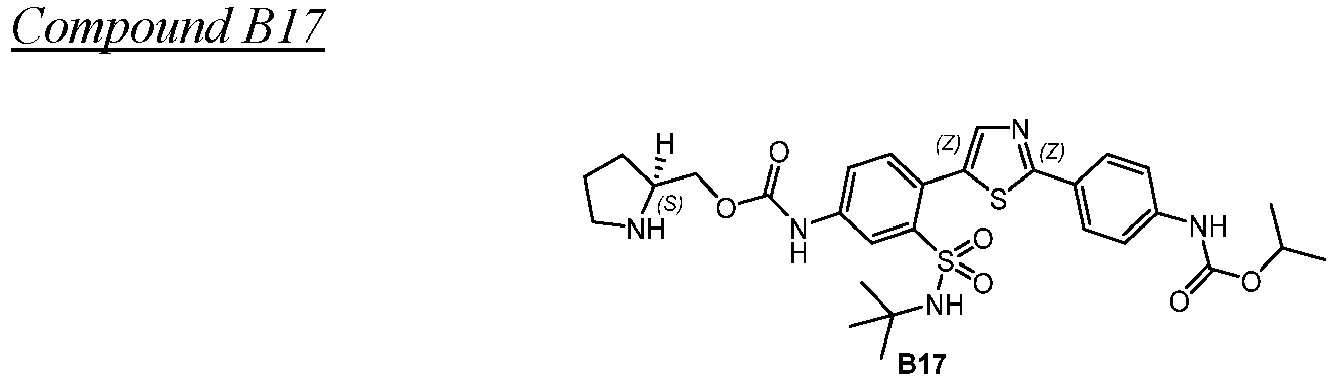
- 1H NMR (400MHz, METHANOL-d4) δ = 8.41 (d, J = 2.2 Hz, 1H), 7.91 - 7.84 (m, 3H), 7.75 (dd, J = 2.0, 8.4 Hz, 1H), 7.57 (d, J = 8.8 Hz, 2H), 7.50 (d, J = 8.4 Hz, 1H), 5.02 - 4.93 (m, 1H), 4.50 (dd, J = 3.3, 12.6 Hz, 1H), 4.35 (dd, J = 7.8, 12.5 Hz, 1H), 3.95 (dq, J = 3.4, 8.1 Hz, 1H), 3.42 - 3.33 (m, 2H), 2.31 - 2.02 (m, 3H), 1.93 - 1.81 (m, 1H), 1.32 (d, J = 6.4 Hz, 6H), 1.12 (s, 9H). ESI [M+H] =616.2

- 1H NMR (400 MHz, METHANOL-d4) δ = 8.44 (d, J = 2.08 Hz, 1H), 7.88-7.94 (m, 3H), 7.78 (dd, J = 1.90, 8.38 Hz, 1H), 7.61 (d, J = 8.68 Hz, 2H), 7.53 (d, J = 8.44 Hz, 1H), 5.01 (td, J = 6.21, 12.53 Hz, 1H), 4.42-4.49 (m, 1H), 4.33 (dd, J = 7.21, 12.59 Hz, 1H), 3.42-3.55 (m, 2H), 3.01-3.11 (m, 1H), 1.91-2.06 (m, 3H), 1.58-1.76 (m, 3H), 1.35 (d, J = 6.24 Hz, 6H), 1.14 (s, 9H). ESI [M+H] =630.2

- 1H NMR (400 MHz, METHANOL-d4) δ = 8.43 (d, J = 2.2 Hz, 1 H), 7.87 - 7.94 (m, 3 H), 7.77 (dd, J = 8.3, 2.0 Hz, 1 H), 7.60 (d, J = 8.7 Hz, 2 H), 7.53 (d, J = 8.4 Hz, 1 H), 5.00 (dt, J = 12.5, 6.3 Hz, 1 H), 4.42 - 4.48 (m, 1 H), 4.29 - 4.36 (m, 1 H), 3.41 - 3.53 (m, 2 H), 3.01 - 3.10 (m, 1 H), 1.92 - 2.06 (m, 3 H), 1.58 - 1.75 (m, 3 H), 1.34 (d, J = 6.2 Hz, 6 H), 1.13 (s, 9 H). SI [M+H] =630.2
-

- 1H NMR (400MHz, DMSO-d6) δ = 9.84 (s, 1H), 8.96 (s, 1H), 8.24 (d, J = 2.3 Hz, 1H), 7.86 (d, J = 8.7 Hz, 2H), 7.80 (s, 1H), 7.63 - 7.55 (m, 3H), 7.41 - 7.32 (m, 5H), 7.28 - 7.20 (m, 1H), 7.07 (s, 1H), 6.76 (d, J = 7.8 Hz, 1H), 4.98 - 4.80 (m, 2H), 1.42 (d, J = 6.8 Hz, 3H), 1.27 (d, J = 6.2 Hz, 6H), 1.08 (s, 9H). ESI [M+H] =636.3

- 1H NMR (400MHz, METHANOL-d4) δ = 8.25 (d, J = 2.3 Hz, 1H), 7.87 - 7.91 (m, 3H), 7.68 - 7.72 (m, 1H), 7.60 (d, J = 8.7 Hz, 2H), 7.33 - 7.45 (m, 5H), 7.23 - 7.29 (m, 1H,), 4.94 - 5.03 (m, 2H), 1.51 (d, J = 6.8 Hz, 3H), 1.33 (d, J = 6.2 Hz, 6H), 1.14 (s, 9H). ESI [M+H] =636.2

- 1H NMR (400MHz, DMSO-d6) δ = 9.84 (s, 1H), 9.39 (s, 1H), 9.23 - 9.15 (m, 2H), 8.25 (d, J = 2.4 Hz, 1H), 7.85 (d, J = 8.8 Hz, 2H), 7.79 (s, 1H), 7.67 - 7.56 (m, 4H), 7.39 (d, J = 8.4 Hz, 1H), 7.07 (s, 1H), 6.97 (t, J = 6.0 Hz, 1H), 4.90 (quin, J = 6.3 Hz, 1H), 4.39 (d, J = 5.5 Hz, 2H), 1.26 (d, J = 6.2 Hz, 6H), 1.05 (s, 9H). ESI [M+H] =624.2

- 1H NMR (400MHz, METHANOL-d4) δ = 9.23 (br s, 1H), 8.31 (d, J = 2.2 Hz, 1H), 8.08 - 8.02 (m, 1H), 8.01 - 7.95 (m, 1H), 7.86 (t, J = 4.3 Hz, 3H), 7.70 (dd, J = 2.2, 8.4 Hz, 1H), 7.57 (d, J = 8.6 Hz, 2H), 7.43 (d, J = 8.4 Hz, 1H), 4.97 (td, J = 6.2, 12.5 Hz, 1H), 4.77 (s, 2H), 1.30 (d, J = 6.2 Hz, 6H), 1.11 (s, 9H). ESI [M+H] =624.2


- 1H NMR (400MHz, METHANOL-d4) δ = 9.07 (s, 1H), 8.82 (s, 2H), 8.28 (d, J = 2.2 Hz, 1H), 7.91 - 7.84 (m, 3H), 7.71 (dd, J = 2.3, 8.3 Hz, 1H), 7.57 (d, J = 8.8 Hz, 2H), 7.44 (d, J = 8.4 Hz, 1H), 4.97 (td, J = 6.1, 12.5 Hz, 1H), 4.46 (s, 2H), 1.31 (d, J = 6.4 Hz, 6H), 1.12 (s, 9H). ESI [M+H] =624.2

- 1H NMR (400MHz, METHANOL-d4) δ = 8.84 (br s, 1H), 8.75 (br d, J = 5.1 Hz, 1H), 8.60 (br d, J = 8.2 Hz, 1H), 8.33 (d, J = 2.2 Hz, 1H), 8.04 (dd, J = 6.0, 7.7 Hz, 1H), 7.91 - 7.82 (m, 3H), 7.67 (dd, J = 2.3, 8.3 Hz, 1H), 7.56 (d, J = 8.6 Hz, 2H), 7.43 (d, J = 8.2 Hz, 1H), 5.02 - 4.95 (m, 1H), 4.61 (s, 2H), 1.30 (d, J = 6.2 Hz, 6H), 1.10 (s, 9H). ESI [M+H] =623.4

- 1H NMR (400MHz, METHANOL-d4) δ = 8.25 (d, J = 2.2 Hz, 1H), 7.90 - 7.84 (m, 3H), 7.69 (dd, J = 2.3, 8.5 Hz, 1H), 7.58 (d, J = 8.8 Hz, 2H), 7.43 (d, J = 8.4 Hz, 1H), 5.04 - 4.92 (m, 1H), 3.91 (quin, J = 6.6 Hz, 1H), 1.32 (d, J = 6.2 Hz, 6H), 1.20 (d, J = 6.6 Hz, 6H), 1.13 (s, 9H). ESI [M+H] =574.1

- 1H NMR (400MHz, METHANOL-d4) δ = 8.22 (d, J = 2.2 Hz, 1H), 7.91 - 7.83 (m, 3H), 7.69 (dd, J = 2.2, 8.4 Hz, 1H), 7.57 (d, J = 8.8 Hz, 2H), 7.44 - 7.32 (m, 5H), 7.28 - 7.21 (m, 1H), 5.02 - 4.91 (m, 2H), 1.50 (d, J = 6.8 Hz, 3H), 1.31 (d, J = 6.2 Hz, 6H), 1.12 (s, 9H). ESI [M+H] =636.2

- 1H NMR (400MHz, METHANOL-d4) δ = 8.38 (d, J = 2.2 Hz, 1H), 7.90 - 7.83 (m, 3H), 7.70 (dd, J = 2.2, 8.4 Hz, 1H), 7.57 (d, J = 8.6 Hz, 2H), 7.45 (d, J = 8.4 Hz, 1H), 4.98 (td, J = 6.1, 12.5 Hz, 1H), 3.79 - 3.68 (m, 1H), 3.59 - 3.47 (m, 2H), 3.40 - 3.32 (m, 1H), 3.30 - 3.25 (m, 1H), 2.24 - 1.96 (m, 3H), 1.89 - 1.75 (m, 1H), 1.32 (d, J = 6.4 Hz, 6H), 1.11 (s, 9H). ESI [M+H] =615.2

- 1H NMR (400 MHz, METHANOL-d4) δ = 8.39 (d, J = 2.32 Hz, 1H), 7.88-7.93 (m, 2H), 7.87 (s, 1H), 7.72 (dd, J = 2.32, 8.31 Hz, 1H), 7.59 (d, J = 8.68 Hz, 2H), 7.47 (d, J = 8.31 Hz, 1H), 5.00 (td, J = 6.28, 12.50 Hz, 1H), 3.72-3.79 (m, 1H), 3.53-3.57 (m, 2H), 3.36-3.42 (m, 1H), 3.27-3.32 (m, 1H), 2.00-2.26 (m, 3H), 1.75-1.90 (m, 1H), 1.34 (d, J = 6.24 Hz, 6H), 1.13 (s, 9H). ESI [M+H] =615.2

- 1H NMR (400MHz, METHANOL-d4) δ = 8.27 (d, J = 2.4 Hz, 1H), 7.93 - 7.85 (m, 3H), 7.71 (dd, J = 2.4, 8.3 Hz, 1H), 7.60 (d, J = 8.3 Hz, 2H), 7.45 (d, J = 8.3 Hz, 1H), 5.06 - 4.95 (m, 1H), 3.08 (d, J = 6.4 Hz, 2H), 1.86 - 1.68 (m, 5H), 1.52 (ttd, J = 3.5, 7.3, 14.5 Hz, 1H), 1.33 (d, J = 5.9 Hz, 9H), 1.15 (s, 9H), 1.07 - 0.93 (m, 2H). ESI [M+H] =628.2
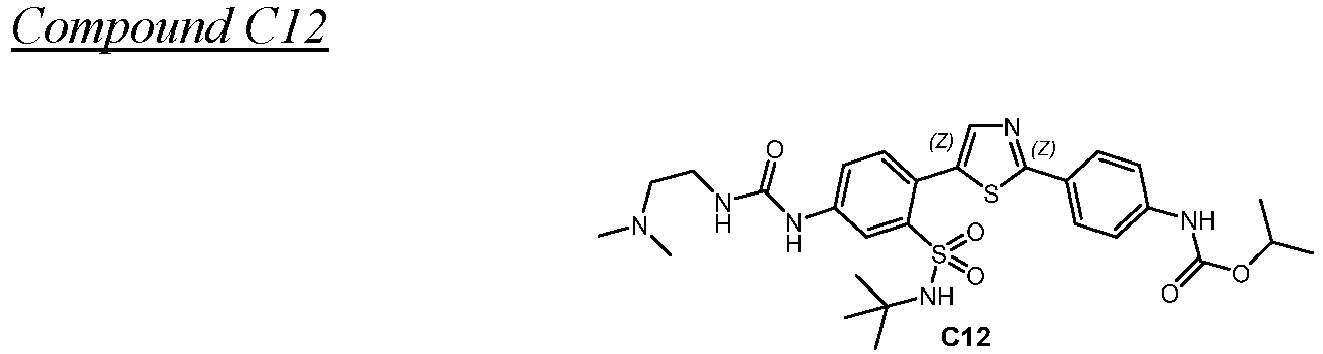
- 1H NMR (400MHz, METHANOL-d4) δ = 8.36 (d, J = 2.4 Hz, 1H), 7.91 - 7.82 (m, 3H), 7.70 (dd, J = 2.4, 8.4 Hz, 1H), 7.57 (d, J = 8.8 Hz, 2H), 7.45 (d, J = 8.4 Hz, 1H), 4.98 (td, J = 6.3, 12.4 Hz, 1H), 3.61 (t, J = 5.6 Hz, 2H), 3.35 - 3.31 (m, 2H), 2.98 (s, 6H), 1.31 (d, J = 6.4 Hz, 6H), 1.11 (s, 9H). ESI [M+H] =603.2

- 1H NMR (400MHz, METHANOL-d4) δ = 8.34 (d, J = 2.2 Hz, 1H), 7.92 - 7.82 (m, 3H), 7.67 (dd, J = 2.2, 8.4 Hz, 1H), 7.57 (d, J = 8.6 Hz, 2H), 7.44 (d, J = 8.4 Hz, 1H), 4.97 (td, J = 6.3, 12.4 Hz, 1H), 4.46 - 4.32 (m, 1H), 3.56 - 3.47 (m, 2H), 3.39 - 3.32 (m, 2H), 2.45 - 2.32 (m, 1H), 2.15 - 2.00 (m, 1H), 1.31 (d, J = 6.4 Hz, 6H), 1.11 (s, 9H). ESI [M+H] =601.3

- 1H NMR (400MHz, METHANOL-d4) δ = 8.37 (d, J = 1.8 Hz, 1H), 7.93 - 7.86 (m, 3H), 7.71 (dd, J = 1.9, 8.3 Hz, 1H), 7.60 (d, J = 8.6 Hz, 2H), 7.46 (d, J = 8.3 Hz, 1H), 5.03 - 4.98 (m, 1H), 3.65 - 3.46 (m, 10H), 3.27 (br s, 2H), 1.33 (d, J = 6.2 Hz, 6H), 1.13 (s, 9H). ESI [M+H] =644.2

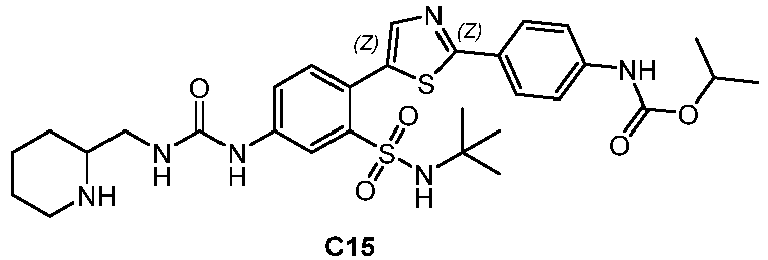
- 1H NMR (400MHz, METHANOL-d4) δ = 8.40 (d, J = 2.3 Hz, 1H), 7.93 - 7.85 (m, 3H), 7.73 (dd, J = 2.3, 8.3 Hz, 1H), 7.59 (d, J = 8.7 Hz, 2H), 7.47 (d, J = 8.4 Hz, 1H), 5.00 (td, J = 6.2, 12.5 Hz, 1H), 3.46 (d, J = 5.5 Hz, 2H), 3.40 (br d, J = 12.8 Hz, 1H), 3.28 - 3.19 (m, 1H), 3.03 - 2.93 (m, 1H), 2.01 - 1.86 (m, 3H), 1.75 - 1.47 (m, 3H), 1.34 (d, J = 6.2 Hz, 6H), 1.13 (s, 9H). ESI [M+H] =629.3

- 1H NMR (400 MHz, METHANOL-d4) δ = 8.38 (d, J = 2.32 Hz, 1H), 7.90 (d, J = 8.80 Hz, 2H), 7.74 (d, J = 2.4 Hz, 1H), 7.73 (dd, J = 2.32, 8.31 Hz, 1H), 7.59 (d, J = 8.68 Hz, 2H), 7.47 (d, J = 8.44 Hz, 1H), 5.00 (td, J = 6.24, 12.47 Hz, 1H), 3.81 (br d, J = 5.26 Hz, 2H), 3.62 (t, J = 5.75 Hz, 2H), 3.39 (t, J = 5.62 Hz, 2H), 3.11-3.21 (m, 2H), 2.00-2.24 (m, 4H), 1.33 (d, J = 6.24 Hz, 6H), 1.14 (s, 9H). ESI [M+H] =629.3
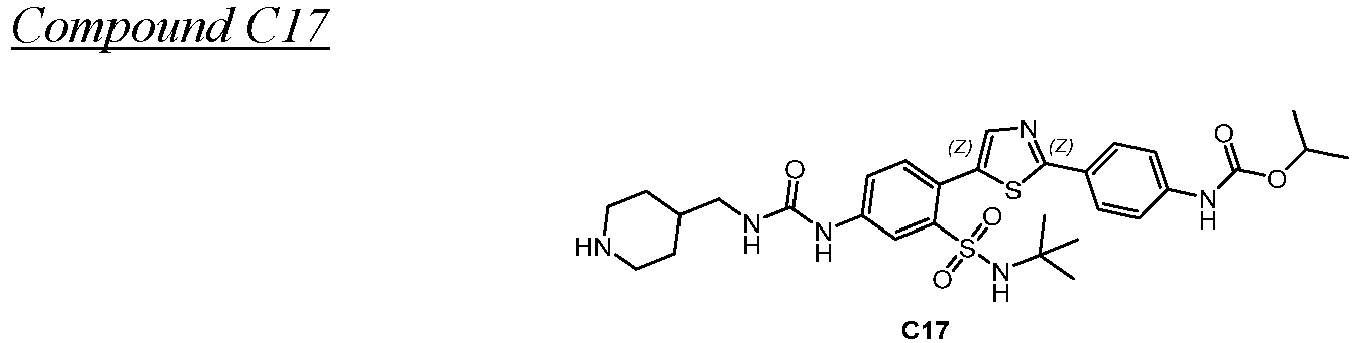
- 1H NMR (400MHz, METHANOL-d4) δ = 8.32 (d, J = 2.2 Hz, 1H), 7.91 - 7.82 (m, 3H), 7.66 (dd, J = 2.4, 8.6 Hz, 1H), 7.57 (d, J = 8.8 Hz, 2H), 7.42 (d, J = 8.3 Hz, 1H), 4.97 (td, J = 6.2, 12.6 Hz, 1H), 3.41 (br d, J = 12.7 Hz, 2H), 3.18 (d, J = 6.6 Hz, 2H), 3.04 - 2.92 (m, 2H), 1.99 (br d, J = 13.6 Hz, 2H), 1.92 - 1.80 (m, 1H), 1.51 - 1.36 (m, 2H), 1.31 (d, J = 6.1 Hz, 6H), 1.11 (s, 9H). ESI [M+H] =629.2


- 1H NMR (400MHz, METHANOL-d4) δ = 8.33 (s, 1H), 7.90 - 7.82 (m, 3H), 7.65 (br d, J = 7.5 Hz, 1H), 7.57 (br d, J = 8.3 Hz, 2H), 7.43 (br d, J = 8.3 Hz, 1H), 5.01 - 4.94 (m, 1H), 3.43 - 3.32 (m, 2H), 3.20 (br d, J = 6.1 Hz, 2H), 2.92 (br t, J = 12.5 Hz, 1H), 2.74 (br t, J = 12.1 Hz, 1H), 2.08 - 1.87 (m, 3H), 1.73 (br d, J = 11.8 Hz, 1H), 1.31 (br d, J = 6.1 Hz, 7H), 1.11 (s, 9H). ESI [M+H] =629.2

- 1H NMR (400MHz, METHANOL-d4) δ = 8.24 (d, J = 2.2 Hz, 1H), 7.81 - 7.73 (m, 3H), 7.57 (dd, J = 2.3, 8.4 Hz, 1H), 7.47 (d, J = 8.6 Hz, 2H), 7.34 (d, J = 8.4 Hz, 1H), 4.91 - 4.85 (m, 1H), 3.36 - 3.26 (m, 2H), 3.24 (s, 1H), 3.20 - 3.15 (m, 2H), 2.95 (dd, J = 8.1, 11.7 Hz, 1H), 2.51 (spt, J = 7.5 Hz, 1H), 2.14 - 2.03 (m, 1H), 1.71 (qd, J = 8.1, 13.2 Hz, 1H), 1.22 (d, J = 6.2 Hz, 6H), 1.02 (s, 9H). ESI [M+H] =615.2
-

- 1H NMR (400MHz, DMSO-d6) δ = 10.36 (s, 1H), 9.55 (br s, 1H), 8.31 (d, J = 8.8 Hz, 1H), 8.18 (s, 1H), 7.91 - 7.77 (m, 4H), 7.70 (s, 1H), 7.64 (d, J = 8.8 Hz, 2H), 7.41 (d, J = 8.3 Hz, 1H), 7.18 - 7.07 (m, 3H), 7.03 (br d, J = 6.1 Hz, 2H), 4.37 (br s, 1H), 3.92 - 3.80 (m, 1H), 3.43 (br s, 3H), 2.96 - 2.80 (m, 2H), 2.09 (s, 3H), 1.17 (d, J = 6.6 Hz, 6H). ESI [M+H] = 652.2

- 1H NMR (400MHz, DMSO-d6) δ = 10.39 (s, 1H), 9.55 (br s, 1H), 8.25 (d, J = 1.8 Hz, 1H), 8.14 (d, J = 9.6 Hz, 1H), 7.93 - 7.77 (m, 5H), 7.64 (d, J = 8.3 Hz, 2H), 7.48 (d, J = 8.3 Hz, 1H), 4.37 (br s, 1H), 3.58 (br s, 1H), 3.43 (s, 3H), 2.08 (s, 3H), 1.89 (br dd, J = 6.4, 13.4 Hz, 1H), 1.17 (d, J = 6.6 Hz, 6H), 0.83 - 0.69 (m, 6H). ESI [M+H] = 604.2

- 1H NMR (400MHz, DMSO-d6) δ= 10.40 (s, 1H), 9.56 (br s, 1H), 8.43 (d, J = 4.2 Hz, 1H), 8.28 (d, J = 2.2 Hz, 1H), 8.19 (t, J = 6.2 Hz, 1H), 7.89 - 7.78 (m, 6H), 7.64 (d, J = 8.8 Hz, 2H), 7.49 (d, J = 8.4 Hz, 1H), 7.38 (d, J = 7.9 Hz, 1H), 7.33 - 7.26 (m, 1H), 4.38 (br s, 1H), 4.15 (d, J = 6.2 Hz, 2H), 2.09 (s, 3H), 1.16 (d, J = 6.6 Hz, 6H). ESI [M+H] = 581.2
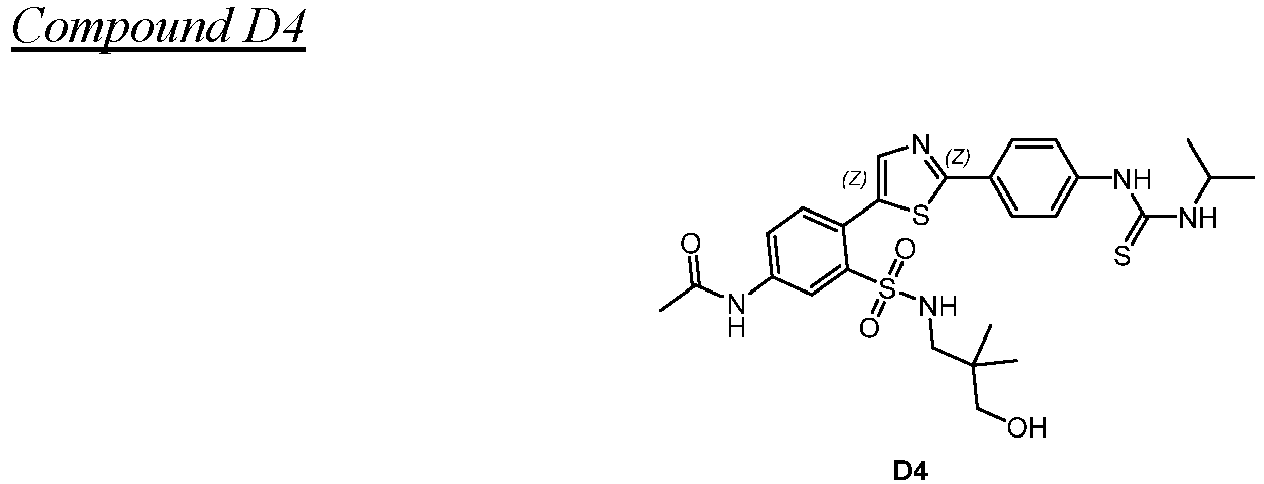
- 1H NMR (400MHz, DMSO-d6) δ = 10.41 (s, 1H), 9.56 (br s, 1H), 8.20 (d, J = 2.0 Hz, 1H), 7.89 - 7.80 (m, 5H), 7.63 (d, J = 8.8 Hz, 2H), 7.52 (d, J = 8.4 Hz, 1H), 7.39 (t, J = 6.5 Hz, 1H), 4.42 - 4.33 (m, 1H), 3.05 (s, 2H), 2.70 (d, J = 6.4 Hz, 2H), 2.09 (s, 3H), 1.17 (d, J = 6.6 Hz, 6H), 0.70 (s, 6H). ESI [M+H] = 576.3

- 1H NMR (400MHz, DMSO-d6) δ = 10.41 (s, 1H), 9.56 (br s, 1H), 8.35 (d, J = 2.2 Hz, 1H), 7.90 - 7.79 (m, 5H), 7.63 (d, J = 8.8 Hz, 2H), 7.50 (d, J = 8.2 Hz, 1H), 7.26 (d, J = 7.7 Hz, 1H), 4.38 (br d, J = 6.6 Hz, 1H), 3.32 - 3.24 (m, 1H), 3.12 - 2.97 (m, 2H), 2.08 (s, 3H), 1.17 (d, J = 6.4 Hz, 6H), 0.94 (d, J = 6.4 Hz, 3H). ESI [M+H] = 548.2

- 1H NMR (400MHz, DMSO-d6) δ = 10.41 (s, 1H), 9.55 (br s, 1H), 8.24 (d, J = 2.0 Hz, 1H), 7.92 - 7.76 (m, 5H), 7.62 (d, J = 8.8 Hz, 2H), 7.50 (d, J = 8.2 Hz, 1H), 7.35 (br d, J = 4.6 Hz, 1H), 4.36 (br d, J = 7.1 Hz, 1H), 2.43 (d, J = 4.9 Hz, 3H), 2.07 (s, 3H), 1.15 (d, J = 6.6 Hz, 6H). ESI [M+H] = 503.8

- 1H NMR (400MHz, DMSO-d6) δ = 10.49 - 10.34 (m, 1H), 9.67 - 9.48 (m, 1H), 8.36 (s, 1H), 7.97 - 7.79 (m, 5H), 7.65 (d, J = 8.8 Hz, 2H), 7.49 (dd, J = 8.2, 17.6 Hz, 2H), 4.39 (br d, J = 7.5 Hz, 1H), 3.29 - 3.17 (m, 1H), 2.81 (br d, J = 7.5 Hz, 1H), 2.10 (s, 3H), 1.67 (br t, J = 14.2 Hz, 4H), 1.18 (d, J = 6.6 Hz, 8H), 1.08 - 0.94 (m, 2H). ESI [M+H] = 587.9

- 1H NMR (400MHz, METHANOL-d4) δ = 8.47 - 8.39 (m, 1H), 7.96 - 7.86 (m, 4H), 7.59 (d, J = 8.4 Hz, 3H), 4.66 - 4.40 (m, 1H), 3.54 - 3.48 (m, 4H), 3.05 - 2.98 (m, 4H), 2.18 (s, 3H), 1.25 (d, J = 6.6 Hz, 6H). ESI [M+H] = 559.8

- 1H NMR (400MHz, DMSO-d6) δ = 10.41 (s, 1H), 9.56 (br s, 1H), 8.29 (d, J = 2.2 Hz, 1H), 7.90 - 7.79 (m, 5H), 7.63 (d, J = 8.8 Hz, 2H), 7.53 - 7.47 (m, 2H), 4.46 - 4.30 (m, 1H), 2.90 - 2.74 (m, 2H), 2.08 (s, 3H), 1.17 (d, J = 6.6 Hz, 6H), 0.95 (t, J = 7.2 Hz, 3H). ESI [M+H] = 517.9

- 1H NMR (400MHz, DMSO-d6) δ = 10.44 (s, 1H), 9.55 (br s, 1H), 8.23 (d, J = 2.0 Hz, 1H), 7.92 - 7.77 (m, 5H), 7.60 (d, J = 8.6 Hz, 2H), 7.53 (d, J = 8.4 Hz, 1H), 4.36 (br d, J = 6.8 Hz, 1H), 2.60 (s, 6H), 2.08 (s, 3H), 1.15 (d, J = 6.4 Hz, 6H). ESI [M+H] = 517.9

- 1H NMR (400MHz, METHANOL-d4) δ = 8.42 (s, 1H), 7.96 - 7.84 (m, 4H), 7.57 (br d, J = 8.2 Hz, 2H), 7.50 (d, J = 7.9 Hz, 1H), 4.52 (br s, 1H), 3.55 - 3.44 (m, 4H), 3.23 - 3.18 (m, 1H), 2.16 (s, 3H), 1.23 (d, J = 6.6 Hz, 6H). ESI [M+H] = 563.9

- 1H NMR (400MHz, DMSO-d6) δ = 10.45 (s, 1H), 9.61 (br s, 1H), 8.68 (d, J = 6.2 Hz, 2H), 8.45 (t, J = 6.3 Hz, 1H), 8.36 (s, 1H), 7.88 (br t, J = 4.3 Hz, 5H), 7.72 - 7.60 (m, 4H), 7.58 - 7.56 (m, 1H), 4.40 (br s, 1H), 4.23 (br d, J = 6.0 Hz, 2H), 2.11 (s, 3H), 1.21 - 1.16 (m, 6H). ESI [M+H] = 580.8

- 1H NMR (400MHz, DMSO-d6) δ = 10.46 (s, 1H), 9.58 (br s, 1H), 8.32 (s, 1H), 7.92 - 7.79 (m, 5H), 7.64 (d, J = 8.6 Hz, 2H) , 7.55 (s, 1H), 4.39 (br d, J = 6.2 Hz, 1H), 3.10 - 3.01 (m, 4H), 2.11 (s, 3H), 1.82 - 1.75 (m, 4H), 1.18 (d, J = 6.4 Hz, 6H). ESI [M+H] = 543.9

- 1H NMR (400MHz, DMSO-d6) δ = 10.46 (s, 1H), 9.58 (br s, 1H), 8.32 (d, J = 2.2 Hz, 1H), 7.96 - 7.80 (m, 5H), 7.63 (d, J = 8.8 Hz, 2H), 7.56 (d, J = 8.4 Hz, 1H), 4.39 (br d, J = 6.2 Hz, 1H), 2.91 (br s, 4H), 2.10 (s, 3H), 1.38 (br s, 6H), 1.20 - 1.16 (m, 6H). ESI [M+H] = 557.9

- 1H NMR (400MHz, DMSO-d6) δt = 10.40 (s, 1H), 9.54 (s, 1H), 8.25 (s, 1H), 7.96 - 7.77 (m, 6H), 7.62 (d, J = 8.4 Hz, 2H), 7.48 (d, J = 8.2 Hz, 1H), 4.37 (s, 1H), 3.68 (br s, 1H), 3.53 - 3.51 (m, 2H), 3.43 (s, 3H), 2.07 (s, 3H), 1.20 (br s, 1H), 1.15 (d, J = 6.6 Hz, 6H). ESI [M+H] = 591.8

- 1H NMR (400MHz, DMSO-d6) δ = 10.58 - 10.47 (m, 1H), 9.73 (br s, 1H), 9.44 (br s, 1H), 8.49 - 8.29 (m, 1H), 8.02 - 7.97 (m, 1H), 7.92 - 7.80 (m, 4H), 7.69 (d, J = 8.6 Hz, 2H), 7.60 - 7.53 (m, 1H), 4.39 (br d, J = 6.6 Hz, 1H), 3.20 - 3.07 (m, 4H), 2.76 (br s, 6H), 2.11 (s, 3H), 1.21 - 1.14 (m, 6H). ESI [M+H] = 560.9

- 1H NMR (400MHz, DMSO-d6) δ = 10.48 (s, 1H), 9.64 (br s, 1H), 8.42 (d, J = 2.0 Hz, 1H), 7.93 - 7.85 (m, 3H), 7.81 (dd, J = 2.2, 8.4 Hz, 1H), 7.76 - 7.65 (m, 5H), 7.57 (d, J = 8.4 Hz, 1H), 4.46 - 4.32 (m, 1H), 3.01 (q, J = 6.5 Hz, 2H), 2.82 (br d, J = 5.5 Hz, 2H), 2.11 (s, 3H), 1.18 (d, J = 6.6 Hz, 6H). ESI [M+H] = 533.1

- 1H NMR (400MHz, DMSO-d6) δ= 10.36 (s, 1H), 9.54 (br s, 1H), 8.28 (s, 1H), 7.87 - 7.81 (m, 5H), 7.69 (d, J = 3.3 Hz, 1H), 7.60 (br d, J = 6.0 Hz, 2H), 7.46 (d, J = 8.4 Hz, 1H), 7.10 (d, J = 9.0 Hz, 1H), 4.36 (br s, 1H), 3.28 - 3.13 (m, 2H), 2.88 (br s, 1H), 2.06 (s, 3H), 1.81 - 1.69 (m, 1H), 1.15 (br d, J = 4.4 Hz, 6H), 0.71 - 0.60 (m, 6H). ESI [M+H] = 575.9

- 1H NMR (400MHz, DMSO-d6) δ = 10.43 (s, 1H), 9.57 (br s, 1H), 8.30 (s, 1H), 8.20 - 8.14 (m, 1H), 7.90 - 7.79 (m, 5H), 7.64 (d, J = 8.6 Hz, 2H), 7.50 (d, J = 8.2 Hz, 1H), 7.28 - 7.14 (m, 5H), 4.39 (br s, 1H), 4.03 (d, J = 5.7 Hz, 2H), 2.11 (s, 3H), 1.18 (d, J = 6.4 Hz, 6H). ESI [M+H] = 580.1

- 1H NMR (400MHz, DMSO-d6) δ= 10.38 (s, 1H), 9.54 (br s, 1H), 8.19 (s, 1H), 8.05 (s, 1H), 7.91 - 7.75 (m, 5H), 7.62 (br d, J = 8.6 Hz, 2H), 7.48 (d, J = 8.2 Hz, 1H), 4.35 (s, 1H), 3.62 (br d, J = 5.7 Hz, 2H), 3.49 (s, 3H), 2.07 (s, 3H), 1.15 (d, J = 6.6 Hz, 6H). ESI [M+H] = 561.8
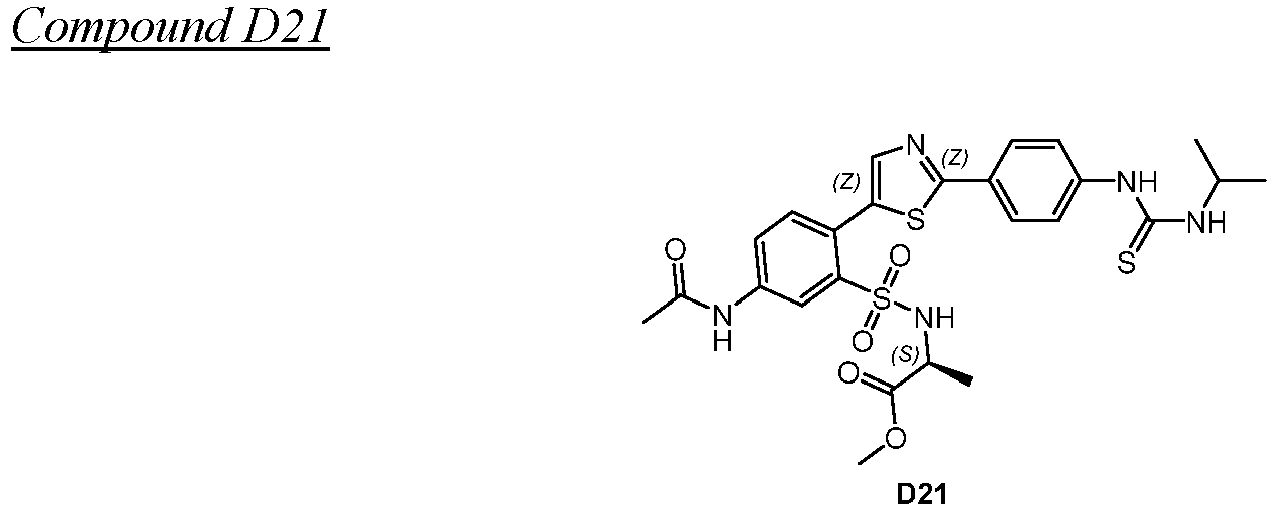
- 1H NMR (400MHz, DMSO-d6) δt = 10.40 (s, 1H), 9.54 (br s, 1H), 8.28 (s, 1H), 8.22 (d, J = 8.4 Hz, 1H), 7.88 - 7.79 (m, 5H), 7.62 (br d, J = 8.8 Hz, 2H), 7.49 (d, J = 8.2 Hz, 1H), 4.36 (br s, 1H), 3.74 - 3.66 (m, 1H), 3.46 (s, 3H), 2.07 (s, 3H), 1.20 (br d, J = 7.3 Hz, 3H), 1.15 (d, J = 6.4 Hz, 6H). ESI [M+H] = 575.9

- 1H NMR (400MHz, DMSO-d6) δ = 10.46 (s, 1H), 9.61 (br s, 1H), 8.40 (d, J=2.2 Hz, 1H), 8.00 - 7.92 (m, 1H), 7.91 - 7.82 (m, 4H), 7.66 - 7.59 (m, 2H), 7.56 (d, J=8.4 Hz, 1H), 4.38 (br d, J=6.8 Hz, 1H), 3.84 (br s, 2H), 2.13 - 2.07 (m, 3H), 1.58 (br d, J=6.8 Hz, 4H), 1.34 (br d, J=6.8 Hz, 4H), 1.16 (d, J=6.6 Hz, 6H). ESI [M+H] = 569.9


- 1H NMR (400MHz, DMSO-d6) δ = 10.48 (s, 1H), 9.69 (br s, 1H), 8.39 (d, J = 1.8 Hz, 1H), 8.31 (br s, 2H), 7.96 (br d, J = 7.9 Hz, 1H), 7.91 - 7.85 (m, 3H), 7.84 - 7.79 (m, 1H), 7.75 - 7.65 (m, 3H), 7.55 (d, J = 8.4 Hz, 1H), 4.39 (br d, J = 6.2 Hz, 1H), 2.90 - 2.81 (m, 4H), 2.50 (s, 3H), 2.11 (s, 3H), 1.69 (quin, J = 7.3 Hz, 2H), 1.18 (d, J = 6.4 Hz, 6H). ESI [M+H] = 561.3

- 1H NMR (400MHz, DMSO-d6) δ = 10.48 (s, 1H), 9.71 (br s, 1H), 8.37 (d, J = 1.8 Hz, 1H), 7.98 (br d, J = 7.7 Hz, 1H), 7.91 - 7.81 (m, 4H), 7.74 - 7.62 (m, 6H), 7.54 (d, J = 8.4 Hz, 1H), 4.52 - 4.30 (m, 1H), 2.87 (q, J = 6.5 Hz, 2H), 2.81 - 2.70 (m, 2H), 2.11 (s, 3H), 1.74 - 1.59 (m, 2H), 1.18 (d, J = 6.6 Hz, 6H). ESI [M+H] = 547.2

- 1H NMR (400MHz, DMSO-d6) δ = 10.45 (s, 1H), 9.67 (br s, 1H), 9.38 (br s, 1H), 8.36 (s, 1H), 7.94 (br d, J = 7.7 Hz, 1H), 7.88 - 7.82 (m, 3H), 7.78 (br d, J = 8.2 Hz, 1H), 7.72 - 7.63 (m, 3H), 7.52 (d, J = 8.2 Hz, 1H), 4.36 (br d, J = 6.6 Hz, 1H), 3.03 - 2.92 (m, 2H), 2.84 (q, J = 6.3 Hz, 2H), 2.68 (d, J = 4.4 Hz, 6H), 2.08 (s, 3H), 1.78 - 1.65 (m, 2H), 1.15 (d, J = 6.4 Hz, 6H). ESI [M+H] = 575.2

- 1H NMR (400MHz, DMSO-d6) δ = 10.42 (s, 1H), 9.58 (br s, 1H), 8.29 (d, J = 2.2 Hz, 1H), 7.93 - 7.81 (m, 5H), 7.68 - 7.57 (m, 3H), 7.53 (d, J = 8.4 Hz, 1H), 4.47 - 4.37 (m, 2H), 3.44 - 3.39 (m, 2H), 3.38 - 3.29 (m, 4H), 3.03 - 2.93 (m, 2H), 2.10 (s, 3H), 1.18 (d, J = 6.6 Hz, 6H). ESI [M+H] = 578.2
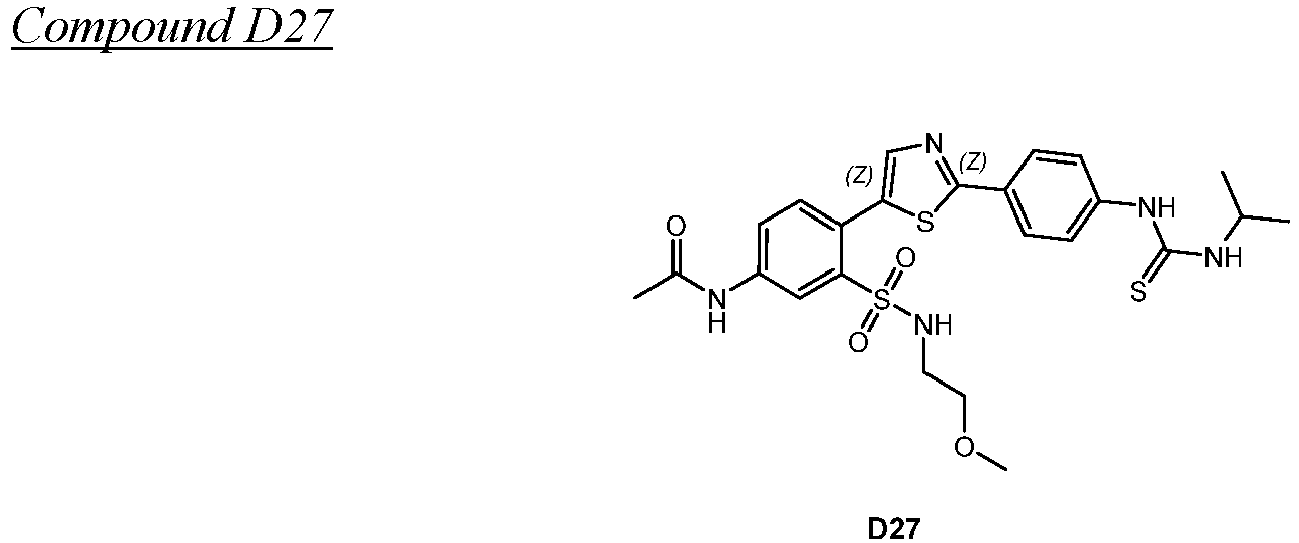
- 1H NMR (400MHz, DMSO-d6) δ = 10.42 (s, 1H), 9.58 (br s, 1H), 8.28 (d, J = 2.2 Hz, 1H), 7.92 - 7.82 (m, 5H), 7.68 - 7.58 (m, 3H), 7.54 - 7.50 (m, 1H), 4.40 (br d, J = 6.6 Hz, 1H), 4.00 (s, 3H), 3.26 (t, J = 5.8 Hz, 2H), 3.02 - 2.93 (m, 2H), 2.10 (s, 3H), 1.20 - 1.16 (m, 6H). ESI [M+H] = 548.2


- 1H NMR (400MHz, DMSO-d6) δ = 10.50 (s, 1H), 9.72 (br s, 1H), 8.41 (d, J = 2.2 Hz, 2H), 7.98 (d, J = 7.7 Hz, 1H), 7.91 - 7.86 (m, 3H), 7.84 - 7.77 (m, 2H), 7.72 - 7.67 (m, 2H), 7.57 (d, J = 8.4 Hz, 1H), 4.48 - 4.27 (m, 1H), 3.12 - 3.01 (m, 2H), 2.95 (br s, 2H), 2.56 - 2.52 (m, 3H), 2.11 (s, 3H), 1.18 (d, J = 6.4 Hz, 6H). ESI [M+H] = 547.2

- General method G. 1H NMR (400MHz, METHANOL-d4) δ = 8.48 (d, J = 1.8 Hz, 1H), 7.95 - 7.82 (m, 4H), 7.57 (d, J = 8.8 Hz, 2H), 7.49 (d, J = 8.3 Hz, 1H), 4.53 (br s, 1H), 2.17 (s, 3H), 1.24 (d, J = 6.6 Hz, 6H), 1.14 (s, 9H). ESI [M+H] = 546.0


-

- 1H NMR (400MHz, METHANOL-d4) δ = 8.39 (d, J = 1.1 Hz, 1H), 8.14 (s, 1H), 8.03 - 7.91 (m, 1H), 7.77 (d, J = 8.6 Hz, 1H), 7.66 (br d, J = 8.4 Hz, 2H), 7.49 (br d, J = 8.4 Hz, 2H), 4.62 - 4.40 (m, 1H), 2.16 (s, 3H), 1.26 (s, 9H), 1.22 (d, J = 6.6 Hz, 6H). ESI [M+H] = 546.2
-

- 1H NMR (400MHz, METHANOL-d4) δ = 7.97 (d, J = 2.2 Hz, 1H), 7.88 - 7.78 (m, 5H), 7.63 - 7.46 (m, 5H), 7.43 - 7.35 (m, 2H), 4.97 (quin, J = 6.1 Hz, 1H), 1.30 (d, J = 6.6 Hz, 6H), 1.02 (s, 9H). ESI [M+H] =629.5


- 1H NMR (400MHz, METHANOL-d4) δ = 7.99 (d, J = 2.2 Hz, 1H), 7.91 - 7.85 (m, 3H), 7.57 (d, J = 8.3 Hz, 2H), 7.47 - 7.42 (m, 1H), 7.40 - 7.36 (m, 1H), 7.35 - 7.25 (m, 5H), 5.04 - 4.93 (m, 1H), 4.50 (s, 2H), 1.31 (d, J = 6.6 Hz, 6H), 1.15 (s, 9H). ESI [M+H] =643.5

- A mixture of N-[3-(tert-butylsulfamoyl)-4-(4,4,5,5-tetramethyl-1,3,2-dioxaborolan-2 - yl)phenyl]acetamide (285.99 mg, 721.62 µmol, 1.20 eq.), N-[4-(5-bromothiazol -2-yl)-3-(tert-butylsulfamoyl)phenyl]acetamide (260.00 mg, 601.35 µmol, 1.00 eq.), Na2CO3 (159.34 mg, 1.50 mmol, 2.50 eq.) and Pd(PPh3)4 (138.98 mg, 120.27 µmol, 0.20 eq.) in Tol. (1.50 mL)/EtOH (3.00 mL)/H2O (1.50 mL) was degassed and purged with N2 for 3 times, and then the mixture was stirred at 80°C for 12 hrs under N2 atmosphere. LCMS showed the reaction was complete. The reaction mixture was concentrated, diluted with H2O (5 mL) and extracted with EtOAc (10 mL × 3). The combined organic layers were washed with brine, dried over Na2SO4, filtered and concentrated. The residue was purified by prep-HPLC (TFA condition; 5-P1B, column: YMC-Actus Triart C18 150∗30 5u;mobile phase: [water(0.1%TFA)-€];B%: 40%-70%,12min) to give compound E3 (65.75 mg, 101.09 µmol, 16.81% yield, 95.6% purity) as a light yellow solid. 1H NMR (400MHz, METHANOL-d4) δ = 8.44 (dd, J = 2.2, 12.8 Hz, 2H), 8.01 (dd, J = 2.2, 8.4 Hz, 1H), 7.98 (s, 1H), 7.92 (dd, J = 2.4, 8.4 Hz, 1H), 7.79 (d, J = 8.4 Hz, 1H), 7.54 (d, J = 8.4 Hz, 1H), 2.18 (d, J = 3.1 Hz, 6H), 1.29 (s, 9H), 1.12 (s, 9H). ESI [M+H] = 622.3


-

- ESI [M+H] =298.8/296.8

- To a solution of 5-amino-N-tert-butyl-2-(4,4,5,5-tetramethyl-1,3,2-dioxaborolan -2-yl)benzenesulfonamide (150.00 mg, 423.41 µmol, 1.00 eq.) in EtOH (2.00 mL), Tol. (1.00 mL) and H2O (1.00 mL), were added N-[4-(5-bromothiazol-2-yl)phenyl] acetamide (150.99 mg, 508.09 µmol, 1.20 eq.), Pd(PPh3)4 (48.93 mg, 42.34 µmol, 0.10 eq.) and Na2CO3 (134.63 mg, 1.27 mmol, 3.00 eq.). The mixture was stirred at 80°C for 16 hrs under N2 and LCMS showed the reaction was complete. The mixture was concentrated and the residue was purified by acidic prep-HPLC to give compound E4 (47.72 mg, 107.34 µmol, 25.35% yield, 100% purity) as a yellow solid. 1H NMR (400MHz, DMSO-d6) δ = 10.16 (s, 1H), 7.90 - 7.83 (m, 2H), 7.74 - 7.67 (m, 3H), 7.32 (d, J = 2.4 Hz, 1H), 7.15 (d, J = 8.2 Hz, 1H), 6.81 (s, 1H), 6.74 (dd, J = 2.4, 8.2 Hz, 1H), 5.83 (br s, 1H), 2.07 (s, 3H), 1.06 (s, 9H). ESI [M+H] = 445.2
-

- 1H NMR (400MHz, DMSO-d6) δ = 10.19 (s, 1H), 9.72 (br s, 1H), 8.36 (d, J = 2.0 Hz, 1H), 7.90 (d, J = 8.6 Hz, 3H), 7.84 (s, 1H), 7.77 - 7.69 (m, 3H), 7.46 (d, J = 8.2 Hz, 1H), 7.16 (s, 1H), 4.38 (br d, J = 5.3 Hz, 1H), 2.10 - 2.06 (m, 3H), 1.19 (d, J = 6.6 Hz, 6H), 1.10 (s, 9H). ESI [M+H] = 546.3

-

- ESI [M+H] =392.1/390.1
-

- 1H NMR (400MHz, METHANOL-d4) δ = 8.03 (s, 1H), 7.63 (d, J = 3.5 Hz, 4H), 7.53 (d, J = 8.3 Hz, 1H), 7.46 - 7.43 (m, 1H), 6.86 (br d, J = 11.0 Hz, 1H), 2.14 (s, 3H), 1.27 (s, 9H). ESI [M+H] = 445.2
-

- 1H NMR (400MHz, METHANOL-d4) δ = 8.42 (d, J = 2.6 Hz, 1H), 8.13 (s, 1H), 7.85 (dd, J = 2.2, 8.3 Hz, 1H), 7.75 (d, J = 8.3 Hz, 1H), 7.65 (s, 4H), 4.53 (br s, 1H), 2.14 (s, 3H), 1.31-1.24 (m, 15H). ESI [M+H] = 546.3


- To a solution of 5-amino-2-(5-bromothiazol-2-yl)-N-tert-butyl- benzenesulfonamide (95.00 mg, 243.39 µmol, 1.00 eq.) in EtOH (2.00 mL), Tol. (1.00 mL) and H2O (1.00 mL) were added N-[3-(tert-butylsulfamoyl)-4-(4,4,5,5-tetramethyl-1,3,2- dioxaborolan-2-yl)phenyl]acetamide (106.10 mg, 267.73 µmol, 1.10 eq.), Pd(PPh3)4 (28.13 mg, 24.34 µmol, 0.10 eq.) and Na2CO3 (64.49 mg, 608.48 µmol, 2.50 eq.). The mixture was stirred at 80°C for 16 hrs under N2 and LCMS showed the reaction was complete. The mixture was filtered and concentrated and the residue was purified by prep-HPLC to give compound E8 (11.00 mg, 17.04 µmol, 7.00% yield, 89.79% purity) as a yellow solid. 1H NMR (400MHz, METHANOL-d4) δ = 8.43 (s, 1H), 7.90 (s, 2H), 7.56 - 7.50 (m, 2H), 7.46 (s, 1H), 6.86 (br d, J = 10.5 Hz, 1H), 2.17 (s, 3H), 1.28 (s, 9H), 1.10 (s, 9H). ESI [M+H] = 580.2
-
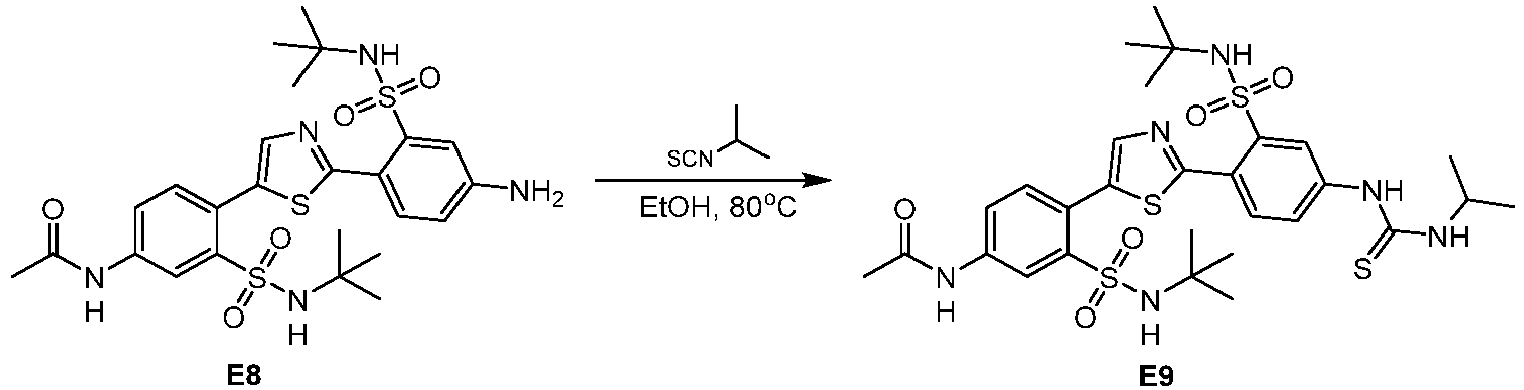
- 1H NMR (400MHz, METHANOL-d4) δ = 8.45 (s, 2H), 7.99 (s, 1H), 7.92 (br d, J = 10.1 Hz, 1H), 7.87 - 7.83 (m, 1H), 7.79 - 7.75 (m, 1H), 7.54 (d, J = 8.3 Hz, 1H), 4.52 (s, 1H), 2.17 (s, 3H), 1.31 - 1.24 (m, 15H), 1.12 (s, 9H). ESI [M+H] = 681.3

-

- ESI [M+H] =257.0/255.0
-

- 1H NMR (400MHz, METHANOL-d4) δ = 8.48 (d, J = 1.8 Hz, 1H), 7.95 - 7.82 (m, 4H), 7.57 (d, J = 8.8 Hz, 2H), 7.49 (d, J = 8.3 Hz, 1H), 4.53 (br s, 1H), 2.17 (s, 3H), 1.24 (d, J = 6.6 Hz, 6H), 1.14 (s, 9H). ESI [M+H] = 531.1

-

- ESI [M+H] =433.1


- To a solution of 5-amino-N-tert-butyl-2-[2-(4-nitrophenyl)thiazol-5-yl] benzenesulfonamide (150.00 mg, 346.80 µmol, 1.00 eq.) in i-PrOH (5.00 mL), were added 2-bromothiazole (170.65 mg, 1.04 mmol, 93.76 ul, 3.00 eq.) and TsOH (179.16 mg, 1.04 mmol, 3.00 eq.). The mixture was stirred at 80°C for 16 hrs and LCMS showed the reaction was complete. The mixture was concentrated and the residue was purified by prep-TLC (PE:EtOAc=1:1) to give intermediate compound 24 (100.00 mg, crude) as a yellow solid. ESI [M+H] =516.0
-

- 1H NMR (400MHz, DMSO-d6) δ = 10.66 (br s, 1H), 8.47 (s, 1H), 7.88 - 7.79 (m, 1H), 7.72 (s, 1H), 7.65 (d, J = 8.6 Hz, 2H), 7.43 (d, J = 8.4 Hz, 1H), 7.30 (d, J = 3.7 Hz, 1H), 7.10 (s, 1H), 7.00 (d, J = 3.7 Hz, 1H), 6.70 (br d, J = 7.9 Hz, 2H), 1.09 (s, 9H). ESI [M+H] = 486.1
-

- 1H NMR (400MHz, DMSO-d6) δ = 10.69 (s, 1H), 9.55 (br s, 1H), 8.49 (d, J = 2.2 Hz, 1H), 7.91 - 7.77 (m, 5H), 7.61 (d, J = 8.6 Hz, 2H), 7.47 (d, J = 8.4 Hz, 1H), 7.31 (d, J = 3.7 Hz, 1H), 7.15 (s, 1H), 7.01 (d, J = 3.7 Hz, 1H), 4.37 (br d, J = 6.6 Hz, 1H), 1.16 (d, J = 6.6 Hz, 6H), 1.09 (s, 9H). ESI [M+H] = 587.2

-

- 1H NMR (400MHz, DMSO-d6) δ= 7.97 (s, 1H), 7.80 (s, 1H), 7.69 (d, J = 8.3 Hz, 2H), 7.64-7.54 (m, 2H), 7.26 (s, 1H), 6.74 (d, J = 8.3 Hz, 3H), 3.24 (br s, 3H), 1.92 (br s, 3H), 1.05 (s, 9H). ESI [M+H] = 459.2
-

- 1H NMR (400MHz, DMSO-d6) δ = 9.56 (br s, 1H), 7.98 (d, J=2.0 Hz, 1H), 7.91 - 7.80 (m, 4H), 7.66 - 7.56 (m, 4H), 7.28 (s, 1H), 4.37 (br dd, J=6.6, 13.2 Hz, 1H), 3.23 (br s, 3H), 1.90 (br s, 3H), 1.16 (d, J=6.6 Hz, 6H), 1.04 (s, 9H). ESI [M+H] = 559.9


- To a solution of 5-amino-N-tert-butyl-2-[2-(4-nitrophenyl)thiazol-5-yl] benzenesulfonamide (50.00 mg, 115.60 µmol, 1.00 eq.) in n-BuOH (2.00 mL) was added 2-bromo-1-methylimidazole (55.84 mg, 346.80 µmol, 3.00 eq.) and TsOH.H2O (65.97 mg, 346.80 µmol, 3.00 eq.) and the mixture was stirred at 125°C for 6 hrs. The mixture was concentrated and the residue was purified by prep-HPLC (TFA condition) to give intermediate compound 25 (45 mg, crude) as a yellow solid. ESI [M+H] =513.1
-

- 1H NMR (400MHz, DMSO-d6) δ = 10.07 (br s, 1H), 7.89 (s, 1H), 7.74 (s, 1H), 7.64 (d, J = 8.3 Hz, 2H), 7.56 - 7.50 (m, 1H), 7.44 (br d, J = 7.9 Hz, 1H), 7.35 (s, 1H), 7.24 (br s, 1H), 7.11 (s, 1H), 6.64 (d, J = 8.8 Hz, 2H), 3.64 (s, 3H), 1.06 (s, 9H). ESI [M+H] = 483.1
-

- 1H NMR (400MHz, DMSO-d6) δ = 10.10 (br s, 1H), 9.60 (br s, 1H), 7.94 - 7.82 (m, 5H), 7.66 (br d, J = 8.3 Hz, 2H), 7.57 (d, J = 8.8 Hz, 1H), 7.45 (br d, J = 8.3 Hz, 1H), 7.36 (s, 1H), 7.26 (s, 1H), 7.17 (s, 1H), 4.38 (br s, 1H), 3.64 (s, 3H), 1.18 (d, J = 6.6 Hz, 6H), 1.06 (s, 9H). ESI [M+H] = 584.0

-
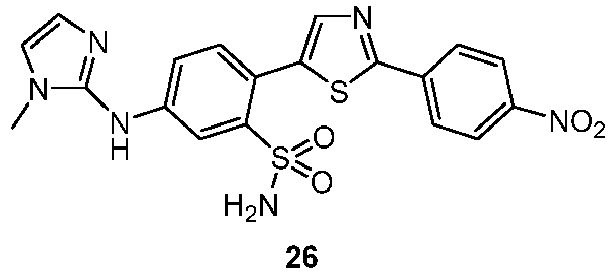
- To a solution of 5-amino-N-tert-butyl-2-[2-(4-nitrophenyl)thiazol-5-yl] benzenesulfonamide (300.00 mg, 693.61 µmol, 1.00 eq.) in n-BuOH (5.00 mL) was added TsOH.H2O (395.82 mg, 2.08 mmol, 3.00 eq.) and the mixture was stirred at 130°C for 18 hrs. LCMS showed the reaction was complete. The mixture was concentrated and the residue was purified by prep-HPLC (TFA condition) to give intermediate compound 26 (140.00 mg, 291.35 µmol, 42.00% yield, 95% purity) as a yellow solid. 1H NMR (400MHz, CHLOROFORM-d) δ = 8.23 (br d, J = 8.8 Hz, 2H), 8.05 (d, J = 8.3 Hz, 2H), 7.93 (s, 1H), 7.79 (s, 1H), 7.39 (d, J = 8.3 Hz, 1H), 7.23 (br d, J = 8.3 Hz, 1H), 6.95 - 6.81 (m, 2H), 3.58 (s, 3H).
-

- 1H NMR (400MHz, DMSO-d6) δ = 10.29 (br s, 1H), 7.83 (s, 1H), 7.78 (s, 1H), 7.66 (d, J = 8.3 Hz, 2H), 7.56 (d, J = 8.3 Hz, 1H), 7.46 - 7.38 (m, 4H), 7.29 (s, 1H), 6.68 (br d, J = 7.5 Hz, 2H), 3.66 (s, 3H). ESI [M+H] = 427.2
-

- 1H NMR (400MHz, DMSO-d6) δ = 10.17 (br s, 1H), 9.62 (br s, 1H), 7.93 - 7.76 (m, 5H), 7.67 (br d, J = 8.8 Hz, 2H), 7.59 (d, J = 8.3 Hz, 1H), 7.51 - 7.40 (m, 3H), 7.38 (s, 1H), 7.28 (s, 1H), 4.40 (br s, 1H), 3.65 (s, 3H), 1.19 (d, J = 6.6 Hz, 6H). ESI [M+H] = 528.2
-
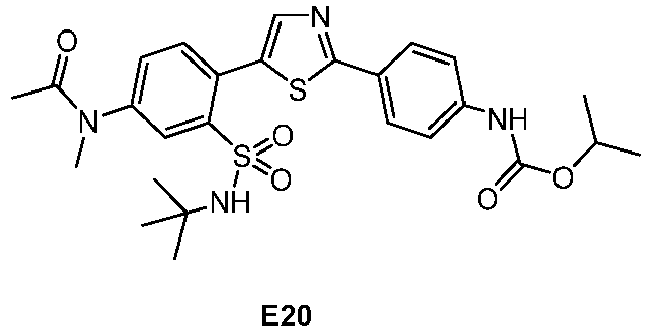
- 1H NMR (400MHz, DMSO-d6) δ = 9.89 (s, 1H), 8.01 (s, 1H), 7.95 - 7.82 (m, 3H), 7.62 (br d, J = 8.6 Hz, 4H), 7.32 (s, 1H), 4.93 (td, J = 6.2, 12.5 Hz, 1H), 3.34 - 3.30 (m, 3H), 1.94 (br s, 3H), 1.28 (d, J = 6.2 Hz, 6H), 1.07 (s, 9H). ESI [M+H] = 544.9

-

- To a solution of N-[4-(5-bromothiazol-2-yl)-3-(tert-butylsulfamoyl)phenyl] acetamide (100.00 mg, 231.29 µmol, 1.00 eq.) in EtOH (2.00 mL), Tol. (1.00 mL) and H2O (1.00 mL) were added 5-amino-N-tert-butyl-2-(4,4,5,5-tetramethyl-1,3,2- dioxaborolan-2-yl)benzenesulfonamide (90.13 mg, 254.42 µmol, 1.10 eq.), Pd(PPh3)4 (26.73 mg, 23.13 µmol, 0.10 eq.) and Na2CO3 (61.29 mg, 578.22 µmol, 2.50 eq.). The mixture was stirred at 80°C for 16 hrs under N2 and LCMS showed the reaction was complete. The mixture was filtered and concentrated and the residue was purified by prep-HPLC (TFA condition) to give intermediate compound 20 (25.00 mg, 36.58 µmol, 15.82% yield, 84.83% purity) as a yellow solid. ESI [M+H] =580.2
-

- 1H NMR (400MHz, METHANOL-d4) δ = 8.40 (s, 2H), 8.02 - 7.95 (m, 2H), 7.78 (br d, J = 8.4 Hz, 2H), 7.51 (d, J = 8.4 Hz, 1H), 4.52 (br s, 1H), 2.17 (s, 3H), 1.30 - 1.21 (m, 15H), 1.12 (s, 9H). ESI [M+H] = 681.3
-

-

- ESI [M+H] =257.9/255.7
-

- ESI [M+H] = 446.1
-

- 1H NMR (400MHz, METHANOL-d4) δ = 8.48 (s, 1H), 7.92 - 7.84 (m, 4H), 7.59 (br d, J=8.8 Hz, 2H), 7.50 (d, J=8.3 Hz, 1H), 3.95 (d, J=6.6 Hz, 2H), 2.18 (s, 3H), 2.05 - 1.95 (m, 1H), 1.14 (s, 9H), 1.00 (d, J=6.6 Hz, 6H). ESI [M+H] = 545.2

- 1H NMR (400MHz, METHANOL-d4) δ = 8.48 (s, 1H), 7.92 - 7.84 (m, 4H), 7.58 (d, J=8.3 Hz, 2H), 7.50 (d, J=8.3 Hz, 1H), 3.76 (s, 3H), 2.17 (s, 3H),1.14 (s, 9H). ESI [M+H] = 503.3

- 1H NMR (400MHz, METHANOL-d4) δ = 8.48 (d, J=1.8 Hz, 1H), 7.91 - 7.85 (m, 4H), 7.58 (d, J=8.8 Hz, 2H), 7.50 (d, J=8.3 Hz, 1H), 4.21 (q, J=7.0 Hz, 2H), 2.18 (s, 3H), 1.32 (t, J=7.0 Hz, 3H), 1.14 (s, 9H). ESI [M+H] = 517.2

- 1H NMR (400MHz, METHANOL-d4) δ = 8.48 (s, 1H), 7.93 (d, J=8.8 Hz, 2H), 7.89 - 7.85 (m, 2H), 7.72 (d, J=8.8 Hz, 2H), 7.50 (d, J=8.3 Hz, 1H), 2.30 - 2.25 (m, 2H), 2.18 (s, 3H), 1.14 (s, 10H), 1.03 (d, J=6.6 Hz, 6H). ESI [M+H] = 529.2

- 1H NMR (400MHz, DMSO-d6) δ = 10.38 (s, 1H), 10.10 (s, 1H), 8.39 (s, 1H), 7.90 (d, J=8.4 Hz, 2H), 7.84 - 7.78 (m, 2H), 7.46 (d, J=8.4 Hz, 1H), 7.29 (br d, J=8.6 Hz, 2H), 7.15 (s, 1H), 3.05 (s, 3H), 2.07 (s, 3H), 1.05 (s, 9H). [M+H] = 523.0

- 1H NMR (400MHz, DMSO-d6) δ = 10.66 (s, 1H), 10.41 (s, 1H), 8.41 (s, 1H), 7.86 - 7.79 (m, 6H), 7.65 - 7.53 (m, 3H), 7.46 (d, J = 8.2 Hz, 1H), 7.23 (br d, J = 8.2 Hz, 2H), 7.15 (s, 1H), 2.09 (s, 3H), 1.06 (s, 9H). ESI [M+H] = 585.0

- 1H NMR (400MHz, DMSO-d6) δ = 10.42 (s, 1H), 10.17 (s, 1H), 8.42 (s, 1H), 7.92 (d, J = 8.6 Hz, 2H), 7.87 - 7.82 (m, 2H), 7.49 (d, J = 8.4 Hz, 1H), 7.33 (d, J = 8.8 Hz, 2H), 7.19 (s, 1H), 3.18 (q, J = 7.2 Hz, 2H), 2.10 (s, 3H), 1.21 (t, J = 7.3 Hz, 3H), 1.07 (s, 9H). ESI [M+H] = 537.3

- 1H NMR (400MHz, DMSO-d6) δ = 10.41 (s, 1H), 10.15 (s, 1H), 8.42 (s, 1H), 7.95 - 7.88 (m, 2H), 7.85-7.84 (m, 2H), 7.49 (d, J = 8.3 Hz, 1H), 7.35 - 7.29 (m, J = 8.4 Hz, 2H), 7.17 (s, 1H), 3.68 (t, J = 5.9 Hz, 2H), 3.46 - 3.43 (m, 2H), 3.18 (s, 3H), 2.10 (s, 3H), 1.08 (s, 9H). ESI [M+H] = 567.1
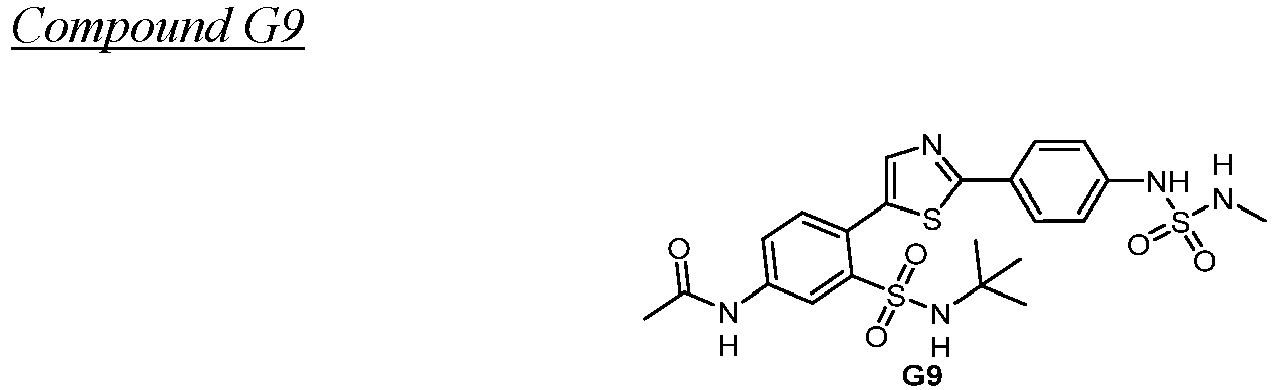
- 1H NMR (400MHz, METHANOL-d4) δ = 8.48 (d, J = 2.0 Hz, 1H), 7.99 - 7.85 (m, 4H), 7.50 (d, J = 8.2 Hz, 1H), 7.29 (d, J = 8.6 Hz, 2H), 2.60 (s, 3H), 2.18 (s, 3H), 1.14 (s, 9H). ESI [M+H] = 538.1
-

- 1HNMR (400MHz, METHANOL-d4) δ = 8.48 (s, 1H), 7.91 - 7.84 (m, 4H), 7.50 (d, J=8.8 Hz, 3H), 3.94 - 3.82 (m, 1H), 2.18 (s, 3H), 1.20 (d, J=6.6 Hz, 6H), 1.14 (s, 9H). ESI [M+H] = 530.2

- A mixture of N-[4-[2-(4-aminophenyl)thiazol-5-yl]-3-(tert-butylsulfamoyl) phenyl]acetamide (50.00 mg, 112.47 µmol, 1.00 eq.), Pyridine (25.00 mg, 316.04 µmol, 25.51 ul, 2.81 eq.) and Boc2O (40.00 mg, 183.28 µmol, 42.11 ul, 1.63 eq.) in THF (2.00 mL) and t-BuOH (2.00 mL) was stirred at 20°C for 14 hrs. LCMS showed the reaction was complete. The mixture was concentrated and the residue was purified by prep-HPLC (YMC-Actus Triart C18 150∗30 5u;mobile phase: [water(10mM NH4HCO3)-€];B%: 55%-75%,12min) to give tert-butyl N-[4-[5-[4-acetamido- 2-(tert-butylsulfamoyl) phenyl]thiazol-2-yl]phenyl]carbamate (20.01 mg, 35.05 µmol, 31.16% yield, 95.41% purity) as a yellow solid. 1H NMR (400MHz, DMSO-d6) δ = 10.41 (s, 1H), 9.70 - 9.63 (m, 1H), 8.42 (d, J = 2.2 Hz, 1H), 7.88 - 7.82 (m, 4H), 7.59 (d, J = 8.8 Hz, 2H), 7.48 (d, J = 8.4 Hz, 1H), 7.18 (s, 1H), 2.10 (s, 3H), 1.50 - 1.49 (m, 9H), 1.08 (s, 9H). ESI [M+H] = 545.4
-


-
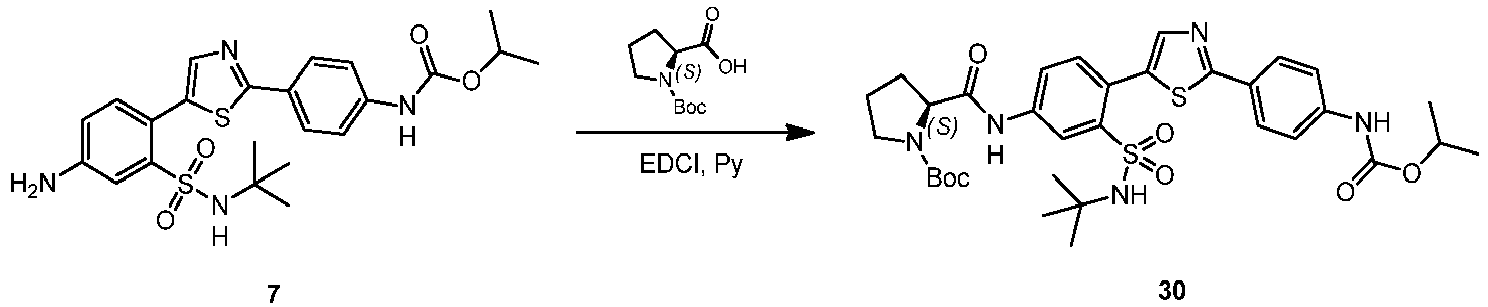
- To a solution of isopropyl N-[4-[5-[4-amino-2-(tert-butylsulfamoyl]phenyl] thiazol-2-yl]phenyl]carbamate (20.00 mg, 40.93 µmol, 1.00 eq.) in Pyridine (2.00 mL) were added (2S)-1-tert-butoxycarbonylpyrrolidine-2-carboxylic acid (44.05 mg, 204.66 µmol, 5.00 eq.) and EDCI (9.42 mg, 49.12 µmol, 1.20 eq.) and the mixture was stirred at 20°C for 0.5 hour. LCMS showed the reaction was complete. The mixture was poured into 1M HCl (10 mL) and extracted with DCM (10 mL × 3). The organic phase was dried over Na2SO4, filtered and concentrated to give tert-butyl (2S)-2-[[3-(tert-butylsulfamoyl]-4-[2-[4-(isopropoxycarbonylamino)phenyl]thiazol-5-yl]phenyl]carbamoyl]pyrrolidine-1-carboxylate (30.00 mg, crude) as a yellow oil which was used without any purification. ESI [M+H] =686.2
-
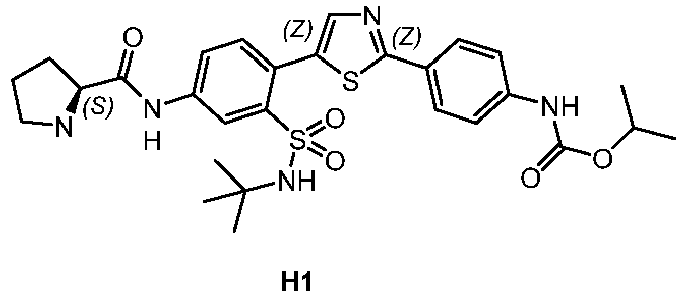
- 1H NMR (400MHz, METHANOL-d4) δ = 8.55 (d, J = 2.3 Hz, 1H), 7.96 - 7.88 (m, 4H), 7.63 - 7.56 (m, 3H), 5.00 (td, J = 6.2, 12.5 Hz, 1H), 4.47 (dd, J = 6.8, 8.6 Hz, 1H), 3.55 - 3.48 (m, 1H), 3.46 - 3.40 (m, 1H), 2.63 - 2.53 (m, 1H), 2.28 - 2.11 (m, 3H), 1.34 (d, J = 6.2 Hz, 6H), 1.14 (s, 9H). ESI [M+H] = 586.2
-

- 1H NMR (400MHz, METHANOL-d4) δ = 8.54 (d, J = 2.2 Hz, 1H), 7.95 - 7.91 (m, 2H), 7.90 (s, 2H), 7.61 (s, 1H), 7.60 - 7.56 (m, 2H), 5.07 - 4.95 (m, 1H), 4.50 - 4.42 (m, 1H), 3.54-3.48 (m, 1H), 3.46 - 3.39 (m, 2H), 2.65 - 2.54 (m, 1H), 2.20 - 2.13 (m, 2H), 1.34 (d, J = 6.2 Hz, 6H), 1.14 (s, 9H). ESI [M+H] = 586.2
-

- 1H NMR (400MHz, METHANOL-d4) δ = 8.49 (d, J = 2.2 Hz, 1H), 7.94 - 7.87 (m, 4H), 7.59 (d, J = 8.7 Hz, 2H), 7.51 (d, J = 8.3 Hz, 1H), 5.06 - 4.95 (m, 1H), 1.87 - 1.77 (m, 1H), 1.34 (d, J = 6.2 Hz, 6H), 1.15 (s, 9H), 1.05 - 0.99 (m, 2H), 0.96 - 0.89 (m, 2H). ESI [M+H] = 557.1

- 1H NMR (400MHz, METHANOL-d4) δ = 8.48 (d, J = 2.1 Hz, 1H), 7.91 - 7.85 (m, 4H), 7.57 (d, J = 8.7 Hz, 2H), 7.49 (d, J = 8.3 Hz, 1H), 5.04 - 4.92 (m, 1H), 2.45 (q, J = 7.5 Hz, 2H), 1.32 (d, J = 6.2 Hz, 6H), 1.23 (t, J = 7.6 Hz, 3H), 1.14 (s, 9H). ESI [M+H] = 545.1

- 1H NMR (400MHz, METHANOL-d4) δ = 8.36 (s, 1H), 7.88 - 7.82 (m, 3H), 7.71 (br d, J = 7.3 Hz, 1H), 7.55 (br d, J = 8.6 Hz, 2H), 7.47 - 7.39 (m, 3H), 7.39 - 7.28 (m, 3H), 5.20 (s, 2H), 4.96 (td, J = 6.4, 12.5 Hz, 1H), 1.29 (d, J = 6.2 Hz, 6H), 1.12 (s, 9H). ESI [M+H] = 623.1
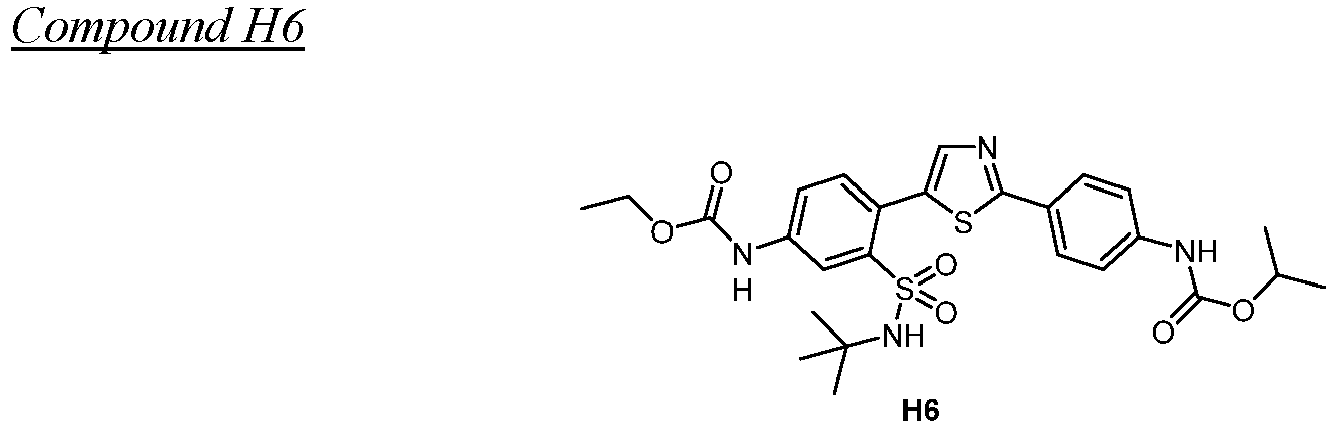
- 1H NMR (400MHz, METHANOL-d4) δ = 8.35 (s, 1H), 7.89 - 7.82 (m, 3H), 7.69 (br d, J = 8.2 Hz, 1H), 7.55 (br d, J = 8.6 Hz, 2H), 7.44 (d, J = 8.4 Hz, 1H), 4.96 (td, J = 6.3, 12.6 Hz, 1H), 4.21 (q, J = 7.1 Hz, 2H), 1.33 - 1.27 (m, 9H), 1.12 (s, 9H). ESI [M+H] = 561.1

- 1H NMR (400MHz, METHANOL-d4) δ = 8.35 (s, 1H), 7.90 - 7.83 (m, 3H), 7.70 (br d, J = 8.4 Hz, 1H), 7.56 (d, J = 8.6 Hz, 2H), 7.45 (d, J = 8.4 Hz, 1H), 4.96 (quin, J = 6.2 Hz, 1H), 3.76 (s, 3H), 1.29 (d, J = 6.2 Hz, 6H), 1.12 (s, 9H). ESI [M+H] = 547.1


- 1H NMR (400MHz, METHANOL-d4) δ = 8.37 (s, 1H), 7.91 - 7.82 (m, 3H), 7.70 (br d, J = 8.2 Hz, 1H), 7.57 (br d, J = 8.6 Hz, 2H), 7.45 (d, J = 8.4 Hz, 1H), 5.04 - 4.91 (m, 2H), 1.32 (dd, J = 3.6, 6.1 Hz, 12H), 1.14 (s, 9H). ESI [M+H] = 575.2

- 1H NMR (400MHz, METHANOL-d4) δ = 8.70 - 8.67 (m, 1H), 8.06 - 7.95 (m, 3H), 7.94-7.85 (m, 3H), 7.65 - 7.48 (m, 6H), 5.02 - 4.93 (m, 1H), 1.32 (d, J = 6.2 Hz, 6H), 1.16 (s, 9H). ESI [M+H] = 593.2

- 1H NMR (400MHz, METHANOL-d4) δ = 8.49 (d, J = 2.2 Hz, 1H), 7.92 - 7.86 (m, 4H), 7.57 (d, J = 8.7 Hz, 2H), 7.50 (d, J = 8.3 Hz, 1H), 4.98 (td, J = 6.3, 12.5 Hz, 1H), 2.67 (spt, J = 6.8 Hz, 1H), 1.32 (d, J = 6.2 Hz, 6H), 1.23 (d, J = 7.0 Hz, 6H), 1.14 (s, 9H). ESI [M+H] = 559.2

- 1H NMR (400MHz, METHANOL-d4) δ = 8.09 (d, J = 2.2 Hz, 1H), 7.92 - 7.84 (m, 3H), 7.63 - 7.44 (m, 4H), 4.98 (td, J = 6.2, 12.5 Hz, 1H), 3.06 (s, 3H), 1.31 (d, J = 6.2 Hz, 6H), 1.14 (s, 9H). ESI [M+H] = 567.1
-

- A mixture of isopropyl N-[4-[5-[4-acetamido-2-(tert-butylsulfamoyl]phenyl] thiazol-2-yl]phenyl]carbamate (20.00 mg, 37.69 µmol, 1.00 eq.) in THF (200.00 ul) was added BH3-Me2S (10 M, 18.85 ul, 5.00 eq.) at 0°C and then the mixture was stirred at 70°C for 2 hrs under N2 atmosphere. LCMS showed the reaction was complete. The mixture was quenched by addition of MeOH (5 mL) at 0°C and then it was concentrated and the residue was purified by prep-HPLC (TFA condition) to give i sopropyl N-[4-[5-[2-(tert-butylsulfamoyl)-4-(ethylamino)phenyl] thiazol- 2-yl]phenyl]carbamate (3.92 mg, 7.59 µmol, 20.13% yield, 100% purity) as a pale yellow solid. 1H NMR (400MHz, METHANOL-d4) δ= 7.84 (d, J = 8.6 Hz, 2H), 7.76 (s, 1H), 7.54 (br d, J = 8.6 Hz, 2H), 7.36 (d, J = 2.2 Hz, 1H), 7.24 (d, J = 8.4 Hz, 1H), 6.78 (dd, J = 2.1, 8.5 Hz, 1H), 4.96 (td, J = 6.2, 12.3 Hz, 1H), 3.18 (q, J = 7.1 Hz, 2H), 1.29 (d, J = 6.4 Hz, 6H), 1.25 (t, J = 7.2 Hz, 3H), 1.10 (s, 9H). ESI [M+H] = 517.1

- Isopropyl N-[4-[5-[4-amino-2-(tert-butylsulfamoyl)phenyl]thiazol-2-yl]phenyl] carbamate (20.00 mg, 40.93 µmol, 1.00 eq.) was dissolved into a solution of H2SO4 (40.14 mg, 409.30 µmol, 21.82 ul, 10.00 eq.) in H2O (1.00 mL). The mixture was cooled to -5°C, then added NaNO2 (3.39 mg, 49.12 µmol, 2.67 ul, 1.20 eq.) in H2O (500.00 ul) and the mixture was stirred at 0°C for 30 min. Then H2O (500.00 ul) was added and the mixture was stirred at 26°C for 1.5 hrs. LCMS showed the reaction was complete. The mixture was concentrated and the residue was purified by acidic prep-HPLC to give isopropyl N-[4-[5-[2-(tert-butylsulfamoyl)- 4-hydroxy-phenyl] thiazol-2-yl]phenyl]carbamate (3.04 mg, 6.02 µmol, 14.71% yield, 97% purity) as a brown solid. 1H NMR (400MHz, METHANOL-d4) δ = 7.85 (d, J = 8.6 Hz, 2H), 7.78 (s, 1H), 7.61 - 7.51 (m, 3H), 7.35 (d, J = 8.2 Hz, 1H), 7.05 - 6.96 (m, 1H), 4.97 - 4.93 (m, 1H), 1.29 (d, J = 6.2 Hz, 6H), 1.10 (s, 9H). ESI [M+H] = 490.1

- To solution of isopropyl N-[4-[5-[4-amino-2-(tert-butylsulfamoyl)phenyl] thiazol-2-yl]phenyl]carbamate (20.00 mg, 40.93 µmol, 1.00 eq.) and NaBH3CN (5.14 mg, 81.86 µmol, 2.00 eq.) in DCM (2.00 mL) at 0°C was added neat TFA (2.00 mL) and the mixture was stirred at 0°C for 5 mins. 2,2,2-trifluoroacetaldehyde (10.03 mg, 102.33 µmol, 2.50 eq.) was then added at 0°C and the mixture was stirred at 20°C for 30 mins. LCMS showed the reaction was complete. The mixture was washed with sat.aq.NaHCO3 (10 mL) and the aqueous phase was extracted with DCM (20 mL × 3). The combined organic phase was dried, filtered and concentrated. The residue was purified by prep-HPLC (TFA condition) to give isopropyl N-[4-[5-[2-(tert-butylsulfamoyl)-4-(2,2,2-trifluoroethylamino)phenyl]thiazol-2-yl]phenyl]carbamate (4.68 mg, 8.20 µmol, 20.03% yield, 100% purity) as a pale yellow solid. 1H NMR (400MHz, METHANOL-d4) δ = 7.77 (d, J = 8.7 Hz, 2H), 7.69 (s, 1H), 7.47 (br d, J = 8.7 Hz, 2H), 7.43 (d, J = 2.4 Hz, 1H), 7.22 (d, J = 8.4 Hz, 1H), 6.86 (dd, J = 2.5, 8.4 Hz, 1H), 4.88 (td, J = 6.2, 12.5 Hz, 1H), 3.83 (q, J = 9.2 Hz, 2H), 1.22 (d, J = 6.2 Hz, 6H), 1.02 (s, 9H). ESI [M+H] = 571.1

-

- To a solution of isopropyl N-[4-[5-[4-amino-2-(tert-butylsulfamoyl)phenyl] thiazol-2-yl]phenyl]carbamate (840.00 mg, 1.72 mmol, 1.00 eq.) in € (30.00 mL) were added tert-butyl nitrite (354.55 mg, 3.44 mmol, 407.53 ul, 2.00 eq.) and CuBr2 (191.98 mg, 860.00 µmol, 40.25 ul, 0.50 eq.), then the mixture was heated at 60°C under N2 for 1 hr. LCMS showed the reaction was complete. The mixture was diluted with water (50 mL) and extracted with EtOAc(50 mL × 3). The combined organic phase was dried, filtered and concentrated. The residue was purified by silica gel column chromatography (Petroleum ether/Ethyl acetate=8:1) to give intermediate compound 31 (350.00 mg, 633.48 µmol, 36.83% yield) as a yellow solid. ESI [M+H] =554.0/552.0

- A mixture of isopropyl N-[4-[5-[4-bromo-2-(tert-butylsulfamoyl)phenyl] thiazol-2-yl]phenyl]carbamate (30.00 mg, 54.30 µmol, 1.00 eq.), 3-methyloxetan-3-amine (23.65 mg, 271.49 µmol, 5.00 eq.), Pd2(dba)3 (4.97 mg, 5.43 µmol, 0.10 eq.), Xphos (3.88 mg, 8.14 µmol, 0.15 eq.) and t-BuONa (5.74 mg, 59.73 µmol, 1.10 eq.) in toluene (2.00 mL) was stirred at 110°C for 16 hrs under N2. LCMS showed the reaction was complete. The mixture was washed with water (30 mL) and the aqueous phase was extracted with EtOAc (30 mL X 3). The combined organic phase was dried, filtered and concentrated. The residue was purified by prep-TLC (PE:EtOAc = 1:1) and prep-HPLC (TFA condition) to give compound I4 (2.78 mg, 4.94 µmol, 9.10% yield, 99.36% purity) as a brown solid. 1H NMR (400MHz, METHANOL-d4) δ = 7.88 (d, J = 8.7 Hz, 2H), 7.80 (s, 1H), 7.58 (d, J = 8.6 Hz, 2H), 7.30 (d, J = 8.3 Hz, 1H), 7.23 (d, J = 2.4 Hz, 1H), 6.67 (dd, J = 2.4, 8.3 Hz, 1H), 5.00 (td, J = 6.2, 12.5 Hz, 1H), 4.82 (d, J = 6.0 Hz, 2H), 4.63 (d, J = 6.0 Hz, 2H), 1.71 (s, 3H), 1.33 (d, J = 6.2 Hz, 6H), 1.14 (s, 9H). ESI [M+H] = 559.2
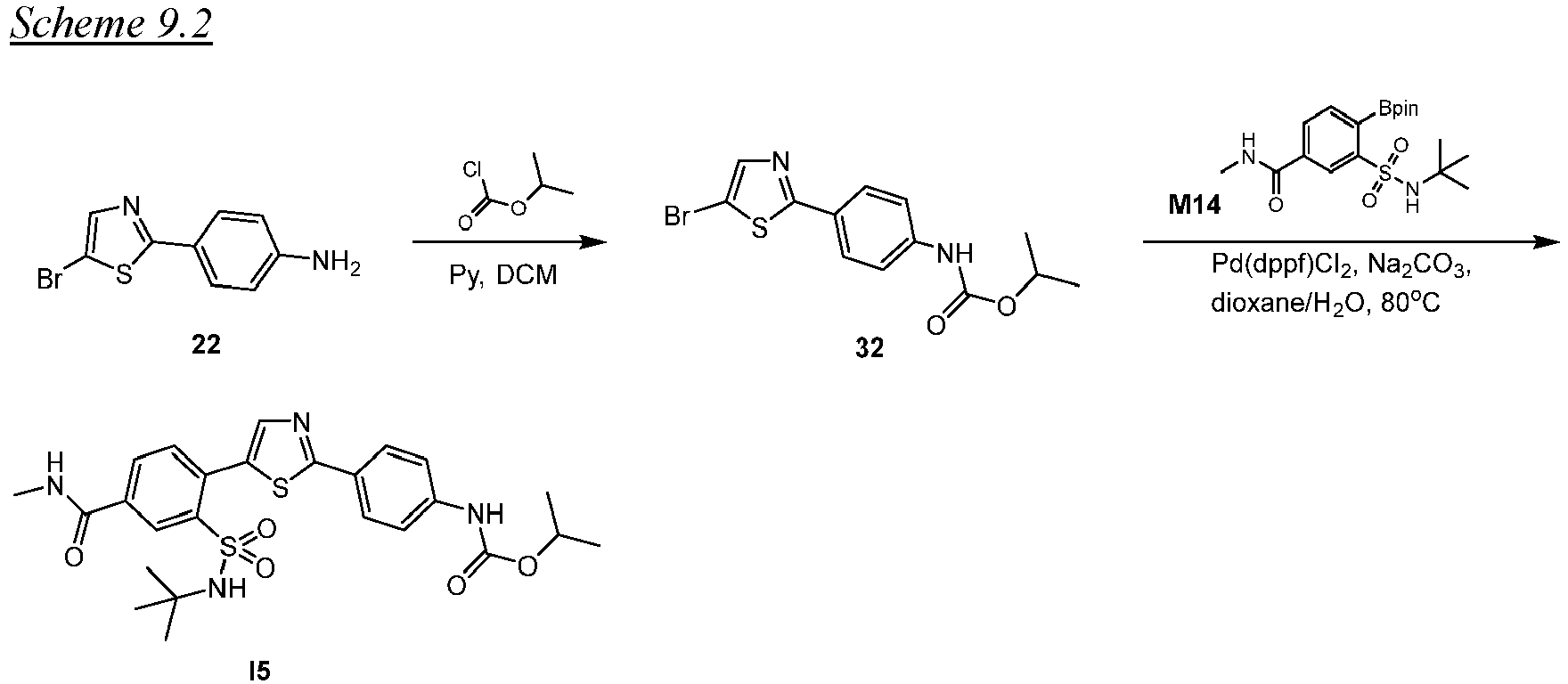
-

- ESI [M+H] =343.1/341.1
-

- 1H NMR (400MHz, METHANOL-d4) δ = 8.64 (d, J = 1.8 Hz, 1H), 8.05 (dd, J = 1.8, 7.9 Hz, 1H), 7.96 (s, 1H), 7.91 (d, J = 8.8 Hz, 2H), 7.67 (d, J = 7.9 Hz, 1H), 7.58 (d, J = 8.6 Hz, 2H), 4.98 (td, J = 6.3, 12.5 Hz, 1H), 2.96 (s, 3H), 1.31 (d, J = 6.2 Hz, 6H), 1.15 - 1.02 (m, 9H). ESI [M+H] = 531.2

-

- 1H NMR (400MHz, DMSO-d6) δ = 9.88 (s, 1H), 8.60 (d, J = 2.0 Hz, 1H), 8.27 (br s, 1H), 8.13 (dd, J = 2.0, 7.8 Hz, 1H), 7.99 - 7.86 (m, 3H), 7.65 (dd, J = 8.3, 18.1 Hz, 4H), 7.28 (s, 1H), 4.93 (quin, J = 6.4 Hz, 1H), 1.28 (d, J = 5.9 Hz, 6H), 1.05 (s, 9H). ESI [M+H] = 517.1
-

- To a solution of compound I6 (70.00 mg, 135.49 µmol, 1.00 eq.) in Tol. (2.00 mL) was added 1,1-dimethoxy-N,N-dimethyl-methanamine (48.44 mg, 406.48 µmol, 53.82 ul, 3.00 eq.). The mixture was stirred at 110°C for 1 hr and LCMS showed the reaction was complete. The mixture was concentrated to give intermediate compound 33 (70.00 mg, crude) as a yellow solid. ESI [M+H] =572.2

- To a solution of intermediate compound 33 (70.00 mg, 122.44 µmol, 1.00 eq.) in AcOH (2.00 mL) was added NH2NH2.H2O (9.38 mg, 183.66 µmol, 9.11 ul, 98% purity, 1.50 eq.). The mixture was stirred at 90°C for 1 hr and LCMS showed the reaction was complete. The mixture was concentrated and the residue was purified by acidic prep-HPLC to give compound I7 (1.90 mg, 3.51 µmol, 2.87% yield, 100% purity) as a pale yellow solid. 1H NMR (400MHz, METHANOL-d4) δ = 8.89 (d, J = 1.8 Hz, 1H), 8.54 (s, 1H), 8.29 (dd, J = 1.8, 7.9 Hz, 1H), 7.97 (s, 1H), 7.91 (d, J = 8.6 Hz, 2H), 7.69 (d, J = 7.9 Hz, 1H), 7.58 (d, J = 8.6 Hz, 2H), 4.98 (td, J = 6.3, 12.6 Hz, 1H), 1.31 (d, J = 6.2 Hz, 6H), 1.13 (s, 9H). ESI [M+H] = 541.1
-

- 1H NMR (400MHz, METHANOL-d4) δ = 8.19 (s, 1H), 7.91 - 7.86 (m, 3H), 7.64 - 7.51 (m, 4H), 4.97 (quin, J = 6.2 Hz, 1H), 4.73 (s, 2H), 1.31 (d, J = 6.2 Hz, 6H), 1.10 (s, 9H). ESI [M+H] = 504.1
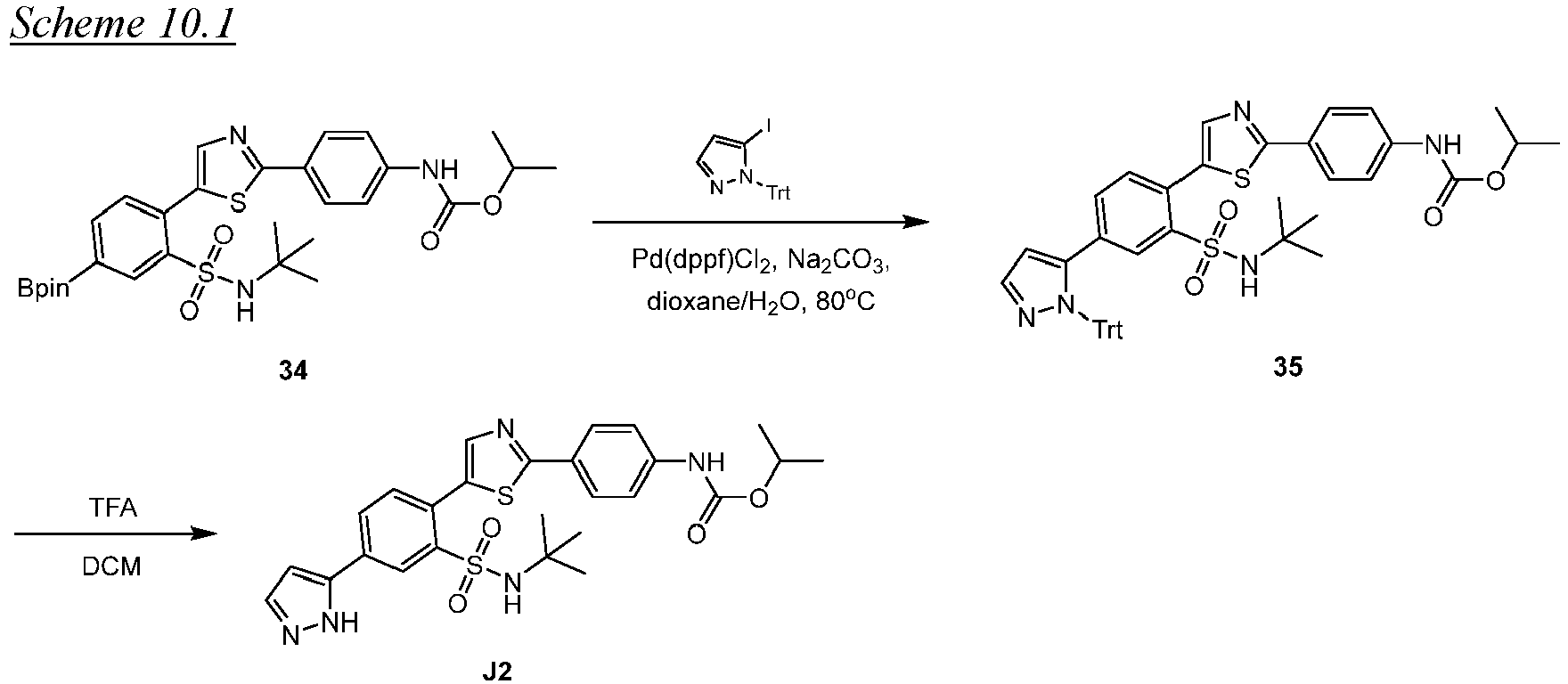
-

- ESI [M+H] =782.4
-

- 1H NMR (400MHz, METHANOL-d4) δ = 8.63 (s, 1H), 8.07 (dd, J = 1.6, 7.9 Hz, 1H), 7.96 (s, 1H), 7.92 (br d, J = 8.7 Hz, 2H), 7.77 (d, J = 2.1 Hz, 1H), 7.65 - 7.58 (m, 3H), 6.82 (d, J = 2.1 Hz, 1H), 5.00 (td, J = 6.3, 12.5 Hz, 1H), 1.33 (d, J = 6.2 Hz, 6H), 1.15 (s, 9H). ESI [M+H] = 540.3

- To a solution of isopropyl N-[4-[5-[4-amino-2-(tert-butylsulfamoyl) phenyllthiazol-2-yl]phenyl]carbamate (25.00 mg, 51.16 µmol, 1.00 eq.) and NaBH3CN (6.43 mg, 102.32 µmol, 2.00 eq.) in DCM (2.00 mL) at 0°C was added neat TFA (2.00 mL) and the mixture was stirred at 0°C for 0.1 hr. Trifluoroacetone (14.33 mg, 127.90 µmol, 11.46 ul, 2.50 eq.) was added at 0°C and the mixture was stirred at 20°C for 1 hr. LCMS showed the reaction was complete. The mixture was washed with sat.aq. NaHCO3 (10 mL) and the aqueous phase was extracted with DCM (20 mL × 3). The combined organic phase was dried, filtered and concentrated. The residue was purified by prep-HPLC (TFA condition) to give isopropyl N-[4-[5-[2-(tert-butylsuffamoyl)-4-[(2,2,2-trifluoro-1-methyl-ethyl)amino]phenyl]thiazol-2-yl]phenyl]carbamate (3.97 mg, 6.75 µmol, 13.19% yield, 99.40% purity) as a yellow solid. 1H NMR (400MHz, METHANOL-d4) δ = 7.88 (d, J = 8.7 Hz, 2H), 7.81 (s, 1H), 7.58 (d, J = 8.7 Hz, 2H), 7.54 (d, J = 2.4 Hz, 1H), 7.32 (d, J = 8.3 Hz, 1H), 6.97 (dd, J = 2.6, 8.4 Hz, 1H), 5.00 (tt, J = 6.3, 12.5 Hz, 1H), 4.31 (td, J = 6.7, 13.4 Hz, 1H), 1.44 (d, J = 6.8 Hz, 3H), 1.33 (d, J = 6.2 Hz, 6H), 1.14 (s, 9H). ESI [M+H] = 585.4

-
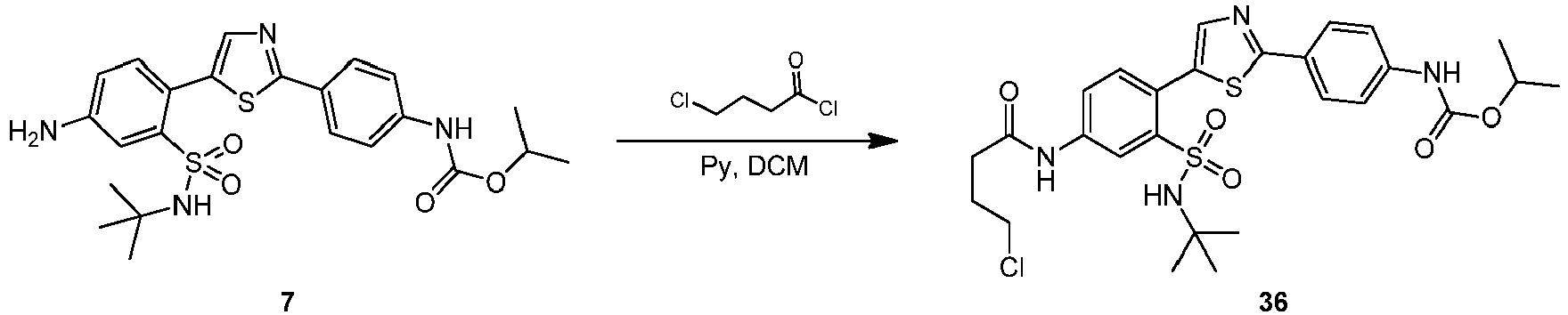
- ESI [M+H] =593.2/595.2

- To a solution of intermediate compound 36 (15.00 mg, 25.29 µmol, 1.00 eq.) in DMF (150.00 ul) K2CO3 (10.49 mg, 75.87 µmol, 3.00 eq.) was added. The mixture was stirred at 60°C for 2 hrs and LCMS showed the reaction was complete. The mixture was concentrated and the residue was purified by prep-HPLC (TFA condition) to give compound J3 (1.07 mg, 1.88 µmol, 7.45% yield, 98% purity) as a white solid. 1H NMR (400MHz, METHANOL-d4) δ = 8.65 (d, J = 2.4 Hz, 1H), 7.93 - 7.77 (m, 4H), 7.56 (dd, J = 4.0, 8.6 Hz, 3H), 5.02 - 4.92 (m, 1H), 3.99 (t, J = 7.1 Hz, 2H), 2.65 (t, J = 8.0 Hz, 2H), 2.29 - 2.15 (m, 2H), 1.31 (d, J = 6.2 Hz, 6H), 1.14 (s, 9H). ESI [M+H] = 557.4

-

- To a solution of (6-amino-3-pyridyl)boronic acid (200.00 mg, 1.45 mmol, 1.00 eq.) in dioxane (5.00 mL), Tol. (5.00 mL) and H2O (2.00 mL) were added Pd(dppf)Cl2.CH2Cl2 (118.41 mg, 145.00 µmol, 0.10 eq.), Na2CO3 (461.06 mg, 4.35 mmol, 3.00 eq.) and 2,5-dibromothiazole (528.35 mg, 2.18 mmol, 1.50 eq.). The mixture was stirred at 80°C for 16 hrs under N2 and LCMS showed the reaction was complete. The mixture was concentrated and the residue was purified by prep-TLC (PE:EtOAc = 1:2) to give 5-(5-bromothiazol-2-yl)pyridin-2-amine (100.00 mg, crude) as a yellow solid. ESI [M+H] = 257.7/255.7
-

- ESI [M+H] = 446.1
-

- 1H NMR (400MHz, DMSO-d6) δ = 10.38 (br d, J = 19.0 Hz, 2H), 8.82 (s, 1H), 8.41 (s, 1H), 8.27 (br d, J = 8.8 Hz, 1H), 7.97 (br d, J = 9.0 Hz, 1H), 7.89 - 7.80 (m, 2H), 7.48 (br d, J = 8.4 Hz, 1H), 7.17 (s, 1H), 5.01 - 4.85 (m, 1H), 2.08 (s, 3H), 1.25 (br d, J = 6.0 Hz, 6H), 1.07 (s, 9H). ESI [M+H] = 532.1
-

- 1H NMR (400MHz, METHANOL-d4) δ = 8.42 (s, 1H), 8.01 - 7.87 (m, 4H), 7.79 (d, J = 7.9 Hz, 1H), 7.59 (d, J = 8.6 Hz, 2H), 4.98 (td, J = 6.0, 12.5 Hz, 1H), 1.32 (d, J = 6.2 Hz, 6H), 1.11 (s, 9H). ESI [M+H] = 542.1


-

- General method C, N-[3-(tert-butylsulfamoyl)-4-[2-(4-nitrophenyl)thiazol-5-yl]phenyl]-4-chloro-butanamide. ESI [M+H] =537.0
-

- A mixture of N-[3-(tert-butylsulfamoyl)-4-[2-(4-nitrophenyl)thiazol-5-yl]phenyl]-4- chloro-butanamide (100.00 mg, 186.20 µmol, 1.00 eq.) and Cs2CO3 (75.00 mg, 542.65 µmol, 2.91 eq.) in DMF (2.00 mL) was stirred at 80°C for 8 hrs and LCMS showed the reaction was complete. The mixture was diluted with H2O (10 mL) and extracted with EtOAc (10 mL). The organic phase was dried over Na2SO4, filtered and concentrated to give N-tert-butyl-2-[2-(4-nitrophenyl)thiazol-5-yl]-5-(2- oxopyrrolidin-1-yl) benzenesulfonamide (100.00 mg, crude) as a black brown solid, which was used directly. ESI [M+H] = 501.1
-

- General method B, 2-[2-(4-aminophenyl)thiazol-5-yl]-N-tert-butyl-5-(2- oxopyrrolidin-1-yl)benzenesulfonamide. ESI [M+H] =471.1
-

- 1H NMR (400MHz, DMSO-d6) δ = 8.67 - 8.58 (m, 2H), 7.86 - 7.73 (m, 4H), 7.59 - 7.49 (m, 3H), 7.26 (s, 1H), 6.14 (d, J = 7.5 Hz, 1H), 3.90 (t, J = 6.9 Hz, 2H), 3.77 (qd, J = 6.6, 13.5 Hz, 1H), 2.59 - 2.54 (m, 2H), 2.11 (quin, J = 7.3 Hz, 2H), 1.17 - 1.05 (m, 15H). ESI [M+H] = 556.1

-
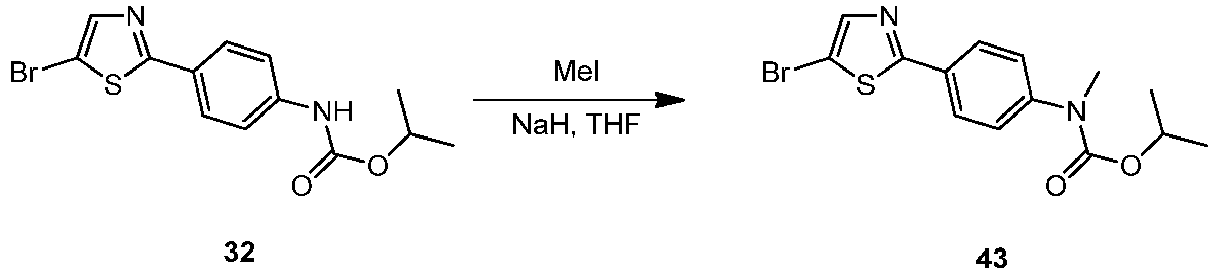
- To a solution of NaH (11.72 mg, 293.06 µmol, 60% purity, 2.00 eq.) in THF (1.00 mL) wad added isopropyl N-[4-(5-bronwthiazol-2-yl)phenyl]carbamate (50.00 mg, 146.53 µmol, 1.00 eq.) in THF (1.00 mL) at 0°C, followed by MeI (41.60 mg, 293.06 µmol, 18.25 ul, 2.00 eq.) in THF (1.00 mL). The mixture was stirred at 20°C for 1 hr and LCMS showed the reaction was complete. The mixture was quenched by sat.aq.NH4Cl (5mL) and extracted with EtOAc (5 mL × 3). The organic phase was dried over Na2SO4, filtered and concentrated to give isopropyl N-[4-(5-bromothiazol -2-yl)phenyl]-N-methyl-carbamate (65.00 mg, crude) as yellow oil. ESI [M+H] =357.0/355.0

- General method A, isopropyl N-[4-[5-[2-(tert-butylsulfamoyl]-4-(2- oxopyrrolidin-1-yl)phenyl]thiazol-2-yl]phenyl]-N-methyl-carbamate. 1H NMR (400MHz, METHANOL-d4) δ = 8.67 (s, 1H), 8.00 - 7.96 (m, 2H), 7.93 (s, 1H), 7.86 (br d, J = 8.6 Hz, 1H), 7.58 (d, J = 8.4 Hz, 1H), 7.43 (br d, J = 8.6 Hz, 2H), 4.94 (br d, J = 6.2 Hz, 1H), 4.00 (br t, J = 6.8 Hz, 2H), 3.33 (s, 3H), 2.66 (br t, J = 7.9 Hz, 2H), 2.29 - 2.19 (m, 2H), 1.26 (br d, J = 6.2 Hz, 6H), 1.15 (s, 9H). ESI [M+H] = 571.2

-

- General method H, 4-(5-bromothiazol-2-yl)-2-fluoro-aniline. ESI [M+H] = 275.0/273.0
-

- General method A, 2-[2-(4-amino-3-fluoro-phenyl)thiazol-5-yl]-N-tert- butyl-5-(2-oxopyrrolidin-1-yl)benzenesulfonamide. ESI [M+H] = 489.2
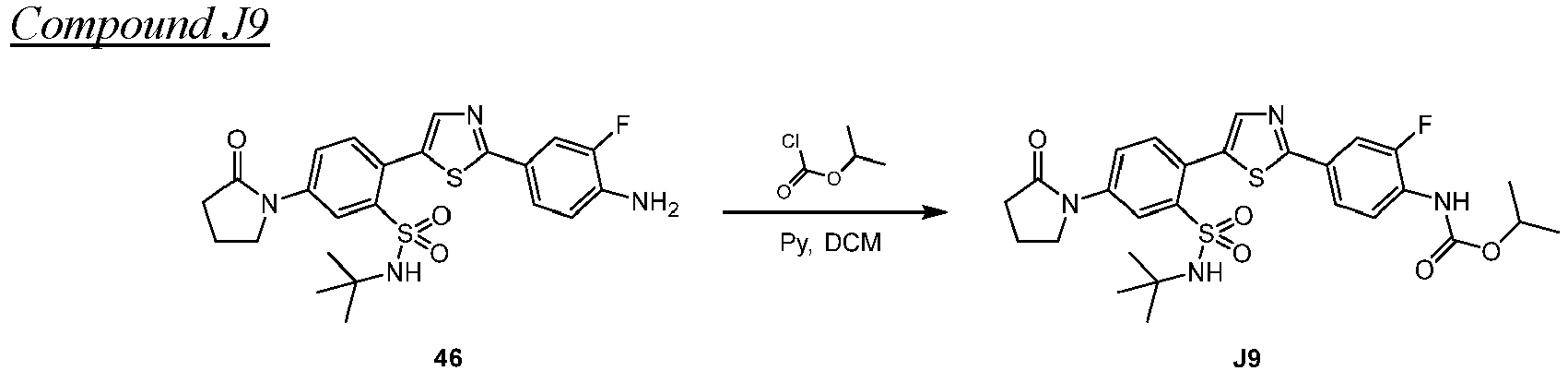
- General method C, isopropyl N-[4-[5-[2-(tert-butylsulfamoyl)-4-(2- oxopyrrolidin-1-yl)phenyl]thiazol-2-yl]-2-fluoro-phenyl]carbamate . 1H NMR (400MHz, METHANOL-d4) δ = 8.66 (d, J = 2.0 Hz, 1H), 8.08 (br t, J = 8.2 Hz, 1H), 7.90 (s, 1H), 7.84 (dd, J = 2.2, 8.4 Hz, 1H), 7.78 - 7.69 (m, 2H), 7.55 (d, J = 8.4 Hz, 1H), 5.00 (quin, J = 6.3 Hz, 1H), 3.99 (t, J = 7.1 Hz, 2H), 2.65 (t, J = 8.0 Hz, 2H), 2.22 (quin, J = 7.6 Hz, 2H), 1.32 (d, J = 6.2 Hz, 6H), 1.14 (s, 9H). ESI [M+H] = 575.2


- To a mixture of 2-methyloxirane (19.60 mg, 337.41 µmol, 23.61 ul, 1.50 eq.) in dioxane (1.00 mL) were added LiClO4 (5 M, 1.00 mL, 22.23 eq.) in THF solution and N-[4-[2-(4-aminophenyl]thiazol-5-yl]-3-(tert-butylsulfamoyl]phenyl]acetamide (100.00 mg, 224.94 µmol, 1.00 eq.). The mixture was stirred at 100°C for 6 hrs and LCMS showed the reaction was complete. The mixture was diluted with H2O (3 mL) and extracted with DCM (3 mL × 3). The combined organic layers were dried over Na2SO4, filtered and concentrated. The residue was purified by prep-TLC to give N-[3-(tert-butylsulfamoyl)-4-[2-[4-(2-hydroxypropylamino)phenyl]thiazol-5-yl]phenyl]acetamide (40.00 mg, 75.60 µmol, 33.61% yield, 95% purity) as yellow oil. 1H NMR (400MHz, METHANOL-d4) δ = 8.50 (d, J = 2.2 Hz, 1H), 7.93 - 7.87 (m, 2H), 7.81 - 7.75 (m, 2H), 7.53 (d, J = 8.4 Hz, 1H), 6.83 (d, J = 8.8 Hz, 2H), 4.04 - 3.92 (m, 1H), 3.29 - 3.11 (m, 2H), 2.19 (s, 3H), 1.27 - 1.24 (m, 3H), 1.17 (s, 9H). ESI [M+H] = 503.1
-

- General method K, N-[3-(tert-butylsulfamoyl)-4-[2-[4-(2-hydroxypropylamino) phenyl]thiazol-5-yl]phenyl]acetamide. 1H NMR (400MHz, METHANOL-d4) δ = 8.48 (d, J = 2.2 Hz, 1H), 8.02 - 7.97 (m, 2H), 7.91 - 7.85 (m, 2H), 7.75 - 7.70 (m, 2H), 7.51 (d, J = 8.4 Hz, 1H), 4.94 - 4.89 (m, 1H), 4.27 (t, J = 8.6 Hz, 1H), 3.77 (dd, J = 7.2, 8.9 Hz, 1H), 2.18 (s, 3H), 1.53 (d, J = 6.2 Hz, 3H), 1.15 (s, 9H). ESI [M+H] = 529.1


- To a solution of N-[4-[2-(4-aminophenyl)thiazol-5-yl]-3-(tert-butylsulfamoyl) phenyl]acetamide (50.00 mg, 112.47 µmol, 1.00 eq.) in EtOH (900.00 ul) and H2O (100.00 ul) was added 2,2-dimethyloxirane (810.00 mg, 11.23 mmol, 1.00 mL, 99.87 eq.). The mixture was heated at 100°C for 1 hour and LCMS showed the reaction was complete. The mixture was concentrated and the residue was purified by prep-HPLC (TFA condition) to give N-[3-(tert-butylsulfamoyl)-4-[2-[4-[(2-hydroxy-2-methyl-propyl) amino]phenyl]thiazol-5-yl]phenyl]acetamide (60.00 mg, crude) as a yellow solid. 1H NMR (400MHz, METHANOL-d4) δ = 8.46 (d, J = 1.8 Hz, 1H), 7.87 (br d, J = 6.4 Hz, 1H), 7.82 (s, 1H), 7.72 (d, J = 8.8 Hz, 2H), 7.49 (d, J = 8.4 Hz, 1H), 6.77 (d, J = 8.6 Hz, 2H), 3.17 (s, 2H), 2.17 (s, 3H), 1.27 (s, 6H), 1.14 (s, 9H). ESI [M+H] = 517.1
-

- 1H NMR (400MHz, METHANOL-d4) δ = 8.48 (s, 1H), 7.99 (d, J = 8.8 Hz, 2H), 7.90 - 7.85 (m, 2H), 7.72 (d, J = 8.8 Hz, 2H), 7.50 (d, J = 8.2 Hz, 1H), 3.94 (s, 2H), 2.17 (s, 3H), 1.56 (s, 6H), 1.14 (s, 9H). ESI [M+H] = 543.2

-

- General method A, 3-(5-bromothiazol-2-yl)aniline . ESI [M+H] = 255.0/257.0
-

- General method A, N-[4-[2-(3-aminophenyl)thiazol-5-yl]-3-(tert-butylsulfamoyl)phenyl]acetamide. ESI [M+H] = 445.0
-

- 1H NMR (400MHz, METHANOL-d4) δ = 8.48 (d, J = 2.0 Hz, 1H), 8.10 (s, 1H), 7.92 - 7.85 (m, 2H), 7.62 (d, J = 7.5 Hz, 1H), 7.56 - 7.48 (m, 2H), 7.42 - 7.35 (m, 1H), 4.97 (td, J = 6.3, 12.6 Hz, 1H), 2.17 (s, 3H), 1.31 (d, J = 6.2 Hz, 6H), 1.14 (s, 9H). ESI [M+H] = 531.2

-

- General method C, N-tert-butyl-5-(methanesulfonamido)-2-[2-(4- nitrophenyl)thiazol-5-yl]benzenesulfonamide . ESI [M+H] =511.1
-

- General method B, 2-[2-(4-aminophenyl)thiazol-5-yl]-N-tert-butyl-5-(methanesulfonamido)benzenesulfonamide . ESI [M+H] = 481.2
-

- 1H NMR (400MHz, METHANOL-d4) δ = 8.09 (d, J = 2.2 Hz, 1H), 7.88 - 7.81 (m, 3H), 7.55 - 7.43 (m, 4H), 3.90 (td, J = 6.7, 13.3 Hz, 1H), 1.20 (s, 3H), 1.18 (s, 6H), 1.14 (s, 9H). ESI [M+H] = 566.1

-

- General method J, 2-methoxy-4-(4,4,5,5-tetramethyl-1,3,2-dioxaborolan- 2-yl)aniline. 1H NMR (400MHz, CHLOROFORM-d) δ = 7.30 (dd, J = 0.9, 7.5 Hz, 1H), 7.21 (s, 1H), 6.71 (d, J = 7.9 Hz, 1H), 4.01 (br s, 2H), 3.90 (s, 3H), 1.34 (s, 12H)
-

- General method H, 4-(5-bromothiazol-2-yl)-2-methoxy-aniline . ESI [M+H] = 285.2/287.2
-

- General method A, 2-[2-(4-amino-3-methoxy-phenyl)thiazol-5-yl]- N-tert-butyl-5-(2-oxopyrrolidin-1-yl)benzenesulfonamide . ESI [M+H] = 501.2
-

- 1H NMR (400MHz, METHANOL-d4) δ = 8.67 (d, J = 2.2 Hz, 1H), 8.06 (d, J = 8.4 Hz, 1H), 7.89 (s, 1H), 7.85 (dd, J = 2.2, 8.6 Hz, 1H), 7.61 (s, 1H), 7.57 (d, J = 8.5 Hz, 1H), 7.51 (d, J = 8.6 Hz, 1H), 5.05 - 4.94 (m, 1H), 4.03 - 3.95 (m, 5H), 2.66 (t, J = 8.0 Hz, 2H), 2.23 (quin, J = 7.5 Hz, 2H), 1.32 (d, J = 6.2 Hz, 6H), 1.15 (s, 9H). ESI [M+H] = 587.1

-

- General method J, 2-methyl-4-(4,4,5,5-tetramethyl-1,3,2- dioxaborolan-2-yl) aniline . 1H NMR (400MHz, METHANOL-d4) δ = 7.43 - 7.29 (m, 2H), 6.65 (d, J = 7.8 Hz, 1H), 2.13 (s, 3H), 1.31 (s, 12H).
-

- General method H, 4-(5-bromothiazol-2-yl)-2-methyl-aniline . 1H NMR (400MHz, DMSO-d6) δ = 7.76 (s, 1H), 7.54 - 7.32 (m, 2H), 6.64 (d, J = 8.2 Hz, 1H), 5.53 (s, 2H), 2.09 (s, 3H).
-

- General method A, 2-[2-(4-amino-3-methyl-phenyl)thiazol-5-yl]-N-tert- butyl-5-(2-oxopyrrolidin-1-yl)benzenesulfonamide . ESI [M+H] = 485.1
-

- 1HNMR (400MHz, DMSO-d6) δ = 8.90 (s, 1H), 8.64 (d, J = 2.4 Hz, 1H), 7.87 (s, 1H), 7.80-7.74 (m, 3H), 7.59 (t, J = 9.1 Hz, 2H), 7.24 (s, 1H), 4.90 (spt, J = 6.2 Hz, 1H), 3.91 (t, J = 7.0 Hz, 2H), 2.61 - 2.54 (m, 2H), 2.30 (s, 3H), 2.15 - 2.08 (m, 2H), 1.27 (d, J = 6.2 Hz, 6H), 1.10 (s, 9H). ESI [M+H] = 571.1

-

- General method A, 2-[2-(4-andnophenyl)thiazol-5-yl]-N-tert-butyl-5-[methyl(methylsulfonyl)amino]benzenesulfonamide . ESI [M+H] =495.2
-

- 1H NMR (400MHz, METHANOL-d4) δ = 8.23 (d, J = 2.2 Hz, 1H), 7.91 - 7.86 (m, 3H), 7.70 (dd, J = 2.4, 8.1 Hz, 1H), 7.58 (t, J = 8.1 Hz, 3H), 4.98 (td, J = 6.2, 12.6 Hz, 1H), 3.39 (s, 3H), 2.96 (s, 3H), 1.31 (d, J = 6.1 Hz, 6H), 1.13 (s, 9H). ESI [M+H] = 581.1

- General method I, 1-[4-[5-[2-(tert-butylsulfamoyl)-4-[methyl(methylsulfonyl) amino]phenyl]thiazol-2-yl]phenyl]-3-isopropyl-urea . 1HNMR (400MHz, METHANOL-d4) δ = 8.23 (d, J = 2.6 Hz, 1H), 7.90 - 7.84 (m, 3H), 7.71 (dd, J = 2.6, 8.3 Hz, 1H), 7.60 (d, J = 8.3 Hz, 1H), 7.50 (d, J = 8.8 Hz, 2H), 3.90 (quin, J = 6.5 Hz, 1H), 3.40 (s, 3H), 2.96 (s, 3H), 1.19 (d, J = 6.6 Hz, 6H), 1.13 (s, 9H). ESI [M+H] = 580.2


-

- General method C, 2-chloroethyl N-[4-[5-[4-acetamido-2-(tert-butylsulfamoyl) phenyl]thiazol-2-yl]phenyl]carbamate . ESI [M+H] =551.1/553.0

- To a solution of 2-chloroethyl N-[4-[5-[4-acetamido-2-(tert- butylsulfamoyl)phenyl]thiazol-2-yl]phenyl]carbamate (70.00 mg, 127.02 µmol, 1.00 eq.) in DMF (1.00 mL) were added K2CO3 (52.67 mg, 381.06 µmol, 3.00 eq.) and NaI (57.12 mg, 381.06 µmol, 3.00 eq.). The mixture was stirred at 60°C for 3 hrs and LCMS showed the reaction was complete. The mixture was concentrated and the residue was purified by acidic prep-HPLC to give N-[3-(tert-butylsulfamoyl)-4-[2-[4-(2-oxooxazolidin-3-yl)phenyl]thiazol-5-yl]phenyl]acetamide (27.79 mg, 53.95 µmol, 42.47% yield, 99.9% purity) as a white solid. 1H NMR (400MHz, DMSO-d6) δ = 10.38 (s, 1H), 8.39 (s, 1H), 7.96 (d, J = 8.8 Hz, 2H), 7.86 - 7.78 (m, 2H), 7.69 (d, J = 8.8 Hz, 2H), 7.47 (d, J = 8.4 Hz, 1H), 7.18 (s, 1H), 4.44 (t, J = 7.9 Hz, 2H), 4.15 - 4.04 (m, 2H), 2.07 (s, 3H), 1.05 (s, 9H). ESI [M+H] = 515.3


-

- General method C, isopropyl (4-(5-(4-(3-(3-aminobenzyl)ureido)-2-(N-(tert-butyl)sulfamoyl)phenyl)thiazol-2-yl)phenyl)carbamate. ESI [M+H] =637.2

- Isopropyl N-[4-[5-[4-[(3-andnophenyl)methylcarbamoylamino]-2-(tert-butylsuoamoyl) phenyl]thiazol-2-yl]phenyl]carbamate (0.05 g, 78.52 µmol, 1 eq.) was dissolved in conc.HCl (0.5 mL) and water (500.00 ul) and then cooled to 0°C. Aqueous NaNO2 (8.13 mg, 117.78 µmol, 6.40 ul, 1.5 eq.) solution in water (0.5 mL) was added dropwise at such a rate that the temperature did not exceed 5°C. The mixture was stirred at 0°C for 0.5 hr. A solution of NaN3 (7.66 mg, 117.78 µmol, 1.5 eq.) and NaOAc (96.62 mg, 1.18 mmol, 15 eq.) in water (4 mL) was added at 0~5° C and the mixture was stirred for an additional 0.5 hr at this temperature. The aqueous solution was extracted with EtOAc (30 mL × 3) and the organic phase was dried, filtered and concentrated. The residue was purified by acidic prep-HPLC to give isopropyl N[4-[5-[4-[(3-azidophenyl)methylcarbamoylaminol-2-(tert-butylsulfamoyl) phenyl]thiazol-2-yl]phenyl]carbamate (12.57 mg, 18.85 µmol, 24.01% yield, 99.39% purity) as a yellow solid. 1H NMR (400MHz, METHANOL-d4) δ = 8.27 (d, J = 2.2 Hz, 1H), 7.90-7.83 (m, 3H), 7.72 (dd, J = 2.2, 8.4 Hz, 1H), 7.57 (d, J = 8.6 Hz, 2H), 7.43 (d, J = 8.4 Hz, 1H), 7.38 - 7.33 (m, 1H), 7.16 (d, J = 7.7 Hz, 1H), 7.06 (s, 1H), 6.97 (br d, J = 7.9 Hz, 1H), 4.97 (td, J = 6.3, 12.6 Hz, 1H), 4.41 (s, 2H), 1.31 (d, J = 6.2 Hz, 6H), 1.13 (s, 9H). ESI [M+H] =663.4.
-

- 1H NMR (400MHz, DMSO-d6) δ = 9.86 (s, 1H), 8.56 (s, 1H), 7.86 (d, J = 8.6 Hz, 2H), 7.81 (s, 1H), 7.65 (br d, J = 8.6 Hz, 1H), 7.59 (br d, J = 8.4 Hz, 2H), 7.49 (d, J = 8.4 Hz, 1H), 7.39 - 7.34 (m, 2H), 7.33 - 7.27 (m, 3H), 7.19 (s, 1H), 4.90 (td, J = 6.0, 12.4 Hz, 1H), 4.42 (s, 2H), 3.88 (br t, J = 7.9 Hz, 2H), 3.40 (br t, J = 7.9 Hz, 2H), 1.26 (d, J = 6.4 Hz, 6H), 1.08 (s, 9H). ESI [M+H] =648.2

-

- General method A, 5-(3-benzyl-2-oxoimidazolidin-1-yl)-N-(tert-butyl)-2-(2-(4-nitrophenyl) thiazol-5-yl)benzenesulfonamide. ESI [M+H] = 591.9
-

- General method B, 2-(2-(4-aminophenyl)thiazol-5-yl)-5-(3-benzyl-2-oxoimidazolidin-1-yl)-N-(tert-butyl)benzenesulfonamide . ESI [M+H] = 561.9
-

- 1H NMR (400MHz, METHANOL-d4) δ = 8.61 (d, J = 2.0 Hz, 1H), 7.99 - 7.87 (m, 3H), 7.83 - 7.76 (m, 1H), 7.64 - 7.50 (m, 3H), 7.43 - 7.28 (m, 5H), 4.52 (s, 3H), 3.96 (br t, J = 7.8 Hz, 2H), 3.57 - 3.43 (m, 2H), 1.27 (d, J = 6.4 Hz, 6H), 1.18 (s, 9H). ESI [M+H] =663.2

-

-

- To a solution of isopropyl N-[4-[5-[2-(tert-butylsulfamoyl)-4-(2-chloroethoxycarbonylamino)phenyl]thiazol-2-yl]phenyl]carbamate (20.00 mg, 33.61 µmol, 1.00 eq.) in DMF (1.00 mL) was added Cs2CO3 (32.85 mg, 100.82 µmol, 3.00 eq.) and the mixture was stirred at 60°C for 1 hr. The mixture was filtered and the filtrate was purified by acidic prep-HPLC to give isopropyl N-[4-[5-[2-(tert-butylsulfamoyl)-4-(2-oxooxazolidin-3-yl)phenyl]thiazol-2-yl]phenyl]carbamate (10.15 mg, 18.17 µmol, 54.06% yield, 100% purity) as a white solid. 1H NMR (400MHz, DMSO-d6) δ = 9.88 (s, 1H), 8.51 (d, J = 2.3 Hz, 1H), 7.98 - 7.79 (m, 3H), 7.71 (dd, J = 2.3, 8.4 Hz, 1H), 7.65 - 7.57 (m, 3H), 7.31 (s, 1H), 5.02 - 4.85 (m, 1H), 4.51 (t, J = 7.9 Hz, 2H), 4.16 (t, J = 7.9 Hz, 2H), 1.29 (d, J = 6.2 Hz, 6H), 1.11 (s, 9H). ESI [M+H] =559.1

-

- General method C, isopropyl N-[4-[5-[2-(tert-butylsulfamoyl)-4-(3-chloropropoxycarbonylamino)phenyl]thiazol-2-yl]phenyl]carbamate. ESI [M+H] = 609.2
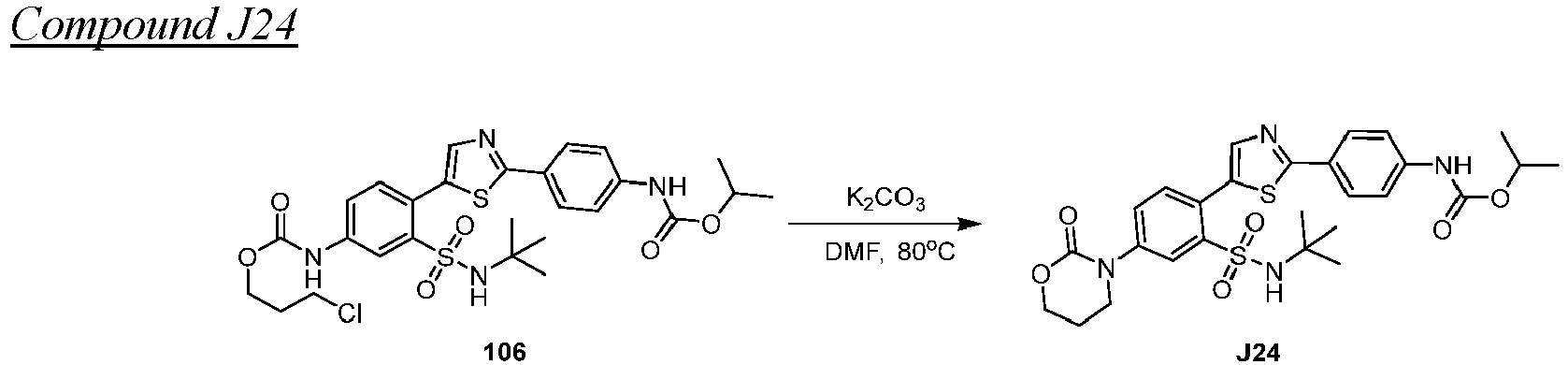
- A mixture of isopropyl N-[4-[5-[2-(tert-butylsulfamoyl)-4-(3-chloropropoxycarbonylamino)phenyl]thiazol-2-yl]phenyl]carbamate (30.00 mg, 49.25 µmol, 1.00 eq.) and K2CO3 (6.81 mg, 49.25 µmol, 1.00 eq.) in DMF (500.00 ul) was stirred at 80°C for 2 hrs. The mixture was filtered and the filtrate was purified by acidic prep-HPLC to give isopropyl N-[4-[5-[2-(tert-butylsulfamoyl)-4-(2-oxo-1,3-oxazinan-3-yl)phenyl]thiazol-2-yl]phenyl]carbamate (2.17 mg, 3.79 µmol, 7.70% yield) as a white solid. 1H NMR (400MHz, METHANOL-d4) δ = 8.22 (d, J = 2.0 Hz, 1H), 7.93 - 7.86 (m, 3H), 7.70 - 7.64 (m, 1H), 7.58 (dd, J = 5.4, 8.3 Hz, 3H), 4.98 (td, J = 6.3, 12.4 Hz, 1H), 4.49 (t, J = 5.3 Hz, 2H), 3.84 (t, J = 6.0 Hz, 2H), 2.26 (quin, J = 5.6 Hz, 2H), 1.31 (d, J = 6.4 Hz, 6H), 1.12 (s, 9H). ESI [M+H] =573.1


- To a mixture of 2-methyloxirane (29.72 mg, 511.65 µmol, 35.80 ul, 5.00 eq.) in AcOH (500.00 ul) was added isopropyl N-[4-[5-[4-amino-2-(tert-butylsulfamoyl)phenyl]thiazol-2-yl]phenyl]carbamate (50.00 mg, 102.33 µmol, 1.00 eq.) and the mixture was stirred at 60°C for 2 hrs. The mixture was diluted with H2O (1 mL) and extracted with DCM (1 mL X 3). The combined organic layers were washed with H2O (1 mL), sat.aq.NaHCO3, dried over Na2SO4, filtered and concentrated. The residue was purified acidic prep-HPLC to give isopropyl N-[4-[5-[2-(tert-butylsulfamoyl)-4-(2-hydroxypropylamino)phenyl]thiazol-2-yl]phenyl]carbamate (7.32 mg, 13.35 µmol, 26.06% yield, 99.7% purity) as a yellow solid. 1H NMR (400MHz, METHANOL-d4) δ = 7.86 (d, J = 8.8 Hz, 2H), 7.78 (s, 1H), 7.57 (d, J = 8.6 Hz, 2H), 7.47 - 7.40 (m, 1H), 7.26 (d, J = 8.4 Hz, 1H), 6.88 - 6.82 (m, 1H), 5.03 - 4.93 (m, 1H), 4.03 - 3.90 (m, 1H), 3.72 - 3.55 (m, 1H), 3.22 - 3.08 (m, 1H), 1.31 (d, J = 6.2 Hz, 6H), 1.26 - 1.22 (m, 3H), 1.12 (s, 9H). ESI [M+H] =547.2

- General method K, isopropyl (4-(5-(2-(N-(tert-butyl)sulfamoyl)-4-(5-methyl-2-oxooxazolidin-3-yl)phenyl)thiazol-2-yl)phenyl)carbamate. 1H NMR (400MHz, DMSO-d6) δ = 9.86 (s, 1H), 8.46 (d, J = 2.4 Hz, 1H), 7.87 (d, J = 8.8 Hz, 2H), 7.83 (s, 1H), 7.65 (dd, J = 2.4, 8.6 Hz, 1H), 7.58 (dd, J = 8.7, 13.8 Hz, 3H), 7.26 (s, 1H), 4.97 - 4.77 (m, 2H), 4.22 (t, J = 8.6 Hz, 1H), 3.73 (dd, J = 7.3, 8.6 Hz, 1H), 1.43 (d, J = 6.2 Hz, 3H), 1.26 (d, J = 6.4 Hz, 6H), 1.07 (s, 9H). ESI [M+H] =573.2

-

- To a solution of isopropyl N-[4-[5-[4-amino-2-(tert-butylsulfamoyl)phenyllthiazol-2-yl]phenyl]carbamate (200.00 mg, 409.32 µmol, 1.00 eq.) in ACN (5.00 mL) was added 2-benzyloxirane (219.67 mg, 1.64 mmol, 215.37 ul, 4.00 eq.) and tris(trifluoromethylsulfonyloxy)ytterbium (253.88 mg, 409.32 µmol, 1.00 eq.) and the mixture was stirred at 60°C for 4 hrs. The mixture was concentrated and the residue was purified by acidic prep-HPLC to give isopropyl N-[4-[5-[2-(tert-butylsulfamoyl)-4-[(2-hydroxy-3-phenyl-propyl)amino]phenyl]thiazol-2-yl]phenyl]carbamate (75.00 mg, 120.42 µmol, 29.42% yield) as a yellow solid. ESI [M+H] = 623.1
-

- General method K, isopropyl (4-(5-(4-(5-benzyl-2-oxooxazolidin-3-yl)-2-(N-(tert-butyl) sulfamoyl)phenyl)thiazol-2-yl)phenyl)carbamate, 1H NMR (400MHz, DMSO-d6) δ = 9.88 (s, 1H), 8.41 (s, 1H), 7.94 - 7.80 (m, 3H), 7.67 - 7.59 (m, 3H), 7.55 (d, J = 8.4 Hz, 1H), 7.34 (d, J = 4.6 Hz, 4H), 7.29 (br d, J = 17.4 Hz, 2H), 5.08 - 4.97 (m, 1H), 4.92 (td, J = 6.3, 12.4 Hz, 1H), 4.20 (t, J = 8.9 Hz, 1H), 3.88 (br t, J = 7.9 Hz, 1H), 3.11 (d, J = 6.2 Hz, 2H), 1.27 (d, J = 6.2 Hz, 6H), 1.08 (s, 9H). ESI [M+H] =649.2

- General method A, isopropyl (4-(5-(4-(3-benzyl-2-oxopyrrolidin-1-yl)-2-(N-(tert-butyl)sulfamoyl)phenyl)thiazol-2-yl)phenyl)carbamate. 1H NMR (400MHz, DMSO-d6) δ = 9.86 (s, 1H), 8.64 (d, J = 2.2 Hz, 1H), 7.91 - 7.84 (m, 3H), 7.78 (dd, J = 2.3, 8.4 Hz, 1H), 7.59 (dd, J = 8.6, 19.4 Hz, 3H), 7.34 - 7.19 (m, 6H), 4.92 (spt, J = 6.2 Hz, 1H), 3.83 - 3.65 (m, 2H), 3.15 (dd, J = 4.2, 13.6 Hz, 1H), 3.02 (dq, J = 4.2, 9.1 Hz, 1H), 2.76 (dd, J = 9.4, 13.5 Hz, 1H), 2.16 - 2.07 (m, 1H), 1.89 - 1.78 (m, 1H), 1.28 (d, J = 6.2 Hz, 6H), 1.11 (s, 9H). ESI [M+H] =647.2

-

- General method K, 5-phenyloxazolidin-2-one. ESI [M+H] = 164.1

- A mixture of isopropyl N-[4-[5-[4-bromo-2-(tert-butylsulfamoyl)phenyl]thiazol-2-yl]phenyl]carbamate (40.00 mg, 72.40 µmol, 1.00 eq.), 5-phenyloxazolidin-2-one (40.05 mg, 245.44 µmol, 3.39 eq.), Pd2(dba)3 (6.63 mg, 7.24 µmol, 0.10 eq.), K3PO4 (46.11 mg, 217.20 µmol, 3.00 eq.) and Xantphos (4.19 mg, 7.24 µmol, 0.10 eq.) in dioxane (3.00 mL) was degassed and purged with N2 for 3 times, stirred at 100°C for 16 hrs under N2 atmosphere. The mixture was poured into water (30 mL) and the aqueous phase was extracted with EtOAc (30 mL X 3). The combined organic phase was dried, filtered and concentrated and the residue was purified by acidic prep-HPLC to give isopropyl N-[4-[5-[2-(tert-butylsulfamoyl)-4-(2-oxo-5-phenyl-oxazolidin-3-yl)phenyl]thiazol-2-yl]phenyl]carbamate (28.54 mg, 44.96 µmol, 62.10% yield, 100% purity) as a yellow solid. 1H NMR (400MHz, METHANOL-d4) δ = 9.42 (br s, 1H), 8.64 (br s, 1H), 7.88 (br s, 2H), 7.75 (br d, J = 7.5 Hz, 1H), 7.62 - 7.54 (m, 1H), 7.57 (br d, J = 7.7 Hz, 2H), 7.54 - 7.49 (m, 1H), 7.51 (br s, 1H), 7.46 (br d, J = 7.5 Hz, 3H), 5.79 (br t, J = 7.7 Hz, 1H), 5.00 - 4.93 (m, 1H), 4.58 (br t, J = 8.8 Hz, 1H), 4.09 (br t, J = 8.2 Hz, 1H), 1.31 (br d, J = 6.0 Hz, 6H), 1.15 (s, 9H). ESI [M+H] =635.1
-

- 1H NMR (400MHz, METHANOL-d4) δ = 8.67 (s, 1H), 8.08 (d, J = 7.9 Hz, 1H), 7.96 (s, 1H), 7.90 (d, J = 8.6 Hz, 2H), 7.67 (d, J = 7.9 Hz, 1H), 7.58 (d, J = 8.6 Hz, 2H), 7.41 - 7.30 (m, 4H), 7.29 - 7.21 (m, 1H), 4.97 (td, J = 6.4, 12.3 Hz, 1H), 4.61 (s, 2H), 1.31 (d, J = 6.4 Hz, 6H), 1.10 (s, 9H). ESI [M+H] =607.1

- 1H NMR (400MHz, METHANOL-d4) δ = 8.08 (d, J = 8.8 Hz, 1H), 7.96 - 7.86 (m, 3H), 7.76 - 7.65 (m, 2H), 7.59 (d, J = 8.8 Hz, 2H), 7.49 - 7.42 (m, 2H), 7.41 - 7.29 (m, 3H), 5.23 (s, 2H), 5.00 (td, J = 6.2, 12.6 Hz, 1H), 1.33 (d, J = 6.4 Hz, 6H), 1.11 (s, 9H). ESI [M+H] =623.2
-

-

- A mixture of N-[4-(5-bromothiazol-2-yl)-3-(tert-butylsulfamoyl)phenyl]acetamide (200.00 mg, 462.58 µmol, 1.00 eq.) in HCl/MeOH (5.00 mL, 4 M) was stirred at 40°C for 20 mins, and then concentrated. The residue was partitioned between EtOAc (10 mL) and sat.aq.NaHCO3 (10 mL). The organic layer was dried, filtered and concentrated to give 5- amino-2-(5-bromothiazol-2-yl)-N-tert-butyl-benzenesulfonamide (200.00 mg, crude) as a yellow oil, which was used directly. ESI [M+H] =389.9/391.9
-

- General method C, isopropyl (4-(5-bromothiazol-2-yl)-3-(N-(tert-butyl)sulfamoyl)phenyl) carbamate. ESI [M+H] =475.9/477.9
-

- General method A, isopropyl (4-(5-(4-aminophenyl)thiazol-2-yl)-3-(N-(tert-butyl)sulfamoyl) phenyl)carbamate. ESI [M+H] =489.1
-

- 1H NMR (400MHz, DMSO-d6) δ = 10.19 (s, 1H), 9.86 (s, 1H), 8.37 (s, 1H), 8.28 (s, 1H), 7.81 (s, 1H), 7.78 - 7.73 (m, 2H), 7.68 - 7.63 (m, 2H), 7.57 (d, J = 8.6 Hz, 2H), 4.94 (spt, J = 6.2 Hz, 1H), 4.15 (q, J = 7.1 Hz, 2H), 1.30 - 1.23 (m, 9H), 1.20 (s, 9H). ESI [M+H] =561.2
-

- 1H NMR (400MHz, DMSO-d6) δ = 10.19 (s, 1H), 9.80 (s, 1H), 8.37 (s, 1H), 8.28 (s, 1H), 7.81 (s, 1H), 7.76 (s, 2H), 7.68 - 7.63 (m, 2H), 7.59 - 7.53 (m, 2H), 5.00 - 4.85 (m, 2H), 1.28 (t, J = 6.4 Hz, 12H), 1.20 (s, 9H). ESI [M+H] =575.2


- To a mixture of isopropyl N-[4-[5-(4-aminophenyl)thiazol-2-yl]-3-(tert-butylsulfamoyl)phenyl]carbamate (30.00 mg, 61.40 µmol, 1.00 eq.) and K2CO3 (20.00 mg, 144.71 µmol, 2.36 eq.) in THF (2.00 mL) and H2O (500.00 ul) was added CbzCl (15.00 mg, 87.93 µmol, 1.43 eq.). The mixture was stirred at 15°C for 1 hr and then concentrated. The residue was purified by acidic prep-HPLC to give isopropyl N-[4-[5-[4-(benzyloxycarbonylamino)phenyl]thiazol-2-yl]-3-(tert-butylsulfamoyl)phenyl]carbamate (30.92 mg, 49.45 µmol, 80.54% yield, 99.596% purity) as a pale yellow solid. 1H NMR (400MHz, DMSO-d6) δ = 10.19 (s, 1H), 10.01 (s, 1H), 8.37 (s, 1H), 8.29 (s, 1H), 7.81 (s, 1H), 7.76 (s, 2H), 7.70 - 7.65 (m, 2H), 7.58 (d, J = 8.8 Hz, 2H), 7.47 - 7.33 (m, 5H), 5.18 (s, 2H), 5.02 - 4.84 (m, 1H), 1.28 (d, J = 6.2 Hz, 6H), 1.20 (s, 9H). ESI [M+H] =623.2

-

- To a solution of 5-amino-N-tert-butyl-2-[2-(4-nitrophenyl)thiazol-5-yl]benzenesulfonamide (100.00 mg, 231.20 µmol, 1.00 eq.) in THF (3.00 mL) was added K2CO3 (63.91 mg, 462.41 µmol, 2.00 eq.) and benzyl carbonochloridate (197.20 mg, 1.16 mmol, 164.34 ul, 5.00 eq.). The mixture was stirred at 20°C for 0.5 hr, then concentrated and purified by prep-TLC (SiO2, Petroleum ether:EtOAc= 2:1) to give benzyl N-[3-(tert-butylsulfamoyl)-4-[2-(4-nitrophenyl)thiazol-5-yl]phenyl]carbamate (90.00 mg) as a yellow solid.
-

- General method B, benzyl (4-(2-(4-aminophenyl)thiazol-5-yl)-3-(N-(tert-butyl)sulfamoyl)phenyl)carbamate. ESI [M+H] =537.2

- 1H NMR (400MHz, METHANOL-d4) δ = 8.41 (d, J = 1.7 Hz, 1H), 7.95 (d, J = 8.7 Hz, 2H), 7.90 (s, 1H), 7.79 - 7.71 (m, 1H), 7.60 (d, J = 8.6 Hz, 2H), 7.50 - 7.45 (m, 3H), 7.43 - 7.34 (m, 3H), 5.25 (s, 2H), 4.56 (br s, 1H), 1.27 (d, J = 6.6 Hz, 6H), 1.16 (s, 9H). ESI [M+H] =638.2

-

- General method C, ethyl (3-(N-(tert-butyl)sulfamoyl)-4-(2-(4-nitrophenyl)thiazol-5-yl)phenyl)carbamate. ESI [M+H] = 505.0
-

- General method B, ethyl (4-(2-(4-aminophenyl)thiazol-5-yl)-3-(N-(tert-butyl)sulfamoyl)phenyl)carbamate. ESI [M+H] = 475.0
-

- 1H NMR (400MHz, DMSO-d6) δ = 10.18 (br s, 1H), 9.58 (br s, 1H), 8.35 (br s, 1H), 7.88 (br d, J=10.1 Hz, 4H), 7.76 - 7.59 (m, 3H), 7.49 (br s, 1H), 7.18 (br s, 1H), 4.39 (br s, 1H), 4.18 (br s, 2H), 1.27 (br d, J=7.0 Hz, 3H), 1.19 (br s, 6H), 1.09 (br s, 9H). ESI [M+H] =576.2

-

- General method C, N-(3-(N-(tert-butyl)sulfamoyl)-4-(2-(4-nitrophenyl)thiazol-5-yl)phenyl) benzamide. ESI [M+H] = 537.3
-

- General method B, N-(4-(2-(4-aminophenyl)thiazol-5-yl)-3-(N-(tert-butyl)sulfamoyl)phenyl)benzamide.
-

- 1H NMR (400MHz, METHANOL-d4) δ = 8.69 (1H, s), 7.89 - 8.10 (6H, m), 7.49 - 7.62 (6H, m), 4.54 (1H, br s), 1.25 (6H, d, J = 6.4 Hz), 1.16 (9H, s). ESI [M+H] =608.2
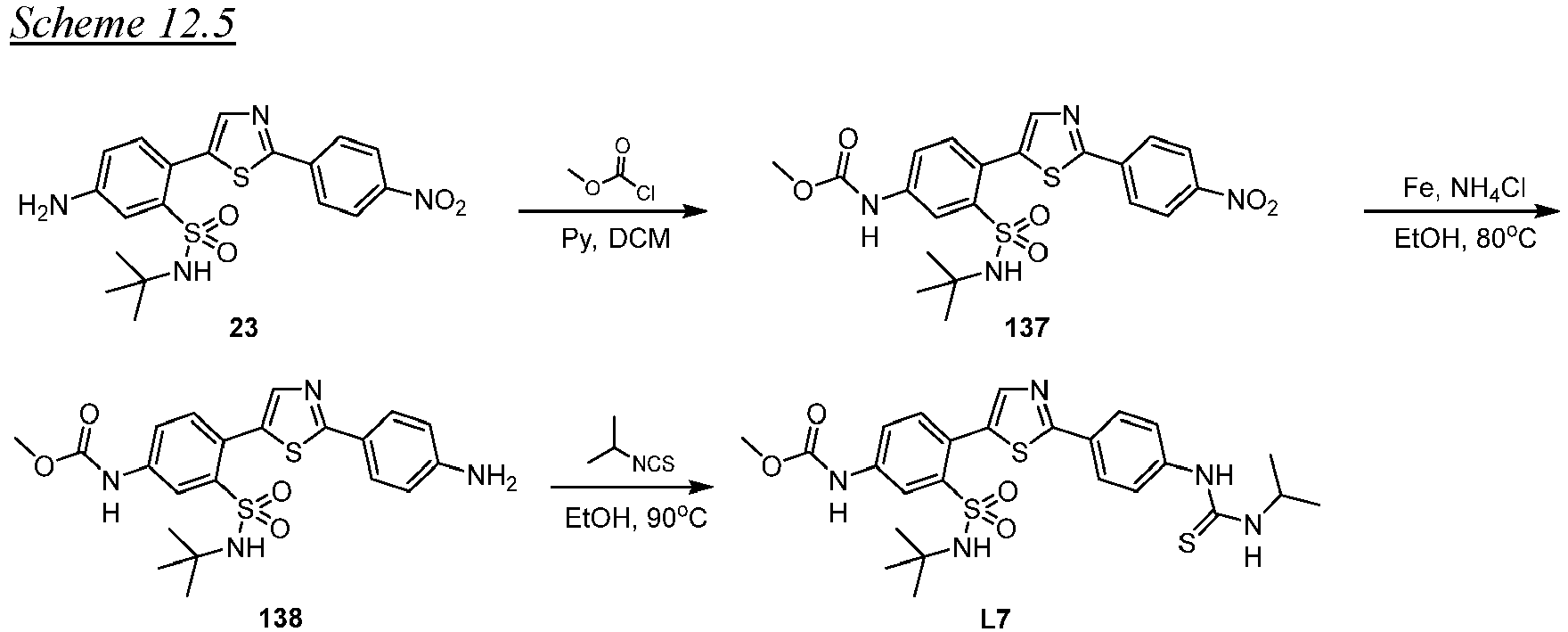
-

- General method C, methyl (3-(N-(tert-butyl)sulfamoyl)-4-(2-(4-nitrophenyl)thiazol-5-yl)phenyl)carbamate. ESI [M+H] = 491.0
-

- General method B, methyl (4-(2-(4-aminophenyl)thiazol-5-yl)-3-(N-(tert-butyl)sulfamoyl)phenyl)carbamate. ESI [M+H] = 461.0
-

- 1H NMR (400MHz, DMSO-d6) δ = 10.17 (s, 1H), 9.58 (br s, 1H), 8.34 (s, 1H), 7.93 - 7.80 (m, 4H), 7.74 - 7.61 (m, 3H), 7.50 (d, J = 8.3 Hz, 1H), 7.17 (s, 1H), 4.40 (br d, J = 5.9 Hz, 1H), 3.72 (s, 3H), 1.19 (d, J = 6.5 Hz, 6H), 1.10 (s, 9H). ESI [M+H] =562.2
-

- 1H NMR (400MHz, DMSO-d6) δ = 10.05 (br s, 1H), 9.87 (s, 1H), 8.49 - 8.36 (m, 2H), 7.92 - 7.76 (m, 4H), 7.62 (br d, J = 8.6 Hz, 2H), 7.49 (d, J = 8.3 Hz, 1H), 7.40 - 7.33 (m, 4H), 7.29 (br d, J = 3.1 Hz, 1H), 7.18 (s, 1H), 5.03 - 4.87 (m, 1H), 4.77 (br d, J = 5.0 Hz, 2H), 1.28 (d, J = 6.1 Hz, 6H), 1.11 (s, 9H). ESI [M+H] =638.2
-

- 1H NMR (400MHz, METHANOL-d4) δ = 8.47 (s, 1H), 7.99 - 7.81 (m, 4H), 7.58 (d, J = 8.6 Hz, 2H), 7.49 (d, J = 8.2 Hz, 1H), 7.41 - 7.29 (m, 4H), 7.28 - 7.21 (m, 1H), 4.83 (br s, 2H), 2.17 (s, 3H), 1.13 (s, 9H). ESI [M+H] =594.2

-

- General method C, 4-nitrophenyl (3-(N-(tert-butyl)sulfamoyl)-4-(2-(4-nitrophenyl)thiazol-5-yl)phenyl)carbamate. ESI [M+H] = 597.9
-

- General method F, 5-(3-benzylureido)-N-(tert-butyl)-2-(2-(4-nitrophenyl)thiazol-5-yl)benzenesulfonamide. ESI [M+H] = 566.1
-

- General method B, 2-(2-(4-aminophenyl)thiazol-5-yl)-5-(3-benzylureido)-N-(tert-butyl)benzenesulfonamide. ESI [M+H] = 536.3
-

- 1H NMR (400MHz, DMSO-d6) δ = 9.56 (br s, 1H), 9.15 (s, 1H), 8.28 (d, J = 2.2 Hz, 1H), 7.88 (d, J = 8.7 Hz, 2H), 7.85 - 7.80 (m, 2H), 7.68 - 7.61 (m, 3H), 7.42 (d, J = 8.3 Hz, 1H), 7.38 - 7.30 (m, 4H), 7.26 (dt, J = 2.6, 6.1 Hz, 1H), 7.09 (s, 1H), 6.77 (br t, J = 5.9 Hz, 1H), 4.45 - 4.36 (m, 1H), 4.33 (d, J = 5.7 Hz, 2H), 1.19 (d, J = 6.5 Hz, 6H), 1.08 (s, 9H). ESI [M+H] =637.3
-

- 1H NMR (400MHz, DMSO-d6) δ = 9.57 (br s, 1H), 8.95 (s, 1H), 8.39 (d, J = 2.2 Hz, 1H), 7.91 - 7.81 (m, 5H), 7.64 (d, J = 8.7 Hz, 2H), 7.44 (d, J = 8.4 Hz, 1H), 7.40 - 7.34 (m, 2H), 7.29 (br d, J = 6.6 Hz, 3H), 7.02 (s, 1H), 4.59 (s, 2H), 4.40 (br d, J = 6.7 Hz, 1H), 2.95 (s, 3H), 1.19 (d, J = 6.6 Hz, 6H), 1.07 (s, 9H). ESI [M+H] =651.3

- 1H NMR (400MHz, METHANOL-d4) δ = 8.80 (d, J = 6.5 Hz, 2H), 8.36 (d, J = 2.2 Hz, 1H), 8.06 (d, J = 6.4 Hz, 2H), 7.94 (d, J = 8.6 Hz, 2H), 7.89 (s, 1H), 7.73 (dd, J = 2.3, 8.4 Hz, 1H), 7.61 (d, J = 8.6 Hz, 2H), 7.47 (d, J = 8.3 Hz, 1H), 4.73 (s, 2H), 4.56 (br s, 1H), 1.27 (d, J = 6.5 Hz, 6H), 1.13 (s, 9H). ESI [M+H] =638.3

- 1H NMR (400MHz, DMSO-d6) δ = 9.61 (br s, 1H), 9.44 (s, 1H), 8.83 - 8.66 (m, 2H), 8.31 - 8.22 (m, 2H), 7.94 - 7.76 (m, 5H), 7.64 (br d, J = 8.4 Hz, 3H), 7.42 (br d, J = 8.3 Hz, 2H), 7.08 (s, 2H), 4.52 - 4.33 (m, 3H), 1.18 (d, J = 6.5 Hz, 6H), 1.06 (s, 9H). ESI [M+H] =638.2

- 1H NMR (400MHz, DMSO-d6) δ = 9.57 (br s, 1H), 9.48 (s, 1H), 8.64 (br d, J = 5.3 Hz, 1H), 8.27 (d, J = 2.2 Hz, 1H), 8.07 (br t, J = 7.5 Hz, 1H), 7.89 - 7.81 (m, 4H), 7.67 - 7.57 (m, 4H), 7.54 (br d, J = 6.4 Hz, 1H), 7.41 (d, J = 8.4 Hz, 1H), 7.09 (s, 1H), 7.00 (br t, J = 5.6 Hz, 1H), 4.52 (br d, J = 5.5 Hz, 2H), 4.37 (br s, 1H), 1.16 (d, J = 6.4 Hz, 6H), 1.05 (s, 9H). ESI [M+H] =638.1

- 1H NMR (400MHz, DMSO-d6) δ = 9.60 (br s, 1H), 9.34 (s, 1H), 9.10 (s, 1H), 8.78 (s, 2H), 8.28 (d, J = 2.1 Hz, 1H), 7.92 - 7.82 (m, 4H), 7.69 - 7.61 (m, 3H), 7.45 - 7.39 (m, 1H), 7.10 (s, 1H), 7.03 - 6.95 (m, 1H), 4.45 - 4.33 (m, 3H), 1.19 (d, J = 6.6 Hz, 6H), 1.08 (s, 9H). ESI [M+H] =639.2

- 1H NMR (400MHz, DMSO-d6) δ = 9.60 (br s, 1H), 9.43 (s, 1H), 8.31 (d, J = 2.1 Hz, 1H), 7.94 - 7.82 (m, 4H), 7.75 (d, J = 3.2 Hz, 1H), 7.71 - 7.62 (m, 4H), 7.44 (d, J = 8.4 Hz, 1H), 7.20 - 7.09 (m, 2H), 4.63 (br d, J = 5.9 Hz, 2H), 4.40 (br d, J = 6.2 Hz, 1H), 1.19 (d, J = 6.5 Hz, 6H), 1.09 (s, 9H). ESI [M+H] =644.1
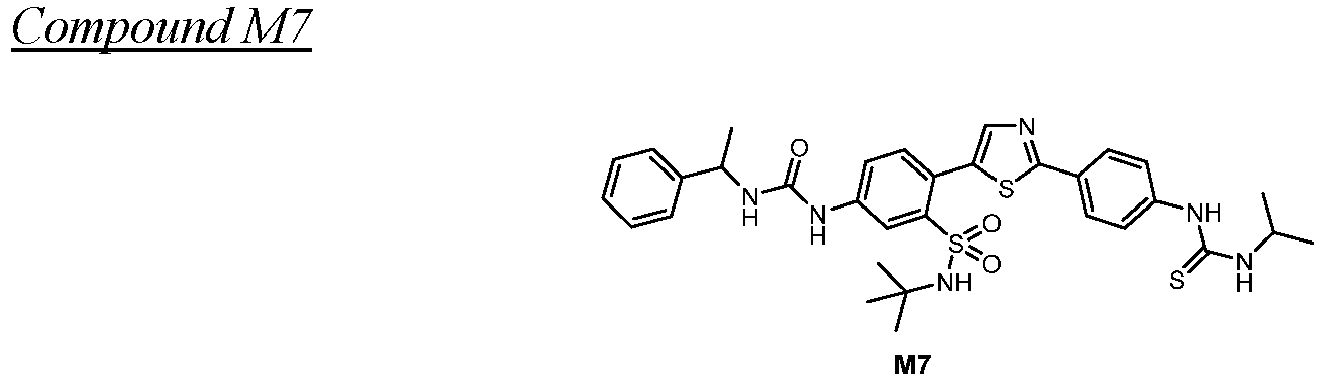
- 1H NMR (400MHz, METHANOL-d4) δ = 8.22 (d, J = 2.2 Hz, 1H), 7.91 (d, J = 8.8 Hz, 2H), 7.85 (s, 1H), 7.68 (dd, J = 2.4, 8.4 Hz, 1H), 7.56 (d, J = 8.6 Hz, 2H), 7.45 - 7.32 (m, 5H), 7.28 - 7.21 (m, 1H), 4.93 (q, J = 6.8 Hz, 1H), 4.53 (br s, 1H), 1.49 (d, J = 7.1 Hz, 3H), 1.24 (d, J = 6.6 Hz, 6H), 1.11 (s, 9H). ESI [M+H] =651.2

- 1H NMR (400MHz, METHANOL-d4) δ = 8.35 (d, J = 2.0 Hz, 1H), 7.91 (d, J = 8.6 Hz, 2H), 7.86 (s, 1H), 7.70 (br d, J = 8.4 Hz, 1H), 7.57 (d, J = 8.6 Hz, 2H), 7.47 - 7.41 (m, 3H), 7.36 (t, J = 7.4 Hz, 2H), 7.32 - 7.26 (m, 1H), 5.87 (q, J = 6.6 Hz, 1H), 4.53 (br s, 1H), 1.59 (d, J = 6.6 Hz, 3H), 1.24 (d, J = 6.6 Hz, 6H), 1.12 (s, 9H). ESI [M+H] =652.2
-

-

- General method G, N-(3-(N-(tert-butyl)sulfamoyl)-4-(2-(4-(3-isopropylthioureido)phenyl)thiazol-5-yl)phenyl)acetamide. ESI [M+H] =546.4
-

- A mixture of N-[3-(tert-butylsulfamoyl)-4-[2-[4-(isopropylcarbamothioylamino)phenyl]thiazol-5-yl]phenyl]acetamide (1 g, 1.83 mmol, 1 eq.) in HCl/MeOH (4 M, 50 mL) was stirred at 30°C for 1 hr, and then concentrated. The residue was diluted with DCM (30 mL) and washed with sataq.Na2CO3 aq. (20 mL). The organic phase was dried over Na2SO4, filtered and concentrated to give 1-[4-[5-[4-amino-2-(tert-butylsulfamoyl)phenyl]thiazol-2-yl]phenyl]-3-isopropyl-thiourea (900 mg, crude) as a yellow solid. ESI [M+H] =504.0
-

- General method C, 4-nitrophenyl (3-(N-(tert-butyl)sulfamoyl)-4-(2-(4-(3-isopropylthioureido)phenyl)thiazol-5-yl)phenyl)carbamate.
-

- General method F, N-(tert-butyl)-5-(3-(4-hydroxybenzyl)ureido)-2-(2-(4-(3-isopropyl thioureido)phenyl)thiazol-5-yl)benzenesulfonamide. 1H NMR (400MHz, METHANOL-d4) δ = 8.30 - 8.25 (m, 1H), 7.96 - 7.89 (m, 2H), 7.86 (s, 1H), 7.70 (br d, J = 6.6 Hz, 1H), 7.57 (br d, J = 8.3 Hz, 2H), 7.42 (br d, J = 8.3 Hz, 1H), 7.17 (br d, J = 8.3 Hz, 2H), 6.75 (br d, J = 8.3 Hz, 2H), 4.54 (br s, 1H), 4.30 (s, 2H), 1.24 (br d, J = 6.6 Hz, 6H), 1.13 (s, 9H). ESI [M+H] =653.2
-

- 1H NMR (400MHz, DMSO-d6) δ = 9.58 (br s, 1H), 9.35 (br s, 1H), 9.15 (s, 1H), 8.31 - 8.23 (m, 1H), 7.94 - 7.77 (m, 4H), 7.69 - 7.59 (m, 3H), 7.42 (br d, J = 8.3 Hz, 1H), 7.15 - 7.07 (m, 2H), 6.72 (br s, 3H), 6.63 (br d, J = 8.6 Hz, 1H), 4.46 - 4.31 (m, 1H), 4.24 (br d, J = 5.4 Hz, 2H), 1.23 - 1.13 (m, 6H), 1.08 (s, 9H). ESI [M+H] =653.2

- 1H NMR (400MHz, METHANOL-d4) δ = 8.26 (s, 1H), 7.96 - 7.85 (m, 3H), 7.69 (br d, J = 8.3 Hz, 1H), 7.58 (br d, J = 8.8 Hz, 2H), 7.42 (d, J = 8.3 Hz, 1H), 7.21 (br d, J = 7.0 Hz, 1H), 7.10 (br t, J = 7.7 Hz, 1H), 6.83 - 6.74 (m, 2H), 4.54 (br s, 1H), 4.37 (s, 2H), 1.24 (d, J = 6.6 Hz, 6H), 1.13 (s, 9H). ESI [M+H] =653.1

- 1H NMR (400MHz, DMSO-d6) δ = 9.58 (br s, 1H), 9.02 (s, 1H), 8.27 (s, 1H), 7.93 - 7.79 (m, 4H), 7.64 (br d, J = 8.4 Hz, 3H), 7.57 (s, 3H), 7.41 (br d, J = 8.2 Hz, 1H), 7.11 (s, 1H), 6.51 (br s, 1H), 4.40 (br d, J = 5.6 Hz, 1H), 4.18 (br d, J = 4.2 Hz, 2H), 1.18 (br d, J = 6.5 Hz, 6H), 1.08 (s, 9H). ESI [M+H] =627.2

- 1H NMR (400MHz, DMSO-d6) δ = 11.89 (br s, 1H), 9.57 (br s, 1H), 9.25 (s, 1H), 8.28 (s, 1H), 7.93 - 7.77 (m, 4H), 7.64 (br d, J = 8.3 Hz, 3H), 7.42 (br d, J = 8.4 Hz, 1H), 7.10 (s, 1H), 6.94 (br s, 2H), 6.69 (br t, J = 5.0 Hz, 1H), 4.48 - 4.20 (m, 3H), 1.18 (br d, J = 6.5 Hz, 6H), 1.08 (s, 9H). ESI [M+H] =627.1

- 1H NMR (400MHz, METHANOL-d4) δ = 8.27 (d, J = 2.4 Hz, 1H), 7.92 (d, J = 8.6 Hz, 2H), 7.86 (s, 1H), 7.70 (dd, J = 2.4, 8.4 Hz, 1H), 7.64 (s, 1H), 7.57 (d, J = 8.6 Hz, 2H), 7.43 (d, J = 8.4 Hz, 1H), 7.02 (s, 1H), 4.53 (br s, 1H), 4.36 (s, 2H), 1.24 (d, J = 6.6 Hz, 6H), 1.12 (s, 9H). ESI [M+H] =627.2
-

-
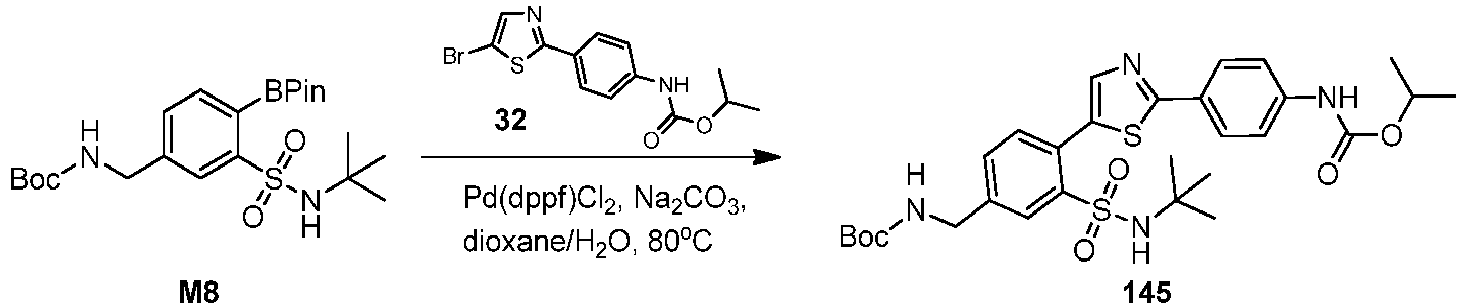
- General method A, isopropyl N-[4-[5-[4-[(tert-butoxycarbonylamino)methyl]-2-(tert-butylsulfamoyl)phenyl]thiazol-2-yl]phenyl]carbamate. ESI [M+H] = 603.3
-

- A solution of isopropyl N-[4-[5-[4-[(tert-butoxycarbonylamino)methyl]-2-(tert-butyl sulfamoyl)phenyl]thiazol-2-yl]phenyl]carbamate (2.20 g, 3.65 mmol, 1.00 eq.) in HCl/MeOH (20.00 mL) was stirred at 15°C for 1 hr and then concentrated to give isopropyl N-[4-[5-[4-(aminomethyl)-2-(tert-butylsulfamoyl)phenyl]thiazol-2-yl]phenyl]carbamate (2.00 g, crude, HCl) as a yellow solid.
-

- To a mixture of isopropyl N-[4-[5-[4-(aminomethyl)-2-(tert-butylsulfamoyl)phenyl]thiazol-2-yl]phenyl]carbamate (40.00 mg, 74.20 µmol, 1.00 eq., HCl), 1-tert-butoxycarbonyl piperidine-4-carboxylic acid (25.52 mg, 111.30 µmol, 1.50 eq.) and DIEA (47.95 mg, 371.00 µmol, 64.62 ul, 5.00 eq.) in DCM (2.00 mL) was added HATU (36.68 mg, 96.46 µmol, 1.30 eq.). The mixture was stirred at 20°C for 1 hr, then washed with 0.5N HCl ( 5 mL), sat.aq.Na2CO3 (5 mL), dried over Na2SO4, filtered and concentrated to give tert-butyl 4-[[3-(tert-butylsulfamoyl)-4-[2-[4-(isopropoxycarbonylamino)phenyl]thiazol-5-yl]phenyl]methylcarbamoyl]piperidine-1-carboxylate (50 mg, crude) as a yellow oil. ESI [M+H] = 714.1
-

- 1H NMR (400MHz, METHANOL-d4) δ = 8.09 (s, 1H), 7.91 - 7.86 (m, 3H), 7.60 - 7.50 (m, 4H), 4.98 (td, J = 6.0, 12.5 Hz, 1H), 4.54 - 4.46 (m, 2H), 3.46 (br d, J = 13.2 Hz, 2H), 3.11 - 3.01 (m, 2H), 2.69 - 2.58 (m, 1H), 2.11 - 1.89 (m, 4H), 1.31 (d, J = 6.6 Hz, 6H), 1.07 (s, 9H). ESI [M+H] =614.2
- The following compounds were synthesized via reacting intermediate 146 with different acids using a procedure similar to that used to synthesize compound O1.


- 1H NMR (400MHz, METHANOL-d4) δ = 8.11 (s, 1H), 7.92 - 7.81 (m, 3H), 7.60 - 7.46 (m, 4H), 5.02 - 4.92 (m, 1H), 4.50 (s, 2H), 3.68 (t, J = 6.1 Hz, 2H), 3.35 (s, 3H), 2.52 (t, J = 5.9 Hz, 2H), 1.31 (d, J = 6.1 Hz, 6H), 1.09 (s, 9H). ESI [M+H] =589.2

- 1H NMR (400MHz, METHANOL-d4) δ = 8.12 (s, 1H), 7.96 - 7.83 (m, 3H), 7.59 (br d, J = 8.2 Hz, 3H), 7.55 - 7.49 (m, 1H), 5.07 - 4.91 (m, 1H), 4.51 (s, 2H), 3.86 (t, J = 6.2 Hz, 2H), 2.50 (t, J = 6.2 Hz, 2H), 1.32 (d, J = 6.1 Hz, 6H), 1.11 (s, 9H). ESI [M+H] =575.1

- 1H NMR (400MHz, METHANOL-d4) δ = 8.10 (s, 1H), 7.92 - 7.85 (m, 3H), 7.62 - 7.43 (m, 4H), 7.35 - 7.18 (m, 5H), 4.97 (td, J = 6.2, 12.6 Hz, 1H), 4.47 (s, 2H), 3.34 - 3.24 (m, 2H), 1.31 (d, J = 6.1 Hz, 6H), 1.07 (s, 9H). ESI [M+H] =621.1

- 1H NMR (400MHz, METHANOL-d4) δ = 8.81 (br d, J = 6.0 Hz, 2H), 8.07 (br d, J = 6.0 Hz, 2H), 8.01 (s, 1H), 7.93 - 7.87 (m, 3H), 7.63 - 7.51 (m, 4H), 5.00 (td, J = 6.2, 12.5 Hz, 1H), 4.55 (s, 2H), 4.02 (s, 2H), 1.34 (d, J = 6.2 Hz, 6H), 1.07 (s, 9H). ESI [M+H] =622.2

- 1H NMR (400MHz, METHANOL-d4) δ = 8.85 (s, 1H), 8.78 (d, J = 5.8 Hz, 1H), 8.57 (br d, J = 7.9 Hz, 1H), 8.11 - 7.98 (m, 2H), 7.88 (d, J = 7.9 Hz, 3H), 7.57 (br d, J = 8.1 Hz, 3H), 7.54 - 7.49 (m, 1H), 5.03 - 4.93 (m, 1H), 4.53 (s, 2H), 3.93 (s, 2H), 1.31 (d, J = 6.1 Hz, 6H), 1.05 (s, 9H). ESI [M+H] =622.2

- 1H NMR (400MHz, METHANOL-d4) δ = 8.88 (br d, J = 5.3 Hz, 2H), 8.20 (s, 1H), 8.14 (d, J = 5.5 Hz, 2H), 7.93 - 7.85 (m, 3H), 7.67 (br d, J = 7.7 Hz, 1H), 7.61 - 7.54 (m, 3H), 4.98 (td, J = 6.2, 12.4 Hz, 1H), 4.73 (s, 2H), 1.31 (d, J = 6.2 Hz, 6H), 1.09 (s, 9H). ESI [M+H] =608.2

- 1H NMR (400MHz, METHANOL-d4) δ = 9.29 (s, 1H), 9.21 (s, 2H), 8.20 (s, 1H), 7.88 (br d, J = 6.0 Hz, 3H), 7.67 (br d, J = 7.8 Hz, 1H), 7.62 - 7.52 (m, 3H), 5.06 - 4.92 (m, 1H), 4.75 - 4.69 (m, 2H), 1.31 (d, J = 6.1 Hz, 6H), 1.09 (s, 9H). ESI [M+H] =609.1
-

- 1H NMR (400MHz, METHANOL-d4) δ = 8.13 (s, 1H), 7.96 - 7.86 (m, 3H), 7.65 - 7.51 (m, 4H), 5.00 (td, J = 6.2, 12.3 Hz, 1H), 4.50 (s, 2H), 2.32 (q, J = 7.6 Hz, 2H), 1.34 (d, J = 6.2 Hz, 6H), 1.20 (br t, J = 7.6 Hz, 3H), 1.15 - 1.09 (m, 9H). ESI [M+H] =559.2

- 1H NMR (400MHz, METHANOL-d4) δ = 8.11 (s, 1H), 7.95 - 7.83 (m, 3H), 7.63 - 7.47 (m, 4H), 5.00 - 4.95 (m, 1H), 4.47 (s, 2H), 2.68 - 2.43 (m, 1H), 1.32 (br d, J = 6.2 Hz, 6H), 1.17 (br d, J = 6.8 Hz, 6H), 1.09 (s, 9H). ESI [M+H] =573.2

- 1H NMR (400MHz, METHANOL-d4) δ = 8.11 (br s, 1H), 7.89 (br s, 3H), 7.65 - 7.44 (m, 4H), 5.00 - 4.94 (m, 1H), 4.47 (s, 2H), 1.32 (br d, J = 6.0 Hz, 6H), 1.24 (s, 9H), 1.09 (s, 9H). ESI [M+H] =587.3

- 1H NMR (400MHz, DMSO-d6) δ = 9.88 (br s, 1H), 9.23 (br s, 1H), 8.05 (br s, 1H), 7.88 (br dd, J = 9.2, 18.6 Hz, 5H), 7.67 - 7.43 (m, 7H), 7.22 (s, 1H), 4.98 - 4.86 (m, 1H), 4.58 (br s, 2H), 1.27 (br d, J = 6.2 Hz, 6H), 1.02 (s, 9H). ESI [M+H] =607.2

- 1H NMR (400MHz, METHANOL-d4) δ = 8.23 (br s, 1H), 7.97 - 7.79 (m, 3H), 7.67 (br d, J = 7.5 Hz, 1H), 7.62 - 7.52 (m, 3H), 4.97 (br dd, J = 6.0, 12.1 Hz, 1H), 4.39 (s, 2H), 2.96 (s, 3H), 1.32 (br d, J = 6.0 Hz, 6H), 1.12 (s, 9H). ESI [M+H] =581.2

- 1H NMR (400MHz, METHANOL-d4) δ = 8.10 (br s, 1H), 7.96 - 7.78 (m, 5H), 7.69 - 7.45 (m, 6H), 7.45 - 7.35 (m, 1H), 5.02 - 4.94 (m, 1H), 4.20 (s, 2H), 1.32 (br d, J = 5.5 Hz, 6H), 1.10 (s, 9H). ESI [M+H] =643.2

- 1H NMR (400MHz, METHANOL-d4) δ = 8.12 (br s, 1H), 7.94 - 7.85 (m, 3H), 7.65 - 7.46 (m, 4H), 5.03 - 4.94 (m, 1H), 4.40 (br s, 2H), 3.68 (s, 3H), 1.32 (br d, J = 6.0 Hz, 6H), 1.12 (s, 9H). ESI [M+H] =561.2

- 1H NMR (400MHz, METHANOL-d4) δ = 8.12 (br s, 1H), 7.95 - 7.84 (m, 3H), 7.63 - 7.46 (m, 4H), 5.05 - 4.93 (m, 1H), 4.39 (br s, 2H), 4.12 (q, J = 6.7 Hz, 2H), 1.32 (br d, J = 6.2 Hz, 6H), 1.26 (br t, J = 6.8 Hz, 3H), 1.11 (s, 9H). ESI [M+H] =575.2

- 1H NMR (400MHz, METHANOL-d4) δ = 8.13 (br s, 1H), 7.89 (br d, J = 5.3 Hz, 3H), 7.65 - 7.47 (m, 4H), 4.97 (br dd, J = 6.1, 12.5 Hz, 2H), 4.39 (br s, 2H), 1.32 (br d, J = 6.0 Hz, 6H), 1.25 (br d, J = 6.0 Hz, 6H), 1.11 (br s, 9H). ESI [M+H] =589.2
-

- To a solution of isopropyl N-[4-[5-[4-(aminomethyl)-2-(tert-butylsulfamoyl)phenyl]thiazol-2-yl]phenyl]carbamate (75.00 mg, 69.56 µmol, 1.00 eq., HCl) in DCM (3.00 mL) were added DMAP (849.80 ug, 6.96 µmol, 0.10 eq.) and AC2O (8.52 mg, 83.47 µmol, 7.82 ul, 1.20 eq.) at 0°C. The mixture was stirred at 15°C for 0.5 hr, then concentrated and the residue was purified by acidic prep-HPLC to give isopropyl N-[4-[5-[4-(acetamidomethyl)-2-(tert-butylsulfamoyl)phenyl]thiazol-2-yl]phenyl]carbamate (5.27 mg, 9.67 µmol, 13.90% yield, 99.9% purity) as a yellow solid. 1H NMR (400MHz, METHANOL-d4) δ = 8.11 (s, 1H), 7.92 - 7.86 (m, 3H), 7.63 - 7.50 (m, 4H), 4.98 (quind, J = 6.3, 12.4 Hz, 1H), 4.48 (s, 2H), 2.03 (s, 3H), 1.32 (d, J = 6.2 Hz, 6H), 1.11 (s, 9H). ESI [M+H] =545.2

- To a solution of isopropyl N-[4-[5-[4-(aminomethyl)-2-(tert-butylsulfamoyl)phenyl]thiazol-2-yl]phenyl]carbamate (20.00 mg, 37.10 µmol, 1.00 eq., HCl) in THF (3.00 mL) was added K2CO3 (10.26 mg, 74.20 µmol, 2.00 eq.) and benzyl carbonochloridate (31.64 mg, 185.50 µmol, 26.37 ul, 5.00 eq.). The mixture was stirred at 20°C for 2 hrs, then concentrated and the residue was purified by acidic prep-HPLC to give isopropyl N-[4-[5-[4-(benzyloxycarbonylaminomethyl)-2-(tert-butylsulfamoyl)phenyl]thiazol-2-yl]phenyl]carbamate (17.54 mg, 27.27 µmol, 73.50% yield, 99% purity) as a gray solid. 1H NMR (400MHz, METHANOL-d4) δ = 8.14 (br s, 1H), 7.89 (br s, 3H), 7.66 - 7.45 (m, 4H), 7.42 - 6.99 (m, 5H), 5.12 (br s, 2H), 4.97 (br dd, J = 6.3, 12.2 Hz, 1H), 4.42 (br s, 2H), 1.32 (br d, J = 6.0 Hz, 6H), 1.10 (br s, 9H). ESI [M+H] =637.2

-

- General method A, 5-(3-benzyl-1-methylureido)-N-(tert-butyl)-2-(2-(4-nitrophenyl)thiazol-5-yl)benzenesulfonamide. ESI [M+H] = 580.3
-

- General method B, 2-(2-(4-aminophenyl)thiazol-5-yl)-5-(3-benzyl-1-methylureido)-N-(tert-butyl)benzenesulfonamide. ESI [M+H] = 550.0
-

- 1H NMR (400MHz, METHANOL-d4) δ = 8.12 (s, 1H), 7.98 - 7.92 (m, 3H), 7.63 - 7.59 (m, 4H), 7.33 (d, J = 4.4 Hz, 4H), 7.28 - 7.21 (m, 1H), 4.56 (br s, 1H), 4.40 (s, 2H), 3.37 (s, 3H), 1.27 (d, J = 6.5 Hz, 6H), 1.13 (s, 9H). ESI [M+H] =651.2

-

- General method A, 5-(3-benzyl-1,3-dimethylureido)-N-(tert-butyl)-2-(2-(4-nitrophenyl)thiazol-5-yl)benzenesulfonamide. ESI [M+H] = 593.9
-

- General method B, 2-(2-(4-aminophenyl)thiazol-5-yl)-5-(3-benzyl-1,3-dimethylureido)-N-(tert-butyl)benzenesulfonamide. ESI [M+H] = 564.1
-

- 1H NMR (400MHz, METHANOL-d4) δ = 7.98 - 7.86 (m, 4H), 7.58 (br d, J = 8.6 Hz, 2H), 7.51 (d, J = 8.4 Hz, 1H), 7.40 - 7.31 (m, 3H), 7.30 - 7.22 (m, 3H), 4.53 (br s, 1H), 4.45 (s, 2H), 3.28 (s, 3H), 2.65 (s, 3H), 1.24 (d, J = 6.6 Hz, 6H), 1.08 (s, 9H). ESI [M+H] =665.2

-

- General method C, 4-nitrophenyl (4-(5-(4-acetamido-2-(N-(tert-butyl)sulfamoyl)phenyl)thiazol-2-yl)phenyl)carbamate. ESI [M+H] = 610.2
-

- General method F, N-(3-(N-(tert-butyl)sulfamoyl)-4-(2-(4-(3-isopropylureido)phenyl)thiazol-5-yl)phenyl)acetamide. ESI [M+H] = 530.2
-

- A mixture of N-[3-(tert-butylsulfamoyl)-4-[2-[4-(isopropylcarbamoylamino)phenyl]thiazol-5-yl]phenyl]acetamide (100 mg, 188.80 µmol, 1 eq.) in HCl/MeOH (4 M, 2 mL) was stirred at 30°C for 1 hr. The mixture was concentrated, then diluted with EtOAc (50 mL) and washed with sat.aq.Na2CO3 (5 mL). The organic layer was dried over Na2SO4, filtered and concentrated to give 1-[4-[5-[4-amino-2-(tert-butylsulfamoyl)phenyl]thiazol-2-yl]phenyl]-3-isopropyl-urea (0.08 g, crude) as a yellow solid. ESI [M+H] = 488.2
-

- 1H NMR (400MHz, METHANOL-d4) δ = 8.39 (d, J = 2.2 Hz, 1H), 7.83 - 7.91 (m, 3H), 7.73 (dd, J = 8.4 Hz, J = 2.1 Hz, 1H), 7.50 - 7.57 (m, 2H), 7.48 (d, J = 8.3 Hz, 1H), 4.97 - 5.06 (m, 1H), 3.92 (quin, J = 6.5 Hz, 1H), 1.34 (d, J = 6.2 Hz, 6H), 1.21 (d, J = 6.5 Hz, 6H), 1.16 (s, 9H). ESI [M+H] =574.2
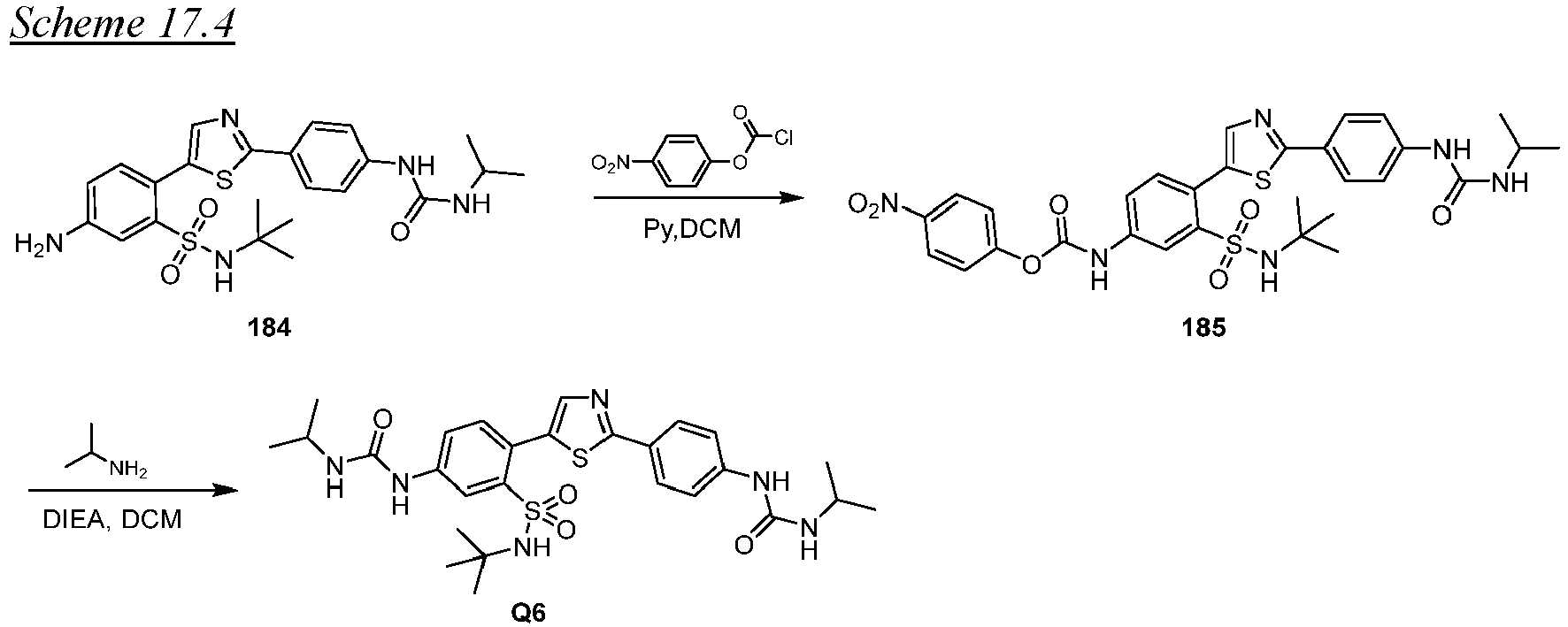
-

- General method C, 4-nitrophenyl (3-(N-(tert-butyl)sulfamoyl)-4-(2-(4-(3-isopropylureido)phenyl)thiazol-5-yl)phenyl)carbamate. ESI [M+H] = 653.1
-

- 1H NMR (400MHz, METHANOL-d4) δ = 8.25 (d, J = 1.8 Hz, 1H), 7.79 - 7.87 (m, 3H), 7.66 (dd, J = 8.3 Hz, J = 1.3 Hz, 1H), 7.49 (br d, J = 8.8 Hz, 2H), 7.41 (d, J = 8.3 Hz, 1H), 3.90 (br dd, J = 10.1 Hz, J = 6.1 Hz, 2H ), 1.19 (dd, J = 6.1 Hz, J = 2.2 Hz, 12H), 1.12 (s, 9H). ESI [M+H] =573.2
-

-

- General method J, 3-methyl-4-(4,4,5,5-tetramethyl-1,3,2-dioxaborolan-2-yl)aniline. ESI [M+H] = 234.2
-
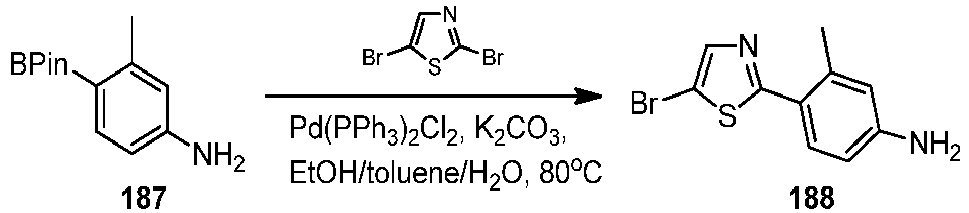
- General method H, 4-(5-bromothiazol-2-yl) -3-methyl-aniline. ESI [M+H] = 269.0/271.0
-

- General method C, isopropyl N-[4-(5-bromothiazol-2-yl)-3-methyl-phenyl]carbamate. ESI [M+H] = 355.0/357.0
- The following compounds were synthesized with different bromides using a procedure similar to the used in the synthesis of intermediate compound 189.

- 1H NMR (400MHz, METHANOL-d4) δ = 7.75 (s, 1H), 7.72 (s, 1H), 7.68 - 7.65 (m, 2H), 4.97 (spt, J = 6.3 Hz, 1H), 5.03 - 4.91 (m, 1H), 2.31 (s, 3H), 1.31 (d, J = 6.2 Hz, 6H). ESI [M+H] = 355.0/357.0

- ESI [M+H] = 370.7/372.7

- ESI [M+H] = 358.9/360.9

- ESI [M+H] = 358.8/360.8

-

- General method C, isopropyl (4-bromo-3-methoxyphenyl)carbamate. ESI[M+H]= 288.0/290.0
-

- General method J, isopropyl N-[3-methoxy-4-(4,4,5,5-tetramethyl-1,3,2-dioxaborolan-2-yl)phenyl]carbamate. ESI [M+H] = 336.2
-

- General method H, isopropyl N-[4-(5-bromothiazol-2-yl)-3-methoxy-phenyl]carbamate. ESI [M+H] = 371.0/373.0
- The following compounds were synthesized using intermediate compound M6 for the left hand side with different bromides for the right hand side via general method A (shown in Example 1), unless otherwise noted.
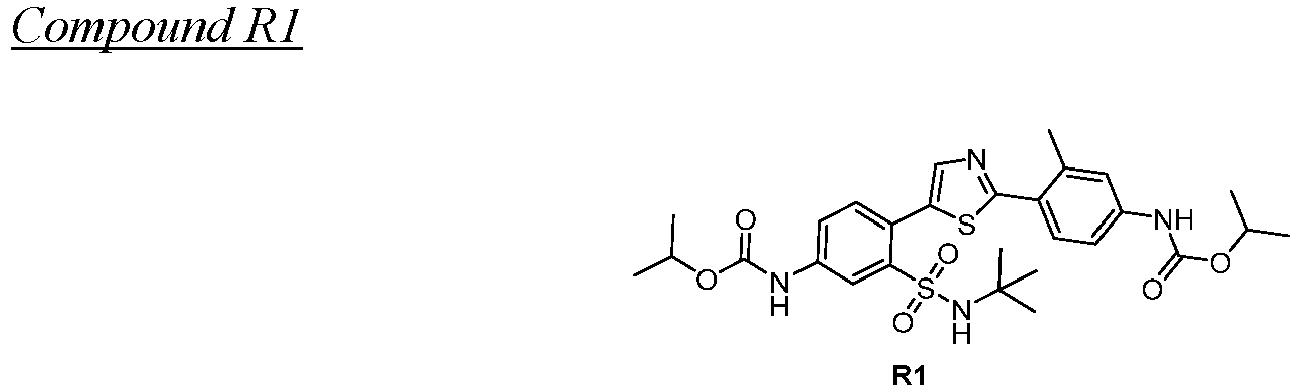
- 1H NMR (400MHz, METHANOL-d4) δ = 8.40 (d, J = 2.0 Hz, 1H), 7.94 (s, 1H), 7.78 - 7.62 (m, 2H), 7.52 - 7.39 (m, 3H), 5.09 - 4.95 (m, 2H), 2.59 (s, 3H), 1.34 (dd, J = 4.4, 6.4 Hz, 12H), 1.17 (s, 9H). ESI [M+H] =589.2

- 1H NMR (400MHz, METHANOL-d4) δ = 8.37 (d, J = 2.2 Hz, 1H), 7.86 (s, 1H), 7.82 - 7.74 (m, 2H), 7.72 - 7.63 (m, 2H), 7.45 (d, J = 8.3 Hz, 1H), 5.03 - 4.94 (m, 2H), 2.33 (s, 3H), 1.32 (d, J = 6.1 Hz, 12H), 1.13 (s, 9H). ESI [M+H] =589.2

- 1H NMR (400MHz, METHANOL-d4) δ = 8.37 (d, J = 2.2 Hz, 1H), 8.05 (d, J = 8.4 Hz, 1H), 7.86 (s, 1H), 7.69 (dd, J = 2.0, 8.4 Hz, 1H), 7.59 (d, J = 1.8 Hz, 1H), 7.52 - 7.41 (m, 2H), 5.05 - 4.94 (m, 2H), 3.97 (s, 3H), 1.32 (dd, J = 1.1, 6.2 Hz, 12H), 1.14 (s, 9H). ESI [M+H] =605.3


- 1H NMR (400MHz, METHANOL-d4) δ = 8.37 (d, J = 2.0 Hz, 1H), 8.08 (br t, J = 8.2 Hz, 1H), 7.87 (s, 1H), 7.78 - 7.67 (m, 3H), 7.44 (d, J = 8.4 Hz, 1H), 5.05 - 4.95 (m, 2H), 1.32 (dd, J = 1.5, 6.4 Hz, 12H), 1.13 (s, 9H). ESI [M+H] =593.2

- 1H NMR (400MHz, DMSO-d6) δ = 10.10 (s, 1H), 9.92 (s, 1H), 8.35 (d, J = 1.5 Hz, 1H), 8.20 (d, J = 8.8 Hz, 1H), 7.87 (s, 1H), 7.67 (dd, J = 1.5, 8.3 Hz, 1H), 7.53 (s, 1H), 7.44 (d, J = 8.3 Hz, 1H), 7.16 (br d, J = 7.8 Hz, 1H), 7.08 (s, 1H), 4.94 (qd, J = 6.3, 9.6 Hz, 2H), 3.96 (s, 3H), 1.28 (d, J = 6.4 Hz, 12H), 1.09 (s, 9H). ESI [M+H] =605.2
-
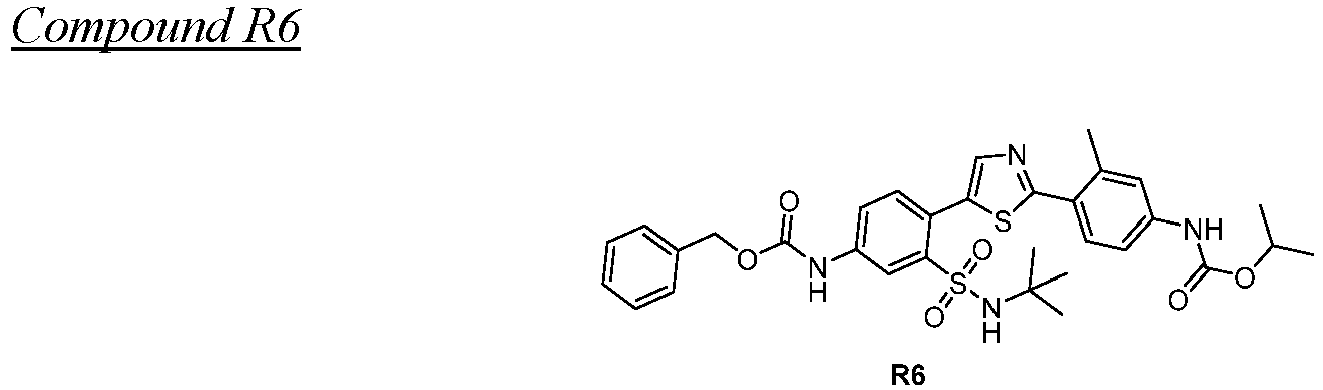
- 1H NMR (400MHz, METHANOL-d4) δ = 8.39 (d, J = 1.8 Hz, 1H), 7.92 (s, 1H), 7.73 (br d, J = 8.3 Hz, 1H), 7.66 (d, J = 8.3 Hz, 1H), 7.50 - 7.41 (m, 5H), 7.40 - 7.30 (m, 3H), 5.22 (s, 2H), 4.97 (td, J = 6.5, 12.5 Hz, 1H), 2.56 (s, 3H), 1.31 (d, J = 6.6 Hz, 6H), 1.14 (s, 9H). ESI [M+H] =637.4

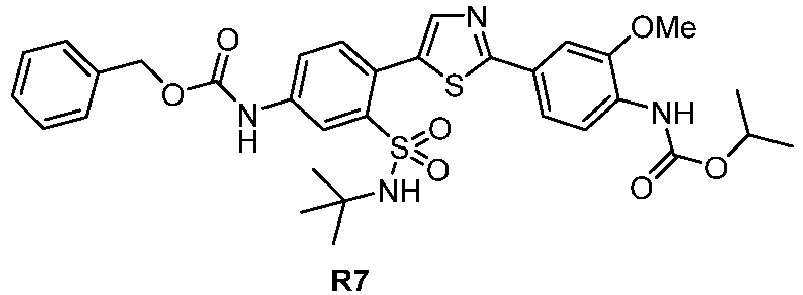
- 1H NMR (400MHz, METHANOL-d4) δ = 8.39 (d, J=2.2 Hz, 1H), 8.05 (d, J=8.6 Hz, 1H), 7.86 (s, 1H), 7.77 - 7.68 (m, 1H), 7.60 (d, J=1.5 Hz, 1H), 7.53 - 7.41 (m, 4H), 7.40 - 7.28 (m, 3H), 5.22 (s, 2H), 5.06 - 4.94 (m, 1H), 3.98 (s, 3H), 1.32 (d, J=6.2 Hz, 6H), 1.14 (s, 9H). ESI [M+H] =653.1

- 1H NMR (400MHz, METHANOL-d4) δ = 8.38 (s, 1H), 8.11 - 8.03 (m, 1H), 7.87 (s, 1H), 7.78 - 7.70 (m, 3H), 7.48 - 7.41 (m, 3H), 7.40 - 7.29 (m, 3H), 5.22 (s, 2H), 5.00 (td, J = 6.4, 12.5 Hz, 1H), 1.32 (d, J = 6.2 Hz, 6H), 1.13 (s, 9H). ESI [M+H] =641.2

- 1H NMR (400MHz, METHANOL-d4) δ = 8.39 (d, J = 2.2 Hz, 1H), 8.10 (d, J = 8.8 Hz, 1H), 7.97 (s, 1H), 7.75 (dd, J = 2.2, 8.4 Hz, 1H), 7.56 (d, J = 1.5 Hz, 1H), 7.49 - 7.41 (m, 3H), 7.41 - 7.27 (m, 3H), 7.13 (dd, J = 1.9, 8.7 Hz, 1H), 5.22 (s, 2H), 5.06 - 4.92 (m, 1H), 4.05 (s, 3H), 1.32 (d, J = 6.2 Hz, 6H), 1.14 (s, 9H). ESI [M+H] =653.1
-

- 1H NMR (400MHz, METHANOL-d4) δ = 8.28 (d, J = 2.2 Hz, 1H), 7.91 (s, 1H), 7.73 (dd, J = 2.2, 8.3 Hz, 1H), 7.66 (d, J = 8.3 Hz, 1H), 7.47 - 7.41 (m, 3H), 7.37 - 7.30 (m, 4H), 7.29 - 7.21 (m, 1H), 5.00 - 4.95 (m, 1H), 4.42 (s, 2H), 2.56 (s, 3H), 1.31 (d, J = 6.1 Hz, 6H), 1.14 (s, 9H). ESI [M+H] =636.4

- 1H NMR (400MHz, DMSO-d6) δ = 9.17 (s, 1H), 8.45 (s, 1H), 8.29 (d, J = 2.2 Hz, 1H), 7.91 - 7.83 (m, 2H), 7.66 (dd, J = 2.3, 8.4 Hz, 1H), 7.56 (d, J = 1.7 Hz, 1H), 7.51 (dd, J = 1.7, 8.4 Hz, 1H), 7.42 (d, J = 8.4 Hz, 1H), 7.38 - 7.31 (m, 4H), 7.29 - 7.23 (m, 1H), 7.14 (s, 1H), 6.80 (t, J = 5.9 Hz, 1H), 4.91 (spt, J = 6.2 Hz, 1H), 4.34 (d, J = 5.9 Hz, 2H), 3.91 (s, 3H), 1.26 (d, J = 6.2 Hz, 6H), 1.09 (s, 9H). ESI [M+H] =652.2

- 1H NMR (400MHz, METHANOL-d4) δ = 8.27 (d, J = 2.2 Hz, 1H), 8.07 (br t, J = 8.3 Hz, 1H), 7.86 (s, 1H), 7.78 - 7.69 (m, 3H), 7.43 (d, J = 8.4 Hz, 1H), 7.36 - 7.29 (m, 4H), 7.28 - 7.22 (m, 1H), 5.00 (td, J = 6.3, 12.5 Hz, 1H), 4.41 (s, 2H), 1.32 (d, J = 6.2 Hz, 6H), 1.13 (s, 9H). ESI [M+H] =640.3


- 1H NMR (400MHz, METHANOL-d4) δ = 8.27 (d, J = 2.2 Hz, 1H), 8.11 (d, J = 8.8 Hz, 1H), 7.95 (s, 1H), 7.74 (dd, J = 2.4, 8.4 Hz, 1H), 7.55 (d, J = 1.5 Hz, 1H), 7.44 (d, J = 8.6 Hz, 1H), 7.38 - 7.30 (m, 4H), 7.29 - 7.22 (m, 1H), 7.11 (dd, J = 1.9, 8.7 Hz, 1H), 4.99 (td, J = 6.2, 12.5 Hz, 1H), 4.42 (s, 2H), 4.05 (s, 3H), 1.32 (d, J = 6.4 Hz, 6H), 1.13 (s, 9H). ESI [M+H] =652.2

- 1H NMR (400MHz, METHANOL-d4) δ = 8.27 (d, J = 2.2 Hz, 1H), 8.11 (t, J = 8.6 Hz, 1H), 7.93 (d, J = 2.2 Hz, 1H), 7.72 (dd, J = 2.3, 8.3 Hz, 1H), 7.61 (br d, J = 13.7 Hz, 1H), 7.42 (d, J = 8.4 Hz, 1H), 7.37 - 7.31 (m, 4H), 7.29 - 7.22 (m, 2H), 4.99 (td, J = 6.2, 12.7 Hz, 1H), 4.42 (s, 2H), 1.31 (d, J = 6.2 Hz, 6H), 1.12 (s, 9H). ESI [M+H] =640.1
- Plastic ware and consumables needed for this experiment include: Cell Culture media; Evaporation Buffer media; 100% DMSO; 96 well U-bottom sterile culture plates; 250mL bottle; 1.5mL Opaque amber epi tubes; Epi Tube rack; 300mL reservoirs; 25mL reservoir; 25mL serological pipette tips; 5mL serological pipette tips P1000 Pipette Tips; and P200 Pipette Tips.
- Equipment needed for this experiment include: Viaflo 384 liquid handler; Eppendorf serological pipette; Eppendorf P1000 Pipette; and Eppendorf P200 Pipette Daudi Cell Culture is also needed for this experiment.
- Lastly, compounds (e.g., the compounds of this invention) to be tested are needed.
- All steps were performed in a sterile environment inside the Biosafety cabinet. A 96 well u-bottom plate was prepared by writing the experiment number, plate number, date and initials in the top right corner of the plate lid. With a sterile 300ml reservoir, and 25ml serological pipette, evaporation buffer media was pipetted into reservoir in 25ml increments. Using the liquid handler, 150ul of evaporation buffer media was pipetted from reservoir into rows A and H, and Columns 1 and 12 of the 96 well u-bottom plate. Cell cultures were counted to obtain the density of cells per ml, and the culture viability. The cell density information was used to obtain 1,000,000 cells from culture using a 5mL serological pipette into an epi tube. The cell density information from the culture was used to calculate the number of cells and volume of media needed for the assay to seed 1250 cells in 130ul of media per available culture well in the 96 well u-bottom plate. Rows B through F were used for cells (50 wells in total), with row G left for an empty media control. The calculation was overestimated by 10mL to account for the dead volume in the 300ml reservoir. Once the media volume was calculated, the appropriate volume of media was pipetted in 25mL increments into the 250mL bottle using a 25mL serological pipette. The 250ml bottle was capped tightly, and placed into a 37°C water bath for 2 minutes. While the culture media was warming, 10mL of fresh media was pipetted from the 500mL culture media bottle into a sterile 25mL reservoir. Using the Eppendorf multichannel pipette, 130ul of media was piptted from the 25mL reservoir into row G of the 96 well u-bottom plate. Once the 250mL bottle of media was warmed, the volume of culture needed was pipetted into the bottle, and mixed gently with a 25mL serological pipette as to not create bubbles, and then the contents of the bottle were pipetted into a new 300mL reservoir. Using the liquid handler, 130ul of culture was pipetted from the 300mL reservoir into rows B through F of the 96 well u-bottom plate. Once the culture was added, the plate was placed into a 37°C incubator until the compound master plate was prepared for use.
- Two 96 well u-bottom plates were prepared by writing the master plate name in the upper right corner of the plate lid. Labeling one DMSO master and the other Media Master. The compounds of interest were obtained from the laboratory freezer, and placed into a 25 well storage box with a lid, and set the box aside. The compounds were vortexed after thawing but before use. Using an automatic multichannel pipette, 20ul of 100% DMSO was pipetted into wells B3-B11 through G3-G11 of the DMSO master plate. For each compound on the master plate, 50ul of the compound were pipetted in the appropriate well of row 2 (reference plate map to determine appropriate well). A serial dilution was prepared beginning by aspirating 20ul from row 2 and mixing with row 3, repeating until row 11 was reached. Using the liquid handler, 194ul of Daudi media was dispensed into wells B2-B11 through G2-G11 of the Media master plate. Using the liquid handler, 6ul from the DMSO master plate was aspirated and dispensed into the media master plate, mixing 100ul twice.
- Compounds from master plate were then added to the culture plate. The culture plates were removed from the incubator, and set inside the biosafety cabinet. Using a liquid handler, 20ul from wells B2 to B11 through G2 to G11 of master plate were aspirated, and dispensed into wells B2 to B11 through G2 to G11 of culture plate. This set was continued with each culture plate. Once the culture plates acquired their 20ul of compound dilutions, they were placed back into the incubator, until their reads on Day 7 of experiment.
-
Table 1 No Structure EC50 (µM) A = < 1 µM B = < 5 µM C = < 10 µM D = > 10 µM A2 
A A3 
B A4 
C A5 
B A6 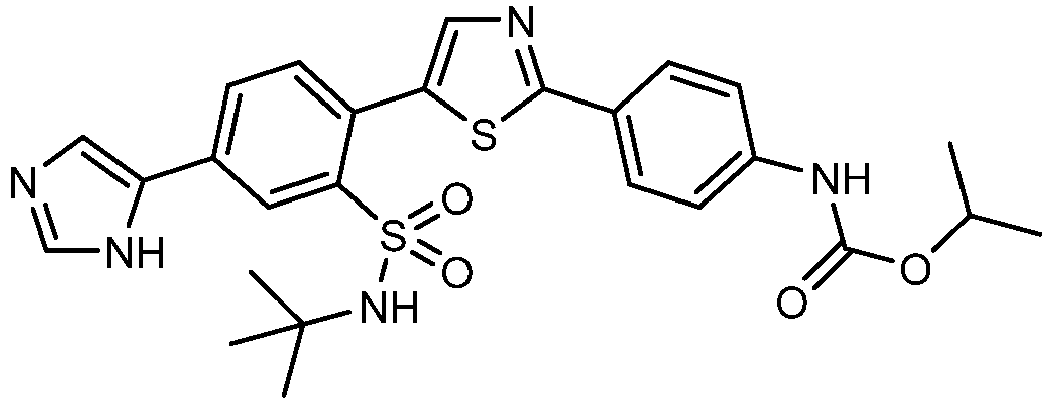
B A7 
C B1 
B B10 
A B11 
A B12 
A B13 
B B14 
C B15 
A B2 
A B3 
A B4 
A B5 
A B6 
A B7 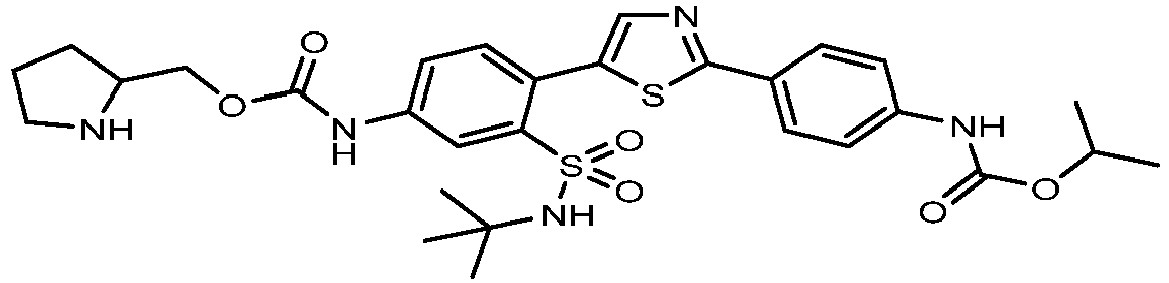
B B8 
A B9 
A C1 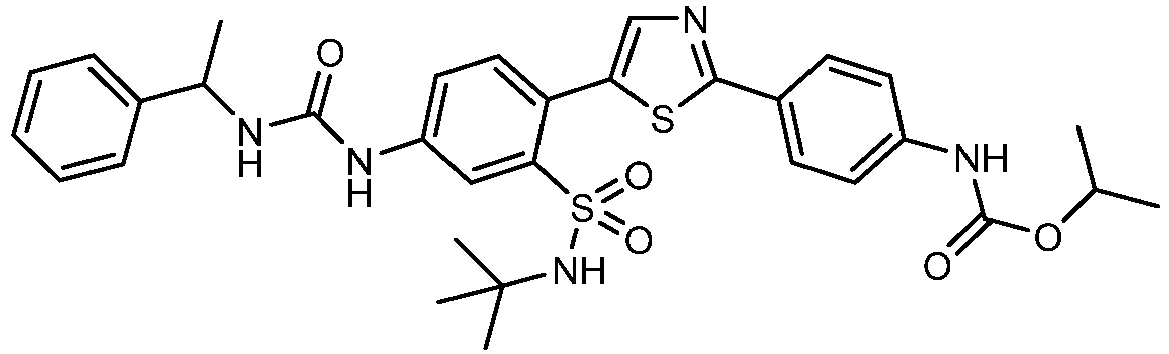
A J19 
D H1 
B H2 
B I6 
B I7 
D L4 
D L6 
B D1 
D D10 
A D11 
D D12 
D D13 
D D14 
D D15 
D D16 
D D17 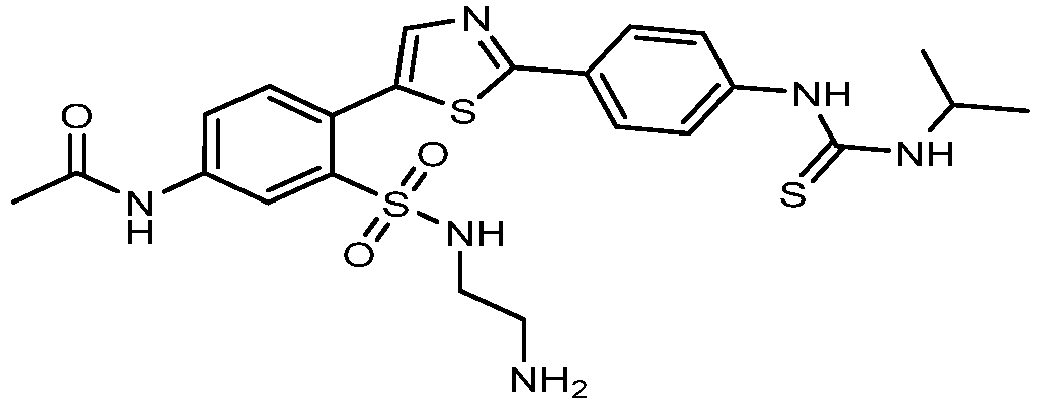
D D18 
D D19 
D D2 
D D20 
D D21 
D D22 
A D23 
D D24 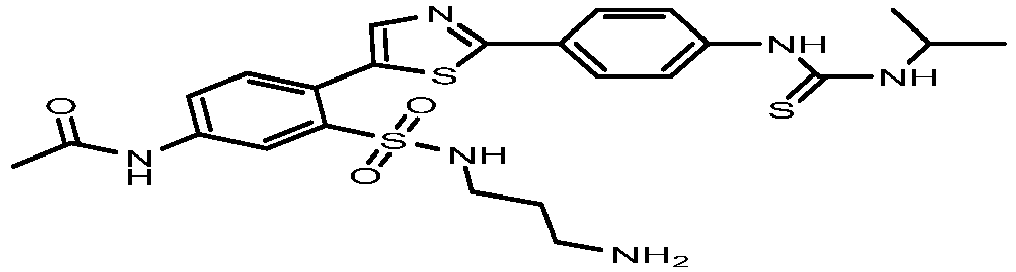
D D25 
A D26 
D D27 
D D28 
D D29 
D D3 
D D30 
B D4 
D D5 
D D6 
D D7 
D D8 
D D9 
D E1 
D E11 
B E12 
D E14 
D E15 
D E16 
D E17 
D E18 
D E19 
D E2 
D E20 
C E21 
B E3 
C E4 
D E5 
C E8 
D E9 
A G1 
B G10 
C G11 
B G2 
C G3 
A G4 
D G5 
D G6 
C G7 
D G8 
D G9 
D H10 
A H11 
D H3 
B H4 
A H5 
A H6 
A H7 
A H8 
A H9 
A I1 
B I2 
B I3 
B I4 
B I5 
B I7 
B J1 
B J10 
D J11 
D J12 
D J13 
D J14 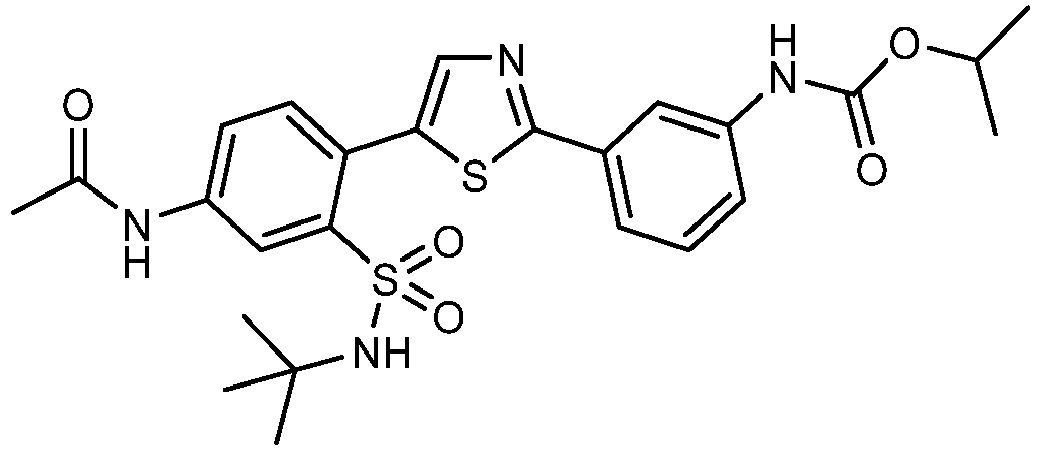
C J15 
D J16 
C J17 
FAIL J18 
B J2 
B J21 
D J22 
D J23 
B J24 
B J25 
B J26 
C J27 
D J28 
D J29 
D J3 
B J4 
B J5 
A J6 
C J7 
C J8 
C J9 
B K1 
D K2 
D L10 
B L5 
B L7 
D L8 
A L9 
B M1 
D M2 
B M3 
C M4 
C M5 
D M6 
D M7 
C M8 
C N1 
C N2 
C N4 
D N5 
D N6 
C O1 
C O2 
D O3 
D O4 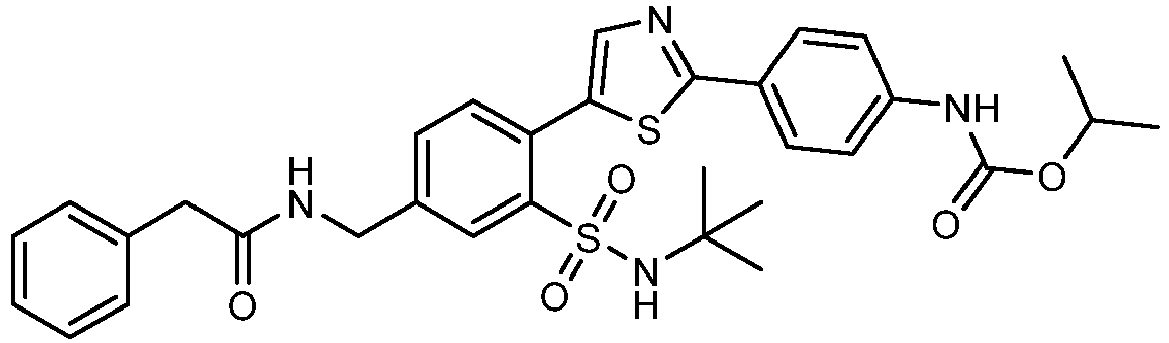
C O5 
B O6 
D O7 
B O8 
C P1 
C P2 
B P3 
D P4 
D P5 
C P6 
C P7 
C P8 
C P9 
D Q1 
C Q2 
D Q3 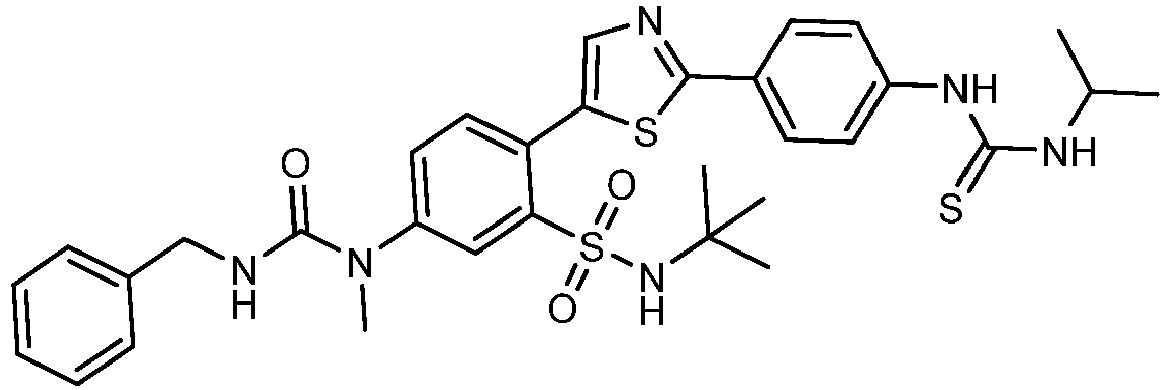
A Q4 
A R1 
A R3 
B R7 
A
Claims (16)
- A compound represented by the following structural formula:
 the thiazole ring is optionally substituted with -F or -Cl;R1 is -ORa, -NH2, -N((C1-C5)alkyl)2, -NRa(C1-C5)alkyl, -NRa-(C3-C6)cycloalkyl, -NRa-phenyl; -NRa-monocyclic 3-7 membered heterocyclic ring, -N-monocyclic 4-7 membered nitrogen containing heterocyclic ring (wherein the nitrogen atom of the heterocyclic ring is attached to the sulfur atom), or -N-5-8 membered nitrogen containing bridged bicyclic heterocyclyl (wherein the nitrogen atom of the bridged bicyclic heterocyclyl is attached to the sulfur atom),wherein a (C1-C5)alkyl in the group represented by R1 is optionally substituted with -ORa, -OC(C1-C3)alkylene-OH, -CO(O)CH3, -NRaRa, -(C3-C6)cycloalkyl, phenyl, monocyclic 3-7 membered heterocyclic ring, or monocyclic 5-6 membered heteroaromatic ring,wherein a (C3-C6)cycloalkyl in the group represented by R1 is optionally substituted with halogen or -ORa,wherein a phenyl in the group represented by R1 is optionally substituted with halogen, -CH3, halomethyl, halomethoxy, -OH, or -NH2;R2 is -H, -(C1-C4)alkyl, -NH2, -NO2, -ORa, -(CH2)mC(O)NH2, -(CH2)mNRaC(O)NH2, -(CH2)mC(O)NRa(C1-C4)alkyl, -(CH2)mC(O)NRa(C2-C4)alkenyl, -(CH2)mC(O)NRa-(C3-C6)cycloalkyl, -(CH2)mC(O)NRa-phenyl, -(CH2)mC(O)NRa-monocyclic 3-7 membered heterocyclic ring, -(CH2)mC(O)NRa-5-10 membered heteroaromatic ring,-(CH2)mNRa(C1-C4)alkyl, -(CH2)mNRa(C2-C4)alkenyl, -(CH2)mNRa-(C3-C6)cycloalkyl,-(CH2)mNRa-phenyl, -(CH2)mNRa-monocyclic 3-7 membered heterocyclic ring, -(CH2)mNRa-5-10 membered heteroaromatic ring,-(CH2)mNRaC(O)(C1-C4)alkyl, -(CH2)mNRaC(O)(C2-C4)alkenyl, -(CH2)mNRaC(O)-(C3-C6)cycloalkyl, -(CH2)mNRaC(O)-phenyl, -(CH2)mNRaC(O)-monocyclic 3-7 membered heterocyclic ring, -(CH2)mNRaC(O)-5-10 membered heteroaromatic ring,-(CH2)mNRaC(O)O(C1-C4)alkyl, -(CH2)mNRaC(O)O(C2-C4)alkenyl, -(CH2)mNRaC(O)O-(C3-C6)cycloalkyl, -(CH2)mNRaC(O)O-phenyl, -(CH2)mNRaC(O)O-monocyclic 3-7 membered heterocyclic ring, -(CH2)mNRaC(O)O-5-10 membered heteroaromatic ring,-(CH2)mNRaC(O)NRa(C1-C4)alkyl, -(CH2)mNRaC(O)NRa(C2-C4)alkenyl,-(CH2)mNRaC(O)NRa-(C3-C6)cycloalkyl, -(CH2)mNRaC(O)NRa-phenyl,-(CH2)mNRaC(O)NRa-monocyclic 3-7 membered heterocyclic ring,-(CH2)NRaC(O)NRa-5-10 membered heteroaromatic ring,-(CH2)mNRaC(S)(C1-C4)alkyl, -(CH2)mNRaC(S)(C2-C4)alkenyl, -(CH2)mNR"C(S)-(C3-C6)cycloalkyl, -(CH2)mNRaC(S)-phenyl, -(CH2)mNRaC(S)-monocyclic 3-7 membered heterocyclic ring, -(CH2)mNRaC(S)-5-10 membered heteroaromatic ring,-(CH2)mNRaC(S)NRa(C1-C4)alkyl, -(CH2)mNRaC(S)NRa(C2-C4)alkenyl,-(CH2)mNRaC(S)NRa-(C3-C6)cycloalkyl, -(CH2)mNRaC(S)NRa-phenyl, -(CH2)mNRaC(S)NRa-monocyclic 3-7 membered heterocyclic ring, -(CH2)mNRaC(S)NRa-5-10 membered heteroaromatic ring,-(CH2)mNRaS(O)2-(C1-C4)alkyl, -(CH2)mNRaS(O)2-(C2-C4)alkenyl, -(CH2)mNRaS(O)2-(C3-C6)cycloalkyl, -(CH2)mNRaS(O)2-phenyl, -(CH2)mNRaS(O)2-monocyclic 3-7 membered heterocyclic ring, -(CH2)mNRaS(O)2-5-10 membered heteroaromatic ring,monocyclic 3-10 membered heterocyclic ring, or 5-10 membered heteroaromatic ring,wherein the (C1-C4)alkyl represented by R2 or a (C1-C4)alkyl in the group represented by R2 is optionally substituted with halogen, -ORa, -NRaRa, -(C3-C6)cycloalkyl, phenyl, monocyclic 3-7 membered heterocyclic ring, or monocyclic 5-6 membered heteroaromatic ring,wherein a (C3-C6)cycloalkyl in the group represented by R2 is optionally substituted with halogen, -ORa, or -NRaRa,wherein a phenyl in the group represented by R2 is optionally substituted with halogen, -CH3, halomethyl, halomethoxy, -ORa, or -N3,wherein the heterocyclic ring represented by R2 or a heterocyclic ring in the group represented by R2 is optionally substituted with =O, -CH3, halomethyl, halomethoxy, phenyl, or benzyl,wherein the heteroaromatic ring represented by R2 or a heteroaromatic ring in the group represented by R2 is optionally substituted with halogen, -CH3, halomethyl, or halomethoxy;R3 is -H, halogen, -C(O)O(C1-C4)alkyl, -S(O)2NH2, or -SO2NRa(C1-C4)alkyl;R4 is -H, -NH2, -NO2, -NRa(C1-C4)alkyl, -NRaC(O)(C1-C4)alkyl, -NRaC(O)O(C1-C4)alkyl, -NRaC(O)NRa(C1-C4)alkyl, -NRaC(S)NRa(C1-C4)alkyl, -NRaS(O)2(C1-C4)alkyl, -NRaS(O)2NRa(C1-C4)alkyl, -NRaS(O)2-phenyl, -OC(O)NRa(C1-C4)alkyl,-NRaC(S)O(C1-C4)alkyl, -NRa-monocyclic 5 or 6 membered nitrogen containing heteroaromatic ring,-NRaC(S)-N-monocyclic 4-7 membered nitrogen containing heterocyclic ring,-NRaC(S)NRa-monocyclic 3-7 membered heterocyclic ring, -NRaC(S)NRa-monocyclic 5 or 6 membered nitrogen containing heteroaromatic ring, monocyclic 5 or 6 membered nitrogen containing heterocyclic ring, or -NRa-(C3-C6)cycloalkenyl optionally substituted with =O or -NRa(C1-C4)alkyl,wherein a (C1-C4)alkyl in the group represented by R4 is optionally substituted with -ORa, phenyl, -C(O)NRaRa, or -NRaRa,wherein a heterocyclic ring in the group represented by R4 is optionally substituted with -CH3, halomethyl, halomethoxy, or -ORa;each R5 is independently -H, -(C1-C4)alkyl, -O(C1-C4)alkyl, halogen, -CN, halomethyl, halomethoxy, -OCH2CH2R1, -C(O)O(C1-C4)alkyl, -S(O)2NH2, or -SO2NRa(C1-C4)alkyl;each Ra is independently -H or -CH3; andm is 0 or 1.
 - The compound of claim 1, wherein the compound is represented by the following structural formula:

- The compound of claim 1 or claim 2, or a pharmaceutically acceptable salt thereof, wherein:the thiazole ring is optionally substituted with -F or -Cl;R1 is -NH2, -NRa(C1-C5)alkyl, -NRa-(C3-C6)cycloalkyl, -N-monocyclic 4-7 membered nitrogen containing heterocyclic ring (wherein the nitrogen atom of the heterocyclic ring is attached to the sulfur atom), or -N-5-8 membered nitrogen containing bridged bicyclic heterocyclyl (wherein the nitrogen atom of the bridged bicyclic heterocyclyl is attached to the sulfur atom),wherein a (C1-C5)alkyl in the group represented by R1 is optionally substituted with -ORa, -OC(C1-C3)alkylene-OH, -CO(O)CH3, -NRaRa, -(C3-C6)cycloalkyl, phenyl, monocyclic 3-7 membered heterocyclic ring, or monocyclic 5-6 membered heteroaromatic ring,wherein a (C3-C6)cycloalkyl in the group represented by R1 is optionally substituted with -ORa,wherein a phenyl in the group represented by R1 is optionally substituted with halogen, -CH3, halomethyl, halomethoxy, -OH, or -NH2;R2 is -H, -(C1-C4)alkyl, -(CH2)mC(O)NH2, -(CH2)mC(O)NRa(C1-C4)alkyl, -ORa, -(CH2)mNRaC(O)NRaRa, -(CH2)mNRa(C1-C4)alkyl, -(CH2)mNRaC(O)(C1-C4)alkyl, -(CH2)mNRaC(O)O(C1-C4)alkyl, -(CH2)mNRaC(O)O(C2-C4)alkenyl, -(CH2)mNRaC(O)NRa(C1-C4)alkyl, -(CH2)mNRaC(O)-(C3-C6)Cycloalkyl, -(CH2)mNRaC(O)NRa-(C3-C6)cycloalkyl, -(CH2)mNRaC(O)-phenyl,-(CH2)mNRaC(O)O-phenyl, -(CH2)mNRa-monocyclic 3-7 membered heterocyclic ring, -(CH2)mNRa-monocyclic 5-6 membered heteroaromatic ring, -(CH2)mNRaC(O)-monocyclic 3-7 membered heterocyclic ring, -(CH2)mNRaC(O)-monocyclic 5-6 membered heteroaromatic ring, -(CH2)mNRaC(O)O-monocyclic 3-7 membered heterocyclic ring,
-(CH2)mNRaC(O)O-monocyclic 5-6 membered heteroaromatic ring, monocyclic 3-7 membered heterocyclic ring, monocyclic 5-6 membered heteroaromatic ring, - (CH2)m-NRaC(O)NRa-monocyclic 3-7 membered heterocyclic ring, -(CH2)m-NRaC(O)NRa-monocyclic 5-6 membered heteroaromatic ring, -NRaC(S)NRa(C1-C4)alkyl, -(CH2)mNRaS(O)2-(C1-C4)alkyl, or -CH2NRaS(O)2-phenyl,wherein the (C1-C4)alkyl represented by R2 or a (C1-C4)alkyl in the group represented by R2 is optionally substituted with halogen, -ORa, -NRaRa, -(C3-C6)cycloalkyl, phenyl, monocyclic 3-7 membered heterocyclic ring, or monocyclic 5-6 membered heteroaromatic ring,wherein a (C3-C6)cycloalkyl in the group represented by R2 is optionally substituted with halogen, -ORa, or -NRaRa,wherein a phenyl in the group represented by R2 is optionally substituted with halogen, -CH3, halomethyl, halomethoxy, -ORa, or -N3,wherein the monocyclic 3-7 membered heterocyclic ring represented by R2 or a monocyclic 3-7 membered heterocyclic ring in the group represented by R2 is optionally substituted with =O, -CH3, halomethyl, halomethoxy, phenyl, or benzyl,wherein the 5-6 membered heteroaromatic ring represented by R2 or a 5-6 membered heteroaromatic ring in the group represented by R2 is optionally substituted with halogen, -CH3, halomethyl, or halomethoxy;R3 is -H, halogen, or -SO2NRa(C1-C4)alkyl;R4 is -H, -NH2, -NRa(C1-C4)alkyl, -NRaC(O)(C1-C4)alkyl, -NRa(O)O(C1-C4)alkyl, -NRaC(O)NRa(C1-C4)alkyl, -NRaC(S)NRa(C1-C4)alkyl, -NRaS(O)2(C1-C4)alkyl, -NRaS(O)2NRa(C1-C4)alkyl, -NRaS(O)2-phenyl, -OC(O)NRa(C1-C4)alkyl, or monocyclic 5 or 6 membered nitrogen containing heterocyclic ring optionally substituted with methyl,
wherein a (C1-C4)alkyl in the group represented by R4 is optionally substituted with -ORa or phenyl;each Ra is independently -H or -CH3; andm is 0 or 1. - The compound of claim 3, or a pharmaceutically acceptable salt thereof, wherein:R1 is -NH2, -NHCH3, -NHCH2CH3, -N(CH3)2, -NHC(CH3)3, -NHCH2CH2NH2, -NHCH2CH2NHCH3, -NHCH2CH2N(CH3)2, -NHCH2CH2CH2NH2, -NHCH2CH2CH2NHCH3, -NHCH2CH2CH2N(CH3)2, -NHCH2C(O)OCH3, -NHCH(CH(CH3)2)C(O)OCH3, -NHCH2-phenyl, -NHCH2-pyridyl, -NHCH2CH2OH, -NHCH2CH2OCH3, -NHCH2C(CH3)2CH2OH, -NHCH(CH3)CH2OH, -NHCH2CH2OCH2CH2OH, -NHCH(CH2OH)C(O)OCH3, -NHCH(CH2OH)2, -NH-cyclohexyl (wherein the cyclohexyl is optionally substituted with -OH), N-morpholinyl, N-piperidinyl, N-piperazinyl, N-pyrrolidinyl, or 7-azabicyclo[2.2.1]heptanyl;R2 is -H, -CH2OH, -CH2NHC(O)CH3, -CH2NHC(O)OCH3, -CH2NHC(O)CH2CH3, -CH2NHC(O)CH2CH2OH, -CH2NHC(O)CH2CH2OCH3, -CH2NHC(O)OCH2CH3, -CH2NHC(O)CH(CH3)2, -CH2NHC(O)OCH(CH3)2, -CH2NHC(O)C(CH3)3, -CH2NHC(O)-phenyl, -CH2NHC(O)-piperidinyl, -CH2NHC(O)-pyridyl,-CH2NHC(O)-pyrimidinyl, -CH2NHC(O)CH2-phenyl, -CH2NHC(O)CH2-pyridyl, -CH2NHC(O)OCH2-phenyl, -CH2NHS(O)2CH3, -CH2NHS(O)2-phenyl, -CF3, -C(O)NH2, -C(O)NHCH3, -C(O)NHCH2-phenyl, -OH, -NHCH2CH3, -NHCH2CF3,-NHCH(CH3)CF3, -NHCH2CH(OH)CH3, -NH-oxetanyl substituted with methyl, -NHC(O)CH3, -NHC(O)CH2CH3, -N(CH3)C(O)CH3, -NHC(O)CH(CH3)2, -NHC(O)-cyclopropyl, -NHC(O)-pyrrolidinyl, -NHC(O)-phenyl, -NHC(O)-CH2-CH2-phenyl, -NHC(O)NH-CH2CH2NH2, -NHC(O)N(CH3)2, -NHC(O)NH-CH2CH2NHCH3, -NHC(O)NH-azetidinyl, -NHC(O)NH-cyclohexyl (wherein the cyclohexyl is optionally substituted with -NH2 or -N(CH3)2), -NHC(O)NHCH2-azepanyl,-NHC(O)NHCH2-azetidinyl, -NHC(O)NH-CH2-phenyl (wherein the phenyl is optionally substituted with -OH or N3), -NHC(O)NH-CH(CH3)-phenyl,-NHC(O)N(CH3)-CH2-phenyl, -N(CH3)C(O)NH-CH2-phenyl, -N(CH3)C(O)N(CH3)-CH2-phenyl, -NHC(O-NH-CH2-imidazolyl, -NHC(O)NH-CH2-pyrazolyl,-NHC(O)NH-CH2-pyridyl, -NHC(O)NH-CH2-pyrimidinyl, -NHC(O)NH-CH2-pyrrolidinyl (wherein the pyrrolidinyl is optionally substituted with -CH3),-NHC(O)N(CH3)-CH2-pyrrolidinyl, -NHC(O)NH-CH2-thiazolyl, -NHC(O)OCH3,-NHC(O)OCH2CH3, -NHC(O)OCH(CH3)2, -NHC(O)OCH2CH3, - NHC(O)OCH2CH2NH2, -NHC(O)OCH2C(CH3)=CH2, -NHC(O)OCH=CH(CH3),-NHC(O)OCH2CH2OH, -NHC(O)OCH2CH2OCH3, -NHC(O)O-CH2-cyclohexyl,-NHC(O)O-CH2-imidazolyl, -NHC(O)O-CH2-phenyl, -NHC(O)O-CH(CH3)-phenyl,-NHC(O)O-CH2-CH2-phenyl, -NHC(O)O-CH2-pyridyl, -NHC(O)O-CH2-pyrrolidinyl, -NHC(O)O-CH2-CH2-thiazolyl,-NHC(S)NHCH(CH3)2, -NHC(S)NHCH2-phenyl, -NH-thiazolyl, -NH-imidazolyl (substituted with methyl), -NHS(O)2CH3, -NHS(O)2-phenyl, -NHS(O)2-CH2-phenyl,-N(CH3)S(O)2CH3, imidazolyl, pyrazolyl, triazolyl,


 R4 is -H, -NH2, -NHCH2CH(OH)CH3, -NHCH2C(CH3)2OH, -NHC(O)CH3, -NHC(O)CH2CH(CH3)2, -NHC(O)OCH3, -NHC(O)OC(CH3)3, -NHC(O)OCH2CH3, -NHC(O)OCH(CH3)2, -NHC(O)OCH2CH(CH3)2, -NHC(O)NHCH(CH3)2, -NHC(O)N(CH3)CH(CH3)2, -N(CH3)C(O)NHCH(CH3)2, -NHC(S)NHCH(CH3)2, -NHC(S)NHCH2-phenyl, -NHS(O)2CH3, -NHS(O)2CH2CH3,-NHS(O)2CH2CH2OCH3, -NHS(O)2-phenyl, -NHS(O)2NHCH3, -OC(O)NHCH(CH3)2, or
- The compound of claim 3, or a pharmaceutically acceptable salt thereof, wherein:R1 is -NH(C1-C4)alkyl, -N-monocyclic 5 or 6 membered nitrogen containing heterocyclic ring (wherein the nitrogen atom of the heterocyclic ring is attached to the sulfur atom), or - N-5-8 membered nitrogen containing bridged bicyclic heterocyclyl (wherein the nitrogen atom of the bridged bicyclic heterocyclyl is attached to the sulfur atom);R2 is -H, -CH2ORa, -C(O)NRaRa, -ORa, -(CH2)mNHC(O)(C1-C4)alkyl, -NHC(O)NRaRa,-NH(C1-C4)alkyl, -NHC(O)(C1-C4)alkyl, -NHC(O)NH(C1-C4)alkyl, -NHC(O)O(C1-C4)alkyl, -NHC(O)O(C2-C4)alkenyl, -NHC(O)-(C3-C6)cycloalkyl, -NHC(O)OCH2--C3-C6)cycloalkyl, -NHC(O)NH-(CH2)n-(C3-C6)cycloalkyl, -NRaC(O)-(CHRa)n-phenyl, -NRaC(O)O-(CHRa)n-phenyl, -NRaC(O)NRa-(CHRa)n-phenyl, -NRaC(S)NRa-(CH2)-phenyl, -NH-monocyclic 3-7 membered heterocyclic ring optionally substituted with -CH3, -NH-monocyclic 5-6 membered heteroaromatic ring, - NHC(O)-monocyclic 3-7 membered heterocyclic ring, -NHC(O)-monocyclic 5-6 membered heteroaromatic ring, -(CH2)mNHC(O)-(CH2)n-monocyclic 5 or 6 membered nitrogen containing heterocyclic or heteroaromatic ring, -NHC(O)O-(CH2)n-monocyclic 5 or 6 membered nitrogen containing heterocyclic or heteroaromatic ring optionally substituted with -CH3, monocyclic 5 or 6 membered nitrogen containing heteroaromatic ring, -NRaC(O)NRa-(CH2)n-monocyclic 3-7 membered heterocyclic ring, -NRaC(O)NRa-(CH2)n-monocyclic 5 or 6 membered nitrogen containing heteroaromatic ring, -NRaC(S)NRa(C1-C4)alkyl, -NRaC(S)NRa-(CHRa)n-phenyl, or -NRaS(O)2-(C1-C4)alkyl,wherein a (C1-C4)alkyl in the group represented by R2 is optionally substituted with halogen, -ORa, or -NRaRa,wherein a (C3-C6)cycloalkyl in the group represented by R2 is optionally substituted with -NRaRa,wherein the phenyl represented by R2 or a phenyl in the group represented by R2 is optionally substituted with halogen, -ORa or -N3;R3 is -H or halogen;R4 is -H, -NRaC(O)O(C1-C4)alkyl, -OC(O)NRa(C1-C4)alkyl, or -NRaC(S)NRa(C1-C4)alkyl optionally substituted with phenyl;each Ra is independently -H or -CH3;m is 0 or 1; andn is 0, 1, or 2;optionally wherein:R1 is -N(CH3)2, -NHC(CH3)3, -N-piperazinyl, or 7-azabicyclo[2.2.1]heptanyl;R2 is -H, -CH2OH, -CH2NHC(O)CH(CH3)2, -CH2NHC(O)-pyridyl, -CH2NHC(O)CH2-pyridyl, -C(O)NH2, -C(O)NHCH3, -OH, -NHCH2CH3, -NHCH2CF3,-NHCH(CH3)CF3, -NHCH2CH(OH)CH3, -NH-oxetanyl substituted with methyl, - NHC(O)CH3, -NHC(O)CH2CH3, -NHC(O)CH(CH3)2, -NHC(O)-cyclopropyl, - NHC(O)-pyrrolidinyl, -NHC(O)-phenyl, -NHC(O)-CH2-CH2-phenyl, -NHC(O)NH-CH2CH2NH2, -NHC(O)N(CH3)2, -NHC(O)NH-CH2CH2NHCH3, -NHC(O)NH-azetidinyl, -NHC(O)NH-cyclohexyl (wherein the cyclohexyl is optionally substituted with -NH2 or -N(CH3)2), -NHC(O)NHCH2-azepanyl, -NHC(O)NHCH2-azetidinyl,-NHC(O)NH-CH2-phenyl (wherein the phenyl is optionally substituted with -OH or N3), -NHC(O)NH-CH(CH3)-phenyl, -N(CH3)C(O)NH-CH2-phenyl,-N(CH3)C(O)N(CH3)-CH2-phenyl, -NHC(O)NH-CH2-pyridyl, -NHC(O)NH-CH2-pyrrolidinyl (wherein the pyrrolidinyl is optionally substituted with -CH3),-NHC(O)N(CH3)-CH2-pyrrolidinyl, -NHC(O)OCH3, -NHC(O)OCH2CH3, - NHC(O)OCH(CH3)2, -NHC(O)OCH2CH3, -NHC(O)OCH2CH2NH2,-NHC(O)OCH2C(CH3)=CH2, -NHC(O)OCH=CH(CH3), -NHC(O)OCH2CH2OH,-NHC(O)OCH2CH2OCH3, -NHC(O)O-CH2-cyclohexyl, -NHC(O)O-CH2-phenyl,-NHC(O)O-CH(CH3)-phenyl, -NHC(O)O-CH2-CH2-phenyl, -NHC(O)O-CH2-pyridyl, -NHC(O)O-CH2-pyrrolidinyl, -NHC(O)O-CH2-CH2-thiazolyl,-NHC(S)NHCH(CH3)2, -NHC(S)NHCH2-phenyl,-N(CH3)S(O)2CH3, imidazolyl, pyrazolyl, or triazolyl,R3 is -H or -F; andR4 is -H, -NHC(O)OCH2CH3, -NHC(O)OCH(CH3)2, -NHC(O)OCH2CH(CH3)2, -NHC(S)NHCH(CH3)2, -NHC(S)NHCH2-phenyl, or -OC(O)NHCH(CH3)2.
- The compound of claim 3, or a pharmaceutically acceptable salt thereof, wherein:R1 is -NH(C1-C4)alkyl or 7-azabicyclo[2.2.1]heptanyl;R2 is -H, -NHC(O)(C1-C4)alkyl, -NHC(O)O(C1-C4)alkyl, -NHC(O)O(C2-C4)alkenyl, -NHC(O)OCH2-(C3-C6)cycloalkyl,-NHC(O)NH-(CH2)n-(C3-C6)cycloalkyl,-NRaC(O)-(CHRa)n-phenyl, -NRaC(O)O-(CHRa)n-phenyl, -NRaC(O)NRa-(CHRa)n-phenyl, -NRaC(S)NRa-(CHRa)n-phenyl, -NHC(O)O-(CH2)n-monocyclic 5 or 6 membered nitrogen containing heterocyclic or heteroaromatic ring optionally substituted with -CH3, or -NRaC(O)NRa-(CH2)n-monocyclic 5 or 6 membered nitrogen containing heterocyclic or heteroaromatic ring,wherein a (C1-C4)alkyl in the group represented by R2 is optionally substituted with -ORa,wherein a (C3-C6)cycloalkyl in the group represented by R2 is optionally substituted with -NRa,wherein a phenyl in the group represented by R2 is optionally substituted with - ORa or -N3;R3 is -H or halogen;R4 is -H, -NRaC(O)O(C1-C4)alkyl, or -NRaC(S)NRa(C1-C4)alkyl;each Ra is independently -H or -CH3; andn is 0, 1, or 2;optionally wherein:R1 is -N(CH3)2, -NHC(CH3)3, or 7-azabicyclo[2.2.1]heptanyl;R2 is -H, -NHC(O)CH3, -NHC(O)CH2CH3, -NHC(O)CH(CH3)2, -NHC(O)-phenyl, -NHC(O)-CH2-CH2-phenyl, -NHC(O)NH-cyclohexyl (wherein the cyclohexyl is optionally substituted with -NH2 or -N(CH3)2), -NHC(O)NH-CH2-phenyl (wherein the phenyl is optionally substituted with -OH or N3), -NHC(O)NH-CH(CH3)-phenyl, -N(CH3)C(O)NH-CH2-phenyl, -N(CH3)C(O)N(CH3)-CH2-phenyl, -NHC(O)NH-CH2-pyrrolidinyl (wherein the pyrrolidinyl is optionally substituted with -CH3), -NHC(O)OCH3, -NHC(O)OCH(CH3)2, -NHC(O)OCH2CH3, -NHC(O)OCH2C(CH3)=CH2, -NHC(O)OCH=CH(CH3), -NHC(O)OCH2CH2OCH3, -NHC(O)O-CH2-cyclohexyl, -NHC(O)O-CH2-phenyl, -NHC(O)O-CH(CH3)-phenyl, -NHC(O)O-CH2-CH2-phenyl, -NHC(O)O-CH2-pyridyl, -NHC(O)O-CH2-CH2-thiazolyl, or -NHC(S)NHCH2-phenyl;R3 is -H or -F; andR4 is -H, -NHC(O)OCH2CH3, -NHC(O)OCH(CH3)2, or -NHC(S)NHCH(CH3)2.
- The compound of claim 1, wherein the compound is represented by a structural formula selected from:

- The compound of claim 7, or a pharmaceutically acceptable salt thereof, wherein:the thiazole ring is optionally substituted with -F or -Cl;R1 is -NRaRa, -NRa(C1-C5)alkyl, or -N-monocyclic 4-7 membered nitrogen containing heterocyclic ring (wherein the nitrogen atom of the heterocyclic ring is attached to the sulfur atom);wherein a (C1-C5)alkyl in the group represented by R1 is optionally substituted with -ORa, -OC(C1-C3)alkylene-OH, -CO(O)CH3, -NRaRa, -(C3-C6)cycloalkyl, phenyl, or monocyclic 5-6 membered heteroaromatic ring,wherein a phenyl in the group represented by R1 is optionally substituted with halogen, -CH3, halomethyl, halomethoxy, -OH, or -NH2;R2 is -H, -NH2, -NO2, -NRaC(O)(C1-C4)alkyl, -NRaC(O)O(C1-C4)alkyl, or -NRaC(S)NRa(C1-C4)alkyl;R3 is -H or -S(O)2NRa(C1-C4)alkyl;R4 is -H, -NH2, -NO2, -NRaC(O)(C1-C4)alkyl, -NRaC(O)O(C1-C4)alkyl, or -NRaC(S)NRa(C1-C4)alkyl; andeach Ra is independently -H or -CH3;optionally wherein:R1 is -NHCH3, -NHCH2CH3, -N(CH3)2, -NHC(CH3)3, -NHCH2CH2OH,-NHCH(CH3)CH2OH, -NHCH2C(CH3)2CH2OH, -NHCH2CH2OCH3, - NHCH2C(O)OCH3, -NHCH2CH2OCH2CH2OH, -NHCH(CH2OH)2, -NHCH2CH2NH2, -NHCH2CH2NHCH3, -NHCH2CH2N(CH3)2, -NHCH2CH2CH2NH2,-NHCH2CH2CH2NHCH3, -NHCH2CH2CH2N(CH3)2, -NHCH2-phenyl, -NHCH2-pyridyl, -NH-cyclobutyl, or -N-pyrrolidinyl;R2 is -H, -NH2, -NO2, -NHC(O)CH3, -NHC(O)OCH(CH3)2, or -NHC(S)NHCH(CH3)2;R3 is -H or -S(O)2NHC(CH3)3; andR4 is -H, -NH2, -NO2, -NHC(O)CH3, -NHC(O)OCH(CH3)2, or -NHC(S)NHCH(CH3)2.
- A pharmaceutical composition comprising a pharmaceutically acceptable carrier or diluent and a compound of any one of claims 1-8 or a pharmaceutically acceptable salt thereof.
- A compound of any one of claims 1-8 or a pharmaceutically acceptable salt thereof or a pharmaceutical composition of claim 9, for use in a method of treating cancer, autoimmune disease, immune deficiency, or neurodegenerative disease, the method comprising administering to a subject in need thereof an effective amount of the compound or pharmaceutical composition..
- The compound or composition for use of claim 10, wherein the method is a method of treating cancer and the cancer is:(a) selected from the group consisting of epithelial cell cancer; colon cancer; liver cancer; gastric cancer; intestinal cancer; esophageal cancer; breast cancer; ovarian cancer; head and neck cancer; lung cancer; and thyroid cancer; or(b) selected from the group consisting of lymphoma, leukemia, and a plasma cell neoplasm; optionally wherein:(i) the cancer is lymphoma selected from the group consisting of Non-Hodgkin's lymphoma; Burkitt's lymphoma; small lymphocytic lymphoma; lymphoplasmacylic lymphoma; MALT lymphoma; follicular lymphoma; diffuse large B-celllymphoma; and T-cell lymphoma;(ii) the cancer is leukemia selected from the group consisting of acute lymphoblastic leukemia (ALL); Burkitt's leukemia; B-cellieukemia; B-cell acute lymphoblastic leukemia; chronic lymphocytic leukemia (CLL); acute myelogenous leukemia (AML); chronic myelogenous leukemia (CML); and T-cell acute lymphoblastic leukemia (T - ALL); or(iii) the cancer is plasma cell neoplasm selected from the group consisting of multiple myeloma; plasma cell myeloma; plasma cell leukemia; and plasmacytoma.
- The compound or composition for use of claim 10, wherein the method is a method of treating an autoimmune disease selected from the group consisting of lupus erythematosus, Wiskott-Aldrich syndrome, autoimmune lymphoproliferative syndrome, myasthenia gravis, rheumatoid arthritis (RA), lupus nephritis, multiple sclerosis, systemic lupus erythematosis, discoid lupus, subacute cutaneous lupus erythematosus, cutaneous lupus erythematosus including chilblain lupus erythematosus, chronic arthritis, Sjogren's syndrome, inflammatory chronic rhinosinusitis, colitis, celiac disease, inflammatory bowel disease, Barrett's esophagus, inflammatory gastritis, autoimmune nephritis, autoimmune vasculitis, autoimmune hepatitis, autoimmune carditis, autoimmune encephalitis, autoimmune diabetes, autoimmune diabetes nephritis, and autoimmune mediated hematological disease.
- The compound or composition for use of any one of claims 10-12, wherein the method further comprises the step of co-administering to the subject an effective amount of a DNA damaging agent;
optionally wherein the DNA damaging agent is selected from the group consisting of: exposure to a DNA damaging chemical; exposure to a chemotherapeutic agent; exposure to a radiochemotherapy, and exposure to ionizing or ultraviolet radiation. - The compound or composition for use of any one of claims 10-12, wherein the subject is determined to have an increased level and/or activity of a DNA damage process or DNA editing enzyme;
optionally wherein the DNA editing enzyme is selected from the group consisting of activation induced cytidine deaminase (AID or AICDA), APOBEC2, APOBEC3A, APOBEC3C, APOBEC3D, APOBEC3F, APOBEC3G, APOBEC3H,APOBEC4, a Type 1 Topoisomerase, a Type 2 Topoisomerase, Recombination Activating Gene 1 (RAG 1), and Recombination Activating Gene 2 (RAG2). - The compound or composition for use of any one of claims 10-12, wherein(a) blood cells obtained from the subject, or(b) B cells obtained from the subject have been determined to have a detectable level of activation-induced cytidine deaminase (AID);
optionally wherein the detectable level of activation-induced cytidine deaminase (AID) is statistically significantly higher than the level of AID expressed in unactivated B-cells or normal non-immune cells from a healthy subject. - The compound of claim 1, wherein the compound is selected from:
Compound No. Structure A1 
A2 
A3 
A4 
A5 
A6 
A7 
B1 
B2 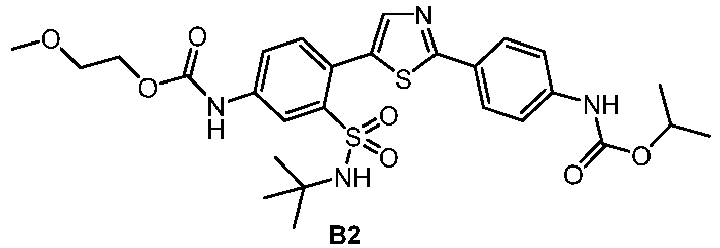
B3 
B4 
B5 
B6 
B7 
B8 
B9 
B10 
B11 
B12 
B13 
B14 
B15 
B16 
B17 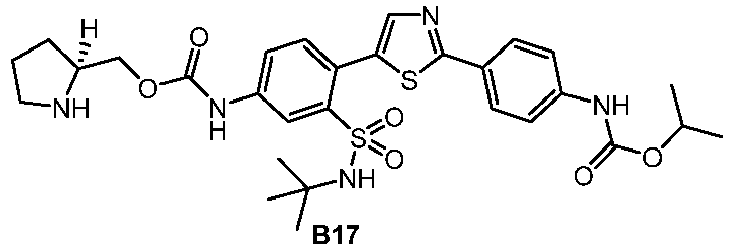
B18 
B19 
C1 
C2 
C3 
C4 
C5 
C6 
C7 
C8 
C9 
C10 
C11 
C12 
C13 
C14 
C15 
C16 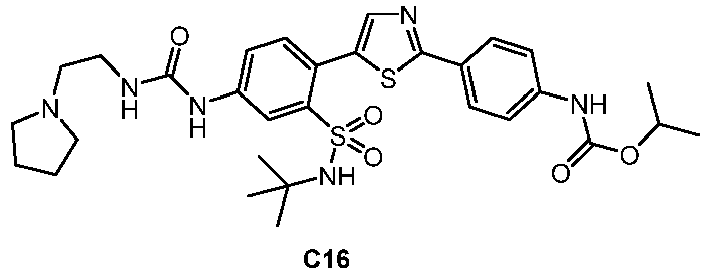
C17 
C18 
C19 
D1 
D2 
D3 
D4 
D5 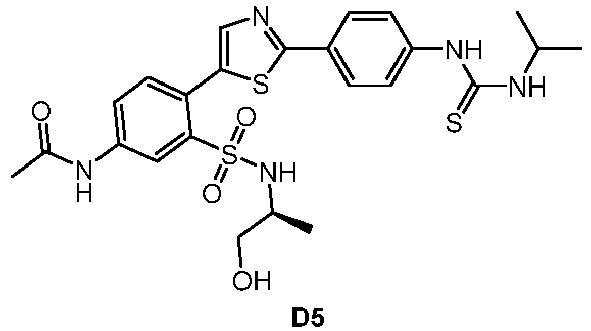
D6 
D7 
D8 
D9 
D10 
D11 
D12 
D13 
D14 
D15 
D16 
D17 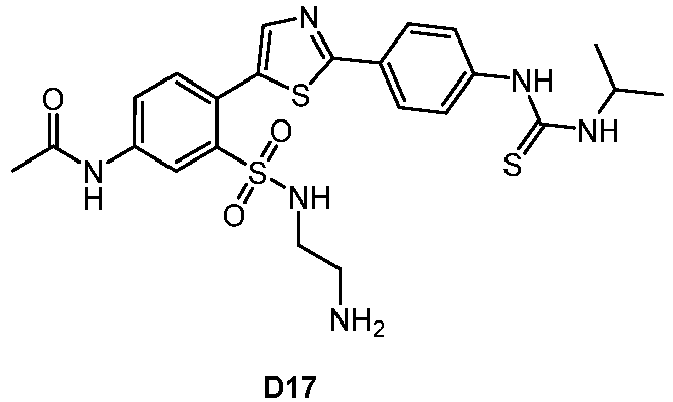
D18 
D19 
D20 
D21 
D22 
D23 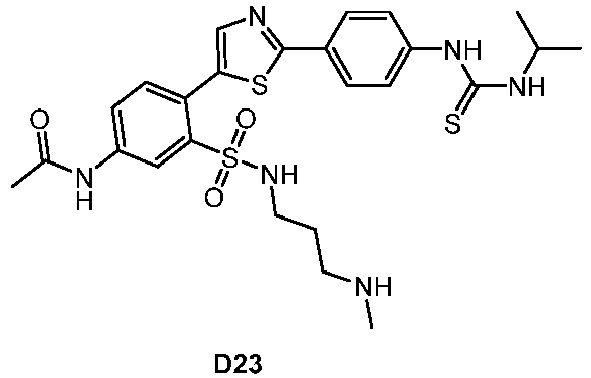
D24 
D25 
D26 
D27 
D28 
D29 
D30 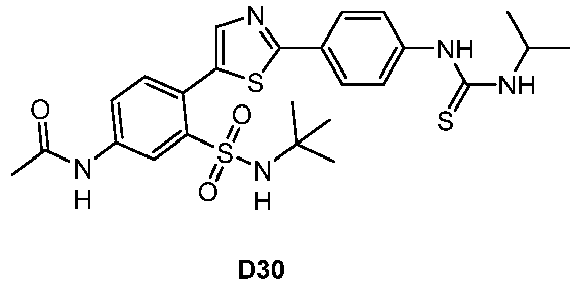
D31 
E1 
E2 
E3 
E4 
E5 
E6 
E7 
E8 
E9 
E10 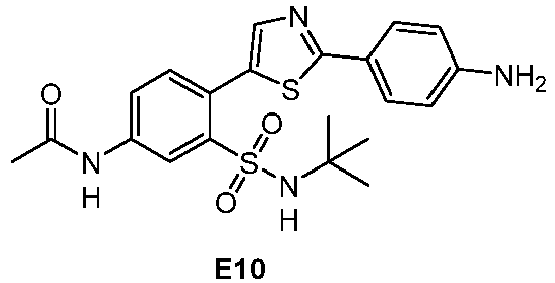
E11 
E12 
E13 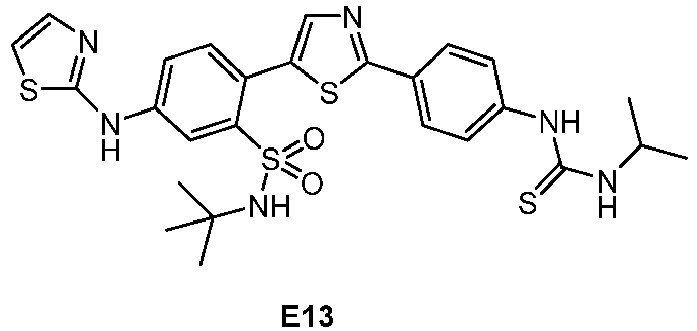
E14 
E15 
E16 
E17 
E18 
E19 
E20 
E21 
G1 
G2 
G3 
G4 
G5 
G6 
G7 
G8 
G9 
G10 
G11 
H1 
H2 
H3 
H4 
H5 
H6 
H7 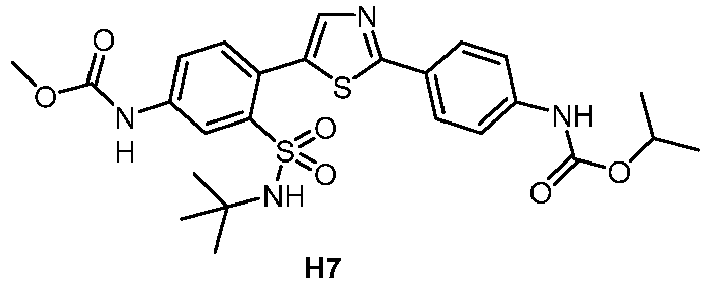
H8 
H9 
H10 
H11 
I1 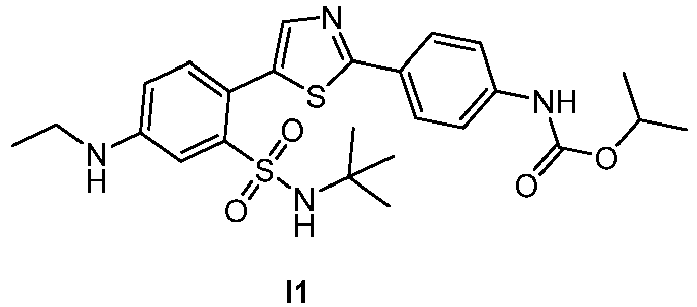
I2 
I3 
I4 
I5 
I6 
I7 
J1 
J2 
J3 
J4 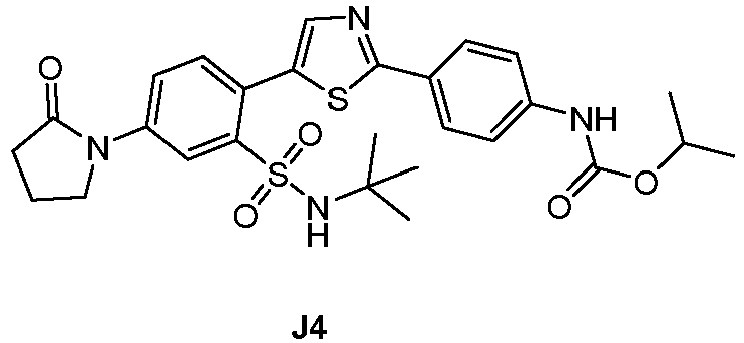
J6 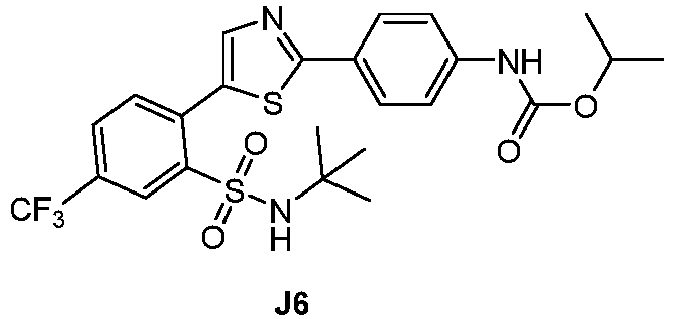
J7 
J8 
J9 
J10 
J11 
J12 
J13 
J15 
J16 
J17 
J18 
J18 
J19 
J20 
J21 
J22 
J23 
J24 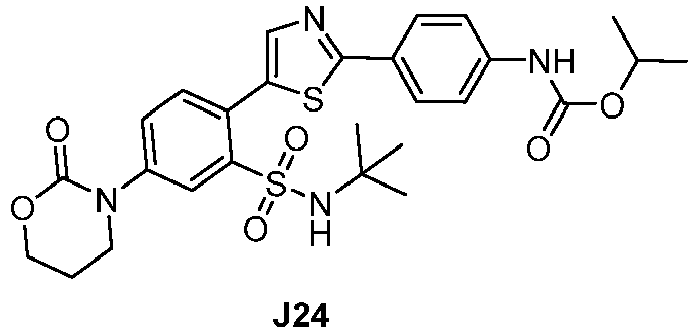
J25 
J26 
J27 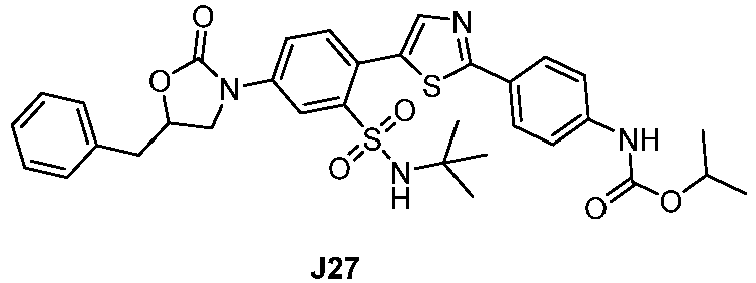
J28 
J29 
K1 
K2 
L1 
L2 
L3 
L4 
L5 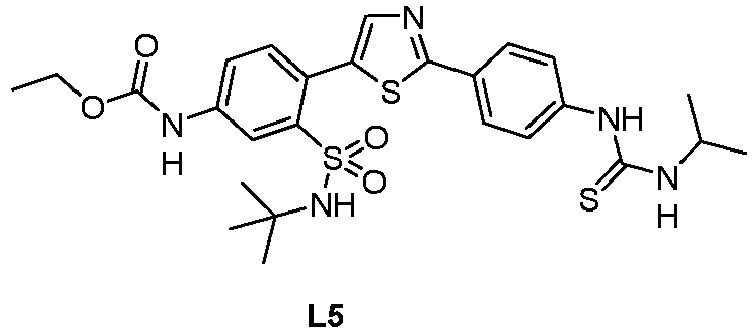
L6 
L7 
L8 
L9 
L10 
M1 
M2 
M3 
M4 
M5 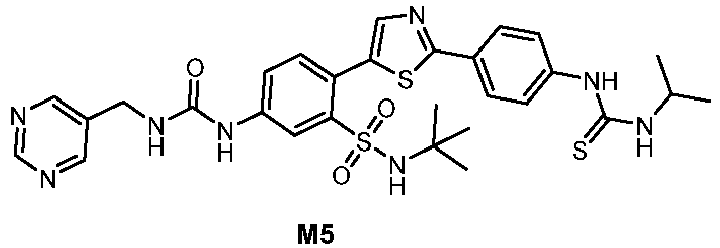
M6 
M7 
M8 
N1 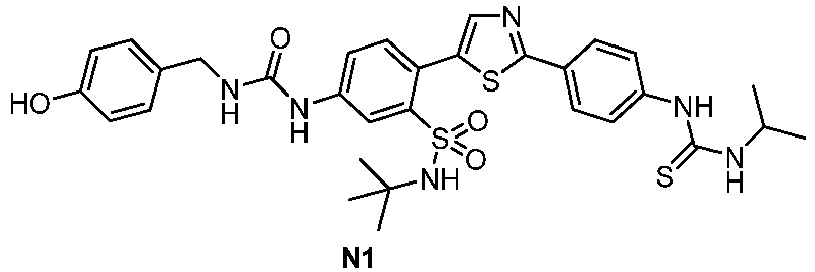
N2 
N3 
N4 
N5 
N6 
O1 
O2 
O3 
O4 
O5 
O6 
O7 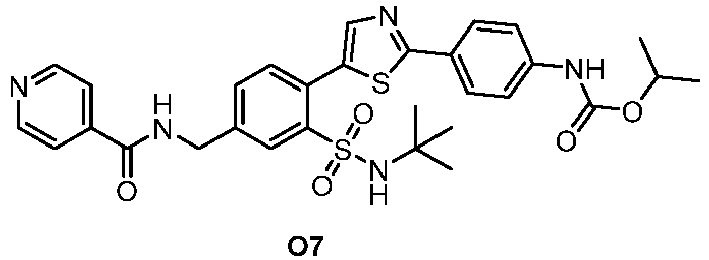
O8 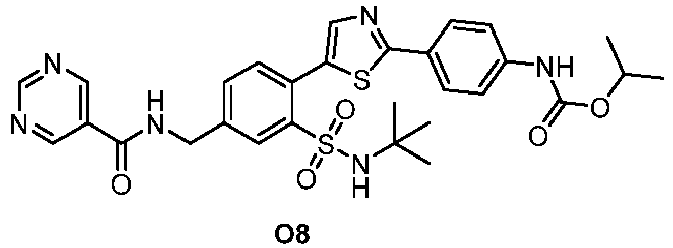
P1 
P2 
P3 
P4 
P5 
P6 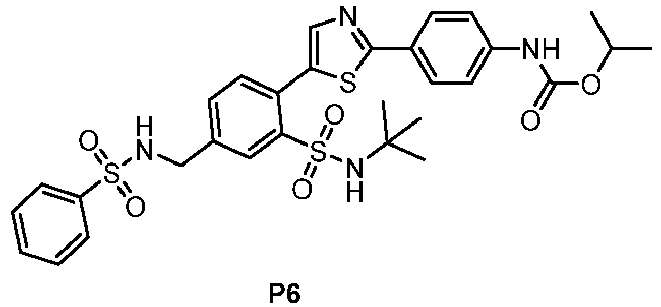
P7 
P8 
P9 
Q1 
Q2 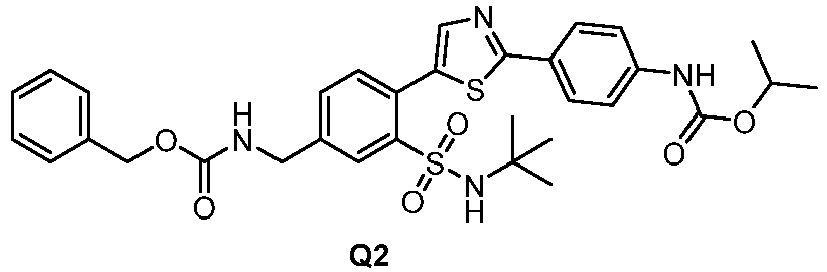
Q3 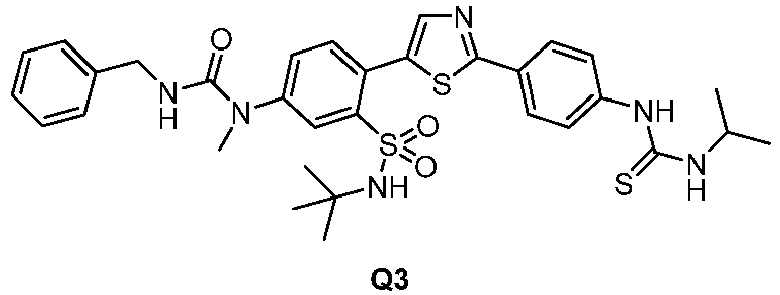
Q4 
Q5 
Q6 
R1 
R2 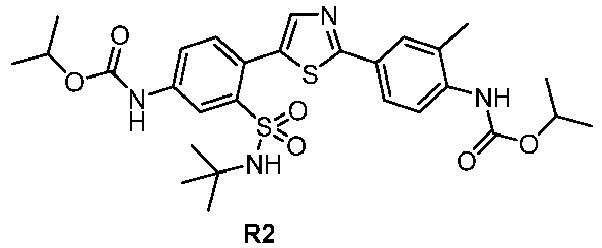
R3 
R4 
R5 
R6 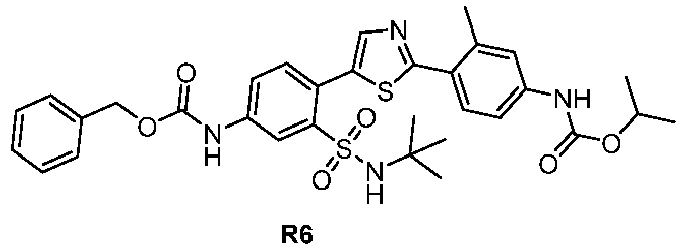
R7 
R8 
R9 
R10 
R11 
R12 
R13 
R14 
Applications Claiming Priority (2)
| Application Number | Priority Date | Filing Date | Title |
|---|---|---|---|
| US201762530972P | 2017-07-11 | 2017-07-11 | |
| PCT/US2018/041588 WO2019014315A1 (en) | 2017-07-11 | 2018-07-11 | Rad51 inhibitors |
Publications (2)
| Publication Number | Publication Date |
|---|---|
| EP3652159A1 EP3652159A1 (en) | 2020-05-20 |
| EP3652159B1 true EP3652159B1 (en) | 2023-01-18 |
Family
ID=63036490
Family Applications (1)
| Application Number | Title | Priority Date | Filing Date |
|---|---|---|---|
| EP18746518.2A Active EP3652159B1 (en) | 2017-07-11 | 2018-07-11 | Substituted thiazole derivatives as rad51 inhibitors for the treatment of cancer diseases, autoimmune and neurodegenerative conditions |
Country Status (8)
| Country | Link |
|---|---|
| US (1) | US11291655B2 (en) |
| EP (1) | EP3652159B1 (en) |
| JP (1) | JP7260540B2 (en) |
| CN (1) | CN111263756B (en) |
| AU (1) | AU2018301381B2 (en) |
| CA (1) | CA3069003A1 (en) |
| MX (1) | MX2020000367A (en) |
| WO (1) | WO2019014315A1 (en) |
Families Citing this family (10)
| Publication number | Priority date | Publication date | Assignee | Title |
|---|---|---|---|---|
| WO2019051465A1 (en) * | 2017-09-11 | 2019-03-14 | Cyteir Therapeutics, Inc. | Rad51 inhibitors |
| SG11202109399SA (en) * | 2019-03-12 | 2021-09-29 | Cyteir Therapeutics Inc | Rad51 inhibitors |
| PH12021552205A1 (en) | 2019-03-25 | 2022-06-13 | Cyteir Therapeutics Inc | Combinations of rad51 and parp inhibitors |
| JP7628090B2 (en) * | 2019-06-21 | 2025-02-07 | サイティアー セラピューティクス,インコーポレイティド | Methods of Utilizing RAD51 Inhibitors to Treat Pancreatic Cancer |
| US20230142274A1 (en) | 2020-02-19 | 2023-05-11 | Simcere Pharmaceutical Co., Ltd. | Substituted aryl compound |
| CN111714638A (en) * | 2020-06-23 | 2020-09-29 | 新疆医科大学第一附属医院 | Composition, preparation method and application of DNA damage-inducing compound combined with DNA damage repair inhibitor |
| CN113461660B (en) * | 2021-06-11 | 2022-08-02 | 浙江大学 | 2,4, 6-trisubstituted-1, 3, 5-s-triazine compound, preparation and application thereof |
| WO2023078271A1 (en) * | 2021-11-02 | 2023-05-11 | 上海旭成医药科技有限公司 | Aromatic compound, preparation method therefor, intermediate thereof, pharmaceutical composition thereof, and use thereof |
| TW202446368A (en) * | 2023-02-28 | 2024-12-01 | 美商賽堤爾醫療公司 | Substituted pyrrolidine and pyrrolidinone compounds |
| CN119431355A (en) * | 2024-11-06 | 2025-02-14 | 徐州医科大学 | A class of phenylthiazole derivatives, compositions and applications thereof |
Family Cites Families (14)
| Publication number | Priority date | Publication date | Assignee | Title |
|---|---|---|---|---|
| US20020086840A1 (en) | 2000-01-26 | 2002-07-04 | Zarling David A. | Use of Rad51 inhibitors for p53 gene therapy |
| JP4160295B2 (en) * | 2000-12-08 | 2008-10-01 | 武田薬品工業株式会社 | Substituted thiazole derivatives having a 3-pyridyl group, method for producing the same, and use thereof |
| WO2002046186A1 (en) * | 2000-12-08 | 2002-06-13 | Takeda Chemical Industries, Ltd. | Substituted thiazole derivatives bearing 3-pyridyl groups, process for preparing the same and use thereof |
| JP2006524638A (en) * | 2003-04-30 | 2006-11-02 | メルク フロスト カナダ リミテツド | 8- (3-Biaryl) phenylquinoline phosphodiesterase-4 inhibitors |
| MX2009004786A (en) * | 2006-10-31 | 2009-06-05 | Schering Corp | Anilinopiperazine derivatives and methods of use thereof. |
| EP2121675A1 (en) * | 2007-02-22 | 2009-11-25 | Irm Llc | Thiazole derivatives as modulators of g protein-coupled receptors |
| KR20120099155A (en) * | 2010-01-07 | 2012-09-06 | 셀렉사겐 세라퓨틱스 인크. | Hedgehog inhibitors |
| WO2013105985A1 (en) | 2011-02-28 | 2013-07-18 | Philadelphia Health & Education Corporation | Small molecule inhibitors of rad51 recombinase and methods thereof |
| CN102250065B (en) * | 2011-05-20 | 2015-05-13 | 浙江海正药业股份有限公司 | Substituted triazine phenyl urea derivatives and application thereof |
| CN106132203B (en) * | 2014-03-26 | 2020-05-15 | 希望之城 | Treatment of BRCA1-deficient or resistant cancers |
| WO2016140971A1 (en) | 2015-03-02 | 2016-09-09 | The Regents Of The University Of California | Novel rad51 inhibitors and uses thereof |
| WO2017050685A1 (en) * | 2015-09-25 | 2017-03-30 | Syngenta Participations Ag | Pesticidally active polycyclic derivatives with 5-membered sulfur containing heterocyclic ring systems |
| WO2019051465A1 (en) | 2017-09-11 | 2019-03-14 | Cyteir Therapeutics, Inc. | Rad51 inhibitors |
| SG11202109399SA (en) | 2019-03-12 | 2021-09-29 | Cyteir Therapeutics Inc | Rad51 inhibitors |
-
2018
- 2018-07-11 US US16/623,850 patent/US11291655B2/en not_active Expired - Fee Related
- 2018-07-11 JP JP2020523682A patent/JP7260540B2/en active Active
- 2018-07-11 CN CN201880058652.7A patent/CN111263756B/en active Active
- 2018-07-11 WO PCT/US2018/041588 patent/WO2019014315A1/en not_active Ceased
- 2018-07-11 CA CA3069003A patent/CA3069003A1/en active Pending
- 2018-07-11 EP EP18746518.2A patent/EP3652159B1/en active Active
- 2018-07-11 AU AU2018301381A patent/AU2018301381B2/en active Active
- 2018-07-11 MX MX2020000367A patent/MX2020000367A/en unknown
Also Published As
| Publication number | Publication date |
|---|---|
| US11291655B2 (en) | 2022-04-05 |
| JP2020527602A (en) | 2020-09-10 |
| AU2018301381A2 (en) | 2020-03-05 |
| EP3652159A1 (en) | 2020-05-20 |
| CA3069003A1 (en) | 2019-01-17 |
| JP7260540B2 (en) | 2023-04-18 |
| AU2018301381B2 (en) | 2022-07-07 |
| AU2018301381A1 (en) | 2020-02-20 |
| CN111263756B (en) | 2023-05-16 |
| US20200129484A1 (en) | 2020-04-30 |
| MX2020000367A (en) | 2020-08-17 |
| CN111263756A (en) | 2020-06-09 |
| WO2019014315A1 (en) | 2019-01-17 |
Similar Documents
| Publication | Publication Date | Title |
|---|---|---|
| US11291655B2 (en) | RAD51 inhibitors | |
| EP3681884B1 (en) | Rad51 inhibitors | |
| US20250082614A1 (en) | Methods of using rad51 inhibitors for treatment of pancreatic cancer | |
| EP3938358B1 (en) | Rad51 inhibitors | |
| CA3072205A1 (en) | Methods and compositions for modulating splicing | |
| HK40086120A (en) | Rad51 inhibitors | |
| HK40025149A (en) | Rad51 inhibitors | |
| HK40025149B (en) | Rad51 inhibitors |
Legal Events
| Date | Code | Title | Description |
|---|---|---|---|
| STAA | Information on the status of an ep patent application or granted ep patent |
Free format text: STATUS: UNKNOWN |
|
| STAA | Information on the status of an ep patent application or granted ep patent |
Free format text: STATUS: THE INTERNATIONAL PUBLICATION HAS BEEN MADE |
|
| PUAI | Public reference made under article 153(3) epc to a published international application that has entered the european phase |
Free format text: ORIGINAL CODE: 0009012 |
|
| STAA | Information on the status of an ep patent application or granted ep patent |
Free format text: STATUS: REQUEST FOR EXAMINATION WAS MADE |
|
| 17P | Request for examination filed |
Effective date: 20200210 |
|
| AK | Designated contracting states |
Kind code of ref document: A1 Designated state(s): AL AT BE BG CH CY CZ DE DK EE ES FI FR GB GR HR HU IE IS IT LI LT LU LV MC MK MT NL NO PL PT RO RS SE SI SK SM TR |
|
| AX | Request for extension of the european patent |
Extension state: BA ME |
|
| RIN1 | Information on inventor provided before grant (corrected) |
Inventor name: CASTRO, ALFREDO, C. Inventor name: VACCA, JOSEPH Inventor name: MCCOMAS, CASEY, CAMERON |
|
| DAV | Request for validation of the european patent (deleted) | ||
| DAX | Request for extension of the european patent (deleted) | ||
| STAA | Information on the status of an ep patent application or granted ep patent |
Free format text: STATUS: EXAMINATION IS IN PROGRESS |
|
| 17Q | First examination report despatched |
Effective date: 20210527 |
|
| GRAP | Despatch of communication of intention to grant a patent |
Free format text: ORIGINAL CODE: EPIDOSNIGR1 |
|
| STAA | Information on the status of an ep patent application or granted ep patent |
Free format text: STATUS: GRANT OF PATENT IS INTENDED |
|
| INTG | Intention to grant announced |
Effective date: 20220810 |
|
| GRAS | Grant fee paid |
Free format text: ORIGINAL CODE: EPIDOSNIGR3 |
|
| GRAA | (expected) grant |
Free format text: ORIGINAL CODE: 0009210 |
|
| STAA | Information on the status of an ep patent application or granted ep patent |
Free format text: STATUS: THE PATENT HAS BEEN GRANTED |
|
| AK | Designated contracting states |
Kind code of ref document: B1 Designated state(s): AL AT BE BG CH CY CZ DE DK EE ES FI FR GB GR HR HU IE IS IT LI LT LU LV MC MK MT NL NO PL PT RO RS SE SI SK SM TR |
|
| REG | Reference to a national code |
Ref country code: GB Ref legal event code: FG4D |
|
| REG | Reference to a national code |
Ref country code: DE Ref legal event code: R096 Ref document number: 602018045521 Country of ref document: DE |
|
| REG | Reference to a national code |
Ref country code: CH Ref legal event code: EP |
|
| REG | Reference to a national code |
Ref country code: AT Ref legal event code: REF Ref document number: 1544631 Country of ref document: AT Kind code of ref document: T Effective date: 20230215 Ref country code: IE Ref legal event code: FG4D |
|
| REG | Reference to a national code |
Ref country code: LT Ref legal event code: MG9D |
|
| REG | Reference to a national code |
Ref country code: NL Ref legal event code: MP Effective date: 20230118 |
|
| P01 | Opt-out of the competence of the unified patent court (upc) registered |
Effective date: 20230428 |
|
| REG | Reference to a national code |
Ref country code: AT Ref legal event code: MK05 Ref document number: 1544631 Country of ref document: AT Kind code of ref document: T Effective date: 20230118 |
|
| PG25 | Lapsed in a contracting state [announced via postgrant information from national office to epo] |
Ref country code: NL Free format text: LAPSE BECAUSE OF FAILURE TO SUBMIT A TRANSLATION OF THE DESCRIPTION OR TO PAY THE FEE WITHIN THE PRESCRIBED TIME-LIMIT Effective date: 20230118 |
|
| PG25 | Lapsed in a contracting state [announced via postgrant information from national office to epo] |
Ref country code: RS Free format text: LAPSE BECAUSE OF FAILURE TO SUBMIT A TRANSLATION OF THE DESCRIPTION OR TO PAY THE FEE WITHIN THE PRESCRIBED TIME-LIMIT Effective date: 20230118 Ref country code: PT Free format text: LAPSE BECAUSE OF FAILURE TO SUBMIT A TRANSLATION OF THE DESCRIPTION OR TO PAY THE FEE WITHIN THE PRESCRIBED TIME-LIMIT Effective date: 20230518 Ref country code: NO Free format text: LAPSE BECAUSE OF FAILURE TO SUBMIT A TRANSLATION OF THE DESCRIPTION OR TO PAY THE FEE WITHIN THE PRESCRIBED TIME-LIMIT Effective date: 20230418 Ref country code: LV Free format text: LAPSE BECAUSE OF FAILURE TO SUBMIT A TRANSLATION OF THE DESCRIPTION OR TO PAY THE FEE WITHIN THE PRESCRIBED TIME-LIMIT Effective date: 20230118 Ref country code: LT Free format text: LAPSE BECAUSE OF FAILURE TO SUBMIT A TRANSLATION OF THE DESCRIPTION OR TO PAY THE FEE WITHIN THE PRESCRIBED TIME-LIMIT Effective date: 20230118 Ref country code: HR Free format text: LAPSE BECAUSE OF FAILURE TO SUBMIT A TRANSLATION OF THE DESCRIPTION OR TO PAY THE FEE WITHIN THE PRESCRIBED TIME-LIMIT Effective date: 20230118 Ref country code: ES Free format text: LAPSE BECAUSE OF FAILURE TO SUBMIT A TRANSLATION OF THE DESCRIPTION OR TO PAY THE FEE WITHIN THE PRESCRIBED TIME-LIMIT Effective date: 20230118 Ref country code: AT Free format text: LAPSE BECAUSE OF FAILURE TO SUBMIT A TRANSLATION OF THE DESCRIPTION OR TO PAY THE FEE WITHIN THE PRESCRIBED TIME-LIMIT Effective date: 20230118 |
|
| PG25 | Lapsed in a contracting state [announced via postgrant information from national office to epo] |
Ref country code: SE Free format text: LAPSE BECAUSE OF FAILURE TO SUBMIT A TRANSLATION OF THE DESCRIPTION OR TO PAY THE FEE WITHIN THE PRESCRIBED TIME-LIMIT Effective date: 20230118 Ref country code: PL Free format text: LAPSE BECAUSE OF FAILURE TO SUBMIT A TRANSLATION OF THE DESCRIPTION OR TO PAY THE FEE WITHIN THE PRESCRIBED TIME-LIMIT Effective date: 20230118 Ref country code: IS Free format text: LAPSE BECAUSE OF FAILURE TO SUBMIT A TRANSLATION OF THE DESCRIPTION OR TO PAY THE FEE WITHIN THE PRESCRIBED TIME-LIMIT Effective date: 20230518 Ref country code: GR Free format text: LAPSE BECAUSE OF FAILURE TO SUBMIT A TRANSLATION OF THE DESCRIPTION OR TO PAY THE FEE WITHIN THE PRESCRIBED TIME-LIMIT Effective date: 20230419 Ref country code: FI Free format text: LAPSE BECAUSE OF FAILURE TO SUBMIT A TRANSLATION OF THE DESCRIPTION OR TO PAY THE FEE WITHIN THE PRESCRIBED TIME-LIMIT Effective date: 20230118 |
|
| REG | Reference to a national code |
Ref country code: DE Ref legal event code: R097 Ref document number: 602018045521 Country of ref document: DE |
|
| PG25 | Lapsed in a contracting state [announced via postgrant information from national office to epo] |
Ref country code: SM Free format text: LAPSE BECAUSE OF FAILURE TO SUBMIT A TRANSLATION OF THE DESCRIPTION OR TO PAY THE FEE WITHIN THE PRESCRIBED TIME-LIMIT Effective date: 20230118 Ref country code: RO Free format text: LAPSE BECAUSE OF FAILURE TO SUBMIT A TRANSLATION OF THE DESCRIPTION OR TO PAY THE FEE WITHIN THE PRESCRIBED TIME-LIMIT Effective date: 20230118 Ref country code: EE Free format text: LAPSE BECAUSE OF FAILURE TO SUBMIT A TRANSLATION OF THE DESCRIPTION OR TO PAY THE FEE WITHIN THE PRESCRIBED TIME-LIMIT Effective date: 20230118 Ref country code: DK Free format text: LAPSE BECAUSE OF FAILURE TO SUBMIT A TRANSLATION OF THE DESCRIPTION OR TO PAY THE FEE WITHIN THE PRESCRIBED TIME-LIMIT Effective date: 20230118 Ref country code: CZ Free format text: LAPSE BECAUSE OF FAILURE TO SUBMIT A TRANSLATION OF THE DESCRIPTION OR TO PAY THE FEE WITHIN THE PRESCRIBED TIME-LIMIT Effective date: 20230118 |
|
| PLBE | No opposition filed within time limit |
Free format text: ORIGINAL CODE: 0009261 |
|
| STAA | Information on the status of an ep patent application or granted ep patent |
Free format text: STATUS: NO OPPOSITION FILED WITHIN TIME LIMIT |
|
| PG25 | Lapsed in a contracting state [announced via postgrant information from national office to epo] |
Ref country code: SK Free format text: LAPSE BECAUSE OF FAILURE TO SUBMIT A TRANSLATION OF THE DESCRIPTION OR TO PAY THE FEE WITHIN THE PRESCRIBED TIME-LIMIT Effective date: 20230118 |
|
| 26N | No opposition filed |
Effective date: 20231019 |
|
| PG25 | Lapsed in a contracting state [announced via postgrant information from national office to epo] |
Ref country code: SI Free format text: LAPSE BECAUSE OF FAILURE TO SUBMIT A TRANSLATION OF THE DESCRIPTION OR TO PAY THE FEE WITHIN THE PRESCRIBED TIME-LIMIT Effective date: 20230118 |
|
| PG25 | Lapsed in a contracting state [announced via postgrant information from national office to epo] |
Ref country code: MC Free format text: LAPSE BECAUSE OF FAILURE TO SUBMIT A TRANSLATION OF THE DESCRIPTION OR TO PAY THE FEE WITHIN THE PRESCRIBED TIME-LIMIT Effective date: 20230118 |
|
| PG25 | Lapsed in a contracting state [announced via postgrant information from national office to epo] |
Ref country code: MC Free format text: LAPSE BECAUSE OF FAILURE TO SUBMIT A TRANSLATION OF THE DESCRIPTION OR TO PAY THE FEE WITHIN THE PRESCRIBED TIME-LIMIT Effective date: 20230118 |
|
| REG | Reference to a national code |
Ref country code: BE Ref legal event code: MM Effective date: 20230731 |
|
| PG25 | Lapsed in a contracting state [announced via postgrant information from national office to epo] |
Ref country code: LU Free format text: LAPSE BECAUSE OF NON-PAYMENT OF DUE FEES Effective date: 20230711 |
|
| PG25 | Lapsed in a contracting state [announced via postgrant information from national office to epo] |
Ref country code: LU Free format text: LAPSE BECAUSE OF NON-PAYMENT OF DUE FEES Effective date: 20230711 |
|
| REG | Reference to a national code |
Ref country code: IE Ref legal event code: MM4A |
|
| PG25 | Lapsed in a contracting state [announced via postgrant information from national office to epo] |
Ref country code: IT Free format text: LAPSE BECAUSE OF FAILURE TO SUBMIT A TRANSLATION OF THE DESCRIPTION OR TO PAY THE FEE WITHIN THE PRESCRIBED TIME-LIMIT Effective date: 20230118 Ref country code: BE Free format text: LAPSE BECAUSE OF NON-PAYMENT OF DUE FEES Effective date: 20230731 |
|
| PG25 | Lapsed in a contracting state [announced via postgrant information from national office to epo] |
Ref country code: IE Free format text: LAPSE BECAUSE OF NON-PAYMENT OF DUE FEES Effective date: 20230711 |
|
| PG25 | Lapsed in a contracting state [announced via postgrant information from national office to epo] |
Ref country code: IE Free format text: LAPSE BECAUSE OF NON-PAYMENT OF DUE FEES Effective date: 20230711 |
|
| PG25 | Lapsed in a contracting state [announced via postgrant information from national office to epo] |
Ref country code: BG Free format text: LAPSE BECAUSE OF FAILURE TO SUBMIT A TRANSLATION OF THE DESCRIPTION OR TO PAY THE FEE WITHIN THE PRESCRIBED TIME-LIMIT Effective date: 20230118 |
|
| PG25 | Lapsed in a contracting state [announced via postgrant information from national office to epo] |
Ref country code: BG Free format text: LAPSE BECAUSE OF FAILURE TO SUBMIT A TRANSLATION OF THE DESCRIPTION OR TO PAY THE FEE WITHIN THE PRESCRIBED TIME-LIMIT Effective date: 20230118 |
|
| PGFP | Annual fee paid to national office [announced via postgrant information from national office to epo] |
Ref country code: GB Payment date: 20250522 Year of fee payment: 8 |
|
| PGFP | Annual fee paid to national office [announced via postgrant information from national office to epo] |
Ref country code: FR Payment date: 20250523 Year of fee payment: 8 |
|
| PG25 | Lapsed in a contracting state [announced via postgrant information from national office to epo] |
Ref country code: CY Free format text: LAPSE BECAUSE OF FAILURE TO SUBMIT A TRANSLATION OF THE DESCRIPTION OR TO PAY THE FEE WITHIN THE PRESCRIBED TIME-LIMIT; INVALID AB INITIO Effective date: 20180711 |
|
| PG25 | Lapsed in a contracting state [announced via postgrant information from national office to epo] |
Ref country code: HU Free format text: LAPSE BECAUSE OF FAILURE TO SUBMIT A TRANSLATION OF THE DESCRIPTION OR TO PAY THE FEE WITHIN THE PRESCRIBED TIME-LIMIT; INVALID AB INITIO Effective date: 20180711 |
|
| PGFP | Annual fee paid to national office [announced via postgrant information from national office to epo] |
Ref country code: DE Payment date: 20250521 Year of fee payment: 8 |
|
| PGFP | Annual fee paid to national office [announced via postgrant information from national office to epo] |
Ref country code: CH Payment date: 20250801 Year of fee payment: 8 |
|
| PG25 | Lapsed in a contracting state [announced via postgrant information from national office to epo] |
Ref country code: TR Free format text: LAPSE BECAUSE OF FAILURE TO SUBMIT A TRANSLATION OF THE DESCRIPTION OR TO PAY THE FEE WITHIN THE PRESCRIBED TIME-LIMIT Effective date: 20230118 |