EP3650245B1 - Schwefelvernetzbare kautschukmischung, vulkanisat und fahrzeugreifen - Google Patents
Schwefelvernetzbare kautschukmischung, vulkanisat und fahrzeugreifen Download PDFInfo
- Publication number
- EP3650245B1 EP3650245B1 EP18205722.4A EP18205722A EP3650245B1 EP 3650245 B1 EP3650245 B1 EP 3650245B1 EP 18205722 A EP18205722 A EP 18205722A EP 3650245 B1 EP3650245 B1 EP 3650245B1
- Authority
- EP
- European Patent Office
- Prior art keywords
- rubber
- phr
- rubber mixture
- formula
- groups
- Prior art date
- Legal status (The legal status is an assumption and is not a legal conclusion. Google has not performed a legal analysis and makes no representation as to the accuracy of the status listed.)
- Active
Links
Classifications
-
- C—CHEMISTRY; METALLURGY
- C08—ORGANIC MACROMOLECULAR COMPOUNDS; THEIR PREPARATION OR CHEMICAL WORKING-UP; COMPOSITIONS BASED THEREON
- C08K—Use of inorganic or non-macromolecular organic substances as compounding ingredients
- C08K5/00—Use of organic ingredients
- C08K5/54—Silicon-containing compounds
- C08K5/5406—Silicon-containing compounds containing elements other than oxygen or nitrogen
-
- B—PERFORMING OPERATIONS; TRANSPORTING
- B60—VEHICLES IN GENERAL
- B60C—VEHICLE TYRES; TYRE INFLATION; TYRE CHANGING; CONNECTING VALVES TO INFLATABLE ELASTIC BODIES IN GENERAL; DEVICES OR ARRANGEMENTS RELATED TO TYRES
- B60C1/00—Tyres characterised by the chemical composition or the physical arrangement or mixture of the composition
-
- B—PERFORMING OPERATIONS; TRANSPORTING
- B60—VEHICLES IN GENERAL
- B60C—VEHICLE TYRES; TYRE INFLATION; TYRE CHANGING; CONNECTING VALVES TO INFLATABLE ELASTIC BODIES IN GENERAL; DEVICES OR ARRANGEMENTS RELATED TO TYRES
- B60C1/00—Tyres characterised by the chemical composition or the physical arrangement or mixture of the composition
- B60C1/0016—Compositions of the tread
-
- C—CHEMISTRY; METALLURGY
- C08—ORGANIC MACROMOLECULAR COMPOUNDS; THEIR PREPARATION OR CHEMICAL WORKING-UP; COMPOSITIONS BASED THEREON
- C08K—Use of inorganic or non-macromolecular organic substances as compounding ingredients
- C08K3/00—Use of inorganic substances as compounding ingredients
- C08K3/34—Silicon-containing compounds
- C08K3/36—Silica
Definitions
- the invention relates to a sulphur-crosslinkable rubber mixture, a vulcanizate and a vehicle tire.
- the rubber composition of the tread strip largely determines the driving properties of a tire, in particular a pneumatic vehicle tire.
- the rubber mixtures that are used in belts, hoses and belts, especially in the areas subject to high mechanical loads, are essentially responsible for the stability and longevity of these rubber items. Very high demands are therefore placed on these rubber mixtures for pneumatic vehicle tires, belts, belts and hoses.
- the driving properties of a tire have been raised to a higher level overall in recent years through the partial or complete replacement of the filler carbon black with silica in rubber mixtures.
- the well-known conflicting goals of the opposing tire properties also continue to exist with tread compounds containing silica.
- an improvement in the rolling resistance behavior generally leads to a deterioration in the abrasion behavior.
- These properties are also an important quality criterion for technical rubber items such as belts, belts and hoses.
- organosilanes are used to make the silicic acid hydrophobic and thus create the connection between the filler and the polymer. For this it is necessary that the silica has a good distribution within the rubber mixture, ie that it is easily dispersible.
- silanes which have a relatively high specific surface area, are very difficult to disperse in rubber mixtures.
- Polysulfidic organosilanes are bound to the polymer.
- different silanes have different influences on the physical properties of the rubber compound. For example, is off WO2008083242A1 It is known that the silanes described there with cyclic units, so-called “silated core polysulfides” (SCP), improve the abrasion behavior but at the same time have no effect on the rolling resistance behavior.
- SCP silanes described there with cyclic units
- monomeric silanes such as mercaptosilanes
- TESPD bis(triethoxysilylpropyl) disulfide
- TESPT bis(triethoxysilylpropyl) tetrasulfide
- monomeric silanes such as mercaptosilanes
- mercaptosilanes improve the rolling resistance behavior, but are associated with severely impaired processability and reduced Wet grip behavior and greater abrasion loss.
- Protected mercaptosilanes, ie mercaptosilanes in which the mercapto group is blocked improve the rolling resistance only slightly at the expense of wet grip and abrasion, although the stiffness, ie the handling potential, decreases.
- the JP2012158679A1 and the JP 2011225730 A disclose rubber mixtures containing, inter alia, the silane p-chloromethylphenylethyltriethoxysilane.
- the CN 108084523A discloses a rubber compound containing the silane 4-chloromethylphenyltrimethoxysilane.
- the invention is therefore based on the object of providing a siliceous rubber mixture which improves the abrasion behavior and/or the reinforcing effect and/or the tear properties, while the other physical properties, in particular the rolling resistance behavior, remain at approximately the same level or even be optimized.
- a further object of the present invention is a vulcanizate of at least one rubber mixture according to the invention.
- a further object of the present invention is a vehicle tire which has at least one vulcanizate according to the invention of the rubber mixture according to the invention in at least one component.
- the vehicle tire preferably has the at least one vulcanizate at least in the tread.
- the vulcanizate according to the invention and the vehicle tire according to the invention are distinguished by an improvement in abrasion and/or the reinforcing effect. At the same time, they have very good handling characteristics.
- the rubber mixture according to the invention can be used both for the cap and for the base.
- At least the cap or at least the base or at least the cap and the base preferably have at least one vulcanizate according to the invention of the rubber mixture according to the invention.
- the rubber mixture according to the invention is also suitable for treads which consist of different tread mixtures arranged next to one another and/or one below the other (multi-component treads).
- vehicle tires are understood to mean pneumatic vehicle tires and solid rubber tires, including tires for industrial and construction site vehicles, truck, passenger car and two-wheeler tires.
- the rubber mixture according to the invention is also suitable for other components of vehicle tires such. B. in particular the horn profile, as well as for inner tire components.
- the rubber mixture according to the invention is also suitable for other technical rubber items, such as B. bellows, conveyor belts, air springs, belts, belts or hoses, and shoe soles are suitable.
- Another object of the present invention is the use of the rubber mixture according to the invention for the production of a rubber article, in particular an air spring, a bellows, conveyor belt, belt, belt, hose, rubber band, profile, a seal, a membrane, tactile sensors for medical applications or robot applications, or a shoe sole or parts thereof.
- the specification phr (parts per hundred parts of rubber by weight) used in this document is the quantity specification for mixture recipes that is customary in the rubber industry.
- the dosage of the parts by weight of the individual substances is based on 100 parts by weight of the total mass of all rubbers present in the mixture with a molecular weight M w according to GPC of greater than 20,000 g/mol.
- phf parts per hundred parts of filler by weight
- phf refers to the silica present, which means that other fillers that may be present, such as carbon black, are not included in the calculation of the amount of silane.
- the rubber mixture contains at least one styrene butadiene rubber or at least one butadiene rubber.
- An example of a low-cis polybutadiene is Li-BR (Lithium Catalyzed Butadiene Rubber) with a cis content of 20 to 50%. Particularly good abrasion properties and low hysteresis of the rubber compound are achieved with a high-cis BR.
- the polybutadiene(s) used can/can be end-group-modified with modifications and functionalizations and/or functionalized along the polymer chains.
- the modification can be those with hydroxy groups and/or ethoxy groups and/or epoxy groups and/or siloxane groups and/or amino groups and/or aminosiloxane and/or carboxy groups and/or phthalocyanine Act groups and / or silane sulfide groups.
- functionalizations further modifications known to the person skilled in the art, also referred to as functionalizations, are also possible.
- Metal atoms can be part of such functionalizations.
- the styrene butadiene rubber can be solution polymerized styrene butadiene rubber (SSBR) having a styrene content, based on the polymer, of 5 to 45% by weight and a vinyl content (content of 1,2-bound butadiene, based on the total polymer) of 5 up to 70% by weight, which can be prepared, for example, using lithium alkyls in organic solvent.
- SSBR solution polymerized styrene butadiene rubber
- the SSBR can also be coupled.
- an emulsion-polymerized styrene-butadiene rubber ESBR
- ESBR emulsion-polymerized styrene-butadiene rubber
- S-SBR emulsion-polymerized styrene-butadiene rubber
- the styrene content of the ESBR is about 15 to 50% by weight and the types known from the prior art which have been obtained by copolymerization of styrene and 1,3-butadiene in aqueous emulsion can be used.
- styrene-butadiene rubber and “styrene-butadiene copolymer” are used synonymously in the context of the present invention.
- the styrene-butadiene copolymer used can be end-group-modified with the modifications and functionalizations mentioned above for polybutadiene and/or functionalized along the polymer chains.
- the amount of styrene butadiene rubber and butadiene rubber contained is preferably from 10 to 100 phr, more preferably from 10 to 90 phr, most preferably from 10 to 80 phr.
- the rubber mixture contains at least one butadiene rubber.
- the rubber mixture contains at least one styrene-butadiene rubber.
- the rubber mixture contains at least one styrene butadiene rubber and at least one butadiene rubber.
- the rubber mixture can also contain other rubbers, such as natural polyisoprene and/or synthetic polyisoprene and/or epoxidized polyisoprene and/or styrene-isoprene rubber and/or liquid rubbers with a molecular weight M w greater than 20,000 g/mol and/or halobutyl rubber and/or polynorbornene and/or isoprene-isobutylene copolymer and/or ethylene-propylene-diene rubber and/or nitrile rubber and/or chloroprene rubber and/or acrylate rubber and/or fluorine rubber and/or or silicone rubber and/or polysulfide rubber and/or epichlorohydrin rubber and/or styrene-isoprene-butadiene terpolymer and/or hydrogenated acrylonitrile-butadiene rubber and/or hydrogenated styrene-butadiene rubber.
- other rubbers such
- nitrile rubber hydrogenated acrylonitrile butadiene rubber, chloroprene rubber, butyl rubber, halobutyl rubber or ethylene-propylene-diene rubber are used in the production of technical rubber articles, such as belts, straps and hoses, and/or shoe soles.
- the mixture compositions known to those skilled in the art for these rubbers, which are particular with regard to fillers, plasticizers, vulcanization systems and additives, are preferably used.
- the rubber mixture is particularly suitable for vehicle tires, and it can in principle be used in any component, such as in particular the tread, the sidewall, the horn profile, and in other so-called body components.
- the rubber mixture contains natural and/or synthetic polyisoprene, it can be either cis-1,4-polyisoprene or 3,4-polyisoprene.
- Polyisoprene can be obtained by stereospecific polymerization in solution with Ziegler-Natta catalysts or using finely divided lithium alkyls.
- the use of cis-1,4-polyisoprenes with a cis-1,4 content of >90% by weight is preferred.
- Natural rubber (NR) is such a cis-1,4 polyisoprene, the cis-1,4 content in natural rubber being greater than 99% by weight.
- a mixture of one or more natural polyisoprenes with one or more synthetic polyisoprene(s) is also conceivable.
- Natural rubber means naturally occurring rubber obtainable from Hevea rubber trees and "non-Hevea” sources.
- Non-Hevea sources include guayule shrubs and dandelions such as TKS (Taraxacum kok-saghyz; Russian dandelion).
- the additional rubber can be used in amounts of 0 to 90 phr, especially in amounts of 0.1 to 90 phr, most preferably in amounts of 10 to 80 phr.
- the rubber mixture contains at least one silica.
- the silicic acid can be the types of silicic acid known to those skilled in the art which are suitable as fillers for tire rubber mixtures. However, it is particularly preferred if a finely divided, precipitated silica is used which has a nitrogen surface area (BET surface area) (according to DIN ISO 9277 and DIN 66132) from 35 to 400 m 2 /g, preferably from 35 to 350 m 2 / g, more preferably from 85 to 320 m 2 / g and most preferably from 120 to 235 m 2 / g, and a CTAB surface area (according to ASTM D 3765) from 30 to 400 m 2 / g, preferably from 30 to 330 m 2 /g, particularly preferred from 80 to 300 m 2 /g and most preferably from 115 to 200 m 2 /g.
- BET surface area nitrogen surface area
- CTAB surface area accordinging to ASTM D 3765
- Such silicas lead z. B. in rubber mixtures for tire treads to particularly good physical properties of the vulcanizates.
- silicas z. B. both those of the type Ultrasil ® VN3 (trade name) from Evonik and highly dispersible silicas, so-called HD silicas (z. B. Zeosil ® 1165 MP from Solvay), are used.
- the rubber mixture according to the invention contains 5 to 500 phr, preferably 5 to 400 phr, particularly preferably 5 to 300 phr of at least one silica.
- the rubber mixture contains 10 to 200 phr and very particularly preferably 20 to 180 phr, again preferably 20 to 100 phr, of at least one silica.
- the rubber mixture according to the invention can also contain at least one carbon black, in particular at least one industrial carbon black.
- carbon black All types of carbon black known to the person skilled in the art can be considered as carbon blacks.
- the carbon black has an iodine number, according to ASTM D 1510, which is also referred to as the iodine adsorption number, between 30 and 250 g/kg, preferably 30 to 180 g/kg. particularly preferably 40 to 180 g/kg, and very particularly preferably 40 to 130 g/kg, and a DBP number according to ASTM D 2414 of 30 to 200 ml/100 g, preferably 70 to 200 ml/100 g, particularly preferably 90 to 200ml/100g.
- ASTM D 1510 which is also referred to as the iodine adsorption number
- the DBP number according to ASTM D 2414 determines the specific absorption volume of a carbon black or a light-colored filler using dibutyl phthalate.
- the rubber mixture contains 0.1 to 50 phr, preferably 0.1 to 30 phr, of at least one carbon black.
- the rubber mixture contains 0.1 to 10 phr, preferably 0.1 to 5 phr, of at least one carbon black.
- the rubber mixture according to the invention can contain other fillers, for example in amounts of from 0.1 to 50 phr.
- the other (non-reinforcing) fillers include aluminosilicates, kaolin, chalk, starch, magnesium oxide, titanium dioxide or rubber gels and fibers (such as, for example, aramid fibers, glass fibers, carbon fibers, cellulose fibers).
- CNT carbon nanotubes
- HCF hollow carbon fibers
- modified CNT containing one or more functional groups such as hydroxyl, carboxy and carbonyl groups
- graphite and graphene so-called "carbon-silica dual-phase filier”.
- zinc oxide does not belong to the fillers.
- R 1 radicals mentioned and bridging of one or more silanes via R 1 radicals can be combined with one another within a silyl group.
- the silicon atom is part of a ring system.
- silanes of the formula I) and/or II are bridged to one another, they share an R 1 radical or are linked to one another via an oxygen atom by combining two Si—R 1 groups. In this way, more than two silanes can also be linked to one another.
- two silanes of the formula I) and/or II) it is therefore conceivable for two silanes of the formula I) and/or II) to be bridged to one another via an oxygen atom or the R 1 radicals. In this way, more than two silanes can also be linked to one another, for example via dialkoxy groups.
- the rubber mixture can thus also contain oligomers which are formed as R 1 of the silanes of the formula I) and/or by hydrolysis and condensation or by bridging by means of dialkoxy groups.
- the silanes according to the formulas I) and II) include the condition that in the formula I) and II) in each (R 1 ) o Si group at least one R 1 is selected from those possibilities mentioned above, in which this R 1 i) is bonded to the silicon atom via an oxygen atom or ii) is a halide, in each case at least one radical R 1 which can serve as a leaving group.
- these are therefore alkoxy groups, phenoxy groups or all other of the groups mentioned which are bonded to the silicon atom with an oxygen atom, or halides.
- radicals R 1 are alkyl groups with 1 to 10 carbon atoms (C 1 -C 10 alkyl group) or alkoxy groups with 1 to 10 carbon atoms (C 1 -C 10 alkoxy group) or halides, particular preference being given to alkoxy groups having 1 to 10 carbon atoms (C 1 -C 10 alkoxy group).
- each silyl group at least one R 1 is a C 1 -C 10 alkoxy group, preferably C 1 -C 6 alkoxy group.
- the radicals R 1 within a silyl group (R 1 ) are o Si and alkoxy groups having 1 or 2 carbon atoms, ie methoxy groups or ethoxy groups, very particularly preferably ethoxy groups, where o is 3.
- the remaining R 1 radicals are preferably alkyl groups having 1 to 10 carbon atoms or halides or alkoxy groups having 1 to 10 carbon atoms, preferably 1 or 2 carbon atoms, i.e. methoxy groups or ethoxy groups, most preferably ethoxy groups.
- ethoxy groups in the formulas of the silanes are abbreviated as EtO or OEt.
- alkoxy groups such as ethoxy groups, are bonded to the silicon atom Si via the oxygen atom O.
- X in the formulas I) and II) is a halide, preferably chloride or bromide or iodide.
- X in formula I) and formula II) is chloride.
- the aromatic groups A of the formulas I) and II) can in principle be any aromatic group.
- the aromatic groups A can contain heteroatoms and/or carry substituents R 5 (for a particular hydrogen atom) on one or more atoms of the aromatic skeleton, in addition to the substituents of the formula.
- R 5 is understood as meaning additional substituents as part of the aromatic group A, which, in the case of two or more substituents, can independently be the same or different.
- aromatic groups A are selected from the group consisting of phenyl, naphthyl, anthryl, phenanthryl, pyridyl, pyridazyl, pyrimidyl, pyrazyl, triazyl, quinolyl, pyrrolyl and furanyl -, Thiophenyl, pyrazolyl, imidazolyl, thiazolyl and oxazolyl radicals and derivatives of the groups mentioned, derivatives comprising that the aromatic group carries one or more additional substituents R 5 .
- the groups mentioned are designated as in the case of a simple attachment to these groups, even if the groups have at least two linkages within the structure, as in each case in formula I).
- the IUPAC designation would be "phenylene-".
- phenyl includes both terminal phenyl groups and phenylene groups. The same applies to all other groups mentioned, unless expressly stated otherwise.
- the substituent or substituents R 5 in formula II) include any conceivable substituents, such as in particular alkyl, alkoxy, hydroxy, carboxyl, amine groups or -C (R 3 2 ) -X groups or hydrocarbon radicals, the 1 to Contain 30 carbon atoms and can contain heteroatoms and/or double bonds and/or other aromatic groups and/or can be branched.
- the substituents of the formula I), ie -(R 2 )-Si(R 1 ) o and -C(R 3 2 )-X, can be linked to the respective aromatic group via any conceivable atom of the aromatic skeleton.
- a in formula I) is a phenyl radical, ie a benzene ring.
- -(R 2 )-Si(R 1 ) o and -C(R 3 2 )-X are preferably attached in the meta or para position to one another.
- a in formula II) is a phenyl radical, ie a benzene ring.
- a in formula II) is a phenyl radical additionally substituted by R 5 , ie a substituted benzene ring.
- R 5 -C(R 3 H 2 )-X is preferred, where R 3 is preferably both hydrogen atoms and X is preferably a halide, preferably chloride.
- n in formula I) is 1, and the radical R 2 is therefore present.
- R 2 is an alkylene group having 1 to 30 carbon atoms, preferably 1 to 20 carbon atoms, particularly preferably 2 to 10 carbon atoms, very particularly preferably 2 to 8 carbon atoms, for example and in particular 2 carbon atoms and thus an ethylene radical .
- k is 1 in formula II), and the radical R 4 is therefore present.
- R 4 is an alkylene group having 1 to 30 carbon atoms, preferably 1 to 20 carbon atoms, particularly preferably 1 to 10 carbon atoms, very particularly preferably 1 to 8 carbon atoms, for example and in particular 1 carbon atom and thus a methylene radical, which, together with the radical -C(R 3 X)- of the formula according to the formula, forms a substituted ethylene radical.
- R 3 in formula II) or at least one R 3 in formula I) is a hydrogen atom.
- Both R 3 in formula I) are particularly preferably hydrogen atoms and the steric hindrance at the functional group —C(R 3 C 2 )X is therefore particularly low.
- n in formula XI) is 0, with R 2 being an ethylene radical.
- the conflicting goals of tear properties and abrasion are solved at a particularly high level, i. H. the rubber compound has a particularly high level of properties.
- the rubber mixture with a silane according to formula XI) even has increased rigidity. This, in turn, is an indicator of improved handling behavior.
- the rubber mixture contains a mixture of the silane according to the following formula XIa) and the silane according to the following formula XIb) preferably in a weight ratio of 5:1 to 1:5.
- the silane according to formula II) has the following structure according to formula XII):
- the silane according to formula II) has the following structure according to formula XIII):
- the preparation of the silanes B described is, for example, in U.S. 7,625,965 B2 described.
- the rubber mixture contains at least one silane B according to formula I).
- the rubber mixture contains at least one silane B according to formula II).
- the rubber mixture contains at least one silane B according to formula I) and at least one silane B according to formula II).
- the amount of silane B is 0.1 to 30 phf, preferably 1 to 22 phf, more preferably 2 to 18.5 phf, most preferably 2 to 10 phf.
- the stated amounts relate to the total amount of silanes of the formula I) and II) present.
- silane B it is also conceivable within the scope of the present invention for the abovementioned silane B to be used in combination with one or more silanes from the prior art.
- the silane or silanes present according to the invention can be applied to a carrier, for example wax, polymer or carbon black, and added to the rubber mixture in this form.
- the silane or silanes contained according to the invention can be applied to a silicic acid, with the connection being able to be effected physically or chemically.
- the rubber mixture can contain further activators and/or agents for binding fillers, in particular carbon black.
- This can be, for example, the example in the EP 2589619 A1 disclosed compound S- (3-aminopropyl) thiosulfuric acid and / or their metal salts act, resulting in very good physical properties of the rubber mixture, particularly in combination with at least one carbon black as a filler.
- plasticizers used in the context of the present invention include all plasticizers known to those skilled in the art, such as aromatic, naphthenic or paraffinic mineral oil plasticizers, such as MES (mild extraction solvate) or RAE (residual aromatic extract) or TDAE (treated distillate aromatic extract), or rubber Liquid oils (RTL) or biomass-to-liquid oils (BTL) preferably with a content of polycyclic aromatics of less than 3% by weight according to method IP 346 or triglycerides, such as. B.
- aromatic, naphthenic or paraffinic mineral oil plasticizers such as MES (mild extraction solvate) or RAE (residual aromatic extract) or TDAE (treated distillate aromatic extract), or rubber Liquid oils (RTL) or biomass-to-liquid oils (BTL) preferably with a content of polycyclic aromatics of less than 3% by weight according to method IP 346 or triglycerides, such as. B.
- the plasticizer is preferably selected from the group consisting of the plasticizers mentioned above.
- the plasticizer is particularly preferably selected from the group consisting of hydrocarbon resins, liquid polymers and mineral oils.
- mineral oil this is preferably selected from the group consisting of DAE (Distillated Aromatic Extracts) and/or RAE (Residual Aromatic Extract) and/or TDAE (Treated Distillated Aromatic Extracts) and/or MES (Mild Extracted Solvents) and /or naphthenic oils.
- the rubber mixture contains at least one mineral oil softener, preferably at least TDAE and/or RAE as softener. This results in particularly good processability, in particular good miscibility of the rubber mixture.
- the rubber mixture contains at least one liquid polymer as a plasticizer.
- the rubber mixture contains at least one hydrocarbon resin as a plasticizer.
- hydrocarbon resins are polymers which are built up from monomers, the hydrocarbon resin being formally built up from derivatives of the monomers as a result of the linkage of the monomers to one another. This In the context of the present invention, however, hydrocarbon resins are not included among the rubbers.
- hydrocarbon resins encompasses resins which have carbon atoms and hydrogen atoms and can optionally have heteroatoms, such as in particular oxygen atoms.
- the hydrocarbon resin can be a homopolymer or a copolymer. In the present application, homopolymer is understood to mean a polymer which, according to Römpp Online Version 3.28, “is formed from monomers of only one type”.
- the monomers can be all monomers of hydrocarbon resins known to those skilled in the art, such as aliphatic Cs monomers, other unsaturated compounds that can be cationically polymerized, containing aromatics and/or terpenes and/or alkenes and/or cycloalkenes.
- the hydrocarbon resin is selected from the group consisting of aliphatic Cs resins and hydrocarbon resins from alpha-methyl styrene and styrene.
- the hydrocarbon resin preferably has a softening point according to ASTM E 28 (Ring and Ball) of 10 to 180°C, more preferably 60 to 150°C, most preferably 80 to 99°C. Furthermore, the hydrocarbon resin preferably has a molecular weight Mw of 500 to 4000 g/mol, preferably 1300 to 2500 g/mol
- the proportion of the total amount of further additives is preferably 3 to 150 phr, preferably 3 to 100 phr and particularly preferably 5 to 80 phr.
- Zinc oxide may be included in the total amount of the other additives. This can be any type of zinc oxide known to those skilled in the art, such as ZnO granules or powder.
- the conventionally used zinc oxide usually has a BET surface area of less than 10 m 2 /g. However, a zinc oxide with a BET surface area of 10 to 100 m 2 /g, such as so-called “nano-zinc oxides”, can also be used.
- a suitable adhesive system often in the form of adhesive resins, is usually added to the rubber mixture.
- the vulcanization is preferably carried out in the presence of sulfur and/or sulfur donors and with the aid of vulcanization accelerators, it being possible for some vulcanization accelerators to also act as sulfur donors.
- Sulfur and/or other sulfur donors and one or more accelerators are added to the rubber mixture in the final mixing step.
- the accelerator is selected from the group consisting of thiazole accelerators and/or mercapto accelerators and/or sulfenamide accelerators and/or thiocarbamate accelerators and/or thiuram accelerators and/or thiophosphate accelerators and/or thiourea accelerators and/or xanthogenate accelerators and/or guanidine accelerators uniger and/or polyetheramine accelerators.
- sulfenamide accelerator selected from the group consisting of N-cyclohexyl-2-benzothiazolesulfenamide (CBS) and/or N,N-dicyclohexylbenzothiazole-2-sulfenamide (DCBS) and/or benzothiazyl-2-sulfenmorpholide ( MBS) and/or N-tert-butyl-2-benzothiazylsulfenamide (TBBS).
- CBS N-cyclohexyl-2-benzothiazolesulfenamide
- DCBS N,N-dicyclohexylbenzothiazole-2-sulfenamide
- MBS benzothiazyl-2-sulfenmorpholide
- TBBS N-tert-butyl-2-benzothiazylsulfenamide
- the rubber mixture contains a sulphur-donating substance, this is preferably selected from the group containing e.g. B. thiuram disulfides, such as. B. tetrabenzylthiuram disulfide (TBzTD) and / or tetramethylthiuram disulfide (TMTD) and / or tetraethylthiuram disulfide (TETD), and / or thiuram tetrasulfides, such as. B. dipentamethylenethiuramtetrasulfid (DPTT), and / or dithiophosphates, such as. B.
- B. thiuram disulfides such as. B. tetrabenzylthiuram disulfide (TBzTD) and / or tetramethylthiuram disulfide (TMTD) and / or tetraethylthiuram disulfide (TETD)
- DipDis bis-(diisopropyl)thiophosphoryl disulphide
- bis(O,O-2-ethylhexyl-thiophosphoryl) polysulphide e.g. Rhenocure SDT 50 ® , Rheinchemie GmbH
- zinc dichloryl dithiophosphate e.g. Rhenocure ZDT/ S ® , Rheinchemie GmbH
- zinc alkyl dithiophosphate e.g. Rhenocure ZDT/ S ® , Rheinchemie GmbH
- 1,6-bis(N,N-dibenzylthiocarbamoyldithio)hexane and/or diaryl polysulfides and/or dialkyl polysulfides.
- network-forming systems such as those under the trade names Vulkuren ® , Duralink ® or Perkaiink ® are available, or network-forming systems, as in the WO 2010/049216 A2 are described can be used in the rubber mixture.
- This system contains a vulcanizing agent which crosslinks with a functionality greater than four and at least one vulcanization accelerator.
- the amount of additional sulfur required in the form of elemental sulfur and/or additional sulfur donors depends on the area of use of the respective rubber compound. The person skilled in the art is familiar with the respective amounts to be metered in.
- the amounts are, for example, 0 to 5 phr in the case of a rubber composition for the bead of vehicle tires.
- the amount of elemental sulfur to be added is preferably 0 to 4 phr.
- a sulfenamide accelerator particularly preferably TBBS
- DPG diphenylguanidine
- the amount of DPG is 0 to 5 phr, preferably 0.1 to 3 phr, particularly preferably 0.5 to 2.5 phr, very particularly preferably 1 to 2.5 phr.
- a sulfenamide accelerator particularly preferably CBS
- polyetheramine accelerators for example Jeffamine® D230
- the amount of polyetheramine accelerators, for example Jeffamin® D230 is 0.1 to 5 phr, preferably 0.1 to 3 phr, particularly preferably 0.5 to 2.5 phr, very particularly preferably 1 to 2.5 phr.
- vulcanization retarders can be present in the rubber compound.
- vulcanized and crosslinked are used synonymously in the context of the present invention.
- the rubber mixture according to the invention described above is particularly suitable for use in vehicle tires, in particular pneumatic vehicle tires.
- vehicle tires in particular pneumatic vehicle tires.
- application in all tire components is conceivable, in particular in a tread strip, in particular in the cap of a tread strip with a cap/base construction, as already described above.
- the mixture is preferably brought into the form of a tread strip as a ready-to-use mixture before vulcanization and applied in the known manner during the production of the vehicle tire blank.
- the rubber mixture according to the invention for use as a sidewall or other body mixture in vehicle tires is produced as already described.
- the difference lies in the shaping after the extrusion process or the calendering of the mixture.
- the forms of the still unvulcanized rubber mixture obtained in this way for one or more different body mixtures are then used to build up a green tire.
- the body mixture is the rubber mixture for the other components of a tire, such as the separating plate, inner liner (inner layer), core profile, belt, shoulder, belt profile, carcass, bead reinforcement, bead profile, horn profile and bandage.
- the extruded, still unvulcanized mixture is brought into the appropriate shape and is often provided with reinforcements, e.g. synthetic fibers or steel cords, either at the same time or afterwards. In most cases, this results in a multi-layer structure consisting of one and/or more layers of rubber mixture, one and/or more layers of the same and/or different reinforcements and one or more other layers of the same and/or another rubber mixture.
- the invention will now be explained in more detail on the basis of comparative examples and exemplary embodiments summarized in Tables 1 to 6.
- the mixtures marked “E” are mixtures according to the invention, while the mixtures marked “V” are comparison mixtures.
- the tables marked “a” represent the mixture compositions, while the tables marked “b” illustrate the associated corresponding physical properties.
- the rubber mixtures according to the invention show an improved profile of properties compared to the respective comparison mixtures, in particular with regard to abrasion and tear properties and the reinforcing effect.
- the rubber mixtures according to the invention have an improved reinforcing effect, which can be seen from the higher values for M300 and thus a higher stiffness with high elongation.
- the rubber mixtures according to the invention thus also have improved handling behavior.
Landscapes
- Chemical & Material Sciences (AREA)
- Health & Medical Sciences (AREA)
- Chemical Kinetics & Catalysis (AREA)
- Medicinal Chemistry (AREA)
- Polymers & Plastics (AREA)
- Organic Chemistry (AREA)
- Engineering & Computer Science (AREA)
- Mechanical Engineering (AREA)
- Compositions Of Macromolecular Compounds (AREA)
Description
- Die Erfindung betrifft eine schwefelvernetzbare Kautschukmischung, ein Vulkanisat und einen Fahrzeugreifen.
- Die Kautschukzusammensetzung des Laufstreifens bestimmt in hohem Maße die Fahreigenschaften eines Reifens, insbesondere eines Fahrzeugluftreifens. Ebenso sind die Kautschukmischungen, die in Riemen, Schläuchen und Gurten Verwendung vor allem in den mechanisch stark belasteten Stellen finden, für Stabilität und Langlebigkeit dieser Gummiartikel im Wesentlichen verantwortlich. Daher werden an diese Kautschukmischungen für Fahrzeugluftreifen, Gurte, Riemen und Schläuche sehr hohe Anforderungen gestellt.
- Durch den teilweisen oder vollständigen Ersatz des Füllstoffes Ruß durch Kieselsäure in Kautschukmischungen wurden z.B. die Fahreigenschaften eines Reifens in den vergangenen Jahren insgesamt auf ein höheres Niveau gebracht. Die bekannten Zielkonflikte der sich gegensätzlich verhaltenden Reifeneigenschaften bestehen allerdings auch bei kieselsäurehaltigen Laufstreifenmischungen weiterhin. So zieht eine Verbesserung des Rollwiderstandsverhaltens weiterhin in der Regel eine Verschlechterung des Abriebverhaltens nach sich. Diese Eigenschaften sind auch bei technischen Gummiartikeln, wie Gurte, Riemen und Schläuche, ein wichtiges Qualitätskriterium.
- Um diese Zielkonflikte zu lösen, sind schon vielfältige Ansätze verfolgt worden. So hat man beispielsweise unterschiedlichste, auch modifizierte, Polymere, Weichmacher und hochdisperse Füllstoffe für Kautschukmischungen eingesetzt und man hat versucht, die Vulkanisateigenschaften durch Modifikation der Mischungsherstellung zu beeinflussen.
- In kieselsäurehaltigen Kautschukmischungen werden Organosilane eingesetzt, um die Kieselsäure zu hydrophobieren und dadurch die Verbindung zwischen Füllstoff und Polymer herzustellen. Hierzu ist es notwendig, dass die Kieselsäure innerhalb der Kautschukmischung eine gute Verteilung hat, d.h. dass sie gut dispergierbar ist.
- Insbesondere von Kieselsäuren, welche eine relativ hohe spezifische Oberfläche besitzen, ist bekannt, dass sie sehr schwer in Kautschukmischungen dispergierbar sind. Polysulfidische Organosilane werden an das Polymer gebunden. Verschiedene Silane haben dabei allerdings unterschiedlichen Einfluss auf die physikalischen Eigenschaften der Kautschukmischung. So ist beispielsweise aus
WO2008083242A1 bekannt, dass die dort beschriebenen Silane mit cyclischen Einheiten, so genannte "silated core polysulfides" (SCP) zwar das Abriebverhalten verbessern, gleichzeitig aber keinen Einfluss auf das Rollwiderstandsverhalten haben. Im Vergleich zu den klassischen multimeren Schwefelsilanen, wie beispielsweise Bis(triethoxysilylpropyl)-disulfid (TESPD) und Bis(triethoxysilylpropyl)tetrasulfid (TESPT), verbessern monomere Silane, wie beispielsweise Mercaptosilane, zwar das Rollwiderstandsverhalten, gehen jedoch mit einer stark verschlechterten Prozessierbarkeit sowie verringertem Nassgriffverhalten und stärkerem Abriebsverlust einher. Geschützte Mercaptosilane, d.h. Mercaptosilane bei denen die Mercaptogruppe geblockt wird, verbessern den Rollwiderstand lediglich leicht auf Kosten des Nassgriffs und des Abriebs, wobei allerdings die Steifigkeit, d.h. das Handlingpotential, sinkt. Der Einsatz eines Systems aus Kieselsäure und Silan ist in Mischungen, welche als einziges Polymer oder als Hauptpolymerkomponente, d.h. einen Anteil von mehr als 50 phr, Naturkautschuk besitzen, aufgrund hoher Abriebsverluste und geringerer Verstärkung gegenüber Mischungen mit Ruß als einzigen oder Hauptfüllstoff begrenzt. InUS 7,625,965 B2 ist eine Kautschukmischung mit 100 phr Naturkautschuk beschrieben, welche mehr als 50 phr Kieselsäure und ein Alkoxysilan mit einer Benzylchlorid-Einheit enthält. Hierbei zeigt sich allerdings, dass auch ein derartiges Silan in Kautschukmischungen mit mehr als 50 phr Kieselsäure und 3 phr Ruß noch Schwächen hinsichtlich des Abriebs und/oder der Verstärkungswirkung besitzt. - Die
JP 2012158679 A1 JP 2011225730 A - Die
CN 108084523 A ) offenbart eine Kautschukmischung enthaltend das Silan 4-Chlormethylphenyltrimethoxysilan. - Der Erfindung liegt daher die Aufgabe zu Grunde, eine kieselsäurehaltige Kautschukmischung bereitzustellen, die das Abriebverhalten und/oder die Verstärkungswirkung und/oder die Reißeigenschaften verbessert, während die weiteren physikalischen Eigenschaften, insbesondere das Rollwiderstandsverhalten, auf annähernd gleichem Niveau verbleiben oder sogar optimiert werden.
- Gelöst wird die Aufgabe erfindungsgemäß durch die schwefelvernetzbare Kautschukmischung gemäß Anspruch 1.
- Überraschenderweise wurde gefunden, dass eine derartige Kautschukmischung ein optimiertes Abriebverhalten und / oder eine optimierte Verstärkungswirkung aufzeigt, ohne die weiteren physikalischen Eigenschaften zu stark negativ zu beeinflussen.
- Ein weiterer Gegenstand der vorliegenden Erfindung ist ein Vulkanisat wenigstens einer erfindungsgemäßen Kautschukmischung.
- Ein weiterer Gegenstand der vorliegenden Erfindung ist ein Fahrzeugreifen, der wenigstens ein erfindungsgemäßes Vulkanisat der erfindungsgemäßen Kautschukmischung in wenigstens einem Bauteil aufweist. Bevorzugt weist der Fahrzeugreifen das wenigstens eine Vulkanisat zumindest im Laufstreifen auf.
- Das erfindungsgemäße Vulkanisat und der erfindungsgemäßen Fahrzeugreifen zeichnen sich durch eine Verbesserung im Abrieb und/oder der Verstärkungswirkung aus. Gleichzeitig weisen sie ein sehr gutes Handling-Verhalten auf.
- Bei zweigeteilten Laufstreifen (oberer Teil: Cap und unterer Teil: Base) kann die erfindungsgemäße Kautschukmischung sowohl für die Cap als auch für die Base verwendet werden. Bevorzugt weist wenigstens die Cap oder wenigstens die Base oder wenigstens die Cap und die Base wenigstens ein erfindungsgemäßes Vulkanisat der erfindungsgemäßen Kautschukmischung auf.
- Die erfindungsgemäße Kautschukmischung ist ferner auch für Laufstreifen geeignet, die aus verschiedenen nebeneinander und/oder untereinander angeordneten Laufstreifenmischungen bestehen (Multikomponentenlaufstreifen).
- Unter Fahrzeugreifen werden im Rahmen der vorliegenden Erfindung Fahrzeugluftreifen und Vollgummireifen, inklusive Reifen für Industrie- und Baustellenfahrzeuge, LKW-, PKW- sowie Zweiradreifen verstanden.
- Die erfindungsgemäße Kautschukmischung ist ferner auch für andere Bauteile von Fahrzeugreifen geeignet, wie z. B. insbesondere dem Hornprofil, sowie für innere Reifenbauteile.
- Die erfindungsgemäße Kautschukmischung ist ferner auch für andere technische Gummiartikel, wie z. B. Bälge, Förderbänder, Luftfedern, Gurte, Riemen oder Schläuche, sowie Schuhsohlen geeignet.
- Ein weiterer Gegenstand der vorliegenden Erfindung ist die Verwendung der erfindungsgemäßen Kautschukmischung zur Herstellung eines Gummiartikels, insbesondere einer Luftfeder, eines Balgs, Förderbands, Gurtes, Riemens, Schlauchs, Gummibands, Profils, einer Dichtung, einer Membran, taktilen Sensoren für medizinische Anwendungen oder Roboteranwendungen, oder einer Schuhsohle oder Teilen davon.
- Im Folgenden werden die Bestandteile der erfindungsgemäßen schwefelvernetzbaren Kautschukmischung näher beschrieben. Sämtliche Ausführungen gelten auch für das erfindungsgemäße Vulkanisat und den erfindungsgemäßen Fahrzeugreifen, der wenigstens ein erfindungsgemäßes Vulkanisat der erfindungsgemäßen Kautschukmischung in wenigstens einem Bauteil aufweist.
- Die in dieser Schrift verwendete Angabe phr (parts per hundred parts of rubber by weight) ist dabei die in der Kautschukindustrie übliche Mengenangabe für Mischungsrezepturen. Die Dosierung der Gewichtsteile der einzelnen Substanzen wird in dieser Schrift auf 100 Gewichtsteile der gesamten Masse aller in der Mischung vorhandenen Kautschuke bezogen mit einem Molekulargewicht Mw gemäß GPC von größer als 20000 g/mol.
- Die in dieser Schrift verwendete Angabe phf (parts per hundred parts of filler by weight) ist dabei die in der Kautschukindustrie gebräuchliche Mengenangabe für Kupplungsagenzien für Füllstoffe. Im Rahmen der vorliegenden Anmeldung bezieht sich phf auf die vorhandene Kieselsäure, das heißt, dass andere eventuell vorhandene Füllstoffe wie Ruß nicht in die Berechnung der Silanmenge mit eingehen.
- Die Kautschukmischung enthält zumindest einen Styrolbutadienkautschuk oder zumindest einen Butadienkautschuk.
- Bei dem Polybutadien (=Butadienkautschuk, BR) kann es sich um alle der fachkundigen Person bekannte Typen handeln. Darunter fallen u.a. die sogenannten high-cis- und low-cis-Typen, wobei Polybutadien mit einem cis-Anteil größer oder gleich 90 % als high-cis-Typ und Polybutadien mit einem cis-Anteil kleiner als 90 % als low-cis-Typ bezeichnet wird. Ein low-cis-Polybutadien ist z.B. Li-BR (Lithium-katalysierter Butadien-Kautschuk) mit einem cis-Anteil von 20 bis 50 %. Mit einem high-cis BR werden besonders gute Abriebeigenschaften sowie eine niedrige Hysterese der Kautschukmischung erzielt.
- Das oder die eingesetzte(n) Polybutadiene kann/können mit Modifizierungen und Funktionalisierungen endgruppenmodifiziert und/oder entlang der Polymerketten funktionalisiert sein. Bei der Modifizierung kann es sich um solche mit Hydroxy-Gruppen und/oder Ethoxy-Gruppen und/oder Epoxy-Gruppen und/oder Siloxan-Gruppen und/oder Amino-Gruppen und/oder Aminosiloxan und/oder Carboxy-Gruppen und/oder Phthalocyanin-Gruppen und/oder Silan-Sulfid-Gruppen handeln. Es kommen aber auch weitere, der fachkundigen Person bekannte, Modifizierungen, auch als Funktionalisierungen bezeichnet, in Frage. Bestandteil solcher Funktionalisierungen können Metallatome sein.
- Bei dem Styrolbutadienkautschuk kann es sich um lösungspolymerisierten Styrolbutadienkautschuk (SSBR) mit einem Styrolgehalt, bezogen auf das Polymer, von 5 bis 45 Gew.-% und einem Vinylgehalt (Gehalt an 1,2-gebundenem Butadien, bezogen auf das gesamte Polymer) von 5 bis 70 Gew.-% handeln, welches zum Beispiel unter Verwendung von Lithiumalkylen in organischem Lösungsmittel hergestellt werden kann. Die SSBR können auch gekoppelt sein.
- Es kann aber auch ein emulsionspolymerisierter Styrolbutadienkautschuk (ESBR) sowie Mischungen aus ESBR und S-SBR eingesetzt werden. Der Styrolgehalt des ESBR beträgt ca. 15 bis 50 Gew.-% und es können die aus dem Stand der Technik bekannten Typen, die durch Copolymerisation von Styrol und 1,3-Butadien in wässriger Emulsion erhalten wurden, verwendet werden.
- Die Begriffe "Styrol-Butadien-Kautschuk" und "Styrol-Butadien-Copolymer" werden im Rahmen der vorliegenden Erfindung synonym verwendet.
- Das eingesetzte Styrol-Butadien-Copolymer kann mit den oben beim Polybutadien genannten Modifizierungen und Funktionalisierungen endgruppenmodifiziert und/oder entlang der Polymerketten funktionalisiert sein.
- Die Menge an enthaltenem Styrolbutadienkautschuk und Butadienkautschuk beträgt bevorzugt von 10 bis 100 phr, besonders bevorzugt von 10 bis 90 phr, ganz besonders bevorzugt von 10 bis 80 phr.
- Gemäß einer vorteilhaften Ausführungsform enthält die Kautschukmischung wenigstens einen Butadienkautschuk.
- Gemäß einer vorteilhaften Ausführungsform enthält die Kautschukmischung wenigstens einen Styrolbutadienkautschuk.
- Gemäß einer vorteilhaften Ausführungsform enthält die Kautschukmischung wenigstens einen Styrolbutadienkautschuk und wenigstens einen Butadienkautschuk.
- In der Kautschukmischung können aber auch noch weitere Kautschuke enthalten sein, wie beispielsweise natürliches Polyisopren und/oder synthetisches Polyisopren und/oder epoxidiertes Polyisopren und/oder Styrol-Isopren-Kautschuk und/oder Flüssigkautschuke mit einem Molekulargewicht Mw von größer als 20000 g/mol und/oder HalobutylKautschuk und/oder Polynorbornen und/oder Isopren-Isobutylen-Copolymer und/oder Ethylen-Propylen-Dien-Kautschuk und/oder Nitril-Kautschuk und/oder ChloroprenKautschuk und/oder Acrylat-Kautschuk und/oder Fluor-Kautschuk und/oder SilikonKautschuk und/oder Polysulfid-Kautschuk und/oder Epichlorhydrin-Kautschuk und/oder Styrol-Isopren-Butadien-Terpolymer und/oder hydrierter Acrylnitrilbutadien-Kautschuk und/oder hydrierter Styrol-Butadien-Kautschuk.
- Insbesondere Nitrilkautschuk, hydrierter Acrylnitrilbutadienkautschuk, Chloroprenkautschuk, Butylkautschuk, Halobutylkautschuk oder Ethylen-Propylen-Dien-Kautschuk kommen bei der Herstellung von technischen Gummiartikeln, wie Gurte, Riemen und Schläuche, und/oder Schuhsohlen zum Einsatz. Dabei finden die dem Fachmann für diese Kautschuke bekannten - im Hinblick auf Füllstoffe, Weichmacher, Vulkanisationssysteme und Zuschlagstoffe besonderen - Mischungszusammensetzungen bevorzugte Anwendung.
- Die Kautschukmischung ist insbesondere für Fahrzeugreifen geeignet, wobei sie prinzipiell in jedem Bauteil verwendet werden kann, wie insbesondere dem Laufstreifen, der Seitenwand, dem Hornprofil, sowie in sonstigen sogenannten Body-Bauteilen.
- Falls in der Kautschukmischung natürliches und/oder synthetisches Polyisopren enthalten ist, kann es sich sowohl um cis-1,4-Polyisopren als auch um 3,4-Polyisopren handeln. Polyisopren kann durch stereospezifische Polymerisation in Lösung mit Ziegler-Natta-Katalysatoren oder unter Verwendung von fein verteilten Lithiumalkylen erhalten werden. Bevorzugt ist allerdings die Verwendung von cis-1,4-Polyisoprenen mit einem cis 1,4 Anteil > 90 Gew.-%. Bei Naturkautschuk (NR) handelt es sich um ein solches cis-1,4 Polyisopren, wobei der cis-1,4-Anteil im Naturkautschuk ist größer 99 Gew.- %. Ferner ist auch ein Gemisch eines oder mehrerer natürlicher Polyisoprene mit einem oder mehreren synthetischen Polyisopren(en) denkbar.
- Im Rahmen der vorliegenden Erfindung ist unter dem Begriff "Naturkautschuk" natürlich vorkommender Kautschuk zu verstehen, der von Hevea Gummibäumen und "Nicht-Hevea" Quellen gewonnen werden kann. Nicht-Hevea Quellen sind beispielsweise Guayule Sträucher und Löwenzahn wie beispielsweise TKS (Taraxacum kok-saghyz; Russischer Löwenzahn).
- Der weitere Kautschuk kann in Mengen von 0 bis 90 phr, besonders in Mengen von 0,1 bis 90 phr, besonders bevorzugt in Mengen von 10 bis 80 phr, verwendet werden.
- Erfindungsgemäß enthält die Kautschukmischung wenigstens eine Kieselsäure.
- Bei der Kieselsäure kann es sich um die dem Fachmann bekannten Kieselsäuretypen, die als Füllstoff für Reifenkautschukmischungen geeignet sind, handeln. Besonders bevorzugt ist es allerdings, wenn eine fein verteilte, gefällte Kieselsäure verwendet wird, die eine Stickstoff-Oberfläche (BET-Oberfläche) (gemäß DIN ISO 9277 und DIN 66132) von 35 bis 400 m2/g, bevorzugt von 35 bis 350 m2/g, besonders bevorzugt von 85 bis 320 m2/g und ganz besonders bevorzugt von 120 bis 235 m2/g, und eine CTAB-Oberfläche (gemäß ASTM D 3765) von 30 bis 400 m2/g, bevorzugt von 30 bis 330 m2/g, besonders bevorzugt von 80 bis 300 m2/g und ganz besonders bevorzugt von 115 bis 200 m2/g, aufweist. Derartige Kieselsäuren führen z. B. in Kautschukmischungen für Reifenlaufstreifen zu besonders guten physikalischen Eigenschaften der Vulkanisate. Außerdem können sich dabei Vorteile in der Mischungsverarbeitung durch eine Verringerung der Mischzeit bei gleichbleibenden Produkteigenschaften ergeben, die zu einer verbesserten Produktivität führen. Als Kieselsäuren können somit z. B. sowohl jene des Typs Ultrasil® VN3 (Handelsname) der Firma Evonik als auch hoch dispergierbare Kieselsäuren, so genannte HD-Kieselsäuren (z. B. Zeosil® 1165 MP der Firma Solvay), zum Einsatz kommen.
- Es ist allerdings durchaus möglich, dass in der Kautschukmischung noch wenigstens eine weitere Kieselsäure mit einer geringeren CTAB-Oberfläche und BET-Oberfläche als oben beschrieben vorhanden ist.
- Die erfindungsgemäße Kautschukmischung enthält gemäß einer bevorzugten Ausführungsform der Erfindung 5 bis 500 phr, bevorzugt 5 bis 400 phr, besonders bevorzugt 5 bis 300 phr wenigstens einer Kieselsäure.
- Gemäß einer bevorzugten Ausführungsform enthält die Kautschukmischung 10 bis 200 phr und ganz besonders bevorzugt 20 bis 180 phr, wiederum bevorzugt 20 bis 100 phr, wenigstens einer Kieselsäure.
- Für den Fall, dass wenigstens zwei verschiedene Kieselsäuren, die sich z. B. durch ihre BET-Oberfläche unterscheiden, in der erfindungsgemäßem Kautschukmischung enthalten sind, beziehen sich die genannten Mengenangaben immer auf die Gesamtmenge aller enthaltenen Kieselsäuren.
- Die Begriffe "Kieselsäure" und "Silika" werden im Rahmen der vorliegenden Erfindung synonym verwendet.
- Die erfindungsgemäße Kautschukmischung kann ferner wenigstens einen Ruß, insbesondere wenigstens einen Industrieruß enthalten.
- Als Ruße kommen alle der fachkundigen Person bekannten Rußtypen in Frage.
- In einer Ausführungsform hat der Ruß eine Jodzahl, gemäß ASTM D 1510, die auch als Jodadsorptionszahl bezeichnet wird, zwischen 30 und 250 g/kg, bevorzugt 30 bis 180 g/kg, besonders bevorzugt 40 bis 180 g/kg, und ganz besonders bevorzugt 40 bis 130 g/kg, und eine DBP-Zahl gemäß ASTM D 2414 von 30 bis 200 ml/100 g, bevorzugt 70 bis 200 ml/100g, besonders bevorzugt 90 bis 200 ml/100g.
- Die DBP-Zahl gemäß ASTM D 2414 bestimmt das spezifische Absorptionsvolumen eines Rußes oder eines hellen Füllstoffes mittels Dibutylphthalat.
- Die Verwendung eines solchen Rußtyps in der Kautschukmischung, insbesondere für Fahrzeugreifen, gewährleistet einen bestmöglichen Kompromiss aus Abriebwiderstand und Wärmeaufbau, der wiederum den ökologisch relevanten Rollwiderstand beeinflusst. Bevorzugt ist hierbei, wenn lediglich ein Rußtyp in der jeweiligen Kautschukmischung verwendet wird, es können aber auch verschiedene Rußtypen in die Kautschukmischung eingemischt werden.
- Gemäß einer vorteilhaften Ausführungsform der Erfindung enthält die Kautschukmischung 0,1 bis 50 phr, bevorzugt 0,1 bis 30 phr, wenigstens eines Rußes.
- Gemäß einer besonders vorteilhaften Ausführungsform der Erfindung enthält die Kautschukmischung 0,1 bis 10 phr, bevorzugt 0,1 bis 5 phr wenigstens eines Rußes.
- Die erfindungsgemäße Kautschukmischung kann weitere Füllstoffe enthalten, beispielsweise in Mengen von 0,1 bis 50 phr. Zu den weiteren (nicht verstärkenden) Füllstoffen zählen im Rahmen der vorliegenden Erfindung Alumosilicate, Kaolin, Kreide, Stärke, Magnesiumoxid, Titandioxid oder Kautschukgele sowie Fasern (wie zum Beispiel Aramidfasern, Glasfasern, Carbonfasern, Cellulosefasern).
- Weitere ggf. verstärkende Füllstoffe sind z.B. Kohlenstoffnanoröhrchen (carbon nanotubes (CNT) inklusive diskreter CNTs, sogenannte hollow carbon fibers (HCF) und modifizierte CNT enthaltend eine oder mehrere funktionelle Gruppen, wie Hydroxy-, Carboxy und Carbonyl-Gruppen), Graphit und Graphene und sogenannte "carbon-silica dual-phase filier".
- Zinkoxid gehört im Rahmen der vorliegenden Erfindung nicht zu den Füllstoffen.
- Eine Kautschukmischung enthält wenigstens ein Silan B mit der allgemeinen Summenformel I) oder II)
I) (R1)oSi-(R2-)m-A-C(R3 2)-X
II) (R1)oSi-(R4-)k-C(R3X)-A
- wobei o gleich 1 oder 2 oder 3 sein kann und die Reste R1 gleich oder verschieden voneinander sein können und ausgewählt sind aus C1-C10-Alkoxygruppen,
- C6-C20-Phenoxygruppen, C2-C10-cyclischen Dialkoxygruppen,
- C2-C10- Dialkoxygruppen, C4-C10- Cycloalkoxygruppen, C6-C20- Arylgruppen,
- C1-C10-Alkylgruppen, C2-C20- Alkenylgruppen, C2-C20- Alkinylgruppen,
- C7-C20- Aralkylgruppen, Halogeniden oder
- Alkylpolyethergruppe -O-(R6-O)r-R7, wobei die Reste R6 gleich oder verschieden sind und verzweigte oder unverzweigte, gesättigte oder ungesättigte, aliphatische, aromatische oder gemischt aliphatische/aromatische verbrückende C1-C30-Kohlenwasserstoffgruppe sind, r eine ganze Zahl von 1 bis 30 ist und die Reste R7 unsubstituierte oder substituierte,
- verzweigte oder unverzweigte terminale Alkyl-, Alkenyl-, Aryl- oder Aralkylgruppen sind, oder
- zwei R1 entsprechen einer Dialkoxygruppe mit 2 bis 10 Kohlenstoffatomen wobei dann o < 3 ist,
- oder es können zwei oder mehr Silane gemäß Formel I) und/oder II) über Reste R1 oder durch Kondensation verbrückt sein; und
- wobei die Bedingung gilt, dass in Formel I) und II) in jeder (R1)oSi-Gruppe wenigstens ein R1 aus denjenigen oben genannten Möglichkeiten ausgewählt ist, bei der dieses R1 i) über ein Sauerstoffatom an das Siliziumatom gebunden ist oder ii) ein Halogenid ist;
- und die Reste R2 und R4 verzweigte oder unverzweigte, gesättigte oder ungesättigte, aliphatische, aromatische oder gemischt aliphatische/aromatische C1-C30-Kohlenwasserstoffgruppen sind, wobei die Indices k und m Werte von 0 oder 1 annehmen können;
- und die Reste R3 innerhalb eines Moleküls gleich oder verschieden sein können und wie für R2 definiert oder Wasserstoffatome sind;
- und wobei A eine aromatische Gruppe ist;
- und wobei X ausgewählt ist aus Halogeniden, Tosylat-, Mesylat- und Trifluormethansulfonat-Gruppen.
- Das Silan mit der oben genannten Summenformel I) oder II) weist die Einheit -A-C(R3 2)-X bzw. -C(R3X)-A auf, wobei X eine Abgangsgruppe ist, die gemäß der Formeln I) oder II) an einem Kohlenstoffatomen benachbart zum Aromaten angeordnet ist; im Falle von A = Phenylen ist dies die Benzylische Position.
- Sämtliche genannten Reste R1 und Verbrückungen von einem oder mehreren Silanen über Reste R1 können innerhalb einer Silyl-Gruppe miteinander kombiniert sein.
- Für den Fall, dass zwei R1 einer Dialkoxygruppe mit 2 bis 10 Kohlenstoffatomen entsprechen und dann o < 3 (o kleiner drei) ist, ist das Siliziumatom Teil eines Ringsystems.
- Für den Fall, dass zwei Silane gemäß Formel I) und/oder II) miteinander verbrückt sind, teilen sie sich einen Rest R1 oder sind durch Kombination zweier Si-R1-Gruppen miteinander über ein Sauerstoffatom verknüpft. Auf diese Weise können auch mehr als zwei Silane aneinander verknüpft sein. Im Anschluss an die Synthese des Silans gemäß Formel I) und/oder II) ist es somit denkbar, dass zwei Silane gemäß Formel I) und/oder II) über ein Sauerstoffatom oder die Reste R1 miteinander verbrückt werden. Auf diese Weise können auch mehr als zwei Silane aneinander verknüpft werden, wie beispielsweise über Dialkoxygruppen.
- Die Kautschukmischung kann somit auch Oligomere, die durch Hydrolyse und Kondensation oder durch Verbrücken mittels Dialkoxygruppen als R1 der Silane der Formel I) und/oder entstehen, enthalten.
- Die Silane gemäß den Formeln I) und II) umfassen durch die Bedingung, dass in der Formel I) und II) in jeder (R1)oSi-Gruppe wenigstens ein R1 aus denjenigen oben genannten Möglichkeiten ausgewählt ist, bei der dieses R1 i) über ein Sauerstoffatom an das Siliziumatom gebunden ist oder ii) ein Halogenid ist, jeweils wenigstens einen Rest R1, der als Abgangsgruppe dienen kann.
- Insbesondere sind dies somit Alkoxy-Gruppen, Phenoxy-Gruppen oder sämtliche andere der genannten Gruppen, die mit einem Sauerstoffatom an das Siliziumatom gebunden sind, oder Halogenide.
- Es ist denkbar, dass die Reste R1 Alkylgruppen mit 1 bis 10 Kohlenstoffatomen (C1-C10-Alkylgruppe) oder Alkoxygruppen mit 1 bis 10 Kohlenstoffatomen (C1-C10-Alkoxygruppe) oder Halogenide umfassen, besonders bevorzugt sind Alkoxygruppen mit 1 bis 10 Kohlenstoffatomen (C1-C10-Alkoxygruppe).
- Gemäß einiger Ausführungsformen ist in jeder Silyl-Gruppe wenigstens ein R1 eine C1-C10-Alkoxygruppe, bevorzugt C1-C6-Alkoxygruppe.
- Gemäß einer weiteren Ausführungsform sind die Reste R1 innerhalb einer Silylgruppe (R1)oSi- gleich und Alkoxygruppen mit 1 oder 2 Kohlenstoffatomen, also Methoxygruppen oder Ethoxygruppen, ganz besonders bevorzugt Ethoxygruppen, wobei o gleich 3 ist. Aber auch bei Oligomeren oder im Fall, dass zwei R1 eine Dialkoxy-Gruppe bilden, sind die übrigen Reste R1 bevorzugt Alkylgruppen mit 1 bis 10 Kohlenstoffatomen oder Halogenide oder Alkoxygruppen mit 1 bis 10 Kohlenstoffatomen, bevorzugt 1 oder 2 Kohlenstoffatomen, also Methoxygruppen oder Ethoxygruppen, ganz besonders bevorzugt Ethoxygruppen.
- Im Rahmen der vorliegenden Erfindung werden Ethoxygruppen in den Formeln der Silane mit EtO bzw. OEt abgekürzt dargestellt. Die beiden Schreibweisen verdeutlichen, dass Alkoxygruppen, wie Ethoxygruppen, über das Sauerstoffatom O an das Siliziumatom Si gebunden sind.
- Prinzipiell können die Abkürzungen OEt und EtO aber im Rahmen der vorliegenden Erfindung synonym verwendet werden.
- Gemäß weiterer Ausführungsformen ist X in den Formeln I) und II) ein Halogenid, und dabei bevorzugt Chlorid oder Bromid oder Iodid.
- Gemäß einer Ausführungsform ist X in Formel I) und Formel II) Chlorid.
- Hiermit wird die die Erfindung zugrunde liegende Aufgabe besonders gut gelöst.
- Bei den aromatischen Gruppen A der Formeln I) und II) kann es sich prinzipiell um jede aromatische Gruppe handeln. Die aromatischen Gruppen A können hierbei Heteroatome enthalten und/oder an einem oder mehreren Atomen des aromatischen Gerüstes Substituenten R5 (für ein jeweiliges Wasserstoffatom) tragen, und zwar zusätzlich zu den formelgemäßen Substituenten.
- Unter R5 werden zusätzliche Substituenten als Teil der aromatischen Gruppe A verstanden, die im Falle von zwei oder mehreren Substituenten unabhängig voneinander gleich oder verschieden sein können.
- Denkbar ist es, dass die aromatischen Gruppen A ausgewählt sind aus der Gruppe bestehend aus Phenyl-, Naphthyl-, Anthryl-, Phenanthryl-, Pyridyl-, Pyridazyl-, Pyrimidyl-, Pyrazyl-, Triazyl-, Chinolyl-, Pyrrolyl-, Furanyl-, Thiophenyl-, Pyrazolyl-, Imidazolyl-, Thiazolyl- und Oxazolyl-Resten sowie Derivaten der genannten Gruppen, wobei Derivate umfasst, dass die aromatische Gruppe einen oder mehrere zusätzliche Substituenten R5 trägt.
- Der Einfachheit halber werden die genannten Gruppen so bezeichnet, wie im Fall einer einfachen Anbindung an diese Gruppen, selbst wenn die Gruppen innerhalb der Struktur, wie in jedem Fall in Formel I), mindestens zwei Verknüpfungen aufweisen. Im Fall von Phenyl- würde die Bezeichnung nach IUPAC "Phenylen-" lauten. Der Begriff "Phenyl-" umfasst aber im Rahmen der vorliegenden Erfindung sowohl terminale Phenylgruppen als auch Phenylengruppen. Analoges gilt für sämtliche andere genannten Gruppen, sofern nicht explizit anders ausgedrückt.
- Der oder die Substituenten R5 in Formel II) umfassen jegliche denkbare Substituenten, wie insbesondere Alkyl-, Alkoxy-, Hydroxy-, Carboxy-, Amin-Gruppen oder -C(R3 2)-X-Gruppierungen oder Kohlenwasserstoffreste, die 1 bis 30 Kohlenstoffatome enthalten und Heteroatome und/oder Doppelbindungen und/oder weitere aromatische Gruppierungen enthalten können und/oder verzweigt sein können.
- Die Verknüpfung der formelgemäßen Substituenten in Formel I), also -(R2)-Si(R1)o sowie -C(R3 2)-X, an der jeweiligen aromatischen Gruppe kann dabei über alle denkbaren Atome des aromatischen Gerüsts erfolgen. Bei einem monocyclischen Aromaten mit sechs Gerüstatomen wie einem Phenylenrest heißt das z. B., dass die formelgemäßen Substituenten in para-, meta- oder ortho- Position zueinander angeordnet sein können.
- Analoges gilt für Formel II) für den Fall, dass wenigsten ein weiterer Substituent R5 vorhanden ist.
- Gemäß einer weiteren Ausführungsform ist A in Formel I) ein Phenyl-Rest, also ein Benzolring. Hierbei sind -(R2)-Si(R1)o sowie -C(R3 2)-X bevorzugt in meta- oder para-Stellung zueinander angebracht.
- Gemäß einer weiteren Ausführungsform ist A in Formel II) ein Phenyl-Rest, also ein Benzolring.
- Gemäß einer weiteren Ausführungsform ist A in Formel II) ein mit R5 zusätzlich substituierter Phenyl-Rest, also ein substituierter Benzolring.
- In diesem Fall sind (R1)oSi-(R4-)k-C(R3X)- und R5 bevorzugt in meta- oder para-Stellung zueinander angebracht.
- Bevorzugt ist R5 -C(R3 2)-X, wobei R3 hierbei beide bevorzugt Wasserstoffatome und X bevorzugt ein Halogenid, bevorzugt Chlorid, ist.
- Gemäß einer Ausführungsform ist in Formel I) m gleich 1, und damit der Rest R2 vorhanden.
- Gemäß einer besonders vorteilhaften Ausführungsform ist in Formel I) R2 eine Alkylengruppe mit 1 bis 30 Kohlenstoffatomen, bevorzugt 1 bis 20 Kohlenstoffatomen, besonders bevorzugt 2 bis 10 Kohlenstoffatomen, ganz besonders bevorzugt 2 bis 8 Kohlenstoffatomen, beispielsweise und insbesondere 2 Kohlenstoffatomen und damit ein Ethylenrest.
- Gemäß einer weiteren Ausführungsform ist in Formel II) k gleich 1, und damit der Rest R4 vorhanden.
- Gemäß einer weiteren Ausführungsform ist in Formel II) R4 eine Alkylengruppe mit 1 bis 30 Kohlenstoffatomen, bevorzugt 1 bis 20 Kohlenstoffatomen, besonders bevorzugt 1 bis 10 Kohlenstoffatomen, ganz besonders bevorzugt 1 bis 8 Kohlenstoffatomen, beispielsweise und insbesondere 1 Kohlenstoffatom und damit ein Methylenrest, der zusammen mit dem formelgemäßen Rest -C(R3X)- einen substituierten Ethylenrest bildet.
- Gemäß weiterer Ausführungsformen ist R3 in Formel II) oder wenigstens ein R3 in Formel I) ein Wasserstoffatom.
- Besonders bevorzugt sind beide R3 in Formel I) Wasserstoffatome und die sterische Hinderung an der funktionellen Gruppe -C(R3 2)X somit besonders gering.
- Gemäß einer Ausführungsform hat das Silan gemäß Formel I) die folgende Struktur gemäß Formel XI):

- Hierbei sind: A = Phenyl, also ein Benzolring, m = 1 und R2 = Alkylen und beide R3 = Wasserstoffatome.
- Gemäß einer weiteren Ausführungsform ist n in Formel XI) gleich 0, womit R2 ein Ethylenrest ist.
- Mit einem Silan gemäß Formel XI) wird der Zielkonflikt aus Reißeigenschaften und Abrieb auf einem besonders hohen Niveau gelöst, d. h. die Kautschukmischung liegt auf einem besonders hohen Eigenschaftsniveau. Gleichzeitig weist die Kautschukmischung mit einem Silan gemäß Formel XI) eine sogar erhöhte Steifigkeit auf. Dies ist wiederum ein Indikator für ein verbessertes Handling-Verhalten.
- Weitere beispielhafte Silane B gemäß Formel I) sind in den folgenden Strukturformeln abgebildet:


- Gemäß einer weiteren Ausführungsform hat das Silan gemäß Formel II) die folgende Struktur gemäß Formel XII):

- Hierbei sind die Gruppen und Indizes wie für Formel XI) definiert.
- Gemäß einer weiteren Ausführungsform hat das Silan gemäß Formel II) die folgende Struktur gemäß Formel XIII):

- Hierbei sind die Gruppen und Indizes wie für Formel XI) definiert.
- Weitere beispielhafte Silane B gemäß Formel II) sind in den folgenden Strukturformeln abgebildet:



- Die Herstellung der beschriebenen Silane B wird beispielsweise in
US 7,625,965 B2 beschrieben. - Gemäß einer Ausführungsform enthält die Kautschukmischung zumindest ein Silan B gemäß Formel I).
- Gemäß einer Ausführungsform enthält die Kautschukmischung zumindest ein Silan B gemäß Formel II).
- Gemäß einer Ausführungsform enthält die Kautschukmischung zumindest ein Silan B gemäß Formel I) und zumindest ein Silan B gemäß Formel II).
- Bevorzugt beträgt die Menge an Silan B 0,1 bis 30 phf, bevorzugt 1 bis 22 phf, besonders bevorzugt 2 bis 18,5 phf, ganz besonders bevorzugt 2 bis 10 phf.
- Für den Fall, dass die Kautschukmischung zwei oder mehrere verschiedene Silane gemäß Formel I) und/oder II) enthält, beziehen sich die Mengenangaben auf die Gesamtmenge an enthaltenen Silanen gemäß Formel I) und II).
- Es ist im Rahmen der vorliegenden Erfindung auch denkbar, dass das oben genannte Silan B in Kombination mit einem oder mehreren Silanen aus dem Stand der Technik eingesetzt wird.
- Das oder die erfindungsgemäß enthaltenen Silane können auf einem Träger, beispielsweise Wachs, Polymer oder Ruß, aufgebracht sein, und in dieser Form der Kautschukmischung zugegeben sein. Das oder die erfindungsgemäß enthaltenen Silane können auf einer Kieselsäure aufgebracht sein, wobei die Anbindung physikalisch oder chemisch erfolgt sein kann. Die Aufbringung der erfindungsgemäß enthaltenen Silane auf Kieselsäure verringert z.B. den Ausstoß von flüchtigen Nebenprodukten, wie Ethanol bei der Verwendung von Ethoxy-substituierten Silanen (R1 = Ethoxy).
- Weiterhin kann die Kautschukmischung weitere Aktivatoren und/oder Agenzien für die Anbindung von Füllstoffen, insbesondere Ruß, enthalten. Hierbei kann es sich beispielsweise um die z.B. in der
EP 2589619 A1 offenbarte Verbindung S-(3-Aminopropyl)Thioschwefelsäure und/oder deren Metallsalze handeln, wodurch sich insbesondere bei der Kombination mit wenigstens einem Ruß als Füllstoff sehr gute physikalische Eigenschaften der Kautschukmischung ergeben. - Des Weiteren kann die Kautschukmischung übliche Zusatzstoffe in üblichen Gewichtsteilen enthalten, die bei deren Herstellung bevorzugt in wenigstens einer Grundmischstufe zugegeben werden. Zu diesen Zusatzstoffen zählen
- a) Alterungsschutzmittel, wie die der Familie der PPD (Phenylendiamine) und dabei z. B. N-Phenyl-N'-(1,3-dimethylbutyl)-p-phenylendiamin (6PPD), N,N`-Diphenyl-p-phenylendiamin (DPPD), N,N'-Ditolyl-p-phenylendiamin (DTPD), N-Isopropyl-N'-phenyl-p-phenylendiamin (IPPD), 2,2,4-Trimethyl-1,2-dihydrochinolin (TMQ),
- b) Aktivatoren, wie z. B. Zinkoxid und Fettsäuren (z. B. Stearinsäure) und/oder sonstige Aktivatoren, wie Zinkkomplexe wie z.B. Zinkethylhexanoat,
- c) Wachse,
- d) Kohlenwasserstoffharze, wie ggf. insbesondere Klebharze
- e) Mastikationshilfsmittel, wie z. B. 2,2'-Dibenzamidodiphenyldisulfid (DBD) und
- f) Prozesshilfsmittel, wie insbesondere Fettsäureester und Metallseifen, wie z.B. Zinkseifen und/oder Calciumseifen
- g) Weichmacher.
- Zu den im Rahmen der vorliegenden Erfindung verwendeten Weichmachern gehören alle dem Fachmann bekannten Weichmacher wie aromatische, naphthenische oder paraffinische Mineralölweichmacher, wie z.B. MES (mild extraction solvate) oder RAE (Residual Aromatic Extract) oder TDAE (treated distillate aromatic extract), oder Rubberto-Liquid-Öle (RTL) oder Biomass-to-Liquid-Öle (BTL) bevorzugt mit einem Gehalt an polyzyklischen Aromaten von weniger als 3 Gew.-% gemäß Methode IP 346 oder Triglyceride, wie z. B. Rapsöl, oder Faktisse oder Kohlenwasserstoffharze oder Flüssig-Polymere, deren mittleres Molekulargewicht (Bestimmung per GPC = gel permeation chromatography, in Anlehnung an BS ISO 11344:2004) zwischen 500 und 20000 g/mol liegt. Werden in der erfindungsgemäßen Kautschukmischung zusätzliche Flüssig-Polymere als Weichmacher eingesetzt, so gehen diese nicht als Kautschuk in die Berechnung der Zusammensetzung der Polymermatrix ein.
- Der Weichmacher ist bevorzugt ausgewählt aus der Gruppe bestehend aus den oben genannten Weichmachern.
- Der Weichmacher ist besonders bevorzugt ausgewählt aus der Gruppe bestehend aus Kohlenwasserstoffharzen, Flüssig-Polymeren und Mineralölen.
- Bei der Verwendung von Mineralöl ist dieses bevorzugt ausgewählt aus der Gruppe, bestehend aus DAE (Destillated Aromatic Extracts) und/oder RAE (Residual Aromatic Extract) und/oder TDAE (Treated Destillated Aromatic Extracts) und/oder MES (Mild Extracted Solvents) und/oder naphthenische Öle.
- Gemäß einer bevorzugten Ausführungsform der Erfindung enthält die Kautschukmischung wenigstens ein Mineralölweichmacher, bevorzugt wenigstens TDAE und/oder RAE als Weichmacher. Hiermit ergeben sich besonders gute Prozessierbarkeiten, insbesondere eine gute Mischbarkeit der Kautschukmischung.
- Gemäß einer bevorzugten Ausführungsform der Erfindung enthält die Kautschukmischung wenigstens ein Flüssig-Polymer als Weichmacher.
- Gemäß einer bevorzugten Ausführungsform der Erfindung enthält die Kautschukmischung wenigstens ein Kohlenwasserstoffharz als Weichmacher.
- Dem Fachmann ist klar, dass Kohlenwasserstoffharze Polymere sind, die aus Monomeren aufgebaut sind, wobei das Kohlenwasserstoffharz durch die Verknüpfung der Monomere zueinander formal aus Derivaten der Monomere aufgebaut ist. Diese Kohlenwasserstoffharze zählen im Rahmen der vorliegenden Erfindung jedoch nicht zu den Kautschuken. Der Begriff "Kohlenwasserstoffharze" umfasst im Rahmen der vorliegenden Anmeldung Harze, die Kohlenstoffatome und Wasserstoffatome aufweisen sowie optional Heteroatome, wie insbesondere Sauerstoffatome, aufweisen können. Das Kohlenwasserstoffharz kann ein Homopolymer oder ein Copolymer sein. Unter Homopolymer wird in der vorliegenden Anmeldung ein Polymer verstanden, welches gemäß Römpp Online Version 3.28 "aus Monomeren nur einer Art entstanden ist". Bei den Monomeren kann es sich um alle dem Fachmann bekannten Monomere von Kohlenwasserstoffharzen handeln, wie aliphatische Cs-Monomere, weitere ungesättigte Verbindungen, die kationisch polymerisiert werden können, enthaltend Aromaten und/oder Terpene und/oder Alkene und/oder Cycloalkene.
- In einer bevorzugten Ausführungsform der Erfindung ist das Kohlenwasserstoffharz ausgewählt aus der Gruppe bestehend aus aliphatischen Cs-Harzen und Kohlenwasserstoffharzen aus alpha-Methylstyrol und Styrol.
- Das Kohlenwasserstoffharz weist bevorzugt einen Erweichungspunkt gemäß ASTM E 28 (Ring und Ball) von 10 bis 180 °C, besonders bevorzugt von 60 bis 150 °C, ganz besonders bevorzugt von 80 bis 99 °C auf. Weiterhin weist das Kohlenwasserstoffharz bevorzugt ein Molekulargewicht Mw von 500 bis 4000 g/mol, bevorzugt von 1300 bis 2500 g/mol auf
- Der Mengenanteil der Gesamtmenge an weiteren Zusatzstoffen beträgt bevorzugt 3 bis 150 phr, bevorzugt 3 bis 100 phr und besonders bevorzugt 5 bis 80 phr.
- Im Gesamtmengenanteil der weiteren Zusatzstoffe kann Zinkoxid (ZnO) enthalten sein. Hierbei kann es sich um alle dem Fachmann bekannten Typen an Zinkoxid handeln, wie z.B. ZnO-Granulat oder -Pulver. Das herkömmlicherweise verwendete Zinkoxid weist in der Regel eine BET-Oberfläche von weniger als 10 m2/g auf. Es kann aber auch ein Zinkoxid mit einer BET-Oberfläche von 10 bis 100 m2/g, wie z.B. so genannte "nano-Zinkoxide", verwendet werden.
- Insbesondere bei der Verwendung der erfindungsgemäßen Kautschukmischung für die inneren Bauteile eines Reifens oder eines technischen Gummiartikels, welche direkten Kontakt zu vorhandenen Festigkeitsträgern haben, wird der Kautschukmischung in der Regel noch ein geeignetes Haftsystem, oft in Form von Klebharzen, zugefügt.
- Die Vulkanisation wird bevorzugt in Anwesenheit von Schwefel und/oder Schwefelspendern und mit Hilfe von Vulkanisationsbeschleunigern durchgeführt, wobei einige Vulkanisationsbeschleuniger zugleich als Schwefelspender wirken können. Schwefel und/oder weitere Schwefelspender sowie ein oder mehrere Beschleuniger werden im letzten Mischungsschritt der Kautschukmischung zugesetzt. Dabei ist der Beschleuniger ausgewählt aus der Gruppe bestehend aus Thiazolbeschleunigern und/oder Mercaptobeschleunigern und/oder Sulfenamidbeschleunigern und/oder Thiocarbamatbeschleunigern und/oder Thiurambeschleunigern und/oder Thiophosphatbeschleunigern und/oder Thioharnstoffbeschleunigern und/oder Xanthogenat-Beschleunigern und/oder Guanidin-Beschleunigern und/oder Polyetheramin-Beschleunigern.
- Bevorzugt ist die Verwendung wenigstens eines Sulfenamidbeschleunigers, der ausgewählt ist aus der Gruppe bestehend aus N-Cyclohexyl-2-benzothiazolsufenamid (CBS) und/oder N,N-Dicyclohexylbenzothiazol-2-sulfenamid (DCBS) und/oder Benzothiazyl-2-sulfenmorpholid (MBS) und/oder N-tert.Butyl-2-benzothiazylsulfenamid (TBBS).
- Als schwefelspendende Substanz können dabei alle dem Fachmann bekannten schwefelspendenden Substanzen verwendet werden. Enthält die Kautschukmischung eine schwefelspendende Substanz, ist diese bevorzugt ausgewählt aus der Gruppe enthaltend z. B. Thiuramdisulfide, wie z. B. Tetrabenzylthiuramdisulfid (TBzTD) und/oder Tetramethylthiuramdisulfid (TMTD) und/oder Tetraethylthiuramdisulfid (TETD), und/oder Thiuramtetrasulfide, wie z. B. Dipentamethylenthiuramtetrasulfid (DPTT), und/oder Dithiophosphate, wie z. B.
- DipDis (Bis-(Diisopropyl)thiophosphoryldisulfid) und/oder Bis(O,O-2-ethylhexyl-thiophosphoryl)Polysulfid (z. B. Rhenocure SDT 50®, Rheinchemie GmbH) und/oder Zinkdichloryldithiophosphat (z. B. Rhenocure ZDT/S®, Rheinchemie GmbH) und/oder Zinkalkyldithiophosphat, und/oder 1,6-Bis(N,N-dibenzylthiocarbamoyldithio)hexan und/oder Diarylpolysulfide und/oder Dialkylpolysulfide.
- Auch weitere netzwerkbildende Systeme, wie sie beispielsweise unter den Handelsnamen Vulkuren®, Duralink® oder Perkaiink® erhältlich sind, oder netzwerkbildende Systeme, wie sie in der
WO 2010/049216 A2 beschrieben sind, können in der Kautschukmischung eingesetzt werden. Dieses System enthält ein Vulkanisationsmittel, welches mit einer Funktionalität größer vier vernetzt und zumindest einen Vulkanisationsbeschleuniger. - Die benötigte Menge an weiterem Schwefel in Form von elementarem Schwefel und/oder weiterem Schwefelspender richtet sich nach dem Einsatzgebiet der jeweiligen Kautschukmischung. Dem Fachmann sind die jeweiligen Mengen der Zudosierung bekannt. Bei der Zugabe von elementarem Schwefel betragen die Mengen im Fall einer Kautschukmischung für den Wulst von Fahrzeugreifen beispielsweise 0 bis 5 phr. Für Laufstreifen von Fahrzeugreifen, die in der Regel gegenüber dem Wulst einen geringeren Schwefelgehalt aufweisen, beträgt die Menge an zuzugebenden elementaren Schwefel bevorzugt 0 bis 4 phr.
- Gemäß einer vorteilhaften Weiterbildung der Erfindung werden mehrere Beschleuniger eingesetzt.
- Gemäß einer vorteilhaften Ausführungsform der Erfindung wird ein Sulfenamidbeschleuniger, besonders bevorzugt TBBS, in Kombination mit dem Guanidin-Beschleuniger DPG (Diphenylguanidin) eingesetzt. Die Menge an DPG beträgt dabei 0 bis 5 phr, bevorzugt 0,1 bis 3 phr, besonders bevorzugt 0,5 bis 2,5 phr, ganz besonders bevorzugt 1 bis 2,5 phr.
- Gemäß einer weiteren vorteilhaften Ausführungsform der Erfindung wird ein Sulfenamidbeschleuniger, besonders bevorzugt CBS, in Kombination mit Polyetheramin-Beschleunigern (beispielsweise Jeffamine® D230) eingesetzt. Die Menge an Polyetheramin-Beschleunigern, beispielsweise Jeffamin® D230) beträgt dabei 0,1 bis 5 phr, bevorzugt 0,1 bis 3 phr, besonders bevorzugt 0,5 bis 2,5 phr, ganz besonders bevorzugt 1 bis 2,5 phr.
- Außerdem können in der Kautschukmischung Vulkanisationsverzögerer vorhanden sein. Die Begriffe "vulkanisiert" und "vernetzt" werden im Rahmen der vorliegenden Erfindung synonym verwendet.
- Die oben beschriebene erfindungsgemäße Kautschukmischung ist besonders für die Verwendung in Fahrzeugreifen, insbesondere Fahrzeugluftreifen geeignet. Hierbei ist die Anwendung in allen Reifenbauteilen prinzipiell denkbar, insbesondere in einem Laufstreifen, insbesondere in der Cap eines Laufstreifens mit Cap/Base-Konstruktion, wie oben bereits beschrieben.
- Zur Verwendung in Fahrzeugreifen wird die Mischung als Fertigmischung vor der Vulkanisation bevorzugt in die Form eines Laufstreifens gebracht und bei der Herstellung des Fahrzeugreifenrohlings wie bekannt aufgebracht.
- Die Herstellung der erfindungsgemäßen Kautschukmischung zur Verwendung als Seitenwand oder sonstige Body- Mischung in Fahrzeugreifen erfolgt wie bereits beschrieben. Der Unterschied liegt in der Formgebung nach dem Extrusionsvorgang bzw. dem Kalandrieren der Mischung. Die so erhaltenen Formen der noch unvulkanisierten Kautschukmischung für eine oder mehrere unterschiedliche Body-Mischungen dienen dann dem Aufbau eines Reifenrohlings.
- Als Body-Mischung werden hierbei die Kautschukmischungen für die sonstigen Bauteile eines Reifen, wie im Wesentlichen Trennplatte, Innenseele (Innenschicht), Kernprofil, Gürtel, Schulter, Gürtelprofil, Karkasse, Wulstverstärker, Wulstprofil, Hornprofil und Bandage. Zur Verwendung der erfindungsgemäßen Kautschukmischung in Riemen und Gurten, insbesondere in Fördergurten, wird die extrudierte noch unvulkanisierte Mischung in die entsprechende Form gebracht und dabei oder nachher häufig mit Festigkeitsträgern, z.B. synthetische Fasern oder Stahlcorde, versehen. Zumeist ergibt sich so ein mehrlagiger Aufbau, bestehend aus einer und/oder mehrerer Lagen Kautschukmischung, einer und/oder mehrerer Lagen gleicher und/oder verschiedener Festigkeitsträger und einer und/oder mehreren weiteren Lagen dergleichen und/oder einer anderen Kautschukmischung.
- Die Erfindung soll nun anhand von Vergleichs- und Ausführungsbeispielen, die in Tabellen 1 bis 6 zusammengefasst sind, näher erläutert werden. Die mit "E" gekennzeichneten Mischungen sind hierbei erfindungsgemäße Mischungen, während es sich bei den mit "V" gekennzeichneten Mischungen um Vergleichsmischungen handelt. Die mit "a" gekennzeichneten Tabellen stellen dabei die Mischungszusammensetzungen dar, während die mit "b" gekennzeichneten Tabellen die dazugehörigen entsprechenden physikalischen Eigenschaften illustrieren.
- Bei sämtlichen in der Tabelle enthaltenen Mischungsbeispielen sind die angegebenen Mengenangaben Gewichtsteile, die auf 100 Gewichtsteile Gesamtkautschuk (phr) oder auf 100 Gewichtsteile Kieselsäure (phf) bezogen sind.
- Die Mischungsherstellung erfolgte unter üblichen Bedingungen in mehreren Stufen in einem Labortangentialmischer. Aus sämtlichen Mischungen wurden Prüfkörper durch Vulkanisation hergestellt und mit diesen Prüfkörpern für die Kautschukindustrie typische Materialeigenschaften bestimmt. Für die obig beschriebenen Tests an Prüfkörpern wurden folgende Testverfahren angewandt:
- Rückprallelastizität bei Raumtemperatur und 70°C gemäß ISO 4662
- Konditionierte Shore-A-Härte bei Raumtemperatur in Anlehnung an DIN ISO 7619-1, zehnfach mit 5 MPa vorkonditioniert und anschließend nach ISO 868 geprüft
- Spannungswert bei 300% Dehnung bei Raumtemperatur gemäß ISO 37
- Abrieb bei Raumtemperatur gemäß DIN/ISO 4649
- Verlustfaktor tan d, synonym zu tan δ, bei 55°C aus dynamisch-mechanischer Messung gemäß DIN 53 513
- Reißdehnung bei Raumtemperatur gemäß ISO 37
-
- a NR, TSR
- b SBR, Fa. Lanxess, BUNA SB 1500-SCHKOPAU
- SSBR1: Fa. Zeon, NIPOL NS 210R
- SSBR2: Fa. Styron, SPRINTAN SLR-4601
- SSBR3: Fa. Zeon, NIPOL NS 616
- BR1: Fa. Zeon, EUROPRENE NEOCIS BR 40
- BR2: Fa. Zeon, NIPOL BR 1250H
- BR3: Fa. Zeon, BR1261
- c Zeosil 1165MP, Fa. Rhodia, CTAB 155m2/g, BET 160 m2/g
- d Gemisch aus Silan gemäß Formel XIa) und XIb) im Verhältnis 2 zu 3
- e DTPD, 6PPD, TMQ, Ozonschutzwachs, Stearinsäure
- Beschl. = Beschleuniger TBBS
- Die erfindungsgemäßen Kautschukmischungen zeigen im Vergleich zu den jeweiligen Vergleichsmischungen ein verbessertes Eigenschaftsprofil, insbesondere im Hinblick auf den Abrieb und die Reißeigenschaften und die Verstärkunsgwirkung. Dabei weisen die erfindungsgemäßen Kautschukmischungen eine verbesserte Verstärkungswirkung auf, was an den höheren Werten für M300 und somit einer höheren Steifigkeit bei einer hohen Dehnung erkennbar ist. Damit weisen die erfindungsgemäßen Kautschukmischungen zudem ein verbessertes Handling-Verhalten auf.
Tabelle 1a Bestandteile Einheit V1 V2 V3 V4 V5 V6 V7 Polyisoprena phr 100 90 55 90 55 90 55 SSBR1 phr -- 10 45 -- -- -- -- SSBR2 phr -- -- - 10 45 -- -- SSBR3 phr - - -- -- -- 10 45 Kieselsäurec phr 46 46 46 46 46 46 46 Silan, TESPD phr 3,31 3,31 3,31 3,31 3,31 3,31 3,31 phf 7,20 7,20 7,20 7,20 7,20 7,20 7,20 Ruß, N339 phr 3 3 3 3 3 3 3 Zinkoxid phr 3 3 3 3 3 3 3 Zusatzstoffee phr 8 8 8 8 8 8 8 DPG phr 2 2 2 2 2 2 2 Beschl. phr 1 1 1 1 1 1 1 Schwefel phr 1,6 1,6 1,6 1,6 1,6 1,6 1,6 Tabelle 1b Eigenschaft Einheit V1 V2 V3 V4 V5 V6 V7 Härte Shore A 57,5 58,0 59,5 57,8 57,9 57,9 56,7 Rückprall bei RT % 56,8 55,1 49,9 53,3 40,4 53,8 42,0 Rückprall bei 70°C % 70,9 68,2 62,1 69,5 62,4 69,1 66,1 Delta Rückprall 14,1 13,1 12,2 16,2 22,0 15,3 24,1 Spannungswert 300% MPa 10,3 10,0 9,3 10,0 9,1 9,9 9,7 Tan d -- 0,077 0,081 0,110 0,081 0,104 0,076 0,094 Reißdehnung MPa 599 593 553 601 592 598 532 Abrieb mm3 123 133 127 142 145 127 136 Tabelle 2a Bestandteile Einh V8 E1 E2 E3 E4 E5 E6 Polyisoprena phr 100 90 55 90 55 90 55 SSBR1 phr -- 10 45 -- -- -- -- SSBR2 phr - - -- 10 45 -- -- SSBR3 phr -- -- -- -- -- 10 45 Kieselsäurec phr 46 46 46 46 46 46 46 Siland phr 3,56 3,56 3,56 3,56 3,56 3,56 3,56 phf 7,74 7,74 7,74 7,74 7,74 7,74 7,74 Ruß, N339 phr 3 3 3 3 3 3 3 Zinkoxid phr 3 3 3 3 3 3 3 Zusatzstoffee phr 8 8 8 8 8 8 8 DPG phr 2 2 2 2 2 2 2 Beschl. phr 1 1 1 1 1 1 1 Schwefel phr 1,6 1,6 1,6 1,6 1,6 1,6 1,6 Tabelle 2b Eigenschaft Einh V8 E1 E2 E3 E4 E5 E6 Härte Shore A 58,9 58,3 60,4 60,6 59,1 59,3 59,3 Rückprall bei RT % 57,5 55,1 49,5 52,5 41,4 52,4 40,6 Rückprall bei 70°C % 72,5 67,9 63,7 66,0 62,7 67,2 61,8 Delta Rückprall 15,0 12,8 14,2 13,5 21,3 14,8 21,2 Spannungswert 300% MPa 15,6 14,8 13,3 14,9 12,6 14,4 13,1 Tan d - 0,071 0,079 0,109 0,086 0,101 0,088 0,104 Reißdehnung MPa 393 445 396 422 376 389 372 Abrieb mm3 107 107 102 105 118 109 119 Tabelle 3a Bestandteile Einheit V1 V9 V10 Polyisoprena phr 100 90 55 SBRb phr -- 10 45 Kieselsäurec phr 46 46 46 Silan, TESPD phr 3,31 3,31 3,31 phf 7,20 7,20 7,20 Ruß, N339 phr 3 3 3 Zinkoxid phr 3 3 3 Zusatzstoffee phr 8 8 8 DPG phr 2 2 2 Beschleuniger phr 1 1 1 Schwefel phr 1,6 1,6 1,6 Tabelle 3b Eigenschaft Einheit V1 V9 V10 Härte Shore A 57,5 59,0 60,3 Rückprall bei RT % 56,8 53,2 46,6 Rückprall bei 70°C % 70,9 68,7 61,1 Delta Rückprall 14,1 15,4 14,4 Spannungswert 300% MPa 10,3 10,1 8,5 Tan d - 0,077 0,086 0,127 Reißdehnung MPa 599 597 607 Abrieb mm3 123 129 120 Tabelle 4a Bestandteile Einheit V8 E7 E8 Polyisoprena phr 100 90 55 SBRb phr -- 10 45 Kieselsäurec phr 46 46 46 Siland phr 3,56 3,56 3,56 phf 7,74 7,74 7,74 Ruß, N339 phr 3 3 3 Zinkoxid phr 3 3 3 Zusatzstoffee phr 8 8 8 DPG phr 2 2 2 Beschleuniger phr 1 1 1 Schwefel phr 1,6 1,6 1,6 Tabelle 4b Eigenschaft Einheit V8 E7 E8 Härte Shore A 58,9 62,1 62,4 Rückprall bei RT % 57,5 53,5 48,8 Rückprall bei 70°C % 72,5 68,4 63,0 Delta Rückprall 15,0 14,8 14,2 Spannungswert 300% MPa 15,6 16,2 14,7 Tan d - 0,071 0,090 0,120 Reißdehnung MPa 393 399 334 Abrieb mm3 107 101 99 Tabelle 5a Bestandteile Einheit V1 V11 V12 V13 V14 V15 V16 Polyisoprena phr 100 90 55 90 55 90 55 BR1 phr -- 10 45 -- -- -- -- BR2 phr - - - 10 45 -- -- BR3 phr -- - - -- -- 10 45 Kieselsäurec phr 46 46 46 46 46 46 46 Silan, TESPD phr 3,31 3,31 3,31 3,31 3,31 3,31 3,31 phf 7,20 7,20 7,20 7,20 7,20 7,20 7,20 Ruß, N339 phr 3 3 3 3 3 3 3 Zinkoxid phr 3 3 3 3 3 3 3 Zusatzstoffee phr 8 8 8 8 8 8 8 DPG phr 2 2 2 2 2 2 2 Beschleuniger phr 1 1 1 1 1 1 1 Schwefel phr 1,6 1,6 1,6 1,6 1,6 1,6 1,6 Tabelle 5b Eigenschaft Einheit V1 V11 V12 V13 V14 V15 V16 Härte Shore A 57,5 58,5 60,1 57,7 60,3 58,2 60,8 Rückprall bei RT % 56,8 57,4 58,5 57,0 61,0 57,8 58,9 Rückprall bei 70°C % 70,9 68,4 65,2 67,2 68,1 69,5 66,2 Delta Rückprall 14,1 11,0 6,7 10,3 7,1 11,7 7,3 Spannungswert 300% MPa 10,3 10,1 9,0 9,9 9,8 10,0 8,5 Tan d - 0,077 0,076 0,091 0,078 0,083 0,072 0,089 Reißdehnung MPa 599 600 569 616 538 593 557 Abrieb mm3 123 118 60 108 70 110 86 Tabelle 6a Bestandteile Einheit V8 E9 E10 E11 E12 E13 E14 Polyisoprena phr 100 90 55 90 55 90 55 BR1 phr -- 10 45 -- -- -- -- BR2 phr - - - 10 45 -- -- BR3 phr -- - - -- -- 10 45 Kieselsäurec phr 46 46 46 46 46 46 46 Siland phr 3,56 3,56 3,56 3,56 3,56 3,56 3,56 phf 7,74 7,74 7,74 7,74 7,74 7,74 7,74 Ruß, N339 phr 3 3 3 3 3 3 3 Zinkoxid phr 3 3 3 3 3 3 3 Zusatzstoffee phr 8 8 8 8 8 8 8 DPG phr 2 2 2 2 2 2 2 Beschleuniger phr 1 1 1 1 1 1 1 Schwefel phr 1,6 1,6 1,6 1,6 1,6 1,6 1,6 Tabelle 6b Eigenschaft Einheit V8 E9 E10 E11 E12 E13 E14 Härte Shore A 58,9 62,3 65,1 62,7 65,1 62,9 64,3 Rückprall bei RT % 57,5 57,9 59,0 57,2 58,6 58,3 61,2 Rückprall bei 70°C % 72,5 69,7 66,9 69,2 66,6 68,3 69,7 Delta Rückprall 15,0 11,8 7,9 12,0 8,1 10,0 8,6 Spannungswert 300% MPa 15,6 16,0 14,7 16,1 15,6 Tan d - 0,071 0,080 0,093 0,084 0,096 0,080 0,086 Reißdehnung MPa 393 427 304 343 317 359 293 Abrieb mm3 107 91 56 96 63 97 60
Claims (8)
- Schwefelvernetzbare Kautschukmischung enthaltend wenigstens folgende Bestandteile:- wenigstens einen Styrolbutadienkautschuk oder wenigstens einen Butadienkautschuk und- wenigstens eine Kieselsäure und- ein Gemisch der Silane B gemäß Formel XIa) und gemäß Formel XIb)
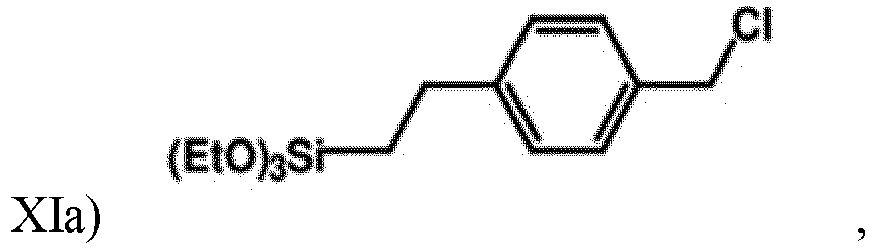

- Kautschukmischung nach Anspruch 1, dadurch gekennzeichnet, dass sie zusätzlich wenigstens einen Ruß als weiteren Füllstoff enthält.
- Kautschukmischung nach einem der vorherigen Ansprüche, dadurch gekennzeichnet, dass sie 0,1 bis 30 phf Silan B enthält.
- Kautschukmischung nach einem der vorherigen Ansprüche, dadurch gekennzeichnet, dass sie die Silane gemäß Formel XIa) und Formel XIb) im Gewichtsverhältnis 5:1 bis 1:5 enthält.
- Vulkanisat, welches durch die Schwefelvulkanisation wenigstens einer Kautschukmischung nach einem der Ansprüche 1 bis 4 erhalten ist.
- Fahrzeugreifen, dadurch gekennzeichnet, dass er in wenigstens einem Bauteil wenigstens ein Vulkanisat nach Anspruch 5 aufweist.
- Fahrzeugreifen nach Anspruch 6, dadurch gekennzeichnet, dass er wenigstens ein Vulkanisat nach Anspruch 5 im Laufstreifen aufweist.
- Verwendung einer Kautschukmischung nach einem der Ansprüche 1 bis 4 zur Herstellung eines Gummiartikels, insbesondere einer Luftfeder, eines Balgs, Förderbands, Gurtes, Riemens, Schlauchs, Gummibands, Profils, einer Dichtung, einer Membran, taktilen Sensoren für medizinische Anwendungen oder Roboteranwendungen, oder einer Schuhsohle oder Teilen davon.
Priority Applications (2)
| Application Number | Priority Date | Filing Date | Title |
|---|---|---|---|
| ES18205722T ES2963676T3 (es) | 2018-11-12 | 2018-11-12 | Mezcla de cauchos reticulable con azufre, vulcanizado y neumático para vehículo |
| EP18205722.4A EP3650245B1 (de) | 2018-11-12 | 2018-11-12 | Schwefelvernetzbare kautschukmischung, vulkanisat und fahrzeugreifen |
Applications Claiming Priority (1)
| Application Number | Priority Date | Filing Date | Title |
|---|---|---|---|
| EP18205722.4A EP3650245B1 (de) | 2018-11-12 | 2018-11-12 | Schwefelvernetzbare kautschukmischung, vulkanisat und fahrzeugreifen |
Publications (2)
| Publication Number | Publication Date |
|---|---|
| EP3650245A1 EP3650245A1 (de) | 2020-05-13 |
| EP3650245B1 true EP3650245B1 (de) | 2023-08-30 |
Family
ID=64277602
Family Applications (1)
| Application Number | Title | Priority Date | Filing Date |
|---|---|---|---|
| EP18205722.4A Active EP3650245B1 (de) | 2018-11-12 | 2018-11-12 | Schwefelvernetzbare kautschukmischung, vulkanisat und fahrzeugreifen |
Country Status (2)
| Country | Link |
|---|---|
| EP (1) | EP3650245B1 (de) |
| ES (1) | ES2963676T3 (de) |
Family Cites Families (8)
| Publication number | Priority date | Publication date | Assignee | Title |
|---|---|---|---|---|
| US7968636B2 (en) | 2006-12-28 | 2011-06-28 | Continental Ag | Tire compositions and components containing silated cyclic core polysulfides |
| US7625965B2 (en) | 2007-02-08 | 2009-12-01 | Momentive Performance Materials Inc. | Rubber composition, process of preparing same and articles made therefrom |
| US8143336B2 (en) * | 2008-08-07 | 2012-03-27 | Momentive Performance Materials Inc. | Activated halo-containing aralkylsilane composition, process of preparing same and rubber compositions made therefrom |
| US8182626B2 (en) | 2008-10-30 | 2012-05-22 | Continental Ag | Tire composition with improved vulcanizing agent |
| JP2011225730A (ja) * | 2010-04-20 | 2011-11-10 | Bridgestone Corp | ゴム組成物およびそれを用いたタイヤ |
| JP2012012456A (ja) | 2010-06-30 | 2012-01-19 | Sumitomo Chemical Co Ltd | S−(3−アミノプロピル)チオ硫酸および/またはその金属塩の使用方法 |
| JP2012158679A (ja) * | 2011-01-31 | 2012-08-23 | Sumitomo Rubber Ind Ltd | タイヤ用ゴム組成物及び空気入りタイヤ |
| CN108084523A (zh) * | 2016-11-23 | 2018-05-29 | 沈阳赛亚橡胶制品有限公司 | 一种丁苯橡胶复合材料及其制备方法 |
-
2018
- 2018-11-12 ES ES18205722T patent/ES2963676T3/es active Active
- 2018-11-12 EP EP18205722.4A patent/EP3650245B1/de active Active
Also Published As
| Publication number | Publication date |
|---|---|
| ES2963676T3 (es) | 2024-04-01 |
| EP3650245A1 (de) | 2020-05-13 |
Similar Documents
| Publication | Publication Date | Title |
|---|---|---|
| EP3303004B2 (de) | Kautschukmischung und fahrzeugreifen | |
| EP3103655B2 (de) | Kautschukmischung und fahrzeugreifen | |
| EP3717276B1 (de) | Schwefelvernetzbare kautschukmischung, vulkanisat der kautschukmischung und fahrzeugreifen | |
| DE102015218745B4 (de) | Kautschukmischung und Fahrzeugreifen | |
| EP3143081B1 (de) | Schwefelvernetzbare kautschukmischung und fahrzeugreifen | |
| EP3717560B1 (de) | Schwefelvernetzbare kautschukmischung, vulkanisat der kautschukmischung und fahrzeugreifen | |
| EP3103654B2 (de) | Kautschukmischung und fahrzeugreifen | |
| EP3717557B1 (de) | Schwefelvernetzbare kautschukmischung, vulkanisat der kautschukmischung und fahrzeugreifen | |
| EP2977227B1 (de) | Schwefelvernetzbare kautschukmischung und fahrzeugreifen | |
| EP3717275B1 (de) | Schwefelvernetzbare kautschukmischung, vulkanisat der kautschukmischung und fahrzeugreifen | |
| EP3717277B1 (de) | Schwefelvernetzbare kautschukmischung, vulkanisat der kautschukmischung und fahrzeugreifen | |
| EP3594283B1 (de) | Schwefelvernetzbare kautschukmischung, vulkanisat und fahrzeugreifen | |
| EP3036114B1 (de) | Schwefelvernetzbare kautschukmischung | |
| EP4079538B1 (de) | Schwefelvernetzbare kautschukmischung, vulkanisat der kautschukmischung und fahrzeugreifen | |
| EP3500626B1 (de) | Kautschukblend, schwefelvernetzbare kautschukmischung und fahrzeugreifen | |
| DE102018211763B4 (de) | Schwefelvernetzbare Kautschukmischung, Vulkanisat und Fahrzeugreifen | |
| EP4001359B1 (de) | Schwefelvernetzbare kautschukmischung, vulkanisat der kautschukmischung und fahrzeugreifen | |
| EP3650245B1 (de) | Schwefelvernetzbare kautschukmischung, vulkanisat und fahrzeugreifen | |
| EP3301118B1 (de) | Schwefelvernetzbare kautschukmischung, vulkanisat der kautschukmischung und fahrzeugreifen | |
| EP3650246B1 (de) | Schwefelvernetzbare kautschukmischung, vulkanisat und fahrzeugreifen | |
| EP3792306B1 (de) | Schwefelvernetzbare kautschukmischung, vulkanisat und fahrzeugreifen | |
| DE102019207526B4 (de) | Schwefelvernetzbare Kautschukmischung, Vulkanisat und Verwendung in einem Fahrzeugreifen | |
| DE102020215465A1 (de) | Schwefelvernetzbare Kautschukmischung, Vulkanisat und Fahrzeugreifen | |
| DE102022210845A1 (de) | Schwefelvernetzbare Kautschukmischung, Vulkanisat der Kautschukmischung und Fahrzeugreifen |
Legal Events
| Date | Code | Title | Description |
|---|---|---|---|
| PUAI | Public reference made under article 153(3) epc to a published international application that has entered the european phase |
Free format text: ORIGINAL CODE: 0009012 |
|
| STAA | Information on the status of an ep patent application or granted ep patent |
Free format text: STATUS: THE APPLICATION HAS BEEN PUBLISHED |
|
| AK | Designated contracting states |
Kind code of ref document: A1 Designated state(s): AL AT BE BG CH CY CZ DE DK EE ES FI FR GB GR HR HU IE IS IT LI LT LU LV MC MK MT NL NO PL PT RO RS SE SI SK SM TR |
|
| AX | Request for extension of the european patent |
Extension state: BA ME |
|
| STAA | Information on the status of an ep patent application or granted ep patent |
Free format text: STATUS: REQUEST FOR EXAMINATION WAS MADE |
|
| 17P | Request for examination filed |
Effective date: 20201113 |
|
| RAP1 | Party data changed (applicant data changed or rights of an application transferred) |
Owner name: CONTINENTAL REIFEN DEUTSCHLAND GMBH |
|
| RBV | Designated contracting states (corrected) |
Designated state(s): AL AT BE BG CH CY CZ DE DK EE ES FI FR GB GR HR HU IE IS IT LI LT LU LV MC MK MT NL NO PL PT RO RS SE SI SK SM TR |
|
| STAA | Information on the status of an ep patent application or granted ep patent |
Free format text: STATUS: EXAMINATION IS IN PROGRESS |
|
| 17Q | First examination report despatched |
Effective date: 20210426 |
|
| GRAP | Despatch of communication of intention to grant a patent |
Free format text: ORIGINAL CODE: EPIDOSNIGR1 |
|
| STAA | Information on the status of an ep patent application or granted ep patent |
Free format text: STATUS: GRANT OF PATENT IS INTENDED |
|
| INTG | Intention to grant announced |
Effective date: 20230417 |
|
| GRAS | Grant fee paid |
Free format text: ORIGINAL CODE: EPIDOSNIGR3 |
|
| GRAA | (expected) grant |
Free format text: ORIGINAL CODE: 0009210 |
|
| STAA | Information on the status of an ep patent application or granted ep patent |
Free format text: STATUS: THE PATENT HAS BEEN GRANTED |
|
| P01 | Opt-out of the competence of the unified patent court (upc) registered |
Effective date: 20230711 |
|
| AK | Designated contracting states |
Kind code of ref document: B1 Designated state(s): AL AT BE BG CH CY CZ DE DK EE ES FI FR GB GR HR HU IE IS IT LI LT LU LV MC MK MT NL NO PL PT RO RS SE SI SK SM TR |
|
| REG | Reference to a national code |
Ref country code: GB Ref legal event code: FG4D Free format text: NOT ENGLISH |
|
| REG | Reference to a national code |
Ref country code: CH Ref legal event code: EP |
|
| REG | Reference to a national code |
Ref country code: DE Ref legal event code: R096 Ref document number: 502018013114 Country of ref document: DE |
|
| REG | Reference to a national code |
Ref country code: IE Ref legal event code: FG4D Free format text: LANGUAGE OF EP DOCUMENT: GERMAN |
|
| REG | Reference to a national code |
Ref country code: LT Ref legal event code: MG9D |
|
| REG | Reference to a national code |
Ref country code: NL Ref legal event code: MP Effective date: 20230830 |
|
| PG25 | Lapsed in a contracting state [announced via postgrant information from national office to epo] |
Ref country code: GR Free format text: LAPSE BECAUSE OF FAILURE TO SUBMIT A TRANSLATION OF THE DESCRIPTION OR TO PAY THE FEE WITHIN THE PRESCRIBED TIME-LIMIT Effective date: 20231201 |
|
| PG25 | Lapsed in a contracting state [announced via postgrant information from national office to epo] |
Ref country code: IS Free format text: LAPSE BECAUSE OF FAILURE TO SUBMIT A TRANSLATION OF THE DESCRIPTION OR TO PAY THE FEE WITHIN THE PRESCRIBED TIME-LIMIT Effective date: 20231230 |
|
| PG25 | Lapsed in a contracting state [announced via postgrant information from national office to epo] |
Ref country code: SE Free format text: LAPSE BECAUSE OF FAILURE TO SUBMIT A TRANSLATION OF THE DESCRIPTION OR TO PAY THE FEE WITHIN THE PRESCRIBED TIME-LIMIT Effective date: 20230830 Ref country code: RS Free format text: LAPSE BECAUSE OF FAILURE TO SUBMIT A TRANSLATION OF THE DESCRIPTION OR TO PAY THE FEE WITHIN THE PRESCRIBED TIME-LIMIT Effective date: 20230830 Ref country code: NO Free format text: LAPSE BECAUSE OF FAILURE TO SUBMIT A TRANSLATION OF THE DESCRIPTION OR TO PAY THE FEE WITHIN THE PRESCRIBED TIME-LIMIT Effective date: 20231130 Ref country code: LV Free format text: LAPSE BECAUSE OF FAILURE TO SUBMIT A TRANSLATION OF THE DESCRIPTION OR TO PAY THE FEE WITHIN THE PRESCRIBED TIME-LIMIT Effective date: 20230830 Ref country code: LT Free format text: LAPSE BECAUSE OF FAILURE TO SUBMIT A TRANSLATION OF THE DESCRIPTION OR TO PAY THE FEE WITHIN THE PRESCRIBED TIME-LIMIT Effective date: 20230830 Ref country code: IS Free format text: LAPSE BECAUSE OF FAILURE TO SUBMIT A TRANSLATION OF THE DESCRIPTION OR TO PAY THE FEE WITHIN THE PRESCRIBED TIME-LIMIT Effective date: 20231230 Ref country code: HR Free format text: LAPSE BECAUSE OF FAILURE TO SUBMIT A TRANSLATION OF THE DESCRIPTION OR TO PAY THE FEE WITHIN THE PRESCRIBED TIME-LIMIT Effective date: 20230830 Ref country code: GR Free format text: LAPSE BECAUSE OF FAILURE TO SUBMIT A TRANSLATION OF THE DESCRIPTION OR TO PAY THE FEE WITHIN THE PRESCRIBED TIME-LIMIT Effective date: 20231201 Ref country code: FI Free format text: LAPSE BECAUSE OF FAILURE TO SUBMIT A TRANSLATION OF THE DESCRIPTION OR TO PAY THE FEE WITHIN THE PRESCRIBED TIME-LIMIT Effective date: 20230830 |
|
| PG25 | Lapsed in a contracting state [announced via postgrant information from national office to epo] |
Ref country code: PL Free format text: LAPSE BECAUSE OF FAILURE TO SUBMIT A TRANSLATION OF THE DESCRIPTION OR TO PAY THE FEE WITHIN THE PRESCRIBED TIME-LIMIT Effective date: 20230830 Ref country code: NL Free format text: LAPSE BECAUSE OF FAILURE TO SUBMIT A TRANSLATION OF THE DESCRIPTION OR TO PAY THE FEE WITHIN THE PRESCRIBED TIME-LIMIT Effective date: 20230830 |
|
| RAP4 | Party data changed (patent owner data changed or rights of a patent transferred) |
Owner name: CONTINENTAL REIFEN DEUTSCHLAND GMBH |
|
| REG | Reference to a national code |
Ref country code: DE Ref legal event code: R081 Ref document number: 502018013114 Country of ref document: DE Owner name: CONTINENTAL REIFEN DEUTSCHLAND GMBH, DE Free format text: FORMER OWNER: CONTINENTAL REIFEN DEUTSCHLAND GMBH, 30165 HANNOVER, DE |
|
| REG | Reference to a national code |
Ref country code: ES Ref legal event code: FG2A Ref document number: 2963676 Country of ref document: ES Kind code of ref document: T3 Effective date: 20240401 |
|
| PG25 | Lapsed in a contracting state [announced via postgrant information from national office to epo] |
Ref country code: SM Free format text: LAPSE BECAUSE OF FAILURE TO SUBMIT A TRANSLATION OF THE DESCRIPTION OR TO PAY THE FEE WITHIN THE PRESCRIBED TIME-LIMIT Effective date: 20230830 Ref country code: RO Free format text: LAPSE BECAUSE OF FAILURE TO SUBMIT A TRANSLATION OF THE DESCRIPTION OR TO PAY THE FEE WITHIN THE PRESCRIBED TIME-LIMIT Effective date: 20230830 Ref country code: EE Free format text: LAPSE BECAUSE OF FAILURE TO SUBMIT A TRANSLATION OF THE DESCRIPTION OR TO PAY THE FEE WITHIN THE PRESCRIBED TIME-LIMIT Effective date: 20230830 Ref country code: DK Free format text: LAPSE BECAUSE OF FAILURE TO SUBMIT A TRANSLATION OF THE DESCRIPTION OR TO PAY THE FEE WITHIN THE PRESCRIBED TIME-LIMIT Effective date: 20230830 Ref country code: CZ Free format text: LAPSE BECAUSE OF FAILURE TO SUBMIT A TRANSLATION OF THE DESCRIPTION OR TO PAY THE FEE WITHIN THE PRESCRIBED TIME-LIMIT Effective date: 20230830 Ref country code: PT Free format text: LAPSE BECAUSE OF FAILURE TO SUBMIT A TRANSLATION OF THE DESCRIPTION OR TO PAY THE FEE WITHIN THE PRESCRIBED TIME-LIMIT Effective date: 20240102 Ref country code: SK Free format text: LAPSE BECAUSE OF FAILURE TO SUBMIT A TRANSLATION OF THE DESCRIPTION OR TO PAY THE FEE WITHIN THE PRESCRIBED TIME-LIMIT Effective date: 20230830 |
|
| PG25 | Lapsed in a contracting state [announced via postgrant information from national office to epo] |
Ref country code: IT Free format text: LAPSE BECAUSE OF FAILURE TO SUBMIT A TRANSLATION OF THE DESCRIPTION OR TO PAY THE FEE WITHIN THE PRESCRIBED TIME-LIMIT Effective date: 20230830 |
|
| REG | Reference to a national code |
Ref country code: DE Ref legal event code: R097 Ref document number: 502018013114 Country of ref document: DE |
|
| REG | Reference to a national code |
Ref country code: CH Ref legal event code: PL |
|
| PG25 | Lapsed in a contracting state [announced via postgrant information from national office to epo] |
Ref country code: MC Free format text: LAPSE BECAUSE OF FAILURE TO SUBMIT A TRANSLATION OF THE DESCRIPTION OR TO PAY THE FEE WITHIN THE PRESCRIBED TIME-LIMIT Effective date: 20230830 |
|
| PLBE | No opposition filed within time limit |
Free format text: ORIGINAL CODE: 0009261 |
|
| STAA | Information on the status of an ep patent application or granted ep patent |
Free format text: STATUS: NO OPPOSITION FILED WITHIN TIME LIMIT |
|
| PG25 | Lapsed in a contracting state [announced via postgrant information from national office to epo] |
Ref country code: LU Free format text: LAPSE BECAUSE OF NON-PAYMENT OF DUE FEES Effective date: 20231112 |
|
| PG25 | Lapsed in a contracting state [announced via postgrant information from national office to epo] |
Ref country code: CH Free format text: LAPSE BECAUSE OF NON-PAYMENT OF DUE FEES Effective date: 20231130 |
|
| GBPC | Gb: european patent ceased through non-payment of renewal fee |
Effective date: 20231130 |
|
| PG25 | Lapsed in a contracting state [announced via postgrant information from national office to epo] |
Ref country code: MC Free format text: LAPSE BECAUSE OF FAILURE TO SUBMIT A TRANSLATION OF THE DESCRIPTION OR TO PAY THE FEE WITHIN THE PRESCRIBED TIME-LIMIT Effective date: 20230830 Ref country code: LU Free format text: LAPSE BECAUSE OF NON-PAYMENT OF DUE FEES Effective date: 20231112 Ref country code: CH Free format text: LAPSE BECAUSE OF NON-PAYMENT OF DUE FEES Effective date: 20231130 Ref country code: SI Free format text: LAPSE BECAUSE OF FAILURE TO SUBMIT A TRANSLATION OF THE DESCRIPTION OR TO PAY THE FEE WITHIN THE PRESCRIBED TIME-LIMIT Effective date: 20230830 |
|
| REG | Reference to a national code |
Ref country code: BE Ref legal event code: MM Effective date: 20231130 |
|
| 26N | No opposition filed |
Effective date: 20240603 |
|
| REG | Reference to a national code |
Ref country code: IE Ref legal event code: MM4A |
|
| PG25 | Lapsed in a contracting state [announced via postgrant information from national office to epo] |
Ref country code: IE Free format text: LAPSE BECAUSE OF NON-PAYMENT OF DUE FEES Effective date: 20231112 |
|
| PG25 | Lapsed in a contracting state [announced via postgrant information from national office to epo] |
Ref country code: GB Free format text: LAPSE BECAUSE OF NON-PAYMENT OF DUE FEES Effective date: 20231130 |
|
| PG25 | Lapsed in a contracting state [announced via postgrant information from national office to epo] |
Ref country code: BE Free format text: LAPSE BECAUSE OF NON-PAYMENT OF DUE FEES Effective date: 20231130 |
|
| PG25 | Lapsed in a contracting state [announced via postgrant information from national office to epo] |
Ref country code: IE Free format text: LAPSE BECAUSE OF NON-PAYMENT OF DUE FEES Effective date: 20231112 Ref country code: GB Free format text: LAPSE BECAUSE OF NON-PAYMENT OF DUE FEES Effective date: 20231130 Ref country code: BE Free format text: LAPSE BECAUSE OF NON-PAYMENT OF DUE FEES Effective date: 20231130 |
|
| PG25 | Lapsed in a contracting state [announced via postgrant information from national office to epo] |
Ref country code: BG Free format text: LAPSE BECAUSE OF FAILURE TO SUBMIT A TRANSLATION OF THE DESCRIPTION OR TO PAY THE FEE WITHIN THE PRESCRIBED TIME-LIMIT Effective date: 20230830 |
|
| PG25 | Lapsed in a contracting state [announced via postgrant information from national office to epo] |
Ref country code: BG Free format text: LAPSE BECAUSE OF FAILURE TO SUBMIT A TRANSLATION OF THE DESCRIPTION OR TO PAY THE FEE WITHIN THE PRESCRIBED TIME-LIMIT Effective date: 20230830 |
|
| REG | Reference to a national code |
Ref country code: AT Ref legal event code: MM01 Ref document number: 1604982 Country of ref document: AT Kind code of ref document: T Effective date: 20231112 |
|
| PG25 | Lapsed in a contracting state [announced via postgrant information from national office to epo] |
Ref country code: AT Free format text: LAPSE BECAUSE OF NON-PAYMENT OF DUE FEES Effective date: 20231112 |
|
| PG25 | Lapsed in a contracting state [announced via postgrant information from national office to epo] |
Ref country code: AT Free format text: LAPSE BECAUSE OF NON-PAYMENT OF DUE FEES Effective date: 20231112 |
|
| PG25 | Lapsed in a contracting state [announced via postgrant information from national office to epo] |
Ref country code: CY Free format text: LAPSE BECAUSE OF FAILURE TO SUBMIT A TRANSLATION OF THE DESCRIPTION OR TO PAY THE FEE WITHIN THE PRESCRIBED TIME-LIMIT; INVALID AB INITIO Effective date: 20181112 |
|
| PG25 | Lapsed in a contracting state [announced via postgrant information from national office to epo] |
Ref country code: HU Free format text: LAPSE BECAUSE OF FAILURE TO SUBMIT A TRANSLATION OF THE DESCRIPTION OR TO PAY THE FEE WITHIN THE PRESCRIBED TIME-LIMIT; INVALID AB INITIO Effective date: 20181112 |
|
| PG25 | Lapsed in a contracting state [announced via postgrant information from national office to epo] |
Ref country code: TR Free format text: LAPSE BECAUSE OF FAILURE TO SUBMIT A TRANSLATION OF THE DESCRIPTION OR TO PAY THE FEE WITHIN THE PRESCRIBED TIME-LIMIT Effective date: 20230830 |
|
| PGFP | Annual fee paid to national office [announced via postgrant information from national office to epo] |
Ref country code: DE Payment date: 20251130 Year of fee payment: 8 |
|
| PGFP | Annual fee paid to national office [announced via postgrant information from national office to epo] |
Ref country code: FR Payment date: 20251126 Year of fee payment: 8 |
|
| PGFP | Annual fee paid to national office [announced via postgrant information from national office to epo] |
Ref country code: ES Payment date: 20251229 Year of fee payment: 8 |