EP3649825B1 - Signal de réservation universel de partage de support - Google Patents
Signal de réservation universel de partage de support Download PDFInfo
- Publication number
- EP3649825B1 EP3649825B1 EP18727911.2A EP18727911A EP3649825B1 EP 3649825 B1 EP3649825 B1 EP 3649825B1 EP 18727911 A EP18727911 A EP 18727911A EP 3649825 B1 EP3649825 B1 EP 3649825B1
- Authority
- EP
- European Patent Office
- Prior art keywords
- rat
- wireless communication
- communication device
- txop
- signal
- Prior art date
- Legal status (The legal status is an assumption and is not a legal conclusion. Google has not performed a legal analysis and makes no representation as to the accuracy of the status listed.)
- Active
Links
Images





Classifications
-
- H—ELECTRICITY
- H04—ELECTRIC COMMUNICATION TECHNIQUE
- H04L—TRANSMISSION OF DIGITAL INFORMATION, e.g. TELEGRAPHIC COMMUNICATION
- H04L27/00—Modulated-carrier systems
- H04L27/26—Systems using multi-frequency codes
- H04L27/2601—Multicarrier modulation systems
- H04L27/2602—Signal structure
- H04L27/261—Details of reference signals
- H04L27/2613—Structure of the reference signals
-
- H—ELECTRICITY
- H04—ELECTRIC COMMUNICATION TECHNIQUE
- H04L—TRANSMISSION OF DIGITAL INFORMATION, e.g. TELEGRAPHIC COMMUNICATION
- H04L27/00—Modulated-carrier systems
-
- H—ELECTRICITY
- H04—ELECTRIC COMMUNICATION TECHNIQUE
- H04W—WIRELESS COMMUNICATION NETWORKS
- H04W16/00—Network planning, e.g. coverage or traffic planning tools; Network deployment, e.g. resource partitioning or cells structures
- H04W16/14—Spectrum sharing arrangements between different networks
-
- H—ELECTRICITY
- H04—ELECTRIC COMMUNICATION TECHNIQUE
- H04W—WIRELESS COMMUNICATION NETWORKS
- H04W28/00—Network traffic management; Network resource management
- H04W28/16—Central resource management; Negotiation of resources or communication parameters, e.g. negotiating bandwidth or QoS [Quality of Service]
- H04W28/26—Resource reservation
-
- H—ELECTRICITY
- H04—ELECTRIC COMMUNICATION TECHNIQUE
- H04W—WIRELESS COMMUNICATION NETWORKS
- H04W74/00—Wireless channel access
- H04W74/08—Non-scheduled access, e.g. ALOHA
- H04W74/0808—Non-scheduled access, e.g. ALOHA using carrier sensing, e.g. carrier sense multiple access [CSMA]
- H04W74/0816—Non-scheduled access, e.g. ALOHA using carrier sensing, e.g. carrier sense multiple access [CSMA] with collision avoidance
-
- H—ELECTRICITY
- H04—ELECTRIC COMMUNICATION TECHNIQUE
- H04L—TRANSMISSION OF DIGITAL INFORMATION, e.g. TELEGRAPHIC COMMUNICATION
- H04L27/00—Modulated-carrier systems
- H04L27/26—Systems using multi-frequency codes
- H04L27/2601—Multicarrier modulation systems
- H04L27/2602—Signal structure
- H04L27/261—Details of reference signals
- H04L27/2613—Structure of the reference signals
- H04L27/26132—Structure of the reference signals using repetition
-
- H—ELECTRICITY
- H04—ELECTRIC COMMUNICATION TECHNIQUE
- H04W—WIRELESS COMMUNICATION NETWORKS
- H04W74/00—Wireless channel access
- H04W74/002—Transmission of channel access control information
Definitions
- This application relates to wireless communication systems and methods, and more particularly to signaling medium reservation information for medium sharing among multiple radio access technologies (RATs).
- RATs radio access technologies
- a wireless multiple-access communications system may include a number of base stations (BSs), each simultaneously supporting communication for multiple communication devices, which may be otherwise known as user equipment (UE).
- BSs base stations
- UE user equipment
- NR next generation new radio
- WiFi 802.11
- An approach to sharing a communication medium or spectrum among multiple RATs is to employ a listen-before-talk (LBT) procedure to ensure a particular channel is clear before transmitting a message.
- LBT listen-before-talk
- a transmitting node may listen to the channel to determine whether there are active transmissions in the channel based on energy detection. While energy detection may have low computational complexity, energy detection-based LBT may provide limited system performance, for example, missed detection and/or false detection. A missed detection may lead to collision and a false detection may cause resource (e.g., spectrum) to be underutilized.
- channel listening may include the detection of a specific sequence.
- another transmitting node may transmit a specific preamble sequence to indicate use of the channel prior to transmitting data in the channel.
- different RATs may use different numerologies (e.g., subcarrier spacing).
- NR subcarrier spacing may not an integer multiple of WiFi subcarrier spacing.
- the detection of a preamble transmitted by a different RAT may require resampling, and thus may be computationally complex. Accordingly, improved procedures for signaling medium reservation information across multiple RATs are desirable.
- WO 2016/073662 A1 discloses a method for minimizing cross-technology interference with data transmissions from a wireless device in a shared spectrum.
- the wireless device obtains data to be wirelessly transmitted in a transmission burst in a first radio access technology (RAT) format over a shared spectrum.
- the wireless device generates a preamble comprising assistance information related to the transmission burst.
- the preamble comprises a first preamble portion in the first RAT format and a second preamble portion in a second RAT format.
- the wireless device transmits the preamble followed by the transmission burst.
- RAT radio access technology
- WO 2016/141368 A1 discloses a method, in which a transmitter may generate a sequence of preambles including an amplify and forward (AF) preamble, an indication that the AF preamble is present, and an indication of at least one intended receiver for the sequence.
- the transmitter may transmit the sequence of preambles to the at least one intended receiver over a radio frequency spectrum.
- a receiver may receive the sequence of preambles over the radio frequency spectrum; determine that the receiver is an intended receiver based at least in part on the indication of at least one intended receiver for the sequence; amplify the received AF preamble; and forward the amplified AF preamble over the radio frequency spectrum.
- US 2016/0248555 A1 discloses a method of wireless communication, comprising generating a preamble signal comprising a superposition of a first set of symbols and a second set of symbols, wherein the first set of symbols correspond to a preamble sequence associated with a first RAT and the second set of symbols correspond to a signature associated with a second RAT, and wherein the first set of symbols is identifiable to both the first RAT and the second RAT and the second set of symbols is identifiable to the second RAT; and transmitting the preamble signal over a frequency channel shared by the first RAT and the second RAT.
- US 2016/0295420 A1 discloses a method of wireless communication over a frequency channel shared by a first RAT and a second RAT, comprising: generating, by a device employing the second RAT, a plurality of training fields of a preamble signal, wherein one or more of the plurality of training fields has a signal property that is associated with detection by devices employing the first RAT, and wherein the preamble signal conveys at least one characteristic that is associated with the second RAT; and transmitting the preamble signal over the frequency channel.
- a method of wireless communication comprises communicating, by a first wireless communication device with a second wireless communication device, a reservation signal to reserve a transmission opportunity, TXOP, in a spectrum, wherein the spectrum is shared by multiple radio access technologies, RATs, wherein the reservation signal includes a plurality of first waveform sequences indicating medium reservation information detectable by the multiple RATs, wherein the plurality of first waveform sequences correspond to multiple instances of a second waveform sequence masked by a code representing the medium reservation information, and wherein the first wireless communication device and the second wireless communication device are associated with a first RAT of the multiple RATs; and communicating, by the first wireless communication device with the second wireless communication device using the first RAT, a communication signal in the spectrum during the TXOP.
- an apparatus comprises means for communicating, with a second wireless communication device, a reservation signal to reserve a transmission opportunity, TXOP, in a spectrum, wherein the spectrum is shared by multiple radio access technologies, RATs, wherein the reservation signal includes a plurality of first waveform sequences indicating medium reservation information detectable by the multiple RATs, wherein the plurality of first waveform sequences correspond to multiple instances of a second waveform sequence masked by a code representing the medium reservation information, and wherein the apparatus and the second wireless communication device are associated with a first RAT of the multiple RATs; and means for communicating, with the second wireless communication device using the first RAT, a communication signal in the spectrum during the TXOP.
- the invention relates to a computer program comprising instructions, which when executed on at least one processor of a wireless communication apparatus, cause said apparatus to carry out the method of wireless communication described above.
- CDMA code-division multiple access
- TDMA time-division multiple access
- FDMA frequency-division multiple access
- OFDMA orthogonal frequency-division multiple access
- SC-FDMA single-carrier FDMA
- a CDMA network may implement a radio technology such as Universal Terrestrial Radio Access (UTRA), cdma2000, etc.
- UTRA includes Wideband CDMA (WCDMA)and other variants of CDMA.
- cdma2000 covers IS-2000, IS-95 and IS-856 standards.
- a TDMA network may implement a radio technology such as Global System for Mobile Communications (GSM).
- GSM Global System for Mobile Communications
- An OFDMA network may implement a radio technology such as Evolved UTRA (E-UTRA), Ultra Mobile Broadband (UMB), IEEE 802.11 (Wi-Fi), IEEE 802.16 (WiMAX), IEEE 802.20, Flash-OFDMA, etc.
- E-UTRA and E-UTRA are part of Universal Mobile Telecommunication System (UMTS).
- 3GPP Long Term Evolution (LTE) and LTE-Advanced (LTE-A) are new releases of UMTS that use E-UTRA UTRA, E-UTRA, UMTS, LTE, LTE-A and GSM are described in documents from an organization named "3rd Generation Partnership Project" (3GPP).
- CDMA2000 and UMB are described in documents from an organization named "3rd Generation Partnership Project 2" (3GPP2).
- the techniques described herein may be used for the wireless networks and radio technologies mentioned above as well as other wireless networks and radio technologies, such as a next generation (e.g., 5 th Generation (5G) operating in mmWave
- the present application describes mechanisms for signaling medium reservation information for medium sharing among multiple RATs.
- the disclosed embodiments employ a waveform-based universal reservation signal (URS) to indicate medium reservation information detectable by multiple RATs.
- the URS may include a plurality of waveform sequences. Each waveform sequence may correspond to an instance of a waveform sequence masked according to the medium reservation information.
- the medium reservation information may include a minimal amount of information sufficient for RAT-level medium sharing.
- the medium reservation information may indicate a transmission opportunity (TXOP) duration and the RAT that is reserving the TXOP.
- TXOP transmission opportunity
- the medium reservation information for medium sharing within a RAT may be carried in a separate reservation signal.
- the URS may include an additional short training field (STF) at the beginning of the URS prior to the waveform sequences carrying the medium reservation information.
- STF may include a plurality of waveform sequence (e.g., repetitions of a waveform sequence) for synchronization and training at a receiver.
- different RATs may use different numerologies.
- a transmitter of a particular RAT may transmit URSs using the numerology of the particular RAT and a receiver of a different RAT may adjust sample spacing during URS detection and processing.
- a transmitter may transmit multiple URSs, each using a different RAT and carrying the same medium reservation information.
- waveform-based URSs enables a receiver to recover the transmitted medium reservation information based on waveform detection instead of data decoding.
- Data decoding may require resampling when a transmitting RAT is different from a receiving RAT.
- waveform detection may have a lower computational complexity than data decoding.
- the use of a repeating waveform sequence enables a receiver to detect the presence of a URS and/or recover the medium reservation information based on autocorrelations and/or cross-correlations, which may have a low computational complexity.
- the use of separate reservation signals for medium sharing within a RAT and medium sharing across RATs can reduce signaling overhead and complexity for the design of the RAT-level URSs.
- reducing the amount of medium reservation information can reduce the number of URS waveforms.
- the use of URSs to communicate medium reservation information detectable by all RATs sharing a spectrum can improve overall system performance. While the disclosed embodiments may be described in the context of NR-based technology and WiFi-based technology, the disclosed embodiments are suitable for use in any wireless communication network with any type of RAT and any number of RATs.
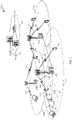
- FIG. 1 illustrates a wireless communication network 100 according to embodiments of the present disclosure.
- the network 100 includes BSs 105, UEs 115, and a core network 130.
- the network 100 operates over a shared spectrum.
- the shared spectrum may be unlicensed or partially licensed to one or more network operators. Access to the spectrum may be limited and may be controlled by a separate coordination entity.
- the network 100 may be a LTE or LTE-A network.
- the network 100 may be a millimeter wave (mmW) network, a new radio (NR) network, a 5G network, or any other successor network to LTE.
- the network 100 may be operated by more than one network operator. Wireless resources may be partitioned and arbitrated among the different network operators for coordinated communication between the network operators over the network 100.
- the BSs 105 may wirelessly communicate with the UEs 115 via one or more BS antennas. Each BS 105 may provide communication coverage for a respective geographic coverage area 110.
- the term "cell" can refer to this particular geographic coverage area of a BS and/or a BS subsystem serving the coverage area, depending on the context in which the term is used.
- a BS 105 may provide communication coverage for a macro cell, a pico cell, a femto cell, and/or other types of cell.
- a macro cell generally covers a relatively large geographic area (e.g., several kilometers in radius) and may allow unrestricted access by UEs with service subscriptions with the network provider.
- a pico cell may generally cover a relatively smaller geographic area and may allow unrestricted access by UEs with service subscriptions with the network provider.
- a femto cell may also generally cover a relatively small geographic area (e.g., a home) and, in addition to unrestricted access, may also provide restricted access by UEs having an association with the femto cell (e.g., UEs in a closed subscriber group (CSG), UEs for users in the home, and the like).
- a BS for a macro cell may be referred to as a macro BS.
- a BS for a pico cell may be referred to as a pico BS.
- a BS for a femto cell may be referred to as a femto BS or a home BS.
- the BSs 105a, 105b and 105c are examples of macro BSs for the coverage areas 110a, 110b and 110c, respectively.
- the BSs 105d is an example of a pico BS or a femto BS for the coverage area 110d.
- a BS 105 may support one or multiple (e.g., two, three, four, and the like) cells.
- Communication links 125 shown in the network 100 may include uplink (UL) transmissions from a UE 115 to a BS 105, or downlink (DL) transmissions, from a BS 105 to a UE 115.
- the UEs 115 may be dispersed throughout the network 100, and each UE 115 may be stationary or mobile.
- a UE 115 may also be referred to as a mobile station, a subscriber station, a mobile unit, a subscriber unit, a wireless unit, a remote unit, a mobile device, a wireless device, a wireless communications device, a remote device, a mobile subscriber station, an access terminal, a mobile terminal, a wireless terminal, a remote terminal, a handset, a user agent, a mobile client, a client, or some other suitable terminology.
- a UE 115 may also be a cellular phone, a personal digital assistant (PDA), a wireless modem, a wireless communication device, a handheld device, a tablet computer, a laptop computer, a cordless phone, a personal electronic device, a handheld device, a personal computer, a wireless local loop (WLL) station, an Internet of things (IoT) device, an Internet of Everything (IoE) device, a machine type communication (MTC) device, an appliance, an automobile, or the like.
- PDA personal digital assistant
- WLL wireless local loop
- IoT Internet of things
- IoE Internet of Everything
- MTC machine type communication
- the BSs 105 may communicate with the core network 130 and with one another.
- the core network 130 may provide user authentication, access authorization, tracking, Internet Protocol (IP) connectivity, and other access, routing, or mobility functions.
- IP Internet Protocol
- At least some of the BSs 105 (e.g., which may be an example of an evolved NodeB (eNB), a next generation NodeB (gNB), or an access node controller (ANC)) may interface with the core network 130 through backhaul links 132 (e.g., S1, S2, etc.) and may perform radio configuration and scheduling for communication with the UEs 115.
- the BSs 105 may communicate, either directly or indirectly (e.g., through core network 130), with each other over backhaul links 134 (e.g., X1, X2, etc.), which may be wired or wireless communication links.
- backhaul links 134 e.g., X1, X2, etc.
- Each BS 105 may also communicate with a number of UEs 115 through a number of other BSs 105, where the BS 105 may be an example of a smart radio head.
- various functions of each BS 105 may be distributed across various BSs 105 (e.g., radio heads and access network controllers) or consolidated into a single BS 105.
- the network 100 utilizes orthogonal frequency division multiplexing (OFDM) on the downlink and single-carrier frequency division multiplexing (SC-FDM) on the UL.
- OFDM and SC-FDM partition the system bandwidth into multiple (K) orthogonal subcarriers, which are also commonly referred to as tones, bins, or the like.
- K orthogonal subcarriers
- Each subcarrier may be modulated with data.
- modulation symbols are sent in the frequency domain with OFDM and in the time domain with SC-FDM.
- the spacing between adjacent subcarriers may be fixed, and the total number of subcarriers (K) may be dependent on the system bandwidth.
- the system bandwidth may also be partitioned into subbands.
- the BSs 105 can assign or schedule transmission resources (e.g., in the form of time-frequency resource blocks) for DL and UL transmissions in the network 100.
- DL refers to the transmission direction from a BS 105 to a UE 115
- UL refers to the transmission direction from a UE 115 to a BS 105.
- the communication can be in the form of radio frames.
- a radio frame may be divided into a plurality of subframes, for example, about 10.
- Each subframe can be divided into slots, for example, about 2.
- Each slot may be further divided into mini-slots.
- FDD frequency-division duplexing
- each subframe includes a UL subframe in a UL frequency band and a DL subframe in a DL frequency band.
- TDD time-division duplexing
- UL and DL transmissions occur at different time periods using the same frequency band.
- a subset of the subframes (e.g., DL subframes) in a radio frame may be used for DL transmissions and another subset of the subframes (e.g., UL subframes) in the radio frame may be used for UL transmissions.
- each DL or UL subframe may have pre-defined regions for transmissions of reference signals, control information, and data.
- Reference signals are predetermined signals that facilitate the communications between the BSs 105 and the UEs 115.
- a reference signal can have a particular pilot pattern or structure, where pilot tones may span across an operational bandwidth or frequency band, each positioned at a pre-defined time and a pre-defined frequency.
- a BS 105 may transmit cell-specific reference signals (CRSs) and/or channel state information -reference signals (CSI-RSs) to enable a UE 115 to estimate a DL channel.
- CRSs cell-specific reference signals
- CSI-RSs channel state information -reference signals
- a UE 115 may transmit sounding reference signals (SRSs) to enable a BS 105 to estimate a UL channel.
- Control information may include resource assignments and protocol controls.
- Data may include protocol data and/or operational data.
- the BSs 105 and the UEs 115 may communicate using self-contained subframes.
- a self-contained subframe may include a portion for DL communication and a portion for UL communication.
- a self-contained subframe can be DL-centric or UL-centric.
- a DL-centric subframe may include a longer duration for DL communication than UL communication.
- a UL-centric subframe may include a longer duration for UL communication than UL communication.
- a UE 115 attempting to access the network 100 may perform an initial cell search by detecting a primary synchronization signal (PSS) from a BS 105.
- PSS primary synchronization signal
- the UE 115 may then receive a secondary synchronization signal (SSS).
- SSS may enable radio frame synchronization, and may provide a cell identity value, which may be combined with the physical layer identity value to identify the cell.
- the SSS may also enable detection of a duplexing mode and a cyclic prefix length.
- Some systems, such as TDD systems may transmit an SSS but not a PSS. Both the PSS and the SSS may be located in a central portion of a carrier, respectively.
- the UE 115 may receive a master information block (MIB), which may be transmitted in the physical broadcast channel (PBCH).
- the MIB may contain system bandwidth information, a system frame number (SFN), and a Physical Hybrid-ARQ Indicator Channel (PHICH) configuration.
- SIBs system information blocks
- SIB1 may contain cell access parameters and scheduling information for other SIBs. Decoding SIB1 may enable the UE115 to receive SIB2.
- SIB2 may contain radio resource configuration (RRC) configuration information related to random access channel (RACH) procedures, paging, physical uplink control channel (PUCCH), physical uplink shared channel (PUSCH), power control, SRS, and cell barring.
- RRC radio resource configuration
- the UE 115 can perform random access procedures to establish a connection with the BS 105.
- the UE 115 and the BS 105 can enter a normal operation stage, where operational data may be exchanged.
- the network 100 may operate over a shared channel, which may include a licensed spectrum, a shared spectrum, and/or an unlicensed spectrum, and may support dynamic medium sharing,
- the network 100 may include multiple RATs.
- some BSs 105 and/or UEs 115 may communicate over a spectrum using NR-based technology, while other BSs 105 and/or other UEs 115 may share the same spectrum for communications using WiFi-based technology.
- Mechanisms for medium sharing across multiple RATs are described in greater detail herein.
- FIG. 2 illustrates an example of a wireless communications network 200 that supports medium sharing across multiple RATs according to embodiments of the present disclosure.
- the network 200 may be similar to the network 100.
- FIG. 2 illustrates two BSs 205 and two UEs 215 for purposes of simplicity of discussion, though it will be recognized that embodiments of the present disclosure may scale to many more UEs 215 and/or BSs 205.
- the BSs 205 and the UEs 215 may be similar to the BSs 105 and the UEs 115, respectively.
- the BS 205a serves the UE 215a in a serving cell or a coverage area 240 using a first RAT
- the BS 205b serves the UE 21 5b in a serving cell or a coverage area 245 using a second RAT.
- the first RAT and the second RAT may be different RATs.
- the first RAT may be an NR-based technology
- the second RAT may be a WiFi-based technology.
- the BSs 205 and the UEs 215 of different RATs may communicate over the same spectrum in the using an LBT procedure.
- the different RATs may be deployed over an unlicensed frequency band, for example, in the 6 gigahertz (GHz) frequency band with a bandwidth of about 500 megahertz (MHz).
- GHz gigahertz
- the BS 205a may listen to the channel. When the channel is clear, the BS 205a may transmit a reservation signal to reserve a TXOP in the spectrum.
- the reservation signal can silence nodes (e.g., the BS 205b and/or other UE 215b) of the other RAT. Subsequently, the BS 205a may communicate with the UE 215a in the spectrum during the reserved TXOP.
- the network 200 may employ a URS that is detectable by all RATs in the network 200.
- the network 200 may employ waveform-based URSs.
- the network 200 may employ different waveforms to represent different medium reservation information.
- the network 200 may employ a repeating short-period waveform sequence and apply different mask patterns to the waveform sequences to represent different medium reservation information.
- the BS 205b and the UE 215b may determine medium reservation information from a URS transmitted by the BS 205a or the UE 215a based on waveform detection instead of data decoding.
- the waveform-based URSs can allow for a larger frequency and or timing offset than content-based URSs.
- an NR node may have a higher timing and/or frequency accuracies than a WiFi node.
- the network 200 may include a minimum amount of medium reservation information in the URSs.
- a URS may include information such as a reserved TXOP duration and the RAT reserving the TXOP.
- Preamble sequences, scheduling information, and/or other reservation information specific to the operations of the reserving RAT may be carried in a separate reservation signal for sharing among nodes of the reserving RAT.
- the network 200 may include other BSs and/or UEs for the first RAT.
- the BS 205a may transmit a separate reservation signal indicating scheduling information for the UE 215a to silence other BSs and/or UEs of the first RAT after transmitting a URS.
- the use of a smaller number of waveform sequences reduces the length or the time span of a URS. The shorter URS length can lower collision rate.
- Different RATs may use different numerologies (e.g., different subcarrier spacing and different sampling rates).
- a transmitting node of a particular RAT may transmit a URS using the numerology of the particular RAT and a monitoring or detecting node of another RAT may account for the different numerologies during URS detection.
- a detecting node may perform the detection using autocorrelation and/or cross-correlation and may account for different numerologies by adjusting sample block spacing during correlations.
- a transmitting node of a particular RAT may transmit multiple URSs, each with a different numerology, but carrying the same medium reservation information.
- the multiple URSs allow a detecting node of a particular RAT to perform URS detection based on the numerology of the particular RAT.
- the BS 205a may transmit a first URS using a numerology of the first RAT and a second URS using a numerology of the second RAT.
- the BS 205b and/or the UE 215b may detect a reservation from the BS 205a based on the second URS using the numerology of the second RAT.
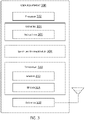
- FIG. 3 is a block diagram of an exemplary UE 300 according to embodiments of the present disclosure.
- the UE 300 may be a UE 115 or 215 as discussed above.
- the UE 300 may include a processor 302, a memory 304, a spectrum sharing module 308, a transceiver 310 including a modem subsystem 312 and a radio frequency (RF) unit 314, and one or more antennas 316.
- RF radio frequency
- the processor 302 may include a central processing unit (CPU), a digital signal processor (DSP), an application-specific integrated circuit (ASIC), a controller, a field programmable gate array (FPGA) device, another hardware device, a firmware device, or any combination thereof configured to perform the operations described herein.
- the processor 302 may also be implemented as a combination of computing devices, e.g., a combination of a DSP and a microprocessor, a plurality of microprocessors, one or more microprocessors in conjunction with a DSP core, or any other such configuration.
- the memory 304 may include a cache memory (e.g., a cache memory of the processor 302), random access memory (RAM), magnetoresistive RAM (MRAM), read-only memory (ROM), programmable read-only memory (PROM), erasable programmable read only memory (EPROM), electrically erasable programmable read only memory (EEPROM), flash memory, solid state memory device, hard disk drives, other forms of volatile and non-volatile memory, or a combination of different types of memory.
- the memory 304 includes a non-transitory computer-readable medium.
- the memory 304 may store instructions 306.
- the instructions 306 may include instructions that, when executed by the processor 302, cause the processor 302 to perform the operations described herein with reference to the UEs 215 in connection with embodiments of the present disclosure. Instructions 306 may also be referred to as code.
- the terms "instructions” and “code” should be interpreted broadly to include any type of computer-readable statement(s). For example, the terms “instructions” and “code” may refer to one or more programs, routines, subroutines, functions, procedures, etc. "Instructions" and “code” may include a single computer-readable statement or many computer-readable statements.
- the spectrum sharing module 308 may be used for various aspects of the present disclosure.
- the spectrum sharing module 308 is configured to monitor for URSs transmitted by multiple RATs, determine medium reservation information from the detected URSs, generate and transmit URSs using numerologies of one or more RATs, and/or perform LBT, as described in greater detail herein.
- the transceiver 310 may include the modem subsystem 312 and the RF unit 314.
- the transceiver 310 can be configured to communicate bi-directionally with other devices, such as the BSs 105 and 205.
- the modem subsystem 312 may be configured to modulate and/or encode the data from the memory 304, and/or the spectrum sharing module 308 according to a modulation and coding scheme (MCS), e.g., a low-density parity check (LDPC) coding scheme, a turbo coding scheme, a convolutional coding scheme, a digital beamforming scheme, etc.
- MCS modulation and coding scheme
- LDPC low-density parity check
- the RF unit 314 may be configured to process (e.g., perform analog to digital conversion or digital to analog conversion, etc.) modulated/encoded data from the modem subsystem 312 (on outbound transmissions) or of transmissions originating from another source such as a UE 115 or 215 or a BS 105 or 205.
- the RF unit 314 may be further configured to perform analog beamforming in conjunction with the digital beamforming.
- the modem subsystem 312 and the RF unit 314 may be separate devices that are coupled together at the UE 215 to enable the UE 215 to communicate with other devices.
- the RF unit 314 may provide the modulated and/or processed data, e.g. data packets (or, more generally, data messages that may contain one or more data packets and other information), to the antennas 316 for transmission to one or more other devices. This may include, for example, transmission of URSs according to embodiments of the present disclosure.
- the antennas 316 may further receive data messages transmitted from other devices.
- the antennas 316 may provide the received data messages for processing and/or demodulation at the transceiver 310.
- the antennas 316 may include multiple antennas of similar or different designs in order to sustain multiple transmission links.
- the RF unit 314 may configure the antennas 316.
- FIG. 4 is a block diagram of an exemplary BS 400 according to embodiments of the present disclosure.
- the BS 400 may be a BS 105 or 205 as discussed above.
- the BS 400 may include a processor 402, a memory 404, a spectrum sharing module 408, a transceiver 410 including a modem subsystem 412 and a RF unit 414, and one or more antennas 416. These elements may be in direct or indirect communication with each other, for example via one or more buses.
- the processor 402 may have various features as a specific-type processor. For example, these may include a CPU, a DSP, an ASIC, a controller, a FPGA device, another hardware device, a firmware device, or any combination thereof configured to perform the operations described herein.
- the processor 402 may also be implemented as a combination of computing devices, e.g., a combination of a DSP and a microprocessor, a plurality of microprocessors, one or more microprocessors in conjunction with a DSP core, or any other such configuration.
- the memory 404 may include a cache memory (e.g., a cache memory of the processor 402), RAM, MRAM, ROM, PROM, EPROM, EEPROM, flash memory, a solid state memory device, one or more hard disk drives, memristor-based arrays, other forms of volatile and non-volatile memory, or a combination of different types of memory.
- the memory 404 may include a non-transitory computer-readable medium.
- the memory 404 may store instructions 406.
- the instructions 406 may include instructions that, when executed by the processor 402, cause the processor 402 to perform operations described herein. Instructions 406 may also be referred to as code, which may be interpreted broadly to include any type of computer-readable statement(s) as discussed above with respect to FIG. 4 .
- the spectrum sharing module 408 may be used for various aspects of the present disclosure.
- the spectrum sharing module 308 is configured to monitor for URSs transmitted by multiple RATs, determine medium reservation information from the detected URSs, generate and transmit URSs using numerologies of one or more RATs, and/or perform LBT, as described in greater detail herein.
- the transceiver 410 may include the modem subsystem 412 and the RF unit 414.
- the transceiver 410 can be configured to communicate bi-directionally with other devices, such as the UEs 115 and 215 and/or another core network element.
- the modem subsystem 412 may be configured to modulate and/or encode data according to a MCS, e.g., a LDPC coding scheme, a turbo coding scheme, a convolutional coding scheme, a digital beamforming scheme, etc.
- the RF unit 414 may be configured to process (e.g., perform analog to digital conversion or digital to analog conversion, etc.) modulated/encoded data from the modem subsystem 412 (on outbound transmissions) or of transmissions originating from another source such as a UE 115, 215, or 300.
- the RF unit 414 may be further configured to perform analog beamforming in conjunction with the digital beamforming.
- the modem subsystem 412 and the RF unit 414 may be separate devices that are coupled together at the BS 105 or 205 to enable the BS 105 to communicate with other devices.
- the RF unit 414 may provide the modulated and/or processed data, e.g. data packets (or, more generally, data messages that may contain one or more data packets and other information), to the antennas 416 for transmission to one or more other devices. This may include, for example, transmission of information to complete attachment to a network and communication with a camped UE 115, 215, or 300 according to embodiments of the present disclosure.
- the antennas 416 may further receive data messages transmitted from other devices and provide the received data messages for processing and/or demodulation at the transceiver 410.
- the antennas 416 may include multiple antennas of similar or different designs in order to sustain multiple transmission links.
- FIG. 5 illustrates a multi-RAT medium sharing scheme 500 according to embodiments of the present disclosure.
- the x-axis represents time in some constant units.
- the y-axis represents frequency in some constant units.
- the scheme 500 may be employed by nodes or devices of different RATs, such as the BSs 105, 205, and 400 and the UEs 115, 215, and 300, to communicate over a shared spectrum 501.
- communications in the spectrum 501 may be in units of TXOP 502.
- a TXOP 502 may include a channel sensing period 504 followed by a transmission period 506.
- the channel sensing period 504 may include an RRQ period 507 and an RRS period 508.
- the RRQ period 507 may include a common period 510, a filler period 511, and a RAT-specific period 512.
- the RRS period 508 may include a common period 514, a filler period 515, and a RAT-specific period 516.
- the RRQ period 507, the RRS period 508, and the transmission period 506 are spaced apart by gap periods 509.
- the gap periods 509 allow time for processing at a receiver and/or switching between a transmit mode and a receive mode at a transmitter and/or at a receiver.
- a transmitting node (e.g., the BSs 205 and the UEs 215) using a particular RAT may transmit a URS 520 in the common period 510 of the RRQ period 507 to reserve the TXOP 502.
- the URS 520 may indicate medium reservation information.
- the medium reservation information may include a duration of the TXOP 502 and the RAT used by the transmitter to transmit the URS 520.
- the URS 520 may be a waveform-based signal and may represent reservation information using different waveforms, as described in greater detail herein.
- a node of another RAT contending for the channel may monitor the spectrum 501 for a URS 520. For example, upon detection of a URS 520, the node may refrain from communicating in the spectrum 501. As such, the transmission of the URS 520 may silence nodes of other RATs for medium sharing across different RATs.
- the transmitting node may transmit a RAT-specific RRQ signal 540 in the RAT-specific period 512 of the RRQ period 507.
- the RAT-specific RRQ signal 540 may include a preamble, a request-to-send (RTS) signal, scheduling information for a target receiving node of the particular RAT, interference management related parameters, and/or spatial LBT information, which may require a receiver to perform content or data decoding.
- Nodes of the particular RAT may monitor the spectrum 501 and refrain from communicating in the spectrum 501 upon detection of the RAT-specific RRQ signal 540.
- the transmission of the RAT-specific RRQ signal 540 may silence other nodes of the particular RAT for medium sharing within the particular RAT.
- the monitoring node when a monitoring node of a particular RAT detected a URS 520 transmitted by a node of a different RAT, the monitoring node may not proceed to receive and process the RAT-specific RRQ signal 540. Conversely, when a monitoring node of a particular RAT detected a URS 520 transmitted by another node of the same RAT. the monitoring node may proceed to receive, process, and decode the content of the RAT-specific RRQ signal 540.
- the target receiving node may transmit a URS 550 in the common period 514 of the RRS period 508.
- the URS 550 may be substantially similar to the URS 520 and may indicate substantially similar medium reservation information as the URS 520.
- the target receiving node may respond to the RAT-specific RRQ signal 540 by transmitting a RAT-specific RRS signal 560 in the RAT-specific period 516 of the RRS period 508.
- the RAT-specific RRS signal 560 may include a preamble and/or a clear-to-send (CTS) signal. Similar to the processing of the RAT-specific RRQ signal 540, a monitoring node may not proceed to receive and process the RAT-specific RRS signal 560 when detecting a URS 550 transmitted by a different RAT.
- CTS clear-to-send
- the transmitting node may transmit a communication signal 570 to the target receiving node during the transmission period 506.
- the inclusion of the RRS period 508 in the transmission period 506 and the transmissions of the URS 550 and/or the RAT-specific RRS signal 560 may be optional.
- the TXOP 502 may have a variable duration dependent on the length of the communication signal 570.
- the timing of the TXOP 502 may be asynchronous to the timing of a serving cell of the transmitting node.
- the TXOP 502 may or may not align to a symbol boundary of the serving cell.
- the URSs 520 and 550 may have a fixed duration, but may or may not align to the symbol time of the serving cell.
- the URSs 520 and 550 may or may not end at a symbol boundary of the serving cell.
- the transmitting node may transmit a filler signal 530 during the filler period 511 and the receiving node may transmit a. filler signal 532 during the filler period 515, respectively, to align to a next symbol boundary.
- the filler signal 530 may be transmitted as an extension to the URS 520.
- the filler signal 530 may be transmitted as an extended cyclic prefix (CP) of the RAT-specific RRQ signal 540.
- the receiving node may transmit the filler signal 532 as an extension to the URS 550 or as an extended CP of the RAT-specific RRS signal 560.
- the TXOP 502 may be reserved in some predetermined units of time or granularities, for example, in units of 10 microseconds ( ⁇ s) or 1 millisecond (ms).
- the communication signal 570 may or may not end at the end of the TXOP 502.
- the transmitting node may transmit a filler signal 534 after the communication signal 570 to fill the filler period 518.
- the filler signals 530, 532, and 534 may carry filler data, which may be dropped or ignored at a receiver.
- FIGS. 6-8 illustrate various mechanisms for generating waveform-based URSs (e.g., the URSs 520 and 550), which may be used in conjunction with the scheme 500 in the networks 100 and 200 for multi-RAT medium sharing.
- waveform-based URSs e.g., the URSs 520 and 550
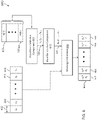
- FIG. 6 illustrates a URS generation scheme 600 for multi-RAT medium sharing according to embodiments of the present disclosure.
- the scheme 600 may be employed by the BSs 105, 205, and 400 and the UEs 115, 215, and 300.
- the scheme 600 employs a plurality of waveform sequences 610 to represent medium reservation information.
- the plurality of waveform sequences 610 may correspond to instances or repetitions of a short-period waveform sequence, shown as S1, which may be a wideband signal or a narrowband signal spanning a duration 602.
- the duration 602 may be about 0.8 ⁇ s.
- reservation information for a TXOP may be represented by Q number of information bits, denoted as I 0 , I 1 , ... , I Q-1 and the Q number of bits can be encoded into L number of coded bits, denoted as d 0 , d 1 , ... , d L-1 , where both Q and L are a positive integer.
- Q is equal to L and Q number of information bits are identical to L number of coded bits.
- L > Q and Q number of bits is encoded into L number of coded bits.
- Q is less than or equal to 8.
- each hypothesis 620 may indicate a duration of a TXOP reservation, the type of RAT (e.g., NR-based technology or WiFi-based technology) reserving the TXOP, and/or any suitable information for medium sharing across multiple RATs.
- the duration may be defined in some units of time, for example, in units of 1 ms.
- a subset of the hypotheses 620 may be used to indicate TXOP reservations from an NR-based node with a TXOP duration in steps of 1 ms, while another subset of the hypotheses 620 may be used to indicate TXOP reservations from a WiFi-based node with a TXOP duration in steps of 1 ms.
- a TXOP reservation may be a semi-static reservation.
- a node may indicate a periodic TXOP reservation with a duration of 1 ms repeating at every 100 ms.
- the scheme 600 includes a hypothesis selection component 630, a mask generation component 640, and a masking component 650.
- the hypothesis selection component 630 is configured to select a hypothesis 620 H(k) from the hypotheses 620 H(1) to 620 H(N) to indicate particular medium reservation information, where 1 ⁇ K ⁇ N.
- the mask generation component 640 is configured to generate a code or a mask 642 based on the Q information bits or the L coded bits of the selected hypothesis 620 H ( k ). The generation may be based on a spreading code, a Walsh code, a differential code, or any suitable code.
- the mask generation component 640 may employ differential encoding to generate the mask 642.
- the mask generation component 640 encodes a difference between adjacent medium reservation information bits (e.g., d 1 and d 2 ).
- the mask generation component 640 may output a value of+1 when there is a bit change between a pair of adjacent medium reservation information bits and may output a value of -1 when there is no bit change between a pair of adjacent medium reservation information bits.
- the mask 642 may include L values, denoted as d 0 to d L-1 , with values of +1 and/or -1.
- the masking component 650 is configured to apply the mask 642 to the plurality of waveform sequences 610 to produce a URS 660 (e.g., the URSs 520 and 550) including a plurality of waveform sequences 662.
- the scheme 600 may apply the mask 642 of length L (e.g., L values) to L number of short-period waveform sequences 610 to represent Q medium reservation information bits.
- the masking component 650 may multiply the L short-period waveform sequences 610 by the mask 642.
- Each short-period waveform sequence 610 is multiplied by one of the L mask bits, for example, represented by S1 ⁇ d i , where 0 ⁇ i ⁇ L-1.
- each waveform sequence 662 corresponds to a waveform sequence 610 masked by a corresponding mask bit d i .
- a receiver may apply autocorrelation to a received signal to determine the presence or the beginning of a URS 660.
- the receiver may apply autocorrelation to detect a phase change between adjacent blocks of samples for detecting the coded bits (e.g., as d 0 , d 1 , ... , d L-1 ) and recovering the original transmitted reservation information bits (e.g., as I 0 , I 1 , ... , I Q-1 ).
- the receiving RAT may have a different sampling rate than the transmitting RAT. In such embodiments, the receiver may adjust the sample between sample blocks for the autocorrelation, as described in greater detail herein.
- FIG. 7 illustrates a URS generation scheme 700 for multi-RAT medium sharing according to embodiments of the present disclosure.
- the scheme 700 may be employed by the BSs 105, 205, and 400 and the UEs 115, 215, and 300.
- the scheme 700 is substantially similar to the scheme 600.
- the scheme 700 employs a plurality of waveform sequences 710 in addition to the plurality of waveform sequences 610 to provide a receiver with training information.
- the plurality of waveform sequences 710 may correspond to instances or repetitions of a short-period waveform sequence, shown as S2, spanning a duration 702.
- the masking component 650 applies the mask 642 to the waveform sequences 610 to form a portion 764 of a URS 760 (e.g., the URSs 520 and 550) carrying the medium reservation information.
- the waveform sequences 710 form a portion 762 at the beginning of the URS 760.
- the waveform sequences 710 may provide training information for the reception of the URS 760.
- a receiver may perform time synchronization, frequency synchronization, automatic gain control, and/or packet detection based on the waveform sequences 710.
- the portion 762 may be referred to as an STF.
- the portion 762 may include about 10 waveform sequences 710 and the duration 702 may be about 0.8 ⁇ s.
- the portion 762 may have a duration of about 8 ⁇ s.
- a receiver may apply autocorrelation to a received signal to determine the presence or the beginning of a URS 760.
- the receiver may apply autocorrelation to detect a phase change between adjacent blocks of samples for detecting the coded bits (e.g., as d 0 , d 1 , ..., d L-1 ) and recovering the original transmitted reservation information bits (e.g., as I 0 , I 1 , ... , I Q-1 ).
- the receiver may adjust the sample spacing between sample blocks for the autocorrelation, as described in greater detail herein.
- FIG. 8 illustrates a URS generation scheme 800 for multi-RAT medium sharing according to embodiments of the present disclosure.
- the scheme 800 may be employed by the BSs 105, 205, and 400 and the UEs 115, 215, and 300.
- the scheme 800 is substantially similar to the schemes 600.
- the scheme 800 employs different sets 812 of waveform sequences 810, denoted as S(1) to S(M), to indicate different subsets 622 of hypotheses 620 in addition to different masks 642.
- Each set 812 includes instances or repetitions of a different waveform sequence 810.
- the scheme 800 may employ the set 812 S(1) to carry medium reservation information for a subset 622 SS (1) of the hypotheses 620 and employ the set 812 S(M) to carry medium reservation information for a subset 622 SS(M) of the hypotheses 620.
- Each waveform sequence 810 may have a fixed duration 802.
- the scheme 800 includes a waveform selection component 830.
- the waveform selection component 830 is configured to select a set 812 S(P) from the sets 812 S(1) to 812 S(M) based on the selected hypothesis 620 H ( k ), where 1 ⁇ P ⁇ M.
- the mask generation component 640 generates a mask 642 based on the selected hypothesis 620 H(k) .
- the masking component 650 applies the mask 642 to the selected set 812 S(P) of waveform sequences 810 S(P) to produce a URS 860 (e.g., the URSs 520 and 550).
- the URS 860 includes a plurality of waveform sequences 862, each corresponding to a waveform sequence 610 masked by a corresponding mask bit d i .
- a repeating waveform sequence 810 for the URS 860 allows a receiver to use autocorrelation-based and cross-correlation-based detection. For example, a receiver may apply autocorrelation to a received signal to determine the presence or the beginning of a URS 860. After time-aligning to the URS 860, the receiver may compute cross-correlations between the received signal and the different waveform sequences 810 S(1) to 810 S(M) to determine the waveform sequences in the URS 860, and thus the corresponding hypothesis subset 622.
- the receiver may apply autocorrelation to detect a phase change between adjacent blocks of received samples for detecting the coded bits (e.g., as d 0 , d 1 , ... , d L-1 ) and recovering the original transmitted reservation information bits (e.g., as I 0 , I 1 , ... , I Q-1 ).
- the receiver may adjust the spacing between blocks of received samples for the autocorrelation and/or the cross-correlation, as described in greater detail herein.
- the scheme 800 may be used in conjunction with the scheme 700.
- the URS 860 may include an STF (e.g., the portion 762) at the beginning of the URS 860 to provide training information for the reception of the URS 860.
- STF e.g., the portion 762
- the schemes 600, 700, and 800 use different masks over a repeating waveform sequence or different masks over different repeating waveform sequence to represent different medium reservation information, similar mechanism can be applied to represent different medium reservation information using different repeating sequences.
- a mask can be applied over multiple short periods to represent 1 bit of information for each hypothesis or multiple bits of information for multiple hypotheses.
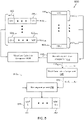
- FIG. 9 illustrates a URS transmission scheme 900 for multi-RAT medium sharing according to embodiments of the present disclosure.
- the scheme 900 may be employed by the BSs 105, 205, and 400 and the UEs 115, 215, and 300 to transmit URSs 910 (e.g., the URSs 520, 550, 660, 760, and 860).
- a transmitter may transmit URSs based on the numerology (e.g., a sampling rate) of a serving cell of the transmitter.
- a transmitter 902 may store a set of URSs 910, denoted as URS 1 to URS N , for example, in a memory (e.g., the memory 304 and 404) of the transmitter 902.
- the URSs 910 may be generated using the schemes 600, 700, and/or 800 based on a sampling rate of the serving cell.
- an NR-based node may store the URSs 910 based on an NR sampling rate and a WiFi-based node may store the URSs 910 based on a WiFi sampling rate.
- Each URS 910 represents particular reservation information (e.g., a hypothesis 620).
- the URSs 910 may correspond to the URSs 660, 760, or 860 generated for the hypotheses 620 (e.g., H(1) to H(N)) using the schemes 600, 700, or 800, respectively.
- the transmitter 902 may include a URS selection component 920 configured to select a URS 910 URS(k) from the URSs 910 URS(1) to 910 URS(N) based on a selected hypothesis 620 H ( k ).
- the transmitter 902 may transmit the selected URS 910 URS(k) in a spectrum (e.g., the spectrum 501) to reserve a TXOP (e.g., the TXOP 502).
- FIG. 10 illustrates a URS detection scheme 1000 for multi-RAT medium sharing according to embodiments of the present disclosure.
- the x-axis represents time in some constant units.
- the scheme 1000 may be employed by the BSs 105, 205, and 400 and the UEs 115, 215, and 300 to detect a URS (e.g., the URSs 520, 550, 660, 760, 860, and 910) and determine a hypothesis (e.g., the hypotheses 620) from the URS.
- a receiver 1002 may receive a signal 1010, denoted as Y, from a channel (e.g., the spectrum 501).
- the receiver 1002 may include a correlation component 1020 configured to perform autocorrelation and/or cross-correlation.
- the correlation component 1020 may perform autocorrelation between two blocks of samples of the signal 1010.
- NR may use a subcarrier spacing that is an integer multiple of 15 kilohertz (kHz)
- WiFi may use 802.11ax subcarrier spacing that is an integer multiple of 78.125 kHz.
- the NR sampling frequency may not be an integer multiple of the WiFi sampling frequency.
- the correlation component 1020 may account for the different sampling rates when detecting a signal 1010 transmitted by a RAT (e.g., NR) different from a RAT (e.g., WiFi) of a serving cell of the receiver 1002.
- the correlation component 1020 may apply time dithering to select blocks of samples from the signal 1010 for correlation instead of resampling the received signal 1010 to the sampling rate of the transmitting RAT.
- the correlation component 1 020 may select a block 1032 of samples and a block 1034 of samples from the received signal 1010.
- the block 1032 may include X number of samples, where X is a positive integer.
- the 1034 may include (X+1) number of samples.
- the value X may be determined based on the sampling rate of the RAT used by the serving cell and the sampling rate of the transmitting RAT.
- a duration e.g., the durations 602, 702, and 802 of a waveform sequence (e.g., the waveform sequences 610, 710, 712, and 810) may include 100 samples based on the numerology of the transmitting RAT, but may include 91.5 samples based on the numerology of the receiving RAT.
- the receiver 1002 may configured X to be a value of 91.
- the correlation component 1020 may compute a correlation between the X samples in the block 1032 and X samples in the block 1034, for example, by dropping the last sample or the first sample in the block 1034. In other words, the correlation component 1020 may adjust the spacing between blocks of samples for correlations, for example, by skipping or dropping one sample in alternate blocks. The rate of dropping or skipping a sample may be dependent on the sampling rates of the transmitting RAT and the receiving RAT. For example, the correlation component 1020 may drop one sample in every 2, 3, 4, or 5 blocks. The correlation component 1020 may apply similar sample dithering for computing cross-correlations, for example, when the received signal 1010 includes a URS 860 generated from the scheme 800. In some embodiments, the correlation component 1020 may perform coherent combining on correlation results by considering phase differences between the blocks 1032 and 1034 due to the sample drop. In some embodiments, the receiver 1002 may perform additional interpolation to further improve URS detection performance.
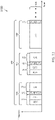
- FIG. 11 illustrates a multi-RAT medium sharing scheme 1100 according to embodiments of the present disclosure.
- the x-axis represents time in some constant units.
- the y-axis represents frequency in some constant units.
- the scheme 1100 may be employed by nodes of different RATs, such as the BSs 105, 205, and 400 and the UEs 115, 215, and 300, to communicate over a shared spectrum 501.
- the scheme 1100 is substantially similar to the scheme 500, but a transmitter may transmit multiple copies of a URS based on different RATs with different numerologies. For example, a transmitter may transmit a URS 1120 and a URS 1122 in the common period 510 of the RRS period 508.
- the URSs 1120 and 1122 may be similar to the URSs 520, 550, 660, 760, 860, and 910.
- the URS 1120 and the URS 1122 may carry the same medium reservation information (e.g., the hypotheses 620), but configured based on two different RATs.
- the spectrum 501 is shared between an NR-based network and a WiFi-based network.
- the URS 1120 may be configured based on an NR numerology and the URS 1122 may be configured based on a WiFi numerology.
- the URSs 1120 and 1122 may be generated using the scheme 600.
- the URS 1120 may correspond to the URS 660 sampled at an NR sampling rate and the URS 1120 may correspond to the URS 660 sampled at a WiFi sampling rate.
- a target receiver may respond to the URSs 1120 and 1122 by transmitting a URS 1150 and a. URS 1152 in the common period 514 of the RRS period 508.
- the URSs 1150 and 1152 may carry the same medium reservation information, but configured based on numerologies of different RATs. While the scheme 1 100 is illustrated with URSs configured for two different RATs, the scheme 1100 may be applied to a network supporting any suitable number of RATs. For example, when a network supports three different RATs, the scheme 1100 may be scaled to transmit three copies of the same medium reservation information carried in three URSs configured for the three different RATs in the common periods 510 and 514.
- the transmissions of multiple copies of reservation information using numerologies of different RATs allow a receiver to perform detection based on the numerology of a serving cell of the receiver. For example, when the URS 1120 is transmitted using NR and the URS 1122 is transmitted using WiFi, an NR-based receiver may detect and process the URS 1120 and a WiFi-based receiver may detect and process the URS 1122.
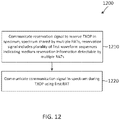
- FIG. 12 is a flow diagram of a multi-RAT medium sharing method 1200 according to embodiments of the present disclosure. Steps of the method 1200 can be executed by a computing device (e.g., a processor, processing circuit, and/or other suitable component) of a wireless communication device, such as the BSs 105, 205, and 400, the UEs 115, 215, and 300, the transmitter 902, and the receiver 1002.
- the method 1200 may employ similar mechanisms as in the schemes 500, 600, 700, 800, 900, 1000, and 1100 described with respect to FIGS. 5 , 6 , 7 , 8 , 9, 10 , and 11 , respectively.
- the method 1200 includes a number of enumerated steps, but embodiments of the method 1200 may include additional steps before, after, and in between the enumerated steps. In some embodiments, one or more of the enumerated steps may be omitted or performed in a different order.
- the method 1200 includes communicating, by a first wireless communication device with a second wireless communication device, a reservation signal (e.g., the URSs 520, 550, 660, 760, 860, 910, 1120, 1122, 1150, and 1152) to reserve a TXOP (e.g., the TXOP 502) in a spectrum (e.g., the spectrum 501).
- the spectrum is shared by multiple RATs (e.g., NR and WiFi).
- the reservation signal includes a set of waveform sequence (e.g., the waveform sequences 610, 662, 710, 810, and 862) indicating medium reservation information (e.g., the hypotheses 620) detectable by the multiple RATs.
- the first wireless communication device and the second wireless communication device are associated with a first RAT of the multiple RATs.
- the method 1200 includes communicating, by the first wireless communication device and the second wireless communication device, a communication signal (e.g., the communication signal 570) in the spectrum during the TXOP using the first RAT.
- a communication signal e.g., the communication signal 570
- Information and signals may be represented using any of a variety of different technologies and techniques.
- data, instructions, commands, information, signals, bits, symbols, and chips that may be referenced throughout the above description may be represented by voltages, currents, electromagnetic waves, magnetic fields or particles, optical fields or particles, or any combination thereof.
- a general-purpose processor may be a microprocessor, but in the alternative, the processor may be any conventional processor, controller, microcontroller, or state machine.
- a processor may also be implemented as a combination of computing devices (e.g., a combination of a DSP and a microprocessor, multiple microprocessors, one or more microprocessors in conjunction with a DSP core, or any other such configuration).
- the functions described herein may be implemented in hardware, software executed by a processor, firmware, or any combination thereof. If implemented in software executed by a processor, the functions may be stored on or transmitted over as one or more instructions or code on a computer-readable medium. Other examples and implementations are within the scope of the disclosure and appended claims. For example, due to the nature of software, functions described above can be implemented using software executed by a processor, hardware, firmware, hardwiring, or combinations of any of these. Features implementing functions may also be physically located at various positions, including being distributed such that portions of functions are implemented at different physical locations.
- FIG. 1 For embodiments of the present disclosure, include a method of wireless communication, comprising communicating, by a first wireless communication device with a second wireless communication device, a reservation signal to reserve a transmission opportunity (TXOP) in a spectrum, wherein the spectrum is shared by multiple radio access technologies (RATs), wherein the reservation signal includes a plurality of first waveform sequences indicating medium reservation information detectable by the multiple RATs, wherein the plurality of first waveform sequences correspond to multiple instances of a second waveform sequence masked by a code representing the medium reservation information, and wherein the first wireless communication device and the second wireless communication device are associated with a first RAT of the multiple RATs; and communicating, by the first wireless communication device with the second wireless communication device using the first RAT, a communication signal in the spectrum during the TXOP.
- RATs radio access technologies
- the medium reservation information indicates at least one of a reservation duration for the TXOP or a RAT type indicating that the TXOP is reserved by the first RAT.
- the reservation signal includes a plurality of second waveform sequences providing information for reception of the reservation signal.
- the communicating the reservation signal includes transmitting, by the first wireless communication device to the second wireless communication device, the reservation signal, and the method further comprises selecting, by the first wireless communication device, the plurality of first waveform sequences from a plurality of second waveform sequences based on the medium reservation information.
- the communicating the reservation signal includes receiving, by the first wireless communication device from the second wireless communication device, the reservation signal, and the method further comprises identifying, by the first wireless communication device, the plurality of first waveform sequences based on a detection between the reservation signal and a plurality of second waveform sequences.
- the communicating the reservation signal includes transmitting, by the first wireless communication device, the reservation signal based on a numerology of the first RAT. In some embodiments, the communicating the reservation signal includes transmitting, by the first wireless communication device based on a numerology of the first RAT, a first signal indicating the medium reservation information; and transmitting, by the first wireless communication device based on a numerology of a second RAT of the multiple RATs, a second signal indicating the medium reservation information.
- the method further comprises receiving, by the first wireless communication device from a third wireless communication device, a reservation signal for another TXOP in the spectrum, the third wireless communication device associated with a second RAT of the multiple RATs; determining, by the first wireless communication device, medium reservation information associated with the second RAT from the reservation signal for the another TXOP; and refraining, by the first wireless communication device, from communicating in the spectrum during the another TXOP based on the medium reservation information associated with the second RAT.
- the reservation signal for the another TXOP is transmitted using a numerology of the first RAT.
- the reservation signal for the another TXOP is transmitted using a numerology of the second RAT.
- the receiving the reservation signal for the another TXOP includes performing, by the first wireless communication device, correlations based on samples of the reservation signal spaced apart by a first spacing associated with a numerology of the first RAT; and performing, by the first wireless communication device, correlations based on samples of the reservation signal spaced apart by a second spacing associated with a numerology of the second RAT.
- the method further comprises communicating, by the first wireless communication device with the second wireless communication device, a filler signal in the spectrum during the TXOP based on a symbol boundary of the first RAT.
- the method further comprises communicating, by the first wireless communication device with the second wireless communication device, a filler signal in the spectrum during the TXOP based on a duration of the TXOP. In some embodiments, the method further comprises communicating, by the first wireless communication device with the second wireless communication device, a first RAT-specific reservation signal including at least one of a preamble of the first RAT or scheduling information of the first RAT.
- FIG. 1 For embodiments of the present disclosure, include an apparatus comprising a transceiver configured to communicate, with a second wireless communication device, a reservation signal to reserve a transmission opportunity (TXOP) in a spectrum, wherein the spectrum is shared by multiple radio access technologies (RATs), wherein the reservation signal includes a plurality of first waveform sequences indicating medium reservation information detectable by the multiple RATs, wherein the plurality of first waveform sequences correspond to multiple instances of a second waveform sequence masked by a code representing the medium reservation information, and wherein the apparatus and the second wireless communication device are associated with a first RAT of the multiple RATs; and communicate, with the second wireless communication device using the first RAT, a communication signal in the spectrum during the TXOP.
- RATs radio access technologies
- the medium reservation information indicates at least one of a reservation duration for the TXOP or a RAT type indicating that the TXOP is reserved by the first RAT.
- the reservation signal includes a plurality of second waveform sequences providing information for reception of the reservation signal.
- the transceiver is further configured to communicate the reservation signal by transmitting, to the second wireless communication device, the reservation signal, and the apparatus further comprises a processor configured to select the plurality of first waveform sequences from a plurality of second waveform sequences based on the medium reservation information.
- the transceiver is further configured to communicate the reservation signal by receiving, from the second wireless communication device, the reservation signal, and the apparatus further comprises a processor configured to identify the plurality of first waveform sequences based on a detection between the reservation signal and a plurality of second waveform sequences.
- the transceiver is further configured to communicate the reservation signal by transmitting the reservation signal based on a numerology of the first RAT.
- the transceiver is further configured to communicating the reservation signal by transmitting, based on a numerology of the first RAT, a first signal indicating the medium reservation information; and transmitting, based on a numerology of a second RAT of the multiple RATs, a second signal indicating the medium reservation information.
- the transceiver is further configured to receive, from a third wireless communication device, a reservation signal for another TXOP in the spectrum, the third wireless communication device associated with a second RAT of the multiple RATs, and the apparatus further comprises a processor configured to determine medium reservation information associated with the second RAT from the reservation signal for the another TXOP; and refrain from communicating in the spectrum during the another TXOP based on the medium reservation information associated with the second RAT.
- the reservation signal for the another TXOP is transmitted using a numerology of the first RAT.
- the reservation signal for the another TXOP is transmitted using a numerology of the second RAT.
- the apparatus further comprises a processor configured to perform correlations based on samples of the reservation signal for the another TXOP spaced apart by a first spacing associated with a numerology of the first RAT; and perform correlations based on samples of the reservation signal for the another TXOP spaced apart by a second spacing associated with a numerology of the second RAT.
- the transceiver is further to communicate, with the second wireless communication device, a filler signal in the spectrum during the TXOP based on a symbol boundary of the first RAT.
- the transceiver is further to communicate, with the second wireless communication device, a filler signal in the spectrum during the TXOP based on a duration of the TXOP.
- the transceiver is further to communicate, with the second wireless communication device, a first RAT-specific reservation signal including at least one of a preamble of the first RAT or scheduling information of the first RAT.
- FIG. 1 For embodiments of the present disclosure, include a computer program comprising instructions, which when executed on at least one processor of a first wireless communication device, cause the first wireless communication device to communicate, with a second wireless communication device, a reservation signal to reserve a transmission opportunity (TXOP) in a spectrum, wherein the spectrum is shared by multiple radio access technologies (RATs), wherein the reservation signal includes a plurality of first waveform sequences indicating medium reservation information detectable by the multiple RATs, wherein the plurality of first waveform sequences correspond to multiple instances of a second waveform sequence masked by a code representing the medium reservation information, and wherein the first wireless communication device and the second wireless communication device are associated with a first RAT of the multiple RATs; and code for causing the first wireless communication device to communicating, by the first wireless communication device with the second wireless communication device using the first RAT, a communication signal in the spectrum during the TXOP.
- RATs radio access technologies
- the medium reservation information indicates at least one of a reservation duration for the TXOP or a RAT type indicating that the TXOP is reserved by the first RAT.
- the reservation signal includes a plurality of second waveform sequences providing information for reception of the reservation signal.
- the code for causing the first wireless communication device to communicate the reservation signal is further configured to transmit, to the second wireless communication device, the reservation signal, and the computer-readable medium further comprises code for causing the first wireless communication device to select the plurality of first waveform sequences from a plurality of second waveform sequences based on the medium reservation information.
- the code for causing the first wireless communication device to communicate the reservation signal is further configured to receive, from the second wireless communication device, the reservation signal, and the computer-readable medium further comprises code for causing the first wireless communication device to identify the plurality of first waveform sequences based on a detection between the reservation signal and a plurality of second waveform sequences. In some embodiments, the code for causing the first wireless communication device to communicate the reservation signal is further configured to transmit the reservation signal based on a numerology of the first RAT.
- the code for causing the first wireless communication device to communicate the reservation signal is further configured to transmit, based on a numerology of the first RAT, a first signal indicating the medium reservation information; and transmit, based on a numerology of a second RAT of the multiple RATs, a second signal indicating the medium reservation information.
- the computer-readable medium further comprises code for causing the first wireless communication device to receive, from a third wireless communication device, a reservation signal for another TXOP in the spectrum, the third wireless communication device associated with a second RAT of the multiple RATs; code for causing the first wireless communication device to determine medium reservation information associated with the second RAT from the reservation signal for the another TXOP; and code for causing the first wireless communication device to refrain from communicating in the spectrum during the another TXOP based on the medium reservation information associated with the second RAT.
- the reservation signal for the another TXOP is transmitted using a numerology of the first RAT.
- the reservation signal for the another TXOP is transmitted using a numerology of the second RAT.
- the code for causing the first wireless communication device to receive the reservation signal for the another TXOP is further configured to perform correlations based on samples of the reservation signal spaced apart by a first spacing associated with a numerology of the first RAT; and perform correlations based on samples of the reservation signal spaced apart by a second spacing associated with a numerology of the second RAT.
- the computer-readable medium further comprises code for causing the first wireless communication device to communicate, with the second wireless communication device, a filler signal in the spectrum during the TXOP based on a symbol boundary of the first RAT.
- the computer-readable medium further comprises code for causing the first wireless communication device to communicate, with the second wireless communication device, a filler signal in the spectrum during the TXOP based on a duration of the TXOP. In some embodiments, the computer-readable medium further comprises code for causing the first wireless communication device to communicate, with the second wireless communication device, a first RAT-specific reservation signal including at least one of a preamble of the first RAT or scheduling information of the first RAT.
- FIG. 1 For embodiments of the present disclosure, include an apparatus comprising means for communicating, with a second wireless communication device, a reservation signal to reserve a transmission opportunity (TXOP) in a spectrum, wherein the spectrum is shared by multiple radio access technologies (RATs), wherein the reservation signal includes a plurality of first waveform sequences indicating medium reservation information detectable by the multiple RATs, wherein the plurality of first waveform sequences correspond to multiple instances of a second waveform sequence masked by a code representing the medium reservation information, and wherein the apparatus and the second wireless communication device are associated with a first RAT of the multiple RATs; and means for communicating, with the second wireless communication device using the first RAT, a communication signal in the spectrum during the TXOP.
- RATs radio access technologies
- the medium reservation information indicates at least one of a reservation duration for the TXOP or a RAT type indicating that the TXOP is reserved by the first RAT.
- the reservation signal includes a plurality of second waveform sequences providing information for reception of the reservation signal.
- the means for communicating the reservation signal is further configured to transmit, to the second wireless communication device, the reservation signal, and the apparatus further comprises means for selecting the plurality of first waveform sequences from a plurality of second waveform sequences based on the medium reservation information.
- the means for communicating the reservation signal is further configured to receive, from the second wireless communication device, the reservation signal, and the apparatus further comprises means for identifying the plurality of first waveform sequences based on a detection between the reservation signal and a plurality of second waveform sequences.
- the means for communicating the reservation signal is further configured to transmit the reservation signal based on a numerology of the first RAT. In some embodiments, the means for communicating the reservation signal is further configured to transmit, based on a numerology of the first RAT, a first signal indicating the medium reservation information; and transmit, based on a numerology of a second RAT of the multiple RATs, a second signal indicating the medium reservation information.
- the apparatus further comprises means for receiving, from a third wireless communication device, a reservation signal for another TXOP in the spectrum, the third wireless communication device associated with a second RAT of the multiple RATs; means for determining medium reservation information associated with the second RAT from the reservation signal for the another TXOP; and means for refraining from communicating in the spectrum during the another TXOP based on the medium reservation information associated with the second RAT.
- the reservation signal for the another TXOP is transmitted using a numerology of the first RAT.
- the reservation signal for the another TXOP is transmitted using a numerology of the second RAT.
- the means for receiving the reservation signal for the another TXOP is further configured to perform correlations based on samples of the reservation signal spaced apart by a first spacing associated with a numerology of the first RAT; and perform correlations based on samples of the reservation signal spaced apart by a second spacing associated with a numerology of the second RAT.
- the apparatus further comprises means for communicating, with the second wireless communication device, a filler signal in the spectrum during the TXOP based on a symbol boundary of the first RAT.
- the apparatus further comprises means for communicating, with the second wireless communication device, a filler signal in the spectrum during the TXOP based on a duration of the TXOP.
- the apparatus further comprises means for communicating, with the second wireless communication device, a first RAT-specific reservation signal including at least one of a preamble of the first RAT or scheduling information of the first RAT.
Landscapes
- Engineering & Computer Science (AREA)
- Computer Networks & Wireless Communication (AREA)
- Signal Processing (AREA)
- Quality & Reliability (AREA)
- Mobile Radio Communication Systems (AREA)
Claims (13)
- Un procédé (1200) de communication sans fil, comprenant :la communication (1210), par un premier dispositif de communication sans fil avec un deuxième dispositif de communication sans fil, d'un signal de réservation pour réserver une opportunité de transmission, TXOP, dans un spectre, dans lequel le spectre est partagé par de multiples technologies d'accès radio, RAT, dans lequel le signal de réservation comporte une pluralité de premières séquences de forme d'onde indiquant une information de réservation de moyen de communication détectable par les multiples RAT, dans lequel la pluralité de premières séquences de forme d'onde correspond à de multiples instances d'une seconde séquence de forme d'onde masquée par un code représentant l'information de réservation de moyen de communication, et dans lequel le premier dispositif de communication sans fil et le deuxième dispositif de communication sans fil sont associés à une première RAT des multiples RAT ; etla communication (1220), par le premier dispositif de communication sans fil avec le deuxième dispositif de communication sans fil en utilisant la première RAT, d'un signal de communication dans le spectre pendant la TXOP.
- Le procédé selon la revendication 1, dans lequel l'information de réservation de moyen de communication indique au moins l'un d'une durée de réservation pour la TXOP ou d'un type de RAT indiquant que la TXOP est réservée par la première RAT.
- Le procédé selon la revendication 1, dans lequel le signal de réservation comporte une pluralité de secondes séquences de forme d'onde fournissant une information pour la réception du signal de réservation.
- Le procédé selon la revendication 1, dans lequel la communication du signal de réservation comporte la transmission, par le premier dispositif de communication sans fil au deuxième dispositif de communication sans fil, du signal de réservation, et dans lequel le procédé comprend en outre la sélection, par le premier dispositif de communication sans fil, de la pluralité de premières séquences de forme d'onde à partir d'une pluralité de secondes séquences de forme d'onde sur la base de l'information de réservation de moyen de communication.
- Le procédé selon la revendication 1, dans lequel la communication du signal de réservation comporte la transmission, par le premier dispositif de communication sans fil, du signal de réservation sur la base d'une numérologie de la première RAT.
- Le procédé selon la revendication 1, dans lequel la communication du signal de réservation comporte :la transmission, par le premier dispositif de communication sans fil sur la base d'une numérologie de la première RAT, d'un premier signal indiquant l'information de réservation de moyen de communication ; etla transmission, par le premier dispositif de communication sans fil sur la base d'une numérologie d'une seconde RAT des multiples RAT, d'un second signal indiquant l'information de réservation de moyen de communication.
- Le procédé selon la revendication 1, comprenant en outre :la réception, par le premier dispositif de communication sans fil à partir d'un troisième dispositif de communication sans fil, d'un signal de réservation pour une autre TXOP dans le spectre, le troisième dispositif de communication sans fil associé à une seconde RAT des multiples RAT ;la détermination, par le premier dispositif de communication sans fil, d'une information de réservation de moyen de communication associée à la seconde RAT à partir du signal de réservation pour l'autre TXOP ; etl'abstention, par le premier dispositif de communication sans fil, de communiquer dans le spectre pendant l'autre TXOP sur la base de l'information de réservation de moyen de communication associée à la seconde RAT, dans lequel le signal de réservation pour l'autre TXOP est transmis en utilisant au moins l'une d'une numérologie de la première RAT ou de la seconde RAT.
- Le procédé selon la revendication 1, comprenant en outre :la réception, par le premier dispositif de communication sans fil à partir d'un troisième dispositif de communication sans fil de la première RAT, d'un signal de réservation pour une autre TXOP dans le spectre ;la détermination, par le premier dispositif de communication sans fil, que le signal de réservation pour l'autre TXOP est transmis par un autre dispositif de communication sans fil de la première RAT ; etla surveillance, par le premier dispositif de communication sans fil, pour déceler un premier signal de réservation spécifique de RAT en réponse à la détermination.
- Le procédé selon la revendication 1, comprenant en outre la communication, par le premier dispositif de communication sans fil avec le deuxième dispositif de communication sans fil, d'un signal de remplissage dans le spectre pendant la TXOP sur la base d'au moins l'un d'une limite de symbole de la première RAT ou d'une durée de la TXOP.
- Un appareil comprenant :des moyens de communication, avec un deuxième dispositif de communication sans fil, d'un signal de réservation pour réserver une opportunité de transmission, TXOP, dans un spectre, dans lequel le spectre est partagé par de multiples technologies d'accès radio, RAT, dans lequel le signal de réservation comporte une pluralité de premières séquences de forme d'onde indiquant une information de réservation de moyen de communication détectable par les multiples RAT, dans lequel la pluralité de premières séquences de forme d'onde correspond à de multiples instances d'une seconde séquence de forme d'onde masquée par un code représentant l'information de réservation de moyen de communication, et dans lequel l'appareil et le deuxième dispositif de communication sans fil sont associés à une première RAT des multiples RAT ; etdes moyens de communication, avec le deuxième dispositif de communication sans fil en utilisant la première RAT, d'un signal de communication dans le spectre pendant la TXOP.
- L'appareil selon la revendication 10, dans lequel l'information de réservation de moyen de communication indique au moins l'un d'une durée de réservation pour la TXOP ou d'un type de RAT indiquant que la TXOP est réservée par la première RAT.
- L'appareil selon la revendication 10, dans lequel les moyens de communication du signal de réservation sont en outre configurés pour transmettre, au deuxième dispositif de communication sans fil, le signal de réservation, et dans lequel l'appareil comprend en outre des moyens pour sélectionner la pluralité de premières séquences de forme d'onde à partir d'une pluralité de secondes séquences de forme d'onde sur la base de l'information de réservation de moyen de communication.
- Un programme informatique comprenant des instructions qui, lorsqu'elles sont exécutées sur au moins un processeur d'un appareil pour communications sans fil, amènent ledit appareil à mettre en œuvre le procédé selon l'une des revendications 1 à 9.
Applications Claiming Priority (3)
| Application Number | Priority Date | Filing Date | Title |
|---|---|---|---|
| US201762529074P | 2017-07-06 | 2017-07-06 | |
| US15/960,883 US10638371B2 (en) | 2017-07-06 | 2018-04-24 | Universal reservation signal for medium sharing |
| PCT/US2018/029410 WO2019009946A1 (fr) | 2017-07-06 | 2018-04-25 | Signal de réservation universel de partage de support |
Publications (2)
| Publication Number | Publication Date |
|---|---|
| EP3649825A1 EP3649825A1 (fr) | 2020-05-13 |
| EP3649825B1 true EP3649825B1 (fr) | 2022-04-06 |
Family
ID=64903054
Family Applications (1)
| Application Number | Title | Priority Date | Filing Date |
|---|---|---|---|
| EP18727911.2A Active EP3649825B1 (fr) | 2017-07-06 | 2018-04-25 | Signal de réservation universel de partage de support |
Country Status (2)
| Country | Link |
|---|---|
| US (1) | US10638371B2 (fr) |
| EP (1) | EP3649825B1 (fr) |
Families Citing this family (22)
| Publication number | Priority date | Publication date | Assignee | Title |
|---|---|---|---|---|
| US10756860B2 (en) | 2018-11-05 | 2020-08-25 | XCOM Labs, Inc. | Distributed multiple-input multiple-output downlink configuration |
| US10659112B1 (en) | 2018-11-05 | 2020-05-19 | XCOM Labs, Inc. | User equipment assisted multiple-input multiple-output downlink configuration |
| US10812216B2 (en) | 2018-11-05 | 2020-10-20 | XCOM Labs, Inc. | Cooperative multiple-input multiple-output downlink scheduling |
| US10432272B1 (en) | 2018-11-05 | 2019-10-01 | XCOM Labs, Inc. | Variable multiple-input multiple-output downlink user equipment |
| AU2019388921B2 (en) | 2018-11-27 | 2024-05-30 | Virewirx, Inc. | Non-coherent cooperative multiple-input multiple-output communications |
| US10756795B2 (en) | 2018-12-18 | 2020-08-25 | XCOM Labs, Inc. | User equipment with cellular link and peer-to-peer link |
| US11063645B2 (en) | 2018-12-18 | 2021-07-13 | XCOM Labs, Inc. | Methods of wirelessly communicating with a group of devices |
| US11330649B2 (en) | 2019-01-25 | 2022-05-10 | XCOM Labs, Inc. | Methods and systems of multi-link peer-to-peer communications |
| US10756767B1 (en) | 2019-02-05 | 2020-08-25 | XCOM Labs, Inc. | User equipment for wirelessly communicating cellular signal with another user equipment |
| US11032841B2 (en) | 2019-04-26 | 2021-06-08 | XCOM Labs, Inc. | Downlink active set management for multiple-input multiple-output communications |
| US10756782B1 (en) | 2019-04-26 | 2020-08-25 | XCOM Labs, Inc. | Uplink active set management for multiple-input multiple-output communications |
| US10686502B1 (en) | 2019-04-29 | 2020-06-16 | XCOM Labs, Inc. | Downlink user equipment selection |
| US10735057B1 (en) | 2019-04-29 | 2020-08-04 | XCOM Labs, Inc. | Uplink user equipment selection |
| US11411778B2 (en) | 2019-07-12 | 2022-08-09 | XCOM Labs, Inc. | Time-division duplex multiple input multiple output calibration |
| US11411779B2 (en) | 2020-03-31 | 2022-08-09 | XCOM Labs, Inc. | Reference signal channel estimation |
| CN115428513A (zh) | 2020-04-15 | 2022-12-02 | 艾斯康实验室公司 | 无线网络多点关联性和多路径 |
| CA3178604A1 (fr) | 2020-05-26 | 2021-12-02 | XCOM Labs, Inc. | Formation de faisceaux tenant compte du brouillage |
| WO2022087569A1 (fr) | 2020-10-19 | 2022-04-28 | XCOM Labs, Inc. | Signal de référence pour systèmes de communication sans fil |
| WO2022093988A1 (fr) | 2020-10-30 | 2022-05-05 | XCOM Labs, Inc. | Groupement et/ou sélection de débit dans des systèmes de communication à entrées et sorties multiples |
| CA3202850A1 (fr) | 2020-12-16 | 2022-06-23 | XCOM Labs, Inc. | Communication sans fil avec des faisceaux quasi-omnidirectionnels et directionnels |
| WO2022241436A1 (fr) | 2021-05-14 | 2022-11-17 | XCOM Labs, Inc. | Identifiants de brouillage pour systèmes de communication sans fil |
| GB2643726A (en) * | 2024-08-29 | 2026-03-04 | Nokia Technologies Oy | Handling transmission on shared resource |
Family Cites Families (10)
| Publication number | Priority date | Publication date | Assignee | Title |
|---|---|---|---|---|
| EP3755108A1 (fr) * | 2013-05-03 | 2020-12-23 | Interdigital Patent Holdings, Inc. | Procédés pour amélioration mac de sectorisation wifi |
| US20150103715A1 (en) * | 2013-10-14 | 2015-04-16 | Qualcomm Incorporated | Downlink control format indicator |
| US10021697B2 (en) * | 2014-02-07 | 2018-07-10 | Qualcomm Incorporated | Multi-tiered shared access operation |
| WO2016073662A1 (fr) | 2014-11-07 | 2016-05-12 | Cisco Technology, Inc. | Réduire à un minimum des interférences dans une communication sans fil |
| US9960890B2 (en) | 2015-02-20 | 2018-05-01 | Qualcomm Incorporated | Superposition coding based preamble designs for co-existing radio access technologies |
| US20160262048A1 (en) | 2015-03-05 | 2016-09-08 | Qualcomm Incorporated | Amplify and forward techniques to reduce collisions in wireless communication systems |
| US10917795B2 (en) | 2015-04-02 | 2021-02-09 | Qualcomm Incorporated | Enhanced preamble waveform for coexistence |
| EP3664528B1 (fr) * | 2015-05-14 | 2022-01-26 | Intel IP Corporation | Transmission de canal physique de commande partagé de liaison montante (pusch) sans conflit au moyen d'un accès multiple avec écoute de porteuse |
| US9948486B2 (en) * | 2016-02-05 | 2018-04-17 | Qualcomm Incorporated | Phase-shift-keying (PSK) pilot |
| US10200874B2 (en) | 2016-09-29 | 2019-02-05 | Qualcomm Incorporated | Signature sequence for system identification in a shared spectrum |
-
2018
- 2018-04-24 US US15/960,883 patent/US10638371B2/en active Active
- 2018-04-25 EP EP18727911.2A patent/EP3649825B1/fr active Active
Also Published As
| Publication number | Publication date |
|---|---|
| US10638371B2 (en) | 2020-04-28 |
| US20190014507A1 (en) | 2019-01-10 |
| EP3649825A1 (fr) | 2020-05-13 |
Similar Documents
| Publication | Publication Date | Title |
|---|---|---|
| EP3649825B1 (fr) | Signal de réservation universel de partage de support | |
| US11601975B2 (en) | Listen-before-talk (LBT) with new radio-spectrum sharing (NR-SS) discovery signal transmission | |
| EP3586558B1 (fr) | Réservation de support spécifique à un noeud pour partage de spectre | |
| US10772110B2 (en) | Universal channel reservation signal for medium sharing | |
| US11552750B2 (en) | Subband-based random access and scheduling request for new-radio-spectrum sharing (NR-SS) | |
| US10834603B2 (en) | Reservation signal for transmission opportunity design for spectrum sharing | |
| US11611975B2 (en) | Uplink (UL) transmission with flexible starting positions for new radio-unlicensed (NR-U) | |
| EP3571858B1 (fr) | Duplexage par répartition dans le temps dynamique (tdd) dans un nouveau partage de spectre radio (nr-ss) et structure de sous-trame autonome | |
| US11622381B2 (en) | Control information update for dynamic time-division duplexing (TDD) | |
| EP3552447B1 (fr) | Adaptation d'un intervalle de transmission à une catégorie de puissance | |
| CN110945954B (zh) | 用于介质共享的通用预留信号 | |
| US10548151B2 (en) | Deafness reduction in preamble detection for medium sharing |
Legal Events
| Date | Code | Title | Description |
|---|---|---|---|
| STAA | Information on the status of an ep patent application or granted ep patent |
Free format text: STATUS: UNKNOWN |
|
| STAA | Information on the status of an ep patent application or granted ep patent |
Free format text: STATUS: THE INTERNATIONAL PUBLICATION HAS BEEN MADE |
|
| PUAI | Public reference made under article 153(3) epc to a published international application that has entered the european phase |
Free format text: ORIGINAL CODE: 0009012 |
|
| STAA | Information on the status of an ep patent application or granted ep patent |
Free format text: STATUS: REQUEST FOR EXAMINATION WAS MADE |
|
| 17P | Request for examination filed |
Effective date: 20191121 |
|
| AK | Designated contracting states |
Kind code of ref document: A1 Designated state(s): AL AT BE BG CH CY CZ DE DK EE ES FI FR GB GR HR HU IE IS IT LI LT LU LV MC MK MT NL NO PL PT RO RS SE SI SK SM TR |
|
| AX | Request for extension of the european patent |
Extension state: BA ME |
|
| DAV | Request for validation of the european patent (deleted) | ||
| DAX | Request for extension of the european patent (deleted) | ||
| STAA | Information on the status of an ep patent application or granted ep patent |
Free format text: STATUS: EXAMINATION IS IN PROGRESS |
|
| 17Q | First examination report despatched |
Effective date: 20201207 |
|
| GRAP | Despatch of communication of intention to grant a patent |
Free format text: ORIGINAL CODE: EPIDOSNIGR1 |
|
| STAA | Information on the status of an ep patent application or granted ep patent |
Free format text: STATUS: GRANT OF PATENT IS INTENDED |
|
| INTG | Intention to grant announced |
Effective date: 20210628 |
|
| GRAJ | Information related to disapproval of communication of intention to grant by the applicant or resumption of examination proceedings by the epo deleted |
Free format text: ORIGINAL CODE: EPIDOSDIGR1 |
|
| STAA | Information on the status of an ep patent application or granted ep patent |
Free format text: STATUS: EXAMINATION IS IN PROGRESS |
|
| INTC | Intention to grant announced (deleted) | ||
| GRAP | Despatch of communication of intention to grant a patent |
Free format text: ORIGINAL CODE: EPIDOSNIGR1 |
|
| STAA | Information on the status of an ep patent application or granted ep patent |
Free format text: STATUS: GRANT OF PATENT IS INTENDED |
|
| INTG | Intention to grant announced |
Effective date: 20211109 |
|
| GRAS | Grant fee paid |
Free format text: ORIGINAL CODE: EPIDOSNIGR3 |
|
| GRAA | (expected) grant |
Free format text: ORIGINAL CODE: 0009210 |
|
| STAA | Information on the status of an ep patent application or granted ep patent |
Free format text: STATUS: THE PATENT HAS BEEN GRANTED |
|
| AK | Designated contracting states |
Kind code of ref document: B1 Designated state(s): AL AT BE BG CH CY CZ DE DK EE ES FI FR GB GR HR HU IE IS IT LI LT LU LV MC MK MT NL NO PL PT RO RS SE SI SK SM TR |
|
| REG | Reference to a national code |
Ref country code: GB Ref legal event code: FG4D |
|
| REG | Reference to a national code |
Ref country code: CH Ref legal event code: EP |
|
| REG | Reference to a national code |
Ref country code: AT Ref legal event code: REF Ref document number: 1482608 Country of ref document: AT Kind code of ref document: T Effective date: 20220415 |
|
| REG | Reference to a national code |
Ref country code: IE Ref legal event code: FG4D |
|
| REG | Reference to a national code |
Ref country code: DE Ref legal event code: R096 Ref document number: 602018033363 Country of ref document: DE |
|
| REG | Reference to a national code |
Ref country code: LT Ref legal event code: MG9D |
|
| REG | Reference to a national code |
Ref country code: NL Ref legal event code: MP Effective date: 20220406 |
|
| REG | Reference to a national code |
Ref country code: AT Ref legal event code: MK05 Ref document number: 1482608 Country of ref document: AT Kind code of ref document: T Effective date: 20220406 |
|
| PG25 | Lapsed in a contracting state [announced via postgrant information from national office to epo] |
Ref country code: NL Free format text: LAPSE BECAUSE OF FAILURE TO SUBMIT A TRANSLATION OF THE DESCRIPTION OR TO PAY THE FEE WITHIN THE PRESCRIBED TIME-LIMIT Effective date: 20220406 |
|
| PG25 | Lapsed in a contracting state [announced via postgrant information from national office to epo] |
Ref country code: SE Free format text: LAPSE BECAUSE OF FAILURE TO SUBMIT A TRANSLATION OF THE DESCRIPTION OR TO PAY THE FEE WITHIN THE PRESCRIBED TIME-LIMIT Effective date: 20220406 Ref country code: PT Free format text: LAPSE BECAUSE OF FAILURE TO SUBMIT A TRANSLATION OF THE DESCRIPTION OR TO PAY THE FEE WITHIN THE PRESCRIBED TIME-LIMIT Effective date: 20220808 Ref country code: NO Free format text: LAPSE BECAUSE OF FAILURE TO SUBMIT A TRANSLATION OF THE DESCRIPTION OR TO PAY THE FEE WITHIN THE PRESCRIBED TIME-LIMIT Effective date: 20220706 Ref country code: LT Free format text: LAPSE BECAUSE OF FAILURE TO SUBMIT A TRANSLATION OF THE DESCRIPTION OR TO PAY THE FEE WITHIN THE PRESCRIBED TIME-LIMIT Effective date: 20220406 Ref country code: HR Free format text: LAPSE BECAUSE OF FAILURE TO SUBMIT A TRANSLATION OF THE DESCRIPTION OR TO PAY THE FEE WITHIN THE PRESCRIBED TIME-LIMIT Effective date: 20220406 Ref country code: GR Free format text: LAPSE BECAUSE OF FAILURE TO SUBMIT A TRANSLATION OF THE DESCRIPTION OR TO PAY THE FEE WITHIN THE PRESCRIBED TIME-LIMIT Effective date: 20220707 Ref country code: FI Free format text: LAPSE BECAUSE OF FAILURE TO SUBMIT A TRANSLATION OF THE DESCRIPTION OR TO PAY THE FEE WITHIN THE PRESCRIBED TIME-LIMIT Effective date: 20220406 Ref country code: ES Free format text: LAPSE BECAUSE OF FAILURE TO SUBMIT A TRANSLATION OF THE DESCRIPTION OR TO PAY THE FEE WITHIN THE PRESCRIBED TIME-LIMIT Effective date: 20220406 Ref country code: BG Free format text: LAPSE BECAUSE OF FAILURE TO SUBMIT A TRANSLATION OF THE DESCRIPTION OR TO PAY THE FEE WITHIN THE PRESCRIBED TIME-LIMIT Effective date: 20220706 Ref country code: AT Free format text: LAPSE BECAUSE OF FAILURE TO SUBMIT A TRANSLATION OF THE DESCRIPTION OR TO PAY THE FEE WITHIN THE PRESCRIBED TIME-LIMIT Effective date: 20220406 |
|
| PG25 | Lapsed in a contracting state [announced via postgrant information from national office to epo] |
Ref country code: RS Free format text: LAPSE BECAUSE OF FAILURE TO SUBMIT A TRANSLATION OF THE DESCRIPTION OR TO PAY THE FEE WITHIN THE PRESCRIBED TIME-LIMIT Effective date: 20220406 Ref country code: PL Free format text: LAPSE BECAUSE OF FAILURE TO SUBMIT A TRANSLATION OF THE DESCRIPTION OR TO PAY THE FEE WITHIN THE PRESCRIBED TIME-LIMIT Effective date: 20220406 Ref country code: LV Free format text: LAPSE BECAUSE OF FAILURE TO SUBMIT A TRANSLATION OF THE DESCRIPTION OR TO PAY THE FEE WITHIN THE PRESCRIBED TIME-LIMIT Effective date: 20220406 Ref country code: IS Free format text: LAPSE BECAUSE OF FAILURE TO SUBMIT A TRANSLATION OF THE DESCRIPTION OR TO PAY THE FEE WITHIN THE PRESCRIBED TIME-LIMIT Effective date: 20220806 |
|
| REG | Reference to a national code |
Ref country code: CH Ref legal event code: PL |
|
| REG | Reference to a national code |
Ref country code: BE Ref legal event code: MM Effective date: 20220430 |
|
| REG | Reference to a national code |
Ref country code: DE Ref legal event code: R097 Ref document number: 602018033363 Country of ref document: DE |
|
| PG25 | Lapsed in a contracting state [announced via postgrant information from national office to epo] |
Ref country code: SM Free format text: LAPSE BECAUSE OF FAILURE TO SUBMIT A TRANSLATION OF THE DESCRIPTION OR TO PAY THE FEE WITHIN THE PRESCRIBED TIME-LIMIT Effective date: 20220406 Ref country code: SK Free format text: LAPSE BECAUSE OF FAILURE TO SUBMIT A TRANSLATION OF THE DESCRIPTION OR TO PAY THE FEE WITHIN THE PRESCRIBED TIME-LIMIT Effective date: 20220406 Ref country code: RO Free format text: LAPSE BECAUSE OF FAILURE TO SUBMIT A TRANSLATION OF THE DESCRIPTION OR TO PAY THE FEE WITHIN THE PRESCRIBED TIME-LIMIT Effective date: 20220406 Ref country code: MC Free format text: LAPSE BECAUSE OF FAILURE TO SUBMIT A TRANSLATION OF THE DESCRIPTION OR TO PAY THE FEE WITHIN THE PRESCRIBED TIME-LIMIT Effective date: 20220406 Ref country code: LU Free format text: LAPSE BECAUSE OF NON-PAYMENT OF DUE FEES Effective date: 20220425 Ref country code: LI Free format text: LAPSE BECAUSE OF NON-PAYMENT OF DUE FEES Effective date: 20220430 Ref country code: EE Free format text: LAPSE BECAUSE OF FAILURE TO SUBMIT A TRANSLATION OF THE DESCRIPTION OR TO PAY THE FEE WITHIN THE PRESCRIBED TIME-LIMIT Effective date: 20220406 Ref country code: DK Free format text: LAPSE BECAUSE OF FAILURE TO SUBMIT A TRANSLATION OF THE DESCRIPTION OR TO PAY THE FEE WITHIN THE PRESCRIBED TIME-LIMIT Effective date: 20220406 Ref country code: CZ Free format text: LAPSE BECAUSE OF FAILURE TO SUBMIT A TRANSLATION OF THE DESCRIPTION OR TO PAY THE FEE WITHIN THE PRESCRIBED TIME-LIMIT Effective date: 20220406 Ref country code: CH Free format text: LAPSE BECAUSE OF NON-PAYMENT OF DUE FEES Effective date: 20220430 |
|
| PLBE | No opposition filed within time limit |
Free format text: ORIGINAL CODE: 0009261 |
|
| STAA | Information on the status of an ep patent application or granted ep patent |
Free format text: STATUS: NO OPPOSITION FILED WITHIN TIME LIMIT |
|
| PG25 | Lapsed in a contracting state [announced via postgrant information from national office to epo] |
Ref country code: BE Free format text: LAPSE BECAUSE OF NON-PAYMENT OF DUE FEES Effective date: 20220430 |
|
| 26N | No opposition filed |
Effective date: 20230110 |
|
| PG25 | Lapsed in a contracting state [announced via postgrant information from national office to epo] |
Ref country code: AL Free format text: LAPSE BECAUSE OF FAILURE TO SUBMIT A TRANSLATION OF THE DESCRIPTION OR TO PAY THE FEE WITHIN THE PRESCRIBED TIME-LIMIT Effective date: 20220406 |
|
| PG25 | Lapsed in a contracting state [announced via postgrant information from national office to epo] |
Ref country code: IE Free format text: LAPSE BECAUSE OF NON-PAYMENT OF DUE FEES Effective date: 20220425 |
|
| PG25 | Lapsed in a contracting state [announced via postgrant information from national office to epo] |
Ref country code: SI Free format text: LAPSE BECAUSE OF FAILURE TO SUBMIT A TRANSLATION OF THE DESCRIPTION OR TO PAY THE FEE WITHIN THE PRESCRIBED TIME-LIMIT Effective date: 20220406 |
|
| PG25 | Lapsed in a contracting state [announced via postgrant information from national office to epo] |
Ref country code: IT Free format text: LAPSE BECAUSE OF FAILURE TO SUBMIT A TRANSLATION OF THE DESCRIPTION OR TO PAY THE FEE WITHIN THE PRESCRIBED TIME-LIMIT Effective date: 20220406 |
|
| PG25 | Lapsed in a contracting state [announced via postgrant information from national office to epo] |
Ref country code: MK Free format text: LAPSE BECAUSE OF FAILURE TO SUBMIT A TRANSLATION OF THE DESCRIPTION OR TO PAY THE FEE WITHIN THE PRESCRIBED TIME-LIMIT Effective date: 20220406 Ref country code: CY Free format text: LAPSE BECAUSE OF FAILURE TO SUBMIT A TRANSLATION OF THE DESCRIPTION OR TO PAY THE FEE WITHIN THE PRESCRIBED TIME-LIMIT Effective date: 20220406 |
|
| PG25 | Lapsed in a contracting state [announced via postgrant information from national office to epo] |
Ref country code: HU Free format text: LAPSE BECAUSE OF FAILURE TO SUBMIT A TRANSLATION OF THE DESCRIPTION OR TO PAY THE FEE WITHIN THE PRESCRIBED TIME-LIMIT; INVALID AB INITIO Effective date: 20180425 |
|
| PG25 | Lapsed in a contracting state [announced via postgrant information from national office to epo] |
Ref country code: MT Free format text: LAPSE BECAUSE OF FAILURE TO SUBMIT A TRANSLATION OF THE DESCRIPTION OR TO PAY THE FEE WITHIN THE PRESCRIBED TIME-LIMIT Effective date: 20220406 |
|
| PG25 | Lapsed in a contracting state [announced via postgrant information from national office to epo] |
Ref country code: BG Free format text: LAPSE BECAUSE OF FAILURE TO SUBMIT A TRANSLATION OF THE DESCRIPTION OR TO PAY THE FEE WITHIN THE PRESCRIBED TIME-LIMIT Effective date: 20220406 |
|
| PG25 | Lapsed in a contracting state [announced via postgrant information from national office to epo] |
Ref country code: BG Free format text: LAPSE BECAUSE OF FAILURE TO SUBMIT A TRANSLATION OF THE DESCRIPTION OR TO PAY THE FEE WITHIN THE PRESCRIBED TIME-LIMIT Effective date: 20220406 |
|
| PGFP | Annual fee paid to national office [announced via postgrant information from national office to epo] |
Ref country code: FR Payment date: 20250319 Year of fee payment: 8 |
|
| PGFP | Annual fee paid to national office [announced via postgrant information from national office to epo] |
Ref country code: GB Payment date: 20250313 Year of fee payment: 8 |
|
| PGFP | Annual fee paid to national office [announced via postgrant information from national office to epo] |
Ref country code: DE Payment date: 20250317 Year of fee payment: 8 |
|
| PG25 | Lapsed in a contracting state [announced via postgrant information from national office to epo] |
Ref country code: TR Free format text: LAPSE BECAUSE OF FAILURE TO SUBMIT A TRANSLATION OF THE DESCRIPTION OR TO PAY THE FEE WITHIN THE PRESCRIBED TIME-LIMIT Effective date: 20220406 |