EP3649821B1 - Radio-ressourcen für content-server teilen - Google Patents
Radio-ressourcen für content-server teilen Download PDFInfo
- Publication number
- EP3649821B1 EP3649821B1 EP18749449.7A EP18749449A EP3649821B1 EP 3649821 B1 EP3649821 B1 EP 3649821B1 EP 18749449 A EP18749449 A EP 18749449A EP 3649821 B1 EP3649821 B1 EP 3649821B1
- Authority
- EP
- European Patent Office
- Prior art keywords
- blocks
- access network
- mobile access
- reservation
- content
- Prior art date
- Legal status (The legal status is an assumption and is not a legal conclusion. Google has not performed a legal analysis and makes no representation as to the accuracy of the status listed.)
- Active
Links
Images

Classifications
-
- H—ELECTRICITY
- H04—ELECTRIC COMMUNICATION TECHNIQUE
- H04W—WIRELESS COMMUNICATION NETWORKS
- H04W28/00—Network traffic management; Network resource management
- H04W28/16—Central resource management; Negotiation of resources or communication parameters, e.g. negotiating bandwidth or QoS [Quality of Service]
- H04W28/26—Resource reservation
-
- H—ELECTRICITY
- H04—ELECTRIC COMMUNICATION TECHNIQUE
- H04L—TRANSMISSION OF DIGITAL INFORMATION, e.g. TELEGRAPHIC COMMUNICATION
- H04L47/00—Traffic control in data switching networks
- H04L47/70—Admission control; Resource allocation
- H04L47/80—Actions related to the user profile or the type of traffic
- H04L47/805—QOS or priority aware
-
- H—ELECTRICITY
- H04—ELECTRIC COMMUNICATION TECHNIQUE
- H04L—TRANSMISSION OF DIGITAL INFORMATION, e.g. TELEGRAPHIC COMMUNICATION
- H04L12/00—Data switching networks
- H04L12/02—Details
- H04L12/14—Charging, metering or billing arrangements specially adapted for data communications, e.g. authentication, authorisation and accounting [AAA] framework
- H04L12/1485—Tariff-related aspects
-
- H—ELECTRICITY
- H04—ELECTRIC COMMUNICATION TECHNIQUE
- H04W—WIRELESS COMMUNICATION NETWORKS
- H04W72/00—Local resource management
- H04W72/04—Wireless resource allocation
- H04W72/044—Wireless resource allocation based on the type of the allocated resource
-
- H—ELECTRICITY
- H04—ELECTRIC COMMUNICATION TECHNIQUE
- H04W—WIRELESS COMMUNICATION NETWORKS
- H04W72/00—Local resource management
- H04W72/50—Allocation or scheduling criteria for wireless resources
- H04W72/54—Allocation or scheduling criteria for wireless resources based on quality criteria
- H04W72/542—Allocation or scheduling criteria for wireless resources based on quality criteria using measured or perceived quality
-
- H—ELECTRICITY
- H04—ELECTRIC COMMUNICATION TECHNIQUE
- H04W—WIRELESS COMMUNICATION NETWORKS
- H04W72/00—Local resource management
- H04W72/50—Allocation or scheduling criteria for wireless resources
- H04W72/54—Allocation or scheduling criteria for wireless resources based on quality criteria
- H04W72/543—Allocation or scheduling criteria for wireless resources based on quality criteria based on requested quality, e.g. QoS
-
- H—ELECTRICITY
- H04—ELECTRIC COMMUNICATION TECHNIQUE
- H04W—WIRELESS COMMUNICATION NETWORKS
- H04W72/00—Local resource management
- H04W72/50—Allocation or scheduling criteria for wireless resources
- H04W72/52—Allocation or scheduling criteria for wireless resources based on load
Definitions
- the invention lies in the field of data transmission through mobile networks in packet mode, for example that of the transmission of multimedia content from different providers to mobile terminals connected to a 3G, 4G access network. , or 5G.
- Video traffic accounts for up to 70% of total traffic on mobile networks.
- this content is on a content server, for example a cache server, which is controlled by a content provider.
- the content server then sends the requested content cut into pieces that it considers that the mobile access network will be able to deliver to the mobile terminal.
- the term piece designates one of the parts of a stream, of variable or constant size; the stream is reconstituted when all the pieces are received correctly by an application running on the terminal. This is not satisfactory because the content server has no assurance that the access network will actually be able to deliver each of the pieces in an acceptable time. Indeed, it is also necessary that the pieces arrive at the terminal before the application on the terminal, for example a reader (“player” in English) of multimedia content, for example a video, asks to consume them; this otherwise creates a blocking of the video on the player, a situation called starvation.
- the content server could reserve radio resources from a network element of the mobile operator.
- the 3GPP has defined in document TS36.213 several classes of service called CQI (Channel Quality Indicator, channel quality indicator, in English).
- CQI Channel Quality Indicator, channel quality indicator, in English.
- Each CQI is associated with guarantees in terms of data transmission (delay, priority, error rate, etc.).
- the content server can, for each of its streams, reserve a class of service CQI, which amounts to reserving a bit rate that it needs so that the content is received by the terminal while respecting a certain quality of service. Examples can be found in US 2011/149879 and EN 2900529 .
- the application of quality settings applies per stream.
- the data traffic associated with a stream will therefore be applied the same treatment for all the pieces of the stream, while the conditions impacting the quality vary over time even for non-real-time content.
- One of the aims of the invention is to remedy these drawbacks of the state of the art.
- the basic unit of radio resources used by a radio communications antenna to send or receive data corresponds to an available frequency band over a time slot, and is called a physical resource block, or more simply "RB". It is mainly the use of BRs that generates the costs of the mobile access network.
- a content server can reserve a quantity of RBs, rather than a bitrate promise, as in the prior art.
- the content server knows the characteristics of the stream requested by the terminal, i.e. the required bit rate and the total volume of stream data, as well as the quality of the channel used by the terminal consuming the stream, i.e. i.e. the CQI parameter. Determining the number of blocks based on throughput and CQI can for example be carried out by consulting the correspondence tables specific to the antenna manufacturers.
- the determination of a value of a number of blocks to be reserved is also made according to a unit cost per block.
- a content server knowing the price to be paid by RB is incited to moderation in a request for reservation of RBs.
- a content server can obtain the price to be paid per RB directly from the control entity with which it has made its reservation request for RBs, and revise the number of RBs that it wishes to reserve.
- This control entity knows the requests of the other content servers, for the same time interval, and can adjust the price according to a balance sought between the supply, i.e. the total of the RBs available, and the demand, that is to say the total number of RBs whose reservation is requested by content servers.
- the control entity an MEC type server for example, receiving requests for radio resources from the content servers can precisely allocate RBs, rather than, as in the technique earlier, throughputs which are liable to vary according to conditions which are not always under the control of the mobile access network, of the antenna, or of the control entity of the mobile access network.
- a mobile access network control entity When a mobile access network control entity receives, for its area, i.e. for a cell covered by its antenna(s), reservation requests for a total number of RBs greater than what is available for the time slot covered by all the requests, the network does not immediately allocate to the requesting content servers RBs by approximation, attempting to approach at the the application as best as possible, as is done in the prior art. Instead, the network does not immediately allocate resources and responds to requesters with a modified RB unit price, and waits for a second reservation response, in an adjustment cycle.
- the unit price of the resource is increased by the network, compared to the current price previously known to the requesters. In this way, the content servers can subsequently issue a second reservation request with knowledge of the revised unit price.
- a content server knows the characteristics specific to its users and/or to the content that this user requests, it will be able to adjust its reservation request according to the importance that it attaches to this content request. With an increased unit cost, he will tend to decrease the number of RBs he wishes to reserve, unless the importance given is high. The other content servers that are competing for the same resources over the same time interval will have the same behavior, which will result in moderating the total number of RBs requested, and thus reducing the difference between this total and the number of RBs available.
- This adjustment cycle which can be seen as a negotiation cycle between supplier and demand, can be repeated as many times as necessary so that this gap disappears, or stop when a time limit is reached, in order to not to induce any delay in the delivery of content.
- the unit price of the resource is reduced by the network, compared to the current price previously known to the applicants. In this way, the content servers will be able to scale up their respective reservation requests, which will allow the network to distribute all its resources.
- mobile access network is limited here to one cell as an example, but the same principle can be applied at any scale, whether single 4G cell scale or 5G, at the scale of all all cells of a national mobile operator, or at any other intermediate scale.
- the network allocates BRs to different content servers.
- the network can allocate the BNs by seeking to come as close as possible to the request. If the deviation is not zero, the network can reduce it to zero by proportionally increasing or decreasing all resource requests.
- the determination module is also capable of, and configured to take into account a unit cost per resource block
- the receiver is also capable of, and configured to receive a reservation response, comprising a parameter relating to the unit cost
- the sender is also able to and configured to send a second resource block reservation request, comprising a revised value of a number of blocks to be reserved, determined at least as a function of the unit cost.
- This device capable of implementing in all its embodiments the reservation method which has just been described, is intended to be implemented in a content server, or cache server, or any other entity capable of transmitting a stream of multimedia data to a mobile terminal.
- the allocation device further comprises a module for adjusting the unit cost as a function of the calculated difference, the transmitter being further able to send reservation responses to the plurality of content servers, comprising information relating to the unit cost, and the receiver being adapted to receive second block reservation requests, originating from the plurality of content servers, a second request from a content server comprising a revised number of blocks requested by this content server.
- This allocation device capable of implementing in all its embodiments the allocation method which has just been described, is intended to be implemented in an entity or control server in contact with the network of mobile access, capable of managing traffic to mobile terminals, as well as accessing real-time information on the operation of the radio part of a base station of the mobile access network.
- the invention also relates to a system for sharing physical resource blocks of a mobile access network, comprising at least two reservation devices conforming to the one which has just been described, and an allocation device conforming to the one which has just been described, the allocation device being connected to the reservation devices and to a base station.
- the invention also relates to a computer program, comprising instructions for implementing the steps of the method for reserving physical resource blocks of a mobile access network which has just been described, when this program is executed by a processor.
- the invention also relates to an information medium readable by a content server, and comprising instructions of a computer program such as mentioned above.
- the invention also relates to a computer program, comprising instructions for implementing the steps of the method for allocating physical resource blocks of a mobile access network which has just been described, when this program is executed by a processor.
- the invention also relates to an information medium readable by a control server connected to a base station, and comprising instructions of a computer program as mentioned above.
- These programs may use any programming language, and be in the form of source code, object code, or intermediate code between source code and object code, such as in partially compiled form, or in any other desirable form.
- the information carriers can be any entity or device capable of storing the program.
- a medium may include a storage medium, such as a ROM, for example a CD ROM or a microelectronic circuit ROM, or even a magnetic recording medium, for example a floppy disk or a disk. hard.
- an information medium can be a transmissible medium such as an electrical or optical signal, which can be conveyed via an electrical or optical cable, by radio or by other means.
- the programs according to the invention can in particular be downloaded from an Internet-type network.
- an information medium can be an integrated circuit in which a program is incorporated, the circuit being adapted to execute or to be used in the execution of the methods in question.
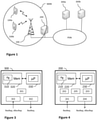
- the figure 1 illustrates a configuration of a mobile access network of the cellular type and the interactions between entities of such a network during the access of two user terminals to multimedia content on two content servers, according to an embodiment of the 'invention.
- the edge computing technology (or edge or periphery) of the cellular network offers the possibility of taking advantage of a location at the edge of the cellular network to optimize applications dedicated to the users of such a cellular network. It thus appears that the MEC technology could be adapted to the various problems of the diffusion of multimedia contents in a cellular network and in a multiuser environment.
- the control server 200 is such a server of MEC type and is located between the PDN network and the base station 100 which manages the radio part of the cellular network MAN (or mobile access network, by generalization). Its location allows the control server 200 to manage the traffic from and to the mobile terminals 100a and 100b of users, as well as to access information in real time on the operation of the radio part of the network.
- a device for allocating physical resource blocks of a mobile access network implementing the technique described is included in the control server 200.
- the base station 100 is for example an eNodeB of the 4G mobile technology.
- the PDN network is for example the core network of the operator of the cellular network, or the Internet network, or encompasses both at the same time.
- the multimedia contents requested respectively by the terminals 100a and 100b are hosted by the content servers 300a and 300b.
- the servers 300a and 300b are, for example, so-called cache servers, to which the content requests are redirected by other servers further upstream and directly requested by the requesting mobile terminals.
- a content server or cache sends requested multimedia content to a requesting terminal in the form of a data stream, cut into successive pieces whose size is variable and determined according to several criteria, such as the size of the buffer memory of the terminal, and also the radio characteristics of the MAN mobile access network.
- the way in which the size of the pieces is indirectly determined is the subject of the block reservation and allocation methods proposed below.
- the example embodiments are shown based on 2 terminals mobiles 100a and 100b, and 2 servers 300a and 300b, but the proposed methods apply to any number of distinct content servers serving at least as many distinct terminals, a content server being able to serve more than one terminal.
- terminal is the same as “terminal client software”.
- client software programs running on the same physical terminal are to be considered as so many terminals, if they receive streams from different content servers.
- the figure 2 illustrates the steps of a reservation method and a method of allocating physical resource blocks of a mobile access network, according to several embodiments of the invention.
- a request for multimedia content emanating from the terminal 100a is received by the content server 300a, directly or indirectly via a network head server, or via a content referencing server, by example.
- this request can also include one or more characteristic parameters of the terminal 100a and of its connection to the mobile access network, such as for example a CQI (Channel Quality Indicator, or channel quality indicator, in English), a filling status of a buffer memory.
- the content server 300a can also deduce the state of filling of the buffer memory from a count of the pieces of stream already transmitted.
- a request for multimedia content emanating from the terminal 100b is received by the content server 300b.
- the content servers 300a and 300b are managed by independent content providers from each other, and do not share any information about their users or the content they request.
- the content server 300a determines a number N0a of blocks, called RBs, to be reserved with the control server 200, according to parameters linked to the content requested, that is to say linked to the flow of data necessary to be implemented to deliver this content, and according to parameters linked to the terminal, that is to say linked to a level of quality compatible with the conditions of the terminal 100a and of its radio link with the network of MAN mobile access.
- RBs a number of blocks, called RBs
- the server can deduce the instantaneous consumption of the terminal in RB per kilobyte.
- the CQI changes over time depending on several parameters: distance of the terminal from the station, interference, presence of obstacles to propagation (rain, tree, etc.), the most impacting parameter being the distance between the terminal and the base station 100.
- This information can be sent regularly by the terminal, which implies trust on the part of the content provider, or be provided by the server 200.
- the radio technology used is information supplied by the terminal.
- the channel bandwidth corresponds to the size of the frequency band used by the station, granted to the operator of the mobile access network. It allows to know the division in number of RBs. This is static information supplied to the content servers 300a and 300b during an initialization phase.
- the correspondence between the CQI and the "TBS" depends on the equipment that the base station 100 uses. This information, which is not static, is known to the control server 200 and can be transmitted to the content servers 300a and 300b dynamically over time.
- the TBS also depends on the channel bandwidth. To a CQI and a bandwidth corresponds a TBS.
- the MIMO used, 2x2 or 4x4 for example, depends on the equipment the base station uses. This information may be provided by control server 200 to content servers 300a and 300b on initialization.
- step E1a the content server 300a has determined that it wishes to transmit to the terminal 100a a piece of stream whose volume is 0.9 Mb, the number N0a of RBs that it must reserve in these conditions is 600.
- the content server 300b also determines a number of blocks RB to reserve with the control server 200, the value of which is N0b.
- the content server 300a sends a first reservation request for a number of blocks equal to N0a, intended for the control server 200.
- This request can be transported in a message using any protocol, for example an http request with an XML body including a ⁇ requested RB> parameter.
- the content server 300b sends a first reservation request for a number of blocks equal to N0b, also intended for the control server 200. It is understood that these first two reservation requests are made by the servers content 300a and 300b without consultation with each other, and without knowledge of the total number of blocks available to the control server 200 to satisfy their respective reservation requests.
- the control server 200 knows, for any time interval, the number of blocks RB available, Ndis, for the transmission of data by electric radio from the base station 100 to all the mobile terminals attached to the base station. base and having made resource reservations, that is to say, in our simplified example, the number of blocks available for the transmission of data from the base station 100 to the 2 terminals 100a and 100b.
- control server 200 calculates a difference between Ndis, the number of blocks available, and the sum of the blocks requested for reservation, that is to say N0a+N0b.
- control server 200 decides, during a step E4, to allocate to each of the content servers 300a and 300b a number close to or equal to the numbers of RB blocks they requested (respectively N0a and N0b). If the difference is large but the supply is greater than the demand, the control server 200 does the same.
- control server 200 decides to enter a negotiation cycle C with the requesting terminals 100a and 100b, of which the goal is to reduce the gap between supply (the number of blocks available, Ndis) and demand (the number of blocks requested, N0a+N0b).
- At least one trading cycle C may be required to converge supply and demand, and only one will be described. Stages of the C trading cycle are indicated by a letter C followed by other characters.
- the control server 200 decides to modify the cost of use of the blocks RB by the terminals. Initially, this cost may be non-existent, or of a value known to the terminals. For simplicity, it is considered that, outside cycle C, the unit cost of the RB is standard and constant or does not change frequently enough to have an impact on the reservation requests made by the content servers during the previous steps E2a and E2b.
- the control server 200 therefore sends a reservation response to the content server 300a, not to indicate to it that its request has been satisfied, or to indicate to it the number of RBs allocated to it, but to provide him with information relating to a modification of the unit cost of the RB.
- This information can be the new value of the unit cost of the BN, or the value of an additional cost compared to the standard unit cost of the BN.
- This response can be transported in a message using any protocol, for example a http request with an XML body including a ⁇ price RB> parameter.
- control server 200 sends a reservation response also to the content server 300b, comprising the same information relating to the modification of the unit cost of the RB.
- the content server 300a determines a new number of blocks RB to reserve, NC1a, with the control server 200, according to the parameters linked to the requested content and according to parameters linked to the terminal, as during of step E1a, with the difference that in this step C6a, the content server 300a determines this new number of blocks to be reserved also according to the value of the modified unit cost of the RB, received during step C5a. Even if a cost per RB increased by the control server 200 is made with the objective of encouraging the content server 300a to reduce the number of RBs for which it requests the reservation, it can decide to maintain the same number, for example because he got an indication that the terminal 100a buffer is empty or nearly empty.
- the content server 300a can decide to reduce the number of RBs from which it requests reservation for some of the terminals, and to maintain it for certain privileged terminals, while reducing the total number for all the terminals it serves.
- the content server 300b determines a new number of blocks RB, NC1b, to reserve with the control server 200.
- the content server 300a sends a second reservation request for a number of blocks equal to NC1a, intended for the control server 200.
- the content server 300a sends a second reservation request for a number of blocks equal to NC1b, intended for the control server 200.
- This second request can be transported in a message using a any protocol, for example an http request with an XML body including a ⁇ revised RB> parameter.
- control server 200 having received the second reservation requests from the content servers 300a and 300b, calculates a difference between Ndis, the number of blocks available, and the sum of the blocks requested for reservation, c i.e. CL1a+CL1b.
- control server 200 decides to exit the negotiation cycle C and to implement the step E4 already described, that is to say to allocate to each of the content servers 300a and 300b a number close to or equal to the numbers of blocks RB that they have requested (respectively NC1a and NC1b).
- step E4 particularly when it is performed after at least one iteration of the cycle C, it is advantageous for the control server 200 to memorize the number of blocks allocated to each of the content servers as well as the unit cost per block RB used, for subsequent invoicing purposes to the operators managing the content servers.
- control server 200 decides to remain in the negotiation cycle C, by implementing once again all the steps of the cycle C, from step C4 to step C8.
- another condition for exiting the cycle may be a maximum time elapsed since the first iteration, or a maximum number of iterations, in other words the achievement of a limits the number of second reservation requests that content servers can issue.
- control server 200 informs the content servers thereof.
- the control server 200 sends an allocation response to the server 300a comprising information relating to the number of blocks RB which are allocated for the transmission of data from the server 300a by the base station 100 to the terminal 100a.
- This response can be transported in a message using any protocol, for example an http request with an XML body including an ⁇ allocated RB> parameter.
- control server 200 sends an allocation response to the server 300b comprising information relating to the number of blocks RB which are allocated for the transmission of data from the server 300b by the base station 100 to terminal 100b.
- the content server 300a determines according to the number of RBs allocated the volume of data forming part of a stream, or stream pieces, that it will have to transfer to the base station 100 so that it sends it to the terminal 100a. This determination is the reverse operation of step E1a, where the server 300a determined a number of RBs according to parameters linked to the data stream.
- the content server 300b determines according to the number of RBs allocated the size of a piece of stream.
- step E300a in response to the request for multimedia content emanating from the terminal 100a transmitted during step E100a, the content server 300a transmits its piece of stream to the terminal 100a through the base station 100.
- the content server 300b in response to the request for multimedia content emanating from the terminal 100b sent during step E100b, the content server 300b sends its piece of stream to the terminal 100b through base station 100.
- the device 300 for reserving physical resource blocks of a mobile access network implements the method for reserving physical resource blocks of a mobile access network, various embodiments of which have just been described.
- Such a device 300 can be implemented in a content server, a cache server, or any other server capable of transmitting multimedia data streams to mobile terminals.
- the device 300 comprises a processing unit 330, equipped for example with a microprocessor ⁇ P, and controlled by a computer program 310, stored in a memory 320 and implementing the reservation method according to the invention.
- a computer program 310 stored in a memory 320 and implementing the reservation method according to the invention.
- the code instructions of the computer program 310 are for example loaded into a RAM memory, before being executed by the processor of the processing unit 330.
- the module 301 is also capable of, and configured to take into account a unit cost per resource block.
- the receiver 303 is also capable of and configured to receive a reservation response (ResRep), comprising a parameter relating to a unit cost of a resource block.
- ResRep a reservation response
- the transmitter 302 is also capable of, and configured to transmit a second resource block reservation request (ResReq), comprising a revised value of a number of blocks to be reserved, determined at least according to the unit cost of a resource block.
- ResReq a second resource block reservation request
- the device 200 for allocating physical resource blocks of a mobile access network implements the method for allocating physical resource blocks of a mobile access network, various embodiments of which have just been described. described.
- Such a device 200 can be implemented in a control server, connected to a base station and capable of managing traffic from and to mobile terminals, as well as accessing real-time information on the operation of the radio part of the base station.
- This control server is for example of the MEC (Mobile Edge Computing) type.
- the device 200 comprises a processing unit 230, equipped for example with a microprocessor ⁇ P, and controlled by a computer program 210, stored in a memory 220 and implementing the reservation method according to the invention.
- a computer program 210 stored in a memory 220 and implementing the reservation method according to the invention.
- the code instructions of the computer program 210 are for example loaded into a RAM memory, before being executed by the processor of the processing unit 230.
- the device 200 also comprises an adjustment module 205, capable of and configured for adjusting the unit cost at least as a function of the difference.
- the sender 204 is also capable of and configured to send reservation responses to the content servers (ResRep), comprising information relating to the unit cost.
- ResRep content servers
- the modules described in relation to the figures 3 and 4 can be hardware or software.
- FIG. 3 and 4 illustrate only one particular way, among several possible, of carrying out the methods detailed above, in relation to the figure 1 and 2 . Indeed, the technique of the invention is carried out either on a reprogrammable calculation machine (a PC computer, a DSP processor or a microcontroller) executing a program comprising a sequence of instructions, or on a dedicated calculation machine (for example a set of logic gates like an FPGA or an ASIC, or any other hardware module).
- a reprogrammable calculation machine a PC computer, a DSP processor or a microcontroller
- a dedicated calculation machine for example a set of logic gates like an FPGA or an ASIC, or any other hardware module.
- the corresponding program (that is to say the sequence of instructions) can be stored in a removable storage medium (such as for example a diskette, a CD-ROM or a DVD-ROM) or not, this storage medium being partially or totally readable by a computer or a processor.
- a removable storage medium such as for example a diskette, a CD-ROM or a DVD-ROM
- the exemplary embodiments of the invention which have just been presented are only a few of the possible embodiments. They show that the invention makes it possible to obtain optimal consumption of the radio resources of the mobile access network, without the content providers sharing, either among themselves or with the mobile access network operators, the information that they hold about their users and how they consume their content.
Landscapes
- Engineering & Computer Science (AREA)
- Computer Networks & Wireless Communication (AREA)
- Signal Processing (AREA)
- Quality & Reliability (AREA)
- Mobile Radio Communication Systems (AREA)
Claims (13)
- Verfahren zur Reservierung physikalischer Ressourcenblöcke eines mobilen Zugangsnetzes (MAN), durchgeführt von einem Inhaltsserver (300a, 300b), der konfiguriert ist, einen von einem mit dem mobilen Zugangsnetz verbundenen Endgerät (100a, 100b) angeforderten Datenstrom mit einem bestimmten Qualitätsniveau zu senden, wobei das Verfahren enthält:• Bestimmung (E1a, E1b; C6a, C6b) eines Werts einer Anzahl von zu reservierenden Blöcken, abhängig von mit dem Datenstrom verbundenen Parametern, vom bestimmten Qualitätsniveau und von einem Einheitspreis pro Block,• Senden (E2a, E2b; C7a, C7b) einer Reservierungsanforderung von Ressourcenblöcken, die den bestimmten Wert der Anzahl von zu reservierenden Blöcken enthält, an eine Steuerentität (200) des mobilen Zugangsnetzes,• Empfang (E5a, E5b) einer Zuweisungsantwort von Ressourcenblöcken von der Steuerentität, die einen Wert einer Anzahl von dem Inhaltsserver zugewiesenen Blöcken enthält.
- Reservierungsverfahren nach Anspruch 1, das vor dem Senden (C7a, C7b) der Reservierungsanforderung enthält:• Empfang (C5a, C5b) einer Reservierungsantwort von der Steuerentität (200), die einen Parameter bezüglich des Einheitspreises eines Blocks enthält.
- Zuweisungsverfahren physikalischer Ressourcenblöcke eines mobilen Zugangsnetzes (MAN) für eine Vielzahl von Inhaltsservern (300a, 300b), die konfiguriert sind, Datenströme an mit dem mobilen Zugangsnetz verbundene Endgeräte (100a, 100b) zu senden, wobei das Verfahren von einer Steuerentität des mobilen Zugangsnetzes (200) durchgeführt wird und enthält:• Empfang (E2a, E2b; C7a, C7b) von Reservierungsanforderungen von Blöcken, für die ein Einheitspreis pro Block festgelegt ist, von der Vielzahl von Inhaltsservern (300a, 300b), wobei eine erste Anforderung eines Inhaltsservers einen Wert einer Anzahl von von diesem Inhaltsserver angeforderten Blöcken enthält,• Berechnung (E3, C8) einer Abweichung zwischen einer Anzahl von im mobilen Zugangsnetz verfügbaren Blöcken und der Gesamtheit der Anzahlen angeforderter Blöcke,• Anpassung (C4) des Einheitspreises mindestens abhängig von der Abweichung,• Bestimmung (E4), zumindest abhängig von der Abweichung, von Werten von Anzahlen von Blöcken, die den Inhaltsservern zugewiesen werden,• Senden (E5a, E5b) von Zuweisungsantworten von Blöcken an die Vielzahl von Inhaltsservern, wobei eine Zuweisungsantwort an einen Inhaltsserver den Wert der Anzahl von Blöcken enthält, die diesem Inhaltsserver zugewiesen werden.
- Zuweisungsverfahren nach Anspruch 3, wobei das Verfahren außerdem vor dem Empfang (C7a, C7b) von Reservierungsanforderungen enthält:• Senden (C5a, C5b) von Reservierungsantworten an die Vielzahl von Inhaltsservern, die eine Information bezüglich des Einheitspreises enthalten.
- Reservierungsvorrichtung physikalischer Ressourcenblöcke eines mobilen Zugangsnetzes (MAN), die in einem Inhaltsserver (300a, 300b) enthalten ist, der konfiguriert ist, einen von einem mit dem mobilen Zugangsnetz verbundenen Endgerät (100a, 100b) angeforderten Datenstrom mit einem bestimmten Qualitätsniveau zu senden, wobei die Vorrichtung enthält:• ein Modul zur Bestimmung (301) eines Werts einer Anzahl von zu reservierenden Blöcken, abhängig von mit dem Datenstrom verbundenen Parametern, vom bestimmten Qualitätsniveau und von einem Einheitspreis pro Block,• einen Sender (302) einer Reservierungsanforderung (ResReq) von Ressourcenblöcken, die den bestimmten Wert der Anzahl von Blöcken enthält, an eine Steuerentität des mobilen Zugangsnetzes,• einen Empfänger (303) einer Zuweisungsantwort (AllocRep) von Ressourcenblöcken von der Steuerentität, die einen Wert einer Anzahl von dem Inhaltsserver zugewiesenen Blöcken enthält.
- Reservierungsvorrichtung nach Anspruch 5, wobei der Empfänger (303) ebenfalls geeignet und konfiguriert ist, eine Reservierungsantwort (ResRep) zu empfangen, die einen Parameter bezüglich des Einheitspreises enthält.
- Zuweisungsvorrichtung physikalischer Ressourcenblöcke eines mobilen Zugangsnetzes (MAN) für eine Vielzahl von Inhaltsservern (300a, 300b), die konfiguriert sind, Datenströme an mit dem mobilen Zugangsnetz verbundene Endgeräte (100a, 100b) zu senden, wobei die Vorrichtung enthält:• einen Empfänger (201) von Reservierungsanforderungen (ResReq) von Blöcken von der Vielzahl von Inhaltsservern, wobei eine Anforderung eines Inhaltsservers einen Wert einer Anzahl von von diesem Inhaltsserver angeforderten Blöcken enthält,• ein Berechnungsmodul (202) einer Abweichung zwischen einer Anzahl von im mobilen Zugangsnetz verfügbaren Blöcken und der Gesamtheit der angeforderten Anzahlen von Blöcken,• ein Anpassungsmodul (205) des Einheitspreises abhängig von der berechneten Abweichung,• ein Modul zur Bestimmung (203), mindestens abhängig von der Abweichung, von Werten von Anzahlen von Blöcken, die den Inhaltsservern zugewiesen sind,• einen Sender (204) von Zuweisungsantworten von Blöcken an die Vielzahl von Inhaltsservern, wobei eine Zuweisungsantwort an einen Inhaltsserver den Wert der Anzahl von Blöcken enthält, die diesem Inhaltsserver zugewiesen werden.
- Zuweisungsvorrichtung nach Anspruch 7, wobei der Sender (204) außerdem geeignet ist, Reservierungsantworten (ResRep) an die Vielzahl von Inhaltsservern (300a, 300b) zu senden, die eine Information bezüglich des Einheitspreises enthalten.
- System zur gemeinsamen Nutzung physikalischer Ressourcenblöcke eines mobilen Zugangsnetzes (MAN), das mindestens zwei Reservierungsvorrichtungen (300a, 300b) gemäß Anspruch 5 und eine Zuweisungsvorrichtung (200) gemäß Anspruch 7 enthält, wobei die Zuweisungsvorrichtung mit den Reservierungsvorrichtungen und mit einer Basisstation (100) verbunden ist.
- Computerprogramm, das Anweisungen zur Durchführung der Schritte des Reservierungsverfahrens physikalischer Ressourcenblöcke eines mobilen Zugangsnetzes nach Anspruch 1 enthält, wenn dieses Programm von einem Prozessor ausgeführt wird.
- Informationsträger, der von einem Inhaltsserver lesbar ist und Anweisungen eines Computerprogramms gemäß Anspruch 10 aufweist.
- Computerprogramm, das Anweisungen zur Durchführung der Schritte des Zuweisungsverfahrens physikalischer Ressourcenblöcke eines mobilen Zugangsnetzes nach Anspruch 3 enthält, wenn dieses Programm von einem Prozessor ausgeführt wird.
- Informationsträger, der von einem mit einer Basisstation verbundenen Steuerserver gelesen werden kann und Anweisungen eines Computerprogramms gemäß Anspruch 12 aufweist.
Applications Claiming Priority (2)
| Application Number | Priority Date | Filing Date | Title |
|---|---|---|---|
| FR1756374A FR3068553A1 (fr) | 2017-07-06 | 2017-07-06 | Partage de ressources radio pour des serveurs de contenu. |
| PCT/FR2018/051528 WO2019008248A1 (fr) | 2017-07-06 | 2018-06-22 | Partage de ressources radio pour des serveurs de contenu |
Publications (2)
| Publication Number | Publication Date |
|---|---|
| EP3649821A1 EP3649821A1 (de) | 2020-05-13 |
| EP3649821B1 true EP3649821B1 (de) | 2022-03-16 |
Family
ID=60302190
Family Applications (1)
| Application Number | Title | Priority Date | Filing Date |
|---|---|---|---|
| EP18749449.7A Active EP3649821B1 (de) | 2017-07-06 | 2018-06-22 | Radio-ressourcen für content-server teilen |
Country Status (4)
| Country | Link |
|---|---|
| US (1) | US11272404B2 (de) |
| EP (1) | EP3649821B1 (de) |
| FR (1) | FR3068553A1 (de) |
| WO (1) | WO2019008248A1 (de) |
Family Cites Families (10)
| Publication number | Priority date | Publication date | Assignee | Title |
|---|---|---|---|---|
| WO1998054868A1 (en) * | 1997-05-30 | 1998-12-03 | Northern Telecom Limited | Control in a data access transport service |
| GB2418267A (en) * | 2004-09-08 | 2006-03-22 | Qinetiq Ltd | Shared resource management |
| US7899865B2 (en) * | 2005-04-22 | 2011-03-01 | At&T Intellectual Property Ii, L.P. | Managing media server resources in a VoIP network |
| FR2900529A1 (fr) * | 2006-04-26 | 2007-11-02 | France Telecom | Gestion de ressources radio dans un reseau de telecommunications radio |
| US8285298B2 (en) * | 2009-12-23 | 2012-10-09 | At&T Mobility Ii Llc | Chromatic scheduler for network traffic with disparate service requirements |
| US8549570B2 (en) * | 2012-02-23 | 2013-10-01 | Ericsson Television Inc. | Methods and apparatus for managing network resources used by multimedia streams in a virtual pipe |
| FR3023108A1 (fr) | 2014-06-30 | 2016-01-01 | Orange | Procede et dispositif d'orchestration de ressources |
| US10326889B2 (en) * | 2016-06-21 | 2019-06-18 | At&T Mobility Ii Llc | Method and apparatus for distributing content via a wireless communication network |
| US10601946B2 (en) * | 2017-02-23 | 2020-03-24 | The Directv Group, Inc. | Edge cache segment prefetching |
| US10484308B2 (en) * | 2017-03-31 | 2019-11-19 | At&T Intellectual Property I, L.P. | Apparatus and method of managing resources for video services |
-
2017
- 2017-07-06 FR FR1756374A patent/FR3068553A1/fr not_active Ceased
-
2018
- 2018-06-22 WO PCT/FR2018/051528 patent/WO2019008248A1/fr not_active Ceased
- 2018-06-22 EP EP18749449.7A patent/EP3649821B1/de active Active
- 2018-06-22 US US16/628,510 patent/US11272404B2/en active Active
Also Published As
| Publication number | Publication date |
|---|---|
| FR3068553A1 (fr) | 2019-01-04 |
| US11272404B2 (en) | 2022-03-08 |
| WO2019008248A1 (fr) | 2019-01-10 |
| EP3649821A1 (de) | 2020-05-13 |
| US20200187057A1 (en) | 2020-06-11 |
Similar Documents
| Publication | Publication Date | Title |
|---|---|---|
| US10805837B2 (en) | Context aware and adaptive QOS/QOE target definition in 5G | |
| US9660922B2 (en) | Network assisted rate shifting for adaptive bit rate streaming | |
| US20150256577A1 (en) | Directing Fragmented Content | |
| US11924650B2 (en) | System, method and service product for content delivery | |
| US9609370B2 (en) | Video delivery modification based on network availability | |
| US9178929B2 (en) | Client-side class-of-service-based bandwidth management in over-the-top video delivery | |
| CN103828327A (zh) | 用于控制带宽的方法以及相应的设备 | |
| FR3023108A1 (fr) | Procede et dispositif d'orchestration de ressources | |
| US20130190026A1 (en) | Enhanced resource management for a network system | |
| US20170134987A1 (en) | Wireless video download rate optimization | |
| Hayamizu et al. | QoE-aware bitrate selection in cooperation with in-network caching for information-centric networking | |
| WO2013017001A1 (zh) | 一种实现应用性能自适应的方法、装置及系统 | |
| EP2732588B1 (de) | Richtlinien-tokens in kommunikationsnetzen | |
| EP3646196B1 (de) | Verfahren und vorrichtung zum herunterladen audiovisueller inhalte | |
| US20130311668A1 (en) | Methods And Systems For Providing Fairness And Stability To Video Streams | |
| EP3437292B1 (de) | Verfahren zur optimierung des durchsatzes von multimedia-inhalten, auf die von mindestens einem benutzergerät zugegriffen werden kann, zugehöriges computerprogrammprodukt und verwaltungsvorrichtung | |
| CN114245225B (zh) | 用于经由内容分发网络流式传输媒体数据的方法及系统 | |
| EP3649821A1 (de) | Gemeinsame nutzung von funkressourcen für inhaltsserver | |
| US11627358B2 (en) | Communication entity and a method for transmitting a video data stream | |
| FR2899054A1 (fr) | Procede et systeme d'allocation de ressources | |
| EP3563494A1 (de) | Verfahren und vorrichtung zur erneuten zuweisung von satellitenressourcen | |
| EP4595412A1 (de) | Auswahl einer vorrichtung zum hosten mindestens eines anwendungsprozesses zwischen mehreren vorrichtungen einer kommunikationsinfrastruktur | |
| Kara et al. | HTTP adaptive streaming over multiple network interfaces | |
| FR3053556A1 (fr) | Procede et dispositif de gestion d'une session de transmission d'un flux video | |
| WO2012131279A1 (fr) | Procede de repartition de flux de donnees multicast dans des groupes de diffusion multicast |
Legal Events
| Date | Code | Title | Description |
|---|---|---|---|
| STAA | Information on the status of an ep patent application or granted ep patent |
Free format text: STATUS: UNKNOWN |
|
| STAA | Information on the status of an ep patent application or granted ep patent |
Free format text: STATUS: THE INTERNATIONAL PUBLICATION HAS BEEN MADE |
|
| PUAI | Public reference made under article 153(3) epc to a published international application that has entered the european phase |
Free format text: ORIGINAL CODE: 0009012 |
|
| STAA | Information on the status of an ep patent application or granted ep patent |
Free format text: STATUS: REQUEST FOR EXAMINATION WAS MADE |
|
| 17P | Request for examination filed |
Effective date: 20200203 |
|
| AK | Designated contracting states |
Kind code of ref document: A1 Designated state(s): AL AT BE BG CH CY CZ DE DK EE ES FI FR GB GR HR HU IE IS IT LI LT LU LV MC MK MT NL NO PL PT RO RS SE SI SK SM TR |
|
| AX | Request for extension of the european patent |
Extension state: BA ME |
|
| RAP1 | Party data changed (applicant data changed or rights of an application transferred) |
Owner name: ORANGE |
|
| DAV | Request for validation of the european patent (deleted) | ||
| DAX | Request for extension of the european patent (deleted) | ||
| RAP3 | Party data changed (applicant data changed or rights of an application transferred) |
Owner name: ORANGE |
|
| GRAP | Despatch of communication of intention to grant a patent |
Free format text: ORIGINAL CODE: EPIDOSNIGR1 |
|
| STAA | Information on the status of an ep patent application or granted ep patent |
Free format text: STATUS: GRANT OF PATENT IS INTENDED |
|
| INTG | Intention to grant announced |
Effective date: 20211004 |
|
| GRAS | Grant fee paid |
Free format text: ORIGINAL CODE: EPIDOSNIGR3 |
|
| GRAA | (expected) grant |
Free format text: ORIGINAL CODE: 0009210 |
|
| STAA | Information on the status of an ep patent application or granted ep patent |
Free format text: STATUS: THE PATENT HAS BEEN GRANTED |
|
| AK | Designated contracting states |
Kind code of ref document: B1 Designated state(s): AL AT BE BG CH CY CZ DE DK EE ES FI FR GB GR HR HU IE IS IT LI LT LU LV MC MK MT NL NO PL PT RO RS SE SI SK SM TR |
|
| REG | Reference to a national code |
Ref country code: GB Ref legal event code: FG4D Free format text: NOT ENGLISH |
|
| REG | Reference to a national code |
Ref country code: CH Ref legal event code: EP Ref country code: DE Ref legal event code: R096 Ref document number: 602018032353 Country of ref document: DE |
|
| REG | Reference to a national code |
Ref country code: IE Ref legal event code: FG4D Free format text: LANGUAGE OF EP DOCUMENT: FRENCH |
|
| REG | Reference to a national code |
Ref country code: AT Ref legal event code: REF Ref document number: 1476774 Country of ref document: AT Kind code of ref document: T Effective date: 20220415 |
|
| REG | Reference to a national code |
Ref country code: LT Ref legal event code: MG9D |
|
| REG | Reference to a national code |
Ref country code: NL Ref legal event code: MP Effective date: 20220316 |
|
| PG25 | Lapsed in a contracting state [announced via postgrant information from national office to epo] |
Ref country code: SE Free format text: LAPSE BECAUSE OF FAILURE TO SUBMIT A TRANSLATION OF THE DESCRIPTION OR TO PAY THE FEE WITHIN THE PRESCRIBED TIME-LIMIT Effective date: 20220316 Ref country code: RS Free format text: LAPSE BECAUSE OF FAILURE TO SUBMIT A TRANSLATION OF THE DESCRIPTION OR TO PAY THE FEE WITHIN THE PRESCRIBED TIME-LIMIT Effective date: 20220316 Ref country code: NO Free format text: LAPSE BECAUSE OF FAILURE TO SUBMIT A TRANSLATION OF THE DESCRIPTION OR TO PAY THE FEE WITHIN THE PRESCRIBED TIME-LIMIT Effective date: 20220616 Ref country code: LT Free format text: LAPSE BECAUSE OF FAILURE TO SUBMIT A TRANSLATION OF THE DESCRIPTION OR TO PAY THE FEE WITHIN THE PRESCRIBED TIME-LIMIT Effective date: 20220316 Ref country code: HR Free format text: LAPSE BECAUSE OF FAILURE TO SUBMIT A TRANSLATION OF THE DESCRIPTION OR TO PAY THE FEE WITHIN THE PRESCRIBED TIME-LIMIT Effective date: 20220316 Ref country code: BG Free format text: LAPSE BECAUSE OF FAILURE TO SUBMIT A TRANSLATION OF THE DESCRIPTION OR TO PAY THE FEE WITHIN THE PRESCRIBED TIME-LIMIT Effective date: 20220616 |
|
| REG | Reference to a national code |
Ref country code: AT Ref legal event code: MK05 Ref document number: 1476774 Country of ref document: AT Kind code of ref document: T Effective date: 20220316 |
|
| PG25 | Lapsed in a contracting state [announced via postgrant information from national office to epo] |
Ref country code: LV Free format text: LAPSE BECAUSE OF FAILURE TO SUBMIT A TRANSLATION OF THE DESCRIPTION OR TO PAY THE FEE WITHIN THE PRESCRIBED TIME-LIMIT Effective date: 20220316 Ref country code: GR Free format text: LAPSE BECAUSE OF FAILURE TO SUBMIT A TRANSLATION OF THE DESCRIPTION OR TO PAY THE FEE WITHIN THE PRESCRIBED TIME-LIMIT Effective date: 20220617 Ref country code: FI Free format text: LAPSE BECAUSE OF FAILURE TO SUBMIT A TRANSLATION OF THE DESCRIPTION OR TO PAY THE FEE WITHIN THE PRESCRIBED TIME-LIMIT Effective date: 20220316 |
|
| PG25 | Lapsed in a contracting state [announced via postgrant information from national office to epo] |
Ref country code: NL Free format text: LAPSE BECAUSE OF FAILURE TO SUBMIT A TRANSLATION OF THE DESCRIPTION OR TO PAY THE FEE WITHIN THE PRESCRIBED TIME-LIMIT Effective date: 20220316 |
|
| PG25 | Lapsed in a contracting state [announced via postgrant information from national office to epo] |
Ref country code: SM Free format text: LAPSE BECAUSE OF FAILURE TO SUBMIT A TRANSLATION OF THE DESCRIPTION OR TO PAY THE FEE WITHIN THE PRESCRIBED TIME-LIMIT Effective date: 20220316 Ref country code: SK Free format text: LAPSE BECAUSE OF FAILURE TO SUBMIT A TRANSLATION OF THE DESCRIPTION OR TO PAY THE FEE WITHIN THE PRESCRIBED TIME-LIMIT Effective date: 20220316 Ref country code: RO Free format text: LAPSE BECAUSE OF FAILURE TO SUBMIT A TRANSLATION OF THE DESCRIPTION OR TO PAY THE FEE WITHIN THE PRESCRIBED TIME-LIMIT Effective date: 20220316 Ref country code: PT Free format text: LAPSE BECAUSE OF FAILURE TO SUBMIT A TRANSLATION OF THE DESCRIPTION OR TO PAY THE FEE WITHIN THE PRESCRIBED TIME-LIMIT Effective date: 20220718 Ref country code: ES Free format text: LAPSE BECAUSE OF FAILURE TO SUBMIT A TRANSLATION OF THE DESCRIPTION OR TO PAY THE FEE WITHIN THE PRESCRIBED TIME-LIMIT Effective date: 20220316 Ref country code: EE Free format text: LAPSE BECAUSE OF FAILURE TO SUBMIT A TRANSLATION OF THE DESCRIPTION OR TO PAY THE FEE WITHIN THE PRESCRIBED TIME-LIMIT Effective date: 20220316 Ref country code: CZ Free format text: LAPSE BECAUSE OF FAILURE TO SUBMIT A TRANSLATION OF THE DESCRIPTION OR TO PAY THE FEE WITHIN THE PRESCRIBED TIME-LIMIT Effective date: 20220316 Ref country code: AT Free format text: LAPSE BECAUSE OF FAILURE TO SUBMIT A TRANSLATION OF THE DESCRIPTION OR TO PAY THE FEE WITHIN THE PRESCRIBED TIME-LIMIT Effective date: 20220316 |
|
| PG25 | Lapsed in a contracting state [announced via postgrant information from national office to epo] |
Ref country code: PL Free format text: LAPSE BECAUSE OF FAILURE TO SUBMIT A TRANSLATION OF THE DESCRIPTION OR TO PAY THE FEE WITHIN THE PRESCRIBED TIME-LIMIT Effective date: 20220316 Ref country code: IS Free format text: LAPSE BECAUSE OF FAILURE TO SUBMIT A TRANSLATION OF THE DESCRIPTION OR TO PAY THE FEE WITHIN THE PRESCRIBED TIME-LIMIT Effective date: 20220716 Ref country code: AL Free format text: LAPSE BECAUSE OF FAILURE TO SUBMIT A TRANSLATION OF THE DESCRIPTION OR TO PAY THE FEE WITHIN THE PRESCRIBED TIME-LIMIT Effective date: 20220316 |
|
| REG | Reference to a national code |
Ref country code: DE Ref legal event code: R097 Ref document number: 602018032353 Country of ref document: DE |
|
| PLBE | No opposition filed within time limit |
Free format text: ORIGINAL CODE: 0009261 |
|
| STAA | Information on the status of an ep patent application or granted ep patent |
Free format text: STATUS: NO OPPOSITION FILED WITHIN TIME LIMIT |
|
| PG25 | Lapsed in a contracting state [announced via postgrant information from national office to epo] |
Ref country code: MC Free format text: LAPSE BECAUSE OF FAILURE TO SUBMIT A TRANSLATION OF THE DESCRIPTION OR TO PAY THE FEE WITHIN THE PRESCRIBED TIME-LIMIT Effective date: 20220316 Ref country code: DK Free format text: LAPSE BECAUSE OF FAILURE TO SUBMIT A TRANSLATION OF THE DESCRIPTION OR TO PAY THE FEE WITHIN THE PRESCRIBED TIME-LIMIT Effective date: 20220316 |
|
| REG | Reference to a national code |
Ref country code: CH Ref legal event code: PL |
|
| REG | Reference to a national code |
Ref country code: BE Ref legal event code: MM Effective date: 20220630 |
|
| 26N | No opposition filed |
Effective date: 20221219 |
|
| PG25 | Lapsed in a contracting state [announced via postgrant information from national office to epo] |
Ref country code: SI Free format text: LAPSE BECAUSE OF FAILURE TO SUBMIT A TRANSLATION OF THE DESCRIPTION OR TO PAY THE FEE WITHIN THE PRESCRIBED TIME-LIMIT Effective date: 20220316 |
|
| PG25 | Lapsed in a contracting state [announced via postgrant information from national office to epo] |
Ref country code: LU Free format text: LAPSE BECAUSE OF NON-PAYMENT OF DUE FEES Effective date: 20220622 Ref country code: LI Free format text: LAPSE BECAUSE OF NON-PAYMENT OF DUE FEES Effective date: 20220630 Ref country code: IE Free format text: LAPSE BECAUSE OF NON-PAYMENT OF DUE FEES Effective date: 20220622 Ref country code: CH Free format text: LAPSE BECAUSE OF NON-PAYMENT OF DUE FEES Effective date: 20220630 |
|
| PG25 | Lapsed in a contracting state [announced via postgrant information from national office to epo] |
Ref country code: BE Free format text: LAPSE BECAUSE OF NON-PAYMENT OF DUE FEES Effective date: 20220630 |
|
| PG25 | Lapsed in a contracting state [announced via postgrant information from national office to epo] |
Ref country code: IT Free format text: LAPSE BECAUSE OF FAILURE TO SUBMIT A TRANSLATION OF THE DESCRIPTION OR TO PAY THE FEE WITHIN THE PRESCRIBED TIME-LIMIT Effective date: 20220316 |
|
| PG25 | Lapsed in a contracting state [announced via postgrant information from national office to epo] |
Ref country code: MK Free format text: LAPSE BECAUSE OF FAILURE TO SUBMIT A TRANSLATION OF THE DESCRIPTION OR TO PAY THE FEE WITHIN THE PRESCRIBED TIME-LIMIT Effective date: 20220316 Ref country code: CY Free format text: LAPSE BECAUSE OF FAILURE TO SUBMIT A TRANSLATION OF THE DESCRIPTION OR TO PAY THE FEE WITHIN THE PRESCRIBED TIME-LIMIT Effective date: 20220316 |
|
| PG25 | Lapsed in a contracting state [announced via postgrant information from national office to epo] |
Ref country code: HU Free format text: LAPSE BECAUSE OF FAILURE TO SUBMIT A TRANSLATION OF THE DESCRIPTION OR TO PAY THE FEE WITHIN THE PRESCRIBED TIME-LIMIT; INVALID AB INITIO Effective date: 20180622 |
|
| PG25 | Lapsed in a contracting state [announced via postgrant information from national office to epo] |
Ref country code: TR Free format text: LAPSE BECAUSE OF FAILURE TO SUBMIT A TRANSLATION OF THE DESCRIPTION OR TO PAY THE FEE WITHIN THE PRESCRIBED TIME-LIMIT Effective date: 20220316 |
|
| PG25 | Lapsed in a contracting state [announced via postgrant information from national office to epo] |
Ref country code: MT Free format text: LAPSE BECAUSE OF FAILURE TO SUBMIT A TRANSLATION OF THE DESCRIPTION OR TO PAY THE FEE WITHIN THE PRESCRIBED TIME-LIMIT Effective date: 20220316 |
|
| PGFP | Annual fee paid to national office [announced via postgrant information from national office to epo] |
Ref country code: DE Payment date: 20250520 Year of fee payment: 8 |
|
| PGFP | Annual fee paid to national office [announced via postgrant information from national office to epo] |
Ref country code: GB Payment date: 20250520 Year of fee payment: 8 |
|
| PGFP | Annual fee paid to national office [announced via postgrant information from national office to epo] |
Ref country code: FR Payment date: 20250520 Year of fee payment: 8 |