EP3648357A1 - Encoding method and apparatus, and computer storage medium - Google Patents
Encoding method and apparatus, and computer storage medium Download PDFInfo
- Publication number
- EP3648357A1 EP3648357A1 EP18822587.4A EP18822587A EP3648357A1 EP 3648357 A1 EP3648357 A1 EP 3648357A1 EP 18822587 A EP18822587 A EP 18822587A EP 3648357 A1 EP3648357 A1 EP 3648357A1
- Authority
- EP
- European Patent Office
- Prior art keywords
- matrix
- cyclic
- cyclic coefficient
- coefficient exponent
- sub
- Prior art date
- Legal status (The legal status is an assumption and is not a legal conclusion. Google has not performed a legal analysis and makes no representation as to the accuracy of the status listed.)
- Granted
Links
Images






Classifications
-
- H—ELECTRICITY
- H03—ELECTRONIC CIRCUITRY
- H03M—CODING; DECODING; CODE CONVERSION IN GENERAL
- H03M13/00—Coding, decoding or code conversion, for error detection or error correction; Coding theory basic assumptions; Coding bounds; Error probability evaluation methods; Channel models; Simulation or testing of codes
- H03M13/03—Error detection or forward error correction by redundancy in data representation, i.e. code words containing more digits than the source words
- H03M13/05—Error detection or forward error correction by redundancy in data representation, i.e. code words containing more digits than the source words using block codes, i.e. a predetermined number of check bits joined to a predetermined number of information bits
- H03M13/11—Error detection or forward error correction by redundancy in data representation, i.e. code words containing more digits than the source words using block codes, i.e. a predetermined number of check bits joined to a predetermined number of information bits using multiple parity bits
- H03M13/1102—Codes on graphs and decoding on graphs, e.g. low-density parity check [LDPC] codes
- H03M13/1148—Structural properties of the code parity-check or generator matrix
- H03M13/116—Quasi-cyclic LDPC [QC-LDPC] codes, i.e. the parity-check matrix being composed of permutation or circulant sub-matrices
-
- H—ELECTRICITY
- H03—ELECTRONIC CIRCUITRY
- H03M—CODING; DECODING; CODE CONVERSION IN GENERAL
- H03M13/00—Coding, decoding or code conversion, for error detection or error correction; Coding theory basic assumptions; Coding bounds; Error probability evaluation methods; Channel models; Simulation or testing of codes
- H03M13/03—Error detection or forward error correction by redundancy in data representation, i.e. code words containing more digits than the source words
- H03M13/033—Theoretical methods to calculate these checking codes
- H03M13/036—Heuristic code construction methods, i.e. code construction or code search based on using trial-and-error
-
- H—ELECTRICITY
- H03—ELECTRONIC CIRCUITRY
- H03M—CODING; DECODING; CODE CONVERSION IN GENERAL
- H03M13/00—Coding, decoding or code conversion, for error detection or error correction; Coding theory basic assumptions; Coding bounds; Error probability evaluation methods; Channel models; Simulation or testing of codes
- H03M13/03—Error detection or forward error correction by redundancy in data representation, i.e. code words containing more digits than the source words
- H03M13/05—Error detection or forward error correction by redundancy in data representation, i.e. code words containing more digits than the source words using block codes, i.e. a predetermined number of check bits joined to a predetermined number of information bits
- H03M13/11—Error detection or forward error correction by redundancy in data representation, i.e. code words containing more digits than the source words using block codes, i.e. a predetermined number of check bits joined to a predetermined number of information bits using multiple parity bits
- H03M13/1102—Codes on graphs and decoding on graphs, e.g. low-density parity check [LDPC] codes
- H03M13/1105—Decoding
- H03M13/1131—Scheduling of bit node or check node processing
- H03M13/1137—Partly parallel processing, i.e. sub-blocks or sub-groups of nodes being processed in parallel
-
- H—ELECTRICITY
- H03—ELECTRONIC CIRCUITRY
- H03M—CODING; DECODING; CODE CONVERSION IN GENERAL
- H03M13/00—Coding, decoding or code conversion, for error detection or error correction; Coding theory basic assumptions; Coding bounds; Error probability evaluation methods; Channel models; Simulation or testing of codes
- H03M13/03—Error detection or forward error correction by redundancy in data representation, i.e. code words containing more digits than the source words
- H03M13/05—Error detection or forward error correction by redundancy in data representation, i.e. code words containing more digits than the source words using block codes, i.e. a predetermined number of check bits joined to a predetermined number of information bits
- H03M13/11—Error detection or forward error correction by redundancy in data representation, i.e. code words containing more digits than the source words using block codes, i.e. a predetermined number of check bits joined to a predetermined number of information bits using multiple parity bits
- H03M13/1102—Codes on graphs and decoding on graphs, e.g. low-density parity check [LDPC] codes
- H03M13/1148—Structural properties of the code parity-check or generator matrix
- H03M13/118—Parity check matrix structured for simplifying encoding, e.g. by having a triangular or an approximate triangular structure
- H03M13/1185—Parity check matrix structured for simplifying encoding, e.g. by having a triangular or an approximate triangular structure wherein the parity-check matrix comprises a part with a double-diagonal
-
- H—ELECTRICITY
- H03—ELECTRONIC CIRCUITRY
- H03M—CODING; DECODING; CODE CONVERSION IN GENERAL
- H03M13/00—Coding, decoding or code conversion, for error detection or error correction; Coding theory basic assumptions; Coding bounds; Error probability evaluation methods; Channel models; Simulation or testing of codes
- H03M13/03—Error detection or forward error correction by redundancy in data representation, i.e. code words containing more digits than the source words
- H03M13/05—Error detection or forward error correction by redundancy in data representation, i.e. code words containing more digits than the source words using block codes, i.e. a predetermined number of check bits joined to a predetermined number of information bits
- H03M13/11—Error detection or forward error correction by redundancy in data representation, i.e. code words containing more digits than the source words using block codes, i.e. a predetermined number of check bits joined to a predetermined number of information bits using multiple parity bits
- H03M13/1102—Codes on graphs and decoding on graphs, e.g. low-density parity check [LDPC] codes
- H03M13/1148—Structural properties of the code parity-check or generator matrix
- H03M13/118—Parity check matrix structured for simplifying encoding, e.g. by having a triangular or an approximate triangular structure
- H03M13/1185—Parity check matrix structured for simplifying encoding, e.g. by having a triangular or an approximate triangular structure wherein the parity-check matrix comprises a part with a double-diagonal
- H03M13/1188—Parity check matrix structured for simplifying encoding, e.g. by having a triangular or an approximate triangular structure wherein the parity-check matrix comprises a part with a double-diagonal wherein in the part with the double-diagonal at least one column has an odd column weight equal or greater than three
-
- H—ELECTRICITY
- H03—ELECTRONIC CIRCUITRY
- H03M—CODING; DECODING; CODE CONVERSION IN GENERAL
- H03M13/00—Coding, decoding or code conversion, for error detection or error correction; Coding theory basic assumptions; Coding bounds; Error probability evaluation methods; Channel models; Simulation or testing of codes
- H03M13/61—Aspects and characteristics of methods and arrangements for error correction or error detection, not provided for otherwise
- H03M13/615—Use of computational or mathematical techniques
- H03M13/616—Matrix operations, especially for generator matrices or check matrices, e.g. column or row permutations
-
- H—ELECTRICITY
- H03—ELECTRONIC CIRCUITRY
- H03M—CODING; DECODING; CODE CONVERSION IN GENERAL
- H03M13/00—Coding, decoding or code conversion, for error detection or error correction; Coding theory basic assumptions; Coding bounds; Error probability evaluation methods; Channel models; Simulation or testing of codes
- H03M13/63—Joint error correction and other techniques
- H03M13/6306—Error control coding in combination with Automatic Repeat reQuest [ARQ] and diversity transmission, e.g. coding schemes for the multiple transmission of the same information or the transmission of incremental redundancy
-
- H—ELECTRICITY
- H03—ELECTRONIC CIRCUITRY
- H03M—CODING; DECODING; CODE CONVERSION IN GENERAL
- H03M13/00—Coding, decoding or code conversion, for error detection or error correction; Coding theory basic assumptions; Coding bounds; Error probability evaluation methods; Channel models; Simulation or testing of codes
- H03M13/63—Joint error correction and other techniques
- H03M13/635—Error control coding in combination with rate matching
- H03M13/6362—Error control coding in combination with rate matching by puncturing
- H03M13/6368—Error control coding in combination with rate matching by puncturing using rate compatible puncturing or complementary puncturing
- H03M13/6393—Rate compatible low-density parity check [LDPC] codes
-
- H—ELECTRICITY
- H03—ELECTRONIC CIRCUITRY
- H03M—CODING; DECODING; CODE CONVERSION IN GENERAL
- H03M13/00—Coding, decoding or code conversion, for error detection or error correction; Coding theory basic assumptions; Coding bounds; Error probability evaluation methods; Channel models; Simulation or testing of codes
- H03M13/65—Purpose and implementation aspects
- H03M13/6502—Reduction of hardware complexity or efficient processing
-
- H—ELECTRICITY
- H03—ELECTRONIC CIRCUITRY
- H03M—CODING; DECODING; CODE CONVERSION IN GENERAL
- H03M13/00—Coding, decoding or code conversion, for error detection or error correction; Coding theory basic assumptions; Coding bounds; Error probability evaluation methods; Channel models; Simulation or testing of codes
- H03M13/65—Purpose and implementation aspects
- H03M13/6508—Flexibility, adaptability, parametrability and configurability of the implementation
-
- H—ELECTRICITY
- H03—ELECTRONIC CIRCUITRY
- H03M—CODING; DECODING; CODE CONVERSION IN GENERAL
- H03M13/00—Coding, decoding or code conversion, for error detection or error correction; Coding theory basic assumptions; Coding bounds; Error probability evaluation methods; Channel models; Simulation or testing of codes
- H03M13/65—Purpose and implementation aspects
- H03M13/6508—Flexibility, adaptability, parametrability and configurability of the implementation
- H03M13/6516—Support of multiple code parameters, e.g. generalized Reed-Solomon decoder for a variety of generator polynomials or Galois fields
-
- H—ELECTRICITY
- H04—ELECTRIC COMMUNICATION TECHNIQUE
- H04L—TRANSMISSION OF DIGITAL INFORMATION, e.g. TELEGRAPHIC COMMUNICATION
- H04L1/00—Arrangements for detecting or preventing errors in the information received
- H04L1/004—Arrangements for detecting or preventing errors in the information received by using forward error control
- H04L1/0041—Arrangements at the transmitter end
-
- H—ELECTRICITY
- H04—ELECTRIC COMMUNICATION TECHNIQUE
- H04L—TRANSMISSION OF DIGITAL INFORMATION, e.g. TELEGRAPHIC COMMUNICATION
- H04L1/00—Arrangements for detecting or preventing errors in the information received
- H04L1/004—Arrangements for detecting or preventing errors in the information received by using forward error control
- H04L1/0041—Arrangements at the transmitter end
- H04L1/0043—Realisations of complexity reduction techniques, e.g. use of look-up tables
-
- H—ELECTRICITY
- H04—ELECTRIC COMMUNICATION TECHNIQUE
- H04L—TRANSMISSION OF DIGITAL INFORMATION, e.g. TELEGRAPHIC COMMUNICATION
- H04L1/00—Arrangements for detecting or preventing errors in the information received
- H04L1/004—Arrangements for detecting or preventing errors in the information received by using forward error control
- H04L1/0056—Systems characterized by the type of code used
- H04L1/0057—Block codes
Definitions
- the present application relates to the field of communication technologies, and particularly to an encoding method and apparatus, and a computer storage medium.
- the Third Generation Partnership Project (3GPP) proposes that there is a need to give a Low Density Parity Check Code (LDPC) channel encoding design for a Enhanced Mobile Broadband (eMBB) scenario in the 5G.
- LDPC Low Density Parity Check Code
- the LDPC is a kind of linear code defined by a check matrix.
- the check matrix needs to satisfy the sparsity, that is, the density of "1" in the check matrix is relatively low, namely, the number of "1" in the check matrix is required to be much less than the number of "0", and the longer the code length is, the lower the density is.
- the embodiments of the present application provide an encoding method and apparatus, and a computer storage medium, so as to increase LDPC encoding performance and thus be suitable for the 5G system.
- An embodiment of the present application provides an encoding method.
- the encoding method includes: determining a base graph of a LDPC matrix and constructing a cyclic coefficient exponent matrix; determining a sub-cyclic matrix according to the cyclic coefficient exponent matrix; and performing LDPC encoding according to the sub-cyclic matrix and the base graph.
- the base graph of the LDPC matrix is determined and the cyclic coefficient exponent matrix is constructed, the sub-cyclic matrix is determined according to the cyclic coefficient exponent matrix, and the LDPC encoding is performed according to the sub-cyclic matrix and the base graph, so as to increase the LDPC encoding performance and thus be suitable for the 5G system.
- the constructing the cyclic coefficient exponent matrix includes:
- Z a ⁇ 2 j ; and the first operation is performed in one of the following ways:
- the determined cyclic coefficient exponent matrix is shown by the table of:
- the determined cyclic coefficient exponent matrix is shown by the table of:
- the determined cyclic coefficient exponent matrix is shown by the table of:
- the determined cyclic coefficient exponent matrix is shown by the table of:
- the determined cyclic coefficient exponent matrix is shown by the table of:
- the determined cyclic coefficient exponent matrix is shown by the table of:
- the method further includes:
- the update includes at least the row and column permutations of the matrix elements.
- performing the LDPC encoding according to the sub-cyclic matrix and the base graph includes:
- the method further includes: performing the row and column permutations for the check matrix; and performing the LDPC encoding by using the check matrix, includes: performing the LDPC encoding by using the check matrix after the row and column permutations.
- performing the row and column permutations for the check matrix includes: updating a part of row and/or column elements in the check matrix, and/or updating all the row and/or column elements in the check matrix.
- An embodiment of the present application provides an encoding apparatus.
- the apparatus includes:
- the first unit constructs the cyclic coefficient exponent matrix includes:
- Z a ⁇ 2 j ; and the first unit performs the first operation in one of the following ways:
- the determined cyclic coefficient exponent matrix is shown by the table of:
- the determined cyclic coefficient exponent matrix is shown by the table of:
- the determined cyclic coefficient exponent matrix is shown by the table of:
- the determined cyclic coefficient exponent matrix is shown by the table of:
- the determined cyclic coefficient exponent matrix is shown by the table of:
- the determined cyclic coefficient exponent matrix is shown by the table of:
- the second unit is further configured to:
- the update includes at least the row and column permutations of the matrix elements.
- the third unit is configured to:
- the third unit is further configured to perform the row and column permutations for the check matrix after determining the check matrix; and the third unit performs the LDPC encoding by using the check matrix, which includes: performing the LDPC encoding by using the check matrix after the row and column permutations.
- the third unit performs the row and column permutations for the check matrix, which includes: updating a part of row and/or column elements in the check matrix, and/or updating all the row and/or column elements in the check matrix.
- An embodiment of the present application provides another encoding apparatus.
- the encoding apparatus includes a memory and a processor.
- the memory is configured to store the program instructions.
- the processor is configured to invoke and obtain the program instructions stored in the memory and perform any one of the above-mentioned methods in accordance with the obtained program instructions.
- An embodiment of the present application provides a computer storage medium storing the computer executable instructions that are configured to cause a computer to perform any one of the above-mentioned methods.
- the embodiments of the present application provide an encoding method and apparatus, and a computer storage medium, so as to increase the LDPC encoding performance and thus be suitable for the 5G system.
- the technical solution provided by the embodiments of the present application gives the LDPC encoding employed for the data channel in the eMMB scenario instead of the turbo encoding employed by the original Long Term Evolution (LTE) system, i.e., gives the LDPC encoding solution suitable for the 5G system.
- LTE Long Term Evolution
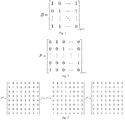
- a base matrix of ⁇ c is constructed at first, where elements of the base matrix are 0 or 1, as shown in Fig.1 . Then each element "1" of the base matrix B is extended as a Circular Permutation Matrix (CPM) of z ⁇ z, and the element "0" of the base matrix is extended as an all-zero matrix of z ⁇ z.
- the base matrix B is referred to as a Base Graph (BG) in the subsequent LDPC construction method based on the protograph.
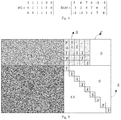
- Each circular permutation matrix of z ⁇ z is represented by P i , where the matrix P is a matrix obtained after a unit matrix cyclically shifts to the right by one digit, as shown in Fig.2 , and i is a cyclic shifting label, i.e., a shifting coefficient of a submatrix.
- each circular permutation matrix P i is actually obtained after a unit matrix I cyclically shifts to the right i times, and a cyclic shifting label i of the circular permutation matrix meets 0 ⁇ i ⁇ z, i ⁇ Z .
- the above-mentioned cyclic shifting label i is also referred to as a cyclic shifting coefficient of an LDPC check matrix.
- Each "1" in a base graph is replaced by a cyclic shifting coefficient of a corresponding sub-cyclic matrix, and each "0" in the base graph is replaced by "-1".
- the resulting coefficient matrix is also referred to as the Shifting coefficients Exponent Matrix (SEM).
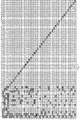
- Fig. 4 represents an example of a cyclic coefficient exponent matrix.
- the BG is a base graph with 3 rows and 6 columns, and each element in the base graph corresponds to a sub-cyclic matrix with 8 rows and 8 columns.
- the base graph is replaced by the cyclic shifting coefficients of each sub-cyclic matrix, where 0 is replaced by -1, to obtain the cyclic coefficient exponent matrix.
- the column weight can be greater than 1, for example, the column weight is 2 or the greater value, and at this time, the sub-cyclic matrix is not a circular permutation matrix (CPM) any more.
- the 5G LDPC code design requires that IR (Incremental Redundancy)-HARQ (Hybrid Automatic Repeat Request) must be supported, so the LDPC code for the 5G scenario may be constructed by an incremental redundancy method. That is, firstly an LDPC code with high code rate is constructed, and then more check bits produced in the incremental redundancy method to thereby obtain the LDPC code with low code rate.
- the LDPC code constructed based on the incremental redundancy method has the advantages of fine performance, long code, wide code rate coverage, high reusability, easy hardware implementation, performing the encoding directly using the check matrix, and so on.
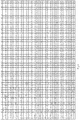
- An instance of the specific structure is as shown in Fig. 5 .
- B is a double diagonal or quasi-double diagonal matrix
- C is a 0 matrix
- E is a lower triangular expansion matrix.
- the design of the LDPC check matrix mainly depends on the designs of A, D and E1.
- the LDPC performance depends on two most important factors, where one is the design of the base matrix and the other is how to extend each non-zero element in the base matrix as a circular permutation matrix of z ⁇ z. These two factors have the decisive effect on the LDPC performance, and the improper designs of the base matrix and the extended sub-cyclic permutation matrix may deteriorate the performance of the LDPC code greatly.
- the LDPC check matrix is designed in the 5G design, and the 5G requires the support of the flexible LDPC.
- the 3GPP requires that at most two LDPC check matrices obtained by extending two base graphs support at most 8/9 code rate and at least 1/5 code rate, and the information bits are at most 8448 bits and at least 40 bits; for the two base graphs, the larger base graph has 46x68 columns, where the first 22 columns correspond to the information bits and the lowest code rate is 1/3; and the smaller base graph has 42x52 columns, where the lowest code rate is 1/5.
- the smaller base graph is used for increasing the degree of parallelism of the decoding and reducing the decoding delay.
- the method of extending the sub-cyclic matrix corresponding to each "1" of the base graph as one of the sub-cyclic matrices in different sizes is used, that is, the size Z of the sub-cyclic matrix can support different values.
- Each Z in the table as shown in Fig.6 corresponds to one check matrix of the LDPC, and as can be seen, the design of the 5G LDPC code needs to design many check matrices.
- a cyclic coefficient matrix is designed for each Z, it is uneasy to store and the workload is huge. Thus it is very difficult to find an appropriate method of designing the cyclic coefficients of the LDPC code, which supports a variety of code rates and a variety of information bit lengths and has the low storage complexity.
- a method is to use the same cyclic coefficient for a plurality of Z, but it is often difficult to obtain the fine performance; and the cyclic coefficient design poses a great challenge to the design of 5G LDPC code.
- the LDPC encoding method provided by the embodiment of the present application includes following operations.
- Operation (1) determining a base graph in combination with actual simulation performance by taking a decoding threshold of a P-EXIT Chart evolved based on the density (a lowest decoding threshold value when the code length is infinite, i.e., a desired lowest SNR value) as a measuring degree.
- Operation (2) constructing a cyclic coefficient exponent matrix, where each value of cyclic coefficients represents a cyclic coefficient of one submatrix, and a coefficient i of the P i described above is at an exponent position, so the matrix here is referred to as the cyclic coefficient exponent matrix, which may also be referred to as an exponent matrix.
- the operation (2) includes the first to fourth operations below.
- a first operation dividing the set of dimensions Z of sub-cyclic matrices to be supported into a plurality of subsets.
- the plurality of subsets may be determined in one of the following ways:
- a second operation generating a cyclic coefficient exponent matrix for each subset, for example by using the method of combining the algebra with the random.
- the random method is for example to produce an exponent matrix randomly, and then pick out the optimum by the subsequent method.
- the algebra method can be for example to construct a large exponent matrix at first, and then obtain an exponent matrix by using the random masked matrix. Thus 8 subsets totally need 8 cyclic coefficient exponent matrices.
- a third operation further determining the cyclic coefficient corresponding to each Z according to the cyclic coefficient exponent matrix determined in the second operation for each Z in 8 subsets (each subset corresponds to a cyclic coefficient exponent matrix) described above as well as the Z elements outside some sets.
- the coefficient exponent matrix has the better applicability. Firstly since the Z elements within the subsets often have the larger intervals, the 1 bit granularity cannot be achieved. When the Z elements outside the subsets are considered for participating in the cyclic coefficient design, the robustness of the coefficient exponent matrix for the different Z performances may be increased, and another brought benefit is that the same coefficient exponent matrix can be configured for the different subsets, thus further lowering the amount of storage and the hardware design complexity.
- each subset produces one exponent matrix, which is actually produced in accordance with the largest Z in the subset, while the coefficient of each specific Z in the subset is a function of the exponent matrix produced by this largest Z.
- the cyclic coefficients are designed so that the cyclic coefficients of all the Z in the subset have the fine performance and thus the exponent matrix corresponding to this subset is qualified.
- a fourth operation judging the quality of the cyclic coefficient exponent matrix at the set level determined in the second operation for all the Z in each subset, for example, by taking the ring distribution and the minimum distance estimate of the code words as the basic measuring degree, where the larger the ring number and the minimum distance are, the better the performance of the code words is. If the performance of the cyclic coefficient exponent matrix at the set level is bad, the process returns to the second operation.
- the ring distribution is the distribution of the ring length, for example, the ring length of the rectangular is 4. The larger one is better.
- the fact that the ring is never formed means that the graph is not closed, which is called a tree in the graph theory.
- the minimum distance is the minimum difference between any two code words, where the less difference causes the uneasy distinction, so the code word performance is worse.
- the performance of the encoded code words is fine only when the minimum distance is large, so that it means that the searched exponent matrix is better, otherwise it means that the exponent matrix should not be used.
- Operation (3) extending each cyclic coefficient as the corresponding sub-cyclic matrix according to the cyclic coefficient exponent matrix determined in the operation (2), to finally obtain the check matrix H of the LDPC code.
- the matrix H is constituted of the sub-cyclic matrices with 42 rows and 52 columns.
- Each sub-cyclic matrix is replaced by "0" or "1” to obtain the base graph, and each element "1" of each base graph is replaced by a sub-cyclic matrix to obtain the matrix H.
- the design of the cyclic coefficient of each submatrix is to select which sub-cyclic matrix to replace "1" in the base graph, and all the cyclic coefficients are placed in one matrix to obtain the cyclic coefficient exponent matrix.
- Operation (4) completing the LDPC encoding by using the check matrix H, where each sub-cyclic matrix is obtained directly when the cyclic coefficients and Z are known, to thereby obtain the whole matrix H.
- a base graph #2 used by the 5G LDPC design has 42 rows and 52 columns, and the base graph determined currently is as shown in Fig. 7 .
- the 42 rows correspond to the check nodes and the 52 columns correspond to the variable nodes.
- the set of sizes Z of cyclic matrices as shown in Fig. 6 is classified according to a, i.e., divided according to per column of Fig. 6 , a has 8 different values, and accordingly 8 different Z sets are obtained.
- the matrix is optimized not only according to the coefficients in the set but also according to the coefficients outside the set.
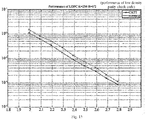
- Fig. 15 An embodiment of designing the LDPC performance according to the base graph as shown in Figs. 8 to 13 is illustrated in Fig. 15 , and as can be seen, the LDPC code performance corresponding to the base graph is better in the embodiment of the present application.
- the method further includes:
- the process of updating includes at least the row and column permutations of the matrix elements.
- the row and column permutations can further be performed on the designed check matrix H, where the row and column permutations include the permutations performed on a part of the elements in the rows and columns besides the usual row and column permutations.
- the double diagonal matrix shown by the matrix B and the lower triangular structure shown by the matrix E in Fig. 5 as an example, the double diagonal angle and the lower triangular structure may remain unchanged when the permutations are performed, while other elements in the rows and columns are permuted.
- such permutation can be the exchange among the different rows and columns of the exponent matrix, or can be the exchange of the rows or columns inside a row sub-cyclic matrix represented by a row in the exponent matrix, for example, the first row of the sub-cyclic matrix is permuted as the last row of the sub-cyclic matrix, so the reaction on the numerical value of the exponent matrix is the original coefficient value plus a certain numerical value.
- an encoding method provided by an embodiment of the present application includes:
- the base graph of the LDPC matrix is determined and the cyclic coefficient exponent matrix is constructed, the sub-cyclic matrix is determined according to the cyclic coefficient exponent matrix, and the LDPC encoding is performed according to the sub-cyclic matrix and the base graph, so as to increase the LDPC encoding performance and thus be suitable for the 5G system.
- the constructing the cyclic coefficient exponent matrix includes:
- performing the LDPC encoding according to the sub-cyclic matrix and the base graph includes:
- the method further includes: performing the row and column permutations for the check matrix; and performing the LDPC encoding by using the check matrix, includes: performing the LDPC encoding by using the check matrix after the row and column permutations.
- performing the row and column permutations for the check matrix includes: updating a part of row and/or column elements in the check matrix, and/or updating all the row and/or column elements in the check matrix.
- an encoding apparatus provided by an embodiment of the present application includes:
- the first unit constructs the cyclic coefficient exponent matrix, which includes:
- the third unit is configured to:
- the third unit is further configured to perform the row and column permutations for the check matrix after determining the check matrix; the third unit performs the LDPC encoding by using the check matrix, which includes: performing the LDPC encoding by using the check matrix after the row and column permutations.
- the third unit performs the row and column permutations for the check matrix, which specifically includes: updating a part of row and/or column elements in the check matrix, and/or updating all the row and/or column elements in the check matrix.
- An embodiment of the present application provides another encoding apparatus, which includes a memory and a processor, where the memory is configured to store the program instructions, and the processor is configured to invoke and obtain the program instructions stored in the memory and perform any one of the above-mentioned methods in accordance with the obtained program instructions.
- another encoding apparatus includes a processor 500 configured to read the programs in a memory 520 and perform the processes of:
- the processor 500 constructs the cyclic coefficient exponent matrix, which includes:
- the processor 500 performs the LDPC encoding according to the sub-cyclic matrix and the base graph, which includes:
- the processor 500 is further configured to perform the row and column permutations for the check matrix after determining the check matrix; and the processor 500 performs the LDPC encoding by using the check matrix, which includes: performing the LDPC encoding by using the check matrix after the row and column permutations.
- the processor 500 performs the row and column permutations for the check matrix, which includes: updating a part of row and/or column elements in the check matrix, and/or updating all the row and/or column elements in the check matrix.
- a transceiver 510 is configured to receive and transmit data under the control of the processor 500.
- the bus architecture can include any numbers of interconnected buses and bridges, and specifically link various circuits of one or more processors represented by the processor 500 and the memory represented by the memory 520.
- the bus architecture can further link various other circuits such as peripheral device, voltage regulator and power management circuit, which are all well known in the art and thus will not be further described again herein.
- the bus interface provides an interface.
- the transceiver 510 can be a plurality of elements, i.e., include a transmitter and a receiver, and provide the units for communicating with various other devices over the transmission media.
- the processor 500 is responsible for managing the bus architecture and general processing, and the memory 520 can store the data used by the processor 500 when performing the operations.
- the processor 500 can be Central Processing Unit (CPU), Application Specific Integrated Circuit (ASIC), Field-Programmable Gate Array (FPGA) or Complex Programmable Logic Device (CPLD).
- CPU Central Processing Unit
- ASIC Application Specific Integrated Circuit
- FPGA Field-Programmable Gate Array
- CPLD Complex Programmable Logic Device
- the encoding apparatus can also be considered as a computing device, which can specifically be a desktop computer, a portable computer, a smart phone, a tablet computer, a Personal Digital Assistant (PDA) or the like.
- the computing device can include a CPU, a memory, input/output devices and the like.
- the input device can include a keyboard, a mouse, a touch screen and the like, and the output device can include a display device such as Liquid Crystal Display (LCD), Cathode Ray Tube (CRT) or the like.
- LCD Liquid Crystal Display
- CRT Cathode Ray Tube
- the memory can include a Read-Only Memory (ROM) and a Random Access Memory (RAM), and provide the program instructions and data stored in the memory to the processor.
- the memory can be configured to store the program of the encoding method.
- the processor invokes and obtains the program instructions stored in the memory and is configured to perform the above-mentioned encoding method in accordance with the obtained program instructions.
- a computer storage medium provided by an embodiment of the present application is configured to store the computer program instructions used by the above-mentioned computing device, and the computer program instructions contain the program for performing the above-mentioned encoding method.
- the computer storage medium can be any available media or data storage device accessible to the computer, including but not limited to magnetic memory (e.g., floppy disk, hard disk, magnetic tape, Magnetic Optical disc (MO) or the like), optical memory (e.g., CD, DVD, BD, HVD or the like), semiconductor memory (e.g., ROM, EPROM, EEPROM, nonvolatile memory (NAND FLASH), Solid State Disk (SSD)) or the like.
- magnetic memory e.g., floppy disk, hard disk, magnetic tape, Magnetic Optical disc (MO) or the like
- optical memory e.g., CD, DVD, BD, HVD or the like
- semiconductor memory e.g., ROM, EPROM, EEPROM, nonvolatile memory (NAND FLASH), Solid State Disk (SSD)
- the embodiments of the present application can provide methods, systems and computer program products.
- the present application can take the form of hardware embodiments alone, software embodiments alone, or embodiments combining the software and hardware aspects.
- the present application can take the form of computer program products implemented on one or more computer usable storage mediums (including but not limited to magnetic disk memories, optical memories and the like) containing computer usable program codes therein.
- These computer program instructions can also be stored in a computer readable memory which is capable of guiding the computer or another programmable data processing device to operate in a particular way, so that the instructions stored in the computer readable memory produce a manufacture including the instruction apparatus which implements the functions specified in one or more processes of the flow charts and/or one or more blocks of the block diagrams.
- These computer program instructions can also be loaded onto the computer or another programmable data processing device, so that a series of operation steps are performed on the computer or another programmable device to produce the computer-implemented processing.
- the instructions executed on the computer or another programmable device provide steps for implementing the functions specified in one or more processes of the flow charts and/or one or more blocks of the block diagrams.
Landscapes
- Physics & Mathematics (AREA)
- Engineering & Computer Science (AREA)
- Mathematical Physics (AREA)
- Probability & Statistics with Applications (AREA)
- Theoretical Computer Science (AREA)
- Computer Networks & Wireless Communication (AREA)
- Signal Processing (AREA)
- General Physics & Mathematics (AREA)
- Computational Mathematics (AREA)
- Mathematical Analysis (AREA)
- Mathematical Optimization (AREA)
- Pure & Applied Mathematics (AREA)
- Algebra (AREA)
- Computing Systems (AREA)
- Error Detection And Correction (AREA)
- Secondary Cells (AREA)
- Lubricants (AREA)
- Battery Electrode And Active Subsutance (AREA)
- Transition And Organic Metals Composition Catalysts For Addition Polymerization (AREA)
Abstract
Description
- The present application claims the priority from Chinese Patent Application No.
201710496055.X - The present application relates to the field of communication technologies, and particularly to an encoding method and apparatus, and a computer storage medium.
- At present, the Third Generation Partnership Project (3GPP) proposes that there is a need to give a Low Density Parity Check Code (LDPC) channel encoding design for a Enhanced Mobile Broadband (eMBB) scenario in the 5G.
- The LDPC is a kind of linear code defined by a check matrix. In order for the decoding feasibility, when a code length is relatively long, the check matrix needs to satisfy the sparsity, that is, the density of "1" in the check matrix is relatively low, namely, the number of "1" in the check matrix is required to be much less than the number of "0", and the longer the code length is, the lower the density is.
- However, there is no LDPC encoding solution suitable for the 5G system in the related art.
- The embodiments of the present application provide an encoding method and apparatus, and a computer storage medium, so as to increase LDPC encoding performance and thus be suitable for the 5G system.
- An embodiment of the present application provides an encoding method. The encoding method includes: determining a base graph of a LDPC matrix and constructing a cyclic coefficient exponent matrix; determining a sub-cyclic matrix according to the cyclic coefficient exponent matrix; and performing LDPC encoding according to the sub-cyclic matrix and the base graph.
- In this method, the base graph of the LDPC matrix is determined and the cyclic coefficient exponent matrix is constructed, the sub-cyclic matrix is determined according to the cyclic coefficient exponent matrix, and the LDPC encoding is performed according to the sub-cyclic matrix and the base graph, so as to increase the LDPC encoding performance and thus be suitable for the 5G system.
- Optionally, the constructing the cyclic coefficient exponent matrix, includes:
- a first operation: dividing the set of dimensions Z of the sub-cyclic matrices to be supported into a plurality of subsets;
- a second operation: generating a cyclic coefficient exponent matrix for each of the subsets;
- a third operation: determining a cyclic coefficient corresponding to Z of the plurality of subsets according to the cyclic coefficient exponent matrix; and
- a fourth operation: detecting whether the performance of the determined cyclic coefficient exponent matrix meets the preset condition for each Z, and if so, ending; otherwise reperforming the second operation.
- Optionally, Z = a×2j; and the first operation is performed in one of the following ways:
- a first way: dividing Z into a plurality of subsets according to the value of a;
- a second way: dividing Z into a plurality of subsets according to the value of j;
- a third way: dividing Z into a plurality of subsets according to the length of information bits.
- Optionally, the third operation includes: determining a cyclic coefficient Pi,j corresponding to each Z by the formula of:

- Optionally, when the first way is employed, the determined cyclic coefficient exponent matrix is shown by the table of:

- Optionally, when the first way is employed, the determined cyclic coefficient exponent matrix is shown by the table of:

- Optionally, when the first way is employed, the determined cyclic coefficient exponent matrix is shown by the table of:

- Optionally, when the first way is employed, the determined cyclic coefficient exponent matrix is shown by the table of:

- Optionally, when the first way is employed, the determined cyclic coefficient exponent matrix is shown by the table of:

- Optionally, when the first way is employed, the determined cyclic coefficient exponent matrix is shown by the table of:

- Optionally, the method further includes:
- updating the cyclic coefficient exponent matrix; and
- updating the sub-cyclic matrix according to the updated cyclic coefficient exponent matrix.
- Optionally, the update includes at least the row and column permutations of the matrix elements.
- Optionally, performing the LDPC encoding according to the sub-cyclic matrix and the base graph, includes:
- determining a check matrix according to the sub-cyclic matrix and the base graph; and
- performing the LDPC encoding by using the check matrix.
- Optionally, after determining the check matrix, the method further includes: performing the row and column permutations for the check matrix; and
performing the LDPC encoding by using the check matrix, includes: performing the LDPC encoding by using the check matrix after the row and column permutations. - Optionally, performing the row and column permutations for the check matrix, includes:
updating a part of row and/or column elements in the check matrix, and/or updating all the row and/or column elements in the check matrix. - An embodiment of the present application provides an encoding apparatus. The apparatus includes:
- a first unit configured to determine a base graph of a LDPC matrix and construct a cyclic coefficient exponent matrix;
- a second unit configured to determine a sub-cyclic matrix according to the cyclic coefficient exponent matrix; and
- a third unit configured to perform the LDPC encoding according to the sub-cyclic matrix and the base graph.
- Optionally, the first unit constructs the cyclic coefficient exponent matrix, includes:
- a first operation: dividing the set of dimensions Z of the sub-cyclic matrices to be supported into a plurality of subsets;
- a second operation: generating a cyclic coefficient exponent matrix for each of the subsets;
- a third operation: determining a cyclic coefficient corresponding to Z of the plurality of subsets according to the cyclic coefficient exponent matrix; and
- a fourth operation: detecting whether the performance of the determined cyclic coefficient exponent matrix meets the preset condition for each Z, and if so, ending; otherwise reperforming the second operation.
- Optionally, Z = a×2j; and the first unit performs the first operation in one of the following ways:
- a first way: dividing Z into a plurality of subsets according to the value of a;
- a second way: dividing Z into a plurality of subsets according to the value of j;
- a third way: dividing Z into a plurality of subsets according to the length of information bits.
- Optionally, the third operation includes: determining a cyclic coefficient Pi,j corresponding to each Z by the formula of:

- Optionally, when the first way is employed, the determined cyclic coefficient exponent matrix is shown by the table of:

- Optionally, when the first way is employed, the determined cyclic coefficient exponent matrix is shown by the table of:

- Optionally, when the first way is employed, the determined cyclic coefficient exponent matrix is shown by the table of:

- Optionally, when the first way is employed, the determined cyclic coefficient exponent matrix is shown by the table of:

- Optionally, when the first way is employed, the determined cyclic coefficient exponent matrix is shown by the table of:

- Optionally, when the first way is employed, the determined cyclic coefficient exponent matrix is shown by the table of:

- Optionally, the second unit is further configured to:
- update the cyclic coefficient exponent matrix; and
- update the sub-cyclic matrix according to the updated cyclic coefficient exponent matrix.
- Optionally, the update includes at least the row and column permutations of the matrix elements.
- Optionally, the third unit is configured to:
- determine a check matrix according to the sub-cyclic matrix and the base graph; and
- perform the LDPC encoding by using the check matrix.
- Optionally, the third unit is further configured to perform the row and column permutations for the check matrix after determining the check matrix; and
the third unit performs the LDPC encoding by using the check matrix, which includes: performing the LDPC encoding by using the check matrix after the row and column permutations. - Optionally, the third unit performs the row and column permutations for the check matrix, which includes:
updating a part of row and/or column elements in the check matrix, and/or updating all the row and/or column elements in the check matrix. - An embodiment of the present application provides another encoding apparatus. The encoding apparatus includes a memory and a processor. The memory is configured to store the program instructions. The processor is configured to invoke and obtain the program instructions stored in the memory and perform any one of the above-mentioned methods in accordance with the obtained program instructions.
- An embodiment of the present application provides a computer storage medium storing the computer executable instructions that are configured to cause a computer to perform any one of the above-mentioned methods.
- In order to illustrate the technical solutions in the embodiments of the present application more clearly, the accompanying figures that need to be used in describing the embodiments will be introduced below briefly. Obviously the accompanying figures described below are only some embodiments of the present application, and other accompanying figures can also be obtained by those ordinary skilled in the art according to these accompanying figures without creative labor.
-
Fig. 1 is a structural schematic diagram of a base matrix provided by an embodiment of the present application. -
Fig. 2 is a structural schematic diagram of a matrix P provided by an embodiment of the present application. -
Fig. 3 is a structural schematic diagram of a circular permutation matrix when z=8 provided by an embodiment of the present application. -
Fig. 4 is a structural schematic diagram of a base graph and a cyclic coefficient matrix (z=8) provided by an embodiment of the present application. -
Fig. 5 is a structural schematic diagram of an LDPC check matrix supporting the incremental redundancy provided by an embodiment of the present application. -
Fig. 6 is a schematic diagram of a set of cyclic matrix sizes Z required to be supported by the 5G LDPC provided by an embodiment of the present application. -
Fig. 7 is a structural schematic diagram of abase matrix # 2 provided by an embodiment of the present application. -
Fig. 8 is a structural schematic diagram of a first cyclic coefficient exponent matrix provided by an embodiment of the present application. -
Fig. 9 is a structural schematic diagram of a second cyclic coefficient exponent matrix provided by an embodiment of the present application. -
Fig. 10 is a structural schematic diagram of a third cyclic coefficient exponent matrix provided by an embodiment of the present application. -
Fig. 11 is a structural schematic diagram of a fourth cyclic coefficient exponent matrix provided by an embodiment of the present application. -
Fig. 12 is a structural schematic diagram of a fifth cyclic coefficient exponent matrix provided by an embodiment of the present application. -
Fig. 13 is a structural schematic diagram of a sixth cyclic coefficient exponent matrix provided by an embodiment of the present application. -
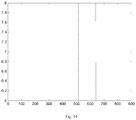
Fig. 14 is a schematic diagram of the girth distribution of the check matrix corresponding to the PCM2 (a=3) R=1/5 employed when Z=128 provided by an embodiment of the present application. -
Fig. 15 is a schematic diagram of LDPC cyclic coefficient performance provided by an embodiment of the present application. -
Fig. 16 is a flow schematic diagram of an encoding method provided by an embodiment of the present application. -
Fig. 17 is a structural schematic diagram of an encoding apparatus provided by an embodiment of the present application. -
Fig. 18 is a structural schematic diagram of another encoding apparatus provided by an embodiment of the present application. - The embodiments of the present application provide an encoding method and apparatus, and a computer storage medium, so as to increase the LDPC encoding performance and thus be suitable for the 5G system.
- The technical solution provided by the embodiments of the present application gives the LDPC encoding employed for the data channel in the eMMB scenario instead of the turbo encoding employed by the original Long Term Evolution (LTE) system, i.e., gives the LDPC encoding solution suitable for the 5G system.
- The 5G LDPC code design requires a quasi-cyclic LDPC code, and a check matrix H thereof may be represented as:

- There are several methods of constructing the quasi-cyclic LDPC code. For example, a base matrix of ρ×c is constructed at first, where elements of the base matrix are 0 or 1, as shown in
Fig.1 . Then each element "1" of the base matrix B is extended as a Circular Permutation Matrix (CPM) of z×z, and the element "0" of the base matrix is extended as an all-zero matrix of z×z. The base matrix B is referred to as a Base Graph (BG) in the subsequent LDPC construction method based on the protograph. Each circular permutation matrix of z×z is represented by Pi , where the matrix P is a matrix obtained after a unit matrix cyclically shifts to the right by one digit, as shown inFig.2 , and i is a cyclic shifting label, i.e., a shifting coefficient of a submatrix.Fig.3 gives an instance of a circular permutation matrix Pi (the size of a subgroup is 8×8, i.e., z=8). - Thus, each circular permutation matrix Pi is actually obtained after a unit matrix I cyclically shifts to the right i times, and a cyclic shifting label i of the circular permutation matrix meets 0 ≤ i < z,

- The above-mentioned cyclic shifting label i is also referred to as a cyclic shifting coefficient of an LDPC check matrix. Actually, the cyclic shifting coefficient is an index of a column in which the first row of "1" of a sub-cyclic matrix is located (the label starts from 0, and index = the number of columns -1). Each "1" in a base graph is replaced by a cyclic shifting coefficient of a corresponding sub-cyclic matrix, and each "0" in the base graph is replaced by "-1". Since each cyclic shifting label i is presented in form of matrix exponent, the resulting coefficient matrix is also referred to as the Shifting coefficients Exponent Matrix (SEM).
Fig. 4 represents an example of a cyclic coefficient exponent matrix. Here, the BG is a base graph with 3 rows and 6 columns, and each element in the base graph corresponds to a sub-cyclic matrix with 8 rows and 8 columns. The base graph is replaced by the cyclic shifting coefficients of each sub-cyclic matrix, where 0 is replaced by -1, to obtain the cyclic coefficient exponent matrix. - For the sub-cyclic matrix (CM) corresponding to the quasi-cyclic LDPC code described above, the column weight can be greater than 1, for example, the column weight is 2 or the greater value, and at this time, the sub-cyclic matrix is not a circular permutation matrix (CPM) any more.
- The 5G LDPC code design requires that IR (Incremental Redundancy)-HARQ (Hybrid Automatic Repeat Request) must be supported, so the LDPC code for the 5G scenario may be constructed by an incremental redundancy method. That is, firstly an LDPC code with high code rate is constructed, and then more check bits produced in the incremental redundancy method to thereby obtain the LDPC code with low code rate. The LDPC code constructed based on the incremental redundancy method has the advantages of fine performance, long code, wide code rate coverage, high reusability, easy hardware implementation, performing the encoding directly using the check matrix, and so on. An instance of the specific structure is as shown in
Fig. 5 . Here, B is a double diagonal or quasi-double diagonal matrix, C is a 0 matrix, and E is a lower triangular expansion matrix. The design of the LDPC check matrix mainly depends on the designs of A, D and E1. - The LDPC performance depends on two most important factors, where one is the design of the base matrix and the other is how to extend each non-zero element in the base matrix as a circular permutation matrix of z×z. These two factors have the decisive effect on the LDPC performance, and the improper designs of the base matrix and the extended sub-cyclic permutation matrix may deteriorate the performance of the LDPC code greatly.
- To sum up, the LDPC check matrix is designed in the 5G design, and the 5G requires the support of the flexible LDPC. By taking the eMBB data channel as an example, the 3GPP requires that at most two LDPC check matrices obtained by extending two base graphs support at most 8/9 code rate and at least 1/5 code rate, and the information bits are at most 8448 bits and at least 40 bits; for the two base graphs, the larger base graph has 46x68 columns, where the first 22 columns correspond to the information bits and the lowest code rate is 1/3; and the smaller base graph has 42x52 columns, where the lowest code rate is 1/5. Unlike the larger base graph, the smaller base graph is used for increasing the degree of parallelism of the decoding and reducing the decoding delay. The current conclusion of the 3GPP is as follows: when the information bits meet K>640, the first 10 columns in the base graph correspond to the information bits; when the information bits meet 560 <K<=640, the first 9 columns in the base graph correspond to the information bits; when the information bits meet 192 <K<=560, the first 8 columns in the base graph correspond to the information bits; when the information bits meet 40 <K<=192, the first 6 columns in the base graph correspond to the information bits.
- In the 5G LDPC design, in order to enable two fixed base graphs to support the information bit length of 40∼8448, the method of extending the sub-cyclic matrix corresponding to each "1" of the base graph as one of the sub-cyclic matrices in different sizes is used, that is, the size Z of the sub-cyclic matrix can support different values. The dimension of the sub-cyclic matrix required to be supported by the 3GPP is Z = a×2j, of which the values are specifically as shown in
Fig.6 . Each Z in the table as shown inFig.6 corresponds to one check matrix of the LDPC, and as can be seen, the design of the 5G LDPC code needs to design many check matrices. If a cyclic coefficient matrix is designed for each Z, it is uneasy to store and the workload is huge. Thus it is very difficult to find an appropriate method of designing the cyclic coefficients of the LDPC code, which supports a variety of code rates and a variety of information bit lengths and has the low storage complexity. A method is to use the same cyclic coefficient for a plurality of Z, but it is often difficult to obtain the fine performance; and the cyclic coefficient design poses a great challenge to the design of 5G LDPC code. - The detailed introduction of the LDPC encoding method provided by an embodiment of the present application will be given below.
- The LDPC encoding method provided by the embodiment of the present application includes following operations.
- Operation (1): determining a base graph in combination with actual simulation performance by taking a decoding threshold of a P-EXIT Chart evolved based on the density (a lowest decoding threshold value when the code length is infinite, i.e., a desired lowest SNR value) as a measuring degree.
- Operation (2): constructing a cyclic coefficient exponent matrix, where each value of cyclic coefficients represents a cyclic coefficient of one submatrix, and a coefficient i of the Pi described above is at an exponent position, so the matrix here is referred to as the cyclic coefficient exponent matrix, which may also be referred to as an exponent matrix.
- The operation (2) includes the first to fourth operations below.
- A first operation: dividing the set of dimensions Z of sub-cyclic matrices to be supported into a plurality of subsets.
- By taking Z = a×2j (0≤j≤7, a = {2, 3, 5, 7, 9, 11, 13, 15}) as an example, the plurality of subsets may be determined in one of the following ways:
- a first way: classifying according to a, for example, when a=2, Z = 2×2j (0≤j≤7) is a subset, so Z is divided into 8 subsets, where the 8 subsets actually correspond to 8 columns of
Fig. 6 respectively, that is, the first subset is the corresponding first column of values inFig. 6 when a=2, and so on; - a second way: classifying according to j, where for each value of j, Z = a×2j (a = {2, 3, 5, 7, 9, 11, 13, 15}) constitutes a subset; since j has exactly 8 values, j also corresponds to 8 subsets, for example, when j=0, it corresponds to 8 values in the first row in
Fig. 6 , and so on; - a third way: classifying according to the size of Z, where Kb∗Z is the length of information bits, where Kb is the number of the columns of the information bits in the base graph and different from the number K of the information bits; kb=22 for the larger base graph and kb=10 for the smaller base graph, so Z is classified by size, which is equivalent to classifying in accordance with the size of the information bit length K. For example: [2:1:15], [16:2:30], [32:4:64], [72:8:128], [144:16:192], [208:16: 256], [288: 32:320], [352:32:384]. Such classifying method is actually to segment according to the information bit length. The information bit length K is the estimated value of K/kb=Z in unit of bits. When segmented, one example is in accordance with the integer power of 2, where the segments are denser when Z is smaller, and the segments are sparser when Z is larger.
- A second operation: generating a cyclic coefficient exponent matrix for each subset, for example by using the method of combining the algebra with the random. Here the random method is for example to produce an exponent matrix randomly, and then pick out the optimum by the subsequent method. The algebra method can be for example to construct a large exponent matrix at first, and then obtain an exponent matrix by using the random masked matrix. Thus 8 subsets totally need 8 cyclic coefficient exponent matrices.
- A third operation: further determining the cyclic coefficient corresponding to each Z according to the cyclic coefficient exponent matrix determined in the second operation for each Z in 8 subsets (each subset corresponds to a cyclic coefficient exponent matrix) described above as well as the Z elements outside some sets.
- Since the Z elements outside the subsets are considered besides the elements within the subsets in the embodiments of the present application, the coefficient exponent matrix has the better applicability. Firstly since the Z elements within the subsets often have the larger intervals, the 1 bit granularity cannot be achieved. When the Z elements outside the subsets are considered for participating in the cyclic coefficient design, the robustness of the coefficient exponent matrix for the different Z performances may be increased, and another brought benefit is that the same coefficient exponent matrix can be configured for the different subsets, thus further lowering the amount of storage and the hardware design complexity.
- Here, each subset produces one exponent matrix, which is actually produced in accordance with the largest Z in the subset, while the coefficient of each specific Z in the subset is a function of the exponent matrix produced by this largest Z. The cyclic coefficients are designed so that the cyclic coefficients of all the Z in the subset have the fine performance and thus the exponent matrix corresponding to this subset is qualified.
- An example of the method of determining the cyclic coefficient corresponding to each Z according to the cyclic coefficient exponent matrix is that: the cyclic coefficient Pi,j may be calculated by using the function of:


- A fourth operation: judging the quality of the cyclic coefficient exponent matrix at the set level determined in the second operation for all the Z in each subset, for example, by taking the ring distribution and the minimum distance estimate of the code words as the basic measuring degree, where the larger the ring number and the minimum distance are, the better the performance of the code words is. If the performance of the cyclic coefficient exponent matrix at the set level is bad, the process returns to the second operation.
- Here, the ring distribution is the distribution of the ring length, for example, the ring length of the rectangular is 4. The larger one is better. The fact that the ring is never formed means that the graph is not closed, which is called a tree in the graph theory. The minimum distance is the minimum difference between any two code words, where the less difference causes the uneasy distinction, so the code word performance is worse. Thus the performance of the encoded code words is fine only when the minimum distance is large, so that it means that the searched exponent matrix is better, otherwise it means that the exponent matrix should not be used.
- Operation (3): extending each cyclic coefficient as the corresponding sub-cyclic matrix according to the cyclic coefficient exponent matrix determined in the operation (2), to finally obtain the check matrix H of the LDPC code.
- For example, the matrix H is constituted of the sub-cyclic matrices with 42 rows and 52 columns. Each sub-cyclic matrix is replaced by "0" or "1" to obtain the base graph, and each element "1" of each base graph is replaced by a sub-cyclic matrix to obtain the matrix H. The design of the cyclic coefficient of each submatrix is to select which sub-cyclic matrix to replace "1" in the base graph, and all the cyclic coefficients are placed in one matrix to obtain the cyclic coefficient exponent matrix.
- Operation (4): completing the LDPC encoding by using the check matrix H, where each sub-cyclic matrix is obtained directly when the cyclic coefficients and Z are known, to thereby obtain the whole matrix H.
- A specific embodiment is given below to illustrate.
- A
base graph # 2 used by the 5G LDPC design has 42 rows and 52 columns, and the base graph determined currently is as shown inFig. 7 . The 42 rows correspond to the check nodes and the 52 columns correspond to the variable nodes. In the case that the information bits Kb in the above-mentioned base graph is less than 10, for example, Kb=9, the tenth column in the base graph is deleted directly; if kb=6, the seventh to tenth columns of the base graph are deleted and the rows remain unchanged. - According to the base graph as shown in
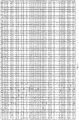
Fig. 7 , the set of sizes Z of cyclic matrices as shown inFig. 6 is classified according to a, i.e., divided according to per column ofFig. 6 , a has 8 different values, and accordingly 8 different Z sets are obtained. For example, the Z set corresponding to a=2 is Setl={2, 4, 8, 16, 32, 64, 128, 256}, the Z set corresponding to a=3 is Set2={3, 6, 12, 24, 48, 96, 192, 384}, the Z set corresponding to a=5 is Set3={5, 10, 20, 40, 80, 160, 320}, the Z set corresponding to a=7 is Set4={7, 14, 28, 56, 112, 224}, the Z set corresponding to a=9 is Set5={9, 18, 36, 72, 144, 288}, the Z set corresponding to a=11 is Set6={11, 22, 44, 88, 176, 352}, the Z set corresponding to a=13 is Set7={13, 26, 52, 104, 208}, and the Z set corresponding to a=15 is Set8={15, 30, 60, 120, 240}. - For each Z set, 6 cyclic coefficient exponent matrices PCMi (i=1, 2, 3, ..6) at the set level are determined by the method described in the above operation (2), which are the cyclic coefficient exponent matrices corresponding to the Seti (i=1, 2, 3, ..6) respectively. Here, when a=2, the cyclic coefficient exponent matrix PCM1 corresponding to the Set1 is specifically as shown in
Fig. 8 ; when a=3, the cyclic coefficient exponent matrix PCM2 corresponding to the Set2 is specifically as shown inFig. 9 , where the matrix shown inFig. 9 is the check matrix in the 5G standard, and the details can refer to the related document; when a=5, the cyclic coefficient exponent matrix PCM3 corresponding to the Set3 is specifically as shown inFig. 10 ; when a=7, the cyclic coefficient exponent matrix PCM4 corresponding to the Set4 is specifically as shown inFig. 11 ; when a=9, the cyclic coefficient exponent matrix PCM5 corresponding to the Set5 is specifically as shown inFig. 12 ; when a=11, the cyclic coefficient exponent matrix PCM6 corresponding to the Set6 is specifically as shown inFig.13 . - As described in the operation (2), when the cyclic coefficient exponent matrix is designed for a set, the matrix is optimized not only according to the coefficients in the set but also according to the coefficients outside the set.
- By taking the PCM2 corresponding to the Set2 (a=3) as an example, some Z in the Set1 (a=2) are considered in the design, so that some Z in the Set1 (a=2) also have the fine performance when using the PCM2 matrix of the Set2 (a=3). In an example where Z=128 in the Set1 (a=2), the code rate is 1/5 and the check matrix corresponding to the PCM2 is used, the girth distribution thereof is as shown in
Fig. 14 , where the performance is fine due to the sixth and eighth rings. - An embodiment of designing the LDPC performance according to the base graph as shown in
Figs. 8 to 13 is illustrated inFig. 15 , and as can be seen, the LDPC code performance corresponding to the base graph is better in the embodiment of the present application. - It shall be particularly pointed out that in an embodiment of the present application, the method further includes:
- updating the cyclic coefficient exponent matrix; and
- updating the sub-cyclic matrix according to the updated cyclic coefficient exponent matrix.
- Optionally, the process of updating includes at least the row and column permutations of the matrix elements.
- In an embodiment of the present application, the row and column permutations can further be performed on the designed check matrix H, where the row and column permutations include the permutations performed on a part of the elements in the rows and columns besides the usual row and column permutations. By taking the double diagonal matrix shown by the matrix B and the lower triangular structure shown by the matrix E in
Fig. 5 as an example, the double diagonal angle and the lower triangular structure may remain unchanged when the permutations are performed, while other elements in the rows and columns are permuted. From the perspective of the coefficient exponent matrix, such permutation can be the exchange among the different rows and columns of the exponent matrix, or can be the exchange of the rows or columns inside a row sub-cyclic matrix represented by a row in the exponent matrix, for example, the first row of the sub-cyclic matrix is permuted as the last row of the sub-cyclic matrix, so the reaction on the numerical value of the exponent matrix is the original coefficient value plus a certain numerical value. - To sum up, referring to
Fig. 16 , an encoding method provided by an embodiment of the present application includes: - S101: determining a base graph of an LDPC matrix and constructing a cyclic coefficient exponent matrix;
- S102: determining a sub-cyclic matrix according to the cyclic coefficient exponent matrix; and
- S103: performing LDPC encoding according to the sub-cyclic matrix and the base graph.
- In this method, the base graph of the LDPC matrix is determined and the cyclic coefficient exponent matrix is constructed, the sub-cyclic matrix is determined according to the cyclic coefficient exponent matrix, and the LDPC encoding is performed according to the sub-cyclic matrix and the base graph, so as to increase the LDPC encoding performance and thus be suitable for the 5G system.
- Optionally, the constructing the cyclic coefficient exponent matrix, includes:
- a first operation: dividing the set of dimensions Z of the sub-cyclic matrices to be supported into a plurality of subsets;
- a second operation: generating a cyclic coefficient exponent matrix for each of the subsets;
- a third operation: determining the cyclic coefficient corresponding to Z of the plurality of subsets according to the cyclic coefficient exponent matrix; and
- a fourth operation: detecting whether the performance of the determined cyclic coefficient exponent matrix meets the preset condition for each Z, and if so, ending; otherwise reperforming the second operation.
- Optionally, Z = a×2j (0≤j≤7, a = {2, 3, 5, 7, 9, 11, 13, 15}); and the first operation is performed in one of the following ways:
- a first way: dividing Z into 8 subsets according to the value of a;
- a second way: dividing Z into 8 subsets according to the value of j;
- a third way: dividing Z into 8 subsets according to the length of information bits.
- Optionally, the third operation includes: determining the cyclic coefficient Pi,j corresponding to each Z by the formula of:

- Optionally, performing the LDPC encoding according to the sub-cyclic matrix and the base graph, includes:
- determining the check matrix according to the sub-cyclic matrix and the base graph; and
- performing the LDPC encoding by using the check matrix.
- Optionally, after determining the check matrix, the method further includes: performing the row and column permutations for the check matrix; and
performing the LDPC encoding by using the check matrix, includes: performing the LDPC encoding by using the check matrix after the row and column permutations. - Optionally, performing the row and column permutations for the check matrix, includes:
updating a part of row and/or column elements in the check matrix, and/or updating all the row and/or column elements in the check matrix. - Corresponding to the above-mentioned method, and referring to
Fig. 17 , an encoding apparatus provided by an embodiment of the present application includes: - a
first unit 11 configured to determine a base graph of an LDPC matrix and construct a cyclic coefficient exponent matrix; - a
second unit 12 configured to determine a sub-cyclic matrix according to the cyclic coefficient exponent matrix; and - a
third unit 13 configured to perform the LDPC encoding according to the sub-cyclic matrix and the base graph. - Optionally, the first unit constructs the cyclic coefficient exponent matrix, which includes:
- a first operation: dividing the set of dimensions Z of the sub-cyclic matrices to be supported into a plurality of subsets;
- a second operation: generating a cyclic coefficient exponent matrix for each of the subsets;
- a third operation: determining the cyclic coefficient corresponding to Z of the plurality of subsets according to the cyclic coefficient exponent matrix; and
- a fourth operation: detecting whether the performance of the determined cyclic coefficient exponent matrix meets the preset condition for each Z, and if so, ending; otherwise reperforming the second operation.
- Optionally, Z = a×2j (0≤j≤7, a = {2, 3, 5, 7, 9, 11, 13, 15}); and the first unit performs the first operation in one of the following ways:
- a first way: dividing Z into 8 subsets according to the value of a;
- a second way: dividing Z into 8 subsets according to the value of j;
- a third way: dividing Z into 8 subsets according to the length of the information bits.
- Optionally, the third operation includes: determining the cyclic coefficient Pi,j corresponding to each Z by the formula of:

- Optionally, the third unit is configured to:
- determine a check matrix according to the sub-cyclic matrix and the base graph; and
- perform the LDPC encoding by using the check matrix.
- Optionally, the third unit is further configured to perform the row and column permutations for the check matrix after determining the check matrix;
the third unit performs the LDPC encoding by using the check matrix, which includes: performing the LDPC encoding by using the check matrix after the row and column permutations. - Optionally, the third unit performs the row and column permutations for the check matrix, which specifically includes:
updating a part of row and/or column elements in the check matrix, and/or updating all the row and/or column elements in the check matrix. - An embodiment of the present application provides another encoding apparatus, which includes a memory and a processor, where the memory is configured to store the program instructions, and the processor is configured to invoke and obtain the program instructions stored in the memory and perform any one of the above-mentioned methods in accordance with the obtained program instructions.
- For example, referring to
Fig. 18 , another encoding apparatus provided by an embodiment of the present application includes aprocessor 500 configured to read the programs in a memory 520 and perform the processes of: - determining a base graph of a LDPC matrix and constructing a cyclic coefficient exponent matrix;
- determining a sub-cyclic matrix according to the cyclic coefficient exponent matrix; and
- performing the LDPC encoding according to the sub-cyclic matrix and the base graph.
- Optionally, the
processor 500 constructs the cyclic coefficient exponent matrix, which includes: - a first operation: dividing the set of dimensions Z of the sub-cyclic matrices to be supported into a plurality of subsets;
- a second operation: generating a cyclic coefficient exponent matrix for each of the subsets;
- a third operation: determining the cyclic coefficient corresponding to Z of the plurality of subsets according to the cyclic coefficient exponent matrix; and
- a fourth operation: detecting whether the performance of the determined cyclic coefficient exponent matrix meets the preset condition for each Z, and if so, ending; otherwise reperforming the second operation.
- Optionally, Z = a×2j (0≤j≤7, a = {2, 3, 5, 7, 9, 11, 13, 15}); and the
processor 500 performs the first operation in one of the following ways: - a first way: dividing Z into 8 subsets according to the value of a;
- a second way: dividing Z into 8 subsets according to the value of j; and
- a third way: dividing Z into 8 subsets according to the length of the information bits.
- Optionally, the third operation includes: determining the cyclic coefficient Pi,j corresponding to each Z by the formula of:

- Optionally, the
processor 500 performs the LDPC encoding according to the sub-cyclic matrix and the base graph, which includes: - determining a check matrix according to the sub-cyclic matrix and the base graph;
- performing the LDPC encoding by using the check matrix.
- Optionally, the
processor 500 is further configured to perform the row and column permutations for the check matrix after determining the check matrix; and
theprocessor 500 performs the LDPC encoding by using the check matrix, which includes: performing the LDPC encoding by using the check matrix after the row and column permutations. - Optionally, the
processor 500 performs the row and column permutations for the check matrix, which includes:
updating a part of row and/or column elements in the check matrix, and/or updating all the row and/or column elements in the check matrix. - A
transceiver 510 is configured to receive and transmit data under the control of theprocessor 500. - Here, in
Fig. 18 , the bus architecture can include any numbers of interconnected buses and bridges, and specifically link various circuits of one or more processors represented by theprocessor 500 and the memory represented by the memory 520. The bus architecture can further link various other circuits such as peripheral device, voltage regulator and power management circuit, which are all well known in the art and thus will not be further described again herein. The bus interface provides an interface. Thetransceiver 510 can be a plurality of elements, i.e., include a transmitter and a receiver, and provide the units for communicating with various other devices over the transmission media. Theprocessor 500 is responsible for managing the bus architecture and general processing, and the memory 520 can store the data used by theprocessor 500 when performing the operations. - The
processor 500 can be Central Processing Unit (CPU), Application Specific Integrated Circuit (ASIC), Field-Programmable Gate Array (FPGA) or Complex Programmable Logic Device (CPLD). - The encoding apparatus provided by the embodiments of the present application can also be considered as a computing device, which can specifically be a desktop computer, a portable computer, a smart phone, a tablet computer, a Personal Digital Assistant (PDA) or the like. The computing device can include a CPU, a memory, input/output devices and the like. The input device can include a keyboard, a mouse, a touch screen and the like, and the output device can include a display device such as Liquid Crystal Display (LCD), Cathode Ray Tube (CRT) or the like.
- The memory can include a Read-Only Memory (ROM) and a Random Access Memory (RAM), and provide the program instructions and data stored in the memory to the processor. In an embodiment of the present application, the memory can be configured to store the program of the encoding method.
- The processor invokes and obtains the program instructions stored in the memory and is configured to perform the above-mentioned encoding method in accordance with the obtained program instructions.
- A computer storage medium provided by an embodiment of the present application is configured to store the computer program instructions used by the above-mentioned computing device, and the computer program instructions contain the program for performing the above-mentioned encoding method.
- The computer storage medium can be any available media or data storage device accessible to the computer, including but not limited to magnetic memory (e.g., floppy disk, hard disk, magnetic tape, Magnetic Optical disc (MO) or the like), optical memory (e.g., CD, DVD, BD, HVD or the like), semiconductor memory (e.g., ROM, EPROM, EEPROM, nonvolatile memory (NAND FLASH), Solid State Disk (SSD)) or the like.
- It should be understood by those skilled in the art that the embodiments of the present application can provide methods, systems and computer program products. Thus the present application can take the form of hardware embodiments alone, software embodiments alone, or embodiments combining the software and hardware aspects. Also the present application can take the form of computer program products implemented on one or more computer usable storage mediums (including but not limited to magnetic disk memories, optical memories and the like) containing computer usable program codes therein.
- The present application is described by reference to the flow charts and/or the block diagrams of the methods, the devices (systems) and the computer program products according to the embodiments of the present application. It should be understood that each process and/or block in the flow charts and/or the block diagrams, and a combination of processes and/or blocks in the flow charts and/or the block diagrams can be implemented by the computer program instructions. These computer program instructions can be provided to a general-purpose computer, a dedicated computer, an embedded processor, or a processor of another programmable data processing device to produce a machine, so that an apparatus for implementing the functions specified in one or more processes of the flow charts and/or one or more blocks of the block diagrams is produced by the instructions executed by the computer or the processor of another programmable data processing device.
- These computer program instructions can also be stored in a computer readable memory which is capable of guiding the computer or another programmable data processing device to operate in a particular way, so that the instructions stored in the computer readable memory produce a manufacture including the instruction apparatus which implements the functions specified in one or more processes of the flow charts and/or one or more blocks of the block diagrams.
- These computer program instructions can also be loaded onto the computer or another programmable data processing device, so that a series of operation steps are performed on the computer or another programmable device to produce the computer-implemented processing. Thus the instructions executed on the computer or another programmable device provide steps for implementing the functions specified in one or more processes of the flow charts and/or one or more blocks of the block diagrams.
- Evidently those skilled in the art can make various modifications and variations to the present application without departing from the spirit and scope of the present application. Thus the present application is also intended to encompass these modifications and variations therein as long as these modifications and variations to the present application come into the scope of the claims of the present application and their equivalents.
Claims (32)
- An encoding method, comprising:determining a base graph of a Low Density Parity Check Code, LDPC, matrix and constructing a cyclic coefficient exponent matrix;determining a sub-cyclic matrix according to the cyclic coefficient exponent matrix; andperforming LDPC encoding according to the sub-cyclic matrix and the base graph.
- The method according to claim 1, wherein the constructing the cyclic coefficient exponent matrix comprises:a first operation: dividing a set of dimensions Z of sub-cyclic matrices to be supported into a plurality of subsets;a second operation: generating a cyclic coefficient exponent matrix for each of the subsets;a third operation: determining a cyclic coefficient corresponding to Z of the plurality of subsets according to the cyclic coefficient exponent matrix; anda fourth operation: detecting whether performance of the determined cyclic coefficient exponent matrix meets a preset condition for each Z, and if so, ending; otherwise reperforming the second operation.
- The method according to claim 2, wherein Z = a×2j, and the first operation is performed in one of following ways:a first way: dividing Z into a plurality of subsets according to a value of a;a second way: dividing Z into a plurality of subsets according to a value of j; ora third way: dividing Z into a plurality of subsets according to a length of information bits.
- The method according to claim 3, wherein the third operation comprises: determining a cyclic coefficient Pi,j corresponding to each Z by a formula of:

- The method according to claim 4, wherein when the first way is employed, the determined cyclic coefficient exponent matrix is shown by a table of:

- The method according to claim 4, wherein when the first way is employed, the determined cyclic coefficient exponent matrix is shown by a table of:

- The method according to claim 4, wherein when the first way is employed, the determined cyclic coefficient exponent matrix is shown by a table of:

- The method according to claim 4, wherein when the first way is employed, the determined cyclic coefficient exponent matrix is shown by a table of:

- The method according to claim 4, wherein when the first way is employed, the determined cyclic coefficient exponent matrix is shown by a table of:

- The method according to claim 4, wherein when the first way is employed, the determined cyclic coefficient exponent matrix is shown by a table of:

- The method according to any one of claims 1 to 10, wherein the method further comprises:updating the cyclic coefficient exponent matrix; andupdating the sub-cyclic matrix according to the updated cyclic coefficient exponent matrix.
- The method according to claim 11, wherein the process of updating comprises at least row and column permutations of matrix elements.
- The method according to claim 1, wherein the performing LDPC encoding according to the sub-cyclic matrix and the base graph, further comprises:determining a check matrix according to the sub-cyclic matrix and the base graph; andperforming LDPC encoding by using the check matrix.
- The method according to claim 13, wherein after determining the check matrix, the method further comprises: performing row and column permutations for the check matrix; and
the performing LDPC encoding by using the check matrix, further comprises: performing LDPC encoding by using the check matrix after the row and column permutations. - The method according to claim 14, wherein the performing row and column permutations for the check matrix, further comprises:updating a part of row and/or column elements in the check matrix; and/orupdating all the row and/or column elements in the check matrix.
- An encoding apparatus, comprising:a memory configured to store program instructions;a processor configured to invoke and obtain the program instructions stored in the memory, and in accordance with the obtained program instructions, perform processes of:determining a base graph of a Low Density Parity Check Code, LDPC, matrix and constructing a cyclic coefficient exponent matrix;determining a sub-cyclic matrix according to the cyclic coefficient exponent matrix; andperforming LDPC encoding according to the sub-cyclic matrix and the base graph.
- The apparatus according to claim 16, wherein the constructing the cyclic coefficient exponent matrix comprises:a first operation: dividing a set of dimensions Z of sub-cyclic matrices to be supported into a plurality of subsets;a second operation: generating a cyclic coefficient exponent matrix for each of the subsets;a third operation: determining a cyclic coefficient corresponding to Z of the plurality of subsets according to the cyclic coefficient exponent matrix; anda fourth operation: detecting whether performance of the determined cyclic coefficient exponent matrix meets a preset condition for each Z, and if so, ending; otherwise reperforming the second operation.
- The apparatus according to claim 17, wherein Z = a×2j; and the first operation is performed in one of following ways:a first way: dividing Z into a plurality of subsets according to a value of a;a second way: dividing Z into a plurality of subsets according to a value of j; ora third way: dividing Z into a plurality of subsets according to a length of information bits.
- The apparatus according to claim 18, wherein the third operation comprises: determining a cyclic coefficient Pi,j corresponding to each Z by a formula of:

- The apparatus according to claim 19, wherein when the first way is employed, the determined cyclic coefficient exponent matrix is shown by a table of:

- The apparatus according to claim 19, wherein when the first way is employed, the determined cyclic coefficient exponent matrix is shown by a table of:

- The apparatus according to claim 19, wherein when the first way is employed, the determined cyclic coefficient exponent matrix is shown by a table of:

- The apparatus according to claim 19, wherein when the first way is employed, the determined cyclic coefficient exponent matrix is shown by a table of:

- The apparatus according to claim 19, wherein when the first way is employed, the determined cyclic coefficient exponent matrix is shown by a table of:

- The apparatus according to claim 19, wherein when the first way is employed, the determined cyclic coefficient exponent matrix is shown by a table of:

- The apparatus according to any one of claims 16 to 25, wherein the processes further comprise:updating the cyclic coefficient exponent matrix; andupdating the sub-cyclic matrix according to the updated cyclic coefficient exponent matrix.
- The apparatus according to claim 26, wherein the process of updating comprises at least row and column permutations of matrix elements.
- The apparatus according to claim 16, wherein the performing LDPC encoding according to the sub-cyclic matrix and the base graph, further comprises:determining a check matrix according to the sub-cyclic matrix and the base graph; andperforming LDPC encoding by using the check matrix.
- The apparatus according to claim 28, wherein after determining the check matrix, the process further comprises: performing row and column permutations for the check matrix; and
the performing LDPC encoding by using the check matrix, further comprises: performing LDPC encoding by using the check matrix after the row and column permutations. - The apparatus according to claim 29, wherein the performing row and column permutations for the check matrix, further comprises:updating a part of row and/or column elements in the check matrix; and/orupdating all the row and/or column elements in the check matrix.
- An encoding apparatus, comprising:a first unit configured to determine a base graph of a Low Density Parity Check Code, LDPC, matrix and construct a cyclic coefficient exponent matrix;a second unit configured to determine a sub-cyclic matrix according to the cyclic coefficient exponent matrix; anda third unit configured to perform LDPC encoding according to the sub-cyclic matrix and the base graph.
- A computer storage medium, wherein the computer storage medium stores computer executable instructions that are configured to cause a computer to perform the method of any one of claims 1-15.
Applications Claiming Priority (2)
| Application Number | Priority Date | Filing Date | Title |
|---|---|---|---|
| CN201710496055.XA CN109120275B (en) | 2017-06-26 | 2017-06-26 | Encoding method and device and computer storage medium |
| PCT/CN2018/086927 WO2019001159A1 (en) | 2017-06-26 | 2018-05-15 | Encoding method and apparatus, and computer storage medium |
Publications (3)
| Publication Number | Publication Date |
|---|---|
| EP3648357A1 true EP3648357A1 (en) | 2020-05-06 |
| EP3648357A4 EP3648357A4 (en) | 2020-07-01 |
| EP3648357B1 EP3648357B1 (en) | 2023-04-05 |
Family
ID=64740333
Family Applications (1)
| Application Number | Title | Priority Date | Filing Date |
|---|---|---|---|
| EP18822587.4A Active EP3648357B1 (en) | 2017-06-26 | 2018-05-15 | Encoding method and apparatus, and computer storage medium |
Country Status (7)
| Country | Link |
|---|---|
| US (1) | US11038531B2 (en) |
| EP (1) | EP3648357B1 (en) |
| JP (1) | JP7091375B2 (en) |
| KR (1) | KR102300273B1 (en) |
| CN (1) | CN109120275B (en) |
| TW (1) | TWI679854B (en) |
| WO (1) | WO2019001159A1 (en) |
Cited By (1)
| Publication number | Priority date | Publication date | Assignee | Title |
|---|---|---|---|---|
| WO2024223612A1 (en) * | 2023-04-28 | 2024-10-31 | Orange | Design of base matrices for quasi-cyclic ldpc codes |
Families Citing this family (5)
| Publication number | Priority date | Publication date | Assignee | Title |
|---|---|---|---|---|
| US11784663B2 (en) | 2019-07-16 | 2023-10-10 | Lg Electronics Inc. | Method and apparatus for performing encoding on basis of parity check matrix of low density parity check code generated from protograph in wireless communication system |
| CN110611510B (en) * | 2019-09-17 | 2021-03-23 | 天地信息网络研究院(安徽)有限公司 | Binary LDPC short code construction method and construction device, terminal and storage medium thereof |
| WO2021168763A1 (en) * | 2020-02-28 | 2021-09-02 | Qualcomm Incorporated | Base graph selection for multi-slot shared channel |
| CN118337223B (en) * | 2024-04-01 | 2024-09-20 | 华中科技大学 | A design method and system for large cycle length quasi-cyclic semi-random LDPC codes |
| CN121690467A (en) * | 2024-09-14 | 2026-03-17 | 华为技术有限公司 | Method for obtaining check matrix and communication device |
Family Cites Families (8)
| Publication number | Priority date | Publication date | Assignee | Title |
|---|---|---|---|---|
| WO2006039801A1 (en) | 2004-10-12 | 2006-04-20 | Nortel Networks Limited | System and method for low density parity check encoding of data |
| CN101192833B (en) * | 2006-11-28 | 2011-12-07 | 华为技术有限公司 | A device and method for low-density checksum LDPC parallel coding |
| CN101601187B (en) | 2007-01-24 | 2014-08-20 | 高通股份有限公司 | LDPC encoding and decoding of variable size packets |
| CN101686061A (en) * | 2008-09-27 | 2010-03-31 | 松下电器产业株式会社 | Method, transmitting and receiving device and system for constructing low density parity check code, |
| US8612823B2 (en) | 2008-10-17 | 2013-12-17 | Intel Corporation | Encoding of LDPC codes using sub-matrices of a low density parity check matrix |
| US8433972B2 (en) * | 2009-04-06 | 2013-04-30 | Nec Laboratories America, Inc. | Systems and methods for constructing the base matrix of quasi-cyclic low-density parity-check codes |
| CN103053116B (en) * | 2011-06-28 | 2016-10-05 | 华为技术有限公司 | The coded method of low density parity check code and device |
| US10484010B2 (en) * | 2016-12-20 | 2019-11-19 | Samsung Electronics Co., Ltd. | Apparatus and method for channel encoding/decoding in communication or broadcasting system |
-
2017
- 2017-06-26 CN CN201710496055.XA patent/CN109120275B/en active Active
-
2018
- 2018-05-15 WO PCT/CN2018/086927 patent/WO2019001159A1/en not_active Ceased
- 2018-05-15 JP JP2019572228A patent/JP7091375B2/en active Active
- 2018-05-15 US US16/626,284 patent/US11038531B2/en active Active
- 2018-05-15 KR KR1020207002393A patent/KR102300273B1/en active Active
- 2018-05-15 EP EP18822587.4A patent/EP3648357B1/en active Active
- 2018-06-25 TW TW107121665A patent/TWI679854B/en active
Cited By (2)
| Publication number | Priority date | Publication date | Assignee | Title |
|---|---|---|---|---|
| WO2024223612A1 (en) * | 2023-04-28 | 2024-10-31 | Orange | Design of base matrices for quasi-cyclic ldpc codes |
| FR3148336A1 (en) * | 2023-04-28 | 2024-11-01 | Orange | Method for encoding source data, corresponding encoding device and computer program. |
Also Published As
| Publication number | Publication date |
|---|---|
| JP7091375B2 (en) | 2022-06-27 |
| EP3648357B1 (en) | 2023-04-05 |
| TW201906328A (en) | 2019-02-01 |
| US11038531B2 (en) | 2021-06-15 |
| WO2019001159A1 (en) | 2019-01-03 |
| KR102300273B1 (en) | 2021-09-08 |
| US20200145025A1 (en) | 2020-05-07 |
| EP3648357A4 (en) | 2020-07-01 |
| CN109120275B (en) | 2021-02-05 |
| JP2020527880A (en) | 2020-09-10 |
| CN109120275A (en) | 2019-01-01 |
| KR20200016983A (en) | 2020-02-17 |
| TWI679854B (en) | 2019-12-11 |
| WO2019001159A9 (en) | 2020-01-09 |
Similar Documents
| Publication | Publication Date | Title |
|---|---|---|
| EP3648357A1 (en) | Encoding method and apparatus, and computer storage medium | |
| CN102412842B (en) | The coded method of a kind of low density parity check code and device | |
| US10193570B2 (en) | Method of and apparatus for generating spatially-coupled low-density parity-check code | |
| CN108988869B (en) | Method and device for determining check matrix and computer storage medium | |
| JP2019536341A (en) | Method and apparatus for encoding and decoding LDPC codes | |
| US12160252B2 (en) | Constructing method, processing device, storage medium and coding method | |
| US12267159B2 (en) | Channel coding method, processing device, communication method and device | |
| EP3364578B1 (en) | Parallel decoding for qc-ldpc codes | |
| US11245423B2 (en) | Interleaving method and apparatus | |
| US10784895B2 (en) | Inter-block modifications to generate sub-matrix of rate compatible parity check matrix | |
| KR20200122064A (en) | Error correction circuit and memory controller having the same | |
| US20200244290A1 (en) | Method and Apparatus for Vector Based LDPC Base Matrix Usage and Generation | |
| Keskin et al. | GPU-based gigabit LDPC decoder | |
| CN106452455A (en) | Dynamic decoding method for QC-LDPC (Quasi-Cyclic LDPC) based on OpenCL devices | |
| US12218692B2 (en) | Method, processing device and storage medium for constructing base matrix | |
| US11316534B2 (en) | Encoding method and device, decoding method and device, and storage medium | |
| CN108988871A (en) | A kind of coding method and device, computer storage medium | |
| US9160369B1 (en) | Method for iterative error correction with designed error floor performance | |
| US20210234556A1 (en) | Decoding method and apparatus based on low-density parity-check code | |
| CN109217879B (en) | A method and device for constructing a multi-rate low-density check code | |
| He et al. | Disjoint-set data structure-aided structured Gaussian elimination for solving sparse linear systems | |
| WO2018126914A1 (en) | Method and device for coding of quasi-cyclic low-density parity-check code, and storage medium | |
| CN108288968A (en) | The coding method of quasi-cyclic low-density parity check codes and device | |
| WO2018149304A1 (en) | Data processing method and device, data processing apparatus, and computer storage medium | |
| EP3098971A1 (en) | Channel coding method and apparatus |
Legal Events
| Date | Code | Title | Description |
|---|---|---|---|
| STAA | Information on the status of an ep patent application or granted ep patent |
Free format text: STATUS: THE INTERNATIONAL PUBLICATION HAS BEEN MADE |
|
| PUAI | Public reference made under article 153(3) epc to a published international application that has entered the european phase |
Free format text: ORIGINAL CODE: 0009012 |
|
| STAA | Information on the status of an ep patent application or granted ep patent |
Free format text: STATUS: REQUEST FOR EXAMINATION WAS MADE |
|
| 17P | Request for examination filed |
Effective date: 20200108 |
|
| AK | Designated contracting states |
Kind code of ref document: A1 Designated state(s): AL AT BE BG CH CY CZ DE DK EE ES FI FR GB GR HR HU IE IS IT LI LT LU LV MC MK MT NL NO PL PT RO RS SE SI SK SM TR |
|
| AX | Request for extension of the european patent |
Extension state: BA ME |
|
| A4 | Supplementary search report drawn up and despatched |
Effective date: 20200529 |
|
| RIC1 | Information provided on ipc code assigned before grant |
Ipc: H03M 13/11 20060101AFI20200525BHEP Ipc: H03M 13/03 20060101ALI20200525BHEP Ipc: H04L 1/00 20060101ALI20200525BHEP |
|
| DAV | Request for validation of the european patent (deleted) | ||
| DAX | Request for extension of the european patent (deleted) | ||
| STAA | Information on the status of an ep patent application or granted ep patent |
Free format text: STATUS: EXAMINATION IS IN PROGRESS |
|
| 17Q | First examination report despatched |
Effective date: 20210303 |
|
| RAP1 | Party data changed (applicant data changed or rights of an application transferred) |
Owner name: DATANG MOBILE COMMUNICATIONS EQUIPMENT CO., LTD. |
|
| GRAP | Despatch of communication of intention to grant a patent |
Free format text: ORIGINAL CODE: EPIDOSNIGR1 |
|
| STAA | Information on the status of an ep patent application or granted ep patent |
Free format text: STATUS: GRANT OF PATENT IS INTENDED |
|
| INTG | Intention to grant announced |
Effective date: 20221025 |
|
| GRAS | Grant fee paid |
Free format text: ORIGINAL CODE: EPIDOSNIGR3 |
|
| GRAA | (expected) grant |
Free format text: ORIGINAL CODE: 0009210 |
|
| STAA | Information on the status of an ep patent application or granted ep patent |
Free format text: STATUS: THE PATENT HAS BEEN GRANTED |
|
| AK | Designated contracting states |
Kind code of ref document: B1 Designated state(s): AL AT BE BG CH CY CZ DE DK EE ES FI FR GB GR HR HU IE IS IT LI LT LU LV MC MK MT NL NO PL PT RO RS SE SI SK SM TR |
|
| REG | Reference to a national code |
Ref country code: GB Ref legal event code: FG4D |
|
| REG | Reference to a national code |
Ref country code: CH Ref legal event code: EP |
|
| REG | Reference to a national code |
Ref country code: AT Ref legal event code: REF Ref document number: 1559026 Country of ref document: AT Kind code of ref document: T Effective date: 20230415 |
|
| REG | Reference to a national code |
Ref country code: DE Ref legal event code: R096 Ref document number: 602018048140 Country of ref document: DE |
|
| REG | Reference to a national code |
Ref country code: IE Ref legal event code: FG4D |
|
| P01 | Opt-out of the competence of the unified patent court (upc) registered |
Effective date: 20230512 |
|
| REG | Reference to a national code |
Ref country code: LT Ref legal event code: MG9D |
|
| REG | Reference to a national code |
Ref country code: NL Ref legal event code: MP Effective date: 20230405 |
|
| REG | Reference to a national code |
Ref country code: AT Ref legal event code: MK05 Ref document number: 1559026 Country of ref document: AT Kind code of ref document: T Effective date: 20230405 |
|
| PG25 | Lapsed in a contracting state [announced via postgrant information from national office to epo] |
Ref country code: NL Free format text: LAPSE BECAUSE OF FAILURE TO SUBMIT A TRANSLATION OF THE DESCRIPTION OR TO PAY THE FEE WITHIN THE PRESCRIBED TIME-LIMIT Effective date: 20230405 |
|
| PG25 | Lapsed in a contracting state [announced via postgrant information from national office to epo] |
Ref country code: SE Free format text: LAPSE BECAUSE OF FAILURE TO SUBMIT A TRANSLATION OF THE DESCRIPTION OR TO PAY THE FEE WITHIN THE PRESCRIBED TIME-LIMIT Effective date: 20230405 Ref country code: PT Free format text: LAPSE BECAUSE OF FAILURE TO SUBMIT A TRANSLATION OF THE DESCRIPTION OR TO PAY THE FEE WITHIN THE PRESCRIBED TIME-LIMIT Effective date: 20230807 Ref country code: NO Free format text: LAPSE BECAUSE OF FAILURE TO SUBMIT A TRANSLATION OF THE DESCRIPTION OR TO PAY THE FEE WITHIN THE PRESCRIBED TIME-LIMIT Effective date: 20230705 Ref country code: ES Free format text: LAPSE BECAUSE OF FAILURE TO SUBMIT A TRANSLATION OF THE DESCRIPTION OR TO PAY THE FEE WITHIN THE PRESCRIBED TIME-LIMIT Effective date: 20230405 Ref country code: AT Free format text: LAPSE BECAUSE OF FAILURE TO SUBMIT A TRANSLATION OF THE DESCRIPTION OR TO PAY THE FEE WITHIN THE PRESCRIBED TIME-LIMIT Effective date: 20230405 |
|
| PG25 | Lapsed in a contracting state [announced via postgrant information from national office to epo] |
Ref country code: RS Free format text: LAPSE BECAUSE OF FAILURE TO SUBMIT A TRANSLATION OF THE DESCRIPTION OR TO PAY THE FEE WITHIN THE PRESCRIBED TIME-LIMIT Effective date: 20230405 Ref country code: PL Free format text: LAPSE BECAUSE OF FAILURE TO SUBMIT A TRANSLATION OF THE DESCRIPTION OR TO PAY THE FEE WITHIN THE PRESCRIBED TIME-LIMIT Effective date: 20230405 Ref country code: LV Free format text: LAPSE BECAUSE OF FAILURE TO SUBMIT A TRANSLATION OF THE DESCRIPTION OR TO PAY THE FEE WITHIN THE PRESCRIBED TIME-LIMIT Effective date: 20230405 Ref country code: LT Free format text: LAPSE BECAUSE OF FAILURE TO SUBMIT A TRANSLATION OF THE DESCRIPTION OR TO PAY THE FEE WITHIN THE PRESCRIBED TIME-LIMIT Effective date: 20230405 Ref country code: IS Free format text: LAPSE BECAUSE OF FAILURE TO SUBMIT A TRANSLATION OF THE DESCRIPTION OR TO PAY THE FEE WITHIN THE PRESCRIBED TIME-LIMIT Effective date: 20230805 Ref country code: HR Free format text: LAPSE BECAUSE OF FAILURE TO SUBMIT A TRANSLATION OF THE DESCRIPTION OR TO PAY THE FEE WITHIN THE PRESCRIBED TIME-LIMIT Effective date: 20230405 Ref country code: GR Free format text: LAPSE BECAUSE OF FAILURE TO SUBMIT A TRANSLATION OF THE DESCRIPTION OR TO PAY THE FEE WITHIN THE PRESCRIBED TIME-LIMIT Effective date: 20230706 Ref country code: AL Free format text: LAPSE BECAUSE OF FAILURE TO SUBMIT A TRANSLATION OF THE DESCRIPTION OR TO PAY THE FEE WITHIN THE PRESCRIBED TIME-LIMIT Effective date: 20230405 |
|
| PG25 | Lapsed in a contracting state [announced via postgrant information from national office to epo] |
Ref country code: FI Free format text: LAPSE BECAUSE OF FAILURE TO SUBMIT A TRANSLATION OF THE DESCRIPTION OR TO PAY THE FEE WITHIN THE PRESCRIBED TIME-LIMIT Effective date: 20230405 |
|
| REG | Reference to a national code |
Ref country code: CH Ref legal event code: PL |
|
| REG | Reference to a national code |
Ref country code: DE Ref legal event code: R097 Ref document number: 602018048140 Country of ref document: DE |
|
| PG25 | Lapsed in a contracting state [announced via postgrant information from national office to epo] |
Ref country code: SK Free format text: LAPSE BECAUSE OF FAILURE TO SUBMIT A TRANSLATION OF THE DESCRIPTION OR TO PAY THE FEE WITHIN THE PRESCRIBED TIME-LIMIT Effective date: 20230405 |
|
| PG25 | Lapsed in a contracting state [announced via postgrant information from national office to epo] |
Ref country code: MC Free format text: LAPSE BECAUSE OF FAILURE TO SUBMIT A TRANSLATION OF THE DESCRIPTION OR TO PAY THE FEE WITHIN THE PRESCRIBED TIME-LIMIT Effective date: 20230405 |
|
| REG | Reference to a national code |
Ref country code: BE Ref legal event code: MM Effective date: 20230531 |
|
| PG25 | Lapsed in a contracting state [announced via postgrant information from national office to epo] |
Ref country code: SM Free format text: LAPSE BECAUSE OF FAILURE TO SUBMIT A TRANSLATION OF THE DESCRIPTION OR TO PAY THE FEE WITHIN THE PRESCRIBED TIME-LIMIT Effective date: 20230405 Ref country code: SK Free format text: LAPSE BECAUSE OF FAILURE TO SUBMIT A TRANSLATION OF THE DESCRIPTION OR TO PAY THE FEE WITHIN THE PRESCRIBED TIME-LIMIT Effective date: 20230405 Ref country code: RO Free format text: LAPSE BECAUSE OF FAILURE TO SUBMIT A TRANSLATION OF THE DESCRIPTION OR TO PAY THE FEE WITHIN THE PRESCRIBED TIME-LIMIT Effective date: 20230405 Ref country code: MC Free format text: LAPSE BECAUSE OF FAILURE TO SUBMIT A TRANSLATION OF THE DESCRIPTION OR TO PAY THE FEE WITHIN THE PRESCRIBED TIME-LIMIT Effective date: 20230405 Ref country code: LU Free format text: LAPSE BECAUSE OF NON-PAYMENT OF DUE FEES Effective date: 20230515 Ref country code: LI Free format text: LAPSE BECAUSE OF NON-PAYMENT OF DUE FEES Effective date: 20230531 Ref country code: EE Free format text: LAPSE BECAUSE OF FAILURE TO SUBMIT A TRANSLATION OF THE DESCRIPTION OR TO PAY THE FEE WITHIN THE PRESCRIBED TIME-LIMIT Effective date: 20230405 Ref country code: DK Free format text: LAPSE BECAUSE OF FAILURE TO SUBMIT A TRANSLATION OF THE DESCRIPTION OR TO PAY THE FEE WITHIN THE PRESCRIBED TIME-LIMIT Effective date: 20230405 Ref country code: CZ Free format text: LAPSE BECAUSE OF FAILURE TO SUBMIT A TRANSLATION OF THE DESCRIPTION OR TO PAY THE FEE WITHIN THE PRESCRIBED TIME-LIMIT Effective date: 20230405 Ref country code: CH Free format text: LAPSE BECAUSE OF NON-PAYMENT OF DUE FEES Effective date: 20230531 |
|
| PLBE | No opposition filed within time limit |
Free format text: ORIGINAL CODE: 0009261 |
|
| STAA | Information on the status of an ep patent application or granted ep patent |
Free format text: STATUS: NO OPPOSITION FILED WITHIN TIME LIMIT |
|
| REG | Reference to a national code |
Ref country code: IE Ref legal event code: MM4A |
|
| 26N | No opposition filed |
Effective date: 20240108 |
|
| PG25 | Lapsed in a contracting state [announced via postgrant information from national office to epo] |
Ref country code: IE Free format text: LAPSE BECAUSE OF NON-PAYMENT OF DUE FEES Effective date: 20230515 |
|
| PG25 | Lapsed in a contracting state [announced via postgrant information from national office to epo] |
Ref country code: IE Free format text: LAPSE BECAUSE OF NON-PAYMENT OF DUE FEES Effective date: 20230515 |
|
| PG25 | Lapsed in a contracting state [announced via postgrant information from national office to epo] |
Ref country code: SI Free format text: LAPSE BECAUSE OF FAILURE TO SUBMIT A TRANSLATION OF THE DESCRIPTION OR TO PAY THE FEE WITHIN THE PRESCRIBED TIME-LIMIT Effective date: 20230405 |
|
| PG25 | Lapsed in a contracting state [announced via postgrant information from national office to epo] |
Ref country code: SI Free format text: LAPSE BECAUSE OF FAILURE TO SUBMIT A TRANSLATION OF THE DESCRIPTION OR TO PAY THE FEE WITHIN THE PRESCRIBED TIME-LIMIT Effective date: 20230405 Ref country code: IT Free format text: LAPSE BECAUSE OF FAILURE TO SUBMIT A TRANSLATION OF THE DESCRIPTION OR TO PAY THE FEE WITHIN THE PRESCRIBED TIME-LIMIT Effective date: 20230405 Ref country code: BE Free format text: LAPSE BECAUSE OF NON-PAYMENT OF DUE FEES Effective date: 20230531 |
|
| PG25 | Lapsed in a contracting state [announced via postgrant information from national office to epo] |
Ref country code: BG Free format text: LAPSE BECAUSE OF FAILURE TO SUBMIT A TRANSLATION OF THE DESCRIPTION OR TO PAY THE FEE WITHIN THE PRESCRIBED TIME-LIMIT Effective date: 20230405 |
|
| PG25 | Lapsed in a contracting state [announced via postgrant information from national office to epo] |
Ref country code: BG Free format text: LAPSE BECAUSE OF FAILURE TO SUBMIT A TRANSLATION OF THE DESCRIPTION OR TO PAY THE FEE WITHIN THE PRESCRIBED TIME-LIMIT Effective date: 20230405 |
|
| PGFP | Annual fee paid to national office [announced via postgrant information from national office to epo] |
Ref country code: DE Payment date: 20250521 Year of fee payment: 8 |
|
| PGFP | Annual fee paid to national office [announced via postgrant information from national office to epo] |
Ref country code: GB Payment date: 20250527 Year of fee payment: 8 |
|
| PGFP | Annual fee paid to national office [announced via postgrant information from national office to epo] |
Ref country code: FR Payment date: 20250528 Year of fee payment: 8 |
|
| PG25 | Lapsed in a contracting state [announced via postgrant information from national office to epo] |
Ref country code: CY Free format text: LAPSE BECAUSE OF FAILURE TO SUBMIT A TRANSLATION OF THE DESCRIPTION OR TO PAY THE FEE WITHIN THE PRESCRIBED TIME-LIMIT; INVALID AB INITIO Effective date: 20180515 |
|
| PG25 | Lapsed in a contracting state [announced via postgrant information from national office to epo] |
Ref country code: HU Free format text: LAPSE BECAUSE OF FAILURE TO SUBMIT A TRANSLATION OF THE DESCRIPTION OR TO PAY THE FEE WITHIN THE PRESCRIBED TIME-LIMIT; INVALID AB INITIO Effective date: 20180515 |
|
| PG25 | Lapsed in a contracting state [announced via postgrant information from national office to epo] |
Ref country code: TR Free format text: LAPSE BECAUSE OF FAILURE TO SUBMIT A TRANSLATION OF THE DESCRIPTION OR TO PAY THE FEE WITHIN THE PRESCRIBED TIME-LIMIT Effective date: 20230405 |