EP3647269A1 - Positive active material for rechargeable lithium battery, method of preparing the same and rechargeable lithium battery including the same - Google Patents
Positive active material for rechargeable lithium battery, method of preparing the same and rechargeable lithium battery including the same Download PDFInfo
- Publication number
- EP3647269A1 EP3647269A1 EP19206384.0A EP19206384A EP3647269A1 EP 3647269 A1 EP3647269 A1 EP 3647269A1 EP 19206384 A EP19206384 A EP 19206384A EP 3647269 A1 EP3647269 A1 EP 3647269A1
- Authority
- EP
- European Patent Office
- Prior art keywords
- active material
- positive active
- transition metal
- particle diameter
- metal oxide
- Prior art date
- Legal status (The legal status is an assumption and is not a legal conclusion. Google has not performed a legal analysis and makes no representation as to the accuracy of the status listed.)
- Granted
Links
Images



Classifications
-
- C—CHEMISTRY; METALLURGY
- C01—INORGANIC CHEMISTRY
- C01G—COMPOUNDS CONTAINING METALS NOT COVERED BY SUBCLASSES C01D OR C01F
- C01G53/00—Compounds of nickel
- C01G53/40—Complex oxides containing nickel and at least one other metal element
- C01G53/42—Complex oxides containing nickel and at least one other metal element containing alkali metals, e.g. LiNiO2
- C01G53/44—Complex oxides containing nickel and at least one other metal element containing alkali metals, e.g. LiNiO2 containing manganese
- C01G53/50—Complex oxides containing nickel and at least one other metal element containing alkali metals, e.g. LiNiO2 containing manganese of the type (MnO2)n-, e.g. Li(NixMn1-x)O2 or Li(MyNixMn1-x-y)O2
-
- H—ELECTRICITY
- H01—ELECTRIC ELEMENTS
- H01M—PROCESSES OR MEANS, e.g. BATTERIES, FOR THE DIRECT CONVERSION OF CHEMICAL ENERGY INTO ELECTRICAL ENERGY
- H01M4/00—Electrodes
- H01M4/02—Electrodes composed of, or comprising, active material
- H01M4/36—Selection of substances as active materials, active masses, active liquids
-
- H—ELECTRICITY
- H01—ELECTRIC ELEMENTS
- H01M—PROCESSES OR MEANS, e.g. BATTERIES, FOR THE DIRECT CONVERSION OF CHEMICAL ENERGY INTO ELECTRICAL ENERGY
- H01M4/00—Electrodes
- H01M4/02—Electrodes composed of, or comprising, active material
- H01M4/36—Selection of substances as active materials, active masses, active liquids
- H01M4/362—Composites
- H01M4/366—Composites as layered products
-
- H—ELECTRICITY
- H01—ELECTRIC ELEMENTS
- H01M—PROCESSES OR MEANS, e.g. BATTERIES, FOR THE DIRECT CONVERSION OF CHEMICAL ENERGY INTO ELECTRICAL ENERGY
- H01M4/00—Electrodes
- H01M4/02—Electrodes composed of, or comprising, active material
- H01M4/36—Selection of substances as active materials, active masses, active liquids
- H01M4/362—Composites
- H01M4/364—Composites as mixtures
-
- C—CHEMISTRY; METALLURGY
- C01—INORGANIC CHEMISTRY
- C01G—COMPOUNDS CONTAINING METALS NOT COVERED BY SUBCLASSES C01D OR C01F
- C01G51/00—Compounds of cobalt
- C01G51/40—Complex oxides containing cobalt and at least one other metal element
- C01G51/42—Complex oxides containing cobalt and at least one other metal element containing alkali metals, e.g. LiCoO2
-
- H—ELECTRICITY
- H01—ELECTRIC ELEMENTS
- H01M—PROCESSES OR MEANS, e.g. BATTERIES, FOR THE DIRECT CONVERSION OF CHEMICAL ENERGY INTO ELECTRICAL ENERGY
- H01M10/00—Secondary cells; Manufacture thereof
- H01M10/05—Accumulators with non-aqueous electrolyte
- H01M10/052—Li-accumulators
-
- H—ELECTRICITY
- H01—ELECTRIC ELEMENTS
- H01M—PROCESSES OR MEANS, e.g. BATTERIES, FOR THE DIRECT CONVERSION OF CHEMICAL ENERGY INTO ELECTRICAL ENERGY
- H01M10/00—Secondary cells; Manufacture thereof
- H01M10/05—Accumulators with non-aqueous electrolyte
- H01M10/052—Li-accumulators
- H01M10/0525—Rocking-chair batteries, i.e. batteries with lithium insertion or intercalation in both electrodes; Lithium-ion batteries
-
- H—ELECTRICITY
- H01—ELECTRIC ELEMENTS
- H01M—PROCESSES OR MEANS, e.g. BATTERIES, FOR THE DIRECT CONVERSION OF CHEMICAL ENERGY INTO ELECTRICAL ENERGY
- H01M4/00—Electrodes
- H01M4/02—Electrodes composed of, or comprising, active material
- H01M4/36—Selection of substances as active materials, active masses, active liquids
- H01M4/48—Selection of substances as active materials, active masses, active liquids of inorganic oxides or hydroxides
- H01M4/50—Selection of substances as active materials, active masses, active liquids of inorganic oxides or hydroxides of manganese
- H01M4/505—Selection of substances as active materials, active masses, active liquids of inorganic oxides or hydroxides of manganese of mixed oxides or hydroxides containing manganese for inserting or intercalating light metals, e.g. LiMn2O4 or LiMn2OxFy
-
- H—ELECTRICITY
- H01—ELECTRIC ELEMENTS
- H01M—PROCESSES OR MEANS, e.g. BATTERIES, FOR THE DIRECT CONVERSION OF CHEMICAL ENERGY INTO ELECTRICAL ENERGY
- H01M4/00—Electrodes
- H01M4/02—Electrodes composed of, or comprising, active material
- H01M4/36—Selection of substances as active materials, active masses, active liquids
- H01M4/48—Selection of substances as active materials, active masses, active liquids of inorganic oxides or hydroxides
- H01M4/52—Selection of substances as active materials, active masses, active liquids of inorganic oxides or hydroxides of nickel, cobalt or iron
- H01M4/525—Selection of substances as active materials, active masses, active liquids of inorganic oxides or hydroxides of nickel, cobalt or iron of mixed oxides or hydroxides containing iron, cobalt or nickel for inserting or intercalating light metals, e.g. LiNiO2, LiCoO2 or LiCoOxFy
-
- C—CHEMISTRY; METALLURGY
- C01—INORGANIC CHEMISTRY
- C01P—INDEXING SCHEME RELATING TO STRUCTURAL AND PHYSICAL ASPECTS OF SOLID INORGANIC COMPOUNDS
- C01P2004/00—Particle morphology
- C01P2004/50—Agglomerated particles
-
- C—CHEMISTRY; METALLURGY
- C01—INORGANIC CHEMISTRY
- C01P—INDEXING SCHEME RELATING TO STRUCTURAL AND PHYSICAL ASPECTS OF SOLID INORGANIC COMPOUNDS
- C01P2004/00—Particle morphology
- C01P2004/60—Particles characterised by their size
- C01P2004/61—Micrometer sized, i.e. from 1-100 micrometer
-
- C—CHEMISTRY; METALLURGY
- C01—INORGANIC CHEMISTRY
- C01P—INDEXING SCHEME RELATING TO STRUCTURAL AND PHYSICAL ASPECTS OF SOLID INORGANIC COMPOUNDS
- C01P2004/00—Particle morphology
- C01P2004/60—Particles characterised by their size
- C01P2004/62—Submicrometer sized, i.e. from 0.1-1 micrometer
-
- C—CHEMISTRY; METALLURGY
- C01—INORGANIC CHEMISTRY
- C01P—INDEXING SCHEME RELATING TO STRUCTURAL AND PHYSICAL ASPECTS OF SOLID INORGANIC COMPOUNDS
- C01P2004/00—Particle morphology
- C01P2004/80—Particles consisting of a mixture of two or more inorganic phases
-
- C—CHEMISTRY; METALLURGY
- C01—INORGANIC CHEMISTRY
- C01P—INDEXING SCHEME RELATING TO STRUCTURAL AND PHYSICAL ASPECTS OF SOLID INORGANIC COMPOUNDS
- C01P2004/00—Particle morphology
- C01P2004/80—Particles consisting of a mixture of two or more inorganic phases
- C01P2004/82—Particles consisting of a mixture of two or more inorganic phases two phases having the same anion, e.g. both oxidic phases
-
- C—CHEMISTRY; METALLURGY
- C01—INORGANIC CHEMISTRY
- C01P—INDEXING SCHEME RELATING TO STRUCTURAL AND PHYSICAL ASPECTS OF SOLID INORGANIC COMPOUNDS
- C01P2004/00—Particle morphology
- C01P2004/80—Particles consisting of a mixture of two or more inorganic phases
- C01P2004/82—Particles consisting of a mixture of two or more inorganic phases two phases having the same anion, e.g. both oxidic phases
- C01P2004/84—Particles consisting of a mixture of two or more inorganic phases two phases having the same anion, e.g. both oxidic phases one phase coated with the other
-
- C—CHEMISTRY; METALLURGY
- C01—INORGANIC CHEMISTRY
- C01P—INDEXING SCHEME RELATING TO STRUCTURAL AND PHYSICAL ASPECTS OF SOLID INORGANIC COMPOUNDS
- C01P2006/00—Physical properties of inorganic compounds
- C01P2006/40—Electric properties
-
- H—ELECTRICITY
- H01—ELECTRIC ELEMENTS
- H01M—PROCESSES OR MEANS, e.g. BATTERIES, FOR THE DIRECT CONVERSION OF CHEMICAL ENERGY INTO ELECTRICAL ENERGY
- H01M4/00—Electrodes
- H01M4/02—Electrodes composed of, or comprising, active material
- H01M2004/026—Electrodes composed of, or comprising, active material characterised by the polarity
- H01M2004/028—Positive electrodes
-
- Y—GENERAL TAGGING OF NEW TECHNOLOGICAL DEVELOPMENTS; GENERAL TAGGING OF CROSS-SECTIONAL TECHNOLOGIES SPANNING OVER SEVERAL SECTIONS OF THE IPC; TECHNICAL SUBJECTS COVERED BY FORMER USPC CROSS-REFERENCE ART COLLECTIONS [XRACs] AND DIGESTS
- Y02—TECHNOLOGIES OR APPLICATIONS FOR MITIGATION OR ADAPTATION AGAINST CLIMATE CHANGE
- Y02E—REDUCTION OF GREENHOUSE GAS [GHG] EMISSIONS, RELATED TO ENERGY GENERATION, TRANSMISSION OR DISTRIBUTION
- Y02E60/00—Enabling technologies; Technologies with a potential or indirect contribution to GHG emissions mitigation
- Y02E60/10—Energy storage using batteries
Definitions
- a positive active material for a rechargeable lithium battery, a method of preparing the same, and a rechargeable lithium battery including the same are disclosed.
- rechargeable lithium batteries In order to meet down-sizing and high performance of various devices, rechargeable lithium batteries have become increasingly important in terms of down-sizing and weight reduction as well as high energy density. In addition, high capacity and high temperature stability of rechargeable lithium batteries, and stability at a high voltage become important to apply to electric vehicles and the like.
- Nickel-based lithium transition metal oxide including Ni, Co, and Mn simultaneously provides higher discharge capacity per unit weight than conventional LiCoO 2 , but provides relatively low capacity per unit volume and discharge capacity due to low filling density.
- the nickel-based lithium transition metal oxide may show deteriorated safety during operation at a high voltage.
- An embodiment provides a positive active material having improved charge and discharge capacity, efficiency, and cycle-life.
- Another embodiment provides a method of preparing the positive active material.
- Another embodiment provides a rechargeable lithium battery including the positive active material.
- An embodiment provides a positive active material for a rechargeable lithium battery as defined in claim 1.
- the positive active material includes a nickel-based lithium transition metal oxide including a secondary particle comprising an agglomeration of a plurality of primary particles.
- the secondary particle includes a core and a surface layer surrounding the core, and the surface layer includes primary particles and a nano-sized cobalt-based lithium transition metal oxide between the primary particles.
- the secondary particle may include a small particle diameter secondary particle having an average particle diameter (D50) of 2 ⁇ m to 5 ⁇ m and a large particle diameter secondary particle having an average particle diameter of 15 ⁇ m to 20 ⁇ m.
- D50 average particle diameter
- the cobalt-based lithium transition metal oxide may have an average particle diameter of 100 nm to 200 nm.
- a content of the cobalt-based lithium transition metal oxide may be 5 wt% to 15 wt% based on a total weight of the positive active material.
- the cobalt-based lithium transition metal oxide may be a compound represented by Chemical Formula 1: [Chemical Formula 1] Li a Co x M 1-x O 2
- M is at least one metal element selected from Ni, Mn, Al, Cr, Fe, V, Mg, Ti, Zr, Nb, Mo, W, Cu, Zn, Ga, In, Sn, La, and Ce.
- the surface layer may be a region corresponding to a depth of 150 nm to 200 nm from the surface of the secondary particle.
- the nickel-based lithium transition metal oxide may be a compound represented by Chemical Formula 2: [Chemical Formula 2] Li a Ni x Co y M z O 2
- M is at least one metal element selected from Mn, Al, Cr, Fe, V, Mg, Ti, Zr, Nb, Mo, W, Cu, Zn, Ga, In, Sn, La, and Ce.
- a mixing ratio of the large particle diameter secondary particle and the small particle diameter secondary particle may be a weight ratio of 90 : 10 to 50 : 50.
- the small particle diameter secondary particle may have a needle-shape, a sheet-shape, or a combination thereof.
- the positive active material may further include a cobalt-based lithium transition metal oxide disposed on the surface layer.
- Another embodiment provides a method of preparing a positive active material for a rechargeable lithium battery which includes mixing a nickel-based transition metal hydroxide and a lithium salt to prepare a first mixture; first heat-treating the first mixture under a rapid temperature-increasing condition at 800 °C to 1000 °C to prepare a first fired product including residual lithium; and mixing the first fired product with a cobalt-based transition metal hydroxide and secondly heat-treating the same at 750 °C to 950 °C to obtain the positive active material.
- the nickel-based transition metal hydroxide may include a large particle diameter secondary particle having an average particle diameter of 15 ⁇ m to 20 ⁇ m and a small particle diameter secondary particle having an average particle diameter of 2 ⁇ m to 5 ⁇ m in a weight ratio of 90 : 10 to 50 : 50.
- the cobalt-based transition metal hydroxide may be Co(OH) 2 .
- the cobalt-based transition metal hydroxide may have an average particle diameter of 100 nm to 200 nm.
- the small particle diameter secondary particle may have a needle-shape, a sheet-shape, or a combination thereof.
- a rechargeable lithium battery including a positive electrode including the positive active material; a negative electrode including a negative active material; and an electrolyte.
- a pellet density of the positive active material powder and a mixture density of the positive electrode may be improved.
- the rechargeable lithium battery may be advantageous for high temperature and high voltage by including the cobalt-based lithium transition metal oxides.
- the rechargeable lithium battery may have improved high temperature cycle-life characteristics and improved charge and discharge efficiency by reducing an amount of gas generated at a high voltage.
- the secondary particles have an average particle diameter within the range, a pellet density of a positive active material powder and a mixture density of a positive electrode may be improved, and a cobalt-based lithium transition metal oxide having in particular a nano-size average particle diameter may be well absorbed in a surface layer of the nickel-based lithium transition metal oxide secondary particle.
- the nano-size may mean a few nano to several hundred nanometers.
- the size of the particles can be measured by SEM (Scanning Electron Microscope).
- a mixing ratio thereof may be 90 : 10 to 50 : 50, for example 90 : 10 to 70 : 30, or 80 : 20.
- the nickel-based lithium transition metal oxide secondary particles satisfy the ratio range, the pellet density of a positive active material powder and the mixture density of a positive electrode may be improved.
- a charge curve of differential charge capacity (dQ/dV)-voltage of the rechargeable lithium battery including the positive active material for the rechargeable lithium battery may not have a peak at a range of 3.8 V to 4.0 V.
- the peak is not found within the voltage range, the nano-sized cobalt-based lithium transition metal oxide is absorbed in the surface layer of the secondary particle. Accordingly, the pellet density of the positive active material powder and the mixture density of the positive electrode may be improved, and particularly, since the cobalt-based lithium transition metal oxide has advantageous characteristics with respect to a high temperature and a high voltage, a gas generation amount at the high voltage may be reduced, and accordingly, a rechargeable lithium battery having improved high temperature cycle-life characteristics and charge and discharge efficiency may be obtained.
- the surface layer may be a region corresponding to a depth of 150 nm to 200 nm from the surface of the positive active material.
- the surface is the outermost surface of the secondary particle.
- the nano-sized cobalt-based lithium transition metal oxide may be a compound represented by Chemical Formula 1.
- Chemical Formula 1 Li a Co x M 1-x O 2
- the nano-sized cobalt-based lithium transition metal oxide may be for example LiCoO 2 .
- the nano-sized cobalt-based lithium transition metal oxide may have an average particle diameter of less than 1 ⁇ m, for example, 100 nm to 800 nm, 100 nm to 600 nm, 100 nm to 400 nm, 100 nm to 200 nm, 100 nm to 180 nm, 100 nm to 160 nm, 100 nm to 140 nm, or 100 nm to 120 nm.
- the cobalt-based lithium transition metal oxide has an average particle diameter within the range, the pellet density of a positive active material powder and the mixture density of a positive electrode may be improved, and the cobalt-based lithium transition metal oxide having a nano-size average particle diameter may be well absorbed in the surface layer of the nickel-based lithium transition metal oxide secondary particle.
- a content of the cobalt-based lithium transition metal oxide may be 5 wt% to 15 wt%, for example 5 wt% to 10 wt%, 5 wt% to 9 wt%, or 5 wt% to 7 wt% based on a total weight, 100 wt% of the positive active material.
- the content of cobalt-based lithium transition metal oxide is in the ranges, a pellet density of the positive active material powder and a mixture density of the positive electrode may be improved.
- the nickel-based lithium transition metal oxide may be a compound represented by Chemical Formula 2.
- Chemical Formula 2 Li a Ni x Co y M z O 2
- M is at least one metal element selected from Mn, Al, Cr, Fe, V, Mg, Ti, Zr, Nb, Mo, W, Cu, Zn, Ga, In, Sn, La, and Ce.
- the small particle diameter secondary particle of the nickel-based lithium transition metal oxide may have a needle-shape, a sheet-shape, or a combination thereof.
- a mixture density of the positive active material powder and a pellet density of the positive electrode may be improved.
- the positive active material may include cobalt-based lithium transition metal oxide disposed on the outer surface of the secondary particle.
- the cobalt-based lithium transition metal oxide may form a continuous layer or be present as an island type.
- Such deposition of pure cobalt-based lithium transition metal oxide on the surface of the secondary particle may have a thickness in a range of 80 nm to 120 nm. Accordingly, a gas generation amount at the high voltage may be reduced, and a rechargeable lithium battery having improved high temperature cycle-life characteristics and charge and discharge efficiency may be obtained.
- a method of preparing a positive active material according to another embodiment is provided. Hereinafter, the preparing method is explained in detail.
- a nickel-based transition metal hydroxide and a lithium salt are mixed to prepare a first mixture; and the first mixture is first heat-treated under a rapid temperature-increasing condition at 800 °C to 1000 °C to prepare a first fired product including residual lithium.
- the nickel-based transition metal hydroxide may include a large particle diameter secondary particle having an average particle diameter of 15 ⁇ m to 20 ⁇ m and a small particle diameter secondary particle having an average particle diameter of 2 ⁇ m to 5 ⁇ m in a weight ratio of 90 : 10 to 50 : 50.
- a mole ratio of Li/(Ni+Co+Mn) may be greater than or equal to 0.99, for example, 1.00 to 1.25.
- the mole ratio of Li/(Ni+Co+Mn) is within the range, a large amount of lithium may remain on the surface of the nickel-based lithium transition metal oxide in the first fired product manufactured from the first heat-treating. This residual lithium may react with the cobalt-based transition metal hydroxide in the secondly heat-treating and be used to prepare a positive active material.
- the rapid temperature-increasing condition may include a process where a temperature of the first mixture is raised from 25 °C to 100 °C to a first heat-treating reaction temperature of 800 °C to 1000 °C at 4 °C/min to 6 °C/min. This process may prevent cation mixing and generate a large amount of unreacted residual lithium on the surface of the nickel-based lithium transition metal oxide.
- the first heat-treating may be performed at 800 °C to 1000 °C for 1 hour to 4 hours under an air atmosphere or an oxidizing gas atmosphere. Since the first heat-treating at a high temperature (800 °C to 1000 °C) under an air atmosphere or an oxidizing gas atmosphere for a short time (1 hour to 4 hours) is performed, nickel-based transition metal hydroxide not participated in a reaction may be present in a large amount. Accordingly, the large amount of unreacted residual lithium may be included on the surface of the nickel-based lithium transition metal oxide, and the cation mixing may be improved by suppressing transition of Ni into Ni 2+ and movement of the Ni 2+ to a Li site.
- the oxidizing gas atmosphere indicates a gas atmosphere further including oxygen in the air.
- the oxidizing gas atmosphere may have an oxygen content of 20 volume% to 40 volume%.
- the first heat-treating process may be performed by setting a charging height of greater than or equal to 5 cm, for example, ranging 5 cm to 8 cm.
- a charging height of greater than or equal to 5 cm for example, ranging 5 cm to 8 cm.
- the first fired product is mixed with the cobalt-based transition metal hydroxide and then, secondly heat-treated at 750 °C to 950 °C.
- the secondly heat-treating may be performed by increasing a temperature from a range of 25 °C to 100 °C up to a reaction temperature for the secondly heat-treating in a range of 750 °C to 950 °C at 5 °C/min to 10 °C/min, maintaining the temperature at 750°C to 950°C for 10 hours to 15 hours, and decreasing the temperature at 5 °C/min to 10 °C/min down to 25 °C to 100 °C.
- the second heat-treating process may be performed under the oxygen atmosphere having an oxygen content of 40 volume% to 100 volume%.
- the cobalt-based transition metal hydroxide may have an average particle diameter of 100 nm to 200 nm.
- cobalt-based lithium transition metal oxide prepared during the second heat-treating process may not be simply coated on the surface of the nickel-based lithium transition metal oxide secondary particle but absorbed among primary particles in a surface layer of the secondary particle.
- a content of the cobalt-based transition metal hydroxide may be adjusted so that the nano-sized cobalt-based lithium transition metal oxide is included in an amount of 5 wt% to 15 wt% based on a total weight of the positive active material.
- a pellet density of the positive active material powder and a mixture density of the positive electrode may be improved.
- the lithium salt may be at least one of lithium hydroxide, lithium carbonate, lithium sulfate, and lithium nitrate.
- the small particle diameter nickel-based transition metal hydroxide secondary particle may have a needle-shape, a sheet-shape, or a combination thereof.
- the small particle diameter nickel-based transition metal oxide secondary particle prepared by the method of preparing the positive active may maintain the needle-shape, the sheet-shape, or the combination thereof. Accordingly, a mixture density of the positive active material powder and a pellet density of the positive electrode may be improved.
- the small particle diameter nickel-based transition metal oxide secondary particle in a final product may have a spherical shape. In this case, the improvement effect of the above pellet density and mixture density may not be shown.
- the positive active material for a rechargeable lithium battery which includes a nickel-based lithium transition metal oxide including a secondary particle in which a plurality of primary particles are agglomerated, the secondary particle includes a core and a surface layer surrounding the core, and the surface layer includes a plurality of primary particles and a nano-sized cobalt-based lithium transition metal oxide between the primary particles.
- a rechargeable lithium battery including a positive electrode including the positive active material; a negative electrode including a negative active material; a separator disposed between the positive electrode and the negative electrode; and an electrolyte.
- the positive electrode includes a current collector and a positive active material layer formed on the current collector and including a positive active material.
- a content of the positive active material may be 90 wt% to 98 wt% based on a total weight of the positive active material layer.
- the positive active material layer may further include a binder and a conductive material.
- each amount of the binder and the conductive material may be 1 wt% to 5 wt% based on a total weight of the positive active material layer.
- the binder may include polyvinyl alcohol, carboxylmethyl cellulose, hydroxypropyl cellulose, diacetyl cellulose, polyvinyl chloride, polyvinylfluoride, polyvinylpyrrolidone, polyurethane, polytetrafluoroethylene, polyvinylidene fluoride, polyethylene, polypropylene, a styrene-butadiene rubber, an acrylated styrene butadiene rubber, an epoxy resin, nylon, and the like.
- the current collector may include an aluminum foil, a nickel foil, or a combination thereof.
- the negative electrode includes a current collector and a negative active material layer formed on the current collector and including a negative active material.
- the negative active material may include a material that reversibly intercalates/deintercalates lithium ions, a lithium metal, a lithium metal alloy, a material being capable of doping/dedoping lithium, or transition metal oxide.
- the material that reversibly intercalates/deintercalates lithium ions may include a carbon material.
- the carbon material may be any generally-used carbon-based negative active material in a rechargeable lithium ion battery. Examples thereof may be crystalline carbon, amorphous carbon, or a mixture thereof.
- the crystalline carbon may be non-shaped, or sheet, flake, spherical, or fiber shaped natural graphite or artificial graphite.
- the amorphous carbon may be a soft carbon, a hard carbon, a mesophase pitch carbonization product, fired coke, and the like.
- the lithium metal alloy includes an alloy of lithium and a metal selected from Na, K, Rb, Cs, Fr, Be, Mg, Ca, Sr, Si, Sb, Pb, In, Zn, Ba, Ra, Ge, Al, and Sn.
- the material capable of doping/dedoping lithium may be Si, SiOx (0 ⁇ x ⁇ 2), a Si-Q alloy (wherein Q is an element selected from an alkali metal, an alkaline-earth metal, a Group 13 element, a Group 14 element, a Group 15 element, a Group 16 element, a transition metal, a rare earth element, and a combination thereof, and not Si), Sn, SnO 2 , a Sn-R alloy (wherein R is an element selected from an alkali metal, an alkaline-earth metal, a Group 13 element, a Group 14 element, a Group 15 element, a Group 16 element, a transition metal, a rare earth element, and a combination thereof, and not Sn), and the like.
- Q is an element selected from an alkali metal, an alkaline-earth metal, a Group 13 element, a Group 14 element, a Group 15 element, a Group 16 element, a transition metal, a rare earth element, and a
- the elements Q and R may be selected from Mg, Ca, Sr, Ba, Ra, Sc, Y, Ti, Zr, Hf, Rf, V, Nb, Ta, Db, Cr, Mo, W, Sg, Tc, Re, Bh, Fe, Pb, Ru, Os, Hs, Rh, Ir, Pd, Pt, Cu, Ag, Au, Zn, Cd, B, Al, Ga, Sn, In, TI, Ge, P, As, Sb, Bi, S, Se, Te, Po, and a combination thereof.
- the transition metal oxide may be vanadium oxide, lithium vanadium oxide, or lithium titanium oxide.
- the negative active material may be included in an amount of 95 wt% to 99 wt% based on the total weight of the negative active material layer.
- the negative active material layer includes a binder, and optionally a conductive material.
- a content of the binder may be 1 wt% to 5 wt% based on a total weight of the negative active material layer.
- the negative active material layer further includes a conductive material, the negative active material layer includes 90 wt% to 98 wt% of the negative active material, 1 wt% to 5 wt% of the binder, and 1 wt% to 5 wt% of the conductive material.
- the binder improves binding properties of negative active material particles with one another and with a current collector.
- the binder includes a non-water-soluble binder, a water-soluble binder, or a combination thereof.
- the non-water-soluble binder may be selected from polyvinylchloride, carboxylated polyvinylchloride, polyvinylfluoride, an ethylene propylene copolymer, polyacrylonitrile, polystyrene, polyurethane, polytetrafluoroethylene, polyvinylidene fluoride, polyethylene, polypropylene, polyamideimide, polyimide, or a combination thereof.
- the water-soluble binder may be a styrene-butadiene rubber (SBR), an acrylated styrene-butadiene rubber, an acrylonitrile-butadiene rubber, an acrylic rubber, a butyl rubber, a fluorine rubber, an ethylene oxide-containing polymer, polyvinylpyrrolidone, polyepichlorohydrine, polyphosphazene, an ethylene propylene diene copolymer, polyvinylpyridine, chlorosulfonated polyethylene, latex, a polyester resin, an acrylic resin, a phenolic resin, an epoxy resin, polyvinyl alcohol, or a combination thereof.
- SBR styrene-butadiene rubber
- an acrylated styrene-butadiene rubber an acrylonitrile-butadiene rubber
- an acrylic rubber a butyl rubber
- a fluorine rubber an ethylene oxide-containing polymer
- a cellulose-based compound may be further used to provide viscosity as a thickener.
- the cellulose-based compound includes one or more of carboxymethyl cellulose, hydroxypropylmethyl cellulose, methyl cellulose, or alkali metal salts thereof.
- the alkali metals may be Na, K, or Li.
- Such a thickener may be included in an amount of 0.1 to 3 wt% based on 100 wt% of the negative active material.
- the conductive material may include a carbon-based material such as natural graphite, artificial graphite, carbon black, acetylene black, ketjen black, a carbon fiber, and the like; a metal-based material of a metal powder or a metal fiber including copper, nickel, aluminum silver, and the like; a conductive polymer such as a polyphenylene derivative; or a mixture thereof.
- a carbon-based material such as natural graphite, artificial graphite, carbon black, acetylene black, ketjen black, a carbon fiber, and the like
- a metal-based material of a metal powder or a metal fiber including copper, nickel, aluminum silver, and the like
- a conductive polymer such as a polyphenylene derivative
- the current collector may include at least one selected from a copper foil, a nickel foil, a stainless steel foil, a titanium foil, a nickel foam, a copper foam, a polymer substrate coated with a conductive metal, and a combination thereof.
- the electrolyte includes a non-aqueous organic solvent and a lithium salt.
- the non-aqueous organic solvent serves as a medium for transmitting ions taking part in the electrochemical reaction of a battery.
- the non-aqueous organic solvent may include dimethyl carbonate (DMC), diethyl carbonate (DEC), dipropyl carbonate (DPC), methylpropyl carbonate (MPC), ethylpropyl carbonate (EPC), methylethyl carbonate (MEC), ethylene carbonate (EC), propylene carbonate (PC), butylene carbonate (BC), methyl acetate, ethyl acetate, n-propyl acetate, t-butyl acetate, methylpropionate, ethylpropionate, decanolide, mevalonolactone, caprolactone, dibutyl ether, tetraglyme, diglyme, dimethoxyethane, 2-methyltetrahydrofuran, tetrahydrofuran, cyclohexanone, ethanol, isopropyl alcohol, nitriles such as R-CN (R may be a C2 to C20 linear, branched
- the organic solvent may be used alone or in a mixture.
- a mixing ratio may be controlled in accordance with a desirable battery performance.
- the organic solvent may further include an aromatic hydrocarbon-based organic solvent.
- aromatic hydrocarbon-based organic solvent may be selected from benzene, fluorobenzene, 1,2-difluorobenzene, 1,3-difluorobenzene, 1,4-difluorobenzene, 1,2,3-trifluorobenzene, 1,2,4-trifluorobenzene, chlorobenzene, 1,2-dichlorobenzene, 1,3-dichlorobenzene, 1,4-dichlorobenzene, 1,2,3-trichlorobenzene, 1,2,4 trichlorobenzene, iodobenzene, 1,2-diiodobenzene, 1,3-diiodobenzene, 1,4-diiodobenzene, 1,2,3-triiodobenzene, 1,2,4-triiodobenzene, toluene, fluorotoluene, 2,
- the electrolyte may further include an additive of vinylene carbonate or an ethylene carbonate-based compound as a cycle-life improvement additive.
- Examples of the ethylene carbonate-based compound may be difluoro ethylenecarbonate, chloroethylene carbonate, dichloroethylene carbonate, bromoethylene carbonate, dibromoethylene carbonate, nitroethylene carbonate, cyanoethylene carbonate, fluoroethylene carbonate, and the like.
- the amount of the cycle-life improvement additive may be used within an appropriate range.
- the lithium salt dissolved in an organic solvent supplies a battery with lithium ions, basically operates the rechargeable lithium battery, and improves transportation of the lithium ions between a positive electrode and a negative electrode.
- the lithium salt include at least one supporting salt selected from LiPF 6 , LiBF 4 , LiSbF 6 , LiAsF 6 , LiN(SO 2 C 2 F 5 ) 2 , Li(CF 3 SO 2 ) 2 N, LiN(SO 3 C 2 F 5 ) 2 , LiC 4 F 9 SO 3 , LiClO 4 , LiAlO 2 , LiAlCl 4 , LiN(C x F 2x+1 SO 2 )(C y F 2y+1 SO 2 ) wherein, x and y are natural numbers, for example an integer of 1 to 20), LiCl, Lil, and LiB(C 2 O 4 ) 2 (lithium bis(oxalato) borate, LiBOB).
- a concentration of the lithium salt may range from about 0.1 M to about 2.0
- the rechargeable lithium battery may further include a separator between the negative electrode and the positive electrode, depending on a type of the battery.
- a suitable separator material include polyethylene, polypropylene, polyvinylidene fluoride, and multi-layers thereof such as a polyethylene/polypropylene double-layered separator, a polyethylene/polypropylene/polyethylene triple-layered separator, and a polypropylene/polyethylene/polypropylene triple-layered separator.
- FIG. 1 is an exploded perspective view of a rechargeable lithium battery according to an embodiment.
- the rechargeable lithium battery according to an embodiment is illustrated as a prismatic battery but is not limited thereto and may include variously-shaped batteries such as a cylindrical battery, a pouch battery, a button-type battery, a coin-type battery, and the like.
- a rechargeable lithium battery 100 includes an electrode assembly 40 manufactured by winding a separator 30 interposed between a positive electrode 10 and a negative electrode 20, and a case 50 housing the electrode assembly 40.
- An electrolyte (not shown) may be impregnated in the positive electrode 10, the negative electrode 20, and the separator 30.
- the Ni 0.55 Co 0.25 Mn 0.20 (OH) 2 was obtained by mixing large particle diameter nickel-based lithium transition metal hydroxide and small particle diameter nickel-based lithium transition metal hydroxide, which had the same composition but a different diameter, in a weight ratio of 8 : 2.
- the first mixture was first heat-treated under a condition of increasing a temperature from 25 °C to 900 °C at 5 °C/min, maintaining it at 900 °C for 2 hours, and decreasing it to 25 °C at 5 °C/min to prepare a first fired product including large particle diameter nickel-based lithium transition metal oxide represented by Li 1.01 Ni 0.55 Co 0.25 Mn 0.20 O 2 and small particle diameter nickel-based lithium transition metal oxide represented by Li 1.01 Ni 0.55 Co 0.25 Mn 0.20 O 2 .
- the first heat-treating process was performed by setting a charging height of 5 cm under an air atmosphere.
- the first fired product was mixed with Co(OH) 2 to include 5 wt% of the nano-sized cobalt-based lithium transition metal oxide based on 100 wt% of a total weight of a positive active material as a final product.
- a secondly heat-treating was performed by increasing a temperature from 25 °C to 850 °C at 5 °C/min, maintaining it at 850 °C for 10 hours, and decreasing it at 5 °C/min down to 25 °C to prepare the positive active material including the large particle diameter nickel-based lithium transition metal oxide represented by LiNi 0.55 Co 0.25 Mn 0.20 O 2 and the small particle diameter nickel-based lithium transition metal oxide represented by LiNi 0.55 Co 0.25 Mn 0.20 O 2 in a weight ratio of 8 : 2 and including LiCoO 2 in a surface layer of the large and small particle diameter nickel-based lithium transition metal oxide.
- the secondly heat-treating was performed under an oxygen (O 2 ) atmosphere.
- the large particle diameter nickel-based lithium transition metal hydroxide of Ni 0.55 Co 0.25 Mn 0.20 (OH) 2 had an average particle diameter (D50) of 19.5 ⁇ m
- the small particle diameter nickel-based lithium transition metal hydroxide of Ni 0.55 Co 0.25 Mn 0.20 (OH) 2 had an average particle diameter (D50) of 2.6 ⁇ m
- the Co(OH) 2 had an average particle diameter (D50) of 100 nm.
- positive active material slurry 94 wt% of the positive active material, 3 wt% of ketjen black, and 3 wt% of polyvinylidene fluoride were mixed in N-methyl pyrrolidone solvent to prepare positive active material slurry.
- the positive active material slurry was coated on an Al foil followed by drying and compressing the same to manufacture a positive electrode.
- the manufactured positive electrode, a lithium metal counter electrode, a separator, and an electrolyte were used to manufacture a 2032-type half-cell in a conventional method.
- the electrolyte was prepared by dissolving 1.0M LiPF 6 in a mixed solvent of ethylene carbonate and dimethyl carbonate (a volume ratio of 50 : 50).
- the separator was 20 ⁇ m-thick polyethylene porous film.
- a positive active material, a positive electrode and a half-cell were manufactured according to the same method as Example 1 except that Co(OH) 2 was added so that 10 wt% of the nano-sized cobalt-based lithium transition metal oxide was included based on 100 wt% of a total weight of the positive active material of a final product to the first fired product.
- a positive electrode and a half-cell were manufactured according to the same method as Example 1 except that commercially available NCM622 (LiNi 0.6 Co 0.2 Mn 0.2 , Umicore) was used as a positive active material.
- a positive active material, a positive electrode and a half-cell were manufactured according to the same method as Example 1 except that Co 3 O 4 having an average particle diameter (D50) of 4.5 ⁇ m was used instead of Co(OH) 2 to the first fired product, wherein the cobalt oxide was included in an amount of 5 wt% based on 100 wt% of a total weight of the positive active material of a final product, and then, mixing the mixture at 2400 rpm for 5 minutes in a 20 L powder mixer, in the preparation of the positive active material.
- D50 average particle diameter
- a positive active material, a positive electrode and a half-cell were manufactured according to the same method as Example 1 except that Co 3 O 4 having an average particle diameter (D50) of 4.5 ⁇ m was used instead of Co(OH) 2 to the first fired product, wherein the cobalt oxide was included in an amount of 10 wt% based on 100 wt% of a total weight of the positive active material of a final product, and then, mixing the mixture at 2400 rpm for 5 minutes in a 20 L powder mixer and dry-coating it, in the preparation of the positive active material.
- Co 3 O 4 having an average particle diameter (D50) of 4.5 ⁇ m was used instead of Co(OH) 2 to the first fired product, wherein the cobalt oxide was included in an amount of 10 wt% based on 100 wt% of a total weight of the positive active material of a final product, and then, mixing the mixture at 2400 rpm for 5 minutes in a 20 L powder mixer and dry-coating it, in the preparation of the positive active material
- a positive active material, a positive electrode, and a half-cell were manufactured according to the same method as Example 1 except that Co(OH) 2 was used so that the cobalt-based lithium transition metal oxide was included in an amount of 15 wt% based on 100 wt% of a total weight of the positive active material.
- a positive active material, a positive electrode, and a half-cell were manufactured according to the same method as Example 1 except that as for Ni 0.55 Co 0.25 Mn 0.20 (OH) 2 , the large particle diameter secondary particles alone without the small particle diameter secondary particles were used.
- pellet densities were measured and recorded within 3.0000 g of each positive active material (an error range ⁇ 0.0004 g), wherein the positive active materials were maintained under 4 tons of a pressure for 30 seconds in a 13 mm-sized KBr pellet die to measure a reduced height and then, a weight per volume.
- the positive active materials according to Examples 1 and 2 exhibited increased pellet density compared with those of the positive active materials according to Comparative Examples 1 to 3, and mixture densities of the electrode plates also exhibited the same result.
- the cross section of the positive active material according to Example 1 was analyzed through EDS to confirm that Ni, Co, and Mn were well dispersed inside (in a core) and the surface (a surface layer) of the positive active material, and atomic mol% at each spot of the nickel-based lithium transition metal oxide secondary particle was measured.
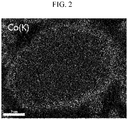
- the cross section EDS photograph of the positive active material where a Co element was dispersed was measured and shown in FIG. 2 .
- the Co element was overall dispersed inside the nickel-based lithium transition metal oxide secondary particle and particularly, present with a high density in a surface layer region corresponding to a depth of 200 nm from the surface of the secondary particle, and the reason may be that Co(OH) 2 and residual lithium on the surface of the nickel-based lithium transition metal oxide secondary particle reacted and formed nano-sized LiCoO 2 .
- FIG. 3A is a graph showing the first differential capacity (dQ/dV)-voltage charge curve
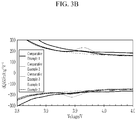
- FIG. 3B is a graph enlarging a voltage range of 3.8 to 4.0 V in the 1st differential capacity (dQ/dV)-voltage charge curve.
- a peak shown in the voltage range of 3.8 to 4.0 V means presence of LCO (LiCoO 2 ).
- the positive active materials according to Example 1 and Comparative Example 2 were prepared by coating a cobalt compound under a different condition on the surface of the nickel-based lithium transition metal oxide secondary particle, and when FIG. 3B was examined, Example 1 did not show the peak, but Comparative Example 2 clearly showed the peak.
- the present inventor confirmed that LCO was absorbed in the surface layer of the nickel-based lithium transition metal oxide secondary particle by using bimodal secondary particle nickel-based lithium transition metal oxide having different average particle diameters during preparation of the positive active material of Example 1 and reacting residual lithium on the surface of the nickel-based lithium transition metal oxide with nano-sized cobalt-based transition metal hydroxide.
- LCO was present as an island type on the surface of the nickel-based lithium transition metal oxide secondary particle or a simple mixture with the nickel-based lithium transition metal oxide secondary particle.
- Example 2 As an input amount of Co(OH) 2 was further increased in Example 2 under the same condition as Example 1, the LCO peak little by little appeared. This result shows that as for Example 2, LCO was absorbed in the surface layer of the nickel-based lithium transition metal oxide secondary particle and simultaneously, formed on the surface of the secondary particle.
- Capacity retention % at 100 th cycle Discharge capacity at 100 th cycle / Discharge capacity at 1 st cycle ⁇ 100 [Table 3] High-temperature cycle-life characteristics capacity retention [%] (45°C/100 cycles)
- the half-cells of Examples exhibited excellent high temperature discharge capacity retention compared with that of the half-cells of Comparative Examples.
- the half-cells of Examples exhibited improved high temperature cycle-life characteristics compared with those of the half-cells of Comparative Examples 1 to 3.
Landscapes
- Chemical & Material Sciences (AREA)
- Chemical Kinetics & Catalysis (AREA)
- Electrochemistry (AREA)
- General Chemical & Material Sciences (AREA)
- Inorganic Chemistry (AREA)
- Composite Materials (AREA)
- Organic Chemistry (AREA)
- Engineering & Computer Science (AREA)
- Manufacturing & Machinery (AREA)
- Materials Engineering (AREA)
- Battery Electrode And Active Subsutance (AREA)
- Inorganic Compounds Of Heavy Metals (AREA)
Abstract
Description
- A positive active material for a rechargeable lithium battery, a method of preparing the same, and a rechargeable lithium battery including the same are disclosed.
- In order to meet down-sizing and high performance of various devices, rechargeable lithium batteries have become increasingly important in terms of down-sizing and weight reduction as well as high energy density. In addition, high capacity and high temperature stability of rechargeable lithium batteries, and stability at a high voltage become important to apply to electric vehicles and the like.
- Various positive active materials have been investigated to realize rechargeable lithium batteries for applications to the uses.
- Nickel-based lithium transition metal oxide including Ni, Co, and Mn simultaneously provides higher discharge capacity per unit weight than conventional LiCoO2, but provides relatively low capacity per unit volume and discharge capacity due to low filling density. In addition, the nickel-based lithium transition metal oxide may show deteriorated safety during operation at a high voltage.
- Therefore, it is required to improve the filling density and thermal stability of nickel-based lithium transition metal oxide and to increase mixture density of a positive electrode plate.
- An embodiment provides a positive active material having improved charge and discharge capacity, efficiency, and cycle-life.
- Another embodiment provides a method of preparing the positive active material.
- Another embodiment provides a rechargeable lithium battery including the positive active material.
- An embodiment provides a positive active material for a rechargeable lithium battery as defined in
claim 1. The positive active material includes a nickel-based lithium transition metal oxide including a secondary particle comprising an agglomeration of a plurality of primary particles. The secondary particle includes a core and a surface layer surrounding the core, and the surface layer includes primary particles and a nano-sized cobalt-based lithium transition metal oxide between the primary particles. - The secondary particle may include a small particle diameter secondary particle having an average particle diameter (D50) of 2 µm to 5 µm and a large particle diameter secondary particle having an average particle diameter of 15 µm to 20 µm.
- The cobalt-based lithium transition metal oxide may have an average particle diameter of 100 nm to 200 nm.
- A content of the cobalt-based lithium transition metal oxide may be 5 wt% to 15 wt% based on a total weight of the positive active material.
- The cobalt-based lithium transition metal oxide may be a compound represented by Chemical Formula 1:
[Chemical Formula 1] LiaCoxM1-xO2
- In Chemical Formula 1, 0.9 ≤ a ≤ 1.05, 0.8 ≤ x ≤ 1.0, and M is at least one metal element selected from Ni, Mn, Al, Cr, Fe, V, Mg, Ti, Zr, Nb, Mo, W, Cu, Zn, Ga, In, Sn, La, and Ce.
- The surface layer may be a region corresponding to a depth of 150 nm to 200 nm from the surface of the secondary particle.
- The nickel-based lithium transition metal oxide may be a compound represented by Chemical Formula 2:
[Chemical Formula 2] LiaNixCoyMzO2
- In Chemical Formula 2, 0.9 ≤ a ≤ 1.05, 0.4 ≤ x ≤ 0.95, 0.1 ≤ y ≤0.3, 0.1 ≤ z ≤ 0.3, x + y + z =1, and M is at least one metal element selected from Mn, Al, Cr, Fe, V, Mg, Ti, Zr, Nb, Mo, W, Cu, Zn, Ga, In, Sn, La, and Ce.
- A mixing ratio of the large particle diameter secondary particle and the small particle diameter secondary particle may be a weight ratio of 90 : 10 to 50 : 50.
- The small particle diameter secondary particle may have a needle-shape, a sheet-shape, or a combination thereof.
- The positive active material may further include a cobalt-based lithium transition metal oxide disposed on the surface layer.
- Another embodiment provides a method of preparing a positive active material for a rechargeable lithium battery which includes mixing a nickel-based transition metal hydroxide and a lithium salt to prepare a first mixture; first heat-treating the first mixture under a rapid temperature-increasing condition at 800 °C to 1000 °C to prepare a first fired product including residual lithium; and mixing the first fired product with a cobalt-based transition metal hydroxide and secondly heat-treating the same at 750 °C to 950 °C to obtain the positive active material.
- The nickel-based transition metal hydroxide may include a large particle diameter secondary particle having an average particle diameter of 15 µm to 20 µm and a small particle diameter secondary particle having an average particle diameter of 2 µm to 5 µm in a weight ratio of 90 : 10 to 50 : 50.
- The rapid temperature-increasing condition may include a process where a temperature is raised from 25 °C to 100 °C to a first heat-treating reaction temperature of 800 °C to 1000 °C at 4 °C/min to 6 °C/min.
- The cobalt-based transition metal hydroxide may be Co(OH)2.
- The cobalt-based transition metal hydroxide may have an average particle diameter of 100 nm to 200 nm.
- The small particle diameter secondary particle may have a needle-shape, a sheet-shape, or a combination thereof.
- Another embodiment provides a rechargeable lithium battery including a positive electrode including the positive active material; a negative electrode including a negative active material; and an electrolyte.
- A pellet density of the positive active material powder and a mixture density of the positive electrode may be improved.
- The rechargeable lithium battery may be advantageous for high temperature and high voltage by including the cobalt-based lithium transition metal oxides.
- The rechargeable lithium battery may have improved high temperature cycle-life characteristics and improved charge and discharge efficiency by reducing an amount of gas generated at a high voltage.
-
-
FIG. 1 is an exploded perspective view of a rechargeable lithium battery according to an embodiment. -
FIG. 2 is a photograph showing a distribution of cobalt (Co) elements by analyzing the cross section of the positive active material prepared in Example 1 by EDS (energy dispersive spectroscopy). -
FIG. 3A is a graph showing a charge curve of the differential capacity (dQ/dV)-voltage of the rechargeable lithium battery cells according to Examples 1 and 2 and Comparative Examples 1 to 3. -
FIG. 3B is an enlarged graph ofFIG. 3A . -
FIG. 4 is a graph showing high temperature cycle-life characteristics of half-cells manufactured in Example 1, Example 2 and Comparative Example 1 to 3. -
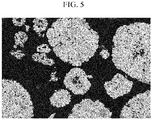
FIG. 5 is a photographic image showing the combination of large particle diameter and small particle diameter secondary particles. - Hereinafter, embodiments of the present invention are described in detail. However, these embodiments are exemplary, the present invention is not limited thereto and the present invention is defined by the scope of claims.
- As used herein, when specific definition is not otherwise provided, It will be understood that when an element such as a layer, film, region, or substrate is referred to as being "on" another element, it can be directly on the other element or intervening elements may also be present.
- A nickel-based lithium transition metal oxide includes a secondary particle in which a plurality of primary particles are agglomerated.
- The secondary particle may include at least one of a small particle diameter secondary particle having an average particle diameter (D50) of 2 µm to 5 µm and a large particle diameter secondary particle having an average particle diameter of 15 µm to 20 µm. In other words, the secondary particle may be a small particle diameter secondary particle, a large particle diameter secondary particle, or a mixture thereof, wherein the small particle diameter secondary particle may have an average particle diameter of 2 µm to 3 µm, and the large particle diameter secondary particle may have an average particle diameter of 17 µm to 20 µm. When the secondary particles have an average particle diameter within the range, a pellet density of a positive active material powder and a mixture density of a positive electrode may be improved, and a cobalt-based lithium transition metal oxide having in particular a nano-size average particle diameter may be well absorbed in a surface layer of the nickel-based lithium transition metal oxide secondary particle. Herein, the nano-size may mean a few nano to several hundred nanometers. For example, the size of the particles can be measured by SEM (Scanning Electron Microscope).
- When the nickel-based lithium transition metal oxide is composed of a mixture of the large particle diameter secondary particle and the small particle diameter secondary particle, a mixing ratio thereof may be 90 : 10 to 50 : 50, for example 90 : 10 to 70 : 30, or 80 : 20. When the nickel-based lithium transition metal oxide secondary particles satisfy the ratio range, the pellet density of a positive active material powder and the mixture density of a positive electrode may be improved.
- The secondary particle includes a core and a surface layer surrounding the core, and the surface layer includes primary particles and the nano-sized cobalt-based lithium transition metal oxide at least partly disposed between the primary particles. When the nano-sized cobalt-based lithium transition metal oxide is included among the primary particles present in the surface layer, for example, absorbed in the surface layer of the secondary particle, the pellet density of a positive active material powder and the mixture density of a positive electrode may be improved. In addition, the cobalt-based lithium transition metal oxide has advantageous characteristics with respect to a high temperature and a high voltage, a gas generation amount at the high voltage may be reduced, and accordingly, a rechargeable lithium battery having improved high temperature cycle-life characteristics and charge and discharge efficiency may be obtained.
- A charge curve of differential charge capacity (dQ/dV)-voltage of the rechargeable lithium battery including the positive active material for the rechargeable lithium battery may not have a peak at a range of 3.8 V to 4.0 V. When the peak is not found within the voltage range, the nano-sized cobalt-based lithium transition metal oxide is absorbed in the surface layer of the secondary particle. Accordingly, the pellet density of the positive active material powder and the mixture density of the positive electrode may be improved, and particularly, since the cobalt-based lithium transition metal oxide has advantageous characteristics with respect to a high temperature and a high voltage, a gas generation amount at the high voltage may be reduced, and accordingly, a rechargeable lithium battery having improved high temperature cycle-life characteristics and charge and discharge efficiency may be obtained.
- The surface layer may be a region corresponding to a depth of 150 nm to 200 nm from the surface of the positive active material. Herein, the surface is the outermost surface of the secondary particle.
- The nano-sized cobalt-based lithium transition metal oxide may be a compound represented by
Chemical Formula 1.
[Chemical Formula 1] LiaCoxM1-xO2
- In
Chemical Formula 1, 0.9 ≤ a ≤ 1.05, 0.8 ≤ x ≤ 1.0, and M is at least one metal element selected from Ni, Mn, Al, Cr, Fe, V, Mg, Ti, Zr, Nb, Mo, W, Cu, Zn, Ga, In, Sn, La, and Ce. - In an embodiment, the nano-sized cobalt-based lithium transition metal oxide may be for example LiCoO2.
- The nano-sized cobalt-based lithium transition metal oxide may have an average particle diameter of less than 1 µm, for example, 100 nm to 800 nm, 100 nm to 600 nm, 100 nm to 400 nm, 100 nm to 200 nm, 100 nm to 180 nm, 100 nm to 160 nm, 100 nm to 140 nm, or 100 nm to 120 nm. When the cobalt-based lithium transition metal oxide has an average particle diameter within the range, the pellet density of a positive active material powder and the mixture density of a positive electrode may be improved, and the cobalt-based lithium transition metal oxide having a nano-size average particle diameter may be well absorbed in the surface layer of the nickel-based lithium transition metal oxide secondary particle.
- A content of the cobalt-based lithium transition metal oxide may be 5 wt% to 15 wt%, for example 5 wt% to 10 wt%, 5 wt% to 9 wt%, or 5 wt% to 7 wt% based on a total weight, 100 wt% of the positive active material. When the content of cobalt-based lithium transition metal oxide is in the ranges, a pellet density of the positive active material powder and a mixture density of the positive electrode may be improved.
- In the positive active material, the nickel-based lithium transition metal oxide may be a compound represented by
Chemical Formula 2.
[Chemical Formula 2] LiaNixCoyMzO2
- In
Chemical Formula 2, 0.9 ≤ a ≤ 1.05, 0.4 ≤ x ≤ 0.95, 0.1 ≤ y ≤ 0.3, 0.1 ≤ z ≤ 0.3, x + y + z =1, and M is at least one metal element selected from Mn, Al, Cr, Fe, V, Mg, Ti, Zr, Nb, Mo, W, Cu, Zn, Ga, In, Sn, La, and Ce. - The x indicating a Ni mole ratio may be 0.4 to 0.95, for example 0.45 to 0.80, 0.45 to 0.70, 0.45 to 0.65, 0.50 to 0.60, 0.53 to 0.57. That is, Ni may be included in an amount of 40 at% to 95 at%, for example, 45 at% to 80 at%, 45 at% to 70 at%, 45 at% to 65 at%, 50 at% to 60 at%, or 53 at% to 57 at% based on a total amount, 100 at% of metals except lithium of the positive active material. Accordingly, a rechargeable lithium battery having improved charge and discharge efficiency and cycle-life characteristics may be provided.
- The small particle diameter secondary particle of the nickel-based lithium transition metal oxide may have a needle-shape, a sheet-shape, or a combination thereof. When the small particle diameter secondary particle has the shape, a mixture density of the positive active material powder and a pellet density of the positive electrode may be improved.
- The positive active material may include cobalt-based lithium transition metal oxide disposed on the outer surface of the secondary particle. The cobalt-based lithium transition metal oxide may form a continuous layer or be present as an island type. Such deposition of pure cobalt-based lithium transition metal oxide on the surface of the secondary particle may have a thickness in a range of 80 nm to 120 nm. Accordingly, a gas generation amount at the high voltage may be reduced, and a rechargeable lithium battery having improved high temperature cycle-life characteristics and charge and discharge efficiency may be obtained.
- A method of preparing a positive active material according to another embodiment is provided. Hereinafter, the preparing method is explained in detail.
- A nickel-based transition metal hydroxide and a lithium salt are mixed to prepare a first mixture; and the first mixture is first heat-treated under a rapid temperature-increasing condition at 800 °C to 1000 °C to prepare a first fired product including residual lithium.
- The nickel-based transition metal hydroxide may include a large particle diameter secondary particle having an average particle diameter of 15 µm to 20 µm and a small particle diameter secondary particle having an average particle diameter of 2 µm to 5 µm in a weight ratio of 90 : 10 to 50 : 50.
- In the first mixture, a mole ratio of Li/(Ni+Co+Mn) may be greater than or equal to 0.99, for example, 1.00 to 1.25. When in the mixture, the mole ratio of Li/(Ni+Co+Mn) is within the range, a large amount of lithium may remain on the surface of the nickel-based lithium transition metal oxide in the first fired product manufactured from the first heat-treating. This residual lithium may react with the cobalt-based transition metal hydroxide in the secondly heat-treating and be used to prepare a positive active material.
- The rapid temperature-increasing condition may include a process where a temperature of the first mixture is raised from 25 °C to 100 °C to a first heat-treating reaction temperature of 800 °C to 1000 °C at 4 °C/min to 6 °C/min. This process may prevent cation mixing and generate a large amount of unreacted residual lithium on the surface of the nickel-based lithium transition metal oxide.
- The first heat-treating may be performed at 800 °C to 1000 °C for 1 hour to 4 hours under an air atmosphere or an oxidizing gas atmosphere. Since the first heat-treating at a high temperature (800 °C to 1000 °C) under an air atmosphere or an oxidizing gas atmosphere for a short time (1 hour to 4 hours) is performed, nickel-based transition metal hydroxide not participated in a reaction may be present in a large amount. Accordingly, the large amount of unreacted residual lithium may be included on the surface of the nickel-based lithium transition metal oxide, and the cation mixing may be improved by suppressing transition of Ni into Ni2+ and movement of the Ni2+ to a Li site.
- On the other hand, the oxidizing gas atmosphere indicates a gas atmosphere further including oxygen in the air. The oxidizing gas atmosphere may have an oxygen content of 20 volume% to 40 volume%.
- The first heat-treating process may be performed by setting a charging height of greater than or equal to 5 cm, for example, ranging 5 cm to 8 cm. In this way, when the heat-treating process is performed by inserting the mixture into a heat-treatment equipment in a height of greater than or equal to 5 cm, a production is increased and thus economical relative to a production cost, and an unreacted lithium amount remaining on the surface of the first fired product is increased, and accordingly, a positive active material may be well formed in the subsequent second heat-treating process.
- The first fired product is mixed with the cobalt-based transition metal hydroxide and then, secondly heat-treated at 750 °C to 950 °C.
- The secondly heat-treating may be performed by increasing a temperature from a range of 25 °C to 100 °C up to a reaction temperature for the secondly heat-treating in a range of 750 °C to 950 °C at 5 °C/min to 10 °C/min, maintaining the temperature at 750°C to 950°C for 10 hours to 15 hours, and decreasing the temperature at 5 °C/min to 10 °C/min down to 25 °C to 100 °C.
- The second heat-treating process may be performed under the oxygen atmosphere having an oxygen content of 40 volume% to 100 volume%.
- The cobalt-based transition metal hydroxide may be Co(OH)2.
- The cobalt-based transition metal hydroxide may have an average particle diameter of 100 nm to 200 nm.
- When the cobalt-based transition metal hydroxide having an average particle diameter within the range is used, cobalt-based lithium transition metal oxide prepared during the second heat-treating process may not be simply coated on the surface of the nickel-based lithium transition metal oxide secondary particle but absorbed among primary particles in a surface layer of the secondary particle.
- A content of the cobalt-based transition metal hydroxide may be adjusted so that the nano-sized cobalt-based lithium transition metal oxide is included in an amount of 5 wt% to 15 wt% based on a total weight of the positive active material.
- When the content of the cobalt-based transition metal hydroxide is in the range, a pellet density of the positive active material powder and a mixture density of the positive electrode may be improved.
- The lithium salt may be at least one of lithium hydroxide, lithium carbonate, lithium sulfate, and lithium nitrate.
- The small particle diameter nickel-based transition metal hydroxide secondary particle may have a needle-shape, a sheet-shape, or a combination thereof. The small particle diameter nickel-based transition metal oxide secondary particle prepared by the method of preparing the positive active may maintain the needle-shape, the sheet-shape, or the combination thereof. Accordingly, a mixture density of the positive active material powder and a pellet density of the positive electrode may be improved. On the contrary, when a positive active material is prepared by separately preparing a large particle diameter nickel-based transition metal oxide secondary particle and a small particle diameter nickel-based transition metal oxide secondary particle, and heat-treating them, the small particle diameter nickel-based transition metal oxide secondary particle in a final product may have a spherical shape. In this case, the improvement effect of the above pellet density and mixture density may not be shown.
- By the method of preparing the positive active material for the rechargeable lithium battery, provided is the positive active material for a rechargeable lithium battery according to the embodiment which includes a nickel-based lithium transition metal oxide including a secondary particle in which a plurality of primary particles are agglomerated, the secondary particle includes a core and a surface layer surrounding the core, and the surface layer includes a plurality of primary particles and a nano-sized cobalt-based lithium transition metal oxide between the primary particles.
- Another embodiment provides a rechargeable lithium battery including a positive electrode including the positive active material; a negative electrode including a negative active material; a separator disposed between the positive electrode and the negative electrode; and an electrolyte.
- The positive electrode includes a current collector and a positive active material layer formed on the current collector and including a positive active material.
- In the positive active material layer, a content of the positive active material may be 90 wt% to 98 wt% based on a total weight of the positive active material layer. In addition, the positive active material layer may further include a binder and a conductive material. Herein, each amount of the binder and the conductive material may be 1 wt% to 5 wt% based on a total weight of the positive active material layer.
- The binder may include polyvinyl alcohol, carboxylmethyl cellulose, hydroxypropyl cellulose, diacetyl cellulose, polyvinyl chloride, polyvinylfluoride, polyvinylpyrrolidone, polyurethane, polytetrafluoroethylene, polyvinylidene fluoride, polyethylene, polypropylene, a styrene-butadiene rubber, an acrylated styrene butadiene rubber, an epoxy resin, nylon, and the like.
- Examples of the conductive material may include a carbon-based material such as natural graphite, artificial graphite, carbon black, acetylene black, ketjen black, carbon fiber and the like; a metal-based material of a metal powder or a metal fiber including copper, nickel, aluminum, silver, and the like; a conductive polymer such as a polyphenylene derivative; or a mixture thereof.
- The current collector may include an aluminum foil, a nickel foil, or a combination thereof.
- The negative electrode includes a current collector and a negative active material layer formed on the current collector and including a negative active material.
- The negative active material may include a material that reversibly intercalates/deintercalates lithium ions, a lithium metal, a lithium metal alloy, a material being capable of doping/dedoping lithium, or transition metal oxide.
- The material that reversibly intercalates/deintercalates lithium ions may include a carbon material. The carbon material may be any generally-used carbon-based negative active material in a rechargeable lithium ion battery. Examples thereof may be crystalline carbon, amorphous carbon, or a mixture thereof. The crystalline carbon may be non-shaped, or sheet, flake, spherical, or fiber shaped natural graphite or artificial graphite. The amorphous carbon may be a soft carbon, a hard carbon, a mesophase pitch carbonization product, fired coke, and the like.
- The lithium metal alloy includes an alloy of lithium and a metal selected from Na, K, Rb, Cs, Fr, Be, Mg, Ca, Sr, Si, Sb, Pb, In, Zn, Ba, Ra, Ge, Al, and Sn.
- The material capable of doping/dedoping lithium may be Si, SiOx (0 < x < 2), a Si-Q alloy (wherein Q is an element selected from an alkali metal, an alkaline-earth metal, a Group 13 element, a Group 14 element, a Group 15 element, a Group 16 element, a transition metal, a rare earth element, and a combination thereof, and not Si), Sn, SnO2, a Sn-R alloy (wherein R is an element selected from an alkali metal, an alkaline-earth metal, a Group 13 element, a Group 14 element, a Group 15 element, a Group 16 element, a transition metal, a rare earth element, and a combination thereof, and not Sn), and the like. At least one of these materials may be mixed with SiO2. The elements Q and R may be selected from Mg, Ca, Sr, Ba, Ra, Sc, Y, Ti, Zr, Hf, Rf, V, Nb, Ta, Db, Cr, Mo, W, Sg, Tc, Re, Bh, Fe, Pb, Ru, Os, Hs, Rh, Ir, Pd, Pt, Cu, Ag, Au, Zn, Cd, B, Al, Ga, Sn, In, TI, Ge, P, As, Sb, Bi, S, Se, Te, Po, and a combination thereof.
- The transition metal oxide may be vanadium oxide, lithium vanadium oxide, or lithium titanium oxide.
- In the negative active material layer, the negative active material may be included in an amount of 95 wt% to 99 wt% based on the total weight of the negative active material layer.
- In an embodiment of the present invention, the negative active material layer includes a binder, and optionally a conductive material. In the negative active material layer, a content of the binder may be 1 wt% to 5 wt% based on a total weight of the negative active material layer. When the negative active material layer further includes a conductive material, the negative active material layer includes 90 wt% to 98 wt% of the negative active material, 1 wt% to 5 wt% of the binder, and 1 wt% to 5 wt% of the conductive material.
- The binder improves binding properties of negative active material particles with one another and with a current collector. The binder includes a non-water-soluble binder, a water-soluble binder, or a combination thereof.
- The non-water-soluble binder may be selected from polyvinylchloride, carboxylated polyvinylchloride, polyvinylfluoride, an ethylene propylene copolymer, polyacrylonitrile, polystyrene, polyurethane, polytetrafluoroethylene, polyvinylidene fluoride, polyethylene, polypropylene, polyamideimide, polyimide, or a combination thereof.
- The water-soluble binder may be a styrene-butadiene rubber (SBR), an acrylated styrene-butadiene rubber, an acrylonitrile-butadiene rubber, an acrylic rubber, a butyl rubber, a fluorine rubber, an ethylene oxide-containing polymer, polyvinylpyrrolidone, polyepichlorohydrine, polyphosphazene, an ethylene propylene diene copolymer, polyvinylpyridine, chlorosulfonated polyethylene, latex, a polyester resin, an acrylic resin, a phenolic resin, an epoxy resin, polyvinyl alcohol, or a combination thereof.
- When the water-soluble binder is used as a negative electrode binder, a cellulose-based compound may be further used to provide viscosity as a thickener. The cellulose-based compound includes one or more of carboxymethyl cellulose, hydroxypropylmethyl cellulose, methyl cellulose, or alkali metal salts thereof. The alkali metals may be Na, K, or Li. Such a thickener may be included in an amount of 0.1 to 3 wt% based on 100 wt% of the negative active material.
- The conductive material may include a carbon-based material such as natural graphite, artificial graphite, carbon black, acetylene black, ketjen black, a carbon fiber, and the like; a metal-based material of a metal powder or a metal fiber including copper, nickel, aluminum silver, and the like; a conductive polymer such as a polyphenylene derivative; or a mixture thereof.
- The current collector may include at least one selected from a copper foil, a nickel foil, a stainless steel foil, a titanium foil, a nickel foam, a copper foam, a polymer substrate coated with a conductive metal, and a combination thereof.
- The electrolyte includes a non-aqueous organic solvent and a lithium salt.
- The non-aqueous organic solvent serves as a medium for transmitting ions taking part in the electrochemical reaction of a battery.
- The non-aqueous organic solvent may include dimethyl carbonate (DMC), diethyl carbonate (DEC), dipropyl carbonate (DPC), methylpropyl carbonate (MPC), ethylpropyl carbonate (EPC), methylethyl carbonate (MEC), ethylene carbonate (EC), propylene carbonate (PC), butylene carbonate (BC), methyl acetate, ethyl acetate, n-propyl acetate, t-butyl acetate, methylpropionate, ethylpropionate, decanolide, mevalonolactone, caprolactone, dibutyl ether, tetraglyme, diglyme, dimethoxyethane, 2-methyltetrahydrofuran, tetrahydrofuran, cyclohexanone, ethanol, isopropyl alcohol, nitriles such as R-CN (R may be a C2 to C20 linear, branched, or cyclic hydrocarbon group and R may include a double bond, an aromatic ring, or an ether bond), and the like, amides such as dimethyl formamide, and the like, dioxolanes such as 1,3-dioxolane, and the like, sulfolanes, and the like.
- The organic solvent may be used alone or in a mixture. When the organic solvent is used in a mixture, a mixing ratio may be controlled in accordance with a desirable battery performance.
- In addition, the organic solvent may further include an aromatic hydrocarbon-based organic solvent. Specific examples of the aromatic hydrocarbon-based organic solvent may be selected from benzene, fluorobenzene, 1,2-difluorobenzene, 1,3-difluorobenzene, 1,4-difluorobenzene, 1,2,3-trifluorobenzene, 1,2,4-trifluorobenzene, chlorobenzene, 1,2-dichlorobenzene, 1,3-dichlorobenzene, 1,4-dichlorobenzene, 1,2,3-trichlorobenzene, 1,2,4 trichlorobenzene, iodobenzene, 1,2-diiodobenzene, 1,3-diiodobenzene, 1,4-diiodobenzene, 1,2,3-triiodobenzene, 1,2,4-triiodobenzene, toluene, fluorotoluene, 2,3-difluorotoluene, 2,4-difluorotoluene, 2,5-difluorotoluene, 2,3,4-trifluorotoluene, 2,3,5-trifluorotoluene, chlorotoluene, 2,3-dichlorotoluene, 2,4-dichlorotoluene, 2,5-dichlorotoluene, 2,3,4-trichlorotoluene, 2,3,5-trichlorotoluene, iodotoluene, 2,3-diiodotoluene, 2,4-diiodotoluene, 2,5-diiodotoluene, 2,3,4-triiodotoluene, 2,3,5-triiodotoluene, xylene, and a combination thereof.
- The electrolyte may further include an additive of vinylene carbonate or an ethylene carbonate-based compound as a cycle-life improvement additive.
- Examples of the ethylene carbonate-based compound may be difluoro ethylenecarbonate, chloroethylene carbonate, dichloroethylene carbonate, bromoethylene carbonate, dibromoethylene carbonate, nitroethylene carbonate, cyanoethylene carbonate, fluoroethylene carbonate, and the like. The amount of the cycle-life improvement additive may be used within an appropriate range.
- The lithium salt dissolved in an organic solvent supplies a battery with lithium ions, basically operates the rechargeable lithium battery, and improves transportation of the lithium ions between a positive electrode and a negative electrode. Examples of the lithium salt include at least one supporting salt selected from LiPF6, LiBF4, LiSbF6, LiAsF6, LiN(SO2C2F5)2, Li(CF3SO2)2N, LiN(SO3C2F5)2, LiC4F9SO3, LiClO4, LiAlO2, LiAlCl4, LiN(CxF2x+1SO2)(CyF2y+1SO2) wherein, x and y are natural numbers, for example an integer of 1 to 20), LiCl, Lil, and LiB(C2O4)2 (lithium bis(oxalato) borate, LiBOB). A concentration of the lithium salt may range from about 0.1 M to about 2.0 M. When the lithium salt is included at the above concentration range, an electrolyte may have excellent performance and lithium ion mobility due to optimal electrolyte conductivity and viscosity.
- The rechargeable lithium battery may further include a separator between the negative electrode and the positive electrode, depending on a type of the battery. Examples of a suitable separator material include polyethylene, polypropylene, polyvinylidene fluoride, and multi-layers thereof such as a polyethylene/polypropylene double-layered separator, a polyethylene/polypropylene/polyethylene triple-layered separator, and a polypropylene/polyethylene/polypropylene triple-layered separator.
-
FIG. 1 is an exploded perspective view of a rechargeable lithium battery according to an embodiment. The rechargeable lithium battery according to an embodiment is illustrated as a prismatic battery but is not limited thereto and may include variously-shaped batteries such as a cylindrical battery, a pouch battery, a button-type battery, a coin-type battery, and the like. - Referring to
FIG. 1 , arechargeable lithium battery 100 according to an embodiment includes anelectrode assembly 40 manufactured by winding aseparator 30 interposed between apositive electrode 10 and anegative electrode 20, and acase 50 housing theelectrode assembly 40. An electrolyte (not shown) may be impregnated in thepositive electrode 10, thenegative electrode 20, and theseparator 30. - Hereinafter, examples of the present disclosure and comparative examples are described. However, the following examples are merely examples and the present invention is not limited thereto.
- Lithium carbonate (Li2CO3) and Ni0.55Co0.25Mn0.20(OH)2 of nickel-based transition metal hydroxide were mixed to have a mole ratio of Li : (Ni + Co + Mn) = 1.01 : 1.00. Herein, the Ni0.55Co0.25Mn0.20(OH)2 was obtained by mixing large particle diameter nickel-based lithium transition metal hydroxide and small particle diameter nickel-based lithium transition metal hydroxide, which had the same composition but a different diameter, in a weight ratio of 8 : 2.
- The first mixture was first heat-treated under a condition of increasing a temperature from 25 °C to 900 °C at 5 °C/min, maintaining it at 900 °C for 2 hours, and decreasing it to 25 °C at 5 °C/min to prepare a first fired product including large particle diameter nickel-based lithium transition metal oxide represented by Li1.01Ni0.55Co0.25Mn0.20O2 and small particle diameter nickel-based lithium transition metal oxide represented by Li1.01Ni0.55Co0.25Mn0.20O2. On the other hand, the first heat-treating process was performed by setting a charging height of 5 cm under an air atmosphere.
- The first fired product was mixed with Co(OH)2 to include 5 wt% of the nano-sized cobalt-based lithium transition metal oxide based on 100 wt% of a total weight of a positive active material as a final product. Subsequently, a secondly heat-treating was performed by increasing a temperature from 25 °C to 850 °C at 5 °C/min, maintaining it at 850 °C for 10 hours, and decreasing it at 5 °C/min down to 25 °C to prepare the positive active material including the large particle diameter nickel-based lithium transition metal oxide represented by LiNi0.55Co0.25Mn0.20O2 and the small particle diameter nickel-based lithium transition metal oxide represented by LiNi0.55Co0.25Mn0.20O2 in a weight ratio of 8 : 2 and including LiCoO2 in a surface layer of the large and small particle diameter nickel-based lithium transition metal oxide. The secondly heat-treating was performed under an oxygen (O2) atmosphere.
- Herein, the large particle diameter nickel-based lithium transition metal hydroxide of Ni0.55Co0.25Mn0.20(OH)2 had an average particle diameter (D50) of 19.5µm, the small particle diameter nickel-based lithium transition metal hydroxide of Ni0.55Co0.25Mn0.20(OH)2 had an average particle diameter (D50) of 2.6µm, and the Co(OH)2 had an average particle diameter (D50) of 100 nm.
- 94 wt% of the positive active material, 3 wt% of ketjen black, and 3 wt% of polyvinylidene fluoride were mixed in N-methyl pyrrolidone solvent to prepare positive active material slurry. The positive active material slurry was coated on an Al foil followed by drying and compressing the same to manufacture a positive electrode.
- The manufactured positive electrode, a lithium metal counter electrode, a separator, and an electrolyte were used to manufacture a 2032-type half-cell in a conventional method. The electrolyte was prepared by dissolving 1.0M LiPF6 in a mixed solvent of ethylene carbonate and dimethyl carbonate (a volume ratio of 50 : 50). The separator was 20 µm-thick polyethylene porous film.
- A positive active material, a positive electrode and a half-cell were manufactured according to the same method as Example 1 except that Co(OH)2 was added so that 10 wt% of the nano-sized cobalt-based lithium transition metal oxide was included based on 100 wt% of a total weight of the positive active material of a final product to the first fired product.
- A positive electrode and a half-cell were manufactured according to the same method as Example 1 except that commercially available NCM622 (LiNi0.6Co0.2Mn0.2, Umicore) was used as a positive active material.
- A positive active material, a positive electrode and a half-cell were manufactured according to the same method as Example 1 except that Co3O4 having an average particle diameter (D50) of 4.5µm was used instead of Co(OH)2 to the first fired product, wherein the cobalt oxide was included in an amount of 5 wt% based on 100 wt% of a total weight of the positive active material of a final product, and then, mixing the mixture at 2400 rpm for 5 minutes in a 20 L powder mixer, in the preparation of the positive active material.
- A positive active material, a positive electrode and a half-cell were manufactured according to the same method as Example 1 except that Co3O4 having an average particle diameter (D50) of 4.5µm was used instead of Co(OH)2 to the first fired product, wherein the cobalt oxide was included in an amount of 10 wt% based on 100 wt% of a total weight of the positive active material of a final product, and then, mixing the mixture at 2400 rpm for 5 minutes in a 20 L powder mixer and dry-coating it, in the preparation of the positive active material.
- A positive active material, a positive electrode, and a half-cell were manufactured according to the same method as Example 1 except that Co(OH)2 was used so that the cobalt-based lithium transition metal oxide was included in an amount of 15 wt% based on 100 wt% of a total weight of the positive active material.
- A positive active material, a positive electrode, and a half-cell were manufactured according to the same method as Example 1 except that as for Ni0.55Co0.25Mn0.20(OH)2, the large particle diameter secondary particles alone without the small particle diameter secondary particles were used.
- The positive active materials and the positive electrodes manufactured in Examples 1 and 2, Comparative Examples 1 to 3, and Reference Examples 1 and 2 were used to measure pellet densities of the positive active materials and mixture densities of the electrode plates, and the results are shown in Table 1.
- On the other hand, the pellet densities were measured and recorded within 3.0000 g of each positive active material (an error range ± 0.0004 g), wherein the positive active materials were maintained under 4 tons of a pressure for 30 seconds in a 13 mm-sized KBr pellet die to measure a reduced height and then, a weight per volume.
- In addition, the electrode plate mixture density was measured by dividing the "electrode plate mixture weight" by the "electrode plate mixture thickness," and the "electrode plate mixture weight" was calculated by subtracting the "substrate weight per unit area" from the "electrode plate weight per unit area," and the "electrode plate mixture thickness" was obtained by subtracting the "substrate thickness" from the "electrode plate thickness."
[Table 1] Pellet density (g/cm3) Mixture density of Electrode plate (g/cm3) Example 1 3.51 3.61 Example 2 3.45 3.58 Comparative Example 1 3.34 3.52 Comparative Example 2 3.42 3.57 Comparative Example 3 3.35 3.53 Reference Example 1 3.43 3.56 Reference Example 2 3.29 3.40 - The positive active materials according to Examples 1 and 2 exhibited increased pellet density compared with those of the positive active materials according to Comparative Examples 1 to 3, and mixture densities of the electrode plates also exhibited the same result.
- The cross section of the positive active material according to Example 1 was analyzed through EDS to confirm that Ni, Co, and Mn were well dispersed inside (in a core) and the surface (a surface layer) of the positive active material, and atomic mol% at each spot of the nickel-based lithium transition metal oxide secondary particle was measured. Among the EDS photographs, the cross section EDS photograph of the positive active material where a Co element was dispersed was measured and shown in
FIG. 2 . - As shown in
FIG. 2 , the Co element was overall dispersed inside the nickel-based lithium transition metal oxide secondary particle and particularly, present with a high density in a surface layer region corresponding to a depth of 200 nm from the surface of the secondary particle, and the reason may be that Co(OH)2 and residual lithium on the surface of the nickel-based lithium transition metal oxide secondary particle reacted and formed nano-sized LiCoO2. - The half-cells according to Examples 1 and 2 and Comparative Examples 1 to 3 were once charged and discharged at 0.2 C and then, twice charged and discharged in the same method.
FIG. 3A is a graph showing the first differential capacity (dQ/dV)-voltage charge curve, andFIG. 3B is a graph enlarging a voltage range of 3.8 to 4.0 V in the 1st differential capacity (dQ/dV)-voltage charge curve. - In
FIG. 3A , a peak shown in the voltage range of 3.8 to 4.0 V means presence of LCO (LiCoO2). The positive active materials according to Example 1 and Comparative Example 2 were prepared by coating a cobalt compound under a different condition on the surface of the nickel-based lithium transition metal oxide secondary particle, and whenFIG. 3B was examined, Example 1 did not show the peak, but Comparative Example 2 clearly showed the peak. Accordingly, the present inventor confirmed that LCO was absorbed in the surface layer of the nickel-based lithium transition metal oxide secondary particle by using bimodal secondary particle nickel-based lithium transition metal oxide having different average particle diameters during preparation of the positive active material of Example 1 and reacting residual lithium on the surface of the nickel-based lithium transition metal oxide with nano-sized cobalt-based transition metal hydroxide. On the contrary, since the aforementioned condition in Example 1 was not satisfied during preparation of the positive active material of Comparative Example 2, even though the same amount of the cobalt compound as that of Example 1 was coated, LCO was present as an island type on the surface of the nickel-based lithium transition metal oxide secondary particle or a simple mixture with the nickel-based lithium transition metal oxide secondary particle. - In addition, as an input amount of Co(OH)2 was further increased in Example 2 under the same condition as Example 1, the LCO peak little by little appeared. This result shows that as for Example 2, LCO was absorbed in the surface layer of the nickel-based lithium transition metal oxide secondary particle and simultaneously, formed on the surface of the secondary particle.
- The half-cells according to Examples 1 and 2, Comparative Examples 1 to 3, and Reference Examples 1 and 2 were respectively once charged and discharged at 0.2 C in a voltage range of 3.0 to 4.3V, and then, charge capacity, discharge capacity, and charge and discharge efficiency thereof were obtained. These results are shown in Table 2.
[Table 2] Charge capacity (mAh/g) Discharge capacity (mAh/g) Charge and discharge efficiency (%) Example 1 184.72 174.32 94.37 % Example 2 184.08 172.94 93.95 % Comparative Example 1 187.25 167.78 89.60 % Comparative Example 2 184.65 170.93 92.57 % Comparative Example 3 183.65 169.33 92.20 % Reference Example 1 183.06 170.65 93.22 % Reference Example 2 183.93 167.11 90.86 % - As shown in Table 2, the half-cells according to Examples 1 and 2 exhibited excellent charge and discharge efficiency compared with those of Comparative Examples 1 to 3.
- The half-cells according to Examples 1 and 2, Comparative Examples 1 to 3, and Reference Examples 1 and 2 were charged at a high temperature of 45° C under a constant current-constant voltage modeat 1.0 C (1 C = 160 mAh/g) up to 4.3 V and then at 0.05 C and discharged under a constant current modeat 1.0 C to 3.0 V, which was regarded as one charge and discharge cycle. This cycle was 100 times in total repeated, and discharge capacity thereof was measured at each cycle. Capacity retention at the 100th cycle was calculated according to
Equation 1, and the results are shown in Table 3, and a high temperature cycle-life graph is shown inFIG. 4 .
[Table 3] High-temperature cycle-life characteristics capacity retention [%] (45°C/100 cycles) Example 1 97.20 % Example 2 96.46 % Comparative Example 1 76.90 % Comparative Example 2 96.36 % Comparative Example 3 95.90 % Reference Example 1 95.85 % Reference Example 2 90.07 % - As shown in Table 3, the half-cells of Examples exhibited excellent high temperature discharge capacity retention compared with that of the half-cells of Comparative Examples. In addition, as shown in
FIG. 4 , the half-cells of Examples exhibited improved high temperature cycle-life characteristics compared with those of the half-cells of Comparative Examples 1 to 3.
Claims (17)
- A positive active material for a rechargeable lithium battery (100), comprising
a nickel-based lithium transition metal oxide comprising a secondary particle, the secondary particle comprising an agglomeration of a plurality of primary particles,
the secondary particle comprising a core and a surface layer surrounding the core, and
the surface layer comprising primary particles and a nano-sized cobalt-based lithium transition metal oxide between the primary particles. - The positive active material of claim 1, wherein the secondary particle comprises at least one of a small particle diameter secondary particle having an average particle diameter (D50) of 2 µm to 5 µm and a large particle diameter secondary particle having an average particle diameter of 15 µm to 20 µm.
- The positive active material of claim 1, wherein the cobalt-based lithium transition metal oxide has an average particle diameter of 100 nm to 200 nm.
- The positive active material of claim 1, wherein a content of the cobalt-based lithium transition metal oxide is 5 wt% to 15 wt% based on a total weight of the positive active material.
- The positive active material of any one of claims 1 - 4, wherein the cobalt-based lithium transition metal oxide is a compound represented by Chemical Formula 1:
[Chemical Formula 1] LiaCoxM1-xO2
wherein, in Chemical Formula 1, 0.9 ≤ a ≤ 1.05, 0.8 ≤ x ≤ 1.0, and M is at least one metal element selected from Ni, Mn, Al, Cr, Fe, V, Mg, Ti, Zr, Nb, Mo, W, Cu, Zn, Ga, In, Sn, La, and Ce. - The positive active material of any one of the preceding claims, wherein the surface layer is a region corresponding to a depth of 150 nm to 200 nm from the surface of the secondary particle.
- The positive active material of any one of the preceding claims, wherein the nickel-based lithium transition metal oxide is a compound represented by Chemical Formula 2:
[Chemical Formula 2] LiaNixCoyMzO2
wherein, in Chemical Formula 2, 0.9 ≤ a ≤ 1.05, 0.4 ≤ x ≤ 0.95, 0.1 ≤ y ≤0.3, 0.1 ≤ z ≤ 0.3, x + y + z =1, M is at least one metal element selected from Mn, Al, Cr, Fe, V, Mg, Ti, Zr, Nb, Mo, W, Cu, Zn, Ga, In, Sn, La, and Ce. - The positive active material of claim 2, wherein a mixing ratio of the large particle diameter secondary particle and the small particle diameter secondary particle is a weight ratio of 90 : 10 to 50 : 50.
- The positive active material of claim 2, wherein the small particle diameter secondary particle has a needle-shape, a sheet-shape, or a combination thereof.
- The positive active material of claim 1, wherein the positive active material further comprises a cobalt-based lithium transition metal oxide disposed on the surface layer.
- A method of preparing a positive active material for a rechargeable lithium battery (100) comprising the steps of:mixing a nickel-based transition metal hydroxide and a lithium salt to prepare a first mixture;first heat-treating the first mixture under a rapid temperature-increasing condition at 800 °C to 1000 °C to prepare a first fired product comprising residual lithium; andmixing the first fired product with a cobalt-based transition metal hydroxide and secondly heat-treating the same at 750 °C to 950 °C to obtain the positive active material of claim 1.
- The method of claim 11, wherein the nickel-based transition metal hydroxide comprises a large particle diameter secondary particle having an average particle diameter of 15 µm to 20 µm and a small particle diameter secondary particle having an average particle diameter of 2 µm to 5 µm in a weight ratio of 90 : 10 to 50 : 50.
- The method of any one of claims 11 or 12, wherein the rapid temperature-increasing condition comprises a process where a temperature is raised from 25 °C to 100 °C to a first heat-treating reaction temperature of 800 °C to 1000 °C at 4 °C/min to 6 °C/min.
- The method of any one of claims 11 - 13, wherein the cobalt-based transition metal hydroxide is Co(OH)2.
- The method of any one of claims 11 - 14, wherein the cobalt-based transition metal hydroxide has an average particle diameter of 100 nm to 200 nm.
- The method of claim 11, wherein the small particle diameter secondary particle has a needle-shape, a sheet-shape, or a combination thereof.
- A rechargeable lithium battery (100) comprising
a positive electrode (10) comprising the positive active material of claim 1;
a negative electrode (20) comprising a negative active material; and
an electrolyte.
Applications Claiming Priority (1)
| Application Number | Priority Date | Filing Date | Title |
|---|---|---|---|
| KR1020180133787A KR102263998B1 (en) | 2018-11-02 | 2018-11-02 | Positive active material for rechargeable lithium battery, method of preparing same and rechargeable lithium battery including same |
Publications (2)
| Publication Number | Publication Date |
|---|---|
| EP3647269A1 true EP3647269A1 (en) | 2020-05-06 |
| EP3647269B1 EP3647269B1 (en) | 2024-04-03 |
Family
ID=68424723
Family Applications (1)
| Application Number | Title | Priority Date | Filing Date |
|---|---|---|---|
| EP19206384.0A Active EP3647269B1 (en) | 2018-11-02 | 2019-10-31 | Positive active material for rechargeable lithium battery, method of preparing the same and rechargeable lithium battery including the same |
Country Status (7)
| Country | Link |
|---|---|
| US (1) | US11417875B2 (en) |
| EP (1) | EP3647269B1 (en) |
| JP (2) | JP7229145B2 (en) |
| KR (1) | KR102263998B1 (en) |
| CN (1) | CN111146413B (en) |
| HU (1) | HUE067633T2 (en) |
| PL (1) | PL3647269T3 (en) |
Cited By (8)
| Publication number | Priority date | Publication date | Assignee | Title |
|---|---|---|---|---|
| EP3706208A1 (en) * | 2019-03-05 | 2020-09-09 | Samsung SDI Co., Ltd. | Positive active material for rechargeable lithium battery, method of preparing the same and rechargeable lithium battery including the same |
| EP4135067A1 (en) * | 2021-08-13 | 2023-02-15 | Samsung SDI Co., Ltd. | Positive active material for rechargeable lithium battery, preparing method thereof and rechargeable lithium battery including the same |
| US11670754B2 (en) | 2017-12-04 | 2023-06-06 | Samsung Sdi Co., Ltd. | Positive active material for rechargeable lithium battery, preparing method thereof and rechargeable lithium battery comprising positive electrode including positive active material |
| US11682755B2 (en) | 2017-12-04 | 2023-06-20 | Samsung Sdi Co., Ltd. | Positive active material for rechargeable lithium battery, preparing method thereof and rechargeable lithium battery comprising positive electrode including positive active material |
| US11728473B2 (en) | 2020-09-24 | 2023-08-15 | Samsung Sdi Co., Ltd. | Positive electrode for rechargeable lithium battery, method of preparing the same, and rechargeable lithium battery including the same |
| US11777075B2 (en) | 2017-12-04 | 2023-10-03 | Samsung Sdi Co., Ltd. | Positive active material for rechargeable lithium battery, preparing method thereof and rechargeable lithium battery comprising positive electrode including positive active material |
| EP4303959A4 (en) * | 2021-10-15 | 2024-10-16 | LG Chem, Ltd. | CATHODE ACTIVE MATERIAL FOR LITHIUM SECONDARY BATTERY AND MANUFACTURING METHOD THEREOF |
| US12300807B2 (en) | 2021-05-28 | 2025-05-13 | Samsung Sdi Co., Ltd. | Positive active material for rechargeable lithium battery, preparing method thereof and rechargeable lithium battery including the same |
Families Citing this family (19)
| Publication number | Priority date | Publication date | Assignee | Title |
|---|---|---|---|---|
| KR102263998B1 (en) * | 2018-11-02 | 2021-06-11 | 삼성에스디아이 주식회사 | Positive active material for rechargeable lithium battery, method of preparing same and rechargeable lithium battery including same |
| US12294077B2 (en) * | 2019-07-03 | 2025-05-06 | Umicore | Lithium nickel manganese cobalt composite oxide as a positive electrode active material for rechargeable lithium ion batteries |
| KR102684662B1 (en) * | 2020-05-29 | 2024-07-15 | 주식회사 엘지화학 | Positive electrode active material precusor and manufacturing method of positive electrode active material precusor |
| KR102392379B1 (en) * | 2020-06-30 | 2022-04-29 | 삼성에스디아이 주식회사 | Nickel-based lithium metal composite oxide, preparing method thereof, and lithium secondary battery including a positive electrode including the same |
| KR102473536B1 (en) * | 2020-10-30 | 2022-12-02 | 삼성에스디아이 주식회사 | Nickel-based lithium metal composite oxide, preparing method thereof, and lithium secondary battery including a positive electrode including the same |
| KR102683205B1 (en) * | 2020-11-27 | 2024-07-10 | 주식회사 엘지에너지솔루션 | Manufacturing method of lithium secondary battery and lithium secondary battery manufactured thereby |
| KR102796388B1 (en) * | 2021-08-13 | 2025-04-18 | 삼성에스디아이 주식회사 | Positive active material for rechargeable lithium battery, preparing method thereof and rechargeable lithium battery including the same |
| KR102904834B1 (en) * | 2021-08-17 | 2025-12-24 | 삼성에스디아이 주식회사 | Positive active material for rechargeable lithium battery, preparing method thereof and rechargeable lithium battery including the same |
| KR102820742B1 (en) * | 2021-08-18 | 2025-06-13 | 삼성에스디아이 주식회사 | Cathode active material for lithium secondary battery, preparing method thereof, cathode for lithium secondary battery including the same, and lithium secondary battery comprising cathode including the same |
| KR102867393B1 (en) * | 2021-12-22 | 2025-10-01 | 포스코홀딩스 주식회사 | Cathode active material for all solid battery, manufacturing method thereof |
| KR20230096894A (en) * | 2021-12-23 | 2023-06-30 | 주식회사 엘지화학 | Positive electrode active material for lithium secondary battery, preparing method of the same |
| KR102651611B1 (en) * | 2022-03-29 | 2024-03-27 | 주식회사 엘지에너지솔루션 | Positive electrode material, positive electrode and lithium secondary battery comprising the same |
| KR102820708B1 (en) * | 2022-08-19 | 2025-06-12 | 삼성에스디아이 주식회사 | Positive active material for rechargeable lithium battery, preparing method thereof and rechargeable lithium battery including the same |
| KR102890558B1 (en) * | 2022-11-09 | 2025-11-25 | 서울대학교산학협력단 | Lithium secondary battery comprising an amourphous cathode active materal |
| KR102889757B1 (en) * | 2022-11-14 | 2025-11-20 | 삼성에스디아이 주식회사 | Positive active material for rechargeable lithium battery, preparing method thereof and rechargeable lithium battery including the same |
| EP4382489A1 (en) * | 2022-12-07 | 2024-06-12 | Samsung SDI Co., Ltd. | Positive active material for rechargeable lithium batteries, preparation method thereof and rechargeable lithium batteries including the same |
| KR102919077B1 (en) * | 2023-10-10 | 2026-01-28 | 주식회사 에코프로비엠 | Positive electrode active material and lithium secondary battery comprising the same |
| KR20250062305A (en) * | 2023-10-30 | 2025-05-08 | 주식회사 에코프로비엠 | Positive electrode active material for secondary battery |
| KR20250106997A (en) * | 2024-01-04 | 2025-07-11 | 삼성에스디아이 주식회사 | Positive electrode active material, preparation method thereof, positive electrode, and rechargeable lithium batteries |
Citations (3)
| Publication number | Priority date | Publication date | Assignee | Title |
|---|---|---|---|---|
| EP3249723A1 (en) * | 2015-09-30 | 2017-11-29 | LG Chem, Ltd. | Cathode active material for secondary battery and secondary battery comprising same |
| EP3272710A1 (en) * | 2016-07-20 | 2018-01-24 | Samsung SDI Co., Ltd. | Nickel-based active material for lithium secondary battery, method of preparing the same, and lithium secondary battery including positive electrode including the nickel-based active material |
| EP3291340A1 (en) * | 2015-04-30 | 2018-03-07 | LG Chem, Ltd. | Cathode active material for secondary battery, preparation method therefor, and secondary battery comprising same |
Family Cites Families (17)
| Publication number | Priority date | Publication date | Assignee | Title |
|---|---|---|---|---|
| JP4923397B2 (en) | 2004-09-06 | 2012-04-25 | 日産自動車株式会社 | Non-aqueous electrolyte lithium ion secondary battery positive electrode material and method for producing the same |
| JP5145994B2 (en) | 2008-02-12 | 2013-02-20 | 住友金属鉱山株式会社 | Cathode active material for non-aqueous electrolyte secondary battery and method for producing the same |
| JP5141356B2 (en) | 2008-04-22 | 2013-02-13 | 住友金属鉱山株式会社 | Cathode active material for non-aqueous electrolyte secondary battery, method for producing the same, and non-aqueous electrolyte secondary battery using the same |
| TW201115813A (en) | 2009-10-16 | 2011-05-01 | Sunyen Co Ltd | Active material of compound electrode of lithium battery and method of fabricating the same |
| KR101286761B1 (en) | 2010-06-01 | 2013-07-16 | 주식회사 엘앤에프신소재 | Precursor of transition metal compound, lithium transition compound using the same, positive active material including the lithium transition compound and lithium ion secondary battery including the positive active material |
| EP3141528B1 (en) * | 2011-08-16 | 2019-09-04 | Tiax Llc | Polycrystalline metal oxide, methods of manufacture thereof, and articles comprising the same |
| WO2013137509A1 (en) | 2012-03-13 | 2013-09-19 | 주식회사 엘앤에프신소재 | Method for manufacturing anode active material for lithium secondary battery, anode active material for lithium secondary battery, and lithium secondary battery |
| KR101785266B1 (en) * | 2013-01-18 | 2017-11-06 | 삼성에스디아이 주식회사 | composit cathode active material, cathode and lithium battery containing the material, and preparation method thereof |
| KR101785262B1 (en) * | 2013-07-08 | 2017-10-16 | 삼성에스디아이 주식회사 | Positive electrode active material, preparing method thereof, positive electrode including the same, and lithium secondary battery employing the positive electrode |
| KR102314045B1 (en) | 2014-12-18 | 2021-10-18 | 삼성에스디아이 주식회사 | Composit cathode active material, preparation method thereof, and cathode and lithium battery containing the composite cathode active material |
| KR102486526B1 (en) | 2015-09-10 | 2023-01-09 | 에스케이온 주식회사 | Lithium secondary battery |
| WO2017057078A1 (en) | 2015-10-02 | 2017-04-06 | 日立金属株式会社 | Positive electrode material, method for producing same and lithium ion secondary battery |
| KR102065716B1 (en) | 2015-10-20 | 2020-02-11 | 주식회사 엘지화학 | Precursor for Preparation of Positive Electrode Active Material Comprising Layered Metal Oxides and Electrode Active Material Prepared with the Same |
| JP2018014208A (en) | 2016-07-20 | 2018-01-25 | 住友金属鉱山株式会社 | Positive electrode active material for nonaqueous electrolyte secondary battery and method for manufacturing the same |
| CN107732193B (en) | 2017-10-09 | 2020-06-19 | 天津理工大学 | An all-solid-state lithium battery using a core-shell structure high-nickel cathode material and a preparation method thereof |
| JP2019199978A (en) * | 2018-05-15 | 2019-11-21 | 株式会社ケーヒン・サーマル・テクノロジー | Heat exchanger |
| KR102263998B1 (en) | 2018-11-02 | 2021-06-11 | 삼성에스디아이 주식회사 | Positive active material for rechargeable lithium battery, method of preparing same and rechargeable lithium battery including same |
-
2018
- 2018-11-02 KR KR1020180133787A patent/KR102263998B1/en active Active
-
2019
- 2019-10-31 EP EP19206384.0A patent/EP3647269B1/en active Active
- 2019-10-31 HU HUE19206384A patent/HUE067633T2/en unknown
- 2019-10-31 US US16/670,850 patent/US11417875B2/en active Active
- 2019-10-31 PL PL19206384.0T patent/PL3647269T3/en unknown
- 2019-11-01 JP JP2019199978A patent/JP7229145B2/en active Active
- 2019-11-01 CN CN201911058343.2A patent/CN111146413B/en active Active
-
2021
- 2021-10-28 JP JP2021176656A patent/JP7531471B2/en active Active
Patent Citations (3)
| Publication number | Priority date | Publication date | Assignee | Title |
|---|---|---|---|---|
| EP3291340A1 (en) * | 2015-04-30 | 2018-03-07 | LG Chem, Ltd. | Cathode active material for secondary battery, preparation method therefor, and secondary battery comprising same |
| EP3249723A1 (en) * | 2015-09-30 | 2017-11-29 | LG Chem, Ltd. | Cathode active material for secondary battery and secondary battery comprising same |
| EP3272710A1 (en) * | 2016-07-20 | 2018-01-24 | Samsung SDI Co., Ltd. | Nickel-based active material for lithium secondary battery, method of preparing the same, and lithium secondary battery including positive electrode including the nickel-based active material |
Cited By (11)
| Publication number | Priority date | Publication date | Assignee | Title |
|---|---|---|---|---|
| US11670754B2 (en) | 2017-12-04 | 2023-06-06 | Samsung Sdi Co., Ltd. | Positive active material for rechargeable lithium battery, preparing method thereof and rechargeable lithium battery comprising positive electrode including positive active material |
| US11682755B2 (en) | 2017-12-04 | 2023-06-20 | Samsung Sdi Co., Ltd. | Positive active material for rechargeable lithium battery, preparing method thereof and rechargeable lithium battery comprising positive electrode including positive active material |
| US11777075B2 (en) | 2017-12-04 | 2023-10-03 | Samsung Sdi Co., Ltd. | Positive active material for rechargeable lithium battery, preparing method thereof and rechargeable lithium battery comprising positive electrode including positive active material |
| EP3706208A1 (en) * | 2019-03-05 | 2020-09-09 | Samsung SDI Co., Ltd. | Positive active material for rechargeable lithium battery, method of preparing the same and rechargeable lithium battery including the same |
| US11552293B2 (en) | 2019-03-05 | 2023-01-10 | Samsung Sdi Co., Ltd. | Positive active material for rechargeable lithium battery, method of preparing the same and rechargeable lithium battery including the same |
| US11728473B2 (en) | 2020-09-24 | 2023-08-15 | Samsung Sdi Co., Ltd. | Positive electrode for rechargeable lithium battery, method of preparing the same, and rechargeable lithium battery including the same |
| US12224426B2 (en) | 2020-09-24 | 2025-02-11 | Samsung Sdi Co., Ltd. | Positive electrode for rechargeable lithium battery, method of preparing the same, and rechargeable lithium battery including the same |
| US12300807B2 (en) | 2021-05-28 | 2025-05-13 | Samsung Sdi Co., Ltd. | Positive active material for rechargeable lithium battery, preparing method thereof and rechargeable lithium battery including the same |
| US12322791B2 (en) | 2021-05-28 | 2025-06-03 | Samsung Sdi Co., Ltd. | Positive active material for rechargeable lithium battery, preparing method thereof and rechargeable lithium battery including the same |
| EP4135067A1 (en) * | 2021-08-13 | 2023-02-15 | Samsung SDI Co., Ltd. | Positive active material for rechargeable lithium battery, preparing method thereof and rechargeable lithium battery including the same |
| EP4303959A4 (en) * | 2021-10-15 | 2024-10-16 | LG Chem, Ltd. | CATHODE ACTIVE MATERIAL FOR LITHIUM SECONDARY BATTERY AND MANUFACTURING METHOD THEREOF |
Also Published As
| Publication number | Publication date |
|---|---|
| US11417875B2 (en) | 2022-08-16 |
| CN111146413B (en) | 2023-07-04 |
| EP3647269B1 (en) | 2024-04-03 |
| CN111146413A (en) | 2020-05-12 |
| JP2022017425A (en) | 2022-01-25 |
| KR102263998B1 (en) | 2021-06-11 |
| HUE067633T2 (en) | 2024-10-28 |
| JP7531471B2 (en) | 2024-08-09 |
| JP2020072092A (en) | 2020-05-07 |
| PL3647269T3 (en) | 2024-08-19 |
| JP7229145B2 (en) | 2023-02-27 |
| KR20200051101A (en) | 2020-05-13 |
| US20200144610A1 (en) | 2020-05-07 |
Similar Documents
| Publication | Publication Date | Title |
|---|---|---|
| EP3647269B1 (en) | Positive active material for rechargeable lithium battery, method of preparing the same and rechargeable lithium battery including the same | |
| EP3708542B1 (en) | Positive active material for rechargeable lithium battery, method of preparing the same and rechargeable lithium battery including the same | |
| EP3819963B1 (en) | Negative active material for rechargeable lithium battery and rechargeable lithium battery comprising same | |
| EP3703162B1 (en) | Negative active material composite for rechargeable lithium battery, method of preparing the same, negative electrode including the same, and rechargeable lithium battery including the same | |
| EP3647270B1 (en) | Positive active material for rechargeable lithium battery, method of preparing the same and rechargeable lithium battery including the same | |
| EP3734702A1 (en) | Rechargeable lithium battery | |
| EP4095949B1 (en) | Positive active material for rechargeable lithium battery, preparing method thereof and rechargeable lithium battery including the same | |
| EP3249721A1 (en) | Positive electrode for rechargeable lithium battery and rechargeable lithium battery including same | |
| EP3706208B1 (en) | Positive active material for rechargeable lithium battery, method of preparing the same and rechargeable lithium battery including the same | |
| US20130122369A1 (en) | Negative active material for rechargeable lithium battery and rechargeable lithium battery including same | |
| US20240363853A1 (en) | Positive active material for rechargeable lithium battery, method of preparing the same, positive electrode for rechargeable lithium battery including the same and rechargeable lithium battery including the same | |
| EP3486977B1 (en) | Positive electrode for rechargeable lithium battery, rechargeable lithium battery including same and battery module | |
| US20250273672A1 (en) | Positive active material for rechargeable lithium battery, method of preparing the same, and rechargeable lithium battery including the same | |
| EP3512011A1 (en) | Cathode active material for lithium secondary battery, method for producing same, and lithium secondary battery comprising same | |
| EP4138153A2 (en) | Positive active material for rechargeable lithium battery, preparing method thereof, and rechargeable lithium battery including the same | |
| EP4369432A1 (en) | Positive active material for rechargeable lithium battery, preparing method thereof and rechargeable lithium battery including the same | |
| EP4328998A1 (en) | Positive active material for rechargeable lithium battery and rechargeable lithium battery including the same | |
| KR102885280B1 (en) | Negative active material for rechargeable lithium battery and rechargeable lithium battery including same | |
| EP4199147A1 (en) | Anode active material for lithium secondary battery, anode for lithium secondary battery, comprising same, and lithium secondary battery comprising same | |
| EP4339163A1 (en) | Positive active material for rechargeable lithium battery, preparing method thereof, and rechargeable lithium battery including the same |
Legal Events
| Date | Code | Title | Description |
|---|---|---|---|
| PUAI | Public reference made under article 153(3) epc to a published international application that has entered the european phase |
Free format text: ORIGINAL CODE: 0009012 |
|
| STAA | Information on the status of an ep patent application or granted ep patent |
Free format text: STATUS: REQUEST FOR EXAMINATION WAS MADE |
|
| 17P | Request for examination filed |
Effective date: 20191031 |
|
| AK | Designated contracting states |
Kind code of ref document: A1 Designated state(s): AL AT BE BG CH CY CZ DE DK EE ES FI FR GB GR HR HU IE IS IT LI LT LU LV MC MK MT NL NO PL PT RO RS SE SI SK SM TR |
|
| AX | Request for extension of the european patent |
Extension state: BA ME |
|
| STAA | Information on the status of an ep patent application or granted ep patent |
Free format text: STATUS: EXAMINATION IS IN PROGRESS |
|
| 17Q | First examination report despatched |
Effective date: 20210907 |
|
| GRAP | Despatch of communication of intention to grant a patent |
Free format text: ORIGINAL CODE: EPIDOSNIGR1 |
|
| STAA | Information on the status of an ep patent application or granted ep patent |
Free format text: STATUS: GRANT OF PATENT IS INTENDED |
|
| RIC1 | Information provided on ipc code assigned before grant |
Ipc: H01M 4/36 20060101ALI20231121BHEP Ipc: H01M 4/525 20100101ALI20231121BHEP Ipc: C01G 53/00 20060101ALI20231121BHEP Ipc: C01G 51/00 20060101AFI20231121BHEP |
|
| INTG | Intention to grant announced |
Effective date: 20231212 |
|
| GRAS | Grant fee paid |
Free format text: ORIGINAL CODE: EPIDOSNIGR3 |
|
| GRAA | (expected) grant |
Free format text: ORIGINAL CODE: 0009210 |
|
| STAA | Information on the status of an ep patent application or granted ep patent |
Free format text: STATUS: THE PATENT HAS BEEN GRANTED |
|
| AK | Designated contracting states |
Kind code of ref document: B1 Designated state(s): AL AT BE BG CH CY CZ DE DK EE ES FI FR GB GR HR HU IE IS IT LI LT LU LV MC MK MT NL NO PL PT RO RS SE SI SK SM TR |
|
| REG | Reference to a national code |
Ref country code: CH Ref legal event code: EP |
|
| REG | Reference to a national code |
Ref country code: IE Ref legal event code: FG4D |
|
| REG | Reference to a national code |
Ref country code: DE Ref legal event code: R096 Ref document number: 602019049354 Country of ref document: DE |
|
| REG | Reference to a national code |
Ref country code: SE Ref legal event code: TRGR |
|
| REG | Reference to a national code |
Ref country code: LT Ref legal event code: MG9D |
|
| REG | Reference to a national code |
Ref country code: NL Ref legal event code: MP Effective date: 20240403 |
|
| REG | Reference to a national code |
Ref country code: AT Ref legal event code: MK05 Ref document number: 1672155 Country of ref document: AT Kind code of ref document: T Effective date: 20240403 |
|
| PG25 | Lapsed in a contracting state [announced via postgrant information from national office to epo] |
Ref country code: NL Free format text: LAPSE BECAUSE OF FAILURE TO SUBMIT A TRANSLATION OF THE DESCRIPTION OR TO PAY THE FEE WITHIN THE PRESCRIBED TIME-LIMIT Effective date: 20240403 |
|
| PG25 | Lapsed in a contracting state [announced via postgrant information from national office to epo] |
Ref country code: NL Free format text: LAPSE BECAUSE OF FAILURE TO SUBMIT A TRANSLATION OF THE DESCRIPTION OR TO PAY THE FEE WITHIN THE PRESCRIBED TIME-LIMIT Effective date: 20240403 |
|
| PG25 | Lapsed in a contracting state [announced via postgrant information from national office to epo] |
Ref country code: IS Free format text: LAPSE BECAUSE OF FAILURE TO SUBMIT A TRANSLATION OF THE DESCRIPTION OR TO PAY THE FEE WITHIN THE PRESCRIBED TIME-LIMIT Effective date: 20240803 |
|
| PG25 | Lapsed in a contracting state [announced via postgrant information from national office to epo] |
Ref country code: BG Free format text: LAPSE BECAUSE OF FAILURE TO SUBMIT A TRANSLATION OF THE DESCRIPTION OR TO PAY THE FEE WITHIN THE PRESCRIBED TIME-LIMIT Effective date: 20240403 |
|
| PG25 | Lapsed in a contracting state [announced via postgrant information from national office to epo] |
Ref country code: HR Free format text: LAPSE BECAUSE OF FAILURE TO SUBMIT A TRANSLATION OF THE DESCRIPTION OR TO PAY THE FEE WITHIN THE PRESCRIBED TIME-LIMIT Effective date: 20240403 Ref country code: FI Free format text: LAPSE BECAUSE OF FAILURE TO SUBMIT A TRANSLATION OF THE DESCRIPTION OR TO PAY THE FEE WITHIN THE PRESCRIBED TIME-LIMIT Effective date: 20240403 |
|
| PG25 | Lapsed in a contracting state [announced via postgrant information from national office to epo] |
Ref country code: GR Free format text: LAPSE BECAUSE OF FAILURE TO SUBMIT A TRANSLATION OF THE DESCRIPTION OR TO PAY THE FEE WITHIN THE PRESCRIBED TIME-LIMIT Effective date: 20240704 |
|
| PG25 | Lapsed in a contracting state [announced via postgrant information from national office to epo] |
Ref country code: PT Free format text: LAPSE BECAUSE OF FAILURE TO SUBMIT A TRANSLATION OF THE DESCRIPTION OR TO PAY THE FEE WITHIN THE PRESCRIBED TIME-LIMIT Effective date: 20240805 |
|
| PG25 | Lapsed in a contracting state [announced via postgrant information from national office to epo] |
Ref country code: ES Free format text: LAPSE BECAUSE OF FAILURE TO SUBMIT A TRANSLATION OF THE DESCRIPTION OR TO PAY THE FEE WITHIN THE PRESCRIBED TIME-LIMIT Effective date: 20240403 |
|
| PG25 | Lapsed in a contracting state [announced via postgrant information from national office to epo] |
Ref country code: CZ Free format text: LAPSE BECAUSE OF FAILURE TO SUBMIT A TRANSLATION OF THE DESCRIPTION OR TO PAY THE FEE WITHIN THE PRESCRIBED TIME-LIMIT Effective date: 20240403 |
|
| PG25 | Lapsed in a contracting state [announced via postgrant information from national office to epo] |
Ref country code: AT Free format text: LAPSE BECAUSE OF FAILURE TO SUBMIT A TRANSLATION OF THE DESCRIPTION OR TO PAY THE FEE WITHIN THE PRESCRIBED TIME-LIMIT Effective date: 20240403 |
|
| REG | Reference to a national code |
Ref country code: HU Ref legal event code: AG4A Ref document number: E067633 Country of ref document: HU |
|
| PG25 | Lapsed in a contracting state [announced via postgrant information from national office to epo] |
Ref country code: LV Free format text: LAPSE BECAUSE OF FAILURE TO SUBMIT A TRANSLATION OF THE DESCRIPTION OR TO PAY THE FEE WITHIN THE PRESCRIBED TIME-LIMIT Effective date: 20240403 |
|
| PG25 | Lapsed in a contracting state [announced via postgrant information from national office to epo] |
Ref country code: PT Free format text: LAPSE BECAUSE OF FAILURE TO SUBMIT A TRANSLATION OF THE DESCRIPTION OR TO PAY THE FEE WITHIN THE PRESCRIBED TIME-LIMIT Effective date: 20240805 Ref country code: NO Free format text: LAPSE BECAUSE OF FAILURE TO SUBMIT A TRANSLATION OF THE DESCRIPTION OR TO PAY THE FEE WITHIN THE PRESCRIBED TIME-LIMIT Effective date: 20240703 Ref country code: LV Free format text: LAPSE BECAUSE OF FAILURE TO SUBMIT A TRANSLATION OF THE DESCRIPTION OR TO PAY THE FEE WITHIN THE PRESCRIBED TIME-LIMIT Effective date: 20240403 Ref country code: IS Free format text: LAPSE BECAUSE OF FAILURE TO SUBMIT A TRANSLATION OF THE DESCRIPTION OR TO PAY THE FEE WITHIN THE PRESCRIBED TIME-LIMIT Effective date: 20240803 Ref country code: HR Free format text: LAPSE BECAUSE OF FAILURE TO SUBMIT A TRANSLATION OF THE DESCRIPTION OR TO PAY THE FEE WITHIN THE PRESCRIBED TIME-LIMIT Effective date: 20240403 Ref country code: GR Free format text: LAPSE BECAUSE OF FAILURE TO SUBMIT A TRANSLATION OF THE DESCRIPTION OR TO PAY THE FEE WITHIN THE PRESCRIBED TIME-LIMIT Effective date: 20240704 Ref country code: FI Free format text: LAPSE BECAUSE OF FAILURE TO SUBMIT A TRANSLATION OF THE DESCRIPTION OR TO PAY THE FEE WITHIN THE PRESCRIBED TIME-LIMIT Effective date: 20240403 Ref country code: ES Free format text: LAPSE BECAUSE OF FAILURE TO SUBMIT A TRANSLATION OF THE DESCRIPTION OR TO PAY THE FEE WITHIN THE PRESCRIBED TIME-LIMIT Effective date: 20240403 Ref country code: CZ Free format text: LAPSE BECAUSE OF FAILURE TO SUBMIT A TRANSLATION OF THE DESCRIPTION OR TO PAY THE FEE WITHIN THE PRESCRIBED TIME-LIMIT Effective date: 20240403 Ref country code: BG Free format text: LAPSE BECAUSE OF FAILURE TO SUBMIT A TRANSLATION OF THE DESCRIPTION OR TO PAY THE FEE WITHIN THE PRESCRIBED TIME-LIMIT Effective date: 20240403 Ref country code: AT Free format text: LAPSE BECAUSE OF FAILURE TO SUBMIT A TRANSLATION OF THE DESCRIPTION OR TO PAY THE FEE WITHIN THE PRESCRIBED TIME-LIMIT Effective date: 20240403 Ref country code: RS Free format text: LAPSE BECAUSE OF FAILURE TO SUBMIT A TRANSLATION OF THE DESCRIPTION OR TO PAY THE FEE WITHIN THE PRESCRIBED TIME-LIMIT Effective date: 20240703 |
|
| REG | Reference to a national code |
Ref country code: DE Ref legal event code: R097 Ref document number: 602019049354 Country of ref document: DE |
|
| PG25 | Lapsed in a contracting state [announced via postgrant information from national office to epo] |
Ref country code: DK Free format text: LAPSE BECAUSE OF FAILURE TO SUBMIT A TRANSLATION OF THE DESCRIPTION OR TO PAY THE FEE WITHIN THE PRESCRIBED TIME-LIMIT Effective date: 20240403 |
|
| PG25 | Lapsed in a contracting state [announced via postgrant information from national office to epo] |
Ref country code: EE Free format text: LAPSE BECAUSE OF FAILURE TO SUBMIT A TRANSLATION OF THE DESCRIPTION OR TO PAY THE FEE WITHIN THE PRESCRIBED TIME-LIMIT Effective date: 20240403 |
|
| PG25 | Lapsed in a contracting state [announced via postgrant information from national office to epo] |
Ref country code: RO Free format text: LAPSE BECAUSE OF FAILURE TO SUBMIT A TRANSLATION OF THE DESCRIPTION OR TO PAY THE FEE WITHIN THE PRESCRIBED TIME-LIMIT Effective date: 20240403 Ref country code: SK Free format text: LAPSE BECAUSE OF FAILURE TO SUBMIT A TRANSLATION OF THE DESCRIPTION OR TO PAY THE FEE WITHIN THE PRESCRIBED TIME-LIMIT Effective date: 20240403 |
|
| PG25 | Lapsed in a contracting state [announced via postgrant information from national office to epo] |
Ref country code: SM Free format text: LAPSE BECAUSE OF FAILURE TO SUBMIT A TRANSLATION OF THE DESCRIPTION OR TO PAY THE FEE WITHIN THE PRESCRIBED TIME-LIMIT Effective date: 20240403 |
|
| PG25 | Lapsed in a contracting state [announced via postgrant information from national office to epo] |
Ref country code: SM Free format text: LAPSE BECAUSE OF FAILURE TO SUBMIT A TRANSLATION OF THE DESCRIPTION OR TO PAY THE FEE WITHIN THE PRESCRIBED TIME-LIMIT Effective date: 20240403 Ref country code: SK Free format text: LAPSE BECAUSE OF FAILURE TO SUBMIT A TRANSLATION OF THE DESCRIPTION OR TO PAY THE FEE WITHIN THE PRESCRIBED TIME-LIMIT Effective date: 20240403 Ref country code: RO Free format text: LAPSE BECAUSE OF FAILURE TO SUBMIT A TRANSLATION OF THE DESCRIPTION OR TO PAY THE FEE WITHIN THE PRESCRIBED TIME-LIMIT Effective date: 20240403 Ref country code: EE Free format text: LAPSE BECAUSE OF FAILURE TO SUBMIT A TRANSLATION OF THE DESCRIPTION OR TO PAY THE FEE WITHIN THE PRESCRIBED TIME-LIMIT Effective date: 20240403 Ref country code: DK Free format text: LAPSE BECAUSE OF FAILURE TO SUBMIT A TRANSLATION OF THE DESCRIPTION OR TO PAY THE FEE WITHIN THE PRESCRIBED TIME-LIMIT Effective date: 20240403 |
|
| PLBE | No opposition filed within time limit |
Free format text: ORIGINAL CODE: 0009261 |
|
| STAA | Information on the status of an ep patent application or granted ep patent |
Free format text: STATUS: NO OPPOSITION FILED WITHIN TIME LIMIT |
|
| 26N | No opposition filed |
Effective date: 20250106 |
|
| PG25 | Lapsed in a contracting state [announced via postgrant information from national office to epo] |
Ref country code: SI Free format text: LAPSE BECAUSE OF FAILURE TO SUBMIT A TRANSLATION OF THE DESCRIPTION OR TO PAY THE FEE WITHIN THE PRESCRIBED TIME-LIMIT Effective date: 20240403 |
|
| REG | Reference to a national code |
Ref country code: CH Ref legal event code: PL |
|
| PG25 | Lapsed in a contracting state [announced via postgrant information from national office to epo] |
Ref country code: MC Free format text: LAPSE BECAUSE OF FAILURE TO SUBMIT A TRANSLATION OF THE DESCRIPTION OR TO PAY THE FEE WITHIN THE PRESCRIBED TIME-LIMIT Effective date: 20240403 |
|
| PG25 | Lapsed in a contracting state [announced via postgrant information from national office to epo] |
Ref country code: LU Free format text: LAPSE BECAUSE OF NON-PAYMENT OF DUE FEES Effective date: 20241031 Ref country code: BE Free format text: LAPSE BECAUSE OF NON-PAYMENT OF DUE FEES Effective date: 20241031 |
|
| PG25 | Lapsed in a contracting state [announced via postgrant information from national office to epo] |
Ref country code: CH Free format text: LAPSE BECAUSE OF NON-PAYMENT OF DUE FEES Effective date: 20241031 |
|
| REG | Reference to a national code |
Ref country code: BE Ref legal event code: MM Effective date: 20241031 |
|
| PGFP | Annual fee paid to national office [announced via postgrant information from national office to epo] |
Ref country code: FR Payment date: 20250930 Year of fee payment: 7 |
|
| PG25 | Lapsed in a contracting state [announced via postgrant information from national office to epo] |
Ref country code: IE Free format text: LAPSE BECAUSE OF NON-PAYMENT OF DUE FEES Effective date: 20241031 |
|
| PGFP | Annual fee paid to national office [announced via postgrant information from national office to epo] |
Ref country code: HU Payment date: 20251105 Year of fee payment: 7 |
|
| PGFP | Annual fee paid to national office [announced via postgrant information from national office to epo] |
Ref country code: DE Payment date: 20250930 Year of fee payment: 7 |
|
| PGFP | Annual fee paid to national office [announced via postgrant information from national office to epo] |
Ref country code: GB Payment date: 20251001 Year of fee payment: 7 |
|
| PGFP | Annual fee paid to national office [announced via postgrant information from national office to epo] |
Ref country code: SE Payment date: 20251001 Year of fee payment: 7 |
|
| PGFP | Annual fee paid to national office [announced via postgrant information from national office to epo] |
Ref country code: PL Payment date: 20251006 Year of fee payment: 7 |
|
| PG25 | Lapsed in a contracting state [announced via postgrant information from national office to epo] |
Ref country code: IT Free format text: LAPSE BECAUSE OF FAILURE TO SUBMIT A TRANSLATION OF THE DESCRIPTION OR TO PAY THE FEE WITHIN THE PRESCRIBED TIME-LIMIT Effective date: 20240403 |
|
| PG25 | Lapsed in a contracting state [announced via postgrant information from national office to epo] |
Ref country code: CY Free format text: LAPSE BECAUSE OF FAILURE TO SUBMIT A TRANSLATION OF THE DESCRIPTION OR TO PAY THE FEE WITHIN THE PRESCRIBED TIME-LIMIT; INVALID AB INITIO Effective date: 20191031 |