EP3646947A1 - Filler for liquid chromatography and column for liquid chromatography - Google Patents
Filler for liquid chromatography and column for liquid chromatography Download PDFInfo
- Publication number
- EP3646947A1 EP3646947A1 EP18822849.8A EP18822849A EP3646947A1 EP 3646947 A1 EP3646947 A1 EP 3646947A1 EP 18822849 A EP18822849 A EP 18822849A EP 3646947 A1 EP3646947 A1 EP 3646947A1
- Authority
- EP
- European Patent Office
- Prior art keywords
- particles
- packing material
- meth
- mass
- column
- Prior art date
- Legal status (The legal status is an assumption and is not a legal conclusion. Google has not performed a legal analysis and makes no representation as to the accuracy of the status listed.)
- Granted
Links
- 0 CC(*CC(COC(*)=O)O)(CC1)CC1(C)S(O)(=O)=O Chemical compound CC(*CC(COC(*)=O)O)(CC1)CC1(C)S(O)(=O)=O 0.000 description 1
Images


Classifications
-
- B—PERFORMING OPERATIONS; TRANSPORTING
- B01—PHYSICAL OR CHEMICAL PROCESSES OR APPARATUS IN GENERAL
- B01J—CHEMICAL OR PHYSICAL PROCESSES, e.g. CATALYSIS OR COLLOID CHEMISTRY; THEIR RELEVANT APPARATUS
- B01J20/00—Solid sorbent compositions or filter aid compositions; Sorbents for chromatography; Processes for preparing, regenerating or reactivating thereof
- B01J20/281—Sorbents specially adapted for preparative, analytical or investigative chromatography
-
- B—PERFORMING OPERATIONS; TRANSPORTING
- B01—PHYSICAL OR CHEMICAL PROCESSES OR APPARATUS IN GENERAL
- B01J—CHEMICAL OR PHYSICAL PROCESSES, e.g. CATALYSIS OR COLLOID CHEMISTRY; THEIR RELEVANT APPARATUS
- B01J20/00—Solid sorbent compositions or filter aid compositions; Sorbents for chromatography; Processes for preparing, regenerating or reactivating thereof
- B01J20/28—Solid sorbent compositions or filter aid compositions; Sorbents for chromatography; Processes for preparing, regenerating or reactivating thereof characterised by their form or physical properties
- B01J20/28002—Solid sorbent compositions or filter aid compositions; Sorbents for chromatography; Processes for preparing, regenerating or reactivating thereof characterised by their form or physical properties characterised by their physical properties
- B01J20/28011—Other properties, e.g. density, crush strength
-
- B—PERFORMING OPERATIONS; TRANSPORTING
- B01—PHYSICAL OR CHEMICAL PROCESSES OR APPARATUS IN GENERAL
- B01D—SEPARATION
- B01D15/00—Separating processes involving the treatment of liquids with solid sorbents; Apparatus therefor
- B01D15/08—Selective adsorption, e.g. chromatography
- B01D15/26—Selective adsorption, e.g. chromatography characterised by the separation mechanism
- B01D15/36—Selective adsorption, e.g. chromatography characterised by the separation mechanism involving ionic interaction, e.g. ion-exchange, ion-pair, ion-suppression or ion-exclusion
-
- B—PERFORMING OPERATIONS; TRANSPORTING
- B01—PHYSICAL OR CHEMICAL PROCESSES OR APPARATUS IN GENERAL
- B01J—CHEMICAL OR PHYSICAL PROCESSES, e.g. CATALYSIS OR COLLOID CHEMISTRY; THEIR RELEVANT APPARATUS
- B01J20/00—Solid sorbent compositions or filter aid compositions; Sorbents for chromatography; Processes for preparing, regenerating or reactivating thereof
- B01J20/281—Sorbents specially adapted for preparative, analytical or investigative chromatography
- B01J20/286—Phases chemically bonded to a substrate, e.g. to silica or to polymers
- B01J20/288—Polar phases
-
- B—PERFORMING OPERATIONS; TRANSPORTING
- B01—PHYSICAL OR CHEMICAL PROCESSES OR APPARATUS IN GENERAL
- B01J—CHEMICAL OR PHYSICAL PROCESSES, e.g. CATALYSIS OR COLLOID CHEMISTRY; THEIR RELEVANT APPARATUS
- B01J20/00—Solid sorbent compositions or filter aid compositions; Sorbents for chromatography; Processes for preparing, regenerating or reactivating thereof
- B01J20/30—Processes for preparing, regenerating, or reactivating
- B01J20/32—Impregnating or coating ; Solid sorbent compositions obtained from processes involving impregnating or coating
- B01J20/3202—Impregnating or coating ; Solid sorbent compositions obtained from processes involving impregnating or coating characterised by the carrier, support or substrate used for impregnation or coating
- B01J20/3206—Organic carriers, supports or substrates
- B01J20/3208—Polymeric carriers, supports or substrates
- B01J20/321—Polymeric carriers, supports or substrates consisting of a polymer obtained by reactions involving only carbon to carbon unsaturated bonds
-
- B—PERFORMING OPERATIONS; TRANSPORTING
- B01—PHYSICAL OR CHEMICAL PROCESSES OR APPARATUS IN GENERAL
- B01J—CHEMICAL OR PHYSICAL PROCESSES, e.g. CATALYSIS OR COLLOID CHEMISTRY; THEIR RELEVANT APPARATUS
- B01J20/00—Solid sorbent compositions or filter aid compositions; Sorbents for chromatography; Processes for preparing, regenerating or reactivating thereof
- B01J20/30—Processes for preparing, regenerating, or reactivating
- B01J20/32—Impregnating or coating ; Solid sorbent compositions obtained from processes involving impregnating or coating
- B01J20/3214—Impregnating or coating ; Solid sorbent compositions obtained from processes involving impregnating or coating characterised by the method for obtaining this coating or impregnating
- B01J20/3217—Resulting in a chemical bond between the coating or impregnating layer and the carrier, support or substrate, e.g. a covalent bond
- B01J20/3219—Resulting in a chemical bond between the coating or impregnating layer and the carrier, support or substrate, e.g. a covalent bond involving a particular spacer or linking group, e.g. for attaching an active group
-
- B—PERFORMING OPERATIONS; TRANSPORTING
- B01—PHYSICAL OR CHEMICAL PROCESSES OR APPARATUS IN GENERAL
- B01J—CHEMICAL OR PHYSICAL PROCESSES, e.g. CATALYSIS OR COLLOID CHEMISTRY; THEIR RELEVANT APPARATUS
- B01J20/00—Solid sorbent compositions or filter aid compositions; Sorbents for chromatography; Processes for preparing, regenerating or reactivating thereof
- B01J20/30—Processes for preparing, regenerating, or reactivating
- B01J20/32—Impregnating or coating ; Solid sorbent compositions obtained from processes involving impregnating or coating
- B01J20/3231—Impregnating or coating ; Solid sorbent compositions obtained from processes involving impregnating or coating characterised by the coating or impregnating layer
- B01J20/3242—Layers with a functional group, e.g. an affinity material, a ligand, a reactant or a complexing group
- B01J20/3244—Non-macromolecular compounds
- B01J20/3246—Non-macromolecular compounds having a well defined chemical structure
- B01J20/3248—Non-macromolecular compounds having a well defined chemical structure the functional group or the linking, spacer or anchoring group as a whole comprising at least one type of heteroatom selected from a nitrogen, oxygen or sulfur, these atoms not being part of the carrier as such
- B01J20/3251—Non-macromolecular compounds having a well defined chemical structure the functional group or the linking, spacer or anchoring group as a whole comprising at least one type of heteroatom selected from a nitrogen, oxygen or sulfur, these atoms not being part of the carrier as such comprising at least two different types of heteroatoms selected from nitrogen, oxygen or sulphur
-
- B—PERFORMING OPERATIONS; TRANSPORTING
- B01—PHYSICAL OR CHEMICAL PROCESSES OR APPARATUS IN GENERAL
- B01J—CHEMICAL OR PHYSICAL PROCESSES, e.g. CATALYSIS OR COLLOID CHEMISTRY; THEIR RELEVANT APPARATUS
- B01J20/00—Solid sorbent compositions or filter aid compositions; Sorbents for chromatography; Processes for preparing, regenerating or reactivating thereof
- B01J20/30—Processes for preparing, regenerating, or reactivating
- B01J20/32—Impregnating or coating ; Solid sorbent compositions obtained from processes involving impregnating or coating
- B01J20/3291—Characterised by the shape of the carrier, the coating or the obtained coated product
- B01J20/3293—Coatings on a core, the core being particle or fiber shaped, e.g. encapsulated particles, coated fibers
-
- B—PERFORMING OPERATIONS; TRANSPORTING
- B01—PHYSICAL OR CHEMICAL PROCESSES OR APPARATUS IN GENERAL
- B01J—CHEMICAL OR PHYSICAL PROCESSES, e.g. CATALYSIS OR COLLOID CHEMISTRY; THEIR RELEVANT APPARATUS
- B01J39/00—Cation exchange; Use of material as cation exchangers; Treatment of material for improving the cation exchange properties
- B01J39/08—Use of material as cation exchangers; Treatment of material for improving the cation exchange properties
- B01J39/16—Organic material
- B01J39/18—Macromolecular compounds
- B01J39/20—Macromolecular compounds obtained by reactions only involving unsaturated carbon-to-carbon bonds
-
- B—PERFORMING OPERATIONS; TRANSPORTING
- B01—PHYSICAL OR CHEMICAL PROCESSES OR APPARATUS IN GENERAL
- B01J—CHEMICAL OR PHYSICAL PROCESSES, e.g. CATALYSIS OR COLLOID CHEMISTRY; THEIR RELEVANT APPARATUS
- B01J39/00—Cation exchange; Use of material as cation exchangers; Treatment of material for improving the cation exchange properties
- B01J39/26—Cation exchangers for chromatographic processes
-
- B—PERFORMING OPERATIONS; TRANSPORTING
- B01—PHYSICAL OR CHEMICAL PROCESSES OR APPARATUS IN GENERAL
- B01J—CHEMICAL OR PHYSICAL PROCESSES, e.g. CATALYSIS OR COLLOID CHEMISTRY; THEIR RELEVANT APPARATUS
- B01J47/00—Ion-exchange processes in general; Apparatus therefor
- B01J47/014—Ion-exchange processes in general; Apparatus therefor in which the adsorbent properties of the ion-exchanger are involved, e.g. recovery of proteins or other high-molecular compounds
-
- B—PERFORMING OPERATIONS; TRANSPORTING
- B01—PHYSICAL OR CHEMICAL PROCESSES OR APPARATUS IN GENERAL
- B01J—CHEMICAL OR PHYSICAL PROCESSES, e.g. CATALYSIS OR COLLOID CHEMISTRY; THEIR RELEVANT APPARATUS
- B01J47/00—Ion-exchange processes in general; Apparatus therefor
- B01J47/02—Column or bed processes
-
- G—PHYSICS
- G01—MEASURING; TESTING
- G01N—INVESTIGATING OR ANALYSING MATERIALS BY DETERMINING THEIR CHEMICAL OR PHYSICAL PROPERTIES
- G01N30/00—Investigating or analysing materials by separation into components using adsorption, absorption or similar phenomena or using ion-exchange, e.g. chromatography or field flow fractionation
- G01N30/02—Column chromatography
- G01N30/88—Integrated analysis systems specially adapted therefor, not covered by a single one of the groups G01N30/04 - G01N30/86
-
- B—PERFORMING OPERATIONS; TRANSPORTING
- B01—PHYSICAL OR CHEMICAL PROCESSES OR APPARATUS IN GENERAL
- B01J—CHEMICAL OR PHYSICAL PROCESSES, e.g. CATALYSIS OR COLLOID CHEMISTRY; THEIR RELEVANT APPARATUS
- B01J2220/00—Aspects relating to sorbent materials
- B01J2220/50—Aspects relating to the use of sorbent or filter aid materials
- B01J2220/54—Sorbents specially adapted for analytical or investigative chromatography
-
- B—PERFORMING OPERATIONS; TRANSPORTING
- B01—PHYSICAL OR CHEMICAL PROCESSES OR APPARATUS IN GENERAL
- B01J—CHEMICAL OR PHYSICAL PROCESSES, e.g. CATALYSIS OR COLLOID CHEMISTRY; THEIR RELEVANT APPARATUS
- B01J2220/00—Aspects relating to sorbent materials
- B01J2220/50—Aspects relating to the use of sorbent or filter aid materials
- B01J2220/58—Use in a single column
-
- G—PHYSICS
- G01—MEASURING; TESTING
- G01N—INVESTIGATING OR ANALYSING MATERIALS BY DETERMINING THEIR CHEMICAL OR PHYSICAL PROPERTIES
- G01N30/00—Investigating or analysing materials by separation into components using adsorption, absorption or similar phenomena or using ion-exchange, e.g. chromatography or field flow fractionation
- G01N30/02—Column chromatography
- G01N2030/022—Column chromatography characterised by the kind of separation mechanism
- G01N2030/027—Liquid chromatography
-
- G—PHYSICS
- G01—MEASURING; TESTING
- G01N—INVESTIGATING OR ANALYSING MATERIALS BY DETERMINING THEIR CHEMICAL OR PHYSICAL PROPERTIES
- G01N30/00—Investigating or analysing materials by separation into components using adsorption, absorption or similar phenomena or using ion-exchange, e.g. chromatography or field flow fractionation
- G01N30/02—Column chromatography
- G01N30/88—Integrated analysis systems specially adapted therefor, not covered by a single one of the groups G01N30/04 - G01N30/86
- G01N2030/8809—Integrated analysis systems specially adapted therefor, not covered by a single one of the groups G01N30/04 - G01N30/86 analysis specially adapted for the sample
- G01N2030/8813—Integrated analysis systems specially adapted therefor, not covered by a single one of the groups G01N30/04 - G01N30/86 analysis specially adapted for the sample biological materials
- G01N2030/8831—Integrated analysis systems specially adapted therefor, not covered by a single one of the groups G01N30/04 - G01N30/86 analysis specially adapted for the sample biological materials involving peptides or proteins
Definitions
- the present invention relates to a packing material for liquid chromatography having a sulfo group and a column for liquid chromatography packed with the packing material.
- Liquid chromatography (hereinafter also referred to as "HPLC") is used in various fields as analysis methods for a wide variety of samples.
- HPLC Liquid chromatography
- cation exchange chromatography using a packing material having a sulfo group is used for analysis of a protein, an amino acid, or the like.
- the non-specific adsorption of the protein is mainly caused by hydrophobic interaction between the packing material and the protein. Therefore, as means for suppressing the hydrophobic interaction, highly hydrophilic particles are used as the packing material.
- highly hydrophilic particles are used as the packing material.
- particles utilizing a (meth)acrylic acid ester-based polymer are widely known as the packing material.
- Patent Literature 1 there is disclosed a method of analyzing glycohemoglobin, including utilizing an ion exchanger in which a sulfo group is introduced into particles formed of a methacrylic acid ester-based polymer.
- Patent Literature 2 there is disclosed a packing material obtained by forming a hydrophilic polymer layer formed of methacrylic acid or the like on surfaces of divinylbenzene-based hydrophobic particles.
- Non Patent Literature 1 there is disclosed an analysis example of a protein using a packing material obtained by acquiring particles by forming a methacrylic acid ester layer on a surface of a core formed of a divinylbenzene polymer generated through a polymerization reaction in acetonitrile, and further causing epichlorohydrin to react with the particles and then introducing a sulfo group into the particles.
- the particles are required to be increased in hydrophilicity.
- a hydrophilic monomer is selected and used as a raw material therefor.
- a cross-linkable (meth)acrylic acid ester used for cross-linking has a feature of having relatively high hydrophobicity, and hence in the packing material for protein analysis applications, the ratio of the cross-linkable (meth)acrylic acid ester monomer cannot be increased. As a result, the degree of cross-linking of the packing material cannot be increased, and the packing material does not have sufficient strength.
- an object of the present invention is to provide a packing material for liquid chromatography and a column for liquid chromatography which can each be suitably used for analysis of a protein, an amino acid, or the like and can each be efficiently produced.
- the present invention provides the following packing material for liquid chromatography and column packed with the packing material.
- the packing material for liquid chromatography and the column for liquid chromatography according to one embodiment of the present invention can each be suitably used for analysis of a protein, an amino acid, or the like.
- the packing material can be increased in strength while keeping high hydrophilicity, and hence can be reduced in particle diameter. As a result, analysis performance is improved.
- the packing material and the column can each be efficiently produced.
- particles of a copolymer having a monomer unit derived from a (meth)acrylic acid ester and a monomer unit derived from divinylbenzene are used as a base material.
- the "(meth)acrylic acid ester” means an acrylic acid ester or a methacrylic acid ester.
- divinylbenzene is used as a cross-linkable monomer.
- the resultant copolymer has high mechanical strength even when the ratio of a non-cross-linkable monomer is increased. Therefore, the particles of such copolymer have high strength even when reduced in particle diameter.
- the particles can withstand an increase in pressure during analysis involved in a reduction in particle diameter. With this, the separation performance of the column can be improved.
- Divinylbenzene serving as a monomer may be a mixture of a meta-positional isomer and a para-positional isomer.
- Examples of the (meth)acrylic acid ester serving as a monomer for the copolymer include methyl (meth)acrylate, ethyl (meth)acrylate, 2-hydroxyethyl (meth)acrylate, 4-hydroxybutyl (meth)acrylate, glycerin di(meth)acrylate, and glycidyl (meth)acrylate.
- Those (meth)acrylic acid esters may be used alone or in combination thereof.
- the (meth)acrylic acid ester preferably includes a (meth)acrylic acid ester having a hydroxy group or a glycidyl group in a certain amount or more. While the amount is not completely determined, the amount is, for example, preferably 70 mass% or more with respect to the total of the (meth)acrylic acid ester.
- Examples of the (meth)acrylic acid ester having a hydroxy group or a glycidyl group include 2-hydroxyethyl (meth)acrylate, glycerin di(meth)acrylate, 4-hydroxybutyl (meth)acrylate, and glycidyl (meth)acrylate.
- glycidyl (meth)acrylate is more preferred because glycidyl (meth)acrylate can be suitably utilized for introduction of a sulfo group, and besides, can be converted into a structure having a hydroxy group through a ring-opening reaction.
- Glycidyl methacrylate is most preferred because of easy availability.
- Ethylene glycol di(meth)acrylate, butyl (meth)acrylate, and hexyl (meth)acrylate, which are highly hydrophobic, may each be used in combination with the (meth)acrylic acid ester.
- the use amount thereof may fall within a range in which the hydrophilicity of the copolymer is not largely affected, and is specifically 10 mass% or less with respect to the total amount of the (meth)acrylic acid ester.
- a ratio between the monomer unit derived from a (meth)acrylic acid ester and the monomer unit derived from divinylbenzene, monomer unit derived from a (meth)acrylic acid ester (in the case of using a plurality of kinds, the total amount thereof):monomer unit derived from divinylbenzene is 70 mass% to 90 mass%:30 mass% to 10 mass%, preferably 75 mass% to 85 mass%:25 mass% to 15 mass%.
- the ratio of the monomer unit derived from a (meth)acrylic acid ester is less than 70 mass%, the hydrophobicity of the copolymer is increased, and non-specific adsorption of a protein is liable to occur.
- a sulfo group is introduced into the monomer unit derived from a (meth)acrylic acid ester, it becomes difficult to efficiently introduce the sulfo group.
- the ratio of the monomer unit derived from a (meth)acrylic acid ester is more than 90 mass%, the strength of the copolymer particles is reduced. When such particles are used as a packing material for a column, the particles are deformed and the degradation of the column is liable to occur.
- the polymer may have any other monomer unit than the monomer unit derived from a (meth)acrylic acid ester and the monomer unit derived from divinylbenzene.
- the amount of the other monomer unit may fall within a range in which the hydrophilicity of the copolymer is not largely affected, and is, for example, 10 mass% or less of the copolymer.
- the amount of the other monomer unit is preferably 5 mass% or less, more preferably 3 mass% or less.
- a monomer for the other monomer unit is exemplified by styrene, ethylstyrene, methylstyrene, propylstyrene, methoxystyrene, ⁇ -methylstyrene, butadiene, and vinyl acetate.
- the sizes of the copolymer particles are not particularly limited as long as the particles can be used as a packing material for a column for liquid chromatography, but in consideration of packing into the column and the separation performance of the column, the average particle diameter of the particles is preferably from 1 ⁇ m to 10 ⁇ m.
- the average particle diameter is 10 ⁇ m or less, the separation performance for a compound is increased, and a satisfactory analysis result can be obtained.
- the average particle diameter is 1 ⁇ m or less, the packing of the particles is liable to be difficult owing to an increase in pressure in the column.
- the average particle diameter of the particles is more preferably from 2 ⁇ m to 7 ⁇ m, most preferably from 2 ⁇ m to 3 ⁇ m.
- the "average particle diameter” as used herein refers to an average particle diameter on a volume basis, and may be measured as described below.
- an image of particles is taken with a particle size distribution measurement device so that the number of the particles is 2,000 or more, and based on the resultant two-dimensional image (preferably a still image) of the particles, the equivalent circle diameter of each particle (the diameter of a circle having the same area as the projected area of the image of the particle) is obtained.
- the volume of each particle is calculated from the equivalent circle diameter, and the particle diameter is obtained through averaging on the basis of the calculated volumes. At this time, the particles are each regarded as a sphere having the same diameter as the equivalent circle diameter.
- FPIA-3000 manufactured by Sysmex Corporation
- FPIA-3000 manufactured by Sysmex Corporation
- the copolymer particles each preferably have few fine pores on the surface.
- the total pore volume of the particles measured by a gas adsorption method is preferably 0.05 cm 3 /g or less, more preferably 0.02 cm 3 /g or less with respect to the mass of the particles.
- the particles are increased in strength.
- HPLC analysis is performed by using a packing material including the particles as a base material, a compound, such as a protein, contained in a sample does not diffuse into the pores, and hence rapid analysis can be achieved.
- the total pore volume may be measured by using Autosorb (trademark) iQ manufactured by Quantachrome Instruments as a device.
- the packing material for liquid chromatography may be produced by obtaining the particles of the copolymer having a monomer unit derived from a (meth)acrylic acid ester and a monomer unit derived from divinylbenzene, and then introducing a sulfo group into the surfaces of the particles.
- any known oil-soluble radical polymerization initiator may be used.
- the polymerization initiator include 2,2'-azobisisobutyronitrile (hereinafter also referred to as AIBN), 2,2'-azobis(2,4-dimethylvaleronitrile) (hereinafter also referred to as V-65), dimethyl 2,2'-azobisisobutyrate, 2,2'-azobis(2-methylbutyronitrile), benzoyl peroxide, and lauroyl peroxide.
- the use amount of the polymerization initiator may be appropriately determined depending on the kind and the amount of the monomers, but is generally from 0.1 part by mass to 5 parts by mass with respect to 100 parts by mass of the total amount of the monomers.
- a suspension polymerization method, an emulsion polymerization method, or a precipitation polymerization method may be utilized as a copolymerization method.
- a precipitation polymerization in which a polymerization reaction is performed in an appropriate organic solvent in which a monomer is dissolved but a polymerized product is not dissolved, particles having uniform particle diameters can be obtained.
- aggregation of the particles may occur during the polymerization, and it is sometimes difficult to efficiently synthesize monodisperse particles.
- the suspension polymerization method and the emulsion polymerization method are preferred because the aggregation of the particles is less liable to occur, and the suspension polymerization method is more preferred.
- SPG membrane suspension polymerization method using shirasu porous glass (SPG) membrane in which a pore diameter is controlled and internal pressure type micro kit MN-20 manufactured by SGP Technology Co., Ltd.
- microchannel suspension polymerization method using a microchannel suspension device manufactured by Eco Project Technologies Co., Ltd.
- a polymerization reaction may be performed, for example, through heating at from 60°C to 80°C for from 6 hours to 20 hours.
- the average particle diameter, uniformity, the content of fine particles, and the like may be adjusted through classification with a sieve or a classification device (e.g., a semi-free vortex classifier Aerofine Classifier AC, manufactured by Nisshin Engineering Inc.).
- a classification device e.g., a semi-free vortex classifier Aerofine Classifier AC, manufactured by Nisshin Engineering Inc.
- the polymerization may be performed without adding a diluent.
- a sulfonating agent may be used.
- the sulfonating agent include: sulfonates, such as sodium 2-hydroxyethanesulfonate, sodium 3-hydroxypropanesulfonate, sodium 2-mercaptoethanesulfonate, sodium 3-mercaptopropanesulfonate, sodium 2-bromopropanesulfonate, and sodium 3-bromopropanesulfonate; and sultone compounds, such as 1,3-propanesultone, 1,3-butanesultone, 1,4-butanesultone, and 2,4-butanesultone.
- sodium 3-mercaptopropanesulfonate and 1,3-propanesultone are preferred because the reaction is easier, and 1,3-propanesultone is more preferred.
- sulfonating agents are each bonded as a sulfo group through utilization of a reaction with a reactive functional group present on the surfaces of the copolymer particles.
- the reactive functional group is preferably a hydroxy group or an epoxy group, more preferably an epoxy group.
- the sulfonating agent may directly react with the reactive functional group derived from the copolymer and present on the surfaces of the particles, or alternatively, the sulfonating agent may react with the reactive functional group after a spacer is caused to react with the reactive functional group, or when the reactive functional group is an epoxy group, the sulfonating agent may react with the reactive functional group after the epoxy group is subjected to a ring-opening reaction. It is preferred that the sulfonating agent directly react with the reactive functional group.
- a column using a packing material obtained through the direct reaction is improved in separation performance and is also excellent in production efficiency.
- a target protein is separated more satisfactorily when an epoxy group present on the surfaces of the copolymer particles is directly sulfonated than when the epoxy group is subjected to a ring-opening reaction and then sulfonated.
- the resultant copolymer particles be used for a reaction with the sulfonating agent without being subjected to any other reaction including the ring-opening reaction of an epoxy group.
- a reaction between the copolymer particles and the sulfonating agent may be performed by an appropriate method depending on the kind of the sulfonating agent. For example, when a sulfo group is introduced into a monomer unit derived from glycidyl methacrylate by using a sultone compound as a sulfonating agent, the reaction may be performed through use of a base.
- the base examples include: inorganic bases, such as sodium hydroxide, potassium hydroxide, and lithium hydroxide; amines, such as triethylamine and N,N-diisopropylethylamine; and organic bases, such as sodium methoxide, potassium methoxide, potassium t-butoxide, and 1,8-diazabicyclo[5.4.0]-7-undecene.
- inorganic bases such as sodium hydroxide, potassium hydroxide, and lithium hydroxide
- amines such as triethylamine and N,N-diisopropylethylamine
- organic bases such as sodium methoxide, potassium methoxide, potassium t-butoxide, and 1,8-diazabicyclo[5.4.0]-7-undecene.
- sodium hydroxide, potassium hydroxide, and potassium t-butoxide are preferred, and sodium hydroxide and potassium hydroxide are more preferred.
- the inorganic base is used in an
- a sulfo group is introduced by using a sulfonate as a sulfonating agent, the reaction may be similarly performed through use of a base.
- a sulfonate having a halogen group is used, a sulfo group is introduced through a halogen substitution reaction of a hydroxy group generated on the copolymer particles during the reaction, and when a sulfonate having a hydroxy group or a mercapto group is used, a sulfo group is introduced through a nucleophilic reaction accompanied by ring opening of an epoxy group on the copolymer particles.
- Examples of the solvent used for a sulfonating reaction include water, dimethyl sulfoxide, dimethylacetamide, dimethylformamide, N-methylpyrrolidone, and an alcohol. Of those, an alcohol is preferred. From the viewpoints of reaction efficiency and reactivity, a secondary alcohol is more preferred. Examples of the secondary alcohol include 2-propanol, 2-butanol, 3-methyl-2-butanol, 2-pentanol, and 3-pentanol. Of those, 2-propanol is preferred from an economic viewpoint. When a sultone compound is used as a sulfonating agent, the secondary alcohol is particularly preferred also from the viewpoint of reaction efficiency.
- the reactivity is not sufficient.
- the resultant packing material has low hydrophilicity and is not dispersed in an aqueous solution. Therefore, the packing material has problems such as being unable to be packed into a column, and hence does not exhibit functions as a packing material for separation of a protein.
- the amount of a sulfo group to be bonded to the copolymer particles is preferably from 20 ⁇ mol/g to 300 ⁇ mol/g, more preferably from 40 ⁇ mol/g to 300 ⁇ mol/g.
- the amount of a sulfo group to be bonded is less than 40 ⁇ mol/g, a retention time period in liquid chromatography analysis, such as HPLC, is shortened, and satisfactory separation cannot be performed.
- the amount of a sulfo group to be bonded is 40 ⁇ mol/g or more, the packing material has satisfactory dispersibility in water, and a column satisfactory for the analysis of a protein can be obtained.
- the case in which the amount of a sulfo group to be bonded is more than 300 ⁇ mol/g is not preferred because a sample is retained excessively strongly, and an analysis time period tends to be prolonged.
- the above-mentioned amount of a sulfo group may be measured by a method described below. Specifically, 10 mL of 0.5 M hydrochloric acid is added to 1 g of particles (sample) having been vacuum dried to allow the particles to be dispersed therein. The particles are filtered and then washed with water. With this, the particles are obtained in a washed state in which the sulfo group is converted into an acid form. Next, 10 mL of 0.5 M sodium hydroxide is added to the particles, and the particles are filtered under a state in which a container for collecting a filtrate is arranged, and then the particles are washed with 10 mL of water.
- a mixed liquid of the filtrate and the washing liquid is titrated with 0.1 M hydrochloric acid.
- the number of moles of hydrochloric acid required at this time is determined, and a value obtained by subtracting the number of moles of hydrochloric acid from the number of moles of sodium hydroxide (in this case, 5 mM) is used as the amount of a sulfo group.
- the copolymer particles each desirably have on the surface thereof a structure represented by the following formula (1) in which a sulfo group is introduced: where R represents a partial structure derived from the surfaces of the copolymer particles, X represents an oxygen atom or a sulfur atom, and n represents an integer of from 2 to 4.
- the structure is formed, for example, by performing copolymerization through use of glycidyl(meth)acrylate as at least one kind of the (meth)acrylic acid ester, followed by bonding the sulfonating agent as a sulfo group while subjecting an epoxy group to ring opening by the sulfonating agent, or followed by subjecting an epoxy group to ring opening to form a diol or a monool monothiol and then bonding the sulfonating agent as a sulfo group.
- the structure may be formed by performing copolymerization through use of a diol structure-containing ester or a monool monothiol-containing ester as at least one kind of the (meth)acrylic acid ester, and then bonding the sulfonating agent as a sulfo group.
- surfaces of the particles mean portions in which the copolymer particles serving as a solid can be brought into contact with a reagent in a reaction solvent, and generally exclude an inside of a solid. However, the sulfo group may be bonded to the inside of the solid.
- the packing material for liquid chromatography is a packing material in which the specific structure having a sulfo group is bonded to the above-mentioned surfaces of the copolymer particles.
- a column for liquid chromatography includes the above-mentioned packing material.
- the column is obtained by packing the above-mentioned packing material into the column by any known packing method, such as a slurry method.
- a column for packing a column made of PEEK or SUS as a material for a column body may be used.
- the column made of SUS has a risk of adsorption of a protein, and hence when a sample containing a protein is analyzed, the column made of PEEK is preferred.
- a frit configured to prevent the packing material particles from flowing out is arranged in the column
- a frit made of PEEK is also preferably used in order to suppress the adsorption.
- a buffer solution such as a phosphate buffer
- eluent a buffer solution
- An average particle diameter measured in each of Examples and Comparative Examples was an average particle diameter on a volume basis, and was measured by the method described in the "Description of Embodiments" section.
- the obtained mixture was turned into oil droplets by using 500 g of a 1% sodium alkyl diphenyl ether sulfonate aqueous solution as an aqueous phase with a microchannel suspension device (manufactured by Eco Project Technologies Co., Ltd.), and was further subjected a polymerization reaction. Thus, copolymer particles were obtained.
- the average particle diameter of the obtained particles was 2.6 ⁇ m.
- the particles were filtered and then washed with water. With this, particles in each of which a sulfo group was converted into an acid form were obtained. 10 mL of 0.5 M sodium hydroxide was added to the particles, and the particles were filtered under a state in which a container for collecting a filtrate was arranged, and then the particles were washed with 10 mL of water. A mixed liquid of the filtrate and the washing liquid collected in the arranged container was titrated with 0.1 M hydrochloric acid. The amount of a sulfo group was determined from a difference between the number of moles (5 mM) of sodium hydroxide firstly used and the number of moles of hydrochloric acid required for the titration. As a result, the amount of a sulfo group with respect to the mass of the particles was 200 ⁇ mol/g.
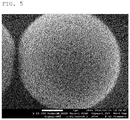
- the packing material particles 1 were observed with a SEM. No pores were observed. The observation result is shown in FIG. 5 .
- a value for the pore volume was 0.01 cm 3 /g and was significantly small.
- the obtained packing material particles 1 were packed into a column made of PEEK measuring 4.6 mm in inner diameter ⁇ 10 mm in length by a slurry method. Thus, a column 1 was obtained.
- Example 1 The column 1 produced in Example 1 was installed in a liquid chromatograph (Agilent (trademark) 1260 Infinity, manufactured by Agilent Technologies Inc.), and a glycated hemoglobin control sample (manufactured by ARKRAY, Inc.) was analyzed under the following analysis conditions.
- Eluent phosphate buffer solution (pH: 5.3)
- Flow rate 1.7 mL/min
- Detector UV-Vis detector (wavelength: 415 nm)
- the obtained chromatogram is shown in FIG. 1 .
- the height equivalent to a theoretical plate of a stable glycated hemoglobin peak was 33 ⁇ m.
- Example 1 The column 1 produced in Example 1 was installed in a liquid chromatograph (Agilent (trademark) 1260 Infinity, manufactured by Agilent Technologies Inc.), and proteins were analyzed under the following analysis conditions.
- Eluent (trademark) 1260 Infinity, manufactured by Agilent Technologies Inc.), and proteins were analyzed under the following analysis conditions.
- the obtained chromatogram is shown in FIG. 2 . It is found that the five kinds of proteins were each satisfactorily separated in a short time period of 1.5 minutes.
- the obtained mixture was added to a 5% polyvinyl alcohol (KURARAY POVAL PVA 224, manufactured by Kuraray Co., Ltd.) aqueous solution, and was subjected to polymerization at 80°C for 24 hours by a suspension polymerization method.
- the obtained particles were classified.
- packing material particles 2 having an average particle diameter of 6.5 ⁇ m were obtained.
- the obtained packing material particles 2 were packed into a column made of SUS measuring 4.6 mm in inner diameterx20 mm in length by a slurry method. Thus, a column 2 was obtained.
- the analysis was performed under the same conditions as in Analysis Example 1 by using the column 2 obtained in Comparative Example 1.
- the obtained chromatogram is shown in FIG. 3 .
- the height equivalent to a theoretical plate of a glycated hemoglobin peak was 81 ⁇ m.
- the height equivalent to a theoretical plate was higher than in Analysis Example 1 because the average particle diameter was not able to be reduced. Further, a time period required for the analysis was 1.3 times as long as that in Analysis Example 1 because sufficient separation was not performed, and hence a longer column length was required.
- V-65 serving as a polymerization initiator
- the obtained mixture was added to an aqueous solution in which 4 g of polyvinyl alcohol and 4 g of sodium chloride were dissolved in 400 g of water, and was subjected to polymerization at 60°C for 10 minutes by a suspension polymerization method. The obtained particles were classified. Thus, copolymer particles having an average particle diameter of 2.5 ⁇ m were obtained.
- the polymer particles were modified in the same manner as in Example 1.
- packing material particles 3 were obtained.
- the packing material particles 3 were packed into a column in the same manner as in Example 1, but a pressure was increased owing to deformation of the packing material particles in the course of the packing, and liquid delivery was stopped, with the result that the packing material particles were not able to be packed into the column.
- the obtained particles had properties of being not dispersed in water.
- the obtained packing material particles 4 were packed into a column made of PEEK measuring 4.6 mm in inner diameter ⁇ 10 mm in length by a slurry method. Thus, a column 4 was obtained.
- the measurement was performed in the same manner as in Analysis Example 1 except that the column 4 was used and a step gradient using (A) a phosphate buffer solution (pH: 5.3) for from 0 min to 0.5 min and (B) a phosphate buffer solution (pH: 8.5) for from 0.5 min to 1.0 min was adopted as eluent conditions.
- the obtained chromatogram is shown in FIG. 4 .
- Glycated hemoglobin was satisfactorily separated in a short time period as in FIG. 1 .
- the chromatogram of FIG. 1 slightly excelled with regard to the separation of glycated hemoglobin and unstable glycated hemoglobin.
Landscapes
- Chemical & Material Sciences (AREA)
- Analytical Chemistry (AREA)
- Chemical Kinetics & Catalysis (AREA)
- Organic Chemistry (AREA)
- General Health & Medical Sciences (AREA)
- Biochemistry (AREA)
- Physics & Mathematics (AREA)
- General Physics & Mathematics (AREA)
- Immunology (AREA)
- Pathology (AREA)
- Life Sciences & Earth Sciences (AREA)
- Health & Medical Sciences (AREA)
- Solid-Sorbent Or Filter-Aiding Compositions (AREA)
- Addition Polymer Or Copolymer, Post-Treatments, Or Chemical Modifications (AREA)
Abstract
Description
- The present invention relates to a packing material for liquid chromatography having a sulfo group and a column for liquid chromatography packed with the packing material.
- Liquid chromatography (hereinafter also referred to as "HPLC") is used in various fields as analysis methods for a wide variety of samples. In particular, cation exchange chromatography using a packing material having a sulfo group is used for analysis of a protein, an amino acid, or the like.
- In the analysis of a protein by the cation exchange chromatography, non-specific adsorption of the protein to the packing material occurs in some cases. When the non-specific adsorption of the protein occurs, an accurate analysis result is not obtained, and besides, there arises a problem in that a column is degraded acceleratedly. Therefore, the use of a packing material which does not cause the non-specific adsorption is required.
- The non-specific adsorption of the protein is mainly caused by hydrophobic interaction between the packing material and the protein. Therefore, as means for suppressing the hydrophobic interaction, highly hydrophilic particles are used as the packing material. For example, particles utilizing a (meth)acrylic acid ester-based polymer are widely known as the packing material.
- In
Patent Literature 1, there is disclosed a method of analyzing glycohemoglobin, including utilizing an ion exchanger in which a sulfo group is introduced into particles formed of a methacrylic acid ester-based polymer. - In
Patent Literature 2, there is disclosed a packing material obtained by forming a hydrophilic polymer layer formed of methacrylic acid or the like on surfaces of divinylbenzene-based hydrophobic particles. - In
Non Patent Literature 1, there is disclosed an analysis example of a protein using a packing material obtained by acquiring particles by forming a methacrylic acid ester layer on a surface of a core formed of a divinylbenzene polymer generated through a polymerization reaction in acetonitrile, and further causing epichlorohydrin to react with the particles and then introducing a sulfo group into the particles. -
- [PTL 1]
JP 03-255360 A - [PTL 2]
JP 03-073848 A - [NPL 1] Shuhong Zhang et al. Journal of Chromatography A, 965 (2002) 83-92
- In a column in which a protein is analyzed, the particles are required to be increased in hydrophilicity. When widely-used particles formed of a (meth)acrylic acid ester-based copolymer are used as the packing material, a hydrophilic monomer is selected and used as a raw material therefor. At this time, a cross-linkable (meth)acrylic acid ester used for cross-linking has a feature of having relatively high hydrophobicity, and hence in the packing material for protein analysis applications, the ratio of the cross-linkable (meth)acrylic acid ester monomer cannot be increased. As a result, the degree of cross-linking of the packing material cannot be increased, and the packing material does not have sufficient strength. In order to improve analysis performance, a reduction in particle diameter of the packing material is conceivable. However, when the particle diameter of the packing material is reduced under the state in which the strength of the packing material is not high, the packing material cannot withstand a pressure at the time of packing into a column to be deformed, with the result that satisfactory analysis cannot be performed. Therefore, there is a demand for a packing material having high hydrophilicity and having such high strength that the packing material can be used even when reduced in particle diameter.
- In addition, in a method of forming a hydrophilic polymer layer on surfaces of hydrophobic particles as in
Patent Literature 2, there arises a problem in that the number of operation steps is increased owing to the necessity for forming the hydrophilic layer, resulting in a reduction in productivity. - Thus, an object of the present invention is to provide a packing material for liquid chromatography and a column for liquid chromatography which can each be suitably used for analysis of a protein, an amino acid, or the like and can each be efficiently produced.
- The present invention provides the following packing material for liquid chromatography and column packed with the packing material.
- [1] A packing material for liquid chromatography, including particles of a copolymer having a monomer unit derived from a (meth)acrylic acid ester and a monomer unit derived from divinylbenzene, wherein a ratio between the monomer unit derived from a (meth)acrylic acid ester and the monomer unit derived from divinylbenzene is 70 mass% to 90 mass%:30 mass% to 10 mass%, wherein the particles each have a sulfo group bonded to a surface thereof and a structure in which the sulfo group is bonded includes a structure represented by the formula (1):

- [2] The packing material for liquid chromatography according to the above-mentioned item [1], wherein the (meth)acrylic acid ester includes glycidyl methacrylate.
- [3] A method of producing the packing material of the above-mentioned item [1] or [2], including the steps of: copolymerizing a monomer mixture containing a (meth)acrylic acid ester and divinylbenzene through suspension polymerization to obtain copolymer particles; and causing the copolymer particles and a sulfonating agent to react with each other in a solvent containing a secondary alcohol in the presence of a base.
- [4] The method of producing the packing material according to the above-mentioned item [3], wherein the step of causing the copolymer particles and a sulfonating agent to react with each other is performed after the step of obtaining the copolymer particles without subjecting the obtained particles to another chemical reaction.
- [5] The method of producing the packing material according to the above-mentioned item [3] or [4], wherein the (meth)acrylic acid ester is glycidyl methacrylate, the sulfonating agent is propanesultone, and the secondary alcohol is 2-propanol.
- [6] A column for liquid chromatography for analysis of glycated hemoglobin, which is packed with the packing material for liquid chromatography of the above-mentioned item [1] or [2] .
- [7] A method of analyzing glycated hemoglobin, including using a column packed with the packing material for liquid chromatography of the above-mentioned item [1] or [2].
- The packing material for liquid chromatography and the column for liquid chromatography according to one embodiment of the present invention can each be suitably used for analysis of a protein, an amino acid, or the like. In particular, despite the use of an acrylic polymer as a base material, the packing material can be increased in strength while keeping high hydrophilicity, and hence can be reduced in particle diameter. As a result, analysis performance is improved.
- In addition, the packing material and the column can each be efficiently produced.
-
-
FIG. 1 is a chromatogram obtained in Analysis Example 1. -
FIG. 2 is a chromatogram obtained in Analysis Example 2. -
FIG. 3 is a chromatogram obtained in Analysis Example 3. -
FIG. 4 is a chromatogram obtained in Analysis Example 4. -
FIG. 5 is a SEM photograph (magnification: 20,000 times) of packing material particles obtained in Example 1. - In a packing material for liquid chromatography according to one embodiment of the present invention, particles of a copolymer having a monomer unit derived from a (meth)acrylic acid ester and a monomer unit derived from divinylbenzene are used as a base material. The "(meth)acrylic acid ester" means an acrylic acid ester or a methacrylic acid ester.
- In the copolymer in one embodiment of the present invention, divinylbenzene is used as a cross-linkable monomer. When divinylbenzene is used as the cross-linkable monomer, the resultant copolymer has high mechanical strength even when the ratio of a non-cross-linkable monomer is increased. Therefore, the particles of such copolymer have high strength even when reduced in particle diameter. Also when the particles are used as a packing material for a column, the particles can withstand an increase in pressure during analysis involved in a reduction in particle diameter. With this, the separation performance of the column can be improved.
- Divinylbenzene serving as a monomer may be a mixture of a meta-positional isomer and a para-positional isomer.
- Examples of the (meth)acrylic acid ester serving as a monomer for the copolymer include methyl (meth)acrylate, ethyl (meth)acrylate, 2-hydroxyethyl (meth)acrylate, 4-hydroxybutyl (meth)acrylate, glycerin di(meth)acrylate, and glycidyl (meth)acrylate. Those (meth)acrylic acid esters may be used alone or in combination thereof.
- In order to increase the hydrophilicity of the base material or to introduce a sulfo group thereinto, the (meth)acrylic acid ester preferably includes a (meth)acrylic acid ester having a hydroxy group or a glycidyl group in a certain amount or more. While the amount is not completely determined, the amount is, for example, preferably 70 mass% or more with respect to the total of the (meth)acrylic acid ester. Examples of the (meth)acrylic acid ester having a hydroxy group or a glycidyl group include 2-hydroxyethyl (meth)acrylate, glycerin di(meth)acrylate, 4-hydroxybutyl (meth)acrylate, and glycidyl (meth)acrylate. Of those, glycidyl (meth)acrylate is more preferred because glycidyl (meth)acrylate can be suitably utilized for introduction of a sulfo group, and besides, can be converted into a structure having a hydroxy group through a ring-opening reaction. Glycidyl methacrylate is most preferred because of easy availability.
- Ethylene glycol di(meth)acrylate, butyl (meth)acrylate, and hexyl (meth)acrylate, which are highly hydrophobic, may each be used in combination with the (meth)acrylic acid ester. The use amount thereof may fall within a range in which the hydrophilicity of the copolymer is not largely affected, and is specifically 10 mass% or less with respect to the total amount of the (meth)acrylic acid ester.
- In the copolymer in one embodiment of the present invention, a ratio between the monomer unit derived from a (meth)acrylic acid ester and the monomer unit derived from divinylbenzene, monomer unit derived from a (meth)acrylic acid ester (in the case of using a plurality of kinds, the total amount thereof):monomer unit derived from divinylbenzene, is 70 mass% to 90 mass%:30 mass% to 10 mass%, preferably 75 mass% to 85 mass%:25 mass% to 15 mass%.
- When the ratio of the monomer unit derived from a (meth)acrylic acid ester is less than 70 mass%, the hydrophobicity of the copolymer is increased, and non-specific adsorption of a protein is liable to occur. In addition, when a sulfo group is introduced into the monomer unit derived from a (meth)acrylic acid ester, it becomes difficult to efficiently introduce the sulfo group. Meanwhile, when the ratio of the monomer unit derived from a (meth)acrylic acid ester is more than 90 mass%, the strength of the copolymer particles is reduced. When such particles are used as a packing material for a column, the particles are deformed and the degradation of the column is liable to occur.
- The polymer may have any other monomer unit than the monomer unit derived from a (meth)acrylic acid ester and the monomer unit derived from divinylbenzene. The amount of the other monomer unit may fall within a range in which the hydrophilicity of the copolymer is not largely affected, and is, for example, 10 mass% or less of the copolymer. The amount of the other monomer unit is preferably 5 mass% or less, more preferably 3 mass% or less. A monomer for the other monomer unit is exemplified by styrene, ethylstyrene, methylstyrene, propylstyrene, methoxystyrene, α-methylstyrene, butadiene, and vinyl acetate.
- The sizes of the copolymer particles are not particularly limited as long as the particles can be used as a packing material for a column for liquid chromatography, but in consideration of packing into the column and the separation performance of the column, the average particle diameter of the particles is preferably from 1 µm to 10 µm. When the average particle diameter is 10 µm or less, the separation performance for a compound is increased, and a satisfactory analysis result can be obtained. Meanwhile, when the average particle diameter is 1 µm or less, the packing of the particles is liable to be difficult owing to an increase in pressure in the column. In order to obtain a column having high separation performance, the average particle diameter of the particles is more preferably from 2 µm to 7 µm, most preferably from 2 µm to 3 µm.
- The "average particle diameter" as used herein refers to an average particle diameter on a volume basis, and may be measured as described below. First, an image of particles is taken with a particle size distribution measurement device so that the number of the particles is 2,000 or more, and based on the resultant two-dimensional image (preferably a still image) of the particles, the equivalent circle diameter of each particle (the diameter of a circle having the same area as the projected area of the image of the particle) is obtained. The volume of each particle is calculated from the equivalent circle diameter, and the particle diameter is obtained through averaging on the basis of the calculated volumes. At this time, the particles are each regarded as a sphere having the same diameter as the equivalent circle diameter. FPIA-3000 (manufactured by Sysmex Corporation) or the like may be used as the particle size distribution measurement device.
- The copolymer particles each preferably have few fine pores on the surface. Specifically, the total pore volume of the particles measured by a gas adsorption method is preferably 0.05 cm3/g or less, more preferably 0.02 cm3/g or less with respect to the mass of the particles. When the particles have few fine pores, the particles are increased in strength. In addition, when HPLC analysis is performed by using a packing material including the particles as a base material, a compound, such as a protein, contained in a sample does not diffuse into the pores, and hence rapid analysis can be achieved.
- The total pore volume may be measured by using Autosorb (trademark) iQ manufactured by Quantachrome Instruments as a device.
- The packing material for liquid chromatography according to one embodiment of the present invention may be produced by obtaining the particles of the copolymer having a monomer unit derived from a (meth)acrylic acid ester and a monomer unit derived from divinylbenzene, and then introducing a sulfo group into the surfaces of the particles.
- For the copolymerization, any known oil-soluble radical polymerization initiator may be used. Examples of the polymerization initiator include 2,2'-azobisisobutyronitrile (hereinafter also referred to as AIBN), 2,2'-azobis(2,4-dimethylvaleronitrile) (hereinafter also referred to as V-65),
dimethyl 2,2'-azobisisobutyrate, 2,2'-azobis(2-methylbutyronitrile), benzoyl peroxide, and lauroyl peroxide. - The use amount of the polymerization initiator may be appropriately determined depending on the kind and the amount of the monomers, but is generally from 0.1 part by mass to 5 parts by mass with respect to 100 parts by mass of the total amount of the monomers.
- For example, a suspension polymerization method, an emulsion polymerization method, or a precipitation polymerization method may be utilized as a copolymerization method. In the precipitation polymerization, in which a polymerization reaction is performed in an appropriate organic solvent in which a monomer is dissolved but a polymerized product is not dissolved, particles having uniform particle diameters can be obtained. In the precipitation polymerization, however, aggregation of the particles may occur during the polymerization, and it is sometimes difficult to efficiently synthesize monodisperse particles. The suspension polymerization method and the emulsion polymerization method are preferred because the aggregation of the particles is less liable to occur, and the suspension polymerization method is more preferred. Out of such suspension polymerization methods, a SPG membrane suspension polymerization method using shirasu porous glass (SPG) membrane in which a pore diameter is controlled and internal pressure type micro kit MN-20 (manufactured by SGP Technology Co., Ltd.), a microchannel suspension polymerization method using a microchannel suspension device (manufactured by Eco Project Technologies Co., Ltd.), and the like are more preferred because particles having uniform particle diameters can be obtained.
- In such polymerization method, a polymerization reaction may be performed, for example, through heating at from 60°C to 80°C for from 6 hours to 20 hours.
- After the polymerization, the average particle diameter, uniformity, the content of fine particles, and the like may be adjusted through classification with a sieve or a classification device (e.g., a semi-free vortex classifier Aerofine Classifier AC, manufactured by Nisshin Engineering Inc.).
- In order for the surfaces of the copolymer particles to be substantially free of fine pores, for example, the polymerization may be performed without adding a diluent.
- In order to introduce a sulfo group into the surfaces of the resultant copolymer particles, for example, a sulfonating agent may be used. Examples of the sulfonating agent include: sulfonates, such as sodium 2-hydroxyethanesulfonate, sodium 3-hydroxypropanesulfonate, sodium 2-mercaptoethanesulfonate, sodium 3-mercaptopropanesulfonate, sodium 2-bromopropanesulfonate, and sodium 3-bromopropanesulfonate; and sultone compounds, such as 1,3-propanesultone, 1,3-butanesultone, 1,4-butanesultone, and 2,4-butanesultone. Of those, sodium 3-mercaptopropanesulfonate and 1,3-propanesultone are preferred because the reaction is easier, and 1,3-propanesultone is more preferred.
- Those sulfonating agents are each bonded as a sulfo group through utilization of a reaction with a reactive functional group present on the surfaces of the copolymer particles. The reactive functional group is preferably a hydroxy group or an epoxy group, more preferably an epoxy group.
- The sulfonating agent may directly react with the reactive functional group derived from the copolymer and present on the surfaces of the particles, or alternatively, the sulfonating agent may react with the reactive functional group after a spacer is caused to react with the reactive functional group, or when the reactive functional group is an epoxy group, the sulfonating agent may react with the reactive functional group after the epoxy group is subjected to a ring-opening reaction. It is preferred that the sulfonating agent directly react with the reactive functional group. A column using a packing material obtained through the direct reaction is improved in separation performance and is also excellent in production efficiency. In particular, in the analysis of glycated hemoglobin, a target protein is separated more satisfactorily when an epoxy group present on the surfaces of the copolymer particles is directly sulfonated than when the epoxy group is subjected to a ring-opening reaction and then sulfonated.
- As described above, it is preferred that the resultant copolymer particles be used for a reaction with the sulfonating agent without being subjected to any other reaction including the ring-opening reaction of an epoxy group.
- A reaction between the copolymer particles and the sulfonating agent may be performed by an appropriate method depending on the kind of the sulfonating agent. For example, when a sulfo group is introduced into a monomer unit derived from glycidyl methacrylate by using a sultone compound as a sulfonating agent, the reaction may be performed through use of a base. Examples of the base include: inorganic bases, such as sodium hydroxide, potassium hydroxide, and lithium hydroxide; amines, such as triethylamine and N,N-diisopropylethylamine; and organic bases, such as sodium methoxide, potassium methoxide, potassium t-butoxide, and 1,8-diazabicyclo[5.4.0]-7-undecene. Of those bases, sodium hydroxide, potassium hydroxide, and potassium t-butoxide are preferred, and sodium hydroxide and potassium hydroxide are more preferred. The inorganic base is used in an aqueous solution at any concentration.
- Also when a sulfo group is introduced by using a sulfonate as a sulfonating agent, the reaction may be similarly performed through use of a base. When a sulfonate having a halogen group is used, a sulfo group is introduced through a halogen substitution reaction of a hydroxy group generated on the copolymer particles during the reaction, and when a sulfonate having a hydroxy group or a mercapto group is used, a sulfo group is introduced through a nucleophilic reaction accompanied by ring opening of an epoxy group on the copolymer particles.
- Examples of the solvent used for a sulfonating reaction include water, dimethyl sulfoxide, dimethylacetamide, dimethylformamide, N-methylpyrrolidone, and an alcohol. Of those, an alcohol is preferred. From the viewpoints of reaction efficiency and reactivity, a secondary alcohol is more preferred. Examples of the secondary alcohol include 2-propanol, 2-butanol, 3-methyl-2-butanol, 2-pentanol, and 3-pentanol. Of those, 2-propanol is preferred from an economic viewpoint. When a sultone compound is used as a sulfonating agent, the secondary alcohol is particularly preferred also from the viewpoint of reaction efficiency.
- When an acid catalyst is used for the reaction between the copolymer particles and the sulfonating agent, the reactivity is not sufficient. Particularly when a Lewis acid is used, the resultant packing material has low hydrophilicity and is not dispersed in an aqueous solution. Therefore, the packing material has problems such as being unable to be packed into a column, and hence does not exhibit functions as a packing material for separation of a protein.
- The amount of a sulfo group to be bonded to the copolymer particles is preferably from 20 µmol/g to 300 µmol/g, more preferably from 40 µmol/g to 300 µmol/g. When the amount of a sulfo group to be bonded is less than 40 µmol/g, a retention time period in liquid chromatography analysis, such as HPLC, is shortened, and satisfactory separation cannot be performed. When the amount of a sulfo group to be bonded is 40 µmol/g or more, the packing material has satisfactory dispersibility in water, and a column satisfactory for the analysis of a protein can be obtained. In addition, the case in which the amount of a sulfo group to be bonded is more than 300 µmol/g is not preferred because a sample is retained excessively strongly, and an analysis time period tends to be prolonged.
- The above-mentioned amount of a sulfo group may be measured by a method described below. Specifically, 10 mL of 0.5 M hydrochloric acid is added to 1 g of particles (sample) having been vacuum dried to allow the particles to be dispersed therein. The particles are filtered and then washed with water. With this, the particles are obtained in a washed state in which the sulfo group is converted into an acid form. Next, 10 mL of 0.5 M sodium hydroxide is added to the particles, and the particles are filtered under a state in which a container for collecting a filtrate is arranged, and then the particles are washed with 10 mL of water. A mixed liquid of the filtrate and the washing liquid is titrated with 0.1 M hydrochloric acid. The number of moles of hydrochloric acid required at this time is determined, and a value obtained by subtracting the number of moles of hydrochloric acid from the number of moles of sodium hydroxide (in this case, 5 mM) is used as the amount of a sulfo group.
- In one embodiment of the present invention, the copolymer particles each desirably have on the surface thereof a structure represented by the following formula (1) in which a sulfo group is introduced:

- The structure is formed, for example, by performing copolymerization through use of glycidyl(meth)acrylate as at least one kind of the (meth)acrylic acid ester, followed by bonding the sulfonating agent as a sulfo group while subjecting an epoxy group to ring opening by the sulfonating agent, or followed by subjecting an epoxy group to ring opening to form a diol or a monool monothiol and then bonding the sulfonating agent as a sulfo group. In addition, the structure may be formed by performing copolymerization through use of a diol structure-containing ester or a monool monothiol-containing ester as at least one kind of the (meth)acrylic acid ester, and then bonding the sulfonating agent as a sulfo group.
- The "surfaces of the particles" as used herein mean portions in which the copolymer particles serving as a solid can be brought into contact with a reagent in a reaction solvent, and generally exclude an inside of a solid. However, the sulfo group may be bonded to the inside of the solid.
- The packing material for liquid chromatography according to one embodiment of the present invention is a packing material in which the specific structure having a sulfo group is bonded to the above-mentioned surfaces of the copolymer particles.
- A column for liquid chromatography according to one embodiment of the present invention includes the above-mentioned packing material. The column is obtained by packing the above-mentioned packing material into the column by any known packing method, such as a slurry method. As a column for packing, a column made of PEEK or SUS as a material for a column body may be used. However, the column made of SUS has a risk of adsorption of a protein, and hence when a sample containing a protein is analyzed, the column made of PEEK is preferred. While a frit configured to prevent the packing material particles from flowing out is arranged in the column, a frit made of PEEK is also preferably used in order to suppress the adsorption.
- When the column for liquid chromatography according to one embodiment of the present invention is used as a column for ion exchange chromatography, for example, various proteins and amino acids can be analyzed. In this case, for example, a buffer solution, such as a phosphate buffer, may be preferably utilized as an eluent.
- The present invention is specifically described below by way of Examples and Comparative Examples.
- An average particle diameter measured in each of Examples and Comparative Examples was an average particle diameter on a volume basis, and was measured by the method described in the "Description of Embodiments" section.
- 0.5 g (an amount corresponding to 1 mass% of the following monomer mixture) of lauroyl peroxide (manufactured by Nacalai Tesque, Inc.) serving as a polymerization initiator was added to 50 g of a monomer mixture of glycidyl methacrylate (manufactured by NOF Corporation) and divinylbenzene (manufactured by Nippon Steel & Sumikin Chemical Co., Ltd., purity: 99%) (glycidyl methacrylate:divinylbenzene=82:17 (mass ratio)) to obtain a mixture. The obtained mixture was turned into oil droplets by using 500 g of a 1% sodium alkyl diphenyl ether sulfonate aqueous solution as an aqueous phase with a microchannel suspension device (manufactured by Eco Project Technologies Co., Ltd.), and was further subjected a polymerization reaction. Thus, copolymer particles were obtained.
- The average particle diameter of the obtained particles was 2.6 µm.
- 24 g of 2-propanol and 3 g of 1,3-propanesultone (manufactured by Tokyo Chemical Industry Co., Ltd.) were added to 3 g of the copolymer particles, and the contents were heated to 50°C. 1.2 g of an 8 M potassium hydroxide aqueous solution was added thereto, and the contents were stirred for 6 hours and then filtered, and were sequentially washed with 0.5 M hydrochloric acid, water, a 0.5 M sodium hydroxide aqueous solution, and water. Thus, packing
material particles 1 were obtained. 10 mL of 0.5 M hydrochloric acid was added to 1.0 g of the packingmaterial particles 1 having been vacuum dried to allow thepacking material particles 1 to be dispersed therein. The particles were filtered and then washed with water. With this, particles in each of which a sulfo group was converted into an acid form were obtained. 10 mL of 0.5 M sodium hydroxide was added to the particles, and the particles were filtered under a state in which a container for collecting a filtrate was arranged, and then the particles were washed with 10 mL of water. A mixed liquid of the filtrate and the washing liquid collected in the arranged container was titrated with 0.1 M hydrochloric acid. The amount of a sulfo group was determined from a difference between the number of moles (5 mM) of sodium hydroxide firstly used and the number of moles of hydrochloric acid required for the titration. As a result, the amount of a sulfo group with respect to the mass of the particles was 200 µmol/g. - The packing
material particles 1 were observed with a SEM. No pores were observed. The observation result is shown inFIG. 5 . As a result of pore volume measurement based on gas adsorption (using Autosorb (trademark) iQ manufactured by Quantachrome Instruments as a use device), a value for the pore volume was 0.01 cm3/g and was significantly small. - The obtained
packing material particles 1 were packed into a column made of PEEK measuring 4.6 mm in inner diameter×10 mm in length by a slurry method. Thus, acolumn 1 was obtained. - The
column 1 produced in Example 1 was installed in a liquid chromatograph (Agilent (trademark) 1260 Infinity, manufactured by Agilent Technologies Inc.), and a glycated hemoglobin control sample (manufactured by ARKRAY, Inc.) was analyzed under the following analysis conditions.
Eluent: phosphate buffer solution (pH: 5.3)
Flow rate: 1.7 mL/min
Detector: UV-Vis detector (wavelength: 415 nm)
Temperature: 35°C - The obtained chromatogram is shown in
FIG. 1 . At this time, the height equivalent to a theoretical plate of a stable glycated hemoglobin peak was 33 µm. - The
column 1 produced in Example 1 was installed in a liquid chromatograph (Agilent (trademark) 1260 Infinity, manufactured by Agilent Technologies Inc.), and proteins were analyzed under the following analysis conditions.
Eluent: - (A) 20 mM 2-morpholinoethanesulfonic acid buffer solution (pH: 5.6)
- (B) (A)+0.5 M Na2SO4
- The obtained chromatogram is shown in
FIG. 2 . It is found that the five kinds of proteins were each satisfactorily separated in a short time period of 1.5 minutes. - 0.1 g (an amount corresponding to 0.25 mass% of the following monomer mixture) of benzoyl peroxide serving as a polymerization initiator was dissolved in a monomer mixture of 30 g of diethylene glycol dimethacrylate (manufactured by NOF Corporation) and 10 g of 2-acrylamido-2-methylpropanesulfonic acid (manufactured by Tokyo Chemical Industry Co., Ltd.) (diethylene glycol dimethacrylate:2-acrylamido-2-methylpropanesulfonic acid=75:25 (mass ratio)) to obtain a mixture. The obtained mixture was added to a 5% polyvinyl alcohol (KURARAY POVAL PVA 224, manufactured by Kuraray Co., Ltd.) aqueous solution, and was subjected to polymerization at 80°C for 24 hours by a suspension polymerization method. The obtained particles were classified. Thus, packing
material particles 2 having an average particle diameter of 6.5 µm were obtained. - The obtained
packing material particles 2 were packed into a column made of SUS measuring 4.6 mm in inner diameterx20 mm in length by a slurry method. Thus, acolumn 2 was obtained. - The analysis was performed under the same conditions as in Analysis Example 1 by using the
column 2 obtained in Comparative Example 1. The obtained chromatogram is shown inFIG. 3 . At this time, the height equivalent to a theoretical plate of a glycated hemoglobin peak was 81 µm. - The height equivalent to a theoretical plate was higher than in Analysis Example 1 because the average particle diameter was not able to be reduced. Further, a time period required for the analysis was 1.3 times as long as that in Analysis Example 1 because sufficient separation was not performed, and hence a longer column length was required.
- 1.5 g (an amount corresponding to 1.88 mass% of the following monomer mixture) of V-65 serving as a polymerization initiator was dissolved in a monomer mixture of 56 g of glycidyl methacrylate and 24 g of ethylene glycol dimethacrylate (glycidyl methacrylate:ethylene glycol dimethacrylate=70:30 (mass ratio)) to obtain a mixture. The obtained mixture was added to an aqueous solution in which 4 g of polyvinyl alcohol and 4 g of sodium chloride were dissolved in 400 g of water, and was subjected to polymerization at 60°C for 10 minutes by a suspension polymerization method. The obtained particles were classified. Thus, copolymer particles having an average particle diameter of 2.5 µm were obtained.
- The polymer particles were modified in the same manner as in Example 1. Thus, packing
material particles 3 were obtained. The packingmaterial particles 3 were packed into a column in the same manner as in Example 1, but a pressure was increased owing to deformation of the packing material particles in the course of the packing, and liquid delivery was stopped, with the result that the packing material particles were not able to be packed into the column. - 24 g of tetrahydrofuran was added to 3 g of the copolymer particles obtained in Example 1 to allow the particles to be dispersed therein. 3 g of 1,3-propanesultone and 0.1 g of a boron trifluoride-diethyl ether complex were added thereto and a reaction was performed at 50°C for 6 hours. The reaction liquid was filtered, and sequentially washed with tetrahydrofuran, water, 0.5 M hydrochloric acid, water, a 0.5 M sodium hydroxide aqueous solution, and water. Thus, particles were obtained.
- 1 ml of 2-propanol and 10 mL of 0.5 M hydrochloric acid were added to 1.0 g of the obtained particles to allow the particles to be dispersed therein. The particles were filtered and then washed with water. With this, particles in each of which a sulfo group was converted into an acid form were obtained. 10 mL of 0.5 M sodium hydroxide was added to the particles, and the particles were filtered under a state in which a container for collecting a filtrate was arranged, and then the particles were washed with 10 mL of water. 70 mL of pure water was added to a mixed liquid of the filtrate and the washing liquid collected in the arranged container, and the resultant was titrated with 0.1 M hydrochloric acid. As a result of calculation, the amount of a sulfo group with respect to the mass of the particles was 38.2 mmol/g.
- The obtained particles had properties of being not dispersed in water.
- The reason why the particles are not dispersed in water is presumed as described below. Under the acid conditions, the amount of a sulfo group to be introduced by the reaction with the propanesultone is small. A column suitable for the analysis of a protein was not obtained because the particles are not dispersed in water.
- 3 g of the copolymer particles obtained in Example 1 were dispersed in 8 mL of water, and 8 mL of 0.5 M sulfuric acid was added thereto. A reaction was performed at 70°C for 6 hours to open an epoxy ring. It was confirmed that the epoxy ring was opened by the reaction with sulfuric acid by the fact that a peak derived from the epoxy group disappeared in FT-IR. The obtained particles were subjected to a modification step with 1,3-propanesultone by the same operation as in Example 1. Thus, 3 g of packing
material particles 4 were obtained. The amount of a sulfo group with respect to the mass of the particles was 180 µmol/g. - The obtained
packing material particles 4 were packed into a column made of PEEK measuring 4.6 mm in inner diameter×10 mm in length by a slurry method. Thus, acolumn 4 was obtained. - The measurement was performed in the same manner as in Analysis Example 1 except that the
column 4 was used and a step gradient using (A) a phosphate buffer solution (pH: 5.3) for from 0 min to 0.5 min and (B) a phosphate buffer solution (pH: 8.5) for from 0.5 min to 1.0 min was adopted as eluent conditions. The obtained chromatogram is shown inFIG. 4 . Glycated hemoglobin was satisfactorily separated in a short time period as inFIG. 1 . In comparison, the chromatogram ofFIG. 1 slightly excelled with regard to the separation of glycated hemoglobin and unstable glycated hemoglobin.
Flow rate: 1.7 mL/min
Detector: UV-Vis detector (wavelength: 280 nm)
Temperature: room temperature
Sample: 1. ovalbumin, 2. trypsinogen, 3. ribonuclease A, 4. cytochrome C, 5. lysozyme (manufactured by Sigma-Aldrich)
Claims (7)
- A packing material for liquid chromatography, including particles of a copolymer having a monomer unit derived from a (meth)acrylic acid ester and a monomer unit derived from divinylbenzene, wherein a ratio between the monomer unit derived from a (meth)acrylic acid ester and the monomer unit derived from divinylbenzene is 70 mass% to 90 mass%:30 mass% to 10 mass%, wherein the particles each have a sulfo group bonded to a surface thereof and a structure in which the sulfo group is bonded includes a structure represented by the formula (1):

- The packing material for liquid chromatography according to claim 1, wherein the (meth)acrylic acid ester includes glycidyl methacrylate.
- A method of producing the packing material of claim 1 or 2, including the steps of: copolymerizing a monomer mixture containing a (meth)acrylic acid ester and divinylbenzene through suspension polymerization to obtain copolymer particles; and causing the copolymer particles and a sulfonating agent to react with each other in a solvent containing a secondary alcohol in the presence of a base.
- The method of producing the packing material according to claim 3, wherein the step of causing the copolymer particles and a sulfonating agent to react with each other is performed after the step of obtaining the copolymer particles without subjecting the obtained particles to another chemical reaction.
- The method of producing the packing material according to claim 3 or 4, wherein the (meth)acrylic acid ester is glycidyl methacrylate, the sulfonating agent is propanesultone, and the secondary alcohol is 2-propanol.
- A column for liquid chromatography for analysis of glycated hemoglobin, which is packed with the packing material for liquid chromatography of claim 1 or 2.
- A method of analyzing glycated hemoglobin, including using a column packed with the packing material for liquid chromatography of claim 1 or 2.
Applications Claiming Priority (2)
| Application Number | Priority Date | Filing Date | Title |
|---|---|---|---|
| JP2017128844 | 2017-06-30 | ||
| PCT/JP2018/024858 WO2019004440A1 (en) | 2017-06-30 | 2018-06-29 | Filler for liquid chromatography and column for liquid chromatography |
Publications (3)
| Publication Number | Publication Date |
|---|---|
| EP3646947A1 true EP3646947A1 (en) | 2020-05-06 |
| EP3646947A4 EP3646947A4 (en) | 2021-05-26 |
| EP3646947B1 EP3646947B1 (en) | 2022-03-16 |
Family
ID=64741586
Family Applications (1)
| Application Number | Title | Priority Date | Filing Date |
|---|---|---|---|
| EP18822849.8A Active EP3646947B1 (en) | 2017-06-30 | 2018-06-29 | Packing material for liquid chromatography and method of production thereof |
Country Status (5)
| Country | Link |
|---|---|
| US (1) | US20200061580A1 (en) |
| EP (1) | EP3646947B1 (en) |
| JP (1) | JP7094958B2 (en) |
| CN (1) | CN110636899B (en) |
| WO (1) | WO2019004440A1 (en) |
Families Citing this family (7)
| Publication number | Priority date | Publication date | Assignee | Title |
|---|---|---|---|---|
| JP2021031659A (en) * | 2019-08-29 | 2021-03-01 | Eneos株式会社 | Crosslinking-type methacrylate resin particle and pore-forming agent |
| JP7258276B2 (en) * | 2019-10-31 | 2023-04-17 | 株式会社レゾナック | METHOD FOR MANUFACTURING PACKING MATERIAL FOR GLYCATED HEMOGLOBIN ANALYSIS |
| JP7347156B2 (en) * | 2019-11-22 | 2023-09-20 | 株式会社レゾナック | Sample diluent for blood sample measurement by HPLC method and method for measuring glycated hemoglobin |
| CN113786823A (en) * | 2021-09-18 | 2021-12-14 | 浙江中医药大学 | Preparation method of ultra-small particle size hydrothermal carbon sphere latex agglomeration type high-efficiency ion chromatographic packing |
| CN114195915A (en) * | 2021-11-04 | 2022-03-18 | 赛分科技扬州有限公司 | Polyacrylate-based sphere and sulfite modification method thereof |
| CN117772154A (en) * | 2024-01-03 | 2024-03-29 | 无锡博慧斯生物医药科技有限公司 | A kind of packing material for glycosylated hemoglobin chromatography column and preparation method thereof |
| CN120365492B (en) * | 2025-05-07 | 2026-04-24 | 天津医学高等专科学校(天津市护士学校) | Preparation method and application of styrene microspheres for glycosylated hemoglobin detection |
Family Cites Families (17)
| Publication number | Priority date | Publication date | Assignee | Title |
|---|---|---|---|---|
| JPH087197B2 (en) | 1989-05-23 | 1996-01-29 | 積水化学工業株式会社 | Packing material for liquid chromatography and its manufacturing method |
| JP2929456B2 (en) | 1990-03-06 | 1999-08-03 | 東ソー株式会社 | Separation and quantification of glycohemoglobin |
| JPH10239301A (en) * | 1997-02-24 | 1998-09-11 | Sekisui Chem Co Ltd | Measurement method of glycated hemoglobin |
| KR20030072653A (en) * | 2002-03-06 | 2003-09-19 | 이호재 | Preparation of a chromatography using polymers having small diameters |
| US20070212327A1 (en) * | 2003-10-22 | 2007-09-13 | Kao Corporation | Allergen Depressant And Depression Method |
| CN1603817A (en) * | 2004-11-12 | 2005-04-06 | 中国科学院上海有机化学研究所 | Highly effective liquid phase and organic phase integral chromatographic column for bonding cyclodextrin compounds and preparing process thereof |
| AU2006256011B2 (en) * | 2005-06-09 | 2011-09-01 | Tosoh Corporation | Novel packing material with excellent hydrophilicity and process for producing the same |
| CN102258982B (en) * | 2005-12-02 | 2013-09-04 | 积水化学工业株式会社 | Filler for ion exchange liquid chromatography, and method for producing the same |
| EP2562178B1 (en) * | 2010-03-31 | 2015-05-06 | JSR Corporation | Filler for affinity chromatography |
| CN103945542A (en) * | 2010-05-24 | 2014-07-23 | Lg电子株式会社 | Method and apparatus for allocation of discontinuous uplink resource |
| JP2012032395A (en) * | 2010-07-09 | 2012-02-16 | Sekisui Medical Co Ltd | Measuring method of hemoglobins |
| US8822955B2 (en) | 2011-03-21 | 2014-09-02 | East China University Of Science And Technology | Polymer-conjugated quantum dots and methods of making the same |
| JP5624513B2 (en) * | 2011-05-16 | 2014-11-12 | 大阪瓦斯株式会社 | Aggregate of porous resin, siloxane remover, and filter using the same |
| JP2016011835A (en) | 2012-03-30 | 2016-01-21 | 三菱化学株式会社 | Liquid chromatography packing, liquid chromatography column and liquid chromatography apparatus |
| WO2015199196A1 (en) | 2014-06-27 | 2015-12-30 | Jsr株式会社 | Carrier for affinity chromatography |
| CN104437676B (en) * | 2014-11-27 | 2017-04-26 | 上海树脂厂有限公司 | Sulfonic acid type strong-acidity cation exchange resin and preparation method thereof |
| JP6733166B2 (en) | 2015-12-11 | 2020-07-29 | 日立化成株式会社 | Method for producing porous polymer particles for separation material, porous polymer particles for separation material, and column |
-
2018
- 2018-06-29 CN CN201880032033.0A patent/CN110636899B/en active Active
- 2018-06-29 EP EP18822849.8A patent/EP3646947B1/en active Active
- 2018-06-29 US US16/609,321 patent/US20200061580A1/en not_active Abandoned
- 2018-06-29 JP JP2019527065A patent/JP7094958B2/en active Active
- 2018-06-29 WO PCT/JP2018/024858 patent/WO2019004440A1/en not_active Ceased
Also Published As
| Publication number | Publication date |
|---|---|
| WO2019004440A1 (en) | 2019-01-03 |
| EP3646947A4 (en) | 2021-05-26 |
| EP3646947B1 (en) | 2022-03-16 |
| JP7094958B2 (en) | 2022-07-04 |
| CN110636899A (en) | 2019-12-31 |
| US20200061580A1 (en) | 2020-02-27 |
| CN110636899B (en) | 2023-03-24 |
| JPWO2019004440A1 (en) | 2020-04-30 |
Similar Documents
| Publication | Publication Date | Title |
|---|---|---|
| EP3646947B1 (en) | Packing material for liquid chromatography and method of production thereof | |
| US9944784B2 (en) | Temperature-responsive polymer particles in protein separation applications | |
| EP1889857B1 (en) | Novel packing material with excellent hydrophilicity and process for producing the same | |
| US20140162369A1 (en) | Method for measuring hemoglobins | |
| CN105392557B (en) | Adsorbent material and analytical system using same | |
| JP7258276B2 (en) | METHOD FOR MANUFACTURING PACKING MATERIAL FOR GLYCATED HEMOGLOBIN ANALYSIS | |
| Uzun et al. | Simultaneous depletion of immunoglobulin G and albumin from human plasma using novel monolithic cryogel columns | |
| EP3770191A1 (en) | Particles, method for producing particles, affinity particles, reagent and kit including same, and method for detecting target substance | |
| JP5446001B2 (en) | Method for measuring hemoglobin A1c and abnormal hemoglobins by liquid chromatography | |
| EP3872101B1 (en) | Polymeric particles | |
| US20190015813A1 (en) | Packing material for liquid chromatography and column for liquid chromatography | |
| CN105037603A (en) | Monodisperse copolymer microsphere and preparation method thereof | |
| CN112834632B (en) | Sample diluent for blood sample measurement by HPLC method and method for measuring glycosylated hemoglobin | |
| EP3586958A1 (en) | Filler for size exclusion chromatography and method for manufacturing same | |
| EP3845306A1 (en) | Packing material for ion chromatography and production method therefor | |
| JP2010236909A (en) | Column filler for separating hemoglobins, method for measuring hemoglobin A1c and abnormal hemoglobin, and method for producing column filler for separating hemoglobins | |
| JP6056231B2 (en) | Cation exchanger for liquid chromatography | |
| JP2010236907A (en) | Column filler for separating hemoglobins, method for measuring hemoglobin A1c and abnormal hemoglobin, and method for producing column filler for separating hemoglobins | |
| JP2011047859A (en) | COLUMN PACKING FOR SEPARATING HEMOGLOBIN, METHOD FOR MEASURING HEMOGLOBIN A1c, METHOD FOR MEASURING HEMOGLOBIN A1c AND ABNORMAL HEMOGLOBIN, AND METHOD FOR PRODUCING COLUMN PACKING FOR SEPARATING HEMOGLOBIN | |
| JPH11271294A (en) | Spherical porous crosslinked polymer particles and method for producing the same | |
| CN104788603A (en) | Synthesis method of hydrophilic ion pair chromatography packing | |
| EP3943182A1 (en) | Polymer, separating agent, production method of polymer, separation method of compound, and production method of compound | |
| Kip | A HILIC stationary phase fuctionalized with glutathione by thiol-ene chemistry on monodisperse-porous polymer microparticles | |
| JP6056230B2 (en) | Cation exchanger for liquid chromatography | |
| CN121001816A (en) | Filler substrate, method for manufacturing filler substrate, method for manufacturing filler and protein. |
Legal Events
| Date | Code | Title | Description |
|---|---|---|---|
| STAA | Information on the status of an ep patent application or granted ep patent |
Free format text: STATUS: THE INTERNATIONAL PUBLICATION HAS BEEN MADE |
|
| PUAI | Public reference made under article 153(3) epc to a published international application that has entered the european phase |
Free format text: ORIGINAL CODE: 0009012 |
|
| STAA | Information on the status of an ep patent application or granted ep patent |
Free format text: STATUS: REQUEST FOR EXAMINATION WAS MADE |
|
| 17P | Request for examination filed |
Effective date: 20191118 |
|
| AK | Designated contracting states |
Kind code of ref document: A1 Designated state(s): AL AT BE BG CH CY CZ DE DK EE ES FI FR GB GR HR HU IE IS IT LI LT LU LV MC MK MT NL NO PL PT RO RS SE SI SK SM TR |
|
| AX | Request for extension of the european patent |
Extension state: BA ME |
|
| DAV | Request for validation of the european patent (deleted) | ||
| DAX | Request for extension of the european patent (deleted) | ||
| A4 | Supplementary search report drawn up and despatched |
Effective date: 20210428 |
|
| RIC1 | Information provided on ipc code assigned before grant |
Ipc: B01J 20/281 20060101AFI20210422BHEP Ipc: B01D 15/36 20060101ALI20210422BHEP Ipc: B01J 20/285 20060101ALI20210422BHEP Ipc: G01N 30/02 20060101ALI20210422BHEP Ipc: G01N 30/88 20060101ALI20210422BHEP Ipc: B01J 20/28 20060101ALI20210422BHEP Ipc: B01J 20/288 20060101ALI20210422BHEP Ipc: B01J 20/32 20060101ALI20210422BHEP Ipc: B01J 39/20 20060101ALI20210422BHEP Ipc: B01J 39/26 20060101ALI20210422BHEP Ipc: B01J 47/014 20170101ALI20210422BHEP Ipc: B01J 47/02 20170101ALI20210422BHEP |
|
| GRAP | Despatch of communication of intention to grant a patent |
Free format text: ORIGINAL CODE: EPIDOSNIGR1 |
|
| STAA | Information on the status of an ep patent application or granted ep patent |
Free format text: STATUS: GRANT OF PATENT IS INTENDED |
|
| INTG | Intention to grant announced |
Effective date: 20211122 |
|
| GRAS | Grant fee paid |
Free format text: ORIGINAL CODE: EPIDOSNIGR3 |
|
| GRAA | (expected) grant |
Free format text: ORIGINAL CODE: 0009210 |
|
| STAA | Information on the status of an ep patent application or granted ep patent |
Free format text: STATUS: THE PATENT HAS BEEN GRANTED |
|
| AK | Designated contracting states |
Kind code of ref document: B1 Designated state(s): AL AT BE BG CH CY CZ DE DK EE ES FI FR GB GR HR HU IE IS IT LI LT LU LV MC MK MT NL NO PL PT RO RS SE SI SK SM TR |
|
| REG | Reference to a national code |
Ref country code: GB Ref legal event code: FG4D |
|
| REG | Reference to a national code |
Ref country code: CH Ref legal event code: EP Ref country code: DE Ref legal event code: R096 Ref document number: 602018032441 Country of ref document: DE |
|
| REG | Reference to a national code |
Ref country code: IE Ref legal event code: FG4D |
|
| REG | Reference to a national code |
Ref country code: AT Ref legal event code: REF Ref document number: 1475491 Country of ref document: AT Kind code of ref document: T Effective date: 20220415 |
|
| REG | Reference to a national code |
Ref country code: LT Ref legal event code: MG9D |
|
| REG | Reference to a national code |
Ref country code: NL Ref legal event code: MP Effective date: 20220316 |
|
| PG25 | Lapsed in a contracting state [announced via postgrant information from national office to epo] |
Ref country code: SE Free format text: LAPSE BECAUSE OF FAILURE TO SUBMIT A TRANSLATION OF THE DESCRIPTION OR TO PAY THE FEE WITHIN THE PRESCRIBED TIME-LIMIT Effective date: 20220316 Ref country code: RS Free format text: LAPSE BECAUSE OF FAILURE TO SUBMIT A TRANSLATION OF THE DESCRIPTION OR TO PAY THE FEE WITHIN THE PRESCRIBED TIME-LIMIT Effective date: 20220316 Ref country code: NO Free format text: LAPSE BECAUSE OF FAILURE TO SUBMIT A TRANSLATION OF THE DESCRIPTION OR TO PAY THE FEE WITHIN THE PRESCRIBED TIME-LIMIT Effective date: 20220616 Ref country code: LT Free format text: LAPSE BECAUSE OF FAILURE TO SUBMIT A TRANSLATION OF THE DESCRIPTION OR TO PAY THE FEE WITHIN THE PRESCRIBED TIME-LIMIT Effective date: 20220316 Ref country code: HR Free format text: LAPSE BECAUSE OF FAILURE TO SUBMIT A TRANSLATION OF THE DESCRIPTION OR TO PAY THE FEE WITHIN THE PRESCRIBED TIME-LIMIT Effective date: 20220316 Ref country code: BG Free format text: LAPSE BECAUSE OF FAILURE TO SUBMIT A TRANSLATION OF THE DESCRIPTION OR TO PAY THE FEE WITHIN THE PRESCRIBED TIME-LIMIT Effective date: 20220616 |
|
| REG | Reference to a national code |
Ref country code: AT Ref legal event code: MK05 Ref document number: 1475491 Country of ref document: AT Kind code of ref document: T Effective date: 20220316 |
|
| PG25 | Lapsed in a contracting state [announced via postgrant information from national office to epo] |
Ref country code: LV Free format text: LAPSE BECAUSE OF FAILURE TO SUBMIT A TRANSLATION OF THE DESCRIPTION OR TO PAY THE FEE WITHIN THE PRESCRIBED TIME-LIMIT Effective date: 20220316 Ref country code: GR Free format text: LAPSE BECAUSE OF FAILURE TO SUBMIT A TRANSLATION OF THE DESCRIPTION OR TO PAY THE FEE WITHIN THE PRESCRIBED TIME-LIMIT Effective date: 20220617 Ref country code: FI Free format text: LAPSE BECAUSE OF FAILURE TO SUBMIT A TRANSLATION OF THE DESCRIPTION OR TO PAY THE FEE WITHIN THE PRESCRIBED TIME-LIMIT Effective date: 20220316 |
|
| PG25 | Lapsed in a contracting state [announced via postgrant information from national office to epo] |
Ref country code: NL Free format text: LAPSE BECAUSE OF FAILURE TO SUBMIT A TRANSLATION OF THE DESCRIPTION OR TO PAY THE FEE WITHIN THE PRESCRIBED TIME-LIMIT Effective date: 20220316 |
|
| PG25 | Lapsed in a contracting state [announced via postgrant information from national office to epo] |
Ref country code: SM Free format text: LAPSE BECAUSE OF FAILURE TO SUBMIT A TRANSLATION OF THE DESCRIPTION OR TO PAY THE FEE WITHIN THE PRESCRIBED TIME-LIMIT Effective date: 20220316 Ref country code: SK Free format text: LAPSE BECAUSE OF FAILURE TO SUBMIT A TRANSLATION OF THE DESCRIPTION OR TO PAY THE FEE WITHIN THE PRESCRIBED TIME-LIMIT Effective date: 20220316 Ref country code: RO Free format text: LAPSE BECAUSE OF FAILURE TO SUBMIT A TRANSLATION OF THE DESCRIPTION OR TO PAY THE FEE WITHIN THE PRESCRIBED TIME-LIMIT Effective date: 20220316 Ref country code: PT Free format text: LAPSE BECAUSE OF FAILURE TO SUBMIT A TRANSLATION OF THE DESCRIPTION OR TO PAY THE FEE WITHIN THE PRESCRIBED TIME-LIMIT Effective date: 20220718 Ref country code: ES Free format text: LAPSE BECAUSE OF FAILURE TO SUBMIT A TRANSLATION OF THE DESCRIPTION OR TO PAY THE FEE WITHIN THE PRESCRIBED TIME-LIMIT Effective date: 20220316 Ref country code: EE Free format text: LAPSE BECAUSE OF FAILURE TO SUBMIT A TRANSLATION OF THE DESCRIPTION OR TO PAY THE FEE WITHIN THE PRESCRIBED TIME-LIMIT Effective date: 20220316 Ref country code: CZ Free format text: LAPSE BECAUSE OF FAILURE TO SUBMIT A TRANSLATION OF THE DESCRIPTION OR TO PAY THE FEE WITHIN THE PRESCRIBED TIME-LIMIT Effective date: 20220316 Ref country code: AT Free format text: LAPSE BECAUSE OF FAILURE TO SUBMIT A TRANSLATION OF THE DESCRIPTION OR TO PAY THE FEE WITHIN THE PRESCRIBED TIME-LIMIT Effective date: 20220316 |
|
| PG25 | Lapsed in a contracting state [announced via postgrant information from national office to epo] |
Ref country code: PL Free format text: LAPSE BECAUSE OF FAILURE TO SUBMIT A TRANSLATION OF THE DESCRIPTION OR TO PAY THE FEE WITHIN THE PRESCRIBED TIME-LIMIT Effective date: 20220316 Ref country code: IS Free format text: LAPSE BECAUSE OF FAILURE TO SUBMIT A TRANSLATION OF THE DESCRIPTION OR TO PAY THE FEE WITHIN THE PRESCRIBED TIME-LIMIT Effective date: 20220716 Ref country code: AL Free format text: LAPSE BECAUSE OF FAILURE TO SUBMIT A TRANSLATION OF THE DESCRIPTION OR TO PAY THE FEE WITHIN THE PRESCRIBED TIME-LIMIT Effective date: 20220316 |
|
| REG | Reference to a national code |
Ref country code: DE Ref legal event code: R097 Ref document number: 602018032441 Country of ref document: DE |
|
| PLBE | No opposition filed within time limit |
Free format text: ORIGINAL CODE: 0009261 |
|
| STAA | Information on the status of an ep patent application or granted ep patent |
Free format text: STATUS: NO OPPOSITION FILED WITHIN TIME LIMIT |
|
| PG25 | Lapsed in a contracting state [announced via postgrant information from national office to epo] |
Ref country code: MC Free format text: LAPSE BECAUSE OF FAILURE TO SUBMIT A TRANSLATION OF THE DESCRIPTION OR TO PAY THE FEE WITHIN THE PRESCRIBED TIME-LIMIT Effective date: 20220316 Ref country code: DK Free format text: LAPSE BECAUSE OF FAILURE TO SUBMIT A TRANSLATION OF THE DESCRIPTION OR TO PAY THE FEE WITHIN THE PRESCRIBED TIME-LIMIT Effective date: 20220316 |
|
| REG | Reference to a national code |
Ref country code: CH Ref legal event code: PL |
|
| REG | Reference to a national code |
Ref country code: BE Ref legal event code: MM Effective date: 20220630 |
|
| 26N | No opposition filed |
Effective date: 20221219 |
|
| PG25 | Lapsed in a contracting state [announced via postgrant information from national office to epo] |
Ref country code: SI Free format text: LAPSE BECAUSE OF FAILURE TO SUBMIT A TRANSLATION OF THE DESCRIPTION OR TO PAY THE FEE WITHIN THE PRESCRIBED TIME-LIMIT Effective date: 20220316 |
|
| PG25 | Lapsed in a contracting state [announced via postgrant information from national office to epo] |
Ref country code: LU Free format text: LAPSE BECAUSE OF NON-PAYMENT OF DUE FEES Effective date: 20220629 Ref country code: LI Free format text: LAPSE BECAUSE OF NON-PAYMENT OF DUE FEES Effective date: 20220630 Ref country code: IE Free format text: LAPSE BECAUSE OF NON-PAYMENT OF DUE FEES Effective date: 20220629 Ref country code: CH Free format text: LAPSE BECAUSE OF NON-PAYMENT OF DUE FEES Effective date: 20220630 |
|
| PG25 | Lapsed in a contracting state [announced via postgrant information from national office to epo] |
Ref country code: BE Free format text: LAPSE BECAUSE OF NON-PAYMENT OF DUE FEES Effective date: 20220630 |
|
| REG | Reference to a national code |
Ref country code: DE Ref legal event code: R081 Ref document number: 602018032441 Country of ref document: DE Owner name: RESONAC CORP., JP Free format text: FORMER OWNER: SHOWA DENKO K.K., TOKYO, JP |
|
| PG25 | Lapsed in a contracting state [announced via postgrant information from national office to epo] |
Ref country code: IT Free format text: LAPSE BECAUSE OF FAILURE TO SUBMIT A TRANSLATION OF THE DESCRIPTION OR TO PAY THE FEE WITHIN THE PRESCRIBED TIME-LIMIT Effective date: 20220316 |
|
| PG25 | Lapsed in a contracting state [announced via postgrant information from national office to epo] |
Ref country code: MK Free format text: LAPSE BECAUSE OF FAILURE TO SUBMIT A TRANSLATION OF THE DESCRIPTION OR TO PAY THE FEE WITHIN THE PRESCRIBED TIME-LIMIT Effective date: 20220316 Ref country code: CY Free format text: LAPSE BECAUSE OF FAILURE TO SUBMIT A TRANSLATION OF THE DESCRIPTION OR TO PAY THE FEE WITHIN THE PRESCRIBED TIME-LIMIT Effective date: 20220316 |
|
| PG25 | Lapsed in a contracting state [announced via postgrant information from national office to epo] |
Ref country code: HU Free format text: LAPSE BECAUSE OF FAILURE TO SUBMIT A TRANSLATION OF THE DESCRIPTION OR TO PAY THE FEE WITHIN THE PRESCRIBED TIME-LIMIT; INVALID AB INITIO Effective date: 20180629 |
|
| PG25 | Lapsed in a contracting state [announced via postgrant information from national office to epo] |
Ref country code: MT Free format text: LAPSE BECAUSE OF FAILURE TO SUBMIT A TRANSLATION OF THE DESCRIPTION OR TO PAY THE FEE WITHIN THE PRESCRIBED TIME-LIMIT Effective date: 20220316 |
|
| PGFP | Annual fee paid to national office [announced via postgrant information from national office to epo] |
Ref country code: DE Payment date: 20250507 Year of fee payment: 8 |
|
| PGFP | Annual fee paid to national office [announced via postgrant information from national office to epo] |
Ref country code: GB Payment date: 20250508 Year of fee payment: 8 |
|
| PGFP | Annual fee paid to national office [announced via postgrant information from national office to epo] |
Ref country code: FR Payment date: 20250508 Year of fee payment: 8 |
|
| PG25 | Lapsed in a contracting state [announced via postgrant information from national office to epo] |
Ref country code: TR Free format text: LAPSE BECAUSE OF FAILURE TO SUBMIT A TRANSLATION OF THE DESCRIPTION OR TO PAY THE FEE WITHIN THE PRESCRIBED TIME-LIMIT Effective date: 20220316 |