EP3645287B1 - Fdm printed luminaires with surface texture - Google Patents
Fdm printed luminaires with surface texture Download PDFInfo
- Publication number
- EP3645287B1 EP3645287B1 EP18731491.9A EP18731491A EP3645287B1 EP 3645287 B1 EP3645287 B1 EP 3645287B1 EP 18731491 A EP18731491 A EP 18731491A EP 3645287 B1 EP3645287 B1 EP 3645287B1
- Authority
- EP
- European Patent Office
- Prior art keywords
- particles
- thermoplastic polymer
- polymer material
- printed
- lighting system
- Prior art date
- Legal status (The legal status is an assumption and is not a legal conclusion. Google has not performed a legal analysis and makes no representation as to the accuracy of the status listed.)
- Active
Links
Images


Classifications
-
- B—PERFORMING OPERATIONS; TRANSPORTING
- B29—WORKING OF PLASTICS; WORKING OF SUBSTANCES IN A PLASTIC STATE IN GENERAL
- B29C—SHAPING OR JOINING OF PLASTICS; SHAPING OF MATERIAL IN A PLASTIC STATE, NOT OTHERWISE PROVIDED FOR; AFTER-TREATMENT OF THE SHAPED PRODUCTS, e.g. REPAIRING
- B29C64/00—Additive manufacturing, i.e. manufacturing of three-dimensional [3D] objects by additive deposition, additive agglomeration or additive layering, e.g. by 3D printing, stereolithography or selective laser sintering
- B29C64/10—Processes of additive manufacturing
- B29C64/106—Processes of additive manufacturing using only liquids or viscous materials, e.g. depositing a continuous bead of viscous material
- B29C64/118—Processes of additive manufacturing using only liquids or viscous materials, e.g. depositing a continuous bead of viscous material using filamentary material being melted, e.g. fused deposition modelling [FDM]
-
- B—PERFORMING OPERATIONS; TRANSPORTING
- B29—WORKING OF PLASTICS; WORKING OF SUBSTANCES IN A PLASTIC STATE IN GENERAL
- B29C—SHAPING OR JOINING OF PLASTICS; SHAPING OF MATERIAL IN A PLASTIC STATE, NOT OTHERWISE PROVIDED FOR; AFTER-TREATMENT OF THE SHAPED PRODUCTS, e.g. REPAIRING
- B29C64/00—Additive manufacturing, i.e. manufacturing of three-dimensional [3D] objects by additive deposition, additive agglomeration or additive layering, e.g. by 3D printing, stereolithography or selective laser sintering
- B29C64/20—Apparatus for additive manufacturing; Details thereof or accessories therefor
- B29C64/205—Means for applying layers
- B29C64/209—Heads; Nozzles
-
- B—PERFORMING OPERATIONS; TRANSPORTING
- B29—WORKING OF PLASTICS; WORKING OF SUBSTANCES IN A PLASTIC STATE IN GENERAL
- B29C—SHAPING OR JOINING OF PLASTICS; SHAPING OF MATERIAL IN A PLASTIC STATE, NOT OTHERWISE PROVIDED FOR; AFTER-TREATMENT OF THE SHAPED PRODUCTS, e.g. REPAIRING
- B29C70/00—Shaping composites, i.e. plastics material comprising reinforcements, fillers or preformed parts, e.g. inserts
- B29C70/58—Shaping composites, i.e. plastics material comprising reinforcements, fillers or preformed parts, e.g. inserts comprising fillers only, e.g. particles, powder, beads, flakes, spheres
-
- B—PERFORMING OPERATIONS; TRANSPORTING
- B33—ADDITIVE MANUFACTURING TECHNOLOGY
- B33Y—ADDITIVE MANUFACTURING, i.e. MANUFACTURING OF THREE-DIMENSIONAL [3D] OBJECTS BY ADDITIVE DEPOSITION, ADDITIVE AGGLOMERATION OR ADDITIVE LAYERING, e.g. BY 3D PRINTING, STEREOLITHOGRAPHY OR SELECTIVE LASER SINTERING
- B33Y80/00—Products made by additive manufacturing
-
- F—MECHANICAL ENGINEERING; LIGHTING; HEATING; WEAPONS; BLASTING
- F21—LIGHTING
- F21V—FUNCTIONAL FEATURES OR DETAILS OF LIGHTING DEVICES OR SYSTEMS THEREOF; STRUCTURAL COMBINATIONS OF LIGHTING DEVICES WITH OTHER ARTICLES, NOT OTHERWISE PROVIDED FOR
- F21V7/00—Reflectors for light sources
-
- B—PERFORMING OPERATIONS; TRANSPORTING
- B29—WORKING OF PLASTICS; WORKING OF SUBSTANCES IN A PLASTIC STATE IN GENERAL
- B29K—INDEXING SCHEME ASSOCIATED WITH SUBCLASSES B29B, B29C OR B29D, RELATING TO MOULDING MATERIALS OR TO MATERIALS FOR MOULDS, REINFORCEMENTS, FILLERS OR PREFORMED PARTS, e.g. INSERTS
- B29K2009/00—Use of rubber derived from conjugated dienes, as moulding material
- B29K2009/06—SB polymers, i.e. butadiene-styrene polymers
-
- B—PERFORMING OPERATIONS; TRANSPORTING
- B29—WORKING OF PLASTICS; WORKING OF SUBSTANCES IN A PLASTIC STATE IN GENERAL
- B29K—INDEXING SCHEME ASSOCIATED WITH SUBCLASSES B29B, B29C OR B29D, RELATING TO MOULDING MATERIALS OR TO MATERIALS FOR MOULDS, REINFORCEMENTS, FILLERS OR PREFORMED PARTS, e.g. INSERTS
- B29K2025/00—Use of polymers of vinyl-aromatic compounds or derivatives thereof as moulding material
- B29K2025/04—Polymers of styrene
- B29K2025/06—PS, i.e. polystyrene
-
- B—PERFORMING OPERATIONS; TRANSPORTING
- B29—WORKING OF PLASTICS; WORKING OF SUBSTANCES IN A PLASTIC STATE IN GENERAL
- B29K—INDEXING SCHEME ASSOCIATED WITH SUBCLASSES B29B, B29C OR B29D, RELATING TO MOULDING MATERIALS OR TO MATERIALS FOR MOULDS, REINFORCEMENTS, FILLERS OR PREFORMED PARTS, e.g. INSERTS
- B29K2033/00—Use of polymers of unsaturated acids or derivatives thereof as moulding material
- B29K2033/04—Polymers of esters
- B29K2033/12—Polymers of methacrylic acid esters, e.g. PMMA, i.e. polymethylmethacrylate
-
- B—PERFORMING OPERATIONS; TRANSPORTING
- B29—WORKING OF PLASTICS; WORKING OF SUBSTANCES IN A PLASTIC STATE IN GENERAL
- B29K—INDEXING SCHEME ASSOCIATED WITH SUBCLASSES B29B, B29C OR B29D, RELATING TO MOULDING MATERIALS OR TO MATERIALS FOR MOULDS, REINFORCEMENTS, FILLERS OR PREFORMED PARTS, e.g. INSERTS
- B29K2069/00—Use of PC, i.e. polycarbonates or derivatives thereof, as moulding material
-
- B—PERFORMING OPERATIONS; TRANSPORTING
- B33—ADDITIVE MANUFACTURING TECHNOLOGY
- B33Y—ADDITIVE MANUFACTURING, i.e. MANUFACTURING OF THREE-DIMENSIONAL [3D] OBJECTS BY ADDITIVE DEPOSITION, ADDITIVE AGGLOMERATION OR ADDITIVE LAYERING, e.g. BY 3D PRINTING, STEREOLITHOGRAPHY OR SELECTIVE LASER SINTERING
- B33Y10/00—Processes of additive manufacturing
-
- F—MECHANICAL ENGINEERING; LIGHTING; HEATING; WEAPONS; BLASTING
- F21—LIGHTING
- F21S—NON-PORTABLE LIGHTING DEVICES; SYSTEMS THEREOF; VEHICLE LIGHTING DEVICES SPECIALLY ADAPTED FOR VEHICLE EXTERIORS
- F21S41/00—Illuminating devices specially adapted for vehicle exteriors, e.g. headlamps
- F21S41/30—Illuminating devices specially adapted for vehicle exteriors, e.g. headlamps characterised by reflectors
- F21S41/37—Illuminating devices specially adapted for vehicle exteriors, e.g. headlamps characterised by reflectors characterised by their material, surface treatment or coatings
Definitions
- the invention relates to a lighting system including a 3D (printed) item.
- Textured 3D printed materials are known in the art.
- WO2016/083181 describes a printing head for a 3D printing device that comprises a nozzle arranged to print a layer of a printing material on a receiving surface and a texturing member arranged to texture the layer or the receiving surface during printing of said layer.
- the nozzle comprises an outlet including the texturing member and the outlet is shaped to form protrusions extending from a main surface of the layer for interlocking with a subsequent layer.
- the texturing member ensures that contacting layers formed with the printing head exhibit improved adhesion due to the increased contact surface area between the layers. This yields stronger 3D articles printed in this manner.
- a printing apparatus including the printing head, a printing method, and a printed article are also described in this document.
- US 2016/346997 A1 discloses a 3D printable composite ink formulation which comprises an uncured polymer resin, filler particles, and a latent curing agent.
- the composite ink formulation comprises a strain-rate dependent viscosity and a plateau value of elastic storage modulus G' of at least about 10 ⁇ 3 >Pa.
- D1 further discloses a filamentary structure which is extruded from a nozzle during 3D printing.
- the filamentary structure comprises a continuous filament which includes filler particles dispersed therein. At least some fraction of the filler particles in the continuous filament comprises high aspect ratio particles which have a predetermined orientation with respect to a longitudinal axis of the continuous filament.
- D1 further discloses a 3D printed cellular structure which comprises a cellular network which comprises cell walls which separates empty cells.
- the cell walls comprise a polymer composite which comprises filler particles dispersed in a polymer matrix.
- the filler particles comprise high aspect ratio particles which have a predetermined orientation within the cell walls.
- WO 2010/075395 A2 discloses a method which comprises to provide a powder composition including at least one semi-crystalline or crystalline aromatic lasersinterable polyester polymer which has a melting temperature between 120 and 220 degrees Celsius; and selectively laser sintering the powder composition to form a three-dimensional article.
- 3D printing One of the aspects of digital fabrication is 3D printing.
- 3D printing can also be used in producing molds which can then be used for replicating objects.
- FDM Fused Deposition Modeling
- FDM Fused deposition modeling
- FDM is an additive manufacturing technology commonly used for modeling, prototyping, and production applications. FDM works on an "additive" principle by laying down material in layers; a plastic filament or metal wire is unwound from a coil and supplies material to produce a part. Possibly, (for thermoplastics for example) the filament is melted and extruded before being laid down. FDM is a rapid prototyping technology. Other terms for FDM are "fused filament fabrication” (FFF) or “filament 3D printing” (FDP), which are considered to be equivalent to FDM.
- FFF fused filament fabrication
- FDP filament 3D printing
- FDM printers use a thermoplastic filament, which is heated to its melting point and then extruded, layer by layer, (or in fact filament after filament) to create a three-dimensional object. FDM printers are relatively fast and can be used for printing complicated object.
- FDM printers are relatively fast, low cost and can be used for printing complicated 3D objects. Such printers are used in printing various shapes using various polymers. The technique is also being further developed in the production of LED luminaires and lighting solutions.
- the invention is defined by a lighting system in accordance with claim 1.
- the surface roughness and surface texture can be controlled. This can be used for various reasons, such as to provide distance elements, to improve, or reduce fingerprint detection, to increase (or decrease) thermal transfer to the environment (or another product in physical contact with the surface of the 3D printed item during use of the 3D printed item).
- the surface texture may be used to control light outcoupling (or light incoupling).
- control of the surface texture may be used to control hydrophobicity or impact on fluids or fluid streams streaming along the surface of the 3D item.
- the first embodiments is it possible to hide the ribbed structure or to provide a sub-structured matt surface. Hence, when desired the ribbed structure, which is inherent to FDM printed items, may be less pronounced.
- fiber-like related aspects may be used, like transport of light, shape of the layers may be controlled, etc.
- Such latter surface may have specific properties for water retention or dust retention, etc., or more provide a kind of distance elements or light outcoupling elements, etcetera.
- the present method it is possible to tailor the appearance of the (outer) surface of the 3D item.
- the cactus appearance formation and cactus property may especially be controlled. Best cactus appearance formation and cactus property was obtained by 0.5 ⁇ H/L1 ⁇ 1 because L1 is larger than H but L1 is smaller than 2H such that the particle can have different orientations in the printable and/or printed thermoplastic polymer material.
- the particles in this embodiment are preferably fiber like cylindrical particles.
- Particle sizes above refer to average sizes as the particles do not necessarily have mono distribution.
- dimension may refer to length, width, height, diameter, major axis length, minor axis length, etcetera.
- longest dimension and shortest dimension are equal, and are the diameter.
- the longest dimension may be the length and the shortest dimension may be the height (assuming the width is larger than the height).
- the smallest rectangular cuboid (rectangular parallelepiped) enclosing the irregular shaped particle may be used to define the length, width and height.
- the 3D printable thermoplastic polymer material comprises particles embedded in the 3D printable thermoplastic polymer material.
- Such material may be provided as filament, like a filament of thermoplastic material with particles in the filament, or such material may be provided as particulate material, like particles of thermoplastic material with smaller particles in the particles of the particulate material.
- the combination of particles and the 3D printable thermoplastic polymer material is chosen such that a 3D printable thermoplastic polymer material is provided, wherein the particles are embedded. This material may be expelled from printer nozzle during the 3D printing stage.
- the 3D printable thermoplastic polymer material comprises up to 40 vol.% of the particles, relative to the total volume of the 3D printable thermoplastic polymer material.
- the 3D printable thermoplastic polymer material comprises in the range of 0.5-15 vol.%, especially 1-15 vol.%, of the particles, relative to the total volume of the 3D printable thermoplastic polymer material, such as in embodiments in the range of 0.5-5 vol.%, such as especially 1-5 vol.%, of the particles, relative to the total volume of the 3D printable thermoplastic polymer material.
- the 3D printable may be difficult to process, and with lower percentages the optical effects may be considered too small.
- especially 0.5-15 vol.%, such as 1-5 vol.% may be applied.
- the 3D printed thermoplastic polymer material comprises up to 40 vol.% of the particles, relative to the total volume of the 3D printed thermoplastic polymer material. Even more especially, the 3D printed thermoplastic polymer material comprises in the range of 0.5-15 vol.%, especially 1-15 vol.%, of the particles, relative to the total volume of the 3D printed thermoplastic polymer material, such as in embodiments in the range of 0.5-5 vol.%, such as especially 1-5 vol.%, of the particles, relative to the total volume of the 3D printed thermoplastic polymer material.
- the method provides depositing during a printing stage 3D printable thermoplastic polymer material to provide the 3D item to provide layers of the 3D printed thermoplastic polymer material with a layer height (H).
- control of layer height may be executed with the nozzle, such as by adjusting the distance between the nozzle and the layer deposited previously (or the receiver item, when no layer has deposited yet).
- the particle dimensions and the layer height may be chosen such, that a substructure of a plurality of ribs is provided. Therefore, in embodiments the 3D printed item has a surface (defined by a plurality of layers), wherein the surface comprises substructures with tops and bottoms, wherein the substructures comprise a plurality of layers with a top-top distance (d3) between adjacent tops, wherein d3/H ⁇ 10, such as especially wherein 10 ⁇ d3/H ⁇ 1000.
- Such substructure may e.g. also be of relevance for inducing decorative effects, or for other effects (such as defined above).
- the 3D item may be generated on a flat substrate. In other embodiments, the 3D item may be generated on a substrate that may have one or more curved or facetted parts. Therefore, in embodiments the invention also provides printing during the printing stage the 3D printable thermoplastic polymer material on a substrate with one or more of (i) a curved face, (ii) a facetted face, and (iii) faces configured relative to each under an angle. In this way, a 3D with a specific shape may be provided.
- the 3D printable thermoplastic polymer material may comprise one or more of acrylonitrile butadiene styrene copolymer (ABS), polystyrene (PS), polycarbonate (PC), polyethylenetelepthalate (PET), polymethylmethacrylate (PMMA), and copolymers of two or more of these.
- ABS acrylonitrile butadiene styrene copolymer
- PS polystyrene
- PC polycarbonate
- PET polyethylenetelepthalate
- PMMA polymethylmethacrylate
- one or more of the 3D printable thermoplastic polymer material and the particles are transmissive for one or more wavelengths in the visible. This may allow special optical effects like a transmissive polymer for light guiding and particles for outcoupling, or light guiding through light transmissive (elongated) particles. Further, also both the 3D printable thermoplastic polymer material and the particles may be light transmissive, but may have different indices of refraction. This may also be used for optical effects like in optical elements, for light guiding, etc.
- the longest dimension length (L1) is selected from the range of 5 ⁇ m - 1 mm, such as 5-500 ⁇ m.
- the layer height (H) may be selected from the range of 50 ⁇ m - 20 mm, like 50 ⁇ m - 10 mm, such as especially 100 ⁇ m-10 mm. With such layer heights, it may especially be able to control the appearance of the outer surface.
- the 3D printed thermoplastic polymer material comprises up to 40 vol.% of the particles, relative to the total volume of the 3D printed thermoplastic polymer material. Even more especially, the 3D printed thermoplastic polymer material comprises in the range of 0.5-15 vol.%, especially 1-15 vol.%, of the particles, relative to the total volume of the 3D printed thermoplastic polymer material, such as in embodiments in the range of 0.5-5 vol.%, such as especially 1-5 vol.%, of the particles, relative to the total volume of the 3D printed thermoplastic polymer material.
- the 3D printed thermoplastic polymer material may comprise one or more of acrylonitrile butadiene styrene copolymer (ABS), polystyrene (PS), polycarbonate (PC), polyethylenetelepthalate (PET), polymethylmethacrylate (PMMA), blends of two or more of these, and copolymers of two or more of these.
- ABS acrylonitrile butadiene styrene copolymer
- PS polystyrene
- PC polycarbonate
- PET polyethylenetelepthalate
- PMMA polymethylmethacrylate
- one or more of the 3D printed thermoplastic polymer material and the particles are transmissive for one or more wavelengths in the visible.
- the invention also provides a lighting system comprising (a) a light source configured to generate light source light and (b) a 3D printed item as defined herein, configured to transmit or reflect at least part of the light source light.
- the invention may thus provide a method comprising providing a filament of 3D printable thermoplastic polymer material and printing during a printing stage said 3D printable thermoplastic polymer material on a substrate, to provide said 3D item.
- the 3D printable material comprises a (thermoplastic) polymer selected from the group consisting of ABS (acrylonitrile butadiene styrene), Nylon (or polyamide), Acetate (or cellulose), PLA (poly lactic acid), terephthalate (such as PET polyethylene terephthalate), Acrylic (polymethylacrylate, Perspex, polymethylmethacrylate, PMMA), Polypropylene (or polypropene), Polystyrene (PS), PE (such as expanded- high impact-Polythene (or polyethene), Low density (LDPE) High density (HDPE)), PVC (polyvinyl chloride) Polychloroethene, etc.
- a (thermoplastic) polymer selected from the group consisting of ABS (acrylonitrile butadiene styrene), Nylon (or polyamide), Acetate (or cellulose), PLA (poly lactic acid), terephthalate (such as PET polyethylene terephthalate), Acrylic (
- the 3D printable thermoplastic polymer material comprises a 3D printable thermoplastic polymer material selected from the group consisting of Urea formaldehyde, Polyester resin, Epoxy resin, Melamine formaldehyde, Polycarbonate (PC), rubber, etc.
- the 3D printable thermoplastic polymer material comprises a 3D printable thermoplastic polymer material selected from the group consisting of a polysulfone, a polyether sulfone, a polyphenyl sulfone, an imide (such as a poly ether imide) etc.
- the printable material per se is light transmissive, more especially optically transparent.
- PPMA, PC, amorphous PET, PS and co-polyesters of two or more thereof are suitable polymers (see also other examples herein). Blends of two or more of these may also be applied.
- polymeric materials may be applied that are at least partially transmissive for visible light.
- the polymeric material may be transparent to light (assuming the particles are not (yet) available).
- thermoplastic polymer material may also be indicated as “printable thermoplastic polymer material.
- polymeric material may in embodiments refer to a blend of different polymers, but may in embodiments also refer to essentially a single polymer type with different polymer chain lengths.
- polymeric material or polymer may refer to a single type of polymers but may also refer to a plurality of different polymers.
- printable material may refer to a single type of printable material but may also refer to a plurality of different printable materials.
- printed material may refer to a single type of printed material but may also refer to a plurality of different printed materials.
- the term "3D printable thermoplastic polymer material” may also refer to a combination of two or more materials. In general these (polymeric) materials have a glass transition temperature T g and/or a melting temperature T m .
- the 3D printable thermoplastic polymer material will be heated by the 3D printer before it leaves the nozzle to a temperature of at least the glass transition temperature, and in general at least the melting temperature.
- the 3D printable thermoplastic polymer material comprises a thermoplastic polymer having a glass transition temperature (T g ) and /or a melting point (T m ), and the printer head action comprises heating the 3D printable thermoplastic polymer material above the glass transition and if it is a semi-crystalline polymer above the melting temperature.
- the 3D printable thermoplastic polymer material comprises a (thermoplastic) polymer having a melting point (T m ), and the printer head action comprises heating the 3D printable thermoplastic polymer material to be deposited on the receiver item to a temperature of at least the melting point.
- T m melting point
- the glass transition temperature is in general not the same thing as the melting temperature. Melting is a transition which occurs in crystalline polymers. Melting happens when the polymer chains fall out of their crystal structures, and become a disordered liquid.
- the glass transition is a transition which happens to amorphous polymers; that is, polymers whose chains are not arranged in ordered crystals, but are just strewn around in any fashion, even though they are in the solid state.
- Polymers can be amorphous, essentially having a glass transition temperature and not a melting temperature or can be (semi) crystalline, in general having both a glass transition temperature and a melting temperature, with in general the latter being larger than the former.
- transparent materials can e.g. be selected from the group consisting of, polycarbonate (PC), amorphous polyamides (PA), amorphous PET, polystyrene (PS), PET, PMMA, etc., and copolymers of two or more thereof (such as copolyesters). They may also contain dyes which may optionally be luminescent to obtain enhanced effects.
- the printable material is especially printed on a receiver item.
- the receiver item can be the building platform or can be comprised by the building platform.
- the receiver item can also be heated during 3D printing.
- the receiver item may also be cooled during 3D printing.
- the phrase "printing on a receiver item” and similar phrases include amongst others directly printing on the receiver item, or printing on a coating on the receiver item, or printing on 3D printed thermoplastic polymer material earlier printed on the receiver item.
- the term "receiver item” may refer to a printing platform, a print bed, a substrate, a support, a build plate, or a building platform, etc. Instead of the term “receiver item” also the term “substrate” may be used.
- the phrase “printing on a receiver item” and similar phrases include amongst others also printing on a separate substrate on or comprised by a printing platform, a print bed, a support, a build plate, or a building platform, etc.
- the phrase "printing on a substrate” and similar phrases include amongst others directly printing on the substrate, or printing on a coating on the substrate or printing on 3D printed thermoplastic polymer material earlier printed on the substrate.
- substrate is used, which may refer to a printing platform, a print bed, a substrate, a support, a build plate, or a building platform, etc., or a separate substrate thereon or comprised thereby. See further also below were specific (separate) substrates are discussed.
- the 3D printable thermoplastic polymer material and thus also the 3D printed thermoplastic polymer material comprises particulate material.
- the 3D printable thermoplastic polymer material comprises particulate material embedded therein.
- the particulate may be polydisperse (in their size distribution).
- the particles have a longest dimension length (LI), a shortest dimension length (L2), and an aspect ratio AR defined as the ratio of the longest dimension length (L1) and the shortest dimension length (L2).
- particles which have a longest dimension (A1) having a longest dimension length (L1), and a shortest dimension (A2) having a shortest dimension length (L2), wherein the longest dimension length (L1) and the shortest dimension length (L2) have an aspect ratio as defined herein.
- L1 and L2 are identical.
- the aspect ratios indicated herein, or the dimensions, such as the longest dimension, etc., indicated herein refer to an average over the total number of particles.
- the term “in average” especially refers to a number average.
- the particulate may be polydisperse.
- the particles may have a flake like structure, i.e. particles having a maximum width and a maximum length substantially larger than a maximum thickness, such as an aspect ratio of the maximum length and maximum thickness of especially at least 5, like at least 10, such as in the range of 10-10,000.
- the aspect ratios refer to the particles including an optional coating of the particles.
- coating of the particles especially refers to a coating on an individual particle, i.e. a coating enclosing a single particle.
- particle coating may be used.
- the coating may enclose the particle entirely or only a part of the particle.
- the particles of a subset of the total number of particles may include a particle coating and anther subset of the total number of particles may not include a particle coating.
- the aspect ratios indicated above may refer to a plurality of particles having different aspect ratios.
- the particles may be substantially identical, but the particles in the coating may also mutually differ, such as two or more subsets of particles, wherein within the subsets the particles are substantially identical.
- the axes of a (virtual) rectangular parallelepiped with the smallest volume that encloses the particle may be used.
- the main and minor axes are defined perpendicular to the faces of the rectangular parallelepiped, the longest dimension having a longest dimension length (LI), a shortest dimension with a shortest dimension length (L2) and another or further (orthogonal axis) having a further dimension length (L3).
- the longest dimension may especially relate to a length of the particles
- the shortest dimension may especially relate to a thickness or height of the particles
- the further dimension may especially refer to a width of the particles. Therefore, in embodiments the longest dimension, the shortest dimension, and a further dimension, define a rectangular parallelepiped with a smallest volume that encloses the particle.
- L1/L2 ⁇ 4 in embodiments L1/L3 ⁇ 1, such as in embodiments L1/L3 ⁇ 4.
- the ratio L1/L3 may also be indicated as AR2. For instance, in embodiments 4 ⁇ AR2 ⁇ 10,000 applies. Larger aspect ratios may be more difficult to process and/or more difficult to control the surface properties.
- the particles may mutually differ.
- the particles may have a distribution of the sizes of one or more of the longest dimension, the shortest dimension (and the further dimension). Therefore, in average, the particles will have dimensions as described herein.
- at least 50 wt.% of the particles comply with the herein indicated dimensions (including ratios), such as at least 75 wt.%, like at least 85 wt.%.
- the particles may also have effective diameters indicated with d50. Such diameters may thus vary, as there may be a distribution of particle sizes.
- At least 50 wt.% of the particles such as at least 75 wt.%, like at least 85 wt.% has a longest dimension with a length (L1) as defined herein, which may e.g. be 5 ⁇ m - 1 mm, such as such as 5-500 ⁇ m.
- the shortest dimension length may be selected from the same range as L1, but divided by AR.
- At least 50 wt.% of the particles such as at least 75 wt.%, like at least 85 wt.% has a shortest dimension length (L2) as defined herein.
- At least 50 wt.% of the particles such as at least 75 wt.%, like at least 85 wt.% has a further dimension length (L3) as defined herein.
- At least 50 wt.% of the particles such as at least 75 wt.%, like at least 85 wt.%, apply all these conditions for L1, L2 and L3 for each particle (of the at least 50 wt.%).
- Particles may be in the form of beads, fibers, platelets irregular shaped particles.
- the largest dimension of the particles is especially in the range 5 ⁇ m-500 ⁇ m.
- the largest dimension is preferably less than 1mm.
- the particles comprise one or more coated particles and uncoated particles, wherein the coating may comprise in (further) embodiments one or more of silver and aluminum, and wherein in specific embodiments the particles comprise one or more of mica particles, glass particles, and carbon particles.
- colorants such as dyes as well as luminescent dyes to obtain enhanced effects.
- the invention relates to a software product that can be used to execute the method described herein.
- the printed product can be a decorative or a functional part of an application such as a luminaire.
- the (with the herein described method) obtained 3D printed item may be functional per se.
- the thus obtained 3D item may (alternatively) be used for decorative or artistic purposes.
- the 3D printed item may include or be provided with a functional component or may be comprised by a functional component.
- the functional component may especially be selected from the group consisting of an optical component, an electrical component, and a magnetic component.
- optical component especially refers to a component having an optical functionality, such a mirror, a light source (like a LED), etc.
- electrical component may e.g.
- the functional component may comprise a thermal component (e.g. configured to cool or to heat an electrical component). Hence, the functional component may be configured to generate heat or to scavenge heat, etc.
- a 3D printer may be used to provide the 3D printed item described herein.
- a fused deposition modeling 3D printer comprising (a) a printer head comprising a printer nozzle, and (b) a filament providing device configured to provide a filament comprising 3D printable thermoplastic polymer material to the printer head, wherein the fused deposition modeling 3D printer is configured to provide said 3D printable thermoplastic polymer material to a substrate.
- the method may include printing a part of the 3D item with 3D printable thermoplastic polymer material comprising particles and printing a part of the 3D item with 3D printable thermoplastic polymer material without particles.
- a 3D printed item may comprise regions with particles and regions without particles. Further, a 3D printed item may comprises regions with different structures.
- FDM printer fused deposition modeling (FDM) 3D printer
- printer nozzle may also be indicated as “nozzle” or sometimes as “extruder nozzle”.
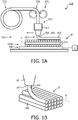
- Fig. 1a schematically depicts some aspects of the 3D printer.
- Reference 500 indicates a 3D printer.
- Reference 530 indicates the functional unit configured to 3D print, especially FDM 3D printing; this reference may also indicate the 3D printing stage unit.
- the printer head for providing 3D printed thermoplastic polymer material such as a FDM 3D printer head is schematically depicted.
- Reference 501 indicates the printer head.
- the 3D printer of the present invention may especially include a plurality of printer heads, though other embodiments are also possible.
- Reference 502 indicates a printer nozzle.
- the 3D printer of the present invention may especially include a plurality of printer nozzles, though other embodiments are also possible.
- Reference 320 indicates a filament of printable 3D printable thermoplastic polymer material (such as indicated above). For the sake of clarity, not all features of the 3D printer have been depicted, only those that are of especial relevance for the present invention (see further also below).
- the 3D printer 500 is configured to generate a 3D item 10 by depositing on a receiver item 550, which may in embodiments at least temporarily be cooled, a plurality of filaments 320 wherein each filament 20 comprises 3D printable thermoplastic polymer material, such as having a melting point T m .
- the 3D printer 500 is configured to heat the filament material upstream of the printer nozzle 502. This may e.g. be done with a device comprising one or more of an extrusion and/or heating function. Such device is indicated with reference 573, and is arranged upstream from the printer nozzle 502 (i.e. in time before the filament material leaves the printer nozzle 502).
- the printer head 501 may (thus) include a liquefier or heater.
- Reference 201 indicates printable material.
- Reference 572 indicates a spool or roller with material, especially in the form of a wire.
- the 3D printer 500 transforms this in a filament or fiber 320 on the receiver item or on already deposited printed material.
- the diameter of the filament downstream of the nozzle is reduced relative to the diameter of the filament upstream of the printer head.
- the printer nozzle is sometimes (also) indicated as extruder nozzle.
- a 3D item 10 may be formed.
- Reference 575 indicates the filament providing device, which here amongst others include the spool or roller and the driver wheels, indicated with reference 576.
- Reference A indicates a longitudinal axis or filament axis.
- Fig. 1b schematically depicts in 3D in more detail the printing of the 3D item 10 under construction.
- the ends of the filaments 320 in a single plane are not interconnected, though in reality this may in embodiments be the case.
- Figs. 1a-1b schematically depict some aspects of a fused deposition modeling 3D printer 500, comprising (a) a first printer head 501 comprising a printer nozzle 502, (b) a filament providing device 575 configured to provide a filament 320 comprising 3D printable thermoplastic polymer material 201 to the first printer head 501, and optionally (c) a receiver item 550.
- the first or second printable material or the first or second printed material are indicated with the general indications printable material 201 and printed material 202.
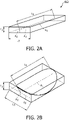
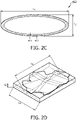
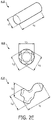
- Figs 2a-2e schematically depict some aspects of the particles 410.
- Some particles 410 have a longest dimension A1 having a longest dimension length L1 and a shortest dimension A2 having a shortest dimension length L2.
- the longest dimension length L1 and the shortest dimension length L2 have a first aspect ratio larger than 1.
- Fig. 2a schematically depicts a particle 410 in 3D, with the particle 410 having a length, height and width, with the particle (or flake) essentially having an elongated shape.
- the particle may have a further (minor or main) axis, herein indicated as further dimension A3.
- the particles 410 are elongated thin particles, i.e.
- L1 may e.g. be selected from the range of 1-500 ⁇ m; likewise L3 may be.
- L2 may e.g. be selected from the range of 0.1 ⁇ m - 10 ⁇ m.
- L3 may e.g. be selected from the range of 0.1 ⁇ m - 10 ⁇ m.
- L2 and/or L3 may also be longer, such as up to 5 mm, such as up to 1 mm, like up to 100 ⁇ m.
- Fig. 2b schematically depicts a particle that has a less regular shape such as pieces of broken glass, with a virtual smallest rectangular parallelepiped enclosing the particle.
- Fig. 2d schematically depicts a relatively irregularly shaped particle.
- the particulate material that is used may comprise e.g. small broken glass pieces.
- the particulate material that is embedded in the 3D printable thermoplastic polymer material or is embedded in the 3D printed thermoplastic polymer material may include a broad distribution of particles sizes.
- a rectangular parallelepiped can be used to define the (orthogonal) dimensions with lengths L1, L2 and L3.
- Fig. 2e schematically depict cylindrical, spherical, and irregularly shaped particles.
- curved or angular shapes For printing lamps and luminaires or other items, it may be desirable to create curved or angular shapes.
- the cactus like effect is especially well visible in curved or angular shapes.
- the 3D printer can print on top of the surface of such shaped receiver item 1550, see Fig. 3b .
- the particle size may especially be in the range of 5 ⁇ m - 500 ⁇ m.
- the largest dimension of 1 mm and aspect ratio of in the range 1-5 appeared to be the most desired range (in experiments that were executed).
- the most desirable particle concentration is found to be less than 15% volume (relative to the total volume of the 3D printed thermoplastic polymer material.
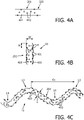
- Fig. 4b schematically depicts a 3D item 10, showing the ribbed structures (originating from the deposited filaments), having layer heights H and a layer width W.
- Fig. 4c schematically depicts a 3D printed item 10 with a substructure with a plurality of tops 13 and a plurality of bottoms 14. The top-top distance is indicated with reference d3.
- substantially herein, such as “substantially consists”, will be understood by the person skilled in the art.
- the term “substantially” may also include embodiments with “entirely”, “completely”, “all”, etc. Hence, in embodiments the adjective substantially may also be removed.
- the term “substantially” may also relate to 90% or higher, such as 95% or higher, especially 99% or higher, even more especially 99.5% or higher, including 100%.
- the term “comprise” includes also embodiments wherein the term “comprises” means “consists of'.
- the term “and/or” especially relates to one or more of the items mentioned before and after "and/or”.
- a phrase “item 1 and/or item 2" and similar phrases may relate to one or more of item 1 and item 2.
- the term “comprising” may in an embodiment refer to “consisting of' but may in another embodiment also refer to "containing at least the defined species and optionally one or more other species”.
- one or more of the first (printable or printed) material and second (printable or printed) material may contain fillers such as glass and fibers which do not have (to have) influence on the on T g or T m of the material(s).
Landscapes
- Engineering & Computer Science (AREA)
- Chemical & Material Sciences (AREA)
- Materials Engineering (AREA)
- Manufacturing & Machinery (AREA)
- Mechanical Engineering (AREA)
- Physics & Mathematics (AREA)
- Optics & Photonics (AREA)
- General Engineering & Computer Science (AREA)
- Composite Materials (AREA)
Applications Claiming Priority (2)
| Application Number | Priority Date | Filing Date | Title |
|---|---|---|---|
| EP17178697 | 2017-06-29 | ||
| PCT/EP2018/066781 WO2019002133A1 (en) | 2017-06-29 | 2018-06-22 | FDM PRINTED LUMINAIRES HAVING SURFACE TEXTURE |
Publications (2)
| Publication Number | Publication Date |
|---|---|
| EP3645287A1 EP3645287A1 (en) | 2020-05-06 |
| EP3645287B1 true EP3645287B1 (en) | 2022-09-14 |
Family
ID=59269836
Family Applications (1)
| Application Number | Title | Priority Date | Filing Date |
|---|---|---|---|
| EP18731491.9A Active EP3645287B1 (en) | 2017-06-29 | 2018-06-22 | Fdm printed luminaires with surface texture |
Country Status (5)
| Country | Link |
|---|---|
| US (1) | US12145310B2 (https=) |
| EP (1) | EP3645287B1 (https=) |
| JP (1) | JP7190457B2 (https=) |
| CN (1) | CN110869209B (https=) |
| WO (1) | WO2019002133A1 (https=) |
Families Citing this family (5)
| Publication number | Priority date | Publication date | Assignee | Title |
|---|---|---|---|---|
| JP6491467B2 (ja) * | 2014-10-14 | 2019-03-27 | 花王株式会社 | 三次元造形用可溶性材料 |
| JP5972335B2 (ja) | 2014-10-14 | 2016-08-17 | 花王株式会社 | 三次元造形用可溶性材料 |
| CN110997292B (zh) * | 2017-07-20 | 2022-04-15 | 昕诺飞控股有限公司 | 在具有金属外观的fdm打印照明器的部件上隐藏光学缺陷线 |
| WO2021175780A1 (en) * | 2020-03-05 | 2021-09-10 | Signify Holding B.V. | 3d item with interpenetrating layers produced by multi-material printing |
| FR3121859B1 (fr) * | 2021-04-19 | 2024-08-09 | Blachere Illumination | Procédé et dispositif de fabrication d’un objet décoratif à partir d’au moins une couche de cordon extrudé. |
Family Cites Families (9)
| Publication number | Priority date | Publication date | Assignee | Title |
|---|---|---|---|---|
| US6767619B2 (en) | 2001-05-17 | 2004-07-27 | Charles R. Owens | Preform for manufacturing a material having a plurality of voids and method of making the same |
| US8247492B2 (en) * | 2006-11-09 | 2012-08-21 | Valspar Sourcing, Inc. | Polyester powder compositions, methods and articles |
| WO2010075395A2 (en) * | 2008-12-22 | 2010-07-01 | Valspar Sourcing, Inc. | Polyester powder compositions, methods and articles |
| US20160346997A1 (en) | 2014-02-10 | 2016-12-01 | President And Fellows Of Harvard College | Three-dimensional (3d) printed composite structure and 3d printable composite ink formulation |
| US9796140B2 (en) | 2014-06-19 | 2017-10-24 | Autodesk, Inc. | Automated systems for composite part fabrication |
| GB201420870D0 (en) | 2014-11-24 | 2015-01-07 | Ngf Europ Ltd And Pilkington Group Ltd | Printed article and a feedstock |
| EP3224021B1 (en) | 2014-11-27 | 2020-06-24 | Signify Holding B.V. | Printing head, printing apparatus, printing method and printed article |
| ES2758712T3 (es) | 2015-11-09 | 2020-05-06 | Signify Holding Bv | Método para producir un componente óptico mediante impresión 3D, un componente óptico y un dispositivo de iluminación |
| US10589461B2 (en) * | 2016-09-22 | 2020-03-17 | Signify Holding B.V. | Method of using FDM to obtain specularly reflective surfaces |
-
2018
- 2018-06-22 EP EP18731491.9A patent/EP3645287B1/en active Active
- 2018-06-22 US US16/625,798 patent/US12145310B2/en active Active
- 2018-06-22 CN CN201880044384.3A patent/CN110869209B/zh active Active
- 2018-06-22 WO PCT/EP2018/066781 patent/WO2019002133A1/en not_active Ceased
- 2018-06-22 JP JP2019571407A patent/JP7190457B2/ja active Active
Also Published As
| Publication number | Publication date |
|---|---|
| CN110869209A (zh) | 2020-03-06 |
| EP3645287A1 (en) | 2020-05-06 |
| US12145310B2 (en) | 2024-11-19 |
| US20200122386A1 (en) | 2020-04-23 |
| WO2019002133A1 (en) | 2019-01-03 |
| CN110869209B (zh) | 2022-08-05 |
| JP2020525312A (ja) | 2020-08-27 |
| JP7190457B2 (ja) | 2022-12-15 |
Similar Documents
| Publication | Publication Date | Title |
|---|---|---|
| EP3645244B1 (en) | Fdm printed luminaires with surface texture | |
| EP3645287B1 (en) | Fdm printed luminaires with surface texture | |
| US20250345987A1 (en) | Fdm filaments using metal coated glass for 3d printing | |
| EP3544792B1 (en) | Powder coated fdm printed item, related manufacturing method and apparatus | |
| US20190210278A1 (en) | Method of using fdm to obtain specularly reflective surfaces | |
| US20210138721A1 (en) | Printed structure with metallic appearance | |
| EP3774288B1 (en) | Cross-linked polymer filled polymer particles for 3d printed items | |
| EP3655240B1 (en) | Hiding optical defect lines on parts of fdm printed luminaires with metallic look |
Legal Events
| Date | Code | Title | Description |
|---|---|---|---|
| STAA | Information on the status of an ep patent application or granted ep patent |
Free format text: STATUS: UNKNOWN |
|
| STAA | Information on the status of an ep patent application or granted ep patent |
Free format text: STATUS: THE INTERNATIONAL PUBLICATION HAS BEEN MADE |
|
| PUAI | Public reference made under article 153(3) epc to a published international application that has entered the european phase |
Free format text: ORIGINAL CODE: 0009012 |
|
| STAA | Information on the status of an ep patent application or granted ep patent |
Free format text: STATUS: REQUEST FOR EXAMINATION WAS MADE |
|
| 17P | Request for examination filed |
Effective date: 20200129 |
|
| AK | Designated contracting states |
Kind code of ref document: A1 Designated state(s): AL AT BE BG CH CY CZ DE DK EE ES FI FR GB GR HR HU IE IS IT LI LT LU LV MC MK MT NL NO PL PT RO RS SE SI SK SM TR |
|
| AX | Request for extension of the european patent |
Extension state: BA ME |
|
| DAV | Request for validation of the european patent (deleted) | ||
| DAX | Request for extension of the european patent (deleted) | ||
| STAA | Information on the status of an ep patent application or granted ep patent |
Free format text: STATUS: EXAMINATION IS IN PROGRESS |
|
| 17Q | First examination report despatched |
Effective date: 20210319 |
|
| GRAP | Despatch of communication of intention to grant a patent |
Free format text: ORIGINAL CODE: EPIDOSNIGR1 |
|
| STAA | Information on the status of an ep patent application or granted ep patent |
Free format text: STATUS: GRANT OF PATENT IS INTENDED |
|
| INTG | Intention to grant announced |
Effective date: 20220413 |
|
| GRAS | Grant fee paid |
Free format text: ORIGINAL CODE: EPIDOSNIGR3 |
|
| GRAA | (expected) grant |
Free format text: ORIGINAL CODE: 0009210 |
|
| STAA | Information on the status of an ep patent application or granted ep patent |
Free format text: STATUS: THE PATENT HAS BEEN GRANTED |
|
| AK | Designated contracting states |
Kind code of ref document: B1 Designated state(s): AL AT BE BG CH CY CZ DE DK EE ES FI FR GB GR HR HU IE IS IT LI LT LU LV MC MK MT NL NO PL PT RO RS SE SI SK SM TR |
|
| REG | Reference to a national code |
Ref country code: GB Ref legal event code: FG4D |
|
| REG | Reference to a national code |
Ref country code: CH Ref legal event code: EP |
|
| REG | Reference to a national code |
Ref country code: DE Ref legal event code: R096 Ref document number: 602018040647 Country of ref document: DE |
|
| REG | Reference to a national code |
Ref country code: IE Ref legal event code: FG4D |
|
| REG | Reference to a national code |
Ref country code: AT Ref legal event code: REF Ref document number: 1518468 Country of ref document: AT Kind code of ref document: T Effective date: 20221015 |
|
| REG | Reference to a national code |
Ref country code: LT Ref legal event code: MG9D |
|
| RAP4 | Party data changed (patent owner data changed or rights of a patent transferred) |
Owner name: SIGNIFY HOLDING B.V. |
|
| REG | Reference to a national code |
Ref country code: NL Ref legal event code: MP Effective date: 20220914 |
|
| PG25 | Lapsed in a contracting state [announced via postgrant information from national office to epo] |
Ref country code: SE Free format text: LAPSE BECAUSE OF FAILURE TO SUBMIT A TRANSLATION OF THE DESCRIPTION OR TO PAY THE FEE WITHIN THE PRESCRIBED TIME-LIMIT Effective date: 20220914 Ref country code: RS Free format text: LAPSE BECAUSE OF FAILURE TO SUBMIT A TRANSLATION OF THE DESCRIPTION OR TO PAY THE FEE WITHIN THE PRESCRIBED TIME-LIMIT Effective date: 20220914 Ref country code: NO Free format text: LAPSE BECAUSE OF FAILURE TO SUBMIT A TRANSLATION OF THE DESCRIPTION OR TO PAY THE FEE WITHIN THE PRESCRIBED TIME-LIMIT Effective date: 20221214 Ref country code: LV Free format text: LAPSE BECAUSE OF FAILURE TO SUBMIT A TRANSLATION OF THE DESCRIPTION OR TO PAY THE FEE WITHIN THE PRESCRIBED TIME-LIMIT Effective date: 20220914 Ref country code: LT Free format text: LAPSE BECAUSE OF FAILURE TO SUBMIT A TRANSLATION OF THE DESCRIPTION OR TO PAY THE FEE WITHIN THE PRESCRIBED TIME-LIMIT Effective date: 20220914 Ref country code: FI Free format text: LAPSE BECAUSE OF FAILURE TO SUBMIT A TRANSLATION OF THE DESCRIPTION OR TO PAY THE FEE WITHIN THE PRESCRIBED TIME-LIMIT Effective date: 20220914 |
|
| REG | Reference to a national code |
Ref country code: AT Ref legal event code: MK05 Ref document number: 1518468 Country of ref document: AT Kind code of ref document: T Effective date: 20220914 |
|
| PG25 | Lapsed in a contracting state [announced via postgrant information from national office to epo] |
Ref country code: HR Free format text: LAPSE BECAUSE OF FAILURE TO SUBMIT A TRANSLATION OF THE DESCRIPTION OR TO PAY THE FEE WITHIN THE PRESCRIBED TIME-LIMIT Effective date: 20220914 Ref country code: GR Free format text: LAPSE BECAUSE OF FAILURE TO SUBMIT A TRANSLATION OF THE DESCRIPTION OR TO PAY THE FEE WITHIN THE PRESCRIBED TIME-LIMIT Effective date: 20221215 |
|
| PG25 | Lapsed in a contracting state [announced via postgrant information from national office to epo] |
Ref country code: SM Free format text: LAPSE BECAUSE OF FAILURE TO SUBMIT A TRANSLATION OF THE DESCRIPTION OR TO PAY THE FEE WITHIN THE PRESCRIBED TIME-LIMIT Effective date: 20220914 Ref country code: RO Free format text: LAPSE BECAUSE OF FAILURE TO SUBMIT A TRANSLATION OF THE DESCRIPTION OR TO PAY THE FEE WITHIN THE PRESCRIBED TIME-LIMIT Effective date: 20220914 Ref country code: PT Free format text: LAPSE BECAUSE OF FAILURE TO SUBMIT A TRANSLATION OF THE DESCRIPTION OR TO PAY THE FEE WITHIN THE PRESCRIBED TIME-LIMIT Effective date: 20230116 Ref country code: ES Free format text: LAPSE BECAUSE OF FAILURE TO SUBMIT A TRANSLATION OF THE DESCRIPTION OR TO PAY THE FEE WITHIN THE PRESCRIBED TIME-LIMIT Effective date: 20220914 Ref country code: CZ Free format text: LAPSE BECAUSE OF FAILURE TO SUBMIT A TRANSLATION OF THE DESCRIPTION OR TO PAY THE FEE WITHIN THE PRESCRIBED TIME-LIMIT Effective date: 20220914 Ref country code: AT Free format text: LAPSE BECAUSE OF FAILURE TO SUBMIT A TRANSLATION OF THE DESCRIPTION OR TO PAY THE FEE WITHIN THE PRESCRIBED TIME-LIMIT Effective date: 20220914 |
|
| PG25 | Lapsed in a contracting state [announced via postgrant information from national office to epo] |
Ref country code: SK Free format text: LAPSE BECAUSE OF FAILURE TO SUBMIT A TRANSLATION OF THE DESCRIPTION OR TO PAY THE FEE WITHIN THE PRESCRIBED TIME-LIMIT Effective date: 20220914 Ref country code: PL Free format text: LAPSE BECAUSE OF FAILURE TO SUBMIT A TRANSLATION OF THE DESCRIPTION OR TO PAY THE FEE WITHIN THE PRESCRIBED TIME-LIMIT Effective date: 20220914 Ref country code: IS Free format text: LAPSE BECAUSE OF FAILURE TO SUBMIT A TRANSLATION OF THE DESCRIPTION OR TO PAY THE FEE WITHIN THE PRESCRIBED TIME-LIMIT Effective date: 20230114 Ref country code: EE Free format text: LAPSE BECAUSE OF FAILURE TO SUBMIT A TRANSLATION OF THE DESCRIPTION OR TO PAY THE FEE WITHIN THE PRESCRIBED TIME-LIMIT Effective date: 20220914 |
|
| P01 | Opt-out of the competence of the unified patent court (upc) registered |
Effective date: 20230425 |
|
| REG | Reference to a national code |
Ref country code: DE Ref legal event code: R097 Ref document number: 602018040647 Country of ref document: DE |
|
| PG25 | Lapsed in a contracting state [announced via postgrant information from national office to epo] |
Ref country code: NL Free format text: LAPSE BECAUSE OF FAILURE TO SUBMIT A TRANSLATION OF THE DESCRIPTION OR TO PAY THE FEE WITHIN THE PRESCRIBED TIME-LIMIT Effective date: 20220914 Ref country code: AL Free format text: LAPSE BECAUSE OF FAILURE TO SUBMIT A TRANSLATION OF THE DESCRIPTION OR TO PAY THE FEE WITHIN THE PRESCRIBED TIME-LIMIT Effective date: 20220914 |
|
| PLBE | No opposition filed within time limit |
Free format text: ORIGINAL CODE: 0009261 |
|
| STAA | Information on the status of an ep patent application or granted ep patent |
Free format text: STATUS: NO OPPOSITION FILED WITHIN TIME LIMIT |
|
| PG25 | Lapsed in a contracting state [announced via postgrant information from national office to epo] |
Ref country code: DK Free format text: LAPSE BECAUSE OF FAILURE TO SUBMIT A TRANSLATION OF THE DESCRIPTION OR TO PAY THE FEE WITHIN THE PRESCRIBED TIME-LIMIT Effective date: 20220914 |
|
| 26N | No opposition filed |
Effective date: 20230615 |
|
| PG25 | Lapsed in a contracting state [announced via postgrant information from national office to epo] |
Ref country code: SI Free format text: LAPSE BECAUSE OF FAILURE TO SUBMIT A TRANSLATION OF THE DESCRIPTION OR TO PAY THE FEE WITHIN THE PRESCRIBED TIME-LIMIT Effective date: 20220914 |
|
| PG25 | Lapsed in a contracting state [announced via postgrant information from national office to epo] |
Ref country code: MC Free format text: LAPSE BECAUSE OF FAILURE TO SUBMIT A TRANSLATION OF THE DESCRIPTION OR TO PAY THE FEE WITHIN THE PRESCRIBED TIME-LIMIT Effective date: 20220914 |
|
| PG25 | Lapsed in a contracting state [announced via postgrant information from national office to epo] |
Ref country code: MC Free format text: LAPSE BECAUSE OF FAILURE TO SUBMIT A TRANSLATION OF THE DESCRIPTION OR TO PAY THE FEE WITHIN THE PRESCRIBED TIME-LIMIT Effective date: 20220914 |
|
| REG | Reference to a national code |
Ref country code: CH Ref legal event code: PL |
|
| REG | Reference to a national code |
Ref country code: BE Ref legal event code: MM Effective date: 20230630 |
|
| PG25 | Lapsed in a contracting state [announced via postgrant information from national office to epo] |
Ref country code: LU Free format text: LAPSE BECAUSE OF NON-PAYMENT OF DUE FEES Effective date: 20230622 |
|
| REG | Reference to a national code |
Ref country code: IE Ref legal event code: MM4A |
|
| PG25 | Lapsed in a contracting state [announced via postgrant information from national office to epo] |
Ref country code: LU Free format text: LAPSE BECAUSE OF NON-PAYMENT OF DUE FEES Effective date: 20230622 |
|
| PG25 | Lapsed in a contracting state [announced via postgrant information from national office to epo] |
Ref country code: IE Free format text: LAPSE BECAUSE OF NON-PAYMENT OF DUE FEES Effective date: 20230622 |
|
| PG25 | Lapsed in a contracting state [announced via postgrant information from national office to epo] |
Ref country code: IE Free format text: LAPSE BECAUSE OF NON-PAYMENT OF DUE FEES Effective date: 20230622 Ref country code: CH Free format text: LAPSE BECAUSE OF NON-PAYMENT OF DUE FEES Effective date: 20230630 |
|
| PG25 | Lapsed in a contracting state [announced via postgrant information from national office to epo] |
Ref country code: IT Free format text: LAPSE BECAUSE OF FAILURE TO SUBMIT A TRANSLATION OF THE DESCRIPTION OR TO PAY THE FEE WITHIN THE PRESCRIBED TIME-LIMIT Effective date: 20220914 Ref country code: BE Free format text: LAPSE BECAUSE OF NON-PAYMENT OF DUE FEES Effective date: 20230630 |
|
| PG25 | Lapsed in a contracting state [announced via postgrant information from national office to epo] |
Ref country code: BG Free format text: LAPSE BECAUSE OF FAILURE TO SUBMIT A TRANSLATION OF THE DESCRIPTION OR TO PAY THE FEE WITHIN THE PRESCRIBED TIME-LIMIT Effective date: 20220914 |
|
| PG25 | Lapsed in a contracting state [announced via postgrant information from national office to epo] |
Ref country code: BG Free format text: LAPSE BECAUSE OF FAILURE TO SUBMIT A TRANSLATION OF THE DESCRIPTION OR TO PAY THE FEE WITHIN THE PRESCRIBED TIME-LIMIT Effective date: 20220914 |
|
| PGFP | Annual fee paid to national office [announced via postgrant information from national office to epo] |
Ref country code: GB Payment date: 20250617 Year of fee payment: 8 |
|
| PGFP | Annual fee paid to national office [announced via postgrant information from national office to epo] |
Ref country code: FR Payment date: 20250624 Year of fee payment: 8 |
|
| PG25 | Lapsed in a contracting state [announced via postgrant information from national office to epo] |
Ref country code: CY Free format text: LAPSE BECAUSE OF FAILURE TO SUBMIT A TRANSLATION OF THE DESCRIPTION OR TO PAY THE FEE WITHIN THE PRESCRIBED TIME-LIMIT; INVALID AB INITIO Effective date: 20180622 |
|
| PG25 | Lapsed in a contracting state [announced via postgrant information from national office to epo] |
Ref country code: HU Free format text: LAPSE BECAUSE OF FAILURE TO SUBMIT A TRANSLATION OF THE DESCRIPTION OR TO PAY THE FEE WITHIN THE PRESCRIBED TIME-LIMIT; INVALID AB INITIO Effective date: 20180622 |
|
| PGFP | Annual fee paid to national office [announced via postgrant information from national office to epo] |
Ref country code: DE Payment date: 20250827 Year of fee payment: 8 |
|
| PG25 | Lapsed in a contracting state [announced via postgrant information from national office to epo] |
Ref country code: TR Free format text: LAPSE BECAUSE OF FAILURE TO SUBMIT A TRANSLATION OF THE DESCRIPTION OR TO PAY THE FEE WITHIN THE PRESCRIBED TIME-LIMIT Effective date: 20220914 |