EP3643082B1 - Apparatus, system, method and computer program for distributing announcement messages - Google Patents
Apparatus, system, method and computer program for distributing announcement messages Download PDFInfo
- Publication number
- EP3643082B1 EP3643082B1 EP18731128.7A EP18731128A EP3643082B1 EP 3643082 B1 EP3643082 B1 EP 3643082B1 EP 18731128 A EP18731128 A EP 18731128A EP 3643082 B1 EP3643082 B1 EP 3643082B1
- Authority
- EP
- European Patent Office
- Prior art keywords
- focused sound
- person
- circuitry
- sound source
- generate
- Prior art date
- Legal status (The legal status is an assumption and is not a legal conclusion. Google has not performed a legal analysis and makes no representation as to the accuracy of the status listed.)
- Active
Links
Images



Classifications
-
- H—ELECTRICITY
- H04—ELECTRIC COMMUNICATION TECHNIQUE
- H04S—STEREOPHONIC SYSTEMS
- H04S7/00—Indicating arrangements; Control arrangements, e.g. balance control
- H04S7/30—Control circuits for electronic adaptation of the sound field
- H04S7/302—Electronic adaptation of stereophonic sound system to listener position or orientation
- H04S7/303—Tracking of listener position or orientation
-
- G—PHYSICS
- G01—MEASURING; TESTING
- G01C—MEASURING DISTANCES, LEVELS OR BEARINGS; SURVEYING; NAVIGATION; GYROSCOPIC INSTRUMENTS; PHOTOGRAMMETRY OR VIDEOGRAMMETRY
- G01C21/00—Navigation; Navigational instruments not provided for in groups G01C1/00 - G01C19/00
- G01C21/20—Instruments for performing navigational calculations
- G01C21/206—Instruments for performing navigational calculations specially adapted for indoor navigation
-
- H—ELECTRICITY
- H04—ELECTRIC COMMUNICATION TECHNIQUE
- H04R—LOUDSPEAKERS, MICROPHONES, GRAMOPHONE PICK-UPS OR LIKE ACOUSTIC ELECTROMECHANICAL TRANSDUCERS; ELECTRIC HEARING AIDS; PUBLIC ADDRESS SYSTEMS
- H04R1/00—Details of transducers, loudspeakers or microphones
- H04R1/20—Arrangements for obtaining desired frequency or directional characteristics
- H04R1/32—Arrangements for obtaining desired frequency or directional characteristics for obtaining desired directional characteristic only
- H04R1/40—Arrangements for obtaining desired frequency or directional characteristics for obtaining desired directional characteristic only by combining a number of identical transducers
- H04R1/403—Arrangements for obtaining desired frequency or directional characteristics for obtaining desired directional characteristic only by combining a number of identical transducers loud-speakers
-
- H—ELECTRICITY
- H04—ELECTRIC COMMUNICATION TECHNIQUE
- H04R—LOUDSPEAKERS, MICROPHONES, GRAMOPHONE PICK-UPS OR LIKE ACOUSTIC ELECTROMECHANICAL TRANSDUCERS; ELECTRIC HEARING AIDS; PUBLIC ADDRESS SYSTEMS
- H04R27/00—Public address systems
-
- H—ELECTRICITY
- H04—ELECTRIC COMMUNICATION TECHNIQUE
- H04R—LOUDSPEAKERS, MICROPHONES, GRAMOPHONE PICK-UPS OR LIKE ACOUSTIC ELECTROMECHANICAL TRANSDUCERS; ELECTRIC HEARING AIDS; PUBLIC ADDRESS SYSTEMS
- H04R3/00—Circuits for transducers
- H04R3/12—Circuits for transducers for distributing signals to two or more loudspeakers
-
- H—ELECTRICITY
- H04—ELECTRIC COMMUNICATION TECHNIQUE
- H04R—LOUDSPEAKERS, MICROPHONES, GRAMOPHONE PICK-UPS OR LIKE ACOUSTIC ELECTROMECHANICAL TRANSDUCERS; ELECTRIC HEARING AIDS; PUBLIC ADDRESS SYSTEMS
- H04R5/00—Stereophonic arrangements
- H04R5/02—Spatial or constructional arrangements of loudspeakers
-
- H—ELECTRICITY
- H04—ELECTRIC COMMUNICATION TECHNIQUE
- H04R—LOUDSPEAKERS, MICROPHONES, GRAMOPHONE PICK-UPS OR LIKE ACOUSTIC ELECTROMECHANICAL TRANSDUCERS; ELECTRIC HEARING AIDS; PUBLIC ADDRESS SYSTEMS
- H04R5/00—Stereophonic arrangements
- H04R5/04—Circuit arrangements, e.g. for selective connection of amplifier inputs/outputs to loudspeakers, for loudspeaker detection, or for adaptation of settings to personal preferences or hearing impairments
-
- H—ELECTRICITY
- H04—ELECTRIC COMMUNICATION TECHNIQUE
- H04S—STEREOPHONIC SYSTEMS
- H04S2400/00—Details of stereophonic systems covered by H04S but not provided for in its groups
- H04S2400/11—Positioning of individual sound objects, e.g. moving airplane, within a sound field
-
- H—ELECTRICITY
- H04—ELECTRIC COMMUNICATION TECHNIQUE
- H04S—STEREOPHONIC SYSTEMS
- H04S2420/00—Techniques used stereophonic systems covered by H04S but not provided for in its groups
- H04S2420/13—Application of wave-field synthesis in stereophonic audio systems
Definitions
- the present disclosure generally pertains to the field of announcement systems, in particular to apparatus, systems, methods and computer programs for distributing announcement messages.
- Public announcement systems which are also called public address systems (PA system)
- PA system typically comprise one or more components such as microphones, amplifiers and loudspeakers, and they allow the transmission of acoustic signals to an audience.
- Such systems are used in public areas and events to announce speech, alerts and important information.
- Public announcement systems typically consist of multiple speakers which are directed to an audience and which synchronously transmit the same audio signal.
- Public announcement systems with many speakers are widely used to make announcements in public, institutional and commercial buildings and locations, such as schools, stadiums and large passenger vessels and aircrafts.
- US 2011/103620 A1 relates to an apparatus for generating filter characteristics for filters connectible to at least three loudspeakers at defined locations with respect to a sound reproduction zone hat includes an impulse response reverser for time-reversing impulse responses associated to the loudspeakers to obtain time-reversed impulse responses.
- DE 10 2007 032272 A1 relates to a method, which involves calculating dynamically a data set on the geometric relationships between speakers, focused sound sources and ears of the listener in all six degrees of freedom depending on the determined position and orientation of the head.
- US 2006/098830 A1 relates to a wave field synthesis apparatus for driving an array of loudspeakers with drive signals, the loudspeakers being arranged at different defined positions, a drive signal for a loudspeaker being based on an audio signal associated with a virtual source having a virtual position with reference to the loudspeaker array and on the defined position of the loudspeaker, at first relevant loudspeakers of the loudspeaker array are determined on the basis of the position of the virtual source, a predefined listener position, and the defined positions of the loudspeakers.
- US 2016/123745 A1 pertains to a beacon-based guidance functionality that assists the user in navigating over a desired route within an environment, wherein the environment is populated with a plurality of beacons having respective non-overlapping ranges.
- the desired route traverses ranges associated with a route-specific set of beacons, from among the plurality of beacons and the beacon-based guidance module generates guidance information which directs the user towards a next waypoint in the route.
- the disclosure provides an apparatus as defined in the appended set of claims, the apparatus comprising circuitry configured to generate one or more focused sound sources as virtual loudspeakers of an announcement system.
- the disclosure provides a method as defined in the appended set of claims, the method comprising generating one or more focused sound sources as virtual loudspeakers of an announcement system.
- the disclosure provides a computer program as defined in the appended set of claims, the computer program comprising instructions, the instructions when executed on a processor, causing the processor to generate one or more focused sound sources as virtual loudspeakers of an announcement system.
- an apparatus comprising circuitry configured to generate one or more focused sound sources as virtual loudspeakers of an announcement system.
- the announcement system may, for example, be a public announcement system.
- the announcement system may be an announcement system for a museum, a railway station, an airport, a passenger hall, or the like.
- the term "public” as used here also relates to spaces and/or rooms that are open to the public, such as a museum, a train station, an airport building, a passenger hall, a garden, or a park, the term "public” should not be considered as being restricted to spaces that are accessible to everybody.
- a public announcement system may also be installed in a school to address teachers and pupils, in a company or firm to address the employees of the company or firm, or the like.
- Circuitry may include a processor, a memory (RAM, ROM or the like), a storage, input means (mouse, keyboard, camera, etc.), output means (display (e.g. liquid crystal, (organic) light emitting diode, etc.)), loudspeakers, etc., a (wireless) interface, etc., as it is generally known for electronic devices (computers, smartphones, etc.). Moreover, it may include sensors for sensing still image or video image data (image sensor, camera sensor, video sensor, etc.), for sensing environmental parameters (e.g. radar, humidity, light, temperature), etc.
- environmental parameters e.g. radar, humidity, light, temperature
- a focused sound source may, for example, be a sound field that gives the impression that an audio point source is located inside a predefined space or listening room (e.g. a museum, hall, park, etc.).
- Using focused sound sources may, for example, allow generating audio messages that are spatially confined.
- creating focused sound sources can be seen as a form of creating virtual loudspeakers.
- the apparatus may comprise one or more video cameras that are distributed over a predefined space.
- the video cameras may be comprised in a camera array that monitors a public space such as a passenger hall.
- the circuitry may be configured to use Wavefield synthesis and/or monopole synthesis techniques to generate focused sound sources.
- Wavefield synthesis and/or monopole synthesis techniques may be used to generate a sound field that gives the impression that an audio point source is located inside a predefined space or listening room (e.g. a museum, hall, etc.).
- Such an impression can, for example, be achieved by using a Wavefield synthesis or monopole synthesis approach that drives a loudspeaker array such that the impression of a focused sound source is generated.
- the circuitry may be configured to generate a focused sound source that is located at a predefined position of a predefined space.
- the circuitry may be configured to generate a focused sound source that is located at an exit door, a passenger hall, or at an emergency exit of a building.
- the circuitry may be configured to generate one or more audio messages at the focused sound sources.
- audio messages PA messages
- a public announcement system may be generated using the focused sound sources.
- a focused sound source may, for example, be a sound field that gives the impression that an audio point source is located at a specific position in a predefined space.
- the circuitry may be configured to generate one or more focused sound sources that allow generating audio messages that are spatially confined.
- the circuitry may be configured to generate multiple focused sound sources that are combined to form arbitrarily shaped audio areas.
- the circuitry may be configured to generate a focused sound source that directs a person to a specific position of a predefined space.
- the circuitry may be configured to generate a focused sound source that directs a passenger to an exit of a passenger hall.
- the circuitry may be configured to generate a focused sound source that is located close to an exit door.
- circuitry may be configured to generate person-individual focused sound sources.
- a public announcement system which uses focused sound sources as a form of creating virtual loudspeakers may be able to simultaneously convey multiple public announcement messages to different areas of interest.
- the circuitry may be configured to apply image recognition techniques to images obtained by a camera array to obtain the positions of persons in a predefined space. Any known image recognition technique, such as pattern recognition, machine learning, or the like, may be applied for this purpose.
- the circuitry is configured to calculate a trajectory that represents the path that a person should take to arrive at a predefined destination. For example, based on the position of a person in a predefined space (e.g. a passenger hall) and based on the predefined position of a destination (e.g. an exit door) in the predefined space, a public announcement system may calculate a trajectory representing the path that the person should take to arrive at the destination. On this trajectory, the public announcement system may place a focused sound source that is located close to a person. This focused sound source may generate an audio message such as "Please find the exit here".
- a predefined space e.g. a passenger hall
- a destination e.g. an exit door
- the circuitry may be configured to adapt the loudness of an audio message so that the audio message is primarily audible for a specific person who is located close to a focused sound source, but less audible, or substantially inaudible, for other persons who are located father away from the focused sound source. It might also be possible to use signals of different character (e.g., male vs. female voice) to have a better separation of messages. The system could take this into account when generating the audio message for a specific person.
- signals of different character e.g., male vs. female voice
- the circuitry may be configured to generate for each of a plurality of persons an individually focused sound source. With such individual focused sound sources, a public announcement system may guide persons individually to a specific destination.
- the circuitry may be configured to generate a focused sound source that is moving.
- a public announcement system may obtain the position of a person in a predefined space. Based on this position of the person in the predefined space and based on the predefined position of a destination in the predefined space, the public announcement system may calculate a trajectory that represents the path that a person should take to arrive from his position at the destination. On this trajectory, the public announcement system may place a focused sound source that is located close to the person. This focused sound source may generate an audio message "Please find the exit here". The person will thus move into the direction of the focused sound source, i.e. in the direction where it perceives the audio message emerging from. This process of placing the focused sound source in accordance with the position of a person may be repeated until the person arrives at the destination.
- the circuitry may be configured to generate a focused sound source whose position is changed dynamically following a predefined trajectory in a smooth way.
- the circuitry may be configured to generate multiple focused sound sources for emitting multiple audio messages at the same time.
- a public announcement system may obtain the position of persons in a predefined space. By image matching techniques, the public announcement system may further determine the identity of the persons located in the predefined space. Based on the identity information the public announcement system may query a data base that stores check-in information concerning the persons in order to obtain the respective destinations to which the persons should go to (e.g. gate A1 for a first passenger and gate B2 for a second passenger located in a passenger hall of an airport). Close to each position of each person, the public announcement system may place a focused sound source. Each focused sound source may generate an audio message that directs the respective person to his destination. Persons can thus receive individual messages that direct them to their respective destinations.
- the circuitry may be configured to generate multiple audio messages at the same time that are used to address a person or a group of persons simultaneously with different messages.
- the messages can be individualized for a person or a group of persons.
- the circuitry may be configured to generate one or more audio messages, each audio message depending on a location of a person, a destination of the person, and/or person-specific information of the person.
- a public announcement system may guide a person in an airport such that he can easily transfer from one gate to another, if the public announcement system knows what his connecting flight is.
- the embodiments also disclose a method comprising generating one or more focused sound sources as virtual loudspeakers of an announcement system.
- the method may comprise any of the processes and/or operations that are described above or in the detailed description of the embodiments below.
- the embodiments also disclose a computer program comprising instructions, the instructions when executed on a processor, causing the processor to generate one or more focused sound sources as virtual loudspeakers of an announcement system.
- the computer program may implement any of the processes and/or operations that are described above or in the detailed description of the embodiments below.
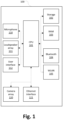
- Fig. 1 schematically describes an embodiment of an electronic system that can act as a public announcement system.
- the electronic system 100 comprises a CPU 101 as processor.
- the electronic device 100 further comprises a microphone 110, a loudspeaker array 111 and a camera array 120 that are connected to the processor 101.
- Microphone 110 can for example be used to generate audio messages that are distributed via the public announcement system.
- Loudspeaker array 111 consists of one or more loudspeakers that are distributed over the predefined space.
- Camera array 120 consists of one or more video cameras that are distributed over the predefined space.
- the electronic device 100 further comprises a user interface 112 that is connected to the processor 101. This user interface 112 acts as a man-machine interface and enables a dialogue between an administrator and the electronic system.
- the electronic system 100 further comprises an Ethernet interface 121, a Bluetooth interface 104, and a WLAN interface 105. These units 104, 105 act as I/O interfaces for data communication with external devices. For example, additional loudspeakers, microphones, and video cameras with Ethernet, WLAN or Bluetooth connection may be coupled to the processor 101 via these interfaces 121, 104, and 105.
- the electronic device 100 further comprises a data storage 102 and a data memory 103 (here a RAM).
- the data memory 103 is arranged to temporarily store or cache data or computer instructions for processing by the processor 101.
- the data storage 102 is arranged as a long term storage, e.g., for recording sensor data obtained from the microphone 110 and the camera array 120.
- the data storage 102 may also store audio data that represents audio messages which the public announcement system may transport to persons moving in the predefined space.
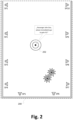
- Fig. 2 schematically depicts a public announcement system that generates a focused sound source.
- the public space is a passenger hall 200 within an airport building.
- a loudspeaker array of the public announcement system comprises loudspeakers SP1 to SP10 that are arranged at the walls of the passenger hall 200.
- the public announcement system uses techniques such as Wavefield synthesis, the public announcement system generates a focused sound source 202 that is located in the middle of the passenger hall 200.
- the focused sound source 202 generates an audio message "Passenger John Doe, please immediately go to gate A1! that is distributed in hall 200.
- focused sound source it is referred here to a sound field that gives the impression that an audio point source is located inside the listening room (e.g., museum, hall, etc.).
- Such an impression can be achieved by using a Wavefield synthesis approach that drives the surrounding loudspeakers SP1 to SP10 such that the impression of a focused sound source is generated (see Fig. 7 and corresponding description below).
- Using focused sound sources for public announcement systems as described above with regard to Fig. 2 allows generating audio messages that are spatially confined.
- creating focused sound sources can be seen as a form of creating virtual loudspeakers.
- Fig. 2 there is displayed only one focused sound source 202. However, in other embodiments, several focused sound sources are combined to form arbitrarily shaped audio areas.
- Focused sound source that directs passengers to an exit door
- Fig. 3 schematically depicts a public announcement system that generates a focused sound source that directs passengers P1 and P2 to an exit door 301 of a passenger hall 300.
- a loudspeaker array of the public announcement system comprises loudspeakers SP1 to SP10 that are arranged at the walls of the passenger hall 300.
- the public announcement system uses techniques such as Wavefield synthesis to generate a focused sound source 302 that is located close to the exit door 301 of passenger hall 300.
- the focused sound source 302 generates an audio message "Please find the exit here" that is distributed within the passenger hall 300.
- the focused sound source 302 gives the impression that an audio point source is located in front of the exit door 301.
- Passengers P1 and P2 thus can move into the direction of the focused sound source 302, i.e. in the direction where they perceive the audio message emerging from and they will automatically arrive at the exit door 301. That is, the audio message that is emitted by focused sound source 302 leads passengers P1 and P2 to exit door 301.
- location information can be attached to an audio message without having the need to install a physical loudspeaker at the desired location (which might be impractical or even impossible, e.g., in the case of a moving source).
- Fig. 4a schematically depicts a public announcement system that generates passenger-individual sound sources.
- a loudspeaker array of the public announcement system comprises loudspeakers SP1 to SP10 that are arranged at the walls of a passenger hall 400.
- the public announcement system comprises a camera array that comprises cameras C1 to C6 that are arranged at the walls of passenger hall 400. The cameras C1 to C6 produce images of the passenger hall 400. By applying image recognition techniques to the images obtained by cameras C1 to C6, the public announcement system obtains the position of passengers P1 and P2 in passenger hall 400.
- the public announcement system Based on the position of passenger P1 in passenger hall 400 and based on the predefined position of exit door 401 in passenger hall 400, the public announcement system calculates trajectory T1 that represents the path that passenger P1 should take to arrive at exit door 401. On this trajectory T1, the public announcement system places a focused sound source 402 that is located close to passenger P1. This focused sound source 402 generates an audio message "Please find the exit here". As the focused sound source 402 is located close to passenger P1, the loudness of the audio message can be adapted so that the audio message is primarily and clearly audible for passenger P1, but not prominent for passenger P2 who is located far away from the focused sound source 402.
- the public announcement system calculates trajectory T2 that represents the path that passenger P2 should take to arrive at exit door 401.
- the public announcement system places a focused sound source 403 that is located close to passenger P2.
- This focused sound source 403 generates an audio message "Please find the exit here".
- the loudness of the audio message can be adapted so that the audio message is primarily and clearly audible for passenger P2, but not prominent for passenger P1 who is located far away from the focused sound source 403.
- Passengers P1 and P2 thus can move into the direction of the focused sound sources 402 and 403, respectively, i.e. in the direction where they perceive the audio message emerging from and they will automatically arrive at the exit door 401. That is, the audio message that is emitted by focused sound sources 402 and 403 leads passengers P1 and P2 to the exit door 401. As the audio message is emitted for each passenger P1, P2 by a person sound source 402, 403, each passenger is individually guided to exit door 401 on an optimized path.
- Fig. 4b schematically depicts a process that generates passenger-individual sound sources.
- the process starts.
- images of the passenger hall are obtained from a camera array.
- image recognition techniques are applied to the images obtained by the camera array to identify the positions of passengers in the passenger hall.
- a trajectory is calculated that represents the path that a passenger should take from his position to arrive at the exit door based on his position and based on the predefined position of the exit door.
- a focused sound source is placed on the calculated trajectory close to the passenger.
- an audio message "Please find the exit here" is generated at the focused sound source.
- it it is tested if all passengers have arrived at the exit door. If yes, at 417, the process ends. If no, operations 411 to 416 are repeated.
- Fig. 5a schematically depicts a public announcement system that generates a moving sound source.
- the public announcement system comprises a loudspeaker array comprising loudspeakers SP1 to SP10 that are arranged at the walls of a passenger hall 500.
- the public announcement system comprises a camera array that comprises cameras C1 to C6 that are arranged at the walls of passenger hall 500. The cameras C1 to C6 produce images of the passenger hall 500.
- the public announcement system obtains the position P1a of a passenger P1 at position P1a in passenger hall 500.
- the public announcement system Based on the position P1a of passenger P1 in passenger hall 500 and based on the predefined position of exit door 501 in passenger hall 500, the public announcement system calculates a trajectory T1a that represents the path that passenger P1 should take to arrive from location P1a at exit door 501. On this trajectory T1a, the public announcement system places a focused sound source 502a that is located close to passenger P1 at position P1a. This focused sound source 502a generates an audio message "Please find the exit here". As the focused sound source 502a is located close to passenger P1 at position P1a, the loudness of the audio message can be adapted in such a manner that the audio message is primarily and clearly audible for passenger P1, but not prominent for other passengers (not shown in Fig.
- the public announcement system obtains a next position P1b of passenger P1 at position P1b in passenger hall 500. Based on position P1b of passenger P1 in passenger hall 500 and based on the predefined position of exit door 501 in passenger hall 500, the public announcement system calculates a trajectory T1b that represents the path that passenger P1 should take to arrive from location P1b at exit door 501.
- the public announcement system places a focused sound source 502b that is located close to passenger P1 at position P1b.
- This focused sound source 502b generates an audio message "Please find the exit here".
- Passenger P1 will thus move into the direction of the focused sound source 502b, i.e. in the direction where he perceives the audio message emerging from.
- the public announcement system obtains a next position P1c of passenger P1 at position P1c in passenger hall 500.
- the public announcement system Based on position P1c of passenger P1 in passenger hall 500 and based on the predefined position of exit door 501 in passenger hall 500, the public announcement system calculates a trajectory T1c that represents the path that passenger P1 should take to arrive from location P1c at exit door 501. On this trajectory T1c, the public announcement system places a focused sound source 502c that is located close to passenger P1 at position P1c. This focused sound source 502c generates an audio message "Please find the exit here". Passenger P1 will thus move into the direction of the focused sound source 502c, i.e. in the direction where he perceives the audio message emerging from.
- the public announcement system obtains a next position P1d of passenger P1 at position P1d in passenger hall 500. Based on position P1d of passenger P1 in passenger hall 500 and based on the predefined position of exit door 501 in passenger hall 500, the public announcement system calculates a trajectory T1d that represents the path that passenger P1 should take to arrive from location P1d at exit door 501. On this trajectory T1d, the public announcement system places a focused sound source 502d that is located close to passenger P1 at position P1d. This focused sound source 502d generates an audio message "Please find the exit here". Passenger P1 will thus move into the direction of the focused sound source 502d, i.e. in the direction where he perceives the audio message emerging from. This process of moving the focused sound source in accordance with the position of passenger P1 is repeated, until passenger P1 arrives at the exit door 501.
- the position of a focused sound source can be changed dynamically following an arbitrarily trajectory in a smooth way.
- Fig. 5b schematically depicts a process that generates a moving sound source.
- the process starts.
- images of the passenger hall are obtained from a camera array.
- image recognition techniques are applied to the images obtained by the camera array to identify the position of a passenger.
- a trajectory is calculated that represents the path that the passenger should take from his position to arrive at the exit door based on the position of the passenger and based on the predefined position of the exit door.
- a focused sound source is placed on the calculated trajectory close to the passenger.
- an audio message "Please find the exit here" is generated at the focused sound source.
- it is tested if the passenger has arrived at the exit door. If yes, at 517, the process ends. If not, the process repeats operations 511 to 516.
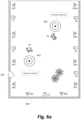
- Fig. 6a schematically depicts a public announcement system that generates multiple audio messages at the same time.
- a public announcement system comprises a loudspeaker array comprising loudspeakers SP1 to SP10 that are arranged at the walls of a passenger hall 600.
- the public announcement system comprises a camera array that comprises cameras C1 to C6 that are arranged at the walls of passenger hall 600. The cameras C1 to C6 produce images of the passenger hall 600.
- image recognition techniques to the images obtained by cameras C1 to C6
- the public announcement system obtains the position of passengers P1 and P2 in passenger hall 600 and by image matching techniques, the public announcement system determines the identity of passengers P1 and P2.
- the public announcement system queries a data base that stores check-in information concerning passengers P1 and P2 in order to obtain the respective gates to which passengers P1 and P2 should go to, here gate A1 for passenger P1 and gate B2 for passenger P2.
- the public announcement system places a focused sound source 602.
- This focused sound source 602 generates a first audio message "Please go to gate A1".
- the loudness of the audio message can be adapted in such a manner that the audio message is primarily and clearly audible for passenger P1, but not prominent for passenger P2 who is located far away from the focused sound source 602.
- the public announcement system places a focused sound source 603 close to the position of passenger P2 in passenger hall 600.
- This focused sound source 603 generates a second audio message "Please go to gate B2".
- the loudness of the audio message can be adapted in such a manner that the audio message is primarily and clearly audible for passenger P2, but not prominent for passenger P1 who is located far away from the focused sound source 603.
- Passengers P1 and P2 thus receive individual messages that direct them to their respective gates A1 and B2.
- multiple audio messages at the same time are used to address a person or a group of persons simultaneously with different messages.
- the messages can be individualized for a person or a group of persons.
- the conveyed message could depend on the person's location.
- the audio message could depend on person-specific information, for example, if the public announcement system wants to guide a person in an airport such that he can easily transfer from one gate to another, if the public announcement system knows what his connecting flight is.
- Fig. 6a which provides multiple messages for multiple focused sound sources may allow to individually address individual persons and/or groups, it may be time efficient as multiple messages can be conveyed at the same time. This may be helpful, e.g., in emergency situations to convey individual information and by this provide different escape routes. Also, such a public announcement system may be helpful, e.g., in a train station where persons may be guided differently to avoid congestion.
- Fig. 6b schematically depicts a process that generates multiple audio messages at the same time.
- the process starts.
- the images of the passenger hall are obtained from a camera array.
- image recognition techniques are applied to the images obtained by the camera array to identify the positions of passengers in the passenger hall.
- image matching is performed to determine the identities of the passengers in passenger hall.
- a data base is queried that stores check-in information concerning identified passengers in order to obtain the respective gates to which the passengers should go to.
- a focused sound source is placed close to the passenger.
- an audio message is generated that directs the passenger to his gate.
- it is tested if all passengers arrived at their respective gates. If yes, at 618, the process ends. If not, the process repeats operations 611 to 617.
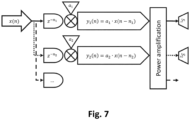
- Fig. 7 provides an embodiment of a system which implements a method that is based on a digitalized Monopole Synthesis algorithm in the case of integer delays.
- a target sound field is modelled as at least one target monopole placed at a defined target position.
- the target sound field is modelled as one single target monopole.
- the target sound field is modelled as multiple target monopoles placed at respective defined target positions.
- the position of a target monopole may be moving.
- a target monopole may adapt to the movement of a noise source to be attenuated.
- the methods of synthesizing the sound of a target monopole based on a set of defined synthesis monopoles as described below may be applied for each target monopole independently, and the contributions of the synthesis monopoles obtained for each target monopole may be summed to reconstruct the target sound field.
- the resulting signals s p (n) are power amplified and fed to loudspeaker S p .
- the synthesis is thus performed in the form of delayed and amplified components of the source signal x.
- the modified amplification factor according to equation (118) of US 2016/0037282 A1 can be used.
- a mapping factor as described with regard to Fig. 9 of US 2016/0037282 A1 can be used to modify the amplification.
Landscapes
- Engineering & Computer Science (AREA)
- Physics & Mathematics (AREA)
- Acoustics & Sound (AREA)
- Signal Processing (AREA)
- Radar, Positioning & Navigation (AREA)
- Remote Sensing (AREA)
- Health & Medical Sciences (AREA)
- Otolaryngology (AREA)
- General Health & Medical Sciences (AREA)
- Automation & Control Theory (AREA)
- General Physics & Mathematics (AREA)
- Circuit For Audible Band Transducer (AREA)
Description
- The present disclosure generally pertains to the field of announcement systems, in particular to apparatus, systems, methods and computer programs for distributing announcement messages.
- Public announcement systems, which are also called public address systems (PA system), typically comprise one or more components such as microphones, amplifiers and loudspeakers, and they allow the transmission of acoustic signals to an audience. Such systems are used in public areas and events to announce speech, alerts and important information.
- Known public announcement systems typically consist of multiple speakers which are directed to an audience and which synchronously transmit the same audio signal. Public announcement systems with many speakers are widely used to make announcements in public, institutional and commercial buildings and locations, such as schools, stadiums and large passenger vessels and aircrafts.
-
US 2011/103620 A1 relates to an apparatus for generating filter characteristics for filters connectible to at least three loudspeakers at defined locations with respect to a sound reproduction zone hat includes an impulse response reverser for time-reversing impulse responses associated to the loudspeakers to obtain time-reversed impulse responses. -
DE 10 2007 032272 A1 relates to a method, which involves calculating dynamically a data set on the geometric relationships between speakers, focused sound sources and ears of the listener in all six degrees of freedom depending on the determined position and orientation of the head. -
US 2006/098830 A1 relates to a wave field synthesis apparatus for driving an array of loudspeakers with drive signals, the loudspeakers being arranged at different defined positions, a drive signal for a loudspeaker being based on an audio signal associated with a virtual source having a virtual position with reference to the loudspeaker array and on the defined position of the loudspeaker, at first relevant loudspeakers of the loudspeaker array are determined on the basis of the position of the virtual source, a predefined listener position, and the defined positions of the loudspeakers. -
US 2016/123745 A1 pertains to a beacon-based guidance functionality that assists the user in navigating over a desired route within an environment, wherein the environment is populated with a plurality of beacons having respective non-overlapping ranges. The desired route traverses ranges associated with a route-specific set of beacons, from among the plurality of beacons and the beacon-based guidance module generates guidance information which directs the user towards a next waypoint in the route. - According to a first aspect, the disclosure provides an apparatus as defined in the appended set of claims, the apparatus comprising circuitry configured to generate one or more focused sound sources as virtual loudspeakers of an announcement system.
- According to a further aspect, the disclosure provides a method as defined in the appended set of claims, the method comprising generating one or more focused sound sources as virtual loudspeakers of an announcement system.
- According to a further aspect, the disclosure provides a computer program as defined in the appended set of claims, the computer program comprising instructions, the instructions when executed on a processor, causing the processor to generate one or more focused sound sources as virtual loudspeakers of an announcement system.
- Further aspects are set forth in the dependent claims, the following description and the drawings.
- Embodiments are explained by way of example with respect to the accompanying drawings, in which:
-
Fig. 1 schematically describes an embodiment of an electronic system that can act as public announcement system; -
Fig. 2 schematically depicts a public announcement system that generates a focused sound source; -
Fig. 3 schematically depicts a public announcement system that generates a focused sound source that directs passengers to an exit door; The examples ofFigs.2 and3 are not encompassed by the wording of the claims but are considered as useful for understanding the invention; -
Fig. 4a schematically depicts a public announcement system that generates passenger-individual sound sources; -
Fig. 4b schematically depicts a process that generates passenger-individual sound sources; -
Fig. 5a schematically depicts a public announcement system that generates a moving sound source; -
Fig. 5b schematically depicts a process that generates a moving sound source; -
Fig. 6a schematically depicts a public announcement system that generates multiple audio messages at the same time; -
Fig. 6b schematically depicts a process that generates multiple audio messages at the same time; and -
Fig. 7 provides a schematic diagram of a system applying digitalized monopole synthesis algorithm. - Before a detailed description of the embodiments under reference of
Fig. 1 is given, some general explanations are made. - In the embodiments an apparatus is disclosed comprising circuitry configured to generate one or more focused sound sources as virtual loudspeakers of an announcement system.
- The announcement system may, for example, be a public announcement system. For example, the announcement system may be an announcement system for a museum, a railway station, an airport, a passenger hall, or the like. Even though the term "public" as used here also relates to spaces and/or rooms that are open to the public, such as a museum, a train station, an airport building, a passenger hall, a garden, or a park, the term "public" should not be considered as being restricted to spaces that are accessible to everybody. A public announcement system may also be installed in a school to address teachers and pupils, in a company or firm to address the employees of the company or firm, or the like.
- Circuitry may include a processor, a memory (RAM, ROM or the like), a storage, input means (mouse, keyboard, camera, etc.), output means (display (e.g. liquid crystal, (organic) light emitting diode, etc.)), loudspeakers, etc., a (wireless) interface, etc., as it is generally known for electronic devices (computers, smartphones, etc.). Moreover, it may include sensors for sensing still image or video image data (image sensor, camera sensor, video sensor, etc.), for sensing environmental parameters (e.g. radar, humidity, light, temperature), etc.
- A focused sound source may, for example, be a sound field that gives the impression that an audio point source is located inside a predefined space or listening room (e.g. a museum, hall, park, etc.). Using focused sound sources may, for example, allow generating audio messages that are spatially confined. In particular, creating focused sound sources can be seen as a form of creating virtual loudspeakers.
- The apparatus may comprise one or more video cameras that are distributed over a predefined space. For example, the video cameras may be comprised in a camera array that monitors a public space such as a passenger hall.
- The circuitry may be configured to use Wavefield synthesis and/or monopole synthesis techniques to generate focused sound sources. Wavefield synthesis and/or monopole synthesis techniques may be used to generate a sound field that gives the impression that an audio point source is located inside a predefined space or listening room (e.g. a museum, hall, etc.). Such an impression can, for example, be achieved by using a Wavefield synthesis or monopole synthesis approach that drives a loudspeaker array such that the impression of a focused sound source is generated.
- The circuitry may be configured to generate a focused sound source that is located at a predefined position of a predefined space. For example, the circuitry may be configured to generate a focused sound source that is located at an exit door, a passenger hall, or at an emergency exit of a building.
- The circuitry may be configured to generate one or more audio messages at the focused sound sources. For example, audio messages (PA messages) of a public announcement system may be generated using the focused sound sources.
- A focused sound source may, for example, be a sound field that gives the impression that an audio point source is located at a specific position in a predefined space. For example, the circuitry may be configured to generate one or more focused sound sources that allow generating audio messages that are spatially confined.
- The circuitry may be configured to generate multiple focused sound sources that are combined to form arbitrarily shaped audio areas.
- Still further, the circuitry may be configured to generate a focused sound source that directs a person to a specific position of a predefined space. For example, the circuitry may be configured to generate a focused sound source that directs a passenger to an exit of a passenger hall.
- The circuitry may be configured to generate a focused sound source that is located close to an exit door.
- Still further, the circuitry may be configured to generate person-individual focused sound sources. A public announcement system which uses focused sound sources as a form of creating virtual loudspeakers may be able to simultaneously convey multiple public announcement messages to different areas of interest.
- The circuitry may be configured to apply image recognition techniques to images obtained by a camera array to obtain the positions of persons in a predefined space. Any known image recognition technique, such as pattern recognition, machine learning, or the like, may be applied for this purpose.
- According to some embodiments, the circuitry is configured to calculate a trajectory that represents the path that a person should take to arrive at a predefined destination. For example, based on the position of a person in a predefined space (e.g. a passenger hall) and based on the predefined position of a destination (e.g. an exit door) in the predefined space, a public announcement system may calculate a trajectory representing the path that the person should take to arrive at the destination. On this trajectory, the public announcement system may place a focused sound source that is located close to a person. This focused sound source may generate an audio message such as "Please find the exit here".
- Still further, the circuitry may be configured to adapt the loudness of an audio message so that the audio message is primarily audible for a specific person who is located close to a focused sound source, but less audible, or substantially inaudible, for other persons who are located father away from the focused sound source. It might also be possible to use signals of different character (e.g., male vs. female voice) to have a better separation of messages. The system could take this into account when generating the audio message for a specific person.
- The circuitry may be configured to generate for each of a plurality of persons an individually focused sound source. With such individual focused sound sources, a public announcement system may guide persons individually to a specific destination.
- Still further, the circuitry may be configured to generate a focused sound source that is moving. For example, by applying image recognition techniques to images obtained by a camera array, a public announcement system may obtain the position of a person in a predefined space. Based on this position of the person in the predefined space and based on the predefined position of a destination in the predefined space, the public announcement system may calculate a trajectory that represents the path that a person should take to arrive from his position at the destination. On this trajectory, the public announcement system may place a focused sound source that is located close to the person. This focused sound source may generate an audio message "Please find the exit here". The person will thus move into the direction of the focused sound source, i.e. in the direction where it perceives the audio message emerging from. This process of placing the focused sound source in accordance with the position of a person may be repeated until the person arrives at the destination.
- Also, the circuitry may be configured to generate a focused sound source whose position is changed dynamically following a predefined trajectory in a smooth way.
- The circuitry may be configured to generate multiple focused sound sources for emitting multiple audio messages at the same time. For example, by applying image recognition techniques to the images obtained by a camera array, a public announcement system may obtain the position of persons in a predefined space. By image matching techniques, the public announcement system may further determine the identity of the persons located in the predefined space. Based on the identity information the public announcement system may query a data base that stores check-in information concerning the persons in order to obtain the respective destinations to which the persons should go to (e.g. gate A1 for a first passenger and gate B2 for a second passenger located in a passenger hall of an airport). Close to each position of each person, the public announcement system may place a focused sound source. Each focused sound source may generate an audio message that directs the respective person to his destination. Persons can thus receive individual messages that direct them to their respective destinations.
- The circuitry may be configured to generate multiple audio messages at the same time that are used to address a person or a group of persons simultaneously with different messages. With a public announcement system that allows conveying several audio messages at the same time, the messages can be individualized for a person or a group of persons.
- The circuitry may be configured to generate one or more audio messages, each audio message depending on a location of a person, a destination of the person, and/or person-specific information of the person. For example, a public announcement system may guide a person in an airport such that he can easily transfer from one gate to another, if the public announcement system knows what his connecting flight is.
- The embodiments also disclose a method comprising generating one or more focused sound sources as virtual loudspeakers of an announcement system. The method may comprise any of the processes and/or operations that are described above or in the detailed description of the embodiments below.
- The embodiments also disclose a computer program comprising instructions, the instructions when executed on a processor, causing the processor to generate one or more focused sound sources as virtual loudspeakers of an announcement system. The computer program may implement any of the processes and/or operations that are described above or in the detailed description of the embodiments below.
-
Fig. 1 schematically describes an embodiment of an electronic system that can act as a public announcement system. Theelectronic system 100 comprises aCPU 101 as processor. Theelectronic device 100 further comprises amicrophone 110, aloudspeaker array 111 and acamera array 120 that are connected to theprocessor 101.Microphone 110 can for example be used to generate audio messages that are distributed via the public announcement system.Loudspeaker array 111 consists of one or more loudspeakers that are distributed over the predefined space.Camera array 120 consists of one or more video cameras that are distributed over the predefined space. Theelectronic device 100 further comprises auser interface 112 that is connected to theprocessor 101. Thisuser interface 112 acts as a man-machine interface and enables a dialogue between an administrator and the electronic system. For example, an administrator may make configurations to the system using thisuser interface 112. Theelectronic system 100 further comprises anEthernet interface 121, aBluetooth interface 104, and aWLAN interface 105. Theseunits processor 101 via theseinterfaces - The
electronic device 100 further comprises adata storage 102 and a data memory 103 (here a RAM). The data memory 103 is arranged to temporarily store or cache data or computer instructions for processing by theprocessor 101. Thedata storage 102 is arranged as a long term storage, e.g., for recording sensor data obtained from themicrophone 110 and thecamera array 120. Thedata storage 102 may also store audio data that represents audio messages which the public announcement system may transport to persons moving in the predefined space. - It should be noted that the description above is only an example configuration. Alternative configurations may be implemented with additional or other sensors, storage devices, interfaces, or the like.
-
Fig. 2 schematically depicts a public announcement system that generates a focused sound source. Here, the public space is apassenger hall 200 within an airport building. A loudspeaker array of the public announcement system comprises loudspeakers SP1 to SP10 that are arranged at the walls of thepassenger hall 200. Using techniques such as Wavefield synthesis, the public announcement system generates a focusedsound source 202 that is located in the middle of thepassenger hall 200. - The focused
sound source 202 generates an audio message "Passenger John Doe, please immediately go to gate A1!" that is distributed inhall 200. - By focused sound source, it is referred here to a sound field that gives the impression that an audio point source is located inside the listening room (e.g., museum, hall, etc.). Such an impression can be achieved by using a Wavefield synthesis approach that drives the surrounding loudspeakers SP1 to SP10 such that the impression of a focused sound source is generated (see
Fig. 7 and corresponding description below). Using focused sound sources for public announcement systems as described above with regard toFig. 2 allows generating audio messages that are spatially confined. In particular, creating focused sound sources can be seen as a form of creating virtual loudspeakers. - In
Fig. 2 there is displayed only one focusedsound source 202. However, in other embodiments, several focused sound sources are combined to form arbitrarily shaped audio areas. -
Fig. 3 schematically depicts a public announcement system that generates a focused sound source that directs passengers P1 and P2 to anexit door 301 of apassenger hall 300. As in the embodiment ofFig. 2 a loudspeaker array of the public announcement system comprises loudspeakers SP1 to SP10 that are arranged at the walls of thepassenger hall 300. Using techniques such as Wavefield synthesis, the public announcement system generates a focusedsound source 302 that is located close to theexit door 301 ofpassenger hall 300. The focusedsound source 302 generates an audio message "Please find the exit here" that is distributed within thepassenger hall 300. The focusedsound source 302 gives the impression that an audio point source is located in front of theexit door 301. Passengers P1 and P2 thus can move into the direction of the focusedsound source 302, i.e. in the direction where they perceive the audio message emerging from and they will automatically arrive at theexit door 301. That is, the audio message that is emitted by focusedsound source 302 leads passengers P1 and P2 to exitdoor 301. - That is, according to the embodiment of
Fig. 3 , as the listener gets the impression of a source inside the room/hall, location information can be attached to an audio message without having the need to install a physical loudspeaker at the desired location (which might be impractical or even impossible, e.g., in the case of a moving source). -
Fig. 4a schematically depicts a public announcement system that generates passenger-individual sound sources. As in the embodiments ofFigs. 1 and2 a loudspeaker array of the public announcement system comprises loudspeakers SP1 to SP10 that are arranged at the walls of apassenger hall 400. In addition, the public announcement system comprises a camera array that comprises cameras C1 to C6 that are arranged at the walls ofpassenger hall 400. The cameras C1 to C6 produce images of thepassenger hall 400. By applying image recognition techniques to the images obtained by cameras C1 to C6, the public announcement system obtains the position of passengers P1 and P2 inpassenger hall 400. Based on the position of passenger P1 inpassenger hall 400 and based on the predefined position ofexit door 401 inpassenger hall 400, the public announcement system calculates trajectory T1 that represents the path that passenger P1 should take to arrive atexit door 401. On this trajectory T1, the public announcement system places a focusedsound source 402 that is located close to passenger P1. This focusedsound source 402 generates an audio message "Please find the exit here". As the focusedsound source 402 is located close to passenger P1, the loudness of the audio message can be adapted so that the audio message is primarily and clearly audible for passenger P1, but not prominent for passenger P2 who is located far away from the focusedsound source 402. Similarly, based on the position of passenger P2 inpassenger hall 400 and based on the predefined position ofexit door 401 inpassenger hall 400, the public announcement system calculates trajectory T2 that represents the path that passenger P2 should take to arrive atexit door 401. On this trajectory T2, the public announcement system places a focusedsound source 403 that is located close to passenger P2. This focusedsound source 403 generates an audio message "Please find the exit here". As the focusedsound source 403 is located close to passenger P2, the loudness of the audio message can be adapted so that the audio message is primarily and clearly audible for passenger P2, but not prominent for passenger P1 who is located far away from the focusedsound source 403. - Passengers P1 and P2 thus can move into the direction of the
focused sound sources exit door 401. That is, the audio message that is emitted byfocused sound sources exit door 401. As the audio message is emitted for each passenger P1, P2 by a personsound source door 401 on an optimized path. -
Fig. 4b schematically depicts a process that generates passenger-individual sound sources. At 410, the process starts. At 411, images of the passenger hall are obtained from a camera array. At 412, image recognition techniques are applied to the images obtained by the camera array to identify the positions of passengers in the passenger hall. At 413, for each passenger, a trajectory is calculated that represents the path that a passenger should take from his position to arrive at the exit door based on his position and based on the predefined position of the exit door. At 414, for each passenger, a focused sound source is placed on the calculated trajectory close to the passenger. At 415, for each focused sound source, an audio message "Please find the exit here" is generated at the focused sound source. At 416 it is tested if all passengers have arrived at the exit door. If yes, at 417, the process ends. If no,operations 411 to 416 are repeated. -
Fig. 5a schematically depicts a public announcement system that generates a moving sound source. As in the embodiment ofFig. 4a the public announcement system comprises a loudspeaker array comprising loudspeakers SP1 to SP10 that are arranged at the walls of apassenger hall 500. In addition, the public announcement system comprises a camera array that comprises cameras C1 to C6 that are arranged at the walls ofpassenger hall 500. The cameras C1 to C6 produce images of thepassenger hall 500. By applying image recognition techniques to the images obtained by cameras C1 to C6, the public announcement system obtains the position P1a of a passenger P1 at position P1a inpassenger hall 500. Based on the position P1a of passenger P1 inpassenger hall 500 and based on the predefined position ofexit door 501 inpassenger hall 500, the public announcement system calculates a trajectory T1a that represents the path that passenger P1 should take to arrive from location P1a atexit door 501. On this trajectory T1a, the public announcement system places afocused sound source 502a that is located close to passenger P1 at position P1a. This focusedsound source 502a generates an audio message "Please find the exit here". As thefocused sound source 502a is located close to passenger P1 at position P1a, the loudness of the audio message can be adapted in such a manner that the audio message is primarily and clearly audible for passenger P1, but not prominent for other passengers (not shown inFig. 5a ) located in thepassenger hall 500. Passenger P1 will thus move into the direction of thefocused sound source 502a, i.e. in the direction where he perceives the audio message emerging from. By applying image recognition techniques to the images obtained by cameras C1 to C6, the public announcement system obtains a next position P1b of passenger P1 at position P1b inpassenger hall 500. Based on position P1b of passenger P1 inpassenger hall 500 and based on the predefined position ofexit door 501 inpassenger hall 500, the public announcement system calculates a trajectory T1b that represents the path that passenger P1 should take to arrive from location P1b atexit door 501. On this trajectory T1b, the public announcement system places a focusedsound source 502b that is located close to passenger P1 at position P1b. This focusedsound source 502b generates an audio message "Please find the exit here". Passenger P1 will thus move into the direction of the focusedsound source 502b, i.e. in the direction where he perceives the audio message emerging from. Again, by applying image recognition techniques to the images obtained by cameras C1 to C6, the public announcement system obtains a next position P1c of passenger P1 at position P1c inpassenger hall 500. Based on position P1c of passenger P1 inpassenger hall 500 and based on the predefined position ofexit door 501 inpassenger hall 500, the public announcement system calculates a trajectory T1c that represents the path that passenger P1 should take to arrive from location P1c atexit door 501. On this trajectory T1c, the public announcement system places a focusedsound source 502c that is located close to passenger P1 at position P1c. This focusedsound source 502c generates an audio message "Please find the exit here". Passenger P1 will thus move into the direction of the focusedsound source 502c, i.e. in the direction where he perceives the audio message emerging from. Again, by applying image recognition techniques to the images obtained by cameras C1 to C6, the public announcement system obtains a next position P1d of passenger P1 at position P1d inpassenger hall 500. Based on position P1d of passenger P1 inpassenger hall 500 and based on the predefined position ofexit door 501 inpassenger hall 500, the public announcement system calculates a trajectory T1d that represents the path that passenger P1 should take to arrive from location P1d atexit door 501. On this trajectory T1d, the public announcement system places afocused sound source 502d that is located close to passenger P1 at position P1d. This focusedsound source 502d generates an audio message "Please find the exit here". Passenger P1 will thus move into the direction of thefocused sound source 502d, i.e. in the direction where he perceives the audio message emerging from. This process of moving the focused sound source in accordance with the position of passenger P1 is repeated, until passenger P1 arrives at theexit door 501. - That is, by the embodiment of
Fig. 5a , the position of a focused sound source can be changed dynamically following an arbitrarily trajectory in a smooth way. -
Fig. 5b schematically depicts a process that generates a moving sound source. At 510, the process starts. At 511, images of the passenger hall are obtained from a camera array. At 512, image recognition techniques are applied to the images obtained by the camera array to identify the position of a passenger. At 513, a trajectory is calculated that represents the path that the passenger should take from his position to arrive at the exit door based on the position of the passenger and based on the predefined position of the exit door. At 514, a focused sound source is placed on the calculated trajectory close to the passenger. At 515, an audio message "Please find the exit here" is generated at the focused sound source. At 516, it is tested if the passenger has arrived at the exit door. If yes, at 517, the process ends. If not, the process repeatsoperations 511 to 516. -
Fig. 6a schematically depicts a public announcement system that generates multiple audio messages at the same time. As in the embodiment ofFig. 5a , a public announcement system comprises a loudspeaker array comprising loudspeakers SP1 to SP10 that are arranged at the walls of apassenger hall 600. In addition, the public announcement system comprises a camera array that comprises cameras C1 to C6 that are arranged at the walls ofpassenger hall 600. The cameras C1 to C6 produce images of thepassenger hall 600. By applying image recognition techniques to the images obtained by cameras C1 to C6, the public announcement system obtains the position of passengers P1 and P2 inpassenger hall 600 and by image matching techniques, the public announcement system determines the identity of passengers P1 and P2. Based on the identity information, the public announcement system queries a data base that stores check-in information concerning passengers P1 and P2 in order to obtain the respective gates to which passengers P1 and P2 should go to, here gate A1 for passenger P1 and gate B2 for passenger P2. Close to the position of passenger P1 inpassenger hall 600, the public announcement system places a focusedsound source 602. This focusedsound source 602 generates a first audio message "Please go to gate A1". As the focusedsound source 602 is located close to passenger P1, the loudness of the audio message can be adapted in such a manner that the audio message is primarily and clearly audible for passenger P1, but not prominent for passenger P2 who is located far away from the focusedsound source 602. Similarly, the public announcement system places a focusedsound source 603 close to the position of passenger P2 inpassenger hall 600. This focusedsound source 603 generates a second audio message "Please go to gate B2". As the focusedsound source 603 is located close to passenger P2, the loudness of the audio message can be adapted in such a manner that the audio message is primarily and clearly audible for passenger P2, but not prominent for passenger P1 who is located far away from the focusedsound source 603. Passengers P1 and P2 thus receive individual messages that direct them to their respective gates A1 and B2. - According to this embodiment, multiple audio messages at the same time (e.g., with the help of focused sound sources) are used to address a person or a group of persons simultaneously with different messages. As the public announcement system allows conveying several audio messages at the same time, the messages can be individualized for a person or a group of persons. For example, the conveyed message could depend on the person's location. Even more, the audio message could depend on person-specific information, for example, if the public announcement system wants to guide a person in an airport such that he can easily transfer from one gate to another, if the public announcement system knows what his connecting flight is.
- The embodiment of
Fig. 6a which provides multiple messages for multiple focused sound sources may allow to individually address individual persons and/or groups, it may be time efficient as multiple messages can be conveyed at the same time. This may be helpful, e.g., in emergency situations to convey individual information and by this provide different escape routes. Also, such a public announcement system may be helpful, e.g., in a train station where persons may be guided differently to avoid congestion. -
Fig. 6b schematically depicts a process that generates multiple audio messages at the same time. At 610, the process starts. At 611, the images of the passenger hall are obtained from a camera array. At 612, image recognition techniques are applied to the images obtained by the camera array to identify the positions of passengers in the passenger hall. At 613, image matching is performed to determine the identities of the passengers in passenger hall. At 614, based on the obtained identity information, a data base is queried that stores check-in information concerning identified passengers in order to obtain the respective gates to which the passengers should go to. At 615, for each identified passenger, a focused sound source is placed close to the passenger. At 616, for each identified passenger, an audio message is generated that directs the passenger to his gate. At 617, it is tested if all passengers arrived at their respective gates. If yes, at 618, the process ends. If not, the process repeatsoperations 611 to 617. -
Fig. 7 provides an embodiment of a system which implements a method that is based on a digitalized Monopole Synthesis algorithm in the case of integer delays. - The theoretical background of this system is described in more detail in patent application
US 2016/0037282 A1 . - The technique which is implemented in the embodiments of
US 2016/0037282 A1 is conceptually similar to the Wave field synthesis, which uses a restricted number of acoustic enclosures to generate a defined sound field. The fundamental basis of the generation principle of the embodiments is, however, specific, since the synthesis does not try to model the sound field exactly but is based on a least square approach. - A target sound field is modelled as at least one target monopole placed at a defined target position. In one embodiment, the target sound field is modelled as one single target monopole. In other embodiments, the target sound field is modelled as multiple target monopoles placed at respective defined target positions. The position of a target monopole may be moving. For example, a target monopole may adapt to the movement of a noise source to be attenuated. If multiple target monopoles are used to represent a target sound field, then the methods of synthesizing the sound of a target monopole based on a set of defined synthesis monopoles as described below may be applied for each target monopole independently, and the contributions of the synthesis monopoles obtained for each target monopole may be summed to reconstruct the target sound field.
- A source signal x(n) is fed to delay units labelled by z-n
p and to amplification units ap, where p = 1, ... , N is the index of the respective synthesis monopole used for synthesizing the target monopole signal. The delay and amplification units according to this embodiment may apply equation (117) to compute the resulting signals y p(n) = sp(n) which are used to synthesize the target monopole signal. The resulting signals sp(n) are power amplified and fed to loudspeaker Sp. - In this embodiment, the synthesis is thus performed in the form of delayed and amplified components of the source signal x.
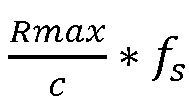
- According to this embodiment, the delay np for a synthesis monopole indexed p is corresponding to the propagation time of sound for the Euclidean distance r = Rp0 = |rp - ro| between the target monopole ro and the generator rp. For the synthesis of focused sound sources, the delays are inverted (negative value for np ). Since this result in a non-causal system, in practice this is realized by using a buffered solution, where the buffer size is chosen to cover the assumed range of delays necessary to place the source inside of the speakers' area. For example, if the maximum distance from a speaker to the focused source is Rmax, the buffer size should be an integer value Nmax =
- Further, according to this embodiment, the amplification factor

- In alternative embodiments of the system, the modified amplification factor according to equation (118) of
US 2016/0037282 A1 can be used. - In yet alternative embodiments of the system, a mapping factor as described with regard to Fig. 9 of
US 2016/0037282 A1 can be used to modify the amplification. - It should be recognized that the embodiments describe methods with an exemplary ordering of method steps. The specific ordering of method steps is, however, given for illustrative purposes only and should not be construed as binding.
- It should also be noted that the division of the control or circuitry of
Figs. 1 and7 into units is only made for illustration purposes and that the present disclosure is not limited to any specific division of functions in specific units. For instance, at least parts of the circuitry could be implemented by a respectively programmed processor, field programmable gate array (FPGA), dedicated circuits, and the like. - All units and entities described in this specification and claimed in the appended claims can, if not stated otherwise, be implemented as integrated circuit logic, for example, on a chip, and functionality provided by such units and entities can, if not stated otherwise, be implemented by software.
- In so far as the embodiments of the disclosure described above are implemented, at least in part, using software-controlled data processing apparatus, it will be appreciated that a computer program providing such software control and a transmission, storage or other medium by which such a computer program is provided are envisaged as aspects of the present disclosure.
Claims (15)
- An apparatus comprising circuitry configured togenerate one or more focused sound sources as virtual loudspeakers of an announcement system, the one or more focused sound sources being generated by a plurality of loudspeakers of the apparatus distributed over a predefined space;apply image recognition techniques to images obtained by a camera array of the apparatus distributed over the predefined space to obtain positions of at least one person in the predefined space;characterised in that the circuitry is configured to:calculate a trajectory representing the path that the at least one person should take to arrive at a predefined destination based on the current position of the at least one person in the predefined space and based on the predefined position of the destination in the predefined space, andgenerate a focused sound source of the one or more focused sound sources at a position on the calculated trajectory close to the at least one person.
- The apparatus of claim 1, wherein the announcement system is a public announcement system.
- The apparatus of claim 1, further comprising one or more video cameras that are distributed over the predefined space.
- The apparatus of claim 1, wherein the circuitry is configured to use Wavefield synthesis and/or monopole synthesis techniques to generate the focused sound sources.
- The apparatus of claim 1, wherein the circuitry is configured to generate a focused sound source that is located at a predefined position of the predefined space.
- The apparatus of claim 1, wherein the circuitry is configured to generate one or more audio messages at the focused sound sources, or wherein a focused sound source is a sound field that gives the impression that an audio point source is located at a specific position in the predefined space.
- The apparatus of claim 1, wherein the circuitry is configured to generate one or more focused sound sources that generate audio messages that are spatially confined by being located at a specific position in the predefined space, or wherein the circuitry is configured to generate multiple focused sound sources that are combined to form arbitrarily shaped sound source areas.
- The apparatus of claim 7, wherein the circuitry is configured to generate a focused sound source that generates an audio message to direct a person to a specific position of the predefined space, or wherein the circuitry is configured to generate a focused sound source that is located in close proximity to an exit.
- The apparatus of claim 1, wherein the circuitry is configured to generate person-individual focused sound sources, wherein each individually focused sound source is generated for each of a plurality of persons, and in particular, wherein the circuitry is configured to use different voice characters for different person-individual focused sound sources, wherein each person-individual focused sound source is emitted for an individual person.
- The apparatus of claim 1, wherein the circuitry is configured to adapt the loudness of an audio message so that the audio message is primarily audible for a specific individual who is located close to a focused sound source, but less audible or substantially inaudible for other persons who are located farther away from the focused sound source.
- The apparatus of claim 1, wherein the circuitry is configured to generate for each of a plurality of persons a person focused sound source or wherein the circuitry is configured to generate a focused sound source that is moving.
- The apparatus of claim 1, wherein the circuitry is configured to generate multiple focused sound sources for emitting multiple audio messages at the same time, or wherein the circuitry is configured to generate multiple audio messages at the same time that are used to address a person or a group of persons simultaneously with different messages, or wherein the circuitry is configured to generate one or more audio messages, each audio message depending on a location of a person, a destination of the person, and/or person-specific information of the person.
- A public announcement system comprising the apparatus of claim 1.
- A method comprisinggenerating one or more focused sound sources as virtual loudspeakers of an announcement system, the one or more focused sound sources being generated by a plurality of loudspeakers distributed over a predefined space;applying image recognition techniques to images obtained by a camera array distributed over the predefined space to obtain positions of at least one person in the predefined space;characterised by:calculating a trajectory representing the path that the at least one person should take to arrive at a predefined destination based on the current position of the at least one person in the predefined space and based on the predefined position of the destination in the predefined space, andgenerating a focused sound source of the one or more focused sound sources at a position on the calculated trajectory close to the at least one person.
- A computer program comprising instructions which, when the program is executed by a computer, cause the computer to carry out the method of claim 14.
Applications Claiming Priority (2)
| Application Number | Priority Date | Filing Date | Title |
|---|---|---|---|
| EP17177260 | 2017-06-21 | ||
| PCT/EP2018/066592 WO2018234456A1 (en) | 2017-06-21 | 2018-06-21 | Apparatus, system, method and computer program for distributing announcement messages |
Publications (2)
| Publication Number | Publication Date |
|---|---|
| EP3643082A1 EP3643082A1 (en) | 2020-04-29 |
| EP3643082B1 true EP3643082B1 (en) | 2025-05-14 |
Family
ID=59215538
Family Applications (1)
| Application Number | Title | Priority Date | Filing Date |
|---|---|---|---|
| EP18731128.7A Active EP3643082B1 (en) | 2017-06-21 | 2018-06-21 | Apparatus, system, method and computer program for distributing announcement messages |
Country Status (3)
| Country | Link |
|---|---|
| US (1) | US11082792B2 (en) |
| EP (1) | EP3643082B1 (en) |
| WO (1) | WO2018234456A1 (en) |
Families Citing this family (3)
| Publication number | Priority date | Publication date | Assignee | Title |
|---|---|---|---|---|
| JP7234555B2 (en) | 2018-09-26 | 2023-03-08 | ソニーグループ株式会社 | Information processing device, information processing method, program, information processing system |
| US20200294372A1 (en) * | 2019-03-11 | 2020-09-17 | United Data Technologies, Inc. Dba Udt | System integrating disparate emergency detection and response capabilities |
| EP3980891A4 (en) | 2019-06-10 | 2023-06-28 | Conquest Technology Services Corp | Software application for continually assessing, processing, and remediating cyber-risk in real time |
Citations (2)
| Publication number | Priority date | Publication date | Assignee | Title |
|---|---|---|---|---|
| US20040030491A1 (en) * | 2002-08-06 | 2004-02-12 | Hewlett-Packard Development Company, L.P. | Method and arrangement for guiding a user along a target path |
| US20040137911A1 (en) * | 2002-08-06 | 2004-07-15 | Richard Hull | Method and apparatus for providing information about a real-world space |
Family Cites Families (17)
| Publication number | Priority date | Publication date | Assignee | Title |
|---|---|---|---|---|
| DE19726176C1 (en) | 1997-06-20 | 1999-01-21 | D & B Audiotechnik Ag | Method and device for operating a sound system |
| JP2002354573A (en) | 2001-05-23 | 2002-12-06 | Mitsubishi Electric Engineering Co Ltd | Super-directive speaker device |
| DE10328335B4 (en) | 2003-06-24 | 2005-07-21 | Fraunhofer-Gesellschaft zur Förderung der angewandten Forschung e.V. | Wavefield syntactic device and method for driving an array of loud speakers |
| US8126159B2 (en) * | 2005-05-17 | 2012-02-28 | Continental Automotive Gmbh | System and method for creating personalized sound zones |
| AU2007252847A1 (en) | 2006-05-22 | 2007-11-29 | Audio Pixels Ltd. | Direct digital speaker apparatus having a desired directivity pattern |
| DE102007032272B8 (en) | 2007-07-11 | 2014-12-18 | Institut für Rundfunktechnik GmbH | A method of simulating headphone reproduction of audio signals through multiple focused sound sources |
| US8229131B2 (en) | 2007-10-04 | 2012-07-24 | Honeywell International Inc. | Systems and methods for delivering directional audio and personalized emergency alerts via addressable speakers |
| WO2009124773A1 (en) | 2008-04-09 | 2009-10-15 | Fraunhofer-Gesellschaft zur Förderung der angewandten Forschung e.V. | Sound reproduction system and method for performing a sound reproduction using a visual face tracking |
| US20110096941A1 (en) | 2009-10-28 | 2011-04-28 | Alcatel-Lucent Usa, Incorporated | Self-steering directional loudspeakers and a method of operation thereof |
| EP2749843A1 (en) * | 2012-12-28 | 2014-07-02 | GN Store Nord A/S | Method for filtering and selecting geographical points of interest and mobile unit corresponding thereto |
| US11022456B2 (en) * | 2013-07-25 | 2021-06-01 | Nokia Technologies Oy | Method of audio processing and audio processing apparatus |
| US9749769B2 (en) | 2014-07-30 | 2017-08-29 | Sony Corporation | Method, device and system |
| US9977573B2 (en) * | 2014-10-31 | 2018-05-22 | Microsoft Technology Licensing, Llc | Facilitating interaction between users and their environments using a headset having input mechanisms |
| US9854376B2 (en) | 2015-07-06 | 2017-12-26 | Bose Corporation | Simulating acoustic output at a location corresponding to source position data |
| JPWO2017061218A1 (en) * | 2015-10-09 | 2018-07-26 | ソニー株式会社 | SOUND OUTPUT DEVICE, SOUND GENERATION METHOD, AND PROGRAM |
| DE102017207581A1 (en) * | 2017-05-05 | 2018-11-08 | Sivantos Pte. Ltd. | Hearing system and hearing device |
| US10251013B2 (en) * | 2017-06-08 | 2019-04-02 | Microsoft Technology Licensing, Llc | Audio propagation in a virtual environment |
-
2018
- 2018-06-21 US US16/623,780 patent/US11082792B2/en active Active
- 2018-06-21 WO PCT/EP2018/066592 patent/WO2018234456A1/en not_active Ceased
- 2018-06-21 EP EP18731128.7A patent/EP3643082B1/en active Active
Patent Citations (2)
| Publication number | Priority date | Publication date | Assignee | Title |
|---|---|---|---|---|
| US20040030491A1 (en) * | 2002-08-06 | 2004-02-12 | Hewlett-Packard Development Company, L.P. | Method and arrangement for guiding a user along a target path |
| US20040137911A1 (en) * | 2002-08-06 | 2004-07-15 | Richard Hull | Method and apparatus for providing information about a real-world space |
Also Published As
| Publication number | Publication date |
|---|---|
| EP3643082A1 (en) | 2020-04-29 |
| WO2018234456A1 (en) | 2018-12-27 |
| US20200145775A1 (en) | 2020-05-07 |
| US11082792B2 (en) | 2021-08-03 |
Similar Documents
| Publication | Publication Date | Title |
|---|---|---|
| EP3643082B1 (en) | Apparatus, system, method and computer program for distributing announcement messages | |
| EP2737727B1 (en) | Method and apparatus for processing audio signals | |
| EP2320676A1 (en) | Method, communication device and communication system for controlling sound focusing | |
| JP2022544138A (en) | Systems and methods for assisting selective listening | |
| US20130089213A1 (en) | Distributed emitter voice lift system | |
| Ogami et al. | Virtual sound source construction based on radiation direction control using multiple parametric array loudspeakers | |
| Sodnik et al. | Spatial auditory human-computer interfaces | |
| Kim et al. | Improved binaural sound localization and tracking for unknown time-varying number of speakers | |
| Kojima et al. | HARK-Bird-Box: A portable real-time bird song scene analysis system | |
| Miura et al. | SLAM-based online calibration for asynchronous microphone array | |
| Begault et al. | Applying spatial audio to human interfaces: 25 years of NASA experience | |
| JP2005159446A (en) | Directional acoustic system | |
| US20170076708A1 (en) | Steerable Loudspeaker System for Individualized Sound Masking | |
| Boothroyd | Characteristics of listening environments: Benefits of binaural hearing and implications for bilateral management: Características del ambiente sonoro: beneficios de la audición binaural y sus implicaciones en el control bilateral | |
| US11159883B2 (en) | Method for adjusting listener location and head orientation within a physical or virtual space | |
| Bando et al. | Posture estimation of hose-shaped robot by using active microphone array | |
| Kim et al. | Ultrasonic sound guide system with eyeglass device for the visually impaired | |
| JP7078039B2 (en) | Signal processing equipment and methods, as well as programs | |
| CN115834775A (en) | Online call management device and storage medium storing online call management program | |
| US12256202B2 (en) | Stereo enhancement system and stereo enhancement method | |
| Schlienger et al. | Immersive Spatial Interactivity in Sonic Arts: The Acoustic Localization Positioning System | |
| Lindstrom et al. | Bio-acoustic Monitoring by Lighter-Than-Air Unmanned Aerial Vehicles | |
| Moriga et al. | Auditory lateralization steering independent of loudspeaker position using sound from ultrasound | |
| JP7705228B2 (en) | Sound field reproduction program, device and method using position information of sound source and sound receiver | |
| Meyer et al. | Sound Source Localization and Tracking for the@ Home Service Robot |
Legal Events
| Date | Code | Title | Description |
|---|---|---|---|
| STAA | Information on the status of an ep patent application or granted ep patent |
Free format text: STATUS: UNKNOWN |
|
| STAA | Information on the status of an ep patent application or granted ep patent |
Free format text: STATUS: THE INTERNATIONAL PUBLICATION HAS BEEN MADE |
|
| PUAI | Public reference made under article 153(3) epc to a published international application that has entered the european phase |
Free format text: ORIGINAL CODE: 0009012 |
|
| STAA | Information on the status of an ep patent application or granted ep patent |
Free format text: STATUS: REQUEST FOR EXAMINATION WAS MADE |
|
| 17P | Request for examination filed |
Effective date: 20200121 |
|
| AK | Designated contracting states |
Kind code of ref document: A1 Designated state(s): AL AT BE BG CH CY CZ DE DK EE ES FI FR GB GR HR HU IE IS IT LI LT LU LV MC MK MT NL NO PL PT RO RS SE SI SK SM TR |
|
| AX | Request for extension of the european patent |
Extension state: BA ME |
|
| DAV | Request for validation of the european patent (deleted) | ||
| DAX | Request for extension of the european patent (deleted) | ||
| RAP3 | Party data changed (applicant data changed or rights of an application transferred) |
Owner name: SONY GROUP CORPORATION Owner name: SONY EUROPE LIMITED |
|
| STAA | Information on the status of an ep patent application or granted ep patent |
Free format text: STATUS: EXAMINATION IS IN PROGRESS |
|
| 17Q | First examination report despatched |
Effective date: 20211018 |
|
| GRAP | Despatch of communication of intention to grant a patent |
Free format text: ORIGINAL CODE: EPIDOSNIGR1 |
|
| STAA | Information on the status of an ep patent application or granted ep patent |
Free format text: STATUS: GRANT OF PATENT IS INTENDED |
|
| INTG | Intention to grant announced |
Effective date: 20241211 |
|
| GRAS | Grant fee paid |
Free format text: ORIGINAL CODE: EPIDOSNIGR3 |
|
| GRAA | (expected) grant |
Free format text: ORIGINAL CODE: 0009210 |
|
| STAA | Information on the status of an ep patent application or granted ep patent |
Free format text: STATUS: THE PATENT HAS BEEN GRANTED |
|
| P01 | Opt-out of the competence of the unified patent court (upc) registered |
Free format text: CASE NUMBER: APP_13611/2025 Effective date: 20250319 |
|
| AK | Designated contracting states |
Kind code of ref document: B1 Designated state(s): AL AT BE BG CH CY CZ DE DK EE ES FI FR GB GR HR HU IE IS IT LI LT LU LV MC MK MT NL NO PL PT RO RS SE SI SK SM TR |
|
| REG | Reference to a national code |
Ref country code: GB Ref legal event code: FG4D |
|
| REG | Reference to a national code |
Ref country code: CH Ref legal event code: EP |
|
| REG | Reference to a national code |
Ref country code: DE Ref legal event code: R096 Ref document number: 602018081908 Country of ref document: DE |
|
| REG | Reference to a national code |
Ref country code: IE Ref legal event code: FG4D |
|
| PGFP | Annual fee paid to national office [announced via postgrant information from national office to epo] |
Ref country code: DE Payment date: 20250620 Year of fee payment: 8 |
|
| PGFP | Annual fee paid to national office [announced via postgrant information from national office to epo] |
Ref country code: GB Payment date: 20250619 Year of fee payment: 8 |
|
| REG | Reference to a national code |
Ref country code: NL Ref legal event code: MP Effective date: 20250514 |
|
| PG25 | Lapsed in a contracting state [announced via postgrant information from national office to epo] |
Ref country code: PT Free format text: LAPSE BECAUSE OF FAILURE TO SUBMIT A TRANSLATION OF THE DESCRIPTION OR TO PAY THE FEE WITHIN THE PRESCRIBED TIME-LIMIT Effective date: 20250915 Ref country code: FI Free format text: LAPSE BECAUSE OF FAILURE TO SUBMIT A TRANSLATION OF THE DESCRIPTION OR TO PAY THE FEE WITHIN THE PRESCRIBED TIME-LIMIT Effective date: 20250514 Ref country code: ES Free format text: LAPSE BECAUSE OF FAILURE TO SUBMIT A TRANSLATION OF THE DESCRIPTION OR TO PAY THE FEE WITHIN THE PRESCRIBED TIME-LIMIT Effective date: 20250514 |
|
| REG | Reference to a national code |
Ref country code: LT Ref legal event code: MG9D |
|
| PG25 | Lapsed in a contracting state [announced via postgrant information from national office to epo] |
Ref country code: GR Free format text: LAPSE BECAUSE OF FAILURE TO SUBMIT A TRANSLATION OF THE DESCRIPTION OR TO PAY THE FEE WITHIN THE PRESCRIBED TIME-LIMIT Effective date: 20250815 Ref country code: NO Free format text: LAPSE BECAUSE OF FAILURE TO SUBMIT A TRANSLATION OF THE DESCRIPTION OR TO PAY THE FEE WITHIN THE PRESCRIBED TIME-LIMIT Effective date: 20250814 |
|
| PG25 | Lapsed in a contracting state [announced via postgrant information from national office to epo] |
Ref country code: NL Free format text: LAPSE BECAUSE OF FAILURE TO SUBMIT A TRANSLATION OF THE DESCRIPTION OR TO PAY THE FEE WITHIN THE PRESCRIBED TIME-LIMIT Effective date: 20250514 Ref country code: PL Free format text: LAPSE BECAUSE OF FAILURE TO SUBMIT A TRANSLATION OF THE DESCRIPTION OR TO PAY THE FEE WITHIN THE PRESCRIBED TIME-LIMIT Effective date: 20250514 |
|
| REG | Reference to a national code |
Ref country code: AT Ref legal event code: MK05 Ref document number: 1795839 Country of ref document: AT Kind code of ref document: T Effective date: 20250514 |
|
| PG25 | Lapsed in a contracting state [announced via postgrant information from national office to epo] |
Ref country code: BG Free format text: LAPSE BECAUSE OF FAILURE TO SUBMIT A TRANSLATION OF THE DESCRIPTION OR TO PAY THE FEE WITHIN THE PRESCRIBED TIME-LIMIT Effective date: 20250514 |
|
| PG25 | Lapsed in a contracting state [announced via postgrant information from national office to epo] |
Ref country code: HR Free format text: LAPSE BECAUSE OF FAILURE TO SUBMIT A TRANSLATION OF THE DESCRIPTION OR TO PAY THE FEE WITHIN THE PRESCRIBED TIME-LIMIT Effective date: 20250514 |
|
| PG25 | Lapsed in a contracting state [announced via postgrant information from national office to epo] |
Ref country code: AT Free format text: LAPSE BECAUSE OF FAILURE TO SUBMIT A TRANSLATION OF THE DESCRIPTION OR TO PAY THE FEE WITHIN THE PRESCRIBED TIME-LIMIT Effective date: 20250514 |
|
| PG25 | Lapsed in a contracting state [announced via postgrant information from national office to epo] |
Ref country code: RS Free format text: LAPSE BECAUSE OF FAILURE TO SUBMIT A TRANSLATION OF THE DESCRIPTION OR TO PAY THE FEE WITHIN THE PRESCRIBED TIME-LIMIT Effective date: 20250814 |
|
| PG25 | Lapsed in a contracting state [announced via postgrant information from national office to epo] |
Ref country code: IS Free format text: LAPSE BECAUSE OF FAILURE TO SUBMIT A TRANSLATION OF THE DESCRIPTION OR TO PAY THE FEE WITHIN THE PRESCRIBED TIME-LIMIT Effective date: 20250914 |
|
| PG25 | Lapsed in a contracting state [announced via postgrant information from national office to epo] |
Ref country code: LV Free format text: LAPSE BECAUSE OF FAILURE TO SUBMIT A TRANSLATION OF THE DESCRIPTION OR TO PAY THE FEE WITHIN THE PRESCRIBED TIME-LIMIT Effective date: 20250514 |
|
| PG25 | Lapsed in a contracting state [announced via postgrant information from national office to epo] |
Ref country code: DK Free format text: LAPSE BECAUSE OF FAILURE TO SUBMIT A TRANSLATION OF THE DESCRIPTION OR TO PAY THE FEE WITHIN THE PRESCRIBED TIME-LIMIT Effective date: 20250514 Ref country code: SM Free format text: LAPSE BECAUSE OF FAILURE TO SUBMIT A TRANSLATION OF THE DESCRIPTION OR TO PAY THE FEE WITHIN THE PRESCRIBED TIME-LIMIT Effective date: 20250514 |
|
| PG25 | Lapsed in a contracting state [announced via postgrant information from national office to epo] |
Ref country code: CZ Free format text: LAPSE BECAUSE OF FAILURE TO SUBMIT A TRANSLATION OF THE DESCRIPTION OR TO PAY THE FEE WITHIN THE PRESCRIBED TIME-LIMIT Effective date: 20250514 |
|
| PG25 | Lapsed in a contracting state [announced via postgrant information from national office to epo] |
Ref country code: EE Free format text: LAPSE BECAUSE OF FAILURE TO SUBMIT A TRANSLATION OF THE DESCRIPTION OR TO PAY THE FEE WITHIN THE PRESCRIBED TIME-LIMIT Effective date: 20250514 |
|
| PG25 | Lapsed in a contracting state [announced via postgrant information from national office to epo] |
Ref country code: SK Free format text: LAPSE BECAUSE OF FAILURE TO SUBMIT A TRANSLATION OF THE DESCRIPTION OR TO PAY THE FEE WITHIN THE PRESCRIBED TIME-LIMIT Effective date: 20250514 Ref country code: RO Free format text: LAPSE BECAUSE OF FAILURE TO SUBMIT A TRANSLATION OF THE DESCRIPTION OR TO PAY THE FEE WITHIN THE PRESCRIBED TIME-LIMIT Effective date: 20250514 |
|
| REG | Reference to a national code |
Ref country code: CH Ref legal event code: H13 Free format text: ST27 STATUS EVENT CODE: U-0-0-H10-H13 (AS PROVIDED BY THE NATIONAL OFFICE) Effective date: 20260127 |
|
| PG25 | Lapsed in a contracting state [announced via postgrant information from national office to epo] |
Ref country code: IT Free format text: LAPSE BECAUSE OF FAILURE TO SUBMIT A TRANSLATION OF THE DESCRIPTION OR TO PAY THE FEE WITHIN THE PRESCRIBED TIME-LIMIT Effective date: 20250514 |
|
| PG25 | Lapsed in a contracting state [announced via postgrant information from national office to epo] |
Ref country code: LU Free format text: LAPSE BECAUSE OF NON-PAYMENT OF DUE FEES Effective date: 20250621 |
|
| REG | Reference to a national code |
Ref country code: DE Ref legal event code: R097 Ref document number: 602018081908 Country of ref document: DE |
|
| PG25 | Lapsed in a contracting state [announced via postgrant information from national office to epo] |
Ref country code: MC Free format text: LAPSE BECAUSE OF FAILURE TO SUBMIT A TRANSLATION OF THE DESCRIPTION OR TO PAY THE FEE WITHIN THE PRESCRIBED TIME-LIMIT Effective date: 20250514 |
|
| REG | Reference to a national code |
Ref country code: BE Ref legal event code: MM Effective date: 20250630 |
|
| PLBE | No opposition filed within time limit |
Free format text: ORIGINAL CODE: 0009261 |
|
| STAA | Information on the status of an ep patent application or granted ep patent |
Free format text: STATUS: NO OPPOSITION FILED WITHIN TIME LIMIT |
|
| REG | Reference to a national code |
Ref country code: CH Ref legal event code: L10 Free format text: ST27 STATUS EVENT CODE: U-0-0-L10-L00 (AS PROVIDED BY THE NATIONAL OFFICE) Effective date: 20260325 |
|
| PG25 | Lapsed in a contracting state [announced via postgrant information from national office to epo] |
Ref country code: IE Free format text: LAPSE BECAUSE OF NON-PAYMENT OF DUE FEES Effective date: 20250621 |
|
| PG25 | Lapsed in a contracting state [announced via postgrant information from national office to epo] |
Ref country code: BE Free format text: LAPSE BECAUSE OF NON-PAYMENT OF DUE FEES Effective date: 20250630 |
|
| PG25 | Lapsed in a contracting state [announced via postgrant information from national office to epo] |
Ref country code: FR Free format text: LAPSE BECAUSE OF NON-PAYMENT OF DUE FEES Effective date: 20250714 |
|
| 26N | No opposition filed |
Effective date: 20260217 |
|
| PG25 | Lapsed in a contracting state [announced via postgrant information from national office to epo] |
Ref country code: CH Free format text: LAPSE BECAUSE OF NON-PAYMENT OF DUE FEES Effective date: 20250630 |